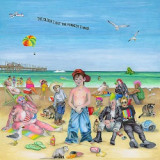
In the summer of 2000, school friends Mark Lawton, Jon Pearce and Jamie Lenman won a battle-of-the-bands competition and used the prize money to record the five tracks that would become their first professional release, entitled Pilot. Then called Angel, before the EP was released on local label Badmusic they changed their name to Reuben and were over the moon when the record received notices in Kerrang and even a spin from Steve Lamacq on Radio One. “We were just a school band, but we definitely had grand plans,” says Lenman, now a successful solo artist in his own right. “We changed our name because we knew we’d have to do it at some point, and we didn’t want the EP to get forgotten.” Despite selling out several modest runs on CD, Pilot was never issued on vinyl, and so to celebrate the 21st anniversary of its release, the five original tracks have been re-mastered and pressed onto wax. But more than this – after a chance discovery of five extra tracks on a DAT tape in a loft, Pilot has been bumped up to album status with the inclusion of a second side. “I always thought we’d only recorded those five tracks before Mark left – I’d completely forgotten about the recordings from the end of the same year,” says Lenman. “They were just demos of new material, they were never meant to be packaged together with the tracks from Pilot – in fact, you can already hear how the sound was starting to change in just six months. But they do make a nice set, and I guess if that original line up of the band had made a full album before Racecar, this is maybe what it might have sounded like.” The album inlay itself boasts a hoard of unseen photos from both recording sessions, unearthed after two decades, as well as the original EP inlay and the unused cover art credited to Angel instead of Reuben – hence Pilot Angel.
Suche:same
Formed in 2005 in Sundsvall, Sweden, Technical Metal Masters SOREPTION are known for their razor-sharp technical riffs, schizophrenic time signatures topped with catchy chugging grooves and intense vocals. From this they have created their signature sound, not yet replicated by any other modern band, with a strong following to back. The band’s debut full-length Deterioration Of Minds brought major attention to the band as a formidable force in the genre. Deterioration Of Minds was released by Ninetone Records in 2010 and was rereleased by Unique Leader Records in 2014, and their follow-up punishing album “Engineering the Void” was released February 2014 also on Unique Leader Records to critical acclaim. 2015 saw SOREPTION take their technical prowess to the masses, with tours supporting extreme metal machine Cryptopsy, tech-death masters Origin, and the legendary death metal giant Cannibal Corpse. Following the on-road success, the industry and fans sat up and took notice, resulting in the band signing with Sumerian Records in 2018 releasing their next full-length “Monument of the End in the late summer of that same year. The album highlighted the growth of the outfit and continued razor-sharp precision that SOREPTION has become known for. Prior to the release of “Monument of the End” the band earned a spot on the 2018 edition of The Summer Slaughter Tour and followed it up with a support slot for Revocation on “The Outer Ones Global Invasion Part II” European Tour, solidifying them again as a live force to be reckoned with. When the world was shuttered from a worldwide pandemic, SOREPTION saw this as an opportunity to shift gears, refocus their tech machine and set out to create an album that is the natural continuation of ‘Monument of the End’, both musically and concept-wise. 2022 sees the return of SOREPTION to Unique Leader Records with the highly anticipated new album “Jord”, mixed and mastered by Buster Odeholm and featuring artwork by Caelan Stokkerman who handled artistic duties on their previous releases.
At any given time, you’re likely to find Jim Lauderdale making music, whether he’s laying down a new track in the studio or working through a spontaneous melody at his home in Nashville. And if he’s not actively crafting new music, he’s certainly thinking about it. “It's a constant challenge to try to keep making better and better records, write better and better songs. I still always feel like I'm a developing artist,” he says. This may be a surprising sentiment from a man who’s won two Grammys, released 34 full-length albums, and taken home the Americana Music Association’s coveted Wagonmaster Award. But forthcoming album Game Changer is convincing evidence that the North Carolina native is only continuing to hone his craft. Operating under his own label, Sky Crunch Records, for the first time since 2016, Lauderdale recorded Game Changer at the renowned Blackbird Studios in Nashville, co-producing the release with Jay Weaver and pulling from songs he’d written over the last several years. “There's a mixture on this record of uplifting songs and, at the same time, songs of heartbreak and despair—because that's part of life as well,” he says. “In the country song world especially, that's always been part of it. That’s real life.” Lauderdale would know: He’s been a vital part of the country music ecosystem since 1991, when he released his debut album and began penning songs for an impressively long roster of country music greats. “When I was a teenager wanting to be a bluegrass banjo player, I never would have imagined that I would get to work with people like Ralph Stanley and Robert Hunter and George Jones and Elvis Costello and John Oates,” he muses. “Getting to work with them inspires me greatly to this day, and I know it always will.” From rollicking guitar riffs on “That Kind of Life (That Kind of Day)” to the slow, sweet harmonies of “I’ll Keep My Heart Open For You,” Game Changer shows off Lauderdale’s ingenuity as a singer, songwriter, and producer—while reestablishing him as one of Americana’s most steadfast champions..”
Since the late sixties Lee Fields has amassed a prolific catalog and has played and toured with such legends as Kool and the Gang, Sammy Gordon and the Hip-Huggers, O.V Wright, and many more. With a career spanning 43 years, it s mind-blowing that the music he s making today with Brooklyn s Truth & Soul Records is the best of his career. While drawing comparisons to The Moments, The Delfonics, The Stylistics, and of course James Brown, Faithful Man is able to create a space of it s own due to the group s desire to interpret and further the formulas of good soul music rather then imitate them. Chalk that up to Truth & Soul producers and co-owners Jeff Silverman and Leon Michels. These are the same individuals that co-wrote, produced, and played on Aloe Blacc s global smash I Need A Dollar, and have provided the back drop for records by Adele, Ghostface Killah, and Jay-Z to name a few. The older Fields becomes, the closer he gets to perfecting the sound of soul said DJ Oliver Wang about Fields in an NPR feature. Faithful Man is the next step towards perfection. A step that will find Lee Fields & The Expressions finally being bestowed the contemporary soul music crown.
- A1: Dua Lipa - Be The One
- A2: Avicii - Hey Brother
- A3: James Bay - Hold Back The River
- A4: Jessie J - Price Tag
- A5: Niall Horan - Slow Hands
- A6: Dermot Kennedy - Power Over Me
- A7: Years & Years - King
- B1: Katy Perry - Roar
- B2: Sheppard - Geronimo
- B3: Of Monsters & Men - Little Talks
- B4: The Weeknd - Starboy
- B5: Scouting For Girls - This Ain't A Love Song
- B6: Neon Trees - Animal
- B7: Lana Del Rey - Blue Velvet
- C1: Miley Cyrus - Malibu
- C2: Axwell & Ingrosso - More Than You Know
- C3: Dnce - Cake By The Ocean
- C4: Lorde - Royals
- C5: Mike Posner - I Took A Pill In Ibiza (Seeb Remix)
- C6: Ellie Goulding - Love Me Like You Do
- C7: Hozier - Take Me To Church
- D1: Bruno Mars - Locked Out Of Heaven
- D2: Icona Pop - I Love It
- D3: Tom Walker - Leave A Light On
- D8: The Teskey Brothers - Hold Me
- D4: American Authors - Best Day Of My Life
- D5: Tove Lo - Stay High (Feat Hippie Sabotage - Habits Remix)
- D6: Sam Smith - Stay With Me
- D7: Bastille - Pompeii
The Decades Collected compilations are part of the new Collected compilation series, which is a collaboration between Universal Music and Music On Vinyl. The compilations bring together the biggest names of each decade, combined with forgotten hits and less discovered gems, giving the listener an experience of listening to their favorite tunes while uncovering new musical grounds at the same time.
Various Artists - Tens Collected features Sam Smith “Stay With Me”, Lorde “Royals”, The Weeknd “Starboy”, Dua Lipa “Be The One”, Niall Horan “Slow Hands” and Ellie Goulding “Love Me Like You Do” amongst others.
reissue with original artwork!
Todd Terje's 2012 EP It's the Arps rumbled the floors of warehouse parties and hedonistic sleepovers alike with lead single 'Inspector Norse' leading the vanguard of electro fun.
Please welcome: It's The Arps! Oslo's magic music maker Todd Terje has already gained a wunderkind like reputation for his gentle yet potent productions (we won't mention the 'E' word here) on labels like Full Pupp, Permanent Vacation and Running Back on top of being one of the best remixers money can buy (Shit Robot, Bryan Ferry, Dølle Jllle etc etc). What is there left for him to do Establish a label of his own! 'It's The Arps' is the starting signal for Olsen. And what a splendid one it is. Created from scratch and solely on the mythical synthesizer ARP 2600, it features four tracks (reads instant classics) that couldn't be a better follow-up to his 2011 super hit EP 'Ragysh'. Towering over the assortment is the laser crime scene called 'Inspector Norse'. Defying genres and blinkers, this is finest goose bumps dance music that makes you whistle along, laughing and crying all at the same time - but the rest isn't half bad either. The short, but sweet 'Myggsommer' gives away Terje's secret love for quirky exotika, whereas 'Swing Star Pt 1' and its brother have a (balearic) brilliance and witchery to them that is rarely found nowadays. Released on Olsen Records and housed in a beautiful sleeve courtesy of Bendik Kaltenborn. 100% Arp 2600 and 200% Todd Terje.
- A1: Enslaved - Eon
- A2: Mono - Er Eb Os
- A3: Ihsahn - Dark Awakening
- B1: Jo Quail - Prime
- B2: Bohren & Der Club Of Gore - Plateau
- C1: Hackedepicciotto - Trinity Past
- C2: Ulver - Godeater
- D1: Jonas Renkse - Er Eb Os
- D2: Zola Jesus - Prime
- D3: Spotlights - Of Eons
- E1: The Ocean - Primal (State Of Being) (State Of Being)
- E2: Crown - Element
- E3: Jaye Jayle - Er Eb Es
- F1: Godflesh - Ashen
- F2: Steve Von Till Aka Harvestman - Testament
- F3: Arabrot - The Last Days (See The Light) (See The Light)
The Others (Lustmord Deconstructed) is a celebration of the fearless attitude of being different and the expression of unique ideas which have never existed before. Over 13 years after the release of O T H E R , Pelagic Records has gathered 16 bands and solo artists to record their own unique takes on tracks from the Other-sessions. The result is an album that is more than a compilation, and more than the sum of its parts; covering a wide range of musical niches and directions, but sharing the same underlying mood and vibe defined by Lustmord's timeless soundscapes: from the ambient solo performances provided by IHSAHN, ENSLAVED or JONAS RENKSE to the subdued voice of ZOLA JESUS woven into Lustmord's sombre fabric to the industrial carnage that is GODFLESH's version of `Ashen'. LUSTMORD is the artistic moniker of Brian Williams. Born in North Wales, he started his musical career in 1980 and soon became a pioneer in the early industrial music scene in the UK. He was a former member of SPK during arguably their most crucial era, and went on to work with THROBBING GRISTLE members Chris & Cosey as well as appearing on early albums by CURRENT 93, NURSE WITH WOUND and others. After relocating to Los Angeles in 1993, Williams worked on dozens of motion picture soundtracks including The Crow, Underworld and Paul Schrader's First Reformed. Additionally he created several video game soundtracks, television scores and solo albums, as well as collaborating with artists as varied as THE MELVINS, CLOCK DVA, JARBOE, John Balance of COIL, Paul Haslinger (TANGERINE DREAM), PUSCIFER, Wes Borland and more, including Grammy Award-winners TOOL on their much acclaimed effort Fear Inoculum. To this day, Lustmord is actively recording and releasing music, his latest release being the collaborative album Alter with Karin Park of A°RABROT, and he is considered to be the founding father of the dark ambient music genre. The original O T H E R was released by independent record label Hydra Head Records, founded by ISIS frontman Aaron Turner and former home of bands such as CONVERGE, PELICAN, JESU, SUN O))) or BORIS. As one journalist put it at the time, O T H E R is a "grim example of a consummate artist who is working frmly within the parameters that he has laid out for himself over the years." This album shows Lustmord at his most characteristic, and the icy, ominous guitar playing of Jones, Turner and Ozborne resonates perfectly within the deep soundscapes that make up this frightening yet inspiring journey. What demonstrates the profound influence of Lustmord on this contemporary music underground showcased here is that artists from disparate ends of the sonic spectrum all feel inspired to explore the essence of his idiosyncratic sounds within their own realm: experimental electronica icons ULVER excel on a stunning, hazy rendition of `Godeater', while Japanese post-rock act MONO deliver a crushing version of `Er Eb Os', and THE OCEAN take us on a cathartically heavy mindtrip back to our `Primal State of Being'. In the end, each of these 16 artists delivers an interpretation that pays the deepest respect to this pivotal artist, while also standing out as a new track of its own.
A true love letter to house music, Larson presents his account of the ubiquitous dance music genre diving deep into its origins. Connecting the dots with some of the genre’s most beloved innovators such as Larry Heard, Boo Williams, Ron Trent, Chez Damier or Chris Brann, the Belgian producer pays tribute by adding his own emphases. Setting a bright mood, at times aiming for the dance floor, at others comforting the listener into a casual vibe, Larson is not seeking, but spontaneously drawing attention with his graceful sounds, stripped to the bone and built on an intuitive factor.
Larson hails from Liège, the South Belgian city known for its meat balls and the mighty river La Meuse, and works as a sound editor in movie production. Recognised by those-who-know as one of the most quintessential figures of Liège’s burgeoning underground nightlife scene, the time is now for Larson to step forward. His 2x12” debut release dubbed ‘Interlace Joy Motions’ is one for the house heads, shifting between 121 and 130 BPM and showcasing the diverse sounds the producer has in store.
Opening track Our Inner Sun has smiles written all over. A simple yet effective piano loop, warm strings and a delicately running acid baseline are all Larson needs to set the standard for the beauty that is yet to come. Effortlessly entertaining for close to seven minutes, here is the essence of timeless house music at work.
Pushing up the speed up to 129 BPM, A2 brings the brand new label’s title track, Larson’s take on the many meanings the name may represent. Designed for jubilant dance floor action, Hi Scores is punchy and elegant at the same time.
On the flip side, Slack Breeze is an eleven-minutes-long breezy electro trip paying homage to Detroit music pioneer Juan Atkins and offers two mixes, nicely manufactured as one auditive whole on the vinyl record with a useful visual marker in between. Be aware of the slight tempo drop between the bold Club mix and the more laid back Sensual mix.
In a cultured and charming manner, Lethal Dance opens the second 12”. Driven by a fab bassline and soft as silk string arrangements, here is a slow burner for moments lost track of time. High Jazz Travel on C2 continues this trip to lofty spaces, speeding up the pace but holding on to Larson’s well crafted dream universe, with its mellow aura almost turning into a debonair lullaby for grown-ups.
Adding another layer to the cake is Chris ‘Funk’ Ferreira, the C12 resident DJ and ½ Senga Ferreira. Also active as the mixing engineer of this double 12”, on the D1 the Brussels based producer takes up the role as remixer with his stomping and energy building ‘Magic Force’ version of Hi Scores, contributing the single vocal sample to the EP. Things come to an end with Souvenir d’Enfance, a playful and innocent conga driven house track, cherished as a safe and sound childhood memory, forever in our hearts just as this excellent debut by Larson.
JARV IS... have written & performed the original soundtrack for the critically acclaimed BBC TV series "This is Going to Hurt" based on Adam Kay"s award-winning international multi-million selling memoir of the same name. The soundtrack was recorded at Narcissus Studios, London by Drew Dungate-Smith during various sessions throughout 2021. Most of the performances are live takes featuring the entire band - often recorded whilst they watched the playback of key sequences from the series. Each episode features at least one song with lyrics by Cocker, who had access to the scripts (adapted by Adam Kay from his own book) from an early stage in the production process. JARV IS... is a band comprising Jarvis Cocker, Serafina Steer, Emma Smith, Andrew McKinney, Adam Betts & Jason Buckle. The soundtrack consists of a mixture of songs & instrumental pieces, with Cocker & Steer being the main composers. Cocker is quoted as saying "It"s our love song to the NHS".
- A1: Bardo State "Sospiro
- A2: Nikolaj Grandjean "Heroes & Saints
- A3: Riccardo Eberspacher "Setira
- A4: Shiftz Feat Hiba El Mansouri "Ahwak
- B1: Ravin, Carlos Campos & David Visan "Homage To Mr V
- B2: Amanaska "Cetacea
- B3: Hess Is More "Yes Boss
- B4: Alihan Samedov "Sen Gelmez Oldun
- C1: Alfida "Allaya Lee (Original Mix)
- C1: Waldeck Get Up .. Carmen
- C2: Arno Elias "El Corazon
- C3: Amanaska "Fracture
- D1: Ravin & Carlos Campos "Romance In Klotild Palace
- D2: Aria "Un Bel Di
- D3: Ganga "Chair
- D4: Laidback "Happy Dreamer
- E1: Consoul Trainin & Pink Noisy Feat Anastasia Zannis "Ta
- E2: Kirpi "The Song
- E3: Riham "Erja Ya Habebi (Dj Srulik Einhorn Remix)
- F1: Amanaska "Wonder Of The Storm
- F2: Panjabi Hit Squad Feat Manpreet Kaur "Hasdi Hasdi (Hit
- F3: Sean Bay Vs Mehdi Mouelhi Feat. Arabella "Maktoub
- F4: Parov Stelar "Chambermaid Swinge
Blue Vinyl
Since 1996, Buddha-Bar has created and developed a new vision of Life. With its enchanting venues and intoxicating music, Buddha-Bar has created Lounge Music. Widely copied but never equaled, our musical signature has delighted millions of people around the world and through the years. Selected by Ravin, this triple Best Of Vinyl gathers the greatest titles that made the Buddha-Bar history from 1996 to 2013.
- A1: Plays Albert Ayler 1 10 01
- A2: Plays Albert Ayler 2 09 45
- B1: Plays John Cassavetes 1 09 58
- B2: Plays John Cassavetes 2 09 57
- C1: Plays Hubert Fichte 1 10 01
- C2: Plays Hubert Fichte 2 09 59
- C3: Plays Cornelius Cardew 1 04 01
- D1: Plays Cornelius Cardew 2 04 03
- D2: Plays Robert Johnson 1 04 04
- D3: Plays Robert Johnson 2 04 00
Ekkehard Ehlers' seminal plays series was originally released on three 12inches (Staubgold) and two 7inches (Bottrop-Boy) in very limited runs. The entire series was previously only available as a CD compilation or digitally. Keplar finally presents it on double vinyl for the first time, featuring a new cover artwork.
Domestic ethnology: Ekkehard Ehlers plays.
‘Play’ is a word in English with many meanings attached. Each one sends you down a different cognitive pathway. When I think of ‘playing’, in the sense of a game, I think of an activity involving more than one person. When Ekkehard Ehlers plays, he is very much on his own. Or, at least, alone but at the same time keeping intimate company with the artistic innovators named in his titles. Robert Johnson. John Cassavetes. Albert Ayler. Cornelius Cardew. Hubert Fichte. Is he playing with them, against them, about them, for them, to them? This can never be known.
It is certainly a mistake to try to hear the ‘work’ of these originals in the sounds played by Ekkehard. They’re not cover versions. They’re hardly tributes in the conventional sense. Cassavetes and Fichte are not even musicians, although music played an important part in both their careers. Sure, there are little nods and flashes of recognition – tiny guitar licks among the minimal beats of ‘Robert Johnson 2’; rich bowed instruments in ‘Albert Ayler’, recalling the violin, cello and double bass arrangements on Ayler’s 1967 Live in Greenwich Village LP; the elongated organ lines of ‘Cornelius Cardew 1’ gesturing towards passages in Paragraph 1 of the British composer’s 1971 Marxist monolith, The Great Learning. Ekkehard is not so much playing these figures as allowing himself to be played by them.
Playing as an activity also suggests freedom. Maybe the only thing all five named persons have in common is that they were all quiet radicals. In music, literature and cinema, they all stepped, without self-promotion or fanfare, into unmapped territories. Once there they found it necessary to invent new languages in order to survive. Necessity was the mother of their inventiveness. They were also uncomfortable avant gardists. Lonely types, fighting their corners out on the margins, with little reward, often misunderstood, ridiculed or ignored.
All died unfairly young. Fichte a victim of HIV/AIDS, Cassavetes of cirrhosis of the liver. (‘Cassavetes 2’ sounds like a tender farewell played across the 59 year old alcoholic director’s death bed.) The deaths of Johnson, Ayler and Cardew have never been satisfactorily explained, and remain shrouded in myths and conspiracy theories. The pioneering expeditions of all five began in that spirit of playful freedom, but inexorably drew them towards the heart of darkness.
So these ‘plays’ are micro-dramas, sonic soliloquies, monolog-ins to the private accounts of various geniuses in Ekkehard’s ‘follow’ list. Hacked sensibilities. Artistic manifestos boiled down and distilled, skinned and dried in the digital smokehouse. (Ekkehard Ehlers Flays.) Each of these plays was originally floated out into the world alone on its own disc. The collected works play well as a team – a tranquil, introspective experience where each artist has his own identifiably unique sound character. As an album, Plays is a ‘Plattenragout’ – a ‘record stew’ – which was the title of Hubert Fichte’s LP review column in the leftist culture magazine konkret in the 1960s. The novelist’s work investigating the cultures of South America and the Caribbean islands has been called ‘domestic ethnology’. The writer himself referred to his ‘ethnopoesie’. Ekkehard Ehlers’s intuitive electronic portraits are a form of domestic ethnology in themselves. Invoking another of Ekkehard’s musical aliases, they are portraits of cultural ‘autopoiesies’ – creators whose works were strong enough to have their own self-regenerating life force. (by Rob Young)
All tracks written and produced by Ekkehard Ehlers.
Featuring Stephan Mathieu, Joseph Suchy, Anka Hirsch.
Tracks A1 to C2 originally released on three 12inches via Staubgold.
Tracks D1 to D4 originally released on two 7inches via Bottrop-Boy.
Plays originally released as CD compilation in 2002 by Staubgold.
Mastered by Rashad Becker.
Cut to vinyl by Lupo, Berlin, 2022.
Redesigned by Sandra Kastl, 2022.
Photos by Ludger Blanke
Expanded Edition[176,43 €]
Double LP[41,13 €]
Blue Vinyl[10,29 €]
Black Vinyl[34,24 €]
Translucent Blue vinyl[35,92 €]
With both sides as vibrant and colourful as a hot and sweaty street party, this latest 45 is the perfect afrobeat soundtrack to end your summer.
A side, Blue G. opens explosively and delivers all that it promises in the opening bars: beautifully orchestrated twists and turn that chug along instrumentally for half the track. South African singer Nongoma unexpectedly adds a vocal spin in English and Xhosa, and with the catchy lyrics of "all the children need love, peace and harmony", it's a delight to be swept up in this swirling, festive, solar energy.
The B side, That Good Thing, follows on at exactly the same tempo, weaving horns, guitars, keys and numerous percussions in and out of an equally infectious groove. A highly polished track, full of rises and falls in all the right places.
The Konkolo Orchestra is, for now, a Zürich studio project led by multi-instrumentalist Alexis Malefakis, but let's hope that changes soon because it feels rather criminal not to have these rich sounds live and in your face. Dexterous musicianship meets fine production and execution.
This two sided split record between Roberto Auser and Melting Dogmas is a showcase of two sides of contemporary elektro… on one side there is the music of electro veteran Roberto Auser… his modular synth sounds are minimal electronics and 80’s inspired… but these two tracks are a bit different then the beat driven music he released mostly these past few years… despite his recognizable sound these two tracks deliver something new to his repertoire… less beat driven but still very much rhythmic… some industrial and pulsating sounds keep these tracks going and even suitable for the dancefloor late at night or early in the morning… I wish for more of this from Herr Auser! Melting Dogmas is 4Cantons together with Numèric… if you are familiar with the debut EP by 4Cantons then you will recognize his dark elektro sound… but these two debut tracks of Melting Dogmas are a bit more complex… without losing their club minded attitude… the sounds of Melting Dogmas is idm driven with elektro and techno elements all there in a perfect mix and maybe even making these tracks punchier as the music by 4Cantons… and at the same time also a bit more daring… the structure is less straight forward with a good balance between building up the tension and full out beat parts… just like 4Cantons I cannot recommend enough to keep an eye out for Melting Dogmas… it is very hopeful to have musicians like this around with such good and daring sounds…
As a duo they embrace both sides of the coin, drums and guitar, chaos and order, male and female, ying and yang, the angel and the devil. They are more than the sum of both counterparts though, making for a maximalist auditory experience. PIKA brings her skills of mystifying performance to the table, all free-drum bluster and vocals veering between shrine maiden and wild spirit. Kawabata's guitar-work moves from a roar to a whisper, a yell to a sob, he's working on the same canvas of extremes. The aim of their unity is to write truly celestial hymns for the outer world and odes of love for the inner cosmic context.
No strangers to one another, the pair have not only gigged together with their respective bands but also recorded together, when these two outfits temporarily fused in 2005 to become Acid Mothers Afrirampo (releasing an album of the same name). Two years later they distilled their collaboration, all other players being stripped away to leave the core of Pikacyu's manic drums and pop vocal, and Makoto's schizoid guitar conjurings. In 2011 they spent five weeks touring the US and their first album, 'OM Sweet Home: We Are Shining Stars From Darkside', which was released by the esteemed UK label of all things heavy and brilliant, Riot Season. Last year they spent two weeks touring through Europe whilst writing a new album suffused with the outreaching sound and message of their impulsive live performances. This new album is entitled 'Galaxilympics' and will be released by Upset The Rhythm on August 4th on LP and CD.
'Galaxilympics' is an album of contrasts, so much colour, so much shade! 'Space Sumo' kicks off the record in explosive style. Pikacyu's drums jitter, crash and stumble, but steadfastly refuse to groove. Makoto attacks his guitar, cloaking himself in reverb to produce a wall-of-sound, alternating between melody and noise. 'Funifunikonefuni' follows with it's frenzied take on pop music, bubbling with energy and PIKA's multiple vocal layers. 'I'll Forgive' is chant-like in its devotion to following the tumbling melody line of the song even to absurd and unpredictable dimensions. 'Pika Mako Hall' is a more serene affair, with whispered echoes and guitar drones swirling amongst bursts of rapid sequencer ambience. 'Castle Of Sand' picks up on this more spacious approach with slowly developing programmed electronics, before the title track erupts with gurgling synths, soaring guitar trails and PIKA's most searching vocal yet.
The album concludes in reflective manner with the suitably titled 'Sayonownara', a song as much in the present as it is in the act of saying farewell. It's positively elegiac with washes of cymbal and deep acres of guitar drone for the first five minutes before PIKA's drums take things up a gear and into more psychedelic out-rock terrain. This insurgence eventually peaks and the album melts away to silence. PIKACYU-MAKOTO have made an album that takes you on a trip into your very soul before emerging once more at the edge of another galaxy. 'Galaxilympics' is a triumph of opposites united, it enjoys walking out into the unknown, but it's also a portal into the very real world of two musicians who find peace and semblance through their interaction. Hymns and odes to one side, this is a giant album of future-facing song and noise, where better to find harmony enthroned
After "La Légende d'Eer" in 2016, the PERIHEL series presents one of the milestones of electroacoustic music: IANNIS XENAKIS' mindblowing 54-minutes oeuvre "Persepolis", mixed from the original 8 track tapes by MARTIN WURMNEST and mastered / cut by RASHAD BECKER.
"Persepolis" is the longest electroacoustic composition by IANNIS XENAKIS (1922-2001) who ranks among the most influential 20th century avantgarde composers. Commissioned by the Persian Shah, the piece was part of a multimedia performance - XENAKIS' so-called "polytopes" - which premiered in 1971 in Shiraz-Persepolis (Iran) as a performance including light-tracks, laser beams, groups of children walking around with torches and 59 loudspeakers to project the music in an open-air situation. XENAKIS had realized "Persepolis" on 8-track analogue tape in the Studio Acusti in Paris and released a stereo reduction on vinyl in the famous Philips series "Prospective 21e Siècle" in 1972, adding the new subtitle "We bear the light of the earth", his most hymnal title ever.
Out of print for decades now, the LP became - especially the Japanese edition from 1974 - one of the most expensive collector's item of electroacoustic music. There were some later CD versions with different durations - too long due to a wrong sample rate, others shortened by 3 minutes due to other reasons. The PERIHEL series now presents a new version: mixed from the original (!) master 8 track tapes by longtime zeitkratzer sound engineer MARTIN WURMNEST and mastered by RASHAD BECKER at D&M, Berlin - the same experts who had already taken care of the 2016 KARLRECORDS release of "La Légende d'Eer", another milestone composition among the works of the Greek-French avant-garde composer.
AI-32 signals the arrival of ‘The Fifth World Recordings’, by Son of Chi (Hanyo van Oosterom) and long-term collaborator Arthur Flink. A tribute to the late Jon Hassell, who passed away in 2021, the album connects a deep running thread that goes back to the source of Chi project. Carrying on from where Hassell left off, the album takes inspiration and references from his Fourth World music concept and the ancient Hopi tradition of Native America. Illuminating the subliminal space of the arising Fifth World, Son of Chi pays respects to an inimitable force in contemporary music.
Hassell’s ‘Dream Theory in Malaya’ forms a touchstone to Hanyo van Oosterom’s musical journey, which soundtracked long, deep and reflective periods living in the cave of the Kallikatsou (Patmos, Greece) back in the early 80s. This period resulted in Hanyo’s track as Chi - ‘Hopi’ - in 1984. Hanyo met Hassell shortly after in 1987 at his “The Surgeon in the Nightsky” concert in Rotterdam - it wasn’t until twenty years later that Hanyo invited him for two magic nights of “Instant Composing Sessions” with the Numoonlab Orchestra (with a host of other artists) at the LantarenVenster, the very same stage where Hassell had performed in 1987 and also where Chi did their first live performance.
Dreamful, mysterious, prophetic, the Fifth World Recordings features the quiet yet elaborate sound of Chi awash with rich instrumentation, field recordings, and old stories by the firelight. Sketches were created with drones, loops, and soundscapes, with which Arthur Flink (also a member of the Numoonlab Orchestra) jammed on trumpet. Channelling Hassell’s idiosyncratic style, floating melodies and lyrical improvisations are parsed into the mix, where Hanyo has processed and manipulated the recordings, also referencing Hassell’s exotic scales and unique harmonics.
Additionally, the wah Bamboo flute at the closing piece is an homage to the works of Chi co-founder Jacobus Derwort (1952-2019). For this piece Hanyo used his first bamboo flute he made at the cave of the Kallikatsou in 1984. Arthur Flink answers in counterpoint with the wah trumpet, almost like the intuitive communication of the nightbirds..
- A1: Robot Rock/Oh Yeah
- A2: Touch It/Technologic
- A3: Television Rules The Nation/Crescendolls
- B1: Too Long/Steam Machine
- B2: Around The World/Harder, Better, Faster, Stronger
- B3: Burnin'/Too Long
- C1: Face To Face/Short Circuit
- C2: One More Time/Aerodynamic
- C3: Aerodynamic Beats/Gabrielle, Forget About The World
- D1: Prime Time Of Your Life/Brainwasher/Rollin' & Scratchin'/Alive
- D2: Da Funk/Dadftendirekt
- D3: Superheroes/Human After All/Rock'n Roll
Daft Punk's 'ALIVE 2007' set, which won 2 Grammy Awards in 2009 (Best Electronic Album and Best Electronic Single categories) and was previously only available on CD and digital, will be released for the first time as a double vinyl with a triple gatefold sleeve.
Derived from their live performance at Bercy on 14 June 2007, this album was originally published the same year on November 19th. Through this amazing live experience, Daft Punk manipulated and reworked their established material, transposing and deconstructing the structures of their studio tracks.
A limited edition of 'ALIVE 2007' will be released at the same time, in a special box including the album on 2 solid white vinyls, plus a vinyl bonus (Side A: the show's encore (human after all / together / one more time (reprise) / music sounds better with you) /Side B : 'ALIVE 2007' pyramid logo etched), a 52 pages book (pictures taken during the shows), a slipmat and a download card.
'ALIVE 1997' is also being reissued separately. Recorded in 1997 in Birmingham during their first European tour, a few months after the release of 'Homework', this first live testimony was released in 2001. 45 minutes of non-stop live mixing, featuring the band's first standard tracks (Da Funk, Rollin' & Scratchin'...) along with those techno-electronic explosions unique to Daft Punk!
Cassette[13,40 €]
‘Stumpwork’ is the follow-up to 2021’s ‘New Long Leg’. The
South London-based group’s first studio album, recorded in
just two weeks with producer John Parish at the iconic
Rockfield Studios, became a huge critical and commercial
success reaching #4 in the UK Album Charts and featuring in
Best Of 2021 polls across the board. Buoyed by its success,
Nick Buxton (drums), Tom Dowse (guitar), Lewis Maynard
(bass) and Florence Shaw (vocals) returned to rural Wales in
late 2021, partnering once more with Parish and engineer
Joe Jones. Working from a position of trust in the same
studio and with the same team, imposter syndrome and
anxiety was replaced by a fresh freedom and openness to
explore beyond an already rangy sonic palette, a newfound
confidence in their creative vision. A longer period in the
studio afforded the time to experiment, improvise, play,
sharpen their table tennis skills.
‘Stumpwork’ was inspired by a plethora of events, concepts,
and political debacles, be they represented in the icy mess of
ambient elements reflecting a certain existential despair, or
the surprising warmth in celebrating the lives of loved ones
lost through the previous year. Surrealist lyrics are as ever at
the forefront - but there is a sensitivity now to the themes of
family, money, politics, self-deprecation, and sensuality.
Furious alt-rock anthems combine across the record with
jangle pop and ambient noise, demonstrating the wealth of
influences the band feed off and their deep musicality. With
the pressure of their debut album behind them, Dry Cleaning
have crafted an ambitious and deeply rewarding new work
that marks them out as one of the most intelligent and
exciting acts to come out of the UK.
LP pressed on white vinyl.
White Vinyl LP[29,83 €]
‘Stumpwork’ is the follow-up to 2021’s ‘New Long Leg’. The
South London-based group’s first studio album, recorded in
just two weeks with producer John Parish at the iconic
Rockfield Studios, became a huge critical and commercial
success reaching #4 in the UK Album Charts and featuring in
Best Of 2021 polls across the board. Buoyed by its success,
Nick Buxton (drums), Tom Dowse (guitar), Lewis Maynard
(bass) and Florence Shaw (vocals) returned to rural Wales in
late 2021, partnering once more with Parish and engineer
Joe Jones. Working from a position of trust in the same
studio and with the same team, imposter syndrome and
anxiety was replaced by a fresh freedom and openness to
explore beyond an already rangy sonic palette, a newfound
confidence in their creative vision. A longer period in the
studio afforded the time to experiment, improvise, play,
sharpen their table tennis skills.
‘Stumpwork’ was inspired by a plethora of events, concepts,
and political debacles, be they represented in the icy mess of
ambient elements reflecting a certain existential despair, or
the surprising warmth in celebrating the lives of loved ones
lost through the previous year. Surrealist lyrics are as ever at
the forefront - but there is a sensitivity now to the themes of
family, money, politics, self-deprecation, and sensuality.
Furious alt-rock anthems combine across the record with
jangle pop and ambient noise, demonstrating the wealth of
influences the band feed off and their deep musicality. With
the pressure of their debut album behind them, Dry Cleaning
have crafted an ambitious and deeply rewarding new work
that marks them out as one of the most intelligent and
exciting acts to come out of the UK.
LP pressed on white vinyl.
- A1: Nothing, Save The Power They’re Given
- A2: Dear G-D
- A3: The Hardest Part Is Forgetting Those You Swore You Would Never Forget
- A4: This Loneliness Won’t Be The Death Of Me
- B1: The Sea Always Seems To Put Me At Ease
- B2: Salute E Vita
- B3: It’s Really Not As Complicated As You’re Making It Out To Be
- C1: Humble Servant, Am I
- C2: This Room Is Alive
- C3: We Will Never Be The Same
- C4: If They’re Not Counted, Count Me Out
- D1: The People Who Share My Name (Bonus Track)
- D2: Dear G-D (Acoustic)
- D3: The Hardest Part Is Forgetting Those You Swore You Would Never Forget (Acoustic)
10 years after Being As An Ocean crashed into the scene with “Dear G-D…”, the legendary debut album of the Californian band is now available on vinyl including 1 brand new previously unreleased song and 2 acoustic bonus tracks! As a special for the fans the album will also be released as a strictly limited double vinyl in bone white color.
The Older I Get, the Funnier I Was, which follows Thomas’ brilliant 2020 HBO special The Golden One and his Can't Believe You're Happy Here EP released earlier this year, surveys a range of emotion and offers a broad sonic palette, moving between pop punk, electro, and the obvious influence of the singer-songwriters he grew up listening to in early childhood. It conjures the ennui of Bright Eyes alongside the barefaced storytelling of John Prine, the overstuffed lists of Fred Thomas with the lackadaisical humor of Colleen Green, among many others.
Thomas attributes the dexterity of the record to Duterte, who recorded and engineered most of it in addition to serving up plenty of encouragement when Thomas got down on the process. “As a comic, I used to test out new songs during sets to see if the funny bits were hitting, but since I wrote this in isolation I ended up writing lyrics and worrying less about making jokes,” Thomas says. That said, the album’s plenty funny. Stand-out and lead single “Rigamarole” opens with a Thomas-voiced infomercial that recalls his oft-cited lookalike Jim Carrey as the Grinch, before launching into a buoyant pop song about being depressed.
Whitmer Thomas will admit that when he traveled home to small town Gulf Shores, Alabama to record his HBO stand-up special, The Golden One, he expected to be greeted as a returning hero, a conquering king, or at minimum, a guy with a moderately successful career as an entertainer in Los Angeles. “I expected a big welcome home, open arms, but when I went back I realized: nobody fucking knows me. Nobody remembers me,” Thomas says. “In the years I’d been performing that show, I’d been romanticizing my childhood in this mythologized place, but the visit made me see that I’m not really from there anymore.”
The sense of alienation compounded when Thomas recognized how few people in town remembered his mom, to whom The Golden One is dedicated and largely about. Thomas grew up watching her perform with her twin sister at the legendary Flora-Bama Lounge, where he set the special, and still counts her as one of his musical influences. His new album, The Older I Get, the Funnier I Was, isn’t overtly about his mom, her presence is deeply felt throughout. While in Gulf Shores, Thomas discovered dozens of her old recordings, all of which had been wrecked by Katrina, but upon returning to LA, Thomas paid “a fancy place in Hollywood” to fix the tapes and hired Melina Duterte (Jay Som, Bachelor, Routine) to mix them. The two struck up a collaborative friendship, and Thomas had the sound of his mom’s voice back. “I was listening to songs she recorded when she was about my age, just these heartfelt, sweet Americana songs,” he says. “I decided then that I wanted to lose the Ian Curtis voice I always sing with; I wanted to do what came naturally, because my mom always sounded like herself, even when she was singing some cheesy reggae song about, like, Jamaica.”
Thus he went into The Older I Get, the Funnier I Was knowing it was time to retire his darkwave persona, and leaning into his natural, chirpier voice, which he says sounds “like a 12-year-old’s.” It makes sense: much of the album chronicles what Thomas calls “being a kid and feeling like you have no control and overcompensating by being annoying.” “So much of the album is about witnessing drug and alcohol addiction as a kid and seeing what it does to people, but also realizing that there's nothing you can do about it,” Thomas says. It’s familiar territory (see: “Partied to Death”) but the methodology is different this time around; true to its title, The Older I Get, the Funnier I Was isn’t always looking for laughs. Thomas might’ve left his hometown behind, but his kid self is still tagging along, a Peter Pan shadow he can’t untether himself from. The first line he sings on The Older I Get, the Funnier I Was is: “There should be a room at every party where you can just sit and watch a movie.” Find a 12-year-old who wouldn’t say the same.
Delia Derbyshire's work at the BBC's Radiophonic Workshop in the 60's was recognised initially for her realisation of the now iconic Doctor Who Theme which was written for the show by Ron Grainer. More recently though, she has been celebrated for her own compositions and experiments at what was then the cutting edge of electronic music. The AA side, Blue Veils and Golden Sands, was written for a TV documentary in 1967, a composition in which she used her own voice and a handy green BBC lampshade: "I analysed the sound into all of its partials and frequencies, and took the 12 strongest, and reconstructed the sound on the workshop's famous 12 oscillators to give a whooshing sound. So the camels rode off into the sunset with my voice in their hooves and a green lampshade on their backs."
On the A side is The Delian Mode, which was used as incidental music during The Sky At Night in 1969, finding critical acclaim in Gramophone Magazine's review of the album BBC RADIOPHONIC MUSIC (often known as The Pink Album), in September of the same year: "… Blue Veils and Delian Mode are probably the finest music here. It may be no accident that the latter is reminiscent of the beginning of Xenakis's OrientOccident for Delia Derbyshire follows the analytical approach of the more sustained electronic compositions. If her best pieces seem the most imaginative here—and they are—it is because she more fully explores the implications of her material."
We're happy to report that the music on the 'Son of a Biscuit' EP from Kuwahara aka Mick Wilson and Scott Gray is every bit as colourfully eccentric as the title it bears. 'Ginger Cut' is dubbed up cloud of sound billowing over choppy hip-hop breaks, with an old skool female MC poking her head out of it to have her say every now and again. Rich Tea's edit of the track takes it into housier territory but, like one of those old Orb ambient singles singles on Wau Mr Modo, still gives plenty of work to the studio's echo chambers. 'Jaffa Quake' goes for snazzy, jazzy overtones and off kilter breaks, 'Kustard Cream' offers up reggae skank, again served up with plenty of sonic exotica, and there's even a more relaxed, Balearic bonus mix of 'Ginger Cut'. A thoroughly nutty record, but a genius one at the same time.
- 1: Lettuce And Cabbage
- 2: Pay Me
- 3: Flamboyant (Feat. Frankie Storm)
- 4: Beastie Boyz (Feat. Ron Browz & Method Man)
- 5: Billy Joel
- 6: Feast (Bo Blakk & Milly D.o.d.)
- 7: Got It Movin (Feat. Ron Browz)
- 8: Faith (Feat. Ron Browz & American Bboy)
- 9: Shark Tank (Feat. Steel & Ruste Juxx)
- 10: Hood Up (Feat. Frankie Storm)
- 11: Squad (Feat. Ron Browz & Last American Bboy)
- 12: The Answer
Since making his mark in the ‘90s through the early aughts as a part of the legendary Boot Camp Clik and one half of “Da Incredible Rap Team” and duo Heltah Skeltah, Rock (also known as the Rockness Monsta) has been conservative with solo efforts. With one of the most distinct voices in hip-hop, the Brooklyn emcee released his full-length debut solo albumRockness AP in 2017, and now looks to step back into the spotlight with his sophomore album, Ether Rocks.
Produced entirely by Harlem, New York’s Ron Browz (Nas’s “Ether”, Jim Jones’s “Pop Champagne”, etc.), the project sees Rock’s ominous tone and sharp flow transposed from the traditional Boom-Bap beats of Da Beatminerz and others, into a sonic backdrop that retains grit yet bolsters an updated and more sophisticated style from the legendary emcee.
The 12 track LP boasts guest appearances from Method Man, Steele (Smif-N-Wessun), Ruste Juxx and more, and is available via DSPs, CD and vinyl through American B Boy Records in partnership with Fat Beats.
“Dope is dope. I'm trying to break out of the underground rap box and ease into ‘grown man rap’. This album is basically my way of showing y’all more sides to myself musically and conceptually. A lot of our culture wants you to do the same thing over and over. That’s understandable but not realistic as we are forever evolving as human beings. So, while I continue to serve jedi level barbarian bars, I’m adding some things to the menu.” – Rockness Monsta
Transparent Orange[27,69 €]
When times are tough, or you’re feeling worn down, you start longing for a life of total peace. A life where there are no fights, arguments or lies; where there is no such thing as disappointment and your actions have no consequences. Some might call it a “fantasy world”. Genre-jumping Belgian trio Brutus call it the “Unison Life” – a phrase that titles their third studio album. Unison Life is about all the stuff that wears you down in the first place. It’s the ugliness, the pain, and the acts of bravery that get you through it all. Beginning with a portrait of contentment and unravelling from there, the album goes into battle and asks what really counts. In their own words: “Is this Unison Life a hoax? Or a quest?”
Since their formation in 2014, Brutus have made a name for themselves with their restless, emotionally raw rock that traverses the landscape of metal, punk, post-hardcore and beyond – often in the same song. The three members first met in their hometown
Turquoise Vinyl[26,01 €]
When times are tough, or you’re feeling worn down, you start longing for a life of total peace. A life where there are no fights, arguments or lies; where there is no such thing as disappointment and your actions have no consequences. Some might call it a “fantasy world”. Genre-jumping Belgian trio Brutus call it the “Unison Life” – a phrase that titles their third studio album. Unison Life is about all the stuff that wears you down in the first place. It’s the ugliness, the pain, and the acts of bravery that get you through it all. Beginning with a portrait of contentment and unravelling from there, the album goes into battle and asks what really counts. In their own words: “Is this Unison Life a hoax? Or a quest?”
Since their formation in 2014, Brutus have made a name for themselves with their restless, emotionally raw rock that traverses the landscape of metal, punk, post-hardcore and beyond – often in the same song. The three members first met in their hometown
Following the compass of an entrancing debut, Flore Laurentienne’s Volume II presents another palette of rich orchestral sound, where changing forces of water inspire metaphorical markers that navigate passages of life and loss.
Mathieu David Gagnon resumes his voyage into environment and emotion with Volume II, drawing inspiration from the rivers and rugged wilderness of the composer’s native Quebec. In his return as Flore Laurentienne – the namesake of an inventory documenting St. Lawrence Valley flora – Gagnon assembles vivid melodic motifs and delicate modulation with a vast string ensemble to emulate the tides of human experience.
Listeners of Volume I will recognise Gagnon’s signature approach towards reworking and reframing an emblematic melody or concept across a series of works inVolume II, a process he likens to that of a painter creating multiple sketches of the same view. Continued from the first album, the enigmatic “Fleuve” series is conjured to evoke the multiple personalities of the great St. Lawrence River, and the “Navigation” works (“III” and “IV”) wade through dappled progressions and expansive streams of string, the latter of which harbors the gentle meanderings of improvised clarinet.
- A1: Come Back Alive 3:06
- A2: Godless 4:21
- A3: Apes Of God 3:36
- A4: More Of The Same 3:58
- A5: Urge 3:16
- A6: Corrupted 2:32
- B1: As It Is 4:26
- B2: Mind War 2:59
- B3: Leech 2:24
- B4: The Rift 2:56
- B5: Bottomed Out 4:35
- B6: Activist 1:53
- B7: Outro 3:06
- C1: Messiah
- C2: Angel
- C3: Black Steel In The Hour Of Chaos
- D1: Mongoloid
- D2: Mountain Song
- D3: Bullet The Blue Sky
- D4: Piranha
The Locked Room imagines a protagonist who experiences the outside world as an endless escape room, a place where, in the early hours, every passing tail-light, train in the distance, hunched bike rider or crying bird might be a possible riddle, leading to a passage or the discovery of a key.
Once opened, however, a room locked from the other side could just be the same room as the one you're in - only slightly different. And maybe the person wanting to break free is not you at all, but the sum or remnant of all of your online actions and conversations, a locked-in avatar whose consciousness wants to experience the real world, and real emotion with it.
"This album is about a struggle with the experience of reality, and about the places and zones where you cross over into a different territory. I tried to address these fixations on steel mandolin and gut-string violone."
Clues and conclusions, finding your way like a kid in the dark, virtual illusions and contemporary gaming culture all have their place on The Locked Room, an album of minimal, kosmische mandolin and violone music that documents the elegant collapse of our 21st-Century grip on reality.
All music written and performed by Ameel Brecht on steel mandolin, violone and electric piano.
An original and particular approach to rhythmic electronics, with an incredible sound, like in all of Potter's works. Six hypnotic tracks from Colin's archive of rarities, for the first time on vinyl, perfect to play really loud.
These six pieces were recorded between the late 80s & mid-90s at IC Studio, which was then located in Tollerton, North Yorkshire.
“I wanted to make some tracks which were much more rhythmic. By then the studio was a 16-track and I had acquired more equipment for making sounds and changing sounds. There was an Akai S950 sampler, an Emulator II, Roland TR727 and Yamaha RX11 digital drum machines, a Roland Juno 60, and some new effects processors. I even, briefly, used an Atari for MIDI sequencing, but using a computer in the studio felt a bit weird in those days. Ironic really, given the situation now. There were a lot of new methods to learn and the tracks on this album were the result of some of these experiments, during which I also found ways of integrating the old analog synths with the newer machines. Mixing was still done hands-on, in real-time, with alternative and often radically different takes being made of the same multitrack. Very different to the way things are done now. Better or worse? Who knows? But different.” - Colin Potter, IC Studio, London 2022.
Colin Potter is a sound engineer and musician currently based in London. He has worked within the fields of electronic and experimental music for over 40 years, collaborating with the likes of Current 93, The Hafler Trio, Organum, Andrew Chalk, and most notably as a key part of Nurse With Wound alongside Steven Stapleton. He started the esteemed ICR (Integrated Circuit Records – still active today) label in 1981 releasing a several wonderful home studio recordings of his own, as small run cassette releases.
“Micro tonal poetry” - Mats Gustafsson
'Its an honor for the AFJ-Series to introduce the self-titled debut album by Danish Oslo resident Signe Emmeluth. Recorded at Flerbruket, in the forest an hour outside of Oslo - Emmeluth alone in a room with her alto and tenor saxophones.
A fantastic session of sax solo ecstasies recorded by Magnus Hemnes Nergård. Much like Joe McPhee’s Tenor and Peter Brötzmann’s 14 Love Songs, this album share the same beautiful intimacy. It is close, sparse, poetic and raw at the same time. Minimalist and soulful free music.
Signe Emmeluth is a Danish saxophonist and composer educated by the Jazz Department in Trondheim and is currently based in Oslo. Emmeluth has recently become a rising star on the international scene for improvised music. She has her own quartet Emmeluth’s Amoeba and has worked with Trondheim Jazzorkester, John Edwards, Tony Buck, Paal Nilssen-Love, Mats Gustafsson and Mette Rasmussen to name a few.'
All music by Signe Emmeluth, except 'I’ll Be Seeing You' by Sammy Fain
Signe Emmeluth: alto saxophone, tenor saxophone, recorder and electronics
Recorded at Flerbruket, Hemnes (December 2020/January 2021)
Sound Engineer: Magnus Skavhaug Nergaard
Mix/Master: Lasse Marhaug
Artwork: Kim Hiorthøy
Tak til Karl, Magnus, Lasse og Joakim for hjælp og gode vibber
Time 2 Love is an album based on Irene’s many influences and foregrounds her sensitivities. All the tracks embody reminiscent of the 00s R&B vocals, inspired by legends like Brandy and Aaliyah.
The production has the signature of RSN, one of the music’s most influential artist and producer, who together with Irene bridge the gap between cinematic soul, R&B classics, Hip Hop and contemporary music scene.
Time 2 Love is about the journey we make from love to toxic relationships and independence. Irene’s journey goes through love to loneliness and shows how the reminisce of a past love may force to toxic old habits. Life pointed her back in the same old directions, but as she is ultimately the master of her own individual destiny, she progressed and moved from abandonment to a healing experience and she regained to be emotionally independent. The album features Anduze from Parov Stelar, MC Yinka, Word Of Mouth, Mr. Collage and the vinyl edition includes an extra track with BNC.
Time 2 Love is available on vinyl by the label Mind The Wax and on all digital platforms via Hidden Track as of September 16th 2022 and includes 10 tracks.
Irene is an R&B artist, born in Athens and based both in UK and Greece. Her debut album “Time 2 Love” is an album sank into her feelings about self-love, toxic relationships, love and independence.
Irene has received three Awards at Manhattan’s IMTA 2011 and released her breakout single ‘Like A Rainbow’ on 2016 with Ian Ikon which was included in the global collection “NOW 2016” from Universal.
In addition, Irene collaborated with celebrated artists such as Anduze (Parov Stelar) and MC Yinka and she released four songs ‘Familiar’, ‘Light It Up’, ‘Piece Of You’, ‘Whatsa Say’ (via Hidden Track Records).
From the mid-90s to 2005, Sweden’s Defleshed churned out a white hot blend of thrash, death metal, and grindcore, marking themselves as one of the most vital bands in all three of those genres. Having run out of inspiration and wanting to try other things they called it a day the same year they released their fifth album Reclaim The Beat, and ever since fans have hollered for their reunion. In 2021 they got what they were asking for when the band’s core lineup - guitarist Lars Löfven, drummer Matte Modin and bassist/vocalist Gustaf Jorde - got back together. None of the members took any convincing to reform or to push ahead with the full-length, starting to seriously write in Autumn 2021, and there was no masterplan guiding them. “We just wanted to see what we sounded like today, with new perspectives on things. We knew it had to be fast and furious yet diverse.” The result is an album “filled to its maximum with power and energy”, this made clear by opener “Bent Out Of Shape”, which is perhaps the greatest start to any of their records. They do not take it easy on the listener from there on, with the likes of the thrashy “Dear Devil” and groove-laden “Unburdened By Genius” taking very different tactics in the damage they wreak, the band making a point of not repeating themselves while staying true to that classic Defleshed sound.
Diggin’ in the vast vaults of Victor Simonelli, a collection of classic Jazz-N-Groove remixes from the legendary Bassline Records label, fully remastered for the first time on one 12”.
Started back in 1993 by the man himself, the label features releases from the likes of Romanthony, Jocelyn Brown, DJ Duke and many more, also going on to spawn the Big Big Trax sublabel too.
For this 12 inch, a spotlight on Jazz-N-Groove, the legendary production team consisting of Marc Pomeroy, Brian Tappert & previously Roy Grant. Showcasing soulful house done properly, this EP takes in four of their sought-after ‘90s remixes of anthemic cuts from Northbound, Body Moods and Strive For Jive. For the house trivia heads out there, the pair also went on to launch Soulfuric Records and also digital download store, Traxsource.
Akae Beka's inimitable style of rich, deep, multi-layered songwriting, uncompromising devotion to RasTafari and soulful healing melodies developed over decades performing with St. Croix based band Midnite and countless recordings. At the point of his untimely passing in 2019, he had released over 70LP's. He is without a doubt one of the most prolific reggae artists ever known.
The stellar production trinity that is Zion I Kings have been involved collectively and individually in creating some of the most highly regarded contributions to the vast Akae Beka catalogue. Beauty For Ashes was named as the best reggae album of 2014 according to iTunes. A monumental achievement for undiluted, uncompromising RasTafari roots reggae music this side of the millennium. Two of the LP's tracks, Weather the Storm and Same I Ah One, have been catapulted into global notoriety in part due to the viral success of the YouTube video of the 'Dub in the Rainforest' session organised in St. Croix by Tippy I in 2014. The video offered an unparalleled audio visual insight of the powerful, captivating, energy of Vaughn Benjamin, Pressure Buss Pipe, Ras Batch, and many of the bredrin and sisterin of St. Croix rallying around the I Grade Dub living dub experience.
Following 8 years of anxious anticipation, for the countless Akae Beka fans that are also vinyl connoisseurs, this LP is now being released on as a 12" vinyl LP courtesy of Before Zero Records. This offers the listener not only the chance to enjoy this LP in an analogue form, but also the chance to hold the artwork as a 12" square masterpiece, created by the hands of Ras Marcus, the artist who gave the powerful visual presence that became synonymous to much of the I Grade / Akae Beka works over the years.
- A1: Rock This Mother
- A2: Talk To Me Girl
- A3: You Can Find Me
- A4: Check This Out
- A5: Jesus Going To Clean House
- A6: Hope You Understood
- A7: Is It What You Want
- A8: Love Is Everlasting
- A9: This Is Hip-Hop Art
- A10: Opposite Of Love
- A11: Do You Know What I Mean
- B1: Saving All My Love For You
- B2: Look Out Here I Come
- B3: Girl You Always Talking
- B4: Have A Great Day
- B5: Take My Hand
- B6: I Need Your Love
- B7: Your Town
- B8: Talk Around Town
- B9: Booty Head/Take A Little Walk
- B10: I Love My Mama
- B11: I Never Found Anyone Like You
Vinyl LP[23,49 €]
As the sun sets on a quaint East Nashville house, a young man bares a piece of his soul. Facing the camera, sporting a silky suit jacket/shirt/slacks/fingerless gloves ensemble that announces "singer" before he's even opened his mouth, Lee Tracy Johnson settles onto his stage, the front yard. He sways to the dirge-like drum machine pulse of a synth-soaked slow jam, extends his arms as if gaining his balance, and croons in affecting, fragile earnest, "I need your love… oh baby…"
Dogs in the yard next door begin barking. A mysterious cardboard robot figure, beamed in from galaxies unknown and affixed to a tree, is less vocal. Lee doesn't acknowledge either's presence. He's busy feeling it, arms and hands gesticulating. His voice rises in falsetto over the now-quiet dogs, over the ambient noise from the street that seeps into the handheld camcorder's microphone, over the recording of his own voice played back from a boombox off-camera. After six minutes the single, continuous shot ends. In this intimate creative universe there are no re-takes. There are many more music videos to shoot, and as Lee later puts it, "The first time you do it is actually the best. Because you can never get that again. You expressing yourself from within."
"I Need Your Love" dates from a lost heyday. From some time in the '80s or early '90s, when Lee Tracy (as he was known in performance) and his music partner/producer/manager Isaac Manning committed hours upon hours of their sonic and visual ideas to tape. Embracing drum machines and synthesizers – electronics that made their personal futurism palpable – they recorded exclusively at home, live in a room into a simple cassette deck. Soul, funk, electro and new wave informed their songs, yet Lee and Isaac eschewed the confinement of conventional categories and genres, preferring to let experimentation guide them.
"Anytime somebody put out a new record they had the same instruments or the same sound," explains Isaac. "So I basically wanted to find something that's really gonna stand out away from all of the rest of 'em." Their ethos meant that every idea they came up with was at least worth trying: echoed out half-rapped exhortations over frantic techno-style beats, gospel synth soul, modal electro-funk, oddball pop reinterpretations, emo AOR balladry, nods to Prince and the Fat Boys, or arrangements that might collapse mid-song into a mess of arcade game-ish blips before rallying to reach the finish line. All of it conjoined by consistent tape hiss, and most vitally, Lee's chameleonic voice, which managed to wildly shape shift and still evoke something sincere – whether toggling between falsetto and tenor exalting Jesus's return, or punctuating a melismatic romantic adlib with a succinct, "We all know how it feels to be alone."
"People think we went to a studio," says Isaac derisively. "We never went to no studio. We didn't have the money to go to no studio! We did this stuff at home. I shot videos in my front yard with whatever we could to get things together." Sometimes Isaac would just put on an instrumental record, be it "Planet Rock" or "Don't Cry For Me Argentina" (from Evita), press "record," and let Lee improvise over it, yielding peculiar love songs, would-be patriotic anthems, or Elvis Presley or Marilyn Monroe tributes. Technical limitations and a lack of professional polish never dissuaded them. They believed they were onto something.
"That struggle," Isaac says, "made that sound sound good to me."
In the parlance of modern music criticism Lee and Isaac's dizzying DIY efforts would inevitably be described as "outsider." But "outsider" carries the burden of untold additional layers of meaning if you're Black and from the South, creating on a budget, and trying to get someone, anyone within the country music capital of the world to take your vision seriously. "What category should we put it in?" Isaac asks rhetorically. "I don't know. All I know is feeling. I ain't gonna name it nothing. It's music. If it grabs your soul and touch your heart that's what it basically is supposed to do."
=
Born in 1963, the baby boy of nine siblings, Lee Tracy spent his earliest years living amidst the shotgun houses on Nashville's south side. "We was poor, man!" he says, recalling the outhouse his family used for a bathroom and the blocks of ice they kept in the kitchen to chill perishables. "But I actually don't think I really realized I was in poverty until I got grown and started thinking about it." Lee's mom worked at the Holiday Inn; his dad did whatever he had to do, from selling fruit from a horse drawn cart to bootlegging. "We didn't have much," Lee continues, "but my mother and my father got us the things we needed, the clothes on our back." By the end of the decade with the city's urban renewal programs razing entire neighborhoods to accommodate construction of the Interstate, the family moved to Edgehill Projects. Lee remembers music and art as a constant source of inspiration for he and his brothers and sisters – especially after seeing the Jackson 5 perform on Ed Sullivan. "As a small child I just knew that was what I wanted to do."
His older brother Don began musically mentoring him, introducing Lee to a variety of instruments and sounds. "He would never play one particular type of music, like R&B," says Lee. "I was surrounded by jazz, hard rock and roll, easy listening, gospel, reggae, country music; I mean I was a sponge absorbing all of that." Lee taught himself to play drums by beating on cardboard boxes, gaining a rep around the way for his timekeeping, and his singing voice. Emulating his favorites, Earth Wind & Fire and Cameo, he formed groups with other kids with era-evocative band names like Concept and TNT Connection, and emerged as the leader of disciplined rehearsals. "I made them practice," says Lee. "We practiced and practiced and practiced. Because I wanted that perfection." By high school the most accomplished of these bands would take top prize in a prominent local talent show. It was a big moment for Lee, and he felt ready to take things to the next level. But his band-mates had other ideas.
"I don't know what happened," he says, still miffed at the memory. "It must have blew they mind after we won and people started showing notice, because it's like everybody quit! I was like, where the hell did everybody go?" Lee had always made a point of interrogating prospective musicians about their intentions before joining his groups: were they really serious or just looking for a way to pick up girls? Now he understood even more the importance of finding a collaborator just as committed to the music as he was.
=
Isaac Manning had spent much of his life immersed in music and the arts – singing in the church choir with his family on Nashville's north side, writing, painting, dancing, and working various gigs within the entertainment industry. After serving in the armed forces, in the early '70s he ran The Teenage Place, a music and performance venue that catered to the local youth. But he was forced out of town when word of one of his recreational routines created a stir beyond the safe haven of his bohemian circles.
"I was growing marijuana," Isaac explains. "It wasn't no business, I was smoking it myself… I would put marijuana in scrambled eggs, cornbread and stuff." His weed use originated as a form of self-medication to combat severe tooth pain. But when he began sharing it with some of the other young people he hung out with, some of who just so happened to be the kids of Nashville politicians, the cops came calling. "When I got busted," he remembers, "they were talking about how they were gonna get rid of me because they didn't want me saying nothing about they children because of the politics and stuff. So I got my family, took two raggedy cars, and left Nashville and went to Vegas."
Out in the desert, Isaac happened to meet Chubby Checker of "The Twist" fame while the singer was gigging at The Flamingo. Impressed by Isaac's zeal, Checker invited him to go on the road with him as his tour manager/roadie/valet. The experience gave Isaac a window into a part of the entertainment world he'd never encountered – a glimpse of what a true pop act's audience looked like. "Chubby Checker, none of his shows were played for Black folks," he remembers. "All his gigs were done at high-class white people areas." Returning home after a few years with Chubby, Isaac was properly motivated to make it in Music City. He began writing songs and scouting around Nashville for local talent anywhere he could find it with an expressed goal: "Find someone who can deliver your songs the way you want 'em delivered and make people feel what you want them to feel."
One day while walking through Edgehill Projects Isaac heard someone playing the drums in a way that made him stop and take notice. "The music was so tight, just the drums made me feel like, oh I'm-a find this person," he recalls. "So I circled through the projects until I found who it was.
"That's how I met him – Lee Tracy. When I found him and he started singing and stuff, I said, ohhh, this is somebody different."
=
Theirs was a true complementary partnership: young Lee possessed the raw talent, the older Isaac the belief. "He's really the only one besides my brother and my family that really seen the potential in me," says Lee. "He made me see that I could do it."
Isaac long being a night owl, his house also made for a fertile collaborative environment – a space where there always seemed to be a new piece of his visual art on display: paintings, illustrations, and dolls and figures (including an enigmatic cardboard robot). Lee and Issac would hang out together and talk, listen to music, conjure ideas, and smoke the herb Isaac had resumed growing in his yard. "It got to where I could trust him, he could trust me," Isaac says of their bond. They also worked together for hours on drawings, spreading larges rolls of paper on the walls and sketching faces with abstract patterns and imagery: alien-like beings, tri-horned horse heads, inverted Janus-like characters where one visage blurred into the other.
Soon it became apparent that they didn't need other collaborators; self-sufficiency was the natural way forward. At Isaac's behest Lee, already fed up with dealing with band musicians, began playing around with a poly-sonic Yamaha keyboard at the local music store. "It had everything on it – trumpet, bass, drums, organ," remembers Lee. "And that's when I started recording my own stuff."
The technology afforded Lee the flexibility and independence he craved, setting him on a path other bedroom musicians and producers around the world were simultaneously following through the '80s into the early '90s. Saving up money from day jobs, he eventually supplemented the Yamaha Isaac had gotten him with Roland and Casio drum machines and a Moog. Lee was living in an apartment in Hillside at that point caring for his dad, who'd been partially paralyzed since early in life. In the evenings up in his second floor room, the music put him in a zone where he could tune out everything and lose himself in his ideas.
"Oh I loved it," he recalls. "I would really experiment with the instruments and use a lot of different sound effects. I was looking for something nobody else had. I wanted something totally different. And once I found the sound I was looking for, I would just smoke me a good joint and just let it go, hit the record button." More potent a creative stimulant than even Isaac's weed was the holistic flow and spontaneity of recording. Between sessions at Isaac's place and Lee's apartment, their volume of output quickly ballooned.
"We was always recording," says Lee. "That's why we have so much music. Even when I went to Isaac's and we start creating, I get home, my mind is racing, I gotta start creating, creating, creating. I remember there were times when I took a 90-minute tape from front to back and just filled it up."
"We never practiced," says Isaac. "See, that was just so odd about the whole thing. I could relate to him, and tell him about the songs I had ideas for and everything and stuff. And then he would bring it back or whatever, and we'd get together and put it down." Once the taskmaster hell bent on rehearsing, Lee had flipped a full 180. Perfection was no longer an aspiration, but the enemy of inspiration.
"I seen where practicing and practicing got me," says Lee. "A lot of musicians you get to playing and they gotta stop, they have to analyze the music. But while you analyzing you losing a lot of the greatness of what you creating. Stop analyzing what you play, just play! And it'll all take shape."
=
"I hope you understood the beginning of the record because this was invented from a dream I had today… (You tell me, I'll tell you, we'll figure it out together)" – Lee Tracy and Isaac Manning, "Hope You Understand"
Lee lets loose a maniacal cackle when he acknowledges that the material that he and Isaac recorded was by anyone's estimation pretty out there. It's the same laugh that commences "Hope You Understand" – a chaotic transmission that encapsulates the duality at the heart of their music: a stated desire to reach people and a compulsion to go as leftfield as they saw fit.
"We just did it," says Lee. "We cut the music on and cut loose. I don't sit around and write. I do it by listening, get a feeling, play the music, and the lyrics and stuff just come out of me."
The approach proved adaptable to interpreting other artists' material. While recording a cover of Whitney Houston's pop ballad "Saving All My Love For You," Lee played Whitney's version in his headphones as he laid down his own vocals – partially following the lyrics, partially using them as a departure point. The end result is barely recognizable compared with the original, Lee and Isaac having switched up the time signature and reinvented the melody along the way towards morphing a slick mainstream radio standard into something that sounds solely their own.
"I really used that song to get me started," says Lee. "Then I said, well I need something else, something is missing. Something just came over me. That's when I came up with 'Is It What You Want.'"
The song would become the centerpiece of Lee and Isaac's repertoire. Pushed along by a percolating metronomic Rhythm King style beat somewhere between a military march and a samba, "Is It What You Want" finds Lee pleading the sincerity of his commitment to a potential love interest embellished by vocal tics and hiccups subtlely reminiscent of his childhood hero MJ. Absent chord changes, only synth riffs gliding in and out like apparitions, the song achieves a lingering lo-fi power that leaves you feeling like it's still playing, somewhere, even after the fade out.
"I don't know, it's like a real spiritual song," Lee reflects. "But it's not just spiritual. To me the more I listen to it it's like about everything that you do in your everyday life, period. Is it what you want? Do you want a car or you don't want a car? Do you want Jesus or do you want the Devil? It's basically asking you the question. Can't nobody answer the question but you yourself."
In 1989 Lee won a lawsuit stemming from injuries sustained from a fight he'd gotten into. He took part of the settlement money and with Isaac pressed up "Saving All My Love For You" b/w "Is It What You Want" as a 45 single. Isaac christened the label One Chance Records. "Because that's all we wanted," he says with a laugh, "one chance."
Isaac sent the record out to radio stations and major labels, hoping for it to make enough noise to get picked up nationally. But the response he and Lee were hoping for never materialized. According to Isaac the closest the single got to getting played on the radio is when a disk jock from a local station made a highly unusual announcement on air: "The dude said on the radio, 107.5 – 'We are not gonna play 'Is It What You Want.' We cracked up! Wow, that's deep.
"It was a whole racist thing that was going on," he reflects. "So we just looked over and kept on going. That was it. That was about the way it goes… If you were Black and you were living in Nashville and stuff, that's the way you got treated." Isaac already knew as much from all the times he'd brought he and Lee's tapes (even their cache of country music tunes) over to Music Row to try to drum up interest to no avail.
"Isaac, he really worked his ass off," says Lee. "He probably been to every record place down on Music Row." Nashville's famed recording and music business corridor wasn't but a few blocks from where Lee grew up. Close enough, he remembers, for him to ride his bike along its back alleys and stumble upon the occasional random treasure, like a discarded box of harmonicas. Getting in through the front door, however, still felt a world away.
"I just don't think at the time our music fell into a category for them," he concedes. "It was before its time."
=
Lee stopped making music some time in the latter part of the '90s, around the time his mom passed away and life became increasingly tough to manage. "When my mother died I had a nervous breakdown," he says, "So I shut down for a long time. I was in such a sadness frame of mind. That's why nobody seen me. I had just disappeared off the map." He fell out of touch with Isaac, and in an indication of just how bad things had gotten for him, lost track of all the recordings they'd made together. Music became a distant memory.
Fortunately, Isaac kept the faith. In a self-published collection of his poetry – paeans to some of his favorite entertainment and public figures entitled Friends and Dick Clark – he'd written that he believed "music has a life of its own." But his prescience and presence of mind were truly manifested in the fact that he kept an archive of he and Lee's work. As perfectly imperfect as "Is It What You Want" now sounds in a post-Personal Space world, Lee and Isaac's lone official release was in fact just a taste. The bulk of the Is It What You Want album is culled from the pair's essentially unheard home recordings – complete songs, half-realized experiments, Isaac's blue monologues and pronouncements et al – compiled, mixed and programmed in the loose and impulsive creative spirit of their regular get-togethers from decades ago. The rest of us, it seems, may have finally caught up to them.
On the prospect of at long last reaching a wider audience, Isaac says simply, "I been trying for a long time, it feels good." Ever the survivor, he adds, "The only way I know how to make it to the top is to keep climbing. If one leg break on the ladder, hey, you gotta fix it and keep on going… That's where I be at. I'll kill death to make it out there."
For Lee it all feels akin to a personal resurrection: "It's like I was in a tomb and the tomb was opened and I'm back… Man, it feels so great. I feel like I'm gonna jump out of my skin." Success at this stage of his life, he realizes, probably means something different than what it did back when he was singing and dancing in Isaac's front yard. "What I really mean by 'making it,'" he explains isn't just the music being heard but, "the story being told."
Occasionally Lee will pull up "Is It What You Want" on YouTube on his phone, put on his headphones, and listen. He remembers the first time he heard his recorded voice. How surreal it was, how he thought to himself, "Is that really me?" What would he say to that younger version of himself now?
"I would probably tell myself, hang in there, don't give up. Keep striving for the goal. And everything will work out."
Despite what's printed on the record label, sometimes you do get more than one chance.
REPRESS
“Sketches of Spain since its release in 1960 has been one of the most widely distributed and popular of all jazz records. Even people who don’t collect jazz records tend to have a copy tucked away somewhere.” - Penguin Guide To Jazz
“Sketches of Spain remains, and rightly so, one of the jewels of Miles Davis’ discography.” - Jazz Magazine (France)
“This recording is one of the most important musical triumphs that this century has yet produced. It brings together under the same aegis two realms that in the past have often worked against one another - the world of the heart and the world of the mind. To Davis and Evans goes not the distinction of five or 10 or a zillion stars in a review rating, but the burden of continuing to show us the way.” - Bill Mathieu, DownBeat
Back from a hot summer we are presenting you this great new release by Steve Mill who truly captures the sun and warmth in these new jams for us. The Greek born artist who lives between Berlin and Thessaloniki just released his “The Mistake EP” on Tensnake’s own True Romance label where we could already hear his soulful and groovey disco infused sound.
The opener “Love Attack” is a real “good times” tune with catchy vocal snips and a bad ass funky arpeggio bass line topped with spaced out strings and pads, this one reminds us a lot of Krystal Klear material and our own Lorenz Rhode. Saying that, we of course could not think of anyone better than him to take on this tune and drawing the inspiration to create his own super funked up version! As always all parts are played and recorded live in his Cologne studio with the same hot summer vibes on this one as well! You can find the vox version on vinyl and an instrumental as bonus digital track to get your party really started. On repeat!
“Make Me Feel” featuring the Berlin based vocalist Tee Amara has disco flavors all over it and is just an irresistible house tune, majestic and soulful. Followed by the slow and developing “Next to You” that’s steadily building towards a crescendo “heaven” gem, much in the tradition of disco edits from back in the 80’s. It reminded us a lot of our old Ben La Desh records we put out some good 10 years ago. Maybe this one is our personal fave, for sure a tune you could drop on any floor: disco, electro or house.
Get in the groove with Steve and Lorenz and let us surprise you with a truly funky, groovey and above all positive vibes only release to reminiscent the summer time. Enjoy!
All tracks have been mastered by Salz Mastering in Cologne. Photography & Art by Break 3000.
- A1: Strawberry Wine 6 25
- A2: Good Advice 3 09
- A3: California 5 48
- B1: Mornin' Lights 5 10
- B2: Can't Stand Without You 9 59
- C1: Waitin' For Your Call 2 19
- C2: Clouds Flee Before The Wind 4 12
- C3: On The Way Out 4 46
- D1: Can't Stand Without You (Demo Version) 6 33
- D2: Clouds Flee Before The Wind (Demo Version) 4 53
- D3: I Want You To Stay (Demo Version) 7 12
We are proud to present the official 40-year anniversary issue of Imagination's debut album Shake It. Remastered from original tapes, this deluxe edition is a double vinyl LP with gatefold sleeve, featuring a newly available lyric insert.
Shake It covers a diverse spectrum of styles and sounds, all combining to a unique soulful amalgam that ranges from sunshine AOR funk ("Mornin' Lights") and leftfield disco ("Strawberry Wine") to psychy, epic, downtempo, vocoder grooves ("Can't Stand Without You") and more. Originally released in 1980, it fast became one of Germany's most collectible privately-pressed LPs.
Shake It was the creation of young thoroughbreds working hard on becoming professional musicians, trying to take their next big step in the music business. Starting out as a pure jazz-rock combo in the mid '70s (as we hear on the recently released lost studio tapes, I'm Always Right (The WDR Tapes 1977)) Imagination left behind their instrumental roots, incorporating new musical trends and styles.
Uwe Ziss, their saxophonist and flutist, became one of two lead singers in Imagination. He would be joined by the younger Roger Mork, a student of original guitarist Willi Hövelmann, around 1979. Roger's voice would best be heard on the aforementioned "Mornin' Lights", one of the various standout tracks on Shake It. However, there is much more that this album offers.
There are brilliant soulful soft rock ballads like "Clouds Flee Before The Wind" and "Waitin for your Call" or the catchy "California" song that switches from a dreamy Westcoast sound (as the title implies) to danceable rhythm & blues with equal ease. Last but not least, we have unearthed three unissued bonus cuts. On one, the demo take of "Clouds Flee Before The Wind", we hear, for the first time ever, the original refrain of this song, which, for some strange reason, was taken out from the final mix on Shake It.
When all eight original songs were recorded and mastered in June, at the well-equipped West Aix-La-Chapelle studio, the stage was set for Imagination's long-desired career push. They'd initially press about 2500 copies of Shake It selling it mainly, locally, directly to their hometown fanbase in Düsseldorf. Meanwhile, their manager would attempt to arrange a record deal with a music label. Unfortunately, this became more difficult than expected. Negotiations with a smaller publishing company were made by Imagination, and Shake It was repressed on Nash Records in 1981 without their consent, under the false promises of a nationwide promotional tour which would never come to fruition. At the same time, the group would face a UK band under the same name achieving mainstream success, making it difficult (not to say entirely impossible) to perform as "Imagination". Though the band would remain active after Shake It, they'd split shortly after Nash's duplicitous reissue hit store shelves.
Luckily, through time, Shake It itself has remained worthwhile, creatively, for those who stumbled upon it and financially, too, becoming quite the sought after gem in record collecting circles. This deluxe anniversary double vinyl issue makes the LP available once again at a far more reasonable price, featuring the original, illustrious, eye-catching, Roy Lichtenstein-influenced banana art, as well as previously unavailable press pictures and more.
The French neo big band celebrates its 10th anniversary with a live
concert broadcasted live on the French radio station France Musique.
The genesis of this one is an ode to the explorers who went to visit "the
ends of the world", the North and the South poles
Between icebergs, extreme cold, icy waters, infinite landscapes, clear skies and
current and crazy expeditions as led by Jean-Louis Etienne with Océan Polaire.
POLAR STAR embodies the visual and soundtrack of these crazy epics: a music
that is at the same time intimate, fragile and epic, and sometimes abyssal to
escape in a dreamlike exploration movie.
It is an "awareness" album, taking care of the extreme beauty of the world, but
also a message full of hope: to be amazed and to continue to be. POLAR STAR
reveals a new breath, at the same time powerful, sensitive and luminous. It is an
epic whirlwind that immerses us into the depths of a progressive jazz with rock,
electro, and sometimes pop fragments.
"We love what amazed us and we protect what we love" Jean-Yves Cousteau
Following the compass of an entrancing debut, Flore Laurentienne's Volume II presents another palette of rich orchestral sound, where changing forces of water inspire metaphorical markers that navigate passages of life and loss. Mathieu David Gagnon resumes his voyage into environment and emotion with Volume II, drawing inspiration from the rivers and rugged wilderness of the composer's native Quebec. In his return as Flore Laurentienne - the namesake of an inventory documenting St. Lawrence Valley flora - Gagnon assembles vivid melodic motifs and delicate modulation with a vast string ensemble to emulate the tides of human experience. Listeners of Volume I will recognise Gagnon's signature approach towards reworking and reframing an emblematic melody or concept across a series of works in Volume II, a process he likens to that of a painter creating multiple sketches of the same view. Continued from the first album, the enigmatic "Fleuve" series is conjured to evoke the multiple personalities of the great St. Lawrence River, and the "Navigation" works ("III" and "IV") wade through dappled progressions and expansive streams of string, the latter of which harbors the gentle meanderings of improvised clarinet. In the world of Flore Laurentienne, complexity emerges from simplicity as the composer roams familiar environments in constant flux. Gagnon extracts beauty through repetition and constraint, utilizing the writing style of counterpoint for which one of his greatest musical inspirations, Johann Sebastian Bach, is renowned. The lilting waves of "Canon" possess the eponymous formation of melodic 'leader and follower' motif, and magnify the softness of the album's eighteen string musicians into a force of full euphoric resonance. In Volume II, Gagnon continues his expansion of classical composition archetypes to meet a new realm of sonic romanticism. Thematic conventions of wandering the pastoral sublime become altered into glimmering refractions, relaying the emotional and kinetic power of natural energies. Volume II forms an estuary where streams of auditory microcosm reach a horizon of dynamic contrast, and reflect the parallel tenors of nature and humankind.
- A1: Dr D Rising
- A2: Spectrangle
- A3: Migera
- A4: Rockwood Riddim
- B1: Sametime Frameline
- B2: Swampland
- B3: Cava
- B4: Stadterboy
- B5: Low End
- B6: Crucial Drone
- C1: Fez
- C2: Wolkenfabrik
- C3: Otherworld
- C4: Scarfacekiller
- C5: Froopy
- C6: Produce Sojuce
- D1: Adventure Time
- D2: Flip Flop Blaster
- D3: Glipglop
- D4: Mr Hyde
- D5: Soft Herbs
- D6: House On Fire
- D7: Roast
First album from Cologne based Jazz / Hip-Hop band for Melting Pot
Music home to artists such as FloFilz, Twit One, Summers Sons,
Pachakuti & young.vishnu, etc.
Bokoya is a four-piece jazz/hip-hop band from Cologne who plays
improvised beat music. Like a four-headed human drum machine, Bokoya improvise, shape, and develop beats in the electric field of repetition and variation. It's impossible to put a tag on Bokoya's music.
BADBADNOTGOOD, Dilla, Krautrock, Ambient and dub might work as
rough reference points for the music but don't do it justice. After a sling of releases on Wadada Records, Bokoya are now signed to Melting Pot Music where they will release their forthcoming projects.
Dr. Feelgood ist das fünfte Studioalbum der amerikanischen Glam-Metal-Band Mötley Crüe und der Höhepunkt ihrer Karriere. Es wurde am 1. September 1989 veröffentlicht und stieg auf Platz 1 der amerikanischen Charts ein. Das Album blieb weit über 100 Wochen in der Album-Hitparade Billboard 200.
Vollgepackt mit Hits, "Dr. Feelgood" (#6), "Kickstart My Heart" (#27), "Without You" (#8), und "Don't Go Away Mad (Just Go Away)" (#17). Jetzt wieder erhältlich als CD und remasterte LP.
We are proud to present "I'm Always Right" by Imagination, an unreleased jazz rock LP from 1977. Comprised of five tracks with a playtime of roughly 30 minutes, you will hear one of the finest German late-70s rock-tinged electric jazz albums of the era. The recording is a delightful stand-out with unique compositions, aspiring solo work, and a soulful spirit throughout. Additionally, the album veritably glows with exceptional sound quality, as it has been remastered from original tapes that were cut more than four decades ago at the WDR Funkhaus, Cologne.
Here is the story of how label founder John Raincoatman became aware of these lost tapes:
"I first got in touch with members of Imagination from Düsseldorf (not to be confused with the UK disco band under the same name) in 2017 for licensing the track "Strawberry Wine" from their collectible "Shake It" album from 1980. A couple of months later, when I was speaking with Willi Hövelmann, the guitarist for Imagination, he told me about some recordings the band had made a couple of years before, when they had been invited to to the studio of the WDR, a major German broadcaster. A couple of weeks later, when Hövelmann finally sent me the files that he had requested from the WDR, I could not believe what I heard - not only that the songs were totally different from what I expected, but that they were also very very good! The music wasn't comparable to any other kind of fusion release that I knew of. These five songs were straight forward, tight and soulful electric jazz rock, a combination rarely heard from Germany from that time period."
How come Imagination - at that time a young newcomer band consisting of musicians between 19 and 22 years of age - was able to record at the well-equipped Funkhaus studio of German radio and television? Hövelmann explains: "The WDR got to know us from a newcomer band competition called "Pop am Rhein" (Pop at the Rhine) which was set up to support local bands and was promoted by several bigger newspapers. Imagination was one of the 5 contestants which were picked from 59 bands by a jury of music journalists and our band was invited to play a concert at the Philipshalle in front of about 3500 guests. Although a band called "Accept" won the contest (yes, the heavy metal band that gained international success in the following years!) and Imagination only made 3rd place, we were invited by music host and journalist Wolfgang Neumann to record in a professional studio."
Neumann's broadcasting show at the WDR was called "Rock Studio", and one of his special goals was to help push newcomer bands by giving them airplay. As a side note, Neumann actually compiled a series of three LPs on the Harvest label from 1979-1982, each of them featuring four bands. However, the earlier recordings of Imagination had only been used for broadcasting reasons, they were aired a couple of times but never made it to a vinyl or CD release.
So, on October 10th, 1977, it was time for the band to show up and prove themselves in the studio. The tracks were all recorded in one afternoon, mainly as one takes. In some cases flute, saxophone were overdubbed, as well as the vocals on "Love is Genesis", as Hövelmann remembers.
The first song, "Jazzgang" can probably be seen as Imagination's most characteristic composition out of their early period: heavy bass, saxophone leads and speedy solos by the band members. A genuine, rough, yet funky uptempo jazz rock tune. But it's "I'm Always Right", the second track on the album, that raises the bar as the key track of the release with its 10-minute length. The song starts with a great piano solo by Mario F. Demonte. In fact, "Demonte" was a pseudonym of Ratko Delorko, a classically trained piano virtuoso who is still active today as conductor, composer and performer. At that time, it was simply impossible for him to officially be part in a band like Imagination and hence the alias was invented. Anyway, the speedy intro leads to a very soulful mid-tempo jazz funk groove that offers space and time for the band members to perform a solo. First off is Uwe Ziss with sax and flute combined. The second solo belongs to Willi "Sultan" Hövelmann on electric guitar. For the furious ending the pace is set back to high speed. Delorko serves us with one of the most brilliant uptempo piano solos you may have heard in a while on a jazz record.
The next song stylistically stands out from the rest. "Biting My Time" incorporates a rhythm and blues feel with a 60s soul jazz attitude. The track was composed by Uwe Ziss who leads through the track with aspiring flute solos which feel like an easy summer breeze after the first two rock tinged tunes.
"Himalaya" sees Imagination move away from jazz quite a bit, rather approaching the psychedelic rock genre with a vibe reminiscent of the sound of the early 70s. Again starting with a piano solo by Ratko Delorko the pace is quickly at 150 bpm with the full band laying down an energetic jazz rock sound. Just after a little over one-and-a-half minutes there is a breakdown to a slower tempo with overdubbed mysterious vocals and psyche-y screams which may remind more of the legendary krautrock band Can than what is typically known as "jazz". The mood continues with tense saxophone and guitar solos, just to speed up again towards the end with furious drumming by Andreas Oelschläger.
"Love Is Genesis" concludes the release. It was composed and sung by former bassist Robert Schlickmann. Though most of the band members didn't really like the song at that time it still is a one-of-a-kind soft rock pop ballad which partly reminds of some of the vocal song tracks later to be found on the "Shake It" LP from 1980. The track manifested that Imagination were never really supposed to be solely an instrumental band.
We are now happy to have cleared the exclusive rights for this recording from the WDR and are proud to re-present this amazing collection of songs. It should appeal to fusion, jazz rock and jazz funk aficionados but also to late krautrock collectors. We are also certain that it will also please fans of the "Shake It" album, simply in terms of being such a bright and soulful debut with great music overall.
Fifth Anniversary reissue of William The
Conqueror’s debut album, ‘Proud Disturber of the
Peace’, featuring all-new mixes by Joseph Lorge
(Hiss Golden Messenger, Blake Mills, Phoebe
Bridgers et al) and new artwork by Australian
design studio Headjam.
The album includes fan favourites ‘Tend to the
Thorns’, ‘Cold Ontario’ and ‘Sunny is the Style’,
delivered with bluesy, alt-rock swagger and wry,
cerebral lyrics that find the band in the same lane
as Built to Spill, Spoon and Pavement.
Tourdates - October 12 Southampton Joiners, 13
Tunbridge Wells Forum, 14 Cambridge Portland Arms, 16
Liverpool Jimmy’s, 17 Manchester Night & Day, 18
Glasgow Attic, 19 Todmorden The Golden Lion, 20 Stoke
Sugarmill, 21 Sunderland Pop Records, 22 Scunthorpe
Café Indie, 23 London The Lexington, 25 Ashford The
Glass House, 26 Bristol Thekla, 28 Falmouth The Cornish
Bank.
Demolition 23 was a band featuring Michael Monroe (Hanoi Rocks) on vocals, Sami Yaffa (Hanoi Rocks) on bass, Jay Henig (Star Star) on guitar, and Jimmy Clark (studio drummer) on drums. Their self-titled album was produced by Little Steven and originally had a limited release in 1994. Though the album has been out of print for years, tracks from Demolition 23 remain a staple in Michael Monroe’s live set. We are thrilled to give the album the proper release it deserves.
Welcome to Retropolis! Known for the inimitable Can’t Stop with Coloray, an unhealthy obsession with vintage music machines, a baroque style in the use of synthesizer melodies and a forewarn-looking approach to the past, Chris Barratt’s music as Eagles & Butterflies can be as fun-loving as melancholically beautiful. For his long overdue debut on Running Back, the english man dishes out a bit of both in a healthy bowl of broth.
Retropolis is not only the direction giving title, but bold and bonny at the same time. That its working title was Italo should tell you all you need to know. Suitable for big rooms, major moments, minor miracles and sophisticated car chase scenes alike. Faster takes off in another direction. Imagine two people falling in love during a bumper car ride – heartfelt vocals included.
On the flip side E&B follows a similar state of equilibrium. Like the highs and lows and ups and downs in a John Hughes movie, it also showcases the characteristics of two synthesizer classics: the exuberant piano version of Juno Ninja (please look at the digital release for a version devoid of it) offsets the poignant and plangent vibe of CS-80. In summary: made with lots of synthesizers and for fans of keyboard music. And always keep in mind: the future sounds and looks better than you think!
OVERVIEW: Press Club return with their third studio album, Endless Motion, to be released this October. Brave, energetic and expansive, the idea of motion has always been central to the Press Club ethos. Having made music together for 12 years, the Melbourne-based punk rock four-piece reject stagnancy, constantly pushing to change and thrive in a scene that largely stays the same. Endless Motion is the ultimate artistic statement about the past three years – a collective and global struggle that has provided the material and circumstances for Press Club to emerge as one of the most exciting and relevant bands of 2022.
Trumpeter, producer and composer Rory Simmons summons his
iconoclastic musical vision on the genre-blurring Monocled Man album,
'Ex Voto'
Here, the omni-appreciative trio (Simmons, Chris Montague and Jon Scott) travel
down a groove- adjacent pathway in search of solemn industrial
soundscapes.Simmons' cultural inquisitiveness forms a treasure-trove of musical
touchstones, which he uses to sculpt a sound that's truly his own. 'Ex Voto' ('an
offer given in order to fulfil a vow') represents another idiosyncratic journey, this
time inspired by Victorian novelist Samuel Butler and his work of the same name.
The themes found in both Ex Voto and Butler's magnum opus Erewhon punctuate
the album, as the trio conjure visceral musical excitement from base ideas on
dystopia and politics.
'Ex Voto' is an opportunity for Monocled Man to tread new ground. Close
collaboration between Simmons and Scott prompted a creative shift with more
emphasis on both groove and production value. "A lot of the touchstones for the
record are cinematic, ambient, industrial soundscapes," Simmons explains. "I still
wanted it to sound English too, whilst tipping European noir."
"I wanted to make a record that was darkly cinematic and ambient but with big
washes of industrial sound," Simmons says. "I didn't want to make a record based
on how I would play it live, I wanted to make something I could sculpt, and create
something really original." Simmons continues to find new ground through his
thought-provoking, uncategorizable music.
Rory Simmons: trumpet/flugelhorn electronics/synths
Chris Montague: electric guitar acoustic guitar
Jon Scott: drums
Cassette[14,24 €]
Fly Anakin's debut studio album 'Frank' draws influence from the classic
R&B and Soul his dad played him as a child, showcasing a gift for
songwriting alongside the breathless raps he's become known for
Recorded at the same time as 'FlySiifu's', it features Pink Siifu on the DJ Harrison
produced 'Black Be The Source', as well as link ups with another Richmond hero
and Anakin mentor Nickelus F, and fellow Mutant Academy members Big Kahuna
OG and Henny L.O..
Beats by Madlib, Evidence, Jay Versace, DJ Harrison, Ohbliv, Foisey, Graymatter
and Like of Pac Div.
"A perfect display of Anakin's captivating lyricism and delivery... flexes the New
York-tinged ruggedness in his breakneck raps as he reflects on his past, present
and future." Paste.
Fly Anakin is a rapper from Richmond, Virginia, who was described by Madlib as
"one of the illest MCs", and has previously collaborated with Freddie Gibbs. He's
co-founder of the Richmond rap collective Mutant Academy.
"Anakin's detail isn't a skill that could just be picked up from studying the legends
of the genre, it's a gift." Pitchfork
Singles have received press suport so far from Pitchfork, Rolling Stone, FADER,
Hypebeast, Stereogum, Vibe and Okayplayer.Fly Anakin recently performed on
Benji B's BBC Radio 1 show, and guested on Mary Anne Hobbs' BBC 6Music show
and Ebro's Apple Music 1 show. US radio support on the singles from Peter
Rosenberg on Hot97, Sirius XM and NPR. Singles have been featured in playlists
by Spotify, Apple Music, Tidal, Dummy, Crack, Ryan Schreiber Pitchfork, Brooklyn
Vegan, Vinyl Me Please, Red Bull, Warp Records and Fool's Gold Records.
Fly Anakin will tour the UK and US this Spring in support of album release. In
November 2021 he performed a European tour alongside Pink Siifu, with dates
across the UK, France & the Netherlands, including Le Guess Who? Festival,
Utrecht.
Vinyl LP[26,01 €]
Fly Anakin's debut studio album 'Frank' draws influence from the classic
R&B and Soul his dad played him as a child, showcasing a gift for
songwriting alongside the breathless raps he's become known for
Recorded at the same time as 'FlySiifu's', it features Pink Siifu on the DJ Harrison
produced 'Black Be The Source', as well as link ups with another Richmond hero
and Anakin mentor Nickelus F, and fellow Mutant Academy members Big Kahuna
OG and Henny L.O..
Beats by Madlib, Evidence, Jay Versace, DJ Harrison, Ohbliv, Foisey, Graymatter
and Like of Pac Div.
"A perfect display of Anakin's captivating lyricism and delivery... flexes the New
York-tinged ruggedness in his breakneck raps as he reflects on his past, present
and future." Paste.
Fly Anakin is a rapper from Richmond, Virginia, who was described by Madlib as
"one of the illest MCs", and has previously collaborated with Freddie Gibbs. He's
co-founder of the Richmond rap collective Mutant Academy.
"Anakin's detail isn't a skill that could just be picked up from studying the legends
of the genre, it's a gift." Pitchfork
Singles have received press suport so far from Pitchfork, Rolling Stone, FADER,
Hypebeast, Stereogum, Vibe and Okayplayer.Fly Anakin recently performed on
Benji B's BBC Radio 1 show, and guested on Mary Anne Hobbs' BBC 6Music show
and Ebro's Apple Music 1 show. US radio support on the singles from Peter
Rosenberg on Hot97, Sirius XM and NPR. Singles have been featured in playlists
by Spotify, Apple Music, Tidal, Dummy, Crack, Ryan Schreiber Pitchfork, Brooklyn
Vegan, Vinyl Me Please, Red Bull, Warp Records and Fool's Gold Records.
Fly Anakin will tour the UK and US this Spring in support of album release. In
November 2021 he performed a European tour alongside Pink Siifu, with dates
across the UK, France & the Netherlands, including Le Guess Who? Festival,
Utrecht.
Hailing from Asheville, North Carolina, Town Mountain is the sum of all its
vast and intricate influences — this bastion of alt-country rebellion and
honky-tonk attitude pushed through the hardscrabble Southern
Appalachian lens of its origin
With their latest album, Lines in the Levee, Town Mountain creates a collage of
sound and scope within the same template of freedom found in the round-robin
fashion of the musical institution that is The Band — a solidarity also found in the
incendiary live shows Town Mountain is now revered for from coast-to-coast, this
devil-may-care gang of strings and swagger.Recorded at Ronnie's Place (part of
the Sound Stage Studios) on Music Row in the heart of Nashville, Lines in the
Levee is a bona fide workshop in the seamless blend of Americana, country,
bluegrass and folk roots — this crossroads of deep influences and cultivated
visions each member of Town Mountain brings to the table.
The complete iconic LP + bonus track on 180g vinyl, includes
photographs taken during the album's sessions by William Claxton
The jazz world was amazed when trumpeter Chet baker presented this, his first
vocal album, which showed that his immense talent as a singer matched his
brilliance as an instrumentalist. This icon album includes such hits as "My Funny
Valentine" and "I Fall In Love Too Easily"
This album was initially issued in 1954 as a 10-inch containing eight songs. Its
success soon led to it being reissued as a 12" LP, with the addition of material
from later 1956 sessions. This edition presents all the songs from the 12" LP plus
one bonus track from the same period.
Durty Geeks are a band at the boundary between Soul, Funk and Hip Hop born in 2013. The lineup is quite uncommon in the Italian
music scene, despite the usual four elements: Federico “Piezo” Pezzotta, on the electric piano, keyboards and synths; Francesco “Frenz” Crovetto, founding member and drummer of OTU; Gregorio "Greg" Conti, bass player also part of Verbal and Bangarang!; Edoardo “DJ Edo” Fumagalli, on the turntables and samplers.
The Durty Geeks sound universe is an illegitimate son of Hip Hop, but without the main element ‐ the voice ‐ replaced by scratches and
samples. This produces an instrumental form that winks at the American soul and funk of the 60s and 70s, as well as the Italian compo‐ sers who in those same years signed cult movie soundtracks: Piccioni, Nicolai, Bacalov, Trovaioli to name a few.
From “La Dama Rossa uccide sette volte" to "The Mack", the sound flows like a second feature film screening. A sequence shot that
does not indulge in the past but that leads straight into modernity thanks to the more contemporary interventions of synth and scrat‐
ches, and to sporadic experimentations in electronics.
The first EP "We Gun Make It" was released in 2014, an exploration of the american imaginary linked to weapons, between urban and
rural contexts, containing 3 tracks, self‐produced and printed by CORPOC.
The first full length album is "Also Starring", 9 tracks plus 5 skits mixed by Tommaso Colliva (Muse, Afterhours, Caliber 35 etc.) which
constitutes an instrumental journey through B‐movies filmography, citing cinema subgenres such as wuxia, blaxploitation and italo hor‐
ror.
- A1: State Of The Nation
- A2: 3030
- A3: The Fantabulous Rap Extravaganza
- A4: Things You Can Do
- B1: Positive Contact
- B2: St Catherine St
- B3: Virus
- B4: Upgrade (A Baymar College Course)
- B5: New Coke
- C1: Mastermind
- C2: National Movie Review
- C3: Madness
- C4: Meet Cleofis Randolph The Patriarch
- C5: Time Keeps On Slipping
- C6: The News (A Wholly Owned Subidiary Of Microsoft Inc)
- D1: Turbulence (Remix)
- D2: The Fantabulous Rap Extravaganza (Part Ii)
- D3: Battlesong
- D4: Love Story
- D5: Memory Loss
- D6: The Assman A+O Speaks
The super group Deltron 3030 is composed of producer Dan the Automator, rapper Del tha Funkee Homosapien and DJ Kid Koala and sometimes features guest artists who also take on varying futuristic pseudonyms. Originally released in 2000 on the now-defunct 75ARK record label, this hip hop concept album was released the same year as the Gorillaz' first 12" and is on a similar plane. Following the release of Deltron 3030, all three members participated in the Gorillaz' self-titled debut album. With Del aka Deltron Zero on vocals, Dan the Automator aka The Cantankerous Captain Aptos on production, and Kid Koala aka Skiznoid the Boy Wonder on turntables, this album takes the listener on a paranoid journey set in a dystopian year 3030 dealing with viruses, the apocalypse, an oppressive government, and a war waged against a huge company called the Corporate Bank of Time that rules the universe, all to the well-crafted and consistent musical backing of the Automator. Appearances by Damon Albarn (The Gorillaz, Blur), Prince Paul, Peanut Butter Wolf, DJ Money Mark, Paul Barman, Mark Bell (Bjork, production), Sean Lennon, and Mr. Lif compliment Del's vocal style and add the right amount of flavor to this classic period piece.
Tropical Disco continue to rewrite the disco handbook as they clock up an impressive quarter century of vinyl releases with a sublime Volume 25 of their series.
Featuring four disco cuts laced with jazz, funk, touches of electro and lots of dancefloor swagger it perfectly continues to build and diversify the sound of the series. Getting in on the party are a trio of Italian disco lovers Musta, an artist whose releases regularly set the disco and house charts alight, alongside the highly rated Corrado Alunni and the mysterious Fun Kool both of whom also hail from Italy.
Opening proceedings, and in stellar form, is co-label boss Sartorial whose ‘Hootin N Tootin’ is a real jazz funk gem. Incessant piano riffs, a groove of a bassline which edges towards acidic in places, guitar licks aplenty and choppy drums all combine for a track which could be played anywhere from a jazz inspired pool party to the funkiest of clubs. ‘Hootin N Tootin’ is as musical as it is dance worthy, two very handy traits which will see it survive the ever onwards march of time.
Musta’s ‘El Matador’ meanwhile has a high energy, fun-filled approach to life. It’s a track which very much defies pigeon holing but which comes from the same effusive family of earworms as Samin’s ‘Heater’ and may well prove to be just as big a breakthrough hit if it lands in the right hands over the summer. It’s very much a track with a big mischievous smile on its sun worshiping face.
Corrado Alunni’s ‘Funk Decision (Dub Mix)’ falls very much into the early Soulfuric camp of Soulful house music, a sound which Tropical Disco has regularly flirted with recently with some fantastic results. Divine live sax, guitar loops and ass shakin’ bass all merge perfectly for a very classy six = minutes of shimmering dancefloor groove.
Fun Kool’s ‘Low Tow’ sees out the EP and takes us off on an 80’s inspired electro journey. Stabby synths, subtle cowbell and Vangelis-esque keys all combine for a track which brings Metro Area’s take on the genre immediately to mind. ‘Low Toe’ deserves all the plaudits which undoubtedly come its way, a future classic for sure.
That Tropical Disco keep conjuring up EP’s of this quality is a major cause for celebration in itself. Disco in 2022 is a progressively more and more interesting place to live given the multifarious avenues which it continues to open up and this EP is a perfect example of the depth, diversity and incredible quality of a genre overflowing with passion. We very much hope that the first 25 volumes are only the beginning.
Emeralds _ musicians John Elliott, Steve Hauschildt, and Mark McGuire _ emerged from the rust-pocked, post-millennial Midwest drone/noise scene seemingly unable or uninterested in keeping up with themselves. Their proliferation of material was intimidating; mountains of improvised, home-recorded music were released on limited-edition tapes, CD-Rs, and split LPs. There is and was a sense that the Ohio trio was after something beyond physical mediums. By 2008, their sprawling live sets were a known can't-miss at any underground experimental event. Tiny Mix Tapes reviewed that year's appearance at No Fun Fest: "No one's sawtooths, sines, and other various waveforms were so beautifully sculpted and beamed out into the Plejades as Emeralds'." These basement dwellers were shaping meditative, psychedelic, arpeggiated electronic music in the veins of German kosmische forebears like Ash Ra Tempel, Klaus Schulze, and Tangerine Dream. Made primarily with synthesizers and guitar, Emeralds' music possessed the same astral psyche with a home-crafted punk edge, a distant descendant of that pioneering era, and a bridge to someplace new, someplace scorched. Released on Aaron Dilloway's (Wolf Eyes, etc.) Hanson imprint, Solar Bridge was the first Emeralds album to receive any kind of proper distribution and represents the first attempt to archivally preserve their fluid craft. The first of an inimitable five-LP run before the band dissolved in 2013, Solar Bridge is a moment of glistening primacy that boots up a catalog and legacy that the heads still grapple with. Emeralds begin to make sense of it in the fall of 2022 with a remas- tered Solar Bridge LP release on Ghostly International. Emeralds materialized as a fully formed entity radiating cosmic potential. Their discography evolved and incorporated different qualities and vocabularies, but hearing where it started will always feel different. The density, the patience, and the sheer refinement presented on Solar Bridge legibly demonstrates how and why Emeralds has become a legendary part of the contemporary electronic music canon.
Danielle Arielli is a young and promising producer based in Berlin, completely devoted to the DIY ethos. Her banging DJ sets are full of energy, mixing classic Chicago House with Detroit Techno, Ghetto House and all the black magic in between. After her first full length
EP on her own label TOOFLEZ MUZIK, her follow-up EP on "Smile for a while" sublabel "All That Jelly" is completely on the same level as her DJ sets - bang dat sh*t!
Completely unknown album by Salah Ragab's Cairo Jazz Band vocalist Maha, recorded in Cairo in 1979. Features productions by Hany Shenoda of Al Massrieen. Maha’s “Orkos,” originally released on cassette, is one of these standout musical diamonds that combines Jazz and Egyptian vocal traditions with Funk, Latin and Soul. Out via Habibi Funk October 10th.
Maha’s “Orkos” immediately catches your ear as a unique album. A strong and energetic voice, equally grounded in jazz as well as Egyptian vocal traditions, Maha sings over instrumentals that offer a wide palette of influences, sonically emblematic of the cultural changes that were occurring in the country. The album features rich compositions and productions by renown Egyptian musician Hany Shenoda, who’s group, Al Massrieen, Habibi Funk worked with in 2017 (the release led to sync placements in Hulu’s “Ramy” TV Series).
At the time of its release, however, the “Orkos” cassette quickly faded away among the growing number of releases populating the Egyptian musical soundscape. For more than 40 years, it sat in near obscurity before being given new life in the form of a properly licensed vinyl release. Habibi Funk and Disco Arabesquo are honored to play a part in sharing Maha’s story. Below is a bit more context around the release as well as the campaign schedule.
The arrival of the cassette brought a seismic shift in how music was produced and consumed around the world. Smaller bands and labels were able to release music without the logistical and financial barrier present in vinyl manufacturing. At the same time, in Egypt, a new crop of musicians and composers made their way into the scene, seeking to bring something fresh to what was perceived as the widely monophonic musical traditions of Egypt. Hany Shenoda, Mohamed Mounir, Magdy El Hossainy, Omar Korshid, Salah Ragab and Hamid El Shaeri are some names that come to mind. Many built their sounds combining their own musical upbringing with influences coming from the outside. The success of these projects varied widely, but for each there were numerous lesser-known bands and singers. Many of these often-short-lived projects would release their music on cassettes on tiny labels only to fade into the musical ether.
Maha’s “Orkos” album fits this category. Put out in a small run of cassettes, it’s fair to say that the singer’s sole recording outing was not a financial success when it was originally released by Egyptian label Sout El Hob in 1979. While it may not have found an engaged and open-eared audience upon its release, the first few bars of the album indicate this is a special, timeless album that transcends the musical boundaries that many artists were seeking to break through at the time.
From the funk sounds of “Law Laffeina El Ard” (Single 1, out September 1 with Pre-Order announcement); the moody, mellow sounds of “Kabl Ma Nessallem We Nemshy” (Single 2, out September 23) or “We Mesheet;” to excursions into Latin sounds in the title track “Orkos,” and disco with “Ana Gaya” (Album Focus Track, out October 10) the album is an amalgamation of genres that stands out from the immense creativity present in Egypt at the time.
We connected Maha in late 2021 and she was clearly surprised to have someone call about music she recorded more than 40 years ago. She also seemed interested in the idea in bringing her music back to people’s attention. A few weeks later we were speaking with our friend Moataz, who runs the Disco Arabesquo project and showed him this great new album we found and to our surprise he knew the album, having found a copy of it a year or two before, in Cairo. It was then obvious to team up for a collaboration for this project. You can find Moataz’s story about Maha and her music, as well as extensive interviews with Maha herself, in the booklet accompanying the release.
As always, both vinyl and CD come with an extensive booklet featuring interviews with Maha as well as unseen photos.
Italian legend Daniele Baldelli & DJ Rocca team up for ‘Cielarko’ on Gottwax this May.
Often mentioned in the same breath as DJing pioneers Francis Grasso, David Mancuso and Nicky Siano, Baldelli’s storied history includes his various long-running residencies, the most well-known being the legendary Cosmic club in Italy, and establishing the now world-renowned ‘cosmic sound’. Teaming up here with his regular production partner DJ Rocca, the duo reunite for four immaculately produced and colourful tracks for Gottwax Records, the record label from the UK’s Gottwood Festival.
Leading the release, ‘Blanka’ brings rolling low end and psychedelic synth work together with floaty yet punchy percussion for a mid-tempo trip. ‘Flava’ follows with sharp staccato drum hits and Italo disco inspired leads, making for a light and playful closer to the A-side. On the flip, ‘Verdeta’ brings twisted basslines, FX-laden licks and wonky drums for a fun and enjoyable track before ‘Helblua’ rounds out the release with light keys, chugging percussion, and catchy riffs.
On his fourth solo album, much as in Oh! (2020), the French composer, pianist and vocalist follows his ongoing exploration of the crossroads between poetry and songs, piano and synth, old-time verses and contemporary sounds. Inspired by the rhythms, effects and speech patterns of urban music, he also delivers, with a warm and moving voice, the texts of three poetesses from the past.
Since 2013, Ezéchiel Pailhès has been crafting a unique French synth pop. On his first three albums, he switched between songs inspired by poetry, instrumental ballads and electronica with hummed
choruses. This latest record is a collection of eleven new songs, two of which he wrote: "Opaline" and "Ni toi, ni moi" (neither you nor me). The others are adaptations of poems written in the 16th, 18th and
19th centuries by French poetesses Louise Labé (1524-1566), Marceline Desbordes-Valmore (1786- 1859) and Renée Vivien (1877-1909).
Poetesses from the past...
From classical music to songs, poetry adaptation is an old French tradition. "My universe has always embraced the musicality of this literary genre," the artist recalls. He actually started this project in 2017 with poems and sonnets by William Shakespeare, Pablo Neruda, Victor Hugo and above all Marceline Desbordes-Valmore, who can be heard again on songs such as "Dors-tu?" (Are you sleeping?),
"Élégie" or "L'attente" (The wait). A figure of romanticism, the author left her mark on the early 19th century through the quality of her texts and her formal inventions, particularly praised by Balzac, and
apparently a decisive influence on Verlaine and Baudelaire. "Marceline's poetry is very musical," says Ezéchiel admiringly. "Her use of rhythm and repetition sounds great and takes on a new perspective when set to music. In fact, she wrote some of her texts with singing in mind.”
“Ces longs secrets dont l'amour nous accuse, Viens-tu les rompre en songe à mes genoux ? Dors-tu, ma vie ! ou rêves-tu de moi ?”
“These long secrets for which love accuses us, Do you come to my knees to break them in a dream?
Are you sleeping, my life! or do you dream of me” (“Dors-tu ?”, after “Les pleurs” (the tears), 1833)
Besides her, we find the more famous, and rebellious, Renée Vivien, whose texts inspired three songs, "Regard en arrière" (Looking backwards), "Mélopée" (Melopoeia) and "La fille de la nuit" (The
night girl). Sometimes nicknamed "Sapho 1900", this figure of lesbian culture and, more broadly, of female genius, combined in her work the themes of desire, dreams, melancholy and the relationship with nature.
“Ta forme est un éclair
Ton sourire est l’instant Tu fuis, lorsque l’appel
T’implore, ô mon Désir !”
"Your shape is a spark of lightning
Your smile, the very moment
You flee, when the calling
Begs you, O my Desire!"
(After “Parle-moi, de ta voix pareille à l’eau courante” (Speak to me, with a voice like flowing waters) and “Ta forme est un éclair” (Your shape is a spark of lightning), Renée Vivien, 1901)
Lastly, with "Tant que mes yeux" (As long as my eyes), Ezéchiel was inspired by a 1555 poem by Renaissance poet Louise Labé, whose main topic explored female love, physical and spiritual desire,
and the torments and pains they generate.
" At the start of the project ", Ezéchiel continues, " I was interested in many poets, men and women, past and present, before my selection was narrowed down to these three female authors. Their works,
often written in difficult or secret conditions, express a raging romanticism, a passionate soul, fuelled by desperate and tormented love. I found it interesting, as a man coming from another world and time, to face this otherness, to trade viewpoints. Obviously, I could loudly claim that the album was the result of a concept, that it reflects today's world, and that it allows me to explore the notion of gender,
giving visibility to the work of a few women, while at the same time pairing these ancient texts with a more modern and rhythmic music, and obviously, there is some truth in that. But more than anything, I
wanted to serve the text itself, to express the emotion and connection I felt with these works.”
Today's rhythms and prosody...
Ezéchiel Pailhès combines texts from French literature with electronic music, its effects and rhythms, as well as a form of scansion that echoes rap, R&B or the current fusion between hip hop and pop,
which is part of our musical background and that of younger generations. "I wanted to cross-reference texts from the beginning of the century with this type of music. I wanted to use today’s techniques to tell the tale of different daily lives and experiences.
The album is thus marked by contemporary electronic orchestrations, in which he drops his favourite instrument, the piano, and his digital collage technique to use more extensive synth melodies, enhanced by drum machines, bringing a gentle and bright vibe to the romantic texts. Lastly, we can hear slight digital tones of Auto-Tune, which Ezéchiel uses sparingly and inventively.
Beyond its sophistication, the term "melopoeia" means a "sung declamation", a "recitative song", sometimes interpreted in a monotonous way. On this album, it could also refer to a sense of phrasing, which does not come from rap, but rather from jazz, Ezéchiel's first love. " In the past, I tried to hide my jazz culture, but it naturally came back on this new album, as can be heard, for instance, in Regard en arrière.” With its verses anchored in our literary memory, the following track "Mélopée", perfectly illustrates the album's vision. It manages to transcend eras, mixing past romanticism with a modern
prosody, fuelled by the nonchalance of hip hop and the warm chords of jazz.
“Qu’un hasard guide enfin mon désespoir tranquille
Vers l’eau d’une oasis ou les berges d’une île,
Où je puisse dormir, mon voyage accompli,
Dans la sécurité profonde de l’oubli”
"May chance guide my quiet sorrow, at last
To the water of an oasis, the shores of an island,
Where I may sleep, having traveled my way,
In the safe depths of oblivion".
(After “Sillages” (Trails), René Vivien, 1908)
One of Manchester's most promising yung producers follows a striking debut EP for Visionist's Lost Codes with two sweeter, pop-wise instrumentals for Saturate!Records. Orbiting a sound somewhere between Zomby, Jamie xx, Fantastic Mr Fox and Visionist, his 'Cycles' EP stands him out from the crowd thanks to eloquent melodic arrangements and a unique groove poised on the cusp of UK house and garage-pop. A-side, 'Solar' synchs minor key bell harmonies with the craftiest, staggered drums, and B-side 'Lunar' clocks glassy keys reminding of the hook from 'Xe2' with deftly textured, glancing percussion for that same sorta feminine pressure that Zomby does so well.
In My Memory is a tribute to the 8 years that Nur Jaber lived in Berlin. A city of chaos, darkness and beauty all at the same time. As always, Jaber releases an EP that highlights vocals and collaborations with artists that coincidentally come into her life at a perfect timing. B1 is a collaboration with a German rapper that she met after one of her gigs in Leipzig; On the dancefloor at sunrise, she heard him rapping and instantly knew this was the next creation. After sending him the text she wrote during the pandemic (tired of all the rules, regulations & lack of dancing) he made some adjustments "Energie & Liebe" was created. A2 "In My Memory" brings power where you can feel Jaber's double personality of light and dark fighting each other brilliantly, which is also represented in her DJ sets. B1 is a banging remix from the one and only O.B.I. whose tracks are found in almost every one of her sets. Ending the EP on a melancholic & hopeful note, B2 introduces "Dance Dance (with the morning light)" with featured vocals from the artist herself. "I kept waking up singing these words, after a dream of us dancing under the moonlight in a big rave somewhere by the mountains." says Nur.
For most of us, life is a series of human interactions; some good, some bad, some happy, some sad. But what would life be without those peripheral characters who plant themselves into our worlds through the sheer force of their presence? Whether we speak to them or not, those vibrant contrasts to the everyday tide of ordinary people are a magical part of the human experience. Oddballs and misfits, flamboyant instigators or low-key game changers, we all clock them on our own hectic journeys, and they make the day a little brighter. Everyone has their favourite people.
Following the runaway success of their first one-shot single in 2020, Favourite People reconvene for a full-length of blues-tinged cuts stemming from sessions at Selva Studios in Brooklyn. The project’s roots predate the studio, from scattered jams and sweaty nights in New York nightspots to impromptu recordings on cruise ships, but the flashpoint of inspiration that truly set the album in motion was the arrival of a blonde 1960s Fender Telecaster. From there, the motley crew of sharp-shooting string slingers and sticks men set about crafting paeans to those striking souls who make the world a more colourful place.
The emphasis here is on the kind of forward-facing, electrically charged mix you felt (whether you realised it or not) hearing early Sabbath or Priest for the first time. With their undeniable bias towards vintage soul, Favourite People are far from heavy metal, but the same lineage of blues and by extension jazz informs the music, while the tonal crunch of that 70s era guides the sound. Feasting on tasteful overdrive and leaning on the unmistakable flavour of tape for much of the recording, the deal was sealed on this purposeful exercise in vibe thanks to the near-mythical texture of Guy Davie’s EMI Nigeria console at Electric Mastering.
Across the album there are mellow shades and bursts of good-time get-down exuberance, but the lead singles capture the essence of the band in no uncertain terms.
‘Promise Of Nibbles’ brings the Favourite People MO into sharp relief with a low-slung, hard swinging blues confection full of overheating organ and duelling guitars in pursuit of Southern-stewed boogie (im)perfection.
‘We’ll Be Late To The Party’ turns up the tempo and dials in the fuzz, striking an anthemic note which lands somewhere between urgent highway escapism and euphoric communal revelation.
‘Mass and Mustiness’ leans in on the funk dimension of the group’s sound with the sweetest licks and chops on that fabled telecaster backed up by an acutely angled beat and the slinkiest of b-lines.
These are but three of the vibrant vignettes laid down by this quietly unassuming collective of heads down jammers, loose groovers and vintage sound freaks –heavy grooving instrumentals pulled from their own moments of pure musical magic and captured on disc for your listening, dancing, living, loving pleasure.
Long time supporters of Kniteforce will be well aware of the truly amazing series, Remix Records & Kniteforce presents ‘The Remix’s’, and here we have Part 17! All the records in this series are insanely good and this EP does not disappoint. To start we have the mighty Bay B Kane taking one of Phuture Assassins newer tracks and turning it into an amazing jungle track, using the original vibe and cranking it up to the maximum with a proper early Bay B Kane style. Next is an absolutely mental remix from Heavy Systems Inc. of an already mental track! One of NRG’s most insane tracks gets the rough and raw treatment that HSI is known for, drawing on the underground sound of 1992. The action doesn’t stop on the other side either! The living legend that is Austin takes an already hugely popular track from Sunny & Deck Hussy and absolutely sprinkles it with awesome. This is Austin at his best, and it shows how he has not missed a step in 3 decades of music production. Rounding out this installment is The BradderCase remix of Stu Chapman’s Rude Boy. The duo of BradderCase, aka Paul Bradley and The Lowercase, took this Stu Chapman track and flipped it on its head. Extracting the energy from the original and lighting a fire under it, showing that hardcore can be fun and serious at the same time.
Club / DJ Support
Jay Cunning, Billy Bunter, the Fat Controller, Liquid, Hyper On Experience, Glowkid, Slipmatt, Dj Jedi, Dj Luna-C, Dj Brisk, Paul Bradley, Jimni Cricket, Bustin, Jimmy J, Doughboy, Lowercase, Dave Skywalker, Ponder and many others
For Fans Of: Aasha Puthli / Grace Jones / Minnie Ripperton/ The Supremes/ Love Apple / Kendra Morris. Previous debut 45 garnered much acclaim from KCRW, the BBC, Albumism, and countless more. The band consists of Piya Malik (El Michels Affair, former 79.5 and backing singer for Chicano Batman), Nya Parker Brown (former 79.5), and Sabrina Cunningham. Housed in a spot-glossed LP with exclusive lyric / photo insert. The highly anticipated debut LP from Say She She, the all female discodelic soul band that will transport you with their dreamy harmonies, catchy hooks and up tempo grooves! The band's sound is a hat tip to late 70’s girl groups with the three strong female lead voices of Piya Malik (featured in El Michels Affair, and backing singer for Chicano Batman), Nya Gazelle Brown, and Sabrina Cunningham - whose vocals soar through a set doused heavily with funky bass lines, rhythmic wah guitar, melodic synths and lilting bansuri flute lines, bursting into a seamless blend of dreamy harmonies and catchy hooks. A multicultural, multi-instrumental, collaborative melting pot, pulling sounds and styles from all corners of their record collections. The largely self-produced debut album ‘Prism’ features contributions from Dap Kings Joey Crispiano & Victor Axelrod, Max Shrager (The Shacks) Bardo Martinez (Chicano Batman) Nikhil Yearwadekar (former Antibalas) Andy Bauer (Twin Shadow) and Matty McDermot (NYPMH). “The funkiest sh*t we’ve heard in a while” (KCRW) // “A glorious overload of joyful elation and spiritual elevation”
The Brattleboro, Vermont trio THUS LOVE stand together, a bond cemented by their experience as outsiders looking in. For THUS LOVE, DIY is an ethos that reflects not only their musical vision but their very existence as three self-identifying trans artists. From the band’s inception, Echo Mars (she/her), Lu Racine (he/him) and Nathaniel van Osdol (they/them) have lived together under the same roof, designed and produced their own merch, and created their own recording studio from scratch. “I realize that most artists don’t live this way,” says Mars. “But for us, it was never really a choice. The art we make is so tied to who we are and the community we’re a part of, that this is the only way we can possibly do it.”
The band was just starting to regularly headline renowned local venue The Stone Church when everything came to a screeching halt. Rather than idly wait, the band decided to take their future in their own hands. Armed with nothing but YouTube videos and her
innate curiosity, Mars constructed a makeshift studio in their apartment, recording during odd hours when their next-door neighbors were out and about.
Portion out of control.
In a shocking act of extreme togetherness, and ruthless efficiency, a third Droid platter in one earth year.
The crack management team at Tape Man Enterprises have assured us this is not a temporary blip, more bacon donors will be flying through the cosmos...as sure as night follows day, thus proving that for some ineptitude can work as a lifestyle choice and pigs do fly.
Hopefully this humble offering can pierce the shitstorm of life and help replenish your joy batteries..
Join us next time for more of not the same.
Dem Idjuts
Meg Ward has spent years formulating a special relationship with underground culture in the North of the UK and was appointed one of BBC Music's 'Tips For 21' in the North East. Ward has carved her own distinct path through energetic sets tied beautifully together by love and passion; It's on the dancefloor where her taste and musical schooling took place and that same schooling has fed into her dynamic, rich and jubilant productions.
Meg's releases on labels NeedWant, Clipp.Art & a remix on Patrick Topping's imprint Trick have been doing the business around the globe, and she now brings her radiant 'Connections' EP to important UK imprint Distant Horizons.
The result is as a record which brings together the best elements of club and house, evoking a sense of freedom and expression through uplifting synths and body shaking bass lines. Opening track 'Have Your Love' makes full use of Kariya's original vocal, a balanced mix of old and new culminating in a fresh and inspired club ready cut. Meg then turns her head to laden kick-drums and melancholy induced pads, their tension released by the introduction of coiling arps. The A side comes to a close with 'Connections' a functional, yet ethereal track that seems to be signaling to something more.
The B side opens with 'Rupture the Rhythm' starting with breaks and sirens, acting as a signal calling all ravers to the dancefloor before the place erupts with the help of a 4/4 kick-drum and an active bassline. 'TekHerGucci' keeps the floor moving with laseresque synths and glossy vocals. 'Cosmic Heat' sees us out, the perfect end to a thrilling journey through the eyes of one of electronic music's most promising artists.
For Fans Of: Aasha Puthli / Grace Jones / Minnie Ripperton/ The Supremes/ Love Apple / Kendra Morris. Previous debut 45 garnered much acclaim from KCRW, the BBC, Albumism, and countless more. The band consists of Piya Malik (El Michels Affair, former 79.5 and backing singer for Chicano Batman), Nya Parker Brown (former 79.5), and Sabrina Cunningham. Housed in a spot-glossed LP with exclusive lyric / photo insert. The highly anticipated debut LP from Say She She, the all female discodelic soul band that will transport you with their dreamy harmonies, catchy hooks and up tempo grooves! The band's sound is a hat tip to late 70’s girl groups with the three strong female lead voices of Piya Malik (featured in El Michels Affair, and backing singer for Chicano Batman), Nya Gazelle Brown, and Sabrina Cunningham - whose vocals soar through a set doused heavily with funky bass lines, rhythmic wah guitar, melodic synths and lilting bansuri flute lines, bursting into a seamless blend of dreamy harmonies and catchy hooks. A multicultural, multi-instrumental, collaborative melting pot, pulling sounds and styles from all corners of their record collections. The largely self-produced debut album ‘Prism’ features contributions from Dap Kings Joey Crispiano & Victor Axelrod, Max Shrager (The Shacks) Bardo Martinez (Chicano Batman) Nikhil Yearwadekar (former Antibalas) Andy Bauer (Twin Shadow) and Matty McDermot (NYPMH). “The funkiest sh*t we’ve heard in a while” (KCRW) // “A glorious overload of joyful elation and spiritual elevation”
What is the sound of the Russian dub? There is a storied history of attempts to adapt roots music to Russian soil, but most of them can be attributed to reggae (the so-called 'northern' variety) rather than dub. Gost has a history with the town of Smolensk. It's home to Gamayun, whose great album Filterealism was released on our label last year. Now Anton, one of Gamayun's members, presents his new duo Dubovaya Kolesnitsa (The Oaken Chariot). In his words, it has no connection to his other band at all and is an attempt to go back to the roots of a genre that doesn't truly exist.
The Russian word for oak, 'dub,' looks exactly like the genre, and the chariot emerged from the name for the group's jams - 'telega' - which can be translated as a cart. All the music here is the result of live improvisations: no samples, just instruments (notably Vasiliy Shilov's bass). These recordings have been slightly edited, and even the almost indecipherable texts are freestyle. There's no place for real riddims in Russian dub: sometimes this record sounds like something akin to dub variations on underground Russian hip hop (and we mean that in the best possible way).
We should also remember that dub and reggae (and hip hop as well) all started as the voice of people. The voice of those who are always in the minority and try not to be silent. The most prominent dub producers and reggae performers were against hierarchy, imperialism, and colonialism - and their music was born out of the desire to protest against it. As Anton puts it, Oaken Chariot, the "Russian mutation of dub," is an attempt of voicing the concern. And he links this attempt to a historic Russian tradition of Foolishness for Christ, also known as yurodstvo. The "fool" in question is not naive at all; he's trying to seem lunatic on purpose. For Anton, the music of Oaken Chariot is a rebellion with a cut-off tongue. Here, illegible speech, full of inarticulate sounds, is a sign of the inability of the statement. But this inability represents a statement itself that is inevitable.
Yet, the music of Oaken Chariot is genuinely fun, free, and mesmerizing (like the happenings of holy "fools"), but we could also approach it more conceptually. Theoretician Michael E. Veal describes dub as a 'postsong', taking the form of "linguistic, formal and symbolic indeterminacy." The duo's faintly eerie compositions call back to the notion of musical hauntology. There is an attempt, without any direct references, to reconstruct the feeling of something that was never there at all. A little nostalgic and very forward-thinking at the same time, the music of Oaken Chariot is best described in its own words. In the opening track, a voice can be heard saying "eto delo v lob," which means something like "it's a straight-on thing." This is very direct, almost in the vein of folk music. This is a great - and, it must be said, successful - experiment in searching for the soul of Russian dub. Simple as that.
Bezbog is a duo formed in 2013 by David Machado and Dora Vieira. Since their first release in 2014, the self-titled Bezbog EP, they have been exploring both acoustic and electronic instruments to create music that lives somewhere in between genres, styles, doctrines and musical cultures. Alongside many underground venues throughout Portugal and Spain, they have shown their work in festivals such as No Noise, Milhões de Festa, Out.Fest, and TESLA at the Castile and León Museum of Contemporary Art, and other places such as the Serralves Museum in Porto and MK Gallery in the UK.
Their latest long play takes its name from the solar deity of the slavic pantheon, Dazhbog - the god that gives, and its idea flows into the concept of this record, through the themes of life, light and darkness, birth and rebirth, and the idea of the omnipresent cycle. We can find cycles in nature, music and life itself can be thought of as a cycle, from the micro to the macro scale.
As they seek to embed their music with these ideas, in a way, their music becomes new sacred music, the music of modern pagan rituals. While Bezbog’s music seeks to replicate the meaning of what that music was, an escape from the profane and a connection to the sacred plane, in form it reconstructs it in light of the duo’s influences, from the obvious portuguese and pagan folklore, chamber and sacred music, to the darkness of doom and heavy metal, the structured improvisations of north-american jazz and psycho-acoustic hallucinations and the hash transients of electronic music.
Dazhbog, while a passenger of the same train of thought as their previous studio work, comes in a different direction from it. Chernobog consists of two short and heavy tracks, painstakingly crafted during several months, while their latest studio effort is a long suite of 8 tracks, composed and recorded live throughout 2020, that form a light and bright record where the duo embedded most of their influences. The album will come out on vinyl in late March, in time for the pagan celebration of Spring and Fertility.
Since a couple of years there has been a lot of data transfer between the thief and the rat. After the first bytes got exchanged, it was clear they speak the same code: Communication on the basis of rhythmic structure! After some interferences and transmission drop-outs, we can finally announce the transfer is complete and will materialize in form of a 12'' vinyl record. Data Theft is a six piece strong selection of Rhythm Beat Master ship. It will be difficult to find more bang for the bug anywhere else. You can now own this magnum opus that is Rat Life Records 20th release!
In response to the current political and ecological turmoil, the famous Malian quintet BKO appeals to the magical spirit of the djinn with Djine Bora (the appearance of the genie). An explosive and mystical third album, embodied by a music of resistance, the fruit of their unique experimentation with Mandingo music and their extraordinary history
The three letters B.K.O. are the code for Bamako airport. It is in the Malian capital that the group has been rehearsing since 2012. In the same year that Mali declared a state of emergency, no one could have imagined that these musicians would be responsible for three albums and over 450 concerts in 25 different countries. BKO fights, does not fail, unifies and looks like no one else.
In this album, the band delivers an abrasive music where tradition is tinged with rock, polyphonies, distortions and shrill breaks. They invoke ancestral spiritualities by marrying for the first time in Mali
two diametrically opposed traditions.
In the course of the ten tracks of Djine Bora, BKO propels the traditions within a powerful and hybrid universe, just like Bamako. In this bewitching atmosphere, crackling concrete and ritual ceremonies
meet. The group has released one of its most accomplished albums, tinged with trance, enigmatic melodies (Ntiaro's Peulh prayer) and unifying messages (Maya, Bamako, Toumaro).
AOTN proudly present a new solo outing from long time friend & contributor to Athens of the North, Other Lands aka Gavin L.Sutherland.
Channelling his considerable improvisational skills to evoke notions of island life, his concept was to create something that could work equally well in the wilds of the Western Isles as in the sunnier spots of the world that we all yearned to escape to at that time. The more he played with this idea of groups of islands, of archipelagos the world over, the more it also became about people themselves experiencing isolation as individuals, while still feeling a sense of togetherness with others in the same boat.
Working a little at home but mainly here at Athens of the North studios, he would come in each day over the course of a few weeks and just hit record, playing at times almost without mind. Sometimes the mood would call for keys, strings, or drums through delays for days and days. Often, the music would happen by chance as much as by design. One rule he tried to adhere to was to not overthink things, capturing moments honestly with minimal editing or digital processing.
What we've ended up with is a beautiful, spontaneous, timeless and honest meditation on what it is to be at once both alone and part of a larger whole.
First time reissue of one of the essential and most sought-after Venezuelan rock albums, originally released in 1970, along the lines of what other artists such as Santana or El Chicano were doing from the United States in those same years. Grupo Pan was led by Carlos "Nené" Quintero, former member of Los Dementes, Ray Pérez's group, and through this record he aims to retain the rhythmic strength and brass arrangements typical of salsa, but also explore other sounds based on powerful guitars. This reissue includes original artwork, liner notes and exclusive photos. 180g vinyl Grupo Pan was formed in 1970 in the popular Caracas neighborhood of Marín at the initiative of Carlos "Nené" Quintero together with his brother Jesús "Chú" Quintero. His experience as a professional musician as part of Los Dementes, Ray Pérez's group, would allow him to retain the rhythmic strength and brass arrangements typical of salsa, but also explore other sounds based on powerful guitars. The band would be completed with Alfredo Padilla (percussion), David Azuaje and Carlos Guerra (trombones), Henry Camba (trumpet) and Rubén "Micho" Correa (electric guitar), already with a solid reputation as a guitarist after years playing in rock bands. Nené Quintero would resume contact with his acquaintance Mario Tepedino, at that time artistic director of 2001 Juvenil, a Venezuelan tv show focused on the promotion of young musical values, who would offer them to appear on said program. Through the popularity provided by their frequent television appearances, they were offered the opportunity to record an album. In December 1970 their first and only LP would release, recorded at the Fidelis studios in Caracas and produced by Mario Tepedino. It was published by Souvenir, a label responsible for the release of many other essential Venezuelan rock albums, such as the highly sought-after records by The Love Depression or Ladies W.C. "Pan" successes in overcoming through its grooves the eternal rivalry between the followers of the hard rock sounds and those who, on the contrary, were devotees of salsa. All the songs on the album are written by "Nené" Quintero himself and remain as fundamental milestones in the history of Venezuelan rock. The album would contribute to the birth of a new paradigm of Latin rock, along the lines of what other artists such as Santana or El Chicano were doing from the United States in those same years. After this Souvenir release, the band would also record two singles on another label called Promus. Grupo Pan would remain active until 1973 when the band members would follow different paths. "Pan", their only LP, has become one of the essential and most sought-after Venezuelan albums, and we are pleased to now be able to present the first-time reissue, including liner notes and exclusive photos.
Fresh from the red carpet, award-winning Matt Berry dusts off another of his many bows to bring us a stunning live album.
To be released on November 20th 2015 through Acid Jazz Records, this record, which sees Matt perform his greatest musical moments, lands on shelves the same month that Matt Berry returns to our screens in his BAFTA award-winning comedy series The Toast Of London, placing him once more at the forefront of the public eye.
This album is the perfect opportunity for fans to prepare themselves for the upcoming Matt Berry & The Maypoles tour in December.
Whether you're familiar with Matt's Live shows or want to understand what they are like, this album takes you there! From the excited audience chatter to the clarity of his pulsing KORG, each element resonates with perfect clarity. Berry and The Maypoles' musical prowess shines through their prog-folk excursions and trombone flairs which are reminiscent of an early Acid Jazz release, all with the a nod to Berry's surreal and panoramic world-view.
Available, on Limited Gatefold coloured vinyl, CD, Standard vinyl and digital download. This release offers a format suitable for every Matt Berry fan. It is the first Acid Jazz release to come with a digital download code.
First Live Album
Limited run of coloured vinyls
Each vinyl with download card
Released in the same month as Matt returns in Toast Of London on Channel 4.
A month before Matt Berry UK tour in December
Arrives in the midst of a heavy marketing and promotion campaign based around Matt's TV, and music and his authorial debut.
"I grew up loving all different kinds of music. I loved everyone from Elvis to the Eagles to Merle Haggard to Earth, Wind and Fire to Queen. As a songwriter, I’ve had not only the great opportunity but pretty decent success writing songs in multiple genres. I felt it was finally time to embrace the same opportunity not only as a writer but as a singer. It’s my voice that supplies the common thread of all the different types of songs I wrote for this album”, says Richard. Songwriter showcases four sides of Richard Marx with 20 brand new songs crossing four musical genres - Pop, Rock, Country and Ballads on red colored double vinyl. Co-writers on the set include Keith Urban, Darius Rucker and Burt Bacharach.
TRACKLIST: POP 1.. Same Heartbreak Different Day 2. Only A Memory 3. Anything 4. Moscow Calling 5. Believe In Me ROCK 1. Shame On You 2. My Love, My Enemy 3. Just Go 4. One More Yesterday 5. We Are Not Alone COUNTRY 1. Everything I’ve Got 2. Misery Loves Company 3. One Day Longer 4. Breaking My Heart 5. We Had It All BALLADS 1. Always 2. Still In My Heart 3. Maybe 4. As If We’ll Never Love Again 5. Never After
Ford and Evans have shared the stage in Europe, North America and even
Japan and already released one album The Sun Room together in 2019
(earMUSIC)
With Common Ground they continue their creative relationship as Bill Evans
explains. “Every now and then, like-minded musicians are able to get together in
the studio or on the same stage and create interesting music together. It’s the
blending of each other’s influences and styles, and the will to create something
new and fresh that can turn this ‘creative meeting’ into something special. I
believe myself and Robben share that same ideology. Robben and I both love all
kinds of music whether it’s classic blues, soul, rock and roll, you name it. This
openness to combine different kinds of music and create something musical and
special is what brought me and Robben together in the first place. Robben
composed some of the most inspiring music I’ve played in a long time. Our
writing styles blend seamlessly.”
The title track features the vocals of popular German singer Max Mutzke.
- A1: Careful What You Wish For
- A2: Ayor
- A3: Nature Is A Language
- B1: Fire Of The Green Dragon
- B2: Algerian Basses
- B3: Copacaballa
- C1: Paint Me As A Dead Soul
- C2: Backwards
- C3: Princess Margaret's Man In The D'jamalfna
- D1: Ayor (Live Pornmod)
- D2: Ambient Basses (Hijack Mix 1)
- D3: Wur Click Wur Ruff 1994
- E1: Backwards Dist Vox
- E2: Drone Geff Master
- E3: Carny Master
- F1: Drone Skellies
- F2: Choir Droney Skellies
- F3: Backwards (Live Wip)
"“The New Backwards” was conceived by Peter “Sleazy” Christopherson in 2007, revisiting stray tracks which hadn’t seemed to gel with the material he had chosen for the more somber “Ape of Naples” from 2005, COIL’s initial posthumous release, a sort of requiem and a kiss-goodbye to his then recently deceased partner John Balance.
Significantly different to its sister release, this album collects the brilliantly chaotic and outrageously rhythmic material from the original sessions for the album that was begun as early as 1993 and had originally been conceptualised as the follow-up to “Love’s Secret Domain”. These songs are as diverse and wild as the places they originated from, partly infamously spawned in Sharon Tate’s former home in the Hollywood Hills, the Nine Inch Nails home base in New Orleans and London’s Swanyard, remixed and restructured with the help of long-term friend Danny Hyde in Thailand, this collection has its own unique flow and an atmosphere not found on any other COIL release.
Both “AYOR” and “Backwards” had by the time the album was first released already become favourites in COIL’s manic live performances. Some of the other tracks had only leaked in demo versions and are here presented updated and polished as Christopherson and Hyde intended them to be heard. It is interesting to consider Balance’s vocal contributions, too. Whilst on the albums COIL did release at the time this material was first put aside (“Black Light District” and “ElpH”) his voice is all but absent, his vocal performances and his lyric writing here are arguably more closely indebted to the previous “Love’s Secret Domain” era, especially the epic “Copacaballa” is noteworthy in that respect.
The New Backwards” effectively became the final official COIL studio release of all new material whilst Peter was still alive and is here presented for the first time fully supervised by Danny Hyde, its co-creator.
The stunning cover uses a detail from artist Ian Johnstone’s “Cubic Raven” painting, licensed from the estate of IJ..
It is high time to rediscover this timeless album with the Infinite Fog release boasting eight further tracks of previously unheard material from the same sessions, rough working stages and surprising remixes which will surely delight the dedicated COIL archaeologists, as they shine yet another light on the creative process and on what could have been.
Recorded at Swanyard, London and at Nothing Studios, New Orleans, 1996.
Thanks to everyone there, especially Trent Reznor who made it all possible.
Written & Produced by Coil & Danny Hyde.
Remixed by Peter Christopherson & Danny Hyde, Bangkok 2007.
For that session Coil were: Peter Christopherson, Jhonn Balance & Drew McDowall.
Mastered by Jessica Thompson.
Front artwork by Ian Johnstone.
Artwork licensed from The Estate of Ian Johnstone.
Layout Cold Graves and Oleg Galay."
Private View is distinctly Blancmange while also expanding into new sonic terrain. There’s a deft marriage of futuristic electronic sounds, Neil Arthur’s unmistakable vocal hooks, and songs veer from buoyant and joyful to dark and brooding. Private View will be released on London Records almost exactly 40 years to the day since the label released Blancmange’s debut album Happy Families. This neat full circle of Blancmange re-signing to the same label that ignited things all those years ago is also reflected in the album itself, being the perfect crystallisation of four decades of creativity.
On Private View Neil returns with key collaborator Benge (Wrangler, John Foxx, John Grant), and David Rhodes (Kate Bush, Peter Gabriel, Scott Walker) also returns as the guitarist, having previously performed with the band as early as 1982’s Happy Families (as well as several other Blancmange albums).
Private View is a record that manages to capture an artist who is potently in the moment when it comes to creating new work, while also being able to draw on 40 years’ worth of knowledge, experience, and built-in intuition. “I'm really lucky to be able make the music completely on my own terms,” Arthur says. “Being able to just continue being creative...that's when I'm happiest.” As he said before: “within myself there are no limits.”
Blancmange is also reflected in the ongoing influence the music has on younger generations of artists and fans over the years. Contemporary electronic producers like Honey Dijon and Roman Flügel have paid tribute with remixes, Moby once called Blancmange “probably the most underrated electronic act of all time.”; while John Grant continues to profess his love for Arthur’s music, old and new, and has invited Blancmange to perform as part of Grace Jones’ Meltdown festival.
- A1: Another Sketch
- A2: Be Cool (Feat Little Dragon)
- A3: Vera (Judah Speaks) (Judah Speaks)
- A4: Leave It (Feat Charlotte Day Wilson)
- A5: September
- A6: To The Floor (Feat Badbadnotgood)
- B1: Backwards (Feat Sampha)
- B2: What If? (Feat Skiifall)
- B3: Colours
- B4: About Us (Feat Elmiene)
- B5: Still (Feat Sampha & Ghetts)
- B6: Ends Now (Feat Serpentwithfeet)
One of the UK’s most consistently inventive production minds of recent times, Lil Silva has perhaps one of the most varied resumes in the world. Causing a seismic effect on the world of club music with smashes such as ‘Seasons’ and releases with the likes of Night Slugs, production credits for a diverse range of artists such as Adele, BANKS, Mark Ronson and serpentwithfeet, and a collaborative project with George FitzGerald as OTHERLiiNE even before factoring stellar solo releases under the Lil Silva moniker using his own vocal, he has continuously combined a broad range of influences to create a transformative, varied discography. After the release of ‘Backwards’ last month alongside Sampha, today Lil Silva announces his long awaited debut album, Yesterday Is Heavy.
Over 10 years in the making, ‘Yesterday Is Heavy’ is a cumulative product of an already remarkable career filled with highlights. An album about stepping out: outside of a comfort zone, and, for Lil Silva, outside of himself. It’s a debut album of heft and heart, but most of all hope – and trusting the process. Buoyed on by the encouragement of long-time collaborators like Jamie Woon and Sampha early in his career (they both implored him to commit his own voice to record), and bolstered by incomparable session experience working with Mark Ronson, Adele and more, the Lil Silva story that started aged 10 in Bedford is beginning full circle. Created primarily in the town he grew up in (and continues to live now), the pervading solace of home courses through the project, while providing the thrilling moments of sleight of hand that Silva has always been capable of.
As he so often does, Lil Silva shares the spotlight with an astonishing international cast of guests. He fuses well-versed modern legends in the shape of Sampha, Ghetts, and Little Dragon with rising stars serpentwithfeet, Charlotte Day Wilson and Skiifall to thrilling effect, the whole time never allowing his deftly dynamic yet considered touch to be outshone throughout. The album has also been created with musical direction from Louis Vuitton musical director and BBC Radio 1 tastemaker Benji B, as well as creative direction from award winning visual artist BAFIC. It’s with the opening track ‘Another Sketch’ however, where his singular talent introduces itself.
With a visual directed by UKMVA Award winner Fenn O’Meally, ‘Another Sketch’ is a prime example of the vast array of talents that Lil Silva possesses. A video that transcends generations of Black Britons (featuring Lil Silva’s own family as well as Sampha), ‘Another Sketch’ focuses on the subject of time. Looking at generations of black britons as monuments, the visual centres on the idea that despite time being able to wear down your appearance, what’s inside of you can never depreciate. The main centrepiece of this is heritage, with archive and newly recorded footage showing Silva’s family and friends enjoying the same activities they did generations ago, spliced with footage and voice notes from one of the lands of his dual heritage, Jamaica. The track itself focuses on a central theme of actions, their consequences and changing our inevitable future, with Lil Silva’s stunning falsetto shining alongside background vocals from serpentwithfeet and an instrumental that initially opens minimalistically before gradually unfurling to unveil elements of his electronic beginnings; a thumping hip hop infused beat and swelling melodic embellishments.
With ‘Yesterday Is Heavy’, Lil Silva reaps the rewards of over a decade of influence to create the debut album he’s always imagined. Simultaneously riding the line between pertinent storytelling and virtuosic production, ‘Yesterday Is Heavy’ charts the story of one of UK music’s unsung heroes taking his time to build something that is truly timeless. Yesterday Is Heavy, but tomorrow is forever.
LAUNCH EVENTS Sept 2nd - Film premier at the David Lean Cinema in Croydon with a Q & A afterwards by Griff and Mark, and an aftershow party nearby with special celebrity guests TBC. An 18 track compilation featuring the best of Croydon's punk and post punk scene! Are They Hostile? Is a new documentary film about the Punk, New Wave and Indie scene in Croydon in the late ‘70s and early ‘80s. It takes its name from the first single by Croydon band Bad Actors. To coincide with the film’s release Damaged Goods Records are releasing a compilation vinyl LP and CD featuring bands from in the film including Johnny Moped, The Marines, The Daleks, Case, Fanatics and also bands such as The Straps who played Croydon many times usually at The Star Pub in West Croydon. The CD version also features a specially recorded introduction by the legendary ex-Croydon Greyhound DJ Peter Fox. It’s been argued that Croydon was the birthplace of Punk in the UK, largely due to The Damned and Johnny Moped. But there was a group of other, less well-known bands who were part of that scene, or who came just after, but who didn’t achieve the same success or recognition. The film and album attempt to set the record straight by shining a light on bands such as Bad Actors, Case, The Daleks, The Heroes and Fanatics. the music still fizzes with the energy and enthusiasm of youth and the punk ethos of just doing it. And the participants, if a bit older and slightly less slim than forty years ago, come alive in the current interviews as if connected to the mains. As the saying goes, “old punks don’t die”, but they do remember. The documentary film takes us through the history of these bands, the people in them, the places they played and, through current interviews with “a bunch of old punks”, what they did next, and how formative and important being in a band was for them growing up. The film is the brainchild of Bad Actor Griff Griffiths and Mark Williams and will premier at the David Lean Cinema in Croydon on 2nd September with a Q & A afterwards by Griff and Mark, and an aftershow party nearby with special celebrity guests TBC. Griff explains: “It’s also a film about being young, being passionate, being part of something.” TRACKLISTING 1 – Bad Actors – Are the Hostile? 2 – Johnny Moped – Groovy Ruby (Live at the Roxy) 3 – The Marines – Step This Way 4 – Slime – Controversial 5 – Case – Smiling My Life Away 6 – The Daleks – Tiny Town 7 – Fanatics – Total Confusion 8 – The Straps - New Age 9 – The Heroes – Tarzan 10 – Bad Actors – One Of Us 11 – Johnny Moped – Incendiary Device (Live at the Roxy) 12 -The Marines – Pleasure Business 13 – Slime – Loony 14 – Case – I Don't Wanna Kill The Whales 15 - The Daleks - Rejected16 – Fanatics – When The Sun Goes Down 17 – The Straps – Brixton 18 – The Heroes - Russia
Eric Clapton, one of music’s most influential and successful recording artists, joined Reprise Records in 1983, launching a prolific period that spans 30 years and encompasses some of his most celebrated work. This limited edition, 12-LP boxed set revisits Clapton’s first six albums for Reprise along with an LP exclusive to this collection that features rarities from the era, including a previously unreleased remix of “Pilgrim” by co-writer and long-time Clapton producer Simon Climie.
The Complete Reprise Studio Albums – Volume I contains newly remastered versions of six studio albums pressed on 180-gram vinyl: Money and Cigarettes (1983) as a single LP, and Behind the Sun (1985), August (1986), Journeyman (1989), From the Cradle (1994), and Pilgrim (1998) as double-LPs. Behind The Sun and August were originally released as single LPs; both are now 3-sided double albums to avoid long LP sides and to maximize the audio quality.
The final LP in the collection, Rarities (1983-1998) brings together eight rare recordings from this era, including live versions of “White Room” and “Crossroads” that were both featured on the B-side on the 1987 single “Behind The Mask.” Another B-side, “Theme From A Movie That Never Happened” (Orchestral), appeared in 1998 on the Grammy winning single, “My Father’s Eyes.”, and a cover of Albert King’s “Born Under A Bad Sign” (an outtake from Grammy winning album From The Cradle).
All the music included in this collection was mastered by Bob Ludwig at Gateway Mastering and the lacquers for the LPs were cut by Chris Bellman at Bernie Grundman Mastering.
Volume I spans 15 years and touches on some of Clapton’s biggest studio albums. It begins with Money and Cigarettes, the guitarist’s eighth solo studio album, which he co-produced with Atlantic Records’ legend Tom Dowd. Released in 1983, it reached the Top 20 in the U.S. and the U.K. and introduced the hit single “I’ve Got A Rock ’n’ Roll Heart.”
Clapton worked with Phil Collins to produce his next album, Behind the Sun, which peaked at #8 in the U.K. The album would earn platinum-certification in the U.S. thanks to hits like “Forever Man” and “She’s Waiting.” Collins returned to co-produce the next album, August, as well. Certified gold in the U.S., it featured a trio of Top 10 singles – “Miss You,” “Tearing Us Apart,” (a duet with Tina Turner) and the #1 smash, “It’s In The Way That You Use It.” Clapton co-wrote the latter with Robbie Robertson and co-produced the track with Dowd. The song was also featured in The Color of Money, the 1986 blockbuster film starring Paul Newman and Tom Cruise.
Journeyman, Clapton’s 1989 follow-up, reached #2 in the U.K. where it was certified platinum. An international sensation, the record was certified platinum in Canada and gold in Argentina, Australia, France, Japan, Netherlands, New Zealand, Spain, Sweden, and Switzerland. The album was certified double platinum in the U.S., scoring #1 hits on the Mainstream Rock charts with “Pretending” and the Grammy winning single “Bad Love.” The album had two more Top 10 hits in America with “Before You Accuse Me” (#9) and “No Alibis” (#4).
Following the runaway success of his 1992 live album Unplugged, Clapton returned in 1994 with From The Cradle. A blues covers album, it featured his versions of songs recorded by some of the bluesmen who influenced him, including Robert Johnson, Howlin’ Wolf, Muddy Waters, Freddie King and more. The album was certified triple-platinum in the U.S., where it topped the Billboard 200. It also reached #1 in the U.K., making it his only #1 album in the U.K. to date. In addition, From The Cradle won the Grammy Award for Best Traditional Blues Album.
The final release on VOLUME I is Pilgrim, Clapton’s 1998 Grammy Award winning 13th solo studio album. It reached the Top 10 in more than 20 countries, including the U.S. (#4) and the U.K. (#3). A passion project for Clapton, the album was certified platinum in America thanks to hit singles like, “My Father’s Eyes,” “Circus,” “Born In Time” (penned by Bob Dylan) and the title track.
Money and Cigarettes (1983)
• Everybody Oughta Make A Change
• The Shape You’re In
• Ain’t Going Down
• I’ve Got A Rock ’n’ Roll Heart
• Man Overboard
• Pretty Girl
• Man In Love
• Crosscut Saw
• Slow Down Linda
• Crazy Country Hop
Behind the Sun (1985)
• She’s Waiting
• See What Love Can Do
• Same Old Blues
• Knock On Wood
• Something’s Happening
• Forever Man
• It All Depends
• Tangled In Love
• Never Make You Cry
• Just Like A Prisoner
• Behind The Sun
August (1986)
• It’s In The Way That You Use It
• Run
• Tearing Us Apart
• Bad Influence
• Walk Away
• Hung Up On Your Love
• Take A Chance
• Hold On
• Miss You
• Holy Mother
• Behind the Mask
Journeyman (1989)
• Pretending
• Anything For Your Love
• Bad Love
• Running On Faith
• Hard Times
• Hound Dog
• No Alibis
• Run So Far
• Old Love
• Breaking Point
• Lead Me On
• Before You Accuse Me
From the Cradle (1994)
• Blues Before Sunrise
• Third Degree
• Reconsider Baby
• Hoochie Coochie Man
• Five Long Years
• I’m Tore Down
• How Long Blues
• Goin’ Away Baby
• Blues Leave Me Alone
• Sinner’s Prayer
• Motherless Child
• It Hurts Me Too
• Someday After A While
• Standin’ Round Crying
• Driftin’
• Groaning The Blues
Pilgrim (1998)
• My Father’s Eyes
• River Of Tears
• Pilgrim
• Broken Hearted
• One Chance
• Circus
• Goin’ Down Slow
• Fall Like Rain
• Born In Time
• Sick And Tired
• Needs His Woman
• She’s Gone
• You Were There
• Inside Of Me
Rarities Vol. 1 (2022)
• Stone Free
• Crossroads – Live
• White Room – Live
• Theme From A Movie That Never Happened (Orchestral)
• Pilgrim – Remix *
• 32-20 Blues – Live
• County Jail Blues – Live
• Born Under A Bad Sign*
* previously unreleased
Emeralds _ musicians John Elliott, Steve Hauschildt, and Mark McGuire _ emerged from the rust-pocked, post-millennial Midwest drone/noise scene seemingly unable or uninterested in keeping up with themselves. Their proliferation of material was intimidating; mountains of improvised, home-recorded music were released on limited-edition tapes, CD-Rs, and split LPs. There is and was a sense that the Ohio trio was after something beyond physical mediums. By 2008, their sprawling live sets were a known can't-miss at any underground experimental event. Tiny Mix Tapes reviewed that year's appearance at No Fun Fest: "No one's sawtooths, sines, and other various waveforms were so beautifully sculpted and beamed out into the Plejades as Emeralds'." These basement dwellers were shaping meditative, psychedelic, arpeggiated electronic music in the veins of German kosmische forebears like Ash Ra Tempel, Klaus Schulze, and Tangerine Dream. Made primarily with synthesizers and guitar, Emeralds' music possessed the same astral psyche with a home-crafted punk edge, a distant descendant of that pioneering era, and a bridge to someplace new, someplace scorched. Released on Aaron Dilloway's (Wolf Eyes, etc.) Hanson imprint, Solar Bridge was the first Emeralds album to receive any kind of proper distribution and represents the first attempt to archivally preserve their fluid craft. The first of an inimitable five-LP run before the band dissolved in 2013, Solar Bridge is a moment of glistening primacy that boots up a catalog and legacy that the heads still grapple with. Emeralds begin to make sense of it in the fall of 2022 with a remas- tered Solar Bridge LP release on Ghostly International. Emeralds materialized as a fully formed entity radiating cosmic potential. Their discography evolved and incorporated different qualities and vocabularies, but hearing where it started will always feel different. The density, the patience, and the sheer refinement presented on Solar Bridge legibly demonstrates how and why Emeralds has become a legendary part of the contemporary electronic music canon.
Finally getting a vinyl re-release is Frank & Tony’s seminal work with breakout duo Bob Moses. Back in 2012 Francis Harris and Anthony Collins (Frank & Tony) worked with their fellow New Yorkers before they went on to sign to Domino and blow up globally.
The four track EP kicks off with Elea - a deep and thoughtful collaboration utilizing Frank & Tony’s slick production with understated vocals. Next up on the A side is Holding On, featuring iconically Bob Moses vocals atop of a low-key bumping groove. There’s also washes of brass that add a new dimension to the track. Flipping over to the B side, Holy for Her (which also appeared back in 2012), is a densely wound, hypnotic rhythm, providing the basis for Tom Howie and Jim Vallance to do their special thing. Winding things up, Marigold is another early classic from the same period - a dubbed-out groove with sharp percussion and a killer, signature vocal. An essential release capturing a vital period in both outfits' development.
When Lannie Flowers set out to write and record his follow up to acclaimed 2010 album Circles, he had no idea how long the journey would take him. Circles was the second installment of an arc that began with the Pengwins frontman’s solo debut Same Old Story (2008) and would be finished with the new record, Home. The idea was that the three records would loosely trace his life from teenage romance though the rock and roll travel years and ultimately address getting off the road. Home was lovingly recorded and mixed and took longer than his fans wanted. Upon release, Home garnered enthusiastic critical reception and made numerous Top Ten Album of lists of 2019.
In 2011, Ard Janssen was one of the first musicians to grace Shipwrec. Now, some eleven years later, the sound sculptor returns for a full album on Phainomena. Music for Delirious Episodes brings together eleven compositions. Ard Bit is known for his delicate, almost brittle, works. This collection focuses on that same fragility that fascinates Janssen. From the first steps of "Troubled Veil", the listener is absorbed into a digital weave of field recordings, everyday undulations, other day modulations and loose harmony. Traditional instruments, string and wind, are filtered and re-imagined. The mundane echoes of routines are reborn as the percussive hum of pieces like "Stripped" and "Broken Respirator (White Funnel)." Behind the shifts and shuffles lurks something triumphal. Memories are given new form through audio carvings. Birdsong is handcrafted through knob tweaks, elephant trumpets bellow past swells of electronic insects as a glowing sun rises through the speaker. Hazes of static are shorn back, as in "Seppuku", to allow moments of intense focus and reflection. And then we return, to that ephemeral beauty that permeates this record, with the final embrace of "Awakening Delusion". An artist who finds the extraordinary in the often overlooked, or unheard.
Andreas Toftemark is a young and talented Danish saxophonist and composer, who has spent the last 8 years of his life making a career for himself abroad; with 1 year in Sweden, 3 years in Amsterdam and 4 years in New York - where he was very inspired and influenced by the capital of jazz. Toftemark has studied with prominent names, such as Joel Frahm, Ben Wendel, Sam Yahel and Eric Alexander. He has performed around the world and he has played with many internationally acclaimed jazz musicians, like Peter Bernstein, Rodney Green, Ethan Iverson and Paul Sikivie. The six tracks on 'A New York Flight' are melodic and driven by the rhythmic open-mindedness that jazz is moving towards today. This is something that can be heard on both the two tracks that Andreas Toftemark has composed himself and on the four jazz standards which the quartet also play. It is swinging and at the same time open to the individual interpretations of both the listeners and of the musicians. The overall subject of the songs are love and passion, whether it's the love for New York - or perhaps the regained love for Denmark...? - or the love expressed on the track, which was the first single from the album, and which also has the most mysterious title of all of the tracks on the album, '2223', which is a row of numbers that seem to follow Toftemark in love and in friendships. Andreas Toftemark Quartet consists of some of the absolutely finest young musicians on the contemporary Danish jazz scene; Felix Moseholm on bass, Andreas Svendsen on drums, Calle Brickman on piano and, of course, Andreas Toftemark himself on sax. Each one of them is an overwhelming joy to listen to, and brought together in a band, they bring music to a both sincere and playful level.
LP comes with a Side D etching in triple gatefold jacket + full album download. The Will to Live was produced by Titus Andronicus singer-songwriter Patrick Stickles and Canadian icon Howard Bilerman (Arcade Fire, Leonard Cohen, The Whole Nine Yards) at the latter’s Hotel 2 Tango recording studio in Montreal. Drawing on maximalist rock epics from Who’s Next to Hysteria, Bilerman and Stickles have crafted the richest, densest, and hardest hitting sound for Titus Andronicus yet. All at once, the record matches the sprawl and scope of the band’s most celebrated work, while also honing their ambitious attack to greater effect than ever before. “It may strike some as ironic we had to go to Canada to record our equivalent to Born in the USA,” quips Stickles, “but the pursuit of Ultimate Rock knows no borders. ”For his recent stretch of personal stability, he credits a newfound domestic bliss and steadfast mental health regimen (“Lamictal is a hell of a drug”) as well as the endurance of what has become the longest-running consistent lineup of Titus Andronicus—Liam Betson on guitar, R.J. Gordon on bass, and Chris Wilson on drums. On the crueler side of the coin, however, The Will to Live was created in large part as an attempt to process the untimely 2021 death of Matt “Money” Miller, the founding keyboardist of the band and Stickles’ closest cousin. Stickles explains: “The passing of my dearest friend forced me to recognize not only the precious and fragile nature of life, but also the interconnectivity of all life. Loved ones we have lost are really not lost at all, as they, and we still living, are all component pieces of a far larger continuous organism, which both precedes and succeeds our illusory individual selves, united through time by (you guessed it) the will to live.” “Naturally, though, our long-suffering narrator can only arrive at this conclusion through a painful and arduous odyssey through Hell itself,” he qualifies. “This is a Titus Andronicus record, after all.” When Titus Andronicus made their long-awaited return to the stage in 2021, it was to celebrate the anniversary of their landmark breakthrough The Monitor, and the act of playing that material before an ecstatic audience left the band determined to deliver an album that would reach for those same lofty heights, relying this time less on the reckless fire of youth and more on the experience and perspective at which a band only arrives with a thousand shows under their belt. Through this golden ratio, Titus Andronicus have arrived at the peak of their creative powers. From its adrenalizing opening instrumental “My Mother Is Going to Kill Me” to its wistful closing benediction “69 Stones,” The Will to Live conjures a vast landscape and sends the listener on a rocket ride from peak to vertiginous peak. Rock fans will find themselves a feast, whether they crave barn-burning rock anthems such as “(I’m) Screwed” and “All Through the Night,” rapid-fire lyrical gymnastics (“Baby Crazy”), symphonic punk throwdowns (“Dead Meat”), or an adventurous excursion into the darkness that delivers thrills as it breezes boldly past the 7 minute mark, “An Anomaly.” As if that wasn’t enough gas for the tank, The Will to Live features sterling contributions from members of the Hold Steady, Arcade Fire, and the E Street Band, as well as duets with the aforementioned Betson, former Titus Andronicus drummer Eric Harm, and Josée Caron of the Canadian rock band Partner. The album comes packaged with gorgeous triple-gatefold artwork by illustrious illustrator Nicole Rifkin, a Hieronymus Bosch–inspired triptych which mirrors the three-part structure of the narrator’s perilous voyage across the corresponding three sides of vinyl. All together, this esteemed ensemble, with Stickles and Bilerman determined and defiant at the helm, have found The Will to Live—now, the question is… will you?
SIDE A 1. My Mother is Going to Kill Me 2. (I’m) Screwed 3. I Can Not Be Satisfied 4. Bridge and Tunnel SIDE B 5. Grey Goo 6. Dead Meat 7. An Anomaly SIDE C 8. Give Me Grief 9. Baby Crazy 10. All Through the Night 11. We’re Coming Back 12. 69 Stones SIDE D Etching
Debut solo album from Julia Kugel (The Coathangers). Limited edition first LP pressing on heartbeat pink color vinyl, includes DL (1500 copies). If you can’t trust yourself, who can you trust? This is the crucial question at the core of Julia, Julia, the moniker for Julia Kugel, founding member of garage punk icons The Coathangers and the dream pop duo Soft Palms. On her first solo full-length album Derealization, Kugel shifts her focus from collaboration and band dynamics towards a singular artistic vision and private self-discovery. Steeped in the beguiling pop elements of her past work, Derealization is a meditative deep dive into the mind of a person struggling to understand a crumbling internal and external world. The album traverses a landscape of ethereal folk, atmospheric deconstructed pop, and dubbed-out country ballads, all centered around straight forward and direct lyrics. This juxtaposition of nebulousness and lucidity gives the album a sense of clarity emerging from the haze, an apt refection of Kugel's personal growth and journey toward self-acceptance. Derealization is based on weaving the unreal, unsaid, and unknown into an undulating sonic fabric. Vocal layering and abstract instrumentation convey a blurred desperation to connect to an emotional and psychological focal point. Moody, dark, and sumptuous, the record is a flow chart of Julia Kugel coming into herself as an artist and songwriter. The album finds Julia playing almost all the instruments and taking her first stab at engineering at COMA, her and her husband's home recording studio in Long Beach, CA. “You know how touring musicians often speak of whether home is real or tour is real? Well, it can lead you to lose grasp on ‘reality,’ especially when touring is taken away and you are left to wonder if anything was ever real, including yourself. Like you we're just playing a character,” Kugel says of her headspace leading up to the creation of Derealization. “Honestly, I kinda lost it, and through making this record I made peace with it and reconciled myself as a real person. I forgave myself and in turn forgave those around me. The song ‘Forgive Me’ is the apology I wanted to say and to hear. I wrote every song from that place and gained the confidence I was pretending to possess.” This raw and personal approach to the lyrics is present throughout Derealization. On the opening track "I Want You," Kugel creates a woozy sense of space with reverb-soaked drums and spaghetti western guitars while she lists off her desires for a mysterious “you.” Is she actually listing off her desires for herself? For the people around her? As she repeats "do you feel it?" in the song’s chorus, it feels as if she’s conjuring a magical thread by which we are all connected, showing us how our desires are all the same. On "Fever In My Heart" the listener is treated to a lush, acoustic techno track detailing the exhilarating madness of an emotional breakdown. Simple truths percolate to the surface on "Words Don't Mean Much,” as if clearing away the murk of platitudes and empty gestures. The journey continues on the detached and conflicted "Do It Or Don't,” an alluring walk through the winding road of lonely choices. The name for the project Julia, Julia is a look in the mirror, a reflection of what is hidden and unanswered, of what is real and what is transient. The experience of living life not as you planned it but as it unfolded, and the mysterious, magical pain that creates meaning.
Tracklisting 1. I Want You 2. Forgive Me 3. Impromptu 4. Fever In My Heart 5. Words Don’t Mean Much 6. Do It Or Don't 7. No Hard Feelings 8. Big Talkin' 9. Paper Cutout 10. Where Did You Go 11. Corner Town
Limited Blue Sky Colour Vinyl LP Pressing. This release is strictly for Indie Stores Only. First reissue of Love Battery’s 1992 Debut Sub Pop Album. Remastered by Jack Endino from the Original Masters. Includes Liner Notes with photos, lyrics and more. Jackpot Records is proud to announce the upcoming vinyl reissue of the classic 1992 Sub Pop album: LOVE BATTERY “Dayglo”. In the middle of the wonderful sludge that was coming out of Seattle in the late 80s/early 90’s, Love Battery pierced through with something different to offer. They were more psychedelic, more tuneful, and even more...dare we say...British sounding than what Sub Pop was releasing at the time. We were listening. The results are crystal clear on the record Jackpot Records is reissuing, ‘Dayglo’. And like many of the Sub Pop records of the day, this has not been available on vinyl in the U.S. Until now. On 'Dayglo', inventive and underrated guitar wizard Kevin Whitworth and vocalist/guitarist Ron Nine slash and burn through 10 songs that would give bands like Blur, Swervedriver, and yes, Nirvana, a run for their money. It doesn't hurt that the focused driven energy of drummer Jason Finn (soon to be of The Presidents Of The United States) and ex-U-Men bass monster Jim Tillman add more than their weight to the sonic mystery of these songs. From the melodic battle cry of opener 'Out Of Focus' with its slippery, infectious chorus, it's obvious that Love Battery had an incredible knack for hypnotic hooks, cryptic lyrics, and propulsive grooves, ones that record obsessives still drool over when the needle hits the turntable. The record is as mysterious as early R.E.M., with equal hints of 13th Floor Elevators and Screaming Trees sprinkled throughout.
Reviews: “4 ½ stars out of 5 - Dayglo is imbued with a highly energetic style and creative force”. All Music Guide // “Two years later, Oasis made the same record and were called geniuses” SPIN Magazine // Track listing: 1 Out Of Focus 2 Foot 3 Damaged 4 See Your Mind 5 Side (With You) 6 Cool School (Trane Of Thought) 7 Sometimes 8 Blonde 9 Dayglo 10 23 Modern Stories
Los Angeles-bred "SoCal Country" singer Sam Outlaw will release a pedal
steel-stamped, new wave-inspired record titled 'Popular Mechanics'
Solely writing seven of the album's 11 tracks, Outlaw fuses the sounds of his
favorite artists of the '80s - Kenny Loggins, Cyndi Lauper, Tom Petty - with stories
influenced by the great innovators of the 20th century and the engineers that
make up his own family tree. The ambitious direction of 'Popular Mechanics' may
seem like a sudden shift from Outlaw's country-leaning albums, 'Angeleno' (2015)
and 'Tenderheart' (2017), which garnered appearances on CBS Saturday
Morning's Anthony Mason, NPR, The New Yorker, Wall Street Journal and more,
but the gears actually started turning in early 2018 after Outlaw shelved some
new material he recorded in Southern California. Following his cross- country
move to Music City that same year, Outlaw found unexpected inspiration during a
visit from his father, a mechanical engineer, and it prompted him to shift his focus
to the technological side of music creation. The epiphany came when he
connected industrial machines with the role technology plays in recorded music.
Growing up on the hits of the '80s, an incredible time of transformation in music
history, he remembers everything came into focus for the album once he
envisioned the title, 'Popular Mechanics`
Genteel, springlike sounds emanate once more from Paris. Those who live there or have visited will know a joy in this that non-residents or travelers can only imagine, but one senses that there’s a texture to it all that bakes into the human experience when winter finally lifts and trees blossom, warm breezes blow. After being stuck at home for two years, once the weather picks up and the world hopes to shift back in gear without millions of deaths, one’s imagination begins to run. Parisian duo Zusammen Clark have codified this sound of openness and warmth using known goalposts of sound – the subtle drag of these sturdy, easygoing songs, a direct path from Jean-Charles Delarue’s previous outing in Bruit Direct outfit City Band; the descent of chord structures, a deep voice going high and staying louche. Maybe a bit of Felt’s cherry red pastoral, shades of that time in speculative fiction where Pavement signed to Postcard (remember? it was the same year that Dandelion and Les Temps Heureux got out of bed and toured coffeehouses together), the Go-Betweens just before the wheels fell off, or NYC underdogs Plates of Cake. Horns swoop in at the right moments and don’t linger. Hooks lock in and down, lead guitar casually doubles itself. Hair gets done, stubble let fashionably go. Along with bandmate and cousin Jerome Lemee, Delarue constructs a frame, pencils in the outline and begins decorating these songs with all the right touches and a confidence that knows where to place them, not just the value of the objects. This is a world of sound where everything has a story and a place, every room can provide a closet mix. It’s a world that opens into a larger world, a human world, maybe a world these two knew from childhood, maybe one they’ve built for themselves. Earlier is too well-assembled to not have a foundation in profoundly comfortable moments in life, and the knowledge of how to get there, even if one knows they can never stay. It’s a catalogue of delight, impossible to oversell. – Doug Mosurock TRACKLIST: A1 - Magyar A2 - Animals & Evidence A3 - Rest Position A4 - Swim In A Blue B1 - Parallel Lines B2 - Ho Chi Minh B3 - The Postcard B4 - Own Company
- A1: Pepe Velasquez Y Su Arpa Paraguaya - Santo Domingo
- A2: Pedro Salcedo Y Su Orquesta - La Pollera Colora
- A3: Pedro Laza Y Sus Pelayeros - La Compatible
- A4: Los Alegres Diablos - La Magdalena
- A5: Juan Pina Y Sus Muchachos - Zapatico Viejo
- A6: Pello Torres Y Sus Diablos Del Ritmo - El Lunatico
- A7: Los Satlites - Pa La Playa
- B1: Julio Erazo Y Su Conjunto - El Indio Chimila
- B2: Ariza Y Su Combo - Ariza En Descarga
- B3: Pedro Jairo Garces Y Su Guitarra Estereofonica - Fajardos Charanga
- B4: Los Claves - El Dulcerito
- B5: Los Super Star De Colombia - El Toro Pusnaix
- B6: Peregoyo Y Su Combo Vacana - Salsa Pa Ti
- B7: La Carnaval Swing - Descarga Colombiana
- C1: El Sexteto Miramar - Cumbia De Serenata
- C2: Tono Y Su Combo - Con El Tambor
- C3: Los Corraleros De Majagual - Amaneci Tomando
- C4: Juancho Vargas Al Organo - La Murga Panamea
- C5: El Super Combo Los Diamantes - Salsa Sabrosa
- C6: Csar Pompeyo Y Su Sonora - Marcela
- D1: La Integracion - Wah Wah
- D2: Dimension Caribe De Pedro Conde - Atruku Truku Ta
- D3: Michi Y Sus Bravos - Corazon De Arana Negra
- D4: The Latin Brothers - La Noche
- D5: Wganda Kenya - El 77
- D6: Afrosound - Zaire Pop
Third volume in our series of Afro-Latin sounds from the golden period of the seminal Discos Fuentes label in Colombia. An outstanding selection of 26 hard-to find-tracks, many reissued for the first time, covering a wide array of Afro-rooted genres, with an stronger focus on the music's folkloric origins than in previous volumes, comprising recordings by the likes of Michi Sarmiento, Wganda Kenya, The Latin Brothers, Los Corraleros De Majagual, Peregoyo_ It's been a few years, but Vampisoul is back with the next installment of Colombian tropical bangers from the deep vaults of Discos Fuentes. The term Afrosound denotes an always exciting, sometimes surprising soundtrack chronicling the embrace, development, dissemination, and commercialization of the country's rich Afro-Coastal musical heritage over more than four decades. It is the proud sound of African-rooted culture translated, transformed, and transmitted through the commercial enterprise of Discos Fuentes, and this third collection offers an even more diverse and chronologically wide-ranging array of tracks than the previous two volumes, with an even stronger focus on the music's folkloric origins. The unifying factor this time is the same: African roots or influences and the period of experimentation, self-expression, upheaval, rebellion, and rebirth in the industry, nurtured by the label and its stable of musicians, song-writers, producers, and engineers. Although this volume does not list Fruko Y Sus Tesos in the track-by-track credits, the presence of Julio Ernesto Estrada Rincón can be felt throughout, with the first half setting the stage for his artistic birth, schooling and eventual emergence at the label, and the second half featuring bands that he was an integral part of or had a hand in creating, producing, and composing for. And with that said, we dedicate this collection to Fruko: long may he reign as The King of Afrosound. This incredible stream of black gold adorned and enriched the public airways of Cali, Buenaventura, Cartagena, Baranquilla, to become a symbol of pride and part of Colombia's collective identity. It includes an extended booklet with notes by compiler Pablo Yglesias aka DJ Bongohead.
"The whole point of this record was to share every emotion that I feel," sagt THE SOFT MOON aka Luis Vasquez. "No two songs are the same. It's about existing in the world as a human being and experiencing many emotions and experiences throughout life." Daher auch der Titel "Exister", ein Album, das von den ekstatischen Freuden und lähmenden Tiefen des Lebens handelt und davon, dass das Durchhalten und die Existenz manchmal alles ist, was wir haben. Der Grund, warum das Album für Vasquez so persönlich ist, liegt darin, dass sich sein Leben während der Entstehung des Albums stark verändert hat. Er verließ Berlin, sein langjähriges Zuhause, und zog in den Joshua Tree, um während des Lockdowns musikalisch und persönlich etwas Freiraum zu finden. Es fühlt sich wie eine Art musikalischer Neustart für Vasquez an. Das Cover des Albums zeigt ein Foto von Vasquez als Kind und steht stellvertretend für eine Platte, bei der es darum ging, sich wieder mit seinem jüngeren Ich zu verbinden, wobei eine Mutter-Sohn-Beziehung im Mittelpunkt des Albums steht. "It's my child self that you hear all over it," sagt er. "I was reminiscing and hurting a lot during the writing process. This is possibly my most vulnerable record yet." Doch trotz des Schmerzes, der Wut, der Verletzlichkeit und des Schmerzes, die im Kern dieser Platte zu finden sind, gibt es auch ein tiefes Gefühl von Hoffnung und Schönheit. Auf dem abschließenden Titel-Song "Exister" scheint das Album einen Ort des Friedens und des Trostes zu erreichen und endet mit einem ruhigen, nachdenklichen und ergreifenden Moment, der ein Gefühl des Optimismus nach einer Zeit des Umbruchs einfängt.
For Fans Of: Delvon Lamarr Organ Trio, The Sure Fire Soul Ensemble, New Mastersounds, Soulive, Jimmy Smith, Khruangbin. First reissue since it's original pressing in 2018! The iconic debut LP from the Scone Cash Players. Hammond Organ Stylings By Organ Master Adam Scone. The Hammond Organ is lead singer on this soulful and orchestral journey about industrial decay and the death of the steel town. Deep from the rusted steel mills of Youngstown Ohio, we bring you the much-anticipated reissue of the melting debut from the Scone Cash Players. It's the same organist that brought you the screaming organ on all those Daptone favorites from The Sugarman Three. Scone was behind that organ bench on the modern classics as follows. "Sugar's Boogaloo”, “Soul Donkey”, “Pure Cane Sugar", and "What the World Needs Now." Adam Scone entered the studio on Dunham Street in Brooklyn. He was wearing a blue Adidas jump suit. The studio had just opened. At the helm were his old compadres from The Dap-Kings. Namely Thomas Brenneck, Eric Kalb, Homer Steinweiss and lan Hendrickson-Smith. They make up the "Bliss Machine" behind Scones's groove. It was a truly rare moment to catch these masters of music and taste in between tours of Sharon Jones and Charles Bradley. Tommy put the mics around. Scone powered up the organ. The analog tape machine turned and turned until they couldn't turn any more. These songs were recorded. We worked all day and all night. Tears were shed. Espresso was made. There was beer on tap. 3 days of life were taken to make this album. We will never get them back. They were distilled to 40 minutes of pure emotion. It's a tale of woe. It's a tale of leaving art for responsibility. It's a farewell to an era. It's a journey that the Hammond B3 organ wasn't accustomed to. You can't compare this album to any other organ record. Don't expect to hear what you want. Free your mind. Be open. Your world is going to feel the heat of the BLAST FURNACE! It never quite feels how you want it to. Don't get burned... Tracks: 1. 1% Crown 2. Bliss Machine 3. The Slitter 4. Heavy Gauge 5. Necking 6. Blast Furnace 7. Jet Cool 8 Call & Receive No Call Back 9. Grinding Wheel 10. Structural Failure
Ben Salisbury and Geoff Barrow’s sinister score to
Netflix’s supernatural horror, ‘Archive 81’, is now
available on LP and CD.
The CD is presented as a digipack.
The LP is pressed on black vinyl and housed in a
heavyweight spined sleeve with double sided
printed insert.
Ben Salisbury and Geoff Barrow are known for
their scores for the Ivor Novello Award winning ‘Ex
Machina’ and ‘Devs’, along with their work on
‘Annihilation’, ‘Free Fire’, ‘HANNA’ and more.
Inspired by the popular podcast of the same name,
‘Archive 81’ depicts the life of a man who comes
across videotapes full of a mysterious woman’s
adventures in an even more mysterious apartment
building. What seemed to be an ordinary job turns
into a nightmare as the strange creature that took
the woman’s life in the past seems to have found a
way back to him 25 years in the future.
Sniffany & The Nits are a deranged, genuinely troubling punk band
from London featuring members of Joanna Gruesome, Ex-Void and
The Tubs. Their debut album, ‘The Unscratchable Itch’, is released
via PRAH Recordings.
Drawing a through line between the British post-punk of The Fall and
the new wave of insolent hardcore typified by bands like Lumpy &
The Dumpers, The Nits have developed a knack for writing unhinged
punk earworms.
But it’s Sister Sniffany, and her singular lyrical and performance style,
who elevates the band beyond the sum of their influences. Her lyrics
inhabit the same world as her “macabre, visceral” (It’s Nice That)
cartoons - a world of hidden humiliations, girl abjection, crumpled
lager cans, clam chowder and lumpy, over-stuffed dollies.
Over the course of ‘The Unscratchable Itch’, Sniffany ventriloquises a
cast of pathetic, unbalanced characters: A secretarial administer tails
her Casanova husband to a suburban swingers party: “I can smell
him from here: a mix of Vaseline, foot cream and Stella beer.” A poor
old grandmother’s glasses fog up as she chastises her
granddaughter: “You self-entitled selfish little twat! / Left me to die in a
popcorn-walled flat! / Spotty little smelly little prick! / Making your poor
grandmother sick!”
But these characters aren’t detached, impersonal creations. As
Sniffany explains: “In Sniffany & The Nits I like to exorcise and exhibit
the deeply shameful parts of myself that I see as the toxic aspects of
my own femininity.” These are confessional songs about love
addiction, jealousy, possession, self-loathing and “egg smashingfury.” Though occasionally they are literally just about Sex & The City,
red-pilled incels or grandmothers.
O Williams (drums), Max ‘Wozza’ Warren (bass) and Matt Green
(guitar) have been entrenched in the UK DIY scene for years, having
played in the aforementio ned bands, as well as countless others.
Warren also runs the influential left-field label Gob Nation - a home
for ‘egg punks’ across the country. As such, the band veer between
atonal no-wave guitar assault, straight-up hardcore, goth/anarcho or
whatever takes their fancy, while remaining identifiably Nit-like.
Always grounded by a pounding, pogo-ing rhythm section, The Nits
provide the perfect backdrop for Sister Sniffany’s wild, relentless live
performances. See them live at 2022’s End of the Road Festival.
Cream vinyl LP.
Ten releases in the space of seven years and then…puff, then nothing (in Europe). Los Peyotes seemingly vanished into the smoke that they knew full well did us wrong. But now they’re back, ripping up the rule book once again to shower us with evil-hearted, spitfire garage punk rock'n'roll on an album that takes in and mashes up straight from the grave garage rock with doses of savage psychedelia and hip-shaking yé-yé. Prepare to be beaten, bastardised, and left twitching on the floor as they hit you with 13 brand new tracks. "They say we’re all the same. Long-haired freaks. Drugs, sex, and into everything filthy. Haters of authority. But Los Peyotes don’t give a damn." As they spit on the opening track, "People are sh+t", but hey, at least their dog ain’t! Screw the haters and critics, everyone thinks they’re one. Take a look around. But who cares when Los Peyotes are biting back with all the force they have? Cranked guitars, a stabbing Farfisa and those ever-present wild-eyed howls. Theirs is, and has always been, a garage that draws lines straight back to their furious forefathers; Los Saicos, The Sonics, Los Shakers, The Seeds; and on their new album, Virgenes, they keep not only the flame but the whole goddamn sin-fuelled incinerating city burning. They rise up in swirling insanity on tracks like No Puedo Aguantar Mas (I Can’t Take Anymore) before bringing everything crashing down on songs like the riotously spooky Dame Dinamita (Gimme Dynamite). And yeah, of course, everything is sung in Spanish, drawing a line firmly back to their musical ancestors who cranked up that British Invasion sound like nobody else to pave the way for proto-punk. All hail Los Peyotes! Prepare to get dosed once again. - Sir Nathan Whittle de Manchester Genre: Alternative / Garage / Punk
Track list: 01 La Gente Es Una Mierda 02 Soy La Droga 03 No Puedo Aguantar Mas 04 El Hombre De Dos Cabezas 05 Terrorista De La Musica 06 Mi Chica 07 Mi Planeta Rosa 08 No Quiero Crecer 09 Soy Asi 10 Cumbia Del Dolor 11 Dame Dinamita 12 Peyolove 13 Nada Pude Ver
A huge, booming sound prevails across these ten songs, riddled with hooks and accessible in its own odd way: you might catch shards of WIPERS,INSTITUTE"Philadelphia death rock/dungeon punk band Poison Ruïn consolidate their two EPs into one ten-song, self-titled album. Brained, fleshed, and recorded by Mac Kennedy, this effort is one of a personal nature. The sonic nature of the album has a human looseness, apparent like a cassette tape warbling from being wound and rewound. At times the songs sound thin and brittle, as though they are breaking apart simply by being played. The lyrics walk the same path and describe a world of cosmic horrors and environmental disaster. With their soft, eerie, medieval-hall introductions, each song transports the listener to a world of runes and swords, but staves off dorkiness with the relevance of a chewy post-punk center. Rife with sweetly stark guitar hooks and drums that flail like a death march, this self-titled LP gives off black metal at first glance. On further inspection, there is a gradation of inspirations ranging from pond-hopping blues guitar solos, heavy-handed punk drumming, gothic ambiance, and progressive song structures."
TRACKLIST: 1.Carrion 2.Crucifix 3.Demon Wind 4.Sacorsanct 5.Fog of War 6.Paladin's Wrath 7.Doppelganger 8.Morning Star 9.Exiles/ Hell Hounds
- A1: Ragz Nordset - You Started It All (Ron Basejam Rework)
- B1: Captain Sunshine - The Ocean Inside (Part One)
- C1: B J. Smith - Hold On To It (Jonny Nash Remix)
- D1: B J. Smith - Over Land And Sea (Original)
- E1: Ryo Kawasaki - Hawaiian Caravan (Andi Hanley Rework)
- F1: Torn Sail - Disconnected (Original)
- G1: George Koutalieris - Early Morning Ferry (Sun Fanatics Beatless Mix)
- H1: Jim - Whisper In The Wind (Begin Remix)
- I1: My Friend Dario - Fenice (Willie Graff Beatless Remix)
- J1: Tambores En Benirras - Camino A Cala Llonga (Original)
A decade is a long time in music, but it feels less epic when the music in question is timeless, picturesque, and immersive. Founded in London, run from Bali for a period, and now based in Ibiza, NuNorthern Soul has grown from humble roots to become one of the most popular outlets for Balearic music on the planet.
NuNorthern Soul started in the late 1990s, long before the label launched, NuNorthern Soul was a regular Sunday session in a bar in Chester, UK where label founder Phat Phil Cooper and school friend Jim Baron (Ron Basejam, Crazy P, JIM) sat behind the decks and played laidback, eclectic musical selections to wind down the weekend. The name was suggested by one of the event’s regular punters, who likened the community feel of the event to his experiences as a Northern Soul dancer.
Fast forward to 2011. Following a move to London, Cooper was introduced to Ben Smith, a singer-songwriter and producer whose music he’d long admired. After bonding over a few pints of Guinness, Smith offered to hand over a hard drive full of unreleased tracks; together, the pair put together what would become the NuNorthern Soul label’s first ever release: a fine album of beautiful, boundary-free music entitled The Movedrill Projects.
Another EP from Smith, Dedications to the Greats, followed in early 2013, with the sometime Fug and Akwaaba band-member recording emotive, life-affirming cover versions in his signature style. It was followed by an EP of opaque, sunset-ready songs from Ragz Nordset, and NuNorthern Soul was on its way. While the label has subtly moved around musically since, offering up EPs and albums that incorporate elements from a multitude of becalmed and blissful styles, the core ethos remains the same. Significantly, those early Ben Smith and Ragz Nordset releases still stand up to scrutiny all these years on.
Smith has remained a big part of the NuNorthern Soul family ever since, and it’s fitting that two of his tracks – the stunning, undulating downtempo epic ‘Over Land & Sea’, from improvised 2019 album From The Ash, and Jonny Nash’s glistening, shuffling 2015 rework of ‘Hold On To It’ – are featured on this 10th birthday celebration of the NuNorthern Soul story so far.
It’s right, too, that Jim Baron, whose stints behind the decks with Cooper in Chester began the NuNorthern Soul story, also makes two appearances. His chugging, jangling, wide-eyed 2014 Ron Basejam rework of Ragz Nordset’s ‘You Started It All’ – a track that has so far racked up over three million streams on Spotify – was an early label hit, while his fragile, softly spun masterpiece as JIM, ‘Whisper in the Wind’ (featuring none other than Ben Smith on guitar), features here via a deliciously stretched-out, sunrise-ready remix from James Holroyd under his Balearic-friendly BEGIN guise.
Sentimentality aside, the success of NuNorthern Soul is rooted in Cooper’s ability to pick music to release from a wide variety of artists that fits the label’s colourful, atmospheric, and tactile sonic vision. This lovingly curated box set is testament to that, with immersive, yearning efforts from veteran musicians such as Jon Tye (here appearing as Captain Sunshine, via the breath-taking ‘The Oceans Inside’) and the late, great Ryo Kawasaki (remixed by Mancunian, former Body & Soul NYC resident DJ Andi Hanley) being joined by wonderfully on-point productions from relatively recent signings such as Torn Sail (the Balearic folk swell of ‘Disconnected’), George Koultalieris, My Friend Dario and Tambores En Benirras.
10 Years, 5 EPs, 10 tracks, exclusives, previously unreleased and hard to find NuNorthern Soul treasures. Packaged in a full colour commemorative designed box with full colour inner sleeves. 1 track per side of vinyl for maximum audio pleasure. Comes with 4 page NuNorthern Soul insert. Limited edition.
Luca LTJ Trevisi (LTJ Xperience) began his dj/producer career in the 80s. As resident dj in two of the most famous Italian clubs of the time, Kinky in Bologna and Cap Creus in Imola, he was one of the first Italian jocks to spin House and to re-propose those black music, jazz and latin-bossa classics from the 70s that at the end of the same decade would have given birth to the Acid Jazz and Rare Groove movements. His first single release in 1988, titled First Job, together with Kekkotronics, was also the first release ever on Bologna based Irma Records. It was featured in a lot of compilations of the time and entered several playlists, rapidly reaching cult status for many UK and US djs. During the early 90s LTJ delivered a couple of singles in a kind of pre-breakbeat style: Dont Stop The Sax, released all over Europe, and Funky Superfly. He also produced US singer Tameka Starrs single Going In Circles, always for Irma Records, still a classic in the downtempo/r&b field. In the second half of the nineties Luca began to produce acid jazz bands like Bossa Nostra, still today one of Irma Records main acts. Their first album had Vicky Anderson as special
guest and today is still considered one of the most important European acid jazz albums. In the following years he concentrated on developing his activity as collector and rare vinyl merchant, which gave him the chance to get in touch with djs from all over the World and to discover many forgotten gems from the past years. Thanks to this experience he was able to create two extremely successful rarities series on Irma Records:
Groovy and Suono Libero. In the meanwhile LTJ started to dj outside Italy too, performing in important venues like the Blue Note and Jazz Café in London, Giant Step in New York and Montreux Jazz Festival in Switzerland. In 1999 saw the release of his first solo album under the LTJ Xperience moniker. The album was produced with the collaboration of fellow Irma artist and producer Ohm Guru and had Taka Boom and Jackson Sloan among the guests. Two of the main tracks on the album are brazil house classic Sombre Guitar and title track Moon Beat, which became a true hit of the Chill Out genre, featured in dozens of important compilations.
After making countless productions for Irma Records, including their second album When The Rain Begins To Fall (with the participation of the historic Spanish-American singer Joe Bataan), and the recents singles as ORGAN MIND / I LOVE YOU (favorite track by Larry Heard ) & ON THE FLOOR / SOUND MACHINE, LTJ is devoted almost exclusively to re-edit and reconstruct tracks from the past with the addition of sounds and rhythms in post production for labels like SUPER VALUE, SMALL WORLD DISCO, HOT GROOVY RECORDS, OH CRISTO! increasing the production of this new musical genre that is currently defined as beatdown/slo-mo, working with international labels such as Far Out Recordings, Sleazy Beats, Future Classics, E.A.R. Music For Dreams, Apersonal Music, Roam Recordings, !K7.
Originally released on tape in 2021 and mastered for vinyl by North London Bomb Factory Mastering. Second LP from the project led by Albert Limones (Nosferatu/ Creamers) following on from The Grotto Screams in 2021. Skeletal, brittle and skittish punk. Complex, layered tones with wobbly chorused bass, jagged drum patterns and bristling guitar. Amongst the rubble, 'Limones vocals are everything that hold this together, piercing and primal. Recalling Christian Death, Bauhaus, but Altar of Eden really stand alone The LP sounds like it’s been pulled from some tape archive from 1985. Not that it’s dated in any way. It’s just along the same strand of DNA.. Essential. TRACKLIST: 1.Sacrilege 2.Genesis 3.Three Fires 4.Existence 5.Matrix of Chaos 6.Legion
- A1: Rock This Mother
- A2: Talk To Me Girl
- A3: You Can Find Me
- A4: Check This Out
- A5: Jesus Going To Clean House
- A6: Hope You Understood
- A7: Is It What You Want
- A8: Love Is Everlasting
- A9: This Is Hip-Hop Art
- A10: Opposite Of Love
- A11: Do You Know What I Mean
- B1: Saving All My Love For You
- B2: Look Out Here I Come
- B3: Girl You Always Talking
- B4: Have A Great Day
- B5: Take My Hand
- B6: I Need Your Love
- B7: Your Town
- B8: Talk Around Town
- B9: Booty Head/Take A Little Walk
- B10: I Love My Mama
- B11: I Never Found Anyone Like You
Cassette[11,72 €]
As the sun sets on a quaint East Nashville house, a young man bares a piece of his soul. Facing the camera, sporting a silky suit jacket/shirt/slacks/fingerless gloves ensemble that announces "singer" before he's even opened his mouth, Lee Tracy Johnson settles onto his stage, the front yard. He sways to the dirge-like drum machine pulse of a synth-soaked slow jam, extends his arms as if gaining his balance, and croons in affecting, fragile earnest, "I need your love… oh baby…"
Dogs in the yard next door begin barking. A mysterious cardboard robot figure, beamed in from galaxies unknown and affixed to a tree, is less vocal. Lee doesn't acknowledge either's presence. He's busy feeling it, arms and hands gesticulating. His voice rises in falsetto over the now-quiet dogs, over the ambient noise from the street that seeps into the handheld camcorder's microphone, over the recording of his own voice played back from a boombox off-camera. After six minutes the single, continuous shot ends. In this intimate creative universe there are no re-takes. There are many more music videos to shoot, and as Lee later puts it, "The first time you do it is actually the best. Because you can never get that again. You expressing yourself from within."
"I Need Your Love" dates from a lost heyday. From some time in the '80s or early '90s, when Lee Tracy (as he was known in performance) and his music partner/producer/manager Isaac Manning committed hours upon hours of their sonic and visual ideas to tape. Embracing drum machines and synthesizers – electronics that made their personal futurism palpable – they recorded exclusively at home, live in a room into a simple cassette deck. Soul, funk, electro and new wave informed their songs, yet Lee and Isaac eschewed the confinement of conventional categories and genres, preferring to let experimentation guide them.
"Anytime somebody put out a new record they had the same instruments or the same sound," explains Isaac. "So I basically wanted to find something that's really gonna stand out away from all of the rest of 'em." Their ethos meant that every idea they came up with was at least worth trying: echoed out half-rapped exhortations over frantic techno-style beats, gospel synth soul, modal electro-funk, oddball pop reinterpretations, emo AOR balladry, nods to Prince and the Fat Boys, or arrangements that might collapse mid-song into a mess of arcade game-ish blips before rallying to reach the finish line. All of it conjoined by consistent tape hiss, and most vitally, Lee's chameleonic voice, which managed to wildly shape shift and still evoke something sincere – whether toggling between falsetto and tenor exalting Jesus's return, or punctuating a melismatic romantic adlib with a succinct, "We all know how it feels to be alone."
"People think we went to a studio," says Isaac derisively. "We never went to no studio. We didn't have the money to go to no studio! We did this stuff at home. I shot videos in my front yard with whatever we could to get things together." Sometimes Isaac would just put on an instrumental record, be it "Planet Rock" or "Don't Cry For Me Argentina" (from Evita), press "record," and let Lee improvise over it, yielding peculiar love songs, would-be patriotic anthems, or Elvis Presley or Marilyn Monroe tributes. Technical limitations and a lack of professional polish never dissuaded them. They believed they were onto something.
"That struggle," Isaac says, "made that sound sound good to me."
In the parlance of modern music criticism Lee and Isaac's dizzying DIY efforts would inevitably be described as "outsider." But "outsider" carries the burden of untold additional layers of meaning if you're Black and from the South, creating on a budget, and trying to get someone, anyone within the country music capital of the world to take your vision seriously. "What category should we put it in?" Isaac asks rhetorically. "I don't know. All I know is feeling. I ain't gonna name it nothing. It's music. If it grabs your soul and touch your heart that's what it basically is supposed to do."
=
Born in 1963, the baby boy of nine siblings, Lee Tracy spent his earliest years living amidst the shotgun houses on Nashville's south side. "We was poor, man!" he says, recalling the outhouse his family used for a bathroom and the blocks of ice they kept in the kitchen to chill perishables. "But I actually don't think I really realized I was in poverty until I got grown and started thinking about it." Lee's mom worked at the Holiday Inn; his dad did whatever he had to do, from selling fruit from a horse drawn cart to bootlegging. "We didn't have much," Lee continues, "but my mother and my father got us the things we needed, the clothes on our back." By the end of the decade with the city's urban renewal programs razing entire neighborhoods to accommodate construction of the Interstate, the family moved to Edgehill Projects. Lee remembers music and art as a constant source of inspiration for he and his brothers and sisters – especially after seeing the Jackson 5 perform on Ed Sullivan. "As a small child I just knew that was what I wanted to do."
His older brother Don began musically mentoring him, introducing Lee to a variety of instruments and sounds. "He would never play one particular type of music, like R&B," says Lee. "I was surrounded by jazz, hard rock and roll, easy listening, gospel, reggae, country music; I mean I was a sponge absorbing all of that." Lee taught himself to play drums by beating on cardboard boxes, gaining a rep around the way for his timekeeping, and his singing voice. Emulating his favorites, Earth Wind & Fire and Cameo, he formed groups with other kids with era-evocative band names like Concept and TNT Connection, and emerged as the leader of disciplined rehearsals. "I made them practice," says Lee. "We practiced and practiced and practiced. Because I wanted that perfection." By high school the most accomplished of these bands would take top prize in a prominent local talent show. It was a big moment for Lee, and he felt ready to take things to the next level. But his band-mates had other ideas.
"I don't know what happened," he says, still miffed at the memory. "It must have blew they mind after we won and people started showing notice, because it's like everybody quit! I was like, where the hell did everybody go?" Lee had always made a point of interrogating prospective musicians about their intentions before joining his groups: were they really serious or just looking for a way to pick up girls? Now he understood even more the importance of finding a collaborator just as committed to the music as he was.
=
Isaac Manning had spent much of his life immersed in music and the arts – singing in the church choir with his family on Nashville's north side, writing, painting, dancing, and working various gigs within the entertainment industry. After serving in the armed forces, in the early '70s he ran The Teenage Place, a music and performance venue that catered to the local youth. But he was forced out of town when word of one of his recreational routines created a stir beyond the safe haven of his bohemian circles.
"I was growing marijuana," Isaac explains. "It wasn't no business, I was smoking it myself… I would put marijuana in scrambled eggs, cornbread and stuff." His weed use originated as a form of self-medication to combat severe tooth pain. But when he began sharing it with some of the other young people he hung out with, some of who just so happened to be the kids of Nashville politicians, the cops came calling. "When I got busted," he remembers, "they were talking about how they were gonna get rid of me because they didn't want me saying nothing about they children because of the politics and stuff. So I got my family, took two raggedy cars, and left Nashville and went to Vegas."
Out in the desert, Isaac happened to meet Chubby Checker of "The Twist" fame while the singer was gigging at The Flamingo. Impressed by Isaac's zeal, Checker invited him to go on the road with him as his tour manager/roadie/valet. The experience gave Isaac a window into a part of the entertainment world he'd never encountered – a glimpse of what a true pop act's audience looked like. "Chubby Checker, none of his shows were played for Black folks," he remembers. "All his gigs were done at high-class white people areas." Returning home after a few years with Chubby, Isaac was properly motivated to make it in Music City. He began writing songs and scouting around Nashville for local talent anywhere he could find it with an expressed goal: "Find someone who can deliver your songs the way you want 'em delivered and make people feel what you want them to feel."
One day while walking through Edgehill Projects Isaac heard someone playing the drums in a way that made him stop and take notice. "The music was so tight, just the drums made me feel like, oh I'm-a find this person," he recalls. "So I circled through the projects until I found who it was.
"That's how I met him – Lee Tracy. When I found him and he started singing and stuff, I said, ohhh, this is somebody different."
=
Theirs was a true complementary partnership: young Lee possessed the raw talent, the older Isaac the belief. "He's really the only one besides my brother and my family that really seen the potential in me," says Lee. "He made me see that I could do it."
Isaac long being a night owl, his house also made for a fertile collaborative environment – a space where there always seemed to be a new piece of his visual art on display: paintings, illustrations, and dolls and figures (including an enigmatic cardboard robot). Lee and Issac would hang out together and talk, listen to music, conjure ideas, and smoke the herb Isaac had resumed growing in his yard. "It got to where I could trust him, he could trust me," Isaac says of their bond. They also worked together for hours on drawings, spreading larges rolls of paper on the walls and sketching faces with abstract patterns and imagery: alien-like beings, tri-horned horse heads, inverted Janus-like characters where one visage blurred into the other.
Soon it became apparent that they didn't need other collaborators; self-sufficiency was the natural way forward. At Isaac's behest Lee, already fed up with dealing with band musicians, began playing around with a poly-sonic Yamaha keyboard at the local music store. "It had everything on it – trumpet, bass, drums, organ," remembers Lee. "And that's when I started recording my own stuff."
The technology afforded Lee the flexibility and independence he craved, setting him on a path other bedroom musicians and producers around the world were simultaneously following through the '80s into the early '90s. Saving up money from day jobs, he eventually supplemented the Yamaha Isaac had gotten him with Roland and Casio drum machines and a Moog. Lee was living in an apartment in Hillside at that point caring for his dad, who'd been partially paralyzed since early in life. In the evenings up in his second floor room, the music put him in a zone where he could tune out everything and lose himself in his ideas.
"Oh I loved it," he recalls. "I would really experiment with the instruments and use a lot of different sound effects. I was looking for something nobody else had. I wanted something totally different. And once I found the sound I was looking for, I would just smoke me a good joint and just let it go, hit the record button." More potent a creative stimulant than even Isaac's weed was the holistic flow and spontaneity of recording. Between sessions at Isaac's place and Lee's apartment, their volume of output quickly ballooned.
"We was always recording," says Lee. "That's why we have so much music. Even when I went to Isaac's and we start creating, I get home, my mind is racing, I gotta start creating, creating, creating. I remember there were times when I took a 90-minute tape from front to back and just filled it up."
"We never practiced," says Isaac. "See, that was just so odd about the whole thing. I could relate to him, and tell him about the songs I had ideas for and everything and stuff. And then he would bring it back or whatever, and we'd get together and put it down." Once the taskmaster hell bent on rehearsing, Lee had flipped a full 180. Perfection was no longer an aspiration, but the enemy of inspiration.
"I seen where practicing and practicing got me," says Lee. "A lot of musicians you get to playing and they gotta stop, they have to analyze the music. But while you analyzing you losing a lot of the greatness of what you creating. Stop analyzing what you play, just play! And it'll all take shape."
=
"I hope you understood the beginning of the record because this was invented from a dream I had today… (You tell me, I'll tell you, we'll figure it out together)" – Lee Tracy and Isaac Manning, "Hope You Understand"
Lee lets loose a maniacal cackle when he acknowledges that the material that he and Isaac recorded was by anyone's estimation pretty out there. It's the same laugh that commences "Hope You Understand" – a chaotic transmission that encapsulates the duality at the heart of their music: a stated desire to reach people and a compulsion to go as leftfield as they saw fit.
"We just did it," says Lee. "We cut the music on and cut loose. I don't sit around and write. I do it by listening, get a feeling, play the music, and the lyrics and stuff just come out of me."
The approach proved adaptable to interpreting other artists' material. While recording a cover of Whitney Houston's pop ballad "Saving All My Love For You," Lee played Whitney's version in his headphones as he laid down his own vocals – partially following the lyrics, partially using them as a departure point. The end result is barely recognizable compared with the original, Lee and Isaac having switched up the time signature and reinvented the melody along the way towards morphing a slick mainstream radio standard into something that sounds solely their own.
"I really used that song to get me started," says Lee. "Then I said, well I need something else, something is missing. Something just came over me. That's when I came up with 'Is It What You Want.'"
The song would become the centerpiece of Lee and Isaac's repertoire. Pushed along by a percolating metronomic Rhythm King style beat somewhere between a military march and a samba, "Is It What You Want" finds Lee pleading the sincerity of his commitment to a potential love interest embellished by vocal tics and hiccups subtlely reminiscent of his childhood hero MJ. Absent chord changes, only synth riffs gliding in and out like apparitions, the song achieves a lingering lo-fi power that leaves you feeling like it's still playing, somewhere, even after the fade out.
"I don't know, it's like a real spiritual song," Lee reflects. "But it's not just spiritual. To me the more I listen to it it's like about everything that you do in your everyday life, period. Is it what you want? Do you want a car or you don't want a car? Do you want Jesus or do you want the Devil? It's basically asking you the question. Can't nobody answer the question but you yourself."
In 1989 Lee won a lawsuit stemming from injuries sustained from a fight he'd gotten into. He took part of the settlement money and with Isaac pressed up "Saving All My Love For You" b/w "Is It What You Want" as a 45 single. Isaac christened the label One Chance Records. "Because that's all we wanted," he says with a laugh, "one chance."
Isaac sent the record out to radio stations and major labels, hoping for it to make enough noise to get picked up nationally. But the response he and Lee were hoping for never materialized. According to Isaac the closest the single got to getting played on the radio is when a disk jock from a local station made a highly unusual announcement on air: "The dude said on the radio, 107.5 – 'We are not gonna play 'Is It What You Want.' We cracked up! Wow, that's deep.
"It was a whole racist thing that was going on," he reflects. "So we just looked over and kept on going. That was it. That was about the way it goes… If you were Black and you were living in Nashville and stuff, that's the way you got treated." Isaac already knew as much from all the times he'd brought he and Lee's tapes (even their cache of country music tunes) over to Music Row to try to drum up interest to no avail.
"Isaac, he really worked his ass off," says Lee. "He probably been to every record place down on Music Row." Nashville's famed recording and music business corridor wasn't but a few blocks from where Lee grew up. Close enough, he remembers, for him to ride his bike along its back alleys and stumble upon the occasional random treasure, like a discarded box of harmonicas. Getting in through the front door, however, still felt a world away.
"I just don't think at the time our music fell into a category for them," he concedes. "It was before its time."
=
Lee stopped making music some time in the latter part of the '90s, around the time his mom passed away and life became increasingly tough to manage. "When my mother died I had a nervous breakdown," he says, "So I shut down for a long time. I was in such a sadness frame of mind. That's why nobody seen me. I had just disappeared off the map." He fell out of touch with Isaac, and in an indication of just how bad things had gotten for him, lost track of all the recordings they'd made together. Music became a distant memory.
Fortunately, Isaac kept the faith. In a self-published collection of his poetry – paeans to some of his favorite entertainment and public figures entitled Friends and Dick Clark – he'd written that he believed "music has a life of its own." But his prescience and presence of mind were truly manifested in the fact that he kept an archive of he and Lee's work. As perfectly imperfect as "Is It What You Want" now sounds in a post-Personal Space world, Lee and Isaac's lone official release was in fact just a taste. The bulk of the Is It What You Want album is culled from the pair's essentially unheard home recordings – complete songs, half-realized experiments, Isaac's blue monologues and pronouncements et al – compiled, mixed and programmed in the loose and impulsive creative spirit of their regular get-togethers from decades ago. The rest of us, it seems, may have finally caught up to them.
On the prospect of at long last reaching a wider audience, Isaac says simply, "I been trying for a long time, it feels good." Ever the survivor, he adds, "The only way I know how to make it to the top is to keep climbing. If one leg break on the ladder, hey, you gotta fix it and keep on going… That's where I be at. I'll kill death to make it out there."
For Lee it all feels akin to a personal resurrection: "It's like I was in a tomb and the tomb was opened and I'm back… Man, it feels so great. I feel like I'm gonna jump out of my skin." Success at this stage of his life, he realizes, probably means something different than what it did back when he was singing and dancing in Isaac's front yard. "What I really mean by 'making it,'" he explains isn't just the music being heard but, "the story being told."
Occasionally Lee will pull up "Is It What You Want" on YouTube on his phone, put on his headphones, and listen. He remembers the first time he heard his recorded voice. How surreal it was, how he thought to himself, "Is that really me?" What would he say to that younger version of himself now?
"I would probably tell myself, hang in there, don't give up. Keep striving for the goal. And everything will work out."
Despite what's printed on the record label, sometimes you do get more than one chance.
Redcar is only the beginning. This is all an opera.
It will take some time to unveil, the same way it is unveiling to Redcar, as he acknowledges his crazy freedom. Angels and stars, the sovereign verb, the heart at its center.
Redcar is not really there to affirm anything but the need to say who we are and what we pray for every day.
‘Redcar les adorables étoiles’ is out September 23rd.
Purple Vinyl
Concentric Records present this special edition EP by the Berlin-based duo YHDESSA - composed of Dutch-Italian composer and poly- instrumentalist Grand River and Sardinian electronic music experimentalist Enrica Falqui.
Entitled Along The Simple Line, the 5-track EP is a unique sonic journey that merges in pure form the distinct worlds of the two composers, exposing a warm and delicate essence. Perfectly punctuated, and in a pace of its own, the album gently and precisely unfolds through touching musical spaces, dramatic textures, entrancing rhythms and unexpected vocal lines, revealing a wonderful depth. The result is so perfectly uniting as if woven by the same two hands.
Yhdessa is a collaborative project made up of Grand River and Enrica Falqui which was conceptualised in 2017 while the duo shared a music studio and were living as a couple in Berlin. Their first piece, released in 2018 on the label One Instrument Records, was named after the Vermona E-Piano and is composed entirely using the analogue synthesizer that was built in 1978. Following this came their lingering soundscape Waldorf Micro Q featured on the record “One Instrument Volume 01” as well as an impelling remix of Dunes by Jiska Huizing and Rudi Valdersnes.
Aimée Portioli is a Berlin-based Dutch-Italian composer and sound designer who records and performs as Grand River. The name Grand River evokes nature, scale, and movement, all key forces in Portioli’s work. Her first release as Grand River was the resolute 2017 Crescente EP, which includes Flies, a composition named by XLR8R as one of the best tracks of that year. She followed this with her melodious debut album Pineapple (Spazio Disponibile, 2018), which garnered praise from The Quietus, amongst others. The moving and dynamic subsequent album, Blink A Few Times To Clear Your Eyes (Editions Mego, 2020) was lauded by Resident Advisor and The Verge, and was elected among the best albums of 2020 by Inverted Audio. Separately, Grand River’s work has appeared on compilations by Ghostly International, Tresor, Longform Editions and has composed an official remix for Tangerine Dream.
Enrica Falqui is a Sardinian music producer and DJ currently based in Berlin. With artistic versatility as one of her defining traits: she comfortably traverses between the dimensions of electronic music. For over a decade she has dedicated herself to the study of sound and the relentless excavation of lesser-known music, which has earned her bookings all over the world and commissions for her productions from some of the most respected labels including Marignal Returns which released Plexus, a mini-album of cool, divergent compositions. Enrica is also part of the coveted duo, ERIS, whose debut and sophomore EPs, Moments and Champions League, found their home on the illustrious Cabaret Recordings. The releases entwine the forceful with the ethereal and create an original, future-facing and club-orientated sound. Moloko, a drum-focussed track laced with weaving synths, was considered by Resident Advisor as one of the best tracks of 2019.
Aimée and Enrica’s musical union through Yhdessa, is one of colour and warmth. It expresses an experimental electro-ambient side of the two composers, to form a style that is meditative, other-worldly and at times introspective. Although, the two are now, no longer romantically engaged, they maintain a passionate friendship to match this profound musical partnership.
‘Amorpha’, a side-long shower of synthetic bells and bass, as
patterns interlock and repeat and the beat within the bar lines
shifts constantly, forms a new, latest miniature of infinity. You flip
it, and ‘Geomancy’ resets you, starting anew, with heavy drift and
drone leading into a space of shorter broken lines and Middle
Eastern tonalities, that roll back into ether again - new spaces, but
mysteriously consonant with the vibe.
‘Bajascillators’ arrives almost five years since their last official fulllength, 2017’s ‘Bajas Fresh’. In the eight years prior to ‘Bajas
Fresh’, Bitchin Bajas issued seven albums, plus cassettes, EPs,
singles… wave after wave of analogue synth tones and zones
extending into a stratospheric arc. Each release its own
headspace, shape and timbre, each one sliding naturally into their
implacable, eternal gene pool.
Following the flow, always, the Bajas went ever-deeper-and-higher
on these records, whether making soundtracks or collaborating
with Bonnie ‘Prince’ Billy, using only fortune cookie fortunes as a
libretto. Plus engagement, with a steady stream of shows and
tours around the world; live re-airings and expansions of the space
captured in their records as they continued to grow and flow - all
the way through, really, to the present moment.
Plus, there have been releases since 2017 - a split 12”, a 7”
single, digital track release and two ‘Cuts’ cassettes, plus the allcovers cassette release ‘Switched On Ra’. But the overall number
of releases, plus the five years between long players, implies a
potential distance between phases, a new line in the sand. The
sound of Bajascillators bear this out. How couldn’t it? Compared to
2017, this is a different world.
Mastered directly from half-inch analogue tape, ‘Bajascillators’
floats transparently from the speakers, its expansive grooves
gathering resonance and building momentum over the four sides,
from genesis to re-conclusion, cascading ecstatically. The elastic
magic of time at its brightest. As the world keeps turning, so too do
Bitchin Bajas, in the same unknowable way. You can’t explain it -
just keep turning.
"The whole point of this record was to share every emotion that I feel," sagt THE SOFT MOON aka Luis Vasquez. "No two songs are the same. It's about existing in the world as a human being and experiencing many emotions and experiences throughout life." Daher auch der Titel "Exister", ein Album, das von den ekstatischen Freuden und lähmenden Tiefen des Lebens handelt und davon, dass das Durchhalten und die Existenz manchmal alles ist, was wir haben. Der Grund, warum das Album für Vasquez so persönlich ist, liegt darin, dass sich sein Leben während der Entstehung des Albums stark verändert hat. Er verließ Berlin, sein langjähriges Zuhause, und zog in den Joshua Tree, um während des Lockdowns musikalisch und persönlich etwas Freiraum zu finden. Es fühlt sich wie eine Art musikalischer Neustart für Vasquez an. Das Cover des Albums zeigt ein Foto von Vasquez als Kind und steht stellvertretend für eine Platte, bei der es darum ging, sich wieder mit seinem jüngeren Ich zu verbinden, wobei eine Mutter-Sohn-Beziehung im Mittelpunkt des Albums steht. "It's my child self that you hear all over it," sagt er. "I was reminiscing and hurting a lot during the writing process. This is possibly my most vulnerable record yet." Doch trotz des Schmerzes, der Wut, der Verletzlichkeit und des Schmerzes, die im Kern dieser Platte zu finden sind, gibt es auch ein tiefes Gefühl von Hoffnung und Schönheit. Auf dem abschließenden Titel-Song "Exister" scheint das Album einen Ort des Friedens und des Trostes zu erreichen und endet mit einem ruhigen, nachdenklichen und ergreifenden Moment, der ein Gefühl des Optimismus nach einer Zeit des Umbruchs einfängt.
Divino Niño are no strangers to bold reinvention. When Camilo Medina and Javier Forero_friends whose bond dates back to their childhoods in Bogotá, Colombia_moved to Chicago and recruited guitarist Guillermo Rodriguez to form a band, they were psych-pop outsiders playing live shows with a drum machine. With the addition of drummer Pierce Codina, their 2019 breakthrough and debut LP for Winspear, Foam, solidified their place as local indie rock mainstays. Soon after, multi-instrumentalist Justin Vittori joined to round out their lineup. Once again, with their masterful, unpredictable, and eminently danceable new album, the band has done something radical: They totally upended the way they write songs, eschewing practice room jams for unrelentingly collaborative beats, implied grooves for immersive dance floor heaters, and mellow vibes for frenetic doses of reggaeton, electropop, and trap on their most adventurous and ambitious work to date. Welcome to the Last Spa on Earth. Written and recorded over the past two years, Last Spa on Earth deals in release and catharsis: confronting your darkest moments and coming out better for it. The album artwork, done by Medina, a longstanding visual artist, depicts a dreamy, yet graffiti-tagged spa, void of physical bodies so listeners can envision themselves in this unique environment. It represents the yin and yang approach Divino Niño took while creating the album: the serenity of the spa and the chaos of the party. Ultimately, the band's desire is to provide healing in the same way one feels after sweating, shivering, stretching, and resting at the spa against the backdrop of the world's darkness. Last Spa on Earth is the cathartic product of Divino Niño letting go of their musical preconceptions, past traumas, and future anxieties to embrace change, chaos, and each other's contributions both to these songs and to each other.
- A1: Disidentes - Martillo (1988)
- A2: Paisaje Electrónico - X2 (1986)
- A3: T De Cobre - No Nunca (1989)
- A4: Meine Katze Und Ich - La Gran Masa (1985)
- B1: El Sueño De Alí - A Donde (1991)
- B2: Cuerpos Del Deseo - En La Tiniebla (1991)
- B3: Circulo Interior - Primera Secuencia (1990)
- B4: Ensamble - Industria De Odio (1990)
- B5: Reacción - Y De Aquí No Me Voy (1990)
This compilation presents for the first time various underground techno groups and projects that emerged in Lima in the mid-1980s. Projects such as Disidentes, Paisaje Electrónico, T de Cobre, Meine Katze Und Ich, El Sueño de Alí, Cuerpos del Deseo, Círculo Interior, Ensamble and Reacción. Disidentes and T de Cobre brought extreme sounds to local electronics, and which has made them an unavoidable reference for any historical account of techno and industrial music in Latin America. This compilation presents for the first time various underground techno groups and projects that emerged in Lima in the mid-1980s. Projects such as Disidentes, Paisaje Electrónico, T de Cobre, Meine Katze Und Ich, El Sueño de Alí, Cuerpos del Deseo, Círculo Interior, Ensamble and Reacción were responsible for introducing styles such as techno-pop, EBM, industrial and minimal synth in Peru. Coinciding with the explosion of punk in Lima and the appearance of the so-called Rock Subterráneo underground rock, these techno groups shared the same DIY spirit, performing in many punk concerts and even creating their own fanzines, and, above all, opening a space for other types of sonic experiences. Meine Katze Und Ich, El Sueño de Alí and Paisaje Electrónico were also the parallel projects of the members of Narcosis, the iconic punk band, one of the founders of Rock Subterráneo. Disidentes and T de Cobre brought extreme sounds to local electronics: viscerality, mechanical rhythms and the use of Casiotones or synthesizers, which resulted in an atypical sound that, in turn, portrayed a critical time in Peru, and which has made them an unavoidable reference for any historical account of techno and industrial music in Latin America. The title of this compilation is inspired by the name of a concert held in Lima in 1991, considered to be the first techno concert to have taken place in Peru. Even though not all intervening groups were doing techno at that time, they did share the fact that they all used keyboards. Four of them, however (Cuerpos del Deseo, Ensamble, Círculo Interior and Reacción), were in fact affiliated to an electronic sound (techno-pop, EBM). The concert was a sign of the diversification of musical styles in Lima's alternative scene, and in particular of the emergence of a micro scene, for which the concert Síntomas de techno [Symptoms of Techno] represented an important step towards the development of a local culture of electronic music during the 90s. Many of the recordings included here are extracted from demos with limited circulation, practically impossible to find. Other tracks are unpublished pieces which come from the private archives of the artists themselves. The compilation has been made by Luis Alvarado and is part of the Essential Sounds Collection, with which Buh Records is making available a vast archive of avant-garde Peruvian music. This compilation is published in vinyl format in a limited edition of 300 copies, with extensive information and visual documentation. Mastered by Alberto Cendra. Art by René Sánchez. Cover photography by Rogelio Martell. This project was awarded with funding from the Economic Stimuli program of the Peruvian Ministry of Culture.
Juan Ibarra's jazz quintet blends hypnotic grooves, sonic landscapes and experimentalism with a cinematic touch. Jazz fusion and Avant-garde united with an unmistakable South American feel. Arco is inspired by an imaginary talk between Eduardo Mateo (Uruguayan Musician) and Thom Yorke (Radiohead) in a bar from deep Uruguay, while drinking cane and playing chess. The talk has its focus on the search for what is our "bow" to be able to launch our "arrow". At the same time they discuss calmly, while they think their movements, the different transformations they go through in life, what are the natural and which ones are necessary. The album seeks a sound between the electric guitar of Martín Ibarra and the acoustic guitar of Jeremías Di Pólito, imitating the voice with the trumpet of Juan Olivera supported by the improvised bases of Andrés Pigatto on double bass and Juan Ibarra on drums, thus opening a limbo to discover between the world Uruguayan folk and jazz.
In the music business, there are certain sidemen — players who back the stars — who play with such prowess that they gain fame of their own. By all rights, Herman Hitson should be one of those people. Over the years, he played with Jimi Hendrix, James Brown, Joe Tex, Bobby Womack, Wilson Pickett, Garnet Mimms, Major Lance, Jackie Wilson, the Drifters, the Shirelles, Hank Ballard & the Midnighters and many others. “I played behind Jackie Wilson and Sam Cooke on the same doggone show,” he said, recalling one night at the Royal Peacock. Along the way, he picked up every style of music that was popular in the early years of his career. Arguably, the original seeds of psychedelic rock were planted after Hitson and Hendrix became running buddies in the early 1960s. Both were playing the Chitlin’ Circuit, tours that would load somewhere between ten and two dozen African American musicians on a bus and tour the South, playing Black nightclubs. The two spent weeks together, Herman says. As the 1970s rolled in, Herman wound up playing funk guitar, recording some tracks with the Ohio Players and releasing some of his own funk singles, including the powerful “Ain’t No Other Way,” a number firmly in the James Brown vein which he reprised on ‘Let The Gods Sing.’ In the mid-1960s, he moved to New York City, where he once again hooked up with Hendrix. Early in 1966, Herman began work on his own psychedelic rock album under the title “Free Spirit.” Hermon sang and played lead guitar, and Hendrix played bass on a few tracks that went unreleased by ATCO at the time. Those recordings wound up being the source of a controversy in the 1980s that brought Hermon’s name into the limelight in a different way. The title song of the album, “Free Spirit,” was released on two albums of music allegedly recorded by Hendrix and then “lost” to history. “That’s my song,” Herman says today. "He Hendrix didn’t never play no lead on nothing of mine. And he didn’t sing on nothing of mine. In fact, back then he thought he couldn’t sing. We had to keep pushing him". Jimi would say, ‘I can’t sing.’ I’d say, ‘Man, you don’t have to be Wilson Pickett. All you got to do is sing like you sing.” Recorded and co-produced by Bruce Watson at his Delta Sounds Studio in Memphis, Hitson’s backed on the new album by guitarist and co-producer Will Sexton and some of Memphis’ best musicians.
- E1: You Turn Me On I’m A Radio (Live)
- E2: Big Yellow Taxi (Live)
- E4: Woodstock (Live)
- F1: Cactus Tree (Live)
- F2: Cold Blue Steel And Sweet Fire (Live)
- F3: Woman Of Heart And Mind (Live)
- F4: A Case Of You (Live)
- F5: Blue (Live)
- G1: Circle Game (Live)
- G2: People’s Parties (Live)
- G3: All I Want (Live)
- G4: Real Good For Free (Live)
- G5: Both Sides Now (Live)
- H1: Carey (Live)
- H2: The Last Time I Saw Richard (Live)
- H3: Jericho (Live)
- H4: Love Or Money (Live)
- A1: Banquet (2022 Remaster)
- A2: Cold Blue Steel And Sweet Fire (2022 Remaster)
- A3: Barangrill (2022 Remaster)
- A4: Lesson In Survival (2022 Remaster)
- A5: Let The Wind Carry Me (2022 Remaster)
- A6: For The Roses (2022 Remaster)
- B1: See You Sometime (2022 Remaster)
- B2: Electricity (2022 Remaster)
- B3: You Turn Me On I’m A Radio (2022 Remaster)
- B4: Blonde In The Bleachers (2022 Remaster)
- B5: Woman Of Heart And Mind (2022 Remaster)
- B6: Judgement Of The Moon And Stars (Ludwig’s Tune)
- C1: Court And Spark (2022 Remaster)
- C2: Help Me (2022 Remaster)
- C3: Free Man In Paris (2022 Remaster)
- C4: People’s Parties (2022 Remaster)
- C5: Same Situation (2022 Remaster)
- D1: Car On A Hill (2022 Remaster)
- D2: Down To You (2022 Remaster)
- D3: Just Like This Train (2022 Remaster)
- D4: Raised On Robbery (2022 Remaster)
- D5: Trouble Child (2022 Remaster)
- D6: Twisted (2022 Remaster)
- I1: In France They Kiss On Main Street (2022 Remaster)I
- I2: The Jungle Line (2022 Remaster)
- I3: Edith And The Kingpin (2022 Remaster)
- I4: Don’t Interrupt The Sorrow (2022 Remaster)
- I5: Shades Of Scarlett Conquering (2022 Remaster)
- J1: The Hissing Of Summer Lawns (2022 Remaster)
- J2: The Boho Dance (2022 Remaster)
- J3: Harry’s House/Centerpiece (2022 Remaster)
- J4: Sweet Bird (2022 Remaster)
- J5: Shadows And Light (2022 Remaster)
- E3: Rainy Night House (Live)
Joni Mitchell was at a turning point 50 years ago. After making four acclaimed albums with Reprise Records, including her 1971 masterpiece Blue, she left the label to join the brand-new Asylum Records in 1972. Over the next seven years, Mitchell would record some of the most acclaimed music of her career while changing her musical direction by adding more jazz elements into her song writing. The evolution culminated in 1979 with Mingus, her collaboration with jazz titan Charles Mingus, and her studio last album for Asylum.
The Asylum Albums (1972-1975), the next instalment in the Joni Mitchell archive series, explores the beginning of that prolific era. The collection features newly remastered versions of For The Roses (1972), Court And Spark (1974), the double live album Miles Of Aisles (1974), and The Hissing Of Summer Lawns (1975). All four were recently remastered by Bernie Grundman. The Asylum Albums (1972-1975 will be available on 23rd September on 5-LP 180-gram vinyl (Limited Edition Of 20,000) and as a 4CD set. The cover art for the set features a previously unseen painting by Mitchell. The set also includes an essay by friend and fellow Canadian Neil Young.
The Asylum Albums (1972-1975), follows Mitchell’s musical evolution over four albums as she embraced more jazz-inspired pieces and moved away from the folk and pop of her early years. It includes essential tracks like her first Top 40 hit, “You Turn Me On, I’m A Radio” and her highest-charting (#7) single “Help Me,” plus favourites like “Free Man In Paris,” “Raised On Robbery” and “In France They Kiss On Main Street.” Mitchell has been intimately involved in producing the collection, lending her vision and personal touch to every element.
l b6. Judgement Of The Moon And Stars (Ludwig’s Tune) 2022 Remaster
[x] e1. You Turn Me On I’m A Radio (Live) [2022 Remaster]
[y] e2. Big Yellow Taxi (Live) [2022 Remaster]
[2022 Remaster]
[xa] e4. Woodstock (Live) [2022 Remaster]
[xb] f1. Cactus Tree (Live) [2022 Remaster]
[xc] f2. Cold Blue Steel And Sweet Fire (Live) [2022 Remaster]
[xd] f3. Woman Of Heart And Mind (Live) [2022 Remaster]
[xe] f4. A Case Of You (Live) [2022 Remaster]
[xf] f5. Blue (Live) [2022 Remaster]
[xg] g1. Circle Game (Live) [2022 Remaster]
[xh] g2. People’s Parties (Live) [2022 Remaster]
[xi] g3. All I Want (Live) [2022 Remaster]
[xj] g4. Real Good For Free (Live) [2022 Remaster]
[xk] g5. Both Sides Now (Live) [2022 Remaster]
[xl] h1. Carey (Live) [2022 Remaster]
[xm] h2. The Last Time I Saw Richard (Live) [2022 Remaster]
[xn] h3. Jericho (Live) [2022 Remaster]
[xo] h4. Love Or Money (Live) [2022 Remaster]
Grey Vinyl
"CCR - Club Culture Rarities" the record label exclusively dedicated to re-prints of cult and rare 12” taken form Expanded Music’s labels.
The 8th release on "CCR - Club Culture Rarities" ENTITY originally released on Dance Floor Corporation in 1991
Before becoming World champion of acrobatic flight, Mr Marvin (aka Sasha Marvin) has been one of the most appreciate italian deep house producer and DJ. Let’s only, within the many, remind Sacro Cosmico, V.F.R. and Virtualmismo produced with Christian Horbostel.
The same joyful of his acrobatic flights is present in the variety of sounds that go throughout the four original versions all included in this new precious re-release of the 1991 Entity by Mr. Marvin. In this case we must say "fly to buy it".
A new colored vinyl (grey) release on CCR Club Culture Rarities
A rediscovered untitled Mass by Adriaen Willaert "Missa Ippolito", a
hidden ode to the Cardinal of Ferrara, Willaert's patron.Adriaen Willaert
must have already been a prolific composer before he assumed the
position of kapellmeister at the Basilica of San Marco in Venice
After all, a second Mass of his was included in a large, illuminated choral
manuscript that was produced for the Illustrious Brotherhood of Our Blessed
Lady in 's- Hertogenbosch, the Netherlands (the first Mass in this manuscript,
Missa sex vocum super "Benedicta," can be found on the LP Adriano 2). The title
page of the Mass does not mention the name of the composition, only that of the
composer, Adrianus Willart. It was catalogued as a Missa sine nomine, a Mass
without a name. It is assumed that the work was composed between 1522 and
1527, at a time when Willaert was a member of the music chapel of Cardinal
Ippolito d'Este in Ferrara, Italy. At first glance, what's striking about this
composition is that one of the tenor voices sings a cantus firmus (a "given, fixed,
foundational voice" that provides the basis for each movement of the Mass, to
which the other voices are added) that always consists of the same 13 notes: mi
ut mi sol mi ut fa mi fa mi re mi.
In an article about the Mass, the musicologist Joshua Rifkin claims to have
discovered a sogetto cavato delle parole in this sequence of notes. This is a
compositional technique common for the time in which the notes of a melody, in
this case the cantus firmus, are derived from the vowels of certain words. The
notes used for the tone poetry are those of the Guidonian hexachord, a series of
the 6 notes ut-re-mi-fa-sol-la.
For example, the word Maria (Ma-ri-a) can be "translated" into the notes la mi la.
The cantus firmus of the Mass, according to Rifkin, fits the words "Primus
Ippolitus Cardinalis Estensis" (Ippolito I, Cardinal d'Este) perfectly. The Mass is
thus almost certainly (via a hidden message in the music) an ode to the Cardinal
of Ferrara who was Willaert's patron. This rediscovered untitled Mass by Adriaen
Willaert, which we have now sung as a world premiere, can therefore rightly bear
the name Missa Ippolito.
Kinetika Bloco's 'Legacy' now on limited-edition vinyl with 6-panel poster
of the cover artwork
'Legacy' celebrates the 21st anniversary of the carnival group of the same name,
which was founded by Mat Fox in South London. Usually around 100 strong, this
scaled-down group of Kinetika alumni led by Mat's son Ruben Fox revisit some of
the Bloco's iconic pieces on this landmark recording and features saxophonist
Nubya Garcia, pianist Reuben James and trumpeters Mark Kavuma, Claude
Deppa and Ife Ogunjobi.
They revisit some of the Bloco's iconic pieces on this landmark recording. What is
effectively a big band with guitar, Hammond B3 and a four-piece rhythm section
of Brazilian surdos (bass drums), bells and snare drums, their sound is
refreshingly new, enthralling, and vibrant.
George Clinton: "Don't ever stop grooving like that, you (Kinetika Bloco) own the
world."
Press quotes:
"Kinetika Bloco has created a unique new British carnival sound, drawing its
influences from the Caribbean, Brazil, Africa and New Orleans." - Jazzwise
"Kinetika Bloco are a phenomenon - over the last twenty years the percussion and
horn heavy collective have evolved their own irresistible version of carnival music,
drawing on the many traditions of the Black Atlantic, while acting as a hothouse
for talent development for generations of young London musicians." - Jazzviews
"The group sounds like a British carnival for today, drawing on a Caribbean,
Brazilian, African and New Orleanian influence. Legacy celebrates Kinetika Bloco's
21st anniversary." - Jazz Journal
Kinetika Bloco were featured in the Queen's Platinum Jubilee Pageant, as seen on
TV by millions.
N8NOFACE assembled a collection of 20 songs deriving from the
ongoing stories built through the lens of his continued new realities
This collection of 1-2 minute minimalist distorted dark synth movements and raw
acoustic micro rage- ballads, challenges every listener to accept what the real
world sounds like, and dares the complacent to be shocked out of their musical
safety net of never-ending sameness
This is a limited edition pressing of 500, 140-gram, black vinyl records in deluxe tip-on “old style” jackets. Exquisitely printed on textured, water color paper. Digital download included. Be Earth Now comprises forty minutes of potent poetic recitation by Joanna Macy and Anita Barrows from their seminal translation of Rainer Maria Rilke’s The Book of Hours. Channeled in a spiritual fervor in 1899, The Books of Hours remains a profound and highly prescient body of work. Rilke’s poems illuminate paths of embodied mysticism, passionately express ecological grief, and reveal the exquisite expanses of the human heart. The Book of Hours, and now Be Earth Now, offer a poetic map for navigating the heartbreak, rage, and soaring love that so many of us feel in these ecologically urgent and socially emergent times. Rilke’s poems surge with passion and pain for a world that was already teetering toward peril at the turn of the last century, due to the rapid industrialization of Europe, and humankind’s increasing alienation from nature. This work flowed through Rilke in a torrent with sometimes as many as five or six poems arriving in a single day, each self-complete and with no need for later revision. While truly mystical poetry, Rilke’s musings on spirituality overtly critique fundamentalism and organized religion. Instead, Rilke extolls what he finds sacred in the mundane and conjures a sense of wonder for both the more-than-human-world and simply for existence itself. So, who better to give voice to these mystic treasures than Joanna Macy and Anita Barrows? Not only because of their enchanted translations, but also because these women are unquestionably two of our righteous elders. Macy and Barrows have worked diligently for many decades, through art, activism, education, psychology, and spiritual practice, to bring some balance back to this world. The same world that Rilke pleaded with his God to sustain for “just a few more hours,” so that we might have time to mend our relationship with the natural world, to cherish and connect with what is good and real, and to possibly even learn to “be earth now.” A1 Anita Barrows Recites Selections from Rainer Maria Rilke's 'The Book of Hours' B1 Joanna Macy Recites Selections from Rainer Maria Rilke's 'The Book of Hours'
"The whole point of this record was to share every emotion that I feel," sagt THE SOFT MOON aka Luis Vasquez. "No two songs are the same. It's about existing in the world as a human being and experiencing many emotions and experiences throughout life." Daher auch der Titel "Exister", ein Album, das von den ekstatischen Freuden und lähmenden Tiefen des Lebens handelt und davon, dass das Durchhalten und die Existenz manchmal alles ist, was wir haben. Der Grund, warum das Album für Vasquez so persönlich ist, liegt darin, dass sich sein Leben während der Entstehung des Albums stark verändert hat. Er verließ Berlin, sein langjähriges Zuhause, und zog in den Joshua Tree, um während des Lockdowns musikalisch und persönlich etwas Freiraum zu finden. Es fühlt sich wie eine Art musikalischer Neustart für Vasquez an. Das Cover des Albums zeigt ein Foto von Vasquez als Kind und steht stellvertretend für eine Platte, bei der es darum ging, sich wieder mit seinem jüngeren Ich zu verbinden, wobei eine Mutter-Sohn-Beziehung im Mittelpunkt des Albums steht. "It's my child self that you hear all over it," sagt er. "I was reminiscing and hurting a lot during the writing process. This is possibly my most vulnerable record yet." Doch trotz des Schmerzes, der Wut, der Verletzlichkeit und des Schmerzes, die im Kern dieser Platte zu finden sind, gibt es auch ein tiefes Gefühl von Hoffnung und Schönheit. Auf dem abschließenden Titel-Song "Exister" scheint das Album einen Ort des Friedens und des Trostes zu erreichen und endet mit einem ruhigen, nachdenklichen und ergreifenden Moment, der ein Gefühl des Optimismus nach einer Zeit des Umbruchs einfängt.
(LTD NUMBERED 2LP EDITION)
Pressed to vinyl by public demand, this double 12" collects three previously released live and extended versions of Craven Faults studio tracks, and one brand new unreleased track entitled "Ravelands Brow". Recorded and filmed during lockdown in the old textile mill Craven Faults calls home, this acts as proof of concept. Proof that these shadowy analogue journeys can translate live. Proof that a fixed start point, and set of rough coordinates, is all that"s required. The destination is never the same. Limited edition numbered double vinyl 12" + DL
Perpetual Doom is proud to present a special double-LP from Mountain Brews. Spearheaded by Jake Longstreth, Los Angeles-based painter and co-host of Apple Music’s Time Crisis with Ezra Koenig, Mountain Brews was founded around a vital American tradition: sippin’ cold ones to the “tasteful palette of seventies rock.” Full of warm melodies and guitars that evoke a Mojave glow, Mountain Brews occupy the sunny spot right between the studio-slick hits of early Eagles and the laidback jams of the Grateful Dead. And now that their four previous EPS are available in a single package, there’s nothing left to do but grab a seat, turn up the music, and crack one open.
Mountain Brews are pros at keeping things loose and light. Recorded by the same group of old pals that make up a LA based Grateful Dead cover band, Richard Pictures—including Longstreth, Aaron Olson, Ryan Adlaf, and John Nixon—these seventeen tracks celebrate the early seventies’ spirit of easy-going collaboration. You can hear it when a guitar slide greets the opening strum on the title track, an assuming ode to the pleasures of drinking and hiking: “As we get to the top of the mountain, there’s a view,” Longstreth sings. “Take a load off and crack a few mountain brews.” And while the song boasts virtuoso playing worthy of Desperado, the vibe is less barstool machismo than six-pack camaraderie.
It’s a self-aware R&R mindset that pulses through tracks like “You Eagled,” which ponders both a great golf score and the trials of becoming “classic,” and “It’s My Masterpiece,” with its tightly coiled licks and breezy nonchalance with regards to inevitable civilizational demise. Sure, the Brews know there’s a down for every up. “Raised in a Place” and “Big Bummer Hotel” acknowledge that even the chillest California cowboys get the middle-aged blues, resurrecting the heartland synthesizers of late eighties Don Henley and Bruce Hornsby to find a little meaning in the madness. And Ezra Koenig and Danielle Haim contribute vocals to help “The Worst Margarita of My Life” go down just a little easier.
These four EPs were recorded between 2019 and 2021 in various bedrooms and studios across California. “Uphill From Here” brings it all back around as guitarist Aaron “Bobby” Olson sings about meeting Jake on the trail once again: “And it’s all uphill from here,” he sings. “We may have to stop and down these beers.” But whether it’s uphill or down, Mountain Brews makes it clear—the journey is better with company.
»Herbstlaub,« the third album by Marsen Jules, was both introspective and visionary, modest and ground-breaking. Blending elements of classical music with electronic textures, the German artist created six pieces that draw on the power of repetition, yet are full of internal tensions and sweeping dynamics. Now, Keplar makes it available again on vinyl for the first time since its original release in 2005. This version, remastered by Stephan Mathieu and with a new artwork by Umor Rex’s Daniel Castrejón, shines a new light on a record that paved the way not only for the artist’s later work, but also further developments in electronic and ambient music more broadly.
»The noughties were a special time,« says Marsen Jules today. »It felt like there was a new tool made available practically every day that allowed you to create new musical worlds on your computer.« Hence, this prolific phase saw the emergence of a plentitude of genres and styles that can be traced back to individual records—»precious gems that opened up new possibilities and anticipated a lot of what later would be picked up on,« as he describes them. »Herbstlaub« surely falls into this category, having paved the way for a distinct approach to combining elements from classical and electronic music.
While Wolfgang Voigt was focusing on the marriage of romanticism and techno with his Gas project at the same time, the six pieces on »Herbstlaub« follow a very different concept. Through repetition and reduction, Marsen Jules threw any sense of time out of joint while also inserting an emotional component into the music. »What would remain if you abstract musical contents to this degree, how much of your personality would still resonate in it,« he sums up the questions that shaped his approach. »When will reduction result in monotony, and how could unique, magical moments created through repetition?«
More than one and a half decades later, »Herbstlaub« seems both melancholic and brimming with excitement. This is the sound of an artist experimenting freely with the sounds and structures of two supposedly irreconcilable musical traditions with new and exciting tools, creating something previously unheard of in the process.
All tracks composed and recorded by Martin Juhls.
Originally released on CCO in 2005.
Remaster by Stephan Mathieu. Vinyl cut by LUPO.
Cover art by Daniel Castrejón based on the original by Alphazebra.
Text by Kristoffer Cornils.
Think about the classic from MAW "Work", Reel to Real "I like to Move it"... TROPICAL FLASH "Get up" has the same vibe and the same kind of potential on the dancefloor !
This is a truly essential for the coming summer, percussive rhythm and expressive Jamaican vocal style. Funky, efficient and with an organic feel due to the bass guitar and percussion.
Along both original mixes features a really cool remix by the NYC Legend DJ Spinna, this time Spinna did not produce a soulful house track but a real massive House Remix with some heavy 90’ influences, really sick! The 12'' has been cut by Mathieu Berthet so expect a very nice cut, the full picture sleeve has been manually designed by Felix Godefroy and is really colourful, it makes a very nice 12'' with good pressing quality on 140g from Vinyl de Paris.
repressed in Clear Orange Marbled Vinyl
Splendid re-issue of this sought after Dutch ambient techno classic from the early 90's. Produced by the same team behind the It's Thinking project: Gerd, Dirk & Mark. Originally released through Deviate from Utrecht. Now manufactured by the self titled Marvo Genetic imprint, a one-off subsidiary to Gerd's own Frame Of Mind. Including a previously unreleased track called The Reprise found on the original session tapes. Tip!
Manchester, UK based duo Leon Wellings Jones and Thomas Filbee form AEIT together, acting as one. These DJ / producers share the same vision of techno, that being a combination of unrelenting drums, blistering pace, raw atmosphere and aggression which is the foundation of AEIT’s powerful approach to industrial underground techno.
Continuing with the ‘Limited As Fuck’ series of releases, on our fiercely independent techno label based in Scotland, and you thought you’d be safe, you thought you’d be kept hidden from the ravaging storm of mental techno abuse with a place of protection and shelter? NOT HERE, THIS IS RIOT.
We guarantee you’ll require sonic psychiatric treatment after the mayhem, chaos, turmoil, pandemonium, extreme confusion and vivid flashbacks that’ll all play their part after you’ve been mentally broken to pieces by this onslaught of incapacitated disbelief. Just how much this release smashed your head in so gracefully, with forethought of menace, will become apparent once a state of near-unconsciousness from your soul bleeding into the sound system has been released.
WARNING: DEVIANCE IS A GIVEN ……………….. ONCE YOU’RE A RIOTous DEVIANT
Grey Marbled Vinyl
Clear water hits the surface of a grainy ball. The stream slowly dissolves and flows down the spherical structure until it finally drops on a candle. The flame extinguishes; fragile streaks of smoke ascend until they hit the rough surface of the colossal globe again.
The cover art to Marble Arch, the second long-player of Vienna- and Berlin-based artists Oberst & Buchner, depicts masterly the dramatic juxtapositions the musicians have always been reflecting in their musical outcome.
The massive density of a giant sound wall is contrasted by spacious openness. Fragile sonic details are sparkling out of colossal pitch-black clouds. The songs are filled with gentle warmth and cold roughness, bright digital clarity and deep analogue crackle, ranging in style from pulsating dark-disco over classic pop to experimental ambient.
The duo's two-week artist residency in a 250-year-old house, located in the mystic landscape of the Bavarian woods set this specific mood for the 10-track album which became a mixture of electronic synthesis, organic instrumentals and field recordings. Heavy-weight basslines in combination with bitter-sweet orchestral instrumentation and the minutiae of precise percussion recordings and drum programming are the characteristics that formed the sound of Marble Arch.
Oberst & Buchner's way to deal with tension is in how they compose their song structures as extreme arcs of suspense in a near classical manner. Their intense dynamic arrangements always alternate between rise and explosion or implosion and fall. This way the compositions pick up the motive of creation and destruction throughout the long-player in the same way as the cover-art.
Taken together, all these fragments form the duo`s signature cinematic articulation of dramatic slowed down club music and moments of surprise.
BIO
Oberst & Buchner are two friends and musicians living in Vienna and Berlin. They look back on a mutual musical journey that is as rich in variety as it is more then 15 years long. For one thing, countless high-energy DJ sets in clubs and at festivals all over Europe in recent years have earned them a reputation as a dynamic duo infernale. At the same time, their own productions draw from the full palette of moods and emotions.
Boiled down to the very essence, there's one common denominator running through the duo's musical works: colossally massive elements are masterfully set against a shimmering backdrop of incredibly detailed layers. Each so full of subtle suspense that they feel like the first raindrops before a monstrous thunderstorm. You can literally hear the calm before the storm in every break they build up, then feel the force of the wind in your face when it hits you.
Ranging from pulsating electronica over slow organic sounds derived from both nature and acoustic instruments to deep dance pop ballads, their songs are full of suspense and packed with drama. In their productions, the two friends conjure up soundscapes that are extremely dense and at the same time infinitely open and spacious. Within this framework, they play with stark contrasts of antithetic elements: repetition and improvisation, functionality and emotions, emptiness and overload, clarity and crackling.
- A1: In And Out
- A2: Isola Natale
- A3: Black Cat
- A4: Lament For Miss Baker
- A5: Goodbye Jungle Telegraph
- B1: Tramp
- B2: Why (Am I Treated So Bad)
- B3: A Kind Of Love In
- B4: Break It Up
- B5: Season Of The Witch
- C1: A Day In The Life
- C2: George Bruno Money
- C3: Far Horizon
- C4: John Brown’s Body
- D1: Red Beans And Rice
- D2: Bumpin’ On Sunset
- D3: If You Live
- D4: Definitely What
- E1: Tropic Of Capricorn
- E2: Czechoslovakia
- E3: Take Me To The Water
- E4: A Word About Colour
- F1: Light My Fire
- F2: Indian Rope Man
- G1: Ellis Island
- G2: In Search Of The Sun
- G3: Finally Found You Out
- G4: Looking In The Eye Of The World
- H1: Vauxhall To Lambeth Bridge
- H2: All Blues
- H3: I’ve Got Life
- H4: Save The Country
- I1: I Wanna Take You Higher
- I2: Pavane
- I3: No Time To Live
- I4: Maiden Voyage
- J1: Listen Here
- J2: Just You Just Me
- F3: When I Was A Young Girl
- F4: Flesh Failures (Let The Sunshine In)
The ground- breaking, unique jazz/R&B/pop group Brian Auger & The Trinity were formed from the ashes of Long John Baldry’s and Brian Auger’s previous group bandThe Steampacket, an R&B Revue collective, which also featured a then barely known Rod Stewart and Julie Driscoll.
Adding the UKs then greatest soul/pop singer Julie Driscoll to this new collective meant that not only did the band have a unique, beautiful voice and face to front the group – Driscoll also embodied everything about the 1960s fashionable It Girl; her sound, her clothes, hair styles and make up assured that nearly as many column inches were dedicated to her stylish demeanour as much as the band’s genre bending music.
The group were the one of the first too to intentionally set out to break down musical barriers – Brian himself specifically stated in the sleeve notes for 1968s ‘Definitely What!’ album that his concept “lies along a straight line drawn between pop and jazz and aims at the ‘fusion’ of both elements”. ‘Fusion’ at that time was not even a recognised musical term, reinforcing Auger’s credentials as an originator and innovator.
“Back then the jazz audiences were purists. They really looked down on rock and pop,” he explains. “I had people cross the road when they saw me coming, I was persona non grata at Ronnie Scotts because of themusic we were doing and the clothes we were wearing”.
Happily – audiences of the time didn’t take the same dismissive approach, Julie Driscoll, Brian Auger & The Trinity toured the US and had exploded onto American TV screens as guests of The Monkees, and also scored hits across Europe's pop charts via the singles ‘This Wheels On Fire’ & ‘Save Me’ – but simultaneously appeared on the UK’s ‘Top Of The Pops’ in the same month as headlining major European Jazz Festivals – a feat no other act has equalled since.
Between 1967 and ’70, Brian Auger experienced a four year run of unprecedented creativity – 1967’s Open with Julie Driscoll, 1968’s Definitely What!, 1969’s Streetnoise again with Driscoll and 1970’s Befour – taking the Hammond Organ in new directions with their thrilling fusion of club R&B, jazz and psychedelic cool, engaging both the underground and the mainstream, and bringing the group chart success in the UK and Europe. “I look back on my years with The Trinity as aperiod of discovery,” Auger concludes. “I didn’t know what would happen or where it would take me but we were breaking down barriers and going someplace new.”
King Britt “The Multi-Genre Maestro, Brian Auger is every producer and DJ’s secret weapon. A hero who deserves his flower now”
DJ Format “I have more Brian Auger records in my collection than any other British artist, which says more about my love of his music than words ever could"
FOR FANS OF:
Jimmy Smith, Aretha Franklin, The Spencer Davis
Group, Nina Simone, Georgie Fame, Traffic. Sly &
The Family Stone, Jimmy McGriff.
Tape
The third LP from the New Zealand quartet houses 12 jewels of tight, guitar-heavy songs that worm their way into your head, an incandescent collision of power-pop and skuzz. With Expert, The Beths wanted to make an album meant to be experienced live, for both the listeners and themselves. They wanted it to be fun -- to hear, to play -- in spite of the prickling anxiety throughout the lyrics, the fear of change and struggle to cope.
Most of Expert was recorded at guitarist Jonathan Pearce’s studio on Karangahape Road in Tāmaki Makaurau, Aotearoa (Auckland, New Zealand) -- and sometimes in the building's cavernous stairwell at 1am -- toward the end of 2021, until they were interrupted by a four-month national lockdown. They traded notes remotely for months, songwriting from afar and fleshing out the arrangements alone, the first time they’d written together in such a way. The following February, The Beths left the country for the first time in more than two years to tour across the US, and simultaneously finish mixing the album on the road. That latter half felt more collaborative, with everyone on-hand to trade notes in real time, until it all culminated in a chaotic three-day studio mad-dash in Los Angeles. There, Expert finally became the record they were hearing in their heads.
Expert is an extension of the same skuzzy palette the band has built across their catalog, pop hooks embedded in incisive indie rock. The album’s title track “Expert In A Dying Field” introduces the thesis for the record: “How does it feel to be an expert in a dying field? How do you know it’s over when you can’t let go?” Stokes asks. “Love is learned over time ‘til you’re an expert in a dying field.”
The rest is a capsule of The Beths’ most electrifying and exciting output, a sonic spectrum: “Your Side” is a forlorn and sincere love song, emotive; while “Silence is Golden,” with its propulsive drum line and stop-start staccato of a guitar line winding up and down, is one of the band’s sharpest and most driving. “When You Know You Know” skews a bit groovier, pure pop and a natural addition to the band’s live set. “Knees Deep” was written last minute, but yields one of the best guitar lines on Expert. There’s a certain chaos across the 12 tracks, the palpable joy of playing music with long-time friends colliding with the raw nerves of pain.
Stokes strings it all together through her singular songwriting lens, earnest and self-effacing, zeroing in on the granules of doubt and how they snowball. Did I do the wrong thing? Or did you? And are we still good people at the end of it? She isn’t interested in villains, but instead interested in just telling the story. That insecurity and thoughtfulness, translated into universality and understanding, has been the guiding light of The Beths’ output since 2016. In the face of pain, there’s no dwelling on internal anguish - instead, through The Beths’ musi
Across professions, consistency is a direct product of work ethic. In the case of Judas consistency is key, "H O Σ T I L E " is a great representation of the maturity of vision during these years, all the four cuts are crafted with the same language that the artist matured, but with a twist that defines his future and our future of modern techno music.
Middle Eastern psych-rock collective Al-Qasar"s debut album is an explosive mix of heavy Arabian grooves, global psychedelia and North African trance music. The band calls it "Arabian fuzz." Brazenly electric yet deeply connected to their roots, guests include Lee Ranaldo (Sonic Youth), Jello Biafra (Dead Kennedys) and Alsarah (Alsarah & The Nubatones). Mixed by Alain Johannes (Queens of the Stone Age, PJ Harvey). Al-Qasar was born in the Barbès neighbourhood of Paris," explains band leader Thomas Attar Bellier. "I"ve lived in Los Angeles, Paris, New York, Lisbon... I wanted to start a project that was in tune with the daily life of people living in these international cities, something diverse, radically colourful, with a fresh, contemporary outlook on what societies really look like today". The musicians came together from France, Morocco, Algeria, Egypt, and the United States. Shows followed, first in France, then in Europe and the Middle East. They put out an EP, the widely-lauded Miraj, recorded in Cairo. In the same time frame, Attar Bellier collaborated with the likes of Emel Mathlouthi and Dina El Wedidi, two of the most exciting names in contemporary Arab music. Drawing on years of experience working in Los Angeles studios, Attar Bellier produced the album. Who Are We? translates the sound that inhabited his head into something physical that stirs spirit, heart and feet. It is relentless and insistent, like a psychedelic celebration on the dancefloor, bristling with the kind of deep energy that makes Al-Qasar sound like the world"s most dangerous wedding band. During those years spent behind the control board, Attar Bellier made some good friends in the US, and they"ve been eager to help out on the project. Alain Johannes (Queens of the Stone Age, PJ Harvey) mixed the record, and Grammy-winner Dave Collins mastered it. The Dead Kennedys" Jello Biafra was a natural addition to "Ya Malak," his inimitable voice reciting a translation of Egyptian revolutionary poet Ahmed Fouad Negm, elevating the record"s social critique while showcasing the first-ever English recording of Negm"s work. Jello Biafra is not the only punk hero to appear on Who Are We? Lee Ranaldo of Sonic Youth layers textured, brooding guitar over the first two cuts, "Awtar Al Sharq" and "Awal." The sweeping drones embrace the Moroccan bendir groove to magical results. "Lee sent me upwards of eighteen guitar tracks," says Attar Bellier in amazement. "It was enough for an entire EP, and all so good. The hard part was deciding what not to use. Lee"s vibe just fit perfectly with what I was trying to do with the track." Who Are We? is an exhilarating album. Its intensity never wavers, music that pulls from the hypnotic roots of North African trance and threads it into a fabric with the elaborate beauty of Arabic scales and the shock and thrill of rock"n"roll. It is modern folklore, a reflection of the cross-cultural societies we"ve become.
Recorded live in 10 days, with minimal overdubs, Shuttered Dreams is a blast of uncompromising truth reminding us to stay awake when the vultures are circling. The album was mixed by Sean Genockey (Shame, Richard Ashcroft, The Who, Black Crowes).
Margate in March 2021 was a time to test your resolve. If the wind howling round the closed down shops and cafes didn’t send you spinning out of control the out of season coastal melancholy could drag you down as surely as any dead eye mermaid. Add in a murderous virus and a frozen gig scene and it was a time to stay frosty and fight off the demons. Dan had some experience to draw on.
“Instead of baking banana bread or knitting, I decided to upgrade my home studio but after a couple of months of writing it was obvious that the songs needed to breathe as much as I did. They’re all about real people and raw feelings and I felt they wouldn’t get justice by being turned into zeroes and ones so early in life “.
It was decided to record the masters live with his new band featuring Dom Hall (drums), Henry Gabbott (bass) and Freya Warsi (vocals) and engineer friend, Harry Armstrong. Armed only with a Vox Marauder, a skeleton recording studio, and a pad of lyrics, Dan moved in with The Tenants to The Tom Thumb Theatre which like everywhere was closed for business but had just received Arts Council recovery funding and was offering residencies for artists.
“Musically I wanted to try to work within a strict palette of sound, using the same acoustic and electric guitars for every song, and Henry’s Wurlitzer and Mellotron to flesh things out a bit.” Dan explains, “We played all of the songs live, sometimes up to sixty or seventy times until we were happy with a take, we might then add a bit of extra electric, percussion or backing vocals, but what you hear on the record is pretty much what was happening in the room. That makes me feel proud, as all the records I love listening to were made in that way.”
Repress!
Blu is the leader of West Coast Hip Hop. Since the days of Pharcyde, Freestyle Fellowship, and Jurassic 5, there have been few wordsmiths that have grasped the attention of listeners worldwide. Introduced to NWA and Public Enemy by his father, Blu later was captivated by the likes of Black Star, The Roots, and Common, creating a unique balance that is displayed in Blu’s personality and music. Blu’s first full length LP, “Below the Heavens” pairs Blu with producer Exile on the Sound in Color imprint. His first single, “Narrow Path” has rocked stages across the world, as fans begin to feel the impact of Blu’s music. His delivery flows flawlessly, while the content reflects the joy and pain of working class youth everywhere. Since the release of “Narrow Path,” Blu has performed alongside Slum Village, X-Clan, Platinum Pied Pipers, Lyrics Born, DJ Houseshoes, and many others, while participating in 3 high-profile nationwide tours alongside musical family members: Ta’Raach, Aloe Blacc, and Exile. The buzz has fans salivating for new music. Worldwide, people are looking to put hope into the ‘next’ emcee that will give them the same feeling when they first heard Black Thought, Common, or Slum Village. Blu fulfills this need, but maintains something that is entirely new, while not recycled.
Vessels promise an escape from responsibilities towards the landscape, they facilitate our avoidance of conscientiously feeling our attachment to the mainland. The visual nothingness of deep water and clean horizons fools the brain and delivers a treacherous feeling of independence.
We ignore the truths expressed by landscapes, so we mould them into urban projects for our strange desires. We clean up the irrationalities by which nature constructs itself. Then we look up to the skies, where the abstractions we have to draw in our minds should reside and inspire us.
We peer into the various shades of blue above the waters, the emptiness guarantees possibilities of our abstractions becoming realities. The apathetic stare into neat, straight horizons transforms our ancestral landscape into dirt and danger, when looking back to it.
To be on a ship under quarantine, is an upside down experience, for the promised escape has turned into a forced paralysis. The Lima flag (? - ? ?, in morse code), presented on the outer sleeve of this record, indirectly demands of all passengers to stay aboard and contemplate their escape from the land they now desire to return to.
These four piano pieces could be considered as a classical sonata (allegroadagio-scherzo-rondo). In a recital they are accompanied by four video pieces by artist Karl Van Welden. We picked the videos out of his extensive archive, choosing images intuitively while listening to the piano music. The theme of ships relating to quarantine thus came unannounced but of course, we were in the middle of the pandemic at the time.
Solastalgia was already waiting as a title for the new album before march 2020. I first came across the word in Underland, a book by Robert Macfarlane (2019). He defines the word as "The unhappiness of people whose landscapes are being transformed about them by forces beyond their control". These forces and this unhappiness are, I believe, what constitutes the modern human. Solastalgia, about the music We haven't found them yet, the words to talk to each other about the worrying signs of climate change. Feeling worried when walking on autumn leaves in the beginning of August should be completely normal. But how do we communicate about it? We don't want to be just the next hysterical doomer.
With this music I try to focus on the climate pain itself, gently inviting the listener to investigate their latent feelings of unease and growing concerns about the environment. As in real life, we circumvent the real issues because they are just too big, there are no words, no expressions yet.
This album tries, in four different attempts, to carve out a path towards communicating about a deeper pain that eventually will connect us all. My general method is to start with a comforting melody, full of fake nostalgia, which, after changing gear to autodestruct mode, morphs into a painful question mark.
The first part sets off with an idyllic melody, accompanied by repeated notes, as a far, muted echo of an alarm. The melody starts to explain itself painfully into a dissonant whirlwind in the high register, sounding not unlike Ravel's Gaspard de la Nuit bravura. In the second piece a warm Beatles like melody (And I love her) gets confronted with the weird hippie mantra of a later Lennon song War is over, if you want it. Sentences get reduced to syllables and result in lonely notes that crash and shiver under the burden of too much meaning. Like Shostakovich's latest work, the Sonata for viola and piano.
The descending melody of Bach's Erbarme dich, Mein Gott is echoed in the upper and lower voicings of the third piece, juxtaposed to a typical, threatening Ennio Morricone Western dotted rhythm accompaniment. This rhythm eventually evolves into citing the 1972 Captain Beefheart early ecological warning song Blabber and Smoke (there's a big pane/pain in your window, it's gonna hang you all,... dangle you all). Towards the middle of the piece, the music explodes and the three layers get dispersed all over the keyboard in a virtuosic maelstrom towards another painful question mark. The bitter answer is going back to business with a barely noticeable citation of the first notes of the RZA's Liquid Swords album.
The final piece is some kind of mantra, the same 7/4 pulse all throughout the piece. The dampers of all A's and B's on the keyboard are released by the middle pedal, thus sustaining an ever present resonance. Melodic cells alternate in shifting quantifications with small, bell like percussive cluster playing. While composing this piece an image crept up: walking out of the church on Sunday morning, tolling bells enthusiastically moderating the churchgoers' small talk in the local dialect. Apparently I have tried to evoke this kind of conversation, but injecting it with fictitious alarming conversation topics, the contemporary.
Frederik Croene (August '22)
Dark-folk songwriter Chantal Acda and beyond drums-percussion musician extraordinaire Eric Thielemans propose a new score for Koyaanisqatsi, re-actualising the incredibly beautiful, raw, rhythmic and touching images of this 80-ties cinematographic masterpiece. Slow deep electric waves, lonely synths in sonic desert landscapes, rhythmic pulses, transporting drums and bells, and deeply longing sounds and voices make up the audible fundamentals of this imagined, neo shamanic, ritualistic music to accompany the Earth as it keeps on supporting our post human frenetics even today. This release contains a selection of the musical material scored for a live performance together with the screening of the movie. The live performance premiered on Film Festival Gent and Vooruit in the fall of 2022.
Currently based in Belgium, Dutch-born Chantal Acda (b. 1978) has worked under the Sleepingdog moniker since 2006, making three acclaimed albums that closed on the 'With Our Heads in the Clouds and Our Hearts in the Fields' (2010) album for which she collaborated with Adam Wiltzie (Stars of the Lid, A Winged Victory For The Sullen). They toured the UK and Benelux with Low in 2011. After all this, it was time for her first real solo record. Playing in various formations (Isbells, True Bypass, Marble Sounds) had made her conscious of the patterns that we all, as humans, share in. So, she sought out kindred spirits with whom she might record an album filled with freedom and intensity, and who were conscious of the patterns we so often fall back on. Nils Frahm was the first of these to cross her path. The inventive German pianist and producer is an intense and adventurous performer and was a perfect match for it. Acda also experienced a direct bond with Peter Broderick, a multi-instrumentalist known from his solo work (on labels such as Bella Union and Erased Tapes) and from his work with, among others, Efterklang. Cellist extraordinaire Gyda Valtysdottir from Icelandic group Múm had previously worked with Chantal as a member of the Sleepingdog live band. And lastly, Shahzad Ismaily stumbled into this picture by chance, but when Acda and he found themselves in the same room they formed an instant rapport. After this first record, 3 other solorecords followed. Chantal kept on searching for a deeper connection with the outside world and recorded "The Sparkle In Our Flaws" (2015) and "Bounce Back" (2017). She also released some live recordings with her band and also Bill Frisell, a highly respected jazz guitarist.(2018). These records were released on the German label Glitterhouse. Chantal and her band toured with these records in Europe. In 2019 Chantal created her first music/theatre performance P_wawau for Oerol Festival, The Netherlands. She worked with Valgeir Sigurdson (Björk, Bonnie Prince Billy,...) and singers from Het Nederlands Kamerkoor. As a result of this, she released the recorded music: Puwawau (2019). In 2021 Chantal released her most recent album Saturday Moon. (2021) For this album she worked with her band (Eric Thielemans, Alan Gevaert, Gaetan Vandewoude and Niels Van Heertum) but also with Bill Frisell, Shahzad Ismaily and Mimi and Alan Sparhawk (Low). Saturday Moon was very well received, internationally, by the press.
Eric Thielemans is a drummer and percussionist. Travelling across music scenes and disciplines, Thielemans navigates by means of his own compass. Most known for his resonant solo works like a Snare is a Bell, Sprang, Aural Mist and Bata Baba Loka and many collaborations with musicians in the experimental music scene, as well as the Jazz scene, and indie folk/pop/rock scenes Thielemans keeps on pushing the borders and expanding conscious aural spaces and territories. Recently, Thielemans has collaborated with PVT - a trio together with Mika Vainio & Charlemagne Palestine (album released April 2020) , PAT - a new trio together with Oren Ambarchi and Charlemagne Palestine, A new duo together with Oren Ambarchi, Billy Hart ("Talking about the Weather"), Chantal Acda ("The Sparkle in our Flaws", "Bounce Back", "Puwawau", "Saturday Moon"), Marshall Allen (Sun Ra), Tape Cuts Tape, Distance Light & Sky, Jozef Dumoulin, Trevor Dunn, Shahzad Ismaily, Vaast Colson, Nico Dockx, and many more. Currently Thielemans is working on r-e-s-o-n-a-n-c-e , a culminative work that encompasses and brings to the surface the underlying currents within his life in and with music. Withing r-e-s-o-n-a-n-c-e he investigates the everyday magic through conversations, writing and score writing to invite as many souls as possible to experience and co create the magic in the everyday.
“Klangstof are conducting deliciously evil experiments on indie rock.” – Clash. Klangstof recently returned to attention with the ‘Ocean View’ EP, which was one of two projects they recorded simultaneously in 2021. Its release added to the anticipation for the bigger set that was recorded at the same time, their third studio album ‘Godspeed To The Freaks’, which will be released on September 16th. The band today launch the album by sharing its lead single ‘Disguiser’. ‘Godspeed To The Freaks’ will see the Edison Award (the Dutch equivalent to the Grammy or BRITs) winning band add to the widespread tastemaker attention that has greeted their previous two albums. It’s an album which focuses on self-reflection; finding the courage to confront your inner self and being at peace with your demons. There’s a power that comes with the acceptance that every good day might have a touch of darkness to it. And in a further contrast to the electronic-orientated 2020 set ‘The Noise You Make Is Silent’, this record is focused primarily upon the warmth of its live instrumentation and the intuitive interplay between the band members. Remarkably, the bulk of ‘Godspeed To The Freaks’ was recorded in just two weeks. The trio - Koen van de Wardt, Wannes Salomé, and Erik Buschmann - were boosted by the addition of their touring guitarist Wouter Van Nienes and channelled the energy of their live show, an approach further amplified by recording in a temporary studio in De Bolder, a music venue on the tiny Dutch island of Vlieland. Klangstof essentially rehearsed, recorded and produced the core of the record themselves in that serene environment, giving them a bubble of freedom amidst a world in chaos. Any outside input only followed later, with additional mixing by Sam Petts-Davies (Radiohead, Frank Ocean) and mastering by Heba Kadry (Björk, Slowdive, Big Thief). The album campaign’s visual aesthetic features band portraits courtesy of the iconic photographer and director Anton Corbijn. His timeless photography includes shoots for R.E.M., U2 and Nick Cave, while Nirvana, Metallica and Depeche Mode lead his numerous renowned music videos. He is also a feature-length film director who is best known for the Ian Curtis / Joy Division biopic ‘Control’. Klangstof will play several European shows this summer as guests to Pixies, including Manchester’s Castlefield Bowl on July 5th. They will again link up with Pixies in December for a tour of Australia and New Zealand.
"It's the same as it ever was," Disco Doom sing on the opening - and title -
track of their brand new album Mt Surreal – but it's a lyric that never quite
rings true
While there's definitely a path from these eight new songs to the hearts and
minds of those waiting to hear them, it's never linear, never as straightforward as
just putting one foot in front of the other. Disco Doom is, as always, led by the
band's core of Anita Rufer and Gabriele De Mario, and the pair began working on a
new album back in 2018, with the final version we hear today worked on from
2019 until late 2021, the story taking many twists and turns along the way.
Releasing music together for some twenty years, such longevity has earned the
band a legendary status in Switzerland, as well as a reputation for making
incredibly forward- thinking rock music. Since the release of 2014's "Numerals",
the Zurich- based band have toured the EU/ UK with both Built To Spill and The
Breeders, had their music featured in the end credits of HBO's Animals, and have
also released a critically acclaimed album under their J&L Defer alter-ego.
True to its name, Mt. Surreal is truly that – a strange and peculiar journey that'll
wrap you up deep inside its intoxicating world, where lyrics leap out at odd
moments, where a hook grabs just when the whole thing threatens to combust.
"Mt. Surreal is a feeling we can't describe properly and one that's constantly
changing. It is a longing for what we can not yet describe," the band say of the
new album.
With their "wall of fuzz" - the Swedish duo NOVA BLAST have a strange
way of finding their way into the heart of different audiences
Whether it has been by opening for acclaimed lo-fi electro acts or breaking the
sound barrier at punk, doom and indie festivals, NOVA BLAST have made a mark.
On Eccolalia - their wonderfully loud, melodic, dynamic and long-awaited debut LP
- they continue to do so.
The album treats the time when lyricist and frontman Anti Zurowski was in
neuropsychological evaluation - it's a diary about Swedish mental health care,
forced medication, stigma and insomnia. The lyrics (in both Swedish and English)
are purposely dreamy, metaphorical, repetitive and shaped as dialogues to
capture the broad (and chaotic) range of his inner conversations. The same can
be said about the music with sudden shifts in dynamics and sensory stimulating
walls of reverb and distortion, a focus on bass/ mid glide chords and noise
crescendos. Limited Edition Blue and Pink color vinyl.
- A1: Careful What You Wish For
- A2: Ayor
- B1: Nature Is A Language
- B2: Fire Of The Green Dragon
- B3: Algerian Basses
- C1: Copacabbala
- C2: Paint Me As A Dead Soul
- C3: Backwards
- D1: Princess Margaret's Man In The D'jamalfna
- D2: Ayor Live Pornmod (It's In My Blood) (It's In My Blood)
- D3: Ambient Basses Hijack Mix 1
- E1: Backwards Dist Vox
- E2: Drone Geff Master
- E3: Carny Master
- F1: Drone Skellies
- F2: Choir Droney Skellies
- F3: Backwards Live Wip (Fixed Softer Backwards)
"“The New Backwards” was conceived by Peter “Sleazy” Christopherson in 2007, revisiting stray tracks which hadn’t seemed to gel with the material he had chosen for the more somber “Ape of Naples” from 2005, COIL’s initial posthumous release, a sort of requiem and a kiss-goodbye to his then recently deceased partner John Balance.
Significantly different to its sister release, this album collects the brilliantly chaotic and outrageously rhythmic material from the original sessions for the album that was begun as early as 1993 and had originally been conceptualised as the follow-up to “Love’s Secret Domain”. These songs are as diverse and wild as the places they originated from, partly infamously spawned in Sharon Tate’s former home in the Hollywood Hills, the Nine Inch Nails home base in New Orleans and London’s Swanyard, remixed and restructured with the help of long-term friend Danny Hyde in Thailand, this collection has its own unique flow and an atmosphere not found on any other COIL release.
Both “AYOR” and “Backwards” had by the time the album was first released already become favourites in COIL’s manic live performances. Some of the other tracks had only leaked in demo versions and are here presented updated and polished as Christopherson and Hyde intended them to be heard. It is interesting to consider Balance’s vocal contributions, too. Whilst on the albums COIL did release at the time this material was first put aside (“Black Light District” and “ElpH”) his voice is all but absent, his vocal performances and his lyric writing here are arguably more closely indebted to the previous “Love’s Secret Domain” era, especially the epic “Copacaballa” is noteworthy in that respect.
The New Backwards” effectively became the final official COIL studio release of all new material whilst Peter was still alive and is here presented for the first time fully supervised by Danny Hyde, its co-creator.
The stunning cover uses a detail from artist Ian Johnstone’s “Cubic Raven” painting, licensed from the estate of IJ..
It is high time to rediscover this timeless album with the Infinite Fog release boasting eight further tracks of previously unheard material from the same sessions, rough working stages and surprising remixes which will surely delight the dedicated COIL archaeologists, as they shine yet another light on the creative process and on what could have been.
Recorded at Swanyard, London and at Nothing Studios, New Orleans, 1996.
Thanks to everyone there, especially Trent Reznor who made it all possible.
Written & Produced by Coil & Danny Hyde.
Remixed by Peter Christopherson & Danny Hyde, Bangkok 2007.
For that session Coil were: Peter Christopherson, Jhonn Balance & Drew McDowall.
Mastered by Jessica Thompson.
Front artwork by Ian Johnstone.
Artwork licensed from The Estate of Ian Johnstone.
Layout Cold Graves and Oleg Galay."
"Matasuna Records" returns to Mexico for a third time to dig for rare treasures. They got their hands on a special gem - two obscure Latin/Jazzfunk tunes by a band called "Colorado" from "Mexico City". The songs were released in 1976 on the Mexican label Peerless and the super rare original 7inch is virtually unavailable. Fortunately, the release is finally available for the first time as an official reissue in a remastered edition. An unjustly under-the-radar Latin jazzfunk highlight!
The song "Colorado", named after the band, opens the "A-side" of the single. The hypnotic fender rhodes puts the listener in the right mood right from the start, before the drums and percussion set the rhythm. The horns also add depth and melodiousness before the song takes a turn and reveals its funky side with guitars, synths and bass. A nice guitar solo also reveals the affinity for rock music without losing sight of the vibe of the song or tipping it a different direction. Definitely a fabulous song that comes up with a lot of ideas and inspirations, offering an unexpected richness in the under 3-minute running time.
The "B-side" also continues musically energetic in the same way with "Para Ti". Here, too, you can feel and hear the playfulness and experimentation of these extraordinary musicians. Atmospherically dense passages alternate with quieter phases and solo parts, before the tension rises again and literally explodes. As in the song "Colorado", rhodes, brass, guitars & bass offer a great and varied interplay. The secret highlight, however, might be the drum and percussion parts in the middle of the track, which will surely enchant not only the B-Boys and B-Girls.
Artist info:
The internet, a source of almost endless knowledge, offers no information about the band Colorado. All the more fortunate that one of the band's founding members, "Emilio Espinosa Becerra", provides detailed info for the reissue.
In 1968 the three brothers "Luis", "Francisco" and "Emilio Espinosa Becerra" from Mexico City started to rehearse together to play wellknown rock & pop songs at friends or family parties. At first, they played on Japanese guitars and a Teisco bass borrowed from a school friend. They saved up money to then buy guitar & bass amps and a microphone, which they always had to rent until then. However, the budget was only enough for Mexican replicas of the legendary Fender Bassman and the Fender Super Reverb. Original equipment was simply unaffordable.
Shortly thereafter, more members joined the band. Three musicians from the school band "Tepeyac": "Marco Nieto Bermudez" (trumpet), "Raymundo Mier Garza" (tenor saxophone) and "Alfonso Romero" (trombone). Another classmate named "Carlos Mauricio Fernández Ordóñez", who studied piano, also joined the group. His father had a chemical factory in the United States and helped bring equipment (amplifiers and a Farfisa Fast 5 organ) - hidden in the back of a truck - to Mexico. In the time that followed, more instruments were acquired, including bass and guitars (from Gibson, Rickenbacher and Fender) and microphones (from Shure) for vocals and horns.
With a larger band and new equipment, they played many parties in their district of "Lindavista" in "Mexico City" and neighboring areas from 1970 to 1973, as well as gigs at various festivals and school events. The group's band name at the time was "Sound Core Brass". However, more and more often people with turntables and speakers showed up at parties, which were also able to heat up. The so-called "Sonideros", a sound system culture that was emerging in the 1960s, charged less than a multi-piece live band, so the band's performances declined.
During those years, three other "Espinosa Becerra" family members joined the band: "Jorge Rafael" (trombone), "Sergio Alejandro" (tenor saxophone) and "Felipe de Jesus" (drums and percussion).
A brother of the musicians, "Carlos Espinosa Becerra", studied electrical engineering at the University. Together with another fellow student, he designed and built a 10-channel console with a variety of functions and features that far surpassed the devices available at the time. They also went to the US again to buy JBL speakers & tweeters to build their own sound system. On another trip to Los Angeles, they bought Phase Linear amplifiers, which offered enormous power by the standards of the time and had an extremely low distortion factor. With this equipment they could turn up the volume really loud and noise-free.
This was also the time when they stopped playing music from English bands & youth groups and changed their repertoire completely. They played mambos, chachachas, pasodobles and tangos on special occasions in big ballrooms and halls. Also, every now and then they hired a string quartet of well-known Mexican violinists to provide the musical entertainment at dinner events.
During those years, classmate "Pablo Rached Diaz" joined the band, playing tenor saxophone. Pablo was very active and organized many parties. He was also the one who helped the band to record on the Mexican label "Peerless". So in 1975 they were asked by Peerles Records to record their own songs. They had recorded a total of 12 songs - six of these songs were released on three vinyl singles (45rpm). Most of the songs were composed by "Gustavo Ruiz de Chavez Sr.". The band was asked to adopt a more commercial name, and so they had chosen the band name "Colorado". In the course of the releases, the band made some promotional tours and appeared in shows on "Televisa", the most important television station in Mexico in those years.
Later, several members of "Colorado" graduated and began to pursue regular professions. They didn't stop playing at events, but priority was given to more formal duties and the band was no longer as active as it had been in its heyday.
About 8 years ago, the band got back together to play again. The next generation of musicians also joined the band: two sons, a nephew and a brother-in-law of the original band members. Currently, they are back playing at friends' parties and family gatherings in Mexico City.
The members of Szun Waves may not have been collectively in the same country, let alone room, for over two years, but that hasn't prevented them from realising their third album, Earth Patterns. The trio - comprised of producer Luke Abbott, saxophonist Jack Wyllie (Portico Quartet) and drummer Laurence Pike (Triosk/PVT/Liars) - recorded the album sessions together at the tail end of their 2019 European tour, locking themselves away in the studio for three days of improvisation. They emerged with hours of music, some inspired by their live shows, most born fresh in the studio itself, ready to be moulded into the group's third album in five years.
Parallel Minds returns after a two-year hiatus with a dub-infested celestial dance debut from a promising Toronto-based producer, record-slinger, and long-time DIY scene mainstay, Ficilio
Ficilio, a.k.a. Will Gillespie and the Parallel Minds crew have enjoyed a long musical friendship. Having met at various underground raves in Toronto, it wasn't long before they found themselves on the same lineups and began trading tunes post-show. When label co-founder Ciel first heard the tunes that would eventually end up on Parallel Minds 003, she was mesmerised by the deep, misty grooves present throughout. 'Dangerous Goods' is the creation of an artist with a super dialed-in sound, whose attention to detail, cohesion, and sound design suggest experience wise-beyond-their-years.
‘Rush-V’ begins the release with a shimmery bang, propelled by infectious chord stabs that sound like they're sprinkled with alien fairy dust and grounded by a driving and subby drum groove. 'Fluid Form' continues in this trajectory, all spacey synths and dubbed out stabs propped up by tough and bouncy drums and a deep low sub. There is an unmistakable 90s influence on these tracks, halfway between old Swayzak and the early 90s output of Dutch label ESP Records. Ficilio is not afraid to flirt with dub techno AND trance influences, which is most discernible on the last track on the A-side, the sublime 'UAM'.
In comparison to the other side, the B-side is a more sub-loaded affair. The drums on this side are less driving and more broken, chopped, and staggered. They work spectacularly on the title track, its vocal chops complement the low-slung groove of the drums to a hypnotic head-nodding effect. 'Second Fold' intrigues immediately with its unusual tempo, fluttering along in a leisurely way until these enchanted synth stabs come in and the track blooms like a beautiful flower. The release comes to a Zen-like close on 'Frame (Amber Mix)', the heavy sub and sparse arpeggiated loops draw us deep within its cavernous interiors.
Uit de Hoogte goes raw on new release “Λέων” with 15 analog jams made between July 23 and August 22, summer 2022. All tracks are written, recorded and mixed off the cuff, straight to 1/2 inch reel-to-reel tape which gives the tracks a deep and warm vibe. Some additional editing and mastering duties were done in the box. The Belgian producer doesn’t hesitate to explore new grounds with tracks ranging from house to garage and acid till techno. These 100 minutes of bangers are printed on a limited number of 50 cassettes. Download option included*.
- 1: Matthis Pascaud & Hugh Coltman Cha Dooky Doo 4 : 38
- 2: Matthis Pascaud & Hugh Coltman Jump Sturdy 3 : 18
- 3: Matthis Pascaud & Hugh Coltman Same Old Same Old 4 : 18
- 4: Matthis Pascaud & Hugh Coltman Barefoot Lady 2 : 59
- 5: Matthis Pascaud & Hugh Coltman Glowin' : 2
- 1: Matthis Pascaud & Hugh Coltman Loop Garoo 3 : 52
- 2: Matthis Pascaud & Hugh Coltman Mama Roux 4 : 40
- 3: Matthis Pascaud & Hugh Coltman Danse Fambeaux : 4
- 4: Matthis Pascaud & Hugh Coltman I Walk On Guilded Splinters 7 :0
Wiederveröffentlichung eines lang vergriffenen Album das 1982 erstmalig erschien und im Channel One & Harry J Studio mit Soldgie Hamilton am Mischpult und den Musikern der Roots Radics eingespielt wurde. Neun der zehn Stücke wurden von Linval Thompson selbst produziert, der Titelsong der LP von Henry "Junjo" Lawes. Dieser basiert auf dem "I'm Not Getting Crazy" Riddim, der durch Frankie Pauls "Worries In The Dance" weltweit populär wurde. Der Tune "I Spy" wiederum hat den selben Riddim wie Eek-A-Mouses "Do You Remember". Die Riddims der Stücke "Are You Ready", "Call Me", "Things Couldn't Be The Same" und "Holding On To My Girlfriend" kamen auch bei den legendären Scientist Dub-Alben zum Einsatz.
"My debut album "Leidenzwang" is the consequence of boundless obsession" apostrophizes Kenji Araki with stoic calm. An obsession in the most positive as well as in the most negative of all senses, involving a wide variety of media. Kenji, in his early 20s, is known to be a digital and interdisciplinary artist from Austria with roots in Japan whose work is primarily influenced by the deconstruction of music and contemporary art.
"Leidenzwang" (in English: Suffering compulsion) is confrontation. Confrontation with the world. Confrontation with oneself. A confrontation that can be productive and cathartic. However, until Kenji Araki was able to get into this pattern of thinking, it was necessary in the process of creation to leave his very own sanctuary which he cultivated over the years. Escapism in the rear-view mirror of the past. "Leidenzwang" as a natural hybrid of passion (probably the most beautiful feeling a creatively active person can experience) and dangerous self-flagellation plus constant unrest. The result and musical core of Kenji Araki's debut album is an experimental, emotional post-club exploration with pop sensibility that deliberately ignores genre boundaries.
12 tracks spread over 50 minutes in fast forward: It starts with the adequate intro "Avant" - a primal scream. Next with "Matter" where Kenji collaborates with Thomas Mertlseder and constructs the sound world of a dark fashion film. Emotional highlights for the vividly vibrating club floor as well as for the digital terminals of Planet Earth delivers "Nabelschnurtanz" with its amalgamation of human sound waves. Followed by "Gel & Gewalt" - a combination of 90s Grunge, IDM and exponential rhythms - the fierce "SINEW" with its distorted double bass recordings and "Monomythz" which is Kenji's interpretation of a club banger with a combination of 2000s Eurodance aesthetic and hypermodern off kilter beats.
A moment to take a breath is offered by the spherical track "Milieu" which was written during an emotional low and thus naturally has a dark note. At position 8 is "lluviácida" - inspired by the "rave scene" observed from afar. Closely followed by the album's title number "Leidenzwang" with its granularized piano melodies while nature sounds can be heard in the background.
The album finale is formed by the polyrhythmic fireworks "Deathless Mess", the piece "Isan 世襲" (in Japanese heritage) which symbolizes the own inner turmoil and at the same time acoustically illustrates the relationship to his origin. And the conclusion is marked by the heartbreaking "Au-Dèla" as the epitome of a closer. Kenji Araki: The time is now.
"What took you so long?" might be a valid question concerning the ten year gap between Zanshin's new album "In Any Case By Any Chance" and his first album "Rain Are In Clouds".
Of course it is a question that the Viennese musician has asked himself quite startled in his usual self-critical manner, just to realize at a closer look that it has not been a lack of creativity or laziness at least. He used the Zanshin moniker on four EP releases and several remixes, plus a game soundtrack. Not to forget all his output as one half of producer duo Ogris Debris (the album "Constant Spring" from 2016 and roughly two dozen singles and remixes) and the many, partly award-winning audiovisual installations and performances with Leonhard Lass as DEPART (depart.at). Furthermore he has also built two sound installations in 2021, "I Gong" at Elevate Festival and "Cymatic Sands" at Ars Electronica. In addition, Zanshin performs with the Max-Brand-Synthesizer from time to time as part of the compositions by Elisabeth Schimana, and together with label mate Dorian Concept he has also composed and performed the piece "Half Chance/Music for Moogtonium" for this unique instrument, built by Bob Moog himself.
Not spared by certain global developments of recent years, but rather invigorated by exploring his own resilience, Zanshin had a talk with Affine Records Operator Jamal in the beginning of 2021, speaking of future ideas and releases. And what was initially a single release spawned into a whole album in seemingly no time. An old skit ("Polar Polychrome") on the Roland MC-505 groove-box that had never really been forgotten, but was rather waiting patiently somewhere in the back of his mind, suddenly proved to be the initial spark for the album.
The term "Zanshin", roughly translated as un-focussed attention, is in fact more than just a pseudonym but rather a directive in the artists life. Zanshin really likes to go in several directions at once, kind of according to Wittgenstein's claim that "The world is everything that is the case.", to find out where his love for music might lead him this time. He also somehow went back to his roots with this album. Not necessarily in the sense of certain musical influences or genres, because then the album would be even more eclectic than it already is. More like a focus on the core values in the fabrication process of the music itself, the freedom to rather follow the structures and sounds than to shape them in a completely predetermined way. Somebody once called it, "to weave what the music demands."
In this regard, Zanshin often feels more like a sculptor and tries not toadhereto strongly to the rules of specific sub-genres of electronic music. Searching for sounds and designing them is one of the energies that fuels his interest the most, thus at the beginning of a lot of tracks there are small skits and ideas that have the freedom to grow in whatever direction.
Hence this album has no elaborate story to tell, there is no extensive "narrative" or big time "storytelling" at work. "In Any Case By Any Chance" is not a novel but rather a collection of short stories (which are certainly dense and have complex plots nonetheless). The result is a long-player where playful electronica, skillful songwriting, extrovert dance music and symphonic film music enter into a symbiotic relationship. Returning to another Wittgenstein quote, "Whereof one cannot speak, thereof one must be silent", the emotional impact of music is the main focus and the results can be quite solemn at times, but around the corner always lurks the next bone-breaking rhythm pattern and gnarly sound design.
The infamous saying, "writing about music is like dancing about architecture", is another brick in the wall of sound in Zanshin's approach to music. He rarely roots himself in traditions or uses them too overtly, he really likes to agglomerate sounds, to challenge the listeners. It seems like he tries to avoid classification on purpose, because he knows that everyone has their own perception anyway. The only thing that this music demands implicitly is a willingness to listen attentively.
Very dense, at times really heavy and massive, then again airy and playful. "Music for clubs that don't exist.", might be another fitting caption to describe this album, which lasts for a little more than an hour.
The opener "Heatseeker" rushes to a sudden head start with its steel pan extravaganza, tropical vibes meet a bass line drenched in electro funk, and electrified synth stabs support the declaration of love in the lyrics. Kind of Jamie XX meets Electro meets Diva House. The monster that is "Bronteroc Brawl" is up next, a serious test for the speakers and a wild ride with metallic, growling sounds. The aggressive sound design reminds of suspense ridden shark chases, vicious dogs and cunning dinosaurs, in any case a track for people who love a proper bass stomper.
A new approach for the "indie discotheque" brings the emotional roller-coaster "In Gloom" with snappy drums and hypnotic synth motives á la Alessandro Cortini, creating an epic atmosphere together with the multi-layered vocals. A psycho-acoustic treat is position 4, the crisp instrumental "Polar Polychrome", you could even go as far as calling this a Zanshin signature track. Like mentioned before, the roots of this track go back to 2002 and you can hear the unmistakable influence of beat wizards like Photek, a piercing bass line is supported by poly-rhythmic drums, while dense pads try to escape the claustrophobic lockdown mood of winter 2020/21.
Another round of intense pathos waits for the listeners in the ensuing track "In Search Of". Moderat say "Hello", a melancholy piano melody is rushed to a climax by a wild bass arpeggio and forceful drums, the desire for a perfect sunrise at the next after-hour to the max. Initially just an appendix to the preceding track, "Time After Thought" swiftly developed from a mere improvisation to an ambient epic with a croaking alien piano, as if Keith Jarrett were on his way to Alpha Centauri.
Up next is the first single "Because Why", a breakbeat driven, synth-heavy track with winged vocals and a popular film quote. The title refers to the movie "Alphaville" by Jean-Luc Godard, a dystopian science fiction film noir, in which an omniscient computer system named Alpha 60 is ruling society and humans can only say "because" but never "why". As if the gears of a galactic mechanism were spinning into motion sounds "Identity Slices". A raspy chord structure finds its counterbalance in a kind of stumbling, wonky beat, and Zanshin would never deny the huge influence that Autechre's sounds and structures always have had on his music. Micro- and macrocosm meet on the same level and this friction is also a metaphor for questions of identity and self-awareness, without using voices or lyrics.
Off we go into the IDM bubble bath of "Enzyme Enigma", the bass drum is stomping and a fizzy acid-line is twisting in all directions behind rolling dub-techno chords. "Corrosion Creak" is a kind of acoustic degradation process, the rave dogs are finally let loose and everything happens at once, funky synths shred, string sounds wail and then there is this bass that sounds like smashing a rusty metal plate in the junk yard with a vengeance.
Towards the end everything slows down a bit, the beat in "Whatever Words" is Warp school cerebral hop at its best and therefore loads of glittery, creaky sounds swarm out until the synapses are overloaded, cumulating in a mighty bass ending. Last but never least, "Rebus Redux" guides us into the limitless night sky, with long indulgent pads dotted by an aimlessly wandering piano, while a compact net of tamed resonances and meandering sub frequencies unfolds in the background, enticing navel-gazing imagination.
Sanna Mun debuts on her imprint, Katabasis, with a three techno cut EP (vinyl & digital).
Sanna Mun is an interdisciplinary artist based in Berlin. Her approach to production is inspired by her work as an archaeologist, using digital modeling and field recordings of ancient sites to extract their psychoacoustics. Sanna's multifaceted sound ranges from ambient to mental and classic techno. Her sense for organically evolving motifs drives her live sets, which resolve to induce a state of meditation. Sanna's music has already received support from O Phase, Developer, and other mainstay techno names.
Katabasis started out as an experimental techno event at Sameheads in Neukolln, Berlin in collaboration with local musicians and visual artists. The vision behind the project is to springboard underrepresented artists reinventing minimal, hypnotic and early techno. Its name and imagery derive from Western esotericism, rooted in Sanna's experience as an archaeologist specializing in occult sciences. The label's first release features tracks exploring Pythagoras' musica universalis, planetary frequencies informed by her studies with Luz Peuscovich.
Released on the Amsterdam based label Q1E2 Recordings, the “Move On” EP is Papi Gaba’s modern take on old school- and Lofi House. Papi Gaba's music takes a surgical and alternative turn from conventional House and pushes the genre into a new direction. The EP is the result of Papi Gaba's first experiments with tape recorders
and cassette tapes, and characterised by warm, melodic, melancholic, and crunchy sounds. Papi Gaba’s tracks are suited for the club, while at the same time perfect for any old dusty living room sound system.
Beauty School are an emo-infused alt rock band from Leeds signed to independent rock label Slam Dunk Records (ran by the same team behind the UK’s largest independent rock festival – Slam Dunk Festival) The band sold out their debut headline show at Leeds’ rock venue The Key Club in August 2021 (400 capacity) Beauty School have been confirmed to play Slam Dunk Festival 2022 and will be on the first festival announcement in November, alongside Alexisonfire, Rancid and The Story So Far. Their debut singles and album ‘Happiness’ have all been recorded and produced by James Kenosha (Dinosaur Pile-Up / Pulled Apart By Horses)
Tape
Over the course of two nights, a few weeks before the pandemic arrived in Portugal, André Gonçalves (ADDAC System) and Casper Clausen (Efterklang) recorded music from another realm, dreamy and scary at the same time, sounds complete but it seems to be falling apart at any moment. It is like an alien language or a way to process sound that sounds foreign because it is different from everything else, formally, and aesthetically. This is “Aether”, 37 minutes of constant take-off. A departure from what both musicians have done in the past.
That’s the beauty of these collaborations. You don’t know exactly the point of departure and where it leads. “Aether” masters that feeling throughout seven parts. The synthesized sounds hang in the air like clouds slowly moving, transforming into something else. Sometimes they touch each other and form something else. Or they just hang in there, waiting, just waiting. And then Casper Clausen’s voice shows up and offers a “Twin Peaks” feeling to everything, transforming that sound mass into ethereal melodies that become too overwhelming.
We think about all those Popol Vuh soundtracks from the Werner Herzog films, the fog that never goes away. The constant ecstasy of creating something magical or achieving the impossible. Or even Vangelis and his ability to elevate simple sounds into something beautiful and glorious. Both share this element of the unexpected, you’ll never know what you’ll listen to or feel during the process of active listening. It is a bizarre but comforting experience, a synthetic dream you want to be part of. Music to be touched and felt.
The Outer Edge (formerly known as The Artless Cuckoo) is proud to present a second vinyl release by Ghia. The first single is sold out for a while and already became a collectible item. Now, we present a piece from Ghia's past - a very limited 7" with two unreleased recordings from 1985: "Down At The Hilton" on side A and the equally fantastic tune "Curacao Blue" on the flip side. This is just the beginning of a series of more unissued songs by the band. Two albums are currently in the works - and there will be more material to follow.
For now, here is what label founder Günter Stöppel a.k.a. John Raincoatman says about the project: "For the past three years I've been asking Ghia about further recordings. Lutz Boberg and Frank Simon, the two original band members who later joined with Lisa Ohm as a singer, always were communicative, friendly and interested in releasing more music. But at the same time nothing really happened. Accept for a bunch of newer demo tracks they offered on their Bandcamp page for a while, I never was able to hear anything more. Anyway, a few month ago, I suprisingly received a picture by email. A photo showing a box of 11 demo tapes by Ghia with basically all tracks they ever recorded. I couldn't believe my eyes! After a few complications the package with the cassettes arrived in Berlin. I didn't really know what to expect. Everything was taped chronologically, the first cassette included early recordings from 1984 and 1985. I put it in my tape deck and I couldn't believe what I heard. It started with a minimal electro funk track, the next song was '80s funk with rap vocals, and then came a track entitled "Down At The Hilton". This was EASILY the best Balearic jazz funk track I had ever heard. The warm sound, the melodies, the drum computer beats, the solos - everything was almost too unreal to believe. I really didn't understand why Boberg and Simon never considered that some of their early works could be of interest to other people. But they simply thought of it as some sort of learning curve remnants or simply forgot that the music existed."
The story goes on - but we are going to end it here for now. The vinyl single "At The Hilton" is now available. Once you hear the songs we are sure that you'll agree that the music by Ghia needs to be heard and shared with the world.
Very limited vinyl pressing, 500 copies in a full colour single outer sleeve and full colour printed lyric inner sleeve, housing a 2-colour blue and yellow cosmic swirl vinyl. Full download included as well. Blacklab are back. The self-proclaimed ‘Doom witch duo from Osaka’ are set to drop their 3rd album ‘In A Bizarre Dream’ this summer. Their debut ‘Under the Strawberry Moon 2.0’ saw them taking Sabbath inspired doom, mashing it with a Japanese sensibility and a fuzzed-up groove. It certainly caused a stir, but only hinted at their potential. Album two ‘Abyss’ added to the mix. A Stooges like squalor to the riffs, dollops of lo-fi hardcore punk and loose riffing, pointing the way towards a signature sound. So what of the ‘difficult’ third album? Not so difficult at all it seems. ‘In A Bizarre Dream’ ups the ante considerably, to let rip and define what Blacklab are about. The combined talents of Jun Morino on production and Wayne Adams (Big Lad, Green Lung, Pet Brick, John, Cold In Berlin) on the mix have conspired to produce a towering beast of a record. A real step forward for the ‘Doom Witch Duo’. The drums have a humungous ‘Fugazi’ like welly, and the guitars are a boiling maelstrom of fuzz dense riffola and warped psychedelics, with added synth. Yuko’s throat shredding snarls are as mean as a pissed off Satan, and melodious, often within the same song. This is doom meets hardcore punk, hooky melodies, and killer riffs, all cranked up to the max. Japan has always had a special take on ‘noise’ and ‘heavy’ and with ‘In A Bizarre Dream’ Blacklab add their own spin to that tradition. Gone is the lo-fi approach, here is Blacklab in full effect. ‘Cold Rain’ and ‘Abyss Woods’ (debuted at their storming set at London’s Desert Fest and appearing here in its full version) are two nuggets of epic fuzz heavy doom with added screamo and a neat and canny grasp of melody at its core. Very much a Blacklab trademark. ‘Dark Clouds’ is D-beat fuelled hardcore, fierce and ferocious, with Chia’s rolling thunder drumming underpinning the distorted guitar. It’s pretty exhilarating stuff that shifts the mood perfectly. ‘Evil I’ is just that, a riff as evil as it gets, morphing into a chugging punk wig out. Then followed by ‘Evil II’ a breather, almost mellow, melancholy, with layers of dark overdrive threatening to explode beneath a sweet yet menacing vocal. Then, the mid-point of the album drops a real surprise. Yuko has said before that the band’s name is a combination of her two favourite bands, Black Sabbath and Stereolab. Odd bedfellows to be sure, but if you want to know what that combination might sound like ... here it is. ‘Crows, Sparrows and Cats’ actually features Laetitia Sadier of Stereolab, no less, providing the lead vocal, adding a layer of cool over Blacklab’s Hawkwind meets krautrock sludge. It’s a stoner groove with pop at its heart ...Sludge Pop even, a surprising gem amongst the maelstrom of sound around it. The skewed, sludgecore of ‘Lost’ with its push-pull riffs and rolling thunder drumming, signals that it’s back to business as usual. And after the brief atmospheric instrumental interlude that gives the album its title, comes ‘Monochrome Rainbow’ a huge beast of a track so simple, yet so seductive, from its filtered bass intro to its massive ebb and flow groove and stomping ending. The vocals are all mystery and melody, and the music is kind of a Groundhogs meets Goatsnake ten-ton fuzz-fest, with a singalong, wave your arms in the air chorus. The new Japanese Doom-blues, and what could be the album’s defining moment. ‘In A Bizarre Dream’ closes with ‘Collapse’ verging on noise rock, complete with throat shredding vocals and a crushing wall of guitars, that switch from a stoner groove to full on punk assault, teetering on mayhem before finally ending with the sound of Yuko switching off her fuzz pedal. Perfect. Blacklab have negotiated that ‘difficult’ third album with aplomb and have created a sound that, despite their many influences, is all their own.