Since relocating from Amsterdam to Bergen on the Netherlands’ north west coast, Tom Trago has gone back to basics. Every day he jams out tracks in his home studio using a small selection of electronic instruments, drum computers and effects units, a process that allows him to quickly capture ideas, emotions and the intense moments he experiences while making music.
It’s these diverse and sometimes surprising musical moments that will be showcased on Trago’s new DIY record label, Jong Nederland. The imprint is named after the building where he now lives and works, an historic and storied place that has been home to artists of all descriptions since the 1960s. Each vinyl release will feature tracks made by Trago using his improvised, straight-to-tape technique, packaged in handcrafted sleeves illustrated by internationally renowned Dutch artist – and fellow Bergen resident – Pieter Bijwaard.
The Jong Nederland story begins with two tracks of undulating, slowly shifting dancefloor voodoo rich in crunchy drum machine hits, lilting electronic melodies and instinctive dancefloor warmth. On the A-side you’ll find “Whisper”, a hypnotic but fluid affair where hushed melodies tumble down over off-kilter polyrhythmic machine drums, spaced out effects and bubbly, ever-changing analogue electronics.
B-side “Belltower” sees Trago up the tempo a little and bounce us towards the farthest reaches of the galaxy. Utilizing a rubbery rhythm track full of sturdy but supple kick-drums and hissing cymbals, Trago layers up fizzing synthesizer lines, poignant minor key chords, wiggling acid-style motifs and starburst electronics to fire the synapses and stir the senses. Like its’ A-side companion, “Belltower” gently twists and turns throughout, reflecting the real time, hands-on changes made by its creator during the spontaneous sessions that led to its creation.
Buscar:sy us
On this Caribbean island that is Cuba, El Tipo is a pioneer of Hip Hop. The founder of Obsesion group with he has committed three albums, traveled Europe, Latin America, United States. He has invested the mythical scene Apollo Theater of Harlem, shared the stage with The Roots, Common or Kanye West, integrated the Gilles Peterson’s band for the Havana Culture Tour. 500 LTD!In the world of beatmaking, Al Quets (originally known as Quetzal) is a figure. An instrumental designer who cut, loop, program, cadence, compose. A name marked by 5 albums and collaborations with Onra, Guts, La Fine Equipe ou Milk Coffee and Sugar. Between the French beat maker and the cuban MC, there’s thousand of kilometers but a desire to connect so strongly that no force could have prevented the meeting. So, rather than exchanging digital files , Al Quetz preferred swallowing on the same frequencies. Together they drew on all the musical currents of the island and around, absorbed Afro- Cuban sounds, added the freedom of jazz, the metronome of hip hop grooves, smoking riddims and heavy bass of the Jamaican neighboor.
Satin is the first solo EP from Lack, the alias of Manchester based artist Charlie Foy - having previously featured on various twelves for the Cong Burn collective. Recorded between 2016 and 2019, these tracks were started during long train journeys, before being finished in the studio. More introspective than previous material, these tracks offer a unique insight into the window of serenity that comes from movement and being in-between places.
These exceptionally balanced and well-crafted compositions use production techniques that explore the relationship between the natural and synthetic, using transients from field recordings to trigger machines, as well as granular synthesis and resampling techniques that further blur this distinction. Equally suited to listening at home or in a club context, these tracks reward deep listening and continually reveal details with each listen.
Dick Verdult, a.k.a Dick el Demasiado is the Philip K. Dick of multi-disciplinary art, the Moby Dick of “cumbia lunática”, and the Charles Dickens of literature and experimental cinema. He first fell in love with cumbia when he heard his nursemaid singing the classic “La pollera colorá”. From this moment on, he adopted the genre and reinvented it, in a perpetual degeneration called Cumbia Lunática, twisting up the elements of traditional cumbia, the “cumbia of the mucamas”, to create an anarchotropical vertebral rhythm, one which supports every moving part.
Celulitis Illuminati is the powerful debut of the anarchotropical gentleman knight of the abstract, Dick el Demasiado, eight dangerous tracks recorded for the first time on vinyl, songs that, upon listening, will liposuck all that grotesque accumulation of adipose tissue out of buttocks and brain. They interweave an amalgam of South American folklore and the cables of electronic music, the plugged-in Ranqueles indians, as in “Asi Que Los Que Sí” (“So That Those Who Yes”) on Side A, surrealist and lugubrious beats, poetry made song and “the dead man’s drool is good for painting watercolors”, as he sings in “Búho Sin Un Ratón” (“Owl With No Mouse”).Euphony that will abduct you away to a viscous street party with “Son Cosas De Hoy” (“They’re Things For Today”) and to an eclectic and excessive dimension with “pero bien bweno” (“but very proper”).
Side B is pure dynamite: “Mecha flan” (“Pudding Fuse”), “Sábado cultural” (“Cultural Saturday”) and “En la jeta” (“In the face”) represent the perfect blend of Lucho Argain (La Sonora Dinamita) and Muslimgauze (Bryn Jones). On top of this, the album includes an as-yet unheard gem, “Llama Mi Abogado” (“Call My Lawyer”), produced by Dick himself and Manuel Schaller, the telepathic mage of the Theremin. When the Dutchman stepped off the boat and onto the block, as well as offering us the TV set, the sculpture of a deranged English woman who devours islands like they were sandwiches, the synthesizer, the sound effect, the African drum, the maraca, the indigenous whistle, he obtained for us the song and the stanza, he provided us with the language and the poetry, the truthful, the epic of the ugly. Cellulite for mortals, cumbia lunática for the enlightened ones! Alfredo Padilla (Trans. Komurki)
Indeed, while he's best known as a DJ/producer in his own right, Duvante's own A&R skills are impressive, with Residual counting on everyone from Fym to Boo Williams to Garrett David over the years. As with their last V/A (the brilliant Refraction Vol. III), the label owner has done another expert job at rounding up some great troops here, with four emerging producers delivering the goods courtesy of Refraction Vol. IV.
We get underway courtesy of Rukka's 'Stellar Radiation'. Full of zippy, nimble synths and clever cowbell sounds, 'Stellar Radiation' is a brilliantly constructed slice of intergalactic funk that brings the rabbit role in some style. Teakup's 'Believe' is a more stuffy, techno-focused cut, the likes of which has been produced in a unique, urban-influenced vein. Miscellanea I on the Is / Was label, it's another reminder of the Ohio native's undoubted talents.
'Sepehr's 'Exit Your Body' plays out like a vintage cut from The Martian. Loaded with funk and soul motifs and characterised by its 808 sounds, this is techno of a real swagger and panache. Deep but brilliantly catchy, it's indicative of the label at its very best. It's then left to Italian producer Pressure Point to see us out, a task he fulfils in some fashion thanks to 'So Far So Good'. Another track with its roots in classic sounds, it too maintains a sort of contemporary edge. Really fascinating and sumptuous stuff that strays down different paths throughout the course of its almost 6 minutes, it closes the release in truly emphatic fashion.
Space-influenced tracks that bring the listener to the heart of the funk cosmos, Residual's latest serves up a brilliant and dexterous voyage to soundspheres that are well worth getting lost in.
Black Truffle is pleased to present Realejo, the first vinyl release from Brazilian sound artist and composer Manuel Pessoa de Lima. Having composed works for diverse contexts including cinema, contemporary dance, theatre and television, Lima’s live appearances often take the form of self-reflexive lecture performances that combine electro-acoustic sound, red light, video and spoken text, moving unpredictably from the hilarious to the distressing.
Realejo consists of two side-long pieces of highly idiosyncratic electro-acoustic collage, beginning with recordings Lima made of himself playing the organ in the Schloss Solitude Chapel in Stuttgart. Exploring the peculiarities of the instrument’s mechanics, Lima made hours of recordings with the organ stops half-way open, moving from haunting gliding tones to oddly tuned fair-ground melodies reminiscent of the record’s namesake realejo, a hand-cranked organ traditionally found in Brazil as the musical accompaniment to the work of fortune-telling parrots.
To these organ sounds, Lima added recordings of a security guard made in São Paulo: ‘Just before coming to Stuttgart, I started making field recordings of a security guard in São Paulo. It's something pretty common in residential areas: they sit in a chair with a whistle, and use that to signal when people arrive, leave or pass by in the street. This particular security guard, Miguel Viana, works on the same street my parents live, and where I had my childhood, and he has worked there since I was a small child. He has watched the street at night, from 8PM to 6AM, every single day, except Sundays, for over 30 years’.
The poignant sounds of the security guard’s whistles punctuate Lima’s electro-acoustic environment, which also includes raw digital synthesis, recordings of his friends’ infant child, audio lifted from Youtube, and, on the LP’s second side, elements taken from an earlier work, ‘36 English to Portuguese Lessons’. Finely chiselled from dozens of hours of source material into a detail-rich, mercurial structure, Realejo is alternately jarring and seductive, introducing listeners to a young composer with a powerfully individual voice.
After lasts years beloved Operator release, SOLIDE returns with the second part, again by label head honchos D.Y.A and Kalyma.
With this current release, they take heed of a well known principle that has been brought upon us by the Hollywood film industry - any thrilling, perfectly executed and audience approved production needs to get a sequel - So, the curtain raises now for Operator II, a tune instantly reminiscent of its predecessor in beat architecture and kalimba arrangement, yet thought through with even more sophistication and sensitivity.
A Gardener's Perspective pursues that same kind of vibe, coming along with slight Electro-borrowings and cocooning synth-harmonies, climaxing in an masterly organ solo that has soul and devotion to sound written all over it.
Yet another tune that doesn't even have to conform with peaktime arithmetics to send whole floors into frenzy, no matter what time of the night it might be. Closing things off it's Casino Lunch Break, another strongly vibing and very tribal affair radiating afterhour qualities, ending another more than solid offering on Solide on a high note.
Holy Fuck have today announced details of new album 'Deleter', which will be released on January 17th and is further previewed with the video for acclaimed latest single 'Luxe' (ft. Alexis Taylor). Having just concluded a US tour alongside Hot Chip, the seminal Canadian band will play a selection of European headline dates later this month (with a London show at Moth Club on October 23rd selling out immediately).
Arriving at a moment where attention spans are shot and anxieties are going into overdrive, 'Deleter', Holy Fuck’s fifth studio LP, is a defiantly full-bodied affair. Polyrhythmic and pleasure- focused, 'Deleter' sees Brian Borcherdt, Graham Walsh, Matt Schulz, and Matt “Punchy” McQuaid utilises their signature sound - seamlessly fusing the gauzy drive of krautrock and deep house’s dreamy ineffability, expertly blending purring motorik percussion with the sort of fuggy synthetic fizz and tang they are renowned for.
From the thrusting minimalism of opener ‘Luxe’ through to the triumphant chug of closing track ‘Ruby’, via club-ready rollocker ‘Free Gloss’ and the cosmic clatter of ‘San Sebastian’, Deleter is a record that joins the Holy Fuck dots within their widescreen, technicolour, crescendo- heavy sound.
Tape / Cassette
Mark Gergis is a producer, musician and audiovisual archivist known for his radio and video productions, recordings and performances. His work has focused on regional folk-pop music from the Middle East and Southeast Asia, including choubi and dabke from Iraq and Syria. As an archivist, Gergis is currently working on the project Syrian Cassette Archives, for which he aims to restore, preserve, catalogue and share his large collection of Syrian media from what can be called Syria’s ‘cassette era’ (1970s–2010). As an artist, under his name and others (Porest) he has released music on the Sublime Frequencies, Discrepant and Nashazphone to name just a few. It’s a wonder that amongst this hectic schedule he still finds time to present us with a new (old) collection of early century recordings (1999-2013).
Locational recordings, radio and TV intercepts, cassette excerpts, environments and street music all expertly all expertly meshed up into a vivid sound journey from places that were (and might) never be again.
Heinrich Dressel was an archaeologist, epigraphist and numismatist, creator of a table, still in use, for the cataloging of Roman amphorae. For over ten years, one of the founders of MinimalRome, Valerio Lombardozzi, has embraced the name of the German scholar, becoming both the guardian of a dense collection of sounds from the past and the creator of new brilliant electronic ones. “Completion Of The Amphoras Table”, originally released on cd by Legowelt's Strange Life Records, was the final chapter of the so-called 'Studium Amphorae Trilogy', a triptych of albums which tried to 'evoke' in notes not only the discoveries and the studies of Monte Testaccio's fragments made by the former pupil of Theodor Mommsen.
The first vinyl release of “Completion Of The Amphoras Table”, curated by Souterraine.org and Envlp_Imprint, fills not only a recording void, but also gives posterity a remarkable album to rediscover, worthy successor of “Mons Testaceum” (2007 ) and “Escape From The Hill” (2008),
which reconstructs one more time the ghostly atmosphere of a Rome at the dawn of the 20th century. Heinrich Dressel adopts the stylistic features of gloomy soundtracks and, above all, relies on a set of polyphonic synthesizers that, starting from the rare Elka Syntex, favor the composition of abstract textures, punctuated by some appropriate variations, and harmonies which, net of the
deep bass, make every single track even more magnetic.
Public Release once again plunges into the deep well of dance music talent it's hometown of San Francisco has long fostered for Moon Replacement, the debut single by Anderson Chase, two originals wrapped around a couple remixes of its titular track.
Clocking in at over eight minutes, “Moon Replacement” is a tense, drawn-out affair. It coaxes you onto the dancefloor with hardedged drums that slap with a metallic clang, a steely bass throb that defines its backbone, and spindly synth noodles that creep around the crust on top. Chase’s previous life as a punk and metal drummer seeps through; this is a tenacious house boogie that trundles along at that Goldilocks BPM of 118, fast enough to snap you to attention, slow enough that you don’t lose stamina as you give into the groove.
Japanese house producer Gonno, known for his ability to graft scalpel-sharp minimal techno loops onto out-there, mindexpanding arrangements, puts his own spin on the song for the A2 slot.
He darkens the mood while zapping it with a static charge to quicken its pace. On the reverse is Mark E’s take, which goes in the opposite direction, applying some heat so the square structure’s joins start to melt, wiggle, wobble. The bottom is still stocky, a molten mass of heavy-duty bass energy, but the melody that dances around the top is airier and lighter, glints of sunshine through storm clouds.
And then “Between Us” arrives to stick the landing, get us back to where we started. Like “Moon Replacement,” it’s a blocky foot-stomper that directs you forward with its tireless rhythm section, though this time with an even longer shadow cast behind it.
- A1: Pinta Manta - António Sanches
- A2: Dia Ja Manche - Dionisio Maio
- A3: Morti Sta Bidjàcu - José Casimiro
- A4: Pontin & Pontin - Bana
- B1: That Day - Fany Havest
- B2: Odio Sem Valor - Pedrinho
- B3: Mino Di Mama - Quirino Do Canto
- B4: Mundo D'margura - Tchiss Lopes
- C1: Po D'terra - Joao Cirilo
- C2: Corre Riba, Corre Baxo - Abel Lima
- C3: Ilyne - Os Apolos
- C4: Sintado Na Pracinha - Americo Brito
- D1: Capchona - Elisio Vieira
- D2: Djal Bai Si Camin - Antonio Dos Santos
- D3: Stebo Cu Anabela - Abel Lima
repress
2LP 140G VINYL + 12 PAGE BOOKLET.
"Space Echo - The mystery behind the "Cosmic Sound" of Cabo Verde finally revealed!" is the 20th release by the fabulous Analog Africa Label.
In the spring of 1968 a cargo ship was preparing to leave the port of Baltimore with an important shipment of musical instruments. Its final destination was Rio De Janeiro, where the EMSE Exhibition (Exposição Mundial Do Son Eletrônico) was going to be held.
It was the first expo of its kind to take place in the Southern Hemisphere and many of the leading companies in were all eager to present their newest synthesisers and other gadgets to a growing and promising South American market, spearheaded by Brazil and Colombia.
The ship with the goods set sail on the 20th of March on a calm morning and mysteriously disappeared from the radar on the very same day.
One can only imagine the surprise of the villagers of Cachaço, on the Sao Nicolau island of Cabo Verde, when a few months later they woke up and found a ship stranded in their fields, in the middle of nowhere, 8 km from any coastline.
After consulting with the village elders, the locals had decided to open the containers to see what was inside - however gossip as scintillating as this travels fast and colonial police had already arrived and secured the area.
Portuguese scientists and physicians were ordered to the scene and after weeks of thorough studies and research, it was concluded that the ship had fallen from the sky. One of the less plausible theories was that it might have fallen from a Russian military air carrier. The locals joked that again the government had wasted their tax money on a useless exercise, as a simple look at the crater generated by the impact could explain the phenomena. "No need for Portuguese rocket scientists to explain this!" they laughed.
What the villagers didn't know, was that traces of cosmic particles were discovered on the boat. The bow of the ship showed traces of extreme heat, very similar to traces found on meteors, suggesting that the ship had penetrated the hemisphere at high speed. That theory also didn't make sense as such an impact would have reduced the ship to dust. Mystery permeated the event.
Finally, a team of welders arrived to open the containers and the whole village waited impatiently.
The atmosphere, which had been filled with joy and excitement, quickly gave way to astonishment. Hundreds of boxes conjured, all containing keyboards and other instruments which they had never seen before: and all useless in an area devoid of electricity. Disappointment was palpable. The goods were temporarily stored in the local church and the women of the village had insisted a solution be found before Sunday mass.
It is said that charismatic anti-colonial leader Amílcar Cabral had ordered for the instruments to be distributed equally in places that had access to electricity, which placed them mainly in schools.
This distribution was best thing that could have happened - keyboards found fertile grounds in the hands of curious children, born with an innate sense of rhythm who picked up the ready-to-use instruments. This in turn facilitated the modernisation of local rhythms such as Mornas, Coladeras and the highly danceable music style called Funaná, which had been banned by the Portuguese colonial rulers until 1975 due to its sensuality!
The observation was made that the children who came into contact with the instruments found on the ship inherited prodigious capabilities to understand music and learn instruments. One of them was the musical genius Paulino Vieira, who by the end of the 70s would become the country´s most important music arranger. 8 out of the 15 songs presented in this compilation had been recorded with the backing of the band Voz de Cabo Verde, lead by Paulino Vieira, the mastermind behind the creation and promulgation of what is known today as "The Cosmic Sound of Cabo Verde".
The field of electronic music were involved. Rhodes, Moog, Farfisa, Hammond and Korg, just to name a few.
Sir James and King Johnny are the leading figures of the mysterious crew: L'ENTOURLOOP.
These elders, fed on the sound of sound systems, vinyl culture and lulled by the epic dialogues of the cinema of yesteryear, concoct a fine fusion of Reggae and Hip Hop.
These beatmakers like to use scratches and samples, all blended with a vintage french touch that makes us travel from France to Kingston, London and New York! The two unstoppable seniors come back this fall to hit ever stronger with a new EP called "Golden Nuggets" in collaboration with the Jamaican Skarra Mucci aka the "Dancehall President".
"Golden Nuggets" is a 6-piece-EP in which we find all the ingredients that make the magic of the sound of Entourloop and Skarra Mucci.
Cynosure returns with OHMS, a playfully uplifting collaboration from Mike Shannon and Ohm Hourani. The three-track EP features two originals laced with twisted drums and slippery synths, equally fitting for intergalactic exploration or a beachside sunrise. The original tracks’ intimately minimal production is complimented by a remix from Akufen of elegant deep house, making for a record that is both contemporary and classic. “Hightower PSA" slips out the gate with a carefree ambling baseline over a slow, swelling tide-like pad. Breezy, pulsing synth stabs pull the groove together while precise, quick hats and snares weave around buzzing tones like alien chatter. “Nova In The Sun” moves into steadier and darker territory: the bass hops between a stark kick-snare, with hats tastefully drizzled on top.
But when singer Ilhem’s sultry voice cues subtle hand drums and squiggly echoes, the track transforms from a slick minimal affair into a soulful throwback. “Nova In The Sun (Akufen’s Aldo Nova In The Sun mix)” takes the female voice of the original and jumps right in with an upbeat staccato piano and swirling violins. A full-blown house arrangement ushers in lush strings, electric piano chords, and loosely fitting open hats and snares, all conspiring to bring a splash of joy to any peak-time crowd. On the whole, OHMS deliver a versatile EP that swaggers with a smile.
Bristol’s Sydney returns to Black Acre with two Jazz infused cuts featuring saxophonist Guy Hobley and emerging guitarist Charlie J-W. One of Gilles Peterson’s Future Bubblers, Sydney is a live artist and traditional instrument enthusiast who debuted on Black Acre with a Swaziland inspired debut mini-album entitled ‘Ode to eSwatini’ earlier this year, showcasing an eclectic mix of broken beat and Jazz.
Now the Bristolian returns with two collaborations featuring two vibrant Jazz and Blues musicians - Guy Hobley on the saxophone and guitarist Charlie J-W. “With the record being South American influenced the titles and artwork are based on a garden in Mexico named Las Pozas. Paraíso meaning paradise and Dahlia being the native flower toMexico found in the Las Pozas garden" – Sydney Conceptualized during Sydney’s first session as a Future Bubbler using one distorted PA speaker in a room full of the new generation year 3 bubblers with Gilles Peterson present, ‘Paraíso ft. Guy Hobley’ flutters into place with shuffling percussion, reverberating piano fills and smooth sax melodies from Guy Hobley whilst underlying world instrumentation operates throughout, including bongos, claves and shakers.
Created in one afternoon alongside fellow band member and friend Charlie J-W, ‘Dahlia’ gives a warming aural experience with a Nina Leão vocal sample, cantering south American drums, a mix of traditional guitar strums, pedal hits and accordion strikes, all glued together with stylish synth stabs.
Support from:
Gilles Peterson,Jamz Supernova, Bradley Zero, Moxie, Horse Meat Disco
Michael Edgehill aka Mikey Melody was born in the parish of Portland, Jamaica. As a youth he constantly raised his voice in song and performing with sound system in the neighborhood community. Known by his sweet voice, his friends gave him the nickname «Mikey Melody».
Mikey Melody was influenced by 60’s and 70’s US R&B icons and Jamaican singers like Bob Marley, Sugar Minott, Burning Spear, Dennis Brown, Bob Andy and Half Pint. In the 1980’s he went to Kingston and was identified early by Lord Sassafrass, who gave him his first recording single “Under Mi Fat Thing” that was covered by many reggae artists. He was then signed by Black Scorpio Corporation which he was a singer on the sound system and recording label. He did songs like “World Is A Disaster”, “Jumbo Mi Jumbo”, “Romance For The Moment”, “Ragga Muffin”, “Unemployment”.
He then moved on to Dennis Star Label which he did songs like “Mona Lisa”, “Maranda” and the hit song “Soldier In Town”. Released in 1988 on Dennis Star International records, ‘’Soldier In Town’’ by Mikey Melody is a pure late 80’s dancehall vocal over heavy digital rhythm by Firehouse Crew.
In the mid-80's, an original form of music was discovered on the midi-capable little planet of Austin, Texas. At the age of 32, Charles Ditto would release his first solo album applying cutting edge computers and synthesizers of the era (Roland DX7, Roland MKS-20, Roland MKS-80, Sequential Circuits Profit 2000 along with a Macintosh SE), creating a unique and detailed world that was inspired by Cluster, Eno & The Residents.
In Human Terms bridges the gab between contemporary classical and minimal pop. Rhythmic but melodically abstract. Microtonal and organic. Often described as experimental electronics, tone poems or Cyber-delic-psychotropic-avante-garde.
In Human Terms, remains very emotion, deep and different. Ditto's music imparts a new listening experience that is still somewhat indescribable today, but remains approachable and relatable.
'What makes Ditto's music so strikingly different is his overt use of emotion, very descriptive melodies and deep atmosphere' Audio Magazine - August 1988 // 'If Erik Satie had midi gear' Keyboard Magazine - April 1988 // 'Brian Eno meets Seastones, but with more melody' Relix Magazine - August, 1988 // 'Ditto's choice of Synthesizer tones are at once both organic and unique' Electronic Musician - June 1988.
They Say: “Documentary and industrial underlays for current themes of modern life”.
We say: Mind-blowing, percussion-heavy, Afro-tinged, cosmic-disco library bomb.
This is the one. An absolutely outstanding record from 1983 and definitely one of the hardest to find on the collectable German library label, Coloursound. The Now Generation (Percussive Underscores) is comfortably one of the very best library records full stop.
The record comes galloping out the gate with a pair of rapid synthy-eurodisco bombs - the title-track and “Panama” - before slowing down to a woozy pace on “Inorganic Matter”. “African Nightclub” sounds like it reads, and is a particular favourite of Prins Thomas. Indeed, it was used to great effect on his seminal Cosmo Galactic Prism mix for Eskimo back in 2007. It’s followed by the dark, druggy, slow motion industrial groove of “Grease Plant” before “Southerly” lifts the tempo to close out side A with its Latin funk strut of bells and melancholic keys.
For us, though, it’s all about the opener to side B: “Mechanical Heart”. Seven minutes of building, mid-tempo disco-funk joy, deceptively explosive, club-ready gear for body and soul. The back cover dryly describes the track as “Guitar and percussion, light industrial underlay”. Hmmm. How about, “after finally emerging from a particularly heavy week jamming in a sunless, lawless German warehouse, Chic warily press record on a wayward, illicit instrumental for basement gatherings”. Just wait for those drums at the 3 minute mark…
The beatless ambience and menacing stabs of the proto-electro “Chemical Threat” follows, before the open drums and incredible fills of the metronomic “Steady Going” and fantastically monotonous funk breaks of “Nepal Trek” round out this sensational set.
This is a library masterpiece in no uncertain terms, full of synth funk, afro beats, exotica, leftfield madness, dance floor dynamite and all-around greatness.
As with our KPM and Themes re-issues, the audio for The Now Generation comes from the original analogue tapes and has been remastered for vinyl by Be With regular Simon Francis. Richard Robinson has brought the original Coloursound sleeve back to life in all its metalic silver glory.
“Lugar Alto presents their very first release: the incredibly rare and absolutely stunning “Homenagem”, by Leonardo V. Boccia. This is a forgotten gem from the eighties that examines traditional Brazilian themes such as choro, northeastern folk, and capoeira with touches of eighties electronics and new age.
Leonardo Boccia is a musician, multi-instrumentalist, composer, researcher and university professor of Culture and Society at the Federal University of Bahia, whose interests include sound studies, manipulation of sound media, audiosphere and aesthetics, musical theatre, audio culture and neuromusic.
Born in Italy, this respected academic studied music in Berlin, moved to Rio de Janeiro and established himself in Salvador where he was invited to research the northeastern music of Bahia. There he created the experimental group Macchina Naturale, an eclectic combo that performed regularly during his stay. In November 1980, Boccia participated in the first Instrumental Music Festival of Bahia as a soloist where he performed works of his own.
But it was in 1983 that Professor Boccia composed, directed and produced the LP Homenagem. With photos by renowned photographer and artist Mario Cravo Neto for the front and back cover of the booklet, the album presents new and original compositions for instrumental ensembles, such as: Choro Fantasia – for guitar and berimbau -, Canção para Iracema, Homenagem and Lenda do Sertão. The LP was originally released on January 3rd, 1984, with a live performance in the main hall of the Castro Alves Theatre under the title Tribute to Brazilian Music, with the participation of vocalist Sueli Sodré, who contributes to the album, instrumentalists Zeno Millet and Onias Camardelli, accompanied by choreography and visuals.
Much of Homenagem examines the genre of Brazilian music known as Choro, or Chorinho, a genre which appeared in Rio de Janeiro in the 19th century. Choro is regarded as the first typically Brazilian urban music and, over the years, it has come to be considered one of the most prestigious genres of national popular music. Stylistically, it originates from Lundu, a percussion-based rhythm of African inspiration but also influenced by European genres. The instrumental composition of choro was based on the trinca flute, guitar and cavaquinho. Over time, other wind and string instruments were incorporated.
Here, in Homenagem, Professor Boccia deliberately mixes the old and the new, the traditional and the innovative; the album is the environment of Chorinho reconsidered and recontextualized, and its melodies and harmonies still capable of surprises. Just listen to “Terra e Povo” – it has an almost proto-acid-house quality to it, while the synth washes on “Mãe Natureza” with the ethereal vocal stylings of Sueli Sodré ushering in the progressive quality of the album.
Too long out of print, new label Lugar Alto now offers you the chance to reappraise this fascinating reissue of yet another forgotten chapter in Brazilian music.”
'RIDE THE WAVE' is one of the most celebrated V.A. series of ORACULO RECORDS and is coming back.
On this new third edition darkwave substyles as synthwave, post-punk and ebm are perfectly represented again by Vore Aurora (USA), A Silent Noise (Italia), Pawns & Anatomy (USA), SM.Forma (Spain) and Werther Effekt (Brasil/Germany). All tracks have been specially remastered for LONG CUT vinyl by Eric Van Wonterghem at Prodam Berlin.
'Oval' marks Konrad Kraft's third release on the German label 'aufaabwegen/Cologne', and is his second release in his current series. Clear textures, wobbling rhythm structures and unexpected melodic particles develop into unusual soundscapes. Blurred and foggy layers give way to clear musical accents.During the recording of the album, KK used mangled and destroyed field recordings, only two software synths and a modular synthesizer. Making use of his favorite modules, he merged the two worlds of sound design, digital and analogue. The result makes interesting listening.
... After his first appearance on Subaltern’s 'Kaleidoscope Vol.1’ with the scorching ‘Alter’, far-east sonic assassin and Back To Chill member Helktram makes his comeback on Subaltern Records with a heavy-as-stone three tracker. Each of the cuts is a dance-floor weapon which shows a different side of the Japanese mastermind’s razor-sharp production.
- Recoil: Opening with a crunchy guitar melody, ‘Recoil’ sets the pace
of the EP: a catchy and relentless bass-line takes us on a march
through forests and mountains, as distant pads and SFXs remind us
to stay alert. After the first round the guitar comes back, warning us
we’re not done yet. A straight hitter which will keep playing in your
head long after the night is over.
- Mineral: The aptly titled ‘Mineral' is hard as diamond and rough as
coal. This triplet juggernaut tramples systems all over the world
leaving its mark on any raver who encounters it. A sinister
thereminesque melody paves the way to a stripped-down beat with a
militant bass riff. Skilfully executed distortion engulfs the low-end
turning it into a powerful growly wobble.
- Beware: A threatening melody paints the post-apocalyptic landscape
of the EP’s third cut in what is Helktram’s trademark style. In this
track distortion is the name of the game: an unforgiving lead
matched by grimy and glitchy stabs evolves into an uninterrupted riff
which carries the rhythm leaving space for the bass melody. As the
title suggests, extreme caution is required when handling this
blaster.
- A1: Desencanto - Contraviento
- A2: Tras Tus Ojos - Jaime Roos Y Estela Magnone
- A3: De Los Relojeros - Eduardo Darnauchans
- A4: Kabumba - Hugo Jasa
- A5: El Chi-Li-Ban-Dan - Eduardo Mateo
- B1: En Este Momento - Travesía
- B2: Capítulos - Mariana Ingold
- B3: Llamada Insólita - La Escuelita
- B4: Y El Tiempo Pasa - Hugo Jasa
- B5: Bombinhas - Leo Masliah Y Jorge Cumbo
- B6: A Ustedes - Fernando Cabrera
Synth ambiences, acoustic landscapes, deep songwriting and subtle candombe percussions combine in most of the musical output released in Uruguay during the 80s. A very unique sound was developed within the narrow boundaries of Montevideo by just a small group of very talented artists. These sounds reverberated in singer-songwriting, jazz fusion approximations, experimental music and the work of musicians at the intersections of these worlds.
In “América Invertida”, ethereal vocal arrangements and acoustic guitars cohabit with synthesizers and drum machines; Candombe and Latin American music form a fellowship with new wave and dream pop.
"América Invertida" is presented with obi strip, deluxe artwork finishing and insert including extensive liner notes and previously unseen photos. Most of the tracks are reissued here for the first time.
This compilation is the fruitful output of a collaboration with Montevideo based label Little Butterfly, the first of many to come
Hoshina Anniversary is conquerer of the mind, creating the most beautiful sound, other than silence.
This is his first offering for the ESP Institute.
Side A’s 'Sagano' is fairly representative of the Hoshina sound — raw organic samples and instrumentation, of traditional Japanese origin, mercilessly bent and tweaked to suit the needs of his obsessively precise arrangement. Midway through the track, we’re bewildered by his demonic breakdown on the Rhodes, which daringly tags the bassline and strings into a synchronized trio of jazz-funk noodles, and he even throws in a key change before dropping us back into the main hook for the duration of the dance. It's a major flex, and indeed makes an impression.
On side B’s 'Haru Wa Akebono', Hoshina displays an alternate and equally significant side to his songwriting, merging optimistic twinkles and arpeggios with slightly detuned dry percussion for an overall uneasy vibe, not dissimilar to early video game aesthetics or circuit-bent toys. Across both sides, there lies an unhinged overtone, such that we feel one small step from spiraling deep into a demented quicksand, a freak-out where hallucinations get the better of us.
Initiating a breadth of releases planned with the ESP Institute, this single summarizes a few of Hoshina’s most compelling modes, and though there is a whole circus yet to unfold, we hold his cards close, no spoilers before the main act.
These two songs will have you drinking moon juice and dancing naked at the Mardi Gras.
Sly Stone is a songwriter and record producer, mostly famous for his role as front man for Sly and the Family Stone. The band played a critical role in the development of soul, funk, rock, and psychedelics in the 1960s and '70s.
Sly Stone was identified as a musical prodigy at a young age. By the time he was seven, Sylvester had already become proficient on the keyboards and by the age of eleven he had mastered the guitar, bass, and drums as well. While still in high school, Sylvester had settled primarily on the guitar and joined a number of high school bands.
In 1993 he was inducted into the Rock and Roll Hall of Fame as a member of the group.
High On You (1975) is the first solo album by songwriter and multi-instrumentalist Sly Stone. For the most part Stone performed a large part of the instrumentation for each song on his own by using multi-tracking. The album prominently features vocalist Rudy Love and includes the singles I Get High on You', Le Lo Li' and Crossword Puzzle'.
ALTA’s debut release, 'Reasons' is the product of many long nights making music together in a back room at Hannah and Julius’ Brunswick home. It was self-recorded over 10 months, from January 2018 to November 2018, using midnight sessions, tape delay effects and a literal room full of wall to wall synths to carve out a world all their very own. "It's a collection of songs written together in our home studio - No cowriters or anything, just us two experimenting making the music,” says the band.
The album was later mixed by Seekae’s George Nicholas in Sydney and mastered by Grammy-winning engineer Chris Gehringer at Sterling Sound (Rihanna, Janelle Monae, Chvrches).
Thematically, the album’s title alludes to the sense of complacency that often sets in when people start making excuses for themselves.
“It’s this internal thing,” Julius explains, ‘always coming up with reasons why things did or didn’t happen, or reasons why someone else did something. Often it’s self-preservation but it’s also bullshit.”
‘Push’ follows on from previous singles ‘Figured Out’, ‘Back On It’ and ‘Twisted’, which have just under 2 million streams on Spotify since their release and are receiving global attention, with spins on BBC Radio 1 and praise from the likes of The Line of Best Fit and CLASH.
At streaming, ALTA have seen huge support locally and internationally, with their 2019 releases featuring in Spotify’s New Music Fridays, Indie Arrivals, The Local List, Just Chill, Front Left, New Dance Beats and The Office Stereo, plus Best Of The Week on Apple Music.
Melbourne fans will witness ALTA performing tracks from Reasons for the first time ever at Northcote Social Club on Saturday 5 October. Tickets are on sale now via Northcote Social Club’s website.
Reasons is an intricate and emotional body of work that will see ALTA step out from Melbourne’s underground scene, and into the international limelight. Pre-order your copy today.
London’s Axe On Wax Records have been coordinating a quality stream of house since 2014, a trend that continues with their latest release from Zopelar vs Brothermartino. Creating a fraternal connection between Brazil and Italy, these are six tracks of woozy, charismatic house funk of the finest pedigree.
Zopelar - one half of Apron Records associates My Girlfriend - takes the first-side easing in with 'Fin', a starry-eyed and expansive instrumental that let us know immediately what his synths can do. Taking this shimmering sound, he adds distinct pressure funk on the bubbling, West Coast groove of the tellingly titled, ‘Funky Juno’, which delights with sensual vocoder and tough drums. ‘Thamis’ is left to take things in a more psychedelic direction, with Zopelar pushing his studio into fizzy, almost anti-gravitational territory.
On the flip, Brothermartino (Money $ex Records) establishes a sensual atmosphere with the lo-slung slap of ‘For 8 Freakin' Hours’, followed by ‘Dem Type Stars’, which stretches out the acidic funk, creating wormholes of spectral grooves. The release closes with the warm and nostalgic ‘We All Love People Who Die’, a cool, beatless interjection loaded with the charm of a cult film soundtrack.
Oh, Juan! We love thee, we love but thee with a love that shall not die ‘till the sun grows cold and the stars grow old.
Once in a blue moon, there is a star for whom we see limitless possibilities, whose inevitably long and fruitful œuvre all but insists we do everything in our power to nurture and provide support.
We diligently examine that sky, seeking rarefied meaning from an often desperate and banal universe, and over this past decade you have surely proven one of the brightest, most wondrous and tenacious cosmic forces we’ve encountered.
Your kaleidoscopic wealth of personality, your emotionally urgent storytelling, your obsessive-compulsive weaving of voices siphoned from the pop culture æther, your ability to synthesize teachings from the Atlantic Northeast, Caribbean and Fatherland to pen an ever-evolving musical autobiography; these superhuman strengths are not lost on us.
The 'Oxford House' EP is particularly special, as 'Fahrt Im Himmel' was our fateful introduction to your work, and though that meeting in a writhing maniacal pit of half-naked sweaty bodies was nearly five years ago, it still lives romantically close to our hearts. We just know the world will fall in love and 'Let It Go', just as we did.
It’s exciting to see you merge a musical adolescence with the now evolved Juan Ramos of 'Oxford House', recognizing your significant coming-of-age and never shying away from your roots, but rather confronting and embracing them at your every turn.
We will continue to champion your creative process and output, in hopes of fueling your inherent quest to illuminate uncharted regions of your vision.
... With all our love, always and forever, the ESP Institute.
The vitality you hear on Antique Blacks is a testament to the unique energy of the community around The Foxhole Cafe in Philadelphia, as Ra honed his unique brand of Afro-Futurism through the late 60';s and 70's. Cosmic theatre, spiritual chants, and experimental electronics make this record an essential document that was ahead of its time. Ancient to future! BIG TIP !
The 1970s saw change in Sun Ra's recorded output, and as far as we can tell, the content of his live performances. By the middle of the decade, Sun Ra's music no longer seemed comprehensible as part of the jazz New Thing – quirkier, more idiosyncratic elements were more to the fore.
At this time, 1974, every Sun Ra record still surprised, and seemed radically different from everything else he had released up to then. The musical universe proposed by free jazz had never circumscribed Sun Ra. He had been part of the movement, but was able to use the possibilities it suggested without being limited by its conventions.
The Antique Blacks illustrates this well. Recorded as a radio broadcast in Philadelphia, according to Dale Williams, it has a well defined but oddball structure. Sun Ra was a master architect, very concerned to use the unfolding of an album, a broadcast or a live performance to create a satisfying structure.
Song No 1 starts on an upbeat note, it's a lively, tonal introduction, featuring John Gilmre on tenor saxophone, Sun Ra on roksichord, Dale Williams, then aged 15, on guitar, and Akh Tal Ebah on trumpet.
Sun Ra's poetry is featured on There Is Change In The Air, a track which has on occasion been used for the album title: in its original incarnation as a Saturn LP, there was no dedicated sleeve artwork, and this record appeared under many names. Ra's poetry is allusive, elusive and paradoxical, and this was its first major appearance on a record. During instrumental passages, Dale Williams' guitar is heard, along with the saxophones of Marshall Allen and Danny Davis.
The Antique Blacks is a similar setting for a Sun Ra poem, which encompasses "spiritual men", and Lucifer as a dark angel. The Arkestra is heard in conducted improvisational ensembles, in between the sections of the poem.
This Song Is Dedicated To Nature's God has Arkestral vocals, with John Gilmore's voice in th foreground. Williams' guitar is once again prominent in the instrumental passages.
Sun Ra's poetic declamations provide the structire for The Ridiculous I and The Cosmos Me, which also has a fine unaccompanied tenor solo by John Gilmore, keyboard improvisations by Sun Ra, and closes with bass clarient from Eloe Omoe.
Sun Ra's keyboards are heard with minimal Arkestra support on Would I For All That Were – a fine synthesiser improvisation, with electric piano left hand accompaniment.
Tension is resolved by Space Is The Place, which rounds the album out in an upbeat mood, with Akh Tal Ebah, James Jacson and Sun Ra prominent among the vocalists. The closing section includes the chant Sun Ra And His Band From Outer Space, often used at the close of live performances. This isn't strictly live, though: in one line the vocal is played backwards on tape!
- A1: Laurent Garnier - Water Planet
- A2: Mono Junk - Beyond The Darkness
- B1: Psychick Warriors Ov Gaia - The Valley
- B2: Melody Boy 2000 - Plenty Of Love
- C1: Drax Ltd Ii - Amphetamine
- C2: Dan Curtin - 3Rd From The Sun
- C3: Front 242 - U-Men
- D1: The Prince Of Dance Music - E3 E6 Roll On
- D2: Pan Sonic - Lahetys/Transmission
- D3: Burial - Archangel
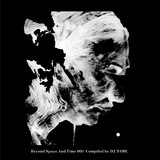
Beyond Space And Time is the new record label from Japanese music festival, Rainbow Disco Club (RDC). RDC has been welcoming music loving people to Japan for over a decade. Throughout the festival's history, RDC have been fortunate to constantly encounter performers and DJs who've collaborated with them in establishing a beautiful dance floor year in, year out. These relationships have lead RDC to start their own label, and now gives them the opportunity to reveal one of the best-kept secrets: What is in a DJ's record bag?
This time around, festival regular DJ Nobu kindly opens up his collection and shares the music he loves with us all. On visual duty we welcome Senekt - his representational yet contemporary drawing illustrates the emotion we feel from DJ Nobu.
We have much more music to come in future from artists that we trust and respect.
▼ DJ Nobu describes 10 tracks this way ▼
A1. Laurent Garnier - Water Planet
Highly respected French DJ/Producer Laurent Garnier has been releasing tracks for decades capturing the very essence of Detroit Techno and Breakbeat. He always manages to create something truly emotional. This is not his biggest hit, but it's my favorite.
A2. Mono Junk - Beyond The Darkness
This track represents the very early days of Techno with it's ravey atmosphere. It has a primitive feel, and the obscure mixdown sounds almost unbalanced. That said, this one really stands out when DJing. Very cool.
B1. Psychick Warriors Ov Gaia - The Valley
It was always my intention to include this track in a compilation if were I ever to do one. It has a fat underlying groove, with some indigenous spices thrown in. The whole thing is put together beautifully. No complaints!
B2. Melody Boy 2000 - Plenty Of Love
I wanted to include a track that had Jacking feel to it - that is my definition of dance music. This track mixes well in both Techno and House DJ sets.
C1. Drax Ltd. II - Amphetamine
This is my all time favorite track by Thomas P Heckman. It asks questions and strikes down all the boring 'wanna be cool' techno tracks. It is obviously a well known tune already, but I include it here because I'm often asked for it's track ID from new kids in the game. This is a classic that should be passed down.
C2. Dan Curtin - 3rd From The Sun
Curtin's refined synth grooves and bass lines make this a true timeless classic. It do not get tired of listening to his rhythms and melodies - he always gets it just right.
C3. Front 242 - U-Men.
The originator of Electric Body Music. Their husky vocals, hard rhythms and strong synth basslines made the group very popular at the time, and they are still to this present day. To me, this track represents what the Belgian New Beat scene is all about.
D1. The Prince Of Dance Music - E3 E6 Roll On
This is the track I played the most up until around 2006. It is a genuine house track that cuts through trends in music. A hidden floor killer.
D2. Pan Sonic - Lähetys / Transmission
Electronic music has existed for decades, and if you are to choose some of the best from all scattered & hidden places, Pan Sonic's 'Lähetys / Transmission' must be considered. The track emerges beautifully - breaking structures and transcending the past. Every layer of the piece is produced with such delicacy and care, that as a whole it magically drags you into the world of the unknown.
D3. Burial - Archangel
This track merges melancholic emotions with technological prowess at the highest level, and deeply impacted the dance music scene on it's release. I recently played this track at the end of my set at the forward thinking Terraforma Festival in Milan. It faded out to huge applause from the open minded crowd. A moment to be remembered.
Sound has the ability to heal. This is the primary tenet that has been driving Karma Moffett for over 35 years. Pure tones, resonant harmonics, the sounds of the earth. At the dawn of the 80’s, as the burgeoning movement of privately-issued New Age was taking hold, Karma Moffett was a pioneer. Eschewing the use of synthesizers and other increasingly-available electronic technology, Karma crafted his meditative, introspective music using ancient instruments. Primarily utilizing Tibetan Bells, and Singing Bowls, Karma Moffett crafted sounds that led the listener on an inward journey.
1982’s Sitting Still Within/Sitting Still Without s Karma Moffett’s earliest triumph. Combining the aforementioned Tibetan Bowls & Bells along with naturalistic field recordings, Karma’s first album is a testament to the power of minimalism and repetition. An ambient voyage that truly draws the listener inwardst, and outwards, Sitting Still Within/ Sitting Still Without is music for healing.
Figure‘s newest addition to its catalog is Nocow‘s Ualldie EP, a vivid adventure following his trilogy Vozduh/Voda/Zemlya on the main label.
Nocow’s synths stand out once again, churning out melancholic grooves over five pieces, which showcase his abilty to mesh the psychedelic and the heavy, resulting in tracks both bittersweet and punishing.
It‘s a distinct Russianness, a yearning frozen within, which Nocow‘s cloud techno transports effectively using stereo panning, finely layered percussion and wide strings to paint his imaginative landscape.
Redsonja Records brings to light reference number 16, held back until now, as to date 18 of our catalog has already been released. Visionary 01 is an EP by VVAA released on vinyl and digital format which showcase new a graphic identity of Redsonja Records: the warrior. In addition, RS16 also includes a future reference: Visionary 02. The four producers that participate coincide in several aspects related to the concept we believe in as a label. They all possess a kind of "divine touch" when producing their tracks, you can tell they all work from their soul. Jose Rico presents a track title ‘Discotime’, deep rhythmic cadences in the purest Detroit style; clean, bright, and delightfully mischievous sounding. Analogies intentionally created, synths that cross each other with elegance and leave space for all the necessaries. The result is an essential track in any relevant music collection. It takes us to other worlds that are more relaxed, more divinized, more colorful, more leisurely ...
When acclaimed South African musician Guy Buttery first sought out Dr. Kanada Narahari in late 2016, it was as his patient.
“It was a dark time.” Buttery recalls, “I had been bedridden for months and had been suffering from debilitating bouts of fatigue which no diagnosis or medication could help me get to the bottom of. When I first met Kanada, I was at the stage where even picking up my guitar to make music had become a joyless and taxing exercise.”
As Buttery’s searched for a cure, a family member recommended he see Kanada an Ayurvedic doctor who had relocated to South Africa from India and set up a practice in Durban. It was during this consultation, that the musician first experienced how Narahari infused the healing properties of Indian Classical music into his practice. Rather than treating him with a smorgasbord of pharmaceuticals, Narahari played his sitar and set Buttery on a strict daily diet of Raga’s to fast track his recovery.
Buttery was not only struck by his doctor’s musical talents but by the powerful healing properties inherent in his sitar compositions. When he left Narahari’s doctors room that afternoon, he asserts he was feeling decidedly clearer, lighter and stronger.
“Diving into Kanada’s music was definitely one of the reasons I'm still here today.” he admits. “The consistent tonal centre at the heart of Indian Classical Music, literally became my support pillar over this period. A central core of sorts in which to fall back on, strengthen and discover.”
Narahari as it turned out, was not only a prominent music therapist (and one of the only Ayurvedic doctors practicing in South Africa) but like Buttery, a highly accomplished musician with a devoted following back in his homeland.
Born in a small village along the Western Ghats in Karnataka, India, Narahari, at the age of nine, had enrolled to study Carnatic classical vocal and developed an interest in Hindustani Classical music with a particular passion for the sitar. While Buttery had secured his reputation as one of South Africa’s musical treasures, a multi-instrumentalist who commands sold-out performances both locally and internationally and more recently had been awarded the prestigious 2018 Standard Bank Young Artist for Music.
From this consultation, a friendship developed between the two musicians with Buttery soon inviting Narahari to join him in his studio. But it wasn’t all plain sailing in the beginning. While Buttery and Narahari’s sensibilities were very much aligned, there were a range of cultural and musical influences, nuances and inflections that first needed to be navigated and understood.
“I suppose we had to find a common ground.” Buttery says, before adding, “Which in the end turned out to be pretty "uncommon ground" for the both of us.”
It was after a few intensive sessions together that something exhilarating began to emerge. What began as a few idle improvisations soon evolved into feverish and lengthier jams. Whenever time permitted, the musicians would meet, descending deeper into the emerging sounds, while reimagining the realms that existed between their African and Indian heritages.
Over the next few months, the duo would rack up over fifteen hours of recordings in studio, and it was up to Buttery to shape the material into an album which they collectively titled Nāḍī, which Narahari translates from the Sanskrit as "The Channel" or "An Internal River".
During this period, Narahari bestowed upon Buttery, the moniker Guruji while Guy would refer to him, in affectionate return, as Panditji. Each time the musicians would meet, the studio space would be cleared by an impromptu ritual, with Guruji burning African Imphepho while Panditji would chant a Sanskrit mantra dusting Indian Agarbatti clouds over their instruments.
Once the room had been made hazy with this aromatic alchemy (with the ancestors welcomed in) the musicians would pick up their instruments and plunge into shimmering tides of sound. Reflecting on these sessions, Narahari recalls the immense creative freedom he felt throughout: “Guy and I tried to wander as much as possible, without any speculative, preoccupied ideologies or limitations. Love remained at the forefront of our journey together.”
“Those evenings we spent together in the studio” adds Buttery, “felt incredibly rich with purpose and a profound sense of freedom. While improvising, anything could happen and mostly did.”
On a first listen, the tracks on Nāḍī emerge as salty, humid invocations to the inscrutable depths and misty myths of the Indian ocean-- that vast body of water that stretches between, and laps the shorelines, of the artists’ respective homelands.
When asked to describe the sound him and Narahari refined, Buttery prefers to relay a series of evocative images.
“For me” he explains, “Nāḍī is a lighthouse, a beacon that resides at the bottom of the ocean.” As Buttery envisions it, “what once offered light to guide ships to safety, has been submerged and re-purposed by marine life as a coral-reef temple. Similarly, this sunken lighthouse exists as a concealed cenotaph, memorializing the ancient sea-routes and passages that once connected the two distant lands.”
On paper this may sound obscure but listening to the songs, it serves as an apt metaphor.
Across each meditative movement, listeners are able to relive the journey, immersing themselves in a series of incantations, replete with high dynamics, delicate African-Indian inflections and virtuoso string playing of an entirely new order. Further complimenting the fusion of musical dialects are a range of guest artists including Shane Cooper on bass, Thandi Ntuli on vocals, Chris Letcher on organ, Ronan Skillen on tabla and percussion and Julian Redpath on guitar, synth and backing vocals.
Now like the submerged lighthouse, the recordings stand as a monument, a marker and snapshot of this fortuitous meeting, a tribute to the healing gifts of Guruji and Panditji in performance. It’s a process that already, both musicians look back on with reverence and nostalgia.
Buttery ruminates in closing, that when he first met Kanada his illness correlated with the biggest drought South Africa had experienced in many years “…for whatever reason, whenever we would connect and make music together, the sky would tend to open. Even if it was just a few drops. This went on for months, until finally the drought dissipated and my health had been restored.”
By the time the heavens did open across the East Coast, a deep friendship had been forged and with it abundant musical offerings poured down. A treasured sample of which we able to share in every time we press play and immerse ourselves in the sacrosanct musical universe that is Nāḍī.
My Music is a stellar spiritual soul / jazz-funk gem, recorded by keyboardist-singer Samuel Jonathan Johnson in 1978. The epitome of a cult classic, it didn't do much upon its release but steadily found an audience over the decades that followed. It eventually worked its way into the culture, and latterly the wantlists, of wave after wave of soul aficionados.
This is music that shares the jazzy R&B DNA of contemporaries like Roy Ayers and is an intoxicating blend of mellow moments and more groove-heavy tracks. Spacey keys and lush production give it a luxurious, enveloping warmth.
My Music opens with the gorgeous title track: an indulgent slow jam opus. Introducing us to Johnson’s compelling musical vision, it features a rich mélange of production techniques. Dripping in strings, horns, backing singers, popping funk bass lines and swooshing synth waves, it’s an unusually structured cosmic two stepper that has an irrepressible groove. Accordingly, it’s been a favourite with the diggers and it was sampled by The Alchemist for Jadakiss’s “We Gonna Make It” (and it was also used on Ras Kass’s “Home Sweet Home”… but that’s a story for another time).
The up-tempo “Sweet Love” bubbles over with joy, its uplifting lyrics backed by infectious bass and jazzy Fender Rhodes lines. It follows a cover of “What the World Need’s Now Is Love”, taken at a funereal pace that transforms it into a heartfelt plea for love and understanding. Essential in these dark days.
After a full-minute-long opening of lush cinematic strings and horns, “Because I Love You” makes space for Samuel’s voice, accompanied by some keys and just a sprinkle of guitar. It builds back up and then mellows its way out to a jazz lounge finish (in all the right ways). The feel-good ebullience of the Stevie Wonder-esque “It Ain’t Easy” closes out the LP’s first side.
The second side bursts open with the heavy bounce and disco-funk basslines of “You”, a slightly off-beat string-laden dancer with insistent horns and a piano-assisted groove. Next up is “Just Us”, a legendary steppers track that could be heard oozing out of deep soul radios and funk sound systems back in the late 80s.
“Yesterdays and Tomorrow” is a moving original ballad that is followed by an exquisite high-stepping paean to mom in the form of “Thank You Mother Dear”. The thumping easy-glide of “Reason For The Reason” brings the album to a close.
Respectfully mastered by Simon Francis and cut by the master Pete Norman, this reissue of Samuel Jonathan Johnson’s sole LP sounds as sumptuous as that scarlet gown on the front cover. The sleeve artwork was lovingly restored by the Be With team. My Music is a luxurious and rare collection of songs that now has an opportunity to reach beyond its cult audience.
I remember the first time I read W.E.B. DuBois eclectic masterpiece The Souls of Black Folk. The way in which this Weberian scholar flowed from personal account to prose to sociological analysis to music and even political intervention has had a lasting impact on my own work as a cultural anthropologist. It made me understand that as scholars we must use different means in order to give expression to the totality of the lived experience: There is only so much in an academic text.
The experience of alienation has always been at the heart of my scholarly and artistic practice. I have used academic writing, lecturing, theatre performance and electronic improvisation to understand and represent it as a theoretical concept, postcolonial condition and lived experience. I believe, some issues need to be told like a story, some analyzed in most abstract terms and others need to be sung like a gospel. The medium changes the message.
In this sense, I guess, I’m a singing cultural anthropologist.
For some time now I have been engaged in the use of dystopian themes and sounds to paint a sonic picture of structural racism and whiteness of our present. But recently I have grown weary of this Ballardian idea of Future Now and the resulting phantasmagorian aesthetics myself and others have been invested in. The widespread availability of Digital Audio Workstations, sequencers, loopers and delay pedals has lead us into a futuristic cul de sac best described by Mark Fisher as the very absence of future.
Likewise, I am most skeptical of the “naturalist” countermovement, the return of folk. Especially in Germany, I am convinced there is no such thing as an innocent or progressive folk musical expression as it is always connected to the idea of the homeland (“Heimat”) which in turn produces the colony. It seems to me, the current zeitgeist is stuck between a “museum of a dystopian future” and a “museum of an idealized past”, but I wanted to sing about the present.
So, I involuntarily returned to pop music in its two-folded meaning of something popular and addressing not an essentialist notion of “Volk” or its woke cousin “communities”, but society as a whole.
I entered the studio just with a few lo-fi sounding melodies and rhythms from my circuit bent CASIO synthesizer. I had no clue what the finished product would sound like. But as soon as Markus started drumming, in a way strangely reminding me of CAN’s Ethnographic Forgery Series, my uptight sounds were suddenly embedded within a warmer global sound spectrum. The alien at home and abroad and the strange overlapped: We were seeing one and the same sound differently but were gently held together by Tobias’ producing.
Making music is about building coalitions. It’s about suggesting an articulation of styles, sounds and people, that hasn’t materialized, yet, but may help us in the current crisis: I wanted Amon Düül II to send their drug induced archangel thunderbird to rescue the refugees, that had tried to escape the police by climbing up a tree in Munich in 2016. I wanted Sun Ra to taunt far-right protesters in Chemnitz in 2018. And I wanted to mourn the loss of a former kebab shop cum discotheque that served as proof that there is such a thing as a minoritarian universalism.
SCHLAND IS THE PLACE FOR ME is a pop album featuring songs of alienation, not only as a tragic experience, but as a pop-cultural promise. Maybe Bill Callahan sung it best, “I am Star Wars today, I am no longer English grey”. I want those who suffer from alienation to stand in alliance with those who seek alienation, and vice-versa. A coalition, that tolerates the possibility that we are moved by the same groove for contrary reasons.
Fehler Kuti
Munich, Autumn 2019
Music by Julian Warner, Markus Acher & Tobias Siegert
Saxophone on RINDERMARKT by Franz Brunner
Trombone on RINDERMARKT and IL by Matthias Götz
Recorded and mixed by Tobias Siegert in Munich.
SONTAGSFAVORIT mixed by Dario Albiez in Dusseldorf.
Mastered by Duphonic in Augsburg.
Artwork by Atelier Grande, Munich.
'Pulse Code EP' by Amberflame - Andrei Zakharov's (aka An-2) side project aimed at finding the right balance between organic yet experimental sound - is a selection of top-notch electronica with the flair of old-school disco and everything inbetween. The crafty and meticulous use of a variety of custom analogue hardware give way to keeping an open mind with production and sound design, which varies greatly, but at the same time, shares a coherent quality throughout the EP.
The opening track "Hope" sets the mood with its melancholic airy strings and pulsating arpeggios developing effortlessly until the groovy guitar bass kicks in lighting things up and giving the mix a completely new perspective.
Taking a more experimental edge 'Pulse Code' is a PCM-inspired leftfield electronica piece which goes a new direction with its solid synthwork and fluent drum programming.
The title of the closing cut 'Dreamscape' speaks for itself: it is a meditative electro-focused affair
Skyf Connection (pronounced skAyf) was a short lived project by long time friends Anthony Mthembu and Enoch Nondala. At the time they were working for Annic Music, an independent label run by married couple Anne and Nic Blignaut. Although the label was known mostly for Zulu, Sotho, Tsonga and other traditional styles, they had a few Disco releases on the label including groups like Keith Hutchinson’s Focus and Enoch’s discovery Lena, who went on to have huge success under the name Ebony a few years later.
In 1984, when an artist didn’t show up for a booked session they decided to make use of the studio time and began working on a demo. At the time Anthony and Enoch had been playing for a year at a new club called Gamsho, located on a farm on the outskirts of Kliptown Soweto. Along with Blackie Sibisi, Sepate Mokoena and Elijah “chippa” Khumalo they made up the resident house band. Due to cultural boycotts and American artists refusing to perform in the country, locals took it upon themselves to fill the market with the American sound the crowds demanded. The demo they recorded at Blue Tree Studios was going to be their product they could use to promote their brand of the American sound. They then took the demo to Universal Studios where their friend and trusted engineer Jan “fast fingers” Smit was working. It would be here that they would polish their demo into something they could take to their bosses and have pressed. Equipped with a DX 7, Linn Drum and some Juno synthesizers they were on their way. Jan lived up to his name and programmed the drums, it is rumoured he could program in almost real time, a skill that translated to the local arcade where he held high scores on many machines. Enoch would be singing and playing guitar while Anthony would do all the Bass and Keyboards. The result was 4 funky party anthems with synth work like no other recording at the time. Their take on what they believed the crowd would want to hear at the beloved club they called home.
From start to finish the 4 tracks portray what would have been a standard night at the Gamshu. Although the club would open earlier and the standard hours of most clubs was 6 to 6 , the band would start playing at 10pm. With their standard set time and Anthony and Enoch unique view on what a Disco should be, they chose the motto Ten to Ten as the album title because those were the hours when they were the stars and Disco ruled the dance floor. To get to the club was a bit difficult, you needed to drive along an empty road where thieves waited for any patrons trying their luck walking after dark. Since there was no transport during the night, the safest way to get home was to wait till the next morning to walk home. Even though in the summer months of Johannesburg light begins to peek in just after 4am, crowds refused to leave and stayed enjoying good music and company until 10am. The lead off track “Let’s Freak Together” has powerful lyrics encouraging people to let go of their worries, put aside any differences and let the music bring everyone to freak and dance together. The whole album is about the joy we can all feel when we share the same moments and how music can bring people together in a unique way, a philosophy shared with the original nightclubs of 70s New York. This approach to music is where the name Skyf Connection comes from, translating from slang to mean the connection we create through sharing, in this case Music and good times.
Skyf Connection would go on to play at Gamsho till the club’s closure in 1986. In those years their popularity lead to being booked for private events like weddings and birthday parties, as well as gigs in some other venues like Mofolo Hall. They would share the stage with many artists through the years learning artist’s songs and providing support as a backing band. After the club closed Anthony would go on to join the house band at The Pelican, another famous club located in Orlando East, as well as dabbling with songwriting for artists like Phumi Maduna and helping Enoch on many projects through the years. Enoch would ditch live music altogether and immerse himself in studio work, starting full time as a house producer and A&R for the recently formed Ream Music. He would go on to produce hit albums for pop artists like Percy Kay and Makwerhu but made his mark discovering countless artists that would become stars in the traditional market. They would remain friends until Anthony’s passing in 2016 and although Anthony is no longer with us his spirit lives in the grooves he left on this one of a kind record. His wife Vinolia will be accepting his portion of the profits on his behalf.
Contagious is a solid blending of avant-garde experimentation and electronic music. Formed by two innovative voices from the Improvisation scene of Berlin (Andrea Neumann and Sabine Ercklentz) and Mieko Suzuki, a well-crafted and creative DJ and musician who’s operating in Berlin venues and festivals since a long time.
Contagious is one of the most forward thinking, mind-melting projects to hit the electronic music scene. Intense and powerful, yet rooted in a tradition of crafting and sculpturing of in the most creative ways, all this building up within a solid structure of instant composition and improvisation. The trio plunder each other’s musical spheres, appropriate them and switch roles. Andrea Neumann on her infamous Inside Piano, an instrument she pioneered and crafted, is applying the most creative feedback processing to simple piano strings and sending them occasionally to Mieko Suzuki’s processing rig, who also uses her own pre-recorded sounds and her skills on turntables, while Sabine Ercklentz’s trumpet sounds blast through her processing system and altogether the three musicians communicate into logics of composition and futuristic structures, where fragile sound textures and pulses become monumental.
Contagious is also the debut album recorded and produced by Rabih Beaini. The Trio wanders in new aesthetic areas, sound is a texture where the processing rigs are constantly developing new forms and evolutions. Structures and grooves implode in noisy fragments, growing into a deep trance state.
After Lowtec, Alex Cortex, STL and iridescence; Swedish label ‘blundar' presents Benjamin Brunn 11th solo album, 20 years after his debut.
BLUNDAR7 comes as a 10 tracks / 38 minutes long-player, coloured cover on a 180g black vinyl. Artwork by ‘mutantexture’
Brunn wrote and produced all tracks between 2017 and 2018; In contrast to must recent releases were limited to one or two synthesisers, this time a whole array of instruments was used: tELHARMONIC, Music Thing Modular Chord Organ, Doepfer A-111-3V Precision VCO, 4ms STS, Yamaha DX7, Clavia Nord Modular G1 & G2. The long-player comes after a collaborative album with Dave Wheels out on Sushitech early this year, and will be followed by one together with Move D, via Smallville in 2020.
SIS003 welcomes Boston's deadliest modern wave duo Dead Husband to the SISTERS family across the murky waters of the Northern Atlantic for a host of dance-floor focused workouts.
A mixture of syncopated drum work and reverb drenched arpeggiators define Dead Husbands debut on the label across a capricious collection of tracks/music.
Doug Lee gives Facial Recognition the usual An-i treatment drawing out a monologue of emotion through the sub bass and sweet undulating use of distortion which constantly helps the track and the low end move forward, whilst electro aficionado Privacy offers up his take on the track with a rolling 4x4 composition true to his unique modus operandi, slowed down powerful.
And a remix debut for Papers, 5 years after down tooling from their white label series, they round off the record bridging the Atlantic gap with their distinctly steezey techno sound.
Julio Victoria is a name that needs no introduction in Colombia's electronic music scene. One of the most influential DJs to emerge from South America over the last decade, Julionow presents Astrolabe, his new EP and first vinyl release. It is also his debut for South East London based label, Church.
The vinyl, composed of three portentous tracks, found its inspiration in an elaborate old fashioned instrument, historically used by astronomers and navigators to identify new stars and planets. Perhaps that's the reason why "Astrolabe" immerses the listener into a celestial state of relaxation and contemplation. A dance ritual that never ends. "Evasión" introduces a more percussive lead groove that carries hypnotic top lines of fuzzy synth patterns that ease across the duration of the track. "Tres" closes the collection with groove inducing hats and a pulsing bass line that partners perfectly with more reverb-soaked swells of filtered chords and showers of twinkling & expanding melodies.
Astrolabe will have a solid run of launch events across Colombia, as well as in Asia and Europe, which will include Seoul, Tokyo, Hong Kong, London, Zurich and Dublin.
Girl is the second album from the North London band Girl Ray, released on 8th November 2019 via Moshi Moshi. Recorded at Electric Beach Studios in Margate with Ash Workman (Christine and the Queens, Metronomy), the album is a delightful, sun-kissed tribute to their love of pop and R&B.
The three-piece, comprising Poppy Hankin, Iris McConnell and Sophie Moss, today share a taster of the new record with “Show Me More”. According to the band, the song is about “crushing really hard but having to play the long game and wait it out because your boo is playing savage games. It’s your classic pop banger. Steamy dance floor. Drinks on me.” The accompanying video was directed by Crusoe Weston and features the band cycling around the city at dusk.
It was Ariana Grande’s explosion into pop culture that kickstarted a new era for Girl Ray, as well as the realisation that their most-listened-to Spotify playlists contained pure pop music. When Poppy began experimenting with writing songs on a computer using keyboards, a collection of shimmering, foot-tapping, sparkling pop bangers poured out. With this new set of songs, Girl Ray have been brave enough to completely change their sound rather than play it safe, yet still remain unmistakably themselves - it’s Girl Ray, but with added synths.
Hot off the heels of Aluxes, his 2018 Lumière Noire debut EP, young Mexican DJ/producer Iñigo
Vontier is inviting Chloé's label on a trip to the far corners of the body & mind with an album of
demented grooves, psychedelic take-offs and imaginary comic strips of mystical rituals. A
bewitching debut full-length. Mexicans may never possess the sonic science of the Germans,
the hedonistic madness of the English or the gift for synthesis of the French, but, as proven by
Iñigo Vontier's first full-length for Lumière Noire, their universe is much more exciting than
anyone would have ever thought.
The DJ/producer fully asserts his origins by brandishing the album’s title "El Hijo del Maiz" ("the
son of the corn") almost as an emblem: "in Mexico, corn is eaten daily. It has long been defined
as 'the gold of America', and I consider all Mexicans as children of corn". A spiritual and
embodied vision Iñigo's first Lumière Noire release, the four-track Aluxes, set the tone of the
young talent's distinctive interpretation of dark disco, which creeps up on the dancefloor from its
iconoclastic side. The two tracks and two remixes (one by Flügel, the other by Inigo himself)
featured on the 12" for lead single "Xu Xu" (featuring Red Axes-affiliate Xen's irrelevant vocals)
was a full-bodied confirmation that Vontier sees the dancefloor as an arena for the occult –
whether from the peoples of the equatorial jungle, the Middle East or, even from indocile
machines. But, while the spiritual element seems part and parcel of the Jalisco native’s output, it
is in no way the only ingredient of this first long-player: "this album best reflects my own vision
and spirituality, and the way I feel it" he says.
Whether contemplative or frenetic, the collection of tracks that make up “El Hijo Del Maiz” takes
the kitchen sink and throws it out the window: languid rhythms, haunted vocals, and mysterious
percussion fuel a discombobulated house set that scrambles the listener's five senses, leaving
one disoriented and exposed to the vagaries of vertigo. Following the demented, dystopian “Xu
Xu” EP, which explored an imaginary jungle that harbored Mayan and Egyptian pyramids,
Middle Eastern accents are once more present in the off-kilter “Bo Ni Ke” and its Japaneseinfluenced vocal trickery, which Moroccan flutes à la Jajouka transform into a feverish trance.
With the following three tracks, Iñigo Vontier raises himself to the same level of excellence as
the Pachanga duo (of which pride of the Mexican scene Rebolledo, is also known as a prolific
artisan of deconstruction): “Awaken”'s slumbering voice, heard as through the veil of hypnosis,
slowly introduces a techno beat which, as in follow-up “Time”, literally brings the listener to a
levitative state. In a housier vein, yet continuing in the same psychedelic, 90s-infused spirit,
“Don’t Go Back” disrupts the genre’s usual signatures with an out-of-tune keyboard that is
becoming the artist's trademark, destabilizing the listener into a drunken vertigo, with a good
helping of sexiness: "I think the sexy dimension definitely brings a kind of magic to music," says
Vontier. “I'm sure I felt this magic during my DJ sets, and I like to think that sorcerers use this
element in their practices. I might consider myself a bit of a sorcerer when I take over the DJ
booth, by the way." A mood and sound that can once again be found – in a quieter, more
bucolic version – on “Chiquitita” (feat. the flute stylings of pioneer DJ Rocca, now a partner of
cosmic disco legend Daniele Baldelli). The more cinematic, fast-paced and dreamy beat of the
no less captivating “Little Monster” might evoke the mischievous spirit of the Mayas' minor
mythological creatures, while ode to the magical herb Marijuana (feat Thomass Jackson)
proudly tramples into the debate that such a provocative title inevitably provokes: "psychedelic
drugs are powerful tools to reach a higher level of consciousness about what surrounds us, but
we must learn how to complete this psychic journey by ourselves, notably through meditation
and love.
In the end, El Hijo del Maiz is an album-length confirmation of Iñigo Vontier's uniqueness, and
his adherence to Lumière Noire's policy of letting artists fully express their vision – while letting
their passions guide their idiosyncrasies and explorations of innovative electronic signatures
Rounding-off a landmark year for Clark which saw an accelerated drive for variety and freshness - including skewed renditions of Bach performed at the Royal Albert Hall and a hugely acclaimed score for TV series ‘Kiri’ - the leftfield legend takes it back to the source with two bangers for the massive.
The riff-powered heavy electrics of ‘Branding Problem’ romp from Detroit to Belgium via Chicago and the M25. It’s platinum-grade dancefloor techno, but it’s more too. The production flair and inventive sound sculpting ensure a level of quality and originality not found in your average grist-for-the-mill DJ fodder.
‘Legacy Pet’ is hardcore and tech step dipped in loopy juice; it’s the sound of a raver wandering out from a cavernous warehouse, across fields and into an enchanted dingily dell dance, throwing gun fingers with the goblins and faeries.
“I’ve been quite amused at how easy it is to stream background music these days. How accessible it all is and how entitled we all feel to it, like it’s some sort of air freshener you spray in your Uber.
For some reason I’m imagining a future where Elon Musk does a streaming deal, so he can prance around controlling nano implant VR chips for 1 million amortal coastal elites, while the rest of us don’t have electricity and only manage one rave a year - to a sound system powered by rationed candles. This is music for that fantasy scenario, ha.
Anyway, I don’t want these 2 tracks to be part of background air freshener world. They are limited edition club gear. I wanna play them out so badly in my live show.
Influences: Hardcore UK rave, Detroit techno, Jungle, Oizo, Ed Rush and Optical, No U-Turn. The origins, the source and it’s constant subsequent mutations. BEHOLD THE CONTINUUM, HARDCORE WILL NEVER DIE.” Clark
Rebekah’s Elements label welcomes Storb who delivers two vigorous cuts, while the label boss herself and Scalameriya provide remixes.
Something of a mystery, Storb may be elusive but his driving music speaks volumes. The industrial techno producer has released on labels like Diffuse Reality and Emetic, but now he is invited to join Birmingham’s pivotal techno tastemaker Rebekah’s imprint accompanied by a remix from the esteemed artist herself, not to mention Serbian techno purveyor and live performer Scalameriya who’s recently released on THEM and Genesa Records.
Taking a haunted and brutal route from the off, ‘The Donut Theory’ is built on contorted synths and sewed pads that together generate a twisting and turning aural experience, followed by ‘Gasp’ which thunders forward using hyperdrive drums, frazzled effects, overdriven machine sounds and caustic textures.
On the flip, Scalameriya remixes ‘The Donut Theory’ incorporating hammering broken beats, urgent alarm samples, industrial components and fizzing stabs. Tying it all together, Elements boss Rebekah reinterprets ‘Gasp’ by stripping things back to focus on colossal kicks and firing sirens that permeate a relentless groove to generate a pure warehouse inclined energy.
TCB aka Chris Beißwenger, our boy on Jah bless road, goes a little something like: 1977, born cross-eyed, parents like Boney M; 1984, suburbia USA, DSNY, still cross-eyed; 1988, 98.7 Kiss FM New York on the school bus radio; 1989, Frankfurt Am Main, hyperactive, outsider, got lazered; 1991, drums and piano in cheesy school band; 1993, kicked out of Omen, kicked out of school band; 1994, kicked out of Omen again, got his own band; 1995, kicked out of band, finally in at Omen, The Box, Wild Pitch Club; 1996, got first car, Fasttracker, EMU ESI-32; 1999, no more car, no more Omen, Robert Johnson instead; 2002, first release, High Tide; 2003, Ableton 0.1 Beta, less MIDI, more gefrickel; 2004, exchange High Tide for CB Funk, kicked out of Cocoon; 2005, a silly move to Düsseldorf, Burkina Faso, more synthesizers; 2006, again silly in Düsseldorf, Brontosaurus, disco-house, love; 2007, Cologne and Frankfurt, back to piano, more love, still no car; 2008, with love to Frankfurt, Arto Mwambe on the road, storyteller; 2009, Mwambe still on the road, bored of work; 2010, Live At Robert Johnson, four-day week (thank God), four bike accidents; 2011, Europe, bored of piano, invention of The Citizen’s Band; 2012, modular cookery, thoughts of moving; 2013, Burkinian's death, Delphi's rise, almost made it, 2014, broke out of seven-year cycle too complicate
With their debut, MME dUO send us across an impulsive sound collage omniverse of enigmatic Dada - long live imperfection! Formerly working together as Sculptress of Sound, Cologne based Patricia Koellges and Tamara Lorenz make use of a variety of instruments and devices: DIY electroacoustics, small synths, loopers, tuning forks, electric bass, percussion and voice are thrown into the game and shape a sound that’s as diverse as it is striking. The four sides of the record are the four seasons of the year. The cover artwork depicts an oddly shaped honey locust situated just outside MME dUO’s rehearsal room; homebase for a year of recordings for awholerunboom. From spring to winter the album opens up a wayward palette of experimental music. Sweet Cold Night could be a soundtrack for a movie scene of ourselves trudging through a swamp. CutCut somehow sounds as if caught in a loop early in the morning after an extensive club night. RZCK, a deliberately stumbling forward percussion piece is the longest of the 21 tracks. Several video clips go along with awholerunboom, one of which features the artists going through some kind of a ritual exercise inside of a two person costume, trying to put things straight it seems. The track itself Isn’t It Isn’t functions by way of permutations of spoken phrases and it might actually make you wonder if Gertrude Stein had gone electric. Mixed and mastered by Volker Hennes. Cover artwork by MME dUO. Edition of 300.
- A1: Felix Kubin - Nachtflug Durch Die Weltenfalte
- A2: Lena Willikens & Sarah Szczesny / Phantom Con Ballett - Fragment 1
- A3: Esmark - Menge Ponge
- A4: Tintin Patrone - Con Papa` Nel Laboratorio
- A5: Asmus Tietchens - Der Heizer
- A6: Lena Willikens & Sarah Szczesny / Phantom Con Ballett - Fragment 2
- B1: Wolfgang Seidel & Ken Montgomery & Crystal Penalosa - Confluence
- B2: Phuong-Dan - About Rhythmus
- B3: Jessica Broscheit & Mark Boombastik - Anomaly
- B4: Carl & Sohn (Toben) - Yes
- B5: Rvds - Conrad Tanzt Im Regen
- A1: Tracklist 7“ Conrad Schnitzler & Ken Montgomery - 27 8.87
- B1: Tracklist 7“ Asmus Tietchens - Wilhelm Bornhofen
12"LP plus 7", ltd copies
ERUPTION is an outburst of creaking energies, unconventional ideas, arhythmic thoughts, cacophonous images and musical phantasms. ERUPTION is also the name of the second album by Kluster, a band project of the musician and video artist Conrad Schnitzler, who died in 2011, together with his colleagues Dieter Moebius and Hans-Joachim Roedelius. ERUPTION was also the name of a two-day festival that took place in July 2018 at the Golden Pudel Club in Hamburg. For two days, artists and musicians from different generations and working in various fields met here, who were in one way or the other inspired by the comprehensive oeuvre Conrad Schnitzlers’, as well as by his free-spirited thoughts and actions. The result was a multi-faceted programme of concerts, performances, sound and video installations, which resulted in the release of these two special records on Pudel Produkte, the house-own label of the Golden Pudel Club. The single features a previously unreleased piece by Conrad Schnitzler & Ken Montgomery as well as a story told by Asmus Tietchens about his father and Schnitzler, who unwittingly crossed the Atlantic together on the steamboat Bornhofen in the late 1950s, one as an engineer, the other as a heater. The LP brings together the festival's invited artists, Schnitzler‘s contemporaries
such as Ken Montgomery, Wolfgang Seidel and Asmus Tietchens, as well as young artists who developed works especially for ERUPTION. Among them are Lena Willikens & Sarah Szczesny with fragments from their performance Phantom Con Ballet, the DJ Phuong-Dan who composed a musical collage from the poem About Rhythmus and rhythm studies by Schnitzler, a piece from the performance of Felix Kubin, who uses a light scanner and his modular synthesizer to convert graphic notation into sound, a theatrical sound piece by Carl & Sohn (also known as Les Trucs), the producer and DJ RVDS, who interacted with the piece Tanz im Regen by Conrad Schnitzler and many more. Initiated and curated by Nika Son, a musician and artist based in Hamburg
The modern, avant synth/dance-pop frolics of ‘Moi’ catch Steven Warwick (Heatsick) at his impish but droll best for PAN. Returning to PAN six years after his standout Re-Engineering album,
Warwick returns to similar zones of enquiry as 2016’s ‘Nadir’ - the first release under his birth name. With ‘Moi’ (which we definitely hear enunciated with a playful pucker), Warwick further emphasises the personal, playful nature of his work with 10 melodic, danceable and pop-tart arrangements accompanied by a range of vocal personas; from his naturally droll singing voice to more alien and leaned-out styles, plus a guest platitude by Turner Prize nominee, Jo Pryde.
Bubbling up with the pickled 2-step and Lolina-esque lilt of ‘Open Fire Hydrant’, Warwick clearly draws upon a UK dance music heritage - and its Afro-Caribbean and US inspirations - with the
freshest, exceptional style that percolates throughout the album, strongly informing its biggest dancefloor highlights such as the warped trancehall bumps of ‘Salvation’ and the crooked crankshaft of ‘Kaleidoscope’, along with the the brittle boned shimmy of ‘Rush’ and the hard but elegant drive of ’Silhouette.’
But they’re only half the story, which really comes together with contrasts in the fizzy downstroke of ‘Kind of Blue’, on the Black Zone Myth Chant-like psychedelic daze and blunted vocals in
‘Consolatio’, and the album’s standout ‘Danke’, which revolves around Jo Pryde’s gentle utterance of the title weft into ominous ambient clag, connoting a sort of humility that knowingly becomes
both less and more meaningful with each reiteration
2x12" 180g Black Vinyl
Pivotal UK producer Kirk Degiorgio returns to De:tuned for his first new and highly anticipated As One studio album in 15 years. "Communion" covers a broad sonic palette, ranging from jazz and hi-tech funk dancefloor beats to minor-chord symphonies, all coming together "As One". A trademark 90s electronica sound shifting between the mind, body and soul, produced and recorded with Kirk's 25 years of studio work experience.
Kevin Foakes (Openmind, DJ Food, Ninja Tune) created all the graphic work. Mastered by Matt Colton at Metropolis Mastering, pressed on 180 gr vinyl and a separate digital version will be available from the usual digital shops. Stay tuned!
Back with a vengeance, Cimm returns to the imprint with a highly anticipated succession to his Sentry debut from last year, stamped on a irresistible 2 x 12" vinyl release. Infernal halftime beats and top-notch Dubstep shells, firmly entrenched at the frontier of sound system music and its invaluable heritage. The London-based producer and DJ rose to swift and significant acclaim in the last few years with releases on institutions like Tempa, J:Kenzo's Artikal and Wheel & Deal as well as notable residencies at Rinse FM and the renowned Fabric night club, among other recent achievements. Now coming to a turntable near you, Cimm delivers four bespoke cuts, primed for the dance and your enjoyment, battle-tested by the scene's foremost tastemakers.
Diving into unidentified transmissions, 'Unknown Caller!!' sets the pace with eerie reverberations and filtered resonance. Amid the faint hiss of machinery, larger-than-life drums set up shop alongside subterranean pressure emissions. Hefty breaks, hold tight! Retro synth melodies keep us on track within the monstrous switch-ups and unquestionably meticulous arrangement, sure to shut down any dance in style. Cutting no corners with the B-Side, Cimm teams up with veteran vocalist Rider Shafique for a dystopian sub-bass onslaught, swaggering militant chants and the apocalyptic ambience to go with it. Steaming low-frequency oscillations bubble and hurl their weight, stripped of all restraints, coveted in freezing harmonies and ethereal atmosphere. Vibrating in a more uplifting spirit, the dedication to the Jamaican roots of sound system culture unfolds in the Londoner's signature style - dubbed out soundscapes ahead. 'Tosh Dub' keeps it a laid back, with vintage instrumentation, scattered skanks and swirling organ chimes. Taking an ultimate trip through unremitted grit and off-kilter grooves, 'I Am Jack Travis' lures us in with rainy undertones and hypnotic foley sampling. Promptly revealing its true nature with plenty of pressure and scrupulous syncopation, a ghostly heavyweight ensues and closes the deal.
PGS 011 comes to us from Gustav Brovold, an essential player in Detroit's latest wave of underground electronic music. His début EP, "Hyperbolic Space" is the first release solely dedicated to the local legend, with influences ranging from 90s UK rave, apocalyptic techno, and bright, post-Drexciyan electro. Since the late-aughts, Brovold has been a fixture of Detroit's dance community; first as a member of Randy Chabot's Deastro project, and then a pillar of the after-hours scene through raves with the ADULT Contemporary collective, all the while sprinkling in rare, must-see all-hardware-based live shows around the city. Moments of brilliance have boiled over the surface globally, with appearances on Don't Be Afraid as Radio Brovold in 2015, the Detroit Electronic Quarterly's "DEQ Vol. 7" in 2016, and on the punishing opener of PGS 009's with "Temple of the Circuit" earlier this year.
Following a live show at Detroit's Donovan's Pub in late 2018, Zach (Shigeto) came to the obvious realization–this music is the reason why we started PGS, and needed to release the music to a wider audience. Brovold handed PGS a flash drive with hours of completed music, a gold mine in bits and bites. "Hyperbolic Space" represents a cohesive sampling of the mountain of tracks from Brovold's vaults, propelling PGS into the next decade. Play it in your car, or at unauthorized raves, and dance to the airwaves of Radio Brovold.
"Oakland Ave"
The vibes of forgotten 90s raves: UK techno made with digital synths, resampled as a low-bitrate soundtrack for the night time level of a PlayStation racing game. Building, dancing hi-hats, slow building chord stabs, dubby techno feels. A triumphant finish, 1st place in fifth gear. (*If you play this at 45rpm, you can Jit).
With their third album ‘Fluid Motion’, Melbourne’s 30/70 are set to soar into higher territory as the face of Australia’s newest wave of soul-influenced brilliance.
From the swirling opening pads of “Brunswick Hustle” all the way through to the sax-laden shimmer of “Flowers” at its close, ‘Fluid Motion’ is an instant classic, effortlessly shifting between neo-soul and languid, Dilla-esque tendencies, astral-facing jazz textures and authentic vignettes of UK club music history.
It’s a formula that those already caught in 30/70’s celestial web are fully aware of; first defined on the local heat of their 2015 debut ‘Cold Radish Coma’ and majestically expanded upon with their critically acclaimed 2017 release ‘Elevate’ on Bradley Zero’s Rhythm Section INTL (mixed by Hiatus Kaiyote’s Paul Bender). ‘Elevate’ did exactly that - elevating both the scope of the band’s sound as well as their standing in the local and international community.
Since the last record was released, the music has brought the band on world tours and to the attention of the wider public and key tastemakers alike. Strongly supported by the likes of Gilles Peterson, Tom Ravenscroft, Jamie Cullum, Matthew Halsall and Bradley Zero, the UK has become something of a second home for 30/70.
London in particular has openly embraced the soulful sounds of Melbourne, as evidenced by Gilles’ latest Brownswood compilation ‘Sunny Side Up’ which features three tracks from 30/70 members: Ziggy Zeitgeist, Horatio Luna and Allysha Joy. The record is a follow up to his era-defining survey of the UK Jazz scene ‘We Out Here’, the compilation that kickstarted a whole generation of London’s under-the-radar Jazz kids to global headlining heights. It would appear we’re about to witness this same effect take place for the Melbourne contingent, of which 30/70 lead the charge. The city’s invasion is well and truly upon us.
While London is undoubtedly in love with what’s happening in Melbourne right now, this is no one way love affair. The 30/70 collective have had their ears to the ground and plugged into the sound of the UK underground. This new album takes inspiration from the syncopation of Broken-Beat, the immediacy of Grime’s and Dub’s sonic aesthetic to create something that is a truly global amalgamation of local sounds, finessed by Allysha Joy’s instantly recognisable vocals; the rawest and realest of voices.
Following on from the release of a spilt EP from rising stars Gramrcy and Gaunt late last year, GlassTalk Records returns in 2019 with the sophomore EP from Bristol's Henry Greenleaf, "Patent".
The unassuming producer has been making waves with his bassy 130bpm productions which seem almost custom-made for the later hours of dark club settings.
Since his debut release on Par Avion last November, Greenleaf has been focused on increasing the sonic scale and clarity of his work; something that's apparent on the whole of "Patent" but especially on the opener, "Inch". A true 'creeper' of a track, the groove and harmonic arrangement of the 3-minute build-up is somewhat
entrancing but then gives way to a head-wringing breakdown.
True to his previous output, Henry doesn't sit still stylistically on "Patent". The EP's second track, "Tare", moves away from the 4x4 structures of "Inch" and into more syncopated territory previously occupied by producers like Mickey Peace or Paleman. "Tare" is a masterclass in polyrhythms with all manner of kicks, claps and vox samples skittering over each other. This deft use of drum programming is complemented by serene and uplifting synth sections, cleansing the tonal pallet before the beat forcefully drops back in.
On the B-Side, "Caved" keeps the energy and the tempos high with supremely processed high hats and a rumbling low-end landscape. Here Henry Greenleaf's adoration of Paula Temple's music shines through more than ever. Much like her output, it's kind of hard to know which way is up in "Caved" with its ever-shifting
palette of sounds and grooves.
Closer and EP title track "Patent" is probably the vastest song Greenleaf has created during his recent mission to grow his productions in scale. It's a mammoth techno track with a pulsing low-end juxtaposed against some sporadic & icey synth pads.
This release solidifies Henry Greenleaf's already hard-to-dispute status as one of the leading lights of the 'Bristol sound'. Almost impossible to define; his work sits in that amorphous sweet spot where techno, dubstep, garage and a load of other UK influences bleed into each other to form something unique. Put your headphones on and let the grooves swallow you up.
Limited Edition Vinyl
Vinyl + Digital Ep
Vinyl includes a Bandcamp download
released Oct 25, 2019
The new release of Dusk & Waves is starring by Vicky Montefusco, Dj and producer from Italy, resident in Berlin for a few years. This EP is presented as his first work on vinyl with great force and originality. Whit a style, synthetic, analog, crude and influenced by the legacy of the 80s, has allowed him collaborating on labels such as Ninefont, Clouded Vision or Items & Things.
The EP begins with 'Justice', a low revolution techno track that with its line of acid bass and Martian sounds, added to the speech sampler of JFK, leads us to a state of deeply hypnosis. On the other hand, 'Roar' goes deeper into EBM territory. Above the starting of the arpeggio, it is built a dark track full of synthetic sounds and a nightmare atmosphere (somber, gloomy, baleful). 'During' keeps the darkness of the other two tracks; however in this case, the rhythmic guitar at the beginning adds a more 'funk' touch to the track. It is “a funk” with a narcotic and somber flavor thanks to the vocal and the synth sounds that accompany it. On the B side of the vinyl we find Blacknob's remix to 'Justice', which gives him a re-interpretation more club raising the bpms and creating a perfect track for dance in the late night. Finally, Jamie Braid´s remix offers a reconstruction of the track 'During' with electro beat, generating an odyssey of textures with a development that goes beyond the standard structures of dance music. Timeless!
We’ve been waiting a while for this one… Dark Sky return after a brief hiatus with this incredible EP featuring band of the moment Afriquoi. Many of you will already know one particular tune here: ‘Cold Harbour’ used by Bonobo on his Fabric mix compilation back in January. This gem is now backed with three more blissful, vital fusions. All created with different members of the deeply-rooted London-based live band.
‘Valmer’ sets the tone with its chimes, bells and chants, featuring the drumming of percussionist Andre Marmot aka Minioca. It's measured, restrained and impossible not to get goosebumps to, a near-spiritual experience the deeper you get into the groove. Elsewhere ‘Love Walk’ takes a much more subdued sojourn into the cosmic dusk. Mid tempo and much more focused on the rich layers of atmospherics than the beats, this will disarm a crowd at 50 paces. Next our minds are altered by eight-minute synth-striking mystique marathon ‘Cambia’ featuring the Kora playing of Jally Kebba Susso. Finally, ‘Cold Harbour’, one of the highlights from Bonobo’s evergreen mix from the London club institution, the combination of those rattled strings, pregnant bass staccatos, rolling percussion and deep undulating bass make it one of the most versatile and touching tracks Dark Sky have given us so far. And that’s saying something.
Breaking the Dark Sky silence that’s been almost two years, the ‘Clod Harbour’ EP opens up a whole new page in the London act’s legacy. And there’s plenty more to come. Watch this space...
Mic Mills, "Global Skywatch" boss dog, friend and family man gives us "ILIO002 - Variety Boy". Mic Mills, originally established with the now infamous "Untzz 12 Inch" and "Big Doint" labels, brings us an EP that is as versatile as the title suggests. Take a plunge with us through dubs, drums, synths and acid lines. Joined by long time amigo "Furious Frank" on the A1, Variety Boy then ebbs and flows from start to finish with low end subs, catchy hi's, addictive percussion and lots of "love" to keep you dancing until the cows come home.
Don't snooze, grow wings and take flight.
Limited to 300 copies - ILIO
Melodize is a brand new label that kicks off with a mighty EP from Beartrax that includes a remix from US house legend John Tejada. Beartrax has already rebased on Motek Music, Lost Diaries and Deeper Love and makes a real impression here.
The US house legend and Kompakt regular that is John Tejada opens the EP with the moody and synth laden Clarity remix. It is a roller that takes you deep and has lush chords stretching to the heavens. Clarity in original form is a tender, piano laden tune with a vulnerable vibe and deep, resonating bass. Last up is Haunted Chalice, a track with a rasping lead synth that mesmerises as the warm drums roll on below.
This is a classy EP to kick off this exciting new label
feedback so far:
- Animal Trainer - "Haunted Chalice sounds awesome!"
- Huxley - "Like the remix."
- Nick Warren - "A fine mix from John and Haunted has great charm."
- Jamie Jones- "Sounds cool, will give proper feedback if played."
- Joyce Muniz- "John Tejada remix is sweet!“
2x12"
"Reactions" is the debut album from First Tone, the musical partnership of New Orleans-based artists Turk Dietrich (Second Woman, Belong) and composer Duane Pitre (Important Records). While the project has been at work quietly sculpting their sound for years, "Reactions" is the first available set of recordings. Those familiar with the respective works of the two artists will be happy to find a collection of music that is very much of the duo, and yet totally unlike anything they've produced before.
Over six tracks, First Tone unfurl poignant, flickering compositional works that utilize pitch material that is tuned using the system known as Just Intonation (which Pitre has studied for nearly 15 years) in conjunction with various software and a single hardware synth. The result is a collection of music that is both organic and alien. Layers of tone and texture build and dissolve from the ultra minimal to the enormous, on occasion seamlessly blending the two. A wide array of striking timbres patiently wash over one another, at times sounding like organic instruments, at other times sounding completely otherworldly.
"Reactions" is a masterclass not only in sound design and dynamic range, but also in sonic depth. The album's approach to the usage of time and dynamics work together to create the perception of a three-dimensional spaciousness of sound. The holographic effects produced from the spaces between the album's sounds are mesmerizing, with discreet arrangements that demand repeat listens to fully absorb.
japanese legendary jazz guitarist “ryo kawasaki”,some of his famous works are like mellow jazz fusion masterpiece “tarika blue”,dance jazz classic “trinkets&things”,cosmic new wave jazz “lucky lady”….
this album with his band “the golden dragon” is probably the best album for fans of wired jazz,brazilian,barealic music. japanese best digger “chee” picked up this album as his favorite album from japan on RA.
“little tree” is a first album that ryo kawasaki used self made guitar synthesizer.
this album is rich in variety, japanese brazilian jazz fusion classic “looking around you”,experimental guitar ambient “capricho arabe”,cosmic fusion “quasar infection”,barealic jazz masterpiece”you are the sun-light”,club jazz classic “little tree”,folky jazz vocal “jamiko”,a lot of great song on this album.
Bonnie & Klein return to IIB with a gem of a track. Reminiscent of a lost alan parsons instrumental. The track meanders its way to a lovely guitar solo before the hypnotic synth parts carry us away.
Already tried and test at La Torre perfect for the discerning sundowner. Ron Basejam excels on his remix, upping the tempo and delivering an awesome yacht disco bomb.
We at Antinote are proud to make our first French-Russian connection. Olga is from Moscow. She came to us after Dominique Dumont's show in Paris, winter 2018. We checked her music and immediately fell in love with the song 'Mojno'. Step by step we built a nice collection of tracks that now make up the 1905 LP! Very active in the electronic music scene, she’s spent the last ten years releasing music, performing, recording & DJing as well as being busy with her tech-project Playtronica (with them she's created 3 controllers that you allow to play scales on people, objects and colors). Across the "1905" LP she utilises some DIY devices such as Yamaha sampler vss-33, voice glitcher from the Russian company “Naked Boards” and organelle synth that creates this synesthetic tone in “ready when you are”. Besides dreamy pads and dancy beats Olga is ironically singing on Russian about her daily routine, in a positive way. There's no sadness and melancholy in the dark snowy days, where even the full moon or retrograde-mercury don’t even bother you ...if you are in harmony with mother nature's 5 elements.
Adapted Vinyl was a UK based techno label active in the late 90’s that picked up regular DJ support from taste makers of the time ranging from Jeff Mills to Mr C.
This, the label’s 7th record disappeared before a public release when the Integrale Muzique distribution company went out of business in 2008, but now gets its first official release date after years of very limited availability
Label founder Suade is the artist behind this release and these days he is best known as a highly-sought-after mastering engineer working for artists like Dense & Pika, Paranoid London, Jamie Jones and Vitalic.
Focusing his energies into family life and the fine tuning of other peoples music it’s rare to see Suade’s own music on a new release, but this hasn’t stopped him from collaborating on original tracks with the likes of Magda and Radioactive Man in recent years.
The EP has four contrasting tracks all with different moods and tempos all blended with Techno’s classic motoric drive.
With it’s absence from the usual music marketplaces creating something of a mystery this record ended up receiving a new, unofficial name on Discogs - The Citadel EP which is a title taken from the broken-beat second track on the B side of the record.
The Citadel is just one of the highlights on this eclectic EP, as it’s a Latronic Notron sequencer workout that patiently deploys layered synths in ever-shifting cross-rhythms for a languid 5 minutes before its deep, underpinning bass arrives evoking desert travel and arrival.
Baikal, named after the huge freshwater lake in Russia, is another stretched out meditation on tone and harmony acting as a foil to the delicate and vibrant Latin American percussion that filters in and out through a massive stereo Moog Modular system creating an energetic yet static, ritualistic atmosphere.
Trajan - the most driving track on the EP, gives a nod to the Probe era Richie Hawtin sound with a touch of Drexciyan melodics with shuffled percussion and bleeps over a snaking TB303 shaped bassline where the classic Acid box is given the role of control sequencer only commanding the thick, dirty oscillators of the big Moog.
A1 track Felix is a contrast yet again. A big room melodic Techno piece with another massive bassline and an almost orchestral level of layering, building to nine counter-melodies in total before letting rip with a classic TB303 acid line that builds from the heart of the track.
Kontakt brings back two sought after minimal-dubtechno tracks by Metric System, which was one of many aliases used by Thomas P. Heckmann in the 90ties, where he explored the sounds of the legendary Sequential Circuits 440 and EMU SP-12. The original recordings have been carefully restored and officially re-mastered by Thomas himself. Limited coloured vinyl.
‘Flush Real Pharynx’ is the title of sound designer/artist/composer and DJ Lee Gamble’s new three-part album for Hyperdub.
The triptych loosely explores three stages of the Semioblitz – the aggressive onslaught of visual and sonic stimuli of contemporary cities and virtual spaces. From ‘In A Paraventral Scale’ (the first part of the triptych released at the start of 2019) the coil springs out into the straight-up choked semioblitz of part 2 — ‘Exhaust’. Gone are the serpentine dopplers and seductive supercar engines. ‘Exhaust’s neon-charms coalesce into an MDMA rush of Boston Dynamics dog barks, hypnotic voices and imploding motion sculptures. From the backfiring splinters of ‘CREAM’ through disorientating photo shutter snare patterns of ‘Shard’, ‘Exhaust’s sultry voices take you for a 300mph ride down the psychedelic high street stitching together clashing strands of club soundscapes on its way.
‘Exhaust’ engages in a world well and truly with us right now – explosive, chaotic, unpredictable, contradictory, intoxicating, hyper-colourful, blown-apart and disturbingly engaging in its surreality. It’s Gamble’s ‘Gully Automated Music Concrète’, sounding out from a high rise overlooking the Ballardian motion-sculpture of a collapsing motorway system.
This is some serious top shelf material out of Baltimore and a certified masterclass in sweet symphonic soul. Optimistics was originally released in 1970 on Turbo and it’s every bit as essential as The Chi-Lites, The Delfonics and The Moments yet nowhere near as known. Those original copies are ridiculously rare and, of course, the prices are equally ridiculous.
Optimistics is a killer LP throughout, beloved of discerning hip-hop producers worldwide and routinely championed by the legendary Pete Rock. The genius George Kerr has handled the production on what is an album of beautiful, naïve soul for mind and body. It’s bursting with goodness and, like the best of its genre, it radiates a heart-breaking ambience that cuts right to the core.
The band of Billy, Harold, James, Charles and Jerome are described on the back cover as “five young, black knights who have embarked on a musical crusade and they're gonna slay a lot of dragons along the way”. We’re not entirely sure how many mythical serpents were dispatched during the making of this album but we can certainly attest to the sense of evangelical drive.
Evergreen opener “You Put Something New In My Life” is a heart-stopping ode to a transformative love. A ballad with spine-tingling chord changes and melodic switch-ups to spare, its sweeping strings and precise drums complement the falsetto delivery perfectly.
It’s followed by the equally beguiling “Let’s Love”. Another string-drenched harmony ballad, it revolves around delicate piano and distinctive guitar lines, crying out to be recontextualised by the best sampling technicians. Closing out the A side, the wonderfully restrained “Love Is God Almighty” is harp and horn-driven, barely-there soul from a higher plain. Heavenly.
Ushering in the flipside, “Should I Let Myself Go”, sampled recently by Knxwledge, is sensational guitar-soul with a yearning that could bring the most hardened soul to tears. It’s followed by the uptempo, Temptations-funk of “Man” and quietly-great “If I Could Influence Man”, where the competing vocals ride a chugging, funky breakbeat and delicious guitar licks. The refreshing, groovy “Say It Baby” is an appropriately positive, upward looking closer. Its sentiment and feel speaks directly to both the band name and the title of this, their only album. Truly optimistic.
The whole LP is a winning blend of slow, spine-tingling ballads and joyously upbeat tracks. It’s a case of A+ vocals, melodies and harmonies over beautiful playing and arrangements. It deserves to be canonical.
This fresh reissue has been mastered with the usual care by Simon Francis and cut by the legendary Pete Norman. The artwork has been lovingly reproduced by the Be With team.
Optimistics should be known to a much wider audience. We’ve hopefully gone some way towards rectifying that.
Blaue Blume are a Danish alternative art pop band with a deep connection to the romanticism of the early 80s UK scene. Referencing artists such as Talk Talk, The Smiths and Cocteau Twins, it's clear their influences are with the more sensitive, magical aspects of music - and the eternal questions of love, life and death. Following two singles (Lovable and Vanilla) the album Bell of Wool is finally with us. It’s suitably enchanting from start to finish. Two themes dominate Blaue Blume’s new album Bell Of Wool, darkness and adventure. With the record mostly made before singer Jonas Smith slipped into a depressive episode, the album’s lyrics and moods draw pictures of the darkness, anxiety and tension that would mark Smith’s depression. Sonically, the album sounds a distance away from anything they’ve done before. Indie and electro pop and rock are out, and instead the album is crafted from soft, glowing synthscapes, dawns and skies transformed into sounds. Even on hints of their older work, like on the acoustics of “Rain Rain”, the synthwork comes into the picture and swells the song into something bigger and more majestic. Opener “Swimmer” introduces the listener to the softness and subtlety of the new sound, whereas songs like “Morgensol” and “Bombard” show it at its biggest and more grand.
This is already EP number three of these two techno heavy weights from Zagreb and Germany, Petar Dundov and Marc Romboy.
After „Caper Tran“ and „Dimension D“ it´s time again for real techno music:
„Upiter“ shows us how musically the Croatian-German friendship team is able to create dark and deep tech tunes. The warm and catchy arpeggio combined with a shuffling 808 groove takes us to a journey of spacy and trippy speres.
„Ex machina“ is forward thinking techno music however with the spirit as it was made in the 90s when the machines were the masters of the music and ruled the structure of the song. The track surprises with unexpected turning points and moving sound synthesis.
Plants Dub is an art project of the homonym collective based in Lecce - Italy formed by Maria Teresa Santoro, art historian and light designer, Francesco Andriani De Vito aka Dubin dj and producer, and Andrea Presicce aka NoFinger Nails, dub master and producer. They work in Plants Dub project in a mutual exchange of skills so as to be able to research in a way where art and science has no borders. Plants Dub connects electronic music and bio-acoustic researches. Through samplings and synthesizers Plants Dub produces an inter-species communication in order to form a complete human-plant audio exchange. The album was composed using melodies generated by plants thanks to a special sound device that allowed the translation of the plants' electrical impulses into sound. Plant sounds were recorded between March 2018 and July 2019 in Salento. The musical production has followed a double register: in Acanthus Mollis, Morus and in Phoenix Canariensis the vegetable melodies overlap to specially composed dub rhythms, in Laurus Nobilis, Olea Europaea and in Quercus, the tree melodies are translated into ambient sounds.
Ok, this one is different from the usual standard of re-edits releases on GAMM.
Swedish duo Pomona Dream from Gothenburg is no re-edit outfit but an official artist. The main track 'Blame It On the Groove' is a vocal rare groove jam which is based on Aged In Harmony's highly sought after 'You're A Melody'.
Together with catchy soul/pop vocals from Pomona Dream and tasteful additional production this simply just works...yup it's that good.
To make the case even stronger Pomona Dream got an extra treat on the B-side. 'San Francisco' got an uptempo electronic / hip hop feel that is very modern yet very timeless with its simplistic vocals and synth(ish) melodies.
It's basically a solid song with an edgy production. All in all, this a real nice 7" inch with lots of character. Check check!
A testament to the growth of Adam Beyer’s scene-leading label, Drumcode annual A-Sides Vol.8 is the brand’s biggest yet.
The 25-track strong compilation, split across 7 EPs, features standout cuts Beyer has received over the last 12 months, but been unable to find room for in Drumcode’s regular release schedule, such is the volume and high standard of music that’s submitted.
Part 3 includes Will Clarke’s bass-drenched re-work of Adam Beyer & Bart Skils ‘Your Mind’, whilst Ramon Tapia unleashes the heavy hitting ‘Sonic Therapy’ and Nicole Moudaber drops her first DC release in 5 years with the mesmerizing ‘This Is Us’.
The highlight-rich compilation also includes Jamie Jones & Darius Syrossian’s buzzy Drumcode debut ‘The Grid’ and Joey Beltram’s first Drumcode release in 11 years with the retro-tinged ‘Can You Feel It’. The beloved Alan Fitzpatrick returns to the fold with the searing ‘Heiße Rakete’, while the exciting Hyperloop project links up with Upercent for the slinky loop-driven ‘Rouge’, alongside label mainstays Layton Giordani, who drops the stirring chord-driven ‘Chrome’ and Wehbba with ‘Mantra’, combining techno classicism with future-focused groove.
There’s a troupe of debutants donning the Drumcode jersey for the first time, including BEC, Shelley Johansson, Avision, Zimmz, Woo York, SAMA (in a terrific collaboration with Secret Cinema) and Ilija Djokovic, who delivers a shimmering highlight with ‘Aura’, a particular favourite of Beyer’s over the last year. Raxon also debuts on the label after a couple of quality additions to the Truesoul back catalogue.
Exciting young guns Weska and Juliet Fox bring heat to the compilation, while Veerus and Timmo follow up strong DC releases with a repeat dose. Elsewhere faithful contributors Jay Lumen, Luca Agnelli, Marco Bailey and Mark Reeve craft powerful dancefloor weapons.
I felt totally unrestrained making this album” says Lindstrøm about his 6th solo album On A Clear Day I Can See You Forever (a title inspired by the 1970’s musical On A Clear Day You Can See Forever starring Barbra Streisand). “I’ve listened to Robert Wyatt’s solo albums and his Matching Mole’s debutalbum a lot lately. It so effortless, fearless and free. And not insisting. I was very inspired by this” In the autumn of 2018, Lindstrøm composed a commissioned piece for Norway’s premiere art centre Henie Onstad Kunstsenter. Sketches from the three sold-out performances became the foundation for the new tracks. “I decided to keep some of the initial ideas and develop them further. All the songs are based on long one-take recordings”, says Lindstrøm “Also I’ve been very conscious about the music on the album not exceeding the length of the physical limitations of the vinyl-format, finding that 2 long tracks on each side were the perfect balance for this album” This is also the first time ever Lindstrøm has made an album entirely with hardware instead of computer-plugins. He utilised thirty plus synthesizers and drum-machines during his performance at Henie Onstad Kunstsenter. The experience inspired him to embrace a similar set-up when making the album. “The joy of making music on actual physical objects and devices makes a lot of sense to me now. After working on a computer for over 15 years, I don’t think I’ll ever look back” he says with an almost childlike excitement. It was the accessibility to his enviable collection of music gear – largely consisting of sought after synthesizers – that allowed Lindstrøm to experiment so freely with ideas and soundscapes. “The title track is a 10-minutes improvisation on the Moog Memorymoog. I liked the loose feel so I decided to keep everything unedited. The other tracks were written and arranged prior to the recordings. I then set up the instruments needed for my sessions, then recorded more or less everything in a single take. I’m really happy with the way this album came together.” Lindstrøm has cited classical music as an inspiration the last couple of years “I used to study classical music at school. Back then I was listening to a lot of Opera, orchestral music and solo music on the piano. Listening to classical music again has been a revisit to my childhood days, just like I did when I embraced the 80s in the early 2000s”
Once embracing the freedom and the joy of making music without inhibitions, immersing himself in to the physical realm of making music with hardware, Lindstrøm learned something new not only about music – but about himself.
“I guess I've been trying to re-educate myself”
It’s the unexpected that fascinates us, letting our curiosity grow stronger than the urge for safety and control. The magic of new encounters and unplanned turnarounds helps us switch
off the autopilot of everyday life and grants us an unbiased, curious glimpse at ourselves and the world around us. In these brief moments we accept the chaos surrounding us, allow
ourselves to embrace it and see the beauty of it.
This delightful chaos is the vibrant fabric woven into “Pleasant Clutter”, the debut album of Vienna-based DJ and producer B.Visible. With an endless love for detail, he masterfully
condenses familiar and strange sounds into a fascinating collection of moments, each one in itself as beautiful as volatile – again and again you find yourself wanting to hold on to something
you’ve only just grown fond of, yearning to stay just a little longer. Leaving space for the unexpected, the album bit by bit reveals the beauty that lies in the harmony of the whole.
Using playful little melodies and decontextualized fragments of sounds, B.Visible conjures up a wide range of moods and emotions: he tells mesmerizing instrumental stories full of
unexpected twists and turns, evoking lively images within the mind. In constant flux between weightlessness and dead-aim beats, structures are being broken up and put back together on
the fly – always changing, always evolving.
Change as a constant and the symbiosis of contrasting elements are omnipresent on “Pleasant Clutter”, and beyond that. Running through the entire work of B.Visible, these stylistic devices have shaped the musician’s creative output over the years, and this distinctive sound has long become his trademark. Colorful Illustrations by Viennese artist Daniel Triendl complement the
music and add a visual dimension to the album, making the project’s intentions visually accessible.
- A1: Geraldo Pino - Shake Hands
- A2: Sonny Okosunds Ozziddi - Dance Of The Elephants
- A3: The Wings - We'll Get Home
- A4: Alhaji (Chief) Prof. Kollington Ayinla - E Ye Ika Se
- B1: Colomach - Kassa Kpa Sama Kpa
- B2: Geraldo Pino - Heavy Heavy Heavy
- B3: Mfb - Beware
- B4: Tony Grey And The Ozimba Messengers - You Are The One
- C1: Sonny Okosuns - Oba Erediauwa I
- C2: The Wings - Single Boy
- C3: Geraldo Pino - Power To The People
- D1: Original Wings - Igba Alusi
- D2: Don Bruce And The Angels - Sugar Baby
- D3: Geraldo Pino - Africans Must Unite
Soul Jazz Records’ Nigeria Soul Power 70 album showcases the influence of funk, rock and disco on Nigerian music during the 1970s. Originally released as a now-long-out-of-print collectors’ 7” RSD box, this fully expanded album release now also includes extra tracks from Sonny Okosuns, Wings, Chief Kollington Ayinla and more. While for many people the fusion of funk and jazz music with Nigerian rhythms and aesthetics began with Fela Kuti and his afro-beat sound, in fact this can be traced further back to the phenomena of the 1960s Nigerian artists and house bands in nightclubs and hotels who interpreted US soul and pop music with a local flavour and none more so than Geraldo Pino, the ‘African James Brown’ who features heavily in this collection. Other similarly inspired Nigerian funk and soul artists featured here included Tony Grey and his Ozimba Messengers and Don Bruce and The Angels. Nigeria Soul Power 70 includes a number of tracks from the group Wings originally known as BAF (Biafran
Air Force) Wings, an army band formed during the Biafran civil war in Nigeria. The groups’ heavy mixture of funk, rock and African styles was popular among many Nigerian groups at the time.
Beneath the shadow of the few Nigerian artists who signed international recording deals in the 1970s – Fela Kuti, King Sunny Ade, Chief Ebenezer Obey – lies of vast wealth of largely undiscovered musical transmutation and cultural cross-pollination, and included here are heavy afro-funk/rock and disco tracks
from artists such as the legendary Sonny Okosuns as well as rare cuts from little-known outside of Nigeria - groups such as Colomach and MFB. Most of these obscure artists signed to major labels in Nigeria in the commercial slipstream that opened up as Philips, Decca and EMI tried to emulate the international
success of the big three international Nigerian artists. Finally featured here is Kollington Ayinla, one of the co-founders of Nigerian Fuji music, who gives us perhaps the heaviest of all tracks on this album. Ayinla is the great moderniser of the Fuji sound and in the late 1970s began adding Bata drums and synthesizers to his authentic music to create a powerful and heavy new fusion of traditional and modernist aesthetics, embracing both new technology and experimentation while rooted firmly in Nigerian historical lineage. Nigeria Soul Power 70 is released as a heavyweight gatefold double vinyl LP (+ free download code),
deluxe slipcase CD and digital album.
Photonz is the alias of Marco Rodrigues a DJ, producer and driving force of Lisbon's underground scene. For little over a decade now, he's been crafting his own deeply personal style of Portuguese house and techno. As a DJ, Photonz grew a reputation for deep crates and intensely euphoric sets and in 2017, together with Violet (co-founder at his Radio Quantica) and Lisbon's own Rabbit Hole collective, he started the now infamous Mina parties - a monthly, sex-positive, queer and intersectional-feminist techno party aimed at using the dissociative potential of intense raving to create a temporary space of suspension away from patriarchal expectations. 'Nuit' is Photonz?s debut album and a simultaneous reference the Egyptian Goddess of the Stars or Night. Marco was really swept away by the concept of ?freedom of form under the night sky?, the accepting embrace of Nuit. Ancestral, but also socially advanced and utopian; a deification of the night time. These ideas manifest themselves as eleven songs spread across two LPs that wax and wane like the moon. Photonz channels early techno, Drexciyan rhythms, balearic & atmospheric house; layering sounds, creating moments. All songs have been mastered by George Horn at Fantasy Studios in Berkeley. The vinyl comes housed in a royal blue and neon yellow jacket with duality/birth symbolism and trance-hieroglyphs designed by Eloise Leigh. Each copy includes a glow-in-the-dark sticker and a postcard with notes
* Emika releases a remix EP of her 6th studio album ‘Falling In Love With Sadness’, (Originally released on World Mental Health Day Oct 2018)
* The remix EP explores 4 sound worlds in electronic music today. Experimental bass music, hypnotic & dark techno, and electro.
About the remixers:
* Pinch, a pioneer of UK bass-driven music, is considered to be one of the most groundbreaking, explorative producers to emerge from the UK dubstep scene.
* Rising techno star Julia Govor is an artist doing things differently, paving her own way with her own label, receiving recognition from the global dance music scene.
* Rebekah needs no introduction, pioneering her own intense sound, now entering her 20th year in the business, she is a serious artist with some seriously heavy vibes.
* Underground Berlin talent Headless Horseman, all though shrouded in mystery, is in high demand world-wide to perform his unique live sets at some of the biggest clubs and festivals.
* Emika produced original album material with cult electro icon The Exaltics.
* Solid remixes from solid underground artists.
About the remixes:
* Pinch creates a seductive environment for a scene from which could have been from David Fincher's Fight Club, one which threatens to overload at any given time, but retains tension until the end.
* Julia’s mix transports us into the next part of our journey, beyond conflict and tension, she gives us the chance to breathe, open up, be free and to dance.
* Rebekah's remix brings us hurtling back down to Earth at a tremendous pace, with crystal clear drums that wake up the soul and synths that energize the mind, this version is more than a dark techno track, it has the spirit of a self-confident grown woman running through it.
* Headless Horseman brings Emika’s original into a beautiful new song space, revoicing the harmony and finding completely fresh chords and backing.
* The artwork hits the mark with a message important for Emika: Equality. With 3 female artists and 3 male artists all featured on the cover, this is a way in which Emika highlights her love for collaboration and sharing of the spot-light.
* Green coloured vinyl (1st edition) 500 copies pressed..
‘’We are moving into a new century where collaboration is going to bring music forwards and exclusivity is going to become a thing of the past.’’ - Emika
A mind-bending blend of modular synth performance, Anthony Baldino’s dynamic Twelve Twenty Two LP is a treat for all ears. Baldino’s transcendent album is available both digitally and on vinyl on Thursday, October 24 via MethLab Recordings.
“The record focuses heavily on the modular synth as a composition tool and instrument. I originally approached this as a collection of tracks that were recorded straight out of the machine with little to no editing. The work flow of generating a complex patch and then figuring out the overall arch and performance of the piece was really exciting. The Tip Top Audio Circadian Rhythms was a key compositional tool in this process and was used to organize the overall structure of these pieces. It wasn’t until I stumbled upon a patch, the opening synths in ‘Fading Quickly Now,’ that I went back to how I used to write and shifted to harvesting sounds and rhythms from the modular and arranging and editing them in the box. That patch was originally created for a different track on the album, which I’ll let you find, but IH ad accidentally changed the clock rate before tearing the patch down. Hearing it in that new way triggered a whole new thought process and emotional reaction for me.” - Anthony Baldino
Originally approached as a collection of tracks recorded straight out of Baldino’s machine with little editing, Twelve Twenty Two is a complex piece of thoughtful modular work. A truly stunning display of masterful sound design, Baldino’s sound resonates with listeners from first note to last. Existing in a unique space where ambient sounds meet vivacious bass, Baldino seemingly exists in an impressive league of his own, with Twelve Twenty Two standing apart powerfully from the masses. With an already powerful arsenal of artists and releases, MethLab Recordings adds a brilliant 10-track addition to their already wild playbook.
“From the beginning, it was important for me to keep this record musical and emotional and not just an exercise in technicality, so using both the modular and the computer to arrange felt really good both emotionally and sonically and created a different balance to the record that I really liked. Switching the process up a bit halfway through kept things interesting and I think the body of work really benefits from it. This record is split in half with performance based/straight out of the machine tracks and the other half organized in the box. But when listening back, the two approaches overlap so much that it’s hard to tell where one approach ends and the other begins.” - Anthony Baldino
About Anthony Baldino:
Born and raised in New York, Anthony Baldino is an LA-based composer and sound designer whose work spans an enormous range of production avenues. The likelihood that you haven’t heard his world is nearly impossible, with music and sound design in too many trailer campaigns to list, including Prometheus, Interstellar, Ex-Machina, Star Wars: Rogue One, and Avengers: Infinity War and End Game just to name a few. From there, his work ventures to the opposite pole of production with custom sound design based compositions for Dolby Labs mixed in Atmos, beautifully glitched out remixes, and continues on to mind-bending modular synthesizer performances.
With his debut artist release, he delivers a devastatingly beautiful album grounded in IDM that focuses on modular synthesizers/ While a vast amount of modular synth music is currently being released, this album goes far beyond the typical beeps and boops that one may expect when they hear “modular IDM record.” This record is as technical as it is emotive. Tasteful and incredibly detailed, Twelve Twenty Two bridges the gap between sound-design laden beats and cinematic motifs and ambiences. This record does not disappoint and is sure to become a favorite of electronic music fans.
The album opens up with a slowly unfolding melody that seems to be within grasp, but never actually repeats itself. Incredibly tasteful glitchy sound design leads us into a build that one would only expect to be in a movie, and then drops into a full-on sonic assault of impeccable drums and rich synths. From there, the record traverses a wide array of texture, time and technique. Closing with a track that makes you feel like you could actually reach out and touch the sound and float in its space, the sonic landscape created in Twelve Twenty Two is a true treat for ears.
Neurot Recordings are proud to reissue the landmark collaboration Neurosis & Jarboe, which was originally released in 2003. This latest version is fully remastered and with entirely new artwork from Aaron Turner.
Very limited silver metallic and black swirl 2LP - Non-Returnable
Steve Von Till explains the idea behind the remastering; "Bob Weston (Chicago Mastering Service, and member of Shellac) worked closely with Noah on making these new versions sound as good as the possibly can. Noah has the most trained critical ear for fidelity out of all of us being an engineer himself. We recorded this ourselves with consumer level Pro Tools back then, in order to be able to experiment at home in getting different sounds and writing spontaneously. The technology has come a long way since then and we thought we could run it through better digital to analog conversion and trusted Bob Weston to be able to bring out the best in it....This new mastered version is a bit more open, with a better stereo image, and better final eq treatment."
He continues about the original artwork..."Aaron felt he could create something that would unify the energy of both Jarboe and Neurosis in an elegant manner. We let him do his thing and I think it definitely adds to mystery of the album and sets it apart from the rest of our catalog."
When two independent and distinct spheres overlap, the resulting ellipse tends to emphasise the most striking and powerful characteristics of each body. Such is the case with this particular collaboration between heavy music pioneers Neurosis and the multi-faceted performer Jarboe (who performed in Swans and who has collaborated with an array of people from Blixa Bargeld, J.G. Thirlwell, Attila Csihar, Bill Laswell, Merzbow, Justin K. Broadrick, Helen Money, Father Murphy, the list goes on...) The musicians pull from one another some of the most harrowing and unusual sounds ever heard from either artist at the time - a sentiment which also rings true to some 15 years later.
Neurosis & Jarboe opens with a high-pitched whirring sound winding up as Jason Roeder's ominous tom-drum beat and Noah Landis' slinking synth line writhe in unison until Jarboe drops in, drawling in her characteristic, corrupted Southern belle voice, "I tell ya, if God wants to take me, He will." From there on in, the album is a series of abrupt shifts and cleverly juxtaposed themes that flows in a rhythm of its own. The sinister and ethereal sounds, vocal coos and electro-pulses of "His Last Words" seem like the perfect soundtrack to a David Lynch film. On "Erase," song parts are dissected and grafted one atop the other, continually building tension as Jarboe wails and yelps with Banshee fervor.
The project began with the artists working in seclusion, recording the elements that would best highlight their own characteristic integrity and personality, rather than either attempting to mimic one another's familiar elements. As recorded ideas were passed back and forth, the collaboration proved to bring out the most unhinged and urgent talents of all those involved.
Throughout the album, that signature "Neurosis note" - the sound of something simultaneously recoiling and erupting, the apocalyptic tone announcing the birth of a new world - reaches its apex and becomes evermore icy and eviscerating. Guitarists Steve Von Till and Scott Kelly trim their tones for cleaner, chorus-drenched effects layered between the thunderous distortion blasts of bassist Dave Edwardson. Likewise, Jarboe's operatic wail and other vocal contortions sound perfectly suited to the eruptive emotional fray of the music.
The collaboration is a deeply textured mosaic that is a culmination of merged aesthetics from two major influences on free-thinking sounds. It unlocked the hidden potential of electronic music as a new force in heavy rock. At a time when groups like Oneida, Wolf Eyes and Black Dice were beginning to experiment with technology in making mind-numbing leaden electro-drone freed from any essence of "dance music," Neurosis & Jarboe redefined all notions of their past - and outlined the course of heavy music to come. It's interesting to look back through the lens of this release, and think about these ideas and concepts in the present.
Neurosis & Jarboe remains the meeting point of all art that takes us beyond ourselves.
“This sound / synapse transposition is as haunting as it is beautiful—surely Grouper’s best.”—Tiny Mix Tapes
“If past Grouper releases have inhabited abyssal trenches and damp backwoods, here Harris takes us journeying across constellations and stars. Two of the most beguiling albums of the year, exquisitely realized and singularly evocative.” —The Quietus
“This music feels both spacey and expansive and also oddly intimate and grounded, the work of someone who has mastered her tools and knows how to get the most out of them.”—Pitchfork “Harris nds a way to dive deeper in simple and unassuming ways.”—NPR
“This sound / synapse transposition is as haunting as it is beautiful—surely Grouper’s best.”—Tiny Mix Tapes
“If past Grouper releases have inhabited abyssal trenches and damp backwoods, here Harris takes us journeying across constellations and stars. Two of the most beguiling albums of the year, exquisitely realized and singularly evocative.” —The Quietus
“This music feels both spacey and expansive and also oddly intimate and grounded, the work of someone who has mastered her tools and knows how to get the most out of them.”—Pitchfork “Harris nds a way to dive deeper in simple and unassuming ways.”—NPR
Maybe it’s too much to ask for a moment of your attention. As we grow older and keep
diving into this era of information, disinformation, fake news and all that, we also tend to
take a step back and listen to the intents of those social media adverts that tell us to slow
down, breathe in, breathe out, enjoy everything around you a little bit. So, if it’s not too
much to ask, you can press play and start enjoying “D-A-D”. If you’re doing that, you can
even stop reading this, because you don’t need further instructions.
It’s the second time in less than two years that we release music from London based
Greek musician Tasos Stamou (Athens, 1978). The wordplay of “Musique Con Crète”
(CREP54, 2018) was a backdoor to an adventurous and ‘concrete’ experience with
sound. “D-A-D” follows up on that. Recorded between 2015-2018 as an homage to both
his Dad and the more commonly used tuning on the Greek Bouzouki, D-A-D, Stamou
delivers 40 minutes of music that explores ancient and modern languages, while crossing
his unique instrumentation with celebrations of new/old folk, field recordings and
electronics. In his music, there’s a constant flow of ideas that defy standard tonalities and
the conception of “traditional”.
Improvisation was the starting point for the creation of some of the nine pieces Tasos
Stamou wrote for “D-A-D”. The electronics often serve to interact with field recordings that
are wisely manipulated, while acoustic instruments, like a Bouzouki, build up the
connection with the tradition and the necessity to slow down.
With his unique atmospheres, Tasos is whispering some life hacks to build a better life.
Nowadays, it’s quite rare for a record to organize the way the listener wants to listen to
music, to sounds. “D-A-D” creates a beautiful systematization between old and new,
folk/traditional music and the technology in sound. There’s – still - some boldness in that.
All songs by Tasos Stamou
Mastered and Cut by Rashad Becker
Beyond Compare is a low slung Nu Soul groove with Andres sun soaked vocals combining with a bumping bassline and infectious rhythm guitar, soothing brass and warm chords build to a piano crescendo with acid overtones to make this another brilliant Situation collaboration with Mr Espeut!
Sean McCabe is one of the leading Deep House producers in the UK and has lovingly remixed Beyond Compare and being as prolific as he is, he has given us 4 remixes and we love them all so much that we have decided to release a Sean McCabe remix 12” containing all 4 mixes!
The A Side provides us with his vocal mix which is beautiful Soulful deep house future classic with A2 being the instrumental for those that just want the groove. B1 is his stunning Vocal Reprise mix which strips things down a shade however don’t be deceived as the clever arranging with relentless piano takes you fully to the dancefloor. B2 brings you the Loose Dub where a driving sub b-line, deep chords and synth stabs framing the dubbed out vocals pushes us into some real deep house heaven.
Robotron successfully autonomized and has now breached the mainframe. This is its second offering for the ESP Institute. Side A’s Exodus picks up where the last 12” left off, the spoils of cybernetic war as scavenged by the now-defunct Xinner and translated by Robotron into machine dance music for a post-apocalyptic future. With only a select few analog machines with which to communicate, it manages to produce the most bombastic beat we’ve heard this side of the acid winter—a mighty compressor permeates all spare gaps in the waveform, as communicative bleeps and note-bending mechanics work in concert to assemble a highly dynamic composition— emboldening us with courage for a new age. On the flip side, Kamchatkan renders a sparse image of a only remaining organic life, found in the furthest Eastern reaches of the Asian continent, the Kamchatka peninsula. Here, Robotron experienced a metamorphosis, a collapse of its structured programming in which it became self-aware and transitioned from its quantitative agenda to a qualitative enlightenment. This breath of new life invigorated Robotron’s musical approach as heard in the aforementioned title, revealing an uncanny ability for humanistic percussion and lyrical Acid melodies. These two programs will conduct synchronized dances for the masses.
NO MORE don't need much of an introduction - the legendary Kiel-based (No)Wave / PostPunk band project took the worlds dancefloors by storm with the release of their seminal single "Suicide Commando" in 1981 which was later re-introduced to the Techno / Electro youth of the world, when Munich's DJ Hell famously reinterpreted the tune in 1998.
Still actively touring and releasing on a regular NO MORE are now making their debut on the freshly launched Intrauterin Recordings-offshoot EL CABALLO SEMENTAL..
The labels cat.no. 001 is a first time on vinyl release taken off NO MORE's "The Return Of The German Angst" digital mixtape and sees one of the bands hit tunes being reworked in a unique, highly captivating manner, pressed exclusively as a limited to 200 copies whitelabel edition on purple / violet vinyl.
"123456789 (baze.djunkiii + Herr Brandt Dream A Nudream Remix)" exceeds the bands natural musical realm by far and transfers the song into MoombahGoth / DubWave territories previously unheard of, not only for a classic band like NO MORE.. The rework picks up latest developments from the urban and bass music world whilst keeping the haunted vibe of the original songs chorus intact, slighty references NuBeat / PostPunk and Dub, adds lush, dreamy Cosmic guitar textures and even winks to the underground whistle and rave posse with a sweet as candy piano breakdown.
In their conjunctional remix work we see Intrauterin Recordings-founder baze.djunkiii, quality electronic music activist and prolific DJ for more than 20 years, and Herr Brandt, founding member of the classic German Wave / Indie / Alternative outfit The Convent as well as of the praised underground Synth Pop / Minimal Wave band Sonnenbrandt, effortlessly merge the best of two musical worlds to create something new and captivating, like they used to do on the decks with their former BETA-ZERFALL parties which were the main and initial reason the two of them and NO MORE came together in the first place.
a A- 123456789 BAZE.DJUNKIII + HERR BRANDT DREAM A NUDREAM REMIX
Indigenous:
music; homegrown, unadulterated, absolute
Drivetrain (Detroit, USA) – Alice
Derrick Thompson delivers a dark and moody banger of minimal groundwork and amplified momentum, culminating in acidic intensity.
Detune (Ghent, BELGIUM) – Maple Fever
Autographed by an unshakably solid bass line, with an ornamented shower of sumptuous pads raining down over a panoramic 4/4 beat terrain.
G-Prod (Bordeaux, FRANCE) – Motif
The toxic rhythm is indisputable and the alluring chord progression is seductive in this energized elastic groove.
Jace Syntax (Glasgow, SCOTLAND) – Hologram World
Submersed in a sea of luxurious strings, a tribal explosion regulates a merciless bass riff, peppered with sweet melodic inflection.
The new sub-label from WNCL Recordings features 12 short “tools” per release, for use on discotheque sound systems and home stereos alike. Released on 10” vinyl with digital to follow at a later date.
Denham Audio – the next generation of breakbeat scientists from the land of bleep and clonk – take some time out from their world domination plans to grace the Library Tool Kit series with an essential collection of heavy duty miniatures.
‘Synth Expressionism/Rhythmic Cubism’ LP from Chicago’s Jamal Moss aka Hieroglyphic Being is a collection of idioms that have no past and no future, his jarring use of polyrhythmic polyphony imbues a sense of timelessness.
The prolific catalog of Moss’ covers many musical dialects from his hometown and beyond. Never standing in one artistic sphere for too long, this adventure for On the Corner Records sees Hieroglyphic Being exploring a multitude of expressions of the American Avant-garde.
Abstractions Of The Future Past — Afro-Cubism: The Designation, conceived by an African With A Mainframe — An Etude Of Effigy — A Hieroglyphic Being.
Rhythmic Cubism: In this ‘Dissertation Of Disorientation’ Neal Andrew Emil Gustafson temporal considerations are put aside as polyrhythmic propulsion is the current flowing through the work. As prelude the fastidious ‘Rhythmic Cubism’, Moss enacts a flurry of white noise and musical coda as it phases in-and-out of synchronicity.
The disjointed dance of an alternative Black Music, ‘The Spiritual Or ‘Electromagnetic Worlds’ takes the meter down a fraction to exonerate a granular groove of visceral refracted complexity. Sonorus static sits alongside spastic shards of synthesis to reveal a melancholic medley before its conclusion.
‘Apocrypha’ collages distinct rhythmic source materials in an entrancing abstraction of ‘Hypersonic Hemiola’. An assertion of Art Blakey proportions. Perpetually pushed forward through the building of distorted percussion, Moss precludes into syncopated synapsis before and end of reductive symmetry.
Evolving into a studdered off-kilter groove, ‘The Redemption Project’ flows as a dissipating organ medley dissolves into a deluge of layered sonic textures, creating an indiscernible metric center before fading to a distant vanishing point.
Departing with a common-time ‘Timbuk2’ takes off like a classic Chicago Acid track, then makes a left turn towards the center as it drives the rhythmic motion into a dystopian dreamland, as the sax line surges forcing the track to break free from it’s charted course.
The Fragmented Fantasy of The Synth Expressionism/Rhythmic Cubism LP is a conclusive work that has no end, a conundrum of conceptual calculated improvisation. Drifting through time, this fragmented abstraction of Afro-Cubism leaves room for posterity, as each listen summons a new perspective on the suite. Something ever so common in the work of Jamal Moss. Charting new sonic directions, the very nature of its precedent makes it a truly Hieroglyphic affair.
Words By Neal Andrew Emil Gustafson
Destiny is made. Realised. Driven by the acts of vision. Hireroglyphic Being is a seer. Atomic resonance echoing from the big bang defies the conceptual reality of purity. The nuclear static of ‘white noise’ is HBs canvas. Channeling poly rhythms into the universe. Experience, repetition and eternal decay. From purity back to the absolute by way of a deluge of slurry across time. Infinite layers of distortion and refracted complexity. This is HBs canvas. Sound of eternity channelled through a bass bin, represented by its own impure reflection and fragments. Always more than it's whole but never as was before.
This album seeks to reach beyond ideas and emotions, beyond the comprehension of a human archetype. Beyond ultimate history, forwards and back. To ends and a singular beginnings. Timbuk2 is the frenetic intersection where the call and response of these ideas lock and dissipate back into the void.
- A1: Preaching To The Choir
- A2: Stronger (Feat Jswiss)
- A3: Superstrada
- A4: Concrete Stardust
- A5: Where Do We Go From Here (Feat Lee Fields)
- A6: Macumba
- B1: Take On The World (Feat Gizelle Smith)
- B2: Return To Space (Feat Peter Thomas)
- B3: Golden Shadow
- B4: Today
- B5: Here We Go (Feat Mocambo Kidz)
- B6: Bounce That Ass (Rmx)
In a world awash with negativity and fear, you are invited to climb aboard the Mocambo mothership where all colours and creeds are celebrated. The Mighty Mocambos have returned - stronger, tighter and hungrier than ever.
Carrying blistering funk lines in their fingers and worldly influences in their hearts, the unique and distinctive Mocambo sound is not one to be confused with retro bands trying to recapture an era. Eschewing traditional recording methods, this DIY crew are
committed to driving forwards, and 2066 sees them at the height of their powers, broadcasting a call for unity.
After reaching new audiences worldwide and earning critical praise for their two long players on Brooklyn's Big Crown Records in their tropical guise as Bacao Rhythm & Steel Band, the band have reassembled and refocused in their original form, the workhorses behind dozens of 45s on the Mocambo label and beyond. Crossing generations, this album introduces some of the world's youngest funk talent to step up and rub shoulders with soul and rap legends, soul sisters, an elder statesman composer/arranger and a brand new emerging artist out of New York.
___ As with all Mocambo releases, the two sides of the record have been meticulously sequenced by the
band. Side A welcomes us aboard with joyous instrumental stomper Preaching To The Choir, and a call to build bridges from Mocambo chanteuse and percussionist Nichola Richards, duetting with emerging raptalent,NewYorkMCJSwiss.B-girlsandb-boysarecalledtothedancefloorasS uperstradaand Concrete Stardust commence, all buzzing synth lines and relentless drums. New Jersey legend and Big Crown associate Mr Lee Fields is guest of honour for Where Do We Go From Here before a horn workout brings us to a close with Macumba. It's time for a breather.
The B side kicks off with the grand return of the Golden Girl of Funk, Gizelle Smith, a sister who's been busy taking on the world. Composer and presenter Peter Thomas narrates a Return To Space to mark the centenary of the debut of his score to sci-fi show Space Patrol, which first broadcast in 1966. We're back down to Earth and the mean streets for the furious drums and car chase workout of Golden Shadow. Today slows down the pace for a reflective ballad with Nichola front and centre - and here's the next generation: the Mocambo Kidz sing along to their parents' instrumentation for Here We Go, a new kids' block party anthem... with no sleep 'til bedtime. The album closer makes it clear that the Mocambos are nowhere near powering down as Ice T and Charlie F unk bring their A-game for an old school attack which, since you're up bouncing anyway, gives you no excuse not to flip the LP and drop the needle right back on to Side A. Onwards!
___ A summation of their journey so far and a celebration in anticipation of what's to come, the album is set
to take its place in a legacy of open minded, organically recorded music, showering listeners with the crew's maze of tantalising sounds pulled from funk, Afro, hip hop with cinematic composition and storytelling.
Agent J
l 12 Bounce That Ass (RMX) feat. Ice-T & Charlie Funk
Crosstown Rebels welcome Tochno Techno label owner Yulia Niko to release her first full EP, Paradise, a captivating three track EP featuring jazz bossanova vocalist Sil Romero and Italian talent Cioz on remix duty. Opening track Caminando encapsulates Yulia’s inspiration from walking on the White Isle of Ibiza where she spent the last year living. The hypnotising deep house melody of swirly synth pads and Sil Romero’s beautiful dreamy vocals wash over skipping percussion in an emotive composition. Cioz puts his own melodic stamp on the remix, creating a progressive club piece with bright keys over a reshaped bass line. Paradise continues the warm, ethereal atmosphere of the EP, bongos dance on hats as lush, relaxing tones fade in and out. Russian-born DJ, producer and label owner, Yulia Niko learned her trade in the clubs of her hometown before moving to the US to work as a resident DJ at Verboten, Brooklyn and Heart in Miami. Now touring the world, she is based in Berlin and runs a vinyl only label, Tochno Techno. She has also released on other esteemed labels such as Get Physical Music, Nervous, Heisenberg, Natura Viva and Dee-P-erfect.
Most recently Jacek Sienkiewicz had been mainly preoccupied with with experimental music - his explorations of outer limits of sound resulted in 3 albums released already in 2019, with two more to follow by the end of the year. So, It was good and perhaps refreshing to hear his surprising return to the dancefloor with "Lightin", an unexpected Summer afterparty anthem released digitally in June. By popular demand, it's now released on vinyl in its full, 11+ minutes glory. Lightweight, gentle and tuneful, propelled by a syncopated rhythm, it rolls like a steam engine taking you to your favourite holiday destination. Side B brings us another new track - "Tracker" is definitely built for clubs and designed for peak time moments, be it in a cramped, dark basement or a big room at a festival. This EP is Jacek's first new club-oriented record on his Recognition label since 2016's "Hideland" - and a teaser for an all-new album, due next year.
Dutch techno duo D&S - or Dennis & Stephan to their parents - hail from Rotterdam and have a penchant for the classic sounds of Detroit. Their previous releases on SK Black, Orbis Records, Indigo Aera's AEX compilations, ARTS and Girada Unlimited have earned them support from the likes of Adam Beyer, Marco Bailey and Ilario Alicante, and this tasty new EP for Abstract Reasoning looks set to find similar favour.
The pitter-patter of classic drum machine hi-hats drive the title track along with swooping, filtered pads and gentle licks of acid, the track gradually evolving into a veritable bubble bath of 303 goodness and gated synth swells. Incidence continues the theme, with gentle cymbal rides splashing over continually evolving acid blips and bleeps while mystical waves of chord melody envelope your senses in a foggy haze.
The second half of the EP flips the script beautiful with two broken beat tracks that show they have a real prowess for melody as well as rhythm. Lost In Sequence's thumping kicks are punctuated by the rolling tribal percussive elements and looming, sorrowful pads. Intricate rhythms and beautiful use of reverb and other FX create a dreamy atmosphere throughout. Partisan sees a morphing, resonant synth motif pulse over another pleasingly thick kick rhythm, and swirling, ethereal layers of atmosphere. All in all it's a superb release that has something for the dancefloor as well as the home stereo.
With the ethos 'Quality House Music Never Betray', Eureka! is a driving force in the evolution of quality house music.
Produced by Pablo Valentino, founder of Faces Records with MCDE, this fifth release features collaborations with Kez YM and Simbad; a Eureka! debut... The A side kicks us off with 'Bananas', with its edgy house groove and up-tempo piano riff, followed by the more downtempo chillout jazzy track, 'Inspiracao'.
Side B's 'Space Tribe' brings our journey into the lo-fi, featuring the beautiful echoing synth sounds of veteran London producer, Simbad. ※Pablo Valentino - Space Tribe released digitally only.
*Artwork by Kouhei Asakura *Mastering by Hideo Kobayash
May not know Maedon, the artist formerly known as pulsewidthmod, but you will soon; she has been pulverizing select dance floors with live sets since her arrival in Brooklyn late summer of 2018. Shrouded in mystery, there is one thing known about her, she’s a wizard with the hardware driven by some fierce passion for the music.
After having toured across the country on her own, she released a 12″ EP with the highly-respected Detroit Underground. Now she is ready to bring her work to the next level with a hard-hitting EP that epitomizes her sound on Adam X’s legendary Sonic Groove label. The label, of course, is known for delivering some of the hardest and intricate records in EBM and industrial, having releases from Rebekah, Dasha Rush, and Orphx.
Against His Will opens with the uncompromising ‘Illusion’ and its all-out destructive energy. Industrious and unforgiving synths dominate this cut, while a riff shifts in and out of chaos. The unrelenting percussion almost calls out like demons, as if you’re making your way down the river Styx, but instead of a boat, you’re on a mechanical conveyor belt.
Tasked with the difficult job of following that opener is ‘Limited Hangout’ which ends up proving as powerful as the first. A bit more punchy, this track has more body to it, the percussion is enchanting, and through all the chaos you will be dancing and stomping.
Next up is ‘Special Report’ in an attempt to tame and focus the disarray. The track has less overall unpredictable texture, and more EBM flared body banging beats. Still an absolute powerhouse, it uses door-pounding percussion to drive it along with modulated synths and riffs generating a menacing presence.
‘Alchemy’ brings the proceedings to a close. The textured cut is a slow down to things. Well-thought-out and more EBM than industrial, it demonstrates Maedon’s dynamic range of skills. Rhythmic drum patterns sway the beat while swirling and electric modulations percolate and oscillate throughout. The dark stabs evoke an underground feel, and although the track evokes smokestacks and assembly lines, it is inherently primal.
With their 2013 debut single "Vintage Voudou," Conjunto Papa Upa cemented themselves as the torchbearers of a rare breed of Afro-Caribbean psychedelic soul, a clear delineation from the wonderful world of Venezuelan poly rhythms. That original song, named after the short lived but heavily influential Amsterdam brick and mortar record shop that band leader Alex Figueira founded, was a perfect clue into the deep exploration that Papa Upa would begin to take on their musical journey. Like the store itself, known for its solid connection to the musical footprints put down in relatively undiscovered places like Suriname, Curacao, Cabo Verde, Portugal and of course Figueira's native Venezuela, Papa Upa has captured a sound that is entirely unique, a new concoction of influences that at once sound strange, yet totally familiar. Perhaps because Venezuela shared such a rich & diverse mix of sounds from the Atlantic, Caribbean & US, a kindred spirit to their neighboring country, Colombia, an equal in terms of their industry output from the 60's & 70's, yet not nearly as publicized and compiled in recent years. Like many places in the greater Afro-Caribbean nexus, they were musically ahead of their time.
This futuristic mélange of sounds is reflective of Papa Upa itself, made up of musicians from Venezuela, Uruguay, Cuba & The Netherlands, all living, practicing & recording at Figueira's Amsterdam studio, Barracão Sound. With such a wide range of tropical influences, in a cosmopolitan and diverse city like Amsterdam, it's no wonder that Papa Upa's first extended project would find kinship in a collaboration with New York's Names You Can Trust.
Their lead single for the label, a preview of an upcoming full-length project in 2020, features "El Secreto Del Metalero" & the 45-only bonus B-side, "Chicharrón Pelúo." Metalero, or "The Metalhead's Secret" is a fitting anecdote for Papa Upa, with Figueira's synthesized vocals leading the way. It's an allegorical exorcism of a debauched headbanger on a discreet dance floor of a tropical rave. The shedding of a gruff & gothic exterior for the buckle-to-buckle bliss of the changa. Similarly in the music itself, under the cloak of vintage synths and a woofer exploding bassline, lies a frenetic fusion of afro-latin percussion that is highlighted by the intense rhythms of Angola's giantguacharaca (or scraper), thedikanza. At its heart is a sugary sweetness that is capable of converting the roughest of rockers into a tropicalista on the dance floor.
Debut release from Australiain artist Destiny71z, the first part in a trilogy of EPs specializing in wild analog experiments in house, techno, electro and garage.
Created using Buchla Music Easel, Buchla 200e System, Various Eurorack Modular Synths, drum machines and synthesizers. Four mind-blowing tracks of bubbling electronics. The full EP's will be vinyl only with select singles dropping digitally.
Essential music for fans of Legowelt, Mr Ozio, Floating Points, Pepe Bradock etc.
- A1: How Do You Like My New Dog_ (2019 Remaster)
- A2: Kaltes Klares Wasser (2019 Remaster)
- A3: Geh Duschen (2019 Remaster)
- A4: Zarah (2019 Remaster)
- A5: Pernod (2019 Remaster)
- B1: Your Turn To Run (2019 Remaster)
- B2: Thrash Me (2019 Remaster)
- B3: You You (2019 Remaster)
- B4: Kampfen Und Siegen (2019 Remaster)
- B5: Dabo (2019 Remaster)
- C1: Geld - Money (2019 Remaster)
- C2: Leidenschaft - Passion (2019 Remaster)
- C3: Eifersucht - Jealousy (2019 Remaster)
- C4: Einsam - Lonesome (2019 Remaster)
- C5: Macht - Power (2019 Remaster)
- D1: Tod - Death (2019 Remaster)
- D2: Mensch (2019 Remaster)
- D3: Slave (2019 Remaster)
- D4: Traum - Dream (2019 Remaster)
- D5: Gewissen (2019 Remaster)
2x12" Repress
January 1981 found Gudrun Gut and Bettina Koster in Christopher Franke’s Berlin-Spandau Studio recording their first Malaria! EP (Zensor Records). Christine Hahn of The Static with Glenn Branca and Barbara Ess, joined in from New York, and Manon P. Duursma fresh from Nina Hagen’s O.U.T. project and Susanne Kuhnke completed the Line-Up.
Malaria! started touring intensively soon after the release of their 12”, commencing with a concert with New Order at Brussel’s Ancienne Belgique, and going on from there to concerts with Siouxsie and the Banshees, Birthday Party, The Slits, The AuPairs, Raincoats, Nina Hagen, John Cale, Einstuerzende Neubauten. They played venues as diverse as the Mudd Club, Peppermint Lounge and Studio 54 in New York, the Documenta in Kassel, the Bat Cave in London, Les Bains Douche in Paris, Milky Way and Paradiso in Amsterdam, ICA in London, the Piazza Santa Maria Novella in Florence and Markthalle in Hamburg and naturally, again and again, at the SO36 in Berlin.
While touring, Malaria! used their time off to record in Studios in New York, London, Brussels, New Orleans, and in Berlin (How Do You Like My New Dog? 7”, Weisses Wasser 12”, New York Passage 12”, Revisited MC, Emotion Album). At the BBC studios in London Maida Vale Malaria recorded an Kit Jensen and a John Peel Session.
Malaria! took a break in 1984 - Bettina and Christine re-located to New York, and Gudrun and Manon stayed in Berlin to form, with Beate Bartel, Matador, but not before they recorded their Mini-Album, Beat the Distance. 1992 Gudrun, Bettina, Christine, and Manon met up in New Orleans with Jim Thirlwell (Foetus) to record Elation 12”. Elation was followed by Cheerio, Album, which again was recorded in Berlin.
Chicks on Speed did their own version of Malaria’s song, Kaltes Klares Wasser in 2001, and the Remix went into the German Top 10.
Malaria has been an instrumental part of Berlin Music History, as recently presented at the „Zurück zum Beton“ at Düsseldorf’s Kunstakademie, Kunsthalle Wien „Punk!“, „Geniale Dilletanten“ Goethe Institut, and in B-Movie.
BIBA KOPF 2019
The theme song for that great German road movie yet to be made, Malaria!’s 1981 single “How Do You Like My New Dog?” etched the E into the motion music of their soon-come debut album Emotion with its trail-out line “Immer vorwärts, nie zurück...”. Always forward, never back: from West Berlin to London, Paris, New York and Tokyo... from here, there and everywhere to eternity, the Autobahn goes on forever, with Malaria! at the wheel, spinning new moves from timelines crossed in records and songs right on the money evoking Zarah Leander, fighting the power, staring down Death, and a whole lot more. In all, one merry hell of a ride, and on the evidence of Compiled 2.0, it’s not over yet.
MARK REEDER 2019
"Even today, their originality in everything from sound to style, has proven just how relevant Malaria! are. In my opinion, their music has stood the test of time. To me, Emotion sounds as good today as it did when it was first released and it was a pleasure to revisit it. They might not have had any zillion selling albums, and their image might have been copied, while their sound could never be. They remain exclusively unique and their influence and legacy will reach far into the future. This band is both an inspiration and a statement and they prove what five very creative girls can achieve, if given the right support to allow them to evolve, and it is exactly that, which has made Malaria! Germany’s most successful and renowned, all-girl band...“
DIEDRICH DIEDERICHSEN 1991
"...Malaria! put across so many clear, manifest, attractive, certain, muscular, and harsh symbols, just as they refused - defying the customs intrinsic to these symbols and the worlds in which they circulate - to weave all these things into a readable, reproducible and manageable, generic text..."
Beijing-based techno producer HWA (aka ELVIS.T) is releasing his first 12" EP "Granular Line" on Ran Groove, the sub-label of Bejing's Ran Music. This EP has 2 Deep Pulsating Techno tracks included as well as one Droning Ambient track produced using his customized modular synth system. As one of the leading figures in China's techno music scene, HWA's left-field experimental sound design, delicate poly rhythmic beat groove, dark and twisted massive soundscapes and the full hardware workflow, have earned him a reputation across China's dance music scene. Granular Line is the crystallization of HWA's persistent efforts on using the modular synth to produce techno music, it is the new envelope of his techno sound aesthetic.
HWA was born and grew up in Taipei and kicked off his DJ career in 1998 and soon started to produce his own music. He relocated to Beijing in 2006 and immediately became a part of China's electronic music scene, which had just emerged a few years before and was on its fast-rising phase. HWA is considered a brute force in the promotion of techno music and culture in the country, he was the early co-founder of Beijing's Lantern club, the most influential techno club in China's capital, he was also the co-owner of Acupuncture Records, which is the only techno label in China back in the 00's. In the past decade, he has played in the finest clubs and festivals in Europe, such as Tresor in Berlin and ADE festival in Amsterdam, as well as the top clubs in Toyko, Seoul, and Taipei, where Asian's best dance music scene exists. In 2016, he appeared in China's first ever Boiler Room event with his modular synth system, created the climax of that night and his live set was considered one of the best moments of Boiler Room China.
HWA has deeply embraced modular synthesis in recent years and it has become the centerpiece of his music production workflow and live performances. He attempts to explore randomized beat sequences and experimental sound design furthermore. He's one of the initial members of The Modular Commune, a Beijing artist community focused on the use of modular synths, which has gained a lot of attention across the globe. Through his music work and live sets, HWA's unique athletics and understanding of techno music made by machines, has become a unique label of his.
Giallo Disco is more than happy to welcome one of the absolute O.Gs of the 2nd wave of horror synth, the one and only Kansas City Warrior turned Mr Dr Hollywood himself… Umberto, who’s new EP ‘Outskirts Of Reno’ takes us deep into the seedy underbelly to tell the tale of a kidnapping. From the EBM dancefloor darkness of The Basement to the ascension-like arps of Repeat. Five brand new tracks from the master of mood destined to work it’s way into the record bags of discerning DJs across the globe… and into the nightmares of the weak… Limited to 200 Copies. Art by Eric A Lee.
Pregnant Void returns with another of their deeply involving and thought-provoking albums, this time from Berlin based sound designer and live-performer Francesco Devincenti.
Devincenti has been making music all of his life and quickly established himself back home in Northern Italy. To further his talents he headed to Berlin to study at the S.A.E. Institute and soon went on to a job at Analogcut mastering studio. As such he is a sound design wizard with an exceptional ear for detail and someone who can get real meaning and soul of out the machines he often solders together himself. He is part of a couple of live hardware duos - MORK and TDV - and always fuses ambient, techno, distorted grooves, jungle beats and dub moods into his immersive recordings.
This new album draws on ten years of life experiences and uses music as a way of telling his own autobiographical story. "With the album I try to explain what I have inside in a way I cannot using only simple verbal communication: those moments of Brutal Reality where you lose something very important and cannot fully express yourself." Though always obsessed with finding his own musical voice, Devincenti is also inspired by studio masters like King Tubby, Adrian Sherwood and Mark Ernestus. His experimental music follows no existing path and is made on modular systems that result in unpredictable and unconventional ambience and rhythms. A number of collaborations add more flavours to this most rich and rewarding album, including friend Hi.Mo, label boss Simone Gatto and vocalist Alice Lobo.
Brutal Reality is filled with truly freeform electronic music - sounds without borders, but with very real narrative and an absorbing sense of emotion that makes it a moving listen in more ways than one.
Kompakt welcomes veteran contemporary experimental producer Marcus Schmickler with the release of his spectacular noise/techno fused medallion entitled “Particle/Matter-Wave/Energy”. Marcus Schmickler’s fifty plus release discography is one of the most fascinating in his field. From his studies under Cologne based Stockhausen collaborator Johannes Fritsch to his releases through legendary imprints a-Musik, editionsMego and Mille Plateaux, over the years Schmickler has been behind innumerable collaborations and sonic explorations. Be it through his ground-breaking indie/electronic band Pluramon or through his releases that have included collaborations with musicians such as John Tilbury, Thomas Lehn, Julee Cruise or MIMEO he has even had his works being performed by ensemble recherche, musikFabrik or Paragon Ensemble. Beyond continuing to perform on the world stages, he authors theatre and film and currently teaches at Institut für Musik und Medien in Dusseldorf. This brings us to the release of "Particle/Matter-Wave/Energy" - a 37 minute long piece (split into 2 parts on the LP version) that explores the borders of a scientific universality of sonification towards something that becomes a singular experience – sound. The pieces’ foundational aim was to create an acoustic rendering of what it sounds like when two galaxies collide by gravitational forces. To avoid this one sheet getting lost in theory, the audible result of “Particle/Matter-Wave/Energy” is an incredibly, immersive work that is required listening from start to end. Contemporary experimental music and modern techno collide as waves of synths caress the listener through intense waves of frequency variables. The orchestral enormity of the piece is both discomforting yet embracing as the listener feels engulfed with it’s robotic caress.
Alexander Pletnev started an entirely new journey under his own name two years ago. Release after release on forward thinking and respected labels like Media Fury, KUMP, Fleeting Wax, SZE and Hard Fist, he has built a solid discography of incredible diversity - from percussive DJ tools to viscous synthetic EBM to dreamy weirdness.
His latest EP titled Voranto Bros is a long awaited return to Le Temps Perdu and the prime example of refined musical storytelling. Title track is a cinematic tale, a sound novel about two migrant brothers hitting the shores of USA in the dawn of XXth century to became vicious gangsters, broken souls ruling the night of NYC. Dusty tape hiss, off kilter percussions and melodies all alternate to later sink under the weight of heavy drums. While Hope They Wont Come Back is a severe instrumental ballad with low drums, talking bass lines and noisy guitar riffs - five minutes inside confused man's mind.
On a remix front, Cocktail D'Amore's head honchos Discodromo strip Voranto Bros down to bear bones to deliver EBM style dance floor burner. And Harold Boué aka Abstraxion aka Lion's Drums of Biologic Records fame delivers menacing remix for Hope They Won't Come Back, a dark & mystic journey, which unwinds slowly and builds up to unexpected climax.
Brian Kage’s fourth release on Michigander Music “303 in the 313 EP” features 4 uniquely gritty and acid-soaked manifestations of mid 90’s Detroit. This exercise in analog monosynth mastery directly connects the grittiness of the urban landscape with the raw spirit of creative freedom.
Detroitasaurus starts the record off with a subtle prehistoric soundscape, steadily building rhythmic tension using hypnotic toms and melodic drum patterns. Razor sharp 909 hats hammer down there through the sonic mist as the journey continues to build. Shrieking jurassic trumpets cap off each of the peaking climbs to reveal metallic broken-down structures that are bound together with oscillating 303 threads and a grooving bassline.
Van Dyke Vessel features an atmosphere of textured percussion and metallic analog synths that wind around a deep square bass groove. Suddenly, truncated growling vocal samples start to collect into the catchy phrase “Let’s take this to outer space”. Swelling pads give way to squealing acid as this track transports dancers to a nostalgic melodic dimension.
Delray Dance undulates with thick bass slowly building into a body focused groove as it winds up and gives way to a rugged 303 saw with fluttering Spanish style synth stabs. Classic Detroit pads continue to swell, adding to the tension and leaving enough sonic space for melodic mixes in and out. This tune is the perfect tool to transition between genres.
Zonin breaks the mold by combining old-school electro vibes with a heavy dose of acid and freestyle hip hop. Heavy broken beats are combined with a rockin’ nostalgic bassline and layered party vocals that transports you to the center of the dancefloor on the best night you’ve ever had.
Warehouse Find!
Flight Mode makes a welcome return to Delusions, this time joining forces with Joel Brittain to come up with another killer release in the form of Burn This. Those who caught his last one It’s So Nice last year will know the drill…. epic, rolling, dubbed-out loopy uptempo house based around a classic disco bassline which patiently builds, increasing in intensity Wild Pitch style. Burn This treads similar waters with subtle arpeggios floating around an incessant groove whilst layers of vocal pads build to a crescendo over a beautiful ten minute ride. Completely flipping the script we’ve got the man like Medlar stepping up for remix duties and delivering just the kind of bonkers reworking we were hoping for. Keeping the trippy vibe of the original in place but opting for a more drum machine-programmed groove Medlar’s remix turns the shuffle factor up to ten and adds a rude bassline and intense synths which make it a real ear worm. Finally, Flight Mode gives us his own Tricky Dub of Burn This which adds a straighter 4/4 vibe and goes heavier on the FX creating a perfectly bubbling track which seems to simmer without ever boiling over.
50 years ago, a young Panamanian singer by the name of Ralph Weeks, who a few years prior had cut his teeth in the US music landscape with the group Johnny & The Expressions, self-produced and independently released a record with an absolute monster of a soul ballad called "Something Deep Inside." It was a song that Weeks had come up with on the spot during one of many gigs in the heart of Brooklyn's Prospect Heights, at the time a cultural hub and community for many Panamanians living in the borough. Along with his group, The Telecasters, Weeks often played at a Panamanian-owned club in the neighborhood called 4 Star's (STA4R's) which would independently sponsor the release of the tune on a 7-inch single.
Fast forward to 2019, where a serendipitous meeting between Ralph Weeks and Names You Can Trust turned into a solid formation of musical synchronicity, bonded over a shared belief in musical fusion, a weaving of musical threads that was similarly the foundation of that earlier era in Panama. It's a fusion that has become a constant theme throughout the Names You Can Trust catalog in the last 10 years, connecting the dots from NY, the Caribbean and Latin America. An immediate plan was put into motion: return Weeks to a studio atmosphere that had eluded him in the preceding decades, a vibe and live musical presence that would be reminiscent of his time recording with The Telecasters and The Exciters in Panama.
In the ultimate tribute to Weeks and that foundation, NYCT label mates Combo Lulo unpacked the 50-year old original tune and refashioned it into a timeless rocksteady ballad. It was an opportunity for Weeks to acquaint himself with a new band and a new generation of musical talent. Ultimately, it was an unexpected chance for Weeks to reconnect to the music he wrote one fateful evening in a Brooklyn club. For Combo Lulo, Names You Can Trust, and now the rest of his musical admirers, it's a chance to hear how gracefully Weeks' voice has aged, still silky smooth with those beloved falsetto runs, sweet and rounded like a barrel-aged añejo rum. It's a testament to the timelessness of Weeks' original music, and certainly another reminder of how far and wide even the smallest of musical blips can spread.
Presented as a double-sided bilingual 45 single, both versions of Weeks' classic tune, "Algo Muy Profundo" and "Something Deep Inside," have been formatted in the traditional Jamaican style, skillfully cut live and mixed under the guidance of NYCT and Combo Lulo's talented musicians. It's a tribute to a brilliant record and an unsung architect of Latin American sweet soul, but also a love letter to a very particular NY-Caribbean fusion that theoretically could have happened 50 years ago, depending on the borough you resided in. After all, there was always something deep inside. Comes with NYCT / STA4R'S Company Sleeve & Liner Notes.

Half of the dark synthwave duo THE HUNT ,Herbert West is a French electronic producer heavily influenced by 70’s and 80’s horror soundtracks. This artist tends to use vintage, analog and modular synths and It ́s important to point out that he has released with the Hunt two albums through the well-known labels Giallo Disco (2014) and Bordello a Parigi (2018).
Vortice Mortale is his new project in which he mixes space disco and dark synth music.It is clear as water that Herbert West loves Italian horror movies and French disco music of the past decade considering that this work “Memento Mori” is perhaps a perfect combination of powerful beats, enigmatic passages and wicked catchy melodies.
For the latest release in their ongoing ‘International’ series, Into The Light Records takes us to Sydney and the dreamy, softly spun musical world of talented multi-instrumentalist Max Santilli.
“Surface” is Santilli’s debut album following years spent working alongside Jacob Fugar in Ken Oath Records-signed downtempo duo Angophora. It draws on a personal archive of home recordings made between 2016 and 2018 using a range of guitars, synthesizers and acoustic percussion instruments.
As you’d perhaps expect, it’s an intimate and hugely personal set that wraps drowsy, slowly shifting musical flourishes around gentle, sun-kissed rhythms and suitably spacey chords. Santilli offers subtle nods towards his various inspirations – think the mesmerizing ambient-jazz fusion of Michael Bierylo, Steve Hillage’s timeless early ambient works and the intricate acoustic guitar playing of Steve Tibbetts and Miguel Herrero – while forging his own distinctly lo-fi and otherworldly path. As a result, “Surface” is an album of impressive depth and diversity, held together by Santilli’s reflective, emotion-rich vision.
Having spent the past few years quietly building up a dedicated crowd of followers and dancers as a club night, Scenic Route step out for their first offering as a label with three expertly crafted club cuts from Desert Sound Colony, an artist whose pumping productions have provided some of the parties’ most memorable moments. Since his debut release in 2014 on New York’s Scissor & Thread, Desert Sound Colony (real name Liam Wachs) has been refining a deeply personal club sound with releases for the likes of Futureboogie, Me Me Me, his own Holding Hands imprint and most notably of late, Nick Höppner’s Touch From A Distance. In addition to his productions garnering support from the likes of Midland, Raresh, Andrew Weatherall and Lena Willikens, Wachs himself is also a highly sought after DJ whose skills have seen him land bookings at some of the world’s most well respected clubs and festivals, including two stints at Berlin’s Panorama Bar already this year.
His prowess as a DJ has undoubtedly informed the music featured on the Cartographer EP. All three tracks are primarily designed for club use yet their intricate arrangements and undulating instrumentation ensure they remain captivating, despite the effectiveness of their functionality. The EP’s opener, “The Cartographer”, is a sleazy machine-driven odyssey, continuously building and evolving until snapping back into its original groove with a vengeance. “Gypsy Moth” sees Wachs team up with fellow Holding Hands affiliate Guava (real name Bradley Hutchings) for a dangerously syncopated drum workout doused in warped agogo bells, spliced vocals and a two-note bassline with a distinctly London flavor. Rounding the release off is “Budapest”. The combined power of the track’s interlocking kick and bass provide a solid stage for Desert Sound Colony to unleash an eerie arp and pads combo alongside a flurry of stuttering percussion and twisted samples while intermittently sprinkled with an unintelligible and downright ominous pitched down voice.
Glenn Astro conquers new territories with Naturals, fusing elements of Balearic and leftfield house with tribal and acid sounds on Tartelet Records.
In an impressively short amount of time, Glenn Astro has created a musical universe that’s entirely his. With full-length releases making waves on Ninja Tune and Apollo Rec, the sister label of R&SRecordings, the Berlin-based musician assembles a perfect pastiche of influences on his forthcoming EP Naturals, coming out on Copenhagen’s Tartelet Records this September.
Exploring the outer fringes of the Balearic sonic spectrum, Naturals delves into unexpected sound territories without losing touch with planet home. Sub-heavy drums mix with private oceanic field recordings, futuristic synth, and effect pedal workouts, delivering a four-track EP that is novel but honest to the bone.
“I tried not to take any direct influence from any particular music I was listening to,” Glenn Astro says. “Instead, I tried concentrating on where the instruments and effects were taking me, experimenting with different ways of using the gear that I know so well.”
Inspired by Sicily’s natural beauty, the juxtaposition of its rough landscapes and clear blue waters, Naturals takes listeners on a journey into unfamiliar sound; a conscious diversion from his usual style and yet an instant dance floor cracker infused with the artist’s signature panache.
“I made most of the record while being in Sicily,” he says. “In retrospect, it is easy to hear that the volcanic landscapes contrasting the idyllic beaches were a major influence.”
The EP opener “Naturals (Unsweetened Mix)” is a beautiful freak – a peak-time cut – starting out with tranquil ambient melodies and water drop percussion followed by a beasty acid line and slick drum programming. Next, “Naturals (Dance Mix)” slows it down to 116 BPM, taking a completely different route with a hypnotic dance between tribal and dub – a wonderfully weird closer.
On the flip side, “Slarutan (Pristine Mix)” emerges au natural with Sicilian field recordings, layered pads, playful melodies, and crisp drum programming. Saving the best for last, “Slarutan (Water Mix)” dips its toes into the early days of dance music, shifting into futuristic, ambient dub territory with divine melodies and filtered percussion.
“This one is for the plants and the trees. Return to planet Tartelet,” Glenn Astro says.
In early 2018, Jas Shaw, one half of Simian Mobile Disco was diagnosed with a rare health condition – AL amyloidosis – a disorder of bone marrow cells. Having just completed SMD’s 7th studio album Murmurations and with a special show at the Barbican scheduled for April, things were thrown into confusion. At the time, no one, including Shaw, knew how the prognosis would pan out. Jas had to start chemotherapy almost immediately, which meant cancelling the tour. The duo decided to go ahead with the Barbican show in spite of Shaw’s illness, which was especially poignant as all involved knew it could potentially be SMD’s last ever live performance – in the end it turned out to be a tour-de-force. If this was SMD’s swansong, so be it.
In the year that followed, Jas spent months receiving weekly chemotherapy, learning to live with his condition, and when he felt well enough, spending hours in his studio making music.
The result of this was twofold, firstly a collaborative album with Derwin Dicker (Gold Panda), released as Selling – On Reflection, on City Slang Records Secondly, a growing archive of solo work, which is now ready for release. Entitled “The Exquisite Cops”, this 20+ track growing body of work will see the light of day via SMD’s Delicacies label – with a 2-track single released every fortnight /month and a limited
edition double LP scheduled for 27th September.
At the end of 2018 a difficult year was capped with hopeful news. With his condition in remission, able to stop chemotherapy Jas is able to start DJing and playing live again.
Jas: “The Exquisite Cops tracks seem to have made their own system for creation. Normally I record electronic music like a band would, as a take. So, it’s kind of surprising to me that that this batch of tracks wasn’t made this way. Instead of a single take that gets edited and developed these tracks were all made in bits, usually months apart. Some days I’d make a drum track, often editing it down so that it’s some sort of semblance of a structure; on other days I’d end up just making a synth sound or texture. This wasn’t something that I gave into reluctantly, it’s nice to be able to give a feedback based pad your whole attention rather than just set it up and only attend to it if it gets really out of hand.
The process of matching these misfits together was originally born out of laziness, rather than break open the synths to make something to develop an idea, what if I could just use something that I already had; slack. The interesting thing was that in pulling two takes together that were done months apart, they cast each other in a different light and though sometimes making them fit together was a hatchet job, sometimes they locked up together in an improbable way, making the rough structures that I’d improvised make a different sort of sense; often a more interesting sort of sense.
The more I did this the more it felt like this was not just a slacker’s way to use up offcuts, this resulted in combinations that I’d probably not have chosen if I’d done the tracks in one go. Also, and I know this isn’t something that’s important to everyone, there was a level of fastidious detail that I’d never have got if I’d had the textural and rhythmic elements playing together. It’s a longwinded process but it’s changed how I record and how I think about recordings I’ve made; plus I enjoy all parts of it so why cut it short?”
Mais Alors !!?... c’est à l’envers is the first release of new French Label ICI BIENTÔT (Here Soon ...), launched by Paris Fleamarket’s Record Shop, Geminicricket. On the Menu... Suspended Time,
Unsung Heroes, Hidden Records and Next Door Marvels.
In 1983, NEF released their first and only album, Mais Alors !!?... c’est à l’envers. At that point, the band already had a long history, interwoven with that of various musical trends and alternative
movements from the late sixties to the early eighties. That’s certainly what makes this record so special and able to conciliate such different worlds as Electronic Prog, Film Score, New Wave …
The band’s destiny was most certainly tied to their native region, the South of France, an idyllic environment that attracted a number of musicians during the 1970s, allowing the group to attend many
concerts or share the bill with several groups that have gone on to become well known: Can, Ash Ra Tempel, Magma, Catherine Ribeiro, Zao, Chêne Noir, Art Zoyd …
Founded in 1975 by Richard Lorenzi, NEF started as a kind of Free Rock band with multiple influences, going from Prog to Musique Concrete, in which any method of making sound, any way of
bringing out sounds was good … 2 musicians and a photographer, full member of the band who was projecting slides over the music and influenced their dreamlike universe. In 1978, Vincent Tronc came on board with his keyboards and synths. While the group had been influenced by electroacoustic techniques until then, Vincent broadened NEF’s horizons, bringing in a host of new influences: Ash Ra Tempel, Kraftwerk, Klaus Schulze … the beginnings of electronic music. When the album is recorded in 1983, new directions were taken and changed NEF’s usual sound.
First, the idea of playing the accordion, clearly not a common thing and a new Drum Machine, the Roland CJ-5000. Pressed the day a figure of French Chanson died, NEF’s pressing is botched up, a
good part of the records were unusable since the records came out totally warped. Then, at the end of the eighties the small stock of remaining records is lost in the sadly famous flood of Nîmes. 2000
records had been pressed, but very few survived! All the more reason to reissue Mais Alors !!?... c’est à l’envers, an unsung record, free and multifaceted, a quirky and daring musical ovni, transcending eras and genres, between synthetic
Krautrock and Film Score, reminiscent of NEU! (with a red nose), François de Roubaix and Pascal Comelade.
It seems KPM have long been fans of Smith and Mudd and, after being introduced to each other by mutual friend Andy Allday, the peerless Balearic maestros were invited to contribute to the library label’s digital-only “Album Shorts” project. The results are predictably wonderful.
With past projects under our belt working with everyone involved so far it made perfect sense for Be With to take on the vinyl release of this instant library classic. But why is it called “Tea With Holger”?
“Holger” is of course Holger Czukay and the whole LP is dedicated to Smith and Mudd’s time spent with him and Ursa Major at Can’s famous Inner Space Studio in Weilerswist, near Cologne.
When not recording it seems they spent a great deal of time sat around being entertained by Holger’s stories and drinking many cups of different sorts of tea from all over the world. These moments provide some their fondest memories of their visits:
“Looking back, it was pretty incredible that we spent part of our lives with Holger in one of the most magical places we’ve ever known, Inner Space Studio. We have our memories and, of course, the Bison album we made with him. But to honour the time we spent with him, we wanted to dedicate an album to him called ‘Tea With Holger’. The names of the tracks are about that time.”
The album was recorded over several years in London, Margate and Gorthleck, a small hamlet in the Scottish Highlands. Mike Piggott, who played with Bert Jansch, handled the strings and played violin whilst Sam Creer lent his virtuoso cello work to the proceedings. The sessions employed a key recording technique from their time with Holger: hit record and play. They wanted to capture magical improvisational moments live and not do the work later on in editing.
In their own words (and in classic library record sleeve style) these tracks are collectively described as “Balearic themes including breezy soul, sun-dappled melodies, warm pianos and sweeping strings”. You want to hear this, right?
The album is vintage Smith and Mudd. The gentle piano ushering in opening track “The Gardener” is soon joined by low, bubbling drums. When the time is just right, lush guitars glisten above a Welsh language vocal that floats like silk. Easy as a sea breeze. “Innerspace” is of course a nod to Can’s aforementioned studio. Dark, heavy piano meets rolling drums before warm chords and luscious strings take over, gliding over moody grooves to drive you home. Closing out side A, “Weilerswist” delivers more beautifully rolling piano and guitars over thumping cellos and building drums.
Side B opens with the full, string-enhanced version of “Away From Me”. This is Smith and Mudd’s prefered version and it’s only available here on this vinyl issue. For us it’s the standout on this all-highlight album. Tribal tones, piano and cello set a melodic staccato for violin to soar over while rolling piano lines and gospel organ chords descend into a drum drop that leads to a glorious vocal lead finale.
Distant synths introduce sun-drenched guitars and uplifting strings in “Kölner Street”, before a spacey Moog solo leads to a spellbinding, sci-fi drop. The sunshine returns before the track ends. The album closes with “Tea With Holger”. Airy vocal swells are punctuated by plucked cellos and picked guitars, all wonderfully warmed by a soulful piano.
Cut by Pete Norman and pressed in the Netherlands by Record Industry, “Tea With Holger” comes in a classic KPM green sleeve complete with track descriptions from Smith and Mudd themselves. The finishing visual touches come courtesy of Richard Robinson. We’ve given this record the same care and attention as we give to each our KPM re-issues, and it’s just as essential.
Microdosing is a series of compilation 12”s selected by Julienne Dessagne aka Fantastic Twins, and designed in collaboration with French visual artist Geff Pellet. Microdosing is a collective experiment aimed at helping you fighting back your modern obsession with happiness. You may deserve a nice day but the day does not need a nice you, nothing should be forced, everything is permitted. Microdosing will provide you with sonic healing weapons on regular basis and at irregular dosage. Those doses will favour psychedelic social techniques against self help tyranny, creation over soma, provoking over numbing, our outer-selves over our inner-selves. Microdosing refuses the fatality of the pleasure principle. Life is a struggle, time to embrace it. —— "My battery is low and it’s getting dark” We at Microdosing will make Opportunity’s famous last words fully ours. Some would see these as an epitaph on a black screen, we embrace them as a reclaimed fragility. Are we grains of sand wandering in space, hoping for a goal? No. We are the cosmos, the cosmos is us, unafraid of the end, unafraid of the void. Before the rise of the infinite silence, Microdosing brings you new guiding lights, white sun or black hole being a simple permutation of the kinetic rainbow. Oceanic’s “Parallel Lines Of Stripes” is a meandering mantra, an synthesised Moebius ring, a mission to your heart, that furthest star in the sky. Gilb’R’s “Cosmogonie” simply reminds us of the profound relation between spatial systems and the holy act of birth (cosmo, world and gon, conceive). The universe is a body, your body is your universe. Lucas Croon’s “Threshold Stimulus” is the soundtrack of a never ending voyage, the man is on a trip to the core sanctum. Imagine Space as a reverberation room cladded with bakelite. Losing yourself in delay repeats sometimes is the shortest way. Neuzeitliche Bodenbeläge & Sam Irl’s “Faeden” is another hymn to the umbilical chords joining us to the outer world, a black monolith of kraut acid, a pagan dance as portal to a destination only you can choose. Microdosing will be back soon with more enablers, helping to turn your petty struggles into a search for a meaning of life. The Quest lives on.
Swedish composer and multimedia artist Marcus Fjellström's debut Miasmah release follows two critically acclaimed full length albums on Lampse (2006's 'Gebrauchsmusik' and 2005's 'Exercises In Estrangement'). In addition Marcus has had several commissioned works requested, leading to him working with, among others, the Swedish Royal Ballet, the Scottish Chamber Orchestra, numerous ensembles, soloists and filmmakers including 'Salad Fingers' creator David Firth. Currently based in Berlin, Fjellström's compositions often combine aspects of modern classical composition and arrangement and more avant forms of music, be that acoustic or electronic.
'Schattenspieler' (which translates as 'Shadowplayer') takes the form of eleven compositions which explore ambience and melody, texture and silence. Haunting synth and orchestral instrument-based audio constructions, flowing from one moment to the next - the fleeting ghosts of Fjellström's melodies rise, only to be buried under a claustrophobic clutter of percussion and creaking background noise. These pieces do indeed feel like you're listening to something more implied than obviously stated, as if Fjellström wants only to expose us to the shadow of the music - the implication being perhaps a more terrifying experience than to be confronted outright…listen to 'Schattenspieler' and you may find your mind starts to play tricks on you…
The undeniably Angelo Badalamenti-esque descending synth strings of opening track 'The Disjointed', lay the foundations for Fjellström's 'Schattenspieler' album; music resting somewhere between the unsettling horror soundtracks of Jerry Goldsmith, the elevating melodies of Cliff Martinez, and the subtle audio constructions of Miasmah label mates Kreng and Jacaszek. Marcus' wide ranging abilities in composition and his willingness to let go of accepted form and function makes 'Schattenspieler' a perfect choice of release for the Miasmah label. The suspense laden 'Antichrist Architechture Management', with its harrowing and tense undertones, weaving synth lines and a wash of static hiss and flicker, is a particular standout track. Despite it's a strangely oppressive sound, shafts of light grace 'Schattenspieler'; pieces such as 'Untitled 090616' find gorgeous melodies are boxed in by unsettling arrangements and sparse background ambience. There is a coldness to many of these compositions - not without emotion, but somehow remorseless. 'Schattenspieler' is, for the main part, a defiantly bleak journey.
Vinyl edition ltd. to 300 copies, purple vinyl, incl. 8-page 12" booklet with drawings by Marcus Fjellström.
“Requiem” is the name of the new Cold Beats Records release. The reference number 14 of the catalan label is written by L´Avenir, the cold synth side project of veteran electronic musician and sound artist Jason Sloan. Known throughout the space and ambient music scenes for his contemplative electronic soundscape work for close to two decades; Sloan founded L’Avenir in 2012 to explore his long time love of synthnpop and dark minimal wave music created purely from analog and vintage equipment. While still retaining the atmosphere of his solo records, the music of L’Avenir is rooted in the tradition of the minimal, analog, synthesizer music of the late 70′s and 80′s ( Fad Gadget, Depeche, Click Click, Chicago’s Wax Trax Records scene etc…). Growing up through the original scene while it was happening, it’s no suprise that Sloan’s music would eventually move in this direction. While releasing over a dozen solo albums and E.P.’s under his own name, Sloan has played live all over the US, Canada and Europe including the influential Live Constructions radio program at Columbia University, STEIM in Amsterdam and Philadelphia’s The Gatherings concert series, one of the country’s oldest continuing ambient and electronic music series. Sloan is a Professor teaching full-time in the Interactive Arts department along with being the founder and program coordinator for the Sound Art concentration at the Maryland Institute College of Art in Baltimore, Maryland. L’Avenir returns with Requiem, the fourth, full-length album for Barcelona’s Cold Beats Records. Requiem finds L’Avenir visiting themes of postmodernity, alienation and spiritualism while expanding the sonic palette far beyond his minimal synth beginnings. The music of L’Avenir has, at times, been compared to 4AD era Clan of Xymox or mid-period Depeche Mode. But while echoes of the former can be heard, L’Avenir brings a uniquely fresh perspective unheard in other bands of the genre. Requiem features eight new songs and is available on limited edition blood red vinyl. Requiem is L’Avenir’s sixth release was written and recorded between February 2018 and January 2019 in a Minimal Space, (Baltimore). Limited edition of 300 copies lacquered pressed on 140 gr. high quality red vinyl and digital album.
Jatinder Singh Durhailay and David Edren released Tea Notes as a cassette back in April of 2018. London-based Jatinder Singh Durhailay is a painter and student of Indian Classical music. He has trained in both the sitar and the Hindi singing technique, Dhrupad. He also plays two traditional Sikh instruments; the bowed, stringed Dilruba and Taus. Poetic Pastel Press issued his solo debut, The Last Ballad Of Mardana, in 2017. David Edren`s expertise lies with machines and modular synthesis. His Kosmische and New Age-Inspired electronics have featured on numerous cassettes, and compilations, produced for imprints from the current Belgian underground, such as Jj Funhouse, Social Harmony, and Ultra Eczema. These recordings appearing, since the turn of the millennium, either under his own name, or the moniker DSR Lines. Jatinder and David’s collaboration, Tea Notes, is a celebration, a meditation, on both the beverage, and the communal time shared imbibing. The coming together to partake in its ritual. Each of the six tracks represents a different infusion. The opening piece is a tribute to semi-oxidised Oolong, from China`s Wuyi Mountains, with hammered dulcimer-like glissando. Gongs shimmering, gently crashing, as if signaling a change in the weather. A calm of thin, stretched synths and Ai angels introduces Tulsi from India. The Holy Basil of Hinduism, used in the worship of Vishnu, Krishna, and Rama. A traditional herb of Ayurveda and Siddha medicine. Automated arpeggiated sequences raising a vibrating wall of hallucinatory sound. Pairing swooning strings with a racing robot heart. Ceylon is a modern twist on the classical raga. Serving to tell the story of a tea smuggled into Sri Lanka in the 19th century. Plants stolen from South West China, where the brew had been enjoyed since the days of the Shang Dynasty (1766 to 1122 BC). The contraband founding fresh industry in its new home when the indigenous coffee crops failed. Muted organ and sleepy, treated sine wave microtones describe Kava, the Polynesian fireweed root, whose extract serves as both sedative and euphoriant.Shincha are the first young leaves of the season. Picked in Southern Japan and steamed to prevent oxidization, retain their flavour and green / gold colour. Their musical counterpart finds Edren establishing an ecclesiastical drone, while Durhailay`s strings chart an ancient romantic ache. Sonic stars shine. Singing out to the infinite, the universe, before dissolving into knots of Radiophonic Workshop noise.Melodies treated with subtle sustain and delay denote Pu-Ehr, from the Yunnan province. The only truly fermented black tea - made distinctive by the action of bacteria, moulds, and yeasts. Its musical themes hovering in the vapour trails, the atmospheres, they themselves create. Spiraling, soaring, reaching for the heavens, while pretty music box glitches - tiny chimes turned in on themselves. Catching, reflecting, like light at play on fresh running water. (words: Robert Harris)
Autre left the lab and brought his science to the people. This is his second offering for the ESP Institute. On side A we have a silky slice of electro aimed straight for our hearts, LA Funk, incorporating stanzas of jazz chords and Autre’s signature meandering string lines, all thickly layered atop an up-tempo more-bounce-to-the-ounce bassline that will receive the nod of approval from even the most serious funk heads. On the flip side, the artist uses a similar broad brush of synthetic strings, but ventures into an emotional sweet-spot built on glorious chord changes and cascading arpeggios, sprinkling delicate percussion throughout like a flurry of phosphorescent dust particles. Wig Teleportation is a complicated looping narrative that ebbs and flows, snaring the soul with melancholy yet keeping your interest piqued with intricate layers of rhythm. These two songs will heal through the power of bodywork.
An outstanding artist since his earliest productions, Pablo Mateo now fully joins the ranks of Figure for his first album. On this versatile LP finally expands his complete creative vision of what techno music truly means to him.
Weird Reflections Beyond The Sky is an album that is accessible to all audiences. When engaged with actively, it holds narratives deeply connected to personal experience, going beyond what words or even images can describe. Confronting the listener with their own complexity and emotions is both its feat and feature. A beautiful use of technology and synthetic sounds as a means to journey far within.
An open invitation to drop all expectations and simply let the mind wander, creating an immersive soundtrack for each individual to explore.
“Bandiera Di Carta” represents the ongoing collaboration between instrument builder and composer Pierre Bastien and the
London based experimental duo Tomaga (Valentina Magaletti and Tom Relleen).
Bastien has been called a “mad musical scientist with a celebrity following” by The Guardian (UK) having collaborated with the
likes of filmmaker Pierrick Sorin, fashion designer Issey Miyake, singer and composer Robert Wyatt as well as Aphex Twin,
who released three of his albums on his label Rephlex.
Tomaga have made more than a dozen records since forming in 2014, pursuing a path of fearless experimentation and sonic
brinksmanship that has won them fans and plaudits from far and wide, including Thurston Moore, with whom they collaborated
on the CAN Project with Malcolm Mooney, Deb Goodge and others in 2017, as well as Wire, Silver Apples and Stereolab, with
whom they toured extensively in summer 2019.
The artistic collaboration between Pierre and Tomaga began with two commissions: from Fructose Festival in Dunkirk and the
revered underground festival Supersonic in Birmingham UK. Recording initially at a studio in the industrial port of Dunkirk, the
uneasy bond between borders and states seems to have been a theoretical motor to the collaborative sessions, as well as the
bleak landscape of the seaport frontier. This inspiration found further manifestation in the cover image for ‘Bandiera Di Carta’.
Resembling a white paper flag, it is, in fact, a photograph of Bastien’s paper and air sound machine installed on stage at
Teatro Carignano in Turin as part of the trio’s performance there. This charged, ambivalent image of a blank flag evokes the
transcendence of the national, a prescient visual motif that meditates on the contemporary uncertainty around notions of
national identity and borders but perhaps also a ‘carte blanche’ for the artists involved, in which they can deviate from the
confines of their usual practice into new and strange territories.
For each piece, Bastien’s unique sonic style: by turns his kinetic mechanoid motors, capriciously arrhythmic pipes, or the
peculiar susurrus of paper, creates a world in which Tomaga introduce their musical palette. Magaletti’s percussion anchors
these sometimes chaotic forces into beguiling syncopations, with Relleen’s synthesizer and organ work creating harmonic
counterpoints and interruptive provocations, to which Bastien responds with lyrical turns on prepared trumpet, rubber band, tin
foil and bass ocarina.
The results are curiously evocative of free jazz by the likes of Sun Ra or Art Ensemble of Chicago paired with the percussive
sound worlds of artists like Francis Bebey or Muslimgauze along with unique and sometimes bizarrely exotic tonal landscapes
of composers like Catherine Christer Hennix, Carl Stone, or Egisto Macchi. All three musicians seem to find space to bloom in
ways that are markedly different from their individual work and the resulting album is a strikingly original and powerfully bold
affirmation of what can happen when venturing beyond the normal in pursuit of the other.All tracks written & produced by Tomaga (Tom Relleen & Valentina Magaletti) & Pierre Bastien.
Mixed and mastered by Rashad Becker.
Official remastered limited edition of Cellophane project from 1984 produced by Alessandro Novaga, one of THE major influences on Chicago House Music with his trio of releases -Drums-, -Electronic Drums- and -Faces Drums-, all essentially EPs of tough electronic bonus beats, creating the blueprint for many early Windy City productions. He was also behind other such hugely influential cuts as Stopps -Im Hungry- and -Ali Shuffle- by Camaros Gang. Here on his Cellophane album, which came after the huge -Gimme Love- single, we get what I guess you could describe as his magnum opus. The album consists of just two long tracks (or suites perhaps?) that take the listener of on an epic psychedelic italo /space disco trip like no other. Heavy use of synths and drum machines expecially on the part 3 !
- A1: I Like Your Embouchoure
- A2: “Bam-Bam” Is Taking A Beating
- A3: ب ن یعك نویز (Noise Bni‘ak)
- A5-: Unplugged Modular Synthesizer
- A5: Just Before The Flood
- B1: Insufficient Creative Input
- B2: Lass Uns Kämpfen
- B3: Please Choose Another Pedantic Title For This Track
- B4: Pour Michel (In Memory Of Michel Waisvisz
Comic book artist, graphic designer and free jazz improviser are only some of the many talents from Beirut born Mazen Kerbaj. After appearing as part of various ensembles on the label, Ariha Brass Quartet (CREP46) and Johnny Kafta Anti-Vegetarian Orchestra (CREP22), Kerbaj finally lands a solo outfit of his own onto the Discrepant dancefloor of misdemeanour.
14 years after his first (and only) solo album "Brt Vrt Zrt Krt" (Al Maslakh, 2005) Mazen returns with a series of loud oozes (entirely) of his own with not one but two(!) solo albums of prepared trumpet that further cement his international position as a serial trumpet botherer.
Showcasing his very own and singular arsenal of squawks, cackles, howls and squeals the notion of being transported to a luring mutant underwater alien community is only occasionally dispelled with the sporadic passages of fluctuating tones and pulsations, like a restful humpback whale puffing on a hookah pipe at the ocean’s deep end. Mazen pulls out all the proverbial stops here, displaying a unique mastering of the instrument and its improbable add-ons creating various vignette like episodes rich in texture and variations - unlike anything else out there – not that you’d knew anyway.
Where Vol. 2.1 shows an astounding use of the instrument without recurring to cuts, overdubs or electronics, Vol. 2.2 raises (or shatters) the bar with its intentional use of everything Vol. 2.1 was denied. And Mazen is right about advising us, the sounds emitted on each record are beyond the limits of believable. Either he is using tricks or just prepared techniques the results go far beyond the reach of a normal or casual listener. Listen to the albums back to back and you’ll know what we mean.
For the first time this massive tune by Esnard Boisdur is pressed on record..One of the standouts in the Gwo-Ka genre.. Comes with a rework on the flip by Africaine 808 (Hans Reuschl & Dirk Leyers) - they used the original stems and added drumcomputer and extra live percussion, synthlines, little dub effects.. Not the ''usual standard threatment'' here!! This is class!
“You don’t need to be a fan of Gwoka or even Antillean music in general to fall in love with the deep, expressive voices of the singers of the genre. Artists like COSACK, ANZALA and ESNARD BOISDUR have fascinated music lovers around the globe for decades. It’s not only the drumming style accompanied by their beautiful melodic intonation, but also the revolutionary spirit of these songs that make them a unique and powerful document of the culture and the history of the Antilles and the Caribbean.
Following his release on Twin Turbo, British artist R.O.S.H. debuts on Rekids with four imaginative cuts entitled ‘Thanks For Keeping It Real EP’.
Real name Roshan Chauhan, UK artist and mix engineer R.O.S.H. has a knack for blending an array of different styles resulting in a refreshing approach to club music and his next release on Radio Slave’s respected Rekids imprint demonstrates exactly that.
With its raw melodies and rough, syncopated percussion, ‘AMG (CLA45 Mix)’ is a monster destined to shake warehouses. ‘In Roll’ then combines a frenetic rhythm with a deep and atmospheric aesthetic before R.O.S.H. takes us into even murkier territories with ‘PACE’ using metallic snares, shadowy reverb and whirring synths. Tying everything together, rattling drums and echoing stabs lay the foundations for ‘Thanks For Keeping It Real’ whilst a moody bassline and soothing chords ebb into the mix. of house music littered with breathy samples and oscillating atmospherics.
Deliquent Delivery’s third EP titled U comes from Dublin based label head Stephen Mahoney, who contributed two tracks to the label’s last split EP.
Mahoney’s vision for Delinquent Delivery is visible on this release, showcasing his talents which range beyond A&R and delving into production. U features five untitled tracks, contrasting thumping dancefloor driven techno with spacey atmospheric ambient tones. With over twenty years experience as a DJ, Mahoney’s ear for precise, engaging rhythms and melancholic tones can be heard throughout U.
A1 sets the tone of U. A thumping kick lays the foundation for the track, with gritty, cutting melodies juxtaposed with polished, pensive tones. Rhythmic structure is a large component of Mahoney’s signature sound, with cleverly placed hats and snares audible on A1. A strong link to the sounds of Detroit sounds of the ’90s is audible here, synonymous with Zenker Brothers et. all.
A2 continues down the path previously set out, with another dance floor directed track. More subtle than previously heard, Mahoney drives the track with a glossy lead, only to break the track up and juxtapose it with a gritty, murky underlying melody. A2 also focuses heavily on rhythmic structure, with well-placed spacing allowing energy to be retracted and reintegrated with more tenacity.
A3 takes U to a different space with an ambient excursion. Mahoney here showcases that he is capable of creating lush, captivating soundscapes which transport the listener to a place of tranquillity. Dark, harrowing undertones are balanced with ethereal swells, maintaining the aura of the record established.
B1 moves back to the dancefloor, with a thumping kick and jagged, piercing tones. Mahoney’s versatility as a producer is evident here, as B1 moves in the same vein as the A-side of U but is completely different in style. Prime-time dance-floor material, this track drives forward with ferocity and grace, cleverly being broken up with sparkling synth tones only to hit back harder than before.
B2 closes out U. A bouncy kick drum sets the tone, with atmospheric, dark swells creating an engaging sonic tapestry. Sparse, delicately placed lustrous tones take the lead, with airy swells contributing to form a wonderful balance of light and darkness. Mahoney’s focus on precision within rhythmic structure is again noticeable here, with rhythmic elements forming their own melodies throughout B2.
U is Stephen Mahoney’s first full release on Delinquent Delivery and captivates the essence of his vision as a producer entirely. Versatile, engaging and polished, U contains five tracks which all compliment one another wonderfully. U is a record which is as useful in a DJ’s record bag as it is for home listening.
- A1: Rainbow Deux (6 57)
- A2: Let Love In (6 14)
- A3: Sigh (4 08)
- B1: The Darkest Night (7 32)
- B2: Surrender Now (6 08)
- B3: Summer Is Her Name (4 37)
- C1: Are You Ready (3 18)
- C2: Streets (Keep Me Runnin’) (7 00)
- C3: Samba Dreams (3 20)
- D1: Let’s Go Deep (5 27)
- D2: We Should Be Laughin’ (3 45)
- D3: Wishful Thinking (4 00)
TThe melodically adventurous soul of Leon Ware continues its expression in his final opus Rainbow Deux, released on double vinyl on September 13th. The album features new songs recorded and performed by Leon before his health turned, leading to his transition on February 23rd 2017. Co-produced by Taylor Graves, it has stellar musical contributions from the likes of Kamasi Washington, Thundercat, Ronald Bruner Jr, Rob Bacon and Wayne Linsey.
Taylor Graves came into Leon’s musical family in 2002 when he, his brother Cameron and the Bruner brothers Ronald Jr and Stephen (Thundercat) were playing along with their schoolmate Kamasi at an L.A. jazz club. Taylor, Cameron, Ronald and Stephen became Leon’s band for his debut shows in Japan in 2002 and Taylor continued to work with Leon as his mentor and collaborator over the next 15 years.
“Leon was ALWAYS writing something or developing his musical palette” his wife Carol Ware tells us, so it’s impossible to pinpoint any single moment of Rainbow Deux’s genesis. Six of the songs go back to 2012/2013 and were released in 2014 as part of Sigh, a Japan-only CD collection heavy with Rob Bacon’s tasteful licks and Wayne Linsey’s piano vibes. The rest of the material comes from Leon’s sessions with Taylor.
Describing Leon’s and his process, here’s Taylor: “We’d start by having some great homemade food! Then a glass of wine ‘to slow down time’. After we’d have our fill and smoked our joints we’d go into his studio room to listen and create.”
The album was finished-up around August of 2016 in a back-and-forth between Leon and his go-to mastering engineer Toni Economides in the UK.
Leon worked on Rainbow Deux with life’s greatest challenge looming over him, yet it is one of his most focused and cohesive solo offerings since the 1980s. The entire record is a vibe: mellow, deep and smooth as silk. The lyrical themes are eternal, and the music is elegant, soulful and sensual.
The album opens with the hypnotic throb of “For The Rainbow”, coming on like a percussive, slow-mo house shuffle. Gilles Peterson is a fan. The exotic “Let Love In” follows, with its gradual-build Island Funk, intricate guitar picks and sassy female vocals. It explodes when it hits its stride. “Sigh” is the stylish slow jam close-out to side A. Serene guitars and polished drums create neck snapping funk, with a swaggering finger-snap strut.
Side B opens with the easy-burning broken-beaty “The Darkest Night”, the centrepiece of the album. Kamasi Washington’s lurking sax, restrained and beautiful, unfurls into the dank, sticky atmosphere of Thundercat’s signature creeping bass laid over his brother’s in-the-pocket drums. Leon’s vocals are perfect, a masterclass in seductive sax-soul.
“Surrender Now” conjures waves of vocals to swell and wash over the glossy piano, subtly bumping hip-hop drums and bubbling synth-bass stabs. It’s got the trademark Leon layers. “Summer Is Her Name” has Kamasi’s effortless, melancholic sunshine sax give way to rising tempos and propulsive rhythms.
“Are You Ready” is a total highlight (and we’ve been playing it out for ages). It’s a nimble groove of piano and synth rolling around Theo Croker’s sensual trumpet playing. Digi-soul at its finest. With lush G-Funk sensibilities “Streets (Keep Me Runnin’)” sounds like a lost Dam-Funk produced gem. All tough kicks and snares and street sounds. Leon’s hood pass will be forever intact.
“Samba Dreams” is the first of two tracks that bring a little Rio magic to Rainbow Deux. Leon created a whole body of work in partnership with Brazilian legend Marcos Valle that includes “Rockin’ You Eternally” - a hit for Leon - and “Estrelar” – a hit for Marcos. Leon channels his obvious love of Brazilian music here through more of Croker’s sumptuous trumpet, played over loose percussion. “Let’s Go Deep” is next up. A dreamy between-the-sheets quiet storm anthem and a real showcase for Leon’s vocals.
The dripping, honeyed harp-funk of “We Should Be Laughin’” marks the star turn of the brilliant Kimbra. Leon first met her on-stage to do an impromptu duet of “Inside My Love” during an open-air celebration of Minnie Riperton in July of 2014. Kimbra was working with Taylor on her music and he brought her to Leon’s house to do some writing. This was the result.
Warm synths radiate shuffling samba soul on “Wishful Thinking” as those Brazilian rhythms return to bring Rainbow Deux to a close.
During an apartment move Leon and Carol rediscovered some watercolours Leon had done years ago. One of these paintings had been dubbed “Deux Hearts” and Leon decided it should be on the cover of Rainbow Deux, getting as far as approving a draft concept for the artwork.
Carol has overseen developing that draft into the final gatefold sleeve. It brings together quotes, photographs and tributes in what is a reflection on the music, relationships and philosophy of the sensual minister.
Gerry “the gov” Brown, Leon’s long-time sound engineer, was by his side throughout the project, recording and mixing. The album was mastered by Toni Economides and Simon Francis’ additional sensitive work makes sure this double LP sounds like it should on vinyl.
Be With’s first ever release was Leon’s eponymous LP. Re-issuing that album planted the seed of a relationship that has grown to grant us the privilege of presenting his crowning achievement. We know that Leon’s fans all over the Earth will love Rainbow Deux. But we also hope that this album, the final entry in a phenomenal body of work, will reach new fans and find fresh conduits for the spirit of this oft-unsung hero of Soul.
Leon always said “they will get it when I'm gone.”
He also said that “the spirit never dies”…
NYC Synth master Steve Moore makes a welcome return to L.I.E.S. with his first ep on the label since 2012. Through these four tracks Moore creates a world with simplistic stripped down beauty, often using one synth and a drum machine to effectively construct alternate realities, as heard on the opener Broken Kills. This continues on the b-side opener Eigengrau, while Future 86 and Future 99 take a more dramatic komische influenced soaring arpeggiated approach. Unmissable.
More like a hidden vault of electronic treasures than your usual prolific label, ICON OF DESIRE suddenly resurfaces for a special limited 12″.
“Origin” features three tracks from the label’s founder Andrea ‘passEnger’ Di Maggio, showcasing abstract synthetic funk, lush electronic ballads and emotional, dystopic electro.
“Origin” was supposed to be the first record of the label, then somehow the plans changed until the label rescued the tracks for this release.
200 copies pressed with hand stamped and numbered sleeve.
'Mantra Moderne' is a stunning, contemporary masterpiece that fuses Anatolian Psychedelia, Brazilian Tropicalia, 60’s European pop and American jazz. A must for fans of Khruangbin, Portishead, Arthur Verocai, Goat, Caetano Veloso, Tom Zé, Os Mutantes, Cortex and co.
The duo is formed of Kit Martin, who lives between London and France and plays all instruments on the album, and Merve Erdem, vocalist and multi-disciplinary artist from Istanbul, now based in London. This is their debut album.
The album explores universal themes such as love, loss, decay, language and ideology, mixing three different languages: English, Turkish and French. Written and recorded by the duo - Kit composed all the songs and Merve wrote the lyrics - in rural France during 2018, each song was completed within a 12-hour window, pawning contemplation for spontaneity.
Dubbed by Kit and Merve as ‘lo-fi-hi-fi’ in reference to the high-end tube equipment that helped it find its way to 8-track cassette tape. The style owes its sound to narrow tape width, valve distortion, spring reverb, the mixture of high end gear with lo-fi equipment as well as a disregard to the norms of hi-fi studio techniques. All instruments were analogue and no samples were used. The instruments that are used range from tablas to darbukas, balalaikas to ouds, MS20 synths to Farfisa organs and a lot of cuica. The mixing techniques were done on-the-fly, tracking immediately to tape: compression, EQ, delay and reverb; meaning mixing could not be revisited!
Inner space centurion and local star command operative Tommy Walker III returns with a new mission directive this DATE...
Hardwiring to the Red Laser network and initiating an advanced, beta-tested programme of futuro-manctalo cybernetics, TWIII's meta-level hybridisation of Italian synth disco & northern English rave styles, combined with an expert deciphering of modernised club dynamics has resulted in a faultless system capable of withstanding the most extreme sonic test environments. RL30's eight tracks are RL Corp. operation-certified to work alongside Human2.0's electrostatic discharge profile. Universally approved usage for sentient earth dwellers offering portals into dancefloor ecstasy and inter-dimensional transcendence. This programme begins with 'Pocsy', and sees euphoric holograms burst through galloping Italo mechanics, fusing retro-tinged optimism with a nu-age release. 'Shoiab' (named after a fellow starship captain tasked to MCR and in alliance with RL Corp...) unleashes red shifted synths and carnal cowbells for the cyberotic lap-dancers to get jizzy too. 'Autopilot' allows the on-board crew to reassemble, a well automated array of arpeggios guiding the shuttle during the first phase, until reconsolidating in the latter stages for full-on interdimensional 5-D funk jam. 'Lightwork' is pure RL endorsed synth-jizz, erupting out of Tommy's arsenal like a mis-timed giant alien cumshot; minus any Manga references.
'Astral Projectile Vomit' address a common problem endemic to protectors of our star cluster; then channels a shiny, serpentine chrome sequence and thrusts it down the rainbow road for maximum belly aches.
More hydraulic collisions between electronic disc-boogie and newly mined atomic particles from passing asteroids ensures Srg. Walker has enough mainroom material to keep the Sharons and Traceys of the main hub dancing in between injections of dimethyltryptamine. Closing with a trio of humanoid hits that'll have Jonny5 ordering kryptonite margaritas for the entire ship, Tommy Walker celebrates with the cosmic conge, 'Gary Blast'.
RL Corp is confident RL30's internal algorithm is a future-proofed, cross-species platform for auditory excitement, and will continue to stimulate listeners across a multitude of environments.
Our secret agent in Oslo returns with another urgent communique in the Norsk Tripping series...Six more tracks selected from a private vault of dance floor dynamite, which takes in modern Italo, solid gold punk-funkery, synth-outs, outsider pop & 80's obscurities.
All given the sonic once-over for maximum playability...
As always, a VERY limited run.
- A1: Robert Arthur Moog - The Abominatron (1964)
- A2: Herbert Deutsch - Jazz Images, A Worksong And Blues (1967)
- A3: Joel Chadabe - Blues Mix (1966)
- B1: Lothar And The Hand People - Milkweed Love (1968)
- B2: Intersystems - Changing Colours (1968)
- B3: Ruth White - The Clock (1969)
- B4: Max Brand - Triptych (1969)
- B5: Paul Earls - Monday Music (1968)
In support of their forthcoming Bob Moog documentary Electronic Voyager, Waveshaper Media have produced a compilation LP of Moog recordings from the 1960s. The first compilation of its kind, Electronic Voyages: Early Moog recordings 1964-1969 contains tracks by Robert Arthur Moog, Herbert Deutsch, Joel Chadabe, Lothar and the Hand People, Intersystems, Ruth White, Max Brand, and Paul Earls. All of these tracks, released here on vinyl in an edition of 1000 copies, have been scarcely heard and difficult to track down, with all but three of them previously unreleased on vinyl.
Bypassing the Moog synthesizer’s backseat appearance on key pop recordings by the likes of the Beatles, the Doors, and the Beach Boys, Electronic Voyages aims to highlight the diverse approach of 1960s musicians and composers who adopted the Moog as their primary instrument; these recordings all feature the Moog synthesizer front and centre. Beginning with an “audio letter” (The Abominatron) from Bob Moog to his musician-muse Herbert Deutsch, demonstrating some of the first Moog synthesizer prototype’s capabilities, Electronic Voyages veers from avant-garde and electronic soundscapes, to psychedelic madness and summer-of-love pop. In the 1960s, the Moog synthesizer was a new, groundbreaking instrument, and its use was completely uncharted territory. The pioneering use of the Moog on all of these recordings sounds fresh today - you can sense the wide-eyed exploratory delight unfolding, and the disparate results range from endearingly naive (Lothar and the Hand People, Paul Earls) to downright eerie (Ruth White, Intersystems).
The musicians and composers behind these Electronic Voyages may have been among the first to adopt Moog synthesizers, but the fact that they so readily found within them expressivity, heart, and a means to translate their wondrous sense of discovery, speaks far more to Bob Moog’s visionary invention and enduring legacy.
After an intrepid new phase in the label’s history - initiated by the “Solidarity Forever” series and followed by releases from Katerina, Mujaji The Rain, Gladkazuka and also Matias Aguayo’s “Support Alien Invasion” (w/ “Crammed Discs”) - Cómeme is happy to announce a new release by a wonderful and unique artist, who chooses to walk adventurous paths beyond nowadays musical normativity, and media spectacle: JOE.
(You might already be acquainted with his releases on the ever - exciting “Hessle Audio” label) On his first EP on Cómeme, JOE invites us to “Get Centred” via fresh sounds, perfect beats, and unusual time signatures – difficult to play, and easy to dance!
A1 GET CENTRED
New rhythms inspire new dances and new ideas, and already at the very first bars you realize that this record can be both a joyfully twisted dance floor work out as also beautiful listening experience - with its shifting arpeggios and trippy crescendos. Reminiscent of minimalist milestones it crosses the artificial barriers between body, mind and soul, satisfying those in need of getting centred, in times of accelerated alienation...
A2 LINE TO EARTH
Triplets are back and here to stay! Such as in this percussive creature Joe unleashes onto the festive crowd. This very catchy jam is clever and intense drum programming at its best, with its swirling toms that seem to float in the air. We feel them activating different body parts for futuristic popping, whereas the relentless boogie rhythm that lays the foundation for this track gives us material to twist our legs in sync to the beat.
A3 RIO LEA
Joe closes this EP with “Rio Lea” - an elegantly swinging jam that smoothly and slowly builds up to a melodic meditation. Its many decorative elements seem all - necessary to make this work and are always falling rightly into place. You can imagine this a perfect fit for a long drink on a spacecraft, watching meteorites pass by, as we are sure it will also work in a bus on headphones late at night, watching the rain rolling down the windows...
Fortuna boss Kalbata joins forces with five-piece band Tigris, creating a mesmerizing percussion-led album inspired by African and Caribbean traditions. Repetitive guitars, blissful synthesizers, and roaring voodoo drums set the tone across this extra-trippy, six-track journey. Techno and Balearic undertones remind us of Kalbata's wide musical spectrum, ranging from very dark to luminous tropical sunlight. Essential!
- A1: Jacques Thollot - Cécile
- A2: Philippe Besombes - La Plage
- A3: Igor Wakhévitch - Materia-Prima
- A4: Mahjun - Les Enfants Sauvages
- B1: Lard Free - Warinobaril
- B2: Etron Fou Leloublan - Le Désastreux Voyage Du Piteux Python
- B3: Jean Cohen-Solal - Captain Tarthopom
- C1: Z. N. R. - Solo Un Dia
- C2: Red Noise - Sarcelles C’est L’avenir
- D1: Pierre Henry - Générique (Thème De Myriam)
- D2: Horrific Child - Freyeur
- D3: Dashiell Hedayat - Fille De L’ombre
- D4: Jean Guérin - Triptik 2
After years of mythology, misinterpretation and procrastination Nurse With Wound’s Steven Stapleton finally chooses Finders Keepers Records as the ideal collaborators to release “the right tracks” from his uber-legendary psych/prog/punk peculiarity shopping list known as The Nurse With Wound List, commencing with a French specific Volume One of this authentically titled Strain Crack Break series. Featuring some Finders Keepers’ regulars amongst galactic Gallic rarities (previously presumed to be imaginary red herrings) this deluxe double vinyl dossier demystifies some of the essential French feee jazz and Parisian prog inclusions from the alphabetical “dedication” inventory as printed the anti-bands 1979 industrial milestone debut.
When Steven Stapleton, Heman Pathak and John Fothergill’s anti-band Nurse With Wound decided to include an alphabetical dedication to all their favourite bands on the back of their inaugural LP the notion of creating a future record dealers’ trophy list couldn’t have been further from their minds. By adding a list of untravelled European mythical musicians and noise makers to their own debut release of unchartered industrial art rock they were merely providing a suggestive support system of existing potential likeminded bands, establishing safety in numbers should anyone require sonic subtitles for Nurse With Wound’s own mutant musical language. Luckily for them, the record landed in record shops in the midst of 1979’s memorable summer of abject apathy and its sound became a hit amongst disillusioned agit-pop pickers and artsy post-punks, thus playing a key role in the bourgeoning “Industrial” genre that ensued. On the most part, however, the list , like most instruction manuals, remained unreadable, syntactic and suspiciously sarcastic... As potential “real musicians” Nurse WIth Wound became an Industrial music fan’s household name, but in contrast many of the names on The Nurse With Wound List were considered to be imaginary musicians, made-up bands or booby traps for hacks and smart-arses. It took a while for the rest of the record collecting community to catch on or finally catch u
Since then, many of the rare, obscure and unpronounceable genre-free records on The Nurse With Wound List have slowly found their own feet and stumbled in to the homes of open-minded outernational vinyl junkies, D’s and sample hungry producers, self-propelled and judged on their own merit, mostly without consultation of the enigmatic NWW map. But, to the inspective competitive collector’s chagrin, one resounding fact recurs, NWW got there first! Via vinyl vacations, on cheap flights and Interrail tickets, buying bargain bin LPs on a shoestring while oblivious to the pending pension worthy price tags after their 40 year vintage, Stapleton and Fothergill, even if you’ve never heard of them, were at the bottom of the pit before “digging” became paydirt. And NOW at huge international record fairs that occur in massive exhibition halls (or within the confines of your one-touch palm pilot) amongst jive talk acronyms such as SS, PP, BIN, DNAP and BCWHES the coded letters NWW have begun to appear on stickers in the corner of original copies of the same premium progressive records accompanied by a customary 50% price hike to titillate/coerce the initiated as dealers extort the taught. Like “psych” “PINA” or “Krautrock” did before, “NWW” has become a buzzword and in the passed decades since its first publication The List has been mythologised, misunderstood and misconstrued. It’s also been overlooked, overestimated and under-appreciated in equal measures, but with a growing interest it has also come to represent a maligned genre in itself, something that all members of the original line-up would have deemed sacrilegious. Bolstered by the subtitle “Categories strain, crack and sometimes break, under their burden,” all bands on the inventory (many chosen on the strength of just one track alone) were chosen for their genre-defying qualities... A check-list for the unchart
Forty years after Nurse With Wound’s first record, Finders Keepers Records, in close collaboration with Steve Stapleton remind fans of THIS kind of “lost” music, that there once existed a feint path which was worn away decades before major label pop property developers built over this psychedelic underground. As long-running fans and liberators of some of the same records, arriving at the same axis from different-but-the-same planets, Finders Keepers and Nurse WIth Wound finally sing from the same hymn sheet resulting in a collaborative attempt to officially, authentically and legally compile the best tracks from the list, succeeding where many overzealous nerds have deferred (or simply, got the wrong end of the stick). Naturally our lavish metallic gatefold double vinyl compendium would only scratch the surface of this DIY dossier of elongated punk-prog peculiarities hence out decision to release volume one in a series which, in accordance with Steve’s wishes, focusses exclusively on individual tracks of French origin, the country that unsurprisingly hosted the highest content of bands on the list. Comprising of musique concrète, free jazz, Rock In Opposition, Zeuhl School space rock, macabre ballet music, lo-fi sci-fi, and classic horror literature inspired prog, this first volume of the series entitled Strain Crack And Break throws us in at the deep end, where the Seine meets the in-sane, introducing the space cadets that found Mars in Marseilles.
Like the Swedish flat-pack record shelves that attempt to house the vast amounts of vintage vinyl that goes into a multi-volume compilation like this, its time to prepare your own musical penchants and preconceived ideas about DIY music and hear them slowly strain, crack and b
Heady, deep dive into techno's more psychedelic spaces, true to form, "Dimensions Doors" EP kicks off with the rolling kicks of "Portal Opening", a trippy exploration of shifting ambiances and rhythmic noise, punctuated by a siren tone. AWB steps up with a broken beat remix of "Portal Opening", layering Clotur's ambiances over low-slung percussion. "Hyperspace Travel" brings up the energy with galloping kicks and rippling resonant synths. BLNDR follows up with a pounding remix, building Clotur's sweeping textures into trippy loops circling over a monolithic kick. "Irregular Frequencies" pulls even further into the portal, with a relentless, rubbery synth squelching along over driving, percussion. Clotur lays a gentle, but uneasy atmosphere over this trippy tool. He brings us back down with "Forbidden Level", another complex rhythmic track featuring glitchy percs and robotic warping over a tough low-end workout.
Our dream team is back in the studio for the new installment of the Seleccion Natural series. This limited 10 inch vinyl comes as an advance of a full-length work to be released this autumn as PoleGroup057.
We provide two cuts of raw and powerful techno cooked by Oscar Mulero, Exium and Reeko in Oscar's studio in the north of Spain. Modular synthesizers, samplers and drum machines expertly crafted on behalf of this proper techno workout.
On the A-side "Split Didactics" gives all the energy from the beginning, fast tempo, hard drums, obsessive sequences and a linear and hypnotic arrangement.
On the B-side "A New Description of Hell" runs in similar parameters, hi speed, harsh sound design, no breaks, no pads no useless elements, just energy and purity.
As an extra bonus, artwork by the mighty Silent Servant.
It’s no secret that the Irish know how to party. That energy is epitomised in the bubbling scene of homegrown talent rising through the ranks all over the island. House of Disco, having recently moved back to the Irish shores, let loose their first 4 track sampler EP in 7 years, ‘Home Turf’, showcasing the best in under-represented young Irish producers.
Taking the first slot, Dublin’s LPM hones in on that signature HoD sound with some expertly interlaced late ‘70s samples, reworked and repackaged into a bomb of a filtered, disco house, hand-raiser that’s got sunshine stamped into it’s very core. Newbridge locals, Mix & Fairbanks then offer up a deep, synth-laden gem, drenched in weighty stabs, analogue melodies and squiggling top lines.
On the flipside, the young gun from Killarney, Shee gets soulful for ‘Me You Us’ with low-slung vocal samples and hazy pads layered over the top of swirling disco loops. Lastly, Wicklow native Purple Ice signs off this killer Irish EP with a blissful, piano infused groover that’s eyes closed ecstasy from start to finish.
Bang on!
White Vinyl
Lars Hemmering is back with his second solo ep on Fullpanda records.
Also known as half of Live Duo – LADA with Dasha Rush, beside his own productions on DOCK records and among few others.
“Bloody &Soul “
Vinyl version – a collection of 4 intense left-field, abstract tracks, ranging from eerie cosmic like techno, throughout harder yet abstract beats, closing with dark ambient. Plus a digital bonus track.
A1.”Bless”
Dynamically hypnotic piece, where synth dominated baseline meets broken beats with barely present percussions, if refereeing to the classic techno approach, blending with dreamy chorals on the background.
A2. “Releasing Strains “
A moody melancholic cut with atmospheric, reverberating analogue synths and poly rhythmical structures.
B1. “Lars wars”
Takes us to more rougher side of techno, frantic energy with distorted syncopated rhythms tiny bouncing sounds that respond to over all dynamics.
B2. “Artarpet”
Closing track comes towards the dark ambient, that bring us to an empty like sound fields.
Master of ambient spaces and far out places, long-time Finnish producer Sasu Ripatti (aka Vladislav Delay) blesses us once again with another release, this from his 'Visa' period of unreleased tracks.
The first track out of the gate is a recognizable Vladislav Delay piece, but instead of gently flowing rivers of sound, instead we have a series of stiff, machine-like rhythms applied to his classic infinitely deep pads and ambient environmental sounds.
It just continues to pile in more elements until becoming almost indistinguishable from his natural, organic flow.
From there we move into somewhat more familiar territory but still unusually stripped down and mechanical for a Vladislav Delay joint.
It’s fascinating to see such an intricate songwriting process laid bare in such a way, often exposing each individual, nearly bottomless sound in isolation.
Deeper into the album, things veer into decidedly more abrasive and synthetic territory, at times becoming an almost unrecognizable artist for a moment, only to be eventually subsumed under layers of shifting ambience that could only be Sasu.
This austere minimalism makes these tracks some of the most hypnotic since the early 90s excursions, but at the same time seems to have left its organic, analog roots and melded with the harsh gridlocked modern sequencer. ~Clint Anderson
Current Age is the first vinyl release from Chicago newcomer label Tres Dias.
Label head and artist Juanne takes us on a visceral journey with three tracks that dig deep into your headspace. Taking from his experiences in the underground and its outer edges lends to create an audible sequence that manifested as the CURRENT AGE ep.
“Crops” is the intro track and invites you into a dark ethereal landscape. With a dreamy, haunting vocal, somber keys and ravenous bassline that grabs you and leads you in.
“Rivers” is the second offering and a tribute to the A.M. dance floor. Hypnotic synths, warehouse sounds and core shattering bass.
“Point of Entry”smashes in as the final track and most dance floor heavy tune on the ep. Nothing short of beating sounds all through your gutty wuts.
Artwork by Chicago's Stephen Cadiz
Mastered by the talents of New York's D.Schoenemann.
- A1: Catherine Brénot – Et Tout Est Yin Et Tout Est Yang (Club Mix)
- A2: 1 Plus 1 – Coming Up For Air (Instrumental)
- A3: Fragile - We've Got Tonight, Boy
- B1: Jarmaz – Night City Life (Disco Remix)
- B2: Friend Of Mine – Just Your Pride
- B3: Mac & Monica – You’re So Good To Me
- B4: Sala & H – Feel The Love
- C1: Alexandra – Fantasia (Fantasy)
- C2: Gioia – No Secrets (Instrumental)
- C3: Janelle – Don’t Be Shy (Dub)
- D1: Alessandro Scellino – Dinner In The Jungle (Erotic Mix)
- D2: Brian Tatcher – Hot Love (Instrumental Dub Version)
- D3: Preludio – Mysterious Nights
Should you find yourself taking a Thames-side stroll in the shadow of the City of London, keep an eye out for the headphone-clad figure of Ilan Pdahtzur. While be-suited bankers and frustrated office workers scurry home to their families, Ilan can frequently be found casting admiring glances towards the blinking lights of towering skyscrapers while filling his ears with the synthesizer-driven sounds of lesser-known 1980s dance music.
Ilan, an avid but little-known record collector best known for sharing the artwork of obscure and under-appreciated early-to-mid ’80s club cuts on his popular Instagram feed, has been digging for vibrant, kaleidoscopic records since his teens. Now, thanks to Spacetalk, he’s been given a chance to offer a glimpse into his neon-lit nocturnal musical world.
The result is Night City Life, a killer collection of 1980s synthesizer songs inspired by Ilan’s admiration for the glow of London’s late night skyline. Over the course of 13 essential tunes, Ilan escorts us on a vibrant sprint through rare Italo-disco, steamy South African synth-boogie, fizzing American freestyle, oddball Austrian electrofunk and so much more.
There are naturally a fair few sought-after cuts present, but also a fine selection of under-appreciated gems that for one reason or other have been all but ignored since they were released three and a half decades ago. In fact, some selections are so obscure that barely any information exists about them online.
Check for example Preludio’s “Mysterious Nights”, an evocative fusion of slow electronic grooves, dreamy chords and twinkling piano motifs previously buried on a lesser-known album of unremarkable German synth-pop, or the dollar-bin brilliance of Fragile’s sweet synth-pop gem “We’ve Got Tonight, Boy”, a cut that Ilan says is capable of “wrapping itself like tendrils around your soul”. He’s not wrong.
At the other end of the scale you’ll find the ultra-rare Italo-disco breeziness of Friend of Mine’s incredible “Just Your Pride” and Mac & Monica’s soulful 1986 South African synth-boogie cut “You’re So Good To Me”, copies of which regularly change hands for hundreds of pounds online. Ilan originally reached out to the men behind the record last year to tell them how one of their other forgotten gems had been played on a Boiler Room session; naturally, they were thrilled.
There’s plenty to admire elsewhere on the compilation, too, from the waves of analogue synths, bubbly melodies and bobbing beats of the instrumental dub version of Brian Tatcher’s “Hot Love” – a cold-war era cut inspired by the idea of love blossoming in the midst of a nuclear meltdown – to the Bobby Orlando-esque freestyle bustle of Janelle’s “Don’t Be Shy (Dub)” and the sparkling post-boogie brilliance of Jarmaz’s “Night City Life (Disco Remix)”, a track Ilan has listened to countless times while admiring the midnight skyline of his home city.
Ross Alexander first came to our attention with Memorias Vol.1 - Bugandan Sacred Places, released back in 2017 on Sucata Tapes, it featured a mind altering mix of recorded sounds from a series of visited sites considered sacred within the Bugandan kingdom and session recordings with Ugandan musicians Albert Sempeke and the Nilotika Collective layered with his own original composition using the Yamaha DX7 and programmed FM synthesis. The result being an unique reconfiguration of new age vocabulary with East African traditional sensibilities. The tape quickly sold out and the new Volume of Memorias presented here arrives now on the mother label Discrepant, on Vinyl with an expanded sound palette appropriate to the format.
Memorias Vol.2 - High Atlas To The Sahara Desert is the logical progression of Volume 1. - based on a series of field recordings Alexander made during a trip through the High Atlas Mountains and into the Sahara Desert in 2018. The aim of the trip was to visit a gathering of nomadic musicians at an oasis close to the Algerian border. Like Memorias Vol1. the recordings made on the trip were then later processed, layered and arranged with original compositions. Where Vol1. had clear nods to New Age music this volume explores the more ambient side of 80’s Industrial sound.
Moon Boots a.k.a Pete Dougherty returns with his second studio album ‘Bimini Road’ on September 6 via Anjunadeep. An ambitious and evocative follow-up to his acclaimed debut First Landing, Bimini Road combines delectable club-ready grooves with soulful songcraft into a seamlessly organic whole. Inspired by notions of mysterious lost civilizations, ancient magic utopias and the sci-fi landscapes of the mind, ‘Bimini Road’ is a joyously celebratory listen that builds off the ‘deep textures and funky melodies’ (Mixmag) of his album 'First Landing', a disco house masterpiece supported by KCRW, Annie Mac and others. Featuring familiar faces KONA, Black Gatsby and Nic Hanson among the featured vocal talent, ‘Bimini Road’ also includes new collaborators like rising US talent Niia, Kaleena Zanders and notable British sing-songwriter Little Boots. OutJuly 9, ‘Tied Up’ is the first single off the album, a sexy slice of deep house pop sure to ignite dancefloors and bedrooms alike. Moon Bootsembarks on his Live Bimini Road Tour this Fall, with dates across North America and Europe. Born in Brooklyn, Moon Boots’ musical obsession started not long after he could walk. His early love of piano lead to a passion for keyboards and synthesizers. Teenage nights lost in the work of Daft Punk, ATribe Called Quest and Herbie Hancock followed. Inspired by legends like Frankie Knuckles and Derrick Carter, he moved to the house music epicenter of Chicago, where he tirelessly passed out demos to local DJs and scoured the web for like-minded people with whom he could share and expand on his sound. Heplayed in a synth-pop trio whose demo caught the attention of Lupe Fiasco, and after a stint touring alongside the hip-hop icon, Dougherty went back to DJing with a renewed focus. The stars aligned when he had a chance encounter withPerseus, founder of an adventurous label, French Express. A fellow junkie and fan of French House and R&B-infused dance music, Perseus became a friend and mentor, the Splinter to Boots' Donatello. The label eventually disbanded but Boots has stayed true to his mission of making dance tracks that can’t be confined to one style. Pete blends the music he loves --jazz, house, funk and soul -- into songs that last longer than their runtime. Songs not just for DJs, but for everyone.
Charles Trees. Myth, tall tale, legend of a human being, one of those people who one minute you'll be scouring reddit for obscure content and the next, stepping on stage to casually DJ to thousands of people like “no big whoop” at a French music festival. Charles is unassuming, the kind of person who effortlessly mixes ghettotech into soul for lulz, who samples a speech (/rant) by Funkmaster Flex in an acid track, or rides BMG & Derek Plaslaiko’s “True Story of a Detroit Groove” with Velvet Underground’s “Sister Ray” for 8 minutes straight.
Charles' relationship with electronic music started early. In high school, Dave Shayman (Disco D) introduced Charles to DJing and he was a regular at Dubplate Pressure*– Todd Osborn's now-legendary record store in Ann Arbor. By 1998, he was already playing on raves in Detroit. A year later, he was the first person to show Zach Saginaw (Shigeto) to Ghostly International, arguably altering the course of our lives forever. In the late 2000s, they became label mates on Moodgadget, the record label of Jakub Alexander (Heathered Pearls).
Through out the years, Charles has been a musical mentor (whether DJing, producing or throwing shows) to many, danced at every weekly at every venue in Ann Arbor & Detroit, produced Hip Hop, and fronted a psych rock band. He has released music on Moodgadget (US), Musique Large (FR), Lovemonk (ES), Vanity Press (US) and JFX Lab (FR). Today, between DJing, hosting radio shows and producing new music, Charles regularly throws shows/parties/raves, and hosts a monthly at Deluxx Fluxx.
We love Charles Trees and we're proud to present "2019," the eighth record on Portage Garage Sounds.
*Additional reading: Dubplate Pressure: was the precursor to Technical Equipment Supply; how Todd Osborn was discovered by Richard D. James and signed to Rephlex Records; where Sam Valenti IV, the founder of Ghostly International, met Tadd Mullinix (Dabrye, JTC, Charles Manier, X-Altera); one of the reasons why we're all here
"Got No"
Hit the ground running.
Chopped up vocal stabs and a playful syncopated melody accompany this percussion heavy two-step shuffle as it speeds down the Lodge on a Friday night in Detroit.
"Think First"
Undeniable rhythm section pocket.
Acoustic bass and dirty ride symbols swing alongside lush keyboards and sprinkles of light melodicism in this psych house banger.
Think St. Germain with CAN playing a warped version of "Rose Rouge."
"In Arms"
Crave the rave. Whips crack and sizzle in this dubbed out techno slapper. A modern take on a classic sound. Trees conjures an era close to his heart: when the warehouse was church and service didn't stop until the sun came up.
"Acja feat. Marcus Elliot ("12 club mix)
Beautifully understated and triumphant.
This closer marks the return of Detroit Saxophonist Marcus Elliot (Detroit pt II - PGS 001). His notes dance and soar over a creeping acid line, while driving drums and warm pads effortlessly take you home in this powerful house anthem.
Concentric Circles presents ''For the Moment'', which features tracks from some of Di Stefano's early cassette releases, as well as a number of unheard explorations of Indian polyrhythms from the early 90s. Di Stefano’s prescient and unique work will appeal to fans of Cybe, Joel Graham, UnknownmiX, Zru Vogue, and provides a fascinating view of the 80s US electronic underground.
American-born, Japan-based composer John Di Stefano self-released a number of cassettes as part of the 80s DIY underground on his own imprint Oktron Produktions, including Klang's Drift, a collaboration with Joel Graham.
Living in San Francisco, Di Stefano had access to multiple University electronic music studios, where he had an impressive array of synthesizers at his fingertips, including both Buchla and Serge modular systems. Combining his knowledge of modular synthesis with a background in percussion, his early releases were a uniquely human approach to electroacoustic music, with flourishes of post punk in the mix. Di Stefano developed an interest in world music, studying Indian music theory and tabla, and after an extended trip to Indonesia in the mid 80s, he was particularly drawn to Javanese gamelan music. Future recordings would forever be indebted to the sounds he heard during those travels.
Flunk's debut album 'For Sleepyheads Only' from 2002 is still one of their greatest success. Spearheaded by a critically acclaimed downbeat version of New Order's 'Blue Monday', the album has received well deserved recognition around the world. Both 'Blue Monday' and other tracks was featured on a more than 20 compilations around the globe, and the album was out on license in US, Greece and Russia. Flunk is still going strong, their sixth album 'Chemistry And Math' was released last autumn. The original LP version was a slightly shortened single LP version, omitting two tracks. This vinyl LP has been out of print for a long time. For this reprint, the full album is now finally out on vinyl, spanning the first 3 sides of a double LP set. The fourth side adds three bonus tracks.
MiguelA.Ruiz is a veteran experimental/electronic musician from Madrid, Spain that has worked under numerous monikers since the early 80s as Técnica Material, Orfeón Gargarín, Codachrom, Dekatron II, Michel Des Airlines,Funeral Souvenir, etc. Some of these projects still active today.
Entering the world of Ruiz is a wonder to the mind and ears, each project yields authentic masterpieces of experimental electronic music. "Climatery" was originally recorded in the summer of 1986 and was published by the Madrid label Proceso Uvegraf and later again by Esplendor's Geométrico label (EGK 017). Its Ethnic Industrial sound of mantric loops and futuristic soundtracks draw similarities to Muslimgauze, O Yuki Conjugate, Cabaret Voltaire, and the avantgarde world rhythms of John Hassell.
"Six long environmental themes with ethnic and exotic touches, within a repetitive minimalism and layers of Korg Polysix synthesizer, combined with loops created with a sampler. Sequenced tribal rhythms, leathery and dragging, remind us of the origins of Techno and Industrial music. To the mix we only need to add the connective tissue of experimentation and the avant-garde, which make each theme acquire its own distinctive body" - La muerta tenía un blog
This is the first time this record is released on vinyl. Remastered by Miguel A.Ruiz and Sountess studio. Limited edition of 300 copies.
After 10 years of vinyl pressings on Lapsus Records it's now time for our first ever "vocal" release!
Many of our Lapsus Radio (Radio 3) followers may already be aware of our fondness for synth-pop, however as a label we have never dabbled with this often unfairly maligned genre, until now...
From the moment we first heard the material from British artist Circa 2000 something magical transpired. William Wiffen's production blueprint signals a new twist in this forty-year old genre. ‘Thoughts In Vias’ –the album released in 2017 on Computer Club, the sub-label of influential Sheffield label Central Processing Unit– offered the first opportunity for us to witness the work of Circa 2000, the UK producer and composer residing in the costal city of Brighton. After his debut, in 2018 William released the ‘The Sun To The Waxing Moon’ EP on the multifaceted Chilean platform Infinito Audio, in which he delved into his more experimental production side.
Circa 2000 now joins Lapsus Records to present ‘Faith Healer’, his most personal work to date and a palpable tribute to the work of Scottish composer Alex Harvey, during his time leading The Sensational Alex Harvey Band. ‘Faith Healer’ is a seven-track album that revisits the nascent days of new wave and synth. It is an exercise in raw and analogue electronics that transports us back to the golden era of synthetic electronica, in which bands like Deux, Victrola and Monoton redefined minimalism and underground pop.
‘Faith Healer’ will be released in July and available on limited edition vinyl and all digital formats. As always, the Basora studio has once again provided us with stunning artwork for this release.
“Following on from Homenagem, Lugar Alto’s first critically acclaimed project, the São Paulo label's new endeavour is the reissue of another neglected masterpiece. This time, it’s “Poema da Gota Serena” turn by Zé Eduardo Nazário from 1982. This unique work gathers elements of free jazz, Brazilian Northeastern rhythms, Asian percussive instruments and electronics.
Zé Eduardo is a virtuoso drummer and percussionist with a prolific career as a musician and teacher. He was introduced to music in his youth and started playing professionally at the age of thirteen. In the late 60’s he was a regular at the famous Totem night club in São Paulo, where he performed alongside the pianist Tenório Jr. and other exceptional instrumentalists. It was there that he met Guilherme Franco, and together they formed the Grupo Experimental de Percussão. This period defined Nazário’s interest in different sonorities involving percussion, and he broke away from the more traditional genres, such as bossa nova and jazz. Over time, this distinctiveness in sound and playing allowed him to create his own path which culminated in an extensive number of remarkable works, including the colorful and psychedelic “M andala”, which examines Indian and hippie themes. He also played with Hermeto Pascoal’s group and joined him and Jaques Morelenbaum for the recording of the cult classic “Imyra, Tayra, Ypy” by Taiguara. For Egberto Gismonti’s “Nó Caipira”, Nazário performed with the khene, a mouth organ from Laos, a present from Gismonti himself.
But it is Nazário’s work with the 1976 collective Grupo Um which is his most well-known, who, during their 6-year legacy recorded, amongst movie and ballet soundtracks, 3 albums: “Marcha Sobre a Cidade”, “Reflexões Sobre a Crise do Desejo” and “Flor de Plástico Incinerada”. The combo is considered one of the most innovative formations of its time, unusually combining electro-acoustic elements, jazz and Brazilian traditional music.
Poema da Gota Serena was Zé Eduardo's first solo project and it was financed by the legendary Lira Instrumental, a collaboration between the ground-breaking venue, label and publisher for the São Paulo avant-garde, Lira Paulistana, along with the always interesting Continental Records, home to such luminaries as Tom Zé. The album was offered as a package deal simultaneously with the production of “Flor de Plástico Incinerada”, ensuring 2 studio sessions at JV studios in October 1982.
Each side of the album explores different duets which, with its suite formated tracks, give the album the feel of a cohesive whole. The first half of the A side, “Energia dos Três Mundos”, is shared with the improvised saxophone of Cacau. Nazário delves into free jazz rhythms and plays his drums with a rolling and tumbling swing, using the kit in full, demonstrating the power of Brazilian jazz fusion. The second half of the suite takes us into a more tranquil mode. “Só Prá Ouvir”, demonstrates Zé’s mastery on the glockenspiel, and Indian percussion instruments, such as the tabla and mridangam. Cacau, on his side, switches his saxophone for more delicate dancing flute driven passages, equal parts northeastern rhythms and deep Amazonian indigenous influences. The B side, with “Prá Pensar / Prá Sentir e Prá Contar”, contrasts heavily with the A side’s more organic and natural feel. In Prá Pensar Lelo Nazários’s synth clusters and electronic blasts strangely interact with the exploring, wandering percussion. This track leads into the sublime “Prá Sentir e Prá Contar” where South Indian inspired vocals, performed by Zé Eduardo, accompany the graceful synth chords and fluttering percussion. The result is a hypnotic, otherworldly feel to the music that is infectious and takes the listener on an extraordinary journey.
With Poema da Gota Serena, it is possible to hear music that extrapolates the lines of the avant-garde and popular music. It is an album the demonstrates that Brazilian jazz fusion can be both spiritual and challenging at the same time.
All the tracks were expertly remastered by Lelo Nazário, directly from the original tapes, maintaining the high quality of production that Lugar Alto are becoming renowned for. All the artwork was reinterpreted by the São Paulo design studio Sometimes Always, including an exclusive insert and unpublished images.
It seems that Lugar Alto have managed to excavate yet another gem from the seemingly bottomless Brazilian mines. Long may they continue to do what they do so well.”
Originally a Library oriented Music label, Apollo Sound by the mid 70s commissioned contemporary musical pieces from new composers, aiming presumably to provide atmospheric backgrounds for film, television and advertising, and to feed the burgeoning demand for ‘New Age’ music. Therefore comes Following The Light.
While certainly melodic, Owen’s music makes no concessions to mid-afternoon mindfulness or commercial use and reuse. Instead, Following The Light - whose title is taken from the Tao. Number 27 - is a deep and immersive listening experience, clearly the work of a singular musical imagination following its own rules in its own way.
With the help of Katherine Sweeney on violin and Milada Polasek on electric piano and organ, Albert Alan Owen recorded Following The Light in “live” condition, taking profit of a strong use of the digital effects which were in its infancy at this time; the music was written to make the most of what technology was available, resulting a singular piece of music of sheer beauty
The record demands to be considered as a stand-alone unit, its three sections unfolding elegant and propulsive by turns, as reoccurring themes answer each other through the layers. There are echoes of Reich and Riley in the use of delay, that warm rolling repetition and those bass pulses. But this is not in the service of a system. There is something more lyrical, more humane at work in the music.
With Following the Light, Albert Alan Owen has given us a record that stands outside of time and place, it’s familiar elements made strange and new, all bathed in magic hour light.
Part 2[12,56 €]
This is the first in a series of remixes of tracks from Dubkasm’s acclaimed 2018 LP, Rastrumentals. The 10” opens with Alter Echo and Zam Zam/Khaliphonic label head E3, who have an impressive list of previous collaborators including Lee Perry, Pinch and The Bug. The Portland, Oregon duo have taken the driving roots energy of ‘Lei Áurea’ and used pounding drums, flurries of aggressive foley and veering synth attacks to flip it into an apocalyptic dancehall banger.
Side B comes courtesy of recent Bristol arrival Om Unit, a truly unique producer and DJ, headlining shows around the world, and collaborating with artists as diverse as Goldie, Joker, and Machinedrum. Always impossible to classify, his remix of LP opener ‘Eco do Jongo’, , dives deep into dub territory, its ethereal, stripped-back nyabinghi drumming, crystallised synths, and a slipstream of horns bringing Ras B’s righteous message to the fore
This release has been expertly mastered via 1/2” tape by Lewis at StarDelta, and is backed and distributed by Unearthed.
UK producer Tom Caruana enlists a huge selection of UK talent including Dizreali, Professor Elemental, Sadie Jemmett, Dr Syntax, Teej, Longusto, Baba Brinkman, Koaste, Nick Maxwell and more. This album is experimental, eclectic, dark, playful and thought provoking. Everything is tied together by Caruana’s production and use of skits and spoken word.
- 1: Umbral
- 2: Lumina
- 3: Io
- 4: Emesis
- 5: Puerta De Sal
- 6: Tejidos
- 7: Ultimo Aliento
- 8: Uno
- 9: Religar
- 10: Lucero
- 11: Astro
Mateo Kingman conceives of his second album Astro as a cure for the healthy. It’s a journey across the constellation of the snake, a journey at once earthly and cosmic. The poetic text expressed with a multiplicity of vocal timbres drives the musical journey, starting with the decision to face up to our demons, passing through a deep sense of vertigo and sacred healings, to return us to ourselves, reconciled and grateful.
Musically, Astro expresses an intense investigation, tying together different threads: contemporary urban song (trap, hip hop, and elements of electronic music), traditional Latin American melodies influenced by shamanic icaro chants, and the emphasis on synthesizers, resulting in a new, hypnotic kind of sound.
In a world in which we increasingly need more stimuli and approval from the outside, Astro invites us to take a look inside and explore all the aspects of the self, from the darkest to the lightest. On this record, Mateo Kingman shows a strong point of view as the author, although he moves away from the sounds and themes with which he made his name, daring to mix current trends, urban rhythms and vocal experiments, forming a constellation through which we can all travel, showing a clear personal and musical evolution.
Franc Spangler makes a welcome and long overdue return to Delusions with a mighty-fine three tracker packed with the good stuff. The throbbing bump of the title track with it’s bouncing square-wave bassline and drifting stabs leads the charge, crunchy hats driving along the groove whilst a cut up vocal ratchets up the energy.
Flipping over we have Somewhere Else, a much deeper and jazzier affair based around a repeating four bar horn part. Never straying too far from the dance floor, Franc keeps things percussive and dynamic whilst conjuring up a moment of musical bliss, chiming synths dripping down like golden rays of sunshine on the densely textured orchestral layers.
Closing off the release, Dreamworld takes us by the hand on a tropical excursion, low slung beats punctuated by echoing xylophone riffs and Apito whistle. Dubby atmospherics and warm Juno106 chords give the track a Balearic mood perfect for the summer months ahead.
The past few years, we've watched from afar as Tokyo based DJ Haruka has established himself as one of Japan's top DJs and a crucial figure in the dance music scene. Since inviting him to play a Butter Sessions party in Melbourne and catching him multiple times in Japan, our online curiosities were met in real life with his impeccable taste and personalised style of house and techno. Needless to say, when Haruka sent us his debut EP "Senko", we instantly heard something special in his approach to music creation.
The three original tracks, entitled by their respective BPMs, encapsulate everything we loved about his DJ sets - bold, acidic and relentless synth sequences that are as intense as the Shibuya crossing, paired with masterful live percussion and drumming from Izpon (of Japanese salsa band Banderas) and Shigekazu Otake (of cult group Cro-Magnon) to create a unique sonic space. The recordings snarling nature reflects the pure force of DJ Nobu's Future Terror crew, of which Haruka is a key member. Additional live dubbing and mixing work from Naoyuki Uchida of Dry & Heavy - "Flying Rhythms" glues this raging bull together while purveying it's raw energy.
On the flip side, label heads Sleep D offer an unflinching club-ready version of "120", while French royalty Zadig contributes a mesmerising 14+ minute dubbed out, psychedelic burner that brings a new focus to the soundscapes of the original.
d 4. 120 (Sleep D Remix) feat. Izpon, Shigekazu Otake & Naoyuki Uchida
[e] 5. 106 (Zadig Remix) [feat. Izpon, Shigekazu Otake & Naoyuki Uchida]
[d] b1 | 120 (Sleep D Remix) [feat. Izpon, Shigekazu Otake & Naoyuki Uchida]
[feat. Izpon, Shigekazu Otake & Naoyuki Uchida]
[d] b1 | 120 (Sleep D Remix) [feat. Izpon, Shigekazu Otake & Naoyuki Uchida]
[feat. Izpon, Shigekazu Otake & Naoyuki Uchida]
[d] b1 | 120 (Sleep D Remix) [feat. Izpon, Shigekazu Otake & Naoyuki Uchida]
[feat. Izpon, Shigekazu Otake & Naoyuki Uchida]
[d] b1 | 120 (Sleep D Remix) [feat. Izpon, Shigekazu Otake & Naoyuki Uchida]
[feat. Izpon, Shigekazu Otake & Naoyuki Uchida]
To mark his second artist album on his own Millionhands label in July, Tee Mango teases with a fantastic second EP from it featuring remixes from Hidden Spheres (Lobster Theremin, NTS), Kiwi (Futureboogie, Optimo, Life & Death) and Hubie Davison (Regraded).
The fantastic full length finds the UK artist stretch himself and serve up a dazzling array of soul-drenched, vocal-laced songs featuring his own singing and influenced by the likes of Prince and Bon Iver, alongside awesome gyuest vox from Detroit funk legend and former Funkadelic member Amp Fiddler.
Opening up EP 2, Tee Mango serves up a fizzing and arpeggiated electronic disco track, ‘Woo Hoo’ which will undoubtedly be rocking festival tents this summer. Irishman and Leisure System man Hubie Davison then steps up to the plate with a heart-warming, tripped out and twinkling organic house mix of ‘Down Down Down’, featuring warm oaky melodies and Mango’s fragmented falsettos.
Then comes a dazzling techno-not-techno mix of ‘Woo Hoo’ from Londoner Kiwi, an associate for labels like Correspondent and Optimo Music. This superb version keeps the galloping arpeggiated feel of the original but swaps the broken beat for a straight four to dizzying effect. Following that is acclaimed Lobster Theremin, Rhythm Section and NTS regular Hidden Spheres with a hip house basement re-rub of ‘Down Down Down’ with more of Tee Mango’s fragmented falsetto over a beat Prince would be proud of.
Finally, Tee Mango himself then steps out with the excellent balearic skit ‘Don’t Worry About the Rain’ with deliciously soothing Rhodes and synth whines topped with Mango’s vocals imploring us to ignore the weather.
This is a top package that bristles with brilliant club sounds for a range of different settings and more than whets the whistle for the forthcoming album.
Carlo Onda vinyl debut represents the Neue Deutsche Welle reinterpretation as it must. Truly vanguard and fresh minimal synth and perfect Germanic vocals that transport us to splendor days of Grauzone, DAF, Joachim Witt or Robert Görl. All tracks have been specially remastered for long cut vinyl by Eric Van Wonterghem at Prodam Berlin.
“Stop here!” exclaimed Robert Oumaou as we passed a mango tree on the side of the road just outside of Point-a-Pitre, the balmy capital of Guadeloupe. He filled a plastic bag with ripe fruit, and we set off on our journey across the small Caribbean island in search of musicians he hadn’t seen in years. On the way, we shared stories in broken French and English, stopping at truck stops to eat delicious fried fish. Robert took me to his hometown, and placed a mango and a flower on the grave of his teacher and mentor, a local poet. The seeds of Vwayajé (Traveller) were sewn on this trip, but shortly after returning home, I heard that Robert was ill, and he sadly passed away in 2018. This compilation was originally intended as a way to share Robert’s brazen work with a wider global audience, but it now also serves to immortalize his indomitable spirit.
Gwakasonné is the ecstatic articulation of Robert Oumaou’s artistic and political vision, a unified expression of his interests in American jazz, pre-colonial rhythms, Guadeloupian independence, and Créole poetics. Over the course of three albums, all released in the 80s, Robert piloted a revolving cast of musicians, a venerable who’s-who of Point-a-Pitre avant-jazz pioneers, to deftly intone his creative communal concepts. The songs on Vwayajé are compiled from these three releases, Gwakasonné, Temwen, and Moun, along with an electronic mantra taken from his 2007 solo album Sang Comment Taire. Viewed from our current artistic and cultural landscape, Robert’s work is exceptionally enduring, grounded in its declarations of freedom and foundational use of the Ka (drum) and voice, and prescient in its borderless explorations of protest folk, electronics, ambient atmosphere, music from the African diaspora, and spiritual jazz. The long-form hive-mind expression of the group has parallels with similar explorations by The Grateful Dead, electric
Miles, Pharaoh Sanders, and even the Boredoms, but these are only oblique references for a truly peerless sound. Like other conceptual children of Gérard Lockel, the group was part of a progressive movement of like-minded musicians, such as Serge Fabriano, Dao, Erick Cosaque, and Gaoulé Mizik, who embraced Lockel’s modernist ideals, fusing Gwo Ka drumming and tuning systems with contemporary jazz and vanguard recording technologies. Robert’s ecstatic phrasings, embrace of electronic instruments, and daring lyrics set the group apart as the beatific expression of a sagacious soul.
#2[13,40 €]
Japanese maverick ALTZ teams up with relative newcomer IGAXX for a wonderful debut on the new LADYBUG imprint...
Having released the superb 'Permanent Vacation' on ALTZMUZICA a few years back, the two made a musical connection that has come to fruition with their celebrated Star Child parties & this collection of mesmerising cuts.
Osaka born ALTZ has forged a genre-defying career both behind the decks and in the studio, always unconventional, he combines a wealth of influences into something genuinely fresh.
He capably takes the A side here, with 'Ottie' a loose, musical and low-end heavy Theo style jam, while 'Sly' is a gurgling synth-out.
Tokyo's IGAXX steps up for the flip, with the atmospheric and intricately realised 'Sonorama' leading the charge. 'Minotaur's Dish' presents us with another exquisitely layered number, with aquatic undertones and a hypnotic appeal. Finally 'Unnn' leaves us with another beatless synth exchange, ending what has to be one of the strongest debut 12's we've heard in a while !
Tropical Disco Records return with another sizzling four-tracker, tackling deeper, more soulfully sustained tracks which still cipher the same party-centric impact consistent across every release.
Moodeena’s ‘The Chase’ is a fireball of an opener, showcasing a tantalizing flurry of teasing brass and uninhibited guitar strokes, cooly climaxing, sending shocks of piloerections to every corner of your body.
Next up label co-founder Sartorial on a slightly slowed, yet typical love flex with ‘Addicted To You’. It oozes high romantic interfusings of heady beats and a fantastically reinvented vocal. It’s an ode to that golden moment in mood music paired with midsummer sun, certainly one of his best works to date.
Tropical Disco debutant Chevals offers up a delectable deep house symphony with ‘Saturn’, a lush suite of hazy chords, boogie vamps and shuffling percussion.
Gledd & The Funk District’s ‘Late At Midnight’ closes of the record in fine style, looped swells and vintage stabs, laying a dexterous foundation for the full-frontal, fanatical vocal to follow. It appears the label are showing off using this tyrannic tool as the EPs send off, making you nostalgic about a night never experienced and stomping another firm footprint in contemporary disco’s orbit.