If you thought the Erupt-ion was over and done with, think again. Another earful of heavy breaks and hardcore junglism have risen from the ashes to keep your residential area vibrating. This time, the ballistics are blasted out by the label's head man, Bullet S.
Bullet uses his EP to tell a story of growing up around urban decay, and claustrophobic city centres. He translates that angst into three tunes' worth of furious beats and staccato riff overload, with the moody aesthetic to boot. This is the first sign of trouble, you cannot ignore it.
Erupt Records was established in 2016 to cover tougher, faster styles of electronic dance music, with a view of openness towards introducing contemporary influences alongside the familiar; Hardcore that reflects today, not yesterday. The objective? Push the boundaries, keep the drums raw, compromise for noone.
Grab the vinyl while you can to get yourself an exclusive bonus track which won't be on any digital releases of this EP, "No Loss".
out of Stock
Last delivered 4 years ago available to reorder, subject to availability
Utter presents the second full-length album by enigmatic duo Vādin - a collaboration between sound artists and performers Christian Duka and Lucie Štepánková (aka Avsluta). “Black Tortoise” is a voyage accompanied by the uncanny, the shadow-dwelling specters and arcane symbolism derived from ancient Chinese astronomy.
“Astrologia” opens the album with an eerie torrent of droning voices and glassy, percussive interventions, leading into the patiently unfolding opening of the “The Presence” with it’s ominous narrative riding the swelling, thunderous rhythms culminating in swarms of hallucinatory chaos. The doom of “Calliope” follows, infused with cavernous, beastly vocalisations which lure the listener into “The Furnace”, a drowsy kaleidoscope of rhythms weaved together with Štepánková’s mother-tongue narration. And further on still, into the make-believe world conjured up by the buzzing and swarming objects overheard on “Plateau”.
Available on limited vinyl and digital formats. A special fold-out pamphlet is included with physical copies.
Spoken word by Lucie Štepánková. Mixed at SAE Institute by Christian Duka and mastered by Rashad Becker at Clunk. Transferred and cut by Helmut Erler at D&M.
Art Moore make vivid, heartbreaking short stories. Each song on the newly formed band's self-titled debut album is its own individual universe of bittersweet feeling: a brief snapshot of a moment in time that captures the fragility and occasional impossibility of human connection. These songs are deft character studies, zeroing in on shy beginners, jilted friends and friendly exes, chronicling minute moments-road trips, casual dates, games of truth or dare-with rich detail and subtle wit. Featuring the inimitable songwriting of beloved Oakland luminary Taylor Vick of Boy Scouts set in sharp relief against lush production from Ezra Furman collaborators Sam Durkes and Trevor Brooks, it's a quietly wondrous record - a set of songs that sketch out the struggle and beauty of coping with everyday life. These are songs about tiny, unspoken feelings rendered on a grand scale, moments that often get brushed aside given the weight that they should be. Across these ten stories, Vick, Brooks and Durkes are unsparing in their focus but remarkably generous in their artistry - three pairs of steady, even hands crafting one fine, precious object.
Jacob Long’s third Earthen Sea outing for Kranky, Ghost Poems, further refines his fragile, fractured palette into fluttering arrhythmias of dust, percussion, and yearning.
Composed during the first wave of lockdowns in New York, the pieces took shape patiently from samples of piano, texture, and domestic sounds (sink splashing, room tone, clinking objects), filtered through live FX to imbue them with an intuitive, immaterial feel. Wisps of melody splinter, shimmer, and refract, like light on water; pulses accrue and dissipate, as if mapping shifting sands. Throughout, there’s a sense of matter made animate, of absences felt.
Long cites notions of “the studio as a dub instrument” and the melancholy of “7th chords on a fake Rhodes patch” as central elements in his process, transforming raw materials into rare thresholds of symbiosis and hypnosis. This is music for night skies in hollowed out cities, for views across rivers towards unknown shores: restless, placeless, and profound.
track listing:1. Shiny Nowhere 2. Stolen Time 3. Felt Absence 4. Oblique Ruins 5. Snowy Water 6. Rough Air 7. Slate Horizon 8. Ochre Sky 9. Fossil Painting 10. Deep Sky
press quotes for previous album Grass and Trees:
“Jacob Long’s vaporous, lo-fi ambient tracks feel like snapshots of stillness made of moving parts.” Pitchfork
“As light as a warm breeze on skin, Earthen Sea’s latest album for Kranky showcases Jacob Long’s natural sensitivity for low-key, enchanting electronic sound craft.” Boomkat
“It’s exciting to hear such a significant change in his sound without sacrificing a personal touch and sonic character.” Igloo
out of Stock
Last delivered 7 months ago available to reorder, subject to availability
White vinyl 10" EP from L'objectif mixing genres including jazz funk, hip-hop, punk, post-punk whilst being inspired by the likes of Basquiat and Francis Bacon!
It is to the detriment of our understanding of musicality that we mostly measure it by the capacity to produce, and much less by the capacity to receive some sort of acoustic information or event. The virtuosity of listening, of understanding the sonic situation and its potential, is, however, that which defines one's capacity to interact – with other musicians, with the audience, and with the environment. This could also be taken to mean that an ethical act is implied in the situation of listening – the decision to relate, to be attentive to, to actively position oneself in relation to what is heard.
Rarely is this capacity so thoroughly pronounced and ethically conscious as in the case of Manja Ristić, the Belgrade-born and Royal Academy of Music-schooled musician, composer, sound and multimedia artist (the list could go on), who currently lives on the island of Korčula in the Croatian part of the Adriatic. Ristić’s recent, field recording-based work, is indeed all about attentiveness, most of all towards the environment and the acoustic traces of the endangered ecological layers of her old-new Mediterranean surroundings. With that in mind, it is indeed no wonder that her newest album draws from Milton’s Paradise Lost, which could easily be the anti-slogan of the endangered Croatian coast, eaten up by the pressures of touristification and the usurpation and privatization of once common space. More precisely, the album is inspired by one of the fifty Gustave Doré illustrations of Milton’s epic, Him, fast sleeping, soon he found, In labyrinth of many a round, self-rolled, from which it draws its title. The verses and the scene are from Book IX, and depict the moment Satan inhabits the Serpent, the beginning of his subversion of God’s autocratic rule, as some interpretations would have it.
For Ristić, the actual Paradise she introduces us to is in a state of imbalance – the idyllic soundscapes of her island surroundings overlain with sonic anxiety, such as on the album’s first track, The Flies, with its unrelenting, nervous buzzing evoking the ominous Biblical entity of Beelzebub, or The Lord of the Flies. The next track, Whales, which beautifully utilizes archival whale recordings, could also be taken to establish an intertextual relation to Milton through Melville, whose Moby Dick was strongly influenced by Paradise Lost. The middle track of the album, dedicated to the Croatian-American painter and muralist Maksimilijan Vanka, uses to great, unsettling effect what to my ears sounds like a buried hydrophone, a technique often employed by Ristić in her work, giving us a rough, grinding impression of water beating the pebbles over a high-pitched drone. But perhaps the most ominous, pessimistic image is painted in The Flag Pole, in which the symbol of revolutionary victory (I’m thinking of the Yugoslav modernist Tin Ujević and his proto-avant-garde sonnet Farewell from 1914) becomes a source of terrifying sonic unease, as we are listening to the incessant sound of its rope hitting the metal pole. However, with Dlana Night comes relief – the drones become airier, calmer; there is a distant notion of people, dogs, everyday life, all shrouded in the calming sound of the crickets on the island of Silba. Ristić, ultimately, serves us some hope on this wonderful new album, showing us that something has been lost, but that something can also be gained through the thoughtful attention with which she listens to the world around her.
„My recording techniques all boil down to one thing – intuition. I do not use expensive or highly sensitive equipment nor do I employ special techniques. On the contrary, I believe that the information regarding a space or an object can be recorded well enough on an average device. My personal guideline when recording sound is the positioning of myself as the listening medium, active and with the intention of establishing a connection that is sometimes intellectual, sometimes conceptual, and sometimes phenomenological.” - Manja Ristić, in an interview for Kulturpunkt.hr
DJ Swagger Minor Major Grand Schemes Nearing that halfway mark into 2022, you'd think Bielefeld's most illustrious producer DJ Swagger would have begun losing steam. Following a successful string of releases throughout the New 20's - consistently solid slabs on Thirty Year Records, ec2a, Timeisnow, plus killer collaborations with LUZ1E as DJ DOOM - the young musician pulls out his second full-length on his own GODDESS MUSIC imprint in the form of a slick, multi-genre double-pack: Minor Major Grand Schemes. MMGS is as much a refinement as it is an expansion of Swagger's stylistic bag of tricks, maneuvering through modern styles of club music, pop sensibilities and sleek production techniques that ticks off boxes for both DJs and casual listeners alike. You got your cheeky intros/interludes and your trap-pop miniatures; dusky UKG street devotionals and bonkers dubstep tools; sexy vocal features, clickity-clack percussion, and biiiig low-end. This is what DJ Swagger says about his new LP: This album is the most DJ Swagger sound yet. It wraps up all my influences from techno over hiphop to breakbeat and IDM. I had such a great time working on this and watching the process. I'm beyond grateful for the features and beautiful people that consistently helped me shape this piece of music. As said this is my very own project on my own label. Probably the largest project I ever started and drove to finish. Minor Major Grand Schemes stands for the balance between objective and subjective reality. Your perception of things mirrors on how you see them, feel them and take them for yourself. Minor major, so to say, important or not-so-important, grand schemes, means that things might get more or less important on how you value them. This is at least what I learned for myself doing a long-term therapy late 2020 into early 2021 against depression and OCD. As my view changed, so did my surroundings. As my surroundings changed, so did my view. I found that to be a really important and crucial lesson on how to deal with fear, anxiety and feelings alike. The toughest thing is to learn how to shift your mind towards another, more positive direction. That might take time, a lot of hard work and a strong will. Be sure that it is okay to ask for help, always. If I didn't get the help I got during my down times, I don't know where I would be now. This is why I decided on that name for this album. Consider yourself important and beautiful at any given time. Have fun and enjoy listening to Minor Major Grand Schemes.
out of Stock
Last delivered 3 years ago available to reorder, subject to availability
Charlemagne Palestine (born Charles Martin ni 1947 in Brooklyn, New York) wrote intense, ritualistic music in the 1970s, intended by the composer to rub against audiences' expectations of what is beautiful and meaningful in music. A composer-performer, he always performed his own works as soloist. His earliest works were compositions for carillon and electronic drones, and he is best known for his intensely performed piano works. He also performs as a vocalist. Palestine's performance style is ritualistic; he generally surrounds himself (and his piano) with stuffed animals, smokes large numbers of kretek (Indonesian clove cigarettes) and drinks cognac.
Oren Ambarchi (born 1969 in Australia) is a composer and multi-instrumentalist with longstanding interests in transcending conventional instrumental approaches. His work focuses mainly on the exploration of the guitar, "re-routing the instrument into a zone of alien abstraction where it's no longer easily identifiable as itself. Instead, it's a laboratory for extended sonic investigation". (The Wire, UK).
Oren Ambarchi's works are hesitant and tense extended songforms located in the cracks between several schools: modern electronics and processing; laminal improvisation and minimalism; hushed, pensive songwriting; the deceptive simplicity and temporal suspensions of composers such as Morton Feldman and Alvin Lucier; and the physicality of rock music, slowed down and stripped back to its bare bones, abstracted and replaced with pure signal.
From the late 90's his experiments in guitar abstraction and extended technique have led to a more personal and unique sound-world incorporating a broader palette of instruments and sensibilities. On releases such as Grapes From The Estate and In The Pendulum's Embrace Ambarchi has employed glass harmonica, strings, bells, piano, drums and percussion, creating fragile textures as light as air which tenuously coexist with the deep, wall-shaking bass tones derived from his guitar.
Ambarchi works with simple constructs and parameters; exploring one idea over an extended duration and patiently teasing every nuance and implication from each texture; the phenomena of sum and difference tones; carefully tended arrangements that unravel gently; unprepossessing melodies that slowly work their way through various permutations; resulting in an otherworldly, cumulative impact of patiently unfolding compositions.
Ambarchi has performed and recorded with a diverse array of artists such as Fennesz, Otomo Yoshihide, Pimmon, Keiji Haino, John Zorn, Rizili, Voice Crack, Jim O'Rourke, Keith Rowe, Phill Niblock, Dave Grohl, Gunter Muller, Evan Parker, z'ev, Toshimaru Nakamura, Peter Rehberg, Merzbow, Kassel Jaeger, Anthony Pateras, Crys Cole, Giuseppe Ielasi, Judith Hamann, Sunn 0))), James Rushford, Stephen O'Malley and many more.
For 10 years together with Robbie Avenaim, Ambarchi was the co-organiser of the What Is Music? festival, Australia's premier annual showcase of local and international experimental music. Ambarchi now curates the Maximum Arousal series at The Toff In Town in Melbourne and has recently co-produced an Australian television series on experimental music called Subsonics. Ambarchi co-curated the sound program for the 2008 Yokohama Triennale. Ambarchi has released numerous recordings for international labels such as Touch, Southern Lord, Table Of The Elements and Tzadik.
Belgian drummer Eric Thielemans is one of the most idiosyncratic figures in Belgian music, someone who not only demonstrates that special musicians always seek out (and find) their own place, but above all that they always remain students of the art of questioning and listening. No musician better illustrates the difference between playing music and playing with music than percussionist Eric Thielemans. He gets to the heart of the matter with an at times extremely minimalist approach, but on the other hand he frequently relies on a range of objects beyond the regular drum kit: a drum placed on its side, a bicycle wheel with a bow, hands and the body.
Edições CN label founder Lieven Martens (Dolphins Into The Future) joins the Dauw label with his new album Short stories - pleasant and/or rather sad. On Short stories, Martens continues his quest for unique sound collages based on recorded original work, field recordings and samples. He offers 3 pieces depicting their own narrative. But what's the narrative? Martens leaves his listener with only music and a few linguistic traces as guidelines.
(1) Romantic collection
I. Under the 4pm sun (smoke and deep green) II. Two white-tailed tropicbirds III. Waves breaking on black lava rocks IV. The distant lights of fishing boats at night
(2) Sonorities
20 memories of maximum 20 seconds – and an intermezzo.
(3) Madrigal: a Conversation in the Dark
In front of the house across my parents’ house. There are two statues. They’re bought in the local garden shop, on a budget. In their driveway strewn with gravel, they slyly talk at night.
Lieven Martens (Lieven Martens Moana, formerly Dolphins Into The Future) is a composer and observer. He makes a conceptual form of music – programme music - that travels beyond the pure description. His works are like narrative stills; encounters with objects and thoughts.
As a recording artist, the main focus lies on the music album, and the live concert. But other forms come into play too, like an operetta, music for carillon, music for a commercial, a few movie soundtracks, installation music, et al.
Since he never submitted his work for an art prize, he didn’t won any. But a few years back he received a grant from the Flemish Department of Culture.
Next to his music he writes to make an extra euro. He also writes a few emails every week too. In general, you know.
Martens runs Edições CN, a private press that is praised for its catalogue of original works by a list of internationally acclaimed artists. He also hosts an irregular radio show on We Are Various radio in Antwerp (previous programs for Lyl Radio, and Radio Centraal).
“Still Lives” is the third solo full length by the Finnish composer Marja Ahti, following a pair of releases on the Hallow Ground imprint. As a collection, it may be seen as a series of studies on the liminality of the listening act and an investigation into the physicality of sound. Ahti forges vivid electroacoustic environments from field recordings, analog synthesizers, acoustic feedback, magnetic tape and digital processing, resulting in a set of articulate, prickly, and surprising compositions. In the artist’s words, “These pieces could be conceived of as vanitas paintings of a kind – selections of mundane or archetypal objects, sounds that have their own distinct qualities, but exist only by virtue of being temporary events. From another angle, one could think of them as shrines – objects assembled and set in a particular relationship to each other, charging each other in their given constellations.” Marja Ahti (b. 1981) is a musician and composer based in Turku, Finland. Originally from Sweden, Ahti has been a part of the Finnish experimental music scene for more than ten years in different constellations. She is currently active in the duo Ahti & Ahti with her partner and as a member of the Himera artist/organizer collective.
Valentina Goncharova's fundamental conceptual musical work released in full uncut form as part of Hidden Harmony Lost Tapes series (HHLTS01). Restored and mastered from the original 6.3 mm analog tapes. A large-scale work comprising eleven parts of varied, brooding, mystical reflection in which the author alters the instrumentation to fit both programmatic and musical character of each section.
Includes a 12-page booklet, which detailly explains the album's conceptual basis, background and creation context, and provides insights into unique sound recording and technical solutions adapted during the album recording in 1988. Created and written with direct involvement of V. Goncharova and I. Zubkov.
From the Liner notes:
"My task is to allow the listener to penetrate deeper into the music. The music is wholly improvisational. It has no concept in the rational sense of the word. It’s concept is purely intuitive. It presumes The Law of Analogies: “As above so below. Man is the same as the Universe. The Universe is the same as Man.” ("Emerald Tablet” by Hermes Trismegistus"). This intuition is a kind of rephrased logic which uses many more symbols which contain not only philosophical but also imaginative meanings/ visionary interpretations.
This music is a stream of consciousness in its purest form: not an imitation of a stream, as in the ‘suggestive poetry’ of the 20th century, but a stream where one flow is superimposed on another (a multilateral passage of recording). And, if we think this flow of music will be better understood under the influence of a verbal flow, then the verbal flow should also be more intuitive and associative, as objective for this short write-up you are currently reading.
Ocean did not appear within the coordinate system of logical scientific thinking of the last four centuries. It can be said that it is based on an intuitive concept of representations of the world which are captured in music figuratively. Similar to how myths were created in time immemorial with only partial support from verbal associations. Ocean is an experience of passing the Human Soul and Mind through the different states of the material world: birth, development, and achievement of perfection, transformation at the points of The Way and Silence, the manifestation of the harmony of the world (Om), which until then had remained in a latent state. It is averse to both mainstream contemporary physics and fringe scientific research. It exists outside their explanatory power.
Ocean is the source of all forms that can receive their life within time and space. Here it is. It has everything: beautiful and terrible, good and evil, self-sacrifice and betrayal. Boundless love and inspired creativity. But contact does not happen immediately. The memory of a bygone civilization is still fresh, and of the dearest things left with it."
Written, performed and produced by Valentina Goncharova
Composition A1 to C4 recorded in Kose subdistrict, Tallinn, Estonia (Recording period August-October 1988)
Composition D1 recorded in artist´s home studio in Lasnamäe subdistrict, Tallinn, Estonia (Recording period May 2021)
Beginning life in 2018 in the home of songwriter Myles McCabe experimenting with shouty, electronic bedroom pop ME REX are equipped with multitudes of “surging gargantuan hooks”, McCabe was quickly joined by longtime friends Kathryn Woods (guitar/vocals), Phoebe Cross (drums/vocals) and Rich Mandell (bass/keys/vocals). In 2021 the band released their debut album Megabear: a record built from 52 short tracks intended to be played in shuffle mode in order for the listener to create their own perfect combination of songs. In 2022 they dove headfirst into follow-up EP Pterodactyl which saw them change pace and tact throughout — constructing delicate vocal layers with luscious swathes of guitars and keys to build a bridge between their raw DIY past and a bright, creative future. Across all four songs on new EP, Plesiosaur, ME REX focus their attention on catchy choruses and snappy rhythms. With Toilet of Venus acting as an extension of Lager Door, the former track looks at present struggles as opposed to the latters inherent nostalgia, Jupiter Pluvius looks theologically at the idea of projecting strength and power onto inanimate objects, all wrapped in sharp wordplay and vibrant fuzzed out guitars and keys that are addictive as hell. Described as “nothing short of an artistic triumph” by Brooklyn Vegan— as well as seeing praise from Pitchfork, DIY, Rocksound, Line Of Best Fit, BBC 6Music, Radio X, Amazing Radio, Audiotree, The I Paper and Baby’s Alright— ME REX are showing no signs of slowing down.
"A collection of pieces about the discovery of sounds and sonic universes hidden in objects, places and within yourself." - Feldermelder & Julian Sartorius
Commissioned by the legendary concert venue Bad Bonn in Düdingen, Switzerland, and the KRAN project, 'Bonn Route' is a collaborative album by electronic musician Feldermelder and percussionist Julian Sartorius. A location- based sound walk that can be experienced both on-site in the village of Düdingen, and as a full-length album. The eleven tracks are a sonic homage to, and an artistic interpretation of, a small village in Switzerland's heartland.
Building on his practice of site-specific performances and percussive sound walks, Julian Sartorius captured sounds and patterns at eleven locations: the train station and cemetery, on the banks of a stream, on a bicycle path, and in an intimate cavern above the village's lake, amongst other locales. Sartorius documented the soundscape of the village in field recordings, recorded samples of objects and captured percussive patterns by playing on the architecture and vegetation found on-site.
Feldermelder then processed these recordings into eleven compositions, preserving the locations' acoustic identities, but expanding on Sartorius' material. Besides the bassline on 'Veloweg', Feldermelder used only sound reactive synthesis and resonators to create additional sounds, layers and tracks, thus multiplying the spectrum and rhythms of the original material. 'Bonn Route' is a musical journey rooted in the emittance of sound, and our resonation with the world around us.
Feldermelder is a Swiss musician, sound designer, producer and installation artist. He is co-founder of -OUS and part of the audiovisual collective Encor.studio. He has previously released several releases on -OUS, both solo and in collaboration with Sara Oswald.
Drummer, artist and percussionist Julian Sartorius' precise and multi-layered rhythmical patterns are keen excursions into the hidden tones of found objects and prepared instruments, bridging the gap between organic timbres and the vocabulary of (experimental) electronic music. He has previously released his album "Locked Grooves" on -OUS.
out of Stock
Last delivered 4 years ago available to reorder, subject to availability
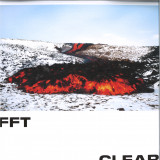
Numbers will release ‘Clear’, the debut album by FFT, on 24th June 2022.The result of three years of focused writing and programming by the London-based producer, ‘Clear’ is deeply psychedelic, defined by a mature sense of melody and structures crafted at a monumental scale.
Though FFT has previously released a handful of tracks under various names, it wasn’t until 2017’s ‘FFT1’ EP on theUncertainty Principle label that his production talents began to fuse into a distinct and personal style, especially evident in FFT’s‘Regional/Loss’ EP on The Trilogy Tapes in 2019, multiple releases on Bruk Records and2021’s ‘Disturb Roqe,’also released on Numbers.Through it all, FFT has mastered a complex sense of mood catalyzed by sound itself: He builds patches and presets from scratch, and feels these synths and software have their own objectives and reactions, creating a kind of compositional feedback loop.The result is an album that brings to mind a collision of electronic pioneers like Delia Derbyshire and Bernard Parmegiani, 2000’s braindance, the Max-imized wares of an OPN or Objekt and the rough rhythmatics of SND or Mika Vainio
The layering of sonic elements and intentions is starkly audible across these nine tracks.They can be seismically concussive and grandiose, but granular and fluid - echoing the Icelandic volcanic eruption that features in the artwork photography byGeorge Cowan. ‘Clear (Eight-Circuit Mix)’sets a euphoric tone immediately accelerated by the jagged sounds and vocal textures of ‘Redeemer’. ‘3 Sided’ channels hyper-urbanity from its almost entirely analogue palette, and by contrast ‘Disturb Roqe 2’is bracingly digital, gyrating in random cycles between clustered percussion, metallic splinters of audio and artificial vocal tics.
Opening side two, ‘You’ve Changed’ adheres to a more abrasive core, while ‘Heal’ and ‘Heal (Alt Mix)’evolved out of linked pieces in FFT’s live sets that grew into complete tracks in the months before Covid-19.The significant intensity of ‘Heal’ in particular was refined during strobe-heavy live performances and is the album at its most turbulent, the claustrophobia interrupted by dazzling arpeggios.The overall impact of 'Clear' is cinematic and precise, marking the arrival of an impressive electronic musician who is not new but has come into his own as a fully developed artist
out of Stock
Last delivered 3 years ago available to reorder, subject to availability
"The past 5 years we have taken our music all over the world: Europe, Asia, Africa besides our homeland Denmark, and even though we cannot speak with many of the people we meet, our music is a universal language that transcends borders. The meetings we have had (and continue to have) all over inspire us to create new music. But of course we are the composers of the music, so this is our representation of those meetings.
Our 3rd album is called AFROTROPISM. Tropism is a biological phenomenon that indicates growth of a plant in response to the environment; so when you see a plant turning for the sunlight, this is tropism. In other words, this is not so much about the plant's roots but more about how it reacts when it touches the air, feels sunlight or rain - in other words the outside world. So AFROTROPISM refers to the fact that we are drawn towards the African traditions, but we are "growing" our own music.
On our first two albums we have recorded extensively with African musicians, and AFROTROPISM is centered around The KutiMangoes (TKM) as a band. We are developing our artistic direction by going more in depth with how we can mix our inspirations with our own musical heritage. Our musical mission is (and has always been) to mix cultures and create our own sound.
With our background in jazz music, TKM counts virtuoso instrumentalists with a heartfelt intent and sound innovators with our horns, effect pedals, synthesizers, drums and percussion from all over the world. AFROTROPISM is a further and deeper development of our trademark bold sound that experiments with synthesizers, soundscapes and a bit of electronic effects without losing it's focus on groove, melody, atmosphere and musicianship."
The KutiMangoes, July 2019
About each track:
STRETCH TOWARDS THE SUN
This track opens up with a synthesizer groove that is inspired by the polyrhythmic grooves played by the balafon (a predecessor of the piano) from West Africa. Our rolling sequence could not be played on the balafon because of the key changes, but the basic idea comes from that instrument. Quick and light, we wanted to write a song where you can feel the sun coming out and feel the energy it's rays give. The combination of the programmed groove, the horn-arrangement, the huge percussion section and the live instruments makes for a sound that we have not heard before, and it illustrates what this album is all about (and what the track's title refers to): that we stretch towards the things that give us energy – and that although our roots are in Denmark, when we encounter a musical tradition as rich as in West Africa, it changes us and our music.
A SNAKE IS JUST A STRING
The first time we saw Mali-bluesman extraordinaire Vieux Farka Touré on stage was just after we had played at a huge festival in Burkina Faso, and we almost literally caught on fire. Their groove was so strong and insistent that we were mesmerized, and it inspired us to come up with the opening guitar part of this song. Basically a bluesy tune with some unusual chord changes and a crazy synthesizer solo by Johannes Buhl Andresen reminiscent of that fuzzy guitar-sound we love so much in the Mali blues. The title is an homage to the Nigerian writer Chinua Acheba, who in his masterpiece novel "Things Fall Apart" tells that in the village during the night, to ward off the fear of darkness, people would call dangerous animals by a different name: don't be afraid, a snake is just a string.
KEEP YOU SAFE
It is a basic human necessity to have a place where you can feel safe. But there are far too many people in our world that fear for their safety, their livelihood, their children, their relatives – and this is surely not a feeling that helps us to flourish as humans. With this song we are saying that we all need to make it a priority to help our fellow humans to feel safe. And of course, if our song can offer a feeling of safety and comfort for a short time to those who listen, we are truly thankful.
MONEY IS THE CURSE
This track is directly inspired by Fela Kuti's ability to create music that is both physical and political. Dance music with a serious message about our times. For the solo part we wanted a more melancholy, pensive feel (than the full-on baritone-trombone melody) and also wanted to experiment with some choppy, stuttering effects to make the horns sound desperate. Money is the curse because it can become the objective of our life; money is the curse because it changes the relationships we have with our fellow humans. Money is the curse.
THORNS TO FRUIT
This melody is inspired by the scales and developments of a traditional Bambara folk-song. We love the way these melodies constantly evolve with small developments and changes. We felt like an accompaniment that is really dry, sparse and earthy would fit well and then made a contrasting solo part. As a group we are interested in how to develop our improvisations together and create sonic landscapes that evoke a distinctive atmosphere – so here, we have no soloist, but a collection of synthesizer parts, saxophone lines and guitar-sounds that together create a dreamy and lush ambience.
SAND TO SOIL
We started out with a short ngoni riff played by our good friend and master musician Aboubacar Konaté. We then sampled it, built soundscapes and our own both meditative and pumping groove around it. We created a melody with both melancholy and joy, with afterthought and impulse and then the brilliant Aske Drasbæk added an emotive and blistering saxophone solo. The title refers to the contrasts in our humanism. As part of our human nature, we have a dark side that drives us (and each other) towards destruction – making the fertile soil into barren sand. The title is an encouragement to emphasize the opposite movement in our nature: to create life and help it flourish. We keep ourselves human by insisting that we must never forget this side of our nature no matter how tough, tiresome or trying it might be. Let's keep our focus on the light, the warmth, the positive energy – that can turn the cold stone into fertile ground.
out of Stock
Last delivered 4 years ago available to reorder, subject to availability
Classic 2001 collection from Detroit's ADULT. 20th anniversary of the original release, 10th anniversary of the first vinyl pressing. Available for the first time in red & black marbled vinyl. "We've wanted to re-release this album for some time," says ADULT.'s Adam Lee Miller, "but we weren't ready until now. We have some new material in the pipeline, and we thought this would be a nice way to reintroduce ourselves." It is indeed a nice way for the hugely respected Detroit duo to herald their return to the world of music, especially for anyone who missed out on Resuscitation the first time around _ the album was never available digitally until the 2012 re-release and vinyl pressing on Ghostly International. The reissue thus presented the chance to own one of the more influential records of the early 2000s: either on double 12" LP or, for the first time, as a digital release. Now, in 2022, the vinyl is available for the first time in a new red and black marble colorway. When it first dropped in 2001, Resuscitation served as a de facto introduction to the duo, collecting a bunch of songs on CD that had only previously been available on hard-to-find singles and EPs. Eleven years later, it does the same thing, except this time around, we can see just how influential its creators' work has been _ and ADULT.'s music only sounds more remarkable with the benefit of hindsight. At the time, Resuscitation's combination of crisp beats, squelch-laden synths and Nicola Kuperus' detached monotone sounded like a broadcast from the future, steeped in the analog synth sounds of forebears like Kraftwerk but possessed of an ultramodern sheen all its own. The duo's visual aestheticwas just as important _ Kuperus' photography adorned all their album packaging (including this re-release), and their liveshows drew on a sense of what a reviewer once called "detached intrigue." Echoes of ADULT.'s aesthetic can be heard today in everythingfrom today's surfeit of analog synth-toting minimal wave bands to the highly stylized divas who dominate the pop charts. But really, in 2022 Resuscitation still sounds like no-one else.
out of Stock
Last delivered 4 years ago available to reorder, subject to availability
Hey Doll Baby is a newly remastered 17-track compilation that collects some of the lesser-known, buried treasures in the Everly Brothers’ rich catalog with songs assembled by Adria Petty, Tom Petty’s daughter, who worked closely with both Everly families on the project, with help from Phil’s widow Patti and son Jason, who provided track-by-track commentary for the liner notes, as well as Don Everly, prior to his passing last summer, and his widow Adela. Hey Doll Baby holds the bittersweet distinction of being the final project Don worked on.
This is not a “Greatest Hits” package. While it includes some hits (e.g.: “Cathy’s Clown” – their biggest selling single), the objective of this compilation is to highlight many of the lesser-known songs that are equally as good as their well-known hits.
In his tenth year with Acid Jazz, the ever-prolific Matt Berry
has crafted a psych masterpiece. Once again proving that
his artistic progression and ambition knows no bounds.
Following the acclaim of last year’s Top 30 album
‘Phantom Birds’ (★★★★ The Times), Acid Jazz release
‘Blue Elephant’, Matt Berry’s sixth studio album with the
ground breaking label.
Recorded during the summer of 2020, ‘Blue Elephant’ is
testament to Matt’s exceptional musicianship, production
skills and songwriting prowess with every instrument
played by Matt - including guitars, bass, a variety of
keyboards and synthesizers (piano, Wurlitzer, mellotron,
Moog, Hammond, Vox and Farfisa organs) - with the
exception of drums (supplied by Craig Blundell), on
arguably his best album to date.
This music soundtracks an album that explores themes
surrounding today’s close scrutiny in all its bewildering,
objectifying and unnerving experiences. Very much a
conceptual and, therefore, continuous long-player, the
album’s infectious grooves come to the fore on standout
tracks ‘Summer Sun’, heavy-psych instrumental ‘Invisible’
and the three-part ‘Blues Inside Me’, which encompasses
a psych journey through a late ‘60s and early glam filter,
mixed with the propulsive ‘Like Stone’.
‘Blue Elephant’ is available on digipack CD, blue vinyl,
black vinyl and audio cassette.
Black Truffle is pleased to present Landscape and Voice, a radical new work (and rare vinyl release) from major Japanese sound artist Toshiya Tsunoda. Undoubtedly one of the most influential artists working with location recordings since the 1990s, Tsunoda’s work possesses a rigorously searching quality that sets him apart from his contemporaries. Tsunoda is known to many listeners for the subtle atmospheric poetry of his early Extract from Field Recording Archive series, which focussed on vibrations recorded in various indoor and outdoor environments in his native Miura Peninsula, often inside pipes, bottles and other vessels. In more recent years, his work has explored the implications of his claim that field recording should be seen as ‘depiction’ rather than ‘documentation’. He has explored disorienting editing and processing in his works with Taku Unami, and, perhaps most radically, represented Maguchi Bay as a kind of kinetic sculpture for shaking speakers by removing all but the inaudible low frequencies from a field recording (Low Frequency Observed at Maguchi Bay).
One of the recurrent concerns of Tsunoda’s recent work, as he explains in the crystalline liner notes accompanying this release, is ‘exploring how I can establish a subjective relationship with an environment, rather than seeing it merely as an object to be recorded’. This has taken various forms, from documenting simultaneously an outdoor environment and the blood flowing through the listener/recorder’s body (captured with a stethoscope) on The Temple Recordings, to representing his own experience of the landscape as made up of ‘grains of space and time’ by inserting looped fragments into field recordings in Grains of Spring.
On Landscape and Voice, this meeting between subject and object becomes an almost mystical union between the natural and the human. As with all of Tsunoda’s work, a relatively simple concept leads to compelling, thought-provoking results. Landscape and Voice combines vowel sounds spoken by six voices with short, looped fragments of field recordings, their noise character suggesting consonants: voice and landscape thus join together in something like words. The record consists of three pieces, each using a different, richly evocative field recording, which periodically freezes, catching on a looped fragment to which is synchronised an abruptly looped spoken vowel sound. The lengths between these interruptions vary, as do the tempi of the loops. The interruption of these lushly immersive recordings of the world – bristling with bird song, rushing water, distant traffic, and clinking metal – only serves to intensify them, as if the depicted environment itself had been returned to the listener each time it abruptly reappears. At the same time, the constant interruption creates an uncannily frozen effect, as if the recorded environment were an object rather than a stretch of recorded time. When combined with the bare human presence of the vowel sounds, the result is both austere and magical. Pressed on 45RPM for maximum fidelity, in a gorgeous sleeve designed by Lasse Marhaug with liner notes from the composer, Landscape and Voice is a radical proposition from one of the deepest thinkers in contemporary sound.
out of Stock
Last delivered 4 years ago available to reorder, subject to availability
In Trux We Pux is an editorial project organized by the Porto based label and collective Favela Discos. Focusing on the city’s thriving experimental and improvised music scene, it sets out to portrait in a series of four volumes some of the characteristic sounds and collaborative practices that have been in development in Porto during the last few years.
In Trux We Pux 02 contains the first of Favela Discos’ collective pieces to be published, and it was chosen to represent a long series of site-specic pieces developed by the collective since its formation. Most of the time these pieces remain lost in time or in the label’s archives.
Desilusão Óptica is an audiovisual piece developed for the festival Serralves em Festa 2017 and was recorded between the concert and rehearsals. The piece is influenced by the book Musicophilia by Oliver Sacks, and tries to explore the notion of auditory hallucination, in this case based on the idea of a phantom sound unconnected to its object.
Starting quietly with a single flute note, Desilusão Óptica slowly grows fuller but more uncomfortable as the pitch rises gradually in a hypnotic effect. The sound we hear is a mix of the sound produced live, its manipulation and repetition, thus the piece exists between the time when it happens, its immediate repetition and ghosts of past sounds.
The flute, delayed and sampled, embodies both the sounds it produces and memories of past sounds, creating a confusion between objecto and sound. The sound is produced by an object but is at the same time separated from it, like in Mulholland Drive when we watch a singer emotionally dedicated to a performance and whose voice keeps on singing even when her body collapses.
Like in Dub Music, the musicians are divided into two groups: those who play, in this case divided by winds, percussion and electric guitars, and the dub master / sound manipulators who launch samples of previous recordings and manipulate the sound that is produced live, through loopers and delay pedals.
The music world is most fortunate that the past two decades have witnessed the rediscovery of mind-opening music that went under-recognized when originally released, and the wellspring of musical content produced by a generation of brilliant musicians. One such musician was the late great drummer Steve Reid, whose reissued eclectic recordings on his own Mustevic Sound label gave his career a second wind.
Though teased on a well-received compilation, one Mustevic release never saw reissue: New Life Trio’s Visions Of The Third Eye, a tremendous collaborative effort between Reid, guitarist Brandon Ross and bassist David Wertman.
Due to overwhelming demand, Early Future Records and Finders Keepers Records are proud to announce a second limited edition pressing of the classic and final Mustevic recording. The release also includes a 20-page written zine featuring an in-depth testimonial and interview with Brandon Ross, and an explorative essay by Finders Keepers’ Andy Votel, as well as a wealth of archival photos, scores and reviews.
Reid’s long and varied career began in his native New York City, where he was involved early on as a member of the Apollo Theater House Band and the R&B scene of the 1960s, including recordings with Martha Reeves and James Brown. In the late 1960s, Reid spent three years in West Africa absorbing musical traditions and experimenting with artists such as Fela Kuti, Guy Warren and Randy Weston. After a stint in prison for dodging the draft as a conscientious objector, the drummer came out swinging in the 1970s. He worked regularly as a session and Broadway musician even while immersing himself into the jazz world, from the straight-ahead styles of Freddie Hubbard and Horace Silver to the otherworldly sounds of Sun Ra and Charles Tyler.
The do-it-yourself ethos of the New York Loft Scene inspired Reid to create his own label, Mustevic Sound, on which he began releasing his own recordings and those of a couple of friends. One of these trusted friends was David Wertman, a young bassist from New York who released his own Kara Suite on Mustevic in 1976.
New Life Trio’s story began when Wertman moved from New York to the more sedate but creatively vibrant town of Northampton, Massachusetts. Here Wertman met Brandon Ross, a young guitarist from New Jersey who had relocated there with his brother to join a coterie of New York expats who had found a comfortable, collaborative environment amidst the liberal college towns in the area, including avant-garde legends Archie Shepp and Marion Brown. Wertman and Ross became friends and began to perform together regularly, both formally and informally.
A string trio of Wertman, Ross and violinist Terry Jenoure was set to record, but Jenoure dropped out just prior to the date. This led Wertman to call his friend Steve Reid to come join the two at the Tin Pan Hollow Studios in Vermont to record what would become Visions Of The Third Eye on December 6, 1978. Originally conceived as an all-acoustic date, the recording would morph slightly when Ross added electric guitar muscle on a number of pieces. Reid would then take the helm and release the recording in 1980, giving a very auspicious birth to what has now become a classic spiritual jazz recording.
Fast forward to 1995…..New Life Trio gets a belated second wind from Stuart Baker’s inclusion of the Ross-voiced “Empty Streets” on his Universal Sounds of America compilation. The brief, haunting lead track just hinted at what the full Visions Of The Third Eye album had to offer. Audience awareness resulted in the pursuit of out-of-print original LPs, thus the rarity of Visions Of The Third Eye led to it becoming a kind of “holy grail” record for collectors of jazz and creative music. The album’s cover image was even incorporated into the cover of Freedom, Rhythm & Sound (SJB, 2009), a wonderful coffee table book presenting album covers from those revolutionary decades in Black creative music. The recording’s legend was cemented.
New Life Trio’s legend continues to grow partly due to the brevity of its existence. The triumvirate of Reid, Ross and Wertman would never work together again. Each member would continue along his own path, finding success in numerous projects. Reid’s career was reinvigorated with the reissue of the bulk of his Mustevic Sound recordings in the early 2000s, which led him to a rewarding partnership with Four Tet’s Kieran Hebden until Reid’s untimely passing in 2010. Wertman balanced life between Florida and Massachusetts as a regular in the local jazz scene, recording numerous projects with his wife, Lynne Meryl, before passing away in 2013. The fantastically creative Ross has remained active in the New York creative music scene with a number of projects, most notably with Henry Threadgill, Cassandra Wilson and Harriet Tubman, a wildly eclectic co-led band with underpinnings of rock, dub and free jazz.
Peer through the windows of the sun-dappled homes in Sicily and you will be faced with a small, strange ceramic object adorning each hallway. It is a glistening pine cone standing upright – a pigna – the longstanding symbol of Sicilian openness and welcome hospitality.
The pigna is a delightfully unusual and yet apt symbol for the title of the third record from Benjamin Harris, AKA Yarni. Ever since his debut LP release in 2017, Yarni has established a following committed to his musical openness, an intuitive curiosity that has spanned everything from house and techno to cinematic ambience and Japanese percussion, as well as jazz horns and afrobeat fanfares. For Yarni, anything goes and everyone is welcome. Now, Pigna sees Yarni reach his fullest and most musically diverse expression, taking its name and ethos from Sicily, but finding a sonic home in the luscious orchestration of a new ensemble of musicians.
Here, at the helm of a nine-person ensemble, Yarni artfully pieces together live improvisations to create the warmth of a seasoned group performing deep within the groove. Opener “Midnight Getaway” places the listener squarely within the disco-funk of Daft Punk as Yarni’s top-line synth intersects with a rolling bassline and a lyrical flute solo from Rachel Shirley. This optimistic tone of sunlit spaciousness is then heightened on “Utopia”, as Yarni’s horn section comes to the fore to pay homage to the ineffable syncopations of Fela Kuti’s pioneering afrobeat.
Rather than scratch at the surface of these musical genres, Yarni’s attuned ear embodies the emotive essence of his various sounds by paying intimate attention to their creation. There is the punch of that afrobeat sax on “Utopia”; the rhythmic skitter of breakbeats on “The Astral”; the sludging thump of funk in the bassline on “Nova”. Collaborators are given free reign, too, to incorporate their own unique stylings into this remarkable whole, from vocalist Emily Marks’ languid tone on “In A Dream”, to saxophonist Jonoa’s innate swing on “Cherub”, and the metronomic movement of bassist Ally McMahon’s playing throughout.
Listening to Pigna is ultimately to find yourself squarely within the comforting embrace of Yarni’s musical mind. It is a truly LP experience – a record to be placed on the turntable’s platter and then left to play, allowing yourself an immersion in these journeying soundscapes. It is no wonder fellow sonic travellers such as the late Andrew Weatherall and DJ Harvey have been supporters of Yarni’s work, since here is a kindred spirit – an artist shaped in the form of radical openness, speaking the hospitable, universal language of beautiful music.
Pan Daijing's exhibition-performance Tissues premiered in the Tanks at the Tate Modern in autumn 2019. A five-act immersion in performance, sound, movement, space, and most of all emotion in its most distilled and conflicted states, Tissues engaged with the conventions of opera and tragedy to present a searing representation of the embattled human psyche in space and time. While the ambitious multi-sensory artwork made use of the range of Daijing's artistic capabilities, music, particularly the voice, was at its formal and emotional core. The vinyl and digital release of Tissues on PAN serves as a record of that work, in the form of an hour-long audio excerpt: an invaluable archival document from Daijing's expansive live practice. Tissues is both a solitary work and a formal study in relation. Composed, directed, designed, written, and performed by Daijing (alongside a cast of twelve dancers and opera singers), the work_its libretto written in a mixture of old and modern Chinese_lingers inside a single human perspective. Daijing conjures states that are by turns delicate and severe, the tension between opposing modes animating the work as it unfolds. And yet, for all its interiority, Tissues foregrounds an intimate relationship with its audience through details like its engulfing visual landscape and its rattling, confrontational narrative arcs. Daijing uses the opera form as a prism through which to question the boundaries of music itself: perhaps, she proposes, music is much more than simply what is heard. It is in the relationship between voice and electronics that this limit is most clearly breached. Across the four acts gathered in this documentation, a counter-tenor, a soprano, a mezzo-soprano, and the artist herself voice a mixture of stunning laments and cries over an instrumental landscape, built out from industrial texture. Meant to be heard in a single listen, rather than track by track, the work unfolds through tender hollows and agitated peaks. At its crescendo, the operatic vocals melt away and the synthesizers themselves seem to howl with grief. Daijing uncovers an essential, sometimes painful, music in all that surrounds us, inviting something like catharsis but also a greater understanding of the thing she and her cast conjure and draw close. A tissue, after all, is both a disposable object one uses to wipe away a tear, and the building block of our fleshy human forms. Daijing reaches and excavates the roiling core of what it is to be alive and full of feeling. Music from Tissues, an opera of five acts at Tate Modern, London on Oct 2nd, 4th and 5th, 2019 Composed, written, produced and directed by Pan Daijing. Performed by Anna Davidson, soprano ; Marie Gailey, mezzo soprano, Steve Katona, countertenor and Pan Daijing, additional vocals. The recording is mixed by James Ginzburg , Jan Urbiks and Pan Daijing, mastered by Rashad Becker. *2xLP comes in a gatefold cover, and includes an obi strip and a booklet containing images from the performance & liner notes, as well as a postcard granting access to exclusive video documentation*
out of Stock
Last delivered 2 years ago available to reorder, subject to availability
Modest techno for mindful people, second edition. Luise is glad to present Arutani‘s newest album, a true evolvement of its prodecessor. Still true to the artist‘s handwriting, with a minimal and subtle character, hinting details and bold elements. However even more a unique listening experience and a sta- tement on its own.
out of Stock
Last delivered 3 years ago available to reorder, subject to availability
Anechoic produced a concept EP inspired by the orbit, and the gravity from a smallest subatomic particle to the largest star.
This 4 tracks vinyl EP + a bonus digital track is carefully constructed to represent the repeating path that one object can take around another one. The gravity represents the harmony of the tracks that keep them playing without intersect. Each track has its own eccentricity - this is the amount an orbits path differs from a perfect circle.
So imagine all of the five tracks playing together, everyone has an eccentricity different from zero to the centre, each one has its own path, and a certain amount of time to make one complete orbit, this is the analogy with the concept EP 'Geosynchronous Orbit'.
out of Stock
Last delivered 2 years ago available to reorder, subject to availability
"The focus of this project and presentation examines the art of mental persuasion and how the mind can control as well as fall vulnerable to subservient ways. It allows the means to look creatively and more in-depth to a subject that applies to every person and at every stage of life because how we perceive or sense something is part of our evolutionary survival pattern. " -Jeff Mills
Mind Power Mind Control
The focus of this project and presentation examines the art of mental persuasion and how the mind can control as well as fall vulnerable to subservient ways. It allows the means to look creatively and more in-depth to a subject that applies to every person and at every stage of life because how we perceive or sense something is part of our evolutionary survival pattern. Because there is no exact mental compatibility between any of us, speculation and misconceptions are not exemplary so, an emphasis on "the presentation of facts, ideas and methods and what we knew as true by example" are the major points that drives the overall purpose of this album project.
Mainly artistic but scientifically as well, the album will explore various techniques used to control minds, physicality of people and inanimate objects. The objective of this project is to examine, reveal and demonstrate how humans have created metaphysical and mind-bending techniques to control people, they're minds, societies and our outlook on reality and life.
-Jeff Mills
out of Stock
Last delivered 2 years ago available to reorder, subject to availability
Cocteau Twins, Jefre Cantu-Ledesma, Julia Holter, DIIV, Washed Out, Broadcast, Insides, Beach House, Drug Store Romeos. Introducing Beneather, a BAFTA-nominated composer from North London obsessively crafting sad, lo-fi, cinematic, ambient scandi-dreampop submerged in gently fuzzy tape loops. Much like the paintings of Gerhard Richter or a heavy mist rolling through a familiar landscape, the debut long player from Beneather obscures and blurs ten beautiful tracks beneath washes of cinematic, ambient scandi-dreampop – details emerge and fade, voices ooze and flow, tunes soothe and unnerve, metronomic beats click and swing. It would not be out of place on a David Lynch or Jim Jarmusch soundtrack. Inspired by the likes of Jefre Cantu-Ledesma, Hammock, Grouper, Low, GAS, Huerco S., Emeralds, Jenny Holzer, William Basinski & ABBA!! Beneather is the solo project of Lewis Young - composer and collaborator in The Leaf Library, drone pop from north London. As a composer, Lewis recently scored the British short ‘Lucky Break’ which found its way into the BAFTAs short list only to narrowly miss out on the gong. Lewis is a multi-instrumentalist, producer, designer and filmmaker currently living in Walthamstow, London. He started as a guitarist in noughties math-rockers Tea with the Queen, shifting to bass for multi-harmonied Naomi Hates Humans before returning to thumping roots as drummer for The Leaf Library. Objects Forever - the imprint label created by The Leaf Library - has provided Lewis with the vehicle to jump back into experimental song craft, inspiring the genesis of Beneather. “I just needed to make a project which spoke to all the aspects of music I’ve loved creating as a multi-instrumentalist. Plugging things into things to make satisfying little electronic loops, then layering extremely minimal bass and guitar lines with a lo-fi aesthetic. Melinda and I spent a few days in the studio - picking out objects, patterns… items that could inspire a thread of instinctive wordless melody. I took that expressionism and sliced it to pieces, rearranging it into ambient vocal hooks.” Beneather is an exercise in hypnotic simplicity. Experimental, dream-like music built on layers of scratchy electronic tape loops, chiming spacious guitars and abstract pulsing vocals. These cinematic songs combine Grouper's wistful deviations with the warm fuzz of Jefre Cantu-Ledesma, the nocturnal hum of Emeralds, the crackling collapse of William Basinski and Low's glacial pop melancholy. Outside of compositions for film, TV and Podcasts - Lewis plays with the indie drone-pop band The Leaf Library, featuring Matt Ashton from John Peel faves Saloon (“World-weary yet innocent, blissful dream-pop” - UNCUT - 8/10). Lewis has supported the likes of Lali Puna, Joanna Newsom, Lætitia Sadier & Alexis Taylor.
Limited 300 180g white vinyl LPs with printed inner Discobag and digital download.
500 CDs in gatefold digifile sleeve.
Each drum controls a virtual musical instrument (synthesizers, samplers, arpeggiators, etc.) within Ableton Live music software that, in combination with a custom step sequencer developed with MaxforLive app, allows Davide to perform real melodies/electronic orchestration without the use of any backing track. 100% live. In addition to that, he also uses a microphone set up in the middle of the drumkit to capture the dynamics of the acoustic drums and translate them through an 'envelope follower' into electronic parts in several ways. About ‘Perceive Reality’: Opener Belief bursts the record into life, as skittering arpeggios spin across a vast open plain of pad synths, before the ground splits beneath it with thrashing drums. On Conceived, Davide creates a simultaneously dark and euphoric wall of crystallised sound, a cacophony of pounding drum hits and icy electronic stabs, with an intensity that continues into Collide. With its shuddering, cut-out reverbed synth pads split in two by crashing cymbals and snares, the song spins itself into a transformative cycling trance, before slowly fading and washing away into silence, only to be broken by Conjectures’ sudden cymbal slams and transfixed toms that roll like thunder into a frenzy, before their final lightning strike. On Subjective, arpeggios twist around beating kick drums and toms, quickly scaling to a furious yet tightly wound sequence that envelops the listener, before Relief, where the album finally takes the shape of a huge wave of calm, glimmering hope and reflection. About the concept behind this latest album, Davide says, “Perceive Reality is a vivid exhortation to deepen the relationship with reality, avoiding simple and often illusory visions. In a historical context that fosters the proliferation of dual information and visions, individuals are increasingly exposed to the danger of perceiving less the complexity of events, thus losing the training to express complex and articulated opinions, the result of a reflection, whether individual or collective. Without having the presumption of resolving epochal issues, the project alerts to the fact that univocal answers do not exist and that only by developing a path of knowledge and giving ourselves the opportunity to examine things in depth, can we enter into the relationship with the existing.” Press highlights so far: Video premiere on Rumore.IT (Italy).
The sound mutations of Estonian based museum security guard Mihkel Kleis, aka Ratkiller, has found its nest on the upcoming oeuvre "Leather Squeaking Softly". A unique sound composition and rare glimpse into visions of being stuck in a whirlpool of forgotten debris and plastic remains, discarded non-recyclable objects and broken hi-fi equipment. An audio memorandum rendering irregular sound compositions of desolated dumping grounds, faulty drum machines and field recordings of distorted memories. It's as if your whole life was a theme park built on a hazardous waste site. Leather Squeaking Softly consists of two different Movements extending a bit over 33 minutes. The cassette release is due in April on Possible Motive and comes as a pro dubbed C-30 coloured cassette with 4–colour pro printed inlays.
“Electronic music’s equivalent of dragging an unwilling teenager to a family function”
Richard Foster — Louder Than War
Bristol techno, noise and hardcore supremos SCALPING are
releasing their highly anticipated debut album ‘Void’.
‘Void’ comes on the heels of an extremely exciting 2021 for the
band, which saw them play to sold-out crowds at the Roundhouse
twice in two weeks - both on tour with Squarepusher and at
Pitchfork Festival London - as well as releasing two widely
acclaimed EPs titled ‘FLOOD’ and ‘FLOOD Remixed’, the latter of
which featured treatments from producers Hodge, Azu Tiwaline,
object blue, AQXDM and Laurel Halo and Scottish instrumental
rock legends Mogwai.
SCALPING are heavy metal in 4D; the sound is moody, distorted
and rhythmic, but the use of electronic techniques gives the finer
details room to breathe, making more space for experimentation.
Tracks such as ‘Tether’, featuring Oakland rapper DÆMON, puts
a modern, metal twist on Bristolian trip-hop, whereas album closer
‘Remain in Statis’ features fast-rising artist Grove, a Bristol-based
rapper and self-professed metalhead whose commanding
presence sets the track alight.
In the heat and darkness, it’s a swarm of low-end frequencies and
ripping guitars, somewhere between Black Sabbath-esque
psychedelica and The Bug’s sub-bass headfuckery. Live, the
effect is immense. SCALPING play continuously for the duration of
their sets, generating a storm of metal-and-techno through a rising
beats-per-minute count.
‘Void’ will be put to the test, as the band kicks off an eight-date UK
headline tour, culminating in a live performance at fabric on May
5th. As live shows return in 2022, SCALPING will continue to
prove themselves as one of the UK’s most impressive, ambitious,
and original new live bands.
out of Stock
Last delivered 3 years ago available to reorder, subject to availability
ARTS objective is to create unique playgrounds, and Keith Carnal is the right man for this work. We present you 4 cuts that are techno weapons used in the right way, emotional, magical & energetic.
out of Stock
Last delivered 24 days ago available to reorder, subject to availability
Analog Africa delves deep into the scene of the Mexican's sonideros (sound-system operators) to present the "Rebajada" movement they've created using locally made pitch controls, speakers and sound effects.
"In 2010, I had asked Eamon Ore-Giron - aka DJ Lengua - if he would be interested in compiling a Latin project for Analog Africa, and if so, if he had a theme in mind. He replied, “Have you ever heard of rebajada?“ The question mark above my head, together with the wall of China, must have been the only other object visible from out of space because Eamon, probably noticing I got paralysed, continued, “Rebajada in Spanish means “to reduce, to lower”. It’s basically Mexican sonideros (soundsystem operators) slowing down the beat of a Cumbia to create a much more tangible music to dance to. I’ll send you a mix I made last year and let me know what you think.“ And so he did.
That mix was called Rebajada Mota Mix and I began listening to it on a loop. Although I was not immediately hooked it was intriguing from the get-go, and so I kept listening until magic began unfolding. Slowed down music allows you enough time to hear right through it, revealing itself in ways I had rarely experienced before. Everything became more transparent and I was noticing sounds normally only perceptible by bats. A near psychedelic experience. That mysterious mix included a few Ecuadorian songs by Junior y su Equipo - aka Polibio Mayorga (a cult figure in the sonidero scene), a couple of Mexican tunes, one Colombian, and various Peruvian songs, undoubtedly the driving force behind this project.
The sonidero who brought Peruvian and Ecuadorian music to Mexico was the legendary Pablo Perea from Sonido Arco-Iris, and although his fingerprints are all over the compilation Saturno 2000, this selection of songs in rebajada is exclusive to DJ Lengua. With the exception of a few classics from Polibio Mayorga and La Sampuesana – the queen of all rebajadas – most of these songs were probably never performed as such before, let alone released.
So how did rebajada come to be? In a nutshell; Rebajada started with two families of brothers – the Pereas and the Ortegas – who travelled all over Latin America and returned to Mexico with heavy loads of records which they would sell to the various sonideros always on the lookout for new tunes. Colombian beats especially seemed to fit almost perfectly with the Mexican dance steps – but they were just a bit too fast. As a result some sonideros began experimenting with equipment, and Marco Antonio Cedillo of Sonido Imperial created a revolutionary pitching system that could slow records down to an extent other players could only dream about. And so rebajada was born . . . or so we thought.
At the same time in north of the country, in Monterrey, sonidero Gabriel Dueñez almost got electrocuted by a short circuit that nearly set his record player on fire. As a result the platter started spinning in slow motion for the rest of the party, turning Cumbia into a different affair altogether. The youngsters went crazy for it and started harassing the sonidero with requests to record cassettes for them. Reluctant at first, Dueñez finally began recording a series of pirated cassettes called “Rebajada” which included mainly Colombian cumbia and porro in slow-mo exclusively. Those tapes took the city by storm and turned rebajada into a celebrated and defiant movement of the youth.
Of course it would not be a Mexican urban legend if it didn’t include dramaturgical elements, and so for nearly 30 years, until this day and probably for ever, both cities have been arguing and claiming ownership the creation of rebajada for themselves. But sonidera Joyce Musicolor, who never has time for such trivial arguments, got straight to the point: “Rebajada, and the equipment to perform it, is from here Mexico City but it was Monterrey that popularised it.“
out of Stock
Last delivered 22 months ago available to reorder, subject to availability
The classic second Big Thief LP originally released in 2017, limited repress at a decent price! Gatefold LP & download code, don’t miss out.
The trails that Brooklyn's Big Thief -- Adrianne Lenker (guitar, vocals), Buck Meek (guitar), Max Oleartchik (bass), and James Krivchenia (drums) -- take us down on Capacity, the band's highly anticipated second record out 6/9 on Saddle Creek, are overgrown with the wilderness of pumping souls. After last year's stunning Masterpiece, Capacity was recorded in a snowy winter nest in upstate New York at Outlier Studio with producer Andrew Sarlo. The album jumps right into lives marked up and nipped in surprisingly swift fashion. They are peopled and unpeopled, spooked and soothed, regenerating back into a state where they can once again be vulnerable. Lenker's songs introduce us to a gallery of multifacted women and deal with the complicated matters of identity — at once dangerous and curious, though never unbelievable. Lenker shows us the gentle side of being ripped open. Tricked into love, done in and then witnessing the second act of pulling oneself back together to prepare for it to all happen again, but this time to a sturdier soul, one who is going to take the punches better than ever before and deal some jabs and roundhouses of their own. The album is thick with raw, un-doctored beauty: most of the songs on Capacity were played for the first time in the studio and were recorded the same day. There is a darker darkness and a lighter light on this album,' Lenker explains. The songs search for a deeper level of self-acceptance, to embrace the world within and without. I think Masterpiece began that process, as a reaction from inside the pain, whereas I feel Capacity examines the pain from the outside.'
The previously unrecorded Drone Mass was described by its composer, the late Jóhann Jóhannsson, as “a contemporary oratorio”. Written for voices, string quartet and electronics, it was commissioned and premiered by the American Contemporary Music Ensemble, aka ACME, who toured and recorded with Jóhannsson for almost ten years. Now they have made the world premiere recording of this richly atmospheric work, in collaboration with Grammy Award-winning vocal ensemble Theatre of Voices, conducted by Paul Hillier, also a multiple Grammy Award-winner. The members of both ACME and Theatre of Voices worked closely with the composer many times, both in the studio and in multiple live performances and tours, before his untimely death. Drone Mass is an extraordinary, mysterious accomplishment which at times bears comparison with the meditative minimalism of composers such as Arvo Pärt or Henryk Górecki. Beginning with strings and voices, but slowly integrating Joìhannsson’s electronic techniques into its landscape, the work represents what the Icelandic composer called “a distillation of a lot of influences and obsessions”.
out of Stock
Last delivered 18 months ago available to reorder, subject to availability