Italian techno sensation Alignment is back with a fifth EP Close Your Eyes on Charlotte de Witte’s KNTXT label out on Friday 31st March.
Close Your Eyes is four tracks of thrilling all-out industrial assault from the Barcelona-based artist.
Title track ‘Close Your Eyes’ rips into a slamming turbo-charged beat accompanied by metal textures and warehouse atmospherics. Next up, ‘Deep Space’ is pure evocative melodrama, riding on a wave of ghostly vocals and piercing synth stabs. ‘Dance For Me’ ups the ante with a trance-tinged roller underscored by slamming bass, before ‘Fight For A New World’ closes out the EP with an epic journey to euphoria.
“I really thought of the Close Your Eyes EP as a travel in my current dreams and maybe a bit of my nightmares as well.” Alignment explains. “For this EP, I tried to combine the “original” Alignment influences with a touch of the new hard techno sounds.”
Charlotte de Witte adds: “Alignment is back, and his 5th release on the label is an absolute killer! I’ve been playing these tracks all over the world for the past couple of months and they don’t disappoint. I’m very excited to finally put them out there and have Alignment on board again!”
Italian-born artist Alignment, whose real name is Francesco Pierfelici, has emerged as an unstoppable force in the techno world in recent years. He has had an outstanding array of vital productions - with four previous EPs on Charlotte de Witte’s KNTXT label, including 2022’s acclaimed Attack - and his sound helps carry forward the diversity and musical
identity the label stands for. Describing his style as “a journey to the dark corners of one’s inner self”, Alignment’s industrial techno is reminiscent of an endless post-apocalyptic warehouse rave.
‘Close Your Eyes’ is another exhilarating offering from the new school techno giant. An EP you won’t want to miss.
out of Stock
Last delivered 27 days ago available to reorder, subject to availability
‘Where is Agartha? What is the specific region in which it lies? Along what road, through what civilizations, must one walk in order to reach it?.’ Saint-Yves d’Alveydre in 1886
Agartha, the debut full-length album by Japanese producer Wata Igarashi, is a mysterious, divine thing. Named for the mythical secret kingdom, understood as a complex maze of underground tunnels, perhaps designed by Martians who colonised the Earth tens of thousands of years ago, it’s a similarly mystical, perhaps even cosmic trip – but this time, exploring an inner, deeply personal cosmos. Beautifully detailed and bustling with rich incident, it takes Igarashi’s music to new places, which still retaining his unique sonic imprimatur; in this respect, it’s perfectly at home with Kompakt, a label that’s always encouraged artists to make the visionary music they need to create, to take risks and make sideways steps into uncharted territory.
An eloquent producer and DJ, Igarashi has been releasing techno for eleven years now, appearing on such imprints as The Bunker NY, Delsin, Midgar, and Time To Express; he has also self-released his productions via his WIP net label. Throughout, Igarashi has consistently explored his unique approach to techno and electronic music, one that’s eloquent and poised, even when it shifts into more psychedelic terrain; he’s a master at balancing the sensual and the functional, and he has an unerring ear for the right texture, the right tone, at the right time. He brings all of this into Agartha, his most thorough-going expression of self to date.
For Agartha, Igarashi had a strong concept he wanted to explore. Visualising specific scenes from an imaginary film based on the titular secret kingdom, he created soundtracks for those scenes, spending time during the pandemic in his studio, working away carefully at the ten tracks here. Given his background in creating music for television and advertisements, Igarashi is well-placed to explore the marriage of the sonic and the visual in such intimate ways, but freed from commercial concerns, he let his imagination run riot. He also drew on a rich palette of musical influences – techno is in there, of course, but you can also hear the smoky, improvised jazz of the likes of Miles Davis (to whom the album’s title is an indirect nod), and the minimalism and systems music of Steve Reich.
The latter is particularly pronounced on the gorgeous, beatless drift of “Floating Against Time”, where an arpeggiated sequence lingers, lovingly, around your ears for nine blissful minutes, coasting across swooning drones and waves of ambient noise. “Ceremony Of The Dead”, originally composed as part of a Sony 360 Reality Audio spatial sound concert, is a deep pass into systems composition, with various patterns overlaid and interlocking, before a wordless vocal rises from the depths, a gorgeous counterpoint to the swarming textures that gather across the track. On the other hand, tracks like “Burning” and “Subterranean Life” nudge toward Fourth World territory, painting deluxe dreamscapes of uncertain provenance; the title cut is an abstract drift-world, Igarashi painting an alien tableau dotted by shape-shifting creatures.
Agartha’s conceptual framework means that everything on the album sits perfectly together; listening to it in one sitting is a dizzying, lush experience. Its imaginings of inner landscapes recall, in some respects, the nautical, aqueous mythologies of the Drexciyan universe, though from different perspectives. But the result is Igarashi’s own creation, a deluxe, enchanting trip through the visionary Agartha of this unique producer’s cinematic mind’s-eye.
Wo liegt Agartha? In welcher spezifischen Region liegt es? Auf welchem Weg, durch welche Zivilisationen muss man gehen, um dorthin zu gelangen?'
Saint-Yves d'Alveydre im Jahr 1886
Agartha, das Debütalbum des japanischen Produzenten Wata Igarashi, ist ein geheimnisvolles, göttliches Ding. Benannt nach dem mythischen, geheimen Königreich, das als ein komplexes Labyrinth unterirdischer Tunnel verstanden wird, die vielleicht von Marsmenschen angelegt wurden, die vor Zehntausenden von Jahren die Erde kolonisierten, ist es eine ähnlich mystische, vielleicht sogar kosmische Reise - aber dieses Mal erforscht es einen inneren, zutiefst persönlichen Kosmos. Wunderschön detailliert und voller reichhaltiger Begebenheiten, führt es Igarashis Musik an neue Orte, die dennoch seine einzigartige klangliche Handschrift bewahren. In dieser Hinsicht hat es bei Kompakt ein perfektes Zuhause gefunden - einem Label, das Künstler immer ermutigt hat, jene visionäre Musik zu machen, Risiken einzugehen und seitwärts Schritte in unbekanntes Terrain zu tun.
Der eloquente Produzent und DJ Igarashi veröffentlicht seit elf Jahren Techno auf Labels wie The Bunker NY, Delsin, Figure und Time To Express; außerdem hat er einige Produktionen über sein Label WIP net selbst veröffentlicht. Dabei hat Igarashi stets seinen einzigartigen Ansatz für Techno und elektronische Musik verfolgt, der kontrolliert und ausgeglichen ist, selbst wenn er sich in psychedelisches Terrain begibt; er ist ein Meister der Balance zwischen dem Sinnlichen und dem Funktionalen und hat ein untrügliches Gespür für die richtige Textur, den richtigen Ton zur richtigen Zeit. All das bringt er in Agartha ein, dem bisher umfangreichsten Ausdruck seiner selbst.
Für Agartha hatte Igarashi ein starkes Konzept, das er erforschen wollte. Er stellte sich bestimmte Szenen eines imaginären Films vor, der auf dem titelgebenden geheimen Königreich basiert, und schuf Soundtracks für diese Szenen. Während der Pandemie verbrachte er Zeit in seinem Studio und arbeitete sorgfältig an den zehn Tracks. Mit seinem Hintergrund als Komponist von Fernseh- und Werbemusik ist Igarashi prädestiniert dafür, die Verbindung von Klang und Bild auf solch intime Weise zu erforschen, aber frei von kommerziellem Dünkel ließ er seiner Fantasie freien Lauf. Er schöpfte auch aus einer reichen Palette musikalischer Einflüsse - Techno ist natürlich dabei, aber man hört auch den rauchigen, improvisierten Jazz von Miles Davis (an den der Titel des Albums eine indirekte Anspielung ist) und den Minimalismus und die Systemmusik von Steve Reich.
Letzteres ist besonders ausgeprägt in dem wunderschönen, beatlosen "Floating Against Time", wo eine arpeggierte Sequenz neun Minuten lang liebevoll um die Ohren fliegt und über schwelende Drones und Wellen von Umgebungsgeräuschen gleitet. "Ceremony Of The Dead", ursprünglich als Teil eines Sony 360 Reality Audio-Raumklangkonzerts komponiert, ist ein tiefes Eintauchen in eine Systemkomposition, bei der sich verschiedene Muster überlagern und ineinander greifen, bevor sich ein wortloser Gesang aus der Tiefe erhebt, ein wunderschöner Kontrapunkt zu den wimmelnden Texturen, die sich über den Track legen. Andererseits bewegen sich Tracks wie "Burning" und "Subterranean Life" in Richtung der Vierten Welt und malen luxuriöse Traumlandschaften ungewisser Herkunft; der Titeltrack ist eine abstrakte Scheinwelt, in der Igarashi ein außerirdisches Tableau malt, das von formwandelnden Kreaturen übersät ist.
Der konzeptionelle Rahmen von Agartha ermöglicht, dass alles auf dem Album perfekt zusammenpasst; es in einem Zug durchzuhören ist eine schwindelerregende, opulente Erfahrung. Wata's Vorstellungen von inneren Landschaften erinnern in gewisser Hinsicht an die nautischen, wässrigen Mythologien des drexciyanischen Universums, wenn auch aus einer anderen Perspektiven betrachtet. Aber das Ergebnis ist Igarashis ureigene Schöpfung, ein luxuriöser, bezaubernder Trip durch das visionäre Agartha dieses einzigartigen Produzenten mit seinem cineastischen Blick.
out of Stock
Last delivered 13 months ago available to reorder, subject to availability
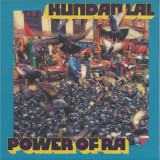
Kundan Lal is a highly understated artist. Little is known about his background, though some refer to him as Kunsaf Halil, his personal life remains largely a mystery.
Gathering a cult following amongst people like Den Sorte Skole or DJ Marcelle with his previous releases, he is now set to sail new shores. There is a sense of wanderlust as he opens his box of field recordings, collected on his many travels. From the buzzing streets of Alexandria, early sunday markets in Tafraoute or a crackling bonfire down by the banks of the river Ganges. Each track takes you places.
Kundan's second album is a captivating blend of dubby beats, collages, and exotic instrumentation. Drawing from classic tools like the Roland 808, SC7 and the famous Space Echo, Kundan has created a unique and minimalistic sound that is sure to captivate listeners. At once nostalgic and experimental, "Power of Ra" is a must-listen for both electronic music purists and fans of adventurous soundscapes.
Compelled to work from home on his computer during lockdown, Kundan dusted his pawnshop e-piano, downloaded some orchestral soundkits and started to digitize almost forgotten field recordings. The "Power of Ra“ came to him.
“Illgrimage” is a good example of his approach. Combining atmospheric soundscapes with swirling strings, trombones and pianos. Echoes of birds and children playing in the streets. A small town filled with life and a theremin leading the way while you hear the faint yet powerful words of Greta Thunberg saying: "Imagine...“
“Raqaqa,” a powerful orchestral journey with a hip-hop edge. Tinkling chimes add a groovy vibe, while lush layers of wind instruments weave a masterful soundscape. It’s the slow-burning intensity of this track that pulls you in.
"Nasi Chip" is a signature song that exemplifies Kundan Lal’s musical prowess. An engaging beat coupled with chopped up vocals, 8-bit synth melodies and an arpeggiated piano provide an energetic atmosphere that is both cunning and unique.
”Cen" lures you into the egyptian realm. A Harmonium slithers serpent like around a pounding beat.Horns gently swaying to the rhythm of the desert.
It is hard to put your finger on his style or genre. You can feel Kundan Lal‘s DIY spirit in his production, carving his own ethnic genre. For enthusiasts of Roberto Musci or Muslimgauze, this avant-garde album is one for your collection. Keep your senses open and let the Power of Ra pass you to another world.
out of Stock
Last delivered 16 months ago available to reorder, subject to availability
With this release TAL delves deep into the very beginnings of Düsseldorf's post punk scene of the early 1980s. STUMM was the duo of Detlef Funder and Bernd Sevens who both would become pivotal figures in the tape underground movement of West-Germany, when they launched the SDV label in 1986. Individually they went on to produce boundary defying works as Konrad Kraft and Seventh Day respectively.
The material on this album was recorded by Funder and Sevens quite casually in 1980 in a rehearsal studio in the centre of Düsseldorf. Right from the beginning the two young musicians incorporated the atmosphere of the space in order to document the process of their sound experiments on a 4-track tape machine. For those recording sessions, which are now released for the first time ever on vinyl and download, Funder and Sevens managed to get their hands on a very rudimentary set of equipment consisting of merely a Korg MS 20 synth, a Roland CR 78 drum machine, a few electronic effects and a drum kit. The urgent and rough sound of the recordings imbues their production with a characteristic and era-specific edge that's hard to imitate today. Spontaneity and understatement were key elements in the brief creative period of STUMM. The recordings still have a uniquely dizzying quality and are somewhat of a basic blueprint for a lot of industrial/techno and post punk which was about to loom in all corners of the world. These tracks are also a testament to the vivid spark of a period in time that would soon be radically changed through the rise of digital technology.
Bernd Sevens: “Around 1980 there was a great musical awakening. Punk, New Wave, Industrial and of course Dub Reggae -- the electronic music blew us away. Everything we heard influenced us. Back then, cassette tapes were cheap and easily available. We could record our ideas on the spot and then copy and distribute the tapes. That's how it started. Giving it a go, experimenting, trial and error. The music you hear on the record was spontaneous and had no concept. Our collaboration was also not intended to be a permanent project. You could say we were dilettantes setting out on our journey, making it up as we went along. It felt like a beginning.”
»Picture a Frame,« the debut album by the Belgian composer Elisabeth Klinck, was born out of strict isolation and is nonetheless a result of a collaborative process that saw her working closely with artist Oscar Claus. Enriching her compositions for violin with electronic soundscapes and field recordings from their surroundings, the two entered an artistic dialogue that took place inside its own idiosyncratic space outside of conventional time. It is an intimate record in which Klinck’s expressive playing that incorporates unconventional techniques forms the basis of something much bigger: an invitation to inhabit a specific space at a specific time together with the two of them.
For an entire week in the spring of 2021, Klinck and Claus stayed at an abandoned monastery surrounded by beautiful gardens, but with no power or running water. The intention was to record some of Klinck’s musical ideas on violin, experiment with electronics and acoustic spaces and to get to know each other on a musical level. This proved to be an inspiring and deeply moving process—and the starting point for more. In the winter of that year, the duo set out to the Spanish Pyrenees to build a DIY studio in a small village on a mountain top and record the eight pieces that form »Picture a Frame.« The idea of losing track of time and space is a theme that found its way in these recordings. The two spent their days and nights reading, walking, talking, cooking and taking care of the animals living there but also experimenting with sound, improvising together and making field recordings.
This deep focus on being present in the moment, listening to the world around them and each other resulted in a holistic experience that was translated into music and sound. Klinck and Claus understand this album as a collage, an attempt to evoke the implicit, an essay that suggests a time and space, and a gentle collision between two people that deeply resonate with one another. It’s impossible to argue with that, and even harder not to be drawn into it.
"As I write these notes sitting on my balcony in July 2022, it has been more than 9 years since the release of my debut album and more than 11years since it was recorded, the time since has been a personally tumultuous period of twists and turns - retreat, reflection, realization, reassessment, therapy, triumph, trial and error - entangled in a decade-long creative block that had me questioning whether
I would ever be able to compose again and though I felt there was so much I wanted and needed to say, I felt I had lost my voice, or perhaps never had one in the first place. A constant knot had grown tighter and tighter within me over time, but I did not understand what had created it or how it might be undone. In 2018, shaken awake by the collision of two transients, I suddenly saw in a new light old
patterns whose familiar presences I realized I had felt for much of my life, but had until then never seen for what they were. Following a third, I finally found the humility to surrender, and as I began re- examining and confronting myself, I slowly started to discover new answers - and new questions to ask.
Then the Covid-19 pandemic happened, and the world stopped. Like so many of us caught in the new eerie calm, I retreated into inner spaces. I began revisiting sketches of ideas I had accumulated over the years, and finally, very, very slowly, new music started to come. " - Jussi Reijonen.
"Electrifying and deeply resonant, monumental and profoundly personal, Reijonen's five- movement suite is a beautifully crafted, remarkable journey of sound and emotion performed by a knockout nine-piece ensemble." - Monarch
"He's written one hell of a piece." - The Arts Fuse
"On this remarkable and ambitious new recording, Reijonen delivers an epic transcultural suite that feels as deeply personal as it is expansive and farreaching." - All About Jazz "a remarkable sophomore album" -The Boston Globe
"This is an album meticulously pulled together into a dense fabric of diverse musical threads. It merits repeated listening; with each fresh listen, the richness of Reijonen's intercultural vocabulary becomes more apparent." London Jazz News
"Even in our present jazz moment, when the art form is worldwide and vital, albums that come as complete surprises are relatively rare. Three seconds Kolme Toista is a stunner." Jazz Times
"Three seconds Kolme Toista is spellbinding from beginning to end, and full of virtuoso performances." All About Jazz
“Talk West is the project of Dylan Aycock. Aycock has forged a small series of intriguing and beautiful missives through the cassette underground with his explorations on guitar and pedal steel. On Black Coral Sprig, Aycock negotiates the terrain between stately and homely by stretching a ringing country tone into an all-encompassing atmosphere, much like the ambient realms of Stars Of The Lid. His unhurried, gentle playing style comes to reveal understated textures that weave into a whole alternately spirited, warming and often haunting.” —Preservation
* 300 COPIES FOR UK/EU* With a friendship stretching back nearly 20 years, it strangely ended up being a couple of childhood photographs that finally brought Ben Chasny and Rick Tomlinson together as collaborators. Both have rich musical backgrounds: Chasny being a member of the psych-rock outfit Comets on Fire but probably best known for his solo project, Six Organs of Admittance, while Tomlinson has released numerous records as Voice of the Seven Woods/Thunders and under his own name. “A mutual acquaintance, Jamie Tugwell, took me to go see Rick play live around 2005,” remembers Chasny. “Jamie kept saying how Rick was sort of an ornery fellow and that I would like him a lot. He was right. I loved his guitar playing right away, which seemed so far from what a lot of players were doing. We had drinks and hit it off. We remained friends over the years.” Chasny became a regular visitor to Tomlinson when on tour in the UK and one particular stay unearthed something serendipitous that would kickstart the making of a joint album. “I was staying at Rick’s house after a show and I looked over and saw a photo of him in a Halloween costume as a box of matches,” Chasny recalls. “It cracked me up because I have a similar photo of me as a robot and I tried to explain to him how it matched his photo.” About 6 months later Chasny found it and sent it to Tomlinson to show him the uncanny likeness of their childhood outfits. “Pretty soon after that we realized we needed to do a duo record and have those photos be on the cover,” says Chasny. “The entire record comes from the photos on the cover.” Tomlinson adds: “It was a pretty odd coincidence. Even down to us both standing on flags with a conifer behind us. We obviously had no option but to use these for the sleeve.” Recorded at Tomlinson’s house in Todmorden over three days one June, initially the pair didn’t quite know where they wanted to go with their musical direction. Tomlinson kept pulling out super rare records from his vast collection for inspiration and they sat and listened to the solo piano recordings of Popol Vuh’s Florian Fricke but they knew they needed to land on something that was intrinsically them. “We knew we wanted to do a record together but we weren’t sure what direction to take,” says Chasny. “When we first sat down to work out some ideas it was pretty much just us getting down to finally having a guitar showdown where each of us tried to outdo each other with flashy moves and ridiculous riffs and playing. After we got that out of our system, we were able to settle down and concentrate on a mood for the record to focus on.” The result is 6 instrumental tracks that capture beautifully fluid and interlocking guitars played with deft grace and skill but also a subtle looseness. On the 9 minute-plus ‘Wait For Low Tide’, the sparse and spacious back and forth playing becomes utterly hypnotic, neatly capturing the kind of natural and intuitive playing that can only come from music made between friends who understand the crucialness of leaving space for one another. While acoustic guitars are the primary means of expression on the record - from the soothing and gentle ‘i’ to the intricate playing of ‘Waking of Insects’ - the pair delve into ambient drone tape loop territory on the humming 16 minute ‘Paths of Ocean Currents and Wind Belts’, which further adds to the deeply textural, spacious and immersive feel of the album. All the tracks were recorded in one take, with the titles all stemming from translations from the Chinese book, The Dream Pool Essays, and then mixed in London at Jimmy Robertson's SNAFU studio, with additional mixing and mastering from Andrew Liles. The laid back, breezy and spontaneous approach to making this record is one that was reflective of the pair’s friendship and camaraderie, with their relationship ultimately driving the tone and feel of the finished album. “We hiked around the countryside, climbed into church bell towers, drank delicious beer in the middle of sunny afternoons, and had fantastic dinners,” says Chasny of the three-day recording period. “I think all of that wound up in the music. I really had the best time in the world.
Hania Rani announces "On Giacometti" a tender meditation on the life and art of Alberto Giacometti and family. "On Giacometti" is a collection of beautiful recordings inspired by the renowned artist and family and features some of Rani's most profoundly delicate compositions to date. Invited by film director Susanna Fanzun, to score her forthcoming documentary on the legendary artist Alberto Giacometti, Hania Rani took herself to the Swiss mountains to compose in blissful isolation. As Rani explains eloquently below the compositions are based on improvised melodies, simple harmonies and structures and inspired by the silence of the mountains as Rani returns to her main instrument, the piano. The results are beguilingly reminiscent of her beloved debut album Esja, but with subtle extra layers of synthesiser, and on two tracks cello from friend and long-running collaborator Dobrawa Czocher.
'On Giacometti' is presented as a limited edition LP with bespoke packaging featuring Les Naturals - Chocolat (Gmund) sustainable recycled paperboard made from 100 % recovered paper with Foil Artwork by Łukasz Pałczyński. Plus Double sided printed insert and download code inside.
Hania Rani "On Giacometti":
‘When I was asked to compose a soundtrack for a movie about the family of Giacometti I didn't think twice.
Alberto Giacometti, a Swiss artist, who worked mainly as painter and sculptor has been one of my favourite artists for a long time. His individual style, aesthetics and the character of his creative process is still fascinating to me on many levels, so being able to dive even deeper into his universe, getting to know not only him but also his family was an opportunity that I couldn't miss. Little did I know how far this "yes" will take me - not only mentally and on a creative level but also physically. Thanks to the director of the documentary - Susanna Fanzun and by a stroke of luck and a couple of extra questions I decided to move for a couple of months to the Swiss mountains, not far away from the place where Giacometti was born and where the place he called home was, although he didn't live there. Susanna showed me a place close to her hometown where I could rent a studio and work on the soundtrack but also for my other projects. It was the middle of a winter, the area was full of ice and snow, just like only it can happen still in the mountains. The residency house was located in a valley surrounded by high mountains and the sun in the winter season was not coming up for too long during the day. I remember she told me about it and added "that not everyone is feeling well there, but I hope you will". I did.
Being almost separated from reality, the city and its entertainments, people rushing and everything that usually takes my attention I could fully concentrate on the music and soundtrack, spending most of the day with my own thoughts and having enough space to experiment and be free in a creative process. This soundtrack would probably be a very different thing if composed in a place that I am usually living in. I took this a chance to explore something new about myself as a composer and human being, taking the opposite direction that I would usually choose for myself.
The album "On Giacometti" includes the excerpts from the soundtrack, the most representative tracks and those which became a strong voice itself. Based a lot on improvised melodies, simple harmonies, structures and silence it reminds me of my debut album "Esja" which was partly composed and recorded in another chilly place - Iceland. All these components, both mental and physical, guided me back to my main instrument - piano, which I tried to redefine again with a language of the space that I was working in. The space is usually the key element that gives me the answer about the arrangement or character of the project. Space seems to be the first to appear and music is the invisible power which is changing its angels.’ Living surrounded by mountains makes you change the perspective and understanding of scale as Alberto Giacometti once famously wrote in a letter: It gives an impression that things that are actually far away, like mountains, are close and the other ones that are not so far away, like people, seem small, watched from a distance. You feel like touching the mountain top with your finger could be as easy as touching the tip of your nose. The snow additionally protects the whole area from the noise, each sound lands softly on the ground accompanied by echoes of immeasurable space. Each scratch or whisper is becoming an autonomic entity, opening the gate to the world of ghosts and lost spirits. It's easy to think that time stands still there, while nothing is moving and changing at the first sight. But the ubiquitous ice and snow reveal the passage of time, transforming frozen paysage into the wild stream of water - each day, hour and second. Melting and vanishing, clearing the space from white powder and noise consuming surface. Invisible process for a one night traveller, becomes painfully real for longer time settlers. Time flows with each new wave of sound coming through the river, reminding us that we are part of the cycle, which endlessly repeats itself.
out of Stock
Last delivered 2 years ago available to reorder, subject to availability
BENNY THE BUTCHER THE PLUGS I MET 2 THE PLUGS I MET 2 IS NOW AVAILABLE IN A LIMITED EDITION BURGUNDY PRESSING
Mere months after releasing an undisputed AOTY contender for 2020 with Burden Of Proof and only three months after being shot, Benny got back on his feet (way ahead of schedule) and re-immersed in his element “back to that little pot, that little flame.” While he has separated himself from his peers, Benny from Montana Ave knows the game is to be sold and never told and he has put all of these accolades in his rearview mirror to focus on his next lick; The Plugs I Met 2. The Plugs I Met 2 is the coronation of a true G going from worker to the PLUG---and never looking back. “I came in as an underdog, to filling out my position as one of the elite rhymers in the industry. Plugs 2 expands upon that mindset; the same confidence, same attitude, cocky, but I still have something to prove” Benny asserts. Produced entirely by Harry Fraud, the Brooklyn bred producer describes The Plugs I Met 2 as “the story of a hustler who’s realized success but understands how fragile it is. Lyrically the album shows Benny reflecting on what he’s sacrificed to get here and what he’ll need to do to continue his rise to the top. With this project we set out to transport the listener into a world that was lush but still gritty, triumphant but still emotional and sonically diverse across the board.”
The house band at Memphis's legendary Stax Records, Booker T. & the M.G.'s played on some of the most legendary and unforgettable soul recordings in history. Originally released in 1962, the title-track of their debut LP Green Onions is arguably the most recognizable piece of instrumental pop and soul ever to be released; an absolute stone classic of a jam, with Booker T.'s organ at the fore. In addition to being a classic group, Booker T. & the M.G.'s were one of the first soul and rock groups to have both white and black members, and understandably their music is often associated with the Civil Rights Movement that was going on all around them in the American south of the 1960s. Essential American originals from Booker T. & the M.G.'s.
New album from Jason Isbell and the 400 Unit, tackling issues such as gun violence, the opioid crisis, and women's rights all through Isbell's signature songwriting lens. Weathervanes is a collection of grown-up songs: Songs about adult love, about change, about the danger of nostalgia and the interrogation of myths, about cruelty and regret and redemption. Life and death songs played for and by grown ass people. Some will make you cry alone in your car and others will make you sing along with thousands of strangers in a big summer pavilion, united in the great miracle of being alive. A Jason Isbell record always lands like a decoder ring in the ears and hearts of his audience, a soundtrack to his world and magically to theirs, too. Weathervanes carries the same revelatory power. This is a storyteller at the peak of his craft, observing his fellow wanderers, looking inside and trying to understand, reducing a universe to four minutes. He shrinks life small enough to name the fear and then strip it away, helping his listeners make sense of how two plus two stops equalling four once you reach a certain age - and carry a certain amount of scars. Jason Isbell has established himself as one of the most respected and celebrated songwriters of his generation. The North Alabama native possesses an incredible penchant for identifying and articulating some of the deepest, yet simplest, human emotions, and turning them into beautiful poetry through song. Isbell sings of the everyday human condition with thoughtful, heartfelt, and sometimes brutal honesty. The record features the rolling thunder of Isbell’s fearsome 400 Unit, who’ve earned a place in the rock ‘n’ roll cosmos alongside the greatest backing ensembles, as powerful and essential to the storytelling as The E Street Band or the Wailers.
Gatefold Green Vinyl Double LP with design by Dian Vandermeulen, the popular Canadian visual artist
(limited edition cassette version will be released by Not Not Fun).
Between December 2018 and 2019, Stefana Fratila embarked on a series of research trips across North America (including to NASA Jet Propulsion Laboratory and NASA Goddard Space Centre), meeting with astronomers and scientists in order to address a complex question: “If each planet in our solar system were a different room, what would each room sound like?”
Her ongoing creative research culminated in Sononaut, eight open-source VST plug-ins created for digital audio workstations (DAWs) that emulate the atmospheric conditions of the planets in our solar system (made in collaboration with artist and coder Jen Kutler, using calculations by NASA astronomer and planetary scientist Dr. Conor Nixon).
Her forthcoming album I want to leave this Earth behind is the sonic extension of her creative research.
In her own words: “The album is conceptual, in that it centres on outer space exploration and my understanding of 'Crip futurity'. My vision is for the album to engage listeners in an exercise of imagining the sounds of interplanetary atmospheres– conditions which are inherently unlivable, unbreathable, converting all human body-minds into disabled-bodied-ness. Since I identify as Crip, or disabled, this idea deeply resonates with me. I am the first artist (a disabled producer/musician, no less) to have worked with NASA researchers on a sonic imagining of the solar system’s atmospheres that incorporates real scientific data. If we are all 'disabled' in (or by) outer space, my music is concerned with propelling all listeners into space, leaving Earth behind them, through my music.”
The solar system’s planetary bodies are inherently prohibitive even in regards to Earth’s most ‘able-bodied’ subjects. Her project seizes upon a form of radical agency and science-fictive ambition, placing all human subjects within new worlds, into the interplanetary bodies of our solar system, through her own sonic imaginings.
The album will be released by Toronto-based label Halocline Trance (Casey MQ, myst milano, ACT!).
During a 2019 residency at CMMAS (Centro Mexicano para la Música y las Artes Sonoras) in Morelia, Mexico, Fratila began writing the album on an octophonic sound system (8 planets = 8 speakers).
Afterwards, from her home studio in Toronto, she recorded additional synthesizer parts, finalized arrangements, and incorporated Sononaut (her 8 solar system VST plug-ins) into the album’s production. The album was recorded, written, and produced by Fratila. She worked with mixing engineer Jeremy Greenspan (Jessy Lanza, Caribou, Junior Boys), as well as mixing engineer Lisa Conway and mastering engineer Sage Kim.
Underlining each track is a five-minute soundscape representing the weather on that planet, based on Fratila’s research at NASA. The weather patterns are interwoven with layers of synths and time-stretched samples.
There are very few disabled femme electronic artists gaining exposure in Canada today.
Arovane's acclaimed 2004 album »Lilies« has been out of print on vinyl for nearly 2 decades now. It finally gets a well-deserved reissue through the Berlin based Keplar label. The new version has been remastered by Kassian Troyer at Dubplates & Mastering and comes with a brand new cover artwork.
»Lilies« was a follow-up to »Tides« in every sense, exploring a trip to Japan and drawing on shimmering textures and the sort of melodies that you might need some time to recover from. There's a hugely evocative sense to these tracks, emotionally driven, free of complexity or conceit, piano melodies providing the central focus for a twilight cascade of light that seems perfect for the Tokyo skyline - just as the sun sets. It's an album that radiates warmth and vulnerability, fusing the technological might at the heart of each track (and at the heart of the city) with an age-old understanding that certain echoes of sound, small melodic changes and cushioned lullabies can imprint sounds on your mind like childhood memories - remembered forever. Like a dreamlike score, or maybe even an alternate soundtrack to »Lost in Translation« - the sort of music that intertwines with images and stays in your mind indefinately.
After coming back from Tokyo and completing the production of »Lilies«, Uwe Zahn disassembled his studio in the big flat in an old building in Berlin's Prenzlauerberg district and stored it away in boxes. He needed a break from making music. »Lilies« was the last album prior to a nine-year hiatus for Arovane, ending in 2013 with the release of »Ve Palor«.
out of Stock
Last delivered 2 years ago available to reorder, subject to availability
Today sees Belgian-Caribbean provocateur Charlotte Adigéry and her long-term musical partner, Bolis Pupul announce their debut album Topical Dancer, due for release on March 4 2022 via Soulwax’s iconic label DEEWEE.
Cultural appropriation. Misogyny and racism. Social media vanity. Post-colonialism and political correctness. These are not talking points that you’d ordinarily hear on the dancefloor but Charlotte Adigéry and Bolis Pupul are ripping up the rulebook with their debut album Topical Dancer. The Ghent-based duo, who broke out with their 2019 Zandoli EP, are rare storytellers in electronic music: they take the temperature of the time and funnel them into their playful synth concoctions – never didactic and always with a knowing wink.
Their debut studio record – which cements them as a duo under both their names for the first time and is co-written and co-produced by Soulwax – is both a triumph of kaleidoscopic electro-pop and “a snapshot of how we think about pop culture in the 2020s.” It captures Charlotte and Bolis’s essence as musical collaborators and the conversations they’ve had over the past two years on tour, as well as their perspectives as Belgians with an immigrant background, Charlotte with Guadeloupean and French-Martinique ancestry and Bolis being of Chinese descent.
Beyond the album’s thematic heft, Topical Dancer reflects Charlotte and Bolis’s idiosyncratic sound: it’s thoughtful but it bangs. Their take on familiar genres is always off-kilter; songs sound undone or a little wonky; but these are nocturnal heaters to make the club throb. “We like to fuck things up a bit,” laughs Bolis. “We cringe when we feel like we're making something that already exists, so we're always looking for things to combine to make it sound not like a pop song, not like an R&B song, not a techno song. We’re always putting different worlds together. Charlotte and I get bored when things get too predictable.”
Topical Dancer is fizzing with ideas – there’s certainly no filler among its 13 tracks. But above all, perhaps, it has a restlessness, a desire not to be boxed in and to escape others’ narrow perceptions of who they are. It’s summarised by the refrain of their new single, ‘Blenda’: “Don’t sound like what I look like / Don’t look like what I sound like.” “One thing that always comes up,” says Bolis, “is that people perceive me as the producer, and Charlotte as just a singer. Or that being a Black artist means you should be making ‘urban’ music. Those kinds of boxes don’t feel good to us.”
‘Blenda’ in particular references how “I am a product of colonialism,” says Charlotte, “and I feel guilty for taking up space in a white country.” The song was inspired in part by Reni Eddo-Lodge’s book Why I’m Not Longer Talking To White People About Race. “It talks about the colonial past and post-colonial present in the UK,” Charlotte continues, “but that isn’t merely a British or American problem, Belgium is part of that as well.” She says that her home country is likewise “oblivious to a big part of its history” which “results in general ignorance and a lack of understanding and empathy towards Belgian inhabitants of immigrant descent.”
On Topical Dancer, it’s less about finger pointing or being dogmatic about all the things they speak about. It’s about emancipation through humour. “I don’t want to feel this heaviness on me,” says Charlotte. “These aren’t my crosses to bear. Topical Dancer is my way of freeing myself of these issues. And of having fun.”
out of Stock
Last delivered 2 years ago available to reorder, subject to availability
Meaning can come from surprising places. In 2020 the Irish guitarist Cian Nugent moved back into his family home in Dublin to care for his mother, Kathy, who was then recovering from a stroke and experiencing aphasia (difficulty with speech). She began saying: "she brings me back to the land of the living" seemingly out of nowhere and with little knowledge of its origin or meaning. "It stuck with me," says Cian, who at the time was working on songs for what would become his 4th album, and felt it would make an apt title for that record. "The songs here act as a way of processing change and accepting new futures." Kathy also provides the cover art, a painting she made while still in the hospital. Seven years since Nugent's previous album, She Brings Me Back To The Land Of The Living merges the previously explored styles across Night Fiction (2016), the expansive Born With The Caul (2014) and his enigmatic debut Doubles (2011). Extensive touring across North America and Europe, including work as a guitarist with Steve Gunn, Ryley Walker and Nap Eyes, provided Nugent with a greater understanding of his musicianship and a clarity of purpose - all of which contributed to the making of his nest album to date.
One of the most notorious hatemongers in movie history is Captain Ahab from John Huston’s 1956 classic Moby Dick. His manic monologues cast a spell on generations of viewers. Berlin based musician and sound artist Jan Jelinek has now turned the voice of Ahab into a musical instrument.
Faitiche presents Jan Jelinek's soundtrack for SEASCAPE – polyptych, an audio-visual software developed in collaboration with Canadian new media artist Clive Holden in 2022.
SEASCAPE – polyptych is based on image and acoustic source material from Moby Dick. While Holden works on manipulating film sequences, the voice of Ahab plays a central role in Jan Jelinek’s soundtrack. The dynamic volume and tone of the captain's speech control a synthesizer system that turns Ahabs voice into ten abstract soundscapes.
In this production the voice gives the impulse and controls things but is not the sound of spoken word itself that we hear. Only occasionally can snippets of speech be heard so that syllables or sounds are recognisable. Instead we hear compositions made of hissing, soundscapes and eruptive sounds. The atmosphere is dark and sinister. Still every piece has a clear sonic structure and follows an understandable dramatic composition. This music is abstract but not overwhelming. Quite the opposite, SEASCAPE – polyptych is an invitation to listeners to let themselves be carried by the stream of sonic events. Although part of a media art work, the soundtrack can be enjoyed without any of this connecting superstructure. It works with no previous knowledge. But what happens when one does know that it’s the sonic waves of a human voice that is controlling a network of synthesizers?
If you want to hear Ahab, you will hear a choir of Ahabs in every piece of sound. The subliminal threatening as well as the conjuring Ahab. Finally the Ahab who whips up his crew and tears them with him into their downfall. The majestic „on the quay now, waiting and watching“, the oppressive “drawn towards the whirlpools center” - they are all music as well as sonic discourse.
out of Stock
Last delivered 3 years ago available to reorder, subject to availability
London’s own Trev appeared on our first release, Body Music Vol 1, as well as other key releases on CoOp Presents and Local Talk. We’ve been fans from the start and, after Trev joined the family, his music went from strength to strength. It was already out-of-this-world production, with serious attention to detail, and this EP is nothing short of excellent! He told us 'there’s no hiding that this EP is, in essence, a long love letter to Brazil', but that it’s also written to 'Iran, London, Lisbon, Japan, probably more - too many to remember!'. Trev described his process as 'listening, learning, combining my favourite elements of all this music that has brought me so much joy over the years'. Right on!
This EP is fresh, different and sonically on point. It’s Bruk, it’s Brazilian, it’s Bass, it’s… all-round-really-good dance music! Trev is a real modern musician, an awesome keys player as well as a producer. He understands the importance of musicality and originality, together with weighty beats and bass, working just as well on the dance floor as they do at a house party… or dinner party, for that matter!
'Nightjar', the title track, draws you in with hypnotic plucks like crickets on a hot summer’s night. Eerie pads float in building tension before the beat drops - Pandeiro and Caxixi serving broken-beat with the kick - pumping the sonic palette and pumping the dancefloor. Deep sinister chords pulse in and out, percussive melodies bring love from the middle east, and we reach a beautiful jazz-harmony break - then it’s straight back to the body movement - this time letting loose with the cowbells and the shakers. Think Brazil, think Persia, think Jazz, think dance-floor, it’s all in there!
'Late Flip' pulls us into a more ethereal intro, with the Koto and skate sounds laying our dream scene. Morphing out of flutes, modular synth plucks pay tribute to the sounds of Lisbon as we drop - a rolling broken beat punch, playful Rhodes and distant vocal chops ring out with the Koto dripping in warm echoes. A truly amazing composition and arrangement that leaves you wanting more!
'Beijo' is one of our faves on this EP. We’re straight in with a kiss - MWAH! - a classic Baile rhythm gets a warm Bruk embrace. It’s passionate and dark and tells a story as old as history. Get lost in the movements between drums and percussion, in the flutes and cicadas, until the organ bass calls it - time to get moving. This really is Trev’s signature dance floor style. A banger with a naughty-yet-subtle bassline, and its own game of perspective - feel this rhythm in more ways than one. Vocal chops and Tamborim place São Paulo’s influence front and centre.
'Grey' takes us on a dusty House/Bruk journey with filtering chords that grow patiently until the beat drops - getting your feet moving and neck bopping! Burning slow, Trev is playful with the harmony, keeping the fun with a roller of a bassline that pulls it all together. It’s a six-and-a-half-minute rich musical journey that feels more like half that time!?
Complete your Dance Regular Vinyl collection with this absolute killer EP from the one called Trev.
out of Stock
Last delivered 2 years ago available to reorder, subject to availability
In a scene sometimes too polluted by clout and thirst for instant social media stardom, it's people like Mark Grusane that anchor our minds in truth, a north star that won't budge, operating outside and beyond the standards imposed by “the industry”, he is his own industry. The kind of truth and honesty minimal techno could barely dream of delivering, this is it, the culmination of so much understanding and knowledge in music. Not unlike what Mondrian did for the fine arts, so simple but so powerful.
Mark Grusane condenses in sound a feeling for the dancefloor that could never be described in words, and as simple as it may sound, the driving force behind it is the product of a rich scholarship in the underground. In a time where everything has been done and creating a uniqe style of one's own, Mark Grusane achieves it so effortlessly - every single track on this EP can unmistakably only have been produced by Mark Grusane during those off-hours at his Chicago record store, Mr. Peabody.
We hope you understand. For any further inquiries, please direct your calls to the party hotline.
out of Stock
Last delivered 3 years ago available to reorder, subject to availability
Dub companion to the 'five star' 1978 release, 'Africa Must Be Free By 1983,' this album underscores the relationship between producer Augustus Pablo and performer Hugh Mundell. Pablo's dub productions, mixed by King Jammy form the perfect compliment to these classic rhythms and melodies. Re-mastered for release in celebration of the 40th anniversary of the Greensleeves label, the album is example of why Augustus Pablo continues to inspire reggae music fans and musicians these
Pablo's Rockers International productions in dub, in their original packaging. Re-mastered for the 40th Anniversary of Greensleeves label.
11th album by the one-of-a-kind collective: psychedelia and free form jazz (not jazz) trigger a sophisticated excursion into weird textures with drastic turns. Dislocated dense music full of secret connections!
Kammerflimmer Kollektief – "Schemen"
Before reason prevails, invoked by those who want everything to remain as it is, Kammerflimmer Kollektief disrupts the established supply chains of sound. It seeks more interesting ways to assemble them. Trusting in this, because of the fact that every sound that still comes out of a guitar, a bass, a harmonium, drums and electronic devices has already been taken into the common mangle of meaning anyway. Enough of all that. Here, nothing is explained. Here we speak in schemes. Polished and jerky.
The images that Kammerflimmer Kollektief conjures up therefore happen not in the focus of consciousness, but rather in its outer realms. In those to which one does not give one's full attention at the moment, but which are nevertheless perceived. For example, when a leaf falls from the ground back up to the tree in the corner of your eye, and for an instant you think this is possible, before you realize it was a small bird flying into the tree; it is in just such irritating moments between perception and realization that the art of the Kollektief also unfolds. On "Schemen", familiar fragments float gently around their core – a Fender Rhodes tone, a bass figure, a guitar motif, a masterful drum shuffle, a moment of icy stasis borrowed from the harmonium playing of Christa 'Nico' Päffgen. Triggering brief associations, they slowly rush off in other directions through free jazz-informed editing work, whereupon such zones can also arise in which perception has a few tricks ready and earlier experience suddenly breaks into the now in a completely different way. Half suspected, half seen.
Half-music like Can from Cologne – also masters of improvised editing – sometimes produced a few decades ago in their in-between moments. The first minutes of "Future Days" for example, which fade in gently, sketch a barely graspable figure emerging from all directions of the room. Kammerflimmer Kollektief also engages in similarly open moments of development. Loosely, it eludes the first formative impressions, keeping itself ready for moments that do not follow any logic of appointment. This looseness in handling makes Kammerflimmer Kollektief so fluidly audible, even when dissonant peaks and free playing arise. What Karlheinz Stockhausen is to Can's understanding of composition, the recordings of The Cocoon are to Kammerflimmer Kollektief. The Cocoon, a meeting of garage psychedelics from the Hannover area with free jazzers from the Galaxie Dream Band, whose album "While The Recording Engineer Sleeps", recorded in 1985 in unguarded moments, operates in a very similar way with decentralized perceptual ambivalences and only appeared more or less secretly four years later on Wilhelm Reich Schallspeicher. Other traces of "Schemen" lead to the debut album of Quicksilver Messenger Service. The guitars of Gary Duncan and John Cipollina, which refer to themselves in an unforced manner, are instructions to let go. They don't want to be traced in every note as a solo, but they give their music a sense that the essential takes place off center, in the mutual and intuitive gift of loving attentions. Consciousness-free.
Loving turns like the little guitar phrase that, like a kind of leitmotif, is repeatedly ghosting more or less unchanged through all of the Kammerflimmer Kollektief albums. A Coricidin induced, very catchy slide idea filtered out of ancient Æther, which – who knows – maybe even centuries ago found its way from somewhere to America – the old, the eerie – and from there wafted on through the ages to southern Germany, to a smoky studio in the Upper Rhine lowlands. A memory of which even the memory no longer knows what it once reminded. Unsaid, then forgotten.
In Kammerflimmer Kollektief you will also find a friend of slowly building, unhurried music, which probably would have been appreciated by the old Franz Mesmer, who 200 years ago, after tranquilizing treatments, sometimes used to play for his patients ambient melodies on the enormous glass harmonica. However, in order not to surrender completely to the flow of one's own life energy, as Mesmer had in mind with his therapies, Kammerflimmer Kollektief occasionally adds hectic tensions, gently embraced by the droning of a sine wave generator, as if a trance could briefly refesh. This old analog sine wave generator is new in the Kammerflimmer assortment of sounds. So, the art of the Kollektief likes to dock occasionally in modern times, yet with the past in mind. Mental states begin to flicker between imagination and certainty, between culture-bound art expression and coincidences: A cawing and scraping can always just be a cawing and scraping with Kammerflimmer Kollektief, the way Andy Warhol's mushroom eater just eats a mushroom.
Heike Aumüller's cover works, which illustrate all the Kammerflimmer Kollektief albums, additionally act as amplifiers of unexplained refractions. Her style consists of eye-corner art that remains so, even when looked at directly. Her shots remain disquieting because they do not jolt themselves into a reassuring order, even in retrospect. Rather than evading the fear that arises when looking at them by trying to impose some irrational rhyme or reason, that fear must simply be endured. This strategy of endurance is equally applicable to the music. The trick is to let parts be parts without compulsively seeking delusional patterns that lull us into a false sense of security and in doing so, possibly delude ourselves. In this context, freedom means not having to anxiously attach a fantasized superior meaning to everything. "Schemen" has an conspiracy disintegrating effect.
b A2 Zweites Kapitel (ruckartig) [feat. Heike Aumüller]
Îlot, an isolated element within a different whole. For his new album, Sheldon, emblematic rapper of the 75e Session collective, continues his work of introspection on organic compositions, filled with the multiple references that build the musical universe of the artist.
Produced by Epektase and mixed by Sheldon himself at Winslow Studio, the project leaves a lot of room for the guitar and the rapper's 60/70s rock influences such as Bowie and the Beatles. There are also influences from Soul, R&B, Lo-Fi and Jazz, pushing the meeting of rap with other musical genres even further.
A nod to Böcklin's painting Isle of the Dead, a work of multiple interpretations that obsessed the painter himself, the island echoes feelings of isolation and solitude, but also the need to escape and introspect. We thus find the themes that haunt Sheldon: his childhood and his relationship with others, his questions about his place as a human being, which he poses head-on or through lighter notes of humour, and his dismay at a world for which he "knows the problems, not the solutions". His texts, unique and personal, reveal his most intimate thoughts. Like a conversation, they resonate within each of us and create a strong bond, a deep sense of understanding, against the backdrop of all the sweetness and melancholy of the images he conjures up: "One more day on my islet, watching the sailboats go by."
The metaphor of the islet continues in the visual universe built around the album, where the central element is a monolith used to represent isolation and emptiness. Made up of four mirrored sides, this imposing artefact represents both the island and the subject of the album: the central element is not the main subject, Sheldon, but rather what he tells us about the world around him.
BBE Music are proud to reissue one of the most elusive and sought-after Afro-Funk LPs of all time: SON OF AFRICA, by REMI KABAKA.
Now a proud 85 years of age and enjoying retirement in America, Remi was the cornerstone of British West African music in the 50s, 60s and 70s, along with Ginger Oloronso Johnson, Fela Kuti and others. But while Ginger played mambo and cha cha cha in Soho clubland and Fela released his early ‘highlife jazz’ records on the Melodisc label, Remi Kabaka was fully ensconced in the UK Rock world, playing sessions and live shows with The Rolling Stones, Paul McCartney, Ginger Baker, Steve Winwood and countless others.
As the 60s became the 70s, Kabaka developed yet another string to his bow: the development of a UK based West African Funk scene, that found its genesis in the legendary Osibisa, but with an influence and an inspiration that spilled over into every contemporary Brit Funk band from Cymande and the Equals to The Average White Band, Matata and beyond.
SON OF AFRICA was originally released by Chris Blackwell’s Island records in 1976, to little acclaim, very few reviews, and with almost no promotion. African music was a hard sell when the 70s Black British record market wanted reggae first and foremost, and with Bob Marley on the books, Island understandably had other priorities at the time. The record disappeared. Until it reappeared in the early 2000s, as a £700-plus collectors’ item.
It’s barely 30 minutes long. But every single minute is drenched with sinuous, spare funk: no spacey psych rock, no disco, no boogie, no over-the-top production: just 90-110 BPM grooves that go straight to the body.
So: whether you’re a turntablist, a hip hop sampler, or just an honest-to-goodness African Funk lover, catch this limited reissue (with full, updated liner notes) while you can. There won’t be another chance.
VE ABOULKHEIR - 22/12/2017 GUILIN SYNTHETIC DAYDREAM (2021)
22/12/2017 Guilin Synthetic Daydream is a perceptual trap. Inspired by an experience of intense perceptive disorientation while crossing a market in China, Eve Aboulkheir reinstantiates, in the field of sounds, the swirling and anamorphic universe of thwarted perceptions, surrounding multitudes and shifted sensations. She thus constructs a dreamlike and artificial universe, suspended and hyperactive, which is both an electronic vortex sucking us in and a mechanical ballet developing its arabesques around us, caught and fascinated by these volutes of sound that fracture like a kaleidoscope in which our eyes-ears are immersed. 22/12/2017 Guilin Synthetic Daydream approaches the musical form in the most direct way possible, i.e. through its effects and its empire on our sensorium.
(fr) 22/12/2017 Guilin Synthetic Daydream est un piège à perception. S’inspirant justement d’une expérience de désorientation perceptive intense lors de la traversée d’un marché, en Chine, Eve Aboulkheir réinstancie, dans le champ sonore, l’univers tourbillonnant et anamorphique des perceptions déjouées, des multitudes environnantes, des sensations décalibrées. Elle construit ainsi un univers onirique et artificiel, suspendu et hyperactif, à la fois vortex électronique nous aspirant et ballet mécanique développant ses arabesques autour de nous, piégés et fascinés par ces volutes de sons qui se fractalisent comme un kaléidoscope dans lequel sont plongés nos yeux-oreilles. 22/12/2017 Guilin Synthetic Daydream aborde la forme musicale de la manière la plus directe qui soit, c’est-à-dire à travers ses effets et son empire sur notre sensorium.
LASSE MARHAUG - HOW TO AVOID ANTS (2020)
Using concrète techniques to collect, transform and assemble sounds of various origins (sounds of tree branches, leaves, but also guitars or synthesizers), Lasse Marhaug elaborates a dense and subterranean work, which unfolds through the multiple dimensions induced by the great diversity of its sound material. There is a labyrinthine feeling in this work, a feeling that is better understood when the inspiration for the title of the piece How to avoid ants is revealed, a very practical and then poetic undertaking, that of avoiding the anthills lining the path to the forest camp in the kindergarten to which his little girl, who was then frightened of insects, was going. It is such an activity of circumvention, diversion and byways that Lasse Marhaug uses to create an exploratory and evasive music.
(fr) Utilisant les techniques concrètes pour collecter, transformer et assembler des sons d’origines variés (sons de branches, de feuillages, mais aussi de guitares ou de synthétiseurs), Lasse Marhaug élabore une œuvre dense et souterraine, qui se déploie au travers des multiples dimensions induites par la grande diversité du matériau sonore. Il y a un sentiment labyrinthique dans cette œuvre, sentiment qu’on comprend mieux lorsque se dévoile l’inspiration du titre de la pièce How to avoid ants, entreprise très pratique et devenue poétique, celle d’éviter les fourmilières jalonnant le chemin vers le camp forestier du jardin d’enfant dans lequel se rendait sa petite fille, alors effrayée par les insectes. C’est une telle activité de contournement, de déroute et de chemins de traverse qu’emprunte Lasse Marhaug pour créer une musique exploratoire et évasive.
Edition OF 500 copies, Comes with insert and download code.
An album that sounds like The Menahan Street Band playing in a tropical jungle, at dawn, right at the point when the first rays of sunlight penetrate the dark depths of the forest. During the 2022 summer of natural disasters, under an unprecedented heatwave, and haunted by news reports of ancient relics, sunken ships, and hunger stones resurfacing as rivers dried-up all-over Europe, Amsterdam based multi-instrumentalist producer Alex Figueira started to hear uncanny metallic vibrations And eerie melodies of untraceable origins, day and night. He recalls nightmares of winged creatures inside timeless structures of Escherian architectures playing cosmic instruments amidst tropical storms
and acid rains. As the visions came more often, his wife reported that he babbled during his sleep about South American demon Yurupari. Soon, Alex found himself in a sleepless state and decided to cleanse the studio, with hallowed rites and
the intense burning of Palo Santo. After almost burning the studio down, he turned to his neighbourhood’s most experienced psychic, seeking answers. He was told there were “cosmic entities” trying to manifest a message “too complex for us to understand in this dimension” and the only way he could find peace was to deliver those messages in a decipherable form. It was then he decided to transmute his hallucinations into music, an all-or-nothing cathartic solution.
Alex entered a feverish dream, fuelled by the kaleidoscopic motion of the cosmos, ancient meteor showers, and visions of forgotten interstellar South American gods. He remembers very little of the work, but the outcome is this record. Entirely composed, recorded, produced, and mixed in a frenetic nine-day studio stint.
How the experts describe it:
”Just when outernational vinyl vampires thought they had it all sewn up, the metronomic makeshift
magician known as Alex Figueira unravels the entire fabric of your record collection to expose a gaping
hole where PUNKUMBIA and Transplant-Tropicalia should be. Reducing an expansive palette of
influences to a recipe that tastes wildly exotic but comfortably over-familiar, Alex’s roles as both
scavenger and chef, bookend a whole ensemble of other highly adept musical personalities in between.
Discover this record NOW, or wait until all your friends (or enemies) recommend it to you later.”
Andy Votel (Finders Keepers)
“Incendiary, lysergic takes on South American and Caribbean music from one of the scene's truly
authentic and eccentric producers. You can always count on Venezuelan-born, Amsterdam-based,
multi-instrumentalist, music-fanatic Alex Figueira to surprise and innovate, whilst consistently keeping it
true and real. The former Fumaça Preta drummer & front-man's debut solo album does not disappoint!”
Miles Cleret (Soundway)
“The one man band Alex Figueira comes through with some major flavors on this one. Cumbia beats and
psychedelic elements with that Latin touch of soul & Funk!”
Kenny Dope (Masters at Work)
“I really respect Alex Figueira’s DIY ethos. From running his own little funky recordstore to running his
own label and making his own music by playing every instrument himself. I was already a fan of the song
“Aprende” which he released on 7 inch and with“Mentallogenic” he takes it a step further in that same
vibe. From songs like “La Culebra” making use of a vocoder in his typical latin sound to songs like
“Serious” playing with rhythmic changes and topping it off with some synth flavors. A lovely and fun
album”.
Antal (Rush Hour).
out of Stock
Last delivered 3 years ago available to reorder, subject to availability
Following up his score for the japanese Netflix Anime series “Carole & Tuesday”, Mocky returns to album mode with his new orchestral opus “Overtones For The Omniverse”. Just days before the first Covid lockdowns, Mocky brought a 16 person orchestra comprising of his usual who’s who of underground talent into LA’s Barefoot Studios (and into the same room where Stevie Wonder recorded “Songs in the Key of Life”) to record a pile of scores he had come up with during his previous year’s sabbatical in Portugal. The result is a stunning orchestral album recorded in 36 hours in one or two takes straight off the written page. Shunning the “possible perfection” of today's recording techniques, Mocky looked back as a way to find an alternate future.
According to Mocky:
“We had to do it quick with no rehearsal to capture that big open sound of people working together in a room - in all its imperfect glory. In the imperfections you find the humanity. And in today’s tech driven spaces you have to fight to preserve a space for humanity. I felt a deep desire to create a sonic trajectory path for us to follow as we ascend and evolve our understanding of love and what it means to be human. This is the inspiration for „Overtones for the Omniverse“”.
The album runs the gamut from Steve Reich infused minimalism overlaid with Dorothy Ashby style harp runs (“Overtures”) to atonal analogue synth sounds over Martin Denny style percussion (“Bora!”). There's a classic Mocky crooning number that gives a Jim Henson-esque take on the state of “Humans” and the album as a whole captures Mocky's skill of bringing together the joyful energy of a unique cast of LA collaborators.
Featuring:
Randal Fisher / Flute, Vicky Farewell / Piano, Vocals, Harry Foster / Bass, Vibraphone, Tubular Bells, Vocals Joey Dosik / Organ and Glockenspiel, Vocals, Guilermo E. Brown aka Pw / Percussion, Vocals, Jhan Lee Aponte (TossTones) / Percussion, Vocals, Timpani, Paul Cartwright / Violin, Molly Rogers / Viola, Gabe Noel / Cello, Contrabass, Liza Wallace / Harp, Coco O. / Vocals, Mocky / Compositions, Drums, Vocals, Roland Sh-1000
O for the O Choir :
Nia Andrews, Leslie Feist, Moses Sumney, Durand Bernarr, Eddie Chacon
Recorded at Barefoot Studios, Los Angeles March 6 + 7, 2020.
All songs written by Dominic “Mocky” Salole and published by Heavy Sheet Music/Warner Chappell except "Wishful Thinking" written by Dominic “Mocky” Salole and Matt Corby and "Bora!" written by Dominic “Mocky” Salole, Guillermo Brown, Aponte Poro.
Produced by Mocky, Justin Stanley and Renaud Letang. Mixed by Renaud Letang at Ferber Studios Paris
Mastered by Emilie Daelemans. Cover artwork by Rand Sevilla. Photo by Vice Cooler.
ABOUT MOCKY
Performer, producer, songwriter, composer and multi-instrumentalist, Dominic "Mocky" Salole came to prominence in the Berlin electronic scene of the mid 2000s, releasing three acclaimed solo albums, co-writing and producing classics like Jamie Lidell's "Multiply" and Feist's "The Reminder" and making waves on stage with close collaborators (and fellow Canadians) Peaches, Feist and Chilly Gonzales.
In 2009, his music took a jazz-inflected turn to the acoustic with the release of "Saskamodie" and in 2011, after work in Big Sur on Feist's "Metals", Mocky relocated to Los Angeles, where he quickly established himself as a co-writer with uncommon credentials and eccentric working methods collaborating with L.A.’s brightest breakthrough artists like Kelela, Joey Dosik, Vulfpeck or Moses Sumney.
Whilst in L.A. songs he has written have been sung by Mary J. Blige, Jill Scott and many more and he has collaborated with artists as diverse as Mali’s Bassekou Kouyate and the GZA. His monthly rooftops gigs at the ACE Hotel breathed new life into the LA live scene and Mocky channeled those new creative energies into his fifth full length album "Key Change" and four digital mixtapes/EPs "The Moxtapes" Vol. I-IV.
After co-producing and co-writing Feist's "Pleasure", Kelela's "Take Me Apart" and Joey Dosik's "Inside Voice", in 2018 Mocky released two albums: "Music Save Me (One More Time)" - a collection of the best of Japan-only/unreleased gems and favorites from his so far digital only "Moxtapes" series and "A Day At United", an instrumental jazz album, recorded in a single day in the legendary LA recording studio United Recording.
In 2019 Mocky delved into soundtrack work by collaborating with legendary Anime director Shinichiro Watanabe (Cowboy Bebop) on the first two seasons of the breakthrough show “Carole and Tuesday” (Netflix) for which he won Best Score at the Anime Awards 2020.
out of Stock
Last delivered 3 years ago available to reorder, subject to availability
I was lucky enough to release Godflesh 'Love is a dog from Hell' on my old label Pathological many moons ago. I was equally lucky to drop JK Flesh 'In Your Pit' on my new label PRESSURE three years ago, and then follow that up with the G36 vs JK Flesh sound clash 'Disintegration Dubs' last year. Justin has consistently handed me pure audio gold, and actually gifted me some of my favourite releases from him full stop, in an incredible career of riches which he has tirelessly. produced since Napalm Death til today. So again, I’m now totally psyched to drop 'Sewer Bait' on my label PRESSURE. The sixth album from JK Flesh, this album is a Slo-mo, Slo-fi, Sewer tech journey into utter gutter level filth. Overdriven, corroded, corrupted and absolutely blasted, it contains so many essential elements of clubland low life, but yet manages to remain beautifully original whilst pushing all levels deep into the red until it hurts in the best possible way. Anyone hooked on Andy Stott's dirtiest works, Porter Ricks deepest explorations or Techno Animal's speaker punishing grooves will find addictive nourishment within these relentlessly distorted heavyweight grooves.... Not so much hard as completely f-ckin brutal, the master stroke from Justin Broadrick however, is takin his raw materials and feeding them militantly into the dub chamber. This is like a wholesale destruction of Techno, 4/4 for people too wasted and strung out to give a f-ck about dancefloors, yet compelling enough and magnetic enough to completely insist upon fully body hypnotism in an undersized room with an oversized rig. The album's title track sounds like Drum & Bass don Digital or the peak of the Metalheadz label dragged down into hell for the ultimate bad rave trip, whilst 'Crawler' could be Killing Joke, jammin with Regis and his aggro allies from Birmingham Techno's underappreciated discography, deep in a warehouse warzone. You don’t have to dig techno to dig this dirt, you just have to enjoy having your head taken off and your body physically punished. If Jeff Mills output had been chopped, screwed and then painfully, slowly crushed, it may resemble the monolithic, psychedelic, crawl of 'Sewer Bait'.” – Kevin Martin
out of Stock
Last delivered 3 years ago available to reorder, subject to availability
Toronto-based retro-soul artist Claire Davis shares her journey of self-worth and love on her debut album "Get it Right", out April 21st 2023, via LRK Records. This lively 10-track analog soul LP was recorded to an 8-track tape machine by engineer Braden Sauder in a converted garage- studio in Toronto, owned by the renowned instrumental jazz/hip-hop group, BADBADNOTGOOD. Featuring some of the city's top-flight musicians in the R&B/Soul scene, the album was laid down live-off-the-floor in one week during the winter of 2022. Davis shares, "My heart really lies in live performance so I wanted to recreate that experience as much as possible for this record by having the musicians all record together to tape. I feel like I personally thrive under the limitations that tape gives you; it offers the opportunity to
capture a vibe of a performance more so than chasing perfection. Knowing that my favourite soul records were recorded this way gives me an even deeper appreciation for the skill and talent involved in this process." "Get it Right" is a record born out of the faith that there's better things on the other side of fear.
Whether that's breaking toxic cycles or being truly honest about what is and isn't working in life. The first song written for the record was the title-track of the album which began as a jam between Davis on guitar, producer Scott McCannell on bass, and drummer Chino deVilla. "The lyrics were inspired by my relationship with my partner and the intention that we both have to work on healing ourselves in order to make our partnership work. I'd like to think that it's a love
song with a strong sense of maturity and understanding to it. And the whole record was really shaped around that idea of my relationships and experiences stemming from my own sense ofself-love add my desire to live and create from an authentic place."
The songs on the album feature co-writes from Scott McCannell, Kyla Charter, and Toronto production house Safe Spaceship Music, in addition to horn and background vocal arrangements by composer La-Nai Gabriel. Musicians include Heather Crawford on guitar,
Scott McCannell on bass, Adrian Hogan on keys, Chino de Villa on drums, Juan Carlos Medrano on percussion, Aphrose, Tegan Michelle Gordon and Chynna Lewis on background vocals, and horn section The Northern Soul Horns.
"Get it Right" follows up Davis' most recent 7" vinyl release of "Long Gone"/ "Times Have Changed" and most recent single release "Intuition" on LRK Records Huey Morgan played "Times Have Changed" on " The Huey Show " on BBC Radio Six
Tune of the week on David Bishops Street Sounds radio.
Karen Gabay played "Intuition" taken from the album on "The People" BBC Manchester
out of Stock
Last delivered 3 years ago available to reorder, subject to availability
The fifth transmission on BRUK comes from Chewlie, a breakthrough artist from Switzerland adept at sculpting tense, sharply defined atmospheres with eerie amounts of space and dreadful amounts of bass. Following up on her 2022 Creature LP for YUKU, this eight-track deep dive explores nervous hallways of dislocated rhythm with a UK soundsystem attitude and a subtle but striking approach to sound design.
In contrast with the strident melodic tones of Creature, Chewlie demonstrates her versatility as a sonic artist (alongside her established work as a graphic designer). Understated moodiness is the key here, resulting in powerful heads-down immersion heaters with stand-out moments to make the floor fall in line amidst meditative, patient pauses in between. In the field of leftfield dubwise club music, Chewlie's voice strikes out with purpose and poise, slotting into the firmament of BRUK as another natural misfit in the many-sided bassweight landscape.
out of Stock
Last delivered 3 years ago available to reorder, subject to availability
Alternative Hip Hop Artist Rebel ACA Channels his Pain in "Migraine" ft. Spragga Benz, Rodney P
LONDON - The word "migraine" can make you twinge, especially if you experience the pounding head, vertigo, and tinnitus associated with migraines. Imagine if you put all those feelings into music - that is what Rebel ACA did with his latest single, "Migraine."
Rebel ACA's new single flows through his twenty-year journey of advising on international tax by day and rapping and producing by night. Perhaps, the ACA stands for his accounting qualification.
Dropping in April, there will be two versions, an original version and a DJ Phantasy Remix of "Migraine" on streaming platforms. Depending on the version, "Migraine" is a musical representation of a severe headache. The drum and bass mix features a funky, constant drone throughout the track, while the original version is a funk-latent hip-hop song.
"I suffer very badly from migraines every week," said Rebel ACA. "To me, it was logical to write a song about migraines. The lyrics talk about what it feels like by using synthesizers to bring out the feeling of a migraine."
Joining Rebel ACA on the single is Spragga Benz and Rodney P. The duo shares their thoughts on using marijuana to cure a migraine. While Rebel ACA acknowledges he is not a medical doctor, studies have shown that smoking weed can reduce migraine pain.
"We talk about smoking weed to fight the migraine," he said. "The lyrics revolve around what it feels like to have one in your head. Doctors have told me that migraines are caused by triggers like alcohol and getting f*cked up. Then you get a migraine and now you get more f*cked up on pills or weed to feel better." This revolving cycle spirals throughout the single.
Born and raised in the UK, Rebel ACA experienced London's musical melting pot from birth. Hailing from northwest London, he was exposed to the rich Caribbean influence and massive underground music scene.
From squat parties to illegal raves, London's music was all mashed up, and Rebel ACA soaked up every genre and cultural influence. As a result, he is a successful singer/songwriter/producer who fuses hip hop, reggae, and indie sounds to create his unique style.
"Where I come from, the UK hip hop is like the 90s hip hop in America," he stated. "There is a hip hop scene that talks about poetry. I'm trying to keep it real with my lyrics and talk about things that are important other than guns, money, and bitches."
Rebel ACA's music is versatile but uniquely his own by utilizing numerous live instruments and coming in hard with a big boom-bap sound. The Rebel ACA sound is born by adding a funk influence on his tracks aligned with funky bass. On "Migraine," he uses some vintage 70s French influence vibes to give the single a flavor of its own. There is nothing out there like "Migraine."
Rebel ACA records under Buttercuts Records, a company he owns and operates. The London-based production company has been "bashing out buttery beats" since 2000. Buttercuts Records is the go-to place for releasing hip hop, reggae, breaks, funk, soul, and folk records with a tongue-in-cheek attitude and marketing that surpasses witty wordplay.
As "Migraine" gains international attention, it is easy to understand how Rebel ACA combines old and new hip hop with effortless flows and brilliant lyrics. Maybe the world is ready for an international tax advisor who drops bars and vibes out to some wicked rhymes.
Make sure to stay connected to Rebel ACA on all platforms for new music, videos, and social posts.
a A1. DJ PHANTASY VOCAL MIXfeat. Rebel ACA
b A2. DJ PHANTASY DUB MIXfeat. Rebel ACA
[c] A3. DJ PHANTASY INSTRUMENTAL MIX [feat. Rebel ACA]
[d] B1. OLD KOOL F U NKY MIX [feat. Rebel ACA]
[e] B2. OLD KOOL F U NKY INSTRUMENTAL [feat. Rebel ACA]
[feat. Rebel ACA]
out of Stock
Last delivered 3 years ago available to reorder, subject to availability
7A Records are proud to announce the 50th Anniversary
Edition of Michael Nesmith’s “Pretty Much Your Standard
Ranch Stash” album. The LP version is pressed on 180g
opaque grey vinyl and comes in a gatefold sleeve, includes
extensive liner notes and session details by Andrew
Sandoval and lyrics to all of the songs. Also included is a
bonus track, the 1973 alternate version of “Marie’s Theme”.
The Album:
Nesmith’s time with the Monkees was well and truly in the
rear-view mirror and he needed a new place to live and
work. He caught the ear of Jac Holzman, head of Elektra
Records, and a path forward miraculously appeared.
Realising that most of the record companies at the time
didn’t understand Country Rock, Nesmith convinced
Holzman to start a new label, Countryside. Nesmith would
run the label, put together a ‘house band’ and produce
albums by various up and coming country artists.
Unfortunately, most of the new label’s releases didn’t make much of an impression and Nesmith soon started to
contemplate his own music again. Aided by the power of his Countryside house band, he quickly crafted Pretty Much
Your Standard Ranch Stash, a full and final RCA album. Despite its commercial sheen, Ranch Stash wasn’t a success saleswise and it became the closing remark to a heavy chapter in Nesmith’s life, a final “adios” to Monkee Mike, to the cosmic
cowboy, and to his family, as he moved further on up the trail.
Del Jones, a poet, and proto-rapper, recorded Court is Closed in 1973. It was underground Philadelphia’s response to Amiri Baraka’s and Gil Scott-Heron’s indictments of the Black American experience - a call to action not just for his city, but for the nation. The set includes an oversized 10 page booklet by Jeremy Cargill, with contributions by Now-Again founder Eothen “Egon” Alapatt which delves into Jones’ music, milieu and life as an author, activist and orator, shining a light not only on his prescient awareness of hip-hop, but also on the struggles he confronted, and his urgent, current mandate. Court is Closed, equal parts psychedelic rock and deep funk, had a limited release of 500 copies and was rarely heard before Jones overdubbed horns on the album, remixed and augmented it with additional music, and issued it as the better-known Positive Vibes. Here we present both versions of the album on the 23rd release in the deluxe Now-Again Reserve Edition series. Jones’ story, and that of his family, is like his music: a loud, vital voice long silenced. Understanding it now is not just a visceral musical experience, but an essential dissection of racism and classism in America.
The sun sets over the ranch, a can of beer cracks, and an acoustic guitar
wrangles the day's thoughts and memories into a semblance of orderDuring moments like these, California-born and Nashville-based singer
and songwriter Emily Nenni chronicles her life through delicate songcraft
rife with honky-tonk spirit and spiked with just the right amount of soul
In possession of a deep understanding of music stoked by a lifelong passion and
sharp chops shaped by endless sets in smoky bars and sizzling doublewides, she
asserts herself as the consummate country storyteller on her full- length debut
album, On The Ranch.
Did you know that miracles happen every day? We don't always see it that way We look at the state of the world and think, "It'll be a miracle if we make it out alive." But miracles are what humans do. We're Earth's most inventive and unpredictable species, when we're allowed to be. Also the most destructive. Miracle-Level is Deerhoof's mystical manifesto on creativity and trust. It celebrates the infinite small wonders of existence that spontaneously present themselves, when not obstructed by our death-driven masters. Musically, Miracle-Level is vulnerable, brave, and brimming with spicy surprises. Deerhoof's 19th album is also their their first to be recorded and mixed in a recording studio. Production was entrusted to Mike Bridavsky, at No Fun Club in Winnipeg, Manitoba. This is also their first album written entirely in Satomi's native language. Deerhoof once again speak in a secret code that only their fans understand, in which hooks abound, and genre is nonexistent.
out of Stock
Last delivered 3 years ago available to reorder, subject to availability
Understated, yet dramatic, Nana Adjoa combines storytelling, poetry and instrumental musicality for Bloomer Records’ fourth release. Songs are flecked with alternative sound designs but always ride atop rich acoustic foundations. The A-side presents orchestral and jazz fusion interpretations whereas the B-side recordings have a more grounded edge, completed with Nana's 5-piece tour band. As a multi-instrumentalist and powerful vocalist, she gives substance to the term modern-day musician.a few driving and noticeably danceable numbers, offering glimpse of familiarity amidst emotive and inquisitive soundscapes.
Over the past 20 years, The New Pornographers have proven themselves one of the most excellent bands in indie rock. The group's ninth album and first for Merge establishes them alongside modern luminaries like Yo La Tengo and Superchunk when it comes to their ability to evolve while still retaining what made them so special in the first place. A dazzling and intriguing collection of songs, "Continue as a Guest" finds bandleader A.C. Newman and his compatriots Neko Case, Kathryn Calder, John Collins, Todd Fancey, and Joe Seiders exploring fresh territory and shattering the barriers of their collective comfort zone. Newman began work on "Continue as a Guest" after the band had finished touring behind 2019's "In the Morse Code of Brake Lights". Themes of isolation and collapse bleed into this album, as Newman tackles the ambivalence of day-to-day life during the COVID-19 pandemic. But Newman says that the album's title track also addresses the concerns that come with being in a band for so long. "The idea of continuing as a guest felt apropos to the times," he explains. "Feeling out of place in culture, in society, being in a band that has been around for so long_not feeling like a part of any zeitgeist, but happy to be separate and living your simple life, your long fade-out. Living in a secluded place in an isolated time, it felt like a positive form of acceptance: find your own little nowhere, find some space to fall apart, continue as a guest." Newman discovered new vocal approaches within his own talent. There are new and rich tones to Newman's voice throughout Continue as a Guest, from his dusky lower register over "Angelcover" to his slippery slide over the glimmering synths of "Firework in the Falling Snow," to bold tones he embraces on the soaring "Bottle Episodes." Another sonic change comes courtesy of saxophonist Zach Djanikian, whose tenor and bass luxuriate all over Continue as a Guest's alluring chassis, especially on the menacing build of "Pontius Pilate's Home Movies." Along with Newman's usual collaborators, several songwriters contribute. The bursting opener and first single "Really Really Light" is a co-write with Dan Bejar (Destroyer, the New Pornographers). Then there's "Firework in the Falling Snow," a collaboration with Sadie Dupuis of Speedy Ortiz and Sad13. Even as Newman embraces a collaborative spirit more than ever, his new album is a testament to his ability to discover new artistic sides of himself. "Continue as a Guest" sounds like a thrilling path forward for The New Pornographers, with songs that generate a contagious feeling of excitement for the future as well.
Over the past 20 years, The New Pornographers have proven themselves one of the most excellent bands in indie rock. The group's ninth album and first for Merge establishes them alongside modern luminaries like Yo La Tengo and Superchunk when it comes to their ability to evolve while still retaining what made them so special in the first place. A dazzling and intriguing collection of songs, "Continue as a Guest" finds bandleader A.C. Newman and his compatriots Neko Case, Kathryn Calder, John Collins, Todd Fancey, and Joe Seiders exploring fresh territory and shattering the barriers of their collective comfort zone. Newman began work on "Continue as a Guest" after the band had finished touring behind 2019's "In the Morse Code of Brake Lights". Themes of isolation and collapse bleed into this album, as Newman tackles the ambivalence of day-to-day life during the COVID-19 pandemic. But Newman says that the album's title track also addresses the concerns that come with being in a band for so long. "The idea of continuing as a guest felt apropos to the times," he explains. "Feeling out of place in culture, in society, being in a band that has been around for so long_not feeling like a part of any zeitgeist, but happy to be separate and living your simple life, your long fade-out. Living in a secluded place in an isolated time, it felt like a positive form of acceptance: find your own little nowhere, find some space to fall apart, continue as a guest." Newman discovered new vocal approaches within his own talent. There are new and rich tones to Newman's voice throughout Continue as a Guest, from his dusky lower register over "Angelcover" to his slippery slide over the glimmering synths of "Firework in the Falling Snow," to bold tones he embraces on the soaring "Bottle Episodes." Another sonic change comes courtesy of saxophonist Zach Djanikian, whose tenor and bass luxuriate all over Continue as a Guest's alluring chassis, especially on the menacing build of "Pontius Pilate's Home Movies." Along with Newman's usual collaborators, several songwriters contribute. The bursting opener and first single "Really Really Light" is a co-write with Dan Bejar (Destroyer, the New Pornographers). Then there's "Firework in the Falling Snow," a collaboration with Sadie Dupuis of Speedy Ortiz and Sad13. Even as Newman embraces a collaborative spirit more than ever, his new album is a testament to his ability to discover new artistic sides of himself. "Continue as a Guest" sounds like a thrilling path forward for The New Pornographers, with songs that generate a contagious feeling of excitement for the future as well.
Did you know that miracles happen every day? We don't always see it that way We look at the state of the world and think, "It'll be a miracle if we make it out alive." But miracles are what humans do. We're Earth's most inventive and unpredictable species, when we're allowed to be. Also the most destructive. Miracle-Level is Deerhoof's mystical manifesto on creativity and trust. It celebrates the infinite small wonders of existence that spontaneously present themselves, when not obstructed by our death-driven masters. Musically, Miracle-Level is vulnerable, brave, and brimming with spicy surprises. Deerhoof's 19th album is also their their first to be recorded and mixed in a recording studio. Production was entrusted to Mike Bridavsky, at No Fun Club in Winnipeg, Manitoba. This is also their first album written entirely in Satomi's native language. Deerhoof once again speak in a secret code that only their fans understand, in which hooks abound, and genre is nonexistent.