"
Welshly Arms is an American blues rock band from Cleveland, Ohio, United States. The band has been active since their debut in 2013 with the EP Welcome. The following year, they released a covers EP and in 2015, an album titled Welshly Arms. The band writes, produces, and records all of their material in Cleveland. TV PROMO: “Dangerous” TV sync on Love Island RADIO PROMO: Regional radio plays PRINT PROMO: Classic Rock review, hotlist feature and high hopes feature. Daily Star feature, Fireworks review, HRH magazine feature,
"
We are excited to announce the release of the second ISARN record N1A by up-coming artist NENDZA. With a versatile and pitch black groove that is both futuristic and rooted in the classics and a level of detail and polish that is rare in a newcomer, NENDZA is poised to become a key player of the label and the future techno scene.
a A1 Roter Drache In Ewigen Linien
b A2 Sigma Fixes Wasser
[c] B1 Beowolf [GRB 190114c]
[Ji-Tong]
out of Stock
Last delivered 2 years ago available to reorder, subject to availability
Hot on the heels of last year’s Mermaids reissue retrospective, Hull’s deep listening house forerunners return: this time revisiting a pair of originals as well as previously unreleased versions.
It’s testament to the depth of feeling that Steve Cobby and David McSherry can conjure, that these tracks sound as potent and impactful as they did when they first came out - and not just for the dance. Throughout their 30+ years, the Yorkshire duo have produced ten albums amid many more collaborations, and transformed the remix into an artform, putting their fingerprints on everyone from Busta Rhymes to The Orb to Radiohead.
This EP collection finds them at the full scope of their powers: from disembodied mood music, to tripped-out dubby beats and raw house sessions for the club. The title track Subtle Body sounds like it drifted in through the window in the middle of a snowy night. Its layered chimes, looped delay feedback and floaty chords (played on a Wurlitzer Electronic Piano that Steve bought from Bill Nelson), mark it out as an enduring piece of ambient music, and a favorite for film-makers, able to soundtrack both haunted memories and afterparty comedowns with finesse. It precedes an unreleased instrumental version of Nightfall from Fila Brazillia’s 2002 album Jump Leads (named Mixmag’s chill album of the year), and as an instrumental, the chunky electro bass and mix of ephemeral tones and bird-like chirrups are brought clearly into focus. The attention to detail is what makes Fila Brazillia’s sound palette so rich, and Nightfall a certified smokers’ anthem.
On the B side, the tempo and temperature rises, and we’re treated to The Light Of Jesus, a favorite from Fila Brazillia’s 1994 debut LP Old Codes: New Chaos. Atop a bumping house groove, the song weaves together smooth organ pads and electrified guitar licks with syrupy bass and gospel-tinged exaltations from Charles Bukowski. The EP rounds out with Room ‘96, a live house jam from Hull’s Room nightclub, and a veritable time capsule back to the halcyon ‘90s rave days, when the lights were still on, everyone was home, and anything seemed possible.
The songs here on Subtle Body might be a window into a time long past, but they remain in the present: and as long as bodies seek pleasure, and dancers want to keep going til sunrise, Fila Brazillia will endure, and soundtrack those moments for us all to get lost in.
out of Stock
Last delivered 7 months ago available to reorder, subject to availability
„Grace“ - Das erste Studioalbum von Angelo Kelly seit über 10 Jahren!
In Angelo Kellys neuem Album „Grace” erlebt man den Musiker so nah und persönlich wie noch nie zuvor.
Denn es ist ein Album mit jenen „Songs ..., die mich zum Teil mein ganzes Leben lang begleitet haben und die mir viel bedeuten”, so der Künstler selbst.
Das Besondere dabei: alle Songs sind “One-Takes” und wurden analog mit einer Bandmaschine aufgenommen und gemischt. Die einzigartige Stimme von Angelo Kelly ist untermalt mit den irish traditionellen Tönen und Melodien des Musikers. Nichts retuschiert oder aufgehübscht, einfach echt und authentisch!
„Es ist einfach die ehrlichste Art, ein Album zu produzieren. Das Album steckt voller Emotionen und ich glaube es wird viele Menschen berühren - und das ist, was Musik ausmacht!”, so Angelo Kelly.
Mit „Grace‘‘ nimmt der Künstler die Zuhörenden mit auf eine intime musikalische Begegnung. Bei den Aufnahmen befanden sich alle Musiker gemeinsam in einem Raum. Dadurch entstand eine Art „LagerfeuerRomantik‘‘ die den Vibe und die Leidenschaft jedes einzelnen Musikers perfekt einfängt.
Das Album „Grace” ist als CD und auf Vinyl erhältlich.
Die schwarze Vinyl Edition löst die ausverkaufte coloured Vinyl ab.
Frankfurt's celebrated producer, Philip Lauer returns to Especial, this time teaming up with Berlin based vocalist Dena for a special collaboration, covering Julie Stapleton's soulful House classic with a modern interpretation across a number of versions (vinyl and digital).
After the success of the Hotel Lauer EP on Especial way back in 2016, Lauer has continued his ascendency with albums for Permanent Vacation and Running Back, as well as releasing a string of sure-fire, dancefloor friendly EPs for the likes of Cin Cin, Futureboogie and Skatebard's Digitalo Enterprises.
Born and raised in Bulgaria, before making the move the music mecca of Berlin, Denitza Todorova has a carved a path with her electronic, dance pop stylings across releases for the likes of K7 and Kitsune Music. First appearing on Make It Stay from Lauer's last album, it jumped out as the perfect partnership to bring the raw, soulful and uplifting sounds of the cult V4 Visions label up to date. Founded by Alex Palmer, the label was part of the UK's early 90s club sound, releasing street soul, deep house and more, in Where's Your Love Gone, Palmer and 18-year-old writer/vocalist Julie Stapleton hit on the perfect marriage of Lovers Rock and Street Soul yearning with the haunting sounds of US House. Presented as a new take on the classic, but with utmost respect, the EP starts with the Club Mix, a Larry Heard bassline joins a marimba melody, lifting Dena's vocals of youth's lost love and pain. This is followed by the Demo Mix, a warm, beautiful string laden original take that Lauer and the label felt had to be included.
DJ Slyngshot is welcomed to provide a deep, tech remix. A name to watch via his releases on his YAPPIN label and recent EP for Workshop, his remix is an analogue twist of hypnotic, raw dub techno percussion and counter breaks builds as string and piano join. The EP ends in the Synthapella, as bongos, cowbell and whistle are added to create a drifting Balearic version for late summer nights and dawn that highlight Dena's vocals in a 'sunrise' light.
out of Stock
Last delivered 3 months ago available to reorder, subject to availability
Platform 23 again explores to the dense voids, this time with a touch of the funk, with a reissue of Dutch experimentalists De Fabriek and two tracks from their "Music For" cassette series, this time calling all Hippies.
Featuring both original and reinterpretations from modern-day heads, Dunkeltier and Khidja, this double-pack is something of an oddity, showcasing the bands' expansive range, moving away from the noise, drone and industrial soundscape releases they had become known for and crafting here, free flowing, groovy longform jams.
Active since the late 70s to today, De Fabriek (The Factory) have never considered themselves a real band - being also a label too - with an evolving and irregular line up centred around Richard van Dellen, they present their music and output as a kind of work-union.
With literally four decades and dozens of releases across all formats, 1988's cassette release, 'Music For Hippies', has become something of a cult curio, with the long improvisational tracks, Lullabye and Coming Down eschewing the rougher, industrial experience for something completely different.
In opener Lullabye, we go full leftfield P-Funk meets Motorik undertones. An incessant beat is laid from the start and doesn't cease for over 10 minutes, while spoken vocals call closer to the Krautrock realms of Can and hark to Liebezeit's stylised grooving best.
Analog, echo washed, with touches of glam and wrapped in simple effects pedal work, the secrets are passed to Dresden / Berlin inhabitant Dunkeltier aka Sneaker DJ aka Thomas Smorek. His darker moniker, appearing on obscure edits for Macadam Mambo and the much-missed Bahnsteig 23, his 'Hey Robot' mix adds bass, percussion, strings and synth to remold Lullabye into a late night, red light, basement denzien. This is followed by an additional, bonus reimagining, creating an all-new time piece, an ear worm of the best kind with Tik Tok Goes The Clock.
The second slab presents in Come Down, a more resembling De Fabriek werk. Edited to fit, the darkness is entered as snapshot vocal quips, oscillations and synthesised mutations are laid over a lazy, relentless ostinato rhythm where cymbals crash on the bar. Inviting, calling, De Fabriek's aptly titled downer is in fact, a joyous journey.
To complete, label affiliates, Khidja take a break from finalising their debut album to unfold their 'Psychebabble Mix', a dozen plus minutes of warped, twisted, cassette machinations that suck the listener further along the trip. Added bass propels their edit suddenly to a new direction, a hook for mind and for the open willed, the body. De Fabriek's "coming down lullabye" arriving on vinyl for the first time, with a twist and shake, calling deeper to acceptance.
out of Stock
Last delivered 3 years ago available to reorder, subject to availability
Emotional Rescue is delighted to debut a first. Rather than a straight reissue of an (obscure) classic or a collection of music by an artist or label, here presented is a compilation of various artists centered around a sound and movement reggae-tinged music and how it influenced and spread from the Caribbean and diaspora.
Drawn from the off kilter digging of archivist, DJ and collector Bruno (perfectliv.es), Nowhere Like Here is not a follow up, but a sideways accompaniment, to his recent and already cult like 'Perfect Motion' collection of left field pop and new wave, recently self-released with Flo Dill (NTS).
This is a special release to celebrate the label's 10th year and beyond, offering a treasure trove of lo-fi and often pop inspired reggae cuts, mixing heartfelt Lovers Rocks style paeans and quirky private press oddities, all guaranteed to 'make-a-move and tap', these are, in the main ridiculously rare or impossible to find alternative bombs, that are just as sound system rocking and massive bass line quaking showcases of the enduring legacy of this Jamaican music phenomenon.
As with much of the early 80s period, the music community was in the throes of a Do-It-Yourself cultural renaissance as small labels, where crazy limited, one off White Labels Onlys came and went. Songs like Avalanche 's 'Your Love is Such a Good Thing 'or Warp Speed's 'Take It To The Night' were part of the claiming the means of production in to their own hands, pressing up the records and self-distributing. This raw, naive exuberance can be heard in the songs themselves. This is not reggae or Lovers as known, but something more expressive. Musical, simply produced, but with intelligible and uplifting optimism that is just superlatively catchy.
While Paul Thompson's 'Can I Take You Home' and Ras Ibuna's 'Black Beauty' are more straight-ahead Lover's style cuts, there is the parallel dance pop private pressing vibrations of the two Keith Robinson songs and Majority's 'Caroline' included all part of a thread; a joining the dots that Nowhere Like Here is at its most basic, a warmth the whole album exudes.
This is not a Lovers Rock Hits of some, but a left-of-center versioning, spread across Double Pack and cut loud for DJ play, fitting the ethos of Emotional Rescue by presenting something most will not have heard before and all the better for it.
out of Stock
Last delivered 7 months ago available to reorder, subject to availability
Elena Tonra ist zwar keine passionierte Schwimmerin, aber der Sound auf dem neuen Daughter Album "Stereo Mind Game" klingt wie ein Ozean, in den man eintauchen möchte. Das dritte Album der britischen Band, gleichzeitig das erste Studioalbum seit sieben Jahren, setzt sich damit auseinander, was es bedeutet, von geliebten Menschen und auch von sich selbst getrennt zu sein - ein komplexes Thema. Daughter, das Trio bestehend aus Elena Tonra, Igor Haefeli und Remi Aguilella - wurde 2010 gegründet. Nach der Veröffentlichung von zwei Studioalben, "If You Leave" (2013) und "Not to Disappear" (2016), und dem Videospiel-Soundtrack Music "From Before the Storm" (2017), beschlossen sie, eine Auszeit voneinander zu nehmen. Kurz zuvor jammten sie allerdings noch gemeinsam in Los Angeles, zwischen einer Support-Tour für The National und ihren ersten Headline-Shows in Südamerika. Hier begann die Arbeit am neuen Album. Danach herrschte erst einmal Stille - als Band und untereinander. In den nächsten Jahren, in denen die Mitglieder an ihren eigenen Projekten arbeiteten, darunter auch Tonras Soloplatte als Ex:Re, trafen sich Daughter gelegentlich zum gemeinsamen Schreiben in Studios in London, Portland und San Diego, wo Haefeli 2019 für sechs Monate lebte. Die zentrale romantische Figur der Platte ist jemand, den Tonra dort kennengelernt hat, als sie aus London zu Besuch kam. Sie teilten eine bedeutende Verbindung, aber sie wusste, dass der Atlantik zwischen ihnen liegt. Daughter begann 2021 konkret mit den Aufnahmen für die zwölf Songs des Albums. Haefeli, der in Bristol lebt, traf sich mit Tonra in den Middle Farm Studios in Devon. Aguilella, der in Portland, Oregon, lebt, nahm seine Schlagzeugparts im Bocce Studio in Vancouver, Washington, auf. Haefeli produzierte eine Reihe der Songs, während Tonra "Junkmail" produzierte. Den Rest haben sie gemeinsam produziert. Die Sehnsucht, physische Entfernungen zu überwinden, ein Gefühl, das sich während der Pandemie noch verstärkt hat, ist in viele dieser Stücke eingeflossen. Auf "Wish I Could Cross the Sea" hören wir Sprachnotizen von Tonras junger Nichte und ihrem Neffen, die in Italien leben. "(Missed Calls)" enthält eine weitere Sprachnotiz, in der ein Freund einen Traum beschreibt. Gefüttert mit einigen modularen Effekten, klingt er geisterhaft eindringlich. Diese Nachrichten, Versuche einer Verbindung von geliebten Menschen, die man nicht sehen kann, "können einen aus dem Brunnen ziehen", sagt Tonra - aber nur, wenn man den Hörer abnimmt. Wenn man andere hereinlässt, kann Schönheit entstehen. Tiefes Gefühl kommt von den Bögen des 12 Ensemble, dem in London ansässigen Streichorchester, das bei vielen Stücken des Albums zu hören ist. Die von Haefeli und Tonra arrangierten und von Josephine Stephenson orchestrierten Stücke wurden, passenderweise, im The Pool aufgenommen, einem Raum in Bermondsey im Süden Londons, der eine ehemalige Badeanstalt war. Ein Blechbläserquartett verleiht auch "Neptune" und "To Rage" eine wohlig klangliche Wärme. Während Daughters frühere Arbeiten ihre Kraft in ihrer entwaffneten und emotionalen Ehrlichkeit fanden, handelt "Stereo Mind Game" von gegensätzlichen Gefühlen. "Es geht darum, nicht in absoluten Kategorien zu arbeiten", sagt Haefeli. Nach mehr als einem Jahrzehnt, in dem sie die dunkelsten Emotionen darstellten, haben Daughter ihr bisher optimistischstes und ein fast schon strahlendes Album aufgenommen.
out of Stock
Last delivered 3 years ago available to reorder, subject to availability
Drumcode’s beloved A-Sides compilation makes a welcome return after a two-year absence, with a mammoth 25-track feast covering every shade of the techno spectrum split across seven, 12 inch parts. The project was devised in 2012 as a way of showcasing the wealth of strong material Adam Beyer receives each year, which due to Drumcode’s busy release schedule, might not otherwise find a home on the label. Since then, it’s grown to become an essential fixture on the techno release schedule and a marker for where the genre stands in any given year.
For part 1, Layton Giordani & HI-LO take you down the ‘Rabbit Hole’ on the A side, an epic synth storming techno workout that twists and turns as it pulls you in deeper. On the B, Charles D hits with ‘Traction’ a full-frontal powerhouse that expertly builds the tension before unleashing a gigantic drop ready made to do damage on the biggest systems out there.
out of Stock
Last delivered 10 months ago available to reorder, subject to availability
Kerri’s Kaoz Theory label unlocks the vault to two key tracks from the early days of the label that have never pressed on vinyl before.
First up the man himself, Kerri Chandler with a deep, heads down stomper ‘Who’s Afraid Of The Dark’. Kerri at his hard hitting best, as vocal refrains wash over the chunkiest of synth stabs and basslines with crunched up percussion laying the basis for a track that is readymade for smoke filled clubs and pumping sound systems.
On the flip, Josh Butler ‘Sunday Club’ goes deep down the rabbit hole effortlessly moving from ethereal elegance to twisted machine energy, showcasing that light and dark can sit together seamlessly to produce something seriously special.
out of Stock
Last delivered 5 months ago available to reorder, subject to availability
Lofi “heavyweights” Phlocalyst und Mr. Käfer liefern den zweiten Teil ihres gemeinsammen Projekts “Now / Again” auf Melting Pot Music.
Aber Moment mal.. kann man bei “Now / Again II” überhaupt von Lofi sprechen? Wenn man die einschlägigen Playlists verfolgt hat man mit Sicherheit schon Tracks der beiden gehört und wenn man ihre Zahlen betrachtet, gehören sie zu den erfolgreichsten Produzenten der Szene. Aber was ist mit der Musik? “Now / Again II” ist weit entfernt von melancholischen Piano Loops, imitierten Vinylrauschen und überstrapazierten SP-404 Effekten (oder was auch immer der Waschbär in dir mit Lofi assoziiert).
Stattdessen würden wir “Now / Again II” als Contemporary Smooth Jazz mit souligen Hip-Hop Einflüssen beschreiben. Umgesetz mit einem feinen Gespür für starke Melodien, ausgefeilten Arrangements und der nie endenden Liebe für Blue Notes. Überzeugt euch selbst.
Phlocalyst – Trumpet, Rhodes, Synths, Piano, Bass
Mr. Käfer – Drums, Rhodes, Synths, Piano, Bass
Produced by Mr. Käfer & Phlocalyst.
Mixed by Mr. Käfer.
Artwork by Giza One.Tracklist
out of Stock
Last delivered 3 years ago available to reorder, subject to availability
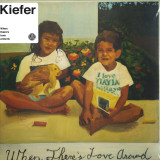
‘When There’s Love Around’ is GRAMMY Awardwinning artist Kiefer’s second album for Stones Throw.
For the first time, Kiefer is joined by a full band, including Sam Wilkes, Carlos Niño, DJ Harrison (Butcher Brown) and many more. Release to be supported with extensive global PR / radio campaigns and national and international touring.
For fans of Kamaal Williams, Kamasi Washington, Blue Lab Beats, Sam Wilkes, Moses Boyd, Yussef Dayes.
Kiefer is one of LA jazz’s most exciting new artists, with a broad international fanbase. Previous press and radio highlights include 6
Music, Radio 1 / 1Xtra, Radio 2, Pitchfork, Mojo, FACT, Mixmag, Drowned in Sound. Double vinyl cut at 45rpm for top audiophile
quality. Bonus track ‘thinking of you’ exclusive to vinyl release. (Not available on digital format.) Available to independent retailers on blue and yellow coloured vinyl. Headline European tour in February 2022.
out of Stock
Last delivered 3 years ago available to reorder, subject to availability
Brainwaltzera returns to FILM with a brace of archive recordings in the artist's characteristically idiosyncratic style.
The collection opens with FMsquared royal wavetable mellodies A, a mesmerizing beatless composition split across two contrasting movements. Synth-focused, the first explores a more introspective tone whilst the second is decidedly more elevated and playful. Follow up good endgar showcases the artist's enviable talent for crafting rolling, wide-open IDM, marrying crisp drum machine hits with washed out pads and a resonant bassline. WSsquared royal wavetable mellodies B follows the same pattern as mellodies A, split once again into two movements. This time each movement is markedly more distinct: the first, an atmospheric, half-time dirge and the second a more uplifting and esoteric workout, with crystalline FX breaking up the composition. On LANsqape4 short_oneTake Brainwaltzera lets the drums roll out, underpinning more lush synth work with a hint of a break closing in as the piece subsides near its close. Copperfeel, the penultimate offering, is the most reduced work in the collection with a single main melody doing the bulk of the legwork, and buoyed by vocal-sounding synths. FMsquared epiloggy beauvine bonus perc version closes the collection, a pleasing bookend that sees the riff from the opening track's latter movement return - now underpinned with rolling drums.
a A1. FMsquared royal wavetable mellodies A
c A3. WSsquared [royal wavetable mellodies B]
[e] B2. FMsquared [epiloggy] [beauvine bonus perc version]
[short_oneTake]
out of Stock
Last delivered 3 years ago available to reorder, subject to availability
A four track full colour special edition vinyl from Mella Dee.
The lead ‘Riptide’, features original vocals from synth-pop trailblazer and founder of New Order/Joy Division Bernard Sumner. A slice of euphoria streaked with melancholy,
'Big Eff Off Groove' was the first track of the EP to be released as a single, following on it's massive Summer of 2022 where it garnered support across some of the biggest festival stages and clubs internationally. Mella Dee speaking on the record describes it as “Exactly what it says, heavy hitting no frills groove, complete with full on dubbed out effects. Enjoy.”!
Followed up with two cuts of rolling house music on track 'Find Love Yourself', the 'Deeper Love Mix' explores Mella Dee’s affinity for the murkier corners of dance music, whilst the original mix is a deep-in-the-dance groover paired with a haunting Little Dragon vocal sample.
out of Stock
Last delivered 2 years ago available to reorder, subject to availability
UK Garage legends Groove Chronicles (Noodles & Dubchild) are back with the 'Soul 'N Mind' 12" featuring their highly sought after Brokenstep edits.
These have been on heavy rotation by the likes of Gilles Peterson, Charlie Dark, Bradley Zero, IG Culture and more. Limited hand-stamped and stickered copies, be quick!
Groove Chronicles have releases dating back to 1997 and are legendary in the world of UKG. Founded by Noodles, who is now working with longtime associate, Dubchild. Noodles has been working in the music game for three decades, from spinning at raves in Paris when he was 17, to serving it up behind the record shop counter, to running his own label, DPR. Responsible for bonafide classics like 'Stone Cold', 'Myron' & 'Poor Man's Break', his work serves as a blueprint for many sounds across the UK bass spectrum.
Leicester legend, Dubchild, stems from a musical background of reggae, hip hop, house, garage & jungle. He's released an array of dubstep & instrumental grime records through various labels since the early noughties, including Caspa's Storming Productions & Heavy Artillery, amongst others.
The duo also combine under the moniker Nu-Agenda with their own hybrid house style, and have had collective support over the years from stations such as 1Xtra, NTS, Kiss, Reprezent & Rinse, DJs such as Annie Mac, Zane Lowe, Mary Anne Hobbs & Ras Kwame, IG culture, Charlie Dark, Gilles Peterson, Bradley Zero, Marcia Carr, Afronaught and publications like iD, Fact, DJ Mag & Crack Magazine, to name a few.
out of Stock
Last delivered 2 years ago available to reorder, subject to availability
Steve Gunn and David Moore's Let the Moon be a Planet is a volume of improvisatory exchanges between classical guitar and piano, and a meeting place where two artists become acquainted through instrumental dialogue without a single expectation distracting them from the joy and open field possibility of collaboration. A project enveloped by an aura of reciprocity, Let the Moon Be a Planet unfolded from an invitation to connect between two New York-based musicians who admired each other's work but had never intersected: guitarist and songwriter Steve Gunn, whose solo, duo, and ensemble recordings represent milestones of contemporary guitar-guided material, and pianist and composer David Moore, acclaimed for his minimalist ensemble music as the leader of Bing & Ruth. The exchange began remotely as Gunn and Moore responded to one another's solo improvisations, embarking on a synergistic progression of deep listening and connection through musical conversation. "We were both fans of each other's music and this was a chance to try a different process which was much more open," says Moore. "It felt like something I needed personally as an artist, to not be so controlling over the final output, and to truly collaborate with somebody else." Similarly for Gunn, who was exploring new pastures and passages in classical guitar when the dialogue began, the project was an invitation for pure conversation and exchange, creating space for him to revisit foundational forms with his playing: "I was trying to break out of what I was doing, to have something that just pulled away all the elements of usual structured things." Let the Moon Be a Planet intertwines the trajectories of two musicians acclaimed for pushing the boundaries of their instruments, unified by a shift away from what they recall as more "detail-oriented" approaches to composition. Fueled by the magnetism of their call and response exercise, Gunn and Moore set out on a nomadic songwriting venture without an intended destination. "We didn't know it was going to be an album," Gunn explains. "There was never pressure on us to complete or make something. It was interesting to start realizing that this could be an album and to take a step back_ to arrive at a project after the fact." Calibrating their focus to connect with a spectrum of inner and external emotional realities, the duo found their way into a world where the most subtle of gestures can eternally flow. Let the Moon be a Planet is an ode to experimentation over outcome; it holds a candle light to the corners of introspection and captures the patterns that flicker within. Cast across the compositions of the album is a gritty, filmic grain _ a quality that emerged partially from recording "without the greatest microphones" or their usual studio environments. For both artists, this lo-fi sensitivity felt integral to the record and its production, and they worked closely with engineer Nick Principe to preserve its otherworldly haze in the final mixes. Across the record's eight compositions, the rippling impulses of Gunn and Moore's inner worlds converge in the spirit of two strangers wandering the same path, engaged in a daydream state of natural back and forth. Melodic tableaux arise, drift and disperse across serene open spaces, painted in earthy hues of nylon string and balmy, undulating keys _ side by side, the duo converse in tessellating motifs and gestures of lucid introspection, cultivated by a shared desire for intuitive play. "This project was such a simple idea," says Gunn. "It got down to the very core of where I am or where I was, and where I'm trying to be as a musician. Making this record became a very beneficial ritual for me, almost a meditative process." As Moore recalls, "Our only motivation for making these tracks was that it felt good to make them and there was nothing else behind it_ I don't know that I've ever made a record that came about so naturally." While Let the Moon Be a Planet was envisioned through a deeply collaborative process, it uncovered a path for Gunn and Moore to respectively return home as musicians. Imbued with the forces of interconnection and balance, the record is an exploration of creative synergy while following the currents of inner experience _ of looking outwards to arrive at one's natural self. Steve Gunn and David Moore's Let the Moon Be a Planet will be released March 31, 2023 in LP, CD, and digital editions. The album represents the first volume of Reflections, a new series of contemporary collaborations orchestrated by RVNG Intl. A portion of the proceeds from this release will benefit St. John's Bread and Life, whose mission is to respect the dignity and rights of all persons by ensuring access to healthy, nutritious food and comprehensive human services resulting in self-sufficiency and stability.
The undisputed kings of garage rock are back! It’s been 22 years since the last Headcoats album, but now Billy, Bruce, and Johnny return with a brand-new studio album!
Recorded last year at Ranscombe Studios in Rochester. Billy, Bruce, and Johnny kindly answered some pertinent questions…You got back together recently as Thee Headcoats Sect to make the ‘Tribute to Don Craine’ EP. What was it like working with each other again after all this time? BILLY: It was 'fab' and 'gear.' BRUCE: The weirdest thing for me was how weird it wasn't.
It was like time compressed, but to the 'good old days', early on. I was wary that it 'wouldn't be like Thee Headcoats', but it was. JOHNNY: I'm with Bruce and Billy on that one. I think we were all surprised how it all just worked. If I remember correctly, we kicked off role playing like we detested each other. Then we got started and well, you can hear the result.
What were the first songs you ran through when you got in the studio? BILLY: That’s a very good question. No idea. BRUCE: I can't remember. They all sound the same to me. JOHNNY: Bill had stuff on his phone that went “KSSHHCCCKSSHHHH”! So, we did that first. You’ve also paid tribute to Don with a track on the Irregularis album – ‘Oh Leader We Do Dig Thee’.
He was, along with the other members of Downliners Sect, a big inspiration to Thee Headcoats. When did you first become aware of his music and what was he like to work with? BRUCE: We were given (or possibly lent) a reissue of the Sect's first LP around 1977, marketed as 'Punk From The Vaults', which certainly floated our boats and definitely popped our corks, due to the somewhat aggressive yet carefree nature of the tunes and sound in general. Ollie, our old bassist, found an ad in a trade magazine for them with a contact number for a Michael O'Donnell, which I excitedly called almost immediately.
T'was none other than Don his'self and we managed to convince him into venturing down to Rochester to record some tunes with us which became the first Headcoat Sect EP. We were fairly starstruck and presented him with a brand new 'dearstalker' (or 'Headcoat', as they were now known). He was very accommodating and a great laugh and spent the evening with us, regaling us with tales of yore. I recorded a lot of it on cassette, which I may still have somewhere. Gawd bless Don
Steve Gunn and David Moore’s Let the Moon be a Planet is a volume of improvisatory exchanges between classical guitar and piano, and a meeting place where two artists become acquainted through instrumental dialogue without a single expectation distracting them from the joy and open field possibility of collaboration.
A project enveloped by an aura of reciprocity, Let the Moon Be a Planet unfolded from an invitation to connect between two New York-based musicians who admired each other’s work but had never intersected: guitarist and songwriter Steve Gunn, whose solo, duo, and ensemble recordings represent milestones of contemporary guitar- guided material, and pianist and composer David Moore, acclaimed for his minimalist ensemble music as the leader of Bing & Ruth.
The exchange began remotely as Gunn and Moore responded to one another’s solo improvisations, embarking on a synergistic progression of deep listening and connection through musical conversation. “We were both fans of each other’s music and this was a chance to try a different process which was much more open,” says Moore. “It felt like something I needed personally as an artist, to not be so controlling over the final output, and to truly collaborate with somebody else.”
Similarly for Gunn, who was exploring new pastures and passages in classical guitar when the dialogue began, the project was an invitation for pure conversation and exchange, creating space for him to revisit foundational forms with his playing: “I was trying to break out of what I was doing, to have something that just pulled away all the elements of usual structured things.”
Let the Moon Be a Planet intertwines the trajectories of two musicians acclaimed for pushing the boundaries of their instruments, unified by a shift away from what they recall as more “detail- oriented” approaches to composition. Fueled by the magnetism of their call and response exercise, Gunn and Moore set out on a nomadic songwriting venture without an intended destination.
“We didn’t know it was going to be an album,” Gunn explains. “There was never pressure on us to complete or make something. It was interesting to start realizing that this could be an album and to take a step back... to arrive at a project after the fact.”
If you were smart enough to get your grubby paws on the first Scrap Metal compilation, you probably have a pretty good idea of what you’re in for with our second installment. Featuring long-lost gems from ultra-rare 45s and private press singles—plus one previously unreleased banger—Scrap Metal 2 maintains a steady NWOBHM course. Packed with infectious outliers and supremely talented one-and-done metal warriors from the crucial British movement of the late ’70s and early ’80s (and some killer American obscurities inspired by them), this collection delivers all the fist-pumping, riff-mongering and flashy solos of heavy metal’s golden age. As always, every track has been officially licensed and every artist gets paid. As a late entry into the NWOBHM sweepstakes, JJ’s Powerhouse was formed in Merseyside, England, by guitarist Jon “J.J.” Cox with members of his previous band, Quad. Much like the opener to the original Scrap Metal comp, you can hear early Metallica coursing through this legendary ripper. Coincidentally, this ultra-rare 45 was released in ’83, the same year as Kill ’Em All. Taking their name from a 1978 sci-fi novel by Marion Zimmer Bradley, Welsh super troopers Storm Queen reveled in animal-print clothing and flying Vs. The Motörhead-meets-Priest anthem “Raising the Roof” is the flipside to their only single, which the band self-released in 1982. Led by guitarist Dave Morse, Storm Queen’s earliest lineup included bassist Bryn Merrick (RIP), who would go on to join The Damned. Roaring out of Birmingham, England, in 1975, Jameson Raid palled around with fellow Brummies Black Sabbath and named themselves after a failed 19th century attack that helped kick off South Africa’s Second Boer War. Their three-song 1979 debut featured the infectious “It’s a Crime,” which comes across like a deadly hard-glam version of Budgie. Still fronted by vocalist Terry Dark, they’re going strong as of 2022. A.R.C., a punky proto-metal group from the UK, released the boozy single “Home Made Wine” b/w “The Chase” in 1979 and—as far as we know—were never heard from again. They’re not to be confused with a gang of Tolkien enthusiasts also called A.R.C., who released two NWOBHM singles in the early ’80s and actually were heard from again. Nonetheless, the A.R.C. we have here was led by a thirsty lad named Klaus Brunnenkant, who liked to rock n’ roll all night and party every day. Both sides of Metropolis’ sole single bear the legend, “Unauthorized duplication shall result in getting your ass beat.” This San Jose metal squad released their only single in 1986 and dedicated it to Metallica bassist Cliff Burton, who had recently been killed in a bus accident. “The Raven” is the serpentine NWOBHM- and Edgar Allan Poe-influenced flipside to “Time Heals Everything,” and yeah, you can hear the guitars going out of tune on the solo, but that’s part of the charm. Of the two dozen or so metal bands that have called themselves Prowler over the years, we’re pretty sure this particular Prowler is the only one from San Diego. These dudes take a thrashier approach than most of the bands here on Scrap Metal 2: “Temporary Insanity” strikes a deft balance between early Anthrax and early Testament, with just enough hard rock swing to keep it from getting overly staccato. Self-released in ’86 as the band’s only single, the song is the flip to “I Love It.” Not much is known about Christian Steel beyond this: They put out their only single in 1983, which boasted “Need Your Love” as the flip to “I Don’t Want To.” The former, included here, sounds kinda like a dizzy, more metallic version of ’70s Jersey rockers Starz, who famously influenced the likes of Mötley Crüe, Poison and Twisted Sister. Ohio guitarist/vocalist Marty Soski’s career dates back to at least 1969 with the Inside Experience track “Be On My Way,” which we unearthed for our own Brown Acid: The Third Trip. This time, we’ve got a monster Soski cut that he recorded under the name Black Rose. Released in 1982, the absolutely smokin’ “Sidewinder” was the A-side on the band’s sole single. The main riff isn’t far off from Y&T’s major-label banger “Mean Streak,” which was released the following year. When Dark Age titled their 1987 album The Youngest Metal Band in the World, they weren’t even sort of kidding. Legend has it that “Star Trippin’,” which was released as a single a year earlier, was written by guitarist CJ Rininger when he was just 12 years old. His brother Dave, the vocalist, was two years younger. Old photos of the band—complete with pineapple haircuts—seem to bear this story out. Either way, the song is pure flash metal, conjuring Sunset Strip sleaze all the way from Ohio. By now, all you heads know Los Angeles magic men Sorcery from their storied appearance in—and soundtrack for—the death-defying Ozploitation flick Stunt Rock. What we have here in “Whales” is a previously unreleased track from the same 1978 recording sessions. It’s a little bit Zeppelin, a little bit prog, and a whole lotta thundering riffage. Why this languished in the vaults for so long is anyone’s guess. Better late than never!
If you were smart enough to get your grubby paws on the first Scrap Metal compilation, you probably have a pretty good idea of what you’re in for with our second installment. Featuring long-lost gems from ultra-rare 45s and private press singles—plus one previously unreleased banger—Scrap Metal 2 maintains a steady NWOBHM course. Packed with infectious outliers and supremely talented one-and-done metal warriors from the crucial British movement of the late ’70s and early ’80s (and some killer American obscurities inspired by them), this collection delivers all the fist-pumping, riff-mongering and flashy solos of heavy metal’s golden age. As always, every track has been officially licensed and every artist gets paid. As a late entry into the NWOBHM sweepstakes, JJ’s Powerhouse was formed in Merseyside, England, by guitarist Jon “J.J.” Cox with members of his previous band, Quad. Much like the opener to the original Scrap Metal comp, you can hear early Metallica coursing through this legendary ripper. Coincidentally, this ultra-rare 45 was released in ’83, the same year as Kill ’Em All. Taking their name from a 1978 sci-fi novel by Marion Zimmer Bradley, Welsh super troopers Storm Queen reveled in animal-print clothing and flying Vs. The Motörhead-meets-Priest anthem “Raising the Roof” is the flipside to their only single, which the band self-released in 1982. Led by guitarist Dave Morse, Storm Queen’s earliest lineup included bassist Bryn Merrick (RIP), who would go on to join The Damned. Roaring out of Birmingham, England, in 1975, Jameson Raid palled around with fellow Brummies Black Sabbath and named themselves after a failed 19th century attack that helped kick off South Africa’s Second Boer War. Their three-song 1979 debut featured the infectious “It’s a Crime,” which comes across like a deadly hard-glam version of Budgie. Still fronted by vocalist Terry Dark, they’re going strong as of 2022. A.R.C., a punky proto-metal group from the UK, released the boozy single “Home Made Wine” b/w “The Chase” in 1979 and—as far as we know—were never heard from again. They’re not to be confused with a gang of Tolkien enthusiasts also called A.R.C., who released two NWOBHM singles in the early ’80s and actually were heard from again. Nonetheless, the A.R.C. we have here was led by a thirsty lad named Klaus Brunnenkant, who liked to rock n’ roll all night and party every day. Both sides of Metropolis’ sole single bear the legend, “Unauthorized duplication shall result in getting your ass beat.” This San Jose metal squad released their only single in 1986 and dedicated it to Metallica bassist Cliff Burton, who had recently been killed in a bus accident. “The Raven” is the serpentine NWOBHM- and Edgar Allan Poe-influenced flipside to “Time Heals Everything,” and yeah, you can hear the guitars going out of tune on the solo, but that’s part of the charm. Of the two dozen or so metal bands that have called themselves Prowler over the years, we’re pretty sure this particular Prowler is the only one from San Diego. These dudes take a thrashier approach than most of the bands here on Scrap Metal 2: “Temporary Insanity” strikes a deft balance between early Anthrax and early Testament, with just enough hard rock swing to keep it from getting overly staccato. Self-released in ’86 as the band’s only single, the song is the flip to “I Love It.” Not much is known about Christian Steel beyond this: They put out their only single in 1983, which boasted “Need Your Love” as the flip to “I Don’t Want To.” The former, included here, sounds kinda like a dizzy, more metallic version of ’70s Jersey rockers Starz, who famously influenced the likes of Mötley Crüe, Poison and Twisted Sister. Ohio guitarist/vocalist Marty Soski’s career dates back to at least 1969 with the Inside Experience track “Be On My Way,” which we unearthed for our own Brown Acid: The Third Trip. This time, we’ve got a monster Soski cut that he recorded under the name Black Rose. Released in 1982, the absolutely smokin’ “Sidewinder” was the A-side on the band’s sole single. The main riff isn’t far off from Y&T’s major-label banger “Mean Streak,” which was released the following year. When Dark Age titled their 1987 album The Youngest Metal Band in the World, they weren’t even sort of kidding. Legend has it that “Star Trippin’,” which was released as a single a year earlier, was written by guitarist CJ Rininger when he was just 12 years old. His brother Dave, the vocalist, was two years younger. Old photos of the band—complete with pineapple haircuts—seem to bear this story out. Either way, the song is pure flash metal, conjuring Sunset Strip sleaze all the way from Ohio. By now, all you heads know Los Angeles magic men Sorcery from their storied appearance in—and soundtrack for—the death-defying Ozploitation flick Stunt Rock. What we have here in “Whales” is a previously unreleased track from the same 1978 recording sessions. It’s a little bit Zeppelin, a little bit prog, and a whole lotta thundering riffage. Why this languished in the vaults for so long is anyone’s guess. Better late than never!
ASSASSINS did what many bands do: they grabbed a moment out of the air and slammed it onto tape machines and hard drives with relentlessness, cunning, and an attitude.
It was in Chicago, mid 2000’s, and though there was energy in the music scene, it wasn’t coalescing into anything you could use as a heading in the musical encyclopedia. Drag City, Thrill Jockey, Bloodshot, Tortoise, Andrew Bird, 90 Day Men – amazing labels and bands, but discrete and siloed and separated by boundaries that weren’t very real.
In the midst of that complicated morass, ASSASSINS generated a collection of songs that became the album YOU WILL CHANGED US. And it did.
There was confidence built into the fabric of the project: 5 members, 2 singers, massive synced video walls and samples streaming from laptops swirling in three dimensions around the stage. They could go from subtle atmospheric moments to a gargantuan wall of sound instantly. It was hard to do- months in cold practice rooms troubleshooting sections of songs or reworking synthesizer patches put the band through a self-imposed boot camp. And it brought them together as a sort of hive-mind focused on one thing: that these songs could connect. They could cut through the noise and share a state of mind with other human beings.
And it worked. Those early shows were mind bending. It was fun, loud, drunken, and rewarding- that time together, before the record deal, before the tragic let down of being traded and gobbled up by the major label system. The years after that got more difficult, more complicated, more human.
Leading us here: the musical journey of the Assassins has ended. With the up-coming release of their second and final album THE YEAR THAT NEVER CAME, we finally get to hear, and feel, the final statements of their inspiring chemistry.
In July of 2021, founding member, songwriter and singer Joe Cassidy unexpectedly passed away. THE YEAR THAT NEVER CAME is the culmination and end point of a collaboration that started in the early 2000’s with a chance meeting and excited conversation with Aaron Miller at a gig in Chicago. Quickly joined by David Golitko on keyboards, Merritt Lear on vocals and guitar, and Alex Kemp on bass.
It was Miller who saw Joe Cassidy’s song writing in a new context. Cassidy had been known for his beautiful, post- pop inflected BUTTERFLY CHILD, a thoughtful, regal project where Joe’s emotions could soar. Miller saw a different context for that voice- not dreamy, but immediate, not just hopeful, but demanding. He took Joe’s open hand and suggested that it could be a fist, raised in the air, with a crowd of other people doing the same.
At the time of his death legendary composer and songwriter Jimmy Webb (who wrote such hits as ‘Wichita Lineman and MacArthur Park) said Joe ‘was a creative and generous producer but, more importantly, he was a creative and generous friend.’
With the release of THE YEAR THAT NEVER CAME, this band, this relentless creative force, has to finally relent. No one in the band could see a future ASSASSINS that doesn’t include Cassidy. So in one last act of will, for the love of their friend, they did the rigorous work of finishing the songs that they had started together for the second album.
Assassin’s obsession with the notion of time, from YOU WILL CHANGED US to THE YEAR THAT NEVER CAME, flows from the most natural question we all have to ask ourselves: what do I do now? Because: how we react today to life’s unpredictability - that is the tomorrow we build for ourselves.
"Hungarian guitarist Gabor Szabo (1936-82) issued only three live recordings during his lifetime. Significantly, the first of these, The Sorcerer (1967), remains the most popular album in the guitarist’s all-too abbreviated discography. But there were also More Sorcery (1968) and Gabor Szabo Live with Charles Lloyd (1974), offering Szabo totally in his element and at his bewitching best.
Several more of Szabo’s concert recordings have surfaced in the intervening years, including this one, superbly captured for radio broadcast live in 1976 at the 600-seat Agora Ballroom in Cleveland, Ohio. It is a revelation. There is a sense here that concert patrons may have been hearing an altogether different Gabor Szabo than record buyers.
For one thing, Szabo is heard fronting what is likely his own group, rather than an army of studio musicians. In 1976, Szabo was leading a tremendous quartet with George Cables (or Joanne Grauer) on piano, Tony Dumas on bass and Sherman Ferguson on drums. Szabo had not had a band with this much jazz clout since his famed quartet with Jimmy Stewart in 1967-68 – and it is a union worth savoring: Szabo’s records during this period were light, at best, on jazz.
It’s unclear if any of these musicians are on the Agora date, but as Dumas’s “It Happens” opens the program, it’s a good bet, at least, that the bassist is on board here. But as Szabo’s ’76 quartet is not known to have recorded a studio record, Live in Cleveland is the closest thing to what a mid-seventies Szabo jazz album would sound like.
Gone, are the strings, vocals and concessions to commercial consideration so prevalent on so many of Szabo’s studio records at the time. What is present, though, is fine craftsmanship, tremendous interplay, and the exciting improvisation that good jazz always yields.
This particular concert was part of Sansui’s “New World of Jazz,” a series of 13 hour-long jazz concerts recorded at Cleveland’s iconic Agora Ballroom and broadcast over 40 FM radio stations. The series was sponsored by Sansui Electronics, a Japanese manufacturer of audio and video equipment, which previously sponsored a similar series of rock concerts recorded at the Agora as well.
Sansui was promoting its matrix QS 4-channel sound system – offering, what was considered at the time, superior diagonal separation and stereo compatibility. The firm, partnering with Agora Ballroom and Agency Recording Studio owner Hank LoConti (1929-2014), was looking to take advantage of what they rightly felt was the then-current jazz renaissance.
Each show’s 16-track master tape was mixed through the Sansui QS 4-channel encoder,” according to an August 1976 Billboard article detailing the arrangement, “for distribution to the 40 FM stations throughout the United States that bought the series” – allowing for three commercial spots for local dealers to advertise."
The recording is available for the first time on CD and VINYL. Mastering by grammy-nominated Jessica Thompson.
“Wild Boy …” is a reissue of the well-known 2016 release curated by Brian Chidester, renowned researcher and biographer of Eden Ahbez. Especially for this album, Brian wrote an interesting text about Abi’s life, which definitely became the decoration of the release.
With the new 2020 re-release, we went a little further and kept what is commonly referred to as studio cuts. It’s a few more minutes in the studio with ahbez himself, full of emotion and life. In addition, to the delight of fans, the edition includes an additional composition Nature Boy (Mantovani Orchestra).
Especially, it is worth noting the outstanding mastering prepared from practically decomposed tapes by the Grammy-nominated Jessica Thompson, which guarantees the deepest and warmth possible sound. Jessica a huge ahbez fan and we’re highly appreciated for what she has done to save his music for the future.
Eden Ahbez is definitely at the origin of psychedelic music and this release can be taken as further proof. Over the past twenty years, the iconic figure of the world’s first hippie Eden ahbez has become famous primarily for his 1948 song “Nature Boy”, praising universal love, and his amazingly solo album from the 1960s called “Eden’s Island” – one from the first concept albums in the history of music and probably the first psychedelic music album. “Wild Boy: The Lost Songs Of Eden Ahbez” deepens understanding of the origins of the psychedelic movement in the 1950s.
The disc contains a musical selection of works by Eden ahbez himself, written by him in the period after Nature Boy. The inclusion of songs such as “Palm Springs” – Ray Anthony Orchestra and “Hey Jacques” by Erta Kitt gives the listener the chance to discover for the first time the little-known recordings of world-famous artists composed by Eden ahbez. Through “Wild Boy” and “Surfer John” you can hear the author’s handling of absurd rock and exotic experimentation, as well as sweet psychedelic pop like Monterey (with Paul Horn on flute). Overall, Wild Boy: The Lost Songs Of Eden Ahbez offers an overview of the lost works of 1949-1971 with seven unpublished recordings and eight rare singles.
If in 2020 you are missing the hallucinogenic content in Eden Ahbez, it amazingly makes up for that deficiency with simple chords, expansive arrangements, and lyrics about travel, relaxation, free love, and spirituality. Thus creating the standard of psychedelic music. Eden Ahbez’s songs weren’t only fantasy and his personal philosophy was the real thing that he lived.
reviews:
“This carefully and extensively researched compilation culls covers by top notch mainstream artists juxtaposed with unreleased Eden recordings. What might sound like a mixed bag is actually more like a chronological, musical non-fiction novel about Eden Ahbez. While Eden was writing hundreds of songs and performing live and making recordings in various styles, his songs were also being picked up by popular artists like Nat King Cole and Eartha Kitt who recorded with a more polished mainstream style. There are also some early rock n roll style recordings here. Eden’s professionally recordings often end up as Novelty Pop records such as “Child of Nature” and “The Clam Man” but if you read between the lines and listen to the lyrics it is pretty eye-opening that he is singing about Eastern-religion-style and pre-hippie philosophies about being at one with the planet Earth.
All of this is explained in the lengthy liner notes inside the lp along with a few choice photos that establish Eden as a founding father of Southern California mystic/psychedelic music.” – Tiki_News
“Eden Ahbez’s life philosophy was summed up in the lyrics of his most famous song, “Nature Boy,” a 1948 hit for Nat King Cole: the song describes a “strange enchanted boy” who wanders the world in search of truth. “The greatest thing you’ll ever learn,” he concludes, “is to love and be loved in return.” Ahbez was a pre-cursor of California’s beatniks and hippies, and an exalted icon of ex-otica via his rare 1960 album Eden’s Island. Beyond “Nature Boy” and Eden’s Island, though, there were nu-merous lesser-known Ahbez record-ings. Ahbez biographer Brian Chidester has been doing an exemplary job of archiving and documenting that catalog of work. The Exotic World of Eden Ahbez (reviewed in UT#38) appeared a few years ago, gathering together 14 Ahbez-related rarities” – Ugly Things
Cairo, late 2013. In a city in turmoil, where the curfew had just been lifted after a second coup d'état, where the walls were still covered in dreams and revolt, where even the clubs of the city-centre echoed with anti-Islamist and anti-army slogans, I was deeply touched by the voice of Abdullah Miniawy at the 100Copies music studio, a stone's throw from Tahrir Square. A singer, writer, poet, poetry-slammer and student from the El-Fayoum oasis, this spokesman for Egyptian youth was shaking up the music scene and social networks with his hypnotic voice and unique blend of electro, sufism and jazz music, both punk and psychedelic, secular and avant-garde. Three months later, Abdullah's first on-stage revelations took place at the La Voix est Libre festival in Cairo with the "Jimi Hendrix of oud", Mehdi Haddab, followed by his first meeting with composer and saxophonist Peter Corser at the D-CAF festival (Downtown Contemporary Art Festival), created in the aftermath of the revolution by leading figure in theater Ahmed El-Attar. After three years of administrative battles, while censorship was making a comeback in Egyptian artistic circles, Abdullah finally arrived in Paris where he recorded an initial version of Purple Feathers with Peter Corser, which was broadcast on Soundcloud.
In 2017, gripped from the very first seconds by these soaring vocal and instrumental performances, Erik Truffaz accepted our invitation to become involved with Peter's hypnotic loops and Abdullah's electric vocals, and was soon joined by the visceral strings of cellist Karsten Hochapfel. Five years later, Le Cri du Caire is still turning heads, and often moving audiences to tears. Both free and spiritual, sensitive and elusive, their music elevates the soul to giddy heights and flies towards what may well be one of the shortest paths from zero to infinity.
out of Stock
Last delivered 23 months ago available to reorder, subject to availability
Liverpool-born drummer Aynsley Dunbar was one of the most respected musicians on the international rock scene of the late ‘60s. His work with trailblazers such as John Mayall, David Bowie, Lou Reed and Frank Zappa, with whom he had a lengthy association, have assured his place in history. But Dunbar also laid down a marker as a bandleader in his own right. His debut album, Doctor Dunbar’s Prescription was a confident set of electric blues that was full of snappy tunes and high energy riffing. Recorded in 1971, Blue Whale is considerably more experimental, though. It is really a case of Dunbar drifting towards a hybrid of progressive rock and pyschedelia not far removed from Zappa’s surreally comic, bitingly sardonic world. And indeed the cover of his seminal ‘Willie The Pimp’ is one of the highlights of the set. Accompanied by excellent rhythm section players and soloists such as guitarists Ivan Zagni and Roger Sutton, bassist Peter Friedberg, pianist-organist Tommy Eyre, and vocalist Paul Williams, Dunbar hit a creative peak here that is emphatically maintained elsewhere on the album, which has mostly long pieces full of notable light and shade. This newly re-mastered version of Blue Whale puts one of the highpoints of Aynsley Dunbar’s illustrious career back under the spotlight. He was rightly inducted into the Rock & Roll Hall Of Fame in 2017 and there could be no more fitting example of his achievement than an album that sounds impressively fresh 50 years after it was made.
MC/Lyricist Raw Poetic (aka Jason Moore) announces Space Beyond The Solar System, his new album out December 9th on 22nd Century Sound, and presents its lead single, “A Mile In My Head,” featuring legendary saxophonist Archie Shepp. Although Space Beyond The Solar System could be considered a concept album by its outcome, its inception started from a string of experiments between Moore and frequent collaborator/producer Damu the Fudgemunk. These initial sessions had no specific direction but became the catalyst for what would become a prolific wave of Raw Poetic projects; five of which have been released since 2020.
It was these initial sessions and the demos they produced that convinced Shepp—who is also Raw Poetic’s uncle—to record what would eventually become 2020’s Ocean Bridges, a collaborative album from Raw, Damu, and Shepp, praised by The FADER as “modern masterpiece at the intersection of rap and jazz.” The trio’s collaboration continues on Space Beyond The Solar System, which boasts three tracks featuring the jazz legend, including today’s “A Mile In My Head,” a sprawling and thought-provoking album stand-out.
At two hours, absorbing Space Beyond in its entirety may be overwhelming for most, especially in the present day, but Raw and Damu are very aware of this. With a total of over 40-plus years of experience between the vocalist and producer, the two of them went down memory lane taking every influence and experience in their personal histories to extract ingredients for a groundbreaking statement. Space Beyond The Solar System is their most comprehensive environment to date.
The creation of Space Beyond sparked a conversation between Raw and Damu about their creative chemistry, with Raw likening their direction to a “space beyond the solar system.” His comment was a eureka moment for the two artists, giving their wandering efforts a sense of definition that was needed. “I think we’ve been exploring music beyond our limits for a few years,” says Raw Poetic. “It’s hard to tell where we’ll land, but we are constantly pushing our way out of the norm. Hence the title, ‘Space Beyond the Solar System.’ It’s just to say, this is new territory for us. Where the sky was once the limit, now it’s just the start.”
The axolotl is a species of salamander native to Mexico, living in a state of larva and having the capacity to regenerate damaged organs. This brief introduction doesn’t tell us if the axolotl sings. But, for the one that concerns us here: yes indeed.
In Paris, at the end of the 1970s, Etienne Brunet and Marc Dufourd would improvise regularly, inspired by some other saxophone-guitar duos: Claude Bernard-Raymond Boni firstly, then Evan Parker-Derek Bailey. When Jacques Oger (a saxophonist whom Brunet had met at a workshop given by Steve Lacy at the Châteauvallon festival in 1977) joined the duo Brunet-Dufourd, Axolotl was born.
Iconoclastic, the trio was bound to please Jac Berrocal, and he proposed to record their first album on the label ‘D’avantage’. In spring 1981 three days were just enough for Oger (tenor and barytone saxophones), Brunet (alto saxophone, bass clarinet and ‘things’) and Dufourd (electric guitar) to complete Axolotl, the first album by a group which would record ... two.
If there was a collective of iconoclasts, the trio would be there with some relatives: Alterations, Fred Frith, John Zorn, the ROVA Saxophone Quartet... and then because we mention a collective, Axolotl steps (considerably) beyond the domain of free improvisation to lean towards jazz (“Illusion”, “Paris, froissé”), No Wave (“Ombre pilée”, “Trottoirs défunts”), contemporary (“Oreiller”, “D’autres seuls”), and even what we could call ... acid fun (“Dehors”).
Above all, Axolotl wanted to really get to grips with sound via an expression as direct as it was liberating, as can be heard on “Ozone, flocon, torsion”, producing a noise that, even today pierces the brain. All we can hope is that now, thanks to this wonderful reissue, listeners will be able, like the axolotl, of regeneration.
Lyburnum Wits End Liberation Fly was the one and only full-length album by experimental post-punk innovators, Moss Icon . Recorded in 1988, Lyburnum would not be released until 1993 - several years after Moss Icon 's demise. Originally released on Vermiforn - the esoteric noise label founded by Sam McPheeters of Born Against - the vision that Moss Icon 's Tonie Joy had for Lyburnum failed to manifest in its finished product. Of the process of preparing Lyburnum for its eventual release, Joy recalls, "My creative mind was well into its next chapter, onto an apocalyptic order referring to Joy's post- Moss Icon band, Universal Order of Armageddon . Getting Lyburnum to look like what I envisioned in my mind became an uphill battle that involved misplaced photos, misunderstood instructions by the printer, increasing apathy, and lack of advanced printing knowledge (on my part), amongst many other technical and creative issues. With a deadline near it ended up being an it-is-what-it-is situation. Some corrections were attempted for the second pressing the following year, but a further lack of coordination between various parties saw it losing even more of the original vision." Despite these challenges and shortcomings, Lyburnum Wits End Liberation was instantly cherished as a feral masterpiece - a singular entity that would become a defining influence on post-hardcore and emo in the 1990s and beyond. Nothing before sounded like this, and nothing since has quite captured the same mysterious fury. Now, finally, Moss Icon 's seminal Lyburnum Wits End Liberation Fly LP will be released exactly as it was always intended to look, sound, and feel. The artwork has been fully restored, and includes previously unpublished photos that were inadvertently missing from the original release. Brilliantly remastered by Alan Douches at West West Side Music, the vinyl has been newly cut by Bob Weston at Chicago Mastering Service, and pressed onto audiophile-grade vinyl at Record Technology Inc.
CRYSTAL CLEAR VINYL
Lyburnum Wits End Liberation Fly was the one and only full-length album by experimental post-punk innovators, Moss Icon . Recorded in 1988, Lyburnum would not be released until 1993 - several years after Moss Icon 's demise. Originally released on Vermiforn - the esoteric noise label founded by Sam McPheeters of Born Against - the vision that Moss Icon 's Tonie Joy had for Lyburnum failed to manifest in its finished product. Of the process of preparing Lyburnum for its eventual release, Joy recalls, "My creative mind was well into its next chapter, onto an apocalyptic order referring to Joy's post- Moss Icon band, Universal Order of Armageddon . Getting Lyburnum to look like what I envisioned in my mind became an uphill battle that involved misplaced photos, misunderstood instructions by the printer, increasing apathy, and lack of advanced printing knowledge (on my part), amongst many other technical and creative issues. With a deadline near it ended up being an it-is-what-it-is situation. Some corrections were attempted for the second pressing the following year, but a further lack of coordination between various parties saw it losing even more of the original vision." Despite these challenges and shortcomings, Lyburnum Wits End Liberation was instantly cherished as a feral masterpiece - a singular entity that would become a defining influence on post-hardcore and emo in the 1990s and beyond. Nothing before sounded like this, and nothing since has quite captured the same mysterious fury. Now, finally, Moss Icon 's seminal Lyburnum Wits End Liberation Fly LP will be released exactly as it was always intended to look, sound, and feel. The artwork has been fully restored, and includes previously unpublished photos that were inadvertently missing from the original release. Brilliantly remastered by Alan Douches at West West Side Music, the vinyl has been newly cut by Bob Weston at Chicago Mastering Service, and pressed onto audiophile-grade vinyl at Record Technology Inc.
Lyburnum Wits End Liberation Fly was the one and only full-length album by experimental post-punk innovators, Moss Icon. Recorded in 1988, Lyburnum would not be released until 1993 several years after Moss Icon’s demise.
Originally released on Vermiforn – the esoteric noise label founded by Sam McPheeters of Born Against – the vision that Moss Icon’s Tonie Joy had for Lyburnum failed to manifest in its finished product. Of the process of preparing Lyburnum for its eventual release, Joy recalls, “My creative mind was well into its next chapter, onto an apocalyptic order referring to Joy’s post-Moss Icon band, Universal Order of Armageddon.
Getting Lyburnum to look like what I envisioned in my mind became an uphill battle that involved misplaced photos, misunderstood instructions by the printer, increasing apathy, and lack of advanced printing knowledge (on my part), amongst many other technical and creative issues.
With a deadline near it ended up being an it-is-what-it-is situation. Some corrections were attempted for the second pressing the following year, but a further lack of coordination between various parties saw it losing even more of the original vision.”
Despite these challenges and shortcomings, Lyburnum Wits End Liberation was instantly cherished as a feral masterpiece a singular entity that would become a defining influence on post-hardcore and emo in the 1990s and beyond.
Nothing before sounded like this, and nothing since has quite captured the same mysterious fury. Now, finally, Moss Icon’s seminal Lyburnum Wits End Liberation Fly LP will be released exactly as it was always intended to look, sound, and feel. The artwork has been fully restored and includes previously unpublished photos that were inadvertently missing from the original release.
Brilliantly remastered by Alan Douches at West West Side Music, the vinyl has been newly cut by Bob Weston at Chicago Mastering Service, and pressed onto audiophile-grade vinyl at Record Technology Inc.
Lyburnum Wits End Liberation Fly was the one and only full-length album by experimental post-punk innovators, Moss Icon. Recorded in 1988, Lyburnum would not be released until 1993 several years after Moss Icon’s demise.
Originally released on Vermiforn – the esoteric noise label founded by Sam McPheeters of Born Against – the vision that Moss Icon’s Tonie Joy had for Lyburnum failed to manifest in its finished product. Of the process of preparing Lyburnum for its eventual release, Joy recalls, “My creative mind was well into its next chapter, onto an apocalyptic order referring to Joy’s post-Moss Icon band, Universal Order of Armageddon.
Getting Lyburnum to look like what I envisioned in my mind became an uphill battle that involved misplaced photos, misunderstood instructions by the printer, increasing apathy, and lack of advanced printing knowledge (on my part), amongst many other technical and creative issues.
With a deadline near it ended up being an it-is-what-it-is situation. Some corrections were attempted for the second pressing the following year, but a further lack of coordination between various parties saw it losing even more of the original vision.”
Despite these challenges and shortcomings, Lyburnum Wits End Liberation was instantly cherished as a feral masterpiece a singular entity that would become a defining influence on post-hardcore and emo in the 1990s and beyond.
Nothing before sounded like this, and nothing since has quite captured the same mysterious fury. Now, finally, Moss Icon’s seminal Lyburnum Wits End Liberation Fly LP will be released exactly as it was always intended to look, sound, and feel. The artwork has been fully restored and includes previously unpublished photos that were inadvertently missing from the original release.
Brilliantly remastered by Alan Douches at West West Side Music, the vinyl has been newly cut by Bob Weston at Chicago Mastering Service, and pressed onto audiophile-grade vinyl at Record Technology Inc.
Circassian-Turkish Producer Sine Buyuka debuts new solo project Sinemis with lush, graceful album ‘Dua’, gently combining the ancestral Sufi music of her homeland with sophisticated techno-inflected ambient. Dua’s life began with a life-threatening illness. “I started feeling unwell last year and no one could figure out the reason,” Sine writes. “It was a scary time, not knowing and trying to manage symptoms while they slowly worsened. In late 2021, while I was visiting my family in Turkey during the Christmas break, I was taken into A&E. After more tests, I had a diagnosis and had surgery in January.” Following this, within the healing process - highly emotional as well as physical - Sine was drawn to the traditional Sufi music of Turkey and the Middle East. Ritualistic music to accompany ancient sema ceremonies, in which whirling dervishes enter a transcendental consciousness through ecstatic movement and repetition. With this influence at heart, Sine began work on ‘Dua’, with a newly-formed artist name to signify new, unfamiliar music from a celebrated electronic producer. For her, the album marks a significant step in her recovery. But it is also a potent marriage of contemporary and ancestral trancestates, interweaving sci-fi synthesis and floor shaking bass tones with mystic imagery, textures and timbres. A meditative, spiritual balm that melds field recordings, found sounds, ambient soundscapes, electronics and acoustic instrumentation to celebrate life and survival in challenging circumstances. The breathy, cinematic tones of album opener ‘Dua’ hover and shiver in preparatory stasis as broken-machine punctuation begins to dot rhythmically through the space. A yearning, repeated vocal sample - a living, beating heart inside the machine - characterises a crucial theme for the album: the marriage of digital instrumentation with the analogue, the human and the organic. Later, ‘Elegy’ reflects its title with heartbreaking chordal shifts and glitching birdsong, conjuring a sound world somewhere between KMRU and Max Richter. Key track ‘Gazel’ moves in glacial slo-mo, like whirling dervishes frozen in time at the peak of their trance. Euphoric ceremony made haunting and poignant without losing a mote of power…Across the album, the timbres of Sufi ritual are often captured by the otherworldly presence of the historic ney flute, said to be as old as the Holy Books. “Sufi music can be created using several different instruments but the ney flute is at the heart of it. The sounds emanating from this fascinating instrument kept capturing my imagination,” Sine tells us. Working both with samples and with Turkish musician Omar Faruk Tekbilek, Sine achieves a rare balance of reverence and recontextualisation for such a time-honoured instrument, here performed by a lifelong student of its intricacies and mysteries. In Sinemis’ hands, the processing and sonic treatment of the ney even sometimes renders it indistinguishable from Dua’s synthesis and sound-design
Gargantuan volcanoes erupting with primal force, fountains of molten lava bursting sky high and massive boulders hurtling capriciously through the air. These potent and violently alluring images in the documentary series The Living Planet captivated Raoul Björkenheim's imagination in 1986. The search for a band name had come to an end. -”I was mesmerised. The name Krakatau sounded like a drum fill to me”. After studying at the Helsinki Conservatory for a year and the Berklee College of Music in Boston for three, Björkenheim relocated to Finland where he played in bands with Jone Takamäki, Antti Hytti and Tom Nekljudow, and later went on to work with composer and drummer Edward “Eetu” Vesala (1945-1999). His always original and highly demanding Sound & Fury workshops were a pivotal hotbed in the local improvised music scene, but after four years of Vesala's strict leadership Björkenheim felt a need to leave Sound & Fury behind and direct all of his attention towards Krakatau. The lineup on the first album “Ritual” consisted of reed virtuosos Jorma Tapio and Tapani Rinne, the bassist Sampo Lassila and two drummers, Michel Lambert and Heikki “Lefty” Lehto. “Krakatau’s debut album was very challenging to make, as I felt that it might be my one and only chance to record my own music, so I wanted it to be as intense and effective as possible”, says Björkenheim, “I was lucky enough to work with an incredibly talented cast of musicians. I can still listen to the album and feel satisfied that it really works. The first guitar solo illustrates what was to become my modus operandi: to try and play the electric guitar in unexpected ways.” Svart Records will release an expanded double LP version of Krakatau’s Ritual. Limited to 500 copies and due out on March 24th, the album contains an album’s worth of previously unheard material recorded in 1987 in Studio Helsinki and at the Finnish Broadcasting Corporation studio.
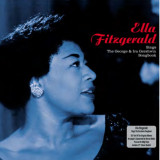
When Ella Fitzgerald began recording her series of albums devoted to the work of
America’s greatest song writers, she elevated the art of Jazz singing into a new
dimension while celebrating a unique musical heritage bequeathed to the world of
popular music. Norman Granz encouraged the bold decision to record five albums all
featuring the extraordinary output of songs composed by the brothers George and Ira
Gershwin during the Golden Age of popular song. Gershwin show tunes had long been
a staple diet for bandleaders, pop-vocalists and star-instrumentalists eager to perform
such exhilarating material as Strike Up The Band, Oh, Lady Be Good!, S’Wonderful and
I Got Rhythm. But there was also a gamut of ballads and romantic dance themes
needing to be interpreted with greater sensitivity. Ella was more than capable of
focusing on lyrics and caressing melodies of songs like Someone To Watch Over Me, A
Foggy Day and Embraceable You. They are among the 53 Gershwin classics she
recorded over an eight month period in 1959 and now featured in this superb collection.
Lloyd Cole & The Commotions – Cole, Blair Cowan, Lawrence Donegan, Neil Clark and Stephen Irvine – were formed in Glasgow in 1982, where Buxton-born singer-songwriter Cole was studying Philosophy and English at the University of Glasgow -Their sound swam against the tide of shiny 80s synthesisers, offering intense, melodic, guitar-based pop, topped with droll words packed with literary references.
Given just how loved debut album Rattlesnakes was, it would have been hard for whatever followed to be received as warmly – yet Easy Pieces made a good first of it. It was to sell twice as many copies in its first two weeks as Rattlesnakes had to date, giving the group a Top 5 chart placing on its release in November 1985. Recorded with 80s super-producers Clive Langer and Alan Winstanley, its first two singles, the brooding, gospel influenced Brand New Friend and the forever-jaunty Lost Weekend reached the UK Top 20.
This re-issue faithfully replicates the original 1985 Polydor Records UK release with printed inner sleeve and is pressed onto high quality 180g vinyl.
ShitKid is the project of 24-year- old Åsa Söderqvist who made her debut last spring with a self-titled debut EP, which quickly propelled her into being one of the most talked about new acts in Sweden. The three-track ShitKid EP was released via the Stockholm based label PNKSLM Recordings in the spring of 2016 to great acclaim, reaching far beyond its lo-fi confines to find fans at the likes of The FADER, Pigeons & Planes and SPIN internationally, while her debut single "Oh Please Be A Cocky Cool Kid" appeared on national TV in Sweden the morning after it was released. An expanded version of the debut EP was released in the summer of 2016, which saw ShitKid playing several Swedish festivals before making her debut international appearances in the fall, alternating between playing to full houses in London and monthly shows in her new hometown Stockholm. Now ShitKid is ready to announce her long-awaited debut lp - titled "Fish" it's due for release on June 2 via PNKSLM Recordings on vinyl, cd and digitally. Recorded during the same sessions as "EP 2"it's another step on ShitKid's musical journey - offering up a sound that's clearer than the lo-fi murkiness of the debut EP but still very much the opposite to the slick pop dominating the musical landscape today. ShitKid will be doing select festival shows during the spring, leading up to a UK and EU tour around The Great Escape ahead of the album before spending the summer on the road with slots at ex Roskilde Festival announced already, with a lot more UK and EU dates TBA. Fish is written, recorded, performed and produced by Åsa Söderqvist and mixed by Simon Skeleton.
Nearly five years on from their acclaimed debut, Bennett Wilson Poole reveal the follow up. It's been a long time coming, but...
That eponymous first album was only ever intended as a one-off collaborative project — a serendipitous series of events which began with a late evening session where the trio wrote ‘Hate Won't Win’. A response to the murder of MP Jo Cox, it was something of a fresh take on Crosby Stills Nash and Young’s classic protest song ‘Ohio’. The release saw Bennett Wilson Poole embraced by the Americana community, playing live on the Andrew Marr show and crowned as ‘UK Artist of the Year’ at the 2019 UK Americana Awards, in front of a watching crowd including Graham Nash himself.
The new album came together in similar fashion; Robin (Bennett) and Danny (Wilson) started writing new songs late into the night whilst on tour to promote the first record — a tour which unfolded from a three-night residency in a London pub into a year-long odyssey culminating in a headline show in Hall One at King’s Place — and before they knew it, there were enough songs to begin recording an unplanned second album.
Where the first record drank deep from 70s US west coast folk-rock, the second has been heavily spiked with 1960s British psychedelia, even featuring a cover by legendary counterculture artist John Hurford (whose credits include 60s artwork for Oz Magazine and International Times).*
Tony Poole’s meticulous and inspired production has spun Robin and Danny’s fresh batch of songs into a delicate web of musical delight. Fans of the ‘spot the reference’ game Tony started on the first record won’t be disappointed this time either, as there are plenty more to be found here.
As with the first album, the lyrics don’t shy away from current affairs – by the end of that year of touring, the band were already playing “I Wanna Love You (But I Can’t Right Now)”, reflecting on the state of US politics, yet optimistic that the problems are only temporary.
Many of the tracks on the new album feature live rhythm section Fin Kenny (drums) and Joe Bennett (bass) for the first time on a BWP record.
The title of the album comes from the lyrics of ‘Help Me See My Way’, the first single, a prayer for strength in difficult times, the trippy animated video for which was originally issued during lockdown. The dreamy positivity of the line "I saw a star behind your eyes" is tempered with the plea "don't let it die away", a message which feels as important as ever two years on.
All three collaborators have had critical acclaim in their own right. Danny Wilson’s credentials go back to his days in Grand Drive with brother Julian, and his consistent high calibre output with his Champions of the World led them to sweeping the board at the first UK Americana Awards with Album, Artist and Song of the year awards richly deserved; Tony Poole’s Starry Eyed and Laughing were hailed as “the English Byrds” on the back of their two CBS-released albums in the mid-seventies and he has since built an enviable reputation as producer and engineer; Robin Bennett has been relentlessly turning out timeless songs from his Oxfordshire base in bands from Goldrush to The Dreaming Spires
Für viele Musiker ist der Schritt aus dem Kollektiv ein riskantes Manöver: Wie nämlich nehmen Band und Publikum die Entscheidung auf? Hendrik Otremba, Sänger der Gruppe Messer, stellt nun sein Soloalbum vor. Er hat es Riskantes Manöver genannt - aber nicht aus dem genannten Grund. Längst hat er sich als eigenständiger Künstler etabliert, hat als Maler, Autor und Performer stets auch zur Identität von Messer beigetragen, die gerade obendrein an einem neuen Album arbeiten - dieses Soloalbum kündet also nicht von Zwist. Wenn etwas verblüfft, dann vielleicht eher, dass Otremba nicht erneut in ein neues Medium aufbricht, sondern dorthin zurückgeht, wo alles anfing: zu den eigenen Songs, die bisher im Verborgenen lagen. Riskantes Manöver ist dabei kein Aufguss des Bekannten, aus Ennui oder Eitelkeit. Viel eher tritt der Songwriter Hendrik Otremba an die Öffentlichkeit, der sich parallel zu Messer entwickelt hat. In den vergangenen zwölf Jahren nimmt er Demos auf, experimentiert, geht intuitiv vor und findet zu einer eigenen Sprache, aus der er nun mit zwei engen Freunden ein Album ausgearbeitet hat: Multi-Instrumentalist Alan Kassab, ein Schulfreund Otrembas, und Kadavar-Schlagzeuger Christoph 'Tiger" Bartelt, schon Produzent des Messer-Debuts. Gemeinsam nähern sie sich den Demos wie einem Skript und schaffen so eine Art auditiven Autorenfilm. Im Zentrum steht eine kreative Vision, die von virtuosen Technikern und begnadeten Darstellern umgesetzt wird - neben der Kern-Crew gehören dazu Stella Sommer, Alex Zhang Hungtai (Ex-Dirty Beaches), der Otremba überhaupt erst dazu inspirierte, ein eigenes Album zu schreiben), Gregor Schwellenbach, Friedrich Paravicini, Dominik Otremba (aka Performance) - aber auch Tochter Hedi und mehr als ein Dutzend weitere Kreative zwischen Indie-Adel, Hochkultur-Bagage und Jugendfreunden. Doch nicht nur durch sein Casting-Gespür und weitere direktive Entscheidungen überzeugt Otremba, sondern vor allem mit Musik, die durch ihre Weite und einen eigensinnigen erzählerischen Ansatz gar filmisch wirkt: Als zarter Chansonier schleicht Otremba durch die Streicherschluchten von New York II, geifert als Apokalyptiker in Nektar Nektar vor Blastbeat und heulendem Saxofon, findet in der sinophilen Klavierballade Bargfeld aber auch zu Ruhe und Intimität. Brachialen Proto-Industrial und dröhnenden Goth meistert Otremba ebenso wie epischen Pop oder Großstadt-Country; hier öffnet ein Musik-Enthusiast sein vielseitiges Portfolio, in dem er als Sänger und Performer zugleich eine neue Bandbreite entwickelt. In sein Rollen-Inventar führt Otremba zudem die Figur "66 ein, ein "Zeuge des zivilisatorischen Niedergangs" und eine Art Erzählstimme, durch deren Perspektive wir auf das von Katastrophen und Verlassenheit geprägte Geschehen des Albums blicken. Otremba tritt als "66 maskiert auf, zu sehen etwa auf dem Cover der Riskantes Manöver Doppel-10-Inch. Was die Bandagen bedeuten, bleibt unklar - ein weiterer, rätselhafter Eintrag in Otrembas Privatmythologie, bestehend aus Namen, Zeichen, Bildern, die sich durch sein gesamtes Werk erstrecken. Riskantes Manöver öffnet darin nicht nur eine neue Facette, der Titel fasst zugleich das Ethos eines Arbeitens zusammen, "das nicht auf Relevanz oder Erfolg gepolt ist". Gerade, wenn dabei immer wieder Gegensätze vereint werden müssen, die an dem Menschen dahinter zerren: "Das riskante Manöver ist mit den Widersprüchen zu leben und sie im eigenen Schaffen stattfinden zu lassen. Lust und kreative Ambition als was Positives zu begreifen in einer Situation, wo das, was ich sehe, eigentlich für das Gegenteil spricht, abgründig, negativ, dämonisch ist." In diesem Sinne ist hier ein Monolith von einem Album geschaffen, der sich zugleich machtvoll und zart aufstemmt, wie es im Untertitel der Platte heißt: "gegen die Verachtung der Gegenwarth"! - Sebastian Berlich
Extra Muros is an annual itinerant artistic residency initiated in 2017. The third edition was co-organised during the winter 2021-2022 by the FLEE art collective in collaboration with the Music Department of the Museum of Ethnography, Geneva (MEG). Five artists participated in this residency including: Prins Emanuel, Nabihah Iqbal, Jaakko Eino Kalevi, Cosmic Neman, and Maria Spivak.The residency was held at the MEG in two phases. The first part of the residency and encounter represented an opportunity for the artists to explore the museum’s archives, collections, and exhibition spaces. The second phase was dedicated to the composition and production of original musical content in an ephemeral studio set up in the auditorium of the Genevan institution.
In this context, the pieces presented in this album were all conceived during this residency. Having never worked together, the five artists and musicians, each with their own distinct musical path, discovered a variety of sound resources at the Museum. These included eleven traditional instruments from the African continent, Asia and Oceania from the MEG collections, as well as synthetisers, audio effects units, amplifiers and several other vintage emblematic analog electronic devices from the collection of the Swiss Museum and Center for Electronic Music Instruments (SMEM) in Fribourg. In addition, recordings of traditional music from the five continents belonging to the museum’s International Archive of Folk Music (IAFM) were also made available to the artists.
In pairs, the residency’s participants were able to combine their respective creative worlds with the museum’s historical instruments as well as sound archives. This compilation is the result of this rich dialogue.
out of Stock
Last delivered 3 years ago available to reorder, subject to availability