We call them the rat pack of our beat scene. With all diversity in sound, the three producers are unified in their love for dope beats and high-proof drinks, both catered and consumed with style and expertise.
Suff Daddy, the globetrotting gin connoisseur and minimoog player with domiciles in Berlin, Düsseldorf and Sydney. He has released three solo albums and has worked with artists like Miles Bonny, Fleur Earth, Ta-ku and Elzhi. After a one year stint in Sydney, he returned to Berlin this spring.
Brenk Sinatra, the Wien-Kaisermühlen homeboy, Westcoast rap fanatic and producer of the forthcoming MC Eiht album. Last year Brenk released the critically acclaimed S3 album together with US singer Miles Bonny and has laced beats for an armada of MCs from both sides of the Atlantic.
And last but not least Dexter, the Stuttgart based trip maker and platinum producer with a day job as a pediatrician. This June Dexter released his second solo-album 'The Trip' a homage to the psychedelic rock era and one of the most innovative and genre bending hip-hop albums of 2013.
All three first met at the Hi-Hat Club, the producer series that we started a couple of years ago with the goal to push and celebrate the art of beat making. With their respective volumes 'Suff Draft' (Suff Daddy), 'The Jazz Files' (Dexter) and 'Chop Shop' (Brenk Sinatra) each of the guys put the instrumental hip-hop thing on a new and different level. None of their beats need a MC to be complete, they are full songs in their own right.
The official birth date of the Betty Ford Boys was the 2012 Beat BBQ in Cologne where Dexter, Suff and Brenk performed together for the first time. Right after the now legendary gig, that was ended by police forces Suff Daddy left for Sydney so that most the recordings for the Betty Ford Boys debut album took place in the cloud. Right after his return to Berlin, the Boys jumped on the bus and played their first club tour which finished with a gig at the Splash Festival.
On August 30th, the Betty Ford Boys release their first album 'Leaders Of The Brew School' on Melting Pot Music. The record combines the best of three worlds and has a surprisingly chilled Westcoast vibe. It's perfect summer music, it's edgy and relaxed at the same time and keeps you thirsty for more ....
quête:west
Back in stock!
Some friends think that Shihab the man owes the balance of his soul to his beautiful Danish wife. They may be right; for Eros is the very essence of what Shihab plays.Yet Eros is a god with many a face. A tale of tender mournings Shihab's flute is telling in MAUVE - a piece that translates its title into delicately changing colors of sound. In UMA FITA DE TRES CORES he has his instrument wooing with the proud self-reliance of Latin grandezza. Calmly, softly, almost blandishly Shihab blows the solo flute in the Jimmy Woode composition MY KINDA WORLD. Serene and somewhat playful his own title ANOTHER SAMBA comes along - a most uncommon composition by the way: lasting for sixty bars as if growing independent out of itself, with solos that appear to be additional spinnings rather than improvised choruses; and yet; a perfect, self sustaining melody no element of which is superfluous. In the last of the pieces for flute, in Klook Clarke's THE WILD MAN, which is based on a flourish of trumpets, Shihab for the first time reminds of the sombre, the demon-like face of God Eros. He contrasts flawlessly intoned passages with challenging phrases, phrases raucously sung into the flute - really, he is a 'wild man' who is playing like that. This raucous challenging sound prevails throughout the four baritone-titles ('Shihab never withholds long to caress', Campi says). Shihab blows the instrument the same way he speaks: without any delay, directly coming to the point. And he treats it like a voice, not aiming at an artificially homogeneous sound in all the registers, but at their different modes of expression. In the high pitches the horn gains a brilliant tenor-like quality - for instance in PETER'S WALTZ, dedicated to Shihab's son Peter, and in Kenny Clarke's simple drum fills comprising theme JAY-JAY. In the deep register Shihab produces snotty sounds filling lady's ears with horrors like Pan - thus in JAY-JAY and in the boppy blues SET UP . Shihab's sense of a scurrilous humor breaks through in SEEDS (which reminds of the West-African heritage of jazz with its multiple rhythms and its renunciation of harmonious development - only the eight bars of the bridge base on a progression of chords): not only does he omit the notorious bombastic chord by the ensemble after his own final cadenza, he even ends with a minor second above the keynote. Seems as if Shihab now unrestrictedly conveys to his music all the experiences and emotions he formerly did not deal with in a musical way. Shihab the man need not be disturbed so that Shihab the musician may improvise passionate choruses. It would be unjust, however, to forget the choruses of the four other musicians for those by the 'born leader'. Francy Boland, taciturn and always introverted: he plays an extrovert, a masculine piano. Even with spare single note lines he produces a piercing and ringing sound that hitherto nobody except him has discovered, a bluesy sound bespeaking the very element of frustration that lies within the title of the trio number WHO'LL BUY MY DREAM. The unfailing feeling for rhythm the musicians of the CBBB praise with the arranger Boland, becomes manifest in the piano solo on SET UP. Francy's improvisation is rhythmically styled in a Monk-like manner, and yet no accent could be set differently. Maybe this is the secret of the Shihab-Combo. 'Rhythm is our business', this credo of Jimmy Lunceford could be the one of the five musicians as well. Sadi hits his vibes as dryly as if wanting to bring its ancestors to memory, the wooden chimes of West Africa's coastal tribes. To reach the fullest poignancy possible, he intentionally calms down even the resonance in MY KINDA WORLD. In UMA FITA DE TRES CORES Jimmy Woode bears out the crispy jazz beat against Sadi's Bongos and Klook's Latin-American percussion all by himself. Moreover - and that, too, is connected with the school of the Duke who was the first in the history of jazz to discover the instrument's potential as a melody instrument - Woode rips a marvelous counterpoint to the inventions of the other melody instruments, take for example PETER'S WALTZ. And then there is Kenny Clarke. Klook. On the entire record he only uses his brushes. Means by which different drummers only know to bring forward impressionistically blending noises: He drums a vigorous beat with them, fanciful fills, a solo, melodious and at once skillfully playing with cross rhythms in JAY-JAY. The 'born leader', the 'outstanding baritone saxophonist of modern jazz' (Joachim-Ernst Berendt), he could not wish himself different sidemen for this record overdue since some years.
Lee Perry's time at WIRL Records, later to be renamed Dynamic Sounds Studios, was a very productive time
in his career. A run of great singles and the shaping of a new sound, the beginning of what we know today as
Reggae .
Lee Perry (b. Rainford Hugh Perry, 28 March 1936, Hanover,Jamaica) began his entry into the music business at
the age of 16.Moving up to Kingston Town and working around various Sound Systems, before finding
employment at Coxonne Dodd's Studio One set up, in the late 50's early 1960's. Perry started out as a record
scout, organising sessions and supervising auditions at Dodd's record shop on Orange Street. Helping to make
hits for Delroy Wilson ( 'Joe Liges','Spit In The Sky') and the Maytals, which would lead to his own vocal records
released through Studio One.The musical backing for which, came from legendary Studio One house band The
Skatalites. Another important relationship for Perry, his first recordings with Bob Marley came in the form of
the Wailers, also providing backing, alongside the Soulettes who featured Rita Marley. Cutting such tunes as
'Chicken Scratch' around 1965/1966. This tune was also to provide him with one of his future nicknames
'Scratch'. A dispute over credits and money saw Perry leave Studio One and work with various producers
including Clancy Eccles and J. J. Johnson, before arriving at the door of producer Joe Gibbs in 1967. Here he
would write songs and produce hits for artists such as, Errol Dunkley and the Pioneers. A tune cut during his
time with Gibbs, voiced a snipe at fellow employee Dodd, a trademark that would become an outlet for his
frustrations in the business.This particular tune 'The Upsetter' would also provide another moniker and a name
for his label 'Upsetter'. Again lack of musical credit and financial reward saw Perry move on this time to WIRL
(West Indies Records Limited) Records, working alongside manager Clifford Rae, who would provide studio
time and pay for pressings in return for helping to promote and distribute WIRL product, which Perry would
carry out on his trusted Honda 50 motorcycle around Kingston town.
This period at WIRL saw some inspired work from Perry. 'Run For Cover' was another musical blow to a
previous employer, Coxonne Dodd and featured the Sensations on backing vocals and Lynn Taitt's guitar
picking skills. 'People Funny Boy' was a massive hit for Perry going on to sell over 60,000 copies. Joe Gibbs
would be at the end of this musical attack. Perry had felt Joe Gibbs had turned his back on him, after he had
provided hits for groups like, The Pioneers amongst others. The song would be one of the first records to
feature a New Beat (Reggae) inspired by the sounds coming out of a Pocomania Church, Perry had heard one
night.The congregation inside, wailed in a more slower way than the current musical style of the time Ska!. Perry
worked up this new style with Clancy Eccles, who would come under attack himself in 'You Crummy'. Their
closeness, which as detailed in that song would find them, 'Even shared the same Gal' but 'Now it's plain to see we
reached the end'. 'Set Them Free' was an answer record to Prince Buster's 'Judge Dread' (which had
featured Perry on it) a plea to the Judges in Jamaica that handed out extremely harsh sentences to the young
offenders of the time. The track was cut on the same rhythm as 'Run For Cover' . 'Django Shoots First'
inspired by the Spaghetti Western film of the same name, features Sir Lord Comic. One of the early DJ's who
used a jive talking style over rhythms. 'Night Doctor' was a hit instrumental that featured the organ talents
of Ansel Collins, that really push the tune along. 'Something You Got' was a cover of an USA R& B track by
Chris Kenner and 'Wind Up Girl' was cut at the same session. 'Water Pump' was a rude style track that
was cut later and originally released in 1974.As was 'People Sokup Boy' a later version of 'People Funny Boy'.
'Labrish' which means idol talk and gossip, was one of the first great talk over tunes that features Lee Perry
and producer Bunny 'Striker' Lee talking about the Political situation in Jamaica at the time and their own
financial situation and stories of various comrades.The track was originally released in 1973.
Bunny Lee would play a major part in lee Perry's career around this time and they were very close, often
sharing sessions and rhythms. Ironically it would be Bunny Lee that took over Perry's roll at WIRL and become
responsible for the labels products in years to come. Clifford Rae who give control to Bunny for a lot of the
WIRL product and even gave him his shop 101 Orange Street. So here we have a collection of music born out
of a time spent at WIRL Records and providing an important chapter in Lee Perry's career and indeed to the
story of Reggae itself.
Hope you enjoy the set.
*The product of a move from South Carolina to Berkeley, CA and the subsequent extended separation from loved ones, Toro Y Moi's third full-length, Anything in Return, puts Chaz Bundick right in the middle of the producer/songwriter dichotomy that his first two albums established.
*There's a pervasive sense of peace with his tendency to dabble in both sides of the modern music-making spectrum, and he sounds comfortable engaging in intuitive pop production and putting forth the impression of unmediated id.
*The producer's hand is prominent- not least in the sampled "yeah"s and "uh"s that give the album a hip-hop-indebted confidence- and many of the songs feature the 4/4 beats and deftly employed effects usually associated with house music. Tracks like "High Living" and "Day One" show a considerably Californian influence, their languid funk redolent of a West Coast temperament, and elsewhere- not least on lead single, "So Many Details"- the record plays with darker atmospheres than we're used to hearing from Toro Y Moi. Sounding quite assured in what some may call this songwriter's return to producer-hood, Anything in Return is Bundick uninhibited by issues of genre, an album that feels like the artist's essence.
*Born and raised in Columbia, South Carolina, Chaz Bundick has been toying with various musical projects since early adolescence. Having spent his formative years playing in punk and indie rock acts, his protean Toro Y Moi project has been his vessel for further musical exploration since 2001. During his time spent studying graphic design at the University of South Carolina, Chaz became increasingly focused on his solo work, incorporating electronics and allowing a wider range of influences- French house, Brian Wilson's pop, 80s R&B, and Stones Throw hip-hop- to show up in his music. By the time he graduated in spring 2009, Chaz had refined his sound to something all his own. Music journals across the board touted his hazy recordings as the sound of the summer, and he released his debut album, Causers of This in early 2010.
*Since then, Bundick has proven himself to be not just a prolific musician, but a diverse one as well, letting each successive release broaden the scope of the Toro Y Moi oeuvre. The funky psych-pop of 2011's Underneath the Pine evinced an artist who could create similar atmospheres even without the aid of source material and drum machines. His Freaking Out EP, a handful of singles and remixes, and a retrospective box-set plot points all along the producer/songwriter spectrum in which he's worked since his debut, and Anything In Return is another exciting offering that shows he's still not ready to settle into any one genre.
Six years have passed since the last album by Andi Otto alias Springintgut, ("Park and Ride", City Centre Offices, 2007). In this period, Otto has done nothing less than inventing a new instru- ment: His "Fello" is a cello with movement sensors attached to the bow and a corresponding software. The development has been kicked off at STEIM in Amsterdam already in 2007. Since then, Otto has achieved vital refinements of the system, cooperated with artists of various fields as diverse as choreographers in Macedonia, theatre in Nigeria and Techno DJs in the Berghain Kantine in Berlin or the Fusion Festival. He even played solo with his instrument on different continents. For this third album, "Where We Need No Map" Otto takes the "Fello" to his studio in Hamburg for the first time. He records his instrument which has until today only been presented live on stage. In these Fello Sessions, the bow gestures immediate- ly modulate and process the amplified cello sound. In the subsequent editings he selects and cuts these sessions and merges them with other styles, such as Skweee, House and Jazz. Springintgut's trademark sound, this unique playfulness, is pre- sent throughout, while the live-processed cello adds an unrivaled deepness. The artist's expeditions even add more colour. Two tracks have been recorded in India. The lead voi- ce in "Bangalore Kids" is a field recording of a schoolboy in Cubbon Park, Bangalore. Andi Otto spends three months in Japan as artist- in-residence in the Villa Kamogawa in Kyoto. Du- ring this concentrated period he produces the more contemplative tracks of the album, like "Ka- mogawa Cycling" and "Western Kyoto". In Sri Lan- ka, finally, he meets Sasha Perera, the voice of Berlin's Dub Techno band Jahcoozi. They record two songs together. Especially in "Bullet" one can sense the lazy, muggy, peaceful heat of the after- noons in which this beautiful track has been com- posed. These stories may help to locate the music's orig- ins but still the sound of "Where We Need No Map" points us to unknown territories. The journey itself is the reward, let's listen!
Sechs Jahre sind seit dem letzten Album "Park and Ride" (City Centre Offices, 2007) von Andi Otto alias Springintgut bereits vergangen. Diese Zeit hat der Pingipung-Mitinhaber genutzt, nicht weni- ger als ein eigenes Instrument zu erfinden: das "Fello", ein Cello mit Bewegungssensoren auf dem Bogen und einer dazu gehörigen Soft- ware. Die Grundlagen dafür entstehen bereits 2007 am STEIM in Amsterdam. In der Folgezeit gelingt es Otto, das Instrument immer weiter zu verfeinern, mit unterschiedlichen Künstlern zu kooperieren und international aufzutreten. Für "Where We Need No Map" trägt Otto das Fello erstmals ins Hamburger Studio und nimmt unzählige Sessions auf, in denen die Gesten des Bogens direkt den verstärkten Sound des Cellos verändern und neu formen. Diese Fello-Sitzungen werden anschließend editiert und mit anderen Ein- flüssen vermengt, die von Skweee über House bis hin zum Jazz reichen. Der Markenzeichen-Sound von Springintgut, diese ureigene Verspieltheit, ist weiterhin vorhanden, gewinnt durch das live-pro- zessierte Cello aber eine bisher unerreichte Tiefe. Weitere Farbe erhält das Album durch Ottos zahl- reiche Tourneen in ferne Länder. Zwei Stücke ent- stehen in Indien. Die Stimme von "Bangalore Kids" ist eine Feldaufnahme eines Schuljungen im Cubbon Park in Bangalore. In Japan verbringt Andi Otto drei Monate als "Artist in Residence" in der Villa Kamogawa in Kyoto. Während dieser kon- zentrierten Zeit entstehen die ruhigeren Tracks des Albums wie "Kamogawa Cycling" und "Western Kyoto". In Sri Lanka lernt er dann Sasha Perera kennen, die Stimme von Jahcoozi. Sie nehmen zwei Songs zusammen auf. Vor allem in "Bullet" kann man der faulen Nachmittagshitze nachspü- ren, in der die Stücke entstanden sind. So lassen sich die vielfältigen Entstehungspunk- te von "Where We Need No Map" zwar karto- graphieren, aber der Sound des Albums schickt einen trotzdem in unbekanntes Terrain. "Der Weg ist das Ziel, frag nicht viel, hör mal..."
New Leng signing Auf Togo are the combination of Clement Cachot-Coulom from the Fabulous Penetrators and Sasa Crnobrnja, one half of In Flagranti.
Their combined sound is one of vintage recording equipment and instruments coupled with tweaks and blends from the modern studio. This new 12 for Leng draws on all their knowledge of the past and of the current club scene, effortlessly gliding through deep, warm analogue sounds and tougher studio techniques. Both tracks have guitar work that reminisces of a late 60's West Coast scene laid over strong bass lines and beats giving the perfect mix of home listening fuzz and a late night dance floor.
SKYLAX RECORDS, THE company focused on realeasing original obscure dance classic and everything's that sounds fine to their ears ! For this new release serie, we decided to bring you guys one of the most influential & mysterious producer from Detroit since the late glorious 80's ! He's an amazing singer, keyboard player & producer, he has worked with Eddie 'Flashin' Fowlkes', legendary labels such as Submerge (U.R. homebase run by Mad Mike), 430 west (Octave one), Happy House (deep house submerge sub label), Planet E (with Carl Craig), he has even been for the ones who really know their stuff one of the original member of the iconic R&B House band that ever existed 'Members of the House' doing some vocals on their very first release back in 1987 (Signed by Underground Resistance Mike Banks). This guy is NIKO MARKS. He gave us the chance to release some of his work that has been available on some some very very striclty limited edition (mostly Cdr).
This is some of the best stuff we've ever heard, the detroit real sound melted with P-funk (circa funkadelic) & extraordinary vocals.
i met kirill from spdsc last year at a festival in bucharest called "poolside" and instantly became friends. to be honest i wasnt really aware of his productions at that time but in the end who do i know anyway so one of the first things while keeping in touch was him sending me the demo of "i need it" which he produced with his friend lipelis. instantly i fell in love with this tune and asked if its available to sign for teardrop. it was. and here we go, a few months later with remixes by myself lovebirds and mr iron curtis under his new moniker leaves from the western hemisphere and arsenii and vougal from the eastern!
Four track instrumental EP from LA producer Devonwho. Sun-drenched synths and G-funk vibes are the order of the day here; 'Strangebrew' and 'Sleet' zip along with their low-slung bass and melodic purple keys while on the flip 'Cactus' takes the pace down a bit. Slow jamz with a fast feel, these three rolling 4/4 workouts are rounded off with a fresh rework of the title track from fellow West Coast funakateer B Bravo (Frite Nite, Brownswood). Comes in picture sleeve with free download code.
Up and away / To your journey to the sun / Drink your rocket juice / Fly away (Hey, Shooter).
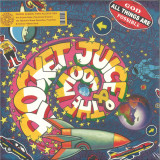
High up in the skies, amongst the clouds, Rocket Juice & The Moon was born. Literally. It happened back in 2008, when Damon Albarn, Flea and Tony Allen convened on the same Lagos flight, to play and exchange musical ideas in that city as part of the Africa Express collective. Relishing a shared enthusiasm for one another's work, and bonding immediately, there and then the triumvirate laid down the blueprint for Rocket Juice.
Still, more than a year passed before conditions were set for three weeks together at Albarn's West London studio, recording and refining two-dozen startlingly out and deeply funky instrumental grooves. The next stage was to invite onboard some extremely talented friends, with further sessions in Dallas, New York, Chicago and Paris... Erykah Badu, no less, queen of contemporary soul. Three companions from Africa Express: Malian singer Fatoumata Diawara, whose debut album has topped World Music charts since its release last Autumn; her multi-talented compatriot Cheick Tidiane Seck, whose prodigious keyboardism has lit up releases by artists ranging from Youssou N'Dour to Hank Jones; the young, Ghanaian rapper M.anifest, quizzically existential, switching seamlessly between Twi and English. And the Hypnotic Brass Ensemble, long-time stalwarts in the Honest Jon's set-up — since one of the team discovered them busking near the shop in Portobello Road, on his lunchbreak — with a second album for the label due in May... Finally, the tracks were dispatched for mixing to Berlin, to be meticulously honed, polished and envenomed by Mark Ernestus, one half of the legendary Basic Channel and Rhythm & Sound partnerships.
The result is Rocket Juice & The Moon — out March 26, 2012, on Honest Jon's Records — a triumphant exploration and proliferation of kinetic Afro-funk rhythms: organic, exuberant, communal music-making, evidenced by the project's live debut on stage as part of the Honest Jon's Chop Up in late 2011, which hit London, Marseille, Dublin, and Cork to such great acclaim (witness the flurry of smart-phone film-clips uploaded in the days thereafter).
From the inaugural bars — that absurdly funky slice of instructional timekeeping, 1-2-3-4-5-6 — the liquid pulse of Fela Kuti's classic recordings drives the action through a suite of 18 shape-shifting compositions. The greatest drummer in the world has never sounded so good as he does here. His intricate cross-patterns jostle and lock with Flea's nimble, rumbling bass riffs. Joined by Seck on There and Extinguished — 'when you dispose of something burning, be sure it's out' — Albarn's keyboards spray synth fusillades up top, over, and under... splicing into the mess of wires running between the freaked Afro-disco of William Onyeabor and the space-jazz-moog of Sun Ra. The HBE brings extra intensity and drama to Leave-Taking — likewise Flea's trumpet to Rotary Connection — teasing out the haunting melody coiled in the mix.
Where the best of vintage Afrobeat sides sustained their concentrated energies over the course of sprawling, marathon jams, RJ & TM manages something altogether different: the group bottles the idiom into capsules of funk... and real songs. Beautifully buoyed by Erykah Badu's unmistakable vocals, Hey, Shooter brilliantly traverses metaphysical spaceways sans any semblance of noodling. Lolo and Follow-Fashion — featuring the open-hearted sensuality of Diawara's singing, M.anifest's quick, brawny science, and more brass blasts — play like its musical cousins or codas. Indeed, the album's shrewd sequencing creates the composite effect of tracks working both individually or within the context of an extended song-cycle.
The lovely ballad, Poison, is bittersweet and ruminative: 'If you're looking for love, beware the signs / They will paralyze you one by one / Poison, it will only break your heart.' Down-tempo and dubby, Check Out and Worries amplify the range of styles and moods. And by the time of Fatherless — a chugging Afro blues that evokes John Lee Hooker lost in Lagos, one gets the sneaking suspicion there's very little outside the reach of this collective's inventive musical grasp.
There is, in fact, a palpable openness pervading Rocket Juice & The Moon — the sense of a limber willingness to follow creative impulse — right down to how the group acquired its name. When Ogunajo Ademola — the Lagotian commissioned to do the album's cover artwork — dubbed his submission 'Rocket Juice & The Moon', it quickly morphed into the formal name of the project, like trying to hold onto mercury.
Surely, the stars above also approved.
Coming out with one of the most anticipated and long-awaited albums so far on Brainfeeder is Samiyam aka Sam Baker. 'Sam Baker's Album' is 40 minutes of pure listening pleasure, a series of woozy, off-centre hip hop instrumentals drawing heavily on Baker's love of electronic funk but never in hock to it. Intensely detailed and carrying considerable emotional weight, this is not 'Rap Beats Volume 2' but an album of fully-realised pieces of music which stand on their own without the need for an MC's intervention.
Ann Arbor native, Samiyam (born Sam Baker) moved to Los Angeles in 2006. In his short time out West, he has become one of the city's most progressive and recognized producers, a man who has spearheaded the revival of interest in instrumental hip-hop music over the last few years. Baker's 'Rap Beats Vol.1' collection was the very first release on Brainfeeder. He has also collaborated with old friend Flying Lotus as Flyamsam as well as having releases on Hyperdub and Poo-Bah records.Samiyam describes the work contained in his "Debut album" simply as, 'my favourite stuff' - and what could be better than that
Over the last two years, Ahmet Sisman has become one of the most interesting newcomers within the German Techno scene. His music is located at the junction between Turkish roots and western post-modernism, but still always succeeds in orchestrating the dark energy of the night, too. Consequently, his last EP "Hit Me Low" (Dumb Unit) could be found in the charts of Tiefschwarz and André Galluzzi, and the percussive masterpiece from '98 "Buiya" belonged to Sven Väth's most popular tracks of the Ninth Season last year.
A1 | In My Dreams (Cudder Anthem)
A2 | Soundtrack 2 My Life
A3 | Simple As
A4 | Solo Dolo (nightmare)
B1 | Heart of A Lion (KiD CuDi Theme Music)
B2 | My World f. Billy Cravens
B3 | Day N Nite (nightmare)
B4 | Sky Might Fall
C1 | Enter Galactic (Love Connection Part 1)
C2 | Alive (nightmare) f. RATATAT
C3 | CuDi Zone
C4 | Make Her Say f. Kanye West & Common
D1 | Pursuit of Happiness (nightmare) f. MGMT & RATATAT
D2 | Hyyerr f. Chip Tha Rapper
D3 | Up Up & Away (The Wake & Bake Song)
D4 | BONUS TRACK - Day N Nite (Crookers Remix)
Repressed !!
Jay Dee needs no introduction. Widely regarded as one of the most important figures in hip–hop alongside Pete Rock, Kanye West, Pharell, and Dr. Dre, his influence has reached far beyond the genre. Known widely as your favourite producer’s favourite producer, and having produced and remixed for legends like Janet Jackson, Daft Punk, A Tribe Called Quest, Brand New Heavies, Busta Rhymes, Common, Erykah Badu, Guru, The Pharcyde, The Roots, De La Soul, and Royce Da 5’9"—the list is endless—there is no questioning Jay Dee’s genius. Many have tried, but none have been able to duplicate his sound. Originally released in 2001, Welcome 2 Detroit marked Jay Dee’s first solo project and the groundbreaking debut of BBE’s Beat Generation series, where producers stepped into the spotlight with complete creative freedom. A paradigm-shifting record, it was short-listed for Artistic Achievement in Music in October 2001 (the U.S. equivalent of the Mercury Prize) and instantly set the bar for everything that followed. Now, 25 years later, Welcome 2 Detroit returns in a long-awaited repress, celebrating a quarter-century of influence and innovation. This anniversary edition brings the instrumental version of the album back into circulation after years out of print, allowing listeners to experience the full depth and complexity of Jay Dee’s production in its purest form. Stripped of vocals, the intricacy, texture, and brilliance of his work shine brighter than ever—revealing details you may have missed the first time around. Make sure you grab a piece of history.
Green Vinyl[15,08 €]
"In 2021, we started the Mdou Moctar mixtape series. These releases compiled field recordings, cell phone voice memos, interview clips, conversations captured in the tour van, and blown-out board recordings from shows all over the world. As a continuation of those mixtapes, we present the Niger EPs, which examine the roots of the Mdou Moctar band. Early Mdou recordings were contained on cassettes, though the humble tape was soon replaced by the quick and easy facilityof cell phone technology. Long bus rides are common in West Africa. On one of these rides, you might be seated next to a stranger and ask "what are you listening to?", then a song exchange would begin over Bluetooth. This is a very real way artists found their music distributed far from home. In that vein, the Niger EP series features solely recordings taped in Mdou Moctar"s home country of Niger. Volume 1 begins the series with a mix of recordings from 2017- 2020, documenting the band at weddings, picnics, rehearsals, and even impromptu house concerts. A must have for any Mdou Moctar fan!" - Mdou Moctar bassist Mikey Coltun
Yellow Vinyl[15,08 €]
"In 2021, we started the Mdou Moctar mixtape series. These releases compiled field recordings, cell phone voice memos, interview clips, conversations captured in the tour van, and blown-out board recordings from shows all over the world. As a continuation of those mixtapes, we present the Niger EPs, which examine the roots of the Mdou Moctar band. Early Mdou recordings were contained on cassettes, though the humble tape was soon replaced by the quick and easy facilityof cell phone technology. Long bus rides are common in West Africa. On one of these rides, you might be seated next to a stranger and ask "what are you listening to?", then a song exchange would begin over Bluetooth. This is a very real way artists found their music distributed far from home. In that vein, the Niger EP series features solely recordings taped in Mdou Moctar"s home country of Niger. Volume 1 begins the series with a mix of recordings from 2017- 2020, documenting the band at weddings, picnics, rehearsals, and even impromptu house concerts. A must have for any Mdou Moctar fan!" - Mdou Moctar bassist Mikey Coltun