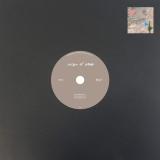
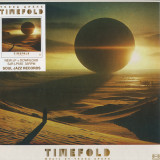
Born from a profound devotion to the piano and a reverence for the organic flow of life, byt’ surprises listeners by presenting paths of sand, a remarkable creation by Amsterdam- based composer xico, offering sound and soul to those willing to listen beyond the surface.
Through the magic of experimentation, xico captured the fleeting beauty of the muse of improvisation, as described by Nachmakovich, transforming the ephemeral into something lasting. Performances recorded on the same old piano during the 2023 Kaalstaart Festival in the Netherlands have since evolved into a fully realized work.
A journey of nearly three years of dedicated silence that began with Telva’s intuitive recognition of xico’s voice, starting with an invitation to her radio show and blossoming into a captivating fascination with what unfolded. This process led to the art of shaping the selected live recordings into a collector’s item, now materialized as a limited edition of 200 pressed vinyl copies, forever remaining as an artistic memento.
paths of sand unfolds as an intimate reflection of music’s ability to hold what cannot be held, to speak what cannot be said, and to embody what can never be described.
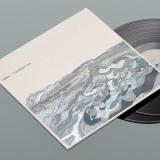
Calibre announces his new album 'Tricklemore Sea', set for release on vinyl and digital on 1st May via Signature Recordings.
A deeply personal and exploratory body of work, the album moves through ambient, shoegaze, electronic, blues and folk, all subtly shaped by the low-end sensibility that has defined his music for decades. It resists easy categorisation, reflecting an ongoing interest in blending bass culture with forms that sit outside it. Following the release of 'They Want You' at the end of 2025, this new project marks a clear shift in tone. Where that record leans into intensity and forward momentum, 'Tricklemore Sea' turns inward, occupying a more introspective space. Featuring entirely his own vocals and production, it carries a more exposed and vulnerable quality.
The album has taken shape gradually, drawing from material written in the years after 'Planet Hearth'. Rather than forming around a fixed concept, it emerges as a collection of pieces connected by tone and instinct. Tracks move between simplicity and abstraction, with piano-led compositions sitting alongside field recordings, improvisations and bass-driven works. Ideas often begin quickly, then evolve over long periods of revisiting and reworking. His voice takes on a more central role throughout, bringing a heightened sense of vulnerability. Lyrics and delivery are often left open, allowing space for interpretation. His process remains fluid and instinctive, with ideas written quickly, revisited over time and combined across different periods.
Moments such as 'Little Blend' carry a quiet melancholia balanced with hope, while 'Free One' reflects on the pressures of contemporary life. The title track considers the scale of human existence within a wider universe, framing individual lives as small but meaningful within something larger. Elsewhere, 'Deflower' and 'Pigeon Luncheon' draw from recordings made in Berlin at the end of lockdown, capturing a sense of movement and return. Older material, including 'Living In Your Head' and 'Hyndsight', is recontextualised and sits naturally alongside newer work. Threads from his wider catalogue remain present. 'Able Son Dub' nods to longstanding reggae influences, while 'Bit Broken Stream' appears here in a downtempo form alongside its drum and bass counterpart from 'They Want You'. Tracks like 'United Pull' and 'Mizzle Mine' lean further into abstraction, using minimal language and space to suggest mood rather than define it.
Over more than 30 years, Calibre has built a catalogue that moves across drum and bass, ambient, dub, techno, house, jazz, soul, blues and folk. His work is marked by restraint, quiet melancholy and a singular approach that continues to evolve. Complete authorship remains central, with all vocals, lyrics and production on both 'They Want You' and 'Tricklemore Sea' created solely by him. This breadth extends into his DJ sets, where he draws heavily from his own catalogue, often performing entirely self-produced material across a wide range of tempos and styles. His ability to move between contexts has seen him play at Boomtown, Houghton and Atonal Berlin, delivering distinct sets while maintaining a clear identity.
With 'Tricklemore Sea', that identity leans toward stillness, introspection and emotional depth. It is a record that prioritises feeling over definition, holding space for ambiguity while remaining grounded in a strong sense of authorship. Each release carries an element of exposure, a moment of vulnerability in letting the work go. At its core, the album seeks to capture something fleeting but recognisable, a sense of beauty that sits just beyond language.
He describes it simply: "The river inside of me flowing into the sea."
Laurie Torres is a Canadian musician and composer raised in Montréal, Québec by Haitian parents. Since 2008, she has been a trusted stage and studio performer for Julia Jacklin, Pomme, and Land of Talk, as well as being a founding member of Folly & The Hunter, with whom she recorded four studio albums and toured Canada, Europe and the UK.
In 2023, Laurie shifted focus to work on her own creations, a process of making time - the will and the need becoming omnipresent. Drawing creative inspiration from contemporary artists like Tirzah, Gia Margaret, Valentina Magaletti, Tara Clerkin Trio and ML Buch, 'Après coup' finds Torres intersecting at a pivotal moment where artists whose marginalized identities are at the forefront in creating a beautiful array of "other options".
"Being othered and tokenized as a woman who plays music, as well as a queer and black person, takes a toll, while also positively feeding a strong urge to push and be seen."
Centering around piano, drums and synthesizer with interweaving field recordings, 'Après coup' follows the precursor ep 'Correspondances' in the form of a sprawling 11-track album. Translating directly from French - afterwards, after the event - its title subliminally points at something deeper between the lines. Recorded in 2023 between tours in a small window of time where 'normal' life hadn't quite recommenced, Torres meticulously crafted her debut solo material in view of surrounding nature, all providing the perfect nourishment for long streams of improvisation. Built right up to the edge of a lake, Studio Wild in St-Zénon, Québec offered an unparalleled location and set up for her freeform creativity.
Instrumental music seemed like a natural response and evolution for Torres who had long basked in the world of "pop music" as she elaborates: "I had an urge to use creativity as a sort of resting place, a place where things can unfold slowly and take time to reveal themselves. In other worlds words, I felt the need to make something slower, more elusive"
The immediacy of Torres' recorded takes doubled with minimal overdubs create a fiercely direct, intimate and unpolished lo-fi beauty. 'Après coup' then is self-reflective, open and inclusive with Torres allowing herself to be fully seen. An album to be felt at close distance with unrivalled authenticity. This album stands as a testament to Laurie's artistic evolution and serves as a beacon, inspiring her to continue nurturing her own creative pursuits and finding exhilarating freedom.
Once I Was Young and The Airplane Album find the producer taking yet another sonic right turn. "These records were made in the same year with a very similar creative process. I moved almost completely away from sampling, experimented more than ever with ambient and techno elements and used the album format as a way to tell a story about moments in my life." Once I Was Young is a storytelling work that journeys through analogue synth-pop, modulated techno and raw, dusty drums with otherworldly melodies. Moments of beauty come through escapist, naturalistic ambient tracks and fusions of Kraftwerkian sequencing with more classical piano, while stark, clubready grooves keep things moving. Airplane contrasts similar shades of light and dark, synthetic and organic, rough and smooth. Glitchy, imperfect analogue sounds, knackered drum machine grooves and eerie synth phrasing evoke a post-human world with icy atmospheres. Elsewhere, warmth comes from bittersweet melodies and loose, funky drums that ooze retro-future charm.
Once I Was Young and The Airplane Album show a diff erent side to Escobar, one that embraces introspection and experimentation while exploring a whole other world of meaningful machine soul
The long-overdue revival of Bim Sherman’s catalog begins here. These essential recordings will become widely available again for the first time in decades, opening a new chapter in the appreciation of one of Jamaica’s most distinctive voices and representing a major moment for reggae and dub aficionados around the world. This reissue series will not only preserve his legacy but will also offer listeners the chance to experience the depth and timeless resonance of Sherman’s work in its full glory.
Bim Sherman—born Jarret Lloyd Vincent, in Westmoreland, Jamaica—holds a unique place in reggae history. Emerging in the mid 70s, his ethereal, haunting vocal style quickly set him apart from his contemporaries. He was soon collaborating with the top producers and musicians of the era, including Adrian Sherwood and the On-U Sound collective, bridging the gap between roots reggae and experimental dub and laying the groundwork for the fusion of Jamaican sounds with the vibrant underground scene in the UK. His career, from Kingston to London to Mumbai, was marked by an artistic daring and spiritual intensity that has earned him enduring respect across generations.
The centerpiece of this reissue campaign is Ghetto Dub from 1988, a record that distills Sherman’s artistry into its most potent form. Originally released in a limited number, the album embodies the stark yet soulful beauty of dub production. With its reverb-drenched drums, cavernous basslines, and echo-laden atmospherics, Ghetto Dub transforms Sherman’s various tracks into spectral presences that drift in and out of the mix. The arrangement and production—minimal yet profoundly textured—captures both the raw urgency of Jamaican street culture and the forward-looking experimentation of the UK dub scene. Each track unfolds like a meditation, balancing grit with grace, density with space. Ghetto Dub is more than an album; it is an immersive soundscape that reaffirms Bim Sherman as one of reggae’s most otherworldly and visionary figures.
We are excited to continue our work with Art P / Art Programming by finally offering the first full-length work from this Bremen-based electronic group. Originally released only on cassette in 1983, the self-titled album has now been fully restored and remastered, complete with bonus tracks and unreleased mixes unearthed from a rare demo.
The LP opens with "Wesen vom anderen Stern" ("Beings from Another Planet"), a downtempo, 808-driven electro synth wave track with German lyrics telling a story of aliens capturing earth, becoming the new "Herren" (lords), while humans are reduced to mere "objects." Art Programming founding member Jens-Markus Wegener notes that this track has always been a favorite during live performances, and it's easy to imagine how the futuristic sounds would have blown people away at the time.
Next is the electro/proto-techno title track "Art Programming," which we previously issued on a limited 12" in its full-length form. With its straightforward Roland 808 rhythms, catchy synth lines, and vocoder vocals, it's a classic example of German electro, and one of the earliest proto-techno tracks - long before Cybotron claimed the techno mantle. Its extensive break and electronic twist make it an early precursor to the genre. Wegener recalls that this track was created exclusively by him and Grotelüschen, with Grotelüschen contributing most of the melodic elements, while Wegener focused on drum machine programming and vocoder vocals.
On "That's Me," the album welcomes back singer Claudia Roebke. Although it's an electronic composition, Roebke adds a rock-infused, almost psychedelic vibe to the song. The lyrics, written by Wegener, depict a person obsessed with their appearance, using irony to critique societal beauty norms, questioning the obsession with perfection and attraction.
The album continues with a series of uptempo electro tracks: "Videoscreen," "La Gare," and "Genscher Pull 'N' Push." The first two feature slightly different mixes from an earlier demo that we personally prefered over the versions that were available on the final cassette release. "Videoscreen" expands on the theme of social isolation, with lyrics reflecting on a world obsessed with watching video all day - a topic that resonates strongly with today's culture of doom scrolling and social media addiction.
Next up, "Genscher Pull 'N' Push" is an incredible electro/wave/proto-techno track recorded in October 1982 with a political edge. Originally omitted from the album, it was only available on the demo cassette we mentioned earlier. The song takes aim at German politics, with lyrics that shout "bitte geh nach links / bitte geh nach rechts" ("please go to the left" and "please go to the right"), referencing the shifting political allegiances during the 1982 coalition change, when Genscher's party, the FDP, left the Helmut Schmidt cabinet to join the CDU/CSU opposition. The track was never released as the political topic had become outdated just a few months later.
The album closes with "Light and Fire," which originally served as the album's opening track. Its quirky, upbeat vibe now makes for a fitting outro.
The gear used on this album reads like a dream list for early 80s electronic music production: Roland Jupiter 4, TR 808, TB 303, System 100, SVC 350, Korg Mono/Poly, Moog Prodigy, FRICKE-Sequenzer, Roland CSQ-100 Sequenzer, Coron DS-8, MM 12/2, Sony TC 399, TEAC-244 Portastudio, Ibanez DM 1000, EH-Electric Mistress, EV-Micro. This unique lineup of equipment sets the album apart from NDW releases of the era, lending it a distinct sound with heavy proto-techno leanings and that straightforward electro vibe we all love.
The album is being released as a very limited edition of 300 copies on transparent red vinyl, complete with a full picture sleeve and lyrics inlay. This is yet another rediscovered and restored 80s gem on our label that you definitely don't want to miss!
With Le Tact, Joseph Schiano di Lombo delivers a work of rare finesse, conceived as a posthumous conversation with photographer Henri Cartier-Bresson. Through seven meditative pieces - whose evocative titles echo the photographer's words when describing the art of creating an image - this album explores the instinctive and delicate relationship that connects music and photography to our everyday lives.
Presented for the first time on stage during the 20th anniversary of the Henri Cartier-Bresson Foundation, Le Tact draws its inspiration from the photographer’s art: a sensitive and respectful approach, capturing the essence of things without altering them. This spirit of discretion and precision is distilled by Joseph into his music, blending composition and improvisation with intuitive elegance. While Joseph composed and performed the piano, organ, synthesizer, clarinet, and guitar himself, he opened his arrangements for the first time to other musicians. Agnes Wasniewska (oboe), Barbara Misiewicz (cello), and Tomasz Baye Zietek (trumpet) bring their sonic textures, enriching this work, which is both intimate and collaborative. The album was recorded between Paris and Sopot (Poland) during a residency organized by the CNM.
The album’s title perfectly encapsulates its essence: Le Tact. This simple word, evoking both the sense of touch and artistic intuition, reflects the way Joseph composes—with respect, humility, and attention to detail. Each note seems to float lightly, as if to preserve the serenity of the moment. Le Tact transcends genre boundaries. Between ambient music and contemporary art, this album invites listeners to slow down and truly listen. It is a tribute to the beauty of the world, captured with the subtlety of a photographer and the sensitivity of a musician.
Black Truffle is pleased to present Radis, the first recording by the Oslo-based trio of Andrea Giordano (voice and organetto), Kalle Moberg (accordion) and Jo David Meyer Lysne (guitar and snare drum). Now based in Norway, Giordano is a native of Cuneo, in the Piedmont region in the north-west of Italy and her exploration of the Piedmontese language provides the starting point and conceptual anchor of the trio improvisations heard on Radis, which make use of the words of 20th century Piedmontese poets Nino Costa, Bianca Dorato and Oreste Gallina. As the musicians explain, the project is an attempt to preserve the beauty and singularity of a language at risk of extinction.
Fittingly, the first sound we hear on the opening piece ‘Fiorìa’ is Giordano’s unaccompanied voice. She sings a poem from Oreste Gallina as a kind of floating cadenza, the accompanying silence sensitizing the listener to the pellucid quality of Giordano’s voice and the unique sound of the Piedmontese language. The voice dies away and into the silence swells a single tone, sounded by Moberg’s accordion and—special guest on this opening piece—the alto saxophone of Mario Gabola. Extended techniques and preparations create unexpected timbres from the acoustic instruments: Gabola’s saxophone is augmented with tin cans and springs and Moberg’s unorthodox techniques allow the accordion to generate wheezing, buzzing textures and patterns of microtonal beating. Giordano’s voice returns, picking up the thread of the languorous opening melody, coexisting for a while with the shifting drone before the piece takes an unexpected yet organic left-turn into a delicate saxophone solo of sorts.
Recorded in several locations across Italy and Norway over the course of three years, Radis documents an ensemble who have developed both a distinctive sound-world and a remarkably sensitive group dynamic. Moving from folkish duets between accordion and Giordano’s organetto (the small accordion used in Italian folk music) to episodes of metallic guitar scraping from Meyer Lysne, the music is both quietly contemplative and gently chaotic. Ensemble roles shift with disarming ease. If on ‘Profij dëspers’ Meyer Lysne’s prepared guitar adds a haywire noise element to a lyrical episode of organetto and accordion, the next piece, ‘D’antorn a lor’, is grounded in chiming guitar chords of stunning beauty; once Giordano’s joins, the result calls up the most spacious moments of Maria Monti’s Il Bestiario. Throughout the seven pieces, the trio explore countless possibilities of group interaction and the margin between conventional euphony and pure abstraction: at times the voice floats against silence or seems almost disconnected from the gentle clatter of the instruments (sometimes reminiscent of Nikiforas Rotas’ haunting settings of Cavafy), while at other points the instruments touch on conventional harmonic accompaniment. What is perhaps most striking of all is the way that voice and instruments relate to each other, the extended technique reframing the voice as a kind of abstract sound object, while the melodic beauty of Giordano’s voice lends a contemplative, almost melancholic air to the wheezing and scraping of accordion and guitar.
Captured in gorgeously intimate recordings, Jim O’Rourke’s careful and beautifully spacious mix highlights the wealth of textural detail in each element. Accompanied by notes, session photos and the text of the Piedmontese poems, Radis is a work of stunning beauty that demonstrates the vitality of exploratory music in Norway today.
"Ed DMX has been part of Shipwrec since the label's inception. Under his DMX Krew moniker, this analogue wizard has released four Eps and one LP on the Nijmegen imprint. DMX Krew returns to Shipwrec for a brand new album, a collection that displays yet another side of this sculptor's sound. Brutal and cold, shadows are long and shades dark from the outset. Drum patterns twist in tempo and intent, from hard and punishing to gentle and fragile. Elements of breaks and industrial are also present in the percussion, this fragmenting allowing deep and soulful melodies to counter the battery. In fact, echoes of electronica permeate the harmonies across the LP such as deep and divergent "Interrupt." No single style is adhered to. Instead, the full palette of machine music is employed. From the squelchy Tudor electrofunk of "I Wonder Why" to the melancholic braindance of "Rephlections in Time", genre boundaries are given little credence. Instead, Ed DMX draws on his decades of experience to create sounds that are both familiar and completely one of a kind. The deep-sea dive of "Final Comedown" is juxtaposed with the ambling calypso of "Dinosaur Reaction", styles reimagined and reshaped to the creator's evolving purpose. Echoes of the halcyon days of Rephlex permeate the 2LP. The harshness and softness of the Cornwall imprint being present throughout, those more subtle tones coming to the fore in the delicate beauty of the "Phaser Level 2." A transcendent album and a certified future classic. To accompany this very special release, there will be a limited edition run with full cover art by Ruwedata. An artist very close to Shipwrec's heart, Ruwedata was responsible for the sleeve work on DMX Krew's Cosmic Awakening."
Black Truffle is thrilled to announce Dalbergia Retusa, an extensive double LP selection of the solo guitar music of Hans Reichel, compiled by Oren Ambarchi. Last heard on Black Truffle as one quarter of the joyously anarchic Bergisch-Brandenburgisches Quartett, Hans Reichel (1949-2011) is one of the great figures of experimental guitar music. Though perhaps lesser known than peers like Derek Bailey, Fred Frith and Keith Rowe, Reichel’s rethinking of the instrument was in some ways the most radical of all. Early on, he dispensed with existing guitars to build a series of his own that explored the use of additional strings and fretboards, moveable pickups, extra bridges, special capos, and other innovations documented in the extensive booklet accompanying this release.
Reichel was a long-term resident of Wuppertal, the small Western Germany city that became an unlikely centre of European free jazz in the late 1960s, also home to Peter Brötzmann and Peter Kowald. His solo debut Wichlinghauser Blues was an early entry into the FMP discography and began a relationship with the label that stretched into the 1990s; all the solo performances heard here were first released on FMP. As Reichel says in the charming archival interview with Markus Müller included here, he was ‘always a cuckoo’s egg at FMP’, a label that began as an outlet for roaring European free jazz. What strikes the listener right from the opening selection on Dalbergia Retusa—‘Return of the Knödler show’, from 1987’s The Dawn of Dachsman—is the extraordinary beauty of Reichel’s music, at once alien in the shimmering sonorities and unconventional pitch relationships made possible by his invented instruments, and deeply lyrical, even romantic in its harmonic content. Growing up in West Germany in the 1960s, Reichel’s formative influences were mainly British and American rock bands, a background that shines through in many of the pieces included here: ‘An old friend passes by’ is haunted by the ghost of Hendrix’s rhythm guitar, and the wild closer ‘Heimkehr der Holzböcke’, taken from a rare 1975 7” and the only piece to use overdubbing, layers errant hammer-on and slide tones over a Canned Heat boogie chug.
Reichel was an important source for the development of Oren Ambarchi’s own extended approach to the electric guitar. Appropriately enough, his selection opens with the very first piece by Reichel he ever heard, on a flexidisc included with a 1989 issue of Guitar Player magazine. Though Reichel collaborated with others extensively in many settings and also performed on violin and his other major contribution to instrument invention, the daxophone, his music for solo guitar remains at the core of his oeuvre. Focusing exclusively on solo pieces recorded between 1973 and 1988, the 23 pieces on Dalbergia Retusa showcase the range and consistency of Reichel’s work, allowing the listener to see how his performances developed hand-in-hand with his instrumental inventions. On a piece from his very first LP, played on an 11-string instrument (partly strung with piano strings and using a schnapps glass a slide), we hear his intensive exploration of fret-hammering to create zither-like, chiming tone, which Reichel would hone further in later years with a double fretboard guitar specifically designed to be hammered rather than fretted and picked. On a piece from 1979’s Death of the Rare Bird Ymir, Reichel uses two steel-string acoustic guitars at once, with beautiful results: ‘some even say too beautiful’, he jokes in the interview included here. Many of the pieces from the 1980s make use of varieties of the ‘pick behind the bridge guitar’, instruments of uncanny harmonic richness primarily designed to be played on the ‘wrong’ side of the bridge. At times the unexpected behaviour of attacks, resonance, and decay can almost seem electronic, conjuring up the technology-assisted work of Henry Kaiser or even Fennesz, but realised solely through Reichel’s unorthodox techniques on his invented instruments. Extensively illustrated with photos and Reichel’s own plans and drawings of his instruments, Dalbergia Retusa is an essential introduction to the unique world of Hans Reichel. Rarely has music been at once so strange and so beautiful.
The union of Antwerp synthesist David Edren and Tokyo minimalist Hiroki Takahashi is a fit so natural as to feel preordained. Both traffic in subtle shades of contemplative electronics, marked by patience, space, and poetic restraint. And both have rich histories of curation and collaboration – Edren in the duo Spirit & Form alongside Bent Von Bent, and Takahashi as proprietor of the Kankyō record shop, as well as one fourth of cosmic ambient quartet UNKNOWN ME. Mutual fans of one another’s work, they began sharing stems in the latter half of 2020, which slowly blossomed into a collection of multi-hued compositions inspired by notions of connectivity and impermanence, translated for east and west: Flow | 流れ.
Opener “Dusk Decorum | 黄昏 礼節” maps the mood of what’s to come, elegantly pirouetting and percolating through an expanding vista of looming stars and half-light horizons. Takahashi describes Edren’s arrangements as evoking “a strange feel, something we haven't heard much of before.” The sensation is one of “in-betweenness,” a restless current whispering beneath the beauty, like seasons seen in time-lapse footage: flickering but infinite, transience turned permanent. Takahashi’s signature sculpture garden tones plot spiral patterns over which Edren cascades dazzling pointillist synthesizer coloration. The pieces veer between delicate and dilated, micro and macro, their aperture forever softly in flux.
From the oscillating orchestral lullaby of “Stalactime | 鍾乳石時計” to the sweeping, sparkling dream sequence closer, “Shift Register | シフトレジスタ,” the album achieves the elusive goal of being more than the sum of its parts. This is music of rare air, elevated and amorphous, shimmering just out of reach. Though Edren and Takahashi have yet to cohabitate the same room in person (a fact that should be rectified soon by an astute festival booker), their palettes and poise are perfectly paired, twin fragilities woven into seven radiant and regenerative vibrational states. The cover design of a beatific, beaded leaf rippling on the surface of a hidden pond aptly captures the record’s muted majesty. Takahashi’s quiet pride is justified: “We are very happy with this time-consuming and carefully crafted work.”
As Poorly Knit completes it's first arc of the Sun, it's children become four, as a new mini LP is born.
Tending to his crop with dreams of rotation, Bruce sows and scythes four new grains in the porky mill. Of this strange fruit, that further explores his increasingly familiar, hyper-real and sonically surreal work within this current “movement,” he finds his foothold once more in a wild world intensity: fear and fury grappled in equal measure.
What's more, in celebration of the plentiful harvest thus far, (let alone in the interest of seed diversity), Bruce invites four fellow reapers to the farm, offering their recipe from the spoils of the label's yield:
Vancouver based Brit-abroad, dj_2button pulls apart 'The Hand,' with his 'Accidental Mood Mix,' to be reborn as an Odyssian 13 minute stomper: "a fight of emotions, of light and dark; in quiet protest to the incessant fear mongering that slowly numbs us on a global scale." Balearic shores can be seen glimmering in the distance, whilst you are dragged by part man part (very horny) bull into the depths of dancefloor madness.
re:ni proves she is the captain of her own ship as sweet SSRI numbness billows in the sheets and fraying, dubwise halyards tether and tear through her devilishly elegant 'sertraline queen mix'. polyrhythms plotted and percussion plundered; the vocal from 'Golden Water Queen' sounds oh so sweet in the claws of its new Regina.
Hotly titted deep house reviver, fka boursin empties clips with their bubblegum 'boomkat mix,' of 'The Price,' swivelling the original's brash and bawdy bonce, to face a 120 reality we all need to wake up and start sniffing. Sprinkled with trauma on an icing of a bassline more than a little rood, boursin is packing enough cake for the whole function to take home in (dreadful) goody bags (and even allowed compression in the mastering - mental).
Last and indubitably not least, from lying somewhat dormant in the depths of UK dance music legend, none other than flippin' Untold (!?) rises to seal the release with typically megalithic prowess. Proving he was just resting his eyes for a bit, his 'A1 Mirabelle Mix,' weaves and whips an otherworldly beauty, technically tantalising 'Dham's Jam' in adornments both sour and sweet. It's nothing short of a cloaks and daggers banger, primed for the darkest of dancefloor cosmic moments, and serving as a little less-than-warm-reminder that Untold’s presence in the world of dance music is crucial as ever.
Frankly, if you couldn't tell from all the verbose waffle, they have all absolutely smashed and finessed it: they were all approached after expressing a real resonance from the previous releases and it's such an honour to have them and their fantastic visions on the label.
Available digitally or on high quality cassette, the final chapter of the Poorly Knit's first act has been woven whimsically into the fraying folds.
a A1. It Ain’t Over Till… 04:37
b A2. Wesley’s Sniped All Our Bleeding’ K (Re-Vamped) 05:40
c A3. Rockfall 05:06
[d] A4. You Were Right [10:00
[e] B1. The Hand (dj_2button's accidental mood mix) [13:07]
[f] B2. Golden Water Queen (re:ni's sertraline queen mix) [05:36]
[g] B3. The Price (fka boursin's boomkat mix) [08:30]
[h] B4. Dham's Jam (Untold's A1 Mirabelle Mix) [09:42]
[a] A1. It Ain’t Over Till… [04:37]
[b] A2. Wesley’s Sniped All Our Bleeding’ K (Re-Vamped) [05:40]
[c] A3. Rockfall [05:06]
[d] A4. You Were Right [10:00
[e] B1. The Hand (dj_2button's accidental mood mix) [13:07]
[f] B2. Golden Water Queen (re:ni's sertraline queen mix) [05:36]
[g] B3. The Price (fka boursin's boomkat mix) [08:30]
[h] B4. Dham's Jam (Untold's A1 Mirabelle Mix) [09:42]
lim. 150 blue transparent 180 Gr LP + 7" + Poster / incl. Silent Servant Remix
A cross-cutting label exploring the boundaries between different disciplines based on deep listening and music research, Modern Obscure Music is set to release 'INRI' (INDUSTRIA NACIONAL DEL RUIDO INFINITO) on the 1st December, the new album from Dellarge.
Inspired by the scenic beauty of his studio's surroundings at Lake Pátzcuaro in Michoacan, Mexico, Alejandro Barba, aka Dellarge, delves deep into the depths of his artistic consciousness to craft a spiritual album that encapsulates the essence of the place. 'INRI' stands for Industria Nacional del Ruido Infinito (National Industry of Infinite Noise) and serves as a vessel for Dellarge's innermost self-expression and reflections on the potential of humanity.
A multifaceted artist and veteran of the music industry for over two decades, his latest musical creation is an intimate and personal album and a departure from previous Techno/EBM-orientated Dellarge releases. 'INRI' (INDUSTRIA NACIONAL DEL RUIDO INFINITO) offers a mesmerizing blend of ambient, futuristic, and industrial sounds that transport listeners into a realm of mysticism, futurism, and duality and stands as a testament to Dellarge's artistic growth and his ability to transcend boundaries, offering listeners an immersive experience that connects them to his world.
Drawing inspiration from numerous sources, Dellarge found creative fuel in books such as 'El Arte de los Ruidos' by Luigi Russolo, 'Manifiestos y Textos Futuristas' by F.T. Marinetti, and science fiction classics including 'Congreso de Futurología' by Stanislaw Lem, 'Neuromancer' by William Gibson, and 'Dune' by Frank Herbert. Musically, he delved into the works of Coil, Michael Bundt, The Threshold Houseboys Choir, krautrock legends CAN and Popol Vuh, early Kraftwerk, Arthur Brown, Yello, Esquivel, The Residents, and Hector Lavoe for inspiration.
When asked about the creative process behind the album, Dellarge revealed a disciplined routine that involved immersing himself in the sounds, focusing on minute details that connected with the vivid world he envisioned. Ethereal tracks such as 'Viento Androide' and 'Viaje al Sol' offer a glimpse of a hopeful future, while darker compositions such as 'Corpus de Sangre' and 'Toro de Falaris', explore the wickedness and compassion within humanity. Each piece in the album represents a unique sonic journey.
'Viaje al Sol', the first single to be taken from the album, is set for release on the 27th October, and is also available as an EP which includes a remix from Juan Mendez aka Silent Servant. The remix is also included on the digital version of the album and available on 7" vinyl alongside an exclusive reworking of 'Cascabel' by the founder of Modern Obscure Music, Pedro Vian.
Belgian tastemaker Charlotte de Witte returns to her own KNTXT to serve up the well regarded label's seventh EP. Rave On Time is about reminding us of the joys of being lost on the dance floor and is another hard hitting EP filled with her distinctive techno energy.
Charlotte is at the centre of her own musical movement, with a hard hitting, no frills style. Her powerful grooves, whether solo or in collaboration with the likes of Chris Liebing, come laced with ambient and synth beauty. She has mesmerised crowds all over the world as well as at her own special KNTXT events, and has been as creative as ever during lockdown, as this new EP shows.
Says the artist herself of this latest offering, "Rave On Time. Three words that probably have never been more relevant. In a time where raving feels like a distant memory, it seems increasingly important to bring music back in our lives, in reverse. Let's not forget where we came from and let's not lose hope. We'll be together again soon. Rave On Time."
Opener Rave On Time is built on hammering, distorted kicks that bend you to their whim. Freaky vocals and monstrous hits add extra pressure and ensure you stay locked before shooting laser synths and retro hoover sounds bring the rave. There's No One Left To Trust keeps up the energy with scintillating synths rattling over rock solid drum programming that never lets up. The World Inside is brain frying material, with serrated synths firing out and growing ever more acid as the groove pounds on. Common Era is brilliant hands in the air acid-trance-techno that froths with energy and flashing strobes. Finally, vinyl only track 'Wahr Ist Sie Dann’ is a distorted, brain melting techno workout with brutalist kicks and vast walls of synths that are hugely powerful.
As ever from de Witte, this is pure, unadulterated club music that makes a gargantuan impact.
Efde's first release on Voyage Direct. Here he gets a chance to showcase his trademark sound on an expansive, four-track E.P for the Amsterdam-based label.
Some may be familiar with Efde's work through his occasional 12' singles for Nordik Netrecords and Soweso, where he distilled a variety of influences - think dreamy, ultra-deep house, the Chicago bump of Chez Damier, and the sci-fi pulse of Detroit - into tracks that had a distinctive vibe all of their own.
My Bleep' is arguably his most stunning production yet: a spine-tingling re-imagining of Detroit futurism built around sparkling, intertwined melody lines, dusty drum machine rhythms, hissing hi-hats and throbbing, analogue bass. While a thing of rare beauty, it also comes blessed with moments of sweaty percussive intensity, with stacked snare hits that increase in energy as the track progresses. The original's inherent beauty is emphasized further on the accompanying Ambient Mix', which recalls the glory days of Pete Namlook's FAX Records in the early 1990s.
There's more far-sighted dancefloor futurism to be found on the flip, where the spacey chord progressions, sprightly synth-bass and restless rhythms of Just Did It' capture the spirit of both the Motor City, and the classic UK techno-funk of Dave Angel and Luke Slater. A fine EP is completed by the ultra-deep shuffle of CMP135', which successfully draws on Efde's love of bumpin' U.S deep house whilst retaining the intergalactic sounds that are such a key part of the Dutchman's club-ready productions.
The album delivers masterful arrangements, inventive rhythms, rich harmonies, and a perfect balance of flute and saxophone interplay. Funk, Jazz, Gospel, Afro, and traditional elements all merge seamlessly into something unique and timeless.
Joshua Sithole (1947–1999) was a self-taught multi-instrumentalist and vocalist from South Africa who first started busking with the Kwela kids in 1959 and then went solo in 1978. He became popular in the 80’s, performing widely in Durban and Cape Town.
Originally released in 1975, this overlooked masterpiece is now reissued for the first time by Voom Voom Records — the first 500 copies include a poster of Vladimir Tretchikoff's painting, "The Pennywhistlers" which captures the beauty of Joshua's playing.
“Joshua Sithole, Errol Dyers, and Jonathan Butler come from some of the most influential and esteemed musical families in South Africa. You cannot write about Jazz in Cape Town and not mention some of these families and their contributions to the art form.” — Fanie Jason (Music Photographer - Cape Town)
"South African spiritual funk gem. slick guitar, banks of horns" - Chris Albertyn (Matsuli Records)
"Dynamic South African funk. An album that will make you want to dance from start to finish" - Franck Descollonges (Heavenly Sweetness)
“I like him very much. He’s very special. He’s singing with a voice I never heard before” - Townes Van Zandt
“A conscious, soulful brother” - Horace Andy
“He’s a brother to me - one of the best singer/songwriters I’ve ever met” - Adrian Sherwood
“Unearthed mine of gems from inner Wales - a songbook of ideas - that's Jeb!” - Gilles Peterson
Jeb Loy Nichols is a bonafide Country (Got) Soul legend. The Music Maker presents 21 incredibly deep, grooving and soulful songs from the cream of Jeb's catalogue; from its earliest days to his latest unreleased gems via countless rare and unbelievably good lost-classics. This 2LP set is presented in a gatefold sleeve complete with freshly commissioned artwork courtesy of Jeb himself.
In collecting these uncut, under-heard gems, we hope to do justice to Jeb's jaw-dropping artistic brilliance. A man who, in working with Adrian Sherwood, Dennis Bovell, Dan Penn, Larry Jon Wilson and countless other legendary characters, has crafted some of the most deeply affecting folk, country, soul, funk, blues, dub, reggae, gospel, rap and electronic music, ever heard.
The first music Jeb really felt a connection with was southern soul: "I used to listen to the radio at night and fell in love with Bobby Womack and Al Green, The Staple Singers and Joe Simon – that whole Nashville/Memphis/Muscle Shoals thing.” But Jeb was so much more than a soul boy, Indeed, he "went to bluegrass festivals with my dad and come home and listened to jazz records with my mother.” And, when he was fifteen, he heard his first punk record: "God Save The Queen" by The Sex Pistols. “That and The Ramones completely changed me.” In 1979 he got a scholarship to go to art school in New York: “A great time. Punk was over but hip-hop was starting and I got into that in an obsessive way.”
His first recording, in 1980, was an unreleased rap song called "I’m A Country Boy". If that isn't an insight enough into Jeb's kaleidoscopic path through music, in 1981 he visited friends in London and found himself living in a squat with Adrian Sherwood, Ari Up (from the Slits), and Neneh Cherry. “Adrian put me to work immediately, moving boxes of records all across London. It was Adrian that was and is my biggest influence – in his complete disregard for genre purity.” So, presumably you're getting the picture? A veritable musical magpie with a voracious appetite and unimpeachable taste.
"Mine has always been a meandering career. I've done what I've done, and made the music I've made, due to chance meetings. I'm not particularly ambitious; it's more important to me that I work with friends and like-minded people. I've been a big fan of Be With for years. Everything they release is essential. When they asked about rereleasing "Countrymusicdisco45" I was both pleased and flattered. We began talking about how we'd do it; two years and twenty-one tracks later, here we are. I've always thought of the music I make as Country Music. Music conceived in the country, written in the country, recorded in the country. I left London and moved back to the country so I could live among the trees, the grasses, the animals, those things that don't go to war and get greedy. This compilation is the story of that life. Hand made, lo-fi, ramshackle, stripped down, real deal music. Heartworn and funky. Music made in the kitchen, not in the studio. As the great Skip Mcdonald said, Perfect ain't perfect. It's great to see all these tracks gathered together. It feels like a family reunion. Some older members of the tribe, some newer arrivals."
Opener "countrymusicdisco45" is a song Jeb wrote about how his crew lives, tucked up blissfully in the hills: "House parties full of country folk dancing to disco, reggae, soul, country, hip-hop. All night. I recorded it at home under the influence of Stevie Wonder." It's one of the funkiest records you'll ever hear. "Sometimes Shooting Stars" was recorded in Nashville and mixed by the legendary Dennis Bovell. It's deep, dubby, majestic. A thing of fragile, melodic beauty. The party ramps back up again with the undeniable groove of "Short Cut Home" before the profoundly moving "Disappointment" arrives. One of many songs he's recorded with good buddy Benedic Lamdin (aka Nostalgia 77): "We were going for a Leon Thomas meets Richard Brautigan meets Alice Coltrane kind of thing". We think they nailed it. "Days Are Mighty", like a lot of the tracks on this collection, "started life as a demo, an attempt to get something down while it was fresh. No frills, nothing fancy, just feel." And what feels!
The irrepressibly funky "Don't Dance With Me Tonight" is a deeply moving, slow-mo organ-drenched head-nod-funky country-ballad. Next up, the breezy "You Got It Wrong" was recorded in Wales with some of Jeb's good friends and neighbours, The Westwood All Stars, featuring Clovis Phillips and Will Barnes. Skanking fiddle-flecked gem "Ring The Bells" was the first thing Jeb recorded when he moved to Wales. A combination of all his loves; country, reggae, soul. It's followed by "Let's Make It Up", a truly sumptuous string-drenched emotional groover. "When Did You Stop Loving Me" is another Nashville track, written and recorded during a time Jeb was spending a lot of time with the Muscle Shoals crew, Donnie Fritts, Spooner Oldham, George Soule and Dan Penn: "It shows, I'm sure, their influence." Oh, you bet it does!
The swaggering country-funk of "Just Beginning" should grace many groove-focused DJs' sets whilst "Wintering Of The Year", again made with Clovis, is pastoral, campfire soul. The glacial, gorgeous "Let It Rain" is from an unreleased record Jeb made with the great British jazz bass player Andy Hamill and "We Tell Each Other Who We Are" is freaky country-soul made by a man with a love for strutting, wonky hip-hop stylings. Rounding out the side, "Trip To You" is pure, uncut amphetamine-propelled drum-machine soul.
The spare, beautiful "Dirt" is from an EP Jeb made with Julian Moore in his house in South London: "All first takes, straight to tape." Swoon! "Heaven Right Here" was a very minor league hit in America: "It was produced by the brilliant and much missed Wayne Nunes. It was started in the countryside of Missouri, finished in the countryside of Wales, and recorded in the countryside of Sussex." Double swoon! "If Later Ever Comes" is electronica meets J.J. Cale business whilst "Remember The Season" is truly wonderful and breezy guitar soul. "A Little Love" was made with Wayne Nunes as well, after a night of listening to Studio One and Northern Soul. Bouncy dub closer "Weary Traveller" was written by Bill Monroe, the hero of Jeb's youth: "Monroe's music was heavily influenced by black southern churches; I've tried to keep some of that feral feel." This was the final recording by Jeb's 1990s Country-Dub band, Fellow Travellers.
The name of this compilation comes from a time when Jeb lived in Peckham, south London and he used to DJ and sometimes perform at a local bar: "The owner of the bar, a Jamaican named Count Percy, once asked me what I called my music. I told him I wasn't sure, I guess just pop music. He thought about it for a minute and then said, 'no, more like mom and pop music'. Rather than call me a country singer or a folk singer he always referred to me as The Music Maker."
With the long overdue deluxe overview of his beloved music, we hope to finally shine a light on the unheralded genius of Jeb Loy Nichols. RIYL Larry Jon Wilson, Townes Van Zandt, Bobby Charles, country got soul artists, dub, deep soul, disco, dancing, heartbreak. This deluxe collection, spellbinding from beginning to end, should hopefully go some way to ensuring Jeb reaches an ever bigger, ever more appreciative crowd of followers. Mastering for this special double vinyl edition was overseen by Be With regular Simon Francis and it was cut by the esteemed Cicely Balston at Abbey Road Studios to be pressed in the Netherlands by Record Industry. The artwork has been lovingly put together by The Music Maker, himself, Jeb Loy Nichols. "Be With is the perfect home for this mongrel music. I am forever in their debt." The pleasure is all ours, Jeb.
Mythology has a recurring theme: creating ambiguity by rearranging worlds and creatures that normally don’t belong together. Centaurs, Minotaurs, Hydras and so on: mockery and mystery intertwine into entities that are in equal parts magnificent and ridiculous. Referencing this idea in the present, Loris S. Sarid conjures 12 compositions simultaneously showing traits of dreamlike trap, candy-flavoured New Age and Spoken Word. The lines between spiritual and mundane, drama and parody are bent and questioned, used as raw material and treated with the same importance. Binding the work together is the sense of feeling peacefully lost inside a shuffling iPod, buried in a quiet zen garden inside a noisy shopping mall or vice versa. What connects Ambient music, which often anonymously swims into endless sleeping playlists with monthly subscriptions to well-being, to the mainstream output of commercial music? "Ambient $" doesn’t explore the social aspect of this question, but rather celebrates the beauty of its paradoxes. This album is the morning choir of forgotten NFTs, brewing lyrics in their binary exile. The television homily of a wrestler turned priest, turned influencer chef, then hermit and then rapper. Randomness is reclaimed as a human quality, and the aesthetics of mass music consumption are repurposed into a rather inexpensive guide to streaming-service-enlightenment.
Second Circle is very excited to announce ‘In Dream’, the eight-track debut album from Tokyo-born, Berlin-based producer and DJ Courtney Bailey.
Sonically, 'In Dream' unfolds as a rich, lush soundscape, woven together with expansive digital synth pads, Fairlight-esque stabs, and vibrant acid bass lines. At times the EP leans back horizontally to evoke the balearic spirit of Yello ('Burnt Moon'), at other times it leans more upright towards to dancefloor ('In Heaven'), but what remains throughout is a sense of intimacy, gracefully guided by Bailey’s whisper soft spoken vocals and gentle melodic vocal lines.
Building on an initial spark of inspiration that arose when listening to the work of Japanese artist Dream Dolphin aka Noriko Kodera, ‘In Dream' is Bailey’s direct creative response to new feelings, energy and emotions. Time spent in the outdoors, specifically in the natural landscapes of Australia also had a profound influence on the making of the record; opener ‘Kodou’ was directly inspired by a moment in Melbourne watching rainbow-colored parrots in a pink-flowering tree. Similarly, 'Burnt Moon' captures the essence of watching moonlight shimmer on ocean waters. At its core, 'In Dream' embraces a child-like wonder for the beauty of nature, an act which infuses the music with a radiant, luminous sense of positivity.
Capturing the essence of stepping into the unknown and more importantly, doing it with curiosity and optimism, ‘In Dream’ paints a vibrant, multi-colour vision of life, with Bailey inviting us all to immerse ourselves in it’s wonders.
This exciting new collaboration between Cara Tolmie and Rian Treanor is a highly kinetic and playful endeavour. Body-centric vocal explorations merge with intricate rhythmic systems forming a deliciously disorientating, hypersurreal space of semantic modulations, concrete poetry, cut-up beats and mimicked samples. Their sound is singular and tactile: dissociative dance music that reassembles contorting vocal lines and knotting biomechanics in an explorative network of unstable forms. It's a blur of bodily fragility and ecstatic disruption, where swells of meaning rise and fall through clouds of synthetic buzz, fleeting breath, and stream-of-consciousness imagery.The duo first performed together when Counterflows Festival paired them for a new commission at the historic Arches venue in 2023. Glasgow-born, Stockholm-based vocalist and performance artist Cara Tolmie brought her hypnotic vocal technique, Internal Singing _ an intimate practice using breath, movement, and touch that explores the subtle binds between voice and body in an unsettling, engrossing sonic space. Treanor's richly innovative work provided a compounding counterpart: radical, rave-infused structures that bent and contorted around Tolmie's incantation.Growing out of a series of charged, improvisational performances, Body Lapse was recorded between Stockholm and Rotherham in 2024. Echoes of their live energy run throughout _ a voice shaking through the body, responding to touch and physical modulation, translating performance into something tactile and immediate. Body Lapse marks their debut release together, it conjures a sound of unsettling beauty and frictional intensity _ a playful, physical mesh of computer music, voice, and speculative storytelling. In this gnawing, dreamlike space, breath and body become sites of both connection and disruption, sparking thrilling encounters with the unexpected, the playful, and the decisively weird
Steve Moore reprises his beloved Lovelock guise by presenting his unique riff on the library breaks genre. Business And Pleasure contains grimy groove and sleazy, funk-laden lounge music.
This vinyl release is hyper-limited, with just 500 pressed for the world.
The LP is ushered in by the spacey synth-funk of the sleazy, woozy title track. This is that serious slo-mo cosmic-balearic head-nod shit. Laidback bass, heavy funk with dreamy synth and electric guitars. An outstanding opener. Up next, the dynamic, swaggering "Last Call" is a sophisticated, elegant stroll - sweeping, mellow strings, a smooth bassline and gorgeous percussion with urgent keys and swelling synths.
"Slinky Strut" is another spaced-out, sleazy funk groove with jazz rock by way of a heavy, heavy guitar riff, mellotron and bass breakdowns which build to brass crescendos. Gigantic. "First Class" closes out the side, and, like classic Hawkshaw / Bennett noir, it's got that mysterious and murky stretched out sleuth / detective soul with a great bassline and percussive elements, with swelling strings, ace synths and smooth Rhodes piano melodies entering the mix halfway through. Dramatic guitars and groovy percussion add extra intrigue. It's 7 minutes of funk!
Side B opens with the stretched-out psychedelic funk and jazz groove of "Stank 49". It takes its sweet time to unfurl, creating enormous - almost sensual - anticipation for the ensuing beauty but, as it does, we're left beguiled and straight-up hypnotised. Heaven-sent synth flourishes and a laidback bassline over smooth drums cement its simple, vivacious grace. "Dangerous Man" is that creeping crime funk we all love; heavy bass and fuzzy guitar riffs, mellow strings and sumptuous piano/synths. It's irresistible, it's ominous and it's pretty gargantuan. It's basically like an El-P hip-hop instrumental. We need to get some rappers over this stuff, stat!
"Stinkbug" is a dazzling and funky groove-fuelled jazz-rock workout with fizzing synth riffs joined by full percussion and drum breaks, building with strings to a strong swagger. Vigour! To close out this remarkable set, the breezy "Win Or Lose" is laidback soul-inflected funk, utilising urgent, skipping drums and galloping basslines. Just stunning.
This collection was written and recorded in Spring and Summer of ’24. Everything was tracked at Steve's home studio in Albany, NY except the drums and percussion, which were recorded by Jeff Gretz at his space in NYC. The whole collection is basically a rhythm section feature, so Steve's Rickenbacker 4003 and Fender Jazz Bass play very prominently. The bass guitar serves as lead instrument in a lot of these tracks. Also, lots of Rhodes and stringers (Solina, Logan etc) and guitar (Strat and Les Paul). He even dusted off my sax for this one, which he doesn’t do as often as he’d like!
This type of groove-oriented library music has been a steady part of Steve's diet since the late 90’s. In heavy rotation while writing this collection were the following classics: “Time Signals” by Klaus Weiss, “Tilsley Orchestral No. 10” by Reg Tilsley, and “Heavy Truckin’” by Simon Haseley. “Voyage” by Brian Bennett was also a big one.
Lovelock started as a dedicated Italo-disco project, but over the years Steve expanded it to include anything directly informed by the commercial/pop side of the music of his childhood (70s/80s). Writing and recording this album was, like a lot of Steve's music these days, basically a test to see whether or not he could do it.
The song titles, like the music, are meant to be evocative yet vague. But there is a bit of a travel theme. Steve imagined this record being the soundtrack to a sleazy salesman’s business trip. The kind of guy who, when asked if he’s traveling for business or pleasure, responds “both.” Beyond the traveling salesman comparison, the title directly relates to the creation of this album. This was something he wanted to do just for his own enjoyment. Yet, like our sleazy salesman, he still found a way to get paid.
The album’s cover was designed by Chris Stevenson, with no little direction from Steve. He knew that he wanted to go with something photography-based for this cover so, in true DIY/cheapskate spirit, Steve started by looking through his own photos. He found the cover image on his phone, taken through an almost empty bottle of beer, and it clicked. The whole album has a very boozy vibe (especially with titles like “Last Call”) so this shot seemed appropriate. We, hic, agree.
Mastering for this vinyl edition was overseen by Be With regular Simon Francis, and it was cut by the esteemed Cicely Balston at Abbey Road Studios to be pressed in the Netherlands by Record Industry.
For its sixth release, Rio de Janeiro’s Onda Boa label sees founder Joutro Mundo, step up once again - this time reviving and re-vibing Netinho’s independent 1980s bop, “Du Du Du Domingo”.
Netinho first made his mark in the 1960s as the drummer for Brazilian beat icons Os Incríveis, then again in the 1970s with the heavier, lysergic sounds of Casa das Máquinas. By the 1980s, he had turned toward a new vision, inspired by the spiritual group Amor e Caridade. Released on his own imprint, Manancial do Amor, 1982’s Apartamento 97 – Projeto Amor & Caridade Vol. 2 brought together heavyweights Zé Rodrix, Faísca, and Manito to expand on this funky, pop-rock chapter first introduced with 1980’s Amor & Caridade Vol. 1.
According to Netinho, a year passed in search of inspiration for the follow-up LP before he began receiving notes and poems through his medium, dictated to her by his “protector.” Following that divine intervention, the album’s songs were completed in just two days—including the standout track, “Du Du Du Domingo,” an ode to the beauty of a Sunday afternoon after the toils of the workweek.
Side A presents the original track, lovingly remastered, in all its stripped-down, idiosyncratic glory. A bubbling synth bass paired with a nimble electric bass line set the stage for the plunky synth melody that defines this anomalous yet infectious gem—before giving way to a samba break and a wafting crowd noise that instantly transports you to a sunny Sunday by the sea.
On the B-side, Joutro Mundo injects a new vitality into the track with crisp hi-hats, a thumping kick, and other subtle studio magic. The samba break is brought forward, while the electric bass line—previously bubbling beneath the surface—rises to center stage around the three-minute mark. True to form, Joutro Mundo avoids the obvious, drawing on his deep crates and production sorcery to conjure up yet another gem for the balearic heads and other lovers of left-field dancefloor deviance.
Celebrated DJ, producer, and sonic explorer Auntie Flo (aka Brian d’Souza) — described by The Guardian as “one of global club culture’s most vital voices” — returns this autumn with ‘Birds of Paradise’: a rhythmically rich, emotionally resonant, and ecologically grounded new album, out 23 October via his A State of Flo imprint. The album will be launched with a special live show at London’s Jazz Caféon the same day.
‘Birds of Paradise’ draws on d’Souza’s global club experience while deepening his connection with the natural world. Built around classic Roland drum machines and iconic vintage synths, the record is a joyful, body-driven celebration of rhythm and movement, but one grounded in ecology and place. The album’s spiritual centre lies in Saligao, Goa, near d’Souza’s maternal homeland where his Auntie Florie (where the name is derived from) is buried. Where he found his ‘paradise’ nearby, staying in a converted fisherman’s hut and recorded dawn choruses from a riverside studio overlooking mangrove-lined waters. Environmental textures from Japan also make their way into the music, creating a sonic map rooted in lived experience.
“Birds of Paradise is about finding beauty and rhythm in a chaotic world. It’s about listening, to nature, to our bodies, to what’s real. It’s a reminder that dance music can be both joyful and grounded.” The album blends Afro-Latin polyrhythms with Western 4/4 patterns, fusing instinctive, dancefloor energy with field recordings that anchor the music in the earth. Described by d’Souza as “tropical with a few deeper edges, a balance of light and dark.”
The new record follows the acclaimed ‘In My Dreams, I’m A Bird and I’m Free’, which earned 4 stars and Global Album of the Month from The Guardian, featured in Disco Pogo’s Albums of the Year, and received support from Luke Una, Resident Advisor, Juno, Bandcamp, Mixmag, DJ Mag, Electronic Sound, The Skinny, Beatport, Ban Ban Ton Ton, and more. The album’s launch show at Omeara London sold out. Other recent projects include the ‘Outernational Dance’ EP on cult label Multi Culti, event series ‘Plants Can Dance (and Mushroom’s Sing)’ which explore plant and fungi bioelectricity as a means of live composition, and ‘Black Beacon’, a haunting cassette release and soundwalk series recorded on the abandoned military island of Orford Ness. There, d’Souza explored the eerie intersection of nature, decay, and deep time, gaining special access to restricted buildings to capture long-form soundscape compositions.
Alongside his production work, d’Souza has emerged as a leading voice at the intersection of sound and science. He curated music for Imperial College’s groundbreaking psychedelic therapy trials, developing six-phase playlists to guide participants through psilocybin-assisted sessions treating conditions such as fibromyalgia and gambling addiction. His five-hour ambient set at Watching Trees Festival, selected as Resident Advisor’s Mix of the Day, continued this exploration into the therapeutic potential of sound in altered states. He also spent six months collaborating with BBC producer Tom Raine on a documentary for BBC World Service, centred on a two-week journey through Kenya and Goa. There, he performed live, led plant music workshops, and joined a deep listening retreat rooted in field recording. “I realised my studio isn’t just four soundproofed walls filled with instruments — it’s the journey itself. It’s the people I meet, the natural world I listen to, and the connections I feel.”
This same commitment to deep listening fuels his live concept Plants Can Dance, a project that combines the biosonification of plants and fungi with modular synthesis. The next event, on 14 September at Hideout Hackney Wick, will feature performances by Stella Z and Lapalace, with d’Souza and resident Lamine playing live alongside responsive plants in collaboration with Repot Hackney Wick and the label Music To Watch Seeds Grow By. “I’ve spent years exploring how electronic music can connect us, not just to each other, but to the natural world. Whether it’s translating mushroom data into melody or capturing birdsong at dawn, it’s about finding resonance across bodies, ecosystems, and machines.”
Rooted in his Goan and Kenyan heritage and shaped by years of travel and collaboration, d’Souza’s creative mission is simple: to reconnect the electronic world with the natural one. Through A State of Flo, he continues to blur the boundaries between club culture, sound art, and ecological awareness.
On September 26th, 2025, two decades and seven albums into his career, American musician, composer, and academic John Maus will release his most transcendent work yet: Later Than You Think. Arriving via his new label YOUNG, the album explores themes of grief, justice, rebirth, transformation, and spiritual warfare - coalescing into a work of confession and confrontation: an aural metaphysics where affect, intellect, and spirit converge in search of the beautiful, the truth and the real. Written, produced, and recorded in the Ozarks of Southwest Missouri, Later Than You Think spans 16 tracks and contains multitudes - the lush and the bare, the sacred and the profane, minimalist discipline and maximalist indulgence, counterpoint and simple pop harmony. At its core, the album reaffirms John Maus’ commitment to radical sincerity and emotional truth in an age of alienation. Powered by confrontation, faith and transformation - driven by the urgent belief that meaning still matters, and time is of the essence. Holding a degree in experimental music from CalArts and a PhD in political science from the University of Hawaii, Maus has been dubbed a “philosopher pop star” and “analog futurist” for the way he merges academic rigor with lo-fi synth-pop aesthetics. His influence spans genres and generations—from UK grime icon Skepta, who sampled his track “I’m Only Human,” and Gen-Z rapper nettspend, to filmmaker Josh Safdie, actor Natasha Lyonne, and photographer Wolfgang Tillmans. His track “Cop Killer” features in the 2025 film Friendship, underscoring his continued relevance across high and low culture. With five previous albums under his belt - Songs (2006), Love Is Real (2007), We Must Become The Pitiless Censors of Ourselves (2011), Screen Memories (2017) and Addendum (2018) - Maus has carved out a singular path where irony, grief, joy, and absurdity can coexist and gained a cult following along the way. On Late r Than You Think Maus doesn’t just return—he confronts, confesses, and transforms. The result is not only a career-defining work, but a rare artistic offering: one that dares to believe in meaning, beauty, and the possibility of transcendence
More than once Jay Richford and Gary Stevan’s Feelings has been described as the greatest library record ever released. Of course Be With can’t be seen to be playing favourites, but we have to admit, it’s pretty good. Insanely rare and immensely sought-after, it’s a tough funk, street jazz masterpiece coveted for many years by collectors of all musical genres.
Since its original release on Italian label Carosello in 1974, Feelings has appeared on several labels with different sleeves and even under a different artist. Indeed cult library label Conroy put it out in one of their iconic red sleeves in 1976 and yes, Feelings has indeed had more than one modern re-issue since these “original” releases. But a record this special deserves to be kept in press and we think it deserves the Be With treatment.
No, Jay Richford and Gary Stevan aren’t two of the most Italian sounding names. As the story goes these were the pseudonyms adopted by Stefano Torossi and Giancarlo Gazzani who wrote the album but couldn’t use their real names on the original release for legal reasons. But Stefano Torossi himself later both clarified and confused the tale further by explaining that Feelings was the work of four people not just Gazzani and himself. Fellow composers and musicians Sandro Brugnolini and Puccio Roelens also worked on the album and as Torossi himself explained “we all worked together”, with all four gents “dividing the royalties in equal parts… that’s the story.” Right, so, with that all sorted out let’s get back to talking about the music. And what music it is.
Long hailed as a holy grail of library music, Feelings is the epitome of the sort of cinematic orchestral jazzy funk that is “that 70s library music sound”. Infectiously funky, deliciously melodic and with impeccible, elegant production, this record is the showcase for a stunning set of compositions and arrangements and with performances that are nothing short of virtuoso.
The record’s first side lifts off with “Flying High”, soaring brilliant and shimmering. Funk licks, menacing strings and swaggering horns combine for an ice-cold intro groove that Isaac Hayes would surely have envied, before the steady-paced drums deliver the slo-mo TKO. The string-drenched cop-funk of “Going Home” raises the tempo. All funky quick-fire bass lines and killer electric guitar soloing. A real thriller.
“Walking In The Dark” positively drips in blaxploitation-funk drama strings and horn struts, all laced with delicate drums, velvet piano and more filthy wah-wah. “Fighting For Life” is another funk-fuelled workout built around an effortlessly relentless drum track that refuses to give up until even the stiffest-necked head is nodding.
The loping, open drum break that guides the much-loved “Feeling Tense” through its early stages would be good enough on its own. The heavy bass gloss, swirling strings and ominous horns that follow take things to the next level.
The second side opens with another favourite “Running Fast”, and the track does precisely that. This is one fine rollicking chase theme underpinned by frenetic (yet funky) Fender Rhodes and skipping bass and drums. Those sweeping strings are a gorgeous extra. It’s a deliciously feel-good groove that sets the heart racing.
“Loving Tenderly” envelops us in warm, velvety night-time vibes with easy listening horns and slinky strings dialing up the seduction. Definitely one for the lithe lovers out there. The pace picks up on the electrifying “Fearing Much” where strings dart around deep bass, buzzing guitars and another funky drum break. The lush, melancholic “Being Friendly” is another easy beauty, all warm Rhodes and strings. Majestic stuff that puts an aural arm around you. The climactic “Having Fun” rides a pulsating, bass-heavy drum break with snatches of a funky guitar refrain, some luxurious keys, sweeping strings and triumphant horns. Sensational.
Following their mesmerizing debut Tradition, CHO CO PA CO CHO CO QUIN QUIN return with Correspondances—a 7-inch release that drifts effortlessly between organic textures and delicate electronic landscapes. Expanding on their signature blend of dreamy synth work and nylon-stringed warmth, the trio refines their approach with a more mature, immersive sound that feels both nostalgic and forward-thinking.
The A-side, “Adan no Umibe” (Adan’s Seashore), opens with a soft, relaxed vocal delivery reminiscent of Haruomi Hosono’s solo work, floating over a gentle groove of nylon guitars and spacious synths. It captures the essence of a quiet shore, where melodies ebb and flow like waves against the sand, infused with the scent of Okinawa.
The title track, “Correspondances,” embraces an airy, ambient minimalism. Whispered vocals glide over sparse beats, floating basslines, and interwoven birdsong—blurring the lines between nature and sound.
Closing the record, “Koe o Kikasete” (Hear Me Your Voice) introduces a subtle rhythmic pulse, with its soft vocal refrain weaving through a beautiful chord progression, layered with nylon guitar and delicate electronic textures. The birdsong theme resurfaces here, echoing the lyrics and enhancing the immersive, weightless atmosphere.
While rooted in the warmth of vintage Japanese pop experimentalism, Correspondances carries CHO CO PA CO CHO CO QUIN QUIN’s sound into new, refined territory.
This is a record of quiet yet deeply expressive beauty—an invitation to pause, listen, and drift.
»White Noise« is a cooperation project between raster-media and the Max Planck Institute for Empirical Aesthetics. Artistic sound projects generated in the context of the scientific research institute will appear at irregular intervals. The themes and questions of empirical aesthetics research are taken up, questioned or challenged in very different ways. »White Noise« is conceived as an audio archive of the MPIEA artists in residence which records the artistic works on vinyl and documents the respective concepts and working methods in text form.
Victioria Keddie’s »Pshal P’shaw« (white noise #002) is a multimedia exploration delving into phonetic expression’s auditory and rhythmic nuances of phonetic expressions through an amalgamation of text, sound, video, data, and customized learning software. Drawing inspiration from the painter and architectural theorist Hermann Finsterlin who made speculative architectural renderings, the project originated during a residency at the Max Planck Institute of Empirical Aesthetics in Frankfurt in 2023.
The project’s engagement with the sonic landscape of the eight diphthongs in US English, documented through recorded sessions at EEG labs with participants of diverse international backgrounds, is not just a technical analyses. The applied script for the recording session, infused with a contemporary Western US dialect, ventures beyond, exploring the primal essence of phonetic expression and its impact on the oral landscape of mouth, throat, and tongue.
This work focuses on the spoken aspect of language: the art of oration, conversation, and mimicry. It reflects the beauty of our perpetual change, speaking directly to our humanity and the raw, tender moments of existence. It embraces the awkward, beautiful and vulnerable essence of our shared human experience.
Victoria Keddie is a multidisciplinary artist delving into sound, video, installation, and performance. Her work uncovers hidden narratives within ordinary artifacts and spaces, emphasizing their role in shaping our collective story. The examination of acoustic phenomena and language is a recurring theme in her artistic work. Keddie’s current projects navigate the acoustic complexity of language and dialects.
For over a decade, Keddie was co-director of E.S.P. TV, exploring the televisual medium for performance and sound. Keddie has performed and exhibited internationally. Recent fellowships include the NYSCA/NYFA for Music/Sound (2022), the Max Planck Institute for Empirical Aesthetics (2023), and the Bemis Center for Contemporary Art, Sound Art and Experimental Music Fellowship (2024).
»White Noise«, 40 p. magazine English/German, vinyl LP, cardboard box
Something that was in the pipeline for a while is finally happening: the first collaborative release between Mother Tongue and Neroli. And right in time to celebrate Neroli’s 25th anniversary. To make it even more exciting the two Verona based labels worked together to curate a full 4 track EP from Chicago’s very own Glenn Underground!
A very special selection of obscure and diverse gems from the deep vaults of the legendary producer touching the boogie, the jazzy and even the acid sounds, that will please the most demanding music lovers!
Ohio'Ohio's James A Donadio returns to Diagonal via his StabUdown Productions moniker, delivering the hyper spiritual "Tinge of Ascension" 9 track LP. This album is about the beauty of building something new by surrendering everything once learned. It's the culmination of 12 months working with a reappraised creative ethos. Throughout the process, Jimmy's interest in Krishna Consciousness & Dharma Yoga was deepening. Both went on to become deeply infused in this music. All tracks are ethereal in nature. Tempos are varied and rendered irrelevant. Jimmy's masterful use of sampling is on display as ever but the samples do not overburden. Tracks vary in energy but a bracing spirituality unites them all. Bráulio Amado (who has recently worked with Frank Ocean and Andre 3000) and Guy Featherstone (Diagonal's own aesthete force of nature) unite once again to deliver sleeve art which perfectly renders the music's preoccupation with the search for inner peace and purpose.
A collection of ten hypnotic guitar renditions that dive deeply into the traditional compositional musicality that underpins Harakami’s hallucinatory beatscapes before reconsidering them under a fresh, innovative and engaging new light. River: The Timbre of Guitar #2 Rei Harakami signals a new level of awareness and understanding of both Rei Harakami’s significance and Ayane Shino’s undeniable talent.
VITAL SALES POINTS:
In 1996 Tokyo-based label Sublime Records received a cassette demo from Rei Harakami, a 26-year-old Japanese experimental filmmaker, and musician. Within one year Harakami’s debut LP ‘Unrest’ was released. As the 21st century dawned, Harakami was becoming a critically acclaimed figure, and there was a feeling in Japan that Harakami would be an inevitable successor to such luminaries as Haruomi Hosono and Ryuichi Sakamoto. Sadly Harakami passed away at age 40 in 2011, leaving behind a musical legacy that seemed to deserve more recognition. A fitting tribute now comes from the incredibly gifted classical guitarist Ayane Shino. Continuing her album series ‘The Timbre of Guitar’ (the inaugural release of which was ‘Sakura’ - a cover album of Susumu Yokota's seminal album, released through the Swiss label, Mental Groove Records in 2021), she now presents ‘River ???? : The Timbre of Guitar #2 Rei Harakami’. Ayane has reworked some of Harakami’s standout tracks into an album of tranquil yet complex compositions helping to build a new level of awareness and understanding of Rei Harakami’s significance. A collection of ten hypnotic guitar renditions that dive deeply into the traditional compositional musicality that underpins Harakami’s hallucinatory beatscapes before reconsidering them under a fresh, innovative and engaging new light.
In the years that followed Harakami’s untimely passing, Sublime Records continued to sign and support new artists emerging from Japan’s rich and fertile electronic music scene. This eventually led to a meeting with gifted classical guitarist Ayane Shino in 2020. Although a new name within electronica, Shino’s classical resume is impeccable. She has performed with a range of prestigious orchestras in concert halls and at music festivals across Japan, Europe, and South America while playing classical guitar for numerous animations, movies and television commercials and holding various educational roles. These days, she also hosts the Tokyo Harmonics radio show, which is syndicated through Hyogo prefecture’s Ashiya Radio and TJS Radio in Los Angeles.
During her time completing a masters at Tokyo’s University of the Arts, Shino became fascinated by Brian Eno, Aphex Twin, Oneohtrix Point Never, Steve Reich, and, closer to home, Harakami and Susumu Yokota. ”I found myself in an environment where I was surrounded by fellow students who produced computer music, live electronics, and installations,” she explains. Following her meeting with Sublime, Hideoki Amano, the producer and owner of Musicmine, the parent company of the label, asked Shino if she would be open to transcribing and recording an album of covers of the late, great composer, producer and DJ Susumu Yokota’s music in incorporate into then-upcoming events commemorating the 5th anniversary of his death and reissues of his past works. “Yokota made music with the Roland TB-303 bass synthesizer and samplers, not in a way like a conventional instrumentalist, so I was aware it might be more of a challenge for her,” Amano explains. Fittingly, Shino was up for his suggestion, leading to ‘Sakura: The Timbre Of Guitars #1 Susumu Yokota’. Song by song, Sakura highlighted Shino’s free-flowing playing and prowess at translating electronic music into classical guitar shapes.
After considering Harakami’s background as an instrumentalist, Amano felt revisiting his catalogue should be the next step for Shino. Well-versed in how often classical versions of electronic music tend to fall flat, he asked her to examine Harakami’s songs closely, select the musical phrases suitable for guitar and create arrangements that would sound interesting to music listeners with a deep engagement with ambient, techno and electronica. In Harakami’s discography, Shino discovered “a sense of simplicity, warmth, moisture and a floating sensation.” “I was gripped by his songs, which had an array of sounds that gave me a sense of mystery but also coexisted with a sense of familiarity,” she explained. Moving beyond his official releases, Shino began digging through YouTube to find live recordings, radio appearances and obscure outtakes. Within her mind’s eye, imagining playing his songs on guitar was effortless. On her approach to the album, Ayane explains: “For this album, I succeeded in spinning some exquisite, silk thread like delicate tones, interwoven with human warmth, gentleness and simplicity. And I was also able to rework Rei Harakami's distinctive sound with a floating feel to it and transform it into a very classical guitar sound. I hope many people will be able to receive this group of sounds that I created in this album that I played with all my heart.” A record of limitless innate beauty, ‘River ???? : The Timbre of Guitar #2 Rei Harakami’ is a delicate and thoughtful body of work. A true masterclass in deconstruction and subsequent rebuilding, and an eternal lesson in how the art that we leave behind can outlive us all.
QUEENDOM is an album that marks a new era for the project while staying true to the essence of Minuit Machine. Produced under the SYNTH RELIGION label, this opus immerses us in Amandine's introspective realm, oscillating between darkness and light, between doubt and self-conquest. While retaining the emotional DNA of previous productions, QUEENDOM stands out with a more pop-oriented touch, featuring tracks where Amandine sings in French for the first time.
The first single, "HOLD ME," is a powerful pop anthem addressed to the queer community, celebrating the freedom to be oneself and breaking free from societal and patriarchal norms. This track is a true empowerment statement, with striking electro beats supporting a strong message of emancipation and pride.
"Créatures," a collaboration between RAUMM and Minuit Machine, is a modern fairy tale—a timeless love story that could take place in any era. This salvific love, rarely seen today, embodies a poignant depth and beauty.
Continuing the journey, "Cent Fois"—a French-written track—takes us into a techno-pop universe with nostalgic yet hopeful undertones. This song perfectly reflects Minuit Machine's evolution toward a more radiant approach while staying faithful to its dark heritage.
"Party People," on the other hand, is a return to roots with dark wave/italo sounds. This hypnotic and haunting track questions identity in an increasingly robotic society, where individuals are forced to conform to imposed norms. This exploration of the individual versus the collective lies at the core of Minuit Machine's DNA.
"Mes Souvenirs," created in collaboration with Rebeka Warrior, dives intimately into the memories of Amandine and Rebeka. Together, they reveal fragments of their past—precious and vibrant memories that resonate through powerful and melancholic electro sounds.
Finally, the eponymous track "Queendom" invites us to plunge into the depths of Amandine's world—a universe that is both tormented and icy, yet resilient. Supported by a slow and captivating rhythm, this track is designed to grip and haunt the listener, like an incantation.
QUEENDOM is a bold and hybrid work where each track reflects a pursuit of sincerity and artistic reinvention while maintaining the ability to express emotions through rhythms that are both danceable and introspective. The album showcases Minuit Machine's artistic maturity, establishing itself as a must-listen in the darkwave and electronic pop scene.
Amandine entrusted the artistic direction of this album to Manon Dupeyrat, a brilliant young artist who crafted a bespoke universe perfectly aligned with the produced tracks. The album cover, both intimate and anachronistic, invites listeners into Amandine's private world through her bedroom, revealing what she wishes to share.
In October 1987, four months after the release of their critically acclaimed Sister LP, Sonic Youth showcased their latest work in a blistering set at Cabaret Metro, Chicago. The concert was introduced by Big Black's Steve Albini (who at the time was banned from the venue) and subsequently released as a semi-official bootleg under the title Hold That Tiger on writer/provocateur Byron Coley's impishly Geffen-baiting label Goofin' (years later the band would use this nom de guerre for their own imprint).
Hold That Tiger's sterling reputation among the Sonic Youth faithful is well deserved. In fact, it isn't a stretch to suggest that the album is to the first handful of SY releases what It's Alive is to the first three Ramones LPs – a feral and liberatory public snapshot of a band's blossoming imperial phase. Indeed, HTT is the sound of a group at the peak of their powers, presenting new songs alongside a handful of older ones with the kind of wild, cathartic enthusiasm common to rock 'n' roll's most revered live albums.
Taking nothing away from Sister – inarguably one of indie rock's first true masterpieces – it is reasonable that many fans prefer the live versions heard on Hold That Tiger to their studio counterparts. On HTT, Sonic Youth is a spiky, pummeling and confident force, alternately mammoth and meditative. Sister and its predecessor EVOL notably added an airy, dreamlike reverie to the band's turbulent doom-lurch, a stylistic evolution that seems to crystallize on HTT. Throughout, Kim Gordon's sinewy, sumptuous bass and Steve Shelley's propulsive, tom-heavy percussion provide the bedrock groove for Thurston Moore and Lee Ranaldo's ferocious barrages of noise-guitar crunch.
By 1987, the band was confidently articulating their dual lexicon of punk-noir dissonance and supernal, psychedelic sonic calligraphy – bending their jagged, streetwise gnarl into balloon animals of dazzling and beautiful songs. This collision of splendor and chaos would become a hallmark of the group's singular alchemy as well as provide a blueprint for the post-SST American underground they would help invent and ultimately nurture.
Hold That Tiger's encore – four songs by the band's beloved Ramones, which Thurston would later astutely compare to "the perfect pudding after a hearty meal" – serves as a reminder that, like any true punks, Sonic Youth never could resist a good, rousing anthem to send the kids home with their ears ringing, their hearts hot-wired.
This first-time reissue with speed-corrected master comes in a gatefold tip-on jacket. Mastered by Bob Weston from the original tapes. Recorded by Aadam Jacobs. Audio repair/editing by Aaron Mullan.
The album’s title deftly gestures to the sheer vastness of astronomical dimensions, while simultaneously capturing the musical breadth within, where the eight planets are imagined as the eight notes of an octave. The work draws inspiration not only from earlier compositions —most notably Gustav Holst’s The Planets—but also from the rich astronomical and cultural contexts surrounding these celestial bodies. Here, the focus transcends direct citation of melodic motifs, instead embracing an intriguing conceptual approach on a meta level, unfolding in a series of vividly contrasting soundscapes. These contrasts shape a sweeping sonic journey, one that fully embraces the album format with both arms, inviting the listener to venture into realms both strange and wondrous, feeling the immensity of the interstellar space that lies between them. Contrast, after all, is the brushstroke that enriches our world.
Embarking on an auditory voyage, "Astral Guide" establishes the sonic framework that propels us into the boundless expanses of the cosmos. Its ethereal tones evoke the vastness of space, crafting a mood ripe for exploration within the realms of sci-fi. The subsequent tracks unfold like constellations, weaving a rich tapestry of sound that seamlessly marries cinematic soundscapes with pulsating, club-oriented rhythms. This album invites listeners to traverse its immersive landscapes, whether nestled in the comfort of home or dancing under the starlit sky, each note a guide through the transcendent experience of a nocturnal journey.
"Solar Flares" draws its inspiration from the awe-inspiring expanse of solar phenomena, capturing the majestic power of the sun as it reaches into the cosmos. This track resonates with the idea that energy, while vital, can also be a force of destruction when unleashed with overwhelming intensity. The composition beautifully mirrors the sun’s duality, where brilliance and devastation coexist, inviting listeners to reflect on the delicate balance between creation and annihilation. Through its rich textures and dynamic shifts, "Solar Flares" serves as both a homage to the celestial and a poignant reminder of nature's formidable power.
"Mercury – The Winged Messenger" embodies a meticulously crafted soundscape where artistry meets astronomy. The tempo of 173.6 BPM, derived from precise astronomical data, propels the composition into a vibrant realm that resonates with cosmic energy. Synthwave sound design intertwines seamlessly with the fluid rhythms of Drum’n’Bass, imbuing the piece with an uplifting dynamism that evokes the ethereal grace of Mercury itself. In this sonic exploration, listeners are invited to ascend on wings of sound, navigating the celestial tapestry of the universe with each invigorating beat.
"Venus, The Bringer of Peace" strikes a decidedly cozy note, presenting a poignant contrast to the more tempestuous themes often found in cosmic narratives. This composition evokes a nostalgic vision of an optimistic era, one in which humanity transcended borders and embraced the infinite possibilities of space exploration, where no destination felt too distant. The dense, languid atmosphere envelops the listener, creating a tangible sense of serenity that unfolds gradually, allowing for a meditative journey through sound. Each note serves as an invitation to linger in this tranquil embrace, reflecting on the harmonious potential of our collective aspirations and the beauty of connection in a vast universe.
The central theme of „Gaia, The Bringer of Life“ —originally not part of the planetary cycle— is the profound enabler of life on Earth. The arrangement delicately mirrors the slow, tentative unfolding of this potential, marked by an initially sparse orchestration that gradually builds in momentum. This progression crescendos, embodying the explosive dynamism of the Cambrian burst of life, ultimately culminating in a euphoric fanfare—a triumphant, celebratory flourish echoing life’s victorious emergence.
"Blue Moon" unfolds as a contemplative reverie on the tranquil clarity of a night sky, now seldom glimpsed in its natural purity, unclouded by the relentless haze of urban light. The listener is drawn into the vast embrace of the star-strewn firmament, a journey that sways between euphoric awe at nature’s sublime beauty and a profound melancholy for its fragile and imperiled state. Musically, this duality finds expression in the delicate interplay of modal mixtures, while an ever-shifting triplet groove, poised at the intersection of Outrun and melodic house, lends a pulse that is both nostalgic and forward-looking—echoing the beauty and transience of a world on the brink.
Rather than replicating the original composition of „Mars, The Bringer of War“, this interpretation seeks to evoke its profound, foreboding atmosphere. Cyberpunk emerges here as an ideal genre, channeling the dark, relentless march synonymous with Mars, the ancient god of war. The piece reverberates with intensity, as distorted vocalizations rise, embodying the anguish and visceral torment that shadow war’s violent crescendo. This auditory descent into conflict captures the relentless pulse of warfare, where sound itself becomes an embodiment of suffering and fury.
Majestically, "Jupiter, the Bringer of Jollity" emerges on the celestial stage, sweeping away the somber tones with its radiant vigor. Drawing inspiration from the triumphant strains of the original, and borrowing a melodic motif in the refrain, the piece expresses joy and buoyancy through a shift to a major key and the lilting sway of a danceable 12/8 meter. Spirited and exuberant, it leaps boldly from major to minor and back again, playfully shifting time signatures to capture a mood of unbridled festivity and jollity.
Here, a more conciliatory concept is chosen than in the original inspiration. „Saturn“ aligns with the number six, being the sixth planet from the Sun and bearing the iconic hexagonal pattern at its northern pole. What, then, could be more fitting than to render this piece in a 6/8 time signature? The arrangement unfolds with a multifaceted richness, mirroring the countless stones and ice fragments that form the foundations of Saturn’s majestic rings.
„Uranus“ adopts the theme of a light-footed, dancing instrumentation, giving the impression of perpetual motion, never quite settling. This musical choice harmonizes with the planet’s own orbit, as it spins with breathtaking velocity, teetering and swaying, seemingly unable to attain rest or stability.
The chill and vastness of the cosmos find expression in „Neptune, The Mystic“. At its core, an electronic soundscape envelops a classical arrangement, its unreachability intensified by an ethereal, otherworldly choir. Hovering at the outermost boundaries of the solar system, where warmth is but a distant memory, the composition lingers in a slow, contemplative tempo, evoking a realm where space for speculation stretches wide and silence reigns supreme.
Though Pluto may have lost its planetary status, and its companion Charon never achieved one, this shift in classification subtly aligns with the cosmic scale invoked here—one that mirrors the musical tradition of an eight-note sequence. Fittingly, the album closes with „Kuiper Belt“, a composition emblematic of the turbulence and vitality of countless smaller
celestial bodies that, though diminutive, find their rightful place within the vast architecture of the solar system.
They say nature is the greatest composer, shaping the universe with a symphony of chaos and order, beauty and danger. It is this duality that fuels the artistic vision of Edictum—a producer who, armed with a doctorate in chemistry, delves as deeply into the mysteries of molecules as he does into the depths of sound. In the tension between the vastness of the cosmos and the microscopic processes that dictate life’s rhythm, Edictum creates sonic landscapes that dissolve the boundaries between science and art.
His music is a story of contrasts—a sonic tale where the raw forces of nature clash with the intricate structures of human culture. Opposites intertwine to form a harmonious whole: the primal rhythms of the earth meet the celestial melodies of the cosmos, the rigid laws of physics blend with the boundless freedom of art. Edictum explores these polarities with meticulous devotion, each composition an expedition into uncharted soundscapes—a quest to give voice to the unfathomable.
With over 20 years immersed in the realms of electronic music, Edictum has honed a keen sense for rhythm and movement. His driving beats compel both body and mind into a hypnotic flow. Yet beyond the pulse of dance lies a complex framework of conceptual thought. Today, his creative focus revolves around holistic album projects—self-contained worlds with overarching narratives that embrace contrast and complexity. Each track stands alone as a fragment of the whole, but together, they weave a cohesive tapestry, much like the chapters of a novel that guide the listener on an emotional and sonic journey.
Edictum’s distinctive musical signature has earned him international recognition. With over 150 releases, many on prestigious platforms like the iconic *NewRetroWave* label, and collaborations with artists such as Jan Johnston, Azumi Inoue, Powernerd, and Turbo Knight, he has solidified his place in the global electronic music scene. His latest work, *A Cosmic Scale*, marks his seventh vinyl album and is released under his own label, *Echoes of Expanse*. The label’s name is no coincidence—it captures the essence of his art: echoes of infinity, the vibrations of the universe distilled into a singular sonic experience that carries the listener ever further into the boundless expanse of sound and space.
Trees Speak are releasing their new album TimeFold worldwide on 15 Nov 24 on Soul Jazz Records.
Trees Speak return with TimeFold, their sixth release on Soul Jazz Records, further expanding their ever-evolving sonic universe. This new album builds on their signature blend of hypnotic krautrock rhythms, post-punk angularity, and experimental soundscapes while venturing into new terrain by blending influences from avant-garde electronics to ceremonial sound forms.
On TimeFold, Trees Speak (comprised of the Tucson-based duo Damian Diaz and Daniel Martin Diaz) push their musical boundaries from expansive, intergalactic landscapes to eerie, imagined 1970s Italian and French sci-fi horror film scores. The album seamlessly weaves John Carpenter-esque synthesizer motifs with ambient sound sculptures, conjuring immersive worlds that are both cinematic and otherworldly.
The album also incorporates the duo’s deep-rooted influences, which span across electronic pioneers like Jean-Michel Jarre (Oxygene), Tangerine Dream, and Karlheinz Stockhausen. Drawing on the revolutionary techniques of Musique Concrète, TimeFold features experimental track splicing, looping, and collage work that harkens back to the golden age of avant-garde music. At times, the album channels the ceremonial tones and hypnotic rhythms reminiscent of early 1970s krautrock, fusing these sounds with organic instrumentation like dulcimers, adding an earthy, drone-like ritual quality to the experimental electronic framework.
A new element in this release is the inclusion of spoken word by Ashley Christine Edwards, which lends the album a haunting, apocalyptic edge. Her contributions evoke a tone reminiscent of the 1970s avant-garde scene, recalling literary and conceptual artists like Ruth White. The spoken words create a sensory experience akin to ceremonial chants, adding to the atmospheric intensity of the album. These vocal elements tie into the overall theme of TimeFold, which continues Trees Speak’s exploration of futuristic technologies and the communication of nature, with the evocative concept of trees and plants acting as organic hard drives storing data and knowledge.
Drawing further influence from Italian and French horror cinema, Trees Speak explore cinematic tension throughout TimeFold, creating a layered listening experience. The record transports the listener from the haunting, desolate beauty of Southwestern desert vast landscapes to an auditory space that melds early electronic experimentation with the contemporary urgency of conceptual art.
Since their debut Ohms in 2020, Trees Speak’s prolific output on Soul Jazz Records has continually redefined genre boundaries. TimeFold solidifies their position as visionaries in experimental music, offering an album that is as much a meditation on future technologies as it is a tribute to the avant-garde traditions that have come before.
Roberto Musci, born in Milan in 1956, studied guitar, music and electronic instruments. From 1974 to 1985 he traveled the world studying African, Indian, Arabic and Oriental music, recording ethnic music “in the field,” studying and collecting ethnic musical instruments from all over the world. His self-produced debut album, “The Loa of Music,” is a seminal work of staggering originality and extraordinary beauty in which field recordings, musique concrète, electronics, synthesis and instrumentation are interwoven, drawing on the countless musics from around the world that he has recorded. The subsequent “Water messages on desert sand,” composed with Giovanni Venosta, was nominated for a Grammy in the UK in 1987. In the 1980s and 1990s he broadcast ethnic and electronic-experimental music from Rai and Radio Popolare radio stations. He has also composed and played music for videos, commercials, dance, poetry, theater, composed soundtracks and accompanied silent films live. From 1980 to the present, he has played with many Italian and European musicians: Giovanni Venosta, Claudio Gabbiani, Walter Prati, Giorgio Magnanensi, Massimo Cavallaro, Massimo Mariani, Moni Ovadia, Roberto Zorzi, Chris Cutler, Jon Rose David Moss, Steve Piccolo, Elliott Sharp, Keith Tippett and the Third Ear Band.
The theme of travel, ethnicities and mysticism are a pivotal point in this new album of his as well, demonstrating once again how music needs absolutely no sharp lines of demarcation. The music is one.
It goes from the search for deep meanings in a time spent in a Hindu monastery (Ashram) listening to mantras and studying Buddhist philosophy (The Principle Of Things) to space explorations and human settlements on the Moon or Mars wondering how man will live and what he will bring to the new worlds imagining that Sufism, an Islamic mystical religion, will accompany him in the discovery of new worlds (Derviches On Mars). In Goodbye Monsters, harmony and peace are sought. Memories Of A Piano Player is a tribute to Keith Tippett, a great pianist (King Crimson , Centipede, Mujician) with whom he played in several concerts and with whom I spent evenings talking about music, food and Italian wine. Quantum State focuses on how quantum mechanics is creating a revolution in the way of thinking and dividing reality into infinite Parallel Worlds. Panthalassa is the vast ocean that surrounded Pangea and blends South American marimba music and traditional Chinese music. Burn The Shadows is a tribute to the fascinating Indonesian shadow theater, from the stories told and the atmosphere created during the long plays told in the sacred Indian texts of Ramayana or Mahabharata. Shadows are also more or less pleasant memories to which one is attached, and to burn them is still to move on with one's life.
Torajan Funeral Chant: The Toraja are a people living in Sulawesi (Indonesia) who have a special worship of the dead. Funerals are festivals that last several days, the corpses are protected by Tau-Tau (small dolls that watch over cemeteries), and over the years, they exhume the corpses of their relatives and keep them in their homes with them for a time to remember them.
The experimentation goes all the way to modern Artificial Intelligence that 'interrogated' to create something new by inserting conflicting inputs joins them together but nonsensically creating interesting insights; hence A.I. In Confusion. Pangea, named after the continent that contained all the land that emerged between 540 and 200 million years ago, in the Paleozoic and Mesozoic periods, imagined as inhabited by man without divisions created by borders, wars, religions or ethnic groups, is also a tribute to Steve Reich, one of the fathers and a great musician of minimal music. Prophecies, a reading of sacred texts and religious songs from evangelical sects in the United States filtered into granular synthesis with percussion music from South India, closes.
Parsley Sounds was the glorious debut album for Mo Wax by Parsley Sound. The album was one of the iconic label’s final releases before it closed in 2003 and locating a clean copy has been extremely tricky of late, unless you're flush enough to drop 150 notes on it. Mercifully, the Be With reissue, put together with invaluable assistance from the group, should remedy this situation. It's a lo-fi, bass-heavy, blunted beat treat, warped with heat haze and dreamy soft-psych and has been criminally under-heard for far too long.
As with most cult-like records, Parsley Sounds has many influential fans, far and wide. From Four Tet and Caribou to NTS's modern day breakfast hero Flo Dill, its reputation has only grown in stature. At the time, the notoriously hard-to-please Pitchfork garlanded it with a scarcely achievable 8.8 whilst, just recently, the Numero Group's Rob Sevier described it as a "visionary bit of proto-Salvia Palth (or Steve Lacy)" via a Ghostly International missive.
Parsley Sound comprised super-talented duo Preston Mead and Dan Sargassa. They released an early single (the perfect "Twilight Mushrooms", featured here) on Warp Records as Slum, before signing to Mo Wax. Hidden behind a wall of sound - fuzzy layers of beats, bleeps and symphonic synths - they were convinced they made mainstream pop music. And, in many respects, Parsley Sounds really is a beautiful pop album. It overflows with memorable, gorgeous melodies and inspired songcraft. As the contemporaneous Pitchfork review correctly had it: "Parsley Sounds is one of those rare records that manage to sound modest while frequently pushing the sonic envelope."
Killer opener "Ease Yourself And Glide" is a thing of aching, soft-psych, wonky beat-beauty. A melodic masterpiece, part Crosby, Stills & Nash, part proto-Koushik, it presents a melancholy falsetto, surging bass and blunted lead guitar. As it climaxes, gorgeous strings are ushered in to see us out. Sublime. "Twilight Mushrooms" is up next and it's an acid-drenched, strung-out acoustic-led campfire wonder. Amid layers of tape-hiss and beautiful, sun-dappled strings, its understated vocal track provides a haze of wistful innocence.
The breezy "Spring's Near" is a krautrock-inspired chiming instrumental of heavenly excellence, its warm, skipping, motorik groove and dreamy synths completely infectious. Another total highlight, the technicolour "Yo Yo" initially presents itself as a more abstract, bleepy offering but as it organically swells into ever more beautiful places, with the addition of a choppy insistent drum loop, flute bursts, horns and sweeping strings, it puts one in mind of early Manitoba and Four Tet releases. Shimmering, blissed-out greatness.
The celestial harmonies and glistening harps of the wonderfully beatless, serenely sullen "Ocean House" are very much in conversation with late-60s meditative psych whilst, closing out Side A, the jaw-dropping, lushly experimental effort "Find The Heat" comes on like Arthur Russell meets Brian Wilson. Yep, *that* good.
Side B opens with the warped, bleepy "Stevie", a brief but beautifully wonky, soulful and intricate instrumental. The more upfront vocals that propel the fuzzy "Platonic Rate" have a refreshing swagger to them, the heavy bass and neck-snapping in-the-red beats too much for any system to deal with whilst the guitars and strings have a sweeping, cinematic feel which just beguiles. The slow, urbane soul of "Candlemice" will stop you in your tracks, no matter what you're doing. It carries a delicate sadness, as does much of the album in that classic "down lifting" style we so love here at Be With.
The fuzzing, buzzing "Templechurchmansions" is a searing, soulful dubwise detonation. Heavily stoned with slow-burning jazzy snatches and a tense, moody atmosphere, it's a Tricky-adjacent gem. The album rounds out brilliantly with the ominous instrumental "Neon Breeze" before giving way to the propulsive, almost incongruous punk-funk / disco-dub of secret "untitled" track "Caution", a scratchy, smacked-out groove-fuelled workout with a female vocal dripping with 'tude. Just sensational.
Under the watchful eye - and attentive ears! - of Parsley Sound themselves, the audio for Parsley Sounds has been carefully mastered by Be With regular Simon Francis, with a few much needed tweaks here and there, according to the artist's wishes. Cicely Balston's expert skills have made sure nothing is lost in the cut whilst the records have been pressed to the highest possible standard at the always stellar Record Industry in Holland.
Preston and Dan always thought the colours on the first vinyl pressing looked a bit "washed out" vis-a-vis the original artwork which was way more vibrant. We feel we've got it popping back to the original intention with the restoration work here at Be With HQ. So with the audio and artwork now approaching completeness after 20 years, this long overdue re-issue could be considered its definitive vinyl release.
Drumcode welcomes another debutant to the label, as Metodi Hristov unveils his stunning ‘Build to Destroy’ EP. The Bulgarian DJ/producer has been building a solid body of work stretching back a decade, releasing quality drops on labels including Terminal M, Octopus and Filth on Acid, meaning he’s long been on Adam Beyer’s radar. Drumcode, in turn, has always been a goal label for Hristov to release on. He explains: 'I’ve always wanted to release on Drumcode, but it was not a fixed plan till October last year when I fully embraced the idea and nailed it with my heart and mind. I ended up in a long three-month studio session from which I extracted some of the best productions I’ve made in my career.' He wasn’t wrong. The EP leads with ‘Flatline’, a straight up sexy techno track with bags of groove and charisma, driven by dreamy synth lines and an arresting vocal, while balancing silky and punchy elements with a deft ease. ‘Build to Destroy’ is a bulldozing beauty that fires out of the starting blocks with plenty of low-end energy, before moving into a succession of atmosphere-laden bass stabs and effects of varying rhythms and intensity. It’s a dynamic cut that piques interest to the end and a very solid addition to the Drumcode discography.
Following her breakout debut on the label with the mega-hit Heavyweight Sound, which brought a spark of light to lockdown when it dropped, Nina Girassóis now unveils her first album, Superfluido.
Great music isn’t about having the latest gear—it’s about the vision and creativity behind it. Superfluido is the result of over a decade of lo-fi experimentation at São Paulo’s Rocky Studio, where Nina teamed up with producer Paulera. Their journey is infused with mid-2000s underground sound system sessions, carnival rhythms, and the vibrant energy of the city that never sleeps.
The duo’s creative process flows with the spirit of ‘vida boa’—embracing spontaneity and seizing inspiration wherever it strikes: in the supermarket queue, at the bar, or while wandering the streets. This free-flowing approach defines Nina and Paulera’s work, embodying a distinctly Brazilian way of living in the moment, grounded amidst life’s challenges.
With its minimalist soulful sound, Superfluido radiates an effortless, unpolished beauty. It’s a collection of tracks meant to be shared with those closest to you—a soundtrack for life’s special moments.
Souffle Continu records presents Byard Lancaster – The Complete Palm Recordings 1973-1974, the definitive package of Philadelphia-born jazz wizard Byard Lancaster including his 4 legendary albums released on Jef Gilson’s Palm Records in the 1970s, Us, Mother Africa, Exactement and Funny Funky Rib Crib, along with the first ever standalone edition of Love Always, a fifteen minute modal jazz beauty plus a 20 page booklet with rare photos and in-depth article about Byard Lancaster’s Parisian years by Pierre Crépon.
At the beginning of the 1960s, at the Berklee College of Music, Byard Lancaster met some feisty friends: Sonny Sharrock, Dave Burrell and Ted Daniel. It is easy to see why he rapidly became involved in free jazz. Once he was settled in New York, he appeared on Sunny Murray Quintet, recorded under the leadership of the drum crazy colleague of Albert Ayler.
In 1968, the saxophonist and flutist recorded his first album under his own name: It’s Not Up To Us. The following year he came to Paris in the wake of... Sunny Murray. He would come back to France in 1971 (again with Murray) and in 1973 (without Murray for a change). This is when he met Jef Gilson, the pianist and producer who encouraged him to record under his own name again. On Palm Records (Gilson’s label), he would release four albums: Us, Mother Africa, Exactement and Funny Funky Rib Crib.
“Us”, the first of the four records was recorded on November 24th, 1973 with Sylvin Marc on electric bass (a Fender... Lancaster?) and the evergreen Steve McCall on drums.
On the album, the trio works from the John Coltrane model; free jazz shook up by the timely contributions of the bassist, followed by a mesmerizing atmospheric music. Then, Lancaster delivers a sinuous solo path, which is a reminder of his unique tone. On the album’s companion single, the trio launches into great black music of a different genre which would lead the clairvoyant François Tusques to claim that Byard Lancaster is an “authentic representative of soul/free jazz”, to sum up this is Great Black Music! A few months after recording “Us”, Lancaster recorded “Mother Africa” along with Clint Jackson III, a trumpeter, partner of Khan Jamal or Noah Howard on other recordings.
On march 8th, 1974, Lancaster and Jackson headed up a group composed of Jean-François Catoire (electric and double bass), Keno Speller (percussion) and Jonathan Dickinson (drums). Together, they create an immediate impression. From the first seconds of “We The Blessed”, they develop a free jazz which rapidly abandons any virulence under the effect of blues and soul based interventions. When Gilson’s composition “Mother Africa” begins, listeners are transported into the studio, listening to the musicians setting up: chatting and joking... Then comes the melody: a dozen or so notes of a repeated theme which is accelerated and deformed according to their whims... The jazz played by the association Byard Lancaster / Clint Jackson III is rare: creative AND recreational. “We the blessed”, is apt listening to this again today!
The recording of “Exactement” required two sessions in the studio: February 1st and May 18th 1974 – in between the two dates, Lancaster recorded, alongside Clint Jackson, the excellent Mother Africa.
Two names appear on the cover of “Exactement”: Lancaster (Byard) and Speller (Keno). Byard Lancaster wanted to be precise, moving regularly from one instrument to another: first on piano, which was the first instrument he learned. On “Sweet Evil Miss Kisianga”, his inspiration is first and foremost Coltrane (even if leaning more towards Alice than John), this announces the storm to follow.
It is Lancaster’s horn-playing which really stands out: on alto (the sound of which is transformed by an octavoice on one track, "Dr. Oliver W. Lancaster") or soprano saxophones, as well as on flute or bass clarinet, the musician walks a tightrope making the most of all the risks he takes. Using the full register of his instruments, he has fun with the possibilities.
Then, Lancaster invokes or evokes Ornette Coleman, Eric Dolphy and even Prokofiev, before going into a danse alongside Keno Speller on percussion. Above all, he has a unique sound. Byard Lancaster, on whatever instrument he plays and by continually seeking, always ends up hitting the right note... ends up by playing exactement the note he had to play.
“Funny Funky Rib Crib” is an unforgettable recording (made up of several sessions dating from the middle of 1974) of creative jazz overwhelmed by funk and soul. If Lancaster had already made successful albums in the same genre – notably New Horizons, under the name Sounds Of Liberation which he co-led with Khan Jamal –, this one is an homage to James Brown and Sammy Davis enjoying the company of a host of guests including François Tusques (electric piano), Clint Jackson III (trumpet), François Nyombo (guitar), Joseph Traindl (trombone)...
Funny Funky Rib Crib’s cover is a three-quarter profile portrait of the saxophonist (who can also be heard on flute, piano and even vocals), however, on the record, it is the whole group, inspired and frenetic, that tests the melodies of “Just Test”, “Dogtown” or “Rib Crib” – the two versions of which display leader Lancaster’s art of nuance. On both sides of the album, the group also moves into a calmer groove, infused by blues and soul, “Work And Pray” and “Loving Kindness” are meditative tracks where listeners can lay back and relax before asking for more: Funny Funky Rib Crib!
The magnificent “Love Always” was originally released on the fourth (and last) volume of the Jef Gilson Anthology series released in 1975.
Recorded on 8th March 1974, it is a beautiful 15-minute-long modal jazz piece. Four notes from the bass (the relentless Jean-François Catoire, who makes up the rhythm section alongside drummer Jonathan Dickinson and percussionist Keno Speller), and the group is up and running!
On piano, Gilson shows the subtle tact of a sideman, leaving the lions’ share of the place to the horns. This allows us to hear the trumpet of Clint Jackson III and the alto (which sometimes sounds almost flute-like) of Byard Lancaster each staking their claim in a long hallucinatory march which moves from moments of direct exaltation to profoundly sensitive collective playing. And if further proof was required of the confidence that Byard Lancaster and Jef Gilson inspire, “Love Always” provides it on this one sided release exclusive to the box set.
Theme: collaboration. Or how to remain creative in the modern world. Nanocluster started as a bespoke one off pop up gig that turned into an album series. Built around Colin Newman from acclaimed UK post-punk band Wire and his partner in life and sound Malka Spigel from Minimal Compact with various guests, they define collaboration. Colin met Malka when he produced her band in 1985.The collaboration started there. They became a couple and created their own projects like the instrumental electronic duo Immersion in 1994 and Githead in 2004 - spaces where they both 'feel really comfortable.' Growing out of Immersion, Nanocluster was birthed as a series of one-off gigs at the Rosehill in their new hometown of Brighton in 2017 with an added cast of influential and cutting edge musicians. These were not ad hoc jams. The songs had been written and rehearsed prior to each performance. This adventure led to a debut album, Nanocluster Vol 1, released in 2021 with Stereolab singer/guitarist Laetitia Sadier, German post-rock duo Tarwater, electronic musician Ulrich Schnauss and experimental artist Robin Rimbaud (Scanner). Released again as double 10 inch with each collaboration taking up each disc, the new album Nanocluster Vol 2 has further developed this idea with a stark beauty that sounds like a future pop with sleek lines and unexpected great melodies. Disc one is built around Thor Harris, the charismatic percussion player from Swans and many other projects, who they met and performed with at South By South West in Austin, Texas in 2023. Thor adds ideas, his tuned percussion instruments, clarinet and trumpet to the sessions. Disc two is built around Cubzoa (Jack Wolter from the band Penelope Isles) who brings his musical craft, beguiling voice, guitar and much more. Meanwhile Matt Schulz from Holy Fuck plays drums across both combinations helping the resulting music become a third entity. What results is a true collaboration that, enhanced via Immersion's production, merges its elements to develop a new harmony. Key to the process is Colin and Malka's radio show for Slack City radio, 'Swimming In Sound' with its entertainingly diverse playlist that has widened their horizons. It's also helped build relationships not only with these collaborators but also musicians like ambient country masters SUSS, with whom they plan an extended Nanocluster tour in the USA with in 2025 and Brighton via Falmouth's "jangly pop punk" Holiday Ghosts with whom they will perform the next Nanocluster event in their hometown, as well as many more in the pipeline. Malka: 'Nanocluster is collaboration but in a very specific form. We don't have rules. It's a series of creative snapshots. We start as the gig with our collaborators with tracks that we rehearse because this is not a jam and where it stops is an album.' Colin: 'It's chemistry & music. Malka & I operate as a team and now we've taken it to another level. Malka comes from a band where they would stand in a room together and work out the material. In Wire, I would present the songs, so when Malka and I first started working together, we had to find a third path, and that was the concept behind our collaboration.' Nanocluster Volume 2 is a 21st century collusion of shared ideas, creating a momentary extended musical family. It's about musical and personal relationships and the meeting place in the middle. A temporary band of house guests. The place where Immersion happens.