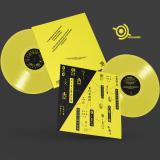
Second part of the Wave Earplug series trying to support the underground wave scene across Europe. Released on vinyl LP limited to 500 copies. This time artists come from Germany, Netherlands, France, Hungary, Slovakia, Sweden, Belgium and Italy. Artists in subject: MAKiNA GiRGiR, Staatseinde, The Revolving Eyes, Brigade Rosse, Stílus Együttes, Style Group, ImiAFan, Sololust, Machinepop, Arsenic Of Jabir, Noisebrigade
out of Stock
Last delivered 5 years ago available to reorder, subject to availability
Hardfloor acid tribe to Acidcore... A dancefloor weapon, newborn label from Underground Techno's Narkotek familly, annoncing a newskool acid tribe sound ! Big ! Notice the last track witch is a the Acid Doom frontier... rare style.
out of Stock
Last delivered 7 years ago available to reorder, subject to availability
After the impressive album from the label owner MTD, Methodical comes backs with a huge split vinyl between Forward Strategy Group and Rommek. Artists who do not need any presentation thanks to their work on label such as Mord or Blueprint
The Storied Music Producer Readies His Sophomore Solo Album For Release, Ten Years After His First Album, The Gemini Principle. The Ten-year Gap Between Solo Albums Has Seen Dbridge Releasing Landmark Collaborations And Projects As Part Of The Autonomic Movement, Module Eight, Heart Drive And Exploring Other Bpms As Velvit.
Dbridge's Journey Within Electronic Music Has Seen Him At The Front And Center Of Electronic Music Culture And Then By Design, As The Seasons Change, He Has Retreated To His Own World To Work On His Next Statement.
A Love I Can't Explain Is The Sound Of Dbridge Making Music For Himself. As A Man He Finds Himself In A New Phase Of His Life- In Love, Married And A Father That Is No Longer Concerned With Previous Constraints And This Has Led To A New Freedom In Creation. An Artist Looking At The Same Sculpture But Now From A New Perspective.
Svengalisghost captured here in his most true form, the live setting. This recording comes direct from the board during his performance on French television in 2015 and harnesses the maniacal energy of his live set in perfect form. What may be the Chicago born artist's darkest and most plodding recording to date, this is the definintion of deconstructed death-industrial, foward thinking and freeform yet totally focused and razor sharp, plodding drums over open wire electronics and zodiac killer vocals hitting you from all angles. This is sound of evil personified. Limited copies available worldwide.
The human connection is the key to personal and career success. 3KZ is the perfect example of how two great minds can connect and relate to the world with sounds that have no description. The beauty of it comes once you put down the needle and immerse yourself to listen deeply to the brilliant music that this project represents
Finally the long-awaited second series of 'Invisible Family' outings has arrived. Label boss and compiler GK Machine has this to say: 'Beyond ecstatic to get these tracks out. The Gazeebo track I've been playing in my sets for years. Digital only but SO great it definitely needed to get pressed onto wax!! I would DJ with it using Ableton and speed it up a lot so for the vinyl I asked Jon (Nedza) who I've been a huge fan of since his Community Recordings releases on Grayhound and Imperial Dub, whether he could speed it up a little bit before we pressed it up. Now it's 100% perfect: a Moroder-esque cosmic stomper that's sure to set any dancefloor alight. The Apiento track is another one that's been gestating for a long time...first appearing around the time the original "E.S.P." 12' appeared on the wonderful Golf Channel Recordings in 2014. Secret Circuit gave it a complete overhaul, in fact several complete overhauls, plus some of his signature guitar and has turned the already blissful track into an afro-esque, trippy, beautiful, beautiful piece of music that (IMO) is one of his best yet. Utterly gorgeous!!
Then there's the boy-girl retro-future duo Der Kundalini coming from the wonderful Lectric Sands stable in NY who gave us Zoovox. This one's also been hiding on my hard drive way too long! Finally relative newcomers Konzel (of Junto Club/Optimo Music fame) & Natural Sugars (Pardon My French) round off the package just perfectly. The former so distinct that I felt it was a perfect opener for the A side. So, I hope you dig it...and keep an eye out for the super limited 12-track cassette too!!!'
Limited to 300 hand-numbered copies.
The Boutique Label presents an expanded vinyl edition of Backdoor Possibilities, the sixth album by cult German prog rockers Birth Control, originally released on the Brain Records imprint in 1976.
Formed in Berlin in 1968, Birth Control were known for a progressive hard rock sound which fused elements of jazz, psychedelia and so-called Krautrock. A surreal concept suite recorded with famed producer Conny Plank, Backdoor Possibilities arguably marked a final creative peak, blending rock, jazz, classical and avant-garde stylings with intricate polyrhythmic textures and lyrical nods to the legends of Faust and Odysseus.
On Backdoor Possibilties core members Bernd Noske (drums, vocals) and Bruno Frenzel (guitar) were joined by keyboard maestro Zeus B. Held, who also features on two long improvised tracks featured on Disc 2, Figure Out the Weather and Shake Those Crazy Nights, both recorded with Conny Plank in 1976. All material on Disc 2 is previously unreleased, with third track Rock It With a Long Bone being another extended piece recorded at Dierks Studio in 1982.
The first release from Heartless on Steve Bicknell's 6dimensions. Acid tinged techno lives throughout the EP. Hazy modular sequences, sizzling precision crushed atop of a constant kick drum creating an organic aesthetic.
Impulse Model exudes human emotion, the EP's emotional depth lies beneath its techno construct within coarse and bruised production which gives the release a confidently imperfect aura. The production process for Heartless is a 'way of absorbing things that have happened and completely escaping from them', ultimately Heartless has composed an EP that condones escapism whilst the listener stays firmly rooted in their emotional state.
Support from:
Steve Bicknell, Ben Klock, Jeff Mills, Robert Hood, Derrick May, Francos Kevorkian, Function, Luke Slater, SLAM, Oliver Ho, Dj Nobu, Wata Igarashi, James Ruskin, Dimi Agelis, Phase, Ben Sims, Paul Mac and more.......
UK wave funk veteran DMX Krew returns to Abstract Forms with his latest double album project. Escape-MCP features 13 tracks of synth drenched electro and elastic techno grooves drawing inspiration from a 1983 computer game where the player is trapped inside a computer by a rogue processor. Fortunately DMX Krew isn't trapped inside a computer and is still with us making killer grooves. Don't sleep!
L/F/D/M is from London and studied art with Dom from Factory Floor, who encouraged him to work on music production. But his musical influences range from jazz, exotica, afrobeat, disco, post punk - you name it.
'I guess all the music you soak up just filters through one way or another. Music production is often about exploiting chance and about decisions made in that moment. I'm always trying to reach that magic point where you can remove yourself from what you're making, and the music starts to trigger an emotion rather than just being blocks of colour on a computer.' - L/F/D/M
out of Stock
Last delivered 6 years ago available to reorder, subject to availability
Elon make with the DIY vibes on the smart EP. Fans of Live Jam releases, listen up! On the title track sharp cuts, tight bursts of sound and loose percussion combine into a complex rhythm that is kept in check by a nice tumbling bassline. Jazz breaks hit the speakers with Got Ya, Tiger! Like a night out in Soho in 1962 brought back to life on an MPC. The bruising bassline just shouts 'Dance Or I'll Kick You In The Guts". Alex Celler's Broken Circuit Dub of Got Ya, Tiger! ramps up that kicking a notch. All those bruising elements are still there, but the guy grinds those jazz breaks up in his big metal jaws and spits out a gobful of twisted future. And you're gonna like it! Elon team up with Stefny on Téo, which finishes the EP. And you can feel her effect - she clearly loves a cheeky little synth line, because there are plenty of them here... squalking, meeping and dooping in perfect harmony to create a nice trancey brainfeeder. Nice.
Label head Len Faki joins forces with Icelandic dub techno pioneer Exos for Infinity In Loop, a joint exploration into cavernous depths and shifting tonal landscapes.
Two versions of the title track fill the entire A-side, each unfolding with patient intent. Drifting across icy atmospheres and static hums, Infinity In Loop’s first incarnation slowly builds into a mesmerizing, minimalistic loop—punctuated by delicate percussion and a faint, comforting sprinkle of melodic warmth amidst the arctic chill. The second iteration leans more into a classic 90s dub techno framework, launching straight into a steady pulse anchored by echoing chord pairs and crisp, high-energy percussion.
On the B-side, the duo shifts towards raw, dancefloor-driven territory. Aurora delivers impressive tension with dry, jacking rhythms, snappy percussion, and haunting vocal fragments cut up to drive the groove forward. Closing out the EP, Circuit Flux pairs sub-heavy low-end with unpredictable rave energy. Nostalgic 90s vocal cues, pitched-up hooks, and fidgety FX swell and recede over staunch synths—creating a dynamic, deeply layered track that constantly shifts between space and peak-time momentum.
Keroxen presents Spandauer Damm 103, a new album by Dancelwerk.
Bringing together modular systems, worn drum machines and digital synthesis, the record nods directly to the first decade of Warp Records and the early logic of bleep culture.
Dancelwerk is a Tenerife-based electronic pioneer and one of the foundational figures of the Canary Islands underground. Active for over 30 years, Spandauer Damm 103 marks both a personal milestone and a renewed point of focus, reaffirming his role in shaping the region’s electronic lineage. The album draws on 1990s electronic futurism, filtering those references through a contemporary production approach rather than nostalgia.
The music moves between places and periods: from the early rave circuits of southern Tenerife, where Dancelwerk built his reputation through DIY releases and warehouse-level experimentation, to his later relocation to Berlin, famously arriving with a shipping container of vintage synthesizers and modular equipment.
Balancing melody and impact, Spandauer Damm 103 sets custom-programmed percussion against detailed sound design. FM, spectral and wavetable synthesis shape its harmonic and textural focus, resulting in music that remains physical without sacrificing clarity.
A long-standing practitioner reconnecting with his roots while pushing the system forward.
Singer-songwriter Willis Alan Ramsey was 20 years old when he became the third signing to Leon Russell and Denny Cordell's Shelter Records – after Russell himself and the legendary J.J. Cale. The result was Ramsey's 1972 eponymous debut, a masterpiece of laid-back Texas country-rock, blues-inflected folk and outlaw ballads.
As a child, Ramsey was an obsessive radio listener – from Elvis and the Beatles to Delta blues, country and even classical music. By middle school, he had formed his first garage band and started writing songs. After a brief stint at the University of Texas, he took to the burgeoning coffeehouse circuit where he toured alongside folks like Townes Van Zandt, Jerry Jeff Walker and Keith Sykes. It was during these shows that Ramsey developed much of the material for his LP, a diverse yet coherent mix that revealed his varied influences.
Recorded in Memphis, Nashville and at Russell's home studio in the Hollywood Hills, the album features some of the era's greatest session musicians: Eddie Hinton on guitar, Red Rhodes on pedal steel and the rhythm section of Leland Sklar and Jim Keltner. A true songwriter's songwriter album, its tunes have been covered by Waylon Jennings ("Satin Sheets"), Jimmy Buffett ("The Ballad of Spider John") and, most famously, Captain & Tennille ("Muskrat Love"), but no cover can beat the originals from the wise-beyond-his-years Ramsey.
Though Willis Alan Ramsey has continued to perform regularly and write new songs, a second album is yet to be released. For years, whenever someone asked about it, Ramsey was known to answer "What's wrong with the first one?" The answer is, of course, absolutely nothing. In fact, it's perfect.
This first-time vinyl reissue reproduces the original lyric sheet. Includes new interview with Ramsey and liner notes by author Richie Unterberger.
Discrepant presents Fantarombo, a new album by Giovanni Lami.
While his previous works often moved through memory, residue, degradation, and dialogue with existing materials, Fantarombo takes shape as an unstable, bodily gesture.
Sound is not recalled or reconstructed, but triggered, pushed, and set in motion as an active force. Lami approaches modular synthesis as a physical, hands-on practice rather than a technical exercise or display of system mastery. The modular setup becomes a responsive body: something to be nudged, listened to, and occasionally resisted.
The pieces unfold through slow accumulations, unstable feedback paths, and carefully misaligned sequences. Rather than driving toward resolution, the music lingers in states of suspension, allowing small shifts in voltage, timing, and texture to reshape the whole. Chance and duration play a central role, with structure emerging gradually from repetition and drift.
There is an unmistakably organic quality to the sound: porous, tactile, and quietly resonant. A sensitivity to space, grain, and micro-movement, where subtle changes carry as much weight as overt gestures. On Fantarombo, process takes precedence over control, and the circuitry is allowed to speak back, resulting in music that feels intimate, unstable, and quietly insistent, revealing itself slowly through sustained attention.
A music of unresolved behaviours, suspended somewhere between obsolete digital optimism, imaginary systems and malfunctioning computational folklore.
The fifteenth release of Barro comes with an exclusive: behind the Transylvanian mask of Orlok 101 lies Nöle himself, the boss of the label.
Remember that he used this vampiric AKA to kick off Barro—his The End Of The Beginning being the first release, published in late 2018. That same year, his techno-industrial sound—packed with references from the famous work of Bram Stoker and nightmare atmospheres—helped launch another label: Soil, the Valencia-based imprint, with a project that included a suitably fitting remix of The Horrorist. The following year, he released an EP with five original tracks, titled Runaway, while also “spreading blood” on Antikhrist Visions Vol I alongside his Industrias Mekanikas comrades.
His dark influence has been felt across Barro’s catalogue, whether through his own tracks or remixes—sinking his teeth into artists like The Hacker (under his real name, Amato) or Nebula Circuit. In 2025, Orlok made his debut on Aspecto Humano with a powerful EP, equally gritty and dark. In Barro, we’ve recently had Nöle—the most techno side of Imanol Pagola—with the EPs Electro Bloody Music and Demencial Chico Aceleradom, two great showcases of his ability to keep us dancing nonstop, following the popular Mendekua, released by Xtraperlo.
For Barro 15, the two sides of the producer and DJ come together on this EP, titled Sex With a Cop—four tracks released on vinyl and digitally, plus an alternate version of the final composition as a bonus track.
Nöle's knowledge of the dancefloor and Orlok 101's ability to create atmospheres that will give you goosebumps come together on this EP to create an explosive mix.
Sex With a Cop starts with Hilerri, a techno EBM track where Orlok provides repetitive, screeching sounds and a ghostly melody, while Nöle adds incisive synths and a catchy, addictive vocal sample that warns you of the danger of the material you’re listening to. Orlok then takes over with his industrial and metallic sonorities on the next track, Amets Fabrika, although Nöle’s influence still comes through with his powerful bass and addictive synth lines. A stifled scream and a production packed with a thousand details create an unsettling atmosphere that will surprise you on the dancefloor.
The flip side begins with No Voy A Quedar Con Nadie, a track closer to Nöle’s technooid world. Even with its unsettling opening, it doesn’t take long to turn into a danceable bomb, with that dark touch typical of the Navarro producer.
Surprisingly, he saves the best for last: Harina de Huesos Humanos is one of the most interesting tracks created by Imanol Pagoda, and we can hear it in two versions, one as a bonus track. Thanks to complex production full of details and sounds that come and go, a punchy, hard as granite kick drum, and a carefully crafted industrial atmosphere, it all ends up being the perfect union between the two sonic worlds. A spectacular finale for the label’s fifteenth release.
Son Of first surfaced in 2015 with Social Zombies on Opal Tapes. A decade on, he returns with YYY on his own label, Digital Empathy, the fifth in its sinister futurism catalogue. Unconventional minimalist Detroit electro, eroded IDM, 8-bit dungeonstep, and deconstructed funk interlace into one unifying sonic world of YYY. The dawn of the anti quasi-replica is here. Only taste will survive.
CER015 sees Celestial Echo bring back one of the great modern soul 45s, Ramsey & Company – “Love Call”.
Coming out of New York in the late ’70s, Ramsey & Company was led by Mainor Ramsey, with the group originally playing the Catskills supper club circuit. Their only single was released privately on Ramsey’s own Ramco label, with copies sold at shows and barely making it into wider distribution. Like so many great soul records, it found its real afterlife much later, becoming a favourite across the UK modern soul and rare groove scene.
“Love Call” is the reason this record has carried such a reputation for so long. A beautifully arranged modern soul dancer, it has that perfect late ’70s balance of groove, song and musicianship. On the B-side, “Leg Grease” brings the funk.
Original copies are now almost impossible to find, often selling for serious money when it turns up and even the Lotus Land reissue has become expensive in its own right. This Celestial Echo edition puts the track back into circulation properly, cut loud and ready for the DJs and soul heads who have been waiting on a clean copy.
Celestial Echo is here to put proper soul records back into circulation — respectfully cut, properly pressed, and ready to play.
Muyei Power or Orchestre Muyei (muyei means 'our country') was one of the top dance bands of the1970s in Sierra Leone. Soundway Records' first collection of music from this West African country ('Muyei Power: Sierra Leone in 1970s USA') is an album of rock-infused, 'afro' music from a group that traveled the world throughout the mid 1970s. Fusing elements of electric Congolese and Nigerian music with fast, syncopated, uptempo modernised arrangements of traditional music, Muyei Power produced a series of unique single-only releases that have been unavailable for 35 years. The rare recordings featured here are a glimpse of a dynamic and powerful band at the very height of its powers.
Even though lyrically Orchestre Muyei focused on traditional themes and songs, the arrangements and formulation of the instrumental side of things still very much reflected the mixed nature of urban Sierra Leone music, exemplified by a small collection of bands that also included Afro National, Sabanoh 75 and Super Combo.
For the early part of 1970s the band toured extensively throughout Sierra Leone, Liberia and Côte d'Ivoire before making a handful of 45s in local TV and radio studios. The recordings featured here however come from a period of touring the college circuit in California during late 1975 and early 1976. Later that year, as they played the colleges of the east coast, they gave the tracks to the owner of the African Record Centre in Brooklyn, New York. He initially released two of them on his in-house Makossa Records label as 7-inch 45rpm singles in 1976. The tracks from 1975/6 were then not heard of again until 1979/80 when the African Record Centre released many of them on a series of Makossa Records 12's that sounded far superior than the records that had been released a few years earlier.
Orchestre Muyei Power finally split up in 1979 leaving no proper album releases and only a handful of recordings for us to enjoy all these years later.
here is a direct and enduring connection between the roots of Italian electronic music and the underground club culture of today.
Boldly pulling that thread are Marta Paradise, the duo from Martina Franca (Puglia, Italy), who have established themselves as a go-to name for anyone craving an elegant, refined sound that remains unapologetic.
For their latest release, they team up once again with a true legend: Fred Ventura. As one of the most iconic artists of early Italo Disco, Ventura brings an unmistakable vocal timbre that turns every track into an instant classic.
The result of this cross-generational collaboration is Call In The Night, a track that bridges authentic Italian heritage with the sharpest edges of modern Indie Dance. It delivers everything discerning clubbers live for: shimmering synths cutting through the dark, an octave-driven bassline that locks you to the dancefloor and a nocturnal, dreamy, relentlessly catchy vocal line.
Elevating the package even further is a stellar remix package featuring some of the hottest names on the current circuit, including Mystery Friend, Day Ventura, the unmistakable touch of the legendary Flemming Dalum, and Slow Motion label boss Franz Scala.
Far from a simple nostalgia exercise, Call In The Night is a forward-looking journey with a vintage soul that never falls into cheap clichés. Past and present merge to set the world’s most visionary DJ booths ablaze.
Written by GIANLUCA SERVETTI
HEY CABRERA
Owner of the Magazine “rockerilla”
Hackney Electronica come to Dark Entries with the Feedback Memory EP, featuring 5 cuts of acidic rave-inflected wave. Quinn Whalley (Paranoid London), Unai Trotti (Cartulis Music), and Margo Broom (Hermitage Working Studios) formed Hackney Electronica during COVID era. Trotti and Whalley were spending countless hours digging through records and making music during lockdown. As their sound took shape – heavy and hypnotic – they invited Broom to join, cementing the motley trio. Following their debut EP, Synaptic Shadows, the five pieces on Feedback Memory muse on the loss of self in the digital era and the fine line between pleasure and paranoia. Each track pulses like a memory from the backstreets of Hackney, where the night transforms the city into an electrified maze of fleeting highs and inevitable crashes. Their hard-hitting dancefloor indulgences shine on “Trapped in the Circuit” and “Six Foot Seven,” which features Mutado Pintado on vocals, while tweaked-out wave sounds blossom on “Feedback Memory” and “Lost Trip - Destino.” Things close out with “Compressed Air,” a lush, breakbeat-laced affair that veers into trip-hop territory. Housed in a sleeve designed by Germán Bardo, Feedback Memory continues Hackney Electronica’s tumultuous journey through the flickering alleys of the mind, where tension and transcendence intertwine.
Dark Entries is ecstatic to announce Terminal Fascination, a retrospective release of the music of Camille O’Grady, subversive artist, leather witch, punk poet, and gender saboteur. O’Grady cut her teeth in New York’s burgeoning punk scene at clubs like CBGB’s, where her band Leather Secrets would share the stage with acts like Television. She became one of the few women to be welcomed into the Mineshaft, Wally Wallace’s legendary Manhattan gay BDSM club. Towards the end of the 70s, she would trek west to San Francisco to be with her partner, performance artist and gallerist Robert Opel, who was tragically killed in 1979. O’Grady would pass away from COVID in 2020, with her voluminous works across various media - text, image, and sound - having been unpublished during her lifetime.
Working with O’Grady’s estate, Dark Entries has assembled thirteen of her finest recordings, including instant classics like “James Dean to the Rescue,” “Tourniquet,” and, of course, “Toilet Kiss.” Two songs, “Angel with a Key” and “Love Comes Like a Cutthroat,” were recorded at a studio in Los Angeles for a 7” release that never materialized, while the rest of the material was recorded live in 1979 at The Ambush, a San Francisco leather club. O’Grady’s songs, often written from the perspective of a gay man, explode like a genderfuck version of Patti Smith, like Buffy St. Marie in leather, like the hedonic utopianism of the 1960s dragged (blissfully) through the broken glass of the 1970s. The release of Terminal Fascination coincides with the publication of ‘A Cross-Worlds Angel,’ a 300-page book of O’Grady’s work by Phillip Zimmerman. The record includes an insert featuring liner notes, lyrics, and photographs. Celebrate Camille O’Grady, the artist Jack Fritscher described as an “earth mother, a leather lioness of the arts.”
Strut proudly presents the first release in almost a decade from the legendary Senegalese group Orchestra Baobab with Made In Senegal. Few groups embody the spirit of African music like Orchestra Baobab. Formed over 50 years ago as the resident band of the Baobab Club in Dakar, their timeless fusion of Afro-Cuban rhythms, Wolof griot traditions, mbalax, Congolese rumba and jazz continues to resonate across generations and continents. Now, the celebrated big band marks a new chapter in their illustrious history with Made in Senegal, their first new studio album since Tribute To Ndiouga Dieng in 2017 for World Circuit. Released on respected imprint Strut Records in conjunction with Madoky Music, the new album celebrates home, heritage, love and resilience and was recorded entirely in Dakar. On Made In Senegal new songs sit effortlessly beside re-imagined classics. Lead single "Togne Bakhoul", composed by late Baobab vocalist Rudy Gomis is a poignant ode to his wife and "Tioro Bye Samba" reprises a classic Thione Seck song while "Casamance" celebrates the culturally rich Southern Senegalese region, homeland of several Baobab members. "Baobab 50 Ans" marks the 50-year anniversary of this indomitable group. Made In Senegal is another modern Baobab classic combining a fresh approach with roots fixed firmly in Senegal"s rich traditions. It is the perfect time for a new generation to discover the elegant, hypnotic sound of one of Africa"s greatest ever big bands.
Following the Home Listening Acid and House Compilation releases, Mark Churcher aka A-Eno-
Acid returns with his debut LP.
A raw transmission from the underground — deep, hypnotic and unapologetically acid. Rooted in the late-1980s sound of warehouse parties, pirate radio and underground dancefloors, this is an album built for DJs, dancers and heads who know. 808s, squelching 303s and hypnotic grooves — pure acid house energy.
"ABYSSUS stand as one of the most significant forces within the Greek Death Metal scene, having forged their path since 2011. Drawing profound inspiration from genre-defining pioneers such as DEATH, OBITUARY and BOLT THROWER, the band preserves the unadulterated spirit of old school death metal while imprinting their own distinct identity.
From the very outset, ABYSSUS placed equal emphasis on studio output and live performance. A steady stream of EPs and split releases established their presence within the international Underground metal community. Their debut full-length, „Into the Abyss“ (2015), garnered widespread acclaim and marked a pivotal moment in the band’s evolution - leading to increasingly frequent appearances both in Greece and across Europe, often sharing the stage with renowned acts, like POSSESSED, SINISTER, SUICIDAL ANGELS and ROTTING CHRIST.
With renewed creative vigour and greater maturity, ABYSSUS unveiled their sophomore album „Death Revival“ in 2022 via Transcending Obscurity Records. Adorned with an arresting cover by the legendary Andreas Marschall (KREATOR, BLIND GUARDIAN, IN FLAMES a.o.), the album was met with universal praise, further cementing the band’s reputation for delivering unrelenting, yet masterfully crafted, death metal. More shows with a.o. ASPHYX, TANKARD, GRAVE DIGGER and THE CROWN followed.
Now in 2026, ABYSSUS return with their third full-length opus, “The Reign” - a ferocious testament to their artistic evolution. The album encapsulates all the core elements that have defined death metal through the decades: raw aggression, blistering riff-work, and a suffocating, commanding atmosphere. Once again, the visual narrative is entrusted to Andreas Marschall, whose artwork enhances the band’s sonic vision with striking intensity.
Relentlessly evolving, ABYSSUS remain true to their roots while continuing to push the boundaries of the genre. With a prolific discography and an ever-growing presence on the live circuit, they have rightfully earned their place as a formidable name within the global death metal landscape."
“Neither from here nor from there” is often used to describe migrant identities in territorial terms. In the case of Siete Catorce, it works better temporally: his music has always been so far ahead of its moment that it ultimately carved out a space of its own within both Latin American and global electronic music.
Born in Mexicali and shaped between the Bay Area and northern Mexico, his musical identity emerged through hip hop, dubstep, and the independent borderland scenes. After several years in Mexico City — without a clear place inside the local circuit — he created his own space through his music, developing a distinctive DJ/live set and a singular vision of contemporary Mexican electronic music, becoming a key figure within the city’s most forward-thinking underground.
In 2026, he releases El Valle, his first album in nearly three years. The record moves through different currents of electronic music — ambient, techno, cumbia, and tribal — filtered through a unique rhythmic language marked by syncopation, unpredictable breaks, and a constant tension between restraint and energy.
The album opens with “Mexicali,” alongside Andre Pereda, a tribal track stripped down to its percussive essence, evoking the genre through an ambient and synthetic approach. From there, “Aragón” and “El Rancho” progressively increase the tempo and intensity, combining cadenced phrases with minimalist tribal beats and unexpected turns.
In the second half of the album, now moving through territories of 140 BPM and beyond, tracks like “Montecarlo 1” and “Tierra Roja” drift between futuristic bass music and large-scale techno structures. This is followed by the 8-minute epic “East LA,” where Siete Catorce expands the energy of syncopated techno before releasing it into a pre-Hispanic tribal journey with flute and all the drums required for the occasion.
The closing section arrives with “Tlatelolco,” accelerating into an epic cumbia infused with trance references, and “Los Pinos,” a direct and forceful finale sustained by some of the album’s most precise sound design.
More than genres, Siete Catorce’s work is defined by meticulous sound design and an exceptional rhythmic sensibility — qualities that have established him as one of the most respected drum programmers of his generation.
"After a couple of years shaping her sound in the studio, Budino lands the "Signal EP", a record that grew out of the desire to make music for her own sets. Citing the journey she aims to create in the club as a key inspiration, she certainly put in the mileage, with a booking schedule tirelessly spanning all points of the compass. Although this is her first label-released original record, it's no novice effort: ALT027 shows a confident artist, fully in control, with a distinct vision and the technical expertise to bring it to life. On opener "Stay More", a trippy trance rendition, the sturdy kick and distorted sines leave ample room for mid-bass acid lines to roam freely. In its company, a myriad of risers, gated white noises and delayed fills appear - signifiers within the artist's palette, as will become apparent. "Wireless" features similar crafty sub movement, but this time the drums are infused with conga patterns and other exotic slices of battery. Because of the zest these rhythms bring, the track can keep building for several minutes until a synthesised lead emerges. When that finally happens, the affair really takes off. On the other side, "Alpha 7" rides the call-and-response dynamics between different formant and deep-vibrating leads, its shimmering arpeggios and atmospheric pads adding colour. Closer "1031" provides an organic touch with its live guitar bass pulse and enigmatic, eerie vocals. Amidst ever-evolving micro-frills, a sturdy square lead thrusts it forward. The groove, again, is endlessly seductive. This characterizes Budino's skilled approach: it's often so hypnotic it feels unclear whether the themes materialise from the surrounding, seemingly fluid compositions - or dissolve into them. In any case, these are multi-dimensional cuts you will love getting lost in on a nearby dancefloor."
With one foot in the Mexican underground rock scene and the other one in the global tape trading circuit, Las Ánimas del Cuarto Obscuro found themselves in the middle of a crossroad after their first LP. México wasn´t the same country as when the band first started. Even though access to non-commercial music still was a difficult task in the late eighties, the fringes of culture had way more resources thanks to the stubbornness of certain anonymous heroes: dwellers of El Tianguis Cultural del Chopo, niche record stores, illegal underground parties and hosts of late night Mexican public radio shows.
Ubiquitous social unrest expressed itself in every way possible. The aftermaths of the 1985 earthquake weren’t the only matters on the table. Protests erupted after a rigged presidential election and a student strike hit Mexico’s biggest public university. This was just the tip of the iceberg of issues PRI’s perfect dictatorship was or wasn’t addressing. The clash of the authoritarian regime against new and fresh ideas.
If the first record was about the loneliness of self-destructive youth and it’s urban phantasmagories, LACO’s second LP dealt with change as the axis of human existence. Las Ánimas is just the beginning of the sonic metamorphosis Toño Sánchez went through until this very moment.
The departure of former bandmembers set a different approach towards more experimental and atmospheric sounds. As the project’s only member, Toño Sanchez took an alchemical trip aiming for more mysterious horizons.
Despite the fact that we can still find conventional dark pop and catchy songwriting, the record rests on sound landscapes closer to Jorge Reyes or Tuxedomoon and This Heat than the orthodox ways of so called post-punk, seasoned of course with the lack of music gear and the economic reality prevalent in Mexico of those convulsed times.
Las Ánimas is a goodbye letter to underground but not because the next move is the mainstream. Far away from it, it’s a farewell to traditional rock and a the first steps down into the depths. From now on, Toño Sánchez will dedicate his musical efforts to weirder sounds and scarcer audiences in the search of the arcane, possessed by a mania of constant change that infects the soul after crossing the black door’s threshold.
„Rejoice“ ist eine ganz besondere Zusammenarbeit zwischen Tony Allen, dem legendären Schlagzeuger und
Mitbegründer des Afrobeat, und Hugh Masekela, dem Trompetenmeister des südafrikanischen Jazz.
Die beiden weltberühmten Musiker, die sich in den 1970er Jahren durch ihre jeweiligen engen Verbindungen
zu Fela Kuti kennengelernt hatten, sprachen jahrzehntelang davon, gemeinsam ein Album aufzunehmen.
Als sich ihre Tourneepläne im Jahr 2010 in Großbritannien überschnitten, bot sich die Gelegenheit, und
Produzent Nick Gold nutzte den Moment, um ihr Zusammentreffen aufzunehmen. Kurz nach dem sehr
traurigen Tod von Hugh Masekela im Jahr 2018 und mit neuem Elan holten Tony Allen und Nick Gold
– mit dem Segen und der Beteiligung von Masekelas Nachlassverwaltung – die Originalbänder hervor und
stellten die Aufnahmen im Sommer 2019 fertig; dies geschah in jenem Londoner Studio, in dem auch die
ursprünglichen Sessions stattgefunden hatten.
Das von der Kritik gefeierte Album wurde vom „Guardian“ als „bemerkenswert stimmige Mischung aus
Swing und Afrobeat“ beschrieben, die „einige von Allens bisher besten Arbeiten am Schlagzeug sowie
Masekelas unnachahmliche Bläsermelodien“ präsentiert.
Anlässlich des 40-jährigen Jubiläums von World Circuit Records erscheint diese Veröffentlichung nun auf
„Splatter-Vinyl“ in den Farben Orange, Pink und Weiß.
Mysticisms’ explores the previously unknown Dub House, Digidub and electronic Street Soul of Manchester émigré Andrew Fitzgerald aka Atone on a 6 track EP, shape shifting from dark basements to summer fields, the music is wide-screen dreams, mixing psychedelic temperaments with ecstatic memories.
Dub Dats is a compendium of a life around or making music, beats, dubs; menageries of sound that encompass a love of reggae mixed with the influences of youth. Growing up in Thatcher’s then declining Manchester housing estates, Fitzgerald found escape first as a young roadie, just aged 15, sorting ‘cigarettes and alcohol’ for visiting bands. Rubbing shoulders with the likes of The Buzzcocks, Ian Dury and The Slits, was a great way to learn the ropes, while avoiding becoming another juvenile delinquent.
A love of Bowie, Kraftwerk, Motown, film scores and the emerging electronic and industrial bands like Throbbing Gristle led to a first studio, featuring the unique and faithful DR-55 Dr. Rhythm, soon followed by Sequential Circuits Pro One, Juno 60, Roland 303 (x 2), Roland 808 and Space Echo.
Working on music solidly, a release finally appearing on Robs Records, before losing all the equipment in a robbery. Manchester was shifting, gangs and “Gunchester” meant it was time to move on and when ‘an out’ appeared, Fitzgerald was landing in Sydney and settling into a new life.
Hooking up with Ali Omar, who he’d met while doing a stint in Brixton, London; the two worked solidly on music, gigging continuously, hanging with the likes Severed Heads and living a good life of that post acid-house party era. The loss of Ali to cancer, still young, hit hard and period “quite liked the madness” ensued. Rehab and starting again, Atone has been gaining some interest.
With 2 EPs of early works recently released on Tonal Oceans, Dub Dats looks deeper, with the dubbed house grooves of title cut, Dats and, the intriguingly named, Somewhere In France With Eric Random. Complimented by the electronic dub of Keep On, the soulful, slow breaks torch song, I Be There, the sample heavy Sound Of Soul and closing, trippy Unlike You, this is a multi-genre producer of considerable capability and talents.
Finally getting his due, Dub Dats perfectly fits the Dubplate Series, broadening its soundscape, while also standing out as its own, sonic release.
You'd be hard pressed to name a song with the driving, emotional intensity and raw energy of the Hamilton Movement's anthemic ode to heartbreak, "She's Gone." Issued as the B-Side of the band's 1976 single "We're Gonna Party," and distributed in and around Indianapolis, there is no evidence the song garnered significant attention upon release—yet over the past fifty years it has amased a cult of devotees across the globe. But while interest in the group's music remains strong, little information has surfaced about the Hamilton Movement's history, and until now, there have been no official reissues of their work. This collection presents the band's discography, alongside previously unreleased music discovered on tape; it is the Indianapolis soul album that should-have-been.
The keys to the Hamilton Movement's mystery can be found in central Indiana, where promoter Dick Melvin has lived the past few decades, in a rural suburb of Indianapolis, amidst forests and cornfields. Melvin served as the group's manager throughout their entire existence, but his involvement extended far beyond typical managerial duties. He co-wrote and co-arranged the band's music; he produced and released their recordings on his Look Out label. Dick is also the band's archivist. His home is filled with boxes of demo sessions, live tapes, contracts, posters, and promotional photos documenting his work with the Hamilton Movement. He entrusted his archive to Now-Again's care and they've assembled this album under his watch. Dick's story, and the story of his band, are presented in an extensive, oversized booklet with Dick's rarely-seen photos and ephemera and words by Now-Again's Egon and Naptown historian Kylie Long.
Curses' dark, romantic take on electronic music is often linked to EBM, new beat, synth-pop, and the offshoots in between - but, as the artist states, it's feelings, not genres, that motivate his music. Especially the underground and its niche sounds, brimming with collective energy, drive and passion, make for a major impetus. It's no coincidence that he's drawn to the era when man turned to the machine, as a collaborative force, and a new kind of liveliness, timelessness, emerged. In Curses' practice, this synergy translates into an enticing mix of synthesisers and voices, electronic drums and guitars. Nostalgia operates as an influence rather than a motive, though: despite its affinities with the past, his music is stridently contemporary and idiosyncratic. On the "Perfect High" EP, this approach is rendered in a resolutely dancefloor-oriented selection. It's rich in detail and constantly evolving; each time a new element appears, it's treated with such delight and care that you could imagine the track to flit off and turn it into the main theme. This doesn't happen, however, as the sense of cohesion and momentum is paramount: there's a relentless forward drive that keeps engagement tight from start to finish. The detuned, chorus-heavy leads of title track "Perfect High" and the clockwork-tinged percussion of "Weapon Of Time" jell with lustrous hooks. The ominous choirs on "Dare To Dream" and the proto rolling-and-scratching squelches of "Killer Instinct" similarly fall into place. Bravado never stands in the way of flow. Everything is kept in check by gated R-50 rhythms, and in the vocal department, Curses finds the sweet spot between his own voice and a slew of off-kilter samples. On closer "Blasted" NYC royalty Andi joins for a slab of synth-driven groove. It's shiny and sensuous, like patent leather - a perfect distillation of club music channeled through pop aesthetics, and thus a right coda for ALT028.
Polygonia and Simon Popp present ‚Apiformes‘, the second collaborative release from the two Munich-based artists.
As with 2023‘s ‘Candid’, ‘Apiformes’ was born from pure improvisation. Originating from the stems of four concerts, additional elements were built on from a foundation of live recordings — an intuitive endeavor by the musicians with such integrated effects to give one the impression of a sole sonic organism, and mystifying which sound is coming from which performer. Rapid creative decisions create an intriguing sense of aliveness, producing a uniquely vibrant buzz of jazz and electronic influences.
The duo set an otherworldly tone in their latest release, with leanings towards acoustic and percussion-heavy instrumentation, combined with playful synthetic musings which create a sense of opening up: an intriguing and earnest exploration of the ethereal, and what is available in nature as a window to the divine. Named for the scientific name for bees, the project’s mix of warm, dynamic improvisation and sequenced synth instrumentalisation mimic the similarly complex mathematical structures of a bee colony: a visual and sonic world made up of geometric shapes, mating dances and navigation patterns, sensations perhaps most energetically available through a sense of wonder rather than logical extrication.
A quiet intensity permeates Chantal Michelle’s music, like a veiled flame. Even at its most spare and delicate, an undulating tension unsettles the ear through wavering microtonal interference and uncanny spatial juxtaposition. She takes seriously the mandate of the composer to foster new relationships between various types of sounds, bringing together disparate field recordings, instrumental stems, and the sounds of circuitry in unheard configurations. Resolution is elusive, in its place a sense of oblong cyclicality and prickly uncertainty. When the veil is pulled back, we find more depth, more complexity, and more mystery.
Unit of Heart, Michelle’s second album of 2026, presents two interrelated pieces that highlight diverging compositional modes. Here she brings in two key collaborators: Patrick Shiroishi, who contributes flutes and saxophones throughout, and poet Funto Omojola, whose words and voice bookend the title composition. Both compositions unfold gradually, but where the album’s a-side “Sudden Oceans” presents a minimal tonal palette focused entirely on the subtle grain of wind instruments, “Unit of Heart” proceeds linearly, moving through passages of synthesizer, environmental recordings, and full-cheeked wails of saxophone. Both encourage a state of focused listening as the scope of the music deepens and widens.
“Sudden Oceans” allows the listener to hover in rippling currents of air, breath overlapping breath in a shimmering patchwork. All flutes and saxophones on the piece are played by Shiroishi, which are molded by Michelle into a pattern that resembles the flow of tidal waters, surging and receding moment to moment as the tonal density increases. Expansive and recursive, it reflects both the restorative awe and eerie disquiet of encountering the sublime. The first and last sounds we hear are the gentle rush of unmediated breath as Shiroishi connects and disconnects from his flute.
Michelle’s skill at presenting the familiar as preternatural comes to the fore on “Unit of Heart, ” one of her most ambitious works. Omojola’s voice begins with a melody that could be a lullaby, but as it’s bounced around the stereo field it takes on a haunted quality. Their poem, reprinted on the LP’s inner sleeve, hints at a similar type of transformation: “I mean this is where our mouth turns saliva into spears only a throat can recognize. ” Pads of downy synthesizer billow and are subsumed by a discordant ringing. The climactic section features atonal electronics and field recordings, first of water and then the evening call of insects, processed in such a way to transform them into pulsating bursts of noise. What we think we know about the world, what is elemental, can change with even the slightest adjustment of the lens.
Following her previous appearances on Blueprint, Manchester-based techno artist Kerrie returns to the label with her latest release, "Pressure Signal". The four-track EP sees Kerrie deliver another focused collection of raw, uncompromising techno, continuing her distinct approach to dark, gritty, metallic and industrial sounds.
Kerrie is a multidisciplinary artist whose work spans live performance, production, DJing and running her own label, Dark Machine Funk. Having honed her craft for almost 20 years, Kerrie has developed a sound deeply rooted in UK, Detroit and European techno, with her sets and productions characterised by tough moods, high energy and a strong sense of groove.
Kerrie first made her debut on Blueprint in 2022 with her"Raw Regimen" EP, before returning to the label with further releases in 2024 and 2025 and joining the Blueprint crew at showcases around the globe.
And the Glass Handed Kites is the fourth album by Danish quartet Mew and marked a highlight in their career. It has won several music prizes in Denmark, including four Danish Music Awards. Gaffa named And the Glass Handed Kites the best Danish album of 2005. Mew also won the 2005 MTV Europe Music Award for Best Danish Act. Pitchfork Media ranked the single "The Zookeeper's Boy" #92 on its list of top 100 tracks of 2006.
This reissue is the expanded edition on vinyl containing 10 bonus tracks, including the Mogwai remix of “Why Are You Looking Grave”, “Dark Design (red version)”, “Animals Of Many Kinds”, the unreleased song “Wherefore Are You Not There”, and many more.
And the Glass Handed Kites is available as a limited edition of 1500 individually numbered copies on white vinyl and includes a 12-page booklet.
The intriguingly named Pigeon Steve joins Especial for an EP of trippy, psychedelic electronic dance music that goes far beyond its origin – a thirst for all forms of movement – a struggle filled with all possibility.
Since its inception, the label has sought to take inspiration from a wide range of music genres – new wave and new beat to disco-not-disco, post punk and proto-house – never looking for a trend. This belief system expressed is human; intimate and authentic, dissolving and uniting around shared truths and universal values.
Music as ecstasy, the flux of rhythm and sound, to find and be yourself; no guilt, no competition, no games. It is phenomenon – magick – that short circuits through human (emotional) response.
Relocated to South-East London, Glaswegian DJ and producer, Pigeon Steve aka Adam Low, showcases his talent. A dubby, trippy approach to DJing mirrored in his productions; the recent, well-received EPs on the esteemed Offen Music and Weirdos Inc lead here – an EP of sample heavy cuts, wrapped in echo-laden grooves, the beats dripping in psychedelic, new beat and steppers electronica.
Dialect locates us, through its cadences, inflections and intonations we journey through life. Language allows us to escape the lion in a cage. The moment we forget ourselves, we can reach joy and clarity. To live is to exist, the struggle against controls, fighting for an individual destiny.
Children of Zeus return with their third studio album ‘As The World Burns…’
Five years on from their highly-acclaimed sophomore album ‘Balance’, Manchester’s kings of hip hop soul, Tyler Daley and Konny Kon, bring us a brand new 16-track opus.
Sonically the duo continue their story where they left off; crafting an amalgamation of street soul, alternative r&b and boom bap hip hop, with a sprinkle of flavours taken from their original multi-genre pirate radio influences, and a dash of forward-thinking new sounds, ensuring all tracks are destined to become future classics.
The features are sparing but powerful, enlisting the talents of revered UK rapper Knucks (‘Before We Drown’), Colorado-native Young Old Soul (‘Dopamine’), MCR family K S R (‘Do You Want To Get High’, & Australian/Mauritian up & comer Anieszka (‘Water & Vibes’).
As with previous projects, this album is largely produced by the duo themselves, though there are guest productions from previous collaborators too, including Grammy Award-winner Beat Butcha, Grammy-nominated Teo, and broken beat pioneer K15, along with an assortment of new players making moves in the underground neo-soul & beats circuit.
Conceptually, this project continues on with the story to date. An eternal search for sunsets and soulfood, as a respite to the anxieties of the modern world; personally, professionally and globally. Assertive swagger is matched with brutal but sincere candidity. As ever, it encapsulates the rough with the smooth, with reflections on where they’ve been, where they’re at and where they’re headed. There’s no preaching to be found here; just an acceptance of things as they are, an embrace of the environment and people they were nurtured by, and a celebration of some of the finer things in life; slow jams, weed & rum, water & vibes. Raps for listeners, blunt heads, fly ladies and prisoners. All packaged together as another perfect sonic love letter to sound system culture. 50 minutes of big people music.
Since the release of their anthemic debut single ‘Still Standing’ a decade ago, to the subsequent EP ‘The Story So Far’, and their critically-lauded debut album ‘Travel Light’, the duo have received numerous accolades, including nominations for AIM Awards & Worldwide Awards both, along with tons of ‘Album of the Year’ nods care of Clash Magazine, Bandcamp, Complex, Wordplay and many more. This along with huge swathes of support from DJs, radio stations, press outlets, tastemakers, luminaries & fellow artists across the globe.
Children of Zeus have performed sessions for COLORS, Soulection (Apple Music), DJ AG, Boiler Room, BBC 6 Music and at the infamous Maida Vale studios for BBC 1Xtra as well as touring across Europe, Australia and South Africa. This is in addition to collaborating & touring with Mercury Award Winner’s Ezra Collective, including a Wembley Arena show. Other collaborations over the years have included Shy FX, Juls, Goldie, Black Milk, Kofi Stone and the late great Lenzman.
From the Broke ’n’ English / Hoodman-era, to the present day, Children of Zeus have been omnipresent in the fabric of British black music. Proud ambassadors of Manchester music, and of UK soul, it really is “Zeus to the world”.
Children of Zeus have been adorned with plenty of flowers over their career. The unbridled quality and poignance of the music and the message on display throughout this project will see the algorithmic needle move some more. It’s undoubtedly set to be a Zeus Summer. As the world burns…
Available on all digital platforms and physical formats, Friday September 4th 2026.
t 07: Do You Want To Get High? (feat. K S R ) - Children of Zeus03:26
t 07: Do You Want To Get High? (feat. K S R ) - Children of Zeus03:26
[t] 07: Do You Want To Get High? (feat. [ K S R ]) - Children of Zeus03:26
[t] 07: Do You Want To Get High? (feat. [ K S R ]) - Children of Zeus03:26
[g] B3 | Do You Want To Get High? (feat [ K S R ]) - Children of Zeus03:26
Year 3673. The frequencies have taken hold. What began as scattered transmissions from the underground has become an infection. Across the dead zones, abandoned receivers flicker back to life. Forbidden rhythms bleed through the static. Citizens once numb to the Global Order's neural grip are beginning to move again. But something else has awakened with them. Deep beneath the ruins, an unknown signal has begun answering SHIFT's transmissions. Its origin is untraceable. Its frequency predates the network. Those exposed report visions, lost time and an uncontrollable urge to follow the sound. The Global Order calls it contamination. SHIFT calls it evolution. A new generation has been born into the resistance; raised on distorted circuitry, machine funk and frequencies never meant for human ears. The signal is spreading. Do not adjust your receiver.
Katsunori Ishida’s vision of true crossover music reaches its peak. Powerful grooves and striking sound define the resurrection of Zerosen’s legendary first album.
Zerosen was a group led during the 1970s by Katsunori Ishida, who would later gain recognition as a producer, composer, and arranger of numerous television and film soundtracks. With a fluid lineup and only a brief period of activity, the group disappeared almost as quickly as it emerged. The only recordings left behind were two albums originally produced as audio component test records. Yet these recordings would later gain worldwide attention as landmark examples of Japanese rare groove.
Remarkably, this debut album already presents a fully realized concept and sound. Highlights include the rolling groove and vibrant keyboard work of “Scramble”, the hard-driving beat of “Circuit”, and the mellow Caribbean-infused groove of “Majo no Sasayaki”. There is not a weak moment to be found.
Outstanding arrangements and performances generate a groove of exceptional power, while the album’s origins as an audio component test record contribute to its vivid and dynamic sonic character. Here lies crossover music in its truest sense—a timeless fusion of musicianship, groove, and sound quality.
Irish techno producer, Kerrie, returns to Tresor Records on the 24th of October 2025 with her second EP for the label. Entitled Echoes Of The Live Wire, this collection captures the beauty and essence of live performance; a moment in time never to be repeated.
This fixing of time is also given a different meaning as the EP explores the ways in which intense moments in our lives, both joyful and painful, are crystallised into memory, both beautiful and haunting, lingering long after they've passed.
Layered meanings are employed throughout as Kerrie explores this idea: Live Wire draws connections between circuit boards and the human nervous system, whilst also toying with multiple meanings of the word “live”.
Echoes Of channels classic Detroit techno influences, resonating with the distant hum of memories that refuse to fade, while Moment To Memory is a beatless, floating piece which slowly builds to an ecstatic crescendo.
Digital bonus tracks Recircuit and Reclaim add further depth to the core metaphor: the former a driving, minimal yet building techno work-out, and the latter a cathartic and emotionally open track that delivers intensity with vulnerability.
Echoes Of The Live Wire reflects on memory as a complex, dual-sided force where joy and pain coexist with equal weight. Her creative process becomes a form of meditation and emotional processing, using machines to process, reflect, and let go. The result is a body of work that loops back on itself, telling a story of fleeting moments and their lasting emotional imprints.
Land of Talk is still here. That wasn’t always a guarantee. Over the multi-faceted twenty year history of their project, Lizzie Powell has drifted from and back to music, always interrogating their role as an artist. In the time since 2023’s Performances, they found themselves utterly worn down by the vicissitudes of the music industry and wracked with worry around their aging parents. Yet the music didn’t stop: Powell heard songs in traffic and in birds chirping, in their downstairs neighbor’s daily prayers and in the babble of children on the street. Melodies slowly cohered over time. “Life can become so unbearable, and music is where I go to metabolize it,” they explain. “I know the music was the only thing that was going to help me.” Soon Powell reemerged with the sixth Land of Talk album, LASTS.
LASTS is full of double meanings — both resilience and finality, acting as a noun and a verb. Though LASTS is haunted by crises including climate collapse, political upheaval, and genocide, the mangitude of global turmoil led Powell towards smaller, humane depictions of suffering and grief. As both their parents became ill, Powell reflected on the last time a person might walk, might talk to a loved one. Yet watching their parents near the other side of life’s arc also made Powell consider all they had survived across their own decades on this earth, their new songs channeling both gratitude and rage. LASTS became a phrase, honoring Land of Talk’s circuitous route and all Powell’s reckoned with through the years. “I think of this record as a love letter to life,” they say.
The end result is an album both lean and winding, allowing Powell’s words and melodies to take centerstage, uncrowded in visceral, shot-no-chaser arrangements. LASTS jumps right in with “Broken Tongue,” a wiry track built on thrumming electric guitar and ghostly synths as Powell rails against the lack of justice for victims of abuse. The trio’s interplay is readily evident in “Saffron” and “4:44,” two earworm songs that also allow themselves to unspool into extended instrumental codas. Early in the record, there are seething tracks like “Dogs” — “Just your basic instinct / Even dogs know better,” Powell growls in the chorus, before the song quiets into a plaintive plea of “Leave us alone now” — and later there are more vulnerable, wandering moments. In “Projections” and “Cedars,” Powell ventures deep into their head, inviting their co-conspirators and listeners alike to follow the songs wherever they meander.
Put out on the circuit in 2011 as a collaboration between Leipzig's Flop Beat Disk and the
Alphacut subsidiary operating under the name Alphacute this limited to 200 copies split 7“
vinyl features contribution by both Thee Vaporizer as well as Romanian producer Yvat.
Whilst Thee Vaporizer operates in a grey area between Glitch, lo-fi IDM, decaying
DarkJungle x Breakcore and cheesy melodies with an almost childlike positivity Yvat
brings on a rather distinct take on fragmented, highly detailed Glitchtronica with a
signature Phonk twist.
Limited pressing of 200 copies on turquoise vinyl.
The tracks on the upcoming Boysonic release are a snapshot of a period largely absent from the discussion around Romanian electronic dance music: the first half of the 1990s.
Boysonic’s music was made in the face of considerable adversity, in a Romania still reeling from the aftermath of the 1989 revolution, spiralling inflation of over 200%, and the violence of the early-1990s Mineriads. In the gatefold photos, one of the band’s members can be seen performing live wearing a miner’s safety helmet, a piece of stagewear, but also a charged symbol of the period.
The original music on Madhouse was made in Bra?ov during 1993–1994. Situated away from Bucharest’s political and cultural centre, Bra?ov gave the project its own slightly detached rhythm. Classically trained in piano and active in local radio, Mihai Barb developed Boysonic as a largely one-man act, often joined live by a changing cast of dancers and vocalists. In the absence of a developed club circuit, early performances took place in pre-1989 concert halls, seaside resorts and local entertainment circuits organised around regional radio stations.
Agnostic in genre and unusually fluid in approach, Madhouse moves through downtempo pop burners, KLF-type UK house, boomy breakbeat, new beat and acid-leaning experiments. The material reflects a short-lived moment before the Romanian mainstream/underground divide had fully taken shape, when electronic music lacked infrastructure but not imagination.
Sampling was used generously, with drum loops, vocal fragments and preset banks repurposed through software such as ProTracker and further processed outboard.
The release comes as a 2xLP gatefold.
Remixes are from Benedikt Frey, Boysonic, Cosmin TRG, Flore of Khidja, Romansoff, and Tankwart.
"Once Turin-based producers Mattia and Massimo joined forces under the Voodoos & Taboos moniker, they quickly became a notable force in contemporary club music. A crafty take on house music, combining groove with sculpted production work and a bent for lush melodies, drawing from a wide range of influences - anything that borders on the electronic genres really, and beyond - fueled their own namesake imprint with 6 EP's and landed them spots on a variety of top-tier labels. We have been keen to work with these artists for a long time, and are thrilled this finally materializes with the release of ALT027. Title track "Sempre Sognar" immediately sets out the duo's floor-focused intentions. Breakbeat-laced drums gradually build momentum before a formant lead drops in. It trades phrases with an equally infectious organ that's eventually joined by a 303 pattern for the track's finale. Similar vibrating, buzzy leads thrust "Take Me" forward. Amid heavily delayed vocal samples, the proggy beat takes a more trippy turn however. Synthesized idiophone interludes create room for moments of repose, although not entirely unambiguous ones. A subtly detuned lead and more sleek acid lines are supported by the type of arp bass that characterizes Voodoos & Taboos' sound on the B-side's "Revolution". A collage of broadcast and war-movie lines alike not only adds color, but underlines the sense of indeterminate imminence that looms throughout the track. B2 "Afterhouse" sees the BPM drop a notch, yet the palette shows no signs of winding down; it is downright exuberant. As different arpeggiated melodies play call and response, tape-delayed chords, alarm-like risers, and sprinkles of guitar add extra flavor. This does not lead to excess, however. Everything is carefully measured and kept in check: after all, at the helm are two artists who understand that perfection lies in getting a great many small things exactly right."
Celebrating 30 years since ‘Buena Vista Social Club’ was released, this classic will be made available on limited edition pearl vinyl and features the remastered audio and bonus tracks released as part of the album’s 25th Anniversary in 2021.
Masterminded by the trio of Cuban bandleader Juan de Marcos González, American producer and guitarist Ry Cooder, and British producer and label owner Nick Gold, 'Buena Vista Social Club’ is both the name given to this extraordinary group of musicians and the album they recorded in just seven days in 1996 in Havana’s 1950s vintage EGREM studios. It was clear from the atmosphere of the recording sessions that something very special was taking place. However, no one could have predicted that Buena Vista Social Club would become a worldwide phenomenon – awarded a Grammy in 1997 and, at over 8 million copies, outselling any other record in the same genre.
The acclaim of the original album elevated the artists (including Ibrahim Ferrer, Rubén González, Eliades Ochoa, Compay Segundo and Omara Portuondo) to superstar status, inspired an award-winning film by Wim Wenders, a Tony Award-Winning Broadway Musical and contributed to popularising Cuba’s rich musical heritage. Produced by Ry Cooder and Executive Produced by Nick Gold for World Circuit, the timeless quality of the music and the sheer verve of the veteran performers have ensured that this album will go down as one of the landmark recordings of the 20th century.
Chris Liebing's collaboration with Daniel Miller, Pascal 'Stubbleman' Gabriel and Terence Fixmer, aka The Alte Stuben Modular Ensemble, 'Entangled Circuits', has been remixed by Hayden Payne, better known as Phase Fatale. Originally released on Chris Liebing's 'Evolver' LP earlier this year, the remix will be released via CLR 20th November 2026. The original track is a collaboration between Liebing and The Alte Stuben Modular Ensemble made up of Mute founder Daniel Miller, Pascal 'Stubbleman' Gabriel and Terence Fixmer. New York-born, Berlin-based Phase Fatale has held residencies at Berghain, Brooklyn's Merge and Tbilisi's KHIDI, and has built a catalogue across Ostgut Ton, Dekmantel, Jealous God and his own BITE imprint, carrying a lineage that runs from New York's cold-wave underground through to the sharper industrial edges of Berlin's club circuit.
Phase Fatale rebuilds 'Entangled Circuits' around a hypnotic bassline, pitching the original's synth stabs up a notch.
Weighted kick drums, relentless repetition, and industrial texture anchor the rework in techno mastery, delivering a peak-time weapon without loosening its grip on the source material.
The original version of 'Entangled Circuits' appears on 'Evolver', Liebing's first solo techno LP, released 27th March 2026 on CLR. 'Entangled Circuits' was composed on a skiing trip to Oberlech, Austria with The Alte Stuben Modular Ensemble, Mute founder Daniel Miller, Pascal 'Stubbleman' Gabriel and Terence Fixmer, blending dark, modular synth textures with driving rhythmic sequencing. Marking a distillation of over three decades at Techno's core, the album pairs introspective depth with immediate, floor-driven impact, bringing together contributions from the likes of Luke Slater, Charlotte de Witte, Speedy J and The Advent, while ultimately remaining rooted in Liebing's singular vision.
Following acclaimed releases on Permanent Vacation and Shall Not Fade, as well as their Panorama Bar debut, Rhode & Brown return with their second album, Multitudes.
Across nine tracks, the Munich-based duo showcase their signature versatility, moving seamlessly between dubby tech groovers, bouncy house cuts, and sleek, 90s-inspired downtempo. The LP features collaborations with Italian producer Ferrari (Faith Beat) and London-based Braga Circuit (Rinse), alongside vocal appearances from UK rapper RONNI and Munich/ Mexico-based artist Sianza.
Cold, Bold & Together (CBT) CBT was founded in Bellingham, Washington in 1971 by percussionist Tony Gable and musicians Solomon Harris, Keith Hooks and twin brothers TC & Jamar Jenkins. It soon became evident that Bellingham was not a particularly welcoming environment for R&B music, so they moved to Seattle to try their luck and plumb the rich supply of venues, which they successfully did until disbanding in 1978. They spent their early Seattle years playing a combination of covers and originals in clubs, later becoming the "go to" opening act for various nationally known artists, such as Ohio Players, Kool and the Gang and Earth, Wind & Fire. While they were paying their club circuit and opening act dues, they squeezed in recording sessions whenever they could and released their own material, which was well-received and got strong regional airplay. However, because of the feudal nature of the music business at the time, they just couldn't break out, and like a lot of Northwest bands with great potential, they inevitably broke up and went their separate ways. Upon disbanding, they left behind a collection of original recordings at Seattle's legendary Kaye-Smith studios.
Unfortunately for CBT, the studio passed through several owners and at some unknown point in time, one of them did the unforgivable and destroyed the storied studio inventory of two-inch tapes and quarter-inch masters. Unknown to the band, a copy of their masters was smuggled out by their producer who added them to his legacy collection of cloned quarter-inch masters. After several years and many moves, he became concerned about the tendency for magnetic tape to deteriorate over time.
He sent the tapes to a Seattle lab to be restored and digitized, with the hope that perhaps, some day, they might be made available for the listening pleasure of R&B fans. The hoped-for day has finally arrived. Russell Paine and Super Disco Edits has pressed two of the Kaye-Smith CBT tracks: "Go For It", a jazz-influenced instrumental, featuring Kenny G, and "Unity", sung by the group en masse with Tony Gable singing lead. The musicians on these tracks are: Tony Gable, leader, vocals and percussion Harry Alexander, drums Kenny Gorelick (now world-renowned "Kenny G"), sax, flute and horn arrangements Chris Ishi, trumpet Michael Young, Trombone Jamar Jenkins guitar, vocals TC Jenkins bass, vocals 1 Philip Woo, keyboards Footnotes: CBT gave legendary saxophonist Kenny G his start in the music business. Kenny was still in high school when he was recruited to play sax and write horn arrangements. Kenny co-wrote, arranged and played sax and flute on the instrumental "Go For It." He rips a smoking tenor sax solo in the middle, which showcases his already masterful technique and solidifies his R&B bona fides. He went on to have a spectacular career recording for Clive Davis and Arista Records. Before his untimely passing in 2016, Tony Gable went on to found contemporary Jazz group, "Tony Gable and 206" (206 being Seattle's then only area code). With songwriting, performance and production help from Kenny G.
Elypsia Records presents A Future Tribe, the new album from Italian electronic music producers CEM3340 & 2030. Rooted in the formative language of electro and early techno, A Future Tribe channels the past through a lens very much focused on the future. Across the album, analogue warmth, machine-driven funk, synthetic textures and futuristic atmospheres come together in a sound that channels the pioneering spirit of early Detroit while remaining unmistakably connected to the present. For CEM3340 and 2030, machines are not simply tools, they are central to the creative process. Both producers have spent years immersed in the culture of electronic hardware. They've been carefully building and refining their own approach to production through an extensive collection of synthesisers, drum machines, sequencers and studio equipment. Based in Bari, southern Italy, their work reflects a deep fascination with the physicality of electronic music: oscillators, circuitry, voltage, rhythm and the unpredictable character of machines programmed and played with a human touch. That philosophy is deeply embedded in A Future Tribe. Rather than treating the early years of techno as a museum piece, CEM3340 & 2030 approach its foundational ideas as a living language - one that can be stripped back, re-translated and taken somewhere new. The influence of Detroit's first generation of electronic innovators is unmistakable. There are echoes of the futuristic electro and techno pioneered by artists including Juan Atkins and his contemporaries, where funk, science fiction, machines and the possibilities of tomorrow became part of a new musical vocabulary. It is an approach that has already earned the duo recognition within that lineage. Their previous Machines Awake EP, released through Atkins' Metroplex Records, was described as paying homage to the classic foundations of the genre while pushing them into new territory. Juan himself gave the release his sonic approval. But A Future Tribe is not an exercise in retro-futurism for its own sake. The album comes from two producers who understand the history, have the hardware to explore it and, crucially, are interested in what happens when those influences are given space to evolve. The result is electronic music that is full of funk, groove and a kind of nostalgia that is pure and intentional without being a pastiche. Together, they make music that is rooted in one simple truth: machines can't come to life without human creativity.
The project first appeared as an anonymous transmission: a folder sent through the network, containing music, instructions and a name - Transpac. No photograph. No biography. Just the request to use the name and let the music speak.
There have been several transmissions since. Still no interviews, no confirmed identity, no explanation of who - or what - is behind the name.
Some say Transpac is a person. Others insist it is a machine. A few believe it is simply a data packet that escaped the network and somehow learned how to make music.
The name itself offers a possible clue. TRANSPAC was once the name of a French public data network, launched in 1978 and built around X.25 packet switching - breaking information into packets and moving them across a network long before the Internet became what it is today.
Perhaps Transpac has been travelling ever since.
Packet Switching EP is the latest intercepted transmission: six packets of pure machine music, assembled somewhere between circuitry, communication protocols and whatever exists on the other side of the network.
Whilst the packets have been received, the sender remains unknown.
Synaptic Cliffs is particularly pleased to have brought Transpac into its network - a feat made possible, not least, by its principal operative, pdqb. Through communication channels inaccessible to ordinary Earthlings, pdqb was able to locate Transpac with remarkable ease and secure its transmission for the label.
The artwork, rendered in yellow and black and largely composed of binary code, echoes the visual language of the early machine age - a world of geometric systems, electronic signals and human beings beginning to communicate with machines. Created by the legendary Infamous Image Division.
Erol Alkan returns to his vinyl Reworks series for ‘Part 6’ the first new pressing since 2017. A long-awaited addendum to a series that has previously encompassed artists including Daft Punk, Justice, Hot Chip and Tame Impala, Alkan delivers two club-friendly tracks from his own Phantasy Sound imprint, both previously only available digitally.
For a propulsive take on Josh Caffe’s emotionally defiant, warehouse-bound ‘You’, originally produced in collaboration with Quinn Whalley of Paranoid London, Alkan delves deep into a lifelong appreciation of Chicago house. Stripped, spacious and tough on the drums, Alkan keeps Caffe’s demands front and centre while riding out an irresistible bassline and conjuring a brooding, typically psychedelic atmosphere.
Flipping from minimal jack to maximal funk, Alkan pays a visit to the esoteric archives of Cowboy Rhythmbox, the partnership of much-loved London DJ Nathan Gregory Wilkins alongside pop-provocateur Richard X. ‘Rock Music’ arrives rescued from a dormant hard drive of demos, its frenetic collage of samples stitched back together and fully recharged for a circuit-frying electro workout by Alkan, operating here at full tilt for the dancefloor.
Juan Atkins returns as Model 500 with I.D.L.E., a transmission rooted in Detroit's original machine language. Pulsing basslines and crystalline sequences unfold with the precision and restraint that have defined the Model 500 signal for decades. The package expands with two reinterpretations from different corners of the electro-techno continuum. DJ Stingray pushes the track into high-velocity orbit, sharpening the rhythms into a relentless futurist propulsion. FJAAK reshape the material with their unmistakable Berlin energy, driving the groove deeper into warehouse territory while keeping the circuitry alive. A meeting point between generations, I.D.L.E. continues the Metroplex tradition: forward motion, mechanical soul, and signals from the future.
2026 Repress
Efficient Space honours the memory of producer and MC Ali Omar with Hashish Hits, a posthumous selection from the dub rebel’s self-released discography.
One of ten children in working-class Liverpool, Omar drew deep influence from his father's Arabic heritage—a thread central to his identity and sample origins. After art school and a spell clubbing during Manchester's halcyon days, he relocated to Sydney, where he cofounded the blunted downbeat duo Atone with fellow British expatriate Andy Fitzgerald. As an MC, he infiltrated the city’s house, dub, jungle, and bass circuits, becoming a regular fixture at the Bentley Bar, where he commanded the mic with his versatile, rumbling baritone and charisma.
Freakishly talented in the studio, Omar was a pioneer of the Akai sampler and Atari, deftly recording live sessions straight to DAT. Drawing on industry insights from his sister, Merseybeat firebrand Beryl Marsden—who supported The Beatles on their final UK tour and was signed to Decca and Columbia—the non-conformist sought to build a self-sufficient business model. Between 1998 and 2004, he independently issued four albums on CD through his Hashish Studios imprint, hustling copies directly to local record stores and live shows for instant returns, even hand-sewing screen-printed hessian sleeves for his final release.
Uncompromising in his principles and refusing to suffer fools or charlatans, Omar relished the opportunity to collaborate with those who embodied the same spirit. Hashish Hits offers a snapshot of his inner sanctum—Fitzgerald on the opening track's billowing smoke stacks, the serpentine vocals of Gina Mitchell and the magic hands of mixer Louis Mitchell on 'On Release,' and Wicked Beat Sound System’s Kye on 'Poor Man Beggar Man Thief'. Meanwhile, 'Suicide Bomber' smoulders with the tension of a lost Muslimgauze relic, as the instructional 'Roll Up' and 'The Last Straw' spiral deeper into Omar’s signature production vortex— where space stretches in slow motion and walls reverberate with ricocheting delay.
A true icon of Sydney’s underground scene, the larger-than-life Omar passed away on 23 June 2009 after a valiant battle with cancer. He is remembered for his assertive spirit, larrikin humour, wild anarchic personality, and enduring mantra: “Love and live your life”.1
Memento Records proudly presents a new single by MAP, a.k.a. Massimino Lippoli, Angelino Albanese and Peonia. We’re talking history of Italo House here: Lippoli and Albanese are part of the Sueño Latino collective that released the eponymous track in 1989 to worldwide acclaim. The track, which samples sounds from Manuel Göttsching’s E2-E4 record, went on to become one of Ibiza’s balearic anthems, thanks to the support of legendary DJ Alfredo Fiorito, and a classic staple on the House circuit in clubs all over the planet, with epic remixes by Derrick May, Carl Craig and Bushwacka cementing its legacy as one of the genre- defining pieces. 2026 sees the duo joined by Peonia do what they do best: melodic ambient House Music infused with catchy grooves and beautiful melodies. Opening with a sexy rhythm and dreamy pads, the crescendo leads the way to voluptuous vocals and a swinging arpeggio, making this a total dancefloor darling, perfect to be enjoyed at sunset, on the beach, at your favourite stylish disco, or at that private villa party where everyone is having their best time. B-side rounds off the EP with a stripped down Dub rendition that again is proof of the immense talent of these artists.
Damage Code is the result of the convergence of two long-standing figures from the underground industrial and EBM scene: Carlos Grabstein (89s✝) and Ben Bunzen (Hammershøi). Released in partnership with Miseria records, their first collaboration unfolds through proto-industrial sequences, oppressive atmospheres, repetitive structures, and distorted transmissions, all wrapped in body-driven percussion that pulls the listener into a controlled state of sensory overload. Harsh yet precise, ritualistic yet futuristic, the record advances with relentless intensity while maintaining a raw, physical energy throughout. Somewhere between the diseased electronics of Front Line Assembly and the primitive industrial tension of Esplendor Geométrico, Digital Slave channels a sound that is both confrontational and hypnotic. With “Digital Slave”, Damage Code opens a new portal into industrial body music: dense, punishing, and engineered to trap the mind inside its circuitry. Presented in ONE-OFF truly limited edition of 300 copies lacquered pressed on 180 gr. high quality solid BLACK vinyl. All tracks have been specially remastered and mastered for vinyl by Daniel Hallhuber at Young and Cold Studios (Germany).
Always lurking amidst the underground Porto music scene is Spitbender, the most stable moniker of the ever-morphing Francisco Antão. Spin gathers a collection of tracks that demonstrate his experimentalism & coy sonic precision. Spitbender takes cues from Jungle & Hip Hop producers to create his own unique blend of Downtempo. What becomes clear throughout the album is the attention to detail: it is infused as much by Industrial's red-line spectra as it is by the dubplate logic of the Darkside Continuum, yet it does so at its own tripped out speed.
Spin begins with the laid-back but constantly shifting 'Global Overgroove'. Its breakbeat science moves in & out of DSP glitch-work & dub reflections. When its slinky bassline melody arrives, a certain dread sets in.
'Weyward Fold' drops into a driving, hard-edged chug, threaded with snippets of Malcolm X's disobedient pedagogy. The momentum carries into 'Headnod Doctor', where the bass distortion thickens & the cymbal circuit is overloaded, landing somewhere between Hip‑Hop grit & metal weight.
Side A ends with the downtempo roller 'Dogs and Moles (Skylurk Mix)'. The familiar break drifts into new territory, pulled along & wrapped in a slap-back echo. A quirky melody cuts through the haze, giving the track a fresh tilt. The mulch of the track forms a steady, unhurried pulse.
Spitbender's spacious atmospherics & groove-focused approach comes further into focus on 'Nothing Here But the Recordings'. Creating his own chapter in the book of Trip Hop, his minimalist touch is laid out in full.
'Force the Hand Ov Chance' pulls Boom Bap gently into dub mechanics, letting space do the heavy lifting. Its simplicity hides a deep pocket.
Returning to broken-up distortion, 'Mirrors of Flesh (Dub Mix)' finds Spitbender using the mixer as an instrument to push & pull the heavy drums of Benjamin Brejon of Méchanosphere alongside the voice of Rui intoning the title phrase.
Sitting between the album's two poles, 'Out Take Dub' fuses the clipped‑obsession timbres of Spin's heavier moments with its blissed out flow. Feedback & distortion are welcomed & drawn long.
In the end, Spin hits like a fully formed statement—lean, focused, & unmistakably Spitbender. Every track pushes its own angle, but together they land with a clarity that feels earned. It's a sharp marker in his trajectory, & it leaves a charge in the air.
Haute Tension 09 arrives
Les400Coups, a duo made up of Akouphen and Damage Circuits, are back on the grooves to delight us with their very own style! They'll be joined by 2 talented artists, La Tartine and La Gazel.
Tribe fans, this record is for you!
Bruno Berle is a singer, songwriter, producer, multi-instrumentalist and figurehead of a contemporary Brazilian music movement. With a quiet mastery of songwriting and an astonishing voice, his music has won hearts around the world. Since the release of his debut album No Reino Dos Afetos (2022), Berle has performed across the UK, Europe, Japan, South Korea, and China, only leaving his home country for the first time in 2023. Shaped by these journeys, Berle’s third studio album, Sem Fronteiras (Without Borders), reflects a utopian vision of a unified world.
Recorded across London, São Paulo, Minas Gerais, Germany, and Maceió, the album–co-produced alongside his longstanding musical partner Batata Boy–is the most expansive canvas Berle has worked on to date. Shot through with the imagery that has always animated his songwriting: open skies, morning light, vivid colours and the magic of human connection, Berle’s carefully crafted poetics and warm, delicate instrumentation drive this vivid body of work.
“I came from nothing”–Berle doesn’t take his rise to global prominence for granted.
Born to a working class family from Brazil’s northeastern Alagoas state, one of Brazil’s most economically deprived, Bruno moved frequently in his youth to follow any job opportunities his parents could find, before eventually settling in the coastal capital of Maceió. “I used to travel to Caruaru, Santa Cruz, Recife, Garanhuns, Arapiraca, which I loved and feel it made me ready to be in this rhythm i’, but at the same time I think not having friends from childhood and being in constant change made me a little numb to the constant upheaval”. On Sem Fronteiras, there is a similar duality at play. The album celebrates the collective joy and human connection that live touring brings, but it also sits with the darker realities of crossing borders. While music moves more freely around the world than ever before, our bodies are not granted the same privilege.
Though he’s never lacked self-belief, Berle recognises that talent alone doesn’t guarantee opportunity. “Before my second album No Reino Dos Afetos 2 everything I had ever recorded was made with the help and kindness of people who believed in my ability”. Determined to pay that kindness forward and help others from the sharp end of Brazil’s desperately unequal society, Berle produced and featured on the recent self-titled albums by his northeast Brazilian compatriots, Nyron Higor and Phylipe Nunes Araújo (both 2025), helping propel both onto the international stage. In turn, following the successes of Nyron & Phylipe’s albums alongside his own, Bruno finds himself at the forefront of a thriving community of artists now based in São Paulo, but primarily originating from northeastern states like Alagoas and Pernambuco.
Much like the famed Clube Da Esquina movement that spawned in 1970’s Minas Gerais, they operate with a free-exchange of ideas, writing songs with and for each other, performing on each other’s albums and on the live circuit together. Lead single ‘Manha’ flows from this ethos. It was written by Berle’s friend and fellow Alagoan João Menezes (writer of ‘Ate Meu Violao’ and ‘Te Amar Eterno’ from Bruno’s previous albums) and Marvin Viera, and originally recorded on their 2018 album Areia e Mar.
Sem Fronteiras opens with ‘Você Já Sabe Que Eu Te Amo’, just six beats of one nylon guitar chord ring out before changing key, paving the way for the gentle strike of fender rhodes and the arresting call & response duet between Berle and Higor. On ‘Amor Inteiro’, the album reaches a celebratory burst of catharsis, with the punch-packing drums of Pedro Lacerda and Nina Maia’s joyous backing vocals encapsulating the live energy that Berle and his band bring to the stage.
With the abundant talents of this musical community at its heart, Sem Fronteiras releases 10th July 2026 via Far Out Recordings, supported by a summer tour across Europe. Bruno Berle will perform in a four-piece band alongside Nyron Higor, Phylipe Nunes, and Batata Boy, culminating in an appearance at Roskilde festival, Berle’s biggest live show to date. He’ll continue to carry a hopeful vision of a world where artists and musicians can move as freely as their music flows.
Tracklist:
A1 “Você Já Sabe Que Eu Te Amo”
(Nyron Higor / Bruno Berle)
Nyron Higor – drums, bass, acoustic guitar, electric piano, synthesizers, vocals
Bruno Berle – piano, vocals
Batata Boy – piano
Jorik Bergman – score preparation and conducting
Klara Gronet – violin
Ségolène de Beaufond – violin
Cristina Ardelean Montelongo – viola
Ilektra Stevi – cello
A2 “Não Posso Viver Sem Você”
(Batata Boy / Bruno Berle)
Batata Boy – electric piano, organ, synthesizer
Bruno Berle – drums, bass, synthesizer, vocals
Jorik Bergman – score preparation and conducting
Klara Gronet – violin
Ségolène de Beaufond – violin
Cristina Ardelean Montelongo – viola
Ilektra Stevi – cello
A3 “A Noite de Estrelas”
(Nyron Higor / Bruno Berle)
Nyron Higor – synthesizers
Bruno Berle – bass, drums, vocals
A4 “Outra Noite”
(Bruno Berle)
Nyron Higor – drums
Bruno Berle – acoustic guitar, bass
Felipe Berle – congas
Lucca Francisco – guitar, vocals
B1 “Amor Inteiro”
(Bruno Berle)
Pedro Lacerda – drums, choir
Nyron Higor – bass, choir
Batata Boy – guitars, organ, electric piano, choir
Nina Maia – choir
Bruno Berle – guitars, acoustic guitar, congas, vocals
B2 “Ideias Mágicas”
(Batata Boy / Bruno Berle)
Heloisa Alvino – trombone
Batata Boy – synthesizers, beats, electric piano, organ, bass
Bruno Berle – synthesizer, vocals
B3 “Vim Dizer”
(Batata Boy / Bruno Berle)
Batata Boy – electric piano, organ, synthesizer
Thomas Stankiewicz – synthesizer
Nyron Higor – synthesizer
Bruno Berle – acoustic guitar, bass, vocals
B4 “Tô Assim”
(Bruno Berle)
Bruno Berle – acoustic guitars
Batata Boy – synthesizer
Nyron Higor – bass, synthesizer
B5 “Manhã”
(João Menezes / Marvin Silva)
Bruno Berle – acoustic guitar, vocals, congas, shaker
Batata Boy – piano, shaker, electric piano, vibraphone, synthesizers
Nyron Higor – drums, bass
B6 “Sem Fronteiras”
(Bruno Berle)
Filipe Mariz – guitar
Bruno Berle – acoustic guitar, vocals, bass
Jennifer Souza – vocals, acoustic guitar
Rudson França – drums
Credits:
Produced by Bruno Berle and Batata Boy
Mixed and mastered by Bruno Berle, Batata Boy and Felipe Berle
Audio engineering:
Nyron Higor (track 1 – production; track 4 with Felipe Berle)
Joe Osborne (tracks 7 and 9)
Victor Gelling (strings on tracks 1 and 2)
Filipe Mariz (track 10)
Photography: Claudio Virgínio
Design: Minchai
Recorded in:
Maceió, Alagoas, Brazil
Tamandaré, Pernambuco, Brazil
Belo Horizonte, Minas Gerais, Brazil
São Paulo, São Paulo, Brazil
London, England
Cologne, Germany
The Sound of Love International 008 curated by Ivan Smagghe.
The next chapter of Love International's compilation series with Test Pressing arrives through the lens of Ivan Smagghe. Guided by his long-standing mantra, “the style of no style,” the 12-track selection drifts effortlessly between shadow and light - a reflection of the festival as he knows it.
This is Smagghe’s version of Love International: unpolished in the right places, intuitive, and deeply attuned to the stranger corners of the Adriatic experience. The compilation captures the balance at the heart of the festival: connection, curiosity, and a shared rhythm that holds it all together. Slightly out of reach yet exactly where it should be.
Logout Record Shop Firenze is happy to present its first official release: LGT 001, signed by Novosti Kulturi. Known for his raw blend of electro, raw synth and underground industrial textures, Novosti Kulturi has been active within the darker electronic circuit through the Waveform community — a cult underground platform and party series connecting artists and dancefloors across Europe and beyond. Alongside connected to legendary German coldwave label Kernkrach, Berlin-based cassette label Detriti Records and London’s Meta Moto. Widely associated with contemporary electro, dark disco, techno and EBM-oriented dancefloors, Novosti Kulturi continues to shape a personal sonic language balancing cold machine-driven rhythms with saturated synth pressure, cinematic atmospheres, tape saturation and distorted nocturnal nostalgia. Built around classic TR drum machines, VCO and DCO synthesizers, 12-bit sampling and tape recordings, Novosti Kulturi operates like a transmission from an unidentified place — where past and future dissolve into raw sonic waves and frequency distortions.
This debut EP delivers five tracks moving across sharp electro rhythms, stripped techno structures and darker EBM-infused territories. Cold machine grooves, industrial tension and late-night melancholia define the release, balancing dancefloor functionality with a distinctly cinematic approach. Influences from electro-industrial, new beat and dark synth-driven club music emerge throughout the record’s sonic palette. With LGT 001, Logout Record Shop introduces a vision centered on artistic identity and storytelling, embracing a broad sonic spectrum rather than a fixed aesthetic direction. The label’s first release reflects this approach through Novosti Kulturi’s personal language — crossing styles, moods and textures while keeping a strong connection to modern underground dancefloors.
Fausto returns to the Carpet family, this time with three tweaked out jams perfect for the Circuits series. Spread across the A-side, the 9-minute ‘Moonland’ evokes its title with driving acid and cosmic Detroit atmospherics. On the B, ‘Nacho’ is a classic mood builder, tempering its own acid lead with expansive bass and a rolling groove. The EP closes with the stepping ‘Nirvana’, perfect for closed-eyes reverie at the afters.
Founded in Puebla City in 1998 by Alberto Tlahuetl, Grupo Soñador played a key role in shaping a distinct regional take on cumbia at a time when the genre was largely dominated by Mexico City and the coastal scenes. Working with minimal resources, home recordings, cassettes, and affordable keyboards, the group developed a clean, melodic, and dance-driven sound that resonated deeply within the sonidero circuit. Their breakthrough track El Paso del Gigante (2001), spread organically through DJs and street dances, establishing Grupo Soñador as a cornerstone of Puebla’s emerging musical identity. Without a formal label structure, their music travelled hand to hand, from local fairs to migrant communities in the United States, becoming part of a wider underground network of circulation. Blending electronic instrumentation with sonidero rhythms, Grupo Soñador helped place Puebla on Mexico’s cumbia map, not through industry infrastructure, but through the dance floor.
Derek Kamm is the American producer behind the Kidislive project and brings more than two decades of experience.
The Long Island-raised DJ and producer has previously received support from the likes of Richie Hawtin, Marco Carola and Carl Craig, while releasing on Visionquest, but now hones his craft, combining influences from micro house, minimal and experimental. Fresh off a third outing on 8 Head Records, he is back on his own new label to explore more compelling grooves.
Opener 'Down To The Penny' has a lively carnival feel, with an excitable mix of shimmering synths and subtle guitar riffs bursting through the mix. Sweeping filters ramp up the scale as more delicate melodies hang in the air, helping to hypnotise the dance floor. There is plenty of sunshine in the rich, multilayered instrumental 'Never Stop Reaching', which builds through rousing chords and florid flute lines. Vocals arrive with an empowering message that will bring real rapture. The fantastic 'Dipper Fox' is a rugged rhythm with chunky bass and a muscular feel that's softened by wispy, swirling synths and soaring choral vocals. Last but not least, 'Shorty Circuitry' is a study in emotional soundscaping - a warm, effervescing brew with strings and breathy vocals, long-tailed chords and a sense of joy all swarming around a subtle bass guitar that moves things onward and upwards.
'Electronic lullabies and folk songs from Ethiopia! A landmark recording from Ethiopia’s vibrant cassette era of the 1980s, Resonance of Time features pioneering composer Wesenyeleh Mebreku reimagining Ethiopian folk melodies through the humble circuitry of an early Casiotone keyboard.
'Historically, the works featured on Resonance of Time (የጊዜ ቃና Yegizie Kana) stand as quiet documents of Ethiopian musical memory. Many of the original songs included in this release emerged during important moments in Ethiopian history when music carried the collective emotion of the nation - love, loss, resistance, dignity, and hope. By arranging these pieces from Ethiopia’s musical heritage instrumentally, Wesenyeleh Mebreku aimed to preserve their essence while protecting them from being confined to a single era or performance style. In doing so, his preservation of Ethiopia’s musical heritage became a contribution to his country’s musical legacy itself, as Resonance of Time serves as an important musical milestone of this composer’s innovative recordings and musical developments in the prolific era of Ethiopia’s 1980s cassette tape culture.
'On Resonance of Time, Wesenyeleh made use of the first Casio electronic keyboard - the Casiotone CT-201 - to arrange and perform Ethiopian folk songs in his own unique style. Implementing the soulful, lo-fi character of the keyboard, Wesenyeleh’s interpretations of these works take on a life of their own. Charming analog tones interpret swirling sounds of organ and piano in kignit modality to the beat of a nostalgic rhythm machine while twinkling synthesizer sounds carry the melodies drifting out of time. The recordings reflect a watershed moment in Ethiopian musical history - when traditional melodies started being interpreted on electronic keyboards, and the advent of cassette tape recording allowed for music to be transmitted more accessibly than centuries-old oral traditions. During this time, Ethiopian musical modes were syncretized with new technology and budding musical experimentation, and Wesenyeleh’s interpretations on Resonance of Time are a landmark recording of this era, following in the tradition of reflecting upon and re-interpreting historical Ethiopian music for a new generation.
'Featured on the release are timeless Amharic folk songs and lullabies, Tigrinya love songs, Gurage and Oromifa popular songs, and even works closely associated with performers from Ethiopia’s 1970s popular music era such as Tiz Alegne Yetintu (ትዝ አለኝ የጥንቱ) which was famously performed by Tilahun Gessesse. Each piece, thoughtfully chosen by Wesenyeleh, is beautifully transformed into instrumental music of his own style - allowing these worlds of song to echo into the future while they are synthesized with the electronic innovations of the 1980s and Wesenyeleh’s own musical history.
'Wesenyeleh says this about his musical approach - ”Instrumental music, for me, is a space of reflection. Without words, the listener is invited to remember, imagine, and feel freely. In Resonance of Time, I hear my own musical philosophy: respect for Ethiopian kignit, careful dialogue with Western harmony, and a deep trust in melody as a storyteller.”
'Each piece performed on Resonance of Time speaks to a time when Ethiopian music was shaped by oral transmission through live performance and communal listening. In today’s fast-moving musical environment, revisiting these works is an act of cultural responsibility. These works remind us that melody once traveled slowly, settling deeply in the listener’s heart. The instrumental format allows these works to cross linguistic and generational boundaries, making them accessible to audiences who may not know the original lyrics but can still feel their spirit.
'Resonance of Time also reflects a broader historical dialogue: the meeting of tradition and adaptation. Ethiopian music has always evolved while holding onto its core identity. These arrangements affirm that evolution does not mean abandonment. Instead, it can be a form of safeguarding - ensuring that the musical wisdom of the past continues to resonate in the present and inspire the future.
'In this sense, the album is both personal and collective. It carries Wesenyeleh Mebreku’s own musical fingerprint, shaped by decades of practice, but it ultimately belongs to a wider cultural continuum. It is the artist’s contribution to keeping time audible so that memory, history, and sound may continue to speak to one another.'
In a dystopian universe where elites manipulate memory to control the population. Vibracid emerges as a technique of liberation through sound: a method for erasing induced memory.
THE RHYME marks the counterattack phase. The insurgents infect the system used by the elites for control and reprogram it from within: patterns, voices and sequences as active code.
Contemporary bass, electro, breaks, acid and rave converge as transmission vectors. Each track operates as a unit of intervention within this science fiction scenario.
At this stage, new signals are incorporated. Power, with a solid trajectory within the underground circuit, opens the EP in a forceful way, with an acid, surprising and spectacular impact. Exieve, a young producer from Chernihiv, continues the attack with a raw tension where vocals cut through the signal like sharp fragments. Alongside them, Lups Digga, Atix, Parand and Calagad 13 continue expanding the system’s reach.
DMA & Friends returns with a four-track EP from Groningen-based producer Mathijs Smit, one of the most interesting names emerging from the new wave of the Dutch underground scene.
Known for his hybrid approach between modern techno, progressive influences and intelligent club-oriented dance music, Smit has been steadily building a strong reputation through releases on labels such Superlux, alongside appearances across the Dutch underground circuit.
Built around hypnotic grooves, soaring melodies and emotionally charged atmospheres, the EP creates a constant sense of tension and release while moving between modern techno pressure and progressive inspired dancefloor moments.
Hyperdreams returns with Caim — Dream Ritual, a transmission pulled from a forgotten exoplanet where forest and machine have fused into a single ecosystem. Synthetic vines wrap through dead circuitry. Somewhere inside it, an alien tribe is still performing rituals to keep the system alive.
Six tracks. Six undeniable hits. Science can't explain it.
Four dazzling pdqb originals: pop-infused disco house transmissions where retro dreams collide with absurdly modern groove technology and hyper-modern circuitry. Hooks everywhere. Basslines that flirt shamelessly with eternity. Rhythms that know exactly what they're doing.
And then Roman Flügel arrives at the party. With two remixes of such dubby, technoid magnificence that they bend the laws of physics wherever they're played.
The cover? Pure gold. A radiant golden surface punctured by bullet marks - courtesy of world-renowned artist Maurizio Cattelan. When the music hits this hard, the artwork should too.
And the vinyl itself is no less extravagant: it reveals a dramatic close-up of the Direct Hit - a colossal crater surrounded by smoky burn marks, gleaming like a tiny golden monument to impeccable taste.
A small but undeniable upgrade to the cultural history of planet Earth. Play loud. Repeat often. History will thank you.
P.S. Real-world violence is neither glamorous nor welcome - this record stands firmly for peace, joy, and the radical idea that the only explosions worth having happen on dancefloors.
White Mechatronica returns.
Introducing Cold Voltage - a new series wired for tension, circuitry, and raw machine emotion. This first volume sets the tone: cold, direct, and built for dark rooms.
On the A-side, Elena Siziva opens with "The Balls", an experimental descent of bouncing basslines and cavernous synth textures. Filmmaker follows, delivering his unmistakable dark wave electro signature - sharp, shadowed, and hypnotic. Violet Position & Echo Protocol close the side with "Into the Silent Blue", an electro vocal cut designed to ignite the floor.
Flip to the B-side: Jennifer Touch strikes with "Don't", a rolling, snare-driven machine track that hits without warning. Mr. Funghi pushes further into EBM/Techno territory with "Off for the Weekend", a relentless piece built to tear down walls. Closing the release, The Spy delivers "Track Reaper", a dramatic Italo wave finale that lingers long after the last note fades.
"Over the past three decades, Philipp Lauer has produced an incredible body of work, deploying a myriad of aliases, both as a solo artist and as a part of collaborative projects. From his hardware-steeped Frankfurt studio Pyramide 2, he has built this catalogue through original material and remix commissions, taking on the full spectrum of electronic music while retaining an unmistakable signature. He combines a hands-on approach to rhythm and composition with a DIY MO and a love of big hooks. The level of expertise at hand seems to facilitate a playfulness that subtly permeates all layers of his work. He's a pop melody natural who just so happens to love fiddling with synthesizers, drum machines, and effects an equal amount. All of these qualities are exemplified on "Embalmed In Martino": Lauer's four-track ode to the Belgian Martino sauce, a spicy tomato-based condiment, and arguably the essential ingredient to top off the namesake raw meat sandwich. On "Embalmed", which makes use of instrumentation that would fit right in on an early eighties Manchester cut, and "Martino", where a sturdy, electroclash flavored arp bass provides the stamina, a slew of big and small riffs easily work their way in, thirsting for our ears. On the other side, "Transactional" combines Miami basslines and similarly electro-fundamental twinkling synth work with a flanger-laced 4/4 beat, while "Don't You Know" features soaring synthwave patterns and the only vocal samples on the EP. Both sport rich arrangements as well, right down to the cowbell overdubs. Lauer's often lauded for his "summery sound". In this light ALT026 lands right on time - yet we might disagree here, as it's suited for all seasons, and all terrains, both the shiny festival grounds and the dim-lit club floors."
Sometimes the title of an album tells you everything you need to know. Laurence Pike’s Possible Utopias for Jazz Quintet is like that: The music within represents a search for freedom, potentiality—liberatory strategies that transcend the ego and the solitary, atomized figure.
But in this case, the album title is also a red herring, because there is no jazz quintet here—just Pike, his drums, and his machines, not so much an ersatz ensemble as a purely notional one, a thought experiment equipped with drumsticks, circuitry, and the desire to go beyond hardwired limits.
And the results, strictly speaking, aren’t really jazz, though they incorporate the vocabulary of jazz, along with that of ambient, electronica, and post-rock. They are some other thing, cognizant of genre but never beholden to it. Again, we’re talking about a search for freedom here.
The Sydney-based musician has a long history of coloring outside the lines, not just in his solo recordings—including four albums for the Leaf label between 2018 and 2024—but also in the trio Pivot (later PVT); Szun Waves (alongside saxophonist Jack Wyllie and Border Community’s Luke Abbott); Triosk, which recorded an album with Jan Jelinek in 2003; and even post-punk titans Liars, whom he joined in late 2018.
Of his first album for Balmat, Pike says, “My loose concept was: What does music sound like when the expectations of late capitalism are removed from it? How might a jazz musician from an idealised culture of the future, or even another world, utilise musical language when the conventions of style and marketing are no longer a factor in music making?”
That inquiry, he says, connects to his “guiding principle: that the purpose of music is to access something bigger than the individual, and reveal a sense of possibility and freedom in the world to the listener. To create an understanding that the future can be something other than what we imagined or expect, even unconsciously.”
Heady ideas, but plug into his stream-of-metaconsciousness flow and you may start to intuit what motivates him. There is a deeply lyrical expression in these pieces—in the ruminative piano of opener “Guardians of Memory,” for example—but also a sense of exploded perspective, of ideas approached from more angles than any one mind could dream up. Of a collectivized consciousness, of mycelial networks branching across tone and rhythm and timbre, of ideas articulated in distributed fashion, nodal points dancing across drum heads.
Pike’s imaginary quintet is hardly without precedent; it’s a continuation of concepts floated across Jan Jelinek’s Loop-Finding-Jazz-Records, Burnt Friedman’s many guises, and much of the recombinant improv of the International Anthem roster, not to mention the far corners of ECM’s catalog in the late 1970s and 1980s, which Pike says have been integral to his development since he was a teenager. Possible Utopias for Jazz Quintet is a point in a continuum, a voice in a conversation, a question with no obvious answer: How can the search for otherness in music manifest something true about ourselves?
/// First track, Symmetry, debuted on BBC Radio 6 New Music Fix, 10th February: "A beautiful, beautiful album" /// I got my life back. On 17 February 2025, 1024 rays of ultra sound converged at an operation table in Bern, Switzerland, and disconnected a noisy circuit on my brain. 90% of the manifestation ceased – of a disease that I no longer wish to mention by its name. During the same period, I completed my new album: Self Help Manual. I’ve read more current research about the nameless disease than my neurologist, who despite that I didn’t follow his advice on suitable treatment, called me after the successful operation: a brave, brave man. I have composed the music in the same way as in my previous album – Songs for the Nervous System – through layers upon layers of improvisations in dialogue with my synthesizers, most of which are the same age as me. I made the majority of the songs in my studio in the remains of Old Hagalund in Solna. I edited the recordings in my bed during the waking hours of clarity at night. Some songs – NAC, Ketosis, Overkill – were recorded in the basement of my childhood home in Skutskär, in Norduppland, where I’d returned to be nurtured by my retired parents – who during a night when I couldn’t turn over in bed, or pull the blanket over me – made a list of what would happen to my belongings. To my friends who have stood out with me despite my disease, I want to state: you will not inherit me yet. On the new album, the electric bass takes on a leading role. ESG and Liquid Liquid have been important when I reinvented my baselines, limited and liberated by my poor fine motor skills. Plasma is my homage to Summertime Rolls by Jane’s Addiction, that I listened to frequently in my youth. I guess that no one will hear the resemblance. In several songs, the Fender Rhodes plays an important role, a magical instrument that I bought shortly after my diagnosis over a decade ago, and for a long time didn’t dare to touch out of respect for Herbie Hancock and Fela Kuti. A couple of songs draw inspiration from the Horn of Africa – Inner Nile and Delta. At first, subconsciously in the reverb-drenched Inner Nile, then more consciously in Delta. I’m sorry it doesn’t swing the right way, but it was my attempt to return to the cradle of humanity. Longevity is possibly my favourite. The melody is played by an arpeggiator that I controlled by pressing down different keys in an exhilarating sense of freedom. One song in particular, the second track – One – has caused friends to associate freely: one thought it sounded like Patrick Cowley, another like Sly & Robbie meets Kraftwerk, a third like Air – Moonlight Safari. I made one song just before the surgery: opening track Symmetry. It’s the mightiest and most minimal song. I made one song after the surgery: finishing track Self Help Manual. My previous medication pump is heard through the microphone of my Ovation Magnum. It’s the most hopeful song on the album. I took the cover photos with my Hasselblad during walks in Tokyo suburbs of Ōmori and Kamata more than ten years ago. It was something about the faith of the traffic cones that fascinated me – born in the same streamlined form, they had over the years become increasingly individual and lovable. The mixing was finalized by Christoffer Roth in the newly built Studio Dubious in Nacka. Rashad Becker, who in an interview said that he listens as much with his mouth as with his ears, mastered the album at Clunk in Berlin. Right now it feels like anything is possible. My recovery is perhaps a small step for mankind, but a giant leap for me. I hereby leave the music to you. Joakim Forsgren