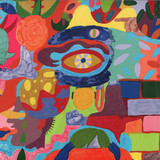
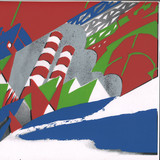
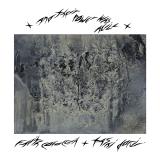
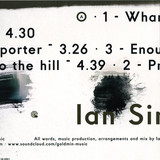
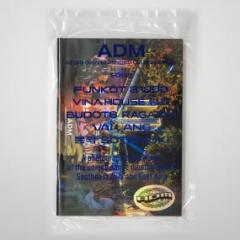
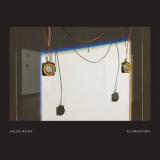
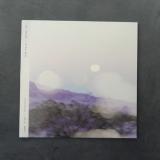
The fourth Rebound Lounge EP. DJ Dog and Double Dancer keep on pushing the boundaries of their weird and wonderful genre Basketball House! The sound always changing and evolving into different territories, but still keeping their flavour and strickt concept. Here we got five new tracks as always, and a new fantastic color scheme and pic on the back of the sleeve. Limited edition and vinyl only. So not to miss!
Rebound Lounge a label and production project consisting of DJ Dog (aka DJ Fett Burger) & Double Dancer. They have been 'Rejuvenating the basketball house scene since 2016' as they like to say. A genre they claim to have invented and thus rejuvenated since day one. The music presented with sounds from the basketball world and weave this in to the productions. It can be a shoe rubbing on the wooden court, a cheering audience, a yelling coach or a heavy slam dunk. Sometimes clearly audible, sometimes hidden deep in the mix. From this mixture the unique Rebound Lounge sound is created.
The fourth Rebound Lounge EP. DJ Dog and Double Dancer keep on pushing the boundaries of their weird and wonderful genre Basketball House! The sound always changing and evolving into different territories, but still keeping their flavour and strickt concept. Here we got five new tracks as always, and a new fantastic color scheme and pic on the back of the sleeve. Limited edition and vinyl only. So not to miss!
Rebound Lounge a label and production project consisting of DJ Dog (aka DJ Fett Burger) & Double Dancer. They have been 'Rejuvenating the basketball house scene since 2016' as they like to say. A genre they claim to have invented and thus rejuvenated since day one. The music presented with sounds from the basketball world and weave this in to the productions. It can be a shoe rubbing on the wooden court, a cheering audience, a yelling coach or a heavy slam dunk. Sometimes clearly audible, sometimes hidden deep in the mix. From this mixture the unique Rebound Lounge sound is created.
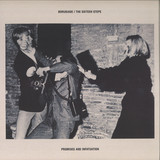
“Give Me Peace On Earth” is the second single from Modern
Talking’s fourth album In The Middle Of Nowhere. It reached
#29 in Germany and #28 in Austria on the singles chart.
Besides the title track, this 12 inch Give Me Peace On Earth also features the bonus tracks “Stranded In The Middle Of Nowhere” and “Sweet Little Sheila”. It is available as a limited edition of 1000 individually numbered copies on crystal clear vinyl.
One of the most active players in techno, Portuguese DJ and producer João Rodrigues aka Temudo, after leaving his trademark sound on labels such as Blueprint, Soma and Mord returns on Klockworks and delivers two cuts of elegant, pure bred techno.
In his words: “I think these two tracks truly represent my vision for minimalist techno: repetitive music reduced to its core elements, where the sequencing of sounds and their texture come together to form a solid idea with every detail being meticulously crafted and has a clear intention. I honestly associate these tracks to the label and I’m glad they have found the perfect home.”
Half Grand Records’ second release makes it more clear that their target is squarely between the dancefloor and headphones. This unpredictable playlist spans genres, from Golden Science’s buzzy boom bap to Jon Doppler’s sub shaking hardcore, with layers of analog goodness that seem to glow with the first days of rave. Electronic music veteran Proswell contributes a real viber, replete with growling basslines and bells. Round it out with a sprawling, spastic workout from Sweden’s A Stantz (Peel MD) and you have a chronicle that would fit perfectly in the collection of fans of early Warp Records, Tobacco, and millennium era Merck Records. Check it out!
*MILKY CLEAR VINYL - 300 COPIES ONLY FOR WORLD!!* Technology + Teamwork’s fizzling synths, interweaving textures and punchy rhythms are beguiling on their long-awaited debut album We Used To Be Friends. However, at the heart of it all it’s the connection between the group’s two members, Anthony Silvester and Sarah Jones, the friendship the much-travelled duo have managed to maintain for nearly 15 years and a showcase of the slow-burning construction of the electronic world that they’ve surrounded themselves with. We Used To Be Friends is ultimately the tale of two storied artists in their own right, holding onto each other through personal and career twists and turns, relocations and broader movements through respective phases of their lives. Silvester and Jones first met and then collaborated as part of biting post-punk five-piece XX Teens in 2008, eventually breaking off to forge their own path together even as the latter’s demand as a drummer grew. Performing with everyone from Hot Chip, Harry Styles and Bloc Party among many others, Jones has been a constant percussive presence across the sphere of alternative UK pop music – she’s also found time for her own solo project Pillow Person and played on records by the likes of Puscifer and Kurt Vile. Silvester meanwhile has performed in art galleries across Europe including: Fridericianum in Kassel, Kölnischer Kunstverein in Cologne, and Vleeshal in Middelburg, as well as providing sound design and composing work for several art films. Technology + Teamwork is the constant throughout all of that though. “Technology + Teamwork's name perfectly describes how we work” Silvester explains. “Sometimes the teamwork is between each other and sometimes it’s between us and the technology.” Although going by the name Technology + Teamwork as far back as 2014, two events conspired that pulled the project into focus for the pair of them: firstly, Silvester spent a year constructing a soundproof studio shed on the border of London and Essex where he lives. Secondly, inevitably, the pandemic brought the globe-trotting Jones back home to just seven miles away from her long-time collaborator and friend. “We probably hung out more than we had for a few years” says Silvester. “Also, after all her Pillow Person releases Sarah had gotten really good with recording vocals and knowing what did and didn’t work and had a really good home studio set up. We still worked separately though, exchanging ideas via email and WhatsApp.” As with many artists through 2020 and early 2021, working separately was a new necessity that they were forced to adapt to. However, it became clear that there were creative benefits to it. “It really changed our sound and our sounds became a lot more focused as a result” Jones says. “I wanted to use the same ideas of improvisation that I might use while playing the drums for myself and apply that to melodies and lyrics.” The album bristles with hyperpop modernity. You can hear it in the manipulated vocals most prominently on Big Blue’s disco strut and on Moving Too’s heady mix of pitched up voice and burrowing sub bass. However, the pair also looked to San Francisco and the West Coast synthesis movement of the 60s, Silvester inspired by the likes of Suzanne Ciani and Don Buchla. The plaintive lo-fi and melancholy of Amsterdam incorporates Mutable Instrument’s Marbles by Émilie Gillet which – inspired by Buchla’s own synthesis work – outputs random voltages to give the track an air of unpredictability. It’s something that occurs throughout the album, the duo revelling in the happy accidents that disrupt the flow of their hook-laden pop. “The ‘Buchlian’ ideas of music having randomness and uncertainty, completely freed us up” Silvester explains. “It felt a bit like having more members in the band, machines that didn't do what you expected or intended.” Perhaps more subtly, is the influence of 17th and 18th century Baroque music, with Silvester drawing a line between it and the 90’s R’n’B he and Jones both love – exemplified perhaps best on K+B’s percussive claps and sultry grooves. The portentous juddering synthpop of the title track, meanwhile, alludes specifically to Handel’s Sarabande. It’s typical of an album that only needs a scratch of its seemingly glossy surface to unearth a myriad of contorted touchstones and reference points that’ve fermented beneath it. Thematically there’s an anxious sense to the record, with tracks often balancing above a quiet sense of unerring tension even at their most bombastic. Moving Too is the result of an existential doubt that hit Silvester while out cycling, with the outro refrain "it's not enough to die you also have to be forgotten" a take on something Samuel Beckett once said. These worries are echoed on the album’s closing track What A Year, which borrows a lot of lines from the late drag performer and fashion designer Dorian Corey including the grimly defiant "you're gonna leave your mark somewhere in this world just by getting through it”. Those clouds offer a counter point to We Used To Be Friends, but then isn’t that what great pop albums do? Technology + Teamwork undoubtedly love the craft of the hook and the song, but they always position themselves left of centre, prepared to scuff things up, pull something out of shape or manipulate something to leave it sounding warped. Much like their friendship, nothing here is particularly linear – and it’s all the better for it. Bio: Anthony Silvester & Sarah Jones first collaborated as part of biting post-punk five piece XX Teens in 2008, eventually breaking off to forge their own path together even as the latter's demand as a drummer grew. Performing with everyone from Hot Chip, Bat for Lashes, Harry Styles and Bloc Party (among many others), Jones has been a constant percussive presence across the sphere of alternative UK pop music - she's also found time for her own solo project Pillow Person and played on records by the likes of Puscifer and Kurt Vile. Silvester meanwhile has performed in art galleries across Europe including Fridericianum in Kassel, Kölnischer Kunstverein in Cologne, and Wleeshal in Middelburg, as well as providing sound design and composing work for several art films. Technology & Teamwork is the constant throughout all of that though. "We Used To Be Friends" proves that Technology & Teamwork undoubtedly love the craft of the hook and the song, but they always position themselves left of centre, prepared to scuff things up, pull something out of shape or manipulate something to leave it sounding warped. Much like their friendship, nothing hear is particularly linear - and it's all the better for it.
Dam-based don Retromigration steps into the big leagues letting loose his debut album on WOLF Music. An LP that has long been in the works and for good reason too. Fourteen expertly executed tracks that range from hazy beats and jazz-tinged broken rhythms to club-ready groovers, deep excursions, soulful footwork and even some jungle energy. A flavour for every occasion and damn it tastes good.
With an envious run of releases on the likes of Handy, Healthy Scratch, wewillalwaysbealovesong and WOLF in a relatively short space – Retormigration is hot property and it’s clear to see why. A distinctive style and energy permeate his tracks with a breadth of influences on offer, from hip hop, to jazz, soul to funk. You just know a long player from this player is going to cover all bases.
His debut LP, Straight Foxin’, is a carefully curated and crafted journey showcasing the creative explosions firing off in Retromigration’s brain. Joining the dots between genres, taking elements from here, ideas from there – twisting and turning yet never out of place. Take the opening three tracks, all tied together by a deep fondness for jazz but served up in different styles, ‘Kunta’ with that hazy beatsy blend, ‘Formant’ leaning into the realms of broken beat and DnB and ‘Be Someone’ cruising with the off-kilter house.
Elsewhere there’s prime examples of Retromigration’s signature sample-laden house with deeper cuts like ‘Mada’ and ‘Bouncer’, sitting side by side with more soulful explorations such as ‘New Cribs’ and ‘ITWT’.
Not one to be pigeonholed, another course of Retromigration’s expansive taste gets served up with four high energy hits. The bouncing footwork flavours of ‘Kush Love’ ft. Passion Deez and ethereal excursion ‘What If’ lead into a captivating nod to the heydays of jungle and DnB on ‘Mild Fever’ and ‘Bad Knees’ respectively.
Straight Foxin’, mad flexin’ – Retromigration has laid down the law with this LP, a debut album done right.
Brandee Younger will release her second album on Impulse! Records, ‘Brand New Life’. Younger is quite often noted for standing on the shoulders of the very women who ushered in the harp as a clear and distinct voice in jazz: Dorothy Ashby. This record is an amalgamation of original pieces from Brandee and select reinterpretations of Ashby’s work. Brandee Younger represents a generation of contemporary improvisational musicians who came of age in an era when hip hop commanded a strong presence in American popular culture and emerged as leaders of a new school. In ‘Brand New Life’, she brings progressive explorations of harmony, rhythm, and melody infused with styles from hip hop, rock and pop music.
LP COLOUR IS CLEAR. New vinyl edition of the second album from USA emo / indie rock band The Appleseed Cast. Originally released in 2000 on Deep Elm Records.
third ear is u.r.trax's third ever release and first full ep on Trip after her contribution to "all his decisions".
throughout the seven tracks she plays with vocals creating textures, sounds and melodies and above all a clear aesthetic.
"I feel like this release faithfully represents my musical identity. I see and hear my sound becoming clearer and that's very satisfying. If I try to define the overall vibe of the record, I would say that it is like a mood swing, from deep, dark and cold atmospheres to uplifting, higher, sometimes ethereal energies." - u.r.trax
Omni AM presents the long-awaited reissue of “Can We Get / Keep Doing That.” This timeless record sent dance music in a new direction. Euphoria Record’s vaults are open and finally, for the first time since 1997, this seminal tech-house classic is available to everyone for the very first time in over 25 years. This 1997 indie record was Euphoria Records second release – and their first international record. Whether you agree with it or not, many people consider this one of the pioneering records of American Tech-House. Both sides and several mysterious alternate versions have graced the decks of DJs like Evil Eddie Richards, Terry Francis, Derrick Carter, Tyler Stadius, and Magda. The list goes on.
We were lucky. Curve Pusher lovingly remastered the original four tracks from the 1997 studio masters. Then, he went a step further, and remastered some previously unreleased versions – including a live version in Chicago that encapsulates what Omni AM was back then: ambient house. There’s a bit of Chicago, a bit of London, a bit of New York, and a bit of Tokyo in every second of these classic, genre-defining tracks.
A1.
“Can We Get” happily sits with the finest works of Ron Trent, Chez Damier, and Mood II Swing – and goes further, as Omni AM has never feared genre definitions. It opens with classic deep house chords, floating synth pads, and sparse vocals. The bassline is deep and warm. Marky Star and Adam Collins expertly work the percussive effects but always keep the theme simple and clear. Everyone knows this is a classic house track because it hypnotizes you.
A2.
“Keep Doing That” continues the theme with another classic late-night killer. However, this one is totally different – almost industrial, yet clearly housey and ambient. It drives deep into a tough groove that just builds and builds. The dub-influenced bass line gives way to a more angular synth riff that both offsets and adds to the track's forward thinking sound design. It’s dark and dirty, yet terribly sexxxy at the same time. It was and always will be mesmerizing. Once again, musical magic by Marky Star and Adam Collins.
B-Sides
The flip side features two remixes of “Keep Doing That” by UK tech-house legend Mark Ambrose. His bubbly, psychedelic take on the track pumps up the percussive Chi-town groove while going in a distinctly London afterhours direction. Trippy, for sure. Fun for all, for sure. These remixes are guaranteed to make your afterhours weird.
After the successful 7-inch release of Agip, Roman producer and composer Azzurro 80 is back on Four Flies with another triple-single that continues his love affair with dreamy synth-pop and Italian Eighties culture and society.
"Notte Inchiesta", on side A, could be the title music to an imaginary '80s investigative/true-crime program broadcast on late-night television. Clearly reminiscent in mood and texture of the soundtracks of late-70s/early-80s Italian detective-action films, it brings back the jazz-funk, post-prog and fusion overtones that characterized the music of those films. In short: a contemporary-retro sound nestled somewhere between Goblin's funk-oriented recordings, Azymuth's "Jazz Carnival", and electronic disco with a sprinkle of new wave.
Side B opens with "Equilibrio", which could serve as additional, more dynamic music for the same TV program mentioned above. The style is once againelectronic jazz-funk, but here we have abreak built upon a trail of notes chasing each other.
In contrast, "Sambuca", the single's closer, is deliberately nostalgic and melancholy. Perfectly suitable for visual narratives of an Italy that no longer exists, it sounds like one of those great Italian soundtrack themes that are able to convey tension and calm at the same time. The track is titled after the anise-flavoured liqueur that Italians often drink after their espresso, because "making references in my music to things that are part of our national popular culture is really important to me", as the artist has explained.
On April 7th electronic luminary Nathan Fake presents the new longplayer ‘Crystal Vision’ on his own Cambria Instruments imprint, which features collaborations with Clark and Wizard Apprentice.
This is music for music’s sake – recorded without angles, agendas and themes – so Fake was free to simply continue honing his craft and express himself non-literally. Aptly titled, there’s a clarity of execution and ambition, and a peak effectiveness to the record that just sounds right.
Continuing to set a personal bar higher and topping his own best, the mark of master craftsperson is everywhere, but that doesn’t mean it’s polished; There’s plenty of rawness evident, with spiky sonics keeping ears on high alert – full of endorphin-flooded rave energy.
Following a short, scene-setting ‘Arrival’ – a simple major chord arpeggio played on a Jupiter 6 which sounds like curtains opening at dawn, things begin apace with ‘The Grass’, which hurtles like a precision-tuned bullet train through Arctic tundra. The undulating effect of compression is emphasised by the classic techno trope where 2 rhythms jar yet interlock, creating an exquisitely disorientating strobe-like flutter. On the track’s guest, Fake comments, “I fell in love with Wizard Apprentice's ‘I Am Invisible’ and felt our musical styles were similar. Their vocals are smooth and clear and sharp at the same time. They’re like a calm within the storm.”
Inspired by Italo disco but sounding wholly alien and futuristic, ‘Vimana’’s fizzing buzzsaw arpeggiated bassline, popping snares and bright whirling melody are equally an electro trance melange, with an effervescent major chord Arp that kicks in midway.
Reminiscent of what used to be called ‘funky techno’ but with sparklier sounds, ‘Boss Core’ blinds like sunshine bouncing off ice. Using his trusty Boss DR550 drum machine, and inspired by Autechre's ‘Vose In’, the track peaks by reaching that melancholic/euphoric axis for which he is loved.
With chugging slow breakbeats not a million miles from Board Of Canada or trip hop, ‘Crystal Vision’ rolls along, with the melody opening up, revealing more hidden notes as it progresses, building into a fractal, kaleidoscopic mosaic.
An emotional outpouring with serotonin surging through the circuitry, classic breakbeats and layers of lazers, ‘Bibled’ has all the hallmarks of a classic. This is a bonafide festival-set closing, hugging-your-mates, moment – or, with its guitar solo, “a power ballad” – as Nathan calls it.
A minimalistic moment of calm midway through the album, ‘CMD’’s gently comforting dreamscape is conjured with FM stacked and detuned sine waves which are left to breathe, whilst the chunky Chicagoan house jack of ‘Hawk’ brings to mind classic Relief records, but even more detuned and wibbly, and laden with synths.
As the title suggests, ‘Amen 96’ is in Fake’s own words, “me having a go at jungle. I grew up listening to it, and I remember as a teenager it sounded like the most intense and otherworldly music ever. It still does. This track is an experiment to see how my melodic style works against amen breaks”. Closer to the braindance end of the spectrum than ‘proper’ jungle (and all the more interesting for it), Fake channels the spirit of Squarepusher but makes it his own, brimming with melodious twinkle.
A collaboration with Nathan’s close friend and genuine musical hero Clark. ‘Outsider’ finds this dream team alchemising pure gold that’s bigger than the sum of their parts. Skittering, intense, far-reaching end epic, the pair close proceedings on a grandly dramatic note. In 2020 Nathan released the album ‘Blizzards’, which was described by The Quietus as “his best work”, and “his best LP yet” yet by Resident Advisor. The equally well received ‘Blizzards Remixes’ EP which featured Afrodeutsche and Irene Dresel followed in 2021, as did a nationwide UK tour.
An in-demand remixer, Fake has added his magic to tracks by Radiohead, Clark, Perc, Jon Hopkins, GoGo Penguin, Dominik Eulberg, Christian Löffler and Damian Lazarus, working for labels including Ninja Tune, Domino, Warp, Blue Note and Kompakt.
Before MF DOOM donned his mask and became one of the most prolific MC-producers of modern Hip-Hop, he was a member of KMD, an early ‘90s rap group whose work still goes criminally under-appreciated to this day.
Following their 1991 debut album, Mr. Hood, the former trio shed one member leaving only two remaining – Subroc and his brother, Zev Love X (better known today as MF DOOM). Originally scheduled for release in 1994, their sophomore album Black Bastards showed clear progression from their debut. It was a truly amazing record, both sonically and lyrically, full of youthful creativity and tinged with the stresses of growing up as Black men in urban America. Songs like the lead single “What A N*gga Know”, the slippery, bass-driven “Get U Now”, and the album’s title track explore Black consciousness viewed through young-but-experienced eyes. Musically alternating between bouncy and raw – many times both, concurrently – the tracks gave the MC’s the springboard they needed to express themselves clearly.
Sadly, Subroc would face a sudden and untimely death in 1993, just as the duo were finishing the album. Grief-stricken, his brother Zev Love X – now the sole remaining member of the group – was determined to carry the legacy of KMD onward, but Elektra Records unceremoniously shelved the project in the eleventh hour, due to controversy surrounding the album’s provocative cover art. Following the fallout with Elektra, Zev tried for years to release the album on other labels, but he was continually met with dead ends. Struggling through the pain of losing his brother, coupled with the inability to release their final project together, a discouraged Zev Love X quietly withdrew from the scene and began quietly plotting his revenge on an industry that had broken him spiritually. Thus, in order to understand the true origin story of the super-villain, MF DOOM, one must recognize and appreciate the evolution of his former group, KMD, and the backstory of their pivotal album, Black Bastards.
Emotional Rescue dives back in the world of post punk experiments and early synthesised electronics to present another of the labels iconoclastic 7" 'collectors specials', with a look at Stockholm's Staalfagel.
Born in 1977, Erik Fritjofsson and Petter Brundell merged and formed Staalfagel out of the suburbs of Jakobsberg. Like so many at the time, the duo was tired of Prog, Jazz and Symphonic Rock and formulated something new and against at the same moment; a time where drummers were jettisoned in place of drum machines and the inspirations of artists like Creedence Clearwater Revival, Devo and Pere Ubu were thrown in the mix to fervent results.
With Micke Kjell soon joining on bass, they toured Sweden constantly, the manic machine beat, beating guitars and strange synth sounds defeated the throng and led to a considerable following. Recorded live to tape with no overdubs or mixing, the faithful CR 78 drum machine, the results radiate energy.
Release just 4 records in 2 years (1980 - 1982), Utan Rymddrakt Pa Uranus appeared as their last ever release. Jettisoning the punky-funk vocals of previous releases, the single is a pure electronic groove. Funk bass and guitar atop, its short form simplicity is perfection distilled in 2 parts of less than 3 minutes, conjoined like some reggae dream, with 'Uranus II' acting the dub 'version' counterpoint.
Discovered and shared by long-time friend, DJ and collector, Gary The Tall steps out from behind the decks and microphone of his long running NTS show to present an exemplary "Reversion". Teaming up with master producer and label affiliate, Timothy J Fairplay on engineering duties, they keep the originals' straightforward charm, deceptively editing, looping and reversing with aplomb, for a killer flip side.
In 1975, under the oppressive air of military dictatorship in Brazil, brothers Lelo and Zé Eduardo Nazario invited bassist Zeca Assumpção to join their musical experiments in a basement under Sao Paulo’s Teodoro Sampaio Street. As teenagers, the trio had already been playing together in Hermeto Pascoal’s Grupo, alongside guitarist Toninho Horta and saxophonist Nivaldo Ornelas, and it was while working together under Hermeto’s direction that the Paulista rhythm section (as they were then known) began to realise their own potential.
With many nightclubs and venues closed in the mid-70s and government censors dictating the output of radio, TV and art galleries, many Brazilian artists fled during the years of dictatorship. But underground, Grupo Um were fusing avant garde ideals with contemporary jazz and Afro Brazilian rhythm; making phenomenally free and expressive music - in stark contrast to the sterile, conservative conditions being imposed above ground.
Just like Hermeto Pascoal’s Viajando Com O Som from the following year, Starting Point was recorded over two days at Vice-Versa Studios, by revered engineer Renato Viola. The studio was one of the best in Sao Paulo and musicians communicated with engineers through cameras and a monitor, allowing the group complete immersion in the process. They also made use of the studio’s hemispherical tiled room, which served as an acoustic reverberation chamber.
The album begins with Zé Eduardo Nazario’s thunderous drum solo on “Porão da Teodoro”, before clearing the clouds with the lone Berimbau which opens “Onze Por Oito”. Built around a hypnotic electric bass line, heady Fender Rhodes improvisations, and more rip-roaring drums, it’s a rapturous, electrifying freak-jam in 11/8.
Like some invertebrate deep-sea curiosity, the free-form “Organica” is made up of Lelo Nazario’s playfully eerie prepared piano, with Zé Eduardo’s percussion flurries darting around Assumpçao’s double bass. The equally non-conformist, percussion-only piece “Jardim Candida” features many of Zé Eduardo’s home-made instruments, including a long saw blade played with vibraphone sticks and violin bow. While working with Hermeto, Zé Eduardo famously built his own all-in-one percussion set-up known as the “Barraca de Percussão” (Percussion Tent) - the first of its kind in Brazil, which he would also use on Hermeto Pascoal’s Viajando Com O Som and throughout his career.
“Suite Orquidea Negra'' (Black Orchid Suite) was written by Lelo Nazario as the score for an imaginary movie - the story of a rare, black orchid which produced a substance meant to cure all diseases, but which had mysteriously disappeared from the laboratory… “As a screenplay it’s not very good” reflects Lelo in jest, “but the music ended up being very interesting, the way its parts are chained to one another carries a little of the mystery I imagined for the movie.”
The album closes with the triumphant “Cortejo dos Reis Negros” (Procession of Black Kings) - a groovy variation on the Maracatu rhythm, with a two-note bassline underpinning piano improvisations, exultant wordless vocals, cuicas, slide-whistles and a very special guest appearance from Zé’s dog Bolinha.
Starting Point was to mark the inception of one of Brazil’s most daring instrumental groups. Their debut now sits in the lofty echelon of otherworldly 70s Brazilian music, alongside the likes of Marcos Resende & Index’s self-titled debut, Cesar Mariano & Cia’s Sao Paulo Brasil, Azymuth’s debut and indeed Hermeto Pascoal’s Viajando Com O Som. But just like all of those titles, which were either shelved or largely ignored at the time, Grupo Um - so radically ahead of their time - struggled to find a label to release their debut album. So Lelo kept the tapes safe in his archives, which is where they sat for almost half a century. Finally, almost fifty years later, this mesmerising piece of history is here, and it was only the beginning...
Grupo Um’s Starting Point will be released by Far Out Recordings, on vinyl LP, with an insert featuring unseen photos and liner notes by the Nazario brothers, as well as a CD on 17th February 2023.
KINGUNDERGROUND TO RELEASE SET OF 45s, FROM CAVENDISH MUSIC CATALOGUE. PAYING HOMAGE TO LIBRARY MUSIC, FURTHERING ITS EXPOSURE TO A NEW GENERATION OF LISTENERS.
Library Music experienced its heyday in the 60s and 70s, as thousands of instrumental tracks were produced by musicians and composers for the purpose of placements in radio, television, and film.
The first 45 of the to be released, classified as ‘Dramatic’ features tracks from both John Scott and Tony Kinsey. Titling was important to Library Music, because it needed to clearly represent the emotions being expressed through the music, so it was easy for television and film executives to find what they needed to complete their projects. John Scott wasted no time getting into the dramatics with the opening track “Milky Way”, it displays the importance of grabbing a listener from the top, as well as being concise clocking in at just 47 seconds. Scott was not only a master composer, but also known for his work on the Saxophone, including playing on John Barry’s soundtrack for ‘Goldfinger’ in the James Bond series.
The juxtaposition of Tony Kinsey’s composition on the record offers a dynamic not present in the two tracks from Scott. Kinsey is more patient in his approach to “Kaleidoscope” building the tension with multiple movements and highlighting several instruments. The way the keys and bass play off each other leaves just enough room for a guitar lick to sneak in, as if it is hinting toward something.
In all there will be 8 individual 45s, licensed from Boosey & Hawkes & Cavendish Music Library and released by KingUnderground. Including compositions by Tony Kinsey, John Scott, Sam Fonteyn, Ray Davies, and more.
After previous releases by Todd Modes, the mysterious K-6000 and long-time Urban Tribe member Kemetrix, 100 Limousines from Detroit presents this new album by DUNN.
A wonderful and deep sound exploration, ranging from peaceful meditative states to echoing sounds from outer space and even some warm Detroit house vibes in between.
In other words, a perfect release to expand 100 Limousines’ off-the-beaten-track catalogue. Bending genres and not sticking to any rules... Just as we like it.
Available to pre-order now! Also some very limited quantities left of 100LIM001 and 100LIM002…
Paul Wise aka Placid is the driving force behind ‘We’re Going Deep’ – a thriving online community and record label that keeps you coming back for more. Born out of a lifelong affair with the many shades of electronic rhythm and an obsession for collecting records since 1988, Paul is known and respected by many in the realms of underground House and Techno. Renowned for making hips and feet move at parties, clubs and fields across the UK and beyond over the last few decades.
As a label owner, his mission couldn’t be clearer - releasing new music for heads of all persuasions. Fresh cuts aimed squarely at the dance floor, front room or even just your headphones. Rather than staying too hung up on the past, he continues to serve up the freshest in Acid, Electro, Techno, Deep House alongside sweet slices of Electronica.
Sticking to the format of 4 superlative cuts from equally talented producers, the quality remains unquestionably consistent on Volume 8 of his various artist series. Kicking off A1 in style with a family affair from Acid House aficionado Affie Yusef and his daughter Leila, ‘Dublovr’ is a Class A slice of pure late night chug that rides clockwork rhythms to a rolling bassline. As dubbed out synths ring out to lift you skywards – eerie sweeping undertones add another dimension. Tried and tested since the summer season, the added layer of a TB-303 brings everything nicely to a head. Not to be outdone, Bristol based Electro emissary Zobol delivers a pure slice of machinist joy on A2 ‘Sense The Consesus’, showing his ability to finesse and balance uplifting melodies with warm synthesis on this finest of jams.
Over on the flipside, Maltese producer Acidulant takes up the reins with the hushed tones of ‘The View of Her Shade’ on B1 – a thoughtful excursion into electro hinterland that’s a textbook lesson in making more with less. Last but not least, mysterious I Love Acid affiliate Type-303 turns out an exquisite IDM inflected serving of woozy broken Electronica on the mysterious ‘Knowhere’. Steeped in rippling melodies and aquatic
For this uniquely personal retrospective spread over twelve vinyl discs, Sven Väth takes us back to the early days of his DJ career. On What I Used To Play we meet great pioneers of electronic music, gifted percussionists, obscure wave bands, and innovative producers of a bygone 'new electronic' era. Rough beats and irresistible grooves from the identification stage of house, techno, and acid remind us not just how far electronic music has evolved over the past four decades, but how great it was to dance to EBM, techno, and house for the very first time.
If there is one protagonist of the electronic music scene who has remained curious, innovative and at the very cutting edge of music for over four decades, it's Sven Väth. His multi-layered artist albums and Sound of the Season mix compilations have been defining the genre for over two decades, and even today, he is constantly on the lookout for the next top tune to add to the highlights of his next set. At least, that's the case when he's not producing them himself as an artist or remixer. "Actually, it's always been part of my DNA to think ahead," and nothing had been further from his mind than looking back at his past, but when in spring of 2020 the international DJ circuit had to be scaled down to virtually zero, the 'restless traveler' suddenly had time. Time to stop and reflect on "how it actually was back then, at the very beginning of my career..."
"It was a great trip and with every track, beautiful memories came flooding back".
In the London apartment, he had just moved into, Sven has set up a "little music room", where he cocooned himself for several days, "to look way back for the first time and review my musical journey through the eighties, so to speak."
The interim result was six thematically oriented playlists with a grand total of 120 tracks from 'early 80s' to 'Balearic late 80s', together with excursions into afrobeat, European new wave, and EBM sounds and a few epochal techno/house tracks from the USA in between. From these 'Best of Sven Väth's favorites', the project What I Used To Play crystallized. Sven remembers how the Cocoon team reacted to his proposal: "They found the idea of making a compilation out of it MEGA from the beginning and everyone said 'Sven, go for it', but then, of course, the work really started, namely, to clear the rights and to get clean sounding masters of the up to 40-year-old tracks. There was also disappointment, of course. We couldn't clear certain titles because the rights holders in the USA had fallen out with each other or simply disappeared from the scene. In short, it wasn't easy, but now I can safely say we got the most important tracks."
Finally, after two years of research, curation, design, and administrative fine-tuning, the "little retrospective" from 1981 to 1990 is available. The exquisitely packaged, and three-kilo heavy box set is not only physically impressive, WIUTP is also the definitive record of Sven Väth's musical development. On each of the twenty-four sides of vinyl, you can trace track by track, what influenced him during which phase, and how he took off as a DJ from his parents' Queen's Pub straight into the spotlight at Dorian Gray. There and at Vogue (later OMEN), Sven became the style-defining player in the DJ booth that he still is today.
1981 - 1990: Future Sounds of Now
In the early eighties, the crowd in clubs like Vogue and Dorian Gray danced to what nowadays we call 'dance classics' - mainly disco, funk, soul, and chart pop. It was up to a new generation of DJs, including Sven Väth, the youngest protagonist in the Rhine-Main area at the time, to create their own club-ready music mix. Good new tracks and potential floor-fillers were rarities that had to be sought out and found, in order to prove oneself worthy.
Without MP3s, internet streaming, or other digital download possibilities, music didn't just gravitate to the DJ, instead, it had to be tracked down. In well-stocked record stores in Frankfurt and Wiesbaden or even in Amsterdam, London, or New York, Sven and friends sourced the material for countless magical nights. On WIUTP we can follow Sven's very personal journey through this wild, innovative era in which synth-pop, funk, hip-hop, and disco were successively replaced as 'club music' by house, techno, acid, and breakbeat. By the end of the decade, it was clear to see that these once exotic 'fringe' phenomena would soon become 'mass' phenomena.
Early 80s
Dirty Talk by the Italian-American duo Klein & M.B.O. represents the most innovative phase of the Italo-disco genre in the early eighties like no other track. Mario Boncaldo (I) and Tony Carrasco relied entirely on the original synthetic drum and percussion sounds of the Roland TR-808, coupled with the raunchy vocals of Rossana Casale and guitar accents of Davide Piatto. Of course, other tracks from this period were also influential in style, most notably Unit by Logic System, which worked as the perfect soundtrack to the laser lighting system at the legendary Dorian Gray club. With stomping beats and robotic rap interludes, Bostich by Yello also belongs on Sven's eternal playlist - after all, it caught the attention of Afrikaa Bambaataa, who invited the Swiss duo to perform at the Roxy in New York in 1983.
EBM Wave - Mid 80s
From today's point of view, the almost ten-minute-long, downtempo track Giant by Matt Johnson's band project The The, would probably not be considered an obvious club classic. However, a closer (re)listen reveals the rhythmic intricacies of the percussion overdubs by JG Thirlwell (aka Foetus) on Johnson's composition, and it becomes clear why this exceptional piece of music is one of Sven's absolute favorites. Other classics from this phase include Kaw-Liga by the mysterious The Residents, the hypnotic-synthetic Our Darkness by Anne Clark (and David Harrow), and last but not least, the somber, monotonous anthem Where Are You? by 16Bit, one of Sven Väth's projects together with Michael Münzing, Luca Anzilotti from 1986.
US House - Late 80s
You certainly can't talk about Chicago house without mentioning Frankie Knuckles. The resident DJ at the Warehouse not only gave the name to an entire genre, but also produced epochal floor fillers on the Trax label like the timeless Your Love, sung (and moaned) by Jamie Principle. Acid house protagonists Phuture also hail from Chicago, and on We Are Phuture (also released on Trax) we hear the chirping acid sounds of the legendary Roland TB-303 in full effect. Another featured classic is No UFO's by Detroit's Model 500 aka Juan Atkins, who is rightly considered the 'Godfather of Techno' even if the genre-defining track from 1985 still breathes with the spirit of hip-hop and electro from the first breakdance era.
Afrobeat
Le Serpent, by Algerian-born Abdelmadjid Guemguem, is a track that sounds completely different from everything else on WIUTP. Made in 1978, it's a monumental, rousing groove created without bass or synths, just with five congas! Even though Guem sadly passed away in 2021, his immortal, acoustic beats are understood all over the world and will continue to enrich many thousands of DJ sets for years to come. Another classic that not only Sven appreciates beyond measure is Hugh Masekela's Don't Go Lose it, Baby. In addition to being one of the most important jazz pioneers, the trumpeter and freedom fighter from Johannesburg was very experimental, integrating electronic sounds into his music in later years, in a similar vein to Miles Davis and Herbie Hancock. Dutch jazz pianist Jasper van't Hof's afrobeat project Pili Pili has also aged well. The trance-like, almost sixteen-minute-long track of the same name, manages to fill a whole side on the seventh of twelve vinyl discs in the WIUTP box.
UK-US-Euro - Late 80s
Time for a change of scene, in the truest sense of the word, and from a musical perspective, this section is like landing on another planet. First up is Andrew Weatherall's classic remix of Primal Scream's Loaded, featuring the iconic Peter Fonda sample (lifted from the 1966 biker film Wild Angels) that came to personify the mood triggered by the British Second Summer of Love in the late eighties: "We wanna be free to do what we wanna do, and we wanna get loaded...". This period also saw the emergence of M/A/R/R/S whose only single, 1987's Pump Up The Volume, became a club classic with support from DJ legend CJ Mackintosh. In this most eclectic of sections, we also encounter New York house and reggae producer Bobby Konders and his seminal Nervous Acid.
Balearic - Late 80s
Those who know him, know that Sven had already lost his heart to the 'magic island' of Ibiza as a teenager, so with that in mind, the WIUTP project couldn't end without a Balearic chapter. Inspired by Manuel Göttsching's E2-E4, the immortal, eponymously titled Sueño Latino belongs in there without question. Equally popular on the island was, and still is Break 4 Love by Raze, which thinking about it, would also fit perfectly into the house chapter. Last, but not least, there's an overdue reunion with Sven Väth himself, in his role as frontman of the successful Frankfurt trio OFF. Together with Michael Münzing and Luca Anzilotti (later of Snap!) this 'Organization For Fun' created the off-the-wall club hit Electric Salsa in 1986 which incidentally turned into an international chart smash, putting Sven in the enviable position of having to decide between pop stardom and a DJ career. Well, we all know how that decision turned out and the rest, as they say, is history. A not insignificant part of his story is What I Used To Play. Enjoy!
Benjamin Damage is back on ARTSCORE with a stunningly crafted record that explores the deepest parts of his mind.
We strongly believe that an Artist should have the freedom to express many phases of his thoughts, and doing it with the power of Techno is one of our main goals to inspire you. Benjamin is clearly on top of his game, and we are proud to deliver something very powerful here, done in one of the most elegant ways.
'Water Temple' is the debut album of the Berlin-based group Property. Comprised of Marijn Degenaar (NL) and Vivant de Non (AUS), the group use the theme of hydromancy to straddle the poetics of reverb from a post-punk perspective. The album wanders through dense end-of-world sensations without keeping away from piercing melodic instrumentation. As hazy as 'Water Temple' can get, Property just as easily trade the murky side of their post-punk sound for analogue synthesisers that feel almost celestial. Used to striking effect on 'Water Temple', the chorus-heavy bassline is interwoven with a strident melody that punctures the rhythm and accents the Neue Deutsche Welle energy that the pair play on at certain moments. Similarly, the vocals on 'Water Tempel' flirt with our cracked times from another angle, rendering a remarkable first transmission from this new duo. Foggy synthesisers fill the cavities of every track, though the driving leads ensure the ambience never overtakes the song-structures across the album. This tendency is best captured on the downer-anthem Blood Cube with its sharp drum machine rhythm, just as Clear Boys reprises this rowdy pop edge for a forceful album closer. The burning melancholy of 'Water Temple' is as shadowy as it is enlivening Track list: 1. Empty Leather Spell 2. Diet Of Worms 3. Water Tempel 4. Sea Wall 5. Blood Cube 6. Verbreek d Eed Niet 7. Het Oerslijm 8. Clear Boys
Another one from the fruitful collaboration with LA's highly regarded Patrick Houchen aka Shakaman. After Shakeena's “I bet you” 12" re-issue flying off the shelves, we deepen the exploration within Shakaman's treasure chest of Reggae/Dub gems with Shakeena's first and last album on Majicaa Records. Originally released in 1987, this album is a proper act of musical generosity, not so easy to point out the “hit” track here – clearly a case of all killer no filler. Unlike too many albums where the format length sadly gets the best of the artists' work, rest assured with this one you can play from the beginning to end and you'll only have to come back to flip it. The professional execution of what is hands down an ensemble of highly seasoned musicians sets the tone for the dreamy lyrics and arrangements to unravel. Besides expected reggae rhythms, Shakaman brings in other influences with subtle electro/freestyle hints that might have been hard to ignore in LA at the time. New remastered version sounding especially big and cozy on the low end. Can't go wrong!
'A Winged Victory For The Sullen' is the first installment of the new collaboration between Stars Of The Lid member Adam Wiltzie and L.A. composer Dustin O'Halloran. The duo agreed to leave the comfort zone of their home studios and develop the recordings with the help of large acoustic spaces, hunting down a selection of 9ft grand pianos that had the ability to deliver extreme sonic low end.
Other traditional instrumentation was used including string quartet, French horn, and bassoon, but always juxtaposed is the sound of drifting guitar washed melodies. The recordings began with one late night session in the famed Grunewald Church in Berlin on a 1950's imperial B?sendorfer piano and strings were added in the historic East Berlin DDR radio studios along the River Spree. One last session on a handmade Fazioli piano in a private studio on the Northern cusp of Italy, before the final mixes took place in a 17th century villa near Ferrara with the assistance of Francesco Donadello. All songs were then processed completely analogue straight to magnetic tape.
Their secret to harvesting new melodic structures from the thin air of existence was for the duo to push themselves to dangerous territory, realising that clear thinking at the wrong moment could stifle the compositions. The final result is seven landscapes of harmonic ingemination. In 'Requiem For The Static King Part One' ? created in memory of the untimely passing of Mark Linkous ? they have taken the age-old idea of a string quartet and then shot it out of a cannon to reveal exquisite new levels of sonic bliss.
Of the 13 minute track 'Symphony Path?tique', Wiltzie says 'after almost 20 years of struggling to create interesting ambient drone music, I feel like I have finally figured out what I am doing'. Notable guest musicians include Icelandic cellist Hildur Gudnadottir, as well as Erased Tapes label comrade Peter Broderick on violin. A Winged Victory For The Sullen is not a side project ? it is the future of the late night record you have always dreamed of. A Major release for Forte, Non exportable.
After our last release titled “jazz Baileys” we are back with House Experience Vol.2., this time in Ep format, presented by Bs As deep.
The previous volume was clearly dedicated to being a various artists, also with the participation of Bs As deep.
We have been working since vinyl number 4 with musicians, who have a participation in almost all the tracks released.
When we talk about musicians, we are including keyboardists, saxophonists, percussionists, guitarists or bassists.
Our goal or common thread has always been to achieve a warm and forceful sound, so that it can be heard in any environment, and at the same time be used at any time of the night, on a dance floor.
With those involved in both past and current releases, we share a common idea, which guides us in the interpretation of each song.
We also base ourselves on house influences from the late 90s (96,97,98,99)
Personally, we are moved by those times in which the sounds become more sophisticated, more elaborated in detail, and that is when we believe that the house that we listen to today with soul and jazz sounds, take on more relevance.
They also promote Afro and Latin percussion, leaning towards that New York and Puerto Rican fusion.
For all this, we like to include classic instruments, such as roland rhodes, the much-loved Juno, or korg packages with their inevitable M1.
Many shots are made live through a session expressed by the musician, who improvises for a while, from there we extract some part, which can be used several times in several tracks.
It is always necessary to do an editing job to adapt and correct any dissonance or variation in time that implies desynchronization in the beat. All this working in the sequencer of the daw to use.
On this album you will be able to hear soulful house sounds strongly impacted by keyboards, flutes and session basses, as well as some perfectly adapted percussion samples.
Home is a powerful concept with an abstract definition. This solo album takes those subjective ideas and unifies them under one roof. Evolving from Jerve’s #dailypiano posts in 2019, ‘The Soundtrack of My Home’ relays thoughts and improvisations that trace his journey from childhood home to adult and now, father. Nurturing a mood or feeling, each song begets a sonorous story of someone close to him, expressed through the language of piano playing.
Jerve makes use of his hands as a human step sequencer, often programming two or more motifs of varying lengths in a polymetric fashion. These melodic patterns and arpeggios evolve at varying rates but grow around clear progressions with standard 8-bar forms.
The first track - ‘Kjetil’ enters with an earnest, gentle and endearing character - like a young river near its source. As with such a river, it will grow to varied sizes throughout the album but must begin as a humble expression from the source. The following titles sketch his interpretations of the people that have made up his home.
There is a theme across the album that unites the songs, so much so that differentiating tracks can at times be difficult. Though, Jerve punctuates this overarching mood with a few distinct structures, as found in tracks ‘Karoline’ (wife), ‘Espen’ (brother) and ‘Sven’ (father). ‘Turid’ (daughter) and ‘Jon Eirik’ (brother) seem less directive and welcome more intrigue, reminiscent of a curious child wandering through the dappled light of a forest.
‘Iben’ (daughter) and ‘Eivor’ (daughter) have a hypnotic, three-pointed melodic structure that leaves the listener suspended; transfixed - while ‘Sussi’ (cat) carries unique momentum and suitably feline autonomy. ‘Mette’ (mother) has a mood of ascending, like that of a child's upward gaze at their maternal carer. Utterly nuanced in structure, Jerve leaves ample space for subjective interpretation and allows the listener to weave their own life into the tones.
As expected from the founder of Dugnad rec - this album signifies a deeply personal sentiment. Sometimes we are forced to confront the music and other times, we are left to wonder. Here, we find a balance and unity that allows little thoughts and worries to drift away, bringing us warmly to rest in the present. The LP edition's bonus track features producer/performer extraordinaire Stian Balducci, drawing a line to the next chapter of piano-based music from Dugnad rec: TOKYO TAPES: PIANO RECYCLE.
After debuting on Flippen Disks in 2018 and a follow-up track on Bradley Zero’s Rhythm Section, PTDD is back on Flippen Disks with this debut solo-EP called „Sizipin“.
Melting PTDD’s signature minimalist sound with a welcoming harmonic world in Hoe Je Het Snijdt, taking a wide array of influences from UK-bass and broken beat in Sizipin to HipHop in N Btj Blvn Dnsn or more progressive club sounds in Kajuit, this EP is a clear big step in PTDD’s development as a producer.
„Sizipin“, a made-up term for an adaptor that you don’t know the use for anymore, it’s a rather fitting name considering the circumstances of the creation go this EP. A connector for quitting his day-job to focus fully on audio and music work, building his studio in deep pandemic lockdown-Utrecht and most importantly becoming a father. Also features a vocal performance of PTDD’s son Olivier. Can you find it?
How do you follow up an EP like Champion Sound? By going even darker and harder, that’s how! And that is exactly what Q project did with this incredible EP. In 1993 the burgeoning jungle sound was coming into its own, and this EP encapsulates that perfectly. The sound is very dark yet still has great musicality and a sound that is clearly defined as jungle music today. This is one of the most sought after records from the Q Project back catalogue and with just a quick listen you’ll hear why.
Club / DJ Support
Jay Cunning, Billy Bunter, the Fat Controller, Liquid, Hyper On Experience, Glowkid, Slipmatt, Dj Jedi, Dj Luna-C, Dj Brisk, Paul Bradley, Jimni Cricket, Bustin, Jimmy J, Doughboy, Lowercase, Dave Skywalker, Ponder and many others
HOTMIX Records presents Simoncino - Jungle Dream - The Ron Trent Remixes!
The Chicago Master re-interpreted Nick Anthony Simoncinio's "Jungle Dreams", formerly out on Mathematics in 2013.
Highy recommended!
The debut album from Samuel Coates, AKA Setaoc Mass, crystallises the expansive, left-field vision that's been brewing in his techno-focused discography. Now, downtempo, drum & bass and electro-influenced soundscapes come through strong, as the Manchester-born, Berlin-residing artist combines a decade of dance floor experience and a lifetime of wide-ranging music tastes. The album's 14 tracks transcend the dance with rhythmic and tonal adventure. The urgency of Coates' techno records remains, though now suspended in an unbound space that switches between unpredictable body music and eyes closed moments of escape. Timeless melodies recall the golden era of UK electronica, while ultra-modern production drives the record's microscopic details home. A lovingly crafted collection of the tracks that have been kept for when the time is right. It's the sound of Samuel Coates, then Setaoc Mass - vulnerable but visceral music that demands your full attention.
And they are doing it again!
The Snuff Crew is back!
With two crispy floor bangers the Snuff Crew is back after a longer creative break. Soundtechnically in the known percussive influenced acidstyle.
On "Midnight Peepin" striking vocal samples enter the sound and fire into the crowd _ no time for Sadnes!!! So it chirps drifting through night.
AGN1 on the other hand comes with the classic 303 line and lots of oldschool drums, a track that would also have had a place on my "Post Acid Crash" compilation in 1991!!! Acid party stuff from the Snuff.
On the B side TCCM present their remixes of the A side tracks in typical style, dirty and without compromise!
While "Midnight Peepin RMX" clearly shows and celebrates the elements of the original track, AGN1 RMX is a complete reinterpretation of the track structure and sounds, made and mangled from the original drums.
A record with an extremely varied soundscape from original oldschool to dirty interpretation. This disc is a must for acid fans!
This 7-inch record contains two audio adaptations by Josie Perry of her performances 'Retainers' and 'Toy Shop'. Josie is based in Glasgow and works mainly between drawing, sculpture, performance and publishing. The performances connected to this vinyl were part of a series made between 2019-20 involving absurd narration, audio loops and suggestive props. 'Beautifully Formed' is a short extract from the longer piece 'Retainers', while 'Toy Shop' uses the full transcript. Both works relate to her interests in materialities of spoken language and alienated voicing, and her background in vocal performance.
In his foundational essay on Los Angeles, L.A. Glows, the essayist Lawrence Weschler speaks on the city's uncanny, immediately recognizable light; "The late-afternoon light of Los Angeles—golden pink off the bay through the smog and onto the palm fronds." Weschler traces the city's mysterious refracted light from the iconic paintings of David Hockney through the city's frequent portrayal on film and TV, noting its ability to put residents into a state of "egoless bliss."
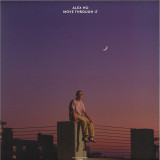
Similarly, Alex Ho's new album for Music From Memory, 'Move Through It', radiates with the unmistakable LA glow. While the Pasadena native's studio work is just now coming to light, Ho has long been a fixture in the Los Angeles dance music scene, throwing what are perhaps the city's most musically expansive warehouse events and carving out a singular voice as a DJ, as heard on his brilliant Moony Habits show for NTS. The eight-track record, however, lands in a more contemplative zone, better suited for a golden hour drive than a night out.
Though it's his first record, 'Move Through It' is the accomplished work of a fully-formed artist, produced patiently between 2017 and 2020 with help from friends including Baba Stiltz, Phil Cho, Damon Palermo and John Jones. "Mark," the Koanic track conclusion side A, is an arpeggiated slow burn reminiscent of Pino Donaggio's brilliant score for Brian De Palma's 1984 film Body Double. Ho's stunning, pure falsetto soars above gentle melodies. "Miss Suzuki," the piece that originally caught the ear of MFM's Jamie Tiller and Tako, opens the record with a blue, cinematic sway. Ho's facility for poignant melodies—easily conveyed through saxophone, vibes, various keyboards and his own voice—shines on "College Crest Drive," as well as the title track. The lyrical "Move Through It" and the restrained and beautiful closing cut, "TYFC," are abetted by glimmering Kraut guitar figures courtesy of John Jones.
While Ho's rhythms and melodies paint a crystal-clear musical vision, the music's emotional centre is more elusive, indicative of a yearning feeling synonymous with the City Of Angels. Hitting these hazy and subtle notes, Move Through It falls within a canon of sun-addled records spanning from Herb Alpert's "Rotation" to Dam-Funk's Private Life trilogy as Garrett. An immersive and concise statement, Alex Ho's 'Move Through It' is as warm and uncanny as the city that inspired it, a definitive LA album.
After a cameo appearance on the Spektrum compilation, DC Salas lands on TAU with his first full EP. The Belgian producer has been active for more than a decade and brings with him depth of experience and maturity, along with a clear understanding of the dance floor. His Time Well Spent EP showcases these core skills, along with his distinct flair and emotive nuance...
30 years as a full-time touring nightclub DJ sounds like one hell of a career, and for Kenny Summit it's as much of a milestone as it is a turning point. Having shared the stage with greats such as David Byrne, Stevie Wonder, Chaka Khan, George Michael, Kylie Minogue and Prince over the years, Kenny took that influence and inspiration and decided it was time for him to get behind the mic too.
‘Burnin’ is a song written, produced and performed by Kenny Summit that speaks on a desire that's been burning inside of him for three decades. Across those 30 years he’s made many an influential friend too, three of which come on board to remix ‘Burnin’ - the late great Paul Johnson, D&B icon DJ Aphrodite and Brooklyn legend DJ Spinna.
"I caught the fever for house in 1990 and by 1992 I was booked for my first DJ gig at New Jersey's famed Zanzibar nightclub where house legend Tony Humphries held court on a weekly basis. Something changed that night, a fire started and its been building, growing inside of me and now it's time to put paper to pen and write my own songs."
Clearly influenced by the artists Kenny's worked with over the years, ‘Burnin’ is a culmination of one man's journey through dance music; from the Nile Rogers-ish 70s guitar riff to the whining Steely Dan-like keys, to the lush strings and synth pop stabs that would make Moroder blush, the track itself is masterfully produced and punctuated with Kenny's unique uplifting vocals, sang in a manner as if David Byrne and Boz Scaggs were put together and yet still very uniquely Kenny Summit.
Up on remix duties the late great Paul Johnson, Chicago's shining star, serves up a dark, very much after house vibe, that still keeps that trademark Paul Johnson sound. Drum & Bass icon DJ Aphrodite applies his unique sound to ‘Burnin’ with a stellar remix the D&B community has been patiently waiting over three years for. And finally, long-time friend, Brooklyn's DJ Spinna steps up, who after hearing the track commented 'this needs a dope DUB! Leave it to me, imma hook you up bruh!'. The Discoelectric Dub does not disappoint.
Some people are just not destined to have enough sleep.When you don't sleep enough the world appears to be a different place, compared to the way it is when the mind is fully rested. In such cases very different scenarios may occur.
Starting with a dreamy melody of Roma Zuckerman's 'Sleep not found', which inspired the entire 008 album, and ending with a thirteen minute live recording by a_000, the side project of Alex Backdrop, the entire record has a dreamy and tripped out flow. 008 continues the tradition of gatefold double EPs as conceptual album.All tracks are selected around a particular story, a trip, and presented as a continuous sonic landscape.All tracks are structured in a way that they can be mixed one with another an endless amount of times making a continuous loop, a trip, that needs only end when the party stops. Kraviz works without release dates or deadlines, enabling her to achieve a certain sound bank to shape the story, unmasking the thoughts and unravelling like a dream. A1. Roma Zuckerman - Sleep Not found (North Edit) Apart form the fact that he leaves in Krasnoyarsk in the middle of Russia, very little is known about Roma (short version of the name Roman). But listening to his music and engaging in random short conversations late at night makes it clear that there are really a lot of things going on Romas mind... Minimalistic yet emotionally complex, his music always stands out with it's murkiness and signature moodiness that Roma creates like nobody else.
A2. Deniro - G Deniro continues the record's journey with his new live cut that like pretty much everything he did so far is a beautiful sparse atmospheric groover. He says he wanted it to be angry and it its done with triggering synths from the tr909 and tr808.
B1. Maayan Nidam - Infinite Rattle
Maayan was born in Tel-Aviv. She does not like computers and prefers to record her music live using hardware only. In order to do so she built her incredible studio in Berlin where she recorded "Infinite Rattle'.There is much more to come from Maayan on
B2. Bbbbbb - Prins Polo Caramel milkshake.
Side project by Bjarki-bbbbbb. Like any other normal Icelander, Bjarki really likes ice cream. In Iceland they are absolutely crazy about it.They walk the streets, ice cream in hand, even when its freezing cold outside. But even more than that Icelanders like Milkshakes with all sorts of added cookies and candies. Bjarki's favourite is called Prince Polo after the name of a chocolate bar. He always believed Prins Polo was an Icelandic brand but a couple of months ago somebody proved him wrong.
C1. Exos- dub jazz
In Iceland Exos is a legend. Everybody knows him there. He's been playing incredibly powerful and technically advanced techno sets since the late 90s and releasing delicious dub techno on Icelandic label Thule. Nina always appreciated his subtler, dubbier side, and this short recording a the continuation of it.
C2. Maaayn Nidam - Justice for some
This second live recording was a perfect fit for this album. Maayan has managed to create a particular mysterious night time dreamer here. Sound wise it's even more unique. It took a few times to get the master right, because we wanted to keep the original breathing of the machine that has captured a seriously freaky vibe. Maayan has always been one of Nina's favourite DJs as they share a similar attitude towards music. But after this tune she has also reserved a place in Nina's collective of favourite producers. D1. A_000
This is a side project of Italian native Alessio Meneghello (Alan Backdrop) & Enrico Voltan. . A beautiful 13-minute sonic journey.
Reissue of Elizio De Buzios's "Tamanquiro". Remastered and pressed on 45 RPM!
Sitting a good 90-minute drive away from Rio de Janeiro’s crowded beaches and packed tourist hot-spots, Campo Grande is not a neighbourhood that attracts travellers from around the World. Traditionally it is home to the city’s lower middle-class, whose aspirations of moving up the social ladder were played out in a suburb that has always been solidly working-class.
Campo Grande is home to Elizio De Buzios, a Brazilian musician who started playing music in the late 1970s and early 1980s. De Buzios began as a drummer, before learning to play guitar and starting to compose and sing his own music. When he turned 18, De Buzios joined a local band formed by some of his friends and other like-minded local musicians: Sol da Terra. The band mostly played samba in neighbourhood bars and small venues around Camp Grande, but De Buzios was interested in more than just samba. While he naturally admired great samba composers such as Cartola and Beth Carvalho, his musical pass went far beyond Brazil’s national music. He also loved MPB and bossa-nova and at home he listed to Joäo Bosco, Milton Nascimento, Luis Melodia, Tom Jobim, and many bossa-nova singers.
In 1980 De Buzios was noticed by a local representative of international major label Polygram, who gave him the opportunity to record two songs. He was excited, so started searching for inspiration for the songs he would eventually lay down. He found that inspiration close to home while passing a neighbourhood shop which made and sold clogs. After noticing a display of then fashionable Portuguese clogs outside the store, De Buzios popped inside to talk to the owner. It turned out that he was a tamanqueiro – as clog-makers are traditionally called in his native Portugal – and was as passionate about music as he was about the footwear he made. Thus inspired, De Buzios returned home to work more on the lyrics and music.
The next day, he headed into the studio to record the song, with Vale Ribeiro, who later went on to produce tracks for Marcos Valle, behind the desk. With Ribeiro’s assistance, De Buzios managed to record two songs in one day: ‘Tamanqueiro’ and ‘Sou Um Louco’, a ballad with English lyrics blended into the mostly Portuguese text. From the start, it was clear that ‘Tamanqueiro’ would be the single’s A-side. Incredibly catchy and funky, with some subtle disco elements, the song remained distinctively Brazilian thanks to the use of the cuíca. Listening back all these years on, De Buzios’ lyrics seem almost spontaneous, carry the track forward, and make it almost impossible not to sing along. Its infectiousness and funkiness made it an instant hit with the first few people to hear it.
When it was released, responses to the song were enthusiastic, even if it never became the Brazil-wide smash it should have been. It resonated well in the local clubs and on the radio, but unfortunately the marketing was handled by an inexperienced Polygram employee who failed to adequately promote the track. As a result, the record sank without trace and De Buzios’ dreams of stardom evaporated. Having just started a family, he realized he could not live off the uncertainty of being a musician. Instead, he got a job at city hall as a civil servant, a role he continued until his retirement a few years ago. ‘Tamanqueiro’ and ‘Sou Um Louco’ remain the only two songs he ever recorded.
In the early 2000s, with the rise of diggers’ culture, ‘Tamanqueiro’ slowly surfaced again. It became a sought after, hard to find seven-inch single, finding its way onto the airwaves once more and into the ears of a new generation of listeners. Some started appreciating the song so much that it was referred to as the “best-Jorge-Ben-song-Jorge-Ben-never-recorded”. And they are right: ‘Tamanqueiro’ does have that Jorge Ben-straight-forwardness. It’s a completely honest song that’s almost impossible not to fall in love with. Thanks to this remastered reissue on Rush Hour, De Buzios may now get the props his sole record so richly deserves.
Now for the good news: De Buzios is still singing in local bars and clubs in and around Campo Grande. He is surprised, but also incredibly proud, that the record he had almost forgotten about is appreciated so much by a group of music lovers he didn’t even know existed. But above all, he is happy that more than 40 years after the recording session, the record lives on – not only on this re-release, but also in his weekend sets in the bars of Campo Grande.
Over the past few years, Luca Binatti released a steady stream of quality EPs that showcased a remarkable talent with a clear understanding of what makes dance music unique. Also known for his guise as D:fferent Place, where house music is the main topic, Luca's boldest experiments belong under the Pressure Point project.
Pressure Point's debut on Pluie/Noir is no different — a collection of four ultra-personal tracks drenched in honest emotion and playful psychedelia. And it sounds as human as it sounds outer-worldly. Inspired by music genres unrestricted by the club ecosystems, "Ghost on Tape" features compositions that span from deeply spacial house to low-swung finely-detailed minimal.
Cover artwork features a stunning painting by the exquisite London-based artist David Surman. "Mask of a King / Midas" is inspired by Agamemnon's mask found in ancient Mycenae and Picasso's last self-portraits, furthering the emotional impact of the release as a whole. Limited pressing.
160 gram clear red vinyl, glossy sleeve, Cititrax presents rare live recordings from Birmingham techno legend Regis. The 12" EP features recently uncovered recordings of Regis playing live in New York City on January 4th, 1997 at the famed New York Film Academy. Original tapes discovered by Evan Kreeger, studio work / transfers done by James Ruskin in London and audio mastered by Veronica Vasicka in New York. The EP will be pressed on 160 gram clear red vinyl and housed in a gloss sleeve, featuring text by Evan Kreeger. An excerpt is below: Gymnastics broke techno - first time performed ! Regis has recreated this show for you - from the tapes in storage Over twenty years later - You're welcome! You are born! Now you can say you were there - rather than Skavoovee chore Damage and flame was our desire for this fight Two fans rebuffed tossed cinderblocks thru the front doors that night Locking up the Film Academy was only pageantry and a lie Nothing secure anymore - just crouch down - on your knees - crawl inside"
Limited Clear Vinyl Pressing!
We are very happy to present a new series of limited releases in vinyl, called the Pattern Series. This series will consist of translucent pressings with specially designed artwork, and the first number 'Vertigo' will feature three tracks from label boss Oscar Mulero.
On the A side, the main track is 'Epley Manoeuvre', with funky components, solid drums and a repetitive synth workout which is reminiscent of classic Regis-style bleeps. This one is aimed directly for the floor.
On the B side there are two other cuts. First comes 'Gravity' flanged sequences on an hypnotic vein, sharp shaker driven percussions and a subtle but fat kick drum spiced with white noise details and 909 snares.
Closing the B side we find 'Particle Repositioning', which starts with a round kick drum and bleepy one bar sequences that are soon spiced with claps and reverb. A second percussive sequence appears after some bars, starting a rhythmic conversation until the shuffled hats and rides complete the beat.
Three abstract pieces of modern techno but with a solid step into tradition.
London's SlothBoogie return with the second instalment of their 'Dancing With Friends' series this August, featuring exclusive new music from Kemback, Felipe Gordon, Mak z, Bill Mango, The Revenge and more.
Following the success of the inaugural 'Dancing With Friends', which featured the likes of Kassian, Letherette, Joe Cleen and Ruff Stuff amongst others, the crew are back with that ever so tricky... second album. This sequel however, will not disappoint. The team have scoured the four corners of the globe to provide listeners with a comprehensive follow up that showcases more brand-new music from their favourite producers.
'Dancing With Friends Vol.2' is a deftly curated selection of the diverse styles synonymous with the SlothBoogie sound, ranging from the hazy deepness of cuts by Amy Dabbs, DJ Counselling, Bill Mango, Metropolitan Soul Museum and Kristy Harper to Disco tinged, jazzy, bumpy numbers from the likes of Jesse Bru, T.U.R.F. and Felipe Gordon through to more tripped out acid workouts by The Revenge, Fede Lng & Mojeaux, Togethrs and Pablot.
With this latest collection you can trust SlothBoogie to bring some much-needed dancefloor unity and sun-drenched energy to the world for the summer of 2021. The perfect soundtrack to reconnect and begin dancing with friends once again.
The vinyl format will come as a Gatefold Cover with 2 x 12" cream speckled clear vinyl and will include the full digital album download cards.
When the first Placid Angels album dropped in 1997, John Beltran was already an established force within dance music’s then-emerging scene. He had a knack for both the melodic side as well as intricately designed rhythmic programming. A signature style that went for his early records in the 1990s as much as it does for this new installment of the Placid Angles series. The blissful synths, Aphex Twin-era IDM and loose percussive patterns take you right back to where it all began when genres didn’t mean anything and Beltran was just starting out to experiment with any sound that would elevate your consciousness. The Michigan-born artist since has spanned a career of nearly four decades, remaining relevant all the while, by playing the music he found himself most drawn to express. By working with artists like Detroit veteran Carl Craig, labels such as R&S or more recently his LPs for Delsin or his joint work with Four Tet. Whether it be his more Techno-leaning or New Wave-inspired works, his takes on Ambient, or the more Latin-influenced productions - he has always stayed active and re-invented himself while painting his records with a clearly own palette that is full of beautiful melodies and a timeless sound-design. The album Touch The Earth itself comes as diverse as the artist’s own legacy, ranging from skittish, colorful UKG to proper pulsing sub-basslines as it progresses deeper into intelligent drum programming and further into the melodic ventures of what’s at the core of Beltran’s work.
The latest from Mr. K and Most Excellent Unlimited pairs lowdown and stomping disco from an unlikely source with a funked-out floorfiller from some very familiar voices.
Minnie Riperton’s 1977 single “Stick Together” was an outlier in her catalog of smooth modern soul, an intentional nod in the direction of the prevailing disco sound. Co-written with Stevie Wonder, “Stick Together” in its original single release was divided into two parts, the first a fairly conventional uptempo cut with all the catchy qualities you’d expect from Stevie and the husband and wife team of Richard Rudolph and Minnie. It was the second half of the song that caught the ears of DJs who played for funkier dancefloors, however. Freddie Perren, a former member of Motown’s legendary Corporation collective of songwriters and producers, and a man then red-hot off his success with Tavares’ “Heaven Must Be Missing An Angel” and the Sylvers’ “Boogie Fever,” was on production duties, and the song clearly benefits from his disco-friendly touch. In Mr. K’s epic edit we are treated to a lengthy exploration of the second part of “Stick Together,” featuring keyboardist Sonny Burke (veteran of Marvin Gaye’s band and fresh from playing on Candi Staton’s disco smash “Young Hearts Run Free”) working out an irresistible Jingo-esque piano part, Riperton’s sensual ad-libs, and, as if that wasn’t enough, a cameo appearance by Pam Grier on finger snaps! Krivit’s 8-minute-plus edit passes way too quickly to get enough of the hypnotic groove — rewinds are called for!
Our flip side, “Body Language,” originated as an album cut on the Jackson Five’s last album of original material for Motown, Moving Violation, recorded before Jermaine left to go solo and the remaining brothers joined Epic Records in a new incarnation as the Jacksons. For such an obvious heater it’s puzzling why the label never released it as a single; but regardless of that apparent misstep, “Body Language” has long been a sure shot in many DJs’ bags. With his new edit, Mr. K presents the track in its ultimate form, loud, remastered, stretched out and rippling with energy over a full six minutes. With an iconic bass line that just doesn’t quit, and Michael and the boys in fine form, it’s impossible to imagine a situation where this wouldn’t set the room on fire.
fortunea starts their 2021 release schedule with a new 4 tracker this february. Peletronic is featured on this record and he shows again his love for detail.
‚About The Void‘ is a composition with an arc of suspense. The eerie pads and strings are in control by an imposing hypnotic groove that will guide the listener to the dancefloor.
As a guest remixer they hired none other than Stuttgart’s deep house expert Soulphiction. His take on the title track is placed on A2 and uses the elements of the original in a clever way. The groove is even more thrilling. And a female vocalist gives the track a femme fatale like character.
Peletronic delivers us his lo-fi house ‚Experience‘ on the B-side. Of course with a typical 909 kick drum, shuffled hihats and a purposely raw filtered jazz sample in loop. Intringuingly and playful likewise.
At last the record ends with the track ‚Paixão‘, which means „passion“ in portuquese. And you can clearly hear his passion for experimental latin influenced dub house in here.
The record is limited to 300 copies. There will be no repress! First come, first serve.
Israeli DJ and collector Elado makes his debut on RNT with a pack of impossibly rare edit heat! A relative newcomer to the scene, Elado made some waves recently with a stunning entry on Eddie C’s Red Motorbike, and he’s clearly no novice when it comes to digging as this exceptional pack of tunes shows.
With rarefied material ranging from Africa, India and the Mideast, Elado works these 4 tunes with a careful editor’s touch, nipping and tucking only where necessary to let the incredible source selections shine through, but rendered eminently DJ-friendly. Already supported by Antal and many others, this 12” is the first essential add of 2021!
Superlux Records continues its release schedule this December with a debut EP from Taymor Zadeh. The four-track Life Goes On EP includes three originals from the UK-based artist, as well as a special remix from One Records co-founder, Subb-an. Speaking on the production process behind the EP, Taymor describes how “ Life Goes On was made using a tb303, roland mc505, a 909 which I borrowed from a good friend, some vocal samples from old tape recordings and a load of imagination.”
The A Side gets underway with Bubbleworks , and Taymor’s “imagination” is plain to see. It’s a no-nonsense club-ready cut, with thick hats and an up-tempo lead bassline residing next to an array of bubble-sounding pops throughout. That same late-night feel continues into Life Goes On , as eerie vocals flitter between pulses of acid and punchy, whip-like drums. On the B Side, Gekula takes the lead. Fast-paced with clear minimal influences, we’re graced with eight minutes of dancefloor-geared delight as distorted voices reside atop a driving kick-hat backbone, before Subb-an’s remix continues in the same vein, taking us deep into 5 AM territory with glitchy synths and plenty of dark, low-slung percussion.
With an ethos of quality over quantity at his core, Taymor Zadeh has carved out a bespoke sound within the electronic music sphere. In recent times his releases have been welcomed by Stephane Genacia’s Highpath Records as well as Luca C’s See Double imprint, a testament to his keen ear for production. Berlin-based Subb-an is a leading figure in the UK minimal scene. As co-founder of One Records, 2020 has seen the label celebrate ten years of releases with a two-part vinyl sampler, including tracks from the likes of Anna Wall, Matthew Johnson and more besides.
Twenty vinyl releases is a strong landmark in any labels life most especially in these ever unpredictable days. Tropical Disco Records have reached that number with some verve. Over the last three years they have had a succession of chart-topping, sell-out releases fusing their love of the Jazzier edges of house music with contemporary disco and plenty of sure-fire club hits. So successful has the label been that they have in a short space of time that they have quickly become one of the most established labels releasing across the disco spectrum.
As you would expect Tropical Disco Records have put together a very special collection of tracks to celebrate their twentieth edition. Uniting Italian producer Paul Older with England’s Tung-Sol, Greek disco don C. Da Afro and London’s label head Sartorial the EP marks all points on the European compass. It’s an EP which shows the clear impact that Disco has had across the continent and indeed that we are all united by the power of music.
The opening move goes to Paul Older with his delightful track ‘Nothing’ and it’s the perfect feel-good moment. Wonderfully warm vocals, layers of Saxophone, guitar licks aplenty and some tight drum programming give it an energetic live feel as if Salsoul’s band are playing this in the corner of your club. ‘Nothing’ is a track which transcends pigeon holing and as such is perfect for a variety of situations from sun soaked day parties to peak-time dance-floors.
Tung-Sol’s ‘One for Frida’ is packed with layers of brass giving it a truly enigmatic feel. It’s a track which has discernible African overtones but as seen through the lens of American funk and transcribed by a disco loving auteur. Its effervescent feel is hammered home even further with the addition of Jazzy keys. ‘One For Frida’ is as multicultural a track as you will find in the Disco pantheon and as such will see this picked up by a multitude of genre hopping DJ’s.
‘Shiva’s Chant’ see’s label co-boss Sartorial adding Eastern influences to what is already a globe trotting selection of sounds on Volume 20. Its smooth keys and brass stabs give it an undeniable charm which will see it in heavy demand with sun worshiping DJ’s and for summer playlists alike. Sitars, guitars and trumpets combine here for an intoxicating mix of sounds which help this track stand out from the crowd.
Closing the EP out is perhaps Disco’s most prolific producer C. Da Afro. His sure hands deliver yet another club smash in the shape of 'Street Jam'. Powerful strings immediately establish this as a track which has no intention of letting you do anything other than dance with abandon. It’s a straight to the dance-floor combination of percussion, guitar licks and delightfully effusive vocals. Combining the best moments of 70’s disco he’s crated a sensational club jam.
With their twentieth release Tropical Disco Records continue to redefine the notions of what disco is in 2020. With releases this exciting we can’t wait for the next twenty.
In these turbulent times we have managed to release six pieces of wax to date.This is something to be proud of, and of course we are.
For this sixth slice of plastic we have Kalter Ende on board and it’s a real pleasure. From his bunker hidden somewhere in the middle of the peninsula, he runs his label Concerns Music and his mastering studio Reborn.
On the production side he has lately gone into modular, and you can clearly feel the machines in his productions and in his amazing live act.
For this release he has cooked up five cuts of modern and complex techno, carefully crafted, nothing easy or predictable. Mujo, the opening track, is a clear example.
Jōshahissui follows slow paced grooves, crispy analogue percussion, linear hypnotic sequences and a wise and dynamic arrangement. You can feel the circuits singing in this one.
Sengoku introduces distortion and harshness, a diffused kick drum and processed synth lines running together from the beginning until flanged sequences come on top, a weird marriage of overdrive and deepness.
Closing the release, Senran explores the profound side of techno, clear synthetic drums, liquid synths, elastic bleeps, again on a complex and wise arrangement.
As digital bonus we include the track Ran, again a precise electronic workout made of continuous synth lines and sharp rhythms.
Five timeless pieces of danceable electronic music, away from trends, far from the easiness, done by professionals for professionals. Touchable, collectable and physical as every piece of vinyl is.
RX-101 has quietly been making waves in the IDM/electronic music underground for the past few years, through a series of archival releases — material recorded in the late-90s, but previously unreleased until Suction Records began compiling and releasing these records in 2016. What’s truly mind-boggling about RX-101’s output is the sheer quantity of stunning, top-drawer material that Dutch producer Erik Jong recorded over the period of just 3 years, 1997-1999. Many have suggested that the whole thing is a publicity stunt — some insisting that this is all new material masquerading as vintage, while others have proposed that the material may in fact be a secret alias for Aphex Twin to release gems from his own legendary ’90s audio archive. RX-101 has absolutely nailed the sound, and quality, of early-90s AFX/Rephlex, that much is true. “Serenity,” this latest full-length RX-101 release, is no exception.
Just as RX-101’s last album, 2019’s Dopamine, concentrated on one hallmark of Aphex Twin’s sound — the smooth melodic techno of his Selected Ambient Works 1985-1992 LP — so too does Serenity reference another classic early-Aphex era, but this time it’s a completely different beast. Don't let the title fool you - Suction Records' latest dive into RX-101's 1997-1999 tape archives is not all lush, serene melodies. On Serenity, scorched, crunchy jackhammer beats combine with emotional, plaintive pads, delivering a classic set of vintage-Rephlex-style bliss, à la AFX, Caustic Window, and Cylob. It was Cylob who coined the term Industrial Folk Songs for his classic 1995 LP, and that release is clearly a blueprint for RX-101’s latest collection.
Standout cut Hearts Utd., featuring a stunning music video by Aidan Fantinatto and I Dream Of Wires’ director Robert Fantinatto, not only nails the magic of AFX’s trademark, irresistible jackhammer-beats-meets-plaintive-melody device, it arguably rivals the master at his own sound. As a whole, what could be a harsh and monotonous collection is lifted by RX-101’s subtle diversity and skill, particularly in his ability to create eerie, evocative moods, with gorgeous melodies that speak volumes of emotion.
For the first time ever repressed on FullTime Production the iconic disco record "Easy Going" by Easy Going!
That's a brand-new great landmark for the label as "Easy Going" set a milestone in the italian Disco culture.
If at the end of the Seventies you were at Piazza Barberini in Rome at night, you would have come across a small but crowded club half-hidden in the ascent of Via della Purificazione, a trendy gay club with elegant Fassbinderian furniture, but also a night crossroads for many prominent characters of the cultural and artistic life of the eternal city and a regular stop for the most popular national DJs at the time. Easy Going creature was founded by Claudio Simonetti (Goblin), as a homage to the place mentioned above.
The homonymous 33 rpm debut of 1978 is remastered and repressed on a glossy white vinyl and due next December 13th on FullTime Production!
It features the original LP cover highlighting the mosaic of masculine struggle between a sailor and a strictly naked policeman , photographed in the Roman club.
The music explodes with the piece that will define the group par excellence: "Baby I Love You" also released as the first single, sung by a very filtered voice on a hypnotic rug of keyboards and a captivating melody that define a real masterpiece of italian disco and beyond. The same goes for the remaining three tracks of the album, which are also set to set the dance floor on fire: "Do It Again" is pure dance from Studio 54 and on the flip side, Creedence Clearwater Revival's cover "Suzie Q" and the ballad "Little Fairy".
Magical cinematic jams from ION LUDWIG and multi-instrumentalist TWAN SALLAERTS.
A mysterious and peaceful sounding, beautifully vibrating LP.
It presents compassionately played and carefully recorded electroacoustic-ambience pieces.
Part of the Meander Horizon Pi Series.
(Limited edition of 300 copies on clear & black marbled vinyl with full printed sleeve and textured coloured printed insert)
This is the 1st vinyl release on a quiet RIOT, an independent electronic music label based in Scotland.
Following his Interferenza cassette for Osiris Music, Berlin-based sound artist Adam Winchester returns with a new body of work that sees him embracing ever more forthright rhythms while adhering to his established lines of sonic enquiry.
With roots in the Bristol dubstep scene and a long-standing partnership with Christopher Jarman in Dot Product, Winchester has spent the past few years investigating alternative methods of sound generation that deal in hidden electromagnetic frequencies and spectral tones found lurking in circuitry. Bringing these extremities back to a more structured focus, Muutto is a highly personal work that captures the period of transition as he moved from Bristol to Berlin.
While the finely sculpted tonality and artful distortion of his recent work is plain to hear throughout, Muutto is also grounded in arrangement and melody, weaving a tangible narrative that pivots around steely rhythmic architecture, nodding to his roots in club music without expressing anything explicitly 'dancefloor.' Even at its most physical, as on the weighted march of 'Hold,' the emphasis is on atmosphere and mood, no matter how heavy the drums fall. In the distant murmurs of pads and poignant vocal threads, the bittersweet emotional backdrop to the record comes through in abundance.
There's space afforded for the more avant-garde tendencies in Winchester's music too. 'Metaphors' is caked in guttural feedback that comes on like a particularly noisy Albini studio session strapped to a chassis of the swampiest blues rock lurch you're likely to hear all year.
In its needlepoint detail, broad scope of sound palettes and potent expression, Muutto is an accomplished offering, but more significant is the way these facets are bound together by immediacy and form that transcend the freeform experimentation many of Winchester's traits are drawn from.
'a quiet RIOT' is an electronic music label based in Livingston, Scotland orchestrated by Nomad and is the sub-label of the highly renowned 'RIOT Radio Records.'
Since 20th February 2015, Nomad has run his own very successful fortnightly internet techno radio show called the "RIOT Radio Show.' Each show has a resident warm up set then a further hour with a wicked guest, the majority of whom are among the world's top electronic artists. The show gets thousands of listeners on each transmission with every set recorded exclusively for it. You will not hear them anywhere else.
A hoard of very well-known and simply stunning acts always feature on the show along with a whole host of very talented local music makers.
This was the build up to the record label being launched in April 2016 that will show-case major acts and amazing local talent.
BOSS AXIS - GOLIATH EP - BlackFoxMusic 029 The ministers
of melody are back! Good things sometimes need their time.
And if you count the gap since boss axis' last release one thing
is immediately clear: when its about years, this is not just
"good" - its awesome! The titletrack "goliath" on the A side isn't
just named like a giant - with the huge break of 2mins in the
middle and the catchy melodic bassline it's a perfect peaktimemonster to burn down nearly every danceoor. "Goliath" also
gets a new dress by northern germanys Rauschhaus who
already releases on Traum Schallplatten or Paul Hazendonk´s
Manual Music. And this dress seems to be a short and breezy
summer-wear with openair-character. On the B side you'll nd
the dreamy "lost bridge" wich don't has to hide from the A side.
We don't know wich bridge they mean, but if everything what
they lose sounds like this techhouse-styled and groovy
dancetrack, we hope they lose some more... Last but not least
"the secret": with a classic sample wich is already used in a
classic early 90s ravetrack from suspicious the massive break
climbs to the top to explode with a stompy kickdrum and let
move every feet around the globe.
And now for something completely different ! - The second vocal lead EP on FireScope - This time introducing KineStatics ... A collaboration between Steven Rutter and Karla Hajman/Stereochemistry.
Downtempo techno and quirky vocals are what this EP is about, covering challenging topics such as labyrinths and obstacles we place in our own heads ; war ; destruction ; and the end of the the world.
Labyrinth a lush techno vibe with a marching drum; a song about the twists and turns of our own minds; leading into Grmi Seva where a balkan vibe built around a conflict themed remake of a Yugoslavian children's song continues our journey. The last track on Side A 'Till The End Of The World is a very downtempo affair where a baseline provides the underpinning for Karla to tell her tale of a world on its way to its own demise.
The B Side provides the beats and baselines of Grmi Seva followed by a dubby alternate rendering of Labyrinth
Finished in Clear with Blue splatter vinyl with exclusive artwork by Mass Roman.
'World' is the debut album dreamt up by Barcelona based DJ / Production duo Memorial Home. Comprising of Paul Roux (France) and Jeremy Pinchasi (Belgium), 'World' is the exciting result of their shared desire to push the limits of their own brilliant musical foresight. It's an ambitious 20 track longplayer which effortlessly showcases the incomparable sonic space shared between both musical masterminds.
Sitting somewhere just to the left of Nicolas Jaar, Radiohead, Massive Attack, Mike Dehnert and Ostgut Ton, Memorial Home has managed to craft an album absolutely unique to their sound, impossible to categorise and sure to catch the attention of music lovers of all shapes and sizes. Techno without a dancefloor, experimental electronica fit for the warehouse raves. It's an exciting, perfectly confusing album which simply works wonderfully.
Heavily textured in incredible atmospherics, dub effects and crisp, clear percussion, 'World' spreads over an excellent array of individual tracks full of groundbreaking musical magic. Incorporating a stunning fusion of live instrumentation and electronic craftsmanship, 'World' is an audio adventure into emotive soundscapes, with a clear focus on the subtle saturation of melancholy. It's a soundtrack for a dystopian film yet to be written. A sonic painting for the coming winter months where the trees are all but dead and frozen; and the ground a thick layer of glowing white snow.
Memorial Home are the founders of the independent label Rapid Eye Movement, which has seen a breadth of incredible EPs riding the balance between experimental Techno and introspective electronica. They first met by random chance in their newly adopted home of Barcelona, Spain. This unexpected encounter quickly developed into a full-fledged musical kinship through their shared interest in crafting cinematic, experimental techno music. Each release from the label and duo showcase their clear passion to unearthing sounds beyond the expected. With their debut LP about to drop, the future is looking certain for the duo, the label, and the changing face of modern day electronic music.
Shot At Dawn is a scintillating return for a band who have been collectively quiet (but individually busy) for a few years, and (once again) sounds like the music of tomorrow. Lyricist Leon Mayes wills the real revolution to come, Morris's uneasy keys and driving, bittersweet production embodies the UK's collective anxiety/apathy coupled with an impending sense of doom, as we all obediently troop off the cliff like lemmings, while vocalist Michelle Manetti's melancholy delivery is the perfect foil both, recalling Tracey Thorn at her best.
It's a genuine wake-up call for the dance floor that's dropping well with club DJs but clearly has the potential to shine fully on radio. A2 track Warm Your Love is an equally forward-facing slice of sci-fi dance music sonically and already turbo-charging the dance floor with its futuristic feel.
The remixes come from Edinburgh/London duo Leonidas & Hobbes and are the first productions they've released since 2017's summer anthem and Release Of The Year, Web Of Intrigue (from their Rags of Time EP), as voted by some 400+ DJs on Bill Brewster's DJ History podcast back in January. Their Electro mixes doff a cap to Vince Clarke (Depeche Mode, Yazoo) and Daft Punk/Thomas Bangalter, with some Compass Point era Grace Jones/Sly & Robbie thrown in for good measure on the electro dub, while the Deep House variations are more Pepe Braddock's Deep Burnt meets Frankie Knuckles/Jamie Principle's Your Love and Orbital...
Percussionist Jamie Muir was a member of King Crimson during the recording of Larks' Tongues In Aspic, in 1973. Staying less than a year with Robert Fripp, the Scot had already cut his teeth with another master guitarist, Derek Bailey, as part of the Music Improvisation Company, along with Evan Parker, Hugh Davies and Christine Jeffrey, whose eponymous 1970 album was one of the first releases on ECM. Muir and Bailey recorded Dart Drug eleven years later, in 1981.There's no shortage of great percussionists in the brief history of free improvised music but on the strength of Dart Drug alone Jamie Muir deserves a place at High Table. Unlike for example Han Bennink and John Stevens, though, you can't hear echoes of any particular jazz drummer in Muir's playing, even if he has expressed appreciation for Milford Graves (who himself sounded like nobody else who'd come before him).What on earth did Muir's kit consist of Some instruments are clearly identifiable (bells, gongs, chimes, woodblocks); others could be... well, anything. Old suitcases thwacked with rolled up newspapers Tin cans and hubcaps inside a washing machine Who cares It sounds terrific - but if you're the kind of person who faints at the sound of nails scraping a blackboard, you might want to nip out and put the kettle on towards the end of the title track.Dart Drug is consistently thrilling, and often very amusing - but it's certainly not easy listening. In music we talk about playing with other musicians, whereas in sport you play against another opponent (or with your team against another team). Why not play against in music, too That's precisely what happens very often in improvised music, and Bailey was particularly good at it. How can a humble acoustic guitar hope to compete with a Muir in full flight Sometimes Bailey's content to sit on those open strings, teasing out yet another exquisite Webernian constellation of ringing harmonics and wait for the dust to settle in Muir's junkyard, but elsewhere he sets off into uncharted territory himself.'The way to discover the undiscovered in performing terms is to immediately reject all situations as you identify them (the cloud of unknowing) - which is to give music a future.' Bailey evidently concurred with this spoken statement by Muir, including it in his book Improvisation.Derek Bailey is no longer with us, of course, and Muir gave up performing music back in 1989. All the more reason for seeking out this magnificent, wild album.
Modularz Label owner Developer presents his first LP Sold in Three Parts A,B&C
The Title named "In Pure Form' is a real wealth of work that developer has been creating over the last year. Its a fairly large catalog of music focusing on raw rhythms, strong tools and powerful funk fueled techno.
We do advise that this is not your average concept album with ambient and break beat type pieces that the market is flooded with - but instead a more straight to the point no filler type of LP.
This is a massive selection of functional tracks direct from the Developer factory of techno. Already a huge amount of support and positive feedback received on this release from the global heavyweights currently playing a selected amount of tracks from this killer release.
First pressing CLEAR vinyl
DsorDNE (pronounced Disordine) is a project from Torino, Italy that evolved as group out of the electronic experimental post punk project Novostj in 1987. At the core of DsorDNE is Marco Milanesio, musical engineer and co-founder of the HAX record label, joined by a revolving cast of musicians. Their spectrum ranged from experimental to structured electro-poetry and Soundtrack like instrumental electronic music. In 1987 they released their first track on a split-single with The Legendary Pink Dots. Between 1987 and 1994 they released 6 full length albums, 3 split-EPs and appeared on various cassette compilations. à Un Sole (Itâs a Sun) was the groupâs only vinyl full length originally released in 1990 on HAX. Itâs 8 tracks of electro-beat poetry and experimentation recorded between July 1989 and January 1990 by Marco Milanesio (music) and Roberta Ongaro (vocals) with guests Claudio Burdese (guitar), Danilo Beltrame (guitar) and Cristiana Bauducco (vocals). The album is broken up into two distinct halves. Side A contains four chunks of hard hitting, percussive patterns and rushing bass sequences. Dark, moody female vocals force their monologues through the machinery in their native Italian tongue. The traditional song structure is carefully avoided by giving lyrics equal opportunities be they recited, half-sung, whispered or spoken. Side B displays moodier moments, less savage attacks and subtler sensuality, veering towards the more melodic and existential. All songs have been remastered by George Horn at Fantasy Studios in Berkeley. The record is housed in an exact replica of the original jacket featuring a black and white drawing with silver metallic spot color housed in a clear PVC plastic cover with a three color screen-printed design. Each copy includes a 11x11â double-sided lyrics sheet with English translations as well an 8x11â sheet with original press notes from 1990 by Marco Pustianaz.
Gray sky, desolate moor, cold wind and almost anechoic silence, that melt with raw and intimate sounds, acid synths and powerful rhythms. This is the vision of 'Scena_731' label, with base in the hard city of Rotterdam, Holland. In this release the trio Yari Greco, Ontal and Ryuji Takeuchi, has clear ideas; a label careful to the digital, but that finds its true and primordial analogical essence in vinyl, in order to "set/fix it", some of the best releases in limited editions. The third release is on vinyl; 'SC731003 LP' is the summary of an exactly "archived" path, collected and matured in the years from combined experiences of its producers.Supported by Bas mooy, Orphx, Violet Poison, Violet Poison, Paula Temple, Isolated Lines, Orde Meikle, Eomac, Mindcut Music, The Zone FM, Reclaim Your City, and more...
For their 3rd release, Pulse Msc has traveled worldwide from Rennes to Vienna, Copenhagen, and Adelaide to create "Mind Trip", a detonating 4 tracks Lo-fi House EP with multiple influences.
The first track is signed by Subjoi, a young Australian artist well-known in the Lo-fi game. The man delivers "The Way I Feel", a subtle and emotional tune, embellished with devastating kicks which will leave nobody indifferent.
In the second position, there is an important contributor to the French Lo-fi scene, who has a lot of talent and is clearly to monitor: DJ Psychiatre! The guy has released of his imagination "Our Love Is Real", a wonderful piece conducive to escape with varied & nonlinear sonorities and powerful vocals.
Then Slim Hustla, a Danish duo with well-tempered personalities gives a big contribution to the project with "Ghostryda". The track is a sentimental and melancholic ballad, with beautiful vocals which brings the listeners in weightlessness and strays them into a dreamy universe.
To conclude, gutinstinct, an Austrian versatile artist, owner of Dream Raw Recordings ends the EP with "Blue Sea". The tune is a raw and dark dance-floor killer track, which plunges everybody into an abyssal atmosphere. Take a deep breath and enjoy the trip!
Ltd. to 999 copies, initial copies on black inside milky clear vinyl,
Cititrax present a split EP by two massive talents, Borusiade and The Sixteen Steps. Borusiade, originally from Bucharest, Romania began as a DJ in the early 2000s and then started producing music in 2005. With a background in classical music, she combined her love of raw electronics, obscure themes and melodic lines to create her own signature sound. She has released on the Cómeme label as well as Corresepondent. Infatuation and Confutation are dark, moody and intense tracks that catch you upon first listen. The flip side of the Promises and Infatuation EP features The Sixteen Steps, the brainchild of George Lanham who cut his musical teeth DJing and running events in the south of England. We have been listening to many of his tracks endlessly for a while now. They've also been a highlight of Veronica Vasicka's DJ sets as of late. Signals From The South and Promises On The Run are both immaculately produced, hypnotic, dance floor killers. They are sparse ebm meets smoky warehouse techno, and offer a wonderful contrast to Borusiade's layered emotive tracks that reminisce of an East Village club in the 1980s. Themes of infatuation, appearances, and anonymity appear throughout this EP from the music itself right through to the cover art.
Limited edition vinyl pressing of 999 copies, first 500 copies are pressed on black inside milky clear vinyl (each record is one of a kind), housed in a matte printed sleeve.
When we started Ilian Tape 10 years ago in 2007, we were both basically kids at the ages of 23 (Dario) and 18 (Marco). There was no plan behind it, no concept, no promotion campaign or any budget, but just an early vision of where it could go. We wanted to build something that lasts. After a few years of playing at parties and producing music, it was the next logical step to start a label. You can clearly see us growing up through the label in terms of artwork, compiling the records and handling things. We made some mistakes along the way and there are surely things we could have done better, but looking back after 10 years now it all makes sense as it was a natural and human development with all its ups and downs.It was always a very personal project, never about making money, but about creating a platform for music we believe in and building relationships with artists in a transparent and fair way. We really appreciate that we were able to work with so many great artists, who shared the same vision and trusted in us, over all the years. A while ago we moved away from the ordinary release info write ups, because in general writing about music is tricky and who isn't tired of the typical, full of praise for every detail of a record, release textsBut this might be starting to get boring for you too, so just buy this lovely triple vinyl package including a poster and download code, light one up and turn up the volume!One last thing though - we want to deeply thank our parents for teaching us to live our dreams and find out who we really are, our friends for the vibes and honesty, all the artists releasing on the label, all the supporters & fans for buying vinyl and files, all the DJ's playing out the stuff, all the diggers selling the stuff overpriced on Discogs, all the dancers working out on the dancefloors & all the clubs doing label nights over all the years.
Musik Krause, the label with that special funk and the wide view releases the fourth album in their 10-year history. The circle is complete. In 2002 they started with Metaboman. Now there is the album. As a part of the record-spinning Krause Duo he's known a number of escapades having to do with the 'bash' or rather party culture. Inventively they go about things on a winding path. The have a developed a completely singular metaphoric like a Krauzy schroud and trashno effect. Even if on this long player there is a good deal of gravitation and disengaged handbrake, the beloved notorious krause-vibe swings in every beat, as Metaboman forges the iron. He wants to go further and let himself be taken away, and above all with the musicians he has won over with his live-project to massage the masses from the stage. Krause Duo remains. The album comes in this regard as a gesture providing the direction. Solo here is the conductor, the arranger and the composer in one. Various artists is the keyword, good ol' Metaboman. On all ten songs our friendly neighborhood sonic meister sets the notes and vibes between the skillful, grooving rhythms. In this way there is a bonafied club album in the room that understands rhythm-feeling. Music that in the club context brings an attribute that stands far above the plain acoustic shock and scream. Party But of course, yet still both feet in the game with not a little insubordination, depth, plumes of smoke and indulgence. Metaboman has always had his own vision, which plays out and mirrors his own authentic uniqueness. He doesn't find sounds. He finds shapes and forms and that is the progressive aspect, not the new sounds but rather the new forms. He 's not merely about the subteranean bassdrum, but rather telling his own story. He gives his pieces space and depth. The music itself is positioned somewhere within a sonic cosmos. The listener can functionally hear the record in a club. A freak and his freaks invite you and in your heart you know long before it is apparent that you belong. You can clearly hear that this dude and his folks want me to be there! This album encompasses the moment and keeps it safe for posterity. This music is the language of Metaboman and it is the understood. inkl. digital download code
Brazilian artist Rubel isn’t one to be pigeonholed and typecast into staying in one sound. Casas, the follow-up to his debut album Pearl from 2015, brought a bigger, more epic, and richer production quality to the table. Fusing the worlds of MPB and hip hop, Rubel’s sophomore LP built on the momentum of its predecessor, gaining a Latin-Grammy nomination along the way. Mr Bongo is proud to be giving Casas its first worldwide release on vinyl and CD outside of Brazil and Japan.
The cliché they say is that the second album is always the trickiest; however, Rubel doesn’t seem to have had any problems on Casas. It’s a fountain of creativity and originality, marking an artist in full flow.
Conceived after Rubel spent six months living in Los Angeles, Casas is MPB-leaning at its core but is also driven by a hip hop inspired pulse. There is a clear influence from hip hop’s aesthetic across the 2010s woven subtly but fundamentally throughout. Nods to Frank Ocean, Kendrick Lamar and Tyler, The Creator can be heard across an album full of playful edge and personality. Luscious string-led arrangements and tracks that explore the rich folkloric rhythms of Brazil, sit next to songs with low-fi drum machines and features from acclaimed Brazilian rappers.
One of the highlights of the album, ‘Mantra’, starts with a traditional Brazilian rhythm that morphs into a hazy hip hop beat. A sublime song with a hooky call and response chorus, it features a guest appearance and verse by the Brazilian MC Emicida. Another highlight is the epic ‘Colégio’ (College) which further showcases the melding of stripped back drum machine beats with cinematic, sweeping arrangements. Elsewhere, ‘Partilhar’ is a swaying, heartwarming hug. A tale of longing and love that has become a singalong fan favourite at Rubel’s concerts.
Casas also shines a light on a string of key players in Brazil’s new vanguard, such as Pedro Fonte, Gus Levy, and Brazilian rapper / poet Rincon Sapiência to name a handful. The record has pop sensibilities yet also feels underground. It beats with the heart of a singer-songwriter, a feeling that was felt so strongly on Pearl, yet this time is bolstered by a level of arrangement and richness of sound that take it to another dimension - soaring horn and string sections elevating the songs from home recording to stadium-ready anthems. Keeping that intrinsic beauty and simplicity of a well-constructed song yet reframing it within a pop context is the true gift of this album.
Casas cemented Rubel’s status as one of Brazil’s leading contemporary talents and a key figure enriching the country’s already effervescent scene.
out of Stock
Last delivered 14 days ago available to reorder, subject to availability
The third chapter of The Third Room's curator-led series is shaped by Verraco, one of the key voices behind a new generation of artists reshaping contemporary club music. Through his productions, DJ sets and his work with TraTraTrax, he has helped define a sound where hybrid forms, rhythmic experimentation and cross-cultural influences are pushing the genre into new territory. Structured across two distinct sides, the release draws a clear connection between past and present. The A-side leans into a deeper, more classic space, while the B-side moves towards a more forward-facing, hybrid sound. It opens with Libration (Stone Version) by Substance & Vainqueur, a revisiting of their landmark 2007 release, a track that helped define the language of Dub Techno as it is understood today. Reduced, deep and spatially precise, it established a blueprint for how rhythm, delay and tone could function together. It's presence here acts less as a nod to the past and more as a reminder of a foundation that continues to shape the genre. Skee Mask's Clear Sky 909 continues this thread, softening the edges without losing depth. Warm, enveloping textures and fluid movement give the track a sense of openness, balancing clarity with emotional weight. The B-side shifts perspective. On Untitled (Teamgeist Mix), Verraco, joined by Tils, delivers the record's defining moment - a dense, intricately designed piece built on a driving low-end and evolving rhythmic patterns. Elements from Techno, Bass and Leftfield House converge into a detailed, forward-moving structure that actively bridges cultural contexts. It results in a form of dance music shaped by technical precision, but drive.n by a clear sense of intent, marking a distinct expression of Verraco's current sound. Untitled by 1morning introduces a rolling, tribal-infused groove with a strong sense of depth, while PatumPa by Regal86 closes the record with a bright, loop-driven energy that leans into pure motion. Across both sides, the release moves between reference and progression. Rather than separating old and new, Verraco connects them - tracing a line from foundational Dub Techno to a more fluid, contemporary club language. Copyright 2026 The Third Room A1 Written and Produced by Peter Kuschnereit & Rene Loewe | A2 Written and Produced by Bryan Mueller | B1 Written and Produced by JP Lopez & Jakob Ferdinand Tils and mixed by Lurka | B2 Written and Produced by 1morning | B3 Written and Produced by Regal86 Mastered by Andreas Kauffelt (Schnittstelle Berlin) Artwork by Charlotte Ernst Design by Daniel Bornmann (STUEDIO.XYZ) Distribution by Clone Pressing by Matter Of Fact
out of Stock
Last delivered 4 days ago available to reorder, subject to availability
The title of Ghost Bridge, the East-Coast-spanning chamber ensemble Hour's fifth record, is less metaphorical than one might expect. Bandleader Michael Cormier- O'Leary repurposed it from an unrealized movie concept about a bridge that inexplicably starts disappearing. On the nearly-ten-minute title track of this richly imaginative suite of songs_written for a 13-piece ensemble that includes woodwinds, strings, and vibraphone as well as a rock rhythm section_Hour conjures up this central image with spectral string harmonics and free-time percussion gestures. While writing the keyboard pieces that became the takeoff point for the album, Cormier-O'Leary also found himself reflecting on the loss of loved ones or even his own mortality. The six kaleidoscopic instrumental pieces on Ghost Bridge, though, feel more cosmically inquisitive than straightforwardly elegiac, sketching a progression from existential doubt toward understanding and acceptance. Ghost Bridge forms a contrast with Hour's art-rock-informed, more improvisatory early releases, representing a step further into intricate chamber orchestration. Known for his work with Friendship, Wendy Eisenberg, and 2nd Grade, Phillybased multi-instrumentalist and Dear Life Records founder Cormier-O'Leary has made Hour a home for increasingly cinematic instrumental compositions since the mid-2010s. With dazzling production by Lucas Knapp, Ghost Bridge delivers plenty of the live ensemble's trademarks, especially cyclically developing guitar and keyboard melodies. However, even more than on Hour's last studio album, unconventional harmonies and sophisticated counterpoint take center stage here. These emotionally multifaceted compositions feel as rooted in contemporary classical and film soundtrack music as in indie rock. One of the most striking elements of Ghost Bridge is the more significant developmental role the orchestral instruments assume in each piece. Instead of underscoring Cormier-O'Leary's central hooks, there is a new mesmerizing level of detail to the group's conversational interactions and kinetic energy. "Centralia" is a stately and idiosyncratic fugue built from repeated and overlapping phrases, while Ghost Bridge's compositions are full of unexpected pivots in harmony that allow recurring melodic motifs to sound continually reshaded. On "Pearls," the chords modulate drastically around Cormier-O'Leary's inviting central melody in a way that emulates cuts in a film telling several parallel stories. There is an unsettled quality to the chords on Ghost Bridge, with Cormier- O'Leary's progressions avoiding firm grounding in either clearly sunny or melancholy tonalities. This mood is made more concrete by the record's sole vocal track, the jazz-inflected "Sky is Blue," featuring an uncannily gorgeous performance by Heeyoon Won. The song seems to be a communication from a person who has departed, offering consolation or perspective to someone left behind. Though its sonic palette is often tranquil, Ghost Bridge explores heartbreak, grief, anger, and helplessness in a distinct and pretense-free way. The project represents a bold step forward for Cormier-O'Leary as a composer and arranger, and on Ghost Bridge Hour reaches its most fully realized form to date, connecting soaring themes with an inventiveness that perfectly suits the searching nature of the subject matter.
OTHELLO is the debut album by pianist and composer Orson Claeys. Bringing together influences from jazz, hip-hop, urban culture, and everyday life, the record offers the clearest portrait yet of an artist shaped as much by the worlds around him as by music itself.
The title refers to Claeys' full name, Orson Dwight Othello Claeys, and reflects the album's central concern:identity. Throughout the record, personal experiences, cultural influences, and artistic inspirations converge into a body of work that seeks to understand how an artist is formed, both within and beyond music. Musically, OTHELLO builds on jazz, strongly intertwined with hip-hop, contemporary culture, and ideas beyond traditional musical frameworks. For Claeys, music is not a fixed genre, but an open and evolving form of expression.
This broad perspective is evident in the album's carefully chosen collaborations. A track like "WHAT A NIGHT" first took shape during a studio session with indie-soul singer Sevens, whose harmonic ideas laid the foundation for the track. As the composition evolved, Claeys felt it called for a stronger hip-hop voice. Through a recommendation from Mixmonster Menno of STUFF., he was introduced to L.A. rapper IAMOMNI, whose contribution brought exactly the energy and perspective the track needed. The result unfolds like a late-night journey through Los Angeles, with IAMOMNI's contribution adding a sense of movement, character, and place.
Elsewhere on the album, "SPIRAL", featuring Belgo-Brazilian vocalist Helena Casella, grew out of a long-standing mutual admiration. Conceived as a meeting point between R&B and jazz, the composition balances the groove and emotional depth of the former with the improvisational spirit and spontaneity of the latter. The collaboration developed naturally from the outset, with Casella instinctively understanding the atmosphere Claeys envisioned while enriching the music with her own warmth and nuance.
A long-held ambition materializes on "SHADOWBOXING", where Claeys is joined by drummer, producer, and one of the key figures in contemporary Belgian jazz, Lander Gyselinck. Gyselinck's work, particularly his collaboration with Zwangere Guy on Pourriture Noble, was instrumental in showing Claeys how the language of hip-hop could coexist naturally with jazz, an idea that runs through OTHELLO. Drawing inspiration from boxing, the track is a musical equivalent of a fighter's walk towards the ring: focused, intense, and driven by the sense of anticipation that precedes stepping into the fight.
After this heightened intensity, the album gradually moves toward its closing statement. OUTRO / HANIN", featuring oud player Akram Ben Romdhane, a longtime collaborator whose playing forms a natural bridge between Claeys' previous work and the broader musical landscape explored across the album. The title references the Tunisian Arabic word hanin, meaning "nostalgia", a fitting conclusion to a work deeply concerned with memory, identity, and personal history.
Beyond music itself, OTHELLO is informed by a wider cultural landscape. Urban culture, with its visual language, creative independence, and sense of community, forms an important backdrop to the record. Sport also plays a significant role, particularly boxing and basketball, whose emphasis on discipline, focus, and resilience mirrors Claeys' own creative process. Rather than being treated as separate influences, these worlds coexist without hierarchy, reflecting an artistic vision that resists rigid boundaries and allows different disciplines, communities, and experiences to inform one another.
It’s safe to say that Rochester, NY rapper of Italian descent Pounds’ work ethic is unmatched: he’s constantly on the grind, loud in the lab but quiet on the outside, he wastes no time unlike many other big mouthed rappers these days and then, all of a sudden, he drops a bomb on you. To kick off 2018 in the best of ways, he released a 4-tracks collaboration EP with West Coast producer , 1/2 of Gangrene, Oh No entitled “Borgata”. The record opens up with “Last Supper” and with a clear statement of intent: “Run for your life, my cousin brought a drum and a knife, break my hand on your face I need a bucket of ice” just so you understand where this project is headed since the first song. His style is always direct, without any frills, with his trademark voice spitting gritty crime-themed bars that revolve around drug and the street life that raised him. A “borgata” in Italy is a “hood”, and Pounds, being the definition of an artist that talks the talk and walks the walk, couldn’t pick a better title for this project.
Limited edition vinyl release of 500 hand-numbered copies with etched B-side, black vinyl.
Their music draws from old folk sources, but it sounds vibrantly alive. On The Holy Coming of the Storm, their debut from 2010, the duo crafts original songwriting and seasoned acoustic musicianship into a timeless blend of old-time, bluegrass, folk and Americana traditions. Now, more than a decade later, these beloved recordings are finally being pressed on vinyl for the very first time in special limited-edition releases. Together, Cahalen and Eli tap the root of the old country and bluegrass duets. As the sparse landscapes of Cahalen's vocals reflect the warm glow of Eli's voice, it's clear that this duo was made to sing together
Their music draws from old folk sources, but it sounds vibrantly alive. On Our Lady of the Tall Trees , their sophomore release, the duo builds on the sensitive folk of their debut and shows why they are some of the finest roots songwriting of their generation. Now, more than a decade later, these beloved recordings are finally being pressed on vinyl for the very first time in special limited- edition releases. Together, Cahalen and Eli tap the root of the old country and bluegrass duets. As the sparse landscapes of Cahalen's vocals reflect the warm glow of Eli's voice, it's clear that this duo was made to sing together.
Their music draws from old folk sources, but it sounds vibrantly alive. Produced by Tim O'Brien, I'll Swing My Hammer With Both My Hands is the epic culmination of the duo's original run together. Now, more than a decade later, these beloved recordings are finally being pressed on vinyl for the very first time in special limited- edition releases. Together, Cahalen and Eli tap the root of the old country and bluegrass duets. As the sparse landscapes of Cahalen's vocals reflect the warm glow of Eli's voice, it's clear that this duo was made to sing together
Following the success of Naturalisten’s release “Forms”, E2-E8 is back with the latest offering from Milan-based artist Joseph Tagliabue. “Espansione” presents a meticulously crafted sonic exploration that transcends conventional genre boundaries. It is a double LP consisting of four distinct parts: an ambient concept presented in Part 1 & 2, and four techno tracks in Part 3 & 4. This structure makes for a multifaceted listening experience, seamlessly blending organic textures with synthetic manipulations.
Part 1 & 2 delve into immersive, post-natural ambient soundscapes. Tagliabue constructs a vaporous, dreamlike environment through the interplay of modular synthesis, analog effects, and meticulously designed soundscapes. The journey into the forest is not a merely thematic narrative, but rather a visceral sonic realisation. These expansive compositions, devoid of clear demarcations, invite the listener to a lysergic, meditative retreat, where ritualistic and mystical elements converge. The blurring of lines between machine and nature is a central motif, achieved through ethereal layers seamlessly integrated with ambient textures.
The album as a whole is a sophisticated sound collage, highlighting Tagliabue’s mastery of sonic manipulation. The dense sonic flow, characterised by echoes of distant temples and molten synthetic modulations, creates a compelling auditory and potentially visual experience. The interplay between organic and synthetic, combined with the album’s thematic depth, makes Espansione a noteworthy evolution in Joseph’s artistic expression. A work designed to be both deeply listened to, and physically experienced.
Early support comes from Vladimir Ivkovic, Marco Shuttle, Konduku, among others.
out of Stock
Last delivered 4 days ago available to reorder, subject to availability
Have Isaac Carter & Callum Asa made the most tasteful tech house EP of recent memory? The short answer is
yes....
Isaac and Callum, known for their respective club nights: OCHI and Planet People have been quietly chipping away at the coalface of underground dance music for quite some time now.
Isaac - perhaps known more widely as a regular at Circoloco & Phonox has shared bills with the likes of Moodyman, DJ Bone, Kai Alce, Laurent Garnier and Marcellus Pittmann whilst being championed by Joy Orbison, Ben UFO, Moxie, Seth Troxler, Raresh and Floating Points to name but a few. With such an impressive CV and wide ranging support, it’s wild to note that the first EP released on his own label, OCHI only came out in 2023. His star is clearly ascending with rapidity - so when we throw long term collaborator Callum Asa into the mix, things start to get really interesting. Calum has been running Planet People for the last couple of years, welcoming incredible names such as Shed, Surgeon, Willow, Ploy, Cooly G, Rroxymore and so many more. Steel sharpens steel and having been surrounded by such esteemed talent, it’s clearly rubbed off on the pair who present 4 polished, meticulously constructed, club ready masterpieces, each with their own distinct feel and an insatiable groove.
‘Feel Me’ sets the scene with a descending baseline that would eek a wiggle out of the most reluctant spectator. The twisted dub eeks out even more groove, locking in a more sinister bounce for the heads. By The time ‘Understand’ get’s into full swing, we’re already under the spell of Carter & Asa, this is the kind of roller that could go on forever and ever. The synth embellishments and washes of analog synth pull us deeper and deeper in, prepping us for the finale , ’Try You’ which simmers with deep, brooding intensity.
The magic of the dup’s appeal is that this EP will find its way into the bags of the deepest diggers and also appeal to a new generation of house fans. Elements of it are accessible , but in the right hands - the EP will open a portal to new worlds.
T-WAVE (original release date: 1 June 1980): 180g vinyl weight, clear orange vinyl.
Remastered & cut by Alex Wharton (Abbey Road Studios, London).
Sixth original album. The album is bursting with exhilarating funky sounds, including ‘Early Bird’, which starts with the sound of an alarm,
and ‘My Secret Beach’, a commercial song for the Mazda Familia.
out of Stock
Last delivered 7 days ago available to reorder, subject to availability
Two is the second album by British electronic group Utah Saints, and was released in 2000. It's the result of a eight-year layoff that was this close to retirement (in techno terms). In 1992, Utah Saints' self-titled debut was one of the year's most exciting dance releases. Jez Willis and Tim Garbutt's anthems boomed out with the exuberance of copyright liberation, but their unreleased second album was permanently bricked up by record label ffrr for copyright violation.
But in 2000 they finally got to release this beauty! Two features guest apparances by Michael Stipe (R.E.M.), Chuck D (Public Enemy) and Edwin Starr. On Two, you can hear samples ranging from Metallica, Average White Band, The Pretenders, The Stooges and Joyce Sims, so you can only imagine which samples were used on that unreleased album!
Two is available as a limited numbered edition of 1000 copies on clear/turquoise marble vinyl, and is packaged in a gatefold sleeve.
out of Stock
Last delivered 7 days ago available to reorder, subject to availability
Six of Ayumi Hamasaki's classic albums and her 2025 single "mimosa" are being released on vinyl!
Since its release in April, her latest album, "mimosa," has been a long-running hit across generations and is now available on vinyl on 7-inch colored vinyl.
In addition, six of her early masterpiece albums, which became a hit when their cover art was featured in the "mimosa" music video, are also being released
on vinyl at the same time!
"mimosa," a 2025 single that became a huge hit as the theme song for a TV drama, is now available on special 7-inch colored vinyl (clear yellow).
out of Stock
Last delivered 7 days ago available to reorder, subject to availability
Trumpeter Don Cherry, an Ornette Coleman soulmate and a world musician decades ago, became one of jazz's many early losses 10 years back. But saxophonist Pharoah Sanders, who joins him on this fizzing 1966 set, has since ascended to cult status, and he is still around to admire . In the 1960s, he knew no melodic fear at all, in which respect he was aptly partnered with Cherry. This is a quartet set, strongly influenced by the melodic approach of Coleman, but with a fierce abstraction of tone quite different from Coleman's playful lyricism.
Moreover, the rhythm team of Ed Blackwell on drums and Henry Grimes on bass provides a scintillating underpinning for the music that is worth listening to all on its own. Sanders' mix of Coltrane's yearning long notes, Ayler's ghostly, fluttering wail, Coleman's fast, bumpy phrasing and his own manic bagpipe screams certainly separates the faint-hearted from the stayers on the opening Awake Nu. But the conversation between Sanders and Cherry is light, lyrical and engaging on The Thing, and the saxophonist even gets into a stubborn, Sonny Rollins-like repeating Latin vamp on There Is the Bomb. An unflinchingly quirky classic. (THE GUARDIAN)
The latest release from Rainbow Disco Club’s label imprint, Beyond Space And Time, is the debut compilation from The Melting Hours, a live project by Wata Igarashi and Kuniyuki. WataIgarashi continues to make his mark on the history of techno, whilst Kuniyuki has long been revered as one of Sapporo’s greatest treasures. The two artists, who have long held mutual respect for one another, met whilst performing at the Draaimolen Festival 2025, and this encounter gave rise to The Melting Hours.
‘Blue Sun’ is imbued with a freshness reminiscent of the ambient jazz masterpieces released by prestigious labels such as ECM and Windham Hill. ‘Liquid Dunes’ sees the organic tones of the flute and percussion melt into over ten minutes of abstract sound textures, whilst the breathtaking ‘Cloud Touch’ awakens amidst a swirling vortex of pulsating downbeats and arpeggios. It is said that ‘Blue Sun’ was created by reconstructing studio rehearsal recordings, whilst ‘Liquid Dunes’ and ‘Cloud Touch’ were crafted from live recordings at Draaimolen 2025. The essence of these works—and indeed of the project The Melting Hours itself—lies at the heart of their improvisational nature.
It brings to mind the Rainbow Disco Club event back in 2026, where they wove their sounds amidst fresh greenery and surrounded by listeners under a clear blue sky. It felt as though the pulsating energy was spreading across the dance floor, guided by a session from The Melting Hours that seemed almost like a living creature. The organic breath one senses in this work not only evokes precisely that scene but also allows us to feel the unique, ephemeral nature inherent in this project—and, consequently, the boundless possibilities that stem from it.
Rainbow Disco Club のレーベル・ライン'Beyond Space And Time'から放たれる最新作は、Wata IgarashiとKuniyukiによるライブ・プロジェクト、The Melting Hoursによる初の音源集だ。テクノ史に残る実績を現在進行形で刻み続けているWata Igarashi、長きに渡り札幌の至宝として尊敬を集めてきたKuniyuki。兼ねてよりリスペクトを送り合ってきた両名がDraaimolen Festival 2025への出演を契機に邂逅し、始動したプロジェクトがThe Melting Hoursである。
快晴の元で新緑とリスナーに囲まれ音を紡いでいった、去る2026年のRainbow Disco Clubを思い出す。まるで、生き物のようなThe Melting Hoursによるセッションに導かれ、脈動するエネルギーがフロアに伝播していたようだった。この作品から感じられる有機的な息遣いは、まさにそんな情景を思い起こすものであると同時に...このプロジェクトが宿すその場/その時限りの唯一無二性と、それ故に広がっていく限りない可能性をも感じさせてくれる。
The pinnacle of Japanese AOR, delivering the finest mellow sound. The only album left behind in 1982 by the male-female unit of Hiroshi Narumi and Etsuko
Yamakawa is being reissued on clear deep blue colour vinyl.
After leaving Terumasa Hino’s group and moving to the United States, Mikio Masuda returned to Japan and formed the fusion band Mickey’s Mouth.
The band’s first album, released in 1976, is being reissued on clear yellow colour vinyl.
And Their Power Is Alive is a collaborative record between the Vashon Island based artist Faith Coloccia and Ashville based guitarist Tashi Dorji out September on Whited Sepulchre Records. Coloccia and Dorji’s longstanding collaborative relationship and friendship bolsters this massive conceptual weight –– the music is as stirring as it is gorgeous, as exploratory as it is surefooted. And Their Power Was Alive manifests and rises up as a profound iteration of the interrelatedness of the personal and the political, poetically. Coloccia’s plaintive voice, as always, is clear and stirring, intimate, close, and notably here recorded without reverb. She is steady and her lyrics echo dream phrases which visited her during major life shifts: a drive through the arid desert, explaining the concept of private property to the next generation, intergenerational knowledge and caregiving. All of this establishes a melancholia of reflections on land, history, scale. The first words sung on this record are: “Cosmic Horror! I am nothing, I am no-one” and even here, Coloccia is steady. Dorji’s glacial layers of distorted howling guitar create a rise and crest and fall –– symphonies of noise, roaring but distant like fire in the hills, interwoven with piano, organ, and tubular bells.
Ian Simmonds presents his new album "The right side of kind" on Goldmin Music. Ian Simmonds is one of the most creative Nu-Jazz/Downtempo producers of the last 20 years.
Although these words can't describe his music properly as the man is always looking for an innovative sound that could cross the boundaries of musical styles. The Welsh-born found his inspiration in music from all over the world and his songs don't only express one clearly defined feeling. They are more of a subtle mix of emotions that let the listener interpret it his way. As Ian said himself: "I think there's a lot of beauty in melancholy". For example, he spent over a year living in a castle in Germany to record his last album " The Burgenland dubs" in a solitary atmosphere where he could really think, breathe, make a plan. That's the point, Ian is always re-thinking things over, looking for a new source of inspiration which results in a constant evolution. He had the chance to collaborate both with amazing musicians like Goldfrapp and electronic music heads like Mathias Kaden, Soulphiction, Krause Duo..
The story of each re-release begins with the original. In the late 90s, Uwe Zahn (Arovane), along with Robert Henke (Monolake) and Stefan Betke (Pole), began releasing music on Torsten Pröfrock’s (Dynamo) newly launched DIN label. This was a very inconspicuous undertaking, but fans of the flourishing IDM, glitch, and constantly evolving abstract techno genres quickly picked up on the quality of sound coming out of Germany. After a few successful EPs, Zahn began working on his debut full-length, Atol Scrap. The release was a success, at least in the underground circles, where followers of the melodic harmonies, stuttering off-beat rhythms, and, most importantly, advanced sound design feverishly consumed the imprint’s output. There was only one thing missing – the album was never pressed on vinyl, and for decades remained in the digital domain. The fans, of course, inquired. There were multiple offers on the table, but Zahn retained control until he was assured that it was properly attained. “I thought of taking everything into my own hands and releasing the record myself,” says Zahn, “but at the end of last year, Matthias from Keplar asked me to re-release Atol Scrap on vinyl.” The label and its owner revolve in the Morr Music universe, and so it made sense for Zahn to trust the platform to treat the record right.
Listening to Atol Scrap over twenty years later it is inane not to admit how well it has held up. Where other genres clearly aged, becoming stale, bland, and dull, the music on eleven tasty tracks still keeps the neurons tickled with each note. More than an echo of the past, the bottled sound truly has matured. Many of the newly evolving techniques are recognizable on the album. “I created the digital artifacts with a digital multi-track recorder, the Fostex D80,” recalls Zahn. “The thing had a scrub wheel with which I could achieve wonderful glitch effects by winding through the audio data. I have sampled and further processed these artifacts.” And this approach is still embedded in Zahn’s sound design. “I still use my 24-track analog desk from Tascam to mix my audio. I love to use hardware synths and samplers. I’ve definitely built upon my studio experience in the 90s.” From this debut to the most recent output, Arovane’s sound has evolved to become more intricate, detailed, and pronounced. “My music has become much quieter and much slower. But that’s probably also due to the noise in the world.” And just as Atol Scrap reminds Zahn of the past, retaining charm preserved in a container traveling through time, it also jitters memories of long ago, when we were twenty years younger, less experienced, and bold. For me, among the many records of the time, this album held a special place in life, my heart, and many CD boxes moved across the world. And now I’m only happy to restock the vinyl space, where Atol Scrap belongs among the beloved records. Welcome home. - Mike Lazarev
Remastered and cut to vinyl by Kassian Troyer @ D&M. Cover art by Jim Kühnel based on a photograph by Uwe Zahn.
out of Stock
Last delivered 12 days ago available to reorder, subject to availability
228 page photobook, printed on high quality Japanese paper.
Paperback
Size: 257 x 182 x 7mm
Enclosed in a printed clear plastic bag
Soi48 proudly presents this book, a photographic document of the unique dance music clubs
and culture of Southeast Asia and East Asia. The photos, from the years 2017 through 2025,
were taken in nightclubs, discos, festivals, raves, sound system parties, private parties and
migrant worker clubs — the places where Asia’s unique dance music genres are born and
thrive. ADM, with its exclusive on-the-spot snapshots, provides an extraordinary visual
archive of Asian contemporary dance music. Journeying through Thailand, Vietnam, Laos,
Malaysia, Indonesia, Philippines, Myanmar, Taiwan, Korea and Japan, Soi48 captures
glimpses of how people create their nights, visually comparing the differences between
countries in fashion, dance style, lighting, club interiors, flyers and more, showcasing the
distinctive entertainment culture that each country has created. The 167 photos also feature
the pioneering DJs and track makers who built unique music genres in each country, such
as Budots (Philippines), Vina House (Vietnam) and Saiyo (Thailand). Also of note: the book
provides a valuable record of nightlife during the COVID-19 pandemic; captures the energy
that migrant workers release in clubs on weekends; and in general showcases the ingenuity,
wit and passion of music lovers throughout the region.
Soi48:
A duo, comprising Tokyo natives Keiichi Utsuki and Shinsuke Takagi, that promotes the
magic of Asia and Asian music through DJ-ing, writing, design, and party activities. Their
interests range from traditional music to cutting-edge dance music, released on physical
media as well as on the internet. In addition to supervising the film Bangkok Nights (Kuzoku)
and the EM Records Thai music series, they introduce the joys of Asian music and travel
through talk events, TV, radio appearances, etc. Their books include TRIP TO ISAN: A
Traveling Thai Isan Music Disc Guide (DU BOOKS), OMK#001 (OMK), and ADM: Asia's own
unhinged club culture. As ever, they enthusiastically continue to research dance music and
sound system culture in Asian countries.
*Re-release of Holy Fuck’s 5th album originally released in 2020, now on clear vinyl limited to 500 copies*
Holy Fuck have today announced details of new album 'Deleter', which will be released on January 17th and is further previewed with the video for acclaimed latest single 'Luxe' (ft. Alexis Taylor). Having just concluded a US tour alongside Hot Chip, the seminal Canadian band will play a selection of European headline dates later this month (with a London show at Moth Club on October 23rd selling out immediately).
Arriving at a moment where attention spans are shot and anxieties are going into overdrive, 'Deleter', Holy Fuck’s fifth studio LP, is a defiantly full-bodied affair. Polyrhythmic and pleasure- focused, 'Deleter' sees Brian Borcherdt, Graham Walsh, Matt Schulz, and Matt “Punchy” McQuaid utilises their signature sound - seamlessly fusing the gauzy drive of krautrock and deep house’s dreamy ineffability, expertly blending purring motorik percussion with the sort of fuggy synthetic fizz and tang they are renowned for.
From the thrusting minimalism of opener ‘Luxe’ through to the triumphant chug of closing track ‘Ruby’, via club-ready rollocker ‘Free Gloss’ and the cosmic clatter of ‘San Sebastian’, Deleter is a record that joins the Holy Fuck dots within their widescreen, technicolour, crescendo- heavy sound.
*Limited edition (500) reissue of The Orchids second album – originally released on Sarah Records in 1991- remastered with the 7” and E.P tracks from the time. Translucent pink*
“The Orchids have a lightness of touch, an autumnal and mellow fruitfulness, a clear-eyed pop nous. Imagine some nexus that takes in Felt, Orange Juice, The Beach Boys and The Go-Betweens”
-Stuart Maconie
“The Orchids can come on like esoteric angels high on Felt and Massive Attack”
– John Mulvey, NME
The early summer bloom of 1992 felt like it had been pollinated by a lot of sunshine-loving records from the year before, optimistic headrushes that embraced hedonistic bliss or at least a sweeter ride. There was still an element of bedroom wistfulness to singles like Higher Than The Sun, Nothing Can Stop Us and even Paris Angels’ Perfume but there was no denying the appeal that techno, rave and Bleep held, especially when it was microdosed. Bands were more willing to experiment with technology and producers, if not necessarily going for all whistles-blazing club bangers.
The Orchids, hailing from the suburbs of Glasgow were unlikely to ever emerge from their hood as contenders for a deal on Soma Records (which had begun in 1991 in that city) but they evidently wanted to stretch their boundaries beyond their introverted debut. Unholy Soul is somewhat breezier than Lyceum. It’s still laced with a Scottish melancholy but there’s more breathing space within the production. They’d hinted as much on their 12” ‘Penetration’ EP from 1991 and lovelorn songs such as Waiting For The Storm and Peaches are now spiked by absent-minded cherubs with an ear for the 3.a.m comedown.
As lead singer James Hackett says today: “Unholy Soul was the first time we had spent more than a couple of days in the studio, doing so after work. It was a thrilling period of creativity and we had most of the songs written but not enough. We didn’t worry about that too much though because with Ian Carmichael there was a new opportunity for studio generation. Also this was the first time we had heard Pauline (Hynds) singing with One Dove so we asked her to sing on some of the songs. We were obviously influenced by a lot of the music of the time but you can still hear it’s The Orchids at heart”.
The next year of course One Dove (with Carmichael programming) released their debut album - produced by Andrew Weatherall - on the Boy’s Own label. It felt like there was a lot of ideas being spun back and forth between artists and producers in the early 90s. If some of the records also sound very much of that time that’s no bad thing either. There was a lot of loved-up nostalgia for the 60s then so it’s no surprise that many of the records have a youthful exuberance coupled to a technological innocence, that’s the charm.
Released in August 2020 to much acclaim, as well as receiving many accolades as one of the best albums of 2020, Duval Timothy present Help (2021 edition).
This new and limited edition will be released independently by Duval Timothy’s Carrying Colour label, fashion brand and shop. It comes on 2 x 140g milky clear vinyl, with new 2 x 12" square posters and shrink-wrapped.
Help was recorded in London and Los Angeles, and reveals the artists' experience traversing the meshes of the music industry, mental health, YouTube self-help videos, and the healing he discovered through friendship and collaboration. Co-produced by Rodaidh McDonald (King Krule, The XX) and Marta Salogni (Bjork), with collaborations from Lil Silva, Melanie Faye, Vegyn, Desta Haile, Mr Mitch, Dave Okumo, and Twin Shadow amongst others.
Duval Timothy is a multidisciplinary artist, whose practise is centred around colour and involves the use of music, photography, textiles, painting, sculpture, design, cooking and video. In between delivering a celebrated cookbook for Penguin Books, and an interactive installation at Tate Modern Turbine Hall, Duval makes music, which is sampled by the likes of Solange and Loyle Carner and collaborates frequetly with cktrl, Vegyn, Kwes, and Mr Mitch.
out of Stock
Last delivered 4 years ago available to reorder, subject to availability
A clerestory - a bright or "clear" level or "story" - is an upper section of wall, most often in a church punctuated by windows. It is a powerful image for grasping this luminous new music from Jules Reidy. Light casts shadows, of course, and logics of shadowing, mirroring, and distorted reflection - of key importance for Reidy"s work as a whole - inform the sumptuous surfaces of Clerestory. "Shadow Symmetric" is a string quartet commissioned and performed by the JACK Quartet as part of their JACK Studio program. The piece makes simultaneous use of two pitch sets, beginning from the same starting point but expanded using different scaling to produce what Reidy describes as "two offset spectral layers." "Clerestory Windows" offers up a distorted mirror image of the string quartet, arranged as a series of episodes that each remake the material in their own way. It begins with an arrangement of the string quartet material for MIDI strings and voices, repositioning its rigorous harmonic exploration somewhere between the Lovely Music Ltd universe and a 90s RPG soundtrack. This episode derives from Reidy"s installation Inside, Crystals and Circuitry, held in Stockholm in 2025. The piece moves into a lyrical 12-string acoustic guitar air performed at the installation opening, before the strings from the first side reappear. From this emerge flickering arpeggios, achieved by arranging the string quartet material for the RMI, an early digital synthesizer. Clerestory is a meditation on fundamental dynamics of human experience: orientation and disorientation, the hazy borders the hazy borders between the material and the spiritual, and the instability of identity.
Reckoning is a dense, carefully nuanced, profoundly complex text, though all nine songs are presented as directly as possible: Mary's voice, her guitar, bits of harmonica. Folk music, of a kind, but not a broadside. Nothing so easy as that. Topical songs with a long view, because she's seen and lived too much of it. Mary's most celebrated songs — “I Drink,” “Mercy Now,” “Drag Queens in Limousines” — are confessional stories, closely observed, clear-eyed and compassionate. She sings with the unmistakable languor of her native Louisiana, writes with the bluntness of Boston, where she was once a successful restauranteur, and rewrites with the fierce precision of Nashville, her home for many years. Her 2018 release, Rifles & Rosary Beads, co-written with wounded Iraq war veterans, received a Grammy nomination for Best Folk Album, and an Americana Music Association nomination for Album of the Year. During Covid she wrote and saw published (by MacMillan) Saved by a Song: The Art and Healing Power of Songwriting, part memoir, part reflection on songwriting, through the lens of her most impactful songs. “A reckoning,” Mary Gauthier writes on the outer sleeve to her newest album, “can be personal, political, or spiritual. These songs inhabit all three realms at once.”
The word ‘Tystnad’ – literally translated – means silence. In this case, the Silence is less that of zen buddhism or that of John Cage, rather the name of the studio where Flowers Must Die – carriers of the torch of Swedish psychedelia for now nearly 20 years – retreated to make their most head-expanding album to date. Located near the Norwegian border in the verdant rural Värmland region, Silence Studios has been a countercultural hub for decades, attaining a legendary status as a residential outpost where bands can retreat to stretch out creatively and focus their psychic powers.
From just such origins, Flowers Must Die have crafted a collection of expansive and incandescent jams that maps out a lysergic trajectory between the idealistic, anything-goes mania of early ‘70s psychedelia and the 21st century. Tystnad is the sound of a band buoyed by the afterglow of their last Rocket release, 2017’s Kompost and its attendant touring, and expanding into extrapolations that marry the wildest free improv with haunting melody.
If Tystnad, as the band claim, is to be their last recording made in one room at the same time, then it displays a formidable escape velocity. Who’s to say whether Flowers Must Die have tapped into a Swedish continuum, one including the like of Pärson Sound, Dungen or Goat. What’s clear is that Tystnad is a timeless treatise, and a potent channeling of spirits –transcending genre in search of enlightenment anew.
A side is a trip... Bloody experience...
Like I say "if a record does not have something to say... then abort !"
Here frequencies becomes weapons !
Screwdrivers for solid brains !
The flip brings 2 Speedcore at same speed for a deejay pleasure, as expected with this vinyl only project !
The name of the EP in in memory of parties organised between 1994 and 1995 where the music was...
Enjoy !
Mastered by ArmguetNad.
Cut at The Exchange.
Visuals by Artcoton
out of Stock
Last delivered 18 days ago available to reorder, subject to availability
Gi Gi describes his process as “dubwise sampledelia.” It begins with fragments and ends somewhere else entirely, destabilizing its source material until it stops pointing backward. A borrowed sound, looped and bent, eventually forgets where it came from; it stops referencing anything but itself.
This liquid sensibility shaped his earlier work, music that hovered between drift and propulsion, suggesting the dance floor without fully stepping onto it. Presence was implied, edges stayed soft. The center was always there, but diffused like mist on a screen.
With In Lieu, that center comes into focus. Half written in Texas, half in Australia, the shift isn’t simply geographic, but internal. The record moves with a coiled, anticipatory energy; the drums arrive with more force and the bass organizes the room instead of melting into it. It's dense with the feeling of more bodies in the frame. Textures still smear and refract, but they move around a clearer axis.
Where past records circled their core, these inhabit it, pulling closer to the body. “Some Of” and “Arque” lean into low-end pressure without abandoning his instinct for drift. "Pink Dirt" circles around mechanical drums and dizzying vocal chops, head-down and visceral. Elsewhere, voices gain newfound contour, materializing in “Downswept” with intimate musings and nearly forming a lead vocal on the title track before dissolving again.
In Lieu moves with a newfound confidence, compressing inward, sounding closer to the source of its own pulse.
Some recordings herald the future in ways that are impossible to see in real time. Teodros Makonnen With His Organ (ቴዎድሮስ መኮንን ከኦርጋኑ ጋር), by the artist Teodros Makonnen, also known as Teddy Mak, is one of those. Today, electronic sounds, synthesizers, and digital production are taken for granted in Ethiopian music, but in the early 1980s, they were novelties that polarized opinion. Even to this day, the story of Teodros Makonnen’s legacy has never been properly told. He played a decisive role in defining the sound of the digital era of Ethiopian music that emerged in the 1980s and beyond, both as a keyboard player and as a producer, songwriter, performer, and sound designer.
Ethiopian music was at a crossroads in the early 1980s. Much like music in the rest of the world, technology and automation heralded either a quantum leap in musical development or the annihilation of musicianship, depending on who you’d ask. The changes were incremental nonetheless, but with the benefit of hindsight one can clearly see that the changes meant different things in different contexts. Drum machines and electric organs came to replace many hotel bands because, all of a sudden, one musician could control drums, melody, and accompaniment. Teodros was one of the first musicians in Ethiopia to explore the possibilities this opened up.
Teodros’ father, Captain Makonnen Beri, was a chief pilot at Ethiopian Airlines and a music enthusiast at that. This would prove important to his development, as Makonnen brought back a piano from Germany, which would lead to the first steps in Teodros’ long musical career. Captain Makonnen’s work as Head of Flight Operations and as a pilot exposed him to the wider world that was far from commonplace for most Ethiopians. In a house where music captivated the whole family, the piano gave Teodros’ talent an outlet. Not only was a piano at home rare in Ethiopian households, his father also brought an Indian teacher to their home to teach Teodros and his brother, Captain Samuel Makonnen, music theory (solfeggio or ear training) and piano. Teodros and his youngest brother, the late great Dereje, a member of both the legendary Ibex Band and the Ethiopian reggae group Dallol, took up music from that point onward, with Teodros beginning to develop his proficiency at the age of eight. His father encouraged him to practice tirelessly at home, and Teodros later received musical schooling at the German School in Addis Ababa. His obvious talent led to studies and formal education at the Yared School of Music, followed by continued studies in American jazz at Northern Virginia Community College in Virginia. Teodros cut his teeth professionally in his mid-teens, not only as a keyboardist, but also as an arranger for the Wabi Shebelle and Dahlak bands in the 1970s. He mastered electronic sequencing early, rising to prominence through the midnight recording sessions held during the military curfew. The pressures imposed by the curfew required precise and disciplined recordings, and Teodros delivered just that. This, in turn, led to collaborations with iconic artists such as Mulatu Astatke, Aster Aweke, Menelik Wossenachew, Tilahun Gessesse, Mahmoud Ahmed, and Alemayehu Eshete. In those days, he sat in as a keyboardist with the Dahlak Band when Dawit Yifru took a hiatus to study in Russia, and also with the Ethiostar Band. He secured a residency at the Wabi Shebelle Hotel with the Shebele Band, together with Zelalem Tadese (drums), later succeeded by Elias Bekele, Mulugeta Hailu (bass), Teferi ‘Bibisha’ Mengesha (guitar), Kumelachew G/Selassie (trumpet), and Teshome Deneke (saxophone). A friendly competition developed between the bands associated with the Ras Hotel (the Ibex Band), Ghion Hotel (the Dahlak Band), and Wabi Shebelle Hotel (the Shebele Band). The music scene at Wabi Shebelle saw teenagers commanding the spotlight in an industry otherwise dominated by musicians of an older generation. At the Wabi Shebelle Hotel, Teodros met a diplomat from Saudi Arabia and later visited him at his home in Addis Ababa, a meeting that had unexpected musical consequences. The man owned a Yamaha double-deck keyboard. That evening, they recorded Teodros Makonnen With His Organ (ቴዎድሮስ መኮንን ከኦርጋኑ ጋር) in one take. This recording, a cornerstone in the early digital sound of Ethiopian music, came about almost by chance, simply because Teodros got the opportunity. Traditional Ethiopian songs were cast in a wholly electronic style. Once freed from backing duties, Teodros’ keyboards could explore dreamlike soundscapes that took Ethiopian music in new directions. Even though the cassette contained well-known Ethiopian songs, they were given highly original arrangements, performed on an electric organ with drum machine backing and rhythm patterns that left the listener with suggestive, lingering sounds. “Libesh Kabashen” (also known as “Anchi Bale Game”) and “Odu Gol Golesa” wrap you in the very stuff that dreams are made of. Originally released on cassette only, this recording exudes a mystique that surpasses even some of the most obscure Ethiopian recordings of the day. It remained more or less unknown outside of Ethiopia until now. Some of the tracks, like “Addis Fikir,” are permeated with an almost naive buoyancy, free-floating sounds that lost contact with the ground the moment they were conceived. Others, like “Meche New Hageren Yemayew” and “Lelitu Alnega Alegn,” carry a moodier, quirkier timbre, with pulsating rhythms in the background. Yet even the darker pieces contain an unmistakable wave, something essentially Ethiopian. If most recordings of Teodros’s contemporaries at the time were teeming with atmosphere, his songs seem instead at home in the stratosphere, almost ethereal. Some of the music here could be filed under “lullabies,” were it not for the recurring, almost brooding feeling that engulfs the listener on the aforementioned tracks. You could easily be forgiven for drifting into a blissful haze as the music washes over you.
Up to the advent of electronic music production, Ethiopia was totally dominated by big bands on the one hand, and small groups on the other. The former were tied to large institutions such as the military, the latter emerged from the entertainment industry, in hotel bars and nightclubs. These groups were commercially driven, and bands ultimately had to foster a mercenary approach to employment, albeit not to the passion for music. In the light of this, Teodros’ musical legacy can be seen in two ways. On the one hand, he is a key player in Ethiopian music from the 1970s onwards, leaving an indelible mark through hundreds of compositions and arrangements, including soundtracks for numerous documentary films and advertisements for different companies. On the other hand, the way he and others employed electronics brought Ethiopian music onto a fork in the road.
The replacement of traditional instruments with electronic equipment was seen as impending doom by some. Others, like Teodros, saw new avenues for performance, production, and creativity. Just as later producers like Abegasu Shiota of Admas, Teodros was a trailblazer who opened paths that it took Ethiopian music as a whole more than a decade to rush into. The hotel scene had already been pushed toward electronic music by financial necessity and cost-cutting. Today’s revived global interest in Ethiopian music from the seventies and eighties, alongside a broader resurgence, has changed the reasons for using digital means of music production. They have become tools for musical dreaming. This is where the dreaming began.
out of Stock
Last delivered 8 days ago available to reorder, subject to availability
je prie pour que la goutte ne tombe pas
(I pray that the drop does not fall) is the first international release by Japanese trio Chi To Shizuku. While they have released five albums and a 7” in Japan, their spectral, haunted rock songs haven’t yet reached a much wider audience overseas. With this album, then, a live recording taken at Koenji HIGH, Suginami, Tokyo on 23rd November 2021, the unique, quartz-like character of Chi To Shizuku’s music is writ large, the bleak bliss of their songs carved onto twelve-inch vinyl.
Perhaps the best-known member of Chi To Shizuku, at least for audiences with an ear turned to Japanese psychedelia, is drummer Takahashi Ikuro, known for his membership of almost every group worth a damn from that scene – Fushitsusha, Nagisa Ni Te, Ché-SHIZU, Kousokuya, High Rise, Maher Shalal Hash Baz, LSD March, the list goes on. But the core of Chi To Shizuku’s music is the collaboration between vocalist, bassist and lyricist Morikawa Seiichirou, and guitarist and arranger Yamagiwa Hideki. Morikawa is a member of long-running punk/goth group Z.O.A., and has also played with YBO , Zzzoo, and as collaborator with Takeshi and Atsuo of Boris in A/N; he’s also recently been performing with Mitsuru Tabata. Yamagiwa’s history takes in stints with Katsurei and Cock C’ Nell, and he also recently guested with la scene 裸身.
All this contextual information does relatively little, though, to prepare you for the unique vibration of Chi To Shizuku’s lustrous songs. They shimmer in the same half-light, perhaps, as Shizuka and the quieter moments of LSD March, sharing a similar poise and classicism, and there’s a tenderness and wracked poetry to Morikawa’s voice that reminds of the emotional intensities both of traditional Japanese folk, and of British folk music: on “Musuu No Nemuri No Naka De Kumo Wo Tukamu”, the combination of his singing, backed with gorgeously plangent guitar, reminds of no-one so much as it does The Pentangle or Spriguns Of Tolgus. Chi To Shizuku’s love for the ballad as form gifts their music an archaic, sometimes arcane resonance, and from what you can hear on this album, it’s clear they’re in love with graceful melancholy.
But this is not a folk album, by any means; it just shivers with the same eternal spirit. There are also hints of prog rock, and you can catch some passages of scratchy, distended free rock, on the extended spirit invocation of “Nanhito Hanhito”. je prie pour que la goutte ne tombe pas is an extraordinary album, a melancholy surprise, that reminds dedicated listeners of the seemingly bottomless well of great music to be found via the Japanese underground in its many forms. Perhaps Michel Henritzi says it best, though, in his liner notes, when he writes, “Chi To Shizuku’s music reminds us that our life is a dream that lasts only a season, and that oblivion will follow.”
Recorded at Koenji High Suginami, Tokyo, 23 November 2021
Mix & Mastering: Taku Unami, photography : Noriko Akiyama
Liner notes by Jon Dale Printed by Alan Sherry
FKJ returns with Tyber— a project that captures a period of personal and creative transformation following the release of his acclaimed album ‘V I N C E N T’. Written and recorded across multiple continents, the album reflects years spent navigating movement, solitude, collaboration and renewal.
The result is FKJ at his most expansive and uninhibited. Across ‘Tyber’, groove-driven compositions sit alongside jazz-led instrumentals, sample-heavy explorations and more direct songwriting moments, moving seamlessly through genres without ever losing cohesion. The album feels both deeply personal and globally informed, spotlighting an artist documenting his evolution in real time. It captures musical snapshots across London, Los Angeles, Paris, Brazil, and beyond to create music that combines intricacy and intimacy seamlessly.
Anchored by themes of emotional equilibrium and self-care, Tyber balances vulnerable storytelling with an unmistakable, groove-laden optimism. The album seamlessly weaves together spontaneous, late-night collaborations with artists like Labrinth, Bas, and Baby Rose, alongside deeply personal solo compositions. Ultimately, Tyber is a vibrant celebration of human connection and resilience, offering listeners an immersive, cinematic invitation into FKJ’s newly restored world.
out of Stock
Last delivered 22 days ago available to reorder, subject to availability
Two of the most prolific remixers in the world of Disco,Dave 'Love' Lee and John Moraleshave teamed up for one of their biggest projects to date - 'Mixed To The Maxxx'. After gaining access from the legendary original artists, the pair take the multi-track tapes of many classic Disco, Funk & Soul tracks and re-work them...to the Maxxx!
Where Remixed With Love stands as Dave Lee's own gold-standard body of work, Mixed To The Maxxx sets that legacy alongside Morales' own decades-deep M+M body of work: Lee brings his musically dense, groove-first touch to the likes of Harold Melvin, Syreeta, Lenny Williams and The Brand New Heavies, while Morales applies his extended, dancefloor-built M+M treatment and crushes the likes of Barry White, The Temptations and Loleatta Holloway, plus Dennis Coffey's breakbeat classic "Scorpio" for the DJs and collectors alike. Both work from original tapes, surfacing parts barely audible or entirely unheard in the source mixes, and both know when to let a classic breathe rather than bury it under modern production. It's a pairing a long time in the making. Lee and Morales first talked about working together around a decade ago, and getting Mixed To The Maxxx off the ground took five years of patient work: tracking down usable stems, securing approvals, and navigating a licensing landscape where much of the best material is now tied up with major labels increasingly cautious about clearing remixes. What's landed here is the product of that graft as much as the pair's shared ear for a great record, the sound of two people who know exactly what they're looking for and are willing to put in the time to find it.
A double 12" sampler in summer 2025 previewed the record's range. A bass-driven overhaul ofThe Brothers Johnson's "The Real Thing" and an extended mix of Philly legends Bell & James' "Livin' It Up (Friday Night)" showcased Lee's side, while an anthemic take on Inner Life's "Ain't No Mountain High Enough" and a tempo-lifted Light Of The World"London Town" flew the flag for Morales. Both drew strong early support ahead of the full LP.
Two of the most prolific remixers in the world of Disco,Dave 'Love' Lee and John Moraleshave teamed up for one of their biggest projects to date - 'Mixed To The Maxxx'. After gaining access from the legendary original artists, the pair take the multi-track tapes of many classic Disco, Funk & Soul tracks and re-work them...to the Maxxx!
Where Remixed With Love stands as Dave Lee's own gold-standard body of work, Mixed To The Maxxx sets that legacy alongside Morales' own decades-deep M+M body of work: Lee brings his musically dense, groove-first touch to the likes of Harold Melvin, Syreeta, Lenny Williams and The Brand New Heavies, while Morales applies his extended, dancefloor-built M+M treatment and crushes the likes of Barry White, The Temptations and Loleatta Holloway, plus Dennis Coffey's breakbeat classic "Scorpio" for the DJs and collectors alike. Both work from original tapes, surfacing parts barely audible or entirely unheard in the source mixes, and both know when to let a classic breathe rather than bury it under modern production. It's a pairing a long time in the making. Lee and Morales first talked about working together around a decade ago, and getting Mixed To The Maxxx off the ground took five years of patient work: tracking down usable stems, securing approvals, and navigating a licensing landscape where much of the best material is now tied up with major labels increasingly cautious about clearing remixes. What's landed here is the product of that graft as much as the pair's shared ear for a great record, the sound of two people who know exactly what they're looking for and are willing to put in the time to find it.
A double 12" sampler in summer 2025 previewed the record's range. A bass-driven overhaul ofThe Brothers Johnson's "The Real Thing" and an extended mix of Philly legends Bell & James' "Livin' It Up (Friday Night)" showcased Lee's side, while an anthemic take on Inner Life's "Ain't No Mountain High Enough" and a tempo-lifted Light Of The World"London Town" flew the flag for Morales. Both drew strong early support ahead of the full LP.
The album title, Bachar Mar-Khalifé Plays Christophe, inevitably comes as a surprise: the Lebanese composer, singer, and multi-instrumentalist ventures into the world of the pop dandy who escaped the yé-yé era… From the very first notes, one thing becomes clear: splendor flows effortlessly from melodies restored to their fragility and simplicity. Bachar Mar-Khalifé explores the hypnotic melancholy of a world that is both sophisticated and crystal clear. A fascinating plunge “into this collapsing luxury,” as the lyrics of Paradise Lost say. Seven tracks with his collaborators Dogan Poyraz on drums and Aleksander Angelov on bass, seven narratives unfolding the musical richness of Christophe’s songs as much as that of Bachar Mar-Khalifé’s playing and singing. A captivating journey, both on record and on stage. It all started there, in fact. In April 2025, BMK dared to pay tribute to Christophe at the Fragile Festival, at the Cirque Zingaro, five years after his death. At first glance, it wasn't his familiar world. "I haven't idolized him my whole life," he explains. "I really knew Christophe personally before I knew his work in detail." During his childhood in Lebanon, and then after arriving in France in 1989 at the age of six, the music played at home left little room for Christophe's pop. "We listened more to Brassens, Brel, Ferré, Barbara. I hardly knew anything more than 'Les Mots bleus.' Then we met. Christophe loved the night, young musicians, exploring together..." In 2018, Bachar and Christophe recorded a Unik session for FIP, which involved recording a 45 rpm single live, followed by a concert at the Maison de la Radio. The younger brother has the opportunity to discover a legend, but also how it works: “His melodies allow you to go very far—even him, who seems to be searching for a new version with each interpretation, as if he wanted to return to the organic aspect of the song. A researcher who, out of a need for freedom, wants to escape the image people have of him.” So there was no question of overproducing these covers as one might do with the stage fright of tackling an intimidating work. “I tried to go very fast to deliver each song, as if I had composed it myself.” Working instinctively, very spontaneously, the bulk of the album comes from the trio's rehearsals and the concerts that followed. “I chose songs that moved me. Very beautiful melodies and very beautiful lyrics.” Whether the lyrics are by Jean-Michel Jarre or Alain Kan, “they often speak of love in danger.” “I like to hear this quote from Paradise Lost: ‘Dandy, a little cursed, a little aged / In this crumbling luxury.’ Here and there, he pruned the lyrics, as if to make them more audible, in Les Mots bleus, ‘The winter wind blows in April / I love the still silence’ – an evocation of the month of Christophe’s death. And he chose a little-known song from the yé-yé era, Les Amoureux qui passent, in which we hear the young trumpeter Siméon Petrov, who further expands the play on the archetypes of vintage romantic song. Between accepted fragility and the vertigo of feeling, between virtuosity of lightness and unfathomable depths, Bachar Mar-Khalifé unfolds an unexpected kinship with Christophe.” A kinship of silences and sonic surprises (a synthesized zurna sound in "Emporte-moi," for example) that will continue on tour. He is also preparing an album of original songs, his first since 2020, after many compositions for film and collaborations with other artists. He writes songs of love and dance, at a time when Lebanon and the world are experiencing such dark times. Perhaps this is yet another lesson from Christophe: to love and sing "in this crumbling luxury."
Brazilian artist Rubel isn’t one to be pigeonholed and typecast into staying in one sound. Casas, the follow-up to his debut album Pearl from 2015, brought a bigger, more epic, and richer production quality to the table. Fusing the worlds of MPB and hip hop, Rubel’s sophomore LP built on the momentum of its predecessor, gaining a Latin-Grammy nomination along the way. Mr Bongo is proud to be giving Casas its first worldwide release on vinyl and CD outside of Brazil and Japan.
The cliché they say is that the second album is always the trickiest; however, Rubel doesn’t seem to have had any problems on Casas. It’s a fountain of creativity and originality, marking an artist in full flow.
Conceived after Rubel spent six months living in Los Angeles, Casas is MPB-leaning at its core but is also driven by a hip hop inspired pulse. There is a clear influence from hip hop’s aesthetic across the 2010s woven subtly but fundamentally throughout. Nods to Frank Ocean, Kendrick Lamar and Tyler, The Creator can be heard across an album full of playful edge and personality. Luscious string-led arrangements and tracks that explore the rich folkloric rhythms of Brazil, sit next to songs with low-fi drum machines and features from acclaimed Brazilian rappers.
One of the highlights of the album, ‘Mantra’, starts with a traditional Brazilian rhythm that morphs into a hazy hip hop beat. A sublime song with a hooky call and response chorus, it features a guest appearance and verse by the Brazilian MC Emicida. Another highlight is the epic ‘Colégio’ (College) which further showcases the melding of stripped back drum machine beats with cinematic, sweeping arrangements. Elsewhere, ‘Partilhar’ is a swaying, heartwarming hug. A tale of longing and love that has become a singalong fan favourite at Rubel’s concerts.
Casas also shines a light on a string of key players in Brazil’s new vanguard, such as Pedro Fonte, Gus Levy, and Brazilian rapper / poet Rincon Sapiência to name a handful. The record has pop sensibilities yet also feels underground. It beats with the heart of a singer-songwriter, a feeling that was felt so strongly on Pearl, yet this time is bolstered by a level of arrangement and richness of sound that take it to another dimension - soaring horn and string sections elevating the songs from home recording to stadium-ready anthems. Keeping that intrinsic beauty and simplicity of a well-constructed song yet reframing it within a pop context is the true gift of this album.
Casas cemented Rubel’s status as one of Brazil’s leading contemporary talents and a key figure enriching the country’s already effervescent scene.
Clear vinyl. Originally released in 1999, The Sacred Talisman is the highly-acclaimed third studio album from Swedish power metal stalwarts Nocturnal Rites.
Her sound remains vast and yearning, with gut-punch drums pushing through explosions of colored powder; her voice is a chrome-plated sigh, and her agile melodies soar effortlessly. - Pitchfork *BEST NEW MUSIC*
she achieves some serious cinematic grandeur. - Stereogum
Simply too sublimely crafted to ignore. - Consequence of Sound
A catchy ethereal piece of pop - Brooklyn Vegan
Rose's layered, reverb-laden vocals hit like waves of sunlight, warming her lines almost to the point of wordlessness. - Paste Magazine
"Hila. A record about loss. What persists beyond the range of ordinary perception? The place mourning keeps returning to - not quite transcendence, not quite doubt. The edge of what we can see."
Frankie Rose has spent fifteen years building one of the most quietly distinctive bodies of work in American independent music. Bursting out of the shackles of her legacy on 2024's Love As Projection, 2026's Hila builds on the muscular, dance-ready songwriting and transcendent melodies to result on Rose's most exploratory and affecting record of her career. Imbued with yearning melodies and brooding post-punk dynamics, Hila is Frankie Rose at her most impressionistic and expansive.
Self-produced at her home studio featuring collaborations with drummer Justin Welch (Elastica/Lush), Hila was recorded following extensive touring with The Jesus & Mary Chain and Swervedriver. The result is the most confident, searching music Rose has produced; muscular in its production yet emotionally vulnerable in its diffracted neon glow. A record informed by loss and the way grief mutates our senses, it's fitting that Rose channels the nuanced darkness of later Coil, at times the pounding EBM-production of Skinny Puppy and the near-spiritual alien-ness of Cocteau Twins. On Hila, the doors of perception are constantly melting, revealing the porous nature of the seen and unseen. The result is a synesthesia that flips the senses.
If Love As Projection was an outward-looking record looking to embrace the world, Hila brings the dark cosmos into inner space. Rose's love for 80s production and soaring melodies remain, they're cornerstones to her craft after all, but there's something more assured and gothic underneath the massive waves of sound. Opener Olo shimmers into a pulsating, cinematic brooder, Rose's vocal transcending and swan diving between registers in the chorus breakdowns. First single Cant Be Wrong serves as a transition from the optimistic pop of Rose's previous album, introducing a thumping 80s funk rhythm track under the soaring vocal performance. The ebullient Shadow Twin is that song's sibling, recalling major label-era Strawberry Switchblade melancholy mixed with Robin Guthrie's twinkling guitar work.
Hila blossoms darkly from here on in, blowing out into a glacial wide-screen sonic dynamic. On Rainman and the title track the listener is transported to a rain-soaked, nocturnal cityscape ridden with desire, moonlight cutting through blinds, intoxicating chasms without bounds. Rose's use of saxophone and digital synthesis recalls the nightmusic of Hats-era Blue Nile or the more ambient end of Emeralds' catalog. Indeed, in the towering synthetic cello sounds that climb into the mind on Hila, there's a distinct flavour of the instrumentals on Bowie's Low. This is musick to play in the dark, to light the way a little, just enough to trick the senses.
Leading into the strobe-filled haze, single Manifest pounds forward with a massive Industrial 4/4 beat and post-punk/goth musicality, an exercise in unlit ecstasy. For Best Of Times, the liberal saxophone passages feel like a suppressed, 80s Michael Mann soundtrack with Frankie Rose's effortless, melodic vocal performance probing, searching for connection. Navigating through the dry, iced landscape into a rising sun, closer Velvet Refrain flips the melancholy of the preceding passages. With a massive sound dripping with harmony, the clanging guitar and vocal duet feels they're sound-tracking an unexpected happy ending after bouts of darkness."
Clear/Blue marbled Vinyl. Irgendwo zwischen altem Seemannsgarn, dichtem Zigarettendunst und tiefsitzender emotionaler Zwiespältigkeit haben Romans Nailed It ihren ganz eigenen, dreckigen akustischen Cocktail gemixt. Das Singer-Songwriter-Punk-Duo startete 2022 und veröffentlicht nun sein Debütalbum "In Need of Romance Intervention_". In den Texten geht es um den ungeschönten Alltag, das Jonglieren mit den eigenen Baustellen und die ewige Suche nach einem Funken Sinn - irgendwo zwischen emotionalem Chaos, Rückschlägen und dem Drang, trotzdem jeden Tag aufs Neue aufzustehen und weiterzumachen.
Released in 1983, "En la guía, en el listín" remains a permanent anomaly in the history of Spanish pop music, with few clear predecessors and even fewer descendants. It is an imperfect yet fascinating catalog of the many faces Derribos Arias could reveal. Its sound combines odd electric rock, leftfield proto-hip-hop, and dark, immersive songs that simply defy categorization. An essential album. Includes liner notes and the artwork of the original insert. By late 1981, the San Sebastián-based group La Banda sin Futuro had already transformed into Derribos Arias. Their first two singles dazzled critics eager for new ideas capable of placing Spanish pop alongside the contemporary music increasingly arriving from abroad in real time. 'Branquias bajo el agua', the standout track from the band's debut single, topped the list of Best Songs of 1982 as voted by listeners of Diario Pop on Radio 3 (Spanish National Radio). With an expanded four-piece lineup and a larger budget than they had enjoyed for their earlier singles, the band entered the prestigious Kirios Studios to record their album, with Paco Trinidad serving as producer. The electric intensity of 'Intima decoración' and 'Crematorio' -angular, off-kilter reinterpretations of a strain of rock descended from The Velvet Underground and The Stooges, a style with virtually no precedent in Spain-are excellent examples of the band's sound. To aberrate was the key term Poch used to describe his ineffable working method: a fearless creative freedom without which songs such as 'Lo que hay' could never have existed. The track stands as a leftfield proto-hip-hop number, later reworked as 'Disco pocho,' demonstrating both his admirable lack of prejudice and his complete disregard for any commercial ambitions the album might have had.Unfortunately, this album would never have a follow-up.
For more than three decades, this Grammy-winning US bandleader and roots master has outrun genre, classification and comfort zone, journeying between the acclaimed solo work with his own name on the marquee, his storied jam-band Gov't Mule, and America's fabled rock 'n' roll institutions from the Allman Brothers Band to the Grateful Dead. To represent this lifetime of roots and branches in a single project, while tearing down and reimagining his songbook with bold orchestral arrangements, acknowledges Haynes, was a daunting prospect that nonetheless exerted an irresistible pull. Now, the resulting live album - Dreams & Songs, released September 18, 2026 - is a living document of 2019's one- of- a- kind concert at the Thomas Wolfe Auditorium, with a visceral mix by the legendary Bob Clearmountain capturing the thrilling collision between Haynes' lineup of seasoned rock 'n' roll improvisers and the 64- piece Asheville Symphony Orchestra.
Issued on Crystal Clear vinyl is Max Richter’s emotive and minimal score to Damon Lindelof’s TV series about a post-apocalyptic global event where 2%
of the world’s population disappears without explanation. Richter’s approach explores the feelings of the protagonist’s family, the Garveys, through intimate,
small scale music. He tackles this psychological landscape by bringing a ritual quality to the score, while themes of departure and loss are represented by
a sense of sonic decay, relying on the instrumentation of a few sustained tones on pianos, harps and celesta.
Max Richter is a classically trained composer that defies boundaries. Trained at the Royal Academy of Music and finishing his studies under the tutelage
of avant-garde composer Luciano Berio in Florence, Richter’s career has followed many paths. His musical output ranges from ballets
(Wayne MacGregor’s Infra), reinventions of classical works (Vivaldi’s Four Seasons), collaborations with The Future Sound Of London, Roni Size and
Vashti Bunyan to writing scores for film and TV (Waltz With Bashir, Lost and Found, Last Days on Mars) and solo work.
Come Over Reshapes works because it never tries to smooth JdB's debut into something safe. It features seven artists from LA and the Midwest all taking his source material somewhere different as brooding, minimal jungle rubs up against dubbed-out weight and drifting psychedelic ambient. Despite the variety, the whole thing plays like a continuous narrative rather than a scattered remix comp. Some cuts are clearly built for the floor, others for the comedown room, and the sequencing respects both. Steffan Betke's mastering keeps everything sounding cohesive and like a thoughtful tribute record that expands on the original rather than just repackaging it.
Originally released in 1995 Methodrone was the first Brian Jonestown Massacre album. Redolent with the spirit of such high priests of effects and delay as Loop, Spaceman 3, and My Bloody Valentine, not to mention a fair dollop of the Jesus and Mary Chain ,over 70 minutes long Methodrone clearly is the sum of its influences..
When a British alt-soul and art-pop duo collaborates with Filipino musical royalty, the result is a blinding flash of artistic spirit that transcends geographical andgenerational barriers.
For Margate-based act Thandii, a chaotic whirlwind of a trip to Manila allowed Graham Godfrey and Jess Berry to explore a new cultural context of song- writing. After several prolific years of self-released albums together, they took the opportunity to channel Graham’s Filipino heritage through an ambitious project proposed by the label Sama Sama Records: for Thandii to make their next album with the most recorded drummer in the Philippines, Jun Regalado.
Now in his late 70s, Regalado has recently gained more recognition internationally after the reissue of his track ‘Pinoy Funk’ (from the Soundway compilation Ayo Ke Disco in 2024), along with the discovery of nearly 500 album appearances that are now finding themselves in the collections of younger generations. And on Coco Okayo - the first time he has collaborated outside of his contemporaries - Regalado effectively passes the torch.
In exploring a sound born of the diaspora with roots in British soul music, Coco Okayo makes full use of the polymath abilities of Thandii. While they provide vocals, percussion, flutes and production, they still manage to carve out space for regular Margate collaborators (including keyboardist Steve Pringle, Graham’s bandmate in Pigeon), as well as tapping Filipino connections in the United States such as Wyn Avillas and Ian Santillano.
“It’s a new genre coming from Filipino diaspora artists paying tribute to the Manila sound of the 70s,” say Thandii, “but combining it with modern day post-punk- disco, beat-driven-art-pop music coming from the small seaside town of Margate”. However the listener might interpret it, it’s clear that Coco Okayo is not stuck between worlds, but rather, has built a utopian world of its own.
out of Stock
Last delivered 29 days ago available to reorder, subject to availability
The Rascals are a British indie rock trio formed in 2006 by Miles Kane (guitar and vocals), Joe Edwards (bass) and Greg Mighall (drums), hailing from The Wirral on Merseyside. Before becoming The Rascals, all three members spent their formative years playing together in The Little Flames, gaining valuable experience touring with prominent contemporaries such as The Coral, The Zutons and, most significantly, Arctic Monkeys. It was while supporting Arctic Monkeys—drawing inspiration from their fiercely independent, DIY ethos and refusal to compromise—that the trio decided to trust their instincts and strike out on their own.
In September 2006, Kane, Edwards and Mighall began writing and jamming as a three-piece, giving birth to The Rascals. The band quickly developed a sound rooted in strong pop melodies and psychedelic flourishes, but distinguished by a darker, more introspective undercurrent. Influenced by artists such as Scott Walker, their music carries a sweeping, epic quality, while their lyrics often evoke a David Lynch–like atmosphere. As Kane explains, The Rascals were never content with skimming the surface, instead preferring to explore subtler, shadowy themes that reveal themselves over time.
Released on Deltasonic Records, Rascalize showcases clear influences from labelmates and peers such as The Coral, as well as echoes of bands like The Inspiral Carpets. Standout tracks including “The Glorified Collector,” “Does Your Husband Know That You’re On The Run?” and lead single “Freakbeat Phantom” highlight the band’s knack for catchy hooks, layered guitar effects and driving rhythms.
Swedish speed/thrash metal newcomers XION are set to release their second album, *When Stars Collide*, on 11 September via Fireflash Records. XION’s fresh blend of speed and thrash metal sounds unique, and you can clearly sense the power, dedication, boundless energy and ambition of this young band.
The quintet was formed in 2022, when some of the members were still under 18, yet they were already playing with the same precision and energy as more established metal bands. Since then, the band from Falun – the hometown of acts such as SABATON, BROTHERS OF METAL, TWILIGHT FORCE and others – has taken the world by storm. The combination of the members’ young age and their extremely precise and virtuosic musical skills has made XION one of the most interesting and promising newcomers on the Swedish metal scene in many years.
Mit der auf Metalville erschienenen LP "Godslave Limited Clear W Orangegreen Marble Vinyl Edition" präsentiert Godslave das nächste Level seiner Kreativität, bleibt aber im Großen und Ganzen seinem Stil treu. Godslave sind eine deutsche Thrash‑Metal‑Band, die sich durch geradlinige, riffgetriebene Kompositionen und eine ausgeprägte Nähe zur klassischen Teutonen‑Thrash‑Tradition auszeichnet; prägnante Lead‑Parts, treibende Rhythmusgitarren und rauer Gesang prägen das Klangbild. Die Arrangements setzen auf klare Strukturen, schnelle Tempiwechsel und gezielte melodische Einsprengsel, wodurch die Stücke zugleich eingängig und kraftvoll wirken. Live hat die Gruppe einen Ruf für energetische Auftritte, die die rohe Aggressivität der Studioaufnahmen unmittelbar transportieren. Auf ihren Veröffentlichungen bei Metalville zeigt die Band immer wieder, wie sich traditioneller Thrashsound mit moderner Produktion verbinden lässt, ohne die ursprüngliche Direktheit zu verwässern. Diese Edition wendet sich an Hörer/innen, die Wert auf handfeste Gitarrenarbeit und unverblümte Songstruktur legen.