Modern Obscure Music is proud to present Pierre Bastien & DJ Low's "Swing Low", a work that fuses the poetic inventiveness of Pierre Bastien with the visionary legacy of the late DJ Low (Tom Deweerdt), a central figure in Belgian independent music and founder of the influential Lowlands label. This album, which interweaves memory and experimentation, represents Bastien's debut on the Barcelona label's catalog and a testament to the creative bond between the two artists.
The album, composed of seven pieces, stands out for its hybrid nature: five reinterpretations of Bastien's previous works, some of them coming from his influential Mecanoid (originally released by Rephlex), and two unreleased improvisations, A Pupa and Reviver, which seal the unique character of the project.
Pierre Bastien, recognized as a composer, inventor and builder of sound machines, has been a tireless explorer of the frontiers between the mechanical and the musical. From his contribution to the Belcanto Orchestra, his collaboration with the PRSNT project to his participation in Pedro Vian's Earth, Our Planet or his collaboration with Tomaga for the Other People label, his career illustrates a constant commitment to experimentation and the intersection of disciplines. Among the artists he has worked with are names such as Robert Wyatt, Jac Berrocal, Jaki Liebezeit and designer Issey Miyake. His works have found homes on iconic labels such as Marionette, Morphine and Discrepant to name a few.
The album is presented with a visual design by Koen Bruyneel, reinterpreted as a tribute to Tom Deweerdt, a decade after his departure.
Search:disciplines
Lamina is the moniker of multi-disciplinary French artist Clarice Calvo-Pinsolle. 'Olas Curativas' is Calvo-Pinsolle's first vinyl release. Taking influence from the natural world, works of hydrofeminism, and experiences with hypnotism, Calvo-Pinsolle prolifically performs and records her own refreshing take on ambient music alongside working as an established installation artist. She has previously released two full-length albums on Orila Records & Complex Holidays, as well as a joint LP with Kitchen Cynics, and a collaboration project with Bear Bones Lay Low under the moniker XAXI. Her discography is fleshed out by various contributions to compilations, including the opening track 'Soupire' on Twin System's 'Tendrils Lurched Purple In The Slush' tape series. Radio play of Laminas music includes Graham Dunning / NTS, Emil Mirzoev/ Kiosk Radio, Laura de Diaz / CAMPO BASE, xYsse / Radio Vacarme, Melina Despretz / Kiosk Radio, Chris Penty Alvarez / Noods Radio, Leoni Leoni / Radio Alhara, Laura Connant / Ola Radio, Bravo Tounky / Rootradio. Performances of material from 'Olas Curativas' include shows at Cafe Oto / London, Cosmos / Lisboa, TV Control Center / Athens, Iklektic / London, Braille Satellite / Lithuania, Slug Gallery / Leipzig, Spazio X / Treviso, Krut Festival / Ghent, Schiev Festival / Brussels, Woodblocks Festival / Brussels.
'Olas Curativas' was developed and written in 2022, with these pieces first heard as live jams at shows mainly around Brussels and Portugal, before being honed into this mesmeric full-length LP. Calvo-Pinsolle's effective use of manipulated field recordings and tape loops provide a backdrop for harmony that leans towards the mystical, brimming with melodies equal parts haunting and enchanting. Alongside harvesting a sound library over the past several years, Calvo-Pinsolle has developed an approach to composition using field recordings that informs both her musical and sculptural work. These recordings are transformed much like the ceramics seen in the record artwork; shaped, chiseled, and transformed. These ceramics were crafted and painted by Calvo-Pinsolle herself, and hints at this bridge between her two disciplines of music and sculpture. Although an expansive realm, throughout Calvo-Pinsolle's output there are consistent moods and qualities that are absolutely distinctive to this artist's creative worldview, and of which 'Olas Curativas' is a perfect encapsulation.
- A1: Heaven, Or Paradise; And Hell (Ft Adrien Soleiman)
- A2: Our Dead Can’t Rest (Old Jugha Flute Dance)
- A3: Miracle
- A4: The Crane Has Lost Its Way Across The Heaven
- A5: Unraveling (Interlude)
- B1: Zephyr
- B2: Far From The Eye, Far From The Heart
- B3: What Solace Can I Give (Ft Adrien Soleiman)
- B4: …Nothing Matters More Than Touching You Although I Haven’t Touched You Yet
Lara Sarkissian’s long-awaited debut full-length, ‘Remnants’ is an ornate patchwork of ancient and modern sonic shapes that uses the vernacular of electronic music to reformulate Armenian traditions and memories. Taking digitally modeled instruments (such as the kanun, a large zither, and the duduk, an ancient double reed woodwind instrument), vocals, davul and dhol drums, tenor saxophone (from acclaimed Paris-based player Adrien Soleiman) and myriad electronic elements and techniques, Sarkissian tangles the old and the new, creating an immersive, narrative-driven experience that’s powered by history, mythology and her own familial connection to the West Asian landscape. It’s an album that’s best absorbed like a film; only multiple encounters can reveal its layered themes and references to industrial music, noise, various club styles, ambient and traditional folk.
Born and raised in San Francisco and currently based in Los Angeles, Sarkissian has developed her unique approach to composition over years of relentless experimentation across various disciplines. Her interest in music production initially stemmed from her filmmaking and video editing work, when she began to sculpt her own sound collages and scores to accompany the visuals. Since then, she’s constantly blurred the boundary between dance and experimental music, DJing around the world, producing AV installations and scoring film and video projects that have been exhibited in Berlin’s Gropius Bau, Montréal’s Musée d’art contemporain, the Music Center Los Angeles and other prestigious institutions, and releasing music with labels such as Tresor, Knekelhuis, All Centre, Silva Electronics and CLUB CHAI, the label and event series she co-founded. In recent years, she’s also been able to advance the theory behind her art, publishing a conversation with ethnomusicologist Sylvia Alajaji in the Journal of the Society of Armenian Studies in 2021, and unveiling her methodology in Norient’s ‘This Track Contains Politics – The Culture of Sampling in Experimental Electronica’ a year later.
‘Remnants’ is a new stage in Sarkissian’s evolution as an artist; not only is it her first proper album, but it’s the inaugural release on her new platform btwn Earth+Sky. She sees the label as a place to encourage collaborations between musicians and producers and prioritize sound in visual arts realms, and ‘Remnants’ is the ideal proof of concept. It opens with ‘Heaven, or Paradise; and Hell’, a track that’s inspired by the layout of the Armenian sharakan (or hymn) ‘Aravot Luso’. Sarkissian imagines the original piece’s harmonies and melodies as parts of a dreamy electronic opera, using digital kanun sounds to punctuate her woozy, evocative synths. Soleimen joins on tenor sax in the third act, while Sarkissian repeats the chant and Jace Akira adds ghostly traces of electric guitar and bass. And on the rousing ‘Our Dead Can’t Rest (Old Jugha Flute Dance)’, Sarkissian chops urgent davul and dhol drum rhythms with spine-chilling shvi woodwind sounds lifted from a documentary about Old Jugha. The title is a reference to the moving of graves by Armenian families; the area initially housed over 10,000 elaborately carved khachkars (cross stones), one of which is pictured on the album’s cover, provided by historian Argam Aivazian’s archive.
On ‘Miracle’, Sarkissian samples atmospheres from the post-Soviet Armenian comedy film ‘Կիսանդրի’ (Kisandri). She takes this opportunity to lighten the mood a little, powdering her smudged samples with tightly edited breaks and bass thumps. It’s not until the album’s middle section that the duduk, perhaps Armenia’s best-known instrument, makes its appearance. Its familiar reedy tones, popularized by Djivan Gasparyan on his many Hollywood soundtrack appearances, emerge on ‘Unraveling (Interlude)’, weaving through the acidic ‘Zephyr’ and ‘Far from the eye far from the Heart’, a post-punk inspired stomper. Sarkissian mutates the instrument almost beyond recognition, pitching and layering it into a voice-like wail that creeps between her woody, dancefloor-primed percussion on the former, and turning it into a gentle, ghostly moan on the latter. And she brings ‘Remnants’ to a close with two of her most cryptic tracks, marrying digital kanun strings with Soleiman’s resonant tenor hums on ‘What Solace Can I Give’, and looping the same saxophone sounds until they dissolve into the air on the beatless closer ‘…nothing matters more than touching you although i haven’t touched you yet’.
It’s an album that ties up Sarkissian’s various interests and experiences, finding a romantic, poetic glimmer of light in history’s darkness. But most of all, ‘Remnants’ is about the optimism of starting anew, and rebuilding a life from the pieces of everything that’s been left behind.
- Rejection Letter Sample
- No Network
- Contactless
- Gift Shop
- Every Elevator
- A4:
- Bad Deal
- Ketchup
- Brainfog
- Covfefe
- Homework
- Tennis
- Portal
Dischi Fantom’s Sussurra Luce series, blurring the boundaries between text, music and voice, returns with their fifth instalment, an expanded version of Hanne Lippard’s “Talk Shop”. Sculpting a fascinating bridge between radically experimental sound practice, conceptual art, and sound poetry, across its two sides the Berlin based multidisciplinary artist taps an almost dada sensibility, delivering a suite of poems and texts where singular words and sentences are looped and repeated creating a sensory experience of the efficiency and stress found in our private as well as public life.
Roughly a year ago, we had the pleasure of exploring the first two releases from Dischi Fantom’s emerging Sussurra Luce series, Ginevra Bompiani, Caterina Barbieri, and Tomoko Sauvage’s “Il Calore Animale” and Francesco Cavaliere’s “Zoomachia Disc 1”. An extension of the Milan based cultural platform Fantom’s broad and diverse activities (exhibitions, installations, performances, etc.) across numerous artistic disciplines, the series, curated by Francesco Cavaliere and Massimo Torrigiani, delves into the “science of imagination”, working with contemporary authors to explore and blur the boundaries between text, music and voice. Now the brilliant series returns with its latest entry, the Berlin based multidisciplinary artist Hanne Lippard’s “Talk Shop”. Released in a limited edition of 200 copies and coming with an LP-sized booklet, it combines orality and textuality with the idea of loop and repetition to explore the notion of time, and it’s a stunning gesture of performative poetics that plums a startling range of subjects through its sonorous forms.
Working across the fields of text, vocal performance, sound installation, printed objects and sculpture, for more than a decade Hanne Lippard has deployed language as the raw material for her work. Working within a practice that rests at the juncture of the spoken and written word, drawing upon content appropriated from the public sphere (found text) intertwined with her own words, Lippard’s work investigates how the rise in digital communication and mediation reprograms our relationship to language, presenting the subsequent fragility of language - its flaws, oddities, and potential for misinterpretation - and its attempts to convey meaning and sense.
“Talk Shop”, the fifth instalment of Dischi Fantom’s Sussurra Luce series and Lippard’s third recorded release - building upon the ground of 2020's “Work”, issued by Collapsing Market, and 2021's “PigeonPostParis”, released by Boomkat Editions - began as a live performance. Combining orality and textuality with the idea of loop and repetition to explore the notion of time, its relationship with the world of work today, and its personification through the experience of the human body - anonymity as the spearhead of the digital economy - the conceptual underpinnings of the piece depart from the notion that the human voice has become commodified by the ubiquitous nature of contemporary productivity, and intertwined with the mechanics of capital - the voices of satnavs, smart speakers and voicemail systems - while the written word has become increasingly anonymous online.
Addressing vocal anonymity as a spearhead of the digital economy, Lippard’s “Talk Shop” - regarded by the artist as “a compilation of poems and texts where singular words and sentences are looped and repeated creating a sensory experience of the efficiency and stress found in our private as well as public life” - taps an almost dada sensibility through its unexpected layers of meanings drawn from a maximalized approach to the potential of the human voice, creating an engrossing and challenging listen from the first sounding to the last, that continues to reveal itself and unfold with every return.
Sculpting a fascinating bridge between radically experimental sound practice, conceptual art, and sound poetry, it culminates as one of the most strikingly singular creative gestures we’re likely to encounter this year. Highly recommended and not to be missed.
Hanne Lippard (Milton Keynes, 1984) explores the social forms that govern discourse. Her artistic practice, which mainly takes the form of reading and sound installations, investigates the voice as an instrument of emancipation and alienation in times of hyper-connectivity. By mixing personal thoughts and appropriating texts from advertising, slogans and newspaper articles, the text becomes a mix of private and public that regains inventiveness and authorship through the use of the voice, becoming a body of its own. Her recent artistic research has focused on the use of the female body as a container of sounds, on the conscious and unconscious automation of speech and language.
Black Vinyl[28,99 €]
Body Meπa is the New York-based quartet of Greg Fox (drums), Sasha Frere-Jones (guitar), Melvin Gibbs (bass), and Grey McMurray (guitar). As luminaries in the intersecting traditions of improvised music, rock, jazz, fusion, and contemporary classical music, the four artists have each spent decades building diverse practices that extend beyond sound into multiple disciplines. Prayer in Dub, their second release on Hausu Mountain, follows the band’s 2020 album The Work Is Slow.
The album presents a band whose collective intuition as instrumentalists and live-in-the-room songwriters has deepened with each take that they put to tape. Prayer in Dub finds Body Meπa taking up new experiments with song structure and atmosphere, fanning out into a wide menu of both longer and more concise pieces that suggest deliberate shifts in energy and emotional resonance. The album presents a thrilling contrast between storms of precise rhythmic interplay and slowly expanding fields of multi-guitar and bass texture, alternately pushing the narrative toward explosive peaks of intensity and dipping into ambient expanses. Contemplative guitar lines, both bone dry and effected into total abstraction, ripple together over dub-indebted rhythm section grooves before shifting the dial towards beatific twang. Knotty distorted solos surge out of the fray over networks of arpeggios and drum fills.
On Prayer in Dub, Body Meπa pursues a strain of euphoria charged with elegiac grandeur and the looming potential to crumble at any moment under the psychic weight of confusion. It speaks to the band’s goals and general outlook that chaos never completely consumes their sessions. The band channels the kinetic energy of a “supergroup” of veteran musicians into communal works that evolve beyond their creators’ extensive pedigrees into new forms both intimate in sentiment and majestic in scope.
Silver Metallic Vinyl[31,72 €]
Body Meπa is the New York-based quartet of Greg Fox (drums), Sasha Frere-Jones (guitar), Melvin Gibbs (bass), and Grey McMurray (guitar). As luminaries in the intersecting traditions of improvised music, rock, jazz, fusion, and contemporary classical music, the four artists have each spent decades building diverse practices that extend beyond sound into multiple disciplines. Prayer in Dub, their second release on Hausu Mountain, follows the band’s 2020 album The Work Is Slow.
The album presents a band whose collective intuition as instrumentalists and live-in-the-room songwriters has deepened with each take that they put to tape. Prayer in Dub finds Body Meπa taking up new experiments with song structure and atmosphere, fanning out into a wide menu of both longer and more concise pieces that suggest deliberate shifts in energy and emotional resonance. The album presents a thrilling contrast between storms of precise rhythmic interplay and slowly expanding fields of multi-guitar and bass texture, alternately pushing the narrative toward explosive peaks of intensity and dipping into ambient expanses. Contemplative guitar lines, both bone dry and effected into total abstraction, ripple together over dub-indebted rhythm section grooves before shifting the dial towards beatific twang. Knotty distorted solos surge out of the fray over networks of arpeggios and drum fills.
On Prayer in Dub, Body Meπa pursues a strain of euphoria charged with elegiac grandeur and the looming potential to crumble at any moment under the psychic weight of confusion. It speaks to the band’s goals and general outlook that chaos never completely consumes their sessions. The band channels the kinetic energy of a “supergroup” of veteran musicians into communal works that evolve beyond their creators’ extensive pedigrees into new forms both intimate in sentiment and majestic in scope.
De School is thrilled to announce the release of HET ALTIJD: a 160-page journey back to and through its now-defunct club, art spaces, café, and restaurant, which closed their doors on January 15. HET ALTIJD archives De School’s essential facets, functions, spaces, and stories, from the pre-DS days to the moment the music stopped. In sync with De School’s eight-year- spanning program, the publication is a sensory and experience-based format that crisscrosses disciplines and allows those who enter to define their own route. The release of HET ALTIJD follows the launch of HET ARCHIEF, the extensive sound archives unlocked earlier this year.
More than a final form of documentation, HET ALTIJD was created to be an experience in itself, expanding on the time-erasing sense of exploration that a deep dive into De School embodied. Preserved records such as architectural sketches and art documentation are interwoven with original imagery by various creative contributors, including semi-anonymous portraits of club regulars, and post-closing snapshots taken just minutes after the very last dance. Recurring throughout the publication, and featured on the cover, is the abstracted thermal imagery of artist Loes de Boer, who chronicled the 66-hour closing (Het Einde) while upholding De School’s distinct sense of anonymity and wonder. In HET ALTIJD, the no-photo policy is simultaneously upheld and lifted—leaving space to roam and relive De School one last time.
HET ALTIJD refrains from a singular storyline and exclusively features text found in, on, and around Doctor Jan van Breemenstraat 1. Left-behind wall markings, toilet scribbles and sticky notes from the basement were photographed and excerpted to form fragmentary, touching, and tongue-in-cheek poetry that revive individual and collective memories. In addition, the non-linear graphic design and—lack of—binding allows anyone to (re)arrange their very own De School encounters. Holding HET ALTIJD together is a translucent red cover featuring the instantly recognisable grid: a final nod to De School, the warm hue of its seemingly endless hallways, and its enduring, all-encompassing foundation.
Nubya Garcia isn’t an artist you can easily classify. Is it jazz? Sure, the London-born saxophonist, composer and bandleader grew up studying the genre under the noted pianist Nikki Yeoh at Camden Music. But it isn’t until you listen to albums like 2020’s Source and 2024’s Odyssey that you hear broader creativity shining through: It’s jazz, classical, dub, R&B and whatever else Garcia wants to convey. It all comes from a place of exploration and self-study, of wanting to do all the things across all disciplines while ignoring arbitrary boxes that don’t t.
Garcia’s sophomore album Odyssey, out in September 2024 via Concord Jazz, is a majestic feat on which she blends orchestral arrangements with R&B, jazz, broken beat and dub, resulting in a grand, nuanced record that feels airy and celestial without sacricing the groove. It’s a deeply personal oering about her trek to falling back in love with musical composition over the past four years.
Source, her 2020 debut album, was released via Concord Jazz to massive critical acclaim, an NPR Tiny Desk (Home) Concert, a Pitchfork “Best New Music” review and a Rolling Stone “Album of the Month” mention. In a prole, The New York Times called Source “a sweeping set of jazz with Afro-Caribbean inuences that funnels a life’s worth of experiences into an hourlong listen.” Also upon release, the album entered the UK charts in the Top 30, and she was just one of three artists selected to perform live at Glastonbury’s 2020 Experience, which aired on the BBC to thousands of viewers. Source was also nominated for the Mercury Prize, a prestigious award given to the best albums from the UK or Ireland.
In 2022, Garcia toured the US in support of Khruangbin, performing in sold-out venues including Radio City Music Hall in New York, the Ryman in Nashville and the Met in Philadelphia. She then headlined her own tour in the UK and US, performing at various festivals including Glastonbury, Love Supreme, Pickathon and Newport Jazz.
Garcia continues to tour worldwide while also collaborating with major brands like Lululemon, Paul Smith, Labrum, Nicholas Daley and Burberry. She was one of three creatives selected for Fossil’s “Moment In Time” campaign, which was published globally in VOGUE, GQ, and GLAMOUR magazines. Elsewhere, Garcia has been featured in numerous print publications, including Mojo, Vogue and Ebony.
As a composer, Garcia’s original music has been placed with Apple TV (Ted Lasso); OWN Network (Cherish The Day); FX TV (Atlanta); EPIC GAMES (Fortnite); and on multiple podcasts (including the theme tune for Anika Noni Rose’s Clio award-winning podcast Being Seen).
Nubya Garcia isn’t an artist you can easily classify. Is it jazz? Sure, the London-born saxophonist, composer and bandleader grew up studying the genre under the noted pianist Nikki Yeoh at Camden Music. But it isn’t until you listen to albums like 2020’s Source and 2024’s Odyssey that you hear broader creativity shining through: It’s jazz, classical, dub, R&B and whatever else Garcia wants to convey. It all comes from a place of exploration and self-study, of wanting to do all the things across all disciplines while ignoring arbitrary boxes that don’t t.
Garcia’s sophomore album Odyssey, out in September 2024 via Concord Jazz, is a majestic feat on which she blends orchestral arrangements with R&B, jazz, broken beat and dub, resulting in a grand, nuanced record that feels airy and celestial without sacricing the groove. It’s a deeply personal oering about her trek to falling back in love with musical composition over the past four years.
Source, her 2020 debut album, was released via Concord Jazz to massive critical acclaim, an NPR Tiny Desk (Home) Concert, a Pitchfork “Best New Music” review and a Rolling Stone “Album of the Month” mention. In a prole, The New York Times called Source “a sweeping set of jazz with Afro-Caribbean inuences that funnels a life’s worth of experiences into an hourlong listen.” Also upon release, the album entered the UK charts in the Top 30, and she was just one of three artists selected to perform live at Glastonbury’s 2020 Experience, which aired on the BBC to thousands of viewers. Source was also nominated for the Mercury Prize, a prestigious award given to the best albums from the UK or Ireland.
In 2022, Garcia toured the US in support of Khruangbin, performing in sold-out venues including Radio City Music Hall in New York, the Ryman in Nashville and the Met in Philadelphia. She then headlined her own tour in the UK and US, performing at various festivals including Glastonbury, Love Supreme, Pickathon and Newport Jazz.
Garcia continues to tour worldwide while also collaborating with major brands like Lululemon, Paul Smith, Labrum, Nicholas Daley and Burberry. She was one of three creatives selected for Fossil’s “Moment In Time” campaign, which was published globally in VOGUE, GQ, and GLAMOUR magazines. Elsewhere, Garcia has been featured in numerous print publications, including Mojo, Vogue and Ebony.
As a composer, Garcia’s original music has been placed with Apple TV (Ted Lasso); OWN Network (Cherish The Day); FX TV (Atlanta); EPIC GAMES (Fortnite); and on multiple podcasts (including the theme tune for Anika Noni Rose’s Clio award-winning podcast Being Seen).
2024 Repress
Finders Keepers invite you to witness the incredible first ever Buchla synthesiser concerts/demonstrations providing a distinctive feminine alternative to The Silver Apples Of The Moon if they had ever been presented in phonographic form. This is history in the remaking.
This spring Finders Keepers Records are proud to release an archival project that not only redefines musical history but boasts genuine claim to the overused buzzwords such as pioneering, maverick, experimental, groundbreaking and esoteric, while questioning social politics and the evolution of music technology as we've come to understand it. To describe this records as a game-changer is an understatement. This record represents a musical revolution, a scientific benchmark and a trophy in the cabinet of counter culture creativity. This record is a triumphant yardstick in the synthesiser space race and the untold story of the first woman on the proverbial moon. While pondering the early accolades of this record it's daunting to learn that this record was in fact not a record at all... It was a manifesto and a gateway to a new world, that somehow never quite opened. If the unfamiliar, modernistic, melodic, pulses, tones and harmonics found on this 1975 live presentation/grant application/educational demonstration had been placed in a phonographic context alongside the promoted work of Morton Subotnick, Walter Carlos or Tomita then the name Suzanne Ciani and her influence would have already radically changed the shape, sound and gender of our record collections. Hopefully there is still chance.
In short, Suzanne was a self-imposed twenty-year-old employee of the Buchla modular synthesiser company, San Francisco's neck and neck contender to New York's Moog. Buchla was run by a community of festival freaks and academic acid eaters whose roots in new age lifestyles and the reinvention of art and music replaced the business acumen enjoyed by its likeminded East Coasters. In the eyes of the consumer the creative refusal to adopt rudimentary facets like a piano keyboard controller rendered the Buchla synthesiser the more obscure stubborn sister of the synth marathon, steering these incredible units away from the mainstream into the homes and studios of free music aficionados, art house composers and die-hard revolutionaries. Championed and semi-showcased by composer Morton Subotnick on his albums The Bull and Silver Apples Of The Moon, Buchla's versatility began to open the minds of a new generation, but the high-end design features and no-compromise modus operandi was often confused with incompatibility and, in the pulsating shadow of Moog's marketing, the revolution would not be televised nor patronised. Suzanne Ciani, as one of the very few female composers on the frontline (and also providing the back line) did not lose faith.
These concerts' are the epitome of rare music technology historic documents, performed by a real musician whose skills and academic education in classical composition already outweighed her male synthesiser contemporaries of twice her age. At the very start of her fragile career these recordings are nothing short of sacrificial ode to her mentor and machine, sonic pickets of the revolution and love letters to an absolutely genuine vision of and 'alternative' musical future. In denouncing her own precocious polymathmatic past in a bid to persuade the world to sing from a new hymn sheet, Suzanne Ciani created a bi-product of never before heard music that would render the pigeon holes ambient' and futuristic' utterly inadequate. Providing nothing short of an entirely different feminine take on the experimental records' of Morton Subotnick and proving to a small, judgmental audience and jury the true versatility of one of the most radical and idiosyncratic musical instruments of the 20th century. These recordings have not been heard since then.
The importance of these genuinely lost pieces of electronic musics puzzle almost eclipses the glaring detail of Suzanne's gender as a distinct minority in an almost exclusively male dominated, faceless, coldly scientific landscape. Those familiar with Suzanne's work, a vast vault of previously unpublished non-records', will already know how the creative politics in her art of being' simultaneously reshaped the worlds of synth design, advertising and film composition before anyone had even dropped a stylus in her groove. Needless to say this record, finally commanding the archival format of choice, courtesy of the Ciani and Finders Keepers longstanding unison, was not the last first' with which this hugely important composer would gift society, and the future of a wide range of exciting evolving creative disciplines.
You have found a holy grail of electronic music and a female musical pioneer who was too proactive to take the trophies. With the light of Buchla and Ciani's initial flame Finders Keepers continues to take a torch through the vaults of this lesser-celebrated music legacy shining a beam on these non-records' that evaded the limelight for almost half a century. You can't write history when you are too busy making it. With fresh ink in the bottomless well, let's start at the beginning. Again. You, are invited!
- A1: Love Is Ft. Kameelah Waheed
- A2: Love Is A State Of Mind Ft. Ramona Renea
- A3: It's Quiet Now Ft. Dope Earth Alien
- B1: Downtown Ft. Anette Bowen & Nikki-O
- B2: Drama Ft. Rimarkable & Dope Earth Alien
- C1: Stand Ft. Cor.ece
- C2: In The Club Ft. Eve
- D1: Not About You Ft. Hadiya George
- D2: Everybody Ft. Pablo Vittar & Urias
- E1: Show Me Some Love Ft. Channel Tres
- E2: Don't Be Afraid Ft. Latashá
- E3: Work Ft. Dave Giles Ii, Cor.ece & Mike Dunn
- F1: C's Up Ft. Mike Dunn
- F2: La Femme Fantastique Ft. Josh Caffe
- F3: Love Me Like You Care Ft. Hadiya George
repressed !
Classic Music Company are proud to present Black Girl Magic, the highly anticipated sophomore album from the inimitable Honey Dijon. An artist in every sense of the word, across 15 tracks of attitude, energy, heart and community, Honey demonstrates a broad range of disciplines and influences, enlisting A-List collaborators such as Channel Tres, Eve, Pablo Vittar, Josh Caffe, Mike Dunn and more for an unmissable, boundary-pushing LP.
Redefining what it is to be a DJ in 2022, this year Honey’s production capabilities have been enlisted by the upper echelon of musicians. Producing two records for Beyonce’s chart-topping album Renaissance and remixing lead single ‘Break My Soul’, as well as working in the studio with Madonna on new material. Now unapologetically expressing her own sound on Black Girl Magic, she unveils the next chapter of her development as a producer and songwriter.
Since the first teaser of the album, the BBC Radio 1 playlisted collaboration with Atlanta singer-songwriter Hadiya George ‘Not About You’, to the most recent single ‘Show Me Some Love’ featuring Compton royalty Channel Tres, the Black Girl Magic project has consistently illustrated Honey’s dedication to profiling diverse vocal talent. Shining a spotlight on a new generation of queer people and people of colour, Honey’s intentions to “keep this culture in the conversation,” are demonstrated with the featured artists on the LP.
Behind the scenes Honey has worked closely with Classic Music Company founder and close friend Luke Solomon, as well as regular collaborator Chris Penny on the production of the album. Her most adventurous and explorative output yet with a diverse range of influences, Honey’s Chicago musical upbringing is a driving force behind the LP, with her sights set on demonstrating how she first experienced the music of her hometown felt deeply across the record.
Working with British sculptor Jam Sutton, an artist who explores the relationship between technology and antiquity, 3D sculptural digital renderings of Honey have formed the artwork for all preceding singles leading into Black Girl Magic. Exploring identity, form, technology and classical portraiture, the artwork for the album comes as the final piece in the series of bespoke displays of Honey.
From her stratospheric DJ career, to her fashion line with COMME des GARÇONS: Honey Fucking Dijon, to soundtracking some of the most iconic fashion shows of the 21st century, Honey’s influence is felt far and wide across the worlds of music, fashion and art, with Black Girl Magic a powerful physical statement of her interdisciplinary artistic impact.
"Although life is hyper-individualised, you rarely go about it alone. This rings especially for RADIOHOP, the 4-man band drawing in everything that derives from Jazz. Aptly titled, ‘All We Do’ sees the band culminating each member’s journey through life as a performer and music head, into one entity. It is a collection of various musical feelings; drawn from all of the widely diverse musical environments they are surrounded by. Their early explorations in Hip-Hop laid the foundation RADIOHOP jetted from. All We Do ventures into Soul, Funk, Jazz, Broken Beat, Brazilian harmony, Fusion and other genres that they see connections with. It engenders a journey through the peaks and troughs of a modern musical spectrum and is an undeniable act of successfully approaching a contemporary Jazz album.
Together, they drew on Jazz as a concept existing outside the walls of formality. In addition to sessions and gigs with like-minded musicians, they explored the Amsterdam nightlife and genre-bending concerts for inspiration. This 3.5-year exploration brought them unconventional writing, producing and performing experiences resulting in All We Do being as much a presentation of the people accompanying them on this exploration, as it is about the journey itself.
RADIOHOP are constantly surrounded by other musicians and creatives from all different genres, disciplines, and spaces. The album is a celebration of the creative, and the ecosystem they operate in. The band likes to root that in the philosophy of Hip-Hop: spoken word, rap, vocals, lyrics, flute solos, photography, digital art, graphic design, tagging and poetry all congregate on the limited vinyl, as they truly believe art should not see any material boundaries. All We Do appreciates the art and the artist's creative endeavour. RADIOHOP gladly shares that with others in a holistic creation that is this album."
"Klara Lewis and Yuki Tsuji's collaboration builds on Tsuji's singular guitar playing and Lewis's resolutely explorative soundscapes. Salt Water is their debut album.
Klara Lewis is a sound sculptor and loop finder. She has spent the last decade creating albums equally tender and brutal for Editions Mego as well as in collaborations with Nik Colk Void, Peder Mannerfelt and now Yuki Tsujii. Lewis has presented her audiovisual work at festivals such as Sonar, Mutek, Dark Mofo and Atonal.
Yuki Tsujii is a guitarist from Japan-via-London, now based in Stockholm. In the last 15 years, as a member of Bo Ningen, Tsujii has performed extensively across the world in festivals such as Coachella, Glastonbury, and Yoko Ono’s Meltdown and collaborated with artists across different disciplines such as Faust, Lydia Lunch, Keiji Haino, Alexander McQueen and Juergen Teller."
Mastered by Stephan Mathieu.
This album compiles a series of sound pieces produced by the Peruvian artist Teresa Burga (Iquitos, 1933 - Lima, 2021) during the 1970s. It includes works that were part of various artistic projects, mainly sound installations, as well as pieces commissioned to musicians and inspired by her work. This album thus embodies an approach to a sound universe that has accompanied Burga's very personal work, which has transcended the limits of the artistic medium and disciplines. In the last decade, Teresa Burga's work has been present in numerous retrospectives and anthologies, as well as in various critical studies, which has cemented her standing in the art world, both in her home country and internationally. Indeed, she has come to be seen as one of the key figures of Peruvian conceptual and pop art of the 1960s and 1970s. This album includes the sound pieces Estructura Informe Corazón Structure Informe Corazón (1972) and 4 mensajes [4 Messages (1974)], composed of heart sounds and distorted television signals. It also includes the interpretation of the conceptual score Esctructura Propuesta Sonido [Structure Proposal Sound I (1978)], based on the poem "Cruz y Ficción" by Blanca Varela, in versions by the Peruvian Nicolás Wangeman, and by the Argentineans Alma Laprida and Alan Courtis. Also included is the piece Borges (2017), a commission by Burga to the Peruvian composer Jan Diego Malachowski, for the installation of the same name, here presented in a synthesizer version by Laprida and Courtis. Estructura Propuesta Sonido, by Teresa Burga is presented in vinyl format, in a limited edition of 300 copies. The publication includes a booklet with extensive notes by curator and researcher Luis Alvarado, as well as extensive visual documentation. Includes the participation of musicians Nicolás Wangeman, Lama Laprida and Alan Courtis (Reynols).
Craig Clouse has devoted the past several decades to exploring a wide range of avant-garde avenues for his brainchild Shit & Shine. The monolithic riffs of raw and powerful psych'n'roll hysteria, the freeform dance miasma, sub-heavy electronica and the blissful stupidity crafted for ecstatic ascension: all perfectly-placed in the idiosyncratic world of Shit & Shine. There's also fertile soil for twisted noises in their lowest form, often obscured by groovier comrades in S&S releases yet vitally important for the substance of Clouse's compositional carcass and OOH-sounds has given him the required space to stretch out his longtime interest in developing loose structures and crackling landscapes to transcend his rhythmic comfort zone.
Making an enthusiastic transgression into noisy tones, "Joy Of Joys" has a friendly way of presenting difficult material. The rough and ready cheapo electronics sparkle in full electrifying mode, welding an ascetic gamut of aural hypnotics with a wormhole of uncompromising loop brut. Clanks, bangs, twangs and creeping, ragged globs of sound bloom on the bones of repetition to focus on the swinging stream of dirty anarchy. Stepping out of any context and genre disciplines, S&S finds new sonic trajectories in "Joy Of Joys" which perfectly sit in-between a wobbly cabal of international sub-underground acts: the idiot-avant strategies of LAFMS, early Mego bad digitalia, no-brow enthusiasm of Wolf Eyes family, micro-DIY ethos of Chocolate Monk and the sheer hellish nonsense of US noise circa '00s.
Clouse was already established as a landscape painter with a series of faux naïf paintings charmingly accompanying his releases. With his heart full of passion for abstract minimalism, he continued these narrative forms but was always in search of the confidence to paint non-figurative art. The first step into the chaotic abyss is coming from his sonic side by abandoning the beat and riff layers of his previous works to complete nakedness and reductionist courage. At once Clouse makes an evolutionary lurch into extremes as well as taking us back to basic forms in "Joy Of Joys". He creates an entire new parallel world to Shit & Shine with his maverick imagination presenting us with one of the most mutant releases to bear his name. Arthur Kuzmin
2024 Repress
Silvana Noris, Italian-German singer, is an artist who has embraced theater, sport (she has been awarded on various occasions in various martial arts disciplines), writing and singing.
The cult song "Din Don" published under the pseudonym of Evo in 1983 for the Italian label "Cultura & Musica".
With Silvana's voice in a very deep and dark intonation, accompanied by synthesizer chords creating a sort of melancholic cosmic-disco, defining an underground hit that has been only recently rediscovered by DJ-Harvey and played into his exclusive "Sarcastic-disco" sessions. Today Best Record Italy presents it again in a limited
edition remastered from the original master tapes at the highest level of quality possible!
Hush Hush is thrilled to present the debut album 'No Such Thing As Free Will' by Los Angeles-based guitarist and composer Deniz Cuylan. "Deniz Cuylan seems to invent new languages for the guitar: nylon-strung takes on Reichian minimalism, fluttering arpeggios that recall Vini Reilly's spidery flamenco and atmospheric pieces pitched between Glenn Branca and Bert Jansch." -The Guardian "It's certainly an album that will soundtrack those moments when you sit and gaze at the world for a stretch, whether it is from behind a screen or in a park. An understated work, yes, but a miniature marvel." -A Closer Listen "A bright, studious, harmonic, pastoral gem. 'No Such Thing As Free Will' is a much prettier and more enveloping record than words can convey; it has a really nice poise between the disciplines of the leftfield, the guitar soli and that of bright folk melody." -Backseat Mafia
Sampha announces the full details of his highly-anticipated, sophomore album LAHAI, out October 20th on Young. Taken from his paternal grandfather’s name, which is also Sampha’s middle name, LAHAI revels in the awe and magic of our existence, synthesizing the exquisite chaos that one experiences confronting the cycle of life and the beyondness. Spanning 14-tracks, with contributions from some of Sampha’s closest friends, peers and collaborators including: Yaeji, Léa Sen, Sheila Maurice Grey (Kokoroko), Ibeyi, Morgan Simpson (Black Midi), Yussef Dayes, Laura Groves and Kwake Bass, LAHAI, in contrast to Process, is a communal affair seeing Sampha explore the many ways in which we as humans connect to each other, and to something bigger than ourselves. On the album’s latest single “Only,” premiering today via a new music video directed by Dexter Navy in collaboration with Sampha, which follows the recent “Spirit 2.0,” we meet a newly energized Sampha, as he spits melodically over a fragmented hip-hop hued beat with co-production from El Guincho.
Not unlike its maker, LAHAI defies clear categorization. Spanning jazz, soul, rap, dance, jungle and west African music, LAHAI sees Sampha elevating his production and vocal ambition to great new heights. A notable singer, songwriter and producer, it’s no wonder that artists like Kendrick Lamar, Stormzy, Travis Scott and previously, Drake, Solange, Frank Ocean, Beyoncé, Lil Wayne and Alicia Keys have all tapped the artist for his inimitable voice plus songwriting and production contributions to their music. His work expands across multiple disciplines, with previous creative partnerships including the fashion designer Grace Wales Bonner, the Shy Light zine with Durimel (who also shot the LAHAI artwork) his Process film with director Kahlil Joseph, and most recently creative director Jonny Lu, with whom Sampha worked to create the LAHAI album artwork and logo.
If Process, Sampha’s 2017 Mercury-Prize-winning debut album, was an artist figuring out his own place in the world, engulfed in the shadows of grief and loss, LAHAI is an exercise in the radical acceptance and joy in the human condition, and the beauty in the journey itself. Welcome to Sampha’s next musical chapter: LAHAI.
Sampha announces the full details of his highly-anticipated, sophomore album LAHAI, out October 20th on Young. Taken from his paternal grandfather’s name, which is also Sampha’s middle name, LAHAI revels in the awe and magic of our existence, synthesizing the exquisite chaos that one experiences confronting the cycle of life and the beyondness. Spanning 14-tracks, with contributions from some of Sampha’s closest friends, peers and collaborators including: Yaeji, Léa Sen, Sheila Maurice Grey (Kokoroko), Ibeyi, Morgan Simpson (Black Midi), Yussef Dayes, Laura Groves and Kwake Bass, LAHAI, in contrast to Process, is a communal affair seeing Sampha explore the many ways in which we as humans connect to each other, and to something bigger than ourselves. On the album’s latest single “Only,” premiering today via a new music video directed by Dexter Navy in collaboration with Sampha, which follows the recent “Spirit 2.0,” we meet a newly energized Sampha, as he spits melodically over a fragmented hip-hop hued beat with co-production from El Guincho.
Not unlike its maker, LAHAI defies clear categorization. Spanning jazz, soul, rap, dance, jungle and west African music, LAHAI sees Sampha elevating his production and vocal ambition to great new heights. A notable singer, songwriter and producer, it’s no wonder that artists like Kendrick Lamar, Stormzy, Travis Scott and previously, Drake, Solange, Frank Ocean, Beyoncé, Lil Wayne and Alicia Keys have all tapped the artist for his inimitable voice plus songwriting and production contributions to their music. His work expands across multiple disciplines, with previous creative partnerships including the fashion designer Grace Wales Bonner, the Shy Light zine with Durimel (who also shot the LAHAI artwork) his Process film with director Kahlil Joseph, and most recently creative director Jonny Lu, with whom Sampha worked to create the LAHAI album artwork and logo.
If Process, Sampha’s 2017 Mercury-Prize-winning debut album, was an artist figuring out his own place in the world, engulfed in the shadows of grief and loss, LAHAI is an exercise in the radical acceptance and joy in the human condition, and the beauty in the journey itself. Welcome to Sampha’s next musical chapter: LAHAI.
Reissue of Veik's `From Madness To Nomadness' EP out now. Limited to 300 copies on 10" black in clear vinyl. Originally released on cassette in 2016, `From Madness to Nomadness' is the debut EP from Caen, France-based group Veik and is now being reissued on vinyl for the first time, with a limited 10" release courtesy of Fuzz Club Records. Introducing listeners to the trio's motorik, synthesised post-punk, the EP is a compilation of four tracks taken from a two-day recording session in the summer of 2016, recorded and mixed by Hugo Lamy of fellow Caen experimental duo Glass. The cover and the title of the EP are openly inspired by the `Telepathic Music' works by the French conceptual artist Robert Filiou, outlining the band's multi-disciplinary approach to music from the off. At the time drummer/vocalist Boris Collet told a local media outlet that "we wish to assume links with other artistic disciplines like photography". Concerning the reference to Robert Filiou, he added: "It is not so much the visual aspect that is important as the philosophy and the vision of the economy that he develops. The result should not be pompous or falsely intellectualizing. It is just that it seems relevant to build bridges between different fields (artistic or not). Bringing a bit of philosophy, architecture, images, sociology or geography into music can't hurt. It's not pretending to be anything else than what it is, it's still music, but I think there is a gesture and an intention to assume, no matter how you qualify it (creative, political, reflective). You have to allow yourself to do it."
Jimi Prasad Orchestra is the next stage in the evolution of visionary artist
Jimi Prasad
The Orchestra is a unique project, blending mixed art disciplines, featuring top
musicians from around the world including trumpet player Avishai Cohen,
keyboardist/ producer Rejoicer, cellist Esther Patricia Valladares Amador and
more. The debut album is due to be released in 2023 on Raw Tapes Records.
Initially releasing on Oscilla Sound, then following up with records on Intramuros and FTD, E-Unity gained wider recognition when Resident Advisor described "post-Livity techno with a dreamy twist, from this promising young Frenchman". His next release – on TEMƎT – saw him inaugurate the imprint with the ‘Duo Road’ EP – four tracks of electronic futurism, jerky rhythms and dubbed-out frequencies.
‘BBB<3’ is an LP of club ballads that echo his influences, ranging from hyper-pop, Latin music, the hardcore continuum and post-dubstep stylings, featuring heavy bass mutations, spacey synths and hybrid rhythmic compositions.
In an uncertain world, E-Unity takes the opposite approach to a lot of contemporary electronic music which is always faster, harder and somehow dystopian. Instead he offers a record filled with sensibility, love and positivity, fighting the evil forces with heart emojis and sub-reinforced sonic weapons.
E-Unity shows extraordinary musicality and eclecticism throughout his productions and DJ mixes. His b2b set with Simo Cell at Positive Education Festival and former monthly residency on Rinse France solidified his notoriety as an adventurous yet thoughtful selector.
TEMƎT was launched by Simo Cell with a mission to release cross-genre electronic music, placing focus on the French music scene, whilst developing collaboration across different artistic disciplines. Previous artists to release on the label are Lolito, Less-O, Second., elise, E-Unity and Simo Cell, plus additional contributions from Low Jack, Peverelist and Skee Mask for their mix cassette series.
Having lived and worked in numerous musical directions for many years, Semay Wu’s begrudgingly
faithful cello still remains at her side: from Merseyside, to Manchester, to The Netherlands, and now to
Central Scotland. Always trying to push age-old boundaries of how the instrument is viewed and heard,
her focus has led her to explore further collaborative and everyday improvisations, blending electronics
with mixed media and a variety of gestural art disciplines.
Raspberry Hotel is Semay’s first foray into recorded solo work. Finding it hard to stick to any one brief,
she filled out a room of a local studio space, with toys, everyday objects, instruments, and her cello.
Sitting on the floor, she recorded whatever came to mind. A week-long session of improvisations were
then taken home, spliced up and pieces were composed and mixed. Raspberry Hotel is made up of
fleeting, off-the-cuff performances, that can be listened to as separate tracks or as one long piece.
The story of Del cuarto rojo (From The Red Room) began in March 2020, when the Peruvian composer and percussionist Manongo Mujica received a call notifying him that the visual artist Rafael Hastings, his friend of almost half a century, had passed away. Since then, and in the midst of the pandemic, Manongo Mujica began a personal journey searching for sounds, which has resulted in a new set of pieces that evoke the memory of a friendship. Del cuarto rojo (From The Red Room), subtitled Homenaje sonoro escuchando la pintura de Rafael Hastings (Sound Tribute Listening To Rafael Hastings' Paintings), is Manongo Mujica's new album, and it has also motivated the preparation of a new show by the dancer and choreographer Yvonne von Mollendorff, wife of Hastings. The history of this friendship dates back to 1974, when a young Manongo returned to Lima, after ten years living in London, while young Rafael Hastings and Yvonne von Mollendorff settled in Peru after a long period in Europe. Since then, the collaborations between these artists have been continuous, always marked by an experimental impetus. The attitude of listening to images and painting sounds was more than a metaphor and became a code that identified them and a way of working, where the crossing of disciplines set the tone, both in video works and in unusual visual / conceptual scores, works of dance and experimental music, in the context of a creative effervescence that renewed the arts and music in Lima in the 70s. Del cuarto rojo is an album that integrates many of the musical resources developed by Mujica. It is an amalgam that well sums up his own language: from the creation of environments with extended techniques and objects, to experiments in jazz fusion; from the use of field recordings and sound montages to compositions with string arrangements: everything around the hypnotic pulse of percussion and drums, which oscillate between moments of subtlety and explosive improvisation. The album features the participation of outstanding musicians such as Pauchi Sasaki (violin), José Quezada (cello), Terje Evensen (electronic effects), Jean Pierre Magnet (Saxophone), Cristobal, Daniel and Gabriel Mujica (sons of Manongo Mujica, on percussion, string and wind arrangements). It is published in vinyl LP and includes a full color 12-page booklet with a sample of Rafael Hastings' visual art, which also illustrates the album cover.
- 1: Runner: I. Sixteenths
- 2: Runner: Ii. Eighths
- 3: Runner: Iii. Quarters
- 4: Runner: Iv. Eighths
- 5: Runner: V. Sixteenths
- 6: Music For Ensemble And Orchestra: I. Sixteenths
- 7: Music For Ensemble And Orchestra: Ii. Eighths
- 8: Music For Ensemble And Orchestra: Iii. Quarters
- 9: Music For Ensemble And Orchestra: Iv. Eighths
- 10: Music For Ensemble And Orchestra: V. Sixteenths
‘Runner is a calmly luminous orchestral piece with the pulsating, propulsive
rhythms that animate much of Mr. Reich’s music.’ – New York Times
‘Reich interweaves the two groups to create a dense textural tapestry that sounds like his most native orchestral thinking to date. A beautiful and dramatically charged masterpiece.' – San Francisco Chronicle
Nonesuch Records releases the first recordings of Steve Reich’s Runner (2016) and Music for Ensemble and Orchestra (2018), performed by the Los Angeles Philharmonic and conducted by Susanna Mälkki.
Reich says Runner is written “for a large ensemble of winds, percussion, pianos, and strings. While the tempo remains more or less constant, there are five movements, played without pause, that are based on different note durations. First, even sixteenths, then irregularly accented eighths, then a very slowed-down version of the standard bell pattern from Ghana in quarters, fourth a return to the irregularly accented eighths, and finally a return to the sixteenths but now played as pulses by the winds for as long as a breath will comfortably sustain them. The title was suggested by the rapid opening and my awareness that, like a runner, I would have to pace the piece to reach a successful conclusion.”
“Music for Ensemble and Orchestra is an extension of the Baroque concerto grosso where there is more than one soloist,” the composer continues. “Here there are twenty soloists – all regular members of the orchestra, including the first stand strings and winds, as well as two vibraphones and two pianos. The piece is in five movements, though the tempo never changes, only the note value of the constant pulse in the pianos. Thus, an arch form: sixteenths, eighths, quarters, eighths, sixteenths. Music for Ensemble and Orchestra is modeled on my Runner, which has the same five movement form.”
Nonesuch has recorded every new piece of music by Steve Reich since 1985, beginning with The Desert Music and continuing through 2018’s Pulse/Quartet, resulting in 22 albums and the two box sets Phases in 2006 and Works: 1965-1995 in 1997. Most recently, the label released his Reich/Richter, performed by Ensemble intercontemporain and conducted by George Jackson, in June 2022. The Times said, ‘What a delight to be able to focus on the music, delivered here with a clever mix of pinprick precision and reverberant haze by 14 members of Ensemble Intercontemporain. The more intently you listen, the more subtleties emerge among the shifting, criss-crossing textures and phrases, sometimes coloured with gentle melancholy but decisively upbeat by the end. Reich/Richter is an ear-tickling tonic and a happy companion to Reich’s newly published book, Conversations.’ Nonesuch will put out a collection of Reich’s complete works in 2023.
Reich released a book earlier this year, Conversations, that includes dialogues with past collaborators, fellow composers, musicians, and visual artists who have been influenced by his work, including: David Lang, Brian Eno, Richard Serra, Michael Gordon, Michael Tilson Thomas, Russell Hartenberger, Robert Hurwitz, Stephen Sondheim, Jonny Greenwood, David Harrington, Elizabeth Lim-Dutton, David Robertson, Micaela Haslam, Anne Teresa de Keersmaeker, Julia Wolfe, Nico Muhly, Beryl Korot, Colin Currie, and Brad Lubman. The Wall Street Journal called the book ‘a testament to the influence of an idea – one that triggered a cultural turning point,’ and the New York Times said, ‘The joy of the book is to hear artists from a variety of disciplines and backgrounds rhapsodizing about their relationship to Reich’s music and how it influenced their own creative processes.’
Steve Reich has been called ‘America’s greatest living composer’ (Village Voice), ‘the most original musical thinker of our time’ (New Yorker), and ‘among the great composers of the century’ (New York Times). His music has influenced composers and mainstream musicians all over the world. Music for 18 Musicians and Different Trains have earned him two Grammy Awards, and in 2009, his Double Sextet won the Pulitzer Prize. Reich’s documentary video opera works – The Cave and Three Tales, done in collaboration with video artist Beryl Korot – have been performed on four continents. His recent work Quartet, for percussionist Colin Currie, sold out two consecutive concerts at Queen Elizabeth Hall in London shortly after tens of thousands at the Glastonbury Festival heard Jonny Greenwood (of Radiohead) perform Electric Counterpoint followed by the London Sinfonietta performing his Music for 18 Musicians.
In 2012, Reich was awarded the Gold Medal in Music by the American Academy of Arts and Letters. He has additionally received the Praemium Imperiale in Tokyo, the Polar Music Prize in Stockholm, the BBVA Award in Madrid, and the Golden Lion at the Venice Biennale. He has been named Commandeur de l’Ordre des Arts et des Lettres and has been awarded honorary doctorates by the Royal College of Music in London, The Juilliard School, and the Liszt Academy in Budapest, among others. ‘There’s just a handful of living composers who can legitimately claim to have altered the direction of musical history and Steve Reich is one of them,’ states the Guardian.
Redefining what an orchestra can be, the Los Angeles Philharmonic (LA Phil) is as vibrant as Los Angeles, one of the world's most open and dynamic cities. Led by Music & Artistic Director Gustavo Dudamel, this internationally renowned orchestra harnesses the transformative power of live music to build community, foster intellectual and artistic growth, and nurture the creative spirit. This is the third recent recording by the orchestra on the label; the others were the Louis Andriessen pieces The only one and Theatre of the World. Additionally, the Los Angeles Philharmonic’s recordings of The Gospel According to the Other Mary and Must the Devil Have All the Good Tunes?, with Yuja Wang, released on Deutsche Grammophon, are included in this year’s John Adams Collected Works boxed set. Nonesuch also released an LA Phil recording of Adams‘ Naïve and Sentimental Music in 2002.
Susanna Mälkki is sought-after at the highest level by symphony orchestras and opera houses worldwide. About to embark on her final season as Chief Conductor of the Helsinki Philharmonic Orchestra, she concludes a seven-year tenure with a distinctive dynamism and imaginative flair to her programming. In addition to a full season in Finland, she will lead the Helsinki orchestra on tour to the prestigious Lucerne and Edinburgh festivals, New York’s Carnegie Hall, and Washington’s Kennedy Centre this season.
2022 Repress
Originally released in 2005, 'Insen' is the second collaboration album between Alva Noto and Ryuichi Sakamoto and the second installment of V.I.R.U.S.'s five albums series.
Remastered in 2021 in collaboration with Calyx Studio, the album's recordings are accompanied by an unreleased composition titled 'Barco.' Initially composed for Alva Noto and Ryuichi Sakamoto's 2005 'Insen' tour, the audio material used in this piece is based on the subtle sounds of Barco projectors, whose tonalities served as a ground for the artists' live improvisation. ?
In 'Insen', Alva Noto and Ryuichi Sakamoto explore the potential for interaction and tension between electronic and acoustic instrumentation. Across eight compositions, the echoes of the cascading piano combine, collide, and dissolve with the tapestry of digital breakages in sheer vibrancy. This relationship lies at the album's core. It subtly continues Vrioon's calm melancholia, becoming a vessel for all the emotions and memories nourished by the listener. As you hear the opening, lonesome notes of 'Aurora,' you realize that the pair have once again conceded an ambition to embed elaborate disciplines into an archetypal sound of soul-searching beauty.
Felix Laband’s The Soft White Hand is the masterwork of an artist who expresses himself through musical and artistic collage acting together to reinterpret his sources and to express significant elements of his own personal story.
Released by Munich-based Compost Records, the 14-track album is Laband’s first full-length offering since the critically acclaimed Deaf Safari in 2015. It is heralded by the single “Derek and Me”, and is being pressed on vinyl for distribution globally.
In The Soft White Hand Laband works with source materials that will be familiar to those who know his previous four records – Thin Shoes in June (2001), 4/4 Down the Stairs (2002), Dark Days Exit (2005) and especially Deaf Safari which reached deep into the South Africa scene and its political culture to inspire its vocal and music sampling. However, the disengagement he felt from his homeland during his latest album’s creation – an abiding sense of untethered-ness to place and space, exquisitely rendered in tracks like “Death of a Migrant” – is perceptible in Laband’s desire to illuminate instead aspects of his own life.
“For this album, my source material became almost autobiographical as opposed to African statements I’ve worked with previously,” says the artist. “I have sampled a lot from documentaries from the 80s crack epidemic in impoverished African American communities and believe my work speaks unapologetically for the lost and marginalised, for those who are the forgotten casualties of the war on drugs. In the past, I have had my issues with substance abuse, and I know first-hand about the nightmares and fears, what it feels like to be isolated and abandoned.”
Few artists have managed to air these intimate aspects of their life so luminously as Laband does in tracks like “5 Seconds Ago”, “They Call Me Shorty” and in the strange and meditative “Dreams of Loneliness”. “I’ve been building this weird, autobiographical story using other people talking. It’s kind of humorous but it is also sad and beautiful,” says Laband.
Yet, as in all of Laband’s recorded output, the delineations between emotions are never starkly drawn and The Soft White Hand is also shot through with beauty. Nature appears in recordings made in his garden in the intimate early morning hours, whether as in the calls of the Hadada Ibis and other birdsong in “Prelude” or of the vertical-tail-cocking bird in “Derek and Me”. The last is a wonderful track with Derek Gripper, the South African experimental classical guitarist of international renown, whose 2020 song “Fanta and Felix” imagines a meeting between Fanta Sacko and Laband.
Laband’s eloquence in reinterpreting classical composers such as Beethoven in “We Know Major Tom’s a Junkie” is another thrilling aspect of the new record. “I’ve been properly exploring classical music on this album,” explains Laband, “taking melodies from classical compositions and reinterpreting them”. A fresh quality comes to his work through this sonic adventuring: the tender manipulation of the mundaneness of the computer’s AI voice to reimagine and reinvent iconic lyrics and melodies in strange and unexpected configurations.
The Soft White Hand is Laband’s most cohesive body of work to date. Yet it remains, in its sheer artistic scope, impossible to describe fully. Darkness abuts the gossamer light. A song that summons the sunrise and all the hope of a new day could also be about the final dipping down of the sun that portends a troubled night ahead. Interludes are invitations to expand outwards or shift inwards. Mistakes and “weird fuckups” in the sound are cherished as convincing statements against what Laband calls the “grossness” of perfect sound in modern music.
For this world-leading electronic artist, the boundaries are unfixed. He is inspired by the German Dada artist, Hannah Höch, who memorably declared: “I wish to blur the firm boundaries which we self-certain people tend to delineate around all we can achieve.” His music consequently reflects a primal artistic impulse that is also visible in Laband’s considerable visual art output as seen recently in several solo exhibitions such as that held in the No End Gallery in Johannesburg in 2019 and in the works he produced during his 2018 Nirox Foundation Artists Residency. “My music is always about collage, as is my art,’’ he affirms. “Everything I do is collage. It is a medium I find very interesting because you are taking history and distorting it and changing its meaning and turning it upside down and back to front.” In her book Recollections of My Non-Existence, Rebecca Solnit calls collage “literally a border art”; it is “an art of what happens when two things confront each other or spill onto each other”.
With The Soft White Hand, Laband is confirming his singular ability to achieve this in both art and music, melting the divisions between the two creative disciplines until they become one. He is also affirming his belief that an album of music should be more than a collection of unrelated tracks, but should unfold a fully integrated, cohesive story as in the song cycles of the great classical composers. In doing so, he claims his position as one of the most significant artists working today.
Artist Statement – Felix Laband – August 2022
When the Khmer Rouge took their captives for processing, they identified their class enemies by looking at their hands. If they were sunburned, rough and calloused, they were those of a peasant, a proletarian to be spared. But if they were soft and white, then they were those of a city-dweller, an intellectual or bourgeois, an adversary to be liquidated.
In calling this album The Soft White Hand, I was reflecting on the Cambodian genocide and how it resonates in contemporary South Africa. The apartheid era is over, and gone with it is white political domination. Yet economic and social privilege is still held in soft white hands. But those who grasp it know just how tenuous is their hold, how it singles them out, and my music reflects their subconscious fears, the stress and guilt of clinging on to what others envy and desire.
The soft white hand of the title suggests to me a further image, one that relates to all of postcolonial Africa. In my mind’s eye, I see the soft, duplicitous handshake of the smooth representatives of the superpowers making deals and promising gifts that benefit only them, and not their African dupes.
Yet, soaring above the wailing of sirens sampled from the first day of the invasion of Ukraine, my music is also about love gained and passion lost. It is about the tender caress of a soft white hand that conducts you into a place of dreams to be enfolded by nocturnal melodies.
Charbel Haber is Lebanese musician, performer, visual artist and composer from Beirut. His work has seen him collaborate with artists from a wide range of disciplines - film, video art, visual art, theatre, dance - both in Lebanon and abroad.
As a solo artist and as a member of post-punk band Scrambled Eggs, he has composed music for directors Khalil Joreige and Joana Hadjithomas, Ghassan Salhab, Mohamad Malas, video artists Lamia Joreige and Akram Zaatari, Maqamat dance company and playwrights Rabih Mroueh and Lina Saneh, to name but a few. His prolific and collaborative career includes free improv group Johnny Kafta Anti-Vegetarian Orchestra, psychedelic Arabic music ensembles Malayeen and Orchestra Omar, cold wave band The Bunny Tylers and minimal ambient duo Good Luck In Death. He is the founder of Those Kids Must Choke and co-founder of Johnny Kafta's Kids Menu - two experimental record labels - and he has recorded and collaborated with notable artists from the fields of free rock and improv such as Oiseaux-Tempête, Radwan Moumneh, Tarek Atoui, Jean Francois Pauvros, The Ex, Michael Zerang, Mats Gustafson, Eddie Prevost, Xavier Charles and Tony Buck.
And once again, here I am telling you to go look for the truth and its beauty in the words of dead poets, in the little tales of ravaged cities, in aborted dreams, in the melancholy of the ruins of tomorrow, in meaningless plastic totems, in the enigmatic end of restless fools.
I'll be here long after you all disappear.
These are the first and last sentences from Charbel Haber's latest offering, A Common Misunderstanding of the Speed of Light: a multi-media musing on the chronic and the chronological, the subversive nature of time. This combination of a record and book observes the slow passing of life and the illusion of retrogradation in his every day. Simply by documenting - via image, text and tune - Haber assigns value to everything that is cast in amber by this project. There's an acceptance and appreciation of the destitution he witnesses, it is an homage given in overlapping forms.
ACMOTSOL has two parts. The book, hardcover in an embossed orange, features photographs and texts taken from Haber's personal digital diary spanning from 2020 to the start of 2022. Broken into six chapters - named for the six tracks on the record - the entries are an artist's log of sorts during a peculiar period of global hyper stagnation and navigating the aftermath of the Beirut explosions. The 96 pages highlight Haber's interest in decay, negative space and the temporality of the human condition. Instead of presenting the images and texts as they were originally paired online, they're reordered and recontextualized in the book. New connections are formed, as tenuous and fleeting as the content they surround. The images interrupt the texts in many instances, forcing pauses and inviting distraction.
At the center of the book is a sudden burst of orange pages, with stylized pluckings of the text framing a QR-code that grants access to the record. With the brilliant orange covers and matching innards, pregnant with the music at the core, it's almost as if these central pages act as a way to turn the book inside out. There, the book's purpose is altered, fixated on a mirror image of itself. It forms a self-completing arc for the project, a loop.
ACMOTSO's second half is that mirrored album. Six tracks totalling just under 52 minutes. The music could be a continuation of his solo albums Of Palm Trees and Decompositions (2016) and It Ended Up Being a Good Day Mr. Allende (2012), an exploration into the expansiveness of seemingly simple loops of a lilting guitar. Careful electronic effects add dimensions or reground the listener. There's a swelling of sound, the illusion of the push of space before it retracts back into itself or fades into the distance. Much like the images and texts the music complements, the songs challenge the purity of cycles. Endings are beginnings, beginnings are endings or is everything just the middle? Haber is quietly and elegantly grappling with the troublesome act of place-making. In music, in words and in visual storytelling.
ACMOTSOL is a work that can be calming or disorienting, depending on what is requested of it. Similar to the way loops and cycles can signify both meditation and mania. The tendrils of Haber's past - his home of Beirut, fictional and real characters encountered, authors read, films watched, composers listened, walks taken - knit themselves together for a presentation of our immediate present. An evidence of a happening. A considered project of time.
All photographs, texts and music by Charbel Haber. Album mixed by Radwan Ghazi Moumneh. Design by Maziyar Pahlevan. Printed by Albe De Coker in Belgium.
This dual-part project will be released on XX XXX 2022 on 'Other People.'
Description by Nereya Otieno.
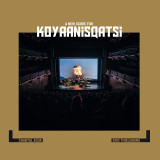
Dark-folk songwriter Chantal Acda and beyond drums-percussion musician extraordinaire Eric Thielemans propose a new score for Koyaanisqatsi, re-actualising the incredibly beautiful, raw, rhythmic and touching images of this 80-ties cinematographic masterpiece. Slow deep electric waves, lonely synths in sonic desert landscapes, rhythmic pulses, transporting drums and bells, and deeply longing sounds and voices make up the audible fundamentals of this imagined, neo shamanic, ritualistic music to accompany the Earth as it keeps on supporting our post human frenetics even today. This release contains a selection of the musical material scored for a live performance together with the screening of the movie. The live performance premiered on Film Festival Gent and Vooruit in the fall of 2022.
Currently based in Belgium, Dutch-born Chantal Acda (b. 1978) has worked under the Sleepingdog moniker since 2006, making three acclaimed albums that closed on the 'With Our Heads in the Clouds and Our Hearts in the Fields' (2010) album for which she collaborated with Adam Wiltzie (Stars of the Lid, A Winged Victory For The Sullen). They toured the UK and Benelux with Low in 2011. After all this, it was time for her first real solo record. Playing in various formations (Isbells, True Bypass, Marble Sounds) had made her conscious of the patterns that we all, as humans, share in. So, she sought out kindred spirits with whom she might record an album filled with freedom and intensity, and who were conscious of the patterns we so often fall back on. Nils Frahm was the first of these to cross her path. The inventive German pianist and producer is an intense and adventurous performer and was a perfect match for it. Acda also experienced a direct bond with Peter Broderick, a multi-instrumentalist known from his solo work (on labels such as Bella Union and Erased Tapes) and from his work with, among others, Efterklang. Cellist extraordinaire Gyda Valtysdottir from Icelandic group Múm had previously worked with Chantal as a member of the Sleepingdog live band. And lastly, Shahzad Ismaily stumbled into this picture by chance, but when Acda and he found themselves in the same room they formed an instant rapport. After this first record, 3 other solorecords followed. Chantal kept on searching for a deeper connection with the outside world and recorded "The Sparkle In Our Flaws" (2015) and "Bounce Back" (2017). She also released some live recordings with her band and also Bill Frisell, a highly respected jazz guitarist.(2018). These records were released on the German label Glitterhouse. Chantal and her band toured with these records in Europe. In 2019 Chantal created her first music/theatre performance P_wawau for Oerol Festival, The Netherlands. She worked with Valgeir Sigurdson (Björk, Bonnie Prince Billy,...) and singers from Het Nederlands Kamerkoor. As a result of this, she released the recorded music: Puwawau (2019). In 2021 Chantal released her most recent album Saturday Moon. (2021) For this album she worked with her band (Eric Thielemans, Alan Gevaert, Gaetan Vandewoude and Niels Van Heertum) but also with Bill Frisell, Shahzad Ismaily and Mimi and Alan Sparhawk (Low). Saturday Moon was very well received, internationally, by the press.
Eric Thielemans is a drummer and percussionist. Travelling across music scenes and disciplines, Thielemans navigates by means of his own compass. Most known for his resonant solo works like a Snare is a Bell, Sprang, Aural Mist and Bata Baba Loka and many collaborations with musicians in the experimental music scene, as well as the Jazz scene, and indie folk/pop/rock scenes Thielemans keeps on pushing the borders and expanding conscious aural spaces and territories. Recently, Thielemans has collaborated with PVT - a trio together with Mika Vainio & Charlemagne Palestine (album released April 2020) , PAT - a new trio together with Oren Ambarchi and Charlemagne Palestine, A new duo together with Oren Ambarchi, Billy Hart ("Talking about the Weather"), Chantal Acda ("The Sparkle in our Flaws", "Bounce Back", "Puwawau", "Saturday Moon"), Marshall Allen (Sun Ra), Tape Cuts Tape, Distance Light & Sky, Jozef Dumoulin, Trevor Dunn, Shahzad Ismaily, Vaast Colson, Nico Dockx, and many more. Currently Thielemans is working on r-e-s-o-n-a-n-c-e , a culminative work that encompasses and brings to the surface the underlying currents within his life in and with music. Withing r-e-s-o-n-a-n-c-e he investigates the everyday magic through conversations, writing and score writing to invite as many souls as possible to experience and co create the magic in the everyday.
2022 Repress
2x12", high gloss photo like gatefold sleeve, 180g Vinyl , WAV&MP3 Download code included
Following their debut EP with 'Ezra Was Right' and support from the likes of Gilles Peterson, Grandbrothers are presenting their debut album 'Dilation". Twelve modern Experimental / Ambient / Piano pieces, whose sounds are generated completely out of a grand piano using small electromagnetic hammers. Grandbrothers are Erol Sarp and Lukas Vogel. After meeting at university in Dusseldorf, Erol and Lukas formed Grandbrothers to tie together their respective musical backgrounds and disciplines: Erol is a trained jazz pianist, while by day Lukas constructs synthesizers at Access Music. Together, they create a sound that combines classical composition with modern, experimental production and sound design. Their first song, 'Ezra Was Right', earned an early supporter in the esteemed Gilles Peterson, who included the track on his Bubblers 10 compilation and played it numerous times on his Worldwide radio show for BBC Radio 6 Music, with the song eventually being voted #7 by listeners in his end-of-year poll in 2013. A full EP on FILM followed - backed by remixes from legendary Manchester DJ Greg Wilson, Optimo's JD Twitch, and Kim Brown - which sold out its initial run within ten days. Now, Grandbrothers present their debut album, Dilation. The product of two years work, Dilation builds on some of the ideas established on 'Ezra Was Right' while exploring further elements of minimalism, ambient music, IDM, and techno.
The background of this artist’s narrative pops out across themes, disciplines and styles. Hailing from Germany, having lived among others in Uganda and Morocco and calling Hamburg and Brussels a home, HDDDs journey can be felt and of course heard in every song on this record. Traditional folk wise percussions as well as deep synth lines unfold the makings of his sounds. Think of a Jazz Player who is into Fantastic Vol.1! Or maybe what Minnie Ripperton would play
for Jazzy Jeff. Listen to this record and you'll make the
journey yourself.
After Dinner’s Paradise of Replica is a concise nugget of tomfoolery that occupies a whimsical no man’s land between art pop, Japanese folk music and full-assed Art Zoydian avant proggery. Gentle, arcane and covertly sweeping, it typifies that friendly strain of experimentalism that Eastern music seems so predisposed towards and which curious minds find such great delight in.
Assembled by the enigmatic chanteuse and composer known simply as Haco, After Dinner was less a band and more of a loose art collective that utilized a plurality of different musical disciplines stapled together through free improvisation sessions. And some of this does come through on Paradise of Replica—the record is a scrapbook of bells, strings and koto humming under Haco’s ethereal vocals, and the effect, while perfectly tuneful, does come off more as a musical project than a conventional album.
But Paradise of Replica is far from an impenetrable scholastic endeavor—in fact, there’s something of an Elephant 6-like quality in its ability to warp conventions while still coming off more or less like pop music. Counter to the ramshackle hostility of much improvised music, After Dinner’s choices are melodious and feel deliberately sequenced. Even crescendos don’t tend to rise above a murmur, and there are even apparent hooks on tracks like “A Walnut” and “Ironclad Mermaid.”
Ultimately, there’s not much to be said about Paradise of Replica that can elucidate more than actually hearing it will be able to. Proggy, playful and lush, it’s a brief glimpse into something in the vicinity of genius, and just outside the realm of commercial music. It’s a quietly bold project that shows a softer side of the avant-garde, and makes a perfect companion to Stereolab and Magma at once.
Belgian instrumentalists Glass Museum have found the perfect balance between piano and drums, where jazz and electronics collide, uniting the surgical precision of the best contemporary jazz, à la Gogo Penguin and Badbadnotgood, with the electronic influences of Jon Hopkins or Floating Points.
In motion since 2016, the duo consisting of keyboardist Antoine Flipo and drummer Martin Grégoire, have a rich history written around a powerful connection to duality. From the initial impact of the 'Deux' EP in 2018, to the synthetic and organic textures of the critically acclaimed 2020 album 'Reykjavik', Glass Museum has found its balance in symmetry.
Released 29th April via the groove-obsessed Sdban Ultra label, 'Reflet' was born out of a desire for freedom, a wish to innovate and travel differently. This new piece stands out as an artistic climax crafted at the crossroads of time and genres, an electronic proposition wrought by two brave hearts, tempered by the organic reflections delivered through computer free melodies. An album which places the human at the core of its compositions and in order to return to a more instinctive and instantaneous means of creation, the duo retreated to a secret location in one of the most remote parts of the Ardennes. It's there, in the shade of spruces, that the album was first born.
Extremely cinematographic, 'Reflet' delivers a panoramic view point: jazz, breakbeat, minimal techno and deep house, collide on neo classical grounds. From the dynamic instrumentation of album opener 'Caillebotis' to the absorbing oscillations of 'Shiitake' and grand gestures of the album title track, 'Reflet' is an odyssey running through troubled times, an ode to night time, to life, dreams and to all rhythms that convey emotions beyond words. Like its immersive creative process, the album offers a counterpoint and, above all, endless perspectives. Elsewhere, the pulsing, melodic 'Auburn' and entrancing electronic textures of 'Opal Sequences' continue the exploration before the strutting 'Kendama' showcases the electronic sensibilities that are buried within their productions.
Shining as a true instrumental tour de force, 'Reflet' also takes inspiration from the progress of the Ohme Collective. At the crossroads of art disciplines, science, new technologies and societal challenges, this creative community draws the future of visual arts and created the album artwork for this resolutely futuristic album.
Having initially won the opportunity to perform at the Dour Festival, Tournai back in 2016, Glass Museum have picked up a series of awards and distinctions back home in their homeland and they now find themselves dining at the top table of Europe's contemporary music scene. The international music scene opened itself to the band once again in 2019, with the duo performing at Elb Jazz in Hamburg, the legendary Ancienne Belgique in Brussels and the Iceland Airwaves Festival, Reykjavik.
In 2020, Glass Museum distinguished themselves by remixing a track for electronic artist, Rone. Having recently received a César Award for his soundtrack to the Jacques Audiard film, Les Olympiades, the French producer called on the Brussels duo's know-how - a mark of confidence which once again underlines the international reach of Glass Museum. Germany, Iceland, Turkey, Romania, Greece, France or Czech Republic have already approved Glass Museum's singular recipe.
- 1: Connais Tu L'animal Qui Inventa Le Calcul Integral?
- 2: Evariste Aux Fans
- 3: Les Pommes De Lune
- 4: La Chasse Au Boson Intermédiaire
- 5: Dans La Lune
- 6: La Faute À Nanterre
- 7: Ma Mie
- 8: Wo I Nee
- 9: Si J'ai Les Cheveux Longs C'est Pour Pas M'enrhumer, Atchoum!
- 10: La Révolution
- 11: Je Ne Pense Qu'a Ça
- 12: Je Chante Pour Vous Faire Marcher
- 13: Je Ne Suis Pas Simple
- 14: Si Les Étoiles Pouvaient Parler
Évariste is one of the rare specimens of artist-cum-scientists. Among his kind stand others like Pierre Schaeffer, a Polytechnique graduate (an engineer but also the father of musique concrète) and the eccentric Boby Lapointe (graduate of the École centrale and inventor of the Bibi-binaire system, patented in 1968). Évariste's songwriting, joyful and full of energy (albeit extremely critical), shrouds an original tragedy: born in 1943 among résistants, Joël Sternheimer (aka Évariste) grew up without a father, lost to Auschwitz. Although he makes little reference to Jewish culture in his music, his origins leave their mark: in 1974, he sings a Hebrew song on television. In 1966, the young Joël sports Princeton's colourful paraphernalia - that's because he's freshly returning from the US, where he was sent to pursue his research on "particle mass and the interpretation of observed regularities, such as the effects of a wave" (will understand who may). When he gets there the country's in the midst of the Vietnam War. With McNamara keen to find an alternative to the nuclear weapon and calling upon the country's biggest brains to undertake the task, there's a "fund shift" within the university - a diplomatic way to give notice to whoever may not be disposed to follow the government's scheme. Joël, who's under the supervision of a rebellious physician, is dismissed. He regardless keeps following the prestigious seminaries of the Institute for Advanced Study, chaired by Oppenheimer, inventor of the atomic bomb. Likely inspired by the hippie movement and music, Joël buys a guitar and starts playing in Washington Square - after all, Bob Dylan himself started there. He blithely skips Oppenheimer and receives a warm (though surprised) welcome from a crowd thoroughly unfamiliar with French. When the ageing physicist questions him about his decreasing attendance, Joël explains how drawn he is to music, and how he thinks it could help him in self-financing his research. Évariste recalls seeing the sickened man, his face torn by remorse, lighten up to his words and say: "What's keeping you - go for it! If I was still young that's exactly what I'd do." The student takes these words as a testimony from his professor - and it's enough to convince him . And so he takes the leap during the Christmas vacations he spends in Paris. A journalist friend he often sees around the Sorbonne introduces him to the artistic director of Disques AZ. The latter passes the tapes on to the label's boss, Lucien Morisse, also program manager on Europe N°1. Morisse is blown away - and signs him onto the label right away. Michel Colombier, arranger for Serge Gainsbourg and co-author of "Psyché Rock", with Pierre Henry, contributes some of his original ideas to the 7 inch "E=mc2": Évariste's preoccupation with the percussion sound on the track "Le calcul intégral" is that it goes "poom poom" and not "tock tock" - Colombier is aware of the issue and records Évariste's guitar like a percussion in an isolated booth. The organist Eddy Louis, who is to participate, in 1969, to the success of Claude Nougaro's "Paris mai", also appears on the record. It's 1966 and the Antoine phenomenon (signed on Vogue) storms through France. The two singers share similarities: Antoine is an engineer of the École centrale, gifted with a great originality in his song-writing. A godsend for the two labels who turn this resemblance into a commercial strategy, setting them out as rivals. To this day though, Évariste still denies what was little more than slushy tabloïd gossip. Success comes around swiftly and in 1967 Évariste launches into a second 7 inch, "Wo I nee", again arranged by Michel Colombier. Quantum mechanics fans finally get their anthem with "La Chasse Au Boson Intermédiaire" (or the "Intermediary Boson Pursuit"). To sum up what's a boson, say he's a close pal of the meson, photon and other gluons. A few months later, it's May 68 and everything's turned upside down. Évariste writes a series of songs inspired by the events, which he immediately submits to Lucien Morisse. When the man behind "Salut les copains", once married to Dalida, hears the song "La révolution" - a father and son dialogue - he can't take any more: AZ simply cannot release this. But there and then Lucien Morisse makes a gesture which will remain engraved in French music's history: sorry to be unable to officially stand by the singer, he encourages him to self-produce the record, but with his tacit support. He calls the pressing factory and asks they apply the same rate for Évariste as they would for AZ. The singer and his musicians use the same studio as for the previous record, all of them playing for free awaiting a return on investment. Évariste keeps singing at the Sorbonne with "Jussieu's gang" and "the young Renaud" he nicknames "le p'tit gavroche" (or "street urchin"). Renaud volunteers to type the lyrics of the song "La révolution" so that the chorus can be sung and recorded. A boy in the group is related to Wolinski and introduces them. The two get along so well that Wolinski ends up drawing the cover for the record "La révolution", for free. The self-released 7 inch "La révolution / La faute à Nanterre" is sold under the table and door-to-door for half the price of a standard record, on and around the boulevard Saint-Michel; and it runs out fast. In the end, there will be 6 releases of the record, and 25000 copies sold. When the theatre director Claude Confortès decides to adapt Wolinski's drawing series titled "Je ne veux pas mourir idiot" ("I don't want to die a fool"), he asks Évariste to write the original soundtrack. His friend, now cartoonist for Hara-Kiri Hebdo, often promotes him in accordance with a principle dear to him by virtue of which he gives a special place to his friends. Dominique Grange (writer of the song "Nous sommes les nouveaux partisans") soon joins the team. After 150 performances, Évariste leaves his place to Dominique Maurin (brother of Patrick Dewaere). Évariste composes the songs for Claude Confortès' next play, "Je ne pense qu'à ça" ("That's all I think about"), co-wrote with Wolinski in 1969. The comedians of the play record the songs on a 7 inch, with a cover signed, again, by Wolinski. In 1971, French television produces the documentary "Évariste et les 7 dimensions", but doesn't air it. Indeed, the scientific sub-comity of the programming comity (sic) censors the show. The given justification is that "Évariste dangerously mixed science with science-fiction, numerology and other non-scientific disciplines". The underlying motive might have been a will to censor the singer-mathematician's political discourse. In the documentary and among other things, Évariste discusses hierarchy, alienation and revolution. Half a century later the documentary remains invisible, though some excerpts resurfaced in 1992 in the cult show "L'oeil du cyclone", on Canal +. Though flourishing, Évariste's career is nearing its end. 1970 is the beginning of a decade in the course of which he is to make a decisive discovery in the musical and scientific domains. Following this breakthrough, he moves away from self-produced music and gaucho magazines to focus on science. He keeps Oppenheimer's encouraging words in mind, now freely pursuing his research thanks to the sales of his records. Joël realises that when decoding protein sequences, one finds musical sequences recognisable to humans. He names them "proteodies". If, when listening to a proteody, one responds by being so sensitive as to finding it beautiful, then it reveals a deficiency of the related protein - and this peculiar music may be the cure. We could trace back the music history in light of proteins lacking in a given artist, or within a public's majority. You always thought these hysterical groupies who'd throw their underwear with passion and faint in the pit had miraculously appeared because they had never heard anything as wonderful as the Beatles? Make no mistake! For Évariste, it all boils down to an intro's protein content. Indeed, the beginning of their first hit "Love Me Do" corresponds to dopamine, the neurotransmitter linked to compulsive buying. An intro like this could only unleash the fervour of groupies, victims of fashion and biology. Évariste's success is such that the income from his sales gives him the autonomy to which he had aspired when confiding to Oppenheimer. It made it possible for him to pursue his research without any institutional constraints. He now devotes himself to his proteodies, sat in the offices of the European University for Research, just around the corner from the Sorbonne he knew so well. Évariste is no more. Joël regained control of this strange and comical beast.
Lolina project emerged at a time when CDJs became standard in clubs and artists from many disciplines began exploring their possibilities. In Lolina’s records and performances, they are used as a live sampling tool allowing her to move between composition and improvisation. On “Fast Fashion”, discarded vocal takes and phone recordings made while watching videos online or walking down the street are re-sampled across long-form collages. “Mark Ronson’s TED Talk Intro (Using Computer Remix)”, restyles a lecture about sampling and constructed of samples into a track that can’t be contained by any of its elements. Relaxed beats break down into stuttering, jokes turn into abstract situations, and meaning is altered through repetition. With transitions between different parts defining the listening experience, “Fast Fashion” reveals a process by which one thing can be changed into another. “Fast Fashion” is Lolina’s fifth album and first working with Deathbomb Arc. Digital to be released on Oct 27th with vinyl to follow in early 2022 ~ both on pre-sale now. Lolina previously released music as Inga Copeland and was a member of the band Hype Williams between 2009 — 2013.
- A1: Cool Water Feat. Ivan Conti (Azymuth) And Lars Bartkuhn
- A2: Cycle Of Many
- A3: Admira Feat. Gigi Masin
- A4: Flowers Feat. Venecia
- A5: Melt Into You Feat. Alex Malheiros (Azymuth)
- B1: Flos Potentia (Sugar, Cotton, Tabacco) Feat. Khruangbin
- B2: Sphere Feat. Jean-Luc Ponty
- B3: Warm
- B4: On My Way Home
- B5: What Do The Stars Say To You
Black Vinyl[24,79 €]
In 1990 Ronald Lee Trent Jr. was the teenage creator of Altered States – a raw, futuristic techno-not-techno anthem, which in retrospect was something of a stylistic anomaly for the young artist. Across subsequent years, with time spent in Chicago, New York and Detroit, came the development of his signature sound, and renown as a world class purveyor of deep, soul infused house/garage. This story has already been told, and on casual inspection, the well-worn platitude ‘house music legend’ is an old shoe that still fits. However, in fact, he’s actually so much more, and has been for quite a while. A genuine musician, songwriter, and ‘producer’ in the proper, old-school sense, the artist today has more in common with Quincy Jones than he does your average journeyman DJ track-hack.
To those in the know, these broader skills haven’t gone unnoticed, which is why on the highly collaborative, career-topping new LP ‘What Do The Stars Say To You’, it took little persuasion to recruit serious star power. Brazilian royalty Ivan Conti and Alex Malheriros from Azymuth, violin maestro Jean Luc Ponty, ambient hero Gigi Masin, hype band Khruangbin and more performed, whilst NY cornerstone François K provided mastering duties. At various points Ron himself played drums, percussion, keys, synths, piano, guitar and electronics.
Harking back to the 70s and 80s boom in adventurous, luxurious albums, WDTSSTY is a love letter to the longplayer, where rich musicality and a liquid smooth, silky flow make seemingly odd genre bedfellows acquiesce harmoniously. Each song its own high-fidelity odyssey, Trent incorporated a broad range of live instruments and electronics into a sophisticated, euphonic whole. Described by him as being “designed for harmonising with spirit, urban life and nature”, this is aural soul food, gently easing you into balmy nights, where everything is alright.
Originally wanting to be an architect, Trent’s views his approach to collaboration and music in general as having the same principles. A firm believer in the nourishing qualities of sound, he sees direct parallels between the two disciplines, being as the purpose of good architecture is to improve quality of life. “With WARM, through sound design, I built frameworks for the musicians, who furnished and occupied these structures beautifully, which was a big compliment for me”, he comments.
The conditions required for a good collab are more than simply structural though, as Trent expounds, “I’m a huge fan of everyone on the record, especially Jean Luc and Azymuth, who’re part of my DNA. Each track was made with that guest in mind – for example, when I started writing ‘Sphere’, I immediately thought ‘this IS Ponty’. I played the keys in his style, and did a guide violin solo using a synth, which he then re-did, amazingly. ‘Cool Water’ is based around Azymuth themes, so when I sent it to Ivan, he could immediately see himself in the piece; He got what I was going for straight away. For ‘Melt Into You’ I hit up Alex on Instagram, sent him the track, he liked it, and within 24 hours he’d sent back six different bass passes!”
“Conversely, Admira began with a sketch sent by Gigi and became something combining Jon Hassell-esque chords and the feel of ‘Aquamarine’ by Carlos Santana, which links back to Masin’s recurrent nautical theme”, he adds.
With community, history and the need for racial equality never far from Ron’s mind, ‘Flos Potentia’ translates from Spanish as flower power, but rather than promoting some hippy idyll, instead it refers to plants which drove the slave trade: tobacco, sugar and cotton. Joined by Khruangbin, together they propel Dinosaur L, Hi-Tension and afrobeat into an ethereal, clear-skyed stratosphere.
Aside from these esteemed guests, other key influences cited by Trent include ‘Gigolos Get Lonely Too’ by Prince, ‘Beyond’ by Herb Alpert, David Mancuso, Jan Hammer, Tangerine Dream, The Cars, Trevor Horn, Alan Parsons Project and pre-Kraftwerk incarnation Organization. A multitude of others are audible too, including George Bension, Vangelis, Loose Ends, Maze, Flora Purim, Weather Report, Atmosphere, Grace Jones, James Mason and Brass Construction.
On the subject of influences, although opposed to the fences erected by genre tags, to understand where Ron is coming from, and where he’s at, it’s important to acknowledge just how big the palette is from which he paints. Traversing jazz funk, quiet storm, sophisti-pop, new age, new wave, kosmische, Balearic, samba, afrobeat, Latin rock, soft rock and yacht rock, his deeply entrenched digger’s knowledge pays off in dividends.
- A1: Cool Water (Feat Ivan Conti (Azymuth)
- A2: Cycle Of Many
- A3: Admira (Feat Gigi Masin)
- A4: Flowers (Feat Venecia)
- A5: Melt Into You (Feat Alex Malheiros (Azymuth)
- B1: Flos Potentia (Sugar, Cotton, Tabacco) (Sugar, Cotton, Tabacco)
- B2: Sphere (Feat Jean-Luc Ponty)
- B3: Warm
- B4: On My Way Home
- B5: What Do The Stars Say To You
White Vinyl[31,51 €]
In 1990 Ronald Lee Trent Jr. was the teenage creator of Altered States – a raw, futuristic techno-not-techno anthem, which in retrospect was something of a stylistic anomaly for the young artist. Across subsequent years, with time spent in Chicago, New York and Detroit, came the development of his signature sound, and renown as a world class purveyor of deep, soul infused house/garage. This story has already been told, and on casual inspection, the well-worn platitude ‘house music legend’ is an old shoe that still fits. However, in fact, he’s actually so much more, and has been for quite a while. A genuine musician, songwriter, and ‘producer’ in the proper, old-school sense, the artist today has more in common with Quincy Jones than he does your average journeyman DJ track-hack.
To those in the know, these broader skills haven’t gone unnoticed, which is why on the highly collaborative, career-topping new LP ‘What Do The Stars Say To You’, it took little persuasion to recruit serious star power. Brazilian royalty Ivan Conti and Alex Malheriros from Azymuth, violin maestro Jean Luc Ponty, ambient hero Gigi Masin, hype band Khruangbin and more performed, whilst NY cornerstone François K provided mastering duties. At various points Ron himself played drums, percussion, keys, synths, piano, guitar and electronics.
Harking back to the 70s and 80s boom in adventurous, luxurious albums, WDTSSTY is a love letter to the longplayer, where rich musicality and a liquid smooth, silky flow make seemingly odd genre bedfellows acquiesce harmoniously. Each song its own high-fidelity odyssey, Trent incorporated a broad range of live instruments and electronics into a sophisticated, euphonic whole. Described by him as being “designed for harmonising with spirit, urban life and nature”, this is aural soul food, gently easing you into balmy nights, where everything is alright.
Originally wanting to be an architect, Trent’s views his approach to collaboration and music in general as having the same principles. A firm believer in the nourishing qualities of sound, he sees direct parallels between the two disciplines, being as the purpose of good architecture is to improve quality of life. “With WARM, through sound design, I built frameworks for the musicians, who furnished and occupied these structures beautifully, which was a big compliment for me”, he comments.
The conditions required for a good collab are more than simply structural though, as Trent expounds, “I’m a huge fan of everyone on the record, especially Jean Luc and Azymuth, who’re part of my DNA. Each track was made with that guest in mind – for example, when I started writing ‘Sphere’, I immediately thought ‘this IS Ponty’. I played the keys in his style, and did a guide violin solo using a synth, which he then re-did, amazingly. ‘Cool Water’ is based around Azymuth themes, so when I sent it to Ivan, he could immediately see himself in the piece; He got what I was going for straight away. For ‘Melt Into You’ I hit up Alex on Instagram, sent him the track, he liked it, and within 24 hours he’d sent back six different bass passes!”
“Conversely, Admira began with a sketch sent by Gigi and became something combining Jon Hassell-esque chords and the feel of ‘Aquamarine’ by Carlos Santana, which links back to Masin’s recurrent nautical theme”, he adds.
With community, history and the need for racial equality never far from Ron’s mind, ‘Flos Potentia’ translates from Spanish as flower power, but rather than promoting some hippy idyll, instead it refers to plants which drove the slave trade: tobacco, sugar and cotton. Joined by Khruangbin, together they propel Dinosaur L, Hi-Tension and afrobeat into an ethereal, clear-skyed stratosphere.
Aside from these esteemed guests, other key influences cited by Trent include ‘Gigolos Get Lonely Too’ by Prince, ‘Beyond’ by Herb Alpert, David Mancuso, Jan Hammer, Tangerine Dream, The Cars, Trevor Horn, Alan Parsons Project and pre-Kraftwerk incarnation Organization. A multitude of others are audible too, including George Bension, Vangelis, Loose Ends, Maze, Flora Purim, Weather Report, Atmosphere, Grace Jones, James Mason and Brass Construction.
On the subject of influences, although opposed to the fences erected by genre tags, to understand where Ron is coming from, and where he’s at, it’s important to acknowledge just how big the palette is from which he paints. Traversing jazz funk, quiet storm, sophisti-pop, new age, new wave, kosmische, Balearic, samba, afrobeat, Latin rock, soft rock and yacht rock, his deeply entrenched digger’s knowledge pays off in dividends.
Giacomo “Mino” di Martino started his musical career in several early 1960s Italian beat bands. By 1968 he had found enormous success with pop superstars I Giganti. After a brief split in 1970 –during which Mino formed Il Supergruppo with Ricky Gianco and other greats of the Italian scene– he came back to I Giganti in 1971. With them and with new advanced ideas that set the band pretty far away from the sophisticated pop and beat sounds they had been so successful with, they would record the amazing Terra in Bocca conceptual LP, an adventurous experimental album that explored the obscure connections between the Italian state and the mafia. A delicate topic full of political criticism which also found them having to fight censorship –it was played only once in the radio. This fact, along with the advanced new sound probably being too far ahead from the mainstream audience’s taste, turned the record into a commercial flop. Nowadays Terra in Bocca is a highly regarded album among critics, afficionados and collectors, and a pretty seminal one for the Italian scene of the seventies, since it can even be seen as a precursor to the works on the Cramps label. Gianni Sassi, producer and photographer who founded Cramps was involved in the release of Terra in Bocca –his is the amazing cover concept.
After the Terra in Bocca experience, Mino’s will was to keep exploring new musical paths and free his mind to experimentation. Along with his wife, actress and singer Edda “Terra” di Benedetto, they formed the Albergo Intergalattico Spaziale, just after the brief post-Giganti project Telaio Magnetico (with Franco Batiatto, among others) was over. The Albergo was a venue where artists from diverse disciplines, mainly musica and theatre, could meet and create works together.
On the musical side of the community, Mino and Terra explored the cosmic sonorities that were coming from Germany and mixed them with the Italian experimental scene of names like Franco Battiato, Luciano Berio or Roberto Cacciapaglia. It is from the sessions that took place in the Albergo from 1974 onwards that the Albergo Intergalattico Spaziale LP came out. Originally released in 1978 the compositions had been made during those years of exploration, the goal not being the release of an album but the aim to explore new sounds and experiment with music. Eventually it was decided to present a sample of all that work, and a few copies of the Albergo Intergalattico Spaziale LP were privately pressed.
The record sleeve and notes on the insert reivindicate the fight against nuclear power. The music is dominated by Mino’s keyboards, creating amazing space sounds reminiscent of those from 1950s and 1960s science fiction B movies brought to the most avantgardist experimentation of the moment, exploring new sounds with the newest keyboards available. This intriguing background sets the athmosphere for Terra’s voice to improvise all over.
Repress
Founded in October 2017 and known in first place as a party series in Essen, The Third Room expands its spectrum with their debut as a label and mastering studio as well. Those three disciplines going hand in hand and forming our vision as a creative collective. Creating, crafting and sharing the passion that drives us.
After a bitter series of event cancellations caused by the corona pandemic we had to find a way to overcome this financial crisis which has put lot of people in a difficult situation who are driven by love and dedication for what they do. In first place we wanted to give all ticket buyers who waived their refunds for the cancelled The Third Room x Bassiani event at UNESCO World Heritage's Mischanlage a "thank you" gift in form as a Fundraiser Compilation. We wanted to preserve what we have built up over the years at our home base. Because we do believe that the Mischanlage is maybe the most aesthetically-techno place we've ever seen.
We, the founders Ahmet Sisman & VNNN., reached out for artists we have invited on our events, build up a strong relationship and sharing the same ambition for what we stand for. Not only regular guests such as Dax J, Ellen Allien or SHWD & Obscure Shape who have accompanied us over the years, but also new friendships have risen up with artists like Henning Baer, Hector Oaks or Markus Suckut. Or collectives such as Lebendig, R-Imprint, Brutalism, Purify and Acid Wave Records. It is safe to say that we have our own special story with each artist on this compilation and it shows once more that music unites us in these hard times. If you like what you hear, buy the music, support the artists and the local scene. Everyone who has held their T3R x Bassiani Tickets will get a download link of the compilation.
The music of Isaac de Martin, aka IKE, blends jazz and electronic influences into warm, smooth, and often cinematic soundscapes. A certain eclecticism is not surprising considering that the Berlin-based composer, producer and guitarist was born in Italy into a musical family with British roots, studied classical guitar, graduated in jazz and went on to develop his personal style through creative experimentation, live touring and collaborative work with artists from a variety of disciplines and countries.
The Great Escape, his second album under the moniker IKE, is a collection of songs and instrumental pieces that have a common theme: the escape from – or possible antidotes to – our present techno-scientific society. It is an invitation to take courage, look into ourselves, and go back to our inner child, seen as the guardian of a world of freedom, imagination, spontaneity and natural rhythms.
The concept for the album first came to IKE in mid-2019, when he started collaborating with American singer-songwriter and actress Sera Kalo. Not only did Sera's soulful melodies, powerful vocals and heart-felt lyrics beautifully complement IKE's elegant nu jazz compositions, but the songs they penned together unlocked a specific creative vision. IKE went on to explore and capture it over the next year or so, getting on board great musicians from the US, UK, Scandinavia and, of course, Italy.
Recorded in various locations by IKE himself, the album was mixed by Nene Baratto at Big Snuff Studio, Berlin, and mastered by Fabrizio De Carolis at Reference Mastering Studio, Rome. The stunning artwork is by Italian graphic designer Franz Longhi, who, in line with the album's concept, created an analog feel by hand painting on Xeroxed photographs.