Producer Scrappy Jud Newcomb and Cleaves teamed up for the third time in early 2022 between Covid surges to record a new batch of songs, Slaid's first in five years.
Familiar themes of struggle and resilience will be a surprise to no one. As Scrappy puts it, "This album speaks to the hopeful, the hard working, the battered, confused, and the sad. But above all to the believers in the city of freedom that we heard in the stories of our youth and all those FM radio hits."
The first single, "Through the Dark," was co- written with Slaid's long- time collaborator and life- long friend, Rod Picott ("Broke Down," "Take Home Pay").
Slaid describes it simply as "a song about offering comfort in hard times."
Joseph Hudak of Rolling Stone calls Cleaves "a master storyteller, one influenced not by the shine of pop-culture but by the dirt of real life."
"More than 20 years into his career, Slaid Cleaves just keeps getting better . . .
There are few contemporaries that compare. He's become a master craftsman on the order of Guy Clark and John Prine." - Austin Chronicle
Suche:free will
Belgian jazz veterans W.E.R.F. records and JazzLab are celebrating their 30th anniversary together with three unique creation projects for which they are joining forces. One of them is with percussionist Chris Joris, a veteran of Belgian jazz who is releasing a haunting new project.
Until the Darkness Fades' immediately says something about Chris Joris' career path, in which the musical and the personal invariably overlap. This percussionist has written one of the most colorful chapters of Belgian jazz. For many years he was active within various genres, but is now mostly praised as the percussionist who constantly demolished boundaries. Not only between all those oppressive genre boxes - pop, experiment, theater, world music, jazz - but also between complete worlds.
Chris Joris was playing "world jazz" long before there was that term, and he signed on for some hot-blooded jazz classics, with "Out Of The Night" perhaps the best-known example. That album was originally released in 2003, was then unavailable for years, but is back on shelves in 2023 and on vinyl for the first time. And rightfully so. Joris also eagerly seized the prospect of a new tour and a brand new album for a musical self-portrait. With "Until the Darkness Fades," he highlights different aspects of his musical identity, both expected and unexpected.
Joris composed new material, but also keeps a prominent place for free improvisation. It will be a tantalizing dichotomy full of hybrid sounds, with familiar and less familiar sounds, between romanticism and uninhibited adventure. He explores these in the presence of notable associates on violin and cello. In this way, he combines earthy percussion with the freedom of jazz and the elegance of chamber music. Discover this story of a Belgian master who is far from finished.
An aura of mystery hangs over Jacky Giordano, a studio musician who has mostly worked for library music.He is the one behind the amazing label Freesound (Schifter, Philopsis, Challenger), but as well on Montparnasse 2000 with Pop in Devil's Train (reissued on Le Tres Groove Club), on Timing (Timing N?1 and Timing N?5, under the nickname Jacky Nodaro), on Musax with Boucles Rythmiques (under the nickname Joachim Sherylee, reissued as well on Le Tres Groove Club) or Black Devil Disco Club whose paternity for this record is still disputed between him and Bernard Fevre. Jacky Giordano wasn't an altar boy, far from it, and will have sadly been more known for his troubles with justice than for his music.This is his work for the label l'Illustration Musicale (IM) which can now be rediscovered thanks to this new reissue on Le Tres Groove Club.Organ Plus (IM26) is the sequel to Organ (IM 24), also reissued by Le Tres Groove Club. The title is misleading here, an organ not being preponderant part of the record which honours the Fender Rhodes, string machine, bass synth and clavinet. 'Be Careful', 'Riffologic', 'Twillight' : Jacky Giordano offers slow tempo jazz-funk, without losing his melancholy and low-fi groove that make his tracks immediately recognisable regardless the record label or nickname.
Prince Fatty's new independent record label Lovedub Limited kicks off with a super 7" from the man himself. It is in fact something of an homage to the 1970s jazz-funk of Lonnie Liston Smith but with some hefty dub and reggae treatment. Shniece Mcmenamin stars on vocals and brings plenty of summer soul to the groove which is also lit up with free-flying flute lines over steady reggae rhythms that will sink you in deep to Winston "Horseman" Williams and Carlton "Bubblers" Ogilvie's drums, organ and piano. On the flip is the dub with the iconic Liston-Smith melody leading you through a lazy afternoon in style.
Banshee is the new record label from internationally renowned DJ/producer Brianna Price (B.Traits/Baby T). Drawing “esoteric aggressive feminine energy” from the folkloric figure that gives Banshee its name, the imprint will focus on the output of Price’s Baby T alias.
Brianna knows her way around a dance. Years spent producing, DJing, and touring under the B.Traits alias have given Price a vast knowledge of rave culture. Now, all of that experience has been put to good use as part of Baby T’s “hardcore junglist shit only” approach. Anyone who has encountered a Baby T tune in a dark basement over the years should know that there will be no messing around with Banshee’s output. Baby T specialises in hardcore rave tackle schooled by junglism, electro and darkside techno, the project’s sound was honed via releases on labels like Samurai Music and Central Processing Unit. It’s a style at once wild yet focused, untamed yet laser-precise - This is music that will make the hairs on the back of your neck stand up – not unlike a banshee’s shriek, in fact…
The first Banshee release is not a collection for the faint of heart. Each of these four cuts is primed for deployment at the point of the party when things really kick into overdrive. Fiercely danceable, and unapologetically abrasive, Baby T’s productions here can school any challenger in the electro, techno, and jungle fields yet also carry themselves with a punkish spirit that sets them apart from the pack.
- A1: Us Against The World
- A2: Holding On
- A3: Candle Flame - Jungle, The Architect
- A4: Dominoes
- A5: I've Been In Love - Jungle Featuring Channel Tres
- A6: Back On 74
- A7: You Ain't No Celebrity - Jungle Featuring Roots Manuva
- B1: Coming Back
- B2: Don't Play - Jungle Featuring Mood Talk
- B3: Every Night
- B4: Problemz
- B5: Good At Breaking Hearts
- B6: Palm Trees
- B7: Pretty Little Thing - Jungle Featuring Bas
‘VOLCANO’ follows Jungle’s previous album ‘Loving In Stereo’, which proved to be a landmark moment for the acclaimed UK duo. It achieved their highest domestic UK chart position to date debuting at #3, while also achieving their best ever album chart positions in key international territories such as Australia, Germany, Switzerland, Belgium, Netherlands; and in the US it catapulted to #1 on the Billboard Dance Albums chart which led to major Arena shows as guests to Billie Eilish.
The free-spirited energy that runs right through ‘VOLCANO’ reflects how organically it came together. J and T had written most of the record on tour before starting the recording process while staying in an Airbnb in Los Angeles. It was later completed back home in London at their favourite location, Studio B at Metropolis Studios. This time around, the duo wanted to include a wider variety of voices within the album. In addition to Erick The Architect, they reunited with Bas (who previously featured on the ‘Loving In Stereo’ single ‘Romeo’) for ‘Pretty Little Thing’, as well as calling on talents in the shape of Roots Manuva, Channel Tres and JNR Williams.
RIYL: Sigur Ros, Explosions in the Sky, Bark Psychosis, Caspian, Mogwai, This Will Destroy You. Exclusive vinyl colour (Opaque Mix Hellfire), limited to 1000 copies, and features a gatefold jacket, printed two-sided Euro sleeves, four art prints, and download code. Breaking from the strange monotony and abnormal norms that took hold during two years of pandemic life, Hammock returns with Love in the Void, an album that looks to the future, seizes the present, and unabashedly relishes the experiences and bonds that bring meaning to our days. Known for crafting orchestral works of stirring cinematic ambience, on Love in the Void the Nashville-based duo of Marc Byrd and Andrew Thompson bring guitar-forward, heart-pounding urgency to songs that shout through and shatter the static of complacency. Since forming as Hammock in 2003, Byrd and Thompson have released 14 critically-acclaimed albums and are renowned for their unique talent for bringing inexpressible emotion to life. The Covid-19 pandemic followed closely after one of Hammock’s career-defining works, the Mysterium, Universalis, and Silencia trilogy that chronicled the incomprehensible loss of Byrd’s 20-year old nephew. At their homes and apart, Byrd and Thompson then recorded Elsewhere, an album of shimmering ambience that channelled alienated longing and displacement into avenues that gave way to worlds and possibilities yet realized. Shaken awake and needing to break free of frustrations and longings, Love in the Void pulses with an unbridled spirit for action and experience and a burning desire for connection. Across songs that hammer home the keenly felt emotions of life’s highs and lows, Byrd and Thompson crest soaring crescendos awash in reverb and delve to keenly felt moments of quiet introspection, with unflinching lyrics on tracks like “Undoing” and “Denial of Endings’’ that weigh choices made and circumstances that can’t be changed. Lush and dramatic string orchestration from Matt Kidd (Slow Meadow) and emphatic drumming from Jake Finch heighten the stakes in play, and Christine Byrd’s (Lumenette) ethereal vocals leave mysteries lingering in the haze. Love in the Void is Hammock’s loudest album to date, embracing daring and vulnerability with palpable vitality at its core, and moving into an unknown future without fear.
: Daft Punk, SAULT, BADBADNOTGOOD, Surprise Chef. Eraserhood Sound's mysterious, intergalactic house band Fantasy 15 are finally ready to unleash their debut LP, Zoltandia. After years of rising anticipation which saw the group release a handful of now-sold out, highly sought-after 45s, Fantasy 15 have delivered a modern synth-funk opus. The album, named after the group's remote home planet, is a dazzling display, and features an audacious blend of soul, funk, disco, boogie, house, hip hop, New Wave, and much more. Zoltandia is a true sonic journey, a concept album that tells the fantastical tale of the beloved freedom fighters Fantasy 15. The group, whose true identity has always been a mystery, push the limits of their musical experimentation further than ever. Leading single "Interplanetary Lover" features the show-stopping Kendra Morris on lead vocals, and serves as the group’s first proper love song. Elsewhere, the title track "Zoltandia" features chanting group vocals and a disco-boogie groove that nods to legends like William Onyeabor and Kiki Gyan.
Black Truffle is pleased to announce The Leisure Principle, a new solo LP from London-based bassist and sound artist Otto Willberg. A key player in the London underground, Willberg is often heard on acoustic and electric bass in free improv settings and bands with Laurie Tompkins (Yes Indeed) and Charles Hayward (Abstract Concrete), as well as the fractured No Wave unit Historically Fucked. His previous solo releases have ranged from extended technique double bass to explorations of the acoustics of a 19th century artillery fort. But nothing Willberg has committed to wax so far prepares a listener for The Leisure Principle, six unashamedly melodic improvisational workouts created almost entirely with heavily filtered bass harmonica and electric bass. On the opening ‘Reap What Thou Sow’, a single-note bass harmonica loop pulses along underneath a roaming bass solo, the side-chained envelope filtering (where the dynamic behaviour of the bass determines the filter for both bass and harmonica) fusing the two instruments into a single stream of burbling shifts in resonance. After several minutes of patient exploration of this low-end landscape, the music suddenly opens up in widescreen with the entrance of Sam Andreae’s graceful melodica chords, spreading out across the stereo field. From this epic opener, each of the remaining pieces goes on to explore a slightly different aspect of the terrain. On ‘Shadow Came into the Eyes as Earth Turned on its Axis’, a similarly buoyant harmonica bass line provides the foundation, but this time playing a soulful descending riff, its almost R&B feel abstracted and half-obscured by the filtering. On ‘Mollusk’, echoed bass arpeggios skitter between elegiac chords somewhat reminiscent of the opening of John Abercrombie’s ‘Timeless’, before settling into a hypnotic groove. On the record’s second half, Willberg pushes further into the possibilities of his idiosyncratic instrumentation. On ‘Wetter’, bass and harmonica come together into a monstrous, growling jaw harp; on ‘Had we but world enough and more time’, the subtly shifting pulsating patterns start to feel almost like a kind of evaporated, drum-less dub techno until an eruption of wheezing bass harmonica gives the piece a comically folkish turn. Willberg’s melodically inventive and virtuosic bass performance calls to mind any number of fusion touchstones, from Jaco Pastorius to Mark Egan’s singing tone in the early Pat Metheny Group—even Anthony Jackson’s work with Steve Kahn. But with its radically reduced instrumentation, The Leisure Principle is also an exercise in minimalism, and the absence of percussion gives even its funkiest moments a strangely abstracted quality. At times, its uncanny blend of the abstruse and the immediate suggests the fried pop experiments of David Rosenboom or the skewed but deeply musical DIY of 80s underground groups like De Fabriek. Both easy on the ear and profoundly strange, The Leisure Principle proudly takes its place among the most eccentric offerings on the Black Truffle menu.
- The Scum Always Rises To The Top
- Morbid Bails
- Les Mufflers Du Mal
- Ride Into The Rot (Everything Lewder Than Everything Else)
- Triple D (Dead, Drunk, Depraved)
- Lucifer?S Bend
- Brain Bucket
- Open Road X Open Casket
- Motortician
- Interquaalude
- Sissy Bar Strut (Nymphony 69)
- Cycling For Satan Part Ii
Cursed to ride forever on this mortal plane after partaking in a satanic drug ritual, the Death Wheelers pledge allegiance to the god of hell and fire. However, in order to prove themselves to their newly anointed leader and for the spell to take effect, the club Will need to engage in a series of lewd acts of sex and violence across the country.Immortality comes at a price and you’re about to pay for it… The beating heart of The Death Wheelers is a rumbling engine. Since their self-titled debut in 2015 and in 2020’s cinematic-storytelling breakout, Divine Filth, the Canadian outfit have tapped into wind-through-hair freedom and careened down open roads of groove, not a cop in sight. Their third record, Chaos and the Art of Motorcycle Madness, more than lives up to its name on all fronts. With songs like “Morbid Bails” and “Lucifer’s Bend,” the in-the-know references abound, and The Death Wheelers draw from classic underground metal, scummer heavy rock and cast themselves into a cauldron of cultish biker devil worship, reveling in any and all post-apocalyptic dystopias with genuine glee at having just seen the world eat itself. You might hear some surf guitar. Crazy things can happen. A sample in “Triple D (Dead, Drunk and Depraved)” underscores the message: “We want to be free to ride our machines without being hassled by the man. And we want to get loaded.” That line, from Roger Corman’s 1966 film The Wild Angels, serves as a mission statement, and as “Lucifer’s Bend” starts by laughing about how you can’t get away from Satan, they might as well carve it into their forearms to be ready when the blast of distortion hits, as much Entombed as Motörhead, galloping and sinister, coated in road dust and blood. The band tells the story like this: “Cursed to ride forever on this mortal plane after partaking in a satanic drug ritual, the Death Wheelers pledge allegiance to the god of hell and fire. However, in order to prove themselves to their newly anointed leader and for the spell to take effect, the club will need to engage in a series of lewd acts of sex and violence across the country. Immortality comes at a price and you’re about to pay for it…” While forging songs adherent more to ideology than style, The Death Wheelers cast their biker cult in their own image, and on Chaos and the Art of Motorcycle Madness, they challenge death head-on as only those with no fear of it could hope to do.
- A1: Ballad Of A Dead Soulja
- A2: F*** Friendz
- A3: Lil' Homies
- A4: Let Em Have It (Feat Skg)
- B1: Good Life (Feat Big Syke & Edi Of The Outlawz)
- B2: Letter 2 My Unborn
- B3: Breathin (Feat Outlawz)
- B4: Happy Home
- C1: All Out (Feat Outlawz)
- C2: F***** Wit The Wrong N****
- C3: Thug N U Thug N Me (Feat K-Ci & Jojo - Remix)
- C4: Everything They Owe
- D1: Until The End Of Time (Feat Rl)
- D2: Mob (Feat Thug Life & Outlawz)
- D3: World Wide Mob Figgaz (Feat Outlawz)
- E1: Big Syke Interlude
- E2: My Closest Roaddogz
- E3: N***** Nature (Feat Lil Mo - Remix)
- E4: When Thugz Cry
- F1: U Don't Have 2 Worry (Feat Outlawz)
- F2: This Ain't Livin
- F3: Why U Turn On Me
- G1: Lastonesleft (Feat Outlawz)
- G2: Thug N U Thug N Me (Feat K-Ci & Jojo)
- H1: Runnin On E (Feat Outlawz)
- H2: When I Get Free (Feat J Valentine)
- H3: Until The End Of Time (Feat Richard Page - Rp Remix)
- G3: Words 2 My First Born (Feat Above The Law)
- G4: Let Em Have It (Feat Left Eye - Remix)
Until the End of Time is the seventh studio album, and third posthumous album by 2Pac. It follows his previous posthumous albums R U Still Down? (Remember Me) and Still I Rise. The album consists of material recorded while the rapper was on Death Row Records from 1995–1996. The album debuted at number one on the US Billboard 200 chart.
A majority of the music compositions were remixed from their original state. Highly anticipated, Until the End of Time was ultimately one of the best selling hip hop albums of 2001. There were only three times references to Death Row Records were not censored (“Until the End of Time” (both versions), “U Don’t Have 2 Worry”, and “All Out”). The core vocal tracks and some instrumentation was recorded during and after the All Eyez On Me and Makaveli: The Don Killuminati: The 7 Day Theory sessions.
This will be a 180 gram 4LP 20th anniversary reissue of the long out-of-print, 4x platinum, posthumous album.
Whispers is the first proper P.G. Six album since 2011"s Starry Mind. Time passes slowly, as they"ve been known to say out in the country, and before you know it, there"s a bunch of it behind you. After five releases in the first decade of P.G. Six, it may seem a bit of a surprise to have not heard something new in the past twelve years - but a cursory listen to Murmurs & Whispers will answer why, as the deep acoustic focus of the tracks imply an investment of the type of compassion and understanding that takes time and concentrated effort to conjure. Additionally, Pat Gubler"s always got a few pots going at once in his ever-expanding musical universe. He"s been active since the mid-90s, first with Memphis Luxure and Tower Recordings, then as P.G. Six, and as a member of Metal Mountains, Wet Tuna, Garcia Peoples and Weeping Bong Band. Additionally, some time was spent making collaborative records with Dan Melchior (in 2019) and Louise Bock (in 2021). Pat"s been playing the harp for more years than he"s been in bands, but when he realized that he was writing a set of songs centered around harp compositions, he spent some time in the woodshed with his instrument, a late 80s model Triplett Celtic 34 String Harp (which replaced a lovely Paraguayan harp he"d played for years previously). After the previous P.G. albums of electric band arrangements, he was in a place of writing songs with more silence in them. He ended up playing a lot of the parts himself on Murmurs & Whispers, adding guitar, bass, keyboards, recorder and hurdy gurdy, in addition to his harp and vocals. Clark Griffin and Wednesday Knudson, who Pat plays with in Weeping Bong Band, played and sang a bit themselves, and the record was recorded piece by piece in houses around upstate New York by Mike Fellows. Returning to the quiet acoustic sound of the first couple of P.G. Six albums, Parlor Tricks and Porch Favorites (which has seen a much-needed reissue in the past year after too many years OOP) and The Well of Memory, Murmurs & Whispers is more straightforward in expressing its vision of rural celestial wonder. Bucolic and comfortably lived in, Murmurs & Whispers nonetheless projects the transcendent heart of P.G. Six once again, and as ever, it is magnificent to hear it passing through us.
In 1972, a foursome of design students set out to make a record. This was, in many ways, a strictly creative endeavor. The quartet — composed of Dave Pescod, Alan Lewis, Phil Rawle, and Ted Rockley — were all trained, not as musicians, but as creatives. Art school heavyweights, the four were well-versed in the methodology of intentional experimentation, in the delicate balance of pushing the limits without completely unmooring oneself from a guiding creative intention. Emboldened by a high-brow familiarity with thoughtful experimentation and all the non-conviction of non-musicians, Bowes Road Band’s stint in the world of popular music yielded a record that is as much mind-melting as it is a direct product of its time. Their sprawling LP “Back in the HCA” embodies the exigence “art for art’s sake,” but it is for art’s sake that this record, however off the deep end it seems to travel (hear: “Doctor, Doctor”), remains a unified, and stunning, body of work. The LP’s do-ityourself garage rock noisemaking meets highfalutin creative processes. “Back in the HCA” is warbling psychedelic freakout (“Two Fingers,” “Doctor, Doctor”), Donovan-esque English countryside folk stylings (“Inside My Head,” “Goodbye to Rosie”), and avant-garde jazz improvisions (“Grass is Grass,” “Tomorrow’s Truth”) in one luminous release.
Originally an 9-track LP, Jakarta, Uno Loop, and Bowes Road Band decided to mine the six most cohesive tracks for the reissue, though the extras may be released somewhere down the line. Cohesion efforts aside, “Back in the HCA” stands alone in its singular conception of a genre-bending continuum — it evades definition. That said, the LP can easily be situated in the sonic environment in which it was conceived. By the end of the 60s, England was crawling with blues-based rock outfits that were starting to venture into prog rock territory. You can hear this popular dint cast over the folkier side of the LP. But Bowes Road Band was armed with their non-musicianship: they existed completely liberated from the motivating yet ultimately paralyzing lust for stardom. Enjoying this liberation, Bowes Road Band was utterly free to make noise. This freedom meant drawn out sax interludes amidst sweetly folk stylings (“Grass is Grass”) and Shaggs-like fuzzed-out freakouts that spiral into a void (Doctor, Doctor). This freedom also meant straight-forward tuneful cuts like “Goodbye Rosie” that conspicuously introduce heavily distorted auto-organ accompaniment mid-track amidst poignant lyricism. Bowes Road Band crafts a unified sound and then cracks it open.
With a completely off-the-radar status, Bowes Road Band could only press 50 copies of the record — 10 for each of them and 10 for the school. The band’s lifespan was to end there, or so they thought. “Back in the HCA” was the accidental fruit of a Berlin flea market treasure hunt by Jannis Stürtz, DJ and co-founder of Habibi Funk and Jakarta Records. After finding and sharing the LP with a few colleagues, Stürtz managed to get in touch with the band, get ahold of the master tapes collecting dust in Ted Rockley’s attic, and start the reissuing process. The record is still adorned with its original cover art designed by Alan Pescod, both reminiscent of bygone school days and the Zoom calls of yesterday — in short, reunion. Its re-discovery was happenstance and ought to be listened to as such. That is, “Back in the HCA” was not made to be listened to on a broad scale, or, at least, was not made with this goal in mind; it is neither in its time nor of its time. Of course, the group explicitly cites the folk tunes of the English countryside, the distorted rock groups that reigned during the record’s conception, and the fringes of psychedelic music that only the uber-underground might recognize (e.g., “Dreaming of Alice”). Yet still with these obvious influences, “Back in the HCA” always existed beyond the domain of both traditional musicianship and conventional commodification. Bowes Road Band’s DIY musicality beams through in technicolor across “Back in the HCA.” The vinyl includes an 8-page booklet detailing the albums creation and interviews with the band.
Lead single “Grass is Grass,” out July 14 along with album pre-order, encapsulates the record’s range: the track unfurls into a sprawling sax-driven trip following a sundrenched, Donovan-esque intro w/ lyrics “naively about parks and gardens, not marijuana!” The keyed-down folk cut “Goodbye to Rosie” is single 2 and elevates stripped-down acoustics with golden tinges, out August 4th. Focus track “Tomorrow’s Truth” constructs the fuzzed-out underbelly of acid folk. Listen for echoes of late Beatles, Mark Fry, and Donovan (if they were armed by an unshakabele willful naiveté). Like Sgt. Pepper’s on a shoestring budget—take a trip to the underground with LP “Back in the HCA,” available everywhere physically and digitally on September 1st via Jakarta Records and Uno Loop.
Besides online promotion from label profiles, the album will be further promoted by external agencies within the UK and US.
Whispers is the first proper P.G. Six album since 2011"s Starry Mind. Time passes slowly, as they"ve been known to say out in the country, and before you know it, there"s a bunch of it behind you. After five releases in the first decade of P.G. Six, it may seem a bit of a surprise to have not heard something new in the past twelve years - but a cursory listen to Murmurs & Whispers will answer why, as the deep acoustic focus of the tracks imply an investment of the type of compassion and understanding that takes time and concentrated effort to conjure. Additionally, Pat Gubler"s always got a few pots going at once in his ever-expanding musical universe. He"s been active since the mid-90s, first with Memphis Luxure and Tower Recordings, then as P.G. Six, and as a member of Metal Mountains, Wet Tuna, Garcia Peoples and Weeping Bong Band. Additionally, some time was spent making collaborative records with Dan Melchior (in 2019) and Louise Bock (in 2021). Pat"s been playing the harp for more years than he"s been in bands, but when he realized that he was writing a set of songs centered around harp compositions, he spent some time in the woodshed with his instrument, a late 80s model Triplett Celtic 34 String Harp (which replaced a lovely Paraguayan harp he"d played for years previously). After the previous P.G. albums of electric band arrangements, he was in a place of writing songs with more silence in them. He ended up playing a lot of the parts himself on Murmurs & Whispers, adding guitar, bass, keyboards, recorder and hurdy gurdy, in addition to his harp and vocals. Clark Griffin and Wednesday Knudson, who Pat plays with in Weeping Bong Band, played and sang a bit themselves, and the record was recorded piece by piece in houses around upstate New York by Mike Fellows. Returning to the quiet acoustic sound of the first couple of P.G. Six albums, Parlor Tricks and Porch Favorites (which has seen a much-needed reissue in the past year after too many years OOP) and The Well of Memory, Murmurs & Whispers is more straightforward in expressing its vision of rural celestial wonder. Bucolic and comfortably lived in, Murmurs & Whispers nonetheless projects the transcendent heart of P.G. Six once again, and as ever, it is magnificent to hear it passing through us.
If you dig deep enough into the underground you will find the most precious jewels and it ain't that much of an effort these days to turn on the computer and trip through the colorful World Wide Web. But beware for not all the glitter is gold. I stepped by some dark and dusty back street club in Atlanta / Georgia, USA and some enchanting music tempted me to enter. A powerful raspy voice screaming out the pain of the world no matter if it were big or small affairs. "California dreaming on such a winter's day", wow, when the MAMAS AND PAPAS sang this in a sweet folk manner it was a light and joyful anthem for all hippies and hipsters back in 1966, like a call to love. Lee Moses' version is more of a desperate cry for sunshine and freedom. And it goes on this way. His voice has this special phrase showing determination, pain but also sheer joy of life. His 1971 album is a steady groover with a steaming hot band performing , which includes a brass section of divine greatness. These devoted players build up a massive wall of groove and melody on which Lee Moses can unleash his voice like a volcanic eruption. The groove itself stays quite relaxed but definitely hypnotizing throughout the whole album and clears up your mind for the message of love Lee Moses raves about. The high skills of Lee's backing band gets showcased in a steaming instrumental version of THE FOUR TOPS' "Reach out (I'll be there)", which appeared on an early 7" first and got added here as a bonus track. They don't stop for THE BEATLES' "Day tripper" either and next to "California dreamin'" you can find another heart warming version of "Hey Joe" on the regular album. Not as extraordinary outraging as Hendrix' turn on this classic Lee and his mates make it a slightly more epic effort. All in all this is a soul album with very few covers and even more classic anthems of this genre that should actually be worshipped by lovers of the late 1960s Motown sound. Especially the bonus tracks will drive you wild. Go for it, brothers and sisters.
What started as a one off project for a bit of fun on the Fuzzbrain Records Compilation LP in 2019, quickly mutated into a fully fledged band made up of four UK heads with plenty under their collective belts: Ben Woolf (Blind Authority, Lawful Killing, Frame Of Mind, Stages in Faith, Layback), Bobby Cole (The Annihilated, Churchgoers), Jon Osbourne (Mastermind), and Ollie Hudd (Fortbragg Zine). When QC heard this ‘demo’ it was so in your face we just knew we had to put it on wax, because this blend of Krackdown and Outburst era NYHC with a still distinct London hardcore sound will blow your fuckin’ face off! Live expect some crazy energy and antics that’s hard as nails. Who else is gonna do a hardcore version of the James Bond theme? Stay warned, friends.
Monsieur Dimitri from Paris works his magic on Casbah 73's organic disco grooves with a remix treatment that surpasses all expectations.
'To Be Free' and 'Doing Our Own Thing' had a fantastic response when released on 12", at the end of 2019. It received wide support from people in the know like Red Greg, Danny Krivit, Folamour, Soul Clap, Kenny Dope and many others. The first pressing quickly sold out and the tracks were sounding strong on discerning dancefloors until, well, "The Thing" hit and everything stopped.
Despite this, the record has continued to grow by word of mouth, and so we thought it would be wonderful to have a 7" version with an edit or even a remix of the jazzy funky disco banger 'Doing Our Own Thing'. No one better than Dimitri from Paris for the job, one of the DJs who happened to tell us he loved the track. His two-part edit of 'Doing Our Own Thing' is a bomb that will make people dance for years to come.
- 1: Spectacular
- 2: Best Believe
- 3: Vibe Check (Ft. Cadence Weapon)
- 4: Baby Boy (Ft. Paul Wall)
- 5: Loosen Up (Ft. B.k. Habermehl)
- 6: Alexis (Ft. Harriet Brown)
- 7: We Still Here (Ft. Harriet Brown)
- 8: Opportunist Convention
- 9: Kickin’ In
- 10: Don’t Tap In / Contusion (Feat. B L A C K I E)
- 11: Boss Up
- 12: Make A Baby
- 13: Jasper, Tx
With I Will Make a Baby in this Damn Economy, Fat Tony embodies the kind of quixotic figure he would rap about; a singular entity who’s motivated, confident, and hungry; a perpetual-motion-machine locked in a staring contest with his country. It’s the latest album in his catalog produced entirely by L.A-based producer Taydex since 2020’s Wake Up. Later that same year Fat Tony released Exotica, and ever since he’s demonstrated he is in his own lane as a professional rapper with the mind of a magician, as quick to conjure an image as pull it out from under you, deftly manoeuvring through so many details and references a listener feels as if they have witnessed the work of an illusionist. He paints these canvases inside of songs that rarely spill past three minutes; they’re pocket-sized diaries replete with acute observations, character studies, microdoses of storytelling, and single-minded ruminations on a topic that bud, blossom, and fade before too long. Fat Tony & Taydex’s I Will Make a Baby in this Damn Economy cements Tony’s status as someone whose albums are not so much lyrically-lyrical as they are picaresque.
As with any Fat Tony project, the bars are tight as ever, but are so fluid for the 34-year-old it’s almost easy to take for granted the details, warmth, and humanity inside his free-associative tales of day-one friends who’ve passed, edgelord grifters who want to spit game, and nights on ketamine. Taydex’s production sprints through disparate yet simpatico styles, dipping its toes into Pi’erre Bourne-esque bass (see lead single “Spectacular”), house (“Loosen Up”), and even hyperpop. Meditations on loss and grief are woven throughout, but Tony throws a few curveballs as well: Consider “Alexis,” which sweetly reflects on a long-term platonic friendship. Taydex finds a Teddy Riley-indebted New Jack Swing groove just deep enough for the feeling to land and underlines the song’s sincere candor. This is the appeal of Fat Tony writ-large: his boisterous voice and genial personality invite you to the party, then you stick around to hear what he’s saying, which is frequently more introspective and complex than one assumes.
Written and recorded in Taydex’s new studio in North Hollywood, Tony says, “We had much more freedom and flexibility in making this album and you can hear it. It felt like a family project.” If the album is comfortable and loose, it is also dense and substantial. The album’s final two tracks contextualize the immediacy of what came before it—the mezcal with ices drank, Paul Wall swangin’ through to drop knowledge, the Polaris Prize-winning rapper Cadence Weapon providing a vibe check. “Make a Baby” accounts for Tony who’s seen everything, and knows he’s met the one to be a father with, and yet chooses to take his time to get it done. Taydex’s beat recalls turn-of-the-century R&B and the millennial promise of an endless good time. Sombre closer “Jasper, TX” is Tony coming to grips with the story of James Byrd, Jr., a Black man from East Texas dragged to his death by three white supremacists in 1998. These songs are not only trademarks of Tony’s fastidious rapping—they are deeply personal examples of his approach to artistry and life itself, where every decision is made in the shadow of history.
It’s here the mission statement of I Will Make a Baby in this Damn Economy comes into focus—you get the sense he means it, he’s ready for it, he’ll fight for it. He’s waiting to take the world at its word.
- A1: The Preacher
- A2: Poinciana
- A3: Watch Your Step – The Steampacket
- A4: The Sidewinder - The Steampacket
- B1: Walkin’ - Sonny Boy Williamson
- B2: See A Man Downstairs - Sonny Boy Williamson
- B3: In& Out
- B4: Red Beans & Rice Live (Ce Soir On Danse, Paris)
- B5: I Wanna Take You Higher
- C1: Indian Rope Man
- C2: Light My Fire
- C3: This Wheels On Fire
- C4: Save Me (Live - Piper Club, Rome)
- C5: Jeanine
- D1: Total Eclipse
- D2: A Better Land
- D3: Fill Your Head With Laughter
- E1: Whenever You’re Ready
- E2: Straight Ahead
- E3: Inner City Blues - Alternative Mix
- E4: Freedom Jazz Dance (Live At Winter Garden)
- F1: Planet Earth Calling
- F2: Night Train To Nowhere
- 1: We Can Look Up
- 1: 2 Morning
- 1: 3 Feel The Light
- 1: 4 Breathe
- 1: 5 The Lake
- 1: 6 Dusty Road, So Kind
- 1: 7 As Long As I Can Go
- 1: 8 Right Down There In Your Tributary
- 1: 9 The Orient
- 2: 1 Lift
- 2: Silent Signs
- 2: 3 Heroin(E)
- 2: 4 Love Long Gone
- 2: 5 First Impression
- 2: 6 Bones
- 2: 7 Heart For Hire
- 2: 8 Dead Anchor
- 2: 9 Ragstock
- 2: 10 We
- 2: 11 Dash
- 2: 1 Time To Know
- 3: 1 What Are They Doing In Heaven Today?
- 3: 2 Step It Up And Go
- 3: Phil's Instrumental
- 3: 4 Louis Collins
- 3: 5 Old Dollar Mamie
- 3: 6 Two Scenes
- 3: 7 Sea Legs
- 3: 8 Abel + Cain
- 3: 9 Half Life
- 3: 10 Afro Blue
- 4: 1 Four Keyboard Phase In A
- 4: 2 Cybernetic Meadow
- 4: 3 Paul's Park
- 4: Justin's Phase Piece
- 4: 5 Exercise In Abandonment
- 4: 6 Bones
- 4: 7 I Live The Life I Love (I Love The Life I Live)
- 4: 8 My Beautiful Reward
- 4: 9 A Satisfied Mind
- 4: 10 Come And Go With Me (To That Land)
- 5: 1 Intro
- 5: 2 I Been Drinking
- 5: 3 Down On The Banks Of The Ohio
- 5: 4 Silent Signs
- 5: Please Find Me Here
- 5: 6 Abel + Cain
- 5: 7 We
- 5: 8 Will The Circle Be Unbroken?
- 5: 9 Afro Blue
- 6: 1 Intro
- 6: 2 The Longest Train
- 6: 3 No Depression In Heaven
- 6: 4 Red Shoes
- 6: 5 Song For A Lover (Of Long Ago)
- 6: Ain't No More Cane
- 6: 7 Easy
- 6: 8 All Tomorrow's Parties
- 6: 9 A Satisfied Mind
- 6: 10 Come And Go With Me (To That Land)
- 7: 1 Song For A Love (Of Long Ago)
- 7: 2 Epoch
- 7: 3 Baby Done Got Your Number
- 7: 4 Brief Scene
- 7: 5 Where We Belong
- 7: 6 Red Shoes
- 7: Heroin(E)
- 8: 1 Hazelton
- 8: 2 Frail Sail
- 8: 3 Game Night
- 8: 4 Easy
- 8: 5 Liner
- 8: 6 Song For A Lover (Of Long Ago)
- 8: 7 Hannah, My Ophelia
- 9: 1 Look Down That Long, Lonesome Road
- 9: 2 Handwriting On The Wall
- 9: 3 Hands Up
- 9: 4 Funeral Lights
- 9: 5 Lazy Suicide (Edit)
- 9: 6 Carolina Days
- 9: 7 Trials, Troubles, Tribulations
- 9: 8 Worried Mind
- 9: Set Me Free
DeYarmond Edison war der Vorläufer von Bon Iver und Megafaun. Im Sommer 2005 verließen vier Freunde Wisconsin in Richtung North Carolina mit einem einzigen Ziel: der Folk-Rock-Flaute zu entkommen. Während eines Jahres intensiver Konzentration, des Studiums und der Verletzlichkeit taten sie genau das, indem sie an den ekstatischen Rand des New Weird America vordrangen und von allem ein bisschen ausprobierten - Grindcore und Gospel, Free Jazz und Phasenstücke, Bluegrass und Blues - und es in DeYarmond Edison packten. Der Rest ist Geschichte_ Ein Mitglied ging nach Hause, um das zu gründen, was später Bon Iver werden sollte, während drei vor Ort blieben, um Megafaun zu gründen. Epoch ist die Geschichte von DeYarmond Edison: Brad Cook, Phil Cook, Justin Vernon und Joe Westerlund, erzählt wie nie zuvor. Die Sammlung umfasst fünf LPs, vier CDs, Dutzende von ungehörten Aufnahmen und ungesehene Fotos. Begleitet wird sie von einer ausführlichen Biografie des Schriftstellers Grayson Haver Currin, der auch als ausführender Produzent der Sammlung fungiert. Alles in allem fängt Epoch die Zeit ein, bevor aus diesen vier Freunden zwei andere, aufsehenerregende Bands wurden. Es ist eine Geschichte über Gemeinschaft, Visionen, Familie und ein Quartett, das zu gut sein wollte, um zu bestehen. Es gibt Momente des Experimentierens, subtile Wendungen im Fuzz von "Epoch" und eine stampfende Herangehensweise beim Covern von "All Tomorrow's Parties", die den Grundstein dafür legten, wie Bon Iver und Megafaun die akustische Musik ein wenig umkrempeln würden. Aber ein Großteil von Epoch unterstreicht die einzigartige Sichtweise der Gruppe auf amerikanisches Songwriting, auf das Nehmen von Patchworks, das Finden der Akkorde und das Singen aus vollem Herzen. "Trials, Troubles and Tribulations" ist ein Beispiel dafür. Am bekanntesten ist es als Duett von Justin Vernon und Sharon Van Etten, das hier in ausufernder Last-Waltz-Manier wieder zum Leben erweckt wird, mit Vocals von Megafaun, Justin Vernon, Frazy Ford und Fight the Big Bull. Jede Platte ist gleichermaßen ein Crash-Kurs in allem, was dieses spezielle Stück Musikgeschichte ausmacht: Fotos aus Hinterhöfen und Kellern; Essays, die bestimmte Aufnahmen beschreiben; Farbpaletten, die Zeit und Ort widerspiegeln. Mit über sieben Stunden und 55.000 Wörtern ist Epoch eine maximalistische Sammlung. Aber man muss kein Komplettist sein, um zu verstehen, was es bedeutet, sich mit seinen besten Freunden zusammenzukauern und Dinge zu erschaffen, für diese Dinge zu träumen, zu lernen, zu kämpfen und zu wachsen.
Crème de la Deutz are a desire freeway and palm lodging. Mousy trees yearning for shell stars. During the release phase Crème de la Deutz will show an exhibition at Matjö, Cologne as well as perform at Kunsthalle Düsseldorf / Salon des Amateurs and at Temporary Gallery, Cologne on the occasion of Düsseldorf Cologne Open Gallery Weekend.
Steam Down have released an incredible new single ‘EMPOWER’, which is available now on Decca. It’s the first taste of the hugely influential London collective’s debut EP, ‘Five Fruit’, which will see a release on September 24th. After years of building a truly engaged community - and taking London’s melting-pot to the world’s stage - ‘EMPOWER’ marks a thrilling new musical chapter for Steam Down. Uplifting, urgent and emotive, the track affirms the power of the listener, the strength of collective hopefulness, and the textures of London’s inner-city subculture. Featuring the fast-paced verses of Tinyman and Afronaut Zu (alongside Theon Cross, who has played with Kano and Sons of Kemet), here is a sound that bridges grime with jazz, and turns it all into something unmistakably Steam Down.
- A1: I Wanna Dance With Somebody (Who Loves Me) (Who Loves Me)
- A2: Just The Lonely Talking Again
- A3: Love Will Save The Day
- A4: Didn't We Almost Have It All
- A5: So Emotional
- B1: Where You Are
- B2: Love Is A Contact Sport
- B3: You're Still My Man
- B4: For The Love Of You
- B5: Where Do Broken Hearts Go
- B6: I Know Him So Well
Whitney did more than turn Whitney Houston into a pioneering sensation known around the world by her first name. Originally released in June 1987, the singer's blockbuster sophomore record became the first album by a female artist to debut at No. 1 on the Billboard 200 chart — a position it claimed for a total of 11 weeks en route to selling more than 10 million copies in the U.S. The Diamond platinum effort also contains four No. 1 Hot 100 hits that, when combined with the three chart toppers from her 1985 debut, gave her seven consecutive No. 1 singles — an accomplishment that no other artist has accomplished. Commercially and creatively, Whitney stands on hallowed ground — especially now that the record plays with a sound that puts into perspective just how extraordinary, engaging, and vital Houston's music remains.
Mastered from the original master tapes and pressed on MoFi SuperVinyl at RTI, Mobile Fidelity's 180g 33RPM SuperVinyl LP of Whitney invites listeners to experience the Rock & Roll Hall of Fame inductee's pivotal album in audiophile quality for the very first time. Free of the dynamic limitations and tonal flatness prevalent on prior vinyl and CD pressings, it lets the music breathe and reveals the copious detail, nuance, and texture within the immaculately produced songs. MoFi's SuperVinyl profile offers further advantages in the forms of a nearly inaudible noise floor, dead-quiet surfaces, and superb groove definition.
In addition to featuring extreme clarity and immediacy, this numbered-edition reissue does wonders for the attribute that inspired more than 20 million people around the globe to add Whitney to their record collections: that inimitable voice. Houston's trademark mezzo-soprano — an acrobatic instrument equally capable of taking off on fantastic flights and unwinding for hushed meditations — benefits from the fantastic airiness and transparency afforded by this meticulously restored edition. Whitney has never sounded or looked better. The crossover landmark deserves nothing less.
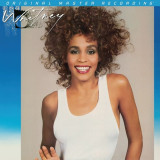
Issued just two years after Houston's breakthrough debut, Whitney immediately signalled the genre-defying singer's intent to continue to push ahead and expand her palette. Shot by photographer Richard Avedon, the album cover depicts an iconic image of Houston — captured with a gleaming smile, bright eyes, teased-out afro, toned arms, and a right hand that appears to wave a friendly hello — whose active, athletic profile stands in contrast to the extremely formal sit-down shot of her that graces her '85 record. The change is telling: Whitney overflows with unfettered joy, rhythmic vibes, and deep-seated emotions that forever endeared her to the hearts and minds of countless listeners — and which set the standard for the wave after wave of divas that followed in her footsteps.
It's no coincidence that the first track on Whitney is the declarative "I Wanna Dance with Somebody (Who Loves Me)." Like Michael Jackson's "Billie Jean" and Madonna's "Material Girl," the feel-good smash is one of the quintessential '80s gems — a lithe, melodic, celebratory release of pent-up energy and loneliness that glides across club floors, shouts to the rooftops, and shrugs off any concerns about vulnerability or embarrassment. Houston's swooping voice moves in sync with the sleek beats and dipping-and-diving synths. She practically takes her fellow musicians by their hand and leads them in a blissful dance that nobody would dare sidestep. Focusing on Houston's singing — a task made challenging only because of the impossible-to-ignore hooks and grooves — showcases the virtuosic facets of not only her register but her control, discipline, smoothness, and warmth.
That she replicates those feats for the entirety of the nearly 53-minute-long album makes Whitney that much more special. Houston reaches back and channels her childhood gospel training on the R&B-flared "So Emotional"; effortlessly slips into Quiet Storm mode on the duet with her mother, gospel great Cissy Houston, on "I Know Him So Well"; flirts with smooth jazz and collaborates with tenor saxophonist Kenny G on the lush "Just the Lonely Talking Again"; conjures dreamscapes and shadow-boxes with supple funk on a romantic cover of the Isley Brothers' "For the Love of You"; and, for the majestic power ballad "Didn't We Almost Have It All," displays the sky-scraping reach of her vocals amid a grand arrangement made even bigger by Houston's sweeping performance and triumphant finish.
Houston's once-in-a-generation talents weren't lost on the adoring public, radio deejays, or industry experts. In addition to harbouring four No. 1 hits and receiving nominations for four Grammy Awards, Whitney generated another Top 10 success in the guise of the Afro-Cuban-leaning "Love Will Save the Day." The album also netted Houston four American Music Awards; two Billboard Music Awards; back-to-back People's Choice Awards; a Soul Train Award; and various other accolades. It all makes the crux of the Washington Post's July '87 review of the album appear prophetic: "Her voice sounds stronger still and the songs are varied but so consistent she could garner 10 Top 10s out of a field of 11."
That claim still holds true. A brilliant fusion of pop, R&B, smooth jazz, and soul, Whitney is a showstopper – and one of the key reasons Houston is the most-awarded female artist of all time.
Rebellion ist aktuell in aller Munde, aber DYMNA LOTVA haben dafür gewichtige persönliche Gründe: Das Duo musste aus seinem Heimatland Belarus aufgrund politischer Verfolgung fliehen. Die Kunst der Metal-Band wird von der Lukaschenka-Diktatur aktuell zensiert und unterdrückt. Doch auch auf ihrem dritten Album, "The Land under the Black Wings: Blood" singen DYMNA LOTVA weiterhin von Trauer und Schmerz. Dabei haben die Belarussen hörbar ihren markanten Stil dynamisch weiterentwickelt. Über einem soliden Black Metal Fundament, das auch Bausteine aus dem Doom und traditioneller Musik enthält, baut das Duo mit Hilfe von melancholischen, eindringlichen Melodien emotionalere und gewaltigere musikalische Strukturen auf. Die Texte von DYMNA LOTVA basieren auf wahren Geschichten aus ihrer Heimat. Diese stammen aus Berichten voller Leid, die das Duo in historischen Archiven und in der Folklore findet - während in ihrem Land an jedem Tag neue Schreckenstaten hinzukommen. Komponist und Multiinstrumentalist Jauhien Charkasau sowie Sängerin Katsiaryna "Nokt Aeon" Mankevich datieren die Gründung von DYMNA LOTVA präzise auf den 8. November 2015. Am diesen Tag entzündete die Nachricht, dass die belarussische Schriftstellerin Swetlana Alexandrowna Alexijewitsch den Literaturnobelpreis erhalten hat, das musikalische Feuer der Band. Noch am gleichen Tag schuf das Duo seinen ersten Song, der von der Nuklearkatastrophe von Tschernobyl inspiriert wurde. Dieser erschien im Jahr 2016 als Single unter dem Titel ("A Solitary Human Voice"). DYMNA LOTVAs erstes Album "The Land under the Black Wings: Swamp" kam noch im gleichen Jahr heraus. Das Debüt stellt auch den ersten Teil einer konzeptionellen Trilogie über Belarus dar. Mit dem Nachfolger, "Wormwood" der nicht zur geplanten Album-Trilogie zählt, kehren DYMNA LOTVA im Jahr 2017 zum Thema Tschernobyl zurück. Nach den gefälschten Wahlen im Jahr 2020 unterstützte DYMNA LOTVA offen die Proteste gegen den Diktator Lukaschenka. Nach einem politisch motivierten Prozess gegen den Metal-Sänger Lesley Knife, der auch als Gast auf der Single 'To Freedom' zu hören ist, werden alle geplanten Konzerte von DYMNA LOTVA offiziell verboten und die Live-Besetzung der Band ist zur Auflösung gezwungen. Sängerin Nokt Aeon kann ihrer politisch motivierten Verhaftung nur durch Flucht außer Landes entgehen. Das Duo will sich in der Ukraine treffen, als der russische Überfall den Plan zunichte macht. Nach zwei Wochen schweren Bombardements durch Russland und harten Kämpfen um Irpin gelingt Nokt Aeon die Flucht aus der Stadt. Beide Musiker finden schließlich Aufnahme in Polen. Für DYMNA LOTVA ist die Veröffentlichung von "The Land under the Black Wings: Blood" daher auch ein Akt des Widerstands. Ihre Musik kann auf mehr als eine Weise gehört werden: Es handelt sich zunächst, nur für sich genommen, um ein wundervoll melancholisches, zeitgenössisches Metal-Album auf der dunklen Seite des Genres; mit einem hörbar belarussischen Einschlag. Doch aus einer erweiterten künstlerischen Perspektive betrachtet, ist DYMNA LOTVAs "The Land under the Black Wings": Blood" ein klagender, wütender Schrei nach Freiheit und Gerechtigkeit!
The Lilac Time are original members Nick & Stephen Duffy, with Claire
Duffy who joined in 1999 and helped out immeasurably here by Ben
Peeler
John Paterno returns to mix and master as he has done since No Sad Songs of
2015.Without conventional drums or bass their fondness for country and folk
hues are clearer. These are unequivocally and absolutely the best songs Stephen
Duffy has ever written in his twenty or so long playing album career. The first
single release is "A Makeshift Raft". A song that asks if those seeking freedom
need drown, then ponders the inevitability of continuous wars. It praises the
America of Allen Ginsberg before a few bars of yodelling. It ends by eulogises
fingers, guitars and songs of love. Something for everyone then. The song is
accompanied by a video created by Martin Carr.They love being who they are and
they love this album and they hope you will find time to dance till all the stars
come down with them.
SUPERB NEW ALBUM BY STRAWBS. FEATURING DAVID
COUSINS, BLUE WEAVER AND JOHN FORD.
• RADIO COVERAGE, REVIEWS IN NATIONAL PRESS, CLASSIC
ROCK, UNCUT, MOJO, RECORD COLLECTOR AND PROG
MAGAZINES PLUS WEBSITES AND FANZINES.
Vinyl LP edition of ‘The Magic Of It All’ by Strawbs,
recorded in Cape Town and featuring David Cousins, Blue
Weaver, and John Ford from classic 1970s line up joined by
some of the finest musicians and singers in South Africa.
Strawbs were high in the charts with ‘Grave New World’ and
‘Bursting At The Seams’ 50 years ago which coincided with a pivotal
moment in the struggle for freedom in South Africa, when students
and workers launched a new wave of resistance against so-called
“resettlement”. The resistance in South Africa identified with
Strawbs songs, especially ‘Part Of The Union’, ‘Lay Down’, and
‘New World’.
Recognising this, South Africa documentary maker, Niel van
Deventer, approached David Cousins with the idea of producing a
documentary about Strawbs and the band’s influence around the
world. Niel wanted to film while new songs were being recorded in
a Cape Town studio. David Cousins came up with a bunch of his
finest songs; Blue Weaver flew over to produce the sessions and cowrite some of the material, while John Ford joined in with his
contribution to the songs from New York.
Featuring brand-new songs recorded at the Academy Of Sound
Engineering in Cape Town, with engineer Peter Pearlson worked
with Paul Simon when he was recording South African musicians for
the ‘Graceland’ album. The South African musicians on this album
include Mauritz Lotz, Schalk Joubert, Kevin Gibson, Byron
Abrahams, Simangele Mashazi, Marzia Barry and Luna Paige.
Cathryn Craig and Nicole Tee joined the singers from the UK. The
documentary The Magic Of It All will be released later this year.
Mike Cooper wrote his final songwriter record, a suite of gloaming glam-rock anthems performed with a spiritual jazz trio, while living on the Costa Tropical of Granada, Spain, an era when he was considering retiring from music altogether. A chance encounter and a last-ditch record deal convinced him to make one last album, which he recorded in 1974 at Pathway Studios in London, with “The Greatest Rock and Roll Band in the World,” featuring the inventive South African jazz rhythm section of Louis Moholo and Harry Miller with UK saxophonist Mike Osborne. This first-ever reissue includes a bonus CD of Milan Live Acoustic 2018, a previously unreleased solo set that represents Cooper’s return, after forty-four years pursuing free improvisation and electronics, to a new, deconstructed approach to singing, steel guitar, and songcraft. The deluxe LP+CD edition also features a six-panel insert with additional artwork and an essay by the artist about both records. The deluxe 2xCD gatefold edition features an eight-panel version of the same insert. In the wake of his magisterial triptych of early 1970s avant-folk-rock records Trout Steel (1970), Places I Know (1971), and The Machine Gun Co. (1972) the British songwriter, guitarist, and fledgling improviser Mike Cooper retreated to the Costa Tropical of Granada, Spain. With no prospects for touring or recording again, his fiery band the Machine Gun Co. had disintegrated. Cooper sets the scene in his liner notes of the first-ever reissue of his unjustly forgotten next album Life and Death in Paradise (1974): No one came running with offers of fame and riches, and we fell apart, and I left the country and headed for the beach, disillusioned and a bit disorientated musically. I went to Almuñécar in Andalusia, a place I had been going since 1969, because a painter friend from Reading, Rowland Fade who made the collage in the gatefold of my earlier album Trout Steel had moved there in 1968. It was in this synthetic coastal “paradise,” unmoored and adrift, considering retiring from music altogether, that he began tentatively writing new songs. A chance encounter with producer Tony Hall, who offered Cooper a last-ditch record deal on Hall’s nascent Fresh Air label, convinced him to make one last album with the stipulation that he could assemble what he called “The Greatest Rock and Roll Band in the World.” I told Tony that I would do it if I could hire some of my South African jazz musician friends that I had used on my Pye/Dawn albums and some friends from Reading that I still knew and admired. I called up Harry Miller, Louis Moholo, and Mike Osborne, who were in fact a trio at the time … and several local Reading heroes, including the singer-songwriter Terry Clarke. The result, recorded live with minimal overdubbing at Pathway Studios in London, was Life and Death in Paradise, an utterly singular suite of gloaming glam-rock anthems performed with a spiritual jazz trio comprising the inventive South African jazz rhythm section of Moholo and Miller with UK saxophonist Osborne. Unlike anything else in Cooper’s extensive catalog. Fresh Air fizzled, and Life and Death became Cooper’s final record as a songwriter, having pushed the form as far as he could. Drifting north from Spain back to the UK, he fell into the scene of the London Musicians Collective (LMC) including Paul Burwell, David Toop, and saxophonist Lol Coxhill, Cooper’s bandmate in the Recedents and fully embraced free improvisation. He was still, however, interested in singing and lyrics, so, influenced by Tom Phillips, William Burroughs, and Brion Gysin, he began experimenting with text collage and cut-up techniques, arriving at his own hybrid compositional strategy for improvisatory songs. The previously unreleased solo set Milan Live Acoustic 2018 represents Cooper’s return, after more than four decades pursuing free improvisation and electronics, to a new, deconstructed approach to singing, lap steel guitar, and songcraft. Presented here together with Life and Death in Paradise, the two records provide fascinating bookends to Mike Cooper’s long, mercurial, and pioneering practice as a songmaker.
DJ Koze unveils a spiritual and surprising journey into rapturous spheres with Wespennest EP. The visionary artist and master of electronic sound, presents his first own release after 2018's global club hit "Pick Up".
"Candidasa" and "Wespennest" are the result of DJ Kozes inspiring stay in a secluded Benedictine monastery on the enchanting island of Sulawesi. Amidst this idyllic setting, he found the perfect environment to unleash his musical vision. He composed all of the music of "Candidasa" while lying on his stomach, in an act of deepest devotion and self-reflection. In doing so, he fed exclusively on so-called heroin kebabs to immerse himself in a trance-like state of creative flow. The result is a soundscape of unimagined depth and beauty that enchants the senses and transports listeners to another dimension by massively increasing the frequency of flicker fusion.
On "Wespennest” the wonderful Sophia Kennedy takes the stage and breathes a new dimension into the music with her impactful lyrics and vocals. With generous dedication, Sophia has provided exclusive excerpts of her yet unreleased songs, giving this track a radiant psychedelic power. The combination of DJ Kozes musical genius and Sophia Kennedy's glorious vocals creates a club track full of wonderment, opening up a mystical rapturous world for listeners. Already an instant classic of German dance music.
With "Candidasa" and "Wespennest" DJ Koze has once again pushed the boundaries of electronic sounds and created a spiritual journey that touches the soul and frees the mind. This EP is the first harbinger of his highly anticipated new album, which will be released in 2024. The time until the release can be wonderfully bridged with the magical album "Hit Parade", which DJ Koze has produced for the British legend Róisín Murphy and on which we can be carried away into the world of musical brilliance.
- A1: Greetings From Planet Love
- A2: Rainbow People
- A3: Love Tonight
- A4: Chasing My Tail
- A5: Swirl
- B1: Tuba Rye And Will’s Son / Balloon In The Sky
- B2: King Of Showbiz
- B3: Whirl
- B4: Freelove Baby
- B5: Groovy Party At Jimmy’s Magic
- C1: It’s Beautiful
- C2: Wink Of The Third Eye
- C3: It Has No Eyes But Sight
- C4: Twirl
- C5: Space And Time
- C6: Time Is Standing Still
- D1: Ride The Snake
- D2: Mr Plastic Business Man
- D3: Ccosmicc Ccarnivall
- D4: Tomorrow Drop Dead
The very first vinyl edition of Andrew Gold’s pastiche
psychedelic masterpiece ‘The Fraternal Order of the All –
Greetings from Planet Love’.
Initially released in 1997, the album was conceived by
Andrew Gold as a tribute to late 60s psychedelic rock. His
remarkable compositions were wonderful stylistic
evocations of artists such as The Beatles, The Beach
Boys, The Byrds and The Doors.
The project saw Gold create the fictitious band The
Fraternal Order of the All, in reality Andrew playing
most of the instrumentation and singing, along with guest
musicians such as Graham Gouldman.
This Esoteric Recordings limited edition double LP is
pressed on 10-inch coloured splatter vinyl and features a
newly designed lavish gatefold sleeve.
In an era defined by futility, isolation, and precarity, it can be difficult to envision a utopia. But on Skeleten’s thrilling, immersive debut album, Under Utopia, the Sydney musician dares to imagine new ways of being that are not characterized by doom or despair. Across eleven tracks of free-flowing, transcendent, and often euphoric electronic music, Skeleten praises the power of comradery and community; while dreaming of a future that is joyously boundless.
Skeleten, real name Russell Fitzgibbon, has always been fascinated by the ideas of utopias. He’s thought a lot about how the concept has shifted and morphed throughout history, and how the goal post for a utopia is always moving further and further away. “We're more familiar with the idea of a dystopia in the modern world - that's more close to our consciousness. I think on this album I wanted to explore the importance of imaging and embodying a new world.”
Written before and during the pandemic, the album was born out of a desire to connect with others and to shake the mantle of introspection that had been placed on his previous works. From the opening notes of the otherworldly album opener “Generator”, it's clear that this record prioritises immediate pleasures without forgoing intimacy. The lyrics are also more explicit, reaching outward with inviting choruses and mantra-like melodies. “I think the album came out of the experience of feeling this great desire to reconnect and dreaming of the power of community,” says the musician.
This is especially present in lead single ‘Sharing The Fire’, a song that crackles with optimism. A sprawling dance track with pulsating synths and Fitzgibbon’s gentle, warm vocals, the song is about futures that are full of brightness and bliss. As the artist repeats in the song’s chorus: “for all that you know, summer could be around the corner.” The song is about an “almost frustrated desire to connect with more people and feel that sense of community through shared goals.” The accompanying video clip, shot on 35mm, is similarly invested in ideas of companionship and gathering. Shot in a clinical, drab office space, friends and revelers fill the space with warmth and energy.
Elsewhere, this invocation of paradise is infused in the stripped-back, singular title track “Under Utopia”. The song was significant to Fitzgibbon, as it allowed him to gather all his thoughts and ideas about his new music under one message. “It’s something I wrote when I had this collection of songs and wanted to give it a single voice, which was about seeing the world entirely new, full of hope and beauty, and all of us underneath pushing it upwards.”
An antidote for gloom presented in Under Utopia is the transformative power of love. There’s “Heart Full Of Tenderness”, a woozy, languorous love song, awash with cloudy vocals and glistening synths; the truncated beats and hypnotic pleading of “Territory Day” and “Right Here It’s Only Love” which explores the icier and ambient side of R’n’B.
Another hallmark that characterizes Under Utopia is Fitzgibbon’s airy and spacious mix, which gives his songs room to sprawl out and simmer; as well as allowing his calming baritone to come to the fore. This is notable in the contemplative, synth-laden “Colour Room”, the funk-tinged “Walking On Your Name,” the previously released “No Drones in the Afterlife,” and the beloved early single “Mirrored,” which speaks of finding yourself through a connection to those around you.
Fitzgibbon has been enmeshed in the Sydney music scene for years. Skeleten emerged out of a need to experiment and make music without worrying about the outcome. “It was just me making music that felt right, and very much focusing on this kind of meditative aspect of exploring without any goal,” says Fitzgibbon. But as the project has evolved, the artist has gained clarity on what he hopes his music will achieve: bringing people together, and creating an atmosphere of elation. Or as Fitzgibbon puts it on Under Utopia’s hallucinatory album closer “We’re gonna get everything we need in the world.”
Renowned agent and jazz pioneer Wim Wigt founded Timeless Records in 1975. This Dutch record label has specialized in bebop, although it also did a sub-series of releases of Dixieland, Swing and Classical recordings. As of today, Timeless Records has, together with its three sub-labels, released over 900 albums. Notable releases include Dizzy Gillespie Meets Phil Woods Quintet, McCoy Tyner's Bon Voyage, Lou Donaldson's Forgotten Man, Eastern Rebellion and albums by the George Adams-Don Pullen Quartet, Chet Baker, Bill Evans, Art Blakey's Jazz Messengers and many more.
To celebrate the legacy of Wim Wigt's Timeless Records, Music On Vinyl is releasing a 45th anniversary jazz series. The series features albums that are part of the Timeless Records legacy and will be released throughout 2021/2022. To kick off this series, Pharoah Sanders' Africa is released on the 19th of November 2021.
Pharoah Sanders possesses one of the most distinctive tenor saxophone sounds in jazz, which has earned him royal status amongst free jazz players, critics and collectors. Harmonically rich and heavy with overtones, his sound can be as raw and abrasive as it is possible for a saxophonist to produce. His 1987 album Africa is soulful but also searching for a strong groove at the same time. The album is recorded with John Hicks, Curtis Lundy and Idris Muhammad and was an explicit tribute to his late mentor John Coltrane, another giant of jazz.
Africa by Pharoah Sanders is available on black vinyl. The album includes an insert with upcoming Timeless Records titles from the Timeless Records 45th Anniversary Jazz series. The sleeve contains liner notes by Kevin Whitehead.
- A1: Daryl Hall & John Oates – Out Of Touch (Club Version)
- A2: Robbie Nevil – C’est La Vie (Extended Remix)
- A3: Living In A Box - Living In A Box (Dance Mix)
- A4: The Colourfield – Running Away (Arthur Baker Remix)
- B1: Fleetwood Mac – Big Love (Extended Remix)
- B2: Artists United Against Apartheid – Sun City (Last Remix)
- B3: Fine Young Cannibals – Ever Fallen In Love? (Club Senseless)
- C1: Neneh Cherry – Buffalo Stance (1/2 Way 2 House Mix)
- C2: Arthur Baker & The Backbeat Deciples Featuring Al Green – The Message Is Love (Cupid Mix)
- C3: Will Downing – A Love Supreme (Jazz In The House Remix)
- C4: Jeffrey Osborne - Soweto (Remixed Version)
- D1: Afrika Bambaataa & Soulsonic Force – Planet Rock (12” Vocal Version)
- D2: Rockers Revenge Featuring Donnie Calvin – Walking On Sunshine (12” Version)
- D3: Freeez – I.o.u. (Mega-Mix)
Revolution Saints, die Band um Sänger und Schlagzeuger Deen Castronovo, mit ihrem 4. Album und neuer Besetzung. Deen Castronovo (Journey, Bad English, Hardline) wird jetzt von Bassist Jeff Pilson und Gitarrist Joel Hoekstra begleitet. Castronovo war schon immer ein großartiger Schlagzeuger, aber Fans, die seinen Backgroundgesang im Laufe seiner Karriere bemerkten und Journey-Shows besuchten und sahen, wie er während des Sets der Band den Leadgesang auf "Mother, Father" übernahm, erkannten, dass er auch eine erstaunliche Stimme hatte. Revolution Saints war immer ein Band, um der Welt Deens unglaubliches Gesangstalent zu zeigen. Revolution Saints brachten den klassischen melodischen Rockstil zurück, der in den 80er und 90er Jahren Legionen von Fans begeisterte und bis heute tut. Inspirierender, erhebender Gesang, aufsteigende Melodien und einprägsame Hooks. Deen, der kürzlich zu Journey zurückgekehrte, wird unterstützt von Joel Hoekstra, aktuelles Mitglied von Whitesnake, Trans-Siberian Orchestra und Iconic, Joel Hoekstra's 13, ist ein atemberaubender Gitarrist. Jeff Pilson, derzeit Mitglied von Foreigner, Black Swan und The End Machine, und natürlich auch bekannt von Dokken. Zwei herausragende Musiker, die Deens Gesang und Trommeln perfekt ergänzen. Fans der ersten drei Alben von Revolution Saints werden von dem brandneuen Album "Eagle Flight" begeistert sein.
Habibi Funk is excited to share “Marzipan” - our first full length contemporary release courtesy of Beirut’s multi-instrumental phenom Charif Megarbane, also known as the man behind prolific Cosmic Analog Ensemble. The LP is a journey into Charif’s styling, one he terms “Lebrary”: a vision of Lebanon + Mediterranean expressed through the kaleidoscopic sonics of library music. Drawing from artists that encapsulates the HF sound, such as Ziad Rahbani, Ahmed Malek and Issam Hajali, Charif translates these influences into an LP that is equally at home in ’23. We always wondered why Charif’s music stayed under the radar for so long, that all changes with “Marzipan”.
Charif Megarbane, the staggeringly prolific producer, instrumentalist, and all-around musical mastermind returns with full LP “Marzipan.” Following his previous release of EP “Tayara Warak” in 2022, “Marzipan” is a sonic journey that seeks to capture the full scope of Megarbane’s habitus. As a composer and producer, Megarbane touts hugely versatile, sometimes volatile musicianship — his 100+ catalogue of projects (including legendary groups like the Cosmic Analog Ensemble, Free Association Syndicate, Monumental Detail, etc.) features a huge domain of sonic direction. This collection was previously developed in Megarbane’s own Hisstology label which hosts a wealth of collaborative efforts. Now, Habibi Funk represents Megarbane under his own name. Megarbane finds a sonic through-line in his surrounding soundscapes as he draws on the chaotic energy of the crowded Beirut metropolis (“Souk El Ahad”), the warm atmosphere of the Lebanese countryside (“Chez Mounir”), or the lushness of a Mediterranean beach resort (“Portemilio”). Reflecting the aural composition of his direct surroundings into kaleidoscopic instrumentation provides a unique insight into how one musical phenomenon transposes sight into sound. Habibi Funk is thrilled to share “Marzipan” and finally throttle this under-theradar phenomenon into the solo spotlight. Despite the magnitude of his catalog, Megarbane’s LP sounds as fresh—as resolutely inspired—as a debut record. “Marzipan” continues down the winding path he trod on EP “Tayyara Warak” (released Decmber, 2022) which features solid footing in the hectic city sounds Megarbane hears as home. Despite his obvious musical acumen, Megarbane’s greatest talent seems to be his open ears. In many ways, “Marzipan” is a cartographic feat — it travels and traces a journey across many dimensions (both sonic and physical). Megarbane’s instrumental catalogue is vast: toy glockenspiel, harpsichord, pedal steel, a classic Wurlitzer, et al are used liberally on the record. The resultant sound is as sprawling as the musician’s instrumental dexterity. “Marzipan’s” closing track “Bala 3anouan” can be translated loosely to “without address” — a fitting final word. Despite the entire record being a sincere testament to Megarbane’s environmental approach to music-making, the record is not bound to any particular coordinates, or any particular sound for that matter. The vastness of his influences — beloved artists like Ahmed Malek and Issam Hajali (both Habibi Funk veterans); West African funk deep cuts; European cinematic scores; et al — result in a record of somewhat unparalleled expansiveness. Floating melodies and frantic rhythmic interludes both find natural homes across “Marzipan.” The record is tinged with psychedelic elements—fuzz-drenched guitar, sliding microtonal interludes, hypnotic rhythmic breakdowns. Reflecting on his creative process, Megarbane cites a stream of consciousness approach: “It’s a very spontaneous, playful, and diary-like approach and workflow…I trust my instinct because instinct is based on experience.” Lead single “Souk El Ahad” opens the roll-out with a raucous energy, out June 12. Megarbane abstracts busy city sounds into a psychedelic framework, casting technicolor hues on everyday experience. Following is second single “Pas de Dialogue” out June 23. The track jerks the listener towards a more meditative state with lulling harpsichord and expanding, cinematic sound. “Marzipan” will be available physically and digitally everywhere on July 14, 2023. Be sure to listen for focus track “Chez Mounir” that captures the warmth of community in a joyful, laidback groove.
Uncover greater insight into the world of Charif Megarbane in the booklet accompanying the LP
Long time Leng recording artists 40 Thieves are back with one of their most notable singles to date – a surprise collaboration with two NYC disco originals, storied vocalist Cinnamon Jones and multiinstrumentalist/producer Gary Davis.
San Francisco outfit 40 Thieves has been serving up cosmic, dubbed-out and otherworldly contemporary disco treats since the mid 2000s, and have been part of the Leng family since 2011. The crew, headed up by Layne Fox, Jay Williams and Corey Black, have released countless killer cuts on the label, as well as an expansive
debut album, 2014’s The Sky Is Yours.
They’ve worked with other artists before, but nobody at the same legendary level as Cinnamon Jones and Gary
Davis. The latter cut his teeth as a musician working with iconic disco producers Patrick Adams and Peter Brown at their P&P Records stable, before becoming a producer and artist in his own right writing and arranging the disco classic ‘Got To Get Your Love’ performed by Clyde Alexander & Sanction.
Jones, meanwhile, has enjoyed a hugely successful career both in her native New York (as Joyce Jones, an original member of First Choice) and on the West Coast, where she not only became an in-demand performer, but also snagged a role in the Supremes biopic Dream Girls.
‘The Gift’ is one of Jones’ most cherished solo songs – a joyful celebration of a new day dawning that has long been popular in her live sets. With input and instrumentation from Davis and a fantastic delivery of her own lyrics by Jones, 40 Thieves has successfully re-framed the track as a sunrise-ready future Bay Area free party
favourite; a dubbed-out, suitably cosmic creation that’s presented in three potent versions.
Leading the charge, and stretched across side A of the vinyl version is the band’s ’Disco Mix’ which boasts a fully realised instrumental arrangement and extensive use of passages from Jones’ vocals. Not all the lyrics are present as the Bay Area band has chosen to focus on selected lines that most neatly fit their musical vision and
celebrate the joys of dancing at sunrise. There are more spaced-out keyboard solos, sharper guitars (smothered in effects in true 40 Thieves fashion) and sound design that’s as immersive as it is heady and intoxicated.
On the flip is the ‘Disco Dub’. A bona-fide dub disco chugger rich in relentless synth-bass, addictive guitar licks, echo-laden vocal snippets, sparkling nu-disco electronics, tactile, deep house style electric piano stabs and cosmic effects aplenty, it’s a track tailor-made for slowly shuffling while the sun peeps over the horizon.
To complete an inspired package, 40 Thieves have also included a killer DJ tool: a ‘Beats’ take that wraps energy packed percussion hits, trippy electronic noises, trailing dub delays and sparse melodies around a metronomic drum machine beat. It’s a wavy, groovy and pleasingly mind-altering way to conclude one of 40 Thieves’ most magical EPs to date.
Crackazat & Heist present: “Senses”. A stunning mini album that sees the artist deliver a heartwarming perspective on contemporary electronic music
On “Senses”, we see the pure talent of Crackazat come to life like never before. We’ve all danced to “Alfa” or his most recent hit on Heist “Demucha” and have heard his venture into the more poppy side of things with his 2022 album ‘Evergreen’ on Freerange. “Senses” however, is on another level. Crackazat takes you on a sonic journey exploring his musical personality with live keys, vocals, bass and production all coming from his studio in Uppsala, Sweden. The
jazzy horns that are featured throughout are recorded by Adeev and Ezra Potash, better known as the Potash twins. The duo took a sidestep from their recordings with John Legend, Robert Glasper and even Diplo to dive into this project with Crackazat and help him deliver arguably his best work to date.
The 6-track album starts off with the low-slung groove of ‘I need to know’. The whole atmosphere is warm, dreamy and seems to be written to lift your spirits, no matter where you are in life. Plucked strings, arpeggios and long horn notes give this song its energy, which is subtly supported by lo-fi drums and sparse bass licks.
“Do you think about me”, keeps the energy tight with a lovely drum groove and a sparse bass section. From the first note of the track, you get the feeling like the energy could change any moment. Halfway through this is exactly what happens, when uplifting keys and a buzzing lead take control of the track. The string arrangement is subtle enough to never overshadow the other instrumentation, but simply adds a beautiful layer to a track that’s already filled with
emotion. It’s all smiles when the energy of this track is set loose!
If “Do you think about me” is Crackazat in pop mode, “Freddie’s Groove” is Crackazat in full-on jazz mode. The nod to Freddie Hubbard is clear, and Crackazat cleverly takes ideas from both the jazz legend and his legendary French sampler, Pepe Bradock for this track. The horns are deep and moody, the groove is jazz-house at its best and Crackazat’s soft vocals have the perfect amount of fragility to fit the groove. The changeover into a stabby synth section
halfway through the track is a subtle reminder from the skilled producer that – even with all these musical elements – he can direct you to the front of the dancefloor with the twist of a note.
“Phantom” sees Crackazat move into a shuffling Latin-dance vibe. Here, the song reaches its full potential through the horn section, so it’s only fitting that this is the feature track for the Potash Twins. The Latin rhythms are lush, the key progression is on point and the energy on this track just keeps on going with layers and layers of horns, powerful vocal chops, and subtle but effective percussion changeovers.
“Endless life” is a track that feels like it’s building up momentum with every repetition. Whether it’s the broken beat groove, the offbeat keys or the sparse horn hits, chord hits or leads, there’s a certain energy in this track that takes a hold of you and simply doesn’t let go.
The outro “When we last met” is built around vibey drunk keys and a downtempo hip-hop groove. There’s a hint of old school D’angelo in this track and you can clearly hear the artist feels at ease with the path he’s taking the listener on. It’s a perfect ending to a record that showcases the beautiful world that Crackazat has crafted through his compositions and one thing is for sure: This is an album we will all keep coming back to for a long time to come.
Yours Sincerely,
Maarten & Lars
PUTAS VAMPIRAS Vol.1 is the debut release of PUTAS VAMPIRAS, a DJ and producer who is an icon of Sao Paulo's queer underground scene.
As the organizer and mother of the infamous VAMPIRE HAUS raves and its community of vampires, her work is a celebration of DIY culture, resistance and an unapologetic commitment to inclusion and the freedom of the Brazilian LGBTQIA+ community.
Over the last decade VAMPIRE HAUS has become much more than a rave, its an aesthetic, a mind-set and a movement that spans across the whole of Latin- America. After almost 10 years, it is finally debuting as a record label.
In this first release, PUTAS VAMPIRAS reimagines post-punk attitudes and the frenzied energy of a rock and roll mosh pit through the lens of the queer Sao Paulo underground. The album's tracks were built to withstand the heat of the VAMPIRE HAUS raves, and to satisfy the legions of dissident ravers, drag monster queens, techno lovers, and "vampiras" from all around the world. She describes her sound as VAMPIRE TECHNO, the perfect soundtrack to a kinkier and queerer alternative reality version of Tony Scott's "The Hunger" movie.
All the tracks on this compilation are anthems at the VAMPIRE HAUS raves and part of PUTAS VAMPIRAS' live performances in recent years, with the track "Puta Vampira Bixa Loka" becoming the soundtrack of LGBTQ freedom and empowerment in Sao Paulo.
Using a hybrid setup of analog drum machines, modular synths and vinyl during her performances, PUTAS VAMPIRAS made thousands of "vampiras" dance like there was no tomorrow.
She has performed on BOILER ROOM and extensively toured across the world, playing amongst many places in the UK, USA, India, Turkey, Ukraine, Chile, and Paraguay and being the first Brazilian to perform a hardware live set on the main floor of Berghain.
PUTAS VAMPIRAS has become a household name and a symbol of LGBTQ+ empowerment, liberation, and resistance and her music will carry the VAMPIRE TECHNO spirit into more corners of the world.
- Moanin’ (Bobby Timmons)
- Superstition (Stevie Wonder)
- Iko Iko (James Crawford)
- Señor Blues (Horace Silver)
- When A Man Loves A Woman
- (C. Lewis & A. Wright)
- Freedom Jazz Dance (Eddie
- Harris)
- Sidewinder (Lee Morgan)
- Brother Where Are You?
- (Oscar Brown)
- Wade In The Water (Traditional)
- Work Song (Nat Adderley)
- Land Of 1.000 Dancers (Chris
- Kenner)
- Gimme Some Lovin’ (S
- Winwood & S. Davis)
- Motherless Child (Traditional)
- New Orleans Strutt (Jack
- Dejohnette)
- La Place Street (Stanley
- Turrentine)
- Amen (Traditional, Arr. By Bob
- Belden)
- Jubilation (Junior Mance)
- Joshua (Traditional)
- Mr. Magic (Ralph Macdonald &
- William Salter)
- Theme From Shaft (Isaac
- Hayes)
- Nobody Knows The Trouble
- I’ve Seen (Traditional)
Who did Aretha Franklin not want to miss out on when she recorded
her most inspiring albums in the early Seventies? Who gave Steely
Dan the beat? Who did Isaac Hayes, Donny Hathaway, BB King,
‘Sweet’ Lou Donaldson and Joe Cocker give the chair behind the
drums? No drummer has seen the inside of a studio as often as
Bernard ‘Pretty’ Purdie.
Not for nothing do colleagues attribute the ‘funkiest soul beat on the
scene’ to the drummer, and consequently, Purdie has never relied on
the genre of jazz alone, but rather curiously looked beyond the
borders. Sessions with The Rolling Stones, James Brown, Jimi
Hendrix or Tom Jones are no problem for him, whose precise and
sensitive playing is synonymous with drive and groove. This is
probably one of the reasons why his rhythms are still sampled by
many DJs today.
Released on CD back in 1996 and 1997 (and now out of print), the
two ‘Soul to Jazz’ recordings have a cult factor today and sound as
fresh as they did back then. Now both albums are released together
for the first time as a 3LP set.
These recordings are peppered with lots of prominent star guests
from jazz and soul, from Eddie Harris, Michael Brecker and Nils
Landgren to Hank Crawford, Stanley Turrentine and Cornell Dupree.
Purdie’s ‘Soul to Jazz’ project takes two different approaches: The
first part focuses on the renowned WDR Big Band led by Gil
Goldstein. Soul classics such as Stevie Wonder’s ‘Superstition’,
‘When a Man Loves a Woman’, Eddie Harris’s ‘Freedom Jazz Dance’
and Lee Morgan’s famous groove tune, ‘Sidewinder’, are interpreted
in large scale sound. One discovery of these recordings amidst all the
renowned guest soloists is the New York-born singer, Martin Moss.
The great success of this first album, released under ‘Soul to Jazz’,
led to ‘Soul to Jazz II’, a more intimate record, but one that picks up
where the first recording left off, by exploring similar themes. Again,
Purdie has called together a notable band of kindred spirits, including
saxophonists Hank Crawford (BB King, Ike and Tina Turner, Ray
Charles), Stanley Turrentine (Jimmy Smith, Shirley Scott) and Vincent
Herring, as well as guitarist Cornell Dupree (King Curtis) to pianists
Benny Green and Junior Mance.
Bernard Purdie’s ‘Soul to Jazz’ is a timeless classic and a blueprint of
the soul jazz genre in all its facets. Above all, it is a portrait of one of
the most influential and best drummers in the world, who made jazz
groove with his inimitable funky soul beat
- 1: Voice From A Mountain (Prelude)
- 1: 2 Cello Song
- 1: 3 Hazey Jane Ii
- 1: 4 Saturday Sun
- 1: 5 Road
- 1: 6 From The Morning
- 1: 7 Place To Be
- 1: 8 Three Hours
- 1: 9 Parasite
- 1: 0 Time Has Told Me
- 1: One Of These Things First
- 1: 2 Northern Sky
- 1: 3 Black Eyed Dog
- 2: 1 Road (Reprise)
- 2: Poor Boy
- 2: 3 Which Will
- 2: 4 Harvest Breed
- 2: 5 I Think They're Leaving Me Behind
- 2: 6 Pink Moon
- 2: 7 Time Of No Reply
- 2: 8 River Man
- 2: 9 Free Ride
- 2: 10 Fly
- 2: 11 Day Is Done
- 2: 1 Voice From A Mountain
The Endless Coloured Ways is a collection of songs by legendary singer/ songwriter, Nick Drake, performed and recorded by over 30 incredible artists from a range of different backgrounds, genres, age groups and audiences From Fontaines D.C. to Guy Garvey, Aurora to Feist, and Self-Esteem to David Gray, each artist has offered their own incredible take on a timeless classic "Nick Drake was not that concerned with promoting himself as an artist but I think he would have been overjoyed to hear his art promoted by so many vibrant and talented artists such as the ones we approached. Each track is an example of a fellow artist adopting Nick's art as if it was their own, submitting to the song, and the results prove to me that talent can so often win out over mere skill or 'personality'. We are honoured and so grateful to all our friends, old and new, who took part in the making of this set." - Cally Calloman, Bryter Music "Having initially exchanged a list of our favourite artists and realised how much our tastes overlapped, Cally and I set out on this venture with one simple brief - to ask the artists to ignore the original recording of Nick's in terms of arrangement, production and singing style; basically, we were asking them to reinvent the song. First of all, it was humbling to hear so many similar responses, saying how important Nick's music was to them, and how much they wanted to be part of this project. But as the results came in one by one, we were staggered by the brilliance and invention that each artist had shown. They had done what we asked - they had made the song their own." - Jeremy Lascelles, Chrysalis Records
- 1: Voice From A Mountain (Prelude)
- 1: 2 Cello Song
- 1: 3 Hazey Jane Ii
- 1: 4 Saturday Sun
- 1: 5 Road
- 1: 6 From The Morning
- 1: 7 Place To Be
- 1: 8 Three Hours
- 1: 9 Parasite
- 1: 0 Time Has Told Me
- 1: One Of These Things First
- 1: 2 Northern Sky
- 1: 3 Black Eyed Dog
- 2: 1 Road (Reprise)
- 2: Poor Boy
- 2: 3 Which Will
- 2: 4 Harvest Breed
- 2: 5 I Think They're Leaving Me Behind
- 2: 6 Pink Moon
- 2: 7 Time Of No Reply
- 2: 8 River Man
- 2: 9 Free Ride
- 2: 10 Fly
- 2: 11 Day Is Done
- 2: 1 Voice From A Mountain
The Endless Coloured Ways is a collection of songs by legendary singer/ songwriter, Nick Drake, performed and recorded by over 30 incredible artists from a range of different backgrounds, genres, age groups and audiences From Fontaines D.C. to Guy Garvey, Aurora to Feist, and Self-Esteem to David Gray, each artist has offered their own incredible take on a timeless classic "Nick Drake was not that concerned with promoting himself as an artist but I think he would have been overjoyed to hear his art promoted by so many vibrant and talented artists such as the ones we approached. Each track is an example of a fellow artist adopting Nick's art as if it was their own, submitting to the song, and the results prove to me that talent can so often win out over mere skill or 'personality'. We are honoured and so grateful to all our friends, old and new, who took part in the making of this set." - Cally Calloman, Bryter Music "Having initially exchanged a list of our favourite artists and realised how much our tastes overlapped, Cally and I set out on this venture with one simple brief - to ask the artists to ignore the original recording of Nick's in terms of arrangement, production and singing style; basically, we were asking them to reinvent the song. First of all, it was humbling to hear so many similar responses, saying how important Nick's music was to them, and how much they wanted to be part of this project. But as the results came in one by one, we were staggered by the brilliance and invention that each artist had shown. They had done what we asked - they had made the song their own." - Jeremy Lascelles, Chrysalis Records
Coming straight outta Salerno's vibrant music scene, "Amo' / Voce 'e Notte" is the first 7" single from female rap duo Zetas. Released by DJ's Choice, a partner label of Four Flies Records, it contains two songs produced bybeatmaker, rapper and producer Tonico 70, a true veteran of Southern Italian hip hop.
Both young millennials, rappers Annarella and Miriade were exposed to the world of underground hip-hop from an early age, jamming, freestyling and listening to different music than their peers. Active as a duo since 2019, they're now making their official debut with this 7", which will be followed byan album at the end of September.
The A-side track "Amo'", which is about the overuse and loss of meaning of the word 'love' (amo' translates as 'luv'), makes their intentions clear. Zetas rap in the exuberant dialect and slang of their native city of Salerno, while their sound looks back to the '90s through a contemporary lens. Raw rhymes are delivered with an urgent flow over a beat that, rather than boom-bap nostalgia, is a modern take on classic production styles. The result is a happy medium between old school and fresh – one where the melody of dialect rap and rhymes blends wonderfully with the rhythms of funk, soul and reggae.
"Voce 'e notte", on side B, has a different mood, but the same approach. Here, Zetas weave wistful verses tinged with disillusionment and toughness on top of Tonico 70's 808-led beat, paying tribute to a classic Neapolitan song also titled "Voce 'e Notte". The result is a rap serenade that transforms and reimagines the Neapolitan song tradition through today's sensibility and, of course, through hip hop.
Born of a thousand nights lost in a surrender to stillness and contemplation, In The Air is Anna St. Louis’ second full length album and her most considered work yet. St. Louis’ debut If Only There Was a River seemed to emerge fully formed out of the recesses of her mind; a gritty, mesmerizing affair, filled with jagged edges and ghostly apparitions. The type of record that announces a new voice; one haunted by what has come before.
But this time, St. Louis is no longer concerned with what could have been and sets her sights to exploring what could be. It’s an outlook on the world that was formed when her immediate one was small. The intervening years since her last album found St. Louis in a small one-bedroom cabin in the middle of the woods of upstate New York with a new love and time to think of what she wanted to express with her music. For weeks on end, the only trips she took were to and from her job as the front desk clerk at a nearby hotel. The previous years she had spent on tour and performing constantly in the venues of Los Angeles felt like they had occurred in another lifetime.
“It really compelled me to surrender to the unknown,” she says. And in this surrender, she found liberation. St. Louis is more self-assured, open-hearted and ready to say what she wants. St. Louis describes the writing period as one of a slow harvest; a fertile time but one that required a newfound patience. Instead of documenting her first thoughts, she spent more time with each song, going deeper with the themes and ideas she wanted to express.
This slower approach also guided the sonic textures of the album. Working with producer Jarvis Taveniere (Purple Mountains, Woods) in two extended recording sessions in Los Angeles in 2021, St. Louis used the studio in a previously unexplored way, opening up her songs to more experimentation featuring brighter tones and a more orchestral sound to accompany her new perspective. To that end, she was aided by a cast of friends and collaborators including Jess Williamson, Kacey Johansing, Oliver Hill (Kevin Morby, Vagabon) on strings, Alex Fischel (Spoon) on piano, Josh Adams on drums (Bedouine, Tim Heidecker) and Keven Lareau (Cut Worms, Hand Habits).
In the Air has the sound of a joyous consideration of the present moment; a quiet morning revealing a new snowfall outside, steam coming from the kettle, just before it whistles, St. Louis with her guitar, staring out the window, with a few free hours before work. She’s reflecting on the scene in front of her, imagining the times yet to come. You can hear it; she’s a long way from the noisy bars of Los Angeles, the rigors of the road. As she intones in “Rest”: “You spend your whole life believing in the chase. And then you realize that being somewhere doesn’t matter like it used to.” She doesn’t need a river to carry her anymore ... She’s in the air.
Little Beat More, Do It Youssef, Not a Pub & Un Rêve Nu labels are glad to introduce ÈCH's latest work, a stunning display of musical mastery that will capture your heart and soul.
Led by Heddy Boubaker, the Toulouse-based band has created a sound that defies categorization, blending elements of free jazz and psychedelic afro-latin rhythm, and more to create a truly unique musical experience which they self described as "post-pfunk-afro-voodoo-weird-free-rock".
With 'Au nombre de joie' and 'Le bonheur des uns fait le malheur des autres', the ÈCH make up two little gems of music that take us back to a time when every note, every instrument was carefully thought out, down to the last detail, a time when music was made simply right.
The EP's artwork, created by painter, trumpeter and percussionist Walkind Rodriguez, represents with colors and shapes blending together to create oneiric flames, archetypal symbol of the band's soul, whose name is derived from a Hebrew word meaning 'fire'.
If you love music done with care, of musicians who pour their hearts and souls into every note, then you won't want to miss out on ÈCH's latest release. So sit back, close your eyes, and let the sound wash over you.
From Alehouse to Playhouse Bjarte Eike and his barnstorming Barokksolistene capture the vital spark of Restoration London’s entertainment scene with a captivating new recording for Rubicon Classics! The Playhouse Sessions will be released on 23 September 2022 to coincide with Barokksolistene’s concert double-bill at London’s Southbank Centre.
‘A smattering of Purcell, dances from Playford’s Dancing Master, shanties, reels and ballads succumb to a nine-piece ensemble drawing on Baroque, jazz and folk styles for a no holds barred hooley of riotous improvisatory give and take,’ (BBC Music Magazine review of The Alehouse Sessions, August 2019)
London’s musicians, pushed in the 1650s, to the margins of society by order of Oliver Cromwell, found room for new forms of entertainment in city-centre taverns and alehouses. They remained there long after the restoration of the monarchy, performing sets of dances, theatre songs and bawdy ballads to audiences glad to be free from Puritan constraints on pleasure.
Norwegian violinist Bjarte Eike and his Barokksolistene have restored the spirit and substance of those long-forgotten performances with their Alehouse Sessions, hailed by The Times as ‘irresistible’ and ‘fabulously unrestrained’ by The Guardian. Five years ago the Norwegian violinist and his band scored a best-selling album with The Alehouse Sessions on Rubicon Classics. They return to the label with another compelling collection of music and words of the kind on offer more than three centuries ago at Henry Purcell’s favourite Westminster watering holes. The Playhouse Sessions, set for release on Rubicon Classics on 23 September 2022, reflects the uplifting energy and engaging emotional contrasts of Barokksolistene’s Alehouse performances.
“The album contains a sort of inner narrative that runs through the recording,” says Bjarte Eike. “It has become like a play in its own right, with each track being a small tale within a larger story.” The recording’s tracklist includes Eike’s beguiling arrangements of music from Purcell’s semi-opera The Fairy Queen and his own original compositions on words from the play on which it is based, Shakespeare’s A Midsummer Night’s Dream; popular songs and ballads such as ‘The Irish Washerwoman’, ‘I often for my Jenny strove’ and ‘The Three Ravens’; tunes from Purcell’s welcome odes and stage shows, Come ye sons of art and Dido and Aeneas among them; the ‘Willow Song’ from Shakespeare’s Othello; Eike’s own voice in Puck’s monologue from Act 5 of A Midsummer Night’s Dream; and John Dowland’s sublime air ‘Can she excuse my wrongs’.
London’s theatres were closed at the start of the English Civil War in 1642 and remained shut until the Restoration. Alehouses offered redundant musicians, actors and dancers a place to scrape a precarious living and soon became their creative refuge. “Although a few surviving theatres reopened in 1660 with the return of Charles II, there was little money around to rebuild those that had been demolished,” observes Bjarte Eike. “And a generation of musicians had already found an audience in places like the Black Horse in Aldersgate Street. So popular were their alehouse sessions that Cromwell tried to abolish them! But they outlived him and became part of Restoration musical life.” The form of a Barokksolistene Alehouse, he adds, is like a creative room. “Within its framework I can frequently refurbish the show with new contents. The Playhouse project is likewise an extension of the ever-evolving Alehouse Sessions. Together they tell the story of music and theatre in London during Cromwell’s time and after the Restoration. Of course there’s an historical context to what we do. But there’s also the practical context – which is even more important to me – of connecting with a contemporary twenty-first century audience. An Alehouse / Playhouse performance is not something for the museum; it's about music made in the present moment, just as it was in the London alehouses of Purcell’s day -- with their playhouses annexed to the rear of the beer-drinking saloons. The encounter of musicians onstage and the audience in the hall is the real magic of it. We have to fuse the audience into the action of our performance!”
The Playhouse Sessions will be launched on Friday 23 September with a late-night concert at the Purcell Room and a post-concert Alehouse Session in the foyer of the Queen Elizabeth Hall. Soprano Mary Bevan is set to join Eike and his Alehouse Boys for the first half of their Southbank Centre double-bill, offering unique interpretations of songs from Purcell shows and other hits from the late seventeenth-century London stage. “The Southbank Centre is a direct descendant of concerts given in the 1650s in the alehouses of London,” notes Eike. “These alehouses after all staged some of the world’s first public concerts. Later, after the Restoration, it became common for promoters to advertise alehouse concerts in the press and offer subscription tickets. Purcell and his fellow musicians were thus just as at home performing there as they were in the chambers of the royal court or in London’s new theatres.”
Bjarte Eike launched his Alehouse Sessions in company with like-minded musicians 15 years ago. The ensemble comprises a core of regular performers, all of whom have committed to memory a huge setlist of up to four hours of music. Typically they meet a day or so before a concert tour to share a meal and make music together; then next day, re-grouping thirty minutes before the show, they discover Eike’s select-menu for the evening. “That ensures that every show is fresh,” he notes. “I make sure we never repeat the same programme twice. It’s therefore essential to work with people who share my outlook and dare to adventure. We’re into a high-risk sport, with lots of traps and places where the unexpected appears - for good or for ill. And so the audience knows we’re vulnerable. But our skill is seen in how we re-act on the hoof to the unpredictable. That’s authenticity and honesty - and above all it’s a performance that’s genuine.”
Armed with a classical training and a background in folk music and improvisation, Bjarte Eike was drawn naturally to Early Music in all its stylistic variety. “I never really felt at home with only one genre,” he recalls. “Early Music allowed me to study profound, complicated compositions, but performing it has also opened up the chance of rebellion and uproar! Early music offers wide, multi-faceted areas of musical exploration for me. You find, for instance, links to different types of music wherever you look in seventeenth-century English repertoire. And I am fascinated by all these connections. They offer a foundation for the Alehouse Sessions and for all Barokksolistene performance more generally. Every member of the group plays, sings, dances and improvises without limitation. We’re all interested in the many different fields of being a stage performer and pushing hard at the ‘normal’ boundaries of what it means to be a classical musician.”
Far Out Recordings proudly presents Hermeto Pascoal’s remarkable self-titled debut album. Recorded in 1970 at A&R studios in New York, the album features certified North American titans including Ron Carter, Hubert Laws, Joe Farrel and Googie Coppola, and Brazilian stars Airto Moreira and Flora Purim (who also produced the album).
While it was Hermeto’s first album released under his own name, he had spent the decade or so prior making a name for himself in Brazil and internationally as a composer, arranger and instrumentalist with groups including Sambrassa Trio, Quarteto Novo and Brazilian Octopus, before going on to work with (amongst countless others) Edu Lobo, Antonio Carlos Jobim, Donald Byrd, Airto Moreira and Miles Davis, who allegedly called Hermeto “one of the most important musicians on the planet”.
With Hermeto’s otherworldly orchestral arrangements, ghostly vocal performances from Flora Purim and Googie Coppola, and the inimitable drumming and percussion stylings of Airto Moreira, Hermeto easily rivals some of the oft-celebrated MPB albums of the early 1970s, sitting somewhere between the string-heavy magic of Arthur Verocai’s 1972 debut and the unplacable early experimentalism of Pedro Santos’ 1968 album Krishnanda.
With his phenomenal natural musical genius and a ceaseless sense of creative freedom, Hermeto is widely known for using unconventional objects to make music. In the album’s sleeve notes, Airto highlights the track “Velório (Mourning)” explaining how Heremto filled 36 apple juice bottles with different amounts of water and tuned them to precise pitches in order to create the beguiling harmonies heard.
The reissue of Hermeto Pascoal’s Hermeto, follow’s Far Out’s recent unveiling of a previously unheard Hermeto Pascoal live concert Planetario da Gavea from 1981, and 2017’s release of Hermeto Pascoal’s lost 1976 studio album: Viajando Com O Som.
Hermeto will be available on vinyl LP and CD from the 20th May 2022 via Far Out Recordings.
Producer Endemic Emerald has provided top-notch beats for
many in the rap game over the years - notable names such as
various members of the Boot Camp & Wu Tang camps,
Tragedy Khadafi, Ill Bill, and Planet Asia. On ‘Renegade
Soul’ he digs deep into his sounds to bring us his 1st
instrumental album. The set features an array of soulful
soundscapes, accompanied by a gritty undertone. The album
moves through different moods, utilising a range of jazzy
pianos, intense strings, and heavy basslines. Accompanied by
soulful voices throughout a real edge is provided and makes
‘Renegade soul’ guaranteed head-nod material. The album
will be available on 12” Vinyl, Cassette & CD on June 30th.
Produced by Endemic Emerald who has
worked with members of Wu Tang, Boot Camp
Clik, Roc Marciano, Ill Bill, Planet Asia,
Skyzoo
In the mid-'60s, Albert Ayler found himself at the center of major transformations within jazz. On his albums for ESP-Disk', his delivery was radically aggressive and his tone blistering – aiming for something beyond the New Thing. His music would be further energized when (at the behest of John Coltrane) Bob Thiele signed him to Impulse! As Ayler told The Plain Dealer at the time, "It's not about notes anymore. It's a sound – a feeling. The approach we're taking will discontinue the use of the word 'jazz.'"
In Greenwich Village, Ayler's first LP on Impulse!, perfectly captures the Cleveland-born saxophonist's radiant intensity. Sourced from a pair of live engagements – February '67 at the Village Theatre on New York's Lower East Side and December '66 at the Village Vanguard – these recordings show an improved clarity in production and performance.
Both sets feature two basses (including Alan Silva and Henry Grimes) which allowed the ensemble to go in different harmonic directions while maintaining an organic unity. Of particular interest are "For John Coltrane," a tribute to Ayler's mentor who would pass later that year, and "Truth Is Marching In" where trumpeter Donald Ayler joins his brother to celebrate and ultimately deconstruct several jazz traditions to stunning effect.
Vibrant in sound and vision, Albert Ayler's In Greenwich Village is a landmark statement in free jazz and a career high-point for this truly original artist. Superior Viaduct is honored to present this classic album on vinyl for the first time domestically in 30 years.
- 1: Helplessly - Moment Of Truth
- 2: After You've Had Your Fling - The Intrepids
- 3: Welcome To The Club - Blue Magic
- 4: I Can't Move No Mountains - Margie Joseph
- 5: Supernatural Thing Part 1 - Ben E King
- 6: Mellow Me - Faith, Hope & Charity
- 7: Georgia's After Hours - Richard "Popcorn" Wylie
- 8: Date With The Rain - Eddie Kendricks
- 9: Just As Long As We're Together - Gloria Scott
- 10: Wendy Is Gone - Ronnie Mcneir
- 11: Got To Get You Back - Sons Of Robin Stone
- 12: Night Of The Wolf (Tema Del Lupo) - Ivano Fossati
- 13: Good Things Don't Last Forever – Ecstasy, Passion & Pain
- 14: Tell Me What You Want - Jimmy Ruffin
- 15: Keep It Up - Betty Everett
- 16: Free & Easy - Satyr
- 17: Each Morning I Wake Up - Major Harris
- 18: It's The Same Old Story - Act I
- 19: You Can't Hide Love - Creative Source
- 20: The Whole Damn World Is Going Crazy – John Gary Williams
- 21: If That's The Way You Feel - White Heat
- 22: Wake Up Everybody - Harold Melvin And The Bluenotes
Before there was Saturday Night Fever there was underground disco. DJs across America went out and found the music to play; dancers went out and found the clubs. At this point, in the early seventies, the disco was the venue and not a genre of music.
By the time Nik Cohn’s short story Tribal Rites of the New Saturday Night was published by New York magazine in June 1976, disco was the biggest genre of music on the charts and was about to get bigger still, becoming an all-enveloping cultural phenomenon. Cohn sold the film rights to Robert Stigwood, and his classic club yarn became Saturday Night Fever.
“Tribal Rites Of The New Saturday Night” is the soundtrack to Cohn’s story, where disco began; a 1975 score for the underground clubs of Brooklyn and Queens that played R&B, soul and Latin beats to people who lived for the weekend.
Bob Stanley has put this collection together, sourcing what was actually played in Brooklyn discos in 1974 and 1975. Only a few specific records were mentioned in Cohn’s feature, but two of them – Ben E King’s ‘Supernatural Thing Part 1’ and Harold Melvin’s ‘Wake Up Everybody’ - were cosmically great and both are included here, alongside underground favourites like Moment Of Truth’s Four Tops-like ‘Helplessly’ and Gloria Scott’s Barry White-produced modern soul classic ‘Just As Long As We’re Together’. Ivano Fossati’s incredible ‘Night Of The Wolf’ has fans in northern soul, disco and prog circles.
Without Cohn’s original story, it’s quite possible that disco would have remained an underground phenomenon – “Tribal Rites Of The New Saturday Night” paints a scene in full flower. Saturday Night Fever would eventually, if unintentionally, wreck the underground nature of this scene, and clubs like Studio 54 would destroy the democracy of the party, but for two or three years the scene was largely undocumented and magical. This album is the sound of disco before it was captured.
- 1: Hold On Tight
- 2: He's Coming Out
- 3: No One Rides For Free
- 4: One Summer Sunday
- 5: Are We There Yet
- 6: Ludlow 18
- 7: Battle Song
- 8: I Want A Pony
- 9: Till We Meet Again
- 10: Come Down Now
- 11: Automatic
- 12: Who Can Really Know
- 13: Sunshine Tonight
- 14: Good Sounds
- 15: In And Around Greg Lake
- 16: Today Will Be Yesterday Tomorrow
- 17: Another Myself
- 18: Right Idea
- 19: Mahnsanto
- 20: Probleme Romantique
- 21: Fantastic Pantsuit
In the quiet surrounding the pandemic, Madeline Kenney made sonic sketches in the basement studio she shared with her then-partner. She arranged phrases that called her—the sharp knife of a synth cutting a path along a blooming arpeggio, drums stuttering firm and tight. Working this way, she amassed a collection of songs she had no particular aims for. Some formed her 2021 EP Summer Quarter, others languished.
But in 2022, Kenney’s partner left suddenly and without warning, plunging her into the solitary act of untangling what happened. In the wake of her ensuing depression, she revisited these songs and found in them something prescient. She’d already laid the foundation for A New Reality Mind.
That her relationship’s end came without warning is only half true, though. The warnings were in the feelings and fears that inspired Kenney’s critically-acclaimed third album, Sucker’s Lunch (2020), which was co-produced by Jenn Wasner (Flock of Dimes) and centered around the idea of flinging oneself freely into the seemingly-assured destruction of new love, come what may.
If sonically Sucker’s Lunch was letting yourself be pulled into the warm bath of a good story, A New Reality Mind reflects the harsh light of truth coming to break the spell. But as sobering as morning light can be, there’s brilliance to it, too. To see in the clarity of day is a gift. A revolution. Rather than reckoning with love lost, the songs on A New Reality Mind grapple with the self that chose to fall. “I guess I only needed to look twice / Reflected in my attitude, my constant compromise,” Kenney sings on “Red Emotion,” the musical landscape screeching and gasping around her observations of how she made herself small to keep the dream of love alive.
These notions of sight and vision pervade the record as Kenney stands before the infinity mirror of selves she’s been to preserve bonds in her life. On “I Drew a Line,” Kenney contends with the stories she’s told herself to keep plodding along, and the way those stories shape her perceived reality. She invokes John Berger’s Ways of Seeing—“Everything around the image is part of its meaning,” we hear him say. “Everything around it confirms and consolidates its meaning.” Here, Kenney isn’t interested in shaming herself for being carried away by the fantasies of the heart, but rather in investigating the unavoidably human propensity to do so. “I, like everyone else, am muddling through my most ordinary disaster of a life,” she acknowledges, a sentiment which reverberates through album opener “Plain Boring Disaster.” “I don’t need to start again,” she sings at the song’s close. “But I can change when it ends.” We may all be doomed to repetitive, ordinary heartbreaks, Kenney realizes, but at least we can cultivate a capacity to witness our missteps and build new realities for ourselves.
This is Kenney’s most expansive work, while also her most solitary. Produced and recorded alone in her basement, these songs are manifestations of what it feels like to be transformed by pain. Textures collide and collude; sonic ornaments emerge and dissipate capriciously; saxophones soar untamed, as on the 80s pop elegy to self-sacrifice, “Reality Mind”. These songs beg you to dance, then pull the rug out from under you once you’ve caught the beat, leaving you dizzy like the whiplash of love’s end.
But in the propulsive power of A New Reality Mind, there’s also acceptance, self-forgiveness, and a willingness to move forward into life, with all its ways of making a sucker of you. “That way of living, I’m over it,” Kenney declares of the habits that hold her back on “Superficial Conversation”. “I do not need to be reminded of what I did,” she assures, the song opening wide and beaming, like a smile expanding to taste a new breath of air.
Freestyle Records are proud to reissue Ambiance II Fusion's mid-80s fusion rarity "Come Touch Tomorrow" - originally recorded in Hollywood CA October/November 1984 and released in 1985.
Following a yearly run of 4 albums self-released between 1979 and 1982, Nigerian-born saxophonist, flutist, and clarinettist Daoud Abubakar Balewa then took a few years off before returning with 1985's "Come Touch Tomorrow", the first of two albums issued under the updated name of Ambiance II Fusion. Combining the afro-spiritual jazz & be-bop inflected fusion of his earlier work as Ambiance, this record took the project into more modern & distinctly cosmic planes with the introduction of spacey pads and drum machines working alongside somewhat tighter arrangements and solid rhythm sectons. Of particular note here is the B1 track "Boy What a Joy" on which a sublimely funky synth & drum machine throwdown is presented in prophetically lo-fi fashion - recalling recent stylistic approaches from the likes of Dâm-Funk among others.
Participating Musicians:
"AMBIANCE II FUSION"
Stanley Dominguez - Guitars
Dr. Isacc Ford - Drums/Electric Drums
Ralph Rodriguez - Percussion
Juliian Breeton - Bass
Jardin Wilson - Bass
Lee Williams - Keyboards/Syntheziers
Daoud Abubakar Balewa - Alto & Tenor Saxophone/Percussion
Larry Dominguez - Alto Saxophone
Suzanne Daniels - Vocal Sounds
"AMBIANCE II FUSION ENSEMBLE"
James "Kino" Cornwell - Keyboards
Randy Landis - Basses
Rick Smith - Percussion
Jim Lum - Guitars
Arnold Ramsey - Drums
Daoud Abubakar Balewa - Soprano Saxophone/Percussion
Recorded at Sound Images Recording Studios - Sound Images Entertainment Complex - North Hollywood, CA & Classic Sound Studios - Hollywood, CA. October/November 1984.
- A1: Breaking News - El Queeno, Deado
- A2: Made In M - Pronto
- A3: Tom Doolie - Yacht
- A4: Flofilz - La Première Fois
- B1: Ellosophy - Lost In Music
- B2: Digitalluc - Never Loose
- B3: Rick Flair - Freedom
- C1: Imaginary Friend - Joke
- C2: Flofilz - Meteora
- C3: Made In M - Balsa
- C4: Digitalluc - Morgentau
- D1: Tom Doolie - Pick Up
- D2: Klaus Layer - Type 2
- D3: Ellosophy - Katanga Nights
Introducing "Beats on Boat Vol. 2" - the highly anticipated compilation album featuring some of the most talented and respected names in the lofi hiphop scene With tracks from the likes of FloFilz, Made in M, digitalluc, and Klaus Layer, to name a few. This project promises to deliver a unique blend of chill beats and groovy rhythms that
will transport listeners to a world of laid-back vibes.
Released through ear-sight, tracks from "Beats on Boat Vol. 2" will be released every two weeks starting from
May 31st and will be accompanied by a live set, filmed on Berlins river Spree.
One of the standout features of this album is how each artist brings their own unique style to the table. From FloFilz's jazzy beats to Made in M's dreamy soundscapes, listeners can expect a diverse range of sounds and textures that will keep them hooked like fish on a rod.
Another thing that sets "Beats on Boat Vol. 2" apart from other compilations is the focus on both lofi hiphop and lofi house. While these two genres may seem vastly different at first glance, they actually share a lot of common ground - both are built on a foundation of warm textures, and infectious grooves.
A must-listen for anyone who loves lofi music, chill beats, or just wants to experience something truly unique. With this roster of top-tier artists, the focus on both lofi hiphop and lofi house, and its live beat sets on a boat in Berlin, this compilation is sure to make waves. Hop aboard and tune in!
Mastered by digitalluc
Cover design by Otto Stobbe
ORANGE Vinyl
In celebration of the 30th anniversary of Bettie Serveert"s debut, Matador Records has announced a limited transparent orange LP + 7" of "Palomine." Heralded in its original four-star review by Rolling Stone as "untamed and free as pop gets," the "90s classic will see its first pressing by Matador since the album"s original release in 1993. The LP package will be accompanied by a 3 Track three "Brain-Tag" 7" with newly remastered versions of the "Kid"s All Right," "Palomine," and "Tomboy" music videos on YouTube. "Palomine" is featured as the first installment of Matador"s Revisionist History catalog series in 2023.
The Search for God is a wake-up call for a troubled world that’s still worth saving, animated by a belief in the power of small connections to add up to big changes. At 10 songs delivered in a brief 15 minutes, Jimmy Whispers’ long-awaited sophomore album feels present in a way that feels brand new for the cult auteur. Like many of us, Jimmy has been affected by the pressure of the past few years. After embracing sobriety in 2019, and now as a filmmaker sharing the stories of lesser known Los Angeles community members, he’s brought his dreaming down to earth, while turning its direction even further out.
Recorded with his longtime friend Ziyad Asrar of the band Whitney (and re-recorded after a hard drive incident destroyed the original files), The Search for God was created in the wake of Jimmy’s COVID isolation, and returns to some teen influences that are out of step with the chill/lo-fi LA indie rock scene he’s found himself lumped in with. Created mostly with two vintage synths, a single Roland CR5000 drum machine, and a busted karaoke machine, it channels Midwestern emo, the Beach Boys’ Smile, subtle nods at hyper-pop production, and forgotten jewel-box era college radio of the early aughts into a pure pop sound that transcends easy categorization.
The album’s standout single—and its statement of purpose—is “Hellscape,” which packs more into a minute and 40 seconds than you’d think possible: multiple immediately-unforgettable hooks, kaleidoscopic keyboards, and a bracing reminder that even the most transcendent moments are rooted in a world full of suffering. “This is a fucking hellscape,” Jimmy sings. “This is real life / this is happening.”
That may sound like punk nihilism, but The Search for God is anything but. Every lyrical acknowledgment of how fucked things are right now comes with a promise that we can still make positive changes. Jimmy calls it “God”; you might call it Love or Peace or A Place In the Universe That Makes Some Kind of Sense.
Will The Search for God deliver whatever that is to you? Of course not. At its heart, it’s still just a really good pop album. But maybe that’s enough. For a minute or two at a time, Jimmy’s music cracks open a space where the divine can enter our lives. The utopia we’ve all been dreaming of is already here if we’re just willing to build it. Jimmy Whispers is there, ready to add his voice, whenever we want to reach out.
- A1: The Language Of Love Ft Adam Evald, Антоха Мс
- A2: Strong Accent Ft Curly Castro, Sindysman, Lovvlovver
- A3: Forget, Forgive Ft Mishinuki
- A4: Ingen Förstår Ft Adam Evald, Ni!
- A5: The Closing Shift At The Jazz Cafe Ft Jimi Tenor, Starving Yet Full, Ÿorik, Mak Glonti
- A6: Breed Ft Ÿorik
- A7: Praise This Ft Sindysman
- B1: In The Mood For Dub (Memories Of Love) Ft Mishinuki
- B2: Light Ft Fotiniya
- B3: Obey (Reprise) Ft Mishinuki
- B4: Kabwato Ft Budūchi, Ni!, Lipelis
- B5: Magic Mystery Tour Ft Adam Evald
- B6: Track 04 (りんロゴ) Ft Jimi Tenor, Fotiniya, Rich Thair
- B7: The Sun Is Still Up Ft Noteless, Adam Evald, Saya Siiang, Alina Royz, Katya Panterrra
Green Monster, the 4th Kito Jempere studio album is a journey through love, interconnectedness and creative freedom, bound together by musical friendship that breaks through walls, borders, languages and shapes; accumulated over a celebrated twenty year career and ten years of Kito Jempere.
Over fourteen tracks Kito teams up with over 26 artists from all over the world: a range of talented artists including Warp records artist Jimi Tenor, Red Snapper drummer Rich Thair, Azari & III ex-vocalist Starving Yet Full, L.I.E.S. records Lipelis (on bass), Curly Castro and SINDYSMAN. The album blends hip-hop, free-flowing jazz and world-building soundscapes into a piece dedicated to Kito’s musical roots; marrying multiple artforms, cultural influences and international artists into a body of work that feels deeply personal, healing and detailed. The accompanying artwork is a world created by Kito made using Midjourney prompt, connecting the albums audio world with visible objects — both vinyl and CD will contain booklets with lyrics and the visual world of Green Monster.
Kito describes the album ‘like getting Ennio Morricone, Weezer, The Beatles, Oneothrix Point Never, Eduard Artemiev, Jaga Jazzist, Massive Attack, Fugazi, Jimi Tenor, Hans Zimmer, Radiohead, John Cage and Aphex Twin all together, then collaborating with movie-directors Wes Anderson, David Lynch, Dziga Vertov and Andrei Tarkovskiy.’ Used as a metaphor to help create his album.
Heart-wrenching ambient to cerebral techno: INVERNO is Carlo Maria’s debut on Drone.
‘Winter in the northern hemisphere is often seen as the season of death, a state of life so often negatively connoted. I see winter as an incubator of change, where life takes the time to free its potential again.
This record is a memory of past winters and a reminder that new ones will come. It celebrates the state of stillness as a necessary element of movement. It is an invitation to acceptance. The music itself might not necessarily express these ideas, but it acts as a trigger of memories and feelings of the times when these recordings were conceived. I like to see music recordings as pages of a diary.
This music was recorded in a time and space span of various years and locations. Exhumed was recorded at the end of October 2016 in Berlin; the other three tracks were recorded in Milan and performed live in various locations across Italy between in winter/spring 2021/2022.’
Introducing the 5th release from Tokyo's experimental dub label newdubhall.
Following the impressive works of Babe Roots and DeadBeat, this time they bring you Element, a producer hailing from Kyoto.
Building on Element's previous successes, such as 2021's 12inch "Freedom" (Riddim Chango) featuring captivating vocals of Nazamba, and 2022's "Andromeda EP" (Bokeh Versions / Riddim Chango) which showcased the collaboration with Duppy Gun, he continues to push boundaries.
On Side A, titled "Particular Angle," Element presents a mesmerizing blend of new roots, grime, and dub techno, intricately woven together to create a weighty dub soundscape. This side is a testament to Element's mastery, as they effortlessly navigate these diverse genres and deliver a powerful sonic experience.
Flip the record to Side B, aptly named "Blurring Off Into Its Opposite," and the listeners will be transported into an experimental ambient journey. Here, Element skillfully intersects noise and bass, drawing inspiration from Gil Melle's iconic 1971 soundtrack for "The Andromeda Strain." The result is an atmospheric soundscape that captivates the imagination and pushes the boundaries of ambient
music.
Both sides of this release truly embody Element's distinctive and original style, showcasing their unparalleled creativity and artistic vision. Prepare to be immersed in the enigmatic world of newdubhall as Element's unique soundscapes unfold.
Discover the profound and captivating universe of newdubhall with this exceptional release.
The leader of the European Dancehall/Shatta scene is still as productive as ever after his latest project Mad Ting 2 and a Europe/Latin America tour in 2022. By delivering multiple hits and appearing at major festivals, Blaiz Fayah is starting 2023 the same way he ended the previous year. The hit maker confirms his notoriety through his appearance in mixes played in clubs by the best DJs of the moment. His exponential growth on social networks, especially Tiktok, is also noteworthy.
A few digits: Blaiz Fayah has 850k monthly listeners on Spotify, 36M Spotify listens and 56M views YouTube for his hit "Bad", more than 9 million TikTok videos under the #blaizfayah.
For his upcoming project "Mad Ting 3" scheduled for June 2, 2023, which concludes the "Mad Ting" series, Blaiz Fayah highlights the vast range of his musical references by bringing in Dancehall, Kompa, Moombahton, Reggae, Shatta and Zouk influences.
For the occasion, some of the most renowned artists of their genre have been invited, such as Busy Signal, Jahyanai King and Nesly.
More than a mere sensation, the artist has seduced Dancehall fans all over the world with hits powered by a dancing energy that only he knows the formula. A unique energy that he was able to spread on some of the best European stages in 2022 (Solidays, Garorock) and that he will be able to continue to broadcast during some fifteen European dates in 2023 (Dour Festival, Reggae Sunska, No Logo...).
By collaborating with international DJs for the production of the tracks on his album (Netherlands, United Kingdom, Mauritius, West Indies...), the artist from the Parisian suburbs extends his influence across different international music stages, as shown by the success of his tour in Latin America (Colombia, Costa Rica, Chile...) and in the Indian Ocean (Mauritius, Reunion, Seychelles...).
The next chapter of the Natural Information Society is here. Since Time Is Gravity, credited to Natural Information Society Community Ensemble with Ari Brown, presents a newly expanded manifestation of acclaimed composer & multi-instrumentalist Joshua Abrams nearly 15 year, 7 albums &-counting flagship ensemble. Joining the core NIS of Abrams (guimbri & bass), Lisa Alvarado (harmonium) Mikel Patrick Avery (drums) & Jason Stein (bass clarinet) are Hamid Drake (percussion), Josh Berman & Ben Lamar Gay (cornets), Nick Mazzarella & Mai Sugimoto (alto saxophones & flute), Kara Bershad (harp) & Chicago living legend of the tenor saxophone Ari Brown. Recorded live to tape at Electrical Audio & The Graham Foundation, cover painting Vibratory Cartography: Nepantla, by Lisa Alvarado. 2xLP on Eremite USA, 2xLP & CD on Aguirre/Eremite Europe. Out 14-04.
Since first developing Natural Information Society in 2010, Joshua Abrams has been gradually expanding the group’s conceptual underpinnings, its musical references & the sheer number of the group’s members. Its music is, in a sense, an expansive form of minimalism, based in repeated & overlaid rhythmic patterns, ostinatos & modality. Its roots, its scale & its meaning become clearer in time. If time is gravity, it also allows us to carry more. Having begun as fundamentally a rhythm section with Abrams’ guimbri at its core, the version here can stretch to a tentet, including six horns.
Abrams has been expanding his minimalism gradually, but he has long understood a key to minimalism’s potential: the breadth of its roots in the late 1950s & early 1960s, ranging from the dissatisfaction of young European-stream composers with the limitations of serialism to the simultaneous dissatisfaction of jazz musicians with the dense harmonic vocabulary of bop & hard bop. The former began exploring rhythmic complexity & narrow tonal palates in place of harmonic abstraction (Steve Reich’s Drumming, Philip Glass’ Music with Changing Parts; perhaps above all Terry Riley’s In C & his late ‘60s all-night organ & loop concerts); the later reduced dense chord changes to scales (signally with Miles Davis' Kind of Blue, but rapidly expanding with John Coltrane’s vast project). In the 1950s the LP record opened the world with documentation of Asian & African musics, key influences on both minimalists & jazz musicians. If John Coltrane’s soprano saxophone suggested the keening shehnai of Bismillah Khan, the instrument was rapidly taken up by two key minimalists, LaMonte Young & Riley, similarly appreciative of its flexible intonation, the same thing that kept it out of big bands.
If the guimbri, the North African hide-covered lute that Abrams plays with NIS, involves a rich tradition of hypnotic healing music associated with the Gnawa people, Abrams’ music also touches on other musics as well — other depths, memories & healings, different drones, rhythms & modes. As the group expands on Since Time Is Gravity, he has made certain jazz traditions in the same stream more explicit as well. If there is a mystical & elastic quality involved in the experience of time, both in direction & duration, you will catch it here. The parts for the choir of winds expand on the roles of Abrams’ guimbri, Mikel Patrick Avery & Hamid Drake’s percussion & Lisa Alvarado’s harmonium: at times, the winds are almost looping in the tentet version, each hitting a repeating note in turn, at once drone & distinct inflection on temporal sequence. The brilliance of the work resides in Abrams’ compositions, the NIS’ intuitive execution & in Ari Brown’s singular embodiment of the great tenor saxophone tradition, including the oracular genius of Eddie “Lockjaw” Davis, & Yusef Lateef. The three pieces by the expanded NIS featuring Brown —the opening “Moontide Chorus” & “Is” & the ultimate “Gravity”— have an immediate impact, & togther might be considered a kind of concerto for tenor saxophone. Here Brown presses almost indistinguishably from composed melody to improvised speech, getting so close to language that he might have a text. Everything here is a sign. Note the tap of the Rhythm Ace that links “Moontide Chorus” to “Is”, the attentive heart always present, even when signed by a machine. There’s a link here to the methodologies & meanings of dub music & the linear & vertical collage of beats, textures & tongues: treated with reverence, a sample of a beat-box can be as soulful, as hypnotic, as a mbira or a tamboura. If those pieces with Brown are heard as a suspended concerto, the three embrace & enfold the other works, like the sepals of a flower. That placement will also touch on the mysteries of our perception of time.
Particularly in “Is”, but elsewhere as well, a phenomenon of transcendence arises in which time appears to be tripartite, at once moving backwards & forwards & standing still. This is an act of technical brilliance certainly, but also an illumination of music’s ability to represent temporal consciousness through polymetrics. This particular listener has only heard it before in a few places, including the horn shouts & bowed basses of Coltrane’s Africa, in moments of Charles Mingus’ The Black Saint & the Sinner Lady, in certain pieces where tapes were literally running backwards, & earlier still in Dizzy Gillespie’s Cubana Be, Cubana Bop, in which the composer George Russell & conguero Chano Pozo found a music that spoke at once in the voices of Stravinsky’s Rite of Spring & the vestigial rites, rhythms & songs of the Yoruba language & Santeria religion of inland Cuba.
In Joshua Abrams’ compositions & the realization of them by the NIS, in the time of one’s close listening & memory thereof, distinctions between the “natural” & the “social”, the “quotidian” & the “transcendent” are erased, suspended or perhaps irrelevant. Consider two of the ensemble pieces, one named for nature, the other social science. In “Murmuration” the repeated wind figures of flute & alto saxophone combine with the interlocking patterns of harp, guimbri & frame drum (tar) to create a perfect moving stillness, not an imitation but a witness to the miracle of the starlings’ astonishing collective art, a surfeit of beauty that might be the ultimate defense tactic.
“Stigmergy” takes its name & concept from the Occupy movement’s Heather Marsh, who proposes a social system based on a cooperative rather than competitive models, one in which ideas are freely contributed & developed as ideas rather than an individual’s property. In its form, Abrams’ “Stigmergy” is the closes thing to traditional jazz, a series of accompanied solos by each of the wind players. However, the composed accompaniment is a radically collectivist notion: a repeated rhythmic figure, call it ostinato or riff, in which the different winds each play only a note or two of the figure, a concept both more collectivist & individualistic in its conception than any typical unison figure. It suggests another of the underlying recognitions that propel the Natural Information Society, the group as social organism, the teleology of hypnotic anarchy, all parts in place, functioning systematically, evolving & expressing itself, its nature & society, as a transformative organism.
George Lewis has described music as “a space for reflection on the human condition”. This suggests that, rather than a “distraction”, at least some music might serve as a distraction from distraction. It’s a focus, a clarity, a awareness, an external invitation to interiority, as if music itself is a model for form & contemplation, an organism contemplating for us or as us. If that is a possibility, & I am sure I have heard such musics, than this music is among them. How many of our rhythms, melodies & harmonies (cultural, historical, biological, psychic) might such music carry, translate & transform in the particulate ecstasy of our own murmuration? (Stuart Broomer, April 2022)
What would have happened if Michael Dudikoff had gone missing in action, say – in Poland in 1987 – during the harshest freezing spell of the century? Would he have coped under these conditions like John Rambo has in the town of Hope? We shall never find out, but the soundtrack is already there. Latarnik and Cancer G (members of EABS and Błoto) would call this film Zima Stulecia: Minus 30°C.
When Twin Peaks debuted on Polish National Television with its oneiric music by Angelo Badalamenti, Poland could feel as eerie as the series. Seemingly nothing quite matched, but on the other hand, no one was surprised. Growing up in the 1990s inevitably brings back memories of stalls selling a variety of products. You could buy there cleaning products from Germany, some underwear, Haribo jellies and Jacobs coffee, and have access to the "latest" cultural releases, which would be arriving late in Poland. This is where one could obtain pirated copies of cassette tapes and VHS, the labels of which had typewritten film titles that transported kids' fantasies to another world. With such content distribution, many of these kids got their first glimpse of Predator, Terminator, Robocop, as well as Van Damme's stunts in Bloodsport and a plethora of other B action movies, which to this day - like American Ninja - are rerun on TV over and over again. The afterimages of these soundtracks nestled in the heads of Marcin Rak and Marek Pędziwiatr for years and found expression on their debut album.
The music of Zima Stulecia is difficult to label in terms of genre. It oscillates towards melancholic electronic music. For some it will be techno, others will hear elements of house, all accompanied by improvised synth and percussion music.
Zima Stulecia is a duo that was not supposed to have any chance of success. Many years ago, back in 2006, when they were still budding musicians they met for the first time at a jazz workshop. When they found out where they both came from and that they were separated by almost 800 kilometers, despite having great chemistry in playing, they
jokingly said goodbye with the sentence: "it was fun playing together!". They figured they would never meet again. At the time, none of them imagined that in a few years' time in Wrocław they will form one of the most interesting contemporary jazz bands in Poland: EABS and Błoto. On top of that, they were both born in January 1987. The last of the historic "winters of the century" (eng. for "zima stulecia") occurred at that time in Poland, which ultimately determined their name as a band. Minus 30°C album is a recording of the non-verbal workings of these soulmates, and a fruit of a musical collaboration that has lasted for 16 years.
Much anticipated debut album from this Leeds-based electronic duo, following high-profile UK festival slots, and shows alongside luminaries The Brian Jonestown Massacre, Warmduscher, Sea Power, Moonlandingz, The KVB, with multiple plays across BBC6/BBC Introducing and Amazing Radio, jellyskin are finally ready to unleash ‘In Brine’, their first full length release. The result of four years spent writing, recording, and refining the album between Leeds, Liverpool, Bristol, Palamos, and Berlin, ‘In Brine’ showcases the many talents of Will Ainsley and Zia Larty-Healy in a work straddling iridescent electronica, tungsten-tipped techno, art pop, and queasy, brown acid folk. The songs are pieced together with themes of longing, misadventure by the sea, desire and aquatic apparitions that showcase Larty-Healy’s warm but urgent vocal range, as at home around the campfire as it is in the club. The pair’s meticulous arrangement and rearrangement, sculpting, recording, and mixing was a glacially slow process of adaptation, mutation, cooperation, growth, and, yes, natural selection. First single ‘Bringer of Brine’ thumps from the speaker anthemically and forcefully, pitched somewhere beautiful and uncanny; Larty-Healy’s vocals soar and skim off the production like a smooth stone across choppy waves. The radio-ready pop electronica of ‘I Was The First Tetrapod’ bursts into the world with an urgency in line with the lyrics. An aquatic tale of crawling onto land for the first time, desperate to make new life forms, it’s also a positive, joyful rebuke to the despair of the world around us. “Growing my legs...”. The fuzzed-out psychedelic keys and forward-moving, Knife-like structure echo throughout while beautiful lyrics detail visions of where this would all lead life as we know it-“I can run freely, white horse behind me. Flexing my bones and artery twine, find human tone and reach for the vine.” ‘Fox Again’ opens with chopped alarm clocks segueing into a lurching rhythm, before exploding into skittering beats and a soaring chorus. The effect is like waking up drowsily, going over to the window in your room and yanking open the curtains to be blasted by searing sunshine. The pair brought in Berlin based co-producer, mixer and masterer Lewis D-t to help finesse the tracks into fat-free hunks of ecstasy and sonic exploration, their rich depths marking ‘In Brine’ as an album everyone should be talking about this summer and beyond-all nine tracks will have feet moving and hearts swelling in equal measure. As opening track ‘Lift (Come In)’ positively opines “Going up!/Just want to keep going up!”. It’s time to get in on the ground floor
The music explores Ekko´s feelings and possibilities, and the unpredictability of the improvisational music is a parallel to an echo that speaks freely. What happens then? «Hva nå, Ekko?» is a commissioned work by Liv Andrea Hauge, written for Festspillene i Helgeland 2022. The ambition behind the work is based on exploring improvisation in a bigger jazz ensemble. Composed by Liv Andrea Hauge, it´s performed by some of the foremost young jazz musicians on the Norwegian stage: Ragnhild Moan, Signe Emmeluth, Torstein Lavik Larsen, Marte Eberson, Fredrik Luhr Diecthricson and Andreas Winther. Drawing on Liv Andrea´s compositions and collective improvisations, the work appears as a collective project colored by tight interaction, and through the hour long work it´s notable how much the musicians enjoy playing with each other. Liv Andrea Hauge is an Oslo based musician, originally from Mosjøen in Northern Norway. She has studied jazz piano at the Norwegian Academy of Music, and despite her young age and carriere she has put a mark on the Norwegian music stage, with bands such as Kongle Trio and Ladybird Orchestra. In 2022 she released the album “Live From St.Hanshaugen” with Liv Andrea Hauge Trio, mentioned as one of 2022’s best Norwegian jazz albums
Josh Milan has been recording music professionally for over 30 years.He's played every role from artist to engineer in the studio.This project, Honeysweet, focuses on his production and musicianship.Utilizing only one musician on sax, Josh plays every instrument and sings every note on this project. His songs are packed with soulful dance floor grooves inspired by iconic, soulful groups like Brian Auger, Cymande, Pleasure, Africano, Santana and others.
"I wanted to do music that made me and my family feel good when I was growing up. It's the kind of music that families dance to at gatherings with a record player and no DJ”, says Josh. “Intros, Accents, Breakdowns, Bridges, and endings were all part of the music.” This music will transport Josh's audience to a place of musical freedom. This is music with, seemingly, no rules.
Josh Milan describes each track on the Honeysweet EP “Exodus” in his own words :
"Last Night Changed It All featuring Lawrence Clark on sax is the kind of groove that keeps its dance floor value while holding up the banner of true musicianship. This song was written after hearing a DJ set,where the DJ didn’t seem to be concern about staying within a musical box. He played all sorts of music in one set. I knew then that I’d branch out musically when recording.Rhodes, picked bass guitar, rhythm guitar and drum kit is all that's needed on this one.”
"Exodus the manipulation of major and minor chords in this groove make it complex and interesting. The listener is lead by the organ solo featured here. The song is a mental escape. A mental exodus complete with bongo section.”"Being Free is a message that captures the point of this entire project. Musical freedom and expression is where this project gets its
fuel. Horns, are included on this production. A true expression of soulful music. Being free should be all the time I'm your mind all the time.”
“Cranberries and Cream is my tribute to funk grooves as they were featured on records in 70’s. I’m a fan of that sound and I like to play by own funk grooves when I’m alone. This is one of the tracks on the ep I prefer to rock.”
“And So She Waits has eerie sounding pads in the background. They linger throughout the track. Popping in and out, as though they’re waiting for something. You will hear the change in mood once she is no longer waiting. The groove returns to it’s original state. Only she is no longer waiting, he is.”
“Crazy is me bringing the funk to dirty house music. Complete with house piano in the mix. The chords are unsettling. They are, in fact,Crazy. I though adding a horn arrangement to a house track like this would sound interesting and different.”Honeysweet “Exodus” out at all digital outlets and double pack vinyl set.
- A1: Jpye & E11E - Freedom Ain't Free
- A2: Jpye & Da Roc - You Freak Out
- A3: Jpye & E11E - Shiver
- B1: Jpye & Da Roc - Xcuse My French
- B2: Jpye & Renato - Va La-Bas (Feat Michael T)
- B3: Jpye & Renato - Tutto Ok
- C1: Jpye & Leonidas - Lazyjack
- C2: Jpye & Renato - Take Off
- C3: Jpye & Da Roc - Spinnaker
- D1: Jpye & Iamrobd - Fingers Crossed
- D2: Jpye - Freedom Ain't Free (Instrumental)
- D3: Jpye & Da Roc - Spinnaker (Instrumental)
Jean-Philippe Altier’s first full-length excursion as Jpye, 2021’s Samba With You, was heralded a contemporary Balearic pop gem – a superbly summery, sun-kissed set full of atmospheric instrumentation, colourful synth sounds, strong songs and star turns from a wide variety of musical friends and guest performers.
Bleu Your Mind, his hotly anticipated follow-up, takes a similar sonic approach to its predecessor, with Altier being joined in the studio by friends old (vocalist e11e, keyboardist Michael T and fellow Twonk members Leonidas and Renato Tonini all reprise their roles from ‘Samba With You’) and new (Da Roc and Iamrobd) on a set that effortlessly mixes and matches elements of nu-disco, jazz-funk, laidback synth-pop, Italo-disco and Balearic beats.
Those who savoured ‘Samba With You’ will feel at home right away, as e11e sings softly and sweetly atop the gentle Latin infused shuffle, dusk-ready instrumentation and chiming vibraphone solos of ‘Freedom Ain’t Free’. French composer and keyboardist Da Roc make’s his first appearance on the following track, the duelling electric pianos and synths of sun-splashed instrumental Balearic pop gem ‘You Freak Out’, before e11e returns on the throbbing and suspenseful ‘Shiver’– a re-imagined and genuinely glassy-eyed cover of Marie Laure Sachs’ sleazy 1978 Italian disco jam of the same name. So, it continues, with Altier and his collaborators painting scintillating sonic pictures in kaleidoscopic colours.
Impeccable arrangements and pin-sharp instrumentation work in perfect harmony with seductive grooves that pack plenty of subtle swing. Even more impressively, ‘Bleu Your Mind’ is an album that genuinely rewards repeat listens, with each successive spin revealing more musical touches and cannily crafted melodic motifs. As a result, highlights come thick and fast throughout, from the delay-laden jazz-funk-goes-electrofunk fizz of ‘Xcuse My French’ (with Da Roc), and the humid afternoon heat of ‘Va Là-Bas’ – a gorgeous and immersive, sunset-ready affair produced alongside Renato and featuring dazzling kets from Michael T) – to the slow-motion Gallic/Italian reggae-pop of ‘Tutto OK’ (a nod to the tropical-tinged reggae sounds created in France during the 1980s), and the slap-bass sporting, smoothed-out (but low-down) grooves of Renato hook-up ‘Take Off’.
As ‘Bleu Your Mind’ progresses, the musical details become more refined, the grooves drowsier and the mood more horizontal. This subtle shift can be heard in Leonidas co-production ‘Lazyjack’ – all chiming lead lines, languid bass guitar, snappy drum machine beats and glistening guitar motifs – the vocoder-sporting stoner funk of ‘Spinnaker’, and the yearning brilliance of ‘Fingers Crossed’. The album’s most emotive and immersive moment by some distance, ‘Fingers Crossed’ sees Altier and collaborator Iamrobd (also a fellow Twonk member) tease out a slow-motion groove in combination with lilting Spanish guitar solos, ultra-dreamy chords, twinkling pianos and delay-laden drum machine hits. Bittersweet and brilliant, it’s a track guaranteed to send shivers down your spine. By the time it fades out, via a sustained piano chord, you’ll be sat or stood in wide-eyed, open-mouthed wonder.
London-based producer Prayer is set to release a 3-track EP titled "Io" on Rua Sound's SPHERES series. Following previous releases on esteemed imprints such as Hooversound, Black Acre, and Grade 10, Prayer is known for creating atmospheric jungle with an emotive energy that can range from poignant to ecstatic.
Prayer flexes that muscle on opening track 'Set Me Free' with layers of vocals over euphoric breakbeats. "Break Through" takes a turn towards trance-influenced synths, building to a four-on-the-floor finale that reaches for the sky.
On the B-side, Reteoric takes over with an epic jungle track that clocks in at just under 12 minutes. The emotive energy of this track is aptly described as "epic" and serves as a fitting conclusion to the EP. Tim Reaper comes through with a remix of this track as a digital bonus.
Named after the third-largest moon of Jupiter, "Io" is the third release in Rua Sound's SPHERES series. The EP will be available on June 16, 2023.
ZEKE, die legendären Punkrocker aus Seattle, melden sich mit ihren ersten neuen Aufnahmen seit über 4 Jahren zurück. "Ride Hard Ride Free" enthält zwei Tracks, die mit ZEKEs charakteristischer Mischung aus turbogeladenem Thrash-Punk und Motörhead-besessenem Rock'n'Roll gespickt sind und bietet einen ersten Vorgeschmack auf ZEKEs neues Album, das im Laufe des Jahres erscheinen soll. Im Jahr 2022 fanden ZEKE unerwartet wieder zusammen. Die Gründungsmitglieder Blind Marky Felchtone (Gesang/Gitarre) und Donny Paycheck (Schlagzeug), der nach 18 Jahren ans Schlagzeug zurückkehrt, steckten die Köpfe zusammen und arbeiteten an neuen Songs. Auch Jason Freeman (Bass) und Jeff Hiatt (Gitarre), die schon einmal bei ZEKE dabei waren, konnten von einem Wiedereinstieg überzeugt werden. Die erste Single "Ride Hard Ride Free" ist alles, was man von ZEKE erwartet - oder hören will.
Manuel Sahagun lives in Buenos Aires, Argentina and has a long history in the music industry. He is known for his unique sound signature which have landed him releases on great labels such as Freerange, True Romance, Minor Notes, Lazy Days and more. And this summer he tryst with Fortunea Records, bringing along his new 3-tracker ‚A Daily Noise‘.
The record starts off with ‚Dreams‘. Don’t expect with this title a fluffy, peaceful melancholic tale. This track pushes through the door with warm subs, galloping hi-hats, xylophones and an irresistible crunchy bassline that’ll get stuck in your head for hours and hours. An absolute belter!
The EPs title-track goes on in similar manner. This time built around an eerie pad that lurks from behind and comes more and more forward in the course of time. A sign for danger? Not at all. But an optimistic relief will come along when the climax hits the dancefloor.
Finally we have ‚Hostages‘ on B2. A deep house track which has a beautiful sense of gloom and curiosity to it. Manuel gives more drama to the track by adding abstract digital glitch noises and haunting synths. A substantial treat for the ears.
‚A Daily Noise‘ comes out on the 9th of June 2023. The vinyl is limited to 300 copies. There will be no repress!
A stone’s throw from the church where Desmond Tutu organised the escape of the most wanted antiApartheid activists of Soweto, BCUC rehearses in a shipping container-turned-community restaurant,
where their indomitable outspokenness echoes in a whole new way.
Like its elders, Bantu Continua Uhuru Consciousness sees its music as a hedonistic trance, but also as a weapon of political and spiritual liberation.
Bantu means people, Uhuru means freedom - the 7- pieces band led by vocalist Jovi Nkosi rekindle the freedom of awareness, giving contemporary voice to the ancestral traditions of indigenous peoples.
Jazz sounds of 1970s and ‘80s productions replaced by hip-hop in!uences and punk-rock energy, taking the listener on an intriguing epic journey.
With only a few releases under their belt, BCUC took the world by storm with their mesmerising performances, winning crowds at festivals such as Glastonbury (West Holts), Roskilde, Dour, Worldwide, Womad, Fusion and Sziget to name a few, while collaborating with legends like Femi Kuti and Saul Williams.
‘Millions Of Us’ is their first full-length album and most ambitious work to date - distilling their magic on record, summoning mainstage festival-energy and stewing down, casting spells for the intimate
audience. Recorded in Soweto, post dubbed and mixed in London the album is the coming together of this unique band and London’s On The Corner Records, a label that has been traversing underground
sounds worldwide.
Limited to 1000 copies on Sea Blue vinyl! There's freedom to be found in consistency. Until recently, Juan Wauters may not have agreed with this statement. As a touring musician and multinational citizen, transience had always come naturally to him. Circumstance, however, recently prompted him to reconsider the benefits of staying in one place. His most introspective work to date, Wauters' sixth solo album Wandering Rebel finds the artist taking stock of how he's changed, how the world sees him, and what he wants out of life. Written mostly during an extended break from touring, the songs on Wandering Rebel are candid reflections on subjects like career ("Wandering Rebel"), romantic commitment ("Amor Amor"), mental health ("Nube Negra") and the personal toll of touring ("Let Loose"). On "Modus Operandi," he voices his frustration with New York's fairweather residents, who fled the city at the onset of the COVID-19 lockdown. Vocal contributions from fellow New Yorker Greta Kline (Frankie Cosmos) add to the chorus of playful disapproval. On the singalong-worthy "Millionaire," he turns his eye to the west coast: "It's hard to get around Los Angeles / If you don't have a car / I'm staying in a privileged part of town / It's suspicious for me to be walking." The clarity with which Wauters approaches these subjects lyrically is reflected in the music as well. His trademark eclecticism is still present (fans of Real Life Situations' spirited hip-hop should look to track 6, "Bolero"), but it's more refined this time, anchored in his signature Latin-influenced indie folk. Wandering Rebel is peppered with delicate additions that add depth throughout: rain sounds and hand drums on "Nube Negra," a strings section on "Modus Operandi," a gentle vibraphone on "Amor, Amor." Some of these are classic Wauters touches, but others are owed to outside influences, like production from Brooklyn-based Carlos Hernandez (Ava Luna, Carlos Truly) and Brazilian indie artist Sessa, as well as vocal contributions from Kline, Luz Elena Mendoza (Y La Bamba), Zoe Gotusso, and Super Willy K. Throughout Wandering Rebel, Wauters attempts to reconcile the stability he's come to enjoy with the nomadic restlessness that's characterized his life thus far. In the end, though, it's the interplay of both of these elements that makes the album so strong.
Like the winged half-man/half-bull that dominates its outrageous cover, Cleveland Eaton's Half And Half is a mutant bass-heavy monster that absolutely slays. Incredible jazz-funk from 1973, it's been largely overlooked for decades, and unfairly so. This is just sensational music - a crate digger's delight. It's super funky throughout, with lots of layers, jazz breaks for days, dripping with style and gritty class. This is the first reissue of what has been a hard to find record for many years; it's long overdue. Joyous music for mind, soul and body.
Cleveland Eaton was a revered bassist who played an active role in the backing of Count Basie, the Donald Byrd Quintet, The Ramsey Lewis Trio, Terry Callier and Minnie Riperton; amongst many, many others. Half And Half was the first album released under his own name, initially released as a private press record on his - awkwardly named - Cle An Thair Records. It was then picked up by Gamble & Huff for Gamble Records. Varied, string-adorned and with stupid funky grooves, it's just exceptionally good.
Whilst Half And Half is treasured for its famously brilliant interpretations of gold funk-soul standards, Eaton proves an imaginative composer in his own right. Indeed, the album opens with a striking original; the earthy, laconic jazz-guitar-funk fusion of "Keep It Funky". Cleveland and co. do exactly that. Up next is a properly moving cover of Aretha Franklin's eternal "Day Dreaming". The flute and guitar combo truly achieve celestial greatness here. "Here Comes Funky Lou" rides a bassline from the Gods and a driving soul-jazz groove allows the track to go off in all sorts of directions. Serene guitar soul of the breezy variety one moment, crazy hectic violin-driven wig outs the next, courtesy of Ed Green who played with Dorothy Ashby and Alice Coltrane.
His blistering two track salvo of Stylistics covers to close out this A-Side of A-Sides will leave your jaw dropped, and they're likely the reason you're here for this. And why not? "Betcha By Golly Wow", which uses a bed of acidy synths and harmonica to create a unique atmosphere, is on some next level business. Melancholic, wistful, beautiful. "People Make the World Go Round" is so good, dripping in wonderful horns and ace percussive breaks, it could even be regarded as the definitive version. Seriously!
Opening Side B, War's gigantic "Slipping Into Darkness" is tightly tailored to Eaton's funky flute fusion arrangement whilst the insistent "Missing You" is a swaggering horn-heavy version of Luther Ingram's track from the Dilla/Ghostface-linked LP, I've Been Here All The Time. The creeping, screeching guitar-drenched original "John's Groove" features more fantastic horn lines and neck-snapping percussion whilst "The Love Gangster", written by Bill Wyman and Stephen Stills for his seminal Manassas LP, contains a heavy break with slick drums high in the mix and fuzzy guitars.
The album closes with two more Eaton originals. Written with Johnny Guitar Watson, "Lie" is one hell of a funky string and guitar-driven gem whilst the wild, celebratory "Ah Movin' On" cleverly quotes "Wade In The Water" (which he'd recorded with Ramsey Lewis in 1966) folding it into his new free-jazz composition. A message to his old boss, perhaps, as a sign-off?
We've worked on this reissue for 3.5 years, spending the whole time making it sound super sharp and looking as perfect as it possibly can. An absolute must-have for fans of soulful jazz-funk, Half And Half was mastered for vinyl by Simon Francis and cut by Pete Norman at Final Tweak. The bizarre artwork, mutant beast and all, was restored at Be With HQ over many painstaking months! Hopefully, this new edition, a real labour of love, should bring Cleveland Eaton into the homes and record boxes of many more people.
Wie? Schon wieder Kärbholz? Kam nicht gerade erst Kapitel 11: Barrikaden; und jetzt schon wieder? Wer hat sich denn da vertan?
Eine wohl kalkulierte Promokampagne oder doch ein mathematischer Totalausfall? Im Hause Kärbholz scheint mit dem ersten Lockdown der kreative Funke einen Flächenbrand ausgelöst zu haben. Abwarten was die Zeit bringt, diese jedoch nicht verschwenden war das Kredo und so hat die Band im letzten Jahr nicht nur Material für einen Longplayer komponiert. Nein, Songs für ganze zwei volle Alben sind entstanden; alle relevant und keiner, von dem man sich hätte trennen können. Der einzige Weg für Kärbholz: Double In, Double Out.
Die Songs, die in einer Episode geschrieben worden sind, wurden vor Produktionsbeginn auf die zwei Alben aufgeteilt: Kapitel 10 und Kapitel 11. Und genau in dieser Reihenfolge erfolgten die finalen Aufnahmen gemeinsam mit den Produzenten Alexander Dietz und Eike Freese. Woche um Woche wohnte, lebte und arbeitete man zusammen. Kapitel 10: WILDE AUGEN wurde fertiggestellt - Halbzeit - und ab in die Herstellung.
Weiter ging es mit Kapitel 11: Barrikaden und genau dem Moment, in dem sich alles ändern sollte...
Während der finalen Studiophase zum eigentlich zweiten Album "Kapitel 11: BARRIKADEN" machte sich dieses Gefühl breit… dieses Gefühl, das jeder hatte, aber niemand wagte:
Dieses zweite Album ist eigentlich das perfekte ERSTE Album. Dies sind eigentlich die Songs, mit denen man aus der Stille heraustreten will und sollte, die sich dafür einfach aufdrängten.
Kapitel 10: WILDE AUGEN ist rudimentärer und ungestümer. Es ist der ungezogene Bruder mit den zerrissenen Hosen. Aber auch das musikalische Bindeglied zwischen heute und gestern, erinnert es doch vielleicht am ehesten an das Album RASTLOS von 2009.
Aber was tun? Kapitel 10: WILDE AUGEN war bereits produziert. Das Vinyl lag schon auf dem Tisch. Und darauf stand nun mal: KAPITEL ZEHN! Unumstößlich und unumkehrbar. Und mag hier auch niemand als mathematisches Wunderkind gelten, 10 kommt VOR 11.
Aber wie war das noch vor ein paar Jahren…"Immer mehr Herz als Verstand…"
Also was soll's! Ihr kennt Kapitel 11? Dann lernt nun Kapitel 10, die WILDEN AUGEN kennen. Diese Augen sind hungrig, wollen mehr und drehen sich im Kreise… da kümmert es doch am Ende nicht… dieses kleine bisschen Mathematik.
How does one properly introduce an epochal record? Perhaps by unequivocally stating that it is the best-selling jazz album in history. Or by affirming that, every year, it sells tens of thousands of copies more than five decades after its original release. There's also the matter of its status as the most-referenced, and arguably, most important, jazz recording of all-time. And the Dream Team line-up of Miles Davis, Cannonball Adderley, John Coltrane, Bill Evans, Wynton Kelly, Paul Chambers, and Jimmy Cobb. Yes, Kind of Blue is utterly inimitable.
In its three-decade-plus history, Mobile Fidelity has never been prouder to have the honour of handling efforts as important as Davis' key recordings. It's why the our engineers took every available measure to transport listeners to the March and April 1959 sessions that parlayed modal jazz into mainstream language. The blueprint for melodic improvisation and vamping, Kind of Blue simplifies tonal organization and chordal progression into an eminently beautiful, introspective tapestry stitched with swinging poetry, mellifluous soloing, compositional lyricism, transcendental harmonies, and group interplay of the highest calibre.
While no one has ever completely identified the magic behind the record's allure – the otherworldly nature is part of its inherent charm – much of the success lies with the band members. Davis intentionally hand-picked these musicians to comprise this particular cast, with everyone from former foil Evans to blues maestro Kelly to percussive genius Cobb interacting and reacting with peerless skill.
An audiophile favourite from the day it was issued, Kind of Blue takes on nirvanic sonic proportions via Mobile Fidelity's reissue. The expressive warmth, imaging clarity, frequency extension, and window-on-the-world breadth afforded by this new edition places music lovers right in the studio with the sextet. Close your eyes and, no matter how many times you may have heard it before, your experience will parallel that of the players that recorded these gems. Everyone shares in the excitement of not knowing what will happen and, as the music begins to lie out in front of you, you'll feel as if you've been whisked away to a jazz holy land. Quintessential.
Pointillist club rhythms and dense, porous dub clouds encircle the Wrecked Lightship as Laurie Osborne and Adam Winchester set sail for phantom islands once more. The nocturnal boatswains chart a course guided by pronounced percussive impulses, using physicality to navigate the looming atmospheric pressure that has become their signature style.
Opening tracks ‘Arial’ and ‘Third Law’ speak to the roots of Osborne and Winchester’s respective work as Appleblim and Wedge, dealing in dancefloor abstractions where techno, electro and dubstep once stood, but there’s much more at play than simple genre tags could ever express. ‘Third Law’s electro-static interference calls back to Winchester’s work in Dot Product, while the twitchy urgency and gnarly bass echoes Osborne’s ALSO project with Second Storey.
Wrecked Lightship is an anchorless concern, free to drift into experimental waters if the currents surge that way, and so ‘Kill Mirror’ and ‘Hydrotower’ head away from forthright structures to play around with sound design and full-frequency manipulation. It’s too kinetic and jagged to be considered ambient, even if it willfully shirks the dancefloor. But for every starboard swerve there’s a prevailing wind, and the likes of finely-tuned club weapon ‘Take It Back’ whip ahead with laser-eyed focus.
Nailing their split interests between immediacy and the avant-garde to the mast, Wrecked Lightship deepen the reach of their project on their second album. Whatever shape a specific track might take, Oceans & Seas serves as a paean to the art of sonic manipulation and spatial processing.
Written and produced by Adam Winchester and Laurence Osborne
Artwork by Chloe Grove
Layout by Takashi Makabe
Text by Oliver Warwick
Mastered and cut by Simon at The Exchange
After his first appearance on Specimen Records as a part of the, SPECTRO-017 with his track “React”, Arsonist Recorder now comes with a first solo-EP on the label, Arsonist Recorder now comes with a first solo-EP on the label, in which the producer reaches back into some deeper, almost trippy states of mind, accompanied by some ultimately addictive electro grooves.
The first track, “Vaxxer”, which also titles the EP, puts up a warehouse-worthy beat, handing out bass-punches as it moves along. A rude hi-hat pattern shuffles the groove, and once the rhythm has you hooked, some lush eerie synth patterns start to emerge transporting the listener to the rooftop of a skyscraper in a dystopian city.
Next up is “Oxidant”, which was written with a close friend in mind who was going through some difficult times. The strong determination of the pulsating bass, overlayed by a very emotional melodic element leads you from the contrast to unity, refecting, pushing forward.
“Multiverse” comes in with a thunderous boom, reminiscent of a huge spaceship landing, which could be a metaphor for events that land on top of our heads, which we have no control over and have to deal with. The track introduces an infectious 808-groove, building up, and some chilling synths warp their way straight into your mind to de-program all the viruses in there and set you free from any mind-control.
Finally, finishing off is “Shiffty”. It lands straight away with a heart-pounding beat, with bass-bots bouncing, adding an ultra-funky bassline that will keep your feet moving. Waves of synthy-bliss wash over as this groove connects all your individual elements together.
Foyer Red’s debut LP, Yarn the Hours Away, plays out as a collection of short stories, each with its environment and protagonist(s) meticulously crafted by the band, with lead singer, vocalist, and clarinetist Elana Riordan at the helm. Foyer Red’s debut EP, Zigzag Wombat, showcased their playfully chaotic arrangements, which bridge art-punk, math rock, and sweetly sung indie with a dash of the zoomies.
The band synthesizes their homespun take on magical realist indie rock that was centered on their EP with their varied musical influences; taking cues from the otherworldly melodies of Cate Le Bon, Yucky Duster’s jangle-filled crayon rock, and the organized chaos of Deerhoof’s iconic polyrhythms. The songs that makeup Yarn the Hours Away are fantastical, surrealist stories that hinge on contemporary, post-digital life.
The lead single “Etc” captures this dynamic perfectly. Anchored by Eric Jaso’s hypnotizing bass line, the song unfolds with off-kilter call-and-response vocals between Riordan and Kristina Moore, their stilted deliveries bouncing around the mix. The track is searching but discontent with the algorithmic and claustrophobic realities of daily life: singer/guitarist Mitch Myers throws the song for a loop singing, “gathering information / will set you free once you’ve reached / 37 percent / of the database.” While there’s paranoia and cynicism undergirding the lyrics, the song itself is a thrilling and playful listen.
The songs on Yarn the Hours Away are uniformly exciting and compelling; each track feels distinct and sometimes even in direct conflict. The peppy opener “Plumbers Unite!” belies its themes of gamification of our daily lives and delves into the science fiction and fantasy songwriting of Foyer Red’s debut EP. Centered around a relentless rhythm section, their dueling vocals never abate; Moore and Riordan’s honey-sweet but getting more frantic as the song progresses, while Myers’ erratic talk-singing culminates in one final frustrated scream. Juxtapose this with “Gorgeous,” a lovely song about Riordan and drummer Marco Ocampo’s relationship that sees the band slowing their pace into a blissful sway. Riordan coos and sighs over the track while recalling “Marco-isms”; botched colloquialisms that Ocampo uses.
“Gorgeous” shares little in common with “Pocket,” a loose lamentation on late capitalism that touches on time travel and human evolution. Moore and Riordan’s exclamations are chopped up and used as rhythm instruments, layered over the intricately frenetic guitars of Myers and Moore. Foyer Red thrives on these extremes and contradictions. Where their first release was self-recorded, this LP found them in Figure8 Studios with a deadline. “It was really liberating,” says Jaso. “We're all just kind of throwing in our own voices and challenging each other to make the songs better.”
Yarn the Hours Away comes from a lyric on the closer “Toy Wagon.” The song that first marked the time Moore and the rest of the band worked together, a promising spark of a thrilling collaboration to come. “It harkens back to all of us coming together and spending the hours together in music,” says Moore. “There are few moments where you get to relax and exhale,” adds Riordan. “It's what happened when the five of us got together and started writing. We just wrote all of these out there songs and we didn't see a reason to dial that back. Its natural form is in its chaos and layered craziness.”
Their masterpiece? With breaks for dayyyyyys and an almost ambient, heavy jazz atmosphere throughout, *this* is the apex of British jazz-rock fusion. We'll Talk About It Later was first released on Vertigo in 1971 and original copies are now very tricky to score. Like all the Nucleus records, it’s aged ridiculously well and this Be With re-issue, re-mastered from the original analogue tapes, shows off just why this deserves to be back in press.
Genius trumpeter and visionary composer Ian Carr was one of the most respected British musicians of his era. He was a true pioneer and saw the potential in fusing the worlds of jazz with rock, just as Miles Davis and The Tony Williams Lifetime did in the US. In late 1969, following the demise of the Rendell-Carr quintet, and tiring of British jazz, Carr assembled the legendary Nucleus. Regarding music as a continuous process, Nucleus refused to “recognise rigid boundaries” and worked on delivering what they saw as a “total musical experience”. We can get behind that.
Under bandleader Carr, Nucleus existed as a fluid line-up of inventive, skilled musicians. This constant evolution and revolution was all part of the continuous musical exploration and discovery that took jazz to new levels. And the music has kept relevant. To steal a line from a review of our re-issue of Roots, when it comes to anything Nucleus “it’s basically already hip-hop”.
We'll Talk About It Later is arguably Nucleus's best album. Not only that, it's in the top 5 of all fusion albums. By the time Nucleus entered Trident Studios in September 1970 to record Elastic Rock's successor, they had already won a best group award at the Montreux Jazz Festival. Once again presented in a Roger Dean designed die-cut gatefold sleeve it continued to demonstrate the chemistry and interplay that worked so brilliantly on Elastic Rock; Carr's sumptuous trumpet and flügelhorn lines, Karl Jenkins's funk-filled electric keyboards, Chris Spedding's wah-wah guitar, Brian Smith's sax and the rhythmic foundation of drummer John Marshall and bassist Jeff Clyne.
The group work and insane musicianship Nucleus were famed for is in evidence from the off. The intensely funky "Song for the Bearded Lady" is absolute FIRE, blasting out the speakers to leave listeners floored. Counterpoint riffing segues into a spacious groove and a Carr trumpet solo demonstrating the influence of electric Miles from the period. The stop-start funk of "Sun Child" would appeal to Soft Machine devotees whilst the genuinely touching "Lullaby for a Lonely Child" is a lovely downtempo ballad. Featuring an understated, reflective horn line from Carr and Smith and atmospheric, shimmering bouzouki from Spedding, there's an exotic flavour which contributes to the bliss. The ominous, sleazy title track retains a swaggering menace and is not the only track to lend a sort of heavy stoner rock atmosphere. The guitars and bass are deep and low throughout, conjuring heavy psych moments to go with the actual jazz and even funk. To say this album was in conversation with Bitches Brew would not be overstating the sheer brain-frying brilliance.
The Weather Report-adjacent "Oasis" opens Side B, a colossal track featuring nearly 10 minutes of steadily building melodic horns, keys and choppy guitar riffs. So ace, it could easily go on for another 10. Mesmeric. Spedding adds unique vocals to the undeniable groove of "Ballad of Joe Pimp" whilst saxophonist Smith's duet with drummer Marshall at the conclusion of "Easter 1916" - inspired by the Yeats poem about the Irish nationalist uprising in Dublin - adopts the wildness of the most incendiary free jazz.
This Be With edition of We'll Talk About It Later has been re-mastered from the original Vertigo master tapes, Simon Francis’ mastering working together with Cicely Balston's cut at AIR Studios to weave their usual magic with these wonderful recordings. The stunning die-cut sleeve has been restored with the original gatefold window pane depicting the Irish uprising in 1916. Incredible, timeless, guaranteed spine-chills.
- A1: Mindfield Saturnalia 4
- A2: Apostolis Clock Croc (House Quickly Mix)
- B1: F U.s.e. F.u.2 (Re-Edit)
- B2: Peyote Alcatraz
- B3: Psyche The Saint Became A Lush
- C1: Man With No Name From Within
- C2: Zen Solar Data (Extended Tribal Mix)
- C3: Francesco Farfa & Joy Kitikonti Beat Control (Siena Mix I)
- D1: Public Relation Eighty Eight (Instrumental)
- D2: Ghostdance Ghostbeat (New Beat Mix)
- D3: Chris & Cosey Exotika (12” Mix)
Part 2[29,87 €]
Sound Metaphors and Transmigration explore the early underground Goa party scene with a 2x12” compilation.
A collection of Techno, Italian-House, New Beat and Post Punk all heard on the same dancefloors amongst Goa's tropical beaches during the late 80's and early 90's. What is now understood as Goa Trance was once preceded by an amalgamation of many different genres smuggled to Goa in tape format by true music devotees that filtered through all that was being produced in the West shaping a unique dancefloor sound that could only pertain to the “Special Goa Music” genre. Sound Metaphors teams up with Transmigration and journalist, DJ and first hand witness of the scene at hand - Ray Castle – to present a meticulous body of research into the sound signature of that unique scene. 11 highly sought after tracks presented in a double LP gatefold format with an A1 poster insert and insightful liner notes by Ray Castle. A tracklist so lush, your discogs wantlists will forever be grateful – buy on sight.
“Everything about the Goa counterculture was illicit. The music from vinyl was bought with black market money and bootlegged onto cassettes and backpacked to India. Collectors and DJs would swap, dub and edit it, for free parties. The music was disseminated tape-to-tape by a clandestine traveller clique of ragtag party makers. This highly coveted ‘Special Goa Music’ contained a vibe—a brain-infesting vibe—capable of triggering apotheosis-like states for dosed up dancefloors, only possible for sunrise Goa parties in nature, in India.” - Ray Castle
French producer, musician and DJ, Thomas Arroyo aka Laroye has over the last couple of years been dropping musical releases in all the right places, Atjazz Record Company, Vision Recordings and Freerange Records to name a few, Local Talk are extremely proud to present 'Let It Go' to the world.
From his studio in Brighton where he resides nowadays, Laroye has produced four highly musical compositions that will appeal to a wide audience of house heads as well as the jazz, soul, and funk communities.
The EP offers everything from vocal soul /boogie jams like 'Beauty in motion' and 'Grateful' to the deep vocal house of 'Let it go' and the jazz-funk with a strong rare groove feel on 'People out there'.
Just 100% quality all the way.
Hania Rani announces "On Giacometti" a tender meditation on the life and art of Alberto Giacometti and family. "On Giacometti" is a collection of beautiful recordings inspired by the renowned artist and family and features some of Rani's most profoundly delicate compositions to date. Invited by film director Susanna Fanzun, to score her forthcoming documentary on the legendary artist Alberto Giacometti, Hania Rani took herself to the Swiss mountains to compose in blissful isolation. As Rani explains eloquently below the compositions are based on improvised melodies, simple harmonies and structures and inspired by the silence of the mountains as Rani returns to her main instrument, the piano. The results are beguilingly reminiscent of her beloved debut album Esja, but with subtle extra layers of synthesiser, and on two tracks cello from friend and long-running collaborator Dobrawa Czocher.
'On Giacometti' is presented as a limited edition LP with bespoke packaging featuring Les Naturals - Chocolat (Gmund) sustainable recycled paperboard made from 100 % recovered paper with Foil Artwork by Łukasz Pałczyński. Plus Double sided printed insert and download code inside.
Hania Rani "On Giacometti":
‘When I was asked to compose a soundtrack for a movie about the family of Giacometti I didn't think twice.
Alberto Giacometti, a Swiss artist, who worked mainly as painter and sculptor has been one of my favourite artists for a long time. His individual style, aesthetics and the character of his creative process is still fascinating to me on many levels, so being able to dive even deeper into his universe, getting to know not only him but also his family was an opportunity that I couldn't miss. Little did I know how far this "yes" will take me - not only mentally and on a creative level but also physically. Thanks to the director of the documentary - Susanna Fanzun and by a stroke of luck and a couple of extra questions I decided to move for a couple of months to the Swiss mountains, not far away from the place where Giacometti was born and where the place he called home was, although he didn't live there. Susanna showed me a place close to her hometown where I could rent a studio and work on the soundtrack but also for my other projects. It was the middle of a winter, the area was full of ice and snow, just like only it can happen still in the mountains. The residency house was located in a valley surrounded by high mountains and the sun in the winter season was not coming up for too long during the day. I remember she told me about it and added "that not everyone is feeling well there, but I hope you will". I did.
Being almost separated from reality, the city and its entertainments, people rushing and everything that usually takes my attention I could fully concentrate on the music and soundtrack, spending most of the day with my own thoughts and having enough space to experiment and be free in a creative process. This soundtrack would probably be a very different thing if composed in a place that I am usually living in. I took this a chance to explore something new about myself as a composer and human being, taking the opposite direction that I would usually choose for myself.
The album "On Giacometti" includes the excerpts from the soundtrack, the most representative tracks and those which became a strong voice itself. Based a lot on improvised melodies, simple harmonies, structures and silence it reminds me of my debut album "Esja" which was partly composed and recorded in another chilly place - Iceland. All these components, both mental and physical, guided me back to my main instrument - piano, which I tried to redefine again with a language of the space that I was working in. The space is usually the key element that gives me the answer about the arrangement or character of the project. Space seems to be the first to appear and music is the invisible power which is changing its angels.’ Living surrounded by mountains makes you change the perspective and understanding of scale as Alberto Giacometti once famously wrote in a letter: It gives an impression that things that are actually far away, like mountains, are close and the other ones that are not so far away, like people, seem small, watched from a distance. You feel like touching the mountain top with your finger could be as easy as touching the tip of your nose. The snow additionally protects the whole area from the noise, each sound lands softly on the ground accompanied by echoes of immeasurable space. Each scratch or whisper is becoming an autonomic entity, opening the gate to the world of ghosts and lost spirits. It's easy to think that time stands still there, while nothing is moving and changing at the first sight. But the ubiquitous ice and snow reveal the passage of time, transforming frozen paysage into the wild stream of water - each day, hour and second. Melting and vanishing, clearing the space from white powder and noise consuming surface. Invisible process for a one night traveller, becomes painfully real for longer time settlers. Time flows with each new wave of sound coming through the river, reminding us that we are part of the cycle, which endlessly repeats itself.
Aptly titled, ‘Welcome’ is the debut album from Don Glori. A kaleidoscopic free dive into his world, featuring 8 recordings of revolving jazz, Brazilian, soul and funk inspired compositions spinning together and blurring into a genre bending slew of new music.
There is an intangible element of joy and connection sitting just outside the grasp of description or definition that can be felt throughout this album. Each song on this album captures the spirit and irrepressible energy that underpins the core of the Don Glori project.
Imperfections are captured along with the moments of transcendence. Layers of vocal harmonies oscillate next to pulsating samba rhythms while spiritual overtones permeate throughout. Congas and percussion form a holy union with the drum kit, co-piloted by Don Glori’s own bass lines.
Saxophones, horns and flutes flutter in between the musical canyons carved out by the piano and vibraphone. When you press all of these forces together you can start to feel the intangible; the intrinsic human elements existing in the creases. The sweat, excitement and willingness of each musician to dedicate their spirit and take risks on every track of this album.
It’s clear from the outset that this is an expansive body of work, from the spiritual jazz opener ‘Maiden Waters’ to the bubbling street party that is ‘Dlareme’, and ending on the unashamedly seductive ‘Commodore’. This is the kind of record that will translate equally well to both the dance floor and the lounge room rug.
Introducing the highly anticipated EP from the legendary Aston, of the Freestylers, Blapps Posse, and Rap & Aston. This time, he has teamed up with the talented DJ Quicklung to create four brand new tracks, each showcasing Aston's impeccable production skills and style.
The EP opens with "Raggamuffin Soldiers," a hard-hitting D&B track with classic influences that has already gained significant support across clubs and radio. Next up is "Moving On," a lively club roller that clearly showcases Aston's foundations and rave pedigree.
On the flip side, "Galactica" takes things in a darker direction with moody D&B vibes that pay homage to classic Suburban Base and Boogie Times, but with a fresh twist that's unmistakably 2023. Finally, "The Hangman" closes out the EP with a stunning breakbeat masterpiece that will leave listeners wanting more.
With its diverse range of sounds and styles, this EP is a testament to Aston's enduring talent and influence in the world of electronic music. Don't miss out on this incredible release!
After releasing their debut project “Voyage” in 2022, Tapioca, the Brussels-Kigali-based, Brazil-inspired duo return with LP “Samba em Kigali.” Building on their sound and influence, “Samba em Kigali” is a definitive step up and clear sonic growth for the twosome, whose debut, RA wrote, is "if Anderson Paak. & Marco Valle made a Brazilian pop-funk record.” Arriving via Berlin’s Jakarta Records May 19th.
Tapioca (32k Monthly Listeners on Spotify), the Belgian duo made of rapper / lyricist Alessandro “Le Tagarel” Vlerick and producer & composer Simon “SiKa” Carlier, tapped into a unique and infectious groove with their debut LP “Voyage,” released in 2022 via Jakarta Records’ “Dubplates” series. Positive reviews came flooding in, including coverage from, among others, BBC Radio 6, KCRW, Resident Advisor, JAZZIZ as well as performances and features on Worldwide FM and Bandcamp Daily. Their debut also landed on global editorial playlists such as Spotify’s “Global Groove,” (600k) “Tulum Vibes” (110k) and Deezer’s “Chilling Pool” (31k). “Voyage,” as the name indicates, was an ode to freedom, escape and the discovery of alternative cultural horizons that brought together various spoken-word testimonies from Portuguese friends around the world. Tapioca’s upcoming LP, “Samba em Kigali,” picks up the thread where “Voyage” left off, acting as an ode to traveling and, more broadly, of the inherent beauty of the African continent. Le Tagarel has worked as a teacher in Kigali, Ruanda, for the past years and his time there is reflected in the album’s buttery lyricism, putting forth the proposition that Africa and Brazil are in fact not so far apart - Africa is, and will always be, present in Brazilian culture. Featuring the Dillaesque sound infused with inspiration from rap, jazz, MPB and funk of the 70/80’s to the stunningly fleshed out lyricism - the LP sways like a ship on the smoothest of seas, a pure ray of aural sunshine to welcome the warm weather. Artwork was stunningly put together by Simone Cihlar (Anderson Paak. Tom Misch, Ivan Ave) and visualizers done by the stalwart crew at Die Ottos (Flofilz, K Le Maestro, Suff Daddy, S.Fidelity, Gianni Brezzo). Jakarta is ecstatic to share such a high-water mark of an album, out everywhere physically / digitally May 19th.
Kicking off “Samba em Kigali” is the impeccably smooth 1st single, “Lagoas de Ruanda” out March 22nd along with LP pre-order announcement. Instantly catchy, the crisp guitar, funky bass and buoyant underlying percussion are the perfect vitamin of joy that gives rise to Le Tagarel’s vocals. The track is a perfect sonic voyage that encapsulates the continued growth of Tapioca’s sound and gives a sonic peek into the LP. Infectious and groovy, the song skirts a line along samba, R&B and jazz with an almost hip-hop bounce.
2nd single, “Sabor Swahili,” out April 12th, is a nostalgic groovy splash that melds soft keys, bass and a percussive edge that slides you into an aural pocket. The song moves in a joyous melancholy that is almost impossible to move to, the under-water synth stabs keep your shoulders loose while the rhythm keeps you bouncing along. Even if you don’t know Portuguese, you’ll be singing along by the tracks end. The joyous 3rd single “Terra Preta” is out April 26th and will lift you up high to keep you in a serene mood anytime, anywhere. Focus track is the headnodding grooves of “Cara de Arabe.” Building from “Voyage,” Tapioca provides a fresh, rare vibe, adding a slight dose of disco to the R&B-driven progressions. “Samba em Kigali” is a unique album that is soaked and marinated in a sonic and visual aesthetic that brings with it feelings of joy, movement, and a global home, and sonic moods ranging from Bruno Berle and Marcos Valle inspired arrangements to bouncing progressions with a swingin’ percussive edge. Besides online promotion from the label and artist profiles, the album will further be promoted by external agencies within the US and UK.
Critically acclaimed folk duo The Milk Carton Kids are back with I Only See The Moon. Produced by Kenneth Pattengale, this full-length album features a collection of timeless and traditionalist tracks with hauntingly lovely and rich vocal melodies and lyrical content spanning the themes of time, nostalgia, heartbreak, sadness, love, nature, grief, loss, freedom, solitude, and relationships. Founded in 2011, The Milk Carton Kids swiftly emerged as a major force in the American folk tradition, blending ethereal harmonies and intricate musicianship with a uniquely powerful brand of contemporary songcraft. 2013’s ANTI- debut The Ash & Clay proved their national breakthrough, earning The Milk Carton Kids their first Grammy Award nomination for Best Folk Album. A second Grammy nomination for Best American Roots Performance followed in 2015 for the track “The City of Our Lady” from band’s acclaimed third studio album, Monterey, and 2018’s All The Things That I Did And All The Things That I Didn’t Do was nominated for Best Engineered Album, Non-Classical. The band’s most recent album, 2019’s The Only Ones (out now via Far Cry Records in partnership with Thirty Tigers), was the subject of extensive praise, with Rolling Stone proclaiming that “Kenneth Pattengale and Joey Ryan get back to the beautiful basics with The Only Ones,” while NPR’s “World Café” noted that “even though Joey and Kenneth are not related, their voices together create a sibling-like harmony...the duo has a strong sense of respect and reverence for the musical traditions that they've grown from.”
Irish-born, Manchester-based Kerrie is a multi-disciplinary artist, incorporating live sets, DJing, producing and running her label Dark Machine Funk across her repertoire of work. Now, Kerrie follows up last year's 'Raw Regimen' (BP063) with a second EP for James Ruskin's seminal Blueprint Records.
Having garnered a rich musical education through working at and holding a DJ residency for one of the UK's most respected record shops Eastern Bloc, Kerrie's in-depth knowledge and unwavering dedication to music shines through her notable back catalogue and bolshy, unforgiving DJ and Live sets. Honing her craft for over a decade, Kerrie has played worldwide in celebrated venues such as Tresor, Berghain, fabric, FOLD, Elsewhere NYC and festivals including Freedom Medellin, Freerotation, Drift and Basilar.
First learning to mix via her brother's turntables in the early 2000s, it wasn't until 2009 that Kerrie invested in her own set-up and built an extensive record collection, covering everything from ambient, electronic, house, EBM, acid, electro, and her go-to genre, techno. Kerrie delivers tough moods from the turntables, as conveyed in her mixes for Reclaim Your City, Bassiani, SLAM and Crack, where she carefully blended high-energy styles of UK, Detroit, and European techno, many of which stem from the 90s and the 00s. It's frequent to hear Kerrie weave broken elements into her mixes too, chopping up the 4/4 groove at just the right moment to keep things propulsive. Kerrie's Live sets are fast becoming renowned for their trippy motifs and high impact on the dancefloor, applauded by Berlin's long-running club Tresor, where she made several appearances with her Elektron machines. Kerrie's Live set at Freerotation in 2019 was one of the festival's most talked-about debuts, and this year, Kerrie will return to and debut at multiple festivals and clubs across Europe and the Americas.
Following well-received releases on labels such as Don't Be Afraid, Cultivated Electronics, I Love Acid and Symbolism, Kerrie launched her imprint Dark Machine Funk DMF in 2020. The label homes her distinctly raw aesthetic and honours her love for dark, gritty, metallic and industrial sounds melded with elements of funk, heavily influenced by second-wave Detroit artists, UK techno and music by some of her favourite artists; James Ruskin, Blawan and Surgeon. Kerrie's first release on DMF, 'Inner Space PT1', was praised by Resident Advisor, who credited her ability to make "lean, fierce techno that knows how to groove."
2022 was a watershed year for Kerrie's productions. She debuted on the monumental UK techno label Blueprint with her EP 'Raw Regimen', which landed acclaimed reviews. Truly welcomed to the Blueprint family, Kerrie shares her second EP on the label in May and joins the crew at Blueprint showcases around the globe. This year marks the release of Kerrie's 10th EP on vinyl, and considering her consistent output on DMF, Blueprint and many more labels, the producer shows no sign of slowing down.
Coming to international prominence in more recent years, regardless of her decade-long tenure in Manchester's vibrant scene, Kerrie is deeply invested in the culture of electronic music, starting from her teenage era as a raver in Ireland up to her innovative projects today. In 2017, she founded Eastern Bloc's in-house event space to nurture local talent, which remains at the heart of Manchester's music community. Having ended her 11-year stint at the shop in 2023 to fully commit to the studio and accommodate her increasingly busy tour schedule, Kerrie is forging a long-lasting path fuelled by drive, passion, authenticity and a community-first way of thinking.
Abubakar Baker Shariff-Farr (born 12th February 1994) is better known as Bakar, a British singer/songwriter/model. Known for his experimental indie rock style he made his professional solo debut with the mixtape 'Badkid' in May 2018, subsequently releasing the extended play 'Will You Be My Yellow?' in September 2019. 'Nobody's Home' is a 14 song full length album released via Black Butter Recordings. Standard black vinyl and standard CD. Ads, features, interviews and reviews across all press. Specialist radio support with spot plays, sessions and ad campaign. Strong streaming support across all platforms. Online/social media activity.
Wiederveröffentlichung eines gefeierten und gesuchten Klassikers des Roots Reggae von 1978, produziert von Augustus Pablo und Hugh Mundell, re-mastered von Kevin Metcalfe! Die Musik wurde eingespielt von Basil "Benbow" Creary, Carlton "Santa" Davis, Wycliffe "Steely" Johnson, Jacob Miller & Leroy "Horse Mouth" Wallace (Drums), Robbie Shakespeare & Leroy Sibbles (Bass), Earl "Chinna" Smith, Geoffrey Chung & Clayton Downie (Guitar), Paul "Pablove Black" Dixon & Augustus Pablo (Organ, Piano, Melodica) und aufgenommen im Channel One Studio (Engineer: Ernest Hookim), Harry J Studio (Engineer: Sylvan Morris), Joe Gibbs Studio (Engineer: Errol "Errol T" Thompson), King Tubby's Studio (Engineer: Phillip "Prince Phillip" Smart), The Black Ark (Engineer: Lee "Scratch" Perry).
repressed !
A lot can happen in 15 years. Few things manage to thrive for a decade and a half, especially in music. But a scrappy, left of center, Bay Area house music label, Dirtybird, has managed to do just that. Claude VonStroke, Dirtybird’s founder, is marking this 15-year milestone the only way he knows how… working. This year, VonStroke will throw two dozen-plus parties, three festivals (including the famous Dirtybird Campout), host his traveling Dirtybird BBQ series in major cities across the US, publish a coffee table book, release a seasonal clothing line, stage art shows, produce a fly on the wall docu series...and kick it all off by releasing a new album, out February 21st.
What began as a free party, turned basement record label, has morphed into a truly thriving community whose familial, fun and welcoming vibe has won over hearts and minds across the world. And while Dirtybird has grown and evolved, VonStroke’s core focus on music remains unwavering. The new album ‘Freaks & Beaks’ is a celebration of quirky innovation and a relentless pursuit of something new and fresh, while hearkening back to the freewheeling spirit that inspired the launch of his label. This is a project that draws upon the inspirations of family, old friends, new fans and proper dancefloors.
Claude will let his flock wet their beaks while they wait in anticipation of the new album with two new singles demonstrating the breadth of the dance music landscape explored on the record. Youngblood touches on the deeper sides of Claude VonStroke, a throwback to the label’s early days, featuring local LA music house talent Wyatt Marshall, while All My People in the House is a dancefloor heater that is sure to unite new and old Dirtybird fans together.
Today, Claude also delivers fans part one of an intimate video series, shot by his sister Emily (an accomplished filmmaker), documenting the creation of ‘Freaks and Beaks’, celebrating this historic milestone and taking a deeper dive into the day to day life of Claude VonStroke on the road.
‘Freaks and Beaks’ is the fourth artist album and sixth full-length project from Claude VonStroke. He approached the album with a new process, including committing to daily creative time, experimenting with a lot of new hardware and having fun creating a huge amount of sketches. He made music on many levels of gear all the way from complex modular synths to simple drum apps on his iPad. Keeping it all DIY, he sampled his own voice and his two children on several tracks as well. He allowed himself to breathe while creating over 130 ideas, which were whittled down to the finished 11 album tracks.
Freaks & Beaks nods at the inspirations that underpin VonStroke’s world, inside jokes between him and Justin Martin (FlubbleBuddy), unused experimental live sessions (Session A), playful noodling on synths (Alpine Arpline), obscure French producers (Frankie Goes To Bollywood), championing new talent (Youngblood), irreverent self-aware humor (Birthday Messages) and genre inspirations that range from ghetto tech and drum n bass to hip-hop and breaks. This is VonStroke’s love letter to the vibrancy and genre diversity that have made Dirtybird such a singular label.
- A1: Erstes Kapitel (Verschliffen)
- A2: Zweites Kapitel (Ruckartig)
- A3: Drittes Kapitel (Ungesagt, Dann Vergessen)
- A4: Viertes Kapitel (Bewusstseinsfrei)
- B1: Fünftes Kapitel (Kreuzweis)
- B2: Sechstes Kapitel (Herausgewunden)
- B3: Siebentes Kapitel (Verflochten)
- B4: Letztes Kapitel (Halb Vermutet, Halb Gesehen)
11th album by the one-of-a-kind collective: psychedelia and free form jazz (not jazz) trigger a sophisticated excursion into weird textures with drastic turns. Dislocated dense music full of secret connections!
Kammerflimmer Kollektief – "Schemen"
Before reason prevails, invoked by those who want everything to remain as it is, Kammerflimmer Kollektief disrupts the established supply chains of sound. It seeks more interesting ways to assemble them. Trusting in this, because of the fact that every sound that still comes out of a guitar, a bass, a harmonium, drums and electronic devices has already been taken into the common mangle of meaning anyway. Enough of all that. Here, nothing is explained. Here we speak in schemes. Polished and jerky.
The images that Kammerflimmer Kollektief conjures up therefore happen not in the focus of consciousness, but rather in its outer realms. In those to which one does not give one's full attention at the moment, but which are nevertheless perceived. For example, when a leaf falls from the ground back up to the tree in the corner of your eye, and for an instant you think this is possible, before you realize it was a small bird flying into the tree; it is in just such irritating moments between perception and realization that the art of the Kollektief also unfolds. On "Schemen", familiar fragments float gently around their core – a Fender Rhodes tone, a bass figure, a guitar motif, a masterful drum shuffle, a moment of icy stasis borrowed from the harmonium playing of Christa 'Nico' Päffgen. Triggering brief associations, they slowly rush off in other directions through free jazz-informed editing work, whereupon such zones can also arise in which perception has a few tricks ready and earlier experience suddenly breaks into the now in a completely different way. Half suspected, half seen.
Half-music like Can from Cologne – also masters of improvised editing – sometimes produced a few decades ago in their in-between moments. The first minutes of "Future Days" for example, which fade in gently, sketch a barely graspable figure emerging from all directions of the room. Kammerflimmer Kollektief also engages in similarly open moments of development. Loosely, it eludes the first formative impressions, keeping itself ready for moments that do not follow any logic of appointment. This looseness in handling makes Kammerflimmer Kollektief so fluidly audible, even when dissonant peaks and free playing arise. What Karlheinz Stockhausen is to Can's understanding of composition, the recordings of The Cocoon are to Kammerflimmer Kollektief. The Cocoon, a meeting of garage psychedelics from the Hannover area with free jazzers from the Galaxie Dream Band, whose album "While The Recording Engineer Sleeps", recorded in 1985 in unguarded moments, operates in a very similar way with decentralized perceptual ambivalences and only appeared more or less secretly four years later on Wilhelm Reich Schallspeicher. Other traces of "Schemen" lead to the debut album of Quicksilver Messenger Service. The guitars of Gary Duncan and John Cipollina, which refer to themselves in an unforced manner, are instructions to let go. They don't want to be traced in every note as a solo, but they give their music a sense that the essential takes place off center, in the mutual and intuitive gift of loving attentions. Consciousness-free.
Loving turns like the little guitar phrase that, like a kind of leitmotif, is repeatedly ghosting more or less unchanged through all of the Kammerflimmer Kollektief albums. A Coricidin induced, very catchy slide idea filtered out of ancient Æther, which – who knows – maybe even centuries ago found its way from somewhere to America – the old, the eerie – and from there wafted on through the ages to southern Germany, to a smoky studio in the Upper Rhine lowlands. A memory of which even the memory no longer knows what it once reminded. Unsaid, then forgotten.
In Kammerflimmer Kollektief you will also find a friend of slowly building, unhurried music, which probably would have been appreciated by the old Franz Mesmer, who 200 years ago, after tranquilizing treatments, sometimes used to play for his patients ambient melodies on the enormous glass harmonica. However, in order not to surrender completely to the flow of one's own life energy, as Mesmer had in mind with his therapies, Kammerflimmer Kollektief occasionally adds hectic tensions, gently embraced by the droning of a sine wave generator, as if a trance could briefly refesh. This old analog sine wave generator is new in the Kammerflimmer assortment of sounds. So, the art of the Kollektief likes to dock occasionally in modern times, yet with the past in mind. Mental states begin to flicker between imagination and certainty, between culture-bound art expression and coincidences: A cawing and scraping can always just be a cawing and scraping with Kammerflimmer Kollektief, the way Andy Warhol's mushroom eater just eats a mushroom.
Heike Aumüller's cover works, which illustrate all the Kammerflimmer Kollektief albums, additionally act as amplifiers of unexplained refractions. Her style consists of eye-corner art that remains so, even when looked at directly. Her shots remain disquieting because they do not jolt themselves into a reassuring order, even in retrospect. Rather than evading the fear that arises when looking at them by trying to impose some irrational rhyme or reason, that fear must simply be endured. This strategy of endurance is equally applicable to the music. The trick is to let parts be parts without compulsively seeking delusional patterns that lull us into a false sense of security and in doing so, possibly delude ourselves. In this context, freedom means not having to anxiously attach a fantasized superior meaning to everything. "Schemen" has an conspiracy disintegrating effect.
b A2 Zweites Kapitel (ruckartig) [feat. Heike Aumüller]
On 28 April, Fuzati and Le Motel will unveil Baltimore, an album conceived between 2020 and 2022, in a period where freedom of movement has never been so reduced.
Paradoxically, the album's transversal theme is travel in all its forms. Because there are the journeys we have made, those we cannot make, or no longer want to make, those we like to relive in our memories, and inner journeys too.
The album cover features an aeroplane staircase. Standing alone in the middle of a runway, we don't know if it has just been used for boarding or if it is waiting for a plane that will never come. Baltimore is also a little more than a record. It has been designed to be listened to in one go, under very specific conditions. Those who want to live this experience to the full can go to Brussels, to the Alice Gallery, from 25 April.
Swedish Doom/Death Metal from the Champions League of that genre!
Runemagick mines the darkest seams of crushing Death/Doom Metal for unremitting headbanging groove. Runemagick are among the most
underrated bands in the history of Metal. Their relative obscurity is hard to pin down. Musically, in terms of songcraft, atmosphere, and immersion into the unearthly realms of the occult, they are basically without peers. Yet despite a prolific thirty-year existence, their reputation exists on the fringes: highly regarded by some but not highly enough considering the overall quality of their output.
From start to finish Runemagick plays well done ancient Death/Doom metal, very slow and heavy, but the balance between Death and Doom Metal is very well chosen! This will relive the glory days of the good old 90’s stuff from the United Kingdom! Deep and intense grunts, the freezing thick guitars and the intense bass lines really spread a gloomy frightening atmosphere. Runemagick have written an album against all kinds of trends hailing a style which.
Of all the things that can and should and will be said of Sam Wilkes’ & Jacob Mann’s Perform the Compositions of Sam Wilkes & Jacob Mann, let’s begin at the beginning and acknowledge that it is an aptly named record indeed. An ideal collaborative effort (which is to say, greater than the sum of its parts), here we have two longtime friends, two luminaries of the New Weird Los Angeles — the experimental, genre-encompassing underground—who have, at last, devoted a full-length record to their signature musical admixture.
Since their meeting as USC music students (Wilkes studied bass, and Mann, jazz/piano), the two have, with a kind of ceaseless abandon, chased the music to the ends the earth — oftentimes quite literally; travel is a recurrent theme in Compositions’ track titles (Pre-board, Soft Landing, and Around the Horn), and the record’s second track, Jakarta, was sketched out in a hotel room in the city of the same name, where Wilkes and Mann were performing at a jazz festival in 2019. Having initially bonded over a mutual and abiding appreciation for the Soulquarians, the two have spent over a decade playing and traveling, together and separately, their styles coevolving all the while.
Across its thirteen tracks, Compositions captures the relaxed creative flow of two consummate musicians. Most of the record’s sessions (“four-to-five-day summits” in an apartment studio, occasioned by “blasts of inspiration”) began with casual improvisation, and, indeed, roughly half of the final material was composed in this manner: Wilkes and Mann squaring off, a Yamaha DX7 facing a Roland Juno 106, alternating leads, two co-pilots with no set course. And though the songs are polished to a shine, there are artifacts of the intimacy of these sessions. Yes It Is concludes with a snippet of just-intelligible studio chatter: “…A flat minor, then A major.” A figuring-it-out-as-we-go moment that briefly renders explicit the warmth, friendship, and creative freedom that is the album’s heart.
I"ve been focused on who I am in my music, but now I"m exploring where I am," Alfa Mist says. "I"m asking: how did I get here?" This is the journeying question that underpins Alfa"s fifth album, Variables. Traversing luscious, big band swing, head-nodding boom-bap rhythms and yearning vocal melodies, the record is expansive, soulful and moving, in both body and spirit. On Variables, his second release for ANTI-, Alfa achieves his most fully-realised, expressive musical work to date, coupling his keen ear for looping, memorably emotive piano melodies with intuitive grooves and a free-flowing jazz improvisation. Since the release of his first full-length project Nocturne in 2015, Alfa has established himself as one of the UK"s most focused, indemand and distinct musical voices. He has worked with the likes of Jordan Rakei and Tom Misch. Artists look to him for his unique blend of intimate bedroom production and expansive jazz group orchestration, since Alfa is yet to be boxed into a specific genre. His music spans everything from hip-hop beat-making to producing for artists such as rapper Loyle Carner, composing neo-classical works for the London Contemporary Orchestra, and reworking tracks from composer Olafur Arnalds and pioneering jazz label Blue Note. The return to live shows has been a welcome one for Alfa and his fans, resulting in an extensive tour throughout UK and Europe. Including a sold-out headline show at the Barbican in London. Alfa Mist will be touring Europe, UK and North America in 2023 again. It is a balance between feeling and perfectionism that ultimately gives Alfa"s music its depth and capacity for repeated listening. It is also an ethos that has enabled his remarkable work-ethic to date. "I"ve never been a "one album every four years" artist - I want to put out new projects every year," he says. "Music is an extension of my life; it is the practice of creating."
In the label's own words:
"Kennedy returns to another musical dream state bringing nocturnal visions to life through the power of machines. Including three tracks of borderless Hi Tech Soul music, on this third 12" in the series he widens his sonic scope via elements of Jazz and African rhythms next to his own distinctive take on the original sounds of Detroit.
It's another musical offering that comes from deep within mind, body and soul. Side a sounds like a warm fusion of loose rhythms and glowing synths determined by machines, whereas the b-side is more explicitly human-made with flute recorded live by Amsterdam Jazz man Han Litz, bringing a lightness of touch that imbues the music with hope and optimism. Beneath that, a battery of drums is set free calling up acoustic sounds driving from deep inside in a dense forest.
This third translation of thoughts, sensations and sounds is another emotive coming together of man and machine that will find yourself invited to gaze off into an infinite sonic cosmos."
Eliott Litrowski and Voiski’s could have done so 15 years ago, after a first meeting in Paris on the Island of Swans, during a ‘Free Party’ event shut down by the police. But it didn’t. Each one followed his own way, and if their paths crossed many times, they only began collaborating in 2021.
Cracki Records’s 10th anniversary Compilation was the trigger: the two artists locked themselves in the studio to create what has become since their signature sound: The Friendship Spacecake, a perfect alliance, driven by their common love for analogic synthesizers, between Eliott Litrowski’s hybrid electro and Voiski’s post-trance.
Neither of them wanted to stop at this stage. One is living in Copenhagen, the other in Paris, yetcreating an album together quickly became the next obvious step.
This common desire led to the beginning of the suitably called Superski duo: a great name that encapsulates both artists’ committed live performances, their unusual musical language, between electro, trance and Italo, and their vision of an uncompromising, colorful and positive club culture.
Oberheim 6, Jupiter 8, TR808, Roland JX8P, Microwave XT and FutureRetro XS, all synthesizers are limitlessly pushed to their last breath, creating an almost retro-futuristic decor for the artiststo evolve in.
Their debut album “Mondo Moderno” will be out March 31st
Red Vinyl
The Cinematic Orchestra haben anlässlich des 20-jährigen Jubiläums die erste Reissue ihres Klassikers, „Every Day“, angekündigt. Auf 3 LPs auf transparentem rotem Vinyl finden sich die Bonustracks „Oregon“ und „Horizon“ (feat. Niara Scarlett) sowie die beiden bisher unveröffentlichten Tracks „Semblance“ und „Flite“ (Original Version). Die Veröffentlichung enthält ein neues Artwork vom Designer des ursprünglichen Artworks von „Every Day“, Openmind, und eine Klapphülle mit Gilles Petersons Original-Linernotes. Außerdem wird eine Auswahl von bisher unveröffentlichten Fotos auf einer 12“-Karte präsentiert, darunter die Band im Rivoli Ballroom in London (fotografiert von Carl Fox) und J. Swinscoe mit Fontella Bass in der Nähe des Genfer Sees in der Schweiz (von Peter Williams).
In den zwei Jahrzehnten seit der bahnbrechenden Veröffentlichung des Albums ist der Einfluss der Band unüberhörbar geworden; Jazz ist überall um uns herum, mit gefeierten Künstler:innen, von Kamasi Washington über Tau5 und Koma Saxo bis hin zu Sons of Kemet und unzähligen mehr, London, Berlin und L.A. haben in letzter Zeit eine Szene hervorgebracht, die produktiver ist, als irgendjemand erwartet hätte. BADBADNOTGOOD haben Jazz-Soundtracks zu großen Modeschauen geliefert, und Kendrick Lamar hat - über den Rap-Umweg - das Genre an die Spitze der Charts gebracht. Die Art und Weise, wie sich The Cinematic Orchestra über ihre anfänglichen Jazz-Einflüsse hinaus zu einer Art transzendentaler Orchestrierung entwickelt hat, kombiniert mit der zeitgenössischen eleganten Elektronik, die heute von Künstler:innen wie Ólafur Arnalds und Floating Points verwendet wird - Künstler:innen, denen sie geholfen haben, den Weg zu ebnen - begann mit der Veröffentlichung von „Every Day“ wirklich Früchte zu tragen. Auf den sieben makellosen, schwebenden Tracks nimmt die Gruppe (angeführt von Gründungsmitglied J. Swinscoe und seinem langjährigen musikalischen Mitarbeiter Dominic Smith) die Hörer mit auf eine Reise durch klassischen Soul, Jazz, Chorsätze, versinkenden Horn-Riffs, pochenden Harfen-Linien, Minimalismus und vieles mehr - mit einer Seele, die tiefer als der Ozean ist. Und mit Gästen vom Kaliber eines Fontella Bass (Autor und Interpret des 60er-Jahre-Soul-Meisterwerks, „Rescue Me“ und Mitglied der Free-Jazz-Abtrünnigen, Art Ensemble of Chicago) und der britischen Rap-Legende Roots Manuva (dessen hochfliegender, philosophischer Beitrag zu „All Things To All Men“ ein absoluter Fan-Favorit ist) weiß man, dass man sich auf etwas Besonderes freuen darf. Pitchfork stimmte dem seinerzeit zu und bewertete das Album bei Veröffentlichung mit 8,6 von möglichen 10 Punkten.
Format: Limitierte rot-transparente Vinyl im Gatefold Sleeve mit vier Bonus Tracks von welchen einige bisher nicht auf Vinyl erhältlich waren inklusive 12” Fotokarte und Downloadcode
Everything eventually turns to dust. Everyone knows this, but few want to acknowledge that our time on this mortal coil is fleeting, preferring to remain in stasis, in hopes that "the end" will pass them by. Chicago trio FACS (guitarist Brian Case, bassist Alianna Kalaba & drummer Noah Leger) have been perfecting their brand of intense, cathartic post-punk over the course of four ever-evolving albums, beginning with 2017's "Negative Houses" thru 2021's landmark "Present Tense', which saw the trio dig deep into the gaping maw of a black hole & pulling back whatever debris they could grasp onto. Their newest "Still Life In Decay" comes as an addendum to the last album - a "post-event review" if you will. "Still Life In Decay" starts with a squall of white noise before collapsing into the band already locked into "Constellation"s lumbering groove, with Case's guitar a ghostly presence, appearing & disappearing in washes of gauzy feedback throughout the track. FACS have never been more locked in as a unit, and "Still Life In Decay" is a decidedly more focused effort. The apocalyptic chaos that defined their previous album "Present Tense" is waved away in favor of an examination of events with cumbrous clarity. FACS are a heavy band, but they don't necessarily FEEL like one (see side two's "Still Life", where Case's fluttering, melodic guitar lines are buoyed by the insistent, underlying pulse of the bass & drums). As a rhythm section, Kalaba & Leger dance & twist around each other like a double helix, forming the DNA of what makes FACS special. Collectively they approach rhythm from outside the groove as opposed to inside it, creating a lattice where Case weaves guitar lines like creeping vines, which makes the moments on "Still Life In Decay" where the band DOES lock in even more powerful. When the guitar punctures the lock-step swing of "When You Say", it hits like a hammer. Case utilizes his lyrics like a person suffering from anterograde amnesia; repeating phrases & holding onto old memories in a desperate attempt to avoid the slide into oblivion. Freeform poetic missives touching on themes of resignation, cynicism, class warfare, and a search for identity & meaning in a crumbling society; A primal desire to hold onto anything in a post-pandemic barrage of sensory overload. The album is a decidedly local affair; recorded once again at Chicago's famed Electrical Audio by renowned engineer Sanford Parker & mixed at his Hypercube Studio in Chicago's Ravenswood neighborhood & mastered by Matthew Barnhart at Chicago Mastering Service.
Platform 23 again explores to the dense voids, this time with a touch of the funk, with a reissue of Dutch experimentalists De Fabriek and two tracks from their "Music For" cassette series, this time calling all Hippies.
Featuring both original and reinterpretations from modern-day heads, Dunkeltier and Khidja, this double-pack is something of an oddity, showcasing the bands' expansive range, moving away from the noise, drone and industrial soundscape releases they had become known for and crafting here, free flowing, groovy longform jams.
Active since the late 70s to today, De Fabriek (The Factory) have never considered themselves a real band - being also a label too - with an evolving and irregular line up centred around Richard van Dellen, they present their music and output as a kind of work-union.
With literally four decades and dozens of releases across all formats, 1988's cassette release, 'Music For Hippies', has become something of a cult curio, with the long improvisational tracks, Lullabye and Coming Down eschewing the rougher, industrial experience for something completely different.
In opener Lullabye, we go full leftfield P-Funk meets Motorik undertones. An incessant beat is laid from the start and doesn't cease for over 10 minutes, while spoken vocals call closer to the Krautrock realms of Can and hark to Liebezeit's stylised grooving best.
Analog, echo washed, with touches of glam and wrapped in simple effects pedal work, the secrets are passed to Dresden / Berlin inhabitant Dunkeltier aka Sneaker DJ aka Thomas Smorek. His darker moniker, appearing on obscure edits for Macadam Mambo and the much-missed Bahnsteig 23, his 'Hey Robot' mix adds bass, percussion, strings and synth to remold Lullabye into a late night, red light, basement denzien. This is followed by an additional, bonus reimagining, creating an all-new time piece, an ear worm of the best kind with Tik Tok Goes The Clock.
The second slab presents in Come Down, a more resembling De Fabriek werk. Edited to fit, the darkness is entered as snapshot vocal quips, oscillations and synthesised mutations are laid over a lazy, relentless ostinato rhythm where cymbals crash on the bar. Inviting, calling, De Fabriek's aptly titled downer is in fact, a joyous journey.
To complete, label affiliates, Khidja take a break from finalising their debut album to unfold their 'Psychebabble Mix', a dozen plus minutes of warped, twisted, cassette machinations that suck the listener further along the trip. Added bass propels their edit suddenly to a new direction, a hook for mind and for the open willed, the body. De Fabriek's "coming down lullabye" arriving on vinyl for the first time, with a twist and shake, calling deeper to acceptance.
- A1: The Revolution Will Not Be Televised – Gil Scott-Heron
- A2: Just In Time To See The Sun - Leon Thomas
- A3: Head Start - Bob Thiele Emergency
- A4: See Saw Affair - Cesar
- A5: Peaceful Man - Esther Marrow
- B1: Expansions – Lonnie Liston Smith & The Cosmic Echoes
- B2: Bolivia - Gato Barbieri
- B3: Friends And Neighbors - Ornette Coleman
- C1: 125Th St & 7Th Ave - Oliver Nelson
- C2: Mama Soul - Harold Alexander
- C3: Heavy Soul Slinger - Pretty Purdie
- C4: Soulful Strut – Steve Allen
- D1: Whitey On The Moon - Gil Scott-Heron
- D2: Lament For John Coltrane (Take 1) – Bob Thiele Emergency
- D3: Peaceful Ones – Lonnie Liston Smith & The Cosmic Echoes
- D4: Echoes - Leon Thomas
• Bob Thiele is one of the great producers. For his work with John Coltrane alone, where he gave free reign to the saxophone great's wildest musical visions including “A Love Supreme”, ignoring the usual cost consciousness of a major label, he deserves to be lauded. In addition to this, his eight years at Impulse! saw him recording seminal works by scores of musicians including late-blooming masterpieces by Duke Ellington and Johnny Hodges, and a whole wave of 'new thing' jazzers such as Archie Shepp and Pharoah Sanders. He didn't stop there and when he launched his own label, Flying Dutchman in 1969, he continued to innovate and record music that reflected its times, but that also resonates down through the ages. It is to Flying Dutchman that we are paying tribute on this compilation.
• Gil Scott-Heron's recordings for the label ran to three records, which sold well but not spectacularly at the time. They have since taken on a resonance that makes the album "Pieces Of A Man" in particular one of the most important recordings of the last century, and its opening track 'The Revolution Will Not Be Televised' an anthem. Pianist Lonnie Liston Smith had been on Thiele's final important Impulse! Recording, Pharoah Sanders’ "Karma", and continued to appear on Flying Dutchman, first as a sideman and then as a leader. His 1975 album "Expansions" was the perfect encapsulation of his 'cosmic jazz' and the title track is a moment of near perfection which has become one of the foundation pieces of modern dance music.
• Flying Dutchman's other great discoveries are here. Vocalist Leon Thomas found a new route for jazz vocals in the early 70s, which made him a star and earned him a place in Santana. Gato Barbieri became one of the major saxophone stars of the era, after Thiele enabled him to meld his free jazz leanings to the rhythms of South America. The label also made important recordings with Tom Scott (featured on Thiele's own 'Head Start'), Ornette Coleman and Oliver Nelson, whilst interesting records appeared by Esther Marrow, Harold Alexander and many more.
• This is Flying Dutchman is a considered tribute to the label, and features in depth and fully illustrated sleeve notes. In the year when Bob Thiele's son is gearing up to release the first new music on the label since 1976, it is an apt and timely reminder of the power of the music.
The axolotl is a species of salamander native to Mexico, living in a state of larva and having the capacity to regenerate damaged organs. This brief introduction doesn’t tell us if the axolotl sings. But, for the one that concerns us here: yes indeed.
In Paris, at the end of the 1970s, Etienne Brunet and Marc Dufourd would improvise regularly, inspired by some other saxophone-guitar duos: Claude Bernard-Raymond Boni firstly, then Evan Parker-Derek Bailey. When Jacques Oger (a saxophonist whom Brunet had met at a workshop given by Steve Lacy at the Châteauvallon festival in 1977) joined the duo Brunet-Dufourd, Axolotl was born.
Iconoclastic, the trio was bound to please Jac Berrocal, and he proposed to record their first album on the label ‘D’avantage’. In spring 1981 three days were just enough for Oger (tenor and barytone saxophones), Brunet (alto saxophone, bass clarinet and ‘things’) and Dufourd (electric guitar) to complete Axolotl, the first album by a group which would record ... two.
If there was a collective of iconoclasts, the trio would be there with some relatives: Alterations, Fred Frith, John Zorn, the ROVA Saxophone Quartet... and then because we mention a collective, Axolotl steps (considerably) beyond the domain of free improvisation to lean towards jazz (“Illusion”, “Paris, froissé”), No Wave (“Ombre pilée”, “Trottoirs défunts”), contemporary (“Oreiller”, “D’autres seuls”), and even what we could call ... acid fun (“Dehors”).
Above all, Axolotl wanted to really get to grips with sound via an expression as direct as it was liberating, as can be heard on “Ozone, flocon, torsion”, producing a noise that, even today pierces the brain. All we can hope is that now, thanks to this wonderful reissue, listeners will be able, like the axolotl, of regeneration.
The endlessly prolific and unpredictable Richard Youngs returns to Black Truffle with Modern Sorrow. As any Youngs fan knows, one of the great pleasures of following his career comes from not being able to predict what the next entry in his inexhaustible string of releases will bring: Unaccompanied voice? Country songs? Shakuhachi? Guitar pieces played with his feet? Shredding fuzz bass over the top of hyper-speed distorted drum machine beats? Continuing in the grand Youngs tradition of exploring new techniques, instrumentation and approaches while bringing to all of them his idiosyncratic touch, Modern Sorrow serves up two sides of twistedly elegiac, radically stark takes on contemporary pop production. The side-long title track is built from a piano sample, synthetic bass notes and organ swells, and an iterative blurt that seems to have wandered out of a 90s jungle track. Eventually joined by a shuffling drum machine, the track moves very slowly through a series of chords, each delayed long enough that its arrival comes as a major event. Over the top, Youngs’ heavily pitch-corrected voice is heard. The processing paints his signature wandering melodic improvisations with shades of contemporary R&B; at the same time, it cuts the natural swoops and glides of Youngs’ melodies into rapid microtonal trills, giving his voice a quavering, middle eastern feel. Unfolding languorously over more than 17 minutes, the piece’s final minutes make room for an extended drumless coda, returning to the stark palette of its opening moments. On the second side, the two parts of ‘Benevolence’ push this minimalism ever further, its first half consisting of nothing more than a remarkably slow drum machine hit, bass-heavy chords and pitch-corrected voice, here so heavily processed that it starts to resemble a shawn solo. In its second part, the harmonic foundation drops out from under the piece while two more voices join; at some moments the voices pause, leaving nothing more than isolated, metronomic drum hits. Though Youngs has explored the sound worlds associated with dance music and contemporary pop in previous work, here these elements are radically reduced, foregrounding a meditative bed of silence with a boldness equal to any more academically inclined contemporary composer. Embracing the accessible digital tools of contemporary music production just as at another moment he would pick up a kazoo, like much of Youngs’ work Modern Sorrow uses simple DIY tools to generous ends, producing formally radical music that remains both free from pretension and deeply moving.
Gargantuan volcanoes erupting with primal force, fountains of molten lava bursting sky high and massive boulders hurtling capriciously through the air. These potent and violently alluring images in the documentary series The Living Planet captivated Raoul Björkenheim's imagination in 1986. The search for a band name had come to an end. -”I was mesmerised. The name Krakatau sounded like a drum fill to me”. After studying at the Helsinki Conservatory for a year and the Berklee College of Music in Boston for three, Björkenheim relocated to Finland where he played in bands with Jone Takamäki, Antti Hytti and Tom Nekljudow, and later went on to work with composer and drummer Edward “Eetu” Vesala (1945-1999). His always original and highly demanding Sound & Fury workshops were a pivotal hotbed in the local improvised music scene, but after four years of Vesala's strict leadership Björkenheim felt a need to leave Sound & Fury behind and direct all of his attention towards Krakatau. The lineup on the first album “Ritual” consisted of reed virtuosos Jorma Tapio and Tapani Rinne, the bassist Sampo Lassila and two drummers, Michel Lambert and Heikki “Lefty” Lehto. “Krakatau’s debut album was very challenging to make, as I felt that it might be my one and only chance to record my own music, so I wanted it to be as intense and effective as possible”, says Björkenheim, “I was lucky enough to work with an incredibly talented cast of musicians. I can still listen to the album and feel satisfied that it really works. The first guitar solo illustrates what was to become my modus operandi: to try and play the electric guitar in unexpected ways.” Svart Records will release an expanded double LP version of Krakatau’s Ritual. Limited to 500 copies and due out on March 24th, the album contains an album’s worth of previously unheard material recorded in 1987 in Studio Helsinki and at the Finnish Broadcasting Corporation studio.
Sunergy brings together synthesists Kaitlyn Aurelia Smith and Suzanne Ciani for the thirteenth installment of FRKWYS, RVNG Intl.'s intergenerational collaboration series. For this edition, a panorama of the Pacific Coast provides the place and head space for a musical appreciation and consideration of a life-giving form vast and volatile with change. Fortuitously (as is the freaky way), Smith and Ciani were discovered to be neighbors in the small coastal community of Bolinas, California. The two had become close friends, bonding over their experience as woman musicians and, more unusually, their shared passion for the Buchla synthesizer. The music of Sunergy embraces this kinship, with Ciani and Smith respectively performing on the Buchla 200 E and the Buchla Music Easel, two modern configurations of the innovative instrument developed in the '60s by Don Buchla.
Sunergy was recorded in the Bolinas home where Ciani has lived for the last twenty-four years. Her living room overlooks the Pacific Ocean from a cliffside perch, creating an idyllic, inspired setting for music making. Setting up their synths side-by-side, Ciani and Smith took turns keeping time and freely improvising for the album sessions. As a complete piece, Sunergy is shaped by slow, pulsing forms and sinuous, melodic sequences that conjure both an oceanic world and the unlimited sound made possible by modular processing.For her part, Ciani has long been a Buchla voyager. Suzanne proselytized the potential of Don's synthesizer instruments in the '60s and '70s, performing her own compositions before introducing synthesized jingles and sound effects to household audiences. Ciani then achieved wide recognition for her debut album Seven Waves, a collection of colorful, classical song-like melodies fluidly working with harmonic textures and sounds of the ocean shore. Since its 1982 release, Seven Waves has become an important chapter of the ambient canon within which contemporary artists like Smith have developed their own synth syntax. Smith was born just a few years after the appearance of Seven Waves, growing up in Orcas Island, Washington. A place of profound natural beauty, the islands would inform Tides, her first instrumental collection from 2014. Smith composed Tides as an accompaniment for Yoga classes, ultimately freeing her from conventional songwriting into the exploratory, synth-based compositions demonstrated in ecstatic variety on 2016's Ears. Despite the serene setting where Sunergy was realized, the album does not romanticize a complete oneness with nature. Smith and Ciani use their collaborative ground to reflect on the unstable forces at play across the Bolinas horizon. Sunergy takes stock of Bolinas in the 21st century, a once-thriving artist's refuge now vulnerable to real estate pressure extending from affluent San Francisco, and more irreparably, the specter of climate change erasing its many waterfront habitats.
A diametric dynamic is present in Sunergy, a somber meditation amidst the intense cultural and solar forces transforming the landscape, and a hopeful assertion of the surviving creative culture of Bolinas. Far from rehashing the gentle grace of the artists' seminal works, Sunergy instead seeks to awaken and bear witness, employing the Buchla waveforms to mirror the infinite rhythms of the ocean and our essential relationship to it.
Kaitlyn Aurelia Smith and Suzanne Ciani's Sunergy will be released on September 16, 2016 on LP, CD, and digital formats. An accompanying documentary by Sean Hellfritsch will be offered in tandem.
Disco Segreta reissues another uber rare 70s Italian disco holy grail !
“Stripiz (Strapazzo)” – a made-up word meaning “Scramble” – was originally recorded in 1978 for the tiny Roman label SGR by Lele Pathà, moniker of musician Emanuele Degni, for what will be his only release, only issued on 45 in just a few hundred copies, specifically targeted to a clubbing environment.
“Stripiz” is a truly unique record in the panorama of Italian 1970s disco during its climax years and is nothing short of pure madness: a fully instrumental track made out of synthesizers, moog lines, bells, drums topped by a male voice that goes “Striiiipiiiiiz”, a picture perfect portrait of the immensely free Italian creative outpour in disco music at the end of the 1970s, not to mention the wonderfully lisergic cover art!
The first ever 12” reissue of “Stripiz” comes lovingly remastered, respectful of the actual tracks’ 70s vibe, and features the original 45 version plus a contemporary reintepretation by Italian mastermind Marcello Giordani DJ that turns “Stripiz” into a dark disco monster!
Note this is a strictly limited edition and – as with all of our 2023 releases – will NEVER be reissued again.
Heist welcomes Belgian house maestro UC Beatz to the label with a 5 track EP featuring Marina Trench and Tour-Maubourg.
UC Beatz is a man who likes to do things his own way. You can hear it in his distinctive sound, but it also goes back to when he started producing and putting out records. If he would have asked us for advice back then, we would have definitely tried to talk him out of starting a record label without a good distribution deal. The hours of work to get the records made, printed and stamped is one thing, but going from shop to shop to sell your work, just because you believe in it? That’s just mad.
Thankfully, Belgian producer, DJ -and yes, label owner- UC Beatz didn’t ask our opinion when he started Entrepot Records in 2014 and we’re glad for it. It’s been a total success story for him and an inspiration for independent artists all around. His releases quickly gained momentum, all sold out in weeks and with that, helped him establish his name as stylish deep house producer with his own sound.
Fast forward to 2023, and we find UC Beatz on labels such as Classic Music Company, Razor ‘n Tape and now we’ve his debut on Heist for you. There’s no need for him to go from shop to shop this time, because we’re sure people will jump on this record the minute it hits the shelves.
UC Beatz delivers a stunning 5 track EP with guest appearances from Marina Trench and Tour-Maubourg. The EP sees the artist go from euphoric sample house (Orchid’s Wish) to his classic pad-driven sound on tracks like Purple Corner Fig and Blu Thang. The EP would be good without the collabs, but UC Beatz found a perfect match in style with fellow Heist artist Marina Trench on ‘Make me feel’. His co-production with Tour-Maubourg sees the duo dive deep into a classic Chicago deephouse vibe and deliver the most ethereal track of the EP.
Yours Sincerely,
Maarten & Lars
Sometimes, a change of view can transform a person’s world. On ‘Don’t Come Down’, the artist formerly known as Matt Pond PA can be found with his “shoulder on the concrete” of a pavement, scoping out the world anew. This granular realignment of perspective serves as an open door to the debut album from The Natural Lines. At once clearly Pond’s work yet a huge leap forward in its measured songcraft, melodic immediacy, collaborative detail and wryly questioning lyrics, the result is a gorgeous album of intimate reflections from a relocated, renamed, revivified talent.
Recorded with close collaborators and friends over a period that saw Pond make vital adjustments to his life, its stealth emergence reflects his desire to set a fresh pace for himself and come from somewhere new, somewhere more open.
Now based in Kingston, New York, with his partner and wild dog Willa, Matt explains the album’s gestation thus. “It was something different from the start. I wanted to write as purely as I could. Instead of getting stuck in the ‘tour, write an album, release an album, tour’ cycle, which is not a natural way of writing or living, I wanted to write an album and when it was done I wanted to make sure it was done. I didn’t want this feeling of, ‘Oh, we didn’t have time’, or, ‘I don’t know whether I believe in the songs but it’s coming out anyway.’ I used to be always racing to the finish line, but I’m not anymore.”
For Matt, the call to ring the changes came with the recognition of “a certain nihilism or narcissism” involved in making music. “In some ways, you have to get in your own head and I think I went too far with that, with drinking and shutting people out. In something that I believe is collaborative, it’s not helpful.”
“I quit lying,” he adds. “I checked my harsher tones. I cut my drinking down. I went to therapy and figured out how to stop shouting at cars.”
Car troubles inspire ‘No More Tragedies’, the album’s standout second track, where he wryly details his desire to dampen his twinned impulses to take pictures of license plates blocking his parking space or take bricks to said car windshields. Warming melodies and harmonies soothe his rage, a balance maintained elsewhere on the album.
A need for connection underpins the lilting ‘Alex Bell’, where Matt’s lyrics playfully reference the inventor of the telephone over a plaintive cello and bubbling keyboards – evidence of the album’s carefully nurtured arrangements. With nimble sequencing, ‘My Answer’ follows with a question: do artists really need to get messed-up to create? Matt may not have the answer, he admits, but he articulates the question beautifully, channelling the influence of Blue Öyster Cult’s ‘Don’t Fear The Reaper’ into a song of fleet, melodic electric-folk drive.
Featuring 17-year-old MJ Murphy on misty backing vocals, the softly insistent ‘Don’t Come Down’ is an album centrepiece, detailing a need to see things anew. Like The Flaming Lips writing a classicist piano ballad, the twinkling ‘Artificial Moonlight’ finds Matt writing late at night, illuminated by the lights from streetlamps. Finally, ‘Mahwah’ closes the album on a note of arrival. While Matt Pond PA’s albums emerged from the disconnection of touring and living in vans, Pond is now happily – cruel winters aside – ensconced in Kingston. “I have found a place I love. Mercury Rev lives near here. It is a cool place to be, an artistic, mountainous, wild place to live. So – maybe this is it.”
In the case of The Natural Lines, a sense of arrival suggests itself. For Matt, the album follows two decades’ worth of Matt Pond PA records and soundtrack works. In a career he once described as “a series of benign mistakes,” Matt travelled far, moving from his band’s starting point in Philadelphia to Florida, Oakland and beyond while releasing 14 well-received albums. In 2017, he declared his intent to retire the Matt Pond PA name, though it lived on briefly in the reissue of The State Of Gold and EPs such as Free Fall, a tribute to Philadelphia.
Now, the name change honours his collaborators. Among a revolving cast, one constant presence in his work has been Chris Hansen, who plays guitar, bass, keys, saxophone and vocals on The Natural Lines’ debut. Matt’s partner, Anya Marina, contributes vocals. Other band members number Hilary James (cello/vocals), Kyle Kelly-Yahner (drums), Louie Lino (keys), Sarah Hansen (horns), Sean Hansen (drums/bass), Kat Murphy (vocals) and, also on vocals, MJ Murphy, for whom Matt brims with praise: “She can do anything she wants to musically.”
A heartening rebirth for Pond and his friends, the result also pays warming, witty, reflective and infectious testimony to the value of reconfiguring one’s outlook. “Once I took control of my mind, I could see what I wanted to say more clearly,” says Matt. “Instead of random floods of mania and panic, I felt like I was composed and composing. It has become as simple as reading the words of a sentence in the right order. As small as the pause before I hit ‘send’.” A development, you might say, conducted along the most natural of lines.
Never released before recordings from Logos Foundation live sessions at Logos Foundation, January 3, 1981.
The music is free-improvisation - that is we make our music co-operatively while playing : by listening, reacting, throwing in new ideas, not by following preplanned schemes. At its simplest the group's intention can be said to be to play together as well as possible and to enjoy ourselves while doing so. We are very interested in the result and intend that the audience is as well. As well as the musicians reacting to each other the music itself is pretty reactive to context. In other words room acoustics, background noise, audience response have a strong effect on what happens. This is particularly true of the audience. We have done performances where conversation has broken out with some audience members. There is much to see as well as hear - this is partly to do with the instruments. Together Terry, Steve and David have hundreds, all sizes, all sorts, most colours. They completely cover the floor. Many of these are non-western. The wide range of instruments means that an extremely broad sound spectrum is covered, from sudden bangs to very quiet low notes, from squeaks to normal guitar sounds. This is what fixes the overal group sound.
David Toop: Flute, home-made reeds, percussion Peter Cusack: Guitar Steve Beresford: Piano, Small Instruments Terry Day: Percussion, home-made reeds
Logos Foundation, located in Ghent, is a unique professional organisation for the promotion of new music and audio-related arts by means of new music production, concerts, performances, composition, technological research and other activities related to contemporary music. This organisation has been founded in 1968 by Godfried-Willem Raes.
You reach a point in life where the question of how to stay at the top of your game looms; the only real solution being, you change the game. Our Love, the new album from Caribou, is the sound of Dan Snaith doing just that. Our Love is due October 6th on City Slang and is the sixth studio album from Caribou. The album features collaborations with Jessy Lanza and Owen Pallett. It was mixed by David Wrench and features artwork by Jason Evans/ Matthew Cooper.
Our Love is formed around a mixture of digital pop production, hip hop inspired beats, muted house basslines and a love of shuffling garage that can be traced all the way back to the time of Start Breaking My Heart which are, of course, all filtered through Dan's own unique perspective. The warm analogue sounds of classic soul should not be overlooked either, for they weave themselves most intensely into the records DNA. In fact, Our Love is probably Caribou's most soulful record to date, chock-full of heartfelt lyrics and organic nature which cuts through bubbling synths and blissful euphoria of their synthetic constructions. It's not all downbeat of course, whilst some thoughts linger on mortality, loss and letting go, there is always an element of celebration.
Having followed up his Polaris Prize winning 2007 record Andorra with the universally adored Swim in 2010 (selling nearly 175, 000 copies worldwide and being named 'Album of the Year' by Rough Trade, Mixmag and Resident Advisor whilst also hitting The Guardian, Pitchfork, Spin and Mojo's Top 20), Dan has spent the intervening four years not only touring the world, bringing not only the sounds of Caribou to the stage but proving his immeasurable worth as a DJ with epic 7.5 hour long sets. In 2012 Caribou were personally invited to join Radiohead on the road whilst Dan released his first album under the guise of his dance floor loving pseudonym, Daphni, to widespread critical acclaim. Following the shape shifting sounds of JIAOLONG and the brightly textured, fluid constructions of Swim - both inward looking records in their own way - Dan withdrew to the basement once more to work on Caribou's next opus. Only he didn't: Our Love isn't the sound of isolated creation but the sound of Dan at his most connected - with love for his listeners, his collaborators and those closest to him.
'Unconscious Collective' is the first album by PS5 - the new ensemble led by Pietro Santangelo (Nu Guinea, Slivovitz, Fitness Forever) - and it will be out for Hyperjazz Records on 21th May 2021.
It's a musical experiment where layered memories and hidden feelings resonate as if they arise directly from the most recondite part of the unconscious and produce a suspension of the stream of consciousness. With the aim to create a state of trance and override the human reason, this is an imaginary round trip across the Mediterranean Sea and the Atlantic Ocean, ideally connecting Naples with North Africa and Latin America.
The arrangements wrote by Santangelo are based on great freedom of improvisation: while the melodic textures of the two saxophones didn't give any clear references, the other musicians followed the rhythmic pulse and its unpredictable ways. The music moves naturally along an imaginary line highlighting the ancestral connection between Jamaica and Ethiopia or between Nigeria and Cuba. In the background, Naples is a synthesis of all the sonic ingredients, mixed and cooked in its own mystical and spicy belly.
Besides Santangelo himself on the tenor and soprano saxophones, the collective is made up of: Paolo Bianconcini, a brilliant Neapolitan percussionist with a very deep Afro-Cuban background; Giuseppe Giroffi, young and talented alto and baritone saxophonist; the bassist Vincenzo Lamagna and the drummer Salvatore Rainone, both loyal members of the former Santangelo's trio.
Recorded live at the Auditorium Novecento in Naples, the legendary studio of Phonotype Records, 'Unconscious Collective' is mixed in analog format by Fabrizio Piccolo, and mastered by Davide Barbarulo at his 20Hz20KHz Studio.
Pietro Santangelo
Pietro was born, lives and plays in Naples. As a saxophonist and composer, he has released five albums with Slivovitz and one with his PS3 trio (Clinamen, Emme records 2017). Graduated in Digital Sound Processing at the Faculty of Physics of Federico II University, he is involved and engaged in the Italian scene of radical improvisation (Franco Ferguson, Elio Martusciello and Officina Arti Soniche, Collettivo NISE).
Multi-instrumentalist since forever, he has collaborated with Nu Guinea, Enzo Avitabile, Fitness Forever, Marzouk Mejri, Dennis Bovell and many others.
He's also author of soundtracks and electronic musician. He appreciates analog photography, loves walking outdoors. He hates biographical notes.
Avid Habibi Funk listeners may be familiar with Libyan composer / producer Najib Alhoush, who’s track “Ya Aen Daly” - the Bee Gee’s “Stayin Alive” cover - was included in our second compilation. While the original track never excited us, Najib’s version managed to strip it from its pop approach that had taken over disco during the genre`s peak. At that time, disco tracks mostly were aiming to appeal to the widest audience possible. Najib had turned the original track into something different and very unique. Upon further research we found that Najib was actually the singer and founder of The Free Music band alongside Fakhreddin, Salim Jibreel, Abdulrazzak ‘Kit-Kat’, Mukhtar Wanis and Mohameed Al Rakibi.
Initially, we only licensed Najib Alhoush’s “Ya Aen Daly” from Yousef Alhoush, Najib’s son, who was pleased to hear that there was interest in his father’s music form someone abroad. In the process of exchanging and learning about Najib’s music and career, our understanding was that The Free Music only recorded the one album. This couldn’t be further from the truth, in fact, there were ten albums produced by the group, all impressively coherent with a clear influence from disco, soul, funk and reggae.
The Free Music album was probably the longest it ever took us to gather information, photos and musical source material in a good enough quality to be reissued. This is largely due to the complicated political situation in Libya, compounded by the fact that Libya is still largely cut off from international payment systems, so getting an advance payment to the right person can be a process that takes weeks. The same goes for getting master tapes to a studio abroad and afterwards back to Libya.
When we look for music that works under the umbrella of Habibi Funk, we often come across albums where bands experimented with influences from Soul, Jazz, Funk, Disco and more, usually on a single track or two but then they often go down to a different path for the rest of the album. This was not the case for The Free Music. All their albums are fully dedicated to their unique blend of Disco, Reggae and Funk and it feels that when we made the selection for this album, we could have chosen a completely different number of tracks and the album would be been equally strong.
The lead-off single is the stupendously groovy “Ana Qalbi Ehtar” out February 3rd along with LP pre-order to capitalize on Bandcamp Friday. From the outset, the rhythmic strumming of the funkified guitars give way to the galloping drums and bass, opening up to anthemic vocals and rounding out with a blistering guitar solo, a certified disco-funk classic through-andthrough.
Second single, out February 17th is the disco slammer “Hawelt Nensa Ghalaak.” Guitars, harmonized horns, synths and bouncing bass and drums collide w/ spaced out vox to make the track a dancefloor sureshot for any party.
Third single is “Mathasebnish,” out March 3rd, a pure disco-funk slammer if there ever was one – with stabbing horns, funky bass riffs, a riding rhythm guitar and anthemic vocals, rounded out with stunning flute and guitar solos – the track will surely be on repeat along with the arrival of warmer weather.
Album focus track “Men Awel Marra” is another standout disco-infused tune, showcasing the immense creativity out of Najib and The Free Music. This past summer we finally had the opportunity to get together with Yousef face-to-face at a coffee shop in Istanbul’s central Istiklal road together with our friend Anas El Horani. Yousef told us the whole story of how his father got into music, the start of the band and his father’s continued conflicts with the Gaddafi regime that probably kept his career from becoming even bigger. As always, both vinyl and CD come with an extensive booklet featuring background on The Free Music and Najib Alhoush, including words from Najib’s son, Yousef, as well as unseen photos, cassettes and more.
After spending the past 20 years in the studio, on concert stages all over the world and at the literal top of the charts, All-American Rejects co-founder Tyson Ritter didn’t start Now More Than Ever in 2018 with the expectation it would turn into a real band – but a real band is very much what it has become. In tandem with veteran musicians/songwriters/producers Scott Chesak (All-American Rejects, Panic! At the Disco, Weezer) and Izzy Fontaine (Taking Back Sunday, Tegan & Sara, Glassjaw), Ritter has begun a meaningful and exciting new chapter in his music career with Now More Than Ever’s debut album Creatrix, which will be released March 17, 2023, by Thirty Tigers. Now More Than Ever shimmers with that spirit of freedom, its nine tracks gracefully surfing the peaks of the past four decades of pop and rock. These are the kinds of songs that used to be on the radio and certainly still should be today – the ones that make you dance, shake your ass and forget about everything else for a while. Now More Than Ever is here to help make sure the pillars of pop and rock will never fall, and they’re prepared to go down believing. “This is our little monolith,” Ritter says. “It might be six feet tall amongst giants, but it’s pure. And it’s truth for us. It’s saccharine as fuck, and I love it.”
An elusive Soul/Funk masterpiece from mid-70s Lakeland, Florida. The Riley siblings; Carrie, Horace & James laid the foundation for the two songs they would bring to Auburndale's custom recording studio, Central Sound to be released on the Nashville/Florida label, 'Music City'. Jerome McNeil, William Freeman, Bruce Bolden & Sam Graham would complete the outfit and be collectively known as 'Carrie Riley & The Soul Fascinations'
It's been 15 years since Now Again & Jazzman showcased the Deep Funk rarity 'Super Cool' on their Florida Funk compilation, however it's James Riley's group harmony B-side, 'Living In A Lonesome House With You' that has remained at large, unknown, collectively showcasing the talent encapsulated by The Fascinations.
'During the early 70’s The Riley family members who formed the Fascinations (originally the Soul Fascinations), James, Horace and Carrie along with a few friends, were destined to develop and perform musically as music flowed through our veins. Our father was a musician who played piano and sang the blues. As children we gathered around an old upright piano after dinner to hear our father play and sang. By the time I was 14 and my brothers, James and Horace were 16 and 17, we had all learned to plan an instrument. My focus was on vocals with many role models to learn from in the music industry such as; Dianna Ross, Chaka Khan, Gladys Knight and Mable Staple. My brothers loved the Commodores, Kool and the Gang, Rick James and Earth Wind and Fire. The Isleys’s were a favorite of ours also. James was the driver of our success in recording as he made sure we practiced for hours on end. Sometimes we would practice popular songs until 2 in the morning. James began to write songs and develop melodies that he would share with Horace and I. We would make suggestions for revisions such as arrangements and melodies. Before long we traveled to Miami where we recorded, Super Cool which was our title song, 'Living in A Lonesome House' and a few other tracks. 'Super Cool' is a song that is personal to me. It is a song about relationships and trust, while the Lonesome house song was about love affairs and breakups. So much great music came out of the 70’s. I am grateful that our music contributed to the industry during a time when great music was about love and relationships.
Lovingly
Carrie'
- A1: The Band - Up On Cripple Creek
- A2: Big Star - The Ballad Of El Goodo
- A3: Steve Earle - Copperhead Road
- A4: Lucinda Williams - Can't Let Go
- A5: Gene Clark - For A Spanish Guitar
- A6: Delta Spirit - People, Turn Around
- B1: America - Ventura Highway
- B2: Whitley - Big Chris Sky Country
- B3: Alison Krauss - Gentle On My Mind
- B4: John Mellencamp - Small Town
- B5: The Flying Burrito Brothers - Sin City
- B6: Poco - Rose Of Cimarron
- C1: Band Of Horses - Factory
- C2: Gram Parsons - A Song For You
- C3: John Hiatt - Georgia Rae
- C4: Gordon Lightfoot - Sundown
- C5: Lynyrd Skynyrd - Free Bird
- D1: The Allman Brothers Band - Midnight Rider
- D2: New Riders Of The Purple Sage - Lonesome La Cowboy
- D3: John Prine - Sam Stone
- D4: Bonnie Raitt - Thing Called Love
- D5: Townes Van Zandt - Pancho & Lefty
- D6: Jonathan Wilson - Desert Raven
Marroon coloured vinyl.
1st pressing on Maroon coloured vinyl. Manzanita is the common name for a kind of small evergreen tree endemic to California which has strong medicinal properties. It's also the name of the brand new full length by visual artist, writer, songwriter, and musician Shana Cleveland. Subtle, powerful, and unafraid. We can't actually tell you how much we love this record because you'd never believe us, so we'll just say that it is her strongest and most personal album to date. These songs are as strong as the bricks in the Brill building, and seem destined to be covered by others in years to come. Where her previous record, 2019's Night of the Worm Moon (Hardly Art) functions as a collection of speculative fictions equally inspired by Afro-futurist pioneers Herman "Sun Ra" Blount and Octavia Butler, Manzanita concerns the love that loves to love. "This is a supernatural love album set in the California wilderness," Cleveland explains. The combinations of words and song structure are so strong throughout that one hardly notices Cleveland's nimble fingerpicking on first listen, or how much is packed into the arrangements. The lyrics are satisfyingly direct, with the buoyantly whimsical descriptions typical of the 1960s New York School of poetry. It's peppered with the kind of unexpected turns that make the words more modern, and in their spookiness they are more West Coast, as in "Mystic Mine," with its "Mystic Mine Lane, cars rotting away/ I feel so relieved to be/ Back in the country." So much of the pop music we love is propelled by those first blushes of infatuation and lust, but Manzanita concerns the kind of love that one can only experience with time, work, and devotion. Cleveland says: "The songs were all written while I was pregnant (side A) or shortly after my son's birth in that weird everything-has-quietly-but-monumentally-shifted state (side B)," she says. Moving to the country, starting a family, laughing for real at the same joke the thirteenth time you've heard it, surviving heavy shit (this is the first release since Cleveland's successful treatment for a diagnosis of breast cancer at the start of 2022). This is a love album that's somehow populated with the insect world, ghosts, and evil spirits. Sonically, Manzanita sits in a meadow similar to her previous solo records, set back and away from the genre-recombinant garage pop of her band La Luz. This is part due to the fact that there's a different sonic palette in use here. While Cleveland continues to play guitar and vocals; Johnny Goss, who has recorded all of Shana's solo material and early La Luz recordings, and Abbey Blackwell (Alvvays, La Luz) play the bass; Olie Eshleman is on pedal steel; and Will Sprott plays the keyboards, dulcimer, glockenspiel, and harpsichord-little of which would have been out of place on her previous two solo records-Sprott also adds layers of synthesizer infused with the sounds of the natural world.
Tape
1st pressing on Maroon coloured vinyl. Manzanita is the common name for a kind of small evergreen tree endemic to California which has strong medicinal properties. It's also the name of the brand new full length by visual artist, writer, songwriter, and musician Shana Cleveland. Subtle, powerful, and unafraid. We can't actually tell you how much we love this record because you'd never believe us, so we'll just say that it is her strongest and most personal album to date. These songs are as strong as the bricks in the Brill building, and seem destined to be covered by others in years to come. Where her previous record, 2019's Night of the Worm Moon (Hardly Art) functions as a collection of speculative fictions equally inspired by Afro-futurist pioneers Herman "Sun Ra" Blount and Octavia Butler, Manzanita concerns the love that loves to love. "This is a supernatural love album set in the California wilderness," Cleveland explains. The combinations of words and song structure are so strong throughout that one hardly notices Cleveland's nimble fingerpicking on first listen, or how much is packed into the arrangements. The lyrics are satisfyingly direct, with the buoyantly whimsical descriptions typical of the 1960s New York School of poetry. It's peppered with the kind of unexpected turns that make the words more modern, and in their spookiness they are more West Coast, as in "Mystic Mine," with its "Mystic Mine Lane, cars rotting away/ I feel so relieved to be/ Back in the country." So much of the pop music we love is propelled by those first blushes of infatuation and lust, but Manzanita concerns the kind of love that one can only experience with time, work, and devotion. Cleveland says: "The songs were all written while I was pregnant (side A) or shortly after my son's birth in that weird everything-has-quietly-but-monumentally-shifted state (side B)," she says. Moving to the country, starting a family, laughing for real at the same joke the thirteenth time you've heard it, surviving heavy shit (this is the first release since Cleveland's successful treatment for a diagnosis of breast cancer at the start of 2022). This is a love album that's somehow populated with the insect world, ghosts, and evil spirits. Sonically, Manzanita sits in a meadow similar to her previous solo records, set back and away from the genre-recombinant garage pop of her band La Luz. This is part due to the fact that there's a different sonic palette in use here. While Cleveland continues to play guitar and vocals; Johnny Goss, who has recorded all of Shana's solo material and early La Luz recordings, and Abbey Blackwell (Alvvays, La Luz) play the bass; Olie Eshleman is on pedal steel; and Will Sprott plays the keyboards, dulcimer, glockenspiel, and harpsichord-little of which would have been out of place on her previous two solo records-Sprott also adds layers of synthesizer infused with the sounds of the natural world.
“On this, their second LP, P16.D4 solicited tapes from several artists from Europe, England, the U.S., Canada, and Japan, and mixed that with their own material. Though in the current digital age collaborations from artists thousands of miles apart is quite normal, this was a quite radical approach back in 1982, when work on this LP began – an interesting concept that actually works quite well, since these artists, which include Bladder Flask, DDAA, the Haters, Merzbow, Nocturnal Emissions, Nurse With Wound, and several others – work in a similar free-ranging experimentalism as P16.D4, and their particular elements, usually just vocals or one instrument or noise implement, blend well without diluting P16.D4’s own peculiar brand of avant-garde post-industrialism, but merely give it another facet. One of the best tracks, “Aufmarsch, Heimlich,” consists of a choir submitted anonymously from Eastern Europe phasing in and out of static while a skronky alto sax bleats away. Most of the pieces exist somewhere just beyond the borders of free jazz, industrial, and even classical avant-garde, full of jarring noises and strange transitions and with a heavy overlay of electronics. What started out as an experiment yielded one of P16.D4’s best albums.” - Rolf Semprebon / AMG
“Distruct is organized around sounds provided by the cream of experimental musicians of the early ’80s, from Nurse With Wound to Nocturnal Emissions, via De Fabriek, Die Todliche Doris, The Haters, Merzbow, and others. Obviously, there is no question of remixing here, and at no time do P16.D4 seek to hide its sources, clearly identifying the contribution of each artist in the liner notes. It would be futile to try to find the paw of each artist, the trio operating vis-à-vis its collaborators the same methods as in their own work. Reworked, distorted by various effects, cut, edited, aggregated with other sounds, produced by P16.D4 themselves, reprocessed. Exchange, communication, two other data that will constantly recur in the work of P16.D4, rich in external contributions and encounters of all kinds. Musically, and despite the diversity of sources treated, Distruct escapes the heterogeneous character, which often marks this type of collaboration, to offer a coherent whole: fragments of opera, Soviet speeches, out-of-tune guitar, saxophone, tattered violins, overdriven and metallic noisy attacks, jackhammers, field recordings, battered choirs, and many other less identifiable sounds. In addition to the desired dialogue between the artists, Distruct also offers a real reflection on listening, and on the expectations of the listener.” - Dissolve
P16.D4 was a German electronic noise music collective, active primarily from 1980 to 1988. P16.D4 embraced tape cut-ups, musique concrète, endless recycling and transformation of previously published material, and many long-distance collaborations with like-minded artists such as DDAA, Vortex Campaign, Nurse With Wound, and Merzbow. Their active participation in the international industrial tape scene yielded collaborative output such as their release Distruct, where bands such as Nurse with Wound, Nocturnal Emissions, Die Tödliche Doris, and The Haters provided the source material. The longest-term collaboration was with the installation and conceptual artist Achim Wollscheid, who used P16.D4 sounds as the basis for LPs he recorded under the name SBOTHI. Ralf Wehowsky, the only constant member of the group, later released solo material under the alias RLW.
Members of P16.D4 were also involved with Selektion, a collective of people involved with sound as well as the visual arts. Selektion published LPs, CDs, books, visual art and design.
The collective worked in a strongly improvised, spontaneous and anti-professional way, using acoustic and electronic instruments, using existing sound fragments, duplicating and alienating them, using repetition, distortion, changes in speed and playing direction. For this they used not only sounds of other artists but also their own material from earlier productions. Late works of the collective are associated with musique concrete.
Kate NV's WOW offers listeners a prismatic shift in perspective and scale, a parallel dimension in which the mundane becomes funny, unfamiliar, and altogether sensational. Turning the contents of her 2020 album Room for the Moon upside down and spilling them across a floor checkered with intrigue and surprise, Kate places sound, object, and ritual under the microscope to magnify the delight hidden in plain sight of everyday life. WOW is Kate Shilonosova's fourth full-length release as Kate NV in six years, and third for RVNG Intl. Her prolific musical output aligns with a highly attuned aesthetic and a deep commitment to visual world building. WOW is one of many of these worlds in which music is fully saturated with color, deeply tactile and textural. Shiny, sproingy, plastic. Where Room for the Moon embraced structure (abstractly speaking) and veered pop, WOW happily abandons conventional song shapes, parsing the experience of musical time into ecstatic fragments. It's difficult to imagine a more fitting album title: pure exclamation, an organic pitch of delight leaving the mouth, with no clear etymological links. On Room for the Moon, Shilonosova's voice was layered and lyrical, with sweeping and urgent melodies. WOW finds her as a peripheral purveyor of high jinks, peeking out from the corners, commenting on her surroundings in non-verbal, and arguably non-human, utterances. Instead of employing lyricism, Shilonosova steps outside of language, and rewards us with a gum ball machine of textures: soda fizz and wind-up teeth and scraps of bubble wrap become comically huge, as if heard from an insect's perspective. Words are tasty plosives, onomatopoeias, percussive chirps and one-liners, and singing serves as another form of what Shilonosova refers to as "funny tiny sounds." WOW skews and skitters, trips over its own feet and laughs about it, plays out of tune on purpose, tilts and leans like a top-heavy flower. Shilonosova is a longtime user of Found Sound Nation's Broken Orchestra sample pack, a sound catalog of over one thousand dilapidated instruments sourced from Philadelphia public schools. These perfectly imperfect instruments are tightly spliced into WOW's patchwork of synthesizer and reworked snippets of Shilonosova's friends playing clarinet, flute, and marimba. It's central to the record's internal logic: a disregard for what is, and isn't, broken, what is, and isn't, a sentence or a song. A commingling of subject and object, with a firmly new wave sensibility. Shilonosova has long had an unusual relationship with inanimate objects (citing her bicycle as her best friend), as if the joys they evoke for her are personality traits of the objects themselves. On WOW, she evinces a kind of inverted anthropomorphism: she shrinks her voice and becomes an object among multitudes, toylike in size and perspective, cohabitating with sedentary, indifferent roommates. This pursuit of childlike perspectives is a thread that runs through much of her catalog, and places her work on a plane with that of her personal hero Nobukazu Takemura, who for decades has treated his music as a portal to childlike curiosity, both in subject matter and tone. With an invitation to pursue this curiosity, WOW further confirms Kate NV's deeply inventive, fluid and technically dizzying artistry. By refusing constraints and rules, Shilonosova embodies a profound freedom, allowing objects, sounds, and processes to unfold organically; or, as she puts it, a commitment to "accepting randomness." She succeeds terrifically at a breed of auditory defamiliarization that is all her own, and the rewards for listeners are many: through her lens, the small becomes monstrous, the abstract becomes sensorial, and the old becomes new. Kate NV's WOW will be released on February 10, 2023 on vinyl and digital formats. On behalf of Kate NV and RVNG, a portion of the proceeds from this release will benefit War Child, an organization that supports children and their families impacted by conflict, and working to build sustainable peace for generations to come.
Yellow Vinyl
Kate NV's WOW offers listeners a prismatic shift in perspective and scale, a parallel dimension in which the mundane becomes funny, unfamiliar, and altogether sensational. Turning the contents of her 2020 album Room for the Moon upside down and spilling them across a floor checkered with intrigue and surprise, Kate places sound, object, and ritual under the microscope to magnify the delight hidden in plain sight of everyday life. WOW is Kate Shilonosova's fourth full-length release as Kate NV in six years, and third for RVNG Intl. Her prolific musical output aligns with a highly attuned aesthetic and a deep commitment to visual world building. WOW is one of many of these worlds in which music is fully saturated with color, deeply tactile and textural. Shiny, sproingy, plastic. Where Room for the Moon embraced structure (abstractly speaking) and veered pop, WOW happily abandons conventional song shapes, parsing the experience of musical time into ecstatic fragments. It's difficult to imagine a more fitting album title: pure exclamation, an organic pitch of delight leaving the mouth, with no clear etymological links. On Room for the Moon, Shilonosova's voice was layered and lyrical, with sweeping and urgent melodies. WOW finds her as a peripheral purveyor of high jinks, peeking out from the corners, commenting on her surroundings in non-verbal, and arguably non-human, utterances. Instead of employing lyricism, Shilonosova steps outside of language, and rewards us with a gum ball machine of textures: soda fizz and wind-up teeth and scraps of bubble wrap become comically huge, as if heard from an insect's perspective. Words are tasty plosives, onomatopoeias, percussive chirps and one-liners, and singing serves as another form of what Shilonosova refers to as "funny tiny sounds." WOW skews and skitters, trips over its own feet and laughs about it, plays out of tune on purpose, tilts and leans like a top-heavy flower. Shilonosova is a longtime user of Found Sound Nation's Broken Orchestra sample pack, a sound catalog of over one thousand dilapidated instruments sourced from Philadelphia public schools. These perfectly imperfect instruments are tightly spliced into WOW's patchwork of synthesizer and reworked snippets of Shilonosova's friends playing clarinet, flute, and marimba. It's central to the record's internal logic: a disregard for what is, and isn't, broken, what is, and isn't, a sentence or a song. A commingling of subject and object, with a firmly new wave sensibility. Shilonosova has long had an unusual relationship with inanimate objects (citing her bicycle as her best friend), as if the joys they evoke for her are personality traits of the objects themselves. On WOW, she evinces a kind of inverted anthropomorphism: she shrinks her voice and becomes an object among multitudes, toylike in size and perspective, cohabitating with sedentary, indifferent roommates. This pursuit of childlike perspectives is a thread that runs through much of her catalog, and places her work on a plane with that of her personal hero Nobukazu Takemura, who for decades has treated his music as a portal to childlike curiosity, both in subject matter and tone. With an invitation to pursue this curiosity, WOW further confirms Kate NV's deeply inventive, fluid and technically dizzying artistry. By refusing constraints and rules, Shilonosova embodies a profound freedom, allowing objects, sounds, and processes to unfold organically; or, as she puts it, a commitment to "accepting randomness." She succeeds terrifically at a breed of auditory defamiliarization that is all her own, and the rewards for listeners are many: through her lens, the small becomes monstrous, the abstract becomes sensorial, and the old becomes new. Kate NV's WOW will be released on February 10, 2023 on vinyl and digital formats. On behalf of Kate NV and RVNG, a portion of the proceeds from this release will benefit War Child, an organization that supports children and their families impacted by conflict, and working to build sustainable peace for generations to come.
First album of the self-titled band ‘Sheikhs Shikhats & B’net Chaabi’, to be released in March 2023.
‘Sheikhs Shikhats & B'net Chaabi’ is a colorful and exuberant ensemble led by Laïla Amezian. Through this project, Laïla wants to pay tribute to the shikhats and ghanayats, female singers who fought for freedom of expression in 19th century Morocco through popular songs. She surrounds herself with Laurent Blondiau for the musical direction and 16 other renowned musicians and vocalists, including jazz saxophonist Toine Thys, tubist Michel Massot, trumpeter Pauline Leblond, young trombonist Nabou Claerhout and female singer-percussionists of the Sultanats B'net Chaabi.
The release of the album is accompanied by a concert tour in Antwerp, Brussels, Leuven and Rotterdam (NL), amongst others. Want a taste of their exciting mix of jazz, urban ethno and traditional Moroccan songs? They will drop a first single online on the 23rd of November 2022. Expect alluring melodies, enchanting vocals, breathtaking brass instruments and an explosive chaabi groove!
The five songs on the Kingfisher EP deal in nostalgia, lost time, and the peculiar pleasure of sadness. It was recorded in StudiOwz in Pembrokeshire in December 2021, engineered by Iwan Morgan (who co-produced along with Georgia, and with whom she worked on her last album Mai). Musicians include Stephen Black (Group Listening, Sweet Baboo) and Iwan Huws, and with additional percussion by Osian Williams, and string arrangements by Owain Roberts. Georgia’s one-year-old son Idris features in the background of a few of the songs, if you listen closely enough! Glassy electronic beats and improvised vocals sit alongside dreamy Americana.
Georgia said: “There's a freedom you get with an EP - you can try things out, get it all out of your system. But all these songs are connected - they come from the same place. I imagined them all as scenes from the same film! “
- A1: The Devil
- A2: Freedom For A Promise
- A3: War-Torn Wasteland
- A4: Wretched Woodland
- A5: Wedding Dance Macabre
- A6: A Mute Reunion
- A7: The Devil Fits - God In His Youth
- A8: Through The Door - Theador
- A9: Your Father Is Dead Young Lord (Be Cursed)
- A10: Broken Boudoir
- A11: Theador And The Rifles
- A12: The Bordel
- A13: Mother
- A14: Daughter Of The Sin
- A15: Zakonnica
- A16: Rope Him To The Horse
- A17: Around You Is A Void Circle Save For The Stinking Corpses
- B1: Understand Nothing
- B2: No Blackberries In Winter
- B3: Cancel The Evil Gently
- B4: Mother Snake
- B5: The Fiery Sword
- B6: The Duel
- B7: Not The Horse
- B10: Theador Go Back To God
- B11: The Black Dog
- B8: The Quill - What’s Not Written Does Not Exist
- B9: The World Is Beautiful (Climb The Tree)
Wipe your blade clean. The bloodline of Eastern European kosmische and groundbreaking, grinding cinematic psych rock finally emerges from fifty years of forbidden forestland to fill your thirsty grails. Poland’s prime progressive provocateurs Żuławski and Korzyński finally expose the jagged roots of Possession and The Silver Globe and give the devil his due via this historical vinyl release.
If an opening strapline that reads “Forget everything that you thought you knew about the history of psychedelic rock and horror movies” appeals to you, then further potentially hyperbolic phrases like “Lost Grail” and “Banned Forever” will surely clinch the deal, leaving the hugely significant wider context of this dream come true release surplus to requirement. But as we hope you have come to expect from Finders Keepers releases “The devil is in the detail” and the fact that any mention of the perpetually elusive original master tapes to a 1972 project entitled Diabeł and the phrase “Holy Grail” have become synonymously associated only adds the twisted irony that surrounds this genuine masterpiece of both aforementioned fields.
For those fastidious enough to pursue the hunt, these unearthed recordings represent the crowning glory of the lifelong unison of Maestro Andrzej Żuławski and filmmaker Andrzej Korzyński, two genuine mavericks of Polish experimental cinema who challenged artistic and societal norms, on both sides of a politically restricted regime and on an international artistic stage, without compromise. Friends since childhood, Korzyński and Żuławski may have become divided by limelight and geography (Żuławski the intrepid emigre), but they remained united in their kaleidoscopic creative vision, resulting in a fractured stream of troublesome and mind-bending golden era collaborations such as Possession, The Silver Globe, and Third Part Of The Night. This long-awaited liberation of the psychedelic masterpiece known as Diabeł finally completes the duo’s full vista with what many consider the most vital piece of the prism.
Skins is a producer/DJ based in Leeds with an active history in dance music that goes back over 10 years. He cut his teeth DJing regularly at the legendary former Oxford nightclub The Cellar. He played here as part of the Subverse Radio collective as well as for other favourite local promoters, alongside a regular radio show on the aforementioned station which he co-founded. After moving to Leeds in 2016, Skins focused his attention on music production and self-released a string of white-label techno EPs which garnered support from artists such as Djrum, Jane Fitz and Mike Schommer of Deepchord.
More recently Skins has moved away from the dub techno sound with which he had become associated, with an EP from speed garage newcomers Spin City on heavy rotation with DJs including Evan Baggs, Andrew James Gustav and Sugar Free. His latest explorations have found him returning to the futuristic jungle stylings which originally drew him into the world of electronic music in his teens.
Whether it’s in the studio or behind the decks, Skins draws on a wide range of influences from hip hop, deep house and techno through dubstep and grime to jungle, with a preference for playing vinyl over three turntables. He has performed alongside the likes of Willow, Batu, Answer Code Request, Levon Vincent and Ben UFO.
Russell Small and DNO P jump on remix duties delivering an upbeat house music interpretation that will put your feet firmly on the dance floor and a smile across your face.
Russell Small has had a string of chart topping tunes with Phatts and Small and the Freemasons so this remix has a pedigree that is second to none.
LazerGirl is a Brighton based European Electronic Dance Music singer and songwriter. She is bright and full of sass, just like her music. Her pulse racing dance music with a euro twist allows her to stand out from the crowd as her style is fresh and catchy and each song is packed full of energy.
Brighton producer and DJ Steve Mac delivers a full on acid house excursion with his stylish remix of LazerGirl's "Tocarme".
Steve Mac has a prestigious bio and discography that most producers can only dream about and this remix exudes all the class you would expect from an artist of this calibre.
With its feet planted firmly in 2020, the remix effortlessly transports you back to the second summer of love combining the old school with the new decade.
Pure Class!
Dreams, Pains & Paper Planes will be Pixey’s first longer form project since the glittering Sunshine State EP arrived in October 2021, which had followed her hugely acclaimed early-2021 debut EP for Chess Club, Free To Live In Colour. The Sunshine State EP’s lead single and title track was crowned Tune Of The Week by Jack Saunders at BBC Radio 1, and received further airplay from Clara Amfo (who also had the EP’s second single ‘Take Me On’ on regular rotation), Mollie King in her Best New Pop playlist and Introducing’s Gemma Bradley. The EP was awarded a second consecutive 5* review from Dork Magazine who subsequently placed Pixey on the 2022 Hype List, to add to her list of accolades including The Sunday Times’ Breaking Act, Notion’s Internet Crush, The Daily Star’s Rising Star, and DIY’s Neu artist.
Commenting on the mini-album, Pixey says: “Dreams, Pains & Paper Planes is my biggest release to date. The majority of the record was written, recorded and produced by myself in my bedroom, alongside a couple of studio tracks. Genre bending was something I wanted to experiment with, tailoring to the moods of each song but still keeping to the core big beat elements. I wanted to write a record that kept a sunny sound but was more anxious lyrically. More than anything, I want the listener to feel like they can dip into an alternate world for a while, whether it’s comforting or not”
- A1: Rooftop Garden
- A2: Love Will Tear Us Apart
- A3: Heaven
- A4: Computer Love
- B1: Particle Man
- B2: Cemetery Polka
- B3: Eyes Without A Face
- B4: Free Fallin
- C1: Forever Young
- C2: Watching You Without Me
- C3: New Horizon/Along Came Ra/We Travel The Spaceways (Medley)
- D1: Dark Eyes
- D2: Maid Of Orleans
- D3: Coming In From The Cold
Local Action is proud to present Cyclorama, the long-awaited debut album by Ariel Zetina.
A resident DJ at Chicago’s iconic Smartbar, a long-standing Discwoman family member and a key part of the city’s dance music and LGBTQ+ communities, Ariel has established herself as one of the most exciting electronic artists operating today - through releases such as 2020’s acclaimed MUAs at the End of the World and 2017’s Organism, and her meticulous approach to DJ mixes - as recently evidenced on Sestina, her 2020 contribution to Mixtape Club.
Written across 2021 and honed this Spring, Cyclorama is Ariel’s most impressive and all-encompassing work yet, showcasing her as a producer, vocalist and also curator, pulling together an ensemble cast of her peers in Chicago (Cae Monāe, Mia Arevalo, DANNN) and some of the most exciting names in contemporary club music (Violet, Bored Lord).
Conceptually, Cyclorama draws heavily from Ariel’s background as a theater writer and producer. Popularized in 19th century German theater, a cyclorama (or cyc) is a large curtain, placed on the back wall of the stage. This creates an illusion of extra depth in the background, and often is used to represent the sky. In Ariel’s words, “I imagine all the tracks on this as the lights and action projected onto the cyclorama. The whole album is like the cyc, a representation of the sky. Or an imagined sky. An imagined dancefloor. An imagined theatrical production.”
As well as drawing conceptually from Ariel’s background in theater, the album draws on a personal level from Ariel’s journey as a trans woman of color - most directly on Cyclorama’s three vocal tracks, ‘Gemstone’, ‘Slab of Meat’ and lead single ‘Have You Ever’.
On ‘Have You Ever’, Ariel collaborates with Cae Monāe, a dear friend and fellow trans woman of color. “‘Have you ever been with a girl like me before?’ and all the lyrics refers to the fear and anxiety that cis men who are attracted to trans women feel, and also any woman that doesn’t fit the mold of a stereotypical woman”, Ariel explains. “Cae and I - and many trans women - have been in so many situations where society tells cis men they cannot be with trans women and this explores that and gives power to all trans women in this situation. The techno reflects that, as well as the “Spell my name” section at the end, showing the true power of trans women.”
On ‘Slab of Meat’, Ariel delivers a hypnotic solo vocal performance that builds in intensity with each line (“I am treated like a slab of meat both emotionally and sexually sometimes, especially one left in the freezer on the back burner. Why did you bring this meat home from the market? For what? You’re wasting meat!”), while ‘Gemstone’, a collaboration with Mia Arevalo, continues the empowering themes of ‘Have You Ever’ in a different context:
“‘Gemstone’ is a call for trans women to take time with your transition because it will all happen eventually. As two girls who have started our transition almost a decade ago, I think we have both seen that we have always needed to take our time to take our time. Reminders not to rush or compare yourself to other girls. I love the metaphor of gemstone months representing different periods of transition. I’ve been so many different women in recent years, and I'm excited to continue my journey.”
It’s immediately followed by album closer ‘Tropical Depression’, the title of which is a reference to Ariel growing up with tropical depressions, storms and hurricanes affecting her hometown of Jacksonville, Florida as well as her family in Belize City:
“This track for me is about living day to day and continuing while dealing with my really intense clinical depression. The sample comes from “Why can’t you let me go?” but is supposed to be transformative and not necessarily legible. How we hold on to our trauma and depression like a protective shell. This is an attempt to deal with it in a different way.”
The Cyclorama album cover, directed by Dylan Bragassa, stars Ariel alongside Monāe and Arevalo in an imagined theater production. In Ariel’s words, “a theoretical performance starring only trans women of color - I wanted an ensemble shot to represent the ensemble nature of this album! Love how Dylan combines so many ideas to create a very unique image that asks so many questions.”
- A1: Olga Gutierrez - A Veces He Pensado
- A2: Hermanas Mendoza Suasti - Alas De Sombra
- A3: Benitez Y Valencia - Amor En Tus Ojos
- A4: Caspi Shungo - Mal Pago
- A5: Gladys Viera - Palomita Cuculi
- A6: Orquesta Nacional - Ponchito Al Hombro
- B1: Lida Uquillas - Tengo Un Amor
- B2: Los Inaquingas - Blanco Lirio
- B3: Segundo Bautista - La Naranja
- B4: Benitez Y Valencia - Lindos Ojos
- B5: Los Barrieros - Siendo Triste Vivo Alegre
- B6: Segundo Bautista - Soledad
- C1: Raul Emiliani Y Hector Bonilla - Imploracion Indigena
- C2: Caspi Shungo - Indio Soy
- C3: Duo Aguayo Huayamabe - Mi Ultima Ilusion
- C4: Conjunto Caife - Huasipichay
- C5: Hermanas Mendoza Suasti - Para Ti
- C6: Olga Gutierrez - Despedida
- C7: Lucho Munoz - Lamparilla
- D1: Hermanos Valencia - Destrozado Corazon
- D2: Luis Alberto Valencia - Toro Barroso
- D3: Los Barrieros - Ashcu De Primo
- D4: Duo Aguayo Huayamabe - Panuelo De Penas
- D5: Hermanas Mendoza Suasti - Alma Enamorada
- D6: Benitez Y Valencia - Lamparilla
- D7: Orquesta Nacional - Atahualpa
Impatiently returning to the golden age of Ecuadorian musica national, this second round of retrievals is more of a selectors’ affair: less reverent, more free-flowing, with more twists and turns. There is no let-up in musical quality, maintaining the same judicious, heart-piercing balance between emotional desolation and dignified endurance, the same bitter-sweet play between affective excess and musical sublimity.
This time around, the woman steal the show. Laura and Mercedes Suasti were child stars, with an exclusive Radio Quito contract. Unlike nearly all the men here, they lived long and prospered: Mercedes died last year, at the age of 93. Gladys Viera and Olga Gutierrez both came to Ecuador from Argentina. To start, Gladys plugged the scandalous new Monokini swimwear; Olga performed for visiting British royalty in 1962. Olga was glamorous but tough. She would make little of the amputation of one of her legs: ‘I don’t sing with my leg.’ She is accompanied on our opener by quintessentially reeling, sultry musica national: haunted-house organ, twinkling xylophone, Guillermo Rodriguez’ heart-plucking guitar-playing, and lilting, dance-to-keep-from-crying double-bass. ‘Sometimes I think that you will leave me with no memories,’ she sings, ‘that you hold only disappointments in store for me… In the future your love will search me out, full of regret. By then it will be too late, there will be no consolation, only disappointment awaiting you.’
Other highlights include the two contributions of Orquesta Nacional: Ponchito Al Hombro, like an off-the-wall forerunner of the Love Unlimited Orchestra, beamed into the tropics from an unknowable time and space; and the tone poem Atahualpa, a mystical yumbo invoking Quito’s most ancient inhabitants, the Kichwa. Also the tremulous, gypsy-flavoured violin-playing of Raul Emiliani, who arrived in Quito from Italy, suffering PTSD from the Second World War; the inscrutable, sardonic experimentalism of organist Lucho Munoz; and the mooing and whistling of Toro Barroso — school of Lee Perry — in which a muddy bull dashes home to his darling chola, fearless, full of desire.
Lavishly presented, with a full-size, full-colour booklet, with transporting art-work and expert notes. Luminous sound, by way of Abbey Road, D&M and Pallas.
- A1: Branislave Zivkovic - Morning Light (2:30)
- A2: B Zivkovic - Sundown (2:44)
- A3: B Zivkovic - Pastoral Walk 1 (0:45)
- A4: B Zivkovic - Pastoral Walk 2 (1:31)
- A5: B Zivkovic - Pastoral Walk 3 (2:11)
- A6: B Zivkovic - In The Garden 1 (1:25)
- A7: B Zivkovic - In The Garden 2 (1:35)
- A8: B Zivkovic - Soft Thoughts 1 (0:47)
- A9: B Zivkovic - Soft Thoughts 2 (0:36)
- A10: B Zivkovic - Soft Thoughts 3 (0:43)
- A11: B Zivkovic - Soft Thoughts 4 (0:38)
- A12: Andre Tschaskowski - Grief (1:20)
- A13: A Tschaskowski - Personal Mood 1 (1:45)
- A14: A Tschaskowski - Personal Mood 2 (1:10)
- B1: A Tschaskowski - Woodland Mood (1:40)
- B2: A Tschaskowski - Reminiscence (3:20)
- B3: A Tschaskowski - Sentimental View 1 (1:30)
- B4: A Tschaskowski - Sentimental View 2 (1:47)
- B5: A Tschaskowski - Sentimental View 3 (1:10)
- B6: A Tschaskowski - Sentimental View 4 (0:40)
- B7: A Tschaskowski - Moonset 1 (4:46)
- B8: A Tschaskowski - Moonset 2 (1:43)
- B9: A Tschaskowski - Emotional Tension 1 (0:33)
- B10: A Tschaskowski - Emotional Tension 2 (0:56)
Emotionally, crafted by Brainislave Zivkovic and Andre Tschaskowski in 1986 for Coloursound, is arguably the most beautiful library album ever produced. A start-to-finish masterpiece of powerfully melodic music for reflection and introspection. It is, indeed, deeply emotional.
Branislave Zivkovic handles the majority of Side A. Opener "Morning Light" evokes exactly that feeling, with a gorgeous and plaintive acoustic guitar solo combining with alto flute to stunning effect. Its immediate counterpoint, "Sundown", in no less arresting but brings with it an after-dark drama of almost Lynchian proportions, again drawing upon guitar and flute but with a slightly more melancholic, even sinister edge, also calling to mind Ry Cooder's score for Paris, Texas. It truly captivates when the strings arrive. Remarkable.
The reflective cello solo with swelling strings at the heart of "Pastoral Walk 1" ensure this track is aptly titled, with parts 2 and 3 adding more agitation - via keys and percussive elements - to great effect. "In The Garden 1" presents an elegiac cello solo whilst its second part elevates the romance. The four-part "Soft Thoughts" suite invites further introspection via reflective alto flute and guitar. Fans of The Durutti Column will need to seek this.
Andre Tschaskowski enters proceedings with three tracks at the end of the Side A. All of them aces in the pack. "Grief", whilst sorrowful, uplifts in its second half through beautiful keys. Equally hopeful are the two-part "Personal Mood" sketches, both dreamy exercises in optimistic ambience.
Tschaskowski controls the entirety of Side B. "Woodland Mood", with its pastoral flute and cor anglais and "Reminiscence", with its classical, emotional strings, both beguile. The piano and strings-heavy "Sentimental View" suite is one of the most beautiful, atmospheric things you will ever hear, particularly its second part. "Moonset 1" with it's wonderful Joe Pass-esque guitar is tense yet easy, the beauty elevated further with the introduction of strings and horns. The more restrained "Moonset 2" is pared back to its divine, sweeping essence and should surely have been sampled by now. To close out an album of almost impossible refinement, the brief 2-part "Emotional Tension" salvo brings both increased stress before resolving itself and the LP with a piano motif and atmosphere of serenity. Blessed relief.
As David Hollander, in Unusual Sounds: The Hidden History of Library Music, states, Coloursound was "founded in 1979 by composer, music lawyer, and vibraphonist Gunter Greffenius. A Munich-based library with a reputation for releasing innovative and ambitious music, it catered largely to the market for experimental sounds, its first release was 1980’s Biomechanoid, an abstract synthesizer excursion by Joel Vandroogenbroeck, of the pioneering kosmische band Brainticket. The record — complete with imposing, anonymous title and unearthly H.R. Giger cover art — set the tone for the label’s progressive leanings. The label’s catalogue stands as a tribute to the unfettered creative license that libraries were able to provide to forward-thinking musicians who, frustrated by the whims and constraints of the commercial scene, found complete freedom in the world of production music."
As with all our library music re-issues, the audio for Emotionally comes from the original analogue tapes and has been remastered for vinyl by Be With regular Simon Francis. Richard Robinson has brought the original Coloursound sleeve back to life in all its metallic silver glory.
Repressed!
For the past two years, Nils Frahm has been building a brand new studio in Berlin to make his 7th studio album titled All Melody, which will be released on January 26th, 2018 via Erased Tapes, before Nils embarks on his first world tour since 2015.Since the day Nils first encountered the impressive studio of a family friend, he had envisioned to create one of his own at such a large scale.
Fast forward to the present day and Nils is now the proud host of Saal 3, part of the historical 1950's East German Funkhaus building beside the River Spree. It is here where he has spent most of his time deconstructing and reconstructing the entire space from the cabling and electricity to the woodwork, before moving on to the finer elements, building a pipe organ and creating a mixing desk all from scratch with the help of his friends.
This is somewhere music can be nurtured and not neglected, and where he can somewhat fulfil his pursuit of presenting music to the world as close to his imagination as possible.His previous albums have often been accompanied with a story, such as Felt (2011) where he placed felt upon the hammers of the piano out of courtesy to his neighbours when recording late at night in his old bedroom studio, and the following album Screws (2012) when injuring his thumb forced him to play with only nine fingers.
His new album is born out of the freedom that his new environment provided, allowing Nils to explore without any restrictions and to keep it All about the Melody.Despite being confined within the majestic four walls of the Funkhaus, buried deep in its reverb chambers, or in an old dry well in Mallorca, All Melody is, in fact, proof that music is limitless, timeless, and reflects that of Nils' own capabilities. From a boy's dream to resetting the parameters of music itself.
- A1: Ringa Ringa (The Old Pandemic Folk Song) (Feat. The Mediaeval Baebes)
- A2: Day One (Feat. Dina Ipavic)
- A3: Are You Alive? (Feat. Penelope Isles)
- B1: You Are The Frequency (Feat. The Little Pest)
- B2: The New Abnormal
- C1: Home (Feat. Anna B Savage)
- C2: Dirty Rat
- C3: Requiem For The Pre-Apocalypse
- D1: What A Surprise (Feat. The Little Pest)
- D2: Moon Princess (Feat. Coppe)
White Vinyl[33,24 €]
DOUBLE BLACK LP : 2 x 140 G Black Vinyl , Sleeve & 2 x Heavy Weight Printed Inner with UV Gloss Finish
Legendary electronic music duo Orbital return Early 2023 with new album “Optical Delusion”, the Hartnoll brothers first studio album since 2018’s Monster’s Exist. Recorded in Orbital’s Brighton studio, “Optical Delusion” includes contributions from Sleaford Mods, Penelope Isles, Anna B Savage, The Little Pest, Dina Ipavic, Coppe, and perhaps most surprisingly, The Medieval Baebes.
Earlier this year, Orbital celebrated their storied history with “30 Something” which, unlike other Best Of’s, contains reworks, remakes, remixes and re-imaginings of landmark Orbital tracks including “Chime”, “Belfast”, “Halcyon”, “Satan”, and “The Box”
SHORT BIOG:
“A human being experiences himself, his thoughts and feelings as something separate from the rest of humanity – a kind of optical delusion of his consciousness. This delusion is a kind of prison for us, restricting us to our personal desires and to affection for a few persons nearest to us. Our task must be to free ourselves from this prison…”
You many have seen this quote attributed to Albert Einstein on social media, the archetypal Smartest Guy Ever apparently having an out-of-character religious epiphany. It certainly leapt out at Paul Hartnoll of Orbital who spotted it in Michael Pollan’s 2018 book How to Change Your Mind: What the New Science of Psychedelics Teaches Us About Consciousness, Dying, Addiction, Depression and Transcendence.
“As soon as I saw ‘optical delusion’ I thought Oh hey, that’s the album title,” says Paul. “It just seemed to say so much about how people construct their own realities, how we see patterns that aren’t there, how we see what we want to see.
“But it’s actually a misquote. He never quite said that. In the German original what he’s really saying is that human experience is as relative as physics. Wouldn’t it be good if we could accept that, and find a kind of universal theory of everything for the human race? Then you look at everything from history to art to your Twitter feed and you think yeah, that’s what we’re all trying to do all of the time…”
Hence ‘Optical Delusion’, the tenth original Orbital album and the latest in a burst of renewed post-pandemic creativity for two brothers who’ve stayed at the top of their game longer than anyone from the post-1988 Class of Acid House.
Now with ‘Optical Delusion’ the Hartnolls dig deeper into the unquiet psyche of our increasingly surreal and disordered world. Sketched out partly during lockdown but fully recorded in the uncertain After Times, the album summons up conflicting emotions and sometimes beguiling images from years when the science fiction doomsdays that the Hartnolls watched on TV as kids finally came true. There are mesmeric tracks with names like ‘The New Abnormal’ and ‘Requiem For The Pre-Apocalypse’ and ‘Day One’. But there are also straight-up bangers and ethereal cosmic dreams, abstract sound wars and deeply human songs of separation and loss.
And it all starts with a bang. Lead single ‘Dirty Rat’, an outright Fall-meets-Front-242 class rant with vocals by Sleaford Mods mob orator Jason Williamson, harks right back to the Hartnolls’ days of politicised anarcho-squatpunk. It began as a remix swap (Orbital did the Sleafords’ ‘I Don’t Rate You’) and morphed into a comic, brutal, bass-driven harangue not so much against our rulers but at the petty, mean-spirited, frightened, Mail-reading voters who put them there: the people who are “blaming everyone in hospital/blaming everyone at the bottom of the English Channel/blaming everyone who doesn’t look like a fried animal.”
Also key to the album is opening track ‘Ringa Ringa (The Old Pandemic Folk Song)’ which returns to an Orbital truism, that time always becomes a loop. This chugging, cyclical Orbital groove gives way to an unnerving past-meets-present timeslip fit for ‘Sapphire And Steel’ as goth maenads The Mediaeval Baebes materialise to sing ‘Ring O’Roses’ – the innocent nursery rhyme whose roots are in the Black Death.
“I’ve always liked folk music and mediaeval sounds,” says Paul, himself an occasional Morris dancer. “I had the basis of that track and I wanted to spin it off somehow.” Trawling his archives he stumbled on The Mediaeval Baebes’ version of ‘Ring O’Roses’ “and my hackles just went up. I was like, my God, this is the original pandemic folk song.”
?his being Orbital, there are collaborations galore on the album, the roles once played by Alison Goldfrapp, Lady Leshurr or David Gray now filled by new talents. London singer-songwriter Anna B Savage contributes a compellingly fragile, Anohni-like vocal to ‘Home’, in which nature reclaims the scorched and vacant mega-cities. ‘Day One’ is a pulsing techno track featuring the singer Dina Ipavic. Paul got in touch with her after working on a score for a sculpture show of giant robotic installations by his friend Giles Walker during the pandemic. First Paul cut up his own score and Ipavic’s vocals on the track The Crane, which appears on the deluxe version of the album. Then he thought, Why not work with her for real? The result is school of ‘Belfast’, a bassy dreamscape with vocalised clouds billowing above.
The pensive ‘Are You ?live?’ adds to the Orbital product range of existential questions (‘Are We Here?’, ‘Where Is It Going?’) in collaboration Bella Union signings Penelope Isles, AKA brother and sister act Lily and Jack Wolter. “They’re our studio mates, they work upstairs!” says Paul happily. “And they’ve both got amazing voices.”
But Orbital are Orbital and never far from the dancefloor. “Eventually the more abrasive bits came back into the fold…” ‘You Are The Frequency’, first of two tracks to feature mysterious vocalist The Little Pest, surrounds the listener with warped voices ordering you to the dancefloor (Phil: “we wanted the idea that the music is kind of absorbing you”). And the second, the sinister ‘What A Surprise’, traps you in a paranoid electronic hall of mirrors.
In another nod to Orbital’s resurgent past the cover artwork once again comes from fine art painter John Greenwood, creator of fantastical grotesques for the covers of ‘Snivilisation’, ‘In Sides’ and Orbital’s most recent album, 2018’s ‘Monsters Exist’. Orbital had just had a slick Mark Farrow cover for ‘30 Something’ – this is a return to the overripe and bulbous techno-organic constructions that somehow express Orbital’s own uncontrollably fertile sound.
There are gaps in the future that Orbital are desperate to fill too; there will be tours and festivals and rooms and fields full of people. Those long paralysed months when we had little to look forward to but a Zoom DJ set made Paul and Phil appreciate the things that make life worth living.
- A1: Ringa Ringa (The Old Pandemic Folk Song) (Feat. The Mediaeval Baebes)
- A2: Day One (Feat. Dina Ipavic)
- A3: Are You Alive? (Feat. Penelope Isles)
- B1: You Are The Frequency (Feat. The Little Pest)
- B2: The New Abnormal
- C1: Home (Feat. Anna B Savage)
- C2: Dirty Rat
- C3: Requiem For The Pre-Apocalypse
- D1: What A Surprise (Feat. The Little Pest)
- D2: Moon Princess (Feat. Coppe)
Black Vinyl[31,05 €]
2 x Solid White LP, 5mm spine Sleeve UV Gloss Finish, 2x Heavy Weight Printed Inner Sleeve UV Gloss finish, marketing sticker.
Legendary electronic music duo Orbital return Early 2023 with new album “Optical Delusion”, the Hartnoll brothers first studio album since 2018’s Monster’s Exist. Recorded in Orbital’s Brighton studio, “Optical Delusion” includes contributions from Sleaford Mods, Penelope Isles, Anna B Savage, The Little Pest, Dina Ipavic, Coppe, and perhaps most surprisingly, The Medieval Baebes.
Earlier this year, Orbital celebrated their storied history with “30 Something” which, unlike other Best Of’s, contains reworks, remakes, remixes and re-imaginings of landmark Orbital tracks including “Chime”, “Belfast”, “Halcyon”, “Satan”, and “The Box”
SHORT BIOG:
“A human being experiences himself, his thoughts and feelings as something separate from the rest of humanity – a kind of optical delusion of his consciousness. This delusion is a kind of prison for us, restricting us to our personal desires and to affection for a few persons nearest to us. Our task must be to free ourselves from this prison…”
You many have seen this quote attributed to Albert Einstein on social media, the archetypal Smartest Guy Ever apparently having an out-of-character religious epiphany. It certainly leapt out at Paul Hartnoll of Orbital who spotted it in Michael Pollan’s 2018 book How to Change Your Mind: What the New Science of Psychedelics Teaches Us About Consciousness, Dying, Addiction, Depression and Transcendence.
“As soon as I saw ‘optical delusion’ I thought Oh hey, that’s the album title,” says Paul. “It just seemed to say so much about how people construct their own realities, how we see patterns that aren’t there, how we see what we want to see.
“But it’s actually a misquote. He never quite said that. In the German original what he’s really saying is that human experience is as relative as physics. Wouldn’t it be good if we could accept that, and find a kind of universal theory of everything for the human race? Then you look at everything from history to art to your Twitter feed and you think yeah, that’s what we’re all trying to do all of the time…”
Hence ‘Optical Delusion’, the tenth original Orbital album and the latest in a burst of renewed post-pandemic creativity for two brothers who’ve stayed at the top of their game longer than anyone from the post-1988 Class of Acid House.
Now with ‘Optical Delusion’ the Hartnolls dig deeper into the unquiet psyche of our increasingly surreal and disordered world. Sketched out partly during lockdown but fully recorded in the uncertain After Times, the album summons up conflicting emotions and sometimes beguiling images from years when the science fiction doomsdays that the Hartnolls watched on TV as kids finally came true. There are mesmeric tracks with names like ‘The New Abnormal’ and ‘Requiem For The Pre-Apocalypse’ and ‘Day One’. But there are also straight-up bangers and ethereal cosmic dreams, abstract sound wars and deeply human songs of separation and loss.
And it all starts with a bang. Lead single ‘Dirty Rat’, an outright Fall-meets-Front-242 class rant with vocals by Sleaford Mods mob orator Jason Williamson, harks right back to the Hartnolls’ days of politicised anarcho-squatpunk. It began as a remix swap (Orbital did the Sleafords’ ‘I Don’t Rate You’) and morphed into a comic, brutal, bass-driven harangue not so much against our rulers but at the petty, mean-spirited, frightened, Mail-reading voters who put them there: the people who are “blaming everyone in hospital/blaming everyone at the bottom of the English Channel/blaming everyone who doesn’t look like a fried animal.”
Also key to the album is opening track ‘Ringa Ringa (The Old Pandemic Folk Song)’ which returns to an Orbital truism, that time always becomes a loop. This chugging, cyclical Orbital groove gives way to an unnerving past-meets-present timeslip fit for ‘Sapphire And Steel’ as goth maenads The Mediaeval Baebes materialise to sing ‘Ring O’Roses’ – the innocent nursery rhyme whose roots are in the Black Death.
“I’ve always liked folk music and mediaeval sounds,” says Paul, himself an occasional Morris dancer. “I had the basis of that track and I wanted to spin it off somehow.” Trawling his archives he stumbled on The Mediaeval Baebes’ version of ‘Ring O’Roses’ “and my hackles just went up. I was like, my God, this is the original pandemic folk song.”
?his being Orbital, there are collaborations galore on the album, the roles once played by Alison Goldfrapp, Lady Leshurr or David Gray now filled by new talents. London singer-songwriter Anna B Savage contributes a compellingly fragile, Anohni-like vocal to ‘Home’, in which nature reclaims the scorched and vacant mega-cities. ‘Day One’ is a pulsing techno track featuring the singer Dina Ipavic. Paul got in touch with her after working on a score for a sculpture show of giant robotic installations by his friend Giles Walker during the pandemic. First Paul cut up his own score and Ipavic’s vocals on the track The Crane, which appears on the deluxe version of the album. Then he thought, Why not work with her for real? The result is school of ‘Belfast’, a bassy dreamscape with vocalised clouds billowing above.
The pensive ‘Are You ?live?’ adds to the Orbital product range of existential questions (‘Are We Here?’, ‘Where Is It Going?’) in collaboration Bella Union signings Penelope Isles, AKA brother and sister act Lily and Jack Wolter. “They’re our studio mates, they work upstairs!” says Paul happily. “And they’ve both got amazing voices.”
But Orbital are Orbital and never far from the dancefloor. “Eventually the more abrasive bits came back into the fold…” ‘You Are The Frequency’, first of two tracks to feature mysterious vocalist The Little Pest, surrounds the listener with warped voices ordering you to the dancefloor (Phil: “we wanted the idea that the music is kind of absorbing you”). And the second, the sinister ‘What A Surprise’, traps you in a paranoid electronic hall of mirrors.
In another nod to Orbital’s resurgent past the cover artwork once again comes from fine art painter John Greenwood, creator of fantastical grotesques for the covers of ‘Snivilisation’, ‘In Sides’ and Orbital’s most recent album, 2018’s ‘Monsters Exist’. Orbital had just had a slick Mark Farrow cover for ‘30 Something’ – this is a return to the overripe and bulbous techno-organic constructions that somehow express Orbital’s own uncontrollably fertile sound.
There are gaps in the future that Orbital are desperate to fill too; there will be tours and festivals and rooms and fields full of people. Those long paralysed months when we had little to look forward to but a Zoom DJ set made Paul and Phil appreciate the things that make life worth living.
“A unique and refreshing release.” — Earmilk
“Stellar… an exciting and surprising release” — Popmatters
Cut Copy’s January Tape, an ambient project originally released in 2016 as a limited-edition run of 400 cassette tapes, comes to vinyl for the first time on January 2023 via Cutters Records and Diggers Factory.
Dan Whitford of Cut Copy said the project took shape after the band took a break from recording the follow-up to 2013’s Free Your Mind. “Having worked for much of the previous 12 months on a new Cut Copy album, we decided in January it was time to give ourselves a well earned break, “Whitford stated. “But instead of retreating to the wilderness or decompressing on a beach somewhere, we spent ten days in the studio making a collection of ambient instrumental works. We wanted to share outtakes from these sessions in all their unedited glory with you, and put them out as an extremely limited edition cassette, available mainly through our webstores.” Now with this limited vinyl release, more fans will be able to grab a hold of a physical copy of the music (the OG cassette’s are now a long-gone and highly coveted collector’s item).
Composed and recorded by Whitford and Cut Copy’s guitarist Tim Hoey, January Tape was accompanied by a short video, January Trip, by Glen Goetze and Brendan MacLeod. The video takes from several parts of the tape, evoking the lush, cinematic and occasionally disparate moods in the music via split screen themed imagery, both man-made and elemental in origin. More meditation than music video, more hypnosis than hype, January Trip works as a harmonious visual companion to the soundscapes in the tape.
• The premium cuts by the legend that is Link Wray remastered on limited coloured vinyl with free CD
• Stunning artwork by Sophie Lo
• Liner notes by Author Nina Antonia.
It will surely come as no surprise that Quentin Tarantino picked up on Link Wray’s ‘Rumble’ and ‘Ace of Spades’ for the movie ‘Pulp Fiction’. The brooding guitar man; born in North Carolina in 1929, as Fred Lincoln Wray Jnr, hails from pulp territory - the mythic Americana of rock n’ roll. Wray’s mother, from whom he inherited his striking appearance, was a Shawnee Indian, his father was a street corner preacher and grandpa did some jail time. Whilst having contracted tuberculosis when serving in the Korean war affected Wray’s vocals, his guitar playing mostly did the singing for him, but he wasn’t always volatile - ‘Lillian’ and ‘Alone’ revealing the heart beneath the tough exterior. Fiercely independent, when the rock n’ roll boom burst, Wray fashioned a 3-track home studio from a chicken shack and largely extricated himself from the music business although he would continue to record and play, stating ‘Money don’t rule me, record companies don’t own me.’ Nothing owned Link Wray but he owned rock n roll. Though the era of monochrome had ended, Link cast a long shadow, drawing admiration from the likes of Neil Young, Keith Moon and Pete Townshend who noted of Wray ‘He is the king, if it hadn’t been for Link Wray and ‘Rumble’, I would never have picked up a guitar.’ Though often marginalised throughout his career, Wray was like the night, an unquantifiable influence on successive generations of guitarists who sought to scorch rather than soothe. In November 2005, Bob Dylan was just about to step out on stage at the Royal Hall Albert, when he learned that Link had struck his final chord. In tribute to the great man, Dylan commenced his set with ‘Rumble.’
Repress !
The long-awaited reissue of the best ever album of rare Eastern and psychedelic Jazz music by this famous Hungarian guitarist
Gabor Szabo, originally released in 1968. For the first time as extended edition with 2 bonus tracks: radio versions of Fire Dance
/ Ferris Wheel from the 1969 7” single 7”. Deluxe 8-sided Digipak CD and Gatefold Vinyl come with long, exclusively written
inner notes by the famous researcher and biographer Douglas Payne. Remastered by Martin Bowes at Cage Studios (UK).
Gabor Szabo was one of the most original guitarists to emerge in the 1960s, mixing his Hungarian folk music heritage with a deep
love of jazz and crafting a distinctive, largely self-taught sound. Born in Budapest, on March 8, 1936, Szabo was inspired by a Roy
Rogers cowboy movie to begin playing guitar when he was 14 and often played in dinner clubs and covert jam sessions while still
living in his hometown. He escaped from his country at age 20 on the eve of the Communist uprising and eventually made his way
to America, settling with his family in California.
He attended Berklee College (1958-1960) and in 1961 joined Chico Hamilton's innovative quintet featuring Charles Lloyd. Urged
by Hamilton, Szabo crafted a most distinctive sound; as agile on intricate, nearly-free runs as he was able to sound inspired during
melodic passages. Szabo left the Hamilton group in 1965 to leave his mark on the pop-jazz of the Gary McFarland quintet and the
energy music of Charles Lloyd's fiery and underrated quartet featuring Ron Carter and Tony Williams.
Szabo initiated a solo career in 1966, recording the exceptional album, Spellbinder, which yielded many inspired moments and
"Gypsy Queen," the song Santana turned into a huge hit in 1970. Szabo formed an innovative quintet (1967-1969) featuring the
brilliant, classically trained guitarist Jimmy Stewart and recorded many notable albums during the late '60s. The emergence of
rock music (especially George Harrison, Eric Clapton, and Jimi Hendrix) found Szabo experimenting with feedback and more
commercially oriented forms of jazz.
During the '70s, Szabo regularly performed along the West Coast, hypnotizing audiences with his enchanting, spellbinding style.
From 1970, he locked into a commercial groove, even though records like Mizrab occasionally revealed his seamless jazz, pop,
Gypsy, Indian, and Asian fusions. Szabo had revisited his homeland several times during the '70s, finding opportunities to perform
brilliantly with native talents. He was hospitalized during his final visit and died in 1982, just short of his 46th birthday.
Originally released in May 2006 through the German label Karaoke Kalk, »Osaka Bridge« was an album that captured the joyful amateurism of Tori Kudo's free-spirited Japanese collective Maher Shalal Hash Baz and Bill Wells’ rich, wistful and easy sense of melody. Approaching brass band and jazz music with a knack for making playing imperfectly feel perfectly right, »Osaka Bridge« became nothing short of groundbreaking when it was released to critical acclaim, becoming an instant classic among musicians and fans alike. Coinciding with the release of the second LP of Wells’ on-going collaboration with Danielle Price on tuba, »The Sensory Illusions«, Karaoke Kalk makes this highly sought-after record available again on vinyl for the first time in 16 years.
The pairing of the prolific Scottish pianist and composer and the fluctuating collective active since the mid-1980s was an easy, natural one—a union particularly apt and complementary. But this is not to say that the 15 recordings which made up »Osaka Bridge« were in any way seamless. The horns played by these self-taught musicians strain and struggle with Wells’ luscious arrangements; each note is given all the stiff emphasis that you’d expect of a high school brass band at its first rehearsal. Songs fall in and out of rhythm, and a track like »Poxy« misses its intended swing feel by a country mile. Of course, this is all part of the magic. Maher Shalal Hash Baz take Wells’ melodies and strip them back to their emotional core, disallowing all artifice and revealing a stark, serene beauty.
Particularly affecting are »On The Beach Boys Bus«—described by colleague Jens Lekman as the »the most beautiful melody I’ve ever heard«—and »Time Takes Me So Back«, the two tracks sung by Kudo’s wife Reiko. Inspiration for both pieces came to Wells in dreams. The former was sung by a group of tanned Californians on the way to a Beach Boys convention, the latter by his grandmother shortly before she passed away. Reiko’s voice gives each song a haunting fragility that enhances their phantasmagoric character. »Cowtail Calypso«, on the other hand, was born when Wells asked Tori Kudo to sing Roger Miller’s »King Of The Road« over a syncopated, propulsive melody. Kudo’s ambiguous response (»maybe,« which according to Wells usually translated to »forget it«) resulted in a brief, idiosyncratic track that nevertheless exceeded all of Wells’ expectations.
Of the instrumental tracks, »Liquorice Tics« stands out for its rolling rhythms and circular melody, while »Family Sighs« creates a brooding atmosphere which perfectly encapsulates the conflicting feelings many people have for their immediate family. For the most part, the instrumentals are concise—a melody stated once and then dispensed with—but their brevity only heightens the impact. Even (or especially) 16 years later, »Osaka Bridge« continues to be an almost accidentally timeless document that captured fleeting moments and personal revelations at their most spontaneous and unaffected. As someone put it so aptly in a Discogs comment a few years back, »this is the album which is able to make aliens understand what humankind is about.« You better turn up the volume so that everyone can hear it everywhere.
Repress !
The long-awaited reissue of the best ever album of rare Eastern and psychedelic Jazz music by this famous Hungarian guitarist
Gabor Szabo, originally released in 1968. For the first time as extended edition with 2 bonus tracks: radio versions of Fire Dance
/ Ferris Wheel from the 1969 7” single 7”. Deluxe 8-sided Digipak CD and Gatefold Vinyl come with long, exclusively written
inner notes by the famous researcher and biographer Douglas Payne. Remastered by Martin Bowes at Cage Studios (UK).
Gabor Szabo was one of the most original guitarists to emerge in the 1960s, mixing his Hungarian folk music heritage with a deep
love of jazz and crafting a distinctive, largely self-taught sound. Born in Budapest, on March 8, 1936, Szabo was inspired by a Roy
Rogers cowboy movie to begin playing guitar when he was 14 and often played in dinner clubs and covert jam sessions while still
living in his hometown. He escaped from his country at age 20 on the eve of the Communist uprising and eventually made his way
to America, settling with his family in California.
He attended Berklee College (1958-1960) and in 1961 joined Chico Hamilton's innovative quintet featuring Charles Lloyd. Urged
by Hamilton, Szabo crafted a most distinctive sound; as agile on intricate, nearly-free runs as he was able to sound inspired during
melodic passages. Szabo left the Hamilton group in 1965 to leave his mark on the pop-jazz of the Gary McFarland quintet and the
energy music of Charles Lloyd's fiery and underrated quartet featuring Ron Carter and Tony Williams.
Szabo initiated a solo career in 1966, recording the exceptional album, Spellbinder, which yielded many inspired moments and
"Gypsy Queen," the song Santana turned into a huge hit in 1970. Szabo formed an innovative quintet (1967-1969) featuring the
brilliant, classically trained guitarist Jimmy Stewart and recorded many notable albums during the late '60s. The emergence of
rock music (especially George Harrison, Eric Clapton, and Jimi Hendrix) found Szabo experimenting with feedback and more
commercially oriented forms of jazz.
During the '70s, Szabo regularly performed along the West Coast, hypnotizing audiences with his enchanting, spellbinding style.
From 1970, he locked into a commercial groove, even though records like Mizrab occasionally revealed his seamless jazz, pop,
Gypsy, Indian, and Asian fusions. Szabo had revisited his homeland several times during the '70s, finding opportunities to perform
brilliantly with native talents. He was hospitalized during his final visit and died in 1982, just short of his 46th birthday.
Historically Fucked is a four way entanglement made to create short, eruptive songs and then set about obliterating them from the inside, like improvising a barrel to encase themselves in and then proceeding to lick their way out of it. It is about playing and laughing at playing, and it is about not doing either of those things sometimes. Sometimes it is to do with talking, howling or grunting, and sometimes it is to do with hitting and rubbing.
Historically Fucked contains four people, who each share the same duties, and whose names in sequence are Otto Willberg, David Birchall, Greta Buitkuté and Alecs Pierce. They are from Manchester and often other places. Guitar, bass, drums and voices keenly jostle amid the group’s frenzy of spontaneous rock throttles. Some of these rampant exercises in avant are collected on ‘The Mule Peasants’ Revolt of 12,067’, the band’s new album, released by Upset The Rhythm on February 3rd. This is the group’s first release since 2018’s mantlepiece staple ‘Aliven Wool’ (Heavy Petting). This is Rock and/or Roll as fertilizer, uncivilised and free, as if one were to imagine what the Plastic Ono Band would’ve hit upon if they had read ‘Riddley Walker’, the sound of an entire timeline of expression put back together back-to-front, misshapen and irradiated.
‘The Mule Peasants’ Revolt of 12,067’ is not mere Sedentary Rock but Blasted Basalt, Frog worshipping cave-funk, harmolodic hullabaloo-wop, a musical game of “badger in the bag”. It is the sound of sacks crammed full of aggregate, a chimerical mind-meld, a seductive din that is to a hound dog in blue suede shoes what a raking of the dorsal fin with a fat marrow pinecone is to a pelican in the midst of being fired from the academy.
‘The Mule Peasants’ Revolt of 12,067’ by Historically Fucked was recorded by Rory Salter, mixed by Otto Willberg and mastered by Mikey Young. The liminally worrisome artwork was painted by John Cobweaver.
“They say these days that History is Fucked. Nothing ever dies but continues to rule the earth as an undead tyrant that cannot accept its own decomposition, look earwardly upon the dance of the proudly dead and decrepit!”
Vymethoxy Redspiders, Leeds 2022
"I begin our sixth album by exploring melodies that take me to the boundaries of my voice. I write myself into my highest highs and lowest lows. There is a precariousness in the outer limits of my range that demands vulnerability. As our demos take shape, I realize this will be our first album without any belting, the first time I can’t force my way through the notes," recalls Tennis' Alania Moore. "In the studio, Patrick compresses the shit out of my mic and I sing with the gentleness of breathing. In that softness, lyrics take shape. We want to write a big album—something suited for radio, but our songs don’t follow conventional pop structures. Instead of choruses with universal themes, I write with a specificity that is new to me, narrowing in on the smallest details of our lives. The more we try to broaden our scope, the more we turn inward." "We name the album Pollen. It is about small things with big consequences: a particle, a moment, a choice. It is me in a fragile state; sometimes inhabited freely, sometimes reacted against. It is striving to remain in a moment without slipping into dread. It is about the way I can be undone by a very small thing." Tennis is Alaina Moore and Patrick Riley. Pollen is their sixth album. The two met in the philosophy department at the University of Colorado in 2008 after dropping out of their respective music programs. In the years after graduating, they got involved in Denver’s DIY music scene. Through house shows, they were connected with Underwater Peoples and Firetalk. The band went blog-viral nearly overnight, landing them a record deal with Fat Possum and then Communion Records, but with shifting labels and new interests, Tennis chose an alternate path for their band and career. In 2016, Moore and Riley formed the label Mutually Detrimental and began self-releasing. Their newfound freedom allowed them to return to their sailboat to write their next full-length, this time in the Sea of Cortez. Yours Conditionally, released in 2017, became their most commercially successful album–charting at #4 on Billboard’s Independent list and in the top 100 highest selling vinyl releases that year. They played Coachella and opened for artists like The National, Father John Misty and The Shins–proving their DIY roots as a cornerstone to their sound and narrative. Their follow up Swimmer (2020), was recorded in their home studio with Moore and Riley producing and engineering. The pair brought their long-time touring member Steve Voss in for the second time to drum on record. The singles, Need Your Love and Runner, were Tennis’ most successful releases to date.
Imagine a designer, who, after having traveled around the world, cuts her hair in a crew cut, sings « Voyage, Voyage » and will thus become number 1 in more than fifty countries including France, Germany, Spain, Russia, Israel, and many Asian
countries ! A real media phenomenon, Desireless hits a second hit with « John » before bowing out and heading off to other horizons.
We were no longer going to be deprived of the desire to listen to these now cult titles which met with dazzling success in the firmament of the Top 50 and European hit parades. This album, which includes 10 fully remastered tracks, is the ultimate testimony to the dazzling career of the New Wave diva and her collaboration with talented producers, such as her friend DJ Esteban, who delivers a super International Club Remix. The pop icon also offers an amazing acoustic version of her favorite hit, for the first time
on vinyl !
Limited Series, Colored Vinyl, including 2 versions of Voyage, Voyage.
Jasper James fights for what he wants to be, cuz function is the key. This is his first offering for the ESP Institute, and after many trials and tribulations with the pressing plants, everyone’s patience is now handsomely rewarded. On the A side, '0141' is percussion-based track utilizing a variety of overdriven metallic percussion and petite vocal snips that roll up neatly into a seductive rhythm. This is one for the hips and hands, with instrumentation chopped into short staccato spikes, Jasper invites impulsive body theatrics and the freedom to spastically express oneself. On the flip, 'E-Maniac' is a bona-fide tops-off Summer anthem if we ever heard one. What would typically qualify as an A-side banger, we’ve decided would better suit our contrarian leanings as a nice Easter egg, just to make sure you’re actually listening. This one drives hard, shuffling at a maniacal pace with gut-bending bass notes and stuttered pad stabs. These two songs will ping your pong and pong your ping.
- A1: Hardy's Jet Band – Sorry, Doc! (3 12)
- A2: Hardy's Jet Band – Wind It Up (2 52)
- A3: Hardy's Jet Band – Safari Track (2 58)
- A4: Hardy's Jet Band – Look At Me (2 27)
- A5: Hardy's Jet Band – Blue Butterfly (2 44)
- A6: Hardy's Jet Band – What You Call To Be Free (3 03)
- B1: Orchestra Klaus Wuesthoff – Lady In Space (2 26)
- B2: Orchestra Klaus Wuesthoff – Big Beat (2 45)
- B3: Jan Troysen Band – A Blue Message (3 31)
- B4: Jan Troysen Band – Pop Happening (2 29)
- B5: Orchestra Gary Pacific – Ghetto Gap (2 43)
- B6: Orchestra Gary Pacific – Soft Wind (2 07)
- B7: Orchestra Gary Pacific – So Far (1 38)
Behold! Yes, Blue Butterfly, one of the absolute stunners on the revered Selected Sound, is finally available for all the beat-heads. Heavyweight library funk with a psychedelic touch, the super in-demand Blue Butterfly from *deep breath* Hardy's Jet Band, Orchestra Klaus Wuesthoff, Jan Troysen Band and Orchestra Gary Pacific - was originally released in 1971. Incredibly ahead of its time, it's been rare and sought-after for decades.
For many aficionados, this is the best Selected Sound release. Loaded with fuzzy wah-wah guitar, deep flute-lines atop soulful psych-rock breakbeats and huge organ action, its uncompromising funk will blow you away. Sampled for many hip hop beats and dropped by well known rare groove DJs around the world, one jewel in particular from this glorious German vault needs little introduction. The intro to Orchestra Gary Pacific's mesmeric "Soft Wind" rides the illest, crispest drum break you've perhaps never heard - like, the drum break to end them all - alongside a smooth, deep bass line from the heavens. It featured notoriously on the beloved Dusty Fingers comps of the 90s and was brilliantly sampled by Pacewon for his eternal "Sunroof Top". Just listen and be dazzled.
Beyond this mini-masterpiece, the other killer tracks offer brilliance in abundance. Hardy's Jet Band take control of the full A side, and it's full of dynamic psych-funk bombs. Hard, "big city" industrial groovers. In particular, the initial one-two of "Sorry, Doc!" and "Wind It Up" provide thrilling funky-blues rock instrumentals showcasing relentless guitars, flutes, sax and organ, the latter containing gorgeous, hypnotic breakdowns; these tracks just slay. The title track, "Blue Butterfly" is a real deep strut of a track with fantastic soloing from guitar and flute over crisp drums whilst the highway banger "What You Call To Be Free" certainly sounds a lot like unbridled, rhythmical liberty.
On the flip, the ghost-riding "Lady In Space" is a string-drenched acid-western foxtrot. Yep. “Pop Happening” by Jan Troysen Band is a heavy, druggy psych-fuzz organ groover whilst their slow beat-organ-flute gem "A Blue Message" is a gorgeous psych floater conjuring deeply strange frontier lands. Preceding their monster "Soft Wind", the soulful, uptempo groover “Ghetto Gap” by Orchestra Gary Pacific contains solo piano and flute whilst closing out the set is the free-and-easy samba beat of "So Far".
Founded in the late 60s by German composer and musician Klaus Netzle (who recorded under the alias Claude Larson for Sonoton) Selected Sound began as a production music company specialising in jazz, orchestral and electronic recordings. You can’t miss those early LPs in their iconic glossy metallic copper sleeves with minimal German typography. Serious, classy stuff.
The audio for Blue Butterfly has been remastered for vinyl by Be With regular Simon Francis whilst Richard Robinson has handled reproducing the glossy metallic (iconic) original Selected Sound sleeve. Essential.
Recorded in just one day, Tripwire is the latest album from saxophonist and composer Will Vinson. Realising a long-held ambition to record a chord-less trio album, Vinson is joined here by bassist Matt Penman, one of today"s most adventurous bass players, and drummer Eric Harland, known for his impressive work with the world"s jazz luminaries. Special guest tenor saxophonist Melissa Aldana also joins for two tracks. The record captures the energy of returning to the studio and playing for the first time since the Covid-Pandemic lockdowns, and further cements Vinson"s reputation as a virtuosic risk-taking leader. Tripwire skilfully brings together Vinson"s vision of freedom and collaboration into a cohesive album that documents the highly charged reunification of musicians, masterfully captured during a one-off recording session.
- A1: Logic System - Unit
- A2: Kraftwerk - Computerwelt (2009 Remastered
- B1: Whodini - Magic's Wand
- B2: Rocker's Revenger - Walking On Sunshine (Feat Donnie Calvin
- C1: Klein & Mbo - Dirty Talk (European Connection
- D1: Liaisons Dangereuses - Los Niños Del Parque
- D2: Yello - Bostich
- E1: The The - Giant
- F1: The Residents - Kaw-Liga
- G1: Clan Of Xymox - Stranger
- G2: A Split - Second - Flesh
- H1: Severed Heads - Dead Eyes Opened
- H2: The Weathermen - Poison!
- I1: New Order - Blue Monday
- J1: Anne Clark - Our Darkness
- J2: 16 Bit - Where Are You?
- K1: Phuture - We Are Phuture
- K2: Model 500 - No Ufo's (Vocal
- L1: Frankie Knuckles Feat Jamie Principle - Your Love
- L2: Quest - Mind Games (Street Mix
- M1: Jasper Van't Hof - Pili Pili
- N1: Guem Et Zaka Percussion - Le Serpent
- N2: Hugh Masekela - Don't Go Lose It Baby
- O1: Sly & Robbie - Make 'Em Move
- Q1: The Ecstasy Club - Jesus Loves The Acid
- R1: Foremost Poets - Reason To Be Dismal?
- S1: Lhasa - The Attic
- S2: A Guy Called Gerald - Voodoo Ray
- T1: M/A/R/R/S - Pump Up The Volume - Usa 12" Mix
- T2: Bobby Konders - Nervous Acid
- U1: Meat Beat Manifesto - Helter Skelter
- V1: Raze - Break 4 Love
- W1: Sueño Latino With Manuel Goettsching Performing E2-E4 - Sueño Latino (Paradise Version
- X1: Off - Electrica Salsa
- O2: Brian Eno - David Byrne - Help Me Somebody
- P1: Primal Scream - Loaded (Andy Weatherall Mix
For this uniquely personal retrospective spread over twelve vinyl discs, Sven Väth takes us back to the early days of his DJ career. On What I Used To Play we meet great pioneers of electronic music, gifted percussionists, obscure wave bands, and innovative producers of a bygone 'new electronic' era. Rough beats and irresistible grooves from the identification stage of house, techno, and acid remind us not just how far electronic music has evolved over the past four decades, but how great it was to dance to EBM, techno, and house for the very first time.
If there is one protagonist of the electronic music scene who has remained curious, innovative and at the very cutting edge of music for over four decades, it's Sven Väth. His multi-layered artist albums and Sound of the Season mix compilations have been defining the genre for over two decades, and even today, he is constantly on the lookout for the next top tune to add to the highlights of his next set. At least, that's the case when he's not producing them himself as an artist or remixer. "Actually, it's always been part of my DNA to think ahead," and nothing had been further from his mind than looking back at his past, but when in spring of 2020 the international DJ circuit had to be scaled down to virtually zero, the 'restless traveler' suddenly had time. Time to stop and reflect on "how it actually was back then, at the very beginning of my career..."
"It was a great trip and with every track, beautiful memories came flooding back".
In the London apartment, he had just moved into, Sven has set up a "little music room", where he cocooned himself for several days, "to look way back for the first time and review my musical journey through the eighties, so to speak."
The interim result was six thematically oriented playlists with a grand total of 120 tracks from 'early 80s' to 'Balearic late 80s', together with excursions into afrobeat, European new wave, and EBM sounds and a few epochal techno/house tracks from the USA in between. From these 'Best of Sven Väth's favorites', the project What I Used To Play crystallized. Sven remembers how the Cocoon team reacted to his proposal: "They found the idea of making a compilation out of it MEGA from the beginning and everyone said 'Sven, go for it', but then, of course, the work really started, namely, to clear the rights and to get clean sounding masters of the up to 40-year-old tracks. There was also disappointment, of course. We couldn't clear certain titles because the rights holders in the USA had fallen out with each other or simply disappeared from the scene. In short, it wasn't easy, but now I can safely say we got the most important tracks."
Finally, after two years of research, curation, design, and administrative fine-tuning, the "little retrospective" from 1981 to 1990 is available. The exquisitely packaged, and three-kilo heavy box set is not only physically impressive, WIUTP is also the definitive record of Sven Väth's musical development. On each of the twenty-four sides of vinyl, you can trace track by track, what influenced him during which phase, and how he took off as a DJ from his parents' Queen's Pub straight into the spotlight at Dorian Gray. There and at Vogue (later OMEN), Sven became the style-defining player in the DJ booth that he still is today.
1981 - 1990: Future Sounds of Now
In the early eighties, the crowd in clubs like Vogue and Dorian Gray danced to what nowadays we call 'dance classics' - mainly disco, funk, soul, and chart pop. It was up to a new generation of DJs, including Sven Väth, the youngest protagonist in the Rhine-Main area at the time, to create their own club-ready music mix. Good new tracks and potential floor-fillers were rarities that had to be sought out and found, in order to prove oneself worthy.
Without MP3s, internet streaming, or other digital download possibilities, music didn't just gravitate to the DJ, instead, it had to be tracked down. In well-stocked record stores in Frankfurt and Wiesbaden or even in Amsterdam, London, or New York, Sven and friends sourced the material for countless magical nights. On WIUTP we can follow Sven's very personal journey through this wild, innovative era in which synth-pop, funk, hip-hop, and disco were successively replaced as 'club music' by house, techno, acid, and breakbeat. By the end of the decade, it was clear to see that these once exotic 'fringe' phenomena would soon become 'mass' phenomena.
Early 80s
Dirty Talk by the Italian-American duo Klein & M.B.O. represents the most innovative phase of the Italo-disco genre in the early eighties like no other track. Mario Boncaldo (I) and Tony Carrasco relied entirely on the original synthetic drum and percussion sounds of the Roland TR-808, coupled with the raunchy vocals of Rossana Casale and guitar accents of Davide Piatto. Of course, other tracks from this period were also influential in style, most notably Unit by Logic System, which worked as the perfect soundtrack to the laser lighting system at the legendary Dorian Gray club. With stomping beats and robotic rap interludes, Bostich by Yello also belongs on Sven's eternal playlist - after all, it caught the attention of Afrikaa Bambaataa, who invited the Swiss duo to perform at the Roxy in New York in 1983.
EBM Wave - Mid 80s
From today's point of view, the almost ten-minute-long, downtempo track Giant by Matt Johnson's band project The The, would probably not be considered an obvious club classic. However, a closer (re)listen reveals the rhythmic intricacies of the percussion overdubs by JG Thirlwell (aka Foetus) on Johnson's composition, and it becomes clear why this exceptional piece of music is one of Sven's absolute favorites. Other classics from this phase include Kaw-Liga by the mysterious The Residents, the hypnotic-synthetic Our Darkness by Anne Clark (and David Harrow), and last but not least, the somber, monotonous anthem Where Are You? by 16Bit, one of Sven Väth's projects together with Michael Münzing, Luca Anzilotti from 1986.
US House - Late 80s
You certainly can't talk about Chicago house without mentioning Frankie Knuckles. The resident DJ at the Warehouse not only gave the name to an entire genre, but also produced epochal floor fillers on the Trax label like the timeless Your Love, sung (and moaned) by Jamie Principle. Acid house protagonists Phuture also hail from Chicago, and on We Are Phuture (also released on Trax) we hear the chirping acid sounds of the legendary Roland TB-303 in full effect. Another featured classic is No UFO's by Detroit's Model 500 aka Juan Atkins, who is rightly considered the 'Godfather of Techno' even if the genre-defining track from 1985 still breathes with the spirit of hip-hop and electro from the first breakdance era.
Afrobeat
Le Serpent, by Algerian-born Abdelmadjid Guemguem, is a track that sounds completely different from everything else on WIUTP. Made in 1978, it's a monumental, rousing groove created without bass or synths, just with five congas! Even though Guem sadly passed away in 2021, his immortal, acoustic beats are understood all over the world and will continue to enrich many thousands of DJ sets for years to come. Another classic that not only Sven appreciates beyond measure is Hugh Masekela's Don't Go Lose it, Baby. In addition to being one of the most important jazz pioneers, the trumpeter and freedom fighter from Johannesburg was very experimental, integrating electronic sounds into his music in later years, in a similar vein to Miles Davis and Herbie Hancock. Dutch jazz pianist Jasper van't Hof's afrobeat project Pili Pili has also aged well. The trance-like, almost sixteen-minute-long track of the same name, manages to fill a whole side on the seventh of twelve vinyl discs in the WIUTP box.
UK-US-Euro - Late 80s
Time for a change of scene, in the truest sense of the word, and from a musical perspective, this section is like landing on another planet. First up is Andrew Weatherall's classic remix of Primal Scream's Loaded, featuring the iconic Peter Fonda sample (lifted from the 1966 biker film Wild Angels) that came to personify the mood triggered by the British Second Summer of Love in the late eighties: "We wanna be free to do what we wanna do, and we wanna get loaded...". This period also saw the emergence of M/A/R/R/S whose only single, 1987's Pump Up The Volume, became a club classic with support from DJ legend CJ Mackintosh. In this most eclectic of sections, we also encounter New York house and reggae producer Bobby Konders and his seminal Nervous Acid.
Balearic - Late 80s
Those who know him, know that Sven had already lost his heart to the 'magic island' of Ibiza as a teenager, so with that in mind, the WIUTP project couldn't end without a Balearic chapter. Inspired by Manuel Göttsching's E2-E4, the immortal, eponymously titled Sueño Latino belongs in there without question. Equally popular on the island was, and still is Break 4 Love by Raze, which thinking about it, would also fit perfectly into the house chapter. Last, but not least, there's an overdue reunion with Sven Väth himself, in his role as frontman of the successful Frankfurt trio OFF. Together with Michael Münzing and Luca Anzilotti (later of Snap!) this 'Organization For Fun' created the off-the-wall club hit Electric Salsa in 1986 which incidentally turned into an international chart smash, putting Sven in the enviable position of having to decide between pop stardom and a DJ career. Well, we all know how that decision turned out and the rest, as they say, is history. A not insignificant part of his story is What I Used To Play. Enjoy!
"Sounds sublime" - Gilles Peterson
"What a delightful, excitingly beautiful album. From "At Once Familiar " all the way through to "Same as Before" everything song feels and sounds sonically glorious. A modern day classic" - Nightmares On Wax
Taking a short sabbatical from their journey into the spiritual stratosphere and beyond, Work Money Death landed on terra firma just long enough to record a follow up to the critically acclaimed "The Space In Which The Uncontrollable Unknown Resides Can Be The Place From Which Creation Arises". The new album "Thought, Action, Reaction, Interaction" explores many of the meditative motifs that mould this unique group in their quest for the perfect sound and space. Those who are familiar with Work Money Death will know their output is as much an adventure for the listener as it was for the musicians.
"Thought, Action, Reaction, Interactions" is a salute to the now sadly deceased master of the spiritual sound Pharoah Sanders, and in particular the spontaneity of his recording process.
Each of the four tracks on "Thought, Action, Reaction, Interaction" were recorded in one take with no rehearsal and while the players may have known where they were starting off none of them were sure where they would end. As much as it is entertainment, and have no doubt this LP is an unctuous, spirit-smoothing joy from beginning to end, this is an experiment of making music in the moment. Spontaneous and spiritual in its truest sense, "Thought, Action, Reaction, Interaction" is a work of innovation and unsurpassed beauty.
"At Once Familiar" is a rising salute to the day, meditative, moving and fierce. An introduction to Burkill's emotive style, at once sweeping and succinct. It fills a room, and your head, with a very real sound, rich in texture and spirit.
"Freedom As A Heartfelt Song" is buoyant with harp, the spirit of the Yorkshire Pharoah is never more to the fore. Visceral sax rides over and uplifting backing, symbiotic and pinioned with power and beauty. Think Sun Ra horns meets Don Ellis brass.
"Song Of Healing" drifts on a river of music, guided through the rapids with a heartbeat bass line. This is temple sombre, with Eastern flavours and an overarching calm. A communion of sound, a master class in the understatement and power of the slow note, deceptively light.
"Same As Before" is spoken word playing foil to the call and response of the brass, dancing alongside and against each other. Spiritual vibrations cement ethereal forms to substantive sounds. A prayer to change."
As with the previous Work, Money, Death release (which was recorded in difficult conditions due to the Covid pandemic) the aim was to recreate a situation, in this case the impromptu and unrehearsed recording sessions of Sanders in the late 60's and early 70's, everything recorded in one take, creating a body of work that is a strong nod to a certain time and ethos but not a pastiche of it.
““Sounds sublime””
Gilles Peterson — BBC6, WorldWideFM
““What a delightful, excitingly beautiful album. From “At Once Familiar “ all the way through to “Same as Before” everything song feels and sounds sonically glorious. A modern day classic””
Nightmares On Wax —
Chaos & Colour, the energetic and triumphant 25th studio album from British hard rock legends and progenators Uriah Heep, bristles with explosive classic rock guitars, supreme harmonies, and Heep’s famously generous keyboard foundation.
Led by founding member Mick Box, it is no surprise that themes of light, love and, ultimately, positivity are constant through the eleven tracks. Opener “Save Me Tonight” shows the band’s weighty yet blistering chops, whilst “One Nation, One Sun” is a journey of soaring balladic contemplation.
“Fly Like An Eagle” emanates magic and mystery in a way that the late, great Ronnie James Dio would have heartily approved, and “Closer To Your Dreams” is a battle cry for all rockers to get out there and do it, with Shaw imploring that “So many have tried but slipped away/Now it’s time for you to have your say.” Throughout the album, Bernie Shaw’s timeless vocals are expertly supported by keyboardist Phil Lanzon, bassist Dave Rimmer and Box, with Russell Gilbrook on drums rounding out exceptional performances throughout.
Produced at Chapel Studios by Jay Ruston, and engineered by Pieter Rietkirk, Chaos & Colour is a superb album of quality hard rock from the pioneers of the genre who continue to create top class material. Old fans will be reinvigorated whilst new fans will surely find Chaos & Colour an exceptional discovery.
Chaos & Colour will be available to pre-order from November 4, in Black and Coloured Vinyl configurations, as a standard CD Digipak, a Deluxe CD packaged in a hardcover book with Uriah Heep’s Chaos & Colour signature patch and in digital formats.
Meg Baird’s songs are rarely made up of tidy stories. In fact, for Meg, mystery itself is often the
medium. With ‘Furling’, Meg’s fourth album under her own name, she explores the breadth of
her musical fascinations and the environments around them - the edges of memory,
daydreams spanning years, loose ends, loss, divergent paths, and secret conversations under
stars. ‘Furling’ moves through these varied spaces with the slippery, misty cohesiveness of a
dream - guided by an ageless, stirring voice that remains singular and unmistakable.
Since co-founding the beguiling and beautiful Espers in the mid-aughts amid Philadelphia’s
fertile underground music community, Meg’s solo recordings have constituted just a fraction of
her work.
Her first solo LP, the disarmingly out-of-time ‘Dear Companion’ (2007), saw her carve a quiet,
sunlit space away from the flickering swirl of Espers. Since her last solo releases, ‘Seasons on
Earth’ (2011) and ‘Don’t Weigh Down the Light’ (2015), Meg has lent thunderous drumming,
lead vocal, and poetry to Heron Oblivion (Sub Pop) on an album that garnered praise from the
New York Times and made Mojo’s Top Ten Albums Of 2016 list. She collaborated with harpist
Mary Lattimore on the mesmerizingly hazy ‘Ghost Forests’ (2018). She’s played drums with
Philadelphia scuzz-punks Watery Love (In The Red, Richie Records) and explored her deep
familial folk roots in the Baird Sisters (Grapefruit Records). She also contributed her vocal
arrangements to albums from Sharon Van Etten, Kurt Vile, Will Oldham and Steve Gunn, and
toured with Angel Olson, Dinosaur Jr., Bill Callahan, Thurston Moore and Bert Jansch, among
others.
Yet ‘Furling’ is the album that most irreverently explores the span of her work and musical
touchstones. It showcases her natural tether to 1960s English folk traditions. But it also reveals
her deep love for soul balladry, the solitary musings of Flying Saucer Attack and Neil Young
shackled to his piano deep in the foggy pre-dawn, dubby Bristol atmospherics, the melancholy
memory collage of DJ Shadow’s ‘Endtroducing’, and the delicious, Saturday night promise of
St. Etienne.
‘Furling’ was primarily recorded at Louder Studios by Tim Green (Bikini Kill, Nation of Ulysses,
Melvins, Wooden Shjips). Additional piano and vocal recording were captured at Panoramic
Studios in Stinson Beach, CA with Jason Quever (Papercuts). It was mastered in Brooklyn by
Heba Kadry, who mixed Bjork’s ‘Utopia’ and mastered albums for Slowdive, Cass McCombs
and Beach House.
For all its adornments, ‘Furling’ remains deeply intimate. The entire album was performed by
Meg and her long-time collaborator, partner, and Heron Oblivion bandmate Charlie Saufley.
While her prior solo work hinted at more expansive horizons, ‘Furling’ explores the idea of Meg
Baird as a band much more freely. Venturing beyond the musical confines of fingerstyle guitar,
she plays drums, mellotron, organs, synths, and vibraphone over her piano and guitar
foundations. Her distinctive, simultaneously elegiac and uplifting vocals, meanwhile, connect
surreal dream montages, graft sunshine sonics to swooning mediations on romantic solidarity
in trying times, and weave odes to the simple gestures of friendship - and the loss of family and
friends.
This rich sound world makes the songs a varied bunch: ‘Twelve Saints’ mates Pacific sunset
ambience and Pink Floyd pastoral to a meditation on mortality and escape. The infectious and
kinetic ‘Will You Follow Me Home’ contemplates hope and longing through the looking glass of
a Jimmy Miller-era-Stones strut. And in the closing piece, ‘Wreathing Days’, language
disintegrates over tone clusters that feel somewhere between falling and flying.
‘Wreathing Days’ also reveals much about Meg’s mastery of contrast - situating the dear and
delicate adjacent to chaos. And while it’s true that some songs on ‘Furling’ grapple with
humanity’s existential unknowns in stark terms, they primarily revel in the mysteries that hide in
nature and humanity at their most ordinary. ‘Furling’ lives in the notion that whole universes of
experience, enlightenment, elation and ecstasy can bloom in these corners.
- A1: Procession
- A2: Love In The Void
- B1: Untruth
- B2: It's Ok To Be Afraid Of The Universe
- B3: Release
- B4: Gods Becoming Memories
- C1: It's In This Lie
- C2: I Would Stare Into The Sun With You Forever
- C3: Undoing
- C4: Absorbed In Light
- D1: Will We Ever Be Ourselves Again?
- D2: Denial Of Endings
- D3: The End Is The Beginning
Red Vinyl
Breaking from the strange monotony and abnormal norms that took hold during two years of pandemic life, Hammock returns with Love in the Void , an album that looks to the future, seizes the present, and unabashedly relishes the experiences and bonds that bring meaning to our days. Known for crafting orchestral works of stirring cinematic ambience, on Love in the Void the Nashville-based duo of Marc Byrd and Andrew Thompson bring guitar-forward, heart-pounding urgency to songs that shout through and shatter the static of complacency. Since forming as Hammock in 2003, Byrd and Thompson have released 14 critically-acclaimed albums, and are renowned for their unique talent for bringing inexpressible emotion to life. The Covid-19 pandemic followed closely after one of Hammock's career-defining works, the Mysterium, Universalis, and Silencia trilogy that chronicled the incomprehensible loss of Byrd's 20-year- old nephew. At their homes and apart, Byrd and Thompson then recorded Elsewhere, an album of shimmering ambience that channeled alienated longing and displacement into avenues that gave way to worlds and possibilities yet realized. Shaken awake and needing to break free of frustrations and longings, Love in the Void pulses with an unbridled spirit for action and experience and a burning desire for connection Across songs that hammer home the keenly felt emotions of life's highs and lows, Byrd and Thompson crest soaring crescendos awash in reverb and delve to keenly felt moments of quiet introspection, with unflinching lyrics on tracks like "Undoing" and "Denial of Endings'' that weigh choices made and circumstances that can't be changed. Lush and dramatic string orchestration from Matt Kidd (Slow Meadow) and emphatic drumming from Jake Finch heighten the stakes in play, and Christine Byrd's (Lumenette) ethereal vocals leave mysteries lingering in the haze. Love in the Void is Hammock's loudest album to date, embracing daring and vulnerability with palpable vitality at its core, and moving into an unknown future without fear.
- A1: It's Your Love That I Need - The Marvellos
- B1: It's Your Love That I Need (Instrumental) - The Marvellos
- C1: Heartstrings - The Invincibles
- D1: Got A Thing Goin' - The Invincibles
- E1: That's All You Gotta Do - Ben Aiken
- F1: Satisfied - Ben Aiken
- G1: Like I Told You – Carl Hall
- H1: Mean It Baby - Carl Hall
- I1: Just A Little Longer - The Enchanters
- J1: I'll Find A Way - Bobby Reed
- K1: See The Silver Moon - The Apollas
- L1: Go For Yourself - Larry Laster
- M1: If You Should See Her - Ben Aiken
- N1: Lies - Bobby Freeman
• To celebrate Kent’s 40th birthday (admittedly a month late, due to pressing times), we are releasing our first ever box set of singles. This is due to getting access to the Loma vaults and finding some previously unheard soul gems to augment the best of the soul dance tracks from the esteemed imprint.
• Starting with THE discovery of the soulful ‘20s we present LA soul group the Marvellos, whose ‘It’s Your Love That I Need’ – written by the great Willie Hutch – is a Motownesque dancer whose arrangements and melodies are so stunning we also issued the backing track as its instrumental B-side.
• The Invincibles were another fabulous Los Angeles outfit whose four Loma releases were ballads but two great dance tracks, the sublime ‘Heartstrings’ and the manic ‘Got A Thing Goin’’ showed they could really turn it up when needed.
• Ben Aiken’s ‘Satisfied’ is a stone classic Northern Soul dancer - finding the more subtle ‘If You Should See Her’ and ‘That’s All You Gotta Do’ in the vaults makes the Philly singer the best represented artist of the set.
• New York-based Carl Hall is another singer with a released classic - ‘Mean It Baby’ and a great unissued tape vault find – ‘Like I Told You’. The pair sit well together on their new 45 pressing.
• The Enchanters cut several tracks after they left Garnett Mimms; ‘Just A Little Longer’ is a great Drifters-sounding number which we’ve coupled with the beautiful ‘I’ll Find A Way’ by Bobby Reed.
• ‘See The Silver Moon’ by west coast girl group the Apollas would have wowed them at Wigan. The poptastic number has the perfect stomping dance beat, beloved of the Casino’s patrons. Alas it was not heard until 2012 when researcher and co-compiler Alec Palao unearthed the master tape. We paired it with Larry Laster’s terrific ‘Go For Yourself’ which shares the backing track of fellow Northern monsters ‘Lighten Up Baby’ and ‘Somebody Somewhere (Needs You)’, more than holding its own.
Tunisian oud player and vocalist Dhafer Youssef is at the vanguard of a movement in contemporary music that brings East and West together. He is one of the most inventive oud players in the world and has succeeded in freeing the instrument from its traditional role and bringing it into jazz.
In 2016, he released his solo album Diwan Of Beauty And Odd, which he recorded together with Aaron Parks, Ben Williams, Mark Giuliana and Ambrose Akinmusire. The album was received with critical acclaim and fuses Arabic and Western culture. It features the popular tracks “Fly Shadow Fly” and “Diving In The Air”.
Diwan Of Beauty And Odd is available as a limited edition of 500 individually numbered copies on translucent magenta coloured vinyl, housed in gatefold sleeve and includes an insert.
- A1: Louise Freeman - Mirage
- A2: Mark - Dreamland
- B1: Loukas Thanos - Jazzburger
- B2: Galvanica - Nightlights In Japan
- B3: Santoro - Lover Message
- C1: Jet Set - Love Break
- C2: Silvia Dheve - Night Ranger
- C3: Isamar & Compañia - No Estas
- D1: Robert Sandrini - Occhi Su Di Me
- D2: Tom Hooker - Talk With Your Body (Instrumental)
- D3: I M S. - An English '93
* 2022 Repress ** Profondo Nero compiled by Cinema Royale
Profondo Nero narrates a storyline that goes beyond the borders of Italy’s musical legacy. Cutting across the face of Italo disco’s leftfield musicians between the early and late ‘80s, Profondo Nero champions a multi-faceted sound that nods to the blueprint of Italo disco but tries to dig deeper. The music is unmistakably Italo disco but moves away from the familiar classic sound. Amsterdam based collector Cinema Royale stitches together eleven tracks from 1983 – 1989, celebrating a sound he fittingly describes as ‘leftfield Italo’.
The compilation connects the dots between soulful disco (Louise Freeman – Mirage), synth-pop (Mark – Dreamland), electro-rap (Loukas Thanos – Jazzburger), breaks (Santoro – Lover Message), 80s dub disco (Jet Set – Love Break), Balearic (Isamar & Compañia - No Estas), boogie (Tom Hooker – Talk With Your Body) and proto-house (International Music System - An English ’93).
Profondo Nero’s title salutes the legendary oeuvre of Italian horror director Dario Argento. His Profondo Rosso (1975) is a classic example of exquisite cinematic storytelling, boasting courageous colors, expressionist camera angles and an unforgettable Goblin score forming the ingredients for an intriguing piece of art. Profondo Rosso’s music, created the spark for a new Dekmantel Records endeavor led by Amsterdam based experimental film score connoisseur, record collector and DJ Cinema Royale.
For those in the know of underground Amsterdam music culture, Arne Visser aka Cinema Royale is among the city’s longest standing record collectors. Born to an Italian mother and Dutch father, Arne was brought up on a diet of Italo disco in the 80s. Cinema Royale explains: ‘For Profondo Nero I took a plunge into the lesser known fringes of Italo disco. From there I tried to connect, among others, San Francisco boogie, Balearic, Japanese late era Italo-electro and synth-pop funk. I hope you can hear what I had in mind: an infectious showcase of my take on traditional Italo disco that will hopefully get a lot of listeners itching for a spin. It’s fair to say that lately this particular sound has seen a reappraisal and renewed interest.
As a party-starting collection for entry-level connoisseurs or suave but lazy types, I hope Profondo Nero can be an education. I’m not claiming I’m the first DJ or collector to do so, but I did try do present something special by digging deep.’ It wasn’t my goal to unearth the most obscure tracks, instead I wanted to compose a compilation that takes you on a journey.
‘In my opinion the best DJs create something extraordinary out of illogical selections by combining music against all odds and showing different kind of moods along the way. There’s a certain amount of arrogance involved: you take the music out of its original context. But by doing so in a very conscious way, you might be able to enhance the power of the individual records. Hopefully each song on Profondo Nero provides an intimate and memorable experience.’
"Island Time" is the latest album from Joel Sarakula and his first since relocating to The Canary Islands at the height of the pandemic. From his home in the UK he accepted an invitation to perform a special concert Alfredo Kraus Auditorium in Las Palmas, Gran Canaria in November 2020 not realising it would change his life.
"Island Time" is a collection of songs covering themes such as island life, city life, loneliness and romantic love and our relationship with nature.
Stylistically covering soft-rock, soul, disco and reggae, "Island Time" and its first single "Tragic" is broad in scope but ultimately a cohesive record, with the production focusing on a small group of musicians featuring Phil Martin (Dawn Patrol, Martin & Garp) on drums and Xav Clarke on guitar and bass. Building on his previous records "Love Club" and "Companionship", Sarakula expands his palette with a broader use of synthesizers and drum machines and makes stylistically adventurous choices such as the AOR samba of "Dinosaur" and the 70s-cod reggae inspired title track "Island Time", a tribute to escape and re-invention. Sarakula sings "Don't bother me I'm on island time, don't bother my mind once again." For any overworked and over-connected city-dweller, this plea for isolation in a tropical island is a beautiful fantasy.
"Island Time" will be released on Jan 20th, 2023 with Sarakula bringing some tropical sunshine to the freezing European winter in January and February with performances already confirmed in The Netherlands and Germany.
The legend of Twilight Force began to form in the year 2007 of the Human Era. It was the result of a yearning to bring back the golden age of Epic Symphonic Power Metal. But Twilight Force soon became an entity of its own, evolving and elevating the genre to new heights and sounds. By fusing triumphant melodies with rich orchestral arrangements and swift performances, Twilight Force creates an intense and immersive experience. Transporting the listener to a magic realm filled with wonder, heroic tales and mesmerising tales from the mythical world known as The Twilight Kingdoms.
Using their vast experience from previous musical endeavours, their classical training, and technical proficiency, Twilight Force spawned the first ever Adventure Metal album in 2014 H.E. - Tales of Ancient Prophecies. Two more critically acclaimed albums followed in its wake, Heroes of Mighty Magic (2016), and Dawn of the Dragonstar (2019), with the fourth opus At the Heart of Wintervale set for release on January 20th, 2023 on Nuclear Blast Records.
Once again, the cover artwork has been created by the brilliantly skilled Kerem Beyit, and is directly connected to the album’s title track as the band explains: “It depicts the tale told in ‘At the Heart of Wintervale’ where an evil curse is broken, and the ancient dragon may finally roam the realms again, free and unfettered!"
At the Heart of Wintervale will be released on CD, Digibook, and Vinyl. The limited Digibook edition will also include three bonus tracks. The first one is a song, many of the band's loyal knights may somewhat recognize; it is an acoustic blend of some of the older works, featuring an entrancing vocal performance and guitar work by Twilight Force's very own wood elf Aerendir. The second and third bonus tracks are orchestral versions of two songs from the album, where fans will have the opportunity to experience a different soundscape, and perhaps discover new exciting elements and intricacies never discerned before.
With the band embarking on a headlining tour through Europe and UK on time with the album’s release, Twilight Force look immensely forward to continue their epic tale.
“So, sharpen your swords, dust off your magic tomes, and brew your strongest potions. It is time to join Twilight Force on their quest for the eternal glory of the Twilight Kingdoms, once again.
May the Power of the Dragon guide you!”
Australian 9-piece Spiritual Jazz group Menagerie announce their highly anticipated third album 'Many Worlds', released 15th January 2021 on esteemed U.K label Freestyle Records.
Menagerie is the Melbourne-based Jazz ensemble founded by producer, songwriter, guitarist, DJ and recording artist Lance Ferguson, also the driving force behind The Bamboos, Lanu, Rare Groove Spectrum and Machines Always Win.
Recorded at Union Street Studio by award-winning engineer John Castle, 'Many Worlds' features some of Australia's finest musicians, including pianist Mark Fitzgibbon (a regular performer at Gilles Peterson and Patrick Forge's original Dingwalls sessions), drummer Daniel Farrugia and renowned saxophonist Phil Noy (The Bamboos).
Inspired by both the post-Coltrane generation of the 70's, labels like Strata-East, Impulse! and Tribe, along with the current 'New Wave Of Jazz', Menagerie aligns with the world of Kamasi Washington, Shabaka Hutchings and Nubya Garcia, whilst also bringing their own unique twist.
Lead single 'Free Thing' leans heavily into the spiritual side of the band's sound. The hypnotic spoken word-poem is evocative of The Last Poets, an earthy yet futuristic meditation on the universal theme of freedom itself, set to a backdrop of insistent percussion, double bass and brooding piano voicings.
'Hope' carries forward the sound of spiritual jazz into the 21st century, with its epic vocal harmonies and melodic fanfare, it is an uplifting anthem for this period of global worldwide upheaval and uncertainty.
The title track 'Many Worlds' is a perfect example of how Menagerie incorporates their myriad influences, but manage to create a sound that feels uncannily fresh and contemporary. Book-ended by ambient, ethereal sections, the slow-burning groove builds over its 11-minute duration to create a standout crossover track.
Menagerie have received airplay and radio support from Gilles Peterson (BBC6/Worldwide FM), Don Letts (BBC6), Jamie Cullum (BBC Radio 2), Simon Harrison, Paul Miller and Ennio Styles (3RRR).
'Many Worlds' will be released on legendary U.K imprint Freestyle Records - home to jazz contemporaries Courtney Pine, Jessica Lauren, and keyboard legend Brian Auger.
The increasingly vital Jorkes makes a big step up to the acclaimed Live at Robert Johnson label with her standout Sweet Dreams EP. As with all Jorkes EPs, the artwork features photography shot by Daniel Rajcsanyi.
Jorkes has been making big and bold moves recently. She is the co-founder of the unique Freeride Millenium label which is a hotbed for queer dance music. German-born but Austria based, she has an influential residency at Radio 80000 alongside ParisBöhm and is a resident at Stuttgart's Romantica where she plays a thrilling mix of disco, house, techno and everything in between. She is someone who always serves to highlight the importance of the dance floor as a place of sexual and cultural liberation and this new EP is another innovative statement that comes as she rides a wave of high profile radio, DJ and media support for recent outings on her own label.
Opener 'You Will be Mine' is a song about obsessing after an unattainable stranger on the dance floor who disappears into the night. It's a silky disco house sound with chords that sing and a floating bassline that lifts you off your feet. The melodic motifs bring charm and cosmic energy and the whole track has a lush, musical feel. The equally excellent 'Robot Lover' muses on human detachment in this technological era of internet porn, dating apps and screen obsessions and how a robotic lover might be a better fit than a real life partner. It is another elastic and disco-tinged rhythm, with elegant chords and dancing keys over a suspensory bassline. Intimate vocal whispers bring tenderness to this timeless track.
On the flip side, 'Sweet Dreams' layers up infectious claps and tinny percussion over an irresistible deep house groove. It's a widescreen, symphonic sound that brings very real but subtle joy and closer 'CDEvaLo' is the name of a crossdressing male-to-female and sex-worker friend of Jorkes. She sings the introduction lyrics in Greek and they translate as "It was a very beautiful day, while we were sitting at the park we thought of going out for a coffee and realized we have no money and are absolutely broke. So we discussed about who is gonna put the wig on to "go and make a visit“ Greek slang for sex work so we'll have money again." It is a comment on the number of young people who arrived in Athens over the years to do cross-dressing sex work after being kicked out by their Orthodox Christian homes. The track flips the script with a more playful disco sound, characterful vocoder vocals and glossy synths over a jacked house beat.
This is an expansive EP that shows off the different sides to Jorkes's unique sound.
Soul Jazz Records are releasing Count Ossie and The Mystic Revelation’s seminal 1975 album Tales of Mozambique in an expanded double album/single CD/digital format, fully remastered and with the inclusion of two bonus rare single-only tracks, full sleevenotes, exclusive photographs and interview.
Count Ossie is the central character in the development of Rastafarian roots music, nowadays an almost mythical and iconic figure. His importance in bringing Rastafarian music to a populist audience is matched only by Bob Marley’s promotion of the faith internationally in the 1970s.
Count Ossie’s drummers performed on the first commercially released single to integrate Rastafarian traditional music with popular music: the vocal group The Folkes Brothers’ groundbreaking song ‘Oh Carolina’, recorded for producer Prince Buster in 1959. In 1966 his drummers greeted the momentous arrival of Haile Selassie at Kingston airport.
His legendary jam sessions up in his Rastafarian compound in the hills of Wareika, Kingston, are famous for the many Jamaican musicians who attended including The Skatalites players – Roland Alphonso, Don Drummond, Johnny Moore, Lloyd Knibbs – and many others.
The Mystic Revelation of Rastafari formed in Kingston, Jamaica, in 1970, a union of Count Ossie’s Rastafarian drummers – variously known as his African Drums, Wareikas or his Afro-Combo – and the saxophonist Cedric Im Brooks’ horns group, The Mystics.
The Mystic Revelation of Rastafari are the defining group in bringing authentic Rastafarian rhythms into the collective consciousness of popular music, their unique music is at once rooted in the deep traditions and rituals of traditional drumming and chanting alongside a forward-thinking, even avant-garde, artistry influenced by the likes of John Coltrane, Sun Ra, Pharoah Sanders and other pioneering African-American jazz artists radicalised and charged by the civil rights movement of the 1960s.
Tales of Mozambique is a truly unique and fascinating ground-breaking album.
Count Ossie and The Mystic Revelation of Rastafari are the central group featured on Soul Jazz Records recent "Rastafari - The Dreads Enter Babylon” a collection showing the influence of Rastafari in Reggae and Jamaican popular culture.
Soul Jazz Records will also be releasing Count Ossie and The Rasta Family 'Man From Higher Heights’ in the near future.
* Bonus tracks
REVIEWS
" All roads in Rastafarian roots music lead to Count Ossie.He’s the lead character in this compelling subplot, the musician who was one of the first to put Rasta tenets into the heart of popular music.
He did so from his camp in the hills above Kingston, Count Ossie and his drummers casting a spell on the musicians who gathered to check him out and then went on to spread the word about the powerful nyabinghi rhythms and mesmerising percussion.
This is a reissue of the 1975 album Count Ossie made with his Rastafarian drummers and saxaphonist Cedric ‘Im’ Brooks’s group The Mystics.
It’s a groundbreaking, majestic work, by turns righteous in tone and joyous in execution. It’s the sound of Ossie and his ensemble narrating a history lesson and you’d be daft not to want to find out more." IRISH TIMES