LIMITED ITALIAN IMPORT. 500 ONLY.
Introducing "BLACK WAVES", a cinematic soul journey rooted in social justice, love, and introspection.
From the vibrant streets of Rome, Luca Sapio crafts an evocative musical landscape that echoes the soulful activism of Marvin Gaye’s "What’s Going On", Curtis Mayfield’s "There’s No Place Like America Today", and Eugene Mac Daniels’ "Headless Heroes of the Apocalypse".
Infused with the timeless sounds of Italian vintage soundtracks—Piero Piccioni, Ennio Morricone, and their cinematic grandeur—this album is a powerful blend of social awareness and heartfelt emotion.
Among the guests legitimising the sound of the album are the legendary Dennis Coffey (Original Motown Funk Brother) Rob Harris (Jamiroquai) and the veteran Boston rapper Ed O.G. along with the same strings used by Ennio Morricone.
Record mastered by grammy winner Mike Bozzi
Hailing from Roma, Italy, Luca Sapio is a celebrated singer-songwriter and record producer, known for his soulful contributions to the music industry.
With a career spanning over a decade, in 2012, Luca released his debut solo album, "Who Knows", which achieved notable success on the German and French charts and was recognized as the best independent record by SIAE, Italy's copyright collecting agency.
In 2014, he solidified his partnership with producer Thomas Brenneck and released his sophomore album, "Everyday Is Gonna Be The Day” once more backed with members of the Dap-Kings and the Budos Band.
Поиск:his band
Все
“Warning! Night Time Listening Advised!”
In early spring 2023, with the end of COVID-19 in China, MK helped produce this album for Rubey. Focusing on the piano atmosphere and framework of the Night Piano Project, MK added some flowing sounds and textures to Rubey’s original tracks using a guitar, delay effects, and a synthesizer. At the same time, Ding Mao, another member of the band Hualun, contributed on two tracks. Of course, all production processes were completed at night; capturing the quiet atmosphere of traditional Eastern natural landscapes and transforming them with indoor amorous feelings. These melodies and notes wander and travel through different times and spaces, and ultimately converge in different rooms.
“In Different Rooms” is the second solo album by Rubey, a keyboardist from the band Hualun. It is also Rubey’s second album release since producing the soundtrack for the movie “Virgin Blue” in 2022. It includes 8 works created between 2020 and 2023. Rubey and MK are located in Beijing and Shenzhen respectively. Just like many of Hualun’s works, the original idea for “In Different Rooms” came from Rubey’s daily piano improvisation practice. Named the “Night Piano Project”, Rubey would spend his nights playing his YAMAHA electric piano.
- Angel's Gear
- Avant-Garde Gas Station
- Slacker
- Folk Song
- Touch The Chimes
- Ethereal Security Guard
- Thursday Morning
- Pool Dizzy
- Nuages
- Mediocre Garden
- Second Contact
- Prime Mover Unmoved
- Oceanographer
- Gentle Decoder
When Brion Gysin died a tape was found in his possession which was posthumously released under his name entitled "The Pool". It took many years and a lot of letters to realize this was actually a composition by his friend Paul Bowles, as they often sent recordings back and forth to each other. Dumb EPs are the same in a way, like tapes or letters crossed through time. Not as they are confused, from a band not earnestly wearing influences on its sleeve. But as a future touchstone making music that is uniquely their own.
DEVO’s Hardcore documents the group’s beginning as pre-punk outcasts in the fertile Akron, Ohio, underground rock scene. Spawned at the nearby college of Kent State, site of the infamous May 4 Massacre, DEVO formed as a conceptual art project armed with the radical philosophy of de-evolution. Brothers Mothersbaugh (Mark, Bob and Jim) and Brothers Casale (Jerry and Bob) along with drummer Alan Myers soon whipped up an otherworldly brand of “devolved blues” that could hold its own alongside the beatnik groove of 15-60-75 (a.k.a. The Numbers Band) or the primal rock poetry of The Bizarros. Recorded on various four-track machines and in tiny studios, basements and garages between 1974-1977, Hardcore reveals their strikingly clear vision: rock ’n’ roll stripped bare of its collective cool and jerked back into propaganda fit for post-modern man. It’s no surprise that these transmissions would soon catch the eye and ear of Brian Eno, who later produced their landmark 1978 debut album. Noisy synth, strangled guitar chops and a primitive rhythmic thud power the early DEVO sound. Threaded beneath it all are lyrical themes of post-McCarthy paranoia, middle-class ephemera and DEVO’s long-running topic of choice: sex, or lack thereof. Few moments in pop music history can match the grinding, pent-up energy of “Mongoloid” and the spastic bounce and sputter of “Jocko Homo” (two anthems presented in their earlier and superior versions here). Cult favorites like “Mechanical Man” and “Auto-Modown” make Volume 1 essential listening. Superior Viaduct and Booji Boy Records are proud to present DEVO’s Hardcore to a new generation of spuds, lovingly packaged with Moshe Brakha’s stunning cover photography. As David Bowie said in 1977, DEVO is indeed “the band of the future.”
- A1: Dub Revolutions
- A2: Woman's Dub 3:30
- A3: Kojak
- A4: Doctor On The Go
- A5: Bush Weed Side
- B1: Dreadlock Talking
- B2: Own Man
- B3: Dub The Rhythm
- B4: Rain Drops
Critics and authors have described Revolution Dub as one of Perry's most important and exemplary albums.
Limited edition of 1000 individually numbered copies on orange coloured vinyl
Revolution Dub is a studio album by Jamaican's legendary dub producer Lee Perry and his studio band the Upsetters, and was originally released in 1975 .
Critics have described Revolution Dub as one of Perry's most important and exemplary albums, although some consider
it one of his more overlooked productions. The use of sampled television dialogue has been highlighted by several writers as innovative
for predating the sampler and for its unusual context, while the album was later influential on artists including Stevie Wonder and Holger Czukay.
Revolution Dub is now available as a numbered limited edition of 1000 copies on orange coloured vinyl.
- 1: Shy Girl
- 2: Ooh Baby
- 3: Rockaway
- 4: Night Night
- 5: Holding On
- 6: In The Pictures
- 7: Frontline
- 8: Take Me In Your Arms
- 9: Crying Wolf
- 10: River Runs Deep
- 11: Hello Operator
- 12: We Share Love
Orange Vinyl[27,10 €]
Almost fifteen years since the release of her self-titled debut LP on Mr Bongo, reggae’s orator of love Hollie Cook is returning to the label for Shy Girl, her fifth studio album and her most authentic yet. Woven with tight grooves, beautiful vocals and catchy melodies, Shy Girl hears singer and songwriter Hollie Cook revel in her contemporary lovers rock sound, more confident and open to vulnerability than ever before.
A sun-drenched exploration of love in all its guises, Shy Girl tells stories of the magical and the melancholy, the heart-lifting and heart-breaking, across 12 luscious, analogue reggae compositions - the culmination of a soft-hued and instantly recognisable “tropical pop” sound that Cook has made her own.
Put together across three years and four cities – from LA and NYC, to Vejer de la Frontera in Spain and Cook’s hometown London – Shy Girl was written with long-time collaborators, The General Roots Band, and features a contribution from legendary dub MC Horseman, who lends his voice to the album’s first single ‘Night Night’.
The album opens with the title track ‘Shy Girl’, a buoyant and elastic slice of lovers rock that was written in a moment of spontaneous intuition, and bubbles with a charisma and positivity that Cook radiates. “I’m not a natural show-off,” Cook explains. “The Shy Girl theme is me. It’s just about being my most vulnerable self and being as true to the music that Iove as possible.” It is this honesty which shines throughout, from the chugging deep dub of ‘Frontline’, complete with raking electric guitar lines, to the bittersweet roots ballad ‘We Share Love’, which closes out the album.
It's clear to see that Cook’s songwriting draws on a lifetime of musical influences and inspirations. From her father, Sex Pistols drummer Paul Cook’s record collection and touring with post-punk icon Ari Up’s The Slits, to her love for strong female-led pop music and the bassweight of London’s sound system culture. Enamoured with the music of Janet Kay and Phyllis Dillon, Shy Girl represents a homecoming and a coming-of-age for Hollie Cook, distilling and refining a shimmering reggae sound that will capture your heart, as it first captured hers.
Almost fifteen years since the release of her self-titled debut LP on Mr Bongo, reggae’s orator of love Hollie Cook is returning to the label for Shy Girl, her fifth studio album and her most authentic yet. Woven with tight grooves, beautiful vocals and catchy melodies, Shy Girl hears singer and songwriter Hollie Cook revel in her contemporary lovers rock sound, more confident and open to vulnerability than ever before.
A sun-drenched exploration of love in all its guises, Shy Girl tells stories of the magical and the melancholy, the heart-lifting and heart-breaking, across 12 luscious, analogue reggae compositions - the culmination of a soft-hued and instantly recognisable “tropical pop” sound that Cook has made her own.
Put together across three years and four cities – from LA and NYC, to Vejer de la Frontera in Spain and Cook’s hometown London – Shy Girl was written with long-time collaborators, The General Roots Band, and features a contribution from legendary dub MC Horseman, who lends his voice to the album’s first single ‘Night Night’.
The album opens with the title track ‘Shy Girl’, a buoyant and elastic slice of lovers rock that was written in a moment of spontaneous intuition, and bubbles with a charisma and positivity that Cook radiates. “I’m not a natural show-off,” Cook explains. “The Shy Girl theme is me. It’s just about being my most vulnerable self and being as true to the music that Iove as possible.” It is this honesty which shines throughout, from the chugging deep dub of ‘Frontline’, complete with raking electric guitar lines, to the bittersweet roots ballad ‘We Share Love’, which closes out the album.
It's clear to see that Cook’s songwriting draws on a lifetime of musical influences and inspirations. From her father, Sex Pistols drummer Paul Cook’s record collection and touring with post-punk icon Ari Up’s The Slits, to her love for strong female-led pop music and the bassweight of London’s sound system culture. Enamoured with the music of Janet Kay and Phyllis Dillon, Shy Girl represents a homecoming and a coming-of-age for Hollie Cook, distilling and refining a shimmering reggae sound that will capture your heart, as it first captured hers.
- A1: Introduction By "Humble Harve" Miller / Mr Farmer
- A2: No Escape
- A3: Satisfy You
- A4: Night Time Girl
- A5: Up In Her Room
- B1: Gypsy Plays His Drums
- B2: Can't Seem To Make You Mine
- B3: Mumble And Bumble
- B4: Forest Outside Your Door
- B5: 900 Million People Daily All Making Love
- B6: Pushin' Too Hard
- C1: Introduction By "Humble" Harv / Mr Farmer
- C2: Mumble And Bumble
- C3: No Escape
- C4: Satisfy You
- C5: Hubbly Bubbly Love
- C6: Up In Her Room
- D1: Gypsy Plays His Drums
- D2: Can't Seem To Make You Mine
- D3: Flyin' With Love
- D4: 900 Million People Daily All Making Love
- D5: Pushin' Too Hard
„Raw & Alive – The Seeds In Concert“ ist möglicherweise das beste „Live“-Album, das es je gab. Das Album wurde 1968 gegen Ende der Karriere des ursprünglichen Quartetts veröffentlicht und war ein Versuch, die Live-Begeisterung, für die diese Garagenlegenden bekannt waren, auf Vinyl zu übertragen. Das Album wird von Seeds-Fans hoch geschätzt, da es spannende Versionen von Bandklassikern wie „No Escape” und „Up In Her Room” sowie hervorragende neue Originalsongs wie das punkige „Satisfy You” enthält, wobei letzteres eine klare Rückkehr zur alten Form nach dem blumigen Longplayer „Future” darstellt. Die meisten wissen jedoch nicht, dass die Aufnahmen tatsächlich live im Studio gemacht wurden und der Applaus erst nachträglich hinzugefügt wurde. Ursprünglich war geplant, eine Seeds-Show vor Publikum aufzunehmen. Im Februar 1968 wurde eine Live-Studioaufnahme vor dem Fanclub der Band aufgenommen, die jedoch in letzter Minute verworfen wurde. Die zweite CD unserer Deluxe-Vinyl-Neuauflage enthält dieses geplante Album in der Form, in der es für die Veröffentlichung vorbereitet wurde, direkt vom bisher unveröffentlichten Masterband. Die frühe Version enthielt den seltenen Titel „Hubbly Bubbly Love“, der für „Raw & Alive“ nicht neu aufgenommen wurde. Die neue 2LP „Raw & Alive“ ist die vierte Ausgabe der erweiterten Seeds-Reihe und enthält ein 8-seitiges Booklet mit Anmerkungen des Herausgebers Alec Palao, der die Geschichte des Abgesangs der ursprünglichen Seeds-Besetzung detailliert beschreibt, illustriert mit bisher unveröffentlichten Fotos des Quartetts auf der Bühne in ihrer Blütezeit Mitte der 60er Jahre. 2LPs, 22 Tracks
Berlin-Hamburg duo Session Victim return to the ever-reliable Delusions Of Grandeur imprint with Chapter Two of their Sidequests trilogy, marking yet another high point in their almost twenty year journey through heartfelt, sample-rich music. Overflowing with analog warmth, sundrenched textures and irresistible grooves, the release also features a stellar remix from label cofounder and deep house pioneer Jimpster who kicks off the EP. Here he takes Behind The Glass into spaced out house-not-house territory. With crisp drum programming, trademark Rhodes, and subtle pads that build over time, his version delivers that late-night sophistication he's known for—steering the downtempo original in a clubbier direction without losing its blissed-out essence. Up next we have a brand new collaborative effort with long time friend, label mate and fellow sample nerd Nebraska. Make It Happen is a dusty, slo-mo house groove featuring delicate keys, euphoric strings and that unmistakable sense of journey. It’s just the kind of low-slung epic house they do best—intimate yet club-ready, nostalgic but never retro. Flipping over, Too Soft To Be Loud, another collaboration with Viken Arman, follows with a jazzy, almost samba-esque rhythm and swirling atmospherics. Loose percussion, catchy guitar riffs and Rhodes stabs collide with off-kilter dub FX and soft vocal snippets giving the track a laid-back, live-band feel that harks back to their See You When You Get There era. Hubcap Candy dives deep into funk territory. Nebraska’s on point boogie bassline drives the track forward as crunchy drums and layers of synths create a dreamlike haze. It’s loopy, moody, and finds Session Victim at their very best. Closing out the EP we have the original of Behind The Glass, a headsy, beatdown piece that slowly unfolds over an unconventional brass-like bassline and delicate guitar textures, paying homage to the golden age of Trip Hop haziness and it’s pioneer turntable spirit. Blending crate-digging sensibilities with forward-thinking production, this latest release solidifies Session Victim’s reputation as genre-blurring tastemakers, and their chemistry with Delusions Of Grandeur remains as strong as ever
- Two Crossed Keys
- Under Lanternlight
- Saturn Shadow
- Transmutation
- Prisoner Of The Moon
- Fiery End
- Lash Of The Tyrant
- Phantom
- Dashed On The Rocks
Die wilden Söhne Manchesters, Wode, kehren mit ihrem vierten Album „Uncrossing The Keys“ zurück und erweitern damit selbstbewusst ihren ohnehin schon beeindruckenden Sound, der auf einer düsteren Grundlage aus wildem Black Metal und eisernem Heavy Metal basiert. Nachdem sie sich von der eher geradlinigen Methodik ihres Debütalbums weiterentwickelt haben, haben Wode im Laufe ihrer Diskografie kontinuierlich Elemente aus verschiedenen dunklen Ecken des Undergrounds hinzugefügt, wobei ihr Songwriting schlanker, aber auch komplexer, fokussierter und melodischer denn je geworden ist.
„Uncrossing The Keys“ hat die Musik von Wode nicht milder gemacht, der Sound ist nach wie vor von Flammen und Wut durchdrungen, aber sie haben ein breiteres Spektrum an Stimmungen angenommen und malen mit schwärzeren, satteren Farbtönen als je zuvor. Zerklüftete Post-Punk-/Goth-Einflüsse leuchten düster in neuen Tracks wie „Saturn Shadow“ und dem verträumten Trance des atmosphärischen Instrumentalstücks „Phantom“. Das düstere Tempo und die majestätisch-nachdenkliche Stimmung der Single „Transmutation“ erinnern mit ihrer düsteren Unterströmung sowohl an Paradise Lost als auch an Amorphis, während das melancholisch-hymnische „Under Lanternlight“ mit dynamischen Melodien im Stil von Sentenced durchdrungen ist. Die Gitarren tragen manchmal einen traurigen Schimmer, ihre Hooks sind sowohl von Melancholie als auch von Bedrohung durchzogen und schweben mit Momenten elegischer Schönheit und dunkler Klage über dem Gemetzel. Der höllische, raue Gesang erhebt sich wie rituelle Gesänge aus einer anderen Zeit.
Wode beschwört Bilder einer Welt herauf, die sich ständig am Rande der Dämmerung befindet, und wirft im Verlauf der neun Tracks von „Uncrossing The Keys“ einen langen, kalten Schatten. Es herrscht ein Gefühl von Erhabenheit und Verfall, als hätte die Band ein Tor zu einem Reich geöffnet, in dem verfluchte Städte unter blutroten Himmeln schwelen und ihre Mauern ewig verlassene Hymnen widerhallen lassen. Als Ergebnis eines ständigen Evolutionsprozesses hat Wode einen wahrhaft gespenstischen und imposanten Blackened Heavy Metal geschaffen, der ein dunkles Banner hoch über einem riesigen und öden Königreich hisst.
The Keith Tippett Group's Dedicated to You, But You Weren't Listening is a landmark in cutting edge fusion/avant-jazz. A vital and profoundly adventurous Jazz-Rock record that still swings very hard, it was first released on Vertigo in 1971.
Original copies are now very tricky to score and, as most of you really should know, it’s aged ridiculously well.
A legendary work, this Be With re-issue has been newly remastered from the original Vertigo master tapes, demonstrating just why this deserves to be back in press. The stunning gatefold jacket fully restores Roger and Martyn Dean's original, arresting album artwork to complete this must-have reissue.
Alive and bursting with a joyful energy that has to be heard to be believed, Dedicated to You, But You Weren't Listening flirts with perfection. It's truly magical and forever essential.
A brilliant jazz pianist, composer, arranger and bandleader "who could make the outlands of modern music feel like the most hospitable of places" (The Guardian), Keith Tippett's second album is oft-regarded as his Canterbury album.
Indeed, not only does he draw heavily on Soft Machine members past, present and future but the album title itself archly references a Soft Machine composition. Ray Babbington handles bass alongside Neville Whitehead and the drums are shared between Brian Spring (Nucleus), Robert Wyatt(!) and Phil Howard (who would go on to replace Wyatt in Soft Machine). Gary Boyle (Isotope) is on guitar whilst the great percussionist Tony Uter is enlisted for his conga and cow bell expertise. Elton Dean on Alto Saxello, cornetist Marc Charig and Nick Evans on trombone round out this quite stunning ensemble.
Dedicated to You, But You Weren't Listening presents a collective of superhuman musicians really, *really* enjoying themselves in the studio. The sheer exuberance of the performance is totally infectious. It's wild, energetic, atmospheric and, bluntly, bordering on chaotic at points. In a word, it's beautiful.
Robert Wyatt's drumming opens the record with a bang on the majestic Be With favourite "This Is What Happens". Some have described his work here as "easily the most inspired of his career on record." It's an ultra-funky conga-driven groove that truly sparks via the duelling interplay between the three horn players. In the background, Keith's insistent piano, in conversation with those unignorable drums, is the anchor that keeps this piece rollicking away. Breathtaking.
The epic, energetic "Thoughts to Geoff" is a 10-minute jammer that tends towards the dissonant and improvisational but becomes more fluid, laconic and melodic as it unravels. The interplay between soloists and ensembles is particularly dazzling here - blazing solos by Evans, Charig and Tippett himself in a flourish of angular arpeggios interspersed with chordal elocution. Phew.
Up next, the no less-urgent Mingus-referencing "Green and Orange Night Park" is a soaring example of ambitious jazz mixed with rock aggression, with Dean strutting his stuff by launching into a scorching solo. An absolutely jaw-dropping piece. Arguably the highlight of this album of huge highlights!
Though much of the album tends to fall on the raucous side ("Gridal Suite" approaches free-jazz at its most chaotic and, dare we say it, "difficult"), there are a few more sedate, at times spacey numbers, such as the deeply impressionistic "Five After Dawn". The rhythmically complex "Black Horse" is the most accessible track here, a sort of swinging Big Band number with tight grooves, soaring horn & reed melodies, a sizzling Boyle guitar solo and tasty electric piano riffs from Tippett. An hypnotic climax to a staggering record.
This Be With edition of Dedicated to You, But You Weren't Listening has been re-mastered from the original Vertigo master tapes, Simon Francis’ mastering working together with Cicely Balston's cut at Abbey Road Studios to weave their usual magic with these wonderful recordings. The stunning gatefold sleeve has been restored in all its brainchild glory so you know you're dealing with the definitive reissue, here. Now, are you listening?
Emerging from the house scene of the 2000s with his label Place Blanche, Greg Kozo has been a bartender in naughty bars, music director at Galeries Lafayette, bassist in funk bands, and legendary producer and DJ with his former band Make The Girl Dance. Far from settling down, he returns to the arena with a sharp sound. Several catchy tracks such as "Reviens" and "After" are sultry and subversive electro-pop songs, reminiscent of the sensuality of French Touch House or 80s Synth Pop. These tracks are performed by La Montespan, a mysterious creature and poetess of carnal desires, who gives them a gently erotic tone. In the dead of night, "Flamingos," "The Room," "Who Take Me Higher," and "Club Melancholia" take us to the depths of Paris' hottest clubs, where the beats pound like bodies on fire. "Magnolia" feat. Coeur (from the punk-rock band Schlasss) is a return to raw electro-rock, like a total experience of letting go. Finally, to climb the stairs out of the club, "Amour Fou" and "Turbulences" are hymns celebrating pure love in a couple who have weathered all the dangers of the nighttogether.
"I stood on top of the mountain and looked out over the landscape. It was so beautiful that my chest hurt. The light vibrated, time stood still, and the contours dissolved for a moment. Everything had changed; I felt it then. I took their little hands so as not to lose contact with the ground. Then we ran down the mountain, scraping our knees. Still, we didn't make it. You had already put away all the nautical charts, loosened the moorings and steered out among the skerries. Mum stood waving from the jetty. You were alone, you wanted it that way. It was to be just you in the boat this time. I called out to you. I think you heard me and felt less lonely. We couldn't carry each other anymore, no matter how hard we tried. We washed our wounds on the shore and scattered tears and rose petals in the bay. The children laughed and searched for treasures under water. We called to them that it was time to come up. They were cold, and we hugged them to warmth. One ran ahead, the other up on our shoulders. Up the mountain, our mountain."
In 2020 Anna Högberg put her widely celebrated band Anna Högberg Attack on hold, retraining as a nurse whilst continuing a solo practice and playing in other groups. With Ensamseglaren she makes a spectacular return with her own ensemble — this time a double sextet — performing an album length suite of new music written in dedication to her late father — the titular ‘ensamseglaren’ pictured on the LP cover as a young boy.
(ensam in Swedish can mean both alone and lonely, seglaren = the sailor).
Shot through with renewed energy and a brutally affective emotional punch, Högberg’s formal experimentation opens up vibrant possibilities for the assembled musicians to let loose with some of their wildest and most ecstatic playing on record.
Högberg’s contention with grief leans into collective joy as method of mourning — the big band as extended family; where bonds are made through a shared experience of being together. Where everyone gets to be themselves without expectations of who they should be or what they can do. It’s a radical commitment to care — of her self and others — that animates and unifies this suite of music’s radical dynamics and variations in colour: from whisper-quiet textural intensity to harrowing distortion and double drum chaos; raucous and solemn song.
"Throughout history, humans have had different images of the transition between life and death. Imagine standing on the seashore on a summer evening and seeing a beautiful vessel being prepared for departure. The sails are hoisted. The evening breeze comes, the sails fill and the boat glides out onto the open sea. You follow it with your eyes as it heads towards the sunset. It gets smaller and smaller, until it finally disappears as a tiny dot on the horizon. Then you hear someone next to you say, ‘Now they have left us.’ Left us for what? The fact that they got smaller and smaller and finally disappeared is only how we see it. In reality, they are just as big and beautiful as when they were here, lying on the beach by our side. Just as you hear that voice say ‘Now they have left us’, there may be someone on another beach who sees them appear on the horizon, someone waiting to welcome them when they reaches their new port."
If Punk culture and Aesthetics have a poet, it’s undoubtedly KŌ MACHIDA. Eleven years after his 1981 masterpiece “Inu”, the Artist—now a celebrated writer and distinguished professor—repeats that success with this album, updating its sound for the modern era with the support of the band Kitazawagumi. Here, the power and expressiveness of the music perfectly elevate the weight and meaning of his words. Reissued for the first time with meticulously retranslated English lyrics included, this is a chance to share a universal literary and musical masterpiece with the world.
- The Slammer
- Bruiser
- Incarcerate The Rich
- Disco Misfits
- Their Law
- Vive Le Rok
- Mofo Face
- Superficial Intelligence
- Never Mind The Botox
- Built For Fun
- Play A Fast 'Un
- Where There's Hope
DYSTOPIAN EXPLOSION VINYL + BONUS 7"[42,23 €]
RADIOACTIVE PINK VINYL[34,41 €]
Formed in the mid-eighties Midlands, they are still not only eating pop but spewing it up in a chaos of thrilling ideas on new album ‘Delete Everything’. Their eighth record sees them further refine, define and deconstruct their melange of industrial rock, loop da loop techno, gonzoid hip hop and punk rock into a series of captivating sci-fi anthems. The band still look and sound like they have stepped out the pages of 2000 AD magazine with Graham Crabb and Mary Byker trading vocals like bouncing Duracell bunnies to the itching, compulsive beats surrounding them. Davey Bennett brings the bottom end and Cliff Hewitt plays the beats whilst Adam Mole delivers guitar aggro and sometimes waves his keyboard around with a delinquent glee. Still creative, still in a world of their own Pop Will Eat Itself have deleted everything and started all over again.
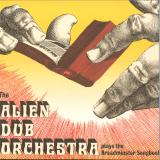
The Alien Dub Orchestra is ragtag collective of Bavarian musicians, featuring members of The Notwist and G.Rag y los hermanos Patchekos. The cohort formed around the idea of performing the standards of the fabled Breadminster Songbook, aka the back-catalogue of lone dubman Elijah Minnelli. Minnelli is known for constructing wheezy, forlorn odes to his hometown, both as highly sought-after self-released 7" singles, and a critically-acclaimed debut album, ‘Perpetual Musket’ for FatCat Records, lauded by the likes of The Guardian, The Wire, and The Quietus. ‘The Alien Dub Orchestra: Plays the Breadminster Songbook’ finds group covering Minnelli’s cumbia-infused dub reggae with full band, playing an eclectic array of instruments including: guiro, accordion, melodica, sousaphone, trumpet and assorted percussion.
The tale begins in 2022, when Minnelli was invited to lend his unique dubbing style to a pair of remixes for The Notwist, and what followed was an ever-flourishing relationship between the Breadminster native and the wider Munich scene. The seeds of the Alien Dub Orchestra were sown during a support gig for The Notwist, where assorted musicians joined Minnelli for a encore, reinterpreting one of his dub remixes across woodwind, brass and assorted percussion.
“The idea of real, competent professionals playing something you’ve muddled together on a computer in a damp basement is quite overwhelming,” reflects Minnelli on the process, “hearing them interpret and improve these melodies is a real joy and privilege.”
Despite the non-traditional origins of the source material, the inherent musicality of Minnelli’s songwriting shines through across his releases, and this creative kinship is what attracted the Orchestra to reimagining his work. The first live collaboration led to recording sessions and further gigs, with the Orchestra building a full set of Minnelli’s music.
The resulting album puts forward the strongest case yet of the shared musical throughline between the acts, where cumbia, dub and folk sensibilities coalesce to something all together unique. The tracks are wrought new, with melodies fleshed out and broader instrumentation expanding the sonic possibilities of the compositions. The tactility of the tracks is perhaps best demonstrated on the gorgeous ‘Vine and Fig Tree’, with it’s layed vocals and expressive bassline returning as a cavorting sousaphone line. Elsewhere, fan favourite ‘SLATS’ sounds as if it was simply written to be performed this way.
To further instill the cylindrical nature of these collaborations, the entire second half of the album is made up of dub versions of the Orchestra’s renditions. For these dubs, Minnelli is joined by Raimund Wong, who had caught his ear with his ambitious live sets, a daisy chain of tape machines and FX pedals. Again, despite their differing creative processes, the two bonded over a shared love of dub music. Each dub was a one-take, with Minnelli riding the faders and Wong’s filters and FX supplying a sound that doesn’t seek to imitate dub, so much as it tries to be it’s own chaotic self. The droning, psychedelic hypnosis of ‘Pundit Dub’ stretches the material to a whole new realm that feels outside of anything else Minnelli has produced before, an ode to the benefits of recycling sound if ever there was one. The whole second half is a perfect closing note to an album that is undoubtedly a love letter to folk tradition, dub ideology and, most importantly, the joy of uninhibited collaboration.
Elijah Minnelli - voc, guiro, percussion
Philip Gross - accordion, melodica
Theresa Loibl - clarinet, melodica
Cico Beck - electronics, keyboards
Sascha Schwegeler - congas, steel drum, percussion
Micha Acher - sousaphone, trumpet
Markus Acher - drums, voc
Dub mixes performed live by Elijah Minnelli & Raimund Wong at Breadminster County Council Studios
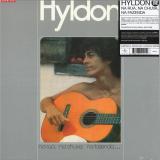
"Na Rua, na Chuva, na Fazenda" is a landmark 1975 album by Hyldon, a key figure in Brazilian soul music. His debut release was one of the top-selling albums that year, capturing the vibrant musical spirit of the 1970s and reflecting the influence of the black power movement alongside artists like Tim Maia and Cassiano. With a mix of MPB, soul, and funk, Hyldon brought his unique sound to life, collaborating with influential artists and contributing to the Brazilian music scene. With a mix of MPB, soul, and funk, Hyldon brought his unique sound to life, collaborating with influential artists like Azymuth. The album, which features the iconic title track, is a celebration of love with timeless songs like 'As Dores do Mundo', 'Na Sombra de uma Arvore' and 'Meu Patuá.' Produced by Guti Carvalho with arrangements by Hyldon and Waldir Arouca Barros, the studio band included the talented musicians from Azymuth (José Roberto Bertrami, Alex Malheiros and Ivan Conti "Mamao"), making it a memorable piece of Brazilian musical history. This album has earned cult status over the years, securing its place as one of the most coveted Brazilian records of all time. Once incredibly rare and expensive, it's now at the top of every serious collector's wishlist. After being unavailable outside of Brazil for years, it's finally been reissued - don't miss your chance to own this legendary piece of music history.
Gegründet wurde Daughter von Sängerin Elena Tonra und Igor Haefli 2010 während ihrer Zeit an der Musikhochschule. Dort trafen sie auch Remi Aguilella, der später das Line-up komplettierte. 2011 veröffentlichten sie in Eigenregie die EP "His Young Heart" und wenig später "The Wild Youth" und in der Folge erspielten sich die drei eine große Fanbase in England. Auch auf dem Kontinent konnten sie bereits überzeugen: Beim Hamburger Dockville-Festival spielten Daughter 2012 vor über 5000 Zuschauern. Die im Herbst folgenden Konzerte in Hamburg und Berlin waren dann schon im Voraus ausverkauft - kein Wunder, betören Daughter das Publikum doch mit ihrer zauberhaften Musik. Mit "If You Leave" ist der Band nun ein eindrucksvolles Debütalbum gelungen, dessen intime Atmosphäre mitunter an das erste Album von The XX erinnert.
By the end of the 1970s Linval Thompson had cut out a successful dual career for himself as both singer and producer. Naturally he moved in the dub field as well, getting further use out of rhythms he used in his other works. Dub had begun strictly as an album format with limited pressing runs for scene insiders, but it had swiftly gained the interest of the rank and file reggae buffs.
'Negrea Love Dub', originally released in 1978, is a cornerstone in the reggae dub scene.
Linval Thompson produced riddims which were laid at Channel One studio by The Revolutionaries – at the time a celebrated studio band led by drum and bass partners Sly Dunbar & Robbie Shakespear – and mixed at King Tubby's renown studio at 18 Dromilly Avenue in Kingston by Prince Jammy.
The sound of the ten dubs featured here is hypnotic and its effects are euphoric to say the least.
Strut presents Mulatu Plays Mulatu, the first major studio album in over 10 years from the father of Ethio-jazz, Mulatu Astatke. Featuring masterful new arrangements of some of his classic compositions, Mulatu Plays Mulatu finds Mulatu revisiting the sounds that helped to change the face of Ethiopian music during the late "60s and early "70s. The album was recorded between London and Addis Ababa, working with his long-standing UK band, a tight, intuitive ensemble honed through years of live performance, alongside cultural musicians resident at his Jazz Village club in Addis. Mulatu Plays Mulatu realises Mulatu"s long-term vision of Ethio-jazz, intricately balancing Western jazz arrangements with the rich sounds of traditional Ethiopian instruments including the krar, masenqo, washint, kebero and begena. Throughout the album, he reshapes familiar material with rich textures, expanded improvisations and a deepened rhythmic complexity, creating a body of work that feels as vital and contemporary as it does steeped in tradition. Familiar compositions like "Yekermo Sew", "Netsanet" and the celebratory "Kulun" are reinvented here as elegant big band performances. Bridging continents and generations throughout his 50-year career, Astatke now offers us an invitation to hear his music again, with a completely fresh perspective. Ethio-jazz, like its creator, is always in motion.
- Southbound To Marion
- M. Daguerre
- Saccharin
- Frida Kahlo
- Seratonin
- Full On Night
- Handwriting
The Rachel's band began when Jason Noble joined forces with Christian Frederickson. Within months of their meeting on a crowded trolley, they had formed a small ensemble to perform original compositions. In the next three years, madness ensued. Christian finished his degree at the Peabody Conserva-tory of Music, traveled to Switzerland to study, returned home, then wound up in NYC to attend the Julliard School. Jason didn't finish his degree, moved back to Louisville, began employment as an artist by day, dishwasher by night, and be-gan working with friends in a band that would become Rodan. This insane, all over the world life-style, led to a barrage of telephone, demo tape, notepaper, sheet music & mail communication. This, combined with sporadic two-week or two-day person-to-person collaborations in whatever city was central enough, became the bizarre process of the music. During this long gestation, Rachel Grimes became involved, first assisting Jason in his brute comprehension of written music, then joining as a pianist & confidant. Soon she was fully entrenched, providing the strange coincidence of possessing the name "Rachel," and an incredible backbone to the project. Several recordings had been finished, some in the studio, hundreds of 8-track cassettes, a few jambox cuts, but the time for a concentrated attempt at an LP seemed far away. Finally, Rachel, Christian, & Jason began assembling musicians who they respected; John, Mark and Barry from the Chicago supergroup The Coctails, Kevin Coul-tas from Rodan, Bob Weston, and several other string players from various walks of life. The result was a group of semi-vagrants, some reading from sheet music, some rambunctious noisemakers, working from an equally improvisational and tight-assed way. The real character comes from the musicians involved, participating in what can only be called a "labor of love." Handwriting, the band's debut album, was originally released by Quarterstick Records in 1995. Jacket custom screen-printed by Jeff Mueller at Dexterity Press.
“New York’s Harlem River Drive is a dividing line, a highway where the rich zip past the poor,” says singer Jimmy Norman. Eddie Palmieri’s Latin-funk band of the same name tackled these hard truths, playing prisons and speaking to the common man. Ultimately, Norman and Palmieri made a powerful socio-political statement that continues to resonate to this day." Pablo Yglesias/Wax Poetics. When initially released in 1971, many critics panned Eddie Palmieri’s album Harlem River Drive. Those critics were wrong. Regardless of critical opinion, the release was not the crossover success Palmieri and Roulette Records had hoped for, at least in the immediate. Over the years the release has developed a following among listeners, DJs, and aficionados of rare-grooves. The record may have been recorded towards the end of the Latin soul era, yet it features that genre's wonderful mix of Puerto Rican soul, Spanish Harlem Latin, and New York funk. Palmieri worked with an incredibly talented crew of Latin and R&B session musicians to create this quintessential New York vibe, a synthesis of funk and Afro-Cuban sounds. Contributors include Victor Venegas from Mongo Santamaria’s band, Palmieri’s brother Charlie, an accomplished musician in his own right, Bruce Fowler who went on to join Frank Zappa’s band, Dick Meza who went on to great things with Tito Puente, Ray Barretto and Celia Cruz, as well as Andy Gonzalez who’s pedigree includes recordings with Barretto, Johnny Pacheco, Willie Colon and even Chico O’Farrill. Also appearing Randy Brecker and one of the all-time greatest of the greats Bernard Purdy. An over-arching theme of Harlem River Drive is the thought that, as Palmieri puts it “The U.S. is richest country, all this immense wealth, side by side with the most intense poverty, racial prejudice; how is that possible?” A question that’s perhaps more even more relevant today than it was in 1971. A question that can be further explored with Get On Down’s reissue of this seminal recording.
- A1: Stepping In
- A2: Start A Fire
- A3: Carry Me Home
- A4: Everywhere I Go
- B1: When You Believe
- B2: Quicksand (Don’t Go)
- B3: Bigger Than All Of Us
- B4: Blood From A Stone
- B5: Into The Light
- C1: Letting Go
- C2: Here Before
- C3: Sailing Off The End Of The World
- C4: Ride At Dawn
- D1: Heartland
- D2: ’Til I’m Home
- D3: Lullaby
“This album is us appreciating how amazing this thing we have is. The realization of how lucky we are that we get to be part of something like this for 25 years, and to have built a community that cares for each other in the way it does. It’s not about any of us individually. When we all work together to make something happen, something bigger happens.” - Jono, Paavo and Tony – Above & Beyond.
If much of the mindset and mantra behind Above & Beyond over the last quarter of a century has been born from the idea of connection, then their fifth artist album ‘Bigger Than All Of Us’ is best summed up in one word: reconnection. It’s been seven years since Jono Grant, Paavo Siljamäki and Tony McGuinness released their fourth electronic album, Common Ground. A #3 on the Billboard charts – an achievement that speaks to the British band’s huge, arena-to-amphitheatre scale profile in America, a level of success replicated in pretty much every other corner of the world.
The time since has seen a series of projects come to life both collectively and individually: 2019’s ambient, yoga-and-meditation-friendly album Flow State, streamed over 400 million times worldwide; a series of club ready instrumentals under the Tranquility Base moniker; radio records ‘See The End’, ‘Over Now’ and ‘Crazy Love’. In the meantime, the band embarked on personal projects outside of the Above & Beyond framework. Grant collaborated with long time friend Daren Tate on 2022’s self-titled synthwave JODA album. In 2023 Siljamäki, reprised his P.O.S. alias, releasing dance floor focussed album Deeper Tales. Last year, McGuinness dug in his own crates for Salt, an album based on a studio-freshened selection of emotional singer-songwriter compositions originally written as the ’90s rave and Britpop fever-dreams faded. A worldwide touring schedule, their weekly Group Therapy radio show, and overseeing a family of iconic dance labels, Anjunabeats, Anjunadeep and, most recently, Anjunachill – it’s never quiet in the world of Above & Beyond.
- A1: Ersatz
- A2: Demain Berlin
- B1: Mauve
- B2: Peine Perdue
First time reissue of this French cold-wave / minimal-synth treasure.
November 1981 – In the heart of autumn, we set off in two cars along the Nationale 1 (!) to reach Choisy-le-Roi, where a 16-track studio was waiting for us—a place where, over the course of a weekend, we would finally be able to carve our own grooves into vinyl. We were quite nervous, as Guerre Froide had already been around for a year and a half. Our elders in Kas Product had already released two EPs—one with four tracks, the other with three—in 1980, even though they’d started only a few months before us. Admittedly, there wasn’t really a sense of urgency—some of us came from the punk movement, where the prevailing mood was still very much No Future, even if we’d long since stopped believing in it... And yet others had truly lost everything, like those from the generation before us. The reasons, ironically, were often the same: heroin and/or love—hard drugs, in both cases.
Speaking of which, I had a terrible stomach ache—due to nerves or some form of tension—which forced us to make a pit stop in the Oise region so I could rush to the toilet of a local café. That same stomach discomfort would hit me again once we arrived at the studio—whose name, incidentally, I’ve since forgotten...
We had gotten there thanks to the generous initiative of a friend, Sylvain S., known as “Perlin” (what a phonetic coincidence!?), who had specifically created the Stechak Products label to produce our record. Stechak because it was consistent with his earlier association called Tchernoziom, and Products as a plural tribute to the trailblazers from Nancy.
Guerre Froide originally consisted of four members: Fabrice Fruchart on guitar-synth (Korg MS-20), Patrick Mallet on bass, and Gilbert Deffais, known as “Bébert”, on Korg drum machine. At the time, I was already singing in a rock/post-punk band called Stress, and that’s how Guerre Froide picked up the bad habit of rehearsing in the same basement in Amiens as Stress. Within a month or two, we had half a dozen songs. We then had the opportunity to record a 4-track demo with a friend from Radio France Picardie, and to perform in October at a festival held at the Amiens municipal circus. Then came the now-legendary concert on November 11 at B.J.’s Club. After that, we self-produced and released 50 completely DIY copies of a cassette titled Cicatrice. A few concerts later—after Jean-Michel Bailleux had joined us on bass and Patrick had switched to guitar, which felt more natural to him—and with more concrete plans starting to take shape, we had to find a new rehearsal space and start renting a room.
Then came the moment when Fabrice told us he was leaving to go study in Lille... After the June 19, 1981 concert, which was naturally dubbed “Farewell to 2F,” Marie-José, Bébert’s wife, offered to take over on synth.
That’s when Perlin, who was a close friend of the Deffais couple and a great fan of our music, offered to fully finance the production of a 4-track 12-inch EP—covering the studio time, mastering, pressing, and artwork. What up-and-coming band would have turned that down? An improvised contract was signed with each member of Guerre Froide. The first step was choosing which four songs we would record. Berlin 81 was an obvious pick, having already become the group’s flagship track. We wanted to avoid reusing songs from Cicatrice, so the focus shifted to new material—some written before, some after Fabrice’s departure. Ersatz, for example, was his composition, but Mauve and Peine Perdue, which were also selected, were both written by Patrick.
- A1: In My Life
- A2: Playing Around
- A3: Do You Wanna
- A4: Turn On Your Funk-A-Phizor
- A5: The Beat Won't Leave You Hangin
- A6: On The Way To The World
- B1: Happiness Is
- B2: Send My Love
- B3: Oh I Love You So
- B4: Down At The Disco
- B5: Let Me Put It In Your Ear
- B6: Errol Flynn
A photo in Rodney Stepp’s scrapbook sums this period in his life in music. It’s 1974, The Spinners were headliners at the “Zaire 74” music festival, a sideshow to Muhammad Ali’s fabled “Rumble in the Jungle” fight with George Foreman. Among the faded snapshots, there’s a picture of Stepp backstage posing arm in arm with Ali; another image shows The Greatest seated at Stepp’s Fender Rhodes alongside vocalist Etta James. It was all a dream for this Naptown wunderkind, who had previously recorded for Herb Miller’s LAMP Records as the Diplomatics and had issued the sweet soul killer “Young Girl” as Jazzie Cazzie and the Eight Sounds on a rare Knaptown 45. (These recordings have been documented on the Now-Again LAMP anthology and our Loving On The Flipside compilation.) But as exciting as his rise out of those local status was, as exciting as it was to headline festivals and arenas and appear on late night talk shows, Stepp grew restless with the mechanical routine of being a sideman. He grew tired of playing the same charts night after night. He was hungry for a creative outlet that mimicked his earliest days in recorded music. So, in 1978, Stepp left The Spinners and returned to Indianapolis, where he established an all-stargroup of musicians–including members of Jazzie Cazzie and the fabled Amnesty–and he named the band Rapture. They inspired countless others. They recorded an album’s worth of material. Now-Again’s Egon first got tapes from Stepp in 2002 and dutifully transferred them, but the time was not right for a foray into this wealth of material. Come 2025, and this is the first time it Rapture’s music is seeing the light of day, a triumphant, late career moment for Stepp and a cause for celebration of those intrigued by deep, sweet soul and disco funk
- A1: That Summer Feeling
- A2: This Kind Of Music
- A3: The Neighbors
- A4: Somebody To Hold Me
- A5: Those Conga Drums
- B1: Stop This Car
- B2: Not Yet Three
- B3: Give Paris One More Chance
- B4: You're The One For Me
- B5: When I'm Walking
Jonathan Sings! is the fourth album by American rock band Jonathan Richman and the Modern Lovers, and was released in 1983. Richman emerges as an incurable romantic on Jonathan Sings!, an infectiously sunny effort which stands among his finest LPs. Recorded after a long layoff with a new Modern Lovers lineup, Richman sounds thoroughly recharge, even extolling the simple virtues of "This Kind of Music"; among his other enthusiasms are kids; "Not Yet Three" and travel; "Give Paris One More Chance", but his primary focus here is romance, "You're the One for Me," "That Summer Feeling" and "Someone to Hold Me" are positively joyous. NME ranked it at number 19 in their "Albums of the Year" list for 1984. Jonathan Sings! is available as a limited edition of 1000 individually numbered copies on purple coloured vinyl.
- Tired
- We Were Punk First
- Moving Day
- The Punchline
- Bad Indian
- The Art Of Savagery
- Rage
- Dreamcatcher
- World Up My Ass
- This Is Not A Political Song
- Doom Indian
- No One Owns Anything And Death Is Real
Crystal Clear Vinyl, limited to 1000 copies. Who were the first punks? Do The Damned have more of a shout than The Sex Pistols? The Stooges or Ramones? Gregg Deal, the acclaimed visual and performance artist behind his new project Dead Pioneers, is making a claim that Indigenous Americans were the first real punks. Deal suggests that the overarching theme of the album is "an introduction to the band itself". Created with a DIY disposition and the "love of a scene that saves lives", they reel off a roll call of marginalised groups and protected characteristics: "Indigenous rights, Black rights, Brown rights, Asian rights, Gay rights, Trans rights, Workers rights and beyond_". This is central to their identity and focus, saying that "with a North American Indigenous person as the vocalist, being unapologetically upfront on the social, political and cultural side of things doesn't seem necessary, but paramount to the overall tone of the band." This self-titled debut, coming in at a lithe 22 minutes with only one of the twelve tracks exceeding three minutes, is almost over before it begins, but covers a huge amount of ground in that time. Blistering opener 'Tired' sets out their stall; as with the whole album, it is passionate, but never preaching. Capitalised 'Political Music' can be hard to land without coming across as hectoring or earnest, but Deal's literary, humorous lyrics effortlessly cut through complex issues of marginalisation and colonialism.
- A1: Cold Embrace (3.37)
- A2: The Dark Lord (3.13
- A3: The Sky Is Burning (2.30)
- A4: You’re Alone Now (3.40)
- A5: Grass (4.01)
- A6: It’s Only Love (4.16)
- A7: Horse (3.31)
- B1: Escalator (2.49)
- B2: Angry Faces (4.01)
- B3: Midsummer Nights Dream (2.11)
- B4: Season Of The Witch (4.23)
- B5: Yesterlove (4.56)
- B6: Back Door Man (3.04)
Escalator" by Sam Gopal feat. Motorhead’s Lemmy – A Psychedelic Gem
Released in January 1969, Escalator is the only studio album by the British psychedelic rock band Sam Gopal, led by tabla maestro Sam Gopal himself
Unique both in sound and lineup, the record blends Eastern percussion with psychedelic rock and has garnered cult status—especially thanks to guitarist/vocalist Ian “Lemmy” Kilmister.
This record marks Lemmy’s earliest studio work, before his stints with Hawkwind and of course, Motörhead, making it a vital piece for fans of his legacy.
Incl. Unreleased tracks “Horse/back Door Man”
180 gram vinyl + insert
Born from a chance encounter in a Villejuif squat over a decade ago, Ciccio & 2mo have cultivated a singular musical language through spontaneous and genre-defying collaborations — notably around cult French band Cheveu.
The duo brings together two key figures from the fringes of the European underground: Olivier Demeaux (aka 2mo), a pioneer of France’s electronic avant-garde, leading projects like Heimat and Accident du Travail (Teenage Menopause, Bruit Direct), known for his explorations across lo-fi synthwave, spectral post-punk, and drone-infused textures; and Francesco Pastacaldi (Ciccio), a jazz-punk drummer and member of the explosive trio Jean-Louis and the angular groove unit Abacaxi (Carton Records), also a longtime collaborator of the maverick performer Fantazio.
Their debut album 24 96 (The Trilogy Tapes, 2021), born from a series of abrasive studio improvisations, was followed by a sold-out show at London’s Café OTO. That performance, released as Maremoto, captured the duo’s raw, physical energy in its purest form.
Since then, Ciccio & 2mo have brought their visceral live act to stages across Europe — from Sonic Protest in France to the Meakusma Festival in Belgium, where their live set was released as Live at Meakusma Festival 2024.
Now, the duo returns with Bouc & Rouages, a bold and hallucinatory second album commissioned by Hublotone. This new opus introduces three singular voices into the mix: operatic singers Léa Trommenschlager and Bianca Iannuzzi, and genre- blurring rapper Pauline Sampler (aka Frizzy P, known for her work with M. Cole). The result is a soundscape in constant tension — pulsing drum machines, organic percussion, saturated synth layers, and hypnotic, looping riffs.
Equal parts physical and disenchanted, the music of Ciccio & 2mo traces a thrilling, unstable path through noise psychedelia, industrial memory, and experimental pop.
Imagine Cosey Fanni Tutti rubbing up against pop, with Charles Hayward (This Heat) on drums — and you’re getting close.
- Hammer
- Bloodfeather
- Pot Of Gold
- Parasites
- Dwelling
- Perfect Organism
- Bones
- Waiting By The Gallows
gold nugget vinyl[24,58 €]
Since 2017, Cosmic Reaper has carried a black-flamed torch of tradition, forged in the long lineage of doom and sludge. Emerging from the shadows of Charlotte, North Carolina, the band blends a raw, southern swing with the full circle of heavy metal-creating a sound as steeped in American mysticism as it is overloaded saturation of amplifier worship. "Bleed the Wicked, Drown the Damned is an album we poured our hearts into. With our sophomore LP, we wanted to take our sound to a new level, but also call back to the roots of doom, with a touch of 90s angst. Lyrically, it touches on everything from standing up to tyranny, to revenge, to sacrifice, to love, lust and betrayal- all wrapped in themes of horror, science-fiction, and history. For the best listening experience: light one up, and turn it up loud."
Black Vinyl[21,81 €]
gold nugget vinyl, limited to 350 copies. Since 2017, Cosmic Reaper has carried a black-flamed torch of tradition, forged in the long lineage of doom and sludge. Emerging from the shadows of Charlotte, North Carolina, the band blends a raw, southern swing with the full circle of heavy metal-creating a sound as steeped in American mysticism as it is overloaded saturation of amplifier worship. "Bleed the Wicked, Drown the Damned is an album we poured our hearts into. With our sophomore LP, we wanted to take our sound to a new level, but also call back to the roots of doom, with a touch of 90s angst. Lyrically, it touches on everything from standing up to tyranny, to revenge, to sacrifice, to love, lust and betrayal- all wrapped in themes of horror, science-fiction, and history. For the best listening experience: light one up, and turn it up loud."
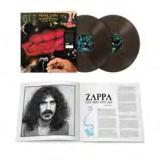
Frank Zappas episches Album „One Size Fits All“ aus dem Jahr 1975 feiert sein 50-jähriges Jubiläum
mit einem weiteren vollgepackten Multi-Disc-Box-Set mit 75 % unveröffentlichtem Material. Die Box enthält vier CDs mit dem 2012 von der Legende Bob Ludwig neu gemasterten Hauptalbum sowie anderthalb
Discs mit Studio-Outtakes, Live-Konzerten, Work-Mixes und relevanten Vault-Tracks. Die Live-Besetzung
bestand aus der klassischen 6-köpfigen Band mit George Duke und Ruth Underwood.Ruth Underwood
steuerte auch neue Linernotes für das Paket bei, zusammen mit historischen Essays von David Fricke und
„Vaultmeister“ Joe Travers. Das Booklet zum 50. Jahrestag enthält außerdem neu veröffentlichte Fotos
von Sam Emerson.
Die Blu-Ray Disc enthält brandneue Dolby Atmos- und 5.1-Mischungen direkt von den 24-Spur-Masterbändern
des Albums, Hi-Res-Versionen des Hauptalbums und zwei Bonus-Surround-Tracks mit alten Mixes von
Zappa selbst. Außerdem sind zwei Bonusvideos von den klassischen KCET-TV-Dreharbeiten enthalten, die
zum ersten Mal neu bearbeitet wurden, seit FZ 1974 das Material in die Hände bekam.
Die 2LP „black glitter“ Jubiläumsedition enthält einen brandneuen analogen Schnitt des Albums, eine
Bonus-LP mit den Highlights des Box-Sets und das Booklet der 50th Anniversary Edition.
- The Big
- Changing Tides
- All
- Bendico
- Vice Versa
- Martha's Dance
- Dunkelflaute
Trailblazing outlet for forward-thinking Danish Jazz, April Records proudly presents the debut from trumpeter/composer Rolf Thofte; a vivid and personal record that blends lyrical melodies, inventive rhythms, and subtle harmonic exploration. Written while Thofte adjusted to fatherhood - the album captures moments of joy, reflection, and experimentation, brought to life by a handpicked quintet of Denmark"s most exciting young jazz talents. Martha"s Dance is set for release on September 19th, 2025 via April Records. The title track is a tribute to Thofte"s three-year-old daughter - a playful, clapping, goat-hoof-stomping tune in quirky 5/4 that channels the spirit of childhood joy and spontaneity. "It"s just a fun tune to play, and I feel like it really captures Martha"s spirit," says Thofte. "This band came together at a time when I was trying to get a foothold in a new life situation as a father, so it felt perfect to make this the title track." The album moves between moods and textures with elegance: from the rich harmonic language of "Vice Versa" - inspired by Wayne Shorter"s ability to cast simple melodies in shifting harmonic light - to the understated power of "Changing Tides," a piece about imperceptible gradual changes in our lives, nature, and politics. "Bendico," written in 15 minutes as a conservatory assignment, showcases Thofte"s gift for strong melodic statements, while "Dunkelflaute" evokes melancholic Nordic greyness through sparse, emotive phrasing. From the swaggering second-line feel of "The Big 5" to the hypnotic pulse of "All...", the album explores rhythm as both a driving force and a canvas for creative interplay. Throughout, Thofte"s trumpet and flugelhorn lead the ensemble with warmth and clarity. The quintet features some of Copenhagen"s top next-generation players: Andreas Toftemark (tenor saxophone), a powerhouse improviser and composer who brings NYC-honed energy and detail to the group dynamic. Rasmus Sorensen (piano), a rising star of the European scene, known for his sensitive, exploratory playing and fearless interaction. Jakob Roland (bass) and Henrik Holst (drums) - two of Thofte"s oldest musical collaborators - round out the rhythm section with deep swing, taste, and musical empathy.
Don your bandanas, leather jackets and distressed jeans, because heavy metal is about to shine brighter than ever as Swedish newcomers BOMBER bring back the hottest era in hard rock history. Asserting their own trademark blend of 70s and 80s inspired classic and hard rock with catchy hooks, top-notch guitar solos and a vibrant aesthetic, BOMBER brings you their debut album, Nocturnal Creatures, via Napalm Records! After explosive live shows in Sweden and a subsequent tour of Germany, the hard rockers prove that the glorious era of rock isn’t over and that they’re already setting the highest standards on Nocturnal Creatures. On ten powerful tracks, BOMBER turns the night into an intoxicating adventure that convinces both old and new fans of the prominent classic and hard rock genre. Album opener and title track “Nocturnal Creatures” opens the gates with epic storytelling and interludes the following passionate ride through “Zarathustra”. With fiery vocals, melodic guitars and untamable drum-play, the track gets the listener’s pulse pumping, while “Fever Eyes” ensnares with wistful weeping choirs and guarantees a quickly increasing temperature. “Black Pants Magic” emerges into an unforgettable high-class rock experience through its industrious and catchy hook, while songs like “A Walk Of Titans (Hearts Will Break)” and “You’ve Got Demons” surprise with dynamic melodies and Anton Sköld’s powerful voice. On “The Tiger”, BOMBER send their listeners right into the eye of a raging thunderstorm of riffs driven by brilliant grooves, while “Kassiopeia” sets the strings on fire with its marvelous solos. Bursting album closer “Aurora” presents Nocturnal Creatures’ crowning achievement, bringing the 40-minute escapade to the edge of the world. With their new studio album, Nocturnal Creatures, the rising stars of Sweden establish a milestone in the legacy of hard rock that leads the once so majestic genre to new glory – marked by their very own special vision!
It's spring of 2023 in the North Carolina Piedmont, and songwriter and singer M.C. Taylor - leader of the band Hiss Golden Messenger - is feeling alive. Joyful. Eternal, he might say. For the Grammy-nominated musician, whose albums have traced an internal path through adulthood, fatherhood, spirituality, and depression for well over a decade, this is something new. "The tunes on Jump for Joy were composed in free moments throughout 2022, a year during which Hiss was on the road more or less constantly," explains Taylor. "And perhaps because the post-pandemic energy out in the world felt so chaotic and uncertain, I found myself thinking a lot about the role that music has played in my life and how exactly I ended up in the rarefied position of leading a band and crew all over the globe through dingy graffiti-scrawled green rooms, venerated music halls, dust-blown roadside motels.
Sometimes playing in front of 5,000; sometimes 200. Sleeping sitting up. Laughing until my stomach hurts. Not being able to fall asleep at 3 a.m. in some anonymous bed because my mind is spinning with anxiety or depression or adrenaline, or because my ears are still ringing. Robbing Peter to pay Paul, then robbing Paul to pay Peter back. Over and over again. It's an outlaw life but one, I'm coming to realize, that makes me happy." The songs that make up Jump for Joy - the sharpest and most autobiographical that Taylor has written under the Hiss name - read as a sort of epistolary, postcards between the present-day songwriter and his alias Michael Crow, a teenaged dreamer very much like Taylor himself, who trips his way through the 14 tunes that make up the record. In this way, Jump for Joy is a meditation on a life lived with art, and the ways that our hopes and dreams and decisions bump up against_ and, with a little bit of luck, occasionally merge with real life. "Creating this character became the way that I could explore these vulnerable, tender moments that were so decisive in my life, even if I didn't know it at the time," explains Taylor.
Produced by Taylor and engineered by longtime Hiss compatriot Scott Hirsch over two weeks in the late fall of 2022 at the fabled Sonic Ranch studio in Tornillo, TX, just a short walk from the Mexican border, Jump for Joy dances with joyful, spontaneous energy that feels like a fresh chapter in the Hiss Golden Messenger oeuvre. Taylor is accompanied throughout the album by his crack live band: guitarist Chris Boerner, bassist Alex Bingham, keyboardist Sam Fribush, and drummer Nick Falk, a collection of musicians that have helped make Hiss Golden Messenger's live performances legendary affairs
This is Music: The Singles, ist ein Kompilationsalbum der englischen Alternative-Rock-Band The Verve:
Richard Ashcroft (Gesang), Pete Salisbury (Schlagzeug), Simon Jones (Bass) und Nick McCabe (Gitarre).
Ursprünglich wurde das Album im November 2004 veröffentlicht und enthielt zwei Nicht-Singles, die aus
den Aufnahmen zu ihrem dritten Album Urban Hymns stammten: „This Could Be My Moment“ und
„Monte Carlo“.
2024 markiert den 20. Jahrestag der Veröffentlichung eines Albums, das nie auf Vinyl gepresst wurde,
und unter der Leitung der Gruppe ersetzt diese längst überfällige Neuauflage die Bonustracks durch die
kraftvollen Singles aus dem 2008er Reunion-Album Forth - ’Love is Noise’ und ’Rather Be’ - und enthält
auch die zweite Single ’She’s A Superstar’ (1992) in ihrer ursprünglichen, achteinhalbminütigen Form (statt
der fünfminütigen Bearbeitung). Somit repräsentiert das Album nun die komplette Geschichte der Singles
von The Verve.
Benannt nach der sechsten Single der Band, der ersten aus ihrem zweiten Album A Northern Soul, dokumentiert es auf brillante Weise die Kraft der relativ kurzen, aber epochemachenden Reise von The Verve
durch den musikalischen Kosmos.
Pratts & Payne, the South London pub that sits around the corner from the famed home studio of producer Dan Carey, has an important place in the history of Royel Otis. When making their debut album with Carey in early 2023, the Australian duo - childhood friends Otis Pavlovic and Royel Maddell - would decamp to the pub to finish lyrics and make decisions on the direction of their first LP. "Dan would ask us to record vocals," Royel remembers, "and we'd say, 'Just give us half an hour, we're popping to Pratts & Payne', and we'd have a pint, a few shots, and get some lyrics down." Eventually, it made such a mark that they named the record PRATTS & PAIN. Across the debut album, Royel Otis swing between melodic, pop- inspired indie and woozy psych, but it never feels tied to one lane. As soon as one style or mood has outstayed its welcome, they handbrake turn into psychedelic weirdness or dissonant noise, keeping everybody on their toes. After the table was laid on the two EPs, PRATTS & PAIN brings everything from the band's history together on a record that's reverent towards their beginnings but unafraid to push forwards into new sounds. This loose, open formula for what makes a Royel Otis song is written all over PRATTS & PAIN, an album defined by its sense of fun and adventure. On the tracks 'Velvet' and 'Big Ciggie', Carey's 11-year-old nephew Archie appears on drums, and a spontaneous energy ran through the sessions, one which can be heard across the album. On first single 'Adored', they master the perfect indie-pop hit, while 'Sonic Blue' keeps this underlying energy but sets screeching guitars over the top. 'Velvet', meanwhile, has the stomping energy of Talking Heads, while 'Molly' is an unsettling and deeply atmospheric slow jam. Whatever sonic template the music might be based on though, the crux of Royel Otis comes back to a foundational DNA of mutual trust. Royel says: "We have fun together, and it's not difficult. I trust what Otis thinks and what he does, and I back it. If you back each other, something good comes from it."
múm are returning with a new album on Morr Music. »History of Silence« is the first full body of work by the Icelandic collective since 2013's »Smilewound« and their seventh studio album to date—recorded, deconstructed, put back together again, refined and finished over the course of two years. Vibrantly oscillating around a carefully curated palette of electronic and analogue sounds, the eight new tracks reflect the group's continuous strive to explore sonic spaces through subtle yet gripping songwriting.
For a long time now, múm have been exploring the idea of distance in their music. In the beginning, this was born purely out of necessity. Founded in Iceland in the late 1990s, the members soon began embarking on journeys across the world—collectively while touring, but also individually, exploring new places to live and create. Settling in, moving on, catching up: The concept of distance soon became an integral part of the collective's process. »History of Silence« leans into this idea, with space and time becoming indispensable pillars of the arrangements. While being coherent and structured, they echo their origins from different seasons, cities, and spaces—neatly stitched together with unparalleled craftsmanship. They breathe an overall airy and intimate atmosphere, yet resonate with the structural heft of time.
On »History of Silence« time manifests in unexpected, liberating, and mesmerizing ways. It does not move reliably forward; it drifts, takes twists and turns, even disappears completely. Electronic textures blur into acoustic sounds, voices flicker and dissolve, melodies stumble and repeat. The arrangements often feel like they’re wandering, gently resisting direction. »Our Love is Distorting,« for instance, begins with a subtle piano motif, playing hide and seek with feedback noises, digital artefacts, and lush—yet very quiet—string arrangements, before gradually forming into a distinctive song. It's a perfect illustration of múm's general approach on this album. »Mild at Heart« turns this idea upside-down, flowing freely from start to finish with moments of silence sprinkled in—serving to emphasize the musical elements. The music on »History of Silence« moves like weather: unexpected, intimate, quietly detailed. Contrasted with vivid phrases, rhythmic shifts, and small hooks, the album offers a new angle of compositional clarity and vision.
Work on »History of Silence« began at Sudestudio in southern Italy. Additional recordings were made in Reykjavík, Berlin, Athens, Helsinki, New York, and Prague. The strings were recorded by Sinfonia Nord at the Hof concert hall, Akureyri, arranged and conducted by Ingi Garðar Erlendsson, who has worked with the band for many years. The orchestral elements don’t dominate the record—instead, they surface gently, adding depth and resonance to the songs without disturbing the songs' fragility.
Contrary to what the album title suggests, »History of Silence« is a collection of bold and colorful songs, no matter how muted they might sound at times. They tickle like a feather drifting through the wind, ending up in unexpected places, stimulating long-forgotten thoughts and feelings, intimate moments of introspection. The songs move through the echoes those moments leave behind: the emotional traces of things unsaid, the weight of stillness. Offering closeness by means of distance and much-needed support.
múm are returning with a new album on Morr Music. »History of Silence« is the first full body of work by the Icelandic collective since 2013's »Smilewound« and their seventh studio album to date—recorded, deconstructed, put back together again, refined and finished over the course of two years. Vibrantly oscillating around a carefully curated palette of electronic and analogue sounds, the eight new tracks reflect the group's continuous strive to explore sonic spaces through subtle yet gripping songwriting.
For a long time now, múm have been exploring the idea of distance in their music. In the beginning, this was born purely out of necessity. Founded in Iceland in the late 1990s, the members soon began embarking on journeys across the world—collectively while touring, but also individually, exploring new places to live and create. Settling in, moving on, catching up: The concept of distance soon became an integral part of the collective's process. »History of Silence« leans into this idea, with space and time becoming indispensable pillars of the arrangements. While being coherent and structured, they echo their origins from different seasons, cities, and spaces—neatly stitched together with unparalleled craftsmanship. They breathe an overall airy and intimate atmosphere, yet resonate with the structural heft of time.
On »History of Silence« time manifests in unexpected, liberating, and mesmerizing ways. It does not move reliably forward; it drifts, takes twists and turns, even disappears completely. Electronic textures blur into acoustic sounds, voices flicker and dissolve, melodies stumble and repeat. The arrangements often feel like they’re wandering, gently resisting direction. »Our Love is Distorting,« for instance, begins with a subtle piano motif, playing hide and seek with feedback noises, digital artefacts, and lush—yet very quiet—string arrangements, before gradually forming into a distinctive song. It's a perfect illustration of múm's general approach on this album. »Mild at Heart« turns this idea upside-down, flowing freely from start to finish with moments of silence sprinkled in—serving to emphasize the musical elements. The music on »History of Silence« moves like weather: unexpected, intimate, quietly detailed. Contrasted with vivid phrases, rhythmic shifts, and small hooks, the album offers a new angle of compositional clarity and vision.
Work on »History of Silence« began at Sudestudio in southern Italy. Additional recordings were made in Reykjavík, Berlin, Athens, Helsinki, New York, and Prague. The strings were recorded by Sinfonia Nord at the Hof concert hall, Akureyri, arranged and conducted by Ingi Garðar Erlendsson, who has worked with the band for many years. The orchestral elements don’t dominate the record—instead, they surface gently, adding depth and resonance to the songs without disturbing the songs' fragility.
Contrary to what the album title suggests, »History of Silence« is a collection of bold and colorful songs, no matter how muted they might sound at times. They tickle like a feather drifting through the wind, ending up in unexpected places, stimulating long-forgotten thoughts and feelings, intimate moments of introspection. The songs move through the echoes those moments leave behind: the emotional traces of things unsaid, the weight of stillness. Offering closeness by means of distance and much-needed support.
múm are returning with a new album on Morr Music. »History of Silence« is the first full body of work by the Icelandic collective since 2013's »Smilewound« and their seventh studio album to date—recorded, deconstructed, put back together again, refined and finished over the course of two years. Vibrantly oscillating around a carefully curated palette of electronic and analogue sounds, the eight new tracks reflect the group's continuous strive to explore sonic spaces through subtle yet gripping songwriting.
For a long time now, múm have been exploring the idea of distance in their music. In the beginning, this was born purely out of necessity. Founded in Iceland in the late 1990s, the members soon began embarking on journeys across the world—collectively while touring, but also individually, exploring new places to live and create. Settling in, moving on, catching up: The concept of distance soon became an integral part of the collective's process. »History of Silence« leans into this idea, with space and time becoming indispensable pillars of the arrangements. While being coherent and structured, they echo their origins from different seasons, cities, and spaces—neatly stitched together with unparalleled craftsmanship. They breathe an overall airy and intimate atmosphere, yet resonate with the structural heft of time.
On »History of Silence« time manifests in unexpected, liberating, and mesmerizing ways. It does not move reliably forward; it drifts, takes twists and turns, even disappears completely. Electronic textures blur into acoustic sounds, voices flicker and dissolve, melodies stumble and repeat. The arrangements often feel like they’re wandering, gently resisting direction. »Our Love is Distorting,« for instance, begins with a subtle piano motif, playing hide and seek with feedback noises, digital artefacts, and lush—yet very quiet—string arrangements, before gradually forming into a distinctive song. It's a perfect illustration of múm's general approach on this album. »Mild at Heart« turns this idea upside-down, flowing freely from start to finish with moments of silence sprinkled in—serving to emphasize the musical elements. The music on »History of Silence« moves like weather: unexpected, intimate, quietly detailed. Contrasted with vivid phrases, rhythmic shifts, and small hooks, the album offers a new angle of compositional clarity and vision.
Work on »History of Silence« began at Sudestudio in southern Italy. Additional recordings were made in Reykjavík, Berlin, Athens, Helsinki, New York, and Prague. The strings were recorded by Sinfonia Nord at the Hof concert hall, Akureyri, arranged and conducted by Ingi Garðar Erlendsson, who has worked with the band for many years. The orchestral elements don’t dominate the record—instead, they surface gently, adding depth and resonance to the songs without disturbing the songs' fragility.
Contrary to what the album title suggests, »History of Silence« is a collection of bold and colorful songs, no matter how muted they might sound at times. They tickle like a feather drifting through the wind, ending up in unexpected places, stimulating long-forgotten thoughts and feelings, intimate moments of introspection. The songs move through the echoes those moments leave behind: the emotional traces of things unsaid, the weight of stillness. Offering closeness by means of distance and much-needed support.
- Last Chance
- Wait For Us To Be Home
- Prayers And Pollen
- Transparent Towns
- Who You Thought I Was
- Jump The Gun
- Regret Without Reason
- Door Of No Return
- Sierra Dawn
- Cardinal Direction
John Calvin Abney rises again from the Oklahoman prairies with his latest album Transparent Towns. The ten songs focus on how we remember, and ultimately accept, though he is not always certain the memories we carry adequately mark the moments that make us. "This record is wrapped around the passage of time, whether or not we can trust the memories that we swear on, how we forgive ourselves and others as seasons turn, and how we define what is important as we roll the boulder back up the hill," Abney says of Transparent Towns. "We build these routines and live our stories, we rely on our histories and our memories - spoken and recorded. Now, we're relying on copies of copies, memories of memories, all packed like sardines into our phones, and we're losing the ability to tell our own stories. I have to constantly remind myself, as well as redefine what matters at the end of a day." Transparent Towns is the seventh studio album for Abney, and his first since 2022's Tourist, which he crafted after spending the pandemic as an itinerant writer. In contrast Abney penned most of the album's 10 tracks during a period of introspection and convalescence while recovering from vocal cord surgery in 2023. The time to himself - "I didn't sing for nearly a year, and after surgery, I couldn't talk for a month, and couldn't sing for over three months," he says, left him contemplating how to trace his experiences in the silence. The album's title track is Abney's take on the inaccessible past, witnessing loss and grief through the years, damning the "days we let go left unsaid", and accepting the uncontrollable circumstances we are sometimes placed in. "The troubles and the joys exist vibrantly in your memory, but you're wondering if you remember correctly," Abney remarks. "I've sometimes had this sort of confusion between memory and dreams - you crafted this ideal in your head of how things were or might be, in order to soften the blow of a harsher reality." The places we inhabit dictate how our memories form, and for Abney, there is one place to which he is constantly drawn: Oklahoma. Although he was born in the biggest little city in America, Reno, Nevada, he grew up learning guitar and piano in Tulsa, playing bars and DIY spaces from Norman to Stillwater. His affinity for the land that raised him is evident in the production of Transparent Towns. Abney self-produced the record, tracking most of it at Cardinal Song outside of Oklahoma City, with Michael Trepagnier handling mixing and engineering. The band was comprised mostly of Sooner State musicians too, along with Lydia Loveless and John Moreland contributing harmony vocals. His signature vulnerable voice and lyrical handiwork comes through in each of the songs, along with his penchant for alternative pop melodies set against colorful chords and subtle soundscapes. Having toured for years backing up artists like Moreland, Wild Child, Ben Kweller, and S.G. Goodman, Abney embraces a lead role again, as he presses forward with the loving lament and defiant joy throughout Transparent Towns, calling us to leave behind the pressures we place on our ourselves and recognize that just because there is an ending, it doesn't mean it's the end.
In 2022, Meral Polat released her debut album "Ez Ki Me" as a singer under the name Meral Polat Trio. "Ez Ki Me" roughly translates to "Who am I?". The album was a search by the singer for her Alevi Kurdish roots. In her lyrics, Meral incorporated many poems from her late father, Adi Ihsan Polat. The album received positive reviews and was nominated for a Music Award by Songlines.
On her new album MEYDAN, Meral primarily showcases her own voice, that of a woman exercising her right to live on her own terms, free from the oppressive interference of patriarchy. The album celebrates female strength, inspired by the philosophy of "JIN, JIYAN, AZADI" (WOMAN, LIFE, FREEDOM), a phrase originating from Kurdish-led women's movements. JIN, JIYAN, AZADI symbolise resistance to oppression and the fight for women's rights.
Musically, MEYDAN takes it a step further than the debut album. Meral welcomes drummer Jens Bouttery to the band, along with many inspiring guest musicians. The track "Cenek" features a determined choir of 26 women of various ages and cultural backgrounds. In "Çiya Icaro", Meral shares a duet with Bolivian artist Ibbelise Guarda Ferraguti.
On MEYDAN, Meral and her band continue their exploration of Anatolian and Mesopotamian music, particularly the Turkish psychedelic rock revolution of the 1970s and the ancient Kurdish Dengbej traditions. The band travelled to Istanbul to record with Murat Ertel from Baba Zula and trumpet player Can Omer Uygan. In addition to Anatolian music styles, influences from Mali Blues and Nigerian Afrobeat are embraced. Another notable guest is Senegalese musician Mola Sylla, who lent his voice and improvisational talent to the track "Govend".
While the drums, keyboards or guitar, and Polat's voice still form the core of the album, each track also contains its own collage of synthesisers, vocal harmonies, percussion, organ, piano, distorted guitars, and guest musicians. All tracks were mixed by the exceptional Belgian mixing engineer Pieterjan Coppejans, who added depth to their sound. All of this results in a particularly rich and uplifting album with a message.
- Another Grand Offering For The Swine
- Noonday Demon
- Mind
- Ditto
- Freeeee
- Divine Blight
- Happy
- Feliz
- Breeze
- Fantasia
- Songs For The Record Exchange
- How Long Must I Stay In This Place?
Following the "rich jangle and big, well-developed songs" (Bandcamp) of 2023's Bananasugarfire, Edling sought to deconstruct his creative process by centering collaboration instead of a more solitary pursuit in songwriting, even as personal matters made isolation a more natural instinct. He describes taking time to make notes of the ways, timing and forms in which songs came to him in the process of demoing the record, and regularly questioning if his approach was like that of "watching a pot of water boil" or waiting for a bolt of light to appear in the sky. In many ways, Shooting Star is an appeal to the muse, a record of "songs about writing songs" born from Edling's desire to trust his instincts despite the posturings of inner demons and creative roadblocks, and to celebrate the little wins along the way. The result is a sprawling new work packed to the brim with playful eccentricities and dynamism, one that owes as much of its inspiration to mid-century folkies like Michael Hurley and Karen Dalton as it does to alt rock of the nineties like Yo La Tengo and Stereolab. Shooting Star is a constellation of influences, experiences, reckonings-with the state of the world, with others, with creativity, with oneself-with no two songs created in the same way. Instead of holing up in a recording studio, the creation of the record was formed by a patchwork of collaborations in a variety of recording locales, all which were later alchemized by mix engineer Matthew Schimelfenig. - RIYL Sparklehorse, John Cale, Yo La Tengo, Superviolet, Spirit of the Beehive, Horse Jumper of Love, Of Montreal
- Strange Meeting With Owls
- Skewered By The Daystar
- It Was A Flood
- Atlas On His Day Off
- Turn Signal
- And You Want To Be My Dog
- Secret Weather
- A Tavern Poem, Passed From Mouth To Mouth
- Another Bullshit Rodeo
- They Laugh That Win
- Escape Artist
- Darkness Leaning Like Water Against The Windows
- The Moon Says
- Hores & Hero
- Demon Confrontation
- Fixing The Past Is A Sucker's Game
- Sea & Swimmer
Gabriel Birnbaum, der Hauptsongwriter der Brooklyn-Band Wilder Maker, sagt, dass das neueste Album der Gruppe, The Streets Like Beds Still Warm, ,einer allgemeinen formalen Asymmetrie folgt, wie einer Traumlogik". Es ist reichhaltig strukturiert, stimmungsvoll und tiefgründig und ebenso narrativ wie experimentell. Es als Konzeptalbum zu bezeichnen, so groß dieser Begriff auch ist, würde ihm eigentlich nicht gerecht werden. Tatsächlich ist es nur der erste Teil einer Konzepttrilogie, die die Geschichte einer langen Nacht in der Stadt erzählt, von der Dämmerung bis zum Morgengrauen. Das Album folgt einem einsamen Erzähler, der durch die Straßen treibt und Bars und Krankenhauszimmer betritt und wieder verlässt. Wenn das ein bisschen noir klingt, dann liegt das daran, dass es das auch ist. ,Film noir Detektive sehen am Anfang immer makellos aus, aber am Ende des Films haben sie einen zerrissenen Kragen, ein blaues Auge, ihre Hosen sind fleckig und sie fangen an, aus Verzweiflung Leute zu schlagen", sagt Birnbaum. ,Sind sie noch die Guten? Ich finde das faszinierend und ich liebe die visuellen Hinweise, die die innere Landschaft widerspiegeln." Zwar gibt es auf The Streets Like Beds Still Warm keine visuellen Hinweise im eigentlichen Sinne, doch das Album verdankt sein großartiges Debüt der Kinematografie. Impressionistische Wirbel aus verzerrter Gitarre, Schlagzeug und Saxophon untermalen Birnbaums heiseres, weltmüdes Bariton-Crooning, das manchmal an Bill Fay erinnert. Aber manchmal, in all den düsteren Bar-Geschichten, denkt man auch an Tom Waits. Es ist ein Vergleich, der sowohl irreführend als auch verkürzend sein kann, aber es ist schwer, diese Assoziationen beim Hören von The Streets Like Beds Still Warm nicht zu sehen - vielleicht eine langsam schwingende Tiffany-Lampe direkt über dem Kopf des Erzählers, der etwas mehr als halbtrunken ist und eine brillant poetische, antiheroische Geschichte auf eine Serviette in einer Bar kritzelt. Seien Sie jedoch versichert, dass dies nicht ,The Heart of Saturday Night" und auch nicht ,In the Wee Small Hours" ist. Tatsächlich stammen die musikalischen Vorläufer von ,The Streets Like Beds Still Warm" aus ganz anderen Ecken des musikalischen Universums. Die Band lässt sich direkt von den Werken der zeitgenössischen Alt-Jazz-Musiker Anna Butterss und Jeff Parker sowie vom Ambient-Pionier Brian Eno ,The Streets Like Beds Still Warm" ist insgesamt ein Statement für nächtliches und hypnotisches Storytelling - sowohl in Bezug auf Stil als auch Inhalt. Birnbaums Engagement für die Erzählung, die letztendlich von Menschlichkeit handelt, spiegelt sich in der traumhaften Art und Weise wider, wie sich die Melodien entfalten. Es könnte gar nicht anders funktionieren. Tief empfunden und fokussiert, unbestreitbar hörenswert, aber schwer zu fassen - ,The Streets Like Beds Still Warm ist wunderschön seltsam - und es fühlt sich genau wie etwas an, das in zehn Jahren die Anerkennung erhalten wird, die es verdient.
- 1: Eel Oil
- 2: Tighten Up (Kay-Dee Version)
- 3: Step It Up Feat. Alice Russell
- 4: Get In The Scene Feat. Ohmega Watts
- 5: I Don't Wanna Stop
- 6: King Of The Rodeo Feat. Megan Washington
- 7: Can't Help Myself Feat. Ty
- 8: On The Sly
- 9: You Ain't No Good
- 10: Keep Me In Mind
- 11: I Got Burned Feat. Tim Rogers
- 12: The Wilhelm Scream Feat. Megan Washington
- 13: Rats
- 14: Lit Up
- 15: Golden Ticket
- 16: Hard Up
- 17: Nothing I Wanna Know About
- 18: Ex-Files
- 19: Lucky Feat. Bobby Flynn
- 20: The Truth (Live At Hamer Hall)
"Impressed are thrilled to be presenting The Bamboos Best, a compilation in celebration of twenty five year anniversary of the formation of The Bamboos.
The definitive collection of one of Australia’s most celebrated, influential and enduring Soul & Funk acts - tracing the history of the band that laid the foundation for the now internationally recognised Australian Soul scene.
Twenty songs taken from across their extensive catalogue, including many that have been unavailable on vinyl since their original release, and one track appearing in the format for the very first time.
From their raw Deep Funk origins through their own genre defying musical path, The Bamboos have reinvigorated a classic sound whilst seamlessly incorporating contemporary influences to create something altogether brand new.
Managing to appeal to both Soul/Funk purists as well as casual music fans along the way, the band have always focused on what’s important: songwriting, groove and powerful vocals.
- Samsara
- Unrest
- Sleepwalker
- Wreckageside B
- Deadweight
- Alone
- Pressuresside C
- Eliver Me
- Karma
- Home Is For The Heartlessside D
- Hollow
- Leviathan
- Set To Destroy
The hotly anticipated follow-up to 2007"s Horizons, Deep Blue raised the bar in every conceivable way. While maintaining the band"s uncompromising metallic-hardcore style at its core, it pushed into exciting new realms, drawing from a wider scope of influence, incorporating everything from anthemic pop-punk to bloodcurdling death metal. With improved musical abilities and a thoroughly inspired approach to songwriting, Parkway Drive has tied the music and lyrics together into one all-encompassing concept. "It"s basically about the search for truth in a world that seems to be devoid of that," says vocalist and lyricist Winston McCall, explaining the narrative running through Deep Blue. "The story is told through the eyes of a man who wakes up and realizes that his life is a lie and nothing he believes in is real. So he tries to find the truth within himself and his journey takes him to the bottom of the ocean and back again."
- A1: Zombie Radio
- A2: In My Cage
- A3: Demon Possession
- A4: Corpus Domini (Instrumental Version)
- B1: Lobotomics
- B2: Vortex
- B3: A Sakris (Instrumental Demo Version)
- B4: Mother Church Klinik (Instrumental Version)
- C1: Blind Oracle (Instrumental Version)
- C2: Tranz Anima (Instrumental Version)
- C3: The Lost Tribes
- D1: Mindgun (Instrumental Version)
- D2: Super Collider
- D3: Silent Mind
Infoline proudly presents a compilation of tracks by Deo Cadaver on double 12' inch vinyl LP! Active from 1987 to 1993, Geneva-based trio Deo Cadaver stood at the vanguard of Switzerland’s electronic body music scene. Formed at just 17 years old, the group drew early influence from the visceral intensity of acts like The Young Gods, Front 242, Laibach, and Skinny Puppy—but quickly forged a sound and performative presence entirely their own. Their live shows became infamous: loud, theatrical, and uncompromising. Covered in grey-green clay and fake blood, suspended from chains, or locked in cages wired with sensors, projections, and video monitors, Deo Cadaver unleashed chaotic storms of samples, distorted drum machines, live percussion, and seismic basslines. At the center stood a vocalist whose voice and energy pushed the limits of physical endurance. Despite their undeniable force, Deo Cadaver remained largely unknown beyond their immediate circles. “There was no support structure—barely any venues, press, or labels for what we were doing,” they reflect. “Apart from our parents and a few community associations, we were completely on our own.” The internet, still confined, offered no relief. Connections were built face-to-face, and tapes were copied by hand. Still, the band found kinship in the Swiss experimental collective MXP, alongside other likeminded outliers pushing electronics beyond the dancefloor. Their spirit was one of invention, defiance, and independence.
While Belgium reveled in its New Beat wave and the UK fell into euphoric ecstasy, Deo Cadaver raged in the shadows—loud, isolated, and ahead of their time. This compilation finally brings their work into the light: a long- overdue snapshot of an uncompromising force from the margins of EBM history
The Pusher Distribution / info@thepusher.fr
Hyperjazz Records presents the self-titled debut album from Tera Tera, an unexpected collaboration between two
visionaries of the Italian music scene. Drummer Jacopo Battaglia, founder of the cult Italian trio Zu and collaborator with
Mike Patton and The Bloody Beetroots, joins forces with guitarist Adriano Viterbini, founder of the rising sensation I Hate
My Village and collaborator with Rokia Traorè and Bombino. Born from two intense jam sessions of pure improvisation, this
album emerged through multiple phases of fragmentation, psychedelic experimentation, and sonic reconstruction. Hours
of raw material were distilled into structures, then subjected to further manipulation and synthesis, documenting the inherent
chemistry between two sound wanderers. Tera Tera's primary interest lies in exploring sound, creating new pathways
toward transcendence. Their music defies genre boundaries, pushing beyond conventional limitations into uncharted
psychedelic territories.
Jacopo Battaglia
Jacopo Battaglia has established himself as one of the most innovative and respected drummers in the Italian experimental
music scene. As a founding member of the cult band Zu, he pushes the boundaries of music since 1997. Blending elements
of noise rock, free jazz, and avant-garde into a distinctive style, he’s a pivotal figure in the “evolutionofavant - gardemusic”
internationally.
Adriano Viterbini
Over the years, Adriano Viterbini has built an international credibility like few other Italian musicians. He’s one of the most
inspired guitarists of contemporary Italian music, best known as founding member of I Hate My Village and Bud Spencer
Blues Explosion bands. An entire career voted to the research of the purest language of blues, Viterbini's impact extends
far beyond Italy, influencing a new generation of musicians with his dynamic approach to composition and performance.
Tin Fingers takes on a darker, melancholic direction on their second full album. Felix Machtelinckx' weeping vocals, preaching, searching, and trying to understand God, form the leitmotif. With rich melodies, haunting piano sounds, improvisations, first takes and no overdubs, Tin Fingers is searching for pureness and keeping things human and simple. The band is playing together intuitively, without a computer, without ego, just for the sake of music
The creation of the album was very fluent and spontaneous. Singer Felix wrote the backbones of the songs and the lyrics on acoustic guitar and piano. He wanted to have songs ready in order to be able to record and write arrangements fast. With an eye for details but without overthinking, keeping the ideas fresh. 'I wanted to stay in love with the music.' he explains. 'It needed to go fast, very fast, in just two weeks the entire album was recorded and ready to be mixed.'
In the studio, the band especially focused on picking the right mood rather than playing the right notes.
They were fed up with working on a computer for many hours, overthinking production choices, and adding instruments on top of each other as if they were Lego blocks. This time they decided to work in a more traditional way, going for first takes, jams, and essentially working with analog gear. No computers, no screens, no distractions. Only four humans in a studio trying to make a sound together by keeping things spontaneous and raw. They said goodbye to perfection and worked towards an unfinished product, a snapshot.
Tin Fingers also didn't want to sound like any other artist on this record. They decided not to listen to music during the sessions, and to never express ideas by referencing other bands. Just before the studio session, however, bass player Simen Wouters broke the rules and shared Bonnie 'Prince' Billy's, I See Darkness. Its dark and searching sound ended up inspiring the band unmistakably.
Once the recording was finished, the band decided to keep the volatile rhythm going and asked reputable NYC-based mixer and producer D. James Goodwin to finish the job. Goodwin, known for his analog folk productions with a real American punchy sound but a tender touch, proved the right man for the job. He opened up the songs and kept things poetic, minimal but impressive.
Leila Gamal’s ‘Abaleeh Abalingi’
At the height of Pan-Arabism, when the United Arab Republic fused Egypt and Syria in a fleeting but bold experiment, a new wave of popular music was emerging—vibrant, infectious, and universally danceable. Among its lesser-known stars was actress Leila Gamal, whose voice—delicate yet rich with longing—embodied the golden era of Egyptian cinema. Born in Alexandria to Syrian roots, Gamal’s vocals were a magnetic blend of sweetness and passion, with a timeless allure that echoed the silver-screen sweethearts of her time.
Abaleeh Abalingi pulses with the hypnotic drive of funky organ riffs, reminiscent of the blind visionary Ammar El Sheriyi, creating a sound both cinematic and undeniably catchy. The delicate lyrics by Khairi Fouad place the track firmly in the lineage of the Middle East’s most iconic pop divas, from Angham to Nawal El-Zoughbi who he subsequently wrote for. This reissue, lovingly remastered, brings this long-lost gem back to life, where it belongs—spinning on turntables, teasing dance floors, and transporting listeners to Egypt in the late sixties.
Adel Osman’s “Oriental Eyes”
Oriental Eyes captures the essence of the 60s Egyptian Franco-Arab movement, blending Western (often jazz) influences with Arabic melodies to mesh mystique with sensuality. Osman’s commanding yet delicate vocals deliver the bilingual lyrics with captivating sincerity, his voice effortlessly gliding over the swells of the arrangement. The trumpet, possibly connecting him to Zaki Osman of Salah Ragab’s legendary Cairo Jazz Band, adds a layer of flair, enriching the track’s Tarantino-esque eclecticism. Now remastered, ‘Oriental Eyes’ is not only a nostalgic gem but a timeless reminder of the boundary-defying spirit that defined the 1960s musical landscape.
Given the ongoing war efforts against Israel, this record wasn’t pressed by Sono Cairo till much later in 1975 once Egypt had recaptured the Sinai and restored national pride. Sono Cairo (Sawt el-Qahira) was the first Arab-owned and by far the largest record label in the Middle East, amassing an unmatched catalogue of music. With exclusive rights over much of Umm Kulthum’s works, Sono Cairo played a crucial role in disseminating the sounds of Arab Nationalism and projecting Egypt’s soft power across the region.
Muhammad Al-Najjar
London, April 2025
credits
Audio restoration and vinyl mastering: Colin Young
Lacquer cut: Timmion cutting lab
Sleeve and label artwork: Grotezk Studio
Under License of Sono Cairo
180 gram pressing.
Producer, DJ, multi-instrumentalist and live performer Alek Lee returns with his second LP, an immersive instrumental journey shaped by his raw, smoky, guerrilla-style production. Cold Feet invites you deep into the Alek Lee universe, rich with swirling synths, layered percussion, Balearic guitar lines and dub-infused horns.
From the psychedelic, Sade like grooves of the title track and “Too Soon,” both steeped in cinematic mystique, to the sun drenched energy of “Pino Pino” and “The Right Thing,” which shimmer with Balearic disco flair, the album glides effortlessly across moods and tempos. A highlight arrives with the summer dub anthem “Was Was Was,” featuring long time collaborator and former Shame On Us bandmate Yovav Arzi on electric guitar.
The journey winds down with “Illusions,” a sultry, downtempo banger laced with an oriental twist, before dissolving into the final track “Cold Feet Desert”, a return to stillness, barefoot on white desert sand beneath a star strewn sky.
With a career spanning over two decades, Alek Lee has carved out a unique space in the global music scene. Known for his long, genre defying DJ sets and dynamic live performances, he moves fluidly between dub, house, and his own idiosyncratic productions. As a solo artist and through projects like Shame On Us and Project Runaway, Alek has played some of Europe’s most respected venues and festivals, including Sisyphos, Kater Blau, Glastonbury, Garbicz and Fusion. His releases have earned radio play from BBC6’s Iggy Pop and NTS’s David Holmes and featured on Peggy Gou’s Boiler Room and France’s legendary Radio Nova.
Now based in Athens, Alek continues to evolve his distinctive sound with Cold Feet, his most expansive statement yet.
Indie exclusive Peak Edition on Orange & Black Swirl Vinyl, in a gatefold cover + poster.
It's spring of 2023 in the North Carolina Piedmont, and songwriter and singer M.C. Taylor - leader of the band Hiss Golden Messenger - is feeling alive. Joyful. Eternal, he might say. For the Grammy-nominated musician, whose albums have traced an internal path through adulthood, fatherhood, spirituality, and depression for well over a decade, this is something new. "The tunes on Jump for Joy were composed in free moments throughout 2022, a year during which Hiss was on the road more or less constantly," explains Taylor. "And perhaps because the post-pandemic energy out in the world felt so chaotic and uncertain, I found myself thinking a lot about the role that music has played in my life and how exactly I ended up in the rarefied position of leading a band and crew all over the globe through dingy graffiti-scrawled green rooms, venerated music halls, dust-blown roadside motels.
Sometimes playing in front of 5,000; sometimes 200. Sleeping sitting up. Laughing until my stomach hurts. Not being able to fall asleep at 3 a.m. in some anonymous bed because my mind is spinning with anxiety or depression or adrenaline, or because my ears are still ringing. Robbing Peter to pay Paul, then robbing Paul to pay Peter back. Over and over again. It's an outlaw life but one, I'm coming to realize, that makes me happy." The songs that make up Jump for Joy - the sharpest and most autobiographical that Taylor has written under the Hiss name - read as a sort of epistolary, postcards between the present-day songwriter and his alias Michael Crow, a teenaged dreamer very much like Taylor himself, who trips his way through the 14 tunes that make up the record. In this way, Jump for Joy is a meditation on a life lived with art, and the ways that our hopes and dreams and decisions bump up against_ and, with a little bit of luck, occasionally merge with real life. "Creating this character became the way that I could explore these vulnerable, tender moments that were so decisive in my life, even if I didn't know it at the time," explains Taylor.
Produced by Taylor and engineered by longtime Hiss compatriot Scott Hirsch over two weeks in the late fall of 2022 at the fabled Sonic Ranch studio in Tornillo, TX, just a short walk from the Mexican border, Jump for Joy dances with joyful, spontaneous energy that feels like a fresh chapter in the Hiss Golden Messenger oeuvre. Taylor is accompanied throughout the album by his crack live band: guitarist Chris Boerner, bassist Alex Bingham, keyboardist Sam Fribush, and drummer Nick Falk, a collection of musicians that have helped make Hiss Golden Messenger's live performances legendary affairs
Give It Up Or Turnit a Loose (Edit) by James Brown b/w Web (Edit) by Hampton Hughes / Give It Up or Turnit a Loose (Bonus Breaks) by James Brown| Galaxy Sound Company — GSC45-044, test pressing | The long-running @galaxy_sound_company imprint has been responsible for some superb re-edits over the years, most of which are pleasingly purist in tone — meaning they are pro rearrangements with no added effects but & needless new beats or cheap trickery like so many out there— making any of their releases cop-on-site. & as you can hear from the test pressing, the 44th in the stellar series delivers yet again.
Side A is a masterclass in breakbeat editing of a b-boy classic sample source. Yes, there are many killer JB edits out in the universe, but when you see that the legendary Black Cash & Theo AKA Thelonious Beats take a turn, you know you gotta cop this mutha on site. Here the edit master bravely returns to one of the main sources of the dawn of hip-hop — JB’s comp “In The Jungle Groove” which was released in 1986 to capitalize on it’s popularity in the genre at the time. The comp is named for a breakdown section that appears in “Give It Up Or Turnit a Loose” which is the workout we have here. JB quiets the band down to handclaps, footstomps & congas played by Johnny Griggs. After he raps a little, JB cues legendary drummer Clyde Stubblefield back in, followed by bassist Bootsy Collins & the rest of the band. JB wasn’t intentionally trying to create a perfect batch of hip-hop samples in the late 60s & early 70s, but he couldn’t have succeeded any better if he had been. This edit may enter well-worn territory but he uniquely delivers an edit that showcases why it inspired so many & still delivers the goods to help you get your party started off right & quickly.
Next up on the flipside we are treated to an edit of “Web” by Hampton Hughes, from his 1974 David Axelrod produced & arranged album “Northern Windows”. Heads will recall it as the core sample for “Off the Record” by Hieroglyphics, from the 1998 LP “3rd Eye Vision”. This jazz-funk burner features a stellar line-up:
Piano/keyboards = Hawes
Trumpet = Allen DeRienzo, Snooky Young
Trombone = George Bohanon
Sax/flute = Jackie Kelso, Jay Migliori, William Green
Electric Bass = Carol Kaye
Drums = Spider Webb
But wait, GSC ain’t done yet! We get some bonus beats from the A-side. Another reason why doubles are highly recommended when you need assistance in your set.
- 1: Mom'lo Siwaju
- 2: The World Is A Village
- 3: L'enfant C'est Notre Dieu
- 4: Bowo Fun Obir
- 5: Women Rights
- 6: Jusqu'au Bout Du Monde
- 7: Unis Pour Toujours
- 8: Azo We Yin Gbeto
- 9: Tonkuro, Yonnu
- 10: Yonin Isa Pom'bi
- 11: Nin Yani
- 12: Pee
Star Feminine Band, hardest working women in Beninese show business, are releasing their third album on Born Bad, who went all out for their first. Some get malaria at the sight of that sticky world label : rest assured, the world is all they deserve after nine years of hard work. These eight young women, from a village that even Beninese can't quite place, started out in hard mode.
They had to convince themselves that it was worth a shot, but also their family, their village and an entire continent.
André Balaguemon, composer, manager and lyricist, does a lot, while remaining in the background. He put the group together, included his three daughters, houses everyone with his wife Edwige who also manages dances and costumes. He gave them a musical training, and created the framework for them to continue school while rehearsing hard. From local heroes to UNICEF ambassadors, the group has made it. The very existence of this new album is a testament to the perseverance of Grâce, Anne, Urrice, Bénie, Angélique, Sandrine, Julienne and Ashley. The personnel of this family affair has changed a bit : two new women have joined the group, which conquered bigger stages (Glastonbury in the summer, the X-mas BBC special).
This new album brings simple joys : watching them grow from Benin's first girl band to a band in its own right. And never forgetting why they took to the stage in the first place. Star Feminine Band makes straightforward music, taking no detours to express what's missing in the country. When Grâce advocates for kids getting a chance to get to school it's because there's nothing else more important to say that day. Teachers, don’t leave the kids alone, after all.
As they said on their first album, « music is our job », let them be that : musicians having a lot of fun on this album. It wanders through the vast territory of the countless West African styles. They even make a quick foray into reggae to talk about marriage (with a little rap thrown in), and interweave their voices in multiple languages (Waama, Ditamari, Bariba, Fon, Yoruba). And boy do they have hits. To each is own, but “L'enfant c'est un don de Dieu » (Child is god’s gift) is a mighty steamroller, methodically smoothing out the ground for dancing together to its final chorus, singing « debout-les-en-fants / get up, kids ! » along.
Smoother than the first two albums, supported by fine arrangements, ambitious keyboard parts and more complex vocal harmonies without losing any of their spontaneity, this third opus quietly adds to Benin's musical heritage. As they make clear in « Jusqu'au bout du monde », clever little number that we can already hear swelling up on stage: « oui, c’est Star Feminine Band qui a gagné - o / Star Feminine Band won».
- A1: Intro 1’06”
- A2: City Is Dead 1’58”
- A3: Bloody Belgium ’1”22
- A4: Do You Wanna Now 2’55”
- A5: For The Fret 2’35”
- A6: I’ll Get You 1’18”
- A7: Rock Over Belgium 1’41”
- A8: Fascist Cops 2’41
- A9: I Wanna Get A Job In The City 3’33”
- A10: I Feel Allright 1’41”
- A11: No Monarchy 2’35
- B1: Sex Queen 1’47”
- B2: Baby That’s Alright 1’48”
- B3: Dead Industry 2’48”
- B4: Razor Blades For Sale 1’46”
- B5: This Is Rock And Roll 2’21”
- B6: Do You Love The Nazis 3’39”
- B7: If The Kids Are United 4’47
- B8: Blitzkrieg Bop 2’00”
- B9: 12Xu 3’52”
The Belgian leading punk band The Kids, founded by Ludo Mariman, made their debut in 1978 with their landmark titleless album, surely deserving to be part of the global top list of great seventies punk albums. After another four studio albums, the band called it a day... only to resurface a good ten years later, at the end of the 1990s. Since then, The Kids have become an international cult punk band, much in demand in Belgium and abroad (USA, Germany, France, Italy, Japan…), mainly focusing on their initial seventies punk repertoire, with many classic songs that have effortlessly survived the ravages of time.
The Kids are still the most angry Belgian band, which says a lot about the eagerness and sharpness of Ludo Mariman and his mates. The Kids, for sure, still are an absolute top band!
"Flabbergasted" was recorded early 2001 at the AB Club in Brussels and released the following year on CD, which sold out quickly. Starman Records issued the album in 2015, making it available on vinyl for the very first time, with restored audio and entirely new artwork. Sold out long ago, it was followed by a second print run in 2023 on limited colored vinyl. An album you can’t miss—sharp as a razor blade and containing many of The Kids' classics, along with a couple of contemporary punk covers. The band still tours actively and will celebrate, in 2026, their 50th anniversary.
Released by Hegoa Records and Night School Records.
Greatest Heads is the fourth album by the radical Basque- Berlinesque group Al Karpenter. A deconstruction of structured “rock” music, here Al Karpenter re-imagine “the band” to explore the intersection between Free music, afro-beat, the avant garde and gonzo rock.
If Theodore Adorno wrote “To Write Poetry after Auschwitz is Barbaric” in 1949, Al Karpenter attempts to answer the difficult question today; what kind of music can be done in the face of a genocide? Álvaro Matilla, Marta Sainz, Enrique Zaccagnini & Mattin’s response to the planet’s slipping into a vortex of hate is to create a music ecstatic, a music of protest bursting with multiple musical languages and glossaries, full of overlapping histories and thrilling tensions.
Greatest Heads posits a plurality of musics both in opposition and intertwined: Al Karpenter play rock instruments pulled apart in the studio in post-production. Distorted rhythm chunks bit-crushed and dissipated, segments of freedom oppressed by waves of sound invading from every direction. The interplay between the chief instrumentalists and renowned, storied sound artist Mattin creates something akin to ESP freedom-seekers Cro Magnon playing in Miles Davis’ early 70s groups, The Los Angeles Free Music Society tightening up into a clenched fist of plunderphonics and runaway percussion.
We Are All Karpenters opens Greatest Heads with the most straight-forward song refrain of the record accompanied by a band that soon crash into eruption, imagining Sun City Girls in full free rock mode.
The modulating synth sound soon sucks the band into its wake to create a spine-chilling climax of distorted sound, made fully orgasmic with mastering engineer Rashad Becker’s attention to detail. On Izugarrizko Buruak (Greatest Heads), Matilla intones in Basque over a mangled distorto-beat. A Brand New Astraphobia creates a black space for a heavily processed guitar to blow up before falling to earth at night, a gentle figure serenading the coming end.
On Side B, the band begins by being masticated by a brutal phaser, squelching and stretching the music into new territories. The overt message of Stop The Genocide! is besieged by violence before Worm City aggressively samples the ghosts of soul music, mixing in noise bursts, prepared piano and swiping, abstracted sound. Epic closer Perfect Love feels like a beat poetry performance on a burnt world, still grasping for community, for home, for some sort of human love. A Mad love, then; an angry love fuelled by solidarity and collaboration.
The band’s cascading layers of references and polyglottal musics attempt to create the perfect lover, alive with rage and disorientating ecstasy: Al Karpenter.
- A1: Floodbound
- A2: Cure Your Ills
- A3: ? | I'm No Good Without You
- A4: For A While
- A5: Golden Vanity
- A6: Rainmaker, Sunseeker
- B1: The House On The Hill
- B2: Ruby Red
- B3: She Never Sleeps
- B4: The Hanging Stars
- B5: Hang Me High
- B6: Crippled Shining Blues
- B7: Running Waters Wide
*Long overdue reissue of the first album by The Hanging Stars to coincide with their tour support slot with Edwyn Collins – initial 300 copies come with 12 x 12 print*
“In late-Sixties California, the Byrds and Flying Burrito Brothers combined traditional country music with hippy rock to great success. The influence lingered and whatever cultural relevance it has this is a delightful, transporting listen” – The Times 4/5
London-based psych-folk outfit The Hanging Stars re-release their much-loved debut album Over the Silvery Lake on Crimson Crow. Blending folk pastoralism with swampy 60s Americana, they sound like the missing link between the California desert sun and the grey skies of London Town. The album was recorded between LA, Nashville and Walthamstow, with each of these vastly different places leaving an indelible mark on the songs.
Now signed to the Loose Records label and fronted by London-based songwriter, singer and guitarist Richard Olson (The See See, Eighteenth Day of May), The Hanging Stars are essentially a loose collective of people who weave together a blissed-out psychedelic tapestry. The rest of the core band is made up of Sam Ferman on bass and Paulie Cobra on drums, Horse on pedal steel and Patrick Ralla on banjo, guitar. They jam rather than write and hang out rather than rehearse, harnessing a kind of tipsy euphoria resplendent with luscious arrangements and glorious vocal harmonies.
During 2015, prior to this album’s original release the band released two critically acclaimed singles via The Great Pop Supplement (both of which also appear on the album). “Golden Vanity” was premiered by The Line of Best Fit who said; “you'd be forgiven for thinking you'd just unearthed a rare deep cut from the late 60s/early 70s boom of psychedelia infused Americana” and “The House on The Hill” was described by The Guardian as; "a hazy, desert-dream of a song, nicely sharpened with steely-eyed guitars, Mersey-laced harmonies and just a whiff of the Gun Club”.
There are a number of allusions to nature and the weather on the album, borne in part out of the contrasting surroundings in which it was produced. The band’s fascination with Americana led them to record some of the material Stateside, laying down some of the parts at Battle Tapes Studios in Nashville (Lambchop, Paperhead), as well as at Vision Quest Studios in Los Angeles with Rob Campanella. His work with The Quarter After, The Brian Jonestown Massacre, Beachwood Sparks The Tyde, and GospelbeacH was a perfect match to capture their sound and they even had San Franciscan legend Chrystof Certik step in on lead guitar for a couple of tracks.
Following the LA recordings, a trip to the Californian desert provided the core notion of what they wanted to produce - a shard of light that they clung on to whilst recording the rest of the album in the significantly more rain-soaked atmosphere of Walthamstow, London, under the watchful eye of Brian O'Shaughnessy at Bark Studios (The Clientele, Comet Gain). As the band explained at the time: “Ultimately we hope you can hear both the sand and the rain in this record.”
The Hanging Stars place themselves firmly as part of a long folk tradition encompassing European and North American influences – as a continuation rather than a pastiche of these styles. This is the sound of a band really coming in to their own, fully formed and in no doubt of their vision. With Over the Silvery Lake they succeeded in producing a record, which has the country, blues and folk traditions at its heart.
- 088:
- 087:
- 089:
- 088:
- 087:
- 089:
DELUXE EDITION[26,01 €]
Requiescat Record is the new EP by New Brutalism, a minimal rock quartet formed in Knoxville, Tennessee, in 1998. The band comprises vocalist Shane Elliott, guitarist/vocalist Matt Hall, bassist/vocalist David Basford, and drummer Carey Balch. The three-track release - "088," "087" and "089," in keeping with their strict numerical naming convention - was recorded in 2021 by the late, great Steve Albini at Electrical Audio, and mastered by Bob Weston at Chicago Mastering Service in 2025. For the band, "less is more" became a guiding principle - channeled through an unwaveringly raw, direct, and honest approach to sound. Out of partly sound, partly aesthetic, mainly a thirst to build, New Brutalism performs on aluminum instruments built by the band members. They chose the material because itE¼s lighter than steel, more consistent than wood, and easy to machine. Above all, itE¼s precise - and thereby, can produce precise music. In 2021, New Brutalism entered Electrical Audio to record Requiescat Record. Named after a Latin term meaning a prayer for the repose of a dead person, Requiescat Record retroactively became a dedication to AlbiniE¼s memory. The band acknowledges that so much of the aesthetic, interests and sounds they admired are a product of his influence and the circle of artists around him. His death instigated a state of urgency. A desire to act became more pressing, to strike more often, and usher in a new era of productivity. Shattered and kinetic, forgedby time and tragedy, with god-given sonicquality, Requiescat Record may acknowledge the dead, but this music feels ever so alive.
Continuing the sensational Spring Revisited series - Acid Jazz presents a new 12” release – Fatback Band: ‘Night Fever (Kenny Dope Mix)’ / ‘(Hey) I Feel Real Good (DJ Spinna Refreak). Spring Revisited is an exciting and unique mix project that explores the musical legacy of legendary New York label Spring Records, with a series of new mixes from top mix artists, using the original masters. Fatback Band are a disco/funk group that were at the peak of their success in the ’70s, and they were one of Spring Records’ most iconic artists. This is the second release in the series featuring the band’s classic work. ‘Night Fever’ is an electro-disco track released in 1976.
Keeping the soulful vocal and strings from the original, house legend Kenny Dope beefs up a looped section of the percussion that forms the backbone of his version. He lifts the tempo and creates a DJ friendly version, while keeping the improvised feel of the original. This rough and ready remix has the kind of bumping groove that’s infectious on a dance floor. On the flip, DJ Spinna gives a new take on the Fatback’s ‘(Hey) I Feel Real Good’. Presented in the signature Spring Revisited house-bag, looking as if it were hand delivered to you from a 1970s record pool.
Limited edition…
- A1: Niet Gezegd
- A2: Dansen Doen We Niet
- A3: Eenmaal, Andermaal, Verkocht
- A4: Wikken En Wegen
- A5: Vleugels
- B1: Maar Niet Vandaag
- B2: Bij Jou
- B3: Ik Ging Voor Zilver
- B4: Keren Van De Wind
- B5: Ademhalen
Kimberly Claeys, known as Little Kim, has been pursuing her musical career for 20 years. She has performed with the Western Swing band Little Kim & The Alley Apple 3 in Belgium, the Netherlands, France, and Germany, and has released four albums. Since 2019, she has brought a breath of fresh air to the folk monument Kadril, with whom she released the album Jolie Flamande in 2022. Little Kim is also known as one of Guido Belcanto’s regular guest singers.
Her solo debut, Moederland (2022), was produced by Guido Belcanto, who also appears on several songs and lent her his band Het Broederschap. In addition to Belcanto, Bruno Deneckere and Lieven Tavernier wrote and interpreted songs for her, drawing from artists such as Gillian Welch, Nathalie Merchant, and Bob Dylan. The album was very well received by both the press and fans.
On 28 March 2025, her new album, Ademhalen, was released, featuring Dutch-language songs written especially for Little Kim by Bruno Deneckere, Lieven Tavernier, Lennaert Maes, and Wigbert.
Little Kim offers a mix of country, folk, roots, and Americana — you could call it Flandricana, or as record boss Felix Huybrechts describes it: “Country molded from Flemish clay.”
For the recording of Ademhalen, Kim was able to rely on her regular band and the support of Gianni Marzo (Marble Sounds, Isbells). Together, they created a new sound that can be abrasive at times and soothing at others, but always centered on the pure beauty of the song.
Her new single, Bij Jou, was featured on Radio 2's playlist for weeks.
Little Kim performs as a soloist, a trio, or with a full band.
LITTLE KIM & GROUP
With: Kimberly Claeys – vocals | Bruno Deneckere – vocals, guitar | Bart Vervaeck – pedal steel, guitar | Andries Boone – violin, mandolin, accordion | Jasper Hautekiet – double bass | Bert Huysentruyt – drums
- A1: De Vrouwen Die Ik Nooit Heb Gekend
- A2: Broekjes Aan De Lijn
- A3: Alzheimer Blues
- A4: Mooi Zoals Je Bent
- A5: Ijsje Met Chocola
- A6: Sex Op Vreemde Plaatsen
- B1: Jessica
- B2: Vaginale Vakantie
- B3: Meneer De Generaal
- B4: De Zuchter
- B5: De Blik Die Je Die Gast Geeft
- B6: Ik Wil Mezelf Bedanken
‘Tedere Baldadigheden’, Guido Belcanto's new, long-awaited album in a production by Firmin Michiels and Guido Op De Beeck, was released on 4 October, 2024 at the beginning of a very extensive, sold out tour. It is a special retrospective from an award-winning singer who looks back with melancholy and humour on the many mischievous adventures that marked his life. Love prevails, but tragedy and tristesse also leave their mark on Belcanto himself and the scarred souls of the many colourful characters who come to life in his songs.
This 15th studio album undoubtedly represents a new high point in Belcanto's oeuvre, which now numbers over 300 songs, with 11 of his own songs and 2 surprising adaptations of songs by Eels and Guido's idol Renaud. Besides members of his loyal backing band Het Broederschap, guest musicians such as Stoy Stoffelen, David Poltrock, Evert Verhees, Jan De Smet, Alban Sarens, Adriano Cominotto and Chris Peeters also play along. Also notable are certainly the passages of Lara Chedraoui (Intergalactic Lovers) and The Bonnie Blues.
For more than 40 years, Guido Belcanto has been creating a universe all his own with his songs. A warm, recognisable home for everyone, young or old, rich or poor, winner or loser. A home too, masterfully brought to a stage where the audience is allowed to be themselves without embarrassment, praising happiness, measuring the damage suffered, letting the tears flow and the laughs ring out.
- Ready To Roll
- She's The Shit
- Taquero
- Post Mortem Depression
- I Want To Die On My Birthday
- True To You
- High-Speed Yoga
- All About It
- I Figured Out That I'm Stupid
- Giant Bug From Planet Q13
- What To Be For Halloween
- Home To You
- Friend Named Fly
- Afraid Of The Dark
Cassette[15,92 €]
Pop-punk veterans Teenage Bottlerocket are primed to release their new LP Ready to Roll, the band's first full length for Pirates Press Records. "This time around, there was no big concept, no pressure. We just wrote songs that felt good to play," explains bassist Miguel Chen. "That freedom brought something fresh. It reminded us why we started doing this in the first place. The vibe is all about reconnecting with the joy of making music together. "The band returned to The Blasting Room in Fort Collins, CO, with Andrew Berlin behind the board & Jason Livermore overseeing the final master. "The Blasting Room is like home for us," says Miguel. "Working with Andrew and Jason is always a smooth ride-they know how to pull the best out of us." Fans got their first taste of what's to come via the lead single "She's the Shit." Ray Carlisle wrote the song for his wife Rachel, who he says "loves to give me a hard time-she rolls her eyes when I rock out in front of the mirror, makes fun of the music I love, and calls me an old man when I bring up movies she's never seen. And I totally love her for it." As for the song, Ray says, "It kicks the door open. It sets the tone for the whole record-fast, catchy, and not taking itself too seriously. Just the way we like it." This back to basics approach carries through the album, making it equally satisfying for longtime fans & newcomers alike. "Whether it's your first TBR album or your tenth," says Miguel. "There's something here for you." It's packed with everything you'd expect from TBR with a few surprises the band think you'll love - including a couple of songs where Miguel steps up to the mic for his first-ever lead vocals! "We're lucky to still be here, making music with our best friends, and connecting with people who get it," sums up Miguel. "Ready to Roll is exactly what it sounds like-we're stoked, and, in a way, we're just getting started."
Oscar-nominated composer Rafiq Bhatia has only deepened his status as "one of the most intriguing figures in music today...who refuses to be pinned to one genre, culture or instrument" (New York Times). On his new album Environments out on September 12th, Bhatia makes sculptural, meticulously crafted music that finds common ground among ecstatic avant-garde jazz. New technological integrations have allowed Bhatia to merge his last decade of development as an electroacoustic composer back into his practice as an improvising guitarist, using real-time sampling and manipulation to express and develop multiple worlds of sound at once. Rafiq has previously co-scored Marvel"s Thunderbolts and the Oscar-nominated soundtrack for Everything Everywhere All AT Once with his bandmates, Son Lux.
- A1: Time Turns As An Engine
- A2: Joanne
- A3: Your Love Is Not Your Own
- A4: How Many Years
- A5: Just One Man To Be Turned Loose
- A6: If We’ll Ever Be Here Again
- B1: Things Have Surely Changed
- B2: Days Have Come And Gone
- B3: Endless Twisted Root
- B4: Many An Friend Too Kind
- B5: Known Thieves
Matt Watts (1987–2024) was born in Philadelphia, in the USA. He recorded his first songs along the banks of the Missouri River in Montana when he was 15, touring the north-western states extensively as a young troubadour. He arrived in Belgium at the tender age of 19 and grew into a full-fledged singer-songwriter that combines a profound respect for the folk tradition with contemporary influences.
His solo album, Songs from a Window, was released in 2014 by Starman Records and received glowing praise in the press.
Matt Watts played dozens upon dozens of shows in the Benelux, often together with Stef Kamil Carlens and Nicolas Rombouts. While his predecessor Songs from a Window was a true solo album, How Different It Was When You Were There includes personal stories by Watts that have been subtly seasoned with wonderful musicians such as Nathalie Delcroix, Bjorn Eriksson, Geert Hellings (Stanton, Guido Belcanto), Maarten Moesen (Guido Belcanto), and bassist and this album’s producer, Nicolas Rombouts (formerly with Dez Mona, Stef Kamil Carlens, The Colorist, Guido Belcanto, and many others).
One of the highlights of this album, which truly showcases Matt Watts’ awakening, is “Many a Friend Too Kind”: a fabulous duet with Stef Kamil Carlens. Watts also performed in Zita Swoon Group’s production, The Ballad of Erol Klof. Sadly, Matt Watts passed away in June 2024.
MORE QUOTES
“Watts, who washed up in Belgium, sings his personal, poetic lyrics in a high, whispering voice that immediately brings Nick Drake to mind.” 4/5 **** (De Standaard)
‘This is an album full of sincere sentiment and stimulating, evocative stories in fine songs that have been beautifully coloured by Watts and his band, and on which he brings the narrative aspect to the fore more than ever.’ (daMusic)
‘Sensitive songwriter, exceptional storyteller... Introverted, dark, more country, less Nick Drake.’ (OOR)
‘This is real, raw, authentic. Well done, Matt, very well done.’ (Keys And Chords)
‘And no matter how young Matt Watts may be, the singer/musician writes timeless songs reminiscent of those by David Blue and John Martyn...’ (Rootstime)
‘Matt knows how to strike that chord in the same way as Cohen, which immediately moves you. From the beginning to the end of this record.’ (Gigview)
‘A singer-songwriter who believes in simplicity (not a note too many), but grabs you by the scruff of the neck from the start and confronts you with the painful beauty of romance.’ (Luminous Dash)
‘Let's be honest here: Belgium has simply become too small for an album like “How Different It Was When You Were There”. Song material of this calibre deserves a much, much wider audience!’ 4.5***** (ctrl.alt.country)
Belgian drummer and composer Jelle Van Giel presents All I Hear, the first full-length album of his new band, Close Distance.
All I Hear unfolds in ten chapters - nine on vinyl, with an additional track on CD. Each track depicts its own world. Some burst to life, driven by energy that draws you in and melodies that linger. Others take their time, emerging like landscapes through morning mist, shaped by shifting textures and quiet detail.
Subtle soundscapes and cinematic colors blend with improvisation and groove, creating an immersive listening experience that speaks to both head and heart. This is music that paints with sound, drawing the listener deep into the world of Close Distance: a quartet in which Jelle invites his fellow musicians Roeland Celis (guitar), Ewout Pierreux (piano/rhodes) and Yannick Peeters (double bass) to join him on his journey and sometimes lead the way.
- A1: Shoot Me Baby!
- A2: You’ve Got To Hide Your Love Away
- A3: The Mother Road (Live)
- A4: Dust My Blues
- A5: Come On A My House
- A6: On The Wayside (Live)
- A7: Driftin’ And Driftin’ (Live)
- B1: Seasons Of The Witch (Live)
- B2: Ayahuasca
The Shakes was a legendary Belgian psychedelic blues rock band founded by multi-instrumentalist Alain Verdier and active between 1967 and 1969. They played approximately 100 gigs in Belgium, Holland, France, and Germany, and once supported The Who. The young virtuoso guitarist in the group was none other than the late Dany Lademacher, who later gained fame as a sideman for Herman Brood and co-author of some of his biggest hits. Lademacher, also known for his own band Innersleeve and his work with Kleptomania, Vitesse, and The Radio’s, contributed to Shoot Me Baby with a wealth of previously unreleased material from personal archives.
- Heaven
- Something Strange
- Jolene
- Freud Estate
- Tv Dreaming
- The Ocean
- Sunshine2
- Beetlejuice
- Morning After
- Apocalypse Rock
- We'll See
- Rosy
- Lately
Whitney K returns with 'Bubble', his first album for Fire Records and follow-up to 2022's acclaimed 'Hard To Be A God'. Whitney K continue his migrant mind games, summoning up a series of intriguing characters, littered with everyday foibles and fantasies. Along the way, he pens a journal of possibilities as he travels further into transient America, touching on everything from bar room chatter, rumour and distortion to misinformation, daydreams, misunderstanding and self-realisation; with anecdotes lifted from the paperback in his back pocket and his half-forgotten past. 'Bubble' is a 13-part cerebral mystery that unravels on songs that bring to mind the gruff sentimentality of the late Kris Kristoferson, Lennon's 'Jealous Guy', Eels at their most troubled and the American Gothic sketches of David Ackles; the perfect soundtrack for a Raymond Carver book club. Recorded in Montreal, it's self-produced by band members Josh Boguski and Michael Halls at their home studio. This stripped back release is Whitney K's most raw yet refined work to date-an honest, sonically paradoxical collection that finds fresh possibilities in the familiar shapes of rock, pop, and folk with the same unfiltered energy and poetic gravity we have come to expect from this modern-day troubadour whose descriptive storytelling is filled with sketchy characters and rudimentary comment. RIYL Bill Callahan, Silver Jews, Leonard Cohen, Lou Reed, Cate LeBon, Kurt Vile, Wilco, MJ Lenderman, Waxahatchee, Cass McCombs, Giant Sand...
Limited first pressing on silver vinyl. Flying Horseman returns with their first new album in five years. Experience their renewed but signature sound with a fresh line-up.
Flying Horseman is back! After a five year hiatus and with a new line-up, the band is ready to once again captivate headphone junkies and live audiences alike with Anaesthesia, their seventh album. It's an urgent and passionate work of intelligent rock'n roll, hazy psychedelia and cosmic folk. Anaesthesia is brooding, angry and dark but at the same time full of life, wonder and sophistication. It's an invigorating, fascinating, electric brew.
Flying Horseman is still centered around the intensely personal song writing, singing and guitar playing of Bert Dockx. The band's line-up has changed,with Louis Evrard (Pruillip, Ottla, Grid Ravage) and Maximilian Dobbertin (Calicos, Frankie Fame) replacing drummer Alfredo Bravo and bassist Mattias Cré. Bravo and Cré were long-standing members, beloved by fans and fellow musicians alike, and they have played an important part in establishing Flying Horseman's musical identity. Today Evrard and Dobbertin are adding a fresh and personal twist to the idiosyncratic sound of Flying Horseman: their groove, their intuition and sensibility, their soul.
Then there's Loesje and Martha Maieu, who have been part of the group for almost as long as its frontman has, and who offer essential ingredients to bring about Flying Horseman's signature flavour, their haunting vocals and atmospheric electronics contrasting beautifully with Dockx' more earthy vocal delivery and his restless, fiery plucking of the guitar strings.
The whole record is fiery, alternately smouldering and violently burning. These are musical sounds capable of setting the listener's heart and mind ablaze. Anaesthesia is very consciously, a political record born out of Dockx and his friends' bafflement at the state of the world, the new rise of fascism, the onslaught of injustice, barbarism and stupidity which we, inhabitants of planet earth, are witnessing day in day out.
How to guard one's sanity in such a crazy world? How to maintain one's dignity? How to feel useful and joyful when surrounded by confusion and hate? These are the questions Flying Horseman is struggling with, as are so many of us today. But there is joy and purpose in the asking; in the struggling; in staying critical of dominant systems of oppression; in thinking or saying: "I don't agree, this is not how it's supposed to be"; in coming together and connecting, sharing, mourning and dreaming. Joy and purpose; questions and confusion; burning hearts and tarnished dreams: it's allhere, in the transportive sound world of Flying Horseman.
Anaesthesia was recorded in Antwerp by Joris Caluwaerts (keyboardist of the inimitable avant-jazz group .STUFF) and mixed by Yves De Mey (one of Belgium's most prominent & avant-garde electronic wizards), two experienced collaborators who know a thing or two about capturing sound and transforming it into a rewarding listening experience. With their help, Flying Horseman has crafted a tight collection of eight art-rock tunes with a clear identity, a rich sound, an original vision and a joyful purpose in the face of encroaching sinister forces.
FJAAK return with a powerful remix package, delivering fresh takes on a selection of tracks from their unforgettable 2024 album 'FJAAK THE SYSTEM'. Welcoming three standout remixes from some of techno's most respected names, 'REMIX02' sees offerings from Robert Hood, Shed and West Code, as well as some surprise Bandcamp digital only remixes selected from the participants of FJAAK's latest remix competition. Kicking off the main remix package release, Detroit legend Robert Hood brings his unmistakable raw, relentless and pioneering sound to the table as he reimagines FJAAK's 'Breathe Underwater'. The genre-defining godfather serves up an undeniably signature cut flooded with euphoric energy, thumping grooves, rippling musicality and spaced-out vocal injections, carving out an authentic Floorplan-esque peak-time jam. Berlin-based artist Shed (one of the many monikers of established electronic stalwart Ren? Pawlowitz) is next to feature, delivering another impressive spin on FJAAK's work, this time exploring his vision on 'Micro Expressions'. An impressive blend of hypnotism and electricity, this bold remix echoes FJAAK's preference for cultivating huge dancefloor heaters that thrive on live instrumentalism and limitless energy. It's racy, groovy and raw, building around rolling rhythms, warping layers of analogue sound and intricate breaks throughout. Argentinian talent West Code was the winner of the 'Redemption' remix competition and rounds off the main package with a huge interpretation of FJAAK's original mix. Almost bordering into tribal techno in places, its emphasis on groove and subtle South American influences create a unique remix, overflowing with boomy low-end drive, piercing percussive drive and mind-bending melodics - a real gem for the height of the party and irresistibly sinister from start to finish. The remix competition of 'Redemption' drew an overwhelming response from producers worldwide, which made it very difficult to choose a winner. Even though West Code's interpretation was the chosen remix, four other interpretations were so good that FJAAK decided to showcase the talent of Helsmoortel, Genex, Ay Din and Your friend daao by including their reworks on an exclusive Bandcamp-only EP, highlighting the duo's ongoing commitment to to the underground.
- 1: Happy New Year
- 1: 2That's The World To Me
- 1: 3Take Heart
- 1: 4Humdrum
- 1: 5Only With You
- 1: 6To Play
- 1: 7Everyone You Know Is Asleep
- 1: 8Play With My Heart
- 1: 9They Are Coming For Me
- 1: 0Out Of My Heart
Singer-songwriter and cult anti-folk troubadour Stanley Brinks returns with Happy New Year, a 10-song collection of lo-fi gems recorded in Berlin. Happy New Year is a warm and celebratory record. Over simple rhythms and minimalist arrangements, Brinks delivers lyrics that oscillate between surreal humour, earnest wisdom, and playful melancholy. Happy New Year features contributions from longtime collaborator Clemence Freschard, plus appearances from Jyoti Sekhawat, Monica Kremidi, Rachel Lipson, Irma Ignataviciute, and Elisa Aseva, weaving together voices from across Brinks' musical community. Their harmonies lend the songs a communal intimacy. Stanley Brinks is renowned for his unique anti-folk style: both playful and suggestive, insightful and entertaining. Brinks was born in Paris, France, in 1973. He studied a bit of biology and worked as a nurse for a while. Half Swedish, half Moroccan, strongly inclined to travel the world, he soon began spending most of his life on the road and developed a strong relationship with New York. By the late 90s he'd become a full time singer-songwriter - Andre' Herman Düne - as part of three piece indie-rock band, Herman Düne. Several albums and Peel sessions later and after a decade of touring Europe, mostly with American songwriters such as Jeffrey Lewis, Calvin Johnson and early Arcade Fire he settled in Berlin. The early carnival music of Trinidad became a passion, and in the early 21st century he became the unquestioned master of European calypso, changing his name to Stanley Brinks. Under this moniker he has recorded considerably more than 100 albums, collaborated with the New York Antifolk scene on several occasions, recorded and toured with traditional Norwegian musicians, and played a lot with The Wave Pictures. The vinyl is of silvery color.
London-based producer Tar Blanche, also known as a member of the dreampop band Yumi Zouma, unveils How to Dance Freely Without Social Anxiety, a 7-track journey through jazz-house, deep house, and chill-out lounge.
With a sound that resonates alongside artists like dublon, Table, and Berlioz, the English producer blends ambient textures, refined guitar riffs, and emotive productions, crafting an intimate yet hypnotic atmosphere. Signed to Délicieuse Records, Tar Blanche continues to push boundaries, cementing his place as one of the most exciting producers in modern electronic music.
- A1: Malavoi - Te Traigo Guajira
- A2: Los Caraibes - Donde
- A3: Tropicana - Amor En Chachacha
- A4: Ryco Jazz - Wachi Wara
- A5: Eugene Balthazar - Dap Pignan
- A6: Roger Jaffort - Oye Mi Consejo
- A7: Les Kings - Oriza
- B1: Les Supers Jaguars - Tatalibaba
- B2: Super Combo De Pointe A Pitre - Serrana
- B3: L'ensemble Abricot - Se Quedo Boogaloo
- B4: Henri Guedon - Bilonga
- B5: Les Aiglons - Pensando En Ti
- B6: Los Martiniquenos - Caterate
In Guadeloupe, many people think that jazz and ka music are like a ring and a finger. To some extent, the same could be said about so called Latin music and the music played in the French West Indies.
Both aesthetics were born in the Caribbean and bear so many connections that they can easily be considered cousins. In constant dialogue, there are lots of examples of their fruitful alliance and have been for a while. The English country dance that used to be practiced in European lounges came to be called kadrille in Martinique and contradanza in Cuba. They both featured additional percussion instruments inherited from the transatlantic deportation. Drawing from shared feelings about the same traumatized identity – later to be creolized – it would be hard not to assume that they were meant to inspire each other. The golden age of the orchestras that graced the Pigalle nights during the interwar period further proves the point. As soon as the 1930s, Havana-born Don Barreto naturally mixed danzón and biguine music in a combo based at Melody's Bar. In the following decade, Félix Valvert, a conductor who was born and raised in Basse-Terre in Guadelupe, also worked wonders in Montparnasse with La Coupole, which was an orchestra made up of eclectic musicians. Afro- Caribbean performers of various origins were often hired on rhythm and brass sections in jazz bands, which used to enliven the typical French balls of the capital. In the 1930s and onwards, Rico’s Creole Band was one of them.
Martinican violinist-clarinettist Ernest Léardée, who would become the king of biguine music as well as the main figure of French Uncle Ben's TV commercials (a dark stigma of post-colonial stereotypes), had musicians from the whole Caribbean sphere play at his Bal Blomet – and they all enchanted "ces Zazous-là" (according the words of Léardée's biguine-calypso piece). In les Antilles (French for French West Indies), music history started to speed up in the 1950s, when trade expanded and radio stations grew bigger. The Guadelupean and Martiniquais youth tuned in their old galena radio sets to South American and Caribbean music. As for the women traders, les pacotilleuses, they bought and sold goods across different islands (the "passing of items through various hands" was thought to be most pleasurable) and brought back countless sounds in their luggage. Such was the case of Madame Balthazar, who once returned from Puerto Rico with the first 45rpm and 33rpm to ever enter Martinique.
Out of this adventure was created the famous Martinican label La Maison des Merengues, a music business she opened and undertook with her husband and which proved to be a major landmark. At the end of the 1950s, in Puerto Rico, Marius Cultier competed in the Piano International Contest playing a version of Monk's Round 'Midnight. He won the first prize and this distinction foreshadowed everything that was to come. Cultier, the heretic Monk of jazz, was quickly praised for writing superb melodies, always tinged with a twist that conferred a unique sound to his music. It didn't take long for the gifted self-taught musician to get to play with Los Cubanos, making a name for himself thanks to his impressive maestria on merengues.
The rest is history. Besides, in the late 1950s, Frantz Charles-Denis, born into the upper middle class in Saint-Pierre and better known by his first name Francisco, went back home after working at La Cabane Cubaine – a club located rue Fontaine where he had caught the Latin fever. Francisco's music was therefore heavily marked by his Cuban cousins' influence, which gave the combos he led a specific style and also led to renewal. Things were swinging hard in La Savane, located in the main square in Fort-de-France. He set up the Shango club close by and tested out the biguine lélé there, a new music formula spiced up with Latin rhythms. Soon afterwards, fate had him fly to Puerto Rico and Venezuela.
As for percussionist Henri Guédon (percussions were only a part of his many talents), he was born in Fort-de-France in May 22nd 1944, the day marking the celebration of the abolition of slavery. As an old man, he could remember that in " his father's Teppaz, a lot of hectic 6/8 music was constantly playing...". In the opening lines of his Lettre à Dizzy, a small illustrated collection of writings published by Del Arco, he highlighted the huge impact that cubop had on him as a teenage boy, around 1960. He eventually turned out to be the lider maximo in La Contesta, a big band steeped in Latin jazz. He was also the one who originated the word zouk to describe music which brought the sound of the New York barrio to Paris. It was the culmination of a journey that started in Sainte-Marie: "a mythical place for bélé, the equivalent of Cuban guaguancó". In the early 1960s, the tertiary economy developed to the detriment of agriculture. Yet rural life was where roots music emerged in Martinique and in Guadeloupe.
Record companies played a major part in the process of Latin versions sweeping across the islands – before reaching everywhere else. Producer Célini, boss of the great Aux Ondes label, and Marcel Mavounzy, both the head of Émeraude records - a firm which was founded in 1953 - as well as the brother of famous saxophonist Robert Mavounzy, were big names to bear in mind. Although there were many of them - all of whom are featured on this record - Henri Debs was definitely the major figure in the recording adventure. He proved to be so influential that he even got compared to Berry Gordy. In the mid 1950s, when he acquired his first Teppaz, he worked on his first compositions: a bolero and a chachacha. Then, he became the one man who made people discover Caribbean music, from calypso to merengue. He was among the first ones to rush out to San Juan, Puerto Rico, to buy records and distribute them through a store run by one of his brothers in Fort-de-France. He had members of the Fania All Star come and perform there, which he was madly proud about. He was also the first one to pay attention to Haitian music, such as compas direct and various other rhythms which would soon flood the market. As a result, many of the combos hitting his legendary studio would end up boosted by widespread "Afro-Latin" rhythms. However, he never denied his identity: gwo ka drums were given a major role, although they were instruments which had long been banned from the "official" music spheres. The present selection bears witness to such a creative swarming. Here are fourteen tracks of untimely yet unprecedented cross-fertilization: all types of music rooted in the Creole archipelago have found their way, whatsoever, to the tracklisting. Whether originating from the city or being more rural, they all go back to what Edouard Glissant, in an interview about the place of West Indian music in the Afro-American scope, called "the trace of singing, the one which got erased by slavery." "It is so in jazz, but also in reggae, calypso, biguine, salsa... This trace also manifests through the drums, whether Guadelupean, Dominican, Jamaican or Cuban... None of them being quite the same. They all point to the idea of a trace, seeking it out and connecting to each other through it. This is the hallmark of the African diaspora: its ability to create something new, in relation to itself, out of a trace. It may be the memory of a rhythm, the crafting of a drum, a means of expression which doesn't resort to an old language but to the modalities of it." The opening track features one of the emblematic orchestras of this aesthetic identity, criscrossing many music types from the archipelago. The 1974 Ray Barretto guajira – Ray Barretto was a major New York drummer influenced by Charlie Parker and Chano Pozzo – is magnificently performed by Malavoi, a legendary Fayolais group (i.e from Fort-de-France). Additionally, the compilation ends on a piece by Los Martiniqueños de Francisco. It symbolically closes the circle as it is a genuine potomitan of Martinique culture which also functions as a tireless campaigner for Afro-Caribbean music. Practicing the danmyé rounds (a kind of capoeiria) to the rhythm of the bèlè drum, it delivers a terrific Caterete, a kind of champeta of Afro- Colombian obedience which was originally composed by Colombian Fabián Ramón Veloz Fernández for the group Wgenda Kenya. The icing on the cake is Brazilian Marku Ribas, who found refuge in Martinique in the early 1970s, bringing his singing to the last trance-inducing track. These two "versions" convey the whole tone of a selection composed of rarities and classics of the tropicalized genre, swarming with tonic accents and convoluted rhythms. It is the sort of cocktail that the West Indians never failed to spice up with their own ingredients. For instance, the Los Caraïbes cover of Dónde, a famous Cuban theme composed by producer Ernesto Duarte Brito, has a typical violin and features renowned Martinique singer Joby Valente and his piquant voice.
The track used to be – or so we think – their only existing 45rpm. The meaningful Amor en chachachá by L'Ensemble Tropicana, a band which included Haitian musicians among whom was composer and leader Michel Desgrotte, also recalls how Latin music was pervasive in the tropics in the mid-1960s. They were the ones keeping people dancing at Le Cocoteraie in Guadelupe and La Bananeraie in Martinique. Around the same time, another "foreign" band, Congolese Freddy Mars N'Kounkou's Ryco Jazz, achieved some success on both islands by covering Latin jazz classics – such as their adaptation of Wachi Wara, a "soul sauce" by Dizzy Gillespie and Chano Pozo whose interweaving of strings and percussions can have anyone hit the dancefloor. How can you resist Dap Pinian indeed, a powerful guaguancó by Eugene Balthazar, performed by the Tropicana Orchestra and published by the Martinique-founded La Maison des Merengues? It also acts as a symbol of the maelstrom at work. Going by the name Paco et L'orchestre Cachunga, Roger Jaffory used to play guaguancó too: his Fania-inspired Oye mi consejo is one example of his style. Baila!!!!! Dancing was also one of the Kings' focus points. Oriza is a Puerto Rican bomba and a "classic" originally composed by Nuevayorquino trumpeter Ernie Agosto, which reserves major space for brasses, giving it a special sheen.
Emerging from the New York barrios crucible was also La Perfecta, a Martinique group originating from Trinidad, whose name directly references the totemic Eddie Palmieri figure as well as his own band, also called La Perfecta. Here they borrow Toumbadora from Colombian producer and composer Efraín Lancheros and interpret it by emphasizing percussions, which set fire to the track even more than the wind instruments. The same goes for Martinique's Super Jaguars, who use Tatalibaba – a composition by Cuban guitarist Florencio "Picolo" Santana which was made famous by Celia Cruz & La Sonora Matencera – as a pretext for sending their cadences into a frenzy. In a more typically salsa vein, the Super Combo, a famous Guadelupean orchestra from Pointe-Noire that was formed around the Desplan family and had Roger Plonquitte and Elie Bianay on board, adapt Serana, a theme by Roberto Angleró Pepín, a Puerto Rican composer, singer and musician also known for his song Soy Boricua. Here again, their vision comes close to surpassing the original. In the 1970s, L'Ensemble Abricot provided a handful of tracks of different syles, hence reaching the pinnacle of the art of achieving variety and giving pleasure. They played boleros, biguines, compas direct, guaguancó and even a good old boogaloo - the type they wanted to keep close to their hearts for ever, "pour toujours", as they sang along together in one of their songs. Léon Bertide's Martinican ensemble excelled at the boogaloo which had been composed by Puerto Rican saxophonist Hector Santos for the legendary El Gran Combo.
Three years later, in 1972, Henri Guédon, with the help of Paul Rosine on the vibraphone, tackled the Bilongo made famous by Eddie Palmieri. Such a classic!!!!! And so were the Aiglons, the band from Guadelupe: choosing to execute Pensando en tí, a composition by Dominican Aniceto Batista, on a cooler tempo than the original, they noticeably used a wonderfully (un)tuned keyboard in place of the accordion. On the high-value collectible single – the first one released by Les Aiglons under the Duli Disc label – there is a sticker classifying the track under the generic name "Afro". Now that is what we call a symbol. Jacques Denis
Introducing the Evil B-Side Twins — A New Era from Yazzus & DJ TOOL
Two of the most unpredictable forces in the underground are colliding at full velocity: YAZZUS and DJ TOOL are proud to launch Evil Twin Rekords — a label and collaborative project born from the wildest corners of their shared sonic imaginations.
Under the moniker The Evil B-Side Twins, the duo are setting out to warp time and space through a blazing fusion of trance, gnarly breaks, and techno rhythms. Their sound? Think hyper-speed rave transmissions beamed in from another galaxy — distorted basslines, and acidic euphoria intersecting 90’s psychedelic textures as they soundtrack a playful, alien-friendly universe. It’s high-energy, no-rules, evil as hell club music with a space-age edge. And their debut EP Relentless Spirit delivers just that.
Four rave-ready ‘in your face’ anthems, breaking the boundaries of modern electronic music. A collision of catchy grooves, iconic motifs from the old school trance world and mental melodies that you won’t forget easily.
Evil Twin Rekords isn’t just a label. It’s a wormhole into a sound that’s too futuristic, too feral, and too fun to fit into anyone’s algorithm. Expect inter-dimensional anthems, and records that feel like they’ve been smuggled from the B-side of a black hole.
This is rave culture turned inside out — full-throttle, unapologetically weird, and always one step ahead. From the UK to Scandinavia let the band expand your horizon and welcome you to the Evil Era. Listen without prejudice.
The artwork is a specially commissioned portrait of the twins, hand painted by friend and collaborator Ryo Koike, known for his eerie, whimsical fantastical style. Throughout his visual ident, he provides an imaginative window into the twins’ cosmos and beyond.
- A1: Time Or Tide
- B1: I Loved And I Lost
Occasionally, one experiences serendipitous events in life. On the 13th of July this year, I received a message from Tim Trapnell, who had discovered an unknown 60’s track on YouTube and expressed his admiration for its exceptional quality. Intrigued by the message, I clicked on the link and was immediately captivated by the musical composition. Within minutes, I embarked on a quest to uncover more information about the band and the particular track. On the 16th of July, only three days after, I’ve received a message from Jim Bojorquez (aka JC), the lead vocalist of the Baron of Soul, “Hello Yann, I was delighted to hear that you have discovered and enjoyed my original composition, ‘Time or vs Tide.’ It was written by myself and Clark Baldwin. that the recording was performed live and this song was never released in any format back in the day. I have reached out to Jim Bojorquez the next day and we spent a considerable amount of time conversing via video chat about his illustrious 60-year music career as an artist in San Jose, California.
I proposed to Jim that I could release two songs from The Barons of Soul through Epsilon Record Co. I re-mastered both songs and made a deal with Jimmie that same day. So today, I am so pleased to present these two previously unissued tracks. "Time or Tide" is a powerful uptempo piece featuring an exceptional brass section and a Hammond B3. The vocals are exceptionally punchy and catchy, ensuring an unforgettable listening experience. "I Loved and I Lost” is a remarkable take of the Impressions classic written by Curtis Mayfield’s If you are an enthusiast of 60s uptempo music like Tim and myself, then this new and exceptional 45 is an absolute must-listen and must have!
- A1: Believe (Feat Anda)
- A2: Five Days (Feat Dj Epik)
- A3: Lost & Found (Feat Sally Green)
- A4: Evergreen (Feat Tony Ozier)
- A5: Take A Ride (Feat Jp Patterson)
- B1: Eight Nine (Feat Sally Green)
- B2: Sure Shot (Feat Dj Epik)
- B3: How Ya Gonna Do It (Feat Kate Moe Dee)
- B4: Cruise Control (Feat Nice Rec)
- B5: Turn It Out (Feat Brothermartino)
Neo funk rising star Buscrates aims high with Blasting Off, his first full-length album. The Pittsburgh-based keyboard cosmonaut has been grabbing ears since his days hooking up beats with the hip hop crew East Liberty Quarters, but after slinging spicy one-offs to a slew of hot labels like Omega Supreme, Voyage Funktastique and Razor N Tape (as well as contributing production to Wiz Khalifa and Curren$y's 2009 project), the time has come for a full-length featuring his growing modern funk repertoire.
"I'm a '90s hip hop dude, but I grew up on that '80s funk stuff," Buscrates acknowledges. DJ gigs provided a working knowledge of the jams that moved a contemporary crowd, and as his collection of keyboards and drum machines grew he began blending the best of both decades with his personal futuristic edge. "I was nice on the MPC but I wanted to have a little more dynamic range with what I was doing," he notes. The self-described "certified synth geek" was soon branching into sounds that recalled '80s legend Kashif crossed with the hip hop bounce of DJ Spinna, and the modern funk community took notice.
For his first full-length, Buscrates has crewed up with an ace team of collaborators, featuring vocalist Sally Green on the bouncy lead single "Lost And Found" and "Eight Nine." Kate Moe Dee takes over mic duties for the second single, "How Ya Gonna Do It," a slinky groove that slides in place alongside groups like the Sunburst Band and Rene & Angela as an exemplar of sophisticated R&B. Adding to those credentials are the sultry vocals of Anda on "Believe," but of course, it wouldn't be a Buscrates set without some stank, neck-snapping instrumentals. "Five Days" and "Sure Shot," both collabos with the drum technician DJ Epik, will rattle speakers and have already been lighting up message boards on recent Buscrates DJ sets. Round things out with some easy gliding, jazzy funk ("Turn It Out" with Brothermartino on flute and "Evergreen" featuring Tony Ozier) and you've got all the ingredients for a high-flying cosmic ride with Buscrates at the controls.
- No Sabes Que Me Siento Bien
- Mujer
- Dama
- Son Las 5
- En El Campo
- Everybody Is Free Bonus Track
- Ensueño
- El Tren Del Señor Taylor
- Atardecer De Un Verano
- Buscando Un Hogar
- Psiquiatra
- Dirty Girl Bonus Track
"Paloma mensajera" (featuring members of New Juggler Sound / Laghonia) shows the shift that was taking place within Peruvian rock away from psych and hard rock which had predominated during the early 70s. The style adopted by Grupo Amigos (and other bands and artists during this period) highlights the influence of soft rock, UK, US and Latin American folk rock and, above all, the desire to keep the melodic greatness of The Beatles alive. This reissue includes bonus tracks and extensive liner notes. DESCRIPTION "Paloma mensajera" (featuring members of New Juggler Sound / Laghonia) shows the shift that was taking place within Peruvian rock away from psych and hard rock which had predominated during the early 70s. The style adopted by Grupo Amigos (and other bands and artists during this period) highlights the influence of soft rock, UK, US and Latin American folk rock and, above all, the desire to keep the melodic greatness of The Beatles alive. The positive reception albums by artists such as We All Together, Telegraph Avenue and Zulu garnered between 1972 and 1975, marked a change of paradigm and in preferences within the Peruvian rock scene. Eclecticism gained new ground, to the detriment of the sectarian and orthodox, while melody grew more present and visible, moving away from the progressive experimentation that typified underground Peruvian rock up to the beginning of the 70s. For their first single on MAG, included on this reissue, the band adopted a formula in which Beatles harmonies converged symmetrically with folk motifs. 'Dirty Girl' was a hit on the radio. A full album followed but only a fairly small number of copies of the album were pressed, which seems to have been the main reason for omitting it from the historical accounts of Peruvian rock music from the late 90s onwards. In "Paloma mensajera" all compositions were penned by the group, after several years during which cover versions were a staple. Some of the musical resources that the band had at their disposal in terms of composition and arrangements are striking and even surprising, considering that they were a debut band, whose members were under the age of 20. The arrangements included the clever use of a Moog synthesizer which had just arrived at the MAG studio. The success achieved by the Beatles tribute performances played by the members of Grupo Amigos for decades have eclipsed the songs that Edmundo, Andrés Da Ros and Simón Ames composed with youthful enthusiasm and energy between 1972 and 1973 to the point where they have almost been forgotten. This re-release of "Paloma mensajera" should help rectify this major injustice. It includes bonus tracks and extensive liner notes.
- Beauty Of The Beast
- Wait For The Blackout
- Absinthe
- History Of The World
- Life Goes On
- Smash It Up
- I Just Can't Be Happy Today
- Shadow Of Love
- Limit Club
- The Dog
- Disco Man
- Nature's Dark Passion
12-song PINOT NOIR RED VINYL LP, limited to 500 Copies! Not many people realise that The Damned have produced a fine array of songs with melodic, harmonic and rhythmic sophistication; with a depth of imagination and atmosphere. They spearheaded British punk, and yet diverse musical influences went into the crucible: UK and US psychedelia, Canterbury prog rock, and even classical and filmic musical influences abound. Now, with the return of drummer Rat Scabies the line-up is the same as that which produced many of these songs - with Monty on keys. Monty Oxymoron has played keyboards with The Damned since 1996, has written songs for the band, and played with Captain Sensible and Dr Space Toad before that. He is a retired psychiatric nurse and trained in art psychotherapy. Monty is keen on "free improvisation" and plays in and around Brighton where he lives. Monty has an almost impossibly eclectic collation of his music on Bandcamp, his YouTube channel, and shares ideas on various subjects on his Substack page (under his "real" name: Laurence Burrow.)
World Of Echo announces the reissue of two remastered albums by Japanese guitarist and songwriter Naoki Zushi, 1988’s Paradise, and 2005’s III. Two classics of Japanese psychedelia, both Paradise and III were originally released on Org Records, the imprint of Shinji Shibayama of acid-folk group Nagisa Ni Te, with whom Zushi has guested on second guitar for decades. Both intimate and expansive, rich with revelatory songwriting and blasted, sky-scouring guitar, these reissues return these albums to print for the first time since the 2000s. It’s the first time III has been officially released on vinyl, with an extra, previously unreleased track, “Under The June Moonlight.”
Recorded in Kyoto’s Townhouse Studios in mid 1987 and released in limited-to-500 vinyl pressing in 1988, Paradise emerged from a scene in Kansai, Japan that was embracing the idiosyncracies of 1970s singer-songwriters, the soaring solos of early seventies psychedelia, and the DIY impulse of 1980s post-punk. While Zushi’s musical history stretched back to the early eighties – he was a founding member of Jojo Hiroshige’s noise outfit Hijokaidan – he found his feet with groups like Hallelujahs, whose dream-pop collection Niku O Kuraite Chikai Wo Tateyo was recently reissued by Black Editions, and Idiot O’Clock.
Paradise appeared two years after that Hallelujahs album and share much the same membership – Zushi’s backing band on several of the songs includes Shibayama on drums and Ken-Ichi Takayama (aka Idiot) on electric guitar, though just as often, Zushi plays all the instruments himself. The coordinates here are wide-reaching – you can hear the volume and intensity of Neil Young & Crazy Horse (on “Hallelujah: Left Side” and “Paradise: Midday”), the slow-motion magic of Galaxie 500, the idiosyncratic spirit of The Only Ones, all mixed up with tender guitar miniatures and stumbling garage-psych-pop moves.
Seven years later, after the transitional album Phenomenal Luciferin, Zushi released III. Perhaps his masterpiece, it’s already been bootlegged on vinyl, but this reissue is the real deal. The album was recorded at Studio Nemu over seven years, and sees Zushi backed by Shibayama (bass) and Masako Takeda (drums), his erstwhile bandmates in Nagisa Ni Te. By this stage, Zushi had started to really stretch out, and many of the songs on III swoon languorously, taking their sweet time to say what they need to say. It’s rich with lovely, melancholy songs, in a similar realm to bandmates Nagisa Ni Te, of course, but you can also hear traces of everything from Syd Barrett’s The Madcap Laughs, through seventies private press loner folk, to the slow-burn meanderings of the likes of early Low or Damon & Naomi.
When interviewed by Shibayama in the mid-nineties, Zushi said of Paradise, “it was a sort of collection of songs that had meant something to me up to that point… it was my paradise. I wanted to create paradise.” That’s something Zushi achieves on both of these albums – visionary Japanese psychedelia, en route to paradise. - Jon Dale
g Under The June Moonlight vinyl only bonus track
- Side A Side B
- A1: Dirty Rain
- A2: Ashes & Fire
- A3: Come Home
- A4: Rocks
- A5: Do I Wait
- A6: Chains Of Love
- B1: Invisible Riverside
- B2: Save Me
- B3: Kindness
- B4: Lucky Now, I Love You But I Don't Know
- B5: What To Say
After the dissolution of his band, The Cardinals, in 2009 and some much-needed R&R, Ryan Adams returned in style in 2011 with his 13th studio album. Ashes & Fire, produced by Glyn Johns and preceded by one of Adams’ most popular singles, ‘Lucky Now’, entered the UK chart at number nine (his best showing) and in the US at number seven. It features significant contributions from Norah Jones (piano and backing vocals) and Benmont Tench of Tom Petty ‘s Heartbreakers (keyboards) and is widely regarded as one of the artist’s best and most consistent efforts. Indeed, here in the UK BBC Music described it as, "an album that delivers more and more with every listen,” while NME called it, “an album worth celebrating now”; an assessment that still applies 14 years on.
- Couldn't Leave U If I Tried
- It's Only Dancin
- Lo Lo Lonely
- Only Wanna See U Tonight
- Good Time
- Take Up All My Time
- But I Ain't Got U
- Same Old Fool
- She Don't Cry For Anyone
- Scam Likely
- April Of My Life
- Too Far Gone
- Change Your Mind
- Sign From God
- Overcome
- Love Me Don't Leave Me
- Cry 2 Sleep
- Cold In The Summer
- Maybe I Should Luv Somebody Else
- Helium
- Nervous Around U
- Nowhere At All
- Wind In My Blood
In the spring of 2020, Ben Cook _ a.k.a. Young Governor, Young Guv, or just Guv _ was holed up in the New Mexico high desert, his U.S. tour having been abruptly covid-cancelled during a southwest swing. He and his bandmates were living moment to moment in something called an Earthship, a solar-rigged adobe structure sustainably constructed with, among other things, recycled bottles and tires. And out there in the serene vastness, as a short ride-it-out stint turned into a nine-month sojourn, Ben was writing music, slowly, little by little, mostly at night while the others slept. By the New Year, almost in spite of himself, he had created a new album, two new albums actually, and through the ordeal he was forever changed. In a place he never expected to be, under circumstances no one could have predicted, and in the face of physical isolation, emotional desolation, and existential dread, Ben created GUV III & IV, a collection of songs dedicated and testifying to the eternal healing power of love _ how to find it in the world, in others, and most importantly, in himself.
- A1: Mediterranean Sundance / Rio Ancho
- A2: Short Tales Of The Black Forest
- B1: Frevo Rasgado
- B2: Fantasia Suite
- B3: Guardian Angel
Friday Night in San Francisco is a live album by Al Di Meola, John McLaughlin, and Paco de Lucía.
It was recorded live at the Warfield Theatre in San Francisco,
on December 5 in 1980. The album is considered an iconic recording and was described by jazz author Walter Kolosky as
"a musical event that could be compared to the Benny Goodman Band's performance at Carnegie Hall in 1938...
it may be considered the most influential of all live acoustic guitar albums."
Al Di Meola is an acclaimed Italian American jazz fusion and Latin jazz guitarist, composer, and record producer.
He experienced a celebrated career that has spanned four decades and earned him critical accolades,
three gold albums and more than six million record sales worldwide.
Di Meola has amassed over 20 albums as a leader while collaborating on a dozen or so others.
John McLaughlin, also known as Mahavishnu, is an English guitarist, bandleader, and composer.
He is a pioneer of jazz fusion, combining elements of jazz with rock, world music,
Indian classical music, Western classical music, flamenco, and blues. He received multiple "Guitarist of the Year"
and "Best Jazz Guitarist" Awards from magazines such as Downbeat and Guitar Player and was ranked 49th in Rolling Stone
magazine's list of "100 Greatest Guitarists of All Time". Jeff Beck called him "the best guitarist alive".
Paco de Lucía was a Spanish virtuoso flamenco guitarist, composer, and record producer.
He was one of the first flamenco guitarists to branch into classical and jazz. De Lucía was noted for his fast and fluent fingerstyle runs
and gained popularity outside Spain after collaborating with McLaughlin and Di Meola. Richard Chapman and
Eric Clapton described de Lucía as a "titanic figure in the world of flamenco guitar."
Friday Night in San Francisco is available as a limited edition of 1000 individually numbered copies on purple coloured vinyl and includes an insert.
Within the nine carefully composed tracks of Young Bones, Mel D’s characteristic voice stands out in all its facets, varying from fragile to powerful, haunting to playful, but most of all soulful. With a voice that’s both extraordinarily clear and melancholic, Mel D is something surprisingly rare: a singer whose artistic expression goes beyond the mere use of her voice. On Young Bones, Mel D uses contemporary figures, rephrasing them into timeless formulas. Her unique musical language embodies references to genres like Indie or Alternative. In other moments, her sound leans baroque, then jazzy, soulful, and contemplative. Each song represents an ode to being connected: to the world, other people, and most of all to the beauty of music. Mel D draws her inspiration from struggles felt in the current world climate: “I have felt overwhelmed by the world we live in and its countless challenges,” said Mel D. “As if we’re all a bit directionless in our own lives.” Nevertheless, Mel D uses her musicality as a tool for resistance - using it to transform sadness and anger into creativity, and to give world-weariness a voice that seduces, comforts, and inspires. On Young Bones, Mel D sings us to a place where we might find hope - with songs rooted in concern, solidarity, humanness, and empowerment, inviting the listener to lean into those feelings. Bring the Witches Back, a hymn to witchcraft, is a quiet song that summons the return of witches with feminist urgency, for more love and magic to open ourselves towards each other and the world. Soft, a soulful song with a tender melody, gently lulls the listener into an in-between dimension, full of opportunities. Meanwhile, in the coming-of-age ballad, Slowly Growing, she raises questions about belonging and identity, pointing directly at our emotional core. Where Do You Look When It Hurts? speaks to the sensation of exhaustion and emptiness, offering musical warmth and a sense of community in moments of lethargy. Finally, listening to the album, one always feels in good company. Playfully working in folk and electro-pop elements, Mel D takes us on a ride toward love and a sense of belonging, particularly on the track We win. Young Bones was recorded in Zurich and Paris with two outstanding producers of our times: Renaud Letang, who has previously collaborated with Feist, Chilly Gonzales or Lianne La Havas, and Dino Brandão. The latter recognized Mel D’s artistic uniqueness during their first meeting, inviting her to a recording session in his studio and bringing her into the band of Swiss superstar, Faber. Mel D’s solo project was more a product of coincidence than planning, as she says, even though an undisputed talent and passion for music had always been apparent throughout her youth. During her studies in fine arts in Zurich, she founded the electronica-duo mischgewebe, and composed soundtracks for theater and movie productions, as well as for exhibitions. Long before forming her current artistic identity, she went by the nickname Mel D, in a humorous reference to the Spice Girls. Although her personality and musical language suggest thoughtfulness and a melancholy touch, Mel D acknowledges that an honest laugh is never out of place, making her sympathetic and approachable.
- 1: No Faith
- 2: Shadow Boxing
- 3: Sugarcoated
- 4: Deadwire
Nu-hardcore quintet, Bodyweb, are the sound of someone’s nervous system on the verge of breakdown—hyperactive, tormented and unflinchingly vulnerable. Born out of the Leeds hardcore scene, they’re a shape-shifting alloy of jagged emotion and precision chaos. What began as late-night jams between Louis Hardy (Higher Power, Big Cheese, Fate) and Ben Jones (Pest Control) eventually mutated into train_wreck_simulation, a debut EP filled with frantic breakdowns and nu-metal swag that felt like the soundtrack to a digital exorcism. The final piece of the puzzle came from Hardy’s estranged childhood friend, pq. His twisted samples and synthetic textures are haunted and disturbed, injecting cyberpunk soul into hardcore flesh. Contorting through several iterations in the following years, the band absorbed Luke Thompson (Stiff Meds) on drums, filmmaker Tom Hobson on guitar and Naomi Macleod (Empire State Bastard) on bass, and laid down their first collective offering. deadwired is due out on Flatspot Records later this year. Bodyweb's second EP is a violent thesis on connection and pain that sends Hardy’s unfiltered vocals through heaven and hell. Four overstimulating tracks run a gamut of styles and influences from Slipknot to Björk, constantly lane-switching between dizzying heaviness, ambient soundscapes and brain-burrowing hooks. Entirely self-produced, deadwired upgrades the sonic formula laid down on the last record and raises the question: what else could exist in Bodyweb’s twisted roadmap? Nothing seems impossible. What seems important, however, is retaining the rawness in a style that can often turn sterile. “We still wanted it to sound very human. It had to be well produced but not cold and lifeless.” shares Hardy. “We didn’t use a click track. All guitars were real amps with microphones. We tried to make everything as real and raw as possible, we recorded using all the same gear we use when playing live too to really capture the energy of how it feels when we jam together." ‘Deadwired’ is a snapshot of violent implosion. Four ADHD-fuelled transmissions from the edge of spiritual collapse. It drags metallic hardcore through glitched-out ambience to confront ego death, generational trauma, and the violence of being alive. On stage, Bodyweb don’t just perform, they purge. Raucous live electronics meld with digitally contorted guitars. Breakbeats meet breakdowns—no backing track in sight. Bodyweb enable a collective catharsis. Mosh, dance, dive, scream, heal. A physical therapy session screamed into the void.
- 1: Diamonds Cutting Diamonds
- 2: Tell Me I Exist
- 3: Can You Find Her Place
- 4: Edge Of The Throne
- 5: Kiss The Future
- 6: The Time
- 7: Give It Back To You
- 8: Floating Dream
- 9: Green Is The Colour
The album introduced a lush, complex dream world that the singer, composer, and producer created and inhabited largely on her own. She produced all the songs, and wrote and performed everything on the self-released collection outside of a re-imagined cover of Pink Floyd’s “Green is the Colour” and 2 other tracks (“The Time,” “Give It Back To You”), which started as instrumentals written by Survive’s Kyle Dixon (who composed the Stranger Things soundtrack with his bandmate Michael Stein), to which Ainsworth wrote melodies and added lyrics. Ainsworth, who’s relocated to Los Angeles from Toronto since 2017’s Darling of the Afterglow, explains that the collection revealed itself to her “as a play taking place in Mother Nature’s vanishing home,” aka Phantom Forest, and that she’s singing from 3 perspectives: herself, Mother Nature, and Greek Chorus. For instance, of the album’s opener, “Diamonds Cutting Diamonds,” she explains: “The Greek Chorus sets the scene, narrating and offering direction on how to enter Phantom Forest. It’s my hope that the listener will imagine the narration to be directed to them as well, as they begin the journey of the album.” You’ll get a sense of this from the collection’s edenic cover art and the playful, pastoral video for the album’s first single, “Can You Find Her Place.” Its inspiration came from Ainsworth’s love for Italian Renaissance painter Botticelli’s 15-century masterpiece “Primavera,” an allegorical representation of the burgeoning fertility of the earth in spring. She notes: “The video features the Greek gods of the painting in a choreographed Baroque style dance.” Keeping with the personal feel of the collection, her sister Abby Ainsworth directed the clip. In line with the classical and historical depths of Phantom Forest, Ainsworth, who holds a Masters Degree in film scoring composition from NYU and studied composition as an undergrad at McGill, notes that although the album might be considered pop, she approached it as an orchestrator. “Even if I’m dealing purely with synths,” she says, “The songs are like a score, each one an evolving journey. I love to use strings so I’ve included my string arrangements on ‘Tell Me I Exist’ and ‘Can You Find Her Place.’ I recorded live musicians on drums, bass, and guitar on ‘Edge of the Throne,’ ‘The Time,’ and ‘Floating Dream,’ and wove those live elements into my programmed elements.” Phantom Forest is a beautiful, vast collection that mixes the historical and the hands on, with hooks about the apocalypse and people obsessively using face-recognition software to see what paintings their face match with, in search of some kind of connection. It’s a journey that holds up to close listening (and lyric reading) and to dance floors, but that can also exist on a purely emotional plane. In all cases, it asks that you listen, and take some kind of action.
20th Anniversary Edition of «The Creep» by Slomo, this ambient doom masterwork is available on vinyl for the first time via Ideologic Organ. This is a storied album of verbal history, and emerged from a figurative long barrow deep within a virtual space of great depth and contemplation, an inverted framing of acoustic space with heavy floors ranging from the wake of COIL to the heaviest Japanese fire of psychedelia to the monuments of drone coagulating in the early ‘aughts. A first CDR edition in 2005 garnered focus of heavyweights like SUNN O))), Julian Cope, the esoteric legendary record store Aquarius, and the Wire.
Ideologic Organ are honoured to have been tasked to bring this to a limited LP for the very first time, and collaborated with mastering genius Rashad Becker to create a 61 minute single LP in a perfect cut.
Highly Ritualised Somnambulant Glumbient Downer band from Yorkshire, UK.
‘Slomo is a 2-piece made up of myself, Holy McGrail, and Howard «Iron Man» Marsden. Our debut album THE CREEP was released in a run of 100 copies on FUCK OFF & DI in 2005, after attracting a great buzz in its earlier promo form. THE CREEP is a single 1-hour-long track recorded live with minimal overdubs & zero eye-contact. Malnourished musical structures flourish, flounder and flag in virtual stasis.
[artist]CAMPER VAN BEETHOVEN [/artist]
TELEPHONE FREE LANDSLIDE VICTORY (40TH ANNIVERSARY EDITION)
- The Day That Lassie Went To The Moon
- Border Ska
- Wasted
- Yanqui Go Home
- Oh No!
- 9: Of Disks
- Payed Vacation: Greece
- Where The Hell Is Bill?
- Vladivostock
- Skinhead Stomp
- Tina
- Take The Skinheads Bowling
- Mao Reminisces About His Days In Southern China
- I Don't See You
- Balalaika Gap
- Opi Rides Again - Club Med Sucks
- Ambiguity Song
To celebrate the 40th Anniversary of Camper Van Beethoven"s groundbreaking debut "Telephone Free Landslide Victory", the CD album is being reissued in a deluxe edition featuring a previously unreleased 11 track demo recorded in 1983 plus B-sides and rarities. It also includes a 16-page booklet and sleevenotes from Victor Krummenacher. The LP is being reissued on dark green vinyl, with an alternative dark green cover to match. Featuring the cult classic "Take the Skinheads Bowling", the album showcases Camper Van Beethoven"s unique blend of folk, punk, ska, and absurdist wit. Beloved for its playful, offbeat charm and eclectic instrumentation, "Telephone Free Landslide Victory" cemented the band"s status as pioneers of alternative music.
- A1: Belladonna
- A2: Lament
- A3: Nimue (Feat Chelsea Wolfe)
- B1: Blot
- B2: Zauberin
- B3: Lady Isobel
- C1: Black Eyed Dog (By Nick Drake)
- C2: Vals
- C3: Ylfa Spere
- D1: Hare Spell
- D2: Umay (Feat Fatma Turgut)
- D3: Alfar
FAUN lädt mit "HEX" zu einer musikalischen Reise ein, die tief in die Mythen und Legenden verschiedener Kulturen eintaucht. Doch dieses Album ist mehr als nur Musik - es ist eine Erkundung der weiblichen Magie, eine Reflexion über die Kraft der Heilerinnen, Seherinnen und Zauberinnen, die in der Geschichte oft gefürchtet und verfolgt wurden. Dabei werden nicht nur die traditionellen Klänge vergangener Zeiten lebendig, sondern auch moderne musikalische Elemente kunstvoll eingeflochten, um die für FAUN exemplarische einzigartige und fesselnde Klangwelt zu schaffen. Mit "HEX" beweisen FAUN einmal mehr ihr Können, sowohl musikalisch als auch inhaltlich. Unter der kreativen Leitung von Oliver Satyr, Magister Artium der mittelalterlichen Philologie, wurden die Texte sorgfältig recherchiert, um den Hörer mit Authentizität und Tiefgang zu fesseln. Bereits der Titel "HEX" verweist auf das alte Wort für Hexe - "Hagazussa" - diejenige, die zwischen den Welten wandelt. FAUN nehmen diesen Gedanken auf und lassen ihn in ihren Songs aufblühen.
Das Album verbindet historische Quellen aus der germanischen, keltischen und angelsächsischen Mythologie und öffnet so ein Tor zu längst vergessenen Zeiten. Doch FAUN lassen sich nicht allein von europäischen Mythen inspirieren und diese Vielfalt macht "HEX" zu einem Album, das den musikalischen Horizont weit über das Mittelalter hinaus erweitert. Die musikalische Umsetzung dieses Themas ist so facettenreich wie die Geschichten selbst: FAUN verbinden traditionelle Instrumente wie Drehleier, Dudelsack, Laute, Schlüsselfiedel, Harfe und Flöte mit Synthesizern, elektronischen Beats und mehrstimmigem Gesang. So entsteht eine unverwechselbare Mischung aus Vergangenheit und Gegenwart. Besonders beeindruckend ist die Bandbreite der Songs. Neben der musikalischen Vielfalt steckt "HEX" voller tiefgründiger Fragen: Warum fürchten wir Hexen, aber nicht jene, die sie verbrannten? Warum gelten Heilerinnen und Weise Frauen oft als Bedrohung, obwohl sie Wissen und Schutz bringen? FAUN greift diese Fragen nicht nur in den Texten auf, sondern lässt sie auch musikalisch spürbar werden - jede Melodie, jeder Klang erzählt eine Geschichte. FAUN haben sich längst einen festen Platz in der Welt der Folk- und Mittelaltermusik erobert. Sie zählen zu den führenden Bands dieses Genres und haben mit ihren einzigartigen Klangwelten weltweit mehr als 1000 Konzerte gespielt - egal ob vor sitzendem Publikum oder auf großen Festivals, sie begeistern immer. Ihre Alben haben sich auf beeindruckende Weise in den deutschen Albumcharts behauptet: "Pagan" und "Midgard" schafften es auf Platz #3, während "Von den Elben" Platin-Status und "Luna" Gold-Status erreichten. Ihre Leistung wurde mehrfach gewürdigt - so wurden sie drei Mal für den Echo, Deutschlands größten Musikpreis, nominiert. FAUN bleiben sich treu, wagen gleichzeitig Neues und eröffnen mit "HEX" ein weiteres, eindrucksvolles Kapitel ihrer Erfolgsgeschichte.
Dieses Album ist eine Einladung, in magische Welten einzutauchen, Mythen neu zu entdecken und die unbändige Kraft des Pagan Folk zu spüren. Sie erschaffen eine Klangwelt, die sowohl historisch tief verwurzelt ist als auch zeitgemäß und innovativ klingt. Das macht sie nicht nur zu Vorreitern in der deutschen Musikszene, sondern auch zu einer Band, die über die Genregrenzen hinaus große Anerkennung findet.
Colombia's finest purveyor of all things jazzy and musical, Felipe Gordon is back on Local Talk with a double album, but this time around he's going all live.
Together with his 8 piece band, Felipe has recorded a "Live Session" that perfectly explains how live played jazz, funk and fusion work so well with electronic dance music.
Over eight compositions, Felipe and his band explore everything from downtempo jazz-funk (example, check 'Wes'), jazz-fusion (example, check 'Socorro Y Jupiter'), jazz-house (example, check 'Strings Of The Afterlife').
There's even a great disco-funk cover of Gypsy Woman for added dance floor effect.
All together, this is a beautiful session where Felipe and his friends showcase what you can expect when you experience this band live on stage...Bogota style!
Ruben Rada played a pivotal role in the development of Uruguayan music. By blending Afro-Uruguayan traditions with rock, soul, jazz, and funk, he paved a new musical path that began in the 1960s and continues to evolve today. Throughout his career, he has consistently been surrounded by talented musicians who have been integral to his sound. This was especially true with Daniel "Lobito" Lagarde, bassist and founding member of the iconic band Totem in the early 1970s; Ricardo Nolé, keyboardist, arranger, and musical director of Rada's band in Argentina during the 1980s; and Nelson Cedréz, the drummer who has been by Rada's side since the 1990s. In 2016, these three musicians reunited to form Rada's Old Boys, releasing an album of jazz-infused reinterpretations of Rada's songs that earned rave reviews. Now, they return with Manos, a bold new album that reimagines Rada's works from every phase of his career, featuring deeply personal renditions and a special guest appearance from Rada himself on one track.
Produced by Joe Barresi (Queens of the Stone Age, Tool), The Dissent of Man finds Bad Religion pushing the boundaries of their music as much today as they did in their formative years as a genre defining punk band. Over the course of making the album, primary songwriters Greg Graffin and Brett Gurewitz"s songwriting was informed by life changing events, with Graffin writing his forthcoming book "Anarchy Evolution" and Gurewitz embarking on parenthood again. The result is one of the band"s most forward thinking and musically varied albums ever. The Dissent of Man is not only a snapshot of the band"s personal experiences of the past years but also of their continued maturity in songwriting, capturing an array of styles ranging from blazing punk rock songs like the opener "The Day That the Earth Stalled" and "Meeting of the Minds" and classic rock-tinged cuts like "Cyanide" and "Turn Your Back on Me" to radio rock ready hits like the first single "The Devil in Stitches." The Dissent of Man is a testament to why Bad Religion has remained relevant for the better part of three decades. Already having cemented their place in history as a groundbreaking band who helped create a movement in Los Angeles with classic releases like How Could Hell Be Any Worse?, Suffer, Recipe for Hate, Stranger Than Fiction and Process of Belief, Bad Religion continue to inspire and create with a unique style that continues to cross boundaries and transcends genres."
Black Vinyl LP with insert (including the story behind the album and lyrics with English translation)
After their first LP, in 1987, Pedro gathered his usual band, Carlos Sousa on keyboard, Bulimundo on drums, Nuno Santos and Zézé on lead and rhythm guitars, Augusto Rasta on bass, Daló on sax and finally Dalú on percussions, for yet another project, one that carried both their names: Jacinta Sanches - Pedro Ramos. Eight days, no more, that’s all Pedro Ramos and Jacinta Sanches needed inside the Estúdios Musicorde. The process was natural, as with all their music, memories recollected and arranged by Pedro on café napkins, rehearsed and perfected at home with Jacinta. Together they imagined music where Cape Verdean saudade could dance together with Kingston’s skank, two island hearts beating inside European concrete.
His name is Pedro Correia Ramos Varela, born in Praia, Santiago, Cabo Verde on April 6th 1954; her name is Jacinta Lopes Veiga Varela, born in Cidade Velha, Santiago, Cabo Verde on January 22nd 1959. The two met in Praia, where a few exchanged words turned into long evening conversations; conversations into friendship; friendship into love; and love into six wonderful children. After the independence of Cabo Verde, they got married in 1978 and moved to Portugal, where Pedro started working as a welder for Lisnave and playing the guitar in a band in Ramada. Trading shipyard sparks by day for the after-hours pulse of Cova da Moura, his love for music proved harder than steel. And in 1982, after seeing Bob Marley and Peter Tosh in Rotterdam, he opened his own Dancing Bar just below their house, a pioneering space for the promotion of reggae music in Portugal.
Their Dancing Bar kept its doors open from 1982 to 1994, seeing the release of two albums and more singles. To this day, Pedro and Jacinta are still making music, one the inspiration of the other. They define themselves as simple people, living happy without prejudice, friends with the world.
- Monk Time
- Shut Up
- Boys Are Boys And Girls Are Choice
- Higgle-Dy Piggle-Dy
- I Hate You
- Oh, How To Do Now
- Complication
- We Do Wie Du
- Drunken Maria
- Love Came Tumblin' Down
- Blast Off!
- That's My Girl
Released exclusively in Germany in March 1966, "Black Monk Time" by The Monks has become a cult classic -praised as a groundbreaking forerunner to punk and krautrock. Though the album was overlooked at the time, its bold sound and sharp lyrics have earned it lasting influence and critical acclaim. The Monks were five American G.I.s stationed near Heidelberg, West Germany. Originally performing as a typical beat group under the name the 5 Torquays, they evolved into something far more radical. After discovering guitar feedback by accident and embracing a raw, percussive approach, they caught the attention of two German ad men-Walther Niemann and Karl Remy-who became their managers and helped reinvent their identity. Dressed in monks' robes with tonsured hair and noose neckties, the band developed a confrontational, rhythm heavy sound. Nowhere is this clearer than in the album's opening track, 'Monk Time,' which captures their entire aesthetic in under three minutes. A pounding, repetitive groove of bass and drums anchors the track, layered with distorted guitar bursts, percussive electric banjo, chaotic organ stabs, and unrestrained, shouted vocals. It's a declaration of intent-urgent, jarring, and unforgettable. Their sole studio album, produced by Jimmy Bowien and recorded in Cologne in late 1965, defied musical norms. From the explosive opener 'Monk Time' to the fierce 'Complication,' "Black Monk Time" rejected flower power for something more urgent-anger, humor, and innovation. At the time, Polydor Records deemed the music too radical for American audiences, delaying its U.S. release. Despite its initial commercial failure, the album is now seen as a pivotal moment in rock history-loud, strange, and unapologetically ahead of its time. The Monks' story is as unlikely as their sound: five ex-soldiers and two ad executives creating one of the most daring records of the '60s. The band never sparked the revolution they hinted at, but decades later, "Black Monk Time" still resonates. This is your chance to experience the album that dared to be different - don't miss it. Remastered sound from the tapes, pressed on 180g vinyl.
Michael Mayer became obsessed with Erik Luebs, an American producer based in Osaka, after stumbling upon his independently released music on Bandcamp.
Luebs’ talent for creating high-energy, minimalist acid techno with impeccable, futuristic sound design swiftly earned him a regular place in Mayer’s sets. It was only a matter of time before Luebs made his debut on Kompakt’s Speicher series with this highly versatile EP.
‘Riding the Blade’ opens the four-track EP, showcasing Luebs’ signature punchy psychedelia. ‘Scarlet Viscera’ features a sleek, minimal groove that is reminiscent of the genre’s heyday in the 2000s. ‘Transform Into Glass’ emanates blissful Detroit vibes, and the EP closes with a real bang: ‘Sucked Through Tube’ creates a frenzy on the dance floor without the need for a single kick drum.
If you like your techno sexy and forward-thinking, there’s no way around the man from Osaka. Play it loud!
- A1: Introduction By "Humble Harve" Miller / Mr Farmer
- A2: No Escape
- A3: Satisfy You
- A4: Night Time Girl
- A5: Up In Her Room
- B1: Gypsy Plays His Drums
- B2: Can't Seem To Make You Mine
- B3: Mumble And Bumble
- B4: Forest Outside Your Door
- B5: 900 Million People Daily All Making Love
- B6: Pushin' Too Hard
- C1: Introduction By "Humble" Harv / Mr Farmer
- C2: Mumble And Bumble
- C3: No Escape
- C4: Satisfy You
- C5: Hubbly Bubbly Love
- C6: Up In Her Room
- D1: Gypsy Plays His Drums
- D2: Can't Seem To Make You Mine
- D3: Flyin' With Love
- D4: 900 Million People Daily All Making Love
- D5: Pushin' Too Hard
Raw & Alive – The Seeds In Concert“ ist möglicherweise das beste „Live“-Album, das es je gab. Das Album wurde 1968 gegen Ende der Karriere des ursprünglichen Quartetts veröffentlicht und war ein Versuch, die Live-Begeisterung, für die diese Garagenlegenden bekannt waren, auf Vinyl zu übertragen. Das Album wird von Seeds-Fans hoch geschätzt, da es spannende Versionen von Bandklassikern wie „No Escape” und „Up In Her Room” sowie hervorragende neue Originalsongs wie das punkige „Satisfy You” enthält, wobei letzteres eine klare Rückkehr zur alten Form nach dem blumigen Longplayer „Future” darstellt. Die meisten wissen jedoch nicht, dass die Aufnahmen tatsächlich live im Studio gemacht wurden und der Applaus erst nachträglich hinzugefügt wurde. Ursprünglich war geplant, eine Seeds-Show vor Publikum aufzunehmen. Im Februar 1968 wurde eine Live-Studioaufnahme vor dem Fanclub der Band aufgenommen, die jedoch in letzter Minute verworfen wurde. Die zweite CD unserer Deluxe-Vinyl-Neuauflage enthält dieses geplante Album in der Form, in der es für die Veröffentlichung vorbereitet wurde, direkt vom bisher unveröffentlichten Masterband. Die frühe Version enthielt den seltenen Titel „Hubbly Bubbly Love“, der für „Raw & Alive“ nicht neu aufgenommen wurde. Die neue 2LP „Raw & Alive“ ist die vierte Ausgabe der erweiterten Seeds-Reihe und enthält ein 8-seitiges Booklet mit Anmerkungen des Herausgebers Alec Palao, der die Geschichte des Abgesangs der ursprünglichen Seeds-Besetzung detailliert beschreibt, illustriert mit bisher unveröffentlichten Fotos des Quartetts auf der Bühne in ihrer Blütezeit Mitte der 60er Jahre.
Legendary postmodern, post punk, post human, past caring collective Mekons return with a brand-new album for 2025. Their first release on Fire Records, ‘Horror’ a collection of songs written in late 2022 but providing a horribly prescient reflection of the world in its current miasma and how we got here. ‘Horror’ looks at history and the legacies of British imperialism with mashed up lyrics set against a typically eclectic sound that amalgamates everything from dub, country, noise, rock & roll, electronica, punk, music hall, polka and you can even take your partner for a nice waltz on ‘Sad And Sad And Sad’. The roots of their global sound reflect their nomadic journey through time and space from Leeds to California in the West and Siberia in the East and is woven into the fabric and intricacies of their song creation… Sounding like The Chills and R.E.M circa the I.R.S Records years, ‘Mudcrawlers’ sees just about the whole band joining Jon Langford on vocals speaking of Irish famine and refugees journeying to Wales. ‘War Economy’ shivers in the cold of such Boroughs spiked one-liners: “Clinical coercion will not achieve dominance!” Sounding like its straight off a Jenny Holzer neon sign (she of Abuse Of Power Comes As No Surprise), it’s held together by a disgruntled swaggering riff that underpins an explosion of disquiet. Meanwhile, Rico takes the lead on the maliciously luscious ‘Fallen Leaves’ an appalled and appalling Hammer Horror take on climate breakdown reminiscent of Rolling Thunder Dylan, that recalls The Pogues at their most introspective, its Celtic twilightism augmented by Susie Honeyman’s keening violin as the dying sun sinks down and the river Styx flows on in the pitch black night. Almost 50 years in the making, these Mekons continue to astound, their sound, sentiment and method of delivery blended to perfection by bass player and studio wizard, Dave Trumfio. The Mekons are Jon Langford, Sally Timms, Tom Greenhalgh, Dave Trumfio, Susie Honeyman, Rico Bell, Steve Goulding, and Lu Edmonds. "Effortlessly eloquent post-punks" Pitchfork // “The Mekons are still vital” Rolling Stone // “The most revolutionary group in the history of rock ‘n’ roll,” Lester Bangs // UK Tour 8-15 May 2025 (including London, Manchester, Glasgow, and more).
- A1: Pocket
- A2: Maggie Went Back To Mineola
- A3: Everybody Loves You (When You're Down)
- A4: Kathleen
- A5: Fool Don't Play With Fire
- A6: Headhunters Themea
- B1: Gun Barrel Boogie
- B2: Independence Day
- B3: Seeing Around Corners
- B4: Who Will Your Next Lover Be?
- B5: Gimme Some Love
- B6: Burnin' Daylight
Ian Moore, Johnny Moeller, and Jesse Dayton-three of Texas' fiercest fretmen-join forces at last as Texas Headhunters, a band born from deep roots, old friendships, and a shared reverence for the raw, swaggering spirit of Texas blues. Their self-titled debut isn't a nostalgia trip. It's a declaration.
Cut over five days at Willie Nelson's Pedernales Studio, 'Texas Headhunters' deals 12 tracks of grit, groove, and gut-level truth. No smoke, no mirrors-just seasoned musicians in a room, plugged in and turned up. The chemistry is real. The result is mind blowing. Clifford Antone looms large in the story of Texas Headhunters-the spiritual godfather of the project, and the man who first recognized the fire in each of its members. All three-Johnny, Jesse, and Ian-were among the last generation of young guns taken under his wing.
Texas Headhunters isn't just a summit of three badasses with guitars. It's a reclamation. A statement. A reminder that Texas blues, in all its grit and glory, still matters. It's not retro-it's revival. And it's not a tribute-it's a shot across the bow.
Format: Standard Jacket with printed sleeve with lyrics. Pressed on Opaque Red Vinyl.
- Cryptmaster Theme
- The Four Pillars
- Use Your Words
- It Sees You
- Rats!
- Spell It Out
- Toad Palace
- Whatever
- Rumble Underground
- Countess Ulara
- Hubble Bubble
- Heavy Hitter
- Iss The Enticer
- Loria The Fair
- Klaxo The Lawless
- Payn The Destroyer
- For Shallya!
- Bending The Law
- Audo The Pure
- Cryptmaster Theme (Ending Version)
- Level Up!
White vinyl. The record is housed in a gatefold jacket, designed as your own personal treasure chest. Akupara Games and Black Screen Records are over the moon (and down in the crypt) to announce the soundtrack release of the game hit Cryptmaster on vinyl. For the music, sound expert Surasshu, part of the duo Aivi & Surasshu (i.a. Steven Universe), has teamed up with Stemage and Catton Arthur to virtuously solve the puzzle of a perfectly fitting game score. SAY ANYTHING in this bizarre dungeon adventure where words control everything. Fill in the blanks with text or voice to uncover lost abilities, embark on strange quests, and solve mindbending riddles. Can you conquer the crypt and uncover the mystery at the heart of Cryptmaster? In the ancient past, four brave heroes banded together to destroy a terrible evil, giving their lives to save countless others. But now their eternal rest has been disturbed by the Cryptmaster, a capricious necromancer in whose thrall they must ascend through the buried strata of the city above them - the gloomy Bonehouses, mysterious Sunken Sea and freakish Downwood. With the enigmatic Soulstone in hand, the four adventurers must recover their memories, solve whimsical puzzles and defeat outlandish enemies. From fishing and card games to bardic rap battles, finding the right word is the key to success. Who knows, maybe you'll even remember a little more than you bargained for. Surasshu, veteran of television and game music, brings out the best in the Cryptmaster soundtrack, featuring his peers Catton Arthur on bass and Stemage on guitar. From laid back accordions of the Bonehouses, to the shredding guitar of battles, to the piper's haunting melody, this album features enough musical morsels to keep all kinds of dungeon-crawling deviants tapping their toes.
- A1: Flashover
- A2: Bad Desire (With Or Without You)
- A3: Outside
- A4: Loose (Korean Ver.)
- B1: Helium
- B2: Too Close
- B3: Bad Desire (With Or Without You) (English Ver.)
- B4: Loose
K- Pop’s unrivaled storytellers, ENHYPEN (JUNGWON, HEESEUNG, JAY, JAKE, SUNGHOON, SUNOO, and NI-KI), made history as the fastest K-pop boy band to perform at Coachella with a show-stopping set, followed by the release of their 6th Mini Album, ‘DESIRE : UNLEASH,’ which landed at #1 on Top Album Sales and #3 on the Billboard 200. This album is now available in an EU Exclusive Black Vinyl
Indonesian duo Kuntari make music that's so distinctive, they had to devise their own genre: primal-core. On Mutu Beton, multiinstrumentalist Tesla Manaf and percussionist Rio Abror dialog with both history and their tropical surroundings in Bandung, West Java's mountainous capital. Using the cornet and hulusi, a free reed instrument made from a bottle gourd and bamboo pipes, Manaf echoes the bellows of local elephants, orangutans and rhinos, grazing Abror's ancestral Indonesian rhythms with potent overdriven riffs and evocative microtonal chimes.
It's music that's profoundly atmospheric and simultaneously raw, recorded live to fully encapsulate the dynamic and deeply human interaction between the two seasoned players. There are elements of sludge metal, noise and post-hardcore, references to traditional folk music and jazz, and gestures towards sound art, 20th century minimalism and dark ambient, but what Kuntari do is completely idiosyncratic -- it's hardly surprising it needed a similarly unique categorization.
Manaf started Kuntari as a solo project, debuting in 2020 with Black Shirt Attracts More Feather and animating his nimble instrumental improvisations with bold electronic processes and booming synthetic drums. And by the time he recorded 2022's acclaimed Last Boy Picked, his approach had evolved significantly; prioritizing organic sounds, he played prepared cornet and piano, bringing in additional percussionists to help devise a ritualistic rhythm section. Abror was one of those performers, and ended up sticking around, playing on 2023's furious LARYNX/STRIDULA, the stylistic precursor for Mutu Beton. At this stage, the duo have racked up a litany of accolades and collaborated with a spectrum of like-minded artists, from noise deity Keiji Haino to fellow Indonesian free-thinker Rully Shabara, who's best known for his work with Senyawa and avant-garde supergroup Osmium. Mutu Beton plays like a lap of honor, showcasing their most kinetic and most feral recordings to date. Kuntari surpass their own high standards, folding history and geography in on itself and suggesting a trailblazing Indonesian cultural movement that's not restricted by highbrow Western conventions. It's not just automation and technology that drives progression, it's interaction and observation. And there's nothing more primal, or revolutionary, than that.
Ranil is undoubtedly the most unconventional figure among the greats of Amazonian cumbia, earning a well-deserved place alongside iconic bands like Los Mirlos, Los Wembler's, and Juaneco y su Combo. This compilation offers a glimpse into the vast musical output Ranil created in the late 1970s and early 1980s. Psychedelia, rock fusion, cumbia, salsa, mambo, Amazonian folk_ you'll find all these flavors blended into the vibrant, jungle-rich sound Ranil crafted. DESCRIPTION Ranil is undoubtedly the most unconventional figure among the greats of Amazonian cumbia, earning a well-deserved place alongside all the better-known iconic bands. He worked as a teacher, criollo guitarist, radio host, TV entrepreneur, and politician, but gained lasting fame as the founder of Ranil y Su Conjunto Tropical in the 1970s. By 1968, around the same time Los Destellos were making waves in Lima, groups like Los Wembler's de Iquitos and Juaneco y su Combo began electrifying cumbia in Iquitos. This new genre, dubbed Amazonian cumbia, exploded nationwide in 1973, thanks to hits by Juaneco y su Combo, Los Mirlos, and Los Wembler's. The success these bands achieved spawned dozens of other groups from the Amazon. Ranil, always a visionary, recognized the movement's potential and joined forces through his first single recorded on the Dinsa label in 1974. Unhappy with the contractual terms, he went on to found Producciones Llerena, the label on which he would release the rest of his discography. Over the years, Ranil y su Conjunto Tropical featured guitarists like Límber Zumba and Luis Nigro, while Ranil remained the lead vocalist and bassist for group. Zumba and Nigro had already played with other regional bands and written songs for groups like Los Destellos and Los Mirlos. This compilation offers a glimpse into the vast musical output Ranil created in the late 1970s and early 1980s, bringing together 14 tracks from the band's 10 LPs. These records have always been hard to come by as, despite being recorded in Lima, they were distributed by Ranil from Iquitos. Psychedelia, rock fusion, cumbia, salsa, mambo, Amazonian folk_ you'll find all these flavors blended into the vibrant, jungle-rich sound Ranil crafted.
- All Night
- Happiness All Around
- Violent Pictures
- The Future's Just More Of The Same
- Walking-Away World
- Still Clouds At Noon
- Everything You Ever Loved
- Walk Through Any Wall
- The House They Went Past
- Writing Songs
Recorded as part of the same daydreaming puzzle as Unwishing Well, Still Clouds at Noon brings out the slowcore/sadcore elements that drift through The Reds, Pinks & Purples' melancholy catalog. Donaldson names '90s hometown San Francisco acts such as American Music Club and the more obscure Timco as pivotal to his guitar playing and development as a songwriter, both of which shine bright here. The slower tempo ballads on Still Clouds_ often culminate in heavy fuzz drenched codas and showcase the more abstract poetic side of Donaldson's lyricism. There's an inherent pop-sensibility always at work though, with ear-worm melodies appearing over intoxicating circular riffs. Formerly a Bandcamp only digital release, this white vinyl version is remastered and adds two unreleased tracks, one featuring Mark Monnone from Australian pop-legends The Lucksmiths on bass. Strictly limited edition of 500 ww.
- A1: Cheb Bakr – Allom
- A2: Group Hewaya – Irja
- A3: Shahd – Erhal Keef Alshams Tgheeb
- A4: Ahmed Ben Ali – Jara
- B1: The White Bird Band– Ya Ummi
- B2: Khaled Al Melody – Jani Bigool
- B3: Fathi Aldiyqz & Sons Of Africa Band – Palestine Is My Homeland
- B4: Libya Music Band – Kol Al Mawaeed
- C1: Stars Of Africa – Baed Al Farha
- C2: Khaled Al Reigh – Zannik
- C3: Khaled Al Zlitni – Jiti Yam Eloyoun Buhoor
- C4: Murad Najah – Hubbi Leeki
- D1: City Lights Band – Kul Ghrub
- D2: Adil Al Ramli – Mawoud
- D3: The Hope Duo – La Tgheeb Anni Wala Youm
2x12"[28,15 €]
Habibi Funk is more than happy to announce our 31st release which happens to be our 3rd various artists compilation. The album is dedicated to the cassette tape scene in Libya from the late 80s to early 2000s, from disco to reggae to pop. All songs previously unreleased outside of Libya and not available on any DSP platforms.
This compilation isn’t a sweeping history of Libyan music — it’s a personal journey into the sounds we fell in love with while digging through tapes, conversations, and stories across Libya and beyond. Rather than spotlighting the country’s most famous musical exports, the compilation brings forward a mix of overlooked gems and local classics of the cassette era: artists whose work thrived despite political limitations, and scarce international exposure. The music featured here blends reggae rhythms, synthy disco grooves, gritty pop, house, and funk, a vibrant collision of genres that reflects Libya’s unique sonic landscape from the 1980s to the early 2000s. Many of these recordings were recovered from the TK7 cassette factory in Sousse, Tunisia, a now-demolished site that once played a quiet but vital role in distributing and manufacturing Libyan music. Other tracks were digitised in a Cairo hotel room in 2021, where we transferred nearly 100 tapes over the course of three days, on-site using a high-grade cassette deck brought into Egypt with us. From that trove emerged artists like Ahmed Ben Ali, Cheb Bakr, and Najib Alhoush & The Free Music, who have already featured on our earlier releases. Their sounds sit alongside contributions from this release from the likes of Khaled Al Melody, Fathi Aldiyqz & Sons of Africa Band, City Lights Band, Libya Music Band, and Group Hewaya. During this era, Independent artists relied on makeshift home studios or travelled abroad to record in Tunisia and Egypt, gradually building their own infrastructures for creativity. By the 90s and early 2000s, as access to digital equipment increased, a few of the artists began setting up their own studios — a shift that gave rise to a more self-sufficient recording culture across the country. The resulting sounds are anything but homogeneous. They reflect Libya’s geographic and cultural crossroads: North African rhythms meet Arab melodies and deep African roots. Reggae, in particular, took on a local Libyan flavour — not just musically, through the slowed-down cadence of traditional shaabi beats, but socially, as a vehicle for expressing identity and pride. What ties all the artists on this comp together is a boundary- pushing approach to genre and style: recorded in small studios, exchanged by hand, and shaped by a cross-pollination of influences, from Benghazi to Tripoli and beyond. All tracks are licensed from their creators and in the case of the artists being deceased from their estates. All profits are being split 50:50 between us in the licensors and ownership remains with the creators, we only licensed the music.
2025 Repress
Ash Ra Tempel is the eponymous debut studio album by the Krautrock band Ash Ra Tempel. It features guitarist Manuel Göttsching with drummer Klaus Schulze and bassist Hartmut Enke.
Engineered by Conny Plank it was recorded in March 1971 and released in June 1971 on Ohr Records.
This 50Th Anniversary Album will be Released in Memoriam of all the Musical Contributors to this Release and on Manuel Göttsching´s MG.ART label. It´s the fourth and headlining edition in this series and was finalised, carefully overseen by Manuel Göttsching himself in the late Autumn of 2022.
Much has been written about the record and band.
Having finished a first musical chapter with their Steeple Chase Bluesband and still at very young age of only 17 and 18 years old Manuel Göttsching and Hartmut Enke met Klaus Schulze. Together they started to write and and compose what, to many, became one the holy grails of Psychedelic Rock and early Electronic Music -
the German variant which was later also named "Krautrock":
Ash Ra Tempel´s self-titled first album "Ash Ra Tempel".
"The trio of Klaus Schulze, Manuel Göttsching and Hartmut Enke decided to abandon conventional composition and song writing, in favour of free-form improvising and developing a new musical language. As such, they became notorious for jams that could exceed 30 minutes." Says Discogs. "Some of these recordings can be found on Manuel Göttsching´s "The Private Tapes" releases", which will be re-released on MG.ART as well, following this edition.
"Krautrocksampler" author Julian Cope mentioned it to be "… one of the greatest rock 'n' roll LPs ever made." (Julian Cope Presents Head Heritage | Unsung | Reviews | Ash Ra Tempel - Ash Ra Tempel". 15 March 2000.)
AllMusic called the album "both astonishingly prescient and just flat out good, a logical extension of the space-jam-freakout ethos into rarified realms."
Here we would like the Band to be heard, for what can easily be said as the first time in 50+ years, with the exception of some early Journalists for whom the young Manuel Göttsching wrote a statement of intent (the original text can be found inside this edition) as following:
"Our musical concept is based on a combination of blues rock and delicate collages of electronic sound. These two elements should remain inseparable. And in their complex unity, the different musical philosophies of each musician find a common sweet spot. Our music is a permanently impulsive experience left to develop as it will, starting from a common fixed point of departure. This is where the difficulty of the music begins: No standardized formulation of our music can and should be possible. Only the constant reaction within the band can determine the musical result. And this requires constant listening with full concentration on the part of the creators. The idea of a particular musician will be - if flexible enough - absorbed by the others, transposed to their own instrument, and reflected back into the music as an individual contribution. This reciprocity within the band is then transferred over to the audience. And this process means that their reaction is not only a contribution to the end result; it actually makes them jointly responsible for the creation of the final musical product.
…
On our album, the track "Amboss" represents the first layer. Conventional instruments communicate familiar music which is in part expanded through electronic means. In the second track of the album - "Traummaschine" - the actual basic sound approach is dissolved into an electronic Nirvana which no longer allows the concrete identification of actual instruments. Innocent, virgin listening, free from any and every association, can finally begin - and the music can be absorbed and processed free from the limitations of categorization. That is the purpose of our music: To convey freedom without any predetermined criteria or traditions.
Thank you for your attention."
(Taken from the original A-R-T Bio 1970)
Hartmut Enke, Manuel Göttsching and Klaus Schulze aka. Ash Ra Tempel travelled to Hamburg in March 1971 to record their debut, with assistance of another Icon, legendary engineer Conny Plank.
The rest is history.
2025 Repress
Ash Ra Tempel is the eponymous debut studio album by the Krautrock band Ash Ra Tempel. It features guitarist Manuel Göttsching with drummer Klaus Schulze and bassist Hartmut Enke.
Engineered by Conny Plank it was recorded in March 1971 and released in June 1971 on Ohr Records.
This 50Th Anniversary Album will be Released in Memoriam of all the Musical Contributors to this Release and on Manuel Göttsching´s MG.ART label. It´s the fourth and headlining edition in this series and was finalised, carefully overseen by Manuel Göttsching himself in the late Autumn of 2022.
Much has been written about the record and band.
Having finished a first musical chapter with their Steeple Chase Bluesband and still at very young age of only 17 and 18 years old Manuel Göttsching and Hartmut Enke met Klaus Schulze. Together they started to write and and compose what, to many, became one the holy grails of Psychedelic Rock and early Electronic Music -
the German variant which was later also named "Krautrock":
Ash Ra Tempel´s self-titled first album "Ash Ra Tempel".
"The trio of Klaus Schulze, Manuel Göttsching and Hartmut Enke decided to abandon conventional composition and song writing, in favour of free-form improvising and developing a new musical language. As such, they became notorious for jams that could exceed 30 minutes." Says Discogs. "Some of these recordings can be found on Manuel Göttsching´s "The Private Tapes" releases", which will be re-released on MG.ART as well, following this edition.
"Krautrocksampler" author Julian Cope mentioned it to be "… one of the greatest rock 'n' roll LPs ever made." (Julian Cope Presents Head Heritage | Unsung | Reviews | Ash Ra Tempel - Ash Ra Tempel". 15 March 2000.)
AllMusic called the album "both astonishingly prescient and just flat out good, a logical extension of the space-jam-freakout ethos into rarified realms."
Here we would like the Band to be heard, for what can easily be said as the first time in 50+ years, with the exception of some early Journalists for whom the young Manuel Göttsching wrote a statement of intent (the original text can be found inside this edition) as following:
"Our musical concept is based on a combination of blues rock and delicate collages of electronic sound. These two elements should remain inseparable. And in their complex unity, the different musical philosophies of each musician find a common sweet spot. Our music is a permanently impulsive experience left to develop as it will, starting from a common fixed point of departure. This is where the difficulty of the music begins: No standardized formulation of our music can and should be possible. Only the constant reaction within the band can determine the musical result. And this requires constant listening with full concentration on the part of the creators. The idea of a particular musician will be - if flexible enough - absorbed by the others, transposed to their own instrument, and reflected back into the music as an individual contribution. This reciprocity within the band is then transferred over to the audience. And this process means that their reaction is not only a contribution to the end result; it actually makes them jointly responsible for the creation of the final musical product.
…
On our album, the track "Amboss" represents the first layer. Conventional instruments communicate familiar music which is in part expanded through electronic means. In the second track of the album - "Traummaschine" - the actual basic sound approach is dissolved into an electronic Nirvana which no longer allows the concrete identification of actual instruments. Innocent, virgin listening, free from any and every association, can finally begin - and the music can be absorbed and processed free from the limitations of categorization. That is the purpose of our music: To convey freedom without any predetermined criteria or traditions.
Thank you for your attention."
(Taken from the original A-R-T Bio 1970)
Hartmut Enke, Manuel Göttsching and Klaus Schulze aka. Ash Ra Tempel travelled to Hamburg in March 1971 to record their debut, with assistance of another Icon, legendary engineer Conny Plank.
The rest is history.
White LP. Born out of the early 1980's Austin noise punk scene, Scratch Acid deliberately eschewed the loud, fast rules of hardcore as everything they didn't want to be and embraced a weirder, artier sound. Prior to the release of their 1984 debut S/T EP, someone gave Touch and Go Records owner Corey Rusk a cassette of the recording, and he was instantly a huge fan. Rusk was immediately interested in releasing the EP and contacted the band to express his admiration. At the time, Scratch Acid had already committed to working with Rabid Cat Records, who released the band's debut release S/T EP (1984) and their only full-length album, Just Keep Eating (1986). The group quickly developed a riveting performance aesthetic, and, as the debut S/T EP made its way around the country via fanzines, college radio, and word-of-mouth, the band mounted short tours to the Midwest and the East Coast. After playing a total of 146 shows, Scratch Acid broke up after the long tour that followed the release of the Berserker EP (Touch and Go Records, 1987). Since that time, the band have had many imitators, and many alternative bands have cited Scratch Acid as one of their influences.
- A1: Got A Memory
- A2: Entangled
- A3: Every Journey From Here
- A4: Satellites
- A5: The Sky’s On Fire
- B1: We Don’t Dream Their Dreams
- B2: Settle Down
- B3: Falling
- B4: First Time Caller
- B5: Daylight
- B6: Going To The Moon
Get ready for a musical journey like no other as Apollo Junction, the dynamic and innovative indie rock sensation, prepares to launch their eagerly awaited new album, ’What In The World’ on August 22nd. The members of Apollo Junction hail from Leeds, UK. Known for their electrifying live performances and genre-blurring sound, the band has captured the hearts of music enthusiasts worldwide.
With a strong and dedicated fan base, Apollo Junction continues to push the boundaries of their craft, creating music that resonates on a profound level. Apollo Junction’s new album ‘What in the World’ has been years in the making - born from highs, lows, countless gigs, and all the chaos in between. It’s the most honest version of the band yet, a record shaped by every late-night argument, every breakthrough, every crazy story they have ever told each other.
Recorded at Chairworks Studio with David Watts (The Reytons, OMD, Paul Heaton, and Kaiser Chiefs) the album also features tracks co-written with Eliot Kennedy (known for his work with Bryan Adams and the Spice Girls) and includes a track with a powerful guest vocal from Brianna Corrigan of The Beautiful South. Lead singer Jamie Williamson explains the importance of the album: “This album feels exactly right for where we are now. Every track is a snapshot—of getting lost, finding our way back, and remembering why we started. It’s about making something that feels like home. We went looking for meaning and realised it was right in front of us: the band, the songs, this record. ‘What in the World’ isn’t just a title—it’s the answer we’ve been chasing all along.” Leeds-based quintet Apollo Junction is made up of Jamie Williamson (singer) Matthew Wilson (guitarist), Ben Hope (bassist), Jonny Thornton (drummer) and Sam Potter (keyboards). Their shared love of live music and dedication to performing, coupled with an incredible hard-work ethic has taken them on this magical journey which has included support slots for Shed Seven, Kaiser Chiefs, Richard Ashcroft and performing at festivals including the prestigious Isle of Wight Festival. Coming up this summer, the lads will be playing with Blossoms, Manic Street Preachers and Doves
Born out of the early 1980's Austin noise punk scene, Scratch Acid deliberately eschewed the loud, fast rules of hardcore as everything they didn't want to be and embraced a weirder, artier sound. Prior to the release of their 1984 debut S/T EP, someone gave Touch and Go Records owner Corey Rusk a cassette of the recording, and he was instantly a huge fan. Rusk was immediately interested in releasing the EP and contacted the band to express his admiration. At the time, Scratch Acid had already committed to working with Rabid Cat Records. The group quickly developed a riveting performance aesthetic, and, as the debut S/T EP made its way around the country via fanzines, college radio, and word-of-mouth, the band mounted short tours to the Midwest and the East Coast. While he was not able to work with Scratch Acid directly through Touch and Go, Rusk had begun booking shows with Scratch Acid in Detroit, so he could see them live and meet them. A friendship formed, and Touch and Go Records would eventually release the band's second EP, Berserker, in 1987.
- 1: I Will Forgive You
- 2: Root Of All Evil
- 3: Holy Mount Zion
- 4: Sexy Jean
- 5: Let The Teardrops Fall
- 6: I Don’t Want To Be Outside
- 7: Eighty Percent Badness
- 8: Get Wise
- 9: Youth Of Today
- 10: Feel Good
With his honeyed falsetto, Horace Andy has long been considered one of roots reggae's most inimitable voices. His signature tune, "Skylarking," is one of a handful of songs that can be instantly recognized by even the most casual of reggae fans. Making his debut with producer and mentor Phil Pratt at the age of sixteen, Andy's expressive vocal style is immediately distinctive, bearing the soulful influence of American artists Otis Redding and Smokey Robinson as well as fellow countryman Alton Ellis.
1975's Get Wise collects a series of singles produced by Pratt including versions of hits "Money, Money" ("Root Of All Evil") and "Zion Gate" ("I Don't Want To Be Outside"). Recorded between 1972 and 1974, these sides were captured at legendary studios Channel One, Black Ark, Dynamic Sound and Randy's Studio 17 with house engineers Ernest Hoo Kim, Lee Perry, Carlton Lee and Errol Thompson at the helm.
Originally released on Pratt's Sunshot label, the album doubles as a showcase for The Soul Syndicate Band, a typically ad-hoc session group which featured Sly & Robbie, Aston "Family Man" Barrett and Earl "Chinna" Smith, among others.
Get Wise delivers ten tracks of Andy's finest material and should be in the collection of any aficionado of the classic '70s Kingston sound. Liner notes by JR Gonne.
- Fruit Gathering
- Interbeing
- Ma
- Forevermore
- Seaside
- Champa Flower
- At Noon
- Like The Sun
- In Heart
"Sun" ist das erste Album der aus Tennessee stammenden Baritonsaxophonistin Zoh Amba für das in Oslo ansässige Label Smalltown Supersound - und ihr zweites Album nach "Oh Sun", das 2022 auf dem Label Tzadik erschienen ist. Auf "Sun" stellt Amba eine neu zusammengestellte Gruppe mit einer Reihe von Kompositionen vor, die die Grenze zwischen Performance und Prozess verwischen - wobei sich sowohl die Musik als auch der Akt ihrer Aufnahme in Echtzeit entfalten, teilweise geleitet von improvisatorischen Aufnahmetechniken. Als Bandleaderin bewegt sich Amba an den Rändern eines improvisatorischen Deltas, in dem spiritueller Jazz und Free Folk nicht als getrennte Genres auftreten, sondern als Nebenflüsse derselben Strömung, die beide aus einem gemeinsamen Glauben an die Musik als heilige Kraft entspringen. Die Entscheidung, "Sun" auf Smalltown Supersound zu veröffentlichen, entstand aus einer gemeinsamen Verbindung zum verstorbenen deutschen Saxophonisten Peter Brötzmann, der sowohl ein spiritueller Mentor für Amba war als auch mehrere Platten auf dem Label veröffentlicht hat. Und während das Album in amerikanischen Folk-Traditionen verwurzelt ist, ist es Brötzmanns furchtloser Geist - selbst ein immenser historischer Katalysator für den europäischen Free Jazz -, der wie ein roter Faden durch die musikalische Zusammenarbeit des Ensembles und seine experimentellen Aufnahmetechniken verläuft. Für Amba war es jedoch wichtig, dass das Ensemble - bestehend aus Caroline Morton (Bass), Lex Korton (Piano) und Miguel Marcel Russel (Percussion) - vor den Aufnahmen eine tiefere musikalische Verbindung aufbauen konnte: ,Wir haben tagelang einfach nur zusammen gespielt, und ich habe versucht, mir mental Notizen zu machen, was in dieser Band ganz natürlich vorhanden war - bevor ich Anweisungen gab oder Noten austeilte. Ich wollte sehen, wo wir alle in diesem Moment in unserem Leben standen. Von dort aus begann ich, mit ihnen den Prozess zu gestalten. So entstanden die Struktur der Band und der Ansatz für das Album."
- Commemorative Coin
- Think Less
- No Respect For The Arts
- Two Hour Lunch
Leeds-based noise-rock band Thank drops their second EP Please. Coming out as a joint venture between Buzzhowl Records and Belgium's EXAG, Please is the follow-upto the group's debut EP, 2017's Sexghost Hellscape. While the tension in Please could be too much for some bands to hold, Thank sustainit expertly across the four tracks here. This is thanks in part to superbly-balanced production by Rob Slater and Jamie Lockhart (Greenmount Studios) as well as a meaty mastering job from Declared Sound's Dominic Clare. Furthermore, vocalist Freddy Vinehill-Cliffe (Beige Palace) acts as a lightning rod for both elements of Thank's sound. Vinehill-Cliffe's lyrics tackle by turns Catholic guilt, deaths in the family, his experiences in therapy, sex, loyalty and betrayal. Whatever the subject matter, every syllable of Please is delivered in a selfflagellatingyelp that is equal-parts Xiu Xiuand post-Nite Flights Scott Walker. Such a tragi-comic performance is the perfect focalpoint for Thank's harsh, powerful Please. "A brutally deranged band that mixes krautrock and experimental electronic music into their caterwauling punk, reforming noise rock with robotic grooves and manipulatedsynths." - Post Trash "Thank trade in groovily abrasive riffs, burbling synths, disco-punk drum patterns and high level ranter vocals." - The Quietus
Cherry Red Records is double delighted to present not one, but TWO brilliant brand-new albums from Jim Bob this summer! • Following his sold-out show at London’s O2 Shepherd’s Bush Empire in April, Jim Bob (Carter USM, Jamie Wednesday) returns with two new solo records (his 13th and 14th), released on the same day – Friday 22nd August 2025.
One album is ‘AUTOMATIC’ and one album is ‘STICK’. This is NOT a double album, double albums allow filler in and there is NO filler on ‘Automatic’ or ‘Stick’. You won’t find any skippable Instrumentals or reprised versions on these beauties, just wall-to-wall, floor-toceiling bangers - 22 of them – 11 songs on each excellent record. ‘Automatic’ features the full band from the last three Jim Bob albums (‘Pop Up Jim Bob’, ‘Who Do We Hate Today’ and ‘Thanks For Reaching Out’ - also available on Cherry Red Records) and includes the opening sing-a-long ‘Victoria Knits The Wars’ which features on the first 7” single. ‘Stick’ is a punkier, dirty power-trio, guitar record and features the poppin’ punky ‘S’ side of the 7” ‘Every Day’s a Discotheque’. Both albums are also available in colour gatefold vinyl and digital formats. ‘Automatic’ and ‘Stick’ are both the greatest album Jim Bob has ever made
Cherry Red Records is double delighted to present not one, but TWO brilliant brand-new albums from Jim Bob this summer! • Following his sold-out show at London’s O2 Shepherd’s Bush Empire in April, Jim Bob (Carter USM, Jamie Wednesday) returns with two new solo records (his 13th and 14th), released on the same day – Friday 22nd August 2025. • One album is ‘AUTOMATIC’ and one album is ‘STICK’. This is NOT a double album, double albums allow filler in and there is NO filler on ‘Automatic’ or ‘Stick’. You won’t find any skippable Instrumentals or reprised versions on these beauties, just wall-to-wall, floor-toceiling bangers - 22 of them – 11 songs on each excellent record. ‘Automatic’ features the full band from the last three Jim Bob albums (‘Pop Up Jim Bob’, ‘Who Do We Hate Today’ and ‘Thanks For Reaching Out’ - also available on Cherry Red Records) and includes the opening sing-a-long ‘Victoria Knits The Wars’ which features on the first 7” single. ‘Stick’ is a punkier, dirty power-trio, guitar record and features the poppin’ punky ‘S’ side of the 7” ‘Every Day’s a Discotheque’. Both albums are also available in colour gatefold vinyl and digital formats. ‘Automatic’ and ‘Stick’ are both the greatest album Jim Bob has ever made.
Brenda (Hudson Whitlock of Surprise Chef / Karate Boogaloo / The Pro-Teens) presents new album 'Bath Time', a suite of heartbreaking, cinematic indie-soul ballads from the hotbed of Melbourne, Australia.
Brenda encompasses the left-field soul sensibilities for which Whitlock has come to be recognised in cult instrumental groups Surprise Chef, Karate Boogaloo and The Pro-Teens, alongside heartfelt, introspective lyricism delivered in a sincere, delicate falsetto. Stylistically, lines can be drawn to the 1960s sweet soul ballads of The Delfonics, Jean-Claude Vannier's vivid arrangements for Serge Gainsbourg, and, of course, the unmistakable flavour of Melbourne's cinematic soul movement à la other Whitlock exploits Surprise Chef and Karate Boogaloo.
'Bath Time' contains ten entrancingly melancholic ballads that earnestly express Whitlock's dramatic indie-soul sensibilities; encompassing the classically introspective nature of the poetic lyricist and the idiosyncratic use of soulful instrumental arrangements. The songs encompass themes of old romantic habits dying hard, familial rifts and unrequited love.
True to his modest vagabond nature, Whitlock has 'released' six Brenda albums to date, each uploaded exclusively to bandcamp, gladly resigning the music to the underground. Whilst he created theses albums in solitude, playing each instrument himself, 'Bath Time' sees Whitlock relinquishes the isolationism of previous works in favour of including his trusted inner circle of friends and collaborators: Surprise Chef's Lachlan Stuckey and Jethro Curtin on guitar and keyboard respectively, Karate Boogaloo's Darvid Thor on bass, and production from Henry Jenkins (Surprise Chef, Karate Boogaloo, Frollen Music Library).
AVAILABLE IN BLACK ICE WITH ORANGE AND BLUE SPLATTER (COK015WW)
- 1: F.y.e.o
- 2: Waste The Day
- 3: Green Crack
- 4: Town
- 5: Silhouette
- 6: D.s.c
- 7: Rat Dog (Crime & Stickmen With Rayguns)
It has been a long time since Creepy Crawl released any music – the return to the fray was not something we had had thought about – times have changed, the world of underground music is almost unrecognizable – however things came back into focus earlier this year when the underground legend that is Mike Vest came calling…. Mike Vest is a one man musical tour de force known for his extensive work with such bands as Bong, Drunk in Hell, 11 Paranoias, Blown Out and Mienakunaru to name a few, releasing records on many underground labels such as Riot Season, Ritual Productions and Cardinal Fuzz etc For Brain Pills Mike has teamed up with Adam Stone from the excellent Poundland on vocals and Nick Raybould from Thought Bubble on drums and art – the result is very impressive indeed – primitive but deadly drums, pulverizingly heavy riffs – lots of fuzz and distortion going on coupled with Adam Stones demented and haunting vocal style all topped off by the excellent and disturbing artwork courtesy of Nick Raybould.
The LP Goatshead is homage to Mike's hometown of Gateshead – Goatshead being the ancient pagan name. The record has been mastered for this vinyl release by crust punk legend Bri Doom, known for his work with Sore Throat, Doom, Lazarus Blackstar and most recently with the excellent Disciple BC - the sound is massive, just what you would expect. Released on clear yellow vinyl with OBI strip and limited to just 300 copies – consume or die!
- Watch The Water
- The Way Of The World
- Coombe House
- Wash What You Eat
- Like When
- Basic Everyday Life
- Hold Onto I.d
Recorded from late 1996 through early 1997, Hold Onto I.D., The Shadow Ring's fourth album, marks the apogee of the trio's experimental rock epoch - their last record clinging to their factitious bandness before they let all song and structure go awash in sonic malaise for their final run of releases on Swill Radio. The surrealist dreams of City Lights and Put the Music in Its Coffin give way to pseudo-expressionistic lyrics mired in the banality and bleakness of the everyday, set against the backdrop of the Coombe House (as pictured on the album's cover). While Hold Onto I.D. is the group's most overtly autobiographical release to date, Lambkin's lyrics obfuscate his expressionist tendencies filtering them through the codes and languages of officialdom, linking the "inner self" with documents of the state_identification cards, National Insurance numbers, and British passport numbers. Having moved out of their parents' homes and into the top floor of the famed Coombe House, Graham Lambkin and Darren Harris set out to rework material drafted over the previous year, aided by Tim Goss, still safely in residence at the "Valebrook Inn." While the familiar sounds of Harris's deadpan recitation and Lambkin's electric guitar, amateurishly strummed, dominate the album, the emotive interludes of Goss's keyboards populate the record along with of home-cooked tape experiments and dime-store concrète. Originally released on CD and supported by a US tour with friends Scott Foust and Karla Borecky's Idea Fire Company, Hold Onto I.D. is perhaps the band's best-known and most accessible album. (The Shadow Ring's sole representative on a streaming platform, it was once acknowledged by the Guardian as one of "the 101 strangest records on Spotify.") Offered here for the first time on vinyl, Hold Onto I.D. is an essential album for both completists and the uninitiated alike. Throughout their legendary, decade-long run, the Shadow Ring were an enigmatic force on the international musical sub-underground. Before their disbandment in 2002, this shambolic rock outfit, formed by a group of rowdy teenagers in southeast England, left behind a mighty run of eight LPs, a handful of 7"s, and a spate of raucous live shows and cryptic zine appearances on both sides of the Atlantic, all which have bolstered their enduring word-of-mouth mystique. Beginning in 2023 with the first-ever vinyl pressing of the self-released pre-Shadow Ring tape The Cat & Bells Club (1992), Blank Forms Editions has been conducting a systematic retrospective of the storied group. Wax-Work Echoes and Hold Onto I.D. are the latest releases in a multiyear reissue effort that includes several LPs, a comprehensive CD box set, and a nearly five-hundred-page book.
No one can help you build something beautiful quite like those who know you best. Alan Sparhawk knows this well. In his years in Low, he built decades of stirring music with his wife and lifelong creative partner Mimi Parker. In recent years, he has performed around Minnesota with his son Cyrus in DERECHO Rhythm Section, a funk band that also frequently features his daughter Hollis on vocals. There's an irreplaceable naturalism that comes with this kind of dynamic. Those who know you understand you. They love you. They want to help you bring your greatest passions to fruition. So it made sense that Sparhawk would turn to fellow Duluth musicians Trampled by Turtles to realize his latest record. As friends and mentees of Low's, taken under Sparhawk and Parker's wing from their earliest days as a bar band, Trampled by Turtles have performed with Sparhawk countless times over the years. The Duluth ties run deep: "There's a certain vibe that has to do with underdog syndrome, coming from a small town," Sparhawk muses. "Some of it is the weird grind and slackness that being at the mercy of Mother Nature puts in you. It humbles you." The two artists hold the kind of ironclad bond. Following Parker's passing in 2022, Trampled by Turtles invited Sparhawk to join them on tour to give him a space to be surrounded by friends. Occasionally, he would join them onstage. The outpouring of love was palpable every time they played together, a surge of warmth. When playing together is that powerful, why stop there? In winter, 2024, Sparhawk and Trampled by Turtles created With Trampled by Turtles, a record exactly as its name implies: Collective. Communal. Fraternal. Empathetic. A vessel for comfort, a reminder of the harmony that can exist when surrounded by those closest to you. Where White Roses, My God, Sparhawk's last album, plunged headfirst into electronica and radical vocal modulation, With Trampled by Turtles leans into the folk and bluegrass stylings of its backing band, Sparhawk's voice now completely unvarnished. With Trampled by Turtles is far more than just Alan Sparhawk and Trampled by Turtles. It's an affirmation of all the people who have been vital in Sparhawk's life and music, and an opportunity to hold each of their gifts into the light. It's producer Nat Harvie, who has been collaborating and performing with him for years. It's Sparhawk's daughter Hollis, who duets with her father on "Not Broken." And it's Mimi Parker, too: "Too High," "Princess Road Surgery," and "Not Broken" were all tracks she and Sparhawk had been working on in the last few years. These songs finally found a setting that stirringly commemorates them, bolstered by a full ensemble to make every note sing. Their presence is a kind of eternal connection to Parker, a way her musical grace will keep flourishing.
“The Mighty Tiny & The Many Few have released their debut Album ‘Be The Good People’
A life- and love-affirming record crafted with vintage techniques and timeless principles.
Walshy Fire (Major Lazer) bridges cross-continental connections in collaboration with Grammy-winning composer and writer Randy Valentine, a South London-based artist hailing from Clarendon, Jamaica. Joining them is Copenhagen-based improvisational jazz visionary Steven Jess Borth II, aka CHLLNGR (I Am An Instrument) along with the crème de la crème of Danish jazz talent, including Morten McCoy, Jonathan Bremer, Rumpistol, Mikkel Hess, Laurits Qwist Bilén, Frederik Scharff and more.
For over two decades, Randy Valentine has cultivated a distinctive voice in music, and his latest work with the concept band The Mighty Tiny and the Many Few brings this artistry to life in a fresh, vibrant way. Brought together by Steven Jess Borth II and Walshy Fire, the band unites over 15 musicians from three continents, celebrating collaboration and shared joy. Alongside Ånd&, the team has crafted a musical masterpiece that resonates with a global perspective and a collective spirit of creative expression.
"Be The Good People" is both a statement and a declaration of revolutionary love—a bold call to action. This seven-track album blends soul-drenched, horn-driven, and timeless instrumentation with forward-thinking, insightful lyrics inspired by life’s triumphs and challenges. The result is a powerful musical journey, promising to be a rewarding ride for every anchoring ear.
‘Be The Good People’ is released independently on new label imprint Ånd&.”
The Bar-Kays were originally formed in Memphis, Tennessee, 1966, as a sextet backing group for Stax Records. They had a promising career in front of them as a session band & recording outfit before the backbone of the group was killed, along with Otis Redding who had hired them as his backing band for a tour, in a plane crash. Only Ben Cauley survived the crash and went on to form what could be dubbed Bar-Kays Mark II. James Alexander (Bass) was also one of the original members but was not aboard the plane because of limited seats on Redding's plane. For Alexander and Cauley and new members Michael Toles, Willie Hall, Ronnie Gordon and Harvey Henderson, the track 'Sang & Dance' was one of the first tracks from the new group, cut in late 1969. They recorded steadily for Mercury records in the 70s & 80s, the two tracks on this 7” among their best loved and sought after. “Open Your Heart” only previously a 7” B-side in Spain
Brenda (Hudson Whitlock of Surprise Chef / Karate Boogaloo / The Pro-Teens) presents new album 'Bath Time', a suite of heartbreaking, cinematic indie-soul ballads from the hotbed of Melbourne, Australia.
Brenda encompasses the left-field soul sensibilities for which Whitlock has come to be recognised in cult instrumental groups Surprise Chef, Karate Boogaloo and The Pro-Teens, alongside heartfelt, introspective lyricism delivered in a sincere, delicate falsetto. Stylistically, lines can be drawn to the 1960s sweet soul ballads of The Delfonics, Jean-Claude Vannier's vivid arrangements for Serge Gainsbourg, and, of course, the unmistakable flavour of Melbourne's cinematic soul movement à la other Whitlock exploits Surprise Chef and Karate Boogaloo.
'Bath Time' contains ten entrancingly melancholic ballads that earnestly express Whitlock's dramatic indie-soul sensibilities; encompassing the classically introspective nature of the poetic lyricist and the idiosyncratic use of soulful instrumental arrangements. The songs encompass themes of old romantic habits dying hard, familial rifts and unrequited love.
True to his modest vagabond nature, Whitlock has 'released' six Brenda albums to date, each uploaded exclusively to bandcamp, gladly resigning the music to the underground. Whilst he created theses albums in solitude, playing each instrument himself, 'Bath Time' sees Whitlock relinquishes the isolationism of previous works in favour of including his trusted inner circle of friends and collaborators: Surprise Chef's Lachlan Stuckey and Jethro Curtin on guitar and keyboard respectively, Karate Boogaloo's Darvid Thor on bass, and production from Henry Jenkins (Surprise Chef, Karate Boogaloo, Frollen Music Library).
AVAILABLE IN BLACK ICE WITH ORANGE AND BLUE SPLATTER (COK015WW)
- Silhouettes
- Every Wave To Ever Rise (Feat Elizabeth Powell)
- Uncomfortably Numb (Feat Hayley Williams)
- Heir Apparent
- Doom In Full Bloom
- I Can’t Feel You (Feat Rachel Goswell)
- Mine To Miss
- Life Support
The quietest voices can be the most durable.
American Football’s original triumph, on their 1999 self-titled debut, was to reunite two shy siblings: emo and post-rock. It was a pioneering album where lyrical clarity was obscured and complicated by the stealth musical textures surrounding it.
Like Slint’s Spiderland, or Codeine’s The White Birch, even Talk Talk’s Laughing Stock, American Football asked far more questions than it cared to answer. But there wasn’t a band around anymore to explain it, anyway. The three young men who made the album – Mike Kinsella, Steve Holmes, and Steve Lamos – split up pretty much on its release.
Fifteen years later, American Football reunited (now as a four-piece, with the addition of Nate Kinsella). They played far larger shows than in their original incarnation and recorded their long-anticipated second album, 2016’s American Football (LP2). The release was widely praised, but the band members still felt like their best work was yet to come.
‘I feel like the second album was us figuring it out,’ says Nate. ‘For me, it wasn’t quite done. I knew there was still more.’
Enter American Football (LP3). ‘We put a lot of time and a lot of energy into it,’ says Mike. ‘We were all thoughtful about what we wanted to put out there. Last time, it was figuring out how to use all of our different arms. This time, we were like – Ok we have these arms, let’s use them.’ The band used the same producer, Jason Cupp, and recorded the album at the same studio (Arc Studios in Omaha, Nebraska) as its predecessor – yet they approached it in a markedly different way. There was a determination to let the songs breathe, to trust in ideas finding their own pace. The final result is a definite, and deliberate, stretching of the band.
As a result, LP3 is less obviously tethered to the band’s past than the second album. An immediate contrast between LP3 and its two predecessors is its cover. The two previous albums featured the exterior and interior of a residence in the band’s original hometown of Urbana, Illinois (now attracting fans for pilgrimages and photo opportunities), by the photographer Chris Strong. But American Football knew that LP3 was an outside record. Instead of the familiar house, this time the cover photo (again by Strong) features open, rolling fields on Urbana’s borders. It is a sign of the album’s magnitude in sound, and of the band’s boldness in breaking away from home comforts.
American Football also joked that LP3’s genre was ‘post-house’, because of this very conscious visual break. But, in a strange way, there are links in LP3 with an actual post-house genre: shoegaze. The more exploratory members of the original British shoegaze scene were inspired by the dreamtime and circularity of house music (ambient house in particular), cherishing its sonic possibilities. That spirit drips into LP3, most obviously on ‘I Can’t Feel You’, a collaboration with Rachel Goswell of Slowdive.
The album also features Hayley Williams from Paramore on the album’s catchiest moment, ‘Uncomfortably Numb’, and Elizabeth Powell, of the Québécoise act Land Of Talk. Mike wrote lyrics in French especially for her.
LP3 is contemplative, rich, expressive, yet with a queasy undercurrent. It is heavy with expectancy, revealing its ideas slowly, eliciting the hidden stories people carry around with them. ‘I feel like my lyric writing has changed a lot over the years,’ says Mike. ‘The goal is to be conversational, maybe to state something giant and heavy, but in a very plain way. But, definitely in this record, I keep things a little more vague.’ As on the first album, the lyrics on LP3 may seem confessional and concentrated, but the more you scrutinize them, the further their meaning slinks away. Or, as Mike tellingly sings on ‘I Can’t Feel You”: I’m fluent in subtlety.
‘Somewhere along the way we moved from being a reunion band to just being a band,’ says Steve Holmes. American Football is now a bona fide ongoing focus, and they are making some of the best music of their lives. American Football (LP3) stands with two other rare reunion successes – Slowdive and My Bloody Valentine’s mbv – as a fine example of how a band refinding one another can augment, rather than taint, their legacy.
‘I think that there are those albums, or the music that you heard when you were younger, and they imprint on you,’ says Nate. ‘And no matter where you go, or what you do they’re always there.’ He is talking of Steve Reich – an early and ongoing influence on American Football – but he might as well be reflecting what is said of his own band, and the ardent following they inspire. American Football stands as an enduring symbol of elusive emotional landscapes, where introspection can be as dramatic as confrontation
- Ida Red
- Glory In The Meetinghouse
- Flowery Girls
- I Had A Good Father And Mother
- Shady Grove
- Pretty Fair Maid
- Billy Button
- Puncheon Camps
- The Queen Of Rocky Ripple
- Boatsman
SEAWEED GREEN VINYL[22,27 €]
Old-time and traditional music stay exciting for their contrasts. Exacting instrumentation honed through mentorships and late-night jams at fiddler's conventions tangles with a community-sourced inventiveness that influences variants and new sounds. Joseph Decosimo is a master of this genre for this very reason, blending deep technique with an openness and curiosity that keep his music crackling with life. A "marvelous fiddler" (No Depression) and banjo player who braids "exultation and veneration" (INDY Week) into his music, on his third solo album Fiery Gizzard Decosimo gathers a close-knit ensemble of friends from his musical career to infuse his interpretations of fiddle and banjo pieces with a contagious communal joy. As an artist working with traditional music from the South and Appalachia, Decosimo chooses songs based not only on historical significance and lineage but also his own sensory approach. For Fiery Gizzard, his ear was tuned to otherworldly tones and mystery, sourcing from field recordings such as Virginia fiddler Luther Davis' hypnotic version of "Shady Grove" while amping up the music's psychedelic potential. On the middle Tennessee banjo composition "Flowery Girls," a VHS of bluesman Abner Jay inspired Decosimo to rig up a pickup inside a fretless banjo and play it thr ough a tube amp to capture some of Jay's edge and funkiness. But to round out the sound and keep it kinetic meant galvanizing a genre-eschewing crew to jam out - and not in a "spaced-out drooly" kind of way, he laughs, but as a sort of "responsive conversation." Decosimo has always been a community-minded artist. He began playing as a seventh graderin Tennessee, fostering relationships with older players at jams and in homes, a learning mode natural to his inquisitive nature and desire for musical connection. A folklorist by intuition, he later became one by profession, studying with old-time legend Clyde Davenport, teaching in East Tennessee State University's renowned bluegrass program, and receiving his PhD at the University of North Carolina with a dissertation titled "Catching the `Wild Note': Listening, Learning, and Connoisseurship in Old-Time Music." In North Carolina, Decosimo kicked about in the verdant environment of Durham and Chapel Hill's folk and indie scenes, collaborating with artists including Alice Gerrard, Hiss Golden Messenger, and Jake Xerxes Fussell. This community has influenced his own music, including his "sublime and strangely heartening" (Bandcamp Daily) 2022 release While You Were Slumbering and Beehive Cathedral, Decosimo's 2024 "Appalachian mountain music treasury" (New Commute) trio album with Luke Richardson and Cleek Schrey for Dear Life Records. Continuing on this path, Fiery Gizzard is home base for a loose outfit of mostly Tarheel-based musicians from within and beyond traditional music. Inspired by a tour with fiddler Stephanie Coleman (Nora Brown), guitarist Jay Hammond, and synth builder and multi-instrumentalist Matthew O'Connell, Decosimo assembled studiomates based on close friendships and comfort. Coleman, O'Connell, and Hammond contribute to Fiery Gizzard, along with bassist and producer Andy Stack (Helado Negro, Wye Oak), horn player Kelly Pratt (Beirut, David Byrne), Mipso and Fust's Libby Rodenbough, Joseph O'Connell (Elephant Micah), andtrad/experimental artist Cleek Schrey. Decosimo's fiddle and banjo work is virtuosic, intricate and simple simultaneously, a testament to his many years of study. On some tracks, his playing or lovely, plain-hearted singing is the centerpiece, such as on his interpretations of Texan street preacher Washington Phillips' 1929 recording "I Had a Good Father and Mother" or the Eastern Kentucky fiddle barn-burner "Glory in the Meetinghouse," famously played by Luther Strong for Alan Lomax. But there's also a trusting open-door policy, like where Southern Appalachian tune "Ida Red" relaxes into Coleman's sweet, confident fiddling and Hammond's loping guitar. As a bandleader, Decosimo's confidence and enthusiasm for the music reveal the heart of traditional music and how it can come to life through community. Fiery Gizzard is Joseph Decosimo as a powerful champion of traditional music - a sponge who soaks up as much as he squeezes out, a responsive artist who makes his genre accessible, and a magnet who can bring musicians of all sorts into his orbit with his same passion.
- 1: The Doomsday Book
- 2: Jaded Apostles
- 3: A Million Random Digits
- 4: Lie Without A Liar
- 5: The Ghost Within
- 6: The Dragonfly Queen
- 7: How To Avoid Huge Ships
- 8: Bus Lines
- 9: Lost In The Grand Scheme
- 10: Like Summer Tempests Came His Tears
- 11: Sound Of The Silk
…And You Will Know Us By The Trail Of Dead (also known as Trail Of Dead) is an American alternative rock band best known for their wild, energetic live shows. The chief members of the band are Jason Reece and Conrad Keely, who alternate between drumming, guitar and lead vocals, both on recordings and live shows. Since their formation in 1994, they have released ten studio albums, including the 2014 IX. The album features favourites “The Ghost Within” and “The Doomsday Book” amongst others. During the time of these recordings, the band also featured Autry Fulbright II on bass and vocals and Jamie Miller on drums and guitar. IX is available as a limited edition of 500 numbered copies on pink marbled vinyl and includes a 4-page booklet.
- A1: Creation Of Tron ( 46)
- A2: Only Solutions (Journey) (3 15)
- A3: We’ve Got Company (2 16)
- A4: Wormhole (2 27)
- A5: Ring Game And Escape (2 55)
- A6: Water Music And Tronaction (2 22)
- A7: Tron Scherzo (1 44)
- A8: Miracle And Magician (2 38)
- A9: Magic Landings (3 41)
- A10: Theme From Tron (1 32)
- A11: 1990’S Theme (Journey) (2 25)
- B1: Love Theme (2 05)
- B2: Tower Music - Let Us Pray (3 45)
- B3: Light Sailer (2 34)
- B4: Sea Of Simulation (3 21)
- B5: A New Tron And The Mcp (5 08)
- B6: Anthem (1 37)
- B7: Ending Titles (5 11)
A reissue on black vinyl of the cult 1982 soundtrack to Tron by legendary electronic pioneer and composer Wendy Carlos (The Shining, Clockwork Orange). The music, which was the first collaboration between Carlos and her partner Annemarie Franklin, featured a mix of an analogue Moog synthesizer and GDS digital synthesizer, along with non-electronic pieces performed by the London Philharmonic Orchestra. Two additional musical tracks (“1990’s Theme” and “Only Solutions“) were provided by the American band Journey. This is the first reissue of the black 18 track 1 LP vinyl. 2022 will mark the 40th anniversary of the Tron Franchise. The original film tells the story of computer engineer Kevin Flynn who finds out that an executive at his company, has been stealing his work. Flynn tries to hack into the system but instead is transported into the digital world of The Grid , where he has to battle Sark, and the imposing Master Control Program. Helped by Tron (a security program) and Yori , Flynn becomes a freedom fighter for the oppressed programs of the grid. The soundtrack perfectly captures the geometrically intense landscapes of cyberspace and the virtual gladiatorial computer game.
- To Crawl Inside
- Downer Surrounded By Uppers
- Knelt
- Nobody Wants To Party With Us
- M.b.o.t.w.o
- You Took Everything
- Self-Surgery
- Mrs. Piss
Mrs. Piss is a new collaboration between Chelsea Wolfe and Jess Gowrie . Drawing on their collective rock, metal, and industrial influences, the project began while the two were touring around together during Wolfe's Hiss Spun album in 2017. The result is their debut album Self-Surgery, which was recorded at The Dock Studio in Sacramento, CA and in Wolfe's home studio, The Canyon. These songs feel more urgent and visceral than anything either of them has created before: heaviness spurred on by punk spirit. Chelsea Wolfe (vocals, guitar): "Working on this project brought Jess and I so much closer as songwriters and production partners, after reuniting as friends and bandmates. It was freeing and fun to channel some wild energies that I don't typically put into my own music. We tried not to overthink the songs as we were writing them, but at the same time we did consciously put a lot into crafting them into our own weird sonic vision. This project was a chance for us to do things our own way, on our own terms, and we plan to invite more womxn musicians along for future Mrs. Piss recordings." CW Jess Gowrie (drums, guitar, bass, programming): "To me, Mrs. Piss represents a musical chemistry cut short long ago that now gets a second chance. Creating with Chelsea has always been very liberating for me, and we both push each other to try new things: anything and everything. Both of us have grown so much as writers and musicians since our first band together (Red Host), and with the journeys we had to take separately to get there, we both have so much more to say; so much more pain and anger to express. That said, we also had a lot of fun doing it, not to mention how freeing it is to not give a f-k and to just create." JG "Doomy chugs, ethereal vocals and massive distortion sounds are the order of the day, summoning the menacing timbres that fueled Wolfe's Abyss and Hiss Spun records" GUITAR WORLD "a grungy, sludgy new project that defies expectations" REVOLVER "Together, they make a grandly grungy noise - something bigger and more anthemic than what we're used to hearing from Wolfe" STEREOGUM "urgent and abrasive" CONSEQUENCE OF SOUND " thundering tracks that sound as if they had diliberately set about to destroy a roomful of amplifiers" BLACKBOOK
- A1: The Invisible Gossamer Bridge
- A2: The Apparition Speaks
- A3: I Will Have Language
- B1: Oh, Lovely Oddities
- B2: Libraries Of Love
- B3: Blakey Ridge
- C1: Helios
- C2: Museum Of Childhood
- D1: Shieldmaiden
- D2: A Boy Travelling With His Mother
CATCHY, MESMERIZINGLY BEAUTIFUL, DREAMY CHAMBER POP WITH A FOLKY TWIST
Music can have a multitude of emotional impacts and can create inner worlds out of voices, sounds, and moods.
If you open heart and ear to the mesmerizing, hauntingly beautiful soundscapes of AURI, you might find a beacon of light inside a sonic realm untouched by today’s often scary, grim realities; a dreamscape that can be profoundly uplifting.
On their third studio album, III - Candles & Beginnings’ the stars have aligned yet again. Propelled by the unique and celestial voice of Johanna Kurkela, the magical textures of Nightwish mastermind Tuomas Holopainen and the almost unlimited musical palette of Nigtwish multi-instrumentalist Troy Donockley, Auri have presented a world to be unlocked with the senses, blending folk, progressive and symphonic elements, world music, pop and avantgarde.
Right after completing Nightwish’s 2024 monument Yesterwynde, the songwriting for the third chapter in Auri’s musical adventures started in 2023, with Troy writing in Yorkshire and Tuomas and Johanna working their creative magic in Kitee, Finland. By Autumn 2024, a 10-song demo was complete, setting the stage for what would become another breathtaking Auri journey. The band and their trusted engineer Tero “Teecee” Kinnunen took the mixing process to sunny Spain, letting the Andalucian vibes infuse the music whereas in March 2025 mastering was wrapped up by Tim Oliver at the legendary Real World Studios - a ground-breaking recording complex started by Peter Gabriel in 1989.
The album is a tapestry of emotions - each song a world of its own, touching on childhood memories, vivid life experiences, and even a nod to one of the group’s most beloved places on Earth - The Lion Inn at Blakey Ridge, a historic spot nestled in the North York Moors and one of the most remote pubs you will ever find.
Visually, the cover artwork by Pete Voutilainen, layout and watercolors by Mikko Pankasalo plus calligraphy by Johanna Kurkela provide wonderful illustrations perfectly capturing Auri’s unique musical visions.
With guest musicians like Frank Van Essen (strings), Jonas Pap (cello), Juho Kanervo (basses), and the incredible drumming and percussion courtesy of Nightwish’s Kai Hahto, Auri III - Candles & Beginnings is as lush as it is atmospheric and provides astonishing dynamics.
Having been a studio endeavor in the past, Auri is finally going on tour with their first-ever live European trek kicking off in August 2025, followed by summer festivals in 2026, allowing you to hear, see and feel songs from their previous two albums, as well as brand new pieces from III - Candles & Beginnings.
- No Cederé (Feat. Susana Fátima)
- Rosa Era Inocente (Feat. Laura Rosales)
- Mascarilla (Feat. Luxsie)
- Como La Última Vez (Feat. Noelia Cabrera)
- La Ciudad De Los Incendios (Feat. Elva Cío)
- La Memoria Es Un Acto Político (No Hay Perdón Ni Olvido) (Feat. Kat Kathia)
- Fábricas Del Miedo (Feat. Anabhell)
- Testamento (Feat. Luminiscencia)
- No Cederé (Italoconnection Remix)
Buh Records presents Primera Secuencia, the debut album by Ballet Mecánico, the project of Fernando Pinzás. After his time in the synth-punk band Varsovia, Pinzás embarks on a new phase as a solo artist and producer, exploring electronic styles from the 1980s like synthpop, Hi-NRG, Italo disco, and techno pop. The album blends synthesizers, programmed sequences, and pulsating basslines to create a nostalgic yet danceable soundscape. Set against the backdrop of the pandemic and social movements in Peru, each track tells a story, featuring guest vocalists from the Peruvian independent scene, including Susana Fátima (Gomas), Noelia Cabrera (Blue Velvet, Silveria), Kat Kathia, Luxsie, Luminiscencia, Anabhell (Las Ratapunks), Laura Rosales (Solenoide), and Elva Cío (Specto Caligo). Singles No Cederé and Testamento define the project's dark and ethereal pop aesthetic. No Cederé, featuring Susana Fátima, critiques societal notions of success over an Italo disco and Hi-NRG beat. The track includes a remix by Italoconnection, the duo of Fred Ventura and Paolo Gozzetti, who take it into a hypnotic, spacey realm. Testamento, with Luminiscencia, reflects on the emotional weight of the pandemic, blending synthpop and ethereal pop. Other standout tracks include La ciudad de los incendios, a dystopian vision of Lima with dark disco rhythms, and Como la última vez, a synthpop-driven, melancholic song featuring Noelia Cabrera.
Clear Vinyl. While Jamie Saft has been a significant presence on previous RareNoise recordings by Slobber Pup, Plymouth and Metallic Taste of Blood, the renegade keyboardist and essential Downtown improviser steps into a dramatically different role on The New Standard. A collaborative trio outing featuring the dream rhythm tandem of drummer Bobby Previte and bassist Steve Swallow, both prolific composers and venerable bandleaders in their own right, it showcases Saft alternating between piano and organ and making thoughtful, melodic contributions throughout. The album is the result of a magical recording and direct mixing session in Saft's own Pottervilles Studios, masterfully setup and captured by 5 - Time Grammy winning engineer Joe Ferla, who is regarded as the fourth member of the band for this remarkably empathetic endeavour. Ferla recorded everything analog direct to two-track 1/2" tape through a Neve console. On ten original tracks, seven of which the keyboardist composed, Saft blends brilliantly with his esteemed elders on this remarkable RareNoise release.
- A1: Azuka Moweta & His Anioma Brothers Band Of Africa - Kamsi Ebinu Ndum (Captain Planet Remix)
- A2: Abelardo Carbono & Quantic - La Pina Madura (Voilaaa Remix)
- B1: Oriental Brothers International Band - Oku Ngwo Di Ochi (Uproot Andy Remix)
- B2: Oriental Brothers International Band - Mu Na Gi Wu Nwanne (Caribombo Remix)
The third volume of the AfroColombia Remix series merges African and Colombian sounds with contemporary electronica. It's a collaboration between Colombian labels Galletas Calientes and Palenque Records that celebrates Palenque's 20+ years of activism and Galletas Calientes' two-decade legacy while honouring the late Abelardo Carbono with a remix of his track 'La PiNa Madura' by Voilaaa - it's a standout here with hints of funk, soul and disco all bringing the sunshine. The compilation also reinterprets Nigerian Igbo Highlife and Ekobe music thanks to producers Captain Planet, Uproot Andy and Caribombo. They bring new, funky energy to timeless classics while preserving the original cultural essence.
Subjekt mints a new limited edition series with a first vinyl pressing of some Biz (Transmat, Acquit Records) tunes that have previously been available only digitally via his Bandcamp. The Aussie is a real pioneer of techno in his homeland and has also made a mark around Europe with outings on top labels like Further Electronix and Tronic. He always delivers deep, hard-hitting cuts that draw on experiences picked up in the scene since the late '80s. This one opens with 'Tears,' which is a deep and atmospheric sound with fuzzy chords and melancholic moods over a mid-tempo rhythm. 'Worlds Collide' brings some Detroit mysticism, then 'Dark Mofo' taps into electro for a deft, kinetic rhythm and icy melodies that come back from the future. 'Fallen Apache' is a deep and dubby roller with an introspective edge, and 'Teach Em A Lesson' shuts down with an astral odyssey and more fluid synth work over analogue drums. Tasteful stuff from this vital veteran.
- A1: Lloyd Gallimore & William Herron - These Young Girls
- A2: Carlos Hernandez & Felix Pitti - Como Tu Me Despreciaste
- A3: Lloyd Gallimore & William Herron - Mame Lele
- A4: Jorge Abadia - Lo Que Tu Eres Para Mi
- A5: Carlos Malcom - Dog War
- B1: Herbert Glinton - Fire
- B2: Emilio Requeira - Como Me Dirias Que No
- B3: Walter Ferguson - Going To Bocas
- B4: Lloyd Gallimore & William Herron - Africa Caliente (Version Cincuenta)
- B5: Luis Manuel Palacios - Bocas Del Toro (The Beachers & Pureza Natural)
Founded in 1966, The Beachers is a group whose music is inspired by Caribbean rhythms and Panama’s musical tradition. Calypso, salsa and bolero are part of the unique Beachers sound, whose popularity peaked in the 70s during what is known as “The Golden Era of National Combos”. The Beachers have released 13 albums and more than 30 singles to their name, on prestigious Panamanian record labels like Tamayo, Loyola, or Sally Ruth Records, teaming up with other Calypso legends such as Lord Cobra.
The Beachers are still current and relevant, with five of the original members performing constantly through Panama and the world. Their energy and spirit is felt in the joy, rhythm and flavor of their songs.
Lloyd Gallimore, the band’s musical director since its foundation, and renowned producer Billy Herron have been working together on this new album, commemorating the group’s 50-year career.
This recording relives The Beachers’s magical trajectory and features collaborations with popular Panamanian musicians, a work that displays a sonic landscape filled with the history and legacy of Panama’s Calypso. It’s a tropical musical fantasy whose Caribbean influence has transcended time.
The Vestige is the first fruit of a new intergenerational collaboration between Giuseppe Ielasi, a quietly prolific key contributor to the European experimental music scene for over twenty years, and Jack Sheen, a young composer-conductor-sound artist from Manchester whose recent projects have seen him moving seamlessly from enigmatic chamber music composition and installations to conducting the London Symphony Orchestra. Their materials and working methods differ significantly, with Ielasi having focussed for many years on electro-acoustic techniques alongside his ongoing commitment to the guitar, and Sheen primarily composing for traditional instruments. More important, though, is what they share: a fascination with what Sheen calls “mysterious, liminal musical material,” using irregular repetition and cyclical forms to create structures at once alive with activity and almost static, as well as a rigorous exploration of spatial diffusion and the interaction of sound event and environment. Working individually with a library of acoustic instrument sounds from Sheen’s recent projects and Ielasi’s guitar, the pair eventually met for several days at Ielasi’s home studio in Monza, sculpting the fourteen pieces that make up The Vestige. Like Ielasi and Sheen’s solo works, the record shows an exquisite attention to details of sequencing and pacing, the sound palette and compositional approach consistent throughout while each piece asserts its own identity. The twenty-five seconds of the opening piece serve as an entrée into the record’s distinctive world of sound: repeated chirps fluctuate in volume as they move across the stereo spectrum, woven between strangled snatches of string glissando against a backdrop of percussive ticks, long tones, and white noise. Across the remaining thirteen pieces, Ielasi and Sheen sketch further dimensions of the ambiguous space, where distinctions between pitch and noise, repetition and irregularity, electronic and acoustic remain pointedly unclear. As the record’s title suggests, the origins of the sounds we hear have become remote: while at moments we get flashes of timbres and attacks that could come from wind instruments, bowed strings, or prepared guitar, these remain vestigial traces, glimpsed through a veil of shifting white noise textures. These textures are themselves difficult to trace, suggesting artefacts of the recording process, electronic synthesis, amplified room sound, rubbed instruments or objects. The Vestige shows an unusual degree of attention to frequency range as a compositional tool, something it shares with the hyper-subtle variations of Ielasi’s electroacoustic works and the deliberately ‘unbalanced’ midrange-heavy ensemble of Sheen’s Sub. Here, movement between episodes is as much about adding or removing a frequency band as it is about changes in density, harmonic content, or instrumental texture. Tracks are marked by the sudden appearance of subbass or exaggeration of high frequencies in otherwise similar material, contributing to our sense that these fourteen pieces are like different views on a scene that we can never quite see clearly. While calling up a range of past music, from the early works of Rolf Julius to Simha Arom’s recordings of layered polyrhythms embedded in the background sounds of central African villages to the temporal distortions and layered hiss of DJ Screw, the alluring and disconcerting world of The Vestige is entirely its own.
- A1: The Watson Brothers Band - Justwhistle
- A2: Jim Huxley - Tessa On A Magazine
- A3: Rick Penta - My Story Changes
- A4: Mak - That's Life
- A5: Palm Pizazz! - Silent Letter
- A6: Twice As Nice - Thoughts Of You
- B1: Barracuda - Baby I Love You
- B2: Elderberry Jak - Forrest On The Mountain
- B3: Dennis - Walk With Me
- B4: Jim Ware - Green Eyed Gypsy
- B5: John Lyle - Oh My Wind
- C1: Peter Kraemer - Let The Light Slip
- C2: Brian Freel - Nightrider
- C3: Michael Moore - Holland
- C4: Clete Stallbaumer - John’s Song
- C5: Ronnie White - The Jump
- D1: David Owens - Take Off Your Armour
- D2: The Squad - D L.m.h.i.m.a
- D3: Christoph Spendel Group - Forever
- D4: Awakening - Gotta Do Somethin / Might As Well Cultivate
‘Maybe I’m Dreaming’ is the latest collection selected by Mikey Young (Total Control, EddyCurrent Suppression Ring) and Keith Abrahamsson (Founder and Head of A&R at AnthologyRecordings), the mangled minds behind the beloved ‘Follow the Sun’, ‘Sad About the Times’,and ‘…Still Sad’ compilations. The twenty tracks of ‘Maybe I’m Dreaming’ make a conscious(and unconscious) detour from its predecessors, sourced entirely from private press releases,spanning new decades and production modes within homespun folk, soft rock and otherwise70s and 80s FM radio adjacent music. The magic of ‘Maybe I’m Dreaming’ is the untold story of the artists behind these songs; thosewho missed the big time, but whose song craft and unrequited care hit the right notes, bothhigh and low.
Where ‘Follow the Sun’ and ‘Sad About the Times’ introduced us to the fame chasing, ambitioncrashing crooners who missed their shot in the mainstream, ‘Maybe I’m Dreaming’ delvesdeeper into the isolated wilds - a private world where production quirks, late-night tape hiss andone-man studio dreams were not necessarily a choice but the hand that was dealt.
With the parameters set to ‘private press only’, Young and Abrahamsson follow a circuitous trailof invention and emotion, documenting a spirit that’s more homespun, sometimes lonelier andoften a little weirder. The guitars still strum, but the keyboards’ hum is more prevalent andprecious; wistful harmonies brush up against lo-fi drum machines; a bittersweet fog lingeringover even the brightest melodies.
As with their previous collaborations, Young and Abrahamsson weren’t interested inconstructing a museum or drafting a historical survey. ‘Maybe I’m Dreaming’ is a sentimentalmixtape, assembled late at night when the mind wanders and old memories blur with imaginedfutures, those within reach and those far too mysterious to ever encounter. Songs wereunearthed in personal collections, deep YouTube burrows, dilapidated web archives and thedim corners of Discogs, with many selections tied not only to intuition but to personalconnection. Some tracks arrived via friends - Kelley Stoltz, a frequent guide for Young, tipped him off toboth Peter Kraemer’s lost gem ‘Let the Light Slip’ and Awakening’s revelatory closer - addingan unseen but deeply felt thread of camaraderie to the compilation.
The journey takes in a wide, strange sweep: The Watson Brothers Band’s ‘Just Whistle’ opensthe collection with a sigh and a shrug, a song that feels like it’s been waiting for decades to beheard again. Jim Huxley’s ‘Tessa on a Magazine’, rediscovered after a long and winding searchby Young, shimmers with a distinctly Australian melancholia. The heartbreak of Rick Penta’s‘My Story Changes’ and Twice As Nice’s delicate ‘Thoughts of You’ float easily alongside themore buoyant, radio-dream sheen of Barracuda’s ‘Baby I Love You’ and MAK’s sunshinedappled ‘That’s Life’.
Widening the aperture to the late 1970s and early 1980s allows for a deeper exploration intoevolving production techniques and musical technologies. The Squad’s ‘D.L.M.H.I.M.A.’ andChristoph Spendel Group’s ‘Forever’ crackle with the kind of bedroom synth warmth that couldonly come from the analogue age, while the soulful, yearning undercurrent of Awakening’s‘Gotta Do Somethin / Might As Well Cultivate’ caps the collection with a call for action - ormaybe just acceptance - in an accidental Brian Eno ‘Here Come the Warm Jets’ parroting.
While ‘Maybe I’m Dreaming’ moves away from the ‘sad man with guitar’ archetype that hoveredover its predecessors, it remains tethered to a familiar emotional gravity - a balance of longingand lightness that defines this corner of the musical universe. Each track shuffles gentlybetween resignation and hope, sadness and serenity, as if the artists themselves were chasinga dream just beyond reach, recording not for fame but for the simple act of getting it, thatprimal, creative itch, out into the world.
Available on CD and 2LP, featuring the third eye-opening artwork of Dang Wayne Olsen. Thedouble LP set arrives in an outrageous double-wide spine jacket with printed inners and adream journal entry by Pacific Northwest artifactual authority Josh Lewellen.
- A1: Roza Terenzi – Wrought Eye
- A2: Xupid – Raindanc94
- A3: Ayū – New Life
- B1: Aiden Francis – Idiom (Beat Around The Bush Mix)
- B2: Kalani – Duality
- B3: Plastic Grn – Membrane
- C1: Alfred Czital – Tropicana
- C2: Dj Life – Bramble
- C3: Cybernet – Veil Walker
- D1: Match Box – Water In Paris
- D2: Laars – Perceptions Of Reality
- D3: Cosmic G – Tamas
- E1: Tifra – Everlasting Rotation
- E2: Jeku – Dengue (Tribal Mix)
- E3: Ash Is – Movimento
- F1: Harrison Bdp – The Juice
- F2: Glen S – La Bomba
- F3: Baumb – Free Falling (Ft Harlev)
18 tracks pressed across three vinyls. A limited-run tee. Seven digital relics, unearthed for Bandcamp only.
As always, dance floor-focused with a clear nod to the ’90s — Progressive, deep & dubby, transcending, 303s. Immersive, but never drifting. Direct, but never dry. Forward thinking, expansive.
Direct, 303s, raw — this lane’s locked down by Roza Terenzi, Cybernet, Aju, Kalani, Ash Is and Xupid, each carving out their space with raw, floor-focused energy. On A2, Xupid slips in Raindanc94 — a long-lost gem some might recognise from D.Dan’s 2021 Boiler Room. Unreleased until now, it’s finally getting the drop it deserves.
Transcending? You know it. Trance mind-melters? Always. Plastic GRNchannels that classic 90s Xpander sound, Alfred Czital drops a dance floor annihilator, while Dutch duo Match Box keeps it as bright and club-ready as ever. It’s a full spectrum of sound, each track weaving into the next with peak energy and timeless hooks.
Progression, progression, progression — it’s shaped our sound from the start. Uplifting, expanding, always pushing into the outer zones. DJ Life, Aiden Francis, Jeku, Tifra, Cosmic G and Laars are back on the label and doing the business. Whether it’s a floor-heating bopper by DJ Life or emotive, widescreen territory by Aiden Francis, this release has it all.
And of course, no 6-year celebration of ND would be complete without a deep dive. Dubbed-out rollers and hypnotic house cuts come courtesy of Baumb, Glen S, and Harrison BDP. Fresh off his second EP last month, Baumb returns with those trademark low-end orbs, guiding us through the fog with finesse. Glen S strips it back and locks into a tech-deep groove. BDP lands on F1. Sublime, heads-down deep house with that unmistakable sample finesse — pure signature gear.
A nod to the 9 incredible artists who feature on the release through digital exclusives — Astro alongside Ash Is, Rounds & Plastic GRN, Primitive Needs, Hotpretty, Tourman, Skinner (making his way through the Pyramid Fields portal), and Wigs — whose Trigger Step track has been getting heavy rotation from Spray and Roza Terenzi, to name a few.
BACK IN PRINT! Glenn Branca’s first full-length album The Ascension is a colossal achievement. After touring much of 1980 with an all-star band featuring four guitarists (Branca, fellow composers Ned Sublette and David Rosenbloom, and future Sonic Youth member Lee Ranaldo) along with Jeffrey Glenn on bass and Stephan Wischerth on drums, Branca took his war-torn group into a studio in Hell’s Kitchen to record five incendiary compositions. Originally released in the summer of 1981, The Ascension effectively tears down the genre-ghettos between 20th century avant-garde and ecstatic rock ’n’ roll. On “The Spectacular Commodity,” chiming, shimmering tones unfold into sinister drone-territory à la Tony Conrad, while abrasive guitars and repetitive beats retain the raw primitivism of No Wave. The title track attains a densely packed, larger-than-life sound and (as author Marc Masters says best) “never stops climbing skyward.” With artist Robert Longo’s stark front cover that depicts Branca battling an unidentified man, The Ascension is a must-have record not only for fans of early Swans and Sonic Youth, but also of Steve Reich or Slint’s Tweez.
While most Japanese bands in the early ’70s were chasing British rock trends, Hiroshi Segawa took a bold, singular path—crafting country rock and Southern rock, sung entirely in Japanese. His masterpiece Pierrot stands as a rare and beautiful outlier, brought to life by a dream team of legendary musicians from Japan’s New Rock scene: Hideki Ishima and Jun Kozuki (Flower Travellin’ Band), Tetsu Yamauchi (Samurai), Yuushin Harada, and Katsuo Ohno (PYG).
Now lovingly reissued with a fresh remaster by Makoto Kubota, this edition also includes the haunting single “Kimi ga Ita Shiroi Heya”, originally released the year after Pierrot. A must-have for fans of Japanese rock history, obscure country rock gems, and boundary-breaking musical vision.
- A1: Aerie Descent
- A2: Funeral Marches To The Grave
- A3: Lovely Children A4. Fairytales
- B1: Fall B2. Thule B3. Home
- B4: You That Mingle May
- C1: Into The Promised Land (Rehearsal)
- C2: Lacus De Luna (Rehearsal)
- C3: Mare Frigoris
- C4: Into The Promised Land
- D1: Lacus De Luna
- D2: Thule (Rehearsal)
- D3: Fall (Rehearsal)
Diese sehr bedeutsamen Veröffentlichungen wurden bereits 2007 und 2015 von Kyrck Productions unter dem Titel "Stigma Diabolicum" zusammengestellt und physisch veröffentlicht. Mit den aktuellen Neuauflagen werden diese historischen Aufnahmen jedoch endlich auf eine Weise in Szene gesetzt, die sie verdienen. Die Seiten der hochwertigen 36-seitigen Artbook-CD-Edition enthalten persönliche Erinnerungen und Notizen der ursprünglichen Bandmitglieder, die Geschichten erzählen und faszinierende Einblicke in die Zeit der Wiedergeburt des Black Metal bieten. Sie enthalten außerdem eine Sammlung seltener Fotos, die unverfälschte Momente hinter den Kulissen einfangen und ihren intensiven, eigenwilligen Kreationen eine zusätzliche Ebene verleihen. Die Künstler offenbaren, was sie von anderen abhob und warum ihr Vermächtnis so heraussticht. Die neue Vinyl-Edition präsentiert "Stigma Diabolicum" erstmals auf einer Doppel-LP mit allen 15 Titeln – vier mehr als auf den vorherigen Vinyl-Editionen. In Erinnerung an die aufregenden vergangenen Zeiten erscheint "Stigma Diabolicum" außerdem erstmals im MC-Format.
- Opening
- Eyes Of Love
- Where To?
- To The Moon!
- Achluo
- Nova
- Helios
- Into The Abyss
- Again
- A Solar Wind
- Space Walk
- Casadastra
- A Rare View
- Totality
- Infinite Dark
Coming off the heels of 2022's A New Kind of Love, A Trip To The Moon sees GFO diving even deeper in the worlds of film music, exotica, and psychedelic surf rock. The aim is to create a layered and collaged listening experience with more elements than you could possibly pick out in a single listen. The guitars are fuzzy and flooded with spring reverb, and the horns are arranged in a studio big band fashion. It's full of big compositions with garage rock attitude. Influences range everywhere from Eddie Palmieri and Esquivel to The Lively Ones, Dusty Springfield, and War. The tracks are tied together by real recorded transmissions from the Apollo moon missions. The concept for the album is a story about a woman stranded on earth by her cosmonaut partner, left to ponder his whereabouts and whether or not he'll make it back from the cosmos alive.
- 1: Nina’s Dream
- 2: Mother Me
- 3: The New Season
- 4: A Room Of Her Own
- 5: A New Swan Queen
- 6: Lose Yourself
- 7: Cruel Mistress
- 8: Power, Seduction, Cries
- 9: The Double
- 10: Opposites Attract
- 1: Night Of Terror
- 2: Stumbled Beginnings…
- 3: It’s My Time
- 4: A Swan Is Born
- 5: Perfection
- 6: A Swan Song (For Nina)
Black Swan is a 2010 American psychological thriller film directed by Darren Aronofsky and starring Natalie Portman, Vincent Cassel, Mila Kunis and Winona Ryder. The plot revolves around a production of Tchaikovsky’s Swan Lake ballet
by a prestigious New York City company. Usually described as a psychological thriller, Black Swan can also be interpreted as a metaphor
for achieving artistic perfection, with all the psychological and physical challenges one might encounter.
The original score for the film was composed by Clint Mansell, an English musician, composer, and former lead singer of the band Pop Will Eat
Itself. Mansell was introduced to film scoring when director Darren Aronofsky hired him to score his debut film, Pi. Ever since Mansell wrote the score for many of Aronofsky’s films. Notable additional film scores include The Fountain, Moon, Smokin’ Aces, Requiem for a Dream, The Wrestler, Doom, and High-Rise.
- 1: The Resistance
- 2: Breaking
- 3: Blame Me! Blame Me!
- 4: Retrace
- 5: Feel Good Drag
- 6: Disappear
- 1: Breath
- 2: Burn Out Brighter (Northern Lights)
- 3: Younglife
- 4: Haight Street
- 5: Soft Skeletons
- 6: Miserabile Visue (Ex Malo Bonum)
New Surrender is the fourth studio album by American alternative rock band Anberlin, released in 2008. It marked their first album under a major label, Universal Republic Records, after signing with them in 2007. The album blends alternative rock and emo influences, featuring a mix of energetic and introspective tracks. Songs from the album are “Breaking”, “Miserable Visu (Ex
Malo Bonum)” and “Feel Good Drag” which was originally released on their earlier album Never Take Friendship Personal, but in this re-recorded version became the most successful single.The album peaked at number 13 on the Billboard 200 and number 5 on the Billboard Modern Rock/ Alternative Albums chart. It was produced by Neal Avron, known for his work with bands like Yellowcard and Fall Out Boy.
New Surrender is available on black vinyl and includes an insert with lyrics.
- A1: Umbra
- A2: Fallowfield Loops
- A3: Forgive The Damages (Feat. Daudi Matsiko)
- B1: What We Are And What We Are Meant To Be
- B2: Background Hiss Reminds Me Of Rain
- B3: The Turn Within
- C1: Living Bricks In Dead Mortar
- C2: Naga Ghost
- C3: Luminous Giants (Feat. Rakhi Singh And Manchester Collective)
- D1: Float (Loi Krathong, 2003)
- D2: State Of Flux (Feat. Manchester Collective)
- D3: Silence Speaks
Auf »Necessary Fictions« zeigt das Trio GoGo Penguin, das seit seiner Gründung Jazz, klassische Musik und elektronische Einflüsse miteinander verbindet, was es aktuell als seine »wesentlichen, authentischen Qualitäten empfindet«. Das führt zu einem verstärkten Einsatz modularer Synthesizer in seinem Sound.
GoGo Penguin, zu denen seit der Pandemie der Schlagzeuger Jon Scott gehört, luden erstmals einige Gastmusiker für ihr neues Albumprojekt dazu: das achtköpfige Streicherensemble Manchester Collective unter der Leitung der künstlerischen Direktorin und Geigerin Rakhi Singh sowie den Singer-Songwriter Daudi Matsiko.
»Necessary Fictions« wurde so ein Album voller ambitionierter neuer Entwicklungen – von einer Band, die vollkommen im Reinen mit sich selbst ist: selbstbewusst genug, um sich auf Zusammenarbeit einzulassen, gespannt darauf, wohin die Reise als Nächstes geht, und voller Lust, dabei auch Spaß zu haben. »Mir ist sehr bewusst aufgefallen, wie oft ich im Studio beim Aufnehmen gelächelt habe“, sagt Illingworth, „und ich lächle jetzt gerade, wenn ich nur daran denke. Ich hoffe, diese Energie überträgt sich auf die Menschen.«
Für »Necessary Fictions« konnten sie ihr eigenes Studio in Manchester in einen stimmungsvollen Treffpunkt verwandeln – einen angenehmen Ort, an dem man gerne Zeit verbringt, mit Kunstwerken, Fotografien und anderen Bildern an den Wänden, die als Anregung und Inspiration dienten. Illingworth und Blacka waren dort so gut wie jeden Tag über zwölf Monate hinweg im Jahr 2024; dann kam Scott, der in London lebt, nach Manchester, um mit den beiden festen Größen von GGP zu arbeiten, sobald sie bereit für seinen rhythmischen Input waren. Der Titel des Albums stammt aus dem Buch »The Middle Passage - From Misery to Meaning in Midlife« des Psychoanalytikers James Hollis, das, wie Nick sagt, »sehr jungsche Sachen über das Schatten-Ich und verborgene Persona präsentiert. Man fängt an zu denken, ‚Moment mal, da ist ein authentisches Ich, tief drinnen irgendwo!«. »Musikalisch«, ergänzt er, »war es der gleiche Prozess, die gleiche Reise, einige der Dinge abzulegen, an die wir uns gewöhnt hatten und die uns zurückhielten.«
Der gesamte Veränderungsprozess ihrer musikalischen Entwicklung wird von einem Track auf »Necessary Fictions« zusammengefasst, der bezeichnenderweise den Titel »What We Are And What We Are Meant To Be« trägt. »Es ist wirklich einfach, wirklich melodisch«, erklärt Nick. »Es ist kein Showoff, wie ‚Hey, schaut mal, was für Skills wir haben und wie großartig wir sind!‘ Es gibt nicht einmal Improvisation darin. Bassmäßig hat es einfach einen Bass-Synthesizer wie ein Dance-Track. Ein Teil von mir denkt immer noch: ‚Was werden die Leute denken?‘ Dann gibt es einen anderen Teil, der einfach denkt: ‚Was soll‘s, die können denken, was sie wollen! Das ist das, was wir gerade machen wollen, und es fühlt sich authentisch an.‘«
Für Chris Illingworth hingegen bestand ihre Reise darin, weiter in eine Welt vorzudringen, die ihn immer schon angezogen hat, nämlich Synthesizer. »Ich bin früher oft live zu Leuten gegangen, die auftraten, wie Underworld, The Prodigy, Orbital, sogar Nine Inch Nails, und ich habe all ihr Equipment auf der Bühne gesehen, und ein Teil von mir dachte: ‚Verdammt, das sieht nach Spaß aus!‘« Illingworth und Blacka blieben jedoch weiterhin äußerst vorsichtig, was das willkürliche Einfügen von schrillen Sounds betrifft. »Wir wollten nicht, dass es wie ein Gimmick wirkt«, erklärt Chris. »Es musste einen Grund geben – und für uns war das der Wunsch, an bestimmten Stellen den Charakter der Musik zu verändern.«
GoGo Penguin hatte schon immer einen erzählerischen, filmischen Ansatz in ihrer Musik – weit entfernt von simplen Strophe-Refrain-Strukturen, inspiriert von Debussys »Préludes« bis hin zu Underworlds »Pearl’s Girl«. Auf »Necessary Fictions« nimmt diese Klang-Erzählkunst nun deutlich größere Dimensionen an – mit spürbar mehr Raffinesse.
GoGo Penguin graben nun selbstbewusst tief in sich hinein, um ihr bestes Selbst hervorzubringen und andere Talente in ihre harmonische Klangwelt einzubeziehen. Mit »Necessary Fictions« bewegen sich die Drei auf neuen Pfaden – und ja, es ist völlig in Ordnung, dabei zu lächeln.
- A1: Orchestre Du Jardin De Guinée Sakhodou
- A2: Orchestre De La Paillote La Guinée Moussolou
- A3: Bembeya Jazz National Guantanamera-Seyni
- A4: Bembeya Jazz National Sabor De Guajira
- B1: Balla Et Ses Balladins Sakhodougou
- B2: Balla Et Ses Balladins Samba
- B3: Orchestre De La Paillote Kankan-Yarabi
- B4: Myriam’s Quintette Solo Quintette
- C1: Pivi & Les Balladins Ka Noutea
- C2: Horoya Band National N’banlassouro
- C3: Orchestre De La Garde Républicaine Sabouya
- C4: Keletigui Et Ses Tambourinis Samakoro
- D1: Keletigui Et Ses Tambourinis Miri Magnin
- D2: 22 Novembre Band Kouma
- D3: Les Frères Diabaté N’fa
On October 2 1958, after over 60 years of colonial rule, Guineans voted overwhelmingly for their independence, and Guinea was declared a Republic with Sékou Touré as President. Guinea was the first of West Africa’s Francophone colonies to gain independence. To free Guinea from its colonial legacy, president Touré sought to restore dignity to his nation and give cause for Guineans to take pride in their culture, history and newfound freedom. To achieve this, he instructed his government to implement new cultural policies that were intended to revitalise and celebrate indigenous culture. The focus of these new policies was on music.
In 1961, President Touré launched authenticité, the name of his new cultural policy for Guinea. One of its first acts was to assemble the best Guinean musicians into a new state-sponsored orchestras that were tasked with presenting traditional Guinean music in a new and modern style. All musicians in Guinea’s orchestras were officially designated as members of the public service. During the years of Sékou Touré’s presidency (1958 – 1984), the government’s cultural policy of authenticité was applied strictly to the creative arts. Guinea’s sole political party, the Parti Démocratique de Guinée exercised complete authority over artistic production. The scale of the Guinean government’s commitment and efforts to invigorate its indigenous musical cultures was unmatched in Africa, and it presented a clear contrast to the minimal endeavours undertaken by Guinea’s former colonial rulers.
From 1967 to 1983, Guinea’s government presented selections of songs from the Voix de la Révolution catalogue on its own recording label, Syliphone. These recordings were described as ‘the fruit of the revolution’. Syliphone was revolutionary in many aspects: it was the first recording label to feature traditional African musical instruments such as the kora and balafon within an orchestre setting; it was the first to present the traditional songs of the griots within an orchestre setting; and it was the first government-sponsored recording label of post-colonial Africa. Syliphone represented authenticité in action, and over 750 songs were released by the recording label on 12-inch and 7-inch vinyl discs. All are highly sought after by collectors worldwide.
This first volume of a two-volume series presents a selection of the best of early Syliphone recordings. The songs demonstrate not only the essence of Guinea’s authenticité policy and of its subsequent Cultural Revolution, but of a confluence of musical styles from Cuba, jazz, highlife and the diverse influences of Guinea’s cultural groups.
Detroit's Marcellus Pittman is one of house music's most unpredictable characters. He was a key member of the legendary 3 Chairs collective but his solo work is arguably even more essential. Here he delivers a standout track from the long sold-out 'The Eastside' EP on Adeen Records. 'I'm Gonna Be the Everything' captures the essence of Detroit deep house with its sparse, driving drums and a thumping bassline and it is rightly given a whole side here for maximum volume. Flip it over for Adeen's in-house live jazz ensemble, A Band of Brothers, rework with lush vibraphone layers and soothing saxophone melodies.
Old Juniper is a new album from The Down Hill Strugglers, their first in seven years and first to feature all original songs and tunes.
"These guys are a first rate string band! Walker, Jackson and Eli have absorbed the old tradition, and the songs and tunes they wrote for this album are outstanding."
- Tony Garnier
(Bob Dylan, Asleep at the Wheel)
"From the first track “I’m Gettin’ Ready to Go” to the last “Let the Rich Go Bust", this is a wonderful collection of original songs and tunes by The Down Hill Strugglers (Walker Shepard, Jackson Lynch and Eli Smith).
Based in NYC they have been playing and recording together for 15+ years—this is their first in seven years and it’s a doozy. Old and new, evocative, current—all original. And I, as one who’s always had one foot in “old weird America” and the other in new weird America, love this recording.
The Down Hill Strugglers have, as Nathan Salsburg put it in his notes, 'an exquisite sensitivity to the seam where collective tradition and individual artistry meet….' I couldn’t agree more."
- Alice Gerrard
"If it’s possible to be at the forefront of something old, The Down Hill Strugglers are right there with this new recording! Imaginative arrangements of interesting tunes played with soul, all while reaching back to the best of the old mountain sounds."
- Bruce Molsky
"Throughout the record, the musical texture of Old Juniper shifts and blooms. Eli, Jackson, and Walker exchange roles freely— the banjo, fiddle, and guitar change hands almost every track. No matter their instrument, the three fall into place with the tune their guide. As these dynamics build and transform, a sound raw and beautifully sincere appears.
This album of new old-time tunes and songs will surely be a welcome addition to the well loved canon of American traditional music."
- Nora Brown
"How wonderful is it that The Down Hill Strugglers are releasing a new album? I’ve been a fan of theirs from the beginning and will happily spend time with anything they put out!
I see The Down Hill Strugglers as the primary successors of the great and longstanding tradition of urban interpreter-performers of American vernacular string band music - They pick up where the NLCR left off, with Cohen’s considerable creative guidance ever in their hearts and minds. “Old Juniper” is a testament to the vibrancy of this legacy."
- Jake Xerxes Fussell
Mate is one of Spain's most cultured deep house outlets and if you don't believe us then get your ears around this. Diego Ruiz, aka DFRA, is an Argentine music producer who here works as Experience Jazz Band and opens with 'The Human Discard' which pairs warm, cuddly drum depths and rolling grouches with majestic jazz melodies. The same story plays out through the cultured sound and magnificently arranged 'Inside The Club' then long-time deep house man Dubbyman serves up his own Breakin Jazz mix which does exactly what it says on the tin. 'Spinning In My Orbit' is a nice cosmic closer on a classy EP.
It’s very difficult to describe someone as prolific as Misha Panfilov. So, I feel the best way to define him is to think of a “Trivial Pursuit Playing Piece,” where each pie piece represents one of the bands he heads up, and each band has its own distinct style and genre. Yet, when looked at all together, create the whole musical persona of Misha. This is the lens I would like to view his latest endeavor, Days As Echoes.
The vibe on this sophomore release channels Krautrock philosophy and Library music, peppered with elements of jazz, Ethiopian, cinema, ambient and bits of everything between. This atmosphere is created from all the instruments Misha uses and the resulting compositions are heard as repetitive patterns that are forged from the multiple layering of melodies. Thus, creating six unique songs with emotional granularity, yet collectively encompass a genuinely positive “feel good” vibe…with a hint of nostalgia.
Moods of the day, moods like echoes say, A future of hope is yours, by following the Sun’s ray.
The opening track, “Days As Echoes,” is a dedication to a much simpler time when the sky was bluer and the snow was whiter…just like how you remember it when you were a child. A time when people honestly cared more about everything as a given, and not as a selfish accolade. A time when optimism seemed within reach. In other words, nostalgia marred by awareness.
…Leading to a path where the skies are not gray. Where dreams of castles in the air are the mainstay.
“In A Dream” has a style that pays homage to both spiritual jazz and ambient music. A simple theme is introduced and leads to the climax of this stormy dream, putting it all in perspective. That pivotal point when one realizes the truth by re-tracing the events, which led to the epiphany of how to find the answer while traveling within this airy soundscape.
…Diurnal or nocturnal, day or night, Traveling the path of truth must be done without fright.
One can’t help but feel a definite traveling vibe that comes from “Moonscape Waltz” To me, it has a dual-characteristic that can be visualized as a train trip, either at sunrise or sunset. Regardless, the time is not of major relevance, but the actual pursuit is. Lao Tzu said, “The journey of a thousand miles begins with that first step.” This track takes you beyond that initial step into this vast world toward your destination as you search for the truth.
…The unknown is real, but you know the deal. People need people to show which direction you point the wheel.
“Together” is the most peaceful and solo oriented compositions of this album. It shows how one cannot achieve happiness alone, but the importance of having someone special or a group of others to help along the way. Not only to help seek your goal, but also the ability to enjoy the scenery while on your journey
…The end of this tunnel has a light that’s so bright. Illuminating the trodden way, your destination, now in sight.
One is free from the chains of the unknown as you listen to a “Few Layers For Smith”, a dedication to a friend. A song that draws energy from the ECM works of Steve Reich, thats married with a primitive lo-fi basement setting. Its positive force breaks those encumbrances and gives you a glimpse of your prize. But you ruminate on this and come to the conclusion that the path that led you there is equally important as the goal itself. Question is, how do you share your realizations and experiences?
…The route was cast, the trials have passed. The glittering treasure you sought is yours now, at last.
“Ocean Song” meanders from the ritual rhythms of its shoreline to the crashing riptides of unbridled guitar feedback, creating this raging ocean atmosphere. However, its message is quite clear and states that people’s goals and experiences are not just meant for personal growth, but to be shared with
others, so that they too can live vicariously thru your story and somehow utilize it for their own.
…The prize has been won, but the journey is never done. You now have the responsibility to share everything under the Sun.
These six songs, each with its own sound, collectively comprise the vibe of this album. One cannot help but feel a sense of joy and fulfillment when listening to it. Each song has its own unique mood, yet together create an atmosphere of hope and happiness that has no choice but to spill out of the listener. I feel this was the ultimate goal of Misha’s on this record. Quite a challenge for the man who never sleeps, but is always searching for the perfect beat. One may not fully grasp his musical mind, but this album does give you a gateway into the moods and magic of Misha!
- Brent Sawicki
- 1: Bellicose Rhetoric
- 2: Damyata
- 3: Screw The Naysayers
- 4: Sunblood
- 5: For All The Wrong Reasons
- 6: Tranquility Base
- 7: The Last Tree
- 8: The Hidden Hand (Theme)
- 9: Divine Propaganda
- 10: Prayer For The Night
Clear[25,17 €]
Things just get heavier and heavier in Scott ‘Wino’ Weinrich’s career and his short-lived classic band The Hidden Hand is no exception. Formed in 2002 and already disbanded in 2007 the trio featured Wino, Bruce Falkinburg on bass/songwriting/vocals and drummer Dave Hennessy.
If The Obsessed, St. Vitus, Shrinebuilder, Probot and Spirit Caravan aren’t enough to bring Wino's CV to legendary status, stop reading now.
LINER NOTES from WINO:
"When I returned from California after The Obsessed Columbia record deal fell apart, I didn't have any gear at all and after we put together (SHINE) which became Spirit Caravan, I was hustling to put a guitar rig together. I discovered ATOMIC MUSIC a super cool store in MARYLAND that encouraged trades, and had a lot of cool shit there,we had met another cat Sonny, who being the gregarious friendly cat he was befriended us (the band) and introduced me to his friend who's recording studio shared space with Atomic Music, Bruce Falkinburg and Phase recording studio. Bruce was a very interesting and hyper intelligent guy, bassist, knowledgeable in all things but specializing in recording rock music. We had decided to diversify our recording process and parted ways with one of my old friends Chris Kozlowski and PolarBearLair studios who had recorded everything Spirit Caravan had done so far.
I hired Bruce to record the version of Darkness and Longing that was our song on the Sixty Watt Shaman -Spirit Caravan split single. We liked what he did on that recording and decided to record more with Bruce at Phase and so we did ;the last SC single -" So Mortal Be/ Undone Mind" and recorded three tracks that were eventually released on "The Last Embrace." Bruce and I had firmly cemented our friendship and when shit fell apart with Spirit Caravan , we decided to form a band. Out of a very interesting list of possible band names Bruce's idea" The Hidden Hand " seemed to resonate the most and once Bruce had recruited Dave Hennessy (guitarist for OSTINATO) to play drums it was ON. Over the next couple years and a couple different drummers, The Hidden Hand would record one single, one split ep ,one compilation song and Three full length albums. Knowing Bruce, and working with everyone in The Hidden Hand realm enriched my life greatly . Bruces enthusiasm, knowledge, creativity, intellect and musical abilities remains an inspiration. Thanks Bruce, Sonny, Louis and Eric and all at ATOMIC MUSIC, Dave Hennessy,Matt and Jeremy Osinato ,Evan Tanner, J Robbins, Mcarthyism records, Andreas at Exile from Mainstream records, Greg Tubevision, 930 club ,Black Cat, Gussound, Diana W, Woody, Stinking Lizaveta, Jadd Schickler and Meteor City, Southern Lord records and extra special thanks to Gianluca and Improved Sequence for keeping this music alive!"
Wino - summer 2024
Things just get heavier and heavier in Scott ‘Wino’ Weinrich’s career and his short-lived classic band The Hidden Hand is no exception. Formed in 2002 and already disbanded in 2007 the trio featured Wino, Bruce Falkinburg on bass/songwriting/vocals and drummer Dave Hennessy.
If The Obsessed, St. Vitus, Shrinebuilder, Probot and Spirit Caravan aren’t enough to bring Wino's CV to legendary status, stop reading now.
LINER NOTES from WINO:
"When I returned from California after The Obsessed Columbia record deal fell apart, I didn't have any gear at all and after we put together (SHINE) which became Spirit Caravan, I was hustling to put a guitar rig together. I discovered ATOMIC MUSIC a super cool store in MARYLAND that encouraged trades, and had a lot of cool shit there,we had met another cat Sonny, who being the gregarious friendly cat he was befriended us (the band) and introduced me to his friend who's recording studio shared space with Atomic Music, Bruce Falkinburg and Phase recording studio. Bruce was a very interesting and hyper intelligent guy, bassist, knowledgeable in all things but specializing in recording rock music. We had decided to diversify our recording process and parted ways with one of my old friends Chris Kozlowski and PolarBearLair studios who had recorded everything Spirit Caravan had done so far.
I hired Bruce to record the version of Darkness and Longing that was our song on the Sixty Watt Shaman -Spirit Caravan split single. We liked what he did on that recording and decided to record more with Bruce at Phase and so we did ;the last SC single -" So Mortal Be/ Undone Mind" and recorded three tracks that were eventually released on "The Last Embrace." Bruce and I had firmly cemented our friendship and when shit fell apart with Spirit Caravan , we decided to form a band. Out of a very interesting list of possible band names Bruce's idea" The Hidden Hand " seemed to resonate the most and once Bruce had recruited Dave Hennessy (guitarist for OSTINATO) to play drums it was ON. Over the next couple years and a couple different drummers, The Hidden Hand would record one single, one split ep ,one compilation song and Three full length albums. Knowing Bruce, and working with everyone in The Hidden Hand realm enriched my life greatly . Bruces enthusiasm, knowledge, creativity, intellect and musical abilities remains an inspiration. Thanks Bruce, Sonny, Louis and Eric and all at ATOMIC MUSIC, Dave Hennessy,Matt and Jeremy Osinato ,Evan Tanner, J Robbins, Mcarthyism records, Andreas at Exile from Mainstream records, Greg Tubevision, 930 club ,Black Cat, Gussound, Diana W, Woody, Stinking Lizaveta, Jadd Schickler and Meteor City, Southern Lord records and extra special thanks to Gianluca and Improved Sequence for keeping this music alive!"
Wino - summer 2024
- 01: River
- 02: The Destroyer
- 03: Constellations
- 04: Tsunami Waves
- 05: Star String Radio
- 06: We Are The Clouds
- 07: Time Machine
- 08: Magical Thinking
- 09: Shattered Stars
- 10: Broken Dragon Wings
- 11: Eulogy
Suzzallo (pronounced Süe-zahh-Lōw) is a new Seattle based rock band fronted by Rocky Votolato. After the devastating loss of his child in a tragic car accident, Votolato created an entire new world inside of aggressive anthemic rock songs to transmute extreme grief and loss into something healing and beautiful. This is a return to form for Votolato, who for the past 2 decades has had a successful career as an Indie-rock solo artist, but who started out playing in heavier bands - most well known for his work in Waxwing.
With Rudy Gajadhar on drums (ex-Waxwing), Steve Bonnell on bass (ex-Schoolyard Heroes) and teaming up with legendary producer John Goodmanson, Suzzallo recently finished recording their debut album “The Quiet Year” at Robert Lang Studios in Seattle, WA. Ben Gibbard (Death Cab For Cutie / The Postal Service) is featured on several tracks on the album, adding some levity to the songs with beautifully placed backing vocals, electric guitar, bass 6, and piano.
Funded via a crowdsourcing campaign that raised over 100K dollars, Suzzallo’s highly anticipated debut is due to be released on Thirty Something Records in the spring of 2025.
- 01: The Crossing
- 02: Half Mast
- 03: Desensitized
- 04: Draco Vibration
- 05: Black Ribbon
- 06: Magdalene
- 07: Currents
- 08: Travesty As Usual
- 09: Marginalized
- 10: Coffin Lily
- 11: Sons Of Kings
- 12: The Deprogramming Of Tom Delay
Yellow[33,57 €]
Another bonafide classic from the all time heavy lifer Scott ‘Wino’ Weinrich. Things just get heavier and heavier in Wino's career and his short-lived classic band The Hidden Hand is no exception. Formed in 2002 and already disbanded in 2007, the trio featured Wino, Bruce Falkinburg on bass/songwriting/vocals and drummer Dave Hennessy.
If The Obsessed, St. Vitus, Shrinebuilder, Probot and Spirit Caravan aren’t enough to bring his CV to legendary status, stop reading now. Originally released in 2004 on Southern Lord.
Another bonafide classic from the all time heavy lifer Scott ‘Wino’ Weinrich. Things just get heavier and heavier in Wino's career and his short-lived classic band The Hidden Hand is no exception. Formed in 2002 and already disbanded in 2007, the trio featured Wino, Bruce Falkinburg on bass/songwriting/vocals and drummer Dave Hennessy.
If The Obsessed, St. Vitus, Shrinebuilder, Probot and Spirit Caravan aren’t enough to bring his CV to legendary status, stop reading now. Originally released in 2004 on Southern Lord.
- 1: Purple Neon Dream
- 2: Someday Soon
- 3: Dark Horizons
- 4: Spiritually Bereft
- 5: The Lesson
- 6: Majestic Presence
- 7: The Resurrection Of Whiskey Foote
- 8: Lightning Hill
- 9: Broke Dog
- 10: Slow Rain
Red[29,20 €]
Another bonafide classic from the all time heavy lifer Scott ‘Wino’ Weinrich. Things just get heavier and heavier in Wino's career and his short-lived classic band The Hidden Hand is no exception. Formed in 2002 and already disbanded in 2007, the trio featured Wino, Bruce Falkinburg on bass/songwriting/vocals and drummer Dave Hennessy.
If The Obsessed, St. Vitus, Shrinebuilder, Probot and Spirit Caravan aren’t enough to bring his CV to legendary status, stop reading now.
Another bonafide classic from the all time heavy lifer Scott ‘Wino’ Weinrich. Things just get heavier and heavier in Wino's career and his short-lived classic band The Hidden Hand is no exception. Formed in 2002 and already disbanded in 2007, the trio featured Wino, Bruce Falkinburg on bass/songwriting/vocals and drummer Dave Hennessy.
If The Obsessed, St. Vitus, Shrinebuilder, Probot and Spirit Caravan aren’t enough to bring his CV to legendary status, stop reading now.
- 1: Falconstone
- 2: The Crossing
- 3: Bellicose Rhetoric
- 4: Five Points
- 5: Desensitized
- 6: Rebellion
- 7: Sunblood
- 8: Welcome To Sunshine
- 9: The Last Tree
- 10: The Hidden Hand (Theme)
- 11: Travesty As Usual
- 12: Divine Propaganda
- 13: Damyata
Blue[31,05 €]
An incredible document from The Hidden Hand playing live in their prime, 60 minutes of mayhem from Leipzig. Never released before.
Another bonafide classic from the all time heavy lifer Scott ‘Wino’ Weinrich. Things just get heavier and heavier in Wino's career and his short-lived classic band The Hidden Hand is no exception. Formed in 2002 and already disbanded in 2007, the trio featured Wino, Bruce Falkinburg on bass/songwriting/vocals and drummer Dave Hennessy.
If The Obsessed, St. Vitus, Shrinebuilder, Probot and Spirit Caravan aren’t enough to bring his CV to legendary status, stop reading now.
An incredible document from The Hidden Hand playing live in their prime, 60 minutes of mayhem from Leipzig. Never released before.
Another bonafide classic from the all time heavy lifer Scott ‘Wino’ Weinrich. Things just get heavier and heavier in Wino's career and his short-lived classic band The Hidden Hand is no exception. Formed in 2002 and already disbanded in 2007, the trio featured Wino, Bruce Falkinburg on bass/songwriting/vocals and drummer Dave Hennessy.
If The Obsessed, St. Vitus, Shrinebuilder, Probot and Spirit Caravan aren’t enough to bring his CV to legendary status, stop reading now.
- Saddle Up The Grey
- Herrarna I Hagen
- Nu Är Det Sommar
- Långbacka-Jans Polska
- Ljusne
- Gärdet 1970
- Jan Jan Dagobert
- 8: Missnöjet
- Children Playing
- Tripp Harley
- Var Försiktig
- Militär
- Ute Bland Folket
- Dagen Är Över
- Bosses Låt
- T-Doja
- Take Your Fingers Off It
- Ute Bland Folket
- Polyanka
- If The River Was Whiskey
- Minns Du Förra Året
- Farmer Jack
- Gör Som Du Vill
- Ute Bland Folket
Silence present a reissue of legendary live album from Sweden's own Woodstock, Gärdesfesterna, the start of the Swedish alternative music movement. It's hard to imagine an album with a greater symbolic significance than the 2LP set "Festen på Gärdet", recorded at the second of the two festivals held at the Gärdet field in Stockholm in 1970, with Träd Gräs Och Stenar and especially Bo Anders Persson as the driving force behind them both. Those festivals are often regarded as the starting point of the music movement. It's convenient having a fixed date of course, but as with any historical event, it was the product of a process, with one thing evolving into something else. So while the date isn't historically valid, the Gärdet festivals' importance to the music movement is unquestionable. This was the first time that several of the soon to be most important bands presented themselves to a larger audience. Most bands didn't have a record contact at the time, and some of them would never get one, such as Det Europeiska Missnöjets Grunder and Låt Tredje Örat Lyssna In & Tredje Benet Stampa Takten.
- Trophy Girlfriend
- K-Klass Kisschase
- Space Manatee
- Ben Sherman
- By The Way
- Cut Off
- Nous Ne Sommes Pas Des Anges
- Mark Angel
- Fat Lenny
- Snail Trail
- Pet
For most members of the band it's the best album. But, tragically, the release of Operation Heavenly in 1996 was overshadowed by the sudden death of drummer Mathew Fletcher. The promotional tour was cancelled, the surviving members of the band went into emotional hibernation and no-one could bring themselves to celebrate these vibrant, upbeat songs. So, this release by Skep Wax Records, nearly thirty years on, is more like an album launch than a re-issue. Time has healed most wounds, and the songs on Operation Heavenly feel like they can finally emerge onto the stage, with Mathew's spirit very much alive: his effervescent witty drumming sounding as fresh now as it did then. These tracks are gleeful, melodic, sophisticated and knowing. The tough riot grrrl edge that Heavenly had developed a year before with seminal singles P.U.N.K. Girl and Atta Girl, has been blended with a deliberate quantity of Britpop styling. Heavenly were clearly listening to what was going on, liked the energy, but didn't necessarily feel the need to join in. Some of the tracks (eg Ben Sherman) are as jaunty as early Blur, but the lyrics, mocking a narcissistic boyfriend for his obsession with hair, clothes and his own erections, show that Heavenly didn't need or want to be part of the la - or even ladette - herd. Operation Heavenly was the band's first release on a label other than Sarah Records. Matt Haynes and Clare Wadd had brought that exceptional label to a deliberate and dramatic end. The liaison with US punk label K Records continued - as did the duets with Calvin Johnson: Pet Monkey is a moving duet between a growling Calvin Johnson and a sweet-voiced Cathy Rogers, as they dramatize another complex, maybe doomed relationship, with another self-centred boy finding himself frustrated by a girl who won't take any shit. But in the UK, Heavenly needed to find a new home - and Wiija Records were welcoming hosts, ushering the band into a brasher, less cloistered world: the production on this album is brighter than before, the artwork is colourful and upbeat. With tracks as catchy and as complete as Fat Lenny, Trophy Girlfriend and Space Manatee there was an expectation that Heavenly might finally emerge from the indiepop shadows and trouble the charts. And who knows if this might have happened. Mathew was lost before the album was released, and the band had no choice but to bring things to an end. This reissue also contains two tracks that appeared on the B side of the 7" single of Space Manatee. They are both cover versions, and along with Serge Gainsbourg's Nous Ne Sommes Pas Des Anges on the main album, these vivacious assaults on Art School by The Jam and You Tore Me Down by The Flamin' Groovies show that the band, briefly in its prime, could happily embrace any variant of pop music and make it something Heavenly.