Recorded in 1991 by the quintet of vocalist Billie Ray Martin and Birmingham-based electronic musicians Brian Nordhoff, Joe Stevens, Les Fleming and Roberto Cimarosti, Electribal Soul was conceived as the sequel to the band’s 1990 debut album, Electribal Memories.
Electribal Memories had yielded the hits ‘Talking With Myself’ and ‘Tell Me When The Fever Ended’ and pushed Electribe 101 to the forefront of a crossover electronic scene that fused dance music with pop savvy. They were snapped up by Phonogram, managed by Tom Watkins and hailed as “the next band to meet the Queen” by i-D. The band took the coveted support slot for Depeche Mode on their epochal World Violation tour and supported Erasure at Milton Keynes Bowl. Seen as the next big thing, everything pointed toward enduring critical success for Electribe 101, and the band settled into putting their second album together.
“There was a degree of confidence among us when we came to write the second album,” recalls Billie Ray Martin. “To me, the songs we put down sound like some of our finest moments.” More immediately lush and warm than the dancefloor-friendly structures of Electribal Memories, the clue to the sound of Electribal Soul lies in the second word in its title: soul. Songs like the aching sensuality of opening track ‘Insatiable Love’ or the emboldened defiance of ‘Moving Downtown’ showcase Billie Ray Martin’s distinctive vocal range as it moves from haunting quiet to dramatic, euphoric rapture. Lyrics from ‘Moving Downtown’ had found their way into ‘Pimps, Pushers, Prostitutes’ by S’Express, and the song would appear as ‘Running Around Town’ on Martin’s 1996 solo album. The strikingproduction on the version of the song presented on Electribal Soul suggests classic late sixties soul influences, such as those of legendary Motown producer Norman Whitfield, with the long shadow cast by Kraftwerk never being far away.
‘Deadline For My Memories’, the song that provided the title for Martin’s first solo album, was originally intended for the second Electribe 101 album. Its lyrics document a sense of freedom and liberation from the darkness of a bad relationship, accompanied by jazzy piano and organ sounds over a quiet rhythm and discrete electronics. In contrast, ‘A Sigh Won’t Do’ finds Martin in soothing vocal mode, despite its devastating message about the final ending of a strained relationship, her lyrics framed by restrained and subtle beats and sounds.
To spend time with Martin’s voice on Electribal Soul is to find yourself moved deep into the ordinarily impenetrable emotional corners of your own psyche. “I was into big ballads at the time and listening to all kinds of US and UK singers, and I was also young enough to want to prove myself as a belter of ballads,” explains Martin of the classic soul edge the album showcased.
Electribal Soul heads into darker territory with ‘Hands Up And Amen’. Originally written by Martin in Berlin in the period before moving to London and forming Electribe 101, the song was then perfected and enhanced by the band’s production nous. ‘Hands Up And Amen’ savagely documents the mugging of a woman in Queens, NY at gunpoint, only to resolve itself with a middle section that nods reverently toward gospel tradition. The song coalesces around a regimented break and burbling synths, finally ending with layers of urgent synth sounds.
Meanwhile, a cover of Throbbing Gristle’s ‘Persuasion’ takes us into a seedy world of sexual coercion and creepy infatuation, predating Martin’s chilling version of the track with progressive house unit Spooky two years later. Supported by a minimal, nagging rhythm and barely-fluctuating sounds, Electribe 101’s take on ‘Persuasion’ makes for uneasy listening, even though Martin manages to inject a sort of twisted sympathy for the protagonist as the song progresses.
That Electribe 101 were as comfortable offering complicated, nuanced tracks like ‘Persuasion’ alongside pop house bangers like ‘Space Oasis’ – written by Billie Ray Martin with Martin King before Electribe 101 was formed – is testament to the way the band wove their way effortlessly through electronic music reference points. Framed by light, jazzy piano melodies and string sounds, the energy of ‘Space Oasis’ soars so high that it could easily reach the moon, while highlighting how well-suited Martin’s voice has always been to club music. We hear the same reminder of her dance music credentials on ‘True Memories Of My World’, finding her describing a Hollywood actress who reflects on being used by directors to sell her ‘tears’.
Hooking up with the Birmingham-based Nordhoff, Stevens, Fleming and Cimarosti after placing a Melody Maker ad in 1988 (“Soul rebel seeks musicians – genius only”), it was clear that Martin had found a group that recognised the unique power and importance of her voice. Having worked with genres as diverse as reggae, rock and R&B, the four producers proved to be perfect collaborators, presenting carefully-sculpted backdrops that emphasised the towering emotional dexterity of her voice.
“Listening back to these tracks now, I was reminded of what a bunch of great musicians they were,” says Martin. “They had a rule that if a part still sounded good after a day or two then it could stay. If it bothered the vocals, it would go.” Even more so than on Electribal Memories, Electribal Soul places Martin at the captivating centre of these pieces, surrounding her voice with everything from dubby rhythms to chunky R&B beats to nascent trip hop breaks; wiry, acid-hued synths uncoil gently without ever dominating, while horn samples and lush, disco-inflected strings provide a rich, naturalistic accompaniment for Martin’s emotional outpourings.
The band finished mixing the album at London’s Olympic Studios in 1991. They were assisted by Apollo 440’s Howard Gray on production duties for ‘Deadline For My Memories’, ‘Insatiable Love’ and ‘Space Oasis’, with Gray supported by talented engineer Al Stone. Pre-release promo tapes were issued and an enthusiastic energy started to build around the band’s anticipated second album.
It was not meant to be. Against a backdrop of a worsening relationship with Tom Watkins, and a disinterested Phonogram, instead of receiving a positive reaction to the new tracks, Electribe 101 were swiftly dropped by their label. Electribal Soul languished, unreleased, and the band yielded to pressures that had been building and split up. After collaborating with Spooky and The Grid, Billie Ray Martin went on to release her seminal debut solo album in 1996, with it securing the era-defining hit ‘Your Loving Arms’, while the other group members continued to work together as The Groove Corporation.
Thirty years after the songs were recorded, we’re now finally able to hear what the second and final chapter of Electribe 101’s story sounded like. Electribal Soul shows that the band had really only just got started when they dropped their first album in 1990. Heard only by a select and privileged few, what followed elevated the band’s music to a completely new level, making Electribal Soul musical buried treasure of the most precious and rare variety.
Electribal Soul will be released on LP, CD and digital formats on 18th February 2022 through Electribal Records. The physical formats include extensive liner notes from Billie Ray Martin, and the album sleeve features unseen archive photographs by Lewis Mulatero from the original 1990 sessions with the band that were never used in the sleeve designs for Electribal Memories.
Search:it electronics
Les Disques du Crepuscule present a new, remastered vinyl edition of Quart de Tour, Mon Amour, the highly collectible debut album by enigmatic Belgian duo Piscine et Charles, originally released by the label in 1984.
This remastered 2021 reissue retains the original cover art, as well as adding text and previously unseen images from the Piscine et Charles archive, plus a digital copy (MP3). A limited edition of 500 copies only has been pressed on turquoise vinyl.
A duo comprising Dominique Outers and Luc Raemdonck, Piscine et Charles taped their debut album at Daylight Studio in Brussels with engineer Didier de Roos (Univers Zero, Tideline), along with several guest musicians and classical singer Lucie Grauman. A concept album of sorts, Quart de Tour, Mon Amour (which translates as Quarter Turn, My Love) combines literary lyrics with music described as a ‘neat fusion of coldwave, electronics and lounge-jazz, predating acid-jazz by about five years and conjuring impressive atmospheres.’
Despite failing to reach a wide audience at the time, the album has since become a sought-after collector’s item, with the title track recently appearing on acclaimed anthology set Uneven Paths: Deviant Pop From Europe on Dutch label Music From Memory. ‘A very unique sound, Piscine et Charles explore a poetic, romantic and enigmatic musical realm where synth-pop meets jazz and spoken word.’
Bringing together therapeutic frequencies, forest bathing
(shinrin-yoku) and binaural sound, Hinako Omori's ‘a journey...’
combines inner healing and natural landscapes into in an
immersive cartography of the mind in ambient electronics. The
album progresses not track by track but as a continuous
journey, a stream of consciousness tracing hills and valleys with
the warmth of analogue synthesis and Omori’s voice always
close at hand. Omori detuned oscillators to create binaural
beats, syncing to the Hz of our brainwaves so that listeners
might further find themselves calmed by and immersed in these
soundscapes
‘a journey...’ was recorded at Omori’s home studio and Real
World Studios, when Omori was an invited to perform at the
immersive online festival WOMAD At Home. Spatial 3D
recordings are woven throughout the album, and situate each
track in different environments, from waterways to forests in and
around the Mendip Hills.
It is Hinako’s work in sound engineering that provides the
bedrock of skills that manifest her vision for ‘a journey...’,
articulating a whole world in binaural field recordings, analogue
synthesisers, and augmented vocals.
The album sits within a rich lineage of electronic musicians who
have looked to music for its healing properties, from
Venezuelan musician Miguel Noya to Pauline Anna Strom’s
ambient soundscapes; Pauline Oliveros’ deep listening
meditations and the augmented field recordings of Irv Teibel’s
‘Environments’ series.
Mastered and cut by Matt Colton at Metropolis.
LP pressed on white vinyl.
Previous album released on Dead Oceans. Previous album was a collaboration with Brian Eno. Past press coverage from Pitchfork, SPIN, The Guardian, Drowned in Sound, Dusted, The Quietus, and many more. Since the release of his last album 2017’s Finding Shore, a collaboration with Brian Eno pianist and singer-songwriter Tom Rogerson’s life has undergone a number of dramatic transformations. While writing his new album Retreat to Bliss, Rogerson had a child, lost a parent, and received his own diagnosis of a rare form of blood cancer. The new decade brought him from Berlin to the Suffolk of his childhood, composing profound pieces of minimal songwriting in the church next to his parents’ home. Rogerson studied composition at the Royal Academy of Music under mentors like Harrison Birtwistle, and he made his live debut as an improvising pianist in 2002, before releasing an improvised record with Reid Anderson (Bad Plus) and Mike Lewis (Happy Apple, Bon Iver) in 2004. He formed the band Three Trapped Tigers in 2007, expertly blending elements of electronic, jazz and noise rock into a cohesive whole. The band earned a reputation for innovative live shows and went on to perform and collaborate with artists like Brian Eno, Deftones, and the Dillinger Escape Plan. It was working with Eno, another Suffolk native, that eventually led Rogerson back to his roots and back to a place where he could write Retreat to Bliss, his solo debut album. “All my life, the piano has been my constant companion, my confessor, my best friend, and my worst enemy,” Rogerson explains. “I’ve always written music on and for the piano, but it felt too personal, too private to release.” Indeed, listening to Retreat to Bliss feels almost like eavesdropping, as though you’re crouched in the belfry of a Suffolk church, bearing witness to a form of musical bloodletting. For the first time in his noteworthy career, Rogerson has combined masterful piano playing and subtle electronics with the texture of his own voice, an attempt to express deeply private emotions that were difficult to articulate using instrumental music alone. “The last few years have brought some struggle, some joy, and a lot of change. My response has been to retreat to what I trust the most: the piano, my voice, and the landscape I grew up in. That’s how the album got its title, and how I came to be ready finally to release a solo record.” The eleven tracks that make up Retreat to Bliss were recorded by Leo Abrahams (Brian Eno, David Byrne, Grace Jones) over the course of just a few days, a process that emphasized spontaneity and the artist’s own commitment to improvisation. Secular yet devotional, intensely personal yet profound, the experience of listening to Retreat to Bliss seems to evade characterization. It’s physical and emotional, a glimpse into the mind of an artist who has chosen exposure over withdrawal, who uses his command of the piano to chart an unflinching path forward, never looking back. UK press campaign by Someone Great. Press Quotes "A meeting of minds that is full of rewarding surprises, challenging and surprising one another, and their listeners, with music that feels alive and wondrous…” Pitchfork // "Both mournful and dazzlingly optimistic, a taste of the conflict found so ofen in nature and reflected so elegantly across the course of the record.” The Line of Best Fit // "Many avant-garde instrumental albums exist to craf a mood; Rogerson and Eno merge these moods, sounds and themes together efortlessly and radiantly on Finding Shore” Exclaim // Track List 01 Descent 02 Oath 03 Buried Deep 04 Toumani 05 Drone Finder part 2 06 Chant 07 Rapture 1 08 Open Out Span Wide View 09 A Clearing 10 Retreat To 11 Coda
South London-based 8-piece band Don't Problem is proud to present their their new album ' Liminality' planned for October 2021.
Their first three singles 'King Kong' 'Whale' and 'CD's Lament' gathered very strong media support with coverage from the likes of Mary Anne Hobbs, Jamz Supernova, Tom Robinson, WorldWide FM, BBC London, Jazz FM, Soho Radio, Amazing Radio, Radio Nova, Fip and more.
With their new album, the combo challenges the common perception of a "covers" brass band, exclusively writing original material and adding electronics, synths & strings, a reflection of their wide encompassing interests. They introduce us to a very personal journey; the moment in time where a brass band affirms their love for club culture and delivers an album that travels from heavy funk to psychedelic jazz and UK dance music.
"As 8 people writing music together, sometimes it can take a while for a tune to fully take shape. This tune came into itself in the studio which gave us the space to explore the production, sonic possibilities and instrumentation. The opening section leads to a beautiful first-take flugelhorn solo driven by lush strings, pulsing horns and electronics before reaching its soaring conclusion. The title ‘Whale’ is in reference to the Whale emoji which we use as a way to express a greatness or joy for which words can't be found."
Don't Problem's debut 'DP EP' combined the heavy funk and raw psychedelic sound of brass and drums with ferocious grime-inspired improvisation to deliver original and fresh music, aimed squarely at the dance floor. The band is comprised of 8 musicians who've played with everyone from Tenderlonius, Emma Jean Thackray, Alfa Mist, Tom Misch and Ruby Rushton to Riot Jazz.
Scott Walker, PJ Harvey, Coil, Matmos, Autechre & Pan Daijing. 180g LP with inner, 12”x24”poster + DL card. The Debut Full-Length By Montréal Producer Kee Avil, The Project Led By Avant/Improv Guitarist Vicky Mettler, Also Known As A Member Of Sam Shalabi’s Land Of Kush And As Co-Founder Of Concrete Sound Montréal. Advance Single “See, My Shadow” Premiered By Mary Ann Hobbs On BBC6 And Picked Up By Music & Riots, Backseat Mafia, Aural Aggravation, Etc In Dec 2021. Kee Avil, a project led by Montréal producer and guitarist Vicky Mettler: a singular expression of fractured dream logic concretized in chiselled postpunk guitar, sinuous low-end electronics, a panoply of organic and digital samples creating alternately twitchy and propulsive rhythm, and the anxious intimacy of her finely wrought lyricism and vocals. Bound by an outstanding production sensibility throughout, Crease unfolds one oblique earworm hook after another, with compositional innovation anchored to an inscrutable and compelling voice across 10 songs of tremendous and imaginative sonic detail. Kee Avil brings a contemporary electroacoustic sensibility to bear on traditions and conventions of pop, postpunk, electronic and sound-art songwriting, where touchstones range from Scott Walker and Coil to Fiona Apple, (early) PJ Harvey and (later) Juana Molina to Eartheater, Pan Daijing and Smerz; or Grouper produced by Autechre. Her unconventional alloys also conjure the guitar-inflected deconstructions of Gastr del Sol and the crystalline micro-worlds of Bjork, Matmos and Rashad Becker. Crease is one of those debut records that excites a wide range of peerless references precisely because it's so compelling in its own idiosyncratic authority, originality and execution. Each song on Crease is its own sculpture, meticulously assembled to resemble disassembly: “each of these worlds was built without consideration for the other; it felt impossible to me, once I would enter the atmosphere of a song, to try to start another until that idea was finished.” The album nonetheless unfolds in impressive holistic integration through a palette of textures and techniques deployed in recurring but continually refracted ways. Alongside her superb austere guitar work stitched into electro-industrial, dark-ambient and minimal-techno soundworlds, it’s her voice and lyrics confidential, hermetic, implacable that provide the galvanizing, always captivating through-line. Her more compositional, exacting, (de)constructed musical identity was first unveiled with the self-titled Kee Avil EP (Black Bough Records) and further honed by pre-pandemic tours sharing stages with Pere Ubu, Marc Ribot and Bill Orcut among others. Woodshedding since then, Crease presents a quantum leap in Kee Avil's exploration of studio-based experimentation, arrangement and production, signaling the arrival of a brilliantly genre-melding, refined and assiduous new voice in avant-garde songcraft.
Described as a ’60s garage rock band performing as a mini-orchestra stuck within a Tarantino film, Los Angeles-based Spindrift is a cinematically inspired rock band that has also been described as “Heavy Western” or “psychedelic spaghetti-western rocknroll.” Led by songwriter-producer-composer Kirpatrick Thomas on guitar and lead vocals, along with Portland-based guitarist Becca Davidson, bass / baritone guitarist, producer, and vocalist Riley Bray, and aerospace engineer Joe Zabielski on drums and electronics, Spindrift creates a cinematic scope that has been heard on their compilation albums like Classic Soundtracks Vol 1, 2, and The West (released by Xemu Records), HBO’s Eastbound & Down (Seasons 1 & 2), the Quentin Tarantino-produced biker exploitation film Hell Ride, the film Diablo (featuring Scott Eastwood), and “The Ballad of Darrell Lemaire” from Season 1 Episode 9 of Hamilton’s Pharmacopeia (Viceland). Classic Soundracks Vol. 3 is their tenth studio soundtrack compilation album, co-produced by Riley Bray and Jello Biafra. Released by Jello’s own Alternative Tentacles Records, it completes a trilogy of themes from various feature films, documentaries, and TV mini-series. This final installment reveals a new level of maturity from the band, opening doors to new genres including espionage-esque Bond themes, upbeat guitar duets, “Italian Polizia” car chase electronica, hard rock from the Middle East, psychedelic disco, and progressive “kung fu” rock." "Los Angeles-based cinematically inspired rock band’s third in a trilogy of themes from various features. Songs have been heard on HBO’s Eastbound & Down, the Tarantino-produced Hell Ride, Diablo and Hamilton’s Pharmacopeia on Viceland.
Developer Archive returns with its 13th chapter and as you'd expect, the EP is made up of four groove based techno bangers tailor-made for floor-filling. The moods differ on each track and it's mostly exotic grooves, looped riffs, haunting modular electronics, and occasional mind-altering synth lines. Huge TIP
Piano, handmade electronics, tenor sax, couple strings.
I was after something tangible. Sounds you could roll around in your palm and consider different, complex, and flawed textures. Feel the weight, maybe even smell them.
This desire is probably a reaction to the dissociative nausea from the constant simulacra of these early 2020s. Like deliberately going barefoot to feel yourself grounded in a real place, as I read Andrea Needham did when facing charges for disarming a warplane.
Anyway, my methods to achieve these sound "objects" was to use a healthy amount of acoustic instrumentation with all its familiar sonic unevenness, to free sounds from rhythmic or thematic structure, and to give plenty of blank space around each note so the ear can reach in and pluck it out. A berry from a bush, an eyelash from a friend's cheek.
Really though, a lot of the time now I just want to listen to the birds. There are plenty on here. Mourning dove, titmouse, helicopter.
"Hunter on the Wing" is a reference to De'Andre Hunter, the Atlanta Hawks small forward.
KF, Dec. 2021
Repressed !
Hear & Now's Story Is One Of Friendship And A Shared Passion For Music. It Began With A Chance Meeting On The Dancefoor At Red Zone In Perugia, One Of Italy's Most Legendary Clubs
Of The 1990s. Nearly Three Decades On, These Glassy-eyed Clubbers Have Joined Forces To Deliver One Of The Most Magical And Sun-kissed Albums That Claremont 56 Has Ever Released. By The Time Ricky L And Marcoradi Frst Joined Forces In The Studio In 2016, Both Had Become Established Producers Within Italy's Vibrant Deep House Scene. Between Them, They'd Released Records And Remixes On Such Labels As Ibadan, Uomo, Reincarnation, Top Tracks, Restricted
Tracks And Vega. Keen To Step Away From The Dancefoor, They Decided To Simply Create Beautiful Music For Bleary-eyed After-hours Sofa Sessions, Lazy Summer Afternoons And Early
Mornings Spent Blinking At The Rising Sun.
Aurora Baleare, Their Debut Album, Follows On From A Fantastic Double A-side 12' For Claremont 56 In February 2017. Those Two Tracks Take Pride Of Place Amongst An Eight-track Selection Simply Brimming With Evocative Workouts, Gentle Soundscapes And Noon-bright Sonic Bliss. While You'll Fnd Luscious Instrumental Cuts Designed To Inspire Baggy, Glassy-eyed Shuffing - See The Mid-tempo, Spine-tingling Brilliance Of salsedine', Mind-massaging hirundo' And Dreamy Slow-house Treat sabbia Magica' - It's The Effortless Brilliance Of Marcoradi's Improvised Guitar Playing And The Duo's tmospheric Approach That Really Catches The Ear.
Check, For Example, The Heady Horizontal Shuffe Of trasimeno', Where Poignant Ambient Chords, Jazzy Electric Guitar Solos And Deep Space Electronics Tumble Down Over Shuffing Beats And A Squeezable Synthesizer Bassline, And The Sun-down Adriatic Wonder Of stella Dei Venti', A Track So Effortlessly Loved-up And Blissful That You Might Be Overcome By Emotion (it Certainly Had Us Daydreaming Of Days Spent Exploring The Intense Natural Beauty Of Italy's Adriatic Coast).
Moments Like This, Where The Duo's Dreamy Electronics And Smile-inducing Melodies Seemingly Shimmer Across The Sound Spectrum, Can Be Found Dotted Throughout Aurora Baleare. There's The Darting Digital Synthesizer Motifs, Sparse Hand Percussion And Ricocheting Solos Of airone', The Italo-disco-inspired Chugging Positivity Of la Marsa' And The Title Track's Humid Beachside Breeze, Where Intertwined Electronic And Acoustic Lead Lines Seemingly Glimmer Like Rays Of Sunshine Bouncing Off The Surface Of A Becalmed, Crystal Clear Ocean. Their Roots May Be On The Dancefoor, But Hear & Now Are Fast Becoming Down Tempo Masters. You Can Dance If You Want To, But You May Just Want To Hug A Stranger Instead.
Orange Vinyl
WRWTFWW Records is very happy to announce the release of the new album from legendary Deee-Lite member Towa Tei, celebrating the 30th year of his career. It is available on (orange) vinyl for the first time outside of Japan.
The album, simply titled LP features Japanese music icons Haruomi Hosono and Yukihiro Takahashi (Yellow Magic Orchestra), Yasuaki Shimizu (Kakashi), fellow METAFIVE colleagues Tomohiko Gondo and Yoshinori Sunahara, HANA, Wataru Iga, Shunji Mori, Hidefumi Ino and more.
It was mixed by famed engineer Goh Hotoda and the artwork comes from painter Tomoo Gokita.
Poppy, catchy, dancy, and very funky, Towa Tei’s 10th solo album is 100% delirious ride and a testament to the Deee-Lite member’s ever-expanding creativity, combining simplicity and experimentalism in the most feel-good ways. Indoor, outdoor, and every day of the year, this one will make you dance and smile!
This release is a collaboration between legendary Japanese label Nippon Columbia/Better Days and WRWTFWW Records.
Sound can be a labyrinth, a twilight drift. Sound can truely unfold when it escapes logic or categorisation. For it is never really one thing or another, especially abstract, collaged or found sound, as it is always connected to a time and a place, or sometimes to an intention, or a notion, or – even more vague – to something as dubious as a feeling. So all this is inevitably inherent in a sound too. Sound is a fact but also an inbetween. In A Piece Of Work, concrete composer crys cole takes us on a journey through those inbetween places. Fragments collected over time in Oslo, Berlin, Vienna, Winnipeg, Melbourne and Lisbon were later arranged and assembled into an invented space, a story arc, a freeform poem. cole's work is one of dynamics and proximity, of complexity and sensitivity. One that embraces both montage and movement. Originally commissioned by Radiophrenia (Glasgow, Scotland), where it premiered in 2019, A Piece Of Work has been developed through live performances and studio sessions, naturally progressing over time and eventually leading to this final version presented here on vinyl.
Composed, performed and recorded by crys cole, 2019-21. With additional percussion by Oren Ambarchi and electronics by Seiji Morimoto. Mixed with Joe Talia at Good Mixture in Berlin, 2021. Mastered and cut by Anne Taegert at Dubplates & Mastering in Berlin, 2021. A Piece Of Work was commissioned by Radiophrenia in Glasgow, Scotland, and originally premiered in 2019.
The US-born, Norwegian-Mexican musician and producer Carmen Villain, real name Carmen Hillestad, has spent the last nine years and four albums gently unraveling song into the sound of emotional impulse. From the tilt and croon of her first two albums to the expansive warmth that flows and pulses beyond ambient in her more recent output, Hillestad's journey is artful musical deconstruction but also somehow spiritual growth.Hence new album Only Love From Now On, her fourth full-length and the culmination of a build-up that really began with the turn in sound evident from third album Both Lines Will Be Blue (2019, Smalltown Supersound) and the subsequent releases Affection In A Time Of Crisis (2020, Longform Editions) and Sketch For Winter IX: Perlita (2021, Geographic North). While the seed of her aesthetic was planted earlier, it has blossomed into something unexpected, benevolent in its composure and altogether luxuriant in its sensuality. If her themes, especially now, are wide, philosophical, and occasionally abstract, the emotional tenor of Hillestad's music is clear and purposeful. Makes sense that her key musical touchstones are dub, ambient, and cosmic jazz - flexible vehicles for tranquil wonder. While it may not contain voice or lyrics, as her two earliest records do, she describes it as, "wishing to maintain a sense of careful optimism for the future, while on the cusp of something unknown." Listening to Only Love From Now On is simultaneously comforting and alluringly strange. Partly it's the contributions of guests Arve Henriksen (trumpet, electronics) and Johanna Scheie Orellana (flutes). Partly it's the fluidity between instruments - such as clarinets - field recordings, the studio, jam, and careful composition. She calls the process a conversation with sound that occurs in her deliberate attempts to experiment with new methods, like granular synthesis, for her music-making. But mostly that strange comfort is in the peace and grateful contentment she has found via the stark recognition of her own privilege - laid bare by the pandemic. Only Love From Now On is fueled by the sense of scale in feeling small in the face of things so large, the contemplation of how the biggest impact we can have is in the people close to us, the attempt to make sure that impact is a positive one, and the choice to try to focus on love instead of fear.
repressed !
Free your mind and float away, you’re now entering the mode of the Growing Bin. Hamburg’s centre for audio enlightenment is back with another sublime sensory experience, this time from the land of the rising sun. Keen to get another stamp on his passport, Basso reached out to Japanese duo Singu, two open minded cats who just love to jam. Marrying Kiyo’s free drumming with Keta Ra’s melodic mastery of keyboard and guitar, the two-piece fuse free jazz, post-rock, kosmische and ambient into immersive and esoteric improvisations. Free from any compositional concerns, the Hiroshima outfit trade in energy, emotion and expression. The frenetic percussion and ephemeral melodies of opener ‘Aurora Gate’ instantly transport you to the breathless churn of a Tokyo crossroads, where thousands of people rush by but you stand still in the eye of the storm. Though they may be explosive, the drums sit back in the mix, offering a soft intensity behind the shimmering wall of melody. A nimble and nuanced affair, ‘Bop’ brings rapid fire rhythm, slick syncopation and hypnotic piano refrains. Cool bass rolls along like KDJ’s ‘Rectify’, as Singu update the acid jazz template like Toshio Matsuura covering Carl Craig. Singu journey from far out to Furthur on Aside closer ‘Nagebu’, strapping in for psychedelic synth wig out which is heavy on the resonance and free on the filter. Blooming out of the darkness on the B1, Basso favourite ‘Fazaria’ soothes and moves you with its twinkling keys, nebulous wave forms and delicate guitar, leaving you wide eyed in wonder as the drum fills burst like fireworks across a star-filled sky. ‘828’ sweeps into abstraction as Kiyo and Keta Ra combine snapping glitches and aquatic electronics with fractal guitar tones and woozy bass, pushing through a portal to see what’s beyond. An a-grade wal
Happy Floating is the debut LP of Italian composer, producer and reed player Damian Dalla Torre. Over the course of two years, the Leipzig-based artist recorded 19 musicians in all kinds of places to bring to life his unique blend of Avant Folk and Electronic. With reeds, brass, guitars, bass, drums, mallets, synthesizers, organ and electronics, the album feels like a mindful walk through a flowering meadow, tickling and caressing all at once.
Born in Northern Italy to a family of non-musicians, his knack for woodwind instruments was uncovered by the sight of a big shiny baritone saxophone in a red velvet case that belonged to his grandma’s neighbour. It was and still is an odd instrument for anyone to play in the Val di Vizze, which may have added to young Damian’s excitement. He opted for the slightly smaller tenor saxophone, took up lessons and eventually studied music in Vienna and Leipzig, where he’s currently living and working within a spirited network of musicians, of which many are featured on this record.
One-year-and-a-half after landing on earth with its first eponymous EP, The Outsider Syndrome is back from its exploration of the vast Techno universe with more musical UFO’s.
Through “Social Engineering”, the Lyon-based duo – composed of E-care and Don Jo –, is about to deliver another dose of rock-influenced electronics, delving its dark-energy into a not-so-sci-fi-anymore dystopian future made of totalitarianism, supranational control.
Four raging tracks of analog techno and electro, with a huge space given to narration and improvisation, as a fight against boring, repetitive standards.
To be published once again on Beyond Techno Musical UFO’s on limited-edition vinyl.
Cemento Atlantico is the first recording project by the Italian DJ/producer Alessandro “ToffoloMuzik” Zoffoli, conceived between 2020 and 2021, in an orphaned silence from wandering and social sharing due to the lockdown in this Pandemic era. To be released on vinyl, CD and all digital platforms starting from July 29th, 2021 via Bronson Recordings, the album Rotte Interrotte was born from the need to translate the travel experiences of recent years into music: Morocco, Vietnam, Peru, Cambodia, Colombia, India, Guatemala, Myanmar. At the edge of the world. The sound that fills everyday life is often seen as a foregone background, in reality all its connotations can be explored and ordered to create a melody. Without a shadow of a doubt, the threshold of auditory attention rises by being sent, immersed in cultures and countries other than your own. Among those coordinates, Cemento Atlantico has kidnapped fragments, samples and field recordings from nature, history, road and sacred places. Emotions engraved in the mind with occasional recording means, subsequently manipulated through electronics and rhythmic construction creating a truly unique and contemporary sound and of cultural melting-pot. Zoffoli has written and produced the record (then mastered by Giovanni Versari), also taking care of its artwork. Cemento Atlantico’s logo is made up of the initials “C” and “A”: “The letter ‘A’ indicates the first Ocean I crossed, the Atlantic one, while the letter” C “- represented by a crescent Moon, with no political or religious reference – symbolizes rebirth, the growth of a project or the advent of a new life in many ancient and modern cultures“. Trip hop, dubstep and chillout are intertwined with world music and ethnic elements, as if the starting point was Bristol, rather than Cesenatico, and the arrival point was all to be soundtracked, all to be explored. Following the first extract Umm Bulgares, the new singles taken from the album are Beat ’em Bang, Amazonienne, Blade Runner Zero and El congreso de los Fantasmas. More than an album, Rotte Interrotte is a casket of stories set in time with your eyes closed, in the deep belief that through sound you can imagine the world without seeing it.
- A1: Graceful (1:53)
- A2: Drumcrazy (2:58)
- A3: Giants (2:26)
- A4: Sound Inventions (3:04)
- A5: Glide (1:06)
- A6: Greenwich Street (0:50)
- A7: Stretching Out (1:42)
- A8: Air Space (2:11)
- A9: Statements (1:24)
- A10: Don’t Stumble (0:56)
- B1: Beauty (2:12)
- B2: Rhythm Function (1:20)
- B3: On Disco Street (0:56)
- B4: Fidget (0:38)
- B5: Waves (1:44)
- B6: Funky Art (2:06)
- B7: Rainbows (1:28)
- B8: Uncertain (0:56)
- B9: A Few Cuts (1:37)
- B10: Hot Chocolate (1:17)
- B11: Sections (1:20)
- B12: Early Start (1:01)
The second Be With foray into the archives of revered German library institution Selected Sound is one of our favourites, Sound Inventions from Klaus Weiss Rhythm And Sounds, originally released in 1979.
From the notoriously strong mind of Niagara drummer / library-funk overlord Klaus Weiss, Sound Inventions is loaded with tripped out studio funk-freakery, mad samples and swaggering abstract funk grooves. From dramatic deep disco with dark Italo/Moroder leanings to heavy German funk breaks, this is absolutely sensational. Absolute synth-and-string-drenched magic.
Born in 1942 in Gevelsberg, Germany, Klaus Weiss began his career as a jazz drummer at sixteen (with a group called the Jazzopators) before working with the internationally successful 60s groups the Klaus Doldinger Quartet and the Erwin Lehn Big Band. In 1965 he formed his own trio, the first of many groups to bear his name, and as his renown as a bandleader grew over the next decade it naturally lead to working in production music.
About as cult as it gets when it comes to library music legends (German or otherwise), he produced essential records on German library labels Coloursound, Selected Sound and Sonoton, as well as making two essential entries in the Conroy catalogue. Collections of music in the trademark Klaus Weiss sound of electronics unsurprisingly built on top of sometimes funky, sometimes frenetic, but always hard-hitting drums.
Sound Inventions is one of those library records with a hefty track list, 22 in total, but they’re all pretty stunning. That’s not something you can often say and picking out the highlights is almost impossible. If pushed, we’d steer you towards the tough teutonic funk of “Drumcrazy”, the by turns juddering and sweeping majesty of the title track “Sound Inventions”, the aquatic serenity of “Glide”, the elegant strut of “Greenwich Street”, the muted, eerie cosmic-funk of “Air Space”, the squelchy acid-clavs of “Rhythm Function”, the calming, melodic “Waves”, the stuttering proto-Timbaland sensation that is “Rainbows” and the percussive funk-fuelled workout of “A Few Cuts”. Phew. Heavy indeed!
Founded in the late 60s by German composer and musician Klaus Netzle, Selected Sound began as a production music company specialising in jazz, orchestral and electronic recordings. You can’t miss those early LPs in their iconic glossy metallic copper sleeves with minimal German typography. Serious, classy stuff.
This re-issue of Sound Inventions has been mastered for vinyl by Be With regular Simon Francis from audio from the original tapes. Richard Robinson has handled reproducing the glossy metallic (iconic) original Selected Sound sleeve. Essential.
Tape
The occult and folk music have been friends for a while. In the 21st century, hauntology and the resurface of some cult soundtracks from the 1970s and 1980s helped to create a new sense of folk, not associated with the typical acoustic feeling, but more relatable with library, krautrock/kosmische and industrial music. João Kyron and Tony Watts, long time collaborators since the late 1990s with their band Hipnótica, and more recently with Beautify Junkyards (Ghost Box) are well acquainted with this friendship. Hidden Horse is their new project as a duo and “Opala” their first release.
With eight tracks and almost thirty minutes, their first release explores dense and greyish urban utopias. The song titles explore ideas that mix sci-fi, horror, science, space and urban phobia, and the music Kyron and Watts create delivers, using electronics and drums with great relish. Their relationship as musicians, which spans more than two decades, can be felt in the way their music flows with a continuous dialogue.
“Opala” is always keen to take you to another dimension. It lives in its own twilight zone, where the obscure entangles the most obvious senses of reality. It sounds like Jacques Tati “Playtime” with a hauntology soundtrack: it kind of feels that this imaginary world is real, but it’s not. And it sucks you in to be a part of it and enjoy it: close your eyes and let yourself go while listening to “Levitação Magnética” or “Fantasmas do Planeta”. You will feel like a foreigner in a new city.
Stroboscopic Artefacts is proud to present the debut album of Malaysian born Bangkok based artist Wanton Witch.
Born in an isolated community of Borneo Island in 1993 Wanton Witch is a DJ and producer with a hyper-sensitive connection and approach to sound through performance. Coming of age in the relative isolation of island life, it wasn’t until relocating to Bangkok that she was able to access the different communities of musical genres that she would later travel between. With an early taste for trap and hip hop, she began working in the deconstructed club and techno scene where she found her musical voice, beginning her DJ career in 2018. Wanton is also a cofounder and original member of Queer underground creative collective ‘Non Non Non’ that has become a Bangkok nightlife staple.
Being an “outsider” musician and producer with no formal training, it was the fortuitous crossing of paths online that has sparked the creative collaboration between Wanton and label owner and creative director Lucy. Last year Stroboscopic Artefacts celebrated ten years established between experimental and dance floor spectres and this is the first record the label is releasing after one year break, marking the launch of a new chapter for the imprint. It is with releases like the eponymous debut album from Wanton Witch and the support given to emerging artists like her that the imprint continues to forge pathways within the industry.
Featuring 11 tracks, these recordings are the first body of work from the Bangkok producer, and include many different snapshots of electronic music genres from IDM and experimental to hardcore and rave, using caustic electronics to deconstruct traditional track conventions. This collection of cuts read more as a complete soundscape, like listening to a live set. The phrenetic jump from genre to genre, the mixing of diverse sound textures and landscapes reflect Wanton Witch’s own experience navigating a hostile world as a Queer trans woman in Malaysia. The intense energy with which each track is cut together reminds the listener of the nostalgia of mixtapes and a time in life when identity is being constructed.
Wanton Witch has created an album which feels like a reflection of the aggregation that already exists within musical internet sub-cultures and communities. A place where many diverse and contrasting sound palettes, textures, and structures can fit together to create a new different, Queer way of seeing the world.
Following up on Wanton’s LP, label head Lucy will also present an actual full length album named ‘Lucy Plays Wanton Witch’ featuring re-interpretations of the original material in a whole new body of work. This upcoming follow up release will not represent a mere remix edition, but a recreation from scratch and the rebirth of “one into another” so to say. Expect the quintessential Lucy treatment.
Pink Vinyl
Drifting on oceans of thunderous stillness, carried away by endless currents, whipped up by waves of darkness devouring you until you see the light. The first album from Platoo, a collaboration between Michelle Samba and Phil Mills, has an unrelenting cadence that grabs you and refuses to let go. A distinctive combination of calming soundscapes and highly-charged energy fitting any occasion, from dancing like lost souls in the empty halls of ancient barracks to ecstatically tripping on a distant desert planet.
To Phil and Michelle creating Platoo was about being given a sense of freedom and exploration, at once shaking off habits and rediscovering forgotten values. Phil's love of the mesh of ''real'' sounds and electronics, and quest to establish a balance where both would feed off each other saw him abandon convention and standard structures, deviate from the beaten path and let things come to life. Michelle's quest to create, to inspire and be inspired, to draw her conclusions from serendipitous events allowed her to break things open and be at ease with letting herself go to create the breathing space needed for this new sound.
What makes their symbiosis fruitful is a common yearning for the unknown, a search for what works without exactly fathoming why it works. The result is something that indeed meets those needs, a strange and beautiful musical exploration.
Carl Finlow keeps on keeping on. As the world changes around him, the veteran producer continues to do what he does best - craft top-quality electro tunes which invoke the sound's Drexciyan heyday, yet carry themselves with an assurance that is all of Finlow's own.
Finlow remains a prolific producer more than a quarter of a century on from his emergence. Still averaging several records a year across a variety of aliases, recent times have seen Finlow forge particularly strong links with the Central Processing Unit label. Now, after a run of EPs for the Sheffield imprint which began with 2018's 'Projections', Finlow's Silicon Scally project offers up CPU's first drop of 2022 in the form of the 'Field Lines' LP.
Silicon Scally productions have long been marked out by how they combine piston-precise beat programming with more textured synth play. 'Field Lines' runs with this formula to deliver some of Finlow's most atmospheric material to date. At once shadowy and expansive, listening to 'Field Lines' is the aural equivalent of taking a night-time drive around some futuristic metropolis.
The beats cruise sleekly here. Many of these burbling machine-funk numbers hover at mid-tempo, the crisp clip of their drum programming given shape and depth by all sorts of percussive tones fizzing around at the fringes of the mix. Even when 'Field Lines' seems to set its sights on the club - the Bunker Records-aping 'Amino', for instance, or the dystopian whizz-bang of 'Static Fire' - the tracks here strut sturdily rather than giving in to full-on freakouts.
However, from this sturdy base, Finlow moves outwards. Working with tones which range from rapid-fire machine-gun bass to keening, dawn chorus keyboard pads, Finlow leads us through the futurescape with the expertise of a seasoned guide. Cuts like 'Submerged' and 'Yield' are brilliantly cinematic, blooming from those reliable drum pulses into miniature masterpieces of nocturnal electronics. Elsewhere on 'Field Lines' there is a mechanical majesty to 'Inhibitor' and 'Altered Domain' which invokes the brave new worlds that Kraftwerk repeatedly conjured in their heyday.
Central Processing Unit's first release of 2022 is 'Field Lines', an LP of electro-funk explorations from Carl Finlow's Silicon Scally project which will thrill regardless of whether it's experienced through headphones or out on the dancefloor.
RIYL: Drexciya, Kraftwerk, Cygnus, Annie Hall
Maniacal Laughter quickly gives way to a non-stop onslaught of irresistible electronics and a ceaseless, pounding groove. Boom! You are embedded in Maedon’s world. Dark and futuristic, her album “Now I have Become Death” is another worthy addition to the Sonic Groove catalogue. This is music that works the body and captures the mind. It’s her 3rd release for the imprint, following up 2020’s “Escape to Berlin” and 2019’s “Against His Will” EP. Maedon crafts some very melodic jams, with refreshing song structure and storytelling trips achieved through excellent sample work and programming prowress. Make no mistake, this is fghting music. It’s blazing hard, with grueling energy, and a fair for the dramatic. Maedon likes relevant content, as tracks like “Rave-Act Never Forget” expose pathetic pledges from poser politicians who have dared to protest against the dance music scene in their past. You have been exposed Biden. The madness continues with the menacing “Destroyer of Worlds”, a massive rave jam with otherworldly synths based around the words of a certain man’s famously guilty post-atomic quote from the Hindu scripture known as the Bhagavad Gita. It’s a reminder of your sins, Oppenheimer. The selection continues to concoct clever experiments with pressure and feels at times like riding a roller coaster thru outer space “Destroy the Status Quo” with subtly pitch-shifting metallic highs and ravey tone-work captivates the mind as gravity drops jerk the body into uncontrollable motion. “Rudersdorf Trip” is a sick adventure into the darkness, with whispered vocals ‘this is what you want this what you need’ leading the charge of hypnotic, spiraling acid. “Childhood dreams” is an excellent ending to the LP, an innovative melodic charmer with nostalgic future vibes pumped up by a broken techno beat. In truth, all the tracks stand out; a solid efort from start to fnish. It serves as a lesson in production for her peers. She enjoys the process, creating a chance for all to dance away their pain. For Maedon, our ears are like trophies to collect. no one is safe.
Efficient Space presents Soft and Fragile by Ros Bandt and LIME (Live Improvised Music Events), originally released by Move Records in 1983. A pioneering figure in Australian music, Bandt is known for her work with sound sculpture, electronics, acoustic ecology, and invented instruments, as well as her writings and teaching.
Soft and Fragile comprises a series of structured improvisations performed on custom-built bells and gongs. On the side-long ‘Ocean Bells’, Bandt performs on her ‘flagong’, a three-tiered vertical glass marimba that she made in 1978, inspired by the ‘cloud chamber bowls’ of maverick instrument builder and microtonal composer Harry Partch. Over a long tape loop made up of slowed down sounds from the same instrument, she delicately strikes the glass bells with mallets, allowing individual pitch-es to ring out and decay with the aquatic wavering quality that suggested the piece’s title, eventually building into flowing melodic sequences. Structured as a series of events determined by the length of the performer’s breath, this gently undulating music invites listeners to lose themselves in delicate microtonal fluctuations and subtle yet expressive phrasing.
For ‘Shifts’, Bandt is joined by Julie Doyle, Gavan McCarthy, and Carolyn Robb on a collectively composed work for clay bells. Atop a steady pulse, melodic and rhythmic cells expand and contract, shifting between LIME’s four members. LIME also perform the closing ‘Annapurna’, where timbres sourced from glass, clay and metal are freely threaded through a pulsating tape backdrop generated from loops of the ensemble chanting.
Presented in a redesigned sleeve showcasing the performers and their instruments, the reissue repro-duces the extensive original liner notes. While Bandt’s ideas and techniques draw on aspects of the invented instrument tradition of Partch and Bertoia, Stockhausen’s intuitive music, and the cyclical structures of American minimalism and Javanese gamelan, the floating world of Soft and Fragile also resonates with the work of New Age outlier Stephan Micus and contemporary practitioners such as Tomoko Sauvage. In Bandt’s own words, this is ‘elegant and sensual music where the body and mind have the time to reflect and catch up with the moment as it passes…It is a music intended for res-pite’.
As the world continues to plunge into a fiery blaze of calamity, the Southern Hemisphere's air warms, its leaves glow green, and the damp earth jolts awake. Springtime is coming to Australia, and it will be ushered in by three sonic shamans who are no strangers to our ears. Gareth Liddiard (Tropical Fuck Storm / The Drones), Jim White (Dirty Three / Xylouris White) and Chris Abrahams (The Necks) are Springtime _ a new endeavor that is as much a tonal experiment as it is a meditation on modern-day absurdity. Springtime's self-titled debut combines free jazz, poignant lyricism crafted alongside renowned Irish poet Ian Duhig -- aka Gareth Liddiard's uncle - and improvisation to craft austere portraits of a world paralyzed by shellshock. It's as monstrously ravishing as it is clumsy in its elegance. Words run into each other with little regard for one another's injuries. There are sounds which come out of nothingness to wallop and brutalize their fellow sounds. The live recording of Will Oldham's "West Palm Beach" is treated with love and respect and would certainly be met with open arms by its author. Across the span of seven tracks, Liddiard incants with wild-eyed fury as White and Abrahams lay down stuttering strings, fizzling electronics, and feathery piano melodies. It is within these raving abstractions that one may find an answer to the enduring question, "What fresh hell will this new season bring?"
Walter Bachauer has been an active part of Berlin's but all in all Germany's electronic and progressive music scene in the 70s & 80s. In the early to mid 80s he got back to compose and play music under the pseudonym Clara Mondshine and this is his second out of three albums from 1983 “Memorymetropolis”. It takes you on a little journey into the cosmic mind of late Mr. Bachauer. Easy listening melodies come in smaller doses here despite his fondness for the pop oriented side of the so called “Berlin School” electronics and the overall time in which he operated this project
Home Stories is Hainbach’s fourth release on Seil Records. It displays an uncompromising approach to sonic world building and explorative ambient music.
The majority of Home Stories was recorded in the Black Forest, the artist’s old home, but the album is far from a reflection on the past. It is about the changes this area has seen and more importantly, about transformation in general. As humans have always been changing the landscapes - for better or worse - Hainbach takes a tentative listen to what can be found in taking the well-known and changing it to the uncanny.
Thus the piano, that often serves as a compositional root sound and familiar element changes over the course of the tracks, is abstracted, re-synthesized, shaped into abstract forms and relocated to physically impossible places. The premise of this album is that transformation is possible. It frees the known to dare into the unknown.
Based out of Berlin, Germany, electro-acoustic music composer and performer Hainbach creates shifting audio landscapes, using esoteric synthesizers, nuclear test equipment, magnetic tape and a collection of idiophones. Hainbach has become known for his immersive live shows and an unique sound that is both abstract yet very much a corporal experience. Otherworldly and intimate, raw and heartfelt. On his wildly popular YouTube channel, Hainbach shares his love for experimental music techniques and his passion for forgotten machines with a wide audience. Inspiring over one hundred thousand each week to explore synthesis, electronics - and to leave beaten paths.
Tape
Home Stories is Hainbach’s fourth release on Seil Records. It displays an uncompromising approach to sonic world building and explorative ambient music.
The majority of Home Stories was recorded in the Black Forest, the artist’s old home, but the album is far from a reflection on the past. It is about the changes this area has seen and more importantly, about transformation in general. As humans have always been changing the landscapes - for better or worse - Hainbach takes a tentative listen to what can be found in taking the well-known and changing it to the uncanny.
Thus the piano, that often serves as a compositional root sound and familiar element changes over the course of the tracks, is abstracted, re-synthesized, shaped into abstract forms and relocated to physically impossible places. The premise of this album is that transformation is possible. It frees the known to dare into the unknown.
Based out of Berlin, Germany, electro-acoustic music composer and performer Hainbach creates shifting audio landscapes, using esoteric synthesizers, nuclear test equipment, magnetic tape and a collection of idiophones. Hainbach has become known for his immersive live shows and an unique sound that is both abstract yet very much a corporal experience. Otherworldly and intimate, raw and heartfelt. On his wildly popular YouTube channel, Hainbach shares his love for experimental music techniques and his passion for forgotten machines with a wide audience. Inspiring over one hundred thousand each week to explore synthesis, electronics - and to leave beaten paths.
HIFILOFI SCIFIWIFI is the debut solo album from Gale P, best known as the co -founder, guitarist and occasional singer of acoustic-indie stalwarts Turin Brakes.
Born in Tehran, based in Brixton, Gale Paridjanian was raised in the multicultural melting pot of South London in a family home full of musical instruments. He picked up a guitar at a young age and launched himself onto his musical arc.
A lockdown break from touring provided the space to explore fresh creative directions, inspirations and collaborations. Gale brought all these into his home studio to stitch together into a compelling set of personal songs; “I’d go around London looking for inspiration, bring it back to my garden shed and create freely, attempting to turn into sound what I’d seen that day - a painting, a fight, a story overheard. But sometimes I’m just trying to make music I want to hear, like a home-made Shazam playlist.”
Everything is tied together by Gales’ authentically lo-fi production, intimate vocals and sultry acoustic guitar, floating across dreamily trashy beats and subtle offbeat electronics.
It's debut time!
Making his first appearance on wax is Manchester's hottest property, Approach Release. When he isn't creating cross-genre chaos behind the decks, this genial gee mans the tram, so you gotta know he's comfortable at the controls.
In addition to a clean drivers license, the man is in possession of some seriously deep crates and this three-tracker sees him pick out a few obscurities in serious need of some scalpel.
The A side serves up the swooning space disco of 'Krypton Factor', a mid-tempo trip into the mirror ball nebula which pairs sweet female vox and dramatic sax with malfunctioning electronics and chest height bass riffs. File it under set opener, sci-fi frother and future anthem!
Over on the B side, A.R. indulges in a little beatific boogie via 'Coma', an outer national excursion building from bubbling bass and classy keys into the eventual heart-swelling vocal, an arms aloft moment if ever we've heard one.
We've been dropping this anywhere there's a CDJ and are just as happy as you lot to have it on wax. Approach Release makes it three hits out of three on the B2, as a slept-on slice of synth-pop Francais gets a necessary extension and leaves its lame chorus on the cutting room floor. Tune in for taut drum machines, playful melodies and a chic vocal.
100% Drum Fun Guaranteed.
After their first album “Vertigo” (2018), the Paris-based musicians making up BLOW are back with the indie-pop album “Shake the Disease”. Produced by Crayon, this surprising new chapter is a collec- tion of purer, more organic sounds with a somewhat 70’s/80’s tilt. A return to basics, one that doesn’t turn its back on reality.
The changes are radical as the need was strong to surprise people including themselves, to think outside the box. They went for radical changes: a new method of song writing, a new musical genre, a new way of working, ... But the group’s fans should be reassured: even if the electronics have given way to a more rock-inspired sound, and the chords are a bit richer, and even if the bass, the driving element of each song, is stronger than ever, “Shake the Disease” is pure BLOW.
In terms of the lyrics, a common thread appears: duality. Without ever giving way to schizophrenia, this duality of “what I’d like to be” versus “what I really am” stands at the center of the chessboard. Legitimate and healthy questions give rise to life changes that almost all of us ask ourselves when en- tering into our thirties, just like the members of BLOW. Coming to terms with all this mentally without losing our instincts or our spontaneity, is the guiding idea behind this second album.
Coming back strong, BLOW started dropping uplifting single and live session «Full Delight» and more recently «One Life», both supported in France and abroad by Greenroom, Tsugi radio, The Inde-pendent, Ones to Watch, Hotmix, Brain, Vanyaland, Kulturnews, Laut.de, DetektorFM...
This third extract is «Shake The Disease», a laid back single coming along with a COLORS session including breathtaking performances from Quentin (singer of BLOW) and the only featuring of the album, praised female songwriter and singer Anna Majidson from French duo HAUTE (also featured on COLORS a few years back).
Limited Transparent Magenta Vinyl. Enigmatic pop outsider Tony Gallardo makes music that's perpetually perched on the outskirts of Mexico's fertile electronic underground. Since 2008, he has been releasing music that inhabits its own artistic universe, a cross between Frank Zappa, Daniel Johnston, The Knife, OutKast and Rosa Pistola. He co-founded the Cocobass label, pioneered the fusion of L.A. noise and cumbia known as ruidos6n and has released music under a plethora of monikers: dark techno as Boi Patrol, ramshackle electronic pop as Maria y Jose, experimental surf rock as El Capricho and experimental dembow as La Fiebre X. "Selected Works" assembles some of Gallardo's most crucial material from a run of EPs released between 2008 and 2013. These tracks show the breadth of his output, running through sleazy, neon electro ('Bruja', 'Mi Presa'), neck-snapping tropical dance music ('Kibose', 'La Conquista'), and eerie Mexican trap ('Plata 0 Plomo', 'Ultra'). It's introspective, haunted music from one of Mexico's most original and most under-appreciated artists that paints a picture of a psychedelic musical landscape that's hard to resist. One listen to the album's closer 'Club Negro', originally released in 2013, should tell you all you need to know. This track is the perfect introduction to the world of Tony Gallardo, with screwed 'n chopped Spanish vocals, 7 doomy syncopated beatbox rhythms and wobbly houseparty electronics.
“I’m reeling, I’m restless,” sing Deep Throat Choir from the heart of their second album. That restlessness manifests in a set of tremendously abundant, original songs from the east London female and non-binary vocal collective, founded by Landshapes member Luisa Gerstein.
Released via Bella Union, ‘In Order to Know You’ is a multi-layered assertion of freshly expansive range, driven by two core virtues: a sense of strength in unity and an open embrace of its singers’ personal experiences, shared through collective, supportive vocal expression.
After 2017’s largely covers-based debut album, ‘Be OK’, the choir recognised the call to evolve. “Having been singing together for five-plus years, and having released an album of mostly covers, it felt like the logical next step to make our own music together,” says Gerstein. “This album is the alchemy of all the specific voices and players that make up the choir, and a collaborative process of writing and sharing music and ideas. Sonically, I wanted to move beyond just voices and percussion, to see what richness could be brought with acoustic instruments and electronics, and to transition from a choir that
does covers to a band with loads of vocalists.”
‘In Order to Know You’ heads towards its climax without seeming to touch the ground, from the title track’s devotional exhalation to the stealthy, smoky shimmer of ‘Unstitching’. Its lyrics drawn from a poem by Emma Cleave, the sublime ‘Field of Not Knowing’ closes the album in a vivid tapestry of folkgothic images (moon beams and pipistrelles) and serene-to-soaring arrangements, revelling in possibility: “It’s the place where I begin,” sing the choir.
For Deep Throat Choir, the result is both an exquisite culmination of journeys taken so far and a lustrous, exquisite springboard for further adventures. Their travels began in 2013, when the collective took shape from a desire to strip music back to the basic elements of raw female voices and drums, united in a fashion that both honours and transmogrifies personal expression.
A small group of four or five singers steadily expanded, with Zara Toppin’s drums providing a propulsive energy. Cathartic live shows and collaborations followed, ranging from team-ups with Peggy Sue, Stealing Sheep, Horse Meat Disco and Matthew E White, to performances at Green Man, Wilderness, the Southbank Centre’s WOW festival, London’s Scala and beyond. ‘Be OK’ provided a gutsy showcase for the band’s close, collective strengths, bolstered by weekly gatherings at a church in east London to blow
the roof off. A fruitful collaboration with techno-pop duo Simian Mobile Disco on the 2018 album ‘Murmurations’ followed: a testament to the choir’s alchemical abilities.
Duane Pitre returns to Imprec with Omniscient Voices, an articulate, intense and emotionally resonant set of five pieces for justly tuned piano and electronics.
Omniscient Voices is a uniquely distinct work that follows Pitre's trilogy of releases which culminated with 2015’s Bayou Electric and included the critically acclaimed Feel Free (2012) and Bridges (2013) albums. Where those albums were rooted in long form pieces, Omniscient Voices is a collection of shorter pieces, offering more harmonic variety than previous works, with a unique sound and feel that is still unmistakably the work of Duane Pitre.
In 2019, after a five year period where Pitre did not focus on outward facing music, but instead on his own personal practice, a small idea in the form of a question came to him: would the combination of his latest computer- and electronic-based experiments, used in conjunction with justly tuned piano, produce interesting results; simply put, would it “work”? Concurrently, Pitre was studying a handful of Morton Feldman scores for their focus on tonal clusters, reading a book on Arvo Pärt’s life and work, and contemplating the pulse-based rhythms of Steve Reich and Phillip Glass.
In 2020, with no intention of making a new album, the composer tried to answer this question. The results would spawn five pieces that would become Omniscient Voices. On this new work, Pitre finds himself giving equal priority to both piano and electronics, utilizing his Max/MSP-based generative network to real-time convert precomposed piano motifs, into data, which is then used to communicate with two polyphonic, microtonal hardware synthesizers whose patches Pitre authored; this process generates the electronic component of the album. Pitre also utilizes controlled improvisation to interact with the piano-reactive electronics in a spontaneous and inspired manner, going back and forth between these two pianistic approaches. In all, this approach creates a “musical feedback loop” of sorts.
Despite Omniscient Voices being the culmination of 15 years of hard work and inspiration, this beautiful album somehow materialized in a natural, intuitive and effortless way (like any artist's best work.)
Artist's statement: “When making the pieces that would become Omniscient Voices, I often viewed the piano as human action, a single note becoming a single gesture that has the potential to change the electronic environment, the electronics becoming the environment surrounding that human in the natural world, who then has the power to change their actions based on their surroundings. All actions have consequences. The interconnectedness of everything. Single actions making waves of change.”
RIYL: Arvo Pärt, Morton Feldman, Steve Reich, Phillip Glass
Mastered and cut by Golden and pressed at RTI for maximum fidelity.
Bathurst is pleased to announce the debut album 'All One' by The Motion Orchestra.
The group formed in 2017 in Hamburg as a studio project and outlet for lead writer and bandleader - David Hanke (Keno, Renegades Of Jazz) to explore his Neo-Classical and Jazz sensibilities in a new setting.
Comprising of the US-based Andy Sells on Drums, with Germans Alexander Bednasch on Double-Bass, Mark Matthes on Violins, and David Hanke on electronics and production, as well as a one-off guest appearance from other long term Hanke collaborators - Tristan de Liege on clarinet (for the track 'Maylight'), David Nesselhauf on electronics (for the track 'All One') and Ingo Möll on additional Bass (for the track 'Everything We Are').
Strangely, when considering the intimacy of the album the group has never actually fully met in person, with live recordings taking place over 4 years across studios in Seattle, Los Angeles and Hamburg. With Hanke and Matthes contributing the majority of the writing and arranging, the wonderful musicianship of the group as a whole is obvious to hear in the record, which expertly showcases the performers rare understanding of musical space and compositional balance, yet still allowing for flashes of individual brilliance.
As the first tracks were arranged it became clear that The Motion Orchestra occupy a musical space that sits aside from their obvious stylistic influences, instead bearing a compositional style that deftly fuses the orchestral and electronic worlds more akin to that of modern cinematic composition than most commercial releases. Matthes' lush string arrangements are a beauty to behold, layered elegantly upon the muscular and oftentimes swinging rhythm section low end, all the while Hanke's cerebral sound design and production elements interplay with all throughout, providing an eclectic array of wonderful foils and musical partners to the palette.
With only a small clutch of singles and tracks being released so far they have already turned the heads of Huey Morgan on BBC 6Music and Bandcamp Weekly, as well as closing in on 500,000 streams on Spotify. Exploring themes as time and space, transience, life and death – their music is delightfully relevant, timeless and contemplative in comparison to much of today's disposable music culture.
''All One' is a collection inspired by the notion that everything comes from the same source, the same starting point. And throughout its play time it builds out this concept from the reserved, poignant strings and ambience beginnings of opener 'From Dust', through to the delicate pitter-patter rhythm and memorable melodies of 'Threadspin', before picking up in tempo and dynamics ahead of the epic penultimate track - Sonorous' and its piano chord harmonics, tasteful bass notes, and swirling jazz drum patterns. Indeed by the last notes of title track 'All One' there is a real sense of having mentally journeyed some distance to arrive exactly where you are for the listener. It's a truly atmospheric audio experience that is constantly engaging and inspiring both feelings and thought throughout.
Perhaps the mastermind of the project - David Hanke, sums it up best himself:
"It begins where it ends. Turning these subjects into sounds, creating an emotional sound journey with a deeper note is the idea."
A sublime techno reissue from the vaults of one of London's leading electronic labels of the last 25 years, remastered and re-presented for 2022!
Originally released in 1994 on Mr.C's cult UK house and techno label Plink-Plonk and composed and performed by Laggy Panteli and Zeno Messis (aka Megalon) in their London studio, 'Pandora's Box' is a truly unique record. Sleek, futuristic, fathoms deep and wholly original, the music contained on these 2 discs sounds as modern and as vital as it did on it's arrival all of those years ago.
Exploring a deeper vein of electronic music, Megalon craft their own sonic landscapes that are undoubtedly inspired by all forms of cerebral electronic music. Ambient, Detroit techno, electro, European electronics and of course the duo's experiences in London's early acid house and rave scene all filter through their lens to bring something brand new to the table. The arrangement, sound design and mix on the album is outstanding, lending a totally visionary and modern feel to the tracks that continues to echo today.
'Pandora's Box' is a record that has existed within the shadows for many years, with a hardcore cult following. The kind of record that one might hear deep into the early hours, at the hands of a seasoned selector or an 'insider' who has the knowledge. It is redolent of a time when innovation, ideas and imagination trumped the run of the mill and the homogenous, which goes a long way in explaining what makes this record so exciting some 25+ years later.
A totally essential mid 90's UK techno and electronic classic, as much a treat for the mind as for the body.
Reissued in full conjunction with the artists and remastered by Curvepusher from DAT and original source materials. Redesigned by Atelier Superplus and distributed worldwide by Above Board distribution, 2022.
Due for release on December 17th, the ‘Fever Dreams Pt 2’ EP will preview four brand new tracks that make up the second quarter of Marr’s forthcoming double album, ‘Fever Dreams Pts 1-4’. Sensory Street, Tenement Time, Lightning People and Hideaway Girl. The ‘Fever Dreams Pt 2’ EP is released digitally and on very limited edition 12” transparent violet vinyl, exclusively through his webstore and UK RSD Stores – limited to 750 copies.
Early previews of ‘Fever Dreams Pts 1-4’ (due February 25th 2022) have been met with widespread acclaim. ‘Spirit, Power and Soul’ was playlisted by BBC Radio 6 Music and BBC Radio 2, described as “his strongest solo composition yet” by the Evening Standard, “an exercise in progressive creative ambition” by DIY, “invigorating” by Uncut, with “defiance in its DNA” by CLASH and simply “banging” by The Telegraph.
Led with the singles ‘Sensory Street’ and ‘Tenement Time’, the second EP is set for another outstanding launch, with ‘Sensory Street’ confirmed for a premiere with Steve Lamacq on BBC 6Music. ‘Sensory Street’ follows on electro soul album opener ‘Spirit, Power and Soul’s anthemic strand, a startling track with strident electronics, whilst ‘Tenement Time’ marks the end of the double album’s first half. A rousing, reflective creation fusing sonic power with an emotional potency. Both highlight ‘Fever Dreams Pts 1-4’s sheer sonic scale.
Tenor saxophonist Timo Lassy, one of Finland's leading jazz artists, is back with a new album release "Trio" on We Jazz Records. The album, to be released on 27 August, introduces Lassy's new combo with bassist Ville Herrala and drummer Jaska Lukkarinen – both We Jazz Records roster artists on their own right.
The new Lassy sound is tight, swinging and funky, led by the strong and riff-ready sax of the tenorman. That being said, the album's sound is not limited to that of the swinging trio. Lassy's new vision also brings in some subtle electronics (played by Lassy, Dalindèo frontman Valtteri Laurell Pöyhönen and Ilmiliekki Quartet pianist Tuomo Prättälä) and lush strings performed by Budapest Art Orchestra as arranged by Finnish artist Marzi Nyman. It's a new sound for Lassy, but one which keeps true to his no-nonsense cookin' on the tenor.
This combination proves to be a winning one on the album, ranging from the more solemn moments on tracks such as "Sunday 20" and "Sointu" to the all out groovers like "Pumping C" and "Subtropical". The basic three sylinders of the band tenor sax, bass and drums, are strong throughout and the strings add air beneath the wings to really lift things off. Electronics are used as a tasty condiment, not taking over the main course but adding to it just right.
"We began the process with the bare bones trio but along the way, the sound started evolving into something else" Lassy explains. "That's how I like to work, anyway, while the trio can take this music to great lengths live, on the album I like to paint a fuller, more colourful picture sonically."
Speaking of painting, the sleeve of the album features the original artwork "Subtropic" by Finnish artist Ilari Hautamäki. "Trio" by Timo Lassy will be released by We Jazz Records as blue and black vinyl editions complete with a heavy duty tip-on sleeve, on CD and digitally. The special BUNDLE version includes the LP with a 7" featuring two non-LP tracks, available with blue LP + blue 7" or as black LP + black 7", bound together in a re-sealable "Japanese styled" sleeve, plus a We Jazz sticker.
Comet Records is so thrilled to present Psyco on Da Bus 20th Anniversary, for the occasion it will be reissued as a Double Vinyl LP and newly remastered.
Recorded in just few weeks in the US during Tony Allen's Black Voices album tour in Spring 2000, on Doctor L’s G3 in different places as hotels rooms, local studios (Nyc, Toronto) and the tour bus.
Doctor L and the members of Tony Allen & Afrobeat 2000 band get the idea of making a collective album alltogether, co-writing both songs and music a
nd creating a new spectrum that reflects their different musical backgrounds. Doctor L, Tony Allen, Jean-Phi Dary, Cesar Anot, Jeff Kellner are the “psyco bus” members.
Completed later in Paris with guests artists like Smadj, Dom Farkas and Eric Guathier, Psyco On Da Bus project fill the gap between the 70's and the new millenium, blending afrobeat rhythms, gospel & soul vocals, jazz & funk licks with wicked electronics and astonishing production.
From the futuristic funk of “Afropusherman” to the eastern sounds of “Many Questions” or the killer floor filler “Push your mind Breakbeat” , from the underrated spiritual suite “Time To Take A Rest”, hybrid fusion of free jazz, poetry, rare groove and nu-beats, to the outstanding “Never Satisfied”.
Last but not least the artwork was created and produced by the talented french graphist designer, filmmaker Edouard Salier. Tony told about his collaboration with Doctor L on this project in 2001: “Younger people are coming into Afrobeat right now. And I personally don't want to be past, I want to be future. Young people like hip-hop, and techno, which is what I must think about. It's the direction I want to take. It's an experiment I've wanted to try. That's why I wanted Doctor L to produce the album.”
Tenor saxophonist Timo Lassy, one of Finland's leading jazz artists, is back with a new album release "Trio" on We Jazz Records. The album, to be released on 27 August, introduces Lassy's new combo with bassist Ville Herrala and drummer Jaska Lukkarinen – both We Jazz Records roster artists on their own right.
The new Lassy sound is tight, swinging and funky, led by the strong and riff-ready sax of the tenorman. That being said, the album's sound is not limited to that of the swinging trio. Lassy's new vision also brings in some subtle electronics (played by Lassy, Dalindèo frontman Valtteri Laurell Pöyhönen and Ilmiliekki Quartet pianist Tuomo Prättälä) and lush strings performed by Budapest Art Orchestra as arranged by Finnish artist Marzi Nyman. It's a new sound for Lassy, but one which keeps true to his no-nonsense cookin' on the tenor.
This combination proves to be a winning one on the album, ranging from the more solemn moments on tracks such as "Sunday 20" and "Sointu" to the all out groovers like "Pumping C" and "Subtropical". The basic three sylinders of the band tenor sax, bass and drums, are strong throughout and the strings add air beneath the wings to really lift things off. Electronics are used as a tasty condiment, not taking over the main course but adding to it just right.
"We began the process with the bare bones trio but along the way, the sound started evolving into something else" Lassy explains. "That's how I like to work, anyway, while the trio can take this music to great lengths live, on the album I like to paint a fuller, more colourful picture sonically."
Speaking of painting, the sleeve of the album features the original artwork "Subtropic" by Finnish artist Ilari Hautamäki. "Trio" by Timo Lassy will be released by We Jazz Records as blue and black vinyl editions complete with a heavy duty tip-on sleeve, on CD and digitally. The special BUNDLE version includes the LP with a 7" featuring two non-LP tracks, available with blue LP + blue 7" or as black LP + black 7", bound together in a re-sealable "Japanese styled" sleeve, plus a We Jazz sticker.
Tenor saxophonist Timo Lassy, one of Finland's leading jazz artists, is back with a new album release "Trio" on We Jazz Records. The album, to be released on 27 August, introduces Lassy's new combo with bassist Ville Herrala and drummer Jaska Lukkarinen – both We Jazz Records roster artists on their own right.
The new Lassy sound is tight, swinging and funky, led by the strong and riff-ready sax of the tenorman. That being said, the album's sound is not limited to that of the swinging trio. Lassy's new vision also brings in some subtle electronics (played by Lassy, Dalindèo frontman Valtteri Laurell Pöyhönen and Ilmiliekki Quartet pianist Tuomo Prättälä) and lush strings performed by Budapest Art Orchestra as arranged by Finnish artist Marzi Nyman. It's a new sound for Lassy, but one which keeps true to his no-nonsense cookin' on the tenor.
This combination proves to be a winning one on the album, ranging from the more solemn moments on tracks such as "Sunday 20" and "Sointu" to the all out groovers like "Pumping C" and "Subtropical". The basic three sylinders of the band tenor sax, bass and drums, are strong throughout and the strings add air beneath the wings to really lift things off. Electronics are used as a tasty condiment, not taking over the main course but adding to it just right.
"We began the process with the bare bones trio but along the way, the sound started evolving into something else" Lassy explains. "That's how I like to work, anyway, while the trio can take this music to great lengths live, on the album I like to paint a fuller, more colourful picture sonically."
Speaking of painting, the sleeve of the album features the original artwork "Subtropic" by Finnish artist Ilari Hautamäki. "Trio" by Timo Lassy will be released by We Jazz Records as blue and black vinyl editions complete with a heavy duty tip-on sleeve, on CD and digitally. The special BUNDLE version includes the LP with a 7" featuring two non-LP tracks, available with blue LP + blue 7" or as black LP + black 7", bound together in a re-sealable "Japanese styled" sleeve, plus a We Jazz sticker.
Tenor saxophonist Timo Lassy, one of Finland's leading jazz artists, is back with a new album release "Trio" on We Jazz Records. The album, to be released on 27 August, introduces Lassy's new combo with bassist Ville Herrala and drummer Jaska Lukkarinen – both We Jazz Records roster artists on their own right.
The new Lassy sound is tight, swinging and funky, led by the strong and riff-ready sax of the tenorman. That being said, the album's sound is not limited to that of the swinging trio. Lassy's new vision also brings in some subtle electronics (played by Lassy, Dalindèo frontman Valtteri Laurell Pöyhönen and Ilmiliekki Quartet pianist Tuomo Prättälä) and lush strings performed by Budapest Art Orchestra as arranged by Finnish artist Marzi Nyman. It's a new sound for Lassy, but one which keeps true to his no-nonsense cookin' on the tenor.
This combination proves to be a winning one on the album, ranging from the more solemn moments on tracks such as "Sunday 20" and "Sointu" to the all out groovers like "Pumping C" and "Subtropical". The basic three sylinders of the band tenor sax, bass and drums, are strong throughout and the strings add air beneath the wings to really lift things off. Electronics are used as a tasty condiment, not taking over the main course but adding to it just right.
"We began the process with the bare bones trio but along the way, the sound started evolving into something else" Lassy explains. "That's how I like to work, anyway, while the trio can take this music to great lengths live, on the album I like to paint a fuller, more colourful picture sonically."
Speaking of painting, the sleeve of the album features the original artwork "Subtropic" by Finnish artist Ilari Hautamäki. "Trio" by Timo Lassy will be released by We Jazz Records as blue and black vinyl editions complete with a heavy duty tip-on sleeve, on CD and digitally. The special BUNDLE version includes the LP with a 7" featuring two non-LP tracks, available with blue LP + blue 7" or as black LP + black 7", bound together in a re-sealable "Japanese styled" sleeve, plus a We Jazz sticker.
- A1: Axis Of Rotation
- A2: Solid Earth
- A3: Anacro Rhythm
- A4: Some Degree Of Sanctuary
- A5: Opal Light
- A6: Something Approaching Happiness
- A7: Dark Seed
- A8: Tunnel North 5
- A9: Follow Earth
- B1: I Dream In Vital Blue
- B2: This Place
- B3: Aint Gonna Lie
- B4: Next Town
- B5: Amplification Of Intelligence
- B6: The Day The Poles Shifted
- B7: Somewhere Near
- B8: Halodule
- B9: Gradual But Not Continuous
The original Environments album was conceived and written back in 1993. It became one of the great lost albums by The Future Sound Of London before the guys took in back to the studio to complete and issue in 2008. Since then has come the success of further instalments and following additional studio work during a period of extreme creativity comes two further volumes. Released separately but simultaneously, Environment 6 and accompanying Environment 6.5, when combined, create two CDs of 46 tracks. Sweeping between luscious dreamscapes to delicately melodically compositions to intensely highly programmed electronics sculptures Environment 6 and Environment 6.5 continue the journey towards the boundaries of the future of sound.
Black Truffle is pleased to announce Live Hubris, documenting the hypnotic and electrifying live performance of Oren Ambarchi’s 2016 LP Hubris by a fifteen-strong band at London’s Café Oto. Over three days in May 2019, Oto toasted Oren Ambarchi at 50/Black Truffle at 10 with Ambarchi and a large group of close friends and collaborators in a series of performances that interspersed existing projects with new collective endeavours, culminating with this: fourteen members of the extended Black Truffle family together on stage, joined by one special virtual guest, to translate the intricately studio-constructed layers of Hubris into a muscular live band workout.
Operating with only the bare minimum of pre-gig preparation after the planned afternoon rehearsal had to be wrapped up prematurely due to noise complaints, the gargantuan group lurches into motion with a 21-minute rendition of ‘Hubris Part 1’, powered by the pulsating electronics of Konrad Sprenger (the ‘ringmaster’ at the ensemble’s core) and no less than seven electric guitars spinning a web of intricately interlocking palm-muted polyrhythms. The layers of closely related but metrically distinct lines create ripples of shifting accents, flickering changes in emphasis that ricochet along the endless central pulse. Gradually building in density, this motorik continuum becomes the backdrop for the haunting tones of Eiko Ishibashi’s processed flute and an extended feature from long-distance guest Jim O’Rourke on guitar synth.
After the brief interlude of the second part, where Albert Marcoeur-esque guitar arpeggios accompany a halting attempt at phone conversation, the full ensemble gears up for the epic side-long rendition of ‘Hubris Part 3’. Now joined by the astonishing triple drum line-up of Joe Talia, Will Guthrie and Andreas Werliin, the layered pulse of the opening piece becomes a burning funk-fusion groove. Beginning on a medium simmer, the ensemble initially stick to its pulsating one-note mantra, over which Ambarchi unfurls a beautiful example of his signature shimmering Leslie-toned guitar harmonics, eventually joined by Ishibashi’s flute and some brooding, distorted dissonance from Julia Reidy’s guitar. Building steadily for the first nine minutes, the heat then rises dramatically with a first, gloriously loose chord change: with the all drummers now rolling and tumbling like a twice-cloned Jack DeJohnette circa 1970, Mats Gustafsson enters on baritone, his tortured roars and shrieks driving the band to peaks of insane intensity. Finally, the exhausted ensemble drops out, leaving only the jagged, skittering fuzz of Ambarchi’s guitar, brought to an abrupt conclusion at the command of crys cole. Arriving on hot pink vinyl with artwork by Lasse Marhaug and an extensive selection of live photos by Ivan Weiss and Fabio Lugaro, Live Hubris brings this ambitious and outrageous evening of music to the safety of the home stereo.
‘Expressions of Interest’ is the debut album from Melbourne/Naarm post-punk group screensaver.
Sonically, the 10 track album is rich and detailed, and pays homage to its era of inspiration (late 70s-mid 80s post-punk and new wave) with gripping vocals, dissonant guitar, melodic basslines, washes of synths and motorik drumming. Engineered by Julian Cue alongside band member Chris Stephenson and recorded over multiple studio sessions between 2020-2021
The album opens with the ominously titled ‘Body Parts’, an immediately arresting song that showcases the bands penchant for blending classic post-punk elements, leaning into a sound somewhere between the Banshees and Protomartyr.
Maynard doubles down on these themes in the frenetic second track, ‘No Movement’. Guttural organ tones swim under overdriven guitar, jagged and intense. Additional textures and sound effects are used percussively to embellish the dynamics, creating a feverish atmosphere with some Martin Hannett like flourishes.
The album takes a surprising turn into electronic driven krautrock on track three with 'Buy, Sell, Trade' - a rollicking piece of danceable ephemera, dominated by swirling synth sounds and punctuated with electronics reminiscent of Sparks/Moroder collaborations. Chris Stephenson's masterful guitar work begins with Greg Sage-esque determination before a crescendo into a lush Frippertronics outro.
'MEDS' transports us back to the foundation established on 'Body Parts', a gothy piece, full of tribal toms and dirge-y synths. Industrial punk rock nearly swallowed whole by the keys in the middle and slowly building back to complimentary guitar and vocal hooks.
It's from this point in the album that the band let's their other influences rise to the surface, as they explore touches of EDM on 'Static State' - a brutal, death-disco style track, Krystal Maynard's lead synth and gloomy vocal complimenting the pounding drums and dub-esque bass line culminating in a track worthy of the dancefloor.
Opening side two we have 'Skin', beginning with a solid and simple backbeat, James Beck’s post-punk percussion provides a steady and minimal framework for the rest of the band to colour in with great depth and detail. Giles Fielke’s bass guitar wobbles brilliantly leading the verse melody, whilst Chris Stephenson’s guitar drives the chorus that folds neatly in on itself.
In ‘Attention Economy’, Krystal Maynard is flexible with her lyrical style, and knows how and when to lend her voice to the greater backdrop of the composition. ‘Attention Economy’ has an almost Kraftwerkian structure - repetitious, but engaging with its constant tom driven beat, lush synth lines and minimal bass tones.
Just when you thought things had slowed down, screensaver ramp things right back up again with ‘Overnight Low’ - a no holds barred thumper. Giles Fielke underpins the hard-edged sound with his bassline, keeping things smooth and tight. It brings to mind a hybrid of PiL’s ‘Annalisa’ and Wire’s ‘Two People In a Room.’
Before you can catch your breath, we have ‘Regular Hours’ - another industrial track, and perhaps the sister song to ‘Static State’ heard earlier on side one. Seething electronic drum samples cut through an abyss of growling synths, Giles Fielke hanging up the bass temporarily to accompany Krystal Maynard on synth duties.
The album closes with the fittingly titled ‘Soft Landing’, literally bringing the listener back down...softly. The song is heavy on atmos, and resembles the aesthetics previously encountered on ‘Attention Economy’ a few tracks earlier.
‘Expressions of Interest” was recorded at various locations across Melbourne, with a handful of songs being captured before the start of the Covid pandemic in January 2020. With the recording timeline being drastically altered, the band shifted focus to work on what would become their first single ‘Strange Anxiety’, throughout the first months of the Melbourne 2020 lockdown.
Editions Mego is proud to welcome Powell to its roster with a bizarre and strangely emotive new LP of synthetic computer works entitled Piano Music 1-7.
Via his own Diagonal Records imprint, his work on XL Recordings and, most recently, the opening of audio/film platform A Folder afolder.studio, Powell has firm footing in the contemporary electronic landscape. During a wry and obstinate musical life he has twisted myriad synthetic forms into shapes that explore and expand upon the districts of post-punk, techno, noise + computer music, and in the the last year alone he has released four albums of hi-def abstractions, each inspired by a formalisation of music proposed by Iannis Xenakis.
As an extension of this intense period of work/research/play with stochastic functions using probabilities to compose music, various processes emerged that Powell then began to apply to more traditional musical events. Where ordinarily in his work the probabilities and relationships are used to define parameters such as wave-shape, folding, FM, filter modes etc., he now began to use them to create musical formations and visual scores that could be played back using any software/MIDI instrument one of these can be seen on the rear cover of the LP release. While mapping out this cartography of relations, he used a basic Grand Steinway sampler as a placeholder instrument; the longer the process went on, though, the more he began to embrace the acoustic properties of the synthetic piano and make it the bedrock for this new constellation of work.
Piano Music 1-7, subtitled 'Music for Synthetic Piano and Assorted Electronics', consists of seven different synthetic islands strung together into a single composition. All were composed using the aforementioned processes that allowed Powell to play a piano, even if he never learned to do so with his hands. After all, 'In writing electronic music,' Robin Mackay once wrote, 'you also have to direct the invention of new tools.'
At times the piano skips gleefully over shadowing synthesis, whilst at others the synthetic sheets swarm and envelope the keys. The interplay between the two create a fantastical alternate reality, a cosmic machine in which time is eroded, shrunk and expanded, like a wax upon which operations and relations are inscribed or engraved. Many of the pieces express a playfulness or optimism verging on vitalism, as bundles of piano notes dance and interpolate with a never-repeating range of electronic gestures. The feel is of a brightly coloured flower-bed in various stage of bloom. This interplay of the artifical acoustic and the electronic builds on the pioneering processes developed by David Behrman in works such as Leapday Night, and Piano Music 1-7 could also be posited as a modern take on Conlon Nancarrow's investigations for player piano. Similarly, the razor-sharp sonic properties and unfolding of non-human events recall the computer works of Xenakis and the surgical precision of Mego mainstay Florian Hecker.
Recorded in late 2020, these new Powell works propose not just a bold and bright vision of electronic music but serve also as a map with which, for 35 minutes at least, we can navigate our way out of the current milieu. As the artist himself remarks in the sleeve-notes, '. . . What emerged from this fog or soup for me were ideas and processes that felt affirmative and life giving — sensations I had always hoped to convey in my music. Perhaps the optimism or positivity I felt at these musical events unfolding, these clusters and knots tumbling in different directions across time, can also be felt by you.'
- 1: Start Engines
- 2: Bpm 100: Lil' Waltzer
- 3: Bpm 144: Norcanoe
- 4: Bpm 108: Family Of Rats
- 5: Bpm 178: Heartbreak Staircase
- 6: Bpm 2: Ballad Of The Sea
- 7: Bpm 124: Deep Thought Panda
- 8: Bpm 112: Dr. Bonesaw Goes To Crete
- 9: Bpm 130: Weeping Amstrad
- 10: Bpm 200: Out-Of-Control Pump
- 11: Bpm 72: U.s.s. Seesaw
- 12: Bpm 104: Hope Everyone's Having A Good Time?
- 13: Bpm 1: Joy Subdivision
- 14: Bpm 110: Limping Haberdasher
- 15: Bpm 109: Has Anyone Seen The Cat?
- 16: Bpm 101: Sandy Can't Fly
- 17: Bpm 194: Tom Cruise Runs
- 18: Bpm 155: Owl Tinder
- 19: Bpm 107: Pursued By Pigeon
- 20: Stop Engines
Bumps Per Minute is a full-throttle reinvention of the traditional fairground dodgems, from Mercury Award-shortlisted composer, producer and musician Anna Meredith. The music is part of the DODGE installation, which can be experienced until 22nd August at Somerset House.
For Bumps Per Minute, Meredith has collaborated with BAFTA-winning sound artist Nick Ryan to design a bespoke tracking technology so that every thump, bump and swerve of the 18 dodgems around the track can trigger a separate composition. This results in a kind of ultimate shuffle where high octane music and ideas compete for airtime and each performance is unique. The installation will occur approximately every hour at DODGE through the day/evening.
The idea for Bumps Per Minute came about when the composer was thinking about what might be a more pandemic friendly replacement for the ice rink at Somerset House where she has her studio. The idea grew from there and now this summer DODGE is taking over the main courtyard at Somerset House, featuring a full smorgasbord of Yinka Ilori designs, DJs, food, drink and of course, dodgem rides.
Today, Meredith announces that she will be releasing a special extended cut of her material via Moshi Moshi out on the 15th July 2021. Bumps Per Minute: 18 Studies for Dodgems will feature full-length individual musical identities of all 18 dodgems – each one a bold and distinct musical track in its own right as well an intro and outro track (voiced by comedian Rob Broderick).
The key to both the dodgems themselves and the release is a user ‘driven’ triggering and shuffling of the material. Meredith encourages the listener to ‘take the driving seat’ and jump from one track to another, mirroring the real dodgem ride, shuffling and curating their own listening experience via the virtual interactive dodgems page or their preferred listening platform.
Bumps Per Minute: 18 Studies for Dodgems explodes out of the starting gate with Meredith’s uncategorisable sound and signature energy, combining fairground wildness with a healthy dose of the nostalgic electronics of old school gaming.
Limited edition 12" dedicated to the Neve A Maggio song flavoured with four remixes. Three from Mushrooms Project and one with a 90's house style by Deep88.
Wrapped in elegant electronics and an international flavour, Sara's voice recounts the unusual in these days characterized by strong anomalies and cold solitude. Like when it snows in May, like when you want to pick a rose and instead find yourself blinded by a white reflection, completely out of place. Yet there is life, under that white; breath, pulsation, a rhythm that presses and makes you dance: a song that drags you away from a daily life troubled by extraordinary events, which become intimate and confidential, but still unique, like every single snowflake.
Archeo Recordings is a reissue record label that regenerates old, lost, obscure and forgotten rare gems of mostly Italian music but also all over the world of the 70s, 80s and 90s.
All releases are licensed audio tracks re-mastered in their original form with sleeves recreated for today but all based on the original images.
Archeo would like to make the music available to a wider audience of collectors, DJs, music lovers of a forgotten time.
strumentalist Teddy Lasry's story is noteworthy not just in regards to the music he released, but in the ways approached the craft of composing and experimenting with sounds and sonics.
Always intrigued with the capabilities of instruments, their groove and their feel, it was very much his family’s influence that helped to fuel these life long affections. As a performer in a parisien cabaret, Teddy’s father Jacques would mingle with giants like Serge
Gainsbourg and Charlie Chaplin (impressed by his ability to improvise, Chaplin wanted him to become his accompanist, but the pianist politely refused). Jacques and his wife (Teddy’s mother Yvonne), would later become members of the innovative experimental group Les Structures Sonores, and surround their children’s lives with sounds. Electronic music was still in its infancy and Les Structures Sonores, with their resonators that produced long, mysterious tones, were deemed ‘cosmic’. It was the era of the launching of the first Russian Sputnik and every time a radio or television station wanted music for their science fiction programs, they turned to one of their compositions. Showing a natural ability with multi instrumentalism, Teddy was rewarded with a spot in the band, allowing him to really explore unconventional methods of composition.
Following a brief stint with Ariane Mnouchkine's avant-garde Théâtre du Soleil after graduating school, Teddy joined the pioneering prog band Magma, with whom he would record three groundbreaking records during the early 1970s (According to former member
Laurent Thibault, their album Mëkanïk Dëstruktïẁ Kömmandöh and its sound were strong influences on David Bowie during the recording
of Low and Iggy Pop’s The Idiot at Hérouville). Despite the successes with these projects, Teddy was constantly searching for new ways
of expressing himself through music, leading him into the beginnings of a solo career that would last the better part of three decades.
Teddy’s transition into his solo career came with contrasting fortunes, in that he was now becoming a music to image composer but with the unfortunate realisation that his eyesight was gradually worsening (due to being diagnosed with retinitis pigmentosa at an early age). Nonetheless, his solo career would begin in 1975, and for the rest of the decade his sound would become increasingly mired in electrified Funk-Fusion and its endless sonic possibilities. The resulting music would serve to highlight Teddy’s love affair with the possibilities found within tireless instrumentation, with the flute and particularly synthesisers becoming a mini-obession of his (he once spent a 7,000 Francs loan, which was meant to be spent on fixing his roof, on synths).
To this day Teddy continues to record and experiment with music, a passion which in many ways has never left his sid, even at the age of 75. His career was one that was fuelled by innate curiosity and an intrinsic desire to discover new methods of expressionism, be it through the realms of Jazz-Funk, ambient electronics, Swing music or indeed through the medium of instrumentation itself. On this compilation, we look to encapsulate the essence of his innovative sound, and from start to finish a sense of his ingenious approach to composing structure and mood is made abundantly clear. The funk-jazz fusion style that embodied the majority of his 70s work is on full display here, with the vibrant flute driven "Los Angeles", the Miles Davis inspired "Blue Theme", the progressive and driving
"Chamonix", and the deeply intricate "Krazy Kat", along with one of his finest 80s slow jams, "Funky Ghost". Two cuts off the ‘Back To
Amazonia’ album are also featured (Teddy’s last album including his Prophet T8, Yamaha DX7 and Oberheim drum machines). "Raising
Sun in Bali" and the title piece both emphasise an ever present passion for synthesisers. "Birds of Space", a standout track off the e=mc2 album, closes the comp, and is a fitting way to end this journey.
Pulled together in close collaboration with Teddy and his family, this collection of songs looks to introduce new listeners to his work and we are proud to present this limited and carefully remastered compilation on vinyl, including extensive liner notes.
Truly adventurous and life enhancing music that invigorates your soul. TIP!
Press Release:
Gordan join traditional Serbian singing with abstraction, energy and minimalism. Their music is marked by radical reduction, seemingly endless ascension and a passion for experiments.
The Serbian singer Svetlana Spajić is an internationally recognized and acclaimed artist. She, like almost no other contemporary singer, is a master of all the complex local stylistic variations of singing from Balkan music. Guido Möbius plays bass and various electronic sound generators. Additionally he uses guitar amps, microphones and effects to provoke feedback which either harmonize or are juxtaposed with the song. It is a dialogue between sound and noise which is accentuated or fragmented by means of Andi Stecher’s expressive drumming. With a rich pool of ideas the percussionist drives the sound forward breathlessly and grounds it. Together the trio form a dynamic body of sound.
Gordan recorded their debut during the first wave of the Covid19 pandemic in Europe in March 2020. Due to the lockdown in Berlin at that time the city didn’t have many distractions to offer, so the trio just concentrated on work. The atmosphere of being isolated in a recording studio had a big impact on the musical results. All three band members came up with ideas for new pieces, which were immediately tested, worked out and recorded. On abstract instrumentals provided by Stecher and Möbius, Svetlana Spajic sometimes reacted with personal interpretations of serbian traditionals, and the other way around. Most of the time it was as if the music just happend to the band; playing together felt natural from the first moment on.
Some of the old serbian traditional songs that Spajic sang are extinct forms with a specific local melodic mode. The skillful improvisation of their lyrics and ornaments was of great importance and very estimated among village singers. The title song Down In The Meadow for instance originally is a love song from the village of Odevce in eastern Kosovo, Serbia. The singing manner is of a great intensity and sonority, with lots of specific local ornaments. It disappeared along with the village communities from the area. Oh, my Rose flowers is from the region of Kopaonik mountain (southwest Serbia) and the mode, scale is known as ”kopaonički glas” (Kopaonik mountain air). Svetlana adopted the style from the late singer Veličko Veličković from the village of Ostraće. It is an old mountain solo chant, rich in fast ornamentation movements and microtonal intervals. Don’t ask how I live is Svetlana’s homage to the new popular folk music movement from the 80ies known as Južni Vetar (Southern Wind) led by a musician and composer Mile Ilić, known as Mile Bas (“Mile the Bass”) which revolutionized popular music introducing tabooed oriental music and original arrangements.
All music by Spajic Stecher Möbius except ‘Don’t Ask How I Live’ by Miodrag M. Ilić, original title Što me pitaš
All lyrics are traditional, except ‘Don’t Ask How I Live’
Svetlana Spajic — vocals
Andi Stecher — drums & percussion
Guido Möbius — bass, feedback, electronics
Recorded by Alberto Lucendo at UFO sound studios Berlin in March 2020 mixed by Morphosis
Mastering by Neel at Enisslab, Rome
Artwork by Lorenzo Mason Studio
Maddie Jay has always had a fixation with taking things apart, examining every tiny piece, and putting them back together in her own way. In fact, in her teens, she tore out all the electronics of her first bass guitar in her parent’s garage, in order to re-paint it neon yellow, green and pink. This fascination with restructuring didn’t end with gear. For years, she has been taking apart music itself, and studying every facet of songwriting, melody and production, in order to patch it back together into her own colorful, quirky package.
This approach in life has brought her from her tiny hometown in northern British Columbia, Canada, to studying bass in Boston, and then to Los Angeles to pursue a career as a “hired gun.” After a year of travelling and supporting artists all around the globe, she was finding more satisfaction on her days off, producing on her laptop. Fast forward to 2020, and Maddie’s first EP “Mood Swings” has gained over 2 million streams on Spotify, and she has a feature on Grammy winning artist RAC’s LP “BOY.”
GENRE: Modern Classical, Experimental, Ambient Metal. RIYL: György Ligeti, Sarah Davachi, Stars Of The Lid. 180g LP pressed at Optimal, 350gsm jacket, inner & DL card. Jessica Moss Also Known For Her Tenure In Thee Silver Mt. Zion (2002-2015), Black Ox Orkestar (2002-2007), Recordings By Vic Chesnutt, Carla Bozulich, Arcade Fire, Basia Bulat, Roy Montgomery, Sarah Davachi, Big Brave & More. A phosphene is “the phenomenon of seeing light without light entering the eye.” The title of the heart-rending and resolute new album by composer/violinist Jessica Moss could not be better chosen. Moss is by now a seasoned practitioner of immersive isolation music; across three previously acclaimed solo records of minimal and maximal post-classicism, her acoustic, amplified, and electronically-shifted violin is the raw material for deeply expressive, palpably haunted, wholly committed compositions. But Phosphenes inscribes fleeting halos of refracted ghostly light out of a prevailing darkness with especially plangent determination and intensity. This is the most overtly searching, mournful and inexorable music Moss has made to date. The pieces on Phosphenes exquisitely navigate consonance and dissonance, building patiently from single notes to multiple voicings, harmonic stacks and clusters. These compositions channel themselves like slow-moving water in a dark cave, finding small eddies and catching glints of luminescence from within. Signal processing is kept to a minimum in the three-movement “Contemplation” suite on Side One, where Moss deploys amplification chiefly in the service of activating overtones and pitch-shifts, thickening and widening the sonics, carving out her unique timbral space. Based on a four-note sequence that sets whole tones against one another, “Contemplation” is a bona fide requiem that finds Moss at her most instrumentally naturalistic, measured, and modern. Side Two unfolds in a more foreboding vein: “Let Down” is marked by cavernous octave-dropped arco and pizzicato, providing a gothically-inflected substratum upon which hauntingly wordless vocal invocations and cumulative gyres of violin melody unfurl. “Distortion Harbour” grinds with noisier grit and a more harrowing complexion, highlighting Moss’s ambient-metal sensibility and her distinctive palette of industrial-inflected power electronics a reminder of why she’s also been a go-to player on albums by the likes of Big Brave, Oiseaux-Tempête and Zu in recent years. These two songs also feature upright bass from old friend and former bandmate Thierry Amar (Godspeed You! Black Emperor, Thee Silver Mt. Zion, Black Ox Orkestar). Album closer “Memorizing & Forgetting” is inarguably the most tender and beautiful song in Jessica’s oeuvre: a keening lullabye of sorts, on which she plays piano, violin and guitar, joined by her partner Julius Levy in a lustrous ambient vocal duet. Everyone has been trying to find a way through and out of pandemic, lockdown, social isolation and often darkened hope and for many musicians, the absence of touring, of live performance, live sound, live audiences, and a living. For Moss, it’s also been “like when you press your fists hard against your eyes and eventually there is fireworks.” The light gets in where it can, even or maybe especially as imaginative sensory simulacra (if/when we shut down our screens and are left to our own devices). Phosphenes is a stoic, acutely sensitive, superlative musical statement from Moss
Prodigal son of the ESP Institute, Juan Ramos, rises from the cesspool of a world gone mad with 'Agua Del Cenote', his fifth release with the label. Whilst many artists are following their inner light to bring us some much needed joy amidst these rotten times, Juan (being the little shit that he is) follows an inner demon and delivers listeners and dancers a demented clusterfuck of sadistic chaos. The title track opens with what sounds like a butane torch and we metaphorically freebase into oblivion. Our perception of reality unravels, writhing in abrasive textures smeared across a low-slung, mid-tempo erotic thump. Everything feels blurry and distant, as if we’re swimming through an underground aquatic tunnel, in a panic, searching for an invisible band of spirits whose tune summons us into certain annihilation. Following this is a remix from a decorated lord of 20th Century electronics, Harald Grosskopf AKA The Synthesist. Harald wipes away grit and lethargy to reveal elements hidden deep within the mix as well as softens Juan’s sense of terror by building up to an optimistic layer of added synth. We’d love to offer some relief with the balance of the EP, however, the remaining two tracks paint complimentary hues in the same cerebral palette. 'Let It Go (Freaks Only)' veers closely to House in terms of tempo and gestalt, utilizing a vocal sample from Third Generation (Kerri Chandler) and a healthy dose of sub bass, but Juan hardly apologizes for his masochistic tendencies and certainly never relents into an uplifting mood. Closing the EP, Juan serves an antidote of sorts with 'Cuko', as if suggesting a way out of the swamp, but leaves it up to the listener’s intuition to not only see the carrot, but actually follow it into the light, thus completing the quest.
- A1: Mon Amour Tu Bois Trop - 3 27
- A2: Les Chants De Maldoror (Kraut Koto) - 4 37
- A3: À Rebours (Hang Bôté) - 3 33
- A4: Intérieur Négro - 3 13
- A5: Vowel - 2 33
- B1: Hard Billy - 3 41
- B2: La Mort De Pierre - 2 38
- B3: Le Cirque De Consolation - 3 40
- B4: Il Pleut Des Hommes - 3 43
- B5: Dandelion (Piano Solo) - 2 15
- B6: Missing Love - 3 22
Léonie Pernet's second album Le Cirque de Consolation, to be released November 19th on InFiné & CryBaby, inhabits a world where borders dissolve and everyone makes their own unique and singular utopia. Hereby, the record questions the links between pop music, African cultures and electronic music, neo-classical music or the role of voice, whether human or synthetic. Sophomore albums can be a painful process for an artist - how refreshing it is to hear one so decidedly optimistic.
Textextext - (add your write up)
The sought after whirlwind of French Pop that exploded onto the scene with her debut "Crave", Leonie Pernet, returns with her second album, "Le Circque de Consolation", a sort of double negative of her first. While the yearning that sat at the center of "Crave"might not have been resolved, the young multi-instrumentalist and singer has found a new perspective - a more open and positive outlook on her own life and work. Perhaps telling, then, that the title was the first element of the album to exist: as it is and has always been a journey of personal (and collective) consolation first, a musical confrontation with the self.
"This record parallels my life's journey," confirms Léonie, "it reflects what has happened in my life since 'Crave' came out and how I feel today. There's still a lot of melancholy, but a lot more sunshine and light. In four years, I've become sober, which has saved me; I've worked a lot on my voice, which is a part of a desire to speak, to address my audience more directly, and also a more pronounced pop desire." In line with her new-found "openness", Leonie invites another musician into her creative process for the first time on "Le Cirque de Consolation": Jean Sylvain le Gouic, who lended his coproduction and perspective to her, while Leonie still plays almost all instruments herself with an astounding prowess.
Leonie's voice oozes with a new-found self-confidence and takes center stage amidst eclectic, distinctively fun and open-minded production. Sometimes she sings in English, mostly in French: "I worked a lot on my voice," confirms Léonie, "I didn't dare to sing before, neither live, nor on record, nor in the studio." Surrounding her astounding, intoxicating voice are forays into any direction imaginable: from harsh, experimental electronics to the more sombre, organic and quiet moments - and everywhere, there is the vision of Africa, (also Middle East) it's many sonic gifts and cultures.
Leonie has found a universal utopia that she craves for - a musical, cultural amalgamation that is decidedly non-western, political and poetic, rooted in self-discovery and the connection with other humans: African and oriental percussion, synthesizers, drum-machines; Léonie mixes genres and instruments with ease and precision. The French novelist and philosopher Édouard Glissant - whose work and writing had a big influence on Pernet - coined the term "Creolization ", the "bringing together of several cultures or at least several elements of distinct cultures, in one part of the world, resulting in new data, totally unpredictable in relation to the sum or the simple synthesis of these elements."
From "Hard Billy ", a techno-influenced rebellious anthem, to "Les Chants de Maldoror," a club and dance song propelled forward by feverish derboukas, to the deeply moving "A rebours" and its Afro-electronic rock. Léonie Pernet inhabits a world where borders dissolve and everyone makes their own unique and singular utopia. Hereby, the record questions the links between pop music, African cultures and electronic music (Intérieur Négro), neo-classical music (Le Cirque de consolation, Dandelion), or the place of the voice, whether human or synthetic as in the atmospheric "Vowel". Sophomore albums can be a painful process for an artist - how refreshing it is to hear one so decidedly optimistic.
We used to enjoy presenting Chapelier Fou's work using the idea of music in the form of a treasure hunt. However, while the phrase in itself it still just as relevant today, we would never have imagined that it would become such an integral part of one of his albums. Or two of his albums to be perfectly exact - Méridiens and Parallèles. Two records with twelve songs each which answer each other back in the form of anagrams. They are like the two sides of the same planet - similar but simultaneously so different. They need to be discovered one after the other taking the time necessary to travel through the sound territories produced by his imagination. The starting point is a sombre night in Uqbar… Chapelier Fou's opening reference to Borgès was obviously not made by chance. He subsequently confided in us the objective of his diptych, namely to combine reality with fiction to question certainties and our relationships with the imaginary sphere. He has continued with his traditional classical-contemporary electronic approach which, although now known to a wide audience, has the advantage of opening up a whole range of possibilities right up to the infinite scale. Moving away from an "État Nain" (Dwarf State) to take refuge on an asteroid...Throughout Méridiens, each composition can be seen as a universe in itself or a specific landscape with its own temporality. Proof of this is the introduction to the chamber music format composed for and performed by only strings which can only be given the date we want to give it. This is "État Nain" in which violins are played like guitars. In some parts we find the spirit of the Penguin Cafe Orchestra and the idea of cheering up classical instruments and not taking everything too seriously. In other parts, we find something close to a mischievous and childish unplugged grunge anthem that could be from the French series Les Shadoks. This mischievous view of things is shown to full effect in Am Scharchtensee. The introduction shows Chapelier Fou's whole classical universe and mastery of orchestration in which "modular" electronics provide a subtle and discreet backdrop. Then, the record suddenly switches to a surrealist dialogue between these classical sounds and modular synthesizers with the flavour of the German pioneers Kluster/Harmonia to name but one example. Timelessness and imaginary places. La vie de cocagne confirms this choice of total freedom. It's traditional music with old sounds, a kind of forgotten bourrée (old French dance) in which electronic sounds disturb the established order and thus reach another musical dimension. Le méridien du Péricarde followed by Désert de Sonora push this idea of a trompe l'oreille and a hall of mirrors even further. The latter track ends almost like a catchy 80s melody and we can no longer find any logical meaning. We let ourselves be carried away by this profusion of madness and are a little amazed by this mastery of sound, composition and space. It sometimes all seems like a succession of conjuring tricks. Chapelier Fou takes not being serious very seriously indeed. The end song Everest trail is the perfect conclusion, a deadpan track in which the primary aspect of a totally classical melody in all its straightness is underpinned by a permanent exchange of electronic tweets which mocks the main musical posture. This impertinence harks back to Pierre Schaeffer who directed the ORTF's very serious experimental department in another era and allowed the development of Jacques Rouxel's series Les Shadoks thus introducing the general public to the notion of concrete music. This is also perhaps why Louis Warynski's stage name is French – because he has opted to use his French musical heritage. Thus the first singles selected from this album, Constantinople with its groovy and jazzy allure and Le Triangle des Bermudes evoke composers like Michel Magne or Michel Colombier both of whom have totally open minds and consider all music to have the same importance, namely that of sound. In absolutely all the tracks that make up Méridiens, you will find at least one detail - a pattern, melody, sometimes a simple sound - that will draw you back to explore it a little more. And the words are carefully weighed for sure. It's quite simple. This is undoubtedly his most hypnotizing and catchy album. Chapelier Fou has become a complete master of his own universe. He draws the start and finish lines himself and no one can follow him in a field that now belongs to him alone. Composed imaginary spheres, illustrated territories...Music is just as meaningful as the more visual arts. Therefore the artwork of Méridiens had to project each of the twelve tracks considered individually and not just the whole album as such. Chapelier Fou therefore asked his old friend the contemporary artist Corentin Grossman to create twelve windows to represent glimpses of the twelve worlds composed for the record. Windows or mirrors when it comes to that? You can never be sure of anything...Space OK. But what about time? The years go by and sometimes we forget that fact. But a simple glance back is often enough to gently touch the time that has passed. It is over 10 years since his first official record and he has been composing, recording and sharing his music for almost 20 years. 20 years is a long time. It makes some people look old while others fall into reassuring but sterile nostalgia. Chapelier Fou, on the other hand, has released his most ambitious project and tried to take a higher view of his discography that was itself nevertheless irreproachable. Although the journey is over we can see Parallèles universes on the horizon. Chapelier Fou has announced 12 additional tracks which are like echoes of the compositions on Méridiens' and will be released on the album Parallèles next spring. They are neither twins nor opposites – they are instead totally original new compositions which go further in exploring a universe which is already richly abundant.
Following March’s 9696 Dream mixtape and July’s Flex Time EP, this new album sees 96 Back shine the spotlight on his own vocals for the first time, at points (such as on lead single ‘9 To Find 6’) operating fully in the realms of experimental pop. At other times, such as on ‘Teach Me Tenderness’ and ‘Feel Hard’, 96 Back stretches and processes his vocals to almost breaking point, while album closer ‘Melt You’ sees him duet with past collaborator Iceboy Violet, ending Love Letters on a sombre but romantic note. That’s not to say Love Letters is fully removed from the dancefloor, however: tracks like ‘Don’t Die’ and ‘Love Compact’ are precision-tooled for the club, while the likes of ‘Felzin’ and ‘Vibrant Colours’ continue to explore the intricate but emotive electronics that 96 Back has been so successful with in the past. More varied and vivid than any of 96 Back’s releases to date, Love Letters feels like a coming of age moment. It casts its net incredibly wide at points, and it’s an album full of ambition, but it meets every challenge it sets itself — as affecting in its quieter, tender moments as during its dramatic peaks. In 96 Back’s words: “This is a record I feel like I’ve been trying to write for years, it feels like the most accurate body of work to match the ideas in my mind. Trying to project a lot of the records I hold very dear to me through this lens, interpreting how they sound to me and merging them with ideas of finding the drama and excitement in the full spectrum of emotions on the tip of my tongue, that’s what ended up being Love Letters, Nine Through Six.”
Over the course of the decade, Meatbodies’ Chad Ubovich has been
a perennial candidate for MVP of West Coast’s fertile rock scene. The
LA native could be seen peeling off guitar solos in Mikal Cronin’s
backing band, supplying the Sabbath-sized low end for Ty Segall and
Charlie Moothart as the bassist for Fuzz, and, of course, fronting his
own Meatbodies. Today the recently dormant experimental noise /
freak-rock outfit has announced their return with 333—a corrosive
stew of guitar scuzz, raw acoustic rave-ups, and primitive
electronics that charts Ubovich’s journey from drug-induced darkness
to clear-eyed sobriety. 333 simultaneously reflects on how the world
he re-entered was still pretty messed up—if not more so. “These lyrics
are dark, but I think these are things that a lot of people are feeling
and going through” he says. “Here in America, we’re watching the
fall of U.S. capitalism, and 333 is a cartoonish representation of that
decline.”
In mid to late 2019, the band—Ubovich and drummer Dylan
Fujioka—had a new album in the can, ready to be mixed. But
when COVID hit, like so many other artists, they put their release
on hold as they rode out the pandemic’s first wave. During that idle
time, Ubovich discovered a cache of demos that he and Fujioka had
recorded in a bedroom back in the summer of 2018, and he really liked
what he heard. In contrast to Meatbodies’ typical full-band attack, it
was deliriously disordered. “It sounded gross, like a scary Magical
Mystery Tour,” he recalls proudly. After subjecting them to some
mixing-board freakery, Ubovich fast-tracked the songs into becoming
this third release of theirs, 333. It proves Meatbodies have greatly
expanded their palette, opening new portals to explore. And for an
album that wasn’t supposed to exist, 333 is the ultimate testament to
Meatbodies’ renewed vitality.
Line-up
Chra / Christina Nemec: electronics, field recordings, effects
Christian Schachinger: guitar, effects
Editions Mego recording artist Chra/Christina Nemec and Christian Schachinger spark off abstract electronic/guitar noise-layers in reminiscence of Italian avantgarde composer Giacinto Scelsi.
As a trio together with Peter Rehberg - SHAMPOO BOY - they have previously released two albums on Blackest Ever Black.
Paradiso Infernal was recorded and processed by Christina Nemec and Christian Schachinger at TROST Waldviertel Studios 2020–2021. Mastering by Martin Siewert. Artwork by Susi Klocker.
This album is a critical meditation on variations of Orientalism practiced by Arabs themselves, as well as those who were born and raised within the diaspora. It originally began as a documentation of extended drum techniques, but eventually morphed into a project of more ambitious scope. Having an open timeframe, Julius Masri gave himself reasons to include all the instruments he obsessively picked up and learned over the years. The work accumulated intentions and guiding principles, and it became rather autobiographical in nature. Some of the tracks either refer to or were recorded in the actual physical spaces he grew up near, in Tripoli, Lebanon during the 1980s. The "Arabic Room" of the title refers to the sitting room in his family‘s house that was decked out in hyper orientalist exoticism, mashing together furniture, fixtures, paintings from all over the Arabic speaking world. The sitting room, or salon, is common in Lebanese homes made specifically to host and entertain guests. Rimsky-Korsakov's Sheherazade and other western made Orientalist cultural artifacts not only had ubiquitous presence in the house, but also found their way onto tv shows and commercials. After moving to the US, his parents recreated this room in their home. Additionally, his father's generation was one that saw their country transform from a post-agrarian trading society after WWII to a center of banking and finance within the span of a few decades. The sense of some lost Eden like innocence of the interwar years permeated much of the media that was available to him growing up there. This album is neither ironic nor some judgmental pronouncement. Call it critical nostalgia. For Masri, there isn't much difference between this form of exotic fantasy creation, and his own adolescence steeped in comic books and listening to bands like Voivod. They both seem to him part of what's known in German as Fernweh, "a nostalgia for a place one's never been". All instruments are performed by Masri himself, (drums, Egyptian rababa, Azeri kamancheh, circuit bent electronics, keyboards, hammered dulcimer, and vocals). Genre-hopping is foundational to the album’s ethos; jazz, metal, experimental, electro-chaabi, and sound collage all appear within the framework of Arabic music, creating the sense of adventurous possibilities best associated with well curated mixtapes. Julius Masri is a Philadelphia based multi-instrumentalist and performer/composer, originally born in Tripoli, Lebanon. The Arabic Room is his debut solo-album. Currently he is working and playing with members of the Sun Ra Arkestra. The album will be released on vinyl only in an edition of 300 copies.
- A1: Abyad Barraq (With Greg Fox)
- A2: Sa'at (With Alexei Perry Cox)
- A3: Istashraqtaq (With Beirut)
- A4: Tanto (With Lucrecia Dalt)
- A5: Ana Lisan Wahad (With Farida Amadou & Pierre-Guy Blanchard)
- B1: Qalaq 1 (With Alanis Obomsawin & Diana Combo)
- B2: Qalaq 2 (With Roger Tellier-Craig)
- B3: Qalaq 3 (With Moor Mother)
- B4: Qalaq 4 (With Rabih Beaini)
- B5: Qalaq 5 (With Oiseaux-Tempete)
- B6: Qalaq 6 (With Viz Reka Csiszer)
- B7: Qalaq 7 (With Tim Hecker)
- B8: Qalaq 9 (With Mayss, Mazen Kerbaj, Sharif Sehnaoui & Raed Yassin)
The Acclaimed Arab-Levantine Contemporary Music & Art Project Returns With Its First New Album Since 2018. Led By Lebanese-Canadian Producer Radwan Ghazi Moumneh, Whose Many Credits Include Matana Roberts, Big | Brave, Sarah Davachi, Suuns. Featuring A Different Guest Collaboration On Each Track, Including Tim Hecker, Moor Mother, Beirut, Lucrecia Dalt, Greg Fox. Europe & Canada Tour In November 2021 With Experimental 16mm Analog Films By New Duo Member Erin Weisgerber.
One of the most renowned and uncompromising entities working in 21st century avant-garde Arab-Levantine art and music, Jerusalem In My Heart presents a new album of vital and haunting electronics and electroacoustics, framed by founder and producer Radwan Ghazi Moumneh’s spoken and sungArabic, buzuk-playing and sound design. Qalaq is the most distilled, variegated and finely wrought Jerusalem In My Heart album to date – featuring a different guest/collaborator on every track, yet as cohesive, emotionally resonant, sonically adventurous and narratively powerful as any release in JIMH’s celebrated discography. Guests across the album's 13 tracks include Moor Mother, Tim Hecker, Lucrecia Dalt, Greg Fox, Beirut, Alanis Obomsawin, Rabih Beaini and many more. “Qalaq” is an Arabic word with many shades of meaning but Moumneh particularly intends it as “deep worry” – on various obvious global levels, but also specifically with respect to Lebanon: its collapsing domestic politics, economy and infrastructure; the tragedy and aftermath of the 2020 Beirut port explosion; the intractable geography and geopolitics that continue to condemn the country to corruption, disruption, destabilization and violence. Moumneh writes: “The Side Two tracks are all named ‘Qalaq’ and then numbered, representing the degrees of layered and complex violence that Lebanon and the Levant have reached in the last couple of years, from the complete and utter failure of the Lebanese sectarian state that has driven the economy to a grinding halt, to its disastrous handling of the migrant influx from neighbouring failed states, to the endemic corruption that led to the August 2020 port explosion, to the latest chapter of Palestinian erasure and yet another brutally asymmetrical and disproportionate bombing campaign on Gaza.” Qalaq is shaped by a "dismantled orchestra" ofmusical collaborations, forged through long-distance file exchange during lockdown winter 2020-21 (and the inverted companion to JIMH's previous 2018full-length Daqa'iqTudaiq, which featured a 15-piece orchestra recorded live in Beirut). Moumneh initially through composed Qalaq in purposely stark and skeletal form, then gave each guest artist a section to decompose, edit, re-interpret and recompose as they desired, working their stems back into his own mixes for each piece/section and moulding newfound coherences in the overall work. The result is The album artwork with a front cover colour photograph by Myriam Boulous capturing a scene during the Beirut October Revolution of 2019.
k 11 Qalaq 6 (w/ VÍZ Réka Csiszér)
- A1: Noriko Miyamoto - Arrows & Eyes
- A2: Mishio Ogawa - Hikari No Ito Kin No Ito
- A3: Yoshio Ojima - Days Man
- B1: Mkwaju Ensemble - Tira-Rin
- B2: Rna Organism - Weimar 22
- B3: Naoki Asai - Yakan Hikou
- B4: Takami Hasegawa - Koneko To Watashi
- C1: Mammy - Mizu No Naka No Himitsu
- C2: Dip In The Pool - Hasu No Enishi
- C3: Wha Ha Ha - Akatere
- D1: D Day - Sweet Sultan
- D2: Perfect Mother - Dark Disco-Da Da Da Da Run
- D3: Neo Museum - Area
- D4: Sonoko - Wedding With God (A Nijinski) (A Nijinski)
LTD. COLORED VINYL
Somewhere Between: Mutant Pop, Electronic Minimalism & Shadow Sounds of Japan 1980–1988 hovers vibe–wise between two distinct poles within Light In The Attic’s acclaimed Japan Archival Series—Kankyō Ongaku: Japanese Ambient, Environmental & New Age Music 1980–1990 and Pacific Breeze: Japanese City Pop, AOR & Boogie 1976–1986. All three albums showcase recordings produced during Japan’s soaring bubble economy of the 1980s, an era in which aesthetic visions and consumerism merged. Music echoed the nation’s prosperity and with financial abundance came the luxury to dream.
Sonically, Somewhere Between mines the midpoint between Kankyō Ongaku’s sparkling atmospherics and Pacific Breeze’s metropolitan boogie. The compilation encompasses ambient pop, underground electronics, liminal minimalism and shadow sounds—all descriptors emphasizing the hazy nature of the nebula. Out–of–focus rhythms wear ethereal accoutrements, ballads are shrouded in static, and angular drums snake skyward on transcendent tones. From the Avant–minimalism of Mkwaju Ensemble and Yoshio Ojima, to the leftfield techno-pop of Mishio Ogawa and Noriko Miyamoto (featuring members of YMO), and highlights from the groundbreaking Osaka underground label Vanity Records, these are blurry constellations defying collective categorization.
These tracks also exist in a space of transition when the major label grip on the Japanese recording market began to give way to the escalation of independents. Thanks to the idyllic economic climate and innovations in domestically–manufactured music gear, creators on the edges were empowered to focus on satisfying their artistic visions in the open headspace of home studios. While labels like Warner Music and Nippon Columbia explored new sounds through traditional channels, it was possible for Vanity, Balcony and other indie labels, not to mention self–released artists like Ojima and Naoki Asai, to publish their work via affordable media such as cassettes, 7" vinyl, and flexi–discs.
Expertly curated by Yosuke Kitazawa and Mark “Frosty” McNeill (dublab), Somewhere Between is a collection of music, much of it released for the first time outside Japan, that is bound more by energetic vibration than shared history, genre or scene. They are the sounds of transition and searching—a celebration of the freedom found in floating.
Note: The track “Days Man” by Yoshio Ojima is only available on the LP and Cassette versions.
German electro producer Martin Matiske has recently breathed new life into his Blackploid alias. The project's revival continues to bear fruit with the Strange Stars EP, Matiske's third Blackploid release of 2021 and second for Central Processing Unit after issuing March's Cosmic Traveler EP through the Sheffield label.
Blackploid's two CPU drops have more in common than just stargazing titles. Those who enjoyed Cosmic Traveler will find plenty to like again in these four tracks, with Matiske serving up another quartet of snappy machine-funk joints this time around. However, while there is certainly a throughline between Cosmic Traveler and Strange Stars, this EP also finds Blackploid pushing the envelope at points by taking risks with his synth tones which thrill and enliven the record.
In keeping with the cosmic theme of Blackploid's recent output, Strange Stars kicks off with 'Star Patrol'. While this opening cut is full of the same needle-gun basslines and dinky synths that characterised Cosmic Traveler, the drum programming eschews the broken beats favoured by many in the scene for a straight house/techno snap. It makes for a very groovy jam, one with Drexciya, Computer World-era Kraftwerk and a pinch of Space Dimension Controller in its mix.
Indeed, the only track on Strange Stars which skips along on a broken beat is second entry 'The Signal'. 'The Signal' also features some of Blackploid's most impressive electronics programming to date, announcing itself with a brilliantly unusual synth that sounds like an old video game unit which has just gained sentience. When this alien tone is combined with another precision-engineered bassline the track invokes the grizzly bangers of the L.I.E.S. label, though the keyboard stabs which enter periodically also hint to the funkier electro of, say, Egyptian Lover.
'The Unseen', the first B-side of Strange Stars, finds Blackploid bringing together many of the things which made the two previous tunes such standouts. A steady four-on-the-floor and a slightly haunted feel to the synth choices casts back to 'Star Patrol', but much like 'The Signal' this joint also features some rather weird tones which are a hair's breadth away from machine malfunction. It's a feeling which runs through to closing cut 'Light Corridor', a number where melodies and anti-melodies zip around an array of gurgling electronic cells.
Martin Matiske's fine run of Blackploid EPs continues with the intergalactic electro stylings of Strange Stars.
RIYL: Drexciya, Cardopusher, Legowelt, Beau Wanzer, Jensen Interceptor
Leng Records has long admired Andrew Meecham’s work as the Emperor Machine. Last year, Meecham made his first appearance on the label via a fine remix of Harks & Mudd favourite ‘Susta’. 12 months on, Meecham returns to Leng with his first Emperor Machine outing of 2021, a typically eccentric, heavily electronic dancefloor outing featuring the seductive vocals of rising star Séverine Mouletin. Meecham is one of British dance music’s most experienced and lauded producers, with a packed history stretching right back to the acid house era. He first rose to fame as part of Bizarre Inc and Chicken Lips (both alongside long-term studio partner Dean Meredith), but over the last two decades has devoted far more time to solo work as The Emperor Machine. In the process, he’s developed a sparse, hypnotic, heavily electronic trademark sound that combines analogue and modular synthesizer sounds with nods to post-punk disco, new wave, trippy proto-house and the mind-altering experiments of the Radiophonic Workshop.
‘Dance Par Amour’, his first solo single on Leng, is typical of his now familiar personal sonic style, with echoing, alien-sounding synthesizer motifs (some reminiscent of those that marked out Chicken Lips’ club classic ‘He Not In’), with bubbly sequenced bass, unfussy machine drums, rubbery slap-bass riffs and flashes of post-punk disco guitars.
Sparse but weighty and pleasingly trippy, the EP-leading ‘Extended Vocal Mix’ is classic Emperor Machine: a near ten-minute workout in which Mouletin’s tender but confident vocals rise above Meecham’s stylish and note perfect backing track, which sits somewhere between early ‘80s ‘no wave’ New York disco, lo-fi European synth-pop and the trippy late night dancefloor dubs that were once a feature of American boogie and proto-house records. Meecham further explores his love of these sparse, effects-laden “synth-dubs” on the accompanying ‘Erotique Dub’, a thrillingly heavy, heads-down affair awash with echoing vocal snippets, hypnotic drums and synthesizer flourishes that attractively echo across the sound space. Like the best DJ-focused dubs of the early 1980s, the remix is propelled forwards by a strong bassline, around which other elements – guitar, bass guitar, sparkling synth sounds and mind-mangling electronics – appear, make their mark and then drift off into the ether. With key passages of Mouletin’s vocal appearing periodically to encourage people to dance, it’s the kind of delightfully wayward revision that will keep people dancing well into the early hours.
King Tubby's Hometown Hi-Fi was one the great Sound Systems in Jamaica. It also proved a fantastic outlet for the Dub Plate Specials cut at Tubby's studio, providing exclusive cuts to be played out and to intice the dance's audience. The tracks at the time were mainly cut over producer Bunny 'Striker' Lee rhythms, that Bunny stored at Tubby's studio which was in fact his home, 18 Drumilly Avenue,Kingston, Jamaica.The versions were given exclusive plays at Tubby's sound
before some finding their way on to vinyl, as the b-side version cut to it's a-side vocal, proving so popular that the records were often brought for its version side over its vocal counterpart. King Tubby and Producer Bunny 'Striker' Lee are intertwined in the birth of Dub Music, after discovering a mistake that made a 'serious joke' (more of which later...) they went on to release the first pressings of this new musical genre namely 'Dub Music'. Tubby's vast knowledge of electronics and Bunny's vast catalogue of rhythms would lay the foundations of what today is taken as a standard... the Remix / Version cuts to an existing vocal tune. Osbourne 'King Tubby' Ruddock was born in Kingston, Jamaica on 28th January 1941 and grew up n the High Holborn Street area of downtown Kingston. He studied electronics at Kingston's
Source: Declaration of Rights / Johnny Clarke
Source: Top Ranking / Johnny Clarke
Source: The Stal-O-Watt / Cornell Campbell
Source: Power Of Love / Ronnie Davis
Source: African People / Johnny Clarke
Source: Pumps And Pride / Leroy Smart
Source: Girl I Love You / Johnny Clarke
Source: King Of The Arena / Johnny Clarke
Source: Stealing Stealing / Johnny Clarke
Source: Satta Dread Wayne Jarrett
Source: Crazy Baldhead / Johnny Clarke
Source: Dread A Dread / Johnny Clarke
Source: No Love / Leroy Smart
This double album is a new collaboration between long-time Umor Rex artists Andreas Gerth (one half of Driftmachine) and Carl Oesterhelt (11 Pieces for Synthesizer). Both developed their shared musical cosmos during their time with the now defunct Tied +Tickled Trio. Oesterhelt is also known for his solo compositions for orchestras and for collaborations with Johannes Enders and Hans-Joachim Irmler of Faust.
As futurism seems inherent to electronic music, the backward-looking view is alien to its nature – consequently, a dialectical struggle between these principles is rarely expressed with the means of electronics. Especially today, its essence as a medium of progress stands in opposition to a sceptical position. By reconnecting us with history, The Aporias of Futurism seeks to define a critical location, that stands in opposition to the postmodern concept of interpretation, deconstruction and reformulation and the belief in progress that goes with it.
The working method for the album Andreas and Carl followed was the usual musique-concrète-technique – cut/assemble/edit/process pre-recorded sounds – but instead of deconstructing the concrete noises into an abstract sound entity, they followed a different path: the organic interweaving of orchestral structures with the electronically processed noise layers into a composition in the sense of classical modernism at the beginning of the 20th century.
Carl started with sketches recorded via a broken CD player, processed through a ring modulator, which sounded like old electronic music from the 1950s. To interact with these fragments Andreas recorded and processed a plethora of everyday noises, atmospheres, tonal fragments from the modular, industrial and shortwave radio noise, percussion in the form of door slamming, falling metal sheets, ball tracks, and so on. So, while they still played within the futuristic discipline, the reference to the past is actually unmistakable. One can hear it in the tonality of the contrasting orchestral passages, in the sound character of the processed samples and the sonic electronic layers. But it is precisely here, where a narrative tension develops. Theses and antitheses, extreme (unresolved) opposites, contrasts… essentially inner contradictions, or expressed in another word aporias… … but there is another factor at play here, something that plays a subordinate, almost ostracized role in the post-modern context: beauty (albeit the beauty of ruins) – beauty, the only refuge of the pessimist.
In the course of the process, a wide range of motifs and ideas emerged from the fog of memory. Free associations of concepts, books and authors from a wide period of time, such as Milton's Paradise Lost, William Blake, Robert Graves, ancient Rome, as well as Borges and Juan Rulfo. This flood of images is also incorporated on the album cover as a "free interpretation" of cultural objects and their relations in time.
The overarching motif of a sceptical rejection of the idea of Futurism is illustrated by a quote from Emile M. Cioran, the writer who most closely embodies the common spirit of the work presented here.
"But here comes the strangest thing: the Futurist idolizes becoming only until he has enforced that order for which he fought; then the ideal conclusion of time becomes apparent to him, the ‘always’ of utopia, which concludes and crowns the historical process. The conception of the Golden Age of Paradise par excellence, thus grips believers and unbelievers alike. But between the original paradise of the religions and the eschatological of the utopia there is the whole distance that separates a nostalgia from a hope, a repentance from a delusion, an achieved from an unrealized completion."
All music composed by Andreas Gerth and Carl Oesterhelt between Berlin and Munich, Germany in 2021. Produced and mixed by Andreas Gerth in Berlin. Mastered by John Tejada in Sherman Oaks, USA. Artwork by Daniel Castrejón in Mexico City.
BBE Music celebrates the centenary of recorded Ghana Highlife music with a double album reissue of two rare 80s LPs recorded by the late Atakora Manu, AFRO HIGHLIFE and OMINTIMINIM. Born in Toase, Ghana, a proud Asante, Atakoras musical talent made itself clear from an early age. But it wasn’t until his late teens that he put that talent to use as a performer, first founding the legendary Princess Trio from 1961 till 1963 with drummer Togas and multi-instrumentalist Elder Osei Bonsu. After a spell from 1963 till 1966 as guitarist with the United Ghana Farmers’ Council Drama Troupe, Manu teamed up with Moses Kweku Oppong to form the legendary Kakaiku No. 2 Band, producing a string of national hit singles over the following three or four years. There followed a three year break from music until fate struck: Atakora found a job in 1973 as Recording Studio Attendant- and later recording engineer- at Ambassador Recording Studios in Kumasi, at that time the country’s largest independent label. On seeing his musical talents behind the studio desk, it wasn’t long before the boss suggested to Manu that he get back to making music himself, an opportunity that he was quick to take up- as will be more than apparent from the hardcore, rootsy Highlife and palmwine selections reissued here. As well as long-time associates Togas and Elder Bonsei, local Kumasi legends CK Mensah, Amoako Agyeman, Agyei Kyeremanteng (of the famous Keyeremanteng All Stars) , and Atta Fofie lent a hand from time to time, along with a handful of other seasoned Ambassador studio session players. THE MUSIC A unique selling point here is the mix of vintage, rootsy ‘palmwine’ blues-style guitar Highlife with quirky keyboard electronics, a sound well-established today but revolutionary in the comparatively conservative world of 70s and 80s Highlife. This comes across beautifully in Dada and Cape Coast Cousin, the latter toasting off guitar licks with bubbling wah wah organ. We find a similar juxtaposition in Asante Kotoko, a shout-out to Kumasi’s champion soccer team, which also features some sweet ‘village’ drumming, and in Meka A Ensa..
Black Truffle is thrilled to announce ViewFinder / Hide & Seek, a new release from acclaimed American experimental composer David Behrman, presenting recordings made in collaboration with Jon Gibson and Werner Durand between 1989 and 2020. Last heard from on Black Truffle as part of the collaborative art song/live electronics madness of She’s More Wild, these recordings find Behrman continuing the pioneering work in interactive electronics that have established him as one of the major living experimental composers.
Side A presents excerpts from two live realisations of Unforeseen Events (1989), the fourth in a series of pieces focussing on the interactions between instrumental performers and responsive software. Like the classic earlier works in the series, On the Other Ocean (1977), Interspecies Smalltalk (1984) and Leapday Night (1986), Unforeseen Events is an “unfinished composition” in which a computer system listens for and responds to specific pitch cues from an instrumentalist. Performed by the composer on electronics and Werner Durand on soprano saxophone in Berlin in 1989, the first realisation immediately ushers the listener into an environment of long soprano notes, lush, sustained synth harmonies, randomised percussive interjections and distantly burbling arpeggiated patterns.
The 1999 realisation recorded in New York with Jon Gibson on soprano shows how much room for the instrumentalist to affect the course of the music exists in Behrman’s interactive pieces, in which, as he notes, ‘performers have options rather than instructions’. Beginning in a roughly similar area to the version with Durand, this later recording eventually becomes substantially more active, as polyrhythmically layered arpeggios and percussive patterns respond to fast chromatic lines and dynamic phrases from the saxophone, moving Gibson in turn to respond with cycling figures and moments of extended technique that touch on the soprano languages pioneered by players like Steve Lacy and Evan Parker. Yet even at its most active, the lack of conventional forward movement in the music allows it to retain what Behrman’s friend Jacques Bekaert called its ‘fragile tranquillity’, as episodes of activity appear only as momentary disruptions of an underlying calm.
On the B side, we are treated to a new collaborative work from Behrman and Werner Durand, building on the 2002 installation work ViewFinder, in which a camera detecting physical motion triggered changes to electronic sound. The piece presented here is a long-distance studio construction, recorded by Behrman in the Hudson Valley and Durand in Berlin, offering up an expansive duet between Behrman’s lush, gliding synth tones and the alien, untempered tones of Durand’s invented and adapted wind instruments. Presented in a stunning gatefold sleeve with art from Terri Hanlon, archival photographs and new liner notes from Behrman and Durand,ViewFinder / Hide & Seek is an essential release showcasing the continuing vitality of a legendary figure in experimental music.
Diving into the archives of Alter Ego - the experimental ensemble of Manuel Zurria, Paolo Ravaglia, Aldo Campagnari, Francesco Dillon, Oscar Pizzo, Fulvia Ricevuto, and Eugenio Vatta - Die Schachtel is thrilled to present Pranam - A(Round) Giacinto Scelsi, a never before released body of recordings interpreting the works of the legendary Italian composer Giacinto Scelsi, made with Matmos (Martin Schmidt and Drew Daniel) in 2005. Resting at the outer reaches of avant-garde chamber and electronic music - moving at a glacial pace of tightly wound energy - Pranam’s two sides radically rethink the terms electroacoustic music in ways that still feel radically ahead of their time, more than 15 years after they were first laid to tape.
A modular chamber ensemble with a pointedly anti-academic approach to music, over the course of its activities - running roughly between 1990 and 2010 - Alter Ego developed a devoted following among some of the most forward thinking voices in experimental music, all the while collaborating widely with artists spanning a vast range of practices and disciplines, including Robin Rimbaud, Philip Jeck, Pan Sonic, Matmos, Gavin Bryars, Andrew Hooker, William Basinski, David Moss, Alvin Curran, Terry Riley, and near countless number of others.
Alter Ego’s diverse activities can be understood as interventions with the disposition toward formality within contemporary chamber music, often pairing themselves with artists working well beyond their own context as a means to develop highly original interpretations of a specific composer’s work. In 2005, this process led them to invite Matmos, the American duo of Drew Daniel, Martin Schmidt - acclaimed for a body of visionary albums at the vanguard of electronic process and sampling - to collaborate on a series of interpretations of works by the legendary Italian composer Giacinto Scelsi.
Realized in collaboration with The Fondazione Isabella Scelsi, which holds Giacinto Scelsi’s archives, and performed at the Festival Roma Europa and the Festival Aeterforum during May of 2005, the album’s four works - Estratti dal Quartetto per archi n.3 (1963), Ko-Lho (1966), Riti: I Funerali di Carlo Magno A.D. 814 (1976), Aitsi (1974) - shift the boundaries of 20th Century chamber music toward markedly new and contemporary terms, incorporating everything from the sounds of the Revox tape machine that Scelsi used to record his own improvisations and processed electronics, to the plastic trumpets used by fans during football matches.
From intertwining, shifting lone-tones that render startling resonances and dissonances, to passages guided by a vast pallet of electronics and flurries of acoustic sounds, joined as a single ensemble, across the two sides of Pranam, Alter Ego and Matmos infuse these four works by Scelsi with humor and playfulness, while retaining all the urgency and rigour with which they were initially composed.
Delicate and meditative, while tightly wound and brooding, Pranam brings the works of Giacinto Scelsi to life in ways that almost no group ever has. Riveting and immersive from start to finish, Die Schachtel is thrilled to present these never before heard recordings from the archives of Alter Ego. Pranam is available on black vinyl, in a limited edition of 350 copies.
Repress
Assembler Code - We've Felt This One Coming For A Minute Now. After An Unstoppable Run Of Releases Along Side Jensen Interceptor On Labels Such As Cultivated Electronics, Private Persons & Boysnoize Records, Ac Is Finally Flying Solo With This 4 Track Electro Assault Masterpiece 'mental Escape'.
Plugging Into The Title Track 'mental Escape', It's A Rugged Machine Driven Work Out Through Idm & Industrial Landscapes Formulated To Present His Vision Of Futuristic Electro Whilst Still Providing All The Nostalgic Rother & Drexcyian Nods We All Love.
Now That The Tone Has Been Set, 'simulant' Follows Suit. Entering The Celestial Sphere Via Some Haunting Sci-fi Strings, We're Slapped In The Face With Slamming Percussion Followed By A Relentless Acidic Modulated Baseline That Takes Us From One Planet To The Next At Light Speed.
The Journey Wouldn't Be Complete With Out His Old Partner In Crime Jensen Interceptor Coming On Board For A Ride. 'type 2' Is A Classic Case Of Past Meets Present. Scrapyard Industrial Groove Ready To Split Speakers At Your Next Warehouse Party Married With A Selection Of Classic Alpha Sounds To Keep All The Purists In Check.
The Thunder Continues To The Very End. If You're A Tape Saturation Fiend Begging For Your Next 808 Crack Hit, Prepare To Have Your Back Bent In Half With Euphoria As Soon As 'hal's Machine Tool' Is Injected Into Your Ears. In Short, 4 Minutes & 44 Seconds Of Hard Nasty Robotic Electro Booty Sweat.
Diving into the archives of Alter Ego - the Italian experimental ensemble of Manuel Zurria, Paolo Ravaglia, Aldo Campagnari, Francesco Dillon, Oscar Pizzo, and Eugenio Vatta - Die Schachtel is thrilled to present Microwaves, a never before released body of recordings of works composed by Atli Ingólfsson, Giovanni Verrando, Yan Maresz, and Riccardo Nova, made with Pan Sonic (Mika Vainio and Ilpo Vaisanen) in 2005. Resting at the outer reaches of avant-garde chamber and electronic music, the LP’s blistering structures, tones, and textures - plowing forward with frenetic energy - remain radical and ahead of their time, more than 15 years after they were first laid to tape.
A modular chamber ensemble with a pointedly anti-academic approach to music, over the course of its activities - running roughly between 1990 and 2010 - Alter Ego developed a devoted following among some of the most forward thinking voices in experimental music, all the while collaborating widely with artists spanning a vast range of practices and disciplines, including Robin Rimbaud, Philip Jeck, Matmos, Gavin Bryars, Andrew Hooker, William Basinski, David Moss, Alvin Curran, Terry Riley, and near countless number of others.
Alter Ego’s diverse activities can be understood as interventions with the disposition toward formality within contemporary chamber music, often pairing themselves with artists working well beyond their own context as a means to develop highly original interpretations of a specific composer’s work. In 2004, this process led them to instigate a collaboration Pan Sonic, the Finnish duo of Mika Vainio and Ilpo Vaisanen, pioneers of a remarkably distinct form of rhythmic, experimental electronic music, and regarded by many as one of the most visionary and irreverent projects working in the field during the '90s and 2000s.
Initially conceived with Fausto Romitelli in 2004 before being sidelined by the composer’s untimely passing the following year, Microwaves acts, in part, a remembrance in sound, featuring four works by some of his closest friends, the composers Atli Ingólfsson, Giovanni Verrando, Yan Maresz, and Riccardo Nova. Each composition, Ingólfsson’s Snap, Verrando’s Harmonic Domains #3, Maresz’s Link, and Nova’s Thirteen13x8@Terror Generating Deity, have roots in a pallet of samples and fragments drawn by each composer from existing works by Pan Sonic. Upon completion, these compositions then entered into a collaborative process between Mika Vainio and Ilpo Vaisanen (Pan Sonic) and Alter Ego (Manuel Zurria, Paolo Ravaglia, Aldo Campagnari, Francesco Dillon, Oscar Pizzo, and Eugenio Vatta), and were performed collectively by both groups during an extensive tour that year.
Distinct and free-standing, while operating as a seamless whole, the four works encountered across the album’s two sides - built from the sounds of flute, clarinet, violin, cello, piano, electronics, and further treatments - present an engrossing intersection between electronic and acoustic sound that diverges from most standing conceptions of electroacoustic music. Each composer’s carefully rendered structures rise and fall within the startling, conversant interplay between the two groups, finding perfect balance - between the frenetic and restrained - in what can only be regarded as one of the most striking and singularly unique expressions of contemporary chamber music realized during the 2000s.
Vast in scope, visionary in concept and artistry, and sonically engrossing, Die Schachtel is thrilled to present these never before heard recordings from the archives of Alter Ego. Microwaves is available on black vinyl, in a limited edition of 350 copies.
A little more than 2 years ago, labelhead honchos Paul & Dave released their "Nobody is Anywhere EP" on their own imprint Dynamic Reflection. It was a statement about the status quo in the techno scene back then, where many artists didn't know which way to go. Ironically enough, the contrary is very true as we speak.
The "Anybody is Nowhere EP" responds to their previous work and reflects the uncomfortable time we are currently living in, driven by uncertainty. Even though these are not the happiest thoughts, the track titles show that there is hope left. "Emergence" is a very seductive but psychedelic trip towards "Discharge", which feels like Abstract Division discharges themselves completely. The last track, "Polarise" points out the current divided society, which sets some doubtful thoughts about the future.
Scandinavian rebel and Northern Electronics patron Anthony Linell provides his interpretation of the track "Emergence" and delivers a distinctive remix as only he can.
Close your eyes and dive deep into the rabbit hole with us.
Nanocluster Vol 1. is an album with some serious pedigree. It sees Immersion (aka Malka Spigel and Colin Newman of influential groups Minimal Compact and Wire respectively) collaborating with some of the finest left field artists of our era: Tarwater, Laetitia Sadier, Ulrich Schnauss and Scanner. The project was born out of a Brighton based club night, also called Nanocluster, run by Spigel and Newman alongside writer, broadcaster and DJ Graham Duff, and promoter Andy Rossiter. The club features a range of influential and cutting edge music acts. But the unique aspect of the evenings is that each show climaxes with a one off collaboration between Immersion and the headliners. The songs having been written and recorded in the studio in just three days prior to the performance - or one day in the case of Schnauss. "It could have just been a series of performances." Says Newman.? "But the fact that we had built the tracks in the studio for the performances means we had these recordings." Says Spigel. The recordings have since been developed with Immersion heading up pro- duction duties. The result is a beautiful and unique album.? "I think the really interesting thing is how different everybody is," says Spigel. "Both as people and creatively." - Immersion and Tarwater: The German duo of Ronald Lippok and Bernd Jestram have created an impressive body of work. Yet their involvement with Immersion has opened out their sound, creating a more panoramic soundscape. The opening instrumental 'Ripples' is a gentle breathe of optimism, all purring tones and sun dazzled synths. Meanwhile, 'Mrs. Wood' is a dubby psychedelic shuffle, Lippok's vocal cool and assured over a fat bass line and skybound eastern melodics. It feels like a more spacious take on the Tarwater of albums such as 'Suns, Animals and Atoms'. The four musicians' 3rd collaboration is Nanocluster's most pop moment: with a heartfelt yet unsentimental lyric unfurling over feline rhythms, 'All You Cat Lovers' is a feel-good anthem for cat lovers everywhere. - Immersion and Laetitia Sadier: An original and distinctive presence in contemporary music, Sadier made her name with the inimitable Stereolab, but she's also created several impressive solo works. The instrumental 'Unclustered' sees Sadier's spidery guitar weaving through Immersion's lush web of synths drones. The following 'Uncensored' has a subtle melodic tug with a classic Spigel guitar line underpinning Sadier's sweet yet worldly wise vocal. 'Riding the Wave' is another feel good song, swapping between Newman's plaintive vocal, and Spigel's vocal and Sadier's backing vocals. With its uplifting chorus: 'Things have a way of working out' 'Riding The Wave' feels like it might be the sound of the summer we've all been waiting for. - Immersion & Ulrich Schnauss: A highly respected solo artist, as well as being a member of Tangerine Dream, Schnauss' skill with electronics is legendary. The opening 'Remember Those Days On The Road' skips along on a rimshot rhythm with Spigel's honeyed vocal telling a tale of life on tour. Yet it is far removed from such usual fare. This feels vulnerable and flecked with melancholy. 'Skylarks' opens with a lattice of arpeggios before a gently nag- ging guitar enters and everything takes a turn for the sublime. 'So Much Green' is everything you'd hope a collaboration between Newman, Spigel and Schnauss could be. A constantly spiralling urban-kosmisch, with Spigel's plangent bass anchoring the celestial sounds. The addition of her wordless backing vocals and recordings of real birdsong only serve to elevate the mood further. - Immersion & Scanner: Scanner - aka Robin Rimbaud - is one of the most prolific and diverse artists currently working in contemporary music. Spigel and Newman have of course collaborated extensively with Rimbaud before: alongside Max Franken in the art-pop group Githead. But this is something very different. Their opening piece together: 'Cataliz' is the album's moodiest moment. With its serpentine synth drones it sounds like the soundtrack to a mysterious thriller. The rich pulsing 'Metrosphere' recalls Immersion's early work whilst adding another layer of grainy uncertainty. The closing 'The Mundane and the Profound' opens with a "Rimbaud scanned" recording of an irritated flight attendant but this is eventually subsumed by a simple yet emotive piano figure: a gentle and touching end to a unique collection of songs. Nanocluster Vol.1 is a testament to a remarkable synergy between a diverse assembly of strongly individual talents. The fact that it not only succeeds, but excels should be cause for celebration.
Hardback: 224 pages
Product Dimensions: 22.7 cm x 17.7 cm x 1 cm
• An A-Z compendium featuring over 100 composers active with tape and electronics in the analogue era.
• Containing information never previously uncovered, it shines a fresh light on many sound experimenters unacknowledged in the history of British electronic music.
• First published by Sound On Sound Magazine in 2016, this is the first time it’s been available outside their shop.
• Deluxe coffee table hardback book in full colour on 130 gsm matt art paper.
Tape Leaders: A Compendium Of Early British Electronic Music Composers is a richly illustrated A-Z compendium featuring over 100 composers active with tape and electronics in the analogue era. Containing information never previously uncovered, it shines a fresh light on many sound experimenters unacknowledged in the history of British electronic music.
With an individual entry for each composer, it covers everyone from famous names like William Burroughs, Brian Eno and Joe Meek to the ultra-obscure such as Roy Cooper, Donald Henshilwood and Edgar Vetter. There are sections for EMS and the BBC Radiophonic Workshop and amateurs, groups and ensembles that experimented with electronics, including The Beatles, Hawkwind and White Noise.
“Until now, the Radiophonic Workshop has somewhat eclipsed other players in British early electronic music history. The extent of this is laid bare in the revelatory book Tape Leaders - a landmark survey by the composer, film-maker, instrument-builder and researcher Ian Helliwell, who has uncovered hitherto unacknowledged independent electronic music composers.” Fortean Times
“For anyone with an interest in the early years of electronic music, Ian Helliwell’s book takes the reader on an enthralling tour of the pioneering British contributors to this genre.” Sound On Sound
Greetings Earth-o-nauts.
The worm has (re) turned! And this time the Regal Worm (Jarrod Gosling of I Monster, Cobalt Chapel) is tackling The Hideous Goblink.
An album painstakingly created by one solitary man ensconced in his darkened, tiny sky parlour of awe, wonder, and heaps of dusty old gear.
Regal Worm’s mission is putting a ‘ggressive’ back into progressive. Getting grubby with the ghosts of the old gods.
The Hideous Goblink reveals a distinct sense of urgency, expressing abstract musings on the shadow cast by our colonial history, nationalism,
terrifying overlords, and what the future might hold for the ever shrinking third tone from the sun.
The fourth Regal Worm offering draws on a number of fresh musical influences; be it space rock, cosmic funk, sludge, fusion, choirs, electronics or pop.
Maxed out and burning hot nasty, Electric Rag brings together the electric organs, electronics and alto sax of Jean-Luc Guionnet, with the closely amplified drums and percussion of Will Guthrie. After years of playing together in the minimalist pointillist free jazz noise core trio ‘The Ames Room’ (with Clayton Thomas on bass) Electric Rag offers up another point of view on a musical history of nearly 15 years of playing together. The 8 titles of Electric Rag draw on their various experience in electronic music, free improvisation and experimental sound research, however the music is deeply rooted in their love of jazz, in its most potent, aggressive and antisocial form.
Imagine Andrew Weatherall producing Pere Ubu. The 7” Taki Chrome / Strummer Maxxx single by Pink Skull released on Höga Nord Rekords give a hint of how such a collaboration would sound. Mid seventies kraut rock á la “Neu 75” meet leftfield and sophisticated punk. The record has an organic warmth to it yet the excessive use of electronics: most instruments on the tracks are synthesizers and drum machines – all Moog, Korg and whatnot.
In the warmth of the Pink Skull-sound you suddenly get a wash of cold, hard rain from all directions. These elements of surprise create edges in the round soundscape and brings chaos to the mix. This is of course all part of Julian Grefes (founder of Pink Skull) plan.
Pink Skull propels you out of the quarantine like a shiny metal free bird released from its rusty cage.
Luxembourg based Persian producer SCARLIT PORT delivers a new EP of uncompromisingly violent power electronics techno titled HIGHNESS HOMA for Megastructure_
Creating an aggressive counterpoint to his previous releases, “Highness Homa” features 4 racks of aggravated industrial body techno with massive sounds for listening both on and off the dance floor.
The record starts with the 145 bpm pounder “Highness Homa”. The intensity continues melancholically with the transcending As it Shall, driving the beats and hypnosis further with heavy-hitting percussion of “Haevenbeas”. The record ends with the bludgeoning track Mina’s Doom, created together with Blush Response – a smasher that keeps you at the edge of your seat!
Georgian DJ and producer Vulkanski returns to BITE with his first full length album Skeptical Answers. Serving as a longtime resident at Tbilisi club KHIDI, he’s also known as one of the key figures pioneering the local electronic music scene. Achi Tabukashvili stands for rich, vibrant techno and grinding, metallic soundscapes that are elegantly arranged through his high fidelity productions and singular dj sets. Vulkanski’s Skeptical Answers traverses over 10 tracks the infinite ranges between tectonic club techno, to UK-inspired IDM and broken beat, while reaching to contemporary weightless and electro territories. Producer Tabukashvili describes and questions a period of a deeper esoteric search through the labyrinth of contemporary viewpoints on instrumental sonics and its unexpected answers. In addition, Vulkanksi is known as one half of duo Greenbeam & Leon who began DJing and performing throughout Georgia in 2002. They notably appeared on Boiler Room in response to the police raids at Bassiani and Cafe Gallery 5 years ago. With Vulkanski’s debut BITE EP Science Gardens in 2018, he illustrated his detailed vision of his own dense soundscape productions culminating in a memorable Berghain debut for label cofounder Phase Fatale’s Ostgut Ton album release party in 2020. Now, Skeptical Answers examines a wider spectrum of sonic possibilities, aimed towards the most daring of dancefloors existing between the liminal bounds of club music and its deconstructions. A dissection of his focused elements in heavy electronics. ALSO INCLUDES DOWNLOAD CODE….
White Marbled Vinyl
Georgian DJ and producer Vulkanski returns to BITE with his first full length album Skeptical Answers. Serving as a longtime resident at Tbilisi club KHIDI, he’s also known as one of the key figures pioneering the local electronic music scene. Achi Tabukashvili stands for rich, vibrant techno and grinding, metallic soundscapes that are elegantly arranged through his high fidelity productions and singular dj sets. Vulkanski’s Skeptical Answers traverses over 10 tracks the infinite ranges between tectonic club techno, to UK-inspired IDM and broken beat, while reaching to contemporary weightless and electro territories. Producer Tabukashvili describes and questions a period of a deeper esoteric search through the labyrinth of contemporary viewpoints on instrumental sonics and its unexpected answers. In addition, Vulkanksi is known as one half of duo Greenbeam & Leon who began DJing and performing throughout Georgia in 2002. They notably appeared on Boiler Room in response to the police raids at Bassiani and Cafe Gallery 5 years ago. With Vulkanski’s debut BITE EP Science Gardens in 2018, he illustrated his detailed vision of his own dense soundscape productions culminating in a memorable Berghain debut for label cofounder Phase Fatale’s Ostgut Ton album release party in 2020. Now, Skeptical Answers examines a wider spectrum of sonic possibilities, aimed towards the most daring of dancefloors existing between the liminal bounds of club music and its deconstructions. A dissection of his focused elements in heavy electronics. ALSO INCLUDES DOWNLOAD CODE….
No Sun is the fifth studio album by singer, songwriter, producer and scholar
Ramona Gonzalez PKA Nite Jewel.
After the critical acclaim of Real High (2017), Gonzalez began her PhD in Musicology at UCLA in 2018. At the same time, her twelve year marriage and creative partnership with Grammy Award-winning producer Cole M.G.N. dissolved,
leaving her homeless and adrift. Though in a state of grief, her studies renewed
her focus.
Working with only a Moog sequencer and keyboard, Gonzalez improvised
along to rhythmic grooves while singing in hushed undertones, which she then
meticulously produced into a collection of intimate off-pop masterpieces. No
Sun manifests a future out of songs of sorrow, as a part of Gonzalez’s quest to
reclaim her subjectivity.
Occupying a liminal space between Arthur Russell’s whispered intimacies, Tirzah’s R&B poeticism, and Kraftwerk’s rigid electronics, No Sun traverses new
soundscapes through the eyes of an uncompromising female auteur.
one hand on the steering wheel the other sewing a garden is the name of the second album by Canadian songwriter Alexandra Levy, publicly known by the moniker Ada Lea. On one hand, it’s a collection of walking-paced, cathartic pop/folk songs, on the other it’s a
book of heart-twisting, rear-view stories of city life. Ada Lea has followed up the creative, indie-rock songcraft of her debut what we say in private with surprising arrangements and new perspectives. The album is set in Montreal and each song exists as a dot on a personal history map of the city where Levy grew up. Due on September 24th from Saddle Creek and Next Door Records in Canada, the physical record will be released alongside a map of song locations and a songbook with chords and lyrics, inspired by Levy’s love of real book standards.
Levy penned and demoed this batch of songs in an artist residency in Banff, Alberta. After sorting and editing she made her way to Los Angeles to record with producer/engineer Marshall Vore (Phoebe Bridgers) who had previously worked on 2020’s woman, here E.P. After a long walk to the studio each morning, Levy spent her session days diving into the arrangements, playfully letting everything fall in place with complete trust for her collaborators. She notes “Marshall’s expertise and experience with drumming and songwriting was the perfect blend for what the songs needed. He was able to support me in a harmonic, lyrical, and rhythmic sense.” Other contributors that left a notable fingerprint on the soundscape include drummer Tasy Hudson, guitarist Harrison Whitford (of Phoebe Bridgers band), and mixing engineer Burke Reid (Courtney Barnett). Many songs came together with a blend of studio tracks and elements from the pre-recorded demos.
The resulting sounds range from classic, soft-rock beauty to intimate finger-picked folk passages and night-drive art-pop. And the textures are frequently surprising due to the collage of lo-fi and hi-fi sounds that tastefully decorate the album without ever clouding the heart-center of the song. Tracks like “damn” and “oranges” feel timeless with their AM gold groove and 70’s studio sheen, while songs like “my love 4 u is real '', “salt spring” and “can’t stop me from dying” sound completely modern in their use of electronics, sound effects, and pitched vocals. In their subtle, sonic variety, all of the album’s songs flow together with ease into one big, romantic dream for Levy’s silken vocals to float above.
Inspired by personal experience, daydreams, and Elena Ferrante’s Neapolitan novels, the lyrics of one hand... center storytelling on a bigger scale. The experience and emotions of a year are communicated through Levy’s vignettes of city life. Her prose is centered in its setting of the St Denis area of Montreal as it draws up memories from local haunts like Fameux, La Rockette, and Quai des Brumes in rearview reverie. Levy creates a balance through the album’s year by splitting her songs evenly into four seasons. Opening track “damn”, as a song of winter, kicks off the narrative with the events of a cursed New Year’s Eve party. Immediately this timeline becomes jumbled into a Proustian haziness. The listener is then led through the heat-stricken, brain fog of Summer song, “can’t stop me from dying” and then into the autumnal romanticism of “oranges” before returning back to New Year’s on “partner,” which Levy describes as “a woozy late-night taxi blues reflection on moments when timing can be so right, yet so wrong…”. These collected stories as a whole chart the unavoidable growth that comes with experience. “All is forgiven in time. All is forgotten in time. And when the music stopped, I heard an answer” (from “my love 4 u is real”).
Whether to consider these songs fiction or memoir remains unknown. On one hand, Levy says “Why would I try to write a story that’s not my own? What good would that do?” but on the other hand, she is quick to note the ways that language fails to describe reality, and how difficult this makes it to tell an actually true story. The poetic misuse of the word “sewing” in the album’s title serves as a nod to the limitations words provide. What does it mean to sew the garden? And how can we appreciate its carefully knit blooms when the rearview mirror is so full of car exhaust?
one hand on the steering wheel the other sewing a garden is the name of the second album by Canadian songwriter Alexandra Levy, publicly known by the moniker Ada Lea. On one hand, it’s a collection of walking-paced, cathartic pop/folk songs, on the other it’s a
book of heart-twisting, rear-view stories of city life. Ada Lea has followed up the creative, indie-rock songcraft of her debut what we say in private with surprising arrangements and new perspectives. The album is set in Montreal and each song exists as a dot on a personal history map of the city where Levy grew up. Due on September 24th from Saddle Creek and Next Door Records in Canada, the physical record will be released alongside a map of song locations and a songbook with chords and lyrics, inspired by Levy’s love of real book standards.
Levy penned and demoed this batch of songs in an artist residency in Banff, Alberta. After sorting and editing she made her way to Los Angeles to record with producer/engineer Marshall Vore (Phoebe Bridgers) who had previously worked on 2020’s woman, here E.P. After a long walk to the studio each morning, Levy spent her session days diving into the arrangements, playfully letting everything fall in place with complete trust for her collaborators. She notes “Marshall’s expertise and experience with drumming and songwriting was the perfect blend for what the songs needed. He was able to support me in a harmonic, lyrical, and rhythmic sense.” Other contributors that left a notable fingerprint on the soundscape include drummer Tasy Hudson, guitarist Harrison Whitford (of Phoebe Bridgers band), and mixing engineer Burke Reid (Courtney Barnett). Many songs came together with a blend of studio tracks and elements from the pre-recorded demos.
The resulting sounds range from classic, soft-rock beauty to intimate finger-picked folk passages and night-drive art-pop. And the textures are frequently surprising due to the collage of lo-fi and hi-fi sounds that tastefully decorate the album without ever clouding the heart-center of the song. Tracks like “damn” and “oranges” feel timeless with their AM gold groove and 70’s studio sheen, while songs like “my love 4 u is real '', “salt spring” and “can’t stop me from dying” sound completely modern in their use of electronics, sound effects, and pitched vocals. In their subtle, sonic variety, all of the album’s songs flow together with ease into one big, romantic dream for Levy’s silken vocals to float above.
Inspired by personal experience, daydreams, and Elena Ferrante’s Neapolitan novels, the lyrics of one hand... center storytelling on a bigger scale. The experience and emotions of a year are communicated through Levy’s vignettes of city life. Her prose is centered in its setting of the St Denis area of Montreal as it draws up memories from local haunts like Fameux, La Rockette, and Quai des Brumes in rearview reverie. Levy creates a balance through the album’s year by splitting her songs evenly into four seasons. Opening track “damn”, as a song of winter, kicks off the narrative with the events of a cursed New Year’s Eve party. Immediately this timeline becomes jumbled into a Proustian haziness. The listener is then led through the heat-stricken, brain fog of Summer song, “can’t stop me from dying” and then into the autumnal romanticism of “oranges” before returning back to New Year’s on “partner,” which Levy describes as “a woozy late-night taxi blues reflection on moments when timing can be so right, yet so wrong…”. These collected stories as a whole chart the unavoidable growth that comes with experience. “All is forgiven in time. All is forgotten in time. And when the music stopped, I heard an answer” (from “my love 4 u is real”).
Whether to consider these songs fiction or memoir remains unknown. On one hand, Levy says “Why would I try to write a story that’s not my own? What good would that do?” but on the other hand, she is quick to note the ways that language fails to describe reality, and how difficult this makes it to tell an actually true story. The poetic misuse of the word “sewing” in the album’s title serves as a nod to the limitations words provide. What does it mean to sew the garden? And how can we appreciate its carefully knit blooms when the rearview mirror is so full of car exhaust?
Welcome aboard! We're about to slide into the wide musical landscapes of True Flavas Band. Please take place on your seat, enjoy the smell of a cup of Douchka black tea , close your eyes, the train's door is shutting then the locomotive pulls the heavyweight transSiberian slowly.
The Journey starts to reach the "Polar Circle" and its deep soaring atmosphere, snowy forest and the steppes' flatness. Now You recognize, that it's all about immersive laidback
funk. The band breaks with the white screen view blowing up at the wagon's window, crosses some more urban ensembles with the uptempo "Take It Straight", the intriguing "Estonia" and "Ghlmly". The expression touches climax offering a view from the mountain's
top in "4Hero" and "Double Trouble" with transversal dynamic and flight sensations. The four musicians offer nights full of stars and aurora borealis moments in tracks like "Gamekeeper" and "Jazz'N'Bass". At the end "Countryside" brings us into a gradual rise of leftfield ambience sustained by Krautrock guitars and Gregorian like chants, hypnotic.
With this first LP on Stereophonk, True Flavas Band show ten beautiful, fine and wellmatured pieces. Strong of a rich musical experience and influences, the quartet from SaintPetersburg composed by Roma (drums), Danik (keyboards and electronics), Dima (bass) and Alexey (guitar) have evolved since 2005 to achieve a perfect combination. TrueFlavas performed with artists such as Tricky, Dj Vadim, Dj Krush, Theo Parrish, Badbadnotgood, Gaslampkiller, Fatima, Themselves, Jimi Tenor... and toured all over Russia.
Forming off the back of contemporary jazz outfit Zeitgeist, Voronoi take the power and rhythmic complexity of heavier prog-metal and fuse it with the sophistication of classical music and jazz. A passion for science fiction thematically drives the band’s heaving and
chopping style, whereas artists such as Autechre, Car Bomb, Tigran Hamasyan and J.S. Bach help shape the rigid, experimental structure of The Last Three Seconds.
“Compositionally and stylistically we have moved into much heavier territory than our contemporary jazz foundations,” says Keyboardist Aleks Podraza. “It really shows. If you were to put this record against the first tunes we played together as Zeitgeist, it would be like introducing a much capable Thelonious Monk to a less hectic Dillinger Escape Plan.”
As the first single off The Last Three Seconds, Gamma Signals serves as a toe in the water for the depth of things to come. The full-bodied riffwork captures the stop-start format of prog-metal heavyweights without being explicitly metal. Yet beyond this, glitchy, experimental electronics cut through the composition like a knife. The final product is something that captures the magic of the cosmos – a place where worlds orbit worlds, genres orbit genres. Each element remains different and unique, but still intrinsically tied to the other.
“Gamma Signals is about pulsars and how when Jocelyn Bell-Burnell first discovered them, the media thought they were aliens trying to contact us,” says Podraza. “Broadly, this song is about my love for and fascination with cosmology as a whole. That's a theme that runs through the veins of most of the album.”
Those following Vorono’s career will need little convincing on the quality of The Last Three Seconds. Collectively, band members have performed and recorded with groups like The Cinematic Orchestra, KOYO, NJYO, Jenova Collective, The Often Herd, Mik Artistik’s Ego Trip, Wandering Monster and more. This in turn has garnered sizable attention at festivals such as Leeds and Reading Festival, Download Festival, Ronnie Scott’s Jazz Club - not to mention Voronoi’s thrashing set at 2019’s ArcTanGent.
The cool and collected chaos of The Last Three Seconds serves as a snapshot of this live energy, as passion and fury hum at the end of every complex composition. From start to finish, the record is nothing less than executed perfectly, undoubtedly appealing to even the most seasoned of prog-lovers
DIALOGUE was conceived as a series of musical letters written back and forth between Luke Slater, Anthony Child (aka Surgeon), KMRU, Lady Starlight, Speedy J and harpist Tom Moth (of Florence + the Machine) at the height of the pandemic between 2020 and early 2021. Using the common language of rhythmic ambient electronics, each DIALOGUE features three actors in a sonic conversation of longform improvisation between 15 and 25 minutes in length, with Luke Slater the common denominator. The results are a brooding, psychedelic exchange of melody, texture, bass, oscillation, key changes and volume swells, which organically merge into complete compositions. It’s music that both reflects and transcends the artists' common reality of isolation – a meditative, consciousness-expanding conversion of musical ideas born from necessity. Cosmic but not escapist. And very much of its time.
Brazilian-American power trio São Paulo Underground (Rob Mazurek, Mauricio Takara & Guilherme Granado) align their chakras with Tenerife electronic pranksters Tupperwear (Mladen Kurajica & Daniel Garcia) for an anything goes EP session of tropical jazz, Chicago post rock and general head scratching psych chants.
Recorded live in 2016 in a disused kerosene tank in Santa Cruz de Tenerife, Canary Islands after a week long residency. Now recompiled by the Keroxen label and presented here in its ripest form, certified ready for human consumption.
Each member plays multiple roles in creating Saturno Mágico’s unique organic evolving sound. Mazurek plays cornet and modular synths; Takara’s on drums, cavaquinho and electronics, whilst Granado plays keyboards, synthesizers, and sampler. Tupperwear add to the organic flow with Kurajica on various synths and keyboards whilst Garcia excels on electronics, live sampling, guitar and voices.
Another unique document from the Keroxen Label, exponential Island music and insular collaborations spilled out onto the world – so much more to come, blink it and you’ll miss!
Penny Records presents the vinyl version of the soundtrack from the TV Series "Anna" written and directed by Niccolò Ammaniti. Fueled by Niccolò Ammaniti's passionate and immersive creative style, the score for 'Anna' was approached almost as a character study. 'Anna' exposes a world of extreme conditions where the essentials of human existence flourish in a wide range of emotions and sentiments tainted through the eyes of children. Striking brutality and primal savagery go hand in hand with the beauty of innocence and hope. Rauelsson's musical language for 'Anna' includes tense and spare textures that blend seamlessly with intimate ambient minimalism; classical elements that coexist with electronic drone experimentation and tribal rhythms, candid piano melodies buried in tape loops and otherworldly rituals of wordless voices. To arrive at this music landscape, Rauelsson enlisted an international cast of collaborators including Finnish percussionist Tatu Rönkkö, German cellist Anne Müller, American multi-instrumentalist Peter Broderick and Oslo-based vocalist Simin Tander. With this ensemble, Rauelsson's music documents a journey of survival that highlights the power of imagination and love.
Credits:
Music by Raúl Pastor Medall except A3 (Salvatore Cardillo, lyrics by Riccardo Cordiferro), A5 (Raúl Pastor Medall, Peter Broderick and Anne Müller), B3 (Raúl Pastor Medall and Anne Müller) and A2, B1, B2 (Raúl Pastor Medall and Tatu Rönkkö)
Played by Peter Broderick (Violin), Anne Müller (Cello), Raúl Pastor Medall (Piano, Electric Piano, Synthesizers, Electronics), Tatu Rönkkö (Drums, Percussion) and Simin Tander (Voice) with additional contributions from Christoph Berg (Violin), Aisha Burns (Violin) and Giulia Dragotto (Voice)
Recorded in 2020 at Rockaway Studios (Castelló, Spain; engineered by Raúl Artana), Niu (Benicàssim, Spain; engineered by Raúl Pastor Medall), Old House at Galgeberg (Oslo, Norway; engineered by Olav Torget), Tanum Church (Bærum, Norway; engineered by Olav Torget) and Indigo Studios (Palermo, Italy; engineered by Fabio Rizzo)
Additional recordings by Peter Broderick (Co. Galway, Ireland), Anne Müller (Berlin, Germany) and Tatu Rönkkö (Helsinki, Finland)
Produced by Raúl Pastor Medall and Niccolò Ammaniti. Mixed by Raúl Pastor Medall and Adam Selzer at Niu and Type Foundry (Portland, OR). Mastered by Adam Gonsalves and Adam Selzer at Telegraph Audio Mastering (Portland, OR). Lacquer mastercut by Andreas LUPO Lubich at Loop-O (Berlin, Germany). Artwork by Emiliano "Stand" Cataldo.
Two worlds collide to offer a brand new project. The lo-fi rock from Emilie Zoé and Nicolas Pittet blends perfectly with the sounds of the machines and samples of the leader of The Young Gods, Franz Treichler. The sound triangulates and takes the shape of an /A\. Zoé is an artist who converts the ghosts of everyday life into electric fulgurations on the extreme fringes of pop and rock; Pittet is her drummer, but above all he’s an all-round musician, as comfortable backing Lee ‘Scratch’ Perry’s primal dub as he is
fiddling with electronics (e.g. his project Kera); and of course, Treichler is the well-known leader of The Young Gods, and band that’s been setting the bar since 1986 when it comes to transforming rock by infiltrating its genome into machines.
This diversity of backgrounds, tastes and experiences might at first sight have appeared as a reason to stay apart from each other, but instead it’s proved to be a vector of mutual attraction. What /A\ offers contains no foreign matter: Treichler, Pittet and Zoé’s aesthetics are intertwined through subterranean links that strike by their clarity, like the pieces of a puzzle that is both unexpected and surprising.
It’s through this profound entanglement that the pieces, one after the other, succeed in materialising hitherto unseen faces. They create something new: Hotel Stellar delivers an otherworldly blues, a slow snake that oscillates between the abyss and redemption; We Travel the Light, with its guitars measured in megatons, invents the notion of a steamroller possessed by insane joy; Count to Ten is a wash of restrained melancholy infused with almost Birkin-like touches, which, as the minutes go by, bristles with scratches and sandy echoes, like synthetic dub; The Leaves is yet another strange beast which could be considered as the evolution of a trip hop theme that would have been left to mature for a few decades in the noblest of drums. “It’s red, it’s hot” says Zoé when asked to analyse the record. “You can feel like there’re waves coming at you, but you never really know when.”
Following on from the acclaimed Tiger Balm / Amazonia Dreaming / Immersion LP (BT028), Black Truffle is thrilled to present two major new instrumental works from legendary sound artist and experimental composer Annea Lockwood. Demonstrating the ever evolving and radically open nature of Lockwood’s practice, these two recent works were developed in close collaboration with their performers. ‘Becoming Air’ (2018), developed with and performed by trumpeter Nate Wooley, uses extended technique and electronics to interfere with Wooley’s virtuosic control over his instrument, pushing him into areas of fluctuating pitch and timbral instability. Motivated by a desire for ‘the letting go of sound to be itself’, ‘Becoming Air’ unfolds as a series of texturally distinct moments separated by pauses, each fixing on a particular approach to the instrument (long tones, upper-register whistles, breathy wooshes) and maintaining it in an essentially static fashion, focussing our attention on subtle changes and variations. Dipping into near-inaudibility in the fragile high tones of its opening section, the piece dramatically increases in volume and intensity in its final third, climaxing with a passage of roaring distortion, where the interaction between feedback and trumpet pitches calls up the shuddering interference effects of Robert Ashley’s Wolfman.
‘Into the Vanishing Point’ (2019) is a collaborative work developed with New York piano and percussion quartet Yarn/Wire, who have performed work by major contemporary composers such as Olivia Block, Catherine Lamb and Klaus Lang. Carrying on the ecological and environmental concerns of some of Lockwood’s previous works, ‘Into the Vanishing Point’ was inspired by a devastating news article on the global collapse of insect populations. Discovering that the four members of Yarn/Wire had also read this text, Lockwood mapped out a loose structure for the piece that would allow the composer and four performers to explore their ‘feelings about what is happening ecologically’. Working with a huge variety of instruments, objects and techniques of sound production, the resulting work is an alluringly lush, organically unfolding tissue of unorthodox textures and haunting tones. Though not intended to sonically represent ecological issues in any direct way, its unique sound world of rubbed piano strings, gently handled objects and chiming pitches often calls up natural images: of insects and frogs, wind rushing through trees, a bird’s wings in flight. Presented in a stunning gatefold cover with liner notes by Lockwood, Wooley and Yarn/Wire, Becoming Air/Into the Vanishing Point is a testament to the generosity and experimentation that continue to characterise the work of this extraordinary artist, active for over fifty years.
- A1: The Way Of Discreet Ten
- A2: Woman Of Water _ Music
- A3: Claudia Wilhelm R _ Me
- A4: Shadow Player
- A5: The Sneerer (Mr G C)
- A6: Improbably Music
- B1: Loa Song
- B2: Night Music
- B3: Dalangs Dream
- B4: Lidia After The Snow
- B5: Drums On Chambri Lake
- B6: Katak Dance For H Partch
- C1: Kami Shintai
- C2: Lazy Raga
- C3: Night Music Ii
- C4: Okkulte Stimme
- D1: Tantric Hymes
- D2: The Age Of Fragmentation
- D3: The Story Of The Serpent Who Created The World
- D4: The Time Of Fine _ Dream
- D5: Vinaya Pitaka
Italian experimental music is notoriously resistant to definition and location. If ever there was an object to encapsulate the spirit of that movement, it is the composer and musician Roberto Musci’s debut album from 1984 - The Loa Of Music. Recorded after a decade travelling the world - drifting between African, Indian, and the Near & Far East - studying music, making field recordings, and collecting instruments, not only is it a perfect culmination of such an experience, but a lens into the rigorously democratic and international spirit of the generation of artists to which Musci belongs. Phenomenally ambitious,The Loa Of Music entirely refuses the well trod path - distilling a remarkable range of sonic reference and reality. A work of field recording, musique concrète, electronics, synthesis, and instrumentation, pulling from countless musics from across the globe, the result is nothing short of brilliant and stunningly beautiful. A near perfect work - an egoless gesture, which rather than attempting to find consensus, offers every voice equity and cohabitation - harnessing the history music, with all of its cultural diversity, as a vision for a more ideal future. Geographies and their sounds intertwine, while Musci’s interventions and instrumentation thread a path. Ambiences ripple, sounds and voices converse in a vision of unity that may only exist within sonic realms. Unquestionably seminal, and one of the most important works to emerge from Italy in the last 50 years. Never before issued on vinyl since it’s original release, and surely not to be around for long, this is one not to miss.
Over the last few years, NuNorthern Soul has established a number of traditions, most notably annual releases that provide a snapshot of the label’s output while also considering their suitability for certain seasons. Perhaps the most popular is founder Phil Cooper’s Summer Selections series, which each year showcases warm and sunny gems mined from a range of forthcoming releases.
The 2021 edition of the sampler, the third in total, may well be the best yet. Six tracks deep and as subtly varied as you’d expect, the entertaining set features tracks from a mixture of exciting newcomers, experienced producers and long-time members of the NuNorthern Soul family.
To kick things off, Cooper introduces us to Marshall Watson, an American producer who later in the year will release two five-track EPs on the label. ‘A Door To The Sky’, which will feature on the Sunsets On Larkin Part 1 EP, is sumptuously sun-kissed, with delay-laden electric guitar textures and sparkling electronics reclining over a tactile electronic groove.
LOVA’s ‘Echoes of Memories’, the track that follows, recalls the atmospheric, synthesizer-sporting new age Balearica popularised by Quiet Force in the late 1980s. The Italian producer was signed after bringing a USB stick of productions to one of Phil Cooper’s gigs in Ibiza; his Gypsophilia EP will be one to check when it drops later in the year.
Gusk’s ‘Sketch #4 - Anafi Nights’ is seductive and exotic. It’s a crackling and atmospheric musical painting that daubs starry stabs and yearning melodies atop a bubbly, lo-fi drum machine beat. It provides a perfect snapshot of the Greek musician’s Mediterranean Sketches EP, which gathers together home recordings made between 1997 and 2003.
Arguably even more immersive and enveloping is ‘Aqua Blancas Sunrise’ by Tambores En Benirras, the musical project of Cumbrian selector DJ Gripper. A slow-burning delight full of intricate musical flourishes –think drifting female vocalizations, Indian-influenced percussion, twinkling pianos and haunting clarinet motifs the track is one of the many highlights on the Barrow in Furness based producer’s forthcoming debut album for NuNorthern Soul.
To round things off, Cooper has chosen to offer-up cuts from two very experienced artists. George Solar (real name Georg Boskamp) is an Ibiza-based German producer who has been collaborating and releasing music since the late 1980s. ‘Infrared’, his contribution to Summer Selections 3, is a languid and glassy-eyed slab of slow-motion Balearic dub. His Los Ra-yos Del Sol EP will be one to look out for later in the year and is his debut solo release.
The sampler’s final missive fittingly comes from long-time friend of the family B.J Smith, a regular contributor to NuNorthern Soul releases who has reunited with Huw Costin – a vocalist he previously worked with on Smith & Mudd releases for Claremont 56 for a double A side single due later in 2021. ‘Sun When You Come’ is as warming and hazy as you’d expect and features Costin’s emotive, reverb-laden vocals and mazy electric piano solos rising above a suitably horizontal groove. It provides a stunning, sunset-ready conclusion to another superb set of Summer Selections.
Mannequin Records is elated to present for the first time on vinyl the reissue of Giovanotti Mondani Meccanici’s first video soundtrack, originally released in 1984 as an audiotape in less than one hundred copies. Giovanotti Mondani Meccanici (literally Mundane Mechanical Youth) or GMM was one of the most unclassifiable audiovisual experiences to emerge from Italy in the 1980s. Maurizio Dami a.k.a. Alexander Robotnick, a pivotal member of GMM, was responsible for the group’s music output.
Founded in 1984 by Antonio Glessi and Andrea Zingoni in Florence, GMM was an art collective whose production represents the quintessential expression of postmodern transmedia hybridity. GMM pioneered the genre of computer comics, created video installations, developed “multiple identity” performances, and was involved in fashion, media, and music productions, and later on produced cyberdelic environments, artificial reality projects, and proto-memes.
Alexander Robotnick’s first contribution to GMM was this soundtrack for the group’s eponymous first video, the animated version of a computer comics they coincidentally published on legendary Frigidaire magazine. Restored by Dami and reissued here for the first time by Mannequin Records, the composition was also split into two “suites” and released as an audiotape distributed by Materiali Sonori, also responsible for other releases by both Robotnick and GMM.
Determining in this work is Dami’s adoption of the alphaSyntauri, also known as the first affordable digital synth (priced less than $2000 when it was released in 1980), which was playable through its own software, “alphaPlus,” on the Apple II computer. The same computer was used by Glessi to “draw” the 3-bit strips scripted by Zingoni recounting the joyrides of the Giovanotti Mondani Meccanici, three merciless cyborgs in black suit and sunglasses dividing their time between nightclubs, rapes and murders.
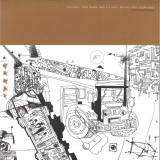
As Robotnick, Dami developed an innovative formula of Italo disco that was attractive to the dance floor yet at the same time highlighted the expressive properties of the instruments he used, notably Roland drum machines and Korg synthesizers. For the soundtrack of GMM’s videos and installations, he left aside the danceable synth rhythmics in favor of ambient sounds that produced rarefied atmospheres, psychological tensions, and enhanced states of consciousness.
Dami’s scores for GMM’s artworks could be associated with Italian avant-garde music of the 1970s and 1980s, ranging from composers who adopted electronics flirting with pop and songwriting to minimalist musicians exploring seriality and drones, including Franco Battiato, Roberto Cacciapaglia, Francesco Messina, and Riccardo Sinigaglia. Analogies could also be traced with the playful and humanizing approach to personal computers that characterizes the music output of Marcello Giombini and Doris Norton.
The futuristic escapism of minimal synth and ambient music’s psychological nature is infiltrated by drifting harmonics typical of new age, as if in search of a spiritual dimension of technology. Characteristic of the postmodern ethos of GMM Suite, in line with the humanizing approach to technology that is at the base of GMM’s computer comics, is the melancholic take at speculative dystopias in which human beings would find themselves increasingly trapped into identity crises: a true cyborg’s melodrama.
According to the artist himself, zake's first solo album of 2020 was recorded and produced during "a four-day excursion in several secluded areas" in South Carolina. As a result, listeners can expect to hear babbling brooks, birdsong and the gentle rustling of leaves beneath Zake's alluring mixture of enveloping ambient chords, unearthly drone tones, opaque electronics and slowly-shifting, heavily processed neo-classical movements. The results are hugely immersive and undeniably enjoyable, with each of the four tracks delivering a head-in-the-clouds journey that ripples with becalmed, atmospheric intent. In other words, it's the kind of ambient music you can get lost in. More please!
Greek electronic music platform, "π" turns seven this year and brings new features on its label catalogue. "Variable Remixes" is the first remixes EP of the Pi Electronics Various Artists series "PEVA". Five tracks from the debut compilation "Variable" - released in 2018 - are getting remixed by some of the label's favorite acts.
Unhuman's “Imminent Fear" gets an alternative Version by the legendary, Spanish band of Esplendor Geometrico. Damcase's "INKL Rules" is remixed by American producer Container. The untitled track of the Variable compilation, by the artist project "I am Legion, for We are many", gets reinterpreted by the Canadia duo of Rich Oddie (Orphx) and Huren as "O/H".
On the flip side, the track "GBNR17" of the label's "3.14" gets its fix by Spanish, industrial techno maestro, Geistform and DΛS' "Spinner" receives a special remix treatment by Athens' infamous ANFS.
Noise break-beats of different tastes on the A side, with stomping industrial beats for the club and sub-club environment on the B side.
in winter 2016, taumel and the ensemble adapter met for several improvisational sessions to develop an evening of music in which the contrasts and boundaries between composition and improvisation, freedom and determination, chaos and structure were to blur or collide. the sessions focused on the development of a specific, sound-gestural musical language. in a way, each musician developed kind of a character on his instrument and its own specific soundgesture. we recorded these sessions and used them as a basis for "in pieces". "in pieces" consists of the remixes of these sessions, as well as additional studio material produced by taumel. "in pieces" can be understood as a sureal sound poem, an abstract sound story that wanders through the most different states - from greatest happiness to frenzy and madness. in the 2 mutating sound fields, the associative story revolves around the theme of linguistic inalienability and thus also around the theme of 'chaos and order'. this ambiguity, the attempt at beauty and its overturning into destruction and failure. attempts at writing, attempts at speaking, stammering, stuttering, screaming, constriction, drifting away, humming... in the mutation of states, heterogeneous sound events meet or are mixed to a new kind of soundmash between song, voices, melody, harmony, instruments, noise, beats, riffs, words, electronics and alienation. the action of the instrumentalists (the instrument playing) is on the same level as any other sound producing action or vocal expression as well as any electronic sound production and is always meant gesturally, performatively, as action, as acoustic dance. "volume one" is the first part of a musical context planned as a two-part work (in pieces - volume two). in two sound parts (side a, side b) "in pieces - volume one" is not a song cycle like our other series, e.g. TRAUM, but rather a musical 2-act, later altogether 4-act. here the overall form of the musical series is not divided into albums and songs, but into albums and their a+b sides, like act 1, 2, 3 and 4. perhaps, therefore, "in pieces" can also be heard as an acoustic theater, or as a radio play without words, or as a soundtrack without a film, or as a film without a picture, or simply as an order of changing sound events . "off the record" in "off the record" taumel meets other musicians and develops albums in collaboration. here different forms of musical interaction can be tried out. in this case of "in pieces" the collaboration with the ensemble adapter consisted in these sessions, which form the basic framework and skeleton for the whole album.
Cole Pulice is a saxophone player from Minneapolis. An improviser of Ambient Jazz who earned his merits touring with Bon Iver, working with Godspeed You! Black Emperor and releasing wonderful electroacoustic gems with the groups Iceblink (Moon Glyph) and LCM (Orange Milk). With Gloam - his solo debut - Cole Pulice offers us six spacious audio holograms, one-take recordings of his saxophone entangled with live electronic hardware. We hear undulating pitch shifters, ring modulations and spectrally rich harmonizers. Cole applies all signal processing live, augmenting the calm, serene melodies Cole plays on his saxophone. The electronics never serve as a mere effect here. Instead, Cole’s fine-tuned setup functions as one whole instrument with which he effortlessly morphs shapes and colors, like fractals within a kaleidoscope or fragments of stained glass in a rock tumbler. Cole mentions the Synchromism visual art movement as an influence for this record, an American avantgarde style of the early 20th century in which colour and sound were treated as equivalents. It’s a spot-on analogy for these musical gems which serve to immerse us in imaginatory prisms. Cole’s sessions conjoin artificial processes with the vibrations of his breath to create electro-acoustic lullabies which reveal ever more timbral layers with each listen. Gloam was released on tape by the Moon Glyph imprint from Portland during the first lockdown in 2020 and has been licensed to Pingipung for this vinyl edition.
Concentric Records presents Radiant, the third compilation of its introductory release trilogy. Featuring music by ASWA, HOLOVR, Max Loderbauer, Petre Inspirescu, Supply, The Waves, William Selman, the album evokes luminous, iridescent and ethereal sonic spaces - a journey that overcomes struggles, spinning upward towards the light.
The album opens with calm, bright and assertive tonalities, evoking mental spaces prone to exploration and wondering. Molecular textures and real-world sounds bring us closer to an intimate and physical sphere, a voice. Ultimately everything dissolves into a synthetic domain of acid-like washes, in a cinematic sense of departure.
MAX LODERBAUER has been an active engineer, producer, and musician across four decades. He first came to notice in the late ‘80s as a member of Fischerman’s Friend. Known then as Daimler Max, Loderbauer’s associates included Stephan Fischer and Tom Thiel, as well as producer Thomas Fehlmann. Once the group went dormant, Loderbauer and Thiel established Sun Electric; one of the leading sources of entrancing downtempo and ambient techno through the ‘90s. During the 2000s and 2010s, Loderbauer collaborated in numerous settings, including NSI with Tobias Freund, Chica & the Folder with Paula Schopf, and Moritz von Oswald Trio with Vladislav Delay and Moritz von Oswald. Loderbauer was partly responsible for some of the most progressive and experimental electronic music released during these years. In 2011, he and contemporary Ricardo Villalobos assembled Re: ECM, a project that involved radical transformations of ECM label recordings by the likes of Bennie Maupin, Christian Wallumrød, John Abercrombie, and Arvo Pärt. More recently he consolidated the collaboration with Ricardo Villalobos via the Vilod project, and with Samuel Rohrer and Claudio Puntin as Ambiq - both described as ‘a fertile patch of inspiration, shaking up the principles of minimal techno with the loose, expressive qualities of jazz’. The album opening track - ‘Harmonic’ - feels like a glowing dream. Composed of stunning electronics in a polychromatic, blinding and shimmering light; harmonious interwoven melodies calmly wind down invoking a serene mental state and grounding peace.
WILLIAM SELMAN was the very first artist ever approached by Concentric Records prior to the label’s birth, back in 2018, following his defining release ‘Musica Enterrada’. A musician and multimedia artist currently based in Portland, Oregon, his work employs analogue and digital synthesis techniques, live percussion and instrumentation, and his own rich field recordings to create compositions and sound art focused on the ideas of place and environment. Selman's recent works have been released on Mysteries of the Deep and Hausu Mountain.
PETRE INSPIRESCU is an extremely versatile composer. As co-founder of the legendary RPR Soundsystem together with Rhadoo and Raresh, he mostly produced club-ready, heavily textured takes on tech-house and minimal techno. In 2015 he released his first album on Mule Musiq, considered a significant departure from his previous work, scoring piano, strings and woodwind instruments for the first time, resulting in a set that sat somewhere between ambient and neo-classical. Since then, he continued to explore further sonic territories, adding in vintage synthesizers and occasional nods to dub techno, resulting in melodious sequences of musical movements that relate to the work of classical composers, American minimalists and ambient legends. ‘The Garden’ is a dreamy, intimate and nature inspired composition, recorded in his home studio in Ibiza sometime in the Summer.
DJ and producer SUPPLY (youngest so far on the label) was born and raised in Gießen, within sight of the skyscrapers of Frankfurt am Main, and has been living in Berlin since 2017. Musically socialised through hip hop, he found his connection to electronic music produced in Chicago and Detroit in the 90s by moving to FFM in 2013. For almost 6 years he has hosted his own events in his hometown. His productions connect the dots between hip hop, retro futuristic movie soundtracks and techno, he recently released on YAY Recordings. ‘Inhale / Exhale’ was created during a time of stress and mental tension, partly self-inflicted, partly result of my surroundings, as it turned out in retrospect. The track tries to capture a moment of taking a deep breath by releasing that tension for a moment. I came up with the first sketch one night around 4am, the final arrangement found its way onto a C60 Chromoxid Cassette - inhale - exhale.’ - Supply
THE WAVES is a post-punk and synthwave-inspired project led by Maayan Nidam, that places her vocals at its front and centre. As a musician obsessed with sound and the technology behind its creation, her workflow places a strong focus on the studio environment. Triggering chain reactions between guitar pedals, drum machines, modular synths and acoustic instruments, generating sounds in unpredictable ways. Drum machines keep a steady groove as to give support to an array of guitars and synthesisers, all topped with The Waves own, mostly unmasked, lyrics and voice. ‘Hold On’ was written by Maayan during the 2020 pandemic as she dived deeply in studio work in Berlin. Her lyrics are featured as part of the art print insert, and have became a central statement to the LP and its narrative - the power to hold on and break through.
Jimmy Billingham's HOLOVR project has racked up various releases on some of the most forward-thinking electronic music labels over the past few years, including Firecracker Recordings, Likemind, Further Records, Opal Tapes and his own Indole Records. Though best known for melodic, drifting acid techno and electronica, he's equally at home crafting textured ambient soundscapes. HOLOVR's deeply emotional synth passages and pads will take you on a journey into the outer. 'Melancholy of Time came out of a period exploring ways of producing and recording outside of the grid-based structures that I was previously working with. I wanted to strip it back to what I often find to be the emotional core of a piece of electronic music - ebbing and flowing synth pads - but to push and pull it a bit to create a slight disjointedness, unpredictability and shop-worn texture, as if it's coming apart and fraying, yet retaining a sonic clarity. I recorded it live using looped and layered synth phrases, underpinned by a layer of hiss and pin-prick textures. I find reflections on time and its passing to be a recurrent feature of my work, both in a more straightforward way of harking back to music of a certain period or pieces of equipment but also in a more abstract sense of creating a feeling where time doesn't matter - a deep feeling of now; that escape that you find in music and other ecstatic experiences. Though of course we’re always in - and running out of - time, and hence the melancholy.’ - Jimmy Billingham
Hailing from the German underground scene, ASWA aka Attila Fidan has an intricate, hypnotic style of electro, techno and ambient. Coming from visual arts and not primarily a trained musician, Attila produces under various and multiple monikers: ‘I never really start out knowing which moniker the track will be made under’. Since 2017 he runs a boutique Berlin label named ‘Tape Archive’. ‘Dust Palace’ is a synthetic piece that resonates with a cinematic vastness, closing the LP in an uplifting tone that evokes new departures and new beginnings.
MANSUR is the project by Jason Kohnen (ex-The Kilimanjaro Darkjazz Ensemble) joined by Dimitry El-Demerdashi (ex-Phurpa) and introducing Martina Horváth on vocals. The sound of MANSUR navigates between the waters of musical fantasy and reality - it morphs and blends traditional instrumentation with modern day electronica.
After the debut record "Temple" and the debut full length "Karma" Minotaurus is Mansur’s first live improv recording. A musical homage to the mythos of the Minotaur. The minotaur as a mirror of self reflection - the fear of confronting one’s inner ugliness. MANSUR takes you on a sonic journey through subterranean labyrinths, evoking spirits from past echoes of Minoa.
Jason Köhnen: Bass / Electronics
Dimitry El Demerdashi: Oud
Martina Horváth: Vocals
To be released in LP and CD on 02/04/21 by Les Disques du Festival Permanent, Pagans, Murailles Music.
Artwork and illustration by Camille Lavaud
Constructed like an invented tarot deck, De Mòrt Viva explores the idea of a contemporary paganism in ten jubilant, humorous and spiritual odes.
The Auvergne Occitan imposes itself at the spittoon, deploying its metaphorical and polysemic network, with the particular candor of a newly acquired language.
The melody is born from the word, the poem gives birth to the song, in a form that could recall from afar and without erudition, the trobar, the art of the troubadours.
In this game-album each piece describes a possible situation, with its typical emotions and stakes, its often reversible systems of forces whose meaning escapes Manichean thinking.
Drawing from the ageless figures of the Carnival, these ten arcane songs will perhaps bring to our consciences what to think differently about contemporary concerns.
Always hybrid and exploratory, Sourdure's music reveals itself here under a new face. Exoskeleton or chemical revelator, the electronics are camouflaged in the roughness of the song as if to disturb its contours. Carried away by an armada of percussions and wind instruments, the voice naturally takes its strong place, whispering, savoring the langue d'oc like a macerated wine.
- A1: Noah Gibson – Returning
- A2: The Pelican Company – Temple Bells
- A3: Varg2Tm Vtss – Vargtss1 (Do The Roar)
- B1: Anthony Linell – Hallucinations
- B2: Exploited Body – She Blames The River
- B3: The Empire Line – Traet Av Lagen, Traet Av Systembolaget
- C1: Puce Mary Ft Varg2Tm - Violent And Delusional
- C2: Fatal – Indolent
- C3: Tusagi – Swetti
- D1: E-Saggila – Blue Amps
- D2: Js Aurelius – Crime Is The Highest Form Of Sensuality
- D3: Mischa Pavlovski – Fra Midt Til Slutning Ii
- E1: Free The Id – Red Fall Foliage
- E2: Evigt Morker – Stege
- E3: Ulwhednar – Dimman Runt Borgen
- F1: Bhmf – Morkertal
- F2: Ca+ – Taki Patch-Out
- F3: Age Coin – No Corner, No Devil
3x12" Repress
Some serious hot tracks on this fourth instalment of the Scandinavian Swords series. It breaks with its predecessors' forms. Deviating from the austere brevity that marks Northern Electronics out, Scandinavian Swords IIII: Atlas of Visions completes a survey of the label's confidants and components in the same breath as it introduces a swarm of new artists and genre-collisions. With the swell of the last 12 months behind them, Anthony Linell and Jonas Ronnberg have forged the compilation with a paradoxical formula: Atlas of Visions stakes itself as a milestone release that retains the sure-footed programming of its proprietors yet cuts a new silhouette for what the platform of a Northern Electronics release consists of. Presented across two volumes, Atlas of Visions courses through the hyper-pigmented and infectious fallout zone between club-focused works and the abstract territories of experimental modes. The release compiles egression and intensification into a pandemoniac whole, a refracting design for fractured times. Recommended!!!
Repress !
Where We're Calling From
The Liminal Zone: Reflections on Duval Timothy’s Sen Am
Lamin Fofana
Sen Am is an enduring and tender album, rich and beguiling and generous in a quiet way. Over the last few years, I find myself returning to it, listening and absorbing, reflecting on the voices and working through the multiple layers of feelings and themes it announces with confidence and equanimity. Notions of care and contradiction, expressions of joy and desire and the underlying feeling of unease and turmoil; there is an urgent appeal to the listener for generosity, to strengthen our capacity to hear multiple voices simultaneously, to exist in multiple places at once.
Duval Timothy’s music was dropped into our world from another realm sometime in the spring of 2017. We received the call and we answered it. The rhythm and spirit was transmitted via London’s NTS Radio on the Do!! You!!! Breakfast Show with Charlie Bones and a short while later we were listening to the first vinyl edition of Sen Am in our living room in Berlin. The record got a lot of plays (at home and at some shows, before and after performances). It was like sunlight filtering through a cracked window and remaining there for a moment, dancing. Blue music emanating from a liminal zone, an in-between space, somewhere on the outskirts of Freetown, or rural Sierra Leone, or the outer edges of South London, or Bath, UK, or some undisclosed orbit, unfixed location. The music is soaked in diasporic experiences. It refuses to settle but still invites us to enter and stay awhile in that zone, where multiple forms exist (all) together with jazz, hip-hop, various strands of expressive electronics and experimental music all breathing together and moving around. It is a portal to a place of possibilities, a space for building and repairing possible and lost connections. But life in that liminal zone is precarious; it is life under duress; under pressure – not merely the pressure to produce a presentable, categorizable, and salable body of work, but the pressure that compels us to experiment and create new concepts and things that will help us imagine a different existence, a way out of the turbulence.
Freetown is a marvellous and sometimes sad place. It is one of those unmistakable locations inscribed diasporic memory; a place that touches you, a place that holds you and demands you bear witness: witness to pain, poverty, joy and desire. You remember the voices and the eyes of people even in momentary encounters. In Sen Am, you hear not only Duval’s recollections and sounds of Freetown, you hear family and friendship, people coming together and forming bonds, creating surrogate families. Forging community wherever you go is a practice, and community is at the core of this music. It’s in all the voices, from Emmerson and 6pac to Aminata and Aruna. It opens up a space for Black voices, for Sierra Leonean voices, and those voices extend through the succeeding projects, the 2 Sim EP and the album Help, and all that radiates from Duval’s Carrying Colour imprint.
Thank you for the invitation to write about the album Sen Am, on the occasion of its re-release which also coincides with the release of the exquisite double 7” Smɔl Smɔl with cktrl — a wonderful piece which calls on the listener to play both records at the same time to hear the music or play them separately and hear different versions. Duval is strengthening us, encouraging us to feel comfortable with discomfort, with incompleteness, with the hard-to-understand. This is a beautiful thing.
After the release of the charts hitter “Don’t Need Your Love” earlier this year it’s now time to follow up with the last two songs out of the reel to reel tape
recorded by The Words at Talun & Trc Studios in Indianapolis in 1982. I feel I really need to explain what went on with the original recordings though. Please be
patient and ber with me. A magnetic tape recorder is made basically by two parts, one electronic and one mechanical. I’ll leave the electronics out of this as it
has no relevance here, to talk about what occurred with the mechanical, specifically with the “heads”, which are the most important part of the recording
action. They are components to be treated with great care, especially when they need to be cleaned; their good condition strictly depends on the functioning
of the entire recorder and - in part - also on the life of the tape. In this case the tape was found god knows where and played again exactly 40 years after the
recording session, on a reeltape player which had good part the “heads” very damaged. The artists themselves transferred it on digital doing it with what they
had on hand, that is basically nothing. It resulted in a stereo soundfile which had the right channel completely flat. Basically the music could be heard on the
left ear only, full of that noise only a cheap and malfunctioning Akai could provide. It took a hell of a restoration to make this second release possible and we
hope you will appreciate the undertaking well beyond the music, that is awesome on its own. Thanks to the first release we think you already know a lot about
Herman Slaughter and The Words of Wisdom. For those who are new to these artists, this awesome band started earning some good popularity at the
crossing of the seventies and eighties. Stable artists at the legendary Lamp - the so called “Naptown’s Motown” - these guys were part of the sparkling funk
soul scene of Indianapolis alongside the likes of The Vanguards and The Fabulous Souls. Support The Words of Wisdom and bring home one of the last slices
of original soul from Napptown’s legacy
Long awaited re-issue of The Necks 2011 masterpiece. Always different, here the Necks resolutely layer polyrhythmic material to form seething blocks of sound - in two long pieces, one more stripped back to the live trio, the other featuring multiple strata of swirling Hammonds, noise-guitar and electronics. Their 16th release still resonates on its own.
Wackelkontakt are the trio that currently spearheads the Jerusalem scene, playing music that's precise yet eclectic, cruel and abrasive even when vulnerable. An unholy mixture of trap, industrial, experimental and power electronics. Wackelkontakt have already made a global mark with the sensory overload of their live multimedia performances and the scintillating presence of frontwoman Tomer Damsky AKA MC Slice, backed by Eyal Lally Bitton (electronics, visuals, scenography) and Marco Milevski Tomasin (drums and electronics). Wackelkontakt's wildly eclectic approach, bound by an impossibly consistent sound, is a direct result of the band living a minute away from The Old City's Damascus Gate and recording in the ultra-orthodox neighbourhood of Me'a She'arim; Jerusalem is present in the music, not in the shape of touristic exotica but in a sense of conflict, paranoia and isolation. The lyrics are equally contradictory, schizophrenic and chaotic. Emotional manipulation clashes with a desire to shake and be shaken, to allow oneself to become sucked as far as possible from self-loathing. When self-reflection arises it is bitter, ridiculous, pathetic, interweaving with philosophical texts lifted directly from the likes of Deleuze & Guatarri, Foucault, Artaud, WJT Mitchell and others.
If Shelter swam through the serene side of the Library experience on GBR016, CV Vision blasts off in the opposite direction, riding an explosion of funk breaks and frazzled synths into the event horizon on his retro-futurist opus ‘Insolita’.
As contemporary life accelerates way past peak-weird, CV Vision leans into uncertainty and leaves Earth in the rear-view. Strung out on Simulacron-3, World On A Wire and Omaggio Ad Einstein, the Berlin-based musician imagines his own Brave New World, an alternate eXistenZ in a secret simulation.
Using the space age obsession of the Italian libraries as a launch pad, Dennis Schulze slathers a sonic storyboard with ferocious percussion, psychedelic fuzz and the pastoral electronics of Germany’s Kosmische movement. But this is less Can, more uncanny - and Schulze perfectly renders the cognitive estrangement of a simulated reality through his adventurous production. The monolithic live drums, recorded in a Neukölln garage on a battered Soviet kit are smeared with tape hiss, compressed to death and fired through LFOs, re-materialising on record in impossible scale. Time slips out of joint under the wow and flutter of the reel to reel, drum computers add digital interference to organic rhythms and the unfaltering slew of the 303 lends the hallucinatory thrill of the club sound system to an already psychedelic affair.
As Schulze’s imagination runs free, we’re taken through epic space battles and narrow escapes, moments of reflection and affection and a final resolution, all expressed through a dexterous control of movement and mood. For every explosion of break-fuelled adrenaline, there’s a cruise into cryo-chamber music and holodeck exotica. For each neck-snapping blast of acid funk, there’s a zero gravity lullaby waiting just around the corner.
So put isolation on ice and surrender to the strange, this is a trip you don’t want to end.
The furious double LP "AL AZRAQAYN" documents KARKHANA (with members of KONSTRUKT, THE DWARFS OF EAST AGOUZA, LAND OF KUSH, PETER BRÖTZMANN CHICAGO TENTET, "A" TRIO) at their very best and intense: live on stage.
Consisting of seven of the most adventurous and innovative artists from the Middle Eastern experimental scene (and a veteran jazz percussionist from Chicago), KARKHANA are surely among the most unique and interesting ensembles around. When MAURICE LOUCA (THE DWARFS OF EAST AGOUZA), SAM SHALABI (LAND OF KUSH, THE DWARFS OF EAST AGOUZA), UMUT ÇAĞLAR (KONSTRUKT), MAZEN KERBAJ ("A" TRIO, JOHNNY KAFTA ANTI-VEGETARIAN ORCHESTRA), MICHAEL ZERANG (PETER BRÖTZMANN CHICAGO TENTET), SHARIF SEHNAOUI ("A" TRIO, ORCHESTRA OMAR) and TONY ELIEH (ORCHESTRA OMAR, JOHNNY KAFTA ANTI-VEGETARIAN ORCHESTRA ) come together to perform and / or record, the result is as diverse as their individual musical backgrounds. The septet's sound is neither retro nor avantgarde, not folklore nor jazz or rock – it's an astonishing blend of all these different styles and elements where seductive oriental melodies can intensify and turn into a psychedelic freak-out, fuelled by reeds, guitars and electronics, only to re-start again from quiet sounds till the ensemble seeks catharsis in a collective improv outburst! Defying simple categorization, and in lack of proper terms for the intense experience of KARKHANA's music (as well as the member's other projects mentioned before), someone labelled it "free Middle Eastern music".
And it's not surprising that these skilled musicians are at their best live on stage – as documented on this live recording from a furious, highly energetic concert at Bimhuis / Amsterdam!
Having already unearthed three collections of archival ‘70s recordings by Catherine Christer Hennix, Blank Forms continues their annual illumination of the visionary Swedish composer’s music by turning to more recent work with this first-time vinyl edition of Hennix’s “Blues Alif Lam Mim in the Mode of Rag Infinity/Rag Cosmosis,” a 2014 piece first released as a CD in 2016 (Important Records).
The double album captures the April 22, 2014 premiere of Hennix’s composition by by the Chora(s)san Time-Court Mirage, her expanded just intonation ensemble, featuring a brass section of Amir ElSaffar, Paul Schwingenschlögl, Hilary Jeffery, Elena Kakaliagou, and Robin Hayward; live electronics by Stefan Tiedje and Marcus Pal; and voice by Amirtha Kidambi, Imam Ahmet Muhsin Tüzer, and Hennix herself. Intended to reveal the blues’ origins in the eastern musical traditions of raga and makam, “Blues Alif Lam Mim in the Mode of Rag Infinity/Rag Cosmosis” has its roots in Hennix’s 2013 realization of an “Illuminatory Sound Environment,” a concept developed in 1978 by anti-artist Henry Flynt on the basis of Hennix’s own “The Electric Harpsichord.”
As Hennix explains in Other Matters, Blank Forms’ 2019 collection of her writings:
“Rag Infinity/Rag Cosmosis presents fragments of ‘raga-like’ frequency constellations following distinct cycles and permuting their order, creating a simultaneity of ‘multi-universes.’ When two such ‘universes’ come in proximity of each other and begin unfolding simultaneously along distinct cycles, there is a kaleidoscopic exfoliation of frequencies as one universe is becoming two, but not separated—the effect of cosmosis is entrained, binding two or more frequency universes into proximity where their modal properties interact and blend, creating in the process entirely new microtonal constellations in an omnidirectional simultaneous cosmic order with phenomenologically ‘transfinite’ Poincaré cycles (cyclic returns to initial conditions).”
As with Hennix’s best work, the organic unfolding of this quivering drone belies a precision that opens onto the infinitesimal. Upon its mesmerizing ebb and flow, the vocalists incant a devotional poem written in Arabic by Hennix and featuring quotations from the Quran. Also reproduced on the album’s gatefold jacket, Hennix’s reduction of the sacred text to its most elegant formulation invites the contemplator to bring their inner knowledge to the composition for use as a prompt for meditation. Yet the piece offers depth to even the most secular listener willing to immerse themselves in music brimming with such serene intensity.
Catherine Christer Hennix (b. 1948) started her creative life playing drums with her older brother Peter, growing up in Sweden where she heard jazz luminaries, such as John Coltrane, Eric Dolphy, Dexter Gordon, Archie Shepp, and Cecil Taylor perform from 1960 to 1967. Directly after high school, Hennix went to work at Stockholm’s pioneering Elektronmusikstudion (EMS), where she developed early tape music, incorporating computer generated speech done at the Royal Technological University (KTH), where she was an undergraduate student. After traveling to New York In 1968, she met artists Dick Higgins and Alison Knowles who invited her to stay at the Something Else Press Town House where she had the opportunity to meet, among others, composers John Cage, James Tenney, and Phil Corner. During the following years she developed fruitful collaborative relationships with many composers in the burgeoning American avant-garde, including, most significantly, Henry Flynt and La Monte Young. Young introduced Hennix to Hindustani raga master Pandit Pran Nath and she would later study intensively under him as his first European disciple. While Hennix continued to make music performing alongside Arthur Russell, Marc Johnson, Henry Flynt, and Arthur Rhames, she also served as a professor of Mathematics and Computer Science at SUNY New Paltz and as a visiting Professor of Logic (at Marvin Minsky’s invitation) at MIT’s Artificial Intelligence Laboratory. In recent years Hennix has led the just-intonation ensemble the Chora(s)san Time-Court Mirage, which has featured musicians Amelia Cuni, Amirtha Kidambi, Chiyoku Szlavnics, Hilary Jeffrey, Amir El-Saffar, Benjamin Duboc and Rozemarie Heggen. She currently resides in Istanbul, Turkey pursuing studies in classical Arabic and Turkish makam.
- 1: Road To Avalon
- 2: Click Click Domino (Feat. Marcus King)
- 3: Line On The Page
- 4: Raining For You
- 5: Little Liars
- 6: Deep River (Feat. Marcus King)
- 7: Heartworn Traders
- 8: Calico Coming Down
- 9: Learn To Love You Better
- 10: Long Gone & Heartworn (Feat. Jake Kiszka)
- 11: Mountain Lion Blues
- 12: Sing A Hallelujah
- 13: Has My Midnight Begun
For nearly two straight years following the release of their critically acclaimed debut, Chasing Lights, Ida Mae lived on the road, crisscrossing the US from coast to coast as they performed hundreds of dates with everyone from Willie Nelson and Alison Krauss to Marcus King and Greta Van Fleet. And while those shows were certainly formative for the electrifying British duo, it was what happened in between — the countless hours spent driving through small towns and big cities, past sprawling suburbs and forgotten ghost towns, across rolling plains and snow-capped mountains — that truly laid the groundwork for the band’s transportive new album, Click Click Domino. Written primarily in the backseat of a moving car, the record embodies all the momentum and possibility of the great American unknown, offering up a series of cinematic vignettes full of hope and disappointment, promise and regret, connection and loneliness. The songs on Click Click Domino are raw and direct, fueled by an innovative mix of vintage instruments and modern electronics, and the performances are loose and exhilarating to match, drawing on early rock and roll, classic country, British folk, and 50’s soul to forge a sound that’s equal parts Alan Lomax field recording and 21st century garage band. Turpin and Jean produced the album themselves, recording primarily on their own in their adopted hometown of Nashville during the COVID-19 pandemic, and while the collection is certainly bolstered by appearances from high profile guests like Marcus King, Greta Van Fleet’s Jake Kiszka, and Ethan Johns, the heart and soul of the record remains Ida Mae’s intoxicating chemistry, which has never felt more vibrant, ambitious, or self-assured. Now married, Turpin and Jean first met a little over a decade ago while attending university in Bath. The pair bonded immediately over their love for the sounds of bygone eras, and they quickly earned rave reviews everywhere from the BBC to the NME with their raucous first group, Kill It Kid. Starting over fresh as a duo named for Sonny Terry and Brownie McGhee’s “Ida Mae,” the first song they ever harmonized on, Turpin and Jean relocated to Nashville in 2019 and released Chasing Lights to similarly widespread critical acclaim. Rolling Stone hailed the album’s “stomping swirl of blues and guitar-heavy Americana,” while The Independent lauded its “retro lustre” and “impressive experimentation,” and NPR’s Heavy Rotation called it “tightly drawn, harmonic and hypnotic.” The music helped the earn the duo a slew of support dates with the likes of Greta Van Fleet, The Marcus King Band, Blackberry Smoke, Josh Ritter, Rodrigo y Gabriela, and The Lone Bellow, as well as performances at Bonnaroo, the Telluride Blues & Brews Festival, the Philadelphia Folk Festival, Germany’s Reeperbahn Festival, and Switzerland’s Zermatt Unplugged.
Cold crushed electronics and tape noise by iDEAL faithful, Altar of Flies, returning to his native Swedish label with a 3rd album of possessed and unsettling tonal abstraction and psychoacoustic isolationism.
Known to the reaper as Mattias Gustafsson, Alter of Flies is the Mjölby-based sound artist’s most prolific alias, responsible for dozens of tapes and LPs for Chondritic Sound and White centipede Noise beside his trio of turns for iDEAL since the mid ‘00s. ‘Bortom Reven’ sticks closely to what he does best, conjuring bleakly depressive atmospheres ripe for inhabitation by the harder-to-please followers of North European ambient and industrial musicks, with an alchemic application of field recordings, tape loops, and primitive oscillators that vividly brings his thoughts into the dark light.
‘Bottom Reven’ is perhaps reflective of a certain, ascetic and isolated Swedish characteristic, enacting solitary rituals that better connect Altar of Flies with his environment, or simply entertain him during long, cold, dark nights. With hints of CMvH’s EVP and John Duncan’s searching shortwave radio textures to ‘Hur regn uppstår,’ and more ruptured reception of scrambled ether voices in ‘Terapimusik,’ alongside the title track’s worn-out nub of intrigue, and the damp basement clangour of ‘Under vår livstid’; its not one for those who get shook by the sight of their own shadow, but a real treat for listeners of a lonelier disposition who get off on the sound of the house creaking at night.
- A1: Shooter
- A2: Back Up 2021 (Feat Debby Friday & Sb The Moor)
- A3: Wriggle
- A4: Hot Fuck No Love (Feat Cakes Da Killa & Maxi Wild)
- A5: Our Time (Feat Nailah Middleton)
- B1: Wriggle (Homemade Weapons Remix)
- B2: Back Up (Dave Quam Remix)
- B3: Hot Fuck No Love (Jana Rush's Naughty Bitch Remix) (Vinyl Exclusive)
- B4: Wriggle (Cardopusher's Ebm Remix)
Loser Edition[18,45 €]
This LP finally brings a Clipping fan-favorite, 2016's Wriggle, onto vinyl in an improved, expanded version that features new art, previously unreleased remixes, and a track that's exclusive to the vinyl format. The original, digital-only Wriggle EP was six tracks that weren't finished in time to make it onto the group's 2014 Sub Pop debut, CLPPNG. For "Shooter," Clipping recorded themselves firing fifteen different guns, the sounds of which exclusively constituted the beat's drums, augmented only by a synthesized tone-row. The verses referenced the well-worn technique of "hashtag rap," but instead of using it to boast about the rapper's personal wealth and masculine prowess, Clipping put forth imagistic narratives of three violent encounters. True to much of the group's music, "Shooter" was an attempt to reframe a familiar style and test the limits of its formal capabilities. "Hot Fuck No Love" contains what might be the most explicit verse to date from Clipping's favorite New Jersey rapper Cakes Da Killa. The EP's title track, "Wriggle," was built around a sample of the influential power-electronics song "Wriggle Like a Fucking Eel" by Whitehouse, transforming William Bennett's torturous imperative into a instructional dance-floor banger. "Wriggle" and "Shooter" have become classic Clipping tracks and staples of their live show. With this vinyl edition, Clipping fans old and new - and there are many new fans thanks to their breakout 2020 album, Visions of Bodies Being Burned, and Daveed Diggs' thriving acting career - get the vinyl version of Wriggle they've been clamouring for.
Etruria Beat founder Luca Agnelli unveils his long-awaited debut album, ‘Source Drops’ – presenting a ten-track journey through techno and beyond.
A name at the centre of Italy’s rich house and techno scene for over a decade, Etruria Beat head-honcho Luca Agnelli continues to showcase his talent as a leading DJ, producer and label boss on the international stage. With releases via a host of globally renowned labels, plus standout remixes including Moby’s iconic ‘Porcelain’, the Tuscany native’s reputation has seen him become of the genre’s leading artists when combining energetic, entrancing productions throughout his powerful DJ sets. Yet, the core of his work has always found a perfect home on his own Etruria Beat imprint, with July now welcoming the arrival of his highly-anticipated debut album ‘Source Drops’ – an in-depth musical story presenting growth, development, self-reflection and raw emotions via a collection of ten tracks ranging from powerful peak-time anthems through to EBM influenced cuts and slower, hypnotic productions.
“This is the journey that traces my musical evolution of the last 20 years, discovering more conceptual, deeper musical territories; taking inspiration from what influenced me in my career as a DJ and from my continuous research without musical barriers. A journey always in equilibrium, at times dark and sharp, solar and fluid, that develops a different creative vision in each track trying to convey my most intimate and strongest emotions". – Luca Agnelli
Opening via the slow-blooming builds and atmospheric and waves of ‘Black Mirror’, before diving into the heady and menacing tones of ‘Mutant Circle’, the ten-track project quickly showcases a wide-reaching range of influences and nuances central to Agnelli’s development as an artist over his career. Productions such as ‘Balance’ and ‘Oxigen’ contrast with one another whilst bringing space to proceedings, guided by breaks-influenced percussion, minimal arrangements and warping leads, whilst the driving ‘Resistance’ harnesses classic techno tendencies to provide an energetic and lively, snaking journey through rich soundscapes.
Title cut ‘Source Drops’ brings that trademark Luca Agnelli energy to the heart of the project, merging scintillating melodies, acid-tinged stabs and icy hats to unveil a high-octane ride into the peak-time, whilst ‘Raw Surface’ keeps the tempo high with sweeping leads, oscillating basslines and resonant lasers. Next, ‘Omega’ spirals into an off- kilter ride through glitchy echoed vocals, crunchy percussion and rumbling low-ends, with the epic ‘Losing Control’ welcoming an infectious lead melody at its core guided by punchy kicks and slick drum licks. To close, the package veers to an eerie yet ethereal close as hazy, celestial vocal chants meet panning sirens and swooping electronics – punctuating an expansive and diverse offering from the Italian favourite and shaping up an impressive debut LP in the process.
- 1: Dearest Frederica (Opening The Proposal)
- 2: Grass Horns For The Proposal Dinner
- 3: Manufacture
- 4: Copyright Implications
- 5: Void Room And Reliquary
- 6: St. Gallen
- 7: Word Guitar
- 8: The Jeweler
- 9: Poised
- 10: Architecture Of Noise
- 11: The Nun With A Chipped Tooth
- 12: As Ever
- 13: Grass Horns For The Proposal Credits
Hand-numbered vinyl edition of 500 copies is 180gramLP in window-cut artboard jacket that frames eight different images from Magid's The Barragan Archives project, printed on four 12"x12" art card inserts including an artworked inner sleeve. The original score for the acclaimed feature-length artworld documentary by multi-disciplinary artist Jill Magid: an exploration of the contested legacy of the Mexican architect Luis Barragan and an art intervention in its own right. Griffin wrote, performed and recorded The Proposal soundtrack with an understated but wide-ranging electro-acoustic sensibility that organically compliments the film's enigmatic narrative and the discreet beauty of Barragan's architectural spaces. Various acoustic instruments combine with electronics, sampling and ambient treatments for an ever-shifting suite of musical vignettes across the album's thirteen tracks. Guest musicians include Matana Roberts, Reut Regev, Jim White (Xylouris White, The Dirty Three), Jason Ajemian (Helado Negro), and Sophie Trudeau and Timothy Herzog (Godspeed You! Black Emperor) alongside Griffin's own contributions on multiple instruments, field recordings and production. Griffin weaves an iridescent musical tapestry, threading various genres with sublime thematic and atmospheric coherence, echoing Magid's contemplative, cerebral journey. The music also works enchantingly on its own as a subtly haunted, evocative and meditative album.
Binding a deep social and political conscious with rigorous musical experimentation, the Brussels based, Italian pianist, performer, composer, Giovanni Di Domenico, delivers Downtown Ethnic Music, the 4th instalment of Die Schachtel’s Decay Music series, focused on inspired contemporary experimental efforts in the ambient, ethereal, and emotively abstract music.
Over the last decade or so, Giovanni Di Domenico has carved a deep path through a diverse number of discrete fields within experimental music, working in various ensembles - Abschattungen, AufHeben, Bonjintan, Cement Shoes, Delivery Health, Going, etc. - as well as producing a discography of critically heralded solo efforts, and intimate collaborations with Jim O'Rourke, Tatsuhisa Yamamoto, Akira Sakata, Arve Henriksen, Tatsuhisa Yamamoto, Alexandra Grimal, Nate Wooley, Chris Corsano, and others.
Downtown Ethnic Music encounters Di Domenico reimagining the future of urban music, pluming the mysterious and emotive depths of self, to arrive at vision of sonorous utopia, radically divergent from those of the past. Hybridizing numerous forms of musical practice, while making a conceptual nod to Jon Hassell’s notion of the "fourth world”, as well as the cross-temporal transnationalism of Roberto Musci, Aktuala, Futuro Antico, and the Third Ear Band, Di Domenico’s vision of democracy - rendered through the creative metaphors of sound - is a true to life, bristling conflict, as open-ended as it is ordered, and as dramatic and tense as it is beautiful, playful, and refined.
A colorful tapestry of ideas, experiences, histories, and reference points, woven from a pallet of electronics, synthesis, and various acoustic sources - the intervening rhythms of drummer João Lobo, vocals by Pak Yan Lau and Patshiva CIE women choir, the horns of Ananta Roosens and Jordi Grognard etc. - across the length of Downtown Ethnic Music, the boundaries between idiom, expressive concept, collective, and individual blur, giving way to a visionary, forward-thinking rendering of electroacoustic music, that subtly reminds us of the social and political potential of art.
Seamlessly incorporating bubbling electronic abstraction, sprawling ambience and long tones, throbbing kosmische, acoustic free improvisation, and the human voice, Giovanni Di Domenico’s Downtown Ethnic Music represents a high-water mark in an already astounding career. Issued by Die Schachtel in a one-time edition of 250 copies, pressed to 180g marble vinyl and housed in a pro-printed inner sleeve and jacket, contained in a silk-screen PVC sleeve.
- A1: Shooter
- A2: Back Up 2021 (Feat Debby Friday & Sb The Moor)
- A3: Wriggle
- A4: Hot Fuck No Love (Feat Cakes Da Killa & Maxi Wild)
- A5: Our Time (Feat Nailah Middleton)
- B1: Wriggle (Homemade Weapons Remix)
- B2: Back Up (Dave Quam Remix)
- B3: Hot Fuck No Love" (Jana Rush's Naughty Bitch Remix)
- B4: Wriggle (Cardopusher's Ebm Remix)
LP[17,19 €]
This LP finally brings a Clipping fan-favorite, 2016's Wriggle, onto vinyl in an improved, expanded version that features new art, previously unreleased remixes, and a track that's exclusive to the vinyl format. The original, digital-only Wriggle EP was six tracks that weren't finished in time to make it onto the group's 2014 Sub Pop debut, CLPPNG. For "Shooter," Clipping recorded themselves firing fifteen different guns, the sounds of which exclusively constituted the beat's drums, augmented only by a synthesized tone-row. The verses referenced the well-worn technique of "hashtag rap," but instead of using it to boast about the rapper's personal wealth and masculine prowess, Clipping put forth imagistic narratives of three violent encounters. True to much of the group's music, "Shooter" was an attempt to reframe a familiar style and test the limits of its formal capabilities. "Hot Fuck No Love" contains what might be the most explicit verse to date from Clipping's favorite New Jersey rapper Cakes Da Killa. The EP's title track, "Wriggle," was built around a sample of the influential power-electronics song "Wriggle Like a Fucking Eel" by Whitehouse, transforming William Bennett's torturous imperative into a instructional dance-floor banger. "Wriggle" and "Shooter" have become classic Clipping tracks and staples of their live show. With this vinyl edition, Clipping fans old and new - and there are many new fans thanks to their breakout 2020 album, Visions of Bodies Being Burned, and Daveed Diggs' thriving acting career - get the vinyl version of Wriggle they've been clamouring for.
This album was originally composed in October 2017, performed and recorded live in Kasteliotissa Medieval Hall, Nicosia, on the 19th of November 2017 as an accompanying soundtrack to Fritz Lang's two hour-long edit of the film Metropolis (1927). Commissioned by the the curators of the 'German expressionism in Cinema exhibition' to compose and perform a live soundtrack, Panagiotis and Yiannis employed a hardware heavy arsenal to produce one of their longest pieces. modular synthesizers, guitars, drum samplers and drum machines are all protagonists. The performance lasted for two hours and was recorded in its entirety. It was later edited down to preserve all sound design qualities and a somewhat live feel. The title is an homage to the main actress of the film.
Panagiotis Mina and Yiannis Eliades, longstanding members of 'do it together' collective Honest Electronics and producers of their own material as Panayotis and Isel respectively, often collaborate on projects such as Brigitte. Panagiotis Mina is a producer, musician and visual artist. He lives and works in Cyprus from Pyrgatory studios, his out in the country home diy studio project. Yiannis Eliades produces and performs music using a blend of analog and digital synthesizers, drum machines and twisted recordings, on his own or as part of duos (MYHN, Carnal Throes).
Clear Vinyl
DDS catch enduringly absorbing sonic alchemist Jim O’Rourke at his knottiest and most ingenious in a wormholing suite of amorphous rhythm and psychedelic electronics - a massive RIYL Autechre, Roland Kayn, Bernard Parmegiani, NYZ, Keith Fullerton Whitman.
Playing up to and into DDS’ freeform aesthetics, O’Rourke renders 40 minutes shearing hyaline synth tones and ruptured rhythm generated at his Steamroom facilities in Tokyo, a modular outzone trawling that harks back to his iconic Mego releases and some of the more recent Steamroom experiments. It’s an ideal addition to the ever expanding DDS cosmos, following Demdike’s recent ‘Drum Machine’ expo with a slice of purist and screwed modular magick that transcends early
electronics and modern styles in pursuit of musical sensations that defy stylistic brackets.
‘Too Compliment’ was assembled using a bespoke Hordijk modular system, a rare West Coast-style setup hand made by Dutch engineer Rob Hordijk. O’Rourke focuses on the frequency shifter here, using it to coax out fluxing tone thickets, haphazard frequencies and elongated drone corridors.
It’s transportive stuff, harking back to the early days of private press academic synth music but also sitting on edge alongside Autechre’s recent long-form work, as well as O’Rourke’s classic “I’m Happy, And I’m Singing, And A 1, 2, 3, 4” In O’Rourke’s hands, the mass of electronics takes on throbbing, organic dimensions, congealing
grey matter and purplish veins of fluid in viscous transitions that glisten and spark with invention as they form new tissue. What comes out is as unearthly as the earliest electronic music, but also
blessed with a psychedelc spirit in a way that’s long kept O’Rourke right out on his own, teetering between paradigms yet never settling into any single style. If you’ve always been keen on finding a way into that sprawling soundworld, ‘Too Compliment’ is a perfect entry point into a highly rewarding creative macrocosm.
Leng Records has long had close ties with the underground music scene in San Francisco, with low-slung dub disco and psychedelic disco outfit 40 Thieves releasing their acclaimed album The Sky Is Yours on the imprint way back in 2014. Now Leng has turned to another stalwart of the Bay Area scene, Cole Odin, on a single that’s every bit as trippy and engrossing as you’d expect from one of San Francisco’s most frequently overlooked talents. Cole made his Leng debut earlier in the year, contributing the electro-influenced track ‘Numbers Game’ to the label’s 10th anniversary compilation. On ‘Little Boxes’, he’s joined by good friend Eddie C, a much-loved disco and house producer from Canada best known for his releases on Endless Flight and Red Motorbike. The pair recorded the track while Eddie was staying with Cole in San Francisco last year.
In keeping with the low-slung, hallucinatory sound that has always been a big feature of the San Franciscan scene, ‘Little Boxes’ is a trippy, mind-altering affair in which waves of sitar sounds, cosmic synths, effects-laden guitars and kaleidoscopic electronics rise above a weighty punk-funk bassline and crunchy, snare-heavy beats. It has serious dancefloor chops but is also atmospheric and immersive: perfect 5am music for Bay Area beach parties and mushrooms-fuelled forest raves.
Fittingly, it’s 40 Thieves who provide the accompanying remix, a 10-minute epic created with the assistance of Adonis and Rodney from the psych rock band ‘Guavatron’ for additional synths and the guitars. Beginning with tabla-style percussion, swirling chords, psychedelic guitar licks and mystical sitar sounds, the remix builds in waves, with looser drums and even weightier bass propelling the track forwards at a metronomic and hypnotic pace. By the time the eyes-closed guitar solos drop two thirds of the way through, you’ll be tripping hard and reaching for the lasers. It’s a genuinely stunning remix of a genuinely intoxicating, mind-mangling track.
It’s with a heart brimming with pride that Bordello A Parigi welcome Italoconnection back to the family with their latest album: Midnight Confessions Vol.1. The team of Fred Ventura, a legend of Italo Disco, and Paolo Gozzetti, a stalwart of Italian electronics, arrive with eight tracks that shimmer with sun-kissed synths and love-filled lyrics. A strew of like-minded musicians have been called upon to bring their own unique ideas and styles to this album. Sweden’s Tobias Bernstrup offers his vocals in the environmentally minded “Rainbow Warrior,” while the unique and unmistakable voice of French pop icon Etienne Daho sings in the charged “Virus X”. Modern day electro-disco maestros feature with Carino Cat collaborating in the warming rays of “The Year of the Sun.” Newcomers to the scene are also represented, Francesca Diprima’s voice accompanying Fred Ventura’s in the lovelorn lament of “Since You Went Away”. And at the heart of the album are Ventura and Gozzetti; a record that explores classic themes while introducing a wider commentary, a collection of bold brilliance and synthesizer subtilty.
Tape
It might be easy to assume that the distinctly focused compositional voice unveiled on Rose Bolton's The Lost Clock is the product of its creator's rigorous, almost hermetic dedication to her own particular aesthetic universe. A quick survey of Bolton's artistic career, however, reveals that her carefully sculpted approach to abstract electronica has been forged through a longstanding engagement with a wide range of intertwining creative activities.
This album—coming out on Important Records' cassette imprint, Cassauna—demonstrates both the Toronto-based composer's unique mastery of colour and her gift for breathing a tactile, organic quality into synthetic landscapes. Bolton's distinctive sensibility is akin to that of a painter—every hue has been carefully mixed so as to imbue its accompanying gesture with its own life and personality. This tangible dimensionality her electronic work assumes, however, can be traced back to the work Bolton has been doing since the 1990's. She has produced a large and varied catalogue of work that includes pieces for solo performers, chamber ensembles, orchestra, electronics, voice, and to accompany installations and films. A number of her works reside in several of these zones simultaneously, such as Song of Extinction, an ambitious collaboration between herself, filmmaker Marc de Guerre, poet Don McKay, and multiple live ensembles, that was mounted in an abandoned power station for Toronto's Luminato Festival.
This quasi-instrumental vitality isn't the only feature of The Lost Clock that reflects Bolton's diverse artistic practice. It can also be heard within the structural realm. Each of the collection's four tracks trace a patient unfolding and favour a certain roundness of timbre, even as finer details begin to fidget along the perimeter of the music. As with her writing for the concert hall, Bolton doesn't shy away from the evocative here, yet she doesn't pursue this poignancy through conventional, direct or quasi-narrative means. Her compositions lead the listener gradually through their impressionistic sonic scenery, but neither the path they take nor their ultimate destination are at all predictable. The ostensible gentleness each piece exudes dissolves as dissonances slowly insinuate themselves, obscure textures writhe just out of earshot, percussive lattice work materializes, or as the overall blend begins to exert a heavier weight. Her lucid-dream vision of form functions in tandem with her acute micro-level attentiveness to engender a vivid and elusive soundworld that resists classification.
Over more than two decades Rose Bolton has been garnering acclaim and enthusiasm from audiences and major collaborators alike. Last year, her brooding string quartet The Coming Of Sobs was nominated for Classical Composition of the Year at the JUNO Awards, following earlier accolades such as SOCAN Awards for Young Composers, and the Canadian Music Centre's Norman Burgess Fund. Her music has been commissioned by the likes of the CBC, stalwart experimental music festival the Sound Symposium, as well as key interpreters and ensembles such as percussionist David Schotzko, accordionist Joseph Petric the Esprit Orchestra, Continuum, Arraymusic, the Kitchener-Waterloo Symphony, and guitar quartet Instruments of Happiness (led by Tim Brady). Together with Marc de Guerre, she produced an 8-speaker sound and video installation for Toronto's Nuit Blanche Festival. She's also been featured by the likes of revered pianist Eve Egoyan, The Vancouver Symphony, L'ensemble contemporain de Montréal, The Music Gallery, and AKOUSMA, while appearing in concert alongside the likes of Jerusalem in My Heart (Constellation Records), Tanya Tagaq, and Francis Dhomont. Bolton is also a respected film composer, notably contributing music to the highly regarded documentary Anthropocene: The Human Epoch (co-directed by Jennifer Baichwal, Nicholas de Pencier and Edward Burtynsky).
As a performer, she variously employs electronics, violin, and viola. Parallel to her engagement with exploratory approaches, she's invested in the fiddle traditions of the British Isles, and various Canadian regions. She teaches this repertoire at the Royal Conservatory of Music. Bolton has also performed with Rhys Chatham, Owen Pallett, opened for Charlemagne Palestine, and appears on recordings by the likes of Chatham and Aidan Baker. In 1999 she joined the Canadian Electronic Ensemble, whose fifty-years together make them the world's longest-running live-electronic music group. In February 2020, the CEE held a residency and provided guest lectures at Carnegie Mellon University's music department. Bolton has also led workshops at the Banff Centre, also founded the SOCAN/ Moog Audio-sponsored program EQ: Women in Electronic Music, which worked to foster community and mentorship among (trans/cis) women and non-binary individuals.
Nonesuch Records releases an album of songs written and performed by Caroline Shaw and Sō Percussion, Let the Soil Play Its Simple Part. The musicians, who have known each other since their student days, were presented with three days of gratis studio time and decided to experiment with ideas they had begun putting to tape during the sessions for their January 2021 Nonesuch release Narrow Sea. With Shaw on vocals and Sō – Eric Cha-Beach, Josh Quillen, Adam Sliwinski, and Jason Treuting – filling out this new band, they developed songs in the studio, with lyrics inspired by their own wide-ranging interests: James Joyce, the Sacred Harp hymn book, a poem by Anne Carson, the Bible’s Book of Ruth, the American roots tune ‘I’ll Fly Away’, and the pop perfection of ABBA, among others. The album is co-produced by Shaw, Sō Percussion, and the Grammy Award–winning engineer Jonathan Low (The National, Taylor Swift).
Shaw, who won a Pulitzer Prize for her vocal composition Partita for 8 Voices, written for and performed with Roomful of Teeth, makes her solo vocal debut with Let the Soil Play Its Simple Part. The album’s first track, ‘To the Sky’, from the Sacred Harp, takes its lyrics from Anne Steele. “I love the songs about death, and going home, and looking toward a time that is better or brighter, which, if there’s one thing to think about in the world, maybe that’s the thing,” Shaw says. “This one I love in particular. There’s a line, ‘Frail solace of an hour / So soon our transient comforts fly / And pleasure blooms to die.’ It’s meditation on the ephemeral, and I love it.”
“I hadn’t written very many songs, but I have certainly loved many in my life. I’ve been thinking of making a solo album for seven or eight years, but it takes having the right friends and community in the room,” Shaw says. “The prompt for all of us was: What would we make in the room together with no one person in charge, like a band writes in the studio?”
Cha-Beach recalls of the early test run during the Narrow Sea session: “It had that capturing-lightning-in-a bottle feeling.” When the opportunity to have three days in their friends’ studio, Guilford Sound, came up, the five musicians decamped for Vermont with engineer/co-producer Jonathan Low. “Jon is an amazing editor,” Cha-Beach says. “He is so helpful in thinking about: ‘We have these ideas: how do we shrink those and make them come across on an album?’”
One such idea was for Shaw to do a duet with each member of Sō. She sings with Josh Quillen on steel drums on the title track, which she wrote in under an hour in a “free-writing zone, very inspired by James Joyce, taking on that brain space,” she says. Lyrically, the song is “related to some math bits that I love, but also memory, and love songs of somebody who’s gone or passed away, or that you’re no longer with: what is the sound of that kind of devastation or confusion or love?” They recorded the song only twice, and the first take is on the album. “It’s very spare. The playing is very Josh; it’s so sensitive,” Shaw says.
Adam Sliwinski’s marimba duet with Shaw is an interpretation of the ABBA song ‘Lay All Your Love On Me’. She explains, “It’s really a Bach chorale. Also, the idea of someone singing ‘Don’t go wasting your emotion / Lay all your love on me / Don’t go sharing your devotion / Lay all your love on me,’ over and over again very slowly, there’s a certain tragedy in it. And then Adam did some absolutely exquisite layering that built this stunning world from the marimba.”
Jason Treuting on the drum kit joined Shaw for ‘Long Ago We Counted’. She suggested, “Why don’t we start with the voice and the kit having a weird conversation, sort of like two babies talking to each other? And then we built this loop, and we go from this place that’s totally uncomfortable and nonsensical to something that’s rich and rolling and satisfying.” For ‘Some Bright Morning’, the duet with Cha-Beach – who here plays electronics, piano, and Hammond organ – Shaw drew upon a twelfth century liturgical hymn she had sung regularly in church during her college years: ‘Salve Regina’.
“Some songs on Let the Soil… were very specifically composed by Caroline,” Cha-Beach says. “But others were this assemblage of ideas: finding words, an idea for how a melody could work, a harmony, and then tossing it in a blender and trusting each other.” Shaw adds, “What I love about Sō is the curiosity about how objects make sounds and how they speak to each other. There was an underlying thread of thinking about what goes into soil, how we take care of it, how we allow it to be itself, how we contain it, and what can come out of it if you cultivate the right environment, which for me is always this wonderful metaphor for creativity and collaboration: let people be themselves and see what happens,” she concludes.
Caroline Shaw is a New York–based musician – vocalist, violinist, composer, and producer – who performs in solo and collaborative projects. She was the youngest recipient of the Pulitzer Prize for Music in 2013 for Partita for 8 Voices, written for the Grammy–winning Roomful of Teeth, of which she is a member. Shaw’s film scores include Erica Fae’s To Keep the Light and Josephine Decker’s Madeline’s Madeline as well as the upcoming short 8th Year of the Emergency by Maureen Towey. Hailed for ‘astonishing both the pop and classical music worlds’ (Guardian), she has produced for Kanye West (The Life of Pablo; Ye) and Nas (NASIR), and has contributed to records by The National and by Arcade Fire’s Richard Reed Parry. Shaw currently teaches at NYU and is a Creative Associate at The Juilliard School. Her 2019 Nonesuch/New Amsterdam album Orange won a Grammy Award.
Through its interpretations of modern classics, innovative multi-genre original productions, and ‘exhilarating blend of precision and anarchy, rigor and bedlam’ (New Yorker), Sō Percussion has redefined the scope and role of the modern percussion ensemble. Sō’s repertoire ranges from twentieth century works by John Cage, Steve Reich, and Iannis Xenakis, to commissioning and advocating works by contemporary composers such as David Lang, Julia Wolfe, and Steven Mackey, to collaborations with artists who work outside the classical concert hall, including Shara Nova, choreographer Susan Marshall, The National, Bryce Dessner, and many others. Sō has recorded more than twenty albums, including a performance of Reich’s Mallet Quartet on the Nonesuch record WTC 9/11; appeared at Carnegie Hall, Lincoln Center, Walt Disney Hall, the Barbican, the Eaux Claires Festival, MassMoCA, and TED 2016; and performed with Jad Abumrad, JACK Quartet, the Mostly Mozart Festival Orchestra, and the LA Phil and Gustavo Dudamel, among others.
Purple Vinyl
Even if you're well-acquainted with composer and multi-instrumentalist Colin Fisher's richly varied output, his gentle fifth solo album, Refections of the Invisible World may come as a surprise. Psychedelic lyricism has always been a fundamental aspect of his sonic signature, but his second collaboration with producer Jeremy Greenspan (Junior Boys, Jessy Lanza, Morgan Geist) finds the Toronto native luxuriating in expansive atmospherics for its full duration.
That's not to downplay the eclecticism he finds within this ethereal landscape. Each track tills its own discrete sonic acreage, and while every one emanates from a clear focal point, the spontaneous impulse that drives Fisher's more audibly improvisational music always remains close at hand. Some pieces unfold rippling aquatic vistas or delight in prismatic guitar arpeggiation, elsewhere his plaintive, blues- infected tenor saxophone wafts like some strange jazz apparition, or becomes a chorus of cosmic murmurs. The presence of electronics is undeniable, but equally irrefutable is the organic instrumental sources of these disparate hues. In fact he's discovered a rare balance: no matter how effects-saturated, every gesture on the record feels palpably sculpted by Fisher's hands and breath. As such, Refections of the Invisible World carries a sense of intimacy at the heart of its diffuse, dream-like sonics.
Fisher has a been a major presence in Canada's music community for more than twenty years—particularly in more experimental and improvisational circles. Nothing short of a guitar virtuoso, he also wields saxophone, drums, and various other instruments with similarly refined musicality, vivid textural imagination, and sometimes feral abandon. His one-man-band tape Garden of Unknowning for Manchester's Tombed Visions, showcase all of this as he spars with different iterations of himself. The Quietus' cassette critic Tristan Bath extolled it as "miraculous," adding that "it’s a visceral experience soaking up this record, and it’s all down to Fisher’s utterly innate sense of musicality." He subsequently cited it in his 2018 contributor's year-end chart for the Wire.
In 2014 his partnership with Nick Millevoi's trio Many Arms on Suspended Defnition (Tzadik) prompted Spin's Brad Cohan to remark "Many Arms have dug even deeper into math-metal wizardry, bolstering their already imposing lineup with gale-force blowing guest saxophonist Colin Fisher, thus blasting their outré sonic blitz into a fire-breathing free jazz otherworld." Fisher later engaged the band's bassist, Johnny DeBlase, to team up with him and Kid Millions (Oneida, Man Forever) as Monas. As an ongoing collaborator to introspective dance music auteur Caribou, Fisher frst appeared in offshoot project Caribou Vibration Ensemble, and subsequently on acclaimed albums Swim and Suddenly. He's also made two duo albums with celebrated Nova Scotian jaw harp innovator chik white for Dylan and Lisa Nyoukis' Chocolate Monk label. In addition to performing alongside the likes of Jaime Branch, Joe McPhee, William Parker, Laraaji, Gerry Hemmingway, and Fred Frith, he has contributed to recordings by the Constantines (Sub Pop), Bernice (Arts & Crafts), Rhys Chatham (Table of the Elements), Born Ruffans (Warp), Anthony Braxton and AIMToronto Orchestra (Spool), and many more.
Japanese import exclusive!
Cosmic Suite is a long 35 minute jam cut in two pieces, it blends house, techno, jazz, reggae and dub
It's a collaboration with iconic musicians including the legendary Jeff Mills, Osunlade, Mutabaruka, Tanaka Tomoyuki (FPM), Yashiki Gōta and Watusi (Coldfeet), among others.
Written by Yasushi Ide
A.Guitar:Kazuma Fujimoto
E.Guitar:Akihiro
E.Guitar:Masayuki Ishii
Drums Sampling:Gota Yashiki
Drums:Hideo Yamaki
Drums:Yukari Uehara
Rhodes:Nobuyuki Nakajima
Keyboards:Mitsuhiro Toike
Percussion:Hiderow Nishioka
Steel Pan:Gen Tamura
Trumpet:icchie
Sax:Motoharu
Electronics:Jeff Mills Rhythm
Treatment:Tomoyuki Tanaka, Hiroshi Nakamura
Vocal Sampling:Osunlade
Dub Poet Sampling:Mutabaruka
Programming,Keyboards:Watusi
Mixed by Watusi at brickwall
A few years ago, Don Zilla was sat alone in an internet cafe teaching himself FL Studio, dreaming of becoming one of Africa's greatest music producers. These early experiments evolved into 2019's "From the Cave to the World", an EP that showcased Zilla's rare fusion of eerie industrial electronics, lurching bass and constantly-shifting East African rhythms. Now the manager of Kampala's Boutiq Studios, Zilla returns to Hakuna Kulala with his eagerly-awaited debut album "Ekizikiza Mubwengula", a labyrinthine album that weaves freewheeling dance sub-genres into a bejeweled tapestry, signaling a path to the future. There's the cybernetic 'nuum funk of dBridge, Emptyset's overdriven, cacophonous anxiety, the hyper-paced airlock club ofShanghai's Hyph11E and the confrontational intensity of Dreamcrusher; everything is melted into a groove-fwd whole that's tough to resist. Tangling trap into slippery, atmospheric doom-step on 'Buziba', experimenting with uptempo, Slikback-esque rhythmic complexity on 'Tension' and reshaping noisy industrial ambience on 'Shots', Zilla uses the album to continuously challenge expectations, folding sounds in on themselves Inception-style and allowing fresh rhythms, textures and forms to peek through. It's a bold step from a central character in East Africa's rapidly-growing stable of paradigm shifting experimental club producers.
On "APHEXions", the Brussels pianist with French roots Dorian Dumont - key member of the electro jazz band ECHT! - is expressing his love for one of his greatest musical heroes: Aphex Twin. Contrary to what one would expect, there are no electronics involved in this album, but he carefully transcribes a wide selection of Richard David James' music to grand piano, giving the songs a whole new dimension. Rave classics like Polynomial-C and Xtal are being stripped to the core while on tracks like Nannou, Kesson Daslef or Fingerbibb he stays truthful to the minimalistic aesthetics from the original tracks.
As an accomplished jazz pianist, he improvises on the various themes and injects it with a tinge of blues here and there. As a result, this homage record captures both the simple beauty and the unruly complexity of Aphex Twin. But above all, it sounds like refreshing new music that immediately puts Dorian Dumont on the map as a solo pianist!
May 28 will see prolific Japanese vibraphonist, multi-percussionist and composer Masayoshi Fujita mark a new sonic direction with his forthcoming album Bird Ambience on Erased Tapes.
Bird Ambience brings several fresh changes for the artist. Until now, Fujita would separate his acoustic solo recordings from the electronic dub under his El Fog alias and experimental improvisations with contemporaries such as Jan Jelinek, Bird Ambience sees him unite all of these different sides to his work for the first time, into one singular vision. He also makes a lateral leap from his signature instrument the vibraphone, on which he created his acclaimed triptych Stories (2012), Apologues (2015) and Book of Life (2018), to the marimba, which takes centre stage on his new album alongside drums, percussion, synths, effectors and tape recorder.
“The way of playing the marimba is similar to the vibraphone, so it was kind of a natural development for me and easier to start with, yet it sounds very different”, explains Masayoshi. “The marimba bars are made with wood and it has a wider range than the vibraphone, which gives me a bigger sound palette with more possibilities. I play the instrument with bows and mallets, and sometimes manipulate it with effects.”
Bird Ambience also marks his liberation from fastidious preparation for past solo releases to new endeavours in improvisation. “I prioritised trying to capture the wonder which happens during those occasional magic improv moments. Sometimes the mic-ing and placement of instruments was pretty rough; things weren’t perfect and everything was done quickly, but it turned out as the final recording. Overall when I
couldn’t decide between two takes, I told myself to go with the first”, Masayoshi recalls.
Arranged with a perfect Kanso-like balance, the unhurried pace of Bird Ambience allows each sound and phrase enough time to be mindfully absorbed and savoured. This subtle but affective work carries ethereal remnants of Midori Takada’s minimalism, the static atmospheres of Mika Vainio, To Rococo Rot’s organics and the bucolic electronics of Minotaur Shock. Fujita vaporises contemporary and classical, ambient and dismantled dub, controlled noise and fragments of jazz into an atmospheric, static mist, which he skilfully coerces into new forms.
After 13 years in Berlin, Masayoshi recently relocated to a new home and studio in the rural Japanese mountain village of Kami-cho, Hyogo, following his life-long dream of creating music in nature. Even though the album was entirely recorded in Germany before he left, it has this palpable sense of reverie found in the natural world. From there we can only imagine the kind of impact his new life in rural West Japan will have on future works.
Audio visual sculptor Kero operates the multidisciplinary arts collective Detroit Underground record label and continues to produce bit crushed experimental electronic music with over two decades under his belt.
Demo Vectors showcases Kero's sonic range—bouncing back and forth between IDM fractures, broken electro shapes and an all around low-end forcefield. Splicing machined modular tunes with syncopated rhythms and Detroit-inspired slivers, Kero's fingerprints can be found on imprints like Blueprint, Wild oats, Ghostly International, Shitkatapult, Semantica, Touchin' Bass, BPitch Control, and many others.
Using different studio setups from 1998 to 2021, Demo Vectors culminated from many different locations including Detroit, Windsor, Barcelona, Berlin and Los Angeles and reveals Kero's curriculum vitae packaged in a 60 minute robust collection.
The downtempo groove of "ABSTR_B&B" offers a classic bricolage of collapsed mechanical percussion straight from the foundry as the definitive sound design and glitchy bits of "BLISS" take shape. Fluid robotics and bass jabs progress on "GROUNDZEROBACK" pushing each pixel to their breaking point. You'll also find stark industrial elements on tracks like "PREFREAK.EPS" and spastic acid on "COMOFFICE-1" displaying the wide angle lens Kero employs to capture improvised dark drill'n bass techniques with a Squarepusher sheen. From the slow burning "PILL'LATHE2" humming its way across laid back digitized acrobatics to the aptly titled "COLOR_CUB" that clicks, cuts and collects subtle low frequency modulations, Demo Vectors is a tightly compacted and forward thinking IDM album.
Sandblasted electronics mixed with shattered glass and corrosive blips'n bleeps, Demo Vectors acts as Kero's raison d'etre as each piece eclipses itself.
Recently signed to FatCat’s 130701 imprint, Dutch
composer Rutger Hoedemaekers makes his debut
solo release with a stunning album that marks the
culmination of a decade spent in the hypercreative studio environment he co-founded in
Berlin, including four years working closely
alongside Jóhann Jóhannsson.
Sonically rich, emotionally deep, and immaculately
handled, ‘The Age Of Oddities’ showcases a
brilliant new talent, its cinematic eloquence bearing
witness to Rutger’s experiences composing for film
alongside Oscar-winner Hildur Guðnadóttir and
Jóhannsson, for whom the album is partly a
eulogy.
‘The Age Of Oddities’ is a bold and forwardthinking record, with a rich, hybrid sound seeing
vocals processed and blurred alongside brass
parts and a wall of strings shadowed by Rutger’s
understated, textural electronics.
The album features the Budapest Art Orchestra’s
23-piece string ensemble alongside vocals (Kira
Kira, Else Torp and Laura Jansen), horn (Morris
Kliphuis), trombone (Hilary Jeffery) and violin (Una
Sveinbjarnardóttir, Viktor Orri Árnason), with
Hoedemaekers contributing trumpet, piano,
keyboard and electronics.
For fans of Jóhann Jóhannsson, Hildur
Guðnadóttir, Mica Levi, Max Richter, Olafur
Arnalds.
Tibor Szemző is not only a skillful and experienced Hungarian musician but also a media artist with a vast imagination. His last LP, ARBO X – Csoma Grooves, refers to his full-length film A Guest of Life released in 2006, for which he not only directed but also composed all the music. The film is inspired by the life of Alexander Csoma de Körös, a remarkable polyglot from the 19th century who set out from his native Transylvania to central Asia on foot to look for the roots of the Hungarian language. He reached Tibet, dedicated the rest of his life to study of Tibetan manuscripts and finally became the founder of tibetology. After 14 years Tibor Szemző decided to explore the theme further and composed the cinematic performance, Silverbird and the Cyclist, where he as narrator presented the story of Csoma from a different perspective.
ARBO X is the music from this performance and it is based on the soundtrack of the original movie but the material has been restructured and enhanced by new layers. There are fourteen relatively short tracks on the album and each of them has a very specific character, sometimes mysterious as the titles of the tracks themselves. Their arrangement is ingeniously composed. Szemző’s typical bass flute and voice with percussion accompaniment on the first track Axis is a very impressive introduction to the whole album. The following tracks build up a series of colorful sound parables, which are in no way descriptive. Every element, whether it’s a double bass, viola, soprano voice, vocal trio or electronics, fits perfectly within the overall sound fabric with effective timing. Listening to ARBO X one unwittingly concentrates on interweaving details without loosing the sense of the whole. It’s certainly a great benefit, as in previous recordings, that most of the musicians participating in the recording of ARBO X are very familiar with Szemző’s music and his collaboration with some of them goes back to Group 180, a new music ensemble he founded in 1978 and soon earned international acclaim. This most recent album belongs among a long line of recordings that Tibor Szemző has released during his musical career and displays great compositional complexity and a keen sense of a perfectly balanced sound spectrum.
Alexandr Krestovský
Outside Ludlow / Desert Disco is the first major solo release from Australian performer-composer Sam Dunscombe, now based in Berlin after residing for the past decade in San Diego and Tokyo. A virtuoso clarinettist who has performed in composed and improvised settings with artists such as Klaus Lang and Taku Sugimoto, their practice also embraces computer music, lo-fi electronics and field recordings, in addition to their long-term commitment to archiving, studying and performing the work of Romanian spectralist composer Horatiu Radulescu.
The two side-long pieces presented on this LP began from a chance encounter in a specific geographic location (documented in the photographs that grace the record’s sleeve). Exploring California’s Mojave desert with a friend, Dunscombe made the unlikely discovery of a tangle of quarter-inch tape snared on a cactus. The digitised version of this tape, variously edited and processed, as well as Dunscombe’s own transcription and embellished performance of some of its material on Hammond organ, makes up one of the main ingredients of the LP’s first side. The other is a field recording of the area outside the ghost town of Ludlow, where the tape was found, where haunted silence is punctuated by freight trains and clusters of explosions from gold mines and the local marine corps. Far from any kind of documentary approach, the resulting composition reaches back to the smeared atmospherics and overdriven tape crunch of Hands To, Small Cruel Party or Joe Colley, before the Hammond organ rises up to cast a spectral shimmer reminiscent of 1960s tape music classics like Arne Nordheim’s ‘Warszawa’.
On ‘Desert Disco’ (its title perhaps a clue to the content of the mysterious tape), Dunscombe zeroes in on a single fragment of the tape, accompanying it with analogue synthesis to craft an immersive work based on a single chord. Throughout the course of this work, the monolithic opening sonority gradually splits apart, revealing an infinity of rhythmically phasing lines that swarm like a cloud of insects and patter like falling rain, placing Dunscombe’s piece in a lineage of patient electronic exploration that includes landmarks like Costin Miereanu’s Derives and the contemporary work of Jim O’Rourke.
Limited edition vinyl with images by Sam Dunscombe and design by Lasse Marhaug. Mastered by Joe Talia at Good Mixture, Berlin.
May 28 will see prolific Japanese vibraphonist, multi-percussionist and composer Masayoshi Fujita mark a new sonic direction with his forthcoming album Bird Ambience on Erased Tapes.
Bird Ambience brings several fresh changes for the artist. Until now, Fujita would separate his acoustic solo recordings from the electronic dub under his El Fog alias and experimental improvisations with contemporaries such as Jan Jelinek, Bird Ambience sees him unite all of these different sides to his work for the first time, into one singular vision. He also makes a lateral leap from his signature instrument the vibraphone, on which he created his acclaimed triptych Stories (2012), Apologues (2015) and Book of Life (2018), to the marimba, which takes centre stage on his new album alongside drums, percussion, synths, effectors and tape recorder.
“The way of playing the marimba is similar to the vibraphone, so it was kind of a natural development for me and easier to start with, yet it sounds very different”, explains Masayoshi. “The marimba bars are made with wood and it has a wider range than the vibraphone, which gives me a bigger sound palette with more possibilities. I play the instrument with bows and mallets, and sometimes manipulate it with effects.”
Bird Ambience also marks his liberation from fastidious preparation for past solo releases to new endeavours in improvisation. “I prioritised trying to capture the wonder which happens during those occasional magic improv moments. Sometimes the mic-ing and placement of instruments was pretty rough; things weren’t perfect and everything was done quickly, but it turned out as the final recording. Overall when I
couldn’t decide between two takes, I told myself to go with the first”, Masayoshi recalls.
Arranged with a perfect Kanso-like balance, the unhurried pace of Bird Ambience allows each sound and phrase enough time to be mindfully absorbed and savoured. This subtle but affective work carries ethereal remnants of Midori Takada’s minimalism, the static atmospheres of Mika Vainio, To Rococo Rot’s organics and the bucolic electronics of Minotaur Shock. Fujita vaporises contemporary and classical, ambient and dismantled dub, controlled noise and fragments of jazz into an atmospheric, static mist, which he skilfully coerces into new forms.
After 13 years in Berlin, Masayoshi recently relocated to a new home and studio in the rural Japanese mountain village of Kami-cho, Hyogo, following his life-long dream of creating music in nature. Even though the album was entirely recorded in Germany before he left, it has this palpable sense of reverie found in the natural world. From there we can only imagine the kind of impact his new life in rural West Japan will have on future works.
Buried amongst the gems on the second Claremont Editions compilation was ‘Oui Non’, a collaborative cut that marked the first label appearance of Jpye (real name Jean-Philippe Altier), a French multi-instrumentalist, DJ and producer best known for his work as part of Twonk alongside Leonidas and percussionist/vocalist/guitarist Renato Tonini.
Here Jpye and Tonini join forces once more for their first single on Claremont 56 – a sensual and seductive slab of slow-motion, sun-soaked synth-pop that features more than a few subtle nods to classic Italian Balearic disco cuts such as Radio Band’s ‘Radio Rap’ and Tullio de Piscopo’s ‘Stop Bajon (Primavera)’.
Built around squelchy synth bass and a shuffling drum machine rhythm, ‘Cosa Ti Va’ is marked out by glistening, jazz-fired guitar solos, vibrant synthesizer squiggles, rich electric piano chords and echoing, dubbed-out electronics. It’s a pin-sharp but effortlessly laidback number that’s as tactile and loved-up as it as lazy and horizontal.
‘Cosa Ti Va’ is presented in two complimentary versions. On the A-side of the vinyl version you’ll find the full vocal, which boasts Tonini rapping in his native tongue in the manner of Italo-disco’s most eccentric and atmospheric vocalists. With his deep, rich tone and fluid flow, it’s hard not to fall in love with Tonini’s previously unheard rapping. Rounding off the single is the pair’s vocal-free instrumental take, in which Jpye’s stunning guitar motifs and tactile, soft-touch production can be savoured in full.
Divided into two worlds Life? A long narrow path. Anything else? Yes: people and music. That's it, but still. It couldn't get any more narrow than for Ozan Ata Canani.
I've been asking myself all these years: what has he done to deserve that his art is so ignored? The young Ata was a prodigy on the bağlama, the Anatolian long- necked lute. So good that the great Aşik Mahzuni Şerif took him on tour. At that time Ata was just thirteen. Ata's father was suspicious and forbade him to play music.
In the late seventies, the young adult Ata wrote the first song cycle of Anatolian music in German. He wanted to arrive, live in Germany and communicate with the majority society. He wanted to make audible what was going wrong. The lament was only eclipsed by Ata's infectious optimism. His music is a journey that takes its listeners along. He was obviously ahead of his time, because no one wanted to publish these songs. They found no lobby. Not even the utopias of the German counterculture of the sixties did include the so-called guest workers and their art and culture - which is why Ata's parents' generation did not find a connection in the country. Most of them wanted to return home after their work was done. So what was the point of building bridges to the land of the oral cavity surveyors and the screaming foremen? The Anatolian people of Germany had created their own great structure of music dissemination. They were not dependent on the radio and the department stores. They had their own shops, everywhere. Unnoticed by the German music industry and the local media, companies like Türküola in Cologne or Uzelli in Frankfurt turned over millions of records every year. Türküola is the most successful independent label in post-war history. The records and cassettes, later CDs, went over the counters in their own shops, in greengrocers' markets and at electronics hawkers near railway stations.
The venerable composer and keyboardist Stale Storlokken follows up his previous Hubro release (and solo debut recording), The Haze of
Sleeplessness, with a second solo album performed entirely on pipe organ and recorded at Steinkjer Church by Stian Westerhus.
He describes the album as “a cavernous cathedral of sound”. While the Norwegian Grammy-nominated ‘The Haze of Sleeplessness’ used a whole keyboardmuseum’s worth of antique synths and contemporary digital software to create
its vast array of sounds, everything on ‘Ghost Caravan’ is the product of one organ’s pedals, pipes and sonic plumbing.
“There’s not so much of a relationship to ‘Haze’, says Stale Storlokken of the new album. “That album was more based on improvised ideas that were tweaked and arranged , while this one is all improvised with almost no editing at all. Everything you hear is from the church organ, with no additional instruments.
The basic concept of the record, and the arrangement of the titles and pieces, is done in such a way that they alternate between a fluent, “on the move”, abstract mood and a more recognisable, concrete and grounded mood. At the same time it should be so open that listeners will hopefully have their own unique experience. The organ at Steinkjer is not a big organ but it has some really nice sounds, with a number of quirks and mechanical eccentricities that suit my music.”
The organ is partly a reconstruction based on a Wagner organ in Nidarosdomen built originally in 1741, the organ is housed in the strikingly modernistic Steinkjer kirke, designed by Olav S. Platou in 1965, and featuring glass panels by the artist Annar Millidahl. What Ghost Caravan does share with its predecessor is a seemingly limitless acoustic space for the listener’s imagination to roam in, with Storlokken creating a cavernous cathedral of sound.
The audio dynamics span an enormous range, capable of stretching from the quietest breathy whisper to a basso profundo squawk or scream, sometimes within seconds of each other. Similarly, the incredible variety of sounds that Storlokken coaxes from the organ can defy rational analysis, with the resolutely analogue instrument appearing to echo the industrial, found-sounds of clanking machinery or buzzing electronics that one might expect to encounter through digital sampling or the tape-based experiments of musique concrete.
Over ten separate improvised pieces which connect into an informal suite through the repetition of key elements and sequential titles (with four ‘Spheres’ and four ‘Cloudlands’, plus ‘Ghost Caravan’ and ‘Drifting on Wasteland Ocean’), Storlokken has made a strikingly unified, self-referential aesthetic world that can stand as a true work of art.
Silent Room, the duo formed by Enzo Carniel and Filippo Vignato is a conversation.
Between the piano of the first and the trombone of the second, two living forces of the
European jazz scene; between France and Italy; between acoustics and electronics. A
patient dialogue initiated on the benches of the conservatory in Paris, which was nourished
by the music of German trombonist Albert Mangelsdorff (to whom the duo paid homage for a
concert at the Cité des Arts in 2014), musical moments shared as a group (Enzo Carniel's
sextet at the Jazz à la Villette festival in particular) and in pairs - for numerous concerts
given on both sides of the Alps - before perfecting their common grammar, giving birth to
their own repertoire, creating their own space.
This first album, Aria, released on the Franco-Japanese label MENACE, was recorded in the
setting of the Villa Cicaletto in Tuscany, whose Silent Room the duo made their own in
September 2019. Carniel had just released Wallsdown, the third elegiac disc of his House of
Echo project (Jazz & People, 2020) and Vignato of an intense live duo recorded with
American cellist Hank Roberts (Ghost Dance, on CamJazz in 2019).
The album is carried by simple melodies, tenuous threads on which the two improvisers who
have slowly got to know each other crisscross and let their voices express themselves. Aria
can refer to the opening of Bach's Goldberg variations, to sung opera arias, but above all to
any expressive melody that develops the imagination. Aria is also the air in Italian: the air
that comes from the breath, the air that fills the room, the air that vibrates and is transformed
into sound. The repertoire is therefore this collection of Arias composed by Enzo Carniel and
Filippo Vignato.
If the duo advocates with this album its jazz heritage - that of improvisation and
conversation, of freedom and virtuosity - and claims to be Carla and Paul Bley, Keith Jarrett,
Gary Valente, Albert Mangelsdorff, Ornette Coleman or John Surman; it also explores the
contemporary colors of electronic music, ambient and Japanese minimalism. The use of the
prepared piano, Fender Rhodes and synthesizers colors the sound space of the acoustic
piano and trombone. The eponymous composition that opens the album in acoustic, closes
it in an electronic version, illuminating the path of the duo between the two universes.
In the almost plant-like composition "In All Nilautpaula", Enzo Carniel evokes the water lily
(in Sanskrit) coming to purify the water around him. On "Babele", Filippo Vignato invokes the
great question of language: thanks to Arias, and therefore melodies, language becomes
universal through music, and only the sensory experience counts.
Born from Carniel and Vignato's desire to create a sound space that would be filled with as
many melodies as silence, a place for listening, dialogue and meditation, Aria is one of those
rare records that contain entire worlds.
Five years after the release of ‘Pressure Loss’ the modern master of electronic minimalism Nicola Ratti returns to Where To Now? in collaboration with Japanese MC ‘MA’, for a suite of submerged, outsider Trip-Hop.
‘Shinkai’ meets at the crossroads of the gloomy sonic snapshot world of Tricky, the South London DIY avant pop bloom of Curl/Mica Levi, the outer fringes of Hip-Hop heralded by the Anticon crew, and the deep textured minimalism of Machinfabriek.
‘Shinkai’ heralds the first time Nicola Ratti has worked with a vocalist, and MA’s unique brand of ritualistic vocal methods and experimental approaches to intonation and inflexion only enhances Ratti’s otherworldly soundscapes. The depth of meaning behind MA’s lyrics further expands this sprawling sound world, revealing a twisted beauty, a deep insight into the melancholic world MA reflects upon within his abstract wordplay – on ‘Suiso’ MA laments above Ratti’s mourning electronics….
“A ship with the wind in the sails erased a path to the skies.
Gone forever,
In sandy finality,
A scene never to be repeated,
Never to be understood.
Never to hatch,
Dreams of never continuing beyond the crossroads
A painting dissipates as the allure runs dry
Without consulting the dusk, dawn never arrives.
Agonising over the silence brought on by a stumble,
Attacked from all angles until I find my ground once more.
What comes next does not matter - just as long as it comes.
A not-so-distant-future, born from certain uncertainty.
Let me face it with wavering reservations,
Bury me in it
My sins left unanswered
Cover the snow on which it falls.
An unthawing aquarium.
An unanswering aquarium.
Hiding, evolving, recollecting, transferring,
A precarious contradiction befalls.
Timeframes cut, edited and replaced with resentment
The ritual aesthetics of a secret ceremony.
The thoughts of once again,
Fills me with dread and rage.
Painted in blood.
Alas, it was fun...”
On the surface this is an unlikely (yet inspired) collaboration – MA has been a part of the Tokyo Hip-Hop underground for many years, over which time he has stylistically leapt into noisier, more experimental territories. We have Rabih Beaini to thank for shining a light on MA’s talents, with the 2019 LP ‘AMA’ being released on Morphine records, and Beaini opening new doors for experimentation and collaboration.
‘Shinkai’ was composed and recorded between January and April 2020. The pair had met a couple of times in Japan first and then in Europe, undertaking a live collaborative experiment combining sounds and words that had not been designed to be performed together, ‘Shinkai’ reflects the fluidity of this encounter and is in essence a consequence of it.
Ratti assigns the following poetic grounding to the intentions and thematic form of the album – “Shinkai means deep sea, a place most of us will never see except on the surface. The sea depths do not belong to us, they are not places for us, we do not know them and they disturb us, they are a material that we can look at without seeing. I have always thought that height, verticality in general, was not a familiar dimension except in relation to our physicality. The horizon reassures us, the depth disturbs us. The Italian language is written and read horizontally, from left to right, the Japanese language can be written vertically and read from right to left. Does the horizon still reassure us?”
Buzzing new Glasgow five-piece VLURE release their hotly anticipated
debut 7” ‘Shattered Faith’ via London-based label Permanent Creeps
Records.
Bursting onto the scene at the dawn of 2020, VLURE introduced
themselves to the world with a live audio/visual performance of their
phenomenal track ‘Desire’, captured in beautiful cinematography from
the loading bay of their Glasgow studio space. Blurring the lines between
live electronics, jarring guitars and the performance sensibilities of their
post-punk contemporaries, the video offered a keyhole view into their
captivating live shows.
Combining synth laden hooks, heavy club influenced rhythms and
emotionally confronting lyrics, VLURE have already seen support from
the likes of So Young and Wax Music praising their life affirming, intense
and enigmatic live performances.
Recorded between the halls of a deconsecrated church in the heart of
the Scottish Borders, the self-produced ‘Shattered Faith’ is an indulgent,
genre bending coming of age anthem influenced by the rhythms,
repetitions and euphoric hooks of Glasgow’s thriving afterparty and club
scene with an angular post-punk foundation. Speaking on the track the
band explain: “We wanted to create something that felt at home on the
dancefloors that we all found ourselves on growing up, yet still equally at
home in the sweat-filled venues that the band was conceived in. At its
crux, ‘Shattered Faith’ is about self-empowerment. It’s the
disillusionment with where you are and what you’ve been given. It’s lying
on your kitchen floor at 3am realising who you truly are and finding
power in that - it’s a new lease of life. We believe that, if they want to find
it, there is something for everyone in this song.”
“There is nothing comparable - this is a new era of musically skeletal
human showmanship” - So Young Magazine
“Urgent, destructive and completely absorbing. Brutalist in form -
unyielding, massive-sounding, distinctive - their atmospheric, yearning
mood is overflowing with inclination and exposed tenderness -
vulnerable and exasperated. They pound the door down with every inch
of blood, sweat and tears in their vessels” - Wax Music
“This is post-punk, but not as you might familiarly expect” - Little Indie
Blogs
“One of Scotland’s most exciting new bands” - Tenement TV
After a year of sadness comes an album fit to resist it. Detritus, the third solo LP by violinist/composer Sarah Neufeld, confronts anguish with beauty, turmoil with grace, gliding through the present like a dancer mid-motion, reaching through space 'til she's caught. Detritus originated with a collaboration: in 2015, Neufeld was invited to appear on stage with the legendary dancer/choreographer Peggy Baker. Baker had prepared a solo piece based on work from Neufeld's second album, The Ridge, to which Neufeld added an original lyrical prelude. The live result was an incendiary duet, almost a sort of face-off, which left each artist unsated. They agreed to reunite for a more extended collaboration - a full-length show with Baker's company, where Neufeld would write to (and perform music alongside) Baker's choreography. It was a fertile partnership, uniting the two women's intense, curious, ferocious sensibilities across an age difference of 29 years. Baker had conceived the show around the title of Neufeld's prelude, "Who We Are In The Dark," exploring themes of loss, betrayal and the emptiness of space; Neufeld was herself in crisis mode, reacting to a specific, earthbound kind of grief (including the end of a relationship). Making work together, they drew on these raw feelings - insistent, urgent darkness but also something that was, for Neufeld at least, much more unexpected: a romantic, tender-hearted love, inspired by the movements of the dancers before her. The work premiered in February 2019. Even before Neufeld and Peggy Baker Dance Projects set off on tour, she had the intuition that this music might take another form: as a distilled set of songs, refined and developed beyond the versions performed on stage. Starting that summer, she began arranging this lush and soloistic material - work that eventually became Detritus - and performed some of these experiments at her own solo gigs. Neufeld worked throughout the process with her Arcade Fire bandmate Jeremy Gara, whose drums, synths and ambient electronics co-anchored the Peggy Baker shows and helped shape the reimagined album versions. She would go on to add foot-pedal bass synth, wordless vocals and swells of French horn courtesy of Bell Orchestre compatriot Pietro, bringing in woodwind wizard Stuart Bogie as a one-man flute ensemble, layering clusters of chords atop Neufeld's luminous compositions.
Olafur Arnalds' highly anticipated second full-length album '...and they have escaped the weight of darkness', continues his mission to lure an indie-generation of pop and rock fans into an emotive world of beguiling electronic chamber music and delicate classical arrangements. The sense of an organic crossover recording is reinforced by the involvement of co-producer Bar?i J?hannsson of eccentric pop/rock/electronica-formation Bang Gang. Bar?i has successfully coloured the brittle minimalism of previous releases through the addition of an array of new instruments.
Those expecting a mere continuation of the minimal melancholia of his previous albums are therefore in for a surprise, as the record may be the most uplifting and richly orchestrated work of his career: "The album has a very clear theme", Arnalds relates, "which is that there is always light after darkness. To me, it has a more positive note than my previous works." When ?lafur saw how the opening scene of a Hungarian indie film metaphorically described a solar eclipse, he instantly connected it to the concept, naming the album after a key line of the film's introductory monologue. Staying true to this positive note, '...and they have escaped the weight of darkness' will herald another intense year for ?lafur Arnalds, with the album being accompanied by a world tour, starting in China in March 2010.
Born in the suburban Icelandic town of Mosfellsb?r, a few kilometres outside of Reykjav?k, the 23-year old composer has always enjoyed pushing boundaries with both his studio work and his live-shows. His new opus is set to again challenge his fan base, which is still growing rapidly. Over the past eighteen months Arnalds has advanced from a former support-act for Sigur R?s to an internationally respected artists in his own right. He was privileged to be invited to write the 'Dyad 1909' score for award-winning choreographer Wayne McGregor, aired on BBC Four and on ITV1's South Bank Show. 'Found Songs', a collection of pieces each written, recorded and released in a single day via the Erased Tapes label website, as well as the video for 'Lj?si?' have since managed to generate half a million downloads and video views.
In many ways, the new record is clearly inspired and informed by these events. Several of the pieces were, in fact, written on and off throughout his tour and benefit directly from the intensity of the live situation and the emotional roller-coaster-ride of life on the road: "The first half of 'Gleypa okkur' was written in a sound check in Munich, for example", Arnalds relates, "while the second part was scored in Braunschweig, Germany." On the other hand it is the result of meticulous studio work, of refining compositions in close co operation with compatriot Bar?i Johannsson, known for his eccentric personality and unique electro-acoustic sound: "I definitely wanted to do something a bit different this time, something more. Working with a producer was a part of that." The enthusiasm translates to arrangements displaying a new sense of sonic diversity.
?lafur Arnalds has created an even more open and spacious sound and taken his distinct style to a new level. Compared to his previous works, '...and they have escaped the weight of darkness' makes use of diverse instrumentation ? drums, guitars, voice, Rhodes, a selection of subtle synthesisers, alongside Arnalds' trademark piano as well as Tony Levin on bass. Traditional terminologies become void on his latest offering, which blends contrasting elements into an original, entirely organic new language and a sensitive ballet of the mind.
Arnalds fusion of 21st century electronics and classical vocabulary thereby continues to decisively unwrap the sealed-off world of classical music.
Hugh Padgham-produced albums have sold well over 100 million copies worldwide, and gathered over 100 billion streams on digital platforms to date. Despite these stratospheric stats, the multi grammy award-winning producer has not been involved in any new material for well over a decade, and it would always take something ultra-special to pique Hugh's attention enough to get him back into the studio. This new album by Drummer/Composer Graham Costello, co-produced by Padgham and out May 7th on Gearbox Records, is most definitely that. Veering away from solid Jazz and into minimalism, electronics and post rock, Costello builds triumphantly on the foundation he laid down on 'Obelisk', his debut 2019 release which was nominated for the Scottish Album of the Year Award. It garnered much attention from the UK press and further, receiving 5-stars from The Scotsman and strong accolades from the likes of Clash Magazine, who called it ”startling, groundbreaking...it explodes definitions to seize fresh space”. 4 leading singles will drop to dsps in advance of the album street date of May 7th - each chosen to unpeal a little of the multiple layers to be discovered on the full set. 2nd single 'Circularity' (March 10th) hints at Blackstar-era Bowie while calming the soul with its sensuous hypnoticism, while 'Impetu' (April 9th) reveals a dense, lustrous sound bursting with colour, rich in energy, and 'Legion' (April 30th) explodes with muscular force and purpose.
After the exceptional first volume of ‘Rakka’, Vladislav Delay is taken by the wanderlust again for a ravishing 2nd album of elemental electronics inspired by the Finnish wilderness. RIYL Shackleton, Rian Treanor...
Where 2020’s ‘Rakka’ represented some of Sasu Ripatti aka Vladislav Delay’s most intensely noisy textures and rhythmic complexity, as inspired by walks in his native Finnish wilderness, his follow-up further draws on and refines that experience in a beautifully brutalist bouquet of brambling distortion and tempestuous pulses that speak to the chaotic power of nature’s ecological interdependence. In the process ‘Rakka II’ fulminates Delay’s reactive sound even closer to the styles of Shapednoise, but still distinguished by his signature,
freehanded style of percussive tumult that reaches beyond techno and club music into an ecstatic, holistic hybrid of power ambient, black metal, avant-dub, free jazz, and extreme dance musicks.
While still breathlessly busy and densely overgrown, ‘Rakka II’ is intended as the romantic answer to the more hostile first volume. Its seven parts balance a sense of febrile passion with hyper-disciplined logic in more explicitly emotive, optimistic gestures that emerge from its atonal murk and convulsive structures.
Boundaries of discord and harmony are smudged almost into the red, but rendered with the spatial definition that become a hallmark of Delay’s best work for over 20 years, but never heard quite so wild and lushly semi-conscious as on cuts such as the soaring and collapsing ‘Raato’, or the craggy might of ‘Raaha’, and the heart-in-mouth headiness of ‘Rapaa.
Red Vinyl
The unmissable, head-twisting debut LP by Cairo’s 1127 returns on red vinyl pressing for those who missed its shockwaves for the first time back in summer 2019, Huge recommendation if you’re into Autechre, Arca, Croww w, Rabit...
Getting right under the skin with its hugely variegated palette of brutalist, rhythmic power electronics and evocative location recordings, ‘Tqaseem Mqamat El Haram 2016-2019’ resembles something like a soundtrack to a Neil Blomkamp flick set it Cario, Egypt, 2050 where stifling heat and pollution means everyone wears
breathing apparatus and hover cars sputter about its dusty sprawl. It’s surely one of the most shocking and transfixing sides from North Africa this side of the debut LPs by 1127’s peers, Myslma and Zuli, and should be prized by anyone with an ear for futurist rhythms and microtonal synths of a modern, Afro-futurist order.
Comprising collaged chunks from 1127’s archive arranged in a seamless, diffracted flow that recalls Autechre as well as the mutant adjuncts in Arca’s &&&& or Croww’s ‘Prosthetics MechaMix’, the results feel as though scraped from the insides of 1127’s skull, capturing and rendering the sounds of Cairo street raves ricocheting
with spasms of gristly noise, strafing into pockets of cutthroat flashcore and dropping out into smoky,
intimate scenes of Arabic dialogue, all threaded together with a distinctive taste for metallic microtonal synthlines and coruscating noise.
Fold Unfold is the debut album by violinist Katrine Grarup Elbo from the Danish collective We like We. As a solo artist she steps out from the safety of group performance and presents a vulnerable portrait using only her classical training and analogue electronic setup.
Peaceful scenarios of natural beauty that hover like calm mist over cold streams are interrupted by spine chilling forces. Naked passages and electroacoustic electronics together create ripples in time as the pieces mold into flowers reaching for the outer edge. Elbo summons the most time stopping affairs using only the most basic of ingredients, as a true master. Clouds of uncertainty and reason echoes infinitely into the ether as she moves in and out of acoustic and manipulated sonic landscapes. Imagine Jocelyn Pook´s captivating Masked Ball piece from Kubrick´s Eyes Wide Shut with its clouds of mystery, suddenly turning unmasked and fragile, as if abruptly standing vulnerable in the shadows listening only to the reverb of the room and ones own breath.
The album was recorded and mixed at Saal 3, Funkhaus, Berlin with Antonio Pulli. In the 29 minutes runtime, we are presented with transportations through silent, almost Baroque sounding pieces towards overpowering, processed alterations of her violin that vibrates like echoes springing off the stars. A stunning debut with all its natural purity and intimacy.
Delving into the recent past in order to revisit forward-thinking projects that, owing to the social, musical or outright political climate, struggled to find an audience, Lost Futures returns with a record from Cairo based project, PanSTARRS. An assured and intriguing blend of post-punk and electronics, 'Ghaby Ghaby Ghaby' is the confident and personal work of Youssef Abouzeid, a fixture within Egypt's unique underground music scene.
"At the time, I was actively occupied by arguments on the fusion of culture in creative context, specifically between western and arabic elements." recalls PanSTARRS founder, Youssef Abouzeid. "The goal was to find a point of natural expression within Arabic songwriting that meets electronic guitar music, and put out something seriously inspired by both and easy on my ear."
By far the heaviest release from the PanSTARRS project at the time, 'Ghaby Ghaby Ghaby' immediately establishes a superior sense of rhythm. 'Khally Balak Hatmoot' practises instant hypnosis, Abouzeid's earnest vocals beckoning outsiders forward over a layer of feedback occupied by a ghostly shift, one which breaks to release a crescendo of post-punk guitar. This sense of subtle drama continues on 'Men Gheir Wa7da', demonstrating a skill for songwriting that recalls the uncompromising approach of The Birthday Party or Lydia Lunch.
'Tortit Naml' is driven by skittish, rapid-fire drums and tense guitars, either subverting or confirming it's subtly anthemic status with a dramatic explosion of feedback. 'Sala Ya Khaifa' brings respite, a mellow and earnest slow-burner, the bubbling spoils of the PanSTARRS studio providing a wistful texture drenched in reverb. Finally, '70mar 3ala 7osan' sees Abouzeid give his voice over to those same machines, burying his barbed perspective in contrary analogue bliss.
Half a decade later, Abouzeid's optimism and experimentation are certain to resonate on a scale beyond that of Cairo's defiant underground music scene.
"Working on everything myself, I enjoyed total creative freedom and kept an organic flow of dirt and error, which was key on this record", recalls Abouzeid. "Sometimes vocals were recorded as lyrics came spontaneously, sometimes written on paper and then recorded on first takes, but I always prioritized the moment while keeping the perspective in check."
Oiche, the debut album from Fears, available 7th Mayl 2021. Pieced
together over five years, Oiche chronicles growth through challenges,
instability, and relationship changes, both with one’s self and others.
The album reveals itself much like a coming of age novel about the breaking
apart of girlhood and rebuilding of a young woman. An intimate depiction of
discovery, Oiche unearths internal dialogue, and makes peace with uncertainty.
Oiche, meaning ‘night’ in Irish, was recorded in three bedrooms, hospital, and
the Domino Recordings studio in Brixton.
Fears is London-based Irish artist Constance Keane. Combining reflective electronics, acoustic samples, and haunting vocals with organic visuals, Fears invites the listener on an ethereal journey, blurring the boundaries between
music and visual art. Her minimalist approach centres on emotive subjects,
which are all-at-once deeply personal yet remarkably universal. Oiche is the
first release on TULLE, run by and for exceptional womxn.
Kleistwahr is the solo project of Gary Mundy, the legendary power electronic and noise-rock musician who is a founding member of Ramleh and runs the highly influential Broken Flag label. Solemn drones and elegiac long-form passages gird Kleistwahr’s Winter, which often chimes, glistens, and glows through a unhurried constructs for organ, synth, guitar, and electronics. Yet Mundy pivots throughout with triumphant explosions of shrill noise, redlined overload, and harrowingly anguished vocals from the great unknown. Quintessential Kleistwahr.
Winter was originally published as part of the instantly out of print On Corrosion - a 10 cassette anthology from 2019 that was housed in a handcrafted wooden box and featuring full albums from Kleistwahr, Neutral, Pinkcourtesyphone, Alice Kemp, She Spread Sorrow, G*Park, Relay For Death, Francisco Meirino, Fossil Aerosol Mining Project, and Himukalt. The collection also stood as the 50th release for The Helen Scarsdale Agency, an imprint founded in 2003 and dedicated to post-industrial research, recombinant noise, surrealist demolition, existential vacancy and then some.
With the necessary reissue of Winter, The Helen Scarsdale Agency will embark upon the reissue of much of that material from On Corrosion.
*Repress*
Robert Rental is an artist as influential as he is overlooked. An anchor of the early British DIY and post-punk scene, his name is most frequently uttered alongside illustrious collaborators such as Thomas Leer and Daniel Miller. Dark Entries and Optimo ally to illuminate some of Rental’s early solo works with an expanded reissue of his debut 7” Paralysis /A.C.C.. Both labels have previously excavated Rental’s catalog; we reissued the collaborative LP with Glenn Wallis in 2017, and Optimo released a collection of demos in 2018.
The double A-side Paralysis /A.C.C. 7” was self-released on Regular Records in 1978, around the same time as Leer’s Private Plane/International 7”. The record is a perfect document of the DIY ethos. It was recorded with the assistance of Leer in the council flat that Robert lived in, using an assortment of budget electronics: a Roland drum machine, a Stylophone, an Electroharmonix DrQ, and a TEAC A3440 4-track recorder. The record’s sleeves were surreptitiously photocopied after hours at the offices of Virgin Records by Robert's partner Hilary Farrow, and the labels were hand-stamped The initial print run was a scant 650 copies. With its prominent notes of Krautrock, prog, dub, and ambient, Paralysis /A.C.C. points to a then-emergent musical form. “Paralysis” makes its four and a half minute runtime feel like an eon, an endless morass of processed vocals and mournful melodies underpinned by the static whirrings of synthesizers. “A.C.C.” is an angular pop song that is at once both fractured and droning, like a skipping record that sounds incrementally more warped with each iteration. The original 7” material is joined here by three previously unreleased tracks. Instrumentals “G.B.D.” and “Ugly Talk” evidence Rental’s outre-prog and melodic electronic sides, respectively. Sitting between the instrumentals is “Untitled”, a sparse gem that layers Rental’s gently processed vox with guitar and drum machine, beautiful in its simplicity.
The Paralysis EP has been remastered for vinyl by George Horn at Fantasy studios. The record comes in a sleeve with the original xeroxed 7” artwork. Also included is a four page booklet with lyrics, photos, and archival press material.
- A1: Die Drachentrommler (Dragon Drummers)
- A2: Lange Melodie Für Den Countdown (Long Melody Towards Countdown)
- A3: Fischer Des Meeres Der Stille (Fishermen Of The Silent Sea)
- B1: Landung Bei Vollmond (Landing At Full Moon)
- B2: Raga Des Aufgehenden Planeten (Raga Of The Rising Planet)
- B3: Amazonenharfe (Harp Of The Amazons)
In the early 1970s, the journalist and composer Walter Bachauer played with experimental fusion group Between, and after founding the Meta Music Festival, began working for RIAS
Berlin. 1981’s Luna Africana was the first electronic album he issued as Clara Mondshine; produced by early Tangerine Dreamer, Klaus Schulze, it’s delightfully lo-fi analogue with a very Berlin feel, the ‘motorik’ style most evident on tracks like ‘Landung Bei Vollmond
(Landing On The Moon),’ while ‘Raga Des Aufgehenden Planeten (Raga Of The Rising Planet)’ and ‘Amazonenharfe (Harp Of The Amazons)’ add world music elements to the skeletal electronics. Fans of Kraftwerk, Cluster and the Eno/Harmonia collaborations need to
get stuck into this obscure gem, a killer piece of Krautrock’s emerging electronic puzzle.
Marking Voitax's 25th release "Venice Pavillion", Farron delivers a beautiful blend of electronics that straddle the lines between jungle, IDM, electro, and techno. The A-Side kicks off with rough breaks, moody Reese basses, and fast footwork rhythms that crown the EP with its very own sparkling character - modern jungle topped with dystopian pads and pressing basslines are perfectly melted into the break-fuelled ride. The flip side doesn't cool things down - fluid drum patterns and hammering toms are continually chased by dramatic synths, with a constant weight brought to the table by the chunky low ends. The energy is maintained throughout, as jungle and electro live side by side in harmony in the track list before the release is brought to an emotional halt with a classy ambient piece.
A metaphor about diversity and passion for athletics. Looking for inspiration in our environment, as diverse as quality electronics, as extensive as a marathon. Biome Laps wants to take a lot of laps within the IDM universe, electro and the most evocative ambient. This new Madrid electronic music label of José Merinero, which in 2021 celebrates 20 years in music, 15 since he launched his �rst references on his own labels such as City Archives or Ultrix Records and 10 since the creation of .Àrtico Netlabel, his pretty girl, which has allowed him to move in the national underground, and in festivals like L.E.V. and what has been your home to look for that diversity, to �nd that electronics without labels under the name of JM. Here, in addition, it has been able to count on the collaboration of great spanish producers in some references. Passion for electronics speaking of José, he falls short, so he decides to create Biome Laps, where we will �nd timeless music, on vinyl and digital, and above all local music, made with a lot of passion. A veteran who debuts with his own name, showing himself without more, with a single objective, to give back to the music he believes in, everything he has received in return…
A maelstrom, the chaos, a vortex, a turmoil. These are appropriate words to describe the hard work of the prolific French producer.
With a cryptic history incorporating nearly two decades of aliases and side projects born out of free parties in warehouses, fields and basements, it is under this moniker that the artist has truly come into his own.
His skill and vision spanning from 135 bpm wave powerful to a pensive and subtle ambient track, Maelstrom's sonic universe is both precise and limitless, described better by feeling ('approaching storm over river/horse with the bit in its teeth/sliver of moon') than genre. Maelstrom cofounded the label RAAR in 2015 with frequent collaborator Louisahhh where he released his debut album «Her Empty Eyes» in 2017. Throughout the next 2 years, he has delivered exciting collaborations with cutting edge electro imprints such as CPU and Cultivated Electronics in the UK, Private Persons in Moscow, or Mechatronica in Berlin, while playing an all electro live set in clubs and raves, from Paris to London or Tokyo.
2021 will see the release of his second album, Rhizome, with a focus on the concepts of interdependence and creative ecosystems
KIRLIAN CAMERA present 'The 8th President' as the first delicious appetiser taken from their forthcoming double album "Cold Pills". The subversive Italians remain true to their course of melancholic electronics as on the highly acclaimed latest album "Hologram Moon". The meticulous songwriting and striking arrangement of the single elegantly demonstrates how this duo has mastered its musical craft with the wealth of experience of more than 30 years.
Yet the title track of the single 'The 8th President' also hints at a slight change of direction. Elena Alice Fossi's soaring vocals float with captivating ease over a beckoning abyss of sinister electronics.
"With 'Cold Pills' we have created our darkest album yet," promise Angelo Bergamini and Elena Alice Fossi. 'The 8th President' is the first indisputable proof of this statement.
For fans of KRAFTWERK, BRIAN ENO and ULTRAVOX.
Limited first pressing on yellow vinyl. 'Lichen' is a selection of rarities from Dijf Sanders' hard drive. Dijf reworked and compiled six songs that didn't make it to the previous albums, but now form a new collection in their own right.Lichen mostly comprises reworked creations he did for dance and performance, nostalgic compositions that fuse organic electronics with classical music.
Autumns Meets Post-Punkers Uptown. A couple of years after the Dyslexia Tracks EP, and following a volley of killer releases on labels such as iDEAL, Death & Leisure and Opal Tapes, Autumns returns to Touch Sensitive with perhaps his most complete set to date. Pitching down the BPM but maintaining the intensity of his recent recorded output and incendiary live shows, Dyslexia Sound System sees Christian Donaghey turn the edit on himself with a grip of eight dub-wave zingers. Pulling from his love of On-U Sound, The Pop Group, and Public Image Limited, Dyslexia Sound System perfectly fuses dubbed-out dynamics with the tough and unrelenting electronics that has become Autumns' signature sound. Guitars squall, clarinets skronk, vocals echo, roto-toms repeat and - as always with Autumns - rhythm is king. Dyslexia Sound System is the sickest handbrake turn in Autumns' relentless and wired journey to date. Ltd. 250 vinyl. Mastered by The Bastard. Cut by Kitaro at Schnittstelle. Artwork by Rinky. Forthcoming Press: Ransom Note Premiere The Thin Air Premiere The Quietus Review Previous Highlights Radio/Mix/DJ play: Trevor Jackson, Ruf Dug, Regis, Broken English Club Gig / Tour Highlights: Playing with Wire, Beak>, Silent Servant, Veronica Vasicka 2016 performance at Paris Fashion Week for Downwards Records w/ Samuel Kerridge Recent online performance as part of Ireland's Celtronic Festival w/ Gerd Janson, Move D, David Holmes, Space Dimension Controller Previous Releases: Downwards Records, iDeal, Opal Tapes, Death & Leisure (Broken English Club)
First-ever official re-issue of the Ecuadorian composer's stunning electroacoustic composition "Oeldorf 8" on vinyl and CD. Remastered by KASSIAN TROYER at D&M, Berlin.
MESÍAS MAIGUASHCA (b. December 24th, 1938 in Quito / Ecuador) is a composer of Neue Musik, especially electroacoustic music, who studied at the Conservatorio Nacional de Quito, at the Eastman School of Music in Rochester, NY (1958–65), with ALBERTO GINASTERA at the Instituto di Tella in Buenos Aires, at the Hochschule für Musik in Cologne and, after a short return to Ecuador, attended the Internationale Ferienkurse für Neue Musik in Darmstadt and the Fourth Cologne Courses for New Music in 1966–67 where he studied with KARLHEINZ STOCKHAUSEN. From 1968 to 1972, MAIGUASHCA worked closely with STOCKHAUSEN in the Electronic Music Studio of the Westdeutscher Rundfunk in Cologne and joined STOCKHAUSEN's ensemble for performances at the German Pavilion at the Expo '70 in Osaka. In 1971 he became a founding member of the OELDORF GROUP of composers and performers, and began work at the Centre Européen pour la Recherche Musicale in Metz, at IRCAM in Paris, and at the ZKM in Karlsruhe. From 1990 – 2004 MAIGUASHCA was Professor of Electronic Music at the Musikhochschule of Freiburg im Breisgau where he still lives today.
The OELDORF GROUP, named after the small village 40 km away from Cologne where they lived and worked in a rented farmhouse where they set up their own studio for electronic music and studio productions, was a musicians' collective active during the 1970s. In the adjacent barn, the group held concerts for audiences up to 300 people with an emphasis on live-electronic music and other kinds of new and avant-garde music. Thanks to a long-standing contact with the Westdeutscher Rundfund, the core members of the OELDORF GROUP (PETER EÖTVÖS - electronics and keyboards, the violinist/violist and composer JOACHIM KRIST, electronics specialist and composer MESÍAS MAIGUASHCA, who also played keyboards, and his wife GABY SCHUMACHER – cello) received commissions for compositions, invitations to perform in the Musik der Zeit concert series, as well as having many of their summer concerts recorded for the late-night broadcasts of WDR3.
One of these commissioned compositions is "Oeldorf 8": a retrospective portrait of the OELDORF GROUP consisting of a series of ten short pieces for four instrumentalists (clarinet, violin, cello, electric organ/synthesizer) and tape which may be played either simultaneously or continuously without a break. It premiered in 1974 at the Darmstädter Ferienkurse and was released on LP two years later and turned into a sought-after, but not very well-known rarity achieving collector's prices., and was later unofficially reissued on KEITH FULLERTON-WHITMAN's Creep Pone CDr label.
Conceived as a sonic diary with an edge to encompass radical electronic synthesis, the 48 minute composition proves " … a thing of wonder; from the outset, MAIGUASHCA's spoken introduction of the players & concept gets slowly eroded by errant, pointillist electronic sound … which then lets loose for a good 10 minutes before a swarm of slowly rising held tones c/o the players acoustic arsenal slowly comes to the fore. On the second side, the acoustic sounds - patiently, elegantly state their cases across a good half of the segment until a rising pulse-wave drone essentially annihilates the more nuanced phrasing & slowly builds to an almost ROLAND KAYN-esque climax of raw oscillator gristle" (Soundohm).
44 years after its original release, MAIGUASHCA's stunning album finally sees its deserved and overdue re-release on CD and LP, carefully remastered by KASSIAN TROYER at D&M, Berlin.
"Maiguashca … is part of the first generation of South American maverick sound explorers that in the 1960s paved the way for a tradition of innovation that persists in the present noise and psychedelic scenes of the continent. Along with Edgar Valcárcel, César Bolaños, Beatriz Ferreyra, Mauricio Kagel or José Vicente Asuar, he contributed to expand the possibilities of musical language beyond the dominant Western canon …"
David Jarrin / Kraak Festival
Autumns Meets Post-Punkers Uptown. A couple of years after the Dyslexia Tracks EP, and following a volley of killer releases on labels such as iDEAL, Death & Leisure and Opal Tapes, Autumns returns to Touch Sensitive with perhaps his most complete set to date. Pitching down the BPM but maintaining the intensity of his recent recorded output and incendiary live shows, Dyslexia Sound System sees Christian Donaghey turn the edit on himself with a grip of eight dub-wave zingers. Pulling from his love of On-U Sound, The Pop Group, and Public Image Limited, Dyslexia Sound System perfectly fuses dubbed-out dynamics with the tough and unrelenting electronics that has become Autumns' signature sound. Guitars squall, clarinets skronk, vocals echo, roto-toms repeat and - as always with Autumns - rhythm is king. Dyslexia Sound System is the sickest handbrake turn in Autumns' relentless and wired journey to date. Ltd. 250 vinyl. Mastered by The Bastard. Cut by Kitaro at Schnittstelle. Artwork by Rinky. Forthcoming Press: Ransom Note Premiere The Thin Air Premiere The Quietus Review Previous Highlights Radio/Mix/DJ play: Trevor Jackson, Ruf Dug, Regis, Broken English Club Gig / Tour Highlights: Playing with Wire, Beak>, Silent Servant, Veronica Vasicka 2016 performance at Paris Fashion Week for Downwards Records w/ Samuel Kerridge Recent online performance as part of Ireland's Celtronic Festival w/ Gerd Janson, Move D, David Holmes, Space Dimension Controller Previous Releases: Downwards Records, iDeal, Opal Tapes, Death & Leisure (Broken English Club)
Richard Youngs' e work can traverse everywhere from avant-folk or otherworldly pop to minimalist electronics or some of the most fervent 'outer sounds' one can dredge from the deepest crevices of their doubtlessly life battle-scarred imagination. On Metal River, Youngs offers four songs of deep space beamed curdled electronics not far removed from being akin to the contorted death caterwauls of a cyborg species reaching out in uttermost anguish. It's like prime Edgar Froese getting snagged on Incapacitants before tumbling headlong into a dingy cellar that then has its door slammed shut and locked before one notices the only company is accorded by body parts in dusty and mouldy demijohns. Features three songs on the first side, 'Days of Gravity Indoors', 'Metal River' and 'Rainy Days Static Caravan', plus the side long 'Dual Monody of Accumulated Detritus'. The perfect follow up to the 2dicks 7" lathe-cut also featuring Richard Youngs and released by FD in June. White vinyl, too. What more could you possibly ask for? "
Hailing from Los Angeles, Jimmy Tamborello has been a key figure in refining what today is considered electronica for over 20 years. "The Seas Trees See" is the first of two Dntel albums to be released in 2021 by Morr Music in collaboration with Les Albums Claus: a free-floating and rather loose stroke of musical genius, giving ambience a whole new meaningful context. It combines crackles and hiss with deep, yet modest, synths and poignant, yet elegant, vocals and lyrics. "Away", its counterpart album, will follow later in 2021. It will showcase Dntel’s unapologetic love for pop music from a long-gone era, presenting yet another aspect of his multi-faceted personality. Dntel has always covered many musical grounds – from the pop-infused hits on "Life Is Full Of Possibilities" (Plug Research, 2001) to his much more abstract works on "Aimlessness" (Pampa Records, 2012), "Human Voice” (Leaving Records, 2014), and his electronics for The Postal Service (Sub Pop). Whatever his style – Tamborello has retained his very own musical voice.
When it comes to producing music, it can be a good idea to get away from the studio and find a more relaxed environment. Inspiration does not necessarily require huge bass bins. Fewer pieces of gear make it easier to really focus on ideas first and let them be. After recording "Hate In My Heart" – his most recent album, released in 2018 – this way, Tamborello continued working in that fashion, mainly jamming and getting ideas together for upcoming live shows. One of the first results of this creative process was the opening track of "The Seas Trees See" – a cover version of "The Lilac and the Apple", originally recorded by Californian folk singer Kate Wolf in 1977. Tamborello turns the acapella song into a vocoder-like extravaganza. Working with the original recording, the track perfectly sets the tone for what "The Seas Trees See" turns out to be – a quiet yet mesmerizing journey through sound and emotion, bringing together his very own sound design, disguised samples and an incredible feel for moods and atmospheres.
"I thought a lot about making an album that you would find in a thrift store", Tamborello remembers. Something "like a mysterious collection of sketches that leaves a lot unanswered. It doesn’t beg for attention or have any big moments." Despite its perfect and gentle flow, it is worth digging deeper, to surrender oneself to all the painstakingly placed details. Whether the beautiful and haunting piano work on "Movie Tears" or the almost sidechained-sounding "Yoga App" – every aspect of this album has been beautifully crafted, often bringing one of life’s biggest questions to the table: What if? What would have happened if Tamborello would have done this on that track or that on this track? It is good that he did not. Small things add up to something great, diverse and riveting.
The subtlety of his latest endeavor is fascinating. It opens up a new world, in which small musical sketches mean at least as much as perfectly produced pop anthems – if not more.
“Gyropedie,” Anne Guthrie’s third record for Students of Decay, takes us further into her hermetic practice, wherein expertly captured field recordings, French horn, and electronics are woven into potent and richly imagined electroacoustic environments. In Guthrie’s own words, “Quite literally a record of pilgrimage from East to West. Remnants of Midwest and East Coast soundmarks, instruments sold to lighten the travel load, sketched out and then buried under the new. Winter birds and crunching snow, frozen playgrounds, broken synths - I spent a year decoupaging over this, but of course it's still there. A second moon appears occasionally in the daytime, and there are frequent, murky transmissions. California has something alien about it I'm still trying to grasp. Primarily vintage, unabashed, corny, I find myself becoming an impressionist.”
Anne Guthrie is an acoustician, composer, and French horn player. She studied music composition and english at the University of Iowa and architectural acoustics at Rensselaer Polytechnic Institute, where she completed her Ph.D in 2014. Her music combines her knowledge of acoustics and contemporary composition/improvisation. Her electronic music has focused on exploiting the natural acoustic phenomena of unique architectural spaces through minimal processing of field recordings. Her composition has focused on the orchestration of non-musical sounds, speech in particular. Her French horn playing has focused on electronic processing and extended techniques used in improvisatory settings, as a soloist and with Fraufraulein and Delicate Sen, among others. Her acoustics research has focused on the use of ambisonics for stage acoustics.
We kick start the return of Wigflex records with a brand new release from first time flexer and Nottingham's biggest blades fan... Son of Philip. Inspired by the story of how Cans drummer Jaki Liebezeit was once told to "play monotonous" during the LSD-induced ramblings of a fan; and the experimentation into repetition which followed.
We first heard Rubber Stamp during a wonky walk around Dam in the early hours of the morning, it made perfect sense then and still makes perfect sense now. King of hazy, crystallised electronics Actress steps things up a notch and takes the ep away from a Hoffman-esque bicycle ride and onto the dance floor.
Hannah Peel’s latest work "Fir Wave" contains re-interpretations of the original music of the 1972 KPM series featuring Delia Derbyshire and the Radiophonic Workshop.
The new album, a sonic shimmer of textures and pulses that switches between raw atmospheric edges and environments, arrives with a fascinating history. As Peel explains, “The specialist library label KPM, gave me permission to reinterpret the original music of the celebrated 1972 KPM 1000 series: Electrosonic, the music of Delia Derbyshire and the Radiophonic Workshop.” This process of re-generation and finding fresh inspiration in pioneering, experimental electronics from the early 1970s is at the core of the album. Peel has made connections and new patterns that mirror the Earth’s ecological cycles through music. Peel explains, “I’m drawn to the patterns around us and the cycles in life that will keep on evolving and transforming forever. Fir Wave is defined by its continuous environmental changes and there are so many connections to those patterns echoed in electronic music - it’s always an organic discovery of old and new.” As Delia Derbyshire revealed in 2000 to BBC sound engineer, journalist and academic Jo Hutton: “I like new things that don’t seem new . . . as though they’ve always been there.” Known more recently for curating and presenting on BBC Radio 3’s Night Tracks, the Northern Irish Emmy-nominated composer and producer’s work is ambitious and forward-looking, adapting and re-inventing new genres and hybrid musical forms.
Recent albums include the solo electronic and pop work of Awake But Always Dreaming, which became an ode to her grandmother’s mind as she lived with dementia; the electronic ruralism of Chalk Hill Blue, an album recorded with the poet Will Burns; and the space and the unparalleled vastness of Mary Casio: Journey to Cassiopeia, scored for synthesisers and a 30 piece colliery brass band. In 2019 she composed and recorded the soundtrack for Game of Thrones: The Last Watch which earned her an Emmy nomination for ‘Outstanding Music Composition For A Documentary Series Or Special (Original Dramatic Score)’.