2025 Repress
The second EP of Global Pulse is brought to you by young Dutch prodigy JSPRV35. Riding a constant flow of creative energy, he originates the Kyoto EP: a solid collection of tracks that explore the full spectrum of pure and unpolluted Techno. On this record, Jasper brings it back to the essentials by mixing a minimalistic sound selection with a fast-forwarding rhythm palette, making The Kyoto EP an essential contemporary masterpiece!
quête:kyoto
- 1
Repress! Limited to 100 Copies
Garage Hermétique, returns with a new EP of music from Views, presenting the ‘Kyoto Love’ EP. An alias of Atilla Fidan - producer & live performer, founder of the Berlin label Tape Archive, and also known for releases as Waitress/ASWA - each of the four tracks hits a naturalistic groove driven by vintage Chicago-esque rhythms and warm, acidic tones.
On opening and title-track ‘Kyoto Love’, charming bird song flourishes into a rubbery bassline. ‘Go Well (Part 2)’ embarks on a similar tip, before loosening up into a soaring, somewhat new-age atmosphere, while never sacrificing it’s watertight drums.
On the flip, ‘Kimura’ and ‘Systems (Last Mix)’ move in deeper directions still; The former is a sparkling, detailed cut that rolls out nocturnal dance floor depth, while the latter rounds off the release with transcendent choral breaks.
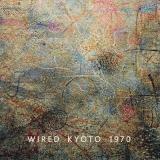
Wired was an ephemeral improvisational music project formed by Michael Ranta, Karl-Heinz Böttner, and Mike Lewis. On 28 April 1970, the trio recorded an extended studio session of approximately 140 minutes, in collaboration with Conny Plank, who engineered and mixed the recording in real time, incorporating elements of live electronics. This session was subsequently edited to album length and released in 1974 as part of the Free Improvisation 3LP box set issued by Deutsche Grammophon, alongside recordings by Iskra and New Phonic Art.
Owing to its exploratory electric sound world and Plank’s distinctive spatial production techniques, the Wired recording acquired a degree of underground cult status, particularly among listeners associated with krautrock and psychedelic improvisation.
Shortly after the studio session, Ranta and Böttner travelled to Japan, where they spent approximately six months performing with Karlheinz Stockhausen at Expo ’70 in Osaka. In addition to these activities, they engaged in various independent musical projects and performances.
The present release, sourced from the personal archive of Michael Ranta, documents a live duo performance by Ranta and Böttner, recorded on 27 July 1970 in an outdoor setting in Kyoto (the exact location remains unknown), before an audience of approximately 200 music teachers. The recording exhibits sonic and aesthetic characteristics closely aligned with the previously recorded studio material, retaining the distinctive “Wired” sound while situating it within a live, site-specific context.
Michael Ranta: percussion, voice, home-made instruments, tapes, tape delay, effects Karl-Heinz Böttner: guitar, organ, ocarina, voice, effects
In 2024, Kyoto Jazz Massive released their third album as a digital-only project, 30 years after their debut. It now receives the honor of a special vinyl edition, featuring brand-new exclusive mixes by Young Pulse—elevating these already great tracks to even greater heights, for both your ears and your feet.
This marks the first and exclusive collaboration between KJM and Echoes Of A New Dawn Orchestra (aka Jéroboam), the unique Parisian band that has been performing live with KJM across Europe for the past three years. On this occasion, KJM recorded four new tracks with EOANDO, including three original songs ("Power", "Love Wars", and "Impulsive Procession") and a new rendition of “Stand Up”, a previously released composition. To complete the album, you'll also find a stunning cover of KJM’s iconic track "Substream" by EOANDO, as well as their signature piece, “EOANDO's Theme”.
"Power" and "Stand Up" were recorded with Vanessa Freeman, while "Love Wars" features Bembe Segue. This London-based duo has been singing live with KJM since 2004.
"Power" is a crossover anthem, blending jazz-funk and French disco with a gospel touch. Vanessa Freeman’s uplifting lyrics call for collective awareness and energize audiences. "Love Wars" is a live-band interpretation of broken beat with a boogie spirit, enhanced by Bembe Segue’s sharp and spiritual vocals. “EOANDO’s Theme” was specially composed by Echoes Of A New Dawn Orchestra for KJM, capturing the Okino Brothers' love for boogie-funk jams with Brazilian and Balearic influences reminiscent of Azymuth.
“Impulsive Procession” fuses Afro, funk, jazz, fusion, soul, rock, house, and techno—drawing inspiration from several of KJM’s most respected musical heroes. A brand-new version of “Stand Up”, originally released in 2008, was re-recorded live in the studio with EOANDO and fresh vocals by Vanessa Freeman.
The album closes with a reimagined version of “Substream”, one of KJM’s most beloved tracks, covered by EOANDO for the official Tokyo Crossover/Jazz Festival 2023 compilation. This new version was recorded as an organic disco interpretation at Danilo Plessow’s studio in Paris.
- A1: Dosojin No Uta
- A2: Extra Freedom
- B1: Still In Love
KYOTO JAZZ SEXTET's new work is a folk song cover!
KYOTO JAZZ SEXTET, which will celebrate its 10th anniversary in 2025, has released an emergency 12-inch. It is a cover of "DOSOJIN NO UTA",
a folk song handed down in Nozawa Onsen Village, Nagano Prefecture, with a spiritual and danceable jazz arrangement.
In 2022, the demo version was used for the video distribution of the Dosojin Festival and secretly attracted attention, and was completed in 2025
with new recordings of drums and bass.
It was also selected as the commercial song for "THE GIN SODA", which uses gin from Nozawa Onsen Village Distillery and will be released at Lawson stores
nationwide in March 2025, and has attracted a lot of attention.
The coupling is Extra Freedom, which has been played more than 1 million times on Spotify and became KYOTO JAZZ SEXTET's biggest hit. In addition, the album includes a new jazz version of Still In Love, a cover of Shuya Okino's global anthem, featuring Navasha Daya and Tomoki Sanders.
This is a supreme album that breaks new ground for KYOTO JAZZ SEXTET and features their strongest songs.
This is also the first release from KJCC (Kyoto Jazzy Creative Council), a voluntary organization that Shuya Okino founded with Yukari BB (Jazz Sport Kyoto) and Masaki Tamura (DoitJAZZ!). Shuya Okino himself wrote the Japanese title on the front cover.
Four Seasons in Kyoto’ marks the final chapter of The Kyoto Connection’s Ambient Japanese trilogy, following Postcards (2018) and The Flower, The Bird and The Mountain(2022). Like its predecessors, this album pays homage to the pioneering ambient and environmental music movements of 1980s and 1990s Japan.
The album unfolds as the imagined soundtrack to life in a quiet rural village, where nature and tradition shape the rhythm of everyday existence. Across 14 evocative compositions, The Kyoto Connection captures the essence of Japan’s ever-changing seasons, weaving together delicate melodies and immersive soundscapes. With contributions from friends and fans in Japan, Four Seasons in Kyoto is both a tribute and a transportive listening experience from producer Facundo Arena, the composer and producer behind The Kyoto Connection.
With Four Seasons in Kyoto, Facundo Arena continues his deep exploration of Japanese ambient and environmental music, blending his long-standing admiration for Kyoto’s cultural heritage with a sound that feels both nostalgic and timeless. While Postcards was an instinctive homage and The Flower, The Bird and The Mountain drew from real Kyoto field recordings, this final chapter in the trilogy leans further into the imagined, an intimate portrait of an unseen yet deeply felt Japan.
Recorded using a mix of vintage synths, delicate acoustic instrumentation, and subtle electronic textures, Four Seasons in Kyoto refines The Kyoto Connection’s signature approach. Organic soundscapes and drifting melodies mirror the slow change of seasons, evoking the impermanence central to Japanese aesthetics. The result is a record that seamlessly bridges the natural and the synthetic, memory and imagination, a fitting conclusion to a journey that began with an algorithmic discovery and blossomed into a rich sonic world of its own.
180g vinyl pressing.
During the late 2010s, music lovers around the world began obsessively listening to increasingly esoteric albums on Youtube. More often than not, they’d leave the browser on autoplay. This was how Facundo Arena, the composer and producer behind The Kyoto Connection, discovered the technonaturalistic pleasures of Kankyō Ongaku (environmental music), a distinctly Japanese interpretation of European, British and American minimalist composition and ambient music. “It was a kind of algorithmic magic,” he says.
Upload by upload, the utopian music of Hiroshi Yoshimura and his 80s Japanese contemporaries transported Facundo back to his childhood. When he was five, his father placed him in karate lessons and began watching martial arts movies with him. From those early experiences, Facundo became fascinated Japanese history, tradition, and culture, particularly that of Kyoto - the cultural capital of Japan. Kankyō Ongaku reminded him of hearing the sounds of Japanese folkloric instruments as a young boy, and suddenly, the way the influence of Japan had manifested in his music made sense. “I had the sensation that for many years, I’d been doing something similar to the style,” he explains.
Inspired, Facundo used an iPad and an old Akai cassette deck to record Postcards, his homage to Japanese minimalism and Kankyō Ongaku. By this stage, he was twelve years deep with The Kyoto Connection, the musical project he launched in 2005 in his hometown of Buenos Aires, Argentina. Over that late 2000s and 2010s, Facundo, later on joined by collaborators Rodrigo Trado (drums), Jesica Rubino (violin) and Marian Benitez (vocals, now his wife), released numerous D.I.Y albums. Project by project, they followed the threads between 80s synth-pop, ambient, new age, house, techno and acoustic composition.
Postcards introduced The Kyoto Connection to listeners around the world and brought Facundo into our orbit. During Argentina’s covid lockdown, Facundo received a set of soundscapes recorded in Kyoto by the Japanese musician and sound designer Masafumi Komatsu. Over several insular months, he decorated them with synthesisers, samples and subtle rhythms, creating The Kyoto Connection’s next album, The Flower, The Bird and the Mountain to be released via Isle Of Jura offshoot Temples Of Jura.
Ostensibly made up of twelve distinct tracks, listening to The Flower, The Bird and the Mountain feels more akin to spending calm, meditative time in twelve specific environments. Although the foundations they rest on are recordings made in geographic locations around Kyoto, Facundo has yet to visit Japan. As a result, the landscapes he paints sit somewhere between fiction and fact, richly pictorial sonic imagination juxtaposed with echoes of reality. Regardless, as his bubbling melodies and glistening synthesisers glide against Masafumi Komatsu's recordings, Facundo guides us into a blissful zone of tranquillity well worth spending time within.
First collaboration ever between Japanese noise legend Merzbow and visionary/provocateur Kaoru Sato of R.N.A. Organism (Vanity Records) and EP-4 (WRWTFWW).
Side A: live recording of Merzbow and Kaoru Sato's first live collaboration ever. Recorded October 21st 2018 at Metro Club in Kyoto for a three-label showcase with avant-garde imprints Slowdown, Phonon and Kyoh Records.
Side B: Solo sessions by each artist that took place after the joint performance on the same night. Edited and mixed in their respective studios.
Vinyl Only. Produced by Ollie Marland of De-Lite and Jah Wobble's Invaders Of The Heart fame Label logo by manga legend Shintaro Kago. Archival reissue of rare 1984 jazz-funk fusion diamond in the rough by German-Australian-British madcap ensemble Bells of Kyoto, produced by Ollie Marland of De-Lite and Jah Wobble's Invaders Of The Heart fame. Fusions grooves with Orient-funk detours and looking out the window of a Swissair aircraft moments of cool mid 1980s contemplation.
Highly recommended to porthole dreamers, seasoned mind travelers, inventive dancefloor adventurers, and dogs who like to stick their head out the car window.
Drums - Alex Friedrich
Electric Bass - Peter Drefahl
Mastered By - Rico Sonderegger
Piano, Bells - Peter Waters
Producer - Bells Of Kyoto, Laurie Carls, Ollie Marland
Recorded By - Laurie Carls, Ollie Marland
Synthesizer, Guitar, Percussion - Ollie Marland
Repress!
NX Records is a collaboration between Matthew Herbert's Accidental Records and the Department of Music at Goldsmiths, University of London.
In May 2013, the label launched with an introductory mixtape and live performances as part of the Puregold Festival launch at the Southbank Centre. NX Records has continued to release new, critically acclaimed music, host numerous events and run an annual pop up record shop.
The label's mission statement is to create a new model for the music industry, connecting exciting talent from the renowned creative hub of Goldsmiths - and the wider community of South East London - with the ever-experimental Accidental Records.
Our aim is to build connections between emerging artists, education, the industry and audiences. NX is a professional label that works alongside, not in opposition with, DIY artists.
The first in our series of experimental split 12"s focuses on instrumental electronic music.
Goldsmiths student and modular wizard Sam Hostettler evokes a daydream meeting between Vangelis and Burial, with his impossibly lush synthscapes shot through with dubbed out percussion. Meanwhile, La Leif's blend of crunchy, electroacoustic techno and outernational field recordings should hit the spot for fans of Karen Gwyer or Shelley Prior.
NX12X is out on Feb 1, with a launch party at The Glove That Fits on Feb 14. Come grab a copy of the vinyl, and have a dance...
- A1: Kid Montana - Cabs Ambush
- A2: Tristes Tropiques - Untitled #1
- A3: Prothese - Tumeurs
- A4: Rel Rex - Program
- A5: Digital Dance - Human Zoo
- B1: Polyphonic Size - Kyoto
- B2: Satin Wall - Dans Les Profondeurs
- B3: Tristes Tropiques - Untitled #2
- B4: Pseudo Code - Around Midnight
- B5: Slim Jack - So Sah Gelleck Tissah
- C1: The Names - Spectators Of Life
- C2: Siglo Xx - Individuality
- C3: Marine - Life In Reverse
- C4: The Neon Judgement - Factory Walk
- C5: Nausea - Vocal Expression
- D1: Isolation Ward - Lamina Christus
- D2: Front 242 - Principles (Instrumental)
- D3: Allez Allez - Allez Allez
- D4: Berntholer - Emotions
- D5: Jung - The Real Thing
LTM presents a limited double vinyl gatefold edition (500 copies only) of B9, the definitive collection of cold wave and minimal electronica from Belgium, recorded between 1979 and 1983.
Originally released on Sandwich Records in May 1981, B9 featured 10 exclusive tracks by luminaries such as Digital Dance, Polyphonic Size, Kid Montana, Pseudo Code and Prothese, the latter the first recording project by Daniel Bressanutti of Front 242. Now digitally remastered, with 10 additional tracks on the second disc, this new deluxe vinyl edition also features Front 242, The Names, Marine, Siglo XX, The Neon Judgement, Berntholer, Allez Allez, Isolation Ward and more.
Cover op-art by Victor Vasarely. Design by Benoît Hennebert, based on a poster for The First Belgian Rhythm Box Contest (1981). Liner notes by James Nice. The existing CD version of B9 is also still available (LTMCD 2486)
Six years have passed since the last album by Andi Otto alias Springintgut, ("Park and Ride", City Centre Offices, 2007). In this period, Otto has done nothing less than inventing a new instru- ment: His "Fello" is a cello with movement sensors attached to the bow and a corresponding software. The development has been kicked off at STEIM in Amsterdam already in 2007. Since then, Otto has achieved vital refinements of the system, cooperated with artists of various fields as diverse as choreographers in Macedonia, theatre in Nigeria and Techno DJs in the Berghain Kantine in Berlin or the Fusion Festival. He even played solo with his instrument on different continents. For this third album, "Where We Need No Map" Otto takes the "Fello" to his studio in Hamburg for the first time. He records his instrument which has until today only been presented live on stage. In these Fello Sessions, the bow gestures immediate- ly modulate and process the amplified cello sound. In the subsequent editings he selects and cuts these sessions and merges them with other styles, such as Skweee, House and Jazz. Springintgut's trademark sound, this unique playfulness, is pre- sent throughout, while the live-processed cello adds an unrivaled deepness. The artist's expeditions even add more colour. Two tracks have been recorded in India. The lead voi- ce in "Bangalore Kids" is a field recording of a schoolboy in Cubbon Park, Bangalore. Andi Otto spends three months in Japan as artist- in-residence in the Villa Kamogawa in Kyoto. Du- ring this concentrated period he produces the more contemplative tracks of the album, like "Ka- mogawa Cycling" and "Western Kyoto". In Sri Lan- ka, finally, he meets Sasha Perera, the voice of Berlin's Dub Techno band Jahcoozi. They record two songs together. Especially in "Bullet" one can sense the lazy, muggy, peaceful heat of the after- noons in which this beautiful track has been com- posed. These stories may help to locate the music's orig- ins but still the sound of "Where We Need No Map" points us to unknown territories. The journey itself is the reward, let's listen!
Sechs Jahre sind seit dem letzten Album "Park and Ride" (City Centre Offices, 2007) von Andi Otto alias Springintgut bereits vergangen. Diese Zeit hat der Pingipung-Mitinhaber genutzt, nicht weni- ger als ein eigenes Instrument zu erfinden: das "Fello", ein Cello mit Bewegungssensoren auf dem Bogen und einer dazu gehörigen Soft- ware. Die Grundlagen dafür entstehen bereits 2007 am STEIM in Amsterdam. In der Folgezeit gelingt es Otto, das Instrument immer weiter zu verfeinern, mit unterschiedlichen Künstlern zu kooperieren und international aufzutreten. Für "Where We Need No Map" trägt Otto das Fello erstmals ins Hamburger Studio und nimmt unzählige Sessions auf, in denen die Gesten des Bogens direkt den verstärkten Sound des Cellos verändern und neu formen. Diese Fello-Sitzungen werden anschließend editiert und mit anderen Ein- flüssen vermengt, die von Skweee über House bis hin zum Jazz reichen. Der Markenzeichen-Sound von Springintgut, diese ureigene Verspieltheit, ist weiterhin vorhanden, gewinnt durch das live-pro- zessierte Cello aber eine bisher unerreichte Tiefe. Weitere Farbe erhält das Album durch Ottos zahl- reiche Tourneen in ferne Länder. Zwei Stücke ent- stehen in Indien. Die Stimme von "Bangalore Kids" ist eine Feldaufnahme eines Schuljungen im Cubbon Park in Bangalore. In Japan verbringt Andi Otto drei Monate als "Artist in Residence" in der Villa Kamogawa in Kyoto. Während dieser kon- zentrierten Zeit entstehen die ruhigeren Tracks des Albums wie "Kamogawa Cycling" und "Western Kyoto". In Sri Lanka lernt er dann Sasha Perera kennen, die Stimme von Jahcoozi. Sie nehmen zwei Songs zusammen auf. Vor allem in "Bullet" kann man der faulen Nachmittagshitze nachspü- ren, in der die Stücke entstanden sind. So lassen sich die vielfältigen Entstehungspunk- te von "Where We Need No Map" zwar karto- graphieren, aber der Sound des Albums schickt einen trotzdem in unbekanntes Terrain. "Der Weg ist das Ziel, frag nicht viel, hör mal..."
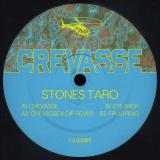
Fast At Work touches down with its fifth flight, and it’s come a long way. Hailing from Kyoto, Japan, Stones Taro delivers three original productions that move through dubstep, breakbeat and the restless spaces in between — a record that carries the weight and precision you’d expect from one of the most in-demand producers to emerge from Japan’s underground in recent years.
KITCHEN. LABEL is proud to present AGATE, the latest album by Japanese artist MEITEI, marking a deepening of the world he first shaped through his Kofū trilogy released between 2020 - 2023.
Named after the mineral agate, a stone formed through slow accumulation, pressure, and time, the album reflects MEITEI’s patient approach to sound. AGATE brings together extended and newly rearranged works from across the Kofū cycle alongside new compositions and passages, refining material developed through years of performance and sustained practice.
The album presents seven tracks:
HAŌ (Previously unreleased track)
SHIN-OIRAN (Remodeled from Oiran I, Kofū 2020)
SHIN-SADAYAKKO (Remodeled from Sadayakko, Kofū 2020)
SHIN-WAROSOKU (Remodeled from Wa-rōsoku, Kofū III 2023)
KYŪGEKI (Remodeled from Shinobi and Akira Kurosawa, Kofū II 2021)
SHIN-OIRAN II (Remodeled from Oiran II, Kofū 2020)
SHIN-EDOGAWARANPO (Remodeled from Edogawa Ranpo, Kofū III 2023)
Across these works, MEITEI expands the musical vocabulary first introduced in Kofū, a sound he once described as “lost Japanese mood.” While Kofū drew from fragments of folklore, theatre, ghost stories, and forgotten urban memory, it was never an act of historical reconstruction. Rather, it reflected a sensibility of the past observed from the present. With AGATE, this worldview is clarified as Shinpu, a process of discovery in which historical awareness becomes a foundation for contemporary creation rather than a constraint.
During five years of Kofū tours across Japan, Europe, and Asia, MEITEI performed this material in a wide range of spaces, from underground live houses and listening rooms to culturally significant sites. These environments influenced pacing, dynamics, and structure, shaping how the material evolved over time. AGATE is therefore not only a studio album, but the result of material refined through repeated performance.
If the Kofū albums were windows into forgotten eras, AGATE explores what lies beneath, sediment and strata formed through time and pressure. MEITEI’s approach to sound mirrors the nature of agate itself. Grains become texture. Texture becomes narrative. Voices drift through decaying layers of sound, while ancient instruments are used in non-traditional ways, forming distinctive percussive rhythms and melodies that appear and vanish without fixed resolution.
The album’s visual materials were developed under MEITEI’s direction through physical art-making processes. The cover artwork originates from a letterpress print created by Kamisoe, a Karakami atelier in Nishijin, Kyoto, using Kyo-karakami paper. The original artwork, produced through traditional woodblock techniques on handmade washi, was subsequently reproduced on print for the album edition. Kamisoe continues to reinterpret this historical Kyoto craft with a contemporary sensibility.
The title calligraphy was created by Bio Xie, whom MEITEI personally invited to participate in the project. During his performances abroad, MEITEI encountered in Taiwan a lingering atmosphere reminiscent of “Shitsunihon” — a sense of old Japanese memory that quietly endures beyond time. He was deeply drawn to Bio Xie’s distinctive use of Chinese characters, which resonated with this experience, and asked him to contribute to the visual expression of AGATE.
In parallel, MEITEI continues to reinterpret Japanese sensibility through his concept of “Shitsunihon,” presenting it as a contemporary musical language. The refined Kyoto motifs envisioned by Kamisoe and the distinctive calligraphic expression by Bio Xie intersect with MEITEI’s singular artistic direction, weaving together a newly articulated worldview.
The accompanying visual imagery, including the liner photographs, was created by photographer Hiroshi Okamoto, who was also responsible for the visual direction of MEITEI’s previous work, “Sen'nyū.” It draws from MEITEI’s lived experiences of winter seas, solitary cliffs, and breaking waves. These scenes symbolize the inner conflicts of the ten years he spent living in Hiroshima, and his confrontation with solitude and the sounds he creates.
AGATE will be released on 17 April 2025 via KITCHEN. LABEL on 180g vinyl, CD, and digital formats. The album is mastered by Kelly Hibbert, known for his work with Flying Lotus, Madlib, and J Dilla.
With AGATE, MEITEI returns to the material of Kofū with greater focus and discipline, continuing an ongoing process of working forward with inherited material.
- A1: Flower's War
- A2: Nonsense Of Folly (Thanks: Noncaterians Of Cortessa)
- A3: The Shortest Way To Love
- B1: Dance Freek
- B2: Dead Romantic
- B3: Marching Turkish
- Flower's War ("Kyoto Night" Version)
- Dead Romantic ("Kyoto Night" Version)
Through the dense blend of Japanese New-Wave, between moldy kimonos and punctured paper screens, along the rails of a sonic bullet train, this mini-LP reaches us, overflowing with purebred Punk-Funk, splinters of Soul and shredded Jazz. A gold nugget in a sea of sadness. Scattered energy trapped in a handful of vinyl grooves. Originally released in 1986.
Alva Noto - Wave Weave – Sono Obi is the original soundtrack by Alva Noto, composed for a film by Carsten Nicolai.
- The project emerged from a collaboration with an 12th-generation kimono textile manufacturer in Kyoto, Japan.
At its core, the work explores the translation of sound into textile form: sonograms of musical compositions serve as the basis for woven structures, connecting acoustic frequency patterns with traditional weaving techniques.
Alongside the original soundtrack, the release includes an alternative soundtrack version and a photographic documentation featuring sonograms, soundtrack visualizations, and film stills.
Tracklisting
---------------------------------------------------------
Medium: 1 // Side: A // Track: 1
Artist: Alva Noto
Title: Sono Obi Wave Weave
Playtime: 00:22:00
Explicit Lyrics: No
ISRC: DE1N62600001
(P): 2026 NOTON
Composer: Carsten Nicolai
---------------------------------------------------------
Medium: 2 // Side: B // Track: 1
Artist: Alva Noto
Title: Sono Obi Landscape
Playtime: 00:06:10
Explicit Lyrics: No
ISRC: DE1N62600002
(P): 2026 NOTON
Composer: Carsten Nicolai
---------------------------------------------------------
Water can retain or wash away memory; flowing or freezing. It gives life and shapes earth, while frozen imprints of an ancient past are waiting to melt – back into sound or fluid motion, or simply to dissipate and disappear. For their split release, Yoichi Kamimura and Olli Aarni offer two distinct reinterpretations of a performance recorded live at the Temppeliaukio Kirkko – a church in Helsinki built directly into solid rock and bathed in natural light – meditating on glacial landscapes and water cycles, using shared field recordings that bifurcate into two sonic visions of “ice journey”.
Yoichi Kamimura’s extensive recordings formed the bedrock of the original performance, notably from time spent on Suomenlinna Island just outside Helsinki in 2021, aiming to capture the remnants of the glacial movements that formed the area’s geology. Elsewhere, the voices of ringed seals, underground waterways of Kyoto, and icy rivers in Lapland from Kamimura’s library float in as well. “The small, charming, and gentle islands floating in the Baltic Sea—some with little cottages and restaurants—reminded me of the drifting ice in the Sea of Okhotsk between Japan and Russia,” describes Kamimura. Fragments of a Christmas choir creep in too, recorded at the church on Suomenlinna Island. Titled Kōri no ryokō , Kaimimura’s reinterpretation of the performance emphasises a shared future across all icy sea regions of the world: thawing ancient memories and the threat of disappearing entirely.
On Jäämatkailu, Olli Aarni presents his own expansive reworking of the same source material, heavily processed alongside his own field recordings from Vantaanjoki river and Suontee lake in Finland. “I was thinking about the processes of erosion, water carving rock, the prehistoric glaciers over the landscape in my own environment,” explains Aarni. The soundscape hums with both intimate details and macrocosmic flow, and a submersible bass rumble hinting at an iceberg far below the tip, morphing at time scales beyond human comprehension.
Side A is composed by Yoichi Kamimura using field recordings of drift ice (Shiretoko, Hokkaido, 2019–2022), the Lake Biwa Canal (Kyoto, 2020), the Therme Vals baths (Vals, 2017), spring water (a fountain next to Saint Benedict Chapel, 2017), a Christmas choir (Suomenlinna Church, Helsinki, 2021), ice in the Juutuanjoki River (Inari, 2021), and recordings from Yoichi’s and Olli’s concert (Temppeliaukion kirkko, Helsinki, 2021), KORG iPolysix, and KORG minilogue xd.
Side B is composed by Olli Aarni using the aforementioned sounds + field recordings of the river Vantaanjoki and the lake Suontee, sampled sounds, and a computer.
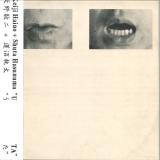
Haino sings. Hasunuma plays. It’s a minimal framework, but what emerges is a boundary-blurring sonic exploration. Across the album, Haino’s voice threads through Hasunuma’s layered soundscapes built from analog synths, electric guitar, piano, field recordings, and more. Haino entered the studio with only lyrics in hand, improvising melodies in response to Hasunuma’s evolving arrangements. The result is a work of deep trust, intuition, and sonic tension.
Keiji Haino and Shuta Hasunuma’’s creative connection began in 2017 with an impromptu performance in Shibuya—Hasunuma on a Buchla modular synthesizer, Haino responding with the Japanese national anthem, “Kimigayo.” That moment sparked their unlikely collaboration.
In 2018 Haino appeared at the Hasunuma-organized event “MUSIC TODAY IN KYOTO” at Rohm Theater, alongside Nobukazu Takemura, Manami Kakudo, Elena Tutatchikova, Kukangendai among others. In September 2021 during the pandemic, the two performed "U TA" for the first time at in Shibuya. They began planning the album soon afterwards.
For the recording of U TA, Haino entered the studio with only the lyrics in hand, with no knowledge of what sounds Hasunuma would produce. Responding to Hasunuma’s music in real time, Haino composed the melodies and layered in his voice on the spot. With additional sessions at Hasunuma’s private studio and Haino’s preferred studio, the album was completed.
All melody and vocals by Keiji Haino
All instrument, written, played, arranged, mixed and produced by Shuta Hasunuma
Recorded by zak at st-robo studio, Shuta Hasunuma at Studio i.M.O and windandwindows
Mastered by Rashad Becker at clunk
Production Management: Eishin Yoshida, Kento Ono (windandwindows)
For Temporal Drift: Yosuke Kitazawa, Patrick McCarthy
Art Direction: Aiko Koike
Special Thanks to Toshihiko Kasai, Ryoichi Kiyomiya, zAk, Yumiko Ohno
license
Since the late 1960s, jazz drummer Takeo Moriyama has been a dominant force in the free jazz scene, initially with the Yosuke Yamashita Trio, and more recently, collaborating with the KYOTO JAZZ SEXTET, earning respect from past to present. Recorded in 1980 with his quartet featuring Fumio Itabashi, this album is renowned for being the first to include the emotionally rich Japanese masterpiece "Watarase". Other highlights include the spirited "Exchange" and the beautifully poignant "Goodbye". Each track is a standout, offering a grand-scale performance where tranquility and movement organically intertwine, making it one of the top albums in the history of Japanese jazz.
Takeo Moriyama (Drums)
Yoshio Kuniyasu (Tenor & Soprano Sax)
Fumio Itabashi (Piano)
Hideaki Mochizuki (Bass)
Koichi Matsukaze (Alto & Tenor Sax, Flute)
- 1: Sky Cafe
- 2: Magic Touch
- 3: Dream On
- 4: Goodnight Sun
- 5: Imagine Space
- 6: Natural Space
- 7: Natural Wonder
- 8: Hidden Corner
- 9: Hotel Cloud
- 10: Kyoto Kiss
- 11: Times
Black Vinyl[20,13 €]
- 1: Sky Cafe
- 2: Magic Touch
- 3: Dream On
- 4: Goodnight Sun
- 5: Imagine Space
- 6: Natural Space
- 7: Natural Wonder
- 8: Hidden Corner
- 9: Hotel Cloud
- 10: Kyoto Kiss
- 11: Times
Clear Vinyl[23,33 €]
a long-awaited reissue of an ultra-rare 7-inch single, originally released as a promo-only item from handsome boy, the 1990 masterpiece by inoue yosui—widely regarded as one of the greatest singer-songwriters in japanese music history.
“pi po pa,” arranged by haruomi hosono and used in a tv commercial at the time, was featured on heisei no oto, a compilation released by music from memory. the album’s standout track, “shonen jidai,” remains one of japan’s most iconic and beloved songs.
also included on this 7-inch is “yume migokochi,” a pinnacle of japanese balearic sound, arranged by yuji kawashima—keyboardist of ep-4, a kyoto-based band essential to the history of japanese new wave.
and exclusive to this release is “kurenai suberi,” an overlooked gem that might best be described as inoue’s take on cold-funk.
remastered from the original master tapes by kuniyuki takahashi, and housed in the ori-ginal artwork.
After showcasing intense, edgy breakbeats on previous releases with Scuffed Records, FeverAM, and early reflex, Kyoto-based producer Naco returns with "Snakey," his first release in two years and a long-awaited comeback on his own label, 85acid. This essential collection features four cutting-edge bass mutations that push boundaries once again.
The EP opens with the title track “Snakey,” a minimal piece featuring a relentless, serpentine bassline that slithers beneath, grounding the sound in a hypnotic groove. It’s followed by "Anolon", a potent and minimal dubstep mutation, pulling the listener back to a sense of calm. In “Ows,” the energy intensifies with a stripped-back, industrial breakbeat that takes the BPM up to 155, where raw machine-like precision takes center stage. Finally, the EP closes with “Mappy,” a dancehall and hardcore-inspired offering where a simple yet addictive rhythm is layered with amen breaks and echoes of raves past.
Embracing a dangerous yet lush minimalism with an intentionally restrained sound, this release also marks a first for 85acid with the label's first vinyl pressing!
- A1: Jake Muir - Mirage
- A2: Pent & Dylan Kerr - Incoherences
- A3: Flora Yin Wong - Oath
- A4: Qwqwqwqwa - Shadow (Ft. Sop.io)
- A5: Ex Wiish & Dorothy Carlos - Assimilation
- A6: Nexcyia & Mu Tate - Sans Titre
- A7: Tati Au Miel - House Of Gold
- B1: Kamran Sadeghi - Formula Fiction
- B2: A... ...Cha.... A... I Feel Like A Ghost Uh
- B3: Eric Frye - Plague Chain
- B4: Maxwell Sterling - Xiahe Tears
- B5: Muein - Creep
- B6: James K - Sketch 4
29 Speedway is a record label and performance series based in Brooklyn, NY featuring forward-thinking improvisational music and live multimedia. Founded in 2020 by Ben Shirken a.k.a. Ex Wiish (‘Shards Of Axel’, Incienso 2023), 29S serves as a platform for artists exploring the fringes of interdisciplinary art and music. Hosting D.I.Y-guerrilla style sound and performance art concerts at Pioneer Works (NYC), Public Records, and in Europe in partnership with Index Records, they have worked with artists such as James Hoff, J. Albert, Yolabmi, Robert Aiki Aubrey Lowe, AceMo, Flora Yin Wong, Nexcyia, Young Boy Dancing Group, UMFANG, Color Plus, Poncili Creación, Special Guest DJ, Arushi Jain, Drumloop, Isabella Koen, Ben Bondy, Kamran Sadeghi, Yawning Portal, James K., Syndey Spann, Debit, Pent and many others.
Resident Advisor called their most recent compilation record ‘Channel Plus’ “one of the most stunning documents of the ‘modern ambient-techno movement pioneered by labels such as Motion Ward and West Mineral’, with a focus on New York as well as a global outreach that encompasses chilled-out trap, electro, downtempo and even early '00s electroacoustic music”. Their debut solo artist release from J. Albert and Will August Park, entitled “Flat Earth” (2023), was based on free improvisation and ambient jazz, receiving praise from Philip Sherburne, Shawn Reynaldo, and was included in RYMs top EPs of the year. 29S has been written about on ID, Bandcamp Daily: Best Ambient, Boomkat, Paper Mag, Artnet, Dazed, Clot Mag, Nina Protocol, and Document Journal.
The newest release from 29 Speedway, UltraBody, is a compilation record featuring the music of Jake Muir, Pent & Dylan Kerr, Nexcyia & Mu Tate, James K, Flora Yin-Wong, Ex Wiish & Dorothy Carlos, Kamran Sadeghi, Tati au Miel, James Hoff, Eric Frye, Muein and Maxwell Sterling. The record is emblematic of the artists who have performed at 29 Speedway shows in New York and Europe during the past two years, and is the third in a series released by the label.
The record was born out of a desire to investiage how the self, spirituality, and language are intertwined with the intervention of subjectivity by new technologies. With increasingly sophisticated tech, and the supposed ability to remake the world and ourselves, what differentiates our individual discretion from the will imposed upon us by software? Quoting Walter Chaw from his piece on David Cronenberg’s Videodrome, “Decades of rampant, unregulated and ill-considered technological leaps have begun to evolve, to mutate, humans at a biological level”. This haphazard acceleration towards a techno-utopic transformation of humanity has faulted, and as William Gibson put it, is leading us to live in a “half assed singularity”. In this reality, artistic processes are influenced by excessive access to computational tools and assistance, but not utterly controlled.
This in-between state of dominion is explored in 29 Speedway: UltraBody. “Incoherences” samples the utterances of Dylan Kerr’s voice processed between Pent’s percolated glazes, muddying the gulf between vaporous ambient and reflexive sound design. The voice on James Hoff’s “A... ...Cha.... A... I feel l” was created by trying to get voice cloning technology to sing a gps data stream, the music an extrapolation from an earworm he got stuck in his head while shopping in Kyoto. On “Plogue Chain”, Eric Frye’s most speculative sci-fi observations spiral into a glazed pool of digital cacophony, while Kamran Sadeghi’s “Formula Fiction” is an experiment in (un)controlled generativity. Incorporating minimal pings from a 3D simulation scene based on gravitational interaction, cello bits evolve on “Assimilation”, a collaboration between Ex Wiish & Dorothy Carlos.
On UltraBody, sound has no separate existence from space.
After touring the globe showcasing their A/V moshpit-inducing live show, they are revealing their new musical creations to an unsuspecting public. Never Sleep are proud to present a landmark moment in the Japanese hardcore new rave scene. The blinding lights of DEATH RAVE point to an untraveled journey, a sci-fi fusion of black metal, gabber, cyberpunk, performance art and techno. It’s their first for the Berlin label (founded by Gabber Eleganza) following 2021’s EP Principle of Light Speed Variance. Full description VMO aka Violent Magic Orchestra break through the darkness and herald a spectacular mould-melting sound on their forthcoming album DEATH RAVE. After touring the globe showcasing their A/V moshpit-inducing live show, they are revealing their new musical creations to an unsuspecting public. Never Sleep are proud to present a landmark moment in the Japanese hardcore new rave scene. The blinding lights of DEATH RAVE point to an untraveled journey, a sci-fi fusion of black metal, gabber, cyberpunk, performance art and techno. It’s their first for the Berlin label (founded by Gabber Eleganza) following 2021’s EP Principle of Light Speed Variance. Ahead of the release VMO have brought their digital harcore to festivals around the globe, including Roadburn Festival, BANG FACE Weekender, Brutal Assault extreme music festival, Le Guess Who?, CTM Berlin and Dark Mofo. Their performance is the ultimate extreme visual music project in which techno, black metal, and industrial unite to create a ritual from the near future, 2099. All visual art and stage setting is provided by non-touring member, artist and programmer Kezzardrix (who has been visual director for millennium parade and BABYMETAL previously).The power consumption of a VMO show is equivalent to 56 guitar amplifiers, 5000W, a mind-expanding supreme noise and light experience. The band members all go by the names of classic black metal bands rendered in the Japanese katakana script; “ダークスローン”; “メイヘム”, and “エンペラー”. Their new LP is the first to feature lead vocalist ザスター. The record features guest vocals from extreme metal icon Attila Csihar, known for singing with Mayhem and Sunn O))). Other featured artists include Dylan Walker, singer of Full of Hell, punk-techno artist Infinity Division (aka Ash Luk), Icelandic darkwavers Kælan Mikla and Ican Harem of Gabber Modus Operandi. The result is a leap forward from their 2016 debut, where they have found a singularity where death metal meets Kraftwerk, or Rephlex goes black. Dressed in corpse paint and other hell-raising looks, onstage they are like “Shinigami (death gods) from the Death Note manga”. Singles Venom, Supergaze and Martello Mosh Pit featuring Gabber Eleganza have been released in the lead up to the record and have been shocking techno dance floors too with their hi-NRG-symphonic doom-gaze. They have shared their video for Planet Helvetech (here), created by Berlin-based Patrick Defasten. Helvetech combines the Norwegian word for hell (hevlete) with techno and is a reference to the infamous black metal shop founded by Mayhem’s Euronymous. It’s a song that imagines time travel from 2099 on the planet Helvetech (where VMO comes from) to 1990s Oslo. In 2023, they performed at the CTM festival in Berlin, as well as at Berghain, receiving rave reviews. At Sydney’s leading multi-sensory SOFT CENTER festival they drove the crowd into a frenzy on the 17 metre X 30 metre jumbo screen. They have also collaborated with artists, performing at the two day installation by the trailblazing Tianzhuo Chen - The Shepherd - at the Kyoto International Performing Arts Festival in 2021 here. At Sónar 2023, VMO provided the music for Taiwanese visual artist Yuen Hsieh’s work about virtual life after death DIGITAL AFTERLIFE AGENCY here. VMO will tour the world again for the new record, with appearances at ROSKILDE and media art and music fest Sónar 2024 announced so far and the DEATH RAVE experience getting bigger and bigger.
G Version III from Kyoto Japan arrives on Digital Sting via a correspondence going back a few years that grew out of mutual musical connections and a deep appreciation for the Jamaican soundsystem diaspora. G Version grew up with a love of Hip Hop, R&B, and Reggae and had a musical revelation at a Lake Biwako sound clash event as a teenager that was formative in spurring a deeper dive into Dancehall and soundsystem culture.
After some time spent studying in the UK and returning to Japan, working at Jet Set records along with meeting heavy weight producer Element the beginnings of her future musical output began to take shape. Downtime during the pandemic provided the time to concentrate on production. G Version's sound has a retro futuristic feel, equal parts Dancehall history and esoteric dub leanings, particularly in tune with the more experimental branches of 80's-90's UK Dub and Steppers. Influences being stated G Versions sound is thoroughly distinct and imaginative, not content to conform to any obvious genre tropes. Also included in this release are two dubs of G Version tracks by Digital Sting mainstays Feel Free Hi Fi.
G Version III- Scenery From Double Glazing DS008 Digital Sting Records
The Kyoto-based musician Yusaku Arai is known for his production work in the avant-garde scenes of Japanese hip-hop and R&B. On this solo album, though, he offers more lengthy, piano-centric meditations that use the techniques of musique concrète.
Arai’s compositions on the A-side emerged out of a reflection on the corporeal and interwoven relationship between his own body and things he encountered in the world—the ocean, a flower petal, a plastic sheet, a hand. His intent is to represent a process in which colors gently well up in inside of an object, pass through its entirety—and eventually permeate into the body itself. The B-side consists mostly of a long composition, which is about an unavoidable surplus that crops up in communication, whether of gestures or of language. This narrative work describes humans as beings torn between enthusiasm and emptiness.
The album’s artwork is by photographer Azusa Yamaguchi and designer Hejiro Yagi. Mastering by Sean McCann of Recital. An 18x24 inch poster is included.
The third release of , which will be released on vinyl with the theme of ancient and modern east and west ~ Nihon no Uta ~, is blindness caused by an illness that he had when he was a child, he met Tsugaru shamisen in a poor and difficult life.
Chikuzan Takahashi, a master of the Tsugaru shamisen, has raised Japanese folk songs to the level of art that has been praised around the world. The recorded song is "Iwaki Impromptu".
Several versions are also recorded in the album work, and there are different arrangements only for improvisational songs, but this time Held from 1973 to 2011 at "Maruyama Park Concert Hall" in Kyoto City to coincide with the Gion Festival in Kyoto
It is a sound source when he appeared in "Yoiyoyama Concert". A thick string that tells the beginning, like slamming Overwhelming power that tightens the chest even though it is not a drumstick, like an orchestra that does not seem to be a single performance
Spread of sound, free development of sound. A shamisen player named Chikuzan Takahashi who completely deviated from the frame of so-called standard folk songs It seems that the expression of is involved in the audience at the scene without even seeing it.
Mr. Takeyama describes this song as "a song where you don't know where it started, where it started, and where it ended." It's just an impromptu song, something that you listen to with subtle changes in sound and complex rhythms while making various changes. It is a masterpiece full of dynamism that you can grab until the end.
Bill Laswell, who is active as a world-class bassist, reconstructed the original sound source this time. He has a deep knowledge of ethnic sound sources, and his arrangement is "Mix-translation" instead of "Remix". Is used. While making the best use of Mr. Takeyama's sound source, as the difference in the words shows, it is unique Arrangement with swelling deep bass bass makes you feel as if you are standing on the same live stage and having a session. It is a finish that you can understand his idea of chewing the original and then translating it.
The jacket picture is by Mr. Akira Kasai, a photographer who has taken Mr. Takeyama's picture for a long time. We asked Mr. Takuji Matsubayashi, the author of "Takeyama Takahashi, the sound of the soul," to introduce the work.
- こびと
- ハレルヤ:左?
- 孤独のハープ弾き
- パラダイス:真昼
- Black Hole
- 紫の夕べ
- 目の前の天使達
- Another Lonely Harpist
- They’ve Gone, They Will Come
- パラダイス
- 童話
- Spirit In My Hair
World Of Echo announces the reissue of two remastered albums by Japanese guitarist and songwriter Naoki Zushi, 1988’s Paradise, and 2005’s III. Two classics of Japanese psychedelia, both Paradise and III were originally released on Org Records, the imprint of Shinji Shibayama of acid-folk group Nagisa Ni Te, with whom Zushi has guested on second guitar for decades. Both intimate and expansive, rich with revelatory songwriting and blasted, sky-scouring guitar, these reissues return these albums to print for the first time since the 2000s. It’s the first time III has been officially released on vinyl, with an extra, previously unreleased track, “Under The June Moonlight.”
Recorded in Kyoto’s Townhouse Studios in mid 1987 and released in limited-to-500 vinyl pressing in 1988, Paradise emerged from a scene in Kansai, Japan that was embracing the idiosyncracies of 1970s singer-songwriters, the soaring solos of early seventies psychedelia, and the DIY impulse of 1980s post-punk. While Zushi’s musical history stretched back to the early eighties – he was a founding member of Jojo Hiroshige’s noise outfit Hijokaidan – he found his feet with groups like Hallelujahs, whose dream-pop collection Niku O Kuraite Chikai Wo Tateyo was recently reissued by Black Editions, and Idiot O’Clock.
Paradise appeared two years after that Hallelujahs album and share much the same membership – Zushi’s backing band on several of the songs includes Shibayama on drums and Ken-Ichi Takayama (aka Idiot) on electric guitar, though just as often, Zushi plays all the instruments himself. The coordinates here are wide-reaching – you can hear the volume and intensity of Neil Young & Crazy Horse (on “Hallelujah: Left Side” and “Paradise: Midday”), the slow-motion magic of Galaxie 500, the idiosyncratic spirit of The Only Ones, all mixed up with tender guitar miniatures and stumbling garage-psych-pop moves.
Seven years later, after the transitional album Phenomenal Luciferin, Zushi released III. Perhaps his masterpiece, it’s already been bootlegged on vinyl, but this reissue is the real deal. The album was recorded at Studio Nemu over seven years, and sees Zushi backed by Shibayama (bass) and Masako Takeda (drums), his erstwhile bandmates in Nagisa Ni Te. By this stage, Zushi had started to really stretch out, and many of the songs on III swoon languorously, taking their sweet time to say what they need to say. It’s rich with lovely, melancholy songs, in a similar realm to bandmates Nagisa Ni Te, of course, but you can also hear traces of everything from Syd Barrett’s The Madcap Laughs, through seventies private press loner folk, to the slow-burn meanderings of the likes of early Low or Damon & Naomi.
When interviewed by Shibayama in the mid-nineties, Zushi said of Paradise, “it was a sort of collection of songs that had meant something to me up to that point… it was my paradise. I wanted to create paradise.” That’s something Zushi achieves on both of these albums – visionary Japanese psychedelia, en route to paradise. - Jon Dale
- Illuminance
- Ame, Hikari
- In Colours
- Warped In Red
- Rainwalk
- Blue Horizon
- Aurora
- Before The Silence
- Oto, Kioku
- Was It A Dream
The artistry of Midori Hirano lives in the resonance between sonic and visual worlds. Over her distinguished career the Berlin-based, Kyoto-born composer, pianist, and synthesist has crafted a distinctive voice straddling the spheres of classical music and harmonies with abstraction and invention. In addition to works under her own name, Hirano has released dynamic experiments under her MimiCof moniker as well as composed for film, television, art exhibitions and architectural expos. Hirano has also been a prolific collaborator, working with CoH, Brueder Selke, Nils Mosh, Teodor Wolgers, Ben Lukas Boysen & Paul Emmerich, SPECIMENS, Mami Sakurai, Atsuko Hatano, and more, contributing to dozens of releases. Hirano is acclaimed for crafting emotive works that stimulate all the senses with impressionism, or painting with sound. OTONOMA is the culmination of her work synthesizing these elements and highlights her acumen as a practiced and intuitive artist. The album infuses Hirano"s more classical sense of harmony on the piano with the endless textural possibilities of synthesizers.
Kyoto-based Stones Taro is a producer and DJ who has established a unique standing within the global dance music scene. After operating the NC4K label since 2017, he embarks on a new challenge by launching his own self-release series.
The inaugural release, titled "Foglore," is characterized by its foggy sound design and timeless arrangements reminiscent of folk tales.
In this four-track release, Stones Taro explores a fresh interpretation of the fusion between Dub, Techno, and Deep House. These tracks capture the essence of contemporary music in intriguing ways, yet feel as familiar as if they have existed since ancient times.
- 1: Blossom
- 2: Kyoto Dans La Brume
- 3: Sans Laisser D'adresse
- 4: Answer Me
- 5: La Course
- 6: Ida Lupino
- 7: Lontano
- 8: Le Jour J A L'heure H
- 9: Les Tuiles Bleues
- 10: Resonances
The album begins with the title track (Blossom) a light and immediate song composed by Besson. Also composed by Besson are 'Kyoto dans la brume', inspired by a stay in Japan's imperial city, and 'La Course', originally written for three slapstick short films by Fatty Arbuckle starring Buster Keaton. Suarez's composition ' Sans laisser d'adresse' , was initially written for a stage play titled ' Ici Nougaro' , and his ' Le jour J a l'heure H' for a film by director Jean- Henri Meunier. 'Les Tuiles Bleues' is a nod to Suarez's late friend, Malagasy accordionist and singer, Regis Gizavo.
There are also three covers on the album, 'Answer Me' by Gerhard Winkler and Fred Rauch, a composition recorded by Keith Jarrett during his 2016 European tour; Besson cites Jarrett as a major influence. There is also Carla Bley's ' Ida Lupino' and Pat Metheny and Lyle Mays' ' Au Lait'. These and their own compositions result is Blossom' ', a highly accomplished album on which trumpet and accordion shine in equal measure.
NC4K, based in Kyoto, presents the third installment of their vinyl-only series. This four-track EP features House and Breakbeats tracks exclusively produced by artists residing in the Kansai region.
Expect raw, impactful drums and skillful sample manipulation designed to deliver a jolt of energy to the dance floor.
An’archives presents 'sensitive', a new album, and the first solo vinyl release, by Japanese keyboardist and synth player, Mitsuhisa Sakaguchi. A deftly assembled suite of glistening electronic tonalities, 'sensitive' is the latest in a lengthy run of excellent, idiosyncratic albums by Sakaguchi. A low-key yet productive artist, Sakaguchi has released banks of solo titles via his own Bandcamp page, and is also an in-demand improvisor for electronics: see, for example, recent collaborations with Yoshiki Ichihara ('TO(R)RI INFRANTA', 'Ftarri', 2025), Tatsuhisa Yamamoto ('non equal mad', self-released, 2020), and the - trio with Yamamoto and Uchihashi Kazuhisa ('self-titled', Modern Obscure, 2023).
'sensitive' is a startling album for many reasons, not least its rich attention to detail. Sakaguchi’s ear is sensitized to the complexity of electronic sonority, something he’s developed through decades of performance and improvisation, though he’s not limited to that language. “I mainly use multiple synthesizers and process the sounds with effects,” he clarifies, detailing his approach to his music. “I also use a lot of acoustic sounds such as field recordings and percussion; sometimes I also use sounds such as prepared piano.”
Indeed, you can hear this see-sawing balance between the electronic and acoustic written across 'sensitive' – see the activated cymbals that twist and stutter through the first half of “metatoxic”, which are soon replaced by a similar stream of burbling synth-flow. The opening “sensitive rot” folds field recordings into Sakaguchi’s electronic kit to such a degree that the differing forms dissolve into each other; on “green shrine”, the field recordings are more present, yet still poetically framed, taken as they are “from the mountains of my hometown, Yawata City, Kyoto,” Sakaguchi explains.
The tender balance achieved by Sakaguchi as he moves between practices, tonalities and temporalities helps manifest the guiding conceptual force behind 'sensitive', where Sakaguchi explores a cleansing reverie. “What I wanted to portray with this album was to create an album of sounds that shattered and reassembled my current ‘sense’ and ‘toxins’,” he nods, “along with the ‘nature’ around me. Electronic sounds, our bodies, the environment around us, and nature all blend.”
From there, Sakaguchi attempts a transformation, or transmutation – an alchemical process of exchange. “I am attempting to explore whether it might be possible for the sounds to come closer to each other,” he concludes, “or perhaps even to interchange places.” On the five pieces that comprise 'sensitive', you can hear this fusing and exchange. Inhabiting similar spaces as the music of Nuno Canavarro, Asmus Tietchens, Omit, and other like-minded visionaries, 'sensitive' traverses curious, quixotic terrain between electronic composition, electro-acoustics, and improvisation.
Pioneering experimental electronic record receives first-ever complete vinyl pressing, featuring expanded content and exclusive liner notes.
Editions Mego release the highly anticipated vinyl reissue of Get Out, the groundbreaking second album by Peter Rehberg under his influential PITA moniker. Originally released in 1999, this seminal work stands as a landmark achievement in experimental electronic music, praised for its revolutionary fusion of ear-splitting noise and melancholic melodies. Moving beyond the era's trend of pure abstraction, Get Out represents a pivotal moment when experimental electronic music began exploring new territories laying forth a path which many artists would subsequently follow.
This expansive reissue marks a significant milestone for collectors and enthusiasts, presenting all 12 tracks from the 2008 eMego CD version on vinyl for the first time. The inclusion of the rare Detroit live recording (remastered by Jim O’Rourke) provides invaluable insight into PITA's performance practice during the album's original touring cycle, whilst new liner notes from Jim O'Rourke and Chris Clepper provide further personal and anecdotal insight.
Since its original release, Get Out has been recognized as essential listening for understanding the evolution of experimental electronic music in the late 20th century. This authoritative reissue ensures that Rehberg's visionary work remains accessible to new audiences while providing longtime admirers with the definitive version of this crucial album.
The vinyl comes with a DL code which contains a 20 minute live performance in Kyoto, Metro, 25.01.1999.
Beautifully remastered and presented 3LP set of exceptional Kanzai psych. Truly classic and very essential business. This stuff melts your heart, brain and face simultaneously..
Temporal Drift presents the first-ever officially sanctioned reissue of celebrated Japanese cult band Les Rallizes Dénudés’ three albums, originally compiled and released in limited quantities on CD in 1991. Led by the enigmatic Takashi Mizutani, Les Rallizes Dénudés has gained an almost mythical status the world over with their delicate balancing act between transcendent psychedelia and pure sonic assault, maintaining its status as an underground phenomenon throughout their three decade existence and beyond.
‘67-’69 STUDIO et LIVE, MIZUTANI / Les Rallizes Dénudés, and ‘77 LIVE are the only albums released during Les Rallizes Dénudés’ lifetime, between its formation in 1967 at Doshisha University in Kyoto to its last-ever show in 1996 at Club Citta in Kawasaki. Produced by Mizutani, the three discs collectively provide a window into the (in)famously impenetrable band’s first decade of existence.
‘77 LIVE is an explosive live set from Tokyo that captures the glorious noise of the Rallizes at their full potential. Recorded on March 12, 1977 at Tachikawa Social Education Hall in Tachikawa, Tokyo, ‘77 LIVE showcases Mizutani’s unmistakable, overdriven, feedback-drenched guitar, played on a newly purchased Gibson SG, soon to become his signature ax. Includes wholly transformed versions of “Memory is Far Away” and “The Last One” reaching the kind of highs that no unsuspecting listener could have imagined coming from Mizutani or the Rallizes just a few years prior, as heard on ‘67-’69 STUDIO et LIVE and MIZUTANI / Les Rallizes Dénudés.
Produced in collaboration with The Last One Musique, the new label set up by former members and associates of Les Rallizes Dénudés, ‘77 LIVE features newly remastered audio by former Rallizes member Makoto Kubota and new liner notes by Yuasa Manabu.
- 09: Chris Bangs &Amp; Nova Vida - My Only (Geemix)
- 01: Venus Dodson - Mother Of The Future
- 02: Jacques Schwarz-Bart - Mendé
- 03: Guinu - Eletromandinga (Extended Version)
- 04: Stefano Di Santis - Nova Laze
- 05: Geew - Kyoto
- 06: Mary Greer Mudiku &Amp; Oneness Of Juju - I Face East
- 07: Alfredo Dias Gomes - Vaya Mulatto
- 08: Juju - Wanting Touch (Instrumental)
- 10: Lifetime - I&Apos;Ll Bet You Thought I&Apos;D Never Find You
- 11: Tres-Men - Samba De-La Cruz
- 12: Miho Nobuzane - Ponteio
- 13: El Caballo Y Su Orquesta - Mambo De Papi
Colin Curtis Jazz Dance Fusion Vol 4
Colin Curtis is back! with another finely curated selection of the best Jazz Dance Fusion records he could find.
Volume 4 reflects a combination of new music, unreleased music, and tracks that have never been on vinyl before or have not attained the recognition they deserve. Packed with great Jazz Dance music from the UK and all around the world. The whole purpose of these compilations is to introduce you to fantastic talent and allow you to then go and explore all their works and keep this movement moving!
With brand new & exclusive releases, extremely rare tracks, and many only available on Vinyl for the first time from Brazil, Cuba, Japan, Italy, USA, UK, and beyond. Showcasing another insight into Colin Curtis's world of Jazz Dance Fusion and highlighting the sheer diversity & talent on offer from Vocal Jazz, Salsa, and Latin Spoken Word to Sambas & Fusion, It's All Here!
"Fasten your Seatbelts for a Jazztastic ride !!" - COLIN CURTIS
i 09: Chris Bangs & Nova Vida - My Only (Geemix) feat. Klei
i 09: Chris Bangs & Nova Vida - My Only (Geemix) [feat. Klei]
[i] 09: Chris Bangs & Nova Vida - My Only (Geemix) [feat. Klei]
[i] 09: Chris Bangs & Nova Vida - My Only (Geemix) [feat. Klei]
- A1: Me On The Beach
- A2: Elegy Of Betrayal
- A3: I'll Abandon You
- B1: Yesterday's Story
- B2: Sign Of Love
- B3: Unfaithful Star
- B4: I'll Abandon You
- C1: At The Beach
- C2: They
- C3: A Story From Long Ago
- D1: Woman
In March 2025, "On the Love Beach" held a highly successful solo concert in Shanghai and Beijing with Toushi Naoki.
2025 marks the 30th anniversary of their memorable debut album, "On the Love Beach," and the band's three first albums will be reissued on CD and vinyl!
All three albums are made using the original master tapes, and each has been thoroughly remastered under the supervision of Shinji Shibayama for high-quality
sound!
Shinji Shibayama, who played drums for IDIOT O'CLOCK, a stalwart band in the Kyoto underground scene in the early '80s, founded Orgu Records in 1986
and released "Eat Meat, Take a Vow" under the name "Hallelujahs," formed "On the Love Beach" in 1992. This 1995 debut album by "On the Love Beach"
deserves to be passed down to future generations.
"On the Love Beach," which took approximately three years to complete due to its 24-channel multi-track recording, truly marks the origin of "On the Beach"
It was during the production of this album that Shibayama met his partner, Masako Takeda. Starting with the classic song "Nagisa no Watashi," born from that inspiration,
this masterpiece, with its kaleidoscope-like polyhedral structure, is the result of a meticulous reconstruction of the musical essence of Shibayama's
personal history, including GS, Showa-era pop, progressive rock, contemporary music, and psychedelic influences. The album also features a superb cast of
guest appearances, including Naoki Toshi, Kenichi Takayama "IDIOT," Chie Mukai, and Fuyuri Kudo.
While the 1995 album LP was a low-sounding cut due to its 54-minute running time, this analog reissue features a 2LP cut for superior sound quality.
The D-side includes the obscure classic "Woman," which was only available on CD at the time, and the album has been reborn as a timeless, complete version
worthy of the 30th anniversary of its release! Of course, the CD released at the same time is also a high-quality version with the same remastering!
Scuba channels timeless, euphoric energy on his Crosstown Rebels debut, ‘GetUppp’. The Hotflush boss delivers two tracks crafted for the later hours, set for release on 21st November 2025.
Damian Lazarus’ Crosstown Rebels welcomes electronic pioneer Scuba for his first appearance on the label with ‘GetUppp’, a two-track release that fuses the UK artist’s trademark low-end pressure with the euphoric pulse of house. The title track glides on slinking percussion, interwoven with subtle soulful vocal nuances, building an irresistible groove that climbs steadily toward full dance-floor release. On the flip, ‘406 Dub’ dives deeper, a stripped, head-down workout that channels the tension and space of dub techno into something hypnotic, trippy, and captivating.
A producer who has continually defied convention, Paul Rose, aka Scuba, has shaped the direction of underground music for over two decades. From his formative role in the UK’s dubstep movement to his era-defining SUB:STANCE residency at Berghain, he’s evolved through techno, house, and beyond while steering his influential Hotflush Recordings imprint - the launchpad for artists like Mount Kimbie and Joy Orbison. He has also delivered critically acclaimed mixes for DJ Kicks, Fabric, and Ostgut Ton, cementing his reputation as one of electronic music’s most astute tastemakers.
Following his acclaimed Digital Underground live tour across 2024, and his latest headline run across Asia with shows in Kyoto, Nagoya, Tokyo, Koh Phangan, Singapore, Danang, Shenzhen, Shanghai, and Beijing, Scuba returns with fresh energy on ‘GetUppp’ - a record that captures the forward-thinking sound that has made him one of underground electronic music’s most influential figures.
- A1: Volume One (Original Mix) - Anjunabeats
- A2: Gravity (Original Mix) - Parker & Hanson
- A3: Northern Lights (Original Mix) - Smith & Pledger
- B1: Gravity (Original Mix) - P.o.s
- B2: Helsinki Scorchin' (Original Mix) - Super8 & Tab
- B3: Amsterdam (Original Mix) - Luminary
- C1: Black Is The Colour (Coco & Green Remix Edit) - Cara Dillon Vs. 2Devine
- C2: Elf (Original Mix Edit) - Bart Claessen
- C3: Chasing Love (Original Mix) - Maor Levi Feat. Ashley Tomberlin
- C4: Sun 2011 (Original Mix Edit) - Slusnik Luna
- C5: My Enemy (Rank 1 Remix Edit) - Super8 & Tab Feat. Julie Thompson
- D1: Downforce (Club Mix 2025 Vinyl Edit) - Nitrous Oxide
- D2: Sushi (Original Mix 2025 Vinyl Edit) - 7 Skies
- D3: Rebound (Original Mix Edit) - Arty & Mat Zo
- D4: Around The World (Original Mix Edit) - Arty
- D5: Easy (Original Mix Edit) - Mat Zo & Porter Robinson
- E1: In And Out Of Phase (Original Mix) - Andrew Bayer & Matt Lange Feat. Kerry Leva
- E2: Bloom (Original Mix) - Norin & Rad
- E3: Wayfarer (Original Mix Edit) - Audien
- F1: The Great Divide (Myon & Shane 54 Summer Of Love Mix Edit) - Velvetine
- F2: Big Ben (Original Mix Edit) - Ilan Bluestone
- F3: The Dark (Original Mix Edit) - Boom Jinx & Meredith Call
- F4: U (Original Mix) - Grum
- F5: Enceladus (Original Mix Edit) - Sunny Lax
- G5: All In (Original Mix) - Fatum, Genix, Jaytech & Judah
- G6: Lost (Original Mix) - Tinlicker Feat. Run Rivers
- H1: The Best Part (Original Mix) - Gardenstate & Anamē Feat. Bien
- H2: Midnight (Original Mix) - Andrew Bayer & Alison May
- H3: Sweet Feeling (Original Mix) - Amy Wiles & Leena Punks
- H4: Remission (Original Mix) - Kasablanca & Lane 8
- H5: Lifetime (Original Mix) - J Ribbon
- I1: Nobody Seems To Care (Original Mix) - 16Bl
- I2: Moth (Original Mix) - Jaytech & James Grant
- I3: A Sort Of Homecoming (Michael Cassette Extended Mix) - Paul Keeley
- J1: To The Six (Martin Roth Remix) - Boom Jinx & Andrew Bayer
- J2: Beautiful Life (Original Mix) - Martin Roth
- J3: Shadow's Movement (Original Mix) - Michael Cassette
- K1: Be Mine (Original Mix) - Lane 8
- K2: Got This Feeling (Original Mix) - Cubicolor
- K3: Wyv Auw Chu (Original Mix) - Tom Middleton
- L1: Mr Man (Original Mix) - Dusky
- L2: Personal Space (Original Mix) - Yotto
- L3: Deep In My Soul (Original Mix) - 16Bl
- M1: Night Blooming Jasmine (Rodriguez Jr. Remix) - Eli & Fur
- M2: Need You (Original Mix) - Luttrell
- M3: Tuesday Maybe (Original Mix) - Way Out West
- N1: Breathing (Original Mix) - Ben Böhmer, Nils Hoffmann & Malou
- N2: Come Together (Original Mix) - Nox Vahn & Marsh
- G1: Nightwalk (Original Mix 2025 Vinyl Edit) - Spencer Brown
- N3: Sleepwalker (Extended Mix) - Tinlicker
- G3: Only Road (Cosmic Gate Remix) - Gabriel & Dresden Feat. Sub Teal
- N4: Room 1.5 (Original Mix) - Joseph Ray
- O1: Nightwhisper (Original Mix) - Jody Wisternoff & James Grant
- O2: Sometimes It's Scary But It's Still Just You And Me (Original Mix) - Leaving Laurel
- O3: Externalizer (Original Mix) - Dosem
- O4: Never Really Get There (Original Mix) - Cri Feat. Jesse Mac Cormack
- O5: Proud (Original Mix) - Qrion
- P1: Overtones (Extended Mix) - Frost
- P2: Points Beyond (Original Mix) - Cubicolor
- P3: Muse (Original Mix) - Rezident Feat. Kate Morgan
- P4: Surge (Proff & Igor Garanin Remix) - Above & Beyond
- P5: Next To You (Original Mix) - Romain Garcia
- Q1: Tri-State (Original Mix 2025 Vinyl Edit) - Above & Beyond
- Q2: Careless Love (Original Mix) - Croquet Club
- Q3: 8 Hours, Still No Rain (Original Mix) - Hosini & Jones Meadow
- Q4: Lose Sight (Original Mix) - Andrew Bayer Feat. Ane Brun
- Q5: Before We Drown (Original Mix) - Boerd Feat. Stella Explorer
- R1: Strength From Inside (Original Mix) - Above & Beyond
- R2: Sleep Is Sacrament (Original Mix) - Cephas Azariah
- R3: Kyoto (京都) (Original Mix) - Mark Barrott
- R4: Happiness (Original Mix) - Omfeel
- R5: Silhouette (Original Mix) - Yotto
- S1: Razorfish (Above & Beyond's Progressive Mix 2025 Vinyl Edit) - Tranquility Base
- S2: Anphonic (Original Mix Edit) - Above & Beyond Vs. Kyau & Albert
- S3: Hello (Original Mix Edit) - Above & Beyond
- S4: There's Only You (Above & Beyond Club Mix) - Above & Beyond Feat. Zoë Johnston
- G2: Higher Love (Original Mix) - Seven Lions & Jason Ross Feat. Paul Meany
- G4: Lovingly (Original Mix) - Oliver Smith Feat. Amy J Pryce
- S5: Screwdriver (Original Mix Edit) - Above & Beyond
- T1: On A Good Day (Above & Beyond Club Mix Edit) - Above & Beyond Pres. Oceanlab
- T2: Sun & Moon (Original Mix) - Above & Beyond Feat. Richard Bedford
- T3: We're All We Need (Original Mix) - Above & Beyond Feat. Zoë Johnston
- T4: Northern Soul (Original Mix) - Above & Beyond Feat. Richard Bedford
- T5: Quicksand (Don't Go) (Original Mix) - Above & Beyond And Zoë Johnston
From its modest beginnings as a university project, Anjuna has grown to become one of the most influential forces in electronic music. What began as, and remains, a passion project has evolved into a global electronic music powerhouse. Led by Jono Grant, Paavo Siljamäki, Tony McGuinness (better known as Above & Beyond) and label exec James Grant - Anjuna now spans three distinctive imprints: Anjunabeats, Anjunadeep and Anjunachill. To mark the label’s 25th anniversary, Above & Beyond and James have carefully curated a selection of picks from its rich catalogue that includes countless genre defining releases to present the label’s most expansive vinyl offering to date.
Covering the full spectrum of that 25 year journey, the ten vinyl box chronicles 84 of the label’s most iconic releases across all three labels, including a vinyl dedicated to label founders Above & Beyond. Encased in a custom outer slipcase box with a debossed foil Anjuna25 logo. Accompanying the ten vinyl is a 48-page perfect-bound booklet printed on premium art paper and textured cover stock, featuring track-by-track insights from artists and Anjuna HQ staffers delving into the stories behind each record and their reflections on 25 years of music. The Anjuna25 anniversary box set is a beautifully presented tribute to 25 years of innovation, artistry and emotional connection.
- A1: Shadows Main Theme
- A2: Welcome To Kyoto
- A3: The Long Shadow Of Oda Nobunaga
- A4: The Fujibayashi Legacy
- A5: Morning Training
- A6: Auntie Matsu
- A7: Becoming A Shadow
- A8: What's Been Hidden
- B1: Tomiko
- B2: Steel And Shadows
- B3: Into The Shadows
- B4: Naoe Attacks
- B5: Death Of A Legend
- B6: An Assembly Of Enemies
- B7: Rise Of Yasuke
- C1: An Oath Fulfilled
- C2: Master Sorin
- C3: Sacred Ground
- C4: A Song Of Remembrance
- C5: Bamboo Grove
- C6: Masked Enemies
- C7: The Incident
- D1: Busy Streets
- D2: Code Of The Sword
- D3: A Moment Of Sweetness
- D4: Chasing Demons
- D5: Akechi Mitsuhide
- D6: Matters Of The Heart
- D7: Yasuke's Past
- 29 Tracks aus dem Open-World-RPG-Actionspiel von 2025
- Artwork von Ubisoft
Ubisoft und Laced Records haben ihre Zusammenarbeit erneuert, um die Musik von Assassin's Creed Shadows auf Vinyl zu veröffentlichen.
"Assassin's Creed Shadows" entführt die Spieler:innen in die reiche Kulisse des feudalen Japans und wird von einem Soundtrack untermalt, der traditionelle Instrumente mit verspielten, modernen Techniken verbindet.
Das Komponistenduo The Flight (Joe Henson und Alexis Smith) kehrt zur Assassin's-Creed-Reihe zurück und liefert einen Soundtrack, der traditionelle Instrumente mit zeitgenössischen orchestralen und elektronischen Elementen verbindet. So entsteht ein unverwechselbares Gefühl für Zeit und Ort, während spielerisch auf die Science-Fiction-Themen der Serie angespielt wird.
Die beiden Protagonisten von "Assassin's Creed Shadows" werden mit unterschiedlichen Instrumenten und musikalischen Ansätzen dargestellt: Die verstohlene Shinobi-Adeptin Naoe wird mit dem Instrument ihrer Wahl, der Tonflöte (Tsuchibue), und dem körperlosen Flüstern während der Stealth-Momente dargestellt. Der legendäre Samurai Yasuke wird mit den schärferen Klängen der Shamisen und rhythmischer Intensität dargestellt.
Für die Darbietung der japanischen Instrumente hat The Flight auf Meisterspieler wie Keiko Kitamura (Koto) und Hibiki Ichikawa (Shamisen) zurückgegriffen. Weitere Interpreten sind die Sängerin Akari Mochizuki, die Flötisten Kristin Naigus, Oriol Singh und Andy Findon sowie Michael Georgiades, der musikalische Mitarbeiter von The Flight bei Assassin's Creed Odyssey.
The Flight & TEKE::TEKE & Thunderdrum feat. Tiggs
Assassin's Creed Shadows - Soundtrack Collection LP 4x12"
- A1: Assassin's Creed Shadows - Original Score Von The Flight - Shadows Main Theme
- A2: Welcome To Kyoto
- A3: The Long Shadow Of Oda Nobunaga
- A4: The Fujibayashi Legacy
- A5: Morning Training
- A6: Auntie Matsu
- A7: Becoming A Shadow
- A8: What's Been Hidden
- B1: Tomiko
- B2: Steel And Shadows
- B3: Into The Shadows
- B4: Naoe Attacks
- B5: Death Of A Legend
- B6: An Assembly Of Enemies
- B7: Rise Of Yasuke
- C1: An Oath Fulfilled
- C2: Master Sorin
- C3: Sacred Ground
- C4: A Song Of Remembrance
- C5: Bamboo Grove
- C6: Masked Enemies
- C7: The Incident
- D1: Busy Streets
- D2: Code Of The Sword
- D3: A Moment Of Sweetness
- D4: Chasing Demons
- D5: Akechi Mitsuhide
- D6: Matters Of The Heart
- D7: Yasuke's Past
- E1: Assassin's Creed Shadows - Kage No Iro Von Teke::teke - Ezio's Family Shadows Version
- E2: Kurutta Hono
- E3: Mienai Iro
- E4: Toku
- F1: Kage No Koe
- F2: Michi
- F3: Mizukagami
- G1: Assassin's Creed Shadows - Ukombozi Von Thunderdrum Ft. Tiggs Da Author - Nguvu Ni Umoja (Shadow's Theme)
- G2: Mwanajeshi
- G3: Ukombozi - Part I
- G4: Ukombozi - Part Ii
- H1: Hadithi
- H2: Chinja
- H3: Jenga Jenga
- H4: Ukombozi - Gameversion
- 44 Tracks aus dem Open-World-RPG-Actionspiel von 2025
- Enthält drei Alben, die auch separat erhältlich sind:
Original Score (2LP) von The Flight
Kage No Iro (1LP) von TEKE::TEKE
UKOMBOZI (1LP) von Thunderdrum ft. Tiggs Da Author
- Artwork von Ubisoft, Maya Kuroki und Nathan Sam Long
Ubisoft und Laced Records haben ihre Zusammenarbeit erneuert, um die Musik von Assassin's Creed Shadows auf Vinyl zu veröffentlichen.
In Assassin's Creed Shadows werden die Spieler:innen in die reiche Kulisse des feudalen Japans versetzt. Der Soundtrack verwendet sowohl traditionelle Instrumente als auch verspielte moderne Produktionstechniken, die auf die Zeitperiode und die Sci-Fi-Themen der auf Zeitreisen basierenden Serie verweisen.
Das Komponisten-Duo The Flight (Joe Henson und Alexis Smith) kehrt zur Assassin's-Creed-Reihe zurück, um die düstere Originalmusik für das Spiel zu liefern. Das Duo hat mit japanischen Meisterspielern zusammengearbeitet, um eine subtile und suggestive Musik zu schaffen, die von weitläufigen Aussichten bis hin zu nervenzerreißender Spannung und explosiver Action reicht.
Die Spieler erleben die Geschichte durch zwei Charaktere: die Shinobi-Assassine Naoe und den Samurai Yasuke. Um der Geschichte jedes Charakters eine eigene klangliche Handschrift zu verleihen, hat Ubisoft mit einigen außergewöhnlichen Künstlern zusammengearbeitet.
So verleiht die japanisch-kanadische Band TEKE::TEKE der verstohlenen Naoe ihre eindrucksvollen "Needle Drop"-Momente und liefert außerdem eine einzigartige Interpretation von Jesper Kyds kultigem Serienthema "Ezio's Family". Ihre Surf- und Psych-Rock-Einflüsse erinnern an kultige Tarantino-Soundtracks.
Das Produktionsteam Thunderdrum (Alex Cameron Ward, Félix Rebaud-Sauer und Hugo Brijs) arbeitete mit dem britisch-tansanischen Sänger Tiggs Da Author zusammen, um die Geschichte des Samurai Yasuke zum Leben zu erwecken. Dabei verschmelzen Morricone-Gitarren, ostafrikanische Rhythmen und japanische Flöten mit Texten in Suaheli.
World Of Echo announces the reissue of two remastered albums by Japanese guitarist and songwriter Naoki Zushi, 1988’s Paradise, and 2005’s III. Two classics of Japanese psychedelia, both Paradise and III were originally released on Org Records, the imprint of Shinji Shibayama of acid-folk group Nagisa Ni Te, with whom Zushi has guested on second guitar for decades. Both intimate and expansive, rich with revelatory songwriting and blasted, sky-scouring guitar, these reissues return these albums to print for the first time since the 2000s. It’s the first time III has been officially released on vinyl, with an extra, previously unreleased track, “Under The June Moonlight.”
Recorded in Kyoto’s Townhouse Studios in mid 1987 and released in limited-to-500 vinyl pressing in 1988, Paradise emerged from a scene in Kansai, Japan that was embracing the idiosyncracies of 1970s singer-songwriters, the soaring solos of early seventies psychedelia, and the DIY impulse of 1980s post-punk. While Zushi’s musical history stretched back to the early eighties – he was a founding member of Jojo Hiroshige’s noise outfit Hijokaidan – he found his feet with groups like Hallelujahs, whose dream-pop collection Niku O Kuraite Chikai Wo Tateyo was recently reissued by Black Editions, and Idiot O’Clock.
Paradise appeared two years after that Hallelujahs album and share much the same membership – Zushi’s backing band on several of the songs includes Shibayama on drums and Ken-Ichi Takayama (aka Idiot) on electric guitar, though just as often, Zushi plays all the instruments himself. The coordinates here are wide-reaching – you can hear the volume and intensity of Neil Young & Crazy Horse (on “Hallelujah: Left Side” and “Paradise: Midday”), the slow-motion magic of Galaxie 500, the idiosyncratic spirit of The Only Ones, all mixed up with tender guitar miniatures and stumbling garage-psych-pop moves.
Seven years later, after the transitional album Phenomenal Luciferin, Zushi released III. Perhaps his masterpiece, it’s already been bootlegged on vinyl, but this reissue is the real deal. The album was recorded at Studio Nemu over seven years, and sees Zushi backed by Shibayama (bass) and Masako Takeda (drums), his erstwhile bandmates in Nagisa Ni Te. By this stage, Zushi had started to really stretch out, and many of the songs on III swoon languorously, taking their sweet time to say what they need to say. It’s rich with lovely, melancholy songs, in a similar realm to bandmates Nagisa Ni Te, of course, but you can also hear traces of everything from Syd Barrett’s The Madcap Laughs, through seventies private press loner folk, to the slow-burn meanderings of the likes of early Low or Damon & Naomi.
When interviewed by Shibayama in the mid-nineties, Zushi said of Paradise, “it was a sort of collection of songs that had meant something to me up to that point… it was my paradise. I wanted to create paradise.” That’s something Zushi achieves on both of these albums – visionary Japanese psychedelia, en route to paradise. - Jon Dale
g Under The June Moonlight vinyl only bonus track
Saxophonist, flautist and producer Chip Wickham casts a formidable shadow across the worldwide jazz landscape. Originally from Brighton, but now dividing his time between the UK, Spain and the Middle-East, he has made a name for himself with a series of beautifully crafted solo albums that draw equally on the hard swinging spiritual jazz of Roland Kirk, Yusef Lateef and Sahih Shihab, alongside the music of British jazz legends such as Tubby Hayes and Harold McNair and the more contemporary sounds of Jazzanova, Kyoto Jazz Massive and Robert Glasper. His close working relationship with Matthew Halsall’s Gondwana Records has spanned close to two decades (since he played on Halsall’s 2008 debut ‘Sending My Love’) and has since released three standout releases on the label (the ‘Cloud 10’ LP, and the ‘Astral Travelling’ and ‘Love & Life’ EP’s). Once again returning to the heralded label, he now prepares to release his elegant fifth studio album ‘The Eternal Now’. Further exploring his penchant for hard-hitting soulful, spiritual jazz and modal hard-bop, it denotes an exciting new chapter in his much- revered discography, once which sees his unbridled artist flourish into new and fruitful pastures.
A beautifully crafted record, ‘The Eternal Now’ is a heartfelt ode to submitting oneself to the practice of creating art, and the freedom that’s derived from letting go. Speaking on his journey to bringing it into the world, Chip explains “The Eternal Now is a creative place where time has no purpose. A place where the past and the future don’t exist. A place where an artist can create something that is timeless and relevant. Writing this album has been a deliberate journey of exploration and drive into the furthest reaches of creativity. An attempt to push myself artistically into new spaces using new colours and new energy”. On how he approached this record in comparison to his previous offerings, he divulges ‘I had to be playful and take risks. It has taken longer than any other album to make and it has been so worth it. I have been drifting and taking the road less travelled as well as not looking back. I’ve enjoyed being on the outside and the freedom it has brought me to create something new and fresh and relevant and timeless.’
Since the late 1960s, jazz drummer Takeo Moriyama has been a dominant force in the free jazz scene, initially with the Yosuke Yamashita Trio, and more recently, collaborating with the KYOTO JAZZ SEXTET, earning respect from past to present. Recorded in 1980 with his quartet featuring Fumio Itabashi, this album is renowned for being the first to include the emotionally rich Japanese masterpiece "Watarase". Other highlights include the spirited "Exchange" and the beautifully poignant "Goodbye". Each track is a standout, offering a grand-scale performance where tranquility and movement organically intertwine, making it one of the top albums in the history of Japanese jazz.
Emerging from the Kansai underground with a sense of ritual and restraint, G Version III returns with a slab of meditative pressure, carved for sound systems. Following last year’s cassette release on Digital Sting, the Kyoto-based producer deepens his exploration of experimental steppers and sacred low-end science.
TRK 1 treads heavy—medium-tempo four-to-the-floor steppers, soaked in 80s/90s UK dub DNA and wired with flickers of celestial synth energy, edged with something unknown.
TRK 2 drifts off-grid—a 100bpm oddity conjuring sacred synth rituals and off-beat spatial tension. Droning and eerily weightless, it hangs like a vapor of frozen scent in an echo chamber.
Flip the plate and TRK 3 and 4 ignite—raw, unrelenting steppers built to test the physical limits of the rig. No compromise, no decoration—just ritual voltage for the floor.
Riddim Chango’s 16th release channels something ancient through circuitry, born for the weight.
- A1: Key 1 05
- A2: Door 1 51
- A3: Subwoofer Lullaby 3 28
- A4: Death 0 41
- A5: Living Mice 2 57
- A6: Moog City 2 40
- A7: Haggstrom 3 24
- A8: Minecraft 4 14
- A9: Oxygène 1 05
- A10: Équinoxe 1 54
- A11: Mice On Venus 4 41
- A12: Dry Hands 1 08
- A13: Wet Hands 1 30
- B1: Clark 3 11
- B2: Chris 1 27
- B3: Thirteen 2 56
- B4: Excuse 2 04
- B5: Sweden 3 35
- B6: Cat 3 06
- B7: Dog 2 25
- B8: Danny 4 14
- B9: Beginning 1 42
- B10: Droopy Likes Ricochet 1 36
- B11: Droopy Likes Your Face 2 07
- A1: Ki
- A2: Alpha
- A3: Blind Spots
- A4: Mutation
- A5: Biome Fest
- A6: Aria Math
- A7: Taswell
- B1: Beginning 2
- B2: Moog City 2
- B3: The End
- B4: Kyoto
- B5: Chirp
- B6: Mellohi
- B7: Stal
- B8: Eleven
- B9: Far
- B10: Intro
Alpha - Green Color Tape[14,08 €]
Green Sonic Opaque w/ White Ink Cassette & Red Opaque w/ White Ink Cassette. Minecraft is a dreamscape, a limitless world where anything is possible. Minecraft is a tool, a means of bringing the imagination to life. Minecraft is a community, a platform on which inventive minds of all ages can share their creations and ideas. Minecraft, of course, is also a game, the most popular and best-selling video game of all time. Created in 2009 by Swedish programmer Markus "Notch" Persson, this cultural phenomenon speaks volumes of our current zeitgeist's love for virtual spaces, but its unprecedented success couldn't be pinned on one factor alone. Countless layers of thoughtful artistry flow through Minecraft's singular experience, not the least of which is its transportive soundtrack by C418, the project of German composer and musician Daniel Rosenfeld. Minecraft Volume Alpha, the first installment of a two-part OST, helped breathe life into the game's voxel-based universe. Upon release, fans and critics were universally enamored with C418's beatless, nuanced electronic pieces. Popular gaming site Kotaku named it among The Best Game Music of 2011, calling the music "remarkably soothing." The Guardian compared Rosenfeld's delicate piano and sparse ambient motifs to legendary artists Erik Satie and Brian Eno. Polygon distilled Volume Alpha to its essence: "It's not bound by the retro aesthetic of Minecraft's graphics. It transcends them. The album is an attempt to uplift the combined game/music experience into the sublime."
Recorded in Kobe, Kyoto, Tokyo, September 2015 Photos by Jim O'Rourke. Layout by Shunichiro Okada Despite decades of activity and having crossed paths in various collaborations Editions Mego is honoured to release the first ever duo recording from two of the most highly regarded citizens of planet experimental electronic. Individually, Jim O'Rourke and Christian Fennesz have been responsible for numerous legendary works which merge the traditional avant-garde with contemporary sensibilities. On It's Hard For Me To Say I'm Sorry these giants of experimental electronic practice come together for an immensely powerful sonic experience. The signature of both O'Rourke and Fennesz cohabit this new release with O'Rourke's gurgling harmonies swimming amongst the shimmering frequencies and strummed melodies produced by Fennesz. Two side long tracks situate themselves as a warm electronic adventure. Simultaneously radical and comforting these works shift from gentle sonorities to fully distorted explosions all of which reside within a template of tension between musical and non-music matter. Timeless in execution and presentation It's Hard For Me To Say I'm Sorry is a deeply rewarding sonic experience from two of the most romantic gentlemen active in experimental music today.
- A1: Raining In Kyoto
- A2: Pyramids Of Salt
- A3: It Must Get Lonely
- A4: Sister Cities
- A5: Flowers Where Your Face Should Be
- B1: Heaven's Gate (Sad & Sober)
- B2: We Look Like Lightning
- B3: The Ghosts Of Right Now
- B4: When The Blue Finally Came
- B5: The Orange Grove
- B6: The Ocean Grew Hands To Hold Me
Following ‘No Closer To Heaven’, The Wonder Years released ‘Sister Cities’, their most transformative work to date.
Recorded at Sunset Sound with Joe Chiccarelli (Manchester Orchestra, The Shins, Spoon) and Carlos de la Garza (Jimmy Eat World, Paramore), ‘Sister Cities’ is an album about distance, connectivity and the way humanity towers above boundaries.
What The Wonder Years do so effortlessly on ‘Sister Cities’ is no small feat; through poetic lyricism, ambient guitar swells and Jimmy Eat World-levels of crashing momentum. On ‘Sister Cities’, they take a massive, unexpected leap forward both sonically and thematically, now speaking confidently to the world at large.
Vocalist Dan Campbell on the inspiration behind ‘Sister Cities’: “It started with journals and photos. We started by documenting. We didn’t know where it would go or if it would go anywhere at all, but we wrote it all down. We took photos of everything. And
then when it came to put it altogether, we had this catalog of how we felt and what it looked like and sounded like and we built from there. Figuring out what the moments were that stayed with me the most. When did I feel most connected to the people around me and why? What did being in this place during this moment teach me? It was a difficult year personally and globally and we experienced that through this lens of being everywhere but home, kind of floating through places and seeing how being there altered our perspective.”
The album is housed in a 200-page, 13”x13”, full-colour book that includes photos, artwork, journal entries and lyrics. LP pressed onto Shinjuku Street Splatter coloured vinyl.
An overpowering sense of earnestness and vulnerability.” - Pitchfork
There is a lifetime yelled in every punk song, captured in the desperate and catchy ‘Sister Cities’.” - NPR MusicFrom the first notes, it’s already clear that The Wonder Years are stepping into uncharted territory.” - UPROXX
- Basho
- Sill Forms
Der Titel dieser Arbeit von Beatrice Dillon ist dem Begriff ,basho" entnommen, der von Kitaro Nishida, dem japanischen Philosophen und Vater der Kyoto-Schule, entwickelt wurde. Kitaros ,basho" bezieht sich auf einen grundlegenden Ort oder ein Feld, in dem Dinge existieren und interagieren. Dabei geht es nicht nur um einen physischen Ort, sondern um einen abstrakteren Raum, in dem alle Erfahrungen, Gedanken und Phänomene miteinander verbunden sind. In Nishidas Philosophie ist ,basho" ein dynamischer, lebendiger Ort, an dem Subjekt und Objekt, Selbst und Welt, nicht getrennt sind, sondern sich gegenseitig bedingen. Inspiriert davon entwickelt Beatrice Dillon eine Musik von komplexer Natur, die nie aufhört, sich als reine Präsentation zu konstituieren, die ständig neu belichtet wird und in jedem Moment sowohl das Objekt der Aufmerksamkeit als auch den Hörer, der darauf zielt, reaktiviert. Dillons Basho, das sowohl seine Klänge (die keinen wirklichen Ursprung oder inneren Raum haben) als auch seine Idiome aus der elektronischen Musik entlehnt, ist eine Ablenkung, eine Neuanordnung, die uns durch vertraute, aber plötzlich fremde Elemente in ein Feld des reinen Hörens zurückführt. Still Forms des japanischen Komponisten Hideki Umezawa schöpft sein Klangmaterial aus der Erforschung der Baschet-Klangstrukturen, Instrumente, die von den Brüdern Bernard und François Baschet in den 1950er Jahren entwickelt wurden und seitdem in der Welt des zeitgenössischen Musikschaffens hoch geschätzt werden. Diese Strukturen wurden 1970 auf der Weltausstellung in Osaka vorgestellt, und einige sind in Japan geblieben. In verschiedenen Aufnahmesitzungen in Japan, aber auch in Frankreich, erforscht Hideki Umezawa das faszinierende klangliche Potenzial dieser atypischen Instrumente neu, um sie in eine hochgradig beherrschte Komposition einzubinden, in der Klänge akustischen Ursprungs und elektronische Texturen aufeinander reagieren, wie in der verzerrten Reflexion der Resonatoren der Baschet-Strukturen. Still Forms ist somit eine Hommage an und eine Zeitreise durch die unglaubliche Inspirations- und Erfindungskraft dieser Klangstrukturen, aber auch ein zugespitzter Vorschlag für eine zeitgenössische elektroakustische Komposition, die sich zu erneuern weiß, ohne ihre Ursprünge zu verleugnen.
"Los Pepes is a dynamic band known for their energetic blend of punk rock and power pop. They have been active since the early 2010s, delivering high-octane performances and catchy tunes. Their music is characterized by infectious melodies, driving rhythms, and a raw, unpolished sound that appeals to fans of classic punk and garage rock. In January 2022, Los Pepes released ""The Happiness Program,"" their fifth studio album. This album received positive reviews for its mix of high-energy punk rock bangers and quintessential punk/pop tracks. The album features tracks like ""Small Time,"" ""I Want You Back,"" and the title track ""The Happiness Program."" Los Pepes are known for their energetic live performances. They have toured extensively, there upcoming a tour in Japan in March 2025, with dates in cities such as Kobe, Tokyo, and Kyoto."
- Aboubakrin
- Awa
- Tassi
- Kante Manfila
- Chérie
- Soundiata
- Laban
- Tu Vas Me Manquer
- Proud
The idea of an acoustic album had long been dismissed by the artist himself. "I"m not a guitarist; I use the guitar to compose", he used to say, reluctant to expose this level of vulnerability. However, in 2023, during the Kyotophonie Festival in Japan, organized by photographer Lucille Reyboz and encouraged by producer Laurent Bizot (No Format!), something changed. Surrounded by the spirituality of a Zen temple and supported by his loyal musicians - Badié Tounkara on ngoni and Mamadou Koné on percussion - Salif agreed to bare himself like never before. The title So Kono, meaning "in the room" in Mandinka, reflects both the simplicity and depth of this album. Recorded in the intimacy of his hotel room, So Kono captures the very essence of Salif Keita: a powerful voice, shaped by trials and travels, elevated by minimalist arrangements. Blending reimagined classics and new compositions, this album resonates as a sincere and timeless work, reaffirming why Salif Keita is considered one of the greatest living singers, across all cultures and continents.
- Wave To Wave
- Shedding Shadows
- Mirages, Memories
- Ahead Of The Dawn
- Sudden Fruit
- Flowers Of Gravity
- Play Echoes
- Waltz For Returnal
- Disperse
Die in Kyoto geborene und heute in Berlin lebende Midori Hirano schafft minimalistische, ätherische Musik, in der akustisches Klavier nahtlos mit elektronischen Texturen verschmilzt. In Anlehnung an Ryuichi Sakamotos spätere Werke (Async, 12) erforscht, dekonstruiert und erfindet Hirano den traditionellen Rahmen der klassischen Musik neu und verwandelt jede Klaviernote in eine introspektive und immersive Reise. Unter ihrem Pseudonym Mimicof produziert sie auch elektronischere, Ambient Techno/IDM-orientierte Werke. Es war daher fast unvermeidlich, dass Midori eines Tages mit Ivan Pavlov zusammentreffen würde. Der russische Künstler, der heute in Frankreich lebt, ist eine Schlüsselfigur der experimentellen elektronischen Musik der letzten 30 Jahre. Als ehemaliger Akustikingenieur der russischen Marine ist COH ein Freigeist mit chirurgischer Präzision. In den späten 1990er Jahren trat er mit avantgardistischem, präzisem Post-Techno hervor, bevor er sich mit Glitch beschäftigte und später akustische und Ambient-Sounds in seine Klangskulpturen einbaute. Seine frühere Zusammenarbeit mit Peter Christopherson (COIL), Cosey Fanni Tutti und Abul Mogard (COH Meets Abul Mogard) sowie Veröffentlichungen auf renommierten Labels wie Raster-Noton und Editions Mego unterstreichen sowohl seinen Einfluss auf die elektronische Avantgarde als auch seine bemerkenswerte Fähigkeit zur Kollaboration. Mit Sudden Fruit liefern COH und Midori Hirano ein immersives und chimärisches Werk ab. Vom ersten Track an, ,Wave to Wave", spürt man das empfindliche Gleichgewicht zwischen dem Organischen und dem Digitalen, dem Fließen der Natur und der Poesie, die es verkörpert.
- A1: Yousui Inoue - Umi He Kinasai 5 29
- A2: Keiko Nosaka / George Murasaki - Oritatamu Umi 5 17
- A3: Higurashi - Natsuno Kowareru Koro 3 56
- B1: Blue - Mangrove 6 45
- B2: Rehabilual - Yaponesia Sakura 5 07
- B3: Sachiko Kanenobu - Asano Hitoshizuku 4 36
- C1: E S.island - Yumefurin 3 47
- C2: Akiko Kanazawa - Esashi Oiwake(Maeuta) (Virtual Reality Mix) 5 53
- C3: Voice From Asia - Sweet Ong Choh 4 43
- D1: Nami Hotatsu - Asa Hikari Ame Yume 1 53
- D2: Nav Katza - Heaven Electric 5 26
- D3: Naomi Akimoto - Tennessee Waltz 3 01
compiled by tsunaki kadowaki
artwork by yoshirotten
mastering by kuniyuki takahashi
Tsunaki Kadowaki, a staff member at Kyoto’s record store Meditations, the supervisor of "New Age Music Disc Guide", and the founder of Sad Disco, curates the fourth installment of "Midnight in Tokyo" themed around Ambient Kayō.
The Midnight in Tokyo series by Studio Mule focuses on Japanese music, serving as a soundtrack for Tokyo nights—whether for home listening, club play, or as a driving BGM, transcending location and space. After a six-year hiatus, the fourth volume takes "Ambient Kayō" as its new perspective, compiling genre-defying tracks released between 1977 and 1999 to explore the intersection of Japanese ambient and pop music.
For this long-awaited fourth installment, selections were made regardless of record label status (major or independent), era, format (vinyl or CD), original release price, or prior reissues. Instead, the focus was on music that deeply moves the listener, is open-minded and evocative, brims with inspiration and spiritual insight, and embodies the "utagokoro" (singing heart) of Japanese artists.
Opening the compilation is "Umi e Kinasai" by Yōsui Inoue, a legendary Japanese singer-songwriter whose works have recently gained renewed interest as hidden gems of Walearic and ambient pop
Composed and arranged by Katsu Hoshi—who is also known for his arrangements on Inoue’s masterpiece Ice World—the track features renowned players such as Masayoshi Takanaka, Hiroki Inui, and Shigeru Inoue. The song embodies a yearning for Balearic horizons, tinged with youthful vibrancy and sentimentality.
Next, "Oritatamu Umi", compiled from Keiko Nosaka, a 20-string koto player, and George Murasaki, a pioneer of Okinawan rock, is an instrumental track from their album "Niraikanai Requiem 1945". As the title suggests, it carries themes of requiem and remembrance, conveying poetic lyricism even without words. Blending Ryukyuan/Okinawan harmonies and indigenous elements, it unfolds as an intimate and nostalgic piece of progressive rock.
Also featured is "Natsu no Kowareru Koro" by Higurashi, a folk-rock band led by Seiichi Takeda, formerly a guitarist of The Remainders of The Clover, the predecessor of RC Succession. Like the opening track "Umi e Kinasai", this song was also produced by Katsu Hoshi. It stands as a folk/new music piece that takes a step into an "otherworldly" realm, recommended for fans of Twin Cosmos and Masumi Hara.
From the enigmatic Blue, the only work left by the mysterious composer S.R. Kinoshita, comes "Mangrove", a hidden treasure of Japan's ambient/new age scene from the CD era. With an oriental and enigmatic atmosphere, the track evokes a mystical world of deep, uncharted jungles, unfolding as an otherworldly New Age Kayō.
"Yaponesia Sakura", selected from Rehabilual’s sole album New Child, is a masterpiece of Japanese new age music. Produced by Swami Dhyan Akamo, a disciple of Indian meditation teacher Osho and a renowned balafon player, the track features Michio Ogawa (Chakra) and Atsuo Fujimoto (Colored Music). Their collective artistry creates an exquisite spiritual ambient pop sound.
"Asa no Hitoshizuku", the opening folk song from Sachiko Kanenobu’s album Sachiko, is also included. Known for her legendary folk album Misora, produced by Haruomi Hosono, Kanenobu’s fourth album after resuming her career was inspired by her experiences living in San Francisco and revolves around the theme of "love." This track carries the same intimate poetic world as Misora, imbued with a pure, crystalline innocence.
From the synth-pop band E.S. Island, known for the Haruomi Hosono-produced *Teku Teku Mami", comes "Yume Fūrin ", selected from their long-lost new age classic Nanpū from Hachijo. Created while the band’s core duo was living in Hachijō Island, the album aimed to sonically capture "the high and happy vibrations of everyday island life." This track offers a dynamic, tribal-infused New Age Kayō experience.
Dubbed "the world's first Min’yō House Mix" "Esashi Oiwake (Maeuta) " comes from Kanazawa Akiko HOUSE MIX Ⅰ, a collaboration between Japanese house music pioneer Soichi Terada and Akiko Kanazawa, a renowned min’yō singer. Through the prism of club music, Hokkaido's Esashi Oiwake, one of Japan’s most iconic folk songs, is transformed into a futuristic ambient pop piece with intricate sound design.
The compilation also includes "Sweet Ong Choh", a track from Voice From Asia, a group active between 1989 and 1992 featuring vocal artist Shizuru Ohtaka. Taken from their imaginative minimal work Voice From Asia, released under Aoyama Spiral’s music label Newsic, the song presents a tranquil, tribal-minimal soundscape enriched by ethnic instruments.
Hailed by Haruomi Hosono as having “a shaman residing in her voice,” singer-songwriter Nami Hōdatsu also appears in the selection. Known for her collaborations with Henry Kawahara, her debut album featured "Asa-Hikari-Ame-Yume", a track that now stands as a precursor to modern vocaloid/synthesized vocal music—a hidden gem of post-choir aesthetics that deserves rediscovery.
Likewise, "Tennessee Waltz", from Naomi Akimoto’s album One Night Stand, supported by members of Mariah, serves as another early prototype of vocaloid/synthesized vocal music. The track weaves fragmented vocal samples, pastoral yet sweetly minimal synth sounds, and mechanical beats into a strikingly unconventional piece in the history of Japanese music.
Closing the compilation is "Heaven Electric", a track from Nav Katze’s album Gentle & Elegance, which featured remixes by Autechre, Seefeel, and Sun Electric. Merging elements of IDM, ambient techno, and chillout, the song embodies an optimism reminiscent of space music while seamlessly blending a mystical Japanese aesthetic—an ambient pop masterpiece.
---
The album presents 12 exquisite pop tracks infused with an ambient feeling, resonating deeply with the evolving landscape of the mid-2020s—a time of post-hyperpop and Y2K revival.
Tsunaki Kadowaki (Compiler)
Born in 1993 in Yonago, Tottori, Tsunaki Kadowaki is a staff member and buyer at Kyoto’s Meditations record store. He is the editor of New Age Music Disc Guide (DU BOOKS) and a contributor to Music Magazine, Record Collectors' Magazine, ele-king, and more. Kadowaki has written liner notes for multiple Japanese releases (Brian Eno, Masahiro Sugaya etc.) and runs the Sad Disco music label under Disk Union. He also curates Spotify’s official New Age Music playlist and performed as a DJ at YCAM’s Audio Base Camp #3 in 2024.
First release of 2025 is The Coin EP Vol.3. Marcello Cassanelli is back on Ten Lovers Music with two stunning tracks and a beautiful outro solo on his Rhodes. Starlight kicks off side A with some superb Italian Disco for 2025, following that a trip to Cuba for Tropical Breeze on which Marcello employs long time collaborators and super talented Giulia Barozzi on vocals and Antonio Rapa on drums.
Across both tracks Marcello plays the keys, bass, flute, guitar and drum programming. Rounding off side A is Dream Horizon an improvised one minute beatless outro jam on the Rhodes. On the AA side we have a new project from Caruso and Helen McCormack. First up is Have and Hold which harks back to the Manchester Street Soul scene of the late 80’s. Very simply constructed with electronic drums, bass, piano and a lead synth on top of which Helen’s vocal sits perfectly. Second on side AA is Love You More, a very atmostpheric track written by Helen with the strings arranged by Cormac Fulton. The percussion is from fellow TLM artist Takashi Nakazato (Kyoto Jazz Massive/Jazztronik).
Both tracks were produced by Steve Conry who also assisted Jose Rico on the mixes. Finally to finish on side AA is Central, a beautiful Deep House instrumental using only real analogue synths like the Solina String Ensemble, ARP Odyssey and Oberheim Xpander, mixed by Steve Conry and Matt Cox
Edit master Scruscru rarely misses no matter what sounds he decides to put under his scalpel. For this one on his own superb Scruniversal label he turns his attention to the lush sound world of City Pop over in Japan. On one vital 12" the maestro cooks up six varied but equally vital sizzlers starting with the funky sounds and big brass of 'One For Xsuxsu' then taking in the blissed out disco and house beats of 'Kyoto Sunshine', jazzy keys of 'Horomi & Rikishi', funky bass twangs of 'Secret Dream' and jazz lunge excellence of 'Nippon Bossa' before 'Scrutinised Tune' closes out with brown beats and sunny chords. Scruperb stuff.
Repress!
A swelling, string-drenched slice of soulful disco, Kyoto Jazz Massive co-founder Shuya Okino’s 2011 release ‘Still In Love’ remains a hugely in-demand cut for discerning selectors, thanks to its life-affirming vocal provided by Navasha Daya and lush instrumentation. Now Glitterbox Recordings deliver a specially curated 12” package of this record box essential, as this enduring modern-day classic is given a number of re-works from dance’s A-List. This package features mixes from true DJ’s DJ The Reflex, Berlin duo Kyodai, and house legend DJ Spen, which are joined by the blissful original, illustrating the versatility of a truly special record.
Ocean Moon - alias of producer Jon Tye (MLO).
In addition to running the long-standing label Lo Recordings, Tye has recorded under various names and been involved in numerous projects over the past three decades. Keen fans of the label may also notice that this isn't Tye's first collaboration with MFM; his work during the 1990's as part of UK ambient group MLO captured our attention years ago, leading to the release of their retrospective album 'Oumuamua' in 2021.
Releasing archival work alongside new material from an artist has been a fundamental aspect of Music From Memory's identity since we began the label, and is something that continues to bring us immense joy. With Jon continuing to produce work under a wide range of names to this day, the short step to releasing this new work was organic and natural. Working under the name Ocean Moon Jon carries echoes of his work with MLO into the modern day, weaving an ambient electronic music that radiates gentle positivity.
The title 'Ways To The Deep Meadow' is inspired by the poem 'Universal Solar Calendar' written by poet, mystic, shaman, and visionary Angus Maclise. Maclise began as the percussionist in an early iteration of La Monte Young's Theatre Of Eternal Music and later played with the Velvet Underground before moving to Nepal, where he wrote and published an impressive collection of poetry and music.
Side one of the album was created at a time when Tye had been exploring ideas around artificial intelligence, delving into books such as 'The Physics Of Immortality' by Frank J. Tippler, 'Novacene' by James Lovelock, and '12 Bytes' by Jeanette Winterson, seeking an alternative to the prevalent, negative views of AI. He was also inspired by the Buddhist perspective of AI as an integral part of consciousness evolution, as evidenced by the creation of a Buddhist robot that preaches in the Kodaiji Temple in Kyoto.
Side two consists of two long-form pieces, one composed for Janine Rook's 'Made In Dreams' exhibition and the other for Vix Hill Ryder's 'Wild Edges' film. For 'Made In Dreams', text from the exhibition catalogue was processed via the Holly Herndon Holly + app to create an environment that is simultaneously otherworldly and warm.
As with much of Jon's work, this music seeks to nurture an optimistic outlook in the listener, something he achieves here with subtlety and a truly delicate touch. The immersive ambient music of 'Ways To The Deep Meadow' reaches out to the listener like gentle trails of light, offering it's spells,invocations and enchantments to all who choose to listen.
'Ways To The Deep Meadow' will be released on 31st January 2025 on LP as well as digitally. Sleeve art and design by Michael Willis.
A Bold New Direction from Kyoto's Finest
Kyoto-based dance music label NC4K's boss, Stones Taro, delivers a daring new EP in the third installment of the NC4KWAX series. Known for his dance-floor-focused beats and impeccable sound quality, Stones Taro pushes the boundaries of his sound on this release.
The EP kicks off with "Clutch," a track that immediately captivates with its addictive vocal chops and signature Stones Taro breakbeats. The up-and-down bassline provides a solid foundation, ensuring that your speakers get a workout. "Busy Lip" follows suit, with its chaotic mix of vocal samples and percussion creating a sense of euphoria. The clap on the third beat adds a challenging yet rewarding twist to the track. The third track is pure Stones Taro, featuring a ravey breakbeat sound with trance-like elements that elevate the track to new heights. Finally, Roman producer Christopher Ledger delivers a stunning remix of the fourth track, transforming it into a tech-house masterpiece with intricate arrangements and a deep, bass-driven groove.
- A1: Summer Soft (Feat. Ruck P)
- A2: Night Shots (Feat. Tremendous Aron)
- A3: 95 Jazz Flava
- A4: Tokyo Lights (Feat. Flks)
- A5: Oxnard
- A6: Summertime (Feat. Ruck P)
- A7: Above The Rim
- A8: Night Call (Feat. Gabiga)
- B1: Jazzterfield 3 (Feat. Roberto Digioia)
- B2: Calm Your Mind (Feat. Kimmo)
- B3: Rain In Kyoto
- B4: Bittersweet
- B5: Summer's Gone
- B6: Jazzna
- B7: Jazzy Winter Walk (Feat. Kid Taro)
- B8: Marseille 68
- B9: Flatbush Jazz (Feat. Kwake)(Vinyl Exclusive)
Celebrated producer Shuko returns with his latest album, Jazzterfield 3, a captivating fusion of hip-hop, soul, and jazz that continues to showcase his signature sound. The third installment in his critically acclaimed Jazzterfield series, this album is a sonic journey that bridges classic jazz influences with modern beats and soulful rhythms. Known for his collaborations with major artists and his standout solo work like Anderson Paak, Kanye West or Chance The Rapper, Shuko’s latest release delivers tracks that feel at home in both intimate listening sessions and vibrant playlists. Whether you’re a fan of golden-era hip-hop, rich jazz textures, or soul-soaked beats, Jazzterfield 3 brings these worlds together in a cohesive, organic sound.
- Meditation
- Going Home
- A-1 Funk
- Every Step Of The Way
- Black Magic Woman
- Gypsy Queen
- Oye Como Va
- Yours Is The Light
- Batukada
- Xibaba (She-Ba-Ba)
- Stone Flower (Introduction)
- Waiting
- Castillos De Arena, Pt. 1
- Free Angela
- Samba De Sausalito
- Mantra
- Kyoto
- Castillos De Arena, Pt. 2 (Sand Castle)
- Se A Cabo
- Samba Pa Ti
- Mr. Udo
- Toussaint L'overture
- Incident At Neshabur
Released in 1974, "Lotus" by Santana is a landmark live album showcasing the band's incredible fusion of rock, jazz, and Latin music. Recorded during their Japan tour, the album features Carlos Santana's signature guitar work and the band’s dynamic improvisations. "Lotus" captures performances from Tokyo, presenting a mix of Santana's classic hits and extended jams, including tracks like "Toussaint L'Overture" and "Oye Como Va." Known for its energetic solos and vibrant rhythms, the album highlights Santana’s ability to blend diverse musical influences into a cohesive, powerful sound. The 1974 release is praised for its high-quality sound and passionate performances, solidifying Santana’s reputation as a pioneering force in rock and Latin music. For fans and collectors, "Lotus" remains a quintessential representation of Santana’s live prowess and innovative spirit. Lotus is a limited edition of 1500 copies on translucent yellow coloured vinyl.
- Meditation
- Going Home
- A-1 Funk
- Every Step Of The Way
- Black Magic Woman
- Gypsy Queen
- Oye Como Va
- Yours Is The Light
- Batukada Xibaba (She-Ba-Ba)
- Stone Flower (Introduction)
- Waiting
- Castillos De Arena, Part I
- (Sand Castle)
- Free Angela
- Samba De Sausalito
- Matra
- Kyoto
- Castillos De Arena, Part Ii
- (Sand Castle)
- Se A Cabo
- Samba Pa Ti
- Mr. Udo
- Toussaint L’overture
- Incident At Neshabur
One of the Most Exhilarating Live Albums Ever Released: Santana’s Lotus Documents 1973 Performances Distinguished by Passionate Soulfulness, Chemistry, and Inventiveness
Mobile Fidelity’s 180g 33RPM 3LP Set Features Reference Sound and Deluxe Trifold Packaging Faithful to That of the Original Japanese Import: Strictly Limited to 5,000 Numbered Copies, Includes Four Photo Inserts and Two Fold-Out Posters
The bizarre legacy of Lotus transcends its status as both the definitive onstage document of Santana’s career and one of the most spectacular live albums ever released. Originally issued in 1974, the triple LP contains exhilarating performances of the band recorded at two shows in early July 1973 at the 2400-seat Osaka Kosei Nenkin Kaikan concert hall. It bears witness to the eight-piece collective playing with a chemistry, inventiveness, cohesiveness, and soulfulness no other Santana lineup would ever surpass. Featuring seven previously unreleased tracks as well as remarkable renditions of material from Santana’s first four albums and the Carlos SantanaJohn McLaughlin collaboration Love Devotion Surrender, Lotus simultaneously suggests and inspires, dreams and delivers.
Transferred by original engineer Tomoo Suzuki, strictly limited to 3,000 numbered copies, and housed in deluxe trifold packaging faithful to that of the original pressing, Lotus benefits from reference audiophile treatment on Mobile Fidelity’s 180g 3LP set. Featuring rich tones, smooth dynamics, excellent separation, deep soundstages, and involving presence, this reissue pays tribute to both the virtuosic lineup and the magnetic fusion of Latin- and Afro-Cuban-influenced jazz, rock, psychedelia, R&B, and blues. The complexity of the spiritual passages, demands of the crescendos, delicacy of the calm transitions, electricity of the solos: everything is rendered with superb balance and free of the harshness, compression, and fatiguing peaks that would otherwise distract from the presentations at hand. Black magic, indeed.
*Includes download code
In the performance of this work, "Plan for Sleep" (1986), created simultaneously with “Every Dog Has His Day” (1985), Yamanaka took on the role of sound operation. The performance begins with a minimal piece where the tones of the electronic organ and striking phrases from the piano and saxophone race forward in syncopation. Following this, various sound fragments drift over a deafening industrial beat reminiscent of machine noises. There are also pieces that transform the typing sounds of a typewriter into rhythm, showcasing a range of experiments inspired by the then-novel sampling technology, beautifully intertwining with the physicality of the performance.
Additionally, influenced significantly by film music, Yamanaka incorporates a rich tapestry of colors through melancholic melodies that evoke various scenes, from secular jazz to other influences. This work constructs a uniquely original and sophisticated worldview that stands out even when surveying the canon of avant-garde performance art from around the globe in the postmodern era.
DUMB TYPE is a multimedia performance art group based in Kyoto that was formed in 1984 and continues to be active at the forefront of the art scene. We are excited to announce the simultaneous release of two cassette book works produced by musician Toru Yamanaka and the late Teiji Furuhashi, a central figure of the group, for works from the early DUMB TYPE Theatre era: "Every Dog Has His Day (recorded in 1985)" and "Plan For Sleep (recorded in 1986)," now available for the first time on vinyl.
Since the founding of DUMB TYPE, Yamanaka has primarily been responsible for music production, while the late Furuhashi played a crucial role in translating Yamanaka’s compositions into stage direction. Their collaboration began with previous groups ORG and R-STILL, and was influenced by the NEW WAVE and progressive rock trends they were pursuing at the time, as well as by artists like Laurie Anderson, Meredith Monk, and Robert Wilson, who fused minimal music and avant-garde performance. Moreover, their bold incorporation of cutting-edge sampling and house music during that era laid the foundation for DUMB TYPE's sound, marking an important intersection in the history of minimalism, ambient music and performance art in Japan.
*Includes download code
The two works which comprise this retrospective release project - "Plan for Sleep” (1984) and "Every Dog Has His Day” (1985) - are collaborations between Yamanaka and Furuhashi which were foundational to the music development of Dumb Type's aural legacy and intermedia innovations at large. Their early stage music possessed a unique charm and innovation, serving as an essential element at the core of their art. Through this project, the legacy of these works is to be re-evaluated, and the essence of the music contributing to the evolution of Dumb Type's sound through this day will be introduced to a new generation.
DUMB TYPE is a multimedia performance art group based in Kyoto that was formed in 1984 and continues to be active at the forefront of the art scene. We are excited to announce the simultaneous release of two cassette book works produced by musician Toru Yamanaka and the late Teiji Furuhashi, a central figure of the group, for works from the early DUMB TYPE Theatre era: "Every Dog Has His Day (recorded in 1985)" and "Plan For Sleep (recorded in 1986)," now available for the first time on vinyl.
Since the founding of DUMB TYPE, Yamanaka has primarily been responsible for music production, while the late Furuhashi played a crucial role in translating Yamanaka’s compositions into stage direction. Their collaboration began with previous groups ORG and R-STILL, and was influenced by the NEW WAVE and progressive rock trends they were pursuing at the time, as well as by artists like Laurie Anderson, Meredith Monk, and Robert Wilson, who fused minimal music and avant-garde performance. Moreover, their bold incorporation of cutting-edge sampling and house music during that era laid the foundation for DUMB TYPE's sound, marking an important intersection in the history of minimalism, ambient music and performance art in Japan.
Das japanische No ist die älteste lebendige Theaterform. Themen wie Schuld, Liebe und Erlösung werden in Text, Tanz und Musik verhandelt. Eric Schaefer ist dem Land Japan und der japanischen Kultur schon seit vielen Jahren verbunden. So begann er, inspiriert durch seine Besuche des No-Theaters, während eines dreimonatigen Aufenthalts und Unterrichts bei Prof. Takanori Fujita (Kyoto City University of Arts) den Liedzyklus HAYASHI zu komponieren. Ein Begriff, der das im No agierende Musikensemble benennt, der aber auch einen Hain beschreiben kann. Die Erstaufführung von HAYASHI fand beim Jazzfest in der Oper Leipzig 2023 statt - gespielt vom Eric Schaefer Ensemble und gemeinsam mit den japanischen Künstler*innen Ichi-Go (Tanz) und Acci Baba (Videokunst). Nun liegt die Studioproduktion von HAYASHI vor. Auf Vinyl und in einer limitierten Auflage. Mit einem Coverbild der in Kyoto lebenden Kalligraphin Chizu Ikura. Die Musik des No hat sich aus einer heterogenen Vielzahl volkstümlicher und religiöser Spielarten (Matsuris, buddhistische Rituale) entwickelt und besitzt eine kompositorische Struktur, die den Ausführenden einerseits exakte Vorgaben macht, aber andererseits selbstbestimmte Räume und Unschärfen besitzt, die sich zu Improvisationen öffnen. Die Komposition HAYASHI von Eric Schaefer nimmt diesen Modus Operandi des Musizierens im No-Theater auf. Durch die Zusammenarbeit von klassisch gebildeten und improvisierenden Musizierenden wird eben dieses fluide Durchwirken von festgelegten und frei zu interpretierenden Kompositionsteilen ermöglicht. Es gibt hier nur eine Partitur für alle, eine semantische Ebene, auf der sich alle bewegen. "Letztlich", so Eric Schaefer, "gehen wir mit dem Ensemble HAYASHI der Frage nach, was uns diese alte Kunstform des No heute ästhetisch sagen kann, wie wir mit Freiheit und Gebundenheit in der Musik umgehen." Dies geschieht im Geiste Zeamis, dem Gründer des No-Theaters, der vor 600 Jahren schrieb: "Das Alte befragen, das Neue begreifen".
Vom Opener bis zum letzten Track vermittelt Soul-Crooner Joseph Malik dem Hörer, dass er sich auf einer musikalischen Entdeckungsreise durch äußerst originelle Soundlandschaften befindet und dass PROXIMA EBONY den Beginn einer neuen Ära der Zusammenarbeit mit internationalen Musikern markiert. Zu diesen zählen Hip-Hop/Rap-Künstler*innen wie Antoine Green aka Capitol A, Kameelah Waheed und DJ Nasty P und Top-Musiker wie Shuya Okino (Kyoto Jazz Massive), Chris Franck (Smoke City, Zeep) und die renommierte Jazzharfenistin Alina Bzhezhinka, die alle einen Trip durch vielfältige Genres mit Einflüssen von Afro-Futurismus über Dirty Soul und Punk Funk bis zu 1970'/80'er Disco und Acid Techno unternehmen.
Parisian label Chuwanaga is proud to present their latest 12-inch series release from Jéroboam, "Brexit Funk / Peckham Night". The band, also known in the streets of Paris and Montreuil as Echoes Of, is celebrating Britfunk and the rich musical heritage of Greater London, reflecting their deep appreciation for the iconic Britfunk sound. After several successful collaborations celebrating the genre with the label at the infamous New Morning venue in Paris, Jéroboam has crafted two brilliant compositions for this EP.
"Brexit Funk" is an electrifying homage to the classic London Jazz-Funk scene of the late seventies and early eighties. It is a tremendous track, reminiscent of the early sounds of Incognito and Freeez, infused with the energy of Hot Cuisine and Hi-Tension. It features a standout brass section, amazing solo performances, and a strong rhythm section. Having played in London and now across the whole UK, the band decided to ironically name this track as a musical memory of this strange transition.
On the B-side, you’ll find "Peckham Night" and its dub version, an outstanding composition that perfectly emulates the late seventies soul-jazz vibe. Beautiful vocals by singer Agyei blend seamlessly into this perfect composition. All along, you really feel the band coming together, bringing out the best of their soul. It really is the work of passionate and experienced musicians who have built strong confidence playing together for years.
Jéroboam is a group of 10 Parisian funkateers recognized as one of the biggest funk outfits on the current French scene. They already boast extensive live experience and a solid reputation between Paris and London. In addition to their original and popular tributes to American funk cities of the 70s-80s, they have also gained attention as a formidable backing band for Howard Johnson, Junior Giscombe, and Kyoto Jazz Massive. Having also released two highly acclaimed EPs on the Space Grapes label, they continue to work on their own original compositions under the name Jéroboam, with their debut album scheduled for release in 2025.
Jomni and Jori is an electronic music duo that has been deeply involved in the Japanese club scene, consistently producing sounds with an emotional and spacey vibe while bringing out the gem in electronic music to create unique club experiences. The record lovers who met in Kyoto have now dispersed to Cologne, Kyoto, and Tokyo, and have started a new label influenced by old records yet dedicated to exploring fresh sounds together with Miki.
"Slips" is a captivating blend of swinging beats and retro sound, featuring lush pads, melancholic chords and the randomly pitched synths. "Naizo" includes the catchy lead synth that serves as a guiding light, encouraging acceptance and self-discovery with its unforgettable melody and infectious mid-tempo groove. "Neuk" transports listeners to a world of liberation, where shimmering pads evoke the luminous breeze beyond deep-sea caverns. Underpinned by an expansive sub-bass that conjures visions of vast landscapes, it embodies an unwavering devotion to the art of dance. "Hitoshio" unveils the pulsating stab synths project the afterimage of the body onto the dancefloor with accelerating drums and anchored by classic house vocal samples.
Japanese vibraphonist and marimba player Masayoshi Fujita returns with Migratory, his masterful new solo album, where his sonic explorations into the unknown continue.
In 2019, after 13 years of living in Berlin, Fujita returned to his native Japan with his wife and their three children, fulfilling his life-long dream of living and composing music in the midst of nature. The family found their new home in the mountain hills along the coast of Kami-cho, Hyōgo, three hours west of Kyoto.
Once settled in, Fujita spent his time turning an old kindergarten into his own music studio, Kebi Bird Studio, which became the birthplace of Migratory. On his new album, the composer and producer masterfully reimagines and mesmerises with his trademark sounds of vibraphone, and resumes his experimentation with the marimba and synthesisers that he first incorporated on his 2021 album, Bird Ambience, which followed the release of his acclaimed vibraphone triptych: Stories (2012), Apologues (2015) and Book of Life (2018).
On Fujita’s ever-evolving list of collaborators, Migratory introduces vocals from Moor Mother on ‘Our Mother’s Lights’ and Hatis Noit on ‘Higurashi’, as well as shō and saxophone to its soundscapes. Whilst at a music residency in Stockholm in 2021, Fujita met Swedish shō player Mattias Hållsten. Although it was a brief encounter, the two musicians stayed in touch. During a visit to Japan, Hållsten stopped by the studio and played on three of the tracks, including the alluring album closer ‘Yodaka’, exceeding Fujita’s own expectations.
Japanese vibraphonist and marimba player Masayoshi Fujita returns with Migratory, his masterful new solo album, where his sonic explorations into the unknown continue.
In 2019, after 13 years of living in Berlin, Fujita returned to his native Japan with his wife and their three children, fulfilling his life-long dream of living and composing music in the midst of nature. The family found their new home in the mountain hills along the coast of Kami-cho, Hyōgo, three hours west of Kyoto.
Once settled in, Fujita spent his time turning an old kindergarten into his own music studio, Kebi Bird Studio, which became the birthplace of Migratory. On his new album, the composer and producer masterfully reimagines and mesmerises with his trademark sounds of vibraphone, and resumes his experimentation with the marimba and synthesisers that he first incorporated on his 2021 album, Bird Ambience, which followed the release of his acclaimed vibraphone triptych: Stories (2012), Apologues (2015) and Book of Life (2018).
On Fujita’s ever-evolving list of collaborators, Migratory introduces vocals from Moor Mother on ‘Our Mother’s Lights’ and Hatis Noit on ‘Higurashi’, as well as shō and saxophone to its soundscapes. Whilst at a music residency in Stockholm in 2021, Fujita met Swedish shō player Mattias Hållsten. Although it was a brief encounter, the two musicians stayed in touch. During a visit to Japan, Hållsten stopped by the studio and played on three of the tracks, including the alluring album closer ‘Yodaka’, exceeding Fujita’s own expectations.
Renowned New Zealand musician Nathan Haines announces his eleventh studio album and first solo album since 2014. Nathan’s vibrant career has solidified his status as a leading figure in contemporary jazz and electronic music, and throughout his career he has distinguished himself as a masterful saxophonist, flautist, and composer, celebrated for his innovative fusion of jazz with elements of soul, funk, and dance music. Notes maintains the jazz sound he is famed for, whilst also seeing the artist embrace the electronic/house and disco scene.
A labour of love, work on the album started several years ago alongside the now deceased UK producer Phil Asher who had produced Nathan’s two most successful albums Sound Travels and Squire For Hire. Regarded as one of the finest DJ’s and producers to emerge from the UK, playing a pivotal role in bridging the gap between 4/4 and broken beat, this was the first time Nathan and Phil had worked together in over eighteen years. Phil passed away during the recording of the album, but he appears on a number of tracks, and his spirit and influence can be felt throughout the entire release.
The album features a number of guest vocalists, including UK soul-diva Vanessa Freeman (Bugz In The Attic, 4 Hero, Kaidi Tatham, Kyoto Jazz Massive), and exciting young talent Ajuna Oakes, Ruby Cesan, La Coco and EO (NZ). Alongside Nathan’s own musicianship, the album also features bass from Razor-N-Tape label founder Jkriv and electronic jazz pioneer Mark de Clive-Lowe, with both bringing a wealth of collaboration and musicality to the project. Long time collaborator and much respected UK based producer Marc Mac (one half the highly influential and respected duo 4Hero) provides beats for a number alongside Nathan’s father Kevin on acoustic bass.
Highly respected DJ and producer Frank Booker (Razor and Tape) drops his signature beats on three tracks which fits nicely alongside Asher’s drum work. The album’s one cover see’s Nathan teaming up with vocalist Rachel Clarke on their version of Storm by US 80’s vocal group Rare Silk - this track is entirely acoustic and is one of the album’s special moments both artistically and musically.
The past years have seen Haines continuing to establish himself as one of NZ's best DJs and live performers, working on releases and remixes with the likes of Chaos in the CBD, Frank Booker, JKriv, Ray Mang and many others. He has also just released a solo album on Goldie's Metalheadz label under his Sci-clone alias co-produced with DJ A-Sides to excellent reviews and featuring a wealth of talent and musicianship.
2024 Repress
Dauw welcomes Berlin based musician Midori Hirano to the label with her new album Soniscope. Award winning composer Robot Koch provided a rework of the track Patterns under his recently announced new ambient project Foam and Sand.
With releases on acclaimed labels such as Longform Editions, Sonic Pieces and Alien Transistor, Midori Hirano is no stranger within the field of electro-acoustic piano music. While she is more known for her studio-work, it is often forgotten that she also has a long tradition of writing for films and theatre productions. This forms an important part in her work and a constant inspiration for her autonomous work. Soniscope is no exception in that regard. While working on the film Mizuko (Kira Dane, Katelyn Rebelo, 2019), a still of many little Jizo statutes got her attention and came to be the first steps of her new album.
“I was fascinated by the combination of the image and sound which well emphasized the stillness with a slight of emotion.” (Midori Hirano)
With the Jizo statutes on her mind, Midori Hirano wanted to make an album and started envisioning several personal narratives. Soniscope can be considered as the soundtrack of her own personal stories related to these statues of which Mizuko Jizo was the starting point. With Soniscope, Hirano continues in the same vein as her previous albums in which piano and electronic arrangements hold a central place. However, on this record she specifically explored new possibilities in terms of techniques and instruments.
Midori Hirano is a Japanese musician, composer and producer, born in Kyoto and living in Berlin since 2008. She started learning the piano as a child, and this triggered what was to later see her study classical piano at university. Therefore her productions are based on the use of acoustic instruments such as the piano, strings or guitars, but yet experimental and an eclectic mixture of modern digital sounds with subtle electronic processing and field recordings.
Her first two albums were released on noble records, and her second, “klo:yuri”(2008), saw her further develop of her sound, garnering critical acclaim from various media including TIME magazine , BBC radio and FACT Magazine. Over the following years Midori has performed in venues and festivals as diverse as Club Transmediale, Heroines of Sound Festival, Erased Tapes Sound Gallery, L.E.V. Festival, Boiler Room Berlin, and Wonderfruit Festival.
The nine solo albums and numerous single track releases to date include the works of her other moniker MimiCof, in which she explores the realm of experimental music and detailed rhythmic patterns, combined with an idea of drawing melodic shapes and harmonies. Her recent works have been released by labels such as Sonic Pieces, Daisart, Alien Transistor, raster-media, 7k! Music and Longform Editions.
Besides producing her own works, she composes music for films, video installations and dance performances. The films that have commissioned works by Midori have been screened at Berlin International Film Festival, SXSW Film Festival, International Documentary Film Festival Amsterdam and among others.
For the thirteenth instalment of the Swinging Flavors catalog, Beat Machine Records presents a gem of pure energy by the talented Kyoto-based producer Naco. Set to ignite dance floors worldwide, this release delivers an electrifying fusion of acid, techno, and breaks, with a rave-inspired twist.
Naco, known for his innovative approach to electronic music, defies convention with his genre-defying sound. Drawing inspiration from Bass, Breaks, and Electro, Naco creates a distinctive sonic landscape that captivates audiences worldwide. Since 2017, he has been at the forefront of the music scene, spearheading 85acid, a label dedicated to showcasing emerging talent from Japan and beyond.
"Wavefunk," the lead track on Swinging Flavors #13, is a testament to Naco's unparalleled creativity and sonic mastery. With its infectious rhythm and hypnotic melodies, the fast-paced percussion and minimal character of the release "Wavefunk" transport listeners to a dimension where the boundaries between genres blur and the energy is palpable.
But the journey doesn't end there. Swinging Flavors #13 also features a remix of "Wavefunk" by We Rob Rave. The Polish duo injects his fresh signature style into the track, taking it to new heights and delivering an unforgettable dance floor experience. Transforming it into a full club experience, increasing the beats, and immersing the listener in a rave-like atmosphere fueled by danceable rhythms and an acid edge that cuts through the dance floor.
Another surprise that comes with the latest Swinging Flavors is 'Pure Water,' exclusively on Bandcamp. Let yourself be carried away by the bouncing sounds that make up this Break-style track, closing an energetic and vibrant release.
Naco's music is really pushing the boundaries of electronic music, inspiring both listeners and fellow artists. With a solid track record and a strong commitment to musical innovation, Naco is definitely going to leave a mark on the global music scene.
Legendary band SOFT, the driving force behind Kyoto's party scene and underground music culture, releases their new album "Passing Tone" from their home base "softribe" to commemorate their 30th anniversary!
This release marks the first time since the 2018 album "Tokinami" that Soft has released new music. It also comes on the heels of the 2021 vinyl reissue of their 2010 album "Tam (Message To The Sun)" on the labels 17853 Records (headed by CHEE CHIMIZU), TUFF VINYL, and Crosspoint (headed by J.A.K.A.M.).
Guest appearance by former member PRITTI. The album was created by the three founding members: guitarist SIMIZ, drummer PON2, double bassist UCON plus engineer and electronic musician KND, a mainstay of the Kyoto music scene.
Evoking the energy of a live performance, the music pulses with psychedelic soundscapes and dub influences. The 30th anniversary live shows in Osaka and Kyoto were met with resounding success, and the Asian tour followed suit.
Experience the enchanting sounds of music born from Japan.
text by Saito (Newtone Records)
Dubbed out new version of a Japanese reggae classic from 1982 by UK-based Tokyo Riddim Band. Recorded and mixed by the legendary Prince Fatty in South London, it's a fusion of past and present, East and West.
Three generations of female musicians from Japan come together, blending reggae drums, funky bass, and the smooth City Pop guitar, all magically dubbed-out live on stage. Tokyo Riddim Band is a culture clash phenomenon unlike anything else.
Championed by Gilles Peterson, and featured on NTS, Pitchfork and Bandcamp Daily, the group was born out of Time Capsule’s wildly popular compilation “Tokyo Riddim 1976-1985”. In just a matter of months they have sold out headline shows across London and supported Kyoto Jazz Massive at Jazz Cafe, conjuring a raucous, dubby dancefloor that brings the classic Japanese reggae sound of the ‘70s and ‘80s to life for a new generation.
Led by the inimitable pianist and composer Izumi ‘Mimi’ Kobayashi who featured on the original compilation, Tokyo Riddim Band are set to release a series of 7” singles in the coming months with more live shows planned throughout the summer 2024.
The first single, 'Denshi Lenzi', reinvents the Natural Mystic riddim of the original Japanese production, infusing it with dubbed-out vocals, sirens, and electrifying e-tom sounds, delivering an authentic reggae/dub experience with a distinct UK flair.
- A1: Yellow - The Ghetto (Getto/Yellow In Kyoto) (Getto/Yellow In Kyoto)
- A2: Quincy Jones & Ray Brown Orchestra - Fat Cat Strut
- B1: Miguel Angel Fuster - Polvo Lunar
- B2: Michel Sardaby - Welcome New Warmth
- B3: David Alexrod - Mucho Chupar
- C1: Brute Force & His Drum - Weird & Wonder
- C2: Johnny Frigo - Thank You
- C3: John Sangster - Hair
- C4: Boris Gardiner - Ghetto Funk
- D1: Fred Wesley - Blow Your Head
- D2: The Motherhood - Back In The Dark
- D3: Leo Acosta - Rencorosa
- D4: The Bridge - Alles Klar
Fire-splattered vinyl is opaque red vinyl with yellow & orange starburst. As C418, composer and producer Daniel Rosenfeld designs sounds to resonate in both physical and pixelated realms. Best known for his original soundtracks to Minecraft, the single best-selling video game of all time, he's developed a discography of instrumental music over the last decade that traverses electronic pop patterns, neo-classical dreamscapes, and sparse ambient motifs. The latter element has broken from the "8-bit" pigeonholing of game music and earned him accolades that reference artists like Erik Satie (The Guardian) and Brian Eno (VICE). In 2015, after quietly self-releasing Minecraft Volume Alpha and Minecraft Volume Beta, Rosenfeld partnered with Ghostly International to reissue Minecraft Volume Alpha on vinyl and CD. The release garnered attention from proper music critics and the gaming community alike, becoming one of the most sought after records in the Ghostly catalog. Now, following several restocks of Alpha to fervent fan response, it is time for the soundtrack's second installment to shine. For the legion of listeners and players to, at long last, have Minecraft Volume Beta in tangible formats. Originally self-released in 2013, Minecraft Volume Beta was C418's longest batch of music to date at nearly 140 minutes. The collection features tracks that were "silently" added to Minecraft during its music updates and a few that never officially entered the game. The run time is now adapted to fit the double LP format, while digital downloads include the full set Rosenfeld's unmistakable abilities are on display; he creates a sweeping variety of musical ideas that mirror the limitless universe of Minecraft. Ghostly International is thrilled to give this unique collaboration its due treatment and hopes to see the creative inspiration which drives Minecraft and Rosenfeld continue to disperse by virtue of this unexpectedly universal music.
Combining elements of post-rock, trip-hop, and industrial music, HAAL have quickly become cult favourites in the UK live scene. Their psychotropic blend of samples, DIY pedals, and monolithic instrumentation, has seen the band play and tour alongside the likes of Kyoto Kyoto, WEB, Deliluh, Treeboy & Arc, Katy J Pearson, and Gurriers, as well as appearing at festivals such as ArcTanGent, Dot To Dot and more. Coming off the heels of their recent singles “Janus” and “Judy” (and subsequent remixes by Water From My Eyes and Crimewave), the new EP “Back To Shilmarine” arrives as a blistering snapshot of the band’s protean dynamism.
The band celebrate their late-90s / early-00s influences in a caustic yet melodic blend of tracks that nod as much to the output of labels such as Dischord, Touch & Go, and Nothing Records, as they do their contemporaries in the UK scene such as SCALER, Famous, deathcrash, and LICE. The EP sees them bring all these touchstones together to create a unique and uninhibited maelstrom of sound that spans everything from intricate math-inflected guitar lines and pensive vocals to propulsive drumming, totemic riffing, and warped synths.
Arguably some of HAAL’s heaviest material to date, “Platform 1, 18:19” offers the first look into this new material melding motorik rhythms and hypnotic riffs with sudden explosions of noise and power. However, as ever with HAAL, there is more than meets the eye – the track also features samples completely abstracted from their sources, for instance, the drone that begins the song is taken from a video of frontman Alfie Hay and his friends beating Bop It.
Elsewhere on the EP, the lyrics explore themes of cosmic existentialism, absurdism, meaning, transhumanism, inner reflection, science, history, and general philosophy. “All the lyrics are musings or verses that I wrote at very different times in my life” says Hay. “I then had to fit them around the music, despite being written at wildly different periods.” The record was once again recorded with long-time collaborator Alfie Tyson Brown (Katy J Pearson, LICE, Lazarus Kane) at The Louisiana in Bristol. The band have a tight knit collaborative circle around them, this is particularly notable around the band’s imagery
2024 repress
Ryoji Ikeda is one of the most influential minimal electronic musicians and sound artists of our time. He also works as a cutting edge visual atist. He creates poetic art reducing the elements to extremes.
Ryoji Ikeda was born in 1966 in Gifu, Japan. He lives and works in Paris, France and Kyoto, Japan.
These two tracks are taken from his first and third album from early/mid 90's and are previously never released on vinyl. Space was newly mixed by Ryoji Ikeda for this EP.
Kyoto-based dance music label NC4K's new dub series features dangerous edits by label boss Stones Taro.
The A-side is a dark 2-step with crazy vocal samples. This must be a floor banger with his typical varied bass sounds and high quality beats.
The B-side is a breakbeat edit of a disco anthem with a dark spice. The minor bassline will set the mood on the floor.
Supported from Mr. Ho of Klasse Wrecks.
- A1: Jimetta Rose & The Voices Of Creation - Let The Sunshine In
- A2: Yellowtail Feat. Mark Murphy - Seasons In My Mind (Patchworks Version)
- A3: Organic Pulse Ensemble - Formative Stages
- B1: Nicola Conte Feat. Zara Mcfarlane - Freedom & Progress
- B2: Raffy Bushman - For Horace
- B3: Azar Azar - Subway
- C1: Francesco Sotgiu - Afro Blue
- C2: Tino Contreras - Naboró
- C3: Mary Ancheta Quartet - Envoy
- D1: Malcolm Strachan - Cut To The Chase
- D2: Mama Terra - Ruptura
- D3: Anthony Joseph - Who Will Save The World?
‘THE CONGREGATION - Jazz Alliance International’ compilation is the latest offering from Mono Jazz label. Compiled by Massimiliano ‘Jazzcat’ Conti - a DJ, broadcaster and internationally respected
selector with over 150,000 followers on Mixcloud - and featuring liner notes by Paul Bradshaw (from the iconic ‘Straight no Chaser’ magazine), ‘THE CONGREGATION’ is an innovative, largely
contemporary selection of tracks that they feel is representative of the current era - a true manifesto of the international jazz scene of the present days.
The release was received with great enthusiasm by some of the leading DJs and music critics of the scene – from the UK, to Germany, to Japan – getting early radio support by Patrick Forge (NTS), Colin
Curtis (Hitmix Radio), Kevin Beadle (TWR), Rainer Trüby (Compost Records), Shuya Okino (Kyoto Jazz Massive), Raffaele Costantino (Rai Radio 2), Ilya Rasskazov (Headz.FM), Michael Rütten (Soul Searching), David Patterson (JFSR), Simon Harrison (Basic Soul) & more.
Built around a near mythical, unreleased song by Japanese producer Yellowtail featuring legendary beat generation jazz singer Mark Murphy, the selection of tunes contained in this album ventures far and wide. Soulful offerings by Anthony Joseph and Jimetta Rose & The Voices of Creation, percussive and spiritual renditions by the likes of Malcolm Strachan, Right Tempo’s own Francesco Sotgiu and Nicola Conte, Latin-flavoured explorations by Mexican giant Tino
Contreras and Acid Jazz’s signed Mama Terra and a hip-hop spiced cut by Portuguese producer Azar Azar are some of the many moods that can be found in ‘THE CONGREGATION’
A counterculture movement united by an expansive, experimental and deeply soulful sensibility, Japan’s rebel protest music challenged the status quo and changed the country’s music industry in the process.
The birth of Japan’s nascent acid folk scene was rooted in the messy and invigorating political climate of the late 1960s. It is a story of Dadaists, communists, pharmacists and cult leaders, led by a young generation of upstart students, artists and dreamers hellbent on turning their world upside down.
Born on the campuses of Tokyo, Kyoto and Osaka, and centred around newly formed independent label and left-wing stronghold URC, this uniquely Japanese form of folk expression provided an outlet for musicians who were tired of aping Western sounds and instead found ways to sing in Japanese and integrate traditional forms in new ways.
At the forefront of this movement was Yellow Magic Orchestra’s Haroumi Hosono, a polymath innovator whose band Happy End released the first Japanese language rock album, and whose influence would go on to be felt across Japanese music for decades. Alongside, and informed by the Kansai scene’s Takashi Nishioka and Happy End collaborator Ken Narita, they experimented with cadences and accents of the Japanese language to open the door for others to experiment with their own forms of psychedelic folk too.
Some, like Nishioka, were more inspired by Dadaism than drugs, while others, like Kazuhisa Okubo, would ultimately find work as a chemist, having founded two further folk groups that flirted with varying levels of success. Obstinately uncommercial, relentlessly creative, the music featured on Time Capsule’s Nippon Acid Folk represents a broad church of influences.
Perhaps the wildest addition to this congregation however was Hiroki Tamaki, a classically-trained violinist and committed iconoclast, whose synth-prog odysseys hinted at his obsession with the divine. Subsumed by the teachings of Bhagwan Shree Rajneesh, he penned an album in praise of the infamous religious leader of which two superbly mind-bending tracks are featured on this compilation.
Charting the decade from 1970 to 1980 as the dreams of political and spiritual liberation seeded in the ‘60s turned to dust, Nippon Acid Folk surveys a little explored corner of Japanese music history, but one which ultimately laid the foundations for an independent music industry, launching the careers of Hosono and others in the process.
Nippon Acid Folk 1970-1980 is pressed on 12” vinyl and represents the start of Time Capsule’s deep dive into Japan’s rich history of folk and psychedelic soul music.
Flora Yin Wong’s ravishing interiority finds lucid expression on an absorbing second album for Modern Love, manifesting her instrumental storytelling in a syncretic bind of supernatural themes with hyperrealist, concrète sound design.
Through ten parts, Flora crystallises the ennui that followed an uncanny, disorienting trip to East and Southeast Asia. “On an unexpected stopover in Hong Kong after five years away, my friends took me to a Bazi reader one night - something I was curious about, but much of a ritual for them - ” Flora recalls. “My father told me that when I was born, he had obtained an auspicious reading that since stayed like a guiding talisman with me. It was almost past midnight but people were still lined up, rather shaken and visibly upset, to see the old man. He had kind eyes and asked me why I was there and I said I was at a crossroads. He asked me my time and date of birth, and told me to pick one of his four little white canary birds as a vessel for divination.”
This was the final stretch of an ultimately aimless few months across the continent, including a 20 year overdue return with her father to his adoptive family in his hometown Kuala Lumpur - for many reasons, ended up as a strange and uncanny trip. She spent solitude in a haunted house during the quiet snowfall of Kyoto, where she might have offended some spirit... and nights in mountain temples with South Korean monks, and an equally strange feeling return to the Island of the Gods.
“It culminated in what felt like a final disillusionment with Asia - sudden deaths and a breakdown in beliefs - somewhere I never really have or will be able to connect with. The process of the reading summoned a final blow to my gut - an overwhelming sense of rootlessness, and understanding that all there is is emptiness and entropy. No birth-divined protection, just a measurement of the night sky based off nothing and everything.”
Heavy with a sense of nightmarish dissociation and grief, Flora read about Giuseppe Tartini’s ‘Violin Sonata in G Minor’, aka the Devil’s Trill Sonata, a notoriously tricky c.18th composition which attempted to transcribe music heard in a dream, which the composer felt he could never fully bring into reality. It’s this soporific motif that binds and underpins ’Cold Reading’, finding Flora chasing the dragon of fleeting fantasy through passages of etched melancholy, pinched with hypnagogic jerks that linger in the memory.
From her use of the ‘Devil’s Trill’ Sonata in ‘All My Dreams are Nightmares’ through evocations of subtropical humidity in the Bryn Jones-esque, resonant hand-played percussion of ‘Konna’ and ‘Banjar’, to a breathtaking dreampop denouement ‘Nectar Dripping’ and the Enya-like lush of ‘Beautiful Crisis’, Flora blooms her ideas with an openended ambiguity so often missing from so called Ambient music, ushering the listener into a soundworld that disturbs and displaces, just as much as it calms.
Techno House Connoisseurs are back with another storming EP of various artists for dance floors worldwide. This V/A features some big hitters in Phoreski and Felix Dickinson as well as San Diego's Terry Jasinto, Seattle's Lock and Hammer and LA's Praus. Lots of ground covered here with unusual and unique stylings in the realm of acid and cosmic.
Phoreski's Kyoto Dawn leads the way with it's deep and euphoric vibe floating along leaning deep and etherial in all the right places.
Felix Dickinson follows up with his remix of Phoreski's track bringing the 303/acid into the forefront building it into a monster chugger complete with droning synths and 808 accents. Look for a sweaty frenzy at the climax of the track!
San Diego's Terry Jasinto makes his THC label debut with a tech house gem that pumps and weaves with it's dynamic drums and synth stabs. With several nice subtle layers of acid throughout, it is perfect for a high energy dancefloor.
LA's Praus continues to produce deep and complex tracks for THC records showing he has an ear for unique programming. His release, "Heedful" quickly gets your attention delivering haunting synths and beautiful acid lines in the cosmic fashion only Praus can deliver.
Seattle's own Lock and Hammer rounds out the EP with an unusual and quirky burner that intrigues and delights in a wealth of analog glory. Built for a warehouse, the artist has let loose a track that will glimmer on any loud system doing a number on your head/psyche in the early hours.
- 1: Dr. Chattanooga & The Navarones – Kabyl Marabù
- 2: Mittageisen - Anfang
- 3: Elephant Château – Wir Fangen Mit Arbeit An
- 4: Unknownmix – Nightmare
- 5: Aboriginal Voices – Le Jour L’ennui
- 6: Café Türk – Söyledir
- 7: Lilliput – Boat-Song
- 8: Bells Of Kyoto – Asho Ii
- 9: Schamanen Circel – Arbeiter (The Worker)
- 10: El Deux - Gletscher (Mehmet Aslan Edit)
- 11: Konx - …Basic Ground Without Voice… (Mehmet Aslan Edit)
- 12: Jürg Nutz – Labyrinth
- 13: Schaltkreis Wassermann – Arabesque
- 14: Die Welttraumforscher – Mondfolklore
- 15: Christine Scaller – L’ombre Dorée Du Scarabée Bleu
A new compilation explores the far reaches of the post-punk, experimental and electronic landscape in Switzerland on Senza Decoro: Liebe & Anarchia in Switzerland 1980-1990 curated by producer / DJ Mehmet Aslan.
In 1972, left-wing intellectual film critic Uwe Nettelbeck suggested to Anthony Moore that he might write some straight songs (relatively speaking), which in turn prompted Moore to invite his old schoolfriend Peter Blegvad over to Hamburg to form the band Slapp Happy.
Dagmar Krause, a young singer from Hamburg and Moore‘s girlfriend, joined them both on their trip to Wümme to record what was to become this album, Sort of, using Faust as their rhythm section. In honour of this album ́s 50th anniversary the album will get a nicely remastered reissue with the newly founded Week–End Records –the fetsival‘s inhouse label who managed to get the band together for a final reunion shows in November of 2016 and Spring of 2017.
Taken from the album ‘Strata Records – The Sound of Detroit – Reimagined by Jazzanova’, BBE Music, DJ Amir and 180 Proof records present the 3rd single from this monumental project. This release features remixes by Japanese Club Jazz pioneers Kyoto Jazz Massive, and Genre Blending New Yorkers, musclecars. Kyoto Jazz Massive were enlisted to remix the Jazzanova reimagining of Sam Sanders’s iconic song Face at my Window. Their mix adds an intimate Jazz Club feel to vocalist Sean Haefeli’s recording, which highlights the dynamics of Sean’s voice. The subtle tempo increase maintains the feel of the original and adds a punch to the brass section, making the track an entirely new experience. musclecars add that traditional New York / Chicago House vibe to Jazzanova’s reimagining of Kenny Cox’s ‘Beyond the dream’, and the result is a skippy afro/latin dancefloor filler which can go on forever. musclecars demonstrate their genre blending superpowers on this mix which adds a garage swing to a jazz record, definitely going to be a jam for the dancefloors in 2023. Both remixes showcase the importance of DJ Amir's unearthing of these strata gems, and Jazzanova’s reimagining, how they have breathed new life into one of Detroit’s hidden gems - Strata Records. They will definitely on board new audiences to the treasure trove that is Strata, and the iconic stories surrounding the often overlooked record label.
Percussionist Takashi Nakazato is well known for his work with Jazztronik and Kyoto Jazz Massive and is now back on Ten Lovers Music with a stunning new Japanese Latin Jazz EP.
The Takashi Nakazato Set are the following musicians featuring over the four tracks; Willy Calderon (Timbales), Yu Hagiwara (Alto Sax/Soprano Sax), Kei Ishi (Baby Bass), Miwa Kashima (Rhodes/Piano), Ryo Kawasaki (Electric Bass/Double Bass), Takahiro Miyazaki (Tenor Sax), Oli Savill (Congas), Ayumi Suzuki (Vibraphone/Marimba), Mitsuru Tanaka (Trumpet), Hayato Yamazaki (Drums) and of course Takashi Nakazato himself (Batá Drums, Cheqere, Cowbell, Claves, Wind Chime, Chaworó, Congas, Bongo, Catá, Iyá, Vibra Slap, Cymbal).
The EP was mixed by Eiji Hirano at Studio Happiness in Japan and mastered by Jose Rico in Madrid, Spain. All four tracks are quality pieces of music in their own right and we were more than happy to commit this to vinyl.
Introducing the 5th release from Tokyo's experimental dub label newdubhall.
Following the impressive works of Babe Roots and DeadBeat, this time they bring you Element, a producer hailing from Kyoto.
Building on Element's previous successes, such as 2021's 12inch "Freedom" (Riddim Chango) featuring captivating vocals of Nazamba, and 2022's "Andromeda EP" (Bokeh Versions / Riddim Chango) which showcased the collaboration with Duppy Gun, he continues to push boundaries.
On Side A, titled "Particular Angle," Element presents a mesmerizing blend of new roots, grime, and dub techno, intricately woven together to create a weighty dub soundscape. This side is a testament to Element's mastery, as they effortlessly navigate these diverse genres and deliver a powerful sonic experience.
Flip the record to Side B, aptly named "Blurring Off Into Its Opposite," and the listeners will be transported into an experimental ambient journey. Here, Element skillfully intersects noise and bass, drawing inspiration from Gil Melle's iconic 1971 soundtrack for "The Andromeda Strain." The result is an atmospheric soundscape that captivates the imagination and pushes the boundaries of ambient
music.
Both sides of this release truly embody Element's distinctive and original style, showcasing their unparalleled creativity and artistic vision. Prepare to be immersed in the enigmatic world of newdubhall as Element's unique soundscapes unfold.
Discover the profound and captivating universe of newdubhall with this exceptional release.
Critically acclaimed composer, producer and electronic musician Mark Barrott is set to release his new album ‘Jōhatsu (蒸発)’ in April via Reflections, the new imprint from the Anjuna family, which focuses on downtempo, ambient, and alternative releases. An artist that creatively speaking, never stops moving, Barrott’s musical career has taken many forms. From Future Loop Foundation, the alias he used to create and perform ambient drum and bass from the mid-90s, to his Sketches from an Island albums released under his own name, and as founder of the highly influential International Feel label, Barrott has spent close to four decades exploring new sonic territory and pushing the boundaries of various genres, and is considered a pivotal figure in the revival of the Balearic music scene of the last decade. Barrott’s new album, ’Jōhatsu (蒸発)’, is predictably unpredictable. Released on Reflections, the new downtempo label from the Anjuna family, it’s a full departure from anything Barrott’s written before, partly because he was writing to moving picture. Towards the end of 2019, he had been working so relentlessly as a record producer for artists such as South African DJ Themba and the late Virgil Abloh, that he developed Repetitive Strain Injury, and was forced to take time off, and it was during this down-time he received an email from a director asking him to write the score for his new documentary, ‘Jōhatsu... the art of Evaporation’. ‘Jōhatsu (蒸発)’ is an 8-track journey through the sounds, sights, smells and sensations of traditional and contemporary Japanese culture. “What came home to me during the scoring process, was how much shame is a huge part of Japanese culture. There’s a lot of shame surrounding losing your job and around things like divorce & bankruptcy, and it’s been there for centuries, since the Samurai and Bushido.” Some take their own lives, while others decide to simply… evaporate. Jōhatsu refers to these people who decide to purposely disappear, leaving their lives they knew behind without a trace.
"One of the world’s finest purveyors of music to chill out to - he is the master of sunset music" (Pitchfork).
- A1: Mirror (Feat Josue Thomas)
- A2: Lava (Feat Ua)
- A3: The Battle Part 1 (Feat. Emilie Chick)
- A4: Sumimasen Suite Part 1(Feat. Emily Capell & Rebel Dread)
- A5: We Need Power Part 1 (Feat. Josh Milan)
- B1: I'm Thinking, I'm Spacing(Feat Afrika Bambaataa)
- B2: Outer Space (Feat Dj Krush)
- B3: Galactic Beats Part 1
- B4: Hear, There (Feat Kan Takagi & Reck)
- B5: New Beginning
Japanese street music icon, Yasushi Ide released new album featuring Don Letts, Josh Milan, Jeff Mills, DJ Krush and more.
"This is a sound track for rude, underground adults! Amazing mixture of reggae, dub, funk, jazz, rock, afro, house. Masterpiece that goes beyond genres of music created by great producer, Yasushi Ide who has relentless motivation and global network of talents." - Shuya Okino (Kyoto Jazz Massive / Kyoto Jazz Sextet)
"Great album! It is amazing to finish such a big project involved many collaborators at this high quality only in a year and 4 months. The magic of Cosmic Suite is there are variety of styles, and it makes you feel deep and spiritual at one point, but at the same time you can feel relaxed. Also, I have to say that the sound quality is great. It sounds very clear and it can only be done with top level recording and mixing professionals." - Ken Ishii
Yasushi Ide is the Japanese street icon. In the 90's he was called "the Guru of Shibuya-kei" which was the movement of Shibuya style of eclectic pop by the artists such as Cornelius, Pizzcato Five, or Original Love who is once again recognized in City Pop revival of recent years. (Yasushi Ide was a manager of Original Love, and also Kenji Ozawa)
Through his works, he has been creating the global network of musicians such as Josh Milan of the Blaze, house music icon, Don Letts, the pioneer of connecting punk rock with reggae, and Jeff Mills, Detroit techno legend, and released a great amount of hi-quality music on his label, Grand Gallery.
The Cosmic Suite project started in 2020, during the pandemic. It started as a project to reconstruct the parts of music Jeff Mills created for Chieko Kinbara, a violinist which Mills produced. However, it turned out to be 36min of spaced themed original track = Cosmic Suite.
(There are few phrases of Jeff Mills music left in the final version) This masterpiece created a buzz in the music scene in Japan and overseas, and became Yasushi Ide's new beginning.
In June, 2022, Ide released "Cosmic Suite 2". Originally, Cosmic Suite was an instrumental. "Cosmic Suite" is the reconstruction of "Cosmic Suite 2" with the element of vocals. In this project, Don Letts, Josh Milan, DJ Krush are featured as guest musicians. Moreover, drums of Tony Allen, the legendary Afrobeat drummer, and Style Scott, a drummer known for his works in early days of ON-U label, and Gota Yashiki, a Japanese drummer known for his works with Soul II Soul are featured in this album. Also, Japanese brightest talents such as Kan Takagi of Major Force, Kaoru Inoue aka Chari Chari, Tomoyuki Tanaka aka Fantastic Plastic Machine and Calm are featured as artists and engineers. This is the true dream team of the Japanese underground music scene.
The artwork is done by Josue Thomas, the founder of popular fashion brand, Gallery Dept. He is also featured as poetry reading artist in track 1 of "Cosmic Suite 2." Ide and him collaborates in various projects under the concept of "Universal Music Connection."
Yasushi Ide's also well received as a dub artist. (beside his wide range of musical styles)
His dub cover of Bill Withers' "Ain't No Sunshine (Space Dub Mix)" is selected for "Late Night Tales mixed by Don Letts" in 2021.
Highlight of "Cosmic 2" is the unique dub sound in tracks such as "Lava" feat. UA, the Japanese singer often described as "Japanese Bjork", and "Sumimasen Suite" feat. Rebel Dread (= Don Letts).
Tokyo is the melting pot of street music from all around the World such as Dub, Jazz, House, Hip Hop, Afrobeat, Punk rock, Techno,,, You can see the influence of all spectrums of rebel music in this album. This unique avant-garde music can only be created by Yasushi Ide, who has been heavily involved in this truly unique music scene for a long time.
Available from Blank Forms for the first time since its original 1980 release on ALM-Uranoia, New Sense of Hearing documents a collaboration between Takehisa Kosugi and Akio Suzuki, two luminaries of Japanese experimental music in the lineage of Fluxus. Blank Forms's high-quality reissue of the sought-after, long out of print LP, is produced by musician-artist Aki Onda and mastered from the original tapes recorded on April 2, 1979, at Tokyo's Aeolian Hall. Described by Suzuki as the "culmination" of their sound,New Sense of Hearing features the two musicians improvising together in that empty Tokyo theater, Kosugi on vocals, violin, and radio transmitter and Suzuki on the Analapos, his namesake glass harmonica, spring cong, and kikkokikiriki, all apparatuses of his own invention. Suzuki and Kosugi first met at the city's Minami Gallery in 1976 on the occasion of "Sound Objects and Sound Tools," an exhibition of Suzuki's homemade instruments. Two years later, at the Festival d'Automne in Paris, Suzuki invited Kosugi to join him for a suite of performances as part of the exhibition "MA: Espace - Temps au Japon," organized by architect Arata Isozaki and composer-writer Toru Takemitsu. Suzuki and Kosugi performed together at the Musée des Arts Décoratifs, Paris, nearly fifty times, honing their approach to mutual improvisation, before traveling with the exhibition to Stockholm and New York_critic Tom Johnson wrote in the Village Voice that he had "seldom seen two performers so completely tuned in on the same types of sounds, the same performance attitude, the same philosophy, the same sense of what music ought to be."For New Sense of Hearing, the duo reunited in Japan and produced an extraordinary dispatch from their collaboration of arioso violin, echoing vocals and bangs, and metallic twangs. As Johnson observed in 1979, Kosugi and Suzuki are "in a very subtle artistic world where there can be no direct relationships. . . . Only coincidence." Takehisa Kosugi (1938-2018) was a composer, artist, and violinist from Tokyo. In 1960, Kosugi founded Group Ongaku, the country's first improvisational performance collective dedicated to Happenings, with Mieko Shiomi and Yasunao Tone. Four years later, Fluxus leader George Maciunas published Events, an eighteen-piece set of his text compositions. Between 1971 and '74, his band the Taj Mahal Travelers produced four live albums. In 1977, the Merce Cunningham Dance Company invited Kosugi to be their resident musician; from 1995 to 2011 he served as the company's musical director. The Whitney Museum of American Art presented "Takehisa Kosugi: Music Expanded," a two-day retrospective of Kosugi's work, in 2015. Akio Suzuki (b. 1941) was born in Pyongyang, North Korea, to Japanese parents. For the artist-musician's first Fluxus-style work Kaidan ni Mono wo Nageru (Throwing Things at the Stairs), 1963, Suzuki tossed a bucket of miscellaneous objects down a flight of stairs in Nagoya Station and listened to the sounds it produced. During the next decade, he would create original instruments including the Suzuki-type glass harmonica and the echo instrument Analapos. In 1976, Tokyo's Minami gallery hosted his first exhibition, "Akio Suzuki's World: Sound Objects and Sound Tools." For his 1988 performance piece Space in the Sun, Suzuki spent twenty-four hours listening to his surroundings on the meridian line which runs through Amino, Kyoto. Suzuki has performed and exhibited at many venues and music festivals, including Documenta 8 (Germany, 1987), the British Museum (2003), Musée Zadkine (France, 2004), Kunstmuseum Bonn (Germany, 2018), and the Museum of Contemporary Art Tokyo (2019).
In three club-geared tracks, Kyoto-based producer Ko Yang maps the allure of floating off-world and the joy still here on planet earth.
A founder and resident of Osaka’s long-running City Boy Lounge party, Ko Yang has been a steady contributor to Japanese party culture for the better part of a decade, hosting international and domestic artists at the homegrown CBL parties.
The release is rounded out with a remix from Alex Kassian, a major talent whose name has become synonymous with quality. Kassian has provided a cut of proggy, tribal euphoria that seems to lift off indefinitely, and is already bringing clubs to a froth internationally
Bliss Point is honored to bring you this collection of off-kilter, otherworldly club sounds from one of Japan’s most exciting talents.
Artwork and packaging by Chris Harnan
Bassist and composer Milo Fitzpatrick (Portico Quartet) launches new collaborative project with saxophonist Jordan Smart (Mammal Hands)
Vega Trails is a new project from double-bassist and composer Milo Fitzpatrick, a founder member of Portico Quartet, who has also performed with the likes of Nick Mulvey and Jono McCleary and features saxophonist Jordan Smart (Mammal Hands, Sunda Arc) in a richly powerful duo bringing together two powerfully charismatic musicians. The project which takes its name from Carl Sagan's science fiction novel 'Contact' (a book about signals of new life detected from the Vega system) andwas born out of a desire to bring the elements of bass and melody to the foreground in their rawest form and Fitzpatrick explains that he deliberatelychose the stripped back approach.
"There is so much in just one musician's sound; the emotional, the intellectual, the vulnerability and power of their character. But often these delicate nuances can be submerged in the quest for a group sound. In Vega Trails I wanted to grant the musicians space to breathe and be heard and for the listener to witness the intimacy and depth of a conversation between two voices, bass and melody. I was also interested in how the limitations would guide both the composition and performance and to push us both to places close to the limits of what we could play, and it is in this place where I believe the character of a musician blossoms and comes forward".
Tremors in the Static was composed during Lockdown as Fitzpatrick immersed himself in music that had space and sparseness such as Swedish fiddle music and Indian Classical music. Jan Johansson's legendary 'Jazz på Svenska' (jazz versions of Swedish folk songs) was another influence, as was a collection of ancient lullabies by Spanish soprano singer Montserrat Figueras. Through exploring the harmonic and textural possibilities on the bass, Fitzpatrick would cycle riffs and motifs whilst singing melodies, and he began to create the music debuted here. However, it was only after listening to Charlie Haden's album of duets, 'Closeness', that the project would come into focus as a duo, and Fitzpatrick immediately knew that the second musician had to be Jordan Smart.
"I saw Jordan play at two Gondwana Records events – in Berlin and Tokyo. Both times I was mesmerised by the intensity and conviction of his playing. His commitment to the cause of transcending himself and the listener made a lasting impression on me. When I began writing this record, I knew I needed a strong player who had equal conviction in their playing as me, but also someone who understood the importance of melody"
It was an inspired idea as Smart brought an openness and positivity which allowed the music to be both experimental and bold. Smart's ability to play tenor and soprano saxophone with equal command, as well as bass clarinet and Ney flute, allowed them to open up the pallet of sound and pull the melodies into varying emotional landscapes.The final piece of the puzzle was the performance space. Fitzpatrick knew that he wanted the two players to react off of a third element. The music was written for an ambient space which interacted with the notes: decaying and disintegrating them into silence. They found the perfect space in a church in Fitzpatrick's local neighbourhood of Stamford Hill.
"The recording space is the canvas on which the sound interacts and flows, it is the frame in which notes can live, breathe and die and is as important as the other elements. A resonant recording space, like a church, allows this stripped back sound to resonate, echo and linger, enough to create images and landscapes in which stories can play out".
This then is Vega Trails, a project that brings together two open-mined and communicative musicians for the first time, to tell beautiful winding stories together and to create something soulful and new.Something bigger than both of them and something that leaves us all richer for hearing it. Enjoy!
• Sony Music Masterworks and Milan Records announce the vinyl release of “My Hero Academia: World Heroes' Mission” with music by composer and arranger YUKI HAYASHI. The film adaptions are based on the original Comic Series “My Hero Academia”, which sold over 50 million copies worldwide.
• Based on Kōhei Horikoshi’s most successful manga series, ‘My Hero Academia: World Heroes’ Mission’ is an action-adventure film directed by Kenji Nagasaki. When a sinister organization threatens to wipe out all superhuman powers, the fate of the world is on the line. But before they can succeed in putting their evil plans into action, the Pro-heroes around the world assemble to come up with a counter plan to stop the worst from happening.
• The soundtrack of the critically acclaimed, hugely popular film adaptation is now being released as a stunning double coloured vinyl with a double gatefold.
• My Hero Academia: World Heroes’ Mission is the third movie, following the success of My Hero Academia: Two Heroes and My Hero Academia: Heroes Rising (75M streams to date), and marking a major shift in the series' story - putting Deku in a precarious position of being painted as a villain.
• Besides the movie adaptations, the comic was adapted into an anime series. The 5th season of the series is currently on air. You can watch it on Funimation and Crunchyroll in the UK and you can find “My Hero Academia Season 1” on Netflix.
About the composer Yuki Hayashi:
• Yuki Hayashi was born in Kyoto, Japan in 1980. Being an active member in a men's rhythmic gymnastics team in his early years spawned his interest in BGM while selecting songs to complement performances. This led him to begin teaching himself music composition while at university, despite not having a background in music itself. After graduating, Yuki acquired the basics of track making under house techno DJ and sound-maker Hideo Kobayashi and started producing his first range of music accompaniments for dance sports. His experience as a rhythmic gymnast has enabled Yuki to intuitively incorporate an eclectic range of music and produce a unique sound, empowering scenes from TV drama, animation and film.
Green Vinyl
Kyoto, Japan producer Stones Taro has been making waves recently with his sick blend of percussion led UK-funky, house, garage, stripped back jungle and hefty UK influence; whether it's serving up grimey shellers or screwface bassline, he always brings the heat.
The versatile producer readies four of his finest dubs yet on Cheeky Sneakers and thrusts himself into the spotlight currently shining on Asia’s underground electronic circuit.
‘Step Into Midnight’ skanks into the frame with it’s energetic 2-step and glitched-out vocal stabs creating a sense of grimey energy, before ‘Emotions’ begins to tug on the heartstrings with its teary-eyed, bubblegum UKG flavour; pitched vocals giving off nostalgic early 00’s wifey riddim vibes. Garage made with real tears.
The second half of the record showcases Stones Taro’s knack for jungle. Classic R&B samples are intertwined with stripped back breaks and dubbed-out basslines on ‘Spend The Night’ to create a vibe similar to that championed by Ghost Phone, with their distinct reshaping of 90’s R&B through a contemporary lens.
‘Change The Mood’ sees us out with a score that wouldn’t sound out of place reverberating off the walls of a NYC underground as a busking drummer uses what he has to create a mood; a beauty lying within its careful repetition.
Japanese experimental group Les Rallizes Denudes are the ultimate rock ‘n’ roll enigma. Sometimes referred to as Hadaka no Rallizes or even as Hadaka no Rarizu, each appellation a variant of the name “Fucked Up and Naked” which equates to being high on hard drugs, they are seen as noise-rock pioneers, yet sifting fact from fiction isn’t easy with their oddball tale. Emerging from the radical hippie communes of Kyoto during the late 1960s, the band was formed in November 1967 by university student Takashi Mizutani, taking the overamplified, distorted guitar of the Velvet Underground as a starting point. Early demo recordings apparently suffered from poor sound quality, leading the perfectionist Mizutani to retreat from the studio environment, meaning that most of the group’s output has appeared as live bootlegs, with the occasional studio demo surfacing as well. Performances were initially staged as part of avant-garde theatre, though the band’s propensity for super-loud noise soon put paid to such collaboration; the ever-changing membership saw Mizutani the only permanent force, despite his embroilment in the 1970 Red Army hijacking of a civilian Japan Airlines flight, enacted partly through bass player, Moriaki Wakabayashi, who defected to North Korea in its aftermath. Though perhaps not quite as notorious, fellow improvisational group, Taj Mahal Travellers, has a backstory of random international travels that is almost as intriguing as that of Les Rallizes; formed in 1969 by six experimental musicians and an electronic engineer, they embarked on a series of improvisational gigs across Japan, notably including an all-day marathon held at a Kanagawa beach, and made their way to Europe in 1971, where they crossed paths with Don Cherry and other likeminded practitioners. They later drove from Holland to the Pakistan border, acquiring santoors in Iran on the way to help broaden their already unpredictable repertoire. The Oz Days Live release is culled from the Oz Last Days festival held in the autumn of 1973, to benefit Tokyo’s Oz Rock Café, which had been closed following repeated drug busts. Here the Taj Mahal Travellers are suitably cosmic, their echoing jams featuring looped vocal chants, disjointed string instruments and sparse, off-kilter percussion; in contrast, the contributions from Les Rallizes are more standard examples of instrumental psychedelic rock, which veers more towards the acid rock end of the spectrum as the performance progresses.
- A1: Kurrytee (Midi_2_Cv)
- A2: Smit
- A3: Day Aft8R (The_Greyz)
- B1: Poly_Ana Summers (Schoolyard Surph Beat)
- B2: Carniblurr.lane 6
- B3: Mixolydian Transition 18
- C1: Kurzweil Dame
- C2: Bouhed Trot
- C3: (Take1)
- D1: Triangulate Dither (Night More Sleepy Version)
- D2: Frikandel (The End Bit)
- D3: Yamaha Hills (Edit)
- D4: Late Ither (Ma8Ema8Mati7S Afsxissor Nap Version)
Repress
Brainwaltzera's debut LP 'Poly-ana' follows quickly on the heels of the producer's Aescoba EP - also released this year via FILM. Across thirteen tracks of both previously released material and fresh excursions into the artist's world, Brainwaltzera explores sounds ranging from luscious, downtempo grooves and expertly reduced braindance cuts with nods to early 90's experimental IDM to harder, more caustic outings - all bound together by a recurring theme of otherworldly ambience. Taking its name from a variety of sources dear to the artist, including polyphonic analogue synthesizers and the Pol-lyanna Principle itself - a theory that suggests individuals recall pleasurable experience more acutely than displeasing ones - the title represents a meeting point in the artistic process between creative method and conceptual choices. Production techniques range from more traditional hardware synthesis to the incorporation of a modified dot matrix printer acting as a modulation source for MIDI parameters. Sample sources include VHS material from the produ-cer's own childhood and ambient Bullet Train samples from an on-the-fly production session traveling from Tokyo to Kyoto. According to the enigmatic producer, memory and its fundamental role in the human experience is one of the central themes of the record. While the artist's own experiences shaped the sound of the record, there is no attempt to impose them on the listener through blatant exposition.
Next up on Time Is Now is a fresh cut from prolific Japanese producer Stones Taro: a kaleidoscopic EP which traverses the boundaries of genre to create something truly unique, occupying the intersection of UKG, electro, breaks and house.
After the raging success of previous releases on Scuffed Recordings, Breaks 'N' Pieces and more recently on his own imprint, NC4K, the Kyoto producer makes his Time Is Now solo debut with Super Hot Floor EP. Kicking things off is the pacey, club-ready banger "Integration" with stuttering synths and a driving bassline which leave little room for respite beneath a fierce breakbeat electro rhythm. On "Straight Walk" Taro offers a new take on speed garage with a sharp two-step rhythm and the suggestion of acid-tinged synth stabs which lure you in before reaching their full form in high-energy intervals of 4X4.
After "Watching You" strips things back, the B-side brings the energy with Pulse X style stabs ("Super Hot Floor") and old school house-indebted Korg organ melodies a la Robin S ("Dry Flower").
Parallel Traces of the Jewel Voice by dj sniff is a project that takes inspiration from historical narratives and personal memories constructed around The Jewel Voice Broadcast (Gyokuon Hoso) that took place on 15th August 1945. Contrary to common belief, Emperor Hirohito did not speak live on air to announce the surrender of Japan on this day. Instead, two lathe-cut discs with his recorded voice were skilfully mixed and played by NHK engineer Shizuto Haruna. Haruna’s proto-DJ/turntablist performance was heard not only in Japan but also throughout the colonized territories in Asia, marking the end of World War II and Japanese rule.
Interested in these aspects which often have been overlooked within the Japanese narratives of this historical event, dj sniff conducted research in both Taiwan and Japan. Over the course of 3 years he collected various materials that include; interviews and field recordings, audio samples extracted from phonograph discs and recordings sessions with improvising musicians, and a re-reading of the Imperial Rescript on Surrender in Chinese. These were used to compose two compositions that are paired differently depending on their distribution format.
The vinyl release is a multi-sided disc with two parallel grooves cut on one side, which in effect plays a different composition depending on where the stylus is cued. The other side has no audio but features two silkscreened lines that refer to how Haruna played the original lathe-cut discs. For the digital release, each composition is independently assigned to the left and right channel and is heard simultaneously.
Additionally, an extensive text written by dj sniff accompanies this release. Sniff uncovers technical details of the recording and broadcasting of the emperor’s voice that took place over 75 years ago. He also reflects on his encounters with the elderly community in Taiwan who spoke fluent Japanese and shared their personal stories after listening together to records from their childhood.
DJ Sniff – Biography
dj sniff (Takuro Mizuta Lippit) is a musician, curator, and educator. His work builds upon a distinct practice that combines DJing, instrument design, and free improvisation. His collaborations include Evan Parker, Otomo Yoshihide, Paul Hubweber, Tarek Atoui, Senyawa, and Ken Ueno.
He was the Artistic Director of STEIM in Amsterdam between 2007 to 2012 and a Visiting Assistant Professor at the School of Creative Media, City University Hong Kong between 2012 to 2017. He is now based in Tokyo where he is the Co-Director of AMF (Asian Meeting Festival) and teaches at Kyoto Seika University.
"In Vivo" is the result of the photographic work of Klavdij Sluban at the Fleury-Mérogis Young Offender Institution (France) from 1995 to 2016 Beds in addition to his work from Izalco prison, located in El Salvador, from 2008 visiting rooms connected to the music of Gareth Davis.
Gareth Davis is an artist, composer and musician living in Amsterdam. He plays clarinet(s), the result of a somewhat impulsive purchase whilst window shopping in Covent Garden, London, around ten years before the turn of the century. The serendipitous location of a rather wonderful (and equally important, rather cheap) second hand record shop less than 10m from the bus stop required for seven years of schooling, combined with delivering newspapers on a daily basis, lead to a somewhat eclectic, dusty and generally unclassified taste in music.
The result. Activity covering sonic art and contemporary classical music through rock, improvisation and noise with collaborations that have included the premiering of new written pieces by composers such as Bernhard Lang, Peter Ablinger, Toshio Hosokawa and Jonathan Harvey, soloist with orchestras including the SWR Symphonieorchester, Warsaw Philharmonic and Orquesta de la Comunidad de Madrid, performances with groups and performers ranging from the Neue Vocalsolisten and Arditti Quartet through to improvisers Elliott Sharp and Frances Marie Uitti, electronic artists Robin Rimbaud and Merzbow and multimedia work with artists including Christian Marclay and Peter Greenaway.
"In Vivo" is his second solo release after to have recorded a bunch of collaborative albums with artists such as Scanner, Machinefabriek, Steven R. Smith, Kleefstra Brothers, Frances-Marie Uitti, Merzbow, Adain Baker, Duane Pitre and more...
Klavdij Sluban, winner of the European Publishers Award for Photography 2009, of the Leica Prize (2004) and of the Niépce Prize (2000), main French prize in photography, is a French photographer of Slovenian origin born in Paris in 1963.
He develops a rigorous and coherent body of work, nourished by literature, never inspired by immediate and sensational current affairs, making him one of the most interesting photographers of his generation. The Balkans, the Black Sea, the Baltic Sea, the Caribbean, Central America, Russia, China and the Antarctic (first artistic mission in the Kerguelen islands) can be read as many successive steps of an in-depth study of a patient proximity to the encountered real.
His images have been shown in such leading institutions as the Metropolitan Museum of Photography of Tokyo, the Maison Européenne de la Photographie in Paris, the Rencontres d’Arles, the Museum of Photography in Helsinki, the Fine Arts Museum in Canton, the Musée Beaubourg, the Museum of Texas Tech University. His many books include East to East (published simultaneously by Actes Sud, Dewi Lewis, Petliti, Braus, Apeiron & Lunwerg with a text by Erri de Luca), Entre Parenthèses, (Photo Poche, Actes Sud), Transverses, (Maison Européenne de la Photographie) and Balkans -Transit, with a text by François Maspero (Seuil). Since 1995, Sluban has been photographing teenagers in jails. In each prison he organizes workshops with the young offenders to share his passion. First originated in France, in the prison of Fleury-Mérogis with support of Henri Cartier-Bresson during 7 years, as well as Marc Riboud and William Klein punctually. This commitment was pursued in the disciplinary camps of Eastern Europe –Serbia, Slovenia, Ukraine, Georgia, Moldavia, Latvia – and in the disciplinary centres of Moscow and St Petersburg as well as in Ireland. From 2007 to 2012, Sluban has been working in Central America with imprisoned youngsters belonging to maras (gangs) in Guatemala and Salvador. In 2015, he started photographing imprisoned teenagers in Brazil. In 2013, the musée Niépce showed a retrospective of K.Sluban’s work, After Darkness, 1995-2012. In 2015/16, he was awarded the Villa Kujoyama Residence in Kyoto, Japan. K.Sluban is member of national and international jurys, such as prix Niépce, prix de la Jeune Photographie de Niort, prix Leica, All About Photo…
- A1: Kevin Shields - Intro/Tokyo
- A2: Brian Reitzell & Roger J Manning Jr - City Girl
- A3: Sebastien Tellier - Shibuya
- A4: Kevin Shields - Fantino
- A5: Death In Vegas - Goodbye
- A6: Squarepusher - Girls
- A7: Phoenix - Tommib
- A8: Happy End - Too Young
- B1: Brian Reitzell & Roger J Manning Jr - Kaze Wo Atsumete
- B2: Kevin Shields - On The Subway
- B3: My Bloody Valentine - Ikebana
- B4: Air - Sometimes
- B5: Kevin Shields - Alone In Kyoto
- B6: The Jesus & Mary Chain - Are You Awake?
- B7: Just Like Honey
Soundtrack to the 2003 Academy Award nominated film. Features songs by My Bloody Valentine, Air, and The Jesus and Mary Chain. On Rolling Stone’ s Greatest Soundtracks of All Time list.
UK/Yorkshire born multi-instrumentalist Jules Brennan has been
creating original funk, jazz and psychedelic soundscapes for most of
his life. Cutting his teeth in the fertile ground of the acid jazz and hiphop scene of 1990s Nottingham in bands such as My Family Tree and his own quirky funk combo Eekman, he then took a left turn and planted himself in Kyoto, Japan, where he has lived for 20 years. This
eastern influence and his obsessive jazz vinyl collecting has inevitably filtered into his productions and lately his kaleidoscopic, Japanesetinged instrumental grooves have been finding their way onto the airwaves, gaining support from some of the leading tastemakers of the global underground.
"In Vivo" is the result of the photographic work of Klavdij Sluban at the Fleury-Mérogis Young Offender Institution (France) from 1995 to 2016 Beds in addition to his work from Izalco prison, located in El Salvador, from 2008 [visiting rooms] connected to the music of Gareth Davis.
Gareth Davis is an artist, composer and musician living in Amsterdam. He plays clarinet(s), the result of a somewhat impulsive purchase whilst window shopping in Covent Garden, London, around ten years before the turn of the century. The serendipitous location of a rather wonderful (and equally important, rather cheap) second hand record shop less than 10m from the bus stop required for seven years of schooling, combined with delivering newspapers on a daily basis, lead to a somewhat eclectic, dusty and generally unclassified taste in music.
The result. Activity covering sonic art and contemporary classical music through rock, improvisation and noise with collaborations that have included the premiering of new written pieces by composers such as Bernhard Lang, Peter Ablinger, Toshio Hosokawa and Jonathan Harvey, soloist with orchestras including the SWR Symphonieorchester, Warsaw Philharmonic and Orquesta de la Comunidad de Madrid, performances with groups and performers ranging from the Neue Vocalsolisten and Arditti Quartet through to improvisers Elliott Sharp and Frances Marie Uitti, electronic artists Robin Rimbaud and Merzbow and multimedia work with artists including Christian Marclay and Peter Greenaway.
"In Vivo" is his second solo release after to have recorded a bunch of collaborative albums with artists such as Scanner, Machinefabriek, Steven R. Smith, Kleefstra Brothers, Frances-Marie Uitti, Merzbow, Adain Baker, Duane Pitre and more...
Klavdij Sluban, winner of the European Publishers Award for Photography 2009, of the Leica Prize (2004) and of the Niépce Prize (2000), main French prize in photography, is a French photographer of Slovenian origin born in Paris in 1963.
He develops a rigorous and coherent body of work, nourished by literature, never inspired by immediate and sensational current affairs, making him one of the most interesting photographers of his generation. The Balkans, the Black Sea, the Baltic Sea, the Caribbean, Central America, Russia, China and the Antarctic (first artistic mission in the Kerguelen islands) can be read as many successive steps of an in-depth study of a patient proximity to the encountered real.
His images have been shown in such leading institutions as the Metropolitan Museum of Photography of Tokyo, the Maison Européenne de la Photographie in Paris, the Rencontres d’Arles, the Museum of Photography in Helsinki, the Fine Arts Museum in Canton, the Musée Beaubourg, the Museum of Texas Tech University. His many books include East to East (published simultaneously by Actes Sud, Dewi Lewis, Petliti, Braus, Apeiron & Lunwerg with a text by Erri de Luca), Entre Parenthèses, (Photo Poche, Actes Sud), Transverses, (Maison Européenne de la Photographie) and Balkans -Transit, with a text by François Maspero (Seuil). Since 1995, Sluban has been photographing teenagers in jails. In each prison he organizes workshops with the young offenders to share his passion. First originated in France, in the prison of Fleury-Mérogis with support of Henri Cartier-Bresson during 7 years, as well as Marc Riboud and William Klein punctually. This commitment was pursued in the disciplinary camps of Eastern Europe –Serbia, Slovenia, Ukraine, Georgia, Moldavia, Latvia – and in the disciplinary centres of Moscow and St Petersburg as well as in Ireland. From 2007 to 2012, Sluban has been working in Central America with imprisoned youngsters belonging to maras (gangs) in Guatemala and Salvador. In 2015, he started photographing imprisoned teenagers in Brazil. In 2013, the musée Niépce showed a retrospective of K.Sluban’s work, After Darkness, 1995-2012. In 2015/16, he was awarded the Villa Kujoyama Residence in Kyoto, Japan. K.Sluban is member of national and international jurys, such as prix Niépce, prix de la Jeune Photographie de Niort, prix Leica, All About Photo…
In 1981, Brenda Ray / Naffi Sandwich released the sweetly yearning “D’ Ya Hear Me!” The song is now considered a post-punk classic, and here we have a warm digi-reggae version sung by Kyoto composer/producer/vocalist NTsKI (“Natsuki”), with backing tracks performed, recorded and mixed by Osaka-based producer/guitarist 7FO ( “nana f o” ). Also on this release are a karaoke version, plus two remixes, the first a dancehall-flavoured version by Bim One Production, a Tokyo electro-reggae production duo. The second mix is from Nagoya-based electronic producer CVN, who provides a harder version. This revisioning of a much-loved classic is available on 10" and CD.
Following their recent solo releases Soniscope (Dauw) and Cells #5 (Important Records), Berlin-based multi-instrumentalist Midori Hirano and Tokyo based string experimentalist Atsuko Hatano have teamed up for their first collaborative full-length: Water Ladder. An intense, multilayered continuation of earlier collaborations (Atsuko was featured on Midori’s debut LP back in 2006), the foundation for this new collaborative album was laid when they shared stages in Berlin (Ausland) and Japan in 2019. Working remotely at first, they later recorded parts of the album in Nara’s snoihouse (using omnidirectional polyhedral speakers).
“As we rallied back and forth with our recordings in the process of creating this album, unanticipated fluctuations and irregularities emerged, coming together into a kind of music with a unique resilience and buoyancy that cannot be confined to existing molds. It was as though we had built a Water Ladder to bridge the gap between us,” explains prolific composer and viola player Atsuko Hatano, who’s been busy recording solo and with colleagues such as Jim O’Rourke, Eiko Ishibashi, Mocky, Tatsuhisa Yamamoto, Takeo Toyama, and Anzu Suhara (Asa-chang & Junrei).
Kyoto-born, Berlin-based Midori Hirano, who’s also been releasing music under her MimiCof moniker, adds multiple instruments to the ever-changing sonic landscapes of Water Ladder – an album defined by suspenseful and seemingly suspended compositions that often feel like floating in midair, a sensation the musicians compare to “that distinctive feeling you get from riding a high-speed elevator, where you can no longer tell whether you’re going up or down.”
Devoid of birdsong, the late summer air is nevertheless full of buzzing, whirring, hissing sounds on foreboding album opener “Summer Noise,” a cinematic intro with slow-moving piano chords and an ominous build-up over the course of its sprawling eight minutes. Elsewhere, sudden bursts of viola cut through nighttime peace (“Nocturnal Awakening”), followed by “Cotton Sphere” – which makes the sensation of floating in midair complete: harmonies and melodies rise and form to fall apart again, leaving only trails of previously defined space shimmering in their wake…
Whereas the title track truly explodes half-way in, the final “Cascade” brings closure to the electro-acoustic six-track collection: the floating continues, but the interlocking musical planes are no longer ruffled or rippling, no longer torn in many directions at once. Instead, the sonic streams merge and eventually disappear like ephemeral water falls after heavy rain or sudden snowmelt.
“Water cannot retain its form on its own, and can take any shape as effected by external forces. Its movements cannot be captured by eyesight alone: A body of water that appears to be crashing down into a deep, bottomless waterfall could actually be rising up very slowly into midair,” says Atsuko. “This is an invitation for you to cross the ever-transforming Water Ladder built between Midori and myself.”
Both noted for strikingly forward-thinking bodies of solo work dating back to the 1990s, the duo of Andrew Pekler & Giuseppe Ielasi - collaborators for the better part of a decade - reemerge with 'Palimpsests’, their first outing with Shelter Press. Built from deconstructed layers of texture, tone, and arrhythmic percussiveness, the album’s 2 sides distill 6 years of work into 9 splintered, airy reimaginings of minimalism - each surprising, creatively rigorous, and startlingly beautiful - that rest at the outer reaches of contemporary electroacoustic practice and musique concrète.
Based in Berlin and Milan respectively, Andrew Pekler and Giuseppe Ielasi have individually carved singular paths across numerous disciplines within experimental music for more than 20 years, each deploying sampling, synthesis, and acoustic sources to weave their own, distinct worlds of sonorous abstraction. Brought together by years of friendship and a shared devotion to layered texture and complex, fractured structure, the pair first joined their creative energies in 2013, a collaboration that culminated as the LP, ‘Holiday For Sampler’, issued by Planam.
'Palimpsests’, the duo’s second outing, draws its material from a series of improvisations made by the Pekler and Ielasi in Milan during 2015. Over the ensuing six years, those recordings would undergo various transformations - cut, reworked, sampled, and added to by each artist, working at geographic distance between Berlin, Kyoto and Monza - before culminating, like the album’s title suggests, as a unique manifestation of musical palimpsest; “an object reused and altered, while still bearing visible traces of its earlier form”.
With each of the album’s compositions nodding toward a city with which Pekler and Ielasi hold biographical connections, 'Palimpsests’ constructs sound as poetic metaphor; a series of ghosts - traces of memory, image, and action - cut and reassembled, in cycling permutations, before been set into action at a glacial pace with layered, transparent forms.
Defined by remarkable restraint and pointillistic precision, across the album’s two sides Pekler and Ielasi weave the fractured remnants of their sessions - reduced to glitches and warbling fragments of texture and tonality - into pulsing expanses of spatial ambiance that defy imagism, blur the boundaries between the synthetic and organic - reducing their sources to a series of unknowns - recast the boundaries of electroacoustic practice on markedly singular terms.
Shelter Press is thrilled to present 'Palimpsests’, another brilliant outing from the duo of Andrew Pekler and Giuseppe Ielasi. Issued in a limited edition of 500 copies on black vinyl, with artworks on printed inner and outer sleeves by Traianos Pakioufakis.
Welcome to the world of Spöön Fazer!
This lost cold wave artist self-released a sought after 7” single in 1980 - Music 2 Dance 2 - and a 12” EP Sunset on Illuminated Records in 1982. In 2008 German label Anna Logue released an EP of unreleased songs that quickly sold out. Spöön featured on Cherry Reds Close To The Noise Floor compilation (2016) examining innovative U.K. electronica released between 1975 and 1984.
The music on these releases showcase Spöön's unique style that blended together art rock, drum machines, guitar, bass, washes of synthesisers and a compelling vocal style.
Spöön Fazer took to the stage over 30 times between 1980 and 1982 at venues ranging from the famous New Romantic haunt the Blitz Club to the Mind, Body and Spirit Festival at Olympia. He either appeared solo singing to pre-recorded music or with his backing band the In-Sect.
OM Swagger brings you a collection of material collated from Spööns personal tape archive. As well as tracks like Do Different Dances and Beat Dance Drumming that appeared on those hard to find recordings, we serve up unreleased tracks recorded between 1980 and 1982. Songs like Fall In Love With The East, Dancing In London, Samurai Dancing Party, Wish, Chan and Birthday show a more commercial side that never made it onto vinyl. These tracks are on a par with music released at the time by artists like Blancmange and John Foxx.
Aptly named Alternative Regression Therapy this 17-track compilation gives an insight into the lost world of Spöön Fazer detailing a career that started on a drum stool for punk band Whippets From Nowhere to a one-man crusade to enrich the cosmos with electronic music! Tracks like Michael, Row The Boat Ashore show that with the right backing Spöön might have
Continued over…
even hit the charts. Spöön even turned down the opportunity to become the drummer for the Thompson Twins just before they hit the big time.
It’s time to fall in love with Spöön Fazer.
Emboss Star is the new album by Kochi-born, Kyoto-based artist Kazumichi Komatsu, the first to be released under his own name following a prolific run of material as Madegg.
Informed by a range of earlier work including EPs, installation works, video works, as well as live appearances at fashion shows, parties & raves, the material collected on 'Emboss Star' has been prepared and refined over the past four years, its final collation described as like arranging the pieces on a chess board; every piece strategically placed.
In its entirety Emboss Star is intended to emphasize the fundamental aspects of sound, and its relation to the material processes of playback; the grain of a rough recording, the jump and skip of a needle, the backwards gargle of a rewind. Individual parts shift suddenly, mirroring the abrupt transitions of everyday life. In this Komatsu attempts to reconfigure our response to sound, and the associations it often evokes; to reconsider the exchange of information and image, to alter perceptions.
Inviting a state of subconscious reverie – a mood often linked with ambient music but rarely matched as it is here – Komatsu adds an element of resistance to Emboss Star, as if depicting the tranquility of a dream, as well as its inevitable disturbance.
With creativity now compressed into a form of contemporary communication often ruled by vanity, redundant hashtags and tiresome jargon, Komatsu navigates the noise, recognizing technological ennui yet finding beauty, folklore & imaginative possibility.
Emboss Star is a collection of folk songs for lost connections. A vivid form of refuge.
3 vinyl only bonus track included. Mastered by Sean McCann.
The artwork for Emboss Star depicts an object created by Kazumichi Komatsu using 3D printing.
l 12: Umi Ga Kikoeru (Extremely Raw Version) [feat. Dove & Le Makeup]
'The Works and Days: The Black Sections' is a sound collage album that emerged out of the production material of the film, The Works and Days (of Tayoko Shiojiri in the Shiotani Basin). The film — winner of the Encounters Golden Bear for Best Film at the 2020 Berlinale — is the second feature of C.W. Winter & Anders Edström. It is an eight-hour fiction shot for a total of twenty-seven weeks, over a period of fourteen months, in a village population forty-seven in the mountains of Kyoto Prefecture, Japan. It is a geographic description of the work and non-work of a farmer. A portrait, over five seasons, of a family, of a terrain, of a sound space, and of a duration. The film was named one of the Ten Best Films of the Year by critics at: Artforum, Cargo, Cinema Scope, Desistfilm, Filo, La Internacional Cinéfila, Mubi, Nobody, Senses of Cinema, and Sight & Sound.
The film is accompanied by this LP, TheWorks and Days: The Black Sections, by C.W. Winter, and the photo book, Shiotani, by Anders Edström. The album features musical excerpts from Tim Berne & Bill Frisell, Tony Conrad, Graham Lambkin, Mary Jane Leach, Alvin Lucier, Phill Niblock, Folke Rabe, Éliane Radigue, and Akio Suzuki. Producing, editing, and recordings by C.W. Winter. Mastered by Stephan Mathieu.
Winter & Edström’s first feature, The Anchorage, won a Golden Leopard at Locarno Film Festival and won the Douglas E. Edwards Independent/Experimental Film/Video Award from the Los Angeles Film Critics Association. It was named one of the Ten Best Films of the Year by critics at Cinema Scope, Film Comment, Senses of Cinema, Variety, and Indie Wire and was named Best First Film of the Year by The New York Times. Their first film, a documentary short called One Plus One 2 was made in collaboration with the late British guitarist, Derek Bailey. Their film/video work has shown at such venues as the Institute of Contemporary Art (Boston), Centre national de la photographie (Paris), Kunstmuseum Wolfsburg, Fotomuseum Winterthur, NRW-Forum (Düsseldorf), the Harvard Film Archive, Anthology Film Archives, the Wexner Center for the Arts (Columbus), Centre de cultura contemporània de Barcelona, the Tokyo Metropolitan Museum of Photography, and the National Museum of Modern Art (Kyoto).
C.W. Winter was born in California. In 2020, he completed his DPhil in Art Practice & Theory at The Ruskin School of Art at the University of Oxford. He received his MFA from California Institute of the Arts where he studied closely under Thom Andersen, James Benning, and Allan Sekula. His writing has appeared in Cinema Scope, Moving Image Source, Purple, and Too Much. He lives in the United Kingdom where he is currently a Visiting Professor at the Royal College of Art and a Lecturer at the University of Oxford.
Side A excerpts:
“Thursday, May 5, 1977 & Friday, May 6, 1977: Part 4” Performed by Tony Conrad. Used by arrangement with The Tony Conrad Estate
“Sethwork” Performed by Phill Niblock. Used by arrangement with Phill Niblock
“What?? (Second Version)” Performed by Folke Rabe. Used by arrangement with the Folke Rabe Estate
“Pipe Dreams” Performed by Mary Jane Leach. Used by arrangement with Mary Jane Leach
“What?? (Second Version)” Performed by Folke Rabe. Used by arrangement with the Folke Rabe Estate
“2011” Performed by Tim Berne & Bill Frisell. Written by Tim Berne. Published by Party Time Music BMI. Recording courtesy of Minor Music Records/Screwgun Records
Side B excerpts:
“Ceremoniolose” Recorded by Graham Lambkin. Used by arrangement with Graham Lambkin
“Kugiuchi” Performed by Akio Suzuki. Recorded live for TheWorks and Days Used by arrangement with Akio Suzuki
“Music on a Long Thin Wire (Side A)” Performed by Alvin Lucier. Used by arrangement with Alvin Lucier
“A Third Trombone” Performed by Phill Niblock. Used by arrangement with Phill Niblock
“Triptych: Part 1” Performed by Éliane Radigue. Used by arrangement with Éliane Radigue
Thomas P. Heckmann's 30th Anniversary Special Edition ! LTD Splatter Repress !
The next Acid record and the thirs installment of the Acid Seduction series is finished !
This time influenced by Heckmann's Japan tours, friends, fans and the ever on-time high tech train Shinkansen :-) And a very nice coincidence, the train we took to Kyoto one day was called Nozomi 303 !
We love and release on Vinyl !
- bryan black (MOTOR/ Black Asteroid) black dope!'
- Diego Diaz Excellent EP from the from the beginning to the end'
- Bas Mooy Thanks! I love acid too :)'
- Xpansul Top!!!! Really cool tracks. Support!!'
- D.Diggler OMG !! So in love with this stuff !!! still loving all the heckmann-stuff since the early beginning !!!! much respect & full support !!!'
- Israel Toledo Great EP, Acidulent is great!, love it...really nice work :)'
- DID records Top notch ACID!'
- Catz n Dogz love it'
- Regal I love that shit! thx'
- Danny Tenaglia thanks!!!!'
- Dave Tarrida nice!'
- Zakari&Blange Bomb ep from Thomas!Nozomi 303 and Black Dope are our favorites.'
- Pet Duo - Great acid Techno release! all tracks are great! Supported by Resistohr!'
- Matt K very nice tracks!! full support :D'
- luca agnelli great release!!!'
- Macromism cool ep ! love acid tracks'
- Superstrobe It throws me back to the good old times'
- BEC cool tracks!'
- Jaissle Nozomi 303 ist der Wahnsinn! Merci'
- Dr Motte Solid Acid package.'
- dolbyd full support by Dolbyd'
- Alalunadevalencia radioshow Great work, good sounds, thanks!!'
- Dave Simon Nice Acid Tunes!!'
- Toni Rios sounds good. will try it. Thanx.'
- Lorenzo al Dino aka 7th District solid acid tech'
- Al Ferox Acid dope :-)'
- morel xavier awesome,gooovy,,,,i love it ,,,,thank s u thomas!
- Lars Wickinger Nice 303 oldschool shit! Thanks!'
- Lukas Stern nozomi 303 für mich!'
Support by Marcel Dettmann, Slam, Audio Injection, J Digweed, gabriele gilleri,...
‘Copycat Killer’ is a 12” featuring four exclusive
new versions of songs from Phoebe Bridgers’
wildly acclaimed ‘Punisher’ album.
Collaborating with arranger Rob Moose (Sufjan
Stevens, The National, Bon Iver, Vampire
Weekend, Jay-Z), these are brand new orchestral
arrangements of the songs ‘Kyoto’, ‘Savior
Complex’, ‘Chinese Satellite’ and ‘Punisher’, all
given a luscious revamp that is sure to delight any
fans of Phoebe’s album and serve as perfect
gateway for new listeners into what makes her one
of the most special artists of 2020 and beyond.
"Flowers Bloom, Butterflies Come" is the result of a dialog between the stunning Japanese photographer and artist Miho Kajioka and the wonderful UK musicians and composers Ian Hawgood and Craig Tattersall (The Humble Bee), initiated by IIKKI, between August 2019 and January 2021.
Born in the United Kingdom, Ian Hawgood spent most of his adult life living in Japan, Italy and Poland. Currently he calls Peacehaven (on the south coast, near Brighton) his home. Since 2009, he’s well-known with his work as the curator of the Home Normal label. He makes music using an array of reel-to-reel and tape machines in his studio by the sea, where he also master works for many labels and artists alike. You could often catch him on the coast with his faithful Nagra recorder, hydrophone and field microphones. These days his focus of music is on decayed ambient works using old synths and reels mostly, alongside his childhood piano. (site)
Craig Tattersall is a former member of The Remote Viewer and Famous Boyfriend bandmate Andrew Johnson. Tattersall's music can be found these days more often under his alias The Humble Bee; as a founder member of The Boats; and in his collaborative works with the likes of Bill Seaman in The Seaman And The Tattered Sail. He has run the wonderful label Cotton Goods from 2008 to 2015 and since 2009 he has recorded 12 albums on his moniker The Humble Bee.
Miho Kajioka (b. 1973, Japan, lives in Kyoto) is an artist and a photographer since 2011. Kajioka’s work has been exhibited in Spain, Italy, France, the Netherlands, the USA, Germany, Belgium, Portugal and the United Kingdom. Kajioka’s latest book ‘so it goes’ won Prix Nadar in October 2019. "Kajioka's artistic practice is in principal snapshot based; she carries her camera everywhere and intuitively takes photos of whatever she finds interesting. These collected images serve as the basic material for her work in the darkroom where she creates her poetic and suggestive image-objects through elaborate, alternative printing methods. Kajioka regards herself more as a painter/drawer than as a photographer. She feels that photographic techniques help her to create works that fully express her artistic vision. Her images evoke a sense of mystery in her constant search for beauty. The focused, creative and respectful way in which she uses the medium of photography to creating her works seems to fit in the tradition of Japanese art that is characterized by the specifically Japanese sense of beauty, wabi sabi. (…) According to her, photography captures moments and freezes them; printing impressions is like playing with the sense of time and getting lost in its timeline." (Ibasho Gallery)
Deepology presents the final EP of the ‘Four Seasons’ series. Four releases, vinyl only, each corresponding to a specific season of the year. Quality deep and underground house gems from past and present.
Mr. Fedor Velyaminov aka Cossway, a Russian producer currently based in Paris kicks things off. ‘Raw Feelings’ is an ethereal journey exploring the depths of deep and tech house whilst firmly placing its sights on the dancefloor appropriate.
Next up Andrey Djackonda & Minube, our friends from Moldova. These guys have got groove and style in abundance. ‘Softly’ is a modern minimal interpretation of deep house, ranging from more traditional house vibes to somewhat abstract deep and dreamy moods.
On the flip side, Erefaan Pearce, a legend of Cape Town house music in collaboration with Perspektif let loose ‘H O U S E’. The track originally appeared digitally back in 2010, but this is the first time it has been pressed to vinyl. True classic deeeeep-house gem.
Finally, a lovely tune by Dance Chance Romance, a contemporary dance music project by Kyoto DJ and producer Yusuke Yamamoto. Having released more than 20 vinyl albums on various labels around the world his work is not influenced by trends and is highly valued for its unique sound.
Limited Edition of 300 copies. Pressed on black vinyl with white disco bag.
I met SUGAI KEN a few years ago in Tokyo, outside the Dommune radio studios. His personality and music, a very special brand, touched me. His music is a coded vision of a dream world. A trade that is progressive yet traditional - in the most positive sense of the word.
Recently out of the blue, Sugai San sent me a collection of personal field recordings he made of folklore groups and public performances in Tokyo, Toyama, Kanagawa, Kyoto, Tottori, … The close listener already knows that Sugai San’s aesthetics speak of a great knowledge of these performing arts.
An open invitation: “the traditional local performing arts in the 21st century intrinsically conceive “fragility” as they are vulnerable to extinction. The Japanese local performing arts that appear in this recording is no exception, endangered by the declining birth rate and aging population which are typical to the country. (SUGAI KEN)”
I bring the original recordings into conversation with new elements like a ‘monomane’ - tr. imitating – sound game. But when i throw these old and new figurines together on the podium, the objects immediately disappear in the cracks of the stage wood. Thus only the understament of the suggestion remains. And relentlessly the significance of every movement now becomes a question.
Furthermore, what’s in focus? The manipulation? Or the content? Or are we zooming in on the aspect of archiving ~ preserving? Dubious.
In KAGIROI – tr. heat haze - people coexist for a moment severely carved in time like a high contrast still of dancing flames. When you bring this composition home, it will never boil yet merely evaporate. And when you gaze at the clouds of condensed droplets inside your own darkness, on a soft volume, You complete our puzzle."
"Flowers Bloom, Butterflies Come" is the result of a dialog between the stunning Japanese photographer and artist Miho Kajioka and the wonderful UK musicians and composers Ian Hawgood and Craig Tattersall (The Humble Bee), initiated by IIKKI, between August 2019 and January 2021.
Born in the United Kingdom, Ian Hawgood spent most of his adult life living in Japan, Italy and Poland. Currently he calls Peacehaven (on the south coast, near Brighton) his home. Since 2009, he’s well-known with his work as the curator of the Home Normal label. He makes music using an array of reel-to-reel and tape machines in his studio by the sea, where he also master works for many labels and artists alike. You could often catch him on the coast with his faithful Nagra recorder, hydrophone and field microphones. These days his focus of music is on decayed ambient works using old synths and reels mostly, alongside his childhood piano. (site)
Craig Tattersall is a former member of The Remote Viewer and Famous Boyfriend bandmate Andrew Johnson. Tattersall's music can be found these days more often under his alias The Humble Bee; as a founder member of The Boats; and in his collaborative works with the likes of Bill Seaman in The Seaman And The Tattered Sail. He has run the wonderful label Cotton Goods from 2008 to 2015 and since 2009 he has recorded 12 albums on his moniker The Humble Bee.
Miho Kajioka (b. 1973, Japan, lives in Kyoto) is an artist and a photographer since 2011. Kajioka’s work has been exhibited in Spain, Italy, France, the Netherlands, the USA, Germany, Belgium, Portugal and the United Kingdom. Kajioka’s latest book ‘so it goes’ won Prix Nadar in October 2019. "Kajioka's artistic practice is in principal snapshot based; she carries her camera everywhere and intuitively takes photos of whatever she finds interesting. These collected images serve as the basic material for her work in the darkroom where she creates her poetic and suggestive image-objects through elaborate, alternative printing methods. Kajioka regards herself more as a painter/drawer than as a photographer. She feels that photographic techniques help her to create works that fully express her artistic vision. Her images evoke a sense of mystery in her constant search for beauty. The focused, creative and respectful way in which she uses the medium of photography to creating her works seems to fit in the tradition of Japanese art that is characterized by the specifically Japanese sense of beauty, wabi sabi. (…) According to her, photography captures moments and freezes them; printing impressions is like playing with the sense of time and getting lost in its timeline." (Ibasho Gallery)
Phoebe Bridgers veröffentlichte ihr Debüt 2017 als relativ unbekannte Singer-Songwriterin aus Los Angeles. Etwas mehr als zwei Jahre später ist sie eine international anerkannte Musikerin mit drei renommierten Werken unter der Haube: ihr Solo-Debüt "Stranger In The Alps", die boygenius-EP mit Julien Baker und Lucy Dacus im Jahr 2018 und Better Oblivion Community Center - eine überraschende Zusammenarbeit mit Conor Oberst 2019. Bridgers ist ein bemerkenswertes Talent und zugleich eine Künstlerin, die sich selbst und ihre kometenhaft wachsende musikalische Karriere mit ausreichend Humor begegnet. Das neue Album "Punisher" wurde zwischen den Sommermonaten 2018 und Herbst 2019 geschrieben und aufgenommen - die Songs offenbaren dabei einmal mehr Bridgers als unwiderstehlich kluge und gefühlvoll produktive Songwriterin unserer Zeit. Erneut arbeitete Bridgers - die auch als Produzentin die boygenius EP und das Better Oblivion Community Center-Album ko-produzierte - für die neuen Songs, wie auch für `Stranger In The Alps', mit Tony Berg und Ethan Gruska zusammen. Dabei fanden sich auch ihre eng verbundenen Musikerfreunde im Studio wieder ein - inklusive Bridgers Band bestehend aus Marshall Vore (Drums), Harrison Whitford (Gitarre), Emily Restas (Bass) and Nick White (Klavier) sowie Performances von Conor Oberst ("Halloween", "I Know The End"), Lucy Dacus ("Graceland Too", "I Know The End"), Julien Baker ("Graceland Too", "I Know The End"), Blake Mills ("Halloween", "Savior Complex" and "I Know The End"), Jenny Lee Lindberg ("Kyoto", "ICU"), Christian Lee Hutson ("Garden Song", "Halloween", "Savior Complex", "I Know The End"), Nick Zinner ("I Know The End"), den legendären Drummer Jim Keltner ("Halloween" and "Savior Complex") und Bright Eyes' Nathaniel Walcott an der Trompete ("Kyoto" and "I Know The End"). `Punisher' wurde wie zuvor auch `Stranger In The Alps' von Mike Mogis gemischt.
More than 40 years after its original release, this limited and numbered facsimile edition of Keith Jarrett’s legendary 10-LP box set “Sun Bear
Concerts” is recreated from original analog sources.
Sun Bear Concerts - documenting five complete solo performances by Keith Jarrett in Japan - counts as a milestone achievement in the history of jazz recording. As Down Beat wrote, on the occasion of the original release, Jarrett’s improvisations are “the inventions of a giant, overpoweringly intimate in the way they can draw a listener in and hold him captive. Jarrett has once more stepped into the cave of his creative consciousness and brought to light music of startling power, majesty and warmth.”
Rich in incident and detail, the music in this beautifully produced, illustrated and presented ten-LP set, first issued in 1978 revealed Jarrett as a player of limitless creativity, unique in his ability to find new forms in the moment, night after night. “These marathons showed Jarrett to be one of the greatest improvisers in jazz,” Ian Carr wrote in his biography of the pianist, “with an apparently inexhaustible flow of rhythmic and melodic ideas, one of the most brilliant pianistic techniques of all, and the ability to project complex and profound feeling.” The present edition is a facsimile of the original LP set, described by the late Haus der Kunst curator Okwui Enwezor as “part of ECM’s declaration of independence from standard packaging of jazz records. Setting itself apart in this way, ECM treated its recordings as works of art by musicians of the highest artistic and conceptual order.”
A work of art by any standards, Sun Bear Concerts brings together solo concerts in November 1976 in Kyoto, Osaka, Nagoya, Tokyo and Sapporo, in recordings made by Japanese engineer Okihiro Sugano and producer Manfred Eicher, who travelled through Japan with Keith Jarrett. The set’s book-form packaging, with design by Barbara Wojirsch, includes photographs by Klaus Knaup, Tadayuki Naitoh and Akira Aimi.
- A1: Love, Money Pt. 2
- A2: Woof
- A3: Symbols, Tokens
- A4: Butterflies (Ft. Kaina)
- A5: Deep Down (Ft. Aaamyyy)
- A6: Tastes Like It Smells (Ft. Lala Lala, Kara Jackson, Qari)
- A7: Save
- B1: Wrecked (Ft. Nnamdi)
- B2: Goosebumps
- B3: Daytime But Darker
- B4: The Things I Thought About You Started To Rhyme
- B5: The Box (Ft. Joseph Chilliams)
- B6: You Come Around
- B7: Nothing Isn't Very Cool
- B8: Jupiter
Der in Kyoto geborene Multiinstrumentalist, Komponist und rappende Songschreiber Sen Morimoto veröffentlicht sein selbstbetiteltes zweites Album. Zu hören ist darauf nicht nur er, sondern ebenso die Hauptakteure der Indie-Szene seiner aktuellen Heimatstadt Chicago: Lala Lala, Nnamdï, Kaina, Joseph Chilliams, Qari sowie die nationale Youth Poet-Preisträgerin Kara Jackson als auch die japanische Elektro-Musikerin Aaamyyy. Die gesamte Produktion und Instrumentierung des Albums stammt von Morimoto selbst, das mit rhythmischen Verschiebungen, unerwarteten Harmonien, Arpeggios und schnell gleitenden Saxophon-Leads so reichhaltig wie eine Jon Brion-Produktion klingt. Seit der Veröffentlichung seines introspektiven Jazz-Rap-Debüts "Cannonball!" vor zwei Jahren war Morimoto sehr beschäftigt. Er tourte gleichermaßen mit seiner eigenen Musik als auch als Mitglied des hochgelobten Chicagoer Jazz-Kollektivs Reservoir durch die Welt und war außerdem mit Lala Lala und Kaina unterwegs. Zusammen mit ähnlich gesinnten Musikern wie Nnamdï und Glenn Curran betreibt SEN MORIMOTO seit 2016 das Chicagoer Label Sooper Records, das mit Veröffentlichungen wie Kainas Debüt "Next To The Sun" und Nnamdïs "Brat" im letzten Jahr auf sich aufmerksam machte.
Torei's self-labeled first release, which mixes the gamut from bass music to house to reggae! The EP was released digitally in March 2020 and is now available on vinyl in a limited edition of 300 copies! A must-listen to Otologic (Animals Dancing) and many other domestic and international DJs already supporting this EP! He started his career in Kyoto in 2014, providing mixes for NTS and Noods radio stations, as well as a podcast series for the UK label Coastal Haze. Torei, now based in Tokyo, launched his own label Set Fire To Me in 2020.
Over the course of three EPs this year alone, Stones Taro has affirmed his skills as a producer with a rare talent for taking old school breakbeats and UK garage into fresh territory. Now the Kyoto-based artist raises his game with his new EP ‘Pump’, which will be released on October 23rd by Highball Records (HB003), the London-based label that exports forward-thinking music from Japan.
If you were enamoured by the playful rush of energy that Stones Taro captured earlier this year on ‘To Rave’, ‘Pump’ takes it to the next level. The title track quickly sets the agenda for what’s to follow: a maddeningly addictive loop, a flurry of breaks that emerge at an anarchic pace and a stuttering vocal sample that takes you back to early ‘90s house. Somehow Stones Taro has glanced back at the sounds that have preceded him and pushed them forwards.
The second track ‘I Want’ is more direct, again echoing ‘90s house but this time from the NYC scene. But still Stones Taro hasn’t peaked, with the manic beats of ‘Ride On The Ride’ recalling the intensity of Metalheadz’ ‘Platinum Breakz’ compilation. The closing ‘Understand’ changes the mood with fevered breaks contrasting a more melancholy ambience.
Stones Taro began his career in 2014 and debuted for Scuffed Recordings (ran by High Class Filter and Ian DPM) in 2017 with the acid house meets 2-step EP ‘Spiral Staircase’. Subsequent releases have largely been split between Scuffed and his own label, NC4K. His tracks have been included in mixes by the likes of Yaeji, DEBONAIR, Qrion and Pinz & Pelz, while media support has included Clash, Hyponik, Inverted Audio and The Ransom Note.
- A1: Kosei Fukuda - ?? - Enso (4 18)
- A2: Uchi - Zro (6 42)
- A3: Ypy - Circulation (6 44)
- B1: Recent Arts - My Default Emotion (5 43)
- B2: Renick Bell - Organize And Unite (4 09)
- B3: Ma + Kosei Fukuda - ????(????)- Enso No Ma (Furutsuki) (1 30)
- B4: Yvesdemey - The Chosen Home (6 11)
- C1: Tobias - He Turned Into Him (5 52)
- C2: Katsunori Sawa - The Stonewall (5 21)
- C3: Yuji Kondo - Zenith (6 09)
- D1: Rabih Beaini - Circle (8 03)
- D2: Ena - 42 1 (4 36)
- D3: Lemna - Moments In Eternal Recurrence (5 00)
Japanese sound artist and producer Kosei Fukuda’s presents a collaborated vision of the first edition of ENSo¯, a two-day audio-visual event collated around the REITEN label. The ENSo¯ Festival invites its artists and audiences alike to appreciate the merging of the improvisational, with the contemplation of rhythmic cycles, based around the conception of enso¯ – ?? – meaning a hand-drawn circle created by one uninterrupted stroke. Now, with an elongated stretch of time in front of us before the next edition of the festival, the compilation stands to provide a sustained glimpse into the world imagined by Fukuda. Blending spontaneity and gravity alike, the record features an array of idiosyncratic artists set to play ENSo¯, all purveyors of their own shaped sound-worlds.
For the A-side, we have Fukada’s own contribution ‘?? – ENSo¯’; a slice of ambient techno dotted somewhere within a faraway galaxy. Venezuelan noise artist UCHI crafts a fourth-world hymn with tribal percussion on the expansive ‘ZRO’, and Osaka based experimentalist YPY aka Korshiro Hino shapes an elusive polyrhythmic ambience on ‘Circulation’. The B-side presents a colossal improvisational track ‘My Default Emotion’ from Berlin based duo Recent Arts. Formed of Chilean artist Valentina Berthelon and German musician Tobias Freund, the duo are masters in audio-visual experimental performances that both surprise and challenge an audience. Renowned artist, programmer and teacher Renick Bell is noted as a pioneer for live coded performance, conducting mutated rhythms that cut across the landscape of electronic sound. His addition to the compilation is a luminescent IDM piece, titled ‘Organize and Unite’. A polished ambient club track from Fukada and MA titled ‘????(????)’ provides a state of organized tranquility, whilst the track ‘The Chosen Home’ from Belgium artist YvesDeMay, whose move from breakbeat to experimental producer has produced gratifying results for all, is a welcome slice of pensive dub- techno.
The C-side brings us a textured and haunting techno track ‘He Turned Into Him’ with revered German artist Tobias, veteran mainstay with an expert hand in shimmering sound design; Kyoto based 10 Label heads Katsunori Sawa and Yuji Kondo brings sample-heavy rushes of sound, the former with ‘The Stonewall’ and the latter with ‘Zenith’, both multi-faceted in their reference points. The D-Side presents the grainy and expansive ‘Circle’ from Lebanese producer Rabih Beaini, who expertly combines club tropes and avant-gardism in his DJing and music. Hypnotic skeletal beats circulate on the pulsating ‘42.1’ by Tokyo artist ENA. Japanese composer Lemna, the alias of Maiko Okimoto rounds it off with a dreamy noise ambience on ‘Moments In Eternal Recurrence’. Released on vinyl July 24th, the compilation stands as a traversable artefact of the festival, rich in spontaneous beauty.
Exzellente Kollektion des in Kyoto geborenen und in Tokio lebenden, japanischen Digital-Künstler, Fotograf und Komponisten Osamu Sato mit exkusiven und bislang unveröffentlichten Ambient-Aufnahmen aus den Jahren 1993-2001. Osamu Sato began seine Karriere Anfang der 1980er mit ersten Tape-Releases und erlangte weltweite Beachtung durch die Produktion kultiger Videospiele wie "Eastern Mind" (Mac OS) und "LSD Dream Emulator" (Playstation), zu denen er auch die Soundtracks schrieb.
Yoshi Wada's Lament For The Rise And Fall Of The Elephantine Crocodile, originally released in 1982 on India Navigation, remains one of the most remarkable flowers to grow in the rarefied air of American minimalism – akin to Terry Riley's Reed Streams and Pauline Oliveros' Accordion & Voice, yet with a wild, liberated energy all of its own.
After graduating from Kyoto University of Fine Arts with a degree in sculpture, Wada moved to New York City in 1967 and quickly fell in with the community of artists known as Fluxus. In the early '70s, he began building his own instruments and writing musical compositions, studying with La Monte Young and Hindustani singer Pandit Pran Nath.
Recorded during an epic three-day session in an empty swimming pool in upstate New York, Wada's first album brings together two of the oldest drone instruments – the human voice and bagpipes – to simple and glorious effect. A visit to the Scottish Highlands spurred Wada's interest in bagpipes, which the composer integrated into these sparse, otherworldly sounds heard on Lament.
"That swimming pool was quite hallucinatory," recalls Wada. “It was another world. I felt it in terms of resonance. I slept in the pool, and whenever I moved, I woke up because of the reverberations.... The piece itself is an experiment with reeds and improvisational singing within the modal structure."
This first-time vinyl reissue is limited to 750 numbered copies. Comes with poster.
Captivity is the next highly anticipated extended EP by Kush Arora aka Only Now, following a triptych of self-released output in 2019. Continuing the project’s ever evolving engagement with themes of time and existence, Captivity encompasses versatile synthesis, mutant kuduro, widescreen sound design, turbulent cold fronts of power ambient and melodic undertones of black metal.
The product of a two-year period in which Arora was contending with transitional shifts in his personal life, Captivity is a culmination of what the project has explored both in a prolific run of recent material and as a whole, across several years of time dilating, mind altering music.
Although shaped by adversity and corresponding sentiments of angst and insignificance, Captivity is pitched at total transcendence. Adopting a meticulous approach to production, a methodology which opens up almost every element to transformation and deconstruction, Arora generates forms which possess a sense of pointillist precision, as well as a keen psychedelic potency.
Despite consistency with his earlier output as Only Now, Captivity is nevertheless an indication of Arora’s ability to challenge internal and external assumptions. The introduction of new hardware – namely, the Nord Drum 3P synthesizer – as well as the incorporation of far-flung atmospherics – closing track ‘Clock Lust’ features field recordings from a trip to Kyoto – delivers fresh enterprise and experimentation, contributing to the expansion of a sound signature which remains as unpredictable and compelling as ever.
With the eponymous opener, Arora combines fathomless underworlds and riotous breakbeats. On ‘Mutants’ a hyper-kinetic onslaught of percussion, low-end and stray cut-ups of noise break out, building to a panorama of thunderous industrial firmaments. ‘Perpetual Slaughter’ maintains momentum with icy, ricocheting FX and concussive, tribal drums, and then unexpectedly shifts into a poignant outro which brings to the fore the enduring influence of black metal on the project. ‘Bound 2’ is cut with relentless sub-bass and rapid syncopation, resembling an abstracted form of juke music, something that could feasibly have been masterminded by Autechre. With the LP’s finale, ‘Clock Lust’, Arora presents a finale of transfixing 3D ritualism, the lone toll of a bell ringing out into a mesmeric emptiness.
Together these form a complete statement from Arora, illustrating the fertile and open-ended territories the Only Now project has arrived at after promising outings on Infinite Machine and Discrepant imprint Sucata Tapes. With Captivity Arora delivers a substantial highpoint and a profound voyage into the world of Only Now.
PAREDO presents new and exclusive works by three female japanese music producers: KOPY, TENTENKO and MIKI YUI who are based in Osaka, Tokyo and Düsseldorf respectively and a radical reinterpretation using elements of the featured works by Lena Willikens, the PAREDO MEGA MIX. All four contributions showcase their highly individual approaches to contemporary electronic dance music. Paredo is directly informed by multi-directional encounters of four musicians and their close observations of musical production and reception in practice.
In 2017 Lena Willikens and TAL founder Stefan Schneider have both, though independently from one another, been invited to Japan under the auspices of the Goethe Institut. While Schneider researched electronic noise music cultures in Osaka, LENA WILLIKENS and her artist partner SARAH SZCZESNY developed aspects of audio mix and filmed footage for their collaborational art project PHANTOM KINO BALLETT while in residency at Villa Kamogawa in Kyoto.
"While in Kyoto, we often went to Osaka or Tokyo to explore the diversity of the music subcultures there. It was fascinating to witness how Japanese underground cultures adopt influences from abroad and turn them into something original and very much their own. We also saw live performances by KOPY and TENTENKO whom we quickly befriended."
KOPY is a consistant part of the vital electronic music scene from Osaka. Besides a few performances at Düsseldorfs famous SALON DES AMATEURS, she has also been invited by LENA WILLIKENS to her showcase at the MEAKUSMA FESTIVAL in 2018.
TENTENKO begun to enter into the japanese music scene with a steady flow of experimental cdr productions as well as collaborations with members of the legendary japanese noise band Hijokaidan.
MIKI YUI originally from Tokyo has lived in Düsseldorf for more than two decades now. Besides albums of her solo work for LINE (US), or more recently, for Cusp Editions (UK) she also collaborates with Carl Stone in the duo REALISTIC MONK (on the Meakusma label) and was a member of Klaus Dingers last band JAPANDORF (Grönland Records).
LENA WILLIKENS who has a background in fine art, first honed her unique approach during a long residency at Düsseldorf’s Salon des Amateurs. Outside of the club, the Cómeme label was home to her first EP, 2015's Phantom Delia. In 2017 she has released a remix of Kenyan singer OGOYA NENGO for the ON MANDE EP, TAL02.
Repress available in early May.
Faitiche releases a new collaboration between the Japanese sound artist ASUNA and Jan Jelinek: the album Signals Bulletin brings together joint improvisations and compositions made over a period of three years in Berlin, Kyoto and Kanazawa. ASUNA’s meandering organ drones merge with Jelinek’s pulsating synthesizer and field recording loops to create dense superclusters that span broad harmonic arcs.
"Watching the Japanese sound artist ASUNA playing the organ, some people might be surprised. ASUNA is no virtuoso flying over the keyboard in a rage. Instead, with the calm gestures of an office worker, he cuts strips of adhesive tape to the correct length before sticking them onto the keys of his instrument. In this way, large clusters of keys are held down, creating a dense and sustained range of frequencies, while the sound artist continually prepares further sets of keys or removes tape again. I have rarely seen a more convincing performance concept, with such a power to fascinate.
I first met ASUNA when we both gave a concert at the 21st Century Museum of Contemporary Art in Kanazawa, his home city. He performed the organ drones as described above and I immediately knew I wanted to collaborate with him. Six years and five meetings later, we completed Signals Bulletin. The album includes both joint improvisations and compositions, recorded in Berlin, Kanazawa and Kyoto.
Whether using prepared organ, Casio keyboards or mechanical plastic toys, ASUNA creates rich textures of sound that barely change over long stretches of time. It is a music without breaks. For a while, I was unsure how my loops made using modular synthesizers and live sampling fitted here – until I realized the role I had to take in this duet: I would provide the rhythmically pulsating foundation over which his dense continuums could unfold.
The result is harmonically drifting superclusters that put us into a meditation-like state. It can perhaps be compared to Automatic Writing – a mode of creative expression floating somewhere between concentration and distraction. Both the structure of our pieces and our approach to our instruments allow a similar “absence”: we let the machines play and repeat themselves – while we, in a mild form of trance, adopt the role of observers, intervening only occasionally.
It is no coincidence that ASUNA owns a collection of Doodle Art – drawings jotted down during conversations or while talking on the phone. It is said that works made like this point to the unconscious and reveal pet motifs – because a doodler always inadvertently returns to his or her favourite themes. The artwork for Signals Bulletin features pictures from the collection, in this case sheets of paper from the pads provided in stationery shops to test out pens. The special quality of such doodles is that the jumble of drawings is the work of a collective whose individual members do not know each other. Layer by layer is added, by someone different each time – until it becomes a dense cluster of lines and symbols ..."
Jan Jelinek, Berlin 2018
Compilation from British post-punk/Futurist group Ghosts of Dance formed in North Devon in 1981.
The members were Yvette Norris (vocals), Kevin Maynard (drums), Daryl Hunt (bass), Mark Butcher (keyboards), and Pete Heaton (guitar). Ghosts of Dance took their name from the song 'Ghosts' by David Sylvian which appeared on the first Japan album. After playing an early gig in Barnstaple, a gentleman in the audience named Richard Newman expressed his interest to start a record label and release their music. Richard scheduled a recording session for the band at Otter Studios in Georgeham with producer Harry Williamson, son of Henry Williamson, member of progressive rock band Gong. The debut single ‘Ghosts of Dance’ was released in 1982 on Plastic Canvas Records to mixed reviews as it was very different from anything being released at the time.
This compilation includes their debut single along with 9 bonus tracks recorded between 1981 and 1983 on vinyl for the first time. The band call themselves “Vocal Trance Music” on the 7” sleeve credits and it’s accurate. Melancholic pop with gloomy atmosphere and dream-like melodies. The final track shows the band moving in a New Romantic direction with Mark taking over the main vocals. All songs have been remastered by George Horn at Fantasy Studios. Each copy is housed in a jacket featuring original artwork by John Hurford and includes an insert with photos, lyrics and liner notes by Pete Heaton.
Hot on the heels of the Jaxx Madicine remix of Kyoto Jazz Sextet on Local Talk, Tommy 'Tubojazz' Garofalo - goes on a solo adventure once again.
His previous EP "Unbreakable" had equal parts of soul, jazz and funk blended together with a house twist.
The follow-up "Night Colors EP" shows both that and a deeper electronic side.
Opening track 'Two' is a clever number with its changes & sonic wizardry throughout.
Turbojazz makes the perfect blend between house and techno dipped into one big pot of deep Detroit vibes.
Next up is 'The Joint', a track that wears the distinct Turbojazz trademark throughout with its playful keys and sequenced drum programming at full tilt.
* Packaged in re-sealable polybag with A4 artwork insert. Comes with EOC logo sticker and download code.
* Katsunori Sawa returns to his EOC (Enormous O'Clock) alias for Mirae Arts. Hailing from Kyoto (Japan), Katsunori Sawa is the co-founder of 10 Label with techno producer, Yuji Kondo. Currently producing and performing as a solo artist as well as in collaboration with Yuji Kondo (as Steven Porter), Anthone (as BOKEH), and Chafik Chennouf (founder of Leyla Records). EOC debuted on the legendary UK label Ai Records in 2008 with an album called Information Warfare. Katsunori Sawa has since then developed a catalogue of deep techno escapades for labels such as Weevil Neighbourhood, Opal Tapes, Leyla Records, and 10 Label.
* The Path of Untitled Memories is a project grounded in neon excess and delicate balance of modern conformity. Ceaseless wriggles beyond pleasures. Electro excursions for the curious minded.
* Logo and sticker design by Jason Smith (founder of Ai Records). Artwork by Elbert Choi (founder of Mirae Arts).
* Vinyl pressed at the highly reputable Gotta Groove Records, Cleveland, Ohio.
- Beautiful 1 LP Edition 140g Vinyl, Heavy 350gsm Sleeve, Sticker WRWTFWW Records is extremely excited to present the official reissue of cult album Lingua Franca-1 (originally released in 1983) by groundbreaking Kyoto band EP-4, available on vinyl housed in heavy 350gsm sleeve and digipack CD. Straight from the delirious minds of unconventional geniuses Kaoru Sato (who had previously released an album as R.N.A. Organism on legendary Osaka label Vanity Records) and Yuji 'Banana' Kawashima, Lingua Franca-1 is a seamless voyage of spellbinding mutant funk grooves, joyful post-punk explorations, synth fantasies, sexy distortions, and fluid cool-no-sweat vocals. Constantly mutating in an almost biological way (similarly to Colored Music's self-titled album), always mysterious and seductive, sometimes reminiscing of a freaky cross between PiL, Liquid Liquid, Bowie and Yello, EP-4's debut is hard to label, although 'Debonair Wave' could be a legitimate way to describe this Japan's best-kept-secret of an album. Defying the rules wasn't limited to sonic experimentations for band leader Kaoru Sato. To promote Lingua Franca-1, he and his crew plastered gigantic (illegal) billboards all over Shibuya and Harajuku, announcing performances in four different cities on odd hours of the same day (May 5th 1983). Other of his notable antics included originally sub-titling the album Death to the Emperor Showa causing a controversy (which led to censorship and a title-change), trying to release two albums on the same day without the concerned labels being aware of the plan or, in the R.N.A. Organism days, fooling Vanity Records into believing the demo he sent them came from a foreign band (it worked). Unique personality, unique music!
Osaka, not being Japan's capital city, has a history of producing some unique underground movements and artists. Without the attention or the funds Tokyo artists may have access to, Osakan artists over the years have had to make their own way with raw innovation.Iku Sakan, an electronic musician and DJ from Osaka, has spent most of the last decade living in Berlin. Prior to that, he was active in the underground club scene of Kyoto & Osaka. A previous unit was Sakan & Senju (with Muneomi Senju of The Boredoms). Together, they produced a 15 copy handmade edition of their music on CDr. Iku personally handed a copy to Karlheinz Stockhausen, when he was visiting Tokyo for his last festival appearance in Japan.Sakan began playing steel drum at the Görlizer park in Berlin, Tori Kudo of Maher Shalal Hash Baz then invited him to accompany the band. Immersing himself in the international DIY / noise / improv scene back in Berlin, he became active as an improviser, DJ and promoter, and has since worked with Sun Araw, Anders Lauge Meldgaard, Pekka Airaksinen, Günter Schickert, and Damo Suzuki.Playing and improvising, touring and DJing, has led to his sound, a kind of metaphysical music, with circular rhythms and an emotive, melodic feel. He combines analogue and digital devices (Omnichord, Roland MC303, and a DIY electronic doll synth. made by his friend Stephane Shibatsuji-Perrin in Tokyo), and pre-recorded materials, mixing and merging all four signals into one mixer (no MIDI sync.), through an effect pedal. When recording, he usually lets these devices run until something clicks. Then he records and starts to improvise, like he's playing an imaginary instrument, entering a timeless region where track length loses its meaning.2017 has seen some of Sakan's Berlin recordings released, initially on two tapes: 'Human Wave Music', for Natural Sciences, and 'Cepheidian' for Planet Almanac. The two track long player 'Prism in Us All' on Japan Blues' imprint is his first LP. His on/off-world sound, part kalimba, part gamelan, part E2-E4 - and at the same time, none of them. A hypnotic, musical mantra, centring the spirit, and resonating with the harmonics of the spheres.Prism In Us All' is the second release on Japan Blues' eponymous imprint, after featuring the album on his NTS show in January.300 copies only, in silk-screened sleeve.
'Great Many Arrows' is the 6th studio album from Damien Dubrovnik, the Danish duo of Loke Rahbek and Christian Stadsgaard. It is also the 200th release on their Posh Isolation label, marking 8 years for both the label and project. The label's inception came with Damien Dubrovnik's debut album, and since then the two have been inseparable. Without Damien Dubrovnik there would most likely have been no Posh Isolation, and vice versa.
'Great Many Arrows' is undoubtedly a high point in the varied discographies of both Rahbek and Stadsgaard. It is the most realized Damien Dubrovnik recording to date, and a standout in Posh Isolation's troves.
As a record, 'Great Many Arrows' manages to translate the intensity of the duo's often unrestrained live shows in to carefully crafted studio productions. Unlike the pair's earlier and largely electronic recordings, the compositions on 'Great Many Arrows' set organs, cellos, violas, wind and other acoustic instruments against the backdrop of an electronic landscape.
The new toolset is as apparent on the surface as it is in the enclosed detail, taking the project further from its noise roots than it has ever been. This is not to say that Rahbek and Stadsgaard have traded ferocity for formal constraint. It is rather the opposite. While 'Great Many Arrows' is certainly the pair's most 'musical' work to date, its veneer of accessibility might also make it their most terrifying.
The strength of the recording lies here in the interaction between the melodic, acoustic instrumentation and the bulldozing electronics. Moments of beauty and light are transfigured into utter chaos and rage, the mesmerising change an expression of the equal and opposite form's natural sway as it beckons and slips between its own passing.
'Great Many Arrows' takes its name from a historic archery competition in Kyoto, Japan, in which archers would shoot as many arrows as possible for a 24 hour period. On April 26, 1686, Wasa Daihachiro from Kishu successfully shot 8,133 out of 13,053 arrows, averaging 544 arrows an hour, or 9 arrows a minute, becoming the record holder.
- 1