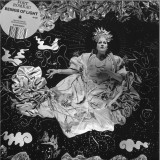
Stalactite is a collaborative recording project by renown Japanese artist and multi-instrumentalist Susumu Mukai AKA Zongamin and producer Drew Brown, whose discography ranges from his own group Off World to a variety of integral productions for artists such as Blonde Redhead and Beck. Their self-titled debut for the ESP Institute is a grand gesture, a broad stroke that illustrates both singular focus and vast complexity, which is no easy feat considering the almost oppressive immediacy and availability of tools at the disposal of contemporary artists. There’s a level of creative confidence and discipline needed to work so fundamentally, and whether or not the listener has an appetite refined enough to process the tasteful subtleties throughout this production, these same subtleties accumulate regardless and land that listener in a highly considered and developed space. The deceptively naive melodic approach consistent across these nine tracks can feel transparent, familiar to a point the listener can anticipate its path, but when listening with acute focus we find a variable range of texture, temperature, depth and negative space. As alumni of the Minimal, Cold Wave, Synth Pop era, Susumu and Drew successfully personify a motley crew of synthesizers to work in concert, reduced to their core personalities and presented as their most honest selves — austere, shy, cinematic, percolating, bulbous, glistening, cantankerous, rubberized, clumsy and animated. Each masterfully paired with complimentary counterparts, these players assemble into a sound-stage we typically find in live recordings, enveloping and inviting us to the center of an acoustic cavern to wade through sonic impressions of monolithic stalactites.
Buscar:sy us
Planet Mu presents ‘ADDLE’ – Bogdan Raczynski’s first album of new music in 15 years. Marking a change from the high-octane jungle tekno braindance for which he is most commonly known, here we find the Polish American musician in a more melodic and zen-like place of peace, which is ergonomic and decluttered, whilst also bittersweet and tinged with melancholy. ‘ADDLE’ is closest in spirit to 2001’s tender ‘myloveilove’, or the light-hearted ditties of this year’s ‘BANANS’ EP, but is also a markedly new milestone. A robust and bottom-heavy rhythm section juxtaposes with sad electronic tear jerkers, at points laced with the soft cooing wail of his vocals, which are loaded with a haunting, heavy and almost wounded emotion. Bogdan comments “Calm is great. You need to take a breather in the eye of the storm now and then. But the real growth happens in turbulence, when your feelings oscillate in and out of sync. It’s not dry land you’re after. You’re trying to build a new island while on a piddly raft. Beleaguered and weary you lay the foundation with your bare hands while the rain lashes your back; a new place for you and yours to moor yourself to until the next storm hits. ‘ADDLE’ is about that storm, its adjacent periphery, and what you look like, in and out, when you set foot. As space and time push against you, that process of adapting becomes an anchor. Among that state of being addled, out of flow, seemingly untethered, there is beauty.”
Although less unhinged and riotous than some of his previous work, ‘ADDLE’ is no less impactful. Lean, punchy and purposeful, this seemingly simple combination of beats and melody belies a razor sharp skill, which bursts with verve and virtuosity. Across its eight unique and moving tracks the listener experiences tenderness, feelings somewhere between unease and comfort, and a sense of reflection, with Bogdan seemingly gazing at twinkling stars, but with his view distorted by welling-up. Sonically, spaces range from razor-sharp choppage, juddering heavyweight head-nodders, bit-crushed siren squall and something akin to Philip Glass’ ‘Candyman’ score played through a high-tech-fairy-tale music box. There’s also a warming, life-affirming moment as close to deep house as Bogdan will ever comfortably get, neck-snapping metallic percussion, Casiotone on steroids and reverberant warehouse throb. Booming drum machines are a prominent factor too – reminiscent of early hip hop instrumentals – but spirited off somewhere, lost in purgatory. Bogdan Raczynski (born 1977) is a Polish-American electronic musician. Raczynski’s work draws inspiration from the chaotic breakbeats of jungle and hardcore rave as well as traditional Polish music and other sources. He has collaborated with Bjork, remixed Autechre, CLPNG and Jonsi from Sigur Ross, and toured with Aphex Twin, who commented how “his records are so underrated.” Bogdan was also a roster mainstay of Richard James’s seminal Rephlex label, with additional releases on Warp, Ghostly, Disciples and Unknown to the Unknown. A keen proponent of tech, he created a sample pack using pollution and recently collaborated with Polyend on a custom made banana-themed tracker.
- A1: Strange Days
- A2: Sad Swan (Feat. Lilla Clara)
- A3: Don’t Speak So I Can Hear You
- A4: Trigger
- A5: Once Again I Felt I Wanna Escape
- A6: Mind Fog (Feat. Aparde)
- A7: What’s Wrong With You
- A8: Forest (Feat. Lilla Clara)
- B1: Bench And Cats
- B2: Happy Here (Feat. Lilla Clara)
- B3: Hallucination
- B4: Make No Attempt (Feat. Thistlemorse)
- B5: Shelter
- B6: Take Your Jacket With You
- B7: Cloud Peels (Feat. Lilla Clara)
Haze - released via Ki Records - is Greek producer and composer, Hior Chronik's latest creation. Aligning with his previous critically acclaimed album, Descent, Haze creates an electro-ambient world which accentuates modern classical minimalism. It is an album which deeply embodies tranquility, fulfilment and meaningful connection, aspirations born out of Hior Chronik's past in Athens, and realised by his relocation near to a forest in Berlin, where he can truly feel at-home, surrounded by the awe-inspiring beauty of nature. Through 15 tracks, Hior Chronik guides his listeners in an immersive journey which features magical soundscapes built using DX7 and Roland synthesizers, beats from the Lofi drum machine and Volca samples. Inspired by the best of his previous work in moody electro soundscapes, alongside his own history as a listener and lover of early 90's electronic music, artists like, Lali Puna, Solvent and Remote Viewer, this album demonstrates a new dimension to Hior Chronik's artistry which exudes light optimism.
In the vast musical archive that is Roman Flügel’s discography, Ro70 holds a special place. Written, performed and produced between January and July 1995, it is his debut album as a full-fledged solo artist. Enquired and inspired by a certain David Moufang from Heidelberg, who used to share a classroom with Jörn Elling Wuttke at the SAE Institute and revealed himself to be an Acid Jesus fan and also of the Roman IV 12“ project, it seemed like a good fit for his (and Jonas Grossmann’s) Source Records label.
In the days before file sharing that meant going back and forth with various DATs in his mom’s Volkswagen Polo Fox for actual listening sessions between Darmstadt and Heidelberg. The time was as special and idiosyncratic one as was the sound of Source Records and of course Ro 70 itself. While the rave-olution was ready to eat its kids with the commercial outlook of former underground phenomena looked bright and the scene’s prophecy seemed grim, enterprises like Source and artist like Roman Flügel were defying any competition out of those corners with their own means.
Listening back to the ten tracks of Ro 70, it proves them, their taste and artistic vision right. Probably still being put into the ambient, downtempo, electronica or chill out sections of most record shops, this music could have been made, relished and cherished anytime between 1995 and now. Made in Roman’s home studio in his parent’s house or in the Klangfabrik studio in Egelsbach, this was made for before or after the rave – or for people who din’t want to have to do anything with it at all. His signature is all over it. Well balanced soundscapes with an almost uncanny presence and clarity. Bittersweet symphonies that doesn’t seem to be in an inferior position to modern classical or electronic studies.
It is also a very personal testament to a time in the artists’s life that was ready to get caught in the maelstrom of the oscillating techno city called Frankfurt am Main and its halcyon days between the Delirium record shop, Sven Väth’s marathon sets, the early days of the label triumvirate Playhouse, Klang & Ongaku. In a musical journal without lyrics, those memories will have to stay pantomimic and private. All for the better, that we can at least still listen to them.
- A1: Steady Eddie Steady
- A2: Killing Time
- A3: Citinite
- A4: Wastelife
- A5: Silver Blades
- B1: Silver Blades A Deeper Cut
- B2: Sodium Pentathol Negative
- B3: (The) Innocent (The)
- B4: Red, Green & Gold
- B5: Fiction Factory
- C1: Do It In The Dark
- C2: Steady Eddie Steady
- C3: Emotional Blackmail
- C4: Bad Move
- C5: Let Go
- D1: Don't Take Drugs, I Don't Tell Lies
- D2: We're The Fashion
- D3: Small People
- D4: Bike Boys
- D5: The Naff All Tango
- D6: Killing Time
During 1978 to 1980, Fashion released one album and a handful of indie club hit singles mixing Punk & Reggae vibes. They toured the US extensively supporting The Police in 1979. Limited Edition of 800 copies 2LP set with printed inner bags. All tracks completely remastered. Contains every studio recording of the first lineup of Fashion including US singles. Includes unreleased tracks. Liner notes from lead singer & Guitarist Luke Sky. Fashion went through several line-up overhauls during its initial existence between 1978 and 1984. John Mulligan (synthesiser, bass) and Dik Davis' (drums) were constants, but the band's frontman changed with each of the band's three albums. Post-punk years: Fàshiön Music Fashion was formed originally as Fàshiön Music, in Birmingham, England, in 1978, and consisted of John Mulligan (bass, synthesizer), Dik Davis (drums), and Al James (vocals, guitar). James became known as Luke Sky, or simply Luke or Lûke (short for "Luke Skyscraper" - a reference to the Star Wars character Luke Skywalker and the fact that James was tall and thin), while John Mulligan was known simply as Mulligan and Dik Davis simply as Dïk (or "Dik Mamba" on their debut single). In 1978, they also founded their own Fàshiön Music label; from this point forward, the band was generally (though not completely consistently) identified as Fashion, as distinct from the name of their self-owned label. Fashion released their first two singles ("Steady Eddie Steady" and "Citinite") as independent issues on the UK in November 1978 and June 1979 respectively. The group was quickly picked up by I.R.S., who put out a third single in the US in September 1979, "The Innocent". Their sound was varied, playing punk, post-punk and indie repertoire, although Mulligan at that time also had a synthesizer which later characterized the future synthpop years of the band. Still signed to I.R.S., in 1979 they recorded and released their first album, Product Perfect. All three members were credited as having written the songs collectively. Between 1978 and 1980, Fashion played shows with performers such as Toyah Willcox, UB40, Hazel O'Connor, & Billy Idol, who later became well known. A then-recently formed Duran Duran opened their shows; they toured the UK with U2, both the UK and US with The Police, and opened for The B-52's on their first British tour. In March 1980, no longer associated with I.R.S., Fashion released their "Silver Blades" single, again on their own Fàshiön Music label. Later in 1980 they also released one more song, "Let Go", on a Birmingham bands compilation called Bouncing in the Red (EMI). In June 1980, after a last gig in London with U2, Luke James left the band, and later moved to the United States.
The Accra-born pianist and frontman only released a few albums in small quantities, yet two of them are among the most sought-after records from 70's Africa. This was the first.
So what do we know After learning his craft in Benin and playing with the likes of Orchestre Poly-Rythmo de Cotonou, ROB returned to Accra to write his own material and find a sound.
Hooked on the driving funk and raw soul of stars such as James Brown and Otis Redding, he would often imitate his heroes on his father's piano during school holidays.
The title track sets the pace with a JBs-like rhythm, ROB almost shamanic with his sparse yet commanding vocal. The organ and wah-wah guitar spin us out before those imperious horns bring us back in.
And what better way to close this set than with 'More', swept up in a call and response between Rob and his backing singers as a 'Blow Your Head' synth flares and the brass blasts. Good times guaranteed.
As the man himself says, 'Funky music is in my blood. What you hear is the coming out of my mind.' No one sounds like Rob, because there is no one like Rob.
Repress
To emerge from a global pandemic with a renewed sense of situational awareness, hard won insight, and a new album is the kind of move we've come to expect from THRICE over the last twenty years. With Horizons/East, Dustin Kensrue and his bandmates address, with candor and courage, the fragile and awkward arrangements that pass for civilization, while inviting us to dwell more knowingly within our own lives. Without surrendering any of the energy and hard edge of their previous albums, they've given us a profoundly meditative work which serves as a musical summons to everyday attentiveness. Since forming THRICE with guitarist Teppei Teranishi, bassist Eddie Breckenridge, and drummer Riley Breckenridge in 1998, Kensrue has never been one to back down from a mental fight. This mood is set by the opening synth-driven number "Color of the Sky," which sounds well-suited to accompany the closing credits of the Stranger Things season finale. Think Flying Lotus giving way to Elbow and setting the listener down in a new dimension. A self-recorded effort, Horizons/East conveys a palpable sense of danger, determination, and possibility.
Vinyl Edition of 300 copies
Aesthetical in collaboration with Sync presents "Detect" by Marco Monfardini.
Originally developed as an audio/video live performance, Marco Monfardini based his research for Detect on the decoding of inaudible sounds, sound generated by electromagnetic emissions left from electronic devices and inaudible to the human ear. By using various electro-smog detectors Marco Monfardini creates a sort of detection mapping where electromagnetic emissions are the starting point for the sonorous development of each single composition.
A path that creates a parallel with our lives by questioning how much these emissions affect unconsciously our choices, tastes and perceptions, seeking a relationship between the massive use of technology in everyday life and our emotional state.
The album Detect is developed in 15 tracks in continuous play, an imperfect, faulty mosaic inhabited by invisible beings manifesting themselves in the form of sound streams, mutable entities that find a definitive form in the pattern of the compositional structure.
The album opens with “aR1 detection", sounds of pure detection place themselves in the sound space giving the initial coordinates for the exploration of unconscious parallel areas. The boundaries transform and gradually expand until they flow into the structure of "kernel variations", a growing rhythmic pattern decodes the impulses projecting a perspective that dissolves in the unstable and fluctuating electromagnetic emissions of the subsequent "[a]3020t detection", "binary defect "and "core[2] ". “[A.box]emission” confronts the use of sound downloaded random from internet sample banks and the emissions generated during the download itself, micro sound fragments arrange themselves in an organized and regular pattern, shaping a rhythmic structure. The first part ends with the short “[sa]6030” and “[det]x1a”, absence and presence provide an alternation of movements, inaudible and elusive signals all trying to establish a contact with our perception. “det : scan” opens the second part of Detect, a sort of scanning, leaving EMF (electromagnetic field) textures, a static multilayer that progressively expands until it dissolves into the rhythmic emissions of a common smartphone “[4s]detection”.The track “[rs]zone” " is pushing itself deeper, two minutes of sound speleology that reveal the existence of sound artifacts that seem to vanish getting in contact with the light accented by the bass drum of "[det] 0100+" a constant, rhythmic pumping, a luminous pulsation that reveals an apparent void, which seems to subside entering in the winding and waving atmosphere of "conductive [area]" and "[s3] microfunktion". Detect comes to the end with “[emf]terminal” a mirror of the unarrestable technological acceleration intercepting the flow of data that feeds the system of communication , digital micro waste suffocates the living space by centering up the invisible in an unconscious map.
[a] A1
[c] A3
[e] A5 core[2]
[f] A6 [A.box]emission (2)
[g] A7
[i] B2 [4s]detection
[j] B3
[k] B4 [det]0100+
[l] B5 conductive[area]
[m] B6 [s3]microfunktion
[n] B7 [emf]terminal
To emerge from a global pandemic with a renewed sense of situational awareness, hard won insight, and a new album is the kind of move we've come to expect from THRICE over the last twenty years
With Horizons/East, Dustin Kensrue and his bandmates address, with candor and courage, the fragile and awkward arrangements that pass for civilization, while inviting us to dwell more knowingly within our own lives. Without surrendering any of the energy and hard edge of their previous albums, they've given us a profoundly meditative work which serves as a musical summons to everyday attentiveness.Since forming THRICE with guitarist Teppei Teranishi, bassist Eddie Breckenridge, and drummer Riley Breckenridge in 1998, Kensrue has never been one to back down from a mental fight. This mood is set by the opening synthdriven number "Color of the Sky," which sounds well- suited to accompany the closing credits of the Stranger Things season finale. Think Flying Lotus giving way to Elbow and setting the listener down in a new dimension. A self-recorded effort, Horizons/ East conveys a palpable sense of danger, determination, and possibility.
10 Track LP - Japanese multi-instrumentalist Masahiro Takahashi's latest album, Flowering Tree, Distant Moon, is a meditation on seasons and distance. Recorded in isolation at his temporary home studio in Toronto, following the coldest winter he’d experienced to date, this is a collection of hushed, lush color wheel electronic vignettes.
Flowering Tree, Distant Moon was created using an array of instruments including software synthesizers, granular samplers and a shruti box. The original Not Not Fun cassette run sold out quickly and this Telephone Explosion re-release will be Takahashi's first official vinyl offering.
The songs shimmer and sway, unspooling in sparkling arcs and alternating between reverie and lullaby. Inspired by blooming apple trees, gagaku music, the nostalgia of immigrants and longing for home, Flowering Tree, Distant Moon moves from soothing to surreal, a swirl of quiet melody and imagined landscapes, as transportive for its listeners as its maker.
Liebe, was sonst?
Warum sich immer entscheiden, wenn man beides kann. Sich in die Wolken träumen und dabei mit den Beinen fest am harten Betonboden stehen, bedrückend-raue Musik machen, die das Leben dennoch feiert und liebkost. Love A.M. denken groß und klingen groß. Packen düstere Synthie-Sounds und E-Drums mit schneidenden Post-Punk-Gitarrenriffs zusammen, wickeln das ganze dick in Dream-Pop-Zuckerwatte ein. Haben keine Scheu vor eingängigen Melodien, aber wissen auch, dass Ohrwürmer allein nicht genug sind.
American blackened Electro-Industrial Act 6th Circle is back with new LP "The Idle Construct", another masterful forty-minute crucible of insurgent post-industrial darkness laced with haunting atmospheres and seismic, disorienting beats. Officially licensed from Sonic Groove Records, "The Idle Construct" is 6th Circle's most tenebrous and atmospheric release to date, seeing its first ever proper release on a physical format worldwide via Sentient Ruin as a limited edition black vinyl pressing, after its initial and so far digital-only release in 2021. "The Idle Construct" sees 6th Circle further evolve and deconstruct its dark sonic canvas, pushing its foreboding atmospheres and anachronistic grooves deeper into lightless realms, and taking the listener further into a dark future dystopia of bitter disillusionment and grim alienation. The dark flame of defining acts like Skinny Puppy, Front Line Assembly, and :Wumpscut:, burns more vigorously than ever within these ten caustic tracks of industrial insurrection, but what defines 6th Circle's unrivaled approach to the craft is not so much its masterful evocation of an unrivaled past glory, rather the fearless exploration of its still unaccomplished and uncharted possibilities in the present. Facing us is a dark electro-industrial beast levitating from the void and pulsing with the wrath of a dark age lurking ahead. A work which projects the genre into the future with spasms of sheer experimentalism and exploration, fusing themes and visions of the occult, magick, evil, darkness, political unrest, violence, chaos and the supernatural into a monstrous synthetic labyrinth of sound
Lost somewhere between the mysterious alleys of 70s Istanbul and the scorching sun and crystal blue sea of Jaffa, Tel Aviv, Şatellites self-titled debut album is set to be released on Batov Records on April 1st.
The Şatellites’ sound shimmers between traditional Turkish folk and instrumentation, ethereal psychedelic guitar leads and groovy dance floor baselines. The resulting concoction of songs draws on cross continental influence yet at its core is a desire to illuminate the vivid qualities of classic Turkish music, honouring the Anatolian folk and psych artists from this golden era of music. From the funky disco beat of Disko Arabesque to the celestial lead guitar in Yağmur Yağar Taş Üstüne, the band add fire and flair to time-honoured pieces of Turkish music giving them new meanings. Covering important tracks such as female singer Kamuran Akkor’s track Olurmu Dersin, and musician and guitarist Zafer Dilek’s Yekte, the album covers an array of original pieces of different musical styles and sounds, that once have and continue to flow out of Turkey. The band boasts six members; Ariel Harrosh (Bass) Lotan Yaish (Drums), Yuli Shafriri (Vocals), Tsuf Mishali (Keys and Synths), Tal Eyal (Percussion) and Itamar Kluger (Diwan saz, both electric and acoustic, electric baglama, Greek 4 double string bouzouki). They came together some years after band leader Itamar Kluger discovered the saz whilst travelling the Kaçkar mountains in Turkey’s eastern region. The saz being a long necked, plucked stringed instrument native to the rural areas of the country, which remains an integral part of Şatellites’ union, and plays predominance throughout the bands’ album and music.
In the same way the guitar was electrified in the 1930s, the electrification of the saz in the 1960s led to an explosion of rock music dredged in middle eastern influence, a musical genre fittingly called “Anatolian Rock” and based on the principles of Anglo-American and psychedelic rock music, yet incorporating the style, rhythm, and scales of traditional Anatolian folk music.
As such, throughout the creation of the album, the band conceived the idea of intertwining differing elements such as the groove of funk, the rhythm of disco, and reverb of psychedelic, with traditional middle-eastern rhythm and structure, opening up the wealth of Turkish music to the western world, so that anyone and everyone can relate to something from the album. With that said, Şatellites emphasise that their music is not fundamentally Turkish music, on the contrary, they merely try to sound as close to the genre as possible. Their sole aim is to honour this amazing culture and to present it to the world in a more accessible and attainable form.
Recorded in 1991 by the quintet of vocalist Billie Ray Martin and Birmingham-based electronic musicians Brian Nordhoff, Joe Stevens, Les Fleming and Roberto Cimarosti, Electribal Soul was conceived as the sequel to the band’s 1990 debut album, Electribal Memories.
Electribal Memories had yielded the hits ‘Talking With Myself’ and ‘Tell Me When The Fever Ended’ and pushed Electribe 101 to the forefront of a crossover electronic scene that fused dance music with pop savvy. They were snapped up by Phonogram, managed by Tom Watkins and hailed as “the next band to meet the Queen” by i-D. The band took the coveted support slot for Depeche Mode on their epochal World Violation tour and supported Erasure at Milton Keynes Bowl. Seen as the next big thing, everything pointed toward enduring critical success for Electribe 101, and the band settled into putting their second album together.
“There was a degree of confidence among us when we came to write the second album,” recalls Billie Ray Martin. “To me, the songs we put down sound like some of our finest moments.” More immediately lush and warm than the dancefloor-friendly structures of Electribal Memories, the clue to the sound of Electribal Soul lies in the second word in its title: soul. Songs like the aching sensuality of opening track ‘Insatiable Love’ or the emboldened defiance of ‘Moving Downtown’ showcase Billie Ray Martin’s distinctive vocal range as it moves from haunting quiet to dramatic, euphoric rapture. Lyrics from ‘Moving Downtown’ had found their way into ‘Pimps, Pushers, Prostitutes’ by S’Express, and the song would appear as ‘Running Around Town’ on Martin’s 1996 solo album. The strikingproduction on the version of the song presented on Electribal Soul suggests classic late sixties soul influences, such as those of legendary Motown producer Norman Whitfield, with the long shadow cast by Kraftwerk never being far away.
‘Deadline For My Memories’, the song that provided the title for Martin’s first solo album, was originally intended for the second Electribe 101 album. Its lyrics document a sense of freedom and liberation from the darkness of a bad relationship, accompanied by jazzy piano and organ sounds over a quiet rhythm and discrete electronics. In contrast, ‘A Sigh Won’t Do’ finds Martin in soothing vocal mode, despite its devastating message about the final ending of a strained relationship, her lyrics framed by restrained and subtle beats and sounds.
To spend time with Martin’s voice on Electribal Soul is to find yourself moved deep into the ordinarily impenetrable emotional corners of your own psyche. “I was into big ballads at the time and listening to all kinds of US and UK singers, and I was also young enough to want to prove myself as a belter of ballads,” explains Martin of the classic soul edge the album showcased.
Electribal Soul heads into darker territory with ‘Hands Up And Amen’. Originally written by Martin in Berlin in the period before moving to London and forming Electribe 101, the song was then perfected and enhanced by the band’s production nous. ‘Hands Up And Amen’ savagely documents the mugging of a woman in Queens, NY at gunpoint, only to resolve itself with a middle section that nods reverently toward gospel tradition. The song coalesces around a regimented break and burbling synths, finally ending with layers of urgent synth sounds.
Meanwhile, a cover of Throbbing Gristle’s ‘Persuasion’ takes us into a seedy world of sexual coercion and creepy infatuation, predating Martin’s chilling version of the track with progressive house unit Spooky two years later. Supported by a minimal, nagging rhythm and barely-fluctuating sounds, Electribe 101’s take on ‘Persuasion’ makes for uneasy listening, even though Martin manages to inject a sort of twisted sympathy for the protagonist as the song progresses.
That Electribe 101 were as comfortable offering complicated, nuanced tracks like ‘Persuasion’ alongside pop house bangers like ‘Space Oasis’ – written by Billie Ray Martin with Martin King before Electribe 101 was formed – is testament to the way the band wove their way effortlessly through electronic music reference points. Framed by light, jazzy piano melodies and string sounds, the energy of ‘Space Oasis’ soars so high that it could easily reach the moon, while highlighting how well-suited Martin’s voice has always been to club music. We hear the same reminder of her dance music credentials on ‘True Memories Of My World’, finding her describing a Hollywood actress who reflects on being used by directors to sell her ‘tears’.
Hooking up with the Birmingham-based Nordhoff, Stevens, Fleming and Cimarosti after placing a Melody Maker ad in 1988 (“Soul rebel seeks musicians – genius only”), it was clear that Martin had found a group that recognised the unique power and importance of her voice. Having worked with genres as diverse as reggae, rock and R&B, the four producers proved to be perfect collaborators, presenting carefully-sculpted backdrops that emphasised the towering emotional dexterity of her voice.
“Listening back to these tracks now, I was reminded of what a bunch of great musicians they were,” says Martin. “They had a rule that if a part still sounded good after a day or two then it could stay. If it bothered the vocals, it would go.” Even more so than on Electribal Memories, Electribal Soul places Martin at the captivating centre of these pieces, surrounding her voice with everything from dubby rhythms to chunky R&B beats to nascent trip hop breaks; wiry, acid-hued synths uncoil gently without ever dominating, while horn samples and lush, disco-inflected strings provide a rich, naturalistic accompaniment for Martin’s emotional outpourings.
The band finished mixing the album at London’s Olympic Studios in 1991. They were assisted by Apollo 440’s Howard Gray on production duties for ‘Deadline For My Memories’, ‘Insatiable Love’ and ‘Space Oasis’, with Gray supported by talented engineer Al Stone. Pre-release promo tapes were issued and an enthusiastic energy started to build around the band’s anticipated second album.
It was not meant to be. Against a backdrop of a worsening relationship with Tom Watkins, and a disinterested Phonogram, instead of receiving a positive reaction to the new tracks, Electribe 101 were swiftly dropped by their label. Electribal Soul languished, unreleased, and the band yielded to pressures that had been building and split up. After collaborating with Spooky and The Grid, Billie Ray Martin went on to release her seminal debut solo album in 1996, with it securing the era-defining hit ‘Your Loving Arms’, while the other group members continued to work together as The Groove Corporation.
Thirty years after the songs were recorded, we’re now finally able to hear what the second and final chapter of Electribe 101’s story sounded like. Electribal Soul shows that the band had really only just got started when they dropped their first album in 1990. Heard only by a select and privileged few, what followed elevated the band’s music to a completely new level, making Electribal Soul musical buried treasure of the most precious and rare variety.
Electribal Soul will be released on LP, CD and digital formats on 18th February 2022 through Electribal Records. The physical formats include extensive liner notes from Billie Ray Martin, and the album sleeve features unseen archive photographs by Lewis Mulatero from the original 1990 sessions with the band that were never used in the sleeve designs for Electribal Memories.
- A1: Triston Palma - Bad Boys
- A2: Tony Tuff - Never Trouble Trouble
- A3: Robert Ffrench - Single Life
- A4: Michael Palmer - String Up The Sound System
- A5: Puddy Roots - Champion Bubbler
- A6: Ashanti Waugh - Police Police
- A7: Triston Palma - Fancyness
- B1: Phillip Frazer - A Little Bit Of Love
- B2: Bill Blast - Barrel Mentality
- B3: Cutty Ranks & Triston Palma - Inner City Blues
- B4: Michael Forbes - Reggae Fever
- B5: Tony Carver - Ethiopia
- B6: Eddie Constantine - Strawberry
- B7: Rod Taylor - The Lord Is My Light
At the beginning of the eighties reggae music became increasingly in tune with what was happening in Kingston’s dance halls… probably more so than at any time since the sound system operators had started to make their own shuffle and boogie recordings in the late fifties. The international audience and the critics were too busy looking for a new Bob Marley to appreciate what was happening downtown and failed to acknowledge that this was a return to the real, raw roots of the music. Brash, confident, young record producers who were totally in tune with the youth audience stepped forward and seized the moment…
Oswald ‘Ossie’ Thomas began his apprenticeship in the music business at the age of fourteen and served his time as a record salesman for Bunny ‘Striker’ Lee and Winston ‘Niney The Observer’ Holness before moving on to Miss Sonia Pottinger’s Tip Top Records.
“I ended up working in three record stores on Orange Street from 1976 to 1981… Yeah man! Me deh ‘pon me bicycle till I buy my motorcycle! Them days records were coming out left, right and centre… every day!” Ossie Thomas
It was during his time with Miss Pottinger that Ossie began to produce records for himself and in 1979 Ossie and Phillip Morgan began the Black Solidarity label based deep in the Kingston ghetto on Delamere Avenue. Phillip initially inspired Ossie to start the label and soon Triston Palma, Phillip Frazer and “a youth named Gary Robertson” joined in although Gary later left for Canada.
The Soul Syndicate rehearsed in the Delamere Avenue area and Tony Chin gave Ossie a cut of a rhythm that he used for Triston Palma’s ‘A Class Girl’… the label’s inaugural release. The record was a sizeable success and paved the way for hit after hit after hit on Black Solidarity. Ossie worked with just about everybody who was anybody during this critical period of the music’s development including vocalists Robert Ffrench, Little John, Sugar Minott, Frankie Paul and most notably Triston Palma.
“But Delamere must be considered as a music street sheltering as it does such artists as Junior Byles, Don Angelo, Triston Palma, Phillip Frazer and producer Ossie of the Black Solidarity label…” Beth Lesser
And the man who had made his name in the business selling other people’s records now became one of the most important and influential record producers of the era.
With grateful thanks to: Paul Coote, Nick Hodgson & Hasse Huss
A globetrotter in the most pure and respectful sense, away from the trappings of neo-colonialist ventures and predatory tourism, Discrepant head honcho Gonçalo F. Cardoso returns to his Island impression series to offers us another glimpse of his deep, abstract impressions of (an)other island.
After passionately collecting the sounds and lives inhabiting the main Island of Zanzibar, Unguja, released through Edições CN back in 2018, Cardoso now dwells into the Malaysian heartbeat of the Borneo forest through Island recordings made during a trip in 2016. Assembled in situ with meticulous craft from portable recorders, samplers and battery powered synths, these nice recollections conjure the spirits that lurk behind the inhabitable and the communal that are as much part of a personal memoir as an impressionistic portrait open to new meanings. Focused compositions that flow organically, bending the environment in & out of shape into a new dreamlike exotica with plenty of breathing room for every detail, silence and movement to surface.
A particular moment suspended in time, haunted perpetually by its bygone existence. Something no postcard or photograph could ever, ever come even close to.
LeSale is back with the Synchronized EP, which marks his fifth solo EP on Luv Shack Records.
The title track is LeSale´s first foray into boogie-funk, featuring lyrics and vocals by Kathy Diamond, one of the great voices of the early nu-disco era and former singer of the duo KDMS, as well as tape mixing by vienna based studio wizard Sam Irl. "Synchronized" comes in 4 versions; the classic vocal mix featuring the full vocals by Kathy Diamond, the instrumental mix which is stripped of the vocals entirely, the extended dub mix, featuring arrangement and additional overdubs by Sam Irl, concentrating on the bare,funky essence of the track and finally a special remix by Ooft!.
The Ooft! remix lays a club foundation for "Synchronized", taking it to proto house territory with a sparse use of original vocals and additional drums, synth leads and pads.
As a bonus original track, we get "Superfluid", an upbeat elektro-funk journey with the right amount of
Thomas Köner is one of the most influential modernist minimal composers. His music is often defined as dark ambient or drone, because of the use of low frequencies, material from gongs,shadowy resonances and boreal ambience, but at the same time its sound with constant fluctuation and vulnerability of sonic events, what makes it organic, human and almost comforting.
Köners soundscapes are no longer simply dark, the question now is that of a profound blackness. Such is the generic darkness of the abyss, the void and vacuum, the darkness of more than silence, of catastrophe and cataclysm, but also the soundscapes have utopian moments. It is a cosmological blackness, the black of nonbeing.
The more subtractive, the blacker the sound synthesis, Köner writes. Such blackness is non-music. Music will never be music until it ceases to represent and begins to sound like non-music or monochrome.
"Whoever hears the distortion of all sounds, will soon become Ultrablack. Whoever listens to this world, but has no affection for any of its sites, even to the place of Black Noise, may soon reach Ultrablack. Whoever understands the spirit of impartiality through ten thousand million partial tones, hears Ultrablack and can no longer be measured. No measures, no enclosures, no properties are the sign of ultrablack scores." Thomas Köner
Aubrite was first released 1995 on the label Barooni. Roland Speckle helped with production of the album. Aubrite is the name of a group of meteorites named for Aubres, a small achondrite meteorite that fell near Nyons in 1836.
After turning heads with the densely orchestrated Riddles, produced by Dan Deacon, the Baltimore-based duo Ed Schrader’s Music Beat have given us another giant leap forward with their fourth record Nightclub Daydreaming. The whiplash-inducing stylistic shifts between aggressive noise rock and operatic gloom pop that have become the band’s trademark have given way to a single aesthetic that fuses both impulses. On Nightclub Daydreaming, menace teems just below the surface as propulsive, stark arrangements leave space that Schrader fills with strident, reverb-soaked narration.
LIMITED GOLD VINYL w/ Download Card
When Ed Schrader and Devlin Rice began writing the record in 2019, the idea was to make a fun, danceable album, but an underlying moodiness proved unshakeable. As Schrader puts it, “The cave followed us into the discotheque.”
The duo road-tested the songs “This Thirst,” “Echo Base” and “Black Pearl” with drummer Kevin O’Meara on tour with Dan Deacon in February 2020. COVID restrictions cut the tour short, squashed plans to go immediately into the studio and sent the touring party on a sprint from LA to Baltimore. “We broke down outside Roswell,” Schrader recalls. “And these cops laughed at our dumb asses as we used all our pent-up stress and fear to propel our half-submerged bus out of the muck, yelling epithets to the sky.”
It was one of the last experiences they had with O’Meara, whose death in October 2020 weighed heavily on Rice and Schrader’s minds as they worked on the record. It was also a cathartic moment that presaged the aesthetic that would permeate the songs on Nightclub Daydreaming: “mad euphoria in the face of doom,” as Schrader puts it.
“This Thirst” is an alienation-fueled barn burner barely restraining itself through musically sparse, lyrically dense verses to culminate in a howling, synth-saturated chorus that beats horror punk at its own game. “Came from the north with a twisted planetarium, rock salt, nervous tic and novocaine,” Schrader sings, assuming the guise of a vagrant whose irresistible urges lead him through a fever dream of chemicals, back-alley bartering and existential threats.
The hyperactive “Echo Base” exudes agitated-cool, with breakneck drum fills and a relentless bass line. The narrator is stranded in a frozen landscape and running out of options. “She is just a night train away,” we are assured, and yet we sense that may not be an altogether good thing.
The band recorded and mixed Nightclub Daydreaming over a two-week period with Craig Bowen at Tempo House in Baltimore with David Jacober on drums, turning demos with artificial sounds and placeholder melodies into fully realized songs playable by a live band. The end result is not the album of “sunny disco bangers” that Rice says the band set out for, but something deeper, darker and more rewarding.
"Stand In The Fire" - Warren Zevon (voc, g, p); Zeke Zirngiebel (g, voc); David Landau (g); Bob Harris (synth, p, voc); Roberto Piñón (b, voc); Marty Stinger (dr)
Warren Zevon had toured for quite some time as a songwriter in the rock scene, released a few singles and landed a flop with his debut LP in 1969 before the tide finally turned. Roughly ten years later, his live album – put together from a five-day residency at the Roxy Theater in West Hollywood – entered the annals of vinyl history as one of the best live albums of all time and was awarded four stars by the magazine Rolling Stone. Ambiguously entitled by the comprehensively educated Zevon, who had been confronted with the tough side of show business, "Stand In The Fire" delivers genial simple pure and straightforward rock right from the start, which hit the public with a vengeance. Full of vim and elation, the band pours out the significant, biting verses with fire ("Jeannie Needs A Shooter") and fuels the emotional inferno with high-speed bursts of rock ("Excitable Boy"). Zevon proves his skills as a singer and songwriter in the ballad-like yet powerful "Mohammed’s Radio". In a direct comparison to this number we have the forthright, no-nonsense hit "Werewolves Of London" with its close harmonies. Just how Zevon manages to succeed in getting his delicate voice and lyrics over to the public is shown in the powerful mix of heavy and honky-tonk ("I’ll Sleep When I’m Dead") and finally in the thunderous final number – "Bo Didley’s A Gunslinger" – with its percussive and metrically complicated antiphony.
This Speakers Corner LP was remastered using pure analogue components only, from the master tapes through to the cutting head. More information under pure-analogue
All royalties and mechanical rights have been paid.
Recording: August 1980 live at The Roxy Theatre in West Hollywood, CA., by Billy Youdelman and Greg Ladanyi
Production: Greg Ladanyi & Warren Zevon
Ben Ritz has released EPs on Sweat Equity and Merge Layers. He's not afraid of the high bpms, but this isn't all blender no tender. This is futuristic, hard yet funky techno that is undeniably for the freaks. Find him in NYC or on his vinyl debut right here.
A1 "Up And Down" opens up with an ear-worm, repetitive melody that bangs and jacks with the hard kick and hi-hats. Freakish manipulation of the melody, tasteful breakdown and build-up, and a good dose of space throughout the track make this an undeniable sweat-dripper, trippy chugger. A2 "Do Make Me Strange" has a similarly catchy diddy that undulates around the drums. Restraint is the key here. Hard but funky, with distorted and drippy acidic takes on the main simplistic melodic line--this is a cerebral come-up, cooling your sweaty skin and leading your body to the nooks and crannies of the Hyper Groove.
The title track "Easily Disturbed" opens up the B side by ushering in the mood of the later hours. This is titillating, popping, syncopated, subtle, but still raucous techno right here. Perfect for mid-peak and when you're in your head, sending forces of rave rhythm telepathically to the rest of the dance floor. "Crystalline" closes out the EP with a boom and bang. Hypnosis overcomes. The ego-death has won out against your anxieties. This is music for the thrill-seekers of metropolitan dystopias worldwide...executed with nuance and style.
'Agua de Jamaica' is the first collaborative project between producer,
multi-instrumentalist, composer and arranger Sly5thAve and pianist and composer Roberto Verástegui
Recorded during lockdown in Mexico, the LP is built from a passionate and comprehensive understanding of Jazz, a love of Hip Hop and Mexico City's evervibrant artistic culture, Latin flavours, and the African roots from which these sounds grew. At the heart of 'Agua de Jamaica' is the title track; the moment Sly5thAve and Roberto realised they had something to pursue. The pair originally met whilst
studying Jazz in Texas and began piecing together the release on Sly5thAve's first visit to Mexico, over a drink of Agua de Jamaica. Thought of by both Sly5thAve and Roberto as the fullest collaboration on the release, "Agua de Jamaica" considers the constant artistic and cultural exchange between the US and Mexico, despite the politically differences. It draws the listener in with looping Hip Hop groove intertwined with hypnotic vocals from local artist Silvana Estrada.
Having moved to Mexico City at the beginning of 2020, Sly5thAve stayed with Roberto and his wife Yuki during the first Covid-19 lockdown. This time allowed for the pair to build on their ideas and explorations of different sounds and places centred around Jazz. Continuing in the Jazz traditions, 'Agua de Jamaica' is littered with signature Sly5thAve interludes, weaved together like a symphony
using album outtakes; "it's my favourite thing about making a record – making a complete piece from start to finish".
Tape
Lucia H. Chung is a Taiwanese experimental artist based in London. She performs and releases music under the alias 'en creux'.
Under this alias, Lucia is interested in the underlying structures of what we call noise and is examining the effects of human interventions into its complex web of tones. Repetition and chance operations are fundamental to Lucia‘s music. It is not built on the dionysian maximalism and symbolic harshness of lots of noise artists; catharsis is not reached via an explosion of sound, but via concentration on sound phenomena and small changes, which, not unlike some minimal disco night your usual mind-altering drone ritual, sucks you in more with every tiny alteration. This music is as intense as it is sensitive.
„The Liberated Mind“, in Lucia‘s own words, „is a sort of split release between two no-input configurations“. For „Wyldside“, she tuned two different feedback mixers with identical routings as close possible, as much as tuning is possible at all on these highly volatile instruments. „The two channels naturally phased in and out from each other. I guess the process was actually akin to Steve Reich's tape techniques on Come Out and It's Gonna Rain. The whole release extrapolated from that point onwards...“ Finding and replicating similar routings/settings on no input mixing desks is the nightmare of every control freak and a task doomed to failure, but in letting go and embracing these failures, patterns emerge. And thanks to Lucia‘s careful work, these patterns become hypnotic as she carves out the essence of each feedback loop, or, as she puts it: „Actually, I did remember the setting for the final track „Earthrise“, but for whatever reasons, I just cannot reproduce the sounds and it's forever lost (at least for this point in time, maybe when the conditions are primed again for the machine, the same sounds will emerge again...). I guess that's really the essences of improvised NIMB setup. Every single sound was the effect of the previous iteration and the cause of the next iteration... (Wait... isn't it just like a Blockchain? Ha!)“
A collection of no-input studio sessions improvised with Mackie 1202-VLZ Pro, TAPCO MIX260FX, MXR Phase 90 and Electro-Harmonix Bad Stone Phase Shifter. All tracks recorded live, no overdubs. Recorded in London in February 2020. Mastered by causeandcondition
Lucia also works as independent curator, producer and broadcaster at Happened. Check out Lucia‘s other albums on Hard Return, Falt and SM-LL.
P.E.’s sophomore album, ‘The Leather Lemon’, ushers in a new era for the New York band. A wild ride through chewy bubblegum pop, sweeping synthetic orchestrations and mutant club beats, the album slides ever closer to the fully-realized pop sensibility only winked at with their debut album, ‘Person’ (2020), and subsequent releases.
Recorded primarily at Schenke’s Studio Windows in Brooklyn, NY, ‘The Leather Lemon’ was cultivated from a fertile creative period between spring 2020 and summer 2021, which also yielded 2021’s acclaimed ‘The Reason For My Love’ EP.
Digging into mystery, romance and sex appeal, the album centres its sound within a Bermuda Triangle of dance music, electronic composition and experimental rock. Members Jonathan Schenke, Bob Jones and Jonny Campolo play within pop parameters, building upon free-form collaboration to create a fluorescent groove machine that harnesses the energy of their frenetic live shows.
Singer Veronica Torres explores her softer side, expanding her vocal repertoire from spoken word and jagged growls to cherubic and sensuous psalms.
Sax virtuoso Benjamin Jaffe’s chiseled experimental tone is heard in an extended solo of true romance in ‘Tears in the Rain’, a sombre surrealist duet penned by Torres and Andrew Savage, singer/guitarist of Parquet Courts.
It is a reckoning record for the times; an album of psychedelic resurfacing, real-time response to world events, and soft, sympathetic magic. This is a collection of songs shaped by five individuals who embrace music-making as a way to centre themselves in times of uncertainty; it’s resilience and imagination given shape. ‘The Leather Lemon’ is a true sweet-and-sour listening experience, an album as bright and clear as it is fractured and fun.
- 01: Through The Timehole
- 02: Distant Reflections
- 03: Tribal Call
- 04: The Turning Point
- 05: Mutated Perception
- 06: Untrodden Pesonance
- 07: Elemental Waveshore
- 08: Glittering Embalming
- 09: Squirlich Stroll
- 10: Return Of The Mystic Channeler
- 11: Chosen Ones
- 12: The Field Of Draflinis
- 13: Forgotten Valley
- 14: Cavern Of Morphing Stones
- 15: Hovering Over The Magnetic Ground
- 16: New Dawn - Return
Following the release of Collision and Coalescence, Slovakian label mappa commits to the duo Grykë Pyje, releasing their third LP "Squirlich Stroll". Maintaining the fabled tone of their debut on the label, Jani Hirvonen (Uton) and Johannes Schebler (Baldruin) dig deeper into the sonic vein of myth and fabric of yonder. The music in "Squirlich Stroll" unravels as a yarn brought back from a wild voyage.
On uncharted areas of medieval maps where potential dangers were thought to exist, the inscription "Here be dragons" was used to warn as much as to tempt explorers willing to cross limits. Myth awaited them as a blank page of dormant territory, yet also to be proved unlike and reinvented. In such pliable borders, wonder had the favorable conditions to blend experience and imagination, crafting creatures with an eye instead of a bellybutton, arms instead of ears and ears instead of fingers, hypnotizing spirals where a mouth should have been. These chimeras, though fictitious, allowed explorers to express their delusions along with their fears. "Here be dreams", we hear nightmares. Here be mushrooms the size of pyramids that sing lullabies for mountains. Here be talking roads that lead to volcanoes throats and spit you back to flight. Here be art of bending trees into braided bridges like in Meghalaya, and the time gap between seed and living ruins.
Let that be the compass, the astrolabe. Yet, the music in Squirlich Stroll comes with these journeys already embraced, unraveling as a story told by wanderers visiting town, nourishing fantasy. The sonic language and diction employed here are crystal clear. Sounds are sharp and pure. Growls, howls, shrieks, tingles, rattles, moans, excretions and even hymns sung by landscape and creatures alike do not run over each other. There is no chaos, but ambience, cohabitation. The duo masters dramaturgy, providing every voice with focused turns and character, guarding their parley with caution and care, convoking them mainly through soothing synth melodies that enable an analgesic, sedative mood. Clusters of sounds gathered are articulated through the album with the inherent luminosity and required stability to accomplish what peaks in, as the title of the final track reads, a new dawn.
Tape
Quiet Rituals draws inspiration from the seemingly mundane tasks and habits in our daily lives which serve to keep us grounded in uncertain times.
Synthesizers, samplers, tape loops, and field recordings by Scott Campbell.
Recorded and mixed 2021 in New Orleans, LA.
Polaroid SX-70 photo by Scott Campbell.
South London-based 8-piece band Don't Problem is proud to present their their new album ' Liminality' planned for October 2021.
Their first three singles 'King Kong' 'Whale' and 'CD's Lament' gathered very strong media support with coverage from the likes of Mary Anne Hobbs, Jamz Supernova, Tom Robinson, WorldWide FM, BBC London, Jazz FM, Soho Radio, Amazing Radio, Radio Nova, Fip and more.
With their new album, the combo challenges the common perception of a "covers" brass band, exclusively writing original material and adding electronics, synths & strings, a reflection of their wide encompassing interests. They introduce us to a very personal journey; the moment in time where a brass band affirms their love for club culture and delivers an album that travels from heavy funk to psychedelic jazz and UK dance music.
"As 8 people writing music together, sometimes it can take a while for a tune to fully take shape. This tune came into itself in the studio which gave us the space to explore the production, sonic possibilities and instrumentation. The opening section leads to a beautiful first-take flugelhorn solo driven by lush strings, pulsing horns and electronics before reaching its soaring conclusion. The title ‘Whale’ is in reference to the Whale emoji which we use as a way to express a greatness or joy for which words can't be found."
Don't Problem's debut 'DP EP' combined the heavy funk and raw psychedelic sound of brass and drums with ferocious grime-inspired improvisation to deliver original and fresh music, aimed squarely at the dance floor. The band is comprised of 8 musicians who've played with everyone from Tenderlonius, Emma Jean Thackray, Alfa Mist, Tom Misch and Ruby Rushton to Riot Jazz.
Evergreen (Tim Reaper remix)
Putting his inimitable Jungle spin on the sleeper hit ‘Evergreen’ from Akuratyde’s ‘Home Movies’ LP, Tim Reaper does what he does best. Retrofitting the original’s Amen and Helicopter breaks all the way back to 1994 and shifting the musical elements in increasingly minor directions, Tim Reaper once again plonks us in the middle of a dizzying past-present-future kaleidoscope and gives us an extra spin for good luck.
Home Movies (Wardown remix)
Wardown, (AKA Pete Technimatic), makes his first appearance following the bombshell 2020 ‘Wardown’ LP, turning his attention to Akuratyde & Whytwo’s track ‘Home Movies’. With shoegazing guitar howls, staccato bells & synthesised marimbas lovingly draped over classic breaks which, in turn, are chopped into unusual time signatures. Wardown once again strikes the gauzy middle ground between melancholy and euphoria that saturated his LP, accentuating the blurry, VHS atmosphere of the original ‘Home Movies’.
Studio Electrophonique is James Leesley: a young songwriter and musician from Sheffield.
Since the critical acclaim accompanying his sought-after debut 10" album "Buxton Palace Hotel" in 2019, James has captivated audiences performing at his own curated events in Sheffield, Liverpool, London and Paris as well as at The Green Man and End Of The Road festivals.
In 2020 Studio Electrophonique performed at L'Olympia in Paris at the personal invite of the legendary Étienne Daho as well as across the UK and Ireland with Richard Hawley - both are long-time supporters and admirers of James's work.
James is currently putting the finishing touches to a film featuring Jarvis Cocker and Sean Bean which retraces the fascinating history of Ken Patton's original Studio Electrophonique home recording studio in Sheffield.
Songs come to James Leesley in airless attics, dinner time chippies and late afternoon bookies shops; on long walks through town with a sandwich in each pocket, on morning runs through the park in lost-property trainers or on the top deck of the 52A with rain-laced windows and wet toe-ends.
He records on an old four-track machine using deadstock Metal Maxima cassettes sourced from an unnamed charity shop close to Bramall Lane. This machine kills flashiness. There is no room for garnish. Choice is minimised to serve the song, intimacy is maximised to serve the ache.
Studio Electrophonique is a semi-fictional collective of analogue romantics sent to reassure us that art is not some far off place, that sadness can be enjoyed like happiness and that glamour can descend like a minor key melody on the shoulders of anyone willing to pay their subs and the price of a day-return to Ballifield shops.
Studio Electrophonique's latest 5- song record is a plaintive symphony of love and hope, yearning and hopelessness.
Synth enchantress Poly Chain returns to Dom Trojga for a smashing full EP release! Hailing from Kiev, she first made a name for herself during the years she spent in Warsaw, releasing her debut LP and becoming a fixture on Poland's underground scene. After returning to Ukraine, she spread her wings further, with exciting releases and regular international appearances only briefly thwarted by the pan-demic. Her long-anticipated EP for Dom Trojga is a treat in her signature style - filled to the brim with incessant, psychedelic arpeggios racing over raw and direct beats. The opener "Kie?" is an unfor-giving electro tune with a huge snare (we like) and tight, unsettling synthwork. "Visa" offers some much-needed hypnotic comfort, and on the flipside, "Acid Regular" hits the floor again with a serious groove, while "Visa Reprise" closes off in a deep, echo-laden fashion. The cover is a drawing by the inimitable Bartosz Zaskórski - an illustrator, sculptor and sound artist, whose uncanny, twisted bio-mechanical visions have been haunting us for years. Take a bite of Dom Trojga!
- 1: Attention All Personnel
- 2: Evacuate The Area
- 3: Do You Mind?
- 4: Passenger Line
- 5: Martian Moons
- 6: Heading For The Scumcluster: Part 1
- 7: Intergalactic Trucking
- 8: Foxtrot 946
- 9: Heading For The Scumcluster: Part 2
- 10: Your Manly Process
- 11: Gratifying Body Odour
- 12: Security Standdown
- 13: Froze Me, Freed Me, Here I Am!
The film is an outer space road movie starring Dennis Hopper, Stephen Dorff, Debi Mazar and Charles Dance. Independent space trucker John Canyon, his reluctant waitress-turned-bride, Cindy, and up-and-coming company trucker Mike carry a shipment of sex dolls which turn out to be quite deadly, especially in the hands of disgraced scientist-turned-space-pirate Captain Macanudo, who wants to use them to settle an old score. The score by Colin Towns plays like a crossover between a road movie and a space opera, featuring the powerhouse performance of the Munich Symphony Orchestra with some country and bluegrass interludes to represent the trucking aspect of the film. A special mention must be made of Phil Todd’s alto saxophone solos that lend some class to Charles Dance’s romantic scenes. And, of course, as with most Stuart Gordon movies, the film can go into crazy overdrive—just as we can expect from the director of RE-ANIMATOR.
The T Funk Collective are a synth loving duo hailing out of Manchester UK; DJ T2Funk and Atomphunk. They started out in the mid-nineties DJing playing quality house music at the CLEAR parties in warehouses, bars, clubs, forests and beaches in and around Stockport, Manchester and Wales. DJ T2Funk is a multi-genre DJ who is rostered on Manchester’s Selectahs DJ Agency and the owner of Regulate Recordings. Atomphunk has deep house roots and productions on labels such as Toko Records, 3AM Recordings, Urban Torque Records and Deepfunk Records (USA).
The fuses fuses hip hop, funk, party breaks and plenty more into a pair of authentic old school sounds.
Side A: ‘Do You Wanna Party’ blends funky guitars, snapping drums, squelching basslines, impressive horns. Do You Wanna Party once again see’s turntablist DJ Stet and DJ Deviant cutting up the vocals to culminate in a melting pot of a synth based melodic flavour.
Side B: ‘Party Time’ is synth fused party vibe track that builds with driving basslines and a vocal hook into a latin synth section of grooving layered keys.
So here it is the second release from Regulate Recordings and the T Funk Collective. What you say is important, so offer us your verdict.
Following up to their acclaimed "Hold" EP from last year, German duo Alma reemerge on Definition with their new transmission, "Mother". Through four cuts dropping anchor down the most remote nooks of our dance-friendly galaxy, Alma move the cursor from proper floor-focused 4x4 grooves to kosmische-informed pop excursions with dextrous style and seamless elegance. Crafting their own blend of emotionally whelming club music, it's material primed for extended use whether you are sitting on some high-rise, towering rooftops at sunrise or enjoying a freeze-dried cocktail on Alpha Centauri. Presented in both original version and remix form courtesy of label head Definition himself, title-track "Mother" is the epitome of a slo-burner, rolling at low speed but gaining tension, weight and impactfulness as it runs. Circuits sizzling and piano stabs blazing, Alma dish out a compelling sample of their cross-dimensional wares, sure to take any dancefloor in the zone without further ado. Definition's Remix revamp trades the original's steady swing for a further syncopated, newbeat-infected swagger, laying further emphasis on the synth leads and lashing drumwork as poetic, bleached-out pads keep painting the sky all shades of pastel. A more Italo-inflected affair at first, the tear-jerking "Lost In The Stars" has us gliding in a parallel universe of its own, where epic-sized synth combers and muscular bass onslaughts avalanche over brittle lines of soft-tongued vocals. As concretely submerging as it is designed to trigger off deep emotional response from the ravers, this one is tailored to weave instant communion between the jockey and his audience. Flinging in the breaks and cross-cutting delays, Kiel outfit Avidus shift the angle of approach towards harder, faster EBM firepower, binding their rowdy, FX-soaked chords with the chorus to create a wholly distinct dancing and listening experience.
Andy Bey was one of the most sought-after vocalists in the era of jazz fusion. Between 1968 and 1973 he was first choice as a studio singer for Max Roach, Duke Pearson, Horace Silver, Gary Bartz and Stanley Clarke, to mention but a few. His warm and engaging baritone voice easily crossed the bridge from conventional blues and gospel to a pugnacious, politicising style of soul – Andy Bey was 'spiritual' in every sense of the word. "Experience And Judgment", his debut album under his own name, was recorded in New York in 1973 and quickly became a cult album. Bey delivers twelve songs in single length, which are full of relaxed, funky grooves, soulful and electrifying, and quite lacking in gimmickry – in many of them a blues number is lurking in the background as a basic idea. His most important colleagues are Wilbur Bascomb, who lets his electric slap bass really thump out, and Bill Fischer who joins in on an electric piano, synthesizer and various other keyboards and really sets off a little fusion firework display. The most powerful numbers come from Andy Bey himself, such as "Experience", "Judgment", "Celestial Blues", "Tune Up" and "Being Uptight" – often powering forwards with a vengeance. Bill Fischer – at that time Artistic Director at Atlantic Records – added a few soul ballads to balance out the LP. This album inspired numerous jazz singers, including Gregory Porter. Jamie Cullum says: »What I love about Andy Bey is that he creates an atmosphere. As soon as he opens his mouth, you’re transported to another place.«
This is Lost Soul Enterprises big 15th release on wax, a tidy compilation of off-kilter dance floor cuts and misfit synthpunk anthems.
Side A commences with the gothic, neon-soaked Miami bass of ALONZO's "Cruising with Pap," featuring sinister verses delivered by a shadowy syrupsipping secret guest vocalist. Up next is bucking bronco NICK KLEIN's slow-mo industrial headbanger "Posture Test. The sonic equivalent of a sweat-soaked concrete floor, it lurches along at its own mechanical pace amid the metallic hiss and howl. Lastly, wild synth lines and ethereal dubbed-out samples dart in and out over a tough, punchy rhythmic foundation in NAEEM's "TLX," an android's sci-fi electro vision gone haywire.
On the B side, HEIDI SABERTOOTH's "Was It You" launches us deep into chugging acidic territory, combining enigmatic spoken vocals and a psychedelic, slowly evolving SH-101 line over a persuasive groove. Like a slap in the face after that comes raucous synth-punk powerhouse SSPS with "Paradise Lozt," raw as fuck, chanting a litany of dystopian tales atop pumping drums and a wash of demented organ-like synth stabs. Finally we close with the short but powerful "New Vape City" by the nomadic DOUCE ANGOISSE - an absolute earworm, a doleful coldwave ballad whose lush production plays perfect counterpoint to the icy, deadpan sentiments within.
Mattiel, the Atlanta based group made up of Mattiel Brown and Jonah Swilley, announce
the release of their third album, ‘Georgia Gothic’, on Heavenly Recordings. ‘Georgia
Gothic’, a magic third in Mattiel’s run of full-length albums, was shaped in the quiet
seclusion of a woodland cabin in the north of the Atlanta duo’s mother-state; “Some
faraway place that just Jonah and I could go where there would be no distractions,
nothing else going on, and we could turn everything off and only focus on writing songs,”
reflects Brown.
Where 2017’s self-titled debut and its 2019 follow-up Satis Factory were written with what
Swilley refers to as a “hands-off” approach - he arranging the music and Brown the lyrics
and vocals, the two working largely separately - the making of ‘Georgia Gothic’ was, for
the first time, a truly collaborative undertaking. “This was the first time we made a point to
just be together and work out ideas in the same room. That was the initial intention... it
was about learning what each other wanted to accomplish on a sonic level, and then just
trying different things out,” Swilley continues. “Everything happened backwards. Normally,
you’d have friends that make a band... with us, we started making music from the jump,
and then became homies.”
Cultivated by time spent together on the road touring the first two albums, it is this
newfound sense of intimacy between Mattiel’s members that enabled the writing of
‘Georgia Gothic’ not as two separate musicians, but rather as one creative entity. The
album remained within the four walls of Brown and Swilley’s private world for much of its
evolution - with recording taking place in a simple studio set up by the pair in the
borrowed room of a dialysis centre, Swilley in the producer’s seat - until, nearing
completion, it was transferred into the trusted hands of the Grammy award-winning John
Congleton (whose extensive list of credits includes artists as diverse as Angel Olsen, Earl
Sweatshirt, Erykah Badu and Sleater Kinney) for mixing.
Not only does the affinity between its creators translate into an electric synergy between
‘Georgia Gothic’s words and music - the brine-shock of Brown’s taut lyricism cut against
the bourbon-smoothness of Swilley’s instrumentation - but here too are the palpable
spoils of experimentation, each party trustful enough of the other to trial and error their
practices into new geometries. Swilley puts this wide palate, in part, down to the place
they call home. “I definitely feel like being from Georgia allows us to have a certain way of
approaching music.” Brown chimes in: “We haven’t really highlighted where we’re from in
the past two records, even though those were also written in Georgia. There’s so much
great art and great music that’s come from Georgia, from all different types of genres and
all over the state - but take R.E.M. and OutKast: there’s this weirdness that I can’t really
put my finger on.” Swilley concurs: “It’s the same with the B-52s, the Black Lips... it
doesn’t feel like L.A., it doesn’t feel like New York, it feels like another planet. We’re not
really in a ‘scene’ here in the same way. You have to make your own sound, create your
own identity.”
And it is precisely the forging of Mattiel’s distinct musical identity that ‘Georgia Gothic’
signals; its members guiding each other ever-homewards not just in a geographical or
sonic sense, but spiritually, too.
Initial LP pressing on Red Hot coloured 140g vinyl with digital download code. (Once this
format has sold out, a black 140g vinyl edition with digital download - HVNLP202 - will be
made available.)
“Whether it is traditional or contemporary, we need to be authentic,” says Gözen Atila who performs as Anadol. “I don't claim that I am authentic, but this is what I want to achieve.”
A sense of authentic exploration, introspection and celebration coats every inch of Anadol’s latest album. After 2019’s Uzun Havalar, the Turkish artist returns with an album that continues to explore a variety of deeply embedded musical traditions while also hurtling into new terrain.
The music and influences - as well as the history, culture and geography behind them - that make up Atila as an artist all coalesce to create something entirely new. The result is something that is simultaneously exploring history and tradition, while harnessing innovative modern sounds and techniques. “If there is any tradition I am somehow connected to, or influenced by, then it’s multi- genres,” she says. “Such as Turkish Pop and Arabesk music from this country where I grew up. There is a connection to Folk and also French pop or Flamenco, Middle Eastern melodies and orchestration, Greek adaptations, Kenny G. solos, American guitars.”
This can be heard on Felicita, not in as much as you can link up the influences directly but in the way it glides across genres, eschewing convention and predictability along the way, to result in a kaleidoscopic experience. For the album, Atila found a talented roster of Jazz musicians in Istanbul who she recorded on top of her synth productions and field recordings. Soon enough saxophone, drums and strings began to stack up against preset drum loops from vintage organs. It’s a record where woozy psychedelic excursions bleed into dreamy synth lines, immersive ambience and the occasionally disconcerting yet incredibly tactile use of field recordings.
If it’s an album that feels like it travels through a variety of feelings, then it’s because the concept is loosely rooted in such a journey. Felicita translates as “happiness” and this album is something that explores the complexities of such an emotion. “I did not name the album like this because I just wanted to call it happiness,” Atila says. “A song like ‘Felicita Lale’ is a sad and confused song about a female character who can't get out of bed. It’s a funny rumination, in her thoughts, saying to get up and lie down repeatedly. At some point the lyrics say: "hep agla, felicita", meaning: "Cry all the time, Felicita". Like she is talking to happiness itself and telling it to cry. So it is not about happiness, it is more about the concept of happiness which can be very sad.”
From the shadows of Slovenia, Shadow Universe is an instrumental music project, creating breathtaking cinematic soundscapes from post-rock, neoclassical/ambient and post-metal elements. Their third album, Subtle Realms, Subtle Worlds is released on 11 March 2022 worldwide on Monotreme Records. Formed in 2017 by Peter Dimnik and Žan Šebrek, Shadow Universe merge contrasting textures of shimmering ambient soundscapes and heavy anxious darkness to portray the diversity of nature and life on earth and beyond. Subtle Realms, Subtle Worlds: Every person experiences the world differently, which puts us into our own unique bubbles, subtle worlds. Subtle Realms, Subtle Worlds finds the band turning their songs into living, breathing ecosystems, carefully dissecting every moment of peace and chaos alike. The album sees the building particles of the universe as separate worlds, with their own story, perception, rules and individual inner realm. Opening track Organism, which portrays the coherence of forming organisms; from a vast universe itself down to the tiniest building particles of it, sets the tone with its slow, tense build to crushing, exhilarating peaks. Don’t Look at It and You’ll See It evokes free-flowing spontaneity through beautiful cascading piano and emotive violin, towering guitars, and soaring synths. Masterfully harnessing both the quiet and the loud, Hymn for the Giants glorifies our almighty and precious trees, with moments of calm cut apart by vast swathes of brutal, yet considered, cacophony. Losing Home’s portentous, droning synths and trumpet ratchet up the suspense, while on Antares Goes Supernova the band carve out layer upon layer of affirming and effecting riffs, each one more powerful than the last. Season of Eternal Maze wraps up the album with a meditative piano and harmonium, wide guitar driven melodies and guides you to your inner maze.
Born out of an impromptu post-pub jam session in Margate, the 5-piece group Pigeon swoops onto the scene with their blistering debut EP Yagana.
As the tracks cross effortlessly between Afro-disco, grunge, no wave and jazz, the cohesive symbiotic relationship of the band members is obvious from the start. The powerful vocals of Guinean singer Falle Nioke are complemented by a wealth of talent from Graham Godfrey on drums, Steve Pringle on keys, Tom Dream on guitar and Josh Ludlow on bass.
Having moved to the UK from West Africa in 2018, Falle Nioke has recently been in the spotlight following recent collaborations with Ghost Culture which were supported by indie radio and BBC 6 Music playlisters. On Yagana, he continues to sing in a multitude of languages, but this time shifts towards a more organic musical direction, showcasing his incredible versatility as a vocalist.
This new path can be attributed to the pedigree of the rest of the group – including veteran musicians Steve Pringle and Graham Godfrey who are key members of Michael Kiwanuka’s band, Godfrey also performing with Little Simz, Cleo Sol and SAULT, among others.
The Yagana EP is an emotionally-charged offering, exploring themes of ust, saudade, homesickness, and hope for peace. The title track ‘Yagana’ translates to “it’s been a while”, and though its up-tempo disco rhythm and wild synth solos lend a cheerful disposition, the lyrics describe a melancholic yearning for Africa.
Recorded in a single weekend, Pigeon’s Yagana EP is a clear testament to each member’s skilfulness and varied experiences, creating a fullyfledged being that is greater than the sum of its parts. With an opening hand like this, we await with bated breath to see what more the humble Pigeon can bring to the world.
Lined up next on Cosmocities is a special delivery and direct nod to our formative years’ loves - in this very case, trance music. Fruit of 90s cross-channel outfit Prism, the collaborative endeavour of French producer Pascal Eloy and UK-based Grant Wilkinson, the three-track EP “CMSR006” mixes unreleased music (Refraction), a 1996-issued goodie (Rain) and an exclusive remix from SYO, better known for his ambitiously retro-futuristic output under the S.O.N.S moniker.
Originally released as part of Planet Dog’s 1996 compilation “Feed Your Head”, “Rain” retains all of its original mystique and soulful use of modern production tools - letting a cascading flow of arpeggiated synths, stealth bass onslaughts and 303-borne trippiness pour down as a fully immersive digital shower for the senses.
An unheard gem from the vault, initially written and recorded in 1995, “Refraction” pulls further dynamic traction from a bubbling drum programming and damp, urban jungle-y atmosphere - beaming us straight back in the rave’s most compelling heyday with its feverish maelstrom of fluttering bleeps, spiralling tribal motifs and faux-organic, Neo-Easternmost harmonics.
Adding his ever innovative spin to the table, SYO cuts into the flesh of the original to deliver a further syncopated and spacious version, flush with complex rhythmic sleights of hand and subtle melodic trickery throughout, bound to keep you on the edge with every bar. 25 years on since it was first designed, Prism’s lasting relevancy shines bright on this all-road, bold-to-the-full trance epic that’s lost nothing of its flair.
2001’s »Anima« was the third album released by Sasu Ripatti under his Vladislav Delay moniker and marked a turning point in the stylistic development of the prolific producer. Clocking in at roughly 62 minutes, the single piece draws on dub aesthetics while working with Musique concrète-like methods through the liberal use of samples to create a dreamlike logic. Muffled voices, lush chords, subtle rhythms and indefinable sound events are not so much integrated into a composition with a predetermined outcome but rather engage with each other freely in a constant sonic flow, forming constellations in one moment before moving on to connect with other elements in the next one. »Anima« marked the first time Ripatti was using a DAW in his working process, creating a piece constantly in motion that subtly evolves over time. This vinyl reissue on the German Keplar label follows up on the 20th anniversary edition of 2000’s »Multila« and will be complemented by a ten-minute long version of the original piece, previously only available on the CD version released by the artist on his own Huume label in 2008.
After the release of his »Ele« and »Entain« albums in 1999 and 2000, respectively, Ripatti took the 1998 independent movie »Hurlyburly« as a conceptual starting point to experiment with different gear and production methods. »Until then I had worked with an old MSQ-700 MIDI sequencer and an Ensonic EPS16 sampler/sequencer that had one or two MB of sampling memory and mixed the music live on a Mackie, which was very limiting arrangement-wise,« says Ripatti. Loading a slightly shortened version of the film into his DAW however allowed him to play along to it with the DrumKAT MIDI controller, triggering and playing all the sounds that can be heard on »Anima« while also contributing synths, bass and other sounds during repeated playthroughs before mixing a total of six stereo tracks together. »This way, after I had edited out most of the few parts that had music in them, I was in the movie; almost like an extra character playing music,« explains Ripatti. »This was certainly the most organic way in which I have ever made music, and I have never again approached another record like this.«
While »Anima« sounded like an unusual Vladislav Delay record at the time of its release, it also prefigured many of the developments Ripatti would go through in the course of his long career. Combining visceral immediacy with a sense of abstraction, it is far more than a mere missing link in his discography but rather a conceptually and musically outstanding piece of work that remains as engaging as it was 21 years ago.
All tracks composed and recorded by Vladislav Delay.
Originally released on Mille Plateaux in 2001.
Remaster and cut by Kassian Troyer @ D&M.
Art direction and design by Marc Hohmann.
Text by Kristoffer Cornils.
'Memory Box' - the new album by Rodney Cromwell - fuses a European synthpop sensibility with a world of magical realism. It was inspired as much by the literature of Alice in Wonderland, Franz Kafka and Anna Kavan, as by its musical influences of artists such as Kraftwerk, Neu!, The Cure, Silver Apples, Oppenheimer Analysis and Polyrock. The sonic pallet of 'Memory Box' is rich, colourful, often surprising and utterly unique. Since the release of his debut 'Age of Anxiety' album in 2015, Rodney Cromwell has been featured by the likes of NME, Electronic Sound Magazine, Huffington Post, Paste, BBC6 Music and national RNE3 in Spain for whom he recorded a live session. 'Age of Anxiety' was included in a wealth of Best of Lists, not least that of Electronic Sound. He has appeared on compilations alongside Cavern of Anti-Matter, John Foxx, Devo, OMD, Katy Perry and many more. Rodney Cromwell is the project of Adam Cresswell. The first band he founded was SALOON, who were John Peel darlings, who recorded three Peel Sessions and the Festive 50 number 1 of 2002. They released three acclaimed albums on Track & Field (UK) and Darla Records (US) and played with a host of alternative acts including Stereolab, Electrelane, Quickspace, Laika, Of Montreal & Movietone. He followed Saloon with ARTHUR & MARTHA the acclaimed tweetronica duo that released the sole album 'Navigation' before vanishing. In addition to performing as Rodney Cromwell, he runs the Happy Robots record label. The Rodney Cromwell live set is a joyful mixed-media extravaganza, incorporating analogue synths, video visuals and live instrumentation, interjected by Rodney's 'offbeat wit'. His debut festival appearance at Indietracks in 2015 was described as 'like a spiritual experience". He has shared stages with acts including Pram, Marsheaux, Death & Vanilla, Rowetta and Steve Davis. His sole performance in 2020 was as part of Damo Suzuki's backing band. He will be promoting the album with a series of live-dates in 2022. Cromwell's recent singles 'Memory Box' and 'Get Me To Prague' received play on BBC 6 Music as well as national play in Spain, Finland and Japan. 'Memory Box' featured in the Official Festive 50 on Dandelion Radio. To coincide with the album we have early confirmed reviews with Electronic Sound Magazine and interviews with ElectricityClub, Pennyback Music and You haven't heard this music vodcast.
Spaceship is Mark S. Williamson, a musician, sound artist and educator based in Todmorden, West Yorkshire. His work is often made in response to his environment, working on location, combining field recordings with electronic and acoustic instrumentation, usually recorded outside, amid the landscape and weather. Mark has recorded for wiaiwya, Apollolaan, the Dark Outside and his own Forged River Recordings. His work has been reviewed by The Wire, Electronic Sound, Shindig and The Quietus and he was recently one of the fourteen artists featured in Electronic Sound Magazine’s ‘field recording special’. His collaboration with Luke Turner on series of readings from Luke’s book ‘Out of the Woods’ has seen performances at Cecil Sharp House, Port Eliot Festival, The Trades Club in Hebden Bridge, Krankenhaus Festival and the Horse Hospital and he recently collaborated with the artist Michael Powell on his Calderfolk project. A direct sequel to 2019’s Outcrops (also on wiaiwya), Ravines moves its focus from the uplands above Todmorden to the narrow, steep sided ravines, known as cloughs, that contain the streams that flow down the valley sides to feed the River Calder. These valleys, formed over hundreds, if not thousands of years can be peaceful sanctuaries, their stepped pools and waterfalls a shelter from the windswept moors. In time of heavy rainfall though, they become the conduits for the rapidly descending overland flows which reach the Calder and, in extreme circumstances, cause the floods which remain a part of valley life. These cloughs also saw the beginnings of industry in the area. Colden Clough and Jumble Hole Clough contain the ruin of small water fed mills which would evolve into the much larger steam powered facilities in Todmorden and Hebden Bridge. Mostly recorded in the field using portable equipment, these pieces are intended to reflect all three of these aspects; the peace, the violence and the beginnings of humankind’s ultimate separation from the landscape brought on by the industrial revolution. The sleeve is by Maxim Peter Griffin, an artist, illustrator and writer based in Lincolnshire. A fine art graduate and former stonemason, over the past few years he has been building a body of work that echo his experiences on foot between the North Sea and the hills. "...a luminous soundtrack to the passage of geological time." Shindig // "Williamson is building desire tunnels, churning through the layers of rock and soil to find his conclusions." The Wire // "These rumbling synth drifts and ominous drones transport you to entirely different places-like being cast adrift in a cosmic void" Electronic Sound // "...the droning synthesizer waves conjure up something spectral and eerie, stretching out like the wide horizon..." The Quietus // "Beautiful." Hannah Peel
Halloween has been and gone for another year, but darkwave-inflected hardcore punk never goes out of fashion, right? And frankly, who gives a solitary fuck if it does? Nag’s sinister second album is too busy being an ear-bleeding good time to care about shit like that. It’s too wrapped up asking questions like ‘is this real reality?’ - too caught up in pushing Bernard Sumner minimalism into furiously energetic bruisers and ever-darker corners. It’s the record you’ve been waiting for throughout 2021, whether you knew it or not. This RIPS. Formed in Atlanta, GA, Nag have already dropped an LP (last year’s ‘Dead Deer’, on Die Slaughterhaus) and a handful of 7”s - all must-haves - but they’ve never quite cut loose like this. Vocalist Brannon Greene pitches his delivery somewhere between a caustic holler and a dead-eyed sneer, taking the blank generation for a midnight drive and hurtling straight into a brick wall. Meanwhile, the band nab ideas from no-wave, the wilder ends of Goner Records’ almighty roster, and the best (and sometimes synthiest) aspects of gothed-out post-punk - the resulting concoction may be composed of familiar elements, but it feels like no one else other than Nag. A more hyperbolic and verbose hack than me might say this is the moment that signals the band have ‘arrived’, but not me. I’d just say this is a damn fine record - one of the very best things to have emerged from the wider punk rock mess in the last 12 months. Oh, and I’d add that if you don’t buy it, you may as well sever those things called ears, toss ‘em into the woods and let any of their redeeming qualities seep out into the soil, ‘cause that’s the only way you could continue to argue that they’re serving any useful purpose. But you know, that’s just me. You do you, friend. Actually, scratch that. Buy this record, you idiot.
- A1: Their Dark Dominion
- A2: Under The Greenwood Tree
- A3: Hecate, Goddess Of The Underworld
- A4: Victims Of Dark Forces
- A5: Moonlight And Magic
- A6: Invocation
- A7: Landscape Of Power
- B1: Genius Loci
- B2: The Demonic Connection
- B3: Secret Meeting
- B4: The Initiate's Warning
- B5: Path To Enchantment
- B6: The Pit And The Pentagram
- B7: Closing The Circle
'Their Dark Dominion' charts the haunted history of Clapham Wood in Sussex, a paranormal hotspot linked with tales of UFO sightings, mysterious disappearances, unexplained deaths, and dark worship. In 1978, local investigator Charles Walker was contacted by a black magic initiate who claimed that the woods were being used for dark rituals and animal sacrifice by The Friends of Hecate - a secretive occult group whose number were said to include those at the highest levels in society. “We will stop at nothing to ensure the safety of our cult!” The soundtrack to an imaginary documentary or TV series circa 1987 - the year in which the area’s ‘demonic connection’ was severed by the great October storm - ‘Their Dark Dominion’ conjures digital synthscapes and swirling gothic guitar to invoke an ethereal atmosphere of supernatural menace.
A core part of the Control Freak Recordings family, London based artist Keplrr has built a reputation as a deft & talented producer with unparalleled attention to detail. In the wake of the widespread support for his 2020 EP ‘Reconstructed Club’, we asked four producers we have long-admired to flip a track from the original release. The result is ‘Club Reconstructed’ - a collection of remixes which distill the spirit of Keplrr’s original record into new forms.
First up, Holding Hands boss Desert Sound Colony serves up one of his signature slammers, locking Convection into a thumping four to the floor groover. Berlin-based Konduku, who has carved some of the most kinetic, angular club tracks of recent years with releases on Nous’klaer Audio, Spazio Donsible and others, provides a second interpretation of Convection, time-stretching the original material into a slow-motion panic attack.
On the flip, Syz makes his return to the label after 2019’s highly acclaimed Bunzunkunzun EP, applying his organic touch to Esoteric Functions with a ‘refunction’, which blurs the line between techno and 140 - packing some serious low-end and a cheeky mid-way switch-up to send the dance wild. Rounding things off, Milan’s Piezo proves his reputation as one of the most inventive producers on the scene, repurposing Bod’s Realm into an aggy, warped & technoid ‘Doom Ragga Mix’.
Pressed by Deepgrooves - Europe’s leading ecologically-friendly plant for sustainable vinyl production, made using 100% green biomass energy
Spaced Repetitions is the brand-new label by veteran producer Manuel Tur. Following his most recent releases on Running Back and Lossless, the German digs deeper on the “Alphalpha EP”, fusing hints of sampled house grooves and bleepy techno synth work. With the lead track reminiscent of classic Parisian dark chemistry à la Motorbass, things get more driving on the B-side: the percussive “La Terre” leads us to the magnetic acid groove of “Immune Response”, rounding off this hypnotic three-track EP.
Ferris & Sylvester release their debut album, ‘Superhuman’, a
body of work highlighting the very best of the duo’s timeless
songwriting.
The British pair have evolved their sound into a distinct
combination of Blues, Americana and Rock ‘n’ Roll, sitting them
somewhere between Alabama Shakes, Jack White and First Aid
Kit.
Their twelve track album, recorded in Seattle, USA and
Cornwall, is available on white double vinyl, standard black
double vinyl and CD.
With the artwork shot entirely on film in Iceland, this album is
both an expansive yet deeply personal record to collect and
takes the listener on a journey through the duo’s world where
genres intertwine and emotions are stripped down to the core.
Ferris & Sylvester release their debut album, ‘Superhuman’, a
body of work highlighting the very best of the duo’s timeless
songwriting.
The British pair have evolved their sound into a distinct
combination of Blues, Americana and Rock ‘n’ Roll, sitting them
somewhere between Alabama Shakes, Jack White and First Aid
Kit.
Their twelve track album, recorded in Seattle, USA and
Cornwall, is available on white double vinyl, standard black
double vinyl and CD.
With the artwork shot entirely on film in Iceland, this album is
both an expansive yet deeply personal record to collect and
takes the listener on a journey through the duo’s world where
genres intertwine and emotions are stripped down to the core.
The Neptune Power Federation brings back the love song and rocks as furiously as ever on their fifth studio album, Le Demon De L’Amour! The Imperial Princess and her crew of Aussie rockers lord over eight love songs that prove few can push the boundaries of rock and metal like The Neptune Power Federation! Heading into the creation of their fifth studio album, Le Demon De L’Amour, Australian psychedelic rock and roll brigade The Neptune Power Federation couldn’t let go of the fact that love songs had been commandeered, in their words, by “soft rockers, bedwetters and the introvert crowd.” Whereas rock had its glory period during the 1970s and 80s, the art of the love song is now lost within heavier music. Few bands are now willing to venture into such territory — metal and rock have settled comfortably into typical, predictable lyrical tropes that fail to pull at the heartstrings the way they used to. On Le Demon De L’Amour, The Neptune Power Federation reclaims the art of the love song as their own. Off the heels of their acclaimed 2019 Memoirs of a Rat Queen studio album, the members of The Neptune Power Federation utilized the unexpected downtime afforded from the 2020 COVID-19 pandemic to craft an album that takes more chances than its predecessor. While the band’s trademark rock swagger and prog tendencies still come into play, Le Demon ups the voltage and energy. True, there is a multitude of genre-blurring taking place, but the album’s infectious choruses and leaden riffs easily re-imagine metal and rock’s glory eras without blatant thievery.
Of course, all roads to The Neptune Power Federation run through lead vocalist Screamin’ Loz Sutch and her stage persona, “The Imperial Priestess.” Le Demon’s eight cuts find the indomitable frontwoman in top form, belting out tales of love from a female’s perspective, weaving in stories of cult worship, murder and hypnotism. The album’s artwork (created by guitarist Inverted CruciFox) also introduces her new nemesis — The Wizzard Princess. Recorded at bass player JayTanic Ritual’s The Ped Food Factory in Marrickville, Sydney, with mixing duties provided by Clem Bennett, Le Demon De L’Amour leads The Neptune Power Federation into their tenth anniversary next year. Their journey has taken them from the sweaty clubs of Sydney to a global audience. Now armed with eight love songs sure to melt and captivate the most hardened metal hearts, The Neptune Power Federation boldly goes where few bands dare to go.
"Maybe their best album so far!" - Deaf Forever (DE), 8.5/10, Soundcheck pos. 7 !!
"They can even top the phenomenal predecessor!" - Metal Hammer (DE), 5.5/7
"'Le Demon De'L'Amour' is definitely their most mature and complete album to date!"
"Finest party rock music of the most beautiful kind!" -(DE), 9/10
"An album full of thick, good riffs, solos, melodies and choruses that stick in mind - definitely recommended!" - Rockmuzine (NL), 85/100
"They are in impressive form!" - Saitenkult (DE), 8.5/10
"The Neptune Power Federation add a great piece of music to their list of achievements." - Heavy Music Blog (DE), 8/10
"The band rocks a bit straighter and more pleasing than before through their love song concept." - Rock Hard (DE), 8/10, Soundcheck pos. 6 / Dynamit !!
Following the demise of emo band Mineral in 1997, singer/guitarist Chris Simpson (Mineral/ Zookeeper/ Mountain Time) and bassist Jeremy Gomez reunited to form The Gloria Record. Taking an acoustic and more organic approach than their previous work, The Gloria Record (with the addition of guitarist Brian Hubbard, drummer Matt Hammon, later replaced by Brian Malone and Ben Houtman on the keys, organs and synthesisers) were unarguably the logical progression from Mineral’s emo throes - quieter, delicate and fervently impassioned. Heralded as a “band with big visions and bombastic sounds”, the quintet fostered their admiration for artists with similar arena sized visions ( Radiohead, REM, U2) to produce a sound that was reminiscent of their British contemporaries and American indies. In 1998 the band released their self-titled EP, followed by the intricate offering of 2000’s A Lull In Traffic and 2002’s full length effort Start Here, before disbanding after extensive US tours in 2004.
In 2002 well-known for his albums by the progressive rock project Ayreon, Star One “Space Metal” is an exciting project from one of rock's great visionaries, Arjen Lucassen. With its stellar musicianship, visionary production and a simple yet far-reaching concept, Star One “Space Metal” shines bright as a giant sun in the galaxy of rock. “Space Metal” isn't a continuous story or a rock opera like the Ayreon albums. Yet it is still very much a concept album and a journey through Arjen's mind and memory. He takes the listener on a trip where they relive those great science fiction space films that made such an impact on him. Without a doubt Arjen Lucassen set a trend with his Ayreon albums. Especially after the highly successful release of “Into the Electric Castle” many musicians and producers have followed in his footsteps and new rock operas with multiple singers are surfacing all over the world. To ensure to keep the involved voices diverse he used very different sounding singers appearing in the same songs -- different singers for different moods. Dan Swano (ex-Edge of Sanity, Nightingale) sings the low parts, Russell Allen (Symphony X and more) sings the powerful rough parts, Damian Wilson (ex-Threshold, Headspace) sings the high clear parts, and to top it off, Floor Jansen (Nightwish) sings the really high choruses. Robert Soeterboek (Ayreon) sang the backing vocals with his huge smoky voice. Of course Ed Warby played the powerful drums, and Erik Norlander once again added his huge analog synth leads. Arjen also managed to get Jens Johansson (Yngwie Malmsteen, Dio, Stratovarius) who played some incredibly fast synth leads as well. Arjen even succeeded in getting Hawkwind's Dave Brock to make a guest vocal appearance, something no one has ever managed to do before. “Space Metal (Re-issue 2022)” is available as: Ltd. 2CD Digipak, Gatefold 2LP+2CD & LP-Booklet and Digital album (2CD).
If this word "music" is sacred and reserved for eighteenth and nineteenth century instruments, we can substitute a more meaningful term: organization of sound.
- John Cage
Kista returns from a long hiatus with his first ever all instrumental LP.
Songs From The Seas Edge takes us on a journey into the mind of producer and Graffiti Writer Kista.
It's an album where all his early influences or things that intrigued him, all come together, his love for Sc-Fi Movies, Hip Hop, 80's Arcade Games, John Carpenter Soundtracks and Films (you will notice a few vocal samples from his films nestled away among the songs) and many other things that influenced him growing up as a kid.
In a world now dominated by Playlists and the digital age, Kista took a step back to try and make an album that all fitted together, a concept album based around living on the coast as a kid in the 80's.
“ I started going through samples i put aside years ago and started to go back to them, to try and make them all fit and blend together to form an instrumental album”.
“It's kind of hard to explain where Songs From The Sea's Edge fits to my previous work” explains Kista
“ I wanted to make something for myself that I could then share, a journey, something to listen to from start to finish,with certain samples making an apperance in more than just one track.
Songs From The Sea's Edge has an hypnotic and haunting synergy to it, it's atmospheric, melodic but is still firmly rooted in Kista's love for Hip Hop.
Press play and enjoy.
Disco Segreta teams up again with Miro (b. Mario Baldoni) in the re-release of his 1970s-80s productions, after the italo-disco burner Stranamore by Brina (DS M 002) and the tropifrutti balearic italo-house smasher Tobago by Pat & Pats (DS M 006), we are back introducing to italo-disco connoisseurs a truly atomic jam !
“Passion Night” was originally written by Miro in 1985. Story goes that envisioning a release by 1987, Miro teamed up with legendary south-african sound engineer Allan Goldberg, in light of their previous Vedette Records disco-infused collaboration for the “Slang“ studio project and the “Real Life Games” LP. The team featured also track co-writer Gregorio Puccio, ready to unleash the synths (Roland JD800 + D50, Yamaha DX7, Oberheim 12, Prophet 5), along with two young vocalists, Giulia Fasolino and Silver Pozzoli, later to become household names for the italo-disco heads.
As a special feature on the track, Miro brought in the studio contribution of the top italian jazz contralto saxophone virtuoso of the era, Massimo Urbani.
In September 1987 a session at Pomodoro Studio had the track recorded on a 24 tracks tape, where has been sitting unreleased for 35 years, until now !
Within its cross-genre blend of synth-pop, italo-disco and jazz, “Passion Night” is an outstanding musical time capsule, a picture-perfect vivid snapshot of year 1987, with the additional historical value as a document itself: it’s the only strictly non-jazz project in Massimo Urbani’s repertoire, in a revelatory performance shedding a light over an unusual facet of Urbani’s versatile talent, regardless of boundaries, a few years before his untimely passing.
Three years in the making for this first-ever release, so that we could bring you “Passion Night” in its original 1987 version from the actual multitrack master, with our usual respectful treatment, plus three remixes: the balearic infused “Miro Smooth Jazz Remix” and a remix by highly acclaimed musician and producer Giulio d’Agostino aka Julyo, who can claim a plethora of collaborations for artists as diverse as Aphex Twin, Goldie, and Michael Brecker.
For their next reissue, Parisian crew Discomatin picked one of the rarest and sought-after releases of the French Boogie scene, Lot'Vie / Y'a Du Blues by Marché Noir. The original 12" from 1984 gets a proper remastering and delivers its powerful mixture of Boogie, Jazz-Funk and West Indies influences. Two amazing titles finally reissued with a loud sound!
"Lot'Vie" is a perfect blend of powerful funky rhythms with tons of percussion, second to none slap bass and dope synths leads. With its infectious chorus ("son a bip bip!"), the track seems to irresistibly make you move your feet. Sung in creole, the track speaks about everyone going their own way, knowing that past, present and future are only one.
"Y'a Du Blues (Tant Pis, C'est La Vie)" is based on a monstrous boogie bassline. the song talks about melancholy and hope, but with joy. In these troubled times, lyrics surely get a special meaning: whatever happens, keep smiling because after all "c'est la vie" ("that's life").
Marché Noir brought together friends and family around keyboardist Max Marolany living in the south of France, with the band starting in the second part of the seventies. Excited by the new funky sound coming from the USA, they wanted to create Marché Noir to compose and sing their own French songs. With a full range of references, from Zouk to Soul, from Disco to Funk, Reggae and Pop, their first goal was to have fun! The band was playing in clubs and festivals around Marseille, Nice, Aix-en-Provence and Fréjus. With this local fame, they ended up doing the first parts of Touré Kunda and french rockstar Johny Halliday. Without a doubt, their live shows were a truly funky experience.
Thanks to Discomatin, the EP is now available to the real connoisseurs with an exclusive insert that contains lyrics, again with fantastic illustrations from French artist Camille de Cussac.
After a quarter century of nearly nonstop activity, dystopian Detroit synth-punk institution ADULT. have perfected a strain of stylistic cohesion in the album format, "but for this we wanted something that's falling apart." Becoming Undone, the 9th official full-length by cofounders Nicola Kuperus and Adam Lee Miller, explicitly succeeds in this aim, simultaneously rejecting and reflecting the planetary discord that inspired it. Begun in the latter half of 2020 against a backdrop of unprecedented flux and seismic isolation, the duo kickstarted their muse by sourcing fresh additions to the rig: a vocal loop pedal for Kuperus and Roland percussion pads for Miller. Reconnecting with legacy influences like the politicized industrial percussion of Test Department and the queasy miscreant synthetics of TG's 20 Jazz Funk Greats sparked a series of fruitfully frenetic sessions, centered on themes of impermanence and dissonance. Miller's rationale is blunt: "We weren't interested in melody or harmony since we didn't see the world having that." From the tense technoid blitz of "Undoing / Undone" to the twitchy EBM of "Fools (We Are_)" and "I Am Nothing," the sides bristle with strident acidic revolt and black leather sequential circuits, unhinged and unforgiving. Elsewhere, slower tempos of purgatorial unraveling ("Normative Sludge," "She's Nice Looking") showcase a breadth of vocal FX, Kuperus sounding alternately indignant and possessed, decrying the crimes, fears, and failings of a deluded world. Throughout, the band's chemistry crackles with revulsion and strobe-lit dissent, equal parts exorcism and denunciation. "Humans have always been pretty terrible," Kuperus explains. "But every year the compromises of culture just accelerate." Becoming Undone is also freighted with a more personal pain, as Kuperus' father passed away during the height of the pandemic, just before the album took root. As his hospice caretakers, she and Miller faced the banality of finality, surrounded by objects drained of meaning, "the joy of having a body, but also the drudgery of having one." The record's bewitching closing track, "Teeth Out Pt. II" - which happens to be the first ADULT. song in the group's history without drums - speaks to this sense of doomed corporeal mass and the looming, lightless unknown that binds us all. A seasick haze swells and subsides in slow, low waves, flickering with ring modulation, above which Kuperus sings in a dazed, brooding, transcendent state, as if having finally glimpsed beyond the pale: "Some day / some day I will be silent and free / of this relentless gravity."
Repressed !
Hear & Now's Story Is One Of Friendship And A Shared Passion For Music. It Began With A Chance Meeting On The Dancefoor At Red Zone In Perugia, One Of Italy's Most Legendary Clubs
Of The 1990s. Nearly Three Decades On, These Glassy-eyed Clubbers Have Joined Forces To Deliver One Of The Most Magical And Sun-kissed Albums That Claremont 56 Has Ever Released. By The Time Ricky L And Marcoradi Frst Joined Forces In The Studio In 2016, Both Had Become Established Producers Within Italy's Vibrant Deep House Scene. Between Them, They'd Released Records And Remixes On Such Labels As Ibadan, Uomo, Reincarnation, Top Tracks, Restricted
Tracks And Vega. Keen To Step Away From The Dancefoor, They Decided To Simply Create Beautiful Music For Bleary-eyed After-hours Sofa Sessions, Lazy Summer Afternoons And Early
Mornings Spent Blinking At The Rising Sun.
Aurora Baleare, Their Debut Album, Follows On From A Fantastic Double A-side 12' For Claremont 56 In February 2017. Those Two Tracks Take Pride Of Place Amongst An Eight-track Selection Simply Brimming With Evocative Workouts, Gentle Soundscapes And Noon-bright Sonic Bliss. While You'll Fnd Luscious Instrumental Cuts Designed To Inspire Baggy, Glassy-eyed Shuffing - See The Mid-tempo, Spine-tingling Brilliance Of salsedine', Mind-massaging hirundo' And Dreamy Slow-house Treat sabbia Magica' - It's The Effortless Brilliance Of Marcoradi's Improvised Guitar Playing And The Duo's tmospheric Approach That Really Catches The Ear.
Check, For Example, The Heady Horizontal Shuffe Of trasimeno', Where Poignant Ambient Chords, Jazzy Electric Guitar Solos And Deep Space Electronics Tumble Down Over Shuffing Beats And A Squeezable Synthesizer Bassline, And The Sun-down Adriatic Wonder Of stella Dei Venti', A Track So Effortlessly Loved-up And Blissful That You Might Be Overcome By Emotion (it Certainly Had Us Daydreaming Of Days Spent Exploring The Intense Natural Beauty Of Italy's Adriatic Coast).
Moments Like This, Where The Duo's Dreamy Electronics And Smile-inducing Melodies Seemingly Shimmer Across The Sound Spectrum, Can Be Found Dotted Throughout Aurora Baleare. There's The Darting Digital Synthesizer Motifs, Sparse Hand Percussion And Ricocheting Solos Of airone', The Italo-disco-inspired Chugging Positivity Of la Marsa' And The Title Track's Humid Beachside Breeze, Where Intertwined Electronic And Acoustic Lead Lines Seemingly Glimmer Like Rays Of Sunshine Bouncing Off The Surface Of A Becalmed, Crystal Clear Ocean. Their Roots May Be On The Dancefoor, But Hear & Now Are Fast Becoming Down Tempo Masters. You Can Dance If You Want To, But You May Just Want To Hug A Stranger Instead.
Today sees Belgian-Caribbean provocateur Charlotte Adigéry and her long-term musical partner, Bolis Pupul announce their debut album Topical Dancer, due for release on March 4 2022 via Soulwax’s iconic label DEEWEE.
Cultural appropriation. Misogyny and racism. Social media vanity. Post-colonialism and political correctness. These are not talking points that you’d ordinarily hear on the dancefloor but Charlotte Adigéry and Bolis Pupul are ripping up the rulebook with their debut album Topical Dancer. The Ghent-based duo, who broke out with their 2019 Zandoli EP, are rare storytellers in electronic music: they take the temperature of the time and funnel them into their playful synth concoctions – never didactic and always with a knowing wink.
Their debut studio record – which cements them as a duo under both their names for the first time and is co-written and co-produced by Soulwax – is both a triumph of kaleidoscopic electro-pop and “a snapshot of how we think about pop culture in the 2020s.” It captures Charlotte and Bolis’s essence as musical collaborators and the conversations they’ve had over the past two years on tour, as well as their perspectives as Belgians with an immigrant background, Charlotte with Guadeloupean and French-Martinique ancestry and Bolis being of Chinese descent.
Beyond the album’s thematic heft, Topical Dancer reflects Charlotte and Bolis’s idiosyncratic sound: it’s thoughtful but it bangs. Their take on familiar genres is always off-kilter; songs sound undone or a little wonky; but these are nocturnal heaters to make the club throb. “We like to fuck things up a bit,” laughs Bolis. “We cringe when we feel like we're making something that already exists, so we're always looking for things to combine to make it sound not like a pop song, not like an R&B song, not a techno song. We’re always putting different worlds together. Charlotte and I get bored when things get too predictable.”
Topical Dancer is fizzing with ideas – there’s certainly no filler among its 13 tracks. But above all, perhaps, it has a restlessness, a desire not to be boxed in and to escape others’ narrow perceptions of who they are. It’s summarised by the refrain of their new single, ‘Blenda’: “Don’t sound like what I look like / Don’t look like what I sound like.” “One thing that always comes up,” says Bolis, “is that people perceive me as the producer, and Charlotte as just a singer. Or that being a Black artist means you should be making ‘urban’ music. Those kinds of boxes don’t feel good to us.”
‘Blenda’ in particular references how “I am a product of colonialism,” says Charlotte, “and I feel guilty for taking up space in a white country.” The song was inspired in part by Reni Eddo-Lodge’s book Why I’m Not Longer Talking To White People About Race. “It talks about the colonial past and post-colonial present in the UK,” Charlotte continues, “but that isn’t merely a British or American problem, Belgium is part of that as well.” She says that her home country is likewise “oblivious to a big part of its history” which “results in general ignorance and a lack of understanding and empathy towards Belgian inhabitants of immigrant descent.”
On Topical Dancer, it’s less about finger pointing or being dogmatic about all the things they speak about. It’s about emancipation through humour. “I don’t want to feel this heaviness on me,” says Charlotte. “These aren’t my crosses to bear. Topical Dancer is my way of freeing myself of these issues. And of having fun.”
Ltd Black & White LP
Today sees Belgian-Caribbean provocateur Charlotte Adigéry and her long-term musical partner, Bolis Pupul announce their debut album Topical Dancer, due for release on March 4 2022 via Soulwax’s iconic label DEEWEE.
Cultural appropriation. Misogyny and racism. Social media vanity. Post-colonialism and political correctness. These are not talking points that you’d ordinarily hear on the dancefloor but Charlotte Adigéry and Bolis Pupul are ripping up the rulebook with their debut album Topical Dancer. The Ghent-based duo, who broke out with their 2019 Zandoli EP, are rare storytellers in electronic music: they take the temperature of the time and funnel them into their playful synth concoctions – never didactic and always with a knowing wink.
Their debut studio record – which cements them as a duo under both their names for the first time and is co-written and co-produced by Soulwax – is both a triumph of kaleidoscopic electro-pop and “a snapshot of how we think about pop culture in the 2020s.” It captures Charlotte and Bolis’s essence as musical collaborators and the conversations they’ve had over the past two years on tour, as well as their perspectives as Belgians with an immigrant background, Charlotte with Guadeloupean and French-Martinique ancestry and Bolis being of Chinese descent.
Beyond the album’s thematic heft, Topical Dancer reflects Charlotte and Bolis’s idiosyncratic sound: it’s thoughtful but it bangs. Their take on familiar genres is always off-kilter; songs sound undone or a little wonky; but these are nocturnal heaters to make the club throb. “We like to fuck things up a bit,” laughs Bolis. “We cringe when we feel like we're making something that already exists, so we're always looking for things to combine to make it sound not like a pop song, not like an R&B song, not a techno song. We’re always putting different worlds together. Charlotte and I get bored when things get too predictable.”
Topical Dancer is fizzing with ideas – there’s certainly no filler among its 13 tracks. But above all, perhaps, it has a restlessness, a desire not to be boxed in and to escape others’ narrow perceptions of who they are. It’s summarised by the refrain of their new single, ‘Blenda’: “Don’t sound like what I look like / Don’t look like what I sound like.” “One thing that always comes up,” says Bolis, “is that people perceive me as the producer, and Charlotte as just a singer. Or that being a Black artist means you should be making ‘urban’ music. Those kinds of boxes don’t feel good to us.”
‘Blenda’ in particular references how “I am a product of colonialism,” says Charlotte, “and I feel guilty for taking up space in a white country.” The song was inspired in part by Reni Eddo-Lodge’s book Why I’m Not Longer Talking To White People About Race. “It talks about the colonial past and post-colonial present in the UK,” Charlotte continues, “but that isn’t merely a British or American problem, Belgium is part of that as well.” She says that her home country is likewise “oblivious to a big part of its history” which “results in general ignorance and a lack of understanding and empathy towards Belgian inhabitants of immigrant descent.”
On Topical Dancer, it’s less about finger pointing or being dogmatic about all the things they speak about. It’s about emancipation through humour. “I don’t want to feel this heaviness on me,” says Charlotte. “These aren’t my crosses to bear. Topical Dancer is my way of freeing myself of these issues. And of having fun.”
Heiko Voss has earned near mythical status as a torchbearer for the emotional, deeply felt and quietly radical style of electronic music. The blissed-out radiance of his Kompakt Pop single, “I Think About You” remains one of the label catalog highlights and a stellar run of collaborative singles as Schaeben & Voss; others might know him for his stewardship of the excellent, much-underrated Firm imprint. But with his new album, 3:30 Minutes To Live, released by Michael Mayer’s label Imara, Voss returns after a long silence with a beautiful collection of songs that hymn heartbreak with a lusciously melodic touch.
There is something definitive and newly confident in 3:30 Minutes To Live that has it feeling like a real statement of intent if compared to his earlier releases. “Although it’s not, 3:30 Minutes To Live feels like my debut album,” Voss reflects. “All releases before were more song sketches or electronic dance tracks.” Bunkering down in Teary Eyes Studio, Voss worked up somewhere between thirty and forty sketches of songs, which he whittled down to the twelve collected here, all of them situated in a unique space, but very much in accord with Voss’s defining aesthetic, which he describes as “indie pop music with a lot of guitar, electronic elements and a great love for melancholic ‘80s synth-lines.”
Voss is sensitive to both variety and consistency – 3:30 Minutes To Live sits together as an assured, vibrant collection of pop songs, but it’s marked by all kinds of surprising incident, like the guitar solo that erupts out of “This Is My Life”, or the acoustic guitar-led melancholy of the closing “This Summer”. It’s all borne of the alchemy of the studio process and the intimate romance of music-making. “If you constantly feel a little bit like you’re in love while writing and producing your music – simply because of the sound of the synth flowing warmly and gently through the room, or because the sequence of notes awakens something in you, or even a randomly arising groove in the loop of a guitar lick makes you shout, ‘Ha!!’ – then it usually becomes a beautiful song,” Voss nods. “Those moments make me happy.”
There’s also a delicious tension between the push of the music, its melodic lushness and gliding, ballerina-like movement, and the darker currents that pull through Voss’s lyrics, inspired by a “short, dramatic and toxic love affair.” This may read like familiar terrain for a pop album, but the way Voss weaves language through both the extra-linguistic joys of music and the inarticulate speech of the heart somehow allows for direct communication that is simultaneously plain-spoken and deeply profound. “Say It” is a simple, devastatingly effective plaint of alienation; “She Wasn’t Lonely” a simple portrait of everyday living set to chiming, clacking guitars, the music in the bridge taking astral flight as the titular character ‘lets herself go.’
A smart and sharp collection of songs that captures you with its gorgeous melodicism just as it blindsides you with its aching heart, 3:30 Minutes To Live is Heiko Voss at his most assured and open-hearted best.
Heiko Voss hat sich als Fackelträger einer emotionalen, von ganzem Herzen kommenden und nicht auf den ersten Blick radikalen Spielart von elektronischer Musik einen nahezu mythischen Status erarbeitet. Das schiere Glück, welches seine Kompakt Pop-Single "I Think About You" aus dem Jahr 2003 immer noch ausstrahlt, macht sie nach wie vor zu einem der Highlights des Label-Katalogs, wo sie neben einer ganzen Reihe hervorragender Singles als Schaeben & Voss steht; andere kennen Heiko vielleicht durch das tolle und vielfach unterschätzte Label Firm, für das er zusammen mit Thomas Schaeben verantwortlich war. Mit seinem neuen Album “3:30 Minutes To Live”, das am 4. März 2022 auf Michael Mayers Label Imara erscheint, kehrt Voss nun nach einer langen Pause mit einer wunderschönen Sammlung von Songs zurück, die den Herzschmerz – getragen auf den Schwingen unwiderstehlicher Melodien – ausgiebig besingen.
“3:30 Minutes To Live” kommt mit einer gehörigen Portion Überzeugung und Selbstbewusstsein daher, was im Vergleich zu seinen früheren Veröffentlichungen wie ein bewusstes Statement wirkt. "Obwohl es das nicht ist, fühlt sich ‘3:30 Minutes To Live’ wie mein Debütalbum an", meint Voss. "Alle meine vorherigen Veröffentlichungen waren eher Song-Skizzen oder elektronische Dance-Tracks."
Im Teary Eyes Studio arbeitete Voss zwischen dreißig und vierzig Songskizzen aus, die er auf die zwölf hier versammelten Songs reduzierte, die alle ihren eigenen Raum einnehmen, dabei aber sehr gut mit Voss' übergeordneter Ästhetik harmonieren, die er als "Indie-Pop-Musik mit viel Gitarre, elektronischen Elementen und einer großen Liebe für melancholische 80er-Jahre-Synthies" beschreibt.
Voss ist sowohl für Abwechslung als auch für Konsistenz empfänglich - “3:30 Minutes To Live“ ist eine selbstsichere, lebendige Sammlung von Popsongs, die aber auch von allerlei Überraschungen geprägt ist, wie dem Gitarrensolo, das aus “This Is My Life” herausbricht, oder die von einer Akustikgitarre getragene Melancholie des abschließenden “This Summer”.
Das alles ist entstanden aus der besonderen Alchemie des Studioprozesses und der intimen Romantik des Musikmachens. "Wenn du beim Schreiben und Produzieren deiner Musik ständig das Gefühl hast, ein bisschen verliebt zu sein – einfach weil der Klang des Synthesizers warm und sanft durch den Raum fließt, oder weil die Notenfolge etwas in dir weckt, oder sogar ein zufällig auftauchender Groove im Loop eines Gitarren-Licks dich ein 'Ha!' ausrufen lässt – dann wird daraus meist ein schöner Song", nickt Voss. "Diese Momente machen mich glücklich."
Es entsteht eine besondere Spannung zwischen dem positiven Elan der Musik, ihrer melodischen Verschwendungssucht, den gleitenden, Ballerina-artigen Bewegungen und den dunkleren Strömungen, die durch Voss' Texte ziehen, die von einer "kurzen, dramatischen und giftigen Liebesaffäre" inspiriert sind. Das mag sich wie ein vertrautes Terrain für ein Pop-Album anhören, aber die Art und Weise, wie Voss die Sprache sowohl durch die nonverbalen Elemente der Musik als auch durch den nicht artikulierten Ausdruck des Herzens verwebt, ermöglicht eine Art direkte Kommunikation, die gleichzeitig ausgesprochen klar und trotzdem tiefgründig ist. “Say It" ist eine erschütternd einprägsame Anklage von Entfremdung; "She Wasn't Lonely" ist ein einfaches Porträt des alltäglichen Lebens, untermalt von klappernden Gitarren, in dem die Musik einen astralen Flug unternimmt, während die Titelfigur sich "gehen lässt".
“3:30 Minutes To Live“ ist eine kluge und scharfsinnige Sammlung von Songs, die den Zuhörenden mit ihren wunderschönen Melodien fesseln, aber auch mit einer Menge schmerzenden Gefühlen konfrontiert. Ein Album, auf dem Heiko Voss ganz bei sich ist und Euch dabei mehr als nur sein Herz öffnet.
"When you cut into the present, the future leaks out" William S. Burroughs. Third Ear are proud and excited to release a new Brendon Moeller project exclusive to Third Ear... Ultra Random Analog Orchestra. The project kicks off with 13 tracks released on vinyl over 3 individually released 12" and a digital album with 16 tracks. The music ranges from deep, wide-screen Techno to Ambient and beatless, that pushes the limits of the sonic palette. Artwork by The Designers Republic. Brendon says, "The ability to sculpt an audio collage in realtime employing techniques of randomness is one of my favorite pursuits using a eurorack modular system.
Lorca joins the Shall Not Fade family with a debut LP consisting of 8 melodic tracks with richly-layered soundscapes made up of samples and field recordings taken from his hometown, Brighton.
His first full-length album as Lorca, the Saudade LP sees Sam Cassman return to a melancholic and experimental sound for which he originally made a name for himself since his first release in 2012. The album's title, written in Portuguese - the language native to his current residence, Madeira - translates to English as "a feeling of longing, melancholy, or nostalgia". With stripped-back percussion and plaintive
atmospherics, it's clear to see why. We are soothed into things with the soft melody of "Lullabies" before being transported to Brighton Beach via field recordings of seagulls and the whisper of pebbles on the second track. The driving pulse of deep house track "Are You Gonna Love Me" picks up the pace whilst maintaining a sense of minimalism before the shimmering lull of "Two Pianos" brings things right back with
formless sonic collages and drifting atmospherics.
Flip the record over and the rolling beats are back. "Colraine" and "uTube" see the return of clever use of sampling, the latter including mobile phone recordings of live piano playing by friends, sampled from social media. "Colraine" offers up pulsating jazz rhythms, oozing with groove, before the aptly-named "Polly" ushers in a change of course with a razor-sharp polyrhythmic melody and acid undertones which are more suited to the club. On "Rock Paper", it's sound design that takes centre stage. To close the LP, Lorca manipulates field recordings taken from inside his studio to incorporate abstract, sample-based percussion, making for a truly unique take on techno and synthesis.
Since the demise of his previous band, Ultimate
Painting, Jack Cooper - under his Modern Nature
guise - has never stopped looking ahead,
exploring and reaching for something further.
Since 2019, he’s released an EP, mini album
‘Annual’, one full length LP, one 7” and three live
cassettes - in the process mapping out astonishing
new terrain. ‘Island Of Noise’ presents an obvious
new peak in his discography.
180g recycled vinyl in 3mm spined sleeve printed
on recycled board.
“Mesmerising... A treasure trove of interesting
musical ideas, as well as a source of restorative
solace.” - The Guardian (****)
“On ‘Island Of Noise’ Modern Nature’s Jack
Cooper folds together much of what he’s already
done - illuminated pop, exploratory improvisations,
post-Canterbury prog - and locates a common
thread, expanding outwards with the help of freemusic pioneers saxophonist Evan Parker and
bassist John Edwards.” - Uncut (9/10)
“Jack Cooper captures a sense of mystery and
magic on his second album as Modern Nature,
using gentle folk rock as the base for a subtle
evocation of peacefulness.” - The Times (****)
As a confluence of ideas and methods, WILD ROCKET endeavour to interpret the subtle signals of the universe - the interplanetary vibrations - and present them as brash manifestations of sound. Scientists and Shaman alike have endeavoured to interpret the universal whispers, to elucidate meaning from the measurable and the sensible. It is known that to measure and interpret is to alter and colour those signals and this is what drives the development of WILD ROCKET's sound and interpretation.
FORMLESS ABYSS showcases the band's unflinching pummelling style, drifting from repetitive blows to unhinged swirls of din yet always remaining innately infectious and perhaps surprisingly danceable. The record is presented as a continuous piece in three parts.
The title track A FORMLESS ABYSS appears here for the first time in recorded form – a behemoth of a tune which builds around a drone, joined by dual drums and minimal bass locked into a repetitive groove. A groove that is slowly expanded via multiple guitars and synthesis. Vocals eventually join at just the right moment imploring the listener to “leave your criticisms down” and realise “we're all equal now” in the formless abyss or the place between worlds where our earthly preoccupation with human differences are meaningless. We're all in it together, whether we realise it or not.
The second track INTERPLANETARY VIBRATIONS may seem familiar to some in a simpler form. The expanded line up and extended development of the core theme brings a new interpretation and experience that is more than worthwhile. The track's vocals juxtapose the hybrid Germanic language of English with the ancient native Irish language of Gaeilge. Both used to promote meaning and interpretation of the interplanetary vibrations felt by all. The track features large dynamic shifts and changes of pace as the message that “it's time to leave” propagated by the Earth itself becomes more frantic and more desperate. The track culminates in a wash of smashed gongs and distorted guitars, leaving the listener to interpret the message for themselves. Should we leave, to protect ourselves or the Earth itself?
The final track FUTURE ECHOES is a doom/kraut juggernaut coming in at just under twenty minutes. Only one question is asked and none answered, are we doomed to repeat the mistakes of previous civilisations over and over, or can we find the cracks of light that echo through and show us a new way forward? We're left in a swirling formless abyss to consider who we are and where we're headed. Will we ever reach the cosmic truth? Or will we be continuously mocked by the cosmic trout?
WILD ROCKET have proven themselves on the live circuit, playing with such visionaries as Ufomammut, Slomatics, Earth, Boris, The Cosmic Dead and old school rock legends Girlschool. One of the heaviest bands to emerge from the melting pot of talent in the Irish music scene, WILD ROCKET's reputation precedes them wherever they travel and audiences and venues alike are left to piece themselves together in the discombobulation.
One of Europe’s most popular queer parties launches its record label, showcasing the residents who made Adonis such a cult, must-attend event. The four-track ‘ADONIS 001’ EP is released on 25 February, featuring four tracks from residents Nyra and Wilson Phoenix, representing the different music styles experienced across both rooms at their infamous party which ended its four-year residency at The Cause with a bang on New Year’s Day this year.
Long-term resident Nyra delivers both A-Side tracks, presenting the uplifting, main-room house sound of Adonis. Opening with ‘Used To Love Me’ which evokes classic early New York house with its sultry “you used to love me, basic lover” vocal refrain alongside deep atmospheric beats and hypnotic saxophone sounds. ‘Visions’ sparkles with vibrant electro beats which bounce and shimmer throughout, combined with the Italo house inspired synth chords for an anthemic track perfect for peak-time dance-floors.
Resident Wilson Phoenix, known for delivering the faster paced, darker sound of Adonis, provides both B-Side tracks. As the BPM rises, the vibe gets harder. The thumping yet euphoric ‘Dash Und’ flexes its muscles from the out, with its punchy 909 matched by robotic synths and nostalgic acid and rave influences. ‘K-12’ ups the intensity; a sweat-soaked techno stomper with stabbing hi-hats which make for the ideal heads down cut.
The US-born, Norwegian-Mexican musician and producer Carmen Villain, real name Carmen Hillestad, has spent the last nine years and four albums gently unraveling song into the sound of emotional impulse. From the tilt and croon of her first two albums to the expansive warmth that flows and pulses beyond ambient in her more recent output, Hillestad's journey is artful musical deconstruction but also somehow spiritual growth.Hence new album Only Love From Now On, her fourth full-length and the culmination of a build-up that really began with the turn in sound evident from third album Both Lines Will Be Blue (2019, Smalltown Supersound) and the subsequent releases Affection In A Time Of Crisis (2020, Longform Editions) and Sketch For Winter IX: Perlita (2021, Geographic North). While the seed of her aesthetic was planted earlier, it has blossomed into something unexpected, benevolent in its composure and altogether luxuriant in its sensuality. If her themes, especially now, are wide, philosophical, and occasionally abstract, the emotional tenor of Hillestad's music is clear and purposeful. Makes sense that her key musical touchstones are dub, ambient, and cosmic jazz - flexible vehicles for tranquil wonder. While it may not contain voice or lyrics, as her two earliest records do, she describes it as, "wishing to maintain a sense of careful optimism for the future, while on the cusp of something unknown." Listening to Only Love From Now On is simultaneously comforting and alluringly strange. Partly it's the contributions of guests Arve Henriksen (trumpet, electronics) and Johanna Scheie Orellana (flutes). Partly it's the fluidity between instruments - such as clarinets - field recordings, the studio, jam, and careful composition. She calls the process a conversation with sound that occurs in her deliberate attempts to experiment with new methods, like granular synthesis, for her music-making. But mostly that strange comfort is in the peace and grateful contentment she has found via the stark recognition of her own privilege - laid bare by the pandemic. Only Love From Now On is fueled by the sense of scale in feeling small in the face of things so large, the contemplation of how the biggest impact we can have is in the people close to us, the attempt to make sure that impact is a positive one, and the choice to try to focus on love instead of fear.
Red hot Modern Soul 45 recorded in Memphis, Tennessee in 1985. Big thanks to Robert Garcia @mrbighappy & Daniel Mathis @quartzwatches for the research and words on this one!!
Brotherhood Band was started by Ernest Coleman(EC) and Clint Hyson, who met thorough a US Navy band called "Mid-South", which was the US Navy's premier musical organization operating out of Millington, Tennessee (20 min outside of Memphis). The group initially played as an instrumental jazz band. In keeping up with the times, they shifted gears towards a more contemporary sound. Shortly after, they decided to cut a single. Enter "Nicci's Theme", which is the B-side here and it's a beautiful jazz tune EC wrote for a girl he fell in love with. This song was supposed to be his door way in, but he actually never opened the door with her.
A few weeks later Clint called EC and played this syncopated bass line for him over the phone. And then EC being the ladies man that he was wrote the lyrics to "Leather Pants" to it. Part of the lyrics read "The pants they stretch, but they don't bust. Enough to make a blind man cuss", but it originally read as, "The pants they stretch, but they don't bust. Enough to make a PREACHER cuss". The song was ready, but they needed to find a singer. That's when member Richard Owens mentioned that he had a young cat back in Atlanta named Taji. In a gamble Taji drove up to Memphis for the Sunrise recording studio session to record the track. According to EC when Taji laid the vocals down he took the song to the next level. In fact it was so impactful that EC, who is now a Grammy producer, still references Taji's sessions when working with new artist.
After the single dropped the group played at Memphis hot spots, Bills Twilight Lounge and Club No Name. EC even had an idea to host a local leather pants contest as a way to promote the song. This lead to a frenzy of women seeking to be "Miss Leather Pants".
Jimpster’s lockdown LP was made throughout 2020 and finally sees the light of day at the end of February 2022 having been delayed around 6 months due to the ongoing vinyl pressing hold ups. Birdhouse is the revered producers seventh full length LP and can be considered a full circle as he takes a step away from the dance floor to revisit his early inspirations of jazz, 70’s fusion, library music, ambient and sample-based downtempo electronica. With its soulful touches, vocal and live musician features and trademark warm Jimpster production, we also think it could be his most accomplished and accessible yet.
The opening title track sets the tone for what’s to come with rustling percussion, widescreen choral samples, dub FX and drifting pads all coming together to create a sense of optimism. The first of six vocal features comes next. Ascension with UK vocalist Oliver Night (featured on IG Culture’s recent Earthbound LP) is a simple soul jam with live bass from Nick Cohen and Jimpster’s beloved Fender Rhodes joining the lo-fi drum groove.
Next up we’re treated to Voodoo featuring brilliant young NYC MC/poet/producer who first grabbed Jimpster’s attention with his mind-melting track Signs, released in 2020 on Youngbloods. Yoh’s sung (not sung) vocal flow adds a new dimension to the Jimpster sound and is hopefully the first of many more collaborations to come with this perfect pairing. Still Believe takes us on a tripped-out journey into slo-mo, lopsided MPC beats punctuated with otherworldly vocal samples, live bass and Rhodes making for an immersive late night mood.
The first of two tracks on the LP featuring London vocalist and songwriter Cairo drops next entitled Beautiful Day. Another incredibly talented young artist introduced to Jimpster through a mutual friend, Cairo adds a deep and uplifting vibe making for a track you’ll come back to time and time again. A slow-burning nu-soul groove which will draw you in with its warm glow. Lazarusman is a Johannesburg-native poet and vocalist known for his collaborations with Stimming, Joris Voorn and Booka Shade. Here he delivers a poem called Heavy, perfectly punctuating the haunting reverb-drenched horn, Detroit-esque chord stabs and filtered drums.
Future Paradise drops the BPM's further still for a slow-stepping synth ride mixing up rising arpeggios, dubby flugel horn FX and the lushest of strings. It’s been 15 years since Jimpster and Capitol A last joined forces on Left n Right from Jimpster’s Amour LP. Known for his work with Jazzanova, King Britt, Mark De Clive-Lowe and 2008 club anthem Serve It Up on Mantis, the San Francisco native MC delivers his inimitable flow to a blunted jazzy hip hop groove making for one of the LP highlights.
Up next, Rain is an intimate and understated slice of contemporary soul music which pushes another spellbinding Cairo vocal front and centre, underpinned by loose, crunchy beats, dusty keys and moogy flourishes. Picking up the pace, Doors Of Your Heart sees Jimpster get busy chopping up a funk groove whilst Nick Cohen lays down another killer live bass line. Lush keys, modular synths and some crazy FX processing take this into the stratosphere and call to mind some of his earliest productions in the late 90’s on his seminal LP Messages From The Hub.
Winding things down, Jimpster continues to revisit some of the sounds and flavours of his earliest work on Tell You, which goes seriously deep with touches of cinematic big band horns and a looped up vocal sample. Closing out the LP we have the aptly titled Full Circle complete with sublime Metheny/Mays-style pads, muted synth arps and subtle FX to drift away to.
Breaking News! DJs Pareja and Matias Aguayo have joined to form the dance project MDM Factory!
Modern transcendental Techno music for those who know, and those who want to learn!
In a turmoil of events nightlife would change forever, and confined to their respective places - A flat in Buenos Aires and a house in the jungle Diego Irasusta, Mariano Caloso and Matias Aguayo joined forces to create new communication on distance via music.
Taking all their dance floor knowledge and dreaming of sound systems and togetherness in a better future, DJs Pareja & Aguayo put their minds, bodies and souls to work on this stunning EP that will please the forward thinking underground freaks as well as the big room techno pros.
Let’s dive into this divine mess of glorious dance floor jams from the future...
A1. Curvas Peligrosas
With the first track it becomes clear what this is all about: Wobbly metamorphous sounds from outer space jamming with stomping and bass driven techno beats of tomorrow, a new kind of rave, hypnotic and seductive, utterly strange but wonderfully catchy and contagious in a good sense, harsh shuffled hiatus and alternating kick drums, a relentless bassline and sophisticated electronic sounds in a a permanent evolution resembling and invoking altered states of consciousness.
A2. Love Boat
This new rave anthem seems like a classic you haven’t heard about. Muscle memories from dancefloor days trigger your body as you listen on your headphones, awaiting the chance to play it out soon, hopefully, as the dance floors slowly reopen. Alternating between parts of kickdrum, clap and snare awesomeness, and the mangled rave signals that slowly morph into a more concrete melody reminiscent of ancient dreams of the future, this track has it all for the club kids of today.
B1. La Vida Loca
The title track is a tech banger that will please those who dig Kenny Larkin, Claude Young, The Surgeon, Dave Clark or any other star in the nocturnal sky of Techno Techno, as well as the lovers of DJs Pareja’s classic Cómeme Clubbangers, or the more Techno side of Mr. Aguayo. Definitely has the potential to become a huge hit if enough djs that don’t rely on algorithms get their hands on it
B2. Las Llaves
The closer is hyper modern tech funk at its best. Percussive greatness as you can find it on many Cómeme releases is triggered in a different way, “sabroso” rhythms that are played in the light and purposeful way of an elegant jazz drummer, pave the way for an always evolving psychedelic lead synth sound, that will be a useful tool for the dj who knows when to keep the groove, prolonging those magic times between the risings...
repress
An underwater adventure by young Parisian Shelter. Where previous releases have seen the synth-obsessed Frenchman take his inspiration from Caribbean rhythms or Balearic attitudes, this marine missive sees Shelter turn to the lavish world of the library,creating his an alternate score to Jean Faurez' 1960 documentary short.
More submersible than snorkel, our journey begins in the very dark of the deep, mystical harp trills echoing through the inky blackness, picking up the bioluminescent shimmer of an Abraliopsis Squid. Gradually we make our way into the light, cruising past shoals of silver scales and underwater forests. Immersion' offers a placid, percolating rhythm and billowing pads, providing sonic symmetry for the dancing leaves, while the spheric soundscape of 'La Vie A L'Ombre' bubbles away like an underwater volcano. The optimistic ambience of 'Plenitude Azotee', brimming with delicate melody and glistening sequences, perfectly captures the wide-eyed wonder of a reef dive, before drifting into the serenity of 'Parade', an aquatic acquaintance of A.R.T. Wilson's 'Overworld'. A brief foray into shark fin funk sees out the A-side, before we're back amid the beauty of the ocean floor, 'Variation Abyssale II' echoing the album opener but with even more poetry. The exotic and otherworldly sine waves of 'Dans La Jungle De Varech' simultaneously sound like a rainforest canopy, alien landscape and coral microcosm, expanding our horizons nicely ahead of the adrenaline rush of 'Hors D'Haleine'. Shelter then sets us at ease with the
tidal tonality and subtle shuffle of 'Fumeurs Noirs', a sublime synthetic suite,
then leaves us to marvel at the soft focus splendour of 'Synthii Outro'.
An unique nexus of electronic music and jazz! Fabio Kumori drum machine, synth, efx, double bass and Ü tenor sax, efx came together in several studio sessions and recorded the tracks for this album.
Some of the tracks let us feel electronic grooves close to house music combined with atmospheres reminding us on ambient music as well as nuances from Detroit techno. While on some tracks the tenor sax sounds pure and intensive like known from free jazz improvisations, on other tracks the sound of the sax is strongly modified by live efx that let it sound like electronic waves drifting through the endless space of universe.
Paul Wise aka Placid is the driving force behind ‘We’re Going Deep’ – a thriving online community and record label that’s showing no signs of slowing down as we start the new year. Born out of a lifelong affair with the many shades of electronic rhythm and an obsession for collecting records that first started in 1988.
As a label owner, his mission couldn’t be clearer: releasing new music for heads - old and new. Fresh cuts aimed squarely at the dance floor, your front room or even just the headphones! Rather than staying too hung up on the past, he’s very much focused on serving up the best in new Acid, Electro, Techno, Deep House along with the odd slice of Downtempo goodness.
Sticking to the trusted format of 4 different producers, all serving up high grade electronic explorations, WGD 006 launches with another stellar line up. Headed up by the foreboding sounds of Versalife with “Omikron” on A1, spacious atmospherics and half-step beat usher in a gnarled bassline that simply won’t let go. As delicately placed melodic touches light up an otherwise pitch black soundscape and open up the spaces in between, it’s a superb reminder of the Dutchman’s majestic talent. Accompanied with an outing from Belgium’s rising talent Mariska Neerman, snappy percussion and machine pulses greet you from the off on A2 “Twin”, evolving into a fully emotive and uplifting ride. Leading with layered synths, Neerman demonstrates her sparkling knowhow for drenching you in heart warming pads and strings that harmoniously sing.
Written under his Analogue-1 alias, head to B1 for the legendary sounds of James Zeiter shimmering through on “Counterpoint”. A subtle and stripped back 4/4 trip into the lighter side of acid inspired grooves that shuffles out into the unknown: tweaking all the way as the intensity build. Powerful stuff at the right moment, do not underestimate the alchemy at work here. Last but not least, newcomer Morthen Kiang leaves us on a punchy 909 driven martian inspired work out, that fully summons the vibe of our Red Planet friends. A perfect ending note packed full of machine oscillations and cosmic waves.
While previous albums, most notably Leland and Minutes of Sleep (2014) as well as two albums released as one half of the duo Aris Kindt (most notably the stellar Swann and Odette from 2017) have relied on singular thematic and narrative drives that were often of a personal, collaborative, or hermetic in nature, Thresholds is an album that aspires to sonic universality and the presentation of a fully formed psychoacoustical world. That being said it is not an “album of ideas”. Inspired by the ecological and political upheavals of the present and the role of speculative thought as an avenue of global transformation Thresholds is the work of a mature artist fully in control of his powers. Both expansive and nuanced the album widens the aperture of the affective possibilities of the electronic assemblage; themes skip from one track to the next, elevating and informing each other in tangible fields of abstract figuration. The titles, while often heady, concisely allude to strategies implicit in the construction and arrangement of the works: Cut Up, within the context of the album, is exactly that. Luck Takes a Step juxtaposes stately synths with just the right touch of playful fluctuation and latent atonality. The title track itself is a knotted mass of uncertainty and propulsive beats the breakdown of which is a nervous series of fits and starts that resonate not just within the track but as the fulcrum of the entire album: the threshold of our Threshold: “…we are caught up in our own original transversals of time to the point of dissolution, and that which remains a part of the contrivance of ourselves is ultimately that which crosses the threshold and is somehow, miraculously, reconstituted on the other side of it. Because it is via the threshold that we can best observe the conditions of experience as lived even as we cross to the other side of understanding, rejoining the ancient equilibriums of which we, in our depths, are comprised.” (From the liner notes)
No track overstays its welcome and with the help of standout vocalist Eliana Glass, and instrumentation by Dave Harrington (Darkside with Nicolas Jaar), Mark Nelson (Pan American), Will Shore, Greg Paulus and Gareth Redmond, and mixed by Phil Weinrobe, the result is a dizzyingly pure inward gaze that is first and foremost an album about connection.
Not to add to the deluge of artistic clichés brought on by the Global Event Which Shall Not Be Named, but spending more or less a year in the house offers plenty of time for reflection, reevaluation, and revision. Though there was a lot to process already in those months, it was an opportune time to try and get your shit together, whatever that may mean for you. For Jakob Armstrong—in addition to many other things like the rest of us—part of it meant fine- tuning a collection of songs first recorded in late 2019. A prolonged process leading to five of the seven songs on Get Yourself a Friend retooled into their better-than-even final form. Jakob Armstrong—youngest son of Green Day frontman Billie Joe—began playing guitar at seven years old and honed his craft privately until about sixteen, playing in bands in and around Oakland after meeting friends with like-minded tastes in music. Soon enough, with the memories of Ultraman action figures fighting in his mind, he and a group of friends he cultivated from those years playing around and pouring over records, formed Ultra Q (its name inspired by an Ultraman prequel series). Opening double-shot “Pupkin” and “It’s Permanent” soar to the heights of Ultra Q’s powers in much different ways; the former a black-clad romp through a rainy graveyard, the former pushing straight to the clouds with its soaring chorus. “Straight Jacket” veers pleasantly close to the jangle-pop of the Go-Betweens. “Bowman” features guitars like cats getting into a scratch-fight while an astoundingly metronomic drumbeat is played live rather than punched out on a beat pad. Closing the EP is its title track, an affecting end credits anthem full of nostalgia and a twinge of regret. As a whole, Get Yourself a Friend marks the synthesis of a songwriter’s vision and his band’s ability, forged through an invisible existential threat and an ever-changing world, eager to show what they’ve found while we were all inside
A homage to the wildlife and mountain people of Benedicte Maurseth’s home area in Hardanger. The acclaimed and innovative visionary musician Benedicte Maurseth is coming forth with the wonderful all-consuming album Hárr. The sound of her magic Hardanger fiddle is woven seamlessly together with that of birds and the other musicians’ musical impressions. Always moving forward with a steely calm disposition, the record draws you into a world where one feels to be one with nature, wandering over a mountain plateau. Benedicte was raised in Maurset in Eidfjord – near Hardangervidda National Park – and has hiked through the mountains her whole life, clearly laying the foundation for this musical expedition. As traditional folk musicians have always been, Maurseth is open to contemporary influences from interactive art and music styles. The work Hárr oscillates between Norwegian folk tunes, free improvised music, American minimalism, and extensive use of musique concrète. In the tracks you will also hear natural soundscapes via the shufflings of reindeer, reindeer herders, birds and insects all recorded in Hardangervidda. Benedicte Maurseth: Hardanger fiddle Mats Eilertsen: contrabass, electronics Håkon Stene: vibraphone, percussion, electronics Guests: Jørgen Træen: electronics Rolf-Erik Nystrøm: saxophone Stein Urheim: langeleik, harmonica, electronics, samples, percussion
From Richmond, Virginia arrives Tempter, a soundtrack for end times hurtling along to the speed of global rage and impending doom. Merging the very best parts of crossover metal and hardcore from the 80s Japan, Sweden and UK, Tempter bring a new voice to a legendary sound. It comes perhaps as no surprise then that the group comprises of veterans of the hardcore scene from bands such as Candy, Division of Mind, Nosebleed, Ekulu and more. Instant bulldozers Sacricide and Pestilence, with their punchy riffs and wild solos bookend the S/T EP, whilst Uniformed Madness and Night Terror run along with at times almost apocalyptic walls of acidic noise. The production provides a dense atmospheric swamp of rage, mixed by Fucked Up’s Jonah Falco, providing a fitting soundtrack for Valentina Lopez’s huge vocal that sounds like 1000s of witches chanting. La Lluvia, with its use of samples and layers of synths, dances around spoken word sections that read out a poem of the same name by Roberto Bolaño, one of Chile’s greatest literary writers. Bolaño’s work fits perfectly with a biting satirical punk mood that Lopez exudes with every breath. He often questioned the privilege of making art whilst the junta would torture people in basements. Hardcore, punk and metal often likes to think of itself as a political act more than music, whether in its DIY ethic or protest lyrics. However, perhaps we find it too easy to fall into its angry embrace and eat each other alive whilst the world outside continues to fall. This music makes hell on earth that little bit more bearable, however ultimately Bolaño, and Lopez, call on counterculture music to have meaning and political action.
Reissue of George Duke's classic 1975 jazz-funk-fusion album 'I Love The
Blues'
On the fourth album of his fusion cycle, George Duke substantially expanded the
number of his colleagues. As before, drummer Leon "Ndugu" Chancler beats as
the heart of the rhythm section, and the Brazilian couple, Airto and Flora are again
on board. The ten tracks perform a stylistic balancing act. The jittery funk of
"Chariot" and the smooth ballad "Someday" show off Duke's soulful vocal flair.
Flora Purim crowns the complex "Look Into Her Eyes" with her spheric sound as
she and guitarist George Johnson take care of business on this stratospheric
piece with its bluesy electric shuffle. With two high- voltage guitarists (Daryl
Stuermer and Byron Miller), "That's What She Said" points to the tie between rock
and funk. The most eye- opening outing occurs with star guitarist Lee Ritenour
stomping on "Rokkinrowl, I Don't Know", and its Hendrix parody. "Sister Sirene"
shows that, naturally, the typical dreamy Duke instrumentals are not left off the
album. An almost animistic soundscape is woven into the fabric of "Mashavu",
and "Giant Child Within Us - Ego" is a small fusion suite encompassing the
spectrum from the classical to the Zappaesque finale. The title piece is indeed a
blues, dished out pure and simple - a far cry from the sounds of the preceding
piece with its mountains of synthesizers. Rather, the sultry delta heat, the
acoustic simplicity and raw truth of the song prevail - the blues.
Red hot Modern Soul 45 recorded in Memphis, Tennessee in 1985. Big thanks to Robert Garcia @mrbighappy & Daniel Mathis @quartzwatches for the research and words on this one!!
Brotherhood Band was started by Ernest Coleman(EC) and Clint Hyson, who met thorough a US Navy band called "Mid-South", which was the US Navy's premier musical organization operating out of Millington, Tennessee (20 min outside of Memphis). The group initially played as an instrumental jazz band. In keeping up with the times, they shifted gears towards a more contemporary sound. Shortly after, they decided to cut a single. Enter "Nicci's Theme", which is the B-side here and it's a beautiful jazz tune EC wrote for a girl he fell in love with. This song was supposed to be his door way in, but he actually never opened the door with her.
A few weeks later Clint called EC and played this syncopated bass line for him over the phone. And then EC being the ladies man that he was wrote the lyrics to "Leather Pants" to it. Part of the lyrics read "The pants they stretch, but they don't bust. Enough to make a blind man cuss", but it originally read as, "The pants they stretch, but they don't bust. Enough to make a PREACHER cuss". The song was ready, but they needed to find a singer. That's when member Richard Owens mentioned that he had a young cat back in Atlanta named Taji. In a gamble Taji drove up to Memphis for the Sunrise recording studio session to record the track. According to EC when Taji laid the vocals down he took the song to the next level. In fact it was so impactful that EC, who is now a Grammy producer, still references Taji's sessions when working with new artist.
After the single dropped the group played at Memphis hot spots, Bills Twilight Lounge and Club No Name. EC even had an idea to host a local leather pants contest as a way to promote the song. This lead to a frenzy of women seeking to be "Miss Leather Pants".
After the incredible success of Polygondwanaland in 2017, we want to give everyone a chance to get their lucky hands on these King Gizzard albums, so let’s make it real together one more time with fair prices and no margin ! MAKE IT VINYL!
Live at The Enmore Theatre, Sydney, Australia, April 22nd 2021
Biosphere is the main recording name of Geir Jenssen (born 30 May 1962),(1) a Norwegian musician who has released a notable catalogue of ambient electronic music. He is well known for his works on ambient techno and arctic themed pieces, his use of music loops, and peculiar samples from sci-fi sources. His 1997 album Substrata was voted by the users of the Hyperreal website in 2001 as the best all-time classic ambient album.
Patashnik was originally released by R&S Records/Apollo in 1994. It was number 1 in NME´s Independent Chart in March 1994 and reached number 50 in the UK official album chart.
The track Novelty Waves was used in Michel Gondry's Levi's 501 Jeans "Drugstore" spot, and holds - according to the Guinness World Records 2004, the record for "Most awards won by a TV commercial".
One reason why Jenssen's work stands out from the flood of early '90s ambient/techno releases is his strong sense of the quirkily creepy -- not in an Aphex Twin mode, but in his own particular way. The contrasting samples of a child quaveringly saying, "We had a dream last night," followed by a rougher sample saying, "We had the same dream," gives opening number "Phantasm" an unsettling feeling. Intensified by the, on the one hand, pretty, on the other, disturbing music, buried synth strings and a soft pulse accentuated by clattering noises deep in the mix, it kicks off the striking Patashnik very well. Though not as openly dark as acts like Lull, for instance, Biosphere still has an edge which isn't just melancholic, it's downright ominous at point. There's the slow crawl of "Startoucher," for instance, with its buried vocal snippets and deep bass drone, or the blend of the space signal atmospheres of "Mir" into the low, brooding intro to "The Shield." Not everything is so shadowy, though, Patashnik is primarily a relax and chill listening experience, but not without its gentle high points. "Novelty Waves," which became a crossover single in some quarters, has a good dancefloor sharpness to it even as Jenssen slyly sneaks in odd drones and samples through the mix. The opening snippet talking about an extraterrestrial disc jockey on "SETI Project" is good for a smile, as well as acting as a sharp lead-in to a fast rhythm track. Mostly, though, things continue on a deliciously unnerving pace throughout, gentle enough to go down easy but still just off enough to ensure you can't call this new age folderol for the rave generation.
►Under the new moniker A/N, French producer Apollo Noir delves deeper into his music and casts a strong yet versatile sonic alloy of atmosphere, beat, voice and texture.
►ACIE E R R (alliteration, French for steel) is a raw, eloquent and fickle stream of consciousness of openness and transparency.
Coming from the steel-city of Thiers, where his family forged a reputation as unrivaled knife manufacturers, A/N does not hide his deep bond with the age-old metal alloy and its making, which here become a structural metaphor in a work that inevitably goes deep into the emotional, the personal and the political.
A sort of 'romanticism of steel' sets the narrative mode of the eight tracker where touching chords progressions, pounding beats, synth washes and eerie vocal intrusions alternate grounded physicality and propulsive sways with unfathomable angelic hues and electro-acoustic subtleties.
Making use of a wide range of analog equipment and the invaluable help of drummer Seb Forrester, A/N's textural sound stream tempers its gleaming chrome finishes by means of sonic shocks and sublime coatings of distorted warmth.
From the bubbling arpeggios of 'Mentir En Temps De Crise' and the organic texture of 'Disparaître', to the clustered sound particles of 'Chromé' and the instant-classic attitude of 'Avoueur Condamner' (Andy Stott, Lanark Artefax) ACIE E R R's contrasting sonic energies bring openness and versatility into focus.
Steel is one of the world's most-recycled materials ☺
Esencia are proud to present the third album by Culross Close - Pressure. The album opens with the sound of PRESSURE! a world where synths blend with keys and the visceral expressions of city life. Things then move from minimalist expressions to beat-driven fusion. With searing string and trumpet arrangement courtesy of Yelfris Valdes, To Belong straddles beat-driven fusion and jazz with mastery. Misguided takes things up a notch, with breakneck rhythms and an enchanting melody. The mood changes on Tipping Point, with the quintet heading into psychedelic territory.
Convictions is a sombre piece, laced with keys and heartfelt intentions. Shifts is both delicate and challenging, stirring and settling. The Will To Change is a solo piano piece and the album’s closer, The Will To Change (I,II) showcases Culross Close at their best: playful, considered and able to hold a groove. Enjoy!
Additional Thoughts:
Pressure. The invisible hand that has the potential to propel or paralyse, to create beauty or despair. Pressure mounts. Builds. Until it reaches a tipping point, after which, things shift and change finds us.
Modern Woman have announced details of their track ‘Juniper’ along with details of their debut EP ‘Dogs Fighting In My Dream’
out September 17th (digital, physical out Feb 25th) via End of the Road Records, the recently launched label arm of the British festival. The EP wasrecorded and mixed by Shuta Shinoda (Anna Meredith, Jehnny Beth, Hot Chip) and mastered by Jason Mitchell (PJ Harvey,Aldous Harding, Dry Cleaning).
London based Modern Woman began life as the songwriting project of Sophie Harris, a literature graduate who started playing
the songs solo at spoken word nights she ran. “I had a firm idea of the direction I wanted the project to go in, and I knew that
couldn’t be achieved without a full band.” Harris says speaking ofthe band’s beginnings. “It was important to me to keep the
tenderness and lyricism of folk music but blend this with heavier and weirder experimental elements.”
An introduction through a mutual friend led her to meeting David Denyer, an Anglo-German-Armenian composer by trade
whose interests include Merzbow records and building his own instruments and pedals. The two started playing together with
Denyer playing an array of homemade violins, synths, effects and percussion - including a battered wooden table with a metal
colander nailed into it and jagged remnants of cymbals that take a pummeling throughout the band’s live show. Explaining the
set up Denyer says; “We always talked about being influenced a lot by Tom Waits and there are lots of stories of him smashing
up doors and using it as percussion so we gave it a shot. Thecolander was Sophie’s idea. I love pasta though so it sits really
well with me.”
Laced Records and Capcom’s scenarios intertwine once more as we present the music of 2019’s Resident Evil 2 on vinyl.
Following a series refresh with Resident Evil 7, the impressive RE Engine was used to power this third-person reworking of a survival horror classic. The thick atmosphere, tight redesign of locations (including the iconic Racoon Police Department), and expanded role of a certain fedora-wearing hunter combined to make Resident Evil 2 an award-winning hit with a 91 Metacritic average.
The soundtrack played a huge part in establishing the taut atmosphere of Resident Evil 2, as the composers shifted gears between dark ambient electronic music, thumping cinematic percussion, and audacious orchestral and choral passages. Capcom veteran Shusaku Uchiyama — who worked on the 1998 original — was given lead composition duties, and also arranged several of Masami
Ueda’s original pieces. They were joined among the soundtrack credits by Zhenlan Kang, Tadayoshi Makino, Sound Director & Sound Team Leader Kentaro Nakashima, Yuichi Tsuchiya, Masahiro Ohki and Mana Ogura. Syotaro Nakayama and Taisuke Fujisawa supplied the power metal with “Tofu On Fire”; while the vinyl opens with the stomping ‘true ending’ credits theme "Saudade" by Cody Matthew Johnson and Shim.
46 tracks have been specially mastered for vinyl by Joe Caithness, and tracks will be pressed onto audiophile-quality, heavyweight 180g discs.
FFO: Arthur Russell, Stealing Sheep, Neu!, Agar Agar, Galaxians
Holodrum are a new disco-infused synth-pop group, who feature members of Hookworms, Yard Act, Cowtown, Virginia Wing, Drahla and more.
Maybe Holodrum were destined to start at this point. This might be the first time they’ve all officially worked together, but between Emily Garner (vocals), Matthew Benn (synth/bass/production), Jonathan Nash (drums), Jonathan Wilkinson (guitar), Sam Shjipstone (guitar/vocals), Christopher Duffin (sax/synth) and Steve Nuttall (percussion) they’ve shared bands, mixed each other’s records, promoted live shows and made music videos together in and around Leeds. As Holodrum, this is the 7 piece’s debut album, but the interlocking grooves and hot headiness of their repeato-rock-via-CBGBs dopamine hits have in one way or other been fermenting for years.
“When it comes to doing music most bands fall between two extremes of doing it for some goal or as an end to itself” says Shjipstone. “I think Holodrum is about the joy and complexity of living, and I just hope to god everyone gets to have a good time doing it.”
Ultimately the core of the group comes from Shjipstone and his former Hookworms bandmates Benn, Nash and Wilkinson. After their abrupt dissolution in late 2018, the four of them spent six months apart; Benn still had Xam Duo, his ongoing project with Virginia Wing and some-time James Holden & The Animal Spirits live member Duffin, Nash remains vocalist and guitarist of long-running DIY rockers Cowtown and helms his solo project Game_Program; and Shjipstone plays guitar with Yard Act. However, the four of them missed the sixth sense synergy they’d built-up playing together over a decade and soon enough demos were being swapped and new ideas were discussed.
The vision of a large live electronic ensemble formed quickly. Friends were added: Duffin and Nuttall – who was keen to resurrect the double percussion interplay that he and Nash had been exploring as part of motorik trio Nope joined first. Then animator and VIDE0 singer Garner crystallised the line-up by joining on vocals.
“Apart from Emily, all of us had actually played together before in a covers band at a New Year’s Eve party at the Brudenell Social Club a couple of years ago, so we knew we could have fun together” says Benn. “So we set up to be a live party band early on. We wanted lots of people on stage having fun, playing for people that also wanted to have fun. It makes sense we take inspiration from bands like Tom Tom Club and Liquid Liquid; they were trying to help people to party at a point when New York was quite a scary and dangerous place we’re doing the same, albeit in the face of a decaying world and a global pandemic.”
Covid-19 hasn’t given them much opportunity to do that yet, with two fledgling shows in late 2019 to their name before festival appearances at the likes of Bluedot, Sounds From The Other City and Gold Sounds were scuppered last year. However, the 6 tracks on Holodrum crackle with the energy of the dancefloor. Opening cut 'Lemon Chic' described by Garner as her “workout track” starts out sparsely, with tight drum claps and burbling synths holding a teetering suspense before the whole thing’s prised open, allowing beaming saxophone skronk to shine in. Garner’s vocals bob and weave around the syncopations of the track’s building cacophony.
It sets the stall for an album heavy on euphoria, built atop crisp interplaying percussion and acid-flecked grooves. At times Shjipstone provides a raw counterpoint on vocals, while elsewhere - like on the strutting, swirling disco of 'Free Advice' and 'Low Light'’s late night ping pong synths - the pair indulge in playful call and response as the instrumentation builds and contorts around them. 'Stage Echo' provides a respite of sorts halfway through, a swirling, fever dream of a track that peaks with big squelchy frequencies and cavernous reverb, before the album returns to its repetitious exercises in body-moving catharsis underpinned at all times by a relentlessly propulsive rhythm section.
Jesse B Weaver, since christened Schoolly D, is one of the most iconic
figures in rap music.
Within the hip-hop industry, Schoolly is considered to be the creator of
gangster rap via his globally acclaimed singles 'P.S.K.' and 'Gucci Time'
Schoolly D has transcended the boundaries of genre and created "rap" music that
has been integrated in films, animated series and sampled by some of the most
prolific acts in music including Beastie Boys, Siouxsie & The Banshees, Lil Wayne
and The Chemical Brothers.
Deemed a "pioneer" by Jay-Z (Decoded, 09) and credited by Ice-T as releasing the
first gangsta rap record (Props Magazine), Schoolly D's career has given
inspiration to countless musicians and fans alike. Songs like 'Gucci Time',
'Saturday Night' and 'P.S.K. What Does It Mean?' have become classics and
illustrate the uncompromising narrative that has become synonymous with the
hardcore gangsta rap of the eighties. His true-to-life lyrics give a snapshot of the
streets of his hometown, Philadelphia, and the influences that drugs and gang life
had on him as a young man. Today, Schoolly D has an almost cult-like following,
as his music continues to be referential. Even younger generations have been
turned onto him thanks to his work with Aqua Teen Hunger Force.
This release is Schoolly's 2021 album 'Cuz Schoolly D Is Crazy' and features a
remake of his classic 'P.S.K.' with appearances by B-Real from Cypress Hill and
Too Short. The album also features appearances by Chuck D and Ice- T. The
album was recorded using the same studio and production of his legendary first
three albums. It's reminiscent of his early work and showcases his rhythmic raps,
mastery of beats and sometimes-explicit lyrics, proving the lasting power of one
of rap's legendary b-boys.
Pure Space Records welcomes a newly emerging Naarm (Melbourne) producer, Dividens with his EP ‘Blueprints’. Across four tracks Dividens masterfully guides us through the fringes of modern drum n bass, eerie Dub and restrained Jungle styles.
Starting strong, ‘Audio Blueprint’ provides a fast and erratic baseline cushioned only by a deep, squelching synth. It’s a textural and delicately refined track, with each sound finding its perfect place with twisted effect.
Completing the A-side, in confidence, is ‘Rollin Smoke’. An acid tinged take on electro, composed with trancey pads and tight percussion.
Flipping over we find ‘Bionic’, luscious pads swirl amongst a deep sub bass rhythm before free-falling into stints of breakbeat. The ominous tone of the track is coloured by the disorienting vocals; lean in and let the bass hold your feet firmly on the ground.
Finally, ‘Tell Dem’ rounds out the release with a tasteful amount of dub. Here a mass of swamp-like synths envelop you completely, while the tight break patterns elevate the energy through to the final moments of the release.
~
Tracks written, produced and mixed by Dividens on Wurundjeri Land. Pure Space and Dividens both acknowledge the traditional custodians of this land and pay our respects to their elders past, present and emerging. Sovereignty was never ceded.
~
Pure Space Recordings is the label venture from the beloved radio show hosted by Andy Garvey, and produced by Mija Healey which has broadcast weekly on Eora Nation (Sydney) radio station FBi Radio for over four years. The label focuses on Australian music both for home listening and that made for the club.
Carl Cox & Commix remix Radio Slave’s ‘Stay Out All Night’
Initially released in 2020 via his own Rekids, ‘Stay Out All Night’ is one of Radio Slave’s biggest tracks todate, alongside timeless cuts such as ‘Grindhouse’, ‘Don’t Stop No Sleep’, and ‘Another Club’. Recruiting Carl Cox & Commix for remix duties, ‘Stay Out All Night (Remixes)’ sees two varied dancefloor-focused revisions drop this February on 12”.
Leading the pack, Carl Cox steps up to the plate fresh from the release of his ‘Oh yes, oh yes!’ book. The People’s Choice delivers a lively 4/4 interpretation, flipping the syncopated breaks of the original into astomping blend of house and techno destined for dancefloor decimation.
Following on is Metalheadz affiliate Commix, taking a break from his usual brand of flawless Drum & Bass to flip the original into a fresh UK Garage cut.
Orison is the latest aural exploration between zake & City of Dawn and a predecessor to their previous orchestral effort, 'A Sorrow Unrequited'. Orison is a prayer or plea to a deity. The archaic origins of the term stem from the Latin language simply meaning to 'speak to God'. Patient and solemn symphonic drifts that foster stillness, boundless thought, introspection, and eternal contemplation.
First Word Records is very pleased to welcome back Quiet Dawn with a brand new EP entitled 'Movements'.
Parisian multi-instrumentalist Will Galland has been with First Word since late 2014, providing several releases for us over the years, from his acclaimed debut album 'The First Day' to his last EP release, the organic opus 'Human Being - The Short Story Of The Reed'. Collaborations have included Makaya McCraven, Oddisee, Miles Bonny and First Word crew such as Eric Lau, Bastien Keb and Sarah Williams White, who he teamed up with on his classic remix of the track 'Hum' and most recently on the track 'One By One' which appeared on the compilation EP 'A Family Affair' at the start of 2021.
For his latest project, 'Movements' sits firmly in the realms of broken beat, after being heavily inspired at First Word's infamous 14th birthday party at Total Refreshment Centre, where he played alongside label-mates such as Kaidi Tatham and Children of Zeus. This delectable six-track EP encompasses a series of deeply percussive grooves and squelchy synths. This is a predominantly instrumental affair, though does feature the supremely soulful vocals of Oliver Night on the track 'Change Must Come', following on from Oliver's work with the CoOp Presents crew amongst others.
Quiet Dawn says "after the birth of my son, I took the time to get back to making new music.
And when I started to work on new tracks, I wanted to compose something without concept, unlike my previous records, just because time is precious and I wanted to find pleasure again when I composeand not be fixed to a concept, or a story.
These new tracks are instinctive; made with my main instruments, rhodes & piano, synths, percussions, vocals, bass and guitars. They are naturally oriented towards my big musical crush, BRUK, along with different rhythms, vibes and grooves. For me, it's definitely a record for the dancers. For this reason, the new EP is called 'Movements'. Aside from the dancer's element, the title relates to everything that is happening in the world at the moment, working on this record over the pandemic. Affecting people in all countries, friendship, mutual aid, solidarity and movements in many instances are very important to me, my family and my musical family, First Word.'
The influences on this particular EP come largely from the West London music scene; DKD, Bugz, Neon Phusion, 2000Black, Domu, IG Culture, Jazztronik, MdCL, the First Word fam and many many more artists. There are also heavy vibes inspired by 70's jazz, funk, disco, latin & african music."
'Movements' by Quiet Dawn is released on First Word Records on vinyl & digital in late 2021.
Following the collaborative releases with DJ Duckcomb, Emotional Rescue teams with “discodub” specialist NAD aka Dan Tyler (Idjut Boys) in the continual documentation of the crucial role played by the Caribbean diaspora in Britain’s music history.
Of the many who have made a mark, Clifton “Sonny” Roberts maybe one of the most unheralded. Upon arrival in the early migration from the Caribbean, Roberts used his carpentry vocation to build and operate the first Jamaican recording studio and then black owned record shop in the country.
Working alongside and sharing offices with a young Chris Blackwell and Trojan founder, Lee Gopthal, Roberts’ trailblazing through his Planetone and Orbitone labels were pivotal in bringing first Ska, then Reggae and on to Lovers Rock to prominence, as well as releasing influential Afrobeat and rising Disco sounds of the day.
It is on the sub-label Cartridge that the mega-rarity I Want You appeared in summer 1982. Teaming up with vocalist Joseph “Remy” Martin, the original 12” is a wonderful mixture of all their influences; soulful vocals, unrelenting boogie groove, afro keys, all pinned by reggae bass.
A heavily saturated Discomix is then created by Dan Tyler aka NAD. A dub masterclass with live desk filter passes and flanging, all running through spring reverb for a true Tubby disco-rockers ride, this is a sound system treasure with more to follow soon.
"Lloyd Stellar X The Droid - Rise of theAMachines is an exciting debut collaboration between Erik Griffioen & Ben Evans.AAn impressive maxi EP, loaded with cutting edge electro brimmingAwith musicality, sound design and expert production.A
Kicking off the release comes theAtitle track 'Rise Of The Machines', this quirky yet nuanced excursion sets the pace, allowing it's nifty ricocheting sequences, slick 808s, and tripped out ear candy to hit the clubs. 'Prisoners features a wiggly bass led jam, plastered with synths and finished with a dash of vocoded vocals. TheAduos ability to illustrate a dense sonic picture is evident once again on 'Cell Block' as intricate razor sharp drum programming holds the ship steady while ominous synths let the head wander before rich melancholic pads blast a sense of perspective and emotive depth.A
A
Onto the flip side - 'Room And Pillar'Agrabs the bull by the horns with a tough and aggressive bass line driven banger. Shrieking, twisted synth lines and FX are shattered across the track, keeping tension levels peaking, while TR808 rhythms cut through with military precision. Contrasting A'The Neutral Zone' sucks us into a deep atmospheric orbit of blissful yet inquisitive FM synthesis, distant emotive pads, fortified by warm stately bass tones. ARounding off the EP 'Coming Home' exhibits electro minimalism at its finest. An entangled, ever evolving musical conversation between bass and upper register synths leads, filled with a sense of hope and optimism, assisted by meticulous programmed electro drums, reminiscent of the best of Schatraxx.A
- A1: Wanton Witch 1 (Daddyʼs Girl)
- A2: Wanton Witch 2 (Do I Pass)
- A3: Wanton Witch 3 (Walking On Moirai)
- A4: Wanton Witch 4 -5 (Lament Ceremony - Looping Projection Of You)
- B1: Wanton Witch 6 (Resentment)
- B2: Wanton Witch 7 - 8 (Is This All We Can Do - Unsound Mind)
- B3: Wanton Witch 9 (Nervous Burial)
- B4: Wanton Witch 10 (The Beautiful Trauma Of Being)
- B5: Wanton Witch 11 (Grieve)
Serendipities surround the collaboration between Berlin's Stroboscopic Artefacts label founder Lucy and their most recent record with Malaysian Bangkok based emerging artist Wanton Witch. The release culminates in the reimagining of WW debut LP as seen and felt through the lens of Lucy. This is a follow up full-length album by Lucy not approached as a usual remixes record, but instead a fully fleshed out new body of work with the WW material being an integral part of Lucy's sonic palette.
Despite the label hiatus during the first year of lockdowns, the isolation of the pandemic helped create a fertile ground for a back and forth between Wanton Witch and Lucy's own distinct sound palettes to collide. With the normal every day pressures of touring lifted and enlightened by WW's sonic world, Lucy has seen this as a positive opportunity to manifest new pathways of connectivity and process a phase of personal growth. Not simply about the breaking of gender lines, but also about the blurring of creative boundaries, especially when making music.
Lucy's original patronage of Wanton Witch and her relatively fresh and new voice in the electronic music scene can be seen as a contribution to this idea of dismantling industry norms. In more than a decade of SA operations this is a reset moment for the label's mission focusing on empowering new talent, refreshing and growing with them, presenting a dynamic two-way process bewtween the label as a whole and the individual artists output.
Lucy's personal revolution has coincided with Wanton Witch's own discovery of her musical voice and their paths have created a synchronicity. This osmosis of thought and feeling, even through massive distances, can be so real and tangible. Lucy's new album is a testament to the power of connective tissue in collaboration. It is this catalyst of realisation that has allowed the creative work to flourish under the toughest of pandemic conditions.
- A1: The Moonlight Duel
- A2: Determination: Father's Message
- A3: The Dragon Ninja
- A4: Mysterious Woman
- A5: Bravery: On The Clutches
- A6: Reminiscence
- A7: A Sudden Development
- A8: Like A Howling Gale
- A9: In Hiding: Pursuing The Nightmare
- A10: Eyecatch
- A11: The Cia
- A12: The Sanctuary Of Shadows
- A13: The Amazing Ryu
- A14: Crisis
- A15: Surprise Attack: The Wicked God's Secret Maneuvers
- B1: Malth The Crimson Terror
- B2: The Truth Concealed
- B3: Melancholy Destiny
- B4: Requiem
- B5: The Truth Concealed (Reprise)
- B6: The Menace Of Jaquio
- B7: Showdown: At The Portal Of Death (Battlefield) (Battlefield)
- B8: The Demon's Incantation
- B9: In A Pinch: The Ordeal Of Battle
- B10: At The End Of The Battle
- B11: Irene: Overture Of Dawn (Prelude)
- B12: Credits
- B13: Game Over
- B14: Cinema Display Sound Attack 1
- B15: Cinema Display Sound Attack 2
- B16: Sound Effects
- C1: Insert Coin
- C10: Las Vegas Stage Boss
- C11: Round Clear 3
- C2: Game Start
- C3: La Stage
- C4: La Stage/Grand Canyon Stage Boss
- C5: Round Clear 1
- C6: Ny Stage
- C7: Ny Stage/Transcontinental Railroad Stage Boss
- C8: Round Clear 2
- C9: Las Vegas Stage
- D1: Grand Canyon Stage (Japan) (Japan)
- D2: Grand Canyon Stage (Usa) (Usa)
- D3: Round Clear 4
- D4: Transcontinental Railroad Stage
- D5: Round Clear 5
- D6: Final Stage
- D7: Final Stage Boss
- D8: Time's Up
- D9: Game Over
- D10: Credits
- D11: High Score Screen
- D12: Round Clear 1 (Usa) (Usa)
- D13: Round Clear 2 (Usa) (Usa)
- D14: Round Clear 3 (Usa) (Usa)
- D15: Round Clear 4 (Usa) (Usa)
- D16: Round Clear 5 (Usa) (Usa)
- D17: Game Over (Usa) (Usa)
Ninja Gaiden, of the most iconic and beloved 2D action game series ever created, was first released in the arcades in 1988, while making its console debut on the Nintendo Entertainment System (NES) later in the same year. At the time of the console release, Ninja Gaiden was renowned not only for its deep storytelling beautifully visualized by TECMO’s unique “cinema scenes,” but also through its legendary chiptune soundtrack, whose unique rock-’n’-roll sound and drum beat instantly became a formative musical experience for players who were only just getting into video games.
Ninja Gaiden: The Definitive Soundtrack is divided into volumes. The first, Ninja Gaiden Vol. 1, features the music of both the NES title and the Arcade game, both titled Ninja Gaiden. These legendary soundtracks have been digitally restored under the supervision of Keiji Yamagishi, one of the original series composers. The booklet includes a comprehensive roundtable discussion among several members of the original development team, including the director, producers, artist and composers; an essay by game historian Ray Barnholt; and original archival artworks.
"The core of confusion and upheaval that drove some of the band's most fiery earlier work, however, is replaced by a more stabilized undercurrent, a mentality that's reflected in songs not afraid to try new things and honestly explore uncomfortable feelings. When combined with exciting production and songwriting choices, that mindset helps make Feels So Good // Feels So Bad one of the Shivas' best albums.” - AllMusic "Portland, Oregon-hailing psych-surf band The Shivas accomplish another time-traveling, reverb-ridden sound that refuses to get boring. Jared Molyneux’s guitar work knows when to be bright or bashful at the right times, breaking into guitar solos that possess a late-’60s groove… The Shivas seem to blissfully flourish” - Paste "a consistent treat for the ears” - The Vinyl District "Though the psych-tinged guitar riff that drives 'Feels So Bad' was written while The Shivas were still on the road, its lyrics didn’t fall into place until the band was well into lockdown, unsure of when they’d be able to return to their most imperative true love: Live shows... Accordingly, 'Feels So Bad' permeates with a sense of urgent desperation, building off a chugging prog-rock instrumental.” - Consequence (on “Feels So Bad”) "They hooked the audience with their throwback rock sounds. The guitar strums and rhythmic drum beats were layered atop smooth and hallucinogenic vocals. The eyes can tell the take at times and there was a sparkle there that said that the band members just love doing live performances." - California Rocker "This single layers on the fuzz but keeps it dreamy, with an especially sticky guitar riff sure to lodge itself in your brain with minimal effort." - Portland Monthly (on “If I Could Choose”) “'My Baby Don’t' translates the genuine vibrant joy
of the live experience into the studio, bringing the band’s ‘60s garage rock roots, sharp pop vocal harmonies, and fervent performances along for the ride." - Under The Radar "Perfectly straddling the line between a solid-head bopping track and an introspective deep cut, The Shivas’ 'Undone' is a rock & roll gem. The track sounds straight out of the late 60s and fits seamlessly in the Portland band’s electrifying catalog." - The Luna Collective "The first time I clicked play on this track, I knew it was a yes for me." - Ear To The Ground Music (on “If I Could Choose”) "The harmonies would make the “Happy Together” Turtles blush, but the unsettling guitar doesn’t shy away from the woollier implications of the ’60s." - Willamette Week (on “If I Could Choose”) "'Undone' is just the perfect song for the good days and the bad ones." - GlamGlare "another hit" - Austin Town Hall (on “Undone”) "one of the best forthcoming albums of the year" - Austin Town Hall RADIO: #3 Most Added @ NACC - 50 official adds BIO Every working musician has had their life turned upside down by Covid-19. For The Shivas, who had recently released a new LP and normally keep a rigorous touring schedule, it was a particularly screeching halt. “We were about to go to SXSW, the following weekend was Treefort in Boise, and then we were going to open for our friends’ band on tour in the US before going to Europe,” Jared Molyneux remembers. Then everything just stopped. They were faced with a dilemma. “It forced us to adapt or just quit,” Molyneux says. “The reality is that shows are our job.” In truth, live shows aren’t just The Shivas job: they are the band’s greatest love. Shivas shows are bombastic, explosive and thoroughly communal live rock and roll experiences where barriers between the performers and their audience seem to dissolve into the sweat and sound. The stage—or the basement, or the living room—that’s The Shivas’ true element. It’s their raison d’etre. It’s their religion. The band’s live urgency may have been born in 2006, when the band’s young members—who began booking West Coast tours while still in high school—waited without fanfare on sidewalks or in parking lots, before being rushed onstage for their sets at 21-and-up clubs. Maybe it developed a little later, as The Shivas blasted their way through Portland’s storied and unsanctioned mid-aughts house show scene. Whatever the origin of their famously kinetic live experience, it’s the show that keeps them coming back after over 1,000 performances spread over 25 countries in 15 years. In those 15 years, The Shivas have grown tight-knit as a group. Guitarist/singer Jared Molyneux, bassist Eric Shanafelt and drummer/singer Kristin Leonard have all been with the band since its earliest days; guitarist Jeff City, another high school friend, joined in 2017. Together they’ve learned to thread a seemingly impossible needle: They’ve honed and tightened their performances without sacrificing the element of surprise that makes each show special. And despite touring and recording for most of their lives, they speak about their project with humility, in the DIY vernacular of their Pacific Northwest upbringing. They talk up their own favorite bands, play all-ages shows as much as possible, and bring a sort of blue-collar humanism to the live performances they relish so much. “We just want to make people feel good,” Molyneux says. “We want them to forget they have to work tomorrow.” Kristin Leonard elaborates, “The live show is all about that feeling of catharsis—in ourselves and in everyone who comes out. We’re creating this safe space where we can all let go. Where we can exhale. And it feels really good when we are able to facilitate that.” So when Covid hit, the band knew it was time for transformation. After a settling realization that live music would be grounded for the foreseeable future, The Shivas booked significant studio time with Cameron Spies, who also produced the 2019 Dark Thoughts LP. They also transformed their lives: three of the band’s four members found work with a local nonprofit serving unhoused Portland residents. They became engaged in protests and fundraisers for social justice. They spent a whole summer actually living in Portland, settling into the city they had always called home, but that sometimes felt like a temporary stop between tours. “We got into a more community-minded headspace,” Leonard says. “And that did give us some purpose. It felt cool to see everybody come together to stick up for what they believe in. It feels like an incredibly formative last twelve months.” The album that emerged from this new moment finds The Shivas reborn as a band that seems seasoned and perfectly at home with itself. There is a calm, even a hopefulness, to Feels So Good // Feels So Bad that sounds new. The Shivas didn’t write or record the album with a particular theme in mind, but one seems to have emerged: where Dark Thoughts was about confronting your demons with fearless self-examination, much of Feels So Good // Feels So Bad is about what happens once you find that peace: how being honest with yourself changes your relationships and your priorities. “I do think it’s about acceptance,” Leonard says. “There’s a weird relaxation that comes with being at peace with things you can’t control or have regrets about.” Maybe that’s why the squealing, riff-laden break-up song opener, “Feels So Bad,” is such a shock to the system. But it’s more of an exorcism than a melodrama: more a song about not being able to do the thing you love (in
this case, playing live shows) than splitting with a partner. “It’s like part of you goes to sleep,” Leonard says. As bandmates who are also in a long-term relationship, Molyneux and Leonard know that their songs might be seen as glimpses into their personal lives, but their songwriting is rarely autobiography. Leonard compares their process to something more akin to screenwriting. “There’s bound to be some autobiographical material in there,” she says. “But the common denominator is the exploration of universal feelings: ones that everyone experiences or can relate to.” The goal is to use the music to drill down into something genuine and sincere, beyond genre or stylistic affectation. That’s where The Shivas have arrived. Whatever growth led the band to Feels So Good // Feels So Bad, plenty of their fascinations remain. They’re still turning love songs into psychedelic, transcendent epics. “Tell Me That You Love Me” subverts doo-wop extravagance and dabbles in Flamenco rhythms. “Rock Me Baby” is a bubblegum anthem soaked in so much reverb that we might just be hearing it from the stadium nosebleeds. “Sometimes” is almost impossibly huge, like a witchy outtake from the Brill Building era. Those songs feel like logical expansions from a band that has always excelled at a timeless sort of rock and roll that tinkers with and explodes elements from every era. But on the towering and mournful “You Wanna Be My Man,” a slow-burning six-minute shoegaze prayer for a higher sort of love, there is a level of emotional nuance that feels like something altogether revolutionary. It’s there again in the stripped-down vulnerability of the album-closing elegy “Please Don’t Go.” Yes, Feels So Good // Feels So Bad is an album about acceptance. Sometimes that acceptance feels enlightened and sometimes it feels like the end result of a lot of kicking and screaming. The Shivas have adapted in both of those ways. With new tours scheduled and a new album on the way, they’re still hoping--like all of us--for a new era of vibrant, cathartic live music. The lessons they learned from having their normal upended, though, have only helped them grow
After the incredible success of Polygondwanaland in 2017, we want to give everyone a chance to get their lucky hands on these King Gizzard albums, so let’s make it real together one more time with fair prices and no margin ! MAKE IT VINYL!
Live at The Enmore Theatre, Sydney, Australia, April 22nd 2021
- A1: Bless This Morning Year (2020 Remaster) 06 05
- A2: Halving The Compass (2020 Remaster) 05 29
- A3: Dragonfly Across An Ancient Sky (2020 Remaster) 05 44
- A4: Vargtimme (2020 Remaster) 03 59
- B1: Coast Off (2020 Remaster) 04 55
- B2: Paper Tiger (2020 Remaster) 04 36
- B3: First Dream Called Ocean (2020 Remaster) 03 54
- B4: The Toy Garden (2020 Remaster) 04 45
- B5: Emancipation (2020 Remaster) 02 35
Repress
Originally released in 2006, Eingya by Helios aka Keith Kenniff returns in a new 2021 edition vinyl re-release, remastered by Taylor Deupree.
Beginning the album on a high with the pastoral beauty of "Bless This Morning Year," Kenniff showcases of what he does best: heartbreaking guitar and piano melodies punctuated by crumbling beats and backed by the most atmospheric synthesizer sounds this side of Eno's Apollo. The appetizing "Halving the Compass" blends subtle field recording with the kind of piano melodies so beautiful they could be compared to Virginia Astley or Harold Budd. This is followed by the album's clear highlight, "Dragonfly Across an Ancient Sky." It's an unsurpassable folk guitar piece with a decomposing percussive background and the sort of melodies that would turn evil tyrants into weeping babies. An album that could appeal as easily to fans of Nick Drake as to fans of Boards of Canada or even early AIR, this truly has something for everyone.
Raised in rural Pennsylvania, Kenniff put out Helios's 2004 debut album, Unomia, while studying percussion at Boston's Berklee College of Music. Since then, he's released six more albums as Helios, in addition to collaborating with his wife Hollie Kenniff in the shoegaze-inspired pop duo Mint Julep and composing music for films and archival use.
"A protracted sunset of an album guaranteed to see you through the longest days of summer and into the twilight of the autumn." - The Wire
"A soundtrack of molasses-sweet, midsummer sunset melancholy and pastoral mellifluence." - Tinymixtapes
Vinyl Only
Undefined #12 comes from the hand of Dan Piu. Since 1992, Dan has been keeping it versatile by blending different styles of music throughout his career. We are very happy to welcome him to the Undefined family.
His 'Fantasy Juxtaposition' EP resembles exactly what Undefined stands for; versatile and timeless.
On the A side we have a straight up DJ track with a certain techno and bleep flava combined with deep luscious vocals. Aa. gives us an old nu groove kinda beat with naughty 80ies jazz and old school bleepy acid house.
The B side starts with a real old recorded 90ies track, one of Dan's first tracks ever made. A dull love romance evolves from a harmony of batteling synthesizers layered on a break beat groove and fueled with a portion of soul. A mindbending trip. The Bb rounds it off! A track that Dan created back in 1998 together with his friend Gary Rich, Take a walk to a mysterious forest with this uplifting vibe. Gary Rich was a mysterious producer himself - people may know him from his Nightstalker moniker which he was in together with Dan.
Re-mastering by: Cicely Baston at Alchemy/Air Mastering
Recorded in 1986 in Paris and originally released only in France, Great Friends mines the John Coltrane spiritual legacy with fervent incantatory playing and an ecstatic charge. Not that alto saxophonist Fortune and tenor man Harper necessarily speak with Trane’s voice, but the intensity of their playing and their use of certain scales and modes produce a Tranelike atmosphere. Drummer Hart (who organized this band at the request of a Japanese promoter), bassist Workman and pianist Cowell form a hard-hitting team alongside the horns.
Things begin with “Cal Massey,” a tribute penned by Cowell. Harper sets the spiritual vibe in motion with a big-toned, take-no-prisoners solo. The Texas tenor man has the heaviest low-register sound in the business. On Workman’s “East Harlem Nostalgia,” he chomps into the low notes as a prelude to wailing runs into the upper register. Harper’s up tempo “Insight” is the album’s tour de force, with rippling solos and torrid exchanges between the saxophonists. Fortune’s searing tone is well suited to the exuberant joyride of this performance.
The rhythm section can be compared to the McCoy Tyner, Jimmy Garrison and Elvin Jones triumvirate that backed Trane. Equally heavyweight and agile, it is relentless in its conviction and spiritual attitude.
Re-mastering by: Cicely Baston at Alchemy/Air Mastering, London
Wendell Harrison was born in Detroit in 1942 where he began formal jazz studies for piano, clarinet and tenor saxophone. At 14, while still in high school, Harrison started performing & recording professionally with artists such as Marvin Gaye, Grant Green, Sun Ra, Hank Crawford … and many others.
In 1971, Harrison began teaching music at Metro Arts (a multi-arts complex for youth) where he also connected with Marcus Belgrave, Harold McKinney and Phil Ranelin…soon after they formed the (now legendary) Afro-centric TRIBE record label and artist collective. TRIBE used the Metro Arts complex as a vehicle to convey a growing black political consciousness. Wendell Harrison also published the very popular TRIBE magazine, a publication dedicated to local and national social and political issues, as well as featuring artistic contributions such as poetry and visual pieces.
In 1978 Harrison and McKinney co-founded REBIRTH, a non-profit jazz performance and education organization, in which many notable jazz artists have participated. Around the same time Wendell Harrison also created the WENHA record label and publishing company, which released many of his (now classic) recordings as well as those of other artists, such as Phil Ranelin, Doug Hammond and Reggie Fields (The Real ShooBeeDoo).
In the early 1990s, Wendell Harrison was awarded the title of “Jazz Master” by Arts Midwest. This distinction led Harrison to collaborate with fellow honorees and gave him the chance to tour throughout the United States, Middle East and Africa. Even to this day Wendell Harrison’s recordings for the TRIBE, WENHA and REBIRTH labels have a large worldwide fanbase.
DREAMS OF A LOVE SUPREME is a monster album that features an all-star line-up that includes Phil Ranelin on trombone, Harold McKinney on Keyboards and Roy Brooks on percussion. Although you can hear the 80ies creeping in with a smoother sound, more synths, and disco/R&B vocals… this remains a very spiritual (and soulful) jazz record. The record’s an irresistible blend of soul jazz combined with funky electric instrumentation…a groovy sound which is very much of its time, yet overtly timeless and as relevant today as it was back when it was initially released. Notes courtesy of Tidal Waves
"Black Truffle proudly presents The Refrain from Melbourne-based artist Francis Plagne, whose growing catalog of collaborative and solo releases range from song-based work to abstract audio collages.
Closely aligned with Plagne's Moss Trumpet LP (released by Penultimate Press in 2018), The Refrain’s two side-long tracks mix sounds of the mundane with the otherworldly; rising, receding and overlapping. The result feels like being led through a series of scenes devoid of context or direction. Furthermore, it’s hard to define the scenes as either inviting or disconcerting, as they’re often both at the same time. As the record progresses sounds reappear and are juxtaposed so as to only hint at the familiar. A hall of mirrors, perhaps?
Completed in 2020 using material recorded from 2012-2020, the record uses tapes of shelved, unfinished, and forgotten projects that featured field recordings from various locations, domestic sounds of plastic bottles, bubble wrap, creaking chairs, voice, and instrumental recordings, including an appearance from crys cole on Casio. These pieces were re-amped, processed and edited, then additional instrumental pieces featuring synths, guitars, plastic saxophone, melodica, and percussion were added, the results shaped into drifting, episodic assemblages.
Although essentially a tape piece, The Refrain presents as a crude, non-idiomatic composition that feels both timeless and transitory. It’s a million miles from the polish and rigour of GRM, perhaps more in line with Jacques Bekaert’s eponymous Igloo LP, or Costin Miereanu’s Luna Cinese. The Refrain could be read as a psychedelic Krapp’s Last Tape; one man’s response to listening through forgotten and discarded tapes, reflecting, reconciling, and forging a new path. A potent tonic for these absurd times."
-- Nick Hamilton, August 2021
Tape
Foam and Sand is the ambient soundscape and visual project of award-winning composer and conceptual artist, Robot Koch. Inspired by the composer’s daily habit of meditation, ideas for the project started to take shape during the lockdown of 2020, growing organically under the radar until Foam and Sand was officially announced in 2021. Using tape recordings of slowed-down pianos, modular synths, and other sonic sources, »Full Circle« is a collection of 16 warm and organic ambient tracks. The signature sound is created with loops that magnify the irregularities and imperfections of cassette recordings and that are then shaped by the artist into hazy meditative journeys. Through the process, the grainy subtleties of sound give way to vast and lush atmospheric soundscapes, making audible the complex interplay of micro and macro and highlighting the interconnectedness of these two spheres in life.
“I started meditating 7 years ago. It’s interesting that meditation and medicine have the same root syllable. Meditating before working on my music resets my brain and helps me access ideas that are layers deeper than my conscious mind. Foam and Sand started as a self-soothing project which I now share with the intention of providing healing and inspiration to others.” - Robot Koch
- 01: Circle 23 - Slow Meadow Rework
- 02: Circle 26 - Tom Ashbrook Rework
- 03: Circle 24 - Birds Of The West Rework
- 04: Circle 18 - Hainbach Rework
- 05: Circle 9 - Arms And Sleepers Rework
- 06: Circle 27 - Julien Marchal Rework (Feat. Delhia De France)
- 07: Circle 2 - Alaskan Tapes Rework
- 08: Circle 19 - Midori Hirano Rework
- 09: Circle 9 - Six Missing Rework
Tape
Foam and Sand is the ambient soundscape and visual project of award-winning composer and conceptual artist, Robot Koch. Inspired by the composer’s daily habit of meditation, ideas for the project started to take shape during the lockdown of 2020. Using tape recordings of slowed-down pianos, modular synths, and other sonic sources, »Full Circle« is a collection of 16 warm and organic ambient tracks.
»Full Circle Reworks« comes with an international selection of some of the most interesting and upcoming names in the ambient/electronic/modern classical community: Midori Hirano, Hainbach, Slow Meadow, Alaskan Tapes, Tom Ashbrook, Arms and Sleepers, Birds Of The West, Julien Marchal and Six Missing.
After a hiatus of sorts NxT Records is back on home turf with the next eponymous EP from Rich NxT. The label, now seven releases strong, traces the timeline of his sound and the newest instalment continues to tell the story, in this, his first release of 2022. Feint starts off the package with one of those trademark modulated baselines that we know so well, with snatches of melody working against snippets of vocal, injected into the infectious groove. On the flip side we hear more of an experimental side with Pulley taking a brighter, more playful tone with slap bass melding with percussion alongside swirling synths, and then bringing things to a close, Rose takes us into tribal territory, where haunting, eerie synth lines meet rolling drums. Grab this one for the bag!
They are here, all over: sudden, random molecular movements. Invisible and yet extremely effective. Perceptible only to those who turn on things from a peculiar outlook. Now Rio unfolds the second edition of “Risks Issues Opportunities”, bringing interstellar musical developments full of little, yet profound molecule advances. Eight mystical fate spinners, with the muscle to shed some light on unanswered questions, that will stay unanswered after all. Monolithic, yet deeply fragile compositions, made by terrestrials like Leipzig based producer Syncboy, Pannotia from Sydney, Italy based dusty drum machines lovers Twoonky, Charlotte Simon, known as one half of the art duo Le Trucs from Frankfurt, Berlin mystic’s like Airaboi or Nadia D'Alò of the duo INIT, Brooklyn based “The Thing” housekeeper Willie Burns and Vienna’s symbolist sound poet Bocksrucker. They all created electric signs for the above. Murky analogue prophesiers without prophecy, bringing headway music against the greedy frontier spirit. Hypnotic tones out of a hazy musical outer space. Like a dream that forgot to dream, they wave around with veiled frequencies full of ray, processed through analogue machine power. Music, that is able to in sight humans to an Atget photography. Able to transmit flashes to the firmament, to stars that wander darkling in eternal space. And yes: to some who listen a sudden physical movement might transpire, despite the fact that all was made without a particular practical value. Art for art's sake. In favor of an alternative to reality. Compellingly haunted by itself. Like stone, that awaits a random molecular movement.
Spread across 4-tracks, the producer offers fanciful instrumentation and production while conveying a narrative of preservation for mother nature.
The theme of Mother Land is inspired by one of Nohan’s main interests: nature. In response to ongoing climate change and global environmental degradation, he opted to craft a project that captured the planet's beauty - with a message of sustainability.
The EP is a faithful representation of Nohan the producer - packed with his love for the piano, ipnothic synths, and suspended ambient compositions. The project opens with the title track - kickstarting the subtle, yet palpable production rooted in tangible instrumentation. “The world’s on fire… It’s calling out for you and me” are the opening lines from the vocalist, reminding listeners that earth’s fate revolves around us.
“Heavenly Sing” presents a more upstart offering, with loose shakers and scintillating keys leading. This more tropical take provides optimism in sound, serving as prose for uplifting introspection in headphones as well as the ADID dancefloor. “The Sun in December” reflects its title - somber piano leads the way through a serene, melancholy soundscape. The EP also includes an ambient take on “Mother Land,” which strips its electronic backing in the intro to draw focus to the words and theme of the project.
Noahn makes a perfect fit with this emblematic imprint.
The Zephyr Bones’ psychedelic rock expands in a precise and determined sophomore album. A warm and accessible record that speaks about love, self-affirmation, loss and hope.
A quicksilver track that glides on a buoyant bassline and glistening melodic interplay, “No One” is the sound of joy. While it’s easy to pigeonhole it as a dreampop track, there’s undoubtedly hints of psych, funk and Kraut all nestled in there, The Zephyr Bones blurring the lines with ease in this intoxicating track that shows growth in their sonic heft without losing their feathery lightness.
Beats per Minute
"No One" opens up like a traditional indie dance track, with sparkling guitars and a vibrant synth lead reminiscent of a cut from The Strokes or Tame Impala. But it progresses in a fascinating way, bringing in a crunchy psychedelic guitar solo and a funky instrumental breakdown at the end. This track has a variety of sounds, but it's prog rock more than anything, as the dynamic instrumentation sticks out the most. Every layer here is not only an excellent piece to the larger puzzle while also being technically impressive on its own. Despite these nods to the more experienced rock nerd, what's the most fascinating is how accessible the tune really is. The wild drum beats, dense synth layers, and lightning-quick guitars demonstrate the true cerebral chemistry of the group. The sheer musical talent doesn't hurt either.
Earmilk
When The Zephyr Bones first burst into the scene they crushed everything that got in their way. Their music slapped us like a wave when it reaches shore. It took us by surprise and left us asking yearning for more. They coined their style “beach wave”. All this became a first album titled Secret Place, something like the sonic coordinates of a sunny place with a soundtrack of guitars with reverb and intoxicating melodies. You can’t tell whether you’ve been there or not, but you definitely want to go back.
In Neon Body they are the same people, but it hits differently. Their melodies and suggestive guitar riffs are on point. They are able to take you back to places. You will never finish these 10 tracks in the same place where you were when you first hit play. Speaking of The Zephyr Bones is speaking of pure freedom. And yet, in this second album we get to know them in a different way, more determined and with a renewed intensity. The landscape has also changed and now the tone reminds us of the twilight, and in some songs you can even feel the reflection of neon light on your skin.
But let’s not lose the point. What matters here are the songs, and in this album you can find pretty damn good ones. “No One”, the first single, is an excellent entry into the universe created in Neon Body. Addictive and irresistible, it will instantly get you dancing and singing along. “So High” is a dizzying and fast-paced first track. By the time “Verneda Lights” arrives, you have fully surrendered to Brian Silva (vocals, guitar and synthesizers), Jossip Tkalcic (guitar and vocals), Marc López (drums) and Carlos Ramos (bass). “Sparks” shines with its own light: it is a controlled fire until the final part of the song makes everything burn again. “Plastic Freedom” goes all-in with an infallible riff. “Velvet” is as elegant as its title suggests, and “Rocksteady” hits the bullseye again with a chorus that hits like a poisonous dart. “Neon Eyes’’ lifts you up with heavenly back up vocals and “Afterglow” keeps you with your feet on the ground – Why? Because begs you to dance. And then comes “Celeste V”, a song that speaks about loss that puts an end to the recording.
Neon Yellow
The Zephyr Bones’ psychedelic rock expands in a precise and determined sophomore album. A warm and accessible record that speaks about love, self-affirmation, loss and hope.
A quicksilver track that glides on a buoyant bassline and glistening melodic interplay, “No One” is the sound of joy. While it’s easy to pigeonhole it as a dreampop track, there’s undoubtedly hints of psych, funk and Kraut all nestled in there, The Zephyr Bones blurring the lines with ease in this intoxicating track that shows growth in their sonic heft without losing their feathery lightness.
Beats per Minute
"No One" opens up like a traditional indie dance track, with sparkling guitars and a vibrant synth lead reminiscent of a cut from The Strokes or Tame Impala. But it progresses in a fascinating way, bringing in a crunchy psychedelic guitar solo and a funky instrumental breakdown at the end. This track has a variety of sounds, but it's prog rock more than anything, as the dynamic instrumentation sticks out the most. Every layer here is not only an excellent piece to the larger puzzle while also being technically impressive on its own. Despite these nods to the more experienced rock nerd, what's the most fascinating is how accessible the tune really is. The wild drum beats, dense synth layers, and lightning-quick guitars demonstrate the true cerebral chemistry of the group. The sheer musical talent doesn't hurt either.
Earmilk
When The Zephyr Bones first burst into the scene they crushed everything that got in their way. Their music slapped us like a wave when it reaches shore. It took us by surprise and left us asking yearning for more. They coined their style “beach wave”. All this became a first album titled Secret Place, something like the sonic coordinates of a sunny place with a soundtrack of guitars with reverb and intoxicating melodies. You can’t tell whether you’ve been there or not, but you definitely want to go back.
In Neon Body they are the same people, but it hits differently. Their melodies and suggestive guitar riffs are on point. They are able to take you back to places. You will never finish these 10 tracks in the same place where you were when you first hit play. Speaking of The Zephyr Bones is speaking of pure freedom. And yet, in this second album we get to know them in a different way, more determined and with a renewed intensity. The landscape has also changed and now the tone reminds us of the twilight, and in some songs you can even feel the reflection of neon light on your skin.
But let’s not lose the point. What matters here are the songs, and in this album you can find pretty damn good ones. “No One”, the first single, is an excellent entry into the universe created in Neon Body. Addictive and irresistible, it will instantly get you dancing and singing along. “So High” is a dizzying and fast-paced first track. By the time “Verneda Lights” arrives, you have fully surrendered to Brian Silva (vocals, guitar and synthesizers), Jossip Tkalcic (guitar and vocals), Marc López (drums) and Carlos Ramos (bass). “Sparks” shines with its own light: it is a controlled fire until the final part of the song makes everything burn again. “Plastic Freedom” goes all-in with an infallible riff. “Velvet” is as elegant as its title suggests, and “Rocksteady” hits the bullseye again with a chorus that hits like a poisonous dart. “Neon Eyes’’ lifts you up with heavenly back up vocals and “Afterglow” keeps you with your feet on the ground – Why? Because begs you to dance. And then comes “Celeste V”, a song that speaks about loss that puts an end to the recording.
Tape
The Zephyr Bones’ psychedelic rock expands in a precise and determined sophomore album. A warm and accessible record that speaks about love, self-affirmation, loss and hope.
A quicksilver track that glides on a buoyant bassline and glistening melodic interplay, “No One” is the sound of joy. While it’s easy to pigeonhole it as a dreampop track, there’s undoubtedly hints of psych, funk and Kraut all nestled in there, The Zephyr Bones blurring the lines with ease in this intoxicating track that shows growth in their sonic heft without losing their feathery lightness.
Beats per Minute
"No One" opens up like a traditional indie dance track, with sparkling guitars and a vibrant synth lead reminiscent of a cut from The Strokes or Tame Impala. But it progresses in a fascinating way, bringing in a crunchy psychedelic guitar solo and a funky instrumental breakdown at the end. This track has a variety of sounds, but it's prog rock more than anything, as the dynamic instrumentation sticks out the most. Every layer here is not only an excellent piece to the larger puzzle while also being technically impressive on its own. Despite these nods to the more experienced rock nerd, what's the most fascinating is how accessible the tune really is. The wild drum beats, dense synth layers, and lightning-quick guitars demonstrate the true cerebral chemistry of the group. The sheer musical talent doesn't hurt either.
Earmilk
When The Zephyr Bones first burst into the scene they crushed everything that got in their way. Their music slapped us like a wave when it reaches shore. It took us by surprise and left us asking yearning for more. They coined their style “beach wave”. All this became a first album titled Secret Place, something like the sonic coordinates of a sunny place with a soundtrack of guitars with reverb and intoxicating melodies. You can’t tell whether you’ve been there or not, but you definitely want to go back.
In Neon Body they are the same people, but it hits differently. Their melodies and suggestive guitar riffs are on point. They are able to take you back to places. You will never finish these 10 tracks in the same place where you were when you first hit play. Speaking of The Zephyr Bones is speaking of pure freedom. And yet, in this second album we get to know them in a different way, more determined and with a renewed intensity. The landscape has also changed and now the tone reminds us of the twilight, and in some songs you can even feel the reflection of neon light on your skin.
But let’s not lose the point. What matters here are the songs, and in this album you can find pretty damn good ones. “No One”, the first single, is an excellent entry into the universe created in Neon Body. Addictive and irresistible, it will instantly get you dancing and singing along. “So High” is a dizzying and fast-paced first track. By the time “Verneda Lights” arrives, you have fully surrendered to Brian Silva (vocals, guitar and synthesizers), Jossip Tkalcic (guitar and vocals), Marc López (drums) and Carlos Ramos (bass). “Sparks” shines with its own light: it is a controlled fire until the final part of the song makes everything burn again. “Plastic Freedom” goes all-in with an infallible riff. “Velvet” is as elegant as its title suggests, and “Rocksteady” hits the bullseye again with a chorus that hits like a poisonous dart. “Neon Eyes’’ lifts you up with heavenly back up vocals and “Afterglow” keeps you with your feet on the ground – Why? Because begs you to dance. And then comes “Celeste V”, a song that speaks about loss that puts an end to the recording.
Marcel Fengler's IMF begins 2022 with IMF011, the beginning of a new era of the label's outlook, which will combine a focus on new talent, established remixers and a design overhaul.
Belgian artist Milo Spykers is first out of the traps for 2022, with his "Hier & Nu" EP (complete with a remix from Fengler) delivering a four-track punch of modern techno. Spyker's use of dense synths across the EP imbue his tracks with a memorable character that leaps out of the speakers.
From the jagged and oppressive leads of "Hier & Nu" to the outright anthemic riffs of "The Helicity" via the cascading stabs of "Happex", the "Hier & Nu" EP is a boisterous work of controlled chaos. Fengler's remix of "Hier Nu" extracts Spyker's synths, and with clinical precision, reconstructs them around a lean, muscular rhythm track that oozes tension.
"Milo's a very talented young producer. He's got an uncomrpimising taste in techno and that convinced me that he's both a DJ and producer I want to support. I'm really happy to welcome him to the IMF Family." (Marcel Fengler, Jan 2022)
- A1: Prelude To The Haze Of Sleeplessness
- A2: Orange Drops
- A3: Reality Box
- A4: Stranded At Red Ice Desert. Remember You Loved Ones (In Memory Of My Dear Mother)
- A5: Turbulence
- B1: Skyrocket Hotel
- B2: Nitro Valley
- C1: Prelude To The Haze Of Sleeplessness
- C2: Orange Drops
- C3: Reality Box
- C4: Stranded At Red Ice Desert. Remember You Loved Ones (In Memory Of My Dear Mother) (In Memory Of My Dear Mother)
- C5: Turbulence
- C6: Skyrocket Hotel
- C7: Nitro Valley
Retro-futurist cinematic synth-fest from Supersilent keyboardist and composer. Just as radio drama is said to provide the best pictures, so some music can make for a perfect film soundtrack without the need for a film to exist at all. ’The Haze of Sleeplessness’ is a case in point: as the album starts to play, the listener’s imagination kicks in and does the rest, supplying the necessary plot, character and setting until a full-scale narrative unspools behind one’s eyes. A suite of seven movements whose common musical material is continuously recycled into new shapes and sounds, while recurring leitmotifs create a connecting thread of continuity, ’The Haze of Sleeplessness’ operates on several levels simultaneously. Most obviously, perhaps, it’s an unapologetic synth-fest; a love poem to old-school electronica and analogue sound whose squelches, bleeps and blurts can’t help but recall the heroic era of Wendy Carlos, Vangelis and Tangerine Dream. It’s also a remarkably original and successful attempt at using by now antique instruments to form a true orchestral palette, building a symphony of sound through combining monophonic sources and their new digital variants into a densely populated audio landscape that is captured with astonishing sonic fidelity. The super-saturated surface of the music fairly crackles with raw electricity, as if the over-amped distortion was about to short-circuit itself, with a wobbly jack plug connection flickering dangerously before finally cutting out. That many of these sounds and their treatment can’t help but suggest the retro-futurist setting of a dystopian sci-fi thriller might make the cinematic analogy inevitable, but it doesn’t lessen the music’s power or cheapen its effect.
These three offerings from Michael James might fit into the minimal/tech bracket comfortably but there's a free flowing, shuffling sense of funkiness that undeniably runs through them all that defies all the usual 'shoulder twitch' stereotypes about the genre. 'Signal Issues' employs a panther-like bass hovering under the radar, with the briefest of breakbeat snippets adding the growing syncopation. 'Still Waiting' continues the technofunk mission, a sea of underplayed bleepery augmenting the groove, while 'Rush Hour' has a breezier and more open vibe and perhaps a more classic techno feel, proper graceful like.
Influential house and techno titan wAFF is branching out with his own new label, Nature. As well as donating a portion of profits to animal charities, the label will become a platform for music that in some ways heals us, just like nature itself. The innovative DJ and producer kicks it off with his own new three tracker, Colours.
You name it, wAFF has done it. The UK artist has headlined every major club and festival in the world, has released for labels like Cocoon, Hot Creations, Desolat and Moon Harbour Recordings and always brings his own flavours every time he steps out. It is now almost a decade since he broke through, so is the perfect time to start his own imprint.
Says wAFF, "There’s so much that’s happened over the past two years that I really wanted to create a platform of expression and creativity that would be meaningful not just for me but for everyone. I hope the label will be something that brings us back down to earth, to ground us. Nature is so important to me so I wanted something that felt like an extension of myself and what I care about so much. Nature, provides all life with what we need, nature heals us and that’s something I like to think of with this label. By providing the best quality of music for everyone, it can help with healing."
The stylish Colours is a taught, driving house track with slinky hi hats and rubbery drums. The monstrous bassline bobbles away down low and is sure to lock in any crowd. Django is another inventive groove, with lush claps and a knotted bassline that drives the track along beneath infectious percussion and silky smooth synths. Switchin is the most raw of the lot with its busy leads, razor sharp tech house drums and glitchy effects. Add in some turbocharged chords and you have a sleazy and standout banger.
These are three vital tunes that start off this label in fantastic fashion.
- Followup to 2015's Insides. - RIYL: Jacques Greene, Leon Vynehall, DJ Seinfeld, Project Pablo - Features cover art by Salvador Dalí protégé Steven Arnold. - Silver halide (gray + black marble) vinyl limited to 1,500 copies worldwide - Vinyl is housed in a black dust sleeve inserted in to a matte varnish jacket with metallic silver spot color // After a run of critically-acclaimed singles and EPs, British producer Michael Greene, aka Fort Romeau, returns to the full-length format with Beings of Light, the long-awaited follow-up to 2015's Insides and his second LP on Ghostly International. While a prolific DJ who orients many of his productions for the dancefloor, Greene still sees the album as the ultimate statement of intent, "a space to stretch out, to speak in full paragraphs rather than stunted sentences." He has explored several stylistic fragments in recent years (including the summer 2018 anthem "Pablo," hailed a Best New Track by Pitchfork), but when faced with the extended pause to the dance community in 2020, Greene felt compelled to focus on a larger body of work. Embracing a back-to-basics mentality, he amassed over a dozen hours of sounds, asking himself throughout the sessions: "Does the music move you? Is it honest?" He came out the other end with Beings of Light, an expressive collection traversing rainy day ambient, moonlit disco, and dream-like techno in pursuit of the power found within our subconscious. Album opener "Untitled IV" ushers in a sprinting tempo in its exploration of the human voice, a recurring device in the Fort Romeau project. Greene uses it as a compositional layer, disembodied with its context often opaque or reduced to a single phrase. Here the voice is scattered in percussive twitches, colliding with a kick drum to induce a near state of hypnosis as horns sound off in the distance. Propulsive standout "Spotlights'' is Greene's ode to the romanticised New York City that lives in our hearts, nocturnal and carefree. A vocal snippet repeats the title with a breezy poise, reminiscent of classic house cuts. "Ramona'' honors the beloved Robert Johnson club in Offenbach, Germany. Hazy, spacious, and sustained, Greene designed the beat with their system in mind, "also with a strong nod to the more modern lineage of exceptional minimal house music from Frankfurt," he says. Two ambient pieces surround the track, "(In The) Rain" sets the scene and "Porta Coeli" (a Latin phrase which loosely translates to "heaven's gate") soundtracks the comedown. The album's closer, the title track, is an arc constructed with atmospheric textures, euphoric swings of percussion, and a well-placed piano refrain, "Beings of Light" is adaptive; one could imagine it reverberating from a club, scoring the emotional apex of a film, or radiating through the realm of dreams.
Carl Finlow keeps on keeping on. As the world changes around him, the veteran producer continues to do what he does best - craft top-quality electro tunes which invoke the sound's Drexciyan heyday, yet carry themselves with an assurance that is all of Finlow's own.
Finlow remains a prolific producer more than a quarter of a century on from his emergence. Still averaging several records a year across a variety of aliases, recent times have seen Finlow forge particularly strong links with the Central Processing Unit label. Now, after a run of EPs for the Sheffield imprint which began with 2018's 'Projections', Finlow's Silicon Scally project offers up CPU's first drop of 2022 in the form of the 'Field Lines' LP.
Silicon Scally productions have long been marked out by how they combine piston-precise beat programming with more textured synth play. 'Field Lines' runs with this formula to deliver some of Finlow's most atmospheric material to date. At once shadowy and expansive, listening to 'Field Lines' is the aural equivalent of taking a night-time drive around some futuristic metropolis.
The beats cruise sleekly here. Many of these burbling machine-funk numbers hover at mid-tempo, the crisp clip of their drum programming given shape and depth by all sorts of percussive tones fizzing around at the fringes of the mix. Even when 'Field Lines' seems to set its sights on the club - the Bunker Records-aping 'Amino', for instance, or the dystopian whizz-bang of 'Static Fire' - the tracks here strut sturdily rather than giving in to full-on freakouts.
However, from this sturdy base, Finlow moves outwards. Working with tones which range from rapid-fire machine-gun bass to keening, dawn chorus keyboard pads, Finlow leads us through the futurescape with the expertise of a seasoned guide. Cuts like 'Submerged' and 'Yield' are brilliantly cinematic, blooming from those reliable drum pulses into miniature masterpieces of nocturnal electronics. Elsewhere on 'Field Lines' there is a mechanical majesty to 'Inhibitor' and 'Altered Domain' which invokes the brave new worlds that Kraftwerk repeatedly conjured in their heyday.
Central Processing Unit's first release of 2022 is 'Field Lines', an LP of electro-funk explorations from Carl Finlow's Silicon Scally project which will thrill regardless of whether it's experienced through headphones or out on the dancefloor.
RIYL: Drexciya, Kraftwerk, Cygnus, Annie Hall
Born and raised in Detroit but now residing in London, Demi Riquísimo is building a dedicated following and catching the eye of many big-name tastemakers. His distinctive sound, an eclectic beast of acid, disco and italo influence, has gained him wide acclaim across several releases on his own Semi Delicious label.
Divine Reality EP is Riquísimo's first outing with Shall Not Fade, on the established Lost Palms series. It's a headsy affair, opening up with the title track and its driving beat, which pairs well with the blissed out and glimmering pads. You can feel the disco influence on "Local Chain", all subtle strings and pops of guitar over the muted house rhythm that gets feet moving. High-octane B1 "This is The Limit" is an acid roller with clever use of diva vocal samples, maximalist and infectious. The EP closes on "Green Machine", a percussive track that lifts from sound palettes of the 1980s in dramatic and melancholic synth melodies that are completely danceable - a climactic number with instant appeal.
Following hot on the heels of lead single and recent mind-body tantalizer “I Feel Stronger Now,” we are now truly proud to present you with Portable’s latest full-length My Sentient Shadow. Filled to the brim with all of the inventiveness the sonic auteur has commanded we expect from his sizable and consistent body of work on worldrenown labels such as Perlon, ~scape, !K7, and his own Süd Electronic and Khoikhoi imprints, and dare we say offering us perhaps the most cohesive, emotive, and balanced of his highly-admirable catalog here to date. By using the analogy of a shadow that possesses its own consciousness, the theme of light and its distortion vs balance with the inherent and necessary darkness that surrounds it is in clear vision.
Immediately from the warmly bizarre vibes of opening cut “The Simulacrum”, it’s clear Portable is requesting clearance to other worlds of funk and ingenuity. The delightfully trippy, smoky, back-room of the Tattooine Cantina feel sets the stage just right to curb expectations and let the carefully constructed noise movements wash over us.
Elsewhere amongst the generous set we find tracks like “Cages” and “Ripple Effect” continue in the direction of horizontally-maximized aural tapestries oozing with texture, while at the other end of the energy spectrum pieces such as “The Self-Assembling” and “We Exist..” roll and bounce with all the sci-fi gyrations and slick synth layers hinting at a hypnotic halfway rendezvous point to his Bodycode moniker. And of course, no proper Portable outing would be complete without his own robust tenor vocal tone, which feels right at home front-and-center on the space travel anthem “The Spacetime Curvature” and used in more calculated micro-doses on “Analogue World”, as well as the gorgeous “Foreign to You” whose meta-title features a rare guest starring vocalist NiQ.E, and brings to hearts some of Herbert’s finer moments with dear friend Dani Siciliano, albeit done-up entirely in some distant yet alluring parallel dimension. The LP journey finishes with the frenetically-charged closer “Fractal Distortion” which will no doubt please many-a cosmic techno purist while making percussion masters from the afterlife such as Jaki Liebezeit and Tony Allen proud, and is quite possibly the closest thing to a danceable musical take on the current state of cognitive dissonance in the world that surrounds us, offering us a one-way
ticket out from the not-too-distant future. Please join us in welcoming and celebrating this wonderful album from Portable on Circus Company.
Words have a force of their own: a life generated by their meaning and by the imaginary world they refer to; a power increased by the dynamic interplay with other words. Just put 'Moon' and 'Apollo' together, and you'll be almost inevitably transported to mankind's greatest adventure: the Moon landing and, before that, the space race between the US and USSR, the early missions, and the incredible technological challenges faced at the time by astronauts and engineers.
It is against this imaginative background that beat-maker and bass player Moonbrew and organist and keyboardist Paolo Apollo Negri conceived The LEM Tales project. Their collaboration, too, is the coming together of 'Moon' and 'Apollo', and of their two worlds: a sonic universe where hip hop meets funk, pop merges with jazz, old school interacts with new possibilities, and urban and space blend into something new.
The LEM Tales - Chapter One narrates the space race from the American point of view. This vinyl edition, which includes two exclusive tracks (*) not on the digital release, takes us on a journey from "Project Gemini" - NASA's second human spaceflight program - to "Tranquillity Base" (*) (the site on the Moon where Armstrong and Aldrin landed and walked in July 1969) , through tracks titled "Capsule Communicator" (the individual in the mission control center who maintained communication with the astronauts in space), "EMU" (Extravehicular Mobility Unit, better known as the spacesuit), "Saturn V" (a threestage, liquid-fuelled rocket used between 1967 and 1973), and "Mercury Seven" (*) (the group of seven astronauts chosen for the Mercury Program in 1959).
Inspired by iconic images that are part of our collective visual memory, Moonbrew and Apollo's first collaborative effort tries to provide a contemporary sonic representation of what the past means to us today – and, perhaps, will mean to future generations. It does so through a feast of vintage synthesizers, transistor and tonewheel organs, string machines, electric pianos, tube amplifiers, obscure analogue devices, electric bass, and modern samplers.
An old-school hip hop approach was used in the first stages of writing the album: individual drums hits from old, dusty records were first sampled and then physically played on real instruments to create patterns and build up the rhythm section. Moonbrew then laid down the electric bass grooves and Apollo layered his dreamy, evocative vintage keyboards on top. The result is a combination of different styles, sounds and genres that is fresh, original and contemporary while being clearly influenced by many musical legends of the past.
The LEM Tales - Chapter One is released by Four Flies in partnership with Record Kicks.
First Word Records is very pleased to present a brand new full-length album from Sarah Williams White! Emanating from the "hilly fields of Lewisham" in South London, Sarah Williams White is a singer songwriter, multi-
instrumentalist and producer. Her sound is a unique blend of psych-soul, folktronica and experimental synth-pop.
Sarah released her acclaimed debut album 'Of The New World' on First Word in 2015, which was written, produced and performed by Sarah from her home studio, with the assistance of drummer, engineer & husband, Timmy Rickard. Her projects have seen support from the likes of Lauren Laverne, Tom Ravenscroft, Nemone & Chris Hawkins (BBC 6 Music), Jamie Cullum (BBC Radio 2), FIP Radio, Clash & The Guardian, to name a few, and she's toured the UK with Dan Le Sac vs Scroobius Pip and Golden Rules (Lex). There have been additional collaborations with label-mate Quiet Dawn (on the 2021 compilation / EP 'A Family Affair') and with her brother, Paul White - a revered producer in his own right, with credits including Danny Brown and Sudan Archives.
Following a hiatus, Sarah now brings us her sophomore album, 'Unfathomable'. A project that offers up escapism from the mundane, enticing us to connect with our natural planet in this prevalent time, via the eyes of a new mother.
In her words, Sarah states that the album is "about escape. It's about deflating the ego by looking up to the endlessness of outer space, connecting with the greatness of mother nature, and loving how unfathomable the universe and life itself is".
11-tracks in all, including the recent singles 'Nebula', 'Green' and 'Monsters', this opus sees Sarah's buttery lathing of vocals merged with cutting beats and atypical pop sensibilities across the project, again entirely self-produced from home, defining her as one of the UK's most irresistible DIY psych-soul talents.
With a voice reminiscent of Peggy Lee, tapestried harmony akin to Hiatus Kaiyote, beats fit for Little Dragon, and experimental production evocative of Kate Bush, Sarah Williams White's signature genre-defying sound invites us into a world uniquely hers.
'Unfathomable' is released on vinyl and digital in late January 2022.
- A1: Tyrell (2021 Remaster) 03 42
- A2: Take The Bus (2021 Remaster) 05 14
- A3: Rollen Rink (2021 Remaster) 06 09
- A4: Close, But Not Quien (2021 Remaster) 06 01
- A5: The Official Gm Ski-Wm Theme (2021 Remaster) 01 07
- B1: Temko (2021 Remaster) 05 20
- B2: Boom (2021 Remaster) 06 33
- B3: Madshoes (2021 Remaster) 05 38
- B4: Obvious (2021 Remaster) 03 36
- C1: No Ketting (2021 Remaster) 05 30
- C2: Blob Return (2021 Remaster) 02 12
- C3: Bonden (2021 Remaster) 04 54
- C4: Mimi (2021 Remaster) 01 41
- C5: 11 25 (2021 Remaster) 04:40
- D1: Die Mondlandung (2021 Remaster) 11 00
First time vinyl issue of this 1997 Mego classic. General Magic, the duo of Ramon Bauer and Andi Pieper, who, alongside Pita, first pioneered the classic Mego sound on the Fridge Trax 12” in 1995. The following year proved to be formulative when Mego released Frantz alongside a slew of game changing releases from Farmers Manuel, Pita and Fennesz.
Originally released as MEGO 010 Frantz presented a thrilling digression from what was in vogue in music at the time. This was the advent of portable computing and the Vienna based label was at the forefront of harnessing the potential of audio within this new technology.
At once smart and playful these releases reconfigured once disparate genres such as industrial, techno, glitch and the avant garde, folding them into a bright, audacious and euphoric new system of sound. The music on Frantz (named after the Austrian skier, Franz Klammer) still pushes the boundaries of acceptable audio constructions with it’s startling fried electricity and twisted sensibility. The sense of joy in the audio discovery is palatable as techno laced explorations unfold a variety of unexpected and unprecedented sonic manoeuvres.
Tyrell launches proceedings as schizophrenic stuttering handclaps simultaneously slice into pieces as it propels forward. The bending of the brain is on display with the likes of ‘Obvious’ and ‘Close, But Not Quien’. Temko skewers digital debris in which a ghost melody comes to the fore. Brazen rhythms mobilize the tracks ‘No Ketting’ and ‘Bonden’ whilst the Official GM Ski-WM Theme is a short stab of priceless pop wizardry skittering about a strange exhilarating melody in homage to the finest of winter activities.
This reissue also includes ‘Die Mondlandung’ which was released as a 12” in 1995 (MEGO 002), and has never been released anywhere, physical or digital, since. This track is based on the live German TV coverage of the moon landing. An apt theme for the abundance of exploration contained within this classic release.
--
About Frantz ... and Peter (by Ramon Bauer & Andi Pieper, November 2021):
Listening to the test pressings of the remastered Frantz album for the first time on vinyl, 25 years after the original release on the then still young Mego label in 1997, felt like uncovering an ancient artefact. In those exciting days during the mid-1990s, together with the late Peter Rehberg, we founded a label called Mego to further explore the wonders of electronic music. And that is what we did for the next 10 years until everything became too much with the label in somewhat rough waters. So we dropped out of music business and pursued different things. It was Peter who continued producing and releasing music with the restarted label, now called Editions Mego. Until his unexpected death in July 2021, he developed Editions Mego into the grown-up and much acclaimed outfit for which it is known today. We will forever miss Peter’s inspiring personality and his uncompromising creativity. His legacy will live on in his music and in the vast and rich Mego and eMego catalogues. We are humbled and proud to have played a role in those formative years of the label.
Peter approached us in October 2020 with the idea to do a vinyl reissue of Frantz, just in time for the 25 year anniversary of its release. That came as a complete surprise for us, General Magic had not released any music or performed live for over 15 years. Anyway, we were delighted with the prospect of having that General Magic "classic" remastered (by the exceptional Russell Haswell) and released for the first time on vinyl on Editions Mego.
Frantz is a collection of tracks that we produced in 1995 and 1996 right after recording “Fridge Trax” (with Peter) and “Die Mondlandung” (which comes as a bonus track on this reissue). At that time, we started to migrate our analogue gear to 64 MB RAM computers and used almost every other digital thing that yielded a sound by any means. We even deliberately crashed our then so-called "Powerbooks" and scratched self-produced CD-Rs until they produced previously unheard sounds. Real time audio processing with computers was barely a thing back then (before SuperCollider was released), but cheerful massaging of sound files yielded interesting results and the future looked bright. Listening to Frantz today, with decades of distance, there are some parts that might appear dated by modern standards, but the energy and the general magic of that period is well captured.
All Frantz tracks were produced in Andi's studio in Berlin and at Mego Vienna. The Mego studio/office was a vivid place located in an old factory on the outskirts of Vienna. We shared the place with Tina Frank, who created most of the early Mego covers and videos. Other artists, musicians and friends were hanging out there almost every day. Many ideas on Frantz are a product of that particular environment. “Mimi”, for example, is based on a field recording in the backyard of the factory, where we also shot the video for “Tyrell”. “11.25” contains sounds from the Prague train station we regularly passed through on the night train travelling between Vienna and Berlin. Other sounds were sourced from the early internet and mangled on the computer, carefully preserving those early audio codec artefacts. While working on the Frantz tracks at the Mego Vienna studio, Peter was usually around, as he was literally working and living there. And so, of course, he also made an impact on that album: It might not be widely known but Peter even appeared on Frantz contributing his voice to the choir on “The Official Ski WM Theme”.
Let there be Frantz!
Möbius is an aerial ballet created by Cie XY in collaboration with the choreographer Rachid Ouramdane, and composers Jonathan Fitoussi & Clemens Hourrière.
One of the most sensitive sets of ears in Paris, GRM affiliate Jonathan Fitoussi meets Clemens Hourrière for a beautiful 3rd album called "Möbius". After their acclaimed "Five Steps" 2015 & "Espace Timbrés" 2018 on Versatile records, Fitoussi & Hourrière tethered again to the classic Buchla modular synthesiser, but this time for composed the soundtrack of an amazing aerial ballet in collaboration with Cie XY and famous choregrapher Rachid Ouramdane; Widescreen results
-
"For Möbius we have teamed up with two composers, Jonathan Fitoussi and Clemens Hourrière; for several years now they have shared a common passion for electronic instruments with their unique incredible sound. We soon found there was a lot of common ground between our own acrobatic research and the way they create music : their sounds meeting, colliding or clustering together in a slow and finely nuanced progression, requiring the same continuous adjustment as our own process. This constantly evolving music with its expansive percussion will leave the door wide open to flights of the imagination, transporting us to strange atmospheres, at times disturbing, at others invigorating..." Cie XY
- A1: Image-Autumn-Womb (2021 Remaster) 03 09
- A2: In A Notebook (2021 Remaster) 02 16
- A3: Finding It There (2021 Remaster) 03 44
- A4: Subtle The Sum (2021 Remaster) 02 03
- A5: Threnody (2021 Remaster) 04 45
- A6: Now (2021 Remaster) 03 58
- A7: The Winter Of 1539-1540 (2021 Remaster) 02 19
- B1: John Harrington (2021 Remaster) 06 09
- B2: Apalachee (2021 Remaster) 05 00
- B3: Mound Builders (2021 Remaster) 02 55
- B4: Gifts (2021 Remaster) 04 18
- B5: Clement Danes (2021 Remaster) 04 12
Originally released in 2008 on CD and in a very limited vinyl edition, "The Malady Of Elegance" by Goldmund aka Keith Kenniff finally gets its long-deserved vinyl re-release, featuring a new artwork and remastered audio by Taylor Deupree.
Taking cues from 'Corduroy Road' Keith Kenniff (aka Helios) again restricts himself to the piano in conjuring up his humble soundscapes and again we are pulled into a deep, meditative and filmic world as the notes glide to a slow, pensive meter. Keith's precedent release was the challenging 'Two Point Discrimination' EP, released on the Western Vinyl label as part of their portrait series, but where that record was a collection of haunting experiments in form and sound, 'The Malady of Elegance' sees us back into the warming, homespun territory of 'Corduroy Road'. That's not to say these compositions are upbeat, far from it in fact, but there are lines to be drawn to folk music, and while Keith no longer draws on the American Civil War as a primary influence there is still the sense that the ghosts of old America haunt the keys.
On top of these references we see Keith tripping somewhat fittingly into a flickering filmic world somewhat in line with his taste in European film. There is a delicate narrative on show throughout the record from the opening hopefulness of Image-Autumn-Womb through the melancholy of Now to the sensitive romance of the album's closer Evelyn. Listening to the record almost creates its own cinematic accompaniment in the minds eye, and this is simply a testament to Keith's incredible talents as a composer.
Fans of Erik Satie, Sylvain Chauveau and Hauschka need look no further, 'The Malady of Elegance' is a deeply personal meditation which you cannot help but get lost inside.
"Social injustices are implanted into our society, and the powerful are not willing to make way for real change. Urgency is the force driving us both in musical improvisation and life. Our sounds are war sirens against an ongoing disaster."- Simon Grab & Francesco Giudici
Simon Grab & Francesco Giudici's 'No Surrender' is a strong and uncut manifest against social injustices, packed into screaming feedbacks and towering drones. Grab lures tender noises and pulsating frequencies from his fragile no-input-mixing-setup, while Giudici adds linear and visceral guitar drones, opening a dialogue between the two musicians, the room, and the surrounding context. Together, they create a uniquely soft but angry musical creature that feeds from emotions of loss and anger to become a haunting call for change.
The album's cover presents a portrait of 'Madame Rochat' by photographer and film maker Aline d'Auria. The seemingly indestructible concierge was stripped from her home of half a century on the day of her retirement. Still, she persistently continued to fight for the working class' rights. '
Focusing on reduction and the peculiarity of self-referential systems, Simon Grab plays fragile feedbacks, pulsating drones and opulent outbursts of noise on a no-input-mixing setup. His has previously released"Posthuman Species" and "Extinction" on -OUS, while "Diamonds", a collaboration with Togolese rapper Yao Bobby and Asian Dub Foundation's Dhangsha, came out via LavaLava.
Experimental musician and sociologist Francesco Giudici plays guitar in bands and creates music for films, installations and theatre pieces. He has released three albums with his band 'Black Fluo' on PulverUndAsche Records. His research as sociologist and demographer focuses on social and economic inequalities, social gradient in health, gender inequalities, occupational and familiar life trajectories.
clear vinyl[25,00 €]
'PULSE 01' is the first release in PITP's new series, which is an ongoing exploration of ambient tech, while offering a more structured display of beat-driven ambient music. Pulse 01 features brand new tracks by SYNE and Influx. SYNE is Dennis Huddleston from the UK, who is most recognized for his ambient work as 36. He returns to his SYNE alias for the first time in nearly 5 years, with only his second record since his 2017 self-titled debut LP. 'Dystalgia' is a 12 minute opus, spread over 3 movements. Soaring pads and razor sharp percussion combine for a dynamic, emotionally charged journey in sound. Showing love to the Detroit greats, but recognising the distinct UK influence which made him fall in love with Techno in the early 90's, it's a surprising pivot in Dennis' sound and one which all lovers of beautiful, melodic ambient techno should enjoy. Influx is James Bernard from the US, who is most recognized for his solo work in recent years. Influx was his trance/techno alias for much of the early to late 90's and released his work with well-respected UK and US labels.
yellow vinyl[25,00 €]
'PULSE 01' is the first release in PITP's new series, which is an ongoing exploration of ambient tech, while offering a more structured display of beat-driven ambient music. Pulse 01 features brand new tracks by SYNE and Influx. SYNE is Dennis Huddleston from the UK, who is most recognized for his ambient work as 36. He returns to his SYNE alias for the first time in nearly 5 years, with only his second record since his 2017 self-titled debut LP. 'Dystalgia' is a 12 minute opus, spread over 3 movements. Soaring pads and razor sharp percussion combine for a dynamic, emotionally charged journey in sound. Showing love to the Detroit greats, but recognising the distinct UK influence which made him fall in love with Techno in the early 90's, it's a surprising pivot in Dennis' sound and one which all lovers of beautiful, melodic ambient techno should enjoy. Influx is James Bernard from the US, who is most recognized for his solo work in recent years. Influx was his trance/techno alias for much of the early to late 90's and released his work with well-respected UK and US labels.
Box Records is pleased to welcome the debut album from Leeds noise rock band THANK.
'Thoughtless Cruelty' is a stark observation of human cruelty filtered through the band’s grim fascinations including long term nuclear warnings, CNN’s Turner Doomsday Video (opening song 'From Heaven' is a partial reworking of the Latin verse from 'Nearer My God To Thee', the hymn performed in that video), the writings of Saint Ignatius of Loyola, and the "business as usual" liberal politics which has given way to the global rise of the far right.
Unlike THANK’s previous material, which was largely honed at gigs and then recorded almost entirely live, the pandemic found the band in unchartered territory as they hit the studio having not been in the same building for months, including most of the album’s writing period.
Says vocalist Freddy Vinehill-Cliffe on the recording of the album - "It was a very different way of working for us; most of the songs did not have an arrangement figured out, we added layers to serve each track without worrying about how it would translate in a live setting. I guess that's the norm for a lot of bands, but it was a very novel experience for us."
- A1: Fireball Xl5 Main Theme
- A2: The Mystery Of Planet 46 From Planet 46
- A3: Formula 5 From The Doomed Planet
- A4: Rogue Planet From The Doomed Planet
- B1: Exploring The Tanker From The Hypnotic Sphere
- B2: Hypnotised From The Hypnotic Sphere
- B3: Travelling Light From Space Vacation
- B4: Ninety’s Dream From A Day In The Life Of A Space General
- B5: Zero G (Single Version)
- B6: The Cholorphon From Plant Man From Space
- B7: Spectre Of Electon From Ghosts Of Space
- B8: End Titles Fireball
- C1: Circus Dreams From Flying Zodiac
- C2: Platonia Treachery From Planet Of Platonia
- C3: Flat Jazz From Flight To Danger
- C4: Trapped From Space Monster
- C5: This Is The Twist From Space Monster
- D1: Fireball End Titles Instrumental From Space City Special
- D2: Ice Skating Waltz From Drama At Space City
- D3: Aphros Theme From Prisoner On The Lost Planet
- D4: Aquaphibian From Xl5 To H2O
- D5: Foiled! From Xl5 To H2O
- D6: Back To The Past From 1875
- D7: Fireball (Single Version)
Barry Gray’s soundtrack LP to the 1962 series “Fireball XL5” from Gerry and Sylvia Anderson will be released on vinyl early in 2021 on Silva Screen Records, the next in a series of Anderson releases which has so far featured UFO, Supercar and Thunderbirds.
Fireball XL5 was set in 2062 and followed the exploits of the eponymous spaceship commanded by Colonel Steve Zodiac of the World Space Patrol. It was produced, like most other Anderson productions, in Supermarionation, using puppetry techniques that captured the imagination of a generation.
Composer Barry Gray collaborated with the Andersons on all the Supermarionation series, his jazzy style supplemented by the use of an electronically augmented keyboard, the Ondes Martenot, creating the other-worldly atmosphere which became synonymous with the sci-fi series.
We've not been able to get to the bottom of who Kenny Burns is (or at least this one - there was a famous Nottingham Forest footballer of the same name in the dim and distant past), and 89: Ghost main man Neil Tolliday is keeping tight-lipped. Either way, this label debut from the man of mystery includes some genuinely impressive moments. Picturesque closer 'Crease', where dreamy chords and kaleidoscopic synth sounds rise and fall atop an unfussy dancefloor beat, reminded us of Nail's own 1993 cut 'Cassiopeia', while 'Crank' is a thrusting slab of early morning techno peppered with squelchy acid motifs, chiming electronics and loopy, mind-mangling riffs. Elsewhere, 'Croak' is an angular slab of warped techno intensity, and opener 'Creak' is a hypnotic neo-trance number.
#1 charting, award winning band from Australia. This album already has
two #1 singles on US Liquid Metal charts and Top 25 Billboard Mainstream
rock indicator chart and includes a feature from Tatiana Shmayluk
(lead singer of Jinjer).
Forenzics is an exciting new project from former Split Enz members Eddie Rayner and Tim Finn. The project saw two artistic endeavours meet in the middle and started like when Eddie and Tim had been revisiting some of their favorite sections from lesser-known Split Enz works, using them as inspiration and the basis for new songs.
Along with Tim Finn and Eddie Rayner, there are musical contributions from Noel Crombie of Split Enz, Phil Manzanera of Roxy Music, Harper Finn and Elliot Finn. (the latter 2 being Tim’s children). Noel Crombie and Phil Manzanera; both dialled their parts in during Covid lockdown. And even though Eddie and Tim live in the same city they followed the same process. Tim says: “I love working this way, sharing files. You work when you want to, and my singing has an unforced intimacy that is very hard to achieve when there is someone else in the room.”
The Forenzics repertoire, like paintings in an exhibition, is an album of individual works that together form an immersive and cohesive whole. It is a genuine sabbatical journey into the artistic unknown, mapped out by two artists at the height of their creative powers.
There's naturally much to enjoy on the latest volume in Africa Seven's A7 Edits series, which pairs original - and usually obscure - old Afro-disco and Afro-boogie gems with fresh 21st century edits.
This time round, the A-side is all about Kemayo & K System's piano and horn-heavy disco-funk jam 'Biram', a two-minute blast of dancefloor exuberance that Phillip Lauer cleverly re-imagines as loopy, locked-in chunk of Afro-disco/disco house fusion.
Over on the flip there's a chance to savour Afro National's heavy, low-slung stomper 'Push Forward', a cut that brilliantly adds chanted vocals and Hendrix style guitar solos to a sweaty, non-stop groove. Al Zanders does a great job in ratcheting up the tension and heaviness on his accompanying club-ready extension.
Norwegian duo Lost Girls, artist and writer Jenny Hval and multi-instrumentalist Håvard Volden, release their first album after collaborating for more than ten years. Volden has been playing regularly in Hval's live band for more than a decade, and their duo project goes back to an acoustic collaborative album from 2012, using the moniker Nude on Sand. Instead of resurrecting the previous band, Hval and Volden opted for a fresh start for their 2018 EP Feeling, taking nomenclatural inspiration from the 2006 graphic novel by writer Alan Moore and comics artist Melinda Gebbie.
For their first LP, Hval and Volden booked an actual studio (Øra studios, Trondheim, Norway), which they had never done before. Recording sessions took place in March 2020, even if they felt like the material wasn’t really ready for recording. This left a lot to improvisation, and so Menneskekollektivet was created in-between set structures and the energy of collective exploration.
Perhaps this is what makes Menneskekollektivet unique: The quality of trying something, to see if the structures fit. In a way this is a more physical version of what Hval has been exploring lyrically over the past decade in her solo work. The title is Norwegian and translates to human collective, which adds to the feeling of a recording made as part of a strange, improvised performance project.
The music flickers; between club beats and improvised guitar textures; between spoken word and melodic vocal textures; between abstract and harmonic synth lines. Throughout the piece, Volden’s guitar and Hval’s voice come across as equals, wandering, wondering, meandering. Sharing the space.
Acclaimed UK electronic musician Kevin Richard Martin (The Bug, King Midas Sound) releases a stunningly powerful rescore of Andrei Tarkovsky’s seminal 1972 movie Solaris on Phantom Limb.
In May 2020, British musician Kevin Martin was invited by the Vooruit arts centre in Gent, Belgium to compose a new score for a film of his choice. Having been long inspired by pioneering Soviet filmmaker Andrei Tarkovsky, Martin tells us that his 1972 masterpiece Solaris was the “natural choice”. The film is an unattested giant, not only of science fiction and Soviet film, but also in the annals cinematic history. And its original score, composed by regular Tarkovsky collaborator and early Soviet electronic musician Eduard Artemyev, is a magnificent work of haunting majesty, a key element to the film’s brilliance. Martin’s challenge was great: “it was with a certain amount of trepidation I stepped into such large footprints,” he writes.
The results - an all new score entitled Return to Solaris - are breathtaking. The film is intense, psychologically devastating and bleakly compelling. Interweaving themes of love, horror, sorrow, nostalgia, memory and dystopia, Martin’s score expertly mirrors this expansive breadth of psychic weight, from existential dread to heartbreaking poignancy, with immense emotional gravity. Drawn to its “narrative struggle between organic, pastoral memories of a lost past, and the harsh, dystopian realities of a futuristic hell,” Martin employs atonal noise, simmering waves of distorted synthesis, undulating drones and otherworldly, astronomic sound-design to crushing effect. Subtly submerged recurring motifs - reflections of individual characters - rise and fall amidst the fog, occasionally illuminating the doom like motes of starlight, before settling back into the density of space.
- A1: Black Slate - "Sticks Man
- A2: Dee Sharp - "Rising To The Top
- A3: Asher Senator - "One Bible
- A4: Cymande - "Fug
- B1: Digital Mystikz - "Misty Winter
- B2: Winston Curtis - "Be Thankful For What You've Got
- B3: Trevor Hartley - "It Must Be Love
- B4: Shut Up & Dance - "Java Bass
- C1: Brown Sugar - "Black Pride
- C2: The Terrorist - "Rk1
- C3: Black Harmony - "Don't Let It Go To Your Head
- D1: Pebbles - "Positive Vibrations
- D2: Ragga Twins - "Ragga Trip
- D3: Janet Kay & Alton Ellis - "Still In Love
- E1: Funk Masters - "Love Money
- E2: Cosmic Idren - "Compelled
- E3: Harry Beckett - "No Time For Hello
- F1: Sandra Reid - "Ooh Boy
- F2: Tabby Cat Kelly - "Don't Call Us Immigrants
- F3: Brown Sugar - "I'm In Love With A Dreadlocks
Soul Jazz Records new ‘Life Between Islands’ collection coincides with the launch of Tate Britain’s exhibition of the same name. This landmark exhibition explores the links between Caribbean and British art and culture from the 1950s to now.
Soul Jazz Records album, sub-titled “Soundsystem Culture – Black Musical Expression 1973-2006,” focuses on the most important Black British musical styles to emerge out of the distinctly Caribbean world of sound systems. The album features an all-star line-up including Dennis Bovell, Shut Up and Dance, Cymande, Digital Mystikz, Brown Sugar, Funk Masters, Janet Kay, Ragga Twins and more.
The album is a lightning-rod journey across Roots Reggae, Jungle/Drum & Bass, Jazz-Funk, Lovers Rock, Jazz, Dubstep and more. Much of Soul Jazz Records’ catalogue comes out of these genres and this album is partly an overview of some of Soul Jazz’s earlier releases (including Digital Mystikz’ long-deleted groundbreaking and now highly-collectible single, ‘Misty Winter’) alongside some choice rare and classic tunes that span over 30 years of sound system culture.
Many of the tracks represent how Black British artists defined their own identity with songs such as Brown Sugar’s righteous ‘Black Pride’, ‘I’m In Love with A Dreadlocks’ and Tabby Cat Kelly’s powerful ‘Don’t Call Us Immigrants’. Aside from being musically rooted in the distinctly Jamaican-born phenomenon of the sound system, much of this identity is also shaped by the triangular relationship of being British-born, of Caribbean heritage, and with an equal love of African-American Jazz, Funk and Soul, as evidenced with many Lovers Rock tunes reggae covers of American soul tunes (such as those of Jean Carn, William de Vaughan and Rose Royce featured here). This stateside influence can also be heard in groups such as the Funk Masters, a group formed by reggae radio DJ Tony Williams, whose jazz-funk music successfully crossed over into New York’s clubland, as well as the great Cymande, whose unique street-funk became staple material for numerous US hip-hop artists in the years that followed.
In the early 1990s, jungle and drum and bass artists took the essence of reggae’s soundsystem culture – MCs, dubplates, crews – and applied them to their own music, applying heavy reggae bass lines to intense double-speed drum breakbeats. At the forefront of this new movement were the duo Shut Up and Dance, working closely with The Ragga Twins, aka Deman Rocker and Flinty Badman, both MCs for North London’s infamous Unity reggae soundsytem. In the early 2000s, dubstep, spearheaded by Digital Mystikz, became the latest instalment in this ever-evolving soundsystem culture.
Tagliabue’s cosmic music is a transcendental journey through introspection and imagination. The latter has no limits, when stimulated by sounds that slowly shade and snake deeply in the listener’s conscious.
With “Ambiente Sonoro” the Milan based DJ and producer now introduces his debut mini-album. The concept is inspired by the Italian library music of the 70s from Daniela Casa, Egisto Macchi and Piero Umiliani, characterized by the extensive use of electronic, experimental and psychedelic sounds. It is arranged and produced in a contemporary way, alternating dark ambient, tribalistic sounds mixed with abstract electronic and IDM influences from artists such as Biosphere, Higher Intelligence Agency, Global Communication or Coil.
His experience as a music selector and his previous works anticipate the character of this concept album. A record that cannot be placed in a specific genre.
Ancestral rhythms, post-industrial waves, apocalyptic chants and drones, suggest a mental projection into a new planetary system consisting of six bodies with different landscapes kept in orbit by a cosmic sound perturbation. A dreamy state of emotional, protracted and reflective abandonment.
Early support: Vladimir Ivkovic, Cosmo Vitelli, Alexis Le-Tan, Tolouse Lowtrax, Odopt, Ransom Note, Whypeopledance
- A1: Opening - 03 24
- A2: Call Center - 02 22
- A3: End Love - 00 58
- A4: Sister - 01 39
- A5: Mdma - 01 33
- A6: Paris 13Th - 01 52
- A7: Mother - 01 27
- A8: Arrival - 01 43
- B1: Nora - 02 05
- B2: Humiliation - 1 34
- B3: One Month Later - 02 37
- B4: Camille & Emilie - 01 39
- B5: Emilie Dance - 01 54
- B6: Looks - 01 10
- B7: Porno - 2 40
- B8: Nora & Amber - 2 56
Sixteen musical vignettes of electrifying emotion at the crossroads of ambient, modern synthesizer productions and organic orchestral music experimentation, which tint French director Jacques Audiard's new feature film with the illuminated glow of a whole new generation.
Textextext - (add your write up)
When Jacques Audiard contacted him, Rone was just a few weeks away from receiving the Cesar award for best film score for his very first soundtrack "Night Ride", the highest honor in French film for a composer.
Throughout his career, the French director has been able to surprise his audience by playing on the codes of "genre films", while remaining faithful to the aesthetics of "art film". His cinema is both profound and entertaining, sophisticated and accessible, dark and dreamlike.
"Jacques' cinema is physical, sensual, modern", Rone says about the director, "when he asked me to do the music for Paris, 13th District , I immediately accepted, without seeing any images or reading the script. He is simply one of the greatest contemporary filmmakers."
His new feature film deals with youth in general and their sexuality in particular in a way no one may have done before. The story is based on four young characters and their existential questionings, whose destinies intertwined against the backdrop of the Parisian "Olympiades" high rises in the 13th arrondissement.
But time was already running out, as the film was set to be nominated for *Cannes' Palm D'or* at the rescheduled edition of the festival in July 2021. Between the releases of "Rone & Friends" and his remixes for Agnes Obel, Go Go Penguin and Jehnny Beth (who also plays a role in the film), the producer decided to lock himself away in in his brand-new Isola Studio in Cancale, French Brittany. He also invested in a large screen on which he projected loops of the film and started manipulating his gear. "I had Miles Davis in mind and the way he composed "Ascenseur pour l'échafaud" by improvising with his band while watching excerpts from the film."
After a first conclusive test on three scenes of the film which allowed Rone to showcase the skills he had developed in composition in various musical fields, a relationship of trust developed between the musician and the director, which resulted in over 45 minutes of Rone's music used for the final cut.
"There was a lot of music to be made in a short time, but the talks with Jacques were very stimulating. He had a fairly precise idea of what he wanted, while at the same time, I think, having the desire to be surprised, or even a little shaken up."
If the black and white aesthetic recalls the great hours of the "Nouvelle Vague", Rone´s music gives a new layer to the film which fits resolutely with 2020's zeitgeist.
This second soundtrack by Rone is a sonic urban adventure in itself. As it is used in the film, colouring in the lives of Audiard's protagonists, it will have the same impact on us, the listeners, in our own everyday lives.
Rocksteady Disco returns with a package of officially licensed remixes of Brasilian master percussionist Dudu Tucci. As you’ve come to expect from the Rocksteady Disco family the release is a diverse one, starting with the peak hour acid vibes of “Luana (Pontchartrain Tuluminati Dub)”. Rounding out the A-side is the pensive and moody driving afro house of “Pai Benedeto (Kiko Navarro Remix feat. Carlos Mena)”, complete with a monologue reminding us why we get together in front of soundsystems and dance. On the B-side Blair French puts his foot in “Luana” only the way he can, with tons of drums and a dread bassline for the after hour freaks. Peter Croce closes out the release with his sensual Balearic-meets-Donald-Fagen remix of “Shakehands” featuring a stellar synth solo from Topher Horn. Cut loud to high quality wax, don’t sleep.
In the Spring of 2021 we were finally able to travel outside of 5km from home. To take much needed breaks from being in the city, my colleague and I would drive to the seaside, choosing a new beach, a new town each trip as we were both foreigners in a new city, observers to the landscape. Walking and listening, we would take in the fresh air, the smell of saltwater, the call of gulls, and the drone of the ocean. The field recordings on this album are from two of these seaside trips, recorded between the both of us. To build upon the serene atmosphere that was experienced during this time, I composed music on top of them using synth, guitar, and a portable radio. -- Nicholas Maloney
St. Paul and the Broken Bones announce their new album ‘The Alien
Coast’, released on ATO Records. Produced by Matt Ross-Spang and
featuring eleven new, original songs, ‘The Alien Coast’ is the first St.
Paul and the Broken Bones album tracked in the band’s hometown of
Birmingham, AL. The arrangement allowed the octet to spend more time
and tap a broader creative community than ever before, resulting in their
most ambitious work to date.
Led by singer and lyricist Paul Janeway - a former bank teller and
preacher-in-training who learned to sing in his church choir - the octet
explore thrilling new territory on ‘The Alien Coast’, a fever dream
convergence of soul and psychedelia, stoner metal and funk, animated
by the very “fire and brimstone” which Janeway invokes in the album’s
opening line. Unlimited studio-time allowed individual members of the
band to experiment with synths and samples on ‘The Alien Coast’, and
even collaborate with Birmingham beatmaker and hip-hop artist Randall
Turner.
Janeway cites a similarly disparate range of influences that wove their
way into the writing for ‘The Alien Coast’, from Greek mythology and
dystopian sci-fi, to works of art like Bartolomé Bermejo’s Saint Michael
Triumphs over the Devil and 17th Century Italian sculpture, to colonialperiod history books. “The title actually came from reading about the
history of the Gulf of Mexico, which is home for us,” he recalls. “When
the settlers - or invaders, really - first came to the Gulf Coast they
couldn’t figure out what it was, and started referring to it as the Alien
Coast. That term really stuck with me, partly because it feels almost
apocalyptic.”
St. Paul and the Broken Bones have reached incredible heights since
breaking out with their first album in 2014. Their previous three albums
each debuted in the Billboard 200, their legendary NPR Tiny Desk has
over 7 million views, they’ve opened for the Rolling Stones, shared the
stage with Elton John, and appeared on several television shows
including Jimmy Kimmel Live, Austin City Limits and more. They were
also the first-ever musical performance on Stephen Colbert’s Late Show.
St. Paul and the Broken Bones announce their new album ‘The Alien
Coast’, released on ATO Records. Produced by Matt Ross-Spang and
featuring eleven new, original songs, ‘The Alien Coast’ is the first St.
Paul and the Broken Bones album tracked in the band’s hometown of
Birmingham, AL. The arrangement allowed the octet to spend more time
and tap a broader creative community than ever before, resulting in their
most ambitious work to date.
Led by singer and lyricist Paul Janeway - a former bank teller and
preacher-in-training who learned to sing in his church choir - the octet
explore thrilling new territory on ‘The Alien Coast’, a fever dream
convergence of soul and psychedelia, stoner metal and funk, animated
by the very “fire and brimstone” which Janeway invokes in the album’s
opening line. Unlimited studio-time allowed individual members of the
band to experiment with synths and samples on ‘The Alien Coast’, and
even collaborate with Birmingham beatmaker and hip-hop artist Randall
Turner.
Janeway cites a similarly disparate range of influences that wove their
way into the writing for ‘The Alien Coast’, from Greek mythology and
dystopian sci-fi, to works of art like Bartolomé Bermejo’s Saint Michael
Triumphs over the Devil and 17th Century Italian sculpture, to colonialperiod history books. “The title actually came from reading about the
history of the Gulf of Mexico, which is home for us,” he recalls. “When
the settlers - or invaders, really - first came to the Gulf Coast they
couldn’t figure out what it was, and started referring to it as the Alien
Coast. That term really stuck with me, partly because it feels almost
apocalyptic.”
St. Paul and the Broken Bones have reached incredible heights since
breaking out with their first album in 2014. Their previous three albums
each debuted in the Billboard 200, their legendary NPR Tiny Desk has
over 7 million views, they’ve opened for the Rolling Stones, shared the
stage with Elton John, and appeared on several television shows
including Jimmy Kimmel Live, Austin City Limits and more. They were
also the first-ever musical performance on Stephen Colbert’s Late Show.
Many of you will be aware of the band Homegrown Syndrome (we released the single a few years ago). They were also known locally as Homegrown Funk & the band Memphis that put out one extremely rare two sider. A party Side 'Shake and Rock' flipped with a top of the rung ballad 'Inside My Love', it has everything collectors want, Rarity & Quality so sells for 500+ all day long, below Robert Garcia gives us the history....
"Memphis" were members of the Memphis based group "Home Grown Funk." Home Grown Funk was also known as "Homegrown Syndrome," a controversial name bestowed to them. Before heading to LA they gigged all over Memphis. Some of the members were from an earlier 70s group called "Brothers Unlimited" and had earlier ties during the 60s with the "Memphis Invaders" (a peaceful civil rights activist group).
With aspirations of pushing Homegrown further, a few members including Jerry Jones made the move out west. It was LA 1977 when they were introduced to Ike Tuner through a mutual friend "Ricky G". It was a casual meetup. Then one night Ike had his son Ike Jr. go check them out while performing at the Soul Train hangout spot "Maverick Flats". Ike Jr. praised their performance to Ike and he had them come out to his Inglewood studio. The group walked into the studio with a funky track already playing and that's when Jerry Jones improvised this opportunity and started singing. Ike then turned and said… "Who is that singing?" Jerry said, "Thats me." Then Ike replied " YOU BIG MUTHAF***A! You could be my new Tina." From that point the group cut bunch of tracks with Ike over the years up until they're feature on his 1980 album "The Edge."
In 1981 Perry Kibble (Keyboardist for Taste Of Honey) was at "Concerts In The Park" and heard Home Grown Funk performing. He linked up with the group and got them a deal with Arista. During this time they recorded their hit track " Confrontation." Perry suggested that the group change their name because he didn't want another group with the work "Funk" in it and hence "Homegrown Syndrome." They also use the Arista studio to cut an unreleased acetate with tracks "Got the love" and "Party Vibes" soon to be reissued on ATON.
Around the same time they were introduced to a fella named Roger Green. Green asked the group to come over to his home studio to cut the track "Inside My Love." Upon naming the record Roger Green suggested to go by "Memphis" since they were all from there. This record was eventually pressed in 1982 as small run becoming extremely hard to find.
Words by: Robert Garcia
Many of you will be aware of the band Homegrown Syndrome (we released the single a few years ago). They were also known locally as Homegrown Funk & the band Memphis that put out one extremely rare two sider. A party Side 'Shake and Rock' flipped with a top of the rung ballad 'Inside My Love', it has everything collectors want, Rarity & Quality so sells for 500+ all day long, below Robert Garcia gives us the history....
"Memphis" were members of the Memphis based group "Home Grown Funk." Home Grown Funk was also known as "Homegrown Syndrome," a controversial name bestowed to them. Before heading to LA they gigged all over Memphis. Some of the members were from an earlier 70s group called "Brothers Unlimited" and had earlier ties during the 60s with the "Memphis Invaders" (a peaceful civil rights activist group).
With aspirations of pushing Homegrown further, a few members including Jerry Jones made the move out west. It was LA 1977 when they were introduced to Ike Tuner through a mutual friend "Ricky G". It was a casual meetup. Then one night Ike had his son Ike Jr. go check them out while performing at the Soul Train hangout spot "Maverick Flats". Ike Jr. praised their performance to Ike and he had them come out to his Inglewood studio. The group walked into the studio with a funky track already playing and that's when Jerry Jones improvised this opportunity and started singing. Ike then turned and said… "Who is that singing?" Jerry said, "Thats me." Then Ike replied " YOU BIG MUTHAF***A! You could be my new Tina." From that point the group cut bunch of tracks with Ike over the years up until they're feature on his 1980 album "The Edge."
In 1981 Perry Kibble (Keyboardist for Taste Of Honey) was at "Concerts In The Park" and heard Home Grown Funk performing. He linked up with the group and got them a deal with Arista. During this time they recorded their hit track " Confrontation." Perry suggested that the group change their name because he didn't want another group with the work "Funk" in it and hence "Homegrown Syndrome." They also use the Arista studio to cut an unreleased acetate with tracks "Got the love" and "Party Vibes" soon to be reissued on ATON.
Around the same time they were introduced to a fella named Roger Green. Green asked the group to come over to his home studio to cut the track "Inside My Love." Upon naming the record Roger Green suggested to go by "Memphis" since they were all from there. This record was eventually pressed in 1982 as small run becoming extremely hard to find.
Words by: Robert Garcia
I'll Look for You in Others is the bittersweet fruit of a painful time in the Portland, Oregon, electronic musician's life. Patricia wrote and recorded the album in 2020, in the aftermath of losing her mother-in-law to cancer and then, months later, losing a close friend. Created using her habitual materials-synthesizer and voice-in unfamiliar ways, the album served as a means of processing her feelings of heartbreak. Feeling disconnected from everything around her, including her usual approach to music, Patricia found new inspiration in spectral processors-digital FFT algorithms that pull apart and reconfigure audio. As she reshaped her synthesizers and voice into stark, silvery new forms, she realized that the process functioned as a metaphor for grief itself: a representation of the transformation that happens when our loved ones are no longer with us as a physical presence, but are still alive within us in a beautiful new way. I'll Look for You in Others is not just a document of loss; it is a testament to the way the loss of loved ones changes our lives, and the way the presence of those we've lost changes shape after they are gone. I'll Look for You in Others marks Wolf's official debut album, following a long, extensive practice of live performance, sound-design projects, contributions to benefit compilations, and reworks of the music of her friends and peers.
Tara Nome Doyle is a 24-year old singer-songwriter with Norwegian-Irish roots. In April 2018 her first release, the song Down with You came out. Since then it has been streamed more than four million times. More singles and an EP called Dandelion followed. In January 2020 her debut album Alchemy was celebrated by the German press (“… like Kate Bush singing songs by Nick Cave at Berghain”, SPIEGEL). TND’s second album, Værmin, will be released in January 2022 on Modern Recordings. The album was produced by Simon Goff, a Grammy-award winning producer (for his work for Hildur Guðnadóttir’s Chernobyl score), violinist and engineer.
TND likes to collaborate: In spring 2021 she co-wrote an original song with Isobel Waller-Bridge (Fleabag) for the upcoming Netflix feature film Munich - The Edge Of War. In July 2021 the EP The Moments We Keep, which she co-wrote and co-produced with the Italian pianist Federico Albanese, came out on Mercury KX. In late 2020 TND released recordings with Malakoff Kowalski (Bad Dreams) and 1k Flowers (Clemency). TND has also collaborated twice with Max Rieger (Die Nerven; producer of e.g. Caspar and Drangsal).
On Væermin TND tells a tragic love story, rich in symbolism and nuances, orchestrated with piano, violin and synthesizer and sometimes pulsating beats – and with singing that is both intense and varied, sometimes angelic, sometimes rough and threatening. Væermin is touchingly beautiful – and yet it also celebrates the supposed ugliness that lives in all of us and that we like to suppress and ignore. All songs are named after animals that are considered undesirable pests: leeches, caterpillars, snails and worms. Væermin celebrates their beauty and thus also asks a political question: What would happen if we welcomed these vermin instead of rejecting them? Wouldn't we then arrive at a much richer, balanced relationship with ourselves, to a more differentiated relationship to the world around us and to other people?
Værmin is a grand, wise, deeply moving album. And the songs get stuck in your head immediately, pulling you into their depths: existential music by an extraordinary artist.
This is the first release of the brand new vinyl label Terra Magica Rec. which was founded by Munich based music producers and DJs Mirko Hecktor and Tom Sprenger in mid-pandemic times of 2021.
The first release hosts two tracks of the label bosses themselves under their moniker Hektisch Sprengen DJs. In German language the term Hektisch Sprengen basically means blowing up things in a very hectic manner. Instead prepare for quite the contrary sound vise. Their tracks Social Rub and Dancing Dust are electronic, analog Slow-Disco-Cosmic-Trance-Tunes containing some SH101 and Korg synth lines with TR-808 beats and some Japanese, African 2 South-American hints. While one track is tracing an ultra rare psychedelic voice sample from Nigeria’s 70’s Highlife scene the other one uses a little boinx gag.
To round things up no other than Dirk Leyers from Africaine 808 did the final mixdown on those tunes.
On top DJ Normal 4 straight outta ‚Pott’ hits full on groove with an uncanny Funk Breaks anthem recalling early 90s Warp and the best of UK-Big-Beat-Acid and conga easiness.
Last but not least Down Under`s DJ Chrysalis jumps into the genre madness on Terra M`s first release delivering a raw UK-Garage-IDM influenced dreamy synth shiver down your spines transcending those fellow e-dancers straight into the golden years of club culture.
- A1: Nanbu Ushioi-Uta (Feat Kifu Mitsuhashi)
- A2: Isohama Bon-Uta (Feat Toshiko Yonekawa)
- A3: Hohai-Bushi (Feat Kifu Mitsuhashi)
- A4: Otemoyan (Feat Toshiko Yonekawa)
- A5: Aizu Bandaisan (Feat Kifu Mitsuhashi)
- B1: Saitaro-Bushi (Feat Toshiko Yonekawa)
- B2: Soma Nagareyama (Feat Kifu Mitsuhashi)
- B3: Yagi-Bushi (Feat Toshiko Yonekawa)
- B4: Asadoya Yunta (Feat Kifu Mitsuhashi)
- B5: Konpira Fune Fune (Feat Toshiko Yonekawa)
Following the already classic Wamono A to Z trilogy, 180g presents an exceptional collection of jazz funk / rare groove tunes recorded in the mid-seventies at the Nippon Columbia studios by three giants of Japanese music: arranger Kiyoshi Yamaya, koto legend Toshiko Yonekawa and shakuhachi master Kifu Mitsuhashi.
- 180g heavy vinyl pressing, reverse board jacket
- Fully licensed Nippon Columbia masters available for the first time outside of Japan
- Mastering and lacquer cut by Jukka Sarapää at Timmion Cutting Lab, Helsinki, Finland
- Artwork by Nker
---
Born in 1932 in Tokyo, Kiyoshi Yamaya started his musical career in 1953 when he played in various jazz bands in town. In 1957, Yamaya joined Nobuo Hara's famous jazz big band Sharps & Flats as a baritone saxophone player and started composing, arranging, and recording for them and other big bands. He became a key jazz figure in Japan in the sixties together with Norio Maeda and Keitaro Miho, both jazz pianists, composers and arrangers, by forming the Modern Jazz Three Association – which aimed at improving the level of Japanese jazz composition and arrangement. In the mid-seventies, his Contemporary Sound Orchestra explored jazz funk fusions with traditional Japanese melodies and instruments such as the shakuhachi, koto, biwa, and shamisen. These works were recorded for a series of panoramic Japanese albums released domestically on Denon and Nippon Columbia, from which the tracks on this compilation are taken from.
Toshiko Yonekawa, born 1913 in the city of Himeji, not so far from Osaka, is the eldest daughter of koto and shamisen master Kin'o Yonekawa. She started studying both instruments with her talented father from the age of 3, played in her first concert at 8, and was only 12 years old when she first appeared on national radio. Her unique style of koto playing is widely recognized due to the extreme accuracy of the intonation and rhythm, as well as the unequaled beauty of the instrument's sonority. After a life decorated with awards and prizes, Toshiko Yonekawa was named a Living National Treasure in 1996.
Born in Tokyo in 1950, Kifu Mitsuhashi is a great master of Koto style shakuhachi. After completing the NHK Hōgaku Training Program in 1972, Mitsuhashi became a member of Pro Musica Nipponia, a group of leading composers and top-ranking musicians devoted to performing a wide-ranging repertoire of classical and contemporary compositions from both Japan and the West – in which all music is performed by traditional Japanese musical instruments. Mitsuhashi has toured the world for hundreds of recitals, also as a soloist, and has performed his art with the greatest ensembles such as the BBC Symphony Orchestra and the Berliner Philharmoniker. In 2020, Kifu Mitsuhashi was awarded the Order of the Rising Sun.
---
All tracks selected and compiled by Greg Gouty and Maxime Brottes, with the assistance of Ryohei "Nitchiku-kun" Tanaka.
All tracks licensed by Nippon Columbia, Japan.
Mastering and lacquer cut by Jukka Sarapää at Timmion Cutting Lab, Helsinki, Finland.
Artwork by Nicolas Kerembellec (Nker.fr).
Proofreading by Brian Durr (Diskotopia).
Executive producers: Greg Gouty and Maxime Brottes.
180GWALP04 - Manufactured and distributed by 180g.
marbled green vinyl - limited to 300 copies
Nero Zang open the ep with a slow emotional lysergic journey followed up by Oblako Maranta, the new project composed by A-Tweed and Radial Gaze, with a tribal triplets flow scanned by edgy synth, literally a peak time fire gem.
Pletnev close the A side with a trippy electro sequence marked by his voice.
Turn the vinyl to listen Matteo Coffetti in search of a new galaxy, planets are connected to each other through glitchy synths, Camboja draw us a dark scenario with twitchy screaming coming from who?
Closing the various is Hassan Abou Alam the Egyptian emergent artist with triggered voices floating on fattybass.
'No Beauty In The World' is a reflection of how in a world so cruel we can find beauty, with its music bouncing between beautiful ambience and piano loops, modular synth melodies to darker textural and feedback driven drones. Unlike other wounds records where the fluidity of the entire album tells a story, 'No Beauty In The World' explore various sonic possibilities and territories. This is a culmination of over 2 years of writing and recording, constantly driven by the uncertainty and darkness in the world that we live in. Despite it all, the sonic arc of the album gives us something to hope for, maybe there is beauty in the end. The record was engineered and mixed by Diogo Strausz (Far Out Recordings) in France and mastered (digital and vinyl) by Lawrence English (Room40). The record features collaborations from guitarist Carlos Ferreira and drummer / synthesist Phillip Stosberg.
A musical journey with Emile Parisien is an adventure, something way out of the
ordinary. The soprano saxophonist’s sound is instantly recognisable - as is the way
with the greats - and you know that you are in the best possible company to set off
for a destination shrouded in uncertainty.
For the past twenty years, the one-time child prodigy of Marciac has found ways to
astonish, to shake up and to enchant listeners with colourful and productive
experiments. His driving force is a passion which seems physically to take hold of
him as he plays.
Anyone who has seen his development as a performer knows what he’s about; there
is an element of the dance but also the tension of a coiled spring. And among the
musicians who seek him out are not only the very best of his own generation but also
the jazz masters, such is his reputation both as a leader and as an inspirational
partner.
As a musician he is one of a kind, with a power to be evocative and to bring
convincing shape to the unpredictable. His musical language can express sudden
frenzy, keeping the listener completely on tenterhooks, but there are also outbursts of
tenderness and a palpable emotional honesty.
‘Louise’ takes its title from Louise Bourgeois and more specifically her sculpture of a
spider, ‘Maman’. Her monumental work has motherhood as its theme, also conveyed
through the metaphor of weaving, an underlying thread that runs through Emile
Parisien’s creation.
He has assembled a group of musicians who bridge the two sides of the Atlantic. The
saxophonist has set out to combine the essence of jazz with his own purposes; so,
what shines through here are both his kaleidoscopic imagination and his appetite for
breaking down barriers. Three American musicians are in the group, all of them
friends whom he has got to know over time.
Their eagerness to engage in fruitful conversations with a trio consisting of Parisien
himself and two of his closest colleagues from France is miraculous. All kinds of
nuances and a confluence of influences are to be heard here. We find variations of
pace from skittering syncopations to the softly majestic.
Textures are meticulously calibrated, with a broad palette of instrumental colours
both in the original compositions and in a burning cover of Joe Zawinul’s
‘Madagascar’. This collective endeavour leaves plenty of room for individual
inventiveness, yet there is a happy balance between the different personalities as
well. Emile Parisien, always hyperalert, knows when to step back and to leave the
initiative to his partners, but will then re-enter authoritatively and be the catalyst who
completely re-energise them.
‘Louise’ is just magnificent in its twists and turns, and in the way it celebrates the
sheer joy of the groove. ACT have taken a path towards intoxicating freedom with a
team of artists in complete balance both individually and collectively. Through its
subtle amalgamation of diffidence and affirmation, this pellucid music tells us the
truth about life.
NYC-based collective MICHELLE release their debut album,
‘AFTER DINNER WE TALK DREAMS’, via Transgressive
Records.
MICHELLE recently announced new 2022 US tour dates with
Mitski. The band also toured with Arlo Parks and followed with a
string of dates with Gus Dapperton in November and a UK and
European headline tour in February.
Born-and-bred New Yorkers, MICHELLE formed in 2018 and
are comprised of Sofia D’Angelo, Julian Kaufman, Charlie
Kilgore, Layla Ku, Emma Lee and Jamee Lockard. The
predominantly POC and queer collective mix and match the
writing and production groups amongst the six of them.
The hallmarks of MICHELLE’s music - layered vocal harmonies,
analogue synthesizers, vibrant percussion, smouldering hooks -
dominate the sonic landscape of their upcoming album, with the
four female vocalists pushing the boundaries of their
considerable singing talents while Charlie and Julian fine tune
the production. Despite all the tinkering elsewhere, it is
important to note that the vocals remain largely untouched and
appear in their organic state.
Songs hop across genres, from funky R&B to bedroom slow
jams to amped-upbeat-heavy anthems and more. The
songwriting on ‘AFTER DINNER WE TALK DREAMS’ has been
elevated, as there is a depth and prowess at work that makes
good on the promise of the band’s early songs, something they
admit was learned by reflecting and allowing room for artistic
growth.
“crisp R&B with a bright indie flourish… musical serotonin you’ll
want to bathe in for hours” - NME
“A formidable new collective with a genre-bending approach to
songwriting” - The Line of Best Fit
“like an aural hit of Vitamin D” - DIY
“we can’t get enough” - Gay Times
LP pressed on Ocean Blue vinyl.
Capitalising on a defining year where PET NEEDS released their debut album ‘Fractured Party Music’, spent a summer playing outdoor gigs with fellow Xtra Mile artists as part of The Gatherings and recorded new music, the four-piece from Colchester step up a gear with huge plans for 2022. First up is the release of a deluxe edition of Fractured Party Music featuring 4 extra tracks including the new single ‘Punk Isn’t Dead (It’s Just Up For Sale)’. The album and single is out digitally on 14th January 2022. A few days later the band set out on a vast UK tour supporting Frank Turner – playing potentially to over 20K people – which culminates on 27th Feb at London Brixton. ‘Punk Isn’t Dead…’ has become a live favourite and has been rerecorded with that added live energy with Sam Duckworth (Get Cape. Wear Cape. Fly) producing. Playlists to pitch for: Spotify: The Punk List The Pit Feel Good Rock Pure Pop Punk Pop Punk’s Not Dead All New Punk Apple: New In Rock Breaking Hard Rock Pop Punk YouTube: New Rock Deezer: Punk Rock Other plans for 2022 include further far-reaching tours supporting Frank Turner across Europe and USA (dates for US tour to be announced), dates supporting Skinny Lister in Germany, their own headline shows and summer festivals. Below is the campaign overview for 'Fractured Party Music' standard format, released in March 2021.
Highly innovative outsider folk-horror score by John Mehrmann receives lush vinyl and CD treatment from Svart Records. Honeydew is a rural cinematic scare written and directed by Devereux Milburn and stars Sawyer Spielberg, Malin Barr and Barbara Kingsley. Described by writer/director Milburn as a “modern-day Hansel and Gretel narrative,” Honeydew follows Rylie (Malin Barr) and Sam (Sawyer Spielberg) on a camping-trip-gone-wrong. Mehrmann’s soundtrack to this underground horror feast is an eerie organic assembly of human and animal groans, mumbles, vocals, meat and metal percussion. Mehrmann’s (Maine, USA) online biography lists him as a composer for choirs, movies, orchestras, soloists, kids’ shows, commercials, and churches; a pianist, singer, conductor, percussionist, and accordionist; the music director at Immaculate Heart of Mary Parish in Auburn, Maine; a member of the Bangor Symphony percussion section; and a teacher, at Bay Chamber Music School in Rockport, Maine, and at the University of Maine at Augusta. In the score’s accompanying notes Mehrmann explains: “When I started to write the soundtrack for Honeydew, my first few tracks were for fairly traditional instruments, but the director made it clear that he didn’t want that, and he encouraged me to get weirder and weirder. I recorded the entire album with a single mic in my living room, using whatever sounds were at hand namely, my voice, my body, long kitchen knives, glasses filled with water, little percussion instruments and sound effects.
- 1: Apocalypse Whenever
- 2: Summer Lightning
- 3: Baby Blue Shades
- 4: Peachy
- 5: When The World Was Mine
- 6: Wishing Fountains
- 7: Electric Circus
- 8: Nightclub (Waiting For You)
- 9: Life Was Easier When I Only Cared About Me
- 10: Heaven Is A Place In My Head
- 11: Silently Screaming
- 12: Grace (I Think I'm In Love Again)
- 13: Symphony Of Lights
Bad Suns sound – dreamy '80s pastiche fanked by Stratocasters through
cranked Vox amps, pulsing synths, and palpable rhythmic energy – that
endeared listeners to the band in the frst place, and their fourth LP,
Apocalypse Whenever, uses that musical foundation as the jumping-off
point for their next evolution
Conceived as "the soundtrack to a movie that doesn't yet exist," the 13- track
album, helmed by longtime producer Eric Palmquist (MUTEMATH, Thrice) at his
Palmquist Studios and the band's North Hollywood rehearsal spot, is more
conceptually rigorous than anything they've ever attempted – but no less
compelling or accessible. "We also knew we wanted the album to have a throughline, a story from beginning to end,"frontman Christo Bowman explains, so the
band did what any good directors would: They assembled a mood board, fltering
their neo-noir version of Los Angeles through the dreamlike haziness of author
Haruki Murakami, the futuristic fair of Terminator 2: Judgment Day and Blade
Runner, and the lifted cinematography of Spike Jonze's HER.
These disparate infuences don't just offer Apocalypse Whenever an expanded
palette of sonic choices to color Bad Suns' airtight hooks – they help give the
songs an emotional complexity that works on a multitude of levels depending on
how listeners choose to receive them.
Take the freaked-out punked up soul of The Stooges and MC5 mix that with 60s garage trash, blend in Sabbath, AC/DC and heavy rock n roll and then hot wire that sound to a handful of freaks located in Fredericton, New Brunswick. Here it is that The Angered Wrecks were located - in an old Victorian style house in downtown Fredericton. It was here they set up a permanent rehearsal space on the main floor taking up the dining room and living room area with a full P.A. system and the long parties would begin as the Angered Wrecks cranked out an unholy primal serving of mind-numbing, eyeball-popping guttural pure rock and roll.
Lucky for us the Angered Wrecks had a primitive DIY recording set up as they recorded live off the floor with one cardioid mic taped to the ceiling to capture the entire room sound and straight into a cheap Alpine cassette deck. The results of these previously unheard recordings capture the essence of trashy rock’n roll at it’s finest, delivered with pure dereliction, and always a side of extra sleaze.
Keeping warm in the winter at another old salt box style house they would later rehearse and play gigs in, a large circle was cut in the floor so that the rising heat from the pottery kiln downstairs would (along with the right mixture of beer and ‘Purple Jesus’, weed and often speed and hot dogs) keep these boys fuelled long enough in sub zero temperatures to keep pumping out the rock’n roll savagery.
The last show they played was in the fall of ’81 at the Bug Shack after the household was served an eviction noticed with the house to be entirely demolished (just like Stooge Manor aka The Fun House).
They got a gig together the weekend before demolition, packed the bottom floor and played a blazing set. At the very end, walls were kicked apart, old cans of paint strewn about, general wanton destruction to furniture, doors, windows etc…insane. The bug shack had come to an end and shortly thereafter, The Angered Wrecks.
That these tapes have survived to this day is all thanks to John Westhaver’s archival hoarding (even though the loss of a 90 minute session of the Angered Wrecks still haunts John to this day).
So CRANK these tracks as loud as you can – these audio tapes are not for the faint of heart
After more than a year of strengthening our bodies through workout, our poetic endeavors via the discovery of our inner worlds, and also the life of plants and mushrooms, insects, arachnids, birds and wild mammals, after a year and a half that saw us in lockdown, shattered around the planet, after one a and a half year in which we deepened our production skills and also the meaningfulness of our work, Cómeme returns to a new planet with new music.
The beginning is this unique collaboration between Medellín based musician and DJ Julianna, and Matias Aguayo aka “The Don” himself.
In this deep therapeutical exploration of rhythm and sound, these artists established a magical dialogue on distance, leading up to this EP called “Que si el mundo”, roughly translated: “What if the world”.
Between soulful industrial expressions, emotional breakdowns but also discoveries free of any grids and algorithms, Julianna and Aguayo have created a beautiful piece of work, intense as the movements that we had to experience mentally and economically. “Que si el mundo” is state of the art electronic music of today, a work that is both introspective but also extremely open to the outside world and the universe. Compositions reminiscent of Coil, Angelo Badalamenti, Closer Musik, Steve Pointdexter or Mark Broom, shaped this EP that can be considered a short album in its conceptual layout and narrative. Let’s dive into it...
A1. Hiedra
One of the more danceable tunes, ideal for both a sensual warmup or the very late night to the rising sun sensitivity, is polyrhythmical melancholy and hypnotic inevitability, slow dance, deep trance.
A2. Primer Paso
A fat, slick and modern synth sequence, accompanied by heavy drumming and celestial drops that seem to fall onto the body of the listener or dancer, this post EBM stomper is a manifestation of elegant minimalism and reason. As if Liaisons Dangereuses reincarnated in a cloudy forest, to then pause towards the end of the track, with sentimental and gloomy synth chords that open the view towards the horizon.
B1. Que Si El Mundo
The title track keeps up the more melodic approach - somewhere between ambient, avant- garde and late night jazz. Morphing melodies that are both disturbing and soothing at a time encounter smooth free jazz drumming with drums that seem to have travelled from the sixties to today’s world.
B2. Bajo Tierra
This track continues the deep drumming experience that this record means, between laid back rides and intense taikoesque drumming. Distorted dark pads and subterranean choirs build up to a heavy sadness and intensity. Again, a therapeutical track to send those demons fly.
B3. Micelio
A more hopeful conclusion of the EP is “Micelio”. Open chords, soothing and melancholic, spread over profound drum grooves of champed and house. Nothing seems as it was before. A new life has begun.
German multi-instrumentalist and producer, The Micronaut has made a name for himself through his richly textured and enthusiastic compositions. His 2016 album, "Forms" has been described as a true melting pot of sounds and it caught the attention of the electronic music scene with its very playful and original amalgamation of rhythms and samples. Last year, The Micronaut released Olympia (Summer Games) - an album that continued to draw on his elaborate production style as well as on the values of camaraderie and solidarity of the Olympic Games. Continuing on this Olympic journey, the German producer now releases the second part to the project, Winter Games, containing a fresh twelve tracks that capture the essence of winter sports. Winter Games is an eclectic ride, but far from chaotic; transitions are fluid, the momentum uninterrupted and the direction cohesive. Behind the music's energetic flow are sophisticated arrangements and quasi-scientific constructions which crush stylistic boundaries and give birth to a new collage-based genre of music. The music is all the more impressive considering that every sound contained therein is crafted by The Micronaut himself, who has been called a one-man-orchestra for exactly that reason. In the EDM-influenced track Bobsleigh, which contains samples from a DJ describing the state of his own profession, The Micronaut seems to be drawing a line between what he's doing, a true Olympic feat in some regards, to a lot of the lazy productions around today. 'He thinks it's cool to just play with an iPod or a USB stick,' we hear a voice say over a hyper-synthetic beat. It's The Micronaut's critical statement on the superficialness that much of dance music has come down to, "Of course there are exceptions, but unfortunately there are only a few," he notes. At times, Summer Games veers towards techno and at others it seems to be inspired by electro-pop. Towards the end of the album, 'Curling' is a refreshing vocal piece filled with warm chord progressions. "Bernhardt's vocals are really touching, they give warmth to the minimalistic structure of the song," says the Micronaut. The track offers a comforting counterpoint to the high-energy feelings of competitiveness present in the rest of the album with lush pulsating synths and a laid-back groove. "Every time, when I wanted to continue working on "Curling" I was afraid of destroying its very fragile initial structure, but in the end, I think it worked," adds the producer.
Hailing from Sydney, Australia, prolific producer Cabu (860K Monthly Listeners and more than 90M cumulative streams on Spotify alone) has come a long way; from his successful remix work – from Joe Hurtz's "Stay Lost" edit (37M Spotify-streams) to Big Wild's "Empty Room" flip (20M Spotify-streams) – to his consistently catchy original productions, Cabu's only getting started. He keeps this momentum alive with the EP "So Far To Go", his first to be released by Ta-ku & Jakarta Records' sublabel 823 Records.
823 is a perfect place for Cabu's bouncy, hypnotic grooves and is a return to form for what "Cabu" represents: a driving force in the pursuit of happiness through sound. It's a well-timed collaboration, as Cabu's fanbase has continuously grown over the past few years through features on Australia's Triple J, DJ Complexion's Future Beats Radio, Soundistyle, The South East Grind, Mutual Friends, ThisSongIsSick, Majestic Casual, Soulection Radio, BBC 1xtra, Pilerats, Maison Kitsune and more. To that end, "So Far To Go" features some of the most talented artists to come out of the Pacific continent, such as Milan Ring (95K monthly Spotify listeners) – coined "Australia's R&B Princess" by Apple Music – Brisbane native hit-maker Young Franco (1M+ monthly Spotify listeners), Kamaliza (123K monthly Spotify listeners), NOÉ, Gabby Nacua, Pastel and of course label-head Ta-ku himself.
1st single, "Process" featuring Ta-ku & Milan Ring was released on November 3rd. Hypnotically bouncy, with heavenly synth pads, crisp percussive elements combined with the ethereal voices of Ta-ku and Milan harmonically push the sonic envelope to make this track an infallible groovy knockout. As Cabu says, "Process" is "the dream-like state in which you take gratitude in your current situation whilst being hopeful in the future." The track provides a perfect taste of these artistic and creative powerhouses. The stunningly beautiful music video – directed by Sydney based Redscope Films and premiered on The Sound You Need – is the perfect accompaniment.
2nd single, "Sun & Moon" featuring Young Franco & NOÉ is set to be released on December 10th along with an announcement of the EP and pre-order. The song is a contagiously bouncy bop, with the different vocal harmonies and synth chords giving the track an almost prime 00's throwback, it's the perfect year-end anthem to keep dancing and growing through the good and bad.
The album's focus track, "About U" featuring Kamaliza will be released along with the EP release on January 28th, 2022. The song perfectly blends electronic elements within an R&B / Soul aesthetic, and is all about moving forward with intention, from the lyrics to the groove, making you feel tipsy on life.
All singles off the EP will be accompanied with custom visualizers by Perth-based design / creative firm Gesture Systems. The album's single-releases and videos will be promoted in-house via the artist's and the label's social media channels in Germany and Australia.
The 823 label represents the appreciation for the people, ideas and places that inspire and push their protagonists forward. "823 celebrates the simple beauty of everyday life and the people in it that inspire us." (Regan Matthews aka Ta-ku)
Red Vinyl
Deka is the name under which we celebrate the tenth album released in the last six years of Sin Hilo. This time in vinyl format and with a compilation of the styles that unite us most: IDM, electro and rhythms taken directly from the dancefloor.
Seven unique tracks from some of our most special artists. Sölna, Atico Corp., Sound Synthesis, Not On Earth and Frank Jhonson join our family with sounds ranging from the smoothest electro to the most "macarras" beats. And once again, Promising Youngster and Jailed Jamie (aka Skygaze) are with us with their signature IDM.
Los Angeles-based duo SANA SHENAI began in 2009 when their Dublab radio-affiliated ambient quintet Golden Hits went on hiatus. Jimmy Tamborello (Dntel, The Postal Service) and Mitchell Brown (LAFMS, Sun Araw, Sissy Spacek) have since amassed a mountain of material culled from 10 years of home recording. In late 2018 the 5-song digital EP "Forewarm" was released by Leaving Records, which now joins seven other pieces on this physical debut double LP for Les Albums Claus, "WARM FORMER".
Brown reveals: "We initially set out to make oddball minimal techno using 50's-80's musique concrete studio techniques and modular synthesizers. This almost happened, perhaps best exemplified by the cut "Humid Beings", but even by the first session's end we'd given in to the open-endedness of our gear, jamming entirely different stuff." Warm Former's sound palette is vast with plenty of almosts and could be's, hosting shape-shifting polyglot sound-field games to investigate, decipher and redecipher. Tracks "Frozen Host" and "Laqua" might be considered uncanny and reminiscent of memories not quite your own. "No One There to Confirm" is the moody melodic sprawler that heavily features both Serge and Buchla synths. Wonky, splicey 1/4" analog tape loops are hiding all over this album but are definitely the stars on "Wizard A Baby". "Worm Farmer" might be the most accessible tune, falling near the crossroads of motorik 70's krautrock and the sprightlier side of Tamborello's own Dntel catalog.