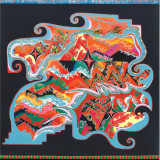
Deprived of sanity, Paul Régimbeau aka Mondkopf found new territories of expression with »Spring Stories«, a collection of post-rapture moods full of glorious chaos, ready to absorb and re-ignite all that is worn.
As a phoenix raising from the ashes, »Spring Stories« captures the earth in full bloom. Darkness & Insanity looses it´s grips as the roots and fresh leaves creates a slow dance towards the sun. Similarly sine-wave drones move around exploding electric guitar improvisations as new light beams on shadow cast corners. The album feels like a 60ies jam set in the post-world psychedelic underground. Heavy, absurd, beautiful and ready to sooth burnt out, depleted minds. Paul has citied that he´s affected as much by folk improvisors such as Master Wilburn Burchette & Robbie Basho as well as the doom drone of giants Earth & Sunn O))). Spring Stories invokes on these, while feeling like a personal blow-out, coming right from the core. Touching and grand, like spring itself.
The album also features Frederic D. Oberland on two tracks playing variously Duduk & Alto Saxophone. Lastly, The Necks drummer Tony Buck shakes & rattles all over the final - and seriously epic - piece “Continuation”, as the world aligns while the sun rises over its near-dead shape.
Cerca:the drones
The »Icol Diston« compilation, released in 2002 on DIN, comprised the three first EPs released by Uwe Zahn under his Arovane moniker. Following up on vinyl reissues of his path-breaking debut album »Atol Scrap« as well as 2000’s »Tides,« the German Keplar label finally makes »Icol Diston« available in its entirety on vinyl for the first time in a remastered version with new artwork. This expansive reissue sheds a new light on Zahn’s first two outings as a producer on the »I.O.« and »Icol Diston« EPs on Torsten ›T++‹ Pröfrock’s legendary label as well as highlighting his radical inventiveness as a remixer with the two renditions of Pröfrock-produced material offered on »AMX.« Taken together, these musically complex and emotionally rich electronic compositions form the prologue to an artistic story like none other while also documenting a very specific era in cultural history.
The energy running through Berlin and its boundaryless electronic music scene at the end of the 1990s is reflected by and refined through these eleven tracks. »There was an overwhelming dynamic of liberation reverberating through the city—through the clubs, the arts, the people,« says Zahn today. At this early stage in his career, he had a head full of ideas and slowly started filling up his studio with samplers, synthesizers, and sequencers to put them into practice. »I would compose percussive structures in my mind during long metro rides and record them once I was back at the studio as well as composing melodies spontaneously on my sequencer.« The Yamaha QY700 would become his sketchbook that allowed him to experiment with different patterns, creating polymetric figures out of discrete musical elements.
Zahn’s sessions, recorded live in stereo and straight to DAT, resulted in two very different EPs of original material. His debut »I.O.« showcases a playful and gentle, albeit dubby and at times moody aesthetic. The four tracks are exercises in sonic worldbuilding, creating vast spaces and filling them with a plethora of intertwining melodies and rhythms. Its successor »Icol Diston« drew on similar parameters, but painted a very different picture in terms of atmosphere and mood. »Berlin’s history felt still so tangible and yet somewhat ghostly during the 1990s, and it is a reflection of all that,« explains Zahn. »The weight of its past, starting with World War II up to the end of the GDR, clashed with an atmosphere of departure, a new zest for life among the people in the city.« It is perhaps no surprise then that the five tracks put a firmer focus on beats, at times even approximating techno or electro grooves despite never eschewing the complexity that is so central to Zahn’s work.
The »AMX« EP features two remixes of tracks originally produced by Pröfrock under two different guises. »Außen vor« had been released under his Dynamo moniker and was reworked by Zahn after having been introduced to his label owner’s Studio 440 sampler, sequencer and drum machine. By leaving the groove at the core of the original track mostly intact but infusing it with more dub as well as anthemic synth drones, Zahn gave it more depth both sonically and emotionally. With his remix of »No. 8,« released under Pröfrock’s tongue-in-cheek pseudonym Various Artists, Zahn followed a more radical approach which led him even deeper into dub territory. »I used a relatively short sample as the tonal foundation and then added an incredibly deep bass and percussive elements,« he explains. Widely different from the original version, it perfectly translated the spirit of this singular masterpiece into another stylistic idiom.
The »Icol Diston« compilation is imbued with a forward-thinking spirit that remains exhilarating until today. It captures the sound of one unique artist, but also electronic music during that time more broadly. This is the sound of opening a new chapter, the willingness to venture into the unknown.
All tracks composed and recorded by Uwe Zahn in 1998/99.
D1 is a remix based on the track by Dynamo. D2 is a remix based on the track by Various Artists.
Originally released on three 12inches by DIN in 1998/99 and on CD in 2002.
Remaster and cut by Kassian Troyer @ D&M.
Cover art by Jim Kühnel based on a photograph by Uwe Zahn.
Text by Kristoffer Cornils.
Constantly evolving and adapting his sound, Shackleton has releases
spanning labels such as Honest Jon’s, Perlon and his own imprints, Skull Disco (co-founded with Appleblim) and Woe to the Septic Heart!.
Shackleton now finds a home for a brand new project on the Barcelona-based, Modern Obscure Music.
Undoubtedly Shackleton, but taking the meditative aspects of his sound to a new plane, The Purge of Tomorrow, is an alias born to transmit a less dancefloor-orientated experience to whomever is ready to receive it.
‘The Other Side of Devastation’ is an investigation into a novel form of
deepness. Adverse to the reductive label of ‘Ambient’, these tracks are spawned from a live performance context. The essence was to create an immersive encounter where listeners are called on to actively unburden their mind of unnecessary thoughts. Staying true to the trance elements that Shackleton is renowned for, this EP is not dependent on traditional structures or a linear narrative.
‘Time Moving’ presents itself through a journey of disquieted moments and contemplative states. Hypnotic strings provided by Kathy Alberici construct pastoral phrases that mesh with the larger looming drones,
culminating to conjure a daydream-like energy. Following on, ‘Waves’
twists through various forms, awash with cascading vocal splices and
soothing murmurs contrasted with rousing sub pressure.
Reflective and sometimes provocative, as an artist who resents the
pigeon-holes of genre, The Purge of Tomorrow presents an exciting new direction for Shackleton. Bursting-at-the-seams with emotional
complexity as to echo the woes of the human condition, this EP is
steeped in feelings of forgone events doomed to be replicated.
DEAD SEA APES are back with a passion to deliver their most essential and cohesive album to date. Formed in 2009, DEAD SEA APES have become a fixture of the psych scene, sharing stages with the likes of Part Chimp, The Heads, Acid Mother Temple and Mugstar while producing a distinctive body of work, ranging from psychedelic punk to experimental dub, from freeform jams to constructions of loops and drones. Following a slew of collaborations and split releases, REWILDING sees them return to a power trio of Brett Savage (guitar), Jack Toker (bass) and Chris Hardman (drums). From the chaotic blast of opener ‘Denialist’, beaming out like a maniacal emergency broadcast, through to the monolithic pounding of the title track, REWILDING is unrelenting, taking in blown-out guitar wails and jet black psych noise while the irrepressible rhythm section moves from claustrophobic motorik beats to a thunderous rolling juggernaut. These blackened pearls have been recast and refined over the course of the past three years, strung out deeper than the night and now embodying our present uncanny, disorienting times, as we emerge into an altered world to find Mother Nature reasserting herself while the human madness intensifies, locally and globally. Savage and uncompromising, this is DEAD SEA APES at their most direct and visceral. REWILDING is released by Cardinal Fuzz (UK/Europe) and Feeding Tube Records (USA) as an edition of 750 on black vinyl.
From the viscerally punishing and nerve wrecking, to the wistfully sublime, Kevin Drumm ‘s work often yield a ferocious intensity through the timbres of minute details. Now, throughout this series of archival works dating from 2000 to 2022, his mastery is once again on full display.
On »Battering Rams«, sinister forces interlope with sanguine glimmers of respite and contemplation, while recurring drones ceaselessly crescendo to near paralysing effect, only for the albums final moments to offer a lofty reprise of boundless oscillation, dispelling all the pent up tension into a sanguine state of bliss. Once again underpinning Drums’ genius of turning apparently trivial hums into elongated microtonal worlds that stay etched deeply in your conscious, often long after the works final resonances have already subsided.
"Akuphone is proud to present the Jerusalem-based improvisational trio Leviot and its hypnotizing debut album. Leviot (Hebrew for “Lionesses”) is a brainchild of multi-faceted musician and composer Yael Lavie, who’s joined by classically trained percussionist and music teacher Cnaan Canetti, and synth enthusiast Yishay Seroussi. The project is a result of Lavie’s ongoing explorations beyond the restraints of classical kanun playing and fascination with electronic sound and modern composition. Initially started following her experience performing and recording with Spiritczualic Enhancement Center, in Leviot, Yael gives up rehearsed pieces in favour of improvised sets, based on virtuous interpretation by Cnaan and Yishay. The three have been active since 2019, playing their immersive shows in a wide variety of settings, venues and festivals. The trio’s debut release is a live session, recorded in late 2020 at Mazkeka Studios (Jerusalem) for the lockdown edition of the annual Zikuk Festival. It’s a meditative improv piece in five parts that combines and melts boundaries between the traditional and the experimental, the primal and the futuristic. With setup as the foundation of the piece and Lavie’s graphic score as the road map, Leviot takes off on a cosmic journey between deep drones, whispering chimes, mesmerizing Arab melodies, pulsating rhythms and iridescent ambient patterns."
Modular synthesizers / electronics + a drum kit enhanced with triggers and sensors: on its self-titled debut album, the duo hÄK / Danzeisen creates a sonic energy that oscillates between high-precision rhythm patterns, analogue sounds and frenzy climaxes.
One must imagine hÄK / Danzeisen as a man-machine apparatus. A collection of cables, resonating bodies and restless limbs that together question all routines. Who overthrow conventional role of instruments and explore the possibilities of a new sound language. Bernd Norbert Würtz alias hÄK operates modular synthesizers, self-soldered circuits and control knobs. Philipp Danzeisen plays a drum kit enhanced with triggers and sensors. These two poles are connected to an interdependent whole in which a constant musical dialogue takes place. The dependencies within this system have been meticulously defined by hÄK / Danzeisen: Drum rolls and sound modulations are interconnected in such a way that there is no contradiction between the strict technological structure and the creative outburst that is possible at any time.
What drives hÄK / Danzeisen is the basic idea that the contrast between acoustic drums and synthetically produced sounds must be overcome in order to create a new experience. Würtz, Danzeisen and their combined instrumentation simultaneously rub up against the same edges, finding a single, piercing voice.
Ideal manifestations of this approach are the duo's live performances: raw energy that oscillates as precisely as it surprises between drones, abstraction and noise attacks, driven by an impudent take on jazz. Constantly oscillating between the registers of "composed" and "improvised", each performance by hÄK / Danzeisen ultimately becomes one of a kind. (Arno Raffeiner)
Mammal Hands announce spell-binding new album 'Gift from the Trees', their fifth studio album, pointing to subtle shifts and exciting new departures for the unique trio
"We're at a point now where playing and writing together can sometimes feel almost telepathic, that as individuals we can tune in to a collective resonance..."
Mammal Hands fifth album 'Gift from the Trees' offers a fresh perspective on the unique trio's singular music. The first to be recorded in a residential studio, the band enjoyed the opportunity to go late into the night searching for a deeper, more organic experience, closer to both their writing process but also their trance-like live performances. While some of the music was pre-composed and had even been performed live, the band also enjoyed the opportunity to improvise ideas in the studio. Drummer Jesse Barrett explains:
We wanted to have a more immersive experience that felt closer to our writing process. One thing that was really important to us was feeling free to jam out ideas as they came to us. We're at a point now where playing and writing together can sometimes feel almost telepathic, that as individuals we can tune in to a collective resonance and just follow that thread where it wants to go. Sometimes it's something as simple as a rhythmic, textural flow, like in Sleeping Bear.
There was also a conscious decision to move away from the sound and ambiance of the recording studio, with the band opting to engineer the record with their go-to live engineer Benjamin Capp before mixing the sessions with Greg Freeman in Berlin. The idea was to try and capture more of the energy of the band's captivating shows, saxophonist Jordan Smart explains:
Considering the group of tracks we had, it made sense to try and capture this process as organically and honestly as possible, and so a change in studio environment felt like the right move to us. Some of the tracks have a raw joy and energy that came with being able to play together again after a long period of time of having been apart, and capture that feeling of just being happy to be in a room with our instruments altogether again.
Whereas for pianist Nick Smart there was also the chance to really go deep into the band's music:
The new studio environment really opened us up to different ways of working and thinking because we could record at any hour of the day or night. I think this allowed us much more freedom to try unusual ideas and push elements of the music to extremes because we had the time to really focus in on the detail and work on things without time pressure. With some tracks, we were trying to find the boundaries of our playing ability and push beyond that point. With others, it was just getting into the right mindset and putting as much energy and emotion into the take as possible.'
The Welsh environment outside the studio doors seeped into the music presented on Gift from the Trees, with two recording sessions (one in winter and one in the spring) bringing different moods: one bleak and wintery, the other more hopeful and bright – an energy that permeates through tracks such as Kernel and Dimu.
Gift from the Trees opens with wonderfully elevating The Spinner which grew from one of Nick's piano parts and was developed and arranged into a complete tune without losing the feeling of constant flow and motion. It is almost like a dance, with the interaction of different melody parts and the doubling of certain parts melding together and fitting into the overall energetic flow, while Jesse's drums are both floating and deeply melodic. Riser aims to capture the band's raw energy and intriguingly is influenced by both breaks and modern drum production but also minimalist classical composition. Nightingale features the band at their most delicate and lyrical – a band favourite it draws heavily on modern folk with a beautifully realised melody that came unforced to pianist Nick Smart before being jammed out together. It was recorded early one morning, bringing an extra light and brightness to this beautiful performance.
Another album highlight is Dimu which utilises one of drummer Jesse Barret's favourite rhythmic devices from the Tabla repertoire and draws inspiration from Indian, Greek and Arabic music as well as modern folk arrangements. Dimu starts with saxophone over a bed of drones and percussion and moves through many different sections that frame and present the melodies in unique ways. The beguiling, intimate Deep within Mountains aims to place you in the room with the band as they play; it was recorded late at night to capture a dreamlike, liminal ambiance. The piano solo really reflects this mood and energy while the tenor is some of the softest and closest on the recording. Elsewhere, the remarkable Labyrinth started with what Nick describes as "some weird recording on my phone from a soundcheck, where Jordan was playing some crazy sounding bass clarinet part and I quickly recorded him", giving birth to a captivating, complex slice of propulsive 'almost' contemporary classical that like so much of the music on Gift from the Trees really couldn't be any other band than Mammal Hands.
Finally, the album draws to a close with the glorious Sleeping Bear, a tune that was wholly improvised in the studio. Nick and Jesse entered a simple but 'weird' locked groove and Jordan improvises melodies over the top. The track came about without any planning or thought; it was one of those special things that came by surprise and the band felt offered the perfect ending to their latest gift to us all: a deeply enthralling album that captures so much of what makes Mammal Hands a special band while mapping out new routes and paths for their beautiful, beguiling music.
Dauw presents 'babel', the debut album from Belgian duo ZONDERWERK. The duo’s name means ‘’without work’’, but it also comes from “bijzonder werk”, where bijzonder is particular, special, unique. They like to work with images/paintings that are “bijzondere werken”, odd works.
babel is an ambitious exercise in translating images into sound. babel was initially created for the eponymous theatre piece by architect and artist Steve Salembier. Inspired by the biblical legend, Salembier envisions the legendary city as an abstract, sprawling modern metropolis in continuous flux. Its steel and glass skeleton is a representation of both an accumulation of overlapping contemporary cityscapes and a metaphor for the anonymous repetitiveness of our daily routines mirrored by the architecture. Subway lines, sky scrapers and whirling highways converge into a megalopolis of monstrous proportions. Despite the composition’s initial context as soundtrack for a theatre play, for the band this album is seen as a standalone work, whose complex sonic material can be appreciated without having seen the piece.
Their score focuses on fleshing out the imposing imaginary universe both in terms of scale and meaning. One of their biggest inspirations were Michael Woolf’s photographs, which served as the basis for the original theatre piece. His use of grey and repetition is translated into looped harmonies and fine-grained drones that progressively open up like blooming ice flowers.
With sounds of bells and metal as their primary materials, Carrijn and Sanders build soundscapes that are at once seductive and unsettling. The atmosphere on tracks like “DreamArp4Kort4” make for majestic, mysterious synths conjuring otherworldly visions, while the angelic glockenspiel set against subtle explosions in “VuurFeest” suggest a serene yet potentially dangerous place. Other tracks like “RoomCarousselTapeLoop5” create multi- layered textured drones through the process of tape decay, a commentary on the cannibalistic nature of the city.
Resulting from an arduous improvisational processusingold samplers with elements such as the Beam harp, a self-made metal instrument with piano strings, reel to reel tape recorders, field recordings and violin, babel perfectly captures the oxymoron of the man-made concrete jungle that is at once inhospitable yet endlessly awe-inducing.
ZONDERWERK is a duo consisting of Linde Carrijn and Dijf Sanders who started this project during the pandemic as a way of exploring their relationship as creative partners. Carrijn has a background in acting but recently came more to the fore as composer/performer with original scores for theatre and her other band Brik Tu-Tok founded with multi-disciplinary artist Maxim Storms. Sanders is a composer and gear enthusiast, more well-known for his eclectic works that draw from a wide-array of non-Western music. His milestone-album Moonlit Planetarium paved to way to a broader audience and recognition from major press in Belgium. In 2021, his work as a producer was recognized with a nomination at the Music Industry Awards.
TEN. KR3 marks the double-figure release, starring David Foster: the man behind the Huren project, which has been churning out influential tracks for the past three decades. Blood Fire Debt – has been described by David with one word: ‘survival’. Indeed, in this tenth release we rediscover an already legendary artist of the power electronics scene, in his most honest and consistent form. Expressing himself through cinematic-noise, harmonised by dark drones and slo-mo rhythms. Still navigating through the chaos, this ride will take us back to the 90s, thanks to the presence of a track (B2. Mytologinen) produced in those years. There will be a unique insert with the HUREN portrayed under one of the twin towers. Written & Produced by David Foster Mastered and Vinyl Cutting by: Tim Xavier at Manmade Mastering Berlin
(Note: Same tracklist on A & B Sides)
Across 8 concise vignettes, Chantal Michelle alchemizes acoustic instrumentation with a spectrum of layered feedback and field sounds, depicting fractured beauty amongst a precarious reality.
Chantal’s work is characterized by intoxicating juxtaposition and enriched with an array of source material to construct immersive narrative. Much of the work here was recorded during her time in New York City, perhaps a pre-requisite to the heightened tension at play.
Opening with lucid choral vocals, a mysteriously seductive anaesthesia disseminates before evaporating into surging feedback, vocals dissolving as quickly as they appeared.
It’s this oscillation between states that permeates throughout the work. Whether it’s the esoteric rumbling of acoustic drones, or the radiant fusion of distorted chords amongst the warming sounds of tropical atmospheres, moments of serenity are conjured up in a space so bliss that their endings incite an immediate nostalgia. Fleeting melodies are pierced by shattering cries of feedback; gossamer tones engulfed in saturated noise.
Amongst the instrumentation, buzzing field sounds tremor with hyperreal peculiarity and hallucinations shape noise into sounds of the familiar; the rumbling of an overheard aeroplane or the whirring of distant grasshoppers. Similarly, recurring motifs elicit a false sense of security in their subliminal familiarity, soon exposed as echoes, a reverberation of what was left behind.
At the approaching climax, the blissful onset anaesthesia has worn off, interrupted by a powerful chorus of deep, gothic synthesis that fuels post-apocalyptic fever dreams, an unnerving and mesmerising symphony. The unresolved tension leaves us in a state of delirium, questioning if the tranquillity we experienced was ever really there.
Chantal was immersed in Fleur Jaeggy’s The Water Statues whilst recording, and its imprint is woven into the sonic fabric of Broken to Echoes; a sublime liminal dream-state, pervaded by haunting visions. It’s a view of the world captured from inside the enclosure of a cell membrane. Through translucent mesh, we see the billowing tension of our surroundings, protected only by the most delicate walls.
Chantal Michelle is a sound artist, musician, and composer based between the United States and Europe. She works with acoustic instrumentation, synthesis, field recordings, and voice to form densely textured aural landscapes. Her work is characterized by tension, disparate sounds, and non-linear arrangements. It has been realized as multichannel installations, live performances, and recorded material.
She has released three albums to date: Pulse, Puls-ar, Procession (Dinzu Artefacts, 2022), Night Blindness (Quiet Time, 2021) and the collaborative Aunis (Injazero, 2019), all to critical acclaim. The Wire called Night Blindness “a dynamic and engrossing narrative,” and Aunis received praise in The Guardian as “a virtually unprecedented palette of synth sounds.”
Brazilian experimental multi-instrumentalist Carla Boregas follows plates for Bokeh Versions and Hive Mind with a ghostly set of deep listening electronics that plays like a symphony for an imagined woodwind orchestra.
Carla Boregas is best known from her tenure in São Paulo's genre-bending experimental post-punk scene, playing in long-running outfit Rakta as well as other related offshoots. Her solo material has been knottier to unpick, here developing ideas from a collection of unfinished fragments and notebook scribbles exploring the possibility of finding a wind instrument that could be played collectively by several musicians. Coinciding with the pandemic, however, she soon realised the inherent risks involved with sharing breath and so the concept took a different direction, with added resonance.
Boregas developed a synthetic alternative, layering vocals and environmental recordings to suggest wind instrumentation without attempting to mimic it. The sounds here are airy, but rarely diegetic - on the title track, Boregas uses analog arpeggios and plucked, sustained tones to approximate the kosmische world of Ash Ra Tempel or more recently Emeralds, as if trapped in a wind tunnel, moved forward by an unseen force.
There's a whisper of the ancient past that harmonises with Wojciech Rusin's speculative medieval gasps, and Bloedneus & de Snuitkever's severely underheard ‘Milli Mille’, an examination of the ancient Greek aulos. On ’Grafia Do Invisível' the sound is completely different again, but the concept remains, using precise analog drones and minuscule timbral shifts to imitate the character of a wind instrument and simultaneously harmonise with the deep listening meditations of Éliane Radigue and Kali Malone.
A voice enters the frame on 'Sopro’, chopped into deviated gulps and syllables, creating a language that's unfamiliar and percussive. The use of breath is subtle, and vocalisations criss-cross between synths and faint whistles, forming an expression that's different from its predecessors but intrinsically interlinked. This is where ‘Pena Ao Mar’ excels, by viewing breath and its application in electronic music from multiple angles simultaneously. Fans of Lucy Duncombe, Lucrecia Dalt, or Sarah Davachi - don't miss this one.
When we established Balmat in 2021, neither of us could have imagined that within two years, we’d be putting out an album by one of our musical heroes: Mike Paradinas, aka µ-Ziq. The British producer has been an inspiration to label co-founders Albert Salinas and Philip Sherburne since the 1990s. In fact, his album-length remix project The Auteurs Vs µ-Ziq was one of the very first pieces of electronic music that Philip bought, way back in 1994. To have the opportunity to release his music now feels like a real full-circle moment.
Paradinas, of course, needs no introduction. Under a slew of aliases, chief among them µ-Ziq, the British artist revolutionized leftfield electronic music in the 1990s—coincidentally, this year marks the 30th anniversary of his debut album, Tango N’ Vectif, for his friend and sometime collaborator Aphex Twin’s Rephlex label—and his label Planet Mu has built up a formidable catalog of visionary, forwardlooking records, mapping virtually every corner of the electronic spectrum. With 1977, he turns the clock backward in a sense, and not just with the album’s title: Rooted in classic ambient and electronic sounds, these 15 tracks evoke the anything-goes spirit of the early ’90s, before the tools and tropes had calcified into cut-and-dried styles.
There’s no shortage of familiar sounds on 1977. There are echoes of raves and chillout rooms and transmissions from the fringes of techno; there are detuned synths and glistening reverb tails and, above all, gauzy vox pads, the eerie glue that holds it all together. The title, he says, is meant to invoke a general sense of nostalgia, bookmarking a year in his boyhood when he became more selfaware. More than anything, 1977 sounds like µ-Ziq distilled: Stripped of his signature breakbeats and customary chaos, Paradinas’ first-ever strictly (well, mostly) ambient album presents the essence of his music in a whole new light.
Along the way Paradinas touches on dark-ambient drones (“Marmite”), horror-film themes (“Belt & Carpet”), jungle breaks (“Mesolithic Jungle”), and even house music (“Houzz 13”), which marks the first bona fide dance-floor moment on Balmat to date). Yet the album never—to our ears, anyway— feels expressly retro. Rather, Paradinas plucks timeless sounds out of the ether and gives them a gentle tap, spinning them into unexpected new orbits. At times, 1977 feels like an experience of extended déjà vu: When we first listened to it, we had the sense that we already knew this music. It was as though we had heard it years ago, perhaps on a battered cassette tape lent to us by a friend, and been searching for it ever since. We hope you feel the same.
Mammal Hands announce spell-binding new album 'Gift from the Trees', their fifth studio album, pointing to subtle shifts and exciting new departures for the unique trio
"We're at a point now where playing and writing together can sometimes feel almost telepathic, that as individuals we can tune in to a collective resonance..."
Mammal Hands fifth album 'Gift from the Trees' offers a fresh perspective on the unique trio's singular music. The first to be recorded in a residential studio, the band enjoyed the opportunity to go late into the night searching for a deeper, more organic experience, closer to both their writing process but also their trance-like live performances. While some of the music was pre-composed and had even been performed live, the band also enjoyed the opportunity to improvise ideas in the studio. Drummer Jesse Barrett explains:
We wanted to have a more immersive experience that felt closer to our writing process. One thing that was really important to us was feeling free to jam out ideas as they came to us. We're at a point now where playing and writing together can sometimes feel almost telepathic, that as individuals we can tune in to a collective resonance and just follow that thread where it wants to go. Sometimes it's something as simple as a rhythmic, textural flow, like in Sleeping Bear.
There was also a conscious decision to move away from the sound and ambiance of the recording studio, with the band opting to engineer the record with their go-to live engineer Benjamin Capp before mixing the sessions with Greg Freeman in Berlin. The idea was to try and capture more of the energy of the band's captivating shows, saxophonist Jordan Smart explains:
Considering the group of tracks we had, it made sense to try and capture this process as organically and honestly as possible, and so a change in studio environment felt like the right move to us. Some of the tracks have a raw joy and energy that came with being able to play together again after a long period of time of having been apart, and capture that feeling of just being happy to be in a room with our instruments altogether again.
Whereas for pianist Nick Smart there was also the chance to really go deep into the band's music:
The new studio environment really opened us up to different ways of working and thinking because we could record at any hour of the day or night. I think this allowed us much more freedom to try unusual ideas and push elements of the music to extremes because we had the time to really focus in on the detail and work on things without time pressure. With some tracks, we were trying to find the boundaries of our playing ability and push beyond that point. With others, it was just getting into the right mindset and putting as much energy and emotion into the take as possible.'
The Welsh environment outside the studio doors seeped into the music presented on Gift from the Trees, with two recording sessions (one in winter and one in the spring) bringing different moods: one bleak and wintery, the other more hopeful and bright – an energy that permeates through tracks such as Kernel and Dimu.
Gift from the Trees opens with wonderfully elevating The Spinner which grew from one of Nick's piano parts and was developed and arranged into a complete tune without losing the feeling of constant flow and motion. It is almost like a dance, with the interaction of different melody parts and the doubling of certain parts melding together and fitting into the overall energetic flow, while Jesse's drums are both floating and deeply melodic. Riser aims to capture the band's raw energy and intriguingly is influenced by both breaks and modern drum production but also minimalist classical composition. Nightingale features the band at their most delicate and lyrical – a band favourite it draws heavily on modern folk with a beautifully realised melody that came unforced to pianist Nick Smart before being jammed out together. It was recorded early one morning, bringing an extra light and brightness to this beautiful performance.
Another album highlight is Dimu which utilises one of drummer Jesse Barret's favourite rhythmic devices from the Tabla repertoire and draws inspiration from Indian, Greek and Arabic music as well as modern folk arrangements. Dimu starts with saxophone over a bed of drones and percussion and moves through many different sections that frame and present the melodies in unique ways. The beguiling, intimate Deep within Mountains aims to place you in the room with the band as they play; it was recorded late at night to capture a dreamlike, liminal ambiance. The piano solo really reflects this mood and energy while the tenor is some of the softest and closest on the recording. Elsewhere, the remarkable Labyrinth started with what Nick describes as "some weird recording on my phone from a soundcheck, where Jordan was playing some crazy sounding bass clarinet part and I quickly recorded him", giving birth to a captivating, complex slice of propulsive 'almost' contemporary classical that like so much of the music on Gift from the Trees really couldn't be any other band than Mammal Hands.
Finally, the album draws to a close with the glorious Sleeping Bear, a tune that was wholly improvised in the studio. Nick and Jesse entered a simple but 'weird' locked groove and Jordan improvises melodies over the top. The track came about without any planning or thought; it was one of those special things that came by surprise and the band felt offered the perfect ending to their latest gift to us all: a deeply enthralling album that captures so much of what makes Mammal Hands a special band while mapping out new routes and paths for their beautiful, beguiling music.
Brilliantly remastered (picture) LP/CD with new stunning artwork!
Lo-Fi India Abuse was recorded in 1998, some tracks are “pure” Muslimgauze and some are re-mixs of tracks from Systemwide’s “Sirius” CD (see also Systemwide meets Muslimgauze “at the City of the Dead” 12″). Nearly all of the tracks have hand percussion in varying tempos and intensities and at least 1/2 make use of electronic noise surges. The sound is very crisp and clean, extremely well produced, recorded and nicely varied throughout the length of the disc. Some track by track comments: “Antalya” is obviously from the same sessions as “Fakir Sind” seeing as it shares the same hand percussion sound, whistles, vocal wailing, cut-ups and delays. “Valencia Flames” sounds like a Systemwide remix. A dub bass line, hi-hat and background vocal of some sort are all obliterated by numerous delays, starts, stops and re-starts with an unpredictable nature in these cut-up tracks. “Al Souk Dub” injects background voices, market sounds and drones into the cut-up mix of slow hand percussion playing. “Catacomb Dub” and the final two tracks make use of twinkling synth waves, presumably a Systemwide sound source. “Dust of Saqqara” has a heavy pulsating electronic sound wave over an old beat box rhythm. “Android Cleaver” is brutal (as is “Nommos’ Afterburn”) hand percussion, jabs of noise and an oft repeated, unintelligible vocal sample. Yes, Lo-Fi India Abuse is yet another great Muslimgauze release, grab it!
All tracks recorded by Muslimgauze 1998
Some tracks are re-mixes from Systemwide’s “Sirius” album
Re-mastered by Višeslav Laboš
Sleeve by Oleg Galay
Originally released in 1999 via BSI Records (BSI 1999-3).
Damage and Their Slices” is a collaborative album NVST and Theo Muller, in which they invite the listeners to a deep dive into an esoteric universe where dark magic meets political revolt.
The Swiss artist NVST shouts, preaches, stirs up and questions the consciences of his audience with a deluge of words about this sick society, the capitalist infection and the abuse of power. In tune with this mantra of georgeorwellian rhetoric, the music by Frenchman Théo Muller turns the malaise of the content into form: paranormal psychedelia, arcane dub, industrial ectoplasms, esoteric ambient and paranormal drones. In short: a friction of electronic sounds that Kraftwerk, years ago, unwittingly defined as metal on metal. Live, this call to action to necromancy and revolution takes on an amphibious, organic, almost cathartic and revealing form.
Franco-Swiss composer & director of INA GRM François J. Bonnet, aka Kassel Jaeger, returns with a new solo album. Following a compositional approach stemming from the musique concrète tradition, without adopting a structuralist aesthetic, Shifted in Dreams explores a wide range of instruments and techniques, going seamlessly from instrumental improvisation to field recording, via micro-editing and the use of asynchronous loops. Mixing the electronic sounds of an ARP 2500 synthesizer with the acoustic drones of a positive organ, articulating guitar layers with the resonance of the Cristal Baschet, bringing together recordings of slamming windows and sound produced by complex modular synthesis patches, Bonnet offers a rich and generous palette of sounds, inviting a constantly renewed sonic investigation.
The electronic music producer and DJ whose catalogue of collaborations namechecks acts as diverse as Agoria, Green Velvet, Roman Flugel to Nitzer Ebb, Depeche Mode and David Holmes is set to release his 6th studio album The Strand Cinema on the 24th March on his own label PKR.
The last five years have seen an evolutionary shift for the electronic musician, undertaking more soundtrack work, including for film (Nightride on Netflix, Rough), radio (The Northern Bank Job BBC R4) and theatre (East Belfast Boy).
The Strand Cinema album is a tribute to the art deco cinema building , The Strand, where Phil’s recording studio is. A stirring and beautiful record, it seamlessly traverses the worlds of contemporary classical to beautifully elevated dance music with a recognisably cinematic influence. Managing to sound both grand and expansive, as well as minimal and introspective – it’s a record that explores the macro and the micro.
The opening track “Strand Cinema”, begins with a steady, gentle, looping pulse, almost recalling the kosmische ripples of Cluster, before sweeping and enveloping strings enter, resulting in a track that manages to sound both grandiose and tender in one fell swoop.
Lead single “Atlantic” perhaps most perfectly encapsulates the various sonic worlds that Kieran is operating in, merging a bordering on euphoric dance beat layered with infectious melodies, while remaining anchored to organic sounds, as strings and percussion collide with the driving and hypnotic groove of the track.
“Strike the Match” showcases Kieran’s talents for detail, in a track that feels almost palpably textural and rich in complexity but without feeling overly busy or superfluous; while “Elephant in Castle” utilises intense, almost gargling electronics, that drone with a foreboding and ominous tone, but also produces fractured moments of light, beauty and poignancy.
Created during Covid Kieran’s method was “To literally be like a tuning fork and ask: What's in my chest? If I were to describe what's inside me, and what's going on in the outside world, If I had to score that in a film, what would it sound like right now? I guess I sort of soundtracked my own life”
“One positive side of lockdowns was that we spent more time in natural surroundings where I’d make field recordings. I’d also record acoustic sounds: cello, violin, percussion, guitar etc and then create my own sample bank from all these single one-note sounds. So, creating your own loops and drones. The album was created from organic sounds manipulated by machines; melted, mangled and hacked with computers but machines only sound as good as the human spirit put into them.
The idea of nature and humans versus technology is the concept behind the album’s A/V show which debuts in Belfast in March before touring. Featuring works by 11 artists from across the worlds of film, animation, advertising, architecture, computer science and dance such as Scottish BAFTA nominated Simone Smith, LA based director Frederico Marzio Vitetta who is famous for skateboarding films like ‘Wet Dream’ with Spike Jonze, to futuristic CGI from BAFTA nominated Kris Kelly and a video from contemporary dancer Oona Doherty. onscreen visualisations that explores The visuals explore nature and technology along a timeline from past, present to future with cinema as a loose reference point with varying degrees of utopian versus dystopian moods.
US-based Mystery Circles is the next stop for Hiroshi EBINA following a previous outing here last year. This new cassette is another beautifully organic ambient soundscape with delicate pads and a sense of quiet hope and atomism. The beauty of the album cover really portrays the majesty of the music within as gentle chords linger in the air above warm and fuzzy drones. Some pieces are more empty that others which only lends the appearance of a wispy pad all the more weight while some grow in stubby intensity as sounds are layered up and draw you in ever deeper.
Official reissue of Civilistjävel!'s first, self-titled archival LP in sky-blue embossed sleeve, 500 copies.
A minor masterpiece of high-lonesome, ultra-spacey existential electronics, recorded in the ‘90s and early 2000s, the music on this album had never been heard outside the Swedish artist’s private tape/CD-R trading networks until 2018 - when London’s Low Company presented it in a hand-assembled vinyl edition of 250 with scant context or biographical info. Some people understandably thought the project might be a ruse - was it really plausible that material this accomplished and affecting had fallen under the radar for 20-odd years? Implausible, perhaps, but true nonetheless. Five years on we know that Civilistjävel is indeed the real deal: the alter ego of a discreet but by no means reclusive solo artist based in Uppsala who has for decades been quietly honing his craft without worrying about who's listening. Since 2019 he has become more visible: performing live several times in and around Europe, and last year releasing a brand new studio album, Järnnätter, on Felt Records. Meanwhile Low Company has put out four subsequent, vinyl-only volumes of archival material. These have increasingly tended towards the more rhythmic/techno-oriented impulse in Civilistjävel, so it’s interesting to return now to Volume 1: comprised of the most introspective and isolationist of his works, tapping into deep wells of northern European melancholy. It’s a music made with no audience in mind, but simply to suit itself: cold-world kosmische, intimate minimal synth etudes, bowled percussion clusters and impossibly yearning, 30-days-of-night ambient dronescapes. Created mostly using a Juno60 and Korg MS20, and home-recorded to DAT (crackles and surface-noise preserved intact), you can hear in these seven expansive instrumentals unconscious echoes of Serge Bulot and Anna SjalveTreje’s crepuscular dream-sequences, Scandinavian black metal's mist-cloaked forest-fantasies, the austere dub-techno of Thomas Köner and Basic Channel, and the gristly, consumptive concrète of Nurse With Wound and Asmus Tietchens.
Roman artist Heinrich Dressel delivers a sparkling gaze into the future with the glistening ‘Lambda 2077’. Opening with powerful, guttural drones and sweet sweeps from ‘Nebulosa’, the broad sonic scope of this LP is beautifully demonstrated.
Growling arps and magnetic, synthesised moans are throughout this record. Dressel cultivates a cinematic, cerebral experience throughout each track, delicately weaving a visceral soundscape. The rising, slicing tones of the atmospheric ‘CEM 8220’ provide a compelling journey through meandering arps with a defined structure. ‘Arpeggio Jawa’ swims into action with a watery, colourful arpeggio sailing through each intriguing section.
‘Francisco’ opens things up with an electro-tinged, thunderous remix. Building upon the chordal gravitas of the original, the remix provides the release with an acidic percussive journey. The swirling brilliance of the title track ‘Lambda 2077’ presents itself as stunning, emotive work which prepares you for the decade Heinrich Dressel is heading to next. The machine lead release shows Heinrich Dressel as a consistent unstoppable force behind the synthesiser, culminating in an astonishing, sophisticated record.
“This music is staggeringly original and innovative, and while it’s possible to locate it in a chain of circumstance that links it to ‘Industrial’ music, P16.D4 indulged in none of the empty cliches associated with the genre, worked incredibly hard, and seem to have been aiming at a form of sound art that was much more profound, varied, subversive, and potentially dangerous. Kuhe In 1/2 Trauer’s accompanying credits indicate their radical approach to making music: lots of improvisation, lots of live electronics, extensive use of tape-loops, some conventional instrumentation, and much that isn’t – like the milk churn on ‘Paris, Morgue’ or the use of baking tray and washing machine elsewhere. Even when guitars, drums or keyboards are used, they’re played very weirdly. It’s not even made clear who was doing what; the main credit is ‘Concept,’ which I assume means that one of the three devised the framework in which the noise would operate itself, and while RLW gets the lion’s share of these credits, a lot of the cuts are evenly divided among the team and I have no doubt that the group operated in a very democratic or libertarian manner. None of this prepares you for the insane and troubling sounds that reach your ears, composed with scant regard for conventional logic and following an exciting, absurdist path, especially in the matter of tape edits and juxtapositions of recordings.” - Ed Pinsent, The Sound Projector.
“Though this German group started out as a the new wave band P.D., by the time of Kuhe in 1/2 Trauer, their first LP under the P16.D4 name from 1984, they had developed far beyond into extremely experimental music similar to other post-industrial artists working with abstract avant-garde soundscapes. There’s a bleak industrial feel to the gritty, lo-fi electronics and tape loops, while the group throws in enough curve balls to keep it interesting. On some pieces, strange, looped choirs bubble out of throbbing pulses and drones of feedback, while others have clanging and clattering, and elements of musique concrète and improvisation blur the boundaries even further. The opening track, “Default Value,” is one of those disorienting pieces with noises flying everywhere, while “Paris Morgue” takes excerpts from one of their old P.D. tracks and messes it up with additional instruments, while the ungainly titled fourth track throws in a heavy texture of percussive noises to create an edgy ambience about to teeter off the edge, and the even darker and more ambient title track takes the tension even further. Arrhythmic and amorphous and capable at moments of becoming quite noisy and abrasive, while at others far more somber and quiet, Kuhe in 1/2 Trauer is quite a fascinating release.” - Rolf Semprebon / AMG
P16.D4 was a German electronic noise music collective, active primarily from 1980 to 1988. P16.D4 embraced tape cut-ups, musique concrète, endless recycling and transformation of previously published material, and many long-distance collaborations with like-minded artists such as DDAA, Vortex Campaign, Nurse With Wound, and Merzbow. Their active participation in the international industrial tape scene yielded collaborative output such as their release Distruct, where bands such as Nurse with Wound, Nocturnal Emissions, Die Tödliche Doris, and The Haters provided the source material. The longest-term collaboration was with the installation and conceptual artist Achim Wollscheid, who used P16.D4 sounds as the basis for LPs he recorded under the name SBOTHI. Ralf Wehowsky, the only constant member of the group, later released solo material under the alias RLW.
Members of P16.D4 were also involved with Selektion, a collective of people involved with sound as well as the visual arts. Selektion published LPs, CDs, books, visual art and design.
The collective worked in a strongly improvised, spontaneous and anti-professional way, using acoustic and electronic instruments, using existing sound fragments, duplicating and alienating them, using repetition, distortion, changes in speed and playing direction. For this they used not only sounds of other artists but also their own material from earlier productions. Late works of the collective are associated with musique concrete.
Cluster was the pioneering German duo of Hans-Joachim Roedelius and Dieter Moebius. Formed on the cusp of the 1970s, they were a part of West Germany's nascent Kosmische Musik scene. The group would use restrained improvisational techniques similar to Gruppo Nuova Consonanza, working with both electric and acoustic instruments (organ, guitar, tone generators, cello, etc.) to create a singular sound that Julian Cope called "a huge beating heart, planet-sized and awesome."
Originally released in 1972 on Brain, Cluster II features six pieces of atmospheric, proto-ambient drones – a step forward from Cluster's 1971 self-titled debut, which had all untitled songs. On "Im Suden," hypnotic bass pulsations and repetitive guitar patterns flow serenely, while side two opener "Live In Der Fabrik" dives deep into Roedelius and Moebius' foreboding industrial soundscapes and synergistic textural interplay.
As Roedelius told Uncut magazine in 2022, "This feels like a breakthrough? Well, we were just getting more into it, and getting more experienced at being able to elaborate it. Conny (Plank) was working with us again – as well as being a multi-talented artist, he was a very experienced sound master and great human being. He contributed as a fellow musician, adding sounds with his mixing table such as reverb, delay and other effects enriching the whole pieces so that they finally became somehow unique."
It's no surprise that when Neu! guitarist Michael Rother first heard Cluster II, he suggested a collaboration with the band – resulting in the supergroup Harmonia who would make their first album together the following year.
The next release on Phase Group is a truly singular and original album from Rotterdam-based producer Ayaz.
With ‘Unpinned’ Ayaz presents a window into a uniquely crafted and highly personal sonic environment, where intercepted radio broadcasts tune in and out of focus, modulating drones echo through cavernous space and the sound of experimental synth explorations are layered over heady dub-laden beat work, deep bass lines and expertly programmed traditional sampled artefacts from the music of his native Azerbaijan.
This is an uncanny and evocative sound universe both cinematic and driving, music that would work equally scoring science fiction cinema as in the most avant-garde club environments. Mind-bending and visionary music for those that explore.
The first LP by Bloedneus & de Snuitkever, MILLI MILLE. Finally on wax, it’s Lukas De Clerck’s musical vehicle for his explorations with the aulos, that ancient reed instrument that mainly satyrs and archeological enthusiasts found beguiling. Equipped with his handmade pipes and the artful sense of devotion of a true modern-day aulete, De Clerck has dug deep into the technical and cultural peculiarities of this long-silenced instrument, paying it the kind of attention and mindfulness that Marsyas the satyr so lacked when he challenged Apollo and his lyre to that ill-fated musical match. But beyond merely resuscitating an ancient cult, De Clerck as Bloedneus gives the aulos a different kind of renaissance where its penetrating qualities are expanded and expounded to effects worth every nosebleed, paving new grounds in these practices of old.
MILLI MILLE hints at mysteries universal to humans of yore, present and morrow, like a Joseph Campbellesque recounting of transcendental journeys through drones and extra reverb. Elegiac modes encounter pastoral vibes that are punctuated by sly baroque flourishes, all pointing to the timelessness of the aulos’s sound - one can easily imagine its power of enlightenment through many ages. Yet in MILLI MILLE, an insistence on the fickleness of the instrument surfaces through disorienting, perception-shifting blasts and a compulsion to push the aulos to its fullest and most destabilizing potential. This is the flavor that Bloedneus & de Snuitkever imbues into that dormant canon, one that permeates the atmosphere long after the last note puts an abrupt end to these vibrations. The satyr’s song rings on, leaving the air abuzz with a timeless pulse that holds the promise of sounds still to be unearthed.
In the midst of a wave of hybridizing ambient, drone, folklore and experimental electroacoustic music, Roxane Métayer has gained a cult following with only a couple of releases to date. Following her debut album (Éclipse Des Ocelles) for Morc with a split EP and a limited cassette for Wabi-Sabi, Roxane now turns to Marionette with her intimate narrative based multi-instrumental recordings, a match made in the heavens if you ask us. With her violin, woodwind, voice and various effect pedals, Métayer takes the listener on a newfound journey into the ancient, medieval, and primordial.
Perlée de sève is Métayer’s second full length, a sophomore to the critically acclaimed Éclipse Des Ocelles, where Métayer continues to sonically realize the map of the fictional habitats that inhabit her mind. Coming from a background of studying narration and different animation mediums, it’s no surprise that her recordings evoke vivid imagery and carry a trace of the environment they were conceived in. The instruments morph as extensions of her body and ultimately become new organs, a means of communicating these bio-memetic stories and creating a dialogue between herself and her surroundings. Meandering melodies intertwine with accompanying drones, mantra-like fragments and a handfeel percussion lend themselves as living and breathing elements in Roxane’s beguiling and spellbinding anecdotes.
Roxane is an observer of the world, her projects conceived from elements that inform her reality, such as the organic imagery and sounds of nature, then transforming that into a strangely familiar parallel universe that would not exist otherwise. Whether it's active research or taking her instruments to the forest, Métayer opens up her imagination by taking this mental journey to discover locations, creatures, and time periods then channeling that into her own fairy tales. The album and track titles act as a portal into those worlds, like chapters in a book where the protagonists are animalia, plantae, and fungi. As Métayer wrote in an interview: “Stories are a privileged way to create an awareness of a specific subject.”
repressed !
Firmly entrenched in techno's haziest alcoves, every new record from Denise Rabe is as punishingly hypnotic an experience as it aims to penetrate the deepest laid of your cerebral zones. Having plied her trade on Arts' sub-division Arts Collective before moving on to establish her own dedicated label, Rabe, in 2017, the Berlin-based DJ and producer steps up with her much anticipated debut platter for Stroboscopic Artefacts, as she takes the helm for the fifth sortie of the Totem series. True to her love for all things droney and psychoactive, this time Rabe has us descending into rugged, hostile sonic terrains with just a headlamp and the thick mantle of darkness for closest companions. Ahead’s a demented safari across nightmare-prone visions and thunderstruck vistas.
Hosing off the loud, churning 909 kicks and passive-aggressive machine talk straightaway, 'Manifesto' sets the tone for the warehouse-sized hammering to come. Evil-minded swashes of hyper-delayed percs and criss-crossing chimes lash out in successive waves, further subjugating the dancers as bars fly by. A more spacious and atmospheric number, B-side opener 'Clouds' heads for quieter high-altitude spheres as the dubbed-out drums beat an off-kilter, leftfield friendly pulse and ominous synth stabs and pads envelop the listener in entrancing textural folds and interplays. Back to floor-ready dynamics, the adrenaline booster 'Don't Leave' caps it off on a truly mind-bending tip. Primed for unrelenting peak time action with its angry buzzard-like drones, pacey 4/4 swing and refined palette of eerie circuit noises and click-y minimalism, this one's a high-impact steamroller, sure to get maximum response when things start getting muscular.
Frokedal is a popular folk singer-songwriter whose haunting vocals have scored the music of various acclaimed bands over the past decade. The members of Sa^ver are veterans of the Norwegian heavy scene. Having toured all over the world playing renowned festivals like Roadburn and Psycho Las Vegas, they now fill and orchestrate the gap between eerie softness and furious anger as a three-piece atmospheric sludge metal ensemble. This split 10" sees each of these artists present a song from the respective other artist's back catalogue, finding a transcendental middle ground between the other artist's musical realm and their own sphere. Commenting on the beginning of her own musical career, Frokedal notes: "Because everyone has a computer these days there's no limit to how many times you can multi-track. I was sick of that. I hoped to go the other way - to remove as much as I could and be left with a beating heart." Remarkably, Sa^ver have done just that in their execution of Frokedal's track «Shot-Put», turning down their guitars to give space to clean vocals and laying bare the synths that are an integral part of their sound. Driven by deep drones and soft layered vocals, the Homeric simile of a meeting at the shot put becomes even more compelling, turning the folksy original into a haunting ambient rock opus. In turn, Frokedal lays bare the heart of «I Vanish» from Sa^ver's debut LP in a gently swaying but bewitching folk version. In a world somewhere between the triple harmony magic of The Staves and the polyphonic madness of Le Myste`re des Voix Bulgares, Anne Lise conjures the unsettling path towards obliteration. Many things can be said about the way these songs sound and even about how they transcend the originals in some ways, but the true beauty of this EP lies in the way both Frokedal and Sa^ver incline towards each other to find a middle ground that is yet unexplored in their respective careers. Coming together, they prove that beauty is found in the eye of the beholder, but transcendence is found in the eye of the storm! Limited (100 copies ww) Single Colour (Dark Blue) Edition!
Bones for Time signifie1s a watershed moment in Tongue Depressor's artistic evolution. Over the course of four expansive tracks, Henry Birdsey and Zach Rowden expound upon the formal and technical characteristics that have defined Tongue Depressor's oeuvre up to this point. Oscillating microtonal drones and spectral smears of pedal steel guitar are now augmented by the disembodied presence of tattered tape loops. The days narrow, dragged forth into a voidal expanse. Sometimes, the void looks back.(Adam Buffington)
Repress!
Tarenah was one of only two singles pressed under the nom de plume of Psychedelic Research Lab - a collaboration between Scott Richmond and John Selway which began while the pair were attending music conservatory at SUNY Purchase College, in upstate New York. Scott produced the first version of the track for a modern dance performance in 1993. A mix of electronics and room full of live musicians, the session featured an afro-cuban percussionist, a Bangladeshi vocalist / tabla player, a classical flautist, and a reggae guitarist, with Scott on keys and engineering, and John on multiple TB-303s. The duo played the piece to a pal, who said, “Listening to your music is like being in a psychedelic research lab” and the moniker was born. DJ Jonathan Kadish, the chill out resident at pioneering NYC rave, NASA, championed the track and subsequently commissioned four remixes for his label, Gyroscopic Recordings.
The tune has been elevated to legendary status in certain circles - due to it being a firm favourite of “The Godfather Of Chill-out”, the late DJ Jose Padilla. Jose at this time had a penchant for “ambient breaks / breakbeats” - seminal stuff like the work of San Francisco's Hardkiss crew and other Bay Area artists. According to close friend Phil Mison, drawn to the Chill Mix, Jose Padilla played and played Tarenah at Ibiza`s Cafe del Mar. It was a daily constant in Jose`s sets for several seasons, and he eventually included the track on the second volume of his essential compilation series honouring said White Isle shrine - put together in the mid-90s for the label React. Sealing the tune`s fate and making Tarenah forever synonymous with Jose and the golden, halcyon, San Antonio, Cala Des Moro, sunsets he soundtracked.
The 3rd Floor Mix, named after the location of the SUNY Purchase studio, is tribally-tinged uplifting progressive house - taking its cues from the contemporary Dutch imprints, Fresh Fruit and Touche. John Selway’s Remix (titled “Spy’s Sub Mix” on the original pressing) strips the track back to a cool, more minimal, jack - heavily influenced by the “bleep” sound of Sheffield`s Warp Records. The Sleepwalker Mix is beatless. Tailored from twisting, intertwining, 303 drones.
Following Tarenah, Scott and John continued devoting their life to dance music. Scott went behind the scenes, founding - alongside Jonathan Kadish - the famous Satellite Records dance music record store chain. He also ran the house and trance labels, Central Park and Pitch Black. In recent years, Scott has worked in artist management, and within the global music festival scene, primarily with Vh1 Supersonic and Ticket Fairy India, which has taken him to Mumbai, Goa, and Pune. John has had an amazingly prolific electronic music career, building a vast, and varied catalogue of productions - both solo, and through collaboration. From Disintegrator and working on Deep Dish`s debut single, to Smith & Selway and The Rancho Relaxo Allstars. Along the way finding the time to run labels such as Serotonin and CSM. Currently John is teaching and mentoring the next generation of electronic music artists at 343 Labs music school, while still producing forward-thinking techno and electro.
This is the first time Tarenah has been reissued in full on vinyl, and Midnight Drive are very proud to present this sublime underground classic once more. Reissued in full conjunction with John Selway and Scott Richmond, remastered by Curvepusher, London and distributed worldwide by Above Board distribution 2022.
LIMITED EDITION DREAD BLACK VINYL LP, WITH THREE DOUBLE SIDED A4 INSERTS AND DOWNLOAD CODE. HOUSED IN PRINTED OUTER SLEEVE WITH POILYLINED INNER, AND HYPE STICKER. NON-RETURNABLE.
Bruxa Maria are G. Dread: Guitar, Vocals-Dave Cochrane : Bass (Head of David, God, Terminal Cheesecake) - Paul Antony: Drums (Ghold, Test Dept) - Robbie Judkins: Synth noise (Left Hand Cuts off The Right)
Bruxa Maria are back on their third full length; be grateful. “Build Yourself A Shrine And Pray” is 45 minutes of pummelling, punishing fury as unrelenting and all-consuming as your anger at coming up short for the rent.
The new record finds the band just as enraged as their 2016 debut, while continuing to evolve artistically. Bruxa Maria’s huge bass and guitar, frantic drums, and banshee shrieking vocals build tension with few moments of release, the frenzy sometimes dissolving into feedback, static, and synth drones.
Often the riffs have a swagger that makes you want to dance, and in a few places there are flashes of some genuinely pretty melodies and hooks. Those moments all shine through for just an instant before being shredded by the noise and wrath, torn apart flower petals under a line of razor wire.
This is dark music about and against a darkening world, where anger and art are crucial to how we keep on keeping on. You can call it now, this is going to be the best record of 2023.'
(Nate Holdren)
Feast or famine, Springtime will continue to sow their garden of auditory delights. Despite the global unrest and strict lockdowns that have come to define the past three years, Gareth Liddiard (Tropical Fuck Storm, The Drones), Jim White (Dirty Three, Xylouris White), and Chris Abrahams (The Necks) have continually convened to weave narratives of death, destruction, desire, and devotion. Pulling the threads cast by their eponymous debut, Night Raver offers three character studies rife with the trio's trademark urgency and poetics. To belatedly commemorate the creation of this tour de force trio, Springtime will be embarking on an Australian tour in the coming months. This is a three track EP but album length with over 40 mins of music.
ONE SIDED BLACK VINYL.
First ever release of the scariest, most inappropriate and possibly most influential kids TV music of ALL TIME.
'A first-ever release to the series' alarmingly experimental soundtrack'
SHINDIG! Five Page Feature.
There is only 17 minutes of music throughout the series, so we have fitted it all onto a one sided LP. Artwork is by Julian House – legendary hauntologist (Belbury Poly etc) and the man behind some of the greatest spooky band artwork of all time- Stereolab, Broadcast, Primal Scream etc etc.
Sleevenotes by Stewart Lee and inner sleeve notes by Alan Gubby of Buried Treasure Records.
It all looks and sounds superb. Of course it does because it’s a Trunk Records release. AND REMEMBER THIS IS NOT A REISSUE!!! SO DON’T SAY IT IS WHEN YOU TRY AND SELL IT.
anyone who watched was scared shitless. The 7 part drama centred around disturbing happenings in a strange pagan village of very weird and unusually happy people, all set in the midst of the stone circle at Avebury – known as Milbury for the show.
The series shown across British TV (and USA TV in 1980) would scar, disturb and influence an entire generation. Without COTS it’s unlikely we’d have hauntology, spooky folk stuff, stone circle clubs, weird walks and a hunger for such pagan oddities everywhere. And COTS really is the key TV series in many of these modern movements, way before The Wicker Man. Even though The Wicker Man was released in 1973 it was an adult film only released to a few cinemas.
Very few people saw it and its influence really started in the late 1990s with the first release of the music. Whereas COTS on the other hand was shown at 5pm, on schooldays, to a whole nation of impressionable kids, who had never seen or heard anything quite like it. The power of COTS runs deep. So much so Stewart Lee made a whole documentary about it. The release of this long-awaited album will be a “Happy Day” for many.
THE MUSIC:
According to rumour the director of the show was listening to Penderecki as he first approached Avebury to scope out locations. Sidney Sager and The Ambrosian Singers produced an avant-garde and often quite oddly terrifying sequence of vocal drones and dramatic peaks based on ancient Icelandic singular word “Hadave”. And yes, it’s still scary.
Horn of Plenty excavates the shadowy depths of the New Zealand/Aotearoa underground with Old Light, a collection of previously unreleased recordings by Nova Scotia, the experimental trio of Dean Brown, Dick Whyte, and Rick Jensen. Resting at the borders of free improvisation, noise, drone, and ecstatic ritualism, across seven tracks - recorded sporadically between the early to mid-2000s - the LP unveils a widely unacknowledged flowering of singular, real-time creativity from the southern hemisphere, with few parallels before or since. Old Light - Nova Scotia’s first full-length to appear in 13 years and the first to be issued on vinyl - draws on live recordings made across the years spanning the early to mid-2000s. Encountering the trio fully embracing a radical search for creative freedom, while dispelling all notions of dedicated instrumentation in an “anything goes” approach, the LP’s seven tracks cover a vast amount of ground, while retaining a unifying logic and sense of cohesion. Rather than the brittle angularity and simmering aggression that helped define the generation of NZ/Aotearoa artists that proceeded them, Nova Scotia’s sound - a distant cousin at best - draws from a different well, embracing a form of ecstatic ritualism bound to a fundamental human desire to commune through sound. As though Faust, Marginal Consort, and the free-wheeling psychedelia of Parson Sound and International Harvester had birthed a delicate, inward-looking child, Old Light embarks on a journey through doomy noise dirges, clatter-threaded drones, spirited DIY clamour, and joyously experimental, real-time improvisation, culminating as a body of creatively brilliant sonority that recalibrates our understanding of what flowered from the NZ/Aotearoa underground at the dawn of the new millennium.
Felicity is an Australian sound artist, composer and educator based in Berlin and her latest effort "Train Tracks Recorded And Edited By Felicity Mangan" will be out world wide on tape and digital December 9.
"Train Tracks Recorded And Edited By Felicity Mangan" composed of field recordings was made during a Green Tour, while traveling only by train and ferry through Denmark, Sweden, Finland and Norway in June 2022.
For this release Felicity utilised raw and sampled field recordings to create a sense of slow travel by train, train networks, train delays and the moments in between waiting for trains or missed train connection in cities and small towns.
Felicity has presented projects in many different settings from galleries, gardens, clubs, festivals and online platforms throughout Europe, including National Gallery Denmark, Technosphärenklänge CTM/HKW, Sonic Acts Academy, RIVERSSSOUNDS.org and recently sound design for 100 Climate Conversations , Powerhouse Museum, Sydney, Australia.
““Stations In Between” establishes a pulse early, recreating the initial excitement that turns to tedium. Four minutes in, the drums disappear, swept away by chimes; no longer stuck, the passenger is moving forward again. The station comes to life: another radio, a street musician, a bicycle, a cough ~ the last sound bearing a reminder of the last two years.”
Richard Allen — A Closer Listen
“the elements of sound are manipulated for effect, and the performance nature of Mangan’ work tends to be an effects driven construction of collated and improvised sounds.”
INNERVERSITYSOUND — Cyclic Defrost
“Throughout the album, it sounds rather as if Mangan had written elaborate electronic music permeated by discreet rhythms and pulsating drones equipped with a whole range of devices. The fact that this is not the case is as impressive as the actual music itself.”
— Fieldnotes Berlin
The soundtrack to Stanley Kubrick’s FULL METAL JACKET is an even split of memorable needle drops from artists such as The Dixie Cups, Nancy Sinatra, and The Trashmen, and an intense, moody score by Abigail Mead (actually Kubrick’s daughter Vivian under her preferred composer credit). Mead’s work delivers huge, haunting swathes of metallic drones and atmosphere, giving way to punishing rhythmic drums that sound like explosions, helicopters, and warfare. It’s a remarkable piece of music that sounds years ahead of its time.
Classic Black Vinyl, DL card. Jane Weavers experimental ensemble in collaboration with Peter Philipson and Raz Ullah, Fenella returns with a hallucinogenic excursion into ambient textures and hypnagogic drones on new album 'The Metallic Index'. Taking further steps into their combined compositional universe with this follow-up to 2019's acclaimed Fehérlófia album. Loosely based on a genuine story accounting the short-lived abilities of a young psychic nurse in 1920's London, Fenella's niche muse justifies this celebratory return to vinyl but not once does it fall into the supposed tropes of staid hauntological-plunderphonics which repeatedly come to muddy our thirsty streams. Fenella make spirited melodic progressive pop music that pulsates with the same magnetism that fans of Jane Weaver's own The Silver Globe and Modern Kosmology have come to expect and hold closely. Handcrafted using a generous archive of some of the best vintage equipment in the country (partly recorded at Soundgas studios in Darkest Derbyshire) the sound structures you hear at the heart of this album form the basis for Fenella's best work yet, while the individual spectral vocalisations and ethereal electronics that circle the room capture this trio's return, as peripheral visions, in full-phantasmic bloom. "A sonic exaltation and refinement of craft, going further into the realms of atmospheric abstract cosmology blissfully morphed with the mythopoetic" The Quietus
Jon K and Elle Andrews’ MAL imprint returns with a new LP from one of the London experimental underground's best kept secrets, Rory Salter aka Malvern Brume. His music is rare, eccentric and mysterious - somewhere between Coil's bleak ritual magick and the BBC Radiophonic Workshop's most experimental, minimal fringes.
Malvern Brume operates just beneath the radar, occasionally turning up at Café OTO lineups and on a smattering of releases for Low Company, Alter, Infant Tree and Kasual Plastik - but he’s never one to shout too loudly about his work. ‘Body Traffic’ is his most interesting set to date, laying bare a process melting found sounds, field recordings and spoken word into throbbing, pulsing rhythms. It’s an evocation of a fraught mindset during the early weeks of lockdown in 2020; sequestered in his flat next to a trainline, the infrasonic - and more audible - rumbles of rolling stock and a nagging sense of dread infecting his ambiguously discomfiting recordings.
Operating in a headspace that values world-building and vivid, visual emotionality, Salter’s careful melodies are familiar - the distant, weeping melancholia of 1970s British TV hangs off the recordings like net curtains, and his atmosphere loops into experiments that weave through bare traces of industrial music, blank-faced electro pop, and hedonistic Brummie techno, all reduced to a cinder.
The mood is set on the bellyaching resonance and crawling walls of the title tune, while 'Through Beaked Fog Horns' is drowned beneath morning mists: lopsided synth drones choke and drift, percussion mutates into inebriated bubbles, and tape-f*cked environmental whirrs create an atmosphere that’s hard to decipher in one take.
‘Moss Spines Clenched’ follows cryptic stains on peeling flocking, and the icy creep of ‘Tense Branches Waver’ quivers beyond a cracked windowpane. The artist’s voice appears from beneath a cardboard box fort in the imaginary world of ‘Cornered Into Sleat’ as a distant drum beats out a marching thud and traffic squeals are sculpted into chirpy whistles, before ‘Bri Dun’ resolves the eerie tension in an OOBE-like ascent above the dado-rail and across the tracks, watching himself fade into a dissociative bliss.
"All chatter falls quiet…” Salter murmurs thru saturation and white noise. It’s a sound that’s gonna stick with us for a while.
Ahem is a new project from Housecraft Recordings head Jeffry Astin (aka Xiphiidae, Digital Natives) along with co-conspirators J.P. Wright and Brian Kinkade. Recommended for fans of smoked out dub-bient and deep Appalachian drones.
-Cover art by Joe Roberts (LSD Worldpeace)
-Housecraft Recordings has been active as a cult favorite ambient/tape label for ~20 years now.
Quotes and reactions:
-“Jeffry Astin was the Dominique Wilkins of the early 2000s tape scene” -Tabs Out Podcast (episode #92)
-“Honestly too fire” -Ian Kim Judd (Fifth World/NTS)
-“Great record!” -Hank Jackson (Anno Records)
-“Super nice” -Jacob Gorchov (Palto Flats)
-“Massive” -Eli Libman (Quiet Time Tapes)
Belgian artist Melawati steps up to Ellum Audio with an arresting debut album, Artimia. Produced with an array of modified machines and modular synths, it is a testament to finding beauty in chaos.
Martijn Ravesloot aka Melawati makes music out of mistakes. He comes from an indie background but has always admired Aphex Twin while playing in bands such as The Subs and working in theatre. He has a love of experimenting with soundwaves that gives rise to his complex, experimental and improvised sounds. He first met Maceo Plex while jamming and that session turned into the track 'Daliah' which dropped on Ellum Audio and was remixed by Tale of Us.
After that, Melawati wrote this most absorbing and beautiful album during the pandemic in a dark studio attic in the heart of Brussels. He set about recording live experiments on analog synths and then deconstructed and reconstructed them into the tracks presented here. The angelic tones of guest vocalist Lisa Jane feature on two tracks though the pair have never met, and Melawati is now set to take his impressive live show to Tomorrowland. His life has changed since writing the album, he now has two children and lives on a farm, but the power of this music where organic and alien worlds intersect remains utterly compelling.
Opener 'I Just Want To Go Walking' pairs a heavenly vocal with celestial chords and a bustling broken beat that strikes a powerful emotional note right from the off. The excellent 'Riddles' showcases more majestic synth work and molten melodies that suspend you in mid-air while 'Slow Pulse' is an intense layering of drones and heavy drum tumbles that again offsets light and dark, tension and release. 'Red Herring' rests with beautifully pensive synth patterns that twinkle, warp and melt before your very ears and 'You And I' takes off on a rubbery groove overlaid with heart-aching keys and shimmering, wordless vocals. 'Somebody' is brain-soothing synth bliss with lush patterns and icy drums that gently unfold to get you in a trance and the gorgeous 'Radiate' then offers a widescreen and cosmic ambient interlude. The heartbroken synths of 'Let Your Love Wash Over Me' speak of the end of a cosmic love affair and 'Violent Thoughts' rebuilds on smooth arps and smeared pads over downtempo drums. The final trio of tracks offers rousing breakbeats on 'New White Noise', uplifting synth catharsis on 'Pain And Pressure' and a melancholic lullaby on 'Stellar'.
Artimia is a beautiful mix of harmony and dissonance, of real emotional power and improvised musical elegance.