Finnish producer Sasu Ripatti has been torching the fringes of electronic music since the mid 1990s, a process that's found him melting a wide spectrum of musical innovation into his cult brand of experimental minimalism. From the skeletal jazz deconstructions of his 1997 Vladislav Delay debut "The Kind of Blue EP" to the blurred dub techno variations of 2000's "Multila" and 2012's "Kuopio", Ripatti has betrayed a restless, voracious passion for sound. "Fun is Not A Straight Line" builds on this impressive legacy, retaining his sonic signature and adding a playfulness that harks back to his beloved deep house smash, Luomo's "Vocalcity". After becoming frustrated by the inflexibility of the 4/4 house idiom, Ripatti found solace in rap and bass music's rhythmic complexity and anarchic structures. "I bought Nas's 'Illmatic' when it came out in '94 and have more or less been listening to rap since," he explains. "I'm not really sure why now, but that rap influence wanted to come through." Chopped rap vocals, booming subs and gritty, neck-snapping beats are the primary colors of "Fun is Not A Straight Line", painted into the foreground and blended into an immediately recognizable rhythmic palette. The tracks cross into the same continuum as Chicago footwork, with stuttering samples that build thick walls of bass and flurries of wordless rhymes amid a narcotic haze of beats. On 'monolith', Ripatti's love of New York rap is in full focus as he obscures chipmunked vocals with tight, crackling percussion that disintegrates into rolling kicks; 'speedmemories' is even more upfront, channeling the raw sunshine energy of So So Def electro into rhythms that are powerfully skeletal. Elsewhere, syrupy Southern-fried TR-808 bass womps are tangled with molasses-slow vocals on 'videophonekitty', fuzzed into textured, dissociated ambience. Since the beginning, Ripatti has tried to find a balance between his experimental urges and drive to create more universal music. As his more recent albums have traveled into darker, more extreme realms, he has craved something different for balance. By drawing a crooked line between DJ Premier, DJ Screw and DJ Rashad, Sasu Ripatti has emerged with the most accessible and unashamedly enjoyable album he's produced in years.
Suche:the rhythm
Tonnon produced the album with longtime collaborator, and The Beths’ guitarist and producer, Jonathan Pearce. Tonnon wrote the bulk of the songs during an extensive period of touring after the release of Successor - a period where Tonnon performed with Nadia Reid in Europe, The Veils in the USA, and The Chills, The Phoenix Foundation and Don McGlashan in New Zealand. The pair workshopped songs between tours, often recording new parts as the live versions developed.
Tonnon and Pearce recorded between 2017 and 2020, and in that time, Tonnon’s practise evolved heavily. He incorporated new technology into his set, including the Wellington-designed Synthstrom Deluge, which allowed him to adapt his set for new performance environments;Art Galleries, Museums, even New Zealand Fashion Week. He took that technology further when he collaborated with the Otago Museum on the immersive show for Planetariums, A Synthesized Universe, which travelled to Arts Festivals around New Zealand in 2019.
Creating a music video for ‘Old Images,’ which explored a lost passenger train network, Tonnon came to the idea for a new experience-based show called Rail Land. It took audiences on railways to reach distant community halls around Aotearoa. The show saw Tonnon combine historical research and spoken word narrative, with the immersive lighting and musical technology he developed for A Synthesized Universe. In March, Rail Land finished a three-night run at Auckland Arts Festival, cementing Tonnon’s move to the concept show.
Over time, Tonnon and Pearce’s production moved further from the traditional rhythm sections that powered songs like Successor’s ‘Water Underground.’ In their place came off kilter electronic rhythms, like the beat in ‘Two Free Hands,’ and textures that blur lines between organic and synthesized sound. Guitars are set against synthesizers, and drums against drum machines in ‘Entertainment’ and ‘Peacetime Orders,’ which Tonnon also used in his soundtrack for RNZ’s 80s spy-themed podcast The Service. In ‘Leave Love Out Of This,’ a ballad starts with a piano and a string quartet, but ends in a wall of electronic sound.
The constant has been Tonnon’s lyrics. Whether singing about evolution and the future of work in ‘Two Free Hands,’ the television industry in ‘Entertainment,’ or environmental disaster and regulatory failure in ‘Mataura Paper Mill,’ Tonnon has followed a distinct approach to subject matter, description and phrasing that have seen him longlisted for the APRA Silver Scroll three times.
Tonnon’s explorations of local government and civic infrastructure in his work - an unusual preoccupation for a songwriter, have taken new meaning in his adopted home of Whanganui, where last year, he was elected by councillors as Whanganui District Council’s representative for public transport.
After Tonnon moved to Whanganui, and Pearce toured almost constantly after the success of The Beths’ first album, the pair conducted their collaboration over distance, but with key sessions at Pearce’s Karangahape Road studio, including drums and bass with long time band members Stuart Harwood and David Flyger, a string quartet led by Charmian Keay and arranged by Matthew Bodman, and additional drums with The Beths’ Tristan Deck.
As Leave Love Out Of This is released, Tonnon and Pearce find themselves in very different places to where they started, working on Auckland’s Karangahape Road, close to the venues like Wine Cellar and Whammy Bar where they regularly performed. Back in New Zealand since Covid, Pearce has had to adjust to being in one of Aotearoa’s best-known bands, while Tonnon, when not working on conceptual shows, wrestles with how to restore civic infrastructure to a post industrial city in the regions.
Created over a life-altering period of, Leave Love Out Of This is the culmination of years of experimentation and development - with new technology, new sounds, and new ways of creating, and performing music.
Schmer brought these two together to battle it out for Schmer019: Snazelle vs Loveland : Get this special 6 track maxi EP of pure techno and YOU will be the winner.
Brooklyn based techno producer and Snazzy Fx boss. Much of the hardware Dan uses in his productions and live sets was designed and built by him. His focus as an artist is on electronic music as a vehicle for achieving transcendent states. This comes out in his sets as a respect for both the funky and hypnotic aspects of dance music. As a DJ and live act, Dan has performed throughout Europe and is a regular fixture in NYC.
2018 saw Dan release the "Exposure to a Steady Stream Ep" on Jacktone records. Fact Magazine included the track " Broken Saucers" in their best of September round-up.
In early 2019 Nina Kraviz and Dan released their collaboration "u ludei est pravo"on the trip compilation "Happy New Year! We Wish You Happiness".
In August, Schmer released his newest EP, "Swarm Draze".
Jasen Loveland is a mercurial force about whom little is known with any certainty. Much of Loveland’s life and exploits are shrouded in an opaque and often contradictory mythology that includes many other characters who may or may not be Loveland himself. Born sometime around 1950, Loveland seems to have been operational within the dance music community for decades, allegedly interning for Giorgio Moroder in Munich after finishing a medical degree in the 1970s. It is rumored he was the individual who did the actual synth programming on “I Feel Love”, however this was never confirmed. Documentation of Loveland’s past was further obscured by a “studio fire” while operating out of Chicago in the mid-1990s that destroyed all of Loveland’s memorabilia from the past, except for a handful of lo-resolution, poorly-scanned photographs Loveland (an early user of Hyperreal.org and the #mw.raves listserv) had emailed to a friend. Fortunately, Loveland was able to save his two favorite synthesizers, a battered Roland TB-303 and it’s demented sibbling, the MC-202, but the rest of Loveland’s equipment, and the documentation of his past, was lost in the blaze, leaving Loveland homeless for several months. Regardless of the veracity of his tales, Loveland’s music speaks for itself; the intense, maniacial vibes that pervade the ouvre are undeniably suited for the most far-out, dancefloor head trips, thus making it only a matter of time before he joined the Interdimensional Transmissions family.
Most recently, Loveland has been presenting DJ-style musical performances under the name “Loveland & Friends”, which has become an umbrella term for all projects related to his work, including JL-303, DJ Curtis Chipp, Chip Curtis, MIDI Master, Remote Perception, The Limit, Acid Musik Department, The Gaze, Ace of Fades, East German Chemistry, The Universal Vision, Clonus, Gamma Polaris, R.O.M. and DJ Kline, and Da House Band. Many of these, such as the DJ Kline project (with Prof. Dr. Alice B. Kline, a self-described “unremarkable scientist” and researcher at CERN), seem to be collaborations or ghost productions, although even this is not clear. In fact, the only confirmed Loveland collaborations are LW Productions (with Clay Wilson) and Pervocet (with Patrick Russell), the latter presented as a 12” by Interdimensional Transmissions, Detroit.
A deep dive into the one of most collectable jazz catalogues in the world, a selection of some of the rarest and most sought-after recordings from the 60s and 70s, a time when British jazz began to find its own identity. Drawn from the iconic labels of Decca, Deram, Argo, EMI Columbia/Lansdowne Series, Fontana, Mercury, & Philips. A figure in British modern jazz for over half a century, Don Rendell was both active protagonist and key witness to the main developments in the music from its rise out of tiny clubs and back rooms on up to the most prestigious national stages. From his earliest performances in London’s West End and his work of the 50s and 60s — most not ably with the Don Rendell-Ian Carr Quintet — to the lower profile work of the 70s and 80s, his quite assurance and consistent performance marked him out as a highly respected figure among his peers. He is one of a handful of British artists to feature on Blue Note Records and appeared on some of the most distinctive and characterful British jazz albums by the likes of Michael Garrick, Stan Tracey, Amancio D’Silva, and Neil Ardley. Even though Rendell eschewed much of the free and electric fusion styles that came to the fore in the late 60s, in the main sticking to an acoustic sound with melody and rhythm at its heart, he similarly bridled at any notion that he was merely a ‘bopper’, a description he positively hated. In many ways, Space Walk was as much a valedictory as transitionary album for Rendell. It was his last for Denis Preston, the fabled producer behind Lansdowne Studios, described by Neil Ardley as a ‘rare Diaghilev like figure’ who steered many of the key figures of the British jazz scene into the studio when nobody else would record them. It was also Rendell’s final project for EMI Columbia and his last as a leader for a major record label. After Space Walk, Rendell would record for smaller, independent labels like Spotlite. But as much as the album is a farewell to one chapter, it also marked the way forward to the next..
- 1: Trenchtown Rock – Feat Ziggy Marley
- 2: Man Next Door – Feat Santigold
- 3: Rule The Nation – Feat Shaggy
- 4: Tom Drunk – Feat Tarrus Riley
- 5: Wake The Town
- 6: Stop That Train – Feat Rygin King
- 7: Soul Rebel – Feat David Hinds
- 8: Queen Majesty /Chalice In The Palace
- Feat Robbie Shakespeare
- 9: Small Axe – Feat Jesse Royal
- 10: Wear You To The Ball – Feat Richie Spice
- 11: Every Knee Shall Bow – Feat Big Youth & Mick Jones
- 12: Every Knee Shall Bow (Scientist Dub)
TROJAN JAMAICA / BMG is proud to announce the release of U-ROY’s final full-length, SOLID GOLD U-ROY. The album was originally set to come out in 2020 with plans for a worldwide tour in support, but unfortunately, the pandemic delayed the release. Now, with the heartbreaking loss of U-ROY on February 17, the album has become a celebration of one of the most profoundly influential reggae stars of his generation. An originator of the chatty rhythmic vocal style known as toasting — a key foundational element in the development of rap in its nascent stages in the 1970s — U-ROY left behind an unmatched legacy which is clearly on display on SOLID GOLD U-ROY, with its guest appearances including ZIGGY MARLEY, SHAGGY, MICK JONES of THE CLASH, SANTIGOLD, SLY & ROBBIE, DAVID HINDS of STEEL PULSE, and more. The album arrives on
July 16, 2021.
SOLID GOLD U-ROY is being heralded today by the release of “MAN NEXT DOOR” (Feat. SANTIGOLD). One of the great reggae songs of all time, the track features an indelible guest appearance by the incomparable Santigold. “Man Next Door” is a beloved reggae standard written by John Holt and released in 1968 by his group The Paragons. U-ROY sampled the song in 1982 for “Peace and Love in the Ghetto” on his Original DJ album. Pre-orders of SOLID GOLD U-ROY will come with an instant grat download of “MAN NEXT DOOR”
Limited Edition Classic LPs - 180g Virgin Vinyl -Audiophile Pressing Gerry Mulligan, Baritone Sax; Thelonious Monk, Piano; Wilbur Ware, Bass; Shadow Wilson, drums. New York, August 1957. Produced by Orrin Keepnews. Thelonious Monk was a creator in the true sense of the word. The current LP includes one of his rare albums that could fit within the standard formula of “jazz star 1 meets jazz star 2”. The pianist seldom shared the bill with other stars or accepted playing second fiddle to anyone. Two rare exceptions include his two 1950 sides backing singer Frankie Passions (“Especially to You” and “Nobody Knows”), and his 1950 studio session backing Charlie Parker and Dizzy Gillespie. But Monk is the leader on most of his recordings, and in a way, he was also the leading voice on this meeting with Gerry Mulligan. Most of the tunes played here are compositions by Monk, with the exception of the standard “Sweet and Lovely” - a favourite of Monk’s, who recorded it dozens of times - and Charlie Shavers’ “Undecided”, which could well have been Gerry’s only call for the evening. Although it remains clearly recognizable, the latter tune was slightly modified here, retitled “Decidedly” and attributed to Mulligan himself. No other recording of “Undecided” by Monk is known to exist. “’Round Midnight” was a Mulligan request for the session, as he wanted to record the song with its composer. It is clearly one of the best tracks of the whole album. However, the fact that no new compositions by Monk were recorded on this date seems to indicate that Monk always preferred to make his own albums and didn’t dedicate too much time to such experiments as Mulligan Meets Monk, which he may have regarded as a “commercial” venture. 4.5 Stars - Down Beat “The minutes of this meeting are very interesting indeed. They begin with a lyrical “’Round Midnight” and continue through Monk’s brittle “I Mean You”. In between, there are stretches of good to excellent Mulligan, brilliant Ware, and good to excellent Monk.” (Dom Cerulli)
g b4 | Straight, No Chaser [Alternate Version]
COS might not be the first genre defying progressive music group you’ve heard who share both wordless onomatopoeic vocals and a snappy three letter title (complete with philosophical leanings and alchemic penchants) but on listening to this first ever custom Cos compendium you might have just discovered a new favourite!
Perhaps it’s no coincidence that COS share close spiritual, stylistic or social connections to the aforementioned bands, as one of the few long-withstanding single-syllable ensembles to remain utterly idiosyncratic and incomparable within their hyper-focussed and impenetrable creative bubble. But as a 1970s group that effortlessly MIX head-nod prog, synth-driven jazz, cinematic sound-designs, dislocated disco, arkestral operatics and high-brow conceptual anti-pop grooves, it’s easier to remember the name COS than thumb the vast amount of genre-dividers in your local record shop which COS COULD occupy. With the crème de la crème of Belgian jazz/prog/psych/funk within their ranks, their combined idea-to-ability ratio litters the Cos-ography with concepts that aficionados, future fans, collaborators and critics still haven’t began to unravel.
With their earliest roots in the compact jazz group Brussels Art Quintet the group spent their sapling years creating art-school prog under the name Classroom, this flourishing collective, cultivated by multi-instrumentalist mainstay Daniel Schell, would soon shed its leaves, dropping band-members and typographics reducing its moniker to simply COS (a multi-purpose, globally recognised word, with links to Alchemy and philosophy, with a hard phonetic delivery to suit the groups heavier rhythmic approach). In it’s new skin COS also shed all forms of orthodox language to find its true exclusive voice. Fronted, in the conventional sense, by the daughter of author and part-time jazz player Jean De Trazegnies, the bands wordless singer changed her name to Pascale SON, to accentuate the French word for “sound”. Drawing comparisons with sound poets like Polish jazz legend Urszula Dudziak or Hungarian Katalin Ladik, but retaining the crystalline femininity (and funk) of Flora Purim, while effectively sharing an imaginary lyric book of non-words with Damo Suzuki, Magma or a future Liz Fraser... To use the word “unique” would, by COS academic standards, be lazy journalism.
For more than five decades, John McLaughlin has deployed his peerless guitar technique, compositional gifts, and imagination in service of a deeply personal higher calling, forging a vast legacy unmatched in improvised music. Now as the world reels from the toll of the ongoing viral-induced global lockdown, McLaughlin reflects on both the perils and potential of this challenging moment with ‘Liberation Time’. Characterised by both joy and reflection, ‘Liberation Time’ finds McLaughlin harnessing his frustrations and redirecting that energy. “The result,” he explains in a candid liner note, “was an explosion of music in my mind.”. Unusual for McLaughlin’s recent projects, ‘Liberation Time’ is not the work of one fixed ensemble. With physical proximity no longer a prerequisite, McLaughlin drew upon decades of experience as a bandleader to select musicians best suited to each composition. “That is a choice that can only be made correctly if you know how the musicians play,” he explains. “Not just how well they play technically, but how they play intuitively. Only then can you make the right decisions.” “As the Spirit Sings” introduces the album by contrasting churning rhythmic tension (stoked by drummer Vinnie Colaiuta and bassist Sam Burgess) with McLaughlin’s soaring guitar figure - all underpinned by Gary Husband’s subtle,expansive piano. Knotty post-bop figures form the basis of “Right Here, Right Now, Right On,” one of the most jazz-inflected performances McLaughlin has laid down in some time, featuring Nicolas Viccaro (drums), Jerome Regard (bass), Julian Siegel (tenor saxophone), and Oz Ezzeldin (piano). It is impossible to ignore the profound brotherhood that exists between the members of 4th Dimension - McLaughlin’s current ensemble, which includes Husband along with Etienne Mbappe (bass) and Ranjit Barot (drums). They are featured on the soulful “Lockdown Blues,” a playful refraction examination of blues tropes first released last summer to benefit the Jazz Foundation of America.
Synth legend Suzanne Ciani, Demdike Stare’s Sean Canty & Finders Keepers’ Andy Votel come together on this killer hour-long 2014 synapse popper of a collaboration pooling the occasional group’s esoteric collage-based approach into a remarkably foreboding session pregnant with a dread that’s never quite resolved. Think Vladimir Ussachevsky, Todd Dockstader, Spectre and Company Flow melted thru the Deutsch-Italo industrial DIY tape era and funneled thru an almost impenetrable fog of Ann Arbor basement noizze.
Hustling some of Neotantrik’s most amorphous gestures, ’241014’ is a four-segment movement of reduced Buchla treatments, destroyed vinyl loops and scraping foley suspense; like a cosmic dream diary layered into a collage of drones and clatters. Little in Ciani’s extensive catalogue has hinted at what’s on display here; the joyful lullaby-pop of “Seven Waves” or metallic alien soundscraping of “Flowers of Evil” are only hinted at. She instead paints new sonic vistas, allowing space for her collaborators to make themselves known; Votel’s chiming toy autoharp and Bubul Tarang (a Punjab string instrument) add a distinctive flavor, while Canty’s grimy drones and noise-soaked textures drizzle pitch-black molasses into the cracks and crevices. Together, the effect is a bit like hearing Philip Jeck improvising over Popol Vuh’s peerless Moog-led debut “Affenstunde” or Demdike Stare knocking out impromptu reworks of Tangerine Dream’s abstrakt early run.
Perhaps unusually, the trio have still never set foot in a studio together, exclusively maintaining their practice in-the-moment and on stage when schedules intersect. So it’s all the more remarkable that their improvisations naturally find a democracy of role and such a heightened level of intuition, beautifully converging their thoughts to mutual, open-ended conclusions that leaves billowing room for interpretation. In a most classic sense, it’s like the sensation of sleep paralysis or dream/nightmare ambiguity, with a level of suggestiveness that’s disorienting from end to end.
For the first time the recordings are now available in high fidelity (there was a tape version a couple of years back) - now remastered by Rashad Becker to better represent the otherworldly scope of their actions on stage, from the NWW-like queues and drone of ‘Scanned Accents’ and keening silhouette of ‘Second Action,’ to new sections of subaquatic Porter Ricks-like murk in ‘Anti-Contraction’ and the levitating webs of synth and tactile, sampled textures in ‘Last Canción.’ Tape music and synth music have long shared a passionate embrace, and here turntablism coolly slides in on the action. Canty and Votel’s background in beat tape assembly and crate digging pays off: they’re keenly experimental creators but bring an unfussy sense of rhythm and performance that’s miles beyond any facile repetition of a nostalgia for vintage glory. Combined with Ciani’s delicate Buchla work - it’s a unique proposition.
- 1: Anything To Say You’re Mine
- 2: My Dearest Darling
- 3: Trust In Me
- 4: A Sunday Kind Of Love
- 5: Tough Mary
- 6: If I Can’t Have You *
- 7: My Heart Cries *
- 8: Next Door To The Blues *
- 9: I Just Want To Make Love To You
- 10: At Last
- 11: All I Could Do Was Cry
- 12: Stormy Weather
- 13: Girl Of My Dreams 2:23
- 14: Spoonful *
- 15: It’s A Crying Shame *
- 16: Something’s Got A Hold On Me *
Contains new specially prepared liner notes by Penguin Guide To Jazz’s writer Brian Morton and by Paris’ prestigious Jazz Magazine.
6 bonus tracks (Green Vinyl) “The question of whether Etta James became a pop singer, a jazz singer, or a blues singer needn’t detain you long. She was all of those, as At Last bears out, and more besides. James touched on gospel, doo-wop and rhythm’n’blues
with equal facility. “Dance With Me, Henry” was a hit, but renamed “The Wallflower” and covered by Georgia Gibbs. Because James had a composition credit, it made her some money, but she didn’t like to be bested. She made sure that the next time it would be her name on the label.“ Penguin Guide to Jazz “At Last!, her debut LP, made for the celebrated Chicago label Chess, certainly is one of her most memorable. It’s impossible to not be moved by the power of her voice, beginning with the opening notes of “Anything to Say You’re Mine”.
Every phrase, every word is attacked with an energy that commands respect. But beware, this young woman (she was only 22 at the time) could also take on the sweetest forms of a melancholy ballad, such as “Stormy Weather”, and manage to achieve tenderness. At Last! is one of the key soul music albums of the early 1960’s.” Jazz Magazine ETTA JAMES, lead vocals; The Riley Hampton Orchestra. Arranged and conducted by Riley Hampton. Recorded in Chicago, Illinois, 1960 and 1961. Original sessions produced by Phil and Leonard Chess.
Born in Naples, educated in New York and now residing in Paris, drummer Francesco Ciniglio combines spotless drumming facility with substantial compositional flair, and has the capacity to move, reflect and express through his music. An in-demand sideman, Ciniglio has collaborated with Wynton Marsalis, Shai Maestro, Aaron Parks, Dayna Stephens, Seamus Blake and Tony Tixier. Following his debut solo release (‘Wood’, with Parks and Joe Sanders), Ciniglio returns as leader for his Whirlwind debut, ‘The Locomotive Suite’, a set of compositions for sextet that combine a personal metaphor of resilience with snapshots of his formative familial influences. Barcelona-based Raynald Colom (trumpet), fellow Paris emigr e Matt Chalk (alto) and Matteo Pastorino (bass clarinet) take the frontline duties, with Frenchman Alexis Valet on vibraphone and rising star Felix Moseholm on double bass. The suite is a collection of substantial, knotty harmonies, rhythmic shifts and spacious textures. But it also experiments internally, with chordal horn textures giving bass and vibraphone more melodic freedom. The unusual scoring is inspired by the soundworlds of Pat Metheny and Ben van Gelder, bridging the gap between music for large ensemble and harmonically focused trio music. Or, as Ciniglio puts it, it’s all about “finding an ensemble that’s not too big or small.” “This album is all about movement - getting a train here, marching there,” summarises Ciniglio. But it also reflects on people and places, and on the personal growth that helps make ‘The Locomotive’ Suite a significant compositional statement.
Sam Prekop's eponymously titled LP is a study in pop nuances. Simultaneously transporting the listener from mild climes and swinging palms to darkened skies and wind blown steppes, the record will be easily recognized by fans of The Sea and Cake. Known to many as the singer and main songwriter for said group, Mr. Prekop is assisted on this release by Chad Taylor (Chicago Underground Duo), Josh Abrams (ex-Roots, Town and Country), Jim O'Rourke (Gastr del Sol) and Archer Prewitt (The Sea and Cake). Those expecting to find more of the computer beats and trickery found on The Fawn and Two Gentlemen are in for a surprise. Whilst prevalent on "Faces and People" - (a lucious groove overlayed by cornet and guitar), the computer takes a back seat to real strings, drums, piano, electric piano and organ as well as electric and acoustic bass. The subtle grooves, a trademark of The Sea and Cake records, are still present here as Sam and his band blend West African rhythms with a bit of soul, jazz and pop. The resulting record is something wholly original, elegant and earthy. A cauldren, if you will, of sweet smelling and enlightening stew. So line up, grab a spoon, and dig in. All the ingredients and intoxicating aromas necessary for an auditory feast are contained within.
Cryovac Recordings recognizes and recruits artists with individualism and creativity to add to its list of collaborators. Cryovac has evolved into a project that is brought to life by craftsmen, musicians and visual artists that give their time and effort for a common cause. Cryovac aims to weave a thread between the varying sonic approaches that describe a direction techno must go. A. García tends the cryovac from conception to press; combining with Mike Kretsch to create a unique minimal sound. Mr. Joshooa has the tools and know how to describe his personality as his work. He swims the Detroit techno-sphere wearing many hats, and is always pushing techno forward by any means necessary. Cryovac is a vehicle for the rebel spirit; we hope you listen to it.
The Cat Lover E.P. starts with Mr. Joshooa taking his time weaving a slow funky grind. “Horse Hockey’ is the name of this 4/4 two step that gallops and bangs its way through cinematic synth rises, heroic harmony, and crunchy to smooth samples. Mr. Joshooa's mischievousness is on full display with his second jam “fuck around”. Tumbling samples form a bop that is maneuvered playfully through a hectic arrangement. Side 2 is a. garcia and Mike Kretsch’s domain. Their first effort minimally clicks and rings into a soulful melody; popping rhythm holds your body to terra firma so your mind can “spacetravel”. B2 ,”meerkat”, opens with a raw kick on top of marmic synth evolving into a dramatic techno drive turning and shaking along a desolate road
‘Code of Conduct EP’ the second instalment from Obia Records takes the labels sound through a darker path. Sinful acid spirits are summoned to drive out the past period of solitary confinement in which we all linger. ‘Discharge’ the records main cut is built by a solid acid line and crispy clear drums that highlight the slow tempo. ‘Code of Conduct’ continues on a similar pattern but with adverse drum programming that shapes the feeling of inner conflict. ‘Ethic of Reciprocity’ completes the cycle of healing with a more rhythmic and uplifting vibe and warm pad. All tracks were made with an original Roland TB-303.
With his debut release for Peckham club and label institution Rhythm Section International, Hackney-raised Jerome Thomas is declaring the dawning of a new age for British soul music.
Jerome’s school was a home filled with non-stop music; whether that was bootleg CDs of Rare Groove from East London’s Sunday markets to late 90s R&B on The Box or family favourites; Marvin Gaye, Curtis Mayfield, Al Green, Chico DeBarge, Jill Scott. He learnt his prodigious vocal craft of ad-libs and harmonies by listening to Brandy’s ‘98 LP ‘Never Say Never’ on repeat.
Working with a live 6 piece band of assorted ages and musical backgrounds from rock to classical jazz, Jerome’s sound is a 180 degree turn from the direction of travel of UK R&B which has trended towards producers tracks made inside the computer. Jerome composes the pieces, then allows space for interaction with his long term musical collaborators. The ‘organic decisions’ open up the scope of his music as they jam and record. The result is a sound that could been made in the 70s, the 90s or the 00s. He’s the new blood of the sophisticated British sound that traces back to artists like Mica Paris, Soul II Soul and Omar.
For Jerome, music has literally been a life saving vessel for self expression. Like 1% of the population, he has a stutter, which disrupts the fluent flow of his speech. The stutter disappears when he sings, freeing his voice as it’s transformed into an instrument. As an introverted, intuitive Pisces, the songwriting process lets him explore and express his internal cosmos; “a lot of my songs are like diary entries addressed to people I haven’t been able to talk to or speaking about desires I am too embarrassed to talk about”. Jerome describes his sound using the acronym FOE, standing for “Freedom of Expression” and “Fusion Of Everything”. His music is a space for him to dissolve boundaries and binaries.
“As soul beings we are all a mixture of masculine and feminine; a mixture of our Mum and our Dad”. His fine falsetto explores a register that can read as masculine or feminine. The romantic story that runs across the two vinyl sides of “That Secret Sauce” is told without specifying a gender point of view. As Jerome says “we all experience the same thing with romantic situations, so I didn’t want to pin it to one side”. Like many of the great soul records, a close listen to “That Secret Sauce” reveals its romantic narrative; from first meeting to sexual infatuation to the dissolution of the affair, the breaking up and the moving forward - keeping your energy clear. It’s a tale as old as time, retold.
- A1: Tough Victory
- A2: Space
- A3: Raise It Up
- A4: My Jamaican Dub
- A5: I Need Somebody To Love Tonight
- A6: Dirt Off Your Shoulder
- A7: Getting Nasty
- A8: Blow Your Cover
- A9: Represent
- A10: The Healer
- A11: Les Fleur
- A12: Squaring The Circles
- A13: Juicy Fruit (Bonus Track)
- A14: Look Out Baby (Here I Come) (Here I Come)
- A15: Kaiso Noir (Bonus Track)
LP[19,87 €]
As one half of Red Axes, Dori Sadovnik could perhaps already stake a claim as one of the most prolific men in electronic music. A natural artist, Sadovnik is the sort of musician who never stops recording, a creator ahead of a consumer, well-adapted to a frenetic lifestyle.
This particular impulse has been funneled into a project known as Kapitan, an already expansive collection of tracks clocking in anywhere between 130 and 150 beats-per-minute.
As for a home, it just so happened that DJ Tennis, friend, collaborator and founder of Life and Death, was processing similar instincts, borne out of his love and association with the nineties heyday of IDM, pioneered by labels such as Warp and Rephlex.
“I don't really know what led me there but I had a feeling that I needed to be in the mountains”, explains Sadnovik. “I'm not a nature guy, nor do I feel particularly spiritual, but I was always struck by the harmony of it all. Everything is in the mix.”
This all-encompassing, blissful philosophy is deeply felt throughout this journey, a fluid blend of analogue and digital sounds rendered as organic as the landscape that inspires the album. Interlocking rhythms evolve into unexpected chamber pieces and bubbling acid lines blossom into rave psychedelia on opening tracks such as ‘Weird Day’ and ‘Flowers’, progressing to the sound of ‘Takak’, which inspires meditations on enormous bass weight, as mantras creep in from the surrounding forest of sound.
In the album’s second-half, this sincere sense of awe expands further still. Centrepiece tracks ‘In The Valley’ inspires a true sense of wonder and transcendence, complex rhythms blending with wide-eyed reverence. ‘Smile’ is trippy and innocent while ‘Elleven’ crackles with whispering energy over whiplash breakbeats. Concluding with ‘Heart’, Sadnovik reduces the pace to a stepping, heavy rhythm, commanding a deep sense of respect for the untamed wilderness that has served as such a unique muse.
Released in 2020, Rheinzand’s self-titled debut LP heralded an authentic vibe of retro-futuristic disco-pop, distinguishing themselves in the current climate of dance music. The album was met with acclaim, picked by Piccadilly Records as their nr. 1 album of the year.
Since, the material on that album have proven fertile ground for practitioners in the art of the remix. On this EP, we release a selection of those efforts.
On the first slot, we have Running Back label owner and longstanding DJ heavyweight Gerd Janson polishing off his house music fluency with a gleaming take on ‘Blind’. The swerving vocals of Charlotte Caluwaerts’ reverberate through space ray arpeggiators and burnished drum gates. Belgian compatriot Blitzzega, the neon-drenched moniker of composer Bjorn Eriksson, features with a dizzyingly switched-on version of ‘Mi Mundo’, sporting gnawing synths and hijacked funk licks.
Next, dub-pop wizards Peaking Lights serve up a heady brew of plugged-up melodies braided around Reinhard and Charlotte’s shuffling vocals. This remix blends the magenta glow of synthwave with the deep grooves of maybe late Theo Parrish.
We round off the EP with a treat form Dennis ‘Citizen’ Kane, the iconic dance music figure who emerged in mid-90s NYC downtown scene. A veteran DJ and disco-head, Kane applies a luminous hand to Rheinzand’s ’14 Again’, deepening the vibe of kittenish mystery through carefully layered work of phasing drones, wandering synths, and mushrooming rhythm section (think T-Connection).
His sixth EP on the Figure label catalogue, Brain Mechanix, finds the Stockholm producer UBX127 once again in top form.
Enhancing the proven formula, UBX127 combines outer-space atmospherics with heavy slabs of techno that will shake up any soundsystem. Revolving around a dusky vocal, opener Freek sets a hazy mood with chugging rhythms and some massive bass. Bastun then builds its eerie character on steady drums and squelching tones, before a hypnotic synth finally takes over.
A perfect example of finely trimmed minimalism, soothing B1 Likstroem carries itself by the presence of its rising and falling dub chords alone. Marking the culmination of the vinyl release, Teleport Into Space combines all of UBX127’ core qualities into a lengthy, albeit deeply rewarding ride throughout the stratosphere.
The Italian producer Daniele Serraino aka D/n, label boss of Spazio Magnetico, publishes his EP entitled Phase Transitions, a title connected to the concept of the album which is magnetism, paying homage to the label's name.
There are three tracks produced by D/n, "Anomaly" and "Dipolar" characterized by hypnotic sequencers, tunnels, with dance flore rhythms. With "Polarity" D/n explores abstract, floating settings with broken rhythms.
Thanks to the dotdat remix of track Anomaly, powerful dance floor track.
“Montreal’s genre-defying post-rock combo BIG|BRAVE could very well be the most noteworthy recent heavy curiosity to come out of the city in recent years.” - NOISEY
“…combines elements of Björk, Neurosis and Sunn O))) into a cohesive whole; but this whole is an ever evolving and challenging sonic mass.
- THE QUIETUS
Minimalism and instinct, structure/freedom and meticulous timing form the cornerstones of their precise, rhythmical sound.
Lyrically, the album explores the weight of race and gender, endurance and navigating other people’s behaviours, observation and protest. The band further comment “this album involves what it means navigating the outside world in a racialized body and what it does to the psyche as a whole while finding individual worth within this reality.”
This time featuring the core trio Robin Wattie, Mathieu Ball and Tasy Hudson, for their most collaborative record they’ve made so far. The band elaborate “having cut our teeth in very different musical backgrounds respectively, our intuitions vary, which has an interesting effect on our individual approaches and ears.”
For this record, BIG | BRAVE once again made the trek down to Rhode Island to record with Seth Manchester at Machines with Magnets. They remark “we fully trust his instinct as an engineer and his creative output, getting to experiment with textures, concepts, layers, and with pretty much every single recorded sound, the process of making records with Seth is an absolute journey and pleasure.”
With the initial seeds planted in 2012, with no other goal than simply experimenting with the instruments in their possession, Robin Wattie and Mathieu Ball started writing subtle ambient/minimalistic folk songs together. When long time friend Louis Alexandre Beauregard joined on drums, the goal still remained to play as tranquil as possible. After an incident where Wattie’s acoustic guitar broke, and having borrowed a friend’s electric as a replacement, larger amps that Ball had in storage from previous bands started to get incorporated to the outfit. Now with amplitude as a compositional tool, BB never lost interest in the power of minimalism and fragility. It became clear that loud volume would become just as effective as the lowest possible ones and the juxtaposition of both would become something BB still uses as their main MO to this day.
After self-releasing Feral Verdure in 2014, the band had the opportunity to open for Thee Silver Mt Zion in Montreal QC. After which, Efrim Manuel Menuck found something meaningful in the members and the band and invited them to open on future shows with Mt Zion and with Godspeed! You Black Emperor.
In 2015, the band entered the studio with Menuck and recorded “Au De La”. With no home for the record, they decided to take a chance in writing to Southern Lord. As luck would have it, Greg Anderson happened upon their email among hundreds and responded. Since then, the band has had a home with Southern Lord Records. (Along with Au De La, Southern Lord has released Ardor in 2017, A Gaze Among Them in 2019 and VITAL in 2021).
After Beauregard’s departure in 2018, the band traveled down to Rhode Island with Loel Campbell on drums to make a first record with Seth Manchester at Machines with Magnets. After the album’s release, with Campbell unable to tour, Tasy Hudson joined the ranks and the band spent most of the year touring their 2019 album “A Gaze Among Them”.
In 2020, the core trio of Ball, Wattie and Hudson once again made the trek down to Machines with Magnets to record their 5th LP “VITAL”.
Since their inception, the band has had many honours and privileges of touring a number of times in North America and Europe with bands such as Sunn O))), MY DISCO, The Body, Thou, Primitive Man and Thee Silver Mt Zion.
LIMITED UCKE YELLOW VINYL.
Xardinal Coffee is a debut album that is a strikingly contemporary record of slick hip hop, rich textures, idiosyncratic grooves and electronic-tinged wonky R&B. It’s an album that feels intricate and busy but also manages to retain a sense of space and looseness, allowing hypnotic rhythms to unfurl with grace. EXUM, aka Antone Chavez Exum Jr. credits the 'genius' of his two producers, Erik Samkopf and Dex Barstad, who he works closely with.
Samkopf being the producer responsible for Xardinal Coffee respectively. 'Sam and I don’t really like doing anything that doesn’t have an ückean effect. We’re not from here you know, we’re just getting adjusted’, says EXUM of the album’s eclectic sonic palate. 'We love to push the envelope on what is considered quirky, but try not to think about it too much. If me and another are walking down a street, who's going to be first to try something spectacular? Them. My walk will speak.’
However, any sense of weirdness is also married with an infectious and accessible quality. Tracks such as Arrest the Dancer - 'a David Bowie/Lady Gaga-type beat we got from YouTube by a producer named Raixsa' - comes alive with an irresistible funk strut, almost recalling Prince in the swaggering bounce of it. On top of this, EXUM’s vocals offer versatility and flexibility, moving from caramel smooth croons to tight rap flows and to enthusiastic bursts of singing.
A sense of texture is palpable throughout too. Portabella Mushroom was recorded on a rare magic mushrooms trip and retains a lysergic and psychedelic quality, sucking the listener up into its swirling atmospheres. Whereas the sparse, minimal and slightly eerie beats of Wolves Eat Wolves was recorded in pitch black and the song takes on that kind of crepuscular vibe, which interspersed with the song’s dark lyrical content - touching upon sex trafficking - further cements this. ‘I take no form’, the artist says, and his formless nature speaks to his willingness to constantly recreate himself as an artist.
A love of words is also clear in EXUM’s delivery, with them being carefully placed and sequenced amidst the ambitious soundscapes of the record. 'Writing is precious to me', he says. 'The vulnerability to bleed on paper. While playing with words, styling the same outfit for the 7th day in a row.'
Initially EXUM looked up producer Erik Samkopf to work with when he’d had a temporary falling out with his previous producer Barstad. In love with Samkopf’s work with Pen Gutt, EXUM took a punt and flew from his hometown of Richmond, Virginia to Oslo, Norway to work with him. As EXUM and Barstad patched things up, EXUM and Samkopf were building chemistry, creating something truly unique. 'Dex and Sam never cease to amaze me', he says. 'They’re versed and creative beyond measure, they both have an immense amount of musicality, and most of all, their love for music is sweaty.’
However adding to the legend, EXUM took a little detour on his musical journey, spending years as a professional footballer in the NFL, for teams such as the San Francisco 49ers and the Minnesota Vikings. Now leaving that chapter of his life behind, EXUM has returned to the true love held dear to him ever since he can remember: music.
EXUM is not simply trying his hand at music though; he is crafting every part of his artistic journey, from carefully selected contributors (such as string composer Christian Balvig) and overseas producers, to shaping his own brilliant music videos with directors such as Allison Bunce and Rosabel Ferber. Both of whom occupy creative space in his art world, which goes by the name of ücke. He has effectively created his own musical ecosystem. 'You’ve got to create your own world and live highly in that first', he says. 'Making it inevitable for other worlds to not be touched by what’s vibrating through you. In my world I’m already a massively iconic artist.'
Binding a deep social and political conscious with rigorous musical experimentation, the Brussels based, Italian pianist, performer, composer, Giovanni Di Domenico, delivers Downtown Ethnic Music, the 4th instalment of Die Schachtel’s Decay Music series, focused on inspired contemporary experimental efforts in the ambient, ethereal, and emotively abstract music.
Over the last decade or so, Giovanni Di Domenico has carved a deep path through a diverse number of discrete fields within experimental music, working in various ensembles - Abschattungen, AufHeben, Bonjintan, Cement Shoes, Delivery Health, Going, etc. - as well as producing a discography of critically heralded solo efforts, and intimate collaborations with Jim O'Rourke, Tatsuhisa Yamamoto, Akira Sakata, Arve Henriksen, Tatsuhisa Yamamoto, Alexandra Grimal, Nate Wooley, Chris Corsano, and others.
Downtown Ethnic Music encounters Di Domenico reimagining the future of urban music, pluming the mysterious and emotive depths of self, to arrive at vision of sonorous utopia, radically divergent from those of the past. Hybridizing numerous forms of musical practice, while making a conceptual nod to Jon Hassell’s notion of the "fourth world”, as well as the cross-temporal transnationalism of Roberto Musci, Aktuala, Futuro Antico, and the Third Ear Band, Di Domenico’s vision of democracy - rendered through the creative metaphors of sound - is a true to life, bristling conflict, as open-ended as it is ordered, and as dramatic and tense as it is beautiful, playful, and refined.
A colorful tapestry of ideas, experiences, histories, and reference points, woven from a pallet of electronics, synthesis, and various acoustic sources - the intervening rhythms of drummer João Lobo, vocals by Pak Yan Lau and Patshiva CIE women choir, the horns of Ananta Roosens and Jordi Grognard etc. - across the length of Downtown Ethnic Music, the boundaries between idiom, expressive concept, collective, and individual blur, giving way to a visionary, forward-thinking rendering of electroacoustic music, that subtly reminds us of the social and political potential of art.
Seamlessly incorporating bubbling electronic abstraction, sprawling ambience and long tones, throbbing kosmische, acoustic free improvisation, and the human voice, Giovanni Di Domenico’s Downtown Ethnic Music represents a high-water mark in an already astounding career. Issued by Die Schachtel in a one-time edition of 250 copies, pressed to 180g marble vinyl and housed in a pro-printed inner sleeve and jacket, contained in a silk-screen PVC sleeve.
Traditional village music transformed into fiery and frenetic underground Hip Hop. Emerging from the digital cultural renaissance of the early 2000s, where DIY studios sprung up throughout West Africa, "Patriote" is a shining example of localized global music. Hypnotic and driving rhythms built from sampled percussion and chopped-up instruments combine with syncopated staccato "ragga" inspired flow into infectious hammering tracks that sound like nothing before. Mamaki Boys was formed in 2002 by Aziz Tony, Bachou Issouf, and Salif André, when a local Hip Hop movement was exploding in the capital of Niger. "Patriote" was recorded to address a trend in the scene they perceived as too derivative. Produced at Studio BAT, one of the first studios in Niamey, Mamaki Boys sought to merge modern Hip Hop with traditional music. They invited elder musicians into the studio to play Nigerien instruments like duma and kalango, which were sampled and looped over their compositions. "We wanted to put tradition in the rap, ancestral dances, the things that our grandparents did in the village," Aziz explains. "Our mission was to re-value the culture, put it into Hip Hop, and to show all the colors of our country." Self-describing their music as "tradi-moderne", a Nigerien movement of folk revitalization, their cultural manifesto presents through every aspect of their work. Each track relies heavily on traditional instruments, and each rhythm is based on a dance from Niger. Their mission extends to the urgency of their lyrics: Takai challenges the population to preserve their culture, Kagani Kagani is a demand to take back mineral, oil, and uranium rights from their colonizers, while Komando uses war cries to inspire artists to keep speaking out. A strong entry in 21st-century global music, Mamaki Boys "Patriote" takes back the tools of globalization, repurposing them in the fight for cultural identity. Originally self-released in 2009 on limited edition CDR in Niger.
"Bones of a Dying World” is an hour long journey full of melody, melancholy, and cinematic post-metal. Hailing from Akron, Ohio, If These Trees Could Talk takes advantage of deep, layered sound full of reverberation and crisp guitar passages weaving in and out of the intense rhythm underneath. Overall, the album has a steady moderate pace with the majority of the songs maintaining catchy, melodic, clean guitar passages. The album also introduces a welcomed amount of distorted and heavy riffs built on top of the clean compositions, something only attainable with their trio of guitars. The group seems to stick to utilizing delay effects with long feedback trails; however, the band delivers a higher understanding of complexity by letting the effects organically enhance the amazing compositions." - The Sludge Lord
- 01: Legs
- 02: Aging With Dignity
- 03: Subway Heart
- 04: Killing Time
- 05: Corridor , Lost Causes , Not The Person We Knew
- 06: Bones
- 07: Tourism
- 08: Surfing
- 09: As Is
- 10: After
- 11: Gate
- 12: You Said
- 13: Know
- 14: Conversations With White Arc
- 15: Carrying
- 16: Bait
- 17: Third Street
- 18: 3Oclock, June 21St, Get Down There And Do It
- 19: F.b.i
Back in print ! Spittle Records present an expanded reissue of Massacre's Killing Time, originally released in 1981. Following the breakup of Cambridge's avant-rock legends, Henry Cow, guitarist Fred Frith moved to NYC in 1979, and soon found himself deep in the heart of the city's robust post-punk and free-jazz scenes. He performed with Bill Laswell and Fred Maher, from the group Material, as a power trio of sorts under the moniker of Massacre. The group quickly garnered a reputation around town, and around the world for that matter, as a heavy and heady band that experimented greatly with rhythm, time signatures, and tone. As Frith himself put it, "the group was a direct response to New York. It was a very aggressive group, kind of my reaction to the whole New York rock club scene." Massacre released one album, Killing Time, before disbanding for nearly 20 years. Their first wave as a group crashed fast and furiously and this one album, recorded in part live in Paris, and in part at Brooklyn's OAO Studio, is a perfect encapsulation of early '80s NYC. In addition to the original album, first released on Celluloid in 1981, this deluxe three-sided double LP includes eight bonus tracks recorded live between '80 and '81 at The Stone in San Francisco, and Inroads and CBGB in NYC. Avant-jazz-post-punk-noise of the highest order from several legends and one of the most important projects Frith and Laswell were ever involved in.
The album features a notable line-up of musician such as: Sami Yaffa (New York Dolls/Joan Jett), Dave Richmond (Serge Gainsbourg/Elton John), Christophe Deschamps (Jean-Michel Jarre), Kath Guifford (Stereolab), Will Crewdson (Adam & The Ants/The Selecters), Danny Ray (Bo Diddley/Brian Setzer)...Mastered at the legendary Abbey Road Studios and cut to vinyl across a 180g LP in a gatefold sleeve with booklet. L'homme de l'ombre immerses you from start to finish in a sonic and lyrical journey that rewards your mind and emotions. Here you will find the glamorous rock attitude of Marc O's musicianship colliding brilliantly with the wise and witty writing of french philosopher Bruno Pons Levy. The result is not so much a double identity, but an intangible and powerful third element, much like the mathematical equation described in the song The triangle squared (Le triangle au carré). This song is emblematic of Marc O's persona: a musician of style and vision, crossing cultures and decades to collaborate with a remarkable team and create this, his most personal album. Press quotes: Ten well realised, vintage aesthetic fantasies ****" MOJO "Singular debut set that lurches from glam-punk to Air-meets-Gainsbourg purr, infectiously Pulp-ish electro-rock and gauche, Bowie-esque panther strut. Formidable! 8/10" UNCUT "Never less than fascinating, this is an important and hugely enjoyable work ****" RECORD COLLECTOR "Propelled by his core rhythm section and lyricist collaborator, they address some weighty subjects with passion ****" SHINDIG! "Blends aggressive and powerful textures and melancholic soundscapes to break down language barriers and deliver a powerful, evocative and stunning album" LOUDER THAN WAR "The music is as strong as Pons Levy's lyrics, mingling melodic rock with chanson in the grand tradition ****" RNR
Following on from the success of 2020's 'Inside' EP on Livity Sound and previous releases on UK labels Cong Burn and Blank Mind, Manchester's Lack returns to Livity Sound with a brand new EP of hybridised and dubbed techno cuts.
“I wanted to try and create a sense of space or calm within the tracks, even if only subtle. I suppose it was a reflection on the crazy state of the world and needing to find space within myself to stay grounded and get through it”
From the deep bass and irresistible skank of Grapefruit to the rapid yet ice cool propulsion of Microshift and the spacious yet energised rhythms of Make It Circular and Constant, this new record further explores Lack's fractured techno aesthetic, skilfully joining the dots between broken dub techno and vintage dubstep.
Livity Sound is a label set up by Peverelist in 2011 as a vehicle for a raw and exploratory strain of UK techno, rooted in the heritage of UK dance music and sound system culture. It has since become one of the UK's foremost protagonists for cutting edge underground electronic music.
At the time of its release, in early 1978 Chinese Restaurant' showed a certain impact. It was recorded between London and Milano, during the second half of 1977. The results were not really punk rock, but post punk' or even some sort of proto post punk' would be adequate. It is something more in the direction of bands such as Ultravox!, Stranglers and Suicide rather than Sex Pistols and Ramones, due to the use of electronic keyboards, obsessive rhythms, tense harmonies, and scratching vocals emerging from generally dark sound textures. Chinese Restaurant' was definitely ahead of its time, especially in terms of Italian rock. Chrisma had their own authentic glory and the minimum we can do is to celebrate it with a beautiful sacred vinyl' reissue.
“May Kun Bass” is a play on the Arabic expression ما يكون باس which, affectionately, means “may you come to no harm.”
Newcomer OACEM bends homemade sounds into jagged industrial rhythms that pop, lock, jiggle and stomp. Nodding to dub, electro, minimal, glitch and techno palettes, forged into saturated, twisted chunks of super-heated noise, May Kun Bass exudes a special energy that rewards the active listener. On remix duty: Technique Nado with a downtempo modular dub interpretation (also her first work on wax) and Vertigo Inc on the B3.
limited to 100 copies, 12 inch vinyl in matte white jackets with unique hand-stamped artwork.
Following up on their debut release of Herron’s ‘Lowflow’ EP, New York’s Club Night Club are back. For their second release as a label they have teamed up with mysterious Parisian producer Design Default to present a formidable club-centric four tracker. The ‘P.H.A.N.E.S’ EP represents the producer’s first official foray into club productions and does not disappoint. Consisting of three jagged peak time club joints plus a remix on the flip, the record is characterized by its playful balance of synthetic, futurist sound design alongside fierce percussive rhythms. The fusion results in a frenetic and at times punishing batch of club steamers. Across the three original tracks, the listener is delicately maneuvered through segments of pure textural chaos, masterfully teased out by the music’s creator. To round things off label co-founder Significant Other pulls out a sleazy remix for the B2. An 8pm, breakbeat riddled chugger which closes out the record in true CNC style
HET returns with a Various Artists EP.
Featuring tracks from talented Berlin-based artists, this release offers a wide range of sounds, that fit different dancefloor situations perfectly.
With ‘’Sleeping Paralysis’’ Tigerhead is delivering a driving and dynamic sound. Her uncompromising track reaches the future post-pandemic floor at peak time.
Justine Perry’s ‘’All of a Sudden’’ is her very first solo track release.Through a deep bassline and intense rhythmicexplores a more hypnotic side of the Techno genre.
Jay Quentin returns after his highly anticipated track ‘’Information Superhighway’’ for the :// about blank004 EP. Here, his track ‘’Fatal Accident in Suicide Forest’’ takes ravers and listeners on a deep musical journey.
- A1: Fantas Variation For Voices (Feat Evelyn Saylor, Lyra Pramuk, Annie Garlid &Amp; Stine Janvin)
- A2: Fantas For Saxophone And Voice (Feat Bendik Giske)
- A3: Fantas For Two Organs (Feat Kali Malone)
- A4: Fantas For Electric Guitar (Feat Walter Zanetti)
- B1: Singeli Fantas (Feat Jay Mitta)
- B2: Fantas Hardcore (Feat Baseck)
- B3: Fantas Resynthesized For 808 And 202 (Feat Carlo Maria)
- B4: Fantas Morbida (Feat Kara-Lis Lis Coverdale)
Fantas is the epic opening track on Caterina Barbieri’s acclaimed 2019 release Ecstatic Computation. The original Fantas laid out a magical path of patterns leading the listener on a journey into the sound itself. Fantas Variations maps out eight new potentials sprung from this initial path as constructed by a diverse mix of artists lending to a wide spectrum of new works extrapolated from the original work. For this project Barbieri invited friends and long time collaborators from a variety of musical backgrounds to create a more sustainable and inclusive landscape in terms of stylistic, geographical, gender and generational balance. The results are a diverse array of approaches and instrumentation which blur the boundaries between the acoustic and electronic.
Fantas Variations embraces a platform for mutual exchange and support between like-minded artists, where active and collective re-imagination is prioritised over the traditional model of remixes, which is often strategic, functional and more passive.
Longtime friend and collaborator Kali Malone rearranged Fantas to a slowed-down, austere and eerie version for two Organs. Evelyn Saylor created a piece for a vocal ensemble consisting of her, Lyra Pramuk, Stine Janvin and Annie Garlid, joining forces to express the choral, psychedelic and vitalistic nature of the piece. Barbieri’s former guitar professor at the Conservatory in Bologna, Walter Zanetti, composes Fantas for electric guitar, by translating every single gesture of the original electronic piece into a personal, nuanced and detailed interpretation. Bendik Giske’s reinterpretation for Saxophone and Voice captures the atmospheric essence of Fantas and its psychic meteorology. Longtime collaborator and along with Barbieri the other half of the outfit Punctum, Carlo Maria, resynthesizes Fantas for TR808 and MC202, bringing a more club-oriented dimension of the piece to life whilst unveiling the sonic continuum between rhythm and pitch through a sensitive timbral approach. Jay Mitta’s Singeli reinterpretation of Fantas transpires with pitched-up percussion and turbo-fast polyrhythmic patterns unleashing the frenetic, shifting, transformative matter within the piece to a higher plain of euphoric dance. Baseck’s variation is a rave fantasia, where the prismatic trance of the original is channeled into fierce, uncompromising hardcore, whilst Kara-Lis Coverdale’s take is a phantasmagoria for piano that gently, yet inexorably, captures the relentlessness chimerical qualities of the original, unveiling its spectral backbone.
Evelyn Saylor (feat. Lyra Pramuk, Annie Garlid & Stine Janvin) - Fantas Variation for Voices (7’38’’)
Composed by Evelyn Saylor. Performed by Evelyn Saylor, Lyra Pramuk, Stine Janvin and Annie Garlid. Recording, mix and additional production by Bridget Ferrill at Real Surreal Studio, Berlin 2021.
Bendik Giske - Fantas for Saxophone and Voice (7'31'')
Adapted and performed by Bendik Giske. Recorded, mixed, and produced by Bendik Giske in Funkhaus, Berlin 2020.
Kali Malone - Fantas for two Organs (10'21'')
Arranged for The Utopa Baroque Organ, The Sauer Organ and tuned sine waves. Recorded by Benny Nilsen at Orgelpark, Amsterdam 2020.
Walter Zanetti - Fantas for Electric Guitar (7'27'')
Recorded by Walter Zanetti, Bologna 2020.
Jay Mitta - Singeli Fantas (12'03'')
Recorded by Jay Mitta in Sisso Studios, Dar Es Salaam 2020.
Baseck - Fantas Hardcore (4'44'')
Mixed by Anthony Baldino, Los Angeles 2020.
Carlo Maria - Fantas resynthesized for 808 and 202 (4'29'')
Recorded by Carlo Maria, Milano 2020.
Kara-Lis Coverdale - Fantas Morbida (3'04'')
Performed, recorded and mixed at The Shop in Valens, Ontario by Kara-Lis Coverdale, January 2021. Engineering assistance from Robert Coverdale and Adam Feingold.
Eamon Harkin, 1/2 of Mister Saturday Night Records and Nowadays in NYC, brings us a balmy 4 track EP, simultaneously full of longing, bliss, and hope. Adeptly oscillating between techno and house, these ear-worm, tastefully catchy tracks will find themselves perfectly at home both on reopened, outdoor summer dance floors as well as on bedroom stereo systems. If you do find yourself on a reopened dance floor, you may end up shedding a joyful tear to one of these.
Limited edition of 300 copies on black vinyl. Mastered by Dietrich Schoenemann. Design by Nick Owen. Photography by Frank Harkin.
- A1: Africa Is My Root - Osayomore Joseph And The Creative Seven
- A2: Ta Gha Hunsimwen - Akaba Man The Nigie Rokets
- A3: Popular Side - Akaba Man And The African Pride
- B1: Iranm Iran - Victor Uwaifo And His Titibitis
- B2: Sakpaide No 2 - Victor Uwaifo And His Titibitis
- B3: Ta Ghi Rare - Akaba Man The Nigie Rokets
- C1: My Name Is Money - Osayomore Joseph
- C2: Ogbov Omwan - Akaba Man The Nigie Rokets
- C3: Aibalegbe - Victor Uwaifo And His Titibitis
- D1: Who Know Man - Osayomore Joseph And The Ulele Power Sound
- D2: Obviemama - Victor Uwaifo And His Titibitis
- D3: Ororo No De Fade - Osayomore Joseph And The Ulele Power Sound
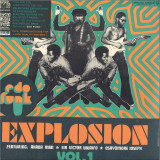
Analog Africa Presents Edo Funk Explosion Vol. 1, available on
2xLP/Gatefold LP with 20-page booklet / CD with 36-page booklet. It was
in Benin City, in the heart of Nigeria, that a new hybrid of intoxicating
highlife music known as Edo Funk was born.
It first emerged in the late 1970s when a group of musicians began to experiment with different ways of integrating elements from their native Edo culture
and fusing them with new sound effects coming from West Africa s night-clubs.
Unlike the rather polished 1980 s Nigerian disco productions coming out of the
international metropolis of Lagos Edo Funk was raw and reduced to its bare
minimum.
Someone was needed to channel this energy into a distinctive sound and Sir
Victor Uwaifo appeared like a mad professor with his Joromi studio. Uwaifo
took the skeletal structure of Edo music and relentless began fusing them with
synthesizers, electric guitars and 80 s effect racks which resulted in some of the
most outstanding Edo recordings ever made. An explosive spiced up brew with
an odd psychedelic note known as Edo Funk.
That’s the sound you’ll be discovering in the first volume of the Edo Funk Explosion series which focusses on the genre’s greatest originators; Osayomore
Joseph, Akaba Man, and Sir Victor Uwaifo: Osayomore Joseph was one of the
first musicians to bring the sound of the flute into the horn-dominated world
of highlife, and his skills as a performer made him a fixture on the Lagos scene.
When he returned to settle in Benin City in the mid 1970s - at the invitation of
the royal family - he devoted himself to the modernisation and electrification
of Edo music, using funk and Afro-beat as the building blocks for songs that
weren’t afraid to call out government corruption or confront the dark legacy of
Nigeria’s colonial past.
Akaba Man was the philosopher king of Edo funk. Less overtly political than Osayomore Joseph and less psychedelic than Victor Uwaifo, he found the perfect
medium for his message in the trance-like grooves of Edo funk. With pulsating
rhythms awash in cosmic synth-fields and lyrics that express a deep personal
vision, he found great success at the dawn of the 1980s as one of Benin City’s
most persuasive ambassadors of funky highlife.
Victor Uwaifo was already a star in Nigeria when he built the legendary Joromi
studios in his hometown of Benin City in 1978. Using his unique guitar style as
the mediating force between West-African highlife and the traditional rhythms
and melodies of Edo music, he had scored several hits in the early seventies,
but once he had his own sixteen-track facility he was able to pursue his obsession with the synesthetic possibilities of pure sound, adding squelchy synths,
swirling organs and studio effects to hypnotic basslines and raw grooves. Between his own records and his production for other musicians, he quickly established himself as the godfather of Edo funk.
What unites these diverse musicians is their ability to strip funk down to its
primal essence and use it as the foundation for their own excursions inward to
the heart of Edo culture and outward to the furthest limits of sonic alchemy.
The twelve tracks on Edo Funk Explosion Volume 1 pulse with raw inspiration,
mixing highlife horns, driving rhythms, day-glo keyboards and tripped-out guitars into a funk experience unlike any other.
Snapped Ankles return to the forest, but it's not as they left it. Trees planted in neat rows. A well-ordered monoculture with access roads and heavy machinery. The smell of greenwashed money in the air. There's no sign of the ancient woodland they emerged from on debut album, Come Play The Trees. And it's far cry from the gentrified East London they found themselves hawking on Stunning Luxury. All is not well in the face of progress. Welcome to the Forest Of Your Problems. Even among the famously close-knit woodwose community there are factions forming. Meet The Business Imp, The Cornucopian, The Nemophile and The Protester. Each with their own motivations and belief systems. Their own sense of injustice: contradictions, anxieties and guilt. There are woodwose who have risen to the top in the boom and bust world of real estate and hedge funds. Grab what you can before the next crash. Others find euphoria in the absolute conviction that wealth and technology will see us through this. There are those with their recycling in order, who are well-versed in the prospect of imminent ecological and economic collapse, burying themselves in vegan cookery and extensive international holiday itineraries. And there's an increasing number angry at the state of the world, ready to take to the streets and the trees in an attempt to force real change. Forest Of Your Problems runs the gamut of modern woodwose emotions. In this neat human approximation of the forest, it's an increasingly knotted affair. Despite all of this, Snapped Ankles haven't lost their innate ability to make you want to move your feet - their Teutonic forest rhythms are still shot through with post-punk lightning. Whether they're exploring those opportunities which might arise when a Nigerian prince emails out of the blue on 'The Evidence', or referencing the crooked woodwose attempting to go straight on 'Rhythm Is Our Business', this is music to lose your inhibitions to. The moments of pure elation on 'Shifting Basslines Of The Cornucopians' are worth the admission price alone - "It's a great time to be alive!" ...apparently. Snapped Ankles outsider status has always allowed them to hold a mirror up to society. Now the boundaries are not so clear. In the four years since Come Play The Trees was released, their cult has flourished. Previous album Stunning Luxury saw the band invited to play the BBC 6 Music Festival and a KEXP session on the back of a sold-out UK tour which culminated with two nights at Village Underground in London. As those who have witnessed the shamanic ritual of their live shows will attest, they are a truly unique, communal experience. Forest Of Your Problems will see the woodwose bring their ancient forest rhythms and high-wire, multi-media live act to ever bigger stages - including Camden's iconic Roundhouse in October.
Following the 70s Peruvian cumbia compilation by Ranil last year, Analog Africa returns to Latin America to highlight the work of one of Perú’s undisputed masters of the electric guitar: Manzanita. This 13th release in the Limited Dance Edition Series includes 14 mostly instrumental compositions of electrifying Peruvian cumbia and guaracha. Manzanita's unique guitar lines rest on confident foundations that shifts gears effortlessly. Limited Edition LP in Gatefold Cover pressed on 180g high quality virgin vinyl
"I was in Lima, hanging out with collector-extraordinaire Victor Zela, who had spent the previous few years pouring his passion for Peruvian Cumbia into the blog „la cumbia de mis viejos“, a trove of incredible music. But after the birth of his first child, his priorities shifted and he decided to part with some of his rarest LPs. I was one of the lucky few given an early chance to examine his treasures, and when I picked up the album Manzaneando com Manzanita, Victor said: “Take it! its one of the best LPs ever recorded in Perú … easily in the top five”. That was all the encouragement I needed … two years later many of the songs from that masterpiece have made it onto Manzanita y su Conjunto, a compilation of electrifying Cumbia sides from Manzanita’s golden era.
Berardo Hernández – better known as Manzanita – first surfaced during the psychedelic Cumbia craze. At the head of the scene were the magnificent Los Destellos, whose leader, Enrique Delgado, was such a six-string wizard that other guitarists found it impossible to escape his shadow. But when Manzanita arrived, his electric criollo style sent shockwaves through Lima’s music scene and posed a serious threat to Delgado’s dominance as king of the Peruvian guitar.
Manzanita had come to Lima from the coastal city of Trujillo, five hundred miles up the coast – a place where Spanish, African and indigenous populations had been living and making music together for centuries – and came of age at a time when the first wave of psychedelic rock from the US and UK was starting to sweep the airwaves. But the sounds of Cream and Hendrix disappeared from the radio just as quickly in 1968 when Juan Velasco seized control of the country in a military coup. The new regime, which favoured local traditions over cultural ‘imports’ from the north, was a blessing in disguise for the Peruvian music scene.
Record labels flourished as new bands, raised on a hybrid diet of electric guitars and Cuban rhythms, rushed in to fill the vacuum created by the lack of imported rock. A new genre, known as Peruvian cumbia, was born and Manzanita quickly became one of its most original voices.
Starting in 1969, Manzanita y su Conjunto released a steady stream of singles that used Cuban guaracha rhythms as the foundation for dazzling electric guitar lines. After countless 45s and several years on the touring circuit, the band signed to Virrey, an important Peruvian label, and recorded two LPs acknowledged as masterpieces among aficionados of tropical music. Most of the songs on Analog Africa’s new compilation Manzanita y su Conjunto are drawn from those legendary sessions of 1973 and 74.
Although he scored a few more hits in the later 70s, his dissatisfaction with the music industry caused him to withdraw from the scene for several years; and when he finally retired for good, the golden age of Peruvian cumbia was a distant memory. But when Manzanita was at the top of his game he had few equals. Victor Zela was right: this is some of the best music ever recorded in Perú."
DJ Sotofett and LNS have teamed up with Tresor Records for Sputters. The double-vinyl album with 15 cuts spans a hybrid of warped electro and psychedelic hypnosis, all the while remaining fixed in an unmistakable dance release. Recorded between 2017 – 2020, and bookmarked throughout by intros and interludes dug out from archival material, it's a deconstructed yet classic compound of techno-sonics.
LNS from Calgary, Canada, is rooted in braindance, electro and acid. Releasing 12inches on both her self-titled imprint LNS and Sotofett’s Wania - LNS, whilst in the studio, has often pointed out “the lacking blend of dub and electro in dance music”.
DJ Sotofett, hailing from Moss, Norway, is among a myriad of things commonly known for the extended work of his Sex Tags Mania and Wania labels, without forgetting his afro, dub and jazz releases on Honest Jon's London.
Together both artists give space to a guest appearance by E-GZR, a fellow Wania artist, to open the Sputters journey. The sinus bending drum stutter of K.O. by E-GZR collisions flanging basses and chronic-inducing synth pads to blueprint the technoid atmosphere to come. LNS & DJ Sotofett take control with El Dubbing, evoking an effect-heavy demeanour, typical of the Sex Tags Mania soundworld that DJ Sotofett is responsible for, this time rubbing up against solid electrified rhythms. The hypnotic moods carry over to Dúnn Dubbing's deep delays, freely running over a surprisingly minimal skeleton retaining a solid direction. Crafting a warmly emotive end of Side-A with sparse rhythms to perfection.
A meaner turn introduces Side-B. Hints of electro are scattered everywhere, fat basslines, ricocheting drums and synths that mourn and drift in and out of harmony. Vitri-Oil exposes a tumbling sound design, fog-lit chords of material fragility and nosedives - with an alive mix that wallows and grows in equal measures. The side closes with Shim, a classic drift between house and techno releasing sensual euphoria with the albums first big surprise – grand strings.
“LNS wanted to sell her TR-606, while my reply was for us to make a track with the 606 sounding so fresh that she'd never even think about selling it again” Sotofett states. Side-C proves the artists to be some of the most singular producers around with album centrepiece The 606. Clocking in over 10 minutes, it kicks off as a driving techno banger, chugging bass and big chords. Midway through everything falls away, and out of the void enter scattered drums and improv piano lines emerge, while twisted dubs lead us back in an enduringly warm groove.
Side-D sets the clock back to the original electroid foundation of the album, casting fires with alien vibrations. Synchronic Bass Blort is a hard-hitting electro track, steaming sonics and thrills, its melodic hook diving in subterranean motions. On Sputtering the duo raspily beams into outer space, with fizzy motives that disfigure and dazzle while the harmonies of the closing track is for yourself to experience.
DJ Sotofett and LNS deliver an album inhabiting a world full of sci-fi sonics and fierce groove. Their sound is free and live, simultaneously wondrous and sharp.
Clear Vinyl
DDS catch enduringly absorbing sonic alchemist Jim O’Rourke at his knottiest and most ingenious in a wormholing suite of amorphous rhythm and psychedelic electronics - a massive RIYL Autechre, Roland Kayn, Bernard Parmegiani, NYZ, Keith Fullerton Whitman.
Playing up to and into DDS’ freeform aesthetics, O’Rourke renders 40 minutes shearing hyaline synth tones and ruptured rhythm generated at his Steamroom facilities in Tokyo, a modular outzone trawling that harks back to his iconic Mego releases and some of the more recent Steamroom experiments. It’s an ideal addition to the ever expanding DDS cosmos, following Demdike’s recent ‘Drum Machine’ expo with a slice of purist and screwed modular magick that transcends early
electronics and modern styles in pursuit of musical sensations that defy stylistic brackets.
‘Too Compliment’ was assembled using a bespoke Hordijk modular system, a rare West Coast-style setup hand made by Dutch engineer Rob Hordijk. O’Rourke focuses on the frequency shifter here, using it to coax out fluxing tone thickets, haphazard frequencies and elongated drone corridors.
It’s transportive stuff, harking back to the early days of private press academic synth music but also sitting on edge alongside Autechre’s recent long-form work, as well as O’Rourke’s classic “I’m Happy, And I’m Singing, And A 1, 2, 3, 4” In O’Rourke’s hands, the mass of electronics takes on throbbing, organic dimensions, congealing
grey matter and purplish veins of fluid in viscous transitions that glisten and spark with invention as they form new tissue. What comes out is as unearthly as the earliest electronic music, but also
blessed with a psychedelc spirit in a way that’s long kept O’Rourke right out on his own, teetering between paradigms yet never settling into any single style. If you’ve always been keen on finding a way into that sprawling soundworld, ‘Too Compliment’ is a perfect entry point into a highly rewarding creative macrocosm.
- A1: Conjunto Típico Corazón De La Selva - Alegría En La Selva (02:47)
- A2: Los Pihuichos De La Selva - La Carachama Coqueta (02:46)
- A3: Los Pihuichos De La Selva - Chupizinatay Yacui (02:37)
- A4: Los Pihuichos De La Selva - Shamuy Pacarina (02:32)
- A5: Los Pihuichos De La Selva - El Montañés (02:41)
- A6: Los Pihuichos De La Selva - El Huancahui (02:38)
- A7: Los Pihuichos De La Selva - Flautero De La Montaña (02:31)
- A8: Los Pihuichos De La Selva - El Jornalero (02:30)
- B1: Los Pihuichos De La Selva - La Danza Del Trapichero (02:32)
- B2: Conjunto Típico Corazón De La Selva - Picaflor Loretano (02:31)
- B3: Conjunto Típico Corazón De La Selva - Ushpagallo (02:56)
- B4: Conjunto Típico Corazón De La Selva - Punchacacho Tutacacho (02:50)
- B5: Los Pihuichos De La Selva - De Dónde Vienes Loretano (02:31)
- B6: Conjunto Típico Corazón De La Selva - Bailando En La Selva (02:52)
- B7: Los Pihuichos De La Selva - La Huayranguita (02:34)
Andrés Vargas Pinedo is a prominent composer of Amazonian popular music from Peru. He is blind and has excelled as a player of the quena and the violin. He was born in the city of Yurimaguas but he developed as an artist in Lima, for thirty years he has worked as a traveling musician on a street in the San Isidro district of Lima. Throughout his career, he has formed and joined various popular music groups. This compilation presents fifteen songs of his authorship, belonging to his first two groups: Conjunto típico Corazón de la Selva and Los Pihuichos de la selva, active between 1965 and 1974, and which helped define the sound of Amazonian popular music.
These years saw the emergence of an Amazonian popular music movement led by Vargas Pinedo as well as groups such as Los Solteritos, Flor del Oriente or Selva Alegre. These artists based their music on the rhythms of the Amazonian folklore (pandilla, sitaracuy, movido, cajada, chimayche) and were nourished by influences from the coast and the highlands of Peru, as well as by the tropical rhythms of Brazil, Colombia and Ecuador, achieving a musical synthesis that is an invitation to collective celebration and endless dance. A sound that is defined by a constant and hypnotic rhythmic base of kick and snare drums, upon which the quena and violin develop imaginative melodic lines. Sometimes there is a singing voice, sometimes the voices playfully appear as sounds that identify Amazonian popular speech or that emulate jungle animals.
The fifteen tracks gathered in 'El fabuloso sonido de Andrés Vargas Pinedo: Una colección de música popular amazónica' (1966-1974) / 'The fabulous sound of Andrés Vargas Pinedo: A collection of Amazonian popular music' (1966-1974) are a good introduction to the work of an essential creator of Peruvian music, whose sound expresses the spirit of the Amazonian people and summarizes the transition from tradition to the popular in the context of the emergence of a record industry of Amazonian music. Andrés Vargas constitutes a fundamental basis for the music of the Amazon, as his work synthesizes diverse influences, having that original root as its main motive.
This compilation is presented in vinyl format and includes a brochure with extensive information and photos. The audio has been remastered directly from the original tapes. Edition of 300 copies. Art by Jordy García (Blumoo Posters).
Blue Vinyl
Lynch protégé and Twin Peaks sound designer Dean Hurley coaxes an incredible puzzlebox of atmospheres and mood pieces on this killer contribution to our Documenting Sound series, now remastered and pressed on vinyl for what is, perhaps unsurprisingly, the most cinematic and neon-lit instalment in the series. Like a
smudged and overdubbed copy of the BoC Maxima tape, with added iridescence.
Across almost 40 minutes we transition from aerosolised synths to romantic chromatics, thru to Nurse WIth Wound-style severed rhythms and fading glimmers of hope, ‘Concrete Feather’ epitomises Dean Hurley’s prized knack for nuanced instrumental story-telling in the finest and most engrossing style we could imagine. Against the backdrop of the Hollywood film industry that has primed us for as long as we can all remember, the music spans a panorama of lush, mirage-like choral pads and starry flickers thru to gloaming
nightmare sequences and screwed drums, while touching on some of the dankest synth tones this side of his ‘Anthology Resource’ volumes or indeed his soundtrack work for Twin Peaks: The Return. It’s full of dread and a slowly unfolding sense of tragedy.
“Having a regular practice of recording is probably the single most important element to my craft. It’s a way of dropping indiscriminate mile markers while constantly moving forward in time without ability to pause.
Over the years, working for David Lynch taught me a great deal about this and the concept and importance of experimentation. I’ve found myself clinging to those lessons during this time and using them as tools for both productivity and balance. His notion of experimentation is a simple one, yet incredibly profound. It was one of the very first words I heard him say during our initial meeting, and I never stopped hearing the term daily over the subsequent 13 years working together. An ‘experiment’ can provide a legitimate mental back-entrance into the act of creation. It can position an approach toward discovery as opposed to effort, and eliminate the thought that one needs to ‘will’ something into existence. It also aids in calming the judgmental
side of a brain from stepping on/interfering with expression…after all, experiments are not about success or failure, they’re simply about learning. In the Lynch school of thought, multiple experiments then become firewood…and with firewood, one can not only build but actually sustain a fire…even turn it into a multipleacre blaze or more.
Dean Hurley
Following the release of Limewax's Untitled and Speed Dealer Moms' SDM-LA8-441-114-211, Trickfinger and Aura T-09's Evar Records imprint is keeping its foot on the gas, officially introducing the arrival of its sub-label, RAVE4EVAR. Embracing more of an outlaw mindset, RAVE4EVAR was created as a place for rebellion to collide with rave, offering refuge for off-the-cuff releases, special projects and occasional one-off collaborations.
Ushering in the sub-label's inaugural release, RAVE4EVAR is proud to present Chicago-based DJ, producer and new media artist S4M23's debut EP, Angelface. The five-track project, set to arrive on July 2nd via a limited edition cassette and digital download, combines haunting vocals with pounding kicks and rave synths to create a moving take on hardcore. Written and recorded during a weeklong session in April 2020, the creation of Angelface took place during a period of processing grave personal loss juxtaposed with the collective state of chaos, grief and fear brought on by the covid-19 pandemic.
Within that specific period of time, S4M23 channeled intense emotion to reflect how cathartic it can be to honor the connections we build with one another despite how frenetic and heart-wrenching the circumstances of a particular moment or experience can be. Pouring an immense spectrum of emotions into Angelface, these productions eschew simple repetition to create unexpectedly complex rhythms and textures that evoke the sounds of British club music and '90s rave, while simultaneously creating something entirely new.
- A1: Funkadelic - Can You Get To That
- A2: Ohio Players - Funky Worm
- A3: Lafayette Afro Rock Band - Darkest Light
- A4: Lonnie Liston Smith & The Cosmic Echoes - A Chance For
- A5: All The People Feat Robert Moore - Cramp Your Style
- A6: Taana Gardner - Work That Body
- A7: Bobby Byrd - Back From The Dead
- A8: Betty Wright - Clean Up Woman
- A9: Little Beaver - Funkadelic Sound
- A10: Timmy Thomas - Are You Crazy???
- A11: Black Ivory - I Keep Asking You Questions
- B1: T-Connection - Do What You Wanna Do
- B2: Ike Turner & The Kings Of Rhythm - Funky Mule
- B3: The Fatback Band - Yum, Yum (Gimme Some)
- B4: The Blowflys - Funky In The Hole
- B5: Uncle Louie Feat Walter Murphy - I Like Funky Music
- B6: Blowfly - Nobody's Butt But Yours, Babe
- B7: Margie Lomax - God's Greatest Gift To Man Is A Woman
- B8: Queen Yahna - Ain't It Time
- B9: Marva Whitney With Osaka Monaurail - I Am What I Am (Pa
- B10: Joy Fleming - Fieber (Fever)
Before their debut album "Stürmer", originally out in 1982 and reissued by a-Musik, there were two 7" by Freiwillige Selbstkontrolle. Both the eponymous 4-track EP (1980) by Justin Hoffmann, Thomas Meinecke, Michaela Melián and Thomas Meinecke and the 7-track EP "Teilnehmende Beobachtung" from 1981 were released on Alfred Hilsberg's legendary Zickzack Platten.
With "Moderne Welt" and the literally endless "Deutschland, Deutschland", the rare "Freiwillige Selbstkontrolle" single contains two of the most brilliant tracks ever recorded in the Federal Republic of Germany. "Teilnehmende Beobachtung" was produced by Wirtschaftswunder's Tom Dokoupil and established F.S.K.'s status as one of the most singular (and back in those days controversial) phenomena in the history of (west-)german postpunk/pop/underground history.
The LP reissue of these two 7"s comes with printed innversleeve and a 8 pp. booklet with extensive linernotes (in german) by Tim Klütz.
crystal blue vinyl
South London based producer Lxury is a subtle experimentalist, pairing house rhythms with eclectic genre blending and risk-taking. Returning to Shall Not Fade's Lost Palms series for a second record, Smart Digital Life EP shows the maturity and complexity of his production while keeping the energy light and summery.
"1722" opens things up with dreamlike pitched vocals that provide a vaporwave feel, hypnotizing over stuttering synths and a wonky beat. "Spin" has an experimental sound palette, a euphoric pulse and a sweet melody, dance music doused in honey.
This sweetness spills over onto the B side; "Pad Ma" sounds like a pumping club track meets a trip to the fairground - unstoppably buoyant and headsy. The vocals in "When I Wake Up" spin around your head before a muscular beat kicks in, the most stripped back and raw sounding of the record. This one is certain to get heads down and feet moving. "Up High" is an expansive closing track, built around fuzzy drums as the clever use of vocal samples creates a melody with a loved-up feeling; it's a tour-de-force of Lxury's delicate production skills.
Classic Alligator title on vinyl for the first time in over 25 years!
“Extra wicked...hellfire slide guitar...will have you barking for joy.”
- ROLLING STONE
“When I die, they’ll say ‘He couldn’t play shit, but he sure made it sound good.”
- HOUND DOG TAYLOR
Vinyl reissue pressing of the second album by Hound Dog Taylor and his ragged
but right HouseRockers.
Features all-time fan favorites like Sadie, Take Five, Roll Your Moneymaker and
See Me In The Evening. All tracks remastered for this reissue. Download card
included.
Ad in Blues & Rhythm
- A1: Megalobox
- A2: Megalobox (Sorrow)
- A3: Megalobox (Acoustic)
- A4: Megalobox (Emotional)
- A5: Beginning Of The Fight
- A6: Battlefield
- A7: The Theme Of Gansaku Nanbu
- A8: The Theme Of Gansaku Nanbu (Sorrow)
- A9: The Theme Of Gansaku Nanbu (Slow)
- A10: The Theme Of Gansaku Nanbu (Playful)
- B1: A Day In The Life
- B2: The Theme Of Sachio
- B3: The Theme Of Sachio (Sorrow)
- B4: The Slum City (Feat Coma-Chi)
- B5: The Slum
- B6: The Slum (Night)
- B7: The Theme Of Bangaichi
- B8: The Theme Of Bangaichi (Celebration)
- B9: Get Up
- C1: The Theme Of Yukiko Shirato
- C2: The Theme Of Yukiko Shirato (Slow)
- C3: The Theme Of Yukiko Shirato (Fanfare)
- C4: The Theme Of Fujimaki
- C5: The Theme Of Aragaki
- C8: The Theme Of Mikio Shirato
- C9: The Theme Of Mikio Shirato (Slow)
- C10: Lost In Grief (Deep)
- D1: The Theme Of Yuri
- D2: Resolution
- D3: Gearless Joe (Feat Coma-Chi)
- D4: Megalonia News Network
- D5: Enter The Arena
- D6: The Theme Of Glen Burroughs
- D7: The Theme Of Pepe Iglesias
- D8: We Are Bangaichi (Feat Sachio)
- D9: The Beast (Feat Coma-Chi)
- D10: Celebration
- D11: The Ending
- C6: The Theme Of Aragaki (Piano Version)
- C7: Heartwarming
This is the very first original soundtrack of our new Japanese Anime Collection!
MEGALOBOX is the tribute animation to the legendary Ashita no Joe, produced by TMS Entertainment and broadcasted worldwide since 2018 with a dazzling success.
MEGALOBOX Original Soundtrack is produced by mabanua (Manabu Yamaguchi) and features several renowned artists such as DJ TAKU, KOMA-CHI or Michael Kaneko. It was acclaimed by the critics for its unforgettable rhythm and melodies, inspired by a broad variety of genres such as hip hop, black music and rap.
This soundtrack is now entirely remastered for the sumptuous vinyl format!
The Megalobox Vinyl Edition features:
- The illustrated gatefold with Joe and Yuri
- 2xLP black color, housed in two illustrated sleeves
- A 12-page booklet with comments from the composer and the team (Yo Moriyama, Keiichirô Miyoshi) and the English translated lyrics from the songs
'The inventive record producer and vocalist Lee 'Scratch' Perry was involved in every musical shift of note in his native Jamaica, from the rhythm and blues that pre-dated the arrival of ska in the early 1960s through the slower and more spacious rocksteady style that appeared middecade and, of course, the frenetic sound of reggae, which he helped to birth as an independent producer during the late 1960s. Operating as 'The Upsetter' from his base in a downtown Kingston record shop, Perry found his greatest success with instrumental music during this phase, the organ and saxophone re-castings of standard vocal issues proving exceptionally popular overseas.
'Scratch The Upsetter Again surfaced early in 1970 as a largely instrumental set, but with dreamy reverb a hefty feature and keyboards veering away from standard organ motifs. Dave Barker, who was soon to hit the pop charts as part of Dave & Ansel Collins, tackles The Shirelles' 'Will You Still Love Me' in soul reggae mode, only for Perry to shift things towards the emerging dub spectrum with 'Take One.'
'As Perry inched ever closer to the dub experimentation he would turn into an art form at his own Black Ark studio later in the decade, Scratch The Upsetter Again shows him moving away from the standard approaches of his competitors in his quest to test the very limits of recorded sound. And reggae was all the richer for it.'
—David Katz (excerpt from the liner notes)
Re-mastering by: Ray Staff at Air Mastering, Lyndhurst Hall, London
Morgan was one of the most active artists in the Los Angeles underground jazz scene, and a member of the late great Horace Tapscott‘s artist collective Union of God’s Musicians and Artists Ascension (UGMAA). He performed alongside Tapscott, and other Nimbus recording artists like Jesse Sharps, who he introduced to Tapscott. He also performed with Arthur Blythe, Gary Bartz, Azar Lawrence, as well as soul icons Willie Hutch (notably on the Foxy Brown soundtrack) and Rufus & Chaka Khan. Most recently he contributed to Carlos Niño’s 2016 album Flutes, Echoes, It’s All Happening!, and was a part of Niño and vocalist Dwight Trible’s soul-jazz group Build An Ark (which also featured Tribe’s Phil Ranelin).
Journey Into Nigritia was Morgan’s debut as a leader, and the first of three recordings he released for Nimbus West. The album has a strong post-Coltrane spiritual feel, with some modal-based melodies, and some fiery solos from saxophonist Dadisi Komolafe. The record also features a solid rhythm section featuring bassist Jeff Littleton and drummer Fritz Wise.
Review by T J Gorton
At the dawn of the Reagan years, LA jazz pianist Nate Morgan recorded his first album for Nimbus West. Journey Into Nigritia portrays an artist marked by the icons of his day, and striving for reinvention. Although he came from a solid jazz background, coming up through the Pan Afrikan People's Arkestra, Morgan found more exciting work with pop bands in the seventies, including glory years with Rufus w/Chaka Khan. On Journey into Nigritia, Morgan re-embraces jazz. Included in the band are Jeff Littleton on bass, Fritz Wise on drums, and Dadisi Komolafe on alto sax.
The collection opens with the Trane-ish Mrafu. Komolafe blasts off in short order, and while the modal chording recalls Tyner, Morgan shows flashes of the nimble loquacious gift that define him. While Alice Coltrane incense perfumes "Morning Prayer, Morgan's devotional sincerity and personnel expression triumph.
Suitably complex with yearning minors, Mother features the trio performing a memorable composition. Littleton's deep-note sustain contrasts Wise's shimmering cymbals, while Morgan tells heart-wrenching truth. With a somewhat solemn theme, He Left Us a Song regularly bursts through into straight-ahead fast break sprints up and down the court. The unexpected "Study in C.T. offers an homage to Cecil Taylor and Morgan's musical roots with free improvisations on a dense and spiky theme. The exhilarating result has Morgan exploring his own way, with a winking slinging of jagged bass chords halfway through.
While a quarter century's experience has nurtured Morgan's prodigious gifts beyond this ambitious debut, Journey Into Nigritia offers enjoyable insights into his artistic evolution, while adding another precious title to the discography of one of the most woefully under-recorded greats of our time.
Re-mastering by: Cicely Baston at Alchemy/Air Mastering, London
Electric blues guitarist Melvin Taylor had been sporadically recording solo albums for 20 years when Dirty Pool arrived — and was somehow just beginning to find fame. Already a hit in Europe, it had taken a steady run of performing in Chicago’s famed blues clubs to slowly earn Taylor a well-deserved reputation as an equal talent among the giants before him, such as Otis Rush, Albert King and Stevie Ray Vaughan.
While early records like Melvin Taylor Plays the Blues For You show off an equally amazing jazz side, Taylor traded away his Wes Montgomery-inspired runs for more Luther Allison/Jimi Hendrix attacks with the formation of the trio Melvin Taylor and the Slack Band in the mid ’90’s.
The title song of the second album by that outfit, “Dirty Pool,” is actually more the balls-to-the-wall, no-compromise, hard-rockin’ electric Texas blues of Vaughan and Johnny Winter than the sweet Chicago soul of Buddy Guy.
Indeed, three tracks on this 1997 release, including “Dirty Pool,” were SRV tunes. Other standards, like “Kansas City” and “Floodin’ in California” also have more of a Lone Star State approach to them. But the Jackson, Miss.-born Taylor’s guitar is cleaner than his forebears and technically, he even surpasses them, yet the anger and sorrow of the blues is readily evident in his playing.
This rare combination of qualities really comes out in a slow blues tune like his solo in “Dirty Pool,” which after repeated listens, still makes me head shake in disbelief when I hear it.
“Too Sorry” is a good example of how well Taylor fares when he treads in Jimi Hendrix territory, whereas his rhythm work is the best I’ve heard from a lead guitarist since Vaughan; listen to “I Ain’t Superstitious,” “Born Under A Bad Sign” and the funky “Telephone Song” for your proof.
It also helps that Taylor’s drummer James Knowles is well in synch with him, while Ethan Farmer completely owns the low end of the sound. Farmer’s peppering bass lines in and “Floodin’ in California” is the textbook way electric blues bass should be. Overall, a tight little band.
Taylor’s vocals certainly won’t draw any comparisons to the Wide-Brimmed–Hatted One but he holds his own just fine until it’s cuttin’ time. This is right at the top of my list of best blues guitar playing on record over the last couple of decades. If you decide to give this one a listen, prepare to be blown away.
678 records are proud to present an historical concert recording of the legendary ethnic kraut-jazz formation Pork Pie. It is difficult to define the music of Pork Pie. It ranges from rhythmic Jazz-rock and meditative Indian sounds to Brazilian songs, and from acoustic improvisations to electric “space” sounds. Paris, December 1973: Pork Pie was founded by piano player Jasper van 't Hof (then 27 years old) and guitarist Philip Catherine (then 31 years old). They had met up with Charlie Mariano, who was 51 years old then, and whom they knew from his playing with Charles Mingus in the fifties and sixties. He had left America, lived in India for some years and founded his new home in Europe. Jasper and Philip were nervous to ask him if he would like to start a band with them but he immediately accepted the invitation. After some concerts in Holland, Germany and France the group recorded their debut album Transitory in May 1974 in the studio of the legendary engineer Conny Plank for MPS-BASF. It became an immediate success and Pork Pie were subsequently booked for many European jazz festivals. Their legendary concert on the first of November 1974 in the Berliner Philharmonie during the Berliner Jazztage was a milestone in the bands existence. The concert hall was packed to the rafters with 2500 over enthusiastic people who were totally overwhelmed by the amazing live sound of Pork Pie in which each of the five individual musicians took his own part, but never once lost the unique togetherness.
In the past 44 years Jasper van 't Hof always retained fond memories about this special concert. Fortunately, in his personal archive (which was for a while stored under a tarpaulin in his garden!) a master tape was discovered & had survived intact. P-Dog & Zembie (a.k.a. Sander Huibers & Frank Jochemsen) dug it up, played it on a tape machine, were totally blown away by the music and initiated this limited vinyl only release. It comes in a hand silkscreened cover designed by Piet Schreuders.
line up
Repress! This is the first full length release from The Sure Fire Soul Ensemble. The Sure Fire Soul Ensemble - If you are a fan of the organ, gritty Funk, and beautiful original soundtracks, these guys are for you. The SFSE is a heavy, original, instrumental soul band based out of San Diego, CA that released their debut self titled album on Colemine Records in June of 2015, and the band will be releasing their sophomore album in the fall of 2016 on the same label. The Sure Fire Soul Ensemble has recently shared the stage with Lee Fields and the Expressions, Big Sam's Funky Nation, Kung Fu, Polyrhythmics, New Mastersounds, Monophonics, Kamasi Washington, and many others. They draw influence from the masters of the style from the past and modern day, including: The Meters, Isaac Hayes, El Michels Affair, Mulatu Astatke, Budos Band, The Nite Liters, Menahan Street Band, Fela Kuti, and The Poets of Rhythm.
Re-mastering by: Ray Staff at Air Mastering, Lyndhurst Hall, London
Owning both this disc and Live at Slugs', Volume 1 is essential for hardcore Jazz fans. Part two of the Slugs' date is just as impressive and again feature three originals all penned by the group. Here we get a better example of Tolliver's compositional work with the touching Coltrane tribute Our Second Father. Again Tolliver's trumpet is simply stunning. The rhythm section of Cecil McBee and Jimmy Hopps also deserve mention as these two really drive the quartet along in a similar fashion to Garrison and Jones did with Coltrane. The McBee original Wilpan's also highlights the strength of McBee's writing and is probably the pick of the tunes here.
Tony Scott (born Anthony Joseph Sciacca June 17, 1921 – March 28, 2007) was an American jazz clarinetist and arranger with an interest in folk music around the world. For most of his career he was held in high esteem in new-age music circles because of his involvement in music linked to Asian cultures and to meditation. Tony performed with many star as Billie Holiday, Sarah Vaughan and Harry Belafonte and before moving to Italy in the early ‘70’s he just cut two sought after masterpiece moving forward from his early idea of bop and cool jazz. In particular ‘Djanger Bali’ (1967 Saba) - recorded with The Indonesian All Stars - and the self titled Tony Scott (1968 Verve) - featuring Richard Davis on bass, John Berberian on oud and Attila Zoller on guitar – set the pace for a revolution in terms. This set recorded in Africa around the mid 90’s is a pure rhythm festival pushing the boundaries of his afro fusion agenda
Nervous Horizon is happy to present 'Sogno EP', the new project by label co-owner Guglielmo Barzacchini, aka TSVI. Embarking on a journey inside the mind's most deep and intricate illusions and hallucinations, 'Sogno EP' is an exploration into various different types of dream states and altered states of consciousness. Characterised by intricate rhythms, slower beats inspired by techno, dancehall and little to no melodies, the record features Italian ASMR and spoken word to enhance the hazy and hypnotic mood permeating throughout. Taking a close look at his own states of unconsciousness and channelling them into his musical creation, TSVI dives into the abstract and eerie worlds of the subconscious with a project inspired by surreal dreamscapes, trance states and the concept of shadow work, in which each track explores a different aspect of the depth of the human psyche.
A modal masterpiece from 1959, Kind of Blue is a true classic that never gets old, no matter how many times you listen to it. Bill Evans’ understated piano is the perfect foil for Miles’ melodies, contrasted by the soaring alto sax of Cannonball Adderley; Jimmy Cobb and Paul Chambers keep the rhythm section steady but unobtrusive, allowing Miles and Cannonball to shine. ‘So What’ and ‘Freddie Freeloader’ are seductive, deceptive gems, imparting all the frustration, begrudging and joy as only a great jazz record can; ‘Blue In Green’ and ‘All Blue’ have melancholy hues and ‘Flamenco Sketches’ a precursor to Sketches Of Spain. Every household should have at least one copy of Kind Of Blue, one of the greatest records ever made.
Shifted offers the latest distillation of his trademark sound.
Following on from the recent release of “The Dirt On Our Hands” – Guy Brewer’s fourth studio album and the first to arrive on his own Avian imprint, “Constant Blue Light” – another full length, explores new avenues in caustic minimalism.
Eschewing the booming effervescence of his own more plosive dance floor material – Shifted takes a no less nuanced, but decidedly more introspective angle on this new LP. At the centre of Brewer’s practice as an artist, there has always been a sense of dedication to the refinement of a singular idea. In some ways “Constant Blue Light” represents a move closer to the apex of this approach.
Opener “Slowly Counting Backwards” creates the framework for the record – reduced and meditative, owing somewhat to previous work, but still crisper and more precise. “Natural Elevation” riffs on airy patches that hiss and bend while “The Weight of It” transmits an unsettling hysteria with flanging leads and untethered rhythmic components. On the B side, the ominous dirge of “Soft Palate” brings a kind of uncanny energy to proceedings before “Into Your Ocean” utilises exquisite FM tones to create a captivating sonic montage. “Several Instances” hinges on dense low end and scattering white noise, before giving way to the machinations of “Clotting Time”. Closing piece “This I Know” offers a stunning, crystalline finish to the LP – upping the ante in its final minutes before giving way to a hiss of delay trails.
A continued exploration from a focused and diligent artist that provides yet another fully formed and beautifully articulated component to his own discography and that of the Avian label.
Apparel Wax is back with the 9th gem of its catalogue, a stunning six track EP out worldwide on the 7th of June 2021. The vinyl faced hero always wants to grow, therefore is on a constant quest for the evolution of its music and this record proves it once again being it a superb array of assorted sounds. A1 kicks it off in style with its Chicagoan touch taking over after a smooth intro: the mellow pad chords laying down the foundation of the arrangement, the soft strings and the melodious piano notes make it a perfect start. A2 opens with a steady kick and a silky bassline murmuring throughout the whole track while some more keys create a Deep dynamic beat. To end side A here's A3 with its far-out, spacey atmosphere and its Deep chords backed by an energetic rhythm section. Side B of our vinyl is about class: B1 is a nothing short of chic with its sampled vocals and its elegant pads. B2 is more Deep with its evolving piano melody, its balanced and groovy drums and some masterly crafted tiny vocal samples. B3 wraps up the record with a Jungle beat sprinkled with Jazz, R&B and Soul. APLWAX009 is a tenacious and cohesive work, yet disseminated by inspirational and diverse sounds which will be Wax's touch forevermore. A perfect EP to start the warmest season with the hope of being able to enjoy the outdoors without restrictions.
Kryptox records was born to show what's happening in the new scene in germany. And David Nesselhauf is the next upcoming artist. Kryptox will release his 6 track EP.?Nesselhauf is a multi-talented artists: bass player, composer, bandleader and man of very original ideas. He was already featured on the Kryptox' Kraut Jazz Futurism compilation vol 1 (2019) and now delivers his first solo EP for the label.
This EP is a follow up in a longer musical evolution that the Hamburg born talent has been making over the past years. A journey that's basically a style he is building that he calls afro-kraut. Before joining Kryptox he already released 2 albums under the Afrokraut title on his own (Bandcamp) before meeting Mathias Modica (head of Kryptox) and they decided to work together.
So on the "Rituals EP“ Nesselhauf salutes his personal pantheon of musical gods once again, leading the listener through his musical Jungle encompassing Krautrock, Downbeat, Drone, Electronica, Afrobeat, Lo-Fi, Shoegaze, Funk and Ambient textures in the blink of an eye.?The 6 new tracks share a common feel, but are colorful individuals at the same time. Some more organic, others with electronic elements.
About Nesselhaufs workflow: Four of these composition are based on quick, playful, raw jams recorded live within hours by a group of Nesselhauf's inner circle musicians. Great grooves played by a heavy rhythm section that he uses also for his live gigs. Just on a few songs Nesselhauf exchanged the human musicians with a legendary Vermona Drum Synthesizer as the main rhythm ingredient.
Guests: One more track was recorded with Julian Gutjahr, Drummer for The Drawbars. Some tracks feature guest appearances by Dennis Rux (he also mixed the EP) and Graeme Currie on guitar. Soulamadou made his way to one of the tracks just by incidentally leaving a very groovy voice message on David ´s phone ("Zeit").
The material was later bewitched into deep, organic swirls: Trippy, psychedelic somnambulistical. The rather mystical, nocturnal reworking process of the recording added even more dimension and depth, leaving the 6 Tracks ready for home listen, but also for an open minded dancefloor and an otherworldly listening experience at the same time.
The next generations of jazz are just waking up. And Davd Nesselhauf and his bunch are one of these new interesting phenomena. Working in the underground since few years, now hopefully there will be more spotlight on these great new innovators.
- A1: Preaching To The Choir
- A2: Stronger (Feat Jswiss)
- A3: Superstrada
- A4: Concrete Stardust
- A5: Where Do We Go From Here (Feat Lee Fields)
- A6: Macumba
- B1: Take On The World (Feat Gizelle Smith)
- B2: Return To Space (Feat Peter Thomas)
- B3: Golden Shadow
- B4: Today
- B5: Here We Go (Feat Mocambo Kidz)
- B6: Bounce That Ass (Feat Ice-T &Amp; Charlie Funk)
Limited edition gold vinyl edition.
Hamburg's funk adventurers at the top of their game with special guests Ice-T, Charlie Funk, Peter Thomas, Gizelle Smith, Lee Fields, JSwiss & the Mocambo Kidz.
Original press release note (2019):
Carrying blistering funk lines in their fingers and worldly influences in their hearts, the unique and distinctive Mocambo sound is not one to be confused with retro bands trying to recapture an era. Eschewing traditional recording methods, this DIY crew are committed to driving forwards, and 2066 sees them at the height of their powers, broadcasting a call for unity.
After reaching new audiences worldwide and earning critical praise for their two long players on Brooklyn's Big Crown Records in their tropical guise as Bacao Rhythm & Steel Band, the band have reassembled and refocused in their original form, the workhorses behind dozens of 45s on the Mocambo label and beyond. Crossing generations, this album introduces some of the world's youngest funk talent to step up and rub shoulders with soul and rap legends, soul sisters, an elder statesman composer/arranger and a brand new emerging artist out of New York.
As with all Mocambo releases, the two sides of the record have been meticulously sequenced by the
band. Side A welcomes us aboard with joyous instrumental stomper Preaching To The Choir, and a call to build bridges from Mocambo chanteuse and percussionist Nichola Richards, duetting with emerging rap talent, New York MC JSwiss. B-girls and b-boys are called to the dancefloor as Superstrada and Concrete Stardust commence, all buzzing synth lines and relentless drums. New Jersey legend and Big Crown associate Mr Lee Fields is guest of honour for Where Do We Go From Here before a horn workout brings us to a close with Macumba. It's time for a breather.
The B side kicks off with the grand return of the Golden Girl of Funk, Gizelle Smith, a sister who's been busy taking on the world. Composer and presenter Peter Thomas narrates a Return To Space to mark the centenary of the debut of his score to sci-fi show Space Patrol, which first broadcast in 1966. We're back down to Earth and the mean streets for the furious drums and car chase workout of Golden Shadow. Today slows down the pace for a reflective ballad with Nichola front and centre - and here's the next generation: the Mocambo Kidz sing along to their parents' instrumentation for Here We Go, a new kids' block party anthem... with no sleep 'til bedtime. The album closer makes it clear that the Mocambos are nowhere near powering down as Ice T and Charlie F unk bring their A-game for an old school attack which, since you're up bouncing anyway, gives you no excuse not to flip the LP and drop the needle right back on to Side A. Onwards!
A summation of their journey so far and a celebration in anticipation of what's to come, the album is set
to take its place in a legacy of open minded, organically recorded music, showering listeners with the crew's maze of tantalising sounds pulled from funk, afro, hip hop with cinematic composition and storytelling.
Something wicked this way comes. Following singles 'Know The Future' b/w 'Digital Warfare' in 2019 and 'Hypersocial' b/w 'Safety Test' in 2020, ESP’s own Patrick Conway has now teamed up with the illustrious Appleblim (of Skull Disco and Apple Pips fame) for a meaty self-titled debut 2xLP under the new collaborative moniker, Trinity Carbon. There is something to be said for art created in the face of global unraveling, while mass transgression and the friction of culture shifting produce poignant commentary, but more often than not, it’s the personal coping mechanisms within our work that have the power to speak directly to the receiver. After a number of sessions resulting in wild imaginative beginnings, it was the untimely passing of Andrew Weatherall and a coming to terms with that loss that moved the two Brits-via-Berlin to herd their roaming sketches into a more narrative statement. In the uphill struggle to retain some sense of individualism, it’s always outsiders like Weatherall whose risks illuminate the roads of creativity less traveled, and when those beacons go dark there is a disorientation felt far and wide. Conway and Blim concede to the internal inquiry, “What would Weatherall do?” bringing to mind the man’s pervading morale, always soldiering onward through mediocrity, as it was undoubtedly an impetus for the duo growing steadfast and chiseling 'Trinity Carbon' into completion. While employing trusted machines in the bass department, they established a warm euphonic home base from which they could stray in a variety of tonal and rhythmic directions without straining a tether to the album’s core. However, as soon as any hint of familiarity may arise, or listeners begin to mentally assign stylistic epithets, the duo boldly change course to remind us that while the banal stay safely defined, it’s the iconoclasts, the outsiders who make us feel.
Parisian label Chuwanaga proudly presents Latitude, Saint-James label co-founder new studio project. Keeping it close to the deep jazz-funk ethos of the label, Latitude brings to the light two luminous songs of joy and hope for a better day, highly danceable yet rich and complex grooves with a human feel to feed your soul and make you move. Their new EP Leo / Attitude presents these first effort with a Dub Remix by Mato: plenty of diverse tastes for every music enthusiasts. Available as Vinyl 12" and Digital.
Latitude is french. Not a random collection of chansons sung in french. Latitude is so french in its sheer elegance, in its simple yet so sophisticated seemingly effortless attempt to groove in a pop context, trying to create moments of grace in the process. Latitude is here with the right vibe as the chorus of "Attitude" says it in french: "It’s the bad attitude, always the good latitude". Latitude is sprung out of the wicked musicianship of Parisian jazz-funk and fusion mavericks and Saint-James tight and adventurous compositions and production. All that jazz combined with David Cukier (Greita) retro-futurist engineering skills in these intense sessions captured in his cutting edge vintage Delta studio.
On A Side, "Leo (Extended Mix)" is an uptempo disco track for the dancers but also a beautiful song for the summer. A seductive number with a pregnant classic French jazz-funk feeling with the help of Parisian singer Club Celest’s energy and beautiful voice. It comes on digital as a short edit for radio but as a serious extended 12inch mix on the vinyl with 8 minutes and 10 seconds of pure pleasure, ending in a real climax after an irresistible percussion break.
On B1, "Attitude" enchanting quality shines with a banging rhythm section and goes for the win as an anthem chorus while sweeping synths keep on growing till the very last drop. On B2, Reggae/Dub don Mato (Stix Records) delivers a sweet dub wise riddim for the Lovers Rock massive.
- A1: Never (A Perpetual Transhumanist Curse)
- A2: Demons (Conditioned Noosphere)
- A3: Necropolitics (Loose Remembrance)
- A4: Alucard And Alive Again (Melancholic Rage)
- B1: Sacrificing Your Heart (It Could Be Bloody Marvellous)
- B2: Crossed Realities (Drained Vectoralisation)
- B3: Demons Ii (Wardrums And Noises Of An Attention Crisis)
- B4: Silent Together (Somewhere Alone)
- B5: Necrorose For The Illdisciplined Void (Dark Euphoria)
- C1: Nicola Kazimir - 9 Eternities In Doom Ep (7Inch) - Midnight Fury (9 Eternities In Doom)
- D1: Nicola Kazimir - 9 Eternities In Doom Ep (7Inch) - Maniac (Resentment Of The Alienated)
In Post-Heretic Dracula X Chronicles II the Dracula figure functions as a part fictive and part autobiographical metaphor. Dracula mirrors certain systematic (therefore also internal) conditionings and attributes in its whole ambivalent fluctuations. This character represents the complex relationships of a loving/living person in a neo-liberal capitalist system while oscillating between melancholia & rage, facing the preservation or loss of his love and standing in an alienated position towards the ruling order. The eleven featured compositions and their respective song names (both of them are riddled with references) playfully touch on conflicts between love, life and system-critique, without being too upfront about the subject-matter.
Nicola Kazimir (*28.05.1990 in Zürich, Schweiz)
A DJ, producer, musician, artist, space-owner, record label owner and party organizer, Nicola Kazimir works freely across platforms and communities. For Kazimir, these numerous positions are not static, and they can actfluidly and reciprocally as a whole, or as separate entities. His artistic and acoustic productions are mostly based on topics that include the institutionalization of techno, copyright, dividualism and the human perception of repetitive rhythm patterns mixed with aesthetic codes of b-movie horror movies or occultism. He is one of the founders and still part of the labels Les Points/ Gentrified Underground / Infoline and the offspace Mikro Zürich. Other projects include a supporting role in the organization of Zentralwäscherei Zürich and being part of the Clubbüro-team at Rote Fabrik.
A sonic clash of Tropical, On-U and Eastern proportions, t-woc drops 6 tracks of dope sound system bashment for Strangelove. Informed by Mick's musical wanderlust and prolific digging, Pentangle deftly blends a mélange of influences where Caribbean steel drum, Anatolian melodies and the sounds of the Maghreb all float through the mix.
Like his work for Macadam Mambo/ Emotional Response- its a sound hard to pin down and all woven into a heady brew percolating somewhere in the dance-floor twilight zone. With early works created pre-lockdown at an artist residency in The Dock in County Leitrim, the heads down groove of 'Crazy Bronco' & 'Goddy' don't sound out of place with an early 90's Uk bass culture. Elsewhere the deeper cuts rub against a little sunshine as the late night swing of Midnight Magic riffs off Junior Delgado's roots classic.
With killer artwork c/o Marius Houschyar Strangelove is super stoked to release this collection of outernational rhythms from the Irish vinyl wallah, mix engineer and producer
Vital Sales Points:
Follow up to the labels previous exotic waves of Scribble & Sjunne Ferger,
- A1: Good Times
- A2: Fabulous Ping Pong
- A3: Jean Sefunk
- A4: Nvr
- A5: My Left Foot
- A6: The Bump
- A7: Jam On It
- A8: Lookout Rhythm
- A9: Play That Sing
- A10: Torrid Drums
- A11: Got That Boing
- B1: The New Beat
- B2: The People Groove
- B3: Say You
- B4: Lost It
- B5: Bread & Jam
- B6: Larry Lenore
- B7: Party Party
- B8: High
- B9: Wellness & Bad
- B10: You Can't Hide Your Love
- B11: Plays Higher
- B12: We Are The Freaks
For his third full-length album, Jacques Renault explores his craft through the format of the classic late-night radio megamix. It's a tour de force that finds him blending his quick-cutting DJ sensibilities with his crate-digging, drum-chopping disco-chemist bonafides into one wham-bam party of pastiche. This is Renault as we know him—but at hyperspeed, tearing through twenty- three tracks in under half an hour. And while it's a head rush of his trademark funky drums, sassy horns, playful synths, it's arranged as an album, with songwriting and structure at the fore. Imagine it as a flip on the script for Renault's most loved club 12-inches of the past, which luxuriate in long-form, stretched-out grooves that burn for hours, fills that ride for days. Instead of on pulling a thread for six, seven minutes, he romps around in a bouncy ball pit, plucking out whatever captures his imagination for a moment, then diving back in to discover another buried
nugget. It's Jacques Renault as we've always known him, but this time through a suite of bite-size vignettes instead of slow-burn grooves.
- A1: The Benefits Of The Fake Commute
- A2: Parasitic Future
- A3: Work Permits And The Isolation Of Equipment
- A4: A Case For Co-Operation Between Humans And Machines
- B1: Maintenance Tips For Heavy Equipment
- B2: Work After Machinery
- B3: Avoiding Cross-Contamination In Your Food Business
- B4: Does The Next Industrial Revolution Spell The End Of Manufacturing Jobs?
Alleged Witches debut album breaks down centuries of human labour into an eight-part instruction manual for company best practice, stock control and tips for the optimum commute. The final break from nature, it's Pagan funeral marches, insect rhythms and doomed ambience for one last trip up the river. Artwork from Bill Connors.
The 3rd volume of Eiger Drums Propaganda’s magnificent epic journey, a musical saga that continues to keep us travelling in the early ages of Neo-Trance, Tribal-Kraut, dream frequencies and modern Dance music. For The Orb, Magma/Gong ‘s aficionados. Double album for double pleasure.
Take a ride down to São Paulo, Brazil for a remarkable one-off recording session between Colombia's Romperayo and Brazilian producer / musician DJ Tudo. Featuring the latter's suitably titled house band, Sua Gente de Todo Lugar (the People From Everywhere) as well as the wild boys of Romperayo, including band leader and drummer mastermind Pedro Ojeda. The music captured at this meeting is a truly unique combinati..
Black vinyl repress of Pub's classic 12" 'Summer'
Ampoule's Pub returns with a fresh remaster of the classic 'Summer' and a brand new track titled 'The Fragile Root'
'Summer' was originally released 20 years ago on the Vertical Form label - a result of a multitude of completely live and improvised studio sessions, that gently swell and evolve over the tracks 16 minutes.
'Fragile Root' is a brand new track, think vintage idm - intricate rhythms and melodies crossed with massive dub chords.
Mastered by Dubplates & Mastering
Breakthrough release for young South African artist Mbulelo. The EP contains 4 fresh cuts merging techno with African coded rhythms. The title track Robotic People is a banger.
Finnish producer Sasu Ripatti has been torching the fringes of electronic music since the mid 1990s, a process that's found him melting a wide spectrum of musical innovation into his cult brand of experimental minimalism. From the skeletal jazz deconstructions of his 1997 Vladislav Delay debut "The Kind of Blue EP" to the blurred dub techno variations of 2000's "Multila" and 2012's "Kuopio", Ripatti has betrayed a restless, voracious passion for sound. "Fun is Not A Straight Line" builds on this impressive legacy, retaining his sonic signature and adding a playfulness that harks back to his beloved deep house smash, Luomo's "Vocalcity". After becoming frustrated by the inflexibility of the 4/4 house idiom, Ripatti found solace in rap and bass music's rhythmic complexity and anarchic structures. "I bought Nas's 'Illmatic' when it came out in '94 and have more or less been listening to rap since," he explains. "I'm not really sure why now, but that rap influence wanted to come through." Chopped rap vocals, booming subs and gritty, neck-snapping beats are the primary colors of "Fun is Not A Straight Line", painted into the foreground and blended into an immediately recognizable rhythmic palette. The tracks cross into the same continuum as Chicago footwork, with stuttering samples that build thick walls of bass and flurries of wordless rhymes amid a narcotic haze of beats. On 'monolith', Ripatti's love of New York rap is in full focus as he obscures chipmunked vocals with tight, crackling percussion that disintegrates into rolling kicks; 'speedmemories' is even more upfront, channeling the raw sunshine energy of So So Def electro into rhythms that are powerfully skeletal. Elsewhere, syrupy Southern-fried TR-808 bass womps are tangled with molasses-slow vocals on 'videophonekitty', fuzzed into textured, dissociated ambience. Since the beginning, Ripatti has tried to find a balance between his experimental urges and drive to create more universal music. As his more recent albums have traveled into darker, more extreme realms, he has craved something different for balance. By drawing a crooked line between DJ Premier, DJ Screw and DJ Rashad, Sasu Ripatti has emerged with the most accessible and unashamedly enjoyable album he's produced in years.
Los Angeles-based singer, songwriter, and producer Tilian releases his brand-new full-length album, Factory Reset, via Rise Records:
Earlier this week, he shared his latest single “Caught in the Carousel” along with a new visualizer. They psychedelic visual emulates the introspective and thought-provoking lyrics of the song, “Am I good enough?”
Factory Reset is both highly personal and wholly universal. Tilian began writing the album just a few weeks after the pandemic forced California into lockdown. “I was searching for meaning in isolation and found it in creating this album,” Tilian shares about the process. He decided to write, record, and produce the album himself, eventually remotely bringing in drummer/frequent collaborator Kris Crummett to help button it up.
Having full creative control allowed Tilian to experiment more than ever, and truly be himself in the process. “I wanted to make the album that I want to hear. ‘What would be my favorite band?’ as opposed to, ‘What is everyone’s favorite band?’” This resulted in his most thrillingly eclectic work to date: a falsetto-laced brand of alt-pop that spans everything from trippy psychedelia and heavy prog riffs to warped hip-hop beats and dembow grooves.
Recently, Tilian released two other singles from the album – “Anthem” and “Dose.” These were first offerings since the release of his 2018 album The Skeptic, which debuted on the Billboard charts at #1 Alternative New Artist, #2 Top New Artists, and #5 Alternative. To date, the project has garnered over 40M global streams and two music videos with over 1M views each, proving the excitement and potential for the burgeoning alt-pop artist. More recently, he collaborated with Marigolds+Monsters and Travis Barker on the exciting single “Falling out of Rhythm.”
Imperium Droop brings two mavericks of sweeping exploration together into new avenues of musical expression. Kid Millions and Jan St. Werner explore a liminal space between improvisation and composition, a fluid yet defined sound-space, founded on the unique chemistry of their friendship and pushing into the future. Kid Millions stands as one of the most sought after drummers and improvisers in NYC, known for his work as the drummer for Oneida, his expansive solo work as Man Forever, as well as collaborations and performances with the likes of Laurie Anderson, Philip Glass, Royal Trux, Boredoms, White Hills, and Spiritualized. Regardless of who he's working with Kid Millions radically redefines the drums as an instrument. Jan St. Werner has consistently remained at the vanguard of electronic music. In his work as one half of the visionary duo Mouse On Mars, as well as his acclaimed solo work both as a composer and sound artist, and in collaborations with The Fall's Mark E Smith, Oval's Markus Popp, Stereolab, and The National St. Werner constantly pushes the limits of recorded sound. Together, Millions and Werner have crafted a monument of unpredictable beauty built on breathless forays into the unknown. Werner's application of a seemingly infinite arsenal of textures unleashes colorful swaths of energy. Mats Gustaffson joins Werner on the maximalist "Color Bagpipes," unleashing torrents of swiveling melody and breathy clicks over the exponential thunder of Millions' drum kit. Pieces like "Dark Tetrad" and "Astral Stare" demonstrate the duo's mastery of space and surprise. Dark flutters flow in slow pulses across "Apotropaic" where erratic swirls of sound twist and mutate on "Sorrows and Compensations," unified as a single force by the overwhelming diversity of sounds. Millions' drums effortlessly rides each wave of Werner's prismatic deluges and channels their energy into dynamic movements. Through his singular prowess, Millions' tireless rhythms and subtle gestures mirror Werner's boundless textural palette and drive each piece towards transcendence. On Imperium Droop, Kid Millions and Jan St. Werner have combined their powers into an incomparable work of gripping and intrepid sonic fluctuations.
Rico started his career in the late 1950’s playing with the likes of Prince Buster, Laurel Aitken and Max Romeo as a session musician in addition to creating his own recordings. He moved to the UK in the early 60’s and continued performing live and playing as a session musician. He signed to Island Records in the 70’s, releasing his first solo albums.
In 1979 Rico met Jerry Dammers and began playing with The Specials. He became an honorary member of the band and featured prominently on some of their most famous tracks, along with Dick Cuthell, which produced a distinctive sound. In 1980 he released his first album for the 2 Tone label, That Man is Forward.
Jama Rico was the second album released on 2 Tone Records in 1982. This album felt like a celebration of Jamaican musicians - Jama Rico was an altogether different beast. This was a more resolute statement, more African in its rhythms and a hidden treasure within the 2 Tone label.
This time the recording sessions were split between Joe Gibbs studio in Jamaica and sessions at London’s Town House Studios. The Jamaican sessions again were produced by Dick Cuthell and comprised of musician friends Sly Dunbar, Robbie Shakespeare, Headley Bennett, and Ansel Collins. The London sessions, produced by Dick and Jerry Dammers, featured Specials John Bradbury and Horace Panter, along with Tony Utah and Satch Dixon.
This new remaster, originally released in May 1982, is a part of the ongoing 2 Tone ‘40th Anniversary’ releases.
The package is a 3mm Spined Sleeve, 180gm Heavyweight Black Vinyl, printed inner and bellyband.
Tape
Tekanan is the full-length debut of Melbourne-based Indonesian-Australian drummer and sound artist, Rama Parwata. A thorough exploration of rhythmic capabilities and percussive improvisation under ever-shifting timbral and stylistic environments, Tekanan is Parwata’s examination and documentation of his vast musical influences in electro-acoustic improvisation, Indonesian gamelan music, free jazz, electronic music, R&B, and noise music, whilst still maintaining an entirely unique non-idiomatic musical voice. Tekanan sees Parwata experimenting with not only the drum kit, but additionally implementing no-input mixing boards, musique-concréte sampling techniques, junk percussion, electric guitar, and computer music production to create a relentlessly metamorphosing soundscape that abruptly, yet seamlessly oscillates between ethereal ambiances to turbulent barrages of rhythm and noise through five unique movements.
Aptly named after the Indonesian word for pressure and stress, Tekanan was composed by Parwata with the intent of it being a listening experience which would pressure the listener to have no clear indication of the direction of the music and where it will ultimately settle, leading the listener on a sinuous, yet intriguing aural journey. This title additionally applies to the pressure of the challenging nature of the music, in a performative sense, which pushed Parwata to his physical and mental limits to perform and compose.
“As cliche or banal this might sound, I tried to make a record that was purposely made to be hard to put into a box. I didn’t want to make a “drumming” record or a noise record or anything of the type, but a record that just contained "good” music (or what I constitute as being good). Many aspects of my musical life were injected into this release: gamelan music (the first music I was exposed to), noise, hip-hop, free-improvisation, Xenakis, jazz, electronic music. Ultimately this record is a homage to those musical influences.” - Rama Parwata
-
An active figure in Australia’s experimental music and art scenes, Parwata has worked with the likes of Marco Fusinato, Robin Fox, and Robbie Avenaim, and choreographers Stephanie Lake, Juliet Burnett, and Melanie Lane. He is also a member of seminal long-running Melbourne Doom Metal band, Whitehorse.
As of 2019, Parwata has been a co-curator and committee member of Melbourne’s legendary concert series, Make It Up Club, which has been presenting weekly avant-garde improvised performances since 1998.
The Chilean/French duet are known for their hypnotic music which incorporates eerie sounds generated by raw and mineral materials (metal, rocks etc) to create tracks that are in turn hyper-rhythmic and dreamy, poised between postpunk rock and electronic dance music. The band have also been very active in the field of multimedia & performance arts, and Xpujil explores that other dimension of their talent. Released on Crammed's revered MADE TO MEASURE series (which is dedicated to experimental, minimal & ambient music), Xpujil consists of a single 40-minute track, which draws the listener into an aural, immersive experience. Based on sounds recorded by Nova Materia during a trip in the Mexican jungle, in Maya territory (Xpujil is the name of an old Mayan city, now lost in the middle of the forest), the album was then produced in the band's Parisian studio, and features contribution by electronic musician/drummer Ikue Mori (of DNA fame) and cellist Gaspar Claus. The album was mixed in binaural, and is best enjoyed on headphones. Nova Materia will be performing Xpujil in appropriate settings (museums, performance arts spaces), with multichannel immersive sound systems. Nova Materia are Caroline Chaspoul and Eduardo Henriquez, formerly with Panico, the alternative rock band they had created in Chile, with which they toured around the globe and released several albums.
- A 1: Sixty Years
- A2: Don't Trust A Woman (In A Black Cadillac)
- A3: When The Bells Don't Chime
- A4: That Someone Just Ain't You
- A5: Rat Pack Boogie
- A6: Drink Whiskey And Shut Up
- B 1: Ring, Ring, Ring
- B2: Smokin' 'N Burnin
- B3: Wild Wind
- B4: St. Jude
- B5: To Be Loved
- B6: When The Bells Don't Chime (Banjo Mix)
- B7: Luck Be A Lady (Single Version)
Surfdog Records and Brian Setzer have announced that for the first time, Setzer’s classic 2003 album Nitro Burnin’ Funny Daddy will be issued on vinyl. It will be released on limited edition 180 gram, red transparent vinyl on 25th June 2021.
Only Brian Setzer could cut an album with more lyrical honesty and musical diversity than anything he's ever done and then title it Nitro Burnin' Funny Daddy. Not that the name is misleading; Nitro is in fact packed with explosive performances. There's more than enough volatile picking and singing to mark this as a highlight of a catalog already crowded with great albums he's delivered as leader of the history-making Stray Cats and on his own too.
But there's more: street-corner doo-wop, heartbreak balladry, a foot-stomp hoedown, several lyrics that will shock and stun longtime fans, and always, somewhere in the mix, the blues. Every track is distinctive, none sounds like any of the others, yet all of them are pure Setzer. And it's all compressed into a tight trio format -- Setzer and his big band colleagues, standup slap-bass powerhouse Johnny Hatton and rhythm dynamo Bernie Dresel on snare and cymbals -- whose sound evokes Les Paul, Junior Parker, and even Earl Scruggs as much as Louis Prima or Eddie Cochran.
Originally released in 2003, Nitro Burnin’ Funny Daddy was Brian Setzer’s eleventh solo album and when it was released he said it was the most personal record he had ever done. The album followed his big-band release Boogie Woogie Christmas from the previous year and saw him back to his rockabilly best, taking in doo-wop (“To Be Loved”), bluegrass (“When The Bells Don’t Chime”), rootsy-rock (“Don’t Trust A Woman (In A Black Cadillac)”) and going on a cinematic Wild-West romp (“Wild Wind”).
Amsterdam producer Kaap steps forward on his own De Lichting imprint with three twisted jams of deep and playful techno. The passionate gearhead, known for his dubby takes on house and techno, started his Working Titles playground back in 2017 by running a niche cassette outlet Yield on the side. In late 2018 he merged into the prolific De Lichting collective and is a frequent guest on Indigo Aera's AEX series. After many years of hard work, Kaap's new solo EP is surfacing, and it's worth the wait. Over the course of three tracks, Kaap shows high levels of creativity. The first track 'Razor' is a bouncy bass wobbler, its rubbery acid lines and crispy percussion make it an ideal party starter. Title track 'Omen' reaches for deeper grounds, a deep and murky groover enlightened by tactical bleepy rhythms. Kaap's love for dub-techno triumphs on the lengthy b-side as a closer on this EP. With over ten minutes of hazy atmospheres and mesmerizing pads, it builds and builds towards the rolling fields of euphoria.
Originally released digitally in August 2020 and supported by DJ Stingray, Martin Gore (Depeche Mode), Manni Dee, Rommek and Tapefeed, OBSCUUR is thrilled to present the vinyl issue of Catartsis & Ōtone's split EP "Mechanical Gesture". Catartsis and Ōtone explore, both in their collaborative and respective work, a wide spectrum of electronic and electroacoustic music with the practices of field recording and attentive listening at the core of their creative process. Inspired by musique concrete and electroacoustic sonic manipulations, they combine and alter sounds from the real, from their surroundings and from found (mainly metallic) objects. Stemming from this approach, they engage in rhythmical and textural research to elaborate a - peculiar, acousmatic and almost tangible - percussive and club-oriented music. With "Mechanical Gesture" Catartsis & Ōtone bring us an EP that is the very definition of the word "groove" while investigating rhythms and timbres from various mechanical apparatuses. Press, slice and carve your way through this assortment, it's guaranteed to get you moving.
LTD Edition!
Die Grammy-nominierte Band Hiatus Kaiyote veröffentlichen ihr neues Album auf Brainfeeder! Knapp 6 Jahre nach "Choose Your Weapon" (2015) erscheint endlich das brandneue Studioalbum!
Die zweifach Grammy-nominierte Band besteht aus Naomi „Nai Palm“ Saalfield (Gitarre, Gesang), Paul Bender (Bass), Simon Mavin (Keyboards) und Perrin Moss (Schlagzeug). Das neue Album ist der Nachfolger ihres 2015er Albums, „Choose Your Weapon“, das der Rolling Stone als „atemberaubenden Schritt nach oben“ beschrieb und sie von Glastonbury bis zum Fuji Rock führte, vom Roots Picnic bis zur ausverkauften Sydney Opera. Das neue Projekt konnte endlich entstehen, nachdem die Band auf Songs von The Carters (Beyoncé & Jay-Z), Kendrick Lamar, Anderson .Paak, Chance The Rapper oder Drake gesampelt wurde - mit dem Nai Palm aber auch auf seinem Album, „Scorpion“, zusammenarbeitete. Das Ergebnis ist ein Album, das sich, untermalt von Verocais Streichern, in einem Groove entspannt: sonnenbeschienen, erhaben, meisterhaft. Hinter allem steckt Hiatus' gewohnter Sinn für musikalische Abenteuer, ihre Gabe, das Komplexe einfach klingen zu lassen, oder, in ihren eigenen Worten: „Wondercore“. Simons Experiment mit einem ungeraden Rhythmus, der in 5er-Gruppen gepackt ist, wird zu einem kaskadenartigen Jam namens „Rose Water“. Benders und Simons Austausch einzelner Noten, hin und her, um eine Melodie zu bilden, wird zu „All The Words We Don't Say“. Nais frecher Kommentar auf sexbesessene, dreiminütige Pop-Hits wird zu „Chivalry Is Not Dead“, einem Song über die bizarren Paarungsrituale von Leopardenschnecken (sie leuchten fluoreszierend) und Seepferdchen (sie verschränken ihre Schwänze und tanzen). Das Album endet mit dem zarten „Blood And Marrow“, einer Bender-Bassline, zu der Nai und Perrin improvisierten, und die Simon als seinen Lieblingssong anpreist: „Es ist ein klassischer Hiatus-Studio-Song, der eine schöne Erkundung ist und ein Geheimnis bereithält.“
Die Grammy-nominierte Band Hiatus Kaiyote veröffentlichen ihr neues Album auf Brainfeeder! Knapp 6 Jahre nach "Choose Your Weapon" (2015) erscheint endlich das brandneue Studioalbum!
Die zweifach Grammy-nominierte Band besteht aus Naomi „Nai Palm“ Saalfield (Gitarre, Gesang), Paul Bender (Bass), Simon Mavin (Keyboards) und Perrin Moss (Schlagzeug). Das neue Album ist der Nachfolger ihres 2015er Albums, „Choose Your Weapon“, das der Rolling Stone als „atemberaubenden Schritt nach oben“ beschrieb und sie von Glastonbury bis zum Fuji Rock führte, vom Roots Picnic bis zur ausverkauften Sydney Opera. Das neue Projekt konnte endlich entstehen, nachdem die Band auf Songs von The Carters (Beyoncé & Jay-Z), Kendrick Lamar, Anderson .Paak, Chance The Rapper oder Drake gesampelt wurde - mit dem Nai Palm aber auch auf seinem Album, „Scorpion“, zusammenarbeitete. Das Ergebnis ist ein Album, das sich, untermalt von Verocais Streichern, in einem Groove entspannt: sonnenbeschienen, erhaben, meisterhaft. Hinter allem steckt Hiatus' gewohnter Sinn für musikalische Abenteuer, ihre Gabe, das Komplexe einfach klingen zu lassen, oder, in ihren eigenen Worten: „Wondercore“. Simons Experiment mit einem ungeraden Rhythmus, der in 5er-Gruppen gepackt ist, wird zu einem kaskadenartigen Jam namens „Rose Water“. Benders und Simons Austausch einzelner Noten, hin und her, um eine Melodie zu bilden, wird zu „All The Words We Don't Say“. Nais frecher Kommentar auf sexbesessene, dreiminütige Pop-Hits wird zu „Chivalry Is Not Dead“, einem Song über die bizarren Paarungsrituale von Leopardenschnecken (sie leuchten fluoreszierend) und Seepferdchen (sie verschränken ihre Schwänze und tanzen). Das Album endet mit dem zarten „Blood And Marrow“, einer Bender-Bassline, zu der Nai und Perrin improvisierten, und die Simon als seinen Lieblingssong anpreist: „Es ist ein klassischer Hiatus-Studio-Song, der eine schöne Erkundung ist und ein Geheimnis bereithält.“
Coloured Vinyl[20,80 €]
White/Blue Splatter Vinyl[25,42 €]
White/Blue Splatter Vinyl[20,59 €]
Blues And The Abstract Truth is Oliver Nelson’s triumph. Featuring his all-time classic ‘Stolen Moments’, Nelson assembled one of the most potent modern jazz sextets ever. Lead trumpeter Freddie Hubbard is at his peak of performance, while alto saxophonists Nelson and Eric Dolphy (Nelson doubling on tenor) team to form an unlikely union that was simmered to perfection. Bill Evans (piano), Paul Chambers (bass) and Roy Haynes (drums) can do no wrong as a rhythm section. Verve’s Acoustic Sounds Series features transfers from analog tapes and remastered 180-gram vinyl in deluxe gatefold packaging.
Black Vinyl[44,50 €]
White/Blue Splatter Vinyl[25,42 €]
White/Blue Splatter Vinyl[20,59 €]
Blues And The Abstract Truth is Oliver Nelson’s triumph. Featuring his all-time classic ‘Stolen Moments’, Nelson assembled one of the most potent modern jazz sextets ever. Lead trumpeter Freddie Hubbard is at his peak of performance, while alto saxophonists Nelson and Eric Dolphy (Nelson doubling on tenor) team to form an unlikely union that was simmered to perfection. Bill Evans (piano), Paul Chambers (bass) and Roy Haynes (drums) can do no wrong as a rhythm section. Verve’s Acoustic Sounds Series features transfers from analog tapes and remastered 180-gram vinyl in deluxe gatefold packaging.
In the beginning, there was just a box of tapes and “Fate’s Gentle Hand.”
It was the autumn of 2010, and an anonymous figure known only as the Head Technician, an employee of Pye Corner Audio Transcription Services (“Magnetically aligning ferrous particles since 1970”), found himself at an auction in the village of Coldred, pop. 110. He was on the hunt for tobacco pipes when he chanced across a trio of boxes listed in the auction catalog, which described their contents only as “archived magnetic recordings.” The sole bidder, he won the lot, and upon receipt of his purchase took possession of an unspecified number of mouldering cassettes and ¼" reel-to-reel tapes. The collection contained no identifying information save for a single phrase scrawled on each box: “Black Mill Sessions.” And so, armed with razors, eyedroppers, and a bevy of solid-state circuitry, the Head Technician sat down at his machines and got to work.
Whether anyone believed it or not, this was the framing device surrounding Pye Corner Audio’s Black Mill Tapes Volume I: Avant Shards, which took the mysterious tactics of artists like Boards of Canada and Burial and raised them exponentially. Much like the narrator of a 19th century novel, the anonymous Head Technician purported merely to be the messenger of secondhand sounds. These were not compositions, we were told; they were tape transfers—“transcriptions” of an unknown author, slathered
- A1: Alton Ellis - It's True
- A2: The Heptones - You Turned Away
- A3: The Gladiators - Mr Sweet
- A4: The Jail Breakers - Work It Up
- A5: Lee Perry & The Gaylads - Run Rudie Run
- B1: The Heptones - Young Generation
- B2: Jackie Mittoo - Good Feeling
- B3: Calvin Marshall - I Need Your Loving
- B4: Alton Ellis - I'll Be Waiting
- C1: The Clarendonians - The Tables Gonna Turn
- C2: Ken Parker - When You're Gone
- C3: Sound Dimension - Traveling Home
- C4: Errol Dunkley - Get Up Now
- D1: John Holt - My Heart Is Gone
- D2: Freedom Singers & Larry Marshall - Monkey Man
- D3: The Ethiopians - Let The Light Shine
- D4: Im & David - Money Maker
- D5: The Viceroys - Lose & Gain
Soul Jazz Records' new Studio One release Rocksteady Got Soul is a collection of uplifting and superb rocksteady and soulful reggae from the late 1960s and early 1970s. Studio One is the number one label in the history of reggae and he album features - as ever with Studio One - an impeccable and unbeatable line-up of reggae superstars, all soaring at the height of their creative powers. Alton Ellis, John Holt, The Heptones, Jackie Mittoo, The Ethiopians, Lee Perry and more. The album is a mix of classic tunes and rhythms alongside super-rarities that were released in a dazzlingly complex web of Studio One labels and issues, deftly navigated with new sleevenotes from author and Studio One authority Rob Chapman. But enough with the chatter, just spin the platter - these tunes rule the town, hands down! This Soul Jazz/Studio One album is released as deluxe gatefold double-vinyl + house inners + download code. Also as jewel case CD housed in card slipcase. Both formats come with full sleeve notes/discography and exclusive photography.
Indie Retail Exclusive Water Spirits color vinyl LP More Energy Fields, Current is a definitive new peak in the recorded continuum of prolific producer/percussionist Carlos Niño. Featuring contributions from more than a dozen exciting voices in the creative music constellation of Los Angeles (of which Niño's has been a central force for over 2 decades), including Sam Gendel, Nate Mercereau, Jamael Dean, and Jamire Williams, the album collects 10 pristine gems of collaborative communication helmed by the Southern Californian sage, elegantly presented in his unique "Spiritual, Improvisational, Space Collage" style. The album is ripe with "ambient" passages that function like open portals between moments of consonance and clarity, and epic post-hip hop opuses like the heavy/heady "Thanking the Earth." But even in the occasional absence of drums, there is a powerful pulse implicit in the program's frequency of consciousness. It's a testament to Niño's foundations as a DJ. His distinct ability to craft a kinetic, cinematic sonic experience from dozens of independent, often rhythmically-ambiguous improvisational memories is more fluently displayed on More Energy Fields, Current than anything we've heard from him to date. It resonates, lucidly, with the way Niño's mentor Iasos - who is known to the world as an original founder of New Age music - has described his work: "Real Time Interactive Imagination, Flow Texturization." On More Energy Fields, Current, Niño immerses us in the watery depths of his world, spiriting us like a submarine through exotic nether-leagues of untouched sound. And when we arrive at the final, bookending piece "Please, Wake Up." (an extended version of the opening theme, featuring saxophonist Shabaka Hutchings), it's like a return, safely to shore.
After more than a decade at the forefront of the global club music scene withseveral celebrated albums and EPs under their belt, Peruvian duo DengueDengue Dengue's seminal 2014 Enchufada EP 'Serpiente Dorada' is still oneof the most impactful of their exciting career. Capturing the vitality of theirearly genre-defining work, where the traditional and hypnotic rhythms ofcumbia were modernised through a collage of electronic music styles,'Serpiente Dorada' is still at the top of their most played music on streamingplatforms to this day, and has motivated their fanbase to continuouslydemand a physical edition since its initial digital release. The wait is finallyover as in 2021, just as the band completed 10 years of activity, we arepressing a beautiful 12'' vinyl edition in black and gold colours, freshlyremastered for vinyl to give this essential release the quality it deserves. 'Serpiente Dorada' remains an absolutely infectious and colourful mixture ofglobal sounds, where genres and styles are used as a starting point on theirongoing hybrid exploration of the interaction between traditional LatinAmerican music and modern electronic music, where the total is much morethan the sum of its parts.
- A1: The Dutch Benglos - Shabi-Bi-Di-Do
- A2: Pat Thomas Kwashibu Area Band - Yamona - Dam Swindle Rmx
- A3: Pupkulies Rebecca - Saude
- A4: La Gran Banda Calena - Que Quieres Que Haga
- B1: Martina Camarguo - Me Robaste El Sueno
- B2: Mackjoss - Mounadji 76
- B3: Voilaaa - Limye-A Ft David Walters Lass Pat Kalla
- B4: Jobby Valente - Mi Moin Mi Ou
- C1: Luis Dias - Liborio
- C2: Bande-Gamboa - Pe Di Bissilon - Dam Swindle Rmx
- C3: Ngalah Oreyo - Aye
- C4: Alcione - Nzambi-Muadiakime
- D1: Ismail Sixu Toure - Utammada
- D2: Pat Kalla Le Super Mojo - Canette - Bosq Rmx
- D3: Aurelio - Nando
- D4: Chucho Pinto - Cumbia De Sal Y Azucar
"Guts finest selection from his DJ sets. Some dancefloor classics and some discoveries"
Any DJ set tells you, unconsciously or not, about its author.
Through the record choices and the way they are organized, one can feel the DJ’s state of mind and find out a bit more about the musical deposit discovered that is being shared and dug through by him or her at the moment.
The appetite for diggin’, the quest for a novelty or a forgotten rarity is what makes a DJ set a true organic living matter constantly fueled although not always, unfortunately, respected.
Time stretching. Too many DJ’s made a pact with this diabolical creature. A true digital steamroller that runs over the rhythm to fix the tempo while leaving behind an agonizing drummer whose sole crime was to have been carried away by his energy and having moved forward the BPM. At the end, everything that gave charm and life to the track, its imperfections and the peculiar fact that it makes you dance faster towards its end… all these along with all the lively movements contained within the track are reduced to nothing.
My conception of music and DJ sets is the exact opposite. Since the first volume of Straight From The Decks, my DJ sets have been redesigned, refreshed and improved. However, there was no preexisting plan, they evolved naturally following my new desires.
The famous core of my indispensable musical choices started to morph little by little into something different without losing sight of its center of gravity which remains undoubtedly afro-tropical.
No matter which track, its style and its origin, the quality of the music that is brought to my ears is always my sole and primary concern.
In this selection, you’ll find 7” vinyl records available to everyone sitting proudly next to some rarities found online and acquired through nerve-raking auctions battles. There are indeed exclusive remixes along with titles that until now were only available in their digital formats. Now for the first time they are available here in vinyl format. Obviously, if you have chosen the CD format, that precision doesn’t really matter…
Sixteen titles which have become the heart of my sets throughout this past year.
A heart which in a year will beat to a certainly different drum…
Pura Vida
Gutsto attend the next one..."
Polifonic Records is the melodic balance between antagonistic vibrations, spirits and energies that inhabit the land of Puglia since the dawn of time.
An harmonic exploration into colorful, vibrant sunrise atmospheres and emotional, introspective sunset sensations. One Body. Many Souls.
PF002 // ‘Sequential Circuit’ EP marks the comeback of Hiver duo. The title track displays the melodic and ethereal sound Hiver have been shaping during the years.
‘Clouds the mind’ follows with a sleazy bass-line alongside hazy pads blending into atmospheric textures.
Giving a great addition to the originals, Adiel contributes with vibrant rhythms and sharp synths.
Marco Shuttle up the tempo on the other side with his clever use of percussive elements and floatings sounds.
Japanese import exclusive!
Cosmic Suite is a long 35 minute jam cut in two pieces, it blends house, techno, jazz, reggae and dub
It's a collaboration with iconic musicians including the legendary Jeff Mills, Osunlade, Mutabaruka, Tanaka Tomoyuki (FPM), Yashiki Gōta and Watusi (Coldfeet), among others.
Written by Yasushi Ide
A.Guitar:Kazuma Fujimoto
E.Guitar:Akihiro
E.Guitar:Masayuki Ishii
Drums Sampling:Gota Yashiki
Drums:Hideo Yamaki
Drums:Yukari Uehara
Rhodes:Nobuyuki Nakajima
Keyboards:Mitsuhiro Toike
Percussion:Hiderow Nishioka
Steel Pan:Gen Tamura
Trumpet:icchie
Sax:Motoharu
Electronics:Jeff Mills Rhythm
Treatment:Tomoyuki Tanaka, Hiroshi Nakamura
Vocal Sampling:Osunlade
Dub Poet Sampling:Mutabaruka
Programming,Keyboards:Watusi
Mixed by Watusi at brickwall
Black Truffle is pleased to announce the first-ever vinyl reissue of Remko Scha’s Guitar Mural 1 featuring The Machines, originally published as a rare cassette edition by Taal Beeld Geluid in 1982. A computational linguist by profession, Scha played an important role in the development of sound, installation, and digital art in the Netherlands from the late 1970s onward, co-founding the performance and exhibition space Het Appolohuis in Eindhoven in 1980. Alongside Paul Panhuysen and Jan Van Riet, Scha was a founding member of the radical improvisation group The Maciunas Ensemble, though he is best known for his work with mechanised electric guitars, documented on the legendary 1982 LP Machine Guitars.
Guitar Mural 1 documents an installation of Scha’s mechanical guitar ensemble The Machines held at a Groningen gallery space in 1982. Five electric guitars hang from the wall, their strings sounded by rotating rubber strings and a sabre saw controlled by a mechanical apparatus, as well as four ropes criss-crossing the five instruments on the wall. Once the mechanism was set up, Scha’s only intervention was to vary the speed at which it operated. Where Machine Guitars presents short excerpts clearly distinguished by rhythmic and timbral variation, here we are confronted with four enormous side-long slabs of percussive string attack and the resulting clouds of harmonics. Variation is minimal across the duration of each side, making for a sculptural listening experience, as if we are patiently examining each facet of a static object. But significant variety exists between the four sides, each of which shows off a different facet of what The Machines were capable of. The first two excerpts feature open strings sounded at rapid tempos, dissolving the percussive attack into a continuous stream of sound reminiscent of Charlemagne Palestine’s ‘strumming’ technique. On the third side, the strings are partly muted and the tempo slightly lowered, resulting in layers of relentlessly chugging rhythm somewhere between an ensemble of hand drums and an early Velvet Underground bootleg. On the fourth side, havoc breaks loose in percussive waves of asynchronous repetition that bring Scha’s sound world close to that of another pioneer experiment in musical mechanisation, the Solar Music of Joe Jones.
Presented as a limited edition 2LP set in a deluxe gatefold sleeve accompanied by stunning visual documentation of the original installation, remastered audio and new liner notes from Alan Licht and Van Lagestein, Guitar Mural 1 is an exhilarating document occupying a unique space between kinetic sculpture, hardcore minimalism and rock & roll.
- 1: Bonjour Klaus - Jeff Özdemir & Daniel Raymond Gahn 03:58
- 2: He's A Woman - Jeff Özdemir With Knarf Rellöm & Dj Patex 03:51
- 3: I Follow My Heartbeat - F.s.blumm & Jeff Özdemir 0:25
- 4: Saatler, Dakikalar Ve Saniyeler Gelip Geçiyor - Jeff Özdemir & Ertan Doğancı 02:29
- 5: Kleistpark - Vackrow 04:22
- 6: Love Letters - Jeff Özdemir & Joanna Gemma Auguri 03:31
- 7 52: Nd Street Und Dann Die Erste Rechts - Jeff Özdemir 05:14
- 8: Campagne (Band Version) - Désolé Léo 04:46
- 9: Disco - Beige Gt 03:40
- 10: Losin' - Jeff Özdemir & Zap 04
- 11: Complètement Perdu - Jeff Özdemir & Alexandre Thiercelin 02:18
- 12: Zu Viele Erinnerungen - Otto Von Bismarck 08:23
- 13: That's Not What Friends Are For - Jeff Özdemir's New Hard Drive 02:58
- 14: Bremerhaven, Das Kann Ich Dir Nicht Antun - Jeff Özdemir 03:26
- 15: The Day - Eng°N Featuring Jeff Özdemir 05:43
- 16: Güneș - Jeff Özdemir & Treetop 01:51
- 17: Bored - Elke Brauweiler & Jeff Özdemir 04
- 18: Die Quelle Von Hermidas - Jeff Özdemir With Elmer Kussiac 02:19
In the past years, the multi-instrumentalist, composer, producer and music enthusiast Jeff Özdemir had been focusing on organising the Live-Mixtape series in Berlin, inviting numerous artists to join him on stage for every single event. However, the year 2020 put an end to this for all the painfully obvious and obviously painful reasons. Undeterred, he instead put together the third instalment of the »Jeff Özdemir & Friends« series, working with singers, musicians and groups such as Knarf Rellöm & DJ Patex, F.S. Blumm, Joanna Gemma Auguri, Elke Brauweiler and Elmer Kussiac for an 18-track … Now, is this a compilation or an artist album? Well, why just either this or that when it can just be both at once? This is »Jeff Özdemir & Friends Vol. 3« after all, emphasis on »&«.
Released on Karaoke Kalk like its two predecessors from the years 2015 and 2017, respectively, »Jeff Özdemir & Friends Vol. 3« sees the man behind Kreuzberg’s 33rpm record store and the 33rpm Records label showcase his qualities as a people remixer, songwriter and versatile musician. He put together a collection of groovy tunes picking up on funk and afrobeat rhythms, introspective ballads, a musically channeled punk attitude, shoegaze sentiments, spoken word passages, drones, glockenspiel sounds, seriously fun experimentation and much more. Just like on the cover artwork - courtesy of Marion Eichmann, Özdemir’s favourite visual artist - everything here seems to discreetly exist for itself while being tightly connected to everything else at same time.
While artists like Ertan Doğancı, Désolé Léo, eng°n, F.S. Blumm and Zap have been long-term collaborators of Özdemir and were featured on previous instalments of the »Jeff Özdemir & Friends« series, new faces and forces also enter the mix. The melancholic »Love Letters« for example marks the first (though hopefully not last) collaboration with singer Joanna Gemm Auguri, while Knarf Rellöm & DJ Patex’s appearance has been dreamt of collectively but hasn’t been fully realised until now.
Whether it’s Désolé Léo’s French crooner soul, the lo-fi synth pop song »Bored« featuring former Commercial Breakup singer Elke Brauweiler or the many different sounds and styles presented under the name Jeff Özdemir: no decision is ever made between either that or this musical direction, but all are being joyfully enjoyed together. Thus, throughout its 70 minutes, the stylistic diversity of »Jeff Özdemir & Friends Vol. 3« does not once border on randomness. Instead, these sometimes very different songs are marked by a shared atmosphere - a direct result of these very different musicians approaching their studio time together less as a chance to make music but more of a chance to carefully listen to and interact with each other.
Just like you’d expect it from someone deeply connected with the local music community who also happens to run a record store, Özdemir is also the kind of person who’ll hand you the worn copy of a record he has just fished out from the bargain bin because he knows about its potential to change your life. The contributions by Vackrow (»Kleistpark«), Gebrüder Teichmann’s old band BeigeGT (»Disco«), and Otto von Bismarck (»Zu viele Erinnerungen«, produced by The Whitest Boy Alive’s Daniel Nentwig) do not even feature Özdemir, but are simply musical pearls that were (almost) lost in the shuffle of music history and unearthed for this very special occasion. That’s just what friends do, don’t they?
Reissued for the first time.
Double vinyl that includes their critically acclaimed and highly sought after debut album ‘Glasshouse’ from 1985 and the 1986 follow up ‘Simplicity’. Presented in a gatefold sleeve adorned with the artwork from the Glasshouse EP, which features in the Prints & Drawings collection at the Victoria & Albert Museum.
With printed inner sleeves and a download code for all 31 tracks on the double CD. Including all tracks from the singles and EP’s plus unreleased recordings
Pressed on colour vinyl. Disc 1 is Purple. Disc 2 is Gold.
Formed in Barnsley in 1981. Party Day, with their bass led rhythms and sharp powerful drums gigged extensively and released their debut single ‘Row The Boat Ashore’ in 1983.
Their brand of Post-Punk Indie Rock with Gothic overtones soon got the attention of DJ John Peel and sold out almost immediately.
The follow up single ‘Spider’ from 1984 again received extensive airplay from John Peel and received rave reviews from the national music press. “Mouthy pellets of malevolence” NME “Excellent punk junk howl” Sounds.
Their self released debut album ‘Glasshouse’ was released in 1985 to glowing reviews and has gained popularity over the years. Now very collectable, it exchanges hands for big money on the second hand market.
The Glasshouse EP followed later in 85 heralding a more commercial approach and widening appeal.
Their second album ‘Simplicity’ was released in 1986
“Proving that they’ve grasped more than an inspirational nettle, the recurrent throb finds their trousers igniting during the quite punctilious rawk of the title track, the urgent prodding of ‘Career’, which reminded me uncomfortably of early Killing Joke and the attractive, though slightly over-wrought black sheep, ‘Glorious Days’, which could have brought a lump to Mario Lanza’s trousers.”
Party Day Split in 1987.
Question everything. Consider your sources. Be wary of ulterior motives, insidious media narratives and even your own unconscious bias. Trust sparingly and try to make smart, informed choices. As the world slides further into ruin, it’s more important than ever to be vigilant and fight back. Luckily, Hacktivist are back to help cut through the noise and bullshit, tooled-up and ready to attack with renewed vigour and reinforced ranks. With Jot Maxi and J. Hurley now sharing the vocal and lyrical load, drummer Rich Hawking and bassist Josh Gurner bringing the beats and rhythms, and guitarist and production don James Hewitt fleshing out the group’s genre-fluid muscle, new album Hyperdialect arrives less like a mission statement and more as a flaming musical Molotov, declaring all-out war. “Hyperdialect isn’t an album for people to just casually listen to,” J insists, “we’ve taken things to the next level, which I didn’t even think was possible. We spit the truth. *We are the truth.*” In 2016, when Hacktivist initially set sights on their enemies with debut album Outside The Box, the world wasn’t fully equipped to heed their warnings and pay attention to its timely rallying cries. They return into a very different one, however – a world that’s sadly now all-too-finely-attuned to the horrors they first forecasted four years ago. “It’s becoming clear that we are on the brink of some type of revolution,” says Jot, with no small dose of conviction or optimism. “Hacktivist are here to bring truth and positivity – the silver lining of a society clouded in poisonous fear. Hacktivist also represents a voice that isn’t afraid of saying what needs to be said. We’re already living in the future. We have the choice to either be shaped by it or to stand up and shape it ourselves. Which path will you take?” It was with those battle lines clearly drawn and ambitions duly set that Hacktivist entered into the creation of Hyperdialect. Starting almost two years ago and developing on the acerbic sonic filth introduced by 2019 singles Reprogram and Dogs Of War, the five-piece felt fired up by their new working dynamic and the collective process involved, with each member actively encouraged to contribute ideas until the best outcome was reached. Unusually, for such a group of bloody-minded insurrectionists, this democratic approach worked wonders – a testament to how much they were all on the same page on these 12 tracks.
Manni Dee returns to Perc Trax for the release of 'A Low Level Love', his second full album following on from 'The Residue' released in 2018 by Berlin techno institution Tresor. Manni opened his Perc Trax account back in 2017 with his 'Throbs Of Discontent' 12" which featured his breakout hit 'London Isn't England' and since then he's become Perc Trax regular releasing his recent 'Everyone's Replaceable Now' 12" plus his 'Gulabi Gang' contribution to first of the 'Forever' various artists series. During this time Manni has gone from a cult UK favourite to being internationally recognised, performing all around the world.
On 'A Low Level Love' Manni expands on both his previous album and his recent run of Perc Trax releases, mixing his trademark club techno rhythms with broken beat and non-dance floor outings. 'No More Heroes' and 'You Don't Always Get What You Want' see Manni at his most melodic and introspective, whilst the storm of kick drums on 'Closer' shows a new intensity and aggression to Manni's music even when compared to the heaviest of his previous releases.
Guest slots and collaborations can often detract from the artistic vision of an album, but Manni chooses his co-conspirators well, with vocalist Sylph adding a human element to album opener 'Persist & Change' and London acid techno legend Chris Liberator providing both vocals and some of the inspiration for club hit in waiting 'London In My System'.
'A Low Level Love' will be released by Perc Trax on 17th June on 2 x 12" vinyl, CD and digital. The album was mastered by Matt Colton at Metropolis, London. The front cover photography was taken by Bruna Kazinoti and design was handled by Adult Art Club.
- A1: Guaxo (Popular, Arranged By Helena Meirelles)
- A2: Saudades Do Meu Velho Pai (Helena Meirelles)
- A3: A Familia Arrastapé (Helena Meirelles)
- A4: O Passo Do Tico-Tico (Helena Meirelles)
- A5: Mercedita (Ramon Sixto Rios)
- A6: A Volta Da Guira Campana (Helena Meirelles)
- A7: Fiquei Sozinha (Helena Meirelles)
- B1: Flor Da Guavira (Helena Meirelles)
- B2: Fandango Em Porto (Helena Meirelles)
- B3: Chalana (Arlindo Pinto/Mario Zan)
- B4: Limpa Banco (Helena Meirelles)
- B5: Durcelina (Popular, Arranged By Helena Meirelles)
- B6: Epitaciana (Helena Meirelles)
- C1: Tropeiro (Popular, Arranged By Helena Meirelles)
- C2: Cerro Cora (Hermínio Gimenez/Felix Fernandes)
- C3: Flor De Jasmin (Helena Meirelles)
- C4: Guiomar (Wilson Baptista/Haroldo Lobo)
- C5: Quatro Horas De Madrugada (Helena Meirelles)
- C6: Rincao Guarani (Helena Meirelles)
- D1: Amelia Boiadeira (Popular, Arranged By Helena Meirelles)
- D2: Me Pega Por Favor (Délio/Delinha)
- D3: 1º De Maio (Helena Meirelles)
- D4: Viradouro (Helena Meirelles)
- D5: Xote Bem-Te-Vi (Helena Meirelles)
- D6: Epitaciana (Helena Meirelles)
It's about time to uncover the most unknown Brazilian music style. Unlike other Brazilian musical traditions as samba and bossa-nova, never ever anything of caipira music has been released outside Brazil. Repairing this huge gap, Vampisoul presents Helena Meirelles - A Rainha da Viola Caipira, a stunning 25-track compilation of the revered Queen Of The Viola Caipira, Mrs Meirelles
A stunning compilation of the revered Queen of The Viola Caipira, Helena Meirelles, once included in the Top 100 World's guitar players by Guitar Player Magazine.
On this double-LP anthology you will face some of the most expressive Helena's creations. 'Guaxo', for example
contains an ultra-melodic guitar riff that will stick in your ears for ages while 'Mercedita' has an evolving rifferama. 'Saudades Do Meu Velho Pai', on the other hand, is a typical baião, a very peculiar Northeastern
rhythm in Brazil, de-constructed by her very own style. 'Flor Da Guavira' is a delicious caipira-ballad. These are only a few great ones, amongst so many other exquisite, and unusual delights.
A fascinating journey into one of the lesser covered Brazilian genres, caipira, rich in folk and country music elements. Reissued on vinyl for the first time.
A few years ago, Don Zilla was sat alone in an internet cafe teaching himself FL Studio, dreaming of becoming one of Africa's greatest music producers. These early experiments evolved into 2019's "From the Cave to the World", an EP that showcased Zilla's rare fusion of eerie industrial electronics, lurching bass and constantly-shifting East African rhythms. Now the manager of Kampala's Boutiq Studios, Zilla returns to Hakuna Kulala with his eagerly-awaited debut album "Ekizikiza Mubwengula", a labyrinthine album that weaves freewheeling dance sub-genres into a bejeweled tapestry, signaling a path to the future. There's the cybernetic 'nuum funk of dBridge, Emptyset's overdriven, cacophonous anxiety, the hyper-paced airlock club ofShanghai's Hyph11E and the confrontational intensity of Dreamcrusher; everything is melted into a groove-fwd whole that's tough to resist. Tangling trap into slippery, atmospheric doom-step on 'Buziba', experimenting with uptempo, Slikback-esque rhythmic complexity on 'Tension' and reshaping noisy industrial ambience on 'Shots', Zilla uses the album to continuously challenge expectations, folding sounds in on themselves Inception-style and allowing fresh rhythms, textures and forms to peek through. It's a bold step from a central character in East Africa's rapidly-growing stable of paradigm shifting experimental club producers.

Hiver and Moy Santana sign their split EP "Planetary Society" to Sungate, featuring 4 original timeless tracks that explore the edge of House and Techno. This versatile record draws on intelligently crafted sounds powered by layers of warm pads, cosmic synth textures and irresistible percussive rhythms.
Joan is a 3 times Grammy Nominated Singer/Songwriter. Consequences, Joan Armatrading’s new album, is one of her most intimate and direct albums yet and one that wears its conscience and its heart on its sleeve. Released via BMG on June 18th, and her 22nd studio album to date, it ably illustrates the fact that Joan Armatrading never likes to repeat herself. It is a very different follow up to 2018’s Top 30 hit album Not Too Far Away. Consequences comes in CD, vinyl and digital format and comprises 10 tracks in total, all written, performed and produced by Joan.
African, funky, sarcastic, bewitching, green, ecstatic: these words collide to describe Vaudou Game and all of them are true.
Noussin is the fourth album of the french Afro Funk band. Forced into lockdown, like much of the planet, Peter Solo and his Vaudou Game had no choice but to retreat into the studio. A reunion to once again invoke the spiritual forces of the Voodoo Deities. A reunion that was Initially imagined for an EP…yet these spiritual forces behind that imagination yearned for something more, and as we all know, these forces are impossible to push away once they have decided to stay.
Under the strain enforced by the current socioeconomic climate, as much as by the environmental peril that faces us all today - they diverted the course of the groove towards daring new vibrations. Without extinguishing or diminishing its highly communicative power, they released Vaudou Game from its origins of pure Afro-Funk to gradually engage into compositions which crystallized themselves into tones resembling more rock than funk.
On this fourth album, with an entirely revisited line-up, Peter Solo separates for the first time in his career from his brassy guard, leaving saxophone, trumpet and trombone outside to invite an arsenal of keyboards to define, with him, this new voodoo sound. A sound, as usual, built on vintage and precise analogical material - grime even on the white side of the tape, a blunt instrument used to blanket anything that strived to shine too much in the mix.
Graced with tapered guitars stringing out rhythmic bumps or withdrawing a few beats to indulge in infectious solos, this album is boisterously alive with vintage 70's Funk, infused with a few digressions into other ethers of the funk timeline, nicking different sounds and frequencies to render the black and white keys of an inspired keyboard to reach new euphoric levels of melodic acidity.
Tearing off the enigmatic mask to reveal his true face: on a few titles, Peter Solo ventures outside of his sacred voodoo range to reconnect with his London years, these titles feature small nods to the time he spent in “The Smoke” where the incantations of British music culture were written within him.
Noussin which means “Stay strong” in Mina, a dialect spoken in the south-west of Togo. Noussin, a message of hope as much as a call to come together to weather the turmoil and to come out better on the other side. Don’t let them grind you down…Noussin!
Steve.Martin - the man with two brains, is the collaboration project of Stevn.aint.leavn and Porter. The two groove maniacs joined forces for dancefloor oriented productions with lots of funk! Besides their own imprint and musical home "Certain Circles" you can find their sound stamp on labels like Beste Modus, Quality Vibe, Rubisco. At the menu, 3 tracks : Deep / Warm / Dub & Rhythm.
We have the honor to welcome the prolific Chris Stussy who give us his deep vision of « Belladova » !
The Winston Brothers are taking Colemine back to its roots. Heavy drums, breakbeats, nasty funk, and all instrumental. The debut 45 from this German based funk powerhouse is just a tease for what's to come from their forthcoming LP. Very much coming from the boom bap side of things and sharing production credits for Bacao Rhythm & Steel Band, that makes sense. This is a 45 tailor made for DJs so grab doubles.
FUSE revisit Rich NxT’s debut album as they welcome Skream, Seb Zito, Guti and Rossi to remix Natural and Other Side from the highly acclaimed album.
FUSE look set to build on Rich NxT’s much-lauded album in notable fashion as they welcome electronic heavyweight Skream as he steps out on FUSE for the very first time,whilst welcoming the long-awaited return of long-standing FUSE family member Seb Zito who returns to the imprint for the first time since late-2019. A wonky, off-kilter, and warping affair, Skream’s take journeys down a twisting trail of elastic analogue rhythms, sweeping electronics and tripped out cuts of Shyam P’s vibrant vocal to take things firmly into after-hours territories, before Seb Zito’s slick interpretation harnesses an abundance of rich UK flavours as skipping garage-tinged drums meet hazy pads, resonant top lines and skittering melodies to close the show in style.
On the flipside the London imprint welcomes two close friends in Argentinian favourite Guti and rising-UK talent Rossi. to offer up fresh interpretations of NxT track ‘Other Side’ featuring Shyam P. Up first, the always excellent Guti offers up his slick and classy remix, welcoming a signature blend of rolling organic percussion beneath snaking top lines, groove-fuelled bass licks and Shyam P’s infectious and hazy vocals, whilst Rossi.’s no-nonsense remix sees the UK hotshot draw for rumbling sub-bass, icy hats and sharp drum licks throughout his driving take on the production.
Pitch Black’s Futureproof, a landmark in New Zealand electronica, finally gets a vinyl release 23 years after it first came out.
The album distilled two years of relentless touring of New Zealand into a sweeping colossus full of epic soundscapes and rumbling basslines, pounding rhythms and mind-bending effects, showcasing Pitch Black’s dubwise styles to full, bass-bin busting effect.
Re-mastering by: Kevin Gray
The best of pianist Horace Tapscott's recordings for the tiny Nimbus label is this 1981 LP which features him in a sextet with trumpeter Reggie Bullen, altoist Gary Bias, tenor saxophonist Sabir Matteen, bassist Roberto Miranda and drummer Everett Brown, Jr. The group stretches out on a couple of Tapscott's originals plus a 19½-minute version of Linda Hill's "Dem Folks." Although the music could be called avant-garde, its use of rhythms and repetition keep the results from being forbidding and the performances have a momentum of their own.
Scott Yanow/AMG
A great group recording from pianist Horace Tapscott – recorded in LA in the early 80s, but done with all the righteousness and spirituality of his earlier albums! Tracks are long and exploratory, but also relatively lyrical too – stretching out with a style that's never too "outside", and which has Horace and the group really soaring to the heavens on the best moments! The group here is a sextet – with the great Gary Bias on alto and soprano saxophone, plus Sabir Matteen on tenor, Reggie Bullen on trumpet, Roberto Miguel Miranda on bass, and Everett Brown on drums and percussion – all working with a cohesiveness that reminds us of some of Tapscott's larger group recordings, but with a cleaner, leaner kind of feel. Titles include "Lately's Solo", "Dial B For Barbara", and "Dem Folks".
Ever effervescent producer Kangding Ray continues to connect experimentalism and dancefloor, hitting home hard on his newest EP on Figure.
Storming out of the gate, Doppler Shift packs the momentum to take off, its dry-thumping arp-ride raising the levels from zero to hero. Meditating on murky sounds, Branches displays the producer’s extraordinary skills at splicing together seemingly disparate DNA of sounds to create otherworldly but compelling tapestries of rhythm.
Turning things for the flip, from colourful dub chords emerges Terra, a driving tune reminiscent of the 90’s spacey chill-out-rooms of. Taking it a notch deeper, Robust builds its lively groove around modular experimentations, the machines ultimately becoming an extension of the artist himself.
A special bonus for the digital version, final track Deeper begins unassumingly beatless, only to pick up the pace for a blissfully trancey journey.
Disco Reggae Funk & Punk sensibilities are effortlessly fused in these classic recordings from the undisputed masters of rhythm - Sly & Robbie.
These Compass Point recordings became the bed for some iconic songs, however the backing tracks themselves were missing in action.
Washed up on a distant shore, the original tapes have revealed these previously unheard Instrumentals, showcasing the talents of Shakespeare, Dunbar, Badarou & crew.
Catch these legendary heavyweight grooves on 180g 12" Vinyl Limited Edition EP.
Let's be honest. A record collection is hardly complete without a Soulphiction release, right?>
Michel Baumann's second release on 18437 is using his Soulphiction moniker and while 2021 is still young, he manages to pull off the one of the best house tracks so far with the opening track Ballin'
The phrase 'top-shelf material' springs to mind for sure.
Up next is 'What What ??!', an expertly constructed shuffling rhythm workout that fits neatly among a seriously funky bassline and piano hooks.
This is as close as you get sounding like a band doing their version of a Soulphiction track, from a one man band.
Finally 'Midi Funk' sounds like a dubbed out tribute to Shep Pettibone...enough said.
How deep can you go?
180g audiophile vinyl pressing. Tip-On Gatefold packaging.
A fascinating solo album from the Swiss pianist, composer and
conceptualist best known as leader of the bands Ronin and Mobile,
‘Entendre’ offers deeper insight into Nik B rtch’s musical thinking.
As the album title implies ‘Entendre’ is about hearing as a creative process,
referencing the patient unfolding of B rtch’s modular polymetric pieces, with
alertness to the dynamics of touch, finding freedom in aesthetic restriction,
serving the flow of each piece’s development while also taking the music to
new places.
Recorded at Auditorio Stelio Molo RSI, Lugano, in September 2020, and produced by Manfred Eicher.
Nik Bartsch: piano
Press:
“Entendre - his first album entirely played on solo acoustic piano, with no
overdubs - might be his finest yet.” - **** The Guardian
“Nik Bärtsch feels a long way from jazz, but a lot closer to a freewheeling
rhythmic spontaneity on this unexpectedly action-packed set.” - **** (Editor’s
Choice) Jazzwise
“There is nothing lost when Nik Bärtsch, bandleader, becomes Nik Bärtsch,
solo pianist. It’s the same, captivating music, only played through the single
vessel of a piano. Through this prism, more is revealed about the genius of
Bärtsch’s ‘ritual groove music,’ not less.” - Somethin’ Else
“Entendre is a fascinating solo album from Swiss pianist, composer and conceptualist Nik Bärtsch... In these six solo realisations, Bärtsch’s creative music
unfolds with heightened alertness and dexterity as the pieces develop and unfurl with texture and subtlety of touch. The pianist finds freedom in aesthetic
restriction, while also seizing opportunities to guide the music to new places
of discovery.” - UK Vibe
“Manfred Eicher’s production captures the sound of the piano and the room
with forensic clarity. Entendre is, literally, classic Bärtsch. It is also classic
ECM.” - All About Jazz
At the end of 2016, after ten years and seven albums, Nick Thorburn quietly decided to put an end to Islands and retire from music. There was no announcement or farewell, only two shows at Webster Hall in New York and the Hollywood Forever Cemetery in Los Angeles to commemorate the tenth anniversary of the band’s widely adored debut album Return to the Sea. “This seemed like a perfect time to put a cap on things and close out the circle,” Thorburn says. He switched focus, selling and producing a pilot television script, creating a graphic novel with preeminent comics publisher Fantagraphics, and scoring a few films and the occasional BBC radio show. Thorburn’s years-long leave of absence resulted in a kind of rock and roll Rumspringa, with Nick unable to shake the bug for making records. After a sudden burst of creativity from a few weeks of working in his kitchen studio, Thorburn had written dozens and dozens of songs informed by everything from late-70s avant-disco to Thea Lim’s time-travel novel An Ocean of Minutes, and would write dozens more over the next year and a half, almost all with a clear focus on rhythm and groove. Thorburn decided that if he was going to make another Islands record, he’d do it without a deadline. He also wanted to work with outside producers, which would be his first time since 2009’s Vapours. He reached out to that album’s producer, Chris Coady (Beach House, Yeah Yeah Yeahs) , and asked Islands drummer Adam Halferty and guitarist Geordie Gordon to join him in a recording session at Sunset Sound in Los Angeles. “At the time I still wasn’t sure what this new music was going to be, or if coming back to Islands even made any sense,” says Thorburn. “But once we started playing, it quickly became clear this would be the next Islands album
A collection of songs / mixtape from Sunun + Jiinx - made up of all their own material, a combination of fully realised songs (some of which you might recognise from earlier outings on BKV, Idle Hands, Euphonic Rhythms etc) as well as unheard demos / ideas and alternate versions. The mix was compiled by Jiinx over a period of nightshifts - sat in his (now cubed) car with the computer running through the stereo. You can hear the dry eyes as the tape moves through sleep deprived jungle to new-age and ambient interludes - with voices (including Sunun's own) moving in and out like real world sounds intruding into a dream (there's also a cameo from Jiinx's daughter). The tape operates in the spaces between waking and sleeping and night and day - and manages to walk the line between euphoric rave afterglow and sleepless sickness and disorientation. Definitely one for the shift workers / ravers / insomniacs. Dedicated to the roofless Beemer.
Premieres from Data Transmission and Bolting Bits. Early support from Hospital, Huey Morgan, Rupture, Fanu, Rob Luis, Anthony Kasper (Fokuz), Red Rack'em, Bandcamp Weekly, etc.
150 copies pressed on 180 gram vinyl. Picture shows the HF021VFELT edition which comes with 'Nuthin' But a Jungle Thang' die-cut felt sleeve insert (in assorted colours), with Heard and Felt embroidered fabric tag. HF021V edition is the same 180g vinyl without the felt sleeve insert.
With music from Jonny Faith's recent Night Lights EP appearing in Grand Theft Auto and best of 2020 lists including Gilles Peterson's, you might think Jonny would continue to mine his take on hip hop and broken beat. Well, all in good time. He's been ready to enter the jungle for 20 years, and he's not waiting any longer.
Now based in Melbourne, Jonny first got involved in music in Edinburgh as a DJ and turntablist in the 90s, getting hooked on jungle, drum & bass, hip hop and the hybrids of these championed by the Mo'Wax label. Formative experiences included hearing DJ Hype spinning in Newcastle, seeing the Roni Size/Reprazent live show with two drummers and hanging out at cult Edinburgh club night Manga, where residents G-Mac and DJ Kid hosted the likes of Marky, Grooverider and J Majik.
Jonny was keen to start making his own sounds, signing up for an electronic music production course. But it wasn't quite what he was after.
'The course turned out to be more house-oriented,' Jonny recalls. 'Sampling wasn't on the curriculum, and the students weren't allowed to touch the Akai S900, the sampler used in lots of the early jungle classics.'
When Jonny did start releasing his own productions a few years later, he was starting to explore the experimental beat scene around the time Flying Lotus and Hudson Mohawke (another Scottish turntablist) were starting to make their mark.
Jonny continued to widen his sonic palette, adding elements of dub, jazz, funk, electronica and broken beat, and picking up fans like Radio Nova Paris, KCRW, Vice and Clash Magazine along the way. But he's never been more than one degree of separation from his jungle/D&B roots. He continued to buy and play the music, did the odd D&B remix and snuck sonic elements and techniques into his tracks at various tempos. Over the years his releases have shared labels with the likes of Peshay, Om Unit, Drumagick, Reso, Kid Drama and Danny Scrilla.
Now, more than 20 years after those early experiences in Edinburgh, Jonny unveils his first jungle/D&B EP, On Lock. And it sounds like he's been making this music the whole time. In a way, he has.
The single 'Open My Eyes' bursts out the gate, chopping not only the breaks and the soul for a tune that sounds like Amerie's '1 Thing', or some Just Blaze chipmunk soul, reimagined for the 174 BPM crew. Jonny started this one as a hip hop beat for a live routine on his MPC, but it only really came together when he reframed the groove around a D&B rhythm. Next up, Jonny tries a similar trick on his own boom bap tune 'Stay in Your Lane' from the 'Night Lights' EP. His new Step Off Mix totally recontextualises US MC Lady K's slinky soulful rap and hooks with a tough and funky junglist groove. One for fans of the old Roni Size/Bahamadia collab. 'Create' then spaces things out just a touch, with atmospheric but propulsive drumfunk. Vinyl bonus track 'Nuthin' But a Jungle Thang' layers cascading amen breaks, timestretched vocals and a massive double bass-line over the wah guitars and synth whistling of a G-funk era classic.
With early support for Jonny Faith's take on jungle/D&B coming from Hospital Records, Rupture (Rinse FM) and Fanu (Metalheadz), Jonny is ready to be welcomed (back) into the scene.
b A2: Stay in Your Lane (Jonny Faith Step Off Mix) feat. Lady K
Drumcode treasures Alan Fitzpatrick and Joel Mull link for their debut collaboration, complemented by a rare Adam Beyer remix. This is special in every sense.
Tis the season for something different; interesting collaborations and the broadening of creative boundaries is the order of the day. Long-time friends and techno colleagues Alan Fitzpatrick and Joel Mull are the latest to connect for a fresh production outing, ‘We Don’t Know Anything Yet’. Inspired by the Buddhist saying ‘Nothing is forever except change’, the duo work alongside Swedish band Frangie to craft an ascendent techno cut that explores existential questions about the future, all the while being propelled by a strong rhythmic underbelly.
Beyer’s first remix in two years is inspired. The boss sharpens his focus on the vocal, while teasing out the melody, ripening the track for a mid-morning post-peak-time moment when the sun starts to bathe the dancefloor is a hazy gentle glow. A masterstroke.
“Listening to the track, it’s obviously very connected to what’s going on in the world right now. When I heard it for the first time, I fell in love with the parts so much I decided to do a remix on the spot. It’s two of the old school crew, so the release is very dear to my heart.” – Adam Beyer
Incredible Bongo Band was formed by MGM A&R Michael Viner in 1972 to record the soundtrack to a now virtually anonymous B-Movie entitled 'The Thing With Two Heads'. "The IBB" transformed from a loose studio collective to an instrumental pop covers consortium, interpreting classics of the day in their inimitable percussive fashion. Viner recorded them at MGM studios during downtime, assembling line-ups from whichever musicians were available at the time, leading to a unique blend of multi-talented musicians that included Jim Gordon, King Errisson, Jerry Scheff, and Perry Botkin Jr. The full bands' line-up is shrouded in mystery, but their legacy is undeniable. They spawned cult-classic records that would become a goldmine for hip hop breaks and attain sampling immortality.
'Apache', which was written and made famous by the British band The Shadows, is legendary in the worlds of dance music and hip hop. It was a staple for DJs such as Kool Herc and Grandmaster Flash as they invented their world-shaking take on the art of DJing at the Bronx block parties of the ‘70s. Over the years it has become a hip hop and breakers anthem and is revered as 'the break' of all time (at least in the top three) with the rhythms of this LP even helping to coin the term 'breakbeat'.
“Bongo Rock” is significant, for being one of the musical cornerstones of rap ... it is certainly one of the most sampled LP’s in history, if not the most sampled. Almost every history-minded hip-hop DJ has a copy, and the first few bars of “Apache,” can send crowds into overdrive.” According to Kool Herc, the stylistic pioneer many people consider to be the father of hip-hop music, the Bongo’s “Apache” is “the national anthem of hip-hop.” NY Times.
Sampled over 600 times, including... Nas, Beastie Boys, Moby, Mick Jagger, Kanye West, Sugarhill Gang, Jay-Z, Aphex Twin, DJ Shadow, Massive Attack, Ultramagnetic MC’s, Unkle, LL Cool J, 2 Live Crew, 4 Hero, Fatboy Slim, to name a few…
The real story of “The IBB” is far greater than the recordings themselves and ultimately shows how a distinctly powerful musical performance can get the recognition it deserves, no matter how anonymous its origins.
"Music gives a soul to the universe, wings to the mind, flight to the imagination, and life to everything." - Plato.
Music is an innate sense that taps into our very core. It exists on a prism, and the range is infinite, for anyone to think they've heard everything would be imprudent. Inspiration strikes in a myriad of waves, acting as a cascading waterfall in which each idea is a droplet converging into one stream. Music doesn't know the rigid constraints of exclusivity. Preferences and ideologies can mould an individual; circumstance and fleeting moments require different melodies throughout the part being played by each being in the cosmos.
As each moment calls for an explicit sound, so too does Axis with it's latest release from the heterogeneous Raffaele Attanasio. The multifaceted Italian has delivered an eclectic sound over the years, from devious techno to melodious rhythmic beats. Attanasio delivers a jazz-tinged, angular, progressive and championing album by coalescing influential factors: a musician father, a multifarious palate in music, and prowess as a multi-instrumentalist.
Nuovo Futuro is creating a new future by travelling to the past. Digging into the Zeitgeist of Naples post-second world war, Attanasio extrapolates the sound to present day, combining modern flair with an enriched sound. The influence of American blues and jazz is felt in his hometown, celebrating the lore of Neapolitan musicians through the track 'Parlesia'. The history comes to life through these compositions, influenced by 70s spaghetti films and rich Italian exuberance. Ardour, lust and avidity ensnare the listener in 'Indagini Sospette'. This album is a journey through the streets where he grew up, but also, encapsulates a wandering mind, meandering into the harmonious Mediterranean under the watchful eye of Mount Vesuvius. 'Equilibrio Dinamico' is a snapshot of the working mind of Attanasio, balancing the impromptu of jazz with a gentle caress of his honed craft. Melodies are soft, smooth, progressive and fulminating the constraints of contemporary music. It emanates a renaissance for a sound that Axis is espousing in their releases.
Izorgor’s sound reflects his burly bouncer name. Drums pound and hi-hats slash in the mean and murderous “HDF-N”, a soundtrack for car crashes and late late club sessions. “Nosferatu” comes from a similarly evil place, percussion is fed through a mincer before a fog of distortion descends to smother samples. If you’re after a respite, you’ll have to wait or feck off home. “HDF-S” wades in. Similar to his sibling in terms of rancorous rhythms, this beast drips with 303 sweat and venom with just a touch of salvation in those soaring notes. Boris Brenicki, of Ontal fame, ends with his own sepulchral take on “Nosferatu.”
Will Hofbauer & Sangre Voss team up for ‘Steppe EP’ this June on Control Freak Recordings, featuring a remix from Discwoman’s Ciel.
London-based Will Hofbauer and Sangre Voss, who’s individual work has seen them appear on labels such as Rhythm Section and Will’s own Third Place imprint, team up for the first time on Control Freak Recordings for the wonky ‘Steppe EP’, picking up early support from Ben UFO, Bradley Zero, and more.
Leading the release, ‘Pumice’ tumbles through rolling low end, crunchy percussion and an eerie breakdown for a high energy start to the A-side. ‘Flundra (Flundra Mix)’ follows with bubbling pads and speaker-rattling subs around a kick-less drop, leading into a shimmering breakdown.
On the flip, ‘June-O’ sees the duo craft a low tempo slugger, peppered with tablas, bells and eagle samples around warped, loopy synthesis. Ciel’s remix of ‘June-O’ takes the B2 spot, adding stuttering percussion, vocal chops, and additional wildlife samples to the mixture to round out the release.
Will Hofbauer & Sangre Voss ‘Steppe EP’ drops on Control Freak Recordings on 18th June.
Phonica White is back with a special four track EP from up and coming London-based producer Keisuke titled ‘At Last’.
Hailing from Manchester, Keisuke (aka Christopher Iwatsu) has a long and varied background in music. From an early age he learned and performed orchestral percussion, touring the UK and Europe. Then, while studying in Glasgow he became immersed in the city’s fertile club scene and began to fuse his percussive experience with dancefloor production, slowly honing his craft over the past decade.
For a debut 12”, the record is therefore a refreshingly refined statement of intent. The four tracks range from uplifting rolling rhythms (‘At Last’) to serpentine melodies (‘For Petre’) and bumping introspection (‘Going Nowhere’) to lighthearted complexity (‘Hatsu’). Every piece is carefully considered and executed, primed for the floor and the mind.
Artwork as always is supplied by the talented Pedro Carvalho de Almeida.
Athlete Whippet join the Toy Tonics family! The London/Berlin-based duo make a sound that is based on futuristic breakbeats combined with deep, jazz chord progressions and a kind of funk that sounds more like it was made in 2100 then in a year behind us. Definitely not a retro record the Vesta EP is further proof that the connection between London and Berlin that has been build by several Toy Tonics artists (Cody Currie the latest in the gang) is becoming a strong one. The combination of the Berlin dancefloor sound and the UK jazz fusion soul is changing the scene and creating new moods. Neo soul and house, broken beats and disco.. there are lot of things happening in that new world and Athlete Whippet could be a strong player in that new sound.
The 2 guys already achieved great support by UK radio DJs such as Annie Mac and Jamz Supernova for their their first collaborative EP Touch (with Metronomy’s Olugbenga), followed by their 2020 solo EP 'Your Love Is Lifting Me', an ode to compassion and solidarity, and remixes for labels including Rhythm Section.
‘Vesta’ is not just the title track of the EP but also the name of the South London Road where they shared an apartment, built a studio in their living room, and put together the first ideas for this EP.
Both Robin and Avi come from a live performance background, played in bands since their early teenage years before they met studying music at Goldsmiths in London. You can hear a playful live quality throughout the EP. It’s not your average house productions with the usual formalistic patterns, but a very original, very fresh style - hard to copy (but easy to dance to).
Now based between Berlin and London, they collaborate with their friend, Athens-born, Berlin-based artist Aphty Khéa on Yesterday and Can’t Make My Mind Up.
Avi and Robin their label squareglass and a London-residency inviting guests such as Seb Wildblood, Will Saul, Asquith, Anu and also have a monthly show on Rinse FM.
Audio visual sculptor Kero operates the multidisciplinary arts collective Detroit Underground record label and continues to produce bit crushed experimental electronic music with over two decades under his belt.
Demo Vectors showcases Kero's sonic range—bouncing back and forth between IDM fractures, broken electro shapes and an all around low-end forcefield. Splicing machined modular tunes with syncopated rhythms and Detroit-inspired slivers, Kero's fingerprints can be found on imprints like Blueprint, Wild oats, Ghostly International, Shitkatapult, Semantica, Touchin' Bass, BPitch Control, and many others.
Using different studio setups from 1998 to 2021, Demo Vectors culminated from many different locations including Detroit, Windsor, Barcelona, Berlin and Los Angeles and reveals Kero's curriculum vitae packaged in a 60 minute robust collection.
The downtempo groove of "ABSTR_B&B" offers a classic bricolage of collapsed mechanical percussion straight from the foundry as the definitive sound design and glitchy bits of "BLISS" take shape. Fluid robotics and bass jabs progress on "GROUNDZEROBACK" pushing each pixel to their breaking point. You'll also find stark industrial elements on tracks like "PREFREAK.EPS" and spastic acid on "COMOFFICE-1" displaying the wide angle lens Kero employs to capture improvised dark drill'n bass techniques with a Squarepusher sheen. From the slow burning "PILL'LATHE2" humming its way across laid back digitized acrobatics to the aptly titled "COLOR_CUB" that clicks, cuts and collects subtle low frequency modulations, Demo Vectors is a tightly compacted and forward thinking IDM album.
Sandblasted electronics mixed with shattered glass and corrosive blips'n bleeps, Demo Vectors acts as Kero's raison d'etre as each piece eclipses itself.
Kolonel Djafaar’s ‘Cold Heat’ packs a mighty punch, combining the irresistible charm of Ethio jazz and psych rock with the power of a big band brass section, that has made them a formidable live force across Belgium. As they come into their own cinematic sound, now is the time for them to be enjoyed more widely, thanks to masters of exotic groove, Batov Records.
Kolonel Djafaar’s debut release for Batov is an all-killer-no-filler EP. On "Bactrian Camel’’ the four-man brass section picks up a thundering groove, only for the organ-led rhythm section to answer with their own snaking retort. Joris Wendelen’s electric guitar riffing adds a further Middle Eastern flavour to the stew. Written by trombonist Willem De Mol, who delivered the song after two months alone in Russia, "Lamentation" continues the Ethio vibe with a little
Latin panache. The brass-led tone here is mysterious, the melody lingers. An almost surf-esque guitar solo transports the listener before the main groove on organ and brass recalibrates us to the solid rhythm.
Comparable to, but distinct from, The Budos Band and The Comet is Coming, the low-slung sounds of "Recording 68" in particular reveal Kolonel Djafaar coming into their own. The tempo drops, emphasizing the depth of the groove. The EP is appropriately closed in cinematic style on "The Heist". The pace picks up. Drums of death, in the mode of DJ Shadow or Unkle, hold up the distorted synths and that sharpest of horn sections. A song ready for the dirtiest of chase scenes. "Cold Heat" is suitably titled. Fast or slow, killer grooves that will take no prisoners. A taste of Kolonel Djafaar’s power on stage and the clearest picture yet of their direction in sound.
Outside Ludlow / Desert Disco is the first major solo release from Australian performer-composer Sam Dunscombe, now based in Berlin after residing for the past decade in San Diego and Tokyo. A virtuoso clarinettist who has performed in composed and improvised settings with artists such as Klaus Lang and Taku Sugimoto, their practice also embraces computer music, lo-fi electronics and field recordings, in addition to their long-term commitment to archiving, studying and performing the work of Romanian spectralist composer Horatiu Radulescu.
The two side-long pieces presented on this LP began from a chance encounter in a specific geographic location (documented in the photographs that grace the record’s sleeve). Exploring California’s Mojave desert with a friend, Dunscombe made the unlikely discovery of a tangle of quarter-inch tape snared on a cactus. The digitised version of this tape, variously edited and processed, as well as Dunscombe’s own transcription and embellished performance of some of its material on Hammond organ, makes up one of the main ingredients of the LP’s first side. The other is a field recording of the area outside the ghost town of Ludlow, where the tape was found, where haunted silence is punctuated by freight trains and clusters of explosions from gold mines and the local marine corps. Far from any kind of documentary approach, the resulting composition reaches back to the smeared atmospherics and overdriven tape crunch of Hands To, Small Cruel Party or Joe Colley, before the Hammond organ rises up to cast a spectral shimmer reminiscent of 1960s tape music classics like Arne Nordheim’s ‘Warszawa’.
On ‘Desert Disco’ (its title perhaps a clue to the content of the mysterious tape), Dunscombe zeroes in on a single fragment of the tape, accompanying it with analogue synthesis to craft an immersive work based on a single chord. Throughout the course of this work, the monolithic opening sonority gradually splits apart, revealing an infinity of rhythmically phasing lines that swarm like a cloud of insects and patter like falling rain, placing Dunscombe’s piece in a lineage of patient electronic exploration that includes landmarks like Costin Miereanu’s Derives and the contemporary work of Jim O’Rourke.
Limited edition vinyl with images by Sam Dunscombe and design by Lasse Marhaug. Mastered by Joe Talia at Good Mixture, Berlin.
What future? What futures? When fear substitutes truth / Misinformation obscures reality / And speculation prevails on experience / Brutality seems necessary / And empathy appears naïve.
One. Simple. Direct. Question. Quale Futuro? What Future? Obliterated by a tumultuous year with lingering anxiety, uncertainty and a city ready to break any strand of hope, Qlowski, resorted to what they know best, turning frustration into dreams, stockpiling possibilities, fabricating desire and simply, living. This is Quale Futuro? their debut LP for Maple Death Records
London based twee-punks Qlowski entered the studio in late January 2020, basically before everything. Crammed in a small studio room in Tottenham Hale with producer Lindsay A. Corstorphine (Sauna Youth, Cold Pumas, Middex) they created a striking, full blown manifesto, where their early post-punk nuances are heightened by an extremely poetic and compelling vision that encapsulates words, imagery and noise. Propulsive rhythms, a modern spin on kiwi-pop and a weird combination of dark punk, noise rock and flower pop are still the foundation of their sound but it’s the combination of bandleaders Mickey and Cecilia’s voices that creates an eerie effortless sense of familiarity. It’s no wonder they’ve known each other since they were young kids. ‘A Woman’ shines bright with Cecilia’s intimate and prismatic approach that unites Poly Styrene’s fierce delivery with the ethereal vocal melodramas produced by Joe Meek in the 60s. Mikey’s howl is confrontational and direct, moving from the motto-induced style of Italian new wave art-punks CCCP on ‘Lentil Soup’ to a deep commanding calm steadiness on ‘Lotta Continua’ and frenetic frenzy on ‘To Be True’. The stabilizing presence of Danny and Christian’s rhythm section has freed the band to develop and expand furious kraut-punk assaults like on deep cut ‘The Wanderer’. Les Miserable from London punks Italia 90 lends his snarl on the sci-fi 50s tinged romantic closer ‘In A Cab To Work’.
What future? What futures? When fear substitutes truth / Misinformation obscures reality / And speculation prevails on experience / Brutality seems necessary / And empathy appears naïve.
One. Simple. Direct. Question. Quale Futuro? What Future? Obliterated by a tumultuous year with lingering anxiety, uncertainty and a city ready to break any strand of hope, Qlowski, resorted to what they know best, turning frustration into dreams, stockpiling possibilities, fabricating desire and simply, living. This is Quale Futuro? their debut LP for Maple Death Records
London based twee-punks Qlowski entered the studio in late January 2020, basically before everything. Crammed in a small studio room in Tottenham Hale with producer Lindsay A. Corstorphine (Sauna Youth, Cold Pumas, Middex) they created a striking, full blown manifesto, where their early post-punk nuances are heightened by an extremely poetic and compelling vision that encapsulates words, imagery and noise. Propulsive rhythms, a modern spin on kiwi-pop and a weird combination of dark punk, noise rock and flower pop are still the foundation of their sound but it’s the combination of bandleaders Mickey and Cecilia’s voices that creates an eerie effortless sense of familiarity. It’s no wonder they’ve known each other since they were young kids. ‘A Woman’ shines bright with Cecilia’s intimate and prismatic approach that unites Poly Styrene’s fierce delivery with the ethereal vocal melodramas produced by Joe Meek in the 60s. Mikey’s howl is confrontational and direct, moving from the motto-induced style of Italian new wave art-punks CCCP on ‘Lentil Soup’ to a deep commanding calm steadiness on ‘Lotta Continua’ and frenetic frenzy on ‘To Be True’. The stabilizing presence of Danny and Christian’s rhythm section has freed the band to develop and expand furious kraut-punk assaults like on deep cut ‘The Wanderer’. Les Miserable from London punks Italia 90 lends his snarl on the sci-fi 50s tinged romantic closer ‘In A Cab To Work’.
Matter & Time is Romanski's second EP on the Wonder Music label. It is a diverse journey of Iranian melody quotes, analog synthesizer arpeggios, tropical disco adventures and vocoder-based vocal interventions. Romanski does not adhere to a uniform scheme of tempo and rhythm. And so melodic slow techno (Mara Beboos), unusually edgy metre (Matter & Time), sprightly disco house (Hombre Sincero) and a laid-back afterhour vocal number (Ammaring) come together on this record. All of these facets are combined in a lively and spacey atmosphere with elaborate rhythm and sound textures that make Romanski's recognizable sound.
Bounding on from the Door to the Cosmos, the label'sexpansive triple vinyl compilation, OnTheCorner has paired up new artists in this series of cosmically twinned EPs. Twinning EPs on a single piece of wax reduces the impact on the environment and wallet friendly. Each brace of cosmically twinned OnTheCorner artists interstellar balearic for the deepspace bound. Each 12" will be split taking over a whole side of black wax. Party wax loaded with Stardust. Get your fix of tomorrow's sound, tonight! Side A is UFFE's 'Not All the Stars EP' - an underground emissary channeling dark bass weight through a prism of jazz-house - dub-tech hitters. A singular talent leading the charge into new frontiers with OnTheCorner. Not All The Stars EP is aprelude to his first LP on the label and follows on from City's Dead and that featured on Door to the Cosmos in 2020. Petwo Evans' 'Bootstrap EP' on the flip side is made of soundsystem-primed, innovative club tracks. Welsh Futurism, celestial electrics and objects of space-junk percussion. CERN loops, cyber kinetic grooves, machine pulses and chugging house kicks converse in the orbit of 'Gyroscope'. Petwo Evansfeeds the tracks compulsion with heady layers awash with dreamy vocal stabs, synths and hazy harmonics.
After a short break, Vibes and Grooves is back in its usual jazzy
manner with a new EP from Shaka.
The title track "From Distance To Common" builds up with a beautiful and calm piano solo and merges into a firework of hypnotic rhythmic piano chords and leads for the dance floor.
"Answer To Destructive Forces" is a multi-layered and complex
secret house weapon filled with piano solos and lead riffs.
"Green Zone" creates a groovy gospel atmosphere with its driving
bass line and the gripping hammond sound.
Following on from Vince Watson’s sell-out 2020 release, that saw tracks lifted from his 9th studio album ‘Via’ taken to a whole new level with remixes by the mighty Joe Clausell, Steve Bug & Langenberg, Osunlade and Manoo, he unleashes two fresh, new, feel-good cuts on Everysoul Audio!
Defining them as House or Techno would be a mistake, as Vince effortlessly bridges the gap between both worlds in a way that he does so very well. ‘Make A Wish’ was born out of the same studio session as his ‘Teardrops’ track for Sacred Rhythm, taking the initial sketch into a different direction with powerful drums, big basslines and silky synth stabs, adding to the orchestral strings that build. ‘Forever’ was originally a studio jam that made it into his live shows pre-covid, but this gave him the chance to finish it the way he always wanted. It’s an upbeat, jazzy cut with funky 909 drums and acid bassline.
If you mention the name of Metamorfosi in front of any fan of Italian progressive rock, you get a unique effect: awe, wonder, united to the memory of the masterpiece that firmly established them as fundamental exponents of the genre. We are obviously talking of "Inferno", published in January 1973 and inspired by the eponymous first poem of the Divine Comedy by Dante Alighieri.
But the musical maturity of "Inferno" had not come immediately, at least not in discographic terms, as it happened for example in the case of Alphataurus, Biglietto per l’Inferno and Campo di Marte, typical meteors of Italian prog that made their debut with a bang and then dissolved into thin air for decades. In fact, Metamorfosi debuted with a work that was indeed less complete, but not negligible.
“...e fu il sesto giorno” is born after two years of gestation, since the singer Jimmy Spitaleri joined the band I Frammenti in 1970. It is the period of maximum splendour for the music which at the time was called ‘avant-garde pop’ and that only later would be labeled as ‘progressive rock’, a music scene in which the Metamorfosi of the beginning just partially fit in as they were partly still anchored to old beat styles, and as they engaged in the exaltation of the Catholic faith at the textual level. The religious content of the album is substantially unequivocal from the cover, in which Jimmy Spitaleri is portrayed in a symbolic laying on of hands to the rest of the band, his disciples and fellow adventurers.
If it is true that the weakness of the Italian prog scene has always been found in the singing, Spitaleri is a notable exception, who does not show any shortcoming throughout the disc. In addition, some elements - the guitar solos, the interventions of flute and keyboards, a solid rhythmic base, a sometimes unpredictable song structure - anticipate what will come from there after a few months. "...e fu il sesto giorno" is, therefore, contrary to what is often said, a major premise, a flower waiting to bloom and show everyone its own beauty.
A welcome departure from their first effort, the record has gained greater reconection in recent years when contemporary audiencies could fully aprreciate the strenght and harsher direction the duo decided to take for their follow-up album.
More rhythmically-oriented tunes whilst revisiting some old-favorites like Daguerrotipo or La Edad del Bronce (both off their first album, but albeit in new mixes).
The Wah Wah edition has been mastered from the original tapes by Eugenio Muñoz, reproduces the original sleeve artwork and and features an insert with photos and info. It is a strictly limited edition of 500 copies only.
Moving into 2021 Pure Space is excited to deliver another year of Australian electronic music. Lately we’ve found therapy through regular body movement to help us see that better days are ahead. We hope you feel this too with this new release…
For our first release of the year, Melbourne’s Third Space captures his most club-focussed exploration to date. It offers a broad path which melts genres, instead showing us an alternate domain.
Having started his own label ‘Nice Setting’ in 2020 and self-releasing an album and an EP, Third Space has established his sound of complex undulating rhythms. For his release on Pure Space, ‘Pattern of Spring’ continues this exploration of dramatic structures with continually shifting timbres - morphing them as they progress through energies, rumbles, and struck surfaces.
The two A-side tracks are powerful displays of organic instrumentation with fluttering pads and subtle resonations. An upbeat tempo and abright atmosphere underpins the opening side, anchored by dnb leaning programming and off-kilter polymetric rhythms.
‘170 Shitshow’ showcases complex percussion underwritten by a formidable resonating karplus-strong section throughout the track. Whilst ‘Pulsing Delay Mod’ builds upon this notion of polymetric rhythms continually at play with one another, it offers a crisp and menacing drum pattern pulsating amongst metallic timbres.
Flipping to the B-sides; ‘Cyclical Pan Workout’ reflects an unruly and evolving atmosphere, anchored by a wonderfully cerebral drum pattern and delicate pad toward the close.
The final track ‘Nonlinear (For Pillows)’ offers re-contextualised melodies and percussion, providing a sense of closure and sonic bookending by linking tones and timbres referenced throughout the EP into a pillow like state.
The trio of fiddle player Erlend Apneseth with guitarist Stephan Meidell and drummer Oyvind Hegg-Lunde follows up their Nordic Prize-nominated album of 2019, ‘Salika, Molika’, with a remarkable suite of tunes inspired by the rhythms and physicality of the human body in motion.
Originally commissioned by FRIKAR Dance Company to accompany the performance of a new work, ‘Skaut’, dealing with the covering of the body in different cultures, the music of ‘Lokk’ takes the trio further than ever before into completely fresh areas of electro-acoustic improvisation.
The sounds of their original instruments are integrated with electronic beats and treated textures to form a kind of enhanced digital-folk style whose influences stretch from traditional south Asian ragas to contemporary dance culture from around the globe.
The result is intense, and intensely rhythmic, music where the normally separate realms of the cerebral and the corporeal can appear to fuse into one irresistible groove.
As the trio rocks on - in a dream of perfect interplay between instruments and players, soloists and ensemble - deep, trembling sub-bass intersects with ethereal ambient soundscapes. Elsewhere, the twittering of birdsong - from both real bird-calls and the uncanny imitation of them by Apneseth’s Hardanger fiddle - meets archival recordings of Norwegian herdswomen.
“Our musical idea for this project was to unite different extremes, connections that felt “forbidden” in one form or another”, says Stephan Meidell. “For example, by using the sampled recording of traditional herd-calling, blended together with aesthetics from more contemporary music styles. This exploration has led us further into a rhythmic and danceable landscape than in previous releases. We also wanted to use this opportunity to deliberately make more dance-related music. As regards the original commission, were pretty free to do what we wanted, but there was one specific dance in mind, ‘Valdresspringar’, for which Erlend wrote the melody. It’s a traditional, asymmetrical dance and has a very particular form. The melody is on the track called ‘Springar’, which we then messed around with.”
This “messing around with” element is key to the sound of ‘Lokk’, whose playful experimentation over the nine separate tracks creates a beguiling, constantly surprising sense of adventure and intrigue that both draws the listener in, and then keeps them on their toes as to where the next stage of the journey will take them. It also becomes inescapably obvious that this is a group of three equals.
The contributions of Stephan Meidell and Oyvind Hegg-Lunde, as musicians, co-composers and producers, appear every bit as important as that of Erlend Apneseth, who performs superbly throughout. “Even though the trio carries Erlend’s name, it’s a band in every sense of the word”, says Stephan Meidell. “We make the music together, where everyone brings their ideas and we build on each other’s input and output. This is not our “coming out” as a band, but the group is sometimes interpreted as having a hierarchical structure, as a soloist and accompaniment.”
As is evident from the trio’s live performances, where each member seamlessly integrates the acoustic and the electronic elements in their respective sounds through constant monitoring and tweaking, Apneseth, Meidell and Hegg-Lunde are also pioneers,
creating real-time effects that in the past were only available through post-production or the intervention of a sympathetic engineer and a truck-load of kit. ‘Lokk’ translates this fleet-footed improvisational approach, and the players’ lightning-speed reaction times, back into the environment of the recording studio, where the music composed for the original FRIKAR dance piece was further embellished and adapted. Played live, it will continue to change again, as improvised music always does.
Toronto’s Ducks Ltd. will release their debut EP, Get Bleak on May 21, 2021 via Carpark Records. Composed of friends Evan Lewis, on lead guitar, and Tom Mcgreevy, on vocals and rhythm guitar, the band built a reputation in their hometown for their bright, sinewy, guitar sound while sharing bills with artists like Rolling Blackouts Coastal Fever, Weyes Blood, The Goon Sax and Juan Wauters. They have earned accolades from Pitchfork who praised the band’s “lilting, throwback jangle pop,” and acclaim from outlets like NPR, Paste, NME, Apple Music 1, and more.
The opening track, “Get Bleak” sets a thematic tone for the EP, one of cultural self-awareness and satiric critiques of society’s pressures and the often ridiculous demands – and prices we pay – to exist. Chiming with breezy indie guitar sounds akin to those of Flying Nun and Sarah Records acts, the track, that features a contribution from Laura Hermiston of Twist, pokes fun at the idea that moving from city to city will fix the problems in your life. Following suit is “Gleaming Spires”, a track that zeroes in on the cities we live in and the push-pull relationships that we so often share with them. “Anhedonia”, via it’s tightly-wound rhythm and nostalgia-inked guitars, shifts focus to the times when one is unable to wring any joy out of the things that they find important in life.
Bringing the band’s characteristic restless bounce, thoughtful lyricism and penchant for orchestration, the tracks explore topics like troubled friendships (“It’s Easy”), self-destructive desires (“Oblivion”), and living with decline (“As Big As All Outside”) while maintaining the balance of earnest self-reflection and humor that endeared audiences to the original release.
Full of the unbridled radiance of jangle-pop, the debut EP from Ducks Ltd.’s Get Bleak celebrates their strengths while expanding their thematic and compositional horizons, and providing an intriguing glimpse of what’s to come.
Forest Green Vinyl
Toronto’s Ducks Ltd. will release their debut EP, Get Bleak on May 21, 2021 via Carpark Records. Composed of friends Evan Lewis, on lead guitar, and Tom Mcgreevy, on vocals and rhythm guitar, the band built a reputation in their hometown for their bright, sinewy, guitar sound while sharing bills with artists like Rolling Blackouts Coastal Fever, Weyes Blood, The Goon Sax and Juan Wauters. They have earned accolades from Pitchfork who praised the band’s “lilting, throwback jangle pop,” and acclaim from outlets like NPR, Paste, NME, Apple Music 1, and more.
The opening track, “Get Bleak” sets a thematic tone for the EP, one of cultural self-awareness and satiric critiques of society’s pressures and the often ridiculous demands – and prices we pay – to exist. Chiming with breezy indie guitar sounds akin to those of Flying Nun and Sarah Records acts, the track, that features a contribution from Laura Hermiston of Twist, pokes fun at the idea that moving from city to city will fix the problems in your life. Following suit is “Gleaming Spires”, a track that zeroes in on the cities we live in and the push-pull relationships that we so often share with them. “Anhedonia”, via it’s tightly-wound rhythm and nostalgia-inked guitars, shifts focus to the times when one is unable to wring any joy out of the things that they find important in life.
Bringing the band’s characteristic restless bounce, thoughtful lyricism and penchant for orchestration, the tracks explore topics like troubled friendships (“It’s Easy”), self-destructive desires (“Oblivion”), and living with decline (“As Big As All Outside”) while maintaining the balance of earnest self-reflection and humor that endeared audiences to the original release.
Full of the unbridled radiance of jangle-pop, the debut EP from Ducks Ltd.’s Get Bleak celebrates their strengths while expanding their thematic and compositional horizons, and providing an intriguing glimpse of what’s to come.
Louisahhh releases her debut LP The Practice of Freedom, via HE.SHE.THEY. The Practice of Freedom heralds the evolution of Louisahhh as she delivers her most exposing work yet, conceived as an exploration of the unorthodox archetype of “feminist submissive,” based on the mantra “sin is not being true to yourself.” Like her uncompromising musical heroes Karen O, Siouxsie Sioux and Shirley Manson before her, Louisahhh’s bold, raw, anti-establishment message on The Practice of Freedom will mark her as punk’s essential new heroine at the forefront of the new dawn of musical feminism.
The Practice of Freedom was born from experiences of loss and love, told through a journey of brutally beautiful electronics, electro and techno colliding with industrial, rock and alternative sounds. On the polysexual polymath label HE.SHE.THEY.’s inaugural album release, Louisahhh captures a record of our times, covering themes ranging from eroticism and empowerment to addiction and apocalypse, and influences ranging from Nine Inch Nails to Patti Smith to Judith Butler. The album, produced by American musician, music video director and photographer Vice Cooler, hears ideas and lyrics by Louisahhh re-contextualised into revolutionary experimental sounds, formed through the pair’s shared love of American alternative rock. Louisahhh’s music fights for and provides a voice for others, rooted equally in the intensity of the dancefloor and the mosh pit.
Batov's Middle Eastern Grooves series has a new, funky, double-sided 7" addition titled ‘Big Baglama’ by Satellites: a fun release that gives vintage Turkish beats a new spin.
‘Big Baglama’ is a beautiful instrumental piece that captures the sound of an acoustic diwan saz - known as a baglama - integrating it in a series of riffs connected by a funky groove. The baglama gives off a fresh and lively feeling, despite the vintage flavour provided via the spacey synth and rippling drums. This track channels the energy and style of old school fuzzy vibe of Arif Sag’s saz recording of the ’70s but makes it new and entertaining to the ear, pulling the listener in for a fun ride.
The B-side ‘Deli Deli’ opens with a groovy bass riff and ululating synth, followed by a nifty melodic lead on the baglama and then Yuli’s enchanting vocals. The song is a new interpretation of an old piece by beloved 70’s Turkish folk singer Sakir Öner. This new version differs from the original in the more bright and poppy feel, conveyed by the 6/8 rhythm, and the addition of a whole new section by the band.
Satellites are another exciting act from the celebrated Tel Aviv music scene, and here at Batov Records we love them! Formed earlier this year, the group comprises talented vocalist Yuli Shafriri on the synth; Itamar Klüger on the baglama & bouzouki; Ariel Harrosh on the bass and Azriel ‘Raz’ Man on the drums. The band plays anything from Anatolian rock to vintage psych and spacey grooves. Satellites describe their sound as retro-fresh psych à la Turk, a musical "laboratory" lost somewhere between the mysterious alleys of 70’s Istanbul and the scorching sun and crystal blue sea of Jaffa-Tel Aviv, 2020.
Repress on purple vinyl!
Batov's Middle Eastern Grooves series has a new, funky, double-sided 7" addition titled ‘Big Baglama’ by Satellites: a fun release that gives vintage Turkish beats a new spin.
‘Big Baglama’ is a beautiful instrumental piece that captures the sound of an acoustic diwan saz - known as a baglama - integrating it in a series of riffs connected by a funky groove. The baglama gives off a fresh and lively feeling, despite the vintage flavour provided via the spacey synth and rippling drums. This track channels the energy and style of old school fuzzy vibe of Arif Sag’s saz recording of the ’70s but makes it new and entertaining to the ear, pulling the listener in for a fun ride.
The B-side ‘Deli Deli’ opens with a groovy bass riff and ululating synth, followed by a nifty melodic lead on the baglama and then Yuli’s enchanting vocals. The song is a new interpretation of an old piece by beloved 70’s Turkish folk singer Sakir Öner. This new version differs from the original in the more bright and poppy feel, conveyed by the 6/8 rhythm, and the addition of a whole new section by the band.
Satellites are another exciting act from the celebrated Tel Aviv music scene, and here at Batov Records we love them! Formed earlier this year, the group comprises talented vocalist Yuli Shafriri on the synth; Itamar Klüger on the baglama & bouzouki; Ariel Harrosh on the bass and Azriel ‘Raz’ Man on the drums. The band plays anything from Anatolian rock to vintage psych and spacey grooves. Satellites describe their sound as retro-fresh psych à la Turk, a musical "laboratory" lost somewhere between the mysterious alleys of 70’s Istanbul and the scorching sun and crystal blue sea of Jaffa-Tel Aviv, 2020.
Music in Exile announce their forthcoming remix EP, featuring reworkings of Music Yared by Melbourne cult hero, Mikey Young (Total Control, Eddy Current Suppression Ring, The Green Child). SINDAYO - MIKEY YOUNG REMIXES features remixes of an original track from Music Yared’s self titled debut EP, released last year through Music in Exile. In addition to today’s announcement, we’re delighted to also share the first single, Sindayo (Mikey Young’s Masinko Remix - Radio Edit), out March 26 via Music in Exile.
Mikey Young’s legacy is well known throughout the Australian music scene, most notably as part of garage punk band Eddy Current Suppression Ring, and synth-driven outfit, Total Control. However, the talents of Young extend well beyond the performance setting to the world of engineering and mastering with his name appearing in the liner notes of an incredible number of releases, becoming something of a trademark of quality. In this release, Young showcases his skill and nuance, creating a remix where tradition and sonic exploration co-exist.
Anbessa Gebrehiwot and Haftu Reda are masterful players of krar and masinko, traditional string instruments from Eritrea and Ethiopia. Now based in Melbourne, Australia, the pair collaborate with multi-instrumentalist Dale Gorfinkel to create an innovative ensemble sound that celebrates their East African culture. The band's seemingly endless repertoire ranges from modern takes on folk songs to new, original compositions with Anbessa’s strong vocal presence a perfect match to Haftu’s sweet lyrical modesty.
Music Yared’s compositions are inspired by traditional Etheopian and Eritrean folk songs and they sing about love, distance, separation and culture. Their songs also feature virtuosic mastery of traditional instruments - the krar, (a 5 string lyre style instrument), and the masinko (a single string violin-like instrument that is played using a bow.) Although inspired by tradition, Music Yared’s compositions embrace the notion that music is always developing and changing with the times. Taking influence from traditional folk songs, Music Yared finds newness and originality through their personal approach to their lyrics, their treatment of rhythm, and the creation of new beats. This change and openness to new sounds is also apparent in their instrumentation, as they pair their traditional instruments with drums, as well as samples of bass lines and percussion.
Given their openness to new musical approaches and experimentation, it only seems fitting for the songs of Music Yared to be remixed, allowing further exploration of their inherent musical attitudes towards change and development. The first single from the EP, Sindayo (Mikey Young’s Masinko Remix - Radio Edit) traverses new sonic territory, pairing the traditional character of Music Yared with contrasting ideas from different sonic landscapes. Beginning with a musical acknowledgement to the original song, Young’s remix then changes direction into a new sonic world; synth pads and melodies swell and intertwine, samples interject, whilst grooving electronic beats underpin a new approach to texture and song structure.
Recorded by Dale Gorfinkel in Thornbury. Mixed and mastered by John Lee at Phaedra Studios.
Remixed & additional production by Mikey Young in Rye.
Comet Records presents the Tony Allen & Afrika 70 reissue series with the classic late seventies first four solo albums of Tony Allen remastered and restored: Jealousy, Progress, No Accomodation for Lagos & No Discrimination, all coming in an heavy Deluxe Tip-On Jacket.
1978's No Accommodation for Lagos, Tony Allen's third solo album, is an effortless Afrobeat masterpiece. The Afrika 70 band floats through two of Tony's heaviest and most churning compositions.
With this album, we start to hear Tony Allen's unique style of Afro-Funk that he would explore for decades to come as a solo artist - it is groove-focused, a rolling meditation on rhythm.
The first track, "No Accommodation for Lagos" is one of Tony's most pointed and churning songs, recorded in a chaotic period following the army raid of Fela's compound. There is a seriousness to the funk, a real burning purpose in the performance of every instrument, from the horns to the shekere. Tony's performance is supercharged - he clearly showed up to the studio that day with a fire in his heart. The followup track, "African Message," is an Afrobeat compositional staple. Tony sits back in the cut through most of the supremely funky track until about seven minutes in, when he steps into the spotlight to express himself fully - his emotions, his frustrations, his convictions - in a fiery duet between his drumkit and his voice. The percussionists coalesce around him in support, lifting Tony up as he gives it his all.
Tony Allen was a musical and compositional visionary, and this album finds him beginning to explore that vision outside of Fela's immense gravitational pull. They are the start of a new era in Tony's fruitful career as a solo artist, opening the floodgates for his distinctive Afro-Funk sound and laying the foundation for the next generation of Afrobeat musicians to come.
It's been a while now since dance music stopped suddenly and also it's been a while since the Exium duo released stuff here at home.
Hector and Valentin have been busy in their studios during these uncertain days, extracting the best out of their minds and tools to create this four tracker. If you are familiar with the Exium sound over the years, you can feel here a sort of comeback to their primitive roots. The sound is harsher, more violent, the components are a chosen few but well standing in the mix, the rhythms are broken and twisted. Nothing easy for the ear. If you push the boundaries like they do, there's still hope in techno as a constantly new and risky journey. Totally the opposite of cloning what is done.
"Ascendo" relies on a broken kick surrounded by industrial noises and distorted textures. Merciless
"Atheris" uses again nonlinear drums as the basement, spicing the recipe with overdriven pads and abstract sonic elements.
"Cyclotron" is the only 4/4 cut here. A random square wave distorted synth line is the leitmotiv, joined by different layers of sonic components creating an aggressive sci-fi joint.
"Low Pressure Discharge" closes the release returning to abstract breaks as foundation, with metallic industrial hits on top.
HIDE are an electronic duo based in Chicago. The pair create dark and heavy sample - based compositions using a combination of self - sourced field recordings and various pop culture and media references. Their music is textured, minimal, and powerful, giving raw vulnerability an opportunity to unfurl. Their work is honest, confrontational, powerful and thought - provoking.
HIDE's third album, Interior Terror further abandons traditional concepts of song structure in favor of splintered rhythms and fevered, immediate release. Expanding on previous themes of autonomy and empowerment, Interior Terror addresses and questions the corporeal and immaterial body in a physical and metaphysical sense. Turning to the dread inside, reflecting on the world around us,
HIDE gives voice to the power of destruction as a c atalyst for hope, and to the collective experiences of those who've come before us as a wellspring of our own power. Raw vocal delivery of mantra - like prose issued forth yields a raging, plaintive wail that lulls, mocks, questions, proclaims and decries. A dearth of collected field recordings give way to more fluid arrangements while retaining a scathing urgency. The result is minimal, spacious, and jarring; a distant knocking grown into the pulse of a hypnotic dirge, drones emerge from shards of decomposed sound, bending, seething their way through your body.
"Do Not Bow down" is a self - directed spell for fire and regeneration. “Nightmare” explodes, unrelenting; conflating time and space to the beat of repeated blows to the head. A reflection on perpetual suffering, generational traumas and the transformative action of release. Title track “Interior Terror” belies a new brand of body horror informed by the systemic enforcement of a contemporary Western gender binary, touching on experiences of dysphoria and disassociation . “Fear” answers the question 'Where do cops come from
HIDE are an electronic duo based in Chicago. The pair create dark and heavy sample - based compositions using a combination of self - sourced field recordings and various pop culture and media references. Their music is textured, minimal, and powerful, giving raw vulnerability an opportunity to unfurl. Their work is honest, confrontational, powerful and thought - provoking.
HIDE's third album, Interior Terror further abandons traditional concepts of song structure in favor of splintered rhythms and fevered, immediate release. Expanding on previous themes of autonomy and empowerment, Interior Terror addresses and questions the corporeal and immaterial body in a physical and metaphysical sense. Turning to the dread inside, reflecting on the world around us,
HIDE gives voice to the power of destruction as a c atalyst for hope, and to the collective experiences of those who've come before us as a wellspring of our own power. Raw vocal delivery of mantra - like prose issued forth yields a raging, plaintive wail that lulls, mocks, questions, proclaims and decries. A dearth of collected field recordings give way to more fluid arrangements while retaining a scathing urgency. The result is minimal, spacious, and jarring; a distant knocking grown into the pulse of a hypnotic dirge, drones emerge from shards of decomposed sound, bending, seething their way through your body.
"Do Not Bow down" is a self - directed spell for fire and regeneration. “Nightmare” explodes, unrelenting; conflating time and space to the beat of repeated blows to the head. A reflection on perpetual suffering, generational traumas and the transformative action of release. Title track “Interior Terror” belies a new brand of body horror informed by the systemic enforcement of a contemporary Western gender binary, touching on experiences of dysphoria and disassociation . “Fear” answers the question 'Where do cops come from
John Dwyer,Ryan Sawyer,Peter Kerlin,Tom Dolas,Brad Caulkins,Kyp Malone,Marcos Rodriguez,Ben B
MOON-DRENCHED
The same crew as the boundary pulsing improvisation record Bent
Arcana has made a trajectory shift and picked up Ben Boye along
the path. The aptly-named Moon-Drenched is the second installment
from these sessions and keeps a heavy-lidded late night perspective
on things as it eases from the somewhat familiar liminal twilight
of skittering hues of black-blue and snaking street groove, to
fizzing off into the ether in pursuit of lunar prism beams heretofore
unseen. The more rhythmically dialed bits here have a lysergic halo of
strangeness to them, and the wispy bits between are spun of iridescent
gossamer. It sounds like a frizzled message from a future just filthy
with guitar hoots echoing off of neon-splattered high rises, oil-slicked
waterways and skittering digital beasts. For Castle Face’s money this
is the strangest slice of this last bunch of John Dwyer and his crew’s
improvisations.
- A1: It Should've Been Me
- A2: Losing Hand
- A3: Heartbreaker
- A4: Mess Around
- A5: Sinner's Prayer
- A6: The Midnight Hour
- A7: Greenbacks
- B1: Bags Of Blues
- B2: The Man I Love
- B3: Doodlin
- C1: Mary Ann
- C2: I've Got A Woman
- C3: Hallelujah, I Love Her So
- C4: Lonely Avenue
- C5: It’s Alright
- C6: Am I Blue
- D1: What'd I Say (Part 1 & 2)
- D2: Come Rain Or Come Shine
- D3: Hit The Road Jack
- D4: Let The Good Times Roll
- D5: Unchain My Heart
- D6: Georgia On My Mind
Raymond Charles Robinson was not just a legend, “the genius”, a “force of nature” and “a presence”. He was also pure energy, the source of a radiant glow that dazzled everyone who ever came near him. His passion for music, women, and rhythm, coupled with his love of life and laughter, were ingredients that made his work a monument of 20th century culture. He left essential traces – in jazz, blues, soul and R&B – because music is something inseparable and Ray lived its rhythms from the inside.
Born in poverty, raised in America’s racist South, blind at seven and an orphan at 15, Ray had all it took to be a success… Those attributes, plus a few titles in his case that he’d recorded for Swing Time, made such an impression on Ahmet Ertegun that he signed Ray to Atlantic in 1952. The next ten years forged the legend of Ray Charles. And now, six decades later, the tracks on this album are still hits hummed by all generations.
Buried amongst the gems on the second Claremont Editions compilation was ‘Oui Non’, a collaborative cut that marked the first label appearance of Jpye (real name Jean-Philippe Altier), a French multi-instrumentalist, DJ and producer best known for his work as part of Twonk alongside Leonidas and percussionist/vocalist/guitarist Renato Tonini.
Here Jpye and Tonini join forces once more for their first single on Claremont 56 – a sensual and seductive slab of slow-motion, sun-soaked synth-pop that features more than a few subtle nods to classic Italian Balearic disco cuts such as Radio Band’s ‘Radio Rap’ and Tullio de Piscopo’s ‘Stop Bajon (Primavera)’.
Built around squelchy synth bass and a shuffling drum machine rhythm, ‘Cosa Ti Va’ is marked out by glistening, jazz-fired guitar solos, vibrant synthesizer squiggles, rich electric piano chords and echoing, dubbed-out electronics. It’s a pin-sharp but effortlessly laidback number that’s as tactile and loved-up as it as lazy and horizontal.
‘Cosa Ti Va’ is presented in two complimentary versions. On the A-side of the vinyl version you’ll find the full vocal, which boasts Tonini rapping in his native tongue in the manner of Italo-disco’s most eccentric and atmospheric vocalists. With his deep, rich tone and fluid flow, it’s hard not to fall in love with Tonini’s previously unheard rapping. Rounding off the single is the pair’s vocal-free instrumental take, in which Jpye’s stunning guitar motifs and tactile, soft-touch production can be savoured in full.
On May 28th , 2021, Surfdog Records will release Brian Setzer - Rockabilly Riot! Volume One - A Tribute To Sun Records on vinyl again! Out of print since 2005, this record sees Brian Setzer paying tribute to one of the greatest rockabilly labels ever, the one that arguably started it all: Sun Records.
"Why should I record a tribute to Sun Records? And at that, narrowing in on only their rockabilly years... a narrow time frame between roughly 1954 through early 1957. For that matter, what the heck is rockabilly anyway? Sure, all of us greaser, guitar slingin' hep-cats know, but (for the most part) the general population has never even heard the word. Rockabilly, the musical bastard of rhythm and blues, hillbilly, country, gospel, and maybe even a little jazz sung by wild-eyed southern white boys with too much time and too little money just lookin' for trouble. After doing much homework, I have selected 23 of what I consider Sun Records' best recordings. Some I’m sure you know (at least I hope so) and some are very obscure gems." - Brian Setzer
Spoon Records kündigt, die erste Veröffentlichung in einer Reihe von lang erwarteten Live Alben an: Can Live in Stuttgart 1975 - erscheint auf Vinyl, CD und digital am 28. Mai 2021.
Selbst wenn man glaubt Can zu kennen, inklusive aller Alben und den legendären Lost Tapes, gibt es hier immer noch vieles entdecken das einen überrascht. Diese Musik ist nie zweimal derselbe Fluss.
Das neue Album in fünf Teilen, Can Live in Stuttgart 1975 dokumentiert einen wichtigen und beeindruckenden Teil der Can-Geschichte. Da in den 70gern technische Pannen immer wieder die geplannten Live-Aufnahmen sabotierten, fehlten diese im Spoon Katalog. Nun wurden die besten Bootleg-Aufnahmen genommen und unter der Leitung von Gründungsmitglied Irmin Schmidt und CAN Produzent/Toningenieur René Tinner durch die Mühlen der Technologie des 21. Jahrhunderts geschickt, um diese wichtigen historischen Dokumente in der bestmöglichen Qualität zu präsentieren. Gegründet 1967 und aufgelöst etwas über ein Jahrzehnt später, hat Can's beispiellose und kühne Verbindung von hypnotischen Grooves und avantgardistischen instrumentalen Texturen sie zu einer der wichtigsten und innovativsten Bands aller Zeiten gemacht. Die neue LIVE Serie offenbart eine völlig neue Perspektive auf die Band. Man kann vertraute Themen, Riffs und Motive hören, die auftauchen und durch die Jams surfen, aber es sind oft nur flüchtig wiedererkannte Gesichter in einer wirbelnden Menge. Man kann aber auch viel Musik entdecken, die es nie in den offiziellen Albumkanon geschafft hat. Die Aufnahmen gehen in extremere Bereiche als Can’s Studioarbeit: von sanftem, ambientem Drift-Rock bis hin zu den berühmt berüchtigten "Godzilla"-Momenten. Und selbst wenn sich die Band Mitglieder von Minute zu Minute anpassen und dem Rhythmus hinterherjagen, kann man die außergewöhnliche musikalische Telepathie hören, die sie alle teilten.
- "Can’s Live-Auftritte klingen wie eine epische Geschichte – ein Roman, der uns erzählt wird. Mit unterschiedlichen Kapiteln, wechselnden Stimmungen, Jahreszeiten und exotischen Landschaften." - Alan Warner
Having already made a big splash on labels like Rush Hour, Ghostly, Spectral Sound and Werkdiscs, the London based producer Moirétees up his third full length player for Hypercolour. ‘Good Times’ goes someway to pulling back a positive energy to recent global events and finds Moirécollaborating with fellow artist Demigosh on a good chunk of the album cuts. Hazy agit house and drowsy beats anchor an album filled with smooth ambience and soulful sampling.
Low frequencies and foggy tones make tracks like ‘Magdan’ and ‘Vertigo’ strike a chord between lo-fi electronica and abstract ambient noise, whilst the collaborations with Demigosh add an ethereal soulful touch that’s both stirring and emotive in equal measures. Exotic beat science is deployed on cuts like ‘R1’ and ‘Telefunk’, whilst the jazzy licks and lumpy rhythms of ‘Lost In Pacific’ seal off an extraordinary album that exemplifies the advancing maturity of Moiré’s sound and vision.
Repress!
"The latest release on Textasy's Berlin-based imprint further mines the interface between electro and jungle. DJ DR-660's EP is, as the name suggests, dedicated to carnal pleasures, whether it's cleverly flipping a familiar spoken word sample into speedy bass-heavy beats and slow jam smoothness on 'Talk 2 Me (Consent)' or combining Miami bass style lewdness and rolling breaks on 'Fuk Me From The Back (Da Bomb Edit)' The latter is especially good, fluidly alternating between rhythms and hip hop samples in a way that will excite dancefloors. Elsewhere, 'Rhodes Rec' has the kind of smokey keys you could expect in an ambient d&b number, but riding speedy juke/ghettotech drums and another rude vocal. The whole EP is fire. 9/10' - DJ MAG (words by Ben Murphy)
Drab Majesty's first ever release was the 2012 self-released cassette tape "Unarian Dances". Originally limited to 100 copies, tracks from this tape would eventually make their way onto the Completely Careless CD collection as bonus cuts. Now, along with the "Unknown to the I" 12" also released on March 26, these songs are finally made available on vinyl in 45 RPM 12" format, bringing all early Drab Majesty material from the Careless era (2012-2015) to vinyl. Mastered by Josh Bonati with beautiful new packaging by Nathaniel Young.
Drab Majesty is the project of Deb DeMure, the androgynous alter-ego of L.A.- based musician Andrew Clinco and partner Mona D. With its combination of reverb-drenched guitars, synth bass lines, commanding vocals, and rhythmic drum machine beats, this project is a stark departure from Clinco’s previous stints as drummer in Marriages and Black Mare. Dubbed “Tragic Wave” and “Mid-Fi” by DeMure, Drab Majesty eloquently blends classic 80s New Wave and hints of early 4AD with a futuristic originality.
Atalented multi-instrumentalist, DeMure composes all of the elements of DrabMajesty. However, rather than taking personal credit for the music, DeMure insists that the inspiration for the songs is received from an other-worldly source and that Deb is merely a vessel through which outside ideas flow inward. But Drab Majesty is more than just a musical project — it’s a methodical experiment in the identity of creativity. The character Deb DeMure is an enigma that eludes all expectations of gender and ego. When DeMure’s imposing 6’ 4” figure assumes the stage, Deb’s playful, harlequin-esque appearance, tempered by an ominous body language, and clashing with the dreamy, ethereal melodies comes across as a web of contrasts. The result is a perfect balance between seemingly conflicting messages, between the high and the low, the drab and the divine.
The creative minds behind Handy, merch dons, illustrative geniuses, radio hosts and all-round good guys are now trying their palms at the world of the record label.
No strangers to danger, they hit the ground running with a five-track rodeo from Handy resident Maroki, complete with remixes from two standout talents of their respective scenes, 1800-Girls and Jensen Intercepter.
Kicking things off ‘Taff Trails’ a crunchy, Detroit influenced, synth laden house gem with a dose of dreamy pianos nestled in for good measure. 1800-Girls puts a breakbeat spin on the original with his emotive take. Blissful, climbing synths all tied together with a solid break. Rounding of the A side, ‘Special’ hypnotsises with reverberating vocals, lo-fi organs and acidic arps.
Flip it over to find ‘Hatchi’ a straight up electro mind melter, driving basslines, crazy reeses & infectious rhythms, before Jensen Interceptor offers his signature sound on a plate to close out proceedings. Warp-speed tempo, rapid fire synth lines and crazy percussion result in a guaranteed dancefloor destroyer.
Mischa Blanos is part of the cult Romanian Formation AMORF (together with Christi Cons and Vlad Caia) which tours all over the world as a headliner of the “ro-minimal” scene. - The blend of electronic music and academic piano training is not new, but few artists have expertise on both musical fronts. The result is an album with a unique organic groove. - Technically Mischa is an outstanding pianist (with several piano prizes). His perfect knowledge of his piano, which he also uses as a rhythm box, allows him to improvise/jam, which gives “City Jungle” a certain “Jazz” dimension. - City Jungle is his first album (after two EPS for InFiné)
In 1970 Barney Wilen assembled a team of filmmakers, technicians and musicians to travel to Africa for the purpose of recordi ng the music of the native pygmy tribes. Upon returning to Paris two years later, he created Moshi, a dark, eccentric effort fusing avantjazz sensibilities with African rhythms, ambient sound effects and melodies rootedin American blues traditions. Cut withFrench and African players including guitarist Pierre Chaze, pianist Michel Graillier and percussionist Didier Leon , this is music with few precedents or followers, spanning from extraterrestrial dissonance to earthbound, streetlegal funk. Wilen pays little heed to conventional structure, assembling tracks like "Afrika Freak Out" and "Zombizar" from spare parts of inde terminate origins. (Jason Ankeny, AMG)
Revelatory reissue of Barney Wilen’s ambitious jazz-fusion journey, Moshi (1972), presenting the legendary French jazzman and Miles Davis-sideman’s wildly ambitious effort fusing recordings of Pygmy tribes with African rhythms and stellar avantjazz leanings, sounding little like anything before or since its release. (boomkat)
Super rare and long out of print, the ground-breaking 1972 album from saxophonist Barney Wilen receives a reissue treatment of the highest order. Complete with a 20-page booklet and a never before seen DVD chronicling Wilen’s trip to Africa, this one is sure to be a delight for fans old and new. The deepest spiritual jazz grooves meet field recordings from the Upper Volta and b eyond, whilst psych rock influences collide with hypnotic and shamanistic percussion work. Truly one of the most out -there jazz records we’ve stocked for a long time! (bleep)
Originally issued by the seminal imprint Saravah in 1972, and among the most uncategorizable and sought after artefacts of the French avant-garde, Barney Wilen’s Moshi is nothing short of a masterpiece - long holding a coveted spot in the hearts of adventurous listeners and record collectors alike. A wild unkept cultural collage. A series of sonic experiments. A spiritual, psychedelic pilgrimage into the unknown - darting from one continent to the next, each of its tangents building toward a more optimist world view through ordered sound. Its scope remains as difficult to understand today as it was when it was released. Now brought back into the light by Souffle Continu, this is a moment to be celebrated far and wide. (Soundohm)
Deluxe reissue with additional artwork & remastered audio. 20-page booklet including rare pictures, sheet music & original liner notes. Bonus DVD with exclusive artwork of Caroline de Bendern’s movie « à l’intention de Mlle Issoufou à Bilma » documenting this incredible african journey.
In 1970 Barney Wilen assembled a team of filmmakers, technicians and musicians to travel to Africa for the purpose of recordi ng the music of the native pygmy tribes. Upon returning to Paris two years later, he created Moshi, a dark, eccentric effort fusing avantjazz sensibilities with African rhythms, ambient sound effects and melodies rootedin American blues traditions. Cut withFrench and African players including guitarist Pierre Chaze, pianist Michel Graillier and percussionist Didier Leon , this is music with few precedents or followers, spanning from extraterrestrial dissonance to earthbound, streetlegal funk. Wilen pays little heed to conventional structure, assembling tracks like "Afrika Freak Out" and "Zombizar" from spare parts of inde terminate origins. (Jason Ankeny, AMG)
Revelatory reissue of Barney Wilen’s ambitious jazz-fusion journey, Moshi (1972), presenting the legendary French jazzman and Miles Davis-sideman’s wildly ambitious effort fusing recordings of Pygmy tribes with African rhythms and stellar avantjazz leanings, sounding little like anything before or since its release. (boomkat)
Super rare and long out of print, the ground-breaking 1972 album from saxophonist Barney Wilen receives a reissue treatment of the highest order. Complete with a 20-page booklet and a never before seen DVD chronicling Wilen’s trip to Africa, this one is sure to be a delight for fans old and new. The deepest spiritual jazz grooves meet field recordings from the Upper Volta and b eyond, whilst psych rock influences collide with hypnotic and shamanistic percussion work. Truly one of the most out -there jazz records we’ve stocked for a long time! (bleep)
Originally issued by the seminal imprint Saravah in 1972, and among the most uncategorizable and sought after artefacts of the French avant-garde, Barney Wilen’s Moshi is nothing short of a masterpiece - long holding a coveted spot in the hearts of adventurous listeners and record collectors alike. A wild unkept cultural collage. A series of sonic experiments. A spiritual, psychedelic pilgrimage into the unknown - darting from one continent to the next, each of its tangents building toward a more optimist world view through ordered sound. Its scope remains as difficult to understand today as it was when it was released. Now brought back into the light by Souffle Continu, this is a moment to be celebrated far and wide. (Soundohm)
Deluxe reissue with additional artwork & remastered audio. 20-page booklet including rare pictures, sheet music & original liner notes. Bonus DVD with exclusive artwork of Caroline de Bendern’s movie « à l’intention de Mlle Issoufou à Bilma » documenting this incredible african journey.
Since her crowning in 2009 at the Blues sur Seine Festival, the young guitar prodigy Nina Attal, with a powerful soul voice, has imposed herself to the public, recording 2 EPs, 3 albums and performing more
than 600 concerts.
‘Pieces of Soul’, is Attal’s fourth album and shows her return to the blues, rhythm ‘n’ blues and rock. Written and composed in the wake of a road trip on the West Coast of the United States, ‘Pieces of Soul’ is eagerly awaited.
These 12 tracks, to which is added a cover of “You’re No Good” popularized by Linda Ronstadt, put the guitar back at the heart of her creative process, through a range of sunny sounds, discreetly and respectfully tinted by various Californian influences (Ben Harper, Lenny Kravitz, John Mayer...).
The riffs with rock distortions are next to great blues-soul ballads, folk, or rhythm ‘n’ blues. Her lyrics, very personal, translate as many doubts as to her desire for emancipation. Inspired by her incompressible love for the music she has in her skin, just like her tattoos, ‘Pieces of Soul’ undoubtedly offers Nina Attal a new dimension.
Joviale is a multidisciplinary artist from North London making otherworldly, immersive music that plays with “minimal textures, killer interjections and vocals that are equal parts restraint and rage.” (The Times) Looping these high vocals with heady, emotional chords, they weave a screen around the listener, pulling them into chaptered, strangely sweet variations of the artist, divided out across albums, and designed to generate a performative atmosphere, both on stage and through the recording.
For their forthcoming EP Hurricane Belle NEVER SEVEN, spring 2021, Joviale combines warm sensual exposure with a flash of teeth, as the fictional Hurricane Belle whirls onto the scene, an embodiment of the “sense of electric and spiralised chaos” erupting from the artist’s centre. Hurricane Belle is a Champion that was inspired by Peter Shenai’s “Hurricane Bell” experiment, in which he cast brass bells modelled on the five stages of Hurricane Katrina. Industrial, insatiable and metallic, Hurricane Belle is embedded in the album not only through sound, but also through sight; the first single of the project, Blow, will be accompanied by a self-directed video, reflecting Joviale’s increased interest in the visual arts, and in building multisensory experiences. As written in the accompanying prose for the album, “Let yourselves into my breath, my rhythm and my core. Take pleasure in the whiplash of this collection.”
2019 saw the release of the artist’s debut EP Crisis, in which Joviale wielded narrative and storytelling to build a dreamy, silk-wrapped universe across songs such as Dreamboat, and Taste of the Heavens. As with Hurricane Belle, Crisis was created in collaboration with the producer Bullion, and it has been widely supported by press, including interviews in The Face and Coeval, and features in Dazed, Line of Best Fit, Guardian, The Times, Fader, Crack and Clash, among others. The EP also merited radio support from Huw Stephens on BBC Radio 1, Jamz Supernova on BBC 1xtra, Selector FM, Matt Wilkinson on Beats 1, Tom Ravenscroft, Tom Robinson on BBC 6 Music, Dan Alani on Reprezent, and Worldwide FM, among others.
Joviale belongs to a generation of artists with a strong sense of collaborative, interdisciplinary practice. The artist leans into this skill-sharing, research-led community, valuing project-based work that allows for the development of concepts related to visual and sound culture. This is reflected in them having recently directed a video for Laura Groves, as well as running a bi-monthly radio show on NTS over a period of twelve months. They carry a deep interest in the connection between the arts, ecological sciences, and semi-fictive encounters, as well as the wider London scene. In 2019, The Face described Joviale’s sound and aesthetic as “building the London artist a loyal fan base”, an effect that encompasses their involvement in the city’s music circuit; Joviale built a reputation for their live shows before releasing any official music. They have played support shows for artists that include Celeste, Zsela, Kate Tempest, Nilufer Yanya, Babeheaven, Kindness, and Westerman, and, in 2019, Joviale sold out their first headline show at Folklore, Hackney.
Hella Love, the Hardly Art debut from Marinero, is an album about closing a chapter. It’s Jess Sylvester’s grand farewell, and love letter to his hometown and the place he grew up, The San Francisco Bay Area, before relocating to Los Angeles after finishing his debut release. Using the moniker Marinero (which means “sailor” in Spanish), Jess Sylvester was drawn to this name as a means to honor his parent’s stories -- his father, a sailor, and mother, a Mexican-American who grew up in San Francisco. This record blends many worlds from beginning to end, and as you go deeper it hits harder. It’s his goodbye to The Bay. Pulling sonic influences from classic Latin American groups and international composers from the 60’s & 70’s: Los Terricolas, Ennio Morricone, Esquivel, Carole King and, Serge Gainsbourg Hella Love finds Sylvester fusing classical arrangements with a variety of different genres, evoking a sonic nostalgia blended with other contemporary artists like Chicano Batman, Connan Mockasin, and Chris Cohen. The album was written, played, and produced by Jess Sylvester with help from Bay Area engineer Jason Kick (Mild High Club’s Skiptracing) at Tunnel Vision and Santo Recording in Oakland, California. On the standout single “Nuestra Victoria,” Sylvester shares “It’s my way of talking about gentrification in SF, or specifically the Mission where my mom and family grew up. The song is about a bakery, or panaderia called La Victoria, and was a place where my mother and tias went growing up, a place I also went to that is no longer there.” It was one of the oldest Mexican-American businesses in SF and I wanted to honor it”. “Through the Fog” highlights Sylvester’s exploration of his influences from the Tropicalia movement, weaving bossa rhythms with lush percussion and orchestration. Using SF’s infamous fog as a metaphor for “tough times”, Sylvester expands that it is a dedication to his friends and family who have helped him get through substance abuse issues, heartbreak, and other painful experiences. “There are a few easter eggs in the lyrics for Bay Area folks or people who have followed my music in the past but it’s mostly about getting through something difficult with the love and support from the homies and fam.” The album’s title track, “Hella Love,” summarizes both of his parent’s stories of how they ended up in the bay. The first verse is about his father’s voyage out west as a sailor during the late ’60s while the second verse follows his mother’s experience moving to The Mission District when she was a young girl.
It’s difficult to classify or generalize about Marinero’s music or identity. To him, it’s important to let his music do the talking. “I’m Chicanx, a bay native, biracial, and I’ve luckily gotten to travel and spend time in Mexico and I feel like my personality and specific musical tastes come through on this album. More than these generalizations we often make, I’m just a human who can both fear and love, and I’m just hoping to connect with others to share optimism and experience joy and laughter, even if for a moment.” Lean your ear to the ground because Jess Sylvester has been many things and will continue to share his journey. It is clear this gifted creator has more to say.
-Luz Elena Mendoza
Drab Majesty's first release for Dais Records was the "Unknown to the I" cassette in 2015, which featured the title track that would later appear on his debut album "Careless" that summer. The additional early cuts "Saturn Inc." and "Ultra Violet" have previously only been available on digital or as CD bonus tracks. Now, along with the "Unarian Dances" 12" also released on March 26, these songs are finally made available on vinyl in 45 RPM 12" format, bringing all early Drab Majesty material from the Careless era (2012-2015) to vinyl. Mastered by Josh Bonati with beautiful new packaging by Nathaniel Young.
Drab Majesty is the project of Deb DeMure, the androgynous alter-ego of L.A.-based musician Andrew Clinco and partner Mona D. With its combination of reverb-drenched guitars, synth bass lines, commanding vocals, and rhythmic drum machine beats, this project is a stark departure from Clinco’s previous stints as drummer in Marriages and Black Mare. Dubbed “Tragic Wave” and “Mid-Fi” by DeMure, Drab Majesty eloquently blends classic 80s New Wave and hints of early 4AD with a futuristic originality.
Atalented multi-instrumentalist, DeMure composes all of the elements of DrabMajesty. However, rather than taking personal credit for the music, DeMure insists that the inspiration for the songs is received from an other-worldly source and that Deb is merely a vessel through which outside ideas flow inward. But Drab Majesty is more than just a musical project — it’s a methodical experiment in the identity of creativity. The character Deb DeMure is an enigma that eludes all expectations of gender and ego. When DeMure’s imposing 6’ 4” figure assumes the stage, Deb’s playful, harlequin-esque appearance, tempered by an ominous body language, and clashing with the dreamy, ethereal melodies comes across as a web of contrasts. The result is a perfect balance between seemingly conflicting messages, between the high and the low, the drab and the divine.


![Rico - Jama Rico [40th Anniversary]](https://www.deejay.de/images/l/4/0/977140.jpg)