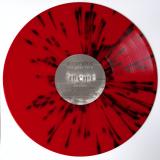
“The music of Season 2 of SEVERANCE is true to what came before in Season 1, while also developing new themes, new sounds, and new variations,” says Shapiro.
“The season's bold expansions into new storylines and new locations, along with the incredible filmmaking and performances, provided plenty of inspiration.”
“We are beyond thrilled to head back to Lumon with our Season 2 vinyl package,” says Mutant Co-Founder Spencer Hickman. “Working alongside Ben Stiller and his team, Fifth Season, and Apple has been an absolute honour and a joy.
Greg Ruth and I are obsessed with the show and the chance to play in this sandbox again. Creating original art alongside in-show ephemera is like receiving a gift. I couldn't be prouder of the package we have crafted for Season 2, blending the Innie and Outie worlds just as the season itself felt instinctual. I really hope fans feel we have done it justice. PRAISE KIER.”
Single LP with obi strip and a 16-page booklet featuring portraits of the main cast.
Building logically on the natural development of their two previous collections, this time the fearless threesome can be heard roaming further than ever before into the uncharted hinterlands where the deep jazz tradition of the classic tenor trio format, laden with melody and swing, ventures into the untamed regions of free improvisation. At the heart of the band is the unmistakable beat of drummer Spike Wells, who this year celebrates his 80th birthday and the 65th year of his extraordinary career at the forefront of jazz in the UK, providing the driving force behind everyone from homegrown heroes Tubby Hayes to Bobby Wellins to visitors like Stan Getz and Roland Kirk and countless others. Riding at his side to represent the current Londonbased millennial cohort is saxophonist Riley Stone- Lonergan , whose intriguing compositions and boundless creative imagination as an improvisor continue to add to his burgeoning reputation.
Representing the diversity of tastes and interests and uncompromising creative stance typical of Gen X, big- toned bassist Eddie Myer rounds up the posse. The trio initially got together through their mutual love of Sonny Rollins' touring pianoless trios of the late 50s and early 60s, but soon found themselves expanding their repertoire to explore the rich and varied territory opened up by their unique combination of individual tastes. This album is their most coherent, wide-ranging and adventurous set of recordings yet. From Ayler to Strayhorn, from be-bop to calypso, from cowboy movie to free-jazz shootout, there's a surprise at every turn, but always delivered with total sincerity and conviction and a driving desire to bring the audience with them every step of the way. 'The Rule of Three' is a bold and confident statement of intent from a real long-term project that's as invested in the music's future as it is inspired by and reverent of its past.
The Modern Sound Quartet represents one of the most treasured, yet least documented, outfits in the history of Italian library music. An exceptional studio band of session musicians with a formidable groove, they released only a handful of albums under this name in the second half of the 1970s. However, their sound indelibly shaped dozens of "invisible" soundtracks, often without ever receiving an official credit on the back sleeve.
Led by pianist and composer Oscar Rocchi, and featuring Andrea Surdi (drums), Luigi Cappellotto (bass), and Ernesto Verardi (guitar), the quartet embodies the more jazz-funk, cinematic, and irresistibly groovy side of the 1970s Milan scene. They established themselves as a compelling alternative to the already established groups operating primarily out of Rome, such as I Marc 4 or I Gres.
Juggling late-night club jam sessions, tours supporting Italian pop giants like Ornella Vanoni, and creating rhythmically intense library records, the Modern Sound Quartet forged a unique sonic aesthetic: sophisticated, electric, and profoundly metropolitan.
This boxset celebrates their funkiest side—an irresistible combination of incandescent drum breaks, tight grooves, and high-intensity fusion passages—bringing together some of the most sought-after tracks from legendary LPs like Erbe Selvatiche (1977), Floreama (1977), Horoscope (1978), and I Tarocchi (1980). The selection also delves further back to the roots of their sound, including two powerhouse tracks from Pop-Paraphrenia (1973), a project where Oscar Rocchi—backed by a young, lethal Tullio De Piscopo on drums—sowed many seeds that would fully blossom in the subsequent Modern Sound Quartet output.
Created with DJs, beatmakers, and collectors of Italian library music in mind, this boxset deliberately features tracks that were never previously released on 7 inch—an ideal format for maximizing the rhythmic punch of the quartet's sound.
Available in a limited worldwide edition (500 copies), enriched by iconic 70s-style artwork conceived and designed by Eric Adrian Lee.
SAGENBRINGER weaves fantasy and emotion, joy and sorrow into the 12 stories on ‘Zwischen den Welten’ (Between Worlds) through words and sound. All of this is packaged in a modern musical guise that has been forged from folk and metal elements into a hot iron. Stories are everywhere. They are countless and come from all corners of the worlds we know and don't know. But they always manage to stimulate the mind, touch the heart or send the soul on a journey. This is the calling of SAGENBRINGER: to spread these stories and not let them fall into oblivion. After establishing themselves in the German folk and pagan scene with their first two albums, ‘Sagenbringer’ and ‘Zeit der Geschichten’, and becoming a recurring name on festival posters across Germany, the young skald troupe are now releasing their third studio album on 30 January 2026. Zwischen den Welten (Between Worlds) transports listeners to the most diverse corners of mythology, legends and human emotions.
Strong one on Voyage Direct from Rotterdam's Benny Rodrigues...TIP!
The label say "Benny Rodrigues seems to delight in confounding critics. Since making his debut alongside Darko Esser with 2007's Underwater Records--released 'Paradox', the Rotterdam--based DJ has surprised and excited at every turn.
Variously delivering woozy tech--house, rave revivalism, stripped--back minimal, jackin' acid, wide--eyed deep house and, under his occasional ROD alias, shirts--off warehouse techno. Along the way, he's released music on some of Europe's most prestigious labels, including Desolat, Soma, EC Records, Be As One and Wolfskuil Records.
Here, he makes his debut for Tom Trago's Voyage Direct imprint with two undulating, hypnotic, heads--down tracks that blur the boundaries between house and techno. Rhythmically loose but impressively tough - like all of Rodrigues' best productions - both cuts are built around mesmerising late night grooves and intoxicating chords.
'Master French' kicks things off, lacing nagging shakers, subtle synth strings and fluttering chords over a robust, shuffling tech--house groove. Rodrigues works the mix like a master, bringing elements to the fore before sliding them into the background. It's a simple, heads--down, 4am groove, but it's executed brilliantly.
'Z', on the other hand, is an altogether breezier affair, with repetitive, new age-- inspired synthesizer melodies seemingly drifting over a rock solid house groove. Notable ride cymbals and warm beats proper the track forward, giving it a humid, tropical feel. This is music to move the body, mind and soul. "
On the 25th August, Burna Boy will release his brand-new album ‘I Told Them…’. It will be available to stream everywhere as well as on CD & Vinyl. The Pre-order will go live alongside the album announce on the 28th July. ‘I Told Them…’ features Burna’s newest hit singles ‘Sittin’ On Top Of The World (feat. 21 Savage)’, ‘Talibans II’ & ‘Big 7’ as well as a whole host of album features.
Burna Boy was born Damini Ogulu in Port Harcourt, Rivers State, Nigeria, in 1991 and began making music at just ten years old. As a teenager he honed his craft on Nigeria’s southern coast, delving into dancehall, reggae and Afrobeat’s. In the early 2010s Burna Boy emerged as one of Nigeria’s fastest-rising stars, combining influences from his Nigerian heritage with hook-filled pop stylings to create unforgettable tracks. His 2012 single ‘Like to Party’ broke into the global mainstream and paved the way for his full-length debut L.I.F.E, a year later.
Over the next five years, Burna Boy released two more albums and collaborated with a long list of high-profile artists including J Hus, Skales, Fall Out Boy and Lily Allen. African Giant was released in 2019 followed by his fifth album Twice as Tall in 2020 (which featured collabs with Chris Martin and Youssou N'Dour), both charted in several countries across the globe andgarnered worldwide acclamation, with the latter winning a Grammy Award for ‘Best Global Music Album’. Breaking cultural boundaries, he became the first Nigerian to headline a show at New York’s Madison Square Garden, he released his sixth album, Love, Damini, last year (featuring collabs with the likes of Ed Sheeran and Khalid). It deservedly became the highest-charting Nigerian album in history and currently holds the record for the only African artist to earn a no. 1 on iTunes in 16 countries worldwide.
out of Stock
Last delivered 8 months ago available to reorder, subject to availability
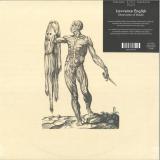
Do you remember the last time you were breathing consciously? Either way, you are likely doing it now. On his new album Observation of Breath« for the Swiss-based Hallow Ground label, Lawrence English worked exclusively with an organ for four compositions that are exercises in »maximal minimalism,« as their creator himself notes in a nod to Charlemagne Palestine, who coined this term. While it seems somewhat fitting that those four pieces based on a steady flow of air were conceived and recorded in a situation of accelerated standstill caused by a respiratory disease, the Room40 founder is not so much concerned with capturing the zeitgeist than rather incorporating the spirit of time itself. »It is a record about presence and patience,« he explains. Exploring the unique sonic affordances of a singular instrument, »Observation of Breath« is not only devoted to the durability of sound but also to its density. That it marks his debut on Hallow Ground after having shaped its sound by mastering most of the label’s releases in recent years is just as fitting then as its release following albums by Kali Malone and FUJI|||||||||||TA, whose innovative work with organ instruments have facilitated a rediscovery of their possibilities.English’s compositions however are neither directly indebted nor responding to these musicians. His exploration of the organ’s many facets started a decade ago when the composer was given access to an instrument built in 1889 that is presently housed at The Old Museum in Brisbane. After it had already played a crucial role on his seminal albums »Wilderness Of Mirrors« and »Cruel Optimism,« last year’s self-released »Lassitude« was the first record that English entirely composed and recorded with that instrument. »During the soft lockdowns, I spent many days playing to an empty concert hall, recording the pieces that became ›Lassitude‹ and then, this album,« says English in regards to an unfortunate situation that fortunately provided him with time and space—two major themes but also key qualities of the four new compositions. In this sense, he goes on, »Observation of Breath« resolves a number of the questions originally raised by »Lassitude.
out of Stock
Last delivered 8 months ago available to reorder, subject to availability
A chopped-and-screwed love letter to the sounds of rebajada – half-speed cumbia, pioneered by Sonido Dueñez in the 1990s, and born from an overheated turntable motor that didn’t make the crowd stop dancing. With Debit’s treatment, rebajada becomes an ethereal, at times intense ambient tapestry that’s also a history lesson.
Spend any amount of time pacing the streets of Monterrey, the bustling city in the north of Mexico where Delia Beatriz, aka Debit, grew up, and you’ll be sure to catch traces of cumbia echoing from Bluetooth speakers, DIY soundsystems, or car stereos. An Afro-Latin dance form and »practica cultural« originating in Colombia in the early 19th century, cumbia evolved rapidly in the early 1900s, as a localised sound played on drums and flutes quickly modernised to integrate European instrumentation like the accordion. When it reached Mexico in the 1940s, the sound shifted again, fusing with mariachi styles and integrating further vallenato folk elements. Eventually, cumbia spread across the entirety of Latin America, splintering into a spectrum of different musical styles such as chicha in Peru, and cumbia villera in Argentina. And over in Monterrey, cumbia inadvertently found its own idiosyncratic groove.
From the 1950s to the 1970s, waves of immigrants from across Mexico and Latin America headed to Monterrey to find work, making a home in Colonia Independencia. Colombian cumbia records, shipped in from Mexico City, Houston, and Miami, became the soundtrack of the neighbourhood, relaying familiar stories to a rural working class adjusting to their new industrial reality. The sound struck a chord with locals, and huge street parties hosted by ramshackle soundsystems known as sonideros unified the diverse community. So when cumbia rebajada materialised serendipitously in the 1990s, it emphasised and highlighted the memory distortions at the heart of the immigrant experience. Local record collector, selector, and sonidero Gabriel Dueñez had been playing cumbia for hours one night when disaster struck: his turntable’s motor overheated and slowed down, turning the music into a warped groan, with half-speed voices echoing over wobbly accordion drones and splashy drums. But the crowd kept dancing, and Sonido Dueñez realised he’d struck gold – cumbia rebajada was born.
Over the next few years, he dubbed a popular series of mixtapes, hawking them at the flea market on the dried-up Santa Catarina riverbed beneath El Puente del Papa, the bridge that links downtown Monterrey with Independencia. These woozy archives became the stuff of legend, poetically but subconsciously shadowing DJ Screw’s series of epochal cassettes that appeared over the border in Houston. Beatriz uses Sonido Dueñez’s first two tapes as the starting point for »Desaceleradas«, entering into a dialogue with time, culture, and geography as she recalls the sonic ecosystem that surrounded her decades ago, long before she emigrated to the USA. If 2022’s acclaimed »The Long Count« was an attempt to recover concealed pre-Columbian history in the face of colonisation, »Desaceleradas« jumps forward, figuring out how memory and shared celebration can resist a more contemporary form of cultural erasure. As AI systems scrape, blend, and decontextualise culture around us, leaving vapid slop, »Desaceleradas« proposes a slower, more careful, and ultimately more human kind of engagement. It’s an archive with a pulse.
out of Stock
Last delivered 7 months ago available to reorder, subject to availability
For AI-41 Astral Industries presents a vinyl reissue of Robert Henke’s multifaceted concept album ‘Layering Buddha’. An erudite masterclass on sampling and composition, ‘Layering Buddha’ encapsulates the material process of metamorphosis and a well of nascent, ever-present potentialities. This new edition comes remastered by Henke himself.
Originally released in 2006, ‘Layering Buddha’ began with a curious encounter with the ‘Buddha Machine’ - a pocket-sized, battery powered playback device that, over the past two decades, has quietly achieved a cult status around the world. Conceived by the Beijing-based group FM3 (Christiaan Virant, Zhang Jian), the machine takes inspiration from Tibetan Buddhist prayer boxes and consists of nine sound loop compositions of varying length, which can be toggled with a single switch. Due to low production cost and manufacturing imperfections, each Buddha Machine is unique, giving slight variations in sound, pitch and duration.
Using a state of the art A/D converter Henke made high quality recordings from a single machine, providing the source material for the album. Through various processing and arrangement methods, new pieces emerged, most of them all deriving from a single source loop. The pieces were then set up on the computer as generative arrangements, living as continuously permutating structures that could theoretically go on forever - just as the loops do within the Buddha Machines…
The final pieces featured on the album are rendered excerpts of these infinite permutations, and therefore exist as momentary views on a perpetual machinery, as opposed to closed works. Upon initial exploration, it also became a natural development to format the work into an immersive multi-speaker performance - which premiered on January 31, 2007.
Within the music, subtle artefacts and idiosyncrasies are transmuted into new realms of texture and timbre. Through the extractive hand of subtle augmentations, an array of ethereal dimensions emerge from the vast unseen ocean. Suspended in a sense of timelessness, their undulating rhythms point to a pool of endless mysteries.
out of Stock
Last delivered 5 months ago available to reorder, subject to availability
With her new album, Spira (Sprout), Olof Arnalds has found her joy in writing songs rekindled. In many ways it harkens back to her debut: it is exclusively in Icelandic, the arrangements are markedly stripped back compared to her last two records, and it is mostly recorded in single takes in the control room of Sundlaugin, much like Vio og vio. Although a classically trained singer and violinist, Olof has been an active practitioner of popular music for thirty years, the watershed moment was the 2007 release of her debut solo album Vio og vio (Now and Again, wider international release in 2009), produced by Sigur Ros' Kjartan Sveinsson in the band's converted swimming-pool studio Sundlaugin. It seemed to appear fully formed out of the ether, and became a local classic almost overnight, winning accolades such as 'Best Alternative Album' at the Iceland Music Awards, named 'Record of the Year' by Iceland's principal daily newspaper and recognised as one of the decade's 100 best albums by eMusic. Spira is produced by Skuli Sverrisson, who also contributes bass and guitar. His mind-melting resume includes musical direction for Laurie Anderson, recordings with Blonde Redhead and work with artists such as David Sylvian, Jon Hassell, Ryuichi Sakamoto, Bill Frisell and Arto Lindsay. Davio por Jonsson contributes piano and guitar to the record-much as he did during Olof's busiest touring schedule nearly fifteen years ago when the two of them toured the world for months on end. There is hardly a jazz musician in Iceland he hasn't played with but lately he is perhaps best known for his close collaboration with Ragnar Kjartansson, one of this century's most celebrated visual artists.
Limited Plum Colored, Full colored Vinyl 12” Jacket 12 Inch Release
Hot on the heels of the recently released Divine Harmonics – From Then Until Now (Part One of Two) the limited orange vinyl edition that sold out within weeks, we are thrilled to announce the arrival of the highly anticipated Part Two of Kuniyuki and Joaquin “Joe” Claussell’s Divine Harmonics imprint.
This next installment is expected to surpass the excitement of both earlier releases, especially as it comes as a plum colored vinyl packaged in a stunning full-color jacket designed by the incomparable Akemi Shimada. As with all Divine Harmonics editions, this is a strictly limited full 12-inch package, created with collectors in mind.
About the Record
Recorded in a fully equipped studio in Brooklyn, New York, this project was born from the idea of gathering musicians who deeply admire Kuniyuki’s work and inviting them to contribute to the composition.
out of Stock
Last delivered 8 months ago available to reorder, subject to availability
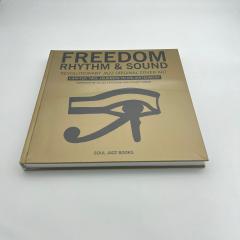
The third instalment in the Disco Pogo Tribute series celebrates the best electronic post-punk band on the planet, LCD Soundsystem.
This follows the hugely successful Disco Pogo Tribute books on Daft Punk and Aphex Twin that have been reprinted numerous times.
As with both previous books the people behind Disco Pogo have a long-standing relationship with James Murphy, LCD Soundsystem and the wider DFA crew which gives them a unique insight into the band.
The book is edited by Disco Pogo editor Jim Butler and features interviews, essays and features from the best music journalists working today, alongside a timeline, family tree, gear and gig lists. There are also archive LCD Soundsystem features from Jockey Slut and Dummy magazine.
The book features an iconic cover portrait of James Murphy by unofficial/official LCD photographer Ruvan Wijesooriya, plus a huge amount of exclusive, never-before-seen photography from Ruvan, Tim Soter, Tim Saccenti and other photographers who have been close to LCD since the very beginning of their career.
The book is hardback, even chunkier than the previous books at 308 pages and is beautifully designed and printed with a (sound of) silver ribbon and spine cloth.
The book is the same size and format as the two previous books and will sit perfectly alongside them on any music lover's bookshelf.
In 2023 Ace Records released the album “28 Little Bangers From Richard Hawley’s Jukebox” where the acclaimed Sheffield musician, singer and songwriter compiled together some of his favourite records. These were instrumentals and vocals records that he had collected over the years and found musically addictive. The album received fantastic reviews and allowed his
extensive fanbase to discover and enjoy tracks like Ronny Kae’s ‘Swinging Drums’ and King Curtis’ ‘Hot-Rod’ that were on the juke box in his home.
Now, three years later, Richard has lifted the lid, taken those 7” out and replaced them with another favoured selection. One again, this second version of “Little Bangers” is full of cracking records such as Chet Atkins ‘Boo Boo Stick Beat’, Frank Minion’s ‘Watermelon’, Johnny Todd’s ‘Pink Cadillac’, Sunshine Theatre’s ‘Mountain’, Jet Harris’ ‘Man From Nowhere’, Tracy Rogers ‘Baby’ and the Ventures ‘Fuzzy And Wild’.
A with the first album there are 28 tracks spread across two albums or shoehorned onto one CD. The extensive liner notes see Richard discussing each and every track and what the record or artist meant to him. As he states himself in the introduction, “the record you hold in your hand is the result of a lifetime obsession.”
Listen for yourself and you will discover that this was time well spent.
Confessor's genre defying album Unraveled reissued in January Confessor is a progressive doom metal band from North Carolina that made its mark on the underground metal scene in the late 80's by combining some of the genre's essential elements in a way that no band had attempted before. Once dubbed "the world's most obstinately technical metal band", Confessor's technically complex interpretation of traditional doom gained them a reputation also within the progressive metal circles. Their grand sophomore album Unraveled from 2005 will finally be reissued after two decades on January 16th via Svart Records. Following the release of their 1991 debut album, Condemned, Confessor disbanded in 1994 while they were already planning a second album. Sadly, in 2002 the band's guitarist Ivan Colon passed away, and in tribute to Ivan, the band re-formed in order to play a benefit show for him. Things went so well, that they decided to continue after almost a decade apart. Their second full length Unraveled followed in 2005; an immensely satisfying and unique blend of majestic Doom Metal raised to the next level.
Confessor's genre defying album Unraveled reissued in January Confessor is a progressive doom metal band from North Carolina that made its mark on the underground metal scene in the late 80's by combining some of the genre's essential elements in a way that no band had attempted before. Once dubbed "the world's most obstinately technical metal band", Confessor's technically complex interpretation of traditional doom gained them a reputation also within the progressive metal circles. Their grand sophomore album Unraveled from 2005 will finally be reissued after two decades on January 16th via Svart Records. Following the release of their 1991 debut album, Condemned, Confessor disbanded in 1994 while they were already planning a second album. Sadly, in 2002 the band's guitarist Ivan Colon passed away, and in tribute to Ivan, the band re-formed in order to play a benefit show for him. Things went so well, that they decided to continue after almost a decade apart. Their second full length Unraveled followed in 2005; an immensely satisfying and unique blend of majestic Doom Metal raised to the next level.
Sunburst vinyl version of “Make Metal Royal Again” (previously released August 15th, 2025 via Reaper Entertainment), HAMMER KING once again raise their banners high: the throne of power metal is theirs to claim. Following the chart-breaking success of their last two records – “Kingdemonium” (#17 DE) and “König und Kaiser” (#16 DE) – the German quartet returns in 2025 with even more grandeur, might, and majestic songwriting. Produced by Charles Greywolf (Powerwolf) and Titan Fox V, and mixed & mastered by Jacob Hansen (Amaranthe, Volbeat), the album delivers ten powerful new tracks and a surprise bonus cover. With “Danger Zone”, the band pays a thunderous, metallic tribute to pop culture for the very first time. From anthemic epics like “For Crown And Kingdom” to the cinematic grandeur of “Hoheitsgebiet” and the touching ballad “Schlaf Kaiser schlaf”, HAMMER KING offer a full royal banquet of sound and spirit. Introducing new drummer Count Shandorian, whose precision and creative drive elevate the band’s sound even further, Make Metal Royal Again marks a new peak in the group’s journey. The magnificent artwork by Péter Sallai (Powerwolf, Sabaton), inspired by The Last Supper, captures the album’s core themes: power, identity, and loyalty. This is not just an album – it’s HAMMER KING’s metal manifesto for a new golden age.
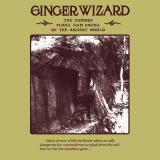
Crypt of the Wizard is proud to present Ginger Wizard - The Curious Flora and Fauna of the Ancient World on vinyl and digital formats.
About ten years ago in a record store in Prague, the Ginger Wizard discovered a copy of Bo Hansson’s Lord of the Rings LP. Although initially unfamiliar with the record, the reference to Tolkien’s masterwork and the incredible cover art drew him in and, rather fittingly, sent him off on a journey of discovery that would reshape his creative trajectory.
Years later while working in cassette tape manufacturing, Ginger Wizard noticed that most fantasy-inspired music fell into two camps: metal and dungeon synth. With little interest in the former, but intrigued by the latter, he began writing a few songs imagining a beautifully packaged and tactile cassette tape. However, dungeon synth he soon realized was “the most boring music to make”.
So began the Ginger Wizard’s own mythological discography. In 2022 came The Feast for the Dead King and Other Musical Themes recorded at home in a cold kitchen, is conversely an album full of warmth drawn from sheer exploration. A year later Can I Choose My Own Psychopompos? was recorded for the legendary Stoned to Death label - a 7” séance of semi-improvised noise and melody featuring allies from the Ginger Wizard’s live backing band The Peter Jacksons. The following year with Bathysburg Tales, a new approach was needed in order to keep the project interesting. Drawing inspiration from Popol Vuh and the inclusion of vocals lent by Protomartyr’s Joe Casey and Jakob Battick, a new more cinematic sound began to emerge.
Now, we present The Curious Flora and Fauna of the Ancient World marking a step into something stranger while still channeling the spirit of Bo Hansson. The new album rejects swords and sorcery for the mythology of the natural world “the ancient stuff,” he explains in the record’s insert, “has a similar taste for me as fantasy.” These songs bloom, creep, and shimmer like forgotten plants under distant suns while rooted in something real and organic. Inspired by the myths of nature rather than heroic quests, it’s an album that feels alive, equal parts archaeological dig and psychedelic garden.
Currently at work on a soundtrack for an imagined 1970s fantasy film in collaboration with The Peter Jacksons, the Ginger Wizard continues to expand his strange universe while The Curious Flora and Fauna of the Ancient World serves as a new map to somewhere ancient, beautiful, and unknown.
Wiccans only make noise when they feel like it. A band that’s been uttered in reverence for nearly two decades with only a handful of releases, each one a stand-alone classic.
You see, it’s hard to pinpoint a band that actually has the equal influences of American psychedelia and hard rock all anchored in the glorious benevolence of American Hardcore. A tonne of bands dance around and flirt with each but it rarely lands in the sweet spot. They’re not trying to fit some supposed perfect space and that’s the very point so many others miss.
Wiccans are creating the space. Breaking rules and allowing a bit of breadth to what is often a claustrophobic style of music. This might sound scary as everyone knows that the more Hardcore evolves the worse it is - at least on record. The formula that Wiccans are playing with on Phase IV should scare you. It’s totally potent with odd songwriting, intensely creative and varied guitar work and completely pissed vocals. Phase IV does whatever the fuck it wants and passes the bar that only Wiccans could have set for themselves. All of this is propelled by a far stronger production quality than previous efforts and instead of having that expose some fault line it’s secured it as a modern classic.
It’s the kind of shit that will shake the dandruff from the beard of a Third Man collector but will also make that guy stop going to DIY gigs because they’re “too rough” or whatever. I’m just sitting here wondering if this is maybe what might have happened if Poison Idea wrote Hidden World. There’s always space for a carbon copy Negative Approach destroying someones basement and they usually put out a record that is clearly brilliant but fuck me if I can’t help but yawn.
Am I getting old or is Hardcore painting by numbers? In a slough of legitimately top tier Hardcore Punk releases, this one actually sounds like something truly special.
Limited edition (numbered 100 copies) 180g black vinyl with insert.
"BEN BEKELE does not exist. At least not the one I'm thinking of.
It's a mix of memories and fantasies from the mid-80s when it was my father who visited Ethiopia, returning with two small drums, a couple of pictures and tons of tales.
One of them was a story of a boy named Bekele, who taught him a traditional Ethiopian song.
Father passed this song on to us, as best as he could - now I'm having doubts as to what the message is actually about - but back then I was fascinated. Many years later, when I was preparing a song for a compilation "Portrety" at U Know Me Records, I realized that the bass line that I created resembled a fragment of that exact song. Apparently the melody buried itself somewhere deep in my subconscious and unexpectedly revealed itself at that moment. Therefore I decided to honor the memory of my deceased of 30 years dad (whose friends called him Ben) naming the composition: "The Life and Death of Ben Bekele". The song turned out to be very happy to me - its success definitely exceeded expectations, while in my head an idea to go further after Ben Bekele began to form.
This time I didn't want to work alone. I invited Kamil Piotrowicz and Igor Wiśniewski to cooperate with me. Incredibly creative, sensitive artists and wonderful companions on stage as well as off it. The music on this album is similar to a small extent to the "founding" piece.
It has however a couple of common features, with focus on the rhythm as the form-forming factor at the forefront. It's also organic, emotional, at times trance-like and illustrative.
I sincerely hope that when listening to this record, for these tens of minutes you'll escape from the surrounding us not-so-pleasant everyday life."
»Hug of Gravity« is the second solo album by Raphael Loher and his first for Hallow Ground. The Swiss pianist and composer uses piano preparations, tape machines, and digital means to forge an aesthetic of playful reduction and rhythmic abstraction. The source material for these four sprawling pieces was culled from recordings of the artist performing the album’s predecessor, 2022’s »Keemuun.« Loher used them in a painstaking two-part working process to create an album that is both a product of and an ode to transformation, exploring themes of alternative temporalities and spatialities. »Hug of Gravity« oscillates between experimental electronic music, ambient, and minimal music and calls to mind the work of artists like William Basinski, Linda Catlin Smith, or label mate Andrius Arutiunian.
Loher laid the foundation for »Hug of Gravity« in 2020 with ten solo performances at his studio, during which he presented the pieces from his debut album. For these intimate concerts, he prepared the piano with modelling clay in order to move beyond the well-tempered tuning that dominates most of Western music. He then used a consecutive three-month residency in the Blenio Valley to refine the recordings. »I cut up and rearranged the material, then transferred the results—around 30 pieces—to a varispeed tape machine and then back to the computer. After that was done, I cut them up and rearranged them again,« he laughs. By radically reworking the material, he created an album that eschews traditional notions of time and space.
Loher points out the influence that his surroundings had on him. »The process created the music—and the place was essential to the process.« he says. He wandered through the mountains for up to nine or ten hours a day, which gave him a sense of what he calls expanded temporality. »Time just felt longer, my experiences seemed more diverse and nuanced, and it was as if I perceived my environment more clearly,« he explains. This shift in Loher’s perception of time and space—the latter also expressed in the album’s title—influenced his work with the varispeed tape machine. It allowed him to change the pitch of different recordings while layering them to let interference patterns emerge and emphasise the emotional qualities of the unconventional tunings he had used.
In this way, Loher constructed numerous interlocking narrative arcs throughout »Hug of Gravity,« an album that is ever-changing; an exercise in calm ecstasy that provides its audience with the feeling of being removed from conventional time and space. This approach is also reflected in the artwork for »Hug of Gravity,« which is based on drawings Loher made during his residency at Blenio Valley. Their fine hand-drawn lines run in parallel and let incidental patterns emerge, an effect that is only multiplied when the six different drawings that accompany each vinyl copy of the album are overlapping, forming ever-new visual constellations.
out of Stock
Last delivered 8 months ago available to reorder, subject to availability
The vinyl LP at the heart of this éthiopiques 31 tracks 2 to 11 was one of the very last vinyl records ever released in Ethiopia. But above all it represents, we felt, the absolute masterpiece of the Ethiopian Groove – the Swan Song of Swinging Addis. The album leaves a clear idea for posterity of the level of sophistication and mastery that modern Ethiopian music had achieved, before being crushed under the Stalino-military heel of the Derg – as the bloody revolution that was unfolding came to be called.
Ethiopia1976.
The Revolution that broke out in February 1974 rolled on in a ruthless march. The whole of Ethiopian society was utterly stunned. The bouquets of flowers handed joyfully to the first tanks of the coup d'état were to wilt very rapidly. From September 1976 to February 1978, 18 months of Red Terror (the name given by the junta itself) spilled blood throughout the country. This fratricidal conflict took its heaviest toll among students and youth. The shift from feudalism to a cruel and primitive Stalinism left the country's citizens deeply traumatised, and snuffed out any pretence of activism, whatever the sector of society. This ice age was to last for seventeen long years.
ሙሉቀን፡መለሰ Mulukèn Mellèssè Muluqän Mälläsä
It was three tracks by Muluken that served as the opener for éthiopiques-1 more than 25 years ago. Seven more tracks appeared on éthiopiques-3 and 13, all accompanied by The Equators, which was soon to become the Dahlak Band.
The first track, Hédètch alu, also the very first piece that Muluken ever recorded, left audiences both unsettled and amazed. Reflecting the singer's extremely young age (he was just 17 at the time), this angelic voice mystified many, who thought they were in fact listening to a feminine voice. He was not yet 22 when he released his last vinyl record in 1976 with Kaifa Records (KF 39LP), one of the very last to be issued in Ethiopia, before the cassette tape became the dominant medium for music distribution – and before the new revolutionary regime put a stop to all independent musical life, via an unspeakable barrage of prohibitions and other persecutions.
Mulu qèn, literally, “A well filled day”. This tender maternal intention wasn't enough to ward off the cruelty of fate. His mother's premature death drove Muluken to leave his native Godjam, in northeast Ethiopia, to live with an uncle in Addis Ababa. Born Muluken Tamer, he took his uncle's last name – Mèllèssè.
The spelling Muluken appeared in his administrative records. Transcription of Amharic to the Latin alphabet, both in Ethiopia and for scholars, gives rise to controversies and quibbles that can never be neatly settled. French allows for a closer approximation of the original pronunciation, thanks to its battery of accent marks, confusing as they may be to anglophones.
Between rather accommodating administrative record-keepers and the various versions that pop up in interviews given by the artist, Muluken's year of birth oscillates between 1953 and 1955…
1954? One thing is certain: the artist's talent made itself known very early indeed, because he got his start in 1966-67, at the age of 13 or 14. Photos from the period attest to his extreme youth. It's a strange sort of initiation for a very young teenager to become a sensation in the heart of Addis's nightlife at the time, Woubé Bèrèha – the Wilds of Woubé. And what's more, in the club of the Queen of the Night, the Godjamé Assègèdètch Alamrèw herself, the very same that was portrayed by Sebhat Guèbrè-Egziabhér in his novel-memoir Les Nuits d’Addis Abeba2… The legendary female club owner who is remembered to this day by the capital's ageing boomers.
Muluken first tried his hand at the drums, before he grabbed the microphone. He emigrated briefly to the Zula Club, across the street from the old Addis Post Office, one of the ground-breaking bars of the burgeoning musical scene, before joining the Second Police Band in 1968, for around three years. He spent a few months with the short-lived Blue Nile Band founded by saxophonist Besrat Tammènè. As the musical scene grew increasingly successful, and pulled slowly but decisively away from its institutional ties, Muluken released his first 45rpm single in February 1972 (Amha Records AE 440). It was included in two LP Ethiopian Hit Parade compilation albums in September of the same year. All in all, Muluken released eight two-track 45s and the same number of original cassette tapes between February 1972 and 1984, the year that he departed for permanent exile in the USA. After converting to Pentecostalism in 1980, Muluken gradually abandoned all secular musical activity. In 1985, at the end of a concert in Philadelphia, he decided to quit concerts and recording for good. Mèlakè Gèbré, the historic bass player from the Walias band who was playing with him that night, recalls that everything appeared so irredeemably diabolical in Muluken's eyes, that it was to be the end of his contribution to Ethiopian Groove.
The end of the story, the beginning of a legend.
Dahlak Band, forgotten by History
Aside from his personal history and vocal talents, it must be remembered that Muluken Mèllèssè was one of the biggest names in the musical innovations that marked the end of the imperial period. These éthiopiques aim to convince those who are just discovering this hidden gem... As for Ethiopians themselves, they are to this day captivated by this singular and atypical figure in the Abyssinian pop landscape – even though he withdrew from public life some 40 years ago. Incorrigible devotees of poetic twists, of more or less hidden meanings, Ethiopians appreciate above all the care Muluken took in choosing his lyrics and the writers who penned them, such as Feqerte Haylou, Alemtsehay Wodajo and, here, Shewalul Mengistu (1944-1977). Love songs, written by women, a far cry from the conventional drivel that pleases sappy sentimentalists.
Muluken is equally acclaimed for his perfectionism when it came to music, the opposite of the overly casual approach that is all too common. He remained a faithful partner of musicians who came from a lineage that borrowed from several inventive and pioneering bands (Venus, Equators, Dahlak). Amongst them were certain artists who began their musical lives with Nersès Nalbandian at the Haile Sellassie Theatre and who come of age in around 1973 – at just the wrong time, you might say. Among them were the pillars Shimèlis Bèyènè (trumpet), Dawit Yifru (keyboards) and Tilayé Gèbrè (sax & flute). Most notably Tilayé Gèbrè, certainly one of the most important musicians, composers and arrangers of his generation, of the end of the imperial era, and of the early years of the Derg.
It was only in 1981 that a miraculous opportunity arose for Tilayé to escape the Stalinist paradise of the dictator Menguistou Haylè-Maryam. Once again it was Amha Eshèté (1946-2021) who provided a solution. The spirited and courageous producer, who had been in exile in Washington since 1975, succeeded, thanks to his incredible perseverence, in bringing the Walias Band to the USA. It was, in fact an extended Walias Band comprising ten musicians3, six of whom chose to slip away after a few concerts and the recording of an LP (The Best of Walias, WRS 100). Tilayé Gèbrè was one of these. He has been living in the USA ever since. There he joined the then-nascent Ethiopian diaspora, which lived largely unto itself, and was making only very modest headway in the American musical market. It seems unfair that Tilayé Gèbrè and the Dahlak Band were not able to benefit earlier from the public recognition that they do deserve.
A similar draining away of the top-rate talents would lead to the reorganization of the major groups of the “Derg Time”. The remaining artists spread themselves around between Ibex Band (renamed Roha Band), Ethio Star Band and a remodeled Walias Band. That spelled the end of the Dahlak Band.
With this record, produced by the essential Ali Abdella Kaifa a.k.a. Ali Tango, we can appreciate everything that the Derg not only destroyed, but also prevented from flourishing. This gem of Ethiopian-style afrobeat came out in 1976 (and, by way of a parenthesis, before the FESTAC 1977 in Lagos, which was attended by an impressive delegation of Ethiopian musicians — although Fela was already personna non grata in his own country). Despite everything that might distinguish this ethio-groove from Fela’s music – no colonial axe to grind, no question of political confrontation with the authorities, no claims to negritude or Africanism for the Ethiopian musicians, and less extrovertion! –, this LP fits beautifully into the saga of intense and electrified soul of the new “African” groove that Fela and Manu Dibango embodied so well from that point onwards.
In restoring this record to its place in the afrobeat epic, it can be seen that, if nothing else, the timeline bestows a legitimate pedigree and a historical primacy to works that had no international impact when they were originally released.
Warning! Masterpiece!
out of Stock
Last delivered 3 months ago available to reorder, subject to availability
Reissue of the 3rd full length by Thomas Bücker aka Bersarin Quartett.
Melancholia. Longing. It is difficult to speak about these moods or states of the mind without invoking stereotypes. In ancient medicine, melancholia was considered to be one of the four temperaments, matching the four humours. In fact, melancholia, meaning "black bile" in Ancient Greek, was thought to be caused by an excess of this very body substance. By contrast, in more modern interpretations, literates and Freudians relate many variations of longing to the one primordial longing, the desire to return to one's mother's womb. In this context, the womb is considered to be the place of absolute comfort and cosiness, of total bliss. Thus it should not be surprising that to many of us melancholia is a mood which we like to invoke and to maintain, we like to envelop ourselves in it like in a warm blanket. Our brain and our sensory systems appear to be made for perceiving and emotionally responding to music in a very immediate fashion. Consequently music is the obvious drug for all of us melancholia-addicts. However, there is a thin line between melancholia and sadness, and music which is meant to be melancholic too often crosses this line by far. Only very few artists succeed in avoiding this crossing, and in creating music which is melancholia in its most pure form. It is safe to say that BERSARIN QUARTETT - the electronic music project of Thomas Bücker - is one of them.
After his debut in 2008 and the sophomore "II" in 2012 - album of the month in many magazines and in numerous "Best of the year" lists - Bücker in 2015 returned with his third BERSARIN QUARTETT album "III". Much like his two predecessors, III is a pure paradox. It is the creation of a perfectionist, an adamant control freak. Every element, be it a note, an ambience layer, a string arrangement, a field recording, a baseline, a vocal (Clara Hill on Track 11) or a beat, is meticulously modified and then assigned its place in Bücker's vast but still minimalistic arrangements. Thus, superficially Bücker's pieces seem to radiate a certain mechanical bleakness. However, there is a unique reduced warmth and liveliness emerging from these stainless compositions and transcending them. This transcendence is precisely the point where Bücker ironically looses control over his creations. In contrast to the first two BERSARIN QUARTETT albums, III offers a few darker shades and succeeds even further in narrowing down the arrangements to the absolute essentials without loosing the characteristic grandeur of Bücker's sound. Whereas BERSARIN QUARTETT's debut was merely a description of melancholia in its most pure form, III maybe even goes as far a defining what melancholia really is. It is the only emotion in the vast spectrum of human states of mind which one can bear forever.
out of Stock
Last delivered 8 months ago available to reorder, subject to availability
Roughly three years after the release of Balts, Schreel Van De Velde’s debut album on Blickwinkel, the guitar and drums improv-centered duo is happy to present their sophomore album A One And A Two.
The Brussels-based musicians sound more decisive than ever: the loud became louder, the quiet became quieter, the weird became weirder and the nostalgic became more nostalgic. The fruit peeled off one of its own shells, getting closer to its heart.
The album came about as a result of 2 separate studio sessions. For a first one, they restricted themself to solely electric guitar and drums, without overdubs, and with most songs ending up as one-takers. A second one took place some months later in a different recording space, using classical guitar with a matching small, cute drum set-up.
On both sessions, the duo played the same compositions, with some additional improvisations. Afterwards they made a blend of both sessions, mixing both energies: A One And A Two. A new language, organic and well-considered, was found.
Throughout the album, touches of minimalism, American primitivism, free-improv, and 90s indie rock can be found, but always within the limits of Schreel Van De Veldes freshly found voice: one that combines sentiment and cerebrality, overview, playfulness and mystery.
Lucas Schreel is a classically trained guitarist based in Brussels. His first solo album We're Never Afraid of Getting Up Every Morning was released through Sentimental Records in 2019 and was well-received both in written-press (Humo, Enola & Indiestyle) and radio (Duyster, Radio 1 & Klara). Besides his solo work, Schreel is also a member of the lo-fi indierockband Kloothommel.
Acclaimed Brussels percussionist Casper Van De Velde made quite a name for himself through his bands like SCHNTZL, Bombataz, Donder among others. His work received prices at International Jazz Contest d’Avignon and Storm! Contest (Jazzlab). Casper is currently also a member of the recently formed An Pierlé Quartet.
out of Stock
Last delivered 8 months ago available to reorder, subject to availability
Editions Mego presents The Psychologist, the sophomore album by the Istanbul born and raised, Berlin based electronic music composer and sound artist Hüma Utku.
As the title suggests, The Psychologist, is a series of sonic essays based around themes of psychological phenomena and can be read as a musical enquiry into the human condition. With Utku’s background as a graduate of Psychology and her current practice as a conceptual music composer we see the two main threads in her professional career intertwine on this unique and ambitious release.
Including recordings of Buchla 200 from Utku’s Elektronmusikstudion residency in October 2020,The Psychologist is a genre aversive work that embodies elements of synthesiser music, electroacoustic, experimental techno, industrial, modern composition and spoken word. Piano, string compositions and vocals hold weight throughout a number of pieces providing a dramatic acoustic edge to the psychological explorations contained within.
The foreboding mood of much of this release is the product of investigation that lends the unsettling theme of anticipatory grief to the mood of the tracks Light of All Lights and Continuing Bonds. Islands of Consciousness refers to Jungian metaphor for consciousness whilst the unnerving Rüya twists around dream analysis in Gestalt psychology. Fuel For The Flames proceeds as a buzzing and swirling representation of alchemy and psychological symbolism. Dissolution of I is haunted by a strange sensation of dissociation whilst defense mechanisms support the sublime Sublimation. The bright shapes of Chironian Wound represent archetypes and analytical psychology whilst the fried soundscapes and rhythms of Ataxia encapture neurological states.
The results unravel with both the clockwork rhythms of the human body and the unpredictable nature of the psyche, the pieces follow arrhythmic patterns in a harmonious way. It tells the raw and intimate story of the human experience with a new work whereby the predictable operates in parallel with the unexpected and like human experience itself, is dark and complex.
Composed, Written & Produced by Hüma Utku
Piano by Hüma Utku
Vocals by Hüma Utku
Double Bass performed by Adam Pultz Melbye
Cello performed by Florina Speth (aka Schloss Mirabell)
Violin performed by Marta Forsberg
Cover photography & art by Gözde Güngör
Design by Eloise Leigh
out of Stock
Last delivered 8 months ago available to reorder, subject to availability
"Ensomheden Vi Deler" ("The Loneliness We Share") is the result of a dialogue between the collages and the music of øjeRum, initiated by IIKKI, between December 2024 and July 2025.
øjeRum is Copenhagen based musician and collage artist Paw Grabowski.
With his collages, the distinctive feature of øjeRum's works is their ability to combine different historical and artistic periods, such as ancient sculpture, medieval frescoes, classical painting and photography, and to make them interact with one another. øjeRum is also renowned for his work as a musician, where he stands out for his surreal, mysterious and poetic universe. His music and art are closely linked. These two sides of the artist's work are constantly intertwined.
In his øjeRum guise, he plucks and strums his treated acoustic instruments, sounding at times like church bells, at times like angelic harp, at time like drones, and suspends the listener in the magic of his melodies. With a deep back-catalogue of releases since 2014 - spanning labels such as eilean rec., Room40, Line, Opal Tapes and many more - he continues exploring his minimal, textural and deeply personal style of ambient music.
The collage and music project "Ensomheden Vi Deler" ("The Loneliness We Share") is an exploration of loneliness, closeness and distance. A meditation on the fragile architectures and hidden shapes of human connection. This is his second release on IIKKI.
Fine Art Book, Ltd. to 500 copies:
Hand numbered & hand stamped / first edition and only edition (no re-print) / hardcover book (15 cm x 21 cm) on Wibalin Natural Cotton White / 80 pages, 35 collages printed on Freelife Vellum 120g/m2 / Swiss Binding / Coloured edges with neon green pantone / Neon Green pantone on front and back cover (logo, slot and circle) / Sticker on front cover.
out of Stock
Last delivered 8 months ago available to reorder, subject to availability
"I want nothing more than to be a loner," Emily Kempf sings early on Flower of Devotion, the new album by Chicago trio Dehd. It's a startling admission coming from a songwriter who, just a year ago on Dehd's critically acclaimed Water, wrote eloquently about the joys and pains _ more than anything, the necessity _ of love, compassion, and companionship. But then, "admission" isn't really the right word here, given the stridency of Kempf's tone. "Loner" is a declaration. The record ups the ante on Dehd's sound & filters in just enough polish to bring out the shining and melancholy undertones in Jason Balla and Emily Kempf's songwriting, even as it captures them at their most strident. Balla's guitar lines at times flirt with ticklish cosmic country, while at others they reflect the dark marble sounds of Broadcast. Kempf, meanwhile, establishes herself as a singer of incredible expressive range, pinching into a high lonesome wail, letting loose a chirping "ooh!," pushing her voice below its breaking point and letting it swing down there. When she and Balla bounce descending counter-melodies off one another over McGrady's one-two thumps, or skitter off over a programmed drum pad, they sound like The B-52s shaking off heartache. What makes Flower of Devotion so impressive is how its creation seems to have strengthened its creators, both as individuals and as a unit, even as they've stared down their own limitations. It's also striking just how much fun they seem to be having in the process. "It's okay to be lighthearted in the face of despair," Kempf says. It's a theme that runs through the album, from the opening back-and-forth build of "Desire" to the click-clacking chorus of "Haha," which finds them deflating their own history. Flower of Devotion was recorded in April and August of 2019 in Chicago. It will be released on Fire Talk Records on July 17th 2020.
"Over the years, Ellende has released six full-length albums and three EPs. They achieved four official chart positions (Austria: #14, #21; Germany: #31, #37) with recent full-lengths, while the band has performed more than 120 international shows and reached over two million Spotify streams in the past year.
The lyrical themes have evolved alongside the music. From early reflections on misanthropy, nature, and isolation to later explorations of human nature, social criticism, war, loss, despair, and dementia. The upcoming full-length album “Zerfallˮ portrays the state of being shattered into fragments and the slow, painful process of rebuilding oneself: a confrontation with the void and ultimately a triumph over it. Shaped also by a tragic event in the life of its mastermind, Ellendeʼs work continues to fuse raw intensity with profound emotional depth."
The capstone of Miles Davis’ electric period, Agharta reigns as a funk-rock fireball — a blazing comet streaked energy and elan, a fearless organism feasting on adventure and freedom, a seven-headed Godzilla stomping its way through Osaka, Japan. Recorded on February 1, 1975 at Osaka Festival Hall at the first of a two-show stand, the double album offers an endless abundance of surprises and shifts — as well as a road-proven ensemble whose chemistry and abilities equal that of any of Davis’ celebrated bands. If the true measure of jazz is the capacity to adapt to the moment and challenge perception, Agharta is consummate.
Sourced from the original master tapes, housed in a Stoughton gatefold jacket, and pressed at Fidelity Record Pressing in California, Mobile Fidelity’s numbered-edition 180g 33RPM 2LP set of this epic live release presents it in audiophile sound on a domestic pressing for the first time. Offering greater degrees of separation, detail, and richness than the compressed CD editions and more clarity, openness, and presence than older vinyl copies, this version of the 1975 release helps bring the concert stage to your home. Just make sure your turntable and speakers are up to the challenge of Davis and Co.’s explosive performances — and producing the decibels they demand.
Teeming with vibrant colors, tones, and pace, Mobile Fidelity’s reissue captures the hear-it-to-believe-it flow, sweep, and moodiness of the music. Though the group honors looseness and freedom with religious verve, the specificity and scale rendered by this remaster allows you to detect methods behind the alleged madness that are often otherwise harder to discern. This insight extends to the understated changes in volume, harmonics, and phrasings. In many ways, you can listen as Davis himself did that early February evening as he helped coordinate the overall direction and decided on whether to blow his wah-wah-wired trumpet or take a turn on the organ.
Tellingly, Agharta would likely never have been made if not for Davis’ ventures overseas and, specifically, to the Land of the Rising Sun. Having for years faced a backlash on his native soil for his choices to experiment and blow past all known borders, Davis was welcomed with open arms in Japan. The concert documented on Agharta — as well as the day’s later show, captured on the equally exciting Pangea — stemmed from a sold-out three-week tour that would ultimately mark Davis’ final public appearances for years, as he soon settled into semi-retirement and nursed the wounds connected to an unprecedented stretch of restless and relentless output.
For all the band-fueled merit of Agharta — and there’s plenty, given the cast of saxophonist Sonny Fortune, bassist Michael Henderson, drummer Al Foster, percussionist James Mtume, and guitarists Reggie Lucas and Pete Cosey seemingly blasts off to outer space and travels distant galaxies by the time this minimally edited record runs its course — Davis’ own playing often remains overlooked. As critics Richard Cook and Brian Morton observed, it is “often fantastically subtle, creating surges and ebbs in a harmonically static line, allowing him to build huge melismatic variations on a single note.” He attacks like a man on a mission, out to prove naysayers wrong and bent on trailblazing another new path forward. Convention and skeptics be damned.
Noisy and furious, dark and discordant, abstract and off-balance, radical and intense, abrasive and atmospheric, strangely beautiful and hypnotically eccentric: Agharta evades simple description, and refuses to be pinned down in any established category — rock, jazz, punk, ambient, prog, avante-garde, or otherwise. Shot through with trench-deep grooves, screaming riffs, scalding solos, and free-improv leads, its cosmic thrust comes on as the equivalent of an animated pointillist painting comprised of millions of textured dots, dashes, and dabs that hold your attention so raptly you want to revisit the ideas again and again.
Always steps ahead of everyone else, Davis knew what he was doing even when Agharta debuted in Japan before later hitting U.S. markets. Though “Maiysha” and “Theme from Jack Johnson” are identified in the track listing, the record contains a number of uncredited references to other Davis works, including a nod to “So What.” This decision to bypass labels only adds to the art of the reveal — the rare black magic in which Agharta expertly deals.
Yes's 1972 3-track recording masterpiece, Close to the Edge, presents a snapshot of an adventurous rock band at the peak of its powers, daring to push itself musically, both as individuals and as a unit.
The first half of the 1970s was an especially fertile period for British progressive rock, laying claim to classics such as Tarkus, Selling England by the Pound, Larks' Tongues in Aspic, The Dark Side of the Moon, and Thick as a Brick. Collectively these and other works represent the best British progressive rock had to offer. Yet, many reviewers cite Close to the Edge as the ultimate prog rock album.
Author and music journalist Will Romano writes: "Yes had previously penned epic tracks for The Yes Album and Fragile, but nothing on the magnitude of the musical gems appearing on Close to the Edge. It's something of a small miracle — perhaps even magic — that the virtuoso quintet crafted such a cohesive and compelling album during an often-hectic recording process that very nearly relegated this monumental work to the dustbin of history."
The album's centrepiece is the 18-minute title track, with themes and lyrics inspired by the Herman Hesse novel Siddhartha. Side two contains two non-conceptual tracks, the folk-inspired "And You and I" and the comparatively straightforward rocker "Siberian Khatru." Original drummer Bill Bruford found the album particularly laborious to make, which culminated in his decision to quit the band after it was recorded, to join King Crimson.
Close to the Edge became the band's greatest commercial success at the time of release. It peaked at No. 4 on the U.K. Albums Chart and No. 3 on the Billboard 200 in the United States, the highest position Yes has reached on the latter chart.
In 2020, Close to the Edge was ranked at No. 445 on Rolling Stone's list of the 500 Greatest Albums of All Time.
Mastered by Kevin Gray at Cohearent Audio. Pressed on 180-gram vinyl at Quality Record Pressings, and housed in a tip-on old style gatefold double pocket jacket with textured stock by Stoughton Printing.
The song titles on Van Halen's aptly titled Fair Warning don't lie. The likes of "Unchained," "Mean Street," "Push Comes to Shove," "One Foot Out the Door," and more indicate the mood the band channels on its double-platinum 1981 record — the nastiest, darkest, and fiercest album of the group's storied career. For the fourth time in four years, Van Halen throws down the gauntlet to all challengers and emerges victorious.
Sourced from the original analog tapes, pressed on MoFi SuperVinyl at Fidelity Record Pressing, and strictly limited to 5,000 numbered copies, Mobile Fidelity's UltraDisc One-Step 180g 45RPM 2LP set plays with unfettered clarity, dynamics, and immediacy. Benefitting from superb groove definition, an ultra-low noise floor, and dead-quiet surfaces, this vinyl edition captures what went down in the studio with tremendous realism and involving presence.
Taking a more controlled approach in the studio and still completing everything in less than two weeks, Van Halen and producer Ted Templeman relied on studio amplifiers to direct the sound. Further diverging from the live-on-the-floor approach of its earlier albums, the ensemble also employed overdubs to great effect. The result: Dense, stacked architecture that underlines the hard-hitting tenor of the songs — and which comes alive like never before on this reference edition that looks as good as it sounds.
The premium packaging and gorgeous presentation befit the reissue's select status. Housed in a deluxe slipcase, it features special foil-stamped jackets and faithful-to-the-original graphics that illuminate the splendor of the recording. Aurally and visually, it is made for listeners who want to immerse themselves in everything involved with the album, including the iconic cover art adopted from William Kurelek's haunting painting, "The Maze."
Isolated frames from Kurelek's childhood-inspired work — including a man bashing his head into a brick wall, a guy pinning down an adversary as he delivers bare-fist blows to his face and others watch with apparent glee, a boy tied down on a conveyer belt and being sent through the equivalent of a meat saw — adorn the front and back covers. The sunnier visual disposition of Van Halen's prior efforts gives way to something sinister and tortured, traits reflective of the music within. The band members, too, are visually depicted not in glamorous shots but in a serious black-and-white portrait in which the quartet is clad in black leather jackets.
Tough, aggressive, stark: Fair Warning comes on like a series of bare-knuckled punches to the solar plexus and boasts lyrical narratives to match. Though not a concept record, the concise album revolves around themes of roughing it on the streets and struggling to survive amid dim prospects. Singer David Lee Roth reportedly penned many of the initial lyrics after traveling to Haiti and observing extreme poverty. The characters and situations populating Fair Warning reflect hardscrabble existence, last-chance desperation, and underlying danger.
Witness the crazies, poor folks, and hunters of “Mean Street”; the former prom queen turned pornographic actress on “Dirty Movies”; the menace and vice of “Sinners Swing!”; the streetwise hustle of “Unchained”; the isolation and alienation of “Push Comes to Shove”; the desire for escape on “One Foot Out the Door”: A carefree California beach party Fair Warning is not.
Having said he felt angry and frustrated during the sessions, guitarist Eddie Van Halen uses the forceful arrangements as a playground for his seemingly unlimited arsenal. Supported by a crack rhythm section and a hyped-up Roth, he performs with an almost impossible combination of punk-like intensity, technical finesse, lyrical fluidity, and unbridled emotion. The virtuoso was increasingly butting heads with Templeton and seeking a freedom in the studio he believed denied him.
No wonder he plays like a bat out of hell. Listen to the rapid-fire manner in which he slaps the high and low E strings on the 12th fret of his instrument on “Mean Street,” instilling the tune with funk flair and metal-spiked sharpness. For the pouty strut of “Dirty Movies,” Eddie Van Halen contributes slide guitar magic made possible after he sawed off the lower portion of a Gibson SG so he could reach further down the fretboard.
Related intensity, urgency, and daredevil momentum punctuate the surging “Sinner’s Swing!” A heavily flanged, delicately melodic introduction frames the attitudinal “Hear About It Later,” among the most creative arrangements of Van Halen’s career. And do riffs come any bigger or magnetic than those on the high-wire kick of “Unchained”? As for the out-of-left-field “Sunday in the Park,” an instrumental composed on an Electro-Harmonix micro-synthesizer: Who but Eddie Van Halen to supply creep factor in such an ingenious way?
Despite selling fewer quantities than Van Halen’s prior efforts, Fair Warning remains for many diehards the record that epitomizes all of the band’s immense strengths —Roth’s manic energy and tongue-wagging humor, Alex Van Halen’s rhythmic heartbeat-in-your-chest bombast, and Michael Anthony’s lucid bass lines included. Arriving when the New Wave of British Heavy Metal and new-wave movements were taking flight, it signaled a shot across the bow from a band determined to stay a step ahead and provide proof nobody could touch what it delivered.
More than four decades later, Fair Warning still sounds that alarm.
American Nightmare's "Year One" collection on 180 gram vinyl for its 25th anniversary. Available again for the first time in decades. Originally released in 2001, the Boston hardcore band’s 25th anniversary release of "Year One" pays tribute to their formative years. This collection unites their first two 7”s, originally released by Bridge 9 Records founder and then-roommate Chris Wrenn, on a 180-gram LP, with all tracks recorded by Kurt Ballou at God City. Originally designed by Jake Bannon (Converge), this edition has been reimagined by Del Jae (Futurismo Records) and singer Wesley Eisold, and comes packaged in a gatefold with an insert of handwritten lyrics and collaged images. "Year One" doesn’t just celebrate a milestone; it reaffirms American Nightmare’s enduring legacy. Their music raised the bar for emotional depth in hardcore, adding a distinctly poetic and existential lyrical approach that set them apart and changed the rules of the scene, paving the way for countless bands that followed
Now recognized worldwide as one of the biggest artists, BTS released this album about two years after their Japanese debut, solidifying their status as
top artists in both Japan and Korea. This marks the analog release of their second Japanese album, coming two years after their previous one.
Included on the album are their 4th single "FOR YOU," which earned them their very first No.1 on Japan’s weekly chart, the hit single "I NEED U,"
and their 6th single "RUN," along with Japanese versions of tracks from the "Hwa Yang Yeon Hwa" series such as "FIRE," which capture the most
beautiful yet fleeting moments of youth. Additionally, the album features the Japan-original song "Wishing on a star," as well as many tracks only
available on this release.
This is the first new Andy Boay album since 2013’s In The Light. I recorded it in January 2024 to a Yamaha MT8X 8-track cassette recorder in my room at the New York Center for Creativity & Dance in the East Village of Manhattan.
I mixed it in June 2024 with Joe Santarpia and Roberto Pagano at the Idiot Room in San Francisco. The three songs on Side A (“HBM,” “If I Ever Come Off,” and “You’re In The Air Now”) were initially arranged over several live performances using a multi-track looper. When I then sat down to track them to my tape machine, I meticulously sang and played out all repeating parts, layering and ping-pong-bouncing each doubled take to another tape-track. In this way I hoped to maintain the hypnotic quality of the looped parts while keeping them organic, singular, and fleeting. Side B is a triptych of more carefully arranged pop songs: a tremolo & mod-delay elegy to youth called “Careless,” bookended by two variations on the same theme — the stark, mellotron prayer of “One & One” and the lonesome after-hours funk of “I Want More”. The line “You took that walk for the two of us” has a dual meaning. In 2011, my friend Spencer Gilley took a long walk through Montreal while listening to demos I’d recorded.
He described the experience to me as magical, ecstatic, inspiring. His encouragement from that moment still echoes every time I sit down to write or record. Less than a year later, I met Florida musician Thomas Fekete. We formed a deep, brief friendship that lasted until his death in 2016. Thom entered my life during a chaotic time and helped me find direction and courage. He took me on a tour that shifted the course of my life. We bonded over surviving cancer as young men, Florida’s noise scene, and the strange lives we led as touring guitarists (he in Surfer Blood, me in Mac DeMarco’s band). Thom could always warmly anticipate all of my joy, humor, and curiosity—and all of my pain, anxiety, and fear. In this way, it felt like he was also taking that walk for the two of us—gently guiding me down a path he had already traveled. Andy Boay (Andy White) began playing and recording music as a teen in Orlando during the early 2000s, exploring noise, psych, and pop in bands and solo projects.
He has played in the duo Tonstartssbandht with his brother Edwin since 2007. He spent six years playing guitar in the touring band for Mac DeMarco. Andy Boay’s music taps the euphoric and the sorrowful, both onstage amongst friends and strangers, and tracking alone at his 8-track in the studio. These days he lives and works in the East Village neighborhood of New York City.
House of Harm are proud to announce the forthcoming release of their new album Playground, out December 1st, 2023. The new record builds and expands upon the three-piece’s enthralling shadow-pop sound, a mix of midnight atmospherics, 90s era jangle pop, and contagious synth drenched hooks that further elevate the transcendent vocals of lead singer Michael Rocheford. Rounded out by Cooper Leardi (guitar / synths) and Tyler Kershaw (guitar / synth), House of Harm have amassed an impressive following as something of a best kept secret among their growing fanbase, leading to sold out shows on both coasts by the power of word of mouth alone.
The band members have been drawn to music for as long as any of them can remember, and the drive to be around like-minded artists and make their own noise drew them all to Boston after high school. There they all quickly enmeshed themselves, playing in other bands before meeting each other. Ever since, House of Harm have been quietly making a name for themselves among music fans with darker pop persuasions via a steady stream of releases in single, ep and album form.
That attention to detail and workmanlike approach at the expense of chasing instant gratification seems to be paying dividends after years of steady effort. The journey of their new album Playground saw House of Harm stay true to that ethos. The band painstakingly narrowed the record down to an efficient 10 tracks that they felt made the most sense, both standing on their own as well as fitting into an LP that built a cohesive world for the listener to get lost in. The album’s name also reflects the experimentation and happy accidents that came about during the writing and recording process.
On “The Face of Grace” they set out to explore different dynamics by writing a song entirely without drums, but couldn’t help themselves from putting emphasis on the song’s 6/8 waltz time signature. “Two Kinds” is another first for House Of Harm in that it’s predominantly driven by acoustic guitar. That aforementioned vulnerability shows up in other areas of the songwriting process as well with “Two Kinds”, one of their most revealing songs to date from a lyrical standpoint, written from a place of reflection and weakness and tackling feelings uneasy to be put on display for public consumption.
Taken as a whole, the end result is an album representing a collection of the band’s most raw and expressive songs yet.
out of Stock
Last delivered 2 years ago available to reorder, subject to availability
Two musicians, two different folk music traditions, two soundscapes hundreds of miles apart and one nightingale song. Nightingale melodies inspired this intoxicating folk album by Slovakian flautist Michaela Antalová and Norwegian double bassist Adrian Myhr. The Oslo-based duo’s album follows their meditative 2021 debut Zvony (Bells), which featured harmonium, field recordings of crickets and a Slovak male choir.
Sing Nightingale is a translation of ‘Zaspievaj Slavicku’, a traditional Slovakian song. The duo experiments with this theme of the songbird; exploring instrumentation from around the world and its rich tonal textures. On ‘Night Singing’, Michaela plays a Slovakian fujara, a tall, upright wooden bass flute originally played by shepherds. The fujara’s smooth, deep tones are laid over a recording of a nightingale by musicologist Tomáš Šenkyřík, with Michaela’s flute mimicking the bird’s nocturnal chirps and warbles to attract a mate. Michaela is carefully imitating the bird, who is in turn improvising his melody. In ‘Worm Moon’, named after the springtime full moon in March, when nightingales return from Africa where they have spent the cold winter, Adrian’s slow and resonant double bass is brightened by the sweet trills of a real nightingale and Michaela’s fujara.
The Norwegian Hardanger fiddle or hardingfele, features on two specially written songs; ‘Lament’ and ‘Rosenhave’ (rose garden) which bring together the nightingale’s symbolic associations with undying love, sacrifice, deep sorrow and loss. Celebrated Hardanger fiddle player Helga Myhr plays alongside Adrian’s double bass and Michaela’s seljefløyte or willow flute. Helga also plays on ‘Flagre’ (Flutter) and ‘Dance Nightingale’. The seljefløyte is very similar to the Slovak overtone flute koncovka. By using this Norwegian instrument, Adrian and Michaela’s new compositions are reminiscent of both countries’ folk traditions. Folk music often comes from unknown sources; the original writer may not be known and the melodies are typically passed down orally. Michaela and Adrian’s project merges the different folk musics from their respective countries, finding common ground in the sonic qualities of instruments and evolving a new hybrid folk style, authentic in its own right.
For the stunning adaptation of the traditional Slovakian fujara song ‘Dolu Ovce Dolinami’ (‘Sheep down the valleys’), Adrian’s friend Javid Afsari Rad plays the Iranian santur, similar to the traditional Slovak string instrument cimbalom. By coincidence, Iran’s national bird is the nightingale, making another unexpected connection to the symbolic bird. These 11 tracks are a beguiling fusion of traditional folk styles, approached by musicians from an avant-garde, improv and jazz background. The album pays tribute to a hugely expressive bird and finds a strange, soothing universality in the folk sounds of different countries.
out of Stock
Last delivered 9 months ago available to reorder, subject to availability
The recording unites Colombian folk traditions with Latin American rhythms, Spanish flamenco, and jazz harmony across fourteen tracks-- twelve of them original-- that travel from the valleys of Colombia to the coasts of Peru and beyond. Centered on voice and guitar, the arrangements feature subtle touches of bass, percussion, flute, and accordion, revealing Gomez's gift for lyrical storytelling and emotional clarity. Two decades later, Cantos De Agua Dulce remains a timeless expression of Gomez's vision; music that flows with grace, bridges cultures, and honors the poetry of everyday life.
Support from: Cream, Lady Duracell, Makossa, Robert Harding, Paul Thomas, Kiberu, Ede, Yves Eaux, Yas Cepeda, Francesco Chiocci, Lonya, PAAX, Yet More, Themba, Noel Sanger, Alex Neri, Gavin Hardkiss, Nicolas Masseyeff, Luke Garcia, Nhar / Bernhard Siefert, Underspreche,
Now, pushing the envelope with a fresh, contemporary flavor, Kwanzaa Posse offers African Kolors,
a gorgeous, warm Afro-inspired gem that exudes good vibes, while the alternative mixes take us deeper and
more underground. The vinyl includes two exclusive versions by Fulvio Perniola (FATHERS OF SOUND).
Written, Composed and Produced b: Kwanzaa Posse & Piero De Asmundis
at Kwanzaa Posse Studio, Pozzuoli, Naples (Italy) for Undiscovered Recordings Ltd.
out of Stock
Last delivered 4 months ago available to reorder, subject to availability
Peripheral Minimal records is proud to present it's latest release: Cold Colors / Xiu "Tristesse" 7". The single comes from a cassette released by Vocoder Tapes in 2013. It will be limited to 250 copies on black vinyl.
The two tracks on the 7" are beautifully constructed minimal wave / synth tracks, that are simultaneously melancholic and uplifting, perhaps for comparison we could think of: Figure Study, Xeno & Oaklander or Selofan.
Cold Colors is Frédérick Barbe who hails from Bordeaux. He has released material on several well-known labels, including: Lux Rec, Oráculo Records, Waste Editions, Nocta Numerica, F.I.R., Romance Moderne, and now Peripheral Minimal.
Xiu is Oksana Rodionova who is based in Milan but originates from Estonia. "Xiu's music is a synthesis between retro-pop and futurist synth waves. It delivers spacy looped electronica, groovy rhythms, linear lo-fi synth washes, softly dreamy pop melodies sometimes admitting dramatic tones and mysterious textural ambiences. The conceptual background deals with thematics related to dystopia, occult arts and mystic beliefs."
The recordings were made between France and Italy during the "Loneliness" E.P. sessions 2013 / 14.
out of Stock
Last delivered 7 months ago available to reorder, subject to availability
Dallas robo Ben Dixon presents '7AM Germany/Damaged', warpspeeding 44 years into the future to retrieve two wild Chicago deep house cuts. The Chicago of the future is one flanked by dives and all-night nightclubs on both sides of the street, and where the tide of globalisation has rendered nationality a slipperier concept than now: on, 'A_7am Germany', we lose sight of where we're dancing for a night, as Chicago and Berlin are confused, despite the many ensouled exhortations to dance. 'Damaged' douses its counterpart hip house sample in a lusty reverb, unmistakably recalling the swelling stylings of one Galcher Lustwerk.
out of Stock
Last delivered 3 months ago available to reorder, subject to availability
Following the acclaimed reissue of Sa Discossa earlier this year, Jo Tongo's third solo album Those Flowers returns to the spotlight.
Originally released just a year and a half after Sa Discossa, this 1982 gem came out on the small Context label and, in Tongo's own words, the two records are "like twins." Recorded with many of the same musicians, Those Flowers continues the vibrant fusion of disco-funk and reggae - this time dedicating one side to each, leaning slightly more into his Western influences.
But there's more than groove beneath the surface. Tracks like "People Need Peace" and "We Human Beings" channel his enduring themes of resistance, identity, and freedom. The synthesizer at the beginning of the song mimics the ominous drone of warplanes, and lyrics speak directly to global struggles - reminders that his music is both deeply personal and powerfully political. "I paid for these ideals in my career," Tongo reflects, alluding to the personal costs of his outspoken stance against colonialism and injustice.
Still, Those Flowers carries joy at its heart. Songs like "Ain't No Man Like A Real Friend" celebrate trust and loyalty, while the title track offers a tender ode to love and kindness - "picking flowers from the soul," as Tongo puts it. These songs reveal the inner world of a man who has always viewed music as a mirror of life.
This reissue marks the second installment in the African Edge series from The Outer Edge label. Fully restored and remastered, Those Flowers is now set to bloom again - another vital chapter in the legacy of Jo Tongo.
out of Stock
Last delivered 9 months ago available to reorder, subject to availability
Over two years in the making, and many more in the two musician’s shared dream, ‘Real Thing’ unites longtime collaborators Michael Collins (Drugdealer) and Natalie Mering (Weyes Blood). Recorded across continents, ‘Real Thing’ is a return, a refinement and a reminder of the deep connection that has bound these two titans of song over multiple collaborations. The journey of ‘Real Thing’ began when Collins, while on a European sojourn, crossed paths with Parisian producer Max Baby. As one does while in Paris, they found themselves in a studio owned by a member of the 1970s French prog rock band Magma. There, a chord progression long-gestating in Collins’ brain blossomed into a bonafide demo.
Collins recalls, “I realized immediately that it was the perfect thing to show Nat, who I had been wanting to collaborate with again for years.” The connection and musical camaraderie between Collins and Mering dates back to 2014 in Oakland, where a chance meeting and studio session marked the genesis of their enduring partnership. Collins reflects, “Since then, I’ve felt like she’s my musical family. I can’t really ask for more in terms of someone who inspired me to even get to this place in my songwriting.” On the B-side is ‘The News’, Drugdealer’s first collaboration with Robbie Chemical. What began as a simple harmony grew into a panoramic partnership, the musician’s voices effortlessly entwined, and a pop paragon envisioned. Inspired by generational conversations on chaos, change and connection, the track opens a new chapter - topical, personal and unmistakably Drugdealer. As Drugdealer, Michael Collins has crafted a career that blends introspective songwriting with a reverence for classic pop and R&B. A native of the East Coast, Collins’ musical adventure began with the experimental pop collages of Run DMT and Salvia Plath before evolving into the more melodic, refined songwriting heard in Drugdealer’s acclaimed albums ‘Raw Honey’ and ‘Hiding In Plain Sight’. Natalie Mering, better known as Weyes Blood, has similarly forged a path of emotive, transcendental folk-pop that delves into themes of myth, love and existential longing.
Known for her ethereal voice and evocative lyrics, Mering’s latest works, ‘Titanic Rising’ and ‘And In The Darkness, Hearts Aglow’, are nothing short of modern classics, though also feel like just the start of this artist’s undeniable ascent. “For both artists, this is their first song since their respective 2022 albums, and what a way to come back. ‘Real Thing’ feels like uncovering a forgotten ’70s disco duet” - PASTE “A lush and insistent folk-pop jam” - Stereogum For fans of Mac Demarco, Kate Bollinger, Men I Trust, Toro y Moi, TOPS, Alice Phoebe Lou, Tame Impala, Thee Sacred Souls, Vacations, Allah-Las, Kurt Vile, Beach Fossils, Slow Pulp, Foxygen, Unknown Mortal Orchestra, Hand Habits, Father John Misty, Oracle Sisters, Whitney, The Lemon Twigs, Mild High Club, Khruangbin, Angel Olsen.
Will Dorey (aka Skinshape) and Ben Bell founded Horus Records in 2013, driven by a shared passion for vintage Jamaican music. Originally launched as a reissue label focusing on rare and hard-to-find reggae gems, Horus has since evolved into a space for original studio productions rooted in the rich traditions of 60s and 70s Jamaican reggae and dub.
Lifelong collaborators and friends, Will and Ben have been making music together for over two decades. Their deep connection to the genre has led to long-standing relationships with many of reggae’s most respected musicians, several of whom contribute to their latest studio album. This new release is a fully analogue reggae/dub studio album, showcasing the duo’s production craft and featuring guest vocalists Andy Platts, Modou Touré, and Winston Reedy. Blending classic influences with fresh interpretations, the album includes original compositions alongside inspired covers, such as a distinctive reggae reworking of the Interstellar theme tune.
Outside of the studio, Ben Bell is co-owner of Lion Vibes Record Shop, one of London's leading reggae specialists, while Skinshape continues to push sonic boundaries from the same studio, known for his unique cross-genre productions spanning funk, psych, soul, and more.
Highlighted by Kathy's own exquisite compositions like 'Fly off with the Wind' and 'For Emile', it also includes her unique interpretations of songs by Jimmie Spheeris and Jackson Browne. This is the first official reissue - 180g vinyl in deluxe gatefold packaging.
Her superlative voice is supported by a team of heavyweight studio musicians, among them Jan Hammer, Warren Bernhardt, Tony Levin, Jerry Jemmott, Don Alias and Jeremy Steig. Remastered from the original analogue tapes, this edition includes two exceptional previously unreleased bonus tracks - 'For Emile' (demo version), and 'Hang On To A Dream'. Smith emerged from the same Orange County, Californian milieu as Tim Buckley and Jackson Browne. Championed by singer- songwriter- guitarist Richie Havens, Kathy recorded two hauntingly beautiful albums, 'Some Songs I've Saved' and 'Kathy Smith 2', for his Stormy Forest label, and then quietly disappeared from the scene. 'Kathy Smith 2', presented here, is the first authorised reissue of the LP
“From Birmingham and centred around the extraordinary songwriting talent of James and Patrick Roberts – initially as The Sea Urchins and since 1993 as Delta – they’ve only just got round to releasing their debut album, Slippin’ Out. It is a work of some beauty”. 9/10 NME ALBUM OF THE MONTH, 2000
“It’s classicist for sure, shot through with the influence of The Beatles, Byrds and Buffalo Springfield. In James’ downright beautiful closing ballad ‘I Want You’ one can also discern the school of ambitious English balladry that peaked in about 1968: The Casuals, Love Affair, Barry Ryan. The impression of accomplished old-schoolery is only furthered by the dizzying string arrangements penned by Louis Clark Jnr, son and namesake of the one-time orchestral chief of Electric Light Orchestra” – Mojo lead review, 2000
Having ended the 90s with the spirited ‘Laughing Mostly’ compilation of singles and demos (Guardian Album Of The Week) Delta finally released their debut studio album of twelve songs in the summer of 2000 on the Dishy Recordings label. Accepting that this might be their sole studio album the band threw everything at these recordings allowing it to exist in its own sphere, unbothered by their contemporary generation and disregarding the idea of even releasing a single.
Recorded at DEP International there was a notable difference to the scruffier, looser charm of their 1990s recordings, a tighter focus developed by having the experienced Lenny Franchi mixing the LP with them. Lenny had been working with a number of Island artists including My Bloody Valentine and Tricky so knew his way around a desk. There was also the question of budget (a few months passed between recording and mixing whilst funds were raised) so every day counted. Ultimately though you can hear the joy in the recordings, even amongst the melancholy and angst. As James recently recalled in an interview in Shindig! Magazine: “It was such a big deal for us. It’s one of my fondest memories doing that record. Everyone was happy. If there’s anything that I’d stand by, I think it would be that”
Louis Clark Jr joined the band towards the end of the ‘90s and brought a classically-trained element to the recordings particularly with his string arrangements. For ‘Cuckoo’, ‘I Want You’ and the prophetic ‘We Come Back’ Louis brought in eight players from the Birmingham Conservatoire; the baroque style is partly why the record often receives comparisons to Love’s ‘Forever Changes’.
On release ‘Slippin’ Out’ was a big favourite with writers at the NME, Mojo and The Guardian again and before long the band were signed to Mercury/Universal for their second studio album ‘Hard Light’, a far more expensive and expansive love affair. It was a temporary palatial home where things quietly fell apart again, but that’s another chapter.
“If long-term memory is nothing more than selective editing and only pop’s most weighty visceral works are built to last then it’s quite possible that in 50 years the Britpop era will be best recollected for the two bands it ostracised. Earlier this year we met Shack and thought their story of mercurial brilliance indicated the biggest music biz oversight of the 90s. We were wrong because we hadn’t met Delta yet. This is richer and more engrossing than anything by Shack”
out of Stock
Last delivered 10 months ago available to reorder, subject to availability
Bone w/ black splatter vinyl. NYC ska/reggae legends The Slackers are back with a new collection of rarities - or as they put it, "Tales of Mirth, Heartbreak, and Woe!" - from their extensive catalog with the release of Lost & Found Vol 2 on Pirates Press Records. In their well over 30-year career, The Slackers have been one of the most consistently prolific artists in the game. While that means their legions of worldwide fans are never wanting for new material, it can also mean that once in a while, even dedicated fans can miss a new song here or there. Thus, it's helpful that the band periodically collects some of these lesser known and sought-after gems for wide release under the Lost & Found banner! Lost & Found Vol 2 includes some of the rarest Slackers tunes of them all. Live versions of several songs as well as the studio track "Diskambobulated" come from ultra-rare lathe cut singles. Still others come from limited one-time-only single pressings on PPR, including two 12" singles and one collaborative 7" which features vocals by Japanese dancehall sensation Papa B. Finally, it includes a dub mix of "Time Won't Set You Free" that is previously unreleased.
The duality of "man" is a subject that has been explored in art for centuries, from writings of the Bible to Descartes, all the way up to filmmakers like Lynch, Cronenberg, & Carpenter. Who is your "true self" & what do they want? With their sixth studio album "Wish Defense" (again for longtime home Trouble In Mind Records), Chicago trio FACS take a good, long look in the mirror to face themselves. The return of original member Jonathan Van Herik - who stepped away from the group just before their debut album "Negative Houses" was released in 2018 - replacing longtime bassist Alianna Kalaba brings renewed vigor & a marked angularity from the band's more recent output. The songs still hit hard, but the approach is sideways - the roles have changed since Van Herik's original tenure & his previous time with Case & powerhouse drummer Noah Leger in Disappears; now on bass, Van Herik was originally the group's guitar player and features on the debut, while current guitarist Brian Case played bass. This role reversal has helped the band's dynamic, offering up a different musical perspective than before, now revisiting the trio's long-going collaboration with some distance and time. Case notes that the lyrics on "Wish Defense" revolve around doppelgängers or "doubles", tackling the idea of facing yourself and observing your ideas and motivations. Look no further than the album's title track; "Enter the mirror / Double walker / An intimate / Wish defense / Is it real? / You beside me / The detail / Terrifying / Abject self / Your grief / A public / Performance". Case lays out the entire album's theme in one stanza; Are your actions & emotions your true self? Or are they a performative aspect of that "other" person you put forward? Case says that ultimately the sentiment is "_don't let the bastards get you down, there's something beyond this moment, like hope - but not in the naive belief that ultimately people are good". "Wish Defense"s artwork is also a subtle reference to "Negative Houses"' art, returning to that album's black & white starkness & minimalism. The album's checkerboards everywhere are offset reflections of themselves, mirrored with the album's lyrics printed front & center on the cover. Everything is out in the open. A final note; "Wish Defense" is the last album engineered by Steve Albini. Two days were recorded at Electrical Audio in early May of 2024 before Steve's untimely passing, with renowned engineer & friend Sanford Parker stepping in to finish the session 24 hours later, tracking the last bits of vocals and overdubs. Longtime collaborator John Congleton mixed the album as Albini would have; in Electrical Audio's A room, off the tape, using Albini's notes about the session.
The album is made up of two sessions recorded for BBC Radio 1 at Maida Vale Studios, from 1973 and 1978 that feature vocalist Norma Winstone, trumpeter Henry Lowther, saxophonists Art Themen, Tony Coe and Alan Wakeman, trombonist David Horler, bassists Dave Green and Jeff Clyne, and drummers Trevor Tomkins and John Marshall. The material, all composed by Garrick, includes some favourites from the classic LPs 'Troppo' and 'October Woman'. He wouldn't record the tracks "River Running" and "Galilee" until decades later, so this is the first time these '70s arrangements have been released. Whereas "Robin's Rest" and the title track are exclusive to this album - providing a fascinating insight into this uniquely talented artist.
Garrick was at the forefront of British jazz from the mid-1960s until his death in 2011 aged 78. He was a key member of The Don Rendell / Ian Carr Quintet, composing the jazz gems "Dusk Fire and "Black Marigolds" and released a series of seminal 1960s and 1970s LPs including 'Cold Mountain', 'The Heart is a Lotus' and 'Black Marigolds'. Remastered by Caspar Sutton-Jones @ Gearbox Records, 'Late Autumn Sunshine' is available as a 2LP set housed in a gatefold sleeve (a limited edition of 600 copies) and 'mini-LP' gatefold CD, with sleeve notes by Daniel Spicer (Jazzwise, The Wire). 'Late Autumn Sunshine' celebrates Michael Garrick's memory and should introduce him to many new fans.
An alto saxophone and acoustic piano engage in an intimate musical dialogue, reflecting on the current state of improvised music. Okuda and Dyberg’s album unites two artists at the peak of their musical collaboration, deconstructing jazz history into shimmering fragments, reassembling them in new forms that deliberately move away from traditional references. The music incorporates diverse influences—glimpses of classical composers like Webern and Prokofiev, abstract electronic elements reimagined acoustically, and a genuine spirit of exploration seeking a unique musical fusion.
Rooted in jazz, the Okuda / Dyberg Duo performs conceptual improvisations that include pulse, durations, interactions, natural/everyday life objects, soundalized: water dropping, light rain comes to a coffee-filter dripping, construction work or glass breaking sounds. Born in 2018. Glasscut is their third release – the first on vinyl – after Nigatsu 二月 (2019) and Naboer (2020).
Two years after releasing the Frontier's Edge EP, the Budos Band are returning with their first full-length since 2020's Long in the Tooth. Titled simply VII, the new album sees them doing what they do best: laying down hypnotic, horn-spiked grooves that menace and mesmerize in equal measure. Produced by Budos guitarist Tom Brenneck with Simon Guzmán engineering, VII features 11 tightly constructed new tracks that draw on the group's wide range of influences, sounding like only the Budos can. It's music for getting down, for nighttime drives, and for alternate headspaces _ a beguiling mix of mystery and rhythm that stands with the formidable work they've released in their two decades of recording. VII was recorded in California and serves as the Budos Band's first full-length album on Diamond West, the independent label founded in 2023 by Tankel and Brenneck. It's also the group's first album to include instrumental contributions from percussionist Rich Tarrana, who previously played in the Frightnrs. All told, it succeeds in opening up some new sonic spaces while staying tethered to the intuitive, unique musicality that made them such a sensation from the jump.
out of Stock
Last delivered 9 months ago available to reorder, subject to availability
Ston Elaióna is John Also Bennett’s first album for Shelter Press since his 2019 solo debut Erg Herbe. The American born, Athens, Greece, based flautist, synthesist, and composer weaves a strikingly singular electroacoustic excursion for bass flute and Yamaha DX7ii, largely recorded in the golden haze of the early morning hours - bending time at the otherworldly juncture of consciousness and place. Translating from Greek as “in the olive grove”, Ston Elaióna is permeated with the ambiences of the ancient and present world, guided into form by a playfully rigorous approach to sound.
Initially emerging during the mid 2000s as part of Columbus, Ohio’s noise scene, before relocating to NYC around 2010, Bennett’s diverse activities picked up an increasing sense of pace over the following decade - performing and recording as a solo artist (JAB), with the trio Forma and with CV &JAB, his prolific duo with his partner Christina Vantzou, as well as playing in Jon Gibson’s ensemble among many other multifaceted collaborations. However, since 2020 the flautist and electroacoustic composer has existed in a semi nomadic state: drifting between Brooklyn, Brussels, extensive tours, and Greece, where he finally came to rest in Athens last year.
Drawing upon a carefully honed attentiveness to the environments and experiences of everyday life, Ston Elaióna is a suite of nine pieces (with an additional track exclusive to physical formats), many of them composed and played live as the early morning sun touched the Parthenon, in full view from Bennett’s studio window in Athens. Bennett’s refinement and restraint, honed over his years adrift, led him to adopt a limited palette focused on his primary instrument, the bass flute, and a Yamaha DX7ii synthesizer tuned to just intonation scales. Alongside a handful of other keyboards, digital oscillators triggered by his flute, and occasional field recordings, this simple palette is reflected by the deeply emotive sense of minimalism that permeates the album’s two sides. Following two solo albums defined by outward facing temperaments - 2022’s Out there in the middle of nowhere (Poole Music), which used a lap steel guitar and generative oscillators to evoke the surreal landscapes of the South Dakota badlands, and the largely synthetic atmospheres of the 2024 anthology Music For Save Rooms 1 & 2 (Editions Basilic) - the shift in Bennett’s worldly circumstances offered an intuitive return to the calm, inward states of creative exploration that have historically defined JAB’s sound. In parallel, context provided clear sources of inspiration for many of the album’s themes, as well as sources for some of its sounds. The aura of Greece, from the ancient to the present, from its stones and olive groves to its traffic, figures heavily across Ston Elaióna’s two sides. John Also Bennett’s Ston Elaióna forms an elegantly rigorous world of electroacoustic sonority, bridging the expanse of time with the immediacies of environment and happening in the here and now: a profound sonic mediation on the countless dimensions unlocked by life in Greece.
out of Stock
Last delivered 5 months ago available to reorder, subject to availability
Freedom, Rhythm and Sound showcases the stunning graphic works of independently published jazz record cover designs in the 1960s, 70s, 80s and beyond, from radical jazz musicians such as Sun Ra, John Coltrane, Pharoah Sanders, The Art Ensemble of Chicago and others. This second Freedom, Rhythm and Sound book is a new ‘chapter’, featuring hundreds more unique, rare and beautiful jazz record cover designs.
This book documents the continued development in jazz as African-American artists set out on new journeys to enlightenment, heading out into Europe at the end of the 1960s. The artwork of these (often self-produced) record cover designs during this era reflected their radical agenda, spiritual awareness and singular search for musical and personal freedoms. From raw, DIY aesthetics to lyrical and poetic illustrations, sometimes containing futuristic worlds and ancient landscapes, the designs are always bold, strikingly graphic, and most importantly capture the spirit of the music, giving them a unique beauty. The book also includes sections on African-American poets and writers, Civil Rights and Black Power Movement leaders (Martin Luther King, Malcolm X) and early musical pioneers (Yusef Lateef, Max Roach, Art Blakey and others), all of which helped influence and shape the world of radical and spiritual jazz from the 1960s and onwards to its rebirth today. Since the 1980s, Gilles Peterson has been a pivotal figure in the club scene, renowned for his genre-defying approach to music with jazz at its core. As one of the UK’s most iconic DJs, he has spent over 40 years shaping music trends as a radio presenter, club DJ, producer, and festival curator.
He hosts a flagship show on BBC Radio 6 Music and, in 2016, launched Worldwide FM. He is founder of the Worldwide Festival in the South of France and We Out Here festival in the UK. He runs the label Brownswood Recordings, dedicated to discovering and promoting new talent and bringing fresh voices to the global stage. Stuart Baker founded Soul Jazz Records in 1992. For more than 30 years the record company has released over 500 records covering a genre-defying array of non-mainstream musical worlds – Jazz, Reggae, Punk, Latin, Brazilian, Disco, African, Gospel, Acid House and more.
In 2017, part of Stuart Baker’s jazz record collection (much of which appears in Freedom, Rhythm and Sound) was featured and displayed as part of the Soul of a Nation: Art in the Age of Black Power exhibition at Tate Modern in London, and subsequently at The Broad in Los Angeles (2019) and Brooklyn Museum (2019). Soul Jazz Books launched in 2007, a similarly diverse and critically acclaimed publishing house with graphic art, culture and photography titles that include ‘Voguing and The House Ballroom Scene of New York’, ‘Dancehall – The Rise of Jamaican Dancehall Culture’, ‘Yo! The Early Days of Hip-Hop’, ‘Freedom, Rhythm and Sound – Revolutionary Jazz Cover Art 1965-83’, ‘Punk 45 – The Singles Cover Art of Punk 1976-80’ and others. Reviews of the first Freedom, Rhythm and Sound: “A remarkable book” The New Yorker “If there can be such a thing as a revolutionary coffee table book, Freedom Rhythm & Sound is it―a chance to wallow in the Afrocentric visual language of the non-mainstream black jazz vinyl of this extraordinary fertile and creative period.” Eye “Like the uncompromising music they represent, all the covers broadcast a sense of bold, brazen ideology” Pitchfork “A definitive account of a complex passage of cultural upheaval.” The Independent “For decades, no one was sure how to refer to this extraordinary music.
Calling it ‘fire music’ does justice to its incandescent spirit, still burning from the pages of a book that preserves the memory of a special time.” The Guardian “These sleeves are the original independent legacy to America’s premier art form – Jazz. In terms of African-American cultural expression they are part of a long line of thought that was charged in the 1960s by John Coltrane, Martin Luther King, Ornette Coleman, Malcolm X and others” The Wire “A hefty compendium of radical jazz cover art” Mojo
Da bossman Tripmastaz delivers two cuts of "Politics As Usual" a summer-themed track in classic golden-era house style – full of positivity and sunshine beams.
On the B-Side "Coffee Smack 4 Dat Azz" balances the EP with Tripmastaz’s signature crunchy beats and gutta flows for the real heads – hits like a perfectly brewed cup of coffee. "Scarp" wraps up the record nicely with proto-digger vibes and fun acid basslines.
And the cherry on top: for the collectors, this time around we pressed just 50 copies on green marbled vinyl – a true gem for the heads.
Summer is here.
out of Stock
Last delivered 10 months ago available to reorder, subject to availability
Comprising of sisters Eva and Grace Tedeschi, The Cords are the brightest new indiepop band from Scotland and this is theri debut. They started playing drums when they were little kids and later found that they liked 80s and 90s indie music more than their peers did, and so formed a band, just the two of them, with Grace on drums and Eva on guitar - and the songs started to flow. With only a cassette and a flexi single released so far (both of which sold out in a matter of hours), Eva and Grace honed their skills by playing a whole series of gigs with some of the biggest names in Scottish pop. Their first show was with The Vaselines, and since then they have played with Camera Obscura, Belle and Sebastian, BMX Bandits and others, while also sharing stages with the new generation of indiepop stars: the Umbrellas, Chime School, Lightheaded. Like all great pop bands, The Cords have taken familiar ingredients and created something utterly fresh. Older indie fans will hear echoes of The Shop Assistants, The Primitives, Tiger Trap and Talulah Gosh, but they will hear something else too: a yearning, dreamy melodic power that takes the songs into darker, stranger places. Younger pop fans won't care about these old reference points: what they will hear is the sound of two young women doing something utterly exciting: playing loud guitar and loud drums, taking analogue instruments and hitting them hard in the service of immediate and infectious pop tunes, and not giving a second thought about the digital world that wants to own everything we do. The Cords sound free: they remind us that pop music, played right, is expressive, liberating, joyful and deeply personal. First single `Fabulist' is a sweet and catchy pop song that races along, so headlong and hooky that, on first listen, you could miss the fact that it's a wholehearted take-down of people who lie for a living. And the album is a fun rollercoaster ride from that point onwards, with the real stars of this record being Eva's sinuous guitar and silky vocals, and Grace's clattering, expressive sing-song drums. It's the sound of two sisters having an intense musical conversation with each other, pushing each other on to greater heights, exhilarated by the set of perfect pop songs they have magicked up. DIGIPAK CD, LP on BABY BLUE VINYL.
Based on a Motown classic that also served as the debut song for a world-famous kids group, the long-awaited ending theme is finally getting a single release!
From the soundtrack of director Shinichiro Ueda's One Cut of the Dead, the indie film that became a social phenomenon upon its 2018 release, grossing over 3.1 billion yen, this gem of a track is now available on vinyl. While retaining the melody of the original song written by Berry Gordy Jr., Kensun Lovers (Nobuhiro Suzuki and Shoma Ito) added Japanese lyrics and a new arrangement, with actress Mayumi Yamamoto on vocals. The theme song "Keep Rolling" quickly won the support of discerning international listeners, reaching No. 1 on Spotify's "Japan Viral Chart" the week after the film's release.
On the B-side, two versions of the film's main theme "zombeat" are included, featuring hard-hitting guitar work brimming with respect for the original Zombie series.
Born out of the Northern California DIY scene, Moms With Bangs started as a ragtag group of high schoolers looking to build a musical community filled with loud, chaotic, unfiltered energy. Quickly becoming known for their loud experimental sound and unhinged live shows. Moms With Bangs become legendary for being high-volume, high-energy, and having zero barrier between them and their audience. It was these qualities that caught the attention of Jello Biafra
himself, who was so impressed he signed them to his label Alternative Tentacles Records, making Moms With Bangs the youngest signing in the history of the label. Recorded at Tiny Telephone in Oakland, CA over the course of two days in January of 2024, Leo Hirsch, Michael Cook, Austin Kennedy, Axel Sanchez, and Oliver John live-tracked these songs in one large recording room, recording at the same time facing each other, to make sure the recording captured the unfiltered energy of the live show as much as possible. As for the name of the 7”? “Do What’s Delicious” came from a suggestion from Jello Biafra himself, while the band was in the studio, as a name he once considered for a Dead Kennedys release. The two tracks on “Do What’s Delicious” capture the throttling high energy rhythms of bands like Thee Oh Sees. Showcasing an affinity for the off-kilter groove of bands like Deerhoof or Black Midi. Moms With Bangs aims to disgust and delight with no limits! We couldn’t be more excited.
Their original pop-infused songs blend rock, punk, and garage rock, and--together with their wild stage presence--have made them unforgettable to anyone who sees them live. Last year, the power trio even provided the soundtrack for a Ryukyu Nissan commercial--appearing in it themselves. Now, it's time for their debut LP: "Best Answer"! The album is incredibly catchy and versatile. From wild, lo-fi punk instrumentals like "Beehive!!" and "Howling Bowl", to cool pop- punk tracks like "I Want You", "45", and "Questions- theme".
There are also danceable garage punk songs like "Brighton Beach", "Koi no yokan", and "Yoakenotori ga naita". The track "I am I" references the SONICS' guitar sound and adds cool Japanese female vocals, screams, and harmonies. The album also includes two wild, punky cover versions: the R&B classic "I Got My Mojo Working", and a charming yet incredibly cool take on Jacques Dutronc's "Les Cactus". And with "Honey Pye", they even deliver a catchy off- beat tune with a feelgood pop-punk attitude. This album is top-quality Japanese rock--from beginning to end!
It was December 2015 when Simon Weiss delivered his first EP for Voyage Direct, an impressively intergalactic affair full of supersonic synthesizer arpeggio lines, Motor City influences and robotic drum machine hits. Two years on, the experienced Dutch producer returns to action for the first time since, in the process delivering another quartet of starry-eyed productions.
.
Through releases on Deepermotions, Rush Hour and Hometaping is Killing Music, Weiss has established a reputation for combining a deep understanding of dancefloor dynamics with a sci-fi inspired futurist aesthetic. Both of these complimentary traits are much in evidence on his second outing for Voyage Direct.
Weiss blasts off via Brain Fever', where raw, mind-altering arpeggio bass, fuzzy drum machine hits, spacey chords and alien electronics thrust our hero skywards. Think of it as techno for funk-fuelled, Italo-disco loving astronauts whose journey to the end of the universe is only just underway. This intergalactic funk blueprint is explored further on the deeper and more melodious You Want A Cigarette', where Weiss's vocoder vocals wrap themselves around mutant TB-303 lines, rush-inducing chords and clattering machine percussion.
On Space Ghetto (Booty)', our hero celebrates the discovery of previously unknown worlds in the only way he knows how. With kaleidoscopic, full-throttle electronic motifs and funk-fuelled synth-bass to the fore, Weiss offers his own unique take on electrofunk. Pleasingly fuzzy and tightly wrapped in the syncopated drum machine handclaps of ghetto-house, it's a typically far-sighted and attractive proposition.
With just two minutes to go until his spacecraft touches down on alien territory, Weiss rounds things off via the melancholic chord progressions and heartfelt vocoder vocals of Intro', a beat-free excursion just tailor made for dramatic set openings and spine-tingling mix endings. He may be stepping into unknown territory, but it won't be the last you'll hear from Simon Weiss.
The inimitable Richard Youngs returns to Black Truffle with this third full-length for the label, Hidden. Like CXXI and Modern Sorrow, Hidden unfolds across two side-long pieces at once eminently listenable and possessed of the ‘bloody-minded’ dedication to ‘having an idea and sticking with it’ that Youngs himself has identified as one of the key qualities of his work.
At the core of both pieces are rapid, randomised arpeggios generated with a Moog Grandmother, hypnotic patterns that wouldn’t be out of place on a Berlin School classic. Alongside these arpeggios, across the seventeen minutes of the first side-long piece Youngs builds an airy structure of shakers, synthetic handclaps and a brief, repeated sample, impossible to identify but sounding like a glitched foghorn. Over the top we hear his unmistakable voice, repeating single syllables—Ha, Ho—with a slow delay, something like a lonely one-man-band take on Anthony Moore’s Pieces from the Cloudland Ballroom or a more musical elaboration of the hypnotically overlapping delayed phonemes of Anton Bruhin’s Rotomotor. Like much of Youngs' work, the arrangement of sounds is sparse, each layer punctuated by spaces that allow others to shine through, in a way that seems to have more to do with dub or early hip-hop than high-brow models of musical reductionism.
On the flipside, the arpeggios return, now accompanied by ringing, filtered guitar chords and long flute tones. The use of a similar ground layer across the two pieces with strikingly different overdubs calls up Youngs' first solo record, the classic Advent, reminding us of how consistent ‘theme and variations’ is as an approach in his enormous body of work. Joined by handclaps and a chiming sound, the piece almost feels like it is about to achieve dance-floor lift-off at times, only for the percussion to disappear and leave the listener once again floating among the guitar and flute, now joined by occasional cut-off vocal snippets, like a radio turned quickly on and off. The suspension of these disparate elements over the steady foundation of the Moog arpeggios might remind some listeners of the free-form studio explorations of Moebius & Plank and Holger Czukay or even give a nod to Youngs’ formative encounter with Cabaret Voltaire.
Like some of Youngs’ much-loved work with Simon Wickham-Smith, Hidden approaches relatively familiar sounds and instruments from skewed angles, delighting in loose structures of interaction that border on gleeful incoherence while remaining outwardly beautiful. Coming up to almost four decades of persistent activity, like little else in contemporary music Youngs’ work beams with the simple joys of exploration and experiment.
out of Stock
Last delivered 8 months ago available to reorder, subject to availability
After touring the globe all year playing sold out shows opening for Djo, Post Animal give their new album the deluxe treatment, titling it the Iron Expansion Pack. The Expansion Packincludes two previously unreleased songs “Leave Overjoyed” and “Something Drive” which were recorded during the initial Iron sessions.
Iron finds Post Animal reconnecting with founding member Joe Keery (Djo, Stranger Things)and getting back to their roots with all original members writing, singing and performing on the album. Iron marks the first time that all original 6 members entered the studio together in nearly a decade. The product of a few straight weeks together, Iron not only finds them reunited with Keery but is the embodiment of 30 days of camaraderie and unbound musical exploration, their renewed connection ironclad.
Transparent Purple vinyl. Sometime in 2005, a lone box of master tapes escaped an estate sale and made its way through a network of collectors, record dealers, and "junkers" into the hands of leading Ohio soul expert Dante Carfagna, who linked them to Columbus, Ohio's mysterious Prix label (See: Eccentric Soul: The Prix Label). A bit of research turned up Prix proprietor George Beter, who identified most of the unlabeled material. All it took was an endless series of phone calls and letters and two fields trips in Columbus. But one complete mystery wended its way onto our final Prix compilation. "You and Me," a simple but irrepressible demo credited only to Penny & the Quarters, was found tacked onto a mixed studio reel. Our survey of every willing lifer left on the Columbus soul scene, including retired DJs, producers, and important local artists, produced not so much as a glimmer of recognition at the name Penny & the Quarters. Though we loved the song from the first play, it may've ended up a bit buried on our original compilation, as #18 of 19 tracks.Four years later, Eccentric Soul: The Prix Label hadn't exactly become a huge seller, although listeners had repeatedly told us that the unfiltered studio demos that fill out the record's back half were true diamonds in the rough. But neither Penny nor her Quarters had appeared to claim credit for their efforts. Then, completely out of left field, we heard from respected screen actor and avowed Numero fan Ryan Gosling that Penny's piercing bit of stripped down doo-wop was being considered for inclusion in Derek Cianfrance's indie-weeper film Blue Valentine. What we didn't know was that "You and Me" had won a major role in what became an indie circuit hit, and that Penny & the Quarters would instantly assume the role of world's most famous unknown doo-wop group.Every week is a slow news week in Columbus, Ohio, and early January 2011 found the city recovering from the thrill of elevating Ted Williams_the formerly homeless guy with the awesome voice for radio_into a national news sensation. But both major daily newspapers in town, as well as the city's alternative weekly, also ran stories about how a lost and unknown Columbus soul group had become the musical centerpiece of a film already garnering Oscar buzz. That mainstream spotlight aimed at Blue Valentine and Penny & the Quarters did the trick: we finally made contact with the widow of Jay Robinson, lead Quarters' singer and songwriter. Robinson, it turned out, had also been the leader of Columbus doo-wop pioneers The Supremes (later known as "The Columbus Supremes," for reasons which should be obvious). Jay Robinson never did give up on the dream of writing a hit record; even so, the posthumous realization of his dream is cold comfort for his widow and daughter. With their blessings, we returned to those estate sale masters and pulled down another neglected track ("You Are Giving Me Some Other Love") from the still-unknown Penny and her now-partly-known Quarters. "You and Me" is a song that could not be suppressed: not when Prix failed to release it; not when Penny & the Quarters were forgotten; not when Numero stuck it at the bitter end of a much overlooked compilation. Its evolution from estate sale trash to silver-screen gold has finally returned it to big-hole 45, where it probably should have lived all along.
Coke Bottle Clear vinyl. Jun 25, 2021 (EST) CD MRG755cd 673855075525 $6.00 Jun 25, 2021 (EST) LP - Black MRG755lp 673855075518 $11.00 Dec 02, 2022 (EST) LP - Coke Bottle Clear MRG755lp-dlx-C1 673855075556 $12.50 TOTAL Quietly Blowing It was written and arranged by Taylor in his home studio_his 8' x 10' sanctuary packed floor to ceiling with books, records, and old guitars_as he watched the chaotic world spin outside his window. "Writing became a daily routine," he explains, "and that was a ballast for me. Having spent so much time on the road over the past ten years, where writing consistently with any kind of flow can be tricky, it felt refreshing. And being in my studio, which is both isolated from and totally connected to the life of my family, felt appropriate for these songs." Between March and June, Taylor wrote and recorded upwards of two dozen songs_in most cases playing all of the instruments himself_before winnowing the collection down and bringing them to the Hiss band. In July, the group of musicians, with Taylor in the production seat, went into Overdub Lane in Durham, NC, for a week, where they recorded Quietly Blowing It as an organic unit honed to a fine edge from their years together on the road. "We all needed to be making that music together," he recalls. "We've all spent so many years traveling all over the world, but in that moment, it felt cathartic to be recording those particular songs with each other in our own small hometown."
Anfang 1996 veröffentlichte The Wedding Present "Mini" über Cooking Vinyl Records, eine EP mit sechs Titeln, deren Songs alle einen Bezug zum motorisierten Fahren hatten. Fast dreißig Jahre später hat David Gedge dieses Konzept wieder aufgegriffen! "Maxi" enthält sechs weitere Stücke, deren Titel/Inhalte sich alle auf diese Thema beziehen. Maxi erscheint über Clue Records und folgt kurz nach der Veröffentlichung von 40 - der Zusammenstellung, die den komplexen und faszinierenden Katalog von The Wedding Present in einem Box-Set mit vier Vinyl- und/oder vier CDs widerspiegelt. Der letzte Titel der Compilation ist "Hot Wheels" - ein Song, der nun auch auf Maxi zu finden ist, zusammen mit fünf weiteren Stücken. Obwohl Maxi dem gleichen Konzept wie Mini (1996) folgt, klingt The Wedding Present 2025 deutlich größer. Dies ist wirklich eine Band in ihrer kreativsten Phase, die sowohl die Grenzen ihres eigenen Stils/Sounds als auch die Erwartungen der Zuhörer erweitert, während die Texte auf provokative Weise Bilder zeichnen, wie es nur David Gedge kann. "Wie ich in meinen Sleeve Notes zu 40 gesagt habe, wurden die Songs, die wir für Maxi aufgenommen haben, relativ schnell geschrieben, weil ich mich besonders inspiriert fühlte, sowohl textlich - durch Situationen in meinem Leben - als auch musikalisch - durch das Schreiben mit der damals neu hinzugekommenen Rachael. Die daraus resultierenden Tracks wirken größer angelegt und stimmungsvoller als alles, was wir seit langem gemacht haben ... und sie sind dank der neuen Rockqueen von The Wedding Present und ihrem Arsenal an Gitarren und Pedalen auf jeden Fall temperamentvoller!" (David Gedge). Transparente Vinyl-10" oder CD im Digipak.
Originally released as an edition of 50 lathe-cut LPs housed in silk-screened jackets in 2020 (fast on the heels of What's Tonight To Eternity), Cat O' Nine Tails has long intrigued die-hard Cindy Lee fans with its combination of the classic songwriting that would dominate Diamond Jubilee a few years later and an actual suite of classical songs under the title itself.
Opening with the gothic soap opera theme of "Our Lady Of Sorrows" into the manic exploration of "Cat O' Nine Tails," onto the dusty western walk through Patrick Flegel's lovely guitar work on "Faith Restored," the album seems to soundtrack the coolest movie the late '60s ever produced. All of this builds to the lush and sweeping ballad of bruised hearts that introduces that beautiful voice via "Love Remains."
Side Two sees 2024 live show closer "Cat O' Nine Tails III" complete the suite to epic effect, before introducing the absolute showstopper that is "I Don't Want To Fall In Love Again." It is tender and fragile in that way that only Flegel can make both familiar and unique. Closing with the ethereal soul shuffle stomp of "Bondage Of The Mind," the album showcases nine songs from an essential time in the Cindy Lee evolution.
W.25TH / Superior Viaduct bring this collection to the larger audience as it deserves.
out of Stock
Last delivered 10 months ago available to reorder, subject to availability
Toxy Kated is a free-spirited, chameleon-like band that produces different styles of music without labeling them. Dani Casarano, Camilo Castaldi, Kitty, and Galo Akun—who have known each other for over two decades—decided to join forces to create something new, without rules. Everything happens collectively, in sessions where emotion intersects with sensitivity, and improvisation coexists with intention. Their upcoming EP is a testament to this unique sonic journey, a defiant refusal to conform and a bold declaration to expand the boundaries of music.
out of Stock
Last delivered 4 months ago available to reorder, subject to availability
For its fifth anniversary, Deeppa Records presents a two-part various artists compilation exploring the theme of duality. The first part kicks off with Jehan's 'Casino Aquatique' which is a breezy and warm deep house jam with smooth vocals radiating soul. Scruscru then brings more funky drums and expressive disco melodies, and Shaka's 'That Spot Under The Sun' is pure Mediterranean vibes. On the flip comes more blissfulness from I Gemin, a starry-eyed and melodic wonder from Laroye's Cosmic Disco mix and Sunes' late-night and romantic groove, 'Don Fetti.' Four tasteful sounds that ooze class.
out of Stock
Last delivered 7 months ago available to reorder, subject to availability
The LP “Cassiopeia”, sets the tone with its mysterious, latesummer atmosphere. Drawing inspiration from cinematic storytelling and layered soundscapes, it unfolds as both intimate and expansive, resonating with themes of release and tension - proper to Butschi and DJ Sonnenbrand music identities. The LP comes with two extended B-side remixes, embodied with a grittier and raw sound, channeling nostalgic 90s trance aesthetics and early Ibiza vibes.
out of Stock
Last delivered 4 months ago available to reorder, subject to availability
Around the end of the 1980s and the first years of the 1990s bands like PUNGENT STENCH, DISHARMONIC ORCHESTRA, DISASTROUS MURMUR or MIASMA made a name for themselves by putting out some classic albums. "Been Caught Buttering", "Changes" or "Expositionsprophylaxe" were records spawned by Austrian hordes which were globally hailed by devotees of Death Metal. As fertile a soil Austria once seemed to be, throughout the last 30 years not one single Death Metal album was put out that would match the quality of the pioneers.
Apparently, it took Brenton, an Australian settling in Vienna, to eventually put Austria on the map again. After having founded FESSUS with 3 other members in 2023, the quartet put out their first demo "Pilgrims of Morbidity" in the same year.
Now, two years after the very promising demo, FESSUS return with their first full-length. Cryptically entitled "Subcutaneous Tomb" the album's six lengthy songs stylistically continue where the demo left off. Whereas other bands focus on hyper-speed, over-technicality and brutality, FESSUS' brand of Death Metal is mostly played in moderate tempi with outbursts of speed and aggression scattered throughout the album. The songs are foremost characterized by memorable compositions and groove. Every song literally oozes with morbidity and conjures a dense macabre atmosphere. Brenton's vocals which are partly reminiscent of NECROPHAGIA's Killjoy are one of the highlights of the album. With his performance being equal parts versatile and deranged, Brenton spews vile bile and brimstone like not many lunatics before him. Although there are hints of other bands like AUTOPSY or PURTENANCE found on the album, FESSUS actually managed to come up with a sound that’s distinctly their own.
"Subcutaneous Tomb" is a perfectly produced album that those worshipping at the altar of morbid, rotten Death Metal can't afford to miss out on.
Recording, mixing, mastering: Thomas Taube (Five Lakes Studio)
For over two decades, Dub Inc has been a cornerstone of the French-speaking reggae scene, embodying both power and authenticity. Hailing from Saint-Étienne, the band has built a strong identity, whether on stage or through their productions, always driven by the will to deliver meaningful messages that resonate far beyond borders. Dub Inc now returns with their new project Atlas, the result of a full year of creation at their new Greenlab Studio. Writing and composing went hand in hand, guided by powerful themes and a constant awareness of today's world. To enrich this record, the band invited three renowned artists: L'Entourloop, Kabaka Pyramid, and Marcus Gad. The result is an explosive fusion of reggae, world, and urban sounds - a 9th album that stays true to Dub Inc's DNA while opening new musical horizons.
This vinyl features the music from the 4th film in the Saint Seiya saga. It also includes 2 tracks from the Asgard TV series (tracks 11 and 12), one piece from the soundtrack of the 3rd film Abel, and a variation of a track from the Poseidon arc (track 13). Finally, the last track is once again a variation combining two themes from both Asgard and Poseidon.
out of Stock
Last delivered 74 days ago available to reorder, subject to availability
Swimming Paul’s music has always lived in the push-and-pull between euphoria and melancholy; the rare kind of electronic music that can make you cry while your body keeps moving.
On Smiling Through the Pain 2 (out October 24 via Headroom Records), the French-born, London-based producer doubles down on that emotional duality, delivering an album that feels as much like a diary as it does a DJ set.
Over the course of 15 tracks, Paul stitches together late-night catharsis, suburban nostalgia, and the jagged tenderness of early adulthood. The record is sequenced like an unbroken night out: the giddy anticipation, the sudden moments of reflection, the quiet comedown as the sun edges in. It’s an album that refuses to treat joy and sadness as opposites, they coexist here, often in the same chord progression.
“I don’t want to escape the feelings, I want to bring them with me” Paul says. “If you can’t stop thinking about something, you might as well dance with it.”
That philosophy runs through the singles: the emotional release of Holly (with Junior Simba), the aching nostalgia of Different Time, the hypnotic haze of Hard 2 Sleep, and the house-driven Drinking to Get Drunk, a bittersweet ode to nights spent outrunning your own thoughts. Elsewhere, Liza M1 folds heartbreak into an almost triumphant piano hook, while Shine a Light urges listeners to take risks and live without hesitation—as if youth’s boldness could be bottled.
Since debuting in 2023, Swimming Paul has quietly built an empire on emotional resonance: 150 million streams across platforms, 1.9 million monthly listeners on Spotify and more than 50 editorial placements (including Dance Party, Crying on the Dancefloor, Electronic Rising….), 10,000+ radio spins worldwide, and sold-out tours across Europe and North America. His sound has earned co-signs from BBC Radio 1, Triple J, KCRW, Sirius XM and a wave of DJs who value melody as much as momentum.
But Smiling Through the Pain 2 isn’t chasing charts, it’s chasing connections. Paul’s global fanbase, nurtured through a lively Discord community and nights on the road, has become a two-way conversation, with fans’ stories feeding back into the music’s emotional core.
This autumn, Paul takes the album to stages that match its ambition, from London to a string of US club dates, festivals and intimate pop ups designed for shared release.
Smiling Through the Pain 2 is an invitation to feel everything at once. To sweat through the sadness. To let your guard down under strobe lights. To realise that the best nights out don’t make you forget; they help you remember.
out of Stock
Last delivered 6 months ago available to reorder, subject to availability
Zwei Meister-Improvisatoren, die ihre wortlosen Gemälde aus dem Nichts komponieren, erforschen weiter den tiefen Raum der Zukunft/Vergangenheit. Ihre kollaborativen Kräfte sind noch lange nicht auf dem Höhepunkt, und diese Reise führt sie weiter ins Unerforschte. Diese Stücke entfalten sich als offenkundige Geistesblüten. Sie schaffen einen Baldachin aus Klangformen, in dem sie die seltene Sprache der Welterschaffung sprechen. Dies ist nicht einfach nur Musik, es ist eine Reise ohne Karten, Inside. Diese neue LP führt Nelson & Kramer tief unter die Meere der Erde und zieht den Hörer an ihrer Seite hinab, während sie die unbekannten Strömungen erforschen, die die menschliche Vorstellungskraft beflügeln, flüssig, immer in Bewegung und immer im Wandel. Es ist ein Ausflug in die tiefsten Tiefen der Ambient-Musik und ein Neuanfang an dem Ort, an dem das Leben selbst begann. Der Grund des Ozeans hat einen neuen Klang, und er ist atemberaubend schön. ENG Further explorations into the deep space of the future/past by two master-improvisors who compose their wordless paintings out of thin air. Their collaborative powers are nowhere near their peak and this voyage takes them further into the Uncharted. These pieces unfold as revelatory mind blooms. Creating a canopy of sound forms inside which they speak the rarified language of world creating. This isn't just music, it's a journey without maps, Inside. This new LP takes Nelson & Kramer deep under the earth's seas, pulling the listener down beside them as they explore the uncharted currents that fuel the human imagination, fl uid, always moving, and always changing. It is an excursion into the lowest depths of Ambient Music, and a new beginning from the very place where life itself began. The floor of the ocean has a new sound, and it is breathtakingly beautiful.
out of Stock
Last delivered 10 months ago available to reorder, subject to availability
Following a string of acclaimed collaborations, including Agua Dulce with percussionist Laura Robles and Mapambazuko alongside Congolese guitarist Titi Bakorta, Peruvian artist Alejandra Cárdenas (aka Ale Hop) returns with her most personal work to date yet, A Body Like a Home. Marking her first album under her birth name, the project is a sonic memoir exploring the tangled realms of trauma, recovery, and love through autobiographical soundscapes.
A Body Like a Home is the artist at her most exposed. Comprising 13 songs and 15 poems, the album sees her set aside collaborative fusions for solo catharsis, channeling years of turbulence - intergenerational scars left by colonialism, racism, domestic violence, and alcoholism - into a work that oscillates between brutality and tenderness. Cárdenas states: “I grew up under Alberto Fujimori’s dictatorship, when a veil of hopelessness seemed to settle over everything. This is the backdrop of the album. The songs and poems trace the inevitable loop between private wounds - addiction, domestic violence, fractured intimacy - and Peru’s national scars, carved by colonialism. It’s not a straight story or a resolution. Writing and composing became a ritual of digging for meaning, into what’s buried, disguised, or renamed, until the body itself became a living archive.
” At the heart of the album is Cárdenas’s own voice - part witness, part confessor - reciting over layers of electric guitars, electronic textures, the haunting violin of Mexican musician Gibrana Cervantes, and a collage of field recordings, from rainfall, muffled whispers, broken glass, to archival protest footage from Peru. The result is a work that resonates like a diary written in sound.
The first single, "Motherland", is a searing testimony where Cárdenas voice cracks under the weight of history and personal loss. Amid a storm of distorted guitars, she traces the cyclical legacies of colonialism, from state massacres branding Indigenous bodies as “terrorists” to the spiral of addiction as an unavoidable future. The lyrics draw parallels between political and domestic violence: a mother’s drunken knife pressed to her chest, and a motherland where racism is currency. She utters: “sacrifice demands a body.” Yet, amid the wreckage, a willful grip on love and faith persists. Ultimately, A Body Like a Home is a document of transformation. Tracks like "Evangelina" and the title piece "A Body Like a Home" hold space for resilience, spirituality, and love, while "Early Road" and "Going South" thread subtle nods to Peruvian folklore, opening up bright vignettes into a sense of belonging.
The poetry chapbook accompanying A Body Like a Home (five of its pieces are also recited on the album) extends the work, building a parallel architecture. Oscillating between the documentary and the mythic, the intimate and the forensic, the profane and the oniric, these poems practice a theology of the ordinary, where everyday objects - cameras, knives, moth-eaten cotton - are charged withspiritual and historical weight. Here, the body is land, house, battlefield, collective pain, geological territory; and trauma is, in contrast, archival, cellular, ritualistic, inherited. Read alongside the music, the stories refract across two mediums: songs give them breath and poems give them bone.
out of Stock
Last delivered 10 months ago available to reorder, subject to availability
Skepticism's celebrated debut album's 30th anniversary edition with bonus material out in November Stormcrowfleet, Skepticism's monumental 1995 debut, remains a landmark of funeral doom — an album that defined both a sound and a legacy. This 30th anniversary edition of the classic was newly mixed from the original tape reels by Anssi Kippo in 2018 at Astia Studio under supervision of the band and is now freshly cut for vinyl. "Stormcrowfleet was originally released on CD. Instead of taking the easiest route we wanted to make the vinyl version the best it can be. We bought the multi-track tapes at the end of the recording sessions back in the day and have stored them for possible later use. This use became the Stromcrowfleet reissue - not just a vinyl edition but a complete remix of the album from the original recordings." "In the remix sessions nothing was added or changed in the original recordings. The mix was done at Astia-studio with high quality analog equipment. In fact most of the equipment used did exist in 1995. What did not exist back in then was more than two decades of audio engineering tradition dedicated to processing extreme metal. In this process that tradition manifested in the form of Anssi Kippo - multiple award winning producer who handled the mixing in co-operation with the band members. In short the target was not to do a different mix but one with the original vision for the album with better equipment and engineering." comments the band. The 30th anniversary edition of Stormcrowfleet features two bonus tracks from the 1994 demo cassette AEOTHE KAEAR cut directly from the original studio master tape, released on vinyl now for the first time ever. Also including a special anniversary edition booklet illustrating the making of the album. A milestone of doom metal history, expanded and reintroduced for a new generation.
Skepticism's celebrated debut album's 30th anniversary edition with bonus material out in November Stormcrowfleet, Skepticism's monumental 1995 debut, remains a landmark of funeral doom — an album that defined both a sound and a legacy. This 30th anniversary edition of the classic was newly mixed from the original tape reels by Anssi Kippo in 2018 at Astia Studio under supervision of the band and is now freshly cut for vinyl. "Stormcrowfleet was originally released on CD. Instead of taking the easiest route we wanted to make the vinyl version the best it can be. We bought the multi-track tapes at the end of the recording sessions back in the day and have stored them for possible later use. This use became the Stromcrowfleet reissue - not just a vinyl edition but a complete remix of the album from the original recordings." "In the remix sessions nothing was added or changed in the original recordings. The mix was done at Astia-studio with high quality analog equipment. In fact most of the equipment used did exist in 1995. What did not exist back in then was more than two decades of audio engineering tradition dedicated to processing extreme metal. In this process that tradition manifested in the form of Anssi Kippo - multiple award winning producer who handled the mixing in co-operation with the band members. In short the target was not to do a different mix but one with the original vision for the album with better equipment and engineering." comments the band. The 30th anniversary edition of Stormcrowfleet features two bonus tracks from the 1994 demo cassette AEOTHE KAEAR cut directly from the original studio master tape, released on vinyl now for the first time ever. Also including a special anniversary edition booklet illustrating the making of the album. A milestone of doom metal history, expanded and reintroduced for a new generation.
Moving freely through time and space via experimental DIY recordings since 2009, Joasihno return with their fourth album "Spots".
“Find your spot in the shade,” a truly laid-back and incredibly soft-spoken MC once advised, yet in a world that seems to get shadier every day, it’s probably time to finally get out and face the sun. Southern German experimental pop duo Joasihno – initial solo founder Cico Beck (The Notwist, Aloa Input, Spirit Fest) and drummer/composer Nico Sierig (Instrument, Fehler Kuti) – seem to know exactly when it’s time to shine. Idiosyncratic genre tweakers since day one, they have been operating at their own pace, mostly staying in their own shady corner. Yet, almost a decade after their most recent “Meshes” (an album that came with a whole legion of tiny music robots), it’s high time for them to take over more corners, to reclaim even more spots between lo-fi and sci-fi, retro electronica and contemporary classic. Drawing upon influences as varied as Reich, Riley, and Ryuichi, múm, Meek, and Moondog, while also nodding to other experimental twosomes (e.g. The Books), the duo’s fourth full-length “Spots” is set to arrive via Alien Transistor in late 2025.
Leaving soulless automation and all things artificial to others, Joasihno launch the latest record on “2 Squares” that feel like a peaceful, almost bucolic version of retro space age: lights blink ever so softly as easy-going bass tones point at today’s introspective flight arc. Electronic shapes align and things lift off – with a majestic 8-bit sunrise soon appearing right in front of us. Whereas playful title song “Spots” is a miniature Rube Goldberg kind of device, with quirky plucked strings and glitches setting off more and more contraption layers, “Crackleboom” is uncharted energy, an open landscape, an expanding bonfire that leads to a long-forgotten piano, all dust-covered in some kind of saloon. Space might be only noise to others, here, it’s foreboding screeches (“Dizzle Whistle”) that make room for A-side center piece “Forest Lights”: a steady beat that lures us to a clearance in the woods. Things break and shatter in the distance, but this spot right here is for hypnosis, dancing, sylvan spirits. And yeah, it’s surprisingly hot down here in the undergrowth…
Opening side B with a fun banger that takes the unhinged dancing to the playground – “Characa Orb.” feels like French kids on swings going crazy, a tipsy, tongue-in-cheek electro blow-out between Oizo and Orbis Tertius –, things get even more cinematic throughout the second half. Even the cheapest, lo-fiest gear is sufficient to make “The Slow Hour” glow like true, timeless pop royalty. In fact, the very same pop spirits roam and celebrate freely in the chirpy coves of mesmerizing “Detune Lagoon” – more hand-crafted sci-fi/lo-fi loops you’ll only find after facing the ghosts of Lynch or Sakamoto on those night-time trails under the “Deep Moon”. It’s all DIY spots, spots that leave room to dream or dangle, drape yourself over or dive into. Returning to the leafy bower on a melancholy post rock tip, we eventually learn that “Death Is Real” – and so we’re left with a laterna magica that turns and turns and turns. It’s a beautiful spot where light and shadows keep on dancing, just like they’ve always done, ever since the dawn of this madcap universe.
out of Stock
Last delivered 10 months ago available to reorder, subject to availability
»La Traversée« (»The Crossing«) is Matthias Puech’s second album for Hallow Ground and follows up on 2023’s »Mt. Hadamard National Park.« Profoundly inspired by re-reading »The Odyssey,« the French composer, instrument designer, and scholar used a Eurorack modular synthesizer to create four pieces that are by far the most intuitive and emotionally charged in his ever-expanding catalogue. Puech’s masterful command of sound comes to the forefront with even more urgency on this record. A wandering meditation on the human condition, »La Traversée« is an album that is constantly in motion—complex electronic music at its most gripping and evocative.
The foundation for »La Traversée« was laid when Puech prepared a live set for a tour organised in collaboration with Hallow Ground in support of »Mt. Hadamard National Park.« Before writing the first three pieces—»Ennosigaios,« »Polyphármakos,« »Nekuia«—the 18½-minute-long »Ithâké« was composed in near-total isolation in the South of France at the end of 2023. Puech performed the material live several times before taking a step black from it for a while. He revisited the pieces when preparingthem for a release. »I was struck by how the technical process and the intention behind the music had completely vanished from my memory,« he says.
What remained intact, however, was Puech’s association of the material with one of the most influential texts of Western literature. Reading a graphic novel adaptation of »The Odyssey« with his two four-year-olds, he noticed the effect that it had on them and himself. »Its themes of longing, fear of and attraction to the unknown, unresolved quests, and the struggle for control felt topical,« he says. »I was completely taken. Every story ever told seemed contained in this ancient tale; every story I have ever tried to tell as a composer seemed inscribed in this framework.« This also extended to formal motifs such as the repetition of incidents, narrative developments, or dramatic effects that also mark »La Traversée.«
Puech says that he perceived Homer’s writing as musical, »like an old Delta blues or a Renaissance counterpoint,« which inspired his writing process. »With a couple of knobs on my Eurorack system, I could control the unfolding of a story,« he notes. »This made me pass through different emotional statesand led to moments in which everything made sudden sense—when you as an artist get a glimpse atsomething essential, can touch upon something universal.« This shines through »La Traversée,« a wildly imaginative album that is deeply personal while also telling a story far more wide-reaching than that of its creator.
out of Stock
Last delivered 10 months ago available to reorder, subject to availability
After two self-produced EPs, Sarah Maison (2018) and Soleils (2021), and the EP Karma (2021) with Anoraak, French singer, musician, author, composer, arranger, and producer Sarah Maison finally unveils her first album, DIVAD, the fruit of four years of creation. Sarah opens up, tackling personal themes through an exploration of the soul and existential questions. She also ventures into more autobiographical subjects such as melancholy, derealization, the search for meaning, and the breakdown of romantic or friendly relationships: often through coded language but always with a touch of humor. DIVAD is a manifesto of artistic independence, boldly and uncompromisingly fusing French chanson, Egyptian music, 70s disco, synth-pop, and English pop. Her influences draw on musical history while reinventing it, bringing together Alan Vega and Martin Rev, the 70s Egyptian band Al Massrieen, the king of Iranian psychedelia Kourosh Yaghmei, as well as Brigitte Fontaine and Françoise Hardy. Each track is a cinematic tableau, where the artist"s theatrical voice, both imperious and vulnerable, carries an intimate narrative with universal overtones. Co-produced with Steve Surmely (sound engineer) and Timotée Pédron (sound designer), the album blurs the lines and asserts an artist who defies categorization. Throughout these twelve tracks, we witnessa rebirth, with Sarah fully embracing her character as a dark, grandiose, and tragicomic diva straight out of a Dario Argentofilm, a sort of tribute to her Italian muses. Danceable, elegant, and elusive, DIVAD is a flamboyant work that reflects Sarah Maison"s image: free, sunny, and daring.
out of Stock
Last delivered 10 months ago available to reorder, subject to availability
Ne$$ and Baby J’s 3rd album comes after a long collaborative working relationship from previous group A-Alikes. Ne$$ has recently done a series of UK shows in London, Leicester and Birmingham as well as an upcoming feature on 05.21 YouTube channel and interviews on Itch FM. The tracks have also been supported on Soho radio and by Shotry Blitz. The album represents an original voice in hip-hop, addressing working-class proletariat stories of street life, and the effects of capitalism on black and poor people. Ne$$ has been a successful part of the US hip-hop seen over the past two decades, working with the likes of Mos Def, Dead Prez and Bilal. Baby J is an established UK, hip-hop producer whose production credits include Amy Winehouse, Skinnyman, Dead Prez, Plan B and Mark Ronson. The album is sonically broken and dark with a raw purist Hip Hop sound.
Alex Voorhies, known to dance floor connoisseurs as lil_art_hoe, is a multidisciplinary artist based in Louisiana, where they operate the boutique imprint Techno Money Records. lil_art_hoe’s signature sound is raw and unedited, with an array of grooves and melodies endlessly swirling to create truly unique tracks full of big ideas, but completely lacking in regard for normalcy.
For this Studio Barnhus debut, lil_art_hoe delivered two prime examples of their sonic practice, with elements constantly expanding and contracting, resulting in some of the most captivating yet straight-forward club music heard at Studio Barnhus HQ in recent times. A side standard living comes with a special dub mix prepared by the artist themself, while OG rave daddy and long time Studio Barnhus hero Truncate was called in to deliver a high octane techno take on flipside recall.
“standard living and recall were tracks spawned in the springtime when I was yearning for balance and reminiscing on moments that got me to the present. I was exploring a lot of live funk recordings for recall, while standard living was an emulation of going back in the work force and reestablishing a 9-to-5 schedule as a chef”, says lil_art_hoe in a rare communique straight from the swamps of south Louisiana.
out of Stock
Last delivered 10 months ago available to reorder, subject to availability
Der Erfolg von Pavement mit ihrer ausverkauften Reunion-Tour, den goldenen Schallplatten oder jüngst dem von der Kritik gefeierten "Pavements"-Film ist ein Beweis für ihr großes Erbe, welches bis heute junge Newcomer-Bands beeinflusst. Obwohl sie in ihrer ursprünglichen Zeit von 1989 bis 1999 zu einer der einflussreichsten amerikanischen Indie-Rock-Bands wurden, erreichten sie nie den Mainstream-Erfolg anderer Kollegen dieser Zeit. Ihr Lo-Fi-Stil und die oft ironischen, abstrakten Texte haben allerdings eine treue Fangemeinde aufgebaut. Wie seltsam bahnbrechend diese wunderbar verspulte wie verspielte Band ist, wurde einem gerade erst jüngst wieder im Kino durch den Film "Pavements" bewusst, dessen Soundtrack jetzt auf Vinyl und CD erscheinen wird. Der Soundtrack, zusammengestellt vom Pavement-Produzenten/Cutter Robert Greene und der Band selbst, vereint disparate Elemente des Films. Dazu gehören Dialog-Ausschnitte, Szenen aus dem fiktiven Oscar-Köder-Biopic "Range Life", sowie Aufnahmen der Besetzung aus dem Jukebox-Musical "Slanted! Enchanted!". Ergänzt wird das Ganze durch Live- und Probe-Aufnahmen der Reunion-Tour der Gruppe im Jahr 2021. Die Aufnahmen der kompletten Band wurden von Bryce Goggin abgemischt, der bereits an den Pavement-Klassikern "Crooked Rain Crooked Rain", "Wowee Zowee" und "Brighten the Corners" mitgewirkt hat.
out of Stock
Last delivered 11 months ago available to reorder, subject to availability
A new chapter emerges within Organic Signs.Conceived as a vessel dedicated to a single frequency, Monolith 45 is born to trace the lineage of progressive trance — that tribal, hypnotic, and ceremonial sound that carved its path during the early 2000s, and which today we reclaim with reverence.
Each release stands as a stone marker along this continuum: timeless signals that resonate equally with memory and vision. As with the broader work of Organic Signs, this new line will follow a dual path: rescuing forgotten gems from the past while also curating new music that embodies the same spirit.
Monolith 45 becomes the place where past and present intertwine, shaping a narrative that honors tradition while opening new doors for exploration.
The first monolith in the series carries with it two totems of the genre:
On the A-side, Magnetrixx – Intraferences, originally released in the year 2000 on the legendary Tatsu Records. Behind this moniker stands Stefan Lewin, not only a key architect of the progressive trance sound but also the mind behind ACL (Audiophile Circuits League), one of the most special modular synthesizer brands..
His work bridges eras: from shaping the trancefloor at the turn of the millennium to designing instruments that define modern electronic creation.On the B-side, Ticon – Lo Mi Hi, a track that saw the light in 2001 on Digital Structures, one of the most influential labels of that era.
Ticon are nothing short of mythical within this universe — pioneers whose sound blurred borders between deep grooves, psychedelic textures, and progressive structures, leaving an indelible mark that still resonates with dancers and producers worldwide.
With Monolith 45, we seek not only to preserve these transmissions but to project them into the present: to reawaken a sound that was always more than music, a tribal pulse, a ritual language that invited bodies and minds into collective trance.
This is our homage, our offering, and our way of extending the path forward.
out of Stock
Last delivered 5 months ago available to reorder, subject to availability
Mona Steinwidder (Museum of No Art) and Mitko Mitkov have spent years exchanging sounds and words across Hamburg's creative landscape - Swimming Pool Reflections is where those exchanges accumulated in Steinwidder's studio beneath the slanted roof of a former barracks. Premiered in November 2024 for Gesa Troch's exhibition "you say water is sweet", the work intertwines Mitkov’s texts (originally composed as emails to members of a swimming club, as imaginary as they are real) with Steinwidder’s clarinet and synthesizer, full of dubby resonance.
Swimming Pool Reflections isn't about swimming. It's about standing at the edge and watching - the way light fractures through water, how shadows play across tile, everything that forms and dissolves in the viewer's eye. The libretto moves through straits where bodies of water collide, small lakes with white slides, pools suspended in generic landscapes generated from uploaded photographs. Binary gods and transparent shadows. Sediment and cosmic hands weaving existence on overdimensional looms.
Across two uninterrupted sides, words float like those oil spots Mitkov describes: "swallowing light, drifting between the waves, forming a strange pattern". The music holds space for these reflections without trying to contain them. Everything stays permeable. Everything keeps moving.
There are artists we occasionally happen across, even 14 years into our FatKidOnFire journey, where we know we need to work with them. There is material from said artists which sets our world on fire, and then there’s the four tunes that make up our first physical record in over two years. This one’s a long time coming, and also marks one of the first instances in FKOF Records where we welcome an artist to the family with a straight-to-record release. When you hear it, you’ll understand why. This is the long overdue FKOFv009…
Over the last decade and a half, the 140 landscape has been through its peaks and troughs. Tastes and styles change, but the one constant is when we find the right beats, bass and space we know we’re onto a winner. The international TRAKA collective caught our eyes and ears early on in their project – for all the right reasons. We’re delighted to welcome them to FKOF Records with a long-overdue record, as well as welcoming long time FKOF fam Oddkut back into the fold.
“The ninth outing on FKOF Records’ physical imprint opens with the anthemic voice of Rider Shafique joining forces with TRAKA for ‘Soo’. Hard-hitting truths, juddering percussion and a rolling low end so solid you can almost chew on it. Keep fighting and rise.
“Next up, we ratchet things up a notch with ‘Shock Em Up’. It’s an absolute unit of a tune, and when we get asked for what we mean by beats, bass and space this is our 2024 example. Effective heavyweight sonic warfare.
“FKOF009’s B-side opens with ‘Silus' – continuing along the foundations TRAKA laid on the A-side. Suffocating power, engaging atmospherics and a vibe that works at peak time on the dancefloor as well as it does opening or closing out the graveyard slot.
“We close out the record welcoming Oddkut back for his latest outing on FKOF Records with the TRAKA collab ‘Shake Junt’. It twists and turns through its first drop, before taking a completely new direction in the break. It’s an absolute groove and one that’s been a firm favourite for as long as it’s been in the bag.”
out of Stock
Last delivered 11 months ago available to reorder, subject to availability
I first remember meeting Eminence in 2019, at one of her Upraw events she was doing at the time in Leeds (now taking place in Bristol). She had booked me & Coco Bryce to play & since then, we kept in contact and she would send me her music that she was working on.
Last year, I heard that she had collaborations on the go with both Dwarde & Kid Lib, which made me curious about how those tunes would sound & when she sent me early previews of them, I was very keen on getting them for the label. It took quite a while for both of these collabs to get finished but eventually, after many back & forth between Eminence & both artists, we reached a point where everyone was happy (I think!) with the end results.
I was asked by Priori (a producer based in Montreal) who runs a label called NAFF about doing a remix of this tune called "First Step To Peace" by Sabola. I did the remix that month & both him & Sabola were pleased with how it sounded and it got the go ahead for release (should be out at some point soon!)
In February, I had a gig in Montreal where I was able to meet both of them beforehand to hang out and chat about music and such & getting to know Sabola in person, I realised that he had more interest in & knowledge about jungle than I had initially assumed. Also, he was occasionally producing jungle tunes, but none of them had been released before.
I asked him to send me some of what he had been working on & when he sent me "Close Your Eyes", I knew straight away that I needed to get him on the label in some form. I signed that track instantly and then waited for him to work on some more music for a Future Retro London release, which then resulted in "Give You Some Space" & that was all I needed.
In the end, I decided that rather than doing 2 separate 10" releases for the collabs Eminence had done with Dwarde & Kid Lib and the tracks that Sabola had made, it would be more practical to combine them into a split 12" EP release & here we are.
Big up to Eminence for her collabs (as well as her putting up with my constant chasing up of progress for the release), to Dwarde & Kid Lib for their work on the collaborations, to Sabola for his excellent work on his two tracks & to Priori for introducing me to his music.
out of Stock
Last delivered 10 months ago available to reorder, subject to availability
Embrace The Abandon is the new project by THE MON, the solo vision of Urlo, vocalist, bassist, and founding member of the Italian heavy-psych veterans Ufomammut.
Structured in two complementary chapters — Songs of Abandon (November 7th, 2025) and Songs of Embrace (March 6th, 2026) — the project tells a journey of duality: loss and surrender on one side, acceptance and rebirth on the other.
The first chapter, Songs of Abandon, is perhaps the most intimate and vulnerable work Urlo has ever created.
Born in a moment of solitude and personal darkness, the album originated from a radical exercise: writing one song a day, for nine consecutive days, using only acoustic guitar and voice.
A collection of stripped-down, emotionally raw ballads. Rooted in acoustic textures and intimate songwriting, these songs explore loss, vulnerability, and the quiet spaces left behind — a personal exorcism of what could have been but never was.
Later, these sketches were shaped into fully realized tracks, with lyrics and subtle layers of sound — not to overwhelm, but to underline the fragile, raw atmosphere that pervades them. The result is a stripped-down, emotionally charged collection that embodies an inner search: the power of music as a tool to face abandonment, to dig into oneself, and ultimately to glimpse the possibility of an embrace.
With Embrace The Abandon, THE MON reaffirms itself as one of the most personal and uncompromising projects.
It is a body of work that fuses vulnerability and strength, speaking directly to the listener with sincerity, leading them through shadow towards light.
An intimate yet powerful sound experience, intertwining the minimalism of acoustic folk with the dark, visionary tension that has always defined Urlo’s artistic path.
The perfect accompaniment to that deep fall feeling, Frank Maston's beloved 2025 single finally gets its long overdue vinyl release! As our friends New Commute articulated beautifully, "Foreign Affairs" drifts through London fog and Paris shimmer, its avant-lounge glow wrapping each melody in a wistful ache. On B-side "Liaison," ghostly strings and a solitary piano paint a deserted twilight shoreline, Pacôme Henry's distinct 16mm cinematography hovering nearby." We've pressed just 500 of these gorgeous records so, be quick, Maston always flies.
Originally written for a film Maston was scoring in 2024, he decided to keep it aside for himself. And, well, us all. The song has a vibe Maston has previously flirted with; he wanted to dive in...all the way: "The arrangement is huge, definitely the biggest I've written, and it merited live musicians playing together. Also another experiment, to do it with all live musicians playing my arrangements. I wanted to make something that you'd want to put on when you bring a date back to your place. It's on the edge of sappy but that's sort of the point. I decided to give myself an unlimited budget - just spend whatever was necessary to get the right musicians and record it the best way possible."
It's this dedication to sonic perfection which Maston is rightly lauded for. We couldn't not put this on a cute wee 7" when we heard it.
The A side, "Foreign Affairs", is a brilliant, Bacharach-esque romp with a bit of that unapologetically romantic Morricone angle. Says Frank: "I was trying to synthesize that sort of jazzy/sexy/classy/romantic mature sound, where the edginess is in these surprising chord changes and subtle arrangement cues."
A wonderful complement, the flipside "Liaison", evokes Martin Denny, but Eden's Island was in Frank's head, too. He wanted to take a deep dive into that exotica sound - a genre he'd referenced a bit but never fully committed to - so the piece is lavished with those big sighing strings and a pretty lush arrangement. Happily, it all sounds super rich. Also, "Umiliani is always a reference for this sort of thing (Il Corpo etc.), That almost mechanical arrangement of things moving together and a simple melody over it (something I nicked from Ennio)".
The two songs were recorded in Paris and London in the summer of 2024. Aside from the rhythm section and piano, there's vibraphone, a full string section, trombones and alto and concert flutes. "Liaison" boasts strings, vibraphone, a female choir and tenor sax. Maston played piano and acoustic guitar but that's it (as opposed to playing basically everything on Tulips). His friend Oscar Sholto Robertson played drums and percussion whilst Maston mainstay Elie Ghersinu (formerly of L'Eclair) played bass.
The theme for a lot of Maston's titles is that they have two meanings. So "Foreign Affairs" is both a reference to him living abroad and the idea of constant cultural diplomacy and then there's this sexy/cheeky interpretation of foreign affairs in a literal way - "an affair abroad, ooh la la!". The artwork for this 7" single has Roman campaign flags, referencing the foreign affairs in sort of a sassy way. There's a violence implied. But then if you look from a bit of a distance it looks like a bouquet of flowers. So Frank thought it went with the spirit of the title. Also, he's used a lot of roman motifs now so he kept that theme going, even with the terracotta cover.
This is a vitally important project for our Frank. He explains why, here: "For whatever reason, these songs really resonated with me. I feel like they are either the end of a stylistic era for me or the beginning of a new one. They're sonically the culmination of what I'd been working towards and trying to get better at since I started. If I heard this when I was making Tulips I would have said "YES! *This* is what I want to be doing!". So that's the essence of it. It's a statement and the intended reaction is "This is really good, but why now?". Like the edge to it is the context of someone making this sort of thing in 2025, which I think is a huge strength. The real heads will get it. My music always has like a 2-3 year latency until people really catch onto it, and these ones will have a nice payoff I think."
We couldn't put it better ourselves. So we haven't.
Fin" is the fourth album by Spanish band Exnovios, a group that has been described as a blend of Spacemen 3 influences and the best of Spanish '60s pop. The new dozen songs that make up their fourth LP happily shifts away a bit from to the usual unbeatable formula of this Pamplona-based quartet (garage reverbcore as if sung by Spanish legends Juan y Junior) and add new and fascinating layers-at once fresh yet entirely logical in the evolution of such a unique band within the local scene. Exnovios' new collection of songs wasn't created in a rehearsal space or recorded in a single week in the studio. Rather, it was composed and rehearsed slowly in bedrooms and living rooms-songs that were later brought into the studio with the idea of finishing building them there. Over the course of nearly a year, the band approached each song one by one, in a handcrafted manner, alongside their trusted ally, producer Guillermo Mutiloa. The result is a treasure trove of songs, perhaps more psych-folk than ever, as acoustic pieces abound-full of exquisite melodies without abandoning the consciousness-expanding journeys that have made Exnovios a cult favorite: from the instant classic 'Nubes' (with its very Byrds-like harmonies and gorgeous twelve-string acoustic guitar), to the delightful Big Star-style fiction of 'El cine se queda en silencio', or even the fabulous cover of Stephin Merritt's 'Tú tú tú tú.' These are often drumless tracks, perhaps with some light percussion, always featuring detailed and exquisite arrangements of guitar, electronics, percussion, and even touches of strings. And despite the reduced presence of drums (which, along with the laid-back recording approach, makes this almost Exnovios' "White Album"), fans of the band's legendary fuzz-guitar reverbcore sound won't be disappointed: there's the psychedelic 'Viaje Alucinante', full of their classic riffs; their brutal cover of Psychic TV's 'Godstar' (drenched in echo and eccentric vocal effects); and the perfectly crafted 'Naves Misteriosas', which pulls off the impossible feat of sounding like 'Cerca de las Estrellas'-era Los Pekenikes in the verses, Phil Spector in the chorus, and the Ramones in the post-chorus. And there's much more: percussion reminiscent of the most 'baggy' Primal Scream on the brilliant 'Aún no es tarde'; love lyrics wrapped in an exquisite drum machine soaked in reverb and Suicide-style Farfisa on 'Ha venido a quedarse'; the beautiful two-chord electronic Christmas carol 'Ya es Navidad'; and that lysergic waltz that sings of the peace brought by karmic revenge, carried along by waves of fuzz and delay, titled 'El día del juicio final.' "Fin" reveals more sides and nuances of Exnovios than ever before-a festival of eclectic styles that all remain true to the musical vision that has defined them over the past decade, with their melodic powers at the peak of their talent.
Camp Trash ist das Ergebnis von zwei Freundschaften: 1. Friendship America, die kurzlebige Band aus Sarasota, die von den Brüdern Keegan und Levi Bradford und Bryan Gorman gegründet wurde, und 2. die jahrzehntelange Freundschaft und Zusammenarbeit beim Songwriting zwischen Keegan und Bryan. Nachdem Keegan Florida verlassen hatte, blieben er und Bryan in Kontakt, indem sie an Musik arbeiteten und sich Song-Demos per E-Mail schickten. Obwohl sie in verschiedenen Bundesstaaten lebten, beschlossen die drei Freunde, dass es Zeit war, mit den Songs, die sie geschrieben hatten, ein neues Projekt zu starten. Sie gründeten Camp Trash, ohne einen Plan zu haben, wie sie aufnehmen oder auf Tour gehen würden, nur mit einer Handvoll Songs und der Freude, gemeinsam mit Freunden etwas zu schaffen. Camp Trash unterschrieb 2020 bei Count Your Lucky Stars Records, veröffentlichte 2021 ihre Debüt-EP ,Downtiming" und 2022 ihr erstes Album ,The Long Way, The Slow Way". Ihr neues Album ,Two Hundred Thousand Dollars" wurde von James Palko aufgenommen, produziert und gemischt, von Zach Weeks bei God City Studios gemastert und enthält einen neuen Beitrag von Kyle Meggison (ehemals Worst Party Ever) am Schlagzeug. Die zweite LP der Band ist das Ergebnis jahrelanger Begeisterung für Fountains of Wayne und Guided by Voices und dem Wunsch, kurze, laute und eingängige Songs zu schreiben. Die Songs sind lose miteinander verbundene Charakterskizzen, die unglücklichen Betrügern, Spielern, Sektenmitgliedern und kleinen Gangstern folgen, die von etwas Größerem träumen und sich narrensichere Pläne ausdenken, um dorthin zu gelangen, aber feststellen, dass der Weg dorthin komplizierter ist, als sie sich jemals vorgestellt haben.
2005...it"s 20 years since already? We can still feel the sensuous tickle of the wind at our back during that marvelous time. It was, as the Scorps promised, a wind of change, and we were drawn to a number of like-minded birds floating in that breeze! Today, we salute Six Organs of Admittance; their School of the Flower was just the record we"d never dreamed of when we asked them if they wanted to do one with us. Turned out their pronoun of choice was "him." "He" was Ben Chasny and we"ve been happy collaborating with him ever since. Coming on the heels of records like Dark Noontide and Compathia, School of the Flower found Six Organs riding high. Having achieved much in his traditional home-recorded kingdom, he too was looking for something different. What our Ben recalls: "It was the first time Six Organs was in a studio, so that"s cool. I wanted to play with Chris Corsano to expand on some of the rhythms in my playing, to kind of suggest some different forms for the way the folk-psych/folk music were being played at the time. The title track was inspired by John Cale and Terry Riley"s Church of Anthrax - I remember we had a big tape loop stretched around the whole studio to form the basis of that. I was taking a lot of cold medicine that week - not the coolest drugs to be on, but, you know..." School of the Flower was indeed a whole new thing - containing enduring fan favorites like "All You"ve Left," "Words for Two," Ben"s revelatory take on Gary Higgins" "Thicker Than a Smokey" (pointing the way for our reissue of Red Hash later that year) and a deep vibe of spiritual folk-jazz throughout. And best of all? It was just the beginning of twenty years of sending the inspiration of Six Organs of Admittance out into the world! But today, we"re happy to send you back to School of the Flower. There"s nothing like it.
As trans-Atlantic alchemists pulling from a shared dialectic that somehow encompassed both postmodern deconstructionist tendencies and a delightfully subversive sense of poptimism, it’s easy to see how David Cunningham and Peter Gordon immediately hit it off upon initially meeting each other back in the late-1970s at the height of their youthful transgressions. Having initially worked together on the second Flying Lizards’ LP fourth wall, with its ingenious fusion of dismantled rhythms and rearranged melodies juxtaposed against the slyly sultry singing of Snatch’s Patti Palladin— with Gordon adding a few sprinkles of mischievous sax in the mix— it’s no wonder the collaboration would lead to further musical adventures.
Which leads us directly to the genesis of The Yellow Box. Embarking on a collaborative exercise in the structural repurposing of music as untethered puzzle pieces in need of rearrangement with no predetermined outcomes, the duo gave birth to a project that would see them move through both time and recording studios across Europe, taking nearly two years from 1981-1983 to complete. Enlisting the great Anton Fier on drums from The Feelies/Lounge Lizards nexus and John Greaves on bass from Henry Cow/Soft Heap lore to round out their dueling creative counterparts, the album would be something of a lost treasure until its eventual release on Cunningham’s Piano imprint in 1996.
Cinematic in scope, and filled with drifting drones, beautiful counter-melodies, eery minimalism, Kraftwerkian synthesizers, looped voices, skronky interludes, and other shifting undercurrents of sound, it was an album that utilized both a diverse array of expressive languages, as well as early sampling techniques and prepared instruments, well before most people were thinking in such expansive, integrated terms at the dawn of the 80’s. But such is life at the vanguard of new music. And one of the reasons that it likely sat on the shelf for so long before finally being released well over a decade later. Like a sparser, less groove-oriented version of My Life in the Bush of Ghosts, or a more radical take on the experimental work of Can’s Holger Czukay, The Yellow Box stands at the crossroads of time and technology, fusing multiple strands of musical thought and compositional techniques into a disjointed whole that somehow still comes off as a conceptually complete record.
Now, here it is again, over 40 years later, with perhaps even more historical resonance than it had before, remade and remodeled just waiting to be rediscovered again.
Unchained is the long-standing guitar-based project of Nate Davis, originally from Providence, RI, and based in France for over a decade. In his two most recent LPs—Gabbeh (2024, A Colourful Storm) and Frontalier (2025, Stern Records)—Davis strives to describe a new path for outsider jazz instrumentalism that remains committed to harmonic and rhythmic form while placing greater emphasis on sonic texture through experimental production techniques.
Release Description:
Unchained—a name which at the project's inception or on earlier recordings spoke perhaps to the ecstatic saturation of high gain guitar—has over the past three albums (N.D. Visitor, Pic, and Gabbeh) come to represent more and more an acknowledgement of and sensitive remove from a crashing world. An excuse of oneself from trend towards a siloed artistic development.
On Frontalier, Nate Davis crosses further into this patient personal lexicon of guitar composition, presenting a new set of richly developed songs and leaps in arrangement which may very well shock Unchained fans the world over. The sympathetic geometric guitar themes of the earlier second-period Unchained style are almost entirely absent, making way for a fully realized presentation of the jazz, MPB, and fusion influence present to varying degrees on the previous three albums. Davis's keen sense of melody and songcraft have never been stronger, here landing on music which is at moments evocative of Wes Montgomery, Allan Holdsworth, Jobim, or the jazzier impulses of Lô Borges. Distinct in Davis's music, however, is what these references might belie: an innate tending towards repetition as an affective tool—one which has less to do with the aesthetics of the scene from which the project emerged than it does with devotional prayer. In this way it feels as if Unchained has always been music for living. What was once a maximalist expression of youth has matured into the sound of living with and in the world and an empathic transmuting of all the joy, disappointment, and ambivalence that comes with it. Songs that feel like the sort of thinking one does looking out the window on a long train ride, or the routinism of internal and external life and the breaking out of it. As much as it will be recognized by the fandom as a significant step forward, Frontalier serves also as a perfect gateway for new listeners to the singular music of Unchained.
Rare is the soundtrack that as time passes overshadows the film of which it was a part, but that’s what has happened in the years since the 1992 release of The Last of the Mohicans. Not that the film is any slouch; Michael Mann’s epic retelling of James Fenimore Cooper’s frontier tale is a cable TV fixture and more evidence that Daniel Day-Lewis is one of the great actors of our time. But the film’s music has emerged as easily one of the most popular scores of ‘90s cinema, with the “Main Title” in particular having become a part of our popular culture the same way as, say, the signature themes from Titanic, Star Wars, and other blockbusters. What makes it even more extraordinary is that the movie’s score emerged from postproduction turmoil as the work of two different composers, Trevor Jones and Randy Edelman. Jones’ work is more of the traditional orchestral soundtrack ilk, Edelman’s has a more contemporary feel, but somehow it all fits, with the closing credit song “I Will Find You” by Clannad an added bonus. Long a bestselling soundtrack CD, we at Real Gone Music are releasing this revered soundtrack on double LP peach vinyl, inside a gatefold festooned with production stills. Guaranteed to get your blood stirring!
Der bewegende Soundtrack zu 'I Love You, I Leave You', dem sehr persönlichen Dokumentarfilm von Regisseur Moris Freiburghaus, erscheint jetzt als Vinyl (inkl.CD). Der Film begleitet den Schweizer Musiker Dino Brandão auf seiner Reise nach Angola, der Heimat seines Vaters, wo er sich mit der Vergangenheit seiner Familie und seinem eigenen Identitätsgefühl auseinandersetzt.
Nach über zwanzig Jahren löst Dinos Rückkehr nach Angola eine tiefgreifende emotionale und psychologische Reise aus, die in einer manischen Episode gipfelt, die sowohl ihn als auch seine Nächsten herausfordert. Zurück in der Schweiz kämpfen seine Freunde und Familie darum, ihn bei der Bewältigung der Komplexität seiner psychischen Erkrankung zu unterstützen. Durch intimes Geschichtenerzählen und einfühlsame Beobachtung fängt Freiburghaus die außergewöhnlichen Bande der Freundschaft und die differenzierten Erfahrungen psychischer Gesundheit ein und schafft so einen Dokumentarfilm, der die Zuschauer tief berührt.
Der Soundtrack spiegelt diese emotionale Reise wider und verbindet die Rhythmen Angolas mit Dino Brandãos charakteristischem Musikstil. So bietet er den Zuhörern ein kraftvolles und eindringliches Erlebnis, das die Erzählung des Films ergänzt. Der Soundtrack zu "I Love You, I Leave You" lädt das Publikum ein, sich wieder mit Dinos Reise, der Musik seiner Herkunft und den universellen Themen Freundschaft, Identität und Widerstandsfähigkeit zu verbinden.
For the third time, they had been sent to this forsaken land. It was neither east nor west, neither north nor south. They said it had once been a kingdom, somewhere in the heart of the old continent, something they had pieced together from the ruins scattered across jagged hills sprouting here and there from the ground. Everyone else went islands, dived to the seabed, drilled at the poles, and explored waste in the east, but these two were sent here again, as if someone were trying to get rid of them, just to keep them out of the way.
What were they really supposed to find here? They wandered the land, aimless and bored, like the last bird watching from the sky. Sometimes they landed, took samples for the lab, and then caught a nap by the river bend. They avoided the hot fumes of active volcanoes. Compared to those on other planets, these were more like small, whispered fumaroles, but even so, they had to be careful.
They felt as if they had stepped into a scene from a movie they had once glimpsed. A mad and exhausted conqueror screamed and wildly flailed his arms on a ridiculous wooden raft in the middle of a raging river. It was somewhere in the south of this planet, deep in the jungle. There were many movies made on this planet, but only fragments of the reels survived, and this one quickly became iconic.
When a trumpet sounded in the distance and flooded the land with a booming murmur, when all the fumaroles hissed together, and when wind rolled in, covering the land in heavy fog, both of them knew the third expedition would not be like the previous ones.
At that moment, Kult Masek and Petr Vrba were flying over the land that was once called České středohoří.
out of Stock
Last delivered 7 months ago available to reorder, subject to availability
Tell me something that makes a difference’ demands Gaia Weiss in Tenashee’s debut single. Something that immerses crisp melody into stodgy bass, collides warm dub with icy sound design, all the while slowly expanding like a supernova. ‘Tell me something’ takes the sounds and styles of the past and places them in a gravity-free future, while evoking an ethereal and precise atmosphere.
Gaia Weiss is an actress - not a singer by trade - and summons Charlotte Gainsbourg & Brigitte Bardot to deliver the spoken words as a fractured monologue, guiding us through splintered visions, and detuned chord progressions, in pursuit of the seemingly unattainable; ‘something that can make a difference’.
With this six-chapter journey on the newborn Street Cinema label, Tenashee (DJ Tennis and Ashee, Manfredi Romano and Joseph Ashworth) have crafted and refined - like two artisans from another era - a unique creation: a creature that reconnects electronic music with complexity and richness, fully aware of hyper-contemporaneity, yet capable of resisting surrender to it.
“Blink To Check It’s Real” featuring artist Campbell King - poet and beautiful soul - immediately immerses us in an electronic reality check, with 90s-inspired tweaking and glitching, all woven together with a poem from Campbell that contrasts the dizzying intensity of lust and connection with the comfort of being able to ‘loosen their grip’ and ‘make it safe.’
In ‘I Can See Now,’ Aurelia Ray (the stage name of pop-music-writing powerhouse Caitlin Stubbs) evokes a sense of serenity, pure love, and trust within a refined, spacious piece of minimalist electronica. “Blindsided” is a journey through pure, airy abstraction, a dance floor companion to the glacial trip-hop instrumental “Cold Logic”.
Finally, in “Memories,” the last track in the setlist but actually the first song the duo worked on, conceived and developed five years ago in 2020, the voice of Chinese German artist Mona Yim transports us to a place that is both emotionally introspective and intense, balancing on the edge between desire and reality.
“You should know where I go when I dream,” she states.
Over the course of five years, through exchanges, writing sessions, and fine-tuning in Paris, London, Saint Martin, and Ibiza, the world evolved, but Tenashee’s musical mission remained unchanged. The mini-album reflects the musical backgrounds of its two creators, their unique sensitivity to the present, and their desire to challenge each other with sharp, emotional, yet weightless styles and sounds. It is no longer just DJ Tennis; the successful DJ touring worldwide, organising events, and founding influential labels like Life & Death; nor only Joseph Ashworth with his scientific approach and creativity as a
producer and writer in the competitive world of pop; nor Ashee, with his releases on Circoloco and Aus Music. No, Tenashee is something more.
It is a duet searching for a thread that connects electronic music—past, present, and future—through experimentation, craft, and artistry. The moment has truly arrived for Tenashee to ‘tell us something.’
out of Stock
Last delivered 10 months ago available to reorder, subject to availability
"It's a Beautiful Day" brings together 12 outstanding songs recorded between 1971 and 1976, reminiscent of sunshine pop, psych folk and soft rock with Peruvian touches, taken from extremely hard to find records, some of them reissued here on vinyl for the first time. A mindblowing look at a really stunning musical moment in Peru. Unusual instruments and exceptional vocal play also feature in the ten original songs and two cover versions, all performed by Lima-based groups. MAG has been, since its foundation in 1953, an essential label in the music scene of Peru, allowing the development of the careers of both tropical artists and musicians of other genres. At the head was Don Manuel Antonio Guerrero, its founder, whose name comes from the acronym of the label itself (M.A.G.). In 2021 MAG was acquired by the Spanish company Distrolux SL, owner of the Munster and Vampisoul record labels, after years of previous collaborations in which some of the most emblematic titles in the catalog were already reissued for the international market: Nils Jazz Ensemble, Sonora Casino, Traffic Sound, Al Valdez, Pax... Following our recent release "14 MAGníficos Bailables", comprising some of the best tropical music on MAG, this new compilation brings together 12 songs recorded between 1971 and 1976, reminiscent of sunshine pop, folk psych and soft rock but with Peruvian touches. The lyrics range from youthful reflections, environmental awareness, paradigm changes to all shades of love that the youth of the day experienced. Unusual instruments and exceptional vocal play also feature in the ten original songs and two cover versions, all performed by Lima-based groups.
"The Bad Seeds and Zakary Thaks were mid ‘60s Texas garage rock bands formed in the wake of the British Invasion, influenced by The Rolling Stones, Kinks, Yardbirds and others, becoming top local live attractions at a time when the 13th Floor Elevators and Moving Sidewalks were leading the way into psychedelia. In late 1966 Rod Prince on guitar and Roy Cox on bass from Bad Seeds joined up with David Fore from Zakary Thaks on drums to create a new band out of San Antonio featuring two lead guitarists. Todd Potter filled out the quartet on second guitar and they chose the name Bubble Puppy, taken from Aldous Huxley’s 1932 dystopian novel Brave New World. Huxley was an early advocate of LSD, appropriately. In 1969 Bubble Puppy scored a top 20 hit single with “Hot Smoke & Sasafrass” which led to their LP “A Gathering Of Promises”. International Artists, the legendary Texas label that previously had unleashed mind expanding classics by the Elevators, Red Crayola, Golden Dawn and others was a perfect fit. After the LP and additional 45s didn’t repeat the success of “Hot Smoke & Sasafrass” the band hooked up with Nick St. Nicholas of Steppenwolf as their new manager and moved to Los Angeles. A new band name was in order, Nick St. Nicholas chose Demian, title of the 1919 novel by Herman Hesse. His books were popular with the counterculture at the time and had provided Steppenwolf with their new name after they changed it from the Sparrow and hit it big. Demian recorded the LP live in the studio at the Record Plant in one midnight to six session. They had their arrangements fully realized, allowing them to combine live show energy and economy with to-the-point delivery suitable for repeated listening. No doubt they were aiming for pop hit success, using proto hard rock skills in a radio friendly way without compromising the heavy guitar moves. The vocals have echoes of the earlier Bubble Puppy style in spots but are more melodic with vibrant harmonies reminiscent of Moby Grape, Buffalo Springfield, James Gang… at times flashing on Steve Stills/Richie Furay westcoast without being too sweet about it. It works terrifically when the radio friendly voices top off killer hard guitar ensemble action. Early hard rock that is too bluesy flashy can get tiresome with repeat listening, especially if overdosing on guitar solos with the band relegated to the background… Demian keep it interesting with inventive song structures allowing all four players to integrate constantly into an ever changing but focused whole. This LP is a grower, despite the basic two guitars, bass and drums lineup and no frills production you reach a lot of different places during the ride. Demian is deadly hard rock, a perfectly organized vibe straddling live energy and crafted itinerary, amongst the first obscure major label killers that commanded premium $$ with collectors even way back in the late ‘70s. It gets you there every time, even half a century later!"
Arriving two years after the first chapter, Absurd Matter 2 isn’t just a sequel, it’s an evolution, redrawing the boundaries established by its acclaimed predecessor. The Berlin-based Italian producer tempers his confrontational sonics with rare moments of introspection, shifting seamlessly between blown-out noise, warped hip-hop, mutant club experimentation, and weightless ambience. Textures disintegrate and reassemble, rhythms flex and crumble, and every detail balances on the edge of fantasy. It’s a poetic, layered response to Nino Pedone’s changing physical reality: the gradual hearing loss and perceptual renegotiation triggered by Ménière’s disease, which struck him in 2022. At first, the experience felt like betrayal, a brutal disconnection from the very sense that had shaped his life. But over time, the disorientation turned into a strange kind of focus. The silence between sounds became as expressive as the sounds themselves.
The first Absurd Matter was a visceral reaction to trauma; the second is more reflective – an ambiguous chronicle of sensory recalibration. Pedone doesn’t represent his altered inner reality through extremes, but through depth, zooming in on illusory distortions, tense rhythmic fluctuations, and fragmented sonics. Dense, immersive, and mystical, the album mirrors Pedone’s evolving relationship with perception itself.
Tinnitus-like feedback wails and noir-ish strings introduce “Repeater”, making it immediately clear that Pedone is painting a more delicately finessed image this time around. Fleshed out by raps from cult MCs billy woods and E L U C I D, the track is marked by subtle, sophisticated contrasts: the blurred, inverted rhythms that couch Armand Hammer’s haunted back-and-forth, and the glitchy interference that offsets the lavish orchestral phrases. Backwoodz associate Fatboi Sharif lends his Lynchian drawl to “Bandage Chipped Wings”, grounding Pedone’s lysergic rhythmic distortions with syrupy, horror-inspired couplets. Pedone also invites discomfort into “Crash Landing”, with droning, metallic tones that contradict South Central rapper ICECOLDBISHOP’s elastic flow. “Bitch, I don't give a fuck about anybody,” he squawks over Pedone’s incongruous rasping textures and time-warped beats, “cash out at any party.” Working alongside London’s Loraine James on production, Pedone reunites with Moor Mother on “I Saw The Light”, blending James’ soft-focus atmospherics with soundsystem-damaging, overdriven bass hits and rusted percussive snips. Moor Mother’s assertive words hover over the wreckage, tightening Pedone’s themes of overstimulation and altered awareness as they stutter and veer off course, vanishing into the backdrop.
Contrasting his more pensive experiments, Pedone’s dancefloor deviations are more concentrated on Absurd Matter 2 than ever before. He torches a stuttering dembow structure on “X”, obfuscating the rhythm’s familiar energy with disturbing audio hallucinations. On “Splintered”, he reunites with Kenyan prodigy Slikback, mangling neon-lit trance arpeggios with dissociated trap rhythms. He sharpens his skills to a fine point on “Oblivion Step”, observing 2- step through a lens of distortion and personal abstraction, shaking blipping synth leads over neck-snapping drums and counteracting the momentum with airless sci-fi soundscapes.
Perhaps the album’s most surprising moment arrives with “Viel”, which features vocals from Los Angeles-based composer Kaitlyn Aurelia Smith. Together, Pedone and Smith chance upon their notion of dub techno, fogging synth stabs and ghostly vocal traces into eerie harmonic distortions. On some level, it’s almost pop music, a far cry from the bleak dissonance of Absurd Matter and a hopeful way to reframe turbulence as transformation. Absurd Matter 2 doesn’t simply document a process; it enacts one. It doesn’t offer clarity; it invites disorientation. It’s not a map of the labyrinth, but a foghorn piercing the darkness.
out of Stock
Last delivered 10 months ago available to reorder, subject to availability
The Dead 60s seminal self-titled album gets a timely Deluxe edition reissue on Vinyl for its 20th Anniversary, on Deltasonic Records
“Back in the day, punk and dub weren’t just sharing space—they were smashing into each other headfirst. Late '70s Britain was a pressure cooker, and for kids like me, growing up between Brixton’s bass bins and the chaos of King’s Road, that collision was everything. Jamaican sound system culture met punk’s raw spirit in a haze of smoke, sweat, and feedback. It wasn’t about genre—it was about energy. Identity. Defiance. so when The Dead 60s came along, post-Britpop and post-bullshit, it felt like someone had dusted off the blueprint and run it through a battered old tape echo. These weren’t just lads with good taste—they understood the assignment. They took the DNA of two rebel cultures and mutated it into something that could stand tall in the 21st century. Dub-soaked, punk-fuelled, dripping with that Liverpool attitude. I remember first hearing them and thinking—yeah, here we go again. Not in a retro way, but in a real way. Guitars that cut like sirens in the night. Basslines fat and warm, straight out the Channel One playbook. Lyrics that painted the grey corners of Britain like CCTV poetry. It was the sound of youth under pressure. The sound of not fitting in—and not wanting to.
Their debut album dropped in 2005, and it hit like a flare in the dark. “Riot Radio” was a pirate broadcast from the concrete frontlines. “Control This” swaggered with menace and reverb. It was like someone opened a time capsule from the punky-reggae party and rewired it for a new generation.
Now, with this 20th anniversary vinyl reissue—complete with the full dub companion produced by Central Nervous System—we get to hear the bones and blood of it all. The dub versions pull the tracks apart and let the ghosts speak. Reverb, delay, space—it’s not just production, it’s meditation. Revolution slowed down to a heartbeat. It’s music that makes you move and think. What they’ve done here is more than remix a record—they’ve revealed its soul. That’s what dub does when it’s done right. And The Dead 60s, they got that. They weren’t tourists in the culture—they were students of it, shaped by it, and ultimately, contributors to the legacy. Liverpool’s long had a love affair with Jamaican music—you can hear it in the streets if you’re really listening. The Dead 60s tapped into that lineage, but they brought their own thing to the table. Punk's fire. Dub’s depth. Ska’s bounce. All filtered through a Northern lens and blasted out like protest graffiti. This 20th anniversary reissue ain’t about nostalgia. It’s a reminder. A celebration. A call to arms. Music like this doesn’t belong in a museum—it belongs on a system, shaking walls and waking minds. Crate diggers, completists, young punks, old heads—this one's for all of you.
So put it on and turn it up. Let the punk edge sharpen your thoughts, and the dub shake your bones ‘cos this isn’t just a reissue - it’s resistance on wax.....”
‘Icon’ is an overused word when it comes to describing singers and musicians, but when it comes to Nina Simone there are few artists that the word describes more accurately. The ‘High Priestess Of Soul’ is surely one of the most iconic singers of the 20th century, and one whose fame and acclaim stretches far beyond conventional black American music circles.
Nina Simone has featured on Ace and Kent CDs before but this is the first time she’s had one all to herself. “Let It All Out” is the first and only Nina Simone collection to draw repertoire from every label she recorded for between the late 1950s to the late 1970s.
Not a traditional ‘Best Of’ or ‘Greatest Hits’ package (although the performances included here ARE among her very best, and do include most of her Greatest Hits!) it is a singles collection that presents Nina Simone’s soul and R&B-slanted 45s in chronological order. Invariably they are the definitive versions of the songs, whether she recorded the original versions or not.
As well as almost all of her American pop and R&B chart hits from 1960 onwards, “Let It All Out” also contains all of Simone’s UK chart hits from the same period – several of which were more successful here than they were back home, including both versions of her biggest British hit ‘Ain’t Got No; I Got Life’, a UK #2 that did not chart at all in the US as was the case with the belated UK Top 5 hit ‘My Baby Just Cares For Me’ which also made no chart impression on its home turf…
Carefully curated and concisely annotated, “Let It All Out” lets the listener in to two dozen of Nina Simone’s most celebrated singles. There have been many compilations of her works since she passed away 20+ years ago, but none that gets to the heart – and soul – of her catalogue in quite so direct a manner as this one does.
25 has always been a mystical number in the world of Kiosk ID, woven into our story since the earliest days of Bar 25, Holzmarkt 25, and every chapter since. When midnight struck on December 31st of last year and 2025 arrived, the magic of the number was undeniable,echoing through Kater Blau, Holzmarkt, and Kiosk ID—and calling for a celebration like no other. As our lasers lit the night, two core Kiosk ID artists—Britta Arnold and Sascha Cawa—took to the decks, weaving a spellbinding journey crafted specifically for this moment. Months in the making, they unfolded a beautifully hypnotic tribute to the magic of 25, premiering five tailormade tracks in the process. That moment lives on as Kiosk ID no. 40—a special double LP capturing the magic of that night. Side A features the live New Year’s recording: an unfiltered document of Britta and Sascha’s hypnotic, otherworldly, and deeply danceable set, as it unfolded in real time—strobing into the first moments of the new year. Sides B, C, and D feature five exclusive studio originals, written and produced specifically for this night. On ‘Counting’, Britta and Sasha unfold their brand of stripped darkness and rolling groove work, while ‘Reformer’ teeters on taut coils of suspended synths. With ‘NGVMT’, the energy bursts open—a radiant block-party roller with throbbing staccato swagger and clanking metallic arpeggios. ‘Beam’ lifts off into pure cosmic wonder, its fluttering, airy themes spiralling skyward. ‘Good Life’ rolls the credits with a beautifully introspective soliloquy, tender and reflective beneath gentle waves of aspirating piano chords. Together, these recordings offer both an auditory keepsake and an invitation to relive that unforgettable night or discover it anew. Across five hypnotic compositions and a half hour of dance floor bliss, ‘Good Life 25’ encapsulates the ever-evolving sound
out of Stock
Last delivered 11 months ago available to reorder, subject to availability
Originally released in 1996, this record featured two 10 minute tracks which were recorded from what the artist calls a Live Set Dub (LSD), this one in particular recorded from a session at Gibus Club in Paris.
The A-side explores the influences that the artist had from the Germany foundations of Basic Channel, while the B side is the artist’s homage to Chicago and Detroit pioneers as an attempt to build a bridge between them using this work as a response which could potentially be used in a greater dialogue with the American source of inspiration.
out of Stock
Last delivered 11 months ago available to reorder, subject to availability
It runs through the minds of men and women of a certain age, complexion, and place who grew up during the era of segregation and who defied their parents, the law, and all genteel propriety and custom by answering one bluesman's invitation to cross the color line and join him getting lowdown and dirty as he serenaded a generation from the bandstand, on jukeboxes, and through the radio.
To them, the slurred guttural sound of a wise man singing "Hush, Hush," putting down the "Big Boss Man" or advising the listener to "Take Out Some Insurance" before they behold the "Bright Lights, Big City" was a siren's call they had no choice but to answer. Even if they tried, they couldn't resist the steady, dirty rhythm punctuated by the twanging sting of an electric guitar note and the sweet wail of a harmonica. And when they leaned in close, they could even hear the barely perceptible sound of a woman's voice whispering forgotten lyrics into an ear.
Ain't nobody can do Jimmy Reed like Jimmy Reed could. But this drive down Jimmy Reed Highway with fellow Mississippian Kent "Omar" Dykes at the wheel with Jimmie Vaughan (older brother of the legendary Stevie Ray Vaughan) riding shotgun and folks like, Kim Wilson, Miss Lou Ann Barton, James Cotton, Delbert McClinton, and Gary Clark, Jr., joining the duo, comes mighty close. As Omar guns the engine and peels rubber on the two- lane blacktop lined with no- good women, empty whiskey bottles, too many cigarette butts and bad intentions, he leaves John Law trailing behind eating his dust. Hop in for a ride and turn up the volume. The electric bluesman who shaped the minds and moves of a musical generation is alive and well. (by Joe Nick Patoski)
out of Stock
Last delivered 11 months ago available to reorder, subject to availability
Where we welcome you to the Fourth installment of 'Divine Harmonics" Featuring Kuniyuki Takahashi. Music produced in collaboration with friends
Here we present Part one of a Two Part Series.
Recorded in a full-fledged Recording Studio in Brooklyn New York, the idea behind this current project was to assemble a few admires of Kuniyuki's music and invite them to participate in the composition.
The musicians on this project include master percussionist composer Lekan Babalola on African Drums and Percussion, Lead Guitarist James Bergeau , Joaquin Joe Claussell Main Voice and Percussions; And of course, the artist himself Kuniyuki Takahashi and Acoustic Piano, Keyboards and Drum Programming.
Artwork Created by the one and only artist Akemi Shimada.
out of Stock
Last delivered 3 months ago available to reorder, subject to availability
Wally Badarou is a synth pioneer and musical polymath. But rarely does he sing over his sumptuous tracks. The 6 songs that comprise new record Simple Things finally realise Wally's vision for select backing tracks from his beloved Colors Of Silence.
The tracks were originally developed back in 2001 for the release of the original CD; here, Wally has “simply" added overdubs and vocals to their mastered mixes with some discerning edits. Simply put, Simple Things is another slice of simply stunning Wally Badarou genius.
Simple Things has been decades in the making. Indeed, Wally struggled not only with the idea of singing these wonderful songs himself but singing them in English and writing his own lyrics, while wrestling with the sensational backing tracks, which themselves seemed to have taken on a life of their own.
As Wally explained to us: "In addition to the instrumental artist I have been known as, so far, there has always been a singer who simply was not sure he was, up until now. Even though “Back To Scales Tonight”, my very first album, was, indeed, a song album."
Opener "It Couldn't Be You" embellishes the uptempo groove of soca-funk gem "The Lights Of Kinshasa". As Wally explained to us, it's about “a simple love story somewhere, one rainy night, under the lights of Kinshasa. A woman, a man, online dating, quite usual in our times. Then they meet, almost missing each other." The guide vocal Wally had laid for Colors Of Silence - with an organ sound - seemed striving for words in Linguala, a Congolese language he could not speak. Therefore the decision to do it himself was not an easy one, for it had to be in English to fit his singing. We think it turned out pretty good!
"You Can't Hide Always" vocalises Wally's deep concerns set to the propulsive "Smiles By The Millions": "Populism, ostracism, radicalism, ethics and values all turned upside down worldwide, are they all inevitably exacerbated by our social networks? It could all melt down one day, like a house of cards in the ocean of fake news and false prophecies”. Wally wanted to keep the track as bare as possible but, inevitably, the backing vocals and the synth-brass arrive ultimately to present a welcome 70s flavour, with no snare-drum added.
The bright and breezy "We'll Make It Again" adds vocals to "Where Were We", a tropical, reggae-tinged bounce through the islands. Here's Waly: "Where were we when we last said: "I love you"? Simple words to express something quite common, but never quite simple to deal with. A simple song about the resilience of the broken hearts.” The reggae came from it being conceived when Wally was scoring for “Third World Cop”, a 1999 Jamaican action movie.
"Walk Straight Ahead" provides Wally's gorgeous, contemplative and idiosyncratic vocals to the deep serenity of Colors Of Silence highlight, "Amber Whispers". It's a gliding, divine, mini melodic masterpiece. It'll make you swoon in its extreme beauty. As Wally describes, "it started as just whispers, sweet amber whispers. Then the colour turned darker, as darker skies seemed to fall upon us while the whole world keeps on walking ahead, straight ahead, regardless of the blatant warnings, feeling much too comfortable in conformity. Initially, the verses were to be spoken only. I realised they could be sung all the while, without overshadowing the ethereal atmosphere." Amen.
The serene, celestial "Painting My Life Blue" presents the vocal version of "Days To Wonder". Says Wally, "how does it feel when your second half is gone after decades of riding life together? Past the temporary loss of your bearings, you come to realise you've been blind to the essential, and suddenly you can see...For this most intimate song of mine, I had tried to come up with a melody on top of the existing backing track, long before realising the melody was in the keyboard part already. It just needed to be properly mixed with it."
The profoundly emotional "Just Two Lovers" works up the formerly-too-brief and glorious "Crystal Falls" into a much fuller masterpiece and features acoustic guitar sparkle before fully glistening with some gentle head-nod percussion. Waly explains further: "Dear little green men, please tell me, what is it about us that makes you want to come and visit us so often (contrary to Fermi's assertion)? And here is the reply I believe I heard them sing: "You've got the key you've been searching for: Love”. I reverted to the initial backing track I had made around 1985, which already bore the melody, and which I added acoustic guitars to, before singing it." An astounding closer.
A synth specialist, there can be few artists more under-appreciated given their vast influence than Wally Badarou. His solo work practically defined the sound of the Balearic DJs of the 1980s, and thus the more sophisticated sound of dance culture thereafter. He was one of the Compass Point All Stars (with Sly and Robbie, Barry Reynolds, Mikey Chung and Uziah "Sticky" Thompson), the in-house recording team of Compass Point Studios responsible for a series of albums in the 1980s recorded by Grace Jones, Tom Tom Club, Mick Jagger, Black Uhuru, Gwen Guthrie, Jimmy Cliff and Gregory Isaacs. Badarou's keyboard playing could also be heard on albums by Robert Palmer, Marianne Faithfull, Herbie Hancock, M (Pop Muzik), Talking Heads, Manu Dibango and Miriam Makeba. He also produced Fela Kuti. Phew!
When we asked Wally about the significance of this collection's title, he explained: "These are "Simple things” that everyday’s life seems to build upon. The simplest are the harder to describe, but when satisfactorily described i.e. with simple words, they are the more genuine and authentic to express and share. I’ve immersed myself in other classic song lyrics, something I hardly did before, just to appreciate the genius behind the simple words they were made of, and had a great time studying how powerful they were in expressing complex ideas such as love."
Recording was twofold: first, most of the backing tracks were recorded in 2001, in Wally's studio in Normandy, mostly using hardware synths and Yamaha digital consoles. Then, he fine-tuned the melodies and wrote the lyrics in late 2023, then added some overdubs and sang them all during summer 2024. States Wally, "Digital Performer was and remains the DAW I’ve been using throughout, ever since the 80s."
Wally's sophisticated synth textures and expressive keyboard runs are so full of character, so full of life, that this work of art transcends any easy genre categorisation. Meticulously remastered and cut by both Simon Francis and Cicely Balston respectively, it has been pressed to the highest possibly quality at Record Industry in Holland. Sometimes, the simple things are the most extraordinary.
out of Stock
Last delivered 10 months ago available to reorder, subject to availability
Villain of the Story sind zurück... Mit „Convergence: Two Minds In One“ präsentiert die Band ihr bislang persönlichstes, künstlerischtes und kompromisslosestes Werk. Das Album erscheint am 26. September und markiert ein neues, kraftvolles Kapitel: Eine Wiederauferstehung voll emotionaler Tiefe, gesanglicher Entwicklung und einer Geschichte, die den Breakdowns an Intensität nichts nachlässt. Die Platte steht sinnbildlich an einem Wendepunkt; zwischen Licht und Dunkelheit, Heilung und Zerstörung. Mit dem Einstieg des neuen Sängers Cody Crook meldet sich Villain of the Story eindrucksvoll zurück und liefert ein Album ab, das messerscharfen Metalcore, mitreißende Melodien und schonungslos ehrliches Storytelling vereint, auf eine Art, wie es nur wenige Bands wagen. Klanglich geht die Band dabei so weit wie nie zuvor, jeder Song ist emotional aufgeladen und bis ins Detail durchdacht. Doch „Convergence“ ist mehr als nur ein Album. Es ist eine Geschichte über Schmerz, Liebe, Verlust und den inneren Kampf. Erzählt wird das Leben eines Mannes, der von seinen Traumata und einem dämonischen Wesen – sei es real oder sinnbildlich – verfolgt wird, das sich von seinem Leid nährt. Eine Geschichte über Erlösung, die zur Tragödie wird: Liebe hat ihn einst gerettet, doch der Verlust droht alles zu zerstören. Im finalen Titeltrack „Two Minds In One“ kulminiert das Drama mit der alles entscheidenden Frage: Wer hat am Ende die Kontrolle? „Das übergeordnete Thema des Albums ist, dass nicht jede Geschichte ein Happy End hat. Am Ende haben wir die Wahl: Werden wir zu den schlimmsten Versionen unserer selbst, wenn alles zerfällt, oder nehmen wir den Schmerz an und versuchen, neu anzufangen?“ –Villain of the Story Egal ob du Villain of the Story von Anfang an verfolgst oder gerade erst entdeckst, „Convergence: Two Minds In One“ beweist, dass diese Band Veränderungen nicht nur überlebt, sondern daran wächst.
Found Keys is the debut album by American artist Ruth Maine. Although Ruth has been playing and composing music for over two decades, this is the first time she decided to record some of her varied compositions and share them with the public. But in times when it is the norm to clamour for attention, she prefers to go the opposite way. Ruth likes to let her music speak for itself and stay in the shadows.
The 16 short piano pieces heard on this album, each about two to three minutes long, were recorded remotely and purely surrounded by nature. Once a composition was found and Ruth considered it mature, she only recorded it once, embracing the beauty of doing something for the first time with all its little imperfections. Found Keys sounds anything but imperfect though. These compositions feel timeless, intimate and comforting, as if they have been around for a long time, like an old friend. Gently played keys slowly evolve into minimal pieces through repetitive melodies. There’s stillness as much as there’s brightness, sadness as much as joy; welcome to a beautiful journey through Ruth’s world of wonder.
In many ways, Found Keys is a deeply personal record that takes Sonic Pieces back to its roots. And it leaves a feeling of nostalgia while reviving memories of the past.
Found Keys is the debut album by American artist Ruth Maine. Although Ruth has been playing and composing music for over two decades, this is the first time she decided to record some of her varied compositions and share them with the public. But in times when it is the norm to clamour for attention, she prefers to go the opposite way. Ruth likes to let her music speak for itself and stay in the shadows.
The 16 short piano pieces heard on this album, each about two to three minutes long, were recorded remotely and purely surrounded by nature. Once a composition was found and Ruth considered it mature, she only recorded it once, embracing the beauty of doing something for the first time with all its little imperfections. Found Keys sounds anything but imperfect though. These compositions feel timeless, intimate and comforting, as if they have been around for a long time, like an old friend. Gently played keys slowly evolve into minimal pieces through repetitive melodies. There’s stillness as much as there’s brightness, sadness as much as joy; welcome to a beautiful journey through Ruth’s world of wonder.
In many ways, Found Keys is a deeply personal record that takes Sonic Pieces back to its roots. And it leaves a feeling of nostalgia while reviving memories of the past.
In March 2024, Jim White released his first-ever solo album, All Hits: Memories. Coming forty years into his career, it felt like some kind of breakthrough happening. His second solo album confirms it: Jim"s deep percussive intuition is fueling a new musical vehicle in his life. Inner Day finds him dancing ever more deftly with himself on an expressionistic set of drum kit and keyboard duets. Developing meditations on his personal arcana into expressive keyboard feels, he crafts parts as he would on the kit, further interacting with them on drums as well. Jim takes another big step on Inner Day, singing on two standout tracks, "Inner Day" and "I Don"t Do / Grand Central," his words and voice in the mix for the first time. A drummer of exquisite powers, great and small - his Dirty Three compatriot Warren Ellis contends his playing long ago "split the atom" - Jim"s capable of driving a band one minute, then slipping past accompaniment and into the cracks of the subliminal in the next breath. He"s got qualities - deep pockets, a lovely sense of the moment - that serve him and those he drums with well. His collaborators include Bill Callahan, Cat Power, Marisa Anderson, Daniel Blumberg, T. Griffin, Phosphorescent, Jess Ribeiro, Ed Kuepper and Mess Esque, alongside communal experiences in Xylouris White, The Double, Beings, The Hard Quartet and Dirty Three. And all that"s just in the past five years!
Limited edition GRAPE CRUSH vinyl 1000 copies worldwide. Remastered by Bob Weston at Chicago Mastering Service. Originally released in 1988 vinyl reissue includes 4 bonus tracks. "Plenty of bands can claim Naked Raygun as an influence, from post-punkers to hardcore acts. All of them could learn a thing or two or three by studying the whoas. With Jettison... Naked Raygun achieved creative bliss. Here is an album that successfully combines dissonant instrumentation with supremely catchy vocals." - Punknews.org - // Naked Raygun were an extraordinary staple in the Chicago music scene - beginning in the early 80's and continuing until their quiet demise in the early 90's. Their music showed the world that punk rockers could play and be really good at it. Founded in Chicago in 1980, by Marco Pezzati, Jeff Pezzati and Santiago Durango, Naked Raygun released six albums during their eleven year career that would change the sound of punk rock indefinitely. The band is widely recognized as being one of the most influential punk bands of the 80's. Their anthemic style incorporated politics in a uniquely accessible way, melding pop and hardcore into one cohesive sound, that would later be dubbed, "The Chicago Sound". Shortly after their first release, Basement Screams, Durango left to join Big Black permanently, and was replaced by John Haggerty, whose unique style of buzzsaw guitar would define Raygun's sound for their next four albums. Additionally, Pierre Kezdy replaced Camilo Gonzalez and Eric Spicer took over drums for Jim Colao. In 1990, Haggerty left the band to start Pegboy. Bill Stephens joined the band for their final studio release entitled, Raygun...Naked Raygun.
LIMITED 500 ONLY (WORLDWIDE) FIRST PRESS ON CRYSTAL CLEAR VINYL WITH GREEN SMOKE SWIRLS. HOUSED IN GLOSS FINISHED FULL COLOUR SLEEVE WITH POLYLINED INNER BAG. NON-RETURNABLE.
Japanese psych rockers Hibushibire return with album number four ‘Flashback Stonehenge’ and a UK/European tour to coincide.
‘Flashback Stonehenge’ is the bands first studio album as a four piece, with live guest Kohei Katsuma now joining as a full time member on percussion/congas (an absolute must see live) alongside Changchang (Guitar/Vocal), Tetsuji Toyoda (Bass/Vocal) and Aoi Hama (Drums/Vocals).
Like the band's previous three albums, this one continues with the three shorter songs on side one, and one epic long song filling out side two mantra that has served them so well thus far.
Opening track ‘Snow Sniffing Matador’ is already a firm live favourite, with it’s heavy riffage and 70’s rock swagger. Things then cool down with a more laid back ‘In Heaven’, featuring Aoi Hama’s dreamlike vocal whispers, and a fuzzed out take on traditional English folk song ‘The Cuckoo’ with Changchang & Aoi trading verses.
Flip it over, and you have the epic title track, which sees the band take a slightly different approach recalling the likes of Steve Reich, Terry Riley, Faust, CAN, Eno etc over its extraordinary 22 minutes.
The band return for their fourth UK tour in October, and also play their first mainland European dates to coincide.
On H008 Len Faki goes back to his crate for a unique journey through synth-led landscapes, carefully selected and bolstered up for the dancefloor.
Starting with 2000 And One - Edge Of No Return from the mid 2000s, when it was just a standout synth-line - no beats. The Hardspace Mix takes this masterclass in building tension, adds a driving beat and searing percussion while keeping the iconic synth-play intact -layered with big, booming bass for that full-bodied, dancefloor-ready energy.
The flip boasts two of longtime Figure-collaborator Viers' productions. Re-L, released almost 10 years ago, it delivered that unmistakable pulse of deep, dubby, shimmering synths. Hardspace picks up these potent elements and injects them with a new low-end, dramatic rises and tight rhythms, creating a high-energy yet hypnotic flow.
Equally energetic but much more brooding in atmosphere is the Hardspace version of Free Your Mind. An elusive original, this mix builds on dense percussion, subdued vocals and droning horns while carrying some seriously spaced-out acid synth textures. One for the wee hours and those special memorable moments in a set.
out of Stock
Last delivered 5 months ago available to reorder, subject to availability
Blang Records are thrilled to announce another two vinyl album re-releases from Jeffrey Lewis's back catalogue: The debut classic The Last Time I Did Acid I Went Insane (originally Rough Trade 2001) and The critically acclaimed 4th album 12 Crass Songs (originally Rough Trade 2007). 12 Crass Songs (VV004LP): Astonishingly transformed covers of songs originally written by the band Crass in 1978-1984, this 2007 LP is the most rare and sought-after vinyl in Jeffrey's catalogue and is also now completely out of stock. "Weird? Very_ _ but it's also downright inspiring" (4 of 5 stars) - Rolling Stone. "The record presents Crass's lyrics calmly, often demonstrating how sane and practical they are; it proves once again, and kind of thrillingly this time, that no music is immune to interpretation" - The New York Times. "Folk maverick raids anarchist commune and finds catchy tunes_ Works wonderfully" - Spin "Jeffrey Lewis' talents appear without end_ (on 12 Crass Songs he) magically makes the anarcho-rockers' anti-establishment savagery his own, by wrapping their barbed sentiments in his trademark mottled tea-towel warmth" - NME. "12 Crass Songs succeeds utterly_ eerily beautiful and strangely affecting" - Plan B Magazine "He's taken hold of any number of my old stormy favourites and breathed fresh life and fire into them. . . Man, I'm in awe of Jeffrey right now. Who'd have thought he could have done that?" - Everett True/ Village Voice "Quite brilliant" - (4 of 5 stars) MOJO. "It's no mean feat to transform such abrasive harangues into lush, tuneful folk_ without defusing their righteous anger_ but Crass's intelligent and indignant screeds could not hope for a more sympathetic translator." (4 of 5 stars) - THE GUARDIAN. Blang Records and Jeffrey Lewis have history: before Blang was a label, it started life as a live night at the 12 Bar Club in Denmark Street, hosting many a set of the NY Antifolk artists over on UK shores, including Jeffrey Lewis. Now 20+ years since Jeffrey first played Blang. Native New Yorker Jeffrey Lewis is a comic book writer/artist and a musician. A cult hero birthed from the now infamous antifolk movement that sprung up on Manhattan's Lower East Side in the 90s, Jeffrey has released dozens of albums showcasing his unique blend of bleakly witty observations, scratchy, lo-fi punk and croaky folk/anti-folk, all firmly rooted in a strong DIY sensibility. Jeffrey and his band have toured the world multiple times over, released albums on Rough Trade, Moshi Moshi and Don GIovanni Records, and have been featured by NPR, The History Channel, The NY Times and more.
Punk pioneer/Eater main-man, Andy Blade's 7th solo album and follow up to 2024's critically acclaimed & heavily rotated, Sparks bros endorsed "Being Alive Is Fun". It is imbued with the usual left-of-centre Blade-ism's & themes: star maps, UFO's & a slightly twisted nod to tragic 70's heroine Karen Carpenter. You get what you deserve with Blade, and with Tiny Specks you are rewarded with a rich code to decipher at your leisure. Most of all, however, it is all about the quality of his songwriting. Opening track 'Karen Is The Drummer' (featuring Blade's regular singing collaborator - PseudoPomp's Katerina Sharkova) seems unsettlingly self-explanatory, but all does not seem well in the Carpenter M.O.R world - 'It's just her & her brother & her folks indifference to that girl'. Occasional Dinosaur Jr vocalist Tiffany Anders gives 'I'm Not Myself' a poppy but eerie nuance. PollyPikPocketz's Myura Amara pops up on the short but very sweet 'About That'. Matilda Scotland, Quick Romance's uber-cool punky-chanteuse - adds her Gen Z aura to the summery 'I Like It When You're Happy'. Former Generation X guitarist Bob 'Derwood' Andrews, with whom Blade has worked with consistently of late, once again features heavily on 'Tiny Specks'_ Like with Katerina Sharkova's voice, Derwood guitar lines interweave with Blade's honeyed vocal as though they made for each other. 'This Place' is another key track, capturing the claustrophobic-genocidal mood of what has been taking place in Gaza/Palestine for over two years now, and counting. 'This is not so much a protest song as it is the noise in my head'. If John Lydon is the Widow Twanky of Punk, and Billy Idol, its Elvis, then Andy Blade must surely be the Sinatra of Punk.
Hekura are a Barcelona-based duo that create expansive soundscapes anchored in ritual minimalism. With influences ranging from the ethereal mysticism of Alice Coltrane to the hypnotic pulse of Steve Reich, their music explores the boundary between introspection and bold sonic exploration. Inspired by ethnographic traditions and the raw energy of Julius Eastman, their compositions fuse scattered percussion, shimmering textures, and hypnotic saxophone rhythms for moments of solitude and profound reflection. Hekura's work invites listeners to immerse themselves into a spectral world where tradition meets the avant-garde, offering a unique and evocative listening experience. Ernest and Edu met during their jazz studies at Taller de Musics in Barcelona. Their first conversation was about Charlie Haden Liberation Orchestra's "free jazz" version of the South African anthem, Nkosi Sikelele. That bond quickly translated into a shared world of listening, respect, experimentation, and sound that crystallized in Hekura. Edu Pons is a saxophonist and a music teacher at Taller de Mùsics in Barcelona. His music ranges from jazz to folk or from classical to free improvisation yet with his own distinctive voice. Ernest Pipó is a guitarist and composer from a small town in La Garrotxa. Currently based in Barcelona, he primarily focuses on music production and soundtrack composition. His influences range from jazz, electronica, noise, pop, and, although he dares to admit it, also ambient. For fans of: John Tchicai (with strings), Steve Reich, Arv & Miljö (Discreet Music, 2024)
Following on from 2024's "Distant Landscapes EP" alongside Tensal, Amorphic returns (solo this time) to James Ruskin's Blueprint Records with a new ten-track album released digitally and as two four-track vinyl EPs released simultaneously.
Amorphic is a pseudonym of Scottish artist Vince Watson to explore more raw and hypnotic signatures. Launched in 2022, Amorphic has featured on labels such as Token, Symbolism and Modularz as well as the two labels Vince runs himself: Amorphic and Morph.
With almost 30 years in the industry, Vince has released over 1000 tracks, which has allowed him to work and gig with some of the very best in that time including Laurent Garnier, Richie Hawtin, Carl Craig and in this year, Vince will release an LP with Carl Cox on his label Awesome Soundwave. As a touring musician has been able to play at some of the world's best clubs as both Amorphic and Vince Watson, including a residency at Tresor Berlin, DC10 Ibiza with Carl Cox, Berghain and Womb Tokyo as well as being a current resident of 909 Festival in Amsterdam.
earth had been watched by the keepers of the secrets for millennia.
the human experiment had evolved into chaos.
the subjects had destroyed themselves and the planet they were gifted.
a few were taken, leaving a dying planet behind.
the rest of human history was deleted.
the gods sought a new order.
the year zero...
First time release on vinyl of the breathtaking songs Patty Waters recorded with engineer Steve Atkins in 1970 at the Coast Recordings studio, together with the unreleased single 'My One And Only Love' and a recorded live session at Lone Mountain College in 1974.
The album 'You Loved Me' is the missing link between her two groundbreaking pioneering and highly acclaimed ESP-Disk records from the end of the 60's and her post 90's releases. The missing link between the radical ingenue of the 1960s and her late 90's songs wherein she expressed the resolution of all of her life's moments through mature readings of traditional songs and jazz standards. This collection aims to provide that missing link and to finally complete the picture of her storied recording career.
In what would have been her third LP, the 'You Loved Me' album serves as the inverse of Patty's debut. While her debut "Sings" concerned itself with themes of heartbreak, loneliness and yearning, there's an abundance of love, joy and togetherness on "You Loved Me".
Or in Patty's own words:
"I was a young girl alone at age 19, I was longing for love and dreaming of how wonderful love could be"
On 'You Loved Me' Patty Waters velvet voice captures this longing for love, straight from her soul to your heart. Crossing the border of the avant garde jazz entering a strange zone, somewhere between spiritual jazz, early folk vibes on the songs on the A-sides while the 14 minute composition 'Touched By Rodin In A Paris Museum' on the B-side is (dixit David Stubbs for Uncut in 2004) a brilliant extended showcase for the uneasy Cageian minimalism of her piano playing.
'You Loved Me' proves also again why Albert Ayler introduced her to ESP-Disk president Bernard Stollman, impressed Miles Davis, Pharoah Sanders and Henry Grimes with her concerts and can count Patti Smith and Yoko Ono (to name a few) amongst her fans.
out of Stock
Last delivered 11 months ago available to reorder, subject to availability