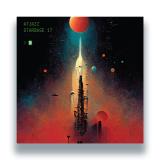
Atjazz presents his long-awaited 27-track long player "Starbase 17" — an epic odyssey through song and sound, offering a rich tapestry of styles that draws listeners into a wondrous sonic realm where rhythm, harmony, and imagination intertwine.
Taking inspiration from his extensive body of work, Martin "Atjazz" Iveson fuses his signature deep musicality with cutting-edge production to reach new creative heights. This time, he brings an exceptional ensemble of world-renowned collaborators aboard his cosmic vessel, each adding their own distinct brilliance to the voyage
Together, this stellar lineup consisting of Fred Everything, Nathan Haines, Sio, Karizma, LyricL, Peacey, Pete Simpson, OVEOUS, Charles Webster, Kaidi Tatham, Clyde Beats, Natasha Watts, Omar, Max Beesley, Josh Milan, Rona Ray, Osunlade, and Clara Hill joins Atjazz on a journey through sound, space, and emotion — where each track is a world of its own, yet all are united by a shared creative vision and boundless imagination.
Gaudi’s Jazz Gone Dub is a masterclass in genre fusion, seamlessly blending the improvisational essence of jazz with the heavy atmospheric grooves of dub. Known for his eclectic approach to music production, Gaudi pushes the boundaries yet again, creating a sonic landscape that feels both nostalgic and refreshingly innovative.
Four years in the making, from the opening track it’s clear that Jazz Gone Dub is more than just a mashup of styles—it's a thoughtful exploration of the intersections between two rich musical traditions.
Gaudi’s multi-instrumental talents are on full display, and the presence of reggae royalty is palpable, courtesy of rootsy melodies from David Hinds (Steel Pulse), Jah Wobble’s iconic bass grooves, Ernest Ranglin’s intricate guitar lines and Sly & Robbie’s rhythmic genius. Add Sardinia’s Train to Roots band, Manu Chao collaborator Roy Paci, veteran guitarist Marcus Upbeat, Mr Woodnote and Tim Hutton’s brass work, Gavin Tate-Lovery’s sultry sax and flute, Horseman’s percussive flair plus Colin Edwin and Vlastur’s serious basslines, and the
result is a rhythmic foundation that’s both solid and fluid, allowing the jazz elements to float freely above the dub undercurrents.
Despite this star-studded line-up, Gaudi remains the glue that holds this gem together: his production is meticulous yet organic, allowing each track to breathe and evolve naturally. The use of space, delays and reverb—a hallmark of dub music—is expertly handled, giving the album a dreamy, immersive quality. Tracks like Susceptible and Alabaster Moon showcase Gaudi’s ability to create mood and atmosphere without sacrificing melodic and rhythmic complexity.
In Jazz Gone Dub Gaudi has crafted an album that feels both timeless and forward-thinking, a celebration of musical synergy where the free-spirit of jazz meets the deep resonance of dub. Whether you’re a fan of either genre or simply appreciate masterful musicianship and innovative production, this album is a must-listen.
Back in 2022, Is It Balearic? Recordings founders Coyote (AKA long-serving producers Richard Hampson aka Ampo and Timm Sure) took time out from releasing music on their own labels to deliver a near perfect mini-album on Phil Cooper’s similarly mind-ed NuNorthern Soul imprint, Everything Moves, Nothing Rests.
A superb exploration of their trademark sound, where gentle downtempo rhythms and nods to dub came cloaked in colourful ambient chords, sun-bright melodic motifs, organic instrumenta-tion and quirky spoken word samples, Everything Moves, Nothing Rests deserved a sequel. So, three and a half years on, the duo has delivered just that: a fine six-track EP that offers an even deeper and more atmospheric exploration of their signature sound.
It is a sonic approach that should now be familiar to Balearic en-thusiasts the world over. Aside from delivering a steady stream of singles, albums and remixes on their own imprint, Hampson and Sure have also showcased their skills and loved-up musical mis-sives on International Feel, Music For Dreams, Needwant, MM Discos and Citizens of Vice.
The Higher The Sky, The Deeper The Ocean, their hotly anticipated NuNorthern Soul return, is named in honour of a quote from Ped-ro Alonso’s documentary series On the Ship of Enchantment, an extended voyage in which the Money Heist movie star meets healers and masters of ancestral medicine across his native Mexi-co.
There’s naturally a meditative and slightly psychedelic sound to much of The Higher The Sky, The Deeper The Ocean, which offers a subtly varied exploration of Coyote’s style and influence. Yearning, soft-focus opener ‘Muted Beauty’ – the kind of immersive, effects-laden and sample-sporting ambient bliss found nestling on Fila Brazillia albums of the mid 1990s – is followed by the similarly gentle ‘Go All The Way’, where delay-laden acoustic guitars, spo-ken word snippets and gaseous chords stretch out atop a languid, slow-motion groove.
‘A Drop in the Ocean’ picks up the pace a little via a glorious hat-tip to turn of the 90s ambient house – all dub-wise bass, heady deep house sonics, spaced-out chords and half-buried references to sunrise-ready Balearic synth-pop records of the late 1980s. Late psychedelic guru Terrence McKenna appears in sampled form on ‘Dolce Far Niente’, a tabla-driven drift and musical hallucination which conjures mental images of lying in the Mexican desert, gazing intently at a starry sky.
In contrast, ‘Riviera Sound’ is a chunkier, brighter and more sun-splashed affair – all deep, dubby bass, sustained piano parts, punchy downtempo breaks and the duo’s trademark ambient pads – while superb closing cut ‘No Coincidences’ fixes jazzy double bass samples, twinkling keyboard motifs, subtle acid lines and Latin-laced percussion to a street soul-adjacent beat.
Heady, impeccably crafted and thoroughly enveloping, The Higher The Sky, The Deeper The Ocean is Coyote at their dazzling best. It marks another significant chapter in their ever-evolving musical journey.
Death Is Not The End collaborate with Uzbek label Maqom Soul to deliver an LP counterpart to last year's mixtape of the same title, compiling specially picked & fully licensed individual belters from the ex-soviet studios of Central Asian republics between 1978 and 1989 - incl. Uzbek, Tajik, Kurdish & Uyghur artists pulling traditional folk motifs together with pop & rock and psych elements.
"These recordings do not form a smooth or coherent history. They feel more like a sequence of discoveries made at different moments and in different circumstances. Songs and instrumental pieces that once lived inside specific contexts radio broadcasts, philharmonic programs, touring routes now sit side by side, revealing hidden connections as well as clear fractures between them.
Nasiba Abdullaeva appears here as a voice from the end of an era. Trained within a conservatory system, she worked inside the format of the Soviet pop song while filling it with melodic logic that did not come from Moscow or Leningrad. Her voice is soft and sustained, shaped by Eastern melisma, and it never functions as decoration. Even in tightly structured songs there is a sense of resistance, an effort to preserve a musical language rooted in Uzbek tradition rather than fully adapted to an all Union standard.
The ensemble Sintez, later renamed Navo, represents a different path. Beginning as a student rock group, the band was gradually absorbed into the official VIA system with all its limitations and compromises. Yet it was precisely within those boundaries that Sintez and Navo developed a recognizable sound. Electric guitars and jazz rock harmonies do not overpower the folk material but remain in tension with it. Their recordings feel like negotiations between what the musicians wanted to play and what they were allowed to perform.
The Tajik ensemble Gulshan reflects an institutional approach carried to a high professional level. Formed under television and radio structures, the group treated folk material almost as a written score. Carefully constructed arrangements, close attention to orchestration, and restrained use of pop techniques define their sound. There is less spontaneity here, but a strong sense of discipline and structure, where national melody becomes part of a carefully controlled sonic framework.
Koma Wetan occupies a very different space. Formed in the 1970s, this Kurdish rock group approached poetry and folklore as tools of cultural assertion. Their psychedelic rock never feels like a stylistic borrowing. Instead it functions as a contemporary vessel for language and themes that might otherwise have remained unheard. Even today these recordings sound fragile and stubborn at the same time.
The Uyghur ensemble Yashlik, closely connected to a musical drama theatre, operated somewhere between stage performance and popular music. Their songs are built on folk melodies but shaped for wide audiences. What emerges is a constant attempt to preserve the recognizability of Uyghur musical identity without freezing it in a folkloric frame. Yashlik's music exists in a state of balance between representation and development.
Digging Central Asia does not attempt to establish hierarchies or offer a single wayof listening. Names and dates matter less than the sound itself. Tape noise, abrupt transitions, and unexpected timbres remain part of the material rather than flaws to be corrected. This music existed at the crossroads of multiple routes geographic, cultural, and ideological. Heard today in a new context, it no longer feels peripheral. Instead it stands as a reminder that the history of popular music is far more fragmented, layered, and polyphonic than it is usually allowed to be."
Nitai Hershkovits and Daniel Dor return with Found & Found, their second collaborative album and a natural continuation of the musical dialogue initiated with The Garden Suite.
Born out of pure curiosity - "there was more to say, more to explore," explains Dor - the album expands the duo's sonic language beyond the synth-only framework of their previous work. While the Moog remains central, Found & Found introduces clarinet and acoustic guitar, gently dissolving the boundaries between electronic and acoustic sound.
Each composition unfolds through interlocking, mantra-like patterns. Repetition becomes a space for transformation: melodies circle, textures shift, and subtle harmonic movements invite the listener inward. The music is structured with care, yet it feels open and fluid. intimate, spacious and quietly immersive. If their previous record explored orchestral depth through synthesizers, this new chapter embraces air and clarity. Acoustic gestures emerge within electronic landscapes, creating a sound world that is both grounded and weightless.
Nitai Hershkovits brings with his fellow partner Daniel Dor a refined harmonic sensitivity shaped by both jazz and classical traditions. Together they continue to refine a shared language that moves between structure and freedom, precision and emotion.
,In the Grace Of Your Love" kam ursprünglich 2011 raus und war ein Neustart für The Rapture und eine willkommene Rückkehr zu DFA, dem Label, das ihnen zu ihrem sofort erfolgreichen Debüt ,Echoes" verholfen hatte. Der Schwung und Erfolg dieser Jahre führte zu einer Achterbahnfahrt mit einem großen Label, die sie wieder da landete, wo sie angefangen hatten - mit Narben, aber jetzt frei, die Grenzen der Erwartungen zu sprengen. Begleitet wurden sie dabei vom verstorbenen, großartigen Philippe Zdar, einer Hälfte des französischen Dance-Duos Cassius und Produzent von Künstlern wie Phoenix und den Beastie Boys. Zdars Begeisterung und technisches Können sind schon in den ersten 30 Sekunden des Albums zu hören: ,Sail Away" ist The Rapture in voller Pracht und Strahlkraft, ein fünfminütiger Ausatem mit Disco-Drums. Natürlich gibt es auch jede Menge Futter für die Dance-Kids - ,How Deep Is Your Love" rockt immer noch die Tanzflächen der New Yorker Bars, ,Miss You" ist ein unwiderstehlicher kleiner Streich in Moll -, aber insgesamt herrscht das Gefühl vor, dass man langsamer wird, Bilanz zieht und an den richtigen statt an den falschen Orten nach Sinn und Liebe sucht. Daher auch das Finale: ,It Takes Time To Be a Man", ein charmant ehrlicher, von Klavierklängen untermalter Song über Verantwortung übernehmen und anderen helfen. Er klingt wie nichts anderes im Repertoire von The Rapture und rundet es dennoch perfekt ab. Der Abspann läuft, die Zeit vergeht, Platten bedeuten immer noch alles.
Evighet proudly unveils its fifth release, EVIGHET005, featuring the Sky City EP by Dave N.A., the prolific producer from Yerevan known for his refined sound design and emotionally resonant compositions. With a catalog that spans labels such as Typeless Records and Uppers & Downers, his work continues to bridge precision and sensitivity, exploring the borders between rhythmic architecture and ambient introspection. On Sky City EP, Dave N.A. constructs an intricate sonic landscape where lush atmospheres coexist with fractured breaks and IDM-inspired rhythms. Rooted in the traditions of Jungle and Breakbeat yet unbound by genre, each piece reveals a narrative built from texture, movement and space. His music invites reflection while maintaining a dynamic forward energy, evoking the sense of motion through memory and dreamlike transitions. A central moment in the release is “Bloom”, which features a collaboration with Hayk Karoyi on flute. His performance adds an organic depth and melodic fluidity, weaving through electronic layers with warmth and clarity. The result is a delicate interplay between human breath and machine pulse, blurring the boundary between the natural and the synthetic. Sky City EP marks a new chapter for Evighet, reaffirming the label’s dedication to sound as a medium of exploration and storytelling. Through this release, Dave N.A. captures both emotional immediacy and compositional detail, expanding the label’s evolving narrative with a vision that feels deeply personal yet universally resonant.
On his sixth album, The Arc of Tension, the Berlin based DJ, label owner and producer OLIVER KOLETZKI yet again presents his remarkable vision of contemporary electronic music, while he assumes the role of a storyteller. The Arc of Tension speaks to its listener as a singular, self contained work, which communicates by way of its natural flow and arc of suspense. The latter is mirrored not only in the multifarious narrative of the actual album, but can also be understood as evidence for its creator's long musical history. While Koletzki focussed on a diverse range of vocal collaborations on his previous long players, he now moves on to a different form of storytelling, rooted in the quiet confidence of a veteran musician, as well as the hectic lifestyle of a globally in demand DJ. The Arc of Tension is the psychonautic journey through the various continents of Oliver's consciousness. The quiet chirps and warbles, which initially unfold on the opener 'A Tribe Called Kotori', thus act as a loose associative bridge to 'Der Muckenschwarm', Oliver's big breakthrough hit of 2005. The first minutes of the album leave no room for doubt - we are immediately locked into an autobiographical world of sound that knows how to captivate from the get go. The dreamy, exotic timbres of the downbeat tracks 'By My Side', Tankwa Town' and 'Byron Bay' penetrate our minds in a subtle yet purposeful manner. But soon the tension tightens and organic sounds one by one evolve towards a sterner, electronic cadence.
Following the first chapter of Connessioni, Danza Tribale unveils Connessioni II, the final movement in Tamburi Neri’s two-part sonic exploration of connection, vibration, and ritual.
If the first EP traced the invisible threads between body, city, and earth, Connessioni II is where those threads tighten and transform. It is no longer the search-it is the meeting point. Nature, metropolis, and digital spirituality no longer call to one another from afar; they converge..
The Buddha Bar collection is the one of the most emblematic electronic compilation series with over several million copies sold over the years. Discover the 27th Buddha-Bar Compilation, Mixed by DJ Ravin. Immerse yourself in the captivating and unique world of Buddha-Bar with this new « haute couture » selection. This latest edition, masterfully mixed by the iconic DJ Ravin, takes listeners on a mesmerizing sonic journey, blending sophisticated electronic beats, worldwide sounds, and deep chill and house vibes. More than just an album, it’s an immersive experience perfect for setting the mood at any gathering or accompanying moments of pure relaxation. With a legacy of globally acclaimed compilations, the Buddha-Bar series has already captivated millions, creating a lifestyle phenomenon like no other. Available on March 28th, Buddha-Bar XXVII is a must-have for fans of lounge and electro music. Give your customers the chance to escape into this musical adventure
Laurie Torres is a Canadian musician and composer raised in Montréal, Québec by Haitian parents. Since 2008, she has been a trusted stage and studio performer for Julia Jacklin, Pomme, and Land of Talk, as well as being a founding member of Folly & The Hunter, with whom she recorded four studio albums and toured Canada, Europe and the UK.
In 2023, Laurie shifted focus to work on her own creations, a process of making time - the will and the need becoming omnipresent. Drawing creative inspiration from contemporary artists like Tirzah, Gia Margaret, Valentina Magaletti, Tara Clerkin Trio and ML Buch, 'Après coup' finds Torres intersecting at a pivotal moment where artists whose marginalized identities are at the forefront in creating a beautiful array of "other options".
"Being othered and tokenized as a woman who plays music, as well as a queer and black person, takes a toll, while also positively feeding a strong urge to push and be seen."
Centering around piano, drums and synthesizer with interweaving field recordings, 'Après coup' follows the precursor ep 'Correspondances' in the form of a sprawling 11-track album. Translating directly from French - afterwards, after the event - its title subliminally points at something deeper between the lines. Recorded in 2023 between tours in a small window of time where 'normal' life hadn't quite recommenced, Torres meticulously crafted her debut solo material in view of surrounding nature, all providing the perfect nourishment for long streams of improvisation. Built right up to the edge of a lake, Studio Wild in St-Zénon, Québec offered an unparalleled location and set up for her freeform creativity.
Instrumental music seemed like a natural response and evolution for Torres who had long basked in the world of "pop music" as she elaborates: "I had an urge to use creativity as a sort of resting place, a place where things can unfold slowly and take time to reveal themselves. In other worlds words, I felt the need to make something slower, more elusive"
The immediacy of Torres' recorded takes doubled with minimal overdubs create a fiercely direct, intimate and unpolished lo-fi beauty. 'Après coup' then is self-reflective, open and inclusive with Torres allowing herself to be fully seen. An album to be felt at close distance with unrivalled authenticity. This album stands as a testament to Laurie's artistic evolution and serves as a beacon, inspiring her to continue nurturing her own creative pursuits and finding exhilarating freedom.
Once I Was Young and The Airplane Album find the producer taking yet another sonic right turn. "These records were made in the same year with a very similar creative process. I moved almost completely away from sampling, experimented more than ever with ambient and techno elements and used the album format as a way to tell a story about moments in my life." Once I Was Young is a storytelling work that journeys through analogue synth-pop, modulated techno and raw, dusty drums with otherworldly melodies. Moments of beauty come through escapist, naturalistic ambient tracks and fusions of Kraftwerkian sequencing with more classical piano, while stark, clubready grooves keep things moving. Airplane contrasts similar shades of light and dark, synthetic and organic, rough and smooth. Glitchy, imperfect analogue sounds, knackered drum machine grooves and eerie synth phrasing evoke a post-human world with icy atmospheres. Elsewhere, warmth comes from bittersweet melodies and loose, funky drums that ooze retro-future charm.
Once I Was Young and The Airplane Album show a diff erent side to Escobar, one that embraces introspection and experimentation while exploring a whole other world of meaningful machine soul
"Morning Star" zeigt Kekht Aräkh auf dem Weg zu einer authentischeren, verfeinerten Version seiner selbst. Das Album wurde in Berlin und Stockholm aufgenommen und entstand in einer Phase intensiven persönlichen und künstlerischen Wachstums. Es verbindet aggressive Black-Metal-Passagen mit immersiven, strukturierten Klanglandschaften, die sowohl intim als auch weitläufig wirken. Seit seinen Anfängen in Mykolajiw, Ukraine, hat Dmitry (alias Crying Orc), der alleinige Kopf hinter dem Projekt, einen unverwechselbaren Weg innerhalb des Black Metal gesucht. Diese Vision entfaltete sich durch sein Debütalbum "Through the Branches to Eternity EP" (2018) und die Alben "Night & Love" (2018) und "Pale Swordsman" (2021), die eine charakteristische Spannung zwischen wildem, viszeralem Black Metal und zarten, introspektiven Balladen etablierten. Auf "Morning Star" erreicht diese Dynamik eine neue Tiefe. Das Album entstand in einer Phase künstlerischer Klarheit und erkundet eine rauere, persönlichere Gefühlspalette, geprägt von Stress, Angst und langen Phasen der Schreibblockade, was ihm eine seltene Unmittelbarkeit und Verletzlichkeit verleiht. Dmitry nahm fast alle Instrumente selbst auf, das Schlagzeug stammt von Jonathan (Spira Me, Vanskapth, Olycka). Bladee steuerte den Gesang bei und war Co-Autor der Texte zu "Eternal Martyr", eine unerwartete Zusammenarbeit, die eine intuitive Chemie offenbart. VS--55 und Varg2Ö fügen abstrakte Samples und subtile Texturdesigns hinzu, die "Morning Star" seine unverwechselbare Körnigkeit und analoge Wärme verleihen, während James Ginzburg (Emptyset, Osmium) sich um das finale Mastering kümmerte und die dynamische Tiefe und atmosphärische Fülle verstärkte. Mehrere Tracks greifen früheres Material mit neuen Perspektiven wieder auf. ,Wänderer" und ,Drömsang" wurden teilweise neu aufgenommen oder komplett neu interpretiert. Intensive, treibende Passagen kollidieren mit spärlichen, kontemplativen Zwischenspielen und erzeugen eine Landschaft, die sowohl viszeral als auch eindringlich ist. Themen wie Isolation und Wanderschaft tauchen in "Wänderer" auf, traumhafte Melancholie in ,Drömsang", existenzielle Kämpfe in "Angest" und Reflexionen über Zeit und Transformation in "Three winters away". Mit "Morning Star" verbindet Kekht Aräkh vergangene Erkundungen mit neuer kollaborativer Energie und produziert ein Album, das die Black-Metal-Tradition der 90er Jahre würdigt und gleichzeitig Lo-Fi-Wärme, melancholische Melodien, klangliche Experimente und emotionale Offenheit umfasst. Das Ergebnis ist ein zutiefst persönliches Statement - ein Album, das sowohl eine Ankunft als auch eine Fortsetzung seiner künstlerischen Reise darstellt.
British electronic music pioneers Graham Massey (founding member of Manchester legends 808 State) and Brian Dougans (the mind behind acid house milestone Humanoid and one half of The Future Sound Of London) join forces for their debut collaboration In Place Of Language, released on Belgian label De:tuned.
Both 808 State and Humanoid helped shape the UK's early rave and acid house movement. Here, Massey and Dougans channel that legacy into a beautifully balanced four-track EP that radiates warmth and energy, drawing on more than three decades of experience in electronic music. Inspired by key elements of the '89-91 era while embracing a contemporary edge, the duo merge their distinct sonic identities into a sound that feels both timeless and forward-looking.
In Place Of Language is not a nostalgia trip, but a natural evolution: a meeting point between foundation and future, and a blueprint for a new wave of electronic experimentation!
Kevin Foakes (Openmind, DJ Food, Ninja Tune) created all the graphic work. Mastered by Matt Colton at Metropolis. A separate digital release will also be available at the usual digital shops. Stay tuned!
GARDEN OF EDEN becane an instant sensation via white label promotion copy plays,
It instantly picked up support from radio stations Mi-Soul (instant playlist), Panacea, Solar and Starpoint, became Terry Jones breakout record at the recent Southport Soul Weekender and had Modern Soul DJs begging for a copy,
A special reaction to a very special record. Produced by veteran House Heads Phil Hooton and Mark Gamble, the duo have created a monster track that straddles Soul, Jazz and House. Commentator Yogi Haughton highlighted the “ambiguous nature” of GARDEN OF EDEN as it merges Soul and Jazzy House.
The bedrock of the track is a newly recorded (with ace musos lured into the recording studio) version of Mezzoforte’s Iceland jazz-funk classic GARDEN PARTY.
Phil and Mark then composed a brand new composition to go over the top of the track,and to regally complete their new concoction got UK Soulful House royalty vocalist extraordinaire Pete Simpson to sing it. And what a performance Pete delivers!
There’s two equally beguiling mixes - on the a side the 4.37 Vocal Edit V.3 With Horns edit and flip it over for the 4.34 Vocal Trombone Mix - on this 7” single.
Saithara were a leading traditional Lanna music group in the Chiang Mai area, led by Chansom Saithara who was named a National Artist in 1996.
Chansom's son, Thepthara Panyamana, fronted the related Saithara "Combo", who explored a range of international pop styles to craft their light-hearted parody tracks in the local "kam mueang" dialect. The lead single here, from 1985, makes use of a well-known German synth-pop song which had become a surprise smash a few years earlier, while the b-side snags a similarly notable power-pop tune from the USA.
Thepthara was also a songwriter and instructor for the child musical group Nok Lae, a Chiang Mai area youth band who became mainstream crossover stars nation-wide. Thepthara passed away in 2017, and Baa Records has teamed with his brother Komsan to license this re-issue in his memory.
It's 5 AM. The golden hour. That moment suspended on the lips of the night that is leaving us. Where the dance still refuses to die as sweat dries, bodies float and minds drift. Some immerse themselves in the dripping surroundings while others emerge or pretend. Outside, nature reclaims its rights. When the moon sets over Kizipolis, the music doesn't stop: it transforms us.
To celebrate our 10th anniversary, the pillars of the label were invited to compose the track they would play at this precise moment. The one that no longer seeks to prove itself, that accompanies the ebb of shadows, connecting the senses to the light.
Kizipolis Vol.1 is the soundtrack to an imaginary but familiar city, a city where raving is a way of life, where music acts as a climate, where at 5am, anything is still possible.
Akusmi is the project moniker of French-born, London based composer, multi-instrumentalist and producer Pascal Bideau, who signs to the new Tonal Union imprint for the release of his album 'Fleeting Future.' With its hallucinatory, genre-defying blend of minimalism, cosmic jazz and Fourth World influences, and in its quest for optimism in the face of unknown and limitless possibility. 'Fleeting Future' stands apart as an inventive and inspirational debut.
The creation of the album's richly colourful and multi-layered sound world was originally inspired by Bideau's journey to Indonesia, where he immersed himself in traditional Gamelan and gong music. Many of the themes, motifs and melodies on 'Fleeting Future' seed from the 'Slendro' scale, one of the essential tuning systems used in Gamelan. However it is not musical scales, but scales as in the size or extent of things that most fascinates Bideau, specifically he explains; "the compelling way things dramatically change when you shift from any given scale to another."
The album connects directly to nature and the wider world in its evocation of perceptive shifts and transitions from microscopic to macro scale, as evidenced by the opening title track 'Fleeting Future', on which a simple dotted saxophone line morphs and billows into synths, brass and strings, indicating the musical voyage that lies ahead. Like the start of a journey or adventure it is full of anticipation, its arborescent growth conveying the optimism of the unknown and of limitless possibility. The album centrepiece 'Neo Tokyo' is a vibrating, ebullient mass of colliding elements which feels like zooming in to the electron level, as it teeters on the edge of chaos. The title is a reference to Katsuhiro Otomo's Akira, a dizzying work of art set in a sprawling futuristic metropolis.
'Yurikamome', meanwhile, is an imaginary soundtrack inspired by Bideau's yearning to visit Japan which he fuels by watching Youtube videos of drives and rides through Japanese landscapes and cities. "It's amazing" he adds, "that we have the ability to access almost anywhere in the world and see what it's like, that people document it and upload it. It's never going to be any replacement for the real thing, but with places that really touch you, it works." The track is named after a Japanese monorail train line which rides from Shinbashi to Toyosu, a last journey that feels like a new beginning.
'Fleeting Future' was composed and recorded by Bideau between 2017 and 2019 in his North London studio and features additional contributions recorded in Berlin by Florian Juncker (trombone), Ruth Velten (saxophone) and regular collaborator Daniel Brandt of Brandt Brauer Frick (drums / electronic percussion). Having been living through uncertain times, one thing that keeps spiralling into the unknown is the future, about which Bideau leaves us with a final thought:
"The future is fascinating: It is constantly readjusting to new events. I feel we left a linear approach to the future to enter an arborescent one where all the data and information we have about what could happen is exponentially ever-growing. Following a branch might allow you to glimpse into what it may become, but the evolution of the whole picture might very well render the prediction totally obsolete, and even meaningless. In that sense, there is not one future but innumerable ones all cancelling each other. That's what makes it fleeting."
Auf ,Reflections Vol. 3: Water Poems" bringen Félicia Atkinson und Christina Vantzou ihre Freundschaft und ihre atmosphärische Kunstfertigkeit in einem feierlichen Fokus zusammen. Gesprochene Worte und orchestrale Fantasie fließen wie Nebenflüsse in einen einheitlichen Strom und ergeben eine Sammlung traumhafter Lieder und Klanglandschaften, die im Meer, im Himmel und in den Steinen verankert sind. Mit elektroakustischen Instrumenten, Gesang und Umgebungsgeräuschen lädt Water Poems die Zuhörer in einen unbewussten Raum ein, irgendwo zwischen alltäglicher Intimität und dem Geheimnis des Ozeans, aus dem alles Leben entsteht. Atkinson und Vantzou haben sich 2009 kennengelernt und seitdem immer mal wieder zusammengearbeitet, aber ein Konzert 2019 in der Philharmonie in Paris hat dieses Projekt richtig in Gang gebracht. Da beide jetzt an der Küste leben (Félicia am Ärmelkanal, Christina am Mittelmeer), wurde das Meer natürlich zu ihrer Muse. ,Das Meer wurde nicht als monolithische Postkarte betrachtet", erklärt Atkinson, ,sondern eher als eine Person an sich; eine Energie, ein Geheimnis, ein komplexer Charakter, dem wir als Menschen, die am Meer leben, jeden Tag begegnen." Im Dialog mit dem Land und der Küste nahmen ihre Sprache und ihre Klänge einen sakramentalen Charakter an. ,Ein feierliches Gefühl, ein Gefühl des Dienens, zieht sich tief durch dieses Album", bemerkt Vantzou, ,ich habe das schon einmal gespürt, aber hier, in der Zusammenarbeit mit Félicia, ist es stärker." Stimme, Atem und wässrige Texturen prägen den Ton des maritimen Mysteriums von Water Poems. Neu in Vantzous Praxis und seit langem ein prägendes Merkmal von Atkinsons Werk, gewinnen ihre gesprochenen Worte hier an relationaler Intimität, indem sie sich gegenseitig und die Uferpromenade ansprechen. Die Texte wurden über zwei Jahre hinweg gemeinsam zusammengestellt. Mit radikaler Unschuld lenken sie das Bewusstsein auf die verborgene Auftriebskraft und die unbewussten Strömungen, die durch das Leben fließen: ,Wie kann ein Boot schwimmen? Wie kann ein Flugzeug fliegen? Wie kann ein Körper schwimmen? Wie kann ein Mensch träumen?" Was mit nah aufgenommenen Stimmen und Feldaufnahmen begann, wurde um Synthesizer, Gongs und Metallophone, Klavier, Vibraphon, Rhodes, Gitarren und Mellotron erweitert. Das Gezeitenklavier des Eröffnungstracks ,Film Still / The Sea" zieht uns in die unbewussten Gewässer des Albums. Enthalten sind Feldaufnahmen, die Vantzou in Delphi in der Nähe des legendären Orakels von Pythia aufgenommen hat - ihr griechisches Erbe verleiht diesem Ort der Vorfahren eine zusätzliche Dimension. Dieser Track und ,Water Poems" als Ganzes sind Ausdruck unseres geologischen Erbes und rufen zum Schutz der Küsten und zu einer Vertiefung unserer Beziehung zu unseren Küsten auf. Ein Teil der Einnahmen aus dem Album geht an Arion, ein gemeinnütziges Naturschutzprogramm für das griechische Mittelmeer. Der langjährige Freund und Mitstreiter John Also Bennett hat bei ,Scorpio Purple Skies", dem kosmischen Finale des Albums, mit E-Gitarre, Lap-Steel-Gitarre und Gesang mitgewirkt. Diese üppige Instrumentierung passt super zu den Science-Fiction-Visionen und der feierlichen Atmosphäre des Albums. Water Poems wurde in The Old Carpet Factory, einem Herrenhaus aus dem 18. Jahrhundert auf der griechischen Insel Hydra, in der Villa Medici aus dem 16. Jahrhundert in Rom und in Les Dunes, Atkinsons Heimstudio in der Normandie, aufgenommen. Mehr als das historische Prestige dieser Orte war es die spürbare Geschichte ihrer Landschaft, die die Musik geprägt hat. Atkinson sagt, dass sie sich zu ,Orten mit seltsamer Anziehungskraft" hingezogen fühlten. In der Villa Medici ,haben Steine und Mineralien das gesprochene Wort beeinflusst", bemerkt sie. ,Wir beide legen Wert auf Gefühl, Atmosphäre und Klang", fügt Vantzou hinzu, ,was er hervorruft und was er bewirkt. In unserem Fall konzentrieren wir uns auf die grundlegenden Elemente: Wasser, Luft, Fels, Kosmos - allesamt lebenswichtig.» Von der Insel Kreta aus arbeitete Vantzou den finalen Mix fertig und tauschte dabei Dateien mit Atkinson aus. Immer noch mit der Küste verbunden, verlief der Mixing-Prozess geduldig und wurde von wichtigen Pausen geprägt. Water Poems spiegelt wider, was die Meeresbiologin Rachel Carson uns in Erinnerung ruft: ,Am Rande des Meeres zu stehen bedeutet, Wissen über Dinge zu haben, die so nahezu ewig sind, wie es das irdische Leben nur sein kann." Es zelebriert rituell dieses ozeanische Gefühl als wichtige Quelle der Gelassenheit und Intelligenz. In einer Welt, die von hitzigen Meinungen und ökologischer Vernachlässigung geprägt ist, lenkt Water Poems unsere Aufmerksamkeit auf ,die Quellen der Quellen". Damit schafft es Raum, um uns wieder mit unseren elementaren, animalischen Instinkten zu verbinden und uns auf tiefere Strömungen einzustimmen. Water Poems von Félicia Atkinson und Christina Vantzou ist der dritte Band von Reflections, einer Reihe zeitgenössischer Kollaborationen von RVNG Intl..
Loud Ambient 2 picks up directly from where Loud Ambient left off. After picking the drum machines back up, we returned to the colourfield ideas that shaped the first record. Rothko remained a key reference, along- side a strong recommendation to spend time with the work of Josef Albers. We did exactly that, and it paid off.
Alongside the music, we created 50 new pieces of artwork for Loud Ambient 2. These became tools rather than decorations. Working this way felt open and rewarding, and brought a real sense of play back into the process. We already understood what a Loud Ambient track could be, so slipping back into that headspace felt natural. The tracks came together quickly, full of energy, movement and that familiar noodle quality.
The creative side landed easily this time. There is some- thing about working with colourfields that frees you up and pushes you further into abstraction. It removes hesitation and keeps the focus on instinct and response.
With the drum machines and synths loaded, we kept our heads down and made the kind of music we want to hear on a dance floor. Loud Ambient 2 is the result.
This first-time reissue of Quinteplus’ 1971 album revives a key moment in Argentine jazz, featuring crisp trumpet and tenor sax, electric piano-driven funk and modal grooves, and a tight, spacious rhythm section. It showcases prominent figures like Jorge Anders and “Pocho” Lapouble.
==================================
Quinteplus was born in Buenos Aires at the end of the 1960s, emerging directly from the ideas and experiments of the legendary Agrupación Nuevo Jazz. Founded in the early ’60s, this collective brought together some of the most forward thinking figures in Argentine jazz functioned as a creative lab where musicians questioned where jazz could go next. Among the key ideas discussed was the fusion of jazz with Argentine folk styles such as zamba, chacarera, malambo, cueca, and candombe, as well as a deeper look into African rhythms as a bridge between musical worlds.
Two members of that collective, keyboardist Santiago Giacobbe and bassist Jorge “Negro” González, carried those ideas forward when they formed Quinteplus in 1969. The group came together naturally: all the musicians already knew each other and had played in different projects around the Buenos Aires scene. They shared a strong admiration for Julian “Cannonball” Adderley’s quintet, along with a clear goal—to develop a modern jazz language grounded in local Argentine rhythms.
From the start, Quinteplus stood out for its openness and adventurous spirit. Rhythm was central, and so was experimentation. The band belonged to a generation of Argentine jazz musicians eager to explore electric instruments and new textures, anticipating what would soon be known as jazz-rock. This was happening in Buenos Aires at the very same time Miles Davis was opening new doors with “In a Silent Way” and “Bitches Brew”. Giacobbe introduced one of the first Fender electric pianos in Argentina, while González pioneered the amplification of the upright bass and even developed a hybrid electric, boxless version of the instrument. Trumpeter Gustavo Bergalli, meanwhile, maintained close ties with the emerging Argentine rock scene, collaborating with Luis Alberto Spinetta and appearing on Almendra’s first album.
In 1971, Quinteplus recorded its first and only studio album for EMI. The original lineup featured Jorge Anders on tenor saxophone, Bergalli on trumpet, Giacobbe on keyboards, González on upright and electric bass, and Norberto “Pocho” Lapouble on drums and percussion—who also illustrated the album’s iconic sleeve. The record is a refined showcase of the band’s musical vision: original compositions, fluent jazz language, folk-derived rhythms, funky electric textures, tight ensemble playing, and standout brass solos. Though critically praised, the album received little label support and sold modestly, eventually becoming a sought-after collector’s item.
Quinteplus disbanded in 1973, their music was perhaps too bold and unconventional for its time.
The duo Sławek Pezda & Witek Ryć is a project by Krakow-based musicians, a hybrid of ambient, noise, experimental music, jazz, trance, electronica, and ethnic music. The two musicians' musical paths were united by the practice of meditation, which also significantly translates into their musical language and the need to share the peace that flows to the listener through sound.
In their recordings and live performances, the musicians utilize tenor saxophone, modular synthesizers, electronics, drums, flutes, drum pads, Tibetan bowls, gongs, and a wide array of percussion instruments. They have played together in improvised concerts, relaxation concerts, chamber sessions, and even spiritual jazz.
"Kardamon" is the result of one of the live sessions, where the rhythm, based on a simple pulse flowing from a frame drum, accompanied by Ankle Bells (Indian janissary bells played with the foot), is enriched by Sławek's tenor saxophone. In addition to the aforementioned instruments, a synthesizer and a Roland HPD 20 drum machine were also used, accompanied by various percussion instruments (shaker, chimes, bells, etc.), as well as a fragment of Witek's own field recordings from the Polesie National Park.
The remix on the B-side was created by DJ PLASH, who gave the duo's original sounds a completely new dimension. Plash (Marcin Przeplasko) is arguably one of the most sought-after DJs playing for b-girls and b-boys worldwide, a feat culminating in his official performance behind the turntables at the last Summer Olympics. PLASH is Witek's neighbor from Krakow's Nowa Huta district.
The front cover artwork is a painting by Witek Ryć, and the entire album was assembled and framed by Animisiewasz. Mastering was handled by Eprom. The single is limited to 150 copies and is being released by Funky Mamas and Papas Recordings, a label specializing in seven-inch singles since 2008.
In September 2024, Nacho Piek, Rapha Mundi, Odd Signals and Ibai Machín gathered for four days in a beautiful house in Etxeberri, a small village in Navarre with barely 50 inhabitants. Isolated from everyday rhythm and surrounded by nature, the goal was clear: to create a production camp dedicated exclusively to club music.
The result is Etxeberri EP, the debut of Buenobueno Soundsystem — a work that captures that coexistence in the form of direct and timeless music, designed for the dancefloor. An organic crossing of influences ranging from House, Techno and late-90s Minimal Trance to contemporary UK Bass.
Etxeberri EP will be released on March 13 exclusively on vinyl, in a limited edition of 200 copies. Each record includes an inlay with photographs of the creative process and private access to an audiovisual piece shot by Jesús Iriarte documenting the experience and the spirit behind the project
COEO are to Toy Tonics records, what Master at Work were to the House scene of the 1990ies: They bring the Soul into the House. Their new EP Back In The Days' is a 4 track house stomper that could have been made in 1997 by guys like Sneak, Dimitri from Paris or Little Louie. But still the similarities to the new Berlin Sample-House scene around Max Graef and Hodini are evident, too. Already their last years' superhit NATIVE RIDDIM (which is featured as a bonus track on this vinyl) included some heavy jazz samples they found in their parents' bag of soul. Native Riddim has been no.1 in the Traxsource charts for several weeks and was the basis for their already huge following. From Laurent Garnier to Tensnake - the feedback has been awesome. Now they proceed their way of souldful house. Just good taste.
The mysterious Gluten People return to the fold, handing over their next vinyl-only transmission. For this second helping of "glutenous" dancefloor heat, the duo has paired up with Giacomo XL, following the massive demand for their debut EP.
Expect more of the same raw, rhythmic energy that made their first outing a must-have for heads and selectors alike. This is essential, no-nonsense club material built specifically for the wax-only connoisseur.
Early Support from: Archie Hamilton, Liquid Earth, Enzo Siragusa, Huxley, La Fleur, Sean Johnston, Make A Dance, Baby Rollen, Ysanne, Eliza Rose, Bartolomeo, Ryan Clover, AGELESS, Alec Falconer, Call Super, Bas Ibellini, ADMNTi, Gearmaster (fka Abdul Raeva), Timo Maas, Christopher Ledger, Moodymanc, Nathan Colinet, Gabski, Greogorio Soave, and many more.
DISPLACES represents Fabris' most personal musical journey to date, inspired by the concept of hyperobjects and cartographic practices. The album sculpts a high-dimensional phased time-space composed of concrete materials and digital archetypes in a state of constant displacement. It delves into the symbolic and philosophical realms of mapping as one of the greatest sense-making mechanisms for life, in dialogue with object-oriented environments, superimposition and non-locality applied to cosmic, temporal, and emotional memory.
The sonic ecosystem expands on the image of navigating a path through a set of places, from the microcosm of quanta to the macro force of dark matter, from underwater depths to overland terrains, encapsulating the cyclical flow between birth and death, both in ecological and anthropological sense. The intersection of these shifting states is explored through the extensive processing of the langspil, Iceland's only traditional instrument, intertwined with manipulated field recordings of biophonies and geophonies captured across Icelandic and Venetian territories. These recordings form the backdrop for a meditative process that relocate familiar objects into unfamiliar realms, reflecting on the transformative power of self-reflection while encapsulating the fragmentation and entanglement found in nature and the human state. The record plunges the listener into a disconcerting and physical soundscape, as a “ghostly spectrality that comes in and out of phase with normalized human spacetime,” evoking sensations of suffocation and release as each layer continuously unfolds the palimpsest of the enclosed labyrinth.
“Extraction of the I” embodies a subatomic reaction—erupting as a molecular force that rises, only to re-submerge with a solitary exhale underwater. In this mutated dark space, beluga whales breathe into "Xanadu Phasing," creating a pulsating tension that releases only to unveil a frozen landscape.
In “Barricading the Ice Sheets” the glacial material morphs into a liquid tunnel of digital artifacts, building a wall of noise that shatters into scattered fragments of ice, resembling bird calls from another world.
A moment of stasis is offered with the appearance of an asymmetrical loop in Monolith I, evoking a primitive rite before an unknown force emerges.
The physical intensity of subsonic material in "A Quake in Being" interrupts the hieratic tone, detuning into polluted sonic matter sourced from relics of the First World War in the Venetian Prealps. The geography of this place reconciles with the original homeland in "The Map is the Territory," blending negative space with anthropogenic elements and exploited sounds of the langspil.
The burning density of "Wolf-Rayet" projects into the void, echoing the residual sounds of a local church as relics of fossilized religions. Wolf tones are the remains in Monolith II, introducing the final track, "Topography of Extinction," where evolving psilocin textures invite the listener to uncover deeper layers of meaning and dislocation.
Schreit es laut heraus: Wir sind der Underground! Die Arbeiterklasse hat genug, sie geht auf die Straße, startet die Revolution, tanzt und kämpft manchmal zum Beat der Songs von RIOT CITY RADIO. Sind das Klischees? Natürlich. Aber Punkrock & Oi! jeder Art basieren seit jeher auf Klischees. Genau wie jede andere Subkultur auch. Das ist also nichts Schlechtes. Im Gegenteil, es macht Spaß. Vor allem mit RIOT CITY RADIO, denn ihre Songs sind sofort eingängige Hymnen mit perfekt ausgewogenem Songwriting zwischen kraftvollen Refrains, großartigen Mitsing-Passagen und einer rohen, gewaltigen Note, die süchtig macht! Eine Ode an Subkultur, Underdogs und die Solidarität, in Distanzierung zu einem Großteil der kranken Gesellschaft und all ihren unnötigen Exzessen. Und RCR meinen jede einzelne Zeile ihrer Songs ernst und haben viel zu sagen! Mit ihrem zweiten Album ,Spitting Teeth" startet die Band aus Plymouth, UK, mit einer charismatischen Street-Punk- und Oi!-Explosion durch! Musik mit Können, harter Schlagkraft und einer knallharten Street-Attitüde. 11 neue Songs, darunter die Singles ,We re still singing" und ,Underground". Auf limitiertem schwarzem und limitiertem mehrfarbigem Vinyl!
This 7" record by Agogo Records features two remixes by Mo' Horizons. Track one is a cover of Nat King Cole's "Calypso Blues", performed by percussionist and singer Nené Vasquez, who is part of the Mo' Horizons family and used to play in Shakira's band in a former life. Super Oud is a musical project from Bremen, Germany, combining traditional Middle Eastern sounds with modern electronic grooves.
a. Nené Vasquez - Calypso Blues (Mo' Horizons Remix)
Written by Nat King Cole & Don George. Published by Crestview Music.
Original production by Nené Vasquez. Remix production by Ralf Droesemeyer.
Lead Vocals by Inna Vizotska. Additional Remix Vocals by Frankie Figueroa.
b. Super Oud - Zala (Mo' Horizons Remix)
Written by Claas Bösling & David Niedermayer.
Original production by Claas Bösling. Remix production by Ralf Droesemeyer.
Oud by David Niedermayer. Remix Vocals by Marriam.
From Universal Music's vast catalogue, the essence of Japanese AOR, all tracks are selected and played in Muro's mix cd 'Diggin' Japanese AOR' released in 2017 and now released on 2LP.
This includes some of hidden gems such as Maki Asakawa's 'American Night', Yoshio Harada and more from the late 80's to early 90's - the golden time of Japanese AOR.
A Japanese smooth double sider for the first time on 7" selected by Muro.
A-side "Heart And Soul" is a mellow Japanese AOR song from Ginji Ito's 10th album Nature Boy in 1987, and the flip side is a cover of Saturday Love "Uwaki na Kare," taken from a sought-after album 'Nouvelles' by Ritsuko Kazami originally released in 1987.
As Flight Mode unveils its ninth physical release, Belgian‑Moroccan DJ and producer Zaatar presents a five‑track EP that naturally bridges her universe with that of the label. The result is a meeting point of visions, blurring stylistic boundaries once again.
"Lost in the spinning sound" is the 12th studio album by The Dining Rooms (Stefano Ghittoni and Cesare Malfatti) who, over the years, have delved into an original style that balances cinematic atmospheres with funk, dub and ambient music. Here they have invited just one vocal guest, Chiara Castello from I'm Not a Blonde, for a collaboration that delivers a slow, nocturnal, orchestral, very minimalist album, oscillating between folk and blues, with deeply meaningful lyrics that explore the intricate nature of interpersonal relationships. The album cover, an illustration by Sara Vivan, conveys the idea of metamorphosis and invites us to dive into the sounds that surround and protect us. This is also the main message of the album: losing ourselves in order to protect ourselves a little. Drifting along and finding new, safer and more peaceful shores.
Jack’s House Recordings kick starts 2026 with a brand new VA featuring talent from all corners of the globe, with artists coming from Portugal, to Australia, the USA and Ibiza !
First up is Alex Arnout with “Baby Let You Know” which is another solid production giving punchy and techy energy with a baseline that will wake you right up when it drops in ! It’s dark, edgy, and has a powerful signature sound that is perfect for the big dance floors as well as your underground intimate ones. Alex is no stranger to the imprint, having been the first artist signed to the label which is about to celebrate it’s 10th year as an independent record label.
Next up, we welcome back popular and talented producer Carlo Gambino with “Time Of Need” which takes you through 6 and a half minutes of a lovely gritty underground groove, and vocal snippets of the track title throughout the arrangement with his warm and unmistakable signature sound.
Then we have AMO (um) & Mills with the more minimal track of the VA, “Therapy” This is a stripped back track but instantly memorable after just one listen. Driven by a simple kick, snare, haunting fills and a riding dark baseline, the track also presents a conversation between two Women having a slightly confusing conversation in a therapy session.
Last up, it is a pleasure to introduce and welcome USA’s Jordan Bernardo & Sharktooth from the Tasteless Thieves crew to the label with their excellent collaboration on the track “So Sorry” This is the light on the VA with this massively uplifting infectious groove. The track is giving skippy swinging beats, filtered vocals which tease in and out of the arrangement, and a great energy that takes you back to the early 2000’s era.
In a nut shell, this fresh Jacks Tracks VA offers 4 unique tracks that can serve any DJ at various points of the night, from warming up, a hands up moment, 3am pushing energy, and a perfect afterparty vibe too. That is always the aim with the Jacks Track VA series, to give vinyl buyers a bit of everything while maintaining talent and the nature of the underground.
Black Truffle is pleased to present Radis, the first recording by the Oslo-based trio of Andrea Giordano (voice and organetto), Kalle Moberg (accordion) and Jo David Meyer Lysne (guitar and snare drum). Now based in Norway, Giordano is a native of Cuneo, in the Piedmont region in the north-west of Italy and her exploration of the Piedmontese language provides the starting point and conceptual anchor of the trio improvisations heard on Radis, which make use of the words of 20th century Piedmontese poets Nino Costa, Bianca Dorato and Oreste Gallina. As the musicians explain, the project is an attempt to preserve the beauty and singularity of a language at risk of extinction.
Fittingly, the first sound we hear on the opening piece ‘Fiorìa’ is Giordano’s unaccompanied voice. She sings a poem from Oreste Gallina as a kind of floating cadenza, the accompanying silence sensitizing the listener to the pellucid quality of Giordano’s voice and the unique sound of the Piedmontese language. The voice dies away and into the silence swells a single tone, sounded by Moberg’s accordion and—special guest on this opening piece—the alto saxophone of Mario Gabola. Extended techniques and preparations create unexpected timbres from the acoustic instruments: Gabola’s saxophone is augmented with tin cans and springs and Moberg’s unorthodox techniques allow the accordion to generate wheezing, buzzing textures and patterns of microtonal beating. Giordano’s voice returns, picking up the thread of the languorous opening melody, coexisting for a while with the shifting drone before the piece takes an unexpected yet organic left-turn into a delicate saxophone solo of sorts.
Recorded in several locations across Italy and Norway over the course of three years, Radis documents an ensemble who have developed both a distinctive sound-world and a remarkably sensitive group dynamic. Moving from folkish duets between accordion and Giordano’s organetto (the small accordion used in Italian folk music) to episodes of metallic guitar scraping from Meyer Lysne, the music is both quietly contemplative and gently chaotic. Ensemble roles shift with disarming ease. If on ‘Profij dëspers’ Meyer Lysne’s prepared guitar adds a haywire noise element to a lyrical episode of organetto and accordion, the next piece, ‘D’antorn a lor’, is grounded in chiming guitar chords of stunning beauty; once Giordano’s joins, the result calls up the most spacious moments of Maria Monti’s Il Bestiario. Throughout the seven pieces, the trio explore countless possibilities of group interaction and the margin between conventional euphony and pure abstraction: at times the voice floats against silence or seems almost disconnected from the gentle clatter of the instruments (sometimes reminiscent of Nikiforas Rotas’ haunting settings of Cavafy), while at other points the instruments touch on conventional harmonic accompaniment. What is perhaps most striking of all is the way that voice and instruments relate to each other, the extended technique reframing the voice as a kind of abstract sound object, while the melodic beauty of Giordano’s voice lends a contemplative, almost melancholic air to the wheezing and scraping of accordion and guitar.
Captured in gorgeously intimate recordings, Jim O’Rourke’s careful and beautifully spacious mix highlights the wealth of textural detail in each element. Accompanied by notes, session photos and the text of the Piedmontese poems, Radis is a work of stunning beauty that demonstrates the vitality of exploratory music in Norway today.
Blue Hour distills over a decade of artistry into his debut album Selva, unearthing eight tracks inspired by ancient wisdom and forgotten worlds.
Blue Hour is the moniker of Luke Standing, a multifaceted artist, producer, and label owner navigating between past and present electronic dance music. Over more than a decade, Standing has built a career balancing transformative craft with a sharp curatorial approach, earning him respect across the global scene. After years of sonic experimentation, he now releases his debut LP Selva. “I never set out to make an LP – it just wrote itself,” he says. “I followed my intuition, and the music found its own path.”
Born and raised in the UK, Standing grew up in parallel with club culture, moving between Brighton, Bristol and Berlin while running club nights and establishing himself under former aliases Furesshu and Esoteric.
He launched his Blue Hour project in late 2013, shortly after relocating to Berlin. Initially a platform for his own music, Blue Hour quickly became a collaborative hub, blurring the lines between personal output and curation. Over time, Standing has cultivated an international ecosystem of like-minded artists while continuously expanding his own sonic horizons.
Selva marks his first full-length studio album, weaving a lifetime of influences into a cohesive narrative inspired by ancient wisdom and forgotten worlds. The eight-track double LP transforms his inner dialogue into a subconscious story pulling inspiration from a labyrinthine network of influence and experience. “I followed the music obsessively, reflecting and refining until the story revealed itself,” Standing explains.
“To me, the LP evokes Amazonian or Mayan jungles, themes of exploration, the mysteries of the natural world, wisdom passed down through generations. I didn't set out to write about these things consciously,
they just emerged on their own.” he adds.The album was shaped through intensive work in his studio and periods spent in subtropical locations.
Listening closely, Selva unfolds like a modern ceremony: the opening tracks channel his early UK dance influences, shifting into blends of traditional and contemporary techno, then expanding into melodic soundscapes before concluding with transcendental textures and atmospheres. The result is an introspective journey where functionality and emotive storytelling coexist, revealing a depth in Blue Hour we haven’t heard before.
Whether performing, curating, or producing, Standing operates with a deep commitment to sound, culture, and collaboration. More than an artist, he is an architectural thinker of what electronic music could become. “Every release is my own metamorphosis,” he says. “This LP reflects my current form, and I’m curious to see what the next chapter brings.” Few artists can unify a lifetime of genre-spanning influences into a sound as sharp and focused. On Selva, Blue Hour does exactly that, opening a new era of deeper
immersion from his Berlin-based label.
Analog Fingerprints Vol. 0 is a compilation bringing together the early 2000s works of Marco Passarani under his Analog Fingerprints alias, collecting key tracks originally released on Rome’s Plasmek and Pigna labels.
For Numbers, the story starts long before the label itself. In their formative years, digging in Glasgow’s Rubadub, Passarani’s records felt like dispatches from a future city. Releases on his own Nature Records and on labels such as Generator and Interr-Ference Communications were mind blowing: rooted in Detroit techno, Chicago house and electro, yet pushing somewhere new. Much like fellow travellers Autechre, who would remix him in 2001, Passarani’s music balanced machine funk with restless experimentation.
Information was scarce, and you would hear these records first on the dancefloor or at listening stations in shops like Rubadub. Print fanzines like Ear and early web outposts such as Forcefield offered only fragments. But there was a palpable axis forming between Detroit techno and a new European wave of record labels including Skam, Rephlex, Clone, Viewlexx and Nature itself. It was the sound that defined Saturday nights at Rubadub’s ‘69’ parties in Paisley, just outside of Glasgow.
Passarani’s records, in particular, were instrumental in bringing together the future Numbers co-founders. Richard had already booked him pre-Numbers; meanwhile Calum (Spencer) and Jack (Jackmaster), then 16/17 year olds working alternate Saturdays in Rubadub, were so enamoured with the Roman sound that they travelled to Rome for the Bitz Festival in 2003 to seek out Passarani and Lory D at their source.
The first Analog Fingerprints release landed as a 12” on Plasmek in 2001, following the fractured, IDM-leaning 6 Katun material. For Passarani, the project marked a recalibration. A DJ first and foremost, he had moved into production via early computer setups, from a Commodore Amiga through primitive PC audio, Cubase and Logic, later experimenting with Ableton. The IDM scene had offered a playground for trial and error, but there was always a tension between abstraction and the dancefloor. Analog Fingerprints became the bridge: still intelligent, but with more dance than distance. After years of broken beats and complex arrangements, he wanted directness without surrendering identity.
Working closely with Francesco de Bellis and Mario Pierro in the Pigneto district, the trio formed Pigna as a vehicle for reclaiming a more accessible dance sound, deliberately steering away from the minimal wave beginning to dominate Europe. Sessions were fast, instinctive, often stretching late into the night with friends dropping by. It was a studio as social space, production as collective energy.
“In that constant search for balance, Analog Fingerprints was my way of expressing something closer to the classic dance floor. The track 'Tribute' - a tribute to my favourite early Detroit techno track of all time, 'First Bass' by Separate Minds - came after I realised I had almost lost my connection with the dance floor. The simplest step was to take inspiration from early Chicago and Detroit and twist it in our Roman ‘Pigna’ way. My goal was to create more accessible dancefloor tracks by mixing my unconscious Italo roots with my teenage love for that early US sound, ensuring the result was as far as possible from the minimal sound that was starting to dominate everywhere.” - Marco Passarani
Technically, the Analog Fingerprints tracks span a transitional era: Roland TR-909, SH-101 and Alpha Juno hardware met early software experiments. A Novation Drumstation rack stood in for the unattainable TR-808, syncing with TB-303 and TR-606. Yet the true secret weapon was Jeskola Buzz, a tracker-style modular environment that allowed step-by-step parameter control and strange melodic constructions, later exported into the audio sequencer. Even the lead on ‘Tribute’ came from an early PPG Wave-style plugin. It was hybrid thinking at a moment when digital tools still felt unstable but full of possibility for technologists like Passarani.
Behind the music sat Finalfrontier, a loose Roman collective orbiting Nature and Plasmek. Distribution and production were intertwined; importing obscure records into Italy built connections with like-minded outsiders across Europe and the US. Expensive phone bills and fax machines forged an “electronix network” that linked Rome to Clone, Viewlexx, Skam, Rephlex, Rubadub and Detroit’s Underground Resistance. There was a shared sense of survival and resistance, of operating against commercial systems.
Passarani recalls “The first time I found a sheet of paper inside an Underground Resistance 12” with info about upcoming releases... and a huge picture of Spock on the back. Imagine that: you love the music, you love Star Trek, and there’s someone on the other side of the ocean sharing those same values and sounds. It was the perfect match. We even gave our original company the suffix ‘Finalfrontier’: that says it all.”
Feedback in that era arrived physically: distributor faxes, conversations with visiting DJs, the experience of playing abroad and meeting kids who had connected with the records. Glasgow became a key node in a scattered outlier network. Passarani personally brought the first two Nature releases to Fat Cat in London, playing them in-store. Shortly after, a fax arrived from Rubadub in Glasgow requesting copies.
“I still remember that phone buzz and the fax paper slowly sliding out, with someone I didn’t know saying they wanted 75 copies of Nature 001. Or like the time we got a fax from the Rephlex crew just saying, “Hello Nature Records, Keep up the good work.” That was how we knew the message was getting through. It was a fantastic feeling; just one piece of thermal fax paper as an analog notification - the mood for the entire week would change.” - Passarani
The connection to Glasgow has since stretched across generations. As Passarani reflects, links often fracture as scenes renew themselves, but in Glasgow something different happened. New and old mixed seamlessly. There was a visible trust in what came before, and a willingness to carry it forward rather than discard it. Observed from Rome, it was deeply encouraging.
Analog Fingerprints Vol. 0 captures that moment of exchange: Rome to Glasgow, Detroit to Europe, experiment to dancefloor. It documents an artist recalibrating his sound and a network of scenes discovering one another in real time, connected by vinyl, faxes and shared intent.
For this edition, the label meets this duo of producers, that has been created by the musical synergy between Zonker and Daniel Gorziza, who go by the name – “SameSame”. This disc has been titled “Unconditional Society” and has been crafted with a mission to be brought to the worldwide dancefloors and to be foreseen by the adepts of the sound it conveys. The A side is opening with a deep trancey burner “Suspect Zero”, with time passing this side of the record is morphing into the prime-time speaker ripping sound of “Rip the Jacker. The B side will see more mellow feel to it and sometimes even could be said that the vibe turns relatively melancholic by the time the record reaches its natural conclusion. The words that have been shared do not translate the profoundness of the subject that the artists have carried through, but then again, sometimes them letters have to be present even if they are kept to the slightest. The frequencies communicate much superior to the words and by now you can stop reading this and immerse yourself into the sound.
Guti returns to Crosstown Rebels with improvisational new EP, ‘You Know Ya Miss Me’.An exploration of instinct, groove, and the new Latin sound, the Argentinian live maestro returns to Damian Lazarus’ imprint on 13th March 2026.
A new wave of Latin-infused groove arrives on Crosstown Rebels, and South American favourite Guti is at the helm. Returning to Damian Lazarus’ imprint with a release that captures his music in its most immediate and expressive form, his four-track ‘You Know Ya Miss Me’ EP marks his first material on the label since 2020, reigniting a relationship that stretches back over 15 years. For the Argentinian artist, the studio has always been a living room, a jam space, a place where ideas can breathe, collide, and evolve naturally. Throughout his career, Guti has blended groove-driven house and Latin percussion into a signature sonic language in which spontaneity guides the process. The result here is a new release that feels as alive as it does intentional, designed for ears, hearts, and dancefloors alike.
Title track ‘You Know Ya Miss Me’ opens with warm rhythmic layers and subtle instrumental interplay, a space where melody and movement coexist freely. ‘What You Give’ follows, pulsing with the organic energy of jam-session dynamics, each percussive gesture and melodic line alive with intention. On the flip, ‘The Truth’ unfurls a rich tapestry of percussion, soulful vocals, and improvisational motifs, while ‘La Nueva Onda Latina’ closes the EP as a vivid statement; an embodiment of the “new Latin sound” at the heart of Guti’s ethos, where instruments, electronics, and collaborative energy meet on equal footing. At its core, ‘You Know Ya Miss Me’ is a showcase of a musical mind at work: deliberate yet free, precise yet flowing, rooted in tradition but open to the unexpected. It’s a reflection of Guti’s belief that dance music can be both kinetic and expressive, that improvisation and groove can coexist, and that the most resonant sounds are born when musicians let go in the moment. This EP invites listeners into that space, to move with the rhythms, and to experience a sound unmistakably Guti; organic, vibrant, and alive.
As Nathan Fake rises from the nocturnal subterranea and rave catharsis of his previous records, on Evaporator, he resurfaces into the domain of daylight, bringing a tangible sense of air rushing against your face, of big skies, and endless landscapes. The idea of pop accessibility that trickled into 2023’s Crystal Vision is refracted here through the prism of sweeping ambient, deep electronica, and trance uplift. Evaporator is Fake’s idea of “airy daytime music”, with each track a different barometer reading across the album’s varying atmospheres, which range from vibrant sunbursts, bracing rainscapes, and fine mists of clement melodics. “It’s not overtly confrontational electronic club music,” states Fake. “It’s quite pleasant, it’s accessible. As I was progressing through making the tracklist, I called it a daytime album. It doesn’t feel like an afterparty album.” For the past decade Fake has been gingerly introducing collaborations with heroes and friends alike into his lone, idiosyncratic working process. Border Community alumni Dextro AKA Ewan Mackenzie transmutes his ferocious drumming for Pigs Pigs Pigs Pigs Pigs Pigs Pigs into the blurred choral thump of ‘Baltasound’. ‘Orbiting Meadows’, meanwhile, is his second collaboration with Clark, an eerily idyllic duet where microtonal 18EDO piano clangs slowly twirl around wailing pads. Evaporator marks the junction point of old technology and ever fresh creativity for Nathan. The trusty “dinosaur” age software, particularly Cubase VST5, that has powered two decades of music is rarely updated. “I used to sort of feel a bit ashamed of using such old software, and then I kind of had an epiphany – that’s just how I work”, comments Fake. “That’s just how I play. I’m very fond of these old tools, and I get the most joy out of them, but now I’ve incorporated new technology too.” When an artist accumulates so much synergy with their instrument, music making becomes instinctual. By Fake’s account, much of Evaporator just fell into place. The album title arrived randomly in his head (“it felt completely perfect. Airy.”), ideas looped and developed until things locked into place and just felt right. ‘The Ice House’ is a fleeting glimpse of the sonic world he taps into in this creative state, its glassy FM synths built around a counterpoint between rough-hewn crystalline arpeggios and sparse yet gravitas-bearing bass. “That riff I just wrote out on the keyboard, I just played it forever and ever and ever. The original track ended up being really short. Here you go, and it’s gone!” These unplanned channellings of sound call forth records from Fake’s past while he looks ahead, perhaps getting at the very essence of his musicianship. The opener ‘Aiwa’ (“the breeziest,” he muses) reminds of the introspection that characterised Providence, excited by the fire and grit of Steam Days’ textural experiments, its chunky slams and clatters surging into a flood of harmonic buzzing as they reach out for old wisdom. ‘Hypercube’ stampedes in a similar chronological confluence, infusing an incessant synth line reminiscent of the golden age of rave with the crackling, ecstatic energy of modern festival anthems. Like the vaporisation of liquid to particles, everything that Evaporator presents has a mutant desire to be amorphous. Sounds rarely settle; the irradiated garage beat of ‘Bialystok’ is pitched downwards to driving, rebounding effect, while ‘You’ll Find a Way’ warps static into shivering energy, cinematic synth strings building anticipation into a gradual gush of chords. This translates into a more expansive stereo field than Fake has explored before. ‘Slow Yamaha’ saves the wildest, most kinetic transformations for last with a cornucopia of crispy melodies and fried drums; a sibilance of cymbals on the left, a susurrus of shakers on the right, and kaleidoscopic lasers pulsing and fizzing all around. Evaporation culminating in pure excited atoms. In a world where music has increasingly become background content, making albums remains lifeblood for Fake: “It makes me realise how long; twenty years is ages! It’s weird to see how much the world has changed. Release day back then you did fuck all, now you spend all day on socials. When I grew up the people who made the electronic music I was into were quite mysterious, and the artwork was very abstract. There was a massive distance between you and that music, and that was a key part of it, really. Now it helps to be an extrovert, and I'm just not, but the album marks the first time my face has graced the cover art. I’ve never wanted to do this before, I'm very shy, and generally I don’t like being seen,” he professes. “But, twenty years in, I supposed I could try something new. I'm very lucky that I'm somehow surviving in this world, where the media world favours extroverts and interesting looking people. It’s not my world but somehow I’m still in it.” Evaporator continues to prove Nathan’s necessary presence, with some of his most engaging, varied, and magical music yet.
INDUSTRIAS MEKANIKAS is back with the third instalment of the ANTIKHRIST VISIONS saga. This release is particularly symbolic: it’s the ninth in the catalogue, marked by the infernal numerology that runs right through the whole series. It’s a descent into a sonic underworld, where noise becomes ritual and pleasure is just pure agony.
The artist tasked with opening this new chapter of the saga is the mighty Óscar Mulero, an essential figure on the national electronic scene and one of our biggest international ambassadors, whose career has left a deep mark on contemporary music. Here, with Faceless, he delves into dark, precise, and devastating electro territory; a spiritual machine that dictates the pulse of chaos.
Next up, we’ve got Pressurized Modulator with Reddrum: hard, crunchy, industrial electro, absolutely buzzing with electrical tension and twisted sonic matter.
Closing out the A-side is Jacko Volvone (aka Hoax Believers) with Quieren Cerrar Las Fábricas: a track that expertly blends electro, techno, and post-punk echoes, resulting in a tense, distorted, and combative sound, like a working-class echo shouting from the abyss.
Flipping over, the B-side opens with Hanging Nuts (made up of Waje Martín, Fake Robotik, and Ruben Montesco). They unleash a murky descent of filthy, distorted, primal electro, slashed through with guitars and raw, guttural vocals: a genuine chant from beyond the grave. The second cut marks the debut of Techselektah & Phil Fork with Champagne No Potable: a raging street anthem packed with fury, energy, and social criticism, where Spanish vocals emerge amidst EBM structures that have that ‘80s spirit, reinterpreted with today’s raw edge. And the big finish is down to HBK1 alongside Rigor Mortis, with Instinto Caníbal: a full-on explosion of electro-industrial and EBM that awakens the body’s most primitive urges.
Antikhrist Visions Vol. III is a sonic summoning from the lands of Hades: ritualistic matter, organic sound, and primal force. A testament to pleasure and torment—Tormento do Gostar—etched into the vinyl as if it were molten iron.
French DJ/producer Mathys Lenne's artistic vision is rooted in his deep connection to rhythm. Telling stories with his sounds while drawing inspiration from poetry and cinema and blending hypnotic textures with raw intensity, his music is widely supported across the scene via labels like Mord, Hayes and more. Across five vinyl cuts and three digital bonuses, the four-deck wizard keeps it deeply atmospheric with his label debut on SHDW's Mutual Rytm imprint, combining elements of psychedelic rock, unique voice samples and saturated synths to create a sound that feels immersive and unrestrained in contrast to the fast-paced, visceral techno he has become known for.
'Detlev' opens up with hefty kicks that demand you quicken your step, while industrial effects and creepy design brings the detail that makes the track pop. The classy 'Natural Born Killers' rides on firm kicks with loopy percussive details tightly coiled, ensuring you are forever on edge as the drums march on. 'Choose Your Pill' is a stripped-back and pulsing deep techno cut with deft synths that peel off the groove, before 'Untidy Echo' delivers a cavernous sound with sparse hits and low-end rumbles that place you in the centre of an underground cavern. 'Enfer ou Ciel' featuring D.E.S brings a sense of melancholy in the occasional string sounds and watery droplets that float over more frictionless, meditative beats - while the trio of digital bonus cuts brings moody subterranean rollers ranging
from snaking and dubby to more drum-led and eerie tones.
On this album the former "Chasing Clouds" have accumilated into the eponymous "Black Sky"; these drifting soundclouds have swallowed a bulk of Sepalot´s sunny nature; his trademark relaxed attitude gave way to instrumental melancholy and pugnacity. "Before I started recording I listened to lots of The Doors songs. I found the suicidal aspect in their music very exciting. I totally inhaled it." Sepalot reports. "The breakage, the grid, the dirt - that was my inspiration. I was thirsty for the energy of pureness." In order to capture this roughness Sepalots first production steps were drafting soundsketches - often more than 100 in a row. This is then is followed by a sorting procees with many drafts going immediately into the trashcan. The survivors create the first basic draft.
There is something waiting in the wings. Don´t fear the storm, come outside with us... "Black Sky" is here.
Clemens Brentano: "These sounds are a wonderfull living breath of darkness"
In a sharp-angled, fiercely inventive reflection on the nature of club culture and digital fatigue, Simo Cell and Abdullah Miniawy reunite to deliver their new album, Dying is the internet, to Dekmantel's UFO series.
French producer Simo Cell has blazed a singular path from his dubstep-influenced origins to become a leading light in contemporary leftfield club music, twisting up adventurous rhythms and flamboyant production in pursuit of a perpetual freshness for the floor. Egyptian singer, poet, producer and composer Abdullah Miniawy has become equally omnipresent in the past 10 years, straddling the arts world and leading with his piercing Arabic lyricism while maintaining an eternally curious spirit that leads into open-ended, experimental music from the abstract to the propulsive.
Following up on their 2020 EP for BFDM, Kill Me Or Negotiate, Miniawy describes their sharply focused new album as "a playful prophecy about the triggers of a new global revolution." Cell considers the title, Dying is the internet, to be a mantra about "how the internet lost its soul," becoming "less about sharing ideas and more about surviving in a digital business ecosystem." Deliberately at odds with the reel-ready two-minute attention span of the average social media surfer (i.e. everyone), the pair set out to make an album that takes its time to reveal nuanced ideas and expressions. Rather than one-note despair for the modern malaise, Cell and Miniawy offer a philosophical reminder that this present moment in the human experience is a temporary phase, no matter how overwhelming it feels.
Dying is the internet finds Miniawy experimenting with auto-tune across the record, while Cell has developed his voice design chops and compositional instincts, moving closer to fully realised song structures without losing the fundamental 'clubbiness' of each track. The result is a cohesive, wildly original kind of heavyweight dance music that slings out hooks left right and centre, from Miniawy's laconic trumpet looming through low-slung 'Reels in 360' and 'Travelling In BCC' to the persistent handclaps that bring 'Living Emojis' to life. Miniawy's poetry explores the power of insistent, repeated phrases in a break from his more typically structured form.
Kenyan powerhouse Lord Spikeheart adds extra snarl to stripped-back, slow-burn opener 'I See The Stadium', but otherwise Dying is the internet is purely the work of Miniawy and Cell casting their considerable chops out into unexplored territory. The results are electric, bound together by a consistent economy of sound that burrows into a shroud of bass-heavy minimalism barely masking Cell's incredibly detailed studio flex. Even the beatless flourish of the Miniawy-produced 'Tear Chime' comes loaded with physicality — a sensory rush at the mid-section of the album bookended by some of the most idiosyncratic club music in recent memory.
Both Simo Cell and Abdullah Miniawy have already proved themselves as fearless innovators across different fields. The strength of their partnership lies in their ability to make space for each other while letting their distinctive sonic identities ring loud and true. Dying is the internet has immediacy and physicality to translate over a soundsystem, but its intricacies are purpose-built for repeat visits and contemplation, unveiling hidden dimensions the deeper you dive into it.
M’Bamina – African Roll (1975)
The story of an album born between Africa, Italy, and the nightclub culture of the 1970s
In the heart of 1970s Italy — a country undergoing profound social change and a music scene just beginning to open itself to distant sounds and cultures — an extraordinary, almost improbable story took shape. It is the story of a group of young African musicians who found their way to Europe, of a Turin nightclub that became a crossroads for communities and experimenters, and of an album which, released in small numbers and largely unnoticed at the time, is now considered a rare jewel of Afro-fusion.
The band called themselves M’Bamina — an ensemble of musicians from Congo, Cameroon, and Benin, who arrived in Italy in the early Seventies. Settling between northern Italy and the Pavia area, they began performing in small clubs and community events, bringing with them a vibrant rhythmic heritage: African polyrhythms, call-and-response vocals, funk-infused bass lines, and Caribbean or Afro-Latin colours absorbed along their musical journeys. Their raw, contagious energy on stage quickly drew attention.
Meanwhile, in Turin, another story was unfolding. There was a venue becoming almost legendary: Voom Voom, one of the city’s liveliest nightclubs, run by Ivo Lunardi. The club attracted an eclectic crowd — students, artists, foreigners, night owls — and Lunardi quickly understood that the dancefloor wasn’t just a place for music, but a melting pot for a new kind of cultural energy. Out of this vibrant atmosphere came his idea: to turn the club’s name into a small independent record label, Voom Voom Music, capable of capturing the spirit of those years and giving voice to unconventional projects.
When Lunardi heard M’Bamina, he immediately sensed that this was the sound he had been searching for: fresh, different from anything circulating in Italy at the time, and capable of blending African tradition with funk and European sensibility. He brought them into the studio.
Production was handled by Lunardi along with Christian Carbaza Michel, while the engineering was entrusted to Danilo Pennone, a young sound technician with a sharp, intuitive ear.
The recording sessions — held in Turin in 1975 — produced a remarkably warm and direct sound. The music feels almost live: grooves rooted in African tradition, but open to funk-rock structures and modern arrangements. It is a natural fusion, never forced. Tracks move between tribal rhythms, funk basslines, light electric guitars, congas and Afro-Latin percussion, with call-and-response vocals and melodies that echo both Congolese tradition and the lineage of Latin jazz. Not by chance, one of the album’s most striking tracks, Watchiwara, reinterprets a Latin standard through M’Bamina’s own rhythmic language.
The album was titled African Roll — a name that was already a statement of intention. It is African music that “rolls,” that moves, adapts, transforms within a new geographic and cultural setting. It is not strictly Afrobeat, nor Congolese rumba, nor Western funk: it is a spontaneous, hybrid blend, shaped more by lived experience than by any calculated aesthetic program.
When African Roll was released, the world around it barely noticed. Distribution was limited, and 1970s Italy had yet to develop a cultural framework for receiving such music. The national music press rarely paid attention to African or “world” productions. The album slipped into silence — though the band’s own story did not.
M’Bamina continued performing across Europe and Africa, even sharing a stage in Cameroon with none other than Manu Dibango. By the late Seventies, they moved to Paris, signed with Fiesta/Decca, and recorded a second LP, Experimental (1978). Meanwhile, the peculiar record they had made in Turin began to resurface quietly among vinyl collectors, Afro-funk enthusiasts, and DJs hunting for forgotten grooves.
That is when the album’s fate began to shift.
Over the decades, African Roll emerged as an almost unique document: a snapshot of an intercultural Italy before the word “intercultural” even existed, a fragment of migrant history, a spontaneous experiment in musical fusion born far from major industry circuits but rich in authenticity. Original copies began commanding high prices on the collector’s market, and the album became recognized as one of the hidden classics of European Afro-fusion from the 1970s.
Today, more than fifty years later, this reissue finally restores visibility and dignity to a project that deserves to be heard, studied, and celebrated. It is not simply an album: it is the testimony of a rare cultural encounter, born in an Italy unaware of how fertile such exchanges would one day become.
It is the story of a visionary producer, an extraordinary band, and a fleeting moment in which music, migration, and nightlife came together to create something genuinely new.
African Roll is — now more than ever — the sound of a bridge: between continents, between eras, between cultures. A record that, after rolling far and wide, has finally come home.
NUTRIA Sounds proudly welcomes Leo Kal to the family with his debut EP, The Roots EP (NUTRIA 004). Across five tracks, Leo Kal delivers a deeply musical statement—grounded, expressive, and rich with intention—perfectly aligning with what NUTRIA Sounds continues to cultivate: organic sound, essential rhythm, and soulful movement.
The Roots EP showcases Leo Kal’s true musicianship, blending groove, harmony, and texture into a body of work that feels both timeless and forward-thinking. Each track is driven by feel and craft, emphasizing connection over excess and allowing the music to breathe naturally on the dancefloor and beyond.
Celba opens the EP with an uplifting, bouncy groove—light on its feet yet firmly rooted, setting a joyful and inviting tone.
Station Verlaine soars effortlessly, carried by smooth, flowing keys that glide across a warm, rhythmic foundation. Roots, the EP’s title track, shines with warm piano lines and earthy percussion, embodying the spirit and intention behind the project.
Round 50 delivers the EP’s most club-friendly moment, channeling a spacey, late-’90s feel with a modern, refined touch.
Second Eyes closes the EP on a downtempo, junglesque note, wrapping the listener in texture and atmosphere while leaving them wanting more.
With this release, NUTRIA Sounds continues its mission to highlight nutrient sounds for the soul and the feet—music that is honest, rooted, and deeply connected. Leo Kal’s debut stands as a confident and inspired entry into the catalog, reinforcing the label’s commitment to artistry, balance, and musical integrity.
Wolfgang Haffner is one of Europe's most respected jazz drummers, known for his impeccable sense of timing, groove, and atmosphere. Though rooted in jazz, his musical language transcends genre boundaries, guided by pulse and subtle nuance rather than tradition alone. For Cocoon Recordings, he now enters an entirely new dialogue, offering warm, organic reinterpretations that honor the spirit of the source material while opening a fresh sonic horizon. The result is a meeting of two artistic worlds where Sven Väth's timeless energy and Haffner's refined touch flow naturally into a new musical form, an encounter between two artistic universes, merging into something both unexpected and deeply musical.
Fusion is a groove driven piece built around a clear, flowing melody, allowing Haffner to reinterpret it acoustically through a jazz lens. Its straight, driving pulse lets him explore the track's rhythmic and melodic interplay with clarity and nuance.
L'Esperanza, originally a dreamy, trance like track, envelops listeners in strings, filtered downbeats, and a playful synth melody, a perfect canvas for Haffner's warm, organic touch. Its ethereal layers and subtle tension allow him to explore the track's emotional depth while preserving its entrancing charm.
Barbarella, emblematic of Sven Väth's early 90s vision, carries the energy and innovation of a club classic. Haffner's reinterpretation transforms it into a rich, acoustic exploration that honors its hypnotic essence. By emphasizing the track's iconic motifs and underlying drive, and by drawing out the track's essential elements, he bridges its electronic origins with a new, organic perspective.
Together, these three reinterpretations form a cohesive journey that celebrates the timeless essence of Sven Väth's music while revealing a new dimension through Haffner's masterful touch, a release that invites listeners to experience familiar classics in a completely new light.
There’s a special kind of feeling when everything falls into place - when the drums bounce easy, the bassline rolls steady, and a bright guitar line cuts through the warmth of tape. That feeling became the heart of the FULLNESS, from Marcus I meets aDUBta. The sound of FULLNESS is built on simple, living elements: real drums, deep bass, a warm sound, and melodies that leave space to breathe. It moves between Early Reggae, Rocksteady, and Roots - sometimes straight and solid, sometimes stretching out into Dub and Echo. With its voice, from singer and lyricist Marcus I, FULLNESS carries the message about gratitude, love, freedom, and the small moments of everyday life. While Marcus’s singing style nods to the great singers, he stays grounded in his own experience, which perfectly complements aDUBta’s production, giving him space to shine. This LP is a complete, warm, balanced, and uplifting experience from start to finish.
FULLNESS grew from a steady musical exchange between Marcus I and aDUBta - two people on different sides of the Alps (Marcus I in France and aDUBta in Germany), finding a shared rhythm. What began in early 2022 with a few Riddims sent back and forth soon turned into a regular flow of songs. Every week brought new ideas, new words, and new melodies. When they finally met in person at aDUBta’s Attic Roots Studio in Bavaria, Germany, it all fell naturally into place. Most of the instruments were played by aDUBta, and the whole LP was mixed live on his Tascam 388, keeping that raw, handmade feel. With several friends helping bring even more color into the music, aDUBta brought in Viti Sanchez to lend his expressive saxophone and horn lines, Michael Salvermoser with his warm trombone tones, and members of the Black Oak Roots Allstars - King HuHa and Jannis Klenke on bass and guitars, along with Morry 'Da Baron' (Dub Inc.) on bass. FULLNESS means the fullness of music, of life, of friendship, of gratitude. It’s what happens when music becomes more than a project - when it turns into a shared space where things just flow.
Cinthie’s Collective Cuts sub-label of her 803 Crystal Grooves label welcomes the UK’s Black Eyes onto its roster this March with his ‘Hydrocity Reflex’ EP, comprised of four original soul drenched House Jams.
Cinthie’s 803 Crystal Grooves Collective Cuts welcomes Black Eyes with a fresh four-track EP that distils the Manchester-born, Berlin-based artist’s signature aesthetic into its purest form. Fusing deep, trippy and soulful house with a raw, Detroit-leaning sensibility, Black Eyes channels the influence of House music’s roots into rolling rhythms and fluid textures alongside shaped by his enduring love of water. Now firmly embedded in Berlin’s underground while carrying the grit of his northern roots, he delivers a release that feels both immersive and driving a natural fit for 803 Crystal Grooves’ dance floor focused sonic vision.
Opening the EP is ‘Can You Dig That Depth’, an emotive slice of House driven by saturated keys, soulful vocal lines, heavily swung drums and a buoyant bassline. ‘Pressure Malfunction’ follows, stripping things back to organic percussion, sweeping filtered funk loops and intricately processed spoken-word chants. The B-side begins with ‘Loyalty To Tha Deep’, living up to its name as it embraces classic Deep House sensibilities through choppy, airy chord progressions, hypnotic breathy vocals, fluttering melodies and slow-slung, crunchy drums. ‘Funky Oxygen’ then brings the release to a close, channelling the spirit of Motor City House with a refined blend of cut-up samples, shuffled percussion, jazzy keys and a snaking bass groove.
“ It’s like a more psychedelic , organic KLF Chill Out with deep roots and cosmic overtones“ Richard Norris
“ A beautiful trip “ Jem Finer
D.E.N 01 LAND - Composer Danny Hammond
Land is the first in a series of earth inspired sonic journeys , part sound meditation , part immersive psychedelic nature trip. Incorporating field recordings , shack instruments and spoken words from cosmic adventurers .
It originated as an installation at the 14 Hour Technicolor Drone event in Sept 2025 whereby all listeners fell into a deep nature/dream slumber.
For fans of Pauline Olivieros ,Brian Eno , Terry Riley , Don Cherry , Barbara Hepworth , Alice Coltrane , John Betjemin and all other ambient adventurers.
D.E.N
Deep Earth Network is a long term sound project exploring deep-listening , drone and sonic adventure , all inspired by the earth in all its manifestations , land , water , space , consciousness. Initiated by Danny Hammond , D.E.N will present different sonic projects and collaborations from vinyl / audio releases to sonic installations with the aid of The Deep Earth Soundsystem and the Sonic Heads ( S.H ) a collection of sculpted head audio transmitters.
Nala Sinephro veröffentlicht ihren ersten Original-Soundtrack für Benny Safdies Film "The Smashing Machine", der vor dem offiziellen Kinostart am 3. Oktober bei den 82. Internationalen Filmfestspielen von Venedig (mit 15-minütigen Standing Ovations!) Premiere feierte. Der Film erzählt die Geschichte des legendären Mixed-Martial-Arts- und UFC-Kämpfers Mark Kerr. Die Hauptrollen spielen Dwayne "The Rock" Johnson und die Oscar-nominierte Emily Blunt. Die Filmmusik wurde von Nala Sinephro komponiert, produziert, arrangiert, gemischt und gemastert. Mit dabei sind auch ihre langjährigen Weggefährten James Mollison, Nubya Garcia, Lyle Barton, Dwayne "Wonky Logic" Kilvington, Morgan Simpson, Natcyet Wakili, Mark Mollison und Sheila Maurice-Grey. Außerdem wirkt das Londoner Orchester Orchestrate mit, das bereits 2024 die Streicher für Sinephros hochgelobtes Album "Endlessness" lieferte.
Obwohl Sinephros Musik – meditativ, ätherisch und gewaltig – für eine Wrestlergeschichte paradox erscheinen mag, fand Marks Geschichte bei Sinephro Anklang, der die verborgenen Sanftheiten und Emotionen der Geschichte aufgriff. Die Filmmusik klingt immer noch unverkennbar nach Nala Sinephro – weitläufig mit gleichmäßiger Wärme, wunderschönen Streicherarrangements, leichten Themen, gemächlicher Harfe –, wurde aber intensiviert, um den Themen des Films zu entsprechen: Druck, Verlustangst, Sucht, Schmerz, vulkanische Beziehungen und das Gefühl des Hochgefühls.
Originally released in 2019 as the Belgium artist was ascending to the top of the scene, Charlotte de Witte’s dark and twisted remix of Eats Everything's incredible 'Space Raiders', helped cement her as a Techno force of nature. Now for the first time the remix alongside the original version is available on vinyl!
Nightfall marks Maoh's first release on The Third Room, channelling a sound distilled through years of deep exploration. Four tracks evoke natural forces and instinctive motion, reshaping the dancefloor into a psychedelic, collective yet deeply personal journey driven by a relentless, precise groove. Maoh commits to a tightly defined sonic language born from tribal percussion and restrained rhythmic dynamic, creating a physical and grounded listening experience. Deeply rooted in repetition and pulse, the release remains precise in its contemporary execution, serving as a bridge capable of uniting listeners in shared momentum. As the tool-driven composition unfolds into storylines, revealing vast and unfamiliar landscapes, sparse voices surface to complete the narrative like a final breath, reminding us of the human presence within the universal expanse that the release encapsulates. Ultimately, Nightfall traces a continuous line from early collective expression to a forward-facing, technological present. Rhythm functions here as ritual and joint movement, articulated with clarity and intent.
Both multi-instrumentalists and seasoned producers, J and Peter took an all-hands-on-deck approach to these original collaborative tracks. The sonic seeds of "Underappreciated" and "Facile" were planted by Peter, JKriv cooked up the demo of "Over Suffa", and all three were completed together in J’s Brooklyn production studio. With live-recorded guitar, bass, analog synths, and drums/percussion by and a cohort of Brooklyn accomplices, the Facile EP marries live elements with modern club-ready production.
The punchy horns and no-nonsense vocals on "Underappreciated" come via Peter’s long-standing stage and studio connection with Ibibio Sound Machine, Favorite Recordings staple singer Olivya delivers the soulful EP title track performance, and Samy Love’s insistent vocal on "Over Suffa" is a pleading message to end the war and suffering in his native Cameroon.
With a remix of "Underappreciated" by French producer extraordinaire Yuksek, songs in both English and French, and influences ranging from boogie funk, 80s R&B, and classic Zouk, the Facile EP is a varied and dazzling collection of music for both listeners and DJs alike.
Ruf Dug flies to Duca with 4 edits showcasing his Ruf Kutz have never been far from the mind.
Rhythm Section, International Feel, Pinchy & Friends, Wolf Music, Music For Dreams and Klasse Wrecks all released the Dug, it’s super honouary to board.
Manchester to Guadalope to Ibiza, his reputation as a DJ, producer and toker is example to all. Here we go. Dug dives in, drum machines ready, mutated across scenes. Street Soul, si! Industriale, buono! Beatdown, no problemo !
Ruffy’s Big Decision is UK Disco meets back alley Boogie, love pains galore over driving funk bass. You Are The One !
Ruffy’s TV Channel is metalica. Heavy beats, unrelenting. Funk to 11. Sherwood. Ciao. Pursuit of trivia. Television, The Drug Of The Nations !
Ruffy Electric Bill. Now we move. Cowbell chiunque? New York ‘81. Smoke stacks. Cars bouncing Downtown. Nobody gets to meet the Duke. Set. It. Off !
Musical maverick Mark de Clive-Lowe returns to his roots with a new electro-acoustic record ‘Dreamweavers', displaying his talent as a pianist and composer in partnership with creative collaborators bass player Andrea Lombardini and drummer Tommaso Cappellato.
De Clive-Lowe’s stylistic signature is usually found in his role as conductor, producer and manipulator of sounds behind his highly customized, mind-boggling setup of intertwining synths, drum machines and live-remixing technology. With all but a grand piano and a few keyboards stripped away from him, and the production in Lombardini and Cappellato’s hands, ‘Dreamweavers’ is the first non-self-produced MdCL album in 25 years.
It Goes Further...IDREN NATURAL & THE UK PLAYERS reissue! The original version of 'Further' was recorded by the INI Oneness, Idren Natural & The UK Players on analogue tapes at the Jah Works '7th Sense' Studio in UK in the late 90's. The tune went on to have great success on sound systems around the world and since became a highly sought after collectible.
Jah Works & The UK Players are reconvening at Earth Works Studio in Amsterdam to record more music together in tribute to their mutual friend and musical collaborator, Idren Natural, who is sorely missed by many in our musical family & those that worked with him intend to make sure that his music and message lives on! This 10" has an alternative vocal mix & alternative dub cut to the original 7", carefully remastered from the original tape mixes & now presented on 10" at 45RPM.
Fides Records is ready to introduce the 4th chapter of the10-year anniversary series with. X4 leans into momentum and contrast with its hard-groove pressure, dub-chord depth, and melodic release that showcases a side of the label where functional club tools and emotional storytelling sit naturally together.
Side A begins with Rebecca Delle Piane’s “Genomica”, a driving techno train powered by tightly layered elements and rhythmic tenacity, marking another step forward for one of Italy’s most exciting rising artists. Rorschack follows with “Primeriti”, weaving dubby chords and rolling basslines around a haunting female vocal. Closing the side, Berlin-based SLV lands with “Ritual Resonance”, a hard-groove banger that fuses percussive urgency with dub-chord sophistication.
Flipping to Side B, OFF GRID’s “The Roots” stands out as a colorful, mental hardgroove tool: elegant in detail yet built for drive, striking a heady balance between control and impact. Francesco Devincenti’s “Joanaz” brings trance tinged melodic techno with harmonic depth and cinematic intensity, opening the door to a more emotive register. The record closes with Endrew’s “Alright”, a powerhous
Twenty five years after its debut, the legendary Post Office compilation returns with its sixth volume – this time as a tribute to House music. Staying true to its pioneering spirit, the series once again brings together iconic figures and fresh talents from today’s international electronic scene. More than just a compilation, Post Office vol.6 is a true celebration of House music – honoring its roots while opening new sonic perspectives.
For the first time EVER on 7" single come two of Don Blackman's most classic tracks from the 1982 album "Don Blackman" for GRP. multi-keyboard wizard Blackman played with the biggest names in fusion music including Lenny White & "Twenny-nine". As a leader and featured recording artist Don's keyboard, vocal and composing talents all came to shine on the debut LP from which these two songs are taken.
Don has toured the world with his band and "The Marcus Miller Band", "The World Saxophone Quartet", with jazz and bassist Tuero Nakamura.. His work on the acoustic piano and other keyboards was recorded on Mary J. Blidge's, "Feel Like A Natural Woman" and Janet Jackson's "That's The Way Love Goes"
Desinteresse releases their second album Onschuld through Fabrika Records on September 9, 2025.
Desinteresse is a Dutch Coldwave act consisting of Bart Vranken (bass), Joppe de Swart (drums), and Sem van den Munckhof (vocals/synth/guitar). Formed in late 2022 as a duo, Bart and Sem released their debut album Voor Altijd in April 2023 and the EP Ik Wil Dood Als Ik Het Vergeet in November 2023, both on cassette through their own label DECADENCE. With the addition of Joppe in early 2024, they released their first work as trio in August 2024, the 7” single Grijze Dromen.
Desinteresse produces their music using original vintage equipment as a deliberate form of artistic expression and identity. Their live performances are a melancholic, but mesmerizing affair, where music and vocals amplify the weight of their message, emphasizing the non-existential and abandoned emotions that define their sound. An absolute delicacy for fans of Fad Gadget, The Normal, Joy Division and early work from The Cure.
The titles and lyrics are in their native Dutch. Onschuld (also the title of the opening track) translates to ‘innocence’. With other titles such as Niets Te Zeggen (nothing to say), Brekend Glas (breaking glass) and Grizje Dromen (grey dreams), this pensive album could be a good-bye to innocence, but it’s certainly the ideal companion for ruminations on gloom.
- Limited edition Orange 2x12” vinyl LP.
- Housed in PMS printed inner sleeve, featuring custom fonts by No Format and spot gloss abstraction of the original album artwork.
- Accompanied with a double sided 2-panel insert and double sided 4 panel poster.
- All sleeved in a custom PMS reverse board outer sleeve with die cut square centre panel and belly band.
The Boy and the Tree was composed after a visit to Yakushima Island, an outstandingly beautiful world heritage site off the southern tip of Japan, scored by a deep, lush and ancient ravine, home of the ancient 7000-year old ‘Jōmon Sugi’. Tree. Also the inspiration for Miyazaki's epic anime Princess Mononoke, a conflict between the rampant greed and destructive force of humanity, and the stoic, mysterious fragility of nature.
This fleeting immersion in nature lent the album a profound introspection and mystery, and the its twelve tracks unfold in dream sequence, each drifting seamlessly into the next while still managing to steer the listener in myriad directions, from eerie butoh atmospheres, to ebullient raga, to desolate, cavernous chanson. The Boy And The Tree is definitely one of, if not the most, visually evocative and cinematic Yokota releases.
Veteran UK Singer PAUL FOX offers here a fresh vocal, riding an uplifting riddim built by King Warrior Music. The tune denonces economical injustice in the western wolrd, with simple words. Comes with instrumental dub on Side B
Mix by Simon Nyabinghi at All Nations Records Studio.
Following standout releases on Tusk Wax and Binh’s Time Passages, Hamburg’s own Difool returns with fresh material for his debut on the mighty Partout Records from Paris.
This new EP continues his exploration of intricate grooves and timeless electronic textures. On A1 duty “Space Monkey Down” is a peak time future rave classic, reminiscent of 1990’s Trance eternals. “Now Hear This” combines classic 808 Electro beats with dreamy pads and a drilling 303 pattern. On the flip “Zone of Avoidance” and “Mosher” both employ broken beats and maximalist sound design for the discerning club-palate. This latest outing is a natural evolution for an artist who has already left his mark on two of the scene’s most respected labels..
Krope is a six-part conceptual album by Belarusian sound artist and producer Anton Anishchanka. Rooted in archival folk songs recorded between the 1960s and 2000s, it transforms fragile voices of the past into living, cinematic sound worlds. Created in collaboration with ethnographer Iryna Vasilyeva, the album weaves Belarusian traditional music with field recordings, acoustic instruments, and analog synthesizers — an immersive journey where memory, landscape, and resilience converge.
Flowing as one continuous suite, Krope unfolds like a film: memory re-emerges, fragile yet persistent, shaping an emotional narrative of displacement, loss, endurance, and hope. The archival voices at its core — songs of love, exile, and mourning — resonate across decades, echoing the urgent realities of today. The album flows as a single, immersive sonic odyssey. From the tender rejection in Krope (Dill) to the grief carved in Dubrovuška (Oak Grove), it traces an arc of human experience that is both deeply personal and universally shared. By reimagining traditional music through contemporary sound art, Anishchanka preserves endangered cultural heritage while revealing its timeless relevance.
Credits:
Produced by Anton Anishchanka
Engineering by Tenzor
Mastered by Alex at Quitfish Mastering
Lacquer cut by Tim Xavier at Manmade Mastering
Cover Art by Sasha Zeliankevich
Graphic Design by Ihar Yukhnevich
Creative Direction by Nadzeya Burmistrava
Archival materials courtesy of the Institute of Art History, Ethnography and Folklore named after K. Krapiva, National Academy of Sciences of Belarus.
Special thanks to Iryna Vasilyeva for her assistance with archival selections and ethnographic material.
Stepping up for Punctuality number 8 is the dynamic duo of Ciel and Matthis Ruffing. Needing little introduction, both artists are prolific producers and collaborators across tempos and genres. Toronto-based Ciel has released music on labels like NAFF, Peach Discs, and !K7, while Berliner Matthis Ruffing’s work can be found on International Chrome, Infinite Drift, and Strictly Strictly, to name just a few.
Bonding over a shared love for the techno stylings of Claude Young and early 2000s tech/prog house from labels like Future Groove and Slide, the duo’s collaboration began with a spontaneous jam in Ruffing’s Berlin studio during the summer of 2022. With an organic studio chemistry, the pair continued to jam over the following years. Hot Squid is the result of these studio experiments: five tracks of sleek, muscular, contemporary tech house that fluidly distill the creative visions of both artists—slick, shimmering grooves, heavily weighted for the dancefloor.
The title track, Hot Squid, weaves dubbed-out waves of FX and low-end sonics around metallic, staccato drum bursts, sci-fi pads, stuttered vocals, and syncopated snares that flit and flicker around a rolling bassline reminiscent of golden-era UK tech house from the late ’90s. Roza Terenzi’s remix flips the original into a modern, low-stepping tek roller—a mind-bending re-fix that puts more focus on the snaking vocal groove and a sparser percussion arrangement, filled out with lustrous textures and razor-precise sound design.
On Little Voice, glossy synths and spiraling atmospherics cascade around a mesmeric vocal line, while tightly wound, minimal drum loops give way to a swaggering bassline that barely relents throughout the track. The result is a satisfyingly boshy, groove-driven roller, fit for the dancefloor at any time of day.
Late Summer maintains the EP’s high-grade production standard in the form of a dreamy, electro-leaning tech house number, resplendent with deep, pummeling kick drums, woozy low-end, and organic sonics. Its plucked melody and introspective pads nod to halcyon-era IDM and the Detroit techno that inspired the duo in creating Hot Squid.
The release culminates in Bong Bong—a meditative dancefloor tool suffused with ASMR-like nature documentary samples that lend the track a psychedelic intimacy. Careening percussion lines and swooning chord stabs anchor the rhythm, while the title’s “Bong Bong” mantra hums beneath the surface, carried along by barely perceptible sub fills and ultra-processed percussion. A cohesive, unique, and enduring take on seminal tech house and Detroit techno from Ciel and Matthis Ruffing.
James Curd and Osunlade. After years of playing back to back DJ sets and collaborating in the studio, they decided it was time to create something that could represent both the music they make together and the shows they play. Their sound is a natural meeting point between deep house grooves and soulful roots, reflecting both artists’ histories and shared love fortimeless dance music.
The first single from Nomadic’s is “Better Man”. The track was originally signed to Defected Records,but after creative differences about how the release should be presented, the contract was voided. That decision gave James and Osunlade the chance to put the music out exactly as they envisioned, and the song now finds its proper home on Pronto Records. The package includes the original alongside a set of remixes from some of the most exciting names in underground house.
Dutch producer Frits Wentink delivers a remix in his unmistakable style – raw drum programming, warm analogue textures, and the kind of off kilter groove that has made him one of the most respected names in Europe’s house scene. Mr Ho, co-founder of the cult label Klasse Wrecks, adds his own twist with a version that nods to classic rave and electro energy, while keeping things firmly locked for the dancefloor. Finally, LA based duo Too Easy bring a mysterious touch, layering live instrumentation with electronic drive, showing why they’re quickly becoming ones to watch.
With its story of creative independence, heavyweight remixers, and the credibility of two deeplyrespected artists at the helm, “Better Man” is both a club record and a statement of intent for what Nomadic’s represents.
The music of Foreign Material carries an invisible veil: at first glance this is great, potent and highly functional contemporary Techno. But for those willing to see, behind the veil there's more than meets the eye. An old, wise Baba-DJ once claimed that we are merely "redefining the ancient tribal ritual for the 21st century". Titles like "Kantae Niskae" and "Drums Of Kaltjär" alludes to that specific, long forgotten past that we all still carry deep within. The blissful and etheric A-side, contrasted by the caveman mania of "Kaltjär", represent the dualistic nature of our scene, our sound and our aim as a label, and encapsulates everything we love with Foreign Material's unique approach to Dance Music.
On remix duty we have none other than Stockholm based "Deep" pioneer Evigt Mörker. Expertly withdrawn, edited and added, he's created a groovy, yet atmospheric, DJ-tool for the ages. Expect to notice it in a wide array of DJ-sets in the near future.
The latest Hayes release introduces Lewis Fautzi to the label with a body of work that aligns naturally with the label's vision. The EP showcases his modern, cerebral take on the genre whilst firmly rooted in contemporary club culture.
“Echoes of the Earth – Episode 1: Central Africa” is the new EP by Railway Movement, the project of Stefano Cattivera with Ettore Vozza (keyboards) and Alessandro Gizzi (percussion). Blending ambient electronics, organic rhythms, and archival sounds from a 1980s cassette of Central African field recordings, it creates a sonic journey through nature, ritual, and memory.
We are alive and well — thank you for asking. As the seasons begin to fade, we had no choice but to release this record by the mysterious Stockholm – ish duo (?) Ation Rop and Iceman MK. Expect everything you might find on other tanzmusik – platten — minus, well, everything. This one is actually fun, warm, close to the heart, and dare we say: very, very, very good. If you have an open and sincere interest in life, art, literature, and poetry, this might be something for you. Otherwise, please look elsewhere — these ar en’ t the droids you’re looking for!
“We know what jazz is when we hear standards or music that is close to the same source, to a recognized pattern. But what is jazz? Here, a starting point. "Blow" showcases an accumulated CITIZEN:KANE techno vocabulary but it quickly tones down the sensation by introducing frequent breaks in the rhythm, as in "Peiote". But even there we are able to "feel" techno by recalling Wolfgang Voigt's M:I:5 and its parallel yet contrasting rhythmic grids. Elsewhere, manifestations of opposite forces: the beat keeps a body firm on the floor, eminently physical but not commanding; and melodies, cosmic threads, suggest ascension as well as a drive towards the within, creating space for feelings and/or rationalization. "The Fence" or "Montreal" stand as good examples. One less evident aspect of beauty in this record is the apparent coldness of the music, almost rigid and devoid of passion, and thus we declare it more true. As the mind performs a synthesis of what was learned after a class, last track "Family" (expressively) gathers impressions of what went before, adding poetry to the moment. "Blow" may be a reference to the most familiar instruments used in jazz but it can also figuratively mean an explosion, an aesthetic liberation, even with (our) knowledge that for now, and theoretically, the artist chose to concentrate on this thing called jazz.”
Black Moon Mother blends light and heavy soundscapes that pull from elements of Psych-Rock, Pop, Doom Metal and Shoegaze. Formed out of a Nashville music collective in 2017, the band put together a demo EP that became their live set, kickstarting their musical journey. At the beginning of 2018, Black Moon Mother began writing new material and continued the show-a-month ritual, while adding a new song to the live set one by one. January 2020 brought Black Moon Mother to Dark Art Audio in Madison, TN where they worked with engineer and producer Mikey Allred. Their newest album Illusions Under the Sun showcases an expanded musical depth and songwriting maturity, while exploring themes of nature, purpose, and perspective.
Natural Goofy & TC80, two close friends and respected producers, have been spending time together in the studio in Barcelona.
No rules, no timeline, just jamming with machines and letting the sound flow in the moment.
The result is NO PLAN EP: a snapshot of instinct over intent, a record shaped by presence rather than plans. A raw dialogue between friends, gear and the dancefloor.
Made with love, for the music.
Released as a limited vinyl-only edition within the Planka Records series, continuing the label’s mission of capturing underground sounds and sharing them with those who listen deep.
Spider Taylor crawls over to Dark Entries with Surge Studio Music, an album of archival gay pornographic soundtracks. James Allan Taylor was born into a working-class family in Los Angeles in 1951. Nicknamed “Spider” by his father due to his frantic energy, Taylor was a natural-born guitarist, gifted with perfect pitch and a voracious musical appetite.
Throughout the 70s, he expanded his musical repertoire, playing in bands ranging from country to post-punk, like his outfit Red Wedding, while always looking for new sounds and styles to explore. During this period, Taylor also partnered with his soulmate and musical collaborator, Michael Ely. They were part of a wave of bold, young, gay couples living openly together in the years immediately following the Stonewall Riots. In the early 80s, while working at the West Hollywood gay sex club Basic Plumbing, Taylor met Al Parker, the legendary pornographic actor and director, who recruited Taylor to produce the soundtrack for a film he was working on. Parker’s partnership with Steve Scott running Surge Studios produced some of the most popular all-male films of the era. Spider’s music was a natural fit for Surge, and throughout 1985 and 1986, he composed the soundtracks for five films produced by the iconic studio. Assisted by engineer Steve Conrad and armed with a drum machine and some synths, Spider’s compositions for film veer from the expansive, reverb-drenched “Rainforest” to the Miami Vice-esque chugger “Tech.”
While Spider thought of this work as little more than a gig, tangential to his real craft, enthusiasts of VHS-era nostalgia and vintage erotica will be brought to bliss. Surge Studio Music will be available on both LP and CD, the latter of which includes a 20-minute version of “Strange Places…Strange Things!” as a bonus track. The album’s cover art was designed by Gwenael Rattke, and features stylish images from Surge Studios releases. Also included is an insert featuring liner notes by Will Lewis, a longtime friend of Spider. The music is released from Spider’s estate by Michael Ely, Spider’s partner of 43 years. The shadow of AIDS lingered over Surge; Steve Scott passed from AIDS-related illness in 1987, and Al Parker succumbed in 1992. In 2014, when it became legal for same-sex couples to marry in Arizona, Spider and Michael finally became wedded. Spider would pass away from liver cancer six months later.
Dark Entries returns to the steam room with Coatshek’s Sound Bath. For their SoundBaths series, now-defunct poppers brand Double Scorpio commissioned artists to make mixes for an imaginary queer bathhouse. When asked to contribute, San Francisco-based artist Coatshek aka Sheki Cicelsky took the opportunity to create original compositions. The resulting album, Sound Bath, serves as a masterclass in slow and sultry ambient techno. Taking inspiration from Pink Floyd, Manuel Göttsching’s E2-E4, and his friend’s DJ mixes (particularly Nick Moss and Matthew Paul’s for “Por Detroit”), Coatshek landed on 107 bpm as the optimal speed for sauna sex. With just a few synths, his Telecaster, and “lots of delays, reverb, and weed,” he sculpted stunning cuts like the effortlessly grooving “Softest” and the psych-laced “Triple Virgo.” The cover for Sound Bath was designed by Coatshek’s fiancé Nate Sprecher, and features photographs by Luke Kraman taken at The Ever Afters campout. The album also includes an insert featuring the Double Scorpio SoundBaths series artwork by Blake Wright. Equally hypnogogic and sexually supercharged, Sound Bath situates the bathhouse as a liminal dreamspace of unbounded erotic potentiality.
A longtime favorite among Brazilian music collectors! Fafá de Belém’s take on Joao Donato´s ‘Êmoriô’ and ‘Naturalmente’ strip away the originals’ sophisticated arrangements in favor of a more driving groove and a raw, funky edge that makes them absolute dancefloor weapons.
Singer and actress Fafá de Belém is one of Brazil’s most beloved and popular artists. This vinyl single from 1975 marked the very beginning of her long and successful career in Brazilian popular music and, over the years, has become a highly sought-after collector’s item among DJs worldwide.
The record features two tracks, ‘Êmoriô’ and ‘Naturalmente’, written by João Donato alongside Gilberto Gil and Caetano Veloso, originally released on his album “Lugar Comum” that same year. Fafá de Belém’s versions, however, strip away the originals’ sophisticated arrangements in favor of a more driving groove and a raw, funky edge that makes them absolute dancefloor weapons.
As electronic music pioneers and co-founders of Soma Records, Slam have continually shaped the landscape of underground techno. With their forthcoming album, Dark Channel, they present a raw, club-focused record that stands as both a reflection of our turbulent times and a celebration of the dance floor's enduring power.
In 2025, the world feels fractured, dominated by division and extremism. Amidst this chaos, the dance floor remains a rare sanctuary-one of unity, self-expression, and collective escape. Dark Channel is an unapologetic tribute to this sacred space, where rhythm dissolves barriers and music serves as a universal language. Through relentless energy, deep textures, and hypnotic grooves, the album embodies the essence of club culture: a place where we reconnect with ourselves and each other.
Slam make no mistake when it comes to the sonic tone of the album as it opens with the tribalistic Use It, Lose It before the discordant sounds of title track Dark Channel hints at the relentless nature of things to come. The intensity continues with Parametric Factor & Glide - both pushing a pulsating, synth driven trip; the later leading on a more traditional Slam percussive workout. The dance floor warping Morganatic pursues dark territory while Infinit Spaces adds trippy FX to an already animated synth hook. The beautifully crafted Kuture Version delves into a more immersive sound as more direct, chord driven elements take the lead. The pace quickens yet again with Ghost Dancer highlighting sub tones whilst still crafting ominous intonations with its modulating FX. Approaching the conclusion, the ferocious Beat On The Drum delivers a lesson in rhythm and energy before the contorted Irregular Object completes proceedings in a suitably hypnotic fashion.
After the last release ‘Innocence’ with Nathan Cable gaining support from John Digweed on his renowned Apple Music Compiled & Mix Series, we bring forth one of the remixers for his own single release ‘Snake Altar’.
Richie Blacker Northern Ireland’s progressive house & breaks prodigy who’s seen releases on Sasha’s Last Night On Earth, Scream’s Of Unsound Mind, Franky Wah’s Shen, Armada, Anjuna Deep and so many more including his own imprint Mess Express. We were super excited to sign the original breaks mix of ‘Snake Altar’, an amazing ethereal & euphoric progressive breaks track with its haunting ethnic vocals we just knew who could step up as the originator (this time) to remix the third Break-The-Future project.
Ray Keith delivered his signature sound system Jungle / Drum & Bass sound to which we think you’ll absolutely love, just oozing in class. The way it flows from euphoric to his heavy hitting signature darkness to deep jungle roots and back is exactly what we wanted from the big man himself and absolutely buzzing to have Ray on the label for our third release.
To finalise the package Richie Blacker delivered a 4x4 mix, now the lead track and to close off the release a beatless mix & acapella giving you some serious tools to work with… THIS IS ESSENTIAL!
Daniele Baldelli and Jolly Mare come together for a record that feels less like a collaboration and more like a shared state of mind. Flusso Uno moves through Afro-cosmic kraut-inflected psychedelia and cinematic electronics with a natural, unforced flow, where rhythm, texture and narrative all pull in the same direction.
Rather than referencing the past, the EP treats it as a living language. The longform, ritualistic percussion of early cosmic dance culture meets the hypnotic motorik pulse of krautrock and the more structured, sample-driven tribalism that followed in later decades. What ties it all together is a deep sense of atmosphere and intention: music that feels physical, emotional and quietly transportive.
“We particularly focused on ritual percussions, hypnotic grooves and suspended atmospheres, trying to blend musical anthropology, auteur electronics and narrative instinct.”
Dhol Parade opens the journey like a slow-burning procession, drums circling and expanding as if guiding the listener into another space. With Icari the perspective lifts, melodic lines drifting and tilting, constantly searching for balance between gravity and flight. Huldufolk pulls everything back into a shadowy, nocturnal zone, where textures feel half-real, half-imagined.
Finally, Viaggio Tascabile loses the record in a quietly reflective way, a compact voyage that sums up the EP’s philosophy: small in scale, deep in meaning. Flusso Uno is not about nostalgia or revivalism. It is about taking the spirit of cosmic culture and letting it breathe in the present, where storytelling, dancefloor intuition and sonic exploration still meet. A record made for open ears, open minds and long nights.
On October 2 1958, after over 60 years of colonial rule, Guineans voted overwhelmingly for their independence, and Guinea was declared a Republic with Sékou Touré as President. Guinea was the first of West Africa’s Francophone colonies to gain independence. To free Guinea from its colonial legacy, president Touré sought to restore dignity to his nation and give cause for Guineans to take pride in their culture, history and newfound freedom. To achieve this, he instructed his government to implement new cultural policies that were intended to revitalise and celebrate indigenous culture. The focus of these new policies was on music.
In 1961, President Touré launched authenticité, the name of his new cultural policy for Guinea. One of its first acts was to assemble the best Guinean musicians into a new state-sponsored orchestras that were tasked with presenting traditional Guinean music in a new and modern style. All musicians in Guinea’s orchestras were officially designated as members of the public service. During the years of Sékou Touré’s presidency (1958 – 1984), the government’s cultural policy of authenticité was applied strictly to the creative arts. Guinea’s sole political party, the Parti Démocratique de Guinée exercised complete authority over artistic production. The scale of the Guinean government’s commitment and efforts to invigorate its indigenous musical cultures was unmatched in Africa, and it presented a clear contrast to the minimal endeavours undertaken by Guinea’s former colonial rulers.
From 1967 to 1983, Guinea’s government presented selections of songs from the Voix de la Révolution catalogue on its own recording label, Syliphone. These recordings were described as ‘the fruit of the revolution’. Syliphone was revolutionary in many aspects: it was the first recording label to feature traditional African musical instruments such as the kora and balafon within an orchestre setting; it was the first to present the traditional songs of the griots within an orchestre setting; and it was the first government-sponsored recording label of post-colonial Africa. Syliphone represented authenticité in action, and over 750 songs were released by the recording label on 12-inch and 7-inch vinyl discs. All are highly sought after by collectors worldwide.
This is the second of a two-volume release which presents a selection of the best songs from Guinea's Syliphone recording label. This volume focuses on recordings from the 1970s, when Guinea’s authenticité policy had transformed the nation's music through a network of over 30 orchestras, each representing their local region, and each presenting Guinean musical traditions alongside the influences of Cuban music, jazz and funk.
Der australische Progressive-Rock-Gigant Karnivool kehrt mit "IN VERSES" endlich zurück. Das Album ist der Nachfolger ihres weltweit gefeierten und in Australien auf Platz 1 der Charts gelandeten Albums "Asymmetry". Das vierte Album der Band ließ so lange auf sich warten, dass es fast schon legendär ist. Nach einigen Fehlstarts und einem langen, heißen Sommer im Studio in Perth ist es nun endlich da. In Zusammenarbeit mit ihrem gleichgesinnten Produzenten Forrester Savell (Sound Awake, Themata) hat die Band ein musikalisches Meisterwerk geschaffen, das sich frisch anfühlt und gleichzeitig auf ihren beliebten Backkatalog Bezug nimmt. "IN VERSES" erweitert den Umfang ihrer weitläufigen Klanglandschaften und schafft es dennoch, Momente zu kreieren, die nur Karnivool-Songs so beflügeln können. Damit beweist das Album eindeutig, dass es Dinge gibt, auf die es sich zu warten lohnt.
Karnivool haben weltweit über 300.000 Alben verkauft und sind an den meisten Orten aufgetreten, an denen sie spielen wollten. Sie sind eine feste Größe auf europäischen Festivals wie Download, Rock am Ring, Hellfest und Copenhell sowie an weit entfernten Orten wie Südafrika, Indien, Dubai und natürlich Australien.
Crate digger and music enthusiast James Endeacott compiles ‘Unlock Your Mind With Morning Glory’ for Two-Piers Records – A glorious heady mix of the weird and wonderful eclectic music from his radio show ‘Morning Glory’
“One weekday afternoon towards the end of 2017 I sat in The Lyric pub on Great Windmill Street, Soho with my dear friend Raf. I’d just finished another of my weekly Soho Radio shows and was starting to think about the next one. Raf had been on as a guest playing some of his favourite tunes of the day. We had a few drinks, told a few stories and started to plot and scheme. It was always a dream of mine to have a daily radio show. Radio had always informed and excited me from my early teens listening to John Peel under the blanket when I should’ve been either sleeping or revising right up to the present-day musical excursions of NTS, WFMU and numerous internet based stations.
We decided to speak to Adrian and Dan who ran Soho Radio to see if they’d be up for us doing a daily morning show. To our surprise they were into the idea and within 5 minutes Adrain came up with the name Morning Glory. We all liked it. We were all excited. It was all systems go. In December 2017 Raf and myself started a daily 2 hour show. We did the show together, got guests in and the musical policy was whatever we felt like that day. After several months Raf found the mornings too much. Off he went into the distance occasionally coming back with a smile, and a bag of new music. I carried on alone and then suddenly in March 2020 the world stopped, and we went into lockdown.
We set up in my house in Catford, Southeast London and carried on. The show became 3 hours a day and I started to invite friends, record labels, record shops, bands etc.. to supply me with hour long mixes that I played every day. The show took off during this time. My musical tastes expanded as I spent all day long searching for new sounds from around the globe. People started to send me more and more music. I became obsessed with the show. The audience started to take to social media and ask for certain tracks or artists to be played. I got listeners to make me mixes to play on the show and I did several phone interviews with musicians while playing some of their favourite tunes.
I was grateful that Soho Radio left me to my own devices. They never told me what to do or what to play – they trusted ma and I trusted my instincts.
The music on this compilation is not a ‘best of’ it’s just how I felt when I compiled it at the start of 2025. Apart from a couple of tracks they are all things I’ve come across since the show started in December 2017. If I did a list of tracks now I’m sure it would be completely different. Surely that’s the point. We never stick in one place. We are always moving and searching. Always trying to unlock our minds. Put it on. Take your time and let it take you somewhere” James Endeacott 2025
Cindytalk has remained a majestic proposition over the decades, one marked by a continued process of disintegration and regeneration. Change has been a constant for Cindytalk, as has been the presence of the Scottish musician Cinder, who has fronted the project since the early '80s. The first Cindytalk albums embraced a dark theatricality of post-punk dissonance and abject rock deconstruction that coupled industrial dirges with Cinder's beatific vocals, these same vocals that were once plied to the earliest This Mortal Coil and Cocteau Twins recordings,forever binding Cinder to the 4AD lore. But even on those albums, Camouflage Heart and In This World, Cinder was pushing the band to embrace the studio as a tool for further abstraction of sodden drones, cobwebbed dark elegance, and decayed textures.
By the early aughts, Cinder had reimagined Cindytalk through the granular processes of digitalia with a handful of equally celebrated works of glitch-born expressionism for Editions Mego. Cinder explains that "those elements were growing roots under our sound and had started to organically change the shape of what we were doing. The fucked-up rock music was in retreat and the electro-acoustic abstractions were becoming apparent. Fast forward to the early part of the 21st Century and my first laptop. It seemed natural where I needed to begin that part of my new sonic journey. To further explore those and new territories. Sunset and Forever is intrinsically connected to what came before."
Sunset and Forever is a labyrinthine opus, one that returns to the themes of the sacred and profane that have rippled through all of Cindytalk's recordings, albeit in various guises. The opening track "Embers of Last Leaves" is a haunted piece of undulated, cyclical tones that entwine into a sorrowful chorale with Cinder's own voice. Thumps of electronic drum kicks and bass drops dot the apocalyptic menace of "Tower of the Sun" but serve not as a rhythmic grid, but as painterly noises that further disrupt and disturb the machined dissonance. A cinematic radioluminescence blooms from the tempered electronics within "For Those Eyes, Shadows Of Flowers." The finale "I See Her in Everywhere" bookends the opening number with a seemingly human chorus build from electronic tones cast in cathedral reverence. Sounds throughout may appear adjacent to those of Fennesz, Holly Herndon, or even Lovesliescrushing from time to time, but Sunset and Forever remains purely Cindytalk.
Cover designed by Chris Bigg, known for his iconic design work for 4AD. Mastered by James Plotkin.
The union of Antwerp synthesist David Edren and Tokyo minimalist Hiroki Takahashi is a fit so natural as to feel preordained. Both traffic in subtle shades of contemplative electronics, marked by patience, space, and poetic restraint. And both have rich histories of curation and collaboration – Edren in the duo Spirit & Form alongside Bent Von Bent, and Takahashi as proprietor of the Kankyō record shop, as well as one fourth of cosmic ambient quartet UNKNOWN ME. Mutual fans of one another’s work, they began sharing stems in the latter half of 2020, which slowly blossomed into a collection of multi-hued compositions inspired by notions of connectivity and impermanence, translated for east and west: Flow | 流れ.
Opener “Dusk Decorum | 黄昏 礼節” maps the mood of what’s to come, elegantly pirouetting and percolating through an expanding vista of looming stars and half-light horizons. Takahashi describes Edren’s arrangements as evoking “a strange feel, something we haven't heard much of before.” The sensation is one of “in-betweenness,” a restless current whispering beneath the beauty, like seasons seen in time-lapse footage: flickering but infinite, transience turned permanent. Takahashi’s signature sculpture garden tones plot spiral patterns over which Edren cascades dazzling pointillist synthesizer coloration. The pieces veer between delicate and dilated, micro and macro, their aperture forever softly in flux.
From the oscillating orchestral lullaby of “Stalactime | 鍾乳石時計” to the sweeping, sparkling dream sequence closer, “Shift Register | シフトレジスタ,” the album achieves the elusive goal of being more than the sum of its parts. This is music of rare air, elevated and amorphous, shimmering just out of reach. Though Edren and Takahashi have yet to cohabitate the same room in person (a fact that should be rectified soon by an astute festival booker), their palettes and poise are perfectly paired, twin fragilities woven into seven radiant and regenerative vibrational states. The cover design of a beatific, beaded leaf rippling on the surface of a hidden pond aptly captures the record’s muted majesty. Takahashi’s quiet pride is justified: “We are very happy with this time-consuming and carefully crafted work.”
Already in its title, Plume Girl’s debut thoroughly lets things go and takes them in – all at once. “In the End We Begin” is the first solo full-length from Sowmya Somanath, a Hindustani classical singer/composer and half of alt-pop duo Felt Out. Plume Girl’s music takes inspiration from the semi-regular musical form of the rāga (translated as ‘tinting’), invoking mood and atmosphere, each rāga thought to have its own distinct nature and personality, brought to life through improvisation. String swells and Somanath’s searching vocalisations envelop every track’s own blissful chamber. Exploring imagined binaries along the way — eastern vs. western, traditional vs. experimental, acoustic vs. electronic, Sowmya sees music as a curious dialogue between divine Self and an invisible reality. Beneath the illusion of a chromatic world, there remains a blissful oneness.
Plume Girl’s songs sit between ambient Hindustani music and emotionally-encumbered pop. In front of backdrops comprising sundrenched drones or glitches, sketched out beats, and criss-crossing glissandi or flutes, Somanath both murmurs intimately and spirals upwards into soaring choruses. The lyrics ponder innermost thoughts, never more literally than on the blissful emo folk closing track: ‘In my heart I know / what’s in my heart / I know what’s in my…’
“When I began writing this music, I was fresh off of an experience that completely twisted my reality,” explains Somanath. It was the end of a years-long relationship, and the blossoming of a long-buried love hidden in plain sight: “a best friend of a decade, my musical partner, someone who had always seen me completely…At once, I felt grief and loss. At once, excitement and love.”
Since arriving at the back end of 2023, Chris Massey's Thief Of Time quickly evolved from a solo project into a live 3 piece alongside fellow electronic explorers; Lady Lady and Mike Grubert.
Where dark is light, light is dark and emotions are electronic, We Are Cosmic is a natural evolution of The Thief Of Time project, with elements of contemporaries like New Order, Pet Shop Boys, The Fuck Buttons, Chromatics and The Cocteau Twins being present alongside current inspirations such as Nabihah Iqbal and Night Tapes.
WOW. Released on Valentine's Day 2025, we're deeply honoured to present the first time reissue of the first *ever* heart-shaped red vinyl 45. Extremely limited!
The smooth titan of blue-eyed soul, Bobby Caldwell transcended genre tags with consummate ease; he was a musical icon of real class and versatility, cherished the world over.
Here we present two timeless masterpieces of sophisticated jazzy soul brilliance that are strictly canonical.
The originals of these red heart-shaped vinyl records go for stupid money - if you can find one in good condition. Here's your chance to snag a real collectors item for fans of Bobby and, well, LOVE, the world over.
The eternal "What You Won't Do for Love" became a national anthem. It remains that way - perhaps even more so in the past year or two. It perfectly captured Bobby's ability to infuse a contagious groove with introspective and relatable lyrics. With its instantly recognisable horn riff and Caldwell's soulful delivery, this timeless, chiller anthem continues to captivate audiences and define his musical legacy.
A perennial favourite, it has been heavily sampled, such is its unique allure; Aaliyah sang over snatches of it on "Age Ain’t Nothing But A Number" and you can hear Caldwell’s vocal sample used for the hook on Tupac’s posthumously released “Do For Love”.
Bobby's dynamite "Open Your Eyes" was immortalised by the eternal J Dilla in the hip-hop canon with his production of Common’s epochal “The Light,” which heavily samples the magical “Open Your Eyes.” On a post paying tribute to Bobby in March 2023,
For Fuse Imprint's eleventh release and the first of 2026, Rosati unveils 'Divina Nostalgia', an ode to vibrancy in dance music through four truly euphoric tracks. The Italian artist focuses on the enduring power of vintage production with a much-needed spotlight on techno's optimistic underbelly, resulting in a sound that is both charismatic and electrifying.
'Division' sets the tone of the EP with playful percussion and bright synth work that unravels as the track progresses. Rosati utilizes the full character of the 909 for the flair that drives the record: rides, claps, and open hi-hats thunder through the arrangement in celebration of each transition. The artist then zeros in on 'Echoes', tightening the energy with an unflinchingly analog bassline and lush pads that round out the harsher edges of the percussion. This serves as a more linear approach for immediate effect; where the track favors minimalism, it provides maximum impact.
Gradually turning up the energy, 'Orbital' jumps through toms and filtered chord stabs to emphasize the record's extroverted nature. The synths dazzle along the rolling drums for a track that possesses house's temperament but techno's insistence. Finally, the title track 'Divina Nostalgia' concludes the EP in a moment of pure release. If you wondered where jazz comes into the picture, just ask Rosati. Organs, Rhodes, swing, and sustained tension slice through to a victorious finish line that highlights dance music's command of the present moment.
With Dark Matter EP, Rambal Cochet continues his exploration of the fringes of electronic music, where ritual, cosmic and hypnotic sounds create a soundscape between mysticism and science fiction. The EP moves naturally between rhythms, atmospheres and synthetic lines from a lost rave futurism.
Each track has its own journey in a single narrative, with deep bass, percussive patterns oscillating between trance, downtempo and global influences, and a melodic sensibility that is both distinctive and accessible.
Dark Matter EP is a work that celebrates the visionary and cinematic side of Rambal Cochet, mixing mystery, spirituality and club pulsation for the dance floor and listener.
Perfect for seeking emotional intensity and imagination, or for an immersive, timeless listening experience.
DJ Support: BEN UFO, Solomun, Marco Carola, Damian Lazarus, Jamie Jones, Joseph Capriati, Ilaria Alicante, Michael Bibi, Paco Osuna, D'Julz, Groove Armada, Dennis Cruz, Chloe Caillet, Kettama and many more
Enzo Siragusa opens 2026 with his ‘Kilimanjaro Sound’ EP, a release that expands on last year’s standalone single. Marking both Enzo and FUSE’s first drop of the year, the EP delivers the latest instalment in his longstanding Kilimanjaro concept while reaffirming the label’s position at the heart of underground club culture.
Following the digital release of ‘Kilimanjaro Sound’ back in October, the full EP frames the title track within a broader narrative of rhythm, atmosphere, and movement. A long-time fixture in Enzo’s sets throughout 2025, the title track established itself as a fan favourite through its rolling percussion, weighty low-end, and expansive spatial design, and now it takes on renewed presence on vinyl. New cut ‘Liquify’ pushes deeper into Enzo’s rhythmic sensibilities, pairing fluid groove structures with subtle tension and release. Designed for late-night floors, the track unfolds patiently, allowing swing, texture, and space to do the heavy lifting. It’s a natural continuation of the Kilimanjaro language, less about immediacy, more about immersion, showcasing his refined understanding of how momentum is built and sustained in true club environments.
Completing the EP is a remix from Giammarco Orsini, whose Garage Dub Mix of ‘Kilimanjaro Sound’ offers a fresh perspective while remaining true to the original. Born in Italy and now based in Berlin, Orsini has quietly evolved into one of the scene’s most respected selectors and producers, with releases on Cragie Knowes, Mood Waves, and Shonky’s Stoned Pilot. His interpretation strips the track back to its essentials, reintroducing it through a garage-leaning lens that prioritises groove, swing, and subtle pressure.
As the first release following FUSE’s latest DJ Mag Best of British Award, marking their second Best Club Event win, the EP reflects the values that have long defined the brand: community, longevity, and music built for real dancefloors. Pressed to wax, the release extends one of Siragusa’s most recognisable concepts and sets the tone for the year ahead - measured, confident, and rooted in the underground.
ULURU is a large sandstone rock formation in Australia. It's sacred to the Anangu, the local Indigenous of the area. For many years it had been deprived of its spiritual significance, due to mass tourism, capitalism, as well as greedy and selfishness of people who just want to make money out of it. However, as a result of the Anangu’s resilience, care and staunchness, huge changes took place in the national park around Uluru as well as in the broader public's consciousness, giving again to the Uluru the sacred identity that had been lost.
You might be reading and thinking now: so what's the point? Actually, there's no real point. I would rather say, there’s hope. The hope of seeing humans all around the world following the example of the Anangu. The hope of seeing humans finally stopping to treat the earth and all what’s part of it, what’s on and what’s in it, as a slave without soul. The hope of changing today, and if not today at latest by tomorrow. This system is failing. It's no longer sustainable, and there's no much time left.
The new album by the collective that for
over 25 years has been among the most
representative names of the Italian dance
and electronic scene worldwide.
“BLOOOM”, this is the title of the new release,
will be available in all traditional stores and
on digital platforms starting January 16.
Set against the soundscapes that have become
the Planet Funk trademark, the lyrics by Dan
Black attempt to give voice to a fragile and
contradictory condition of our time: an
intensified sensitivity that, instead of
turning into openness and connection, often
becomes emotional overload. A generation
constantly overwhelmed by excessive stimuli,
relentless information, anxieties, and fears,
called upon to find its way in a world thaoffers neither pauses nor silence. In this paradox, sensitivity is no longer just a natural gift, but
a daily effort: staying open and receptive without being overwhelmed, trying to preserve a human and
vulnerable gaze in order, despite everything, to fully appreciate life and the present moment.
The single’s artwork—like that of the album—curated by Nationhood, visually conveys this tension: the
distant sirens of a city that amplifies feelings of disorientation and loneliness even when we are
surrounded by thousands of people.
“BLOOOM”, preceded by the single “FEEL EVERYTHING”, arrives at the end of an intense, creative year
full of music, which saw Alex Neri (DJ, keyboards, synthesizers), Marco Baroni (keyboards, piano,
programming), Dan Black (vocals and guitar), and Alex Uhlmann (vocals and guitar) engaged between
studio work, collaborations, and live performances in Italy and abroad. A journey that today
transforms into new energy, into an even more open vision oriented toward the future.
Exactly one year ago, PLANET FUNK released “Nights in White Satin”, a single that reached the top
positions of the radio charts and launched a season rich in concerts and DJ sets in Italy and around
the world. The subsequent “I Get a Rush”, the collaboration with Alfa and Manu Chao on the remix of
their hit “A me mi piace”, and the track “È Naturale” together with Francesca Michielin, confirmed
Planet Funk’s ability to renew themselves and engage with different musical worlds while always
remaining true to their own identity.
Throughout this journey, music has inevitably intertwined with life. The memory of Sergio Della Monica
and Domenico “Gigi” Canu, pillars and founding souls of the PLANET FUNK project, is a living part of
this new chapter. Their vision, creative spirit, and way of understanding music continue to be a
constant guide, a deep root from which new ideas and new directions can grow.
“BLOOOM” is also this: a personal and artistic blossoming that, starting from the legacy left by
Sergio and Gigi, transforms into a living process of growth, metamorphosis, and discovery. An album
that does not look back with nostalgia, but forward with awareness, momentum, and a desire for
renewal.
Founded in 1999, for over 25 years PLANET FUNK have represented one of the most important, solid, and
influential realities in the international electronic music scene. Born from the meeting of Souled
Out! (Domenico “GG” Canu and Sergio Della Monica) and Kamasutra (Marco Baroni and Alex Neri), and
following their debut with “Non Zero Sumness” in 2002 (a gold record and a turning point for the
band), PLANET FUNK have managed to reinvent themselves over time while maintaining a unique sonic
identity. This has led them to collaborate with internationally renowned artists, deliver iconic
performances around the world, create soundtracks and international advertising campaigns, and
continue to demonstrate constant creative vitality
Texas-based producer Declan James runs the VOIDWARE imprint and events, also listing music on labels such as Edit Select Records, Max Gardner's Peer, drxvo's Synergie, and Secus' Rituals amongst others. The Dallas native is making a significant contribution to the upcoming generation of American techno producers with both a domestic and international touring schedule.
Beginning with "Pendulums," a classic sci-fi trip with modular bleeps amidst a slinking, bouncing rhythm section for a perfect lesson in patience and restraint.
"Levitation" has an otherworldly feeling and floats along a sparse track of swirling drones, chugging bass pulses, and classy percussion taps for a mesmerising and introspective journey.
"Transmutate" throws down a stuttering kick drum, haunting tones, and bending modular notes for a grooving yet dystopian analogue concoction.
The final track "Absolved" sees a deep dive into details and dub influences. Where eerie rattles and precision production form a memorable dose of sizzling hot, futuristic, and fantastic techno.
On a limited press of only 200 copies label head Nathan Nisbet takes us on an dreamy 9-minute voyage, weaving together lush, cinematic atmospheres with soaring lead lines and a not out of place break that keeps everything moving forward. With echoes of Sabres of Paradise and The Orb, How Did You Get That Scar? unfolds into a rich and deeply peaceful and reflective experience.
Echospace are proud to announce the fourth ep from the forthcoming cv313 album, "dimensional space". The title track "Seconds To Forever" was originally planned to appear on Echospace 010 but due to the nature of old Ampex tape, the age of the tape resulted in terrible shedding and was unable to be restored but as a result was remade and remodeled for this special limited release in clear vinyl.
Based in Rennes and founder of the Vives label in 2020, Weever has been exploring the interplay of light and shadow for over 10 years, crafting abstract soundscapes and textured sonic tunnels of unparalleled musical breadth. He elegantly blends industrial and baroque sounds to construct sonic cathedrals. His music is both utterly raw and meticulously crafted.
L’âge de la Galère :
started this EP in 2020. At the time, I had just finished my studies, it was a pretty difficult period and I had made a track, or rather a melody, that I thought was amazing. I held onto it all these years without ever releasing it. 2020 was a tough year overall. The big question was: What am I going to do with my life? Hence the title L’âge de la Galère
The title really started to make sense when I began putting tracks together for Micheal. Around that time, I was reading Those of 1914 by Maurice Genevoix. For those who don’t know it: it’s written as a journal and tells the story of the author and his fellow soldiers in the trenches during World War I.
I’ve always been passionate about the two World Wars, I watch every film, old and new, I listen to the soundtracks, and so on. Same with period films, especially medieval ones. I love drawing inspiration from them.
So naturally, I imagine and create around that. It comes easily because it’s always been my universe. And when I make music, those kinds of images inevitably come out, even subconsciously.
So I created and told an audio story through my 6 tracks.
“It’s 1914. The story of many men who, upon hearing the sound of the bells, are met with the announcement of a war like no other. Most of them are young, some very young, and they are drafted into the French and German armies. They have no military experience, and the first battles are so violent that many won’t make it back. Very few will earn the glory they deserve.
The conditions are appalling, everything is in short supply, and the men are exhausted. Still, they must hold on.
Leaving carelessly from beneath their mothers’ skirts, too few returned. Many were left traumatized, and an entire generation was forever changed.”
Big Big Train, die preisgekrönte Progressive-Rock-Band, veröffentlicht ihr 16. Studioalbum. "Woodcut" ist ein Meilenstein für die internationale Gruppe, deren Mitglieder aus England, Schottland, Italien, den USA, Schweden und Norwegen stammen, da es ihr erstes Konzeptalbum in voller Länge ist. "Die Geschichte spielt nicht in einem bestimmten Zeitrahmen, sondern handelt von einem Künstler, der mit dem Leben zu kämpfen hat", beginnt Gründungsmitglied Gregory Spawton. "Er macht einen Spaziergang, findet dieses Stück Kernholz und schafft etwas, das er als schön und anders empfindet. Vielleicht ist es ein Traum oder vielleicht ist es das echte Leben, aber er findet sich in dieser Narnia-artigen Holzschnittwelt wieder."
"Woodcut" ist ein eher bandorientiertes Werk, zu dem alle sieben Mitglieder einen beeindruckenden Beitrag leisten, wobei Frontmann Alberto Bravin die Federführung als Produzent übernommen hat: "Dieses Mal ist es eine Art neues Statement für die Band. 'Woodcut' ist für uns ein großer Schritt nach vorne", kommentiert er. Mit 16 Titeln und einer Spielzeit von 66 Minuten wirkt "Woodcut" episch, ohne sich zu sehr in die Länge zu ziehen.
Das Album ziert ein auffälliges Cover-Design des in Dorset ansässigen Künstlers Robin Mackenzie - natürlich ein schwarz-weißer Holzschnitt, der von einem Holzschnitt abgeleitet ist, den die Band speziell für das Album bei ihm in Auftrag gegeben hat. Erhältlich als limitierte CD + Blu-ray-Edition, einschließlich ausführlicher Liner Notes sowie Dolby Atmos- und 5.1-Surround-Sound-Mischungen von Shawn Dealey von Sweetwater Studios, wird das Album auch als atemberaubende Gatefold-180g-2LP mit speziellem geprägten Cover, Standard-CD-Jewelcase und digital in Stereo- und Dolby Atmos-Versionen erhältlich sein.
For the tenth release on Rhythm Control Barcelona, we present something truly special: the debut of Not A Headliner presents José. This marks a new step in the journey of the Spanish artist, recognized in recent years as one of the leading figures of the national underground techno scene, who now introduces his alter ego to reconnect with his house roots.
"Usufructo (Uso + Disfruto)" is a four-track EP where the spirit of the mid-90s UK sound merges with tech house, acid, and breaks influences, resulting in a solid, characterful record set to delight all lovers of those classic and timeless vibes.
Sublunar is proud to present Pareidolia IV, the fourth chapter of the saga written by its founder Sciahri.
With this new LP, the journey continues and reaches its most complete sonic expression to date a statement of evolution, depth and identity, featuring a special collaboration with Temudo.
The record opens with "Just 30 Seconds", driven by powerful low-end foundations balanced by warm, enveloping textures that immediately pull the listener in. "Groundbound" follows, deep and immersive, built around a memorable synth and arrangement designed to linger in the mind.
The voyage continues with "2014", a melodic and transportive track that drifts effortlessly into "Silent Embers", where raw power and mysticism merge into a uniquely intense atmosphere.
The second half opens with "Anime", propelled by a massive rumble beneath a delicate groove and finely crafted stabs. "Essenza" dives into darker, hypnotic territory, defining its own distinct mood and tension.
The only collaboration on the LP, "Encontro", sees Sciahri and Temudo blending their respective visions into something truly memorable, where both styles converge naturally and with purpose.
The journey closes with "Offset", a reflective and emotional piece that encapsulates a sense of travel and quiet melancholy a final moment designed to resonate long after the record ends.
Following on from the November release of the Material Things / Pike album Rain & Cymbals, 12th Isle enter the new year with a limited vinyl edition of Through Global Frequency, a prescient work of ambient synth, electro-acoustic music and voice recordings by long-standing Dutch multimedia artist Michel Banabila (b. Amsterdam, 1961). Structured around a poem largely composed of titles from recordings he has made over the years, and written during a period marked by new Dutch migration policies, the genocide in Gaza, and the rise of the far right across Europe, Banabila enlists the voices of friends and family, each reciting the poem back to him in their native language. These voice recordings are set within a unique composition that works with the tonality, cadence and rhythm of the vocals, encompassing languages such as Arabic, Spanish, isiZulu, German, French, English, Japanese, Turkish, Ukrainian, and Dutch. Contributions come from Scanner (Robin Rimbaud), Ines Kooli, Sebastian Lee Philipp (Die Wilde Jagd), Yuko Kobayashi, Simone Eleveld, Cengiz Arslanpay and more.
“I felt the need to create something warm, something that embraced diversity. Every voice here is uniquely recognisable and reflects how I know them. I truly enjoyed working with these recordings, focusing on their personalities and the distinctive sound of their languages. For me, making music has always been a way to stay sane, and I have always loved working with voice recordings.”
Music, mix and poem by Michel Banabila,
track 3 featuring Robin Schaeverbeke,
track 8 featuring Cengiz Arslanpay,
track 10 featuring Machinefabriek.
Cello on track 9 by Peter Hollo.
His next 7" from southern Italy's GIOVANNI DAMICO cements his reputation as a honorary Chicago native. "THE POWER" b/w "ANALOG SESSION" is a perfect blend of tracky Italo early drum machine bang the box type of proto house electro soul. Released on 7" with a pic sleeve on
Texas-based producer Declan James runs the VOIDWARE imprint and events, also listing music on labels such as Edit Select Records, Max Gardner's Peer, drxvo's Synergie, and Secus' Rituals amongst others. The Dallas native is making a significant contribution to the upcoming generation of American techno producers with both a domestic and international touring schedule.
Beginning with "Pendulums," a classic sci-fi trip with modular bleeps amidst a slinking, bouncing rhythm section for a perfect lesson in patience and restraint.
"Levitation" has an otherworldly feeling and floats along a sparse track of swirling drones, chugging bass pulses, and classy percussion taps for a mesmerising and introspective journey.
"Transmutate" throws down a stuttering kick drum, haunting tones, and bending modular notes for a grooving yet dystopian analogue concoction.
The final track "Absolved" sees a deep dive into details and dub influences. Where eerie rattles and precision production form a memorable dose of sizzling hot, futuristic, and fantastic techno.
Indiana Jones never dug this deep.
Church – the brainchild of Joe Washington – were a band both lucky and cursed to come up in the seventies. Lucky, because they rode a wave of community activism, uplifting messages and a moment when music truly mattered. Cursed, because those same times meant their tight, heartfelt output went overlooked.
Mid-sixties to circa 1980 soul and funk were extraordinarily rich. The era’s big releases have aged like fine wine, yet countless hidden gems remain buried. Church’s only single was one of them. Their hypnotic 1976 release “How Long” b/w “Da Da Song” arrived the same year as Stevie Wonder’s Songs in the Key of Life, Marvin Gaye’s I Want You, Diana Ross’s Diana, and at a time when Black mainstream music was shifting toward disco. Church, however, sounded like Sly & The Family Stone in an alternate timeline — gritty, focused, stripped of additives.
“Da Da Song” is pure grits and gravy: furious, tight drums and lyrics that sound like both a plea to DJs to play their record and an insistence to keep the party alive, noticed or not. It cooks from start to finish in just two and a half minutes.
“How Long” is its own universe. Where “Da Da Song” is skeletal, “How Long” blends key strands of Black music in under three minutes: touches of spiritual jazz with a Gary Bartz-like sax, gospel-blues undertones, and echoes of the era’s flower-power-tinged Black creativity — The Undisputed Truth, The Family Stone, even the poetic freedom of Nikki Giovanni. The lyrics are a timeless plea for love.
Church formed in the Bay Area in the early seventies, shaped by the movement, culture and activism of the time. Joseph Washington, based in San Jose, never chased a music career — for him, music was a way to bring people together. Before Church, he led a backing band called Wash, then added gospel singer Linda Williams (née Stephens) and New York–born Joel Como on xylophone to complete the group.
They rehearsed in Joe’s garage, spread through word of mouth and played every gig they could: Black colleges, opening slots for The Whispers, neighbourhood house parties. Some members studied at Nairobi Junior College in East Palo Alto, then a hotbed of Black community activism, with revolution in the air and messages woven naturally into the music.
This single is a message from that era, resurfacing at last — ready to be sampled just as another Joe Washington track, “Look Me in the Eyes”, was on Drake and J. Cole’s “First Person Shooter”. These rare, spirited tunes are begging for new life through samplers, again and again.
TNYR 005 – HOUSE NATION stays true to the roots of the label. A sound that runs deep, hits raw, and radiates energy. This is house music: rhythms that move your body, music for your body, your mind and your soul.
Two figures of quasi-human form whose contours are in the process of dissolving. Like curtains of varying opacity, realities slide close together without ever laying claim to validity. The essence is clouded, nature its imitation. What sounds like the dripping of a viscous acid from porous aluminum casings could also be a sequential noise. The rhythm is an aid, a barb in the flesh. Voices fleeting like gases that have never surrendered to the dictates of gravity. It is the year 2024 of a calendar resembling an Abrahamic apparatus. Angels carry guns.
This record comes with a download code for the digital release!
This edition is limited to 150 hand stamped and numbered records including 150 individual and unique drawings and photographs.
Club Splendore was born in 2022 in Modena, Italy, as an itinerant party and club format.
In just a few years, it has established itself as one of the most recognizable disco-oriented projects within the new Italian nightlife scene, exporting its sonic and visual identity to iconic clubs and international settings.
With over 20 dates in a single year, recurring sold-outs and a diverse crowd, Club Splendore has evolved into an experience that goes beyond the dancefloor: an inclusive, label-free space where music, style and attitude coexist under red lights and immersive atmospheres. The format has appeared in some of the most relevant venues across Europe, including Villa Delle Rose (Riccione), Palazzina Grassi (Venice), Matis Club (Bologna), Hierbas Club (Cortina), while also expanding internationally with dates at Do Not Disturb – W Hotel Amsterdam, COYA Mykonos, and House Party London, confirming the project’s ability to connect with an international audience. From the club to the record.
Club Splendore Vol.1 is the project’s first official vinyl release and marks a natural step forward: capturing on physical format the sound that has been defining its dancefloors over the past years. The record explores a contemporary take on Italo Disco, infused with classic disco, funk and modern house elements, delivered with an ironic, sensual and direct approach. A sound that reinterprets the aesthetics of the ’80s without nostalgia, translating them into a current, club-focused language. Behind the production and on the decks: Sparkling Attitude, Nicola Zucchi and Matteo Mussoni, resident DJs of the format and the core musical force behind Club Splendore.
Side A features “Drink Campari”, an italo disco track built around warm, enveloping textures, elastic basslines, bright synths and a late-night groove. A story of summer desire and endless nights, playing with the iconography of Italian Red Passion in a light, effortless way.
Side B hosts “Madame”, a bonus track and electronic ballad with a more intimate, suspended mood. A track designed for the final hours of the night, when the club slows down and the dancefloor gives way to something more personal.
Club Splendore Vol.1 is not a compilation, but a statement of intent. A first chapter that brings the club experience beyond the club itself, staying true to the promise that has defined the project from the very beginning: “We will bring the light into the darkness of the night.
ROTCIV is back with his new EP ‘Memory’, which marks the 20th release on Beartrax’s label Melodize. Throughout the record, the Berlin-based and native Brazilian producer explores his signature dark, mysterious, and atmospheric vibes shaped by the underground and queer club nights and dance-floors that fuel his sound, refined by over almost 30 years behind the decks.
Maintaining Melodize’s specialized sound deep-rooted in moody electronic principles, the EP opens with ‘Memory’, a piercing, dark, synth dynamic alongside rich tonal textures in both harmony and melodies alike. Unapologetic, yet calming and reminiscent of a slow drive through the winter nights; cold, yet bold, sharp, and comforting.
First to remix ‘Memory’ with a nostalgic, synth-heavy 80’s remix is Frankfurt-based DJ, producer, and visual artist Chinaski. Integrating his signature bold synth hooks into the track, Chinaski knows how to roll in with longing sentimentality. The remix features a bouncier approach with re-envisioned acoustic percussion and catchy synth arps, along with an eery dark disco feel.
On the B side, Rotciv kicks in with ‘Trintage’, which gives a sinister sensation with its hypnotising bass synth lines alongside contrasting, choir-like pads. Seeping with articulate poly-rhythmic synth arps, Trintage guides the listener to be indulged into a dream-like state on the border between both digital and analogue soundscapes, blurring the lines between fantasy and reality.
Next up is New York-based and founder of Samo Records, Facets, who takes on the next remix for ‘Trintage’ with a more electro-grunge techno approach consisting of heavier four to the floor kicks in company of Rotciv’s hypnotic textures. Having shifted the synth melody rhythmically, a sense of space and tension is created within the soundworld of this track. The play between gritty bass-end synths along with softer, textured high-ends helps emphasize the groove injected into this remix.
One last remix of ‘Memory’ by Melodize’s own label founder, Beartrax, rounds out the EP. Available exclusively via digital bonus, Beartrax features his deeply hypnotic aesthetic by driving in ethereal synths alongside cosmic arps and slow-rolling rhythmic and pulsating groove lines.
It’s with great pride that we announce this amazing album on Optimo Music from Portland-based duo Natural Magic. It was the final vinyl release that Keith McIvor aka JD Twitch put into production before his untimely departure in late September this year.
Having been a long time lover of everything krautrock, space rock, experimental and psychedelic it seems more than fitting that he leaves us this LP as his parting gift; because this sublime album is all these things wrapped up into one and much more.
The album’s opening track “Galaxy Builder”, with its driving tempo, monolithic bass and screaming guitars might give the impression we’re about to hear a Neu for the 21st Century, but no, by the 2nd track we’re already on the first of several wild detours into uncharted territories: part shoe gaze, part ethereal, part psychedelia it’s a unique piece of beautiful euphoria from start to finish. By the time we reach the end of the A-side’s closing track “Distant Bells” the whole place is in tears after hearing possibly one of the most poignant pieces of electronic music of the entire year.
The B-side takes us even deeper into this trip through the duo’s homeland in the Pacific Northwest opening with “Skyward Eye”. If the Orb had ever teamed up with Slowdive and gotten Andrew Weatherall on production this could be it. “Get It Right” is a fuzz-filled epic with heavy dub leanings and meanings...it soars high up into the beyond and prepares us for “Ride”; an unashamed space voyage in the true sense…cosmic guitars, laden with FX; before returning gently down to the rolling green hills of Earth with the closing track “Chugsby’s Theme”. Whoever Chugsby is, his vibe is organic, deeply grounded and beautiful.
In the duo’s own words:
“Natural Magic II is a west coast road trip soundtrack for the fading summer. Taking inspiration from the majesty and myths of their home in the Pacific Northwest, the seven track album is culled from the late night, dimly lit, live sessions of Mike McKinnon on keys/drums and Matthew Quiet on bass. Overdubs of guitar, synths and percussion followed. All this from the same space they throw their legendary Limited Edition parties - all-night free experimentation celebrations in their own right. The album art work is handmade flower pigments, opium poppy pollen ink and wood-scrap charcoal by their friend and collaborator Pith Cocomici. Roll the widows down, tilt the seat back and turn it up. Gas, grass or black mass... there's magic in the hills.
After a longtime interest in the beguiling music of Nathan Dawidowicz, Hell Yeah now hooks up with the leftfield downtempo producer for their second full-length album, FLUFF. The immersive record features three long, winding and mystical soundscapes that blend trance and experimental into spiritual and ritualistic escapes.
Dawidowicz was born in Milan to a Polish-Lithuanian mother and a Cameroonian father, but grew up in an ultra-Orthodox Jewish community in Jerusalem. Because of that, their sound is deeply rooted in childhood experiences playing the piano at religious ceremonies, as well as taking inspiration from their father’s DJing throughout the '80s and '90s. Now based in Berlin, Dawidowicz has explored expression through music on labels like Luspoderosa, where they released their debut solo album, Sanctuary of Ideas.
It was when Calm and David Holmes started playing the epic, 23-minute 'Capricorn Rising Over Jerusalemite Temple' from that album that Hell Yeah founder Marco was encouraged to get in touch with Dawidowicz. A few months later, talk turned to releasing this new album, which comes with artwork by Spain's Alicia Carrera.
'Skeptic Afro Jr.' kicks off and soon sinks you into slinky, ever-evolving rhythms. It's a slowly evolving work of sound where the focus shifts from snaking basslines to lumpy drums, cosmic leads to life-affirming chords. 'Scintilla (Feat. Hannah Schraven)' is a deep and downtempo trip into dub and techno, with undulating drums and exotic melodies that escort you into otherworldly realms of spiritualism. Last of all are 'Deep Fluff' and a hidden track (Feat. Leo Börger), two cinematic explorations of deep space where acoustic frequencies and molten synths rewire your brain and connect you to a higher power.
FLUFF is another deeply personal and inward journey packed with transcendental experiences.
DJ FEEDBACK:
"That's such an outstanding piece of work - played two at the beginning on Saturday. Probably my favourite release of the year so far!" Sean Johnston ALFOS
"this is great! 3rd repeat. It’s so nice" Vladimir Ivkovic
"Just listened to Nathan's record and it really sounds amazing... Probably the best thing you've put out to my ears ;-) I love the way he bridges the sounds of the past with contemporary storytelling, taking you on a very long trip which you never want to leave!" Alexis Le Tan
The second chapter after “neverlost”, “closer” blends samplebased production with classic songwriting – like a sonic mosaic of warmth and groove. Lyrically “hippiesque,” Sepalot explores natural beauty, unity, equality, and self-determination. Guest features shine: Blu delivers sharp lyricism, and Illa J surprises
with soulful vocals on “My Own Way.” For fans of The Avalanches, Caribou, and Madlib – Closer is lush, human, and unforgettable.
Sepalot is one of those rare artists whose sonic palette refuses to be boxed in. His music exists in the fertile space between multi-layered sophistication and playful unpredictability – a quality rooted in his eclectic upbringing. From skate-punk beginnings to soul all-nighters, from obsessive vinyl digging to
deep immersion in hip-hop’s golden era, Sepalot has carried the art of sampling like a badge of honor. His beats are mosaics – meticulously pieced together fragments of sound forming an intricate whole. Beyond the studio, he’s explored these influences as DJ, producer, and live performer, leading the
Sepalot Quartet across Europe’s jazz festivals, and more recently with his experimental band Tikhet alongside Angela Aux
With “closer”, the upcoming second chapter following his 2023 album “neverlost”, Sepalot distills his broad musical world into a sample-based yet song-driven statement. The production feels warm and tactile – think needle-on-vinyl crackle meeting modern songwriting clarity. Lyrically, it’s “hippiesque” in the best
way: themes of natural beauty, unity, democratic awareness, equality, and spiritual introspection weave through the tracklist.
The guest list is just as inspired: legendary wordsmith Blu delivers razor-sharp verses, while Illa J – brother of the late J Dilla – steps away from his signature rap to surprise with soulful vocals on “My Own Way.” Together, they amplify the album’s humanist core, balancing groove-heavy production with
lyrical depth.
Fans of artists like The Avalanches, Caribou, DJ Shadow, or Madlib will find plenty to love here, but Closer carries its own unique fingerprint – a testament to Sepalot’s ability to merge hip-hop grit with songwriting grace. If “Neverlost” was a map, “Closer” is the destination: lush, thoughtful, and deeply human.
Highly recommended for anyone ready to hold hands, open their mind, and let the beat guide them.
Large Music is proud to announce the highly anticipated reissue of the iconic collaboration between Roy Davis Jr. and Jay Juniel: Transitions. Originally released in 1997, this seminal piece of Chicago house music has been remastered and is set to return to the world with the same raw energy and grit that made it a classic in the late '90s.
Coming on the heels of Roy Davis Jr.’s legendary hit Gabriel, Transitions captures the raw, emotional intensity of Chicago's underground house scene. Blending soulful melodies with thumping basslines, the EP brought forth an undeniable sound that resonated with house music fans globally. A testament to Davis’s versatile talent, Transitions also introduced Jay Juniel, who contributed his own dynamic flair to the project, creating a distinctive fusion of deep, experimental rhythms, intelligent spoken words and a vibrant club-ready pulse.
The reissue of Transitions offers fans both the original tracks and newly remastered audio to further elevate the listening experience. The gritty, hard-hitting vibe that defined the late '90s Chicago house movement is unmistakably present, from its throbbing basslines and kick drum to the smooth, haunting melodies. This release not only pays tribute to the timeless influence of Chicago House but also serves as a reflection of the ever-evolving nature of the genre itself.
With this new chapter, Blackwater Label presents an EP exploring the frontier between ethereal, electronics and sonic horror. Two tracks move like ambiguous presences, evoking atmospheres suspended between dream and nightmare, body and shadow. "Hypnoptera" is a journey through dense textures, oblique frequencies and subtle pulsations that seep into the listener, keeping alive the tension typical of the label's most radical productions. A work that does not seek comfort, but disorientation: a sonic ritual digging into the dark matter of imagination.
The A-side opens with "Gomma", a sonic mass that deforms, viscous and elusive. Gomma moves through dry hits and elastic reverbs, a living organism mutating at each beat. The atmosphere oscillates between tribal and industrial, like a ritual dance seen through distorted lenses. A track that fascinates with its physicality and hypnotic nature, suspended between attraction and unease. "Dulcis in Fungus" descends into a humid and cavernous sonic landscape where sweetness and decay coexist. It layers ethereal drones and underground pulses, creating an environment that feels both organic and alien. The piece develops like the growth of a fungus-silent yet unstoppable, seductive and corrosive at the same time.
Haino sings. Hasunuma plays. It’s a minimal framework, but what emerges is a boundary-blurring sonic exploration. Across the album, Haino’s voice threads through Hasunuma’s layered soundscapes built from analog synths, electric guitar, piano, field recordings, and more. Haino entered the studio with only lyrics in hand, improvising melodies in response to Hasunuma’s evolving arrangements. The result is a work of deep trust, intuition, and sonic tension.
Keiji Haino and Shuta Hasunuma’’s creative connection began in 2017 with an impromptu performance in Shibuya—Hasunuma on a Buchla modular synthesizer, Haino responding with the Japanese national anthem, “Kimigayo.” That moment sparked their unlikely collaboration.
In 2018 Haino appeared at the Hasunuma-organized event “MUSIC TODAY IN KYOTO” at Rohm Theater, alongside Nobukazu Takemura, Manami Kakudo, Elena Tutatchikova, Kukangendai among others. In September 2021 during the pandemic, the two performed "U TA" for the first time at in Shibuya. They began planning the album soon afterwards.
For the recording of U TA, Haino entered the studio with only the lyrics in hand, with no knowledge of what sounds Hasunuma would produce. Responding to Hasunuma’s music in real time, Haino composed the melodies and layered in his voice on the spot. With additional sessions at Hasunuma’s private studio and Haino’s preferred studio, the album was completed.
All melody and vocals by Keiji Haino
All instrument, written, played, arranged, mixed and produced by Shuta Hasunuma
Recorded by zak at st-robo studio, Shuta Hasunuma at Studio i.M.O and windandwindows
Mastered by Rashad Becker at clunk
Production Management: Eishin Yoshida, Kento Ono (windandwindows)
For Temporal Drift: Yosuke Kitazawa, Patrick McCarthy
Art Direction: Aiko Koike
Special Thanks to Toshihiko Kasai, Ryoichi Kiyomiya, zAk, Yumiko Ohno
license
One of the highlights of the King Crimson 50th anniversary CD/Blu-ray editions to date has been King Crimson producer David Singleton’s series of Elemental Mixes as he utilises the full spectrum of available studio sessions for each album to produce very different takes on the familiar songs and pieces.
This is especially true of Lizard where the ambition of the material, the much-expanded line-up of musicians - the background of many of them in the jazz rather than the rock world - and the number of takes recorded, resulted in a large amount of material to be considered for this album.
There was enough material for David to be able to mix and produce alternate takes for every piece from the original album.
As well as giving great insight into the recordings, the nature of Elemental Mixes allows for different takes from individual musicians to be included – sometimes alongside one another - in a way that would never be considered in the formulation of the original album.
David comments that “When I was working on the Elemental mixes, I jokingly described them as ‘Lizard for those who don’t like Lizard’. They were a complete revelation. Lizard is the one album which, in its initial incarnation, never quite convinced me. And yet these Elemental mixes, with their opportunity to look ‘under the hood’ of the album, revealed something fresh, wonderful and astonishing. So, if you are a King Crimson fan, who like me, has never quite taken Lizard to your heart, then these are essential listening. And hopefully equally fascinating to those who already love the album”.
Presented as a single 200gram LP and including the complete album in Elemental Mixes form, running in the same sequence as the original album, this release showcases Lizard in a very different manner to how it’s previously been heard.
Lizard’s reputation has grown, deservedly so, in recent years as old and new audiences alike rediscovered the album, initially when it was first remixed for new Stereo and 5.1 Surround Sound editions in 2009 by Steven Wilson and then as much of it was performed live for the first time in concerts by the most recent King Crimson line-up between 2016 and 2018.
TUP003 marks a meaningful milestone for The Underground Pulse with a release led by Saharty (Egypt) and Manzo (Mexico, now based in Italy). This EP is a carefully crafted journey through the roots of electro, drawing strong influence from the Italian electronic tradition while embracing modern, emotive production.
Characterized by warm analog textures, refined melodies, and heart-touching synth work, the release balances dancefloor functionality with deep musical sensitivity. Each track reflects a timeless approach to electro, where groove and emotion coexist naturally, creating an immersive listening experience.
Compiled by Philip King “And then came the rise of synth pop : blokes with dodgy haircuts hunched over keyboard-operated machines stuffed with wires and do-it-yourself tone oscillators making sounds like a brood of geese passing gas in a wind tunnel. Whoopee! This is the way the ‘70s ended : not with a blood-curdling bang bang but with a cheap, synthesized, emasculating whimper.” NICK KENT, NME. All The Young Droids: Junkshop Synth Pop 1978-1985 is a new compilation that charts the underbelly of the epoch-defining sound of the synthesiser in 80s popular music. Compiled by Philip King (previously seen compiling All The Young Droogs, Glitterbest and Boobs - The Junkshop Glam Discotheque), the music here connects the dots between DIY synth enthusiasts grappling with new, cheap synthesisers at the tail-end of punk and wannabe, jobbing songwriters enthral to the new music pioneered by Gary Numan, Depeche Mode and Daniel Miller’s Mute Records. Featuring rare tracks of auto-didactic progressive pop music, proto-techno punk, shoot-for-the-stars-land-in-the-gutter chart flops and heralded, underground synth classics, School Daze paints a picture of beautiful failure. Complete with extensive sleeve notes written by King and never before seen imagery, all 24 tracks were remastered by RPM in-house engineer Simon Murphy, many from vinyl copies due to lost master tapes. The story told on All The Young Droids is one of the dawning opportunity presented by both the emergence to the market of cheaper analog synthesisers and the distribution networks plus indie labels that exploded with the advent of punk music in 1976. While the music that sprouted out all over the globe in the wake of these factors was decried as fake, plastic, a refutation of punk’s guitar-led revolution, it’s telling that much of the music on All The Young Droids.. was created in bedrooms, ramshackle studios and home-made set ups with often borrowed equipment. In the era of record labels jumping to capitalise on the success of The Sex Pistols, The Clash (both on major labels, of course) these artists struggled to stand out from a new gold-rush with next to no budget or PR team. With radio and labels desperate for the new Yazoo, what resulted was a testament to necessity being the mother of invention. At the time, the synthesiser was the music of the future, a shiny new machine that could paint like an orchestra with a single finger and a 4-track. In the hands of Manchester avant-pranksters Gerry & The Holograms it’s a pulsing, sardonic weapon.. the only instrument on the Messthetics classic lampooning of New Wave fashion. In Hamburg, a 16 year old Andreas Dorau used it to write and record (with his female classmates on vocals) a global smash in Fred Vom Jupiter (later licensed to Mute Records). The hard-to-find English version (Fred From Jupiter, natch) is included here. Many artists with alreadystoried careers caught the bug and recorded synthesiser-fuelled peons to space, computers, the future and, of course, love-interests. Harry Kakoulli, late of Squeeze, recorded a solo album in 1979 that included the incredible power-synth-pop smash-that-never-smashed I’m On A Rocket. Similarly, Ian North of Neo and American Power Pop stalwarts Milk ’n’ Cookies bought a Korg MS20 and used a tape machine to record We’re Not Lonely, an absolute lost-classic of minimal synth pop. We’re Not Lonely also features on the Junkshop Synth Pop sampler 7” twinned with John Howard unreleased track You Will See, released April 12th 2025. There are plenty of compilation debuts in evidence. Sole Sister were a mysterious trio who were featured on the Scaling Triangles compilation of female-fronted, queer-adjacent post-punk / underground music that also featured The Petticoats. Selwin Image were from San Francisco and featured members of the recently defunct power pop/punk group The Pushups. Their stupidly catchy The Unknown fizzes with New Wave energy - think XTC to Sparks but remains unreleased until now. Dream Unit’s A Drop In The Ocean is an early synth wave cut, positively teaming with Joy Division instrumentation, previously only released on a long-forgotten and super rare, self-released EP. Incandescent Luminaire’s Famous Names belies an archetypal struggle of a small-town trying to make it in a cruel industry but is a thrilling New Romantic-Synth Wave cross over with a OMD gloominess that’s a joy to hear. Feminist Minimal Wave track I Am A Time Bomb by performance artist Peta Lilly and Michael Chance is a revelation destined for new found cult status. It was released on 7” and lost until now. The flipside to the subterranean, never-made-it synth pop mentioned above are the ambitious, even fruity attempts at success that have a perennial elegance to their confidence. New Jersey-ite Billy London (real name Ed Barth) tried to cash in on the synth boom with Woman, released by a major label, a lurching new wave track built on the Louie Louie rhythm and a wonderfully camp Lou Reedstyle sleazy vocal before exploding in the synthesised chorus. The song bombed but with a chorus like this, you have to wonder why? Ex-Glitter Band member John Springate’s My Life is truly epic, with doomed chord progressions and massive sounding drums turning into at least 3 different songs in the course of the track. Before you wonder what’s going on the song resolves with a glorious return to the main refrain. The dry-ice-dressed dance floor is well catered for too. Design’s Premonition and Vision’s Lucifer’s Friend are stone-cold minimal synth bangers, well loved but given a new lease of life here. The Warlord’s The Ultimate Warlord was released in 1978, a homespun proto Hi NRG banger that was later re-recorded by The Immortals in Canada who had a club hit with it. One-man- band Disco Volante’s No Motion was re-issued by Synth wave label Medical in 2012 but makes its first vinyl compilation appearance here. Close your eyes and you can imagine what Lawrence of Felt would have sounded like with some cheap Korgs a little earlier in his career. Gibraltar-based trio The Microbes imagined a computer programming people to dance - how prescient - and ended up with a propulsive, robo-funk track with splendid rubbery bass playing over a tectonic drum machine. Previously picked up by Belgian label Stroom TV, Dee Jay Bert & Eagle’s heavily Euro-accented I Am Your Master demands the listener to “come to paradise!” In a frankly terrifying manner. All The Young Droids is the first compilation to peel away from the narrative that dour, Minimal Synth and Cold Wave were the only musical children of the first rush of synth pop. Philip King and School Daze Records describe a much more complicated world: along with the austere, Brutalist children of Daniel Miller (who produced Alan Burnham’s Bowie-Low-influenced Science Fiction here) was a plethora of desperate cash-ins, accidental mainstream hits, ambitious pop dramas and major label punts that went nowhere. Crucially, the compilation blurs the line between junk and treasure. What if the two things are interchangeable. What if it’s all science fiction?
Drummer-composer Tom Skinner announces Kaleidoscopic Visions, his second solo album, out 26th September 2025 via Brownswood Recordings and International Anthem
Kaleidoscopic Visions unfolds across two distinct sonic landscapes. Side A presents entirely instrumental compositions performed by Skinner's live Bishara band—bassist Tom Herbert, cellist Kareem Dayes, and Robert Stillman and Chelsea Carmichael on various woodwinds and reeds—with electric guitar on two tracks courtesy of Portishead's Adrian Utley. A drummer-composer bringing his wealth of experience to bear on the role of bandleader, Skinner composed primarily on guitar, embracing the freedom that came with writing on his secondary instrument.
These compositions include "Auster," dedicated to late novelist Paul Auster, and "Margaret Anne," which honours Skinner's mother Anne Shasby, a former classical concert pianist prodigy who abandoned her own promising career in the face of systemic misogyny, only to impart on her son what Skinner calls "the gift of music."
Skinner’s musical world opens further on Side B, where a collection of poised vocal collaborations stretch out from jazz and improvisation towards a more dream-like, soulful sound. The centerpiece is "The Maxim," a ten-minute collaboration with Grammy Award-winning Meshell Ndegeocello, a dubby, spacious meditation on life and death, delivered with a free-spirited grace. For Skinner, working with Ndegeocello—whom he first saw at Glastonbury as a teenager in 1994—represents a full-circle moment, indicative of the indirect paths and inspirational detours that have shaped his life.
The album goes on to feature South Carolina-based singer Contour (Khari Lucas) who appears on the low-lit soul ballad ‘Logue’, and closes with ‘See How They Run’, featuring London keyboardist-vocalist Yaffra (Jonathan Geyevu). It is the album’s most overtly lyrical track, an articulate exposition of jazz-inflected spoken word that speaks not only to the genre-fluid nature of the music but the breadth of Skinner’s palette.
This should come as no surprise. On Kaleidoscopic Visions, one of London’s most vital musical figures gives us a sparkling glimpse of the multi-coloured lens through which his unique sound is now refracting.
Beautiful soulful album by George Smallwood - including original material from home sessions prior to George's 1980 self- released LP. The rest, a sampling from the Smallwood mind's library of classic song writers. Huge tip!
"Recorded Live in Hyattsville, MD 1975-2015. George really had no interest in releasing this record. 'Seeing Is believing, they don't need records, trust me I did that, today they getting it live.' So this record is that, live tapes from the house, recorded on a government issued cassette recorder from National Library Service for the Blind. George calls these his practice tapes for songwriting, and performance warm-up, and never beyond his ears were they intended to travel. 'You just got to see me live if you want to really see me.. so when we get there just plug me in, and point me at that crowd' Last time I saw George they had him wired to the club system. He unplugs his Yamaha keyboard, licks the tip of the power cord and taps a beat on it, finally plugging in, synth lights up, tones all at zero, beats at zero. Then he builds from there, counting blind through a preset one hunderd factory tones and rhythm patterns. 'I gotta start off at zero, and go from there.' After the Marshmellow Band disperesed, he got this Yamaha keyboard, same one he's been playing since 1990, endless scrolling over the same presets, trying to make them fit, tempo down, tapping while telling the story and asking if that feels right to you. 'This always gonna be different live.'
Andrew Morgan (Peoples Potential Unlimited)
Tresydos welcomes Italian magician Nativo for the label's 15th release, who pulls 4 tricks out of his hat. For this instalment Nativo maintains funky stability throughout the EP to keep you engaged on the stage, closing curtains with Midolio to end on a melancholic note.
Somehow it feels fitting that 1+1 equals not only 11, but also the two slabs of vinyl carrying Henry Hodson’s music here. A small inside joke, perhaps, but also a sign of how naturally this record came together: instinctive and shaped with intention. Hodson — who first appeared on Limousine Dream and later with a subtle and beautifully controlled EP via Silky Beats — continues his trajectory between deep house warmth and minimal clarity. These six tracks are drawn with the sort of fine-grained rhythmic detail that rewards attention without ever demanding it. Light-footed percussion, elegant restraint, grooves that breathe. The double 12’’ format isn’t a gimmick; it’s a commitment. Each track gets the physical space and sonic depth it needs.
Mit ihrem vierten Album Yatta! zünden YIN YIN ein kaleidoskopisches Feuerwerk aus Disco, Funk, Surf, Psychedelia und südostasiatischen Klangmotiven. Die gefeierte Band aus Maastricht bleibt ihrem Prinzip treu: globale Sounds treffen auf tanzbare Grooves - diesmal noch intensiver und organischer. Aufgenommen wurde live auf Band, was dem Album eine warme, natürliche Tiefe verleiht. Tracks wie "In Search of Yang" oder "Kasumi"s Quest" entführen in imaginäre Welten zwischen Retro-Futurismus und fernöstlicher Mystik. Die Band beschreibt Yatta! als ihren bisher vollständigsten musikalischen Ausdruck - ein Album, das nicht nur bewegt, sondern auch träumen lässt. Der Titel "Yatta!" (japanisch für "Wir haben es geschafft!") steht für das Gefühl, als Band angekommen zu sein - und für ein Album, das genau dieses Gefühl hörbar macht.
»Es ist wie die Essenz von SLEEP.« So beschreibt Max Richter Sleep Circle, die neue Veröffentlichung zum
zehnten Jubiläum seines bahnbrechenden Projekts SLEEP. Sleep Circle lädt ein zu einer 90-minütigen Reise
in eine andere Wirklichkeit – in jenes geheimnisvolle Zwischenreich zwischen Wachen und Schlafen, in dem
sich Träume formen.
Die 24 Tracks sind inspiriert von den Eindrücken und Einsichten, die Max Richter bei seinen Konzerten
einer gekürzten Version seines Opus Magnum gesammelt hat. Mit dieser intimeren und konzentrierteren
Gestaltung von SLEEP rückt das neue Album Stücke wie »Dream 11 / Moth-Like Stars« und »Non-Eternal«
in den Mittelpunkt und spannt einen musikalischen Bogen, in dem sich der natürliche 90-minütige REMZyklus spiegelt.
Aufgenommen im Studio Richter Mahr in Oxfordshire, zeigt Sleep Circle Max Richters einzigartige Fähigkeit,
tiefgreifende menschliche Erfahrungen in Musik zu übersetzen. Ein Raum öffnet sich, in dem das Innere
nachklingen darf.
ULURU is a large sandstone rock formation in Australia. It's sacred to the Anangu, the local Indigenous of the area. For many years it had been deprived of its spiritual significance, due to mass tourism, capitalism, as well as greedy and selfishness of people who just want to make money out of it. However, as a result of the Anangu’s resilience, care and staunchness, huge changes took place in the national park around Uluru as well as in the broader public's consciousness, giving again to the Uluru the sacred identity that had been lost.
You might be reading and thinking now: so what's the point? Actually, there's no real point. I would rather say, there’s hope. The hope of seeing humans all around the world following the example of the Anangu. The hope of seeing humans finally stopping to treat the earth and all what’s part of it, what’s on and what’s in it, as a slave without soul. The hope of changing today, and if not today at latest by tomorrow. This system is failing. It's no longer sustainable, and there's no much time left.
Don Cherry, armed with a voracious musical appetite and boundless imagination, first made a name for himself - though not always fully understood - alongside Ornette Coleman, playing trumpet or cornet. In Los Angeles and then New York, he stood at the heart of a revolutionary approach to improvisation based on melody rather than harmony, later baptized "Free Jazz," the final structural development of American jazz. Over time, he became a champion of improbable fusions - gradually integrating into his style a whole array of "exotic" instruments, and more importantly, the cultures from which they originated. Among them: India, Brazil, Africa, Indonesia, and even China. The time had come for the emergence of "world music": in hindsight, a patchwork rich in imagination and seduction, but once the novelty wore off, often lacking in substance.
In Don Cherry's case, however, the commitment ran deep - tied to his personal engagement with a global vision of art and the human condition. Ustad Ahmed Latif Khan, from the Delhi gharana (a musical lineage), was part of a new generation of accompanists - percussionists, sarangi players, flutists, etc. - who had extended both the technical and conceptual possibilities of their predecessors to gain recognition as soloists and soon to venture onto the international scene. Among them, Latif stood out for his taste for irregular, highly syncopated rhythmic patterns - rich in variety and originality. Don and Latif had never met before the recording session, but the two quickly recognised one another as kindred spirits - calm, focused... and full of laughter. Don clearly knew what he wanted to create, and nothing seemed to pose a challenge for Latif, who grasped the American's intentions immediately, warmed up his fingers at astonishing speed, and with his perfect pitch, naturally took on the role of tuning Don's diverse instrument collection to match whatever was found in the studio - from concert piano and Hammond B3 organ to chromatic orchestral timpani.
Originally released in 1971, this classic album was the second studio album from the legendary American singer/songwriter Carole King. It is the 81st best selling album of all time, with over 10 million copies sold and is also ranked by Rolling Stone as 25th on the list of the Top 500 greatest albums of all time. A 12 track standard black vinyl, with download code insert (replaces previous version which had a mastering issue). Marketing.
Tha Dogg Pound (Daz Dillinger & Kurupt) sind Mitbegründer der West Coast G-Funk-/Gangsta-Rap-Szene. Ihr markanter Rap- und Produktionsstil prägten einen Teil des Death-Row-Sounds der 1990er Jahre. "Dogg Food" ist ihr 1995er Debüt-Studioalbum auf Death Row und ein wichtiger Bestandteil des Labelrosters Mitte der 90er Jahre. Tha Dogg waren stark connected zu Snoop, Nate Dogg, The Lady of Rage und der gesamten Death Row Family-Ästhetik.
Belgian based Phara makes a huge debut on Soma with The Great Attractor EP. With his fast, raw and energetic sound, Phara's ascent has been quick off the mark and this latest release has the young producer stretch himself farther with cleverly produced and exciting tracks. UK Techno don, Setaoc Mass backs up this already masterful EP, lending his own prowess to the title track.
Great Attractor leans on 90s, spaced out techno vibes as fast paced 909s fire against the backdrop of rapid, modulating synths. Setaoc Mass' remix comes up next, offering a deeper more restrained affair. However, as usual, the adept nature of his productions deal out devastating effect. On the flip, Mission 3,2,1 delves into dubbed out synth work whilst retaining drive and groove. Further dub explorations are found on closing track The Andromeda Manoeuvre. Spacial synth work and atmospherics ebb and flow as Phara's hard hitting and relentless percussive work deals the final blow.
X-IMG presents “SEARCHING HELL” the new album by industrial body music producer SARIN, this 12” full-length LP marks his first release in six years.
SARIN (aka Emad Dabiri) has spent the last years sharpening his teeth on numerous collaborations and dozens of remixes. His evolution and development is displayed in the Gesamtkunstwerk that is “SEARCHING HELL” a nine track cybernetic joyride into oblivion; featuring his distinct militant drumwork, heat-seeking bass lines and surgically interlaced sampling, augmented by deceptively serene atmospheric pads & bloodied vocals. All this composed and assembled with an array of analog, digital and software based weaponry. “SEARCHING HELL” seeks to find meaning in an increasingly meaningless & subjugated world while maintaining a subversive & defiant autonomy.
UK house veteran Andy Riley, best known as half of Inland Knights, is back with new solo beats on the Frosted Recordings label. Lead single 'Minute By Minute' is a slow, groovy, sensual sound with 90s downbeat vibes and interesting synth textures. Pacific Northwest native Trevor Vichas steps up with his Dark Deep mix which brings a meandering bassline and more uptempo house drums then Canadian export Jason Hodges steps up with two versions. The first is all silky grooves and filtered vocals that bring some warming soul and the second is a stripped-back instrumental. Timeless house from front to back.
A collection of transfixing, storm-like compositions, "Drifts" draws you into its heightened sense of quiet, reveling in iridescent, tranquilized vapors - one part ambient Classical, one part Club-adjacent ambience.
Pitched, reduced, sampled and re-sampled, the album's glowing, elliptical abstractions - using piano, harp, strings & modular synthesizer - explore the emotional terrain between aftermath and renewal, blending the unstructured immediacy of improvisation with the elegant sculpture of composition.
"Drifts" represents for its maker a newfound interest in shadow and mystery, each track a shifting terrain, a collection of clues, a scene set in a larger story, the effect cumulative.
Featuring collaborations with Patrick Belaga, Marilu Donovan (LEYA), and Takuma Watanabe, the album's cinematic suite of impressionistic, ambient works invites the listener into a vast, mapless space of dreamlike non-linearity where interior and exterior landscapes bristle with intimacy and electricity.
After three years of releasing singles and remixes across the electronic scene, Belaria makes a grand return to her label, Binding System, with a more introspective format: Dynamic State. A conceptual EP exploring the benefits of body movement on the mind, psyche, and emotional well-beng, it
unfolds through a two-sided narration where physical and mental energy gradually resurge. Balancing tension and release, control and liberation, Dynamic State translates movement into sound. This EP includes two powerful remixes: VEL delivers an ultra-textured, psychedelic reinterpretation, while Kendal transforms another track into a trance-infused, rave-ready floor-filler.
To submit or to surrender? Robert Johnson resident Oskar Offermann doesn’t have the answers, and that’s kind of the point. Things change: one moment you’re touring the globe as a recognizable face of one of the greatest clubs in the world, the next you’ve started a new life as a teacher. How do you handle that shift? On this record, Offermann doesn’t offer solutions so much as trace his own way through it, reflecting the whole process in his music and creative work.
Whatever the story, whatever the case, Oskar Offermann can still produce some of the most emotive, bleepy, strange dance music out there and this 12 inch is the proof. Sonically and conceptually it leans into that precise, melancholic German school: at points drawing from 80s wave and experimental music, then flirting with trancey motifs and closing in divinely crafted breakbeat. In just four tracks it packs in a surprising amount of functional range, exactly what you’d expect from one of RJ’s longest-standing residents. The A- and B-sides mirror each other: they open at full intensity, tempos pushed well past the 130 BPM mark, easy to imagine ripping through a peak-time floor – and still both sides land on something far more personal and reflective.
Even inside a framework of high-intensity club tunes, Oskar’s character shines through loud and proud. Think the slightly disjarring yet melodically captivating winds in the middle of the B1 trance induced number “Accepting”, or the masterfully paced build of opener “Planet Interface”. The same goes for A2 “Televise Improvise” and B2 “Sei mal nur lieb”: on paper they should feel like breathers next to the two behemoths, but they don’t. Offermann crams so much substance and personality into them that they become quietly dangerous. There’s that magical mix of squelchy acid, rough low end and naturalistic melodies on B2, and the relentless emotional drive of A2 “Televise Improvise”. Oskar is really, really good at making dance music irresistible.
Character, skill and honesty in one record, meant for the attentive listener and the brave DJ. A rare combination nowadays, get it fast!
The Éthiopiques series returns! Essential archive recordings from an extremely fruitful period in Ethiopian music.
Before “Swinging Addis” took over the world, there was Moussié Nerses Nalbandian — the Armenian-born composer who shaped modern Ethiopian music. Mentor, arranger, and pioneer, he laid the foundations of Ethio-jazz.
This Éthiopiques volume revives his forgotten legacy, recorded live by Either/ Orchestra First issue ever with new exclusive photos and in depth liner 8-page insert.
“Ethiopian jazzmen are the best musicians that we have seen so far in Africa.
They really are promising handlers of jazz instruments.”
Wilbur De Paris
(1959, after a concert in Addis Ababa)
አዲስ፡ዘመን። *Addis zèmèn* **A new era.**
The time is the mid-1950s and early 1960s, just before "Swinging Addis" bloomed – or rather boomed – onto the scene. Brass instruments are still dominant, but the advent of the electric guitar, and the very first electronic organs, are just around the corner. Rock’n'Roll, R’n’B, Soul and the Twist have not yet barged their way in. Addis Ababa is steeped in the big band atmosphere of the post-war era, with Glenn Miller's *In the* *Mood* as its world-wide theme song, neck and neck with the Latin craze that was in vogue at the same period. Life has become enjoyable once again, with the return of peace after the terrible Italian Fascist invasion of Ethiopia (1935-1941). The redeployment of modern music is part and parcel of the postwar reconstruction. *Addis zèmèn* – a new era – is the watchword of the postwar period, just as it was all across war-torn Europe.
The generation who were the young parents of baby boomers** were the first to enjoy this musical renaissance, before the baby boomers themselves took over and forever super-charged the soundtrack of the final days of imperial reign. Music is Ethiopia's most popular art form, and very often serves as the best barometer for the upsurge of energy that is critical for reconstruction. Whether it be jazz in Saint-Germain-des-Prés or the *zazous* who revolutionised both jazz and French *chanson* after the *Libération*, be it Madrid's post-Franco Movida, or Dada, the Surrealists and *les années folles* that followed World War I, the periods just after mourning and hardship always give rise to brighter and more tuneful tomorrows. Addis Ababa, as the country's capital, and the epicentre of change, was no exception to this vital rule.
**Two generations of Nalbandian musicians**
Nersès Nalbandian belonged to a family of Armenian exiles, who had moved to Ethiopia in the mid-1920s. The uncle Kevork arrived along with the fabled "*Arba Lidjotch*", the** "*40 Kids*", young Armenian orphans and musicians that the Ras Tafari had recruited when he visited Jerusalem in 1924, intending to turn their brass band into the official imperial band. If Kevork Nalbandian was the one who first opened the way of modernism, pushing innovation so far as to invent musical theatre, it was his nephew Nersès who would go on to become, from the 1940s and until his death in 1977, a pivotal figure of modern Ethiopian music and of the heights it. Going all the way back to the 1950s. Nothing less. And it is Nersès who is largely to thank for the brassy colours that so greatly contributed to the international renown of Ethiopian groove. While the younger generations today venture timidly into the genealogy of their country's modern music, often losing their way amidst a distinctly xenophobic historiographical complacency, many survivors of the imperial period are still around to bear witness and pay tribute to the essential role that "Moussié Nersès" played in the rise of Abyssinia's musical modernity.
Given the year of his birth (15 March 1915), no one knows for sure if Nersès Nalbandian was born in Aintab, today Gaziantep (Turkiye/former Ottoman Empire) or on the other side of the border in Alep, Syria... What is certain is that his family, like the entire Armenian community, was amongst the victims of the genocide perpetrated by the Turks. Alep, the place of safety – today in ruins.
Before Nersès then, there was uncle Kevork (1887-1963). For a quarter of a century, he was a whirlwind of activity in music teaching and theatrical innovation. *Guèbrè Mariam le Gondaré* (የጎንደሬ ገብረ ማርያም አጥቶ ማግኘት, 1926 EC=1934) is his most famous creation. This play included "ten Ethiopian songs" — a totally innovative approach. According to his autobiographical notes, preserved by the Nalbandian family, Kevork indicates that he composed some 50 such pieces over the course of his career. This shows just how much he understood, very early on, the critical importance of song as Ethiopia's crowning artistic form. Indeed, for Ethiopian listeners, the most important thing is the lyrics, with all their multifarious mischief, far more than a strong melody, sophisticated arrangements or even an exceptional voice. (This is also why Ethiopians by and large, and beginning with the artists and producers themselves, believed for a long time — and wrongly — that their music could not possibly be exported, and could never win over audiences abroad, who did not speak the country's languages).
Last but not least, one of Kevork's major contributions remains composing Ethiopia's first national anthem – with lyrics by Yoftahé Negussié.
Nersès Nalbandian moved to Ethiopia at the end of the 1930s, at the behest of his ground-breaking uncle. Proficient in many instruments (pretty much everything but the drums), conductor, choir director, composer, arranger, adapter, creator, piano tuner, purveyor of rented pianos,... he was above all an energetic and influential teacher. From 1946 onwards, thanks to Kevork's connexion, Nersès was appointed musical director of the Addis Ababa Municipality Band. In just a few years, Nersès transformed it into the first truly modern ensemble, thanks to the quality of his teaching, his choice of repertoire, and the sophistication of his arrangements. It was this group that would go on to become the orchestra of the Haile Selassie Theatre shortly after its inauguration in 1955, which was a major celebration of the Emperor's jubilee, marking the 25th anniversary of his on-again-off-again reign.
At some point or other in his long career, Nersès Nalbandian had a hand in the creation of just about every institutional band (Municipality Band, Police Orchestra, Imperial Bodyguard Band, Army Band, Yared Music School…), but it was with the Haile Selassie Theatre – today the National Theatre – that his abilities were most on display, up until his death in 1977. To this must be added the development of choral singing in Ethiopia, hitherto unknown, and a sort of secret garden dedicated to the memory of Armenian sacred music, and brought together in two thick, unpublished volumes. Shortly before his death (November 13, 1977), he was appointed to lead the impressive Ethiopian delegation at Festac in Lagos, Nigeria (January-February 1977).
His status as a stateless foreigner regularly excluded him from the most senior positions, in spite of the respect he commanded (and commands to this day) from the musicians of his era. Naturally gifted and largely self-taught, Nerses was tirelessly curious about new musical developments, drawing inspiration from the very first imported records, and especially from listening intensely to the musical programmes broadcast over short-wave radio – BBC *First*. A prolific composer and arranger, he was constantly mindful of formalising and integrating Ethiopian parameters (specific “musical modes”, pentatonic scale, and the dominance of ternary rhythms) into his “modernisation” of the musical culture, rather than trying to over-westernise it. It even seems very probable that *Moussié* Nerses made a decisive contribution to the development of tighter music-teaching methods, in order to revitalise musical education during this period of prodigious cultural ferment. Flying in the face of all the historiographical and musicological evidence, it is taken as sacrosanct dogma that the four musical modes or chords officially recognised today, the *qǝñǝt* or *qiñit* (ቅኝት), are every bit as millennial as Ethiopia itself. It would appear however that some streamlining of these chords actually took place in around 1960. It was only from this time onward that music teaching was structured around these four fundamental musical modes and chords: *Ambassel*, *Bati*, *Tezeta* and *Antchi Hoyé*. A historical and musical “details” that is, apparently, difficult to swallow, especially if that should honour a *foreigner*. Modern Ethiopian music has Nersès to thank for many of its standards and, to this day, it is not unusual for the National Radio to broadcast thunderous oldies that bear unmistakable traces of his outrageously groovy touch.
Seeking out the inspirational intersection between free improvisation, rave and ancient mysticism, Plants Heal deliver an album of kaleidoscopic, organic beatdowns to Quindi.
Plants Heal is a collaborative project between Dan Nicholls on synths, Dave De Rose on drums and Lou Zon (aka Louise Boer) on visuals. The roots of the project are entwined with Dan and Lou's London-based event Free Movements, which began in 2018 to explore how instrumental music could merge with live electronics and DJ sets. Dave and Dan found themselves playing together frequently at the event and as part of Dave's free improv project Agile Experiments, with their accomplished track records as multi-instrumentalists reaching across many layers of music culture. The particular synergy of their partnership taps into the subliminal, surreal and transcendental soundscapes, but they're reliably anchored by instinctive rhythms and driven by a natural flow-state.
From the tentative steps of their first collaborations, Dan and Dave coalesced Plants Heal as a more pronounced project with Lou's live visuals, culminating in a first self-released album in 2021 and since organically fed and watered through continued performances across adventurous festivals and intimate club spaces. Every incremental step along the path of the project yielded new surprises and the deepening sense of a unique, powerful energy. The trio opted to pour this energy into two days of studio sessions at Sonic Playground Studios in Athens, maintaining their unplanned approach and letting the music and visuals unfold in the moment. The end result is Forest Dwellers, a sincere document of truly free music that uses the rhythmic structure of dance and trance music as a springboard into heightened consciousness.
Throughout the album you can hear hints of the familiar - dub techno shimmers, trip hop boom-bap, kosmische momentum, snarling bass modulation, new age ambience and even the odd sizzle of disco. But none of these references are explicit, and they weave in and out of less placeable expressions deeply bedded into Dan and Dave's sonic practices. The end result is a swirling tapestry of unspooling groove, wide open and agile enough to shift gears mid-flow - just as comfortable letting the propulsion melt away as locking into a four-to-the-floor throwdown. From the slippery syncopation of 'Avena Moon' to the angular bait-and-switch of 'Alien Hardware', 'Yarrow's starry-eyed reverie and the rolling, warm-hearted funk of 'Space Ballad', the Plants Heal sound world is expansive and equally enthusiastic for immediate musical motifs as much as wild abstraction.
Lou's visual practice is an intrinsic part of the project. During performances she improvises with analogue footage from her library run through video mixers and synthesisers, focused on medicinal plants such as yarrow, hawthorn, nettle and thistle. All those plants feature in processed form on the cover of the record, which was designed in collaboration with Lou's brother Arthur Boer. Meanwhile, Lou recorded additional footage in Athens during the recording sessions to feed into the continued cycle of the project's live evolution.
Forest Dwellers' meaning honours this cycle and its reflection of the eternal undulations of the natural world. It's also a sincere tribute to the spiritual importance and radical potential of the dancefloor, drawn from the freedom taught by jazz and dedicated to reclaiming lost ideas about community, agency, bodies and the enduring allure of the unknown.
lim. 150 blue transparent 180 Gr LP + 7" + Poster / incl. Silent Servant Remix
A cross-cutting label exploring the boundaries between different disciplines based on deep listening and music research, Modern Obscure Music is set to release 'INRI' (INDUSTRIA NACIONAL DEL RUIDO INFINITO) on the 1st December, the new album from Dellarge.
Inspired by the scenic beauty of his studio's surroundings at Lake Pátzcuaro in Michoacan, Mexico, Alejandro Barba, aka Dellarge, delves deep into the depths of his artistic consciousness to craft a spiritual album that encapsulates the essence of the place. 'INRI' stands for Industria Nacional del Ruido Infinito (National Industry of Infinite Noise) and serves as a vessel for Dellarge's innermost self-expression and reflections on the potential of humanity.
A multifaceted artist and veteran of the music industry for over two decades, his latest musical creation is an intimate and personal album and a departure from previous Techno/EBM-orientated Dellarge releases. 'INRI' (INDUSTRIA NACIONAL DEL RUIDO INFINITO) offers a mesmerizing blend of ambient, futuristic, and industrial sounds that transport listeners into a realm of mysticism, futurism, and duality and stands as a testament to Dellarge's artistic growth and his ability to transcend boundaries, offering listeners an immersive experience that connects them to his world.
Drawing inspiration from numerous sources, Dellarge found creative fuel in books such as 'El Arte de los Ruidos' by Luigi Russolo, 'Manifiestos y Textos Futuristas' by F.T. Marinetti, and science fiction classics including 'Congreso de Futurología' by Stanislaw Lem, 'Neuromancer' by William Gibson, and 'Dune' by Frank Herbert. Musically, he delved into the works of Coil, Michael Bundt, The Threshold Houseboys Choir, krautrock legends CAN and Popol Vuh, early Kraftwerk, Arthur Brown, Yello, Esquivel, The Residents, and Hector Lavoe for inspiration.
When asked about the creative process behind the album, Dellarge revealed a disciplined routine that involved immersing himself in the sounds, focusing on minute details that connected with the vivid world he envisioned. Ethereal tracks such as 'Viento Androide' and 'Viaje al Sol' offer a glimpse of a hopeful future, while darker compositions such as 'Corpus de Sangre' and 'Toro de Falaris', explore the wickedness and compassion within humanity. Each piece in the album represents a unique sonic journey.
'Viaje al Sol', the first single to be taken from the album, is set for release on the 27th October, and is also available as an EP which includes a remix from Juan Mendez aka Silent Servant. The remix is also included on the digital version of the album and available on 7" vinyl alongside an exclusive reworking of 'Cascabel' by the founder of Modern Obscure Music, Pedro Vian.
Hanagasumi, or "flowering haze," is a Japanese term that poetically describes the smoky, blurred appearance of numerous cherry blossoms visible from a distance. This image is often compared to a floral mist or fog. Through this word, the Japanese convey the visual effect created by a large number of flowers forming a soft, diffused, and ethereal picture. Such a description beautifully resonates with the musical palette of the new release. Introducing the long-awaited album Agera by the mysterious musician Jon'Smu. The record combines elements of classic deep house and ambient music, creating a unique atmosphere and the author's distinctive signature. The album features 8 stunning tracks, carefully selected and compiled into a cohesive story. A few words from the author: "This album, spanning a vast timeline of creativity, is about how important and interesting it is to be in motion and in constant search of something new. The recordings presented cover a significant interval of my musical journey through the diversity of genres and sound experimentation. At the core of the music lies Nature - it is the primary source of inspiration for me, and Action is a key moment of life for everything in nature. A wide range of instruments was used in the recording process, whether fully digital compositions or those featuring vintage analog instruments. I hope my love for an immense variety of genres is reflected in this album and brings joy to the listeners."
Die drei Schwestern der Rockband „The Warning“ sind zurück mit ihrem mitreißenden Live-Album „Live
from Auditorio Nacional CDMX“.
Die in Mexico geborenen Geschwister Daniela „Dany“, Paulina „Pau“ und Alejandra „Ale“, haben inzwischen unzählige Kilometer auf Tournee zurückgelegt, hundert Millionen Streams erzielt und eine riesige
Fangemeinde begeistert.
Ihre harte Arbeit und Leidenschaft haben ihren Sound mit beeindruckender Präzision verfeinert. Sie kombinieren alternative Hymnen mit eingängigen Melodien und einem kraftvollen Hardrock-Einschlag.
„Live from Auditorio Nacional CDMX“ dokumentiert ein unvergessliches Konzert vor 30.000 Fans in MexicoCity und fängt nicht nur die mitreißenden Songs, sondern auch die einzigartige Atmosphäre des Abends ein.
Das Album ist als CD und auf Vinyl erhältlich.
Groovin Recordings proudly announce the forthcoming release of "Back From Paradise", a track co-produced by the legendary Italian DJ Costantino “MixMaster” Padovano and renowned South Italian producer Antony Reale.
This record is a dedication to the enduring legacy of Costantino MixMaster Padovano. Originally produced in the late 90's but never officially released, this collaborative piece is finally seeing the light of day as a powerful celebration and tribute.
Costantino MixMaster Padovano needs no introduction to house music aficionados. He was one of the first Italian DJs to achieve deep respect in the 90s US house scene, regularly sharing the decks with titans like Frankie Knuckles, Kenny Dope Gonzalez, Louie Vega, and Todd Terry. His studio influence was massive, including official remixes for legends such as Marvin Gaye, Diana Ross, Gloria Gaynor, Chaka Khan, Mary J. Blige and many more.
Antony Reale is an established Italian DJ and producer with a large discography spanning the last two decades. He has produced and remixed a roster of top artists, including Chaka Khan, Mary J. Blige, Ultra Naté, and RuPaul.
"Back From Paradise": Originally created by Antony and Costantino during their creative prime in the late 90's, Antony has now decided to finally release the track. It serves as a beautiful and fitting monument to the memory and fantastic career of this iconic Italian DJ and producer who helped define the 90's house scene.
Polymania is a collaboration between Earl Grey and Aroma Nice, both of whom hail from the North West of the UK and are known for their genre-pushing productions in and around the overlapping modern Drum & Bass, Jungle and Drumfunk spheres. This record is a euphoric ravey jungle affair with strong acidic inflections, extrovert and dancefloor-focussed, where effortlessly slick percussive flair shines and rolling acid lines squirt out through the seams - the result of two long-time friends with heaps of production experience having a lot of fun.
A-side opener 'Farce of Nature' sets the tone with high energy stabs and a big grooving bassline, rooted in 90s jungle techno but rendered in full high definition, while 'Happy Slaps' continues the theme with crisp drums dancing over an undulating resonant acid line. 'Tank Ammo' deftly ramps up the euphoria with a spiralling melody rising towards a lethal switch-up midway, using filtered choppage to burst the tension with extreme precision. Bouncy acid breaks bubbler 'Give U Up' closes the EP slowing the tempo a touch and dialling up the funk - a refreshing palate cleanser laced with rich braindance melodies and an infectious vocal hook.
After a first cosmic cruise through Mediterranean Space Disco by TORRE, Musiq Voyage returns with its second release — this time from one of its own founders, Arno E. Mathieu.
Known for his label collaborations with NYC legend Joe Claussell, for his acclaimed Circumstances Of Chaos LP, and many releases on iconic labels like Compost, Yoruba, Real Tone, Deeply Rooted and Africanism, Arno has spent over two decades jamming & crafting deep, balearic & psychedelic journeys across house and electronic realms.
With MV002, he comes home, channeling the spirit of his native Provence and the sun-drenched pulse of the Mediterranean.
Arno delivers two evocative tracks:
“Phoenix” – an 80’s-inspired electronic resurrection, rising from the ashes on waves of funky basslines, soaring synths, and cosmic guitars.
“L’Amoragie” – a cosmic disco odyssey blending “Amore” and “Hémorragie” into one passionate eruption of love and sound — powered by hypnotic drums, anthemic synths, and euphoric choirs.
Mediterranean soul, space disco energy, and emotional storytelling — Musiq Voyage continues its journey.
Enjoy the trip.
Arepas Records follows up its debut serving with a second course of flavoursome house music: “Ceylon Treats EP” by Erwin. True to the Arepas concept of combining dancefloor functionality with culinary storytelling, “Ceylon Treats EP” is all about mood, texture and pacing rather than obvious peaks. Erwin’s production leans on warm basslines, rolling drum programming and hazy chords, spiced with percussive details and small melodic phrases that flicker through the mix like passing smells from an open kitchen. Some moments are cosy and intimate, others are more driving and hypnotic, but everything is tied together by a deep, inviting groove that works from warm-up to after-hours. AREPAS002 feels like a natural evolution of the label’s first chapter: still deep, still soulful, still obsessed with flavour, just with a new recipe and different ingredients. House, deep house, dub house and tech house come together in one coherent, story-driven EP that rounds off the flow of a day, night or early morning like a carefully prepared dessert course. No skips, no fillers. Just pure flavour. Beats & treats.
Emerging from the University of the West Indies (UWI) in Jamaica during the late 1970s, Main Attraction was a group of talented singers whose music captured the social and political energy of their time. With a sound that blended reggae and soulful ballads, their songs were both a reflection and a response to the challenges of the era.
The group originally featured Sonia Copeland, a gifted writer, arranger, and back-up singer, alongside Sharon Jones, whose velvet voice led many of their reggae tracks. They were joined by Allison Smith, Marjorie Smith, and Shahiba Ali, forming the group’s first lineup. As time passed, Michelle Thompson and Lileth O’Connor joined, further enriching the group’s dynamic harmony.
Main Attraction’s musical journey began with their debut recording, a cover of Once Upon a Time, produced by David Haughton under the management of Clayton Downie. Later, with Owen Palmer as their manager and producer, the group expanded their horizons, performing in cabaret gigs with the band Mind Benders and embarking on an overseas tour that showcased their talent in New York City. While Sharon Jones led reggae tracks like Jam Up, Allison Peart and Shahiba Ali brought their soulful touch to R&B songs, creating a rich, versatile repertoire that captivated audiences.
Jam Up was the group’s first original recording, composed and arranged by Sonia Copeland. Performed as part of the Reggae Song Competition during Carnival in 1978, the song is a rallying cry for unity and progress. With powerful lyrics and a Shaka rhythm, Jam Up calls on Jamaicans to come together, strive for economic growth, and uplift the nation collectively.
Sonia’s vision was clear: that Jamaicans from all walks of life would find inspiration in the song’s message, motivating them to improve their standard of living and contribute to the country’s growth and prosperity. Decades later, the lyrics remain just as relevant — a timeless call to action for social and economic strength.
Hold this record in your hands, let the music play, and feel the enduring power of reggae music to transform, uplift, and connect.
Yamaha's DX series of synthesizers has long been a source of inspiration for Tom Trago. The DX7, in particular, appeals to the Dutch producer thanks to a unique sound that he describes as glassy but classic and icy'. 34 years after it went on sale - the same year as Trago was born, interestingly - the synthesizer's sound still bristles with futurist appeal.
.
Trago, who was partially trained in how to use the DX7 by studio friends Bok Bok, Sterac Electronics and Juju and Jordash, has decided to pay tribute to this most distinctive of synthesizers by using it as inspiration for Serene Waters, his first EP for Voyage Direct since 2014 epic Hidden Heart of Gold.
Across the course of five sparkling, spacey and melodious tracks, the Voyage Direct chief showcases the variety of sounds that can be teased from the DX7. Compare, for example, the delicate and rush-inducing melodies of dreamy, deep electro opener Harvest' and the two contrasting mixes of Opulent'', variations on a throbbing, futurist techno theme rich in glacial melody lines, bustling synth-bass and spacey chords. The dancefloor possibilities of the synthesizer's sound palette comes to the fore on the stripped-back Within Mix', where Trago's rolling stabs and cascading melodies are wrapped in tougher, denser drums.
The sparkling nature of the DX7's trademark sounds also come to the fore on XYZ', a crunchier and snappier electro outing that recall the effervescent brilliance of Trago's sometime label mate, Sterac Electronics. The track's combination of darting bass and mind-altering, alien electronics is as kaleidoscopic as they come.
Nestled slap bang in the centre of the EP is Red Room', where Trago manipulates his machines to get a far more psychedelic sound. While there's vibrant warmth thanks to some seductive background pads and stretched-out chords, it's the bubbling electronincs and futurist tunefulness that catches the ear. Like much of the rest of the EP, it tiptoes the fine line between poignancy and rush-inducing colourfulness.
Uruguayan-based Diego Infanzon makes his debut on Partout with a powerful EP that bridges the energy of classic House and the raw pulse of Techno. Known for his groove-driven productions and hypnotic rhythmic language, Infanzon delivers a collection of tracks built for heavy rotation, blending sharp drum work, deep atmospheres and his unmistakable sense of movement on the dancefloor. Carrying the spirit of openness to genres and freedom in sound, the EP reflects the forward-thinking approach that has defined Infanzon’s rise across labels like Cod3QR, Turbo Recordings and Sous Music, now landing naturally within Partout’s vision.
ULURU is a large sandstone rock formation in Australia. It's sacred to the Anangu, the local Indigenous of the area. For many years it had been deprived of its spiritual significance, due to mass tourism, capitalism, as well as greedy and selfishness of people who just want to make money out of it. However, as a result of the Anangu’s resilience, care and staunchness, huge changes took place in the national park around Uluru as well as in the broader public's consciousness, giving again to the Uluru the sacred identity that had been lost.
You might be reading and thinking now: so what's the point? Actually, there's no real point. I would rather say, there’s hope. The hope of seeing humans all around the world following the example of the Anangu. The hope of seeing humans finally stopping to treat the earth and all what’s part of it, what’s on and what’s in it, as a slave without soul. The hope of changing today, and if not today at latest by tomorrow. This system is failing. It's no longer sustainable, and there's no much time left.
El dúo NX1 colabora con Sunil Sharpe, Oxygeno, Rommek y Unhuman en cuatro tracks para la octava referencia de su propio sello.
Nexe Records marks its return by reconnecting with the core idea that first defined its identity — being a true nexus between artists, techno lovers, and the label’s vision. NX1 leads this new chapter with Core VA I, a project built around four collaborations with producers who share the same commitment to authenticity and forward motion in techno. This first volume sets the tone for what’s to come, creating a dialogue between distinct voices while preserving a unified aesthetic.
Opening the record, NX1 and Oxygeno pay tribute to loopy, hypnotic, and driving techno — groovy yet serious, perfectly crafted for deep and focused dance floors. Following up, the collaboration with Rommek delivers an intense, bleepy, and atmospheric track, infused with subtle sci-fi undertones and tension-filled layers that evolve naturally.
On the flip, NX1 and Unhuman explore a more classic but forward-looking take on techno. Clean percussion, dynamic progression, and precise energy shifts give the track a refined sense of movement, balancing power and clarity. Finally, Sunil Sharpe joins to close the release with a bold and energetic piece that captures the raw essence of the club — rhythmic, metallic, and charged with movement.
Overall, Core VA I stands as a statement of Nexe Records’ renewed identity: connecting artists through a shared vision of pure, functional, and evolving techno. Each collaboration offers a different voice, yet all converge in the same pulse that defines NX1’s sound and philosophy.
Microm Records V/A Vol.One reúne a siete productores españoles en su mejor momento.
Un recorrido por el electro contemporáneo desde distintas perspectivas, mostrando la fuerza y la diversidad de la escena nacional.
Microm Records V/A Vol.One brings together seven Spanish producers at their finest.
A journey through contemporary electro from different perspectives, showcasing the strength and diversity of the national scene.
The 12-track record is the first album on SHDW's influential label and explores the past, present, and future of techno.
Planet X label head and 20-year scene veteran Exos, hailing from Iceland, draws on his native country's influences in his work, which explores the interplay between light and dark, warmth and cold. His high-octane sounds over the last 20 years have appeared on vital imprints like Tresor, X/OZ, and, of course, Mutual Rytm, with his releases for
the label having been extremely well received, garnering support from the scene's key DJs. Whether dubby or hard, his techno is always authentic and channels the purity of the 90s style. This new album follows Exos's inaugural X-Release, the Infrared 10", the Icebreaker 12" from last year, and his track on the latest Federation of Rytm IV compilation. It's a real journey through all facets of his sound, including a trip back to his dub techno roots, ambient
explorations, and emotional vocal pieces with lifelong memories fused into sounds that reflect the artist's decades spent in Iceland.
'Sweet Dreams' opens with an atmospheric intro in the form of a 28-year-old collaboration with his father. This full-bodied analogue ambient piece is rich with the mysterious tones of the Nord Modular and was recorded during their shared studio days at D17 in Reykjavik. The title track is a hypnotic, linear groove with icy synth modulations and glistening melodies. 'Hinn Vioforli' then brings dub warmth while 'State of Mind' recalls the spirit of the legendary Reykjavik club 'Thomsen', a cornerstone of Iceland's late 90s underground scene. 'Glaour Og Reifur' and
'Fogur Er Hlioin'pay homage to the echoes of ancient Viking heritage, 'North of January' conveys the cold of Exos's homeland, and 'Hvarvetna' brings textured percussion and darker undertones before '101 After Dark' slows to a bass-heavy broken beat exploration of texture and post-dubstep pressure.
After the heady and atmospheric sound of 'The Dolphin Oracle', another key collaboration comes with 'Freefall', an emotional breakbeat piece featuring vocalist Amelia Rodriguez,' who also lends her voice to 'Shock', a magnificent track that channels Exos's modern techno energy. The album closes with a haunting paradox, 'Paradise Lost,' questioning whether our sweet dreams are truly moments of bliss or simply reflections of what we've already left behind. The three bonus digital cuts offer sleek minimalism, punchy deep techno, and suspenseful ambient.
Lost Gospel Gem - Exitiment "Rap For Jesus" by Columbus Native Kenneth Jordan Rediscovered Nearly 40 Years Later
Columbus, GA — In the late 1980s, Columbus native Kenneth Jordan was such a powerhouse on the local music scene that talent shows had to rewrite their rules. His voice was so captivating (and his wins so frequent) that some claimed the competitions were rigged.
Jordan, deeply rooted in the city's thriving R&B circuit, eventually turned his creative energy toward faith-based music. Teaming up with several local musicians, he recorded "Excitement (Rap For Jesus)", a gospel-infused rap track that aimed to connect with a younger audience enthralled by the sound of hip-hop. His goal was simple: to give youth something uplifting to rap about and listen to.
In 1985, following a personal health scare and a period of reflection, Jordan transitioned from R&B to gospel music. "I took it as a sign from above that it was time to make a change," he later shared. Though his lyrics found new purpose, his signature soulful style remained unchanged.
Fast forward to December 2022 in Little Rock, Arkansas, where record collector and producer Brian Sears stumbled upon a well-loved copy of "Excitement (Rap For Jesus)" while purchasing over a thousand vinyl records from the trunk of an SUV in a Lowe's parking lot. Struck by the track's energy and message, Sears went into "detective mode" to uncover the story behind the voice—and the man—on the record.
Today, Kenneth Jordan continues to share his gift with his community, leading spirited performances every Sunday at his local church in Columbus. Nearly four decades later, his music and message still resonate with the same joy and conviction that first made him a hometown legend.
Ambroos De Schepper and Pepijn Gyssels became roommates when PiP moved to Brussels in 2021. Both paid close attention to each other’s musical approach and interests. One year later, Ambroos moved out. When he swung by to pick up some boxes, they decided to record something for the fun of it. Between May '23 and November '24 they continued experimenting with textures and improvisations. This collaboration has become the deepening of a friendship and a way to maintain it at the same time.
PiP: “We would have coffee or the occasional beer and everything we recorded came very organically. Ambroos would just bring his saxophone, a clarinet, some FX pedals or a weird flute. Whatever he felt like on that particular day. A few hours later he would usually be on his way again, leaving me with the recordings. I could treat them as I pleased.”
Ambroos: “I liked the idea of working with someone focussing on the physical side of music. Not so much on chords and tonality, but on texture and atmosphere. This gave me a framework with less concrete references, using words like “dark” or “busy”. I could improvise freely and we would try and catch a particular moment."
“l’Esprit de l’Escalier” is meant to be a musical meditation, opening up a continuous and detailed sound palette, aimed for the right mental state to listen with. Ambroos came up with the melody in COVID times and later in PiP’s studio, they recorded it on clarinet.
“Sans Loup” is the first jam the duo did together, after Ambroos and Lou moved out of the apartment they shared. Lou Wéry eventually found her way back to the album, as she can be heard playing the wing piano in this track.
PiP: “We recorded in the apartment we used to rent together. Since the title track and the entire album are named after Lou being absent in this dynamic, it seemed only natural to invite her in a later stage.”
“Spring Whistle” was an attempt to embed Ambroos’ musicality in dreamy textures and “Bring Back Bones” was built around an endlessly evolving krakeb recording that PiP took home from on a trip to Morocco. Both tracks are not aimed to end or evolve drastically, they just make the clock tick slower.
To conclude this release, “Velours de Tendre” is built out of a deconstructed groove and a field recording of the “Ronde van Vlaanderen”, a small reference to the countryside where PiP grew up. The reverberating chords you hear are the echoes Tijn Driessen squeezed out of an old harmonium, in a staircase of De Grote Post in Ostend.
PiP: “During a residency in De Grote Post we recorded in a staircase with a spaced pair of omni microphones. And you can take ‘spaced’ quite serious; one was positioned 5 stories higher and the other 3 stories lower.”
Sans Loup is the first vinyl to release on PiP’s label. They look alike, but none will be identical. The cover is screen printed in various combinations + a risograph insert. A highly personalized object.
credits
Released on Zitstill Records
Recorded in Brussels, Horebeke, Morocco and elsewhere, between September 2021 - November 2024
Music, mixing and production by Pepijn Gyssels
Saxophone, flute and clarinet by Ambroos De Schepper
Grand piano on “Sans Loup” by Lou Wéry
Harmonium on “Velours de Tendre” by Tijn Driessen
Mastering and lacquer cut by Anne Taegert at Dubplates & Mastering
Pressing by Objects Manufacturing
Layout and graphic design by Liselotte Van Daele & Otis Verhoeve
Photography by Willem Mevis
Special thanks to: Stijn Cools, Victor De Greef, De Grote Post
Lantern in the Woods is the new album from musician and multi-instrumentalist Misha Sultan – a project that marks an important milestone for the artist. It is his first work conceived and realized as a coherent, unified statement, from the earliest ideas and sounds to the final mastering.
The story of the album began back in 2021 in Saint Petersburg, during studio jam sessions with Anton (Mårble), Vova Luchanskiy, and Nikita (Minereed). These live
improvisations eventually led to the formation of the collective Sri Primat and left a significant imprint on Misha Sultan’s solo sound. Some of the instrumental parts on the album were recorded during this period, preserving the spirit of spontaneity and open dialogue between the musicians.
Later, after moving to Thailand, Misha recorded the second half of the material. These tracks absorbed the atmosphere of southern nights, tranquility, and comfort – bringing a distinct “bedroom jazzy vibe”, a touch of sentimentality and gentle melancholy into the music.
The album offers a beautiful blend of jazz and various other influences. At its heart, it’s a search for balance between memories and the present moment, between nature and the city, between the light of the lantern and the darkness of the woods.
“It was especially important to me that my friends and close people were involved in this album. Their presence gave the music that warmth and personal feeling I value so much. My brother Zhenya (Dyad), Anton (Mårble), Vova Luchanskiy — they all contributed a part of themselves to these tracks, as did Nina Livanova, who recorded vocal parts for several songs,” says Misha.
Lantern in the Woods is a soft and sincere work, where all things intertwine naturally.
Inaugural release of ambitious new label Mindfares, dedicated to the more nuanced, experimental edges of the electronic spectrum. Their first record is coming courtesy of Romania-based artist and performer Aburelius, taking listeners on a left of field, abstract yet nature bound trip that is as much immersive as it is emotional. With a rich, detailed sound that's borrowing and mutating from ambient, post rock, dub techno, and trip hop, the release shines on well-built systems both at home and in your favorite neighborhood hifi booth.