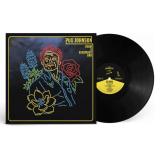
Originally released on 24th of August 2004 on Curb Records, twenty years later Tim McGraw's Live Like You Were Dying is being released on vinyl for the first time. Entering the Billboard 200 chart at number one with sales of 766,000 in it's first week of release culminating in over 4 million in sales. It was nominated for Best Country Album at the 47th annual Grammy Awards, with the title track nominated for Song of the Year and won in the categories for Best Country Song and Best Male Country Vocal Performance. Five singles were released from the album, all top 15 hits on the Hot Country Song Charts, with two number ones.
Marcel Vogel's third record on his own Lumberjacks in Hell in a row, 'If You Like' comes in three versions A1 one featuring Brooklyn weirdo-rap veteran Sensational and Alma Negra's Wisdom Of Oz Remix. Juicy Patwchworks Remix of Brown Curls on A2 reminiscent of Roy Ayers perhaps
Big welcome to Time is Now for J Wax for a bit of a statement EP and I am coming out swinging here cos this is a really good record. There’s good, and then there’s this, the kind of good that stays good.
You know that feeling when something’s just right. When flow state becomes clarity. Well listening to this EP from J Wax gives me that feeling. This is proper Goldilocks business. It’s equal parts Gun Fingers and Loved up hugs. Just right.
By now we all know that something very special happens when Speed Garage collides with 1st wave UK Hard House - but - what makes this just right is that J Wax didn’t stop there, just like the Dutch 2nd Wave of Hard House he’s slid onwards into euphoric trance and oh boy am I here for it. In 1997 we got Double99’s Rip Groove and Nalin & Kane’s Beach Ball and for me this EP has as much in common with perfectly formed ‘97 Trance as it does with Speed Garage. Who says you can’t have it all!
We’ve been following J Wax’s output for years. He has been grafting hard. And for me he’s already firmly a part of the long lineage of globally significant Scottish party starting producers and DJ’s. So when we signed this EP to Time is Now I was gassed. Four big tunes. Sick EP. For me it’s crystal. J Wax is now a producer operating in rarefied air.
Run the Tracks….
A1. The dubplate of ’Peaches’ has been causing mayhem for a minute. Gliding in smooth before that big diva vocal screams down the bassline.
A2. J Wax tags in Edinburgh local RUA.DJ. The pair double up on ‘Shift’ for a slice of Trance infused but no-nonsense Speedy G. Reece bass & gun shots + bouncy synthline & ethereal chords. Lose it and yourself.
B1. ‘Soul Movement’ is a big room weapon. Serious levels on this one that leave no doubt - this is a producer at the top of his game, writing high energy weapons to destroy the dance.
B2. ‘Smokin’ is peak time bizness. Harder darker house with a diiirty dirty south vocal chop. This one is heads down & lock in…
Cruise Music continues to serve up irresistible nuggets with its Vinyl Jams series, now reaching volume 15. Once again, it is a various artists affair that blends high production value with the right amount of emotional depth and dance floor kicks, this time looking at the warmer side of house. Keller's 'Stressed Out' is clean vocal house with a catchy wiggle and soulful bass roll, Mirko & Meex that layer a soaring diva vocal into 'There's A Light' that could well become an instant classic. Pianos rule on Oliver Knight & Angelala's 'Your Sunshine,' which is a perfect outdoor cruiser for the hotter days and Dino DZ closes down with the well-sampled 'I Like It.' These are refined, accessible summer house sounds but done with a touch of class.
Jolene Cuts returns with a 5-track vinyl-only masterpiece that channels the golden era of 1998 French House while pushing it into the future. No edits—just 100% original productions from Danny & Mike, two true craftsmen of filtered house grooves. “Jackpot” kicks things off with a euphoric, sample-driven floor-burner, dripping in funk and irresistible filter sweeps that recall the raw magic of classic Roule and Crydamoure records. “Voiture” follows with a sleek, late-night ride through hypnotic basslines and shimmering disco loops, perfect for peak-time club moments. On the flip, “So Cruel” brings soulful vocal chops and deep, rolling grooves in a way that nods to the emotional side of the French Touch era. “Love U” injects pure joy into the mix—swinging drums, warm filters, and a seductive disco flair designed to light up any dancefloor. Closing it all, “Disco Road” is a driving, high-energy weapon blending pulsating bass and filtered hooks that feel like 3 a.m. in Paris circa ’98. This is a love letter to French House—strictly vinyl, strictly limited, five unmissable club bombs. Perfect for DJs who crave that raw filtered energy, vinyl purists, and anyone who knows the true essence of French Touch: groove, soul, and pure dancefloor ecstasy. Once it’s gone, it’s gone.
Repress 2026
Two years after releasing the acclaimed Crash Recoil, Anthony Child aka Surgeon returns to Tresor with new LP, Shell~Wave. Retaining the minimal equipment list and studio-version-of-live-show-sets approach of the previous album in order to focus on the work itself, Shell~Wave is a deeply personal document of both where Surgeon is and has been, converging three decades of experience with a continued curiosity in the untested.
“To make this project, I had to dig really deep in terms of what my relationship was to techno; I’ve been involved with it for a really long time and there’s a lot about it I feel dislocated from, so I had to really think hard about what techno is to me. I often get asked “what is techno to you?” but I can’t answer that with words; this album is the answer.” From the complex, twisting track Infinite Eye to the caustic Soul Fire, the eight tracks that make up the body of the album are single-take explorations of the vast, hard yet minimal techno Child is synonymous with.
Neatly dividing the record in two, the emotional centre of the record comes in the form of Dying, a vibrating, beatless piece that with a mantra-like vocal loop steeped in reverberating effects. Further echoes of dub production appear throughout the record as tracks like Divine Shadow, and Empty Cloud have an almost ever-present mist of reverberation, driven by the appearance of a new delay unit in the equipment list; while much of the philosophy of Crash Recoil’s creation is present, the process and the instruments have changed as Child again switches up his approach to studio work.
This insistence on trying novel techniques doesn’t preclude returning to old ones, as this use of modern digital machines with live, hands-on takes that are as inspired by 60s producer Joe Meek and 70s reggae as they are by this year’s synthesiser expos.
“For me, it’s an interesting experience returning to old techniques again after 30 years. I’m always exploring and finding myself back at the beginning. Connecting the present with the past.”
This philosophy of ‘time travel’ is inherent to the music itself as the synchronised loops repeat while the delay and effects branch out, forming unique eddies; distinct quantum moments within the circular whole; the future leaking through the spaces between the sounds. All of the concepts on the album are perfectly communicated through the painting by Taiwanese artist Jazz Szu-Ying Chen which suggests the movement of water, sound waves, and the chitinous shells of sea creatures.
Charlotte de Witte now unleashes her slamming three-track EP ‘The Resistance’, featuring Theo Nasa and XSALT, out on KNTXT. It follows the astonishing summer tour of her new audiovisual show ‘The Resistance’, including a spectacular ‘XXL’ version at Belgium’s Rock Werchter in July, for a 40,000 audience watching from inside and outside the tent.
World #1 techno artist Charlotte de Witte’s new show continues a standout year of experimental ventures and celebrations, global pop-up shows, monster street parties, incredible new music (EPs and Deluxe LP)… and most recently ‘The Resistance’ AV show world premier at UNVRS Ibiza and the EU tour. The new ‘The Resistance’ EP is hard, fast, and uncompromising. It features Theo Nasa, whose raw, deep techno EP ‘Lifeline’ was released on her KNTXT label; vocal artist / longtime collaborator XSALT, (previously on ‘No Division’, ‘Overdrive’, ‘Roar’, ‘How You Move’); and Charlotte’s own vocals on a personal track ten years in the making.
‘The Resistance’ EP title track feat. Theo Nasa is urgent, demanding, unapologetic. Juddering main theme, rattling hyperspeed beat, spacey hoover swoops form a matrix for the deep, amused authoritative voice of Nasa – ‘we are unity, we are techno’. The brief ‘The Resistance (Intro Version)’ opens with futuristic FX and Nasa’s voice to the fore introducing the techno credo.
‘Never have I ever teased a track this much as I teased ‘The Resistance’. From the moment the track was being made in the studio, I knew this was going to be a special one. Theo Nasa captures the spirit of the underground and guides you through the essence of club culture like no one did before. An entire A/V show grew out of this feeling, this philosophy. It’s one of the biggest tracks I’ve ever made.’ Charlotte de Witte
‘See Through The Lies’ feat. XSALT: futuristic FX, fast stabby synth theme, and XSALT intoning ‘see through the lies. It’s time to take control’. A message of defiance. ‘XSALT delivers again on ‘See Through The Lies’, offering his own take on the EP's theme. Open your eyes. Break the illusion, see through the lies. Release the pressure. It’s time to take control!’ de Witte says.
‘Another Place’ has relentless pace, twanging pizzicato synth, and de Witte’s whispered phrases becoming full voice. ‘’Another Place’ has been in the making for over a decade. It saw the light of day in Brussels, where the lyrics took shape together with my friend One Track Brain. The track was forgotten and resurfaced years later, leading to an entirely new track created around that magical vocal from all those years ago. This is an EP very close to my heart.’
At the heart of ‘The Resistance’ EP and AV show is a message central to de Witte’s work: Protect Club Culture and the communities that sustain it. That’s why de Witte is donating all proceeds from The Resistance EP to The Nighttime Foundation, a global nonprofit dedicated to safeguarding and shaping the future of nightlife, empowering grassroots communities and promoting nightlife as a vital form of culture worldwide.
"Memory Remains" A Vinyl Cover Painted by 20 Children Who Believed They Could
A new album where the artwork is as personal as the music, created entirely by first-graders from Croatia.
When it came time to design the cover for Memory Remains, there was only one group of artists who felt right for the job: the first-grade class 1A of Osnovna škola Luka in Sesvete, Croatia.
Every single child in the class took part. Each student was given the chance to draw whatever came to mind: memories, dreams, imaginary worlds, the people and animals they love, and every one of those drawings made it onto the final cover. Nothing was left out, nothing was "corrected." The front and back panels of the vinyl are a patchwork of more than two dozen individual visions, side by side, unfiltered and unmistakably their own.
The idea grew directly out of the album's centrepiece track, "World Child", a song about the simple, often-overlooked truth that every child carries a talent that belongs only to them, and that no two ways of seeing the world are the same. Rather than illustrate that idea with a single artist's interpretation, it felt right to hand the canvas to an entire classroom of six- and seven-year-olds and let them prove the point themselves.
The result is a cover that doesn't try to look polished or professional, because that was never the goal. It looks like a classroom wall covered in a year's worth of drawings, each one different, each one someone's best effort, each one worth keeping. Which is exactly what "World Child" is about.
Memory Remains is out on vinyl.
Track of note: "World Child"
Artwork by: The students of 1A, Osnovna škola Luka, Sesvete, Croatia 2026
We release our second record, COPPIES002. Another hand stamped white label EP, collecting tunes from thecommunity, for the community. This time with tracks by Kerr Wilson, Salomo, illousion and APRS. Kerr starts on A1 with his "The Key To My Heart". He showed the first version of the track to Robert around 4 years ago in a memorable summer spent together. We made the promise that this will be pressed on record one day and, here it is! Thanks Kerr! It's a melancholic late-summer tune that makes you tear up and feel like the warm euphoria won't last forever, but it will surely return if you're patient. Salomo follows with a similar moody approach on "Say less (on the DF)", even though we can argue about the meaning of the title ;). illousion builds more tension on the flipside with "Masc or Mask". Entering dubby, rolling terrains with more high intensity drum patterns for later moments of the night. APRS is closing the EP with "I Want to Speak" on B2, maybe the counter argument to Salomos desire of a less noisy dancefloor. He crafted a minimal, loopy trip that drags you down the rabbit hole and won't iet you go til the party is over. COPPIES002 is available on vinyl only with digi download option
Repress 2026
The Visions EP is the debut release from London based DJ/Producer duo Suburban Architecture. Drawing heavily on influences from one of Drum & Bass' most innovative and rapidly changing eras, the mid to late 90s, the duo's productions place a contemporary spin on sounds rooted in this golden era of dance music.
This 4 track EP explores a selection of sounds that meet at the intersection of nostalgia and modern production: "Visions '96" fuses atmospheric jazz samples and haunting horns with fractured drums in a manner reminiscent of Source Direct, Photek et al. "Equilibrium" meanwhile gives a modern take on the classic roller, complete with lush synth pads and rolling Amens. On the flip are a pair of jazzy steppers: "Cubic Nature" delivers more lush pads, this time paired with subtle vocals and deep atmospherics whilst "Pulses" brings some bounce to proceedings fusing 80s soul style keys and jazzy horn licks giving stylistic reference to material by the likes of Alex Reece.
Teen of Denial: Joe’s Story is a freshly reimagined take on Car Seat Headrest’s beloved breakout, Teens of Denial, now celebrating its 10th anniversary.
On the original album, Toledo often used the name “Joe” as a pseudonym – a sly homage to Daniel Johnston. Revisiting Teens in the run-up to its 10th birthday, he felt called to give Joe a unique backstory and began tweaking the album to tell that tale. The group returned to the studio with Teens producer Steve Fisk to update accordingly – tweaking lyrics, revising arrangements, and recording new songs in the “Denial-style,” including ‘Optimistic Son” and the anthemic ‘Joe Drives Again’. The result retains Teens’ dark edge and youthful cynicism, but allows a bit of hard-won compassion into the mix.
From Will Toledo:
Sometime last year, it was suggested to me that we do something for the ten-year anniversary of ‘Teens of Denial,’ so I started looking back on the album to see what we might do. In spite of some of its songs being a regular part of my life for the past decade, it wasn’t a record I’d thought much about as a whole since it came out. Most of the songs I’d come up with over a two-year period at the end of my college days, when I was struggling a lot with cynicism and misplaced aggression. But by the time the songs were done, I was living in Washington, Car Seat Headrest was a full band with a record label, and in spite of the turmoil of the writing process, the final album was pretty enjoyable for everyone to work on.
This time, looking back at the songs, I started to feel like there was a story being told through the album, though I’d never imagined it as being a narrative work. On ‘Hi, How Are You?’ Daniel Johnston had used the name “Joe” in the titles of a few tracks –“No More Pushing Joe Around,” “Keep Punching Joe” – as a sort of joke, a stand-in for himself. I borrowed the idea, and the name, for titling songs on ‘Denial.’ This time, I started thinking - who is Joe? And how do the songs, in the way they’re sequenced on the album, reflect what he’s going through? As I started asking this question, a story emerged with startling wholeness and clarity, like finding the foundations of an ancient city while digging in my backyard. As I kept digging, certain songs from the original album fell by the wayside, as they seemed misplaced in this new context; others asked for new lyrics, to fully give birth to the story contained in the music.
The resulting work feels more like the album ‘Teens of Denial’ was meant to be. When you’re writing from a dark space, it’s hard to have perspective on where you’re at. This time, I could pull from memories of that darkness, and use the distance and additional perspective of ten years of life to shed a fuller light on the experience. Joe is a character going through some of what I experienced, and some of his own problems. Telling his story, and not just my own impressions of life at the end of the teen years, brought a new level of compassion and wholeness to the album. It gave us the opportunity to write new material in “Denial style”, embracing a snappy and simple(ish) rock aesthetic, and in an additional blessing, we were able to team up once with Steve Fisk, a joy and inspiration to get back into the studio with after ten years. We mixed the material at his house in Tacoma, and were constantly amazed at the lack of divide between past and present, as we’d punch in vocal overdubs ten years later into the same gear, hearing my voice now running alongside a 2015 Will. For someone coming across this album or this band for the first time, this is how they’d hear the record, not as a relic of the past but as a new piece. It was immensely rewarding to experience that on our side.
For anyone familiar with ‘Teens,’ comparisons with the original will be inevitable, but I do hope that as much as possible, people can come to this album on its own terms, approaching it as a teen, hearing the music and story for the first time. I believe music is an ongoing story, and albums don’t always do justice to its dynamic, ongoing nature. What gives it life is the new ears that hear it, and the new hearts that engage with it. I’m so grateful that this is a work that people have kept coming to, and I hope that this presentation does them honor with a fresh offering to the conversation. We’ve known that “it doesn’t have to be like this”; now we can wonder - “what it if were like this?”
The premise of this compilation is simple: music we’d like to hear at the airport.
The idea came after learning that Honolulu’s international airport has been playing AI-generated music over its speakers since November 2025. First reported by Civil Beat, the news has caused frustration and disappointment among residents and visitors, as well as within the local music community.
Everyone knows Hawaii is one of the most musically rich regions in the world — why then is the airport using AI music? 'Music For The Airport' is our response.
Located in the middle of the Pacific at the outskirts of one the most remote cities on the planet, Honolulu’s Daniel K. Inouye International Airport (HNL) is for most people the first place they encounter when they arrive in Hawaii. Warm sun, tropical tradewinds, playful palm trees and majestic mountains welcome every traveler, as do the sounds of birds, familiar music from Hawaiian artists like Aunty Genoa Keawe and Israel Kamakawiwo’ole, and—at least for now—seventeen “island-themed” AI-generated songs.
In late 1977, while sitting in Germany’s Cologne Bonn Airport on a Sunday morning, Brian Eno noticed how terribly uncomfortable he felt hearing the airport’s “muzak” overhead. For a harried, hurried place like the airport where travelers scramble to their gates, stand in long border control lines, and wait impatiently for their luggage at the carousels, music can create more anxiety than calm. Asking himself, "What should we be hearing here?", Eno soon created ‘Ambient 1: Music For Airports’, a sonic remedy aimed at reducing nervousness in public spaces.
When we heard the news that HNL airport is playing AI-generated “muzak”, we were immediately reminded of Eno’s genre-defying 1978 album. And we were similarly inspired to react. But how? Recreating an ambient masterpiece wasn’t in our wheelhouse. We started digging through our catalog of licensed music which we haven’t yet re-released. We quickly realized this was our chance to highlight some of favorite songs from the so-called CD era: the 1990s and 2000s (with a few exceptions). In less than 20 minutes, we pulled 17 original songs recorded by local artists between 1984 and 2017.
The speed at which this project came together surprised us; reactionary gut instinct often produces swift and lasting results. Ironically, our new compilation likely took less time than it did for the state Department of Transportation to commission its AI songs in question. But even though ‘Music for the Airport’ came together in less than one week, the truth is that this collection of 17 songs is the result of years of hard work, trust, sacrifice, patience, and understanding. Building relationships with and licensing music from artists doesn’t happen overnight, but more importantly: these songs are the result of people pouring their hearts and souls into something they believe in. This music wouldn’t exist today without the artists and their loved ones who supported them along the way.
As of this writing, the DOT states its intention in creating AI-generated songs is to “highlight different aspects of the islands, aviation and the airport” and that “no state funds were used to produce them”. Okay, but at what cost? Technology disrupting the music industry isn’t news to anyone. AI music in public spaces are cost-saving measures, since its users (airports, for example) don’t have to pay the licensing fees typically required, which can be a worthwhile source of revenue for artists. But what happens when a place like HNL airport, which hosts more than 21 million passengers annually, uses music created by machines instead of people to represent Hawaii? The identity of a place beings to erode, diluted by a language learning model’s conceptual summary of what a people and its culture sounds like. To echo Brian Eno: what should we be hearing here? In other words: what should the music of Hawaii sound like?
We believe in the power of music, especially when it comes from the soul. We believe in supporting artists, especially as AI disrupts our lives. We believe that Hawaii must be represented authentically, especially when it comes to song. And of course we believe in vinyl, especially since it was a record from 1978 (Mackey Feary Band’s debut LP) that inspired Aloha Got Soul’s origins in 2010.
We hope you find as much joy in this compilation as we have. Perhaps it’ll soundtrack your next journey to Hawaii. At the very least, we hope some people take a moment to hear these sounds: in your headphones for now‚ maybe someday overhead at the airport in Honolulu.
The track titles on Post Dub Cities – the new album by Adriano Zanni, photographer, sound artist, and field recordist – evoke the aftermath, that moment when a place continues to exist and live on, but no longer serves anyone. The human element has vanished, whether it happened overnight or through a slow abandonment that lasted for years. The perspective shifts: buildings, homes and palaces reveal a dimension of reality all their own, in which even the ruins give shape to this landscape that endures, transforming into pure presence.
This, after all, is our fate. The fate of us human beings, of our civilisation, of every civilisation: to pass away, to be forgotten, to erect monuments whose significance no one will remember once we are gone.
The opening track Crisopoli transforms the sonic dimension of a city into an echo chamber: a dark, urban dub built from delays and resonances, holding the imprint of what is no longer there — like a bassline that keeps vibrating even after its source has gone silent. What we see is not the presence, but its reverb.
Available from September 11, second excerpt Warosha gives us a minimalist, enveloping, solemn beat, like the symbols on a map that no one can read anymore. Warosha was the district of luxury hotels overlooking the sea in the city of Famagusta. After the island of Cyprus was invaded by the Turkish army, the entire area, emptied of its inhabitants, who had fled south, was fenced off and surrounded by barbed wire. No one has been allowed to enter it since 1974. Now, on these unspoilt beaches, sea turtles have found the perfect place to breed.
Fordlândia, on the other hand, is the symbol of Henry Ford’s failed dream of conquest. An industrial settlement built deep within the Amazon rainforest, several hours’ boat journey from the nearest towns, to gain access to natural rubber for the tyres of his mass-produced cars in Michigan. An extremely costly project, it quickly became a ruinous pipe dream: a town that has been uninhabited for almost a century and has since been reclaimed by nature.
For a long time now, Adriano Zanni has been exploring, through music and photography, the landscape that unfolds before our eyes, as attentive yet silent observers. As if we were absent, a civilisation that has long since vanished: human presence has dissolved, preparing to fade into oblivion. The precise depiction of places through field recordings, and the black-and-white imagery, give rise to apparitions, hallucinations, and memories. The less present we are, the more we seek meaning. We resist abandonment and the indifference of time.
In the ten tracks (plus three bonus tracks) of Post Dub Cities the echoes and reverberations of dub grant us access to an unknown future, as yet untold – in which we are nothing more than a vague memory. The deep sound guides us through a landscape that is familiar yet unknown, unrecognisable. The cold, distant, industrial rhythm resonates within us as if we were the last, all too aware, inhabitant of a now-deserted village.
Every place – be it an abandoned mining settlement on an island in Svalbard, or a ghost town in Pennsylvania evacuated following an underground fire that has been burning for sixty years at a depth of one hundred metres – leaves questions unanswered, shrouds itself in mystery, and makes us wonder, ceaselessly: what happened here?
In the end, we realise that we don’t really care that much about knowing the details of the disappearance. We can guess them, we’ve seen it happen a thousand times before. Just like in the photos accompanying the album, portraits of ghostly, deserted cities: Belgrade, like Venice, Dublin, Sarajevo, Lisbon, Kraków, Sofia, Naples, Hanoi, Lampedusa, Tehran. Unexpectedly, pleasantly emptied of people, and of their obsessions, struggles, illusions.
Then, suddenly, the crowd returns. Busy, feverish, hardworking. The record ends, the spell is broken. We feel a sense of longing for a future that has not yet come to pass, for a place we were only able to observe because we were not there.
British electronic music pioneer Dave Angel returns to R&S Records with “A Time And Place”, his first full-length album release for the seminal Belgian label. Arriving thirty-five years after Dave first joined the R&S family, the album reunites one of UK techno's defining voices with the imprint that helped launch his career, renewing one of electronic music's most enduring creative partnerships.
That relationship began in 1991, when R&S founder Renaat Vandepapeliere discovered Angel's ‘Rolling Thunder’ project and invited the young London producer to Belgium. Personally welcoming him into the R&S family alongside a new generation of forward-thinking electronic artists, Vandepapeliere released the landmark “1st Voyage” EP, helping establish Dave Angel as one of British techno's most distinctive new voices. A succession of acclaimed releases followed, including “Stairway To Heaven”, “3rd Voyage”, appearances on the influential “In Order To Dance’” compilation series, and releases on sister imprint Apollo, charting an artistic partnership that helped shape both Angel's career and the wider evolution of UK techno.
Three and a half decades later, “A Time And Place” feels less like a return than the continuation of a conversation left unfinished. Rather than revisiting former achievements, the album reflects the perspective of an artist whose creative journey has continued to evolve. Reconnecting with the label that first championed his work, Angel delivers his most personal and musically expansive statement to date.
Across fifteen compositions, “A Time And Place” reaches beyond the conventions of techno to reveal the full breadth of Angel's musical identity. Drawing on jazz, soul, improvisation and richly textured electronic production, the album balances rhythmic precision with warmth, melody and emotional depth. Reflections on family, heritage, nature and the communities that have shaped his life sit alongside broader observations of the world around him, creating a body of work that feels both intimate and expansive.
That openness is reflected in a carefully chosen cast of collaborators. Celebrated trumpeter Steve Waterman features on both “Réflexion” and “The Yellow Butterfly”, bringing a lyrical, Miles Davis-inspired voice to the album after first catching Angel's attention through his work on Paul Hazel's “Out Of This World”. Elsewhere, legendary Chicago vocalist Robert Owens appears on “Harmony Serenade”, while guitarist Merv Carswell and vocalist Aurii Sky (Dave’s daughter, adding a poignant family connection) add further colour and texture to a record rooted in musicianship and shared expression.
While Dave Angel's influence on British electronic music has long been established, “A Time And Place” reveals another dimension of an artist whose foundations were laid long before techno. Raised in a household immersed in live music and jazz culture, Angel has spent a lifetime absorbing sounds beyond the club, allowing those influences to surface naturally throughout a career defined by curiosity rather than convention.
For R&S Records, the album renews a relationship that stretches back to the label's formative years. For Dave Angel, it reflects both the path travelled and the road ahead. Thirty-five years after “1st Voyage” first announced his arrival, “A Time And Place” reunites artist and label with the same forward-looking spirit that brought them together in 1991, proof that the strongest creative partnerships continue to evolve.
Norman Gervais and Charles Bals return after last year’s Transcoastal compilation with their first project for the Italian label Periodica Records and its newly founded imprint, Periodica International.
The concept behind SiRENE 89 is quite particular and took six years to develop. It is presented as the live recording of one long evening, with different bands taking the stage one after another on the terrace of a Mediterranean holiday resort in 1989, inspired by the places Charles and Norm remember from their summer holidays around that time.
The songs were recorded between 1982 and 1993 and gathered from small-time artists, beach-club vagabonds, local micro-labels, library records and privately released tapes. The music moves lightly between mystical ballads, digital samba and loose, sunburnt dance songs, carried by drum machines, not-quite-tuned guitars and college-band voices.
The audience on the terrace remains quietly present throughout, joining the tracks into one continuous, partly improvised set. By the end, it feels less like a compilation and more like a place where you have spent the night, proving that charm can carry further than perfection.
There is a hush most of us only knew as children, the warm drift between familiar household sounds and being carried to bed, a place that belongs to you and to some self you have not met yet. June McDoom’s debut full-length, Follow the Light, lives in that dream space and then keeps walking, slipping out of time and waking somewhere new, barely familiar enough to feel like home yet wholly your own. She came up in a Jamaican household on the edge of the Florida Everglades, an existence built of extended family, communal care, bass and harmonics. Her father, a carpenter and a student of sound, built his own speakers and kept three sound systems going across as many rooms. His low end would rise through her bedroom floor like some wayward cat while she lay above it with folk records, finding harmonies that were new and hers alone. Two musics in one room. Lushness as past and premonition. She found folk on her own, somewhere between the cast recording of The Sound of Music and Simon and Garfunkel, while everyone around her called it sleepy music. She did not mind being the only one. The solitude let her fall for harmony first, before words, before anything else, and harmony is still the thing she reaches for. Generationally speaking, the music was already in the air. Her grandfather, Colin Smith, is a distinguished mento man who played banjo and guitar and built his own rumba boxes, worked to keep Jamaica’s oldest acoustic folk form alive. Mento is the root of all of it: ska, rock steady, reggae, dub and everything after. He is the one who put a guitar in her hands. An inheritance, a gift and a map. Even her name is part of it, though she will tell you she landed on it more by feel than reason. She records as June McDoom, born Alyssa, June being a nickname one of her grandmothers, Joan, went by, a name she thought was cool to carry and simply liked the sound of. An etheric channel that reverberates all the same. A dub all its own.
Made slowly and by hand with her longtime partner Evan Wright, Follow the Light lays the harmony of folk over the rhythm of dub, with Dionne Warwick, Minnie Riperton, Pentangle and the washed guitars of Cocteau Twins haunting its outer edges. Voice and guitar seeking each other out first, then everything else stacked across long days in the studio they keep at home, restraint kept on purpose. The lead single “Without You” is the whole method surfacing, split open and sparkling like a geode in a creek bed. Angelic heroics, and nothing less.
At the heart is family. Her grandmother Aggie, the light behind “Memory,” guiding still. And underneath, the quieter truth the record keeps: none of us are only one person, but a continuum of selves, the ones who shaped us and the ones we have yet to meet. Future you is an ancestor your current self gets to greet. Press play and the same invitation is yours: A few minutes out of time, a place that turns familiar the longer you stay until you surface somewhere new and find it was yours all along
There is a hush most of us only knew as children, the warm drift between familiar household sounds and being carried to bed, a place that belongs to you and to some self you have not met yet. June McDoom’s debut full-length, Follow the Light, lives in that dream space and then keeps walking, slipping out of time and waking somewhere new, barely familiar enough to feel like home yet wholly your own. She came up in a Jamaican household on the edge of the Florida Everglades, an existence built of extended family, communal care, bass and harmonics. Her father, a carpenter and a student of sound, built his own speakers and kept three sound systems going across as many rooms. His low end would rise through her bedroom floor like some wayward cat while she lay above it with folk records, finding harmonies that were new and hers alone. Two musics in one room. Lushness as past and premonition. She found folk on her own, somewhere between the cast recording of The Sound of Music and Simon and Garfunkel, while everyone around her called it sleepy music. She did not mind being the only one. The solitude let her fall for harmony first, before words, before anything else, and harmony is still the thing she reaches for. Generationally speaking, the music was already in the air. Her grandfather, Colin Smith, is a distinguished mento man who played banjo and guitar and built his own rumba boxes, worked to keep Jamaica’s oldest acoustic folk form alive. Mento is the root of all of it: ska, rock steady, reggae, dub and everything after. He is the one who put a guitar in her hands. An inheritance, a gift and a map. Even her name is part of it, though she will tell you she landed on it more by feel than reason. She records as June McDoom, born Alyssa, June being a nickname one of her grandmothers, Joan, went by, a name she thought was cool to carry and simply liked the sound of. An etheric channel that reverberates all the same. A dub all its own.
Made slowly and by hand with her longtime partner Evan Wright, Follow the Light lays the harmony of folk over the rhythm of dub, with Dionne Warwick, Minnie Riperton, Pentangle and the washed guitars of Cocteau Twins haunting its outer edges. Voice and guitar seeking each other out first, then everything else stacked across long days in the studio they keep at home, restraint kept on purpose. The lead single “Without You” is the whole method surfacing, split open and sparkling like a geode in a creek bed. Angelic heroics, and nothing less.
At the heart is family. Her grandmother Aggie, the light behind “Memory,” guiding still. And underneath, the quieter truth the record keeps: none of us are only one person, but a continuum of selves, the ones who shaped us and the ones we have yet to meet. Future you is an ancestor your current self gets to greet. Press play and the same invitation is yours: A few minutes out of time, a place that turns familiar the longer you stay until you surface somewhere new and find it was yours all along
Yesca is back on Shall Not Fade with ‘Paint on Walls’ 12” EP.
2024’s Yesca EP on SNF - “Mood Loops” - set a high bar, so when we say this record is something special you should take note. Of course if you already know Yesca’s music or have had the pleasure of a Yesca DJ set then you will have already this queued up.
Sweet Spot: Ben Sims, Deetron, Oliver Ho, Vince Watson, Grain (Artwork’s Techno alias). Planet-E, Primate Recordings, Paul Mac & Stimulus Recordings found the sweet spot.
According to the OED the first use of the phrase “Sweet Spot” was in 1976 in reference to tennis rackets and golf swings. It’s where everything hits just right. And that’s what this EP does, hits just right. What strikes me is how descriptive the phrase ‘Sweet Spot’ is. Given enough swings and some luck we all know what it feels like to hit the sweet spot in some regard. Finding the sweet spot regularly though takes time and skill. But being able to hit the sweet spot by design every time, well that’s something different. That’s what makes the greats great.
For us at SNF there’s a consensus that in the lineage of electronic music there have been many moments where artists & labels converged on a sweet spot. One such sweet spot for us is in Techno
around 2003 when at the tail end of Hardgroove tempos began to slow and a groovier more refined tech house infused goodness appeared in the racks from a group of killer techno labels & artists (some mentioned above) that moment before the fuller emergence of the 2nd wave of Tech House in the mid 00’s.
That sound, while often emulated, never quite hit the same for us at least – until Yesca came along. His music has everything that we love about that sweet spot. Raw driving groove, rolling basslines and hip shaking percussion. What’s different on ‘Paint on Walls’ is that Yesca stepped on - he had already found the sweet spot on 2024’s Mood Loop EP - now his sound (or swing) is natural. Repeatable, refined and seemingly effortless. To revisit the tennis and golf analogy, this is the start of a Grand Slam run from an artist ready to etch their name in dance music history. Tiger..... Serena......Yesca.
Run the Tracks:
‘How I Do It (They Wonder)’ - A masterclass in less is more, and a serious DJ tool. Full of groove - slow it down and it will light the touchpaper in a house set - speed it up and you’ve got techno weaponry. Forget gatekeeping, this will make you feel like you just found a 2004 techno white label from the likes of Grain or Ben Sims.
‘I Desire’ - House music that I reckon Deetron would be proud of... Blissed out machine funk, whispered vocals, slick jazzy chords and dubbed out techno stabs are all grounded by Yesca’s impeccable, loopy drum programming. The best tunes always end too soon.
‘Domination’ - The ever rising bass, err, dominates this track and this track will dominate on many a dancefloor, but Yesca's knack for dubbed out swinging synth lines has to get a shout out here too. He turns what would be melodic elements into what feels like part of the percussion. Double Threat. Hands Up and Heads Down business.
‘Paint on Walls’ - It would be a tough call to say Yesca’s saved the best til last with the EP’s eponymous track given what’s come before, but Paint On Walls works all the highlights from the rest of the EP into a latin techno/house infused anthem. Skittering percussion, a hint of Detroit goodness and a deep deep rolling bassline and THAT vocal. In every way hopeful yet resistant, and that is what techno is all about.
What an unbelievable record. From the wild cover to the iconic breakbeats, Roots from Ian Carr’s Nucleus is one of the dopest albums we know. This is seriously thick, funky-prog jazz-rock heaven. Originally released on Vertigo in 1973, other than a couple of versions at the time for other territories, Roots was never re-pressed since so it’s gone on to become another one of those impossible to find records.
Maybe it was a little too out there for the time, but it’s aged very, very well indeed and this Be With re-issue, re-mastered from the original analogue tapes, shows off just why this deserves to be back in press.
Genius trumpeter and visionary composer Ian Carr was one of the most respected British musicians of his era. He was a true pioneer and saw the potential in fusing the worlds of jazz with rock, just as Miles Davis and The Tony Williams Lifetime did in the US. In late 1969, following the demise of the Rendell-Carr quintet, and tiring of British jazz, Carr assembled the legendary Nucleus. Regarding music as a continuous process, Nucleus refused to “recognise rigid boundaries” and worked on delivering what they saw as a “total musical experience”. We can get behind that.
Under bandleader Carr, Nucleus existed as a fluid line-up of inventive, skilled musicians. This constant evolution and revolution was all part of the continuous musical exploration and discovery that took jazz to new levels.
Working together with producer Fritz Fryer and engineer Roger Wake, the seven compositions by Carr, Brian Smith and Dave MacRae that make up Roots flirt with perfection, and Nucleus at that time made up of the cream of 1970s UK jazz with Brian Smith on tenor saxophones and flutes, Dave MacRae on piano and electric piano, Jocelyn Pitchen on guitar, Roger Sutton on bass, both Clive Thacker and Aureo De Souza on drums and percussion, Joy Yates delivering the vocals and of course Carr on trumpet.
The spellbinding title track immediately renders the album indispensable. Riding the illest of loping breakbeats, “Roots” is low-slung, doped-out heist-funk. An absolute monster. If it sounds familiar then that’s likely down to it being sampled by Madlib for Lootpack and Quasimoto’s “Loop Digga”, as well as by a whole host of beat manipulators. “Roots” conjures prime instrumental hip-hop / beat music, only 20 years ahead of its time. Truly, these are the roots. Through sinuous bass, twinkling keys and a hypnotic guitar riff, a smoky brass motif weaves its way into a gloriously deep haze around Carr’s solos. “Roots” is over 9 minutes long, but there’s not a single wasted second, not surprising given that this is a condensed version of an originally 40 minute long commissioned composition.
The soothing vocal fusion delight of “Images” follows. Meticulously constructed, with gorgeous flute work from Brian Smith, with Joy Yates’ silky vocals and Dave MacRae’s Rhodes never sounding better. The cool, driving “Caliban” closes out the first side. Originally the third movement in a four part commission to celebrate Shakespeare’s birthday it stands up on its own, all robust rhythms and blended brass. Keyboard colour and Carr’s trumpet are splashed across the funk drums and basslines (and there’s even some bamboo flute). This really is fusion: the elements of jazz and rock coming together in beautifully synthesis.
Side two opens in riotous fashion with the short, thrilling samba of “Wapatiti”. Next up, “Capricorn” forms a smoothed-out, jazzy constellation. Mellow and dreamy, its twinkling percussion and languid horns slowly build the vibe before head-nod drums and a killer bassline enter the fray. With a distinct heaviness that Black Sabbath would’ve envied, “Odokamona” is a venomous slice of riff-soaked jazz metal (yes, you read that right), elevated by Carr’s wah-wah horns.
The album closes with MacRae’s exceptionally cosmic “Southern Roots and Celebration”. Very much in conversation with Weather Report, it opens as a languorous, spiritual jazz of chiming keys and serene guitar that turns slowly, gorgeously into a mid-paced, brass-laced banger. It’s another sure-fire party starter and the sound of the band having a righteous blast, building an ecstatic chaos that ends with Yates screaming.
And of course we need to talk about Keith Davis’ cover for Roots. Perhaps the coolest record cover of all time? Certainly one of the most bonkers. Just your run-of-the-mill high-gloss, acid-tinged airbrush dystopian/utopian living-room party scene. Consider this your chemical flashback trigger warning.
Front-and-centre the hip-to-death green robot holds court with their giant ball of yellow barbwire wool, hooked up to… something(?) being teased out from under the stairs (probably best not to ask). A thoroughly zoned-out, long-legged Pop Art party-goer lounges half-plugged in to the painting behind her as a pair of legs flail into shot from the the top of the stairs opposite. We won’t even begin to guess what the chap’s up to in the middle, but the view out of the windows is rather nice, and someone’s already got the hoover out ready to tidy up. All of the Nucleus sleeves are something special, but this particular one? Crikey.
This Be With edition of Roots has been re-mastered from the original Vertigo master tapes, Simon Francis’ mastering working together with Pete Norman’s cut to weave their usual magic with these wonderful recordings. The crazy cover has been restored at Be With HQ as the finishing touch to this long overdue re-issue.
Once upoun a time Fat Mike came up with the idea of calling up 101 of the best old and new punk rock band around, have them each record a 30-second long song, then put all the tracks out on one record to make the best punk compilation ever. And guess what, the dream came true. The 101 most famous punk rock bands around doing each a 30 seconds long song Back in print for the first time in ten years! Pressed to Lime Vinyl Features super rare songs (recorded exclusively for this compilation) by Green Day, The Offspring, Blink- 182, Pennywise, Rancid, Less Than Jake, The Vandals, Bad Religion, and more
Ąnis is a Lithuanian producer and DJ working in the space between broken rhythms and atmospheric weight. His tracks blur the line between club tools and introspective pieces - raw, textured, and unpolished in the best way.
Ąnis’ debut album “I Swear I’m Not Delusional” builds from late-night sketches into fully formed pressure systems. Ambient passages fall into break-driven grooves, each track shifting like a mood swing. It's rooted in tension, repetition, and space - think the grit and movement of early Skee Mask filtered through a more personal, less polished lens. Tracks like “Mountain People” carry warmth without needing to explain themselves, while others feel like they were made at 3am with no lights on. It’s not chasing a scene - just locked into its own pulse. This isn’t background music. It asks you to sit with it - or move to it. Either way, it sticks.
Credits
Original tracks written, produced, arranged and recorded by Jonas Zubavičius in Vilnius. Mastering by Pranas Gudaitis aka audiomastering.lt. Artwork and design by Povilas Baranauskis.
It's hard to explain an album when one listen is enough. All the more so with MaMaMa: there's no room to stay passive. Listening to his new album, EST, means immersing yourself in an atmosphere that's softly psychedelic, comforting and organic all at once. A dreamy, electronic pop that proves this Strasbourg-at-heart, Paris-by-adoption musician, arranger, singer, songwriter and producer never stops reinventing himself. After changing his name — formerly Petit Prince — and delivering two critically acclaimed albums ("MaMaMa-gnificent." / "Hooks you carry in your head for a long time" / "sumptuous arrangements"), Elliott Diener now offers an even more sincere record. Real songs in French, after two albums where production sometimes took up all the space: "when you make heavily produced music, once you strip away the layers of sound, there's no fruit left underneath. On EST, I don't need makeup for the songs to work," he admits.
That's what this new album is about: the song and the French language first, then the pleasure of sound. An album less concerned with talking about its own making, more inhabited, more embodied, within a contemporary folklore. With this new album, don't expect to be bored: EST is his best record yet.
No pretense
Entirely conceived in his studio in Pantin — a room of his own, at last — imagined as a space free of any daydream, open to every sonic landscape, MaMaMa offers a record that's both hazy and downy soft. Often composed very early in the morning, it has become nostalgic without being dark, melancholic without being sad, with a few lineages showing through: Flavien Berger, Moodoïd, Feu! Chatterton for the taste for words and unease, Mount Kimbie for the approach to sound and rhythm. Unsurprising, given that EST was finalized with the British duo's producer. Live, MaMaMa is preparing a show in the style of Nicolas Jaar or UTO. Hypnotic and immersive.
The most liberating thing is that EST is an album without pretense. With it, we move through perseverance (in Aussi loin qu'il tiendra debout), the small arrangements we make to avoid facing reality (Tout sauf la vérité), and the fragility of bonds we thought were solid (Si bien ensemble). We also touch on lasting conflicts with the people we love (Anywhere You Are, There You Are), misunderstanding (Elle me parle une langue), and the erosion of friendships (S'envoler). EST draws an intimate and redemptive map of human relationships, in a body of work that's both lucid and sensitive — like when he also addresses social masks such as filial love (in Beau garçon, dedicated to his son) or relationships that have become impossible.
"It's really the album that sounds most like me, in terms of sonic landscape," Elliott points out. A record that rises above the noise of an imperfect, shifting world — like us — joyful in its words, liberating in its production. A true gem.
Trumpeter, rapper and sonic wanderer Pan Amsterdam has carved out one of the most distinctive voices operating at the intersection of jazz and hip-hop today.
Pan Amsterdam is a musical enigma wrapped in an enduring riddle. His creator is a jazz musician from Houston who’s found fame working with Detroit punk rock God, Iggy Pop, and British indie royalty, Metronomy, and now makes shapeshifting, adventurous hip hop out of the music’s spiritual home, New York.
He’s an irreverent character born out of frustration and named after a misunderstanding, yet one who’s on the verge of releasing his fifth album of truth-slaying, genre-crossing rhymes and beats. The result is a catalogue that feels both deeply rooted in Black American musical tradition and completely untethered by convention.
Pan Amsterdam returns with ‘Panarama’, his fourth full length album and a bold reassertion of his hip hop identity, released via Def Pressé. Created by Houston-born, New York-based musician and composer Leron Thomas, the record finds Pan Amsterdam embracing the harder edges of his sound while continuing to blur the lines between jazz improvisation, abstract rap, punk attitude, and experimental production
Written as a response to contemporary life and the endless cycle of information, conflict and distraction that defines modern culture, ‘Panarama’ unfolds as a stream of consciousness journey through hyper-normalised realities. Across sixteen tracks, Thomas navigates social commentary, personal reflection, absurdist humour, and cultural critique, delivering his observations with the same spontaneity and freedom that have become central to the Pan Amsterdam project
Lead single ‘Szechuan Beef’, produced by acclaimed collaborator 1FS, serves as one of the album’s defining statements. Built around Thomas’ signature free-flowing delivery, the track explores the overwhelming nature of contemporary life, where domestic conflict, social division, entertainment scandals and political discourse become flattened into a constant stream of content.
In Thomas’ own words: “My stream of consciousness style comes quite naturally to me due to the conditioning of scroll down culture where everything, no matter how minor or extreme, is hyper normalised.”
Elsewhere, the track ‘Vanilla Ice’ was written in response to widely publicised ICE killings and the speed at which tragedy is absorbed and forgotten within online culture. Thomas channels the anxiety and emotional disorientation of endlessly consuming information, allowing his thoughts to unfold in real time as social commentary collides with everyday digital noise. The result is both deeply personal and sharply observational, reflecting the fragmented reality of modern life. Other album highlights include the cinematic, Interpol-esque opener - ‘Old Friend’ complete with shimmering guitar lines and an far-reaching introspective, no-filter vocal as Thomas teams up with Nick Zinner (Yeah Yeah Yeahs) and Brad Truax (Interpol) across multiple tracks, often the production traverses left-field indie territory, but always maintaining Pan Amsterdam’s unique musical identity throughout. For the hip hop purists and beats lovers there are plenty of riches to discover from the clever nostalgic sample flips of ‘Cutlery’, the sleepy lofi of ‘Shuriken’ and the wonky LA beat scene / early Flying Lotus era beats of ‘Drunken Noodles’ - all boasting quick witted lyricism. ‘Deep Fried Shiney Things’ explores early electro and industrial sonics while album finisher is an upbeat new wave / indie band cut which sees Thomas take a break from rapping, but of course never letting up on the sharp observations nonetheless
While his previous record explored more alternative territory, ‘Panarama’ marks a deliberate return to rap, as Pan Amsterdam explains:
“I just wanted to do a rap album again.I enjoyed making my last album, but I felt like rapping again. I like to have the freedom to move in between musical worlds that suit the current state I’m in. Frequency accommodating frequency.”
This philosophy runs throughout the album. Tracks move effortlessly between jazz-inflected arrangements, experimental beats, punk energy and underground hip hop aesthetics, allowing ideas to evolve organically rather than conforming to traditional structures. Thomas describes himself as an improviser first and foremost: “I think like an improvisor. That’s how my albums pretty much move. It’s improvisation.”
Featuring additional contributions from Spice Programmers, AnOtter and Mr. Shn, ‘Panarama’ presents a wide-ranging cast of collaborators while remaining firmly rooted in Thomas’ singular creative vision. The record embraces contradiction, humour and unpredictability, capturing fleeting thoughts and observations with the same freedom and spontaneity that define jazz improvisation itself.
A musical enigma wrapped in an enduring riddle, Pan Amsterdam has built a reputation as one of contemporary music’s true outsiders. The project emerged from frustration, experimentation and artistic freedom, with Thomas drawing equally from his background as a jazz musician and his collaborations with artists including Iggy Pop and Metronomy. Operating from New York while carrying the spirit of Houston’s musical heritage, Pan Amsterdam has developed a distinctive voice that sits comfortably between avant-garde jazz, underground hip hop and experimental music.
Reuniting with Def Pressé for ‘Panarama’, Thomas explores what he describes as the more hardcore side of his artistic identity:
“They let me do anything and everything I wanna do so long as it’s on audio, and I need that freedom. What may verbally be perceived as vulgar to one group of people may be very thoughtful and a poignant description of the times that we’re presently in, so I’m glad that I’m part of a label home that understands that.”
Fontaines D.C. announce their fifth studio album, Dopamine Chamber, released on 16th October via XL Recordings. Produced by James Ford, it is the follow-up to 2024’s UK platinum-certified Romance – and the sound of a band moving decisively away from the guitar language of their early records into something colder, stranger and more synthetic. It arrives today alongside lead single “Marianne” and its accompanying video, directed by Dave Meyers.
Dopamine Chamber arrives like a constellation behind undulating sighs of smog: potent balladry, anthemic melodies glinting through the murk. In a world tipping towards collapse, it asks how pleasure mutates amid peril—and what our pursuit of it reveals about us. Across the album, Fontaines D.C. – Grian Chatten, Carlos O’Connell, Conor Curley, Conor Deegan and Tom Coll – move between gratification and dread until the two meld together, reflecting the overwhelm of artificial intelligence, environmental collapse and political violence all riding the same algorithms as memes, jokes and celebrity culture. “The album itself is a dopamine chamber,” says Chatten. “You step inside and we test these different mind- or mood-altering pieces of music on you.”
Where Romance held its tension in balance, this record tips it. “I think Romance was maybe 60 per cent human and 40 per cent corrupted by automation, and a loss of feeling,” says Chatten, who spent time among the faded grandeur of Venice, Vienna and Sicily in search of lyrical inspiration. “This one feels more like 60 per cent corrupted — the mask is wearing the face a little more.” He resisted any pull towards easy optimism: “I felt it would be more powerful to leave the hope out and reflect the ugliness honestly. This one needed to feel more like a catastrophic warning.”
“Our albums have always questioned a sense of place,” says bassist Conor Deegan. “First Dublin, then being away from Dublin, and then trying to find the romance elsewhere. On this record, the question became: where do you escape to?” Into the self, perhaps – or hedonism, fantasy, cosmetic perfection, eternal youth or the endless refresh of a screen.
Fontaines D.C. have spent five albums refusing to repeat themselves – from Dogrel (2019) through A Hero’s Death (2020), the No. 1 Skinty Fia (2022) and the anarchic, kaleidoscopic Romance (2024). Dopamine Chamber is their most radical turn yet: cold synthesiser tones, marching drums, samples and triggers, several songs with no guitars at all, and the swooning strings of 1960s Italian pop pulled into something synthetic. For guitarist Conor Curley, the aim was to break from the band’s own reference points: “I was trying to find stuff that pointed into the future.” It was made with James Ford between London, the English countryside and Palermo, where Chatten recorded vocals in a makeshift booth built from mattresses and cushions.
“There’s a poignant sense of us being on the brink of some other kind of form of humanity, or non-humanity,” says Chatten. For their fifth album, Fontaines D.C. have built the chamber. What happens to the listener inside it will be the experiment.
Fontaines D.C. announce their fifth studio album, Dopamine Chamber, released on 16th October via XL Recordings. Produced by James Ford, it is the follow-up to 2024’s UK platinum-certified Romance – and the sound of a band moving decisively away from the guitar language of their early records into something colder, stranger and more synthetic. It arrives today alongside lead single “Marianne” and its accompanying video, directed by Dave Meyers.
Dopamine Chamber arrives like a constellation behind undulating sighs of smog: potent balladry, anthemic melodies glinting through the murk. In a world tipping towards collapse, it asks how pleasure mutates amid peril—and what our pursuit of it reveals about us. Across the album, Fontaines D.C. – Grian Chatten, Carlos O’Connell, Conor Curley, Conor Deegan and Tom Coll – move between gratification and dread until the two meld together, reflecting the overwhelm of artificial intelligence, environmental collapse and political violence all riding the same algorithms as memes, jokes and celebrity culture. “The album itself is a dopamine chamber,” says Chatten. “You step inside and we test these different mind- or mood-altering pieces of music on you.”
Where Romance held its tension in balance, this record tips it. “I think Romance was maybe 60 per cent human and 40 per cent corrupted by automation, and a loss of feeling,” says Chatten, who spent time among the faded grandeur of Venice, Vienna and Sicily in search of lyrical inspiration. “This one feels more like 60 per cent corrupted — the mask is wearing the face a little more.” He resisted any pull towards easy optimism: “I felt it would be more powerful to leave the hope out and reflect the ugliness honestly. This one needed to feel more like a catastrophic warning.”
“Our albums have always questioned a sense of place,” says bassist Conor Deegan. “First Dublin, then being away from Dublin, and then trying to find the romance elsewhere. On this record, the question became: where do you escape to?” Into the self, perhaps – or hedonism, fantasy, cosmetic perfection, eternal youth or the endless refresh of a screen.
Fontaines D.C. have spent five albums refusing to repeat themselves – from Dogrel (2019) through A Hero’s Death (2020), the No. 1 Skinty Fia (2022) and the anarchic, kaleidoscopic Romance (2024). Dopamine Chamber is their most radical turn yet: cold synthesiser tones, marching drums, samples and triggers, several songs with no guitars at all, and the swooning strings of 1960s Italian pop pulled into something synthetic. For guitarist Conor Curley, the aim was to break from the band’s own reference points: “I was trying to find stuff that pointed into the future.” It was made with James Ford between London, the English countryside and Palermo, where Chatten recorded vocals in a makeshift booth built from mattresses and cushions.
“There’s a poignant sense of us being on the brink of some other kind of form of humanity, or non-humanity,” says Chatten. For their fifth album, Fontaines D.C. have built the chamber. What happens to the listener inside it will be the experiment.
* long version / previously unreleased on vinyl
** exclusive / previously unreleased
Felix Laband's highly acclaimed electronica masterpiece album "Dark Days Exit" (2005) is now available as an Extended Version 2LP vinyl. Originally planned for last year's 20th anniversary, this special edition features a new design by Felix Laband and includes a double-sided DIN A2 art print. Dark Days Exit features four exclusive tracks, alongside five vinyl-only tracks available for the first time in their original long versions. Listening to the key track, Sleeping Household, on Dark Days Exit is unsettling: like being an impostor rambling around an uncanny house, a Lynchian leitmotif in the form of a young girl divulging secrets that you probably shouldn't hear. Dark Days Exit is an album that paints an interior landscape, an invitation to transgress private thresholds. Made with old-school production tools that require hands-on application, Dark Days Exit is a sound-production tour de force. The music is as wide as the savannah and microscopic at the same time, a lesson in what can be achieved when 'music' is placed on an equal footing with sound as a phenomenon, by an artist who decides to apply themselves without reserve. The masterful manipulation of reverb and delays and hyper-detail was a generation ahead of its time, and Dark Days Exit is preferred by audiophiles for testing their systems. Dark Days Exit is intimate, demanding, and a masterclass in tension, and Laband's ability to use all sound without hierarchy to paint a detailed personal vision — one that is less overtly political and streetwise than on subsequent albums — is unsurpassed. Most discerning listeners are into music because, in the hands of a master, it can manipulate our mood and transport us. Felix Laband opens with a sonic portrait of spring happiness and gradually dismantles the atmosphere in front of our ears, as epitomised by the haunting track Black Shoes. No sooner are we afraid than the artist drops us off where we started. In many ways, the intimacy derives from the tight group of friends and believers whom Laband corralled as contributors: Mark van Niekerk (xylophone, "Miss Teardrop"), Jane Rademeyer (clarinet, "Black Shoes," "Radio Right Now"), Brendon Bussy (mandolin, "Black Shoes"), and Derek Gripper (sampled violin, used throughout) and Alex van Heerden on Minka. The difficulty in categorising Dark Days Exit is probably due to Laband listening mostly to ambient and classical music at the time, and consequently registering the album at the lush, cinematic end of the electronic spectrum. There is poise and restraint in the spare use of beats, and when they do appear, they hit hard. Forged in the optimistic post-apartheid years, Dark Days Exit is music about life and death, spanning hope, despair, terror, tension, with humour and empathy. Twenty one years on, the album's gravity endures, due to its almost perverse authenticity, its timeless themes of hope and despair, and its apex level of technical mastery. The additional, immaculately produced tracks add new rooms to the uncanny house we are invited into.
Riding high off their Movement Detroit b2b set at the Pyramid stage, Rocksteady Disco right-hand man Eddie Logix and head-honcho Peter Croce finally share a split 12" of some of their choicest edits. Eddie takes the A-side, starting the release with the blistering and tropical "Fire Dance". "Good Time" is up next, a midtempo groover full of talking drum and juju guitar dubness. Mr. PC takes the flip, with the disco-meets-folk-meets-almost-gospel "Brothers & Sisters", which he originally made for his first Movement Detroit set. The slomo sleazy groove of "I Wouldn't Want To Be Like You" rounds out the release. Instant cop!
Two of the most prolific remixers in the world of Disco,Dave 'Love' Lee and John Moraleshave teamed up for one of their biggest projects to date - 'Mixed To The Maxxx'. After gaining access from the legendary original artists, the pair take the multi-track tapes of many classic Disco, Funk & Soul tracks and re-work them...to the Maxxx!
Where Remixed With Love stands as Dave Lee's own gold-standard body of work, Mixed To The Maxxx sets that legacy alongside Morales' own decades-deep M+M body of work: Lee brings his musically dense, groove-first touch to the likes of Harold Melvin, Syreeta, Lenny Williams and The Brand New Heavies, while Morales applies his extended, dancefloor-built M+M treatment and crushes the likes of Barry White, The Temptations and Loleatta Holloway, plus Dennis Coffey's breakbeat classic "Scorpio" for the DJs and collectors alike. Both work from original tapes, surfacing parts barely audible or entirely unheard in the source mixes, and both know when to let a classic breathe rather than bury it under modern production. It's a pairing a long time in the making. Lee and Morales first talked about working together around a decade ago, and getting Mixed To The Maxxx off the ground took five years of patient work: tracking down usable stems, securing approvals, and navigating a licensing landscape where much of the best material is now tied up with major labels increasingly cautious about clearing remixes. What's landed here is the product of that graft as much as the pair's shared ear for a great record, the sound of two people who know exactly what they're looking for and are willing to put in the time to find it.
A double 12" sampler in summer 2025 previewed the record's range. A bass-driven overhaul ofThe Brothers Johnson's "The Real Thing" and an extended mix of Philly legends Bell & James' "Livin' It Up (Friday Night)" showcased Lee's side, while an anthemic take on Inner Life's "Ain't No Mountain High Enough" and a tempo-lifted Light Of The World"London Town" flew the flag for Morales. Both drew strong early support ahead of the full LP.
In their own words, it's "more focussed, paced and thought-out." Over 13 tracks that explore the horrors of the outside world and the internal minefield of the brain, Mould's debut also hits with the thrills of a brilliant live band who've distilled that energy to tape. The title comes from a line taken from the time signature-warping 'Emotive Language' that distills what it means to be a band in 2026 down to one concise sentiment. "This has always been the dream, playing with your mates and making good songs and getting to tour and make records," says Kane. "But the realities of trying to start a band now, when you're 30 and also have other goals at the same time are hard. We'd be doing it regardless, but you have to learn a lot. " This duality runs throughout the record, where tracks like lead single 'Float' speak of "strolling through hellscapes" of social media yet surround their frustrations with the sort of barbed, visceral musicality that sounds like if Interpol had grown up in gloomy, rain- soaked Britain. "You're endlessly doom scrolling, past a funny video of a sausage, and then there's Farage and then there's an ad for something," Joe says of the track. "That mindnumbing flashy distraction turns you into idiots."
In their own words, it's "more focussed, paced and thought-out." Over 13 tracks that explore the horrors of the outside world and the internal minefield of the brain, Mould's debut also hits with the thrills of a brilliant live band who've distilled that energy to tape. The title comes from a line taken from the time signature-warping 'Emotive Language' that distills what it means to be a band in 2026 down to one concise sentiment. "This has always been the dream, playing with your mates and making good songs and getting to tour and make records," says Kane. "But the realities of trying to start a band now, when you're 30 and also have other goals at the same time are hard. We'd be doing it regardless, but you have to learn a lot. " This duality runs throughout the record, where tracks like lead single 'Float' speak of "strolling through hellscapes" of social media yet surround their frustrations with the sort of barbed, visceral musicality that sounds like if Interpol had grown up in gloomy, rain- soaked Britain. "You're endlessly doom scrolling, past a funny video of a sausage, and then there's Farage and then there's an ad for something," Joe says of the track. "That mindnumbing flashy distraction turns you into idiots."
Sadurn’s sophomore album The Underworld is a collection of heart-rendingly personal and instantly relatable songs, due out this fall on Run For Cover Records. Following years of lingering vocal issues for guitarist G DeGroot, the album is the culmination of an emotion- al and spiritual journey and a a deeply personal meditation on loss, healing, and transformation.
Sadurn began in 2017 as a solo project for G DeGroot, and from the start their approach to songwriting was informed more by emotional intuition than any kind of real ambitions to be heard. “I discovered songwriting as an outlet for processing my reality,” they explain. “A lot of times when something is hard to say, it flows more easily in songwriting. It’s a place where you can circle back to your own truth.” After moving to Philadelphia, DeGroot was joined by gui- tarist Jon Cox, drummer Amelia Swain, and bassist Tabitha Ahnert. The group recorded Radiator, a debut that immediately connected with listeners and was met with critical acclaim.
Throughout The Underworld, the rawness of DeGroot’s lyrics are matched by Cox, Ahnert, and Swain’s evocative playing. Stunning opener “the weight” describes the early stages of a relationship deteriorating, with brilliant soloing from Cox and DeGroot’s warm voice intertwining through its widescreen outro. Highlights like “mess,” “never tell me,” or “whole thing” strike a perfect balance be- tween lush arrangements and intimate performances, while tracks like “why does my heart” or “can’t stop” add unvarnished, single take moments of spontaneity, or GarageBand demo looseness that perfectly compliment the unabashed longing in the songwriting.
Sadurn’s sophomore album The Underworld is a collection of heart-rendingly personal and instantly relatable songs, due out this fall on Run For Cover Records. Following years of lingering vocal issues for guitarist G DeGroot, the album is the culmination of an emotion- al and spiritual journey and a a deeply personal meditation on loss, healing, and transformation.
Sadurn began in 2017 as a solo project for G DeGroot, and from the start their approach to songwriting was informed more by emotional intuition than any kind of real ambitions to be heard. “I discovered songwriting as an outlet for processing my reality,” they explain. “A lot of times when something is hard to say, it flows more easily in songwriting. It’s a place where you can circle back to your own truth.” After moving to Philadelphia, DeGroot was joined by gui- tarist Jon Cox, drummer Amelia Swain, and bassist Tabitha Ahnert. The group recorded Radiator, a debut that immediately connected with listeners and was met with critical acclaim.
Throughout The Underworld, the rawness of DeGroot’s lyrics are matched by Cox, Ahnert, and Swain’s evocative playing. Stunning opener “the weight” describes the early stages of a relationship deteriorating, with brilliant soloing from Cox and DeGroot’s warm voice intertwining through its widescreen outro. Highlights like “mess,” “never tell me,” or “whole thing” strike a perfect balance be- tween lush arrangements and intimate performances, while tracks like “why does my heart” or “can’t stop” add unvarnished, single take moments of spontaneity, or GarageBand demo looseness that perfectly compliment the unabashed longing in the songwriting.
Sadurn’s sophomore album The Underworld is a collection of heart-rendingly personal and instantly relatable songs, due out this fall on Run For Cover Records. Following years of lingering vocal issues for guitarist G DeGroot, the album is the culmination of an emotion- al and spiritual journey and a a deeply personal meditation on loss, healing, and transformation.
Sadurn began in 2017 as a solo project for G DeGroot, and from the start their approach to songwriting was informed more by emotional intuition than any kind of real ambitions to be heard. “I discovered songwriting as an outlet for processing my reality,” they explain. “A lot of times when something is hard to say, it flows more easily in songwriting. It’s a place where you can circle back to your own truth.” After moving to Philadelphia, DeGroot was joined by gui- tarist Jon Cox, drummer Amelia Swain, and bassist Tabitha Ahnert. The group recorded Radiator, a debut that immediately connected with listeners and was met with critical acclaim.
Throughout The Underworld, the rawness of DeGroot’s lyrics are matched by Cox, Ahnert, and Swain’s evocative playing. Stunning opener “the weight” describes the early stages of a relationship deteriorating, with brilliant soloing from Cox and DeGroot’s warm voice intertwining through its widescreen outro. Highlights like “mess,” “never tell me,” or “whole thing” strike a perfect balance be- tween lush arrangements and intimate performances, while tracks like “why does my heart” or “can’t stop” add unvarnished, single take moments of spontaneity, or GarageBand demo looseness that perfectly compliment the unabashed longing in the songwriting.
A collection of vinyl and limited digital releases, curated by Millsart, an alias of Jeff Mills, of his most eclectic and transcendent compositions that derive from his Every Dog Has Its Day project as well as new unreleased works. Vernacular creations that fall off from the "other side" of the Electronic Music tree, this project is designed for the experienced Techno music listeners, and its goal is to reflect upon the pure artistry of the craft of storytelling. A realization between music and life. Whereas "dancing" is the goal of Dance Music, the goal of this music is about "reflecting on the complexity and simplification of life".Soundtracks for people in their evolutionary process.
This release 'Drifter' is about 'Hype'.
Hype
An animal that prowls on the vulnerable - it excites those who might be looking the other way or with their eyes and minds wide shut.
What is life without hype?
As a transitional tool, hype can be most effective especially when impulse reactions are at play. Something of a psychological currency, there is a lot to gain by giving people what they want - the rush that comes with taking part in a process of making something bigger, more successful and more preferred. Even if there is nothing there.
What's wrong with getting exciting about something?
There are only a few rare masterclass cases that have lasted a lifetime.
As Andy Warhol proclaimed that "everyone will be World famous for 15 minutes" rings darkly true in an era when each one of us can be the talent scout, artist, critic, audience.......and then a revisionist, hoping to bring hype back again by reminding people how great the first round felt.
We are all free to use our attention and time anyway we please. This is the freedom we have, right?
In most cases, we wake up and at some point, the question of justification becomes a debate between those who found unconditional solace and those who re-discovered the subject of substance and "kicked the tires".
Should I care if others like or dislike something?
For some, the hype of something never ends. It hardens and becomes part of a foundation like a cement podium. Something to be stood on to speak over all dissenting voices.
Cut Rate is the debut LP from Detroit-based techno punk band Decliner. Written and recorded over the span of several years, the music reveals a sludgier, darker, and more industrial sound, representing a marked departure from their raw and thrashy roots.
Cut Rate is an album that lives at the edge of potential… a fever-dream where danger, uncertainty, and reckless hope collide. With dark humor, underdog grit, and flashes of raw beauty, it moves like someone risking everything — bravely, boldly, sometimes foolishly.
Intimate yet volatile, Cut Rate balances vulnerability and strength, chaos and tenderness. It unfolds like a roll of the dice, a shot in the dark, a chance that you can’t walk away from.
Produced by Steven Stavropoulos, the record delivers hellish, intricately designed soundscapes that establish the bedrock of each track. Tim Barrett’s guitar adds a dense layer of emotion throughout, elevating the music and further establishing the record’s stylistic ambiguity. Rob Luzynski’s vocals are at once tortured, brazen, and ridiculous, an anti-hero winking at the abyss, telling stories that no one should live by but that we all may learn from.
Seven years after 2019’s ‘The Dusk Loom’, Petrels returns with a pair of new albums, Infangthief and Outfangthief. The first of these releases, Infangthief, was originally written and recorded in 2022, before being reworked in light of a subsequent album, Outfangthief, due to be released later this year.
The two albums act as companion pieces, mirrors revealing facets of the other, overlapping in sound and subject matter. Though Outfangthief may have been written after Infangthief, it is no mere follow-up, with it's own creation causing a re-visiting and re-working of the earlier album, which in turn informed the writing of its twin.
Taking their titles from Old English legal terms ("thief seized without" and "thief seized within”), the central thread running through both albums is the illusion of assumed human authority - that which is given and that which is taken by force. With Western society seemingly hellbent on willingly embracing a brutally destructive economic model (even in its death throes), these albums attempt - in their own small way - to undertake the essential task of imagining alternative ways of being.
Petrels is the solo project of musician and artist, Oliver Barrett. Since releasing his debut, Haeligewielle, in 2011 (#9 in A Closer Listen's Best Albums of the Decade), Petrels has toured across Europe and shared a stage with the likes of Jóhann Jóhannsson, Tim Hecker, FIRE!, Nate Young (Wolf Eyes), Trouble Books, Demdike Stare, Nadja, and Hans-Joachim Roedelius (Cluster). Working from his home in Somerset, UK, Barrett has released numerous albums through his Floating Limb imprint, as well as mixing and/or mastering hundreds of releases for the likes of Keiji Haino, Loren Connors & Alan Licht, Judith Hamann, Incapacitants, Mette Rasmussen & Sofia Jernberg, Yasunao Tone and more
“Petrels sidesteps the chilliness found in much of the music of his peers, replacing it instead with an almost spiritual ecstasy, his ravishing synths and almost choral vocal treatments calling out in cosmic, wide eyed wonder at the universe.” – Paul Margree, Louder Than War
SIGNUM REGIS was founded in 2007 and stands for finest melodic Power Metal with both progressive and symphonic elements. Their upcoming new and eighth studio album „Beyond Spacetime“ will be released on October 9th through Fireflash Records and will feature different vocalists. Among them their current singer Mayo Petranen, who just returned to the band, his successor Jota Fortinho as well as top class names, such as Ripper Owens (ex-JUDAS PRIEST), Matt Smith (THEOCRACY), Ralf Scheepers (PRIMAL FEAR), Johnny Gioeli (HARDLINE, AXEL RUDI PELL), Tasos Lazaris (STEEL ARCTUS, WHITE WIZZARD), David Åkesson (SYMPHONITY; QUANTICE), but also Victor Smolski (ALMANAC, ex-RAGE), with a guitar solo on the first single-release „Throne Of Gold“.
„We are so satisfied and proud of it! Even though the last 3 years were not easy for the band, this is definitely not just a ""next"" Signum Regis"" album, we are a band, we are always aiming to create something special - for us and for fans“, comments guitarist Filip Koluš, who also mixed and produced the album.
„Beyond Spacetime“ is rounded up by an excellent artwork from Uwe Jarling, known for his work for acts like HEAVEN’S GATE, GRAVE DIGGER or recently FRONT ROW WARRIORS. „The result is awesome! We are definitely a band that considers the artwork a very important part of our artistic vision. Over the years this approach has only grown stronger, so having a real cover artist has become an absolute must for us“, comments Tommy.
SIGNUM REGIS will celebrate their 20th anniversary next year. „Beyond Spacetime“ already feels like kind of a best-of journey through their past, present and future. „We grew up on the values of traditional melodic metal - this focus will most probably never change“, says Filip Koluš and explains: „At the same time, we are also a group of great friends, who have a common goal - to make the best quality metal music together.“
The “Kisses at Midnight” remix is an explosion of pure energy, designed for those who experience music directly on their skin. The track stands out for its rich sound design of open, sharp, and percussive sounds, capable of filling the room and creating a magnetic atmosphere from the very first seconds—thanks in no small part to the high-quality original sounds that define its sonic texture.
The real driving force of the track is its driving, arpeggiated rhythm: a continuous, hypnotic flow that doesn’t let you go for a single second, sweeping the listener into a non-stop journey from start to finish.
A physical and overwhelming track that hits you straight in the chest, giving no respite to anyone who wants to feel like an active part of the dancefloor.
– INCOGNITO
There are sounds that transcend time, capable of evoking entire worlds without needing any introduction. “Incognito” is exactly that: a visceral and modern tribute to the golden years of Italian progressive techno—an era that rewrote the rules of global clubbing.
The beating heart of the track lies in its hypnotic power. From the very first beats, you are captured by a perfect interplay of tight percussive rhythms and magnetic arpeggios, elements engineered to lock the listener to the groove and never let go. It is a continuous evolution, a sonic flow that destabilizes and fascinates, carrying us on a unique, mental journey.
Angelo Bass is an Italian DJ and producer known for his seamless blend of sophisticated electronica, house, and techno. After rising as a resident for the Push collective, he has graced the decks of top-tier clubs like Cocoricò, Sankeys Ibiza, and Veniceberg Verona. His production footprint is equally strong, featuring the highly supported “Drawn to the Floor EP” (Trend Records), his latest “Raw Luv EP” (Sengiley Wax), and key releases on Less Is More and Blackboard. Currently based in Ibiza, Angelo balances international club gigs with his role as an instructor at Accademia Italiana DJ.
On January 17th, 2026, Grammy Award-winning hip-hop icon Lupe Fiasco joined Miami’s Nu Deco Ensemble, a hybrid orchestra dedicated to reimagining music from all genres, for a special concert at Miami Bandshell. This Juneteenth, Lupe and Nu Deco will release the recording for the whole world to hear, presenting Lupe Fiasco’s hits and new classics as they have never been heard before. Invigorated by the backing of the 33-person full orchestra, led by conductor Jacomo Bairos, Lupe forcefully rhymes every word of career highlights like “Daydreamin’,” “Kick, Push,” and “Paris, Tokyo,” emphasizing the musicality innate to Lupe’s tongue-twisting bars. In addition, Lupe presents unique live versions of new hits, including “Samurai,” from his critically acclaimed 2024 album of the same title, and “SOS,” an outtake released for the first time on 2025’s Samurai DX. The Nu Deco version of 2015’s “Dots & Lines” begins with a solo guitar exhibition from Aaron Lebos, while songs like “Daydreamin’” and thrilling closer “Superstar” benefit from the powerful pipes of backing vocalist Kelley Kessell and J Howard. The 9-track set is a scorcher, reaffirming Lupe’s status as one of the most proficient and electrifying live performers in hip-hop today.
In the spring of 1971, somewhere between Brussels, Paris and a collective pop fever dream, Le Monde Fabuleux Des Yamasuki landed on vinyl. It sounded like nothing else then and it still does not today. More than half a century later, Sdban Records proudly presents a reissue of this singular cult album, available from April 3, 2026 on vinyl.
The album was produced by Jean Kluger and written both by Jean and Daniel Vangarde (aka Bangalter, later the father of Thomas Bangalter of Daft Punk), who were alreadywell ahead of their time, long before electronic music rewrote the rules of pop culture.
Released under the name Yamasuki, also referred to as The Yamasuki Singers, or The Yamasuki's, the project was never intended as a conventional band. It was a studio-born fantasy, a concept album disguised as a pop record. What began as a standalone single quickly expanded into a full-blown pan-cultural pop opera that ignored genres and common sense with joyful abandon.
Musically, the album sits at a delirious crossroads. Psychedelic pop collides with funk rhythms, samba and bubblegum melodies, full of chants and choruses in a phonetic pseudo-Japanese, written with the help of a dictionary. Kluger and Vangarde famously recruited a children's choir to perform the vocals, and for added spectacle, they brought in a Japanese judo grandmaster, whose ritualistic shouts and battle cries erupt throughout the record.
Several singles were released. One of them, Yamasuki, with accompanying dance move, appeared in the United Kingdom and France on John Peel's Dandelion label, a fitting home for a record that thrived on the margins of pop culture. Its B-side, Aieaoa, proved even more potent. In 1975, the song was reborn as A.I.E. (A Mwana) by Black Blood, an African group recording in Belgium, this time sung in Swahili. That melody would travel even further. Aie a Mwana became the debut single of English pop group Bananarama, and in 2010 it resurfaced once more as Helele, an official song of the FIFA World Cup, recorded by South African singer Velile Mchunu with Danish percussion duo Safri Duo. That version became the most widely known incarnation of the song. With Jean Kluger directly involved, it was less a cover than a continuation of the original idea.
The album's afterlife did not stop there. Over the years, Yamasuki has been quietly sampled, covered, and featured across media far beyond the realm of novelty pop. Kono Samourai was sampled in The Healer by Erykah Badu (2007), produced by Madlib, while Yama Yama has found its way into recent pop culture as well: appearing in the television series Fargo, on Angus Stone's project Dope Lemon, and on the 2008 Late Night Tales compilation curated by Arctic Monkeys drummer Matt Helders. Proof, if any were needed, that this strange little record carries a deeper musical DNA than its playful exterior might suggest.
This new reissue of Le Monde Fabuleux Des Yamasuki proves the renewed interest and respect for this cult album, faithful to the original spirit while finally giving it back the physical presence it deserves. In an era obsessed with genres and algorithmic neatness, Yamasuki still laughs, dances and karate-kicks its way past definitions. It reminds us that pop music can be playful without being disposable, strange without being cynical and joyfulwithout explanation. The world of Yamasuki was always fabulous, we are just lucky it found its way back to us!
Sublime frequencies from the golden era of ambient electronica.
Plumbing hidden depths beneath a deceptively tranquil surface, MLO's mid-90s masterpiece Io is an overlooked gem from a golden era for ambient electronic music. Originally released in 1994, Jon Tye and Pete Smith's collaborative album responded to the growing chill-out movement by leaning into classical and avant-garde influences from Satie, Debussy and Cage through to Soft Machine, Incredible String Band and Eno. Recorded across various studios stacked with classic and rare synths, Io was patiently composed into slowly unfolding suites punctuated with ripples of arrhythmic interference to arrive at a purist vision of true ambient.
The next instalment in Forever Records' ongoing reissue series shines a light back on this landmark piece of UK electronica with the first official reissue since its original edition on Rising High. As well as the original double LP pressing and a new CD digipak version, there will also be a uniquely numbered, limited edition housed in a gatefold sleeve that comes with a bonus 10" featuring two previously unreleased versions of the album's opening cut, 'Wimborne'.
Press response to Io:
"Not so much ambient, more environmental music, Io lets you bring as much (or as little) of your surroundings in as suits your mood. Every listen can be different. Interactive ambient at last.”
IO is pure ambience. Relying on motif as opposed to melody, MLO have produced a truly evocative album.
Peter McIntyre, Mixmag, UK 1994.
"MLO's influences range from the likes of Eric Satie and the intellectual salon music of his era to the more predictable reference point of dubby, modern techno, though they feel, perhaps rather contentiously, that "ambient music can exist in isolation from the rest of the dance music arena". Can it? Take a trip to Io, and find out."
Generator Magazine, UK 1994.
"If you like your ambient deep and moody with long chords that creep along at approximately the speed of drying paint then check out MLO’s Io."
Mixology, UK 1994.
"MLO set the controls for the heart of headspace for their first full album release. Io is top grade ambient brain… Ace album…"
Select, UK 1994.
Sublime frequencies from the golden era of ambient electronica.
Plumbing hidden depths beneath a deceptively tranquil surface, MLO's mid-90s masterpiece Io is an overlooked gem from a golden era for ambient electronic music. Originally released in 1994, Jon Tye and Pete Smith's collaborative album responded to the growing chill-out movement by leaning into classical and avant-garde influences from Satie, Debussy and Cage through to Soft Machine, Incredible String Band and Eno. Recorded across various studios stacked with classic and rare synths, Io was patiently composed into slowly unfolding suites punctuated with ripples of arrhythmic interference to arrive at a purist vision of true ambient.
The next instalment in Forever Records' ongoing reissue series shines a light back on this landmark piece of UK electronica with the first official reissue since its original edition on Rising High. As well as the original double LP pressing and a new CD digipak version, there will also be a uniquely numbered, limited edition housed in a gatefold sleeve that comes with a bonus 10" featuring two previously unreleased versions of the album's opening cut, 'Wimborne'.
Press response to Io:
"Not so much ambient, more environmental music, Io lets you bring as much (or as little) of your surroundings in as suits your mood. Every listen can be different. Interactive ambient at last.”
IO is pure ambience. Relying on motif as opposed to melody, MLO have produced a truly evocative album.
Peter McIntyre, Mixmag, UK 1994.
"MLO's influences range from the likes of Eric Satie and the intellectual salon music of his era to the more predictable reference point of dubby, modern techno, though they feel, perhaps rather contentiously, that "ambient music can exist in isolation from the rest of the dance music arena". Can it? Take a trip to Io, and find out."
Generator Magazine, UK 1994.
"If you like your ambient deep and moody with long chords that creep along at approximately the speed of drying paint then check out MLO’s Io."
Mixology, UK 1994.
"MLO set the controls for the heart of headspace for their first full album release. Io is top grade ambient brain… Ace album…"
Select, UK 1994.
Superfan is the songwriting veil of Kali Priya Flanagan, the Brooklyn-based multi-instrumentalist and producer. While initially imagined as a solo act, ambitious string arrangements crafted in collaboration with cellist Omeed Almassi have come to define Superfan’s noisy and magnetic pop soundscape.
Today, Superfan announces their forthcoming album ‘My Piledriver Heart’ (MPDH), out October 16 via new label home AD 93 (Joanne Robertson, Dagmar Zuniga, YHWH Nailgun). Along with the announcement, Superfan presents his new single “In the Gold Room” paired with the live version filmed by Garrett Winston inside Agger Fish Building in the Brooklyn Navy Yard.
MPDH marks the first release outside of the record deal Flanagan signed at age 14. The album finds Flanagan embracing a more expansive, experimental vision of indie rock - melding deeply tuned acoustic guitar, cello, and Eastern musical influences into what he calls his “Acousticello” sound. Recorded largely live with cellist Omeed Almassi and producer Hudson Pollock, the record explores heartbreak, independence, and hopeful melancholia. Kali says “This time around it was about being (myself) versus becoming myself. This album was made to acknowledge the ebbs and flows in chugging along with life and love, from a place of comfort within the self that opens you up to the beauty in everyday life.” He does so through intimate performances that blur the line between folk, chamber music, pop-rock ballads, and alternative rock. Last year, he released the singles “Apeiron (Fantasy Football)” and “Miss W Jones” and earlier this year he released “Picture of Return.”
Following his acclaimed debut Tow Truck Jesus, Flanagan opened for The Strokes at Red Rocks, and has quietly become a fixture of New York’s DIY scene, performing alongside artists like Horsegirl, Knifeplay, and Quiet Light, while also playing support shows with King Woman and Victoryland this summer. He is also in the rising emo band Holidays in United States.
Before Superfan, Flanagan found success during the pandemic under his first moniker, “KALI.” His initial releases garnered millions of streams and led to collaborations with seasoned high-profile producers and industry teams. Despite his budding career as an indie-pop star, Flanagan was dissatisfied with the conditions of his artistic output and community as he reached adulthood. His coming-of-age years in Los Angeles were marked by an ever-present new-wave pop music oblivion: “hits” made in 5-hour sessions with strangers, a social life suffocated by others’ aspirations for fame, and an absent audience for live music that pushed past the prescriptions of recorded music. On MPDH, Kali says “I can’t help my urge to write these pop-rock ballads, but we really wanted to push the boundary of genre and expressing the sentiments of the songs through experimentation.”
4/5 REVIEW IN MOJO: “HEARTBEAT TONES DISSOLVE INTO BEAUTEOUS SHIMMER AND STELLAR SYNTH MEDITATIONS GIVE WAY TO CAREFULLY ORCHESTRATED ELECTRONICA.”
4/5 REVIEW IN UNCUT: “IT'S MASTERFUL, THOUGH IT WILL LEAVE YOU FEELING LIKE A SPECK OF GRAVEL IN A SELF-DESTRUCTING WORLD.”
NME - 8/10 review (w/c 14 October) "He’s mastered this stylistic skittishness and you’ll do well to find much dispute about his talent."
NARC - 5/5 review (October issue) "An immersive soundtrack to your own personal psychodrama."
WIRE - ONE PAGE REVIEW (October issue) "The sentiments it stirs to life are shadowed and ambiguous, simultaneously personal and impersonal. It is also fantastically immersive, dragging the listener into its turbulent undertows, then washing them back on dry land, intact but changed.’’
Virgins was recorded during three periods in 2012, mostly in Reykjavik, Montreal and Seattle, using ensembles in live performance.
While this album remains committed to a painterly form of musical abstraction, it is also a record of restrained composition recorded live primarily in intimate studio rooms. This record employs woodwinds, piano and synthesizers towards an effort at doing what digital music does not do naturally—making music that is out of time, out of tune and out of phase.
Some pieces go off the rails before forming into anything, others eschew crescendo
compositional structures or bombastic density while going sideways instead. It points to the ongoing development of Hecker's work. It suggests illusory memories of drug- hazed jams or communal music performance that may have never been performed or been heard.
It is an offering of music into the void, a gift of digital filler between distractions. Yet hopefully it also stands as a document of the enduring faith in the narcotic, enigmatic function of music as long-form expression.
Mixed by Valgeir Sigurðsson and Tim Hecker. Additional assistance by Randall Dunn and Ben Frost. Mastered by Mandy Parnell at Black Saloon Studios in London, UK.
Verdad Y Error (2026) resides in the tension between the thrashing of external noise and beating centred internal calm. Gibrana Cervantes is known for her work across experimental music and contemporary performance, a practice with focussed intensity and surging physicality, often pushing the limits of endurance, presence, and embodiment. A central axis of her performance practice is her ongoing collaboration with acclaimed choreographer Florentina Holzinger, including composing the music for SEA WORLD (2026), Florentina Holzinger’s critically acclaimed installation for the Austrian Pavilion at the Venice Biennale. Alongside this, she is a core member of the experimental ensemble Amor Muere (Mabe Fratti, Concepción Huerta, and Camille Mandoki). Cervantes maintains an active recording practice that directly informs her live output including her collaboration Memoria (2025), with Colombian Drone Mafia (Nyksan) for Ambie-Tón (Tratratrax),
Verdad y Error is a record of her artistic approach which expands her body and the violin’s horizon of possibility to near breaking point. Cervantes uses a register closely associated with Metal, yet buried deep in the alchemy of these pieces are motifs which hark back to her classical background. Across these pieces the violin is used as an instrument with a fragmented and shifting voice — blurred, repeated, and reshaped through distortion. “Many of these pieces come from images, memories, and sensations that have stayed with me for years. I'm interested in the blurring of what actually happened and what time transforms.” The recordings are built with layers of violin tones which oscillate between recognisable, processed, stretched and shifted, and lay embedded in a frequency stratum of volatile static and noise. “The violin on this album doesn't appear as a clean instrument. I process it, repeat it, distort it, and multiply it until it begins to feel more like memory than melody. Something blurry, shifting, difficult to grasp.” The origins of the album were born at a time when Cervantes was seeking inner calm amidst a relentless external noise, questioning the validity or possibility of memory and its radically changing perception in relation to experience. Subsequent reflection on this contemplative moment allowed her to develop a relational music which moves through memory, erosion, repetition, and emotional ambiguity. Creating a space that feels both intimate and unstable, mercurial with the patina of lived imperfection.
Akin to the unreliable narrator and linguistic instability, each piece functions as an emotional landscape suspended between clarity and confusion. An album which balances melody, brutality, fragility and noise
throughout its sprawling recordings and artwork, which operates as an analogue to the music. The visual world of the album developed in collaboration with Mauro Ventura was compiled across various media with a mix of handwritten texts, burned typography, metallic textures, and fragile physical materials. “I wanted the record to feel tactile and imperfect — something emotionally direct but physically worn.” says Cervantes. More than offering explanations, verdad y error exists as a conversation between memory and disappearance, noise and stillness, truth and error.
Without turning anything upside down, the trio has released their second album, gracefully deepening the unique path they have carved out for themselves. It is an album that already stands in stark contrast to the attention-deficit culture of our times. Indeed, whilst music sometimes seeks to concentrate the intensity of its references and artefacts, the trio takes a step back, deploying an intensity that is subtly distributed. Thanks to their progressive instrumental tracks blending elements inherited from dub, jazz, folk and even musique concrète, the trio has never allowed the quality of their music to suffer from their experimentation; at the same time, they have never been afraid to venture off the beaten track to achieve the sound they desire. Every single track of this album cast like fragile bridges over various landscapes that explore cycles and the natural rhythm within. It is up to the listener to tread carefully and not lose their footing and embrace the cinematic movement of this music. The three artists have indeed achieved a musical expression so free that it possesses the power of illusion. We are suddenly swept up in all these illusions, to the point where our memories are in flux. Both haunting and in motion, this trio’s music offers an impregnable mental retreat and an invitation to dance. This album conveys a dreamlike conviction that time, in its relentless flight, might—if only for a moment—be brought to a halt. A halt that awaits you.
Plush shag carpeting, jazz flutes, analogue synths, funk grooves, exotica, and sultry, Italian-style vocalising: Erotica 70 is the new album from Larry Manteca, known for their inventive, tongue-in-cheek reimaginings of classic Italian soundtrack aesthetics.
This time around, the Milanese collective sets its sights on the distinct sonic landscape of 1970s commedia sexy—a film genre that, for better or worse, defined an era and fed richly into the cinematic education of Larry Manteca’s members.
Through this lens, Erotica 70 also becomes a way of celebrating Piero Umiliani in his centenary year—a composer whose name is closely linked to the erotic comedies of the time.
The nod to Umiliani is baked right into the details, starting with the choice of vintage gear like the Eminent synth and the Wurlitzer electric piano. These instruments deliver that particular blend of jazz, groove, electronics, and sensual charm that made the golden age of Italian film music so unique.
Standout track “Lando” is a joyful, playful homage to actor Lando Buzzanca, who starred in numerous films scored by Umiliani, including the iconic 1973 comedy La schiava io ce l’ho e tu no (My Darling Slave).
Larry Manteca is spearheaded by multi-instrumentalists Alessandro Paiola and Riccardo Danieli, flanked by the cinematic flute of Carlo Pelsa, the swinging drums of Andrea Quattrini, and the magnetic vocals of Valentina Castelli and Alessandra Maria Manzoni.
Recorded across various studios in Northern Italy, Erotica 70 is the imaginary soundtrack to an Italy that no longer exists, recreating its atmosphere while rendering it in full, vivid colour. It’s a record whose music seems to come straight out of a provincial cinema, a smoky late-night club, or a long-lost 70s film. But while it looks back to a bygone era, it does so only to bring it straight into the present, making the past sound surprisingly fresh and contemporary.
Step into a journey through time with Lapa Dula's debut album "Agua", proudly presented by the Early Sounds team. “Agua” is a sonic and aesthetic collage, a tribute to the sounds and memories of Naples and its surroundings in the vibrant cultural and social scene of the mid 1980s, not just a reflection of producer’s Alessandro La Padula childhood memories, but also a nod to the myths and legends of Partenope. Written between Rome and Naples and co-produced by label head Pellegrino, "Agua" is the latest addition to the imprint’s distinctive "Mediterranean sound" blending funk, Latin, world music, and disco, with songs like the balearic title track "Agua" and the nostalgic ode to rural life "Sibilla", also inspired by the myth of the Sibyl of Cumae, this album takes you on a journey of emotions and experiences.
From vernacular "Scemanfu", a fun play on the French expression "je m'en fous" (I don't care), to the contemplative "Navigante", dedicated to those who have found solace in the sea or in the virtual world, and the final track "Baibai", inspired by the adventurous and licentious affairs of English nobleman Sir Nathaniel Thorold, who lived on the island of Capri, each song tells a story and adds a piece to this mosaic of sounds, images, and places.
Hip-hop royalty returns—Bun B and Statik Selektah team up once again for the fourth chapter of their blazing collabo-rative saga: TrillStatik 4. Recorded in real-time with that unmistakable underground urgency, this album is a master-class in modern rap chemistry, blending Bun B’s Southern grit with Statik’s boom-bap precision.
The guest lineup is nothing short of legendary. From DJ Premier setting the tone on “Live From Houston,” to Griselda heavyweights Westside Gunn, Conway The Machine, and Boldy James blessing “Trillselda 2,” every track hits with purpose. Regional flair runs deep, too—Paul Wall, Maxo Kream, and Lil’ Keke represent H-Town with pride, while East Coast lyricists like Termanology and Tek bring bar-for-bar fire.
This is more than a record—it’s a cipher of cultures, connecting street narratives, soul-drenched beats, and coast-to-coast talent.
Yuvi Havkin aka Rejoicer returns with an exceptional collaborative album, California Space Craft. On this aptly titled record, he joins forces with seasoned LA bass polymath Sam Wilkes — known for his inspired studio work with Sam Gendel and his dynamic live performances alongside Louis Cole and KNOWER — and drummer Tamir Barzilay, completing the LA-connected trifecta alongside a select handful of key featured guests. The idea for California Space Craft was born out of a series of inspired live sessions in Los Angeles between 2019 and 2022, notably at Listen to Music Outside in the Daylight Under a Tree, where the trio’s natural chemistry first began to bloom. The resulting recordings encompass a wide variety of inspired sound stylings, as one would expect from any of these accomplished artists on their own; however, the sum is truly greater than the parts here, with the fluidity of their freeform improvisations over a dedicated three-day recording session feeling remarkably focused as a cohesive whole. Opening track “Traveling Light” sets the LP’s tone with equal parts Sly & Robbie-style, space echo– drenched rhythms and the cozy kosmische, guitar-led feel of early-2000s genre-fluid explorers like Tortoise. As we continue on to “Ritual in G#,” we are reminded that this is indeed a unique and timeless sonic space the trio has created, as Havkin’s crisp Rhodes chords anchor an ever-evolving psychedelic sound bed. The soaring trumpet of Avishai Cohen adorns the Afrobeat-indebted “Lion Water,” with Barzilay laying down a proper Allen-esque groove, while “Further (with you),” featuring Nitai Hershkovits on keys, offers a defining look at the titular concept of the album — with pure Cali feels coalescing effortlessly into sciNew Release Information fi narrative modes and a proper dose of Rejoicer futurism. Elsewhere, “Her Hair in the Air” shines with fresh polyrhythmic intention, illustrating the balanced bond between the three collaborators at their conversational peak, and the brisk synth strokes of “Early Porpoises,” alongside LP closer “Oceanic Friends” — again ideally named — double as a grand, in-stereo ride into the blissful Pacific sunset horizon. California Space Craft embodies the power of open, collective intention and musical kinship, offering memorable, uplifting moments and an aural glimpse of hope, warmth, and loving melodious calm in an otherwise quite chaotic time for humanity.
Argentinian artist Juan Hansen presents his debut album 'Ultrasonido'; twelve tracks spanning indie dance, tech house, and soft melodic house, released on his own newly founded label Ultrasonido, with the second single 'Inside My Mind' coming out via belonging by Innellea.
After his breakthrough Boiler Room appearance in 2019, Juan has been on a relentless quest to push the boundaries, playing major stages around the globe, becoming one of the figureheads of the Argentinian electronic music world. As an exceptional live artist, multi-instrumentalist and vocalist, Juan brings a real sense of groove to the stage, merging two worlds effortlessly: deeply emotional songwriting and direct, dancefloor-focused club tracks. 'Ultrasonido' brings both sides together. The album is a clear evolution of Juan Hansen, presenting a wider range of his sound, which he also presents in his live performances. A journey through the musical world of Juan Hansen.
Across twelve tracks, with contributions from Clér Letiv, Santi Portillo, Franco BA, Rocio Giorgi, Miko Franconi, Brigado Crew and Marley Waters, Juan shifts between club-focused tracks and more intimate, song-driven moments, moving naturally between Spanish and English. It’s a debut album that captures both his roots and the direction he’s evolving toward.
Juan Hansen's story doesn't start on the dancefloor, it starts with acoustic instruments. He built his foundation in the indie and rock scenes of Argentina before crossing into electronic music, a journey that's still audible in every track he makes. After years of building his profile with live performances, mesmerizing audiences from Cosquín Rock and Ultra in Argentina to Watergate in Berlin, Burning Man in the Nevada desert, and Grand Factory in Beirut.
His search is real and visceral; a search for the different, mixing genres without prejudice, with a seriously playful attitude. Positioned within a new generation of artists dedicated to improvising on stage, Juan fuses electronic sounds with analog instruments and organic soundscapes. There's no genre cage. 'Ultrasonido' is his debut album and the launch of his own label, also named Ultrasonido. A long-form statement after years of singles, EPs, and shows around the globe.
Balvanera is the project of Agustina Vizcarra and Lucas Palavecino from Buenos Aires, Argentina.
Since 2016, the duo has been building a sonic narrative that moves between the corporeal and the spectral, exploring waves and minimal synth as well as more intense and rhythmic directions closer to Body music, all while sharing the stage with artists such as Clan of Xymox, Boy Harsher, Die Selektion, Kontravoid, NNHMN and Ashcode.
New album Hasta tocar el fondo vacío del lenguaje arrives as an attempt to push expression to the limit, focused on language and sound as expressive forms.
With all tracks sung in Spanish, the album is a declaration of identity and at the same time an exercise with Spanish itself: how to play with a language that sometimes feels baroque and turn it into something stark while retaining its richness. Musically direct, the album occasionally returns to some minimalism reminiscent of the band’s early releases while preserving the intensity and club-oriented feel of their later work. At times intensifying in speed, the record brings the energy of their live performances to visibility, while other tracks feel like an unsettlingly dreamlike atmosphere. The title – meaning Until Touching the Empty Bottom of Language – borrowed from a fragment of Arturo Carrera’s poem Escrito con un nictógrafo, offers a clue to Balvanera’s nocturnal sensibility: those thoughts and images that can only emerge in the sleepless hours of the night, when they reach their most revealing edge.
Hasta tocar el fondo vacío del lenguajen explores death as something hidden within language while allowing each track to find its own form rather than adhering to genre conventions.
Split released with DKA. Out October 1st, 2026 on aquamarine vinyl LP limited to 500 with lyrics insert.
SECOND REISSUE ON THIS HEAT’s OWN NEW IMPRINT FOLLOWING ‘THIS HEAT’ (TH01LP) WHICH WAS UNCUT ‘REISSUE OF THE MONTH’ RECENTLY WITH 9/10 REVIEW + 4-PAGE FEATURE WITH Q+A.
*24 bit/96 kHz re-master from original analog tapes.
*Heavyweight 180gm vinyl and heavyweight sleeve with pantone printing to match original 1979 release.
Simon Reynolds on Health and Efficiency:
“For some fans, Health and Efficiency is This Heat’s peak achievement – their most concentrated blast of visceral intensity and wayward experimentalism….Lead track “Health & Efficiency” combines fierce angular rock that fully lives up to Cunningham’s belief that This Heat could become a postpunk King Crimson, with a multi-part babble of vocals, clattering percussive timbres, and found sounds.’’
Flipside “Graphic/Varispeed” is more subdued and hypnotic: a wavering tonescape whose duration depends on whether you play it at 45 rpm or 33 rpm. This reissue reproduces the original release’s striking cover image of a human figure painted in blue by Pete Cobb, along with the cryptic flipside of text in many different languages.
Although widely considered to be Post-Punk’s finest, This Heat actually began performing and recording their music in 1976, the early days of London’s punk era. Within their two albums and an EP they perfected a strange and volatile new strain of avant-garde rock that time has proved to be massively influential, a blueprint for much that would follow: post-rock, math rock, homemade musique concrète, experimental electronica. Numerous critics have recognised the band's influence on the music of Sonic Youth, Glenn Branca, Steven Wilson, Public Image Ltd., Radiohead, Swans, Shellac, Young Knives, Black Dice, Lightning Bolt and numerous other experimental and post-rock bands.
Disbanding in 1982 they have left an undeniable legacy that has only continued to grow in stature and relevance.Having recently passed the 50 year anniversary of their first gig, and the recording of material that appears on their debut album, the group’s surviving members Charles Bullen and Charles Hayward, true to their DIY roots, have set up an imprint to release their recordings for their growing fan base that is increasingly recognising their influential place in music history.
‘They went beyond punk before punk had properly started…the entire album is a controlled explosion of ideas. Nearly fifty years on, This Heat’s debut is something the world has still not completely caught up with.’ - Simon Reynolds
‘Over the years, there have been bands to play as aggressively, or even as strangely, but very few have been able to rise from their collective influences and histories to create music so singularly distinctive and inspiring.’ – Pitchfork 9/10
‘This Heat sounded like the future then ... and still do now.’ - Dan Snaith (Caribou)
‘This Heat had a certain kind of force the post-punk bands were unable to adequately control without falling foul of rawk excess, and which the punk bands—albeit blitzing and rowdy—were too basic in form to build.’ – John Calvert , The Quietus
Rotterdam Electronix continues their journey in the realm of Electro teaming up with profound producer and city inhabitant Versalife. The Crack City EP contains four versatile Electro tracks with each a distinct mood that covers the different elements of the harbour city in presents times. hard, rough to playful and joyful. inspired by the likes of E.R.P. and Ectomorph, and for lovers of Der Zyklus and DJ Stingray.
Tiki for the Atomic Age feels like a mid-century transmission intercepted from a parallel timeline—one where hi-fi futurism, Polynesian fantasy, and postwar optimism never lost their sense of wonder. Kava Kon isn’t recreating exotica so much as reviving its original promise: escape, elegance, and possibility, rendered in warm, widescreen stereo.
Built on shimmering vibraphones, reverb-drenched guitars, analog organs, and ritual-leaning percussion, these tracks move at an unhurried pace. This is oceanic music—designed for dim lights, glowing glassware, and time stretched just enough to breathe. The lineage is clear: lounge exotica, bachelor-pad modernism, space-age pop. But this isn’t pastiche or museum work. It’s retro-futurism with intention, imagined from the future looking back.
The “Atomic Age” isn’t just aesthetic shorthand. It speaks to contrast—leisure in the shadow of anxiety, beauty alongside uncertainty, fantasy as a necessary technology. Kava Kon understands that tiki was never about geography; it was about psychology. A constructed elsewhere. A permission slip to slow down.
Pressed on vinyl, Tiki for the Atomic Age comes fully alive: tactile, immersive, and meant to be lived with. For listeners drawn to mid-century dreamscapes and modern exotica that honors the past without freezing it, this is an invitation—step sideways out of the present and into something more elegant.
OFF / GRID makes a captivating debut on Life In Patterns with his 'Sonic Spectrum' EP. Previously recognized as an underground gem in the techno scene due to his acclaimed, self-released EP, 'Time To Shine,' the Hamburg-based producer has garnered significant attention in 2023 with EP releases on labels like Planet Rhythm, Uncage, DifferentSound, and Entourage Concept.
On LIP009, he presents four meticulously crafted vinyl tracks and a digital bonus track, each a testament to his remarkable talent for creating hard-hitting, euphoric DJ tools. His music is distinguished by cutting stabs, hypnotic acid lines, and a distinct dub influence, all seamlessly woven together with powerful drum sounds.
After 10 years of Andy Shauf"s The Party... it"s time for the afterparty. The Party (10th Anniversary Edition) adds nine never-before-released tracks to the original studio version of this essential indie album of the last decade, including two brand new songs plus alternate cuts and demo recordings. With The Party, Shauf masterfully creates a cast of memorable and unique characters. They show up "Early to the Party," reveal secrets ("To You") or try to reveal nothing ("The Magician"). In "a city the size of a dinner plate," everyone knew the guy who keeled over after smoking what he promised would be his last pack of cigarettes ("Alexander All Alone"). There"s the girl dancing by herself in the middle of the room, with the "Eyes of Them All" upon her. One moment you"re dancing with someone who bears an uncanny resemblance to your ex ("Martha Sways") and later slagging your best friend as way of endearing yourself to his recently dumped ex ("Quite Like You"). All of this is set to ornate arrangements of fuzzed-out guitars, string sections, clarinets and dreamy synths, all draped over delicate piano, acoustic guitars and rainy-day drums.
Reissued Rise Against: Revolutions Per Minute (2026) anlässlich der aktuellen Feierlichkeiten zum 35-jährigen Jubiläum von Fat Wreck auf violettem Vinyl gepresst! Ursprünglich 2003 über Fat Wreck Chords veröffentlicht, entstand das zweite Album von Rise Against "RPM" inmitten von Tourneen durch die USA, Kanada und Europa. Nach einigen Wochen im Studio Blasting Room Studio, wo sie gemeinsam mit Bill Stevenson (Descendents) und Jason Livermore die Aufnahmen einspielten, präsentierte sich das Quartett mit diesem von der Kritik gefeierten zweiten Studioalbum. Revolutions Per Minute verbindet auf meisterhafte Weise die rasante Energie des Punk mit scharfen, eingängigen Melodien. Tim McIlraths leidenschaftlicher Gesang transportiert gesellschaftskritische Texte in herausragenden Songs wie "Like the Angel" und "Black Masks & Gasoline". Das Album prägte den Punk der 2000er Jahre maßgeblich, schlug die Brücke zwischen rohem Underground-Hardcore und Mainstream-Rock und gilt heute als Meisterwerk des Genres sowie als das definitive Underground-Werk der Band. Band credited with creating a new sound - branch of melodic hardcore and political punk Rise Against's sophomore breakout album, produced by Bill Stevenson and Jason Livermore at Blasting Room Band has amassed 2 platinum records and 5+ gold records in multiple countries and 5+ Top-Charting Alternative Rock Radio hits Features hit singles "Heaven Knows", "Black Masks & Gasoline" and "Leaving Jesusland" Known for their progressive politics, veganism, and outspoken views
For the label's latest, Oath is proud to present 'Honey Tangerine', the newest mini-album from producer extortionaire Olsvangèr, who serves up his signature blend of hyper-kinetic, ever-shifting dance music.
Olsvangèr's sound and musical journey are forever rooted in the liminal spaces that make up the broad-reaching and ever-shifting electronic music landscape, with his records consistently channeling that in-betweenness that imprints lasting impressions. A classically trained musician with a profound passion for house and techno, Olsvangèr's sonic palette is one of both broad and delicate brush strokes, applying an array of compelling motifs within amorphous arrangements that blend and blur perspectives. His records seek out the faraway fringes as much as focusing on the intensity found in the detail, creating cavernous soundscapes that are impeccably tuned and effortlessly free-flowing. Seemingly genreless, his records are anchored in all that is known and loved, yet due to the music's perspective situated at the intersectionality of electronica, a beautiful anticipation resides within every stanza of his tracks at what may come next. His musical language has found him releasing on the likes of Kalahari Oyster Cult, Hooj Choons and Craigie Knowes, and follows through within his imprint Tofistock, which has been pushing some of the most forward-thinking dance music of recent times.
'Honey Tangerine' touches upon the classic motifs of Olsvangèr's sound, and as always, the room for growth within the record's parameters remains truly endless. Over six tracks, Olsvangèr lays bare the directions of travel, with paths unravelling that feel well trodden yet with some that branch out towards new horizons. 'Source of Thought' opens up proceedings with a captivating ambience, where twinkling hues and lively tones paint the parameters of sound. The chuggy breaks that land deep within the mix drop in and out of view, allowing a deft balance between pure ambiance and rhythm to exchange dialogue between one another. 'In a Nutshell' shifts gears in atmosphere and energy, with all eyes placed upon the club. The shifting rhythm section lifts the acidic melodic features up above, with driving bass notes and a euphoric vocal like lead linking the depths to the heavens. 'Tulpa Nine' swings into heads-down territory, where the drums swing slow and the throbbing bass hits heavy. The auto-tune vocal line up above creates an atmosphere of hazy, smoke-filled rooms, where the party yearns for downtime in anticipation of the next shift in energy.
'Sunrise on the Lips' gives over further chill out room vibrations, where the lights remain low, and smiles reside all around. The enriching drums provide the basis for sitars and glossy keys to glide across the top ends, with the mind invited to dip deep within this enthralling ensemble. 'Zoom It Out' provides the release into the room, with the ante upped. A breaky house leaning number, this cut grooves through its chiming melodic section and groove-laden bass line, with the polyrhythmic drumming pattern doing much to keep the energy residing very high indeed. The record is wrapped up with 'Some Air', which gives over one final jaunt through the airy, slowed-down slipstreams. A wondrous beat is complemented by melodic elements that chime, absorb and quiver, glowing through the night with such charm and feel. An engrossing composition that demonstrates what Olsvangèr is all about - a crafter of sound, where adventure is sought and found, never wavering but curating new connections, feelings, and tones, with an eye on what might come next.
Whether softly undulating or boundlessly expressive, Olsvangèr's music remains a beautiful enigma that serves up both the glorious knowns and the captivating unknowns - 'Honey Tangerine' is yet another chapter in his glorious discography.
Singer-songwriter Willis Alan Ramsey was 20 years old when he became the third signing to Leon Russell and Denny Cordell's Shelter Records – after Russell himself and the legendary J.J. Cale. The result was Ramsey's 1972 eponymous debut, a masterpiece of laid-back Texas country-rock, blues-inflected folk and outlaw ballads.
As a child, Ramsey was an obsessive radio listener – from Elvis and the Beatles to Delta blues, country and even classical music. By middle school, he had formed his first garage band and started writing songs. After a brief stint at the University of Texas, he took to the burgeoning coffeehouse circuit where he toured alongside folks like Townes Van Zandt, Jerry Jeff Walker and Keith Sykes. It was during these shows that Ramsey developed much of the material for his LP, a diverse yet coherent mix that revealed his varied influences.
Recorded in Memphis, Nashville and at Russell's home studio in the Hollywood Hills, the album features some of the era's greatest session musicians: Eddie Hinton on guitar, Red Rhodes on pedal steel and the rhythm section of Leland Sklar and Jim Keltner. A true songwriter's songwriter album, its tunes have been covered by Waylon Jennings ("Satin Sheets"), Jimmy Buffett ("The Ballad of Spider John") and, most famously, Captain & Tennille ("Muskrat Love"), but no cover can beat the originals from the wise-beyond-his-years Ramsey.
Though Willis Alan Ramsey has continued to perform regularly and write new songs, a second album is yet to be released. For years, whenever someone asked about it, Ramsey was known to answer "What's wrong with the first one?" The answer is, of course, absolutely nothing. In fact, it's perfect.
This first-time vinyl reissue reproduces the original lyric sheet. Includes new interview with Ramsey and liner notes by author Richie Unterberger.
For more than 20 years, every CASPIAN album has been driven by a desire to stretch boundaries — a relentless ambition that's resulted in one of post-rock's most revered catalogs and established the Massachusetts quintet as an enduring, global force in the genre's modern era. On CASPIAN, the band’s first album in six years and debut for Wax Bodega, the more unexpected way forward was to stop searching for what they hadn’t yet done and instead trust what had defined them from the beginning.
The six-song, 39-minute effort draws freely from the musical vocabulary the band have spent their career writing: evocative melodic themes, dense textures, swelling crescendos and crushing heaviness that rolls in like a slow-moving storm on the horizon. But they still find new possibilities within those familiar contours, allowing patient development and repetition to carry as much weight as surprise. The nine-minute “Remain” turns a recurring melody into a sweeping study in tension and release, while “No One Left to Tell” layers subtle shifts around a hypnotic tremolo figure and “A Great Fire” sends serpentine guitars crashing into buzzsaw riffs. Even the graceful 3/4-time closer “Waltz for the End,” completed in a half-hour burst of inspiration, reflects the quiet confidence of five musicians comfortable enough in their skin to resist tearing everything down for the sake of reinvention, even as the circumstances surrounding them change dramatically.
For more than 20 years, every CASPIAN album has been driven by a desire to stretch boundaries — a relentless ambition that's resulted in one of post-rock's most revered catalogs and established the Massachusetts quintet as an enduring, global force in the genre's modern era. On CASPIAN, the band’s first album in six years and debut for Wax Bodega, the more unexpected way forward was to stop searching for what they hadn’t yet done and instead trust what had defined them from the beginning.
The six-song, 39-minute effort draws freely from the musical vocabulary the band have spent their career writing: evocative melodic themes, dense textures, swelling crescendos and crushing heaviness that rolls in like a slow-moving storm on the horizon. But they still find new possibilities within those familiar contours, allowing patient development and repetition to carry as much weight as surprise. The nine-minute “Remain” turns a recurring melody into a sweeping study in tension and release, while “No One Left to Tell” layers subtle shifts around a hypnotic tremolo figure and “A Great Fire” sends serpentine guitars crashing into buzzsaw riffs. Even the graceful 3/4-time closer “Waltz for the End,” completed in a half-hour burst of inspiration, reflects the quiet confidence of five musicians comfortable enough in their skin to resist tearing everything down for the sake of reinvention, even as the circumstances surrounding them change dramatically.
Kito Jempere has spent more than two decades building a universe of his own, with releases on Mule Musiq, DFA and other influential labels, alongside remixes from Ewan Pearson and others. With Other People’s Aesthetics, that universe finally opens outward. After years of protecting his own musical language, Kito lets the outside world in—embracing the sounds, artists and scenes that have shaped him, from house and techno to Aphex Twin, Warp, Ninja Tune and Omar-S. The result is a personal universe merging with the world beyond it. The album opens with “Change For Now,” a collaboration with longtime friend Lipelis (L.I.E.S., Public Possession, Running Back), marking a friendship that has grown over the past decade. “Teaser,” originally released on Mule Musiq, returns in a new album “Dub” version, with fewer vocals and a stronger garage-house feel—a direct statement of love for David Lynch. “OPA” looks back to Kito’s original half-jazz, half-drum’n’bass sound and the Uniquetunes era of the early 2000s, alongside the music he absorbed from CDs by Amon Tobin, Squarepusher, Skalpel and The Cinematic Orchestra. “Listens To Selected Ambient Works Once” is a direct homage to Aphex Twin, given a Warehouse-style treatment for bigger dancefloors. “I’m Not A Doctor, Either,” featuring mishinuki—previously heard on Green Monster in its Moloko homage—builds towards an epic, euphoric string finale. “Kobayashi Porcelain” closes the record by combining memories of Usual Suspects with Moby-like atmosphere and an Omar-S-type beat. The release of Other People’s Aesthetics will be followed by a Japan tour in December 2026 and Kito Jempere’s ongoing residency at Honeycomb Hi-Fi in Dubai. Early support from: Ata, Reznik, Horse Meat Disco, Vladimir Ivkovic, Tim Sweeney, Max Pask, Rich Thair of Red Snapper, Ame, Ellen Allien, Benji B, John Tejada, The Blessed Madonna, Hard Ton
The Lemonheads release a strictly limited edition 12” single on 21st September featuring three classic tracks on white vinyl. Lead cut is ‘Roky’, Evan Dando’s homage to the late, great outsider genius Roky Erickson (of garage psyche legends 13th Floor Elevator and much solo strangeness).
"If Roky Erickson had vanished from the face of the earth after The 13th Floor Elevators released their epochal debut single, ‘You're Gonna Miss Me’, in early 1966, in all likelihood he'd still be regarded as a legend among garage rock fanatics for his primal vocal wailing and feral harmonica work." AllMusic
‘Roky’ is Evan's incisive take on the songwriter’s struggles and features a searing guitar break from the song's co-writer Nick Saloman (The Bevis Frond)
The Bevis Frond toured with The Lemonheads in support of the latter’s much-praised ‘Love Chant’ album of 2025 from where ‘Roky’ originally comes. And, to complete this unique package, the Frond cover two Lemonheads’ songs, ‘The Great Big No’ and ‘My Drug Buddy’; both sounding like the kind of UK-based left field power pop that inspired Kurt Cobain in the formative days of grunge – indeed, they could have snook out on the original Rough Trade or 53rd & 3rd labels at any time.
Fact fans looking for Roky-styled curveball ley line between events, might note that The Lemonheads covered The Bevis Frond’s ‘Old Man Blank’ on 2019’s ‘Varshons II’, the same year that Roky sadly passed.
Stars & Quotes:
“One of the most distinctive voices of the ‘90s” The New York Times
“The Lemonheads are one of my favorite bands” Jimmy Fallon
“Gloriously euphoric melancholy” MOJO (on Roky)
Featuring Defected's very first UK No.1 chart single; the Ibiza classic 'Another Chance' from Roger Sanchez, Dennis Ferrer's anthemic mix of Fish Go Deep's 'The Cure & The Cause', Blaze & Barbara Tucker's huge 'Most Precious Love' and Kings of Tomorrow's 'Fall For You'. Those vocal hits sit perfectly alongside underground cuts from Maya Jane Coles who takes on MK's '4 You', Osunlade's 'Envision', Mr V's NYC classic 'Jus Dance' and the Karizma & DJ Spen's '4 The Love'. For the first time in its 27- year history , Defected compiles its greatest hits, underground anthems and bonafide house music classics into a 5 volume triple vinyl collectors series.
John Diva & The Rockets of Love make a triumphant return with their explosive new album “Your Favorite Drug”, set for release via Frontiers Records. Bursting with attitude, swagger, and unapologetic energy, the band delivers a full-throttle hard rock experience that feels both timeless and electrifyingly fresh. Packed with massive hooks, soaring choruses, and razor-sharp riffs, “Your Favorite Drug” showcases the band at the peak of their songwriting power. Standout tracks like “Bigger Than America” and “The Devil’s Got My Back” emerge as true anthems, destined to ignite stages and thrill every hard rock fan with their infectious energy and sing-along choruses. Produced by Hannes Braun, the album captures a polished yet gritty sound that perfectly amplifies the band’s larger-than-life personality. This is more than a comeback — it’s a statement. John Diva & The Rockets of Love are back, louder, bolder, and more addictive than ever. One of the best hard rock releases of the year!
With over 26 years, 8 full-length albums and performances in 40+ countries, GOTHMINISTER is regarded as “one of the most iconic gothic/industrial acts” (Terra Relicta). For the first time, the entire album is fully recorded, produced, mixed and mastered by Bjørn Alexander Brem himself – delivering the raw and uncompromising sound he always envisioned. Gothminister, an acclaimed icon in the gothic industrial metal scene, delivers a monumental masterpiece with “We are all Demons.” This 11-track album plunges into the depths of our inner darkness, revealing that we all carry demons beneath the surface. Through its bold thematic arc, the album urges listeners to confront their darkness, embrace strength within it, and emerge fearless. Musically, it’s a powerful fusion of gothic industrial metal and modern EDM elements. Expect ferocious synths, thunderous drums, and industrial guitars that cut like steel. Screaming vocals intertwine with female duets, soaring operatic moments, and grand choral sections. All of this creates a dark yet beautiful atmosphere—one that culminates in unity and completion. This is not just an album; it’s a legendary sonic journey, cementing Gothminister’s iconic status.
Folksongs and Ballads by Tia Blake & Her Folk-Group, is more than just a “lost classic”. As clear and honest as can be, Folksongs and Ballads is a magnetic record, a refuge like only Nick Drake, Nico, and a few others have been able to create. A graceful, delicately minimalist approach to classic Appalachian and British folk songs.The perfect balance between melancholy and daydream. Originally released only in France in 1971, Ici Bientôt is very pleased to present the first-ever reissue on vinyl.
When she recorded her only album, Tia Blake was nineteen years old and had just arrived in Paris a year and a half beforehand. She spent most of her time at Disco’Thé, a record shop in the Latin Quarter, a free space, peaceful and inspiring, a hub for students as well as the local artistic community.
There, Tia would occasionally sing—when she managed to overcome her shyness. Two young guitarists who were passionate fans of folk music and regulars at the shop began to accompany her, forming “Her Folk Group.” One year later, they cut 11 tracks at Pierre Barouh’s Studios Saravah.
Folksongs and Ballads is composed of traditional tunes that have been covered many times, but they’re not the best-known folk standards. A collection of stories ranging from the Middle Ages to the 1960s, bringing together sublimely doleful ballads, lamentations for a lost lover, and an unexpected, brilliant version of the road anthem “Plastic Jesus.”
Tia Blake's haunting, unaffected voice captivates and comforts us, wrapping us in its cool embrace. Meanwhile, the tasteful, stripped-down, mellow acoustic arrangements provided by the guitarists, reminiscent of Bert Jansch and John Renbourn, occasionally supported by a kena flute, have created the space Tia Blake needed to reinvent these traditional songs.
Folksongs and Ballads is a timeless record, deep and unique, a longtime companion for repeated listening, in the vein of works by Sibylle Baier, Bridget St. John and Vashti Bunyan.
Love or its absence dominates the intimate songs on the new album from ARBORIST – the musical outlet of Mark McCambridge. Looking For Love, Arborist’s fourth album of exquisitely inventive Americana, places us firmly in his hometown of Belfast, allowing it to act as a microcosm of the wider-world, with all its foibles and charms. We find fictional protagonists scouring the dark corners of the city, wiling-away afternoons in strip clubs, wandering the streets in all weather and reflecting on the harsh reality of modern society, all in search of an elusive love – emphasising our need for it now more than ever.
Looking for Love is ARBORIST’s first album to be self-produced by McCambridge, largely from his home studio in Belfast – and at times it feels like we are in the room with him. It’s a different kind of record for him as previously he has always sought collaboration; whether it be with Kim Deal who chose to sing intertwined harmony on his debut single “Twisted Arrow”, or recording in The Curfew Tower owned by The KLF’s Bill Drummond who described Mark’s songwriting as being “riven with more loss than any record since Leonard Cohen quit this world”, and who Matthew E White and his Spacebomb band collaborated with to such astonishing effect on the previous Arborist LP, 2023’s An Endless Sequence of Dead Zeros, winner of the prestigious Northern Ireland Music Prize. This time, with no outside producer steering the way, McCambridge found that the quiet hours were where he felt most at ease, despite periods of trial and error, and, by his own admission, moments of feeling genuinely lost in it all.
Despite playing many of the parts himself, McCambridge still called upon old friends from the community around him; Spacebomb’s resident bassist Cameron Ralston (Bonnie Light Horseman, Hiss Golden Messenger) again features throughout the record, alongside Eamon Ferris (The Waterboys) on drums, with the great and the good from Belfast’s vibrant music scene. Grainne Meyer plays concert harp and Aga Olek plays violin for the quasi-title track “Looking 4 Love” – an off-kilter love-letter to Belfast. Meilana Gillard provides a sleazy saxophone on “Bye Bye Johnny Cash” – a seedy tale of a man obsessively visiting a dancer in a club, and The Larne Community Youth Choir provide backing vocals for “Go Kill The Fatted Calf” – a song Mark wrote about his son growing up, a take on the parable of the prodigal son, with Jonny Ashe’s blistering guitar solo adding an album highlight. The Errigal Ensemble String Quartet and Aisling Agnew’s breathtaking flute solo feature on “What Is It You’re Asking” – a song about love, or its absence, both personally and universally in these times.
McCambridge was recently honoured with a “Fellowship” by the Seamus Heaney Centre at Queen's University Belfast where he collaborated with such illustrious names from the literary world as Nick Laird, Caoilinn Hughes and Conor McPherson. Through the University he was given access to the music department's Steinways and pipe organs, and decided to try one out for the album’s centrepiece “I’ve Been A Flaneur”. As Mark explains, "The drone on the pipe organ — and the sound of it starting and stopping — was so visceral that I decided to try a half-written song against it right there and then, and this came out in one take… The song was a breakthrough artistically - I don't think I'll ever record in the same way again after this."
The album was engineered by longtime collaborator Ben McAuley (Van Morrison) and mixed by Jimmy Robertson (Anna Calvi, Beth Gibbons, Fat Dog). The results are staggering, devastating and uplifting in equal measure, calling to mind albums such as Songs Ohia’s Magnolia Electric Co., The Divine Comedy’s Regeneration, The Blue Nile’s Hats and Wilco’s Ode to Joy, as well as early-70s records from John Cale, John Lennon and Bill Fay.
Belfast native Mark McCambridge played his first show as Arborist supporting James Yorkston. A solo tour followed, and impressive performances led to notable support slots alongside Low, Cat Power, Echo & The Bunnymen and Guy Garvey. Arborist's debut single, the Americana-tinged "Twisted Arrow," caught the attention of the critics with an astonishing duet with Kim Deal of The Breeders. The debut album Home Burial (2016) and its follow-up, A Northern View, both received glowing praise, from The Guardian ("instant classic" ----) to MOJO ("devastatingly bleak… upliftingly beautiful" ----) to Uncut (8/10), with BBC 6 Music play from Cerys Matthews, Cillian Murphy, Lauren Laverne, Radcliffe and Maconie and Gideon Coe — and Steve Lamacq calling single "Taxi" "one of those records that makes you immediately stop what you're doing." He went on to even greater success with the 2023 Northern Irish Music Prize winning third LP, An Endless Sequence of Dead Zeroes, which was recorded at SpaceBomb Studios in Virginia with musician and producer Matthew E White. For his fourth LP, Looking For Love, he has signed with Fika Recordings and with a tour approaching in November, 2026 looks set to be a seminal year for the Irish artist.
On Dummy’s new album, do you love the color of the sky?, the Los Angeles-based 5-piece deliver a breathtaking piece of work that introduces new textures and rhythms to their already varied and refined catalog. For the band’s third album, and first for new label home Polyvinyl, the group split time between self-recording at their home studio as well as Studio 22, linking up with frequent collaborator and engineer Joo-Joo Ashworth (Corridor, Automatic, Spiral XP). The band focused on intentionality and experimentation, exploring downtempo dance beats and electronic music while pushing the guitar as far as they could, using new self-sampling and processing techniques. Percussionist Alex Ewell’s overall sound design and production skills can be heard across the album, with layered drum sounds and rhythmic tremolo techniques shining throughout. Tracks like “Full Spectrum Dominance” and “Alluvial Fan” showcase the band’s tasteful pop sensibilities, while closing track “Heaven’s What You Make Of
It” features perhaps the strongest vocal delivery yet from vocalist/keyboardist
Emma Maatman. Additionally, the dynamic exchange between guitarists Joe Trainor and Nathan O’Dell is absolutely gorgeous, adding a new layer of immersion and directness that is unlike anything the band has done before. The result is Dummy’s most ethereal and sincere record to date, with more feminine and delicate undertones that sit beautifully alongside the gritty and noisy textures the band has become known for. Dummy has been praised in numerous outlets such as Paste, Stereogum, Aquarium Drunkard and Pitchfork, who described their second album, Free Energy, as “the
sound of a band turning all its potential energy into music that’s dazzlingly kinetic and powerful." The band has toured the US, UK, and EU extensively, with festival appearances at Austin Psych Fest, Treefort Music Festival, and others. In addition to larger outlets and festivals, the band’s strong ties to community and DIY ethos are ever-present, oftentimes preferring to play and connect with different local artists on tour, uplifting those around them while shining a light on the history of independent music.
On Dummy’s new album, do you love the color of the sky?, the Los Angeles-based 5-piece deliver a breathtaking piece of work that introduces new textures and rhythms to their already varied and refined catalog. For the band’s third album, and first for new label home Polyvinyl, the group split time between self-recording at their home studio as well as Studio 22, linking up with frequent collaborator and engineer Joo-Joo Ashworth (Corridor, Automatic, Spiral XP). The band focused on intentionality and experimentation, exploring downtempo dance beats and electronic music while pushing the guitar as far as they could, using new self-sampling and processing techniques. Percussionist Alex Ewell’s overall sound design and production skills can be heard across the album, with layered drum sounds and rhythmic tremolo techniques shining throughout. Tracks like “Full Spectrum Dominance” and “Alluvial Fan” showcase the band’s tasteful pop sensibilities, while closing track “Heaven’s What You Make Of
It” features perhaps the strongest vocal delivery yet from vocalist/keyboardist
Emma Maatman. Additionally, the dynamic exchange between guitarists Joe Trainor and Nathan O’Dell is absolutely gorgeous, adding a new layer of immersion and directness that is unlike anything the band has done before. The result is Dummy’s most ethereal and sincere record to date, with more feminine and delicate undertones that sit beautifully alongside the gritty and noisy textures the band has become known for. Dummy has been praised in numerous outlets such as Paste, Stereogum, Aquarium Drunkard and Pitchfork, who described their second album, Free Energy, as “the
sound of a band turning all its potential energy into music that’s dazzlingly kinetic and powerful." The band has toured the US, UK, and EU extensively, with festival appearances at Austin Psych Fest, Treefort Music Festival, and others. In addition to larger outlets and festivals, the band’s strong ties to community and DIY ethos are ever-present, oftentimes preferring to play and connect with different local artists on tour, uplifting those around them while shining a light on the history of independent music.
Swivel inaugura su nuevo sello Swivel Traxx produciendo cinco tracks originales recién salidos del horno.
Swivel Traxx steps up with ‘Out of Circle EP’, a 5-track trip delivered by label head Swivel. Blending raw 90s vibes with modern hypnotic soundscapes, the EP shifts gears from tense ambient to direct, Birmingham-influenced techno and high-energy cosmic madness. Built for both deep head-trips and pure dancefloor mayhem:
A1. Out of Circle (Prelude): A beatless atmospheric opener setting a mystical vibe for the whole record. A hypnotic, bell-like arpeggio glides over a warm Moog bassline and thick tension, teasing the concept behind the EP.
A2. Out of Circle: The title track drops straight into club territory while keeping things dark and mysterious. Massive cavernous pads, a driving rhythmic base, and a relentless sequenced synth loop pay homage once again to classic Birmingham techno.
A3. The Black Knights: A dark, dystopian trip. Driven by a hypnotic groove and sharp triplet hi-hats, this one brings a combat-ready energy made for peak-time dancefloor moments.
B1. Starlight: The fastest joint on the record (140 BPM). Equal parts melodic and club-focused, it locks TR-909 drums, Moog bass, and lush pads together for an astral trip into the unknown.
B2. Roundtable: A heavy, mental, and dark closer. Packed with raw analog-filtered synths, broken beats, and a relentless interplay of open and closed hi-hats, it delivers pure energy for the floor.
Teal return on October 2 with Love Comes Thru, the trio's nine-track debut album. Expanding their emotionally resonant blend of downtempo trip-pop, the record reaches into street soul, dub, and experimental grooves, marking a confident new chapter for the group.
At its core, Love Comes Thru is a reflection on the quiet strength of love—not through grand gestures, but through the steady presence that carries us through uncertainty, change, and connection. Written over the course of a year of bi-coastal collaboration, the album became a testament to the bond Teal share as artists, friends, and family.
From the lush synth landscapes of "Aries Moon" to the footwork-inspired pulse of "Time Is Blind," the album explores themes of patience, vulnerability, longing, and intimacy. Standout singles "Kissing in a Dream" and the title track lean into left-field street soul, while stripped-back, 808-driven tracks like "Change Your Mind" and "Anomaly" demonstrate the power of restraint without sacrificing momentum. Building on the group's love of ambient improvisation, Love Comes Thru also features instrumental pieces with percussion by Brandon Valdivia (Mas Aya/Lido Pimienta).
The album closes with the sensual "Bubbling," bringing the journey full circle with a reminder that love ultimately comes through in its most embodied, physical form. Love Comes Thru is presented in a deluxe, limited-edition matte-finish, double-embossed jacket with a printed inner sleeve. Available on LP and digitally through Rubadub, In Sheep's Clothing, and Forced Exposure beginning October 2.
2026 Repress
30 years of Fuse means 30 years of road paving.
An ode to the past and a hint to the future, Fuse shares this milestone with its original guests from 1994 all the way to its fresh party goers of the past years as a promise to keep its dance floor focused on quality music and timeless moments.
In over a quarter century, the Brussels club has stood the test of time by rooting itself in ageless music and employing pioneering artists - large or small, international or local - to command the decks of Belgium's longest running dance floor. A celebration of this legacy and the renewed imprint is in order, coming in the form of a 30 track compilation of techno's best and brightest from around the world. One track for one year, this collection of recordings highlights the status quo of enduring club music, beginning with a nod to the past: a re-release of Jeff Mills iconic 'Step to Enchantment' from 1993. This glance to the past quickly shoots us forward into the current state of techno with legendary artists like Planetary Assault Systems, DVS1, Steffi, Rodhad, Donato Dozzy, DJ Nobu and many others who headlined the club in recent years. Cementing itself as a respected escapist institution, Fuse also calls on its growing local scene to prove why Brussels continues to remain a reference in the scene even outside of its own borders.
Man of the moment Tino makes a big splash landing on M.A.D Records.
Fun, playful and deadly this EP has it all and without a doubt our most requested ID’s every time we play. A 4 tracker of tried and tested weapons already picking up huge support from the likes of Eris Drew, Dr Banana and Moxie.
Next on global swing sublabel, Healing Channel, garrett david taps Ron Obvious to present “More Than This”
It’s Obvious You Won’t Survive by Your Wits Alone.
You’re deep, just like a chasm, You’ve no enthusiam. You’re tired and uninspired, you’re __.
Your day is one of leisure. In which you search for pleasure. You’re bored when you’re adored.
You’re __! While searching for the moon and stars up in the sky, The simple things of normal life just simply pass you by. You sleep, the sun is shining, you wake, it’s time for dining.
There’s nothing new for you to do… you’re __.
Released in 2000 on Tommy Boy, the album fi nds Capone and Noreaga leaning into their chemistry: Capone's colder, clipped delivery grounding Nore's wild-eyed charisma and off-kilter bounce. The record features heavyweight production and appearances from names like DJ Premier, The Alchemist, Havoc, L.E.S., Nas, Mobb Deep, Foxy Brown, and Carl Thomas, surrounding CNN with some of New York rap's most recognizable voices and architects. Highlights like "Bang Bang," "Invincible," "Queens Finest," and "Phonetime" keep the album rooted in hard drums, prison- call tension, borough pride, and that unmistakable CNN slang. Commercially, it made a solid showing, reaching No. 31 on the Billboard 200 and No. 8 on Top R&B/ Hip- Hop Albums, with "Phonetime" hitting No. 22 on Hot Rap Songs. The Reunion stands as a hard-nosed second chapter for CNN: a tough, guest-heavy, post- millennium Queens record that captures Capone and Noreaga reconnecting without sanding off the grime. This deluxe edition features the remastered original album with 3 bonus tracks.
UK-based DJ and producer Drum Dance returns with a fresh three-track dance 12” on his Into The Cosmos label. Opening title track ‘Space Ritual’ is an almost 12-minute-long journey beginning somewhere in dreamy ambient, dub techno territory before evolving into a deep meditative trance with hypnotic percussive rhythms, rolling dubbed out hi-hats and euphoric synths; like Balearic meets Black Ark. The track then veers off in a new direction; playful arpeggiated synthesizers and stripped-back electronic drums taking it somewhere resembling early house or a cosmic Italo disco dub mix.
Techno goes outernational on ‘Arp Sequence 3 Dub’; stuttering lo-fi machine sounds and samples collide with pitched calypso percussion, dubbed out roots steppers drums and a deep walking bassline before heating up into a driving frenzy of 4/4 drums, siren synths and run-away FX.
‘Cosmo Jam’ starts life like a raw, moody Detroit house jam; tape-saturated kalimba, electric keys and loose drums skipping in and out of time. The track eventually gives way to a more ruff UK broken beat sound; cosmic jazz keys weave around outernational percussion, rhythmic vocals and a heavy low-end.
Since the release of DAMAGED in 2024, Michael Fiedler aka GHOST DUBS has been surfing intensifying waves of adulation, earning praise from such diverse underground legends as Justin Broadrick (Godflesh/Jesu), Regis, Stefan Betke (Pole) and Steve Von Till (Neurosis). With second album Oblique, his mastery of sculpting sound waves results in a spellbinding set of alien soundscapes: larger in scale, richer in tone and considerably more cinematic than its predecessor. Lower, deeper and moodier, its cloudy abstractions, shadowy pulsations and submerged rhythms find Fiedler reaching further into his own sonic void, crafting blurred melodies and addictive narco loops into something simultaneously heavyweight and hypnotic.
Lead single and album opener “Low Times” sets the atmospheric pressure to maximum, resembling a dream date between prime dirt-house era Andy Stott and Berlin dub-tech pioneers Basic Channel. From there, Oblique descends into a series of enchanting mood scenes: the furtive, balletic gyrations of “After All”, the haunting ambience and buried heartbeat throb of “Soft Collapse”, and the noirish atmospherics of “Blackout Dust”, which worms its way into the mind like some forgotten David Lynch scene. The spirit of reggae is more distanced here than on DAMAGED, but the ghost of Jamaican dub still permeates these foggy soundscapes, particularly on “Bombed Suburbs”, where Augustus Pablo-style melodicism is chopped, screwed and slowed into a magnetic lock groove.
Superficially minimal but maximal in its minute detail, Oblique is a record of contorted reflections, mesmeric echoes and tantalising audio mirages. By the vaporous mist of closing track “Almost a Structure”, obvious rhythm has been craftily filtered away, leaving a blurred and blunted residue full of mystery and implied narrative. Dense in the best possible sense and crushing when played loud yet equally potent played quiet, Oblique imagines dub techno burning its own rigid rulebook: sensual, funky and concussive rather than dry or alienating. Following Fiedler’s recent work scoring Sound of Falling, recognised at Cannes in 2025, Oblique finds Ghost Dubs shedding his influences and making it clear he has arrived at a sound entirely his own — essential deep listening and a bewitching dose of future shock.
In 2000, after almost two decades of hibernation under the ambient waves and dub currents of the Sargasso Sea, LSD revived the seminal ‘Auntie Aubrey's' series, an Orb Remix Project. Released as a 2 x CD compilation, Part 3 is a veritable smorgasbord of classic, new and unreleased labour-of love remixes that span three decades yet still transcend space and time.
Many influential artists have been involved with The Orb since the beginning, and the project keeps evolving and adapting. Dr. Alex Paterson, the gravitation centre of the Orb is known for his playfully subversive remixes and true to form this album highlights the diversity of his musical mind.
We see the good doctor remix the melancholy and evocative “The Last Lighthouse Keeper” from The Transit Kings, an early British electronic music group that included Jimmy Cauty of The KLF, one of the original members of The Orb. The remix of ‘Davy Jones’ Locker’ from System 7 takes you surfing on a sun-dappled sea of ambient dance nostalgia, while Killing Jokes’ ‘European Super State’ remix (in which LSD label founder Martin ‘Youth’ Glover plays bass guitar) sounds like the soundtrack for an imaginary spy thriller with the powerful lyrics and hypnotizing voice of Jaz Summers.
Legendary producer Youth teams up with Lx yet again on a psychedelic rocker with spellcasting vocals by Lara Smiles, and this is just the beginning! Boasting an all-star lineup, the compilation includes many of our scenes most esteemed electronic music producers such as Coldcut, David Harrow, Sendelica and Gaudi as well as the ambient blissed out vibes from the enigmatic DF Tram, Duende India Collective and The Gyuto Monks of Tibet, this collection offers up such the variety to appease even the most dedicated Orbsessives and music connoisseurs
On Chuck Strangers’ latest opus, Glory Of The King’s Hand, he raps, “I still rap from the perspective of my government name…” The stage name “Chuck Strangers” is, of course, an alias but it’s not necessarily an alter ego. For the man born Che Jessamy, his rap moniker isn’t some over-the-top rock star persona contrived for public consumption, it’s just a name. What you hear on his records is really who he is - a heavy-tongued griot from East Flatbush, Brooklyn with a gift for vivid stream-of-consciousness storytelling. His bars are imbued with the wisdom he’s gained in his lifetime - especially in the 14 years since he first made his debut with the Pro Era collective.
The elaborate title of his new album, Glory Of The King’s Hand, speaks to his gratitude for the hand that life’s dealt him, which is a pretty good one. At age 34, he does what he loves professionally and does it on his own terms. That’s something to be thankful for.
Glory Of The King’s Hand, not only represents Chuck’s matured attiGlory attitude but also his matured sound. Key to this refined approach was tude collaboration. Chuck is a proficient beatmaker in his own right as evidenced by his production for himself and artists like Joey Baevidenced Badass, and Boldy James. But this time around Chuck chose to be a dass, producer in the Quincy Jones sense of the word, bringing together vocalists, producers, and musicians instead of handling all of the beats and rhymes himself. d Up Reprise
The list of contributing producers is a who’s who of underground sound scientists including The Alchemist, Animoss, Theravada, Kensound Kenny Segal, Preservation, Child Actor, and Morriarchi.
180g Heavy double vinyl LP with liner notes by Tyran Grillo. Limited Japanese Obi for the first pressing. Original artwork by Russell Mills and photography by Jean-Baptiste Mondino.
The third Time Capsule is a body of dub reinterpretations by celebrated producer Bill Laswell of Ethiopian singer Gigi. Curated by Tokyo record collector, music researcher and seasoned reissue supervisor Ken Hidaka, it is the first time Illuminated Audio is pressed to vinyl after its CD release in 2003.
Ejigayehu Shibabaw was born in 1974 in Chagni, northwestern Ethiopia and by pursuing a career as a singer, went against her father’s strict, traditional gender roles. As Gigi, she embraced the same musical freedom she had strived for in her personal life, incorporating the Ethiopian church, funk, hip-hop, West and South African music into her work. She first settled in Nairobi, then Addis Ababa, where she quickly established herself as one of the city’s leading singers. A move to San Francisco in 1998 led to a long and fruitful creative partnership with bassist and producer Bill Laswell.
Around the same time, Chris Blackwell had stepped away from Island Records to start the art house film company and label Palm Pictures. He took an interest in Gigi and together with Laswell, pulled together an all-star cast of musicians for her self-titled US debut album, including Herbie Hancock, Pharoah Sanders and Wayne Shorter. It won international critical acclaim, not just for its musicianship but for making Gigi a “defining voice for the Ethiopian expatriate community”, as journalist Tyran Grillo praises in his Time Capsule liner notes. From the nation-defining 1896 victory over Italian invaders to the quiet revolutionaries who wear simple shemma garments, Grillo believes the themes in Gigi make it “a shower of sunlight on her homeland for those ignorant of its struggles.”
After its success, Blackwell encouraged them to go back into the studio to rethink the album and Illuminated Audio was born. “Anyone can make a voice sound worldly”, Grillo remarks, “but rare are those who can make one sound inner-worldly.” Gigi was clear with Laswell to give her vocals a minor role “because it’s already been done.” Instead her Amharic verse is fleeting, exhaling through the textures like ghostly fragments; soaring yet muted. Yet the album is still titled under her name, an assertion by Laswell of her central role in the album’s creation. Not only was it a fully endorsed project by Gigi, but she would be present throughout its development, giving feedback on half-finished ideas as Laswell played them back in the studio. “It works perfectly”, she reflected after the album’s release. “We wanted to capture the whole spirit of each track, and Bill’s remixes create a different music language that really puts you in a pleasant place”.
This new vocabulary takes its lead from a technical approach that Laswell had been perfecting during a furtive creative period at the turn of the millennium. Much like his ambient interpretations of Miles Davis (Panthalassa, 1998), Bob Marley (Dreams of Freedom, 1997), and Carlos Santana (Divine Light, 2001), Laswell approached Illuminated Audio by returning to the original multitrack masters. Gigi wasn’t just reworked, but recomposed into an expansive lattice of instruments, submerged in a watery ambience of dub and trance undercurrents.
Sonically, this new language that Gigi refers to, is manifested by the original album’s more understated parts being pushed to the fore. Explaining his contrasting methods, Laswell saw Gigi as being “put together in a way that fits”. Contrastingly, in Illuminated Audio, “a lot of things that I featured in the remix weren’t as audible in the original.” Instrumentation laying near-dormant, deep in the mix, are brought to the fore: the acid rock guitar and Wayne Shorter’s saxophone on ‘Tew Ante Sew’, Graham Haynes’ flugelhorn on ‘Nafekeñ’, Laswell’s bass on ‘Kahn’, the melodica in Mengedegna or the floating synths and talking drums in ‘Gud Fella’.
Brought to his attention by mentor DJ Nori, Hidaka describes Illuminated Audio as a “masterful sonic exploration into ethereal ambience and dub” and made sure this reissue also contained a full remaster to give its “deep musicality” much better dynamics and density in the overall sound. Hidaka admits that Laswell's music “is sometimes so out-there, it is often misunderstood” and, indeed, to dub album non-believers this might seem like a prolific producer imposing himself on another artist’s work; eternally developing rearrangements that never quite get to its destination. But that’s missing its true power and triumph. This is more than the reissue of a remix, but “a wholly unique musical entity”, as Hidaka describes. Illuminated Audio refers to the illuminated manuscripts that comprise the major part of Ethiopian art and its new compositions stand in proud solitude as a rare body of reworks that both informs and enhances their originals.
High Focus Records are proud to present the latest collaboration from Verb T & Illinformed. ‘Stranded in Foggy Times’ both continues and completes the trilogy that began back in 2015, with ‘The Man with the Foggy Eyes’, before broadening the horizons with last year’s release ‘The Land of the Foggy Skies’. This final chapter returns to the same conceptual landscape as its predecessors, but also sees Verb T & Illinformed returning to a more classic approach to album making. In spite of its concept, the Foggy Trilogy is something of a personal outpouring for Verb T, with the original aim being to vicariously discuss the trials and tribulations that play a part in his life, including his struggles with chronic illness and the feeling of alienation from leaving his hometown, while also reflecting on the state of the world as a whole. Their approach to making the album meant taking it back to the most natural form, where the idea for the track would be outlined, Illinformed would make the beat, Verb T would write to it and then they would tweak and adjust accordingly. The result is 19 of the most finely crafted tracks to emerge from the UK shores this year. As with the previous albums, ‘Stranded in Foggy Times’ finds Illinformed moving away from the more rugged sound that has shrouded the British scene over the last few months, thanks to his collaborations with the likes of Datkid and Wish Master, instead providing Verb T with an arguably more mellow backdrop. From the string and piano driven introduction on ‘Legacy’, to the blissful head-nod vibes of the closing track, ‘Blind Faith’, the union between beats and rhymes sits at the perfect level. The album also boasts one of the most impressive guestlists of the year, one that is very much a product of both players’ worlds. Thanks to Illinformed’s Bristol connection, there are features from the likes of Res One, Datkid, Leaf Dog, Smellington Piff and Chillman, as well as some locally sourced cuts from DJ Rogue. While on Verb T’s side of the fence, we have features from Rye Shabby and Moreone, along with a collaboration that reignites the same creative spark he found in his early days, as King Kashmere steps into the booth on Feeling Strange. All in all, ‘Stranded in Foggy Times’ does exactly what it sets out to do, by drawing the trilogy to a close while also providing insights into Verb T’s personal world and the world at large. The fact that it also happens to be one of the strongest rap albums of the year is the icing on the cake
Manchester-based producer Lily Mumby, the creative force behind Lapalace, has chosen Lavender as her botanical muse for this sixth instalment. Like the aromatic herb that grows from tiny seeds to fragrant purple stalks, her compositions unfold with a similar patience and elegance. Her synthesisers breathe with a natural rhythm, creating textures that emerge and recede like morning dew on lavender buds waiting to bloom.
The standout track ‘new age night’ – a stunning love child of William Basinski's decaying tape loops and Aphex Twin's intricate programming—carries subtle lavender-inspired tones, balancing the plant's calming essence with hypnotic rhythms. Just as lavender requires thoughtful tending before rewarding the gardener with its distinctive aroma, Lapalace's landscapes reveal deeper complexities with each listen.
Much like gardening itself, Mumby demonstrates an innate understanding of when to intervene and when to allow natural development. This approach echoes throughout her career, from her debut EP "Ephemera" which caught the attention of Insult to Injury Records' Timothy Clerkin, through to her contributions to Chez De Milo's "So It Goes" Remix EP and Manchester label Skiptrace's various artists compilation.
Her work across BBC Introducing and fossil.radio reflects this same philosophy – creating environments where sound, space, and organic movement find their natural harmony. But this composition really feels that Mumby has come of age. "Music To Watch Seeds Grow By Vol. 6" represents the continued cultivation of Lapalace's distinctive sound and demonstrates the maturity of an artist way beyond her years. This music stands as a lighthouse through a thick fog of nostalgia, much like lavender standing tall amidst an English cottage garden.
Early DJ support including - Auntie Flo, Ruf Dug, Courtesy, Vladimir Ivkovic.
Hackney based Hidden Sounds Records launches – with support from Emotional Recordings – it’s Dark Times label by diving in the the music of Alkahest, a short-lived project from Canadian brother-production duo Lex and Rew MacCrimmon.
For the second EP, the Twisted Up release is re-examined, with a tweaked track list to represent the times and how their sound continues in relevance today. Released in 2 years (1994-1996), Alkahest was the darker side of the MacCrimmon’s productions and allowed them to focus on twisted, psychedelic electronics, away from their main Legion Of Green Men project.
Self-described music obsessives from a young age – lying under a home-made harpsichord, with their heads in the resonator box was an early indication of a love outside the norm. Experiments with forks and pencils on strings – totally unaware of the likes John Cage – highlighted an interest in sound from unusual places.
Anything with a synth notably grabbed their attention, going to the public library to take out BBC Sound Effects and Morton Subotnick albums, sat alongside contacting European mail order catalogues, to grow their knowledge and record collections.
As early productions formed, working under the sound production name of Incarnate, their love of art was just as influential as music. The likes of M.C. Escher, Salvador Dali, Bridget Riley and the Op Art movement, was all part of brothers in their progression to form the Post Contemporary label in 1992.
Following the DIY ethos of the music they had long been buying, their “indie ethic” influences all coalesced in the label, not conforming to one sound or tempo, placed them within the electronic music coming from Canada, but also, out on their own.
Twisted Up expands the Alkahest sound, the title cut a stomping anthem, it’s unrelenting drums and lifting strings a call to arms. The compelling Shake arrives, acid techno rewiring synapsis, dub static between the beats.
On the flip, Twisted Another is just that, a reversion excursion, pushing the psychedelic synthesis to the forefront, stabs call and respond. Closing the EP with the perfectly titled, Kiss My Acid, a journey of industrial bang, reflexed, Alkahest showing their sound is pulsating, widescreen overtures.
Original Press Release: ‘Headsoup’ is a new compilation that deepens the legend of mysterious Swedish psych collective Goat even further. Collecting rarities from across band’s celebrated career, including standalone singles, B-sides and digital edits and two enormous brand new tracks. It’s a globetrotting acid trip of a record that’s even bigger in its scope than their acclaimed studio LPs.
From the incendiary heavy psych of their earliest work, like debut B-side ‘The Sun And Moon’, to the serene Requiem’-era alternate take ‘Union Of Mind And Soul’, to the simmering menace of their latest material, it’s a record as multifaceted as Goat themselves, packed with detours in every conceivable direction. Taking in jazz-flute solos, pounding Afrobeat rhythms, ferocious desert blues, drifting Ethio-jazz, this is, as the name of Goat’s first album made clear, ‘World Music’ in its most complete form, a sound unrestrained by genre boundaries. Yet the band are anything but lazy appropriators. They approach their forebears with upmost reverence, articulating a celebratory cultural cross-pollination.And what about these two new tracks? ‘Fill My Mouth’ is a scuzzy psychedelic funk knockout, the sleaziest thing the band have ever recorded. ‘Queen Of The Underground’, meanwhile, is truly herculean, a swaggering psychedelic powerhouse of the very highest order. Sometimes dark and heavy, at others joyous and beautiful, like Goat themselves ‘Headsoup’ is mysterious, and constantly shapeshifting, difficult to properly pin down but constantly enthralling. Almost a decade since Goat first emerged from the depths of Korpilombo, there is still no other band on earth that sounds quite like them.
Mihail A. Popov is a Russian with two decades in the game behind him, partly under his given name, but half of that time has also seen him work as I Gemin. Now he lands on Deeppa Records with a conceptual EP "built around depth, patience and underground exploration." The aim is to explore all new musical ground and follow newly emerging paths, and the result is a fine four-tracker. 'Like The Star' is a lush, deep nu-disco jam, 'Love Undercover' has a seductive slide to the live-sounding drums and playfulness in the horns, while 'Terra Incognita' brings jazzy chords and a balmy late-night warmth. 'Melancholy' gets more heavy and roughed up with smudged neo-soul and r&b samples, making it a romantic affair. Kid Sublime and 6th Borough Project drop remixes that bring more club-ready grooves and complete a superb EP.
Paraiso has been doing vital work in Portugal - documenting the underground dance scene's history and pioneers in various mediums while also showcasing equally brilliant artists from newer generations. And they've been doing it for a decade now: we all know that a label dedicated to its local scene through and through is something rare and should be celebrated. This compilation 'X - 10 Years of Underground House Music from a Paradise Called Portugal' is a manifestation of that cross-generational spirit, with ten never-before-heard pieces of music by initiators and legends like The Advent alongside more recent veterans like Roundhouse Kick and Vil or younger talent like Phoebe or Van Der. Things start off with Salbany's 'Trax 10', oozing a techno elegance and irrefutable groove that wonderfully portrays the spirit of the Lisbon sound: raw yet ethereal, disarming in its simplicity while containing rave, romance and rhythmic complexities. Label founders Maria Amor & Shcuro firmly carry on the torch with 'Intracellular', gelled by dubby washes, syncopated drums, infectious rhythmic sense and layered with a melodic vocal motif. Vil's 'Cave' brings in stone-cold tight percussion offset by rich, evocative pads and technoid know-how for days. The Advent steps in with an ode to acid-minimalism, raw and slow-burning, with curious and twisted moments peppered with the skill of an expert. Van Der storms in with a piece of hybrid qualities, impeccably blending a swing onto industrial territories for a hypnotic-yet-banging hands in the air dancefloor moment. Scam Dust (the duo of Tiago and Shcuro, from adjacent generations) picks up on the industrial flavours, adds furious jacking rhythmics and live sonic experimentation that takes us to peak-quality effect and noise manipulation. 'Subvert' follows and goes deeper, as if into the depths of the ocean, with aquatic arpeggios and sparse drums that morph into an 303-driven state of mysterious oceanfloor mania - Roundhouse Kick sending us messages from the South. Violet and her 'Dream Machine' emerge with its mutant noisy motif, delay-drenched percussion and steady beat interrupted by keys, drum variations - and a u-turn to its paranoid loopy beginnings. Phoebe enters the chat and brings sonic sun rays in 'Galaxia 2000', a wide-eyed moment lead by colourful, open synthesisers with gates and filters taking us on a beautiful ride on tense, swingy drum patterns. The tenth track comes from Lisbon's rkeat and is full of closing act ear-candy with its beautifully chiseled, groovy as hell percussion, organic sonics and metallic instruments that seem to announce that the next decade is about to be just as good, if not better than this lovely 2016-2026 stint of boundary and scene-pushing.
For their next release, Phase Group invites you deep into the mind of a singular artist to offer a glimpse of their prolific body of work, zooming in on music composed specifically between 2018 and 2021.
Across 16 tracks, ‘Summa 2018-2021’ by Serbian producer Andria reveals a highly unique approach to sound design and composition, spanning the realms of futuristic IDM, ritual ambient, fourth-world techno and other elusive electronic genres.
Listening to this album in its entirety feels like entering a self-contained sonic world, where animistic and ancestral traditions are refracted through unfamiliar forms of technology. It’s an album which moves effortlessly from moments of deep and contemplative abstraction, as heard in tracks like ‘Sunlessness’, with it's atmosphere of otherworldly field recordings and ancient rites, to propulsive tracks that will guide clubs through ceremonial trance states such as ‘Floating Island’, where industrial kicks underline expressive poly-rhythms, evocative synths and snarling digital glitches.
The release is a gripping and immersive listening experience filled with spellbinding and expertly conjured sounds alongside highly effective moments of dance music that will surely find their way into the sets of the most expressive and fearless DJs. This is one for fans of Coil, Shackleton, Andy Stott and Demdike Stare.
Behind the work is Andrija Čugurović the Belgrade-based artist. A graphic designer by day (and in-house designer here at Phase Group), he dedicates his nights and time away from work and production to Belgrade’s underground electronic scene, digging deep into the worlds of Bass, Techno, Industrial, Ambient, IDM, Experimental and Computer Music.
A regular attendee at spots like Drugstore and the 20/44 boat since a young age, Andrija has honed a deep connection with the music he creates and DJs and that is evidenced in this highly original collection of music. This is his second release on Phase Group, coming after his debut EP ‘o o o o o’ in 2020, the second release on the label.
'Summa 2018-2021’ is available digitally and on high-fidelity C-90 cassette, dubbed at Tapeline UK and distributed by Rubadub.
All tracks composed and produced by Andrija Čugurović.
Mastered by Giuseppe Ielasi.
Artwork by Andrija Čugurović.
Two decades after its original release, Herbert Boese’s “Charger“ / „Hypnotoad” returns to vinyl.
Originally released as the second record on Jaktronik, the label Herbert Boese ran together with Marc Romboy, the two-tracker captures a very particular moment in German electronic music: stripped back, physical and functional, yet deeply rooted in the sound of Detroit.
At the time Boese was a resident DJ at Düsseldorf’s legendary Harpune club and one of the people shaping the city’s underground electronic music scene. His Jaktronik productions became an extension of that world, music made by a DJ, for the dancefloor.
“Charger” was an immediate standout. Marc Romboy selected the record for his chart at the time, describing its combination of heavy bass and Detroit-influenced strings as a track that made dancefloors scream.
On the flip, “Hypnotoad” goes deeper and more hypnotic: reduced, trippy and relentlessly effective, built around repetition, tension and groove.
Twenty years later, neither track sounds like a museum piece. Quite the opposite. In a time when a new generation is rediscovering the raw, minimal and machine-driven sound of the mid-2000s, “Charger“ / „Hypnotoad” feels remarkably current again.
The original tracks, remastered and finally back on vinyl.
Djrum's first release since 2019, the Meaning’s Edge EP is an introduction to a whole new world. For the artist also known as Felix Manuel, it was created in the final stretches of six rather traumatic years work. Having carefully honed his techniques and aesthetics, and learned some hard-won emotional lessons over this time, finally he began to work in a quicker, lighter fashion – and to cleanse his palate a little by bringing in a fresh ingredient: his own flute playing. For listeners, though, it will serve as an appetiser, a way into the delights and complexities of this new phase of his creativity.
It’s a serious work in its own right, mind. The use of flutes – including Bansuri, Shakuhatchi, Western Classical, and synthesised all blending and blurring into one another – gives it a coherence and a sense of airiness that unites the five tracks over half an hour, however divergent their beats get. And as in all his music, Felix’s whole life is in here. Ethnomusicology studies, untold hours of DJing everywhere from the gnarliest squat raves to the most rarefied deep house clubs, explorations of his own neurological and emotional makeup, and the technical finesse of someone who is never not creating music or art, all roll into an experience that’s dazzling, delightful and keeps on giving.
Just the opening track ‘Codex’ alone touches on OG dubstep, Aphex Twin-like braindance, post-classical exploration, movie themes and more. The gentle tones and melodies that rise up out of it perfectly conjure Felix’s running theme of a protective bubble that provides a sense of safety and tranquillity even as the beats and acid gurgles and spurts all around it conjure up the slings and arrows of life’s difficulties.
The tone set, the EP moves through ultra-rarefied glass-like percussion in an almost ambient setting, hints of grime’s counterintuitive patterns, and even more hectic patterns influenced by Tanzania’s hyperspeed singeli style of dance music – but always with that perfect balance of chaos and control, unpredictability and protection. It rewards playing and replaying endlessly, it’s a profound and often joyous experience… and it’s only just the beginning. This is the return of a master craftsperson more focused than ever on his vision and vocation and ready to blow your mind all over again.
Mastered and cut on 140g black vinyl by legendary mastering engineer Matt Colton at Metropolis Studios, London. Pressed at optimal media, Germany.
Golden Seconds has arrived — a brand-new Disco label brought to you by Johannes Albert. In the 1990s, Disco House records became dancefloor anthems, drawing on the nostalgia of disco's golden era while incorporating modern production techniques like sampling. Pioneered by influential producers like JohNick or DJ Sneak, Disco House revitalized the uplifting spirit of Disco while infusing it with the infectious rhythms of House Music. A young Johannes became addicted to this happy music in a heartbeat. Fast forward two decades, and he’s crafted his own updated take on the genre, guided by one simple philosophy:
"Sometimes all it takes to make a room go bang is a beat and a sample."
Golden Seconds Vol. II opens the vaults again and delivers a selection of tracks straight from the stash — timeless grooves, dancefloor heat, and that unmistakable disco glow.
Sexy cover included.
Genesis' Foxtrot is the band's fourth studio album, released in 1972. Regarded as one of the seminal albums of the progressive rock genre, it marked a significant milestone in Genesis' discography.
AllMusic's Stephen Thomas Erlewine says Foxtrot is where where Genesis began to pull all of its varied inspirations into a cohesive sound. The startling thing about the opening "Watcher of the Skies" is that it's the first time that Genesis attacked like a rock band, playing with a visceral power, he writes, giving the album a 5-star review.
"There's might and majesty here, and it, along with 'Get 'Em Out by Friday,' is the truest sign that Genesis has grown muscle without abandoning the whimsy. Certainly, they've rarely sounded as fantastical or odd as they do on the epic 22-minute closer "Supper's Ready," a nearly side-long suite that remains one of the group's signature moments. It ebbs, flows, teases, and taunts, see-sawing between coiled instrumental attacks and delicate pastoral fairy tales. If Peter Gabriel remained a rather inscrutable lyricist, his gift for imagery is abundant, as there are passages throughout the album that are hauntingly evocative in their precious prose." — AllMusic
This is the rare art-rock album that excels at both the art and the rock, and it's rightly celebrated for its enduring impact on the progressive rock genre, making it an essential listen for Genesis fans.
Analogue Productions has given Foxtrot the deserving full reissue treatment: Mastered directly from the original master tape by Chris Bellman at Bernie Grundman Mastering and cut at 45 RPM. Pressed on 180-gram vinyl at Quality Record Pressings, and housed in tip-on old style gatefold double pocket jackets with film lamination by Stoughton Printing.
Luca Lozano has long been an artist whose output as both a producer and designer we've admired and after many years of seeing his records fly off the shelves here at Phonica, we're delighted to be releasing the 'Da Vinci' EP by the Klasse Wrecks boss on our main label. We'll let Lucas, the modern day renaissance man himself, take it from here:
"These four tracks were created over a few sessions while I was settling into a dank basement studio (which was new at the time and now long gone).
‘The Magnificent’ and ‘Delta Force’ were made just after I acquired an old Korg Delta synth, I spent a lot of time getting the 1970s beast to sync up with modern equipment and both tracks make use of it in various elements.
‘Eau De Dave’ is a cheeky homage to a UK producer legend, I’ve been digging into his various older productions recently and went back to a fidget sound for the fun of it.
‘Crunchy Nut’ was kind of inspired by early U.K. tech house, it was the last track confirmed on the EP and came together super quick. As usual it’s a mix of old drum machines like a modded 707 and a bunch of old samples I’ve had on my computer for a couple of decades now. I’m happy I managed to work some slap bass into a track finally…"
Vinyl Packaging: Gatefold LP + download card. Indie Exclusive Transparent Orange vinyl in gatefold jacket Limited to 1000. CD 6 panel Digipak. Gnosis is the highly anticipated 8th full length from Russian Circles. Across the span of their previous seven studio albums, Chicago-based instrumental trio Russian Circles traversed a diverse topography of sounds, moods, and approaches with their limited armory of drums, bass, and guitar. It’s difficult to chart an evolution in their sound when their records have always felt like well-curated playlists. It wasn’t uncommon to hear drone-heavy meditations, dazzling prog exercises, knuckle-dragging riff-fests, haunting folk ballads, and tension-baiting noise rock all within the span of one album. Still, it’s difficult to ignore the progression from the pensive and intricate melodies of Enter (2006) to the layered distorted dirges of Blood Year (2019). It’s been a gradual sonic shift owing to the band’s rigorous tour schedule and a predilection towards playing their more authoritative material on stage. But with their latest album, Gnosis, Russian Circles eschew the varied terrain of their past work and bulldoze a path through the most tumultuous and harrowing territory of their sound. As was the case for so many artists in the age of COVID, the obstacles of geography and isolation forced Russian Circles to reevaluate their writing process. Rather than crafting songs out of fragmented ideas in the practice room, full songs were written and recorded independently before being shared with other members, so that their initial vision was retained. While these demos spanned the full breadth of the band’s varied styles, the more cinematic compositions were ultimately excised in favor of the physically cathartic pieces. Gnosis was engineered and mixed by Kurt Ballou. Drums and bass were tracked at Electrical Audio in Chicago to maximize the natural room sounds of the rhythm section. Guitar and synth overdubs were conducted at God City in Salem, MA to take advantage of Ballou’s vast inventory of amps and effects pedals. Despite the entirety of the album being written remotely, the songs were recorded with the full band playing together to retain the live feel of the material. Owing to the climate of the times and a new writing method, Russian Circles created their most fuming and focused work to date—an album that favors the exorcism of two years’ worth of tension over the melancholy and restraint that often colored their past endeavors. European Co-Headline tour with Cult of Luna slated for Marc 2023 (Dates TBA). Russian Circles have received coverage from most notable press including Pitchfork, Rolling Stone, Stereogum, FADER, AV Club, Consequence, Decibel, Revolver and much more.
New pressing on black vinyl (500 units). Following the recently released and highly praised Trees 50th Anniversary box set on Earth Recordings, Trees reissue their debut album ‘The Garden of Jane Delawney’as a standalone release. It’s now over fifty years since Trees’ formation, a band who helped define ‘Acid Folk’, creating a sub-category in the lexicon of record dealers and music critics alike. “When we are talking about psych folk or acid folk, we are really talking about music like this by Trees” Stuart Maconie, BBC6 Music. Trees first album, ‘The Garden of Jane Delawney’ (1970) snuggles nicely into contemporary nu-folkies’ idea of the genre, and shares some of the pastoral-whimsy that characterised The Incredible String Band or Donovan, offset by some stunning interpretations of traditional material and Bias’ own songs. The record includes readings of ‘Lady Margaret’, ‘Glasgerion’, the old standard ‘She Moved Thro’ The Fair’, and the extended fade of the group’s own ‘Road’, presage the explosive instrumental duelling that would come to characterise the follow up album, ‘On The Shore’. // “The music’s arcane power remains intact” Mojo. // “A fantastic band” Record Collector. // “Spectacular” Uncut. // “Sublime” Shindig. // Timeless” Prog. // “It’s these two original albums that stand as pinnacles of form” The Wire. // Track listing: A1. Nothing Special A2. The Great Silkie A3. The Garden of Jane Delawney A4. Lady Margaret B1. Glasgerion B2. She Moved Thro' The Fair B3. Road B4. Epitaph B5. Snail's Lament
The process of making this mini-album “anaiis & Grupo Cosmo” was truly life-altering for me. It changed my approach to making music and really brought me back to the roots of what creation is about. I went to Salvador for a month-long artist residency in February 2020 and during that time, I not only fell in love with Brasil’s culture and music, but I also wrote “Toda Cor” with the wonderful Luedji Luna. A few years later, I reached out Biel who’d co-produced “Estrela Acesa” with Sessa to see if they’d be interested in re-developing “Toda Cor” with me. They were enthusiastic and we fully reproduced the record in December, remotely. The connection between us all was electric and it felt like there was a collective enthusiasm for creating more together so I flew out to Brasil in April 2023 to continue this exploration. The beauty behind this record really lies in the experience of making it. We all stayed together in Biel’s house in Ilhabela for a week with Cabral, who co-produced the record with us and plays bass. We would go to the beach, eat communally, share stories, be around the kids, but then spend most of the days creating and jamming together. Each day we would record our songs live to tape, not a computer in the room. By the end of the week we had this album. It was refreshing to make music in this way. The music and approach really held us in that moment and gave us a chance to create freely, in a big moment of transition in our lives in a way that truly embraces imperfection, spontaneity, just very human.
Since 1992, Robin Storey (founding member of the pioneering post-industrial band Zoviet*France) has been creating innovative and thought-provoking music under the Rapoon moniker. Drawing inspiration from his early days with Z*F, he continues to push the boundaries of ambient, industrial, and world music genres, earning him a dedicated following across the globe.
Originally available in 1994 as a limited-edition DAT tape through Staalplaat Records, Cidar was later included as a bonus CD in the reissue of another Rapoon classic, Fallen Gods. Now, after years of anticipation, fans can experience this mesmerizing work as a stand-alone release – remastered and expanded with three previously unreleased tracks from the original 1994 recording sessions.
Cidar showcases Robin’s signature sound – a seamless blend of Z*F-inspired drones and loops intertwined with vibrant African percussion and hauntingly beautiful Asian string instruments. This combination creates an immersive, trance-like atmosphere that transports listeners into a world of meditative sonic exploration.
With its enchanting rhythms and deeply textured layers, Cidar stands as a testament to Robin’s unparalleled ability to craft music that defies genre boundaries while remaining instantly recognizable. Fans of both Zoviet*France and Rapoon will find themselves drawn into the hypnotic sounds of this timeless masterpiece.
The standalone release of Cidar marks an important milestone in the history of experimental music, offering audiences worldwide the opportunity to rediscover or experience for the first time one of Robin Storey’s most influential works.
Xzibit – Kingmaker markiert die lang erwartete Rückkehr der Westcoast-Legende, sein erstes Album seit 2012. Vollgepackt mit Heavyweight-Kollaborationen präsentiert Kingmaker Branchengrößen wie Dr. Dre, Ice Cube, Busta Rhymes, Redman, Royce Da 5'9", Ty Dolla $ign und viele mehr. Mit einer knallharten Produktion und Xzibits charakteristischer, messerscharfer Darbietung verbindet dieses Album rohe Lyrik mit erstklassigen Beats und bekräftigt Xzibits Status als Hip-Hop-Powerhouse. Kingmaker ist ein Muss für Shops und Fans gleichermassen und wird in der gesamten Kulturszene für Aufsehen sorgen.
Midway through Martin Luther King, Jr's historic speech at the 1963 March on Washington, a voice rang out from behind him: "Tell them about the dream, Martin!" That voice belonged to Mahalia Jackson, King's close friend and one of the most revered gospel singers of the 20th century - Glorious Mahalia, a visionary tribute to Jackson's life by the internationally renowned Kronos Quartet, uses that moment as a springboard to explore the depth of Jackson's musical craft and its impact on the Civil Rights Movement, including her relationship with Clarence Jones and Studs Terkel, other luminaries of the time
The Suicide Handbook is Ryan Adams’ most elusive and mythic recordings. The album is a raw and intimate collection of songs that captures the songwriter at his most unguarded. Recorded at the beginning of his solo career and long circulating only through bootlegs, the album has earned a legendary status among die-hard fans and fans of the americana genre alike for its stark stripped-back beauty.
Acoustic arrangements and hushed, late-night vocals, these songs feel like private confessions set to tape. Adams leans into themes of heartbreak, isolation, and emotional vulnerability, delivering recordings that are as fragile as they are compelling. There’s an immediacy here that sets The Suicide Handbook apart from his studio releases. These are the original recordings in their rawest and un-touched form.
Released officially for the first time, experience the record as a cohesive piece, bringing warmth and depth to its lo-fi origins. The analogue format enhances every subtle nuance, from the quiet creak of strings to the tremble in Adams’ voice.
For longtime fans and collectors alike, The Suicide Handbook stands as a haunting, deeply personal snapshot of an artist laying everything bare—an essential addition to the Ryan Adams collection.
Trumpet player Freddie Hubbard's fusion jazz on Red Clay is something that the younger generations within jazz and hip hop admire and aspire to. The title track "Red Clay" was sampled by both A Tribe Called Quest on "Jazz (We've Got)" and Freestyle Fellowship in "Parkbench People", only to be covered by today's new vocal jazz singer José James.
It would take half a day to explain the intricacies of a song like "The Intrepid Fox". Red Clay seamlessly blends bop with soul jazz and fusion in a way that will remain unsurpassed for a long time. Red Clay was Hubbard's first album on CTI Records, after his long stint with Blue Note Records. Accompanying Freddie on this album are Joe Henderson (sax), Herbie Hancock (piano), Ron Carter (bass) and Lenny White (drums). The album was produced by Creed Taylor and recorded and engineered by Rudy Van Gelder in his legendary studio in Englewood Cliffs, New Jersey.
Two absolute dancefloor bombs from the mid 90s, anthems on Hot 97 and clubs like The Tunnel in NYC. Cut & paste party breaks from the legendary DJ Mister Cee. First time on 45
The open skies of Ochre's new album, Oversail, replace the dense canopies of his last, Understory back in 2020. This time, UK-born, Netherlands-based talent Christopher Leary trades rhythmic intricacy for something more exposed and reflective on a record that unfolds in measured steps, with each passage revealing fragile melodies set against sparse, shifting frameworks. There's a tactile quality to the sound design, hardware elements clicking and sighing like ageing machinery still in motion. Tracks feel suspended and the focus is on slow revelation across the quietly affecting 'Casadastra', airy beauty of 'Meristem' and hopeful synth sequencing of 'Canthropa.'
Yes, yes funky people, another super sexy, soul, classic dancer makes it onto the DYNAMITE CUTS 7” series. This all-time soul gem “That what friends are for” by the amazing Madeline Bell and Alan Parker. This version is taken from her solo album, uplifting, with a touch of Latin hip movement, is the fresh, must-have 45 everyone is waiting for. On the flip “That’s the way I like it” is a banging version club mover. When you get the best British Library musicians with one of the hottest American soul singers, the magic happens. The band is made up of some of the biggest library legends; Alan Parker, Alan Hawkshaw, Chris Karan and Duncan Lamont to name a few.
This is the reissue of original 1993 Rephlex double vinyl album, completely remastered from DATs by Beau Thomas, with the original artwork, and photography by Richard James. µ-Ziq's Tango N'Vectif was released in 1993, a classic year for auteurist electronic music that didn't always fit on the dancefloor. Written by Mike Paradinas in his late teens with some help from Frank Naughton, it still stands up really well today and its influence on electronic music in the decades since is obvious. Across an expanse of ideas, taking influences from early Aphex, Detroit Techno and UK Hardcore, Mike created this spirited, funky, jerry-rigged, lo-fi version of rave; with crunchy drums and a knack for melody that fell somewhere between John Barry and classic TV themes. Without owning a computer, Mike had been writing techno, house and industrial tracks on and off since 1990, playing live keys alongside drum machine rhythms on his 4-track recorder. µ-Ziq started when Mike linked up with Frank who was also writing dance-influenced music, and importantly owned an Atari 1040ST computer with Cubeat software. They pooled their equipment and Mike would travel up to Frank's house a couple of miles away in Wimbledon to record together. By 1992, and after a false start when a proposed EP for Mark Pritchard and Tom Middleton's Evolution label got shelved, Mike had started at Kingston University where he deejayed and met like-minded people including a couple of guys who knew Aphex Twin who was also a student at Kingston too, and they passed Aphex a demo of Mike's material. A few days later Mike got a message from his mum to 'call Aphex Twin' and he gave Mike some advice, and seemed interested in releasing something. So when Frank and his family went on holiday that summer Mike borrowed his Atari and synths and wrote the majority of the Tango N'Vectif album during that 2 weeks. By the end of 1992 a release with Aphex Twin and Grant Wilson Claridge's Rephlex label had been agreed - Aphex had moved to the house in Clissold Crescent where he recorded a lot of his early classic albums and Mike went over to collect his advance, in the form of his very own Atari computer.
Season Two continues with its fifth edition - a shift south this time, from KiF's English hedgerows to the island of Lutruwita, Tasmania, and the work of Soda Lite.
A gooseberry plant took root in the sand between the bricks of Alex's back patio - nutrient-deficient leaves and all - and fruited regardless. That's most of the appeal: "I'm drawn to species that survive in the interstices of human industrialisation." The husk itself carries the same idea, shielding the berry until it's ready to be let go.
Past Soda Lite records - Earthbound, Aqua Solar Cura, Vale & Stone - built outward from field recordings first. Here that flipped: you can't field-record a plant, only the noise around it, so only two tracks (Vibrant Matter and An Sí Gaoithe) carry field sound at all. The rest came from narrowing to a single species instead of the wider non-human world, and "trying to create and replicate sound and energy on the level of the plant and its perceptive world."
Two more things worth knowing. ‘Bryn Celli Ddu’ takes its name from a Neolithic burial chamber in Wales, aligned so the summer solstice sunlight reaches its back wall - the sun turning up again as its own recurring character. And ‘An Sí Gaoithe (Return)’ is a reworking of a Vale & Stone title, old fragments reprocessed into something new - "a bit like composting."
Soda Lite is the recording project of Alex Last, a gardener and composer working from Lutruwita on unceded Palawa land. Their music moves through field recordings gathered directly from the island's own biomes - coastline, forest, alkaline lake bed - alongside slow, warbling synth work, built less as backdrop than as document: proof of a specific place, at a specific time, being listened to closely. Past records have taken their titles and themes from geology and land relationships as often as botany - Aqua Solar Cura, Earthbound, Vale & Stone - so a plant with its own mineral-adjacent etymology (soda, found in dried alkaline lakebeds; lite, from the Greek for stone) suits the pairing.
Mining the rich seam between transcendental escapism and crushing physical pressure, Sciama delivers his first album for Samurai Music. Exploring an energetic pitch between half-time and full-tilt 170, the London-based producer sculpts brooding soundscapes of sheer peaks and deep pits, driven by unrelenting but light-footed forward motion and an imposing strain of sound design. As Sciama, Michael Watters has been marking out his exacting sound since 2019 with an assured run of albums on ASC's Auxiliary label. His second EP for Samurai — the Wave Interaction 12" released earlier this year — pointed to his current area of focus inspired by the teachings of electronic music pioneer Daphne Oram. Contemplating the relationship between precise electronic frequencies and human perception, Celetal Form now delivers the full findings of his exploration. Oram coined the term 'celetal' in her 1972 book An Individual Note of Music, Sound and Electronics, trying to sum up a connection between the celestial and electrical. It's this spiritual dimension contained within sound waves Watters is concerned with, and the shape of the music on Celetal Form follows suit. In an opening statement of abyssal ambience, 'Overload Into Silence' establishes an atmosphere that endures throughout the album. Caught between steely textures, vaporous reverb tails and subtle harmonic interactions, the glacial shift of the many layers under Watters' control reveals an intense amount of detail at play even before drums and bass come into play. From there on in, the intensity ramps up from one heavyweight stepper to the next. There is agile, brittle top-end percussion at work on the likes of 'Induced Resonance' and 'Consuming Pulse', perhaps the most closely connected to D&B, while 'Rational Echoes' and 'Scanning Waveband' deal in urgency and techno-coded tension. A half-time roll guides the huge kick drum undulations of 'No Panacea', and 'Celetal Emergence' opens up into more spacious surroundings to let the subtle microtonal inflections of the synth tones set a curious mood. The two 'Intermodulation' tracks bring Watters' exacting approach into sharp focus, pushing the drums back and foregrounding alien frequencies that coalesce into unfamiliar yet strangely uplifting forms. Throughout Celetal Form this uncanny sensation charges the music with a power that reaches beyond its immediate, surface level impact. This intentional reflection on Oram's visionary thinking charges the current sound of Sciama with energetic intrigue that stands apart and invites a mindful, maybe even spiritual, engagement.
Esoteric Ears is a new label from Barcelona’s Conor Brophy.
Its first release comes from an unsung hero of the early 00s: Julian Foddy. As Katakana, Foddy released a string of now sought-after EPs, with a signature, brooding sound in the sweet spot between progressive, breaks and tech house. EARS 01 represents Katakana’s first release in over two decades, archival tracks forgotten for 20 years but that sound like they could have been produced yesterday, perfectly tuned for contemporary dance floors and listeners.
Side-long A1 ‘Incline’ is a driving but patient percussive progressive groove: heavy but spacious. On side B the stabs and bass pressure of ‘Xii’ are primed for peak time play; B2 ‘Fear of the Unknown’ is more heads down and pensive, with gradually unfurling hopeful melodies, perfect for mornings and after hours.
UK underground legend Acerbic aka Ant, Chicago Loop and many other alias returns to Perc Trax after the huge success of this Acerbic remix of Perc's 'Imperial Leather' last year. A regular on labels such as Stay Up Forever, Cluster, Hydraulix, Maximum Minimum and his own Power Tools label, now it is time for his over overdue first full EP for Perc Trax. Across the four tracks on the Doom Circuit EP Acerbic sets out is vision of club techno. Hard driving and powerful with a constant sense of forward momentum. Opening track 'Doom Circuit' has been a key part of Perc's sets for months now. Acid techno without the acid as a succession of computer bleeps take over the role a 303 would usually play in tracks like this. Next up 'Lukla' floats echoing lead lines, looping house music stabs and just a touch of London underground acid to create a fusion of key underground sounds. B1 track 'Metroliner' is the most energetic track on the EP as a stomping kick and clap rhythm is topped off synths stabs reminiscent of Luke Slater's classic 'Forklift. Finally 'Helter-Skelter' takes things down a notch to finish the EP to focus more percussion intricacy making it the perfect mixing tool for the more creative DJ.
When everything just aligns… then it feels like it is meant to be. I think we have all experienced that feeling; a feeling of completeness and that ‘full circle’ moment. Nihil Young lands his debut album packed full or memories stemming from the day he met his wife, to more recent times and the birth of his first child.
‘Compass’ takes you on a real journey of melodic music expertly written and crafted by Nihil from instruments all through to lyrics and songwriting – he has used all of his skills on this body of work – and he does not disappoint! AT ALL!
The album features collaborations alongside Rowland Giles, Leo Wood, Lasada, Jordan Arts, FRDRK, Adriana Stone, TYGR TYGR and more… Each track sounding as special as the last. THIS IS COMPASS….
Veerus & Mattia Saviolo bring their A-game for the brilliant ‘Move Your Body’. The Italian compatriots aren’t new faces to Drumcode. Veerus has earned his stripes via five fantastic EP over an eight-year period, highlighted by ‘Hypnosis’, ‘System’ and ‘Cycle’. Meanwhile Mattia Saviolo is a recent debutant dropping the excellent ‘Parallel Dimension’ on A-Sides Vol.10. When Veerus suggested a collaboration to Mattia, he didn’t mince his words. “Yes, but it has to be a bomb!” Over two days the pair locked in to build an outstanding peak-time production from the ground up. “We started completely from scratch, with no ideas prepared in advance and no project exchanges before meeting. In just two days the track was finished and everything happened very naturally. We both brought our own vision into the process without stepping on each other’s toes, which made the collaboration feel effortless from start to finish,” Veerus shares. ‘Move Your Body’ has a distinct charismatic appeal not commonly found in techno tracks, highlighted by a stomping riff throughout and tension-filled break, before it turns into a pumping cut in the final stanza. A straight-up belter! Accompanying it is a captivating solo track from Mattia, ‘Mindframe’. An absolute gem, file under futuristic techno that sounds like no other.
DJ Support: Mochakk, Joseph Capriati, Jamie Jones, Purple Disco Machine, Groove Armada, Marco Carola ,keinemusik, Adrian Roman, Bill Brewster, Rino, Ruben Mandolini, Terry Farley, Nicolas Masseyeff, Echonomist, Robosonic, Nuno Dos Santos, diskJokke, Dan Marciano Jody Wisternoff / Way Out West, Eelke Kleijn, Henry Saiz, Digitalism, Sister Bliss / Faithless, Innellea, Adriatique, Judge Jules, Sam Divine, TSHA, Simone Vitullo, Joris Voorn, Tommie Sunshine, Fahlberg, Stijn D'hont / DJ Neon
D Stone is a rising force in Amsterdam’s electronic music scene, blending live instruments with electronic production to create his unique take on house music. His sound bridges true house to proto-disco and deeper percussive elements, as showcased in his release Total Unison. A passionate DJ and producer, D Stone crafts infectious tracks by combining samples with live instruments, driving dance floors with his grooves. Born into a musical family, D Stone was immersed in sound from an early age. His father’s influence exposed him to diverse musical styles, sparking his lifelong curiosity. He began playing piano at eight, learned guitar at twelve, and by fifteen discovered electronic music, exploring house as a DJ. A year later, he ventured into production, gaining recognition and landing his first gigs. Inspired by 70s and 80s disco, funk, garage, and 90s tech house, his music blends energy, groove, and soul. With his foundation in live instruments and his forward-thinking approach to electronic music, D Stone strives to create more than tracks—he’s shaping moments that linger in the minds of his listeners.
Envision remixed by DJ & producer Julya Karma Emerging from Brooklyn’s underground and now rooted in Berlin, her practice isn’t about fitting into a lane, it’s about finding what is alive and letting it shape the moment.
Across diverse stages and platforms from Coachella and Lost Village to Berghain, Cercle, Space, The Brooklyn Mirage, DGTL, Time Warp, Audio Obscura, Tomorrowland, and within the orbit of Innervisions, Julya’s performances reflect a commitment to exploration over formula, earning recognition from artists like Laurent Garnier, Dixon, Âme, Adriatique, Rüfüs Du Sol, and Sven Väth.
Even if Ancient Greek isn’t part of general knowledge anymore, the word mega is. Hence, you might admire our modesty to say that Roman Flügel’s first outing on Running Back in 2022 is perfectly headed. Greta, large, mighty and somewhat the love- or brainchild of his earlier Garden Party and the previous D.I.S.C.O., Mega pulls out all the stops: hi-nrg melodies, circus bells, cowboy funk and honey hooks at 140 beats per minute. While it is nearly impossible not to take this bait or decorate it with the Bobby-O medal of honor, Roman proves one more that you can be catchy and classy at the same time.
Rules on the other hand, puts some of these stylistic devices in reverse or down-tempo mode and feels like brushing your teeth after an extended feast or the perfect hors d’oeuvre.
Completing the picture with Film 1, Film 2 and Film 3, Flügel flexes his freethinking muscles and lands in-between art school new wave bands and soundscape science. Music that is masterly made, magical in its impact and perfectly described with a misquoted line from Get The Balance Right: it’s never predictable.
With his last three records all landing within a calendar year (2024-25), enigmatic Swedish producer Civilistjävel! (aka Tomas Bodén) is on a hot streak of releases, his singular vision increasingly ambitious and expansive. There are few artists working at this level so consistently right now, reinventing, revising and continually developing their language. Following on from 2025’s radically re-worked ‘Versions’ (of Mayssa Jallad’s ‘Marjaa…’), Bodén returns to break further fresh ground with his new album, ‘Älvgång’. Featuring contributions from Soccer Committee, Carrier and guest (aka Jabu’s Jasmine Butt), ‘Älvgång’ foregrounds a more brittle and insistent rhythm-based sound, whilst comprising his most broad-ranging collection of material to date.
‘Älvgång’ grew out of a series of sketches made from late ‘24 and throughout the whole of ‘25 at Stockholm’s renowned EMS Studios, which gave Boden free rein to its extensive collection of vintage analogue equipment and rare modular synthesizers such as the Serge and Buchla systems. As a loose framework of tracks began to take shape, so did a reflection of sorts, on family and foundations, underpinned or influenced by sounds that drifted into Tomas consciousness around this time - ancient Swedish pastoral music, Georgian lithurgical chants, gongs, chimes. An idea settled into place, a dedication to his Grandfather, as the earlier release Fyra Platser (tr. ‘Four Places’) was to his Grandmother. Älvgång is grounded with the sense of time and place of an old family photograph, with the tracks over each side bearing one of two names that are more or less the same location - Strinne was the old name for a this loose collection of villages. These days it is more commonly known as Bjärtrå. Metaphorically speaking, the river runs through both.
Civilistjävel! conjures so many adjectives and descriptors, ‘glacial’ and ‘ambient’ frequently among them - but while not altogether untrue, such terms belie the tension and drama so often present in Tomas’ music. Listening to ‘Älvgång’ is not a passive experience. The eight tracks here feel like a patchwork of memories that bathe in the same ethereal, otherworldly glow of Tarkovsky’s polaroids’.
The machine pulses that dominate this landscape are reigned in and tempered by a human hand; lithe, untethered coils, breathing in and out. ‘Strinne Ett’ sets out with purpose, sensing awe and wonder through the murk, but as the final tone unfurls like a question mark, another chapter begins, unfolding/building like a Tarjei Vesaas novel. These lyrical, abstract miniatures combine to reveal a wider context, fragile humanity standing alone against nature.
Guest appearances on Civilistjävel! records have become a regular occurrence (including recent collaborations with Mayssa Jallad, Laila Sakini, Cucina Povera, Thomas Bush, Eldon + Withdrawn), but are used sparingly and with increasing precision. On ‘Strinne Tre’ Mariska Baars’ (Soccer Committee) voice feels like a balm, a clearing. But as her simple, three-word incantation drifts further into fog, the meaning changes, and her words seem to curdle. Carrier’s beats widen the parameters on ‘Strinne Fyra’, a skittering promise that builds tension then refuses to release it; all false starts, Photek gongs, and trinkling modulars. Jabu’s Jasmine Butt pulls all the threads together for the final track, Thomas Tallis’ ghost walking over offset machine impulses, that work against their own symmetry.
Side two begins inquisitively, scanning bleached, alien surroundings, its sparse pads recalling Aphex Twin’s ‘Selected Ambient works Vol 2’. 'Bjärtrå Två’ picks up the baton from ' Strinne Fyra’ with a ruptured Simmons SDS200 analogue drum synth set free from its shackles, the rhythm eventually slotting into the spaces that were hiding in plain sight. What follows seems like an epiphany; ‘Bjärtrå Tre’ is achingly beautiful, a euphoric, winding ascent that leads to devotional plainsong. ‘Bjärtrå Fyra‘s final unheralded shift feels both tragic and haunting.
Put your hands together and please welcome Linda Lo to Shall Not Fade's Time is Now imprint. The LA producer/DJ's new 12" EP "Masa" drops 23rd Oct 2026 and f**k is it sick.
Linda Lo fuses* mambo, samba, and salsa with UK garage, dubstep, and club rhythms to make guaranteed rewind material that is gonna light up the dance…
* imma talk about this fuses sh*t in a minute.. First we need to get a bit philosophical. Cos rewinds and fusions aside, this EP is alive. It's part of something bigger and cyclical, without a start or an end. It is music. It was part of someone else's music before and it will be part of other people's music in the future. Right now though, it's Linda Lo's music.
Too esoteric? Let me elaborate and, let's talk about fusion. There is the fusion that is – steal a bit of genre X and culture Y, chuck it on the grid and strut about professing fusion – and then there's actual fusion: Music that is something "new" and real and genuine. Music that you end up describing excitedly as a "fusion of" things (even if it inevitably ends up doing it a disservice). Music that is simultaneously one thing and not that thing, and also something else and not that something else too. Music that is just "music" to the creator but is also part of the progression and evolution of music for others. Mala wasn't making "dubstep". Skream & Benga ended up not making Garage. Like many before and after they were making their music and Linda Lo is making her music so let's hear from her about it. Big up Linda. This is real.
Notes from Linda:
-----------------
“Like Croydon by way of Havana”
“Masa, or corn-based dough used to make tortillas and tamales, is a traditional staple food for many in Mexico and throughout LatAm. In the Maya worldview, people's flesh is made out of masa. In order to make masa, corn must be dried, nixtamalized, ground, and mixed (often by hand) to create the right textured dough. I find much of my music work is a collision and a mixing of many elements, all worked into one product. In this way, I've worked these songs, transforming raw rhythms and sub bass into hand-mixed tunes. ‘Masa - EP' presents four delicious heaters. The title track explodes with a fiery double-time dubstep groove. Mambo horn stabs bite through a bass inferno. ‘Cenote' looks down upon a subterranean pool of sound—still on the surface but impossibly deep. ‘Minifalda', pure flirt and gyration, calls in cuica and other voices from a samba bateria. Finally, claves stitch across ‘Mestiza', a fusion of blooming lush orchestration and jagged 2step rhythm.
Around 1960, my grandparents were regular dancers at the Palladium in Los Angeles: young, Mexican, and falling in love to dance music, specifically big band mambo. My mom, consequently, is a fantastic dancer, and her mambo collection along with my dad's exotica records formed the base of my own vinyl collection. When I first discovered garage and dubstep, there was something indescribably familiar to me, something mambo-like about the syncopated offbeat hits and drama. Later, as I began stitching together mambo claves and 2step drums, I assumed I was trying out something totally new. The farther I go, the more I see that I was wrong.
Dubstep, garage and jungle share a parental lineage back to dub reggae, originating from Jamaica. Mambo hails from Cuba, and sister genres of salsa to NYC & PR, and bachata and meringue to the Dominican Republic. Yet, these musical genres of the Caribbean have not developed in isolation. Reggae, mambo, dancehall, salsa, even son jarocho from Veracrúz, Mexico (where my family is from), all developed together, influencing each other fundamentally. Ultimately, all musics of the Caribbean have come from West African polyrhythmic musical heritages. Garage, mambo, dubstep, and salsa are points in time along one musical continuum.
I feel very honored to be a selector working in Los Angeles (and elsewhere!). I hope I can share some music for the next generation of young people to fall in love to. "
-----------------
I'm moved by what Linda writes here. #1 Doing what you love, and finding you are part of something bigger. Creating for yourself freely and hoping to inspire others with healthy amounts of care, humility, freedom, self awareness and enjoyment. (It is inspiring and I'm honoured we are now a part of sharing Linda's music). #2 There's something wonderful about finding connection and a sense of place. A place physical, spiritual and in time. Music can help us all find connection and be part of a place. Wheel it up wherever you are.
Like Roses aus Berkeley, Kalifornien, sind eine echte Macht. Offenherzige Texte über Liebeskummer, Verlust und Selbstreflexion treffen auf energiegeladene Hooks und rauen, melodischen Gesang, der geradezu dazu einlädt, lauthals mitzuschreien - eine Kombination, die der Band eine treue Fangemeinde sowie Nordamerika-Tourneen an der Seite von Acts wie Pierce the Veil, Neck Deep und Mayday Parade eingebracht hat. Seit 2018 ist die Band am Start, hat ein paar Singles und EPs veröffentlicht und präsentiert nun ihr erstes richtiges Album. "Gänzlich unprätentiös beschreiben Like Roses ihren Sound wie folgt: "Leute mit Instrumenten, die davon schreien, wie traurig sie sind - und zwar über den Lärm, den sie mit besagten Instrumenten machen." So weit, so emo. Aber eben mit Pop-Punk-Drive und einem Fünkchen Mathrock." - Visions 2023 "Emo is alive and well in the Bay Area band Like Roses, whose song "Wrist" captures the nostalgic sound of early-2000s melodic pop-punk through the lens of queer yearning" - "Wrist" (Like Roses), New York Times - Song of the Week Für Fans von Joyce Manor, Modern Baseball, Tiny Moving Parts
Built with the immediacy that comes from limitation, iPhone Grime is almost exactly what it says on the tape case. Pulled directly from the portable communication device of Front Left Life's Louis Payne, iPhone Grime is the perfect distillation of raw ideas through a simple medium. When producers can drown in the infinite possibilities of the DAW vortex, a simple phone app can steer you swiftly to the sharpest results. Snippets of real world sound captured on the mic ground these quick-fire beats in a time and place, dynamic and street-level like grime and early dubstep was when it was being imagined on PlayStation games and filmed on ropey phone cameras.
Payne is undoubtedly bringing perspective to his sketches, having forged a connection with London's club scene through his part in the widely hailed Front Left Life parties in Catford, at Venue MOT and elsewhere. With a roll call of guests that cuts a sharp line through the best of bassweight club music right now, his taste and knowledge precedes his first steps into the production arena. Rather than puzzling out the path to a thousand likes for a hardware jam reel, he's opted for a direct line between his brain and the beat at the end of it.
You can hear the naivety behind vocal loops like the one nagging away on 'Follow That', calling to mind the first time you ever tried making a Fruity Loops beat. But these are no amateur throwaways — the technology has moved on and Payne's instincts guide him towards legit constructions that could easily do damage in the club. Sometimes they exist as no more than an eight bar loop, while others like 'Wind It Up (Dream Dealers Version)' or 'Extra Dimensional Being' stretch an idea out. Throughout it all, the looming throb of square wave bass glues the record together and anchors the grime dimension of Payne's job lot of phone jams.
Payne's work is all his own, and the snatches of real life around the beats anchor this music in his own London life. But, like previous shifts in technology and accessibility, iPhone Grime also raises an important prospect—that anyone with one of these apps, a Bluetooth speaker and an idea can bring music out of studios and into the world. History has already proven, when that happens the possibilities become thrillingly unpredictable.
2026 Repress
In the ever-expanding universe of deep house, Julius Steinhoff is far from being a stranger. Half of the dynamic duo Smallpeople, founder and one of the steersmen behind Hamburg's Smallville empire (record store/ label/ party curator around the globe) as well as a producer and DJ in his own right, Steinhoff is closely associated with a group of like-minded people that unite fresh ideas and individualism with a certain consciousness of tradition. That 'Flocking Behaviour' is well embodied in Steinhoff's debut album by the same name. After a string of 12-inches for the likes of Live at Robert Johnson, Geography or his own-brand Smallville and the very well-received Smallpeople long-player 'Salty Days", Julius Steinhoff makes a submission that is all his. Rooted in the elegiac variety of the big three (New York, Chicago & Detroit) and a romantic concept of house music that is at times utopian, the album gathers eight tracks that evoke late nights, hazy mornings and walks on thin air. But 'Flocking Behaviour' is by no means anachronistic: Tracks like 'Under A Waterfall' could be made in just the same manner by a puerile Baby Ford in 1989 as they represent a swaying dance floor in 2014. 'Treehouse' or the title track 'Flocking Behaviour' are experiences that make you feel like meeting new people who instantly greet you like old friends. With someone that works and lives in the here and now, Steinhoff seemingly has no interest in revisionism, complains or antagonism, his approach is welcoming and caring, embracing and mesmerizing. Along the way, his musical apparatus never makes use of cheap tricks or antique clichés.
Nine-time GRAMMY® winner Anderson .Paak and GRAMMY®-nominated rapper Cordae have been operating on the same wavelength for years. What started as pure chemical reaction on 2019’s “RNP” slowly turned into one of hip-hop’s most natural, low-ego partnerships, fueled by back-and-forth gems like “Two Tens” and “Summer Drop” and a series of dynamic TV performances that felt more like two best friends hanging out than a polished routine. On their debut collaborative album, Heavy Is The Crown, that organic bond gets the full-length treatment it’s always deserved.
At its core, the project is a tightrope walk between serious real-life stakes and uncompromising fun. The title isn't just bravado—it speaks directly to the shared weight both artists carry as the primary providers and anchors for their families. But instead of letting that pressure crush the vibe, .Paak and Cordae lean into each other. Meeting as total equals, .Paak’s elastic, soul-drenched musicality anchors Cordae’s razor-sharp lyricism, allowing both to unpack the heavy reality of success and family responsibility without ever losing their spark.
That balance is what makes the album tick. To drive the point home, the album art pays homage to the cult comedy Step Brothers—a nod to the silly, irreverent friendship that birthed the music in the first place. Heavy Is The Crown doesn't feel like a forced corporate crossover or a calculated career move. It’s a record about brotherhood, family, and what happens when two masters of their craft step into the studio simply because nobody makes them laugh, rap, or create quite like the other.
Nine-time GRAMMY® winner Anderson .Paak and GRAMMY®-nominated rapper Cordae have been operating on the same wavelength for years. What started as pure chemical reaction on 2019’s “RNP” slowly turned into one of hip-hop’s most natural, low-ego partnerships, fueled by back-and-forth gems like “Two Tens” and “Summer Drop” and a series of dynamic TV performances that felt more like two best friends hanging out than a polished routine. On their debut collaborative album, Heavy Is The Crown, that organic bond gets the full-length treatment it’s always deserved.
At its core, the project is a tightrope walk between serious real-life stakes and uncompromising fun. The title isn't just bravado—it speaks directly to the shared weight both artists carry as the primary providers and anchors for their families. But instead of letting that pressure crush the vibe, .Paak and Cordae lean into each other. Meeting as total equals, .Paak’s elastic, soul-drenched musicality anchors Cordae’s razor-sharp lyricism, allowing both to unpack the heavy reality of success and family responsibility without ever losing their spark.
That balance is what makes the album tick. To drive the point home, the album art pays homage to the cult comedy Step Brothers—a nod to the silly, irreverent friendship that birthed the music in the first place. Heavy Is The Crown doesn't feel like a forced corporate crossover or a calculated career move. It’s a record about brotherhood, family, and what happens when two masters of their craft step into the studio simply because nobody makes them laugh, rap, or create quite like the other.
“Slide in the party like three monkeys wearing a trench,” GDP says in the opening seconds of Cross Off Matthew, his first solo album in over a decade. The line is indicative of the New Jersey emcee/ producer’s relationship with music, one that’s ebbed and flowed throughout his career and eclectic discography. Entirely self-produced, Cross Off Matthew feels like a reintroduction as well as an expansion of what makes the cult rapper so beloved. GDP came up in the respective punk, hardcore, and skateboarding scenes of New Jersey, roots that inspired his DIY approach to making hip-hop. He applied a decidedly punk ethos to his brand of neo- boom bap on early releases like 2009’s Realistic Expectations and 2011’s Useless Eaters, albums that celebrated his youthful indiscretions but also signaled an old soul lying beneath the surface.
He opted to release them on punk/indie labels (including Run For Cover and Ride The Fury Records) instead of more traditional hip-hop outlets, and along with an ambitious touring schedule, he carved out a dedicated fanbase throughout the early 2010’s. Cross Off Matthew is a slow-cooked labor of love, born out of taking enough time away from something to understand the journey with greater perspective and appreciation.“I’m older, arguably wiser, but that creative fire stayed with me,” he says. “I wanted to make something that felt nuanced, something that I could feel proud of.” Throughout the album, the production toggles between foreboding and facetious just as deftly as his bars. Tracks like “Island In The Sky” and “Location Therapy” make rap confetti out of caustic guitars and glaring distortion, while “Seroquel” and “Rock For Light,” (the latter a nod to NJ rap royalty, The Outsidaz) embrace GDP’s signature blend of East Coast hip-hop and punk sensibilities, with lyrics that highlight the sharp wit and heady philosophizing that he made his name on. GDP examines vices, interpersonal relationships, the collective dread of late-stage capitalism as well as the pitfalls and rewards of trying to lead a creative life throughout it all. The wiseman that peaked out from beneath the shield of debauchery on his early releases has now come to the forefront, as GDP’s trademark humor and commentary feel refined by years of life lived experience
For over 25 years, David Madson (aka Odd Nosdam) has been stationed away from the light of the mainstream, diligently working the nightshift. Every so often, we awake to find another of his bleary and beautiful missives slung into the waking world – albums whose assemblages of sampled grooves, atmospheres and voices are unified by a hallucinatory sense of melody, like disparate visions strung together through ribbons of sleep-talk. From his earliest days as a member of the seminal group cLOUDDEAD, through his remixes for artists such as Boards of Canada and Black Moth Super Rainbow, Nosdam has been reporting back from his rounds upon the perimeters of culture and consciousness, forging a musical language all of his own.
On Patrol is the second Odd Nosdam LP to be released on The Notwist’s imprint Alien Transistor – following on from the 2019 album Mirrors – and continues a collaborative history that begun with a 2008 remix of The Notwist song, “Sleep”. It’s a love letter to the vinyl format, produced with the aim of optimizing for a single LP. This objective permeated every aspect of the album’s production, from the duration of each side through to the vinyl mastering (Jessica Thompson) and lacquer-cutting (Dubplates & Mastering, Berlin). As we've come to expect, the album is built almost entirely from found sounds, many of which were taken from obscure and second-hand vinyl gathered during Nosdam’s ceaseless crate-digging escapades. Other sources include field recordings made in 2022 at the Catalonia summer home of artist Salvador Dalí, which are baked into the swirling sci-fi glide of “Here to Know (Adéu Mix)”, and a sumptuous clunking bass line courtesy of Organi’s Mike Walti, which runs like an infinite highway through the fuzzy, sunbaked sprawl of “Deepsimple”.
Odd Nosdam’s work has always swept the entire atmospheric spectrum, from rhythmic vigour to levitational beauty. On Patrol is perhaps his finest assimilation of these extremes. “Sgt. Pepsi” is the perfect case in point: a formidable slow groove capsizes into vinyl crackle after a mere minute, before the song resurrects itself through sweeping strings and vocal harmonies, sliding against each other like the overlain romantic denouements to a dozen Hollywood films from the 1940s. Elsewhere, “Get You In (Belong Mix)” drapes shoegaze guitar over a trundling funk backbeat, straddling the physical world and the outer realms, while hushed voices point toward the song's implied themes of cultural cliques, critical consensus and the plight of the eternal outsider: “Sure, I can get you in... these people are my friends, I’m one of them - I belong.”
This is music that both endures and disappears. Odd Nosdam has always wielded a strange relationship with time, scrambling association with any specific era, weaving together numerous tempos simultaneously. There is no master clock. Each track could happily hold up as an infinite loop, yet Nosdam clearly favours the potency of the gone-too-soon, applying the fadeout just as hypnosis starts to crest. Indeed, the songs are both the product of meticulous long-term construction and spontaneity. While the foundations of On Patrol have come together over several years, the recording process involved channeling vibes through a vintage Roland Space Echo and bouncing song fragments back and forth from hard disk to cassette 8-track, gifting a phased permanence to creative decisions made on the fly – a hat-tip to the production processes of Nosdam's longtime hero, Lee ‘Scratch’ Perry. Like a recurring dream, On Patrol appeals to both the plains of momentary ephemera and the long-established backchannels of the unconscious, equal parts revelation and deja vu.
UK techno lynchpin James Ruskin celebrates 30 years of Blueprint with a remastered edition of his 'Further Design' LP, releasing 4th September 2026. Founded by Ruskin and Richard Polson in 1996, the infl uential label has spent three decades documenting uncompromising techno through releases from the likes of Rommek, Kr!z, Truncate, and many more, with 'Further Design' originally landing in 1998. The anniversary celebrations have already seen Mark Broom revisit seminal Regis recordings on the 'Power Is Neutral' EP, with further releases from Kerrie, Nastia, and more to follow, alongside a merchandise run later this year.
James Ruskin has been a constant presence in techno for over three decades. He defi ned the sound of British techno through his DJ sets, productions, and the releases on his infl uential Blueprint label. His stripped-back, functional, and forward-thinking sound has remained utterly uncompromising, with performances at clubs and festivals around the world while never straying from underground ideals. Substance over trends has always been his MO, through a catalogue spanning Blueprint, Tresor, and numerous collaborations that remain timeless.
The purposeful titles of the tracks on this essential album hint at the minimalist approach to sound. This is bold, linear techno with 'Enter', 'Below', and 'Indirect World' kicking off with rolling low ends and smart sound designs that even now sound futuristic. The likes of 'The Divide' bring spangled synths and crunchy percussive textures that jerk you into motion, while 'Time And Place' is an immersive cosmic odyssey and 'Unknown Destination' melts the mind with liquid synth work that loops around hypotonic rhythms. 'Work' is another perfectly calibrated cut with meticulous percussive placement and the shimmering of bells that dissolve space and time.
It is testament to Ruskin's original vision that 'Further Design' remains as evocative today as it was upon its release, full of otherworldly imagery and grooves that continue to move dance fl oors around the world.
On their third album, FANGS, London collective HMLTD have created an entirely new genre: Götherdammerüng (or ÜberGöth). Predictably unpredictable, it could not be further away from their last outing, 2023 rock opera The Worm. The sixteen-piece orchestra has been traded in for Ableton, the timpani and violins replaced with side-chained four-to-the-floor and rave synths, and the gospel choir swapped for guttural gothic howling and black metal screams. The result is both unique and terrifying: a total reinvention and rehabilitation of the goth genre, through the looking glass of modern electronic and doomscroll-era dance music.
This new beginning was accompanied by a change in personnel, with Theo Spark and Andrei Martynchyk joining the fray alongside original members Henry Spychalski and Duc Peterman. Decamping to a ruined château in the Loire Valley, the quartet became obsessed with vampire lore, and the EBM and goth sound that inspired their early work: Fad Gadget, DAF, Nitzer Ebb, Suicide and Bauhaus. FANGS also points to more contemporary influences like Crystal Castles, German hardcore, 2000s blog-house a la Justice, and 2020s sleazepop.
The world crafted in FANGS is full of cosmic pessimism, glowing horror, imperceptible evil and digital dismemberment, ancient curses and ruined castles, Vampires. But it is also a thoroughly fun, and funny, record, as danceable as it is deep. Born of the club, some tracks would not sound out of place on Brat. Like a Smiths song which sounds happy and carefree until your brain tunes in to the misery of the lyrics, it can be listened to - and enjoyed - on two levels. One can get lost in the throb of bass and ludic synths, or tune into the horror of the lyrics which overlay them.
FANGS attempts to offer up a reflection to a culture that - like a Vampire - has lost its own. The result is something not only thoroughly modern, original, and inventive - but that feels genuinely dangerous and potent. FANGS delights in this ambiguity: simultaneously indicting decadence, decay, and moral rot, while luxuriating in its intoxication by it. Cacophonous sub-bass becomes a chthonic call of the void; seraphic rave synths become the screech of Valkyries; four-to-the-floor becomes a deathly funeral march. Vampire apocalypse.
It’s rare for a hardcore punk band to make four full-length albums, and rarer still for the fourth album to be the band’s masterpiece. Yet Paratiisi, the fourth album from Helsinki punks Kohti Tuhoa, stands as the undeniable coup de grâce of a catalog overflowing with classic hardcore punk. If you’re already a fan, it’ll comfort you to know Paratiisi leans heavily on the strengths Kohti Tuhoa has possessed since their earliest releases: a timeless sound that combines UK82 drive and hooks with dramatic metal flourishes; a captivating vocalist with the perfect balance of grit and clarity, who can both howl like a banshee and carry a tune; and a particularly Finnish way with a driving, medium-fast tempo. But for all the continuities with Kohti Tuhoa’s excellent previous records, Paratiisi almost feels like the work of a new band. The riffs and choruses that anchor the album are impossibly catchy; Paratiisi bulges with huge moments that practically force you to air guitar and sing along (even if you don’t speak a word of Finnish), the band’s peerless chops and the rich and clear recording driving these climaxes to dizzying highs. But while the hooks are memorable, there isn’t a moment on Paratiisi that feels dumbed-down or overly familiar.
In fact, the album feels notably ambitious, pulling influences from across punk’s historical and aesthetic breadth and digesting them seamlessly into Kohti Tuhoa’s distinctive sound. The lyrics (don’t worry: English translations are included!) meet the same high bar as the music. They’re direct, assertive, and punk, but they’re also subtle and insightful, whether they’re tackling huge issues like microplastics or sharing a very personal account of a sexual assault and its aftermath. And then there’s Paratiisi’s most unexpected moment, “Eliitin Psykopatia,” a free punk freakout in the tradition of “Why (Reprise)” and “L.A. Blues.” If Kohti Tuhoa’s brief foray into free jazz tries your patience, though, don’t worry, because after three minutes of building tension, they reward you with what is bound to be the best riff of 2026, a clash of chords potent enough to blow holes through walls the world over. Paratiisi is the sound of one hardcore punk’s most exciting bands at the height of their powers.
On their third album, FANGS, London collective HMLTD have created an entirely new genre: Götherdammerüng (or ÜberGöth). Predictably unpredictable, it could not be further away from their last outing, 2023 rock opera The Worm. The sixteen-piece orchestra has been traded in for Ableton, the timpani and violins replaced with side-chained four-to-the-floor and rave synths, and the gospel choir swapped for guttural gothic howling and black metal screams. The result is both unique and terrifying: a total reinvention and rehabilitation of the goth genre, through the looking glass of modern electronic and doomscroll-era dance music.
This new beginning was accompanied by a change in personnel, with Theo Spark and Andrei Martynchyk joining the fray alongside original members Henry Spychalski and Duc Peterman. Decamping to a ruined château in the Loire Valley, the quartet became obsessed with vampire lore, and the EBM and goth sound that inspired their early work: Fad Gadget, DAF, Nitzer Ebb, Suicide and Bauhaus. FANGS also points to more contemporary influences like Crystal Castles, German hardcore, 2000s blog-house a la Justice, and 2020s sleazepop.
The world crafted in FANGS is full of cosmic pessimism, glowing horror, imperceptible evil and digital dismemberment, ancient curses and ruined castles, Vampires. But it is also a thoroughly fun, and funny, record, as danceable as it is deep. Born of the club, some tracks would not sound out of place on Brat. Like a Smiths song which sounds happy and carefree until your brain tunes in to the misery of the lyrics, it can be listened to - and enjoyed - on two levels. One can get lost in the throb of bass and ludic synths, or tune into the horror of the lyrics which overlay them.
FANGS attempts to offer up a reflection to a culture that - like a Vampire - has lost its own. The result is something not only thoroughly modern, original, and inventive - but that feels genuinely dangerous and potent. FANGS delights in this ambiguity: simultaneously indicting decadence, decay, and moral rot, while luxuriating in its intoxication by it. Cacophonous sub-bass becomes a chthonic call of the void; seraphic rave synths become the screech of Valkyries; four-to-the-floor becomes a deathly funeral march. Vampire apocalypse.
By the time Michael Nau completed Popfly, the songs felt less like compositions than companions. Arriving in fragments, notebook lines, and fleeting observations, these pieces kept company for years until taking their final form. The result is one of Nau's most openhearted, expansive records, both homespun and otherworldly at once. Radiant folk melodies, tape-warped textures, and flashes of everyday wonder coexist in perfect balance on Popfly. Nau has never been a songwriter who forces songs into existence. Instead, he follows them, trusting intuition over agenda and allowing songs to gradually reveal themselves. Writing and recording often blur together, with melodies evolving before lyrics are finished and stray recordings forming the basis for new songs. Popfly showcases these creative detours: thoughtful folk songs, sonic experiments, and accidental beauty transformed into fully realized compositions. Many songs began at home, growing in meaning. Since he entered the Vermont studio, Little Jamaica, with longtime friend and collaborator Benny Yurco, many of them had already lived several lives. "Studio recording feels like covering my own songs," Nau says. This idea flows throughout: performances are lived-in, feeling effortless, as if assembling itself. The title track carries a flicker of wonder in its simple observations. "New Slack" moves with the loose confidence of a song content to follow its own path. On "Lost Station Hideaway," soft static and fading signals become something strangely comforting, as if the song itself is being broadcast from somewhere just beyond reach. Family and friendship are deeply woven throughout the record. Nau's children contribute vocals, bringing warmth and spontaneity to the album's communal spirit, with longtime collaborator and wife Whitney McGraw lending her serene voice. The harmonies that drift from them extend the album's central impulse of people gathering to make something beautiful. Across Popfly, loose-limbed folk songs mingle with homespun psych-pop, porchside country-folk, dreamlike atmospherics, and quietly profound observations. The record moves with the ease of conversation among old friends, finding beauty in tiny revelations, strange coincidences, and everyday mysteries. The record is full of transmissions from different moments in Nau's life, stitched together by instinct, affection, and time. Taken together, they form a portrait of a life spent paying close attention to the world and its small miracles.
The songs of Jules de Corte are condensed, folky gems with an almost effortless charm. Poised between the intimate and the universal, between lightness and darkness, they touch on religion, love, loss, and the small dramas of everyday life. Yet they resist easy translation. Packed with wordplay, de Corte’s signature alliterations, humor, and local cultural references, the songs inevitably lose something in another language. Still, when a Belgian quartet of improvisers takes them on, joined by American songwriter Bonnie ‘Prince’ Billy, the songs are reborn rather than merely transposed: literal fidelity gives way to interpretation, and what is lost in words is often gained in spirit.
Even without tracing every change, their overall effect is fascinating. Songs are slowed down, often doubled in length, and filled with unexpected musical intrusions. They gain fuller arrangements and are placed in an entirely new context. Replacing de Corte’s piano with guitar can create a radically different vibe, as in “Mariska.” An added solo can heighten the contrast between childlike perspective and the almost matter- of-fact brutality of “Little Anita.” In “The Stranger,” another use of contrast unsettles the everyday harmony, transforming it with a subtle, disorienting twist.
Ultimately, these performances show that interpretation is not successful simply because it is literal. With the groundwork laid by Linus, Bonnie ‘Prince’ Billy further liberated the songs from their original versions. Lyrics and melodies become malleable, shaped by his recognizable cadences, timbre, and personal quirks. Like his collaborators, he allows himself the freedom to bend the material to his own approach. There is no radical break between this performance and his other records. Listeners familiar with the originals may be puzzled at first; for those new to de Corte, it is a wholly different experience.
Does it really matter that the original “Little Jesus, Mighty God” is a 100-second nugget combining playful naivete with biblical fervor? In the hands of these five explorers, the song becomes an intriguing contemplation, with subtle musical shades and a recitation in which every syllable carries a maturity that offers a new perspective. Then there is “The Outsider,” which feels as genuine as any original American folk song. The musicians’ process is more than reinterpretation—it is reimagination, bringing new musical compatibility and emotional depth. Whether that depth was there from the start, waiting to be uncovered, or created in the process is beside the point. What matters is that Linus and Bonnie ‘Prince’ Billy have made the essence of these songs their own, paying homage yet dancing to their own tune.
Linus is the Belgian duo of guitarist and banjo player Ruben Machtelinckx and reedist and synthesiser player Thomas Jillings. Across five previous albums — Onland (2014), Linus + Skarbø / Leroux (2015), Felt Like Old language at the crossroads of folk, jazz, minimalism, chamber music and free improvisation. Their music is adventurous, shaped by a particular sensitivity to texture, timbre and the subtle interaction between musicians.
What began as a duo gradually grew into a flexible musical world, bringing Linus together with musicians such as Nils Økland, Ingar Zach, Niels Van Heertum, Øyvind Skarbø and Frederik Leroux. Yet each new constellation has remained recognisably Linus: music in which carefully considered forms leave space for intuition, interaction and the unexpected.
For their sixth album, Linus takes a new step by moving into the world of song and text. Inspired by a shared love for the late Dutch songwriter Jules De Corte, the album is a reimagining of De Corte’s unique repertoire. More than simply interpreting De Corte’s songs, they absorb and reshape them, bringing them into dialogue with their own musical language. In keeping with this open approach, they are joined by celebrated vocalist Bonnie “Prince” Billy. With albums such as 1999’s I See a Darkness appearing on several greatest album lists, Bonnie “Prince” Billy is a cult figure in the alternative folk scene, and his highly intuitive way of singing seamlessly matches the subtle interplay Linus has developed over more than a decade.
Seven years after the haunting resonance of Voids, electronic pioneer Martyn returns to the album format with Music For Existing. Arriving on 15 May 2026, the record is more than a collection of tracks; it is a profound exploration of what it means to remain devoted to a craft in an era of relentless noise.
The album’s announcement is heralded by the lead single "Heavy Sound." The track serves as the perfect bridge between Martyn’s past and present - a masterclass in tension and release that previews the album’s dialogue between the producer, the musicians, and the audience. We live inside a culture that has prioritised and monetised restlessness. The modern apparatus runs on the continuous production of "next," driven by algorithms that value novelty over depth.
Music For Existing serves as a love letter to the communal act of making music - something that is both healing and inherently defiant. For Martyn, a musician often finds solace in musical conversation with others; in the moment we press record, we simply exist together. This record is an invitation to build human infrastructure around what we love, leaning into the fluid nature of community and seeing exactly where the music takes us when we choose to listen.
The album is a sprawling, "off-the-grid" tapestry that echoes Martyn’s profound appreciation for jazz - free, instinctive, and bursting in every sonic direction. This collection features an expansive cast of collaborators, including Duval Timothy, Dan Only, Lucinda Chua, and Mark Cisneros. The record is further elevated by the contributions of jazz talents Mischa Porte and Cees Bruinsma, alongside the evocative words of writer and poet Musa Okwonga.
While the acoustic textures and improvisational spirit of this record may feel like a departure, they represent a homecoming. Jazz has always been ingrained in Martyn’s work; even in his most stripped-back club tracks, the DNA of swing, syncopation, and free-form structure was always present, if not always visible.
Music For Existing marks the beginning of an exciting journey that will continue from the studio to the stage, celebrating the radical act of existing in the moment.
Underoath reinvents the balance between chaos and harmony with each successive release. Their compositions, conjured from creative tension, become iconoclastic anthems. Even when the band almost combusts, the crackling energy coalesces into something deeply resonant for millions.
Each time they have a chance to do something safe, Underoath challenges themselves instead, with integrity and attitude. Their pair of gold albums and three Grammy nominations stand in stark defiance of the idea of commercial compromise. The Underoath catalog weaponizes noise, aggression, and ambiance as skillfully as melody.
This year the band celebrates 20 years of their album Define The Great Line. Coming on the heels of 2004’s They’re Only Chasing Safety, Define The Great Line saw Underoath pivoting towards a more aggressive sound. The record’s unconventional – and, at times, jarring – intensity served as a stark contrast to the pop-leaning trends that were taking over heavy music at the time.
Featuring fan favorites like “Writing On The Walls”, “In Regards To Myself”, and “You’re Ever So Inviting”, Define The Great Line defied expectations when it debuted at No. 2 on the Billboard 200. It is widely regarded as one of the definitive heavy records of the early 2000s, solidifying Underoath’s legacy as one most influential bands of the genre.
The heart of their sound, which delivers naked vulnerability with thrilling force and cinematic lushness, can be heard in generations of bands who’ve pursued their trailblazing spirit. But Underoath refuses to sit still. Walking an artistic tightrope between immersive access and isolationist otherness, Underoath owns the space between huge choruses and forward-thinking heaviness, both on record and onstage.
‘Unfindable Ring', out October 23 on Bayonet Records, is an adventurer’s epic. The arc of the journey, like any good Spirited Away or Neverending Story, lands its wide-traveled protagonist right back at home before bedtime. Grumpy, like many great hero tricksters before him, has always been a project of juxtaposition: upbeat radio-ready hits whose buoyant, goofy hooks belie the dark thoughts they describe. Much of this, Schmitt acknowledges, owes its due to the matter-of-fact morbidity of the trans experience in America. It’s from these experiences—personal, romantic, political, and existential—that the tale of ‘Unfindable Ring’ unfolds.
Ambition and play have always defined the Grumpy sound. Late last year, the Fader praised their “demented, hooky” EP, “Piebald,” whose innovative fuzz-pop confections earned them coverage in NPR and the New York Times. Stereogum heralded them as “wonderfully weird,” and Paste designated them “the best of what’s next.”” Through boisterous collaborations with the likes of Sidney Gish and Claire Rousay, they’ve effortlessly ingratiated themselves with the titans of DIY, and, more recently, Schmitt has become an unlikely favored collaborator of chart-topping country giant Zach Bryan, who named his new record––which prominently features Schmitt’s harmonies–– conspicuously, ‘With Heaven On Top.’
In Grumpy, Heaven Schmitt is joined by Anya Good, Ellie Long (Kid Lake), Austin Arnold, Diego Clare (D.A. Crimson), and Lane Rodgers, who each contribute to every step of the process—engineering and recording, mixing, drafting artwork, producing, and making music videos. A kind of interdisciplinary thieves’ guild, the project, while once Schmitt’s solo eponym, is a labor of communal love.
“We are living these happy lives, and there are people we come across who don’t know us at all who want us to die,” Schmitt, explains. Often the visibility of the joy itself is what prompts the vitriol––“I’m so happy I could die,” Schmitt belts over and over on the chorus (a familiar figure of speech, sure, but one which, upon any scrutiny, shows Schmitt’s hand in the macabre.) A middle finger to fate, Good started asking, “What are you going to do with your One Beautiful Life?” Grumpy is going to keep playing, touring, searching, finding.
Donato Basile AKA DJ Plant Texture always wants his music to tell a story, and with his debut EP on Tresor Records, entitled Life, he’s now trying to tell the biggest story there is. According to the artist, “Life is about the fear of growing up”; both the anxiety itself and acknowledging and moving past it.
This narrative seems to have struck a chord with those who have heard the track, “People want to reflect themselves in the music; something personal. Lots of people have been in touch after hearing it; I guess they feel something melancholic in it. Personally, I imagine the track is like the life of a person; going from being born through childhood and youth and onwards, so perhaps they hear this?”
Having used an MPC since the early 2000s, Basile feels an intuitive connection to the hardware he uses, and so the creative process is very spontaneous: “I know where everything is so the music is made immediately. I make everything in the first ten minutes; after that if it’s not right then I just abandon it and start something else.” This immediacy, and familiarity with his equipment is apparent on the A-side, where Basile’s previous life as a drummer comes to the fore and tracks like Cycles and Ripetivo display his native understanding of groove but also how to stir things up - the three A-side tracks find classic techno rhythms seemingly falling apart only to snap back into place even stronger. The B-side finds Donato exploring more of his melodic side with WTT and the aforementioned title track showing Plant Texture’s love of breakbeat and classic techno.
The three digital bonus tracks continue this exploration of melody and syncopated beats - The EXP Days echos the wistful feeling of Life, as Basile meditates on the times spent at EXP, his record shop in Bari, which functioned as a meeting place for electronic producers in the area.
Australian electronic icon What So Not redefined the boundaries of bass music in 2016 with the seminal Divide & Conquer EP—and now, this moment in dance music history finally gets the treatment it deserves. Celebrating 10 years, this vinyl pressing unleashes the EP’s signature mix of relentless bass and massive, soaring melodies like you’ve never heard them before.
Featuring the timeless sonic architecture of tracks like the explosive title track ‘Divide & Conquer’ and the unforgettable ‘Trust.’ Packed with iconic collaborations with Kimbra, George Maple, BURNS and GANZ, every track on this record holds up as a masterpiece. Drop the needle and re-experience the boundary-pushing energy that established What So Not as a global trailblazer.
After almost twenty years of releasing music, Sven Tasnadi finds himself circling back to some of the sounds that first drew him into house music. Explorer was written at home following a longer break from producing and after moving out of his studio, a change of setting that coincided with a shift in priorities. "The tracks on this EP came together at home after a longer break from music and after I moved out of my studio," he explains. "Musically they are very deep and minimal, at times almost meditative. They were inspired by a new chapter in my life as well as my never-ending love and connection to artists like Lawrence from Smallville and Frank & Tony from Scissor and Thread."
That sense of returning to something runs through the whole record. For much of Tasnadi's career, producing and DJing were closely connected, with many releases naturally shaped by the club. Things have changed. "DJing is no longer my main focus, so I can dedicate myself to these deep and minimal sounds again, free from pressure or expectations," he says. "In a way, after almost twenty years of releasing music, things have come full circle for me."
"Atlas (Chapter 1)" and "Atlas (Chapter 2)" grew from the same initial idea but followed separate paths during production. Chapter 2 came first, while Chapter 1 emerged later from a variation Tasnadi discovered while the track was still essentially a loop. "I was still looking for the right theme for the original idea when another version suddenly opened up," he recalls. He saved that variation for later so he could stay focused on the first version. When he returned to it, the two had developed distinct enough identities to stand independently. Their shared DNA is still audible in the restrained rhythms, slowly shifting details and the way small changes carry much of the movement.
The title track moves further into dub techno, another longstanding passion for Tasnadi. "Explorer is almost a classic dub techno track," he says. "Subtle movements within a constantly repeating pattern create a particular atmosphere. It feels like the track could just keep going forever." It is a patient approach to repetition that he connects to artists such as Moritz von Oswald and his friend Daniel Stefanik.
"Megasektor", one of the first tracks Tasnadi made at home with a new equipment setup, brings the EP into deep house territory. "To me it's almost classic deep house, or at least how I define deep house for myself." Warm, compact and gently propulsive, it provides a natural closing point for a record that is ultimately less about changing direction than reconnecting with an instinct that has always been there.
Explorer captures Tasnadi at a point where making music has become more personal again. The four tracks come from following ideas for their own sake and from rediscovering the deeper, more minimal sounds that have stayed with him throughout his career.
For their eagerly awaited third album, the Parisian trio Howlin' Jaws have teamed up with Swedish producer Kalle Gustafsson Jerneholm (bassist with The Soundtrack Of Our Lives and producer for Foals, The Hives, Jose Gonzalez and Junip) and have taken a major step forward, affirmingthe universal appeal of their explosive yet elegant psych-rock. This new album, Living The Dream, crystallises just about everything we'd ever dreamt of hearing from Howlin' Jaws. Here, more than ever, their dreams take the form of unifying choruses, transforming grief ("Troubled Mind") or separation ("Do What You Gonna Do", "So Sorry") into genuine bursts of hope. Rich in texture (with the Omnichord and Mellotron featuring on the spellbinding "Miss You" and the twilight-tinged "Up On The Roof" respectively) and in wit (led by the biting "Living The Dream"), the eleven-track album is equally diverse in its range of influences. Disco looms large on "Terminal Buzz", country creeps in on "Sunset Laundromat", whilst the fiery "Maximum Speed" is a joyful reminder of King Gizzard & The Lizard Wizard's trippy flights of fancy. The trio are stunning when they're in full swing, but just as impressive when they slow the tempo down. Behind its layers of cosmic keyboards, "Time Has Come" immediately sets the scene and subtly invites introspection. Like an echo at the end of the journey, "That Kind of Pain" rubs shoulders with the stars of the French Touch (the Air school), letting the strings of the Stockholm Philharmonic Orchestra burst forth amidst its melancholic swells. All in all, whether he simmers his albums like an omelette or a beef bourguignon, Howlin' Jaws proves he's never short of imagination.
For their eagerly awaited third album, the Parisian trio Howlin' Jaws have teamed up with Swedish producer Kalle Gustafsson Jerneholm (bassist with The Soundtrack Of Our Lives and producer for Foals, The Hives, Jose Gonzalez and Junip) and have taken a major step forward, affirmingthe universal appeal of their explosive yet elegant psych-rock. This new album, Living The Dream, crystallises just about everything we'd ever dreamt of hearing from Howlin' Jaws. Here, more than ever, their dreams take the form of unifying choruses, transforming grief ("Troubled Mind") or separation ("Do What You Gonna Do", "So Sorry") into genuine bursts of hope. Rich in texture (with the Omnichord and Mellotron featuring on the spellbinding "Miss You" and the twilight-tinged "Up On The Roof" respectively) and in wit (led by the biting "Living The Dream"), the eleven-track album is equally diverse in its range of influences. Disco looms large on "Terminal Buzz", country creeps in on "Sunset Laundromat", whilst the fiery "Maximum Speed" is a joyful reminder of King Gizzard & The Lizard Wizard's trippy flights of fancy. The trio are stunning when they're in full swing, but just as impressive when they slow the tempo down. Behind its layers of cosmic keyboards, "Time Has Come" immediately sets the scene and subtly invites introspection. Like an echo at the end of the journey, "That Kind of Pain" rubs shoulders with the stars of the French Touch (the Air school), letting the strings of the Stockholm Philharmonic Orchestra burst forth amidst its melancholic swells. All in all, whether he simmers his albums like an omelette or a beef bourguignon, Howlin' Jaws proves he's never short of imagination.
Elastica’s iconic self-titled debut album is set to be reissued by Rough Trade Records on 2 October in a new edition boasting rarities and b-sides.
Striking their own, distinct path in March 1995, Elastica proved uniquely fresh-sounding as the London four-piece delivered on the reputation they had built up gigging around the capital beyond in the months ahead its release.
Home to the likes of Line Up, Waking Up and Connection, singles at once timeless yet in the moment, Elastica’s debut captured the fraying emotions, hazy experience and burning energy of life, love and after-hours adventure.
Absorbing atmospheres and attitudes of their post-punk and new wave forbears, Justine Frischmann (vocals, guitar), Annie Holland (bass), Donna Matthews (guitar, vocals) and Justin Welch (drums) poured their own identities into the album’s 15 tracks which balancing youthful swagger, with sage-like observation and a knowing cool that made Elastica and their debut effortlessly timeless.
JUDDER announces the second installment of its vinyl series, bringing together a diverse selection of artists united by their passion for experimental bass music. This time, the record is fully focused on a raw, soundsystem-driven aesthetic. On Side A, French producer Amor Satyr—known for effortlessly navigating between dembow, breakbeat, and techno—ventures into dubstep territory for the first time. On 'Over', he translates his signature style onto the genre’s foundations while retaining the distinctive energy that defines his sound. The record continues with a collaborative effort from Thematic and Nattah. ‘Aurora Pulse' is a cold, restrained piece of leftfield bass at 130 BPM, where a sharp, syncopated subline forms the backbone of the groove, pulsing like the heartbeat of a northern metropolis. Opening Side B, Dawn RAzor and Mani Festo deliver 'Awared', a track where techno and breakbeat converge through layered sound design and spring-loaded drum fills. As it unfolds, the composition gradually draws the listener into a hypnotic journey, dissolving familiar genre boundaries along the way. The release closes with ‘Lockjaw'—a true soundsystem slow-burner from Kahter and Mercy System. Broken tribal rhythms and a constantly evolving arrangement keep the listener suspended in a state of mounting tension, one that intensifies with every new detail introduced. Tracklist: A1 Amor Satyr — Over A2 Thematic & Nattah — Aurora Pulse B1 Dawn RAzor & Mani Festo — Awared B2 Kahter & Mercy System — Lockjaw
Phenomena begins with two artistic voices that seem to speak different languages. Barcelona-based producer R-010 (Lucas Rojo) approaches composition through rhythm, space and electronic transformation; Madrid-born vocalist and multidisciplinary artist Venerandi through texture, breath and the expressive possibilities of the human voice. By the time the album reaches its final moments, that distinction has quietly disappeared.
Rather than functioning as a meeting point between two individual practices, Phenomena gradually
becomes a third language—one that belongs to neither artist alone. Voice no longer sits above the music
but moves inside it, dissolving into layers of synthesis, percussion and guitar until performance itself
becomes another malleable sound source. Likewise, electronic production never behaves as a fixed
environment; it constantly adapts, absorbs and responds, allowing acoustic gestures and digital
manipulation to reshape one another in real time.
This continuous transformation defines the record more than any particular genre ever could. Echoes of trip hop, bass music, psychedelia and experimental electronics drift across its surface, yet they are never
presented as stylistic markers. Instead, they appear as temporary states within an ecosystem that remains
in constant motion, where dense rhythmic passages collapse into suspended atmospheres and moments
of stillness carry as much weight as those driven by pulse.
The presence of Matteo Caro (guitar and percussion), Pablo Gorostiaga (guitar) and Alessio Rodolico
(percussion) further expands this dialogue. Their contributions are not decorative additions but structural
ones, gradually dissolving the distinction between composition, improvisation and production. Instruments
emerge, mutate and disappear inside the same sonic fabric, making it increasingly difficult to distinguish
what was performed from what was transformed.
With Phenomena, Lapsus Records presents a work that feels less interested in crossing genres than in
questioning the borders between artistic identities themselves. The album never asks the listener to decide
where the human ends and the machine begins. Instead, it quietly suggests that, after enough careful
listening, the question itself may no longer matter.
Melissa Weikart and her piano have proceeded through life in step, from her early classical
training to the experimental practice that defines her work today, a blending of sounds and forms that has never been so clear—and so fully realized—as on her new album, Contact. Across twelve shifting and evocative tracks that examine the connective tissue binding us to ourselves and others, the Franco-American musician’s voice and piano navigate personal and emotional terrain with clarity and nuance, forging a rich dialogue between artist and instrument, artist and self, and artist and listener.
Winner of the 2022 Nancy Jazz Pulsations emerging artist award and the instrumentalist prize at the 2023 La Défense National Jazz Competition, Weikart has released two EPs and an album as a solo artist, and one EP and an album—Surprise and Secret—with her electronic duo Beatrice Melissa. A student of jazz and ’70s folk-pop, and a keen lover of improvisation since her time at the New England Conservatory in Boston, Weikart has always conjured the confessional candor of the singer- songwriter in her music, even as she dispenses her lyrics across rich, shifting, dreamlike tableaux.
On Contact, written and arranged entirely by Weikart (aside from “New angles”), she pushes her sound further than ever before. The album is animated by a pressing need for connection, observing what brings us together and what drives us apart, and the life-saving revelations that emerge along the way. The album’s opener, “Crash,” is a dreamy telephone-hour ode, a message in a bottle, to connections new and old. On the wistful “Mesurer le vent,” Weikart conjures Debussy or Ravel, layering contrasting sounds like an Impressionist painting. The title track begins as a showcase of Weikart’s frank lyricism, a splice-reel of missed connections and wasted time, then glides into a hazy, euphoric galaxy of pleas, circling around her thesis—“I wanted to make contact”—that ushers us into “The Intersection,” a song that recalls her the beginning of her career, when it was just Weikart and her keys. “Appétit.e” is built around a sample of her down-the-hall neighbor’s drumming—another subtle, affecting gesture toward proximity and connection—while pulsating synths reminiscent of Air lend the track an unsteady atmosphere. On the Carpenters-inspired “Expectations,” Weikart muses on the relationship patterns, universal and specific, that have always been a hallmark of her songwriting.
The psychedelic “L’amour de construit” is a slow-motion fall down the rabbit hole, as Weikart
considers the way her own emotions are captured and commodified by the confining ways we think about love. The interlude—“L’amour pt. 2”—finds her near the end of that trip, shouting into the void as a last-ditch effort to rescue herself from the fall. The drums near the end of the interlude warn us that there may be no cushion for, until she is saved, again, by the power of revelation, on the confident, resilient “Not Right”—on which a show-stopping, frenetic conversation between singer and piano is gracefully interrupted by a rush of transcendent strings, lifting her back up.
On solid ground anew, “New angles,” featuring Manu Delta, creates a percussion-less groove that relies on experimental synth sounds. The 11-o’clock stunner “Catching up”—composed in a church—meets the singer in a state of ecstatic confession, bringing her to the formative memory that propels “Bicycle,” the album’s closer. Younger, more wide-eyed, she reflects on her move from Boston to Strasbourg, those early days, when Weikart had no other companion than that loyal hunk of scrap metal that took her to the shores of her own soul. She seems to suggest, on “Bicycle,” that a backward-glance is not always troublesome, not always anxiety-producing, but can be grounding: a reminder of where we come from, so that we can keep moving forward.
Kay Slice’s music is more than meets the ear. He channels a movement. His sound moves beyond borders, blending highlife rhythms and poetic verses into a sonic force that connects the soul of Africa with its scattered children across the globe. Slice is rooted in legacy but speaks to the now. Bold, layered, and deeply aware.
This isn’t fusion. It’s ancestral alignment with a futuristic edge.
From the electrifying grooves of West Africa to the sharp truths of hip-hop, Kay’s music isn’t merely entertainment; it’s a cultural awakening. His performances are highlights: Ghanaian drums, balafon chants, and rhythmic prophecy shaking stages to their core. His storytelling is vivid, raw, and intentional. The immigrant experience reimagined through sound and soul. And as Kay says about this new single, “Moving with purpose, driven by the will to put in the work. The time is now to raise Mother Africa.”
Following his powerful debut From Back To Back (2022), Kay is stepping into full artistic clarity. In 2026, it all comes to a head with Kay’s next album, scheduled for autumn 2026, forged across borders, driven by the spirit of his Ghanaian ensemble and a love letter to highlife, elevated with modern energy.
No longer bound by survival, Kay is moving like a general of sound. Leading with grace, grounded in legacy, but always forward-moving. His shows? Think rituals. Think liberation. Think sweat, spirit, and rhythm. Kay Slice isn’t finding his voice. He is the voice of diasporic pride, ancestral rhythm, and future Africa.
Strut proudly presents the first release in almost a decade from the legendary Senegalese group Orchestra Baobab with Made In Senegal. Few groups embody the spirit of African music like Orchestra Baobab. Formed over 50 years ago as the resident band of the Baobab Club in Dakar, their timeless fusion of Afro-Cuban rhythms, Wolof griot traditions, mbalax, Congolese rumba and jazz continues to resonate across generations and continents. Now, the celebrated big band marks a new chapter in their illustrious history with Made in Senegal, their first new studio album since Tribute To Ndiouga Dieng in 2017 for World Circuit. Released on respected imprint Strut Records in conjunction with Madoky Music, the new album celebrates home, heritage, love and resilience and was recorded entirely in Dakar. On Made In Senegal new songs sit effortlessly beside re-imagined classics. Lead single "Togne Bakhoul", composed by late Baobab vocalist Rudy Gomis is a poignant ode to his wife and "Tioro Bye Samba" reprises a classic Thione Seck song while "Casamance" celebrates the culturally rich Southern Senegalese region, homeland of several Baobab members. "Baobab 50 Ans" marks the 50-year anniversary of this indomitable group. Made In Senegal is another modern Baobab classic combining a fresh approach with roots fixed firmly in Senegal"s rich traditions. It is the perfect time for a new generation to discover the elegant, hypnotic sound of one of Africa"s greatest ever big bands.
Ever-evolving Amsterdam duo ANOTR continue their forward momentum with the release of their highly anticipated third studio album, ‘Withness’, out via their own imprint No Art. Rooted firmly in dance music, ‘Withness’ sees the pair refine their sound into their most dance-floor focused and cohesive project to date.
Born during their global tour, ‘Withness’ was shaped in real time: written, tested and refined on dancefloors across the world. Following the expansive, genre-blurring approach of their 2025 LP ‘On A Trip’, the duo felt a pull back toward the club - not as a limitation, but as a unifying space. “We really wanted to have a wide variety of songs that we can play out and create moments,” they explain. “Every track needed to make sense wherever people come together to dance.”
That intention sits at the heart of ‘Withness’. A title that reimagines the idea of “witnessing” into something more active and collective. ‘Withness’ is an album about experiencing life with others. It’s about the moments you share, the people who shape them, and the energy that becomes real only when you’re fully present. The album captures the collective high of friendship. Whether in a packed club, at a festival, or in a living room with friends, the album is designed to soundtrack moments of connection.
“The memories you make with people, they’re the witness of those moments. Withness is about being in it together.” - ANOTR
Sonically, the album marks a clear evolution. Drawing from their early club roots while building on the songwriting confidence developed on their previous records, classic drum machines and 909 samples sit alongside warm, 80s-tinged textures, layered vocals and modern production techniques, creating a sound that feels both nostalgic and forward-thinking.
A key part of the process was spontaneity. The duo embraced a free-flowing, collaborative studio environment, often working with a rotating cast of contributors. Their now-signature “open mic” approach encouraged anyone in the room to experiment with melodies, lyrics and vocal ideas. This energy translates directly into the album’s standout moments. From the euphoric pull of ‘Withness’ to the groove-led ‘Do It With Ya’, the uplifting ‘Paradise’, each track is built to live beyond a single setting.
The LP comes at a timely moment, as their single ‘Talk To You ft. 54 Ultra’ has become the biggest global breakout dance single this year. Sitting firmly in Spotify’s Global Top 200, it has surpassed 175 million streams, and is currently No. 21 in the UK Singles Chart. Spotify have tipped it in their much-coveted global ‘Sound Of The Summer 2026’ list and other highlights include peaking at No. 7 in Shazam’s Global Chart, No.1 on Beatport Top 100 and gaining over 600M UGC views so far.
DP10THEAVALANCHES Disco PogoBooks23.10.202623.OCT.26
For Autumn/Winter 2026/2027 our tenth issue is possibly our best ever with three heavyweight cover stars in the shape of Goldie, Mike D and The Avalanches. Issue 10 also features: Kevin Rowland and David Holmes - Two of the most dapper chaps in music go for a walk through London. William Orbit - We pay tribute to the producer who was simply ahead of his time. Sasha and John Digweed - The Man Like and Diggers reflect upon 30 years of their seminal ‘Northern Exposure’ mix. Larry Heard - Can you feel the genius of the man with his Mr. Fingers in many musical pies? Kraftwerk and Sheffield - How a group of German futurists turned the Steel City on its head. The Warehouse Project - The revolutionary Mancunian clubbing institution turns 20. We bring the cake. They blow out the candles. Shy One - It’s been a long and winding road for the artist also known as Mali Larrington-Nelson. Tom Sharkett - The one-man disco has a groove machine and he’s going to use it. Moxie - Moxie by name; moxie by nature. All hail the On Loop leader. KiF - Teenage friends collate an album dedicated to the life of the passion flower. Plus… loads more across 192 pages.
The Malian virtuoso, indisputably one of the most creative talents of his country, deserved his solo career decades ago. In May 2026, we released his debut solo album SOBRA DANCE featuring his wife Mariam Kouyate on vocals. The groovy and variated electric album, went straight to the top lists of World Music Charts Europe and Transglobal World Music Chart as well as selected for TOP OF THE WORLD by SONGLINES. Gaoussou's solo debut got several 5 star reviews.DJANGO BLUES is a tribute to Gaoussou's father and childhood teacher, who's nickname is Django. On this album the talented guitarist and composer goes deeper into the roots of Malian Dessert Blues, with the variations from the Arabic soundscapes from the north.In Senegal, Gaoussou is nick named "The new Ali Farka Toure". But even though Ali Farka was one of Gaoussou's greatest inspirations, Gaoussou has developed an unmistakable style of his own. He breathes music and goes to his studio every day to work. He uses his composing to reflect, and as a ventilator when things are hard -they often are in his country of contrasts- and as a love declaration to life itself. He is a true Mandingue, a Griot, peaceful and kind, as the philosophy preaches.Accompanying such legends like Toumani Diabate and Kasse Mady Diabate, Gaoussou Kouyate, with his beloved village 'Sobra' as his middle name, has long proven his level. Yet his name has been relatively undiscovered. The trio performed a memorable concert at Dakar Music Expo, led by their producers, Dudu Saar and Lucy Duran. What started being noticed internationally through this exceptional trio was Gaoussou's composing skills.The electric SOBRA DANCE album was released first, to contrast and give space to the acoustic GUITARI BARO album. Now comes the time for DJANGO BLUES. This great album features Gaoussou's band as well as an exceptional Moroccan Ribab- Amazigh violin master and singer, Aziz Ozouss.
Die südafrikanische House-Variante Amapiano geht bei ATFA mit "Teenage Dreams" in die dritte Runde. Nach TENO AFRIKA und DJ BLACK LOW schnappte sich das in New York beheimatete Label das 2019 gegründete Produzenten-Duo NATIVE SOUL, die mit "Teenage Dreams" ihr Debüt geben. Der Titel ist passend gewählt, schließlich sind Kgothatso Tshabalala und Zakhele Mhlanga (DJ Zakes) mit 19 bzw. 18 Jahren sozusagen selbst gerade erst den Kinderschuhen entwachsen. Obwohl die beiden in Pretoria aufgewachsenen Jungproduzenten zur Generation 'Ma2000' gehören, also nach Beginn der Demokratie geboren wurden und die Apartheid nie erlebt haben, überzeugt "Teenage Dreams" mit einer künstlerische Reife, die das jeweilige Alter der beiden Soundtüftler weit übersteigt. Die zwölf Tracks auf dem Debüt sind überwiegend moody, instrumental und mit Drums "made from basslines which stick out like a pocket turned outside of pants" versehen. Für Fans von BURIAL und MR. FINGERS!
Strawberry Guy’s new album ‘Give Me A Dream’ unfolds as a tender, fragile and intimate record. The 14 track album arrives as the ultimate hopecore long player, in a time when we need it most. It's a guiding light, healing for the mind, exploring the tight-rope balance that is making it through life intact. Strawberry Guy evolves from the dreamy indie-pop home recordings to a perfectly formed crystalline vision, utilizing an immersive studio approach. Shifting from sparse & fluid piano parts to rich, engulfing layered strings, infectious melodies and an exquisite rumination on manhood from fraught emotional states. Give Me A Dream is a big step up, brimming with ideas, glistening production, and a tender heart.
From a Beaumont Bar is Pug Johnson's third full-length album and his most complete collection of heartbreak songs to date. Rooted in classic country storytelling, the record draws from the bars, backroads, and late nights that shaped him, turning years of lived experience into songs full of regret, humor, longing, and hard-earned perspective. Written with the benefit of hindsight, these stories don't try to rewrite the past—they simply tell it. From barroom anthems and dancehall shuffles to slow-burning ballads, From a Beaumont Bar captures the moments after love has gone wrong, when all that's left is memory, acceptance, and another round. While Beaumont, Texas provides the backdrop, the album's themes reach far beyond one place. It's a record about heartbreak in all its forms, told with the wit, warmth, and honesty that have become Pug Johnson's calling card. Rich with pedal steel, fiddle, accordion, and timeless country grooves, From a Beaumont Bar is both a tribute to traditional country music and a reminder that the best songs don't just tell stories—they make you feel like you've lived them.
The vibraphone may have gone quiet, but the groove hasn't. Roy Ayers passed away on March 4, 2025, in New York City, at the age of 84, but the man they called the Godfather of Neo-Soul left behind a vault deep enough to keep dancefloors moving for generations. BBE Music now hands the keys to Berlin's own Delfonic, whose second volume of reworks digs even further into that treasure chest for six fresh, floor-ready reimaginings. The series began when Delfonic shared a spontaneous edit with BBE founder Pete Adarkwah, and listener demand for a vinyl pressing turned the idea into a full official release. Volume 1 sold out fast and moved through collector circles at speed; Volume 2 arrives with even higher expectations attached, and record heads who missed out the first time won't want to sleep twice. Everything here is pulled from deep, previously-vaulted Ayers sessions. The reworks draw from BBE's celebrated Virgin Ubiquity compilations, a trove of unreleased Roy Ayers recordings cut between 1976 and 1981. These are the rarer cuts serious collectors have been chasing for years, now given a second life courtesy of BBE Music Delfonic is the alias of Markus Lindner, a Berlin lifer. He's been DJing professionally since 2004, building his name across Berlin and wider Europe with a sound rooted in hip-hop but stretched across many genres. For anyone who needs the primer: Ayers pioneered jazz-funk through his group Roy Ayers Ubiquity and was widely regarded as the godfather of neo-soul. His breakthrough came young; he got his first vibraphone mallets at age five after watching Lionel Hampton's band, and by 1963 he had his own recording contract. His records have been sampled for decades by artists including Mary J. Blige, A Tribe Called Quest, Common, and Kanye West, cementing him as one of the most sampled figures in soul-jazz history; a status that only grows with every year that passes. About BBE Music: This is a label with real archival credibility on Ayers specifically. BBE has held the license to the Virgin Ubiquity sessions since 2004, and this rework series is a natural extension of that decades-long relationship. Buyers trust the BBE stamp on soul-jazz reissues and edits precisely because of that history and the care, thought and quality that goes into every physical release, as BBE celebrates 30 years of real music for real people.
Time to turn on and turn it up, theres a brand new Carlton Melton in the offing… its been a good couple of years since the West Coast space/sike travellers have dropped new music.
‘Phantomize beyond the window, into the portal, the panes of eternal returns, wooden spirals, roots into the realms of everything and nothing, the reason beings’
With Anthony Taibi fully ensconsed in the metaphorical Melton Dome, this four piece is ready to soar, go deeper and wider into the sike psyche than on previous recordings, now fully recording live with drums, bass, guitars and keys...recorded at 3D Light in Freshwater, CA by Anthony Tiabi in 2025, and mastered by the inimitable John Mcbain in 2026.
We have a single LP of 40+ minutes spanning 4 tracks, that have textures, and waves and patterns to lull you into some fever dream of motorik psych! Touchstones like Träd, Gräs Och Stenar / Kandodo / Guru Guru / Eno & Fripp / Birds of Maya / Parson Sound come into view.
There are moments of gentle ambience bordered by speaker shredding guitar soloing, whole passages of Krautrock inspired jams that have form and focus.. you blink and your live flashes before you, the record ends, you want more..
There are moments of gentle ambience bordered by speaker shredding guitar soloing, whole passages of Krautrock inspired jams that have form and focus.. you blink and your live flashes before you, the record ends, you want more.. Carlton Melton masterfully blend hypnotic, long-form psychedelic jams with drone and Krautrock influences.
Band:
Rich Millman
Andy Duvall
Clint Golden
Anthony Taibi
Announced to celebrate summers solstice.. released on the Autumn equinox.. with a full UK tour to boot..
Revisiting the sound and spirit of Jazzy Sport, rooted in Japan and carried forward by a new generation. Compiled by Nina Yamada, featuring Cro-Magnon and Grooveman Spot, with remixes by DJ Mitsu the Beats and Idjut Boys.
Founded in 2002, Jazzy Sport emerged at a particularly fertile moment in Japanese music. Beginning as an independent label and record shop, with its first store in Morioka and Jazzy Sport Music Shop Tokyo opening in Shibuya the following year, it became a home for artists including GAGLE, DJ Mitsu the Beats, Cro-Magnon and Grooveman Spot. Its releases moved freely between hip-hop, house, jazz, broken beat and live musicianship, helping define a distinctly Japanese strain of open-minded club culture.
But the music was only the beginning. Jazzy Sport developed into a network of record shops across Japan, alongside its label and distribution work, apparel and design, dance studios, and a Morioka record shop joined to a bouldering gym. These were not unrelated side projects. They expressed the same founding idea: that music, sport and everyday life could come together to create community.
PAST FORWARD: SILVER marks the first release on the Jazzy Sport London label, distributed by Time Capsule. Established in 2022, the London project first took shape through parties, radio shows and community collaborations connecting Japan and the UK. This compilation carries the Jazzy Sport archive and its values forward through a new generation.
At the centre is Nina Yamada, the daughter of one of Jazzy Sport’s core members. She grew up within the community that shaped the collective, and her selection is not a conventional greatest-hits survey, but an inside view of the catalogue and an intergenerational handover made audible.
The music moves naturally between hip-hop and house, electronic production and live performance. That openness has always been central to Jazzy Sport, where club music, musicianship and community are part of the same conversation rather than separate scenes.
DJ Mitsu the Beats’ remix of Cro-Magnon’s “Eclipse” brings the refined, soulful depth that makes him such an important figure in Japanese beat music. Idjut Boys’ deep, dubwise Cro-Magnon rework reflects the long exchange between Japan and the UK, while Grooveman Spot’s “Do The Dance” finds a sweet spot between acid-tinged 808 groove and warm soulfulness.
Elsewhere, Nubian Lady’s “In☆Flu☆Enza” draws on Detroit techno and Chicago house but sharpens those influences into something lean and distinctive. Physical Sound Sport’s “Magical Kalimba” captures the communal energy and openness of a live session. Bottom Fly’s “Rhyme Or Reason,” rooted in Morioka, pairs rough-edged beats with mellow samples and a quiet sense of nostalgia.
What comes through is not only the strength of the individual tracks, but the sensibility that connects them. That keeps PAST FORWARD: SILVER from feeling like a nostalgic best-of. For longtime followers, it offers rediscovery; for new listeners, a way into the breadth of Jazzy Sport; and for DJs, a selection made for the record bag, not just the archive.
Fishtailing across a trimmed sod lawn, the parking lot of a box-store strip mall, a fast food drive-thru––it’s a hyperreal Americana fantasy that calls Caroline Rose (she/they) home on 'Gentling the Horse at the Walt Whitman Mall'. The release doubles as the debut of SUCK records, the LA based artist’s own imprint—a fitting next form for an enigmatic musician whose work resists settling into one shape.
'Gentling the Horse at the Walt Whitman Mall' stretches the ordinary into the uncanny. The record pairs sharply observed, memoiristic songwriting with expansive guitar textures that render the everyday with violent clarity and mythic scale. Beneath its melodic sweep and signature hooks runs a current of violence and American dream leakage.
It’s Ennio Morricone with an AR15: surf guitars, spaghetti westerns, and suburban dread colliding until they become their own sharp vernacular. Reality is unstable, so we’ll keep telling stories—and for Rose, the sinister slickness of the everyday grows a new head.
Working with producer John Congleton, Rose built the record through humor, layering, and instinct rather than polish. Songs like “Conversations with Shiv,” “Goddamn Train,” and “Everything in its Right Place” were recorded in studio for the first time, with sessions that prized first impulses over perfection. The result is panoramic but never precious—songs that feel meticulously constructed while always threatening to mutate.
Over the last six years, Rose’s music has evolved alongside their work organizing around stronger labor protections and collective bargaining rights for musicians and crews. Creative and political practice have increasingly become the same project as Rose’s career has taken on its hyper-independent form. Those concerns echo throughout 'Gentling the Horse'. Its landscapes are populated by inherited systems that feel absurd yet inescapable, where humor becomes a survival tactic and satire reveals the quiet violence embedded in everyday Am
GERMit Everything in Readiness legt Shovel Dance Collective sein drittes Album vor und bestatigt damit die Ausnahmestellung des neunkopfigen Ensembles innerhalb der aktuellen Folk-Renaissance Großbritanniens. Aufbauend auf der Resonanz der Vorganger The Water is the Shovel of the Shore und The Shovel Dance entwickelt die Gruppe ihren Ansatz konsequent weiter: Traditionelle Lieder werden aus unterschiedlichsten Quellen zusammengetragen, neu arrangiert und zu vielschichtigen Klangcollagen verwoben. Dabei verbindet das Kollektiv akustische Instrumentierung, Improvisation, experimentelle Aufnahmetechniken, Field Recordings und gemeinsame Gesangsarrangements zu einem unverwechselbaren Gesamtbild. Inhaltlich rucken soziale, politische und historische Perspektiven in den Vordergrund, ohne den Charakter der uberlieferten Songs zu verlieren. Erscheint auf dem tak:til-Imprint von Glitterbeat Records und positioniert sich gleichermaßen fur Folk-, Experimental-, Avantgarde- und World-Music-Kundschaft.[ENG]The nine-piece ensemble Shovel Dance Collective have been at the forefront of the resurgence of interest in traditional music since they came together in late 2019 and their two albums thus far - "The Water is the Shovel of the Shore" and "The Shovel Dance" - have been celebrated within, and far beyond, the confines of the folk scene in the UK and internationally.After recent acclaimed releases from artists such as Brighde Chaimbeul, Sirom, Alison Cotton and Cerys Hafana, Glitterbeat's tak:til imprint feels like a natural home for their exhilarating third album "Everything in Readiness".
Fishtailing across a trimmed sod lawn, the parking lot of a box-store strip mall, a fast food drive-thru––it’s a hyperreal Americana fantasy that calls Caroline Rose (she/they) home on 'Gentling the Horse at the Walt Whitman Mall'. The release doubles as the debut of SUCK records, the LA based artist’s own imprint—a fitting next form for an enigmatic musician whose work resists settling into one shape.
'Gentling the Horse at the Walt Whitman Mall' stretches the ordinary into the uncanny. The record pairs sharply observed, memoiristic songwriting with expansive guitar textures that render the everyday with violent clarity and mythic scale. Beneath its melodic sweep and signature hooks runs a current of violence and American dream leakage.
It’s Ennio Morricone with an AR15: surf guitars, spaghetti westerns, and suburban dread colliding until they become their own sharp vernacular. Reality is unstable, so we’ll keep telling stories—and for Rose, the sinister slickness of the everyday grows a new head.
Working with producer John Congleton, Rose built the record through humor, layering, and instinct rather than polish. Songs like “Conversations with Shiv,” “Goddamn Train,” and “Everything in its Right Place” were recorded in studio for the first time, with sessions that prized first impulses over perfection. The result is panoramic but never precious—songs that feel meticulously constructed while always threatening to mutate.
Over the last six years, Rose’s music has evolved alongside their work organizing around stronger labor protections and collective bargaining rights for musicians and crews. Creative and political practice have increasingly become the same project as Rose’s career has taken on its hyper-independent form. Those concerns echo throughout 'Gentling the Horse'. Its landscapes are populated by inherited systems that feel absurd yet inescapable, where humor becomes a survival tactic and satire reveals the quiet violence embedded in everyday
Quiet, from the Latin quies, evokes a state of being still. In its verb form, quiet means to clear so that something can gradually come into focus. Kind Stranger by Amedeo Cappelletti is where quiet materializes in a more transient, even foreign, way. Each track takes a step back from noise, borne out of a slow return to music, a different pace, and a familiar place left behind for years.
Kind Stranger, released on Aurora Edition on July 24th, is about the strangeness of a return. Cappelletti's melodic scores work their way between faint noise and disquiet, and sonically muse upon the familiar. That is, when given enough time and distance, the familiar can become unrecognizable, demanding stillness to resituate oneself within it.
The album began taking shape when Cappelletti performed at Aurora Edition at Silent Green, just after he had returned to music following a three-year hiatus. In one month, he wrote forty-five minutes of new material from scratch. Then Cappelletti left Berlin after eight years and returned to the Tuscan countryside where he had grown up, back into slowness.
The album develops as an atmosphere in the truest sense. Resampled voices, found sound, and years of sound design practice converge as compositions form by overlapping texture with spatial depth. Kind Stranger cultivates a quietude that envelops the listener.
Vocal recordings made with Matthew Walsh and Sarah McInerney, collaborators Cappelletti met by chance in a Berlin ice cream shop, appear throughout the album like a current, shaped during a residency at MONOM, Berlin's spatial sound institute. Thematically, the record moves through digital addiction, fragmented attention, and the grief of work done in the darkness.
Kind Stranger is an offering to whoever finds themselves here within the quiet, in this particular quality of sound between return and lingering.
Here come two unearthed scorchers from the 90s era of UK Dub. Shades Of Black also known as Jonah Dan and Paul Fox on the riddim, mix and vocals. On the A side, one finds ‚Free Again‘, a conscious vocal piece including two dubs calling for freedom and equality. It has never been released as such, and only sounds like Aba Shanti-I were able to beat down cuts of this one dubplate style. The side B holds ‚Fight For The Right‘ an anti-war hymn from the late nineties, which seems to be unfortunately just as relevant today. A crunch with the needle and let the time traveling begin. 90s SALUTE !
Every coastline develops its own rhythm. The Adriatic is no exception.
For decades, Italy’s eastern coast has been shaped by funk, Cosmic Disco, Balearic sounds, Italo Disco, House, Latin rhythms, Brazilian music and countless other influences. Rather than blending into a single style, these musical worlds have lived side by side, constantly inspiring new generations of DJs, musicians and dancers. For more than fifteen years, Soul Fingers and Funk Rimini have explored that landscape from different perspectives. Founded by Claudio Cavallaro in 2013, Soul Fingers grew into a vinyl-driven community where groove matters more than genre. Its philosophy has always been simple: if the groove is right, genres stop mattering. Brothers Ricky and Francesco Cardelli developed Funk Rimini into a project rooted in funk, disco, live performance and electronic production. Anima Adriatica is where these two journeys meet.
The project didn’t begin with the ambition of making an album. It began behind the turntables. As DJs, Claudio Cavallaro and Ricky Cardelli found themselves constantly searching for records capable of connecting distant musical worlds inside their sets; from Afrobeat into disco, from hip hop into Latin, from Brazilian grooves into boogie, from cosmic electronics into deep funk. Sometimes those records existed. More often, they didn’t. So they stopped searching and started writing them. Not records designed to belong to one genre, but records designed to travel between genres. That space between musical worlds became Anima Adriatica.
The music grew through spontaneous jam sessions with Ricky and Francesco Cardelli, drummer Enrico Mao Bocchini and, gradually, a wider circle of musicians, singers and longtime friends, making Anima Adriatica less a traditional band than the beginning of an open collective. Recorded at SynthPosio Studio, founded by Ricky and Francesco Cardelli inside Rimini’s iconic skyscraper, the project also carries a symbolic connection to the building itself, where many Italo Disco classics (including records by Betty Miranda, The Creatures and many others) were recorded decades earlier.
Betty Miranda returns not as a nostalgic guest, but as a bridge between generations. On the title track she performs a spoken-word text written by Claudio Cavallaro, reflecting on the invisible thread connecting the Adriatic dancefloor across time. From Baia degli Angeli to Cocoricò, from the legendary clubs of Riccione to today’s independent communities gathered around projects such as Soul Fingers and Funk Rimini, the places have changed, but the dancefloor continues to tell the same story. Much like Pier Vittorio Tondelli’s Rimini captured the Adriatic through literature, Anima Adriatica imagines its soundtrack.
Brazilian musician Daniel Plentz (Selton) expands that vision on Açúcar and Alegria, bringing another coastline into the story. Across its four tracks, the EP moves naturally between analogue funk, boogie, Brazilian music, underground disco, cosmic textures and the wider Black musical tradition, with All Down The Line paying tribute to the Paradise Garage era.
Released by Bordello A Parigi, the project found its natural home through a shared love of adventurous dance music, records and club culture. More than the title of an EP, Anima Adriatica marks the beginning of an open collective; a meeting point where musicians, DJs, producers and friends continue building bridges between genres, generations and communities.
Because Anima Adriatica doesn’t live inside a genre. It lives between genres. If soul music has always reflected the places where it was born, Anima Adriatica is simply our own Adriatic Soul.