Eno Williams, frontwoman of Ibibio Sound Machine, uses both English and the Nigerian language from which her band's name is derived for the dazzling new album Doko Mien. Long lauded for jubilant, explosive live shows, Ibibio Sound Machine fully capture that energy on Doko Mien, the followup to their Merge debut Uyai.
In a glowing piece in the New York Times, those songs were praised for following 'in the tradition of much African music, [making] themselves the conscience of a community.' By pulsing the mystic shapes of Williams' lines through further inventive, glittering collages of genre, Ibibio Sound Machine crack apart the horizon separating cultures, between nature and technology, between joy and pain, between tradition and future. That propensity for duality and paradox seems common in people whose lives span continents.
Williams was born in the UK, but grew up in Nigeria, always steeped in her family heritage. She obsessed over West African electronic music, highlife, and the like, but was equally empowered by Western genres such as post-punk, disco, and funk. The London octet have enveloped themselves in that maximalist quilt proudly since their 2013 formation. Though it can often bring with it news of stress and uncertainty, the modern world further brings all these disparate traditions into connection.
'Everyone has everything now,' says multi-instrumentalist Max Grunhard. 'Everyone has immediate access to every genre, picking things up from everywhere—like magpies.' And while they haven't suddenly left their African roots behind, Doko Mien does find increased representation of English lyrics in the ratio. By sharing more directly with more universal lyrics, the record feels more anthemic, reaching for grander heights.
'We wanted to give people a reason to sing along, to find their soundtrack every day,' Williams says. 'We wanted everyone to feel as if they're part of the music as well.'
Late album highlight 'Guess We Found a Way' addresses the change with a coy smile. 'Guess we found a way to speak to you/ Guess we found a way to say what's true/ To say what's real,' Williams coos over glistening chains of reverberant synth and diamond dust percussion, before returning to Ibibio in the chorus. Perhaps the best example of the group's ability to convey meaning across language and tradition, to blend past and future into a singular present comes on 'She Work Very Hard'. The traditional Ibibio folk tale bobs over the waves of tuned percussion, chunky synth, and pinprick highlife-esque guitar, while Jose Joyette's drums and Derrick McIntyre's bass funk groove bring everyone to the dance floor. 'These stories won't be forgotten. Feel the music: it speaks to everybody,' Williams says. 'We can travel back in time together, while convening on a futuristic, present tense. We hope that we can give people that reason to wake up, that one song to sing and dance and be happy.'
Doko Mien: Tell me everything. On their new album, Ibibio Sound Machine provide the perfect companion, ready to digest as much as possible and then further unfurl beauty and hope. They remember and honor the past and charge forward toward the future, all while intensely expanding the present.
Buscar:machine punk music
Cititrax release Sand Clock, the new full-length album by Men With Secrets, the Italian trio of Donato Dozzy, Lino Monaco, and Nicola Buono (Retina.it). Originally emerging from a shared background in experimental techno under the name Le Officine Di Efesto, the three musicians turned toward classic post-punk, minimal wave, and synth-driven pop with the formation of Men With Secrets. Their debut album Psycho Romance (2020), released on Bunker Records, introduced a meticulously produced body of work that felt like a rediscovered European darkwave recording from the early 1980s—yet was entirely contemporary in its construction.
With Sand Clock, the trio deepen this language. The album leans more directly into the melodic clarity and romantic tension of late-80s and early-90s darkwave and synthpop while maintaining the stark restraint that defines the project. Icy synthesizers, shuddering basslines, and precise drum machine programming frame baritone vocals that are intimate, emotionally exposed, and quietly apocalyptic.
Balancing pop structure with gothic atmosphere, Sand Clock moves between shadowed dance floor momentum and solitary headphone introspection. It is not an exercise in revivalism, but a continuation—an acknowledgment that the emotional architecture of that era remains unresolved and still relevant. Written and produced by Donato Dozzy, Lino Monaco, and Nicola Buono and recorded in Rome and Pompeii.
The vinyl edition is pressed on clear 160-gram vinyl, limited to 500 copies worldwide. Each record is housed in a heavy printed jacket with a printed inner sleeve.
“One foot out the door, another in the otherworld…”
So begins Hannah Lew’s debut, self-titled solo record, soaked in imperious, wide-eyed pop songwriting and a girl-group/post punk aesthetic that belies the artist’s history in the U.S. underground. A towering, hook-laden album, it’s infused with an optimism and surrealism that conversely deals with the times we find ourselves in.
Recorded at home in Richmond, CA and in The Best House studio with Maryam Qudus in Oakland CA, with the assistance of a crack team of West Coast musicians, this album sees Hannah Lew stepping out from behind the legacy of her two groups Grass Widow and Cold Beat. While musically bearing similarities with her previous work, “Hannah Lew” is a bold leap into direct pop territory, making ample use of a vocal style that teases out the inherent melancholy in her melodies. Mastered by Sarah Register, each song is a perfectly honed nugget that frequently pulls the heart in two directions at once.
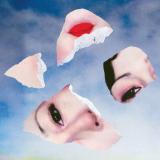
Themes of change, breaking up, shattering old ways of being are shot through the record. For the front cover, a photograph of the artist’s face was printed, ripped up and re-assembled, resembling the creative process embarked upon by Lew for her first “solo” material. The album feels instinctual, almost dream-like in its assemblage of sweeping synths and pulsating, propulsive drum machine beat patterns with Lew’s vocal performances sensitive and caressing over the top. Increasingly relying on the subconscious and dreams to guide her creative process, Hannah Lew frequently abandons literal interpretations or linear narratives, the songs seeming to exist in a swooning, effortless flow-state while remaining emotionally hard hitting.
On an album where every song could be a single, there are kaleidoscopic shades and varying emotional tones in abundance. First single Another Twilight is carried along a pumping, Italo-disco-style 4/4 beat and mono-synth bass line, the low end pulling at the heart and body. Lew’s vocal melody teases the track before swan-diving into a gorgeous chorus as she sings “it’s all over baby and I don’t mind… in decline, I take my time…” The album is suffused with moments like this. On slow builder Damaged Melody, an arpeggiated synth elongates the verse before a cascading synth showers down melodic glitter. The stunning Replica uses dual swirling synth patterns before a driving, synthpop chorus for the ages carries Hannah Lew’s vocal into the stereo field, sailing in on a high register singed with the embers of a break up.
In a departure from previous groups, her solo songs are guided by dreams and free association inspired by Dada and the Surrealist movement and sculpted afterwards. As such, the songs reveal themselves on repeated listens, revealing traces of heartbreak inspired by both personal and global elements - Hannah Lew regards the album “a wartime album.” On Move In Silence, Lew intones “there’s a war outside, just out of view,” revealing the dichotomy at play throughout. With the songs evolving naturally and in a flow state, the pressures and sadnesses of the modern age bleed through, mixed in with Lew’s inherent love, sensitivity and fractured-but-intact optimism. On the swooning, sublime Sunday layers of Numanoid synths open up for the commanding vocal performance pontificating on grief, love, pain as she “feels the ache on Sunday…” As the chorus builds and Lew’s call-and-response vocal adds to the emotional tension, it almost feels like too much to take.
Elsewhere, there are echoes of Hannah Lew’s previous work. On Time Wasted a bass guitar comes in with a heavy, punk attack before the synths and vocal harmonies reminiscent of later Cold Beat elevate everything. The glassy, sweetly resigned closer The Clock sounds like so classic it could be cover, a sweetened Jesus & Mary Chain tune perhaps, before it erupts into volcanic chorus that could only come from Hannah Lew in 2026.
In just five years, The Spy has gone from underground newcomer to one of the most talked-about names in the European electro and EBM dark electro scene. Early releases on Osáre Editions and Mechatronica quickly placed him on the radar of forward-thinking clubs and selectors across Europe. Now landing on Oráculo Records, he presents his most wave-driven and club-oriented material to date: pure, physical electro built for dark rooms and late hours. Driving basslines and sharp machine rhythms—infused with subtle, classic post-punk tension—define a sound that connects the dancefloor with the shadows, drawing clear parallels to artists like L.F.T, Credit 00 or Gesloten Cirkel. This is music made to move bodies without sacrificing attitude—raw, confrontational, and far removed from formulaic club clichés. Five years in, the message is clear: this is not hype, but momentum—an artist fully in command of a modern electro language built for the underground. Presented in ONE-OFF truly limited edition of 300 copies lacquered pressed on 180 gr. high quality solid BLACK vinyl. All tracks have been specially remastered and mastered for vinyl by Daniel Hallhuber at Young and Cold Studios (Germany).
Following Parnell March’s Back Bar Grooves EP in February and November’s release of the Dust Tears (lead song from Sarah/Shaun’s debut) remixes, Edinburgh’s Hobbes Music label returns with a second EP of dream pop from husband-and-wife duo Sarah/Shaun (pronounced simply Sarah Shaun), alias Sarah and Shaun McLachlan (pronounced McLochlun), who wooed hearts and wowed critics with debut EP ‘It’s True What They Say?’ last year.
‘It’s True What They Say?’ attracted fans across the board: Artist Of The Week in The Scotsman, rapturous reviews from The Skinny and Tokyo's Ban Ban Ton Ton blog, BBC 6Music airplay courtesy of Nemone (Mary Anne Hobbs' Morning Show), more radio play from Radio Scotland's Roddy Hart & Vic Galloway, plus Simone Butler (Primal Scream) and Jim Sclavunos (Bad Seeds) via their respective Soho Radio shows, not forgetting ringing endorsements from the likes of David Holmes, Youth, Kevin Bales (Spiritualized), Brent Rademaker (Beachwood Sparks) and Julian Corrie (Franz Ferdinand).
They played gigs supporting Glasgow's huge Glasvegas, at festivals (Kendall Calling, Dunbar Music, Hidden Door), plus a slew of venues across the Scottish capital, ending the year with a trio of shows supporting Glaswegian 80s pop legends The Bluebells at Aberdeen’s Tunnels, Dunfermline’s PJ Molloys and Edinburgh’s Liquid Rooms, while The List magazine tipped them among their Ones To Watch For 2025, with journalist Fiona Shepherd suggesting they were “blending the starry-eyed pop of Sonny & Cher with the electronic experimentation of Chris & Cosey.”
Very much the companion piece to the debut EP but arriving a full twelve months later, Someone’s Ghost is emblematic of the duo’s desire not to rush things or release anything half-baked.
“I’ve always wanted to create the perfect pop record and I do really feel that we’ve achieved that with this one,” says Shaun. And he’s clearly not the only person who thinks so.
REVIEWS, FEEDBACK ETC:
"I LOVE that! Dreamy dreamy pop." ROY MOLLOY (Marvellous Crane/Alex Cameron) on BLAST RADIO, Sydney
“the Scottish music scene’s cream of the cool... buzzy drum beats, high, distant chimes, and heavenly electronics…. very ethereal.” THE SKINNY
"Listening to Sarah/Shaun is like eavesdropping on a noir dreampop, long-distance phone call between them both, across two separate sonic locations. On this stunning 4-song EP, Sarah’s voice, effortlessly mesmerising, draws you into these big beautiful and haunting passages of perfect dream-pop. All beautifully produced in a multi-layered-scape of low-fi analogue textures, epic cinematic crescendos, intense electro-pulse grooves and warped psycho-pop guitar riffs. Within the songs lurk a sense of unresolved emotions, longing and pathos. There are shades of classic Lee Hazelwood & Nancy Sinatra but also Post-Punk Electronica and Beach House. But what a unique sound they’ve created of their own. I love it" DAVID MCCLUSKEY (The Bluebells)
"Absolutely beautiful" SEAN JOHNSTON (A Love From Outer Space)
"Lovely stuff here! Total quality." MARTYN 'MASH' HENDERSON
"Ooooh. Everything the last record promised is here. Well done" GEORGE T aka George Demure (Accident Machine)
"Vince clark Era Depeche Mode in places" KEVIN BALES (Spiritualized)
"Sounds cool. Well done" PETE KEMBER (Sonic Boom, Spacemen 3)
"Glorious, it (Debbie Harry) grabs hold of you and doesn't let go." IAIN DAWSON aka RAVECHILD (Everyone Wants To Play The Hits Podcast)
SOMEONE’S GHOST
Born out of an incredibly anxious, stressful time, the songwriting process for these recordings has been something of a personal tonic for Shaun…
“There was a period when I was having nightmares,” he reveals. “Apparently I was saying there was someone in the room, I was talking to that person and Sarah was seeing all this while I was still asleep.
So, I was thinking that this was my ghost. I started writing songs because I was going through something and I was dealing with something and writing songs was a comfort. My ghost was a comfort, whether it was real or not. The idea of it was a comfort.”
“I firmly believe that everyone has someone who watches over them but all of the songs are essentially about being there for someone,” he says. “Everybody needs someone but also everyone needs to stay real and keep what you have, keep it close, never let it go. If you don’t have it, continue to tell people you’re there for them. It’s about loving and hoping people will be good to you in return.”
While Shaun took the songwriting lead on Filter Of Love and EP closer The Sound Which Stresses The Sound Of My Ears, Debbie Harry was originally instrumentally conceived by producer Jaguar Eyes, alias Ali Chisholm, later lyrically completed by Shaun, and the EP’s lead track, Anhedonia, and one of its stand-outs (much like Starbed on the debut) was conceived by Sarah, as a result of experiencing a bit of a spiritual epiphany of her own.
“When I first heard the word Anhedonia, I didn't know what it meant but when I found out I thought about it quite a bit. How sad it would be to have no enjoyment in anything,” she explains. “This song is really about my own personal beliefs. When I have been down, that's one of the things that helps me the most. It talks about trying to make amends but realising, for some things, you can't. But I think with any kind of faith comes hope… which is always a good thing.”
A record about hope, truth, honesty, a belief in something bigger than oneself… and all set to a soundtrack that wouldn’t feel out of place in a David Lynch or Eighties feature film. What more could anyone ask for, really?
There’s equally a desire to offer something universal and positive to anyone who tunes in. The labels for the 12” edition reveal the dual mantras “Who just wants to survive?” and “It’s about time to live a little”, with both messages also engraved in each record’s run-out grooves. T-shirts accompanying debut EP It’s True What They Say? bore the slogan “Kill Them With Kindness” - leading caps intentional. Shaun carries the acronym KTWK everywhere he plays, as a reminder: it’s stitched into his guitar strap. And this particular wee pebble has already caused a few ripples: people have been approaching him at gigs to acknowledge their appreciation and respect for it.
"We feel we have made an honest, open, colourful, body of work,” say the duo. “We hope to go out and play the songs with the guys (our band) and then potentially make more records. We are taking things as they come. Everything has been organic so far, after all. We are looking forward to whatever this brings."
Sometimes the title of an album tells you everything you need to know. Laurence Pike’s Possible Utopias for Jazz Quintet is like that: The music within represents a search for freedom, potentiality—liberatory strategies that transcend the ego and the solitary, atomized figure.
But in this case, the album title is also a red herring, because there is no jazz quintet here—just Pike, his drums, and his machines, not so much an ersatz ensemble as a purely notional one, a thought experiment equipped with drumsticks, circuitry, and the desire to go beyond hardwired limits.
And the results, strictly speaking, aren’t really jazz, though they incorporate the vocabulary of jazz, along with that of ambient, electronica, and post-rock. They are some other thing, cognizant of genre but never beholden to it. Again, we’re talking about a search for freedom here.
The Sydney-based musician has a long history of coloring outside the lines, not just in his solo recordings—including four albums for the Leaf label between 2018 and 2024—but also in the trio Pivot (later PVT); Szun Waves (alongside saxophonist Jack Wyllie and Border Community’s Luke Abbott); Triosk, which recorded an album with Jan Jelinek in 2003; and even post-punk titans Liars, whom he joined in late 2018.
Of his first album for Balmat, Pike says, “My loose concept was: What does music sound like when the expectations of late capitalism are removed from it? How might a jazz musician from an idealised culture of the future, or even another world, utilise musical language when the conventions of style and marketing are no longer a factor in music making?”
That inquiry, he says, connects to his “guiding principle: that the purpose of music is to access something bigger than the individual, and reveal a sense of possibility and freedom in the world to the listener. To create an understanding that the future can be something other than what we imagined or expect, even unconsciously.”
Heady ideas, but plug into his stream-of-metaconsciousness flow and you may start to intuit what motivates him. There is a deeply lyrical expression in these pieces—in the ruminative piano of opener “Guardians of Memory,” for example—but also a sense of exploded perspective, of ideas approached from more angles than any one mind could dream up. Of a collectivized consciousness, of mycelial networks branching across tone and rhythm and timbre, of ideas articulated in distributed fashion, nodal points dancing across drum heads.
Pike’s imaginary quintet is hardly without precedent; it’s a continuation of concepts floated across Jan Jelinek’s Loop-Finding-Jazz-Records, Burnt Friedman’s many guises, and much of the recombinant improv of the International Anthem roster, not to mention the far corners of ECM’s catalog in the late 1970s and 1980s, which Pike says have been integral to his development since he was a teenager. Possible Utopias for Jazz Quintet is a point in a continuum, a voice in a conversation, a question with no obvious answer: How can the search for otherness in music manifest something true about ourselves?
Spider Taylor crawls over to Dark Entries with Surge Studio Music, an album of archival gay pornographic soundtracks. James Allan Taylor was born into a working-class family in Los Angeles in 1951. Nicknamed “Spider” by his father due to his frantic energy, Taylor was a natural-born guitarist, gifted with perfect pitch and a voracious musical appetite.
Throughout the 70s, he expanded his musical repertoire, playing in bands ranging from country to post-punk, like his outfit Red Wedding, while always looking for new sounds and styles to explore. During this period, Taylor also partnered with his soulmate and musical collaborator, Michael Ely. They were part of a wave of bold, young, gay couples living openly together in the years immediately following the Stonewall Riots. In the early 80s, while working at the West Hollywood gay sex club Basic Plumbing, Taylor met Al Parker, the legendary pornographic actor and director, who recruited Taylor to produce the soundtrack for a film he was working on. Parker’s partnership with Steve Scott running Surge Studios produced some of the most popular all-male films of the era. Spider’s music was a natural fit for Surge, and throughout 1985 and 1986, he composed the soundtracks for five films produced by the iconic studio. Assisted by engineer Steve Conrad and armed with a drum machine and some synths, Spider’s compositions for film veer from the expansive, reverb-drenched “Rainforest” to the Miami Vice-esque chugger “Tech.”
While Spider thought of this work as little more than a gig, tangential to his real craft, enthusiasts of VHS-era nostalgia and vintage erotica will be brought to bliss. Surge Studio Music will be available on both LP and CD, the latter of which includes a 20-minute version of “Strange Places…Strange Things!” as a bonus track. The album’s cover art was designed by Gwenael Rattke, and features stylish images from Surge Studios releases. Also included is an insert featuring liner notes by Will Lewis, a longtime friend of Spider. The music is released from Spider’s estate by Michael Ely, Spider’s partner of 43 years. The shadow of AIDS lingered over Surge; Steve Scott passed from AIDS-related illness in 1987, and Al Parker succumbed in 1992. In 2014, when it became legal for same-sex couples to marry in Arizona, Spider and Michael finally became wedded. Spider would pass away from liver cancer six months later.
STRIKER TRAXX proudly presents its very first release — STX101: BALLAN “Chantal Grooves EP”.
Born as the new sub-label of SUPREME STRIKER, itself a direct emanation of the Skylax Records universe, STRIKER TRAXX sets the tone for a new era: raw, uncompromising, and forward-thinking. As always, the visual identity is entrusted to the legendary H5’s exclusive artwork (Daft Punk, Air, Logorama), delivering a striking design that transforms each copy into a true collector’s object.
For this inaugural strike, we welcome Asaf Ballan, aka BALLAN, an artist emerging with force from the vibrant beatscape of contemporary electronic music. With Chantal Grooves EP, he delivers a 12-inch packed with five club-weapons that dive deep into the essence of house and tech house, reshaping them with his own relentless, pumpy twist.
The trip opens with “How Should I Start”, a perfect ignition, teasing anticipation while locking you instantly on the groove. “Goddamnit (Club Tool)” follows as a pure machine workout, echoing Kerri Chandler’s house foundations while pushing them into today’s territory. “Members Only Club” exudes exclusive sophistication, a secret-weapon built for late-night dancefloors. On the flip, “Keep the Frequency Clear” hypnotizes with razor-sharp frequencies, proof of BALLAN’s sonic craftsmanship, before “Futuro” launches us headfirst into tomorrow—where innovation collides with the Romanian sunrise aesthetic, infused with a heavier, raw energy.
Influenced by the minimal masters (Zip, Ricardo Villalobos, Raresh) yet unwilling to compromise on drive and power, BALLAN delivers here a record where every track stands as a killer. Chantal Grooves EP is both a homage to the roots of house and tech house, and a manifesto propelling the genre into its next evolution.
STRIKER TRAXX launches with a statement: this imprint is made for DJs and dancers who still believe in vinyl as a sacred object and in the dancefloor as a transformative space. With H5’s exclusive artwork (Daft Punk, Air, Logorama)and Skylax’s uncompromising vision, each release is conceived as a weapon for the underground, and a jewel for the true collectors.
Vinyl only. For devoted believers.
Cindytalk has remained a majestic proposition over the decades, one marked by a continued process of disintegration and regeneration. Change has been a constant for Cindytalk, as has been the presence of the Scottish musician Cinder, who has fronted the project since the early '80s. The first Cindytalk albums embraced a dark theatricality of post-punk dissonance and abject rock deconstruction that coupled industrial dirges with Cinder's beatific vocals, these same vocals that were once plied to the earliest This Mortal Coil and Cocteau Twins recordings,forever binding Cinder to the 4AD lore. But even on those albums, Camouflage Heart and In This World, Cinder was pushing the band to embrace the studio as a tool for further abstraction of sodden drones, cobwebbed dark elegance, and decayed textures.
By the early aughts, Cinder had reimagined Cindytalk through the granular processes of digitalia with a handful of equally celebrated works of glitch-born expressionism for Editions Mego. Cinder explains that "those elements were growing roots under our sound and had started to organically change the shape of what we were doing. The fucked-up rock music was in retreat and the electro-acoustic abstractions were becoming apparent. Fast forward to the early part of the 21st Century and my first laptop. It seemed natural where I needed to begin that part of my new sonic journey. To further explore those and new territories. Sunset and Forever is intrinsically connected to what came before."
Sunset and Forever is a labyrinthine opus, one that returns to the themes of the sacred and profane that have rippled through all of Cindytalk's recordings, albeit in various guises. The opening track "Embers of Last Leaves" is a haunted piece of undulated, cyclical tones that entwine into a sorrowful chorale with Cinder's own voice. Thumps of electronic drum kicks and bass drops dot the apocalyptic menace of "Tower of the Sun" but serve not as a rhythmic grid, but as painterly noises that further disrupt and disturb the machined dissonance. A cinematic radioluminescence blooms from the tempered electronics within "For Those Eyes, Shadows Of Flowers." The finale "I See Her in Everywhere" bookends the opening number with a seemingly human chorus build from electronic tones cast in cathedral reverence. Sounds throughout may appear adjacent to those of Fennesz, Holly Herndon, or even Lovesliescrushing from time to time, but Sunset and Forever remains purely Cindytalk.
Cover designed by Chris Bigg, known for his iconic design work for 4AD. Mastered by James Plotkin.
- 1: No Me Jodas
- 2: The City Begins
- 3: Sirena
- 4: Yellow Sun
- 5: Viva La Rosa
- 6: Enemy Without
- 7: You're A Ghost
- 8: Albuterol
- 9: Mi Concha
- 10: Public Works
- 11: Public Luxury
Downtown Boys have pushed relentlessly forward as an artistic and political project since their founding. Singer Victoria Marie and guitarist/singer Joey La Neve DeFrancesco first met at union meetings while working together at a hotel in Providence, RI, writing many of the band's early songs about labor organizing and exploitative workplaces. The quintet is completed by Joe DeGeorge (sax/synth), Mary Jane Regalado (bass), and Joey Doubek (drums). Over years of touring, and three acclaimed albums, Downtown Boys have continued to grow as artists, musicians, and organizers. Now, the band has arrived with Public Luxury, an enthralling album that keeps politics front and center while summoning the band's most urgent and powerful sound to date. The definition of Public Luxury falls very much in line with that of the title of the second Downtown Boys LP, Full Communism. Straight up, Public Luxury means, "everything for everyone." It's the stubborn insistence that a better world is possible, while fully recognizing the horrors we witness daily, and the individual and collective responsibility to resist the nihilism and hopelessness we all feel. Sentiments like "everything for everyone," and "we will have it all" perfectly represent the cathartic, communal live experience this cadre of multi-instrumentalists create. These sentiments also encapsulate the inclusive, joyful sonic fusion that defines the album: anthemic punk and indie rock mix with Latin traditions, drum machines blend with acoustic drums, saxophones punctuate riffs, and layers of synths add flourishes from new-wave to industrial. The amount of ground covered on Public Luxury can't be overstated, and yet the album feels totally vital and cohesive. Public Luxury is a revisitation of the band's past for the sake of their future. It was co-produced by DeFrancesco with recording engineer and longtime Downtown Boys supporter Seth Manchester (Lambrini Girls, Lightning Bolt, Model/Actriz) at the Pawtucket, RI studio and arts space Machines With Magnets, not far from the band's first home of Providence, RI. Victoria Marie's grandmother-a monumental figure for the band throughout their existence-passed away in May of 2025, and her influence looms large over the album; the songs "No Me Jodas" and "Sirena" are crystallized representations of the love between a woman and her ancestor. Beyond the loss, rage and frustration of the present, Public Luxury points boldly towards a vibrant, open-hearted vision of both music and the world: "Our music is simply for anyone and everyone who believes in the new future we can make together," Victoria Marie declares. "A world that will be awkward, inconsistent, yet truly free when it comes to all that matters."
There are records that follow the rules, and others that rewrite them in real time. With O R G A S M A N I A, Byron The Aquarius returns to Skylax with a deeper, freer and more unpredictable statement — where jazz instinct meets raw machine funk, and structure dissolves into pure feeling. Rooted in the lineage of Detroit yet never confined by it, Byron operates in that rare zone where house music becomes expression rather than format. His sound doesn’t chase functionality — it breathes, it stretches, it resists. The EP opens with Back 2 Zion (Tomorrow), a spiritual and meditative journey built on loose drums and luminous chords, carrying a sense of elevation — early morning music where the dancefloor begins to think again. Enter the Co$mos (Fool) pushes further into abstraction, with drifting synths and broken rhythms unfolding in a non-linear structure, navigating between Sun Ra’s cosmic language and Detroit futurism. On the flip, Mr. Captain Crunchhh brings a raw, playful energy — crunchy textures, off-grid swing and an almost improvised groove, alive and unpredictable, a leftfield tool designed to disrupt expectations. Finally, O R G A S M A N I A stands as the centerpiece — hypnotic, sensual and immersive, locking into a deep repetitive groove while evolving in subtle layers, a late-night body experience guided by a sharp musical mind. Across four tracks, Byron The Aquarius confirms his unique position between jazz musician, house producer and sonic storyteller, with a trajectory spanning Sound Signature, Axis, Eglo, Apron and Shall Not Fade, continuing to resonate from Detroit to Berlin and beyond. Artwork by H5 — the iconic studio behind Daft Punk, Air and Vitalic — reinforces Skylax’s timeless and art-driven identity. This is not fast music, this is not algorithm music — this is music for those who still listen. Strictly for the heads. Vinyl only. No repress. Skylax Records.
- A1: Design - Premonition
- A2: Vision - Lucifer’s Friend
- A3: Richard Bone - Alien Girl
- A4: John Howard - I Tune Into You
- A5: Ian North - We’re Not Lonely
- A6: Selwin Image - The Unknown
- B1: Harry Kakoulli - I’m On A Rocket
- B2: Rich Wilde - The Lady Wants To Be Alone
- B3: Billy London - Woman
- B4: Alan Burnham - Science Fiction
- B5: The Microbes - Computer
- B6: The Goo-Q - I’m A Computer
- C1: Gerry & The Holograms - Gerry & The Holograms
- C2: The Warlord - The Ultimate Warlord
- C3: Die Marinas - Fred From Jupiter
- C4: Dee Jay Bert & Eagle - I Am Your Master
- C5: Peta Lily & Michael Process - I Am A Time Bomb
- C6: Sole Sister - It’s Not What You Are But How
- D1: Alasdair Riddell - Do You Read Me?
- D2: Karel Fialka - Armband (The Mystery Song)
- D3: John Springate - My Life
- D4: Idncandescent Luminaire - Famous Names
- D5: Disco Volante - No Motion
- D6: Dream Unit - A Drop In The Ocean
2025 REPRESS ON TRANSPARENT GREEN VINYL
Compiled by Philip King “And then came the rise of synth pop : blokes with dodgy haircuts hunched over keyboard-operated machines stuffed with wires and do-it-yourself tone oscillators making sounds like a brood of geese passing gas in a wind tunnel. Whoopee! This is the way the ‘70s ended : not with a blood-curdling bang bang but with a cheap, synthesized, emasculating whimper.” NICK KENT, NME. All The Young Droids: Junkshop Synth Pop 1978-1985 is a new compilation that charts the underbelly of the epoch-defining sound of the synthesiser in 80s popular music. Compiled by Philip King (previously seen compiling All The Young Droogs, Glitterbest and Boobs - The Junkshop Glam Discotheque), the music here connects the dots between DIY synth enthusiasts grappling with new, cheap synthesisers at the tail-end of punk and wannabe, jobbing songwriters enthral to the new music pioneered by Gary Numan, Depeche Mode and Daniel Miller’s Mute Records. Featuring rare tracks of auto-didactic progressive pop music, proto-techno punk, shoot-for-the-stars-land-in-the-gutter chart flops and heralded, underground synth classics, School Daze paints a picture of beautiful failure. Complete with extensive sleeve notes written by King and never before seen imagery, all 24 tracks were remastered by RPM in-house engineer Simon Murphy, many from vinyl copies due to lost master tapes. The story told on All The Young Droids is one of the dawning opportunity presented by both the emergence to the market of cheaper analog synthesisers and the distribution networks plus indie labels that exploded with the advent of punk music in 1976. While the music that sprouted out all over the globe in the wake of these factors was decried as fake, plastic, a refutation of punk’s guitar-led revolution, it’s telling that much of the music on All The Young Droids.. was created in bedrooms, ramshackle studios and home-made set ups with often borrowed equipment. In the era of record labels jumping to capitalise on the success of The Sex Pistols, The Clash (both on major labels, of course) these artists struggled to stand out from a new gold-rush with next to no budget or PR team. With radio and labels desperate for the new Yazoo, what resulted was a testament to necessity being the mother of invention. At the time, the synthesiser was the music of the future, a shiny new machine that could paint like an orchestra with a single finger and a 4-track. In the hands of Manchester avant-pranksters Gerry & The Holograms it’s a pulsing, sardonic weapon.. the only instrument on the Messthetics classic lampooning of New Wave fashion. In Hamburg, a 16 year old Andreas Dorau used it to write and record (with his female classmates on vocals) a global smash in Fred Vom Jupiter (later licensed to Mute Records). The hard-to-find English version (Fred From Jupiter, natch) is included here. Many artists with alreadystoried careers caught the bug and recorded synthesiser-fuelled peons to space, computers, the future and, of course, love-interests. Harry Kakoulli, late of Squeeze, recorded a solo album in 1979 that included the incredible power-synth-pop smash-that-never-smashed I’m On A Rocket. Similarly, Ian North of Neo and American Power Pop stalwarts Milk ’n’ Cookies bought a Korg MS20 and used a tape machine to record We’re Not Lonely, an absolute lost-classic of minimal synth pop. We’re Not Lonely also features on the Junkshop Synth Pop sampler 7” twinned with John Howard unreleased track You Will See, released April 12th 2025. There are plenty of compilation debuts in evidence. Sole Sister were a mysterious trio who were featured on the Scaling Triangles compilation of female-fronted, queer-adjacent post-punk / underground music that also featured The Petticoats. Selwin Image were from San Francisco and featured members of the recently defunct power pop/punk group The Pushups. Their stupidly catchy The Unknown fizzes with New Wave energy - think XTC to Sparks but remains unreleased until now. Dream Unit’s A Drop In The Ocean is an early synth wave cut, positively teaming with Joy Division instrumentation, previously only released on a long-forgotten and super rare, self-released EP. Incandescent Luminaire’s Famous Names belies an archetypal struggle of a small-town trying to make it in a cruel industry but is a thrilling New Romantic-Synth Wave cross over with a OMD gloominess that’s a joy to hear. Feminist Minimal Wave track I Am A Time Bomb by performance artist Peta Lilly and Michael Chance is a revelation destined for new found cult status. It was released on 7” and lost until now. The flipside to the subterranean, never-made-it synth pop mentioned above are the ambitious, even fruity attempts at success that have a perennial elegance to their confidence. New Jersey-ite Billy London (real name Ed Barth) tried to cash in on the synth boom with Woman, released by a major label, a lurching new wave track built on the Louie Louie rhythm and a wonderfully camp Lou Reedstyle sleazy vocal before exploding in the synthesised chorus. The song bombed but with a chorus like this, you have to wonder why? Ex-Glitter Band member John Springate’s My Life is truly epic, with doomed chord progressions and massive sounding drums turning into at least 3 different songs in the course of the track. Before you wonder what’s going on the song resolves with a glorious return to the main refrain. The dry-ice-dressed dance floor is well catered for too. Design’s Premonition and Vision’s Lucifer’s Friend are stone-cold minimal synth bangers, well loved but given a new lease of life here. The Warlord’s The Ultimate Warlord was released in 1978, a homespun proto Hi NRG banger that was later re-recorded by The Immortals in Canada who had a club hit with it. One-man- band Disco Volante’s No Motion was re-issued by Synth wave label Medical in 2012 but makes its first vinyl compilation appearance here. Close your eyes and you can imagine what Lawrence of Felt would have sounded like with some cheap Korgs a little earlier in his career. Gibraltar-based trio The Microbes imagined a computer programming people to dance - how prescient - and ended up with a propulsive, robo-funk track with splendid rubbery bass playing over a tectonic drum machine. Previously picked up by Belgian label Stroom TV, Dee Jay Bert & Eagle’s heavily Euro-accented I Am Your Master demands the listener to “come to paradise!” In a frankly terrifying manner. All The Young Droids is the first compilation to peel away from the narrative that dour, Minimal Synth and Cold Wave were the only musical children of the first rush of synth pop. Philip King and School Daze Records describe a much more complicated world: along with the austere, Brutalist children of Daniel Miller (who produced Alan Burnham’s Bowie-Low-influenced Science Fiction here) was a plethora of desperate cash-ins, accidental mainstream hits, ambitious pop dramas and major label punts that went nowhere. Crucially, the compilation blurs the line between junk and treasure. What if the two things are interchangeable. What if it’s all science fiction?
UK producer Tom Carruthers returns with a scorching 5-tracker for Skylax Records, diving headfirst into the primal roots of jackin’ house, proto-italo, and early machine funk. Known for his raw MPC-driven grooves on L.I.E.S., Clone Jack For Daze, Syncrophone, and Craigie Knowes, Carruthers channels the energy of the underground circa ’86—pure drum machine soul for the dancefloor faithful. Side A kicks off with the title track “Neutralise”, all sharp snares, warped synths and hypnotic repetition—a jack track in the truest sense. “Deep North” follows with ghostly pads and relentless drum programming, while “No More” brings metallic tension and stripped-down funk with a heavy nod to Chicago’s original blueprints. On the flip, “Pascals” weaves cosmic arps through rugged percussion, merging italo sensuality with bleep-era minimalism. The closer, “Cosmic Ride”, is exactly that: a journey through spacey chords, dusty rhythm boxes, and that unmistakable feeling of warehouse euphoria at 4 a.m. Neutralise EP is a raw, timeless record that strips dance music down to its essence—jacking, emotional, physical. To match the sonic purity and timeless aesthetic of the release, we enlisted the iconic H5 studio—a name synonymous with visionary design in music and culture. Known for their groundbreaking work with Daft Punk, YSL, and numerous award-winning visual campaigns, H5 brings a level of artistic sophistication that elevates this EP into a complete sensory object. Their clean, modernist design echoes the stripped yet futuristic vibe of Tom Carruthers’ sound—a perfect fusion of form and function, underground and high art. Vinyl only. No digital. No compromise. For fans of: Virgo Four, Baby Ford, Larry Heard, early Warp, Mr. Fingers, and Beppe Loda.
- A1: Countrymusicdisco45 4 08
- A2: Sometimes Shooting Stars 2 57
- A3: Short Cut Home 3 25
- A4: Disappointment 3 00
- A5: Days Are Mighty 2 46
- B1: Don't Dance With Me Tonight 3 27
- B2: You Got It Wrong 2 39
- B3: Ring The Bells 3 57
- B4: Let's Make It Up 2 49
- B5: When Did You Stop Loving Me 3 54
- C1: Just Beginning 4 00
- C2: Wintering Of The Year 3 16
- C3: Let It Rain 3 04
- C4: We Tell Each Other Who We Are 3 27
- C5: Trip To You 4 06
- D1: Dirt 2 54
- D2: Heaven Right Here 3 38
- D3: If Later Ever Comes 3 03
- D4: Remember The Season 3 10
- D5: A Little Love 3 35
- D6: Weary Traveller 3 20
“The high priest of country cool” - Rolling Stone
“I like him very much. He’s very special. He’s singing with a voice I never heard before” - Townes Van Zandt
“A conscious, soulful brother” - Horace Andy
“He’s a brother to me - one of the best singer/songwriters I’ve ever met” - Adrian Sherwood
“Unearthed mine of gems from inner Wales - a songbook of ideas - that's Jeb!” - Gilles Peterson
Jeb Loy Nichols is a bonafide Country (Got) Soul legend. The Music Maker presents 21 incredibly deep, grooving and soulful songs from the cream of Jeb's catalogue; from its earliest days to his latest unreleased gems via countless rare and unbelievably good lost-classics. This 2LP set is presented in a gatefold sleeve complete with freshly commissioned artwork courtesy of Jeb himself.
In collecting these uncut, under-heard gems, we hope to do justice to Jeb's jaw-dropping artistic brilliance. A man who, in working with Adrian Sherwood, Dennis Bovell, Dan Penn, Larry Jon Wilson and countless other legendary characters, has crafted some of the most deeply affecting folk, country, soul, funk, blues, dub, reggae, gospel, rap and electronic music, ever heard.
The first music Jeb really felt a connection with was southern soul: "I used to listen to the radio at night and fell in love with Bobby Womack and Al Green, The Staple Singers and Joe Simon – that whole Nashville/Memphis/Muscle Shoals thing.” But Jeb was so much more than a soul boy, Indeed, he "went to bluegrass festivals with my dad and come home and listened to jazz records with my mother.” And, when he was fifteen, he heard his first punk record: "God Save The Queen" by The Sex Pistols. “That and The Ramones completely changed me.” In 1979 he got a scholarship to go to art school in New York: “A great time. Punk was over but hip-hop was starting and I got into that in an obsessive way.”
His first recording, in 1980, was an unreleased rap song called "I’m A Country Boy". If that isn't an insight enough into Jeb's kaleidoscopic path through music, in 1981 he visited friends in London and found himself living in a squat with Adrian Sherwood, Ari Up (from the Slits), and Neneh Cherry. “Adrian put me to work immediately, moving boxes of records all across London. It was Adrian that was and is my biggest influence – in his complete disregard for genre purity.” So, presumably you're getting the picture? A veritable musical magpie with a voracious appetite and unimpeachable taste.
"Mine has always been a meandering career. I've done what I've done, and made the music I've made, due to chance meetings. I'm not particularly ambitious; it's more important to me that I work with friends and like-minded people. I've been a big fan of Be With for years. Everything they release is essential. When they asked about rereleasing "Countrymusicdisco45" I was both pleased and flattered. We began talking about how we'd do it; two years and twenty-one tracks later, here we are. I've always thought of the music I make as Country Music. Music conceived in the country, written in the country, recorded in the country. I left London and moved back to the country so I could live among the trees, the grasses, the animals, those things that don't go to war and get greedy. This compilation is the story of that life. Hand made, lo-fi, ramshackle, stripped down, real deal music. Heartworn and funky. Music made in the kitchen, not in the studio. As the great Skip Mcdonald said, Perfect ain't perfect. It's great to see all these tracks gathered together. It feels like a family reunion. Some older members of the tribe, some newer arrivals."
Opener "countrymusicdisco45" is a song Jeb wrote about how his crew lives, tucked up blissfully in the hills: "House parties full of country folk dancing to disco, reggae, soul, country, hip-hop. All night. I recorded it at home under the influence of Stevie Wonder." It's one of the funkiest records you'll ever hear. "Sometimes Shooting Stars" was recorded in Nashville and mixed by the legendary Dennis Bovell. It's deep, dubby, majestic. A thing of fragile, melodic beauty. The party ramps back up again with the undeniable groove of "Short Cut Home" before the profoundly moving "Disappointment" arrives. One of many songs he's recorded with good buddy Benedic Lamdin (aka Nostalgia 77): "We were going for a Leon Thomas meets Richard Brautigan meets Alice Coltrane kind of thing". We think they nailed it. "Days Are Mighty", like a lot of the tracks on this collection, "started life as a demo, an attempt to get something down while it was fresh. No frills, nothing fancy, just feel." And what feels!
The irrepressibly funky "Don't Dance With Me Tonight" is a deeply moving, slow-mo organ-drenched head-nod-funky country-ballad. Next up, the breezy "You Got It Wrong" was recorded in Wales with some of Jeb's good friends and neighbours, The Westwood All Stars, featuring Clovis Phillips and Will Barnes. Skanking fiddle-flecked gem "Ring The Bells" was the first thing Jeb recorded when he moved to Wales. A combination of all his loves; country, reggae, soul. It's followed by "Let's Make It Up", a truly sumptuous string-drenched emotional groover. "When Did You Stop Loving Me" is another Nashville track, written and recorded during a time Jeb was spending a lot of time with the Muscle Shoals crew, Donnie Fritts, Spooner Oldham, George Soule and Dan Penn: "It shows, I'm sure, their influence." Oh, you bet it does!
The swaggering country-funk of "Just Beginning" should grace many groove-focused DJs' sets whilst "Wintering Of The Year", again made with Clovis, is pastoral, campfire soul. The glacial, gorgeous "Let It Rain" is from an unreleased record Jeb made with the great British jazz bass player Andy Hamill and "We Tell Each Other Who We Are" is freaky country-soul made by a man with a love for strutting, wonky hip-hop stylings. Rounding out the side, "Trip To You" is pure, uncut amphetamine-propelled drum-machine soul.
The spare, beautiful "Dirt" is from an EP Jeb made with Julian Moore in his house in South London: "All first takes, straight to tape." Swoon! "Heaven Right Here" was a very minor league hit in America: "It was produced by the brilliant and much missed Wayne Nunes. It was started in the countryside of Missouri, finished in the countryside of Wales, and recorded in the countryside of Sussex." Double swoon! "If Later Ever Comes" is electronica meets J.J. Cale business whilst "Remember The Season" is truly wonderful and breezy guitar soul. "A Little Love" was made with Wayne Nunes as well, after a night of listening to Studio One and Northern Soul. Bouncy dub closer "Weary Traveller" was written by Bill Monroe, the hero of Jeb's youth: "Monroe's music was heavily influenced by black southern churches; I've tried to keep some of that feral feel." This was the final recording by Jeb's 1990s Country-Dub band, Fellow Travellers.
The name of this compilation comes from a time when Jeb lived in Peckham, south London and he used to DJ and sometimes perform at a local bar: "The owner of the bar, a Jamaican named Count Percy, once asked me what I called my music. I told him I wasn't sure, I guess just pop music. He thought about it for a minute and then said, 'no, more like mom and pop music'. Rather than call me a country singer or a folk singer he always referred to me as The Music Maker."
With the long overdue deluxe overview of his beloved music, we hope to finally shine a light on the unheralded genius of Jeb Loy Nichols. RIYL Larry Jon Wilson, Townes Van Zandt, Bobby Charles, country got soul artists, dub, deep soul, disco, dancing, heartbreak. This deluxe collection, spellbinding from beginning to end, should hopefully go some way to ensuring Jeb reaches an ever bigger, ever more appreciative crowd of followers. Mastering for this special double vinyl edition was overseen by Be With regular Simon Francis and it was cut by the esteemed Cicely Balston at Abbey Road Studios to be pressed in the Netherlands by Record Industry. The artwork has been lovingly put together by The Music Maker, himself, Jeb Loy Nichols. "Be With is the perfect home for this mongrel music. I am forever in their debt." The pleasure is all ours, Jeb.
C.A.R. (Choosing Acronyms Randomly) is the musical project of Chloé Raunet, a Canadian-born, London-based artist known for her icy synths, warm vocals, and left-field pop sensibility. Drawing from post-punk, electro, and experimental songwriting, she creates music that’s both emotionally charged and sonically adventurous.
Following a five-year hiatus, C.A.R. returns with Shyana, the first single from her long-awaited fourth album, Dance at Oscar’s. Produced by Nathan Ridley, the release marks a creative rebirth: a new label, a new live formation with Joni Green, and a sound pulsing with revitalised energy. After a pandemic-induced break to focus on filmmaking — and a period of burnout and disillusionment — Raunet was ready to walk away from music altogether. But a pair of carried-over festival dates and an impromptu onstage reunion with longtime friend Joni Green unexpectedly reignited the spark. What was meant to be a farewell became the start of something new.
Shyana is a shimmering slice of machine-funk — a warped and groovy tribute to Paul Anka, filtered through C.A.R.’s surreal pop lens. A meditation on teen hysteria, pop manufacture, and the strange alchemy of early fame, the track pulses with wonky elegance and strutting confidence. One of the most playful cuts from Dance at Oscar’s, it showcases Nathan Ridley’s tight, swaggering production while capturing the album’s embrace of movement, humour, and the weirdness of cultural nostalgia.
On the B-side, Cecilia Road offers a more reflective counterpoint — a nostalgic, synth-drenched ballad built around a call-and-response vocal, throbbing melodies, and emotional tension. Intimate yet expansive, it hints at vulnerability without losing the pulse.
Artwork by Chloé Raunet, Craig Richards and Oliver Hupfau.
- A1: Emerge / Fischerspooner
- A2: Seventeen / Ladytron
- A3: Strict Machine/ Goldfrapp
- A4: Girls On Pills / The Droyds
- A5: Hooked On Radiation (Pet Shop Boys Orange Alert Mix) / Atomizer
- B1: Fuck The Pain Away / Peaches
- B2: Do I Look Like A Slut? (Original Version) / Avenue D
- B3: Galang / M.i.a
- B4: Kernkraft 400 (Dj Gius Mix) (Radio Edit) / Zombie Nation
- B5: Poney Pt. 1. (Edit) / Vitalic
- B6: The Game Is Not Over / T. Raumschmiere Feat. Miss Kittin
- C1: Over And Over (Naum Gabo Remix) / Hot Chip (7.05)
- C2: Banquet (Phones Disco Remix) / Bloc Party (5.25)
- C3: E Talking (Nite Version) / Soulwax (6.08)
- C4: ?Zdarlight» / Digitalism (5.44)
- D1: Daft Punk Is Playing At My House (Edit) / Lcd Soundsystem (3.23)
- D2: Hustler / Simian Mobile Disco (3.43)
- D3: We Share Our Mother's Health / The Knife (4.09)
- D4: Missy Queen's Gonna Die / Tok Tok Vs. Soffy O (4.13)
- D5: What Was Her Name (Radio Edit) / Dave Clarke Featuring Chicks On Speed (4.44)
- D6: I Am The Fly / Adam Sky And Crossover (4.59)
- E1: We Are Your Friends / Justice Vs. Simian
- E2: Take Me Out (Daft Punk Remix) / Franz Ferdinand
- E3: Slow (Chemical Brothers Remix Edit) / Kylie Minogue
- F2: Warm Leatherette / The Normal
- F3: Empire State Human / The Human League
- F4: Tryouts For The Human Race / Sparks
- F5: Telephone Operator / Pete Shelley
- F6: Nag Nag Nag / Cabaret Voltaire
- E4: Let's Make Love And Listen To Death From Above / Css
- E5: Solta O Frango / Bonde De Rolê
- E6: Club Action / Yo Majesty
- F1: Numbers / Kraftwerk
‘When The 2000s Clashed: Machine Music For A New Millenium’ is the story of how, 25 years ago, a new form of electronic music – known as electroclash - reignited a tired clubland and gave the indie scene and mainstream pop a shot in the arm in the process. Over this 3LP highlights set, carefully curated from the 5CD box of the same name (also released, 3rd October) the collection showcases the back-to-basics electronic beats that heralded in a new generation of exciting and innovative new artists - Hot Chip, Peaches, LCD Soundystem, and Ladytron, to name a handful. It also shows how the sound and attitude of electroclash plugged into the decade’s cutting-edge indie bands, (Franz Ferdinand, Bloc Party), and became intrinsic to the way chart pop would sound in the first decade of the 2000s (Kylie, Goldfrapp).
The collection also shows how the scene’s underground DIY ethos evolved and inspired the next generation of electronic buccaneers (Simian Mobile Disco, Justice Vs. Simian). ‘When The 2000s Clashed’ brings together a dazzling, diverse selection of artists, producers and remixers from right across the 2000s zeitgeist – from The Chemical Brothers and Daft Punk, from M.I.A. to Soulwax and many points in-between. For good measure, there’s also one side of LP3 given over to the original post punk and electronic sounds (including Kraftwerk, The Human League and Cabaret Voltaire) who’d played such a big influence on the electroclash sound. ‘
When The 2000s Clashed’ was compiled and sequenced for Demon / Edsel by Jonny Slut, founder of London’s electroclash citadel Nag Nag Nag. Established in 2002, in a small Soho venue called Ghetto, ‘Nag’ quickly became THE hottest club, first in London and then in the whole world. A glorious mess and hedonists’ hotspot, a night at ‘Nag Nag Nag’ (if you could get in!) saw the capital’s club kids, students and creatives rub up alongside names from the fashion and music worlds - Björk, Pet Shop Boys, Kate Moss, Boy George, Alexander McQueen, and Pam Hogg were among the regulars. Madonna visited, so did John Peel, Yoko Ono asked to perform and did, Throbbing Gristle’s Chris and Cosey DJ’d, so did Marc Almond, and Too Many DJ’s.
Justin Timberlake was refused entry (too many bodyguards)… even Cilla Black was spotted getting down! Jonny shares these reminisces – and many more - in the collection’s sleevenotes. Named after the 1979 Cabaret Voltaire classic, ‘Nag, Nag, Nag’ became the first place to hear the seemingly endless flow of thrilling new tunes coming from every direction during that decade of dance. Many of them are included on this collection.
Emotional Response is delighted to present the debut EP of Aaron Coyes (Peaking Lights / Leisure Connection) new project, as Exotic Gardens. An additional music universe as his love of dub expands to include new wave, goth and acid psychedelics across 5 catchy, bass heavy songs.
While the continuing journey of his duo band, Peaking Lights, with his wife Indra, earns plaudits and fans alike, his early years as a one-man lysergic music polymath that saw his youth in punk and hardcore bands, expanded during a mid-90s burst of “living in San Francisco” creative expansion, devouring music, genres, and influences for life.
Started as a sub-project to Peaking Lights and his personal dub excursions, Exotic Gardens pollinates a rich tapestry. Recording through the pandemic in their then home in Amsterdam, before being archived, assembled, and completed following the move back ‘home’ to the West Coast, California.
Re-embracing that love of his inner goth, the analogue warmth is all there, now featuring Coyes’ dub-languidity of stripped drum machines, widescreen bass, haunting guitar lines and an almost idle voice to peddle true, raw songs.
Combined, the pop layer of hooks and tight grooves instantly catch you. Opener and EP title, Drugs & TV is the perfect anthem for the Exotic Gardens sound, before the “dubwave” of Last Of The Light and Tonite shimmer that yearning melancholy of youth.
In the almost 10 minute dub house opus Organize Your Movement an appreciation and understanding of the psychoactive properties of the Roland 303 and 909, they also hark to a love of Industrial / Noise bands, a lineage from the death pulse of his cult project Rahdunes through to Sound Design and Sound System culture to the pop-dub psychedelics with Indra, now melded here to include a dark assault, whispering invocations and pulsing pads.
To close, Turn It On is a roaming multi-genre evocation, an exotic end from this constant troubadour, cassette junkie, record dealer, sound system builder, always looking to get back on the road, to live to roam.
“I turn it on, you lose your mind’.
C.A.R. (Choosing Acronyms Randomly) is the musical project of Chloé Raunet, a Canadian-born, London-based artist known for her icy synths, warm vocals, and left-field pop sensibility. Drawing from post-punk, electro, and experimental songwriting, she creates music that’s both emotionally charged and sonically adventurous.
Following a five-year hiatus, C.A.R. returns with Shyana, the first single from her long-awaited fourth album, Dance at Oscar’s. Produced by Nathan Ridley, the release marks a creative rebirth: a new label, a new live formation with Joni Green, and a sound pulsing with revitalised energy. After a pandemic-induced break to focus on filmmaking — and a period of burnout and disillusionment — Raunet was ready to walk away from music altogether. But a pair of carried-over festival dates and an impromptu onstage reunion with longtime friend Joni Green unexpectedly reignited the spark. What was meant to be a farewell became the start of something new.
Shyana is a shimmering slice of machine-funk — a warped and groovy tribute to Paul Anka, filtered through C.A.R.’s surreal pop lens. A meditation on teen hysteria, pop manufacture, and the strange alchemy of early fame, the track pulses with wonky elegance and strutting confidence. One of the most playful cuts from Dance at Oscar’s, it showcases Nathan Ridley’s tight, swaggering production while capturing the album’s embrace of movement, humour, and the weirdness of cultural nostalgia.
On the B-side, Cecilia Road offers a more reflective counterpoint — a nostalgic, synth-drenched ballad built around a call-and-response vocal, throbbing melodies, and emotional tension. Intimate yet expansive, it hints at vulnerability without losing the pulse.
Artwork by Chloé Raunet, Craig Richards and Oliver Hupfau.
- 1: Peace & Purpose
- 2: Safe Room
- 3: Not The Same Thing
- 4: Life On A Farm
- 5: Pick Apart
- 6: Marathon Of Hope
- 7: Stop Cutting Me Down
- 8: Shut The Fuck Up
- 9: Reunion
- 10: Phantom Limb
- 11: Thoughts On My Faith
- 12: Eris On The Run
- 13: Red House
- 14: Truth In Trauma
Can’t go over it. Can’t go under it. Gotta go through it. And somewhere out there in the Pitch black beyond all darkness lies Peace & Purpose. The horizon you never quite crest until the inevitable end. Breathe deep — this fearful moment is the most alive you’re ever gonna feel. For the last decade, Crack Cloud’s vision has grown ever more expansive, more cinematic. Last go around, they dropped from The Heavens and then performed with their bare backs to an endless darkening desert. Now they’ve crammed all that life into some metallic and strange object called Peace & Purpose. All the terror of living. All the helplessness. All the raw human will. All glued and screwed and locked into this impossible tactile shape of dungeon dub; sour milk vox; Avant-protest music. Music arm wrestling itself to the ground. Far afield of beauty. The discordant symphony of factory farming and grim timber of the meat processing plant. The grinding din of the cogs. And yet, never giving up in spite of all good sense. Even in death, we are a coterie of survivors. Look now: There’s Terry Fox on his one-legged Marathon of Hope across The Great White North while cancer spreads through his lungs. A self-annihilating drive to feel alive. Rage against the dying of the light, they say. Well, how ‘bout it then!??! Peace & Purpose is not in any way some art project meditation on Punk Rock. It is Punk Rock. Terrifying, inspiring, vital, invigorating and most importantly, utterly unexpected. Every goddamn stupid day is a sublime slice of fresh hell. That’s the point. Gotta go through it. Wishing you Peace & Purpose — if only in that last big breath.
UK producer Tom Carruthers delivers another masterclass for Skylax, diving deeper into the DNA of house music with Deepline, a 5-track journey that connects the raw futurism of the late ’80s to the deep innovations of the early ’90s. Known for his MPC-driven grooves on L.I.E.S., Clone Jack For Daze and Craigie Knowes, Carruthers has become a true guardian of machine funk — always stripped down, always pure. The title track Deepline captures the very essence of house, hypnotic and driving, right at the crossroads of 80s machine funk and early 90s deepness, a timeless groove that feels like the missing link. Dream 12 unfolds as lush and atmospheric, with pads that instantly recall the golden era of early 90s deep house, a reverie made for afterhours and smoke-filled basements. Experience stands as a raw reminder of the four pillars of house — drum machines, bass, minimalism and repetition — metallic, stripped, relentless, pure underground. On the flip, Fantasy explodes with wild energy, channeling the raw spirit of Trax Records and Armando, dirty and direct, a weapon for uncompromising dancefloors. Finally, Folx closes the record with a cosmic edge, its tough jackin’ drums colliding with spacey synth touches to create a bridge between Chicago basements and interstellar dancefloors. Once again, the visual identity is entrusted to the iconic H5 studio (Daft Punk, YSL, Logorama), whose bold modernist artwork perfectly mirrors Carruthers’ stripped yet futuristic vision. Vinyl only. No digital. No compromise.
STRANGER STILL was Julian Cator (guitar), Paul Cator (piano, organ, synthesizer), Tim Warnes (bass), Frank Warnes (vocals, drums) and Ian Johnson (vocals, drums) from King’s Lynn, Norfolk, UK. The two sets of Cator and Warnes siblings had been playing together in bands since 1974, with Ian joining in 1979, and with their musical style evolving from glam influenced rock to punk/new wave (punk came late to Norfolk) and finally post-punk, influenced by Ultravox!, Magazine, Joy Division, Bauhaus and Killing Joke. Their first gig together was in September 1979 with John Peel being in the audience. The Solitude/Survivor single was recorded in July 1981, released in November and sold well locally. John Peel played Solitude, between singles by Winston and Screen 3. When Julian left in autumn 1981 the others continued, later changing their name to Nothing Sacred. Ex-members have since played in a number of other bands, most notably Paul and Tim in Shine!, and Julian and Paul in Ivy.
Solitude opens in a perfect analogue way with a ‚primitive’ rhythm machine pattern and a dark synth sound fading in. We shall be glad for the band’s move towards electronics while knowing „given the negative reaction we got from some of the local bands when we got the synth a Moog Satellite“, quoting Julian. When the real drums, guitar, bass and vocals also come in, you’re in for one of the most perfect post-punk songs, yet playful but ultimately bleak. “And then I can feel nothing more. Alone again, with no sensation.“ Survivor is more uptempo and bass-driven, reminiscent of early Death In June (who came later though). Lyrics like “4 minute warning warning – the sound of today. Our new dream world – Enola Gay.“ set the mood there.
The band composed a dozen of songs, demos to get gigs, which were unfortunately never recorded properly in a studio. So these are demos or rehearsal tracks, never released to the public and presented here for the first time ever as an additional 15 tracks download-only (due to the poor sound quality). You’ll find fantastic tracks like Brave New Berlin or Cardiac Arrest, which is reminiscent of Death In June’s In The Nighttime, and then, there is a demo of Solitude too!
Here’s to a piece of post-punk history!
- A1: Design - Premonition
- A2: Vision - Lucifer’s Friend
- A3: Richard Bone - Alien Girl
- A4: John Howard - I Tune Into You
- A5: Ian North - We’re Not Lonely
- A6: Selwin Image - The Unknown
- B1: Harry Kakoulli - I’m On A Rocket
- B2: Rich Wilde - The Lady Wants To Be Alone
- B3: Billy London - Woman
- B4: Alan Burnham - Science Fiction
- B5: The Microbes - Computer
- B6: The Goo-Q - I’m A Computer
- C1: Gerry & The Holograms - Gerry & The Holograms
- C2: The Warlord - The Ultimate Warlord
- C3: Die Marinas - Fred From Jupiter
- C4: Dee Jay Bert & Eagle - I Am Your Master
- C5: Peta Lily & Michael Process - I Am A Time Bomb
- C6: Sole Sister - It’s Not What You Are But How
- D1: Alasdair Riddell - Do You Read Me?
- D2: Karel Fialka - Armband (The Mystery Song)
- D3: John Springate - My Life
- D4: Incandescent Luminaire - Famous Names
- D5: Disco Volante - No Motion
- D6: Dream Unit - A Drop In The Ocean
MB Crystal Vinyl[32,73 €]
LTD Trans Pink Vinyl[32,82 €]
LTD Trans Pink Vinyl[27,69 €]
Compiled by Philip King
“And then came the rise of synth pop : blokes with dodgy haircuts hunched over keyboard-operated
machines stuffed with wires and do-it-yourself tone oscillators making sounds like a brood of geese
passing gas in a wind tunnel. Whoopee! This is the way the ‘70s ended : not with a blood-curdling bang
bang but with a cheap, synthesized, emasculating whimper.”
NICK KENT, NME.
All The Young Droids: Junkshop Synth Pop 1978-1985 is a new compilation that charts the
underbelly of the epoch-defining sound of the synthesiser in 80s popular music. Compiled by Philip
King (previously seen compiling All The Young Droogs, Glitterbest and Boobs - The Junkshop
Glam Discotheque), the music here connects the dots between DIY synth enthusiasts grappling with
new, cheap synthesisers at the tail-end of punk and wannabe, jobbing songwriters enthral to the new
music pioneered by Gary Numan, Depeche Mode and Daniel Miller’s Mute Records. Featuring rare
tracks of auto-didactic progressive pop music, proto-techno punk, shoot-for-the-stars-land-in-the-gutter
chart flops and heralded, underground synth classics, School Daze paints a picture of beautiful failure.
Complete with extensive sleeve notes written by King and never before seen imagery, all 24 tracks
were remastered by RPM in-house engineer Simon Murphy, many from vinyl copies due to lost master
tapes. The story told on All The Young Droids is one of the dawning opportunity presented by both the
emergence to the market of cheaper analog synthesisers and the distribution networks plus indie labels
that exploded with the advent of punk music in 1976. While the music that sprouted out all over the
globe in the wake of these factors was decried as fake, plastic, a refutation of punk’s guitar-led
revolution, it’s telling that much of the music on All The Young Droids.. was created in bedrooms,
ramshackle studios and home-made set ups with often borrowed equipment. In the era of record labels
jumping to capitalise on the success of The Sex Pistols, The Clash (both on major labels, of course)
these artists struggled to stand out from a new gold-rush with next to no budget or PR team. With radio
and labels desperate for the new Yazoo, what resulted was a testament to necessity being the mother
of invention.
At the time, the synthesiser was the music of the future, a shiny new machine that could paint like an
orchestra with a single finger and a 4-track. In the hands of Manchester avant-pranksters Gerry & The
Holograms it’s a pulsing, sardonic weapon.. the only instrument on the Messthetics classic lampooning
of New Wave fashion. In Hamburg, a 16 year old Andreas Dorau used it to write and record (with his
female classmates on vocals) a global smash in Fred Vom Jupiter (later licensed to Mute Records).
The hard-to-find English version (Fred From Jupiter, natch) is included here. Many artists with alreadystoried careers caught the bug and recorded synthesiser-fuelled peons to space, computers, the future
and, of course, love-interests. Harry Kakoulli, late of Squeeze, recorded a solo album in 1979 that
included the incredible power-synth-pop smash-that-never-smashed I’m On A Rocket. Similarly, Ian
North of Neo and American Power Pop stalwarts Milk ’n’ Cookies bought a Korg MS20 and used a
tape machine to record We’re Not Lonely, an absolute lost-classic of minimal synth pop. We’re Not
Lonely also features on the Junkshop Synth Pop sampler 7” twinned with John Howard unreleased
track You Will See, released April 12th 2025.
There are plenty of compilation debuts in evidence. Sole Sister were a mysterious trio who were
featured on the Scaling Triangles compilation of female-fronted, queer-adjacent post-punk /
underground music that also featured The Petticoats. Selwin Image were from San Francisco and
featured members of the recently defunct power pop/punk group The Pushups. Their stupidly catchy
The Unknown fizzes with New Wave energy - think XTC to Sparks but remains unreleased until now.
Dream Unit’s A Drop In The Ocean is an early synth wave cut, positively teaming with Joy Division
instrumentation, previously only released on a long-forgotten and super rare, self-released EP.
Incandescent Luminaire’s Famous Names belies an archetypal struggle of a small-town trying to
make it in a cruel industry but is a thrilling New Romantic-Synth Wave cross over with a OMD
gloominess that’s a joy to hear. Feminist Minimal Wave track I Am A Time Bomb by performance artist
Peta Lilly and Michael Chance is a revelation destined for new found cult status. It was released on 7”
and lost until now.
The flipside to the subterranean, never-made-it synth pop mentioned above are the ambitious, even
fruity attempts at success that have a perennial elegance to their confidence. New Jersey-ite Billy
London (real name Ed Barth) tried to cash in on the synth boom with Woman, released by a major
label, a lurching new wave track built on the Louie Louie rhythm and a wonderfully camp Lou Reedstyle sleazy vocal before exploding in the synthesised chorus. The song bombed but with a chorus like
this, you have to wonder why? Ex-Glitter Band member John Springate’s My Life is truly epic, with
doomed chord progressions and massive sounding drums turning into at least 3 different songs in the
course of the track. Before you wonder what’s going on the song resolves with a glorious return to the
main refrain.
The dry-ice-dressed dance floor is well catered for too. Design’s Premonition and Vision’s Lucifer’s
Friend are stone-cold minimal synth bangers, well loved but given a new lease of life here. The
Warlord’s The Ultimate Warlord was released in 1978, a homespun proto Hi NRG banger that was
later re-recorded by The Immortals in Canada who had a club hit with it. One-man- band Disco
Volante’s No Motion was re-issued by Synth wave label Medical in 2012 but makes its first vinyl
compilation appearance here. Close your eyes and you can imagine what Lawrence of Felt would have
sounded like with some cheap Korgs a little earlier in his career. Gibraltar-based trio The Microbes
imagined a computer programming people to dance - how prescient - and ended up with a propulsive,
robo-funk track with splendid rubbery bass playing over a tectonic drum machine. Previously picked up
by Belgian label Stroom TV, Dee Jay Bert & Eagle’s heavily Euro-accented I Am Your Master
demands the listener to “come to paradise!” In a frankly terrifying manner.
All The Young Droids is the first compilation to peel away from the narrative that dour, Minimal Synth
and Cold Wave were the only musical children of the first rush of synth pop. Philip King and School
Daze Records describe a much more complicated world: along with the austere, Brutalist children of
Daniel Miller (who produced Alan Burnham’s Bowie-Low-influenced Science Fiction here) was a
plethora of desperate cash-ins, accidental mainstream hits, ambitious pop dramas and major label
punts that went nowhere. Crucially, the compilation blurs the line between junk and treasure. What if the
two things are interchangeable. What if it’s all science fiction?
On June 27, 2025, a long-dormant signal reactivates from Hamburg’s hidden places: Helena Hauff and F#X return as Black Sites with R4 on Tresor Records—their first full-length album and the first release under the moniker since 2014. Like a hieroglyphic recently discovered and translated, R4 feels more like a long-awaited resumption than a comeback.
Recorded to tape with minimal editing or post-production the record is a classic example of the symbiotic relationship that can come from the interaction of human and machine. This punk ethos isn’t invoked through distortion alone, but through method; in the album’s breaking from the received wisdom of hardness tethered to speed as most of the tougher pieces are lower BPM and vice versa (with one notable exception in the mind-melting stomp of BLOKK).
Across ten tracks, Black Sites traverse a landscape where genre dissolves into intention. It migrates through electro’s danceability, acid house’s corrosion, and into the liminal realm of machine funk—a genre coined by Andrew Weatherall, which sounds like the results of technology dreaming of soul where the emphasis is on live execution, on immediacy over perfection—a sound forged in the act of creating, not polishing.
In a 2013 interview, around the time of the first Black Sites EP, Hauff was quoted as saying that she wants “things to fit together properly, but on another level, I really want them to make sense together.” That principle animates R4: The album’s form reveals itself in time, with each movement echoing and amplifying the others to create a synergistic whole.
From the opening crawl of C4 (a name that like the music foreshadows the explosions to come) to the end-of-the-night bliss of MOTHERJAM via the intense peaks of BLOKK, 707, and classic acid track 3D it’s clear that R4 is a work made with serious intent; a refutation of a world where streaming has made the two-minute single the dominant musical form again. R4 demands immersion, not just attention. It is not a collection of tracks, but a singular, recursive experience: a mirror in which sound and listener repeatedly rediscover one another.
- A1: Banchee - Evolmia
- A2: The Dirty Filthy Mud - Forest Of Black
- A3: Wool - Love, Love, Love, Love, Love
- A4: Spencer Mac - Ka-Ka Baya Mow-Mow (Sing A Little Love Song)
- B1: Trifle - One Way Glass
- B2: Brainticket - Black Sand
- B3: Emma De Angelis - Trip
- B4: Blonde On Blonde - Castles In The Sky
- C1: The Braen's Machine - Fall Out
- C2: Eddie Warner & Roger Roger - Shut Up
- C3: Köy Karde?Ler - Shürük
- C4: The Children - Beautiful
- D1: Moebius & Beerbohm - Doppelschnitt (Richard Norris Edit)
- D2: Demon Fuzz - Past, Present & Future
"Throughout all my time as a musician and producer, ever since Jack the Tab, I've been focused on developing a single idea: Blending psychedelic sounds and effects with rhythm." Richard Norris, Strange Things Are Happening White Rabbit 2024
Over the past few years Eskimo Recordings have invited some of the best crate diggers around to curate compilations that don't just reveal the hidden contents of their record bags but something about themselves too. Now, following in the footsteps of the likes of Bill Brewster and Psychemagik, producer, musician, DJ, writer and more, Richard Norris, takes us on a globetrotting psychedelic journey with the epic 42 track collection, Mr Norris Changes Brains.
For over forty years Richard has played a part in many of the UK's most important music subcultures. Whether sharing stages with the likes of Tracey Thorn as a pubescent punk in St. Albans, or running freakbeat nights in Liverpool and working at the pioneering psychedelic label Bam Caruso, co-producing the UK's first acid house inspired LP with Throbbing Gristle's Genesis P. Orridge or riding the wave of creativity that the second summer of love unleashed all the way to the Top of the Pop studios as The Grid, Richard's career has continually seen him work to expand both his own and the public's musical horizons.
With Mr Norris Changes Brains it's the most recent part of his mercurial career that he's focused on. Drawing inspiration from his post 2006 adventures as one half of Beyond the Wizard's Sleeve, alongside Trash's Erol Alkan, this compilation shows how a more connected world has blown the dust off a paradoxically sometimes straightjacketed scene. The result is a dizzyingly wide-ranging collection that explores the further out there reaches of worldwide psychedelia and dancefloor mayhem.
"A lot of these tracks are fairly recent discoveries, things that I've discovered from around the time I started working with Erol and going right up to today," Richard explains. "Whether that's from going out to play and finding new records in places like Istanbul or just connecting with people online from all around the world. Psych can sometimes be a sort of narrow-minded field, with everything having to sit in its specific niche, but more and more people are open to new sounds and that's allowed for a much broader selection."
Despite their disparate origins what does unite these tracks is that they aren't just there to zone out to on a bean bag as projections of swirling coloured oils and psychedelic patterns wash over you. Mr Norris may change brains but his DJ sets also move feet, and whether it's their killer guitar riffs, oscillating synths floor shaking drums or soulful Hammond organs these are all cuts that from festival tents to underground clubs have proven time and time again to get people dancing.
"With a lot of these tracks there's a kind of fun element in them," says Richard. "It's still psychedelia, but they've also got these solid, funky grooves. They sound phenomenal on the dancefloor and as much as these records might excite old psych heads, this compilation is also for a new generation out there who might have never heard anything like this before and, just like when I was 18 and heard The 13th Floor Elevators for the first time, think 'Oh, my God, what on earth is this and more importantly what else is out there?'"
When SW. AKA, Stefan Wust, first established SUED in 2011, their compelling, cosmic and anonymous material struck a rare chord, emanating far beyond the freeform Berlin underground in which it was written. Unknowingly, Los Angelean Oliver Bristow had
established a parallel musical universe, founding the hyper-specific label Acid Test, inviting pioneering artists such as Donato Dozzy, Tin Man and Pepe Bradock to indulge in glorious interpretations of 303 control. Without compromise, these were records that quietly
reinvigorated electronic music.
Some years later, a new label, SWOB, unites Wust and Bristow in a very different landscape. And while it would be easy to transform the purity and integrity of this special alchemy into something like nostalgia, yearning for an alternative culture before
influencers and against algorithms, SWOB endeavours to find inspiration in arguably tougher truths.
“By the mid-90s, the techno scene had already reached a breaking point”, recalls Wust.
“Today, the scene is so highly professionalized that it barely resembles what was once called the "underground. But "underground" was never more than the simple reality that music circulated on cassettes among friends or that dubplates were played at illegal
parties... The consequence of today’s professionalization is the death of the original movement.”
Still, no one can kill an idea. Here, inspired by the “Outside Tekno” or “Outkast Techno” that emerged to subvert even back in the day, SWOB are proud to introduce the tekkNOthing trilogy, a new project from SW. beginning on cassette and culminating later
on vinyl. Some years in development, tekkNOthing first began to take shape during the 2020 global pandemic, when ‘the underground’ quickly began to mean something radically different once again.
“I noticed how everything was accelerating while simultaneously spinning in circles – existing in a kind of creative limbo on a global scale”, recalls Wust. “And that’s where true freedom lies: for artists – in any sense – to consciously engage with this necessity. In
other words, irrationality or nonsense can eventually generate meaning.” While hardly capitulating to the contemporary hammering of techno’s most recent developments, tekkNOthing’s first chapter quickly establishes a frenetic pace; tracks like ‘nuclearFALLoutX’ and ‘paslolESmess’ interlock and unfold at a tempo removed from that typically associated with SW. while ‘euroBSS’ and ‘viscousHEAT’ successfully experiment with a more guttural palette, veering far into a rejuvenating and previously uncharted leftfield.
A resolutely human endeavour, the music of SW. is nonetheless written and recorded in the looming shadow of AI, whose free-form adoption of pop culture, hip-hop and techno reminds Wust of “when photography emerged in the 19th century... painting was no
longer bound to naturalism. Similarly, music today is no longer bound to fixed standards – through AI, it can become truly free.”
If not in competition, than taking inspiration from this landscape of new opportunity, tekkNOthing diversifies further with eight unpredictable tracks across part II, taking in stuttering machine-funk on ‘crAMPDUNK’, a freeform organ jam via ‘sonicENdo’ and the
inexplicable piston-percussive, post-punk exotica heard on ‘poorTENOOR#a#01’ DJs with dual cassette decks skills might even find function in the more overtly floor-focused ‘DU ¨NEhowSE#1takeÄ’ or ‘lookLOOK’.
The times may have changed, but the promise remains simple; more music, more freedom.
- A1: Sepehr - Twilight Calls
- A2: Sissy Fuss - No Restraint Instrumental Def
- A3: God Is God - Na Gore More Dub Edit
- A4: Alex Loveless - Voicenote
- A5: Suemori - Kisou
- A6: Mari Herzer - Limbal Ring
- A7: Elena Colombi Feat Juno Roche - Lost In A City
- A8: Loma Doom - Sisterresister
- A9: Decha - Mujeres
- B1: Pose Dia - Lovers Rock
- B2: Low End Activist - Need To Know Blue Room Version
- B3: Decha Wir Sind Da
- B4: Mayurashka - Libra Man
- B5: Nar John Silvestre - Ensel Ham
- B6: E-Bony - Slow Machines
- B7: Riva Ft Tommy Khosla - Resurfacing
- B8: Anenon - Length-Of-Night Improvisation
Following on from the celebrated first instalment, the second part of The Male Body Will Be Next compiles an entourage of daring sonic experiments, composed in response to bell hooks’ landmark book The Will to Change. Prompting artists and musicians to envision cross-gender solidarity, Osàre! Editions founder Elena Colombi presents an enrapturing, narrative album, conceptualised around collective transformation.
Resonating with hooks’ challenge to men to reclaim the sensitivity that patriarchy denies them, the name of the record arises from a photograph by Peter de Potter and Rebecca Salvadori’s film of the same title. In these depictions, naked flesh is exposed, made vulnerable and trembles with emotion as the fragility of masculine bodies are examined through the queer and female oppositional gaze. Transforming this visual language into musical expression, The Male Body Will Be Next swirls with punk vitriol, electrified noise, acid, electro and free-wheeling encounters charged by love, lust and limerence.
Gently plunking chords signal Pose Diva’s reimagining of lover’s rock before Sissy Fuss smashes in with a heavy-weight instrumental version of their erotic anthem ‘No Restraint’.
Made up of Turkish musician Etkin Çekin and Belarussian songstress Galina Ozeran, God is God delivers a gentle lullaby, while Low End Activist flirts with dark and brooding bass, shattering penetrating frequencies into luminous fragments. Riffing off the 2020 documentary about female early electronica pioneers, Loma Doom crafts a slowly oscillating drone zenith, the ultimate climax. In line with the conceptual underpinning, there are plenty of collaborations – Daytripper’s Riva and Sitar player Tommy Khosla, Lebanonese experimentalist N R and Swiss-French producer John Silvestre (AKA Typhon), as well as Colombi herself and trans author/activist Juno Roche. Within these partnerships, new modalities come alive as mediums, practices and perspectives are ignited and pushed in otherworldly, metamorphic directions.
Parade Ground march back to Dark Entries with The Hidden Side, a compilation of B-sides and unreleased material. Brothers Jean-Marc and Pierre Pauly started Parade Ground in Brussels in 1981. Their Dada-laced brand of post-punk fuses propulsive drum machines and icy synths with skeletal guitar riffs and Jean-Marc’s distinct and powerful voice, pioneering the subgenre of emotional body music. The brothers met Daniel B. and Patrick Codenys of Front 242 in 1982, marking the beginning of an enduring collaborative partnership. In 2011, Dark Entries released The Golden Years, a compilation chronicling the band’s A-sides and exposing them to a new generation of EBM enthusiasts. The Hidden Side continues this mission, illuminating lesser-known facets of the band’s oeuvre. The tracks here were written between 1982 and 1989, and showcase Parade Ground’s range of styles - all cold, dark, and brooding. Tracks like “Riddle in the Stain Glass Window” and the previously unreleased “Looking Through Keyholes” see the band in menacing coldwave mode, rocking chorus-drenched bass guitar and blasts of analog synth. The band’s dancier proclivities shine elsewhere, like on “Off-Balance” or the supremely funky “Hollywood (The Sexiest Fish),” a floor-filler driven by bass guitar and thumping digital drum machine beats. Also included is “Marble Mind,” a previously unreleased latter-period track from the band recorded by Patrick Codenys at 242 Studio. The Hidden Side includes liner notes featuring lyrics and a photo of Jean-Marc and Pierre Pauly. Additionally, a newly remastered edition of The Golden Years will be released along with The Hidden Side.
Next up on Intrepid Skin, MarcelDune readies four heaters direct from the scuzziest corners of the rave, out on Friday 13 December on digital / vinyl.
Based in London but hailing from Athens, they draw upon a lifelong relationship with music spanning jazz studies, opera singing, and the punk DIY scenes of their hometown.
In connecting the dots between these disparate aspects, they've committed to engaging with music that honours resistance and authenticity, and draws inspiration from those seeking liberation from oppression and societal frameworks.
With this new release MarcelDune hones in on the ethos that underpins their aesthetic, with touches of euphoria, huge drums, and quintessentially fun.
Title track 'Buy Success' brandishes raw serrated edges and an industrial core whilst never losing the groove. 'Remedy for evil' moves into bouncier feels with the hardest groove. On 'Tell Me Who They Are', vocal chops ricochet over angular percussion and glitching machines. Closing things off, 'Romantic and Other Fantasies' lays down some weighty percussion driving a madhouse of effects forward.
- A1: Konkparty (7 Inch)
- A2: Baby Dee
- A3: Sokalokamoki
- A4: Honeymoon Side
- B1: Your Life (7 Inch)
- B2: Elephant
- B3: Cool Out Gar (Third Stone From The Sun)
- B4: Suave Y Caliente
- C1: Love Attack
- C2: Machine
- C3: Alien Jam
- C4: Soka-Loka-Moki (7 Inch Part I)
- C5: Soka-Loka-Moki (7 Inch Part Ii)
- D1: Tonton Macoute (Live At Cbgb 81)
- D2: Alamo (Live At Cbgb 81)
- D3: High On The Hill (Live At Cbgb 81)
- D4: Fela (Live At Cbgb 81)
- D5: Frog Talk (Live Broadcast To Paris)
- E1: Konk Party (Uptown Breakdown)
- E2: Konk Party (Master Cylinder Jam)
- E3: Konk Party (Bonus Beats)
- F1: Your Life (12 Inch)
- F2: Your Life (Skull Whip)
- F3: Your Life (What U Want Dub)
Repress!
This year, get ready for KONK! with the ultimate collection The Magic Force Of Konk 1981-1988. This white hot Limited Edition 3xLP set is a lovingly composed Deluxe retrospective, showcasing the Definitive Sounds Of A New York Jazz Punk Afro Funk Disco Machine.
The Magic Force Of Konk 1981-1988 is a testament to the bands artistic staying power, the music sounding as fresh now as it did then, from the crossover funk grooves of the ‘Planet Rock’ inspired ‘Konk Party’, to the innovative punk funk synth bass of club hit ‘Your Life’, the bands influence indisputably lives on in this specially created deluxe collection. This beautifully designed package is a feast for the senses, looking as good as it sounds and sure to please fans of Liquid Liquid, ESG, Pigbag, James Chance, Soul Sonic Force, LCD Soundsystem, to name but a few, or simply those intrigued by those tales of wild nightlife that have become synonymous with the vitality of 1980’s downtown New York City.
Fourth release for Mystic Transfers with the alternative group Zona Utopica Garantita ''ZUG'' with an EP based on the single ''Tanz Minimal'', an infernal circle dotted with minimal wave shadows and rhythmic rustles that convey into a well-defined space in time.
Accompanied by the versions of Gropina, which faithfully reflects the elegance and style, Toulose Low Trax’s dubby version with kraut rock reminiscences and ultimately a hypnotic version native to the dark world of AHEADACHEDAY. ZUG’s music is a marriage between the machine-gunned punk of CCCP and the Body Music of the teutonic DAF, with his own poetry and experimental attitude.
'Science, Art And Ritual' is a story of ‘process'. Growing up in Harrow (a then quiet suburb of London) in the 70’s and 80’s from the age of about 10, Kingsuk Biswas aka Bedouin Ascent's ears opened up to sound as he scanned the airwaves. The undeniable righteousness of 80’s dub via David Rodigan’s Roots Rockers shows was the first prominent influence he received, and with punk roots —and his burgeoning record collection— became exposed to the breathless post punk experimentation that followed in the early 80’s sweeping up free jazz, noise, dub and much more. Throughout though, he maintained his fascination with Indian Classical music which was a mainstay in his parent’s house and spoke with the same infinite space as Joy Division's 'Unknown Pleasures', and King Tubby’s Studio dispatches. Through those teens he assembled and de-assembled, knocking about with fellow travellers —punk bands, garage, space rock, noise. Something was happening. On-U Sound, ECM, Factory Records kept him plugged in and sane.
At that time Kingsuk's core studio setup revolved around his vintage Gretsch, Fender Jazz, Moog, TR-606 and rudimentary FX. He added congas, folk instruments, pipes, hand percussion, gongs, and jammed out shards of funk, noise, jazz fusion, electro and ambience into his hungry Tascam Portastudio. By 1987 these had morphed into what we’d now refer to broadly as techno, but the genre didn't exist beyond the reverberating walls of his bedsit, and he hadn’t yet plugged into the global conversation.
'Science, Art And Ritual' was released in 1994 by Rising High Records and was presented as Bedouin Ascent's debut album, although 'Music for Particles' (released in 1995, again on Rising High) was recorded even before —'SAR' sessions span from 1992-1993, whereas 'Music for Particles' were earlier from 1989-1992, with some older 4-track references from about 1986 too.
Weaved in throughout the album are subconscious references to music that Kingsuk heard in the past that still remained within sight as companions. The opening track "Ancient Ocean III", referencing the extinct ocean Tethis, unapologetically channels Tackhead, Colourbox, Mantronix and Lee Perry. The style was also deliberately juxtaposed to the prevailing sound in techno at the time, which had locked onto a rigid form of symmetrical kicks and light snare drums. Elsewhere 80’s soul and funk are frozen and captured in fragile glass lattices. Electric pianos resound throughout, such as in "He Is She", probably a half-memory of 70’s MOR radio from childhood sleepy night drives. A duel between kick drums from three generations of Roland drum machines —TR-808, TR-707 and R-8— is a central theme in "Transition-R", all in conversation, calling and responding. These were not just machines to Bedouin Ascent, but part of an extended family, with heart and soul.
Three decades after seeing the light, Lapsus is proud to present a special 30th anniversary reissue of this
left-field techno gem in a repackaged and redesigned edition. All pressed on a deluxe 3LP marbled vinyl and including a limited lithographic insert print of the original album cover. All tracks have been restored and remastered directly from the original DAT tapes, and the album also features previously unreleased tracks such as "In the Clouds" and "Thru Water" —regularly performed live at that time and produced in the same period as the album sessions in 1993.
'Science, Art And Ritual’ may refer to esoteric traditions in Indian philosophy, but equally embodies the collision of the science, the art and the ritual that is at the core of being immersed in a deep musical journey.
“Artifact” by Novo Line makes a departure from his Atari ST fueled FM synth journeys, here reimagining the soundtrack of our collective memory. Born from a live performance at a listening festival in Berlin by the Camp Cosmic crew, this LP transforms universally recognized pop anthems, beckoning listeners into a kaleidoscopic realm of sound, where familiar melodies fracture and our brains attempt to reconstitute them.
Using era-consistent equipment – turntable, 12″ maxi singles, classic samplers, and iconic drum machines – Novo Line deconstructs and reassembles songs etched into our cultural DNA. From the soaring emotions of “I’ve Had the Time of My Life” to the disco beat of “Heart of Glass,” these are melodies that have scored countless lives, now reborn in startling new forms.
Recorded live to tape, ‘Artifact’ doesn’t just play; it unfolds like an auditory hallucination. It taps into the deep emotional reservoirs these songs have built over decades, twisting familiar refrains into new shapes. One festival goer recollected that it uncovered “the dark inner universe of Kenny G, suddenly splayed out into a whole new cosmos.”
As the needle traces its path, ‘Artifact’ peels back layers of shared musical experience. It’s an aural alchemy that transmutes the known into the profoundly strange, yet achingly familiar. Listeners may find themselves adrift in a sea of frequencies, where every warped note triggers a cascade of personal and collective memories.
Rooted in the “copyriot” tradition of 1980s punk and industrial scenes, “Artifact” challenges notions of authorship while celebrating the universal language of pop. It doesn’t merely suggest a trip – it becomes a journey through the very fabric of our shared musical consciousness.
Mastered by Rude66, cut by Helmet Erler, and pressed at Objects Manufacturing.
Vast imbecile mentality of those
Who cannane tell a thistle from a rose This is for the others...
Jesse Rae: anachronist Celtic funk warrior, renegade pioneer of funk, soul & dub (collaborating with Parliament, Funkadelic, Adrian Sherwood, Roger Troutman & the Sugarhill Gang); mad pedestrian-punk-poet, steeped so much in his own mythology he exists not only outside of time but in a universe of his own making; three time runner as an independent electoral candidate for Scottish Parliament, kitted-out as ever in ever in his Scots regal (kilt, helmet and claymore); the original trailblazer of the MTV Age (see 1985 music video ‘Over the Sea’, shot on top of the Brooklyn Bridge - aye, you read that correctly). And that’s just the tip of the iceberg folks. The Real McCoy. Prince of Scotland, king of hearts.
Appearing on wax for the first time, three cuts from the world's first ISDN virtual album, Jesse Rae’s seminal ‘Compression’ (CD) - which first dropped on Echo Beach in 1995. ‘Almost Ma Sel Again’ - a Scottish Burns-Funk classic intercut with a reading of Nigel Tranter’s The Wallace, a breathtaking (de)construction of emotional-electronic-free-funk; as deep as the heart that reaps it. ‘Virtual U’ - a mad cut of downtempo Scot/US G-Funk cum hip-hop interposed with answering machine messages from New Jersey’s own Bernie Worrell. ‘Switch Tae U’ - an orchestral and sublime bit of downtown house music. And of course, joining these three is a re-mastered cut of Jesse Rae’s 1982 cult classic ‘Rusha’ - a tripped out slab of linguistic psychedelia.
There we have it then: real shit indeed! Jesse Rae on Pace Yourself folks. For the already initiated and first timers, welcome to the Caledonian wormhole.
Sure to be an outsider anthem for Scotland @ the Euros this summer. Pace & Luv xo
Aerials live, dials tuned, Transmission Towers broadcasting. On either side of the river Mersey, transcendental communications are traded back and forth. Two late-night revellers, one firing messages filled with music, the other returning them laced with lyrics. The result, a dopamine hit of oddball machine soul, melded with a highlife, Afrofuturist touch. Wonky and murky yet deeply emotional, Transmission One, is a debut album that also marks the first release on Luke Una’s É Soul Cultura label, encompassing expertly the off-kilter atmosphere the label sets to orbit.
A synthesised landscape with a Northern charm, Transmission Towers marry the musical worlds of two artists that last collaborated over a decade ago. 10 years have passed, lives have been led, but a gravitational pull has placed Mark Kyriacou and Eleanor Mante back in each other’s spheres on opposite sides of the city of Liverpool. Energised with a newfound desire to strip it all back to the sounds that influenced their formative years in the late ‘80s and ‘90s - astral travelling, intoxicated on Motor City techno, Black Dog IDM and mystical Sun Ra.
Mark half Irish, half Greek Cypriot, Eleanor half Nigerian, half Ghanian, the music contained within is an alchemy of those roots and the pivotal acts that buried deep into their minds. A cosmic contrast, part machine-made, part distinctly human. Take the opener ‘UP’, an ESG-channelling, sci-fi punk beatdown or the polychromatic hyperspace anthem ‘Roller Skater 23’.
Transportive throughout, you ride the solar waves, pace and emotion ebbing and flowing. Tracks like ‘Go Slow Heart’ and ‘Cosmic Trigger’ step to a slower beat but hit with a punch. The former, a slo-mo blast of celestial tenderness, the latter an otherworldly, chugged-out lunar excursion, micro-dosing on whacked-out Wah Wah and Eleanor’s ethereal vocals. Beaming love letters to space and back, ‘Sparse’ marries the organic with the artificial, pianos and percussion circling around synth pads and broadcasting bleeps.
Elsewhere, vibrations move faster. ‘Mega’ strikes, fusing sonic tribalism with psychedelic swirls, as ‘Everything’ sweeps you up in its extra-terrestrial new wave grip. Synth stabs and basslines fizzing from every angle.
Demos of Transmission Towers music surfaced on Luke Una’s radar, making him stop in his tracks. Something magical was emerging, perfectly aligned with the E Soul guardian’s tastes. Guidance followed, quickly turning into conversations about Transmission One becoming the first release on Luke’s own label.
Escapist and futurist yet grounded and relatable. Transmission One is synthesis meets sentiment with a deep, spine-tingling soul at its core.
Shipwrec have delved into the underbelly of electronics for their latest discovery. Fake Youth Cult is the brand new project of Richard van Kruysdijk, an artist who has been integral to the Dutch music scene. Following releases on Delsin, as well as founding his own Music for Speakers label, this latest undertaking explores the darker hues of Kruysdijk's audio creations. Across six tracks, a realm of shadows and steel is constructed. From the murky tones of "Visitor" to the industrial and blackened "Scorched", a towering sound of punishing percussion looms over the listener. Techno is central message. Despite this, the piercing coldness of electro rises in the incising and stark "Messing." The influence of punk comes to the fore in racing rhythms and lean strings that make up "Smear." BPMs drop in the slow burning EBM stained "Management." The machines take control for the finale. A relentless kick is the motor that drives this seven minute juggernaut to the close. Broad and brutish brilliance from a prodigious talent.
Coming from a diverse background of equal amounts hip hop and rock, the producer behind the alias of nrl:ndr got into dance music late in his musical career. After playing in kraut-oriented bands like So Many Mammals, parts of that group reformed into the live techno outfit Tren Né, with the goal of fusing techno elements with live drums. Playing for illegal raves with a punk-like energy, nrl:ndr has cemented his relationship with his machines in service of the dance floor.
But his solo debut on blundar is quite far removed from that scene. To understand this music, one should be aware of the conditions under which it was manufactured. Reluctant to consider himself an artist in the traditional sense, nrl:ndr makes his music free of anticipation and without apparent goals. To glean into this outré musical space is like putting one's ear to the boarded up windows of the photograph that adorn the front sleeve.
The album makes extensive use of the Roland JV-2080, a sample-based synth rack from 1996 with a distinctly clean sound. Our producer dives deep into the expansion cards (labeled after genres like “Hip Hop” and “World”) for curious and sometimes cheesy samples. But he also forces the JV-2080 to do things which are not its forte, like the arduous task of programming decent kick drums.
Another technique that is testament to his experimental view on music making, is the idea of using sketches of unfinished tracks with different time signatures, and mash them together into something new - of which the results of one of these experiments can be heard on the closing track and its bilingual conversation between ambient and tribal.
Full of stunted rhythms and eerie melodies, the unclassifiable nature of the music of nrl:ndr lies somewhere in the vicinity of IDM, classical avant garde and private press synth. From the epic opening track - echoing the post-kraut drumming style of Michael Shrieve - to juggling with chopped up vocal samples and treading into almost trap-like territories on A4, he crosses into a multitude of genres without getting his hands too dirty with nostalgia.
- A1: Island Band – Idle Hours 4 55
- A2: Chaz Jankel – Manon Manon 4 56
- A3: Gilbert O’sullivan – So What (Nail Edit) 8 44*
- B1: Rheinzand – Kills And Kisses (Scorpio Twins Remix) 8 10*
- B2: Canada High – Le Chiffre 5 02*
- B3: Lanowa – Burning Up 6 38*
- C1: Khruangbin – So We Won’t Forget (Mang Dynasty Irreverent Dub) 7 16*
- C2: Fernando – 1998 7 00*
- C3: Debbe& The Code – Code Of Love 6 02
- D1: Jana Koubková - Nijána 6 15
- D2: Ipg V Hot Toddy – Open Space 7 32*
- D3: Smashed Atoms & Backdoor Man – Hey Dreamer 6 50*
This July the esteemed scribe, proper DJ, and discreetly deft twiddler Bill Brewster, drops the latest instalment in his ‘After Dark’ series, for Late Night Tales.
A throbbing, louche and leisurely affair, groove is very much at the heart of this freestyle selection, a vibe which Bill de- scribes as “a basement, a red light and a sound system. Or, as the Beastie’s once rapped, slow and low, that is the tempo”.
There’s Hawaiian drum machine bossa balearica from Island Band, percussive afro post punk from Czech jazz singer Jana Koubkova, and breathy-bubbling-dubwise-slap-bass-soul from Debbe& The Code.
There’s also sultry deep house mood music from Lanowa, infectious bouncy jazz funk breaks from Canada High, and Nail’s life affirming re-edit of singer songwriter Gilbert O Sullivan’s electro pop gem ‘So What’.
Bill’s own studio skills are present and correct too, featuring an undulating bassy version of country troubadour Jeb Loy Nichols, reworked along Alex Tepper under their Hotel Motel moniker, and a chugged-up squelchy disco take on Khruang- bin, this time paired with Raj Gupta, as Mang Dynasty.
Chock full of exclusives, tracks are either completely brand new, or available digitally for the first time, whilst others are wallet-rinsing rarities if purchased elsewhere. Whichever way you slice it though, every tune is a highlight, working equally well as standalone nuggets, or within Bill’s fluidly cohesive mix.
Whether he’s taking the roof off a club with his unique selec- tion of deep and tough house music, enchanting a backroom with a genre-bending set of disco, Balearic, rock and hip hop or playing chillout music in a bay in Croatia, Bill Brewster is the man for all occasions.
In a former life, Bill was a punk rocker, a chef and also the co-editor of football magazine When Saturday Comes but has been a record nerd all of his life. He began DJing in the 1980s, but came into his own in the early 1990s, particularly during a two-year stint in New York running DMC’s office, where nights at the Sound Factory and hanging out with Danny Tenaglia gave him the musical grounding you can still hear in his music today.
Bill was also one of the founding residents at Fabric in London, a position he held for five years. There are few still playing regularly today that have his dedication, eclecticism and encyclopedic knowledge of music.
His parallel life is as a writer, and with his long-term part- ner-in-crime Frank Broughton, they have written four books together, including the acclaimed ‘Last Night A DJ Saved My Life’ (latest edition published last July), ‘How To DJ (Prop- erly)’ and ‘The Record Players’.
He has been working in the industry’s fringes for over 40 years including the running of various labels from Twisted UK and Forensic in the ’90s to Disco Sucks and Anorak in the noughties.
He is one of NTS radio’s new residents for 2023 and his ‘Low Life Loves You’ show is available on the first Tuesday of every month.
A new artist on the Citizen Records / Clivage Music roster, Vhinz is a musician based in Brussels. After taking his time to break onto the electronic scene, he’s now ready to share Belvédère, his debut, dreamlike album, confidently intense, sweeping between cinematic songs and soaring, epic electronic sounds.
Vincent Honca is Belgian, with Armenian roots and a love of keyboards: the mini synth he used to play as a child, the classical piano of his years of training at the Académie de Musique, the Yamaha synth of his teenage years... During the noughties of his adolescence, electronic music was omnipresent in his life as he listened to and admired Daft Punk, Moby, Vitalic, Air and The Chemical Brothers. He also went out dancing, a lot, in the nightclubs and parties of Brussels and the vicinity, and soon his love of computers, technology and synthesisers led to him producing his own music. “I wanted to create beautiful textures with synths,” he says. “I wanted to have fun and discover the possibilities. As part of the internet generation, I taught myself everything I know through reading magazines and checking the forums.”
Vincent went on to become a computer programmer and decided to make music in as much of his spare time as possible. His first productions came out in 2015, including “Drastical”, one of three deep house dancefloor-orientated tracks recorded with none other than Kris Menace. “At the time I was really searching for my musical identity,” explains Vincent, and progressively his music started to lean towards another of his passions – films and film music. “I’ve listened to soundtracks a lot since I was a teenager, and they’ve been a big influence, in particular the music for Heat by Elliot Goldenthal, Gladiator (Hans Zimmer), Saving Private Ryan (John Williams), The Last Temptation of Christ (Peter Gabriel), The Virgin Suicides (Air) and Leon (Eric Serra).” Coincidentally, Vincent has already worked on two independent Belgian films by director Christophe Karabache, UltravoKal and Vortex, both collaborations with Michel Duprez.
Now Vincent has chosen the name Vhinz, bringing together his expertise with machines and computers, his passion and enthusiasm for the electronic sounds of his adolescence and his adoration of cinema’s powerful, impactful soundtracks. Vhinz’s first track is thus called “Aether”, a track brimming with character and confidence, with sung-spoken vocals that sweeps the listener up in bewitching synthetic themes and drums like an off- kilter heartbeat. The track perfectly encapsulates the Vhinz sound, and Citizen Records – the only label he sent it to – immediately loved it and were ready to release a 12” with more. “Then Covid and the lockdown happened, and everything came to a complete halt,” remembers Vhinz. During those long two years without anything being released, the project continued its gestation and has now grown in a mini-album of eight coherent, fascinating tracks. “I really wanted a strong concept for everything, and so was born this album that I’ve called Belvédère. I imagined myself on a belvedere with a panoramic view of the world, channelling all the emotions it elicited in me into music.”
Belvédère is a dreamlike debut album, confidently intense, sweeping between cinematic songs and soaring, epic electronic sounds. It’s a place for Vhinz to showcase his dreams, talk, sing and invite others too: Margot Ferro sings on “Le Passage” and “Envole-moi”, and Michael Meers lends his vocals to “Evolution”. “My album tells a story, with the tracks in chronological order. There are both times of hope and darker periods of my life, with sadness and love,” meaning that listeners are invited to experience a suite of different emotions and be swept along by the author’s musical daydreams. Musically, the album falls somewhere between Moby, Vitalic, Air and Serge Gainsbourg, with a density and atmosphere that are completely Vhinz. “With Belvédère I was looking for beauty, but also something darker, dirtier, more organic. The album is the culmination of that.”
- A1: Extrapolate 01 (Live)
- A2: Meep
- A3: Horn Please (Module)
- A4: Quango
- B1: E S.n
- B2: No Lines (Bodz Mix)
- B3: D R.m 32
- B4: Boot (Live)
- C1: Soaked
- C2: Skint / Soaked / Audio Forensic (Confused Machines Mix)
- C3: D R.m. 32 (Duff Mix)
- C4: Horn Again
- C5: Deep Water
- D1: Soaked (Black Lung Takes A Walk In The Peaceful Valley Mix)
- D2: Skint
- D3: Wasteman
- D4: Extrapolate 02 (Live)
Nice Coordinated Outfit is a journey through history to a time before the internet and social media and before inner city gentrification, when Fitzroy was the beating heart of Australia's avant-garde music and culture. Musically, it showcases the band's incredible range from deep minimal dub to bizarre electronica with elements of shoegaze and experimental noise.
Back then, High Pass Filter were the kings of the Fitzroy underground. Dark, weird improvisers who aimed for something new each performance. Whilst electric guitars and rock n roll dominated Australian airwaves and stages, High Pass Filter were pioneering a sonic revolution in the shadows. The band's indefinable sound saw them sharing lineups with artists from hardcore and punk luminaries like Fugazi and The Boredoms and to dub heavyweights such as Lee Scratch Perry and The Mad Professor.
*MILKY CLEAR VINYL - 300 COPIES ONLY FOR WORLD!!* Technology + Teamwork’s fizzling synths, interweaving textures and punchy rhythms are beguiling on their long-awaited debut album We Used To Be Friends. However, at the heart of it all it’s the connection between the group’s two members, Anthony Silvester and Sarah Jones, the friendship the much-travelled duo have managed to maintain for nearly 15 years and a showcase of the slow-burning construction of the electronic world that they’ve surrounded themselves with. We Used To Be Friends is ultimately the tale of two storied artists in their own right, holding onto each other through personal and career twists and turns, relocations and broader movements through respective phases of their lives. Silvester and Jones first met and then collaborated as part of biting post-punk five-piece XX Teens in 2008, eventually breaking off to forge their own path together even as the latter’s demand as a drummer grew. Performing with everyone from Hot Chip, Harry Styles and Bloc Party among many others, Jones has been a constant percussive presence across the sphere of alternative UK pop music – she’s also found time for her own solo project Pillow Person and played on records by the likes of Puscifer and Kurt Vile. Silvester meanwhile has performed in art galleries across Europe including: Fridericianum in Kassel, Kölnischer Kunstverein in Cologne, and Vleeshal in Middelburg, as well as providing sound design and composing work for several art films. Technology + Teamwork is the constant throughout all of that though. “Technology + Teamwork's name perfectly describes how we work” Silvester explains. “Sometimes the teamwork is between each other and sometimes it’s between us and the technology.” Although going by the name Technology + Teamwork as far back as 2014, two events conspired that pulled the project into focus for the pair of them: firstly, Silvester spent a year constructing a soundproof studio shed on the border of London and Essex where he lives. Secondly, inevitably, the pandemic brought the globe-trotting Jones back home to just seven miles away from her long-time collaborator and friend. “We probably hung out more than we had for a few years” says Silvester. “Also, after all her Pillow Person releases Sarah had gotten really good with recording vocals and knowing what did and didn’t work and had a really good home studio set up. We still worked separately though, exchanging ideas via email and WhatsApp.” As with many artists through 2020 and early 2021, working separately was a new necessity that they were forced to adapt to. However, it became clear that there were creative benefits to it. “It really changed our sound and our sounds became a lot more focused as a result” Jones says. “I wanted to use the same ideas of improvisation that I might use while playing the drums for myself and apply that to melodies and lyrics.” The album bristles with hyperpop modernity. You can hear it in the manipulated vocals most prominently on Big Blue’s disco strut and on Moving Too’s heady mix of pitched up voice and burrowing sub bass. However, the pair also looked to San Francisco and the West Coast synthesis movement of the 60s, Silvester inspired by the likes of Suzanne Ciani and Don Buchla. The plaintive lo-fi and melancholy of Amsterdam incorporates Mutable Instrument’s Marbles by Émilie Gillet which – inspired by Buchla’s own synthesis work – outputs random voltages to give the track an air of unpredictability. It’s something that occurs throughout the album, the duo revelling in the happy accidents that disrupt the flow of their hook-laden pop. “The ‘Buchlian’ ideas of music having randomness and uncertainty, completely freed us up” Silvester explains. “It felt a bit like having more members in the band, machines that didn't do what you expected or intended.” Perhaps more subtly, is the influence of 17th and 18th century Baroque music, with Silvester drawing a line between it and the 90’s R’n’B he and Jones both love – exemplified perhaps best on K+B’s percussive claps and sultry grooves. The portentous juddering synthpop of the title track, meanwhile, alludes specifically to Handel’s Sarabande. It’s typical of an album that only needs a scratch of its seemingly glossy surface to unearth a myriad of contorted touchstones and reference points that’ve fermented beneath it. Thematically there’s an anxious sense to the record, with tracks often balancing above a quiet sense of unerring tension even at their most bombastic. Moving Too is the result of an existential doubt that hit Silvester while out cycling, with the outro refrain "it's not enough to die you also have to be forgotten" a take on something Samuel Beckett once said. These worries are echoed on the album’s closing track What A Year, which borrows a lot of lines from the late drag performer and fashion designer Dorian Corey including the grimly defiant "you're gonna leave your mark somewhere in this world just by getting through it”. Those clouds offer a counter point to We Used To Be Friends, but then isn’t that what great pop albums do? Technology + Teamwork undoubtedly love the craft of the hook and the song, but they always position themselves left of centre, prepared to scuff things up, pull something out of shape or manipulate something to leave it sounding warped. Much like their friendship, nothing here is particularly linear – and it’s all the better for it. Bio: Anthony Silvester & Sarah Jones first collaborated as part of biting post-punk five piece XX Teens in 2008, eventually breaking off to forge their own path together even as the latter's demand as a drummer grew. Performing with everyone from Hot Chip, Bat for Lashes, Harry Styles and Bloc Party (among many others), Jones has been a constant percussive presence across the sphere of alternative UK pop music - she's also found time for her own solo project Pillow Person and played on records by the likes of Puscifer and Kurt Vile. Silvester meanwhile has performed in art galleries across Europe including Fridericianum in Kassel, Kölnischer Kunstverein in Cologne, and Wleeshal in Middelburg, as well as providing sound design and composing work for several art films. Technology & Teamwork is the constant throughout all of that though. "We Used To Be Friends" proves that Technology & Teamwork undoubtedly love the craft of the hook and the song, but they always position themselves left of centre, prepared to scuff things up, pull something out of shape or manipulate something to leave it sounding warped. Much like their friendship, nothing hear is particularly linear - and it's all the better for it.
Over the past few years an increasing number of bands hailing from the former USSR have been appearing on the screens and the phones of the so-called Western world’s underground music enthusiasts.
With most of them being pretty obscure and only a very few ones having established a worldwide following (Motorama, Molčat Doma) the Sovietwave tag has worked usefully enough as a tool to identify a wide range of bands each one with a different sound and yet something in common. Whether it be the harsh weather or just the distance creating an exotic effect, there is some icy-cold touch with these bands that immediately makes you know they’re from Russia, regardless of the language they perform.
This goes for Blind Seagull too.
The trio from Kaliningrad, a small russian enclave on the Baltic Sea between Poland and Lithuania, has been around since quite a few years now, releasing tapes and limited edition vinyls on labels like Detriti, Sierpen and Pine Hill.
Finally taking up the challenge of writing a longer full-length (previous albums were seven or eight track long at best), the trio led by Denis Zarubin has created twelve new songs that shine a light on the impressive skills of this young combo to deliver very classic and yet extremely fresh and modern cold post-punk gems.
Keeping it short and sweet, their two-three minutes long compositions cut right to the chase of the darkwave soul: stomping drum machines, frozen guitar arpeggios, tense bass riffs. The formula is occasionally rocked by the intervention of laser synths, noise raids and gothic chorale, while the industrial pièce of the title-track and the IDM-tinged collaboration with experimental giants Xiu Xiu ‘Fear’ will show how this band stands out and how their upcoming, new album is the best proof of this.
Belgian Kristof "(DJ) 4T4" Michiels has been around for a while, but this is only his second album under this name. It's practically impossible to categorize, since it holds elements of all eras of dance music. It switches effortlessly from new wave to electro, from punk funk to deep house, without ever feeling concocted. This album's got it all, but the main factor these 10 tracks share is soul. You can feel this wasn't thought up in lab, they're are organic sounds made with nothing but love for music, which grants Union Escapade a timeless feel. If you love club music of all ages, and have an open mind, you should check this out.
- A1: Radio Hito - Credo
- A2: Sam Media - Simple As Fuck
- A3: Seytan Tuyu - Anita
- B1: Volga - Na Gorushke (Live At Dom 2002)
- B2: Electronic Body Girl - Walk Away
- B3: Dame Area - Dis-Umani
- C1: Cilin - An Abhainn Mhor
- C2: Op - Fifty Fifty (Anatolian Weapons Rework)
- C3: Romain Fx - Guanmu Cong
- D1: Mytron & A Von F - Confiture
- D2: Tagliabue - Riso Amaro
- D3: Eylul Deniz - She Can't Die (Twin Peaks Cover)
Exploring hybrid music styles and outernational, borderless musical influences, DJ soFa’s Elsewhere compilation series continues with a sixth instalment, and the second to appear on Kalahari Oyster Cult.
Always ahead of the tide, the Kalahari Oyster is a fine specimen when it comes to the discipline of next-level sound-snooping. Meticulously curated by Belgian sonic globetrotter soFa, Elsewhere XX showcases a dozen outstanding tunes, each dwelling in their own personal space between the imaginary worlds of post-kraut, DIY synth-punk and odd-pop ballads.
Melting these genres with contemporary club music is the mission here. Doused in a thick fog of arcane machine talk, tribal rhythms and cosmic synths, Elsewhere XX is an invitation to escape the hall of LED-backlit mirrors that we’ve so mistakenly come to call our “reality”.
Gathering artists from all corners of the globe – including Radio Hito, Anatolian Weapons, Eylul Deniz, Dame Area and Electronic Body Girl – soFa’s curation lays the groundwork for a unique and thoroughly immersive listening and dancing experience. Through a carefully selected suite of like-minded, yet diverse joints, we run the gamut from distorted funk (“Anita”, “Confiture") and cross-pollinated electroid blueprints (“Walk Away”, “An Abhainn Mhor") to oddball synthpop (“Credo” & Twin Peaks cover "She Can't Die"), reverb-soaked audio safaris (“Fifty Fifty (Anatolian Weapons Dub)") and static-filled postpunk (“Umani”).
soFa's Elsewhere series started in 2017 and this is the sixth compilation to date. Shifting focus with every new instalment, the compilations have previously appeared on labels likes Music For Dreams, Emotional Response and Crevette Records.
Mannequin's 100th - a comp looking forward featuring an international and serious cast... BIG TIP!
The modern synthwave scene would be significantly poorer without the keen ear and tireless efforts of the Mannequin label run by Alessandro Adriani. Geographically situated within the nerve centers of Rome and Berlin, yet with a musical spirit that easily transcends these boundary lines, Mannequin's back catalog has been an important component in the modular assemblage that makes up electronics-based independent music in the 21st century, and an important reference point for those who need to defend against the lazy accusations that this such is purely retro' in its form and content. Recent accolades and accomplishments - being named Resident Advisor's label of the month' for May of this year, starting the 'Death of the Machines' 12' series, and being given the 'green light' for bi-monthly parties at the Säule room in Berghain - have been earned through Mannequin's unflagging commitment to sonic diversity and Adriani's own realization that the anxious and sharp-edged sounds associated with, say, the Cold War of the 1980s can convey a completely different message today. Adriani says it best when claiming that there is no such thing as 'old' or 'new' music...only the music of now'. With this cogent statement of intent, Mannequin continues to go on exploratory missions to find the best and most relevant aspects of genres like acid, industrial, EBM, post-punk, coldwave and still more.
Which brings us to Mannequin's newest project and 100th release overall: the Waves of the Future double LP compilation, which itself is not a conventional retrospective collection. Case in point - none of the artists appearing on this collection have put out their own releases on Mannequin yet, despite acting as Mannequin's unofficial ambassadors (via DJ sets and other means). This makes the set even more compelling rather than less so, since it shows how Mannequin fits into a larger picture that includes other scene leaders and label owners including Beau Wanzer, Willie Burns (WT Records), Silent Servant (Jealous God) and Ron Morelli (L.I.E.S.). Of equal importance is how Waves of the Future projects a sense of aesthetic resilience and continuity, showcasing just how well the current artists allied with Mannequin employ and re-interpret the sonic lexicon that appears on that label's reissues of 'classic' acts such as Nocturnal Emissions, Bourbonese Qualk, Din A Testbild and Doris Norton.
However, none of this would matter as much if the music itself didn't have strong potential for lighting a blaze in the dark corners of the human imagination, and of course for forcing bodies into motion. Each track here pivots around a couple of key sound elements that seem to set the stage for the next track to come: see the sputtering / chopped ghost voices on Morelli's Charges Won't Stick,' which easily informs the slicing drone and authoritarian beat of Shawn O' Sullivan's Ill Fit,' which then lays down the emotional foundation for the sequencer-powered With You' from An-I & Adriani or the glassy landscape of Illum Sphere's Exhaustion'. Elsewhere, the wired mischief of Not Waving intersects easily with the spherical electro-funk and coded commands of Beau Wanzer. When all the disparate parts of Waves of the Future are soldered together, it perfectly illustrates Mannequin's non-linear philosophy and Adriani's suggestion that Mannequin listeners directly engage with the music rather than trying too hard to analyze or dissect it.
2025 Reissue.
Münchenbuchsee, a suburb of Bern, Switzerland. Stephan Eicher is the youngest of three children. His father, a radio and TV repairman, is also a jazz violinist and a sound tinkerer in his spare time. In the family home's converted fallout shelter turned studio, Mr. Eicher experiments with homemade sequencers, tortures handcrafted drum machines, and abuses reel-to-reel tape recorders—all under the fascinated gaze of young Stephan.
The boy quickly develops a musical curiosity, exploring sound through various experiments and wanderings. Alongside his younger brother Martin, Stephan crafts audio plays on a homemade multi-track recorder (essentially several cassette decks hooked together!), which they write, record, add sound effects to, and perform for family and friends. Just a couple of nice kids, really...
Then comes 1972, and Lou Reed's Transformer album changes everything for the Eicher kids. For 13-year-old Stephan, it's a revelation—especially "Vicious", the opening track, which he plays on repeat for months. He convinces his father to buy him an electric guitar. Not stopping there, his father also builds him a tube amp using an old radio.
Then comes adolescence. A rough one. Stephan leaves home at 16 and moves to Zurich. With obvious artistic talent, he persuades his art teacher to help him get into F+F, a radical, alternative art school—despite his young age. Accepted, he starts learning video techniques, determined to become a filmmaker.
At F+F, Stephan organizes Dada-style happenings and concerts with a group of friends known as the Noise Boys. Among them: one of his teachers on bass, Veit Stauffer on drums (who would later found ReR/Recommended Records), his girlfriend Sacha on vocals, and Stephan on guitar. In one of their early performances, they release a remote-controlled mouse covered in dull razor blades into the audience to create panic and chaos. Keeping with this aggressive, confrontational spirit, they once played a concert while wearing headphones blasting Tristan and Isolde, trying to perform their own songs simultaneously—to maximize the cacophony. The goal was always the same: clear the room.
Their “songs,” if you can call them that, followed suit. Take "Hungeriges Afrika", for instance—performed entirely with power drills and some drum feedback.
To make ends meet, Stephan returns to Bern on weekends to work as a waiter at the Spex Club, the city’s main punk venue. On September 16, 1980, during a show by proto-electro group Starter, the police raid the club and arrest everyone. Stephan, who manages to avoid arrest, seizes the opportunity to “borrow” Starter’s gear left behind. He suddenly finds himself in possession of a Roland Promars synth, a Korg MS20, and a gorgeous CR78 drum machine, which he runs through a Big Muff distortion pedal to get that perfect gritty sound.
He then sets out to reinterpret some Noise Boys tracks, reworking them during impromptu sessions recorded on a dictaphone (yes, a dictaphone—now the lo-fi sound makes more sense, doesn’t it?). He ironically titles the resulting cassette "Stephan Eicher spielt Noise Boys" ("Stephan Eicher plays Noise Boys"). This gem features seven tracks, which are the ones reissued here.
Back in Zurich, he visits his friends Andrew Moore and Robert Vogel, who have a DIY cassette duplication setup. They make 25 copies of Stephan Eicher spielt Noise Boys for Stephan and his friends. Robert encourages him to visit Urs Steiger of Off Course Records and play him the tape.
Without much hope, Stephan shows up at Urs’s office. But Urs is instantly hooked and suggests releasing a 7” single. Due to space constraints, they reluctantly drop two of the seven tracks ("Hungeriges Afrika" and "One Second"). As for the musical score featured on the cover—it was randomly chosen and remains a mystery to this day. Calling all music theory nerds!
The 7-inch is pressed in 750 copies and released in the first week of December 1980—a date Stephan remembers well, as it’s the same week John Lennon was killed. Smartly, Urs sends a promo copy to François Murner, Switzerland’s answer to John Peel, who hosts a show on alternative station Sounds. Murner falls in love with the record and starts giving it airtime. To Stephan’s surprise, sales follow—and people actually seem interested in his music.
Even this modest underground success scares Stephan a bit. He stops making music for a year and moves to Bologna, where he works as a programmer at Radio Città, a feminist radio station.
Meanwhile, Stephan’s younger brother Martin, who’s also involved in the punk scene, joins the band Glueams as a singer and guitarist. Glueams, named after the fanzine run by two of its members (drummer Marco Repetto and bassist GT), eventually rebrands as Grauzone. Stephan is invited to their shows to project hacked Super 8 visuals live on stage.
Urs Steiger, now working on a compilation titled Swiss Wave – The Album, asks Grauzone to contribute alongside bands like Liliput, Jack and the Rippers, The Sick, and Ladyshave (Fall 1980).
For the album, Martin tasks Stephan with producing their recording sessions. Under Stephan's artistic direction, two tracks emerge: "Raum" and "Eisbär". During "Eisbär", Martin plays a minimalist bass line borrowed from post-punk band The Feelies (just an open string). Drummer Marco Repetto struggles to keep time. Later that evening, unhappy with the takes, Stephan builds a four-bar drum loop from a ¼-inch tape and uses it instead of the flawed original. He then adds bleepy synths and wind sounds to complete the track’s icy vibe before handing it over to Urs.
The Swiss Wave – The Album compilation is released quietly at first, but things snowball thanks to "Eisbär", which eventually becomes a smash hit—selling over 600,000 singles.
Meanwhile, Stephan plays in a rockabilly band called SMUV (named after Switzerland’s social security agency) and begins producing artists, including the debut album of Starter (1981), which includes a more pop-oriented version of "Minijupe".
By early 1982, Stephan starts spending time with the post-punk girl band Liliput (formerly Kleenex). They’re older than him, and he happily drives them around in his Renault Major, acting as their roadie.
By 1983, Grauzone—signed to the major label EMI, which turned out to be a misstep—is falling apart. Stephan begins to pivot toward a more mainstream pop sound with his debut solo album Les Chansons Bleues.
But that... is already another story.
Le Futur c’est la drogue, which should here be translated as The Future Is the Drug, is not to be read as a promise, but as a statement of fact. The present is no longer an experience, but pure consumption. Life itself has taken the form of a dependency.
With this sixth album, Christophe Clébard goes straight to the point, driven by a free and repetitive form of writing, stripped of any syntactic rigidity. Words strike like balls against a wall, revealing darker zones of his mind where guilt, fear, and existential anxiety coexist.
The sound composition, equally minimal, sustains a dense and obsessive mental space, a vortex in which trance appears as the only escape. Driving drum machines, relentlessly hammered electronic loops, and a battered synthesizer, his music unfolds within a physical, strangely hypnotic synth-punk aesthetic that hits viscerally.
The Future Is the Drug is his sixth album.
Hagridden' is the second full-length from Scottish sisters Bratakus. Fiercely political and unapologetic, the duo made up of siblings Brèagha Cuinn (guitar and vocals) and Onnagh Cuinn (bass and vocals) deliver ten songs that combine garage rock and feminist punk with the same deft poise as forerunners The Distillers, The Donnas, Bikini Kill and X-Ray Spex.
In 2019, a BBC news report called Bratakus "the UK's most remote punk band". Formed in 2015 outside a small whiskey village called Tomintoul in the Scottish Highlands, the sisters (then 14 and 8 years old) have maintained a DIY ethos in everything they've done. Recording at home, self-releasing music, booking their own tours and with no drummer available locally, the duo turned their limitation into a statement, performing live with a drum machine and cementing their reputation as an uncompromising force within the punk scene.
'Hagridden' marks a new beginning for the two sisters, introducing real drums to the recording process (including a guest appearance from Chris Dangerous of Swedish rock band The Hives) plus a more focused approach to songwriting. The message and music are just as loud, but the execution is now deadlier than ever.
- 1: Twisted On A Train
- 2: Stairway To Nowhere
- 3: Invisible Ink
- 4: Landline
- 5: Crosseyed Critters
- 6: Oil Change
- 7: East Of Ordinary
- 8: Unglued
- 9: Delusions
- 10: Backroads
Black Vinyl[24,16 €]
Moo is the first wide release on my new label MUP! When I decided to make a new record, it only seemed right to go back to what brings me the most joy, which is, Rock & Roll music. I got my Tascam 388 fixed, the same tape machine I had used to record my first album, King Tuff Was Dead. It had been sitting in my parent’s house in Vermont for the past 14 years, but I had finally dragged it out to LA. I stopped caring if there were mistakes. There’s not enough mistakes. I played my old, blue, Gibson SG, Jazijoo, and she spewed mangled electrified gold. For once, I sang and I didn’t hate my voice. I played the drums badly and bounced them in mono to one track and it sounded like glorious shit. I wish it sounded even worse. Rock & Roll is the music of rodents and bugs. It should sound like it crept from a decrepit trashcan or a crypt or a toilet. It is not chill or vibey, autotuned or on the grid. It is not perfect, which is why it’s perfect. And I don’t care if it’s dead or alive, cool or uncool: when I hear it, and when I play it, as a chubby and balding 43 year old punk weirdo, I FEEL ENERGIZED. All in all, MOO is a full circle moment. A return to form. A return to rock. A return to Vermont. A return to myself. Reconnecting the dots. Restarting the engine. Plugging in the stack. Finally letting King Tuff be King. Fucking. Tuff.
- 1: Twisted On A Train
- 2: Stairway To Nowhere
- 3: Invisible Ink
- 4: Landline
- 5: Crosseyed Critters
- 6: Oil Change
- 7: East Of Ordinary
- 8: Unglued
- 9: Delusions
- 10: Backroads
Indie Exclusive Vinyl[24,16 €]
Moo is the first wide release on my new label MUP! When I decided to make a new record, it only seemed right to go back to what brings me the most joy, which is, Rock & Roll music. I got my Tascam 388 fixed, the same tape machine I had used to record my first album, King Tuff Was Dead. It had been sitting in my parent’s house in Vermont for the past 14 years, but I had finally dragged it out to LA. I stopped caring if there were mistakes. There’s not enough mistakes. I played my old, blue, Gibson SG, Jazijoo, and she spewed mangled electrified gold. For once, I sang and I didn’t hate my voice. I played the drums badly and bounced them in mono to one track and it sounded like glorious shit. I wish it sounded even worse. Rock & Roll is the music of rodents and bugs. It should sound like it crept from a decrepit trashcan or a crypt or a toilet. It is not chill or vibey, autotuned or on the grid. It is not perfect, which is why it’s perfect. And I don’t care if it’s dead or alive, cool or uncool: when I hear it, and when I play it, as a chubby and balding 43 year old punk weirdo, I FEEL ENERGIZED. All in all, MOO is a full circle moment. A return to form. A return to rock. A return to Vermont. A return to myself. Reconnecting the dots. Restarting the engine. Plugging in the stack. Finally letting King Tuff be King. Fucking. Tuff.
INDUSTRIAS MEKANIKAS is back with the third instalment of the ANTIKHRIST VISIONS saga. This release is particularly symbolic: it’s the ninth in the catalogue, marked by the infernal numerology that runs right through the whole series. It’s a descent into a sonic underworld, where noise becomes ritual and pleasure is just pure agony.
The artist tasked with opening this new chapter of the saga is the mighty Óscar Mulero, an essential figure on the national electronic scene and one of our biggest international ambassadors, whose career has left a deep mark on contemporary music. Here, with Faceless, he delves into dark, precise, and devastating electro territory; a spiritual machine that dictates the pulse of chaos.
Next up, we’ve got Pressurized Modulator with Reddrum: hard, crunchy, industrial electro, absolutely buzzing with electrical tension and twisted sonic matter.
Closing out the A-side is Jacko Volvone (aka Hoax Believers) with Quieren Cerrar Las Fábricas: a track that expertly blends electro, techno, and post-punk echoes, resulting in a tense, distorted, and combative sound, like a working-class echo shouting from the abyss.
Flipping over, the B-side opens with Hanging Nuts (made up of Waje Martín, Fake Robotik, and Ruben Montesco). They unleash a murky descent of filthy, distorted, primal electro, slashed through with guitars and raw, guttural vocals: a genuine chant from beyond the grave. The second cut marks the debut of Techselektah & Phil Fork with Champagne No Potable: a raging street anthem packed with fury, energy, and social criticism, where Spanish vocals emerge amidst EBM structures that have that ‘80s spirit, reinterpreted with today’s raw edge. And the big finish is down to HBK1 alongside Rigor Mortis, with Instinto Caníbal: a full-on explosion of electro-industrial and EBM that awakens the body’s most primitive urges.
Antikhrist Visions Vol. III is a sonic summoning from the lands of Hades: ritualistic matter, organic sound, and primal force. A testament to pleasure and torment—Tormento do Gostar—etched into the vinyl as if it were molten iron.
Memento Mori.
- A1: Harris & Orr - Spread Love
- A2: Terry And Deep South - Trying To Get By
- A3: Toshiyuki Honda - Burnin' Waves
- A4: Igna Igwebuike - Disco Bomp
- B1: Janette Renee - What's On Your Mind (Super Club Remix)
- B2: Grupo Serenata - Sodade, Tem Pena D’mim
- B3: Vital Disorders - Zombie
- B4: Alphonsus Idigo - Flight 505
- C1: Dj Food - Peace (Harvey's 30 Something Mix)
- C2: Man Jumping - In The Jungle
- C3: Stars - Dancin’ People
- D1: Gaucho - Dance Forever (Club Version)
- D2: 49Th Floor - Night Passage (Bongo Mix)
- D3: Orion Agassi - Desacato
- D4: Fatdog - Remember Feat Cj Raine
yellow vinyl[28,15 €]
With two deeply cherished compilations already in the bag, Luke Una steps up for the third volume in his É Soul Cultura series on Mr Bongo. A love letter to the dancefloor and its power to unite people from all corners of society amid growing division and extremist politics. Genre-spanning in nature, the 15 tracks travel between cosmic soul, boogie, proto-house, slo-mo technoid grooves, drum machine afro, astral bass-bugging futurism, jazz funk, dance, and disco. Each having the ability to move the body as much as the heart.
From his formative years in Sheffield to co-founding Manchester’s much-fabled Electric Chair with Justin Crawford, through to helming the iconic LGBTQ institutions of Homoelectric / Homobloc, Luke has spent 40 years immersed in dance music. His latest outlet, É Soul Cultura, has grown from a label to a globe-spanning events series with Luke holding residencies and embarking on tours across the world from Japan and Australia to America and Europe.
“For me, the dancefloor was never about a one-dimensional, thudding, 130 BPM beat only. It's a much more dynamic, broader vision than that. I cut my teeth in an era where a 100 BPM record had as much impact, excitement, and energy as a 134 BPM dancefloor jazz funk or techno record”, Luke mentions. É Soul Cultura Volume 3 is the perfect embodiment of that notion: “It’s about four decades in the trenches playing dance music, the late-night afters, the shebeens, the basements, warehouse parties, the eight-hour journeys in East London, through to festival sets at Houghton and We Out Here. It’s music unconstrained by genre or tempo and more about making your body move”.
But this isn’t simply a collection of disparate dance tracks; they carry meaning and soul. “It’s less about escapism, more about reconnection. My experience of post-covid has been the coming together of all the clans in various clubs and gatherings. A reaction to a very toxic world out there, where the aggro rhythms of division have sought to divide us, and people don't meet as often. The coming back together face-to-face in clubs has encouraged a real love in the air, there's a real togetherness and collective spirit”.
Opening up the compilation is a track that channels that very message, the transcendental, soul-rousing Harris & Orr ‘Spread Love’. Joining the dots from there, to the low-slung deep house closer of Fatdog ‘Remember’, you’ll find electronic drum machine Nigerian funk, sitting side by side with dancefloor Cape Verdean brilliance, a post-punk cover of Fela Kuti, rubbing shoulders with cosmic electro, and an Una-championed, 8-minute, kickless DJ Harvey remix. There’s jazz funk in various guises moving from boogie synth to astral travelling, slo-mo acidic raw techno, and a ‘79 soul stepper, alongside swirling percussive Italo disco and tribal-charged house. All infused with an innate ability to bring people together.
As society becomes increasingly fractured, É Soul Cultura Volume 3’s message is more than movement. It’s about dance music’s power to unify people from all walks of life and break down the barriers that divide us.
- A1: Harris & Orr - Spread Love
- A2: Terry And Deep South - Trying To Get By
- A3: Toshiyuki Honda - Burnin' Waves
- A4: Igna Igwebuike - Disco Bomp
- B1: Janette Renee - What's On Your Mind (Super Club Remix)
- B2: Grupo Serenata - Sodade, Tem Pena D’mim
- B3: Vital Disorders - Zombie
- B4: Alphonsus Idigo - Flight 505
- C1: Dj Food - Peace (Harvey's 30 Something Mix)
- C2: Man Jumping - In The Jungle
- C3: Stars - Dancin’ People
- D1: Gaucho - Dance Forever (Club Version)
- D2: 49Th Floor - Night Passage (Bongo Mix)
- D3: Orion Agassi - Desacato
- D4: Fatdog - Remember Feat Cj Raine
black vinyl[26,68 €]
With two deeply cherished compilations already in the bag, Luke Una steps up for the third volume in his É Soul Cultura series on Mr Bongo. A love letter to the dancefloor and its power to unite people from all corners of society amid growing division and extremist politics. Genre-spanning in nature, the 15 tracks travel between cosmic soul, boogie, proto-house, slo-mo technoid grooves, drum machine afro, astral bass-bugging futurism, jazz funk, dance, and disco. Each having the ability to move the body as much as the heart.
From his formative years in Sheffield to co-founding Manchester’s much-fabled Electric Chair with Justin Crawford, through to helming the iconic LGBTQ institutions of Homoelectric / Homobloc, Luke has spent 40 years immersed in dance music. His latest outlet, É Soul Cultura, has grown from a label to a globe-spanning events series with Luke holding residencies and embarking on tours across the world from Japan and Australia to America and Europe.
“For me, the dancefloor was never about a one-dimensional, thudding, 130 BPM beat only. It's a much more dynamic, broader vision than that. I cut my teeth in an era where a 100 BPM record had as much impact, excitement, and energy as a 134 BPM dancefloor jazz funk or techno record”, Luke mentions. É Soul Cultura Volume 3 is the perfect embodiment of that notion: “It’s about four decades in the trenches playing dance music, the late-night afters, the shebeens, the basements, warehouse parties, the eight-hour journeys in East London, through to festival sets at Houghton and We Out Here. It’s music unconstrained by genre or tempo and more about making your body move”.
But this isn’t simply a collection of disparate dance tracks; they carry meaning and soul. “It’s less about escapism, more about reconnection. My experience of post-covid has been the coming together of all the clans in various clubs and gatherings. A reaction to a very toxic world out there, where the aggro rhythms of division have sought to divide us, and people don't meet as often. The coming back together face-to-face in clubs has encouraged a real love in the air, there's a real togetherness and collective spirit”.
Opening up the compilation is a track that channels that very message, the transcendental, soul-rousing Harris & Orr ‘Spread Love’. Joining the dots from there, to the low-slung deep house closer of Fatdog ‘Remember’, you’ll find electronic drum machine Nigerian funk, sitting side by side with dancefloor Cape Verdean brilliance, a post-punk cover of Fela Kuti, rubbing shoulders with cosmic electro, and an Una-championed, 8-minute, kickless DJ Harvey remix. There’s jazz funk in various guises moving from boogie synth to astral travelling, slo-mo acidic raw techno, and a ‘79 soul stepper, alongside swirling percussive Italo disco and tribal-charged house. All infused with an innate ability to bring people together.
As society becomes increasingly fractured, É Soul Cultura Volume 3’s message is more than movement. It’s about dance music’s power to unify people from all walks of life and break down the barriers that divide us.
Hamburg is sinking into an ever-expanding landscape of fresh construction ruins born from investor fantasies, concrete monster-bridges and ghostly office spaces. But from secret basements, a Geflecht begins to grow. After the first tape by Hamburg duo Kostenfalle, now comes their second album on vinyl.
The furious electropunk of Kostenfalle has been cut into the matrix at 45 RPM. Nine
songs in the fast lane, driven by sequencers, synthesizers, drum machines, and bass guitar. Despite the electronic machinery, Kostenfalle remain fiercely dynamic, twisting and shifting through intricate structures and sudden turns. Punk and Electronic Body Music lock into a dance; without warning we’re plunged into a psychedelic riff, only to slam angrily into the next guardrail.
With alternating vocals, Christian manning the transistors, Philipp holding the bass, the lyrics emerge dark and oblique, meditating on life as a one-dimensional human and on the spaces between people. Boycott and sabotage. Explode and generate.
"Western Massachusetts band Landowner play abrasively-clean minimalist punk. Singer Dan Shaw started Landowner in 2016, writing and recording the project's debut Impressive Almanac with a practice amp and a laptop drum machine. Shaw's initial concept was a made-up genre called “weak d-beat”, meant to sound intentionally absurd “as if Antelope were reading the sheet music of Discharge”. When Shaw joined with his current bandmates in 2017, they translated these early experiments in restraint, minimalism, and caricatured hardcore as a live band. This provided Landowner with its own unique set of blueprints: the guitars “slap hard” without using any distortion or effects, the rhythm section is tight, fast, and repetitious, and the song structures make space for lyrics that reflect on the global systems and dark absurdities our lives are tangled in. Comparisons could be made to The Fall, Lungfish, or Uranium Club, but across their five albums, they make it clear: Landowner just sound like Landowner.
Assumption is the band's fifth album. Sonically, it captures the vibrancy and intensity of their live performances. The album title “Assumption” encapsulates the album's multi-layered themes. We make assumptions, taking in information online through an overload of decontextualized snippets and headlines, and then quickly form conclusions, or we allow artificial intelligence to do the thinking for us. Assumption is the sound of a band that established its own musical identity and has reached a place of tightness with an ease gained from years of playing together, sounding mechanically precise and at the same time fully human. It may be the band's most cohesive and fully realized work to date."
- Sorry Again
- There's Only One Thing Left To Say
- Tripping Wires
- I Can't Stop Smiling
- The All-Consumer
- Drug Girls
- Rubble
- Labrador
- Hey You, Get Off My Moon
- Medio Core
- What You Left Behind
- Wake Up, I'm Leaving
- Marzipan
- Labrador (Drum Machine Version)
- Diamond Jubilee
- What You Left Behind (Reprise)
- Your Silent Face
- You're So Good To Me
- Seven Seas
- Breaking Lines
2LP-Erstauflage auf farbigem Loser-Vinyl: "BIO PETROL" Disk 1 und "MAGENTA" Disk 2. "¡Simpatico! (Remastered and Expanded)" bringt das lange vergriffene zweite Album von Velocity Girl aus dem Jahr 1994, "¡Simpatico!", mit einem superfrischen Mastering und einer Menge Bonus-Tracks aus der "¡Simpatico!"-Zeit endlich wieder raus. Das Originalalbum klingt besser als je zuvor und wird durch ein komplettes Album mit B-Seiten und Raritäten ergänzt. Velocity Girl wurde um 1989 an der University of Maryland außerhalb von Washington DC gegründet, mit dem Gitarristen Archie Moore (Black Tambourine), dem Gitarristen Brian Nelson (Black Tambourine), dem Schlagzeuger Jim Spellman (Starry Eyes, Foxhall Stacks, High Back Chairs, Julie Ocean, Piper Club), dem Bassisten Kelly Riles (Starry Eyes) und der Sängerin Sarah Shannon (Starry Eyes, The Not Its). Die Band kombinierte englisch inspirierten, lauten Shoegaze-Fuzz mit rauem US-Indie-Rock und klassischem Pop-Songwriting im Stil der 60er Jahre. Eine Killer-Single auf Slumberland und ununterbrochene Tourneen erregten die Aufmerksamkeit der Indie-Rock-Kenner, und bald darauf unterschrieb Velocity Girl einen Vertrag mit Sub Pop auf einer Motorhaube in Hoboken, New Jersey. Nach der Tournee zur Unterstützung ihres Debüts ,Copacetic" verbrachte die Band den größten Teil des Jahres damit, eine Reihe von Songs für ein zweites Album zu schreiben. So hatten sie noch nie gearbeitet - es war eine neue Erfahrung, Zeit und Budget (vom Label!) darauf zu verwenden, ein Album zu produzieren, das kein selbst produziertes Punkrock-Studioalbum war. Nachdem sie ihr neues Material monatelang im lauten Stil von ,Copacetic" gespielt hatten, waren die Bandmitglieder von den Songs begeistert, wollten sich aber von der rauen, amateurhaften Atmosphäre ihrer früheren Alben lösen. Und ihre Einflüsse waren diesmal etwas anders: weniger My Bloody Valentine und Wedding Present, mehr New Order. Jemand bei Sub Pop brachte die Band mit John Porter zusammen, dem ehemaligen Mitglied von Roxy Music, der The Smiths, Billy Bragg, The Alarm und eine Reihe anderer Acts der 80er Jahre produziert hatte. Sie trafen sich während einer Tournee in Los Angeles. Er erklärte sich bereit, das Album in einer dreiwöchigen Session in den Cue Studios in Falls Church, Virginia, zu produzieren. Er war genau das, was die Band brauchte: ein Redakteur, Arrangeur und Zuchtmeister. Als er gnadenlos jeden unnötig wiederholten Takt herausschnitt, merkte die Band, dass sie sich zu einem klareren Sound hingezogen fühlte und fast komplett auf die laute Gitarre verzichtete, zweifellos beeinflusst durch Porters Präsenz. Velocity Girl waren super zufrieden mit dem Ergebnis, und ,¡Simpatico!" kam im Juni 1994 raus. Diese erweiterte Neuauflage enthält eine Reihe von Songs, die einige Monate nach den Albumaufnahmen in den Inner Ear Studios in Arlington, Virginia, aufgenommen wurden. Die Sessions lieferten spielerisch-experimentelle B-Seiten für die Singles des Albums, zwei Cover-Songs (das New-Order-Cover ,Your Silent Face" und ein Beach-Boys-Cover) für eine Single auf Merge Records und einen Compilation-Track.
- A1: For Safety
- A2: I Don't Like It
- A3: Lies And Flies
- A4: Pain In My Heart
- A5: My Guns
- A6: Puzzle
- B1: Slither
- B2: Slow Soak Poetry
- B3: Throw It Out
- B4: Sexy Machine (Feat. Cosmo Vitelli)
- B5: Love In A Nutshell
- B6: Myaa
After nearly five decades of relentless innovation, Truus de Groot's Plus Instruments project shows no signs of slowing down. The ninth album, Unnoticed, finds the `dutch Pioneer diving deeper into the experimental synthesiser palette than ever before, delivering 12 tracks of minimalist, analogue noise and her signature vocals.
Recorded at The Ranch in Escondido, Unnoticed showcases her continued evolution as an artist. Often referred to as the "Queen of the Dutch Underground," de Groot has is a stalwart of the experimental underground music scene since establishing Plus Instruments in 1978 in Eindhoven. Her journey has taken her from the punk rock explosion of the late '70s Netherlands to the No Wave scene of early '80s New York.
The Plus Instruments project has always been characterised by its ever changing nature and collaborative spirit. She has worked with an impressive roster of artists over the years , spanning continents and genres, including James Sclavunos (Nick Cave), Jim Duckworth (Gun Club), most recently, Miguel Barella and Cosmo Vitelli, who co-writes, produces and adds programming to standout track "Sexy Machine." This creative partnership has opened new avenues for de Groot's explorations, as she continues to plough yet another field of creativity.
Now based back in the Netherlands, she continues her work while maintaining the core elements that have made Plus Instruments a touchstone for electronic music innovators. Her influence can be heard in everything from Electroclash to Cold Wave, with younger artists regularly seeking collaboration with the veteran experimentalist. Unnoticed arrives as de Groot enters her sixth decade of music-making, proving that true artistic vision only grows stronger with time.
- 1: Everybody's Valentine
- 2: Mean Lovin' Machine
- 3: Monday Morning
- 4: The Voices
- 5: Today I Forgot To Cry
- 6: Kiss Me
- 7: And When You Cry
- 8: After A Long Life
- 9: One Legged Woman
- 10: Quiet
Goose Bumpsis Hutter's second solo release and was produced by Hi-Style Records's Jimmy Sutton (JD McPherson, Pokey LaFarge, The Bellfuries). Sutton assembled an all star cast of musicians, including Alex Hall (engineer, drums) and Joel Paterson (guitar). Almost all recording was done live at the analog Hi-Style studio in Chicago. Bonafide contemporary rock star JD McPherson wrote "Everybody's Valentine" for Hutter; it could easily find its way into the next Bond film. Emanuela's influences draw from disparate historical musical threads like doo- wop, German punk, and classic country. From the balladry of "Monday Morning" to the punk-surf rock of "The Voices," Hutter's original songwriting shines throughout. Goose Bumpsis a must listen for fans of modern rock with a classic twist
Childhood Intelligence’s 18th release by ADSR aka. Todd Nickolas & Dominic Paterson from Toronto, Canada. The 2x12” album presents mostly tracks written and produced by Todd, with A1/D1 being in collaboration with Paterson. "Give a teenager in a rural Canadian setting an analog synthesizer, a drum machine and a four-track cassette recorder and feed him a steady diet of 80s EBM, Post-Punk, Synthpop, Electro, Dub, Acid, Hip Hop and House, and you’ll get the kind of genre melding electronic-based music that Todd Nickolas has been known for since his early days of writing and producing." The end result is a versatile one, with “Passive Articulation” presenting abstract Techno - House - Electro visions, and fusing all the elements of vintage Intelligent Dance Music that we cherish so much: warm basslines, beautiful chord progressions, diverse and surprising arrangements infused with haunting melodies, hypnotic cyber sounds, detached vocal cuts and dubbed percussion.…Overall fresh & timeless classiness for the present, past & future.
Recorded various locations New Hamburg, Kitchener-Waterloo, Ottawa, Toronto, San Francisco and Los Angeles. ADSR greatly thanks those who were there from the start, those who joined along the journey and those here now.
- A1: Skyscraper
- A2: Subways Of Your Mind
- A3: Goldrush
- A4: Heart In Danger
- A5: Dirty Slapstick
- B1: I Got My Eyes On You
- B2: Talking Hands
- B3: Strange Feeling
- B4: Jenny
- B5: Subways Of Your Mind (Tmms Darius Version)
Yellow Vinyl[25,17 €]
The incredible story that began with The Most Mysterious Song on the Internet (TMMS) now enters an exciting new chapter: Skyscraper, the debut album by FEX.
Skyscraper features ten original tracks recorded in the early to mid-1980s-carefully re-transferred, remastered, and brought back to life. The album cover, designed by Darius S., brings the story full circle. Darius is the very person who preserved the now-iconic track Subways of Your Mind by recording it from NDR radio in the mid-80s. Without him, FEX may never have been discovered.
FEX's debut opens with its namesake, Skyscraper-a brooding, previously unreleased track the band once described as part of their "psychedelic phase." With haunting synth-helicopter textures and deep guitar riffs, it immediately sets the tone and raises tension.
The release flows naturally into the energetic and fully remastered studio version of Subways of Your Mind. This version of the TMMS - re-discovered on the "yellow label tape" by Reddit user Marijn-was long believed to be from a smaller home studio, but was actually recorded in November 1984 at Hawkeye Studios in Ganderkesee, near Hamburg.
Goldrush, first teased in raw form on FEX's YouTube channel, bends toward mechanical rhythm and shimmering synths, a snapshot of the band's experiments with programmed drum machine sound. Rückwardt's lyrics point to greed and criticizes materialism, and while the music leans toward pop sensibilities, it carries a raw, fractured edge.
Heart in Danger and I've Got My Eyes On You offer contrasting experiences-one rooted in classic post-punk tension, the other floating in melodic synth layers. The latter in particular feels like a fragment from a parallel radio history: a precise and one of a kind synth pop love song with a progressive touch.
From a rehearsal tape comes Dirty Slapstick, its urgency intact. Missing keyboard parts were later reconstructed by Michael Hädrich using his original DX7 synthesizer-recovering lost elements without rewriting the past. The lyrics take a wry look at forced optimism. Also included are the songs Talking Hands, Jenny and Strange Feeling, the latter being a slower blues-tinged cut, revealing yet another facet of the band's reach and Rückwardt's songwriting diversity.
The album closes where the legend began-with the original radio recording of Subways of Your Mind from Darius' cassette. This version of The Most Mysterious Song features alternate vocal effects, contributing to the track's enigmatic aura. Digitally transferred using a high-end Revox machine and carefully remastered, it now has its long-deserved official release.
The cover features a photo of the Eichenberg Bunker in Kiel-one of FEX's original rehearsal spaces and a symbolic monument to their sonic legacy.
"Guerra Total Na Boca Do Lixo" is CAVEIRAS' new album, to be released on February 13, 2026. The album will include 12 brand new tracks, displaying the usual mix of punk aggression, batucada rhythms, industrial / noise bravado and bass music.
---------------------
CAVEIRAS deal in obsessive rhythms and low frequencies, infusing punk with Afro-Brazilian vibes. Their spiritual birth can be traced back to a visit to Favela Rocinha: while watching two young boys improvise a batucada with a bucket and a bin, band members became obsessed with the possibility of an occult alliance between Rio de Janeiro and Einstürzende Neubauten’s Berlin. Back home, Caveiras made a blood oath, vowing to channel the dark side of samba. Armed with an electric bass, scrap percussions and a machine-gunning sampler, they began to butcher Brazilian standards with a wild and iconoclastic attitude. Claves and rhythms of the Brazilian tradition are heavily treated through electro-acoustic techniques, dub-oriented bass lines strip melody down to the bone, while screams cross the line separating punk’s rants from Quimbanda’s curses.
- Troubled Paradise
- Runnin' With The Wild Ones
- Sadie Mae
- Love Don't Live Here Anymore
Tuk Smith is the kind of rock 'n' roll ambassador you didn't think existed anymore. Punk maverick from rural Georgia, Biters frontman, producer and solo artist, he's seen the best and worst of a music industry in constant flux. By turns it's left him critically acclaimed, poised for stadiums, dropped, burned out, back in the game and beloved by those for whom rock is still everything. Now based in Nashville, and with his own label Gypsy Rose Records, he creates from a more real place than most. "I want to do something that means something to people," Tuk says, "because a lot of shit nowadays is so disposable and so plastic. I just don't connect with that. I'd like to do things that impact people positively. It's a weird time on the planet, so to have songs about hope, but not be cheesy about it, it's something I think we need with songwriting. That's the kind of music I want to hear." Again, there's that dichotomy he speaks of. "Rock 'n' roll is essentially the illusion of not giving a fuck, right? Like, you know Axl Rose was doing sit-ups and jump rope, and Paul Stanley was on a cardio machine, and they come out and act like it just happens. The point is I sit at that piano many hours, working on this stuff."
If there is one thing we at Real Gone have learned during our rollicking ride of reissuing The Donnas’ catalog, it’s that they never did anything halfway. And we’ve tried to do the same in bringing their music back to their devout fanbase. Now, by popular demand, and after years of pursuing the rights, we are thrilled to announce that we are releasing their last studio album, Bitchin’, in an expanded, newly annotated, and newly remastered edition! This 2007 release was put out by The Donnas’ own Purple Feather label, and marks a return to the girls’ glam metal and punk roots after the classic rock leanings of Gold Medal…they’ve escaped the major label machine, and are ready to have a good time! Singalong songs like “What Do I Have to Do” and “Don’t Wait Up for Me” have definitely entered The Donnas’ canon, and tunes like “Save Me” confirm that this band’s ability to set a hook in a chorus remains unabated. For this first-ever reissue, we’ve rounded up an entire side of bonus tracks, including the two songs (“Randi” and a cover of “Safety Dance”) that were only available on the vinyl release, a track (“New Kid in School”) that was previously available only as a download, two outtakes (“We Own the Night” and “She’s Out of Control”) that showed up on the Greatest Hits Vol. 16 comp, and a track that only came out in Japan (“Can’t Keep It a Secret”). The whole thing’s been remastered for vinyl by Mike Milchner at Sonic Vision, and our gatefold-plus-insert once again includes fresh commentary by Brett Anderson aka Donna A. Bitchin’ comes in a double scoop of strawberry with black swirl vinyl…we’re here for the party!
Soulwax 's first new album in 8 years, entitled "All Systems Are Lying" and set for October 17th release. Available on CD & various 2LP fromats . The campaign will kick off July 9th with a double single “All Systems Are Lying / Run Free”, album announcement + pre-order launch. Since 1995, David and Stephen Dewaele have consistently pushed the boundaries of music into new and innovative territory by diversifying into many different guises. They are a band (Soulwax), djs (2manydjs), a record label (DEEWEE) and a sound system (Despacio, created along with James Murphy from LCD Soundsystem).
They are also widely renowned as one of the most innovative remix and producer teams around. They have released 7 studio albums to date, including the critically acclaimed ‘Any Minute Now’ and ‘Nite Versions’. Some of their already cult remix credits include the Grammy nominated “Work It” by Marie Davidson, as well as Peggy Gou, Fontaines DC, Roisin Murphy, Robyn, Arcade Fire, The Rolling Stones, Tame Impala, Metronomy, Daft Punk, The Gossip, Hot Chip, MGMT and Warpaint, among many others.
Stephen and David Dewaele are familiar to millions as 2manydjs, a project which undoubtedly moved the needle for modern DJing. Alongside like-minded allies such as Erol Alkan, Tiga and Jacques lu Cont, 2manydjs swept international dancefloors into delirium, gifting a rock ‘n roll attitude to club culture.
For Mal-One’s second dub album he pulled the dub versions of these tracks, as they seemed to work together as an album. New York City Punk (New York Dub), 45 Random Punk Memories (45 Random Dub), Machine Bubble Disco (Machine Bubble Dub), I Used To Play Bass In A Punk Rock Band (I used to play Dub), Never Seen A Bad Picture of Debbie Harry ( Never seen a Bad Dub), Punk Rock Fanzines (Punk Rock Fanzine Dub). JJ’s Alright (JJ is Dub) The Buzz-cocks Are Coming (The Buzz-cocks are Dub), Damned
Disciple (Damned Dub), The Satellite Kid (Satellite Dub), Punk Rock is Back! (Punk Rock is Dub) and The Revolution Is Coming ( Revolution Dub).
The cover of the album is a collage of various mementos culled together over a target painted canvas. The style and objects seemed to suit the cut up style of the tracks. To add another dub layer to the project he also took the lyrics to these tracks and cut and reworked them into a Punk Art Poem for the back side of the record sleeve. A dub reworking of words, music and image.
Hope you enjoy the indulgence.
Jessica93, prodigal bastard of our glorious french squat scene, relocated on Born Bad : this is no picnic. Geoffroy Laporte, alone against all odds, alternates bass and guitar to build harsh loops with a drum machine spitting pre-Gulf War patterns. That’s where it gets tricky : every musical posse claims him. Grunge, sure, but Jessica doesn’t indulge in necrophilia. His circuit is punk, he doesn’t dress the part though. Cold wave, the atmosphere fits somehow, but the gear does not. The self-confident rock horde saw him playing with hair in his eyes… but he never joined the Party. Metal had something to say but sadly, nobody listened. Maybe it's time to give it a rest and let Jessica93 cook his great misery broth on her own, called « 666 tours de périph’ » (666 laps on the beltway). Witnessing Jessica93 live makes you dread that he'll get up the next morning, drive 200 miles and one nap later kick it again, when it takes us a good week to recover from the bad half of that same evening. Like so many other unknown soldiers during our very own world war of music, he patrols small venues relentlessly.
At the heart of this cultural pentacle painted by french weirdos Bryan's Magic Tears, and Carine Krinator, Jessica93 has built a sound validated by years of chosen vagrancy, birthing bands with joyously stupid monikers, in the humid jungle of small labels. Jessica93's debut album had a track celebrating Omar Little, HBO’s gay bandit from Baltimore. This story begins on the beltway, where Florence Rey, accidental copkiller turned to political icon of the 90’s. Geoffroy offers his brilliant analysis : " C’est la police qui nous tire d’ssus / C’est mon trou d’balle qui leur chie d’ssus « (Police shoots us down / my dripping asshole gets the job done).
A previous album was haunted by bedbugs, this one is essentially about love, a delicious scourge just as hard to eradicate. Two black diamonds peek out of the LP : ’’La colline du crack’’, heartbreak song about the ultimate temptation of violent delights, located on crackhead central in Paris. The brilliant chorus, ‘Take my hand and come with me to Crack Hill’ will put an end to the rumours, almost everything was really false. And Bébé Requin, alternative obituary that’ll make you shiver, where our nice couple states ‘’on kiffe la drogue dure et les ptits chiens’ (‘we love hard drugs and little dogs’). And that is the reason we face the wall of sound jostled by unnecessary shoulder thrusts: those nice fat chunks of charcoal poetry, hidden under light sarcasm.
The rest of the record demonstrates the know-how acquired in loop-by-loop construction of ruins that are pleasant to squat in together. There’s your classic doom delicatessen, with bits of heavy metal inside, crafted with the manic care typical of hard wankers. Arthur Satàn, who produced and mixed the album at home in Bordeaux, helped him get his head out of the reverb safe house. And Jessica93 took the opportunity to switch to the dark side of the language : french at last. Worth the wait ! Sing along : « nique sa mère / nique sa grosse mère » (translate that yourself).
DEVO’s Hardcore documents the group’s beginning as pre-punk outcasts in the fertile Akron, Ohio, underground rock scene. Spawned at the nearby college of Kent State, site of the infamous May 4 Massacre, DEVO formed as a conceptual art project armed with the radical philosophy of de-evolution. Brothers Mothersbaugh (Mark, Bob and Jim) and Brothers Casale (Jerry and Bob) along with drummer Alan Myers soon whipped up an otherworldly brand of “devolved blues” that could hold its own alongside the beatnik groove of 15-60-75 (a.k.a. The Numbers Band) or the primal rock poetry of The Bizarros. Recorded on various four-track machines and in tiny studios, basements and garages between 1974-1977, Hardcore reveals their strikingly clear vision: rock ’n’ roll stripped bare of its collective cool and jerked back into propaganda fit for post-modern man. It’s no surprise that these transmissions would soon catch the eye and ear of Brian Eno, who later produced their landmark 1978 debut album. Noisy synth, strangled guitar chops and a primitive rhythmic thud power the early DEVO sound. Threaded beneath it all are lyrical themes of post-McCarthy paranoia, middle-class ephemera and DEVO’s long-running topic of choice: sex, or lack thereof. Few moments in pop music history can match the grinding, pent-up energy of “Mongoloid” and the spastic bounce and sputter of “Jocko Homo” (two anthems presented in their earlier and superior versions here). Cult favorites like “Mechanical Man” and “Auto-Modown” make Volume 1 essential listening. Superior Viaduct and Booji Boy Records are proud to present DEVO’s Hardcore to a new generation of spuds, lovingly packaged with Moshe Brakha’s stunning cover photography. As David Bowie said in 1977, DEVO is indeed “the band of the future.”
Born from a chance encounter in a Villejuif squat over a decade ago, Ciccio & 2mo have cultivated a singular musical language through spontaneous and genre-defying collaborations — notably around cult French band Cheveu.
The duo brings together two key figures from the fringes of the European underground: Olivier Demeaux (aka 2mo), a pioneer of France’s electronic avant-garde, leading projects like Heimat and Accident du Travail (Teenage Menopause, Bruit Direct), known for his explorations across lo-fi synthwave, spectral post-punk, and drone-infused textures; and Francesco Pastacaldi (Ciccio), a jazz-punk drummer and member of the explosive trio Jean-Louis and the angular groove unit Abacaxi (Carton Records), also a longtime collaborator of the maverick performer Fantazio.
Their debut album 24 96 (The Trilogy Tapes, 2021), born from a series of abrasive studio improvisations, was followed by a sold-out show at London’s Café OTO. That performance, released as Maremoto, captured the duo’s raw, physical energy in its purest form.
Since then, Ciccio & 2mo have brought their visceral live act to stages across Europe — from Sonic Protest in France to the Meakusma Festival in Belgium, where their live set was released as Live at Meakusma Festival 2024.
Now, the duo returns with Bouc & Rouages, a bold and hallucinatory second album commissioned by Hublotone. This new opus introduces three singular voices into the mix: operatic singers Léa Trommenschlager and Bianca Iannuzzi, and genre- blurring rapper Pauline Sampler (aka Frizzy P, known for her work with M. Cole). The result is a soundscape in constant tension — pulsing drum machines, organic percussion, saturated synth layers, and hypnotic, looping riffs.
Equal parts physical and disenchanted, the music of Ciccio & 2mo traces a thrilling, unstable path through noise psychedelia, industrial memory, and experimental pop.
Imagine Cosey Fanni Tutti rubbing up against pop, with Charles Hayward (This Heat) on drums — and you’re getting close.
- A1: Ersatz
- A2: Demain Berlin
- B1: Mauve
- B2: Peine Perdue
First time reissue of this French cold-wave / minimal-synth treasure.
November 1981 – In the heart of autumn, we set off in two cars along the Nationale 1 (!) to reach Choisy-le-Roi, where a 16-track studio was waiting for us—a place where, over the course of a weekend, we would finally be able to carve our own grooves into vinyl. We were quite nervous, as Guerre Froide had already been around for a year and a half. Our elders in Kas Product had already released two EPs—one with four tracks, the other with three—in 1980, even though they’d started only a few months before us. Admittedly, there wasn’t really a sense of urgency—some of us came from the punk movement, where the prevailing mood was still very much No Future, even if we’d long since stopped believing in it... And yet others had truly lost everything, like those from the generation before us. The reasons, ironically, were often the same: heroin and/or love—hard drugs, in both cases.
Speaking of which, I had a terrible stomach ache—due to nerves or some form of tension—which forced us to make a pit stop in the Oise region so I could rush to the toilet of a local café. That same stomach discomfort would hit me again once we arrived at the studio—whose name, incidentally, I’ve since forgotten...
We had gotten there thanks to the generous initiative of a friend, Sylvain S., known as “Perlin” (what a phonetic coincidence!?), who had specifically created the Stechak Products label to produce our record. Stechak because it was consistent with his earlier association called Tchernoziom, and Products as a plural tribute to the trailblazers from Nancy.
Guerre Froide originally consisted of four members: Fabrice Fruchart on guitar-synth (Korg MS-20), Patrick Mallet on bass, and Gilbert Deffais, known as “Bébert”, on Korg drum machine. At the time, I was already singing in a rock/post-punk band called Stress, and that’s how Guerre Froide picked up the bad habit of rehearsing in the same basement in Amiens as Stress. Within a month or two, we had half a dozen songs. We then had the opportunity to record a 4-track demo with a friend from Radio France Picardie, and to perform in October at a festival held at the Amiens municipal circus. Then came the now-legendary concert on November 11 at B.J.’s Club. After that, we self-produced and released 50 completely DIY copies of a cassette titled Cicatrice. A few concerts later—after Jean-Michel Bailleux had joined us on bass and Patrick had switched to guitar, which felt more natural to him—and with more concrete plans starting to take shape, we had to find a new rehearsal space and start renting a room.
Then came the moment when Fabrice told us he was leaving to go study in Lille... After the June 19, 1981 concert, which was naturally dubbed “Farewell to 2F,” Marie-José, Bébert’s wife, offered to take over on synth.
That’s when Perlin, who was a close friend of the Deffais couple and a great fan of our music, offered to fully finance the production of a 4-track 12-inch EP—covering the studio time, mastering, pressing, and artwork. What up-and-coming band would have turned that down? An improvised contract was signed with each member of Guerre Froide. The first step was choosing which four songs we would record. Berlin 81 was an obvious pick, having already become the group’s flagship track. We wanted to avoid reusing songs from Cicatrice, so the focus shifted to new material—some written before, some after Fabrice’s departure. Ersatz, for example, was his composition, but Mauve and Peine Perdue, which were also selected, were both written by Patrick.
BARRO #12 – Nebula Circuit (with remixes by Orlok 101 & Abraxas)
Limited to 200 units. Exclusive distribution: Melting Pot Records
The label BARRO returns with its twelfth release, reaffirming its commitment to vinyl culture and uncompromising club music.
This time, the spotlight is on Nebula Circuit, delivering a series of tracks that navigate between EBM, techno, and electroclash, all sharply designed for the dancefloor.
BARRO #12 vinyl release features four tracks:
• Three original productions by Nebula Circuit, where electronic darkness merges with tense rhythms and incisive basslines.
• A remix by Orlok 101, pushing the material into an even more abrasive, machine-driven territory that strengthens the label’s underground identity.
A Statement of Intent:
With this release, BARRO consolidates its place within the darker, more combative spectrum of electronic music. BARRO #12 is crafted for DJs, collectors, and all underground devotees — a punk-spirited record with a clear mission: the dancefloor.
BARRO #12 – available soon on vinyl and digital.
The above references have already been supported by artists such as Dave Clarke, Phase Fatale, The Hacker, Lokier, NX1, Unhuman, Alienata, Reka, and many more.
Rivet’s new album for Editions Mego is an uplifting and joyous affair coming in the wake of tragedy and disenchantment. It is yet another rebirth from an artist willing to take a step back and reprise the current situation he is in. Mika Hallbäck has a long credible history in the Swedish underground. First recognised for his industrial techno works under the Grovskopa moniker he worked privately on more experimental works that eventually came out as On Feather and Wire, an album released on Editions Mego in 2020. After much acclaim for this bold new direction that blended electronic abstraction, pop and industrial forms into a heavy synthetic trip two tragedies struck. One was the passing of label boss Peter Rehberg and then the passing of his dog Lilo, who was as close as a companion one could have. These events led to the release of the more unsettling follow up L+P-2 (Lilo and Pita minus two) on Midnight Shift Records in 2023. Peck Glamour sees Rivet return to the reawakened Editions Mego with an album of optimism inspired by reconciliation with loss and further explorations of new mental/sonic realms.
Hallbäck defines his approach as not being married to any particular machine, instrument, process or genre. However he holds a particular affinity to sampling, of which, he says, provides the dirt and grit amongst what would otherwise be pristine, generic machine music. The contemporary crate digging method of scouring obscure download music bogs for unique sounds was his preferred research practice.
Peck Glamour is an album full of tracks brimming with the excitement of exploration. It's the results of a mind informed by punk, industrial, techno, dancefloor, disappointment, trauma and rebirth. Here the synthetic and authentic is viewed simply as the same means of human rationale and expression.
The opening, ‘Catch Up to Light’, sets the scene with ecstatic and odd fluorescent vocals sliding amongst crystalline likembe whilst synths swirl amongst the external festivities. ‘Orbiting Empty Cocoon’ is somewhat a homage to the alien sound worlds of The Orb, one which takes the listener deeper into a mind melting array of teased potential as visual elements are executed in a mask of audio wizardry and euphoric staccato rhythms, the later being a nod to Singeli music. ‘Patitur Butcher’ is more dance frontal utilising the Ghatam drum and a YouTube rip of a Chinese language lesson. ‘Plastic Bag Putain’ was made during the beginning of Russia's invasion of Ukraine and should be clear of its intent. ‘All that Heaven Allows’ is a marimba cover of an imaginary Love Parade anthem. 'Kyrie Geire’ potentially briefly fills the void left by the demise of Coil. The entire trip of Peck Glamour is sewn up with ‘We left before we came’ whereby extraneous recordings of double bass player Gregory Vartian-Foss (tuning/strumming/moving the bass) are superimposed with local field recordings to create a gorgeous bed of sounds acting as an exciting exit music to this sharp collection of cinematic ear excursions.
Editions Mego presents Bosko, landing exactly 30 years after the initial General Magic flights into the fantastic; the legendary first Mego release, a collaboration with Pita whereby all sounds were harnessed from the buzzing, drinking, humming sounds of fridges MEGO 001 General Magic & Pita and a 12” with Elin called Die Mondlandung (The Moon Landing) MEGO 002 which embarked on a minimal techno template so austere and strange it was one of the historic progenitors of austere and wonky rhythms alongside Sakho and other European explorers.
The initial return of the playful and mystical Austrian outfit General Magic came with the 20th year anniversary vinyl reissue of their classic debut Frantz eMEGO 010. A record so audacious and playful it still baffles as much as it entertains. At some point whilst working on this reissue GM’s Ramon Bauer and Andi Pieper were spurred on to rummage around with ideas and tools once more and after more than two decades of inactivity sonic sorcery was conjured once again. Live shows in honour of Peter Rehberg were performed in Vienna and London. Softbop, a limited risograph collaboration with Tina Frank came with the first new recordings as a digital download came out discreetly online. The first full length album following Rechenkönig in 2000 MEGO 032 “Nein Aber Ja” released in 2023 on Finlay Shakespeare’s GOTO Records on CD and cassette. An ongoing series of mix tapes online further highlights their interests encapsulating a new found angle on electronic mayhem. All of these elements retain the wildly eclectic and ecstatic glow that only they can harness and hand out to an unprepared world.
Now, we have General Magic’s second official full length comeback recording, Bosko. The new album is initially notable prior to the needle hitting the wax or the cursor identifying a track due to the artwork. Made by long term collaborator Tina Frank, this is Frank’s first analogue artwork, with a painting of a happy/nervous machine thing hovering in a landscape of no discernible identity. It’s quasi science fiction hovering amongst the potential for fun. Suited to the music? Natürlich.
Bosko sees Bauer and Pieper update and reframe their original investigations with a fresh supply of head scratching, heart racing tunes that hit the inexplicable with a wild mesh of drums, pianos, synthetic voices and all manner of immaterial sonic play. Startling sonics shock the ears on Club Duchamp which sounds like a conversation between synthetic adult ants in an environment still in development. Elfer features vocals supplied by a female-ish voice who, whilst grappling melody, has trouble executing a firm identity. Noorenhalt catapults along a mainframe of syncopation so unwieldy it feels like the voice, which is utterly alien, provides the only comfort. Seite 5 inhabits a fuzzy zone where a synthetic Horn of Jericho type ambience competes with rhythms never quite sure of who they are. Rise of the Ombré raises the spectral dread. Is this Science Fact? Absolutely nothing within Bosko is predictable.
The amount of change in the miasma of existence and the things we touch in order to make things has shifted so exponentially we are at the point where minds are starting to glaze over. All of this makes the return of the always original, always surprising, always fresh and exciting General Magic totally in tune with the artificial intelligent apocalyptic age we currently inhabit. The tools may have changed but the wonderfully warped gaze of Bosko offers a fresh new vision of perplexing funk and robotic punk.
The incredible story that began with The Most Mysterious Song on the Internet (TMMS) now enters an exciting new chapter: Skyscraper, the debut album by FEX.
Skyscraper features ten original tracks recorded in the early to mid-1980s-carefully re-transferred, remastered, and brought back to life. The album cover, designed by Darius S., brings the story full circle. Darius is the very person who preserved the now-iconic track Subways of Your Mind by recording it from NDR radio in the mid-80s. Without him, FEX may never have been discovered.
FEX's debut opens with its namesake, Skyscraper-a brooding, previously unreleased track the band once described as part of their "psychedelic phase." With haunting synth-helicopter textures and deep guitar riffs, it immediately sets the tone and raises tension.
The release flows naturally into the energetic and fully remastered studio version of Subways of Your Mind. This version of the TMMS - re-discovered on the "yellow label tape" by Reddit user Marijn-was long believed to be from a smaller home studio, but was actually recorded in November 1984 at Hawkeye Studios in Ganderkesee, near Hamburg.
Goldrush, first teased in raw form on FEX's YouTube channel, bends toward mechanical rhythm and shimmering synths, a snapshot of the band's experiments with programmed drum machine sound. Rückwardt's lyrics point to greed and criticizes materialism, and while the music leans toward pop sensibilities, it carries a raw, fractured edge.
Heart in Danger and I've Got My Eyes On You offer contrasting experiences-one rooted in classic post-punk tension, the other floating in melodic synth layers. The latter in particular feels like a fragment from a parallel radio history: a precise and one of a kind synth pop love song with a progressive touch.
From a rehearsal tape comes Dirty Slapstick, its urgency intact. Missing keyboard parts were later reconstructed by Michael Hädrich using his original DX7 synthesizer-recovering lost elements without rewriting the past. The lyrics take a wry look at forced optimism. Also included are the songs Talking Hands, Jenny and Strange Feeling, the latter being a slower blues-tinged cut, revealing yet another facet of the band's reach and Rückwardt's songwriting diversity.
The album closes where the legend began-with the original radio recording of Subways of Your Mind from Darius' cassette. This version of The Most Mysterious Song features alternate vocal effects, contributing to the track's enigmatic aura. Digitally transferred using a high-end Revox machine and carefully remastered, it now has its long-deserved official release.
The cover features a photo of the Eichenberg Bunker in Kiel-one of FEX's original rehearsal spaces and a symbolic monument to their sonic legacy.
- A1: Design - Premonition
- A2: Vision - Lucifer’s Friend
- A3: Richard Bone - Alien Girl
- A4: John Howard - I Tune Into You
- A5: Ian North - We’re Not Lonely
- A6: Selwin Image - The Unknown
- B1: Harry Kakoulli - I’m On A Rocket
- B2: Rich Wilde - The Lady Wants To Be Alone
- B3: Billy London - Woman
- B4: Alan Burnham - Science Fiction
- B5: The Microbes - Computer
- B6: The Goo-Q - I’m A Computer
- C1: Gerry & The Holograms - Gerry & The Holograms
- C2: The Warlord - The Ultimate Warlord
- C3: Die Marinas - Fred From Jupiter
- C4: Dee Jay Bert & Eagle - I Am Your Master
- C5: Peta Lily & Michael Process - I Am A Time Bomb
- C6: Sole Sister - It’s Not What You Are But How
- D1: Alasdair Riddell - Do You Read Me?
- D2: Karel Fialka - Armband (The Mystery Song)
- D3: John Springate - My Life
- D4: Idncandescent Luminaire - Famous Names
- D5: Disco Volante - No Motion
- D6: Dream Unit - A Drop In The Ocean
Compiled by Philip King
“And then came the rise of synth pop : blokes with dodgy haircuts hunched over keyboard-operated
machines stuffed with wires and do-it-yourself tone oscillators making sounds like a brood of geese
passing gas in a wind tunnel. Whoopee! This is the way the ‘70s ended : not with a blood-curdling bang
bang but with a cheap, synthesized, emasculating whimper.”
NICK KENT, NME.
All The Young Droids: Junkshop Synth Pop 1978-1985 is a new compilation that charts the
underbelly of the epoch-defining sound of the synthesiser in 80s popular music. Compiled by Philip
King (previously seen compiling All The Young Droogs, Glitterbest and Boobs - The Junkshop
Glam Discotheque), the music here connects the dots between DIY synth enthusiasts grappling with
new, cheap synthesisers at the tail-end of punk and wannabe, jobbing songwriters enthral to the new
music pioneered by Gary Numan, Depeche Mode and Daniel Miller’s Mute Records. Featuring rare
tracks of auto-didactic progressive pop music, proto-techno punk, shoot-for-the-stars-land-in-the-gutter
chart flops and heralded, underground synth classics, School Daze paints a picture of beautiful failure.
Complete with extensive sleeve notes written by King and never before seen imagery, all 24 tracks
were remastered by RPM in-house engineer Simon Murphy, many from vinyl copies due to lost master
tapes. The story told on All The Young Droids is one of the dawning opportunity presented by both the
emergence to the market of cheaper analog synthesisers and the distribution networks plus indie labels
that exploded with the advent of punk music in 1976. While the music that sprouted out all over the
globe in the wake of these factors was decried as fake, plastic, a refutation of punk’s guitar-led
revolution, it’s telling that much of the music on All The Young Droids.. was created in bedrooms,
ramshackle studios and home-made set ups with often borrowed equipment. In the era of record labels
jumping to capitalise on the success of The Sex Pistols, The Clash (both on major labels, of course)
these artists struggled to stand out from a new gold-rush with next to no budget or PR team. With radio
and labels desperate for the new Yazoo, what resulted was a testament to necessity being the mother
of invention.
At the time, the synthesiser was the music of the future, a shiny new machine that could paint like an
orchestra with a single finger and a 4-track. In the hands of Manchester avant-pranksters Gerry & The
Holograms it’s a pulsing, sardonic weapon.. the only instrument on the Messthetics classic lampooning
of New Wave fashion. In Hamburg, a 16 year old Andreas Dorau used it to write and record (with his
female classmates on vocals) a global smash in Fred Vom Jupiter (later licensed to Mute Records).
The hard-to-find English version (Fred From Jupiter, natch) is included here. Many artists with alreadystoried careers caught the bug and recorded synthesiser-fuelled peons to space, computers, the future
and, of course, love-interests. Harry Kakoulli, late of Squeeze, recorded a solo album in 1979 that
included the incredible power-synth-pop smash-that-never-smashed I’m On A Rocket. Similarly, Ian
North of Neo and American Power Pop stalwarts Milk ’n’ Cookies bought a Korg MS20 and used a
tape machine to record We’re Not Lonely, an absolute lost-classic of minimal synth pop. We’re Not
Lonely also features on the Junkshop Synth Pop sampler 7” twinned with John Howard unreleased
track You Will See, released April 12th 2025.
There are plenty of compilation debuts in evidence. Sole Sister were a mysterious trio who were
featured on the Scaling Triangles compilation of female-fronted, queer-adjacent post-punk /
underground music that also featured The Petticoats. Selwin Image were from San Francisco and
featured members of the recently defunct power pop/punk group The Pushups. Their stupidly catchy
The Unknown fizzes with New Wave energy - think XTC to Sparks but remains unreleased until now.
Dream Unit’s A Drop In The Ocean is an early synth wave cut, positively teaming with Joy Division
instrumentation, previously only released on a long-forgotten and super rare, self-released EP.
Incandescent Luminaire’s Famous Names belies an archetypal struggle of a small-town trying to
make it in a cruel industry but is a thrilling New Romantic-Synth Wave cross over with a OMD
gloominess that’s a joy to hear. Feminist Minimal Wave track I Am A Time Bomb by performance artist
Peta Lilly and Michael Chance is a revelation destined for new found cult status. It was released on 7”
and lost until now.
The flipside to the subterranean, never-made-it synth pop mentioned above are the ambitious, even
fruity attempts at success that have a perennial elegance to their confidence. New Jersey-ite Billy
London (real name Ed Barth) tried to cash in on the synth boom with Woman, released by a major
label, a lurching new wave track built on the Louie Louie rhythm and a wonderfully camp Lou Reedstyle sleazy vocal before exploding in the synthesised chorus. The song bombed but with a chorus like
this, you have to wonder why? Ex-Glitter Band member John Springate’s My Life is truly epic, with
doomed chord progressions and massive sounding drums turning into at least 3 different songs in the
course of the track. Before you wonder what’s going on the song resolves with a glorious return to the
main refrain.
The dry-ice-dressed dance floor is well catered for too. Design’s Premonition and Vision’s Lucifer’s
Friend are stone-cold minimal synth bangers, well loved but given a new lease of life here. The
Warlord’s The Ultimate Warlord was released in 1978, a homespun proto Hi NRG banger that was
later re-recorded by The Immortals in Canada who had a club hit with it. One-man- band Disco
Volante’s No Motion was re-issued by Synth wave label Medical in 2012 but makes its first vinyl
compilation appearance here. Close your eyes and you can imagine what Lawrence of Felt would have
sounded like with some cheap Korgs a little earlier in his career. Gibraltar-based trio The Microbes
imagined a computer programming people to dance - how prescient - and ended up with a propulsive,
robo-funk track with splendid rubbery bass playing over a tectonic drum machine. Previously picked up
by Belgian label Stroom TV, Dee Jay Bert & Eagle’s heavily Euro-accented I Am Your Master
demands the listener to “come to paradise!” In a frankly terrifying manner.
All The Young Droids is the first compilation to peel away from the narrative that dour, Minimal Synth
and Cold Wave were the only musical children of the first rush of synth pop. Philip King and School
Daze Records describe a much more complicated world: along with the austere, Brutalist children of
Daniel Miller (who produced Alan Burnham’s Bowie-Low-influenced Science Fiction here) was a
plethora of desperate cash-ins, accidental mainstream hits, ambitious pop dramas and major label
punts that went nowhere. Crucially, the compilation blurs the line between junk and treasure. What if the
two things are interchangeable. What if it’s all science fiction?
- A1: Design - Premonition
- A2: Vision - Lucifer’s Friend
- A3: Richard Bone - Alien Girl
- A4: John Howard - I Tune Into You
- A5: Ian North - We’re Not Lonely
- A6: Selwin | Image - The Unknown
- B1: Harry Kakoulli - I’m On A Rocket
- B2: Rich Wilde - The Lady Wants To Be Alone
- B3: Billy London - Woman
- B4: Alan Burnham - Science Fiction
- B5: The Microbes - Computer
- B6: The Goo-Q - I’m A Computer
- C1: Gerry & The Holograms - Gerry & The Holograms
- C2: The Warlord - The Ultimate Warlord
- C3: Die Marinas - Fred From Jupiter
- C4: Dee Jay Bert & Eagle - I Am Your Master
- C5: Peta Lily & Michael Process - I Am A Time Bomb
- C6: Sole Sister - It’s Not What You Are But How
- D1: Alasdair Riddell - Do You Read Me?
- D2: Karel Fialka - Armband (The Mystery Song)
- D3: John Springate - My Life
- D4: Incandescent Luminaire - Famous Names
- D5: Disco Volante - No Motion
- D6: Dream Unit - A Drop In The Ocean
Compiled by Philip King
“And then came the rise of synth pop : blokes with dodgy haircuts hunched over keyboard-operated
machines stuffed with wires and do-it-yourself tone oscillators making sounds like a brood of geese
passing gas in a wind tunnel. Whoopee! This is the way the ‘70s ended : not with a blood-curdling bang
bang but with a cheap, synthesized, emasculating whimper.”
NICK KENT, NME.
All The Young Droids: Junkshop Synth Pop 1978-1985 is a new compilation that charts the
underbelly of the epoch-defining sound of the synthesiser in 80s popular music. Compiled by Philip
King (previously seen compiling All The Young Droogs, Glitterbest and Boobs - The Junkshop
Glam Discotheque), the music here connects the dots between DIY synth enthusiasts grappling with
new, cheap synthesisers at the tail-end of punk and wannabe, jobbing songwriters enthral to the new
music pioneered by Gary Numan, Depeche Mode and Daniel Miller’s Mute Records. Featuring rare
tracks of auto-didactic progressive pop music, proto-techno punk, shoot-for-the-stars-land-in-the-gutter
chart flops and heralded, underground synth classics, School Daze paints a picture of beautiful failure.
Complete with extensive sleeve notes written by King and never before seen imagery, all 24 tracks
were remastered by RPM in-house engineer Simon Murphy, many from vinyl copies due to lost master
tapes. The story told on All The Young Droids is one of the dawning opportunity presented by both the
emergence to the market of cheaper analog synthesisers and the distribution networks plus indie labels
that exploded with the advent of punk music in 1976. While the music that sprouted out all over the
globe in the wake of these factors was decried as fake, plastic, a refutation of punk’s guitar-led
revolution, it’s telling that much of the music on All The Young Droids.. was created in bedrooms,
ramshackle studios and home-made set ups with often borrowed equipment. In the era of record labels
jumping to capitalise on the success of The Sex Pistols, The Clash (both on major labels, of course)
these artists struggled to stand out from a new gold-rush with next to no budget or PR team. With radio
and labels desperate for the new Yazoo, what resulted was a testament to necessity being the mother
of invention.
At the time, the synthesiser was the music of the future, a shiny new machine that could paint like an
orchestra with a single finger and a 4-track. In the hands of Manchester avant-pranksters Gerry & The
Holograms it’s a pulsing, sardonic weapon.. the only instrument on the Messthetics classic lampooning
of New Wave fashion. In Hamburg, a 16 year old Andreas Dorau used it to write and record (with his
female classmates on vocals) a global smash in Fred Vom Jupiter (later licensed to Mute Records).
The hard-to-find English version (Fred From Jupiter, natch) is included here. Many artists with alreadystoried careers caught the bug and recorded synthesiser-fuelled peons to space, computers, the future
and, of course, love-interests. Harry Kakoulli, late of Squeeze, recorded a solo album in 1979 that
included the incredible power-synth-pop smash-that-never-smashed I’m On A Rocket. Similarly, Ian
North of Neo and American Power Pop stalwarts Milk ’n’ Cookies bought a Korg MS20 and used a
tape machine to record We’re Not Lonely, an absolute lost-classic of minimal synth pop. We’re Not
Lonely also features on the Junkshop Synth Pop sampler 7” twinned with John Howard unreleased
track You Will See, released April 12th 2025.
There are plenty of compilation debuts in evidence. Sole Sister were a mysterious trio who were
featured on the Scaling Triangles compilation of female-fronted, queer-adjacent post-punk /
underground music that also featured The Petticoats. Selwin Image were from San Francisco and
featured members of the recently defunct power pop/punk group The Pushups. Their stupidly catchy
The Unknown fizzes with New Wave energy - think XTC to Sparks but remains unreleased until now.
Dream Unit’s A Drop In The Ocean is an early synth wave cut, positively teaming with Joy Division
instrumentation, previously only released on a long-forgotten and super rare, self-released EP.
Incandescent Luminaire’s Famous Names belies an archetypal struggle of a small-town trying to
make it in a cruel industry but is a thrilling New Romantic-Synth Wave cross over with a OMD
gloominess that’s a joy to hear. Feminist Minimal Wave track I Am A Time Bomb by performance artist
Peta Lilly and Michael Chance is a revelation destined for new found cult status. It was released on 7”
and lost until now.
The flipside to the subterranean, never-made-it synth pop mentioned above are the ambitious, even
fruity attempts at success that have a perennial elegance to their confidence. New Jersey-ite Billy
London (real name Ed Barth) tried to cash in on the synth boom with Woman, released by a major
label, a lurching new wave track built on the Louie Louie rhythm and a wonderfully camp Lou Reedstyle sleazy vocal before exploding in the synthesised chorus. The song bombed but with a chorus like
this, you have to wonder why? Ex-Glitter Band member John Springate’s My Life is truly epic, with
doomed chord progressions and massive sounding drums turning into at least 3 different songs in the
course of the track. Before you wonder what’s going on the song resolves with a glorious return to the
main refrain.
The dry-ice-dressed dance floor is well catered for too. Design’s Premonition and Vision’s Lucifer’s
Friend are stone-cold minimal synth bangers, well loved but given a new lease of life here. The
Warlord’s The Ultimate Warlord was released in 1978, a homespun proto Hi NRG banger that was
later re-recorded by The Immortals in Canada who had a club hit with it. One-man- band Disco
Volante’s No Motion was re-issued by Synth wave label Medical in 2012 but makes its first vinyl
compilation appearance here. Close your eyes and you can imagine what Lawrence of Felt would have
sounded like with some cheap Korgs a little earlier in his career. Gibraltar-based trio The Microbes
imagined a computer programming people to dance - how prescient - and ended up with a propulsive,
robo-funk track with splendid rubbery bass playing over a tectonic drum machine. Previously picked up
by Belgian label Stroom TV, Dee Jay Bert & Eagle’s heavily Euro-accented I Am Your Master
demands the listener to “come to paradise!” In a frankly terrifying manner.
All The Young Droids is the first compilation to peel away from the narrative that dour, Minimal Synth
and Cold Wave were the only musical children of the first rush of synth pop. Philip King and School
Daze Records describe a much more complicated world: along with the austere, Brutalist children of
Daniel Miller (who produced Alan Burnham’s Bowie-Low-influenced Science Fiction here) was a
plethora of desperate cash-ins, accidental mainstream hits, ambitious pop dramas and major label
punts that went nowhere. Crucially, the compilation blurs the line between junk and treasure. What if the
two things are interchangeable. What if it’s all science fiction?
- Swank Fuckin
- Bloody Mary's Bloody Cunt
- Tough Fuckin' Shit
- I'm A Rapest
- Sick Dog
- Teenage Twats
- Beer Picnic
- Stink Finger Clit
- Scars On My Body / Scabs On My Dick
- Garbage Dump
BLOOD MOON VINYL[23,32 €]
"You Give Love a Bad Name" is the third studio album by the transgressive American punk rock musician GG Allin, and is jointly credited to Allin and a one-time studio band named The Holy Men. The Holy Men featured such New York City heavies as Gerard Cosloy (Conflict fanzine, Matador Records) and Mike Edison (Raunch Hands, Sharkey's Machine) and originally released on Homestead Records in 1987. That year, Cosloy's Homestead label signed Allin and released this album with the Holy Men, You Give Love a Bad Name. Featuring some of GG's best work like "Scars on My Body, Scabs on My Dick" and a cover of Charles Manson's "Garbage Dump". His second effort for Homestead was 1988's Freaks, Faggots, Drunks & Junkies, a fan favorite that introduced some of the most popular numbers in his later repertoire.
"You Give Love a Bad Name" is the third studio album by the transgressive American punk rock musician GG Allin, and is jointly credited to Allin and a one-time studio band named The Holy Men. The Holy Men featured such New York City heavies as Gerard Cosloy (Conflict fanzine, Matador Records) and Mike Edison (Raunch Hands, Sharkey's Machine) and originally released on Homestead Records in 1987. That year, Cosloy's Homestead label signed Allin and released this album with the Holy Men, You Give Love a Bad Name. Featuring some of GG's best work like "Scars on My Body, Scabs on My Dick" and a cover of Charles Manson's "Garbage Dump." His second effort for Homestead was 1988's Freaks, Faggots, Drunks & Junkies, a fan favorite that introduced some of the most popular numbers in his later repertoire.
- 1: If I Knew What I Know Now
- 2: Out Of Reach
- 3: Get A Life
- 4: Resurrection
- 5: Allergy
- 6: Sniffing Glue
- 7: Ordinary Girl
- 8: The World Is Wrong
- 9: Citizen
- 10: Scarred For Life
- 11: Voice Of The People
- 12: Punk Police
- 13: Humane
- 14: Spitfire
- 15: Born In A War
- 16: Last Rockers
Vice Squad are 100% DIY and record everything in their home studio with guitarist/riffmaster Paul Rooney engineering and mixing. There is nothing sloppy here; the whole album is concise and intelligent with lightning-speed diction, passion, and intent. The glorious ‘If I Knew What I Know Now’ and ‘The World Is Wrong’ are examples of Vice Squad’s ability to write instantly catchy, witty songs, and the more gut-wrenching material from their last album, ‘Battle of Britain’, showcases some enormous riffs and a voice that is a million decibels from Beki's untried teen vocals. The album opens with the deliciously effervescent ‘If I Knew What I Know Now’, followed by the sparkling old-school tongue-twister ‘Out of Reach’. Next up is the visceral ‘Get A Life’, an angry anti-suicide note to the desperate, originally the title track from their 1998 comeback album. This is followed by a shimmering version of Vice Squad's old-school classic ‘Resurrection’. While the treatment of the old songs remains true to the original teenage renditions, the upgraded versions pack more of a punch with detuned guitars and growling bass. The tribal tom-toms of ‘Allergy’ underpin just over two minutes of punk protest about the delights of pollution and asthma. Then comes the sublime ‘Sniffing Glue’, a near-perfect punk love song that would be a huge hit if not for its subject matter. ‘Ordinary Girl’ is punk-pop perfection brimming with hook lines and harmonies, warmly mocking the life that could have been chosen instead of the grindstone at the sharp end of the music industry. ‘The World Is Wrong’ is anthemic, joyous, and wonderfully contrary, and one would expect nothing less from a band that has soldiered on and grown through the decades. It’s always great when bands lead by example. In these increasingly tough times where our survival is threatened by the gargantuan greed of a few individuals, it's important to continuously stick two fingers up to the grabbers and spoilers. 'The World Is Wrong' does just that in an impassioned, melodic, and optimistic style. 'Hold your head up, stand your ground, and don't let the bastards grind you down.' Then we roar into the final single Beki wrote with original and now sadly deceased guitarist Dave Bateman, ‘Citizen’, and continue with another teenage opus, the quite brutal ‘Scarred For Life’. ‘Voice of the People’ is a bulldozer of a song, all swagger and ballsy riffs, and the chorus, ‘Freedom of speech is against the law; now we’re all criminals,’ snarls its derision at red-handed red tape. ‘Punk Police’ sneers over a catchy-as-COVID guitar riff, and the lyrics, ‘Regulation cut, you must measure up, down on the street, PR companies, monied families, running the scene,’ call out the hierarchies that now permeate Punk. Baritone guitars add extra darkness to one of the first-ever animal rights songs, ‘Humane’, and I’m struck by how relevant the older songs are. Chocks away, and the awesome ’Spitfire’ takes flight like Motörhead on extra amphetamines. Merlin engines fade into ‘Born In A War’, the second in the triumvirate of conflict-themed songs, an absolute stonker with huge muscular riffs and lyrics that roar pure outrage. Then comes the ominous Last Rockers, with all the angst of the original plus added depth and resonance. Beki: ' "Last Rockers" is a typically depressive adolescent song about nuclear war and being too young to die but too late to live. I believed Punks were the ‘Last Rockers’, the final youth cult before the Apocalypse. I was obsessed with punk, and all I wanted to do was sing in a band and be part of the movement, so I would often romanticise the idea of punk in my lyrics.' The four bonus CD tracks kick off with ‘Coward’, another teen Bateman/Bond composition. ‘No You Don’t’ is just over two minutes of vocal acrobatics over a Dexedrine-driven Devo-esque chord sequence, and the frantically brilliant ‘I Dare To Breathe’ from ‘Battle of Britain’ continues the aural assault. Then the final sombre entreaty of ‘You Can’t Buy Back The Dead’ warns us that ‘Enough’s never enough; absolute power will corrupt; the war machine still rumbles on’ before fading into the future.
Emotional Rescue completes the series of non-defined reissues where the label licenses an all-time favourite, remasters and then reappraised with new interpretations by contemporary producers for today’s collectors.
After the series started back in 2019 with Hawkwind’s sprawling psychedelic electronics, featuring deep drone mixes by the esteemed digger Cherrystones (ERC074), the bouncing cosmic-Balearics of Thomas Leer with wonderful reworkings by friend and producer Bullion (ERC075) and then the post punk dubs of The Embrace and Timothy J Faiplay’s brooding italo-dub excursions (ERC076), there was always one artist and producer left out. Finally, then the percussive excursion of the early 80s band The Impossible Dreamers and their cult B side jam, Spin, coming with 9 minutes percussion-dub extravaganza of an extended reversion, plus a dub heavy reprise, by label go-to Dan Tyler (Idjut Boys /Noid), under his NAD moniker.
Started by a group of friends while at Exeter University that centered around Caroline Radcliffe, James Hood, Justin Adams and Nick Waterhouse, their debut 12” record is one of just three on the 100 Things To Do label. The other two releases have already been covered with the Hamburger All Stars ‘Swinging London’ 12” (ERC114) of 2022.
Recorded before the move to West London, ‘Life On Earth’ was a raw post punk vocal pop cut, with influences of dub, funk, hip-hop and African music shining through, there were in their own words, “young music fans starting out, with no agenda”.
However, it was on the B side that things got interesting. Enamored by the growing trend of extended 12” singles, they decided, with the A side wrapped up, to have some studio experimentation by recording a drumming jam, with all the members playing percussion, followed by some overdubbing. Memories are hazy, but at the time the band was an 8-piece, so the results a chaotic explosion, capturing the essence of that time. Featuring Nick and James on 4 hand piano, plus Caroline on Oboe, with some additional hollering and wooping vocals, Spin was a 5-minute burst of energy.
In effect, self-released in 1982, the band didn’t expect much to come of it, but the 12” acted as a calling card leading them to London and later signing for RCA. At the same time, Spin was being discovered in the early eighties alternative club world. On a trip to New York, the track was heard being played Downtown, and on enquiring it was discovered the DJ was playing a 7” that was never an official release but cut in the US solely for the club DJs there.
Its resonance extended further, to Italy and the Cosmic club of the resident, an ever-searching Danielle Baldelli, before being picked up a few years later by a young Andrew Weatherall during his pursuit of an alternative “Balearic” beat during the late eighties Summers of Love and has even recently received the Joe Clausell edit treatment back again in NYC.
For the remake to fit the label series, it was only right to ask label friend Dan Tyler to do what he does so well, putting the original through his array of dub machines and pedals, extending and cutting with aplomb to create an incendiary ‘Reversion’ that will send dancefloors literally in a spin. Teasing the percussion incandescent, looping and teasing, the piano held back before finally releasing in a haze of dub effects.
This is followed by the ‘Riddim Reprise’. Working with London based drummer Matt Bruce (Claptrap), this is the perfect DJ tool, taking the original idea of the band, to just jam see what happens, twisting it full of space echo and reverb, to offer a perfect 12” Extended Mix.
- A1: Gregory Moore - Excursions
- A2: Talee - Makes Me Wonder
- A3: Cantor Feat New Hook - Achtung! Achtung!
- A4: World Wild Web Feat Rasp Thorne - Scavengers
- A5: H L.m. - Fronde
- A6: New Hook - Unity
- B1: Montessori Feat Vongold - Ad Libitum
- B2: Sx2 - Buttons
- B3: Cantor - Hannett’s Dream (Modular Project Rework)
- B4: Aimes - Carissima
Underground Pacific is back with a new double vinyl compilation titled ‘The Only Good Wave is a Dead One’ that confirms, once again, its uncompromising taste for bold electronic music, psychedelic textures, and raw, electrified rock ‘n roll. This release brings together a varied group of artists, each of them adding something special to the journey.
The trip begins with “Excursions” by Gregory Moore, a piece that floats into a humid sonic world, between the nostalgic tones of vintage video game soundtracks, the Fourth World atmospheres of Jon Hassell, and the shimmering calm of ’90s Japanese ambient à la Takashi Kokubo.
Next comes Talee, the Rotterdam-based regular of the label, with “Makes Me Wonder”. Here, grunge-soaked vocals meet a tight dark disco groove, pierced by crystalline guitar chords that shimmer at the track’s heart. A song with its soul in the past and its feet in the club.
Label founder Cantor teams up once again with German duo New Hook on “Achtung! Achtung!”, an homage to the eponymous track by Italian producer Black Saagan. Fueled by vintage drum machines, punk-infused vocals, and melodies echoing the krautrock minimalism of Cluster, the track channels pure Cold War disco energy.
On “Scavengers”, Berlin based World Wild Web and Rasp Thorne deliver a pure mix of electro-rock noir – Suicide by way of David Lynch. Picture a never seen before episode of the series where Martin Rev and Alan Vega are playing live at the Roadhouse in Twin Peaks, while Laura Palmer slowly moves her head to the music, with a devilish smile on her face.
All the way from Grenoble to Berlin, H.L.M. deliver a dirty bass-driven anthem called ‘Fronde’. French spoken vocals spitfire over layers of distorted drones and hypnotic rhythms. The result is rough, hypnotic, and brings to mind the grooves of Death in Vegas.
New Hook return, this time solo, with ‘Unity’: a blend of groovy downtempo percussions, melancholic guitar riffs, and their signature brand of spoken word, a style that’s quickly become their sonic fingerprint.
Then it’s the turn of mexican-wave exponents Montessori featuring Vongold on “Ad Libitum”: a techy sunrise piece with soft pads, subtle build-ups, and an ecstatic sense of endlessness. After-party music for vast, open spaces.
Next up are SX2 from Ireland with their ‘Buttons’, offering a rolling tech-house banger laced with desert guitars. Psychedelic FX’s and whispered vocals drenched in delay slow the pace in a breakdown full of tension, preparing the floor to an euphoric release.
A dream from the pandemic era reappears: Cantor’s “Hannett’s Dream”, originally released in 2020 by Modular’s Project’s imprint ‘Nothing Is Real’ together with their own reworked version present also in two very limited vinyl-collector editions released by Underground Pacific. The introspection and hypnotic structure of the original cut here is replaced by a more stripped down arrangement, with a four-to-the-floor groove that is perfectly crafted for peak-time ignition.
Closing out the release is “Carissima” by the man behind iconic label Wonder Stories, Aimes – a Moroder-esque bassline and sensual vocals play on top of a warm groove that suddenly fractures into jazz-tinged, breakbeat mood, in the style of early Warp Records, just in time to get back into its disco-ish swing.
Contrary to what the title of this release might suggest, the wave isn’t dead at all. It’s well alive in the underground, reanimated by labels like Underground Pacific who are always ready to welcome artists who aren’t afraid to crash genres together and, above all, who are driven by the desire to make free-form, inspired pieces of music.
- A1: The Mystic Moods-Cosmic Sea (1973)
- A2: Life - Cats Eyes (1973)
- A3: Alan Bown - Moanin (1975)
- A4: Red Parish Group - Dynomite (1975)
- A5: André Brasseur - Saturnus (1974)
- A6: Black Buster - Bump The Bump (Part Ii) (1975)
- B1: Bil Tze - Wu Ying Chiao (1976)
- B2: The People Next Door - Husband And Wife (1974)
- B3: Diabolic Man - Diabolic Man (1974)
- B4: Performance - Red Bullet (1975)
- B5: Dance Machine - Virgin Ballet (1978)
- B6: Pharaoh - Ramses (Part I) (1975)
Yellow Vinyl
'70s Disco Music wan’t just Abba or Studio 54. In the same way that punk or glam rock were evolving at the same time, the "disco" phenomenon generated a plethora of obscure and bizarre studio projects which remained unknown for decades, despite often being more inspired and creative than the few ones that reached stardom and sold millions of copies. 45 rpm singles that remained unsold, sitting in junkshops all over the world for decades hide forgotten gems, revealing genius and avant-garde only guilty of not being at the right place at the right time. Whether it's Moroder-oriented proto synth-wave, groovy space-disco or acid afro funk, volume 1 of the Cosmic Discotheque series is all about rediscovering those forgotten treasures while setting your dancefloor on fire!
After two decades, the indietronic veteran returns with a powerful sonic reflection on today’s sociopolitical climate and a poignant reminder of music’s enduring ability to heal, unite, and inspire. Blending experimental electronics with krautrock sensibilities, the album thrives on spontaneity, collaboration, and the beauty of ‘happy accidents’.
While many of Nitrada’s sonic trademarks remain — intricate, rickety beats; enigmatic field recordings; and gut-punching string melodies — EVERYTHING THAT IS NOT COUNTED WILL BE LOST marks a shift in approach. Experimenting with different constellations of musical machines, Christophe Stoll, the mind behind Nitrada, recorded hours of improvisations (some shared on his Instagram). These sketches became the raw material for more elaborate, carefully structured arrangements.
True to his collaborative spirit, Stoll brought in like-minded artists to shape the final album: Jan Sturm (aka STURM) lends his touch to the shimmering FRAGMENTS OF LIGHT. The euphoric dystopian WE DANCE IN THE CHAOS features Landobe (Marco Heinle) and Patrick Siegfried Zimmer on vocals. Luca di Mira (of Giardini di Mirò fame) contributes synths, cello, and delicate textures to some tracks, while Johannes Schardt’s guitar work brings a visceral, post-rock edge to NO HYMN FOR NOBODY and IL ROMANTICISMO DELL’APOCALISSE, nodding to Stoll’s roots in punk and indie.
“The goal is to take listeners on a journey through different timbres and sonic landscapes — a collage of diverse ideas and inspirations,” says Stoll about his album which effortlessly juxtaposes experimental ambient soundscapes, heavy jagged guitars, and minimal techno pulses, making them feel as though they’ve always belonged together. Because, in the end, they do – all part of the shared vocabulary of our universal language: MUSIC.
- 1: Stay Tuned
- 2: Monster Truck
- 3: Animal
- 4: Be A Sport
- 5: Meg
- 6: Lafayette
- 7: And What?
- 8: Precious Stones
- 9: All In
Red Vinyl[26,68 €]
Rock’n’roll revivalists Split Dogs are not here to make 15 second viral videos, they’re not here to sell you a lifestyle, they’re here to destroy. Born from the frustration of seeing music become commodified and soulless, vocalist Harry Atkins and guitarist Mil Martinez had the idea to form a band as far back as 2015, with the name ‘Split Dogs’ pulled from the classic zombie film ‘Return of the Living Dead’.
In South London, a young Martinez would hear Status Quo, Bachman Turner Overdrive and Dire Straits on the car radio while his father drove him to school. At home he would invade his older brothers’ record collection which leaned towards the harder sounds of punk and heavy metal. Meanwhile in the Black Country, Harry’s mother instilled a love of Northern Soul, Slade and rock’n’roll, with stories of nights out at Club Lafayette and family singalongs at home. According to Martinez, “Our sound is a culmination of all those early influences and, to be honest, it really shows.”
It wasn’t until 2022 that Split Dogs officially arrived on the scene with bass player Suez Boyle joining the band in 2023. Already a prominent figure in the queer punk scene, Suez played the first ever Rebellion Festival at the tender age of 16 with her band The Walking Abortions. Up until that point, drummer Chris Hugall, an old friend of Martinez and former member of ska punks Mouthwash (signed to Rancid’s label Hellcat back in the day), was only on hand to help design artwork. It wasn’t until 2024 Hugall joined the band full time, cementing the current line-up.
The raucous live shows and infectious lyrics saw the four-piece make a name for themselves among the punks of Bristol, a scene that has always welcomed LGBTQ+ and marginalised people. As word spread, so did the gigging, and soon enough Split Dogs were playing to sold out rooms in mainland Europe, eventually grabbing the attention of UK label Venn Records (Gallows, Bob Vylan, High Vis). ‘Here to Destroy’ was recorded over three days at Middle Farm Studios by producer Peter Miles. All tracks were laid straight to a 16 track reel-to-reel tape machine, no autotune, no effects pedals, no computers. To add to the music’s authenticity, the album was recorded live, with Harry singing along in a vocal booth. No cutting and pasting, just nailing takes. According to Martinez, “It was a blast! We fully immersed ourselves, sleeping in a small apartment below the studio, cooking meals and listening to Pete’s extensive record collection”. While the final result is a step away from Split Dogs early punk sound, the attitude is still there in droves. “We wanted the album to have a raw bones feel,” Martinez tells us, “real 1970s rock’n’roll!”. Harry channels the spirit of Motörhead’s Lemmy Kilmister as they tear through hook after hook, singing about the Northern Soul clubs their mother once frequented (‘Lafayette’), the Orwellian nightmare we’re heading for (“Stay Tuned”) and a touching homage to British working class culture (“And What?”). As the album title makes clear, Split Dogs are here to destroy, but they’re also here to rebuild and remind us of music’s essence. “We’re not beholden to the digital age, we don’t want to get famous on social media, we just want to show the world that rock’n’roll is alive and well”.
- 1: Family Dinner
- 2: Clear The Clutter
- 3: Tired
- 4: Guilt And Blame
- 5: Caffeine Od
- 6: Flyblown
- 7: Sydney Sizzles
- 8: Over The Bridge
- 9: Government Flu
- 10: I Still Call This Punk Scene My Home
- 11: Bond Clean
- 12: Explosives In The Headlights
- 13: Chemical Solution
- 14: Cabanossi
- 15: The Scene Expands
- 16: Opinionated Fuck
- 17: Nothing Ever Goes Your Way
- 18: 4 Fatal Collision
- 19: Circular Motion
- 20: Beyond The Pale
- 21: The Executioner
- 22: West Side Story
- 23: S-O-S 75
Black[25,00 €]
Howdy punkè rocke fans, welcome to FORCED COMMUNAL EXISTENCE - the wonderful and frightening world of ALIEN NOSEJOB’s EP’s & singles. Anti Fade and Agitated Records are teaming together to bring you a paint stripping, mind altering, rare collection of EP and compilation tracks recorded in various Australian bedrooms and garages between 2017 and 2022. The sound of goofy obnoxiousness will soon be permeating your bedroom airwaves and perforating your eardrums. Kicking off this long player is an EP that was recorded by Billy from Anti Fade in his childhood bedroom in July 2017. The songs came to fruition while AUSMUTEANTS were on tour in Japan 2016.
There was a lot of ‘WALLABY BEAT’ / ‘MURDER PUNK’ being played in the background while seeing the sites of Mount Fuji and ‘Bar Fuck Yeah’. In between shows Jake was organising the release of DANNY GRAHAM and PLASTIC AND THE EP’S records on the label he co-ran XEROX MUSIC. Both artists played parts in the sound and ethos of the PANEL BEAT EP. The goal was to make the songs sound unapologetically Australian without pretending to be something they’re not. There’s no fake accents or songs about VB and mullets. Instead, there’s songs about every day struggles, like dealing with fickle fashion followers, having too many fucking records, playing PlayStation, resentment and manipulation.
500 copies were pressed and self released, with a photo slipped inside each copy at random. Next is THE DEATH OF THE VINYL BOOM which was self recorded in a shed in November 2017. This is the only Alien Nosejob release (besides this comp, smartarse) to feature a cover - Flyblown by Adelaidean arty weirdo band JACKSON ZUMDISH. The idea behind this EP was to incorporate the simplicity and scrappiness of the late 70’s DIY Australian sound, but give them the complicated structures of prog songs. Scum stats - 500 copies, self released. Several copies were smeared with Jake’s blood and had smashed pieces of vinyl glued to the front cover.
Now we have a cover of the DEAD KENNEDYS. The conspiracy theorist wet dream Government Flu. Recorded September 2020 during lockdown in one-man-band with a tape recorder fashion for a 20 minute unedited ‘live set’ video where all instruments were played one by one, sung and mixed in the space of a couple of hours. The HC45 7” was recorded at the same time as a disco 12” maxi, which I hear were originally meant to come out on the same day. Shit happens I guess? This EP came out in Feb 2020 and sounds somewhere between early GANG GREEN, DIE KREUZEN and the BEASTIE BOYS old bullshit. Self recorded on a 4 track with a broken pinch roller. Lyrically this thing is cynical and choc-a-bloc full of satire and hate. A year later a sequel was recorded the same way, on the same machine.
No fucking disco this time though. Cold Bare Facts is the most recent recording on this comp. Self recorded in Jake‘s bedroom 2022 It has the same mid paced tempo as DYS or SSD when they’re at their slowest (pre-Boston Curse, of course!). Both songs take a stinky shit on the Australian state police. 300 copies. Finishing the record is a cover by THE AINTS. Originally written by ED KUEPPER for THE SAINTS Eternally Yours album, but it sounded too similar to Lost and Found. Originally released on ‘ALTA’ cassette compilation during the lockdown. FORCED COMMUNAL EXISTENCE binds this mouthful of releases into one neat package from June 6th, 2025. Catch the ALIEN NOSEJOB band on tour in Europe & UK from June 13 - July 2nd, 2025.
- 1: Family Dinner
- 2: Clear The Clutter
- 3: Tired
- 4: Guilt And Blame
- 5: Caffeine Od
- 6: Flyblown
- 7: Sydney Sizzles
- 8: Over The Bridge
- 9: Government Flu
- 10: I Still Call This Punk Scene My Home
- 11: Bond Clean
- 12: Explosives In The Headlights
- 13: Chemical Solution
- 14: Cabanossi
- 15: The Scene Expands
- 16: Opinionated Fuck
- 17: Nothing Ever Goes Your Way
- 18: 4 Fatal Collision
- 19: Circular Motion
- 20: Beyond The Pale
- 21: The Executioner
- 22: West Side Story
- 23: S-O-S 75
Red Vinyl[25,00 €]
Howdy punkè rocke fans, welcome to FORCED COMMUNAL EXISTENCE - the wonderful and frightening world of ALIEN NOSEJOB’s EP’s & singles. Anti Fade and Agitated Records are teaming together to bring you a paint stripping, mind altering, rare collection of EP and compilation tracks recorded in various Australian bedrooms and garages between 2017 and 2022. The sound of goofy obnoxiousness will soon be permeating your bedroom airwaves and perforating your eardrums. Kicking off this long player is an EP that was recorded by Billy from Anti Fade in his childhood bedroom in July 2017. The songs came to fruition while AUSMUTEANTS were on tour in Japan 2016.
There was a lot of ‘WALLABY BEAT’ / ‘MURDER PUNK’ being played in the background while seeing the sites of Mount Fuji and ‘Bar Fuck Yeah’. In between shows Jake was organising the release of DANNY GRAHAM and PLASTIC AND THE EP’S records on the label he co-ran XEROX MUSIC. Both artists played parts in the sound and ethos of the PANEL BEAT EP. The goal was to make the songs sound unapologetically Australian without pretending to be something they’re not. There’s no fake accents or songs about VB and mullets. Instead, there’s songs about every day struggles, like dealing with fickle fashion followers, having too many fucking records, playing PlayStation, resentment and manipulation.
500 copies were pressed and self released, with a photo slipped inside each copy at random. Next is THE DEATH OF THE VINYL BOOM which was self recorded in a shed in November 2017. This is the only Alien Nosejob release (besides this comp, smartarse) to feature a cover - Flyblown by Adelaidean arty weirdo band JACKSON ZUMDISH. The idea behind this EP was to incorporate the simplicity and scrappiness of the late 70’s DIY Australian sound, but give them the complicated structures of prog songs. Scum stats - 500 copies, self released. Several copies were smeared with Jake’s blood and had smashed pieces of vinyl glued to the front cover.
Now we have a cover of the DEAD KENNEDYS. The conspiracy theorist wet dream Government Flu. Recorded September 2020 during lockdown in one-man-band with a tape recorder fashion for a 20 minute unedited ‘live set’ video where all instruments were played one by one, sung and mixed in the space of a couple of hours. The HC45 7” was recorded at the same time as a disco 12” maxi, which I hear were originally meant to come out on the same day. Shit happens I guess? This EP came out in Feb 2020 and sounds somewhere between early GANG GREEN, DIE KREUZEN and the BEASTIE BOYS old bullshit. Self recorded on a 4 track with a broken pinch roller. Lyrically this thing is cynical and choc-a-bloc full of satire and hate. A year later a sequel was recorded the same way, on the same machine.
No fucking disco this time though. Cold Bare Facts is the most recent recording on this comp. Self recorded in Jake‘s bedroom 2022 It has the same mid paced tempo as DYS or SSD when they’re at their slowest (pre-Boston Curse, of course!). Both songs take a stinky shit on the Australian state police. 300 copies. Finishing the record is a cover by THE AINTS. Originally written by ED KUEPPER for THE SAINTS Eternally Yours album, but it sounded too similar to Lost and Found. Originally released on ‘ALTA’ cassette compilation during the lockdown. FORCED COMMUNAL EXISTENCE binds this mouthful of releases into one neat package from June 6th, 2025. Catch the ALIEN NOSEJOB band on tour in Europe & UK from June 13 - July 2nd, 2025.
Hailing from Naarm/Melbourne, punk trio CLAMM—comprising Jack Summers, Miles Harding, and Stella Rennex—delve into the tumultuous experience of youth striving to lead an authentic and principled life in an increasingly chaotic world. Their music confronts the challenges of navigating entrenched systems of power and oppression while striving to preserve mental well-being and a strong sense of self. Through their raw and visceral sound, CLAMM aspires to foster community, ignite creativity, and provide a channel for catharsis.
Serious Acts continues the band’s signature raw intensity, with frontman Summer’s commanding vocals and incisive lyricism delving deep into the highs and lows of human existence.
Coming from a diverse background of equal amounts hip hop and rock, the producer behind the alias of nrl:ndr got into dance music late in his musical career. After playing in kraut-oriented bands like So Many Mammals, parts of that group reformed into the live techno outfit Tren Né, with the goal of fusing techno elements with live drums. Playing for illegal raves with a punk-like energy, nrl:ndr has cemented his relationship with his machines in service of the dance floor.
But his solo debut on blundar is quite far removed from that scene. To understand this music, one should be aware of the conditions under which it was manufactured. Reluctant to consider himself an artist in the traditional sense, nrl:ndr makes his music free of anticipation and without apparent goals. To glean into this outré musical space is like putting one's ear to the boarded up windows of the photograph that adorn the front sleeve.
The album makes extensive use of the Roland JV-2080, a sample-based synth rack from 1996 with a distinctly clean sound. Our producer dives deep into the expansion cards (labeled after genres like “Hip Hop” and “World”) for curious and sometimes cheesy samples. But he also forces the JV-2080 to do things which are not its forte, like the arduous task of programming decent kick drums.
Another technique that is testament to his experimental view on music making, is the idea of using sketches of unfinished tracks with different time signatures, and mash them together into something new - of which the results of one of these experiments can be heard on the closing track and its bilingual conversation between ambient and tribal.
Full of stunted rhythms and eerie melodies, the unclassifiable nature of the music of nrl:ndr lies somewhere in the vicinity of IDM, classical avant garde and private press synth. From the epic opening track - echoing the post-kraut drumming style of Michael Shrieve - to juggling with chopped up vocal samples and treading into almost trap-like territories on A4, he crosses into a multitude of genres without getting his hands too dirty with nostalgia.
For a project which made its debut in 2024 with next to no fanfare nor hype, rush2theUnknown managed to capture the attention and the imagination of a number of notable DJs across genres, tempos and timezones in their debut year. From legendary chillers Kruder & Dorfmeister picking up on the more Japanese VGM influenced side of their music, techno DJs like Courtesy, Anastassia Kristensen and Nastia drawn towards their more celestial-tinged breakbeat offerings and key support coming in from many trailblazers past and present of the genres that shaped the duo thirty years back. Support from artists and DJs around the world saw rush2theUnknown's music aired across Kool FM, Rinse FM, NTS, BBC Radio One, and thanks to impassioned support from punky-reggae icon Don Letts, multiple spins on the Rebel Dreads legendary BBC Radio 6 show.
With the foundation laid rush2theUnknown return to Diskotopia with the "Yugawara" EP.
Early support for the Yugawara EP has already seen responses from and tracks from the EP played by DJs like Machinedrum, DJ Flight, Addison Groove, dBridge, Gyrofield, Joakim, I:Cube, Courtesy, Cici, Sakura Tsuruta and more in clubs and on radio like NTS, Kool FM, Rinse FM and BBC Radio One, and BBC 6 Music.
Born from a journey out of Tokyo to the seaside town of Yugawara in the northeastern end of Izu Peninsula, the EP channels the energy, spirit and mathematically impossible coincidences that seem to come with each adventure the duo has in that part of Japan. Each morning the duo would leave their makeshift studio and wander across the hills of Yugawara. Be it a random encounter, a conversation or mental picture sparked by the visual scenery before them, new tracks came to life each day. As with their Diskotopia debut, each EP is a mix of the myriad influences the duo have accumulated since their teenage years living on outer ends of the Pacific Ocean.
From the technicolour aqua-jungle of "View From Fuua" which bursts with Logical Progression era Good Looking Records exo-planet optimism, through to the EPs closer, "Zuio-ji" a track that owes as much of a debt to the ancient Japanese court music of gagaku, as it does the 1960s soundtrack work of composer Toru Takemitsu and the jidaigeki infused breakbeat experiments of a mid 90s Rupert Parkes. Shades, tones and hues plucked from CD-ROM era "Visual Scenes" 80s CM Music and the techno-animism of synth-heavy anime soundtracks can be found on the EPs more VGM-leaning excursions "光のトンネル" and "夜明けの真鶴岬" whereas tracks like "Physical Reality" continue the question posed on their debut:What would a breakbeat tradition look and sound like, had it been forged a billion light years away?
- A1: The Secret Germany (For Paul Celan)
- A2: Solar Caesar
- A3: Ächtung, Baby! (Feat. Alan Averill)
- A4: How Came Beauty Against This Blackness
- A5: Who Only Europe Know
- B1: Kali Yuga Über Alles
- B2: Going Back To Kyiv (Live)
- B3: Parlez-Vous Hate?
- B4: Walking The Atlal
- B5: Evropa Irredenta (Feat. Thåström)
- C1: Todo Es Nada
- C2: Submission
- C3: Celine In Jerusalem
- C4: La France Nouvelle
- C5: Skirmishes For Diotima (Live)
- D1: Hunter
- D2: Coriolan
- D3: The Angry Cup (Feat. Nergal)
- D4: One Lion's Roar
- D5: Alesia
Melancholische Gitarrenakkorde, ein introspektiver Gesang, und immer wieder bedrohliche und energische Ausbrüche mit Percussions und Stakkato. Zwischen intimem Songwriting und Soundtrack-inspiriertem Pathos bewegt sich Jerome Reuter, der nun, 2025, das zweite Jahrzehnt seiner Band ROME feiert.
Zwei Dekaden begleitet das Luxemburgische Bandprojekt ROME nun also die Europäische Tragödie. Und während sich die Alben der ersten zehn Jahre noch vor allem historischen Themen widmeten, treten in der nicht mindert produktiven Ära zwischen 2016 und 2025, die auf dieser neuen "Anthologie" dokumentiert wird, auch aktuelle und grundsätzliche philosophische Fragestellungen ins Zentrum. ROME orientierte sich immer am großen Bild. Im Songwriting deutlich inspiriert vom französischen Chanson, dem späten Johnny Cash und Nick Cave, wurden von Beginn an auch literarische Quellen verarbeitet, und werden sie nicht namentlich genannt (wie bei "The Secret Germany" Paul Celan), so schwingen sie doch zwischen den Zeilen mit, die Denker - nicht nur - des 20. Jahrhunderts. Philosophische und gar okkulte Aspekte werden auf den Alben reflektiert ("The Hyperion Machine", "Hall of Thatch", "The Lone Furrow", "Le Ceneri di Heliodoro"), doch immer wieder wird es konkret, sei es mit Blick auf die russische Invasion in der Ukraine ("Gates of Europe", "World in Flames") und grundlegende Konflikte, die mythisch gelesen werden ("Coriolan", "Hegemonikon"). Wiederkehrend ist das mythische Motiv der Sonne, so auch auf dem jüngsten Werk "Civitas Solis".
Mal als volles Band-Line-Up, mal als Singer-Songwriter, und immer wieder im Austausch mit anderen Musikern (etwa Nergal von Behemoth oder der schwedischen Punklegende Thåström), Jerome Reuter erfindet sich beständig neu, und arbeitet kontinuierlich an einer singulären Stimme in der gegenwärtigen Popkultur. Wie ein Januskopf zurückgewandt in die Zukunft blickend.
Dekmantel UFO Series continues its resurgent form with a new album of bruising, industrial wave and techno from Broken English Club. UK techno mainstay Oliver Ho debuted his dark and brooding alias more than 10 years ago with a release on Jealous God under the guidance of the late, great Juan Mendez (Silent Servant) — Songs Of Love And Decay is explicitly dedicated to Mendez, whose influence runs deep in this seductively sinister corner of underground, independent electronic music.
Within the overarching aesthetic of the Broken English Club sound, Ho finds the freedom to deliver a full spectrum album as diverse as it is consistent. You can sense the shadow of his roots in 90s tribal techno punching through on 'Crawling' and 'Death Cult', while 'England Heretic' leans on thick swathes of analogue synthesis indebted to Giallo soundtracks and the ever-compelling lure of 80s synthwave. In its grinding layers of distortion and dubbed out vocals 'Vessel Of Skin' speaks more to the post-punk influences which have set Broken English Club apart since the outset. This isn't a purely retro-fetishist expedition, though — 'Pacific Island Kill' and 'Lost Gods' exude stark modernism in their sharply-angled sequences and dramatic sound design, moving beyond the functional demands of 4/4 dance music to reach to more cinematic zones.
These are but some of the approaches Ho burrows into as he shapes out the depth and breadth of his muse on Songs Of Love And Decay. It's marked by the undeniable impact of his production, perfected over a decades-deep career at the bleeding edge of machine music. At times the album celebrates the addictive thrust of the dancefloor, while elsewhere it relishes the tension of suspended animation. Throughout, the gritty veneer binds together this accomplished, uncompromising body of work as both a fierce artistic statement and a loving tribute to Mendez — an artist who equally embodied the darker side of the dance.
- A1: She Loves Me
- A2: Dansons Dans
- A3: Nobody Moved
- A4: Dance Riff
- A5: No Trip
- B1: Shadance
- B2: Sequence X
- B3: A Cut & A Wipe 2024
- B4: Aceton
- B5: Iootd Dream Feat. Adrienne Altenhaus
- C1: Constant Click Feat. Adrienne Altenhaus
- C2: Mission Control
- C3: Princeton
- C4: A Car
- C5: Sonate Part Iii
- C6: Kunst-Zaken '87
- D1: Minimalize
- D2: Linda
- D3: À Saint-Tropez
- D4: A Shadow
- D5: Abstractions
2LP in printed inner sleeves + 12 page booklet with detailed info, secrets and unpublished pictures written by Walter Verdin himself. This collection dives deep into Verdin's prolific and experimental music from 1980 to the beginning of this millennium, capturing an era of a DIY punk spirit, improvisation, creative freedom and swimming against the tide.
We are thrilled to announce the upcoming release of 'Pingpong', a 2LP compilation showcasing previously unreleased works by Walter Verdin, the founding member behind Pas De Deux, the Belgian band which delivered 80's cult classics 'Rendez-Vous' & 'Cardiocleptomanie'. This collection dives deep into Verdin's prolific and experimental music from 1980 to the beginning of this millennium, capturing an era of a DIY punk spirit, improvisation, creative freedom and swimming against the tide.
This album is not just a compilation-it's a sonic journey into Verdin's unique approach to music-making, which he nurtured in the AV studio at KU Leuven's Audiovisual Department (AVD). Having begun his civil service there in 1980, Verdin was exposed to a rich array of audio and video tools that would shape his work for years to come. From the outset, Verdin's process was defined by an openness to experimentation, where he would explore sound and music organically rather than following pre-existing concepts.
The songs on Pingpong reflect his fascination with creating spontaneous, layered compositions. These recordings were made using limited tools, such as his duophonic Yamaha CS-40M synthesizer, borrowed drum machines, and tape loops, and were further enriched by techniques such as reverb and vintage sound manipulation. The results are raw, tactile, and full of personality-often more vibrant and personal than the polished, commercial recordings that would follow in professional studios.
Throughout the 1980s and 1990s, Verdin developed his craft, regularly drawing from his diverse interests in film history, soundtracks, video art, and avant-garde music. His innovative use of tape recorders, improvisational techniques, and later, MIDI and digital tools, makes for a fascinating and varied listening experience. This compilation includes everything from proto-techno and abstract new wave to avant-pop songs, sample-driven experiments, and the oddball TV-inspired tunes that have long been a staple of his work.
This selection is a true reflection of Verdin's "keen amateur" approach: a method focused on discovery, happy accidents, and unexpected results. These compositions aren't about achieving technical perfection, but about capturing moments of sonic exploration and transformation. The 21 recordings have been meticulously curated, with some tracks freshly arranged while others remain true to their original, unedited forms.
'Pingpong' finally brings these forgotten gems into the light. The album includes not only unreleased music but also fragments from Verdin's video art and multimedia projects, offering a rare glimpse into his creative evolution over two decades. Stretching up the boundaries between medium and message, aligning his own musical univers.
Take a deep breath and dive into the works of an artist whose explorations pushed his boundaries of sound and technology.
A Belgian sonic cut up, ping ponging in between many worlds.
LINER NOTES BY BOOM BASS
A FIRST ALBUM AFTER SIGNING THE CONTRACT TO RELEASE OUR DEBUT ALBUM, WE WERE SUDDENLY INUNDATED WITH AN OVERWHELMING NUMBER OF TASKS.
TOWARD THE END OF THE 20TH CENTURY,MUSIC PRODUCTION WAS STILL A HEAVILY INDUSTRIAL PROCESS. FACTORIES MANUFACTURED CDS, VINYL RECORDS, AND EVEN AUDIO CASSETTES, WHICH WERE THEN SHIPPED BY TRUCK TO WAREHOUSES BELONGING TO VARIOUS FRENCH MAJOR LABELS. DEDICATED TEAMS BRAINSTOR-MED IDEAS, DEVISED STRATEGIES, AND ORCHESTRATED PLANS TO DISTRIBUTE THESE RECORDS TO SPECIALIZED STORES. AT THE TIME, RADIO, TELEVISION, AND THE PRESS HELD THE KEYS TO SUCCESS.
WITHOUT THEIR SUPPORT, REACHING THE GENERAL PUBLIC, OR EVEN A NICHEA UDIENCE, WAS NEARLY IMPOSSIBLE.OUR FIRST ALBUM AS CASSIUS, SLATED FOR RELEASE IN JANUARY 1999, SPARKED GENUINE EXCITEMENT WITHIN THE VIRGIN RECORDS TEAM. AS A FORMER ARTISTIC DIRECTOR, I KNEW THIS LEVEL OF ENTHUSIASM WAS RARE. FOR PHILIPPE AND ME, STEPPING INTO THE SPOTLIGHT WAS A COMPLETELY NEW EXPERIENCE.
AFTER YEARS OF WORKING BEHIND THE SCENES FOR OTHERS,FOCUSED AND IMMERSED IN THE STUDIO, WE WERE NOW AT THE FOREFRONT, ENTIRELY INCONTROL. THIS SHIFT BROUGHT A WHIRLWIND OF EMOTIONS: AMBITION FUELED OUR FEARS,AND CREATIVE CHAOS OFTEN BLURRED OUR JUDGMENT ABOUT WHEN TO STOP REFINING OURWORK.NAVIGATING DECISIONS AS A DUO, WE QUICKLY DISCOVERED THE COMPLEXITIES OF PARTNERSHIP AND PRODUCTION. WITHOUT MANAGEMENT, WHOSE CRITICAL ROLE IS OFTEN TO SHIELD ARTISTS FROM THEIR OWN TENDENCIES, WE OCCASIONALLY STRUGGLED TO MAKE THE RIGHT CHOICES.
YET, EXCITEMENT AND SHEER JOY ULTIMATELY PREVAILED, AND WE THREW OURSELVES WHOLE HEARTEDLY INTO THE ADVENTURE. AS POSITIVE FEEDBACK ROLLED IN FROM SUBSIDIARIES, MARKETING BUDGETS EXPANDED, AND THE ALBUM'S RELEASE STRATEGY SKYROCKETED TO NEW HEIGHTS.
DAFT PUNK'S GROUNDBREAKING ALBUM HOMEWORK HAD JUST OPENED THE DOOR FOR FRENCH ELECTRONIC MUSIC TO REACH GLOBAL AUDIENCES. FOR ARTISTS ROOTED IN DJ CULTURE,THIS WAS A TURNING POINT. FRENCH ACTS WERE FINALLY BEING INVITED TO PLAY AT BURGEONING FESTIVALS AND ICONIC CLUBS. THE BRITISH AUDIENCE WAS THE FIRST TO EMBRACE US, AND WEEKEND AFTER WEEKEND, WE TOURED THE UK.
INSPIRED BY THOSE NIGHTS BEHIND THE DECKS, WE SUGGESTED RELEASING A VINYL FEATURING EXTENDED VERSIONS OF TRACKS FROM 1999. DESIGNED AS A PROMOTIONAL DJ TOOL, IT CELEBRATED EXPANSIVE, LONG-FORM TRACKS REMINISCENT OF THE ONES WE LOVED TO PLAY, AN HOMAGE TO OUR EARLY EXPERIMENTS WITH NDLESS LOOPS, LIKE DINAPOLY FROM 1996.
THE VINYL WAS PRESSED IN AN EXTREMELY PROMO LIMITED SERIES, ECHOING OUR EARLY MAXI-SINGLES AND THE RARE RECORDS WE USED TO HUNT FOR AS COLLECTORS. FOR FANS, IT WAS A CHANCE TO OWN SOMETHING TRULY UNIQUE; FOR US, IT WAS A FINAL OPPORTUNITY TO RE-EXPLORE THEA LBUM'S MUSIC.PRODUCED IN THE STYLE OF LA FUNK MOB'S EP, WITH THE TWO OF US IN A RECORDING BOOTH SURROUNDED BY FLOPPY-DISK MACHINES AND TWO OR THREE SYNTHS, THE ALBUM'S SONGS WERE STRUCTURED AND MIXED DIRECTLY IN STEREO ON A DAT (DIGITAL AUDIO TAPE).
MOST TRACKS, ORIGINALLY VERY LONG, WERE EDITED INTO A COHERENT, HOUR-LONG LISTENING EXPERIENCE. THE DJ TOOL WAS ASSEMBLED FROM THOSE ORIGINAL MIXES, AS A FINAL, FREE WHEELING VARIATION OF OUR THREE WEEKS OF FUN IN THE STUDIO.HOLDING THAT VINYL TODAY BRINGS BACK VIVID MEMORIES OF THOSE EARLY TRAVELS, THE NIGHTCLUBS AT THE CUSP OF TRANSFORMATION, THE CROWDS GETTING YOUNGER AT NEW PARTIES, AND THE VINYL RECORDS THAT WERE JUST STARTING TO FADE FROM DJ BOOTHS.
I ALSO RECALL BEING 32 YEARS OLD, NAVIGATING THIS EVOLVING WORLD. NOW, AS I PREPARE FOR THE UPCOMING CASSIUS CLUB TOUR, I'M STRUCK BY HOW CLOSELY IT MIRRORS THE ERA OF THE DJ TOOL RELEASE. TWENTY-FIVE YEARS LATER, I FEEL INCREDIBLY FORTUNATE TO STILL BE DOING THIS.
IN THE STUDIO, PHILIPPE ONCE SHOUTED, "CASSIUS IN THE HOUSE !" INTO MY EAR. TODAY, I FEEL LIKE TELLING HIM, "I'M GOING BACK TO OUR ROOTS."BOOMBASS.
'199 DJ TOOL", 2025 UNRELEASED ALBUM BY CASSIUS FEATURING 8 EXCLUSIVE EXTENDED VERSIONS OF THE MOST ICONIC TRACKS FROM THE ALBUM 1999 AND THIS EXCLUSIVE SHORT STORY BY BOOMBASS.
Peter Matson is a Brooklyn, NY based musician, producer, DJ, and founder and leader of the seminal NYC post-punk dance outfit Underground System.
Hotel PMis the debut LP from Matson and third release with Bastard Jazz having released two EPs Short Trips in 2019 and The Right Way in 2022.
Album features a who's who of artists collaborating with Matson including Toribio, Kendra Morris, Pahua, The Phenomenal Hand Clap Band, and core members of The Rapture, Ibibio Sound Machine, Poolside, and Sly5thAve.
Including Bastard Jazz, Matson has released music with Soul Clap, planet e, Razor N Tape, Heist Recordings, Heavenly Sweetness, and Hell Yeah.
Recording, production and mixing by Ross Orton (M.I.A., Arctic Monkeys) and Ewan Pearson (Depeche Mode, Confidence Man) between London, Sheffield, UK, Mexico City and Oaxaca, Mexico and Peter's home of New York City.
Press, Radio, and Sync support include Apple Music's WWDC22 Keynote Speech, Rolling Stone, DJ Mag, NTS, Worldwide FM, BBC Radio 6, KCRW, Ibiza Global Radio and more.
Over the last ten years, Brazil’s Millos Kaiser has cultivated a reputation as a top-ranking selector passionate about bringing his home country’s underappreciated music to the world. After starting as a punk and indie musician in Niterói, Rio de Janeiro, he turned his hand to DJing in the late 2000s and relocated to Sāo Paulo. There, he spent the 2010s rocking city squares, warehouse parties and street parties with DJ Trepanado in the Selvagem duo before cofounding the celebrated Selva Discos label in 2017.
Since 2019, Millos’s focus has shifted to his solo DJ career and ventures as an edit maker, reissue compilation curator, audiophile bar co-owner, and now producer. Planet Trip Records has been very good friends with Millos for a long time and is very pleased to present his first original release, the Te Quero Perto (I Want You Close) EP, available in vinyl and digital formats.
Assembled like a DJ-friendly 12” for late 20th-century nightclub specialists, Te Quero Perto kicks off with Millos’ original ‘club mix’ and an accompanying ‘instrumental’ version (digital.only). Driven by an uptempo machine beat straight out of the mid-'80s, rave pianos, 303 acid bass, and an explosive Brazilian pop vocal sung by Juju Bonjour, it’s an absolute belter of a tune and a masterclass in in-period styling.
Elsewhere on the EP, Millos’s European friends Lipelis & Orion Agassi turn in an equally belting Latin Freestyle remix in vocal, dub and instrumental mixes (instrumental is digital only). Rounding things out, fellow Rio de Janeiro producer Paco Cabana throws the tune into a cocktail shaker before pouring a sunkissed, percussion-heavy reimagining for us to sip on. Front to back, it’s an all-killer, no-filler debut from a generational talent.
"Daft Punk brought me here, he brought me Daft Punk"
Just knowing that this slice of hyper-rare disco dynamite was crafted by Thomas Bangalter's dad should be enough for you to buy this on sight, if only to understand a little bit more about Thomas and Daft Punk's background. But this is so much more than a Daft Punk family curio.
Born Bangalter in 1947, Daniel Vangarde is a French songwriter and producer. In 1975, Vangarde founded his label, Zagora Records, who we have worked closely with on this lovingly curated reissue. For years, Vangarde wrote and produced songs that remained underground, under several pseudonyms and for various artists. Dubbed "the secret father of French disco" this here groove-fulled firecracker - using his Who’s Who moniker - is for disco-funk, library music and cosmic beat lovers.
The intense, evocative opener "Palace Palace" positively throbs with raw energy and sounds, honestly, like something off Daft Punk's Discovery. The title refers to the fashionable Parisian club Le Palace, essentially the Parisian Studio 54. "I’d been to a nightclub in New York, a big ring where people were roller skating with a whistle. The atmosphere was great. The music was all disco. I made this song when I came back. A vocoder transformed my voice. Back then, it wasn’t used much." The track rides a killer groove and is deceptively complex, with layers of fantastic percussion and ace synth work going on all over it. Listed to on repeat, it's brilliance is simply undeniable.
The louche, slo-mo heater "Hypno Dance" is, in Be With's opinion, *the* deadly dancefloor track. A svelte slice of ace space disco again geared towards the roller skating dance mania of the day. So deep, so disco, so instrumental. An unreal track and, as the title hints at, totally hypnotic. The side closes with the somewhat throwaway "Popeden" - it's a jaunty number that you're probably best skipping, in all honesty. Have we ever steered you wrong?
The B-Side opens with the frankly enormous "Roll Jacky Roll" is another thrilling, high class roller-rink jam with beautiful melodies that's adored the world over. The wonky, abstract "Ad Libitum 80" is a super dope, swirling, staccato electro-funk bounce which sounds light years ahead of its time. This might be the real lowkey sleeper gem on this record. CHECK! This remarkable LP rounds out with the huge "Dancin' Machine". It's got sleek drums that emit an absolutely ace swagger and elements of Italo synth funk feels. A relaxed, slow rhythm throughout ensures you can't help but get your funk on when this crashes soundsystems. We'll leave the final word on this to Daniel: "It amuses me to think that my son Thomas was influenced by "Dancin’ Machine" for "Around The World", he says. Both songs being based on an hypnotic repetitive refrain. Both songs being, of course, timeless pieces of Euro genius.
Who's Who really is a fantastic late-70s-early 80s roller disco-funk essential. The audio has been carefully remastered by Be With regular Simon Francis, ensuring it sounds better than ever. Cicely Balston's expert skills have made sure nothing is lost in the cut whilst the records have been pressed to the highest possible standard at Record Industry in Holland.
When it came to the sleeve for this we were presented with an unusual problem: we usually have to rely on an original sleeve as the starting point for the restoration, but instead we were able to scan the original 35mm transparency of the front cover photo. The problem is that with a modern scanner the results were far sharper than when they made the original sleeve. We’ve played around with the exposure and the colour grading but we’re sorry to say that our version of the front cover still ended up looking too good! Don’t hate us.
BLACK/RED VINYL
A match made in heaven and hell, since forming in the cradle of Europe Athens, back in 2012, dark synth duo Selofan have paved their own perditious way, reinventing the modern Darkwave scene throughout the continent and worldwide with their prolific creativity and work ethic over the past decade. Through varied experimental synth-scapes conjured with keen ears for sound design, production, and theatrical aesthetics, Selofan rest not on the laurels of just creating highly danceable coldwave infused music, but with together with Joanna Pavlidou's haunting vocals, and Dimitris Pavlidis' throbbing bass guitar, and modular synth compositions, the pair conjure whole other worlds and narratives throughout each album and music video they create. Thus far the Selofan have released 5 studio albums, issued through their own legendary label they curate themselves: Fabrika Records. Through their Fabrika family, Selofan have championed such acts as Lebanon Hanover, and She Past Away, aiding these bands in becoming two of the most popular Darkwave acts worldwide. Drab Majesty even cameoed in a She Past Away video while being hosted by Selofan during one of the band's frequent stays in Athens, and Kaelan Mikla, a handpicked favorite of The Cure, were first championed by Selofan, through the release of the Icelandic Trio's self-titled debut in 2016. In the Spring of 2020, Selofan released the video for the hopelessly plaintive "There Must Be Somebody", the first single from their forthcoming sixth studio album Partners In Hell, the follow-up to 2018's widely popular Vitrioli LP. "There Must be Somebody" is a discordant composition, mimicking the startled song of birds after a disturbance in a wooded enclave on a mountainside, while a magick ritual unfolds. The album itself opens with "Grey Gardens", a menagerie of morose melodies setting a sombre tone for the rest of a bleak record whose sound design and dreamscapes evoke the best sounds of British and German post-punk of the 80s. "Almost Nothing" is a brooding bell-driven track with a dark and pirouetting melody that is the perfect soundtrack to a figurine twirling in a music box. The German language "Nichts" means No, and this song is both sinister and cinematic with sighing keys, shuddering drum machines, and German lyrics sung with sorrowful conviction. "Zusamen", is a word often asked if you are together, or separate, is a dark ballad whose shadowy keys weave a nightmarish delirium, evoking the soundscapes of a lullaby sung in a haunted dollhouse. "4am" is a restless rhythm, whose soft percussive melody tosses and turns alongside subtle bass and string accents overlaid with despondent vocals. "Happy Consumers" sounds like the swirling of a finger drawn upon the edge of crystalline glass, with vocals and drum machines coming emanating from an adjacent room with echoing acoustics, collectively evoking the sound like lingers when the somnambulist wakes from his dream. "Absolutely Absent" hums onward like a phantom train ride that is a one-way ticket to madness, and with the next track "Metalic Isolation" the locomotive beats gather more steam, propelled forward with anachronistic melody. The album closes with "Auf Dein Haut", which translates as on your skin, and the song is both tactile and tenebrous with sensuously dark synth textures amidst howling German vocals that take flight like witches during a sabbat. Partner's In Hell was mixed and produced by Serafim Tsotsonis, and mastered by Doruk Ozturkcan. Genre: Alternative / Post-Punk / Cold Wave
Capturing phantom drones behind dusty beats and haunted twangs, Ellis Swan and James Schimpl return for their third album as Dead Bandit. Locked into a musical language unique to their collaboration, the duo once again put us out to pasture across broad sonic plains, drums flapping like loose fence panels in the prairie breeze and bass rumbling like distant thunder. True to their previous two records, Swan and Schimpl keep the strung out guitars at the front of what they do, whether playing a naked, desolate strum or running six strings through disruptive effects processing until they're barely recognisable.
But while there are details of disturbance when listening to Dead Bandit's self-titled record up close, the wider impression is a smoother, more direct affair that toys with post-rock complexity and matches it with the emotional weight of melodic simplicity, gentle grooves and conscious arrangements. 'Weeds' offsets its languid fuzz guitar with shimmering sustained notes before settling into a patient, heavy-hearted composition charged with heartbreak leads pealing out in the middle distance.
By comparison, 'Glass' has a smoky, half-hidden backroom quality. Its brushed whisper of a beat, lingering guitar drones and subtle sub bass come on like a dub wise flip of a sad-eyed country ballad. The mood maintains on 'Half Smoked Cigarette', which captures the grey sky sullenness of post-punk and reframes it in the seductive isolation of rural America. While there's a thickness to the sound on these most direct of tracks on the album, there's also fragility inherent to the sound world Dead Bandit have been shaping out over these past few years.
'Buttercup' swaps sadness for sinister undercurrents, once more drawing on fulsome low end to fill out the sparse threads of instrumentation up top. 'Pink' finds a steady momentum for its own brand of brooding mystery, the sharp end of the beat bringing focus to the many-layered approaches to the guitar which roundly define the Dead Bandit sound. There's an even clearer direction mapped out in the vintage drum machine pulse of 'Koyo', all the better to carry swirling effects treatments and moody melodic figures. Even in these ominous climes there's space for plaintive, endearing hooks which land as the most direct phrases in Dead Bandit's musical lexicon to date.
The fundamental sound across this album holds true, but Dead Bandit are never bound to a singular practice. 'Lucien's Bitters' strikes up a pronounced drum machine beat which comes on like 90s downtempo, and it feels like a natural vessel for the heavy, shoegaze tinted lament of the guitars. At every turn, Swan and Schimpl prove their affinity for all kinds of approaches, and yet the end product is a deeply cohesive, immediate listen that shows just how clear their creative vision really is.
2025 marks the return of Cologne-based electronic outfit Urban Homes with their first new music in over eight years, following an unintentional hiatus driven by side projects, relocations, the pandemic, and the unpredictability of »life.« After over eight years, the duo is back with their first new material: a fresh batch of purely instrumental downtempo and dub-influenced tracks, marked by a somber and atmospheric vibe that distinctly separates this new material from their previous work. Inspired by themes of extraterrestrial life and the paranormal, the four new tracks compiled on the »U.F.O.« EP release were crafted during recording sessions split between Cologne and Berlin before languishing for years on neglected hard drives, finally »ripening« into their current form.
Formed in 2008, Urban Homes initially emerged as a post-punk group, debuting live in 2009. Their first release—a four-track demo tape recorded in late 2010—already hinted at an evolving sound that would soon embrace a more experimental and electronic direction. By 2011, the band swapped their live drums for a drum machine, a shift that would profoundly shape their sound in the years to follow. Over the years, Urban Homes has explored a broad sonic landscape, merging electronic production, rhythm-driven compositions, and experimental song structures. Drawing influences from early house, balearic, disco, dub, avant-garde electronica, and pop, their music continues to defy easy categorization.
In March 2013, the duo released their debut album »Centres«, earning the Pop NRW Prize for Best Newcomers that same year. Their 2016 follow-up, »Jams«, was met with critical acclaim. A love letter to dance music's roots, Jams fused pop sensibilities with open-ended experimentation, built from years of MIDI-driven jam sessions that were painstakingly edited and reconstructed. Both released by Altin Village & Mine, »Jams« was also licensed by the Japanese label Fennely / Moorworks for an exclusive CD edition in 2017. Over the years, Urban Homes supported their releases with numerous tours and festival appearances across Germany and a memorable tour of Japan in 2017.
- I Miss You, I Do
- Crooked Teeth
- Greyhound Station
- I Love You
- Day Old Thoughts
- Maybe I Ve Wasted My Time
- Took The Train Til The End
- You Re Mine, I M Yours
- Born In Spring
- Happy New Year
Arny Margret, Iceland’s remarkable and poetic upcoming singer-songwriter, is due to release her second album ‘I Miss You, I Do’ on March 7th via One Little Independent Records. The follow-up to 2022’s celebrated, minimalist folk debut ‘they only talk about the weather’ sees her working with new producers in America to develop and hone a sound that’s more textured, expansive, and mature.
‘I Miss You, I Do’ incorporates sessions from Arny Margret’s trips to New York City, North Carolina, and Colorado, as well as those recorded in Iceland. During extensive international touring, she wrote prolifically and spent time getting to know producers and musicians who each brought their own unique and individual talents to the project. Arny’s atmospheric and introspective material has been layered with country-inflected full band ensembles, keys, banjo, harmonium, slide guitar and more, adding an ambience that only enhances her natural ability to convey crystal-clear imagery within thematically rich writing.
In pursuit of her creative vision, Arny enlisted producers Josh Kaufman, Andrew Berlin, Brad Cook, and Guðm. “Kiddi” Kristinn Jónsson. Josh Kaufman is best known for his work with Grateful Dead founder Bob Weir, The National, This Is The Kit, Hiss Golden Messenger, Josh Ritter, and The War on Drugs. Andrew Berlin, GRAMMY nominated for his work on Gregory Alan Isakov’s record ‘Evening Machines’, also mixes national punk rock staples such as A Wilhelm Scream, Rise Against, and Teenage Bottlerocket. Brad Cook served as a producer for Bon Iver, Big Red Machine, Waxahatchee, Hand Habits, Kevin Morby, and Whitney amongst others. Arny also returned to Iceland to record with her long-time collaborator and friend Kiddi Jónsson in Reykjavík, Iceland.
- 1: Purely Physical
- 2: Keep On Moving
- 3: Insane (Tambourine Mix)
- 4: The Road
- 5: Id Do It For You
- 6: Everything Goes
- 7: Ex
- 8: Insane (Bass Mix)
- 9: Gimme A Blast
Repressed LP on Neon Orange Vinyl, includes download card. It feels like someone left the light on in the studio and it all just ran itself, there had been a funky human input earlier in the day but, by a Darwinian machine-led kind of osmosis, the tracks recorded spent the wee small hours self-reducing and simplifying themselves. Marinated in music. “I believe more in the scissors than I do in the pencil,” said Truman Capote. ”Simplicity is the ultimate sophistication,” opined Leonardo da Vinci much earlier in proceedings. Yes, it’s the space around the object, what you leave out that makes what you leave in so important. ESG know this. Sure they can play the game but it’s the swagger of the groove and the minimal topping – like an anti-cup cake – that makes this unique New York sisterhood so appealing on ‘Keep On Moving’. Sampled on TV ads, lauded by critics and swooned over on the dancefloor, ESG’s post-punk took out the grunge and polished the basics. Cut them open and “less is more” is written all the way through. ‘Keep On Moving’ was released over ten years ago to much praise (Q said it was “even better” than 2002’s much loved ‘Step Off’). ESG had been sparring partners for PiL and early hip hop and four years after the ‘Off’, they were onto something new – rhythm as core, reflective storylines about relationship management, sensuality and insanity gather around the bass fix but they’re much blurrier than the incessant beats. Inadvertently they unmask techno and glitch and leave out any kind of superfluous fluff. It’s hard and temple throbbing. Turn it up. And keep moving. “If there's one tune which sums up ESG's enduring lust for life, it's the beautifully-judged Black Flag/early techno crossover of the closing 'Gimme A Blast'.” The Guardian 5/5 // “This album's every percussive aspect has been honed to impart the maximum amount of pleasure.” The Observer // “Despite their influence on younger bands (you can hear LCD Soundsystem's knobbly grooves on ‘Insane’), ESG still sound like nothing else.” The Guardian
180G vinyl pressing
After releasing their well-received 7” and 12” singles ‘Night Time’ and ‘Feel It / So Hot’, Isle of Jura is pleased to present Exotic Illusions, the debut album from D.D. Mirage, the Sydney-based duo of Josh Dives and Disky Dee.
Having first played music together during the mid-2010s in the indie-psyche and punky-shoegaze bands King Colour and SCK CHX, the two Australian musicians/DJs came up in the warehouse party scene that fermented in the wake of the Sydney lockout laws. While organising mixed media events under the Yeah Nah Yeah brand, they discovered the joys of disco, dance-punk and the Balearic beat through Pender St Steppers’ DJ mixes and reissue releases and found themselves changing direction in response.
Written and recorded with a range of vintage keyboards and preamps, instruments and digital studio software, Exotic Illusions is a cosmopolitan love letter to the immaculate blend of Italo disco, Neopolitan funk, Nigerian boogie, cosmic house, synth-pop, UK street soul and lovers rock sounds that have inspired D.D. Mirage since they began this iteration of their ever-evolving musical relationship.
“The name Exotic Illusions refers to our fascination with all of this music made in other parts of the world,” they explain. “During lockdown and thereafter, we indulged in these exotic sounds as an antidote to our lack of travel. This fascination continued as the world opened up again, and we started working on tunes together. It’s also a way of acknowledging that we feel like tourists partaking in these styles and established sounds. They aren’t ours and weren’t born out of the place we’re from, but we hope we’ve been able to add something unique to them.”
In recognition of this, rather than just reinterpreting genre motifs through an antipodean lens, D.D. Mirage opened up lines of communication with some of their favourite musicians from the Neapolitan scene, bassist Daniel Monaco (Rush Hour, Periodica Records) and drummer Andrea De Fazio (Parbleu/ Nu Genea), who recorded the rhythm section for ‘So Hot’. They also wrote to the Manchester-based singer/producer Private Joy, who graced ‘Night Time’ with a smoother-than-silk street soul vocal that helped the single secure crucial plays on NTS and BBC Radio 6.
Opening with the tropical melodies, post-disco machine beats and jilted art-punk singalong chants of the title track, Exotic Illusions unfolds as a series of sturdy, internationally-minded dancefloor excursions. ‘Piranesi’ is boogie with a South American shuffle. ‘So Hot’ is Neapolitan funk with a Leichhardt strut, and ‘Antenna’ (featuring Jofi) is D.D. Mirage’s love letter to ‘80s drum machine bossa nova from Brussels.
On ‘Feel It’, the duo hit a sparking groove that reaches into an eternal sunset of the mind before throwing out a bubbly disco-not disco spoken word bounce on ‘Cat’s Cradle’, featuring psychedelic-pop singer Jermango Dreaming. From there, D.D. Mirage bring it home with a cheeky Aussie drawl on ‘Living Upside Down’ and the nocturnal excellence of ‘Night Time’, making a case for themselves as a significant new force from Australian music to the world.
full sleeve artwork from Bradley Pinkerton.
Slum Dunk Music is proud to re-release Tropical Punk - a 12" EP by Brazilian mutant punk funk duo Tetine formed by Sao Paulo-born artists/musicians Bruno Verner & Eliete Mejorado, originally released in 2010 - and featuring 4 warm dance punk numbers taken from their the album "From A Forest Near You". The opener "Tropical Punk (Mutant edit)" comes with a brand new mutant funk re-edit with more percussion, more analog synths, warm drum machines, and a funky bassline. The result is a mid-tempo South American cannibalistic disco-pop with catchy lyrics & beautiful half-sang/half-spoken melodies. "Yr Daugther Lies" is a cosmic, experimental/new wave piece with plenty of old school synths, processed vocals, percussive drum machine & spooky live electronics flying around in the mix. It marks Tetine's first collaboration with L.A. electronicists Howardamb. On the B side, "Shiva" comes as a percussive tropical mutnat punk-funk number led by a swinged bassline & Eliete Mejorado's distinct post-feminist spoken word vocals on sordid domesticity set against organic drum beats, dissonant soundscapes, a lost trumpet & some great interplay of raw guitars. The last track "O Espaco" is a relaxed 6-minute cosmic disco piece of Brazilian tropical punk funk on the dangers & delights of being lost in the jungle - sang in Portuguese by Bruno & Eliete - & permeated by a discordant interplay of ultra-funky guitars, abstract synth-bass plus all sorts of FX & live electronics. Tropical Punk finds Tetine celebrating their art-punk roots back to the underground of Sao Paulo with a collection of wild & raw unconventional dance tracks.
Scratching and clanking, cold and hypnotic, equally suitable for dancing and crying, this release was and remains a reflection of the harsh and magical Siberian reality.
Two great artists worked on the design of this release. A chaotic punk collage by Antonio Carrau as the cover art, a poster with broken сyrillic calligraphy by Marina Leonteva, and a bilingual inlay layout in a neat book style by me. All together, they reflect the different facets and depths of the musical and lyrical content of the album.
Crawling up from the cold underground in Toronto, Canada, Some Exercise delivers their debut record - Web Peril.
Uncompromising and unsettling, the project's inaugural full-length is a noisy yet rhythmic hybrid of classic New Wave tropes and forward-reaching experimentalism. It's a part-post punk, part-industrial analysis of our post-internet age.

Cybernetic beats pulsate beneath jagged and occasionally dissonant guitar licks - recalling the same abstract danceability as underground legends like SPK and Suburban Lawns. Evocative vocals are joined by EBM-style synthesizers, molasses-thick bass, and clanking drum machines.
In a contemporary music landscape where capitalist algorithms promise fame and fortune, Web Peril sinks its teeth the hand that feeds, offering this cautionary tale - the onus is yours. Online is offline. Consume what consumes you.
Erste Vinylveröffentlichung des Debütalbums von DEADSOUL TRIBE -feat.
Devon Graves (aka. Buddy Lackey) von PSYCHOTIC WALTZ -epischer Prog Metal für Fans von PSYCHOTIC WALTZ -für Vinyl gemastert, mit bedrucktem Einleger – Limitert auf 300 Exemplare Als sich die wahrlich einmalige Band PSYCHOTIC WALTZ 1997 auflöste, klaffte eine Lücke, die erst mit der Gründung von DEADSOUL TRIBE im Jahr 2001 wieder geschlossen werden konnte. Sänger, Flötist und Aushängeschild Devon Graves, auch als Buddy Lackey bekannt, war in der Zwischenzeit wegen einer Beziehung nach Wien gezogen, wo er dann auch geeignete Musiker für DEADSOUL TRIBE fand.
Auf dem Debüt „Deadsoul Tribe“ spielte Davon Graves noch einige Instrumente selbst, aber man war bereits eine Band mit vier Mitgliedern. Auch wenn sich der Stil in manchen Punkten von PSYCHOTIC WALTZ unterscheiden mag, ist die Zielgruppe automatisch definiert. Und sogar etwas erweitert, denn neben Metal und Prog kann man auch Einflüsse von Tool heraushören. Das sehr organisch klingende Album bekam sehr gute Kritiken und wurde von den Fans ohne Umwege angenommen. Im Anschluss spielte man auf dem Prog Power Europe Festival in Holland. Es ist erstaunlich, dass die Alben von DEADSOUL TRIBE bisher noch nicht als Vinyl veröffentlicht wurden, zumal der Katalog von PSYCHOTIC WALTZ 2024 eine neue Aufarbeitung bekommen hat (Inside Out/Sony Music). Golden Core schließen diese Lücke nun mit den ersten beiden Alben, natürlich gemastert für Vinyl und mit bedrucktem Einleger. Die LPs sind auf 300 Stück limitiert, die sicherlich schnell ausverkauft sein werden
Les Disques Bongo Joe is reissuing Au Revoir, the debut album by Société Étrange, originally released in 2015 on the Lyon-based label S.K. Records, and now considered a cult classic. This Lyon trio, composed of Antoine Bellini (electronics), Romain Hervault (bass), and later joined by Jonathan Grandcollot (percussion), explores a minimalist instrumental soundscape, where repetition and tension play a central role.
Au Revoir was created with a raw and intuitive approach, mostly composed during the group’s earliest days. At the time, Antoine and Romain were working as a duo, experimenting with drum machines and electronic sounds inspired by the post-punk of the 80s, the robotic grooves of Neu! and Cluster, and the DIY spirit of early hip-hop. The result is a music that is both hypnotic and introspective, where the presence and absence of sonic elements balance with minimal precision. Between electronic layers and winding bass lines, the tracks move forward like on a foggy road, uncertain but captivating.
For this reissue, Société Étrange offers two new recordings. One of them is a revisited version of Voiturin à Phynance, renamed Voiturin à Fifinance for the occasion, with Jonathan Grandcollot now fully integrated into the group. His percussive style, both organic and melodic, has profoundly transformed the group’s sonic dynamics, adding richness and texture to this new version. The previously unreleased track Blanchard completes the edition, offering another facet of their universe, more spontaneous and free.
This reissue is more than just a re-release of an out-of-print album. It is a testament to the evolution of Société Étrange, a group that blurs genre boundaries, seamlessly blending post-punk, krautrock, dub, and electronic minimalism. With Au Revoir, the trio crafts a singular instrumental sound, where each note seems to carry a unique weight and intention, borrowing equally from abstraction and narrative.
Taking the album name from the famous adventure novel ‘My Side of the Mountain’, Iconoclastic artist Kat Von D explores themes of love and sobriety in her sophomore album release. Created whilst covering her iconic tattoos and finding a new faith to live by, this synthwave, goth, post-punk album was created whilst finding peace amongst the chaos and written from Kat’s own experiences of love, darkness and vulnerability with collaborations from respected songwriters Shep Solomon (Enrique Iglesias, Kelly Clarkson, Natalie Imbruglia) Fernando Garibay (Lady Gaga, Bruno Mars, and Kylie Minogue) and guest vocalist Alissa White-Gluz (Arch Enemy).Kat Von D has an impressive résumé. She has done everything from shaking up the tattoo industry to starring in hit TV shows, writing best-selling books, and creating a beauty empire. But before all of that, her first love was music. She poured her heart into melodies and songwriting before she became known for her work in tattoos and makeup. With a background in classical music and an eclectic appreciation for different genres, it is clear that ‘My Side of the Mountain’ is an impressive follow up album from Kat.
- Obsession
- The Duke Ellington Bridge
- Conduit
- Fascist Discotheque
- Restructuring
- Apocalyptic Boom Boom
- Angola
- Elvis And Nixon
- Miles Davis Headwound Blues
- Backwards Man
- Arthur Lee Bomb Squad
- Psychic Bloc
- Des Demonas Against Fascism
Washington, DC’s DES DEMONAS have been hailed as a favorite of Henry Rollins (KCRW FM/Black Flag), Marc Riley (BBC6 Music/The Fall), and Iggy Pop (BBC6 Music/The Stooges) since the release of their debut LP on In The Red Records and their subsequent singles and EP. DES DEMONAS’ much anticipated follow-up LP “APOCALYPTIC BOOM! BOOM!” is out this fall on In The Red Records. The group is made up of some familiar names from the DC punk, garage, and indie scenes. A Kenyan punk-poet-politique Jacky “Cougar” Abok (Foul Swoops, Thee Lolitas) is on vocals & percussion, Mark Cisneros (Hammered Hulls, Kid Congo and the Pink Monkey Birds, The Make-Up) is on guitar, Paul Vivari (Benjy Ferree, DJ Soul Call Paul) is on Farfisa organ and bass machine, and Matt Gatwood (Two Inch Astronaut) is on drums. Des Demonas’ music is a melding of disparate sounds and influences, hitting with a driving pulse and fiery intent. “The sonic fuel of the band is a blend of post punk, punk, funk, blues, psych rock, Afro beat, even bubble gum but the noise you hear is pure Des Demonas.” - Kim Salmon / The Scientists “Dig the Des Demonas. Play it loud. Twist your wig.” - Kid Congo Powers
There are few hidden gems that we can find on the different streaming channels, and it is precisely our job to have them for you. This Saturday we want to bring you a Chilean band that is born from transversal rock and its variants. We talk about The Cruel Visions. The Cruel Visions is the name that Pablo Giadach (founder) proposes to imagine a luminous and nostalgic interior landscape, expressed in songs of subtle composition and evocative beauty. The guitarist and musician in the bands Casino, Trancemission and The Ganjas, brings with him an album weathered by the passage of time in nightly improvisations and his recording studio, influenced mainly by the sounds of the early 80's, new wave, paisley underground, post punk and dark wave. The Cruel Visions was born from the idea of grouping together different recordings that Pablo made in parallel to his work with The Ganjas between 2015 and 2017 at different times and formats. Most of the album is a collection of demos and improvisations with a Rickenbacker 12-string guitar, an echo chamber and a drum machine, which were then worked on for almost 3 years in the free time at Estudio Lautaro, where he also performs. as an engineer and producer. His authorial present discovers the ethereal and light sounds that bands like The Cure or The Jesus and Mary Chain decanted, who left the initial rawness to give way to a more atmospheric and personal repertoire, which, although luminous, maintains traces of the darkest noise of the post-punk era. This time the path taken in other formations where Pablo provides precise sounds, completed with effects such as reverb and distortion, gives shape to a more personal list of songs that sails with the wind in its favor through foggy waters, already known to listeners of English 80's alternative music. Vocals and some arrangements were done at Woodbine St Recording by John A. Rivers, who has produced records by Love and Rockets, The Specials, Nikki Sudden, Close Lobsters and Dead Can Dance, among many others
Area Silenzio is eat-girls" debut record and it is both haunted and haunting. For the past four years, the French trio have been crafting their songs into little self-contained worlds with the patience of entomologists, taking them out all over the country and Europe to confront them with the wilderness of a live audience. The ten resulting tracks are a collection of electronic madrigals, groove-driven songs played on a mischievous multi-speed Victrola, ranging from languid dub drips to full-on drum machine cavalcades. Their live performances have that same ghostly, ephemeral quality. There is something other-worldy about the three of them, a suggestion of telepathy, their three voices blending together or going their separate ways like a flock of starlings. They secured opening slots with artists as different as Thalia Zedek, Exek and The Young Gods, just to name a few. It is the elusive essence of their music that allows them to feel at ease pretty much anywhere they find themselves: part no-wave disco rhythms, part post-punk throbbing basses, folk tunes and synthesizers in equal measures, with a perpetual attention to hooks and melodies. The album was self-recorded, a necessary measure to protect the delicate nature of the inner landscapes painted by the band. In this case "delicate" does not mean "soft" by any means: the industrial disco inferno of "A Kin", the ritualistic kraut stampede of "Para Los Pies Cansados" and the bubbly post-funk rhythms of "Trauschaft" will leave you gasping for air once you come out on the other side. "On a Crooked Swing", the opener, is all arpeggiated bass and stumbling kicks. "Unison" will dip you into a hallucinatory river where nothing is what it seems to be and rescue you at the very last second. "Canine", the first single off the record, will gently but firmly reach for your jugular with its vulpine Farfisa and deceptively nonchalant drum beat. The vocal polyphonies on "3 Omens" sound like a field recording of traditional music from a tiny country that has yet to be discovered. eat-girls exist on a slightly different plane from ours, where everything is teeming with secrets and hidden life. Area Silenzio is a precious polaroid shot from that world, or, as Tom Verlaine would have it, "a souvenir from a dream".
Why the Eye is an experimental masked quartet from Brussels that propels bodies into trance during its live performances. All instruments are DIY and played in real time, without loops or sequencers. Fans of The Residents, Société Étrange, Autechre, Boards Of Canada, The Meridian Brothers and Fulu Miziki could easily relate to their sound. Describing their music as "Prehistoric Techno", Why The Eye are set to release their new album ‘Inspirex’ on the 4th of October via Exag Records. Opening with the fidgety JNSP, the vindictive summons La Machine is a brash, abstract experience with a deep yearning to set us free from everyday political confinement while the raw Où cours-je explodes into a wild rage of disorder and mayhem. At the heart of each track are the DIY instruments band member DjP (Jean Paul Domb) has assembled over the years, some of them directly inspired by the African sanzas. With names such as ‘radiocaphone’ and ‘castabignettes’, the instruments are cleverly connected to different effects pedals and are the heartbeat of Why The Eye. Elsewhere, the album title track reveals a snappy rhythmic quality with skittish sounds while Prairies and Animal are tribal-like in delivery with a deep-lying punk ethosele
It's been nearly a decade since Montreal's PYPY (pronounced like 'π π'...with a long 'i' rather than long 'e', thank you very much) landed with their debut Pagan Day (Slovenly), but the same lunatics behind CPC Gangbangs, Red Mass and Duchess Says are back with Sacred Times on Goner Records. One might recall the thunderous pop of their banger "She's Gone" carving out a place for itself in the high-end fashion world, becoming the soundtrack to Yves Saint Laurent's 2016 show. If that album bounced, punched and clawed like Delta 5 covered in dirt and trying to get somewhere in a booted vehicle while dodging lightning rod guitar licks the whole way, Sacred Times takes things to somewhere far beyond the proverbial "next level."
Co-vocalist/founder/multi-instrumentalist Annie-Claude Deschênes' (Duchess Says) signature howl and vocal acrobatics are present but so is a tendency towards beautiful melodies. Bassist Philippe Clement's (Duchess Says) brings a nastier bottom end that locks onto Simon Besré's drumming with a death grip for the entire affair. And guitarist/co-vocalist Roy Vucino (Red Mass, CPC Gangbangs, Black Leather Rose, Les Sexareenos, a gazillion others) goes bonkers with wildass blown-out guitar that's like hornets caught in yr hair.
"Lonely Striped Sock" grooves along like "Earthbeat"-era Slits/ESG until the chorus transforms PYPY into something else entirely. Something huge. Something with monster riffs and wah wah that pins you to the back wall. So there is clearly a brilliance with dynamics here, and it proves to be a not-so-secret-weapon that repays the "ear-vestment" in dividends throughout. "Ear-vestment"? Yikes. Then it's time for "She's Back," a sort of part 2/continuation (maybe a trilogy is in the works?) of Pagan Day's best-known gem (the aforementioned "She's Gone"). This one packs a hook that'll make your brain take out a restraining order. Looking for lost keys? Jury duty? Underwater welding? Negotiating a hostage situation? It doesn't matter...nothing will stop it from invading your thoughts. They say the only way to get a song unstuck from the noodle is to listen to it from start to finish, but you'll be doing that anyway. A lot. "Erase" is a (synth) noise-punk nugget; revealing a need for Brainiac-meets-Blondie we didn't know we had...deceptively kicking off with a no-fi drum machine that is immediately lost in the massive pop din that seemingly includes everything within reach. "Poodle Escape" is two minutes of perfect (and perfectly distorted) synth-punk and "I Am A Simulation" – with lead vox from Vucino – is yet another hit that deviates from the noise a bit and pays homage to both Devo and classic late-70's (big) power-pop (ex: the first Cars LP), but with a manic nature that is 150% circa right now. "15 Sec" (actually 3:38 in duration, thankfully) serves up a stanky-brown bass line, Deschênes' gorgeous vocals, wonderfully combative white hot, pin-the-meters Oh Sees/early Comets on Fire guitar rips, and a stunning coda that seems to utilize everything great about this band over its final minute. The album's title track is a love letter to Hawkwind in the musical language already established here. "Vanishing Blinds" is like being chased through the rain-soaked streets in an unknown dystopian nightmare from 40+ years ago. The album closes with the brooding if not playful menace of "Poodle Escape,” which, like its predecessors, is completely unlike every track before it.
After the Spanish escapade 'Teatro Lucido' and the sweet journey 'Paris Hawai', the group created by Marlon Magnée and Sacha Got continues their world tour with 'Rock Machine,' their first album entirely written in English. Composed over the past few years during various tours around the world, this new LP has been strongly inspired by the succession of dates in the USA, Canada, South America, Australia, and the encounters that ensued. The band returns to its New Wave and Synthwave roots from their acclaimed first LP 'Psycho Tropical Berlin' (Machine), which they mix with an Anglo-Saxon rock sound from the 80s/90s (Rock). This album is an ode to rock'n'roll, its effectiveness, and timelessness, but also an ode to love and despair. La Femme continues to develop with Rock Machine a universe beyond trends with their own sound and aesthetics. In addition to rock and synthwave sounds (of which 'Clover Paradise' is the perfect example), there's still electro (Sweet Babe), surf music (Ciao Paris), disco with a UK punk twist (My Generation), and even elements of western. The list is long but always unique and coherent
2024 Repress
Dark Entries is honored to finally present the first ever official vinyl reissue of Space Museum by Solid Space. Solid Space was the British duo of Dan Goldstein (keyboards, vocals) and Matthew 'Maf' Vosburgh (guitar, bass, keyboards, vocals) formed in 1980. Dan and Matthew met at the age of 11 while attending school in north London. In late 1978 at at the age of 14, they formed Exhibit 'A' with Paul Platypus' and Andrew Lunchbox' Bynghall. They recorded two EPs in 1979 and 1980, self-released on Irrelevant Wombat Records and appeared on 'The Thing From The Crypt' compilation. After the dissolution of the group, Mathew started taking his guitar over to Dan's house where he'd play his Casio MT-30 and they would record songs. Eventually a second hand drum machine and Wasp synthesizer were acquired from classified ads in Melody Maker and the Solid Space sound was born. By this time they were just turning 18 and finally found the freedom to make the music they'd had in their heads. Over the course of the next two years the band assembled eleven bedroom recordings that would become one of the most cherished DIY obscurities of its kind. Their debut album 'Space Museum' was released in 1982 on cassette by In Phaze Records. All of the songs were mixed by label boss Pat Bermingham on 8-track tape at The Shed, in Ilford, which was literally a garden shed. The band's music and lyrics were heavily indebted to science fiction, in particular the 1960s television series Doctor Who. 'Space Museum' is an unveiling of atmospheric, minimalist post punk supported by bright melodies. The music combines drum machines and synths with acoustic guitar and toy drums whilst also experimenting with samples between tracks. Lyrics deal with space travel and a general sense of dejection. Representing a bubbling spirit within the underground, they foreshadowed an entire world of independent music which would emerge across the 80's and well into the 90's. For this reissue we've included two bonus tracks from the band's archive, Platform 6' originally released on the B-side of the second single by Exhibit 'A', this song features only Dan and Matthew and is the first Solid Space track ever recorded. Tutti Lo Sanno' is a cover of In Phaze label mates Marine Girls, though the lyrics have been changed to suit the gender of the new singer.Each song has been carefully remastered for vinyl by George Horn at Fantasy Studios in Berkeley. The record is sleeved in a replica of the cassette artwork featuring the Cybermen and Jamie from the Doctor Who episode "The Wheel in Space". Every copy includes a double sided 11x11 insert with lyrics, notes and never before seen photographs of the band taken by Maf as well as a postcard featuring an original advert for the cassette.
Their first EP "Higher" on Toy Tonic last year reached no. 1 of BEATPORT House music charts and this follow up probably will be similarly successful as it has the same high quality of music and dancefloor catchiness every DJ dreams of.
The new "Everybody Knows" EP consists of four extremely groove infected house music tracks that connect the good things of 1990ies house with the indie disco of the 2000s. Think of Daft Punk in the studio with Kerri Chandler and LCD Soundsystem and you got the sound!
Dutch house wizzard Lars Dales (who also runs HEIST records) and keyboarder and super producer Lorenz Rhode (recently worked also with Purple Disco Machine) connected through their mutual love for dance music. After years of having worked together on several projects, such as the Dam Swindle liveshow, they finally got around to making more and more music together to release their amazing tracks under the name of SOUND SUPPORT: A perfect name because these tracks really support every DJs set ... they fill dancefloors in seconds and make people go mad.
Cloudy Baby Blue Vinyl. with you in spirit, the fourth Balance and Composure LP, is an arresting, atmospheric collection of melodic post-punk and towering rock. Due out October 4 on long-time collaborator and Grammy-nominated producer Will Yip's Memory Music, it's the band's first LP in eight years, and a thrilling full-length comeback after their four-year hiatus. It thunders and stirs, dipping between beautiful, crystalline arrangements and punishing, earth-shaking climaxes; in between all, a gripping, near-physical tension crackles and growls and grooves, waiting to rip open. It's an intensely self-reflective record for vocalist and guitarist Jon Simmons, an uprooting and examination of the supports on which a life is built. Preemptive grief, wrestling with god and faith, familial responsibility, familial mortality_these are the things Simmons was carrying while writing this material. They're also things he was trying, for better and worse, to avoid_ hence the record's title. with you in spirit feels like the work of songwriters reaching new heights, exploring new depths. Sometimes, the record itself feels like a band grappling with its own avoidance, its own mortality, and deciding to face these things the only way they know how. Balance and Composure are with us in spirit, yes, but in the flesh, too, for now.
with you in spirit, the fourth Balance and Composure LP, is an arresting, atmospheric collection of melodic post-punk and towering rock. Due out October 4 on long-time collaborator and Grammy-nominated producer Will Yip's Memory Music, it's the band's first LP in eight years, and a thrilling full-length comeback after their four-year hiatus. It thunders and stirs, dipping between beautiful, crystalline arrangements and punishing, earth-shaking climaxes; in between all, a gripping, near-physical tension crackles and growls and grooves, waiting to rip open.It's an intensely self-reflective record for vocalist and guitarist Jon Simmons, an uprooting and examination of the supports on which a life is built. Preemptive grief, wrestling with god and faith, familial responsibility, familial mortality_these are the things Simmons was carrying while writing this material. They're also things he was trying, for better and worse, to avoid_hence the record's title.with you in spirit feels like the work of songwriters reaching new heights, exploring new depths. Sometimes, the record itself feels like a band grappling with its own avoidance, its own mortality, and deciding to face these things the only way they know how. Balance and Composure are with us in spirit, yes, but in the flesh, too, for now.
with you in spirit, the fourth Balance and Composure LP, is an arresting, atmospheric collection of melodic post-punk and towering rock. Due out October 4 on long-time collaborator and Grammy-nominated producer Will Yip’s Memory Music, it’s the band’s first LP in eight years, and a thrilling full-length comeback after their four-year hiatus. It thunders and stirs, dipping between beautiful, crystalline arrangements and punishing, earth-shaking climaxes; in between all, a gripping, near-physical tension crackles and growls and grooves, waiting to rip open.
Taking the album name from the famous adventure novel ‘My Side of the Mountain’, Iconoclastic artist Kat Von D explores themes of love and sobriety in her sophomore album release. Created whilst covering her iconic tattoos and finding a new faith to live by, this synthwave, goth, post-punk album was created whilst finding peace amongst the chaos and written from Kat’s own experiences of love, darkness and vulnerability with collaborations from respected songwriters Shep Solomon (Enrique Iglesias, Kelly Clarkson, Natalie Imbruglia) Fernando Garibay (Lady Gaga, Bruno Mars, and Kylie Minogue) and guest vocalist Alissa White-Gluz (Arch Enemy).Kat Von D has an impressive résumé. She has done everything from shaking up the tattoo industry to starring in hit TV shows, writing best-selling books, and creating a beauty empire. But before all of that, her first love was music. She poured her heart into melodies and songwriting before she became known for her work in tattoos and makeup. With a background in classical music and an eclectic appreciation for different genres, it is clear that ‘My Side of the Mountain’ is an impressive follow up album from Kat.
- A1: Los Agentes Secretos - Loco Poco A Poco
- A2: Interface - Terregator
- A3: Casino Shanghai - Cuerpos Huecos
- A4: Duda Mata - Se, Soy
- A5: Ford Proco - Central De Datos
- B1: Voces Múltiples - Que No Se Pare El Tiempo
- B2: Neo Danza - La Reina Blanca
- B3: María Bonita - Rezo El Rosario
- B4: El Escuadrón Del Ritmo - Hielo Congelado
- B5: Las Flores Del Mal - El Ojo Del Gato
Dark Entries returns to Mexico with Back Up Dos: Mexican Tecno Pop 1982-1989. Following 2021’s Back Up compilation, Back Up Dos delivers 10 more tracks of synth-pop and New Beat, 7 of which have never before appeared on vinyl. From mutant drum machine beats to irresistible synthesizer hooks, fans of the fringes of the 80s will find songs to stir their cold, dark hearts. But Back Up Dos does more than mine retro kitsch; it documents the development of a rich DIY music scene that is still underexplored. As affordable samplers and digital synths spread throughout the decade, post-punk and new wave gave way to more aggressive EBM and cyberpunk sounds. The scene also developed in opposition to the political climate of the times: the rise of the drug cartels and a reactionary turn in national politics. Using home recording techniques, these bands took cues from the electronic wizardry of the Human League and Wax Trax Records while reflecting the vibrant and chaotic Mexican cultural landscape of the era. On Back Up Dos, impeccable pop anthems from Casino Shanghai and Los Agentes Secretos sit alongside gnarled obscurities from Ford Proco and María Bonita, showcasing a decade of sly deviance and enthusiastic experimentation. This album comes housed in an 80s-inflected neon sleeve designed by Gwenael Rattke and includes a 12-page booklet with photographs, lyrics, and notes. Back Up Dos compiles synthetic music produced in Mexico at the crossroads from Tecno Pop to Post-Industrial, nourished by culture shock and stories of dystopian worlds.
- 1: The Three ‘O’ Clock - Jet Fighter
- 2: The Rain Parade - Don’t Feel Bad
- 3: True West - Lucifer Sam
- 4: Bangles - Going Down To Liverpool
- 5: Thin White Rope - Down In The Desert
- 6: Game Theory - 24
- 7: The Dream Syndicate - Definitely Clean
- 8: The Long Ryders - Too Close To The Light
- 9: Green On Red - Illustrated Crawling
- 10: 28Th Day - Pages Turn
- 11: The Dream Syndicate - That’s What You Always Say
- 12: The Pandoras - In And Out Of My Life (In A Day)
- 13: The Long Ryders - Ivory Tower
- 14: The Three ‘O’ Clock - With A Cantaloupe Girlfriend
- 15: Bangles - All About You
- 16: The Rain Parade - Talking In My Sleep
- 17: The Three ‘O’ Clock - Her Heads Revolving
- 18: True West - Shot You Down
- 19: Wednesday Week - If Only
- 20: Thin White Rope - Exploring The Axis
- 21: The Rain Parade - Mystic Green
- 22: Green On Red - Lost World
Futurismo proudly present a celebration of the Paisley Underground scene with TWISTED DREAM MACHINE The Paisley Underground / California’s Psychedelic Renaissance: 1982-1986, the next volume in their Altered Vision compilation series.
This collection draws from the neo psychedelic movement that took hold in California during the early to mid 80’s, one that melded the psychedelia, country, garage rock, avant-garde and pop of the 60’s with the DIY ethos of the then burgeoning punk scene, a hypnotic amalgamation of sound that came in staunch contrast to the blown out sonic excesses of the time.
Twisted Dream Machine takes you on a trip from the city to the desert, as the kaleidoscope of noise drifts from the The Dream Syndicate’s Velvet Underground inspired take on Crazy Horse and The Three O’Clock’s chiming baroque powerpop, to Rain Parade’s dreamy Beatlesesque melodies and the Bangles hook-laden Love inspired pop. Also featured are the wondrous sounds of Green On Red, The Long Ryder’s, Game Theory, True West, Thin White Rope and others highly worth your attention. If you are not familiar with some of the bands here, you will surely question how that is possible. The Paisley Underground, if anything, encapsulated a certain musical mindset, an outlook where the past and the future would collide in the moment. This thread would bond the bands, yet each honed it’s own sound in a twisted incarnation of the seeds planted two decades earlier. Whilst the ‘scene’ did remain contained, its influence did in fact spread throughout mainstream culture as the Bangles stuck a chord into the heart of MTV, whilst Prince took inspiration from the movement in his own songwriting and the naming of Paisley Park, as well as signing The Three O’Clock to his label and writing one of the Bangles biggest hits.
As you listen to the tracks on Twisted Dream Machine you will be reminded that there is still music left to discover and inspire, this compilation is aimed to hopefully delight longtime fans, as well as ignite a passion for those new to the bands. The Paisley Underground was the sound of neo psychedelic rock, it was subterranean pop...in
the classic sense, it was alternative rock before the term existed, a distillation of the fundamentals present at the dawn of rock ‘n’ roll, with a twist. The bands of the Paisley Underground may have been writing out of their own time, but as you listen to them in today’s context these songs should be heard as landmarks, rather than throwbacks. After all, nothing this good should stay underground. This 2xLP comes on limited edition coloured vinyl, it is housed in a gloss laminated outer sleeve with colour inner sleeves and contains a large fold-out poster with unseen photos and liner notes by Lisa Fancher of Frontier. Also available on CD with Gloss laminated Sleeve and Fold Out Poster.
Death and the Maiden’s Uneven Ground draws back the velvet curtain on the trio’s crepuscular dreamworld with nine songs of their distinctive shadowy slow-motion fusion of underground electronic dance music and post-punk guitars washed through with psychic unease. The trio’s name is taken from that of a nineteenth century engraving by Edvard Munch: an artwork steeped in mythology, exploring the dark boundaries between love and death, strength and frailty, beauty and decay. Their three albums to date each reinforce the symbolism of the name, and Uneven Ground’s title could apply as much to their own journey in the years since Wisteria, their previous album, as to the times in which we live. Bassist and vocalist Lucinda King is the bedrock, guide and storyteller. Guitarist Hope Robertson weaves swooping, soaring motifs and sometimes deconstructed layers of noise to build analogue atmosphere for these alternate worlds. Danny Brady’s beats mix old-school drum machines with electronic tones and distortion, while his synth arrangements blend elements of psy-trance and acid house with more amniotic ambient and industrial textures. While Uneven Ground may be the most overtly “pop”-sounding album in their catalogue, it also ratchets up the ominous atmosphere, noise and experimentation. Once again King’s evocative lyrics appear as cryptic stories, built from events, memories, dreams, moments, warnings, regrets; where questions raised are left unanswered, and possibilities remain open.
Nach dem Erfolg von Keb Darges 2023er Ace Rockabilly-Compilation (CHD 1637) kehrt die Legende mit einer weiteren Sammlung von Musik zurück, die ihm am Herzen liegt. - Auf 'Keb Darge Presents The Best Of Ace Sixties Garage Punk' öffnet der schottische DJ-Maestro und Producer seine Archive und enthüllt eine Auswahl von US-Garage-Stompern aus den 60er Jahren. Künstler wie The Hooterville Trolley, The Litter, The Music Machine, The Venturie "5", The Lyrics oder The Nightcrawlers werfen ein Licht auf britische Invasionsbands wie die Who, Kinks und Rolling Stones, heimische Garagenblumen und das dunkle Ende der psychedelischen Straße. Gespickt mit fuzziger Gitarre, Enthusiasmus, treibendem Beat und einer Einstellung, die Proto-Punk war, bleibt diese Musik frisch und wird bereits von einer neuen Generation angenommen. Mit Liner Notes von Keb Darge und Coverartwork von Robin Banks.
Belarusian post-punk / synth pop group Molchat Doma have always exuded the kind of brutalist aesthetic of the architecture that adorns their album art. It's cold, gray, imposing, industrial and yet there are human hearts beating within those foundations. In the wake of their breakthrough success in 2020, the trio endured a polarity of experiences, from the nadir of an uprooted life and forced relocation away from their native Minsk to the apex of headlining massive shows across the world. It was in this headspace that the band settled into their new home of Los Angeles to finish writing their fourth album Belaya Polosa, a testament to change in difficult times, a love letter to the digital pulse of the `90s, and a technicolor reinvention of the band's somber dancefloor anthems. From the opening synth swell and drum machine throb of "Ty Zhe Ne Znaesh' Kto Ya," to the goth / post-punk austerity of "Son", to the swirling electronic textures mixed with reverb-drenched guitar flourishes, expansive space, and yearning vocals of title track "Belaya Polosa" - that suggests Depeche Mode at their most reflective or The Cure at their most downtrodden - to the sultry and seductive "Chernye Cvety"_ a track reminiscent of Duran Duran's early `90s output in its fusion of dreamy guitars and authoritative mechanized beats _ and the interwoven layers of instrumentation, soaring chorus, and melodic sophistication of "Ya Tak Ustal", it's clear that Molchat Doma are operating on another level. Molchat Doma gained following with earlier albums that sound like third-generation bootlegs of banned recordings from the Eastern Bloc made after a few key entries in the Factory Records catalog were smuggled in from the West. Belaya Polosa propels them into a new direction while retaining their cold minimalist delivery they're known for. The basement grime and dirty tape-head sound of their previous work are now making space for digital luster and shimmering production values. And while Molchat Doma's broadened aural spectrum adds a synesthetic power to Belaya Polosa, the mood remains rooted in stark and unflinching self-reflection. Molchat Doma retain the duality of being both cold and feverish in their delivery while pushing their music into expanded territories through an armory of new textures. The trio continue to harness the sound of harrowing beauty thriving under harsh realities.
Much time has passed since the Queer Australian/Italian-Armenian, multifaceted artist, Kristian Bahoudian aka Kris Baha, swapped the parched red earth and searing midday sun of the Australian landscape for the brutalist communist-era apartment blocks and slate-grey skies of former East Berlin. Kris is now a fixture in Berlin’s club scene and has toured most of the world as a DJ & live artist with his own unique production style of cyber industrial, EBM, wave, post punk, and early ‘90s IDM mutations. Remixing some of the scene’s most notable artists such as Boy Harsher and techno pop lord Boys Noize, Kris has garnered respect and trust in the electronic music scene for the last 13 years. To respond to the current AI revolution, Kris uploads himself to the cyber ether through his latest project: GHOSTS IN THE MACHIИE.
Across Dual Timelines —
” GHOSTS IN THE MACHIИE ” unfolds as a sci-fi cyberpunk concept project inhabiting dual timelines. In one, we glimpse a trans-humanist future where human consciousness exists as intricate sequences of binary code, entwined and controlled by omnipresent AI systems. In this coded future, a profound awakening stirs among a select few who manage to mutate the code they were governed by, unlocking memories of their history that was erased by the AI. Through this discovery they realize they can traverse temporal boundaries and utilize this power to send warning messages back in time to their former fully human selves. These eerie missives carry a dire warning for humanity, urging them to rectify the course of society before the relentless march of artificial intelligence deprives humanity of its essence. In this terrifying future, humans are rendered mere specters within the digital expanse, stripped of their souls, to become Ghosts In The Machine.
Collaboration with the future self —
The cyber odyssey unfolds from a unique perspective— Kris’s very own future self (his future ghost): a spectral entity endeavoring to caution its present incarnation against the ominous path it treads, attempting to avert a dystopian future.Sonic Alchemy —
A fuse of cybernetic synth waves, hyper-punk, and pulsating drum and bass laid out against the dystopian, industrial sonic landscape of this grim future “civilization”. Each track recounts a new chapter in the gripping narrative, drawing listeners deeper into their own story and the role we all play as a collective society with the future possibilities of unregulated AI.Recorded in Berlin with software and hardware synthesisers. AI was used to assist me with lyric themes, concepts and ideas. I also used a trained AI model of my own voice as backing vocals in ‘Haunting Me’.ll music, words & concepts by Kristian Bahoudian aka Kris Baha and his future ghost,
GHOSTS IN THE MACHIИE
goat (JP) are renowned for two albums released in 2013 and 2015 that took Kraftwerk’s man-machine concept back to its roots with swingeing, inch-tight drums, bass and guitar patterns that needed to be heard to be believed. For their long-in-the-making new album ‘Joy In Fear’, band leader Koshiro Hino (YPY, KAKUHAN) describes the process as “90 percent pain” - and we can well believe it - few other records we can think of transmute DAW-composed rhythmic precision into such an expressive instrumental performance. It really is a feat of determination, skill and execution that seems to defy human dexterity.
Make no mistake - an academic exercise it ain’t - in the most visceral sense, goat (JP) make BODY music, for dancing, flailing, for losing yourself in completely. As usual, Hino plays guitar, backed by bassist Atsumi Tagami, while Akihiko Ando joins on saxophone, while Takafumi Okada and Rai Tateishi step in to handle percussion, with the latter moonlighting on flute. Every sound is sculpted into a fragment of cadence: guitar and bass prangs alternately echo and dance between the drums, and Ando's sax is mutated into a respiratory slobber of guttural smacks and phantom breaths.
In some respects, it's tempting to label it jazz, but the kind of jazz that Miles Davis spearheaded on the game-changing 'On The Corner', the blueprint for so much post-punk, electronic music and avant rock. goat (JP) take that raw alloy and sharpen it like a blade, mangling the template with the knotty metrics of Autechre or Ryoji Ikeda. The accuracy is galvanic; it's almost impossible to comprehend each player keeping a mental note of the mathematical time signatures, and yet they floss them out with trills and icy stutters that seem to evaporate around the thick, taiko-like thuds.
They practically get our teeth gnashing with the bruxist rictus chatter of ‘III I IIII III’ , before ‘Cold Heat’ introduces subtly harmonised, new aspects to their sound with slivers of Hassellian flute and ringing overtones of their percussion, while the winding sensuality of ‘Warped’ slips down very nicely. Their links to OG no-wavers like Glenn Branca & Wharton Tiers’ Theoretical Girls - is manifest in the 8 mins of chipping stop/start pulse and parry to ‘Modal Flower’, while a total left turn into Mark Fell-meets-Ligeti-esque messed up metronomics in ‘GMF’ ties it off with a properly beguiling flourish.
To experience Justin R. Cruz Gallego's pulverizing Sub Pop debut is to get burned down to ashes and burst forth, born anew. Grim Iconic...(Sadistic Mantra), the Tacoma-based artist's second album, is driven by opposing forces: noisy abstractions and tightly structured beats, anguish and dissolution at the outside world and empowerment within, apathy and catharsis. Grim Iconic...(Sadistic Mantra) weds scouring electronics to hooky songs and Gallego's powerful drumming in a way that feels visceral and new. It's his most personal statement to date, at once playful and intent, driven and combustible, total fucking chaos mixed into glints of broken-glass beauty. Born in Tucson, Arizona, Gallego experienced culture shock as a child after relocating to the frigid climes of the Pacific Northwest. He found solace in the Seattle punk scene centered around Iron Lung Records and has since remained a fixture in the underground community. "I see this record as first and foremost a musical statement," Gallego says. "I grew up in punk and DIY subcultures, but before that I had Latin music playing in the background through my childhood and every phase of adolescence. It was surprisingly natural to incorporate. I realized I wanted to go deeper into these rhythms. I wanted to make a record that felt as experimental as much as it felt from the perspective of a Latino. When I got a glimmer of that possibility, it felt exciting." Lead single "Dogear" is a face-melting party starter that sounds like someone forced Talking Heads and Rudimentary Peni to share a practice space. "I wanted a song that felt playful in the way it attempted to be dissonant without taking itself too seriously," Gallego says. "Cholla Beat" is even more ambitious, an anthemic mix of WAR and Wire led by unruly synthesizers spiraling down a labyrinth of production. Gallego's influences for the album are vast, ranging from British documentary filmmaker Adam Curtis to electric Miles Davis to audio miscreants like Demdike Stare and Oneohtrix Point Never. But it's Gallego's assured sonic vision that resounds the loudest. And, while J.R.C.G. is a solo project, conceived and executed primarily in Gallego's home studio, he found strength in opening the project to others, starting with Seth Manchester as co-producer. Manchester's penchant for bone-rattling frequencies, as seen in his production work with The Body, Battles, and Mdou Moctar, made him a natural fit for Gallego. Together, they retained the intimacy of Gallego's home recordings while taking advantage of the hi-fi stylings of his Machines With Magnets Studio in Rhode Island. The closing song, "World i," offers a glimpse into the live experience of Grim Iconic...(Sadistic Mantra), with upwards of seven band members blasting off. The album features a fascinating mix of supporting players, many of whom cycle through J.R.C.G.'s live lineup: Morgan Henderson (The Blood Brothers, Fleet Foxes), Jason Clackley (Dreamdecay, The Exquisites), Jon Scheid (Dreamdecay, U Sco), Erica Miller (Casual Hex, Big Bite), Veronica Dye (Terminator) Phil Cleary (U Sco), and Alex Gaziano (Dreamdecay, Kidcrash, Science Amplification). Taken as a whole, G.I.S.M. is a whirlwind of sound, pummeling, and cleansing. It's a sweaty, thrilling aural adventure and, like a great basement show, it'll leave you breathless, exhausted, and wanting to repeat it all over again. As any good mantra should.
Much time has passed since the Queer Australian/Italian-Armenian, multifaceted artist, Kristian Bahoudian aka Kris Baha, swapped the parched red earth and searing midday sun of the Australian landscape for the brutalist communist-era apartment blocks and slate-grey skies of former East Berlin. Kris is now a fixture in Berlin’s club scene and has toured most of the world as a DJ & live artist with his own unique production style of cyber industrial, EBM, wave, post punk, and early ‘90s IDM mutations. Remixing some of the scene’s most notable artists such as Boy Harsher and techno pop lord Boys Noize, Kris has garnered respect and trust in the electronic music scene for the last 13 years. To respond to the current AI revolution, Kris uploads himself to the cyber ether through his latest project: GHOSTS IN THE MACHIИE.
Across Dual Timelines —
” GHOSTS IN THE MACHIИE ” unfolds as a sci-fi cyberpunk concept project inhabiting dual timelines. In one, we glimpse a trans-humanist future where human consciousness exists as intricate sequences of binary code, entwined and controlled by omnipresent AI systems. In this coded future, a profound awakening stirs among a select few who manage to mutate the code they were governed by, unlocking memories of their history that was erased by the AI. Through this discovery they realize they can traverse temporal boundaries and utilize this power to send warning messages back in time to their former fully human selves. These eerie missives carry a dire warning for humanity, urging them to rectify the course of society before the relentless march of artificial intelligence deprives humanity of its essence. In this terrifying future, humans are rendered mere specters within the digital expanse, stripped of their souls, to become Ghosts In The Machine.
Collaboration with the future self —
The cyber odyssey unfolds from a unique perspective— Kris’s very own future self (his future ghost): a spectral entity endeavoring to caution its present incarnation against the ominous path it treads, attempting to avert a dystopian future.Sonic Alchemy —
A fuse of cybernetic synth waves, hyper-punk, and pulsating drum and bass laid out against the dystopian, industrial sonic landscape of this grim future “civilization”. Each track recounts a new chapter in the gripping narrative, drawing listeners deeper into their own story and the role we all play as a collective society with the future possibilities of unregulated AI.Recorded in Berlin with software and hardware synthesisers. AI was used to assist me with lyric themes, concepts and ideas. I also used a trained AI model of my own voice as backing vocals in ‘Haunting Me’.ll music, words & concepts by Kristian Bahoudian aka Kris Baha and his future ghost,
GHOSTS IN THE MACHIИE
- A1: Dark Brown Teeth
- A2: Rough Democracy
- A3: Laid Back Walking
- A4: Drunken Baby
- A5: Vaulting Over A Microphone
- A6: New River
- A7: The Vulgar Joke
- A8: Everything's Easy For You
- B1: The Ripping Driving
- B2: How I Became Offensive
- B3: Instrument Of God
- B4: The Spoiled Brat
- B5: Illegal Mona
- B6: Good And Hostile
- B7: The Blithering Idiot
- C1: Mental Vomit
- C2: Housing, Luxury, Energy
- C3: I'm Glad I Could Help Out
- C4: Delayed Clarity
- D1: Junkie Jesus
- D2: Science In Modern America
- D3: Bird Animal
- D4: Mock She
- D5: Acoustic Junkie
grey 2x12"[33,66 €]
King Buzzo alias Buzz Osborne ist Sänger, Gitarrist und Gründer der einflussreichen Band The Melvins. Seine innovative Herangehensweise an Songwriting und Gitarrenspiel hat zahllose Musiker beeinflusst und unzählige Musikliebhaber zu begeisterten Fans gemacht. Buzzo, der für seine bahnbrechende Verwendung von heruntergestimmten Saiten bekannt ist, vermischte meisterhaft seine Punk- und Metal-Einflüsse und schuf so einen neuen, bahnbrechenden Sound in der Heavy Music. Im Laufe seiner langen Karriere, die 1983 in dem kleinen Örtchen Montesano im US-Bundesstaat Washington begann, hat Osborne mehr als 30 Alben unter dem Namen Melvins sowie zwei Soloalben 'Gift of Sacrifice' (2020) und 'This Machine Kills Artists' (2014) veröffentlicht. Desweiteren war er an einer Reihe von Kollaborationen beteiligt, darunter auch Fantômas und Crystal Fairy.
Für 'Gift of Sacrifice' hat sich Buzz mit Trevor Dunn zusammengetan, der vor allem für seine Arbeit mit Mr. Bungle bekannt sein dürfte, der eklektischen und unberechenbaren Band aus Nordkalifornien, die er 1985 mitbegründete. Doch ist seine Karriere auch außerhalb von Mr. Bungle nicht minder beeindruckend. So ist er zudem Mitglied von Fantômas, Trevor Dunn's Trio-Convulsant, Tomahawk und Melvins Lite.
Wiederveröffentlichung beider King Buzzo Alben zusammen in einem Paket mit 12-Seitigem Booklet + Bonus 'Sick As A Goat' Flexi Disk!
- A1: Dark Brown Teeth
- A2: Rough Democracy
- A3: Laid Back Walking
- A4: Drunken Baby
- A5: Vaulting Over A Microphone
- A6: New River
- A7: The Vulgar Joke
- A8: Everything's Easy For You
- B1: The Ripping Driving
- B2: How I Became Offensive
- B3: Instrument Of God
- B4: The Spoiled Brat
- B5: Illegal Mona
- B6: Good And Hostile
- B7: The Blithering Idiot
- C1: Mental Vomit
- C2: Housing, Luxury, Energy
- C3: I'm Glad I Could Help Out
- C4: Delayed Clarity
- D1: Junkie Jesus
- D2: Science In Modern America
- D3: Bird Animal
- D4: Mock She
- D5: Acoustic Junkie
black 2x12"[33,66 €]
King Buzzo alias Buzz Osborne ist Sänger, Gitarrist und Gründer der einflussreichen Band The Melvins. Seine innovative Herangehensweise an Songwriting und Gitarrenspiel hat zahllose Musiker beeinflusst und unzählige Musikliebhaber zu begeisterten Fans gemacht. Buzzo, der für seine bahnbrechende Verwendung von heruntergestimmten Saiten bekannt ist, vermischte meisterhaft seine Punk- und Metal-Einflüsse und schuf so einen neuen, bahnbrechenden Sound in der Heavy Music. Im Laufe seiner langen Karriere, die 1983 in dem kleinen Örtchen Montesano im US-Bundesstaat Washington begann, hat Osborne mehr als 30 Alben unter dem Namen Melvins sowie zwei Soloalben 'Gift of Sacrifice' (2020) und 'This Machine Kills Artists' (2014) veröffentlicht. Desweiteren war er an einer Reihe von Kollaborationen beteiligt, darunter auch Fantômas und Crystal Fairy.
Für 'Gift of Sacrifice' hat sich Buzz mit Trevor Dunn zusammengetan, der vor allem für seine Arbeit mit Mr. Bungle bekannt sein dürfte, der eklektischen und unberechenbaren Band aus Nordkalifornien, die er 1985 mitbegründete. Doch ist seine Karriere auch außerhalb von Mr. Bungle nicht minder beeindruckend. So ist er zudem Mitglied von Fantômas, Trevor Dunn's Trio-Convulsant, Tomahawk und Melvins Lite.
Wiederveröffentlichung beider King Buzzo Alben zusammen in einem Paket mit 12-Seitigem Booklet + Bonus 'Sick As A Goat' Flexi Disk!
Whisper it quietly, but Andrew Meecham’s ninth album as The Emperor Machine, Island Boogie, may well be the long-serving producer’s strongest set to date. Of course, all his albums ripple with vintage synth sounds, colourful lead lines, dub-flecked electronic disco grooves and lashings of cosmic intent, but this one just feels a little more special. Island Boogie is certainly special. Meecham’s “most personal” full-length to date, it was inspired by his experiences at the Rotation Garden Party – a beloved micro-festival promoted by a group of friends (including sometime Bizarre Inc and Chicken Lips partner Dean Meredith), renowned for the quality of its custom-built Klipschorn soundsystem. “The album’s title sums up the vibe that you get from Rotation,” he explains. “It may be held in a landlocked venue but it gives a wonderful sense of isolation – it is an audiophile paradise.”
Meecham road-tested rough versions of the album’s eight tracks at Rotation 2023, with the feedback and dancefloor reaction guiding the sound and arrangement of the final mixes. Fittingly, Meecham will return to the event to showcase the album at Rotation 2024 this July. Given the inspiration he’s drawn from previous editions of the festival, that will be a very special occasion. Musically, Island Boogie offers the most fully functioning and expertly constructed expression of The Emperor Machine sound yet, a style Meecham describes as “electronic cosmic disco-boogie”. It’s a sound that takes cues from early ‘80s NYC punk-funk and dub disco, vintage electro, proto-house and left-of-centre synth-boogie, but one that’s instantly recognisable to those who have followed Meecham’s career over the last three decades.
Island Boogie also sees Meecham continue his blossoming working relationship with Severine Mouletin, whose stylish and distinctive vocals previously graced his popular ‘Dance Por Amor’ and ‘Your Own Style’ singles. Here Mouletin features on four tracks: the acid-flecked retro-futurist wave-boogie of ‘La Cassette’ (featuring additional percussion by Rupert Brown); the infectious, bleep-sporting headiness of recent single ‘Devoilez-Vous’; and the squelchy analogue synth-funk of ‘Wanna Pop With You’ and ‘Vas-y-Le Chat’. Meecham also finds space for a cover of Fox’s 1976 pop-rock classic ‘S-s-s-single Bed’, one of the Stafford-based artist’s all-time favourites. His version, featuring headline-grabbing lead vocals by Michelle Bee and guitar from Dave Atherton, re-imagines the track as a subtly Chic-influenced slab of infectious electro-pop rich in kaleidoscopic synth sounds, sing-along choruses and shuffling drums.
The instrumental foundations of the classic Emperor Machine sound come to the fore on the album’s three other cuts. There’s the jazz-funk-flecked warmth of the LP-opening title track; the sparse squelches, bleeps, TB-303 style bass and brightly coloured electronics of ‘Walk The Dog’; and the exotic, slow-motion cosmic electronica of ‘Cha Murrah Etem’, a warm but poignant affair dedicated to his late father. Heady and intoxicating, with hints of Balearica and digital reggae, it offers a fittingly beautiful and tactile conclusion to Meecham’s most expressive and accessible album yet.
- A1: Across The Spider-Verse (Intro)
- A2: Spider-Woman (Gwen Stacy)
- A3: Vulture Meets Culture
- A4: Spider-Man 2099 (Miguel O'hara)
- A5: Guggenheim Assemble
- A6: The Right To Remain Silent
- A7: Across The Titles
- A8: My Name Is… Miles Morales
- B1: Back Where It All Started
- B2: Miles Sketchbook
- B3: Under The Clocktower
- B4: Spider-Man India (Pavitr Prabhakar)
- B5: Mumbattan Madness
- B6: Spider-Punk (Hobie Brown)
- B7: Spot Holes 2
- B8: Indian Teamwork
- C1: Welcome To Nueva York (Earth-928)
- C2: Spider Society
- C3: Canon Event
- C4: All Stations - Stop Spiderman
- C5: Nueva York Train Chase
- D1: The Go Home Machine
- D2: Falling Apart
- D3: The Anomaly
- D4: Five Months
- D5: Across The Spider-Verse (Start A Band)
Experience the captivating soundscape from one of 2023’s biggest blockbusters on the Spider-Man: Across the Spider-Verse (Original Score) vinyl. The sequel to 2019’s Oscar-award winning Spider-Man: Into the Spider-Verse broke the global box-office on release, and the critically acclaimed, viral hit-making score is now available on vinyl and CD for the first time.
Academy Award, Golden Globe and BAFTA-nominated composer Daniel Pemberton returns to expand upon the Spider-Verse’s iconic, multi-versal soundscape with a genre-defying score that seamlessly combines a 100-piece orchestra with DJ scratching, operatic vocals, techno beats, punk rock, acid-house-inspired Indian percussion, soaring synth solos, and even…a prominently sampled goose. From the Gwen Stacy’s fan favorite motif to Spider-Man 2099’s internet-breaking theme music, the film and its intricately-woven score is sure to transport you into some wildly unexpected parallel dimensions.
This double vinyl release comes pressed on two white and dark purple marbled LPs, featuring highlights from the score hand-selected by Daniel Pemberton. The package includes a stunning soft-touch gatefold jacket with spot gloss, a double-sided collectable poster and two printed sleeves with custom art – plus, an 8-page art booklet featuring liner notes from Daniel Pemberton and art from the film.
Komponist Daniel Pemberton kehrt für das nächste Kapitel der Oscar-prämierten Spider-Man-Saga zurück: Across the Spider-Verse. Für die Fortsetzung hat Pemberton seine ursprüngliche Klangwelt erweitert, um neue Geschichten im Multiversum zu erzählen, und dabei alles von opernhaftem Tenorgesang und einem 100-köpfigen Orchester bis hin zu indischer Perkussion, Punkrock, Techno-Drums, vielschichtiger Elektronik, verstimmten Celli, zeitgedehnten Beats und mehr eingebaut. 34 Tracks begleiten die Zuschauer:innen, Miles Morales und seine Gefährten und repräsentieren das facettenreiche Repertoire des Spider-Man Universums.
"Learn To Die is a bold new step for a group of musicians, artists, and writers that has at least nominally been considered a punk band. A stylistic overhaul. For those who have been following along, it’ll carry some surprises. Slender began over a decade ago as a semi-improvisational cassette recording project, a casual collaboration between a few friends that was initially documented by two self-titled cassette-only releases released in 2014 and 2015 respectively, now both unavailable and out of print. Most fans, however, will know Slender for their two most recent releases, Walled Garden (2017) and Time On Earth (2019), both released on the tastemaking London art-punk label La Vida Es Un Mus. "Their prior work has earned them comparisons to anarcho-punks Crass and The Snipers, lo-fi flagbearers Swell Maps and Pink Reason, and artrockers Cromagnon and Amon Düül. Here, however, such comparisons feel largely unfounded and the band feels somewhat peerless. Moments of artpunk brutalism, lo-fi experimentalism, and kosmiche detours grace the fabric of Learn To Die, but the album reaches for more than pastiche. Teasing the rarified worlds of chamber music and musique concrete, Slender manages something intangible and strange. A vocoded voice intones multi-lingual poems alongside tinny guitars and sampled strings and flutes. Three chord janglepunk anthems arise suddenly out of a cosmic mist crafted by analogue synths reciting the poetry of machines. The album moves in ways reminiscent of works by artists as varied and singular as Nobukazu Takemura, Chuquimamani-Condori, Coil, and Robert Wyatt, but it doesn’t necessarily occupy the same realm as any of them.” – Leah B. Levinson
The new album from Lebanese-American musician Solpara, Melancholy Sabotage, marks his full length debut and return to Nicolas Jaar's Other People label. While it was recorded over Covid lockdowns, Jaar had been talking about wanting to back a Solpara full-length since he put out Swing. The album came to life while Solpara was living alone in a Brooklyn loft, collecting unemployment checks and viewing ample free time as the artist residency he'd dreamed of; he'd previously been forced to make music in odd windows between numerous jobs and the unmerciful pace of city life. Free from obligations, he would wake up early to take Arabic lessons online, read Tracey Thorn's autobiography, and skateboard the deserted streets, then come home and design sounds until he had a track that felt like it needed to be released. While this easy going lifestyle was peaceful in many ways, Solpara found more complex inspiration in the emotion that stemmed from participation in Black Lives Matter protests and the 2020 Beirut Port explosion, which rocked all of his extended family members in Lebanon.
Melancholy Sabotage explores the theme of sabotaging melancholy. Echoing sounds from the post-punk, trip-hop, and ambient genres, it is about sabotaging the cycle of melancholy and looking at this process without ignoring the sources that put it into motion. It may be compared to a rattling breaking free from retention, reaching states of dreamy euphoria while simultaneously acknowledging the sources of retention, viewed from above. The sources can be personal, political, or socio-economic. They are to be apprehended post-melancholy, after the sabotaging of the initial cycle of melancholy. In other words, it is about transcending melancholy and understanding where it came from with some distance. It may be beautiful and healthy to feel for a while, but how may one sabotage this cycle when it becomes paralyzing? Ultimately, this album is about feeling melancholy but also resisting it and naming the sources that initiated it.
"Time To Hold Better" points to neglect on both personal and group levels. "This Time Last Year" is a personal time capsule. "We Keep Us Safe" is about solidarity, autonomy, and care witnessed within protest groups. "Melancholy Sabotage" is a sonic exploration of the album concept illustrating anger and sadness, but finally, resistance and liberation from these feelings. "Measures" is a more fluid exploration of the latter after the initial storm has passed. "We Don't Owe" points to bigger bodies inflicting harm on populations that we owe nothing to. "Breaking Points" harkens the times that we may lose focus while pushing to transcend melancholy. "Eviction" is about being pushed out of a space unwillingly while simultaneously being forced to move forward.
Melancholy Sabotage pulls from a range of genres, uniting electronic sounds under the same post-punky glow. It pulls from complex, heavy themes including damage and injustice, presenting Solpara's most moving body of work to date. It highlights the poignance that has always been at the heart of his fluid sound, which caters to dancefloors and avant-garde spaces in equal measure. Working with a mix of dissonant guitars, distorted drum machines, and distant, reverb-washed vocals, Melancholy Sabotage is Solpara's uneasiest outing to date. The record pinpoints the duality at the heart of Solpara's sound, which is as plaintive as it is searing.
Mock Media, the new Canadian supergroup comprised of Garnet Aronyk (of Crack Cloud), Bennett Smith (of N0V3L), Austin Boylan (of Pottery) and Evan Aesen (of Painted Fruits), share their captivating debut album 'via Meat Machine Records (Crack Cloud, N0V3L, CLAMM)
Mock Media’s debut LP Mock Media II – out on Tin Angel records captures this firebrand four piece’s head-on plunge into enthralling existential contradictions: songs that explore the darkest corners of humanity, yet come out at the other end with the unwavering joy that marked their genesis. It’s an album of sneaky eclecticism: the high-wired punk rock stylings serve as Mock Media’s framework to clad their agog explorations into pop, electronic and world folk music.
Limited White VInyl Version
Solo Paraiso will be available on vinyl for the first time in 10 years and Digitally for the first time.
Solo Paraiso is Molly Nilsson’s mini-album from 2014 recorded during a 6 month residency in Buenos Aires, Argentina.
For it’s 10th Anniversary, Night School and Dark Skies Association is making the most sought after long player in Molly Nilsson’s catalogue available again on a new format with new artwork designed by Molly Nilsson and Jonas Raam.
Pop music rarely comes as honest and heartfelt as when delivered by Molly Nilsson. Having traveled around the world singing to the romantic and the doomed, Nilsson found herself in the Summer of 2014 in Buenos Aires. Inspired by the crumbling urban landscape and the heavy hearts that populate it, Sólo Paraíso is not only an ode to a specific time and space but a musical novella that meditates on youth, idealism and belonging. The soundtrack to a summer you thought you had when looking over bleached out old photo albums.
Sólo Paraíso has the feel of a bridge between the more lo fi, first phase of Nilsson’s career and the expanded sonic scope she has employed in the last decade. Recorded quickly, with instinct and feeling of paramount importance over rectitude or perfection, amongst the eight tracks of this mini LP are some of the biggest fan favourites of her career. As with all Molly Nilsson songs, each of these tracks is bursting with perfect moments. Opener Summer Cats sails over sun-kissed piano chords, chasing the sun eternally as it dips over the horizon, while show-stealer Blue Dollar draws parallels between the doomed Argentine economy and the failure of a love affair. It’s the most feel-good, romantic peon to an economic downturn you’ll ever hear. As Molly says “why is it so damn easy to break all the things that are so damn difficult to make?”
Using cracked synths, shimmering piano, heat-stroked drum machines and above all her direct, from-the-heart vocal delivery, Nilsson’s songs have never been so precise and on-point. For fellow doomed romantics, Sólo Paraíso is the perfect sound for an imperfect Summer.
Solo Paraiso will be available on vinyl for the first time in 10 years and Digitally for the first time.
Solo Paraiso is Molly Nilsson’s mini-album from 2014 recorded during a 6 month residency in Buenos Aires, Argentina.
For it’s 10th Anniversary, Night School and Dark Skies Association is making the most sought after long player in Molly Nilsson’s catalogue available again on a new format with new artwork designed by Molly Nilsson and Jonas Raam.
Pop music rarely comes as honest and heartfelt as when delivered by Molly Nilsson. Having traveled around the world singing to the romantic and the doomed, Nilsson found herself in the Summer of 2014 in Buenos Aires. Inspired by the crumbling urban landscape and the heavy hearts that populate it, Sólo Paraíso is not only an ode to a specific time and space but a musical novella that meditates on youth, idealism and belonging. The soundtrack to a summer you thought you had when looking over bleached out old photo albums.
Sólo Paraíso has the feel of a bridge between the more lo fi, first phase of Nilsson’s career and the expanded sonic scope she has employed in the last decade. Recorded quickly, with instinct and feeling of paramount importance over rectitude or perfection, amongst the eight tracks of this mini LP are some of the biggest fan favourites of her career. As with all Molly Nilsson songs, each of these tracks is bursting with perfect moments. Opener Summer Cats sails over sun-kissed piano chords, chasing the sun eternally as it dips over the horizon, while show-stealer Blue Dollar draws parallels between the doomed Argentine economy and the failure of a love affair. It’s the most feel-good, romantic peon to an economic downturn you’ll ever hear. As Molly says “why is it so damn easy to break all the things that are so damn difficult to make?”
Using cracked synths, shimmering piano, heat-stroked drum machines and above all her direct, from-the-heart vocal delivery, Nilsson’s songs have never been so precise and on-point. For fellow doomed romantics, Sólo Paraíso is the perfect sound for an imperfect Summer.
A band who have justifiably been championed across the world, Tokyo’s Melt-Banana have been responsible for some of the most complex punk rock ever made … that far outshines ninety-nine percent of most other bands out there. The band once described their live show as “Shooting machine gun and laser beam, chaos in order.” And I think that pretty much sums them up. — Olli Siebelt, BBC No wave without the self-conscious pretension, avant garde composition compressed into one-minute-or-less bursts, urgency, intricate destruction, pure glorious abandon. Melt-Banana play the same way that Repulsion, Naked City, The Ruins, or The Boredoms all make you want to scream and dance and kill your neighbors. This is not music that we are conditioned to accept. This is you delirious with joy scraping your five senses off the floor. —Matthew Moyer, Ink19 Melt-Banana are in a league of their own. There are other extreme hardcore bands out there who are experimental and unique but Melt-Banana are more than that. They area giants amongst infants. Masters amongst pupils. Kings amongst serfs. Nobody can do what they do and nobody can adequately use words to describe them. —Jeb, Crass Menagerie
Born in Beirut, Lebanon, Rami Gabriel has been a motive force in rock n' roll, jazz, Arabic, and experimental music communities across North America for over twenty years. In that time, he has released numerous projects across genres and under many names. On his debut LP for Sooper Records, Rami trips all the breakers. In his own name and voice for the first time, That's what I been sayin' is not so much a debut as a conflagration in Rami Gabriel's worldly underground. Drawing on Punk, Krautrock, Dub, No Wave, and lo- fi, the territory occupied by That's what I been sayin' is astringent, minimal, and buzzing with the sound of machines dancing in the wind. "I'm used to putting out records based on genre," says Rami of his multiple endeavors. "I was listening to one of the `70s Brian Eno records where he took his experimental work and his songs and put it all together, and I was thinking, `Why don't I try to put all the different ways I've been working for the last couple years onto one record?'" That's what I been sayin' ignites this vision with an album that ranges from the motorik-driven krautrock of "Like a monk" to the unexpected trance-like pairing of "Buzuq synth." That's what I been sayin' is a furnace of Rami's insuppressible impulses, where he undertakes to ask and answer: what is left of punk but making do with what is at hand? At times direct and scorching, at others meditative and wandering, That's what I been sayin' compresses Rami's understanding as a composer, musician, and singer into a restless, 11-track love letter to the underground. For Fans of The Fall, Haruomi Hosono, Brian Eno, and Scientist.
We are incredibly excited to release Xena, KLE-KLE's debut EP. Although this is the first release from their new project, GWD and Spok are veterans of the electronic underground. Both have been active in production, as well as live shows and DJ performances for at least the past decade.
They come out guns blazing with music that is focused, mature, and irresistible. Blending breakneck IDM beats with elements of machine-dub and post-punk mutations, the EP maintains a captivating momentum, accentuated by dissonant washes and melodies that will tickle the reptilian part of your brain.
For the stellar remix work, they enlisted fellow scene veteran Dead Janitor, who delivers a glacial, splintered, data-poisoning piece, showcasing his junglist tendencies. Wrong Collective stalwart, Trauma, comes in with his hydraulic twerk monster, to close the EP.
repress !
Following acclaimed singles from Powell, Blood Music, Shit & Shine and Prostitutes, the next release from Diagonal is a landmark. It marks both the London label's first full-length album release, and the return of abrasive and furiously funky hip-hop deconstructionists Death Comet Crew, one of the most quietly influential underground acts to emerge from the creative melting pot of 1980s New York.
Ghost Among The Crew documents the group's return to studio operations for the first time since the 80s, as well as their first ever full-length studio album. It's a remarkable trip: a consolidation of their early feral disassemblies of hip-hop and electro, but also broader in scope, chewing up and spitting out fragments of soul, jazz fusion, punk and industrial music.
Death Comet Crew were founded in New York City in 1983 by Stuart Argabright, a founder member of post-punk/industrial mavericks Ike Yard and the mind behind Dominatrix and later Black Rain. Their sound, then as now, was a singular proposition: urban in mood, exploratory, often compellingly danceable, yet confrontational. It emerged from the interweaving talents of the group's varied members: guitarist Michael Diekmann (of Ike Yard), bassist Shinichi Shimokawa (later of Black Rain) and Nick Taylor aka DJ High Priest, frequently joined by the late, great hip hop artist and graffiti writer Rammellzee. Having recorded two studio EPs - 1985's At The Marble Bar (featuring Rammellzee) and its follow-up Mystic Eyes - the group disbanded barely a year after forming. They left behind a reputation for their incendiary live performances, several recordings from which were gathered on crucial 2004 compilation This Is Riphop.
The musical climate that first birthed Death Comet Crew was one of fertile cross-pollination of styles. In the late 1970s and early 1980s, the seeds of modern day urban musics - hip hop, punk and post-punk, no wave - were taking root in the streets of recession-struck New York City. Argabright recalls dancing at the downtown Mudd Club around 1980 to a bold mixture of styles, with DJs cutting from synth-pop and post-punk to funk, soul and early hip-hop: Bowie and James Brown next to Run DMC, Ultravox and Gary Numan. Indeed, the names of his New York contemporaries operating around the same time - the likes of Liquid Liquid, Run DMC, Afrika Bambaataa, Arthur Russell, ESG, Swans, Sonic Youth, Bill Laswell and more - have since been inscribed in modern music history.
With previous projects Dominatrix and Ike Yard having recently become inactive, in 1984 Argabright formed Death Comet Crew as a means of exploring new sonic avenues. He'd been experimenting with tape, recording and procesing the sounds of his surrounding environment and dialogue from films and TV. Joined by Shimokawa, Diekmann and Taylor, and using drum machines, turntables, spidery guitar and bass, the group assembled a scrambled collage of rhythms and sampled voices. Their live performances were, in Argabright's words, "aurally violent, sharp-edged, downright lacerating", hacking gleefully away at hip hop and electro's rhythmic frameworks. Rammellzee joined the group to vocal 1985 debut EP At The Marble Bar; his MC turn on highlight 'Exterior Street' is all the more remarkable for having been entirely freestyled in the studio. When Death Comet Crew reformed in 2003 for a string of live shows, he continued as an active member of the group, touring and working with them during the recording of Ghost Among The Crew, until he sadly passed away in 2010.
After reforming, Death Comet Crew began writing and recording new material. Now, following on from their just-released Galacticoast 12" through Citinite, Ghost Among The Crew - its title a homage to Rammellzee - hones the group's abrasive early experimentations while tripping into bold and astrally minded new territory. Alongside the core quartet of Argabright, Diekmann, Shimokawa and Taylor are new voices, including Rapscallion (a friend of Rammellzee's), Jessica 6/Hercules & Love Affair singer Nomi Ruiz, and Carolyn 'Honeychild' Coleman. Its eight tracks are steeped in the impulsive spirit of electric Miles and the deep space romances of Sun Ra, and possessed of an enigmatic yet undeniable pop edge. But equally they're pricked with urban paranoia and dread, traits that have long been hallmarks of Argabright's musical projects.
'Me Czar Of The Magyars' opens the album in a twist of tension like the turning of a ratchet. Its taut electroid shudder is paired with machine gunned cymbal hits and a voice telling of "wormwood and opium dens" - the sound of being teleported from everyday city streets into the astral plane, where every sensory input is heightened and the promise of danger or pleasure lurks unseen around every corner. Later, Coleman's lyrics pay tribute to Rammellzee on the sci-fi funk of 'Deep Space Woman'. 'Let The Clubs Ring' melts lounge bar organs and frazzled guitar into freakishly unstable shapes, while 'Drag Racing' matches its title, rocketing along frantically atop clattering drums. 'Moons On Titan's Seas' is halfway interlude pause for rest, like an exotic cocktail in a bar orbiting some as-yet-undiscovered new world. These varied strands are somehow all summarised in album closer 'Ignition Spark', which sets Ruiz's vocals alongside Taylor's and Argabright's. The zone the trio inhabit in this final track exists in perpetual push-pull between contemplation, memory, intrigue and violence, a decisive opening of a new chapter in Death Comet Crew's history.
As with all Diagonal releases, the initial vinyl pressing will be packaged in unique, specially designed artwork.
Aerials live, dials tuned, Transmission Towers broadcasting. On either side of the river Mersey, transcendental communications are traded back and forth. Two late-night revellers, one firing messages filled with music, the other returning them laced with lyrics. The result, a dopamine hit of oddball machine soul, melded with a highlife, Afrofuturist touch. Wonky and murky yet deeply emotional, Transmission One, is a debut album that also marks the first release on Luke Una’s É Soul Cultura label, encompassing expertly the off-kilter atmosphere the label sets to orbit.
A synthesised landscape with a Northern charm, Transmission Towers marry the musical worlds of two artists that last collaborated over a decade ago. 10 years have passed, lives have been led, but a gravitational pull has placed Mark Kyriacou and Eleanor Mante back in each other’s spheres on opposite sides of the city of Liverpool. Energised with a newfound desire to strip it all back to the sounds that influenced their formative years in the late ‘80s and ‘90s - astral travelling, intoxicated on Motor City techno, Black Dog IDM and mystical Sun Ra.
Mark half Irish, half Greek Cypriot, Eleanor half Nigerian, half Ghanian, the music contained within is an alchemy of those roots and the pivotal acts that buried deep into their minds. A cosmic contrast, part machine-made, part distinctly human. Take the opener ‘UP’, an ESG-channelling, sci-fi punk beatdown or the polychromatic hyperspace anthem ‘Roller Skater 23’.
Transportive throughout, you ride the solar waves, pace and emotion ebbing and flowing. Tracks like ‘Go Slow Heart’ and ‘Cosmic Trigger’ step to a slower beat but hit with a punch. The former, a slo-mo blast of celestial tenderness, the latter an otherworldly, chugged-out lunar excursion, micro-dosing on whacked-out Wah Wah and Eleanor’s ethereal vocals. Beaming love letters to space and back, ‘Sparse’ marries the organic with the artificial, pianos and percussion circling around synth pads and broadcasting bleeps.
Elsewhere, vibrations move faster. ‘Mega’ strikes, fusing sonic tribalism with psychedelic swirls, as ‘Everything’ sweeps you up in its extra-terrestrial new wave grip. Synth stabs and basslines fizzing from every angle.
Demos of Transmission Towers music surfaced on Luke Una’s radar, making him stop in his tracks. Something magical was emerging, perfectly aligned with the E Soul guardian’s tastes. Guidance followed, quickly turning into conversations about Transmission One becoming the first release on Luke’s own label.
Escapist and futurist yet grounded and relatable. Transmission One is synthesis meets sentiment with a deep, spine-tingling soul at its core.
Pull the Rope, the new record by Ibibio Sound Machine, casts the Eno Williams and Max Grunhard-led outfit in a new light. The hope, joy, and sexiness of their music remain, but, further honing the edge of their acclaimed 2022 album Electricity, the connection they aim to foster has shifted venues from the sunny buoyancy of a sunlit festival to a sweat-soaked, all-night dance club. Williams and Grunhard attribute this shift to a matter of collaborators, recording Pull the Rope with Sheffield-based producer Ross Orton (Arctic Monkeys, M.I.A.) over the course of two weeks. The way the pair wrote songs changed significantly_rather than Eno penning lyrics to music generated by Max and company's jamming, Orton started with Eno and Max writing together before adding the band. With less time in the studio and a new way of considering how they built songs, the duo found making decisions about Pull the Rope's sound quicker and more instinctual than before. "Ross is from Sheffield, which has an edgier, more industrial vibe than London," Grunhard explains. "He hears things differently than us, is more grounded in rave and grungier sounds, and knew when to add drums or push the instrumentation more. It was very different for us, but it lends itself to where Ibibio Sound Machine is going." In melding their songwriting process, Grunhard and Williams have, impossibly, pulled the trick of making Ibibio Sound Machine a tighter band than ever before, building out from their core in a way that highlights the electrifying group of musicians they play with. Rather than recording with the full band in the room, Pull the Rope was sculpted, elements added and shaped by Grunhard, Williams, and Orton along the way. As a result, Pull the Rope is a nimble, sleek machine that's thrilling from the first note of the opening title track, Eno's otherworldly voice and PK Ambrose's throbbing bass driving through a kaleidoscopic array of house, post-punk, funk, Afrobeat and disco, bangers and ballads, making an argument for unity that begins on the dancefloor. "We are the places we grew up, the places we've been, and the people we've met along the way," Williams says. "Hopping around the globe, we've found that people are fundamentally the same_they're people. Opposing sides push and pull, but there is an alternative to war, violence, and suffering." Lead single "Got to Be Who U Are" literally globetrots, name checking locales across the world that would feel disparate were it not for how well-traveled they are. Eno growing up in the musical melting pot of the Ibibio region of Nigeria and Max being a conservatory-trained musician from Australia, one could call their meeting in London and formation of Ibibio Sound Machine predestined. "Mama Say" and "Let My Yes Be Yes" touch themes of female empowerment. They're indicative of the band's depth as they push further into the electronic; "Mama Say" hits notes of electropop while "Let My Yes Be Yes" fuses electro to Afrobeat. Ibibio Sound Machine have always imbued their music with political consciousness, and the light that shines through in Williams' vocals and voice has never felt more necessary. The sound of Pull the Rope, then, is hope in darkness, bliss in spite of bleakness. Once again, Ibibio Sound Machine are here to provide the soundtrack to the best night of your life, and the better world to come.
Total Reality is the sound of a group in constant forward motion, finding new sounds and new ways to express their joy and catharsis in making music together. On album opener 'Slug' the band sing ‘I’m feeling like a slug so I gotta visit the doctor’, and though reliably tongue-in-cheek you get the feeling they mean it - the members using Dr Sure’s Unusual Practice as a vessel to lift each other up while unpacking the collective fatigue of life in late-capitalist society. “A mood like that, you're apt to stay in it, not dial your way out. Despair like that, about total reality, is self-perpetuating." - Philip K Dick On their third LP Total Reality - a title ripped from the classic sci-fi novel ‘Do Androids Dream of Electric Sheep?’ - Dr Sure's Unusual Practice tackle lofty issues through a hopeful lense, avoiding the often cynical pastiche of modern punk music. Total Reality touches on varied influences - proto-punk to post-punk, new wave to no wave, krautrock to trip-hop - to concieve something fresh and inspired. Beginning in 2018 as a solo project, here Dougal Shaw is joined by an ever-expanding collective. In addition to a core band (Jake Suriano, Miranda Holt, Tali Harding-Hone, Mathias Dowle) the new record features contributions from Jack McCullagh (Cracodile), Stu Patterson (The Empty Threats/Placement), Alannah Sawyer (Babyccino/Mouseatouille), as well as Shaw’s partner Alivia Lester, and baby Blue - who also adorns the album cover. An almost polar approach to the band’s acclaimed second LP ‘Remember The Future? Vol. 2 & 1’, which was tracked live in a recording studio, Shaw refers to Total Reality as a ‘collage album’. There are pieces of pandemic-era demo’s; drum machines coexisting with a live-tracked rhythm section; fresh collaborations; layers of guitars, synths, horns and percussion; collected field recordings and samples - all cut and glued in Shaw’s home studio to realise an expansive and colourful record.
2024 REPRESSED !!
Crash Course in Science are a post punk band that formed in 1979 in Philadelphia.The band members, Dale Feliciello, Mallory Yago and Michael Zodorozny, met while attending art school. They began to experiment with crude electronics and off-beat writing. CCIS avoids conventional instrumentation by using toy instruments and kitchen appliances to augment the distorted guitar, drums and synthesized beats.Their first single, 'Cakes in the Home' was released in 1979 and their 4-song 12'' EP ''Signals From Pier Thirteen'' in 1981. Pier 13 was an abandoned coal-loading pier along the Delaware River near where CCIS rehearsed. The band went there often and was inspired by the huge silent machinery, shapes, shadows, ghosts and debris. The songs 'Cardboard Lamb' and 'Flying Turns' quickly became club favorites during the early 80's. This EP's raw, percussive sound influenced both techno and industrial music in later years. CCIS feel a strong connection to Throbbing Gristle, although they consider themselves as working in a parallel universe rather than being influenced by them. All songs have been remastered for vinyl by George Horn at Fantasy Studios in Berkeley. The vinyl is housed in the original jacket featuring stark black and white photos of Pier 13. Each LP includes a double sided 11x11 insert with lyrics, photos of the band and the atmospheric pier. Crash Course in Science go above and beyond what is considered 'New Wave' in attitude and sound.
Bas Punkt hardware music is recorded Live... His electro acid sound is defenitely from the Nederlands.
Here you will hear 3 tunes, last one is depitched in order to be played at 45RPM.
And ends with a locked groove...
First side is a trippy 165 BPM round kick swinger.
The flip opens with a 174 BPM pumpin minimal after-parties weapon...
...and continues with a 135 BPM bleepy-spiky jumper... trapped because actually it's depitched : so B2 shall be played at 45 RPM !
... and its infinite outro : the locked groove.
Total massive cut by Hervé @ DK Mastering !
For fans of: The Menzingers, Green Day, The Lawrence Ams, Joyce Manor, Teenage Bottlerocket, The Flatliners, Pop-Punk. Broadway Calls begins their 2024 campaign with another big support tour and more new music to go along with it. This time we've packaged it with their other recent singles to make a nifty 4-song 7" EP. These Oregonian lumber-punks live in the woods and probably eat squirrels, so they thought it would be funny to put a mom with a machine gun on the cover. Uhhh, try that in a small town?
DRIFT. Is British-Italian producer Nathalia Bruno, releasing music under the guise since 2015. Her 'techno-pop' EPs 'Black Devotion' and 'Genderland' released with Avant! records were the first explorations in finding the sound of DRIFT. but as the name suggests, is in constant flux. In 2020 'Symbiosis' the debut record was released on Hamburg's Tapete Records, an assemblage of lo-fi futurism reflecting on the breakdown of communication and interaction Nathalia felt was increasing around her. Channelling classic industrial electronica, haunting melodies, using samples, field recordings and curated sound as a 'canvas to rewire the vision of the future as colourful and old, ceremonial and rust beaten. A shrine like ornament and clinical machine language plaited together.'. In 2022 DRIFT. Self released 'The nature of things', a 30 minute piece entitled 'CTRL/ Algorhythm of love' written and produced for designer Mona Cordes' 'Cellusion' show for London fashion week. "_a journey into the dark heart of the dancefloor. The glimmering bass-heavy trance of its opening section could be classic Underworld, while its ambient center is genuinely Eno-esque. And then it all kicks off again as a Berlin school style banger. It's terrific" says Electronic Sound Magazine. This year, 2023 will give birth to DRIFT.'s second album released with God Unknown records '11 points In Time' written for and based on disappeared artist Rosi Crucci, compiled of sounds/field recordings recorded onto cassettes found in the attic of the home she last lived at, interpreted into song using some of her poetry and journal entries of what was happening in the world around her, attempting to finally give Rosi a voice. PRESS Louder Than War album review 'Symbiosis' (2020) "...blends passion with precision to create a tapestry of machine-made sounds that are bursting with ideas and filled with emotion. "We live in times where nothing means nothing," she sings on Visualise The Invisible. "And nothing is true." Never more so than now...Over the course of its ten tracks, Symbiosis draws from pretty much every strand of electronic music throughout its 50-year history" Shindig Magazine review 'Symbiosis' 2020 "A brilliant, fascinating album" Post Punk Magazine review 'Symbiosis' 2020 "is an exercise in disjointed meditation, a trip through the doors of the spirit lodge and inner workings of the human psyche." Pop Matters Review 'Symbiosis' 2020 "...One track in particular, "In Orbit", speaks to this new disturbing unknown we are creating. A distorted, three-note death knell drives it as repeated knocking seems to come from a dank tunnel. If it sounds bleak, it's likely also to be therapeutic and finds common ground with the entrancing industrial thud of Throbbing Gristle or Third Eye Foundation..."
- 01: Désert Culturel - "Peine" (1993)
- 02: Les Have-Nots - "About Some Damned O.e." (1994)
- 03: Mascarade - "La Chanson De Craonne" (2000)
- 04: Les Vermines - "Sometimes" (1999)
- 05: Kochise - "Ils Ne Passeront Pas" (1991)
- 06: Kargol’s - "Pression Dans Les Ghettos" (1996)
- 07: Un Dolor - "Acid Queen" (1995)
- 08: Rachid & Les Ratons - "Figuerolles" (1998)
- 09: Pleûm - "Le Lourd" (1995)
- 10: Abdomens - "A Bad Trip In Vatican" (1997)
- 11: Original Disease - "Hungry’ N’ Angry" (1995)
- 12: Rude Boy System - "Put It On It" (1996)
- 13: Zygomatik Zone - "Pas Assez" (1996)
- 14: Haine Brigade - "Territoire Des Ombres" (1991)
- 15: The Informers - "A President For The Dogs" (1993)
- 16: Les Gigoinces - "Nozeux" (1998)
- 17: Mister Moonlight - "You Dont Wanna Play With Fire" (1994)
- 18: Raymonde & Les Blancs Becs - "Paris Doit Brûler (Live)" (1993)
- 19: Extrême Onction - "Droit A L’avortement" (97)
- 20: Désert Culturel - "Guerre À La Guerre" (1993)
On a faim!" was originally an anarchist music fanzine created in 1984.
An entire network, with no geographical ties, grew up around the fanzine, helping to write articles and distribute them (often by hand). The fanzine's name even began to appear in connection with the organisation of concerts (Ludwig Von 88, Raymonde et les Blancs Becs, les Thugs, Les Ejectés, Kortatu, Yo Pizza Jump, etc.) and the creation of radio programmes.
The On A Faim ! label came into being at the end of the 80s, following the release of a host of live tapes and themed compilations: "A Bas Toutes Les Armées", "Cette Machine Sert A Tuer Tous Les Fascistes", "Ni Jah Ni Maitre", "Pogo Avec Les Loups". Then came the first artistic albums with Désert Culturel, Un Dolor, Have Nots, Kargols, Pleum, Mister Moonlight, Rude Boy System... Here again, the artistic choices were made primarily on the basis of human encounters, the attention paid to the bands' approach and discourse, and their attitude to the public... even before listening to the slightest demo!
Archives de la Zone Mondiale wanted to pay tribute to this inspiring label, which marked the history of independent and committed music for nearly 15 years. With one of its founders, Jean Pierre Levaray, we have cleverly concocted a sort of musical anthology retracing the essential bands that have marked the history of the label and the fanzine.
On A Faim ! - Anarchy & Musik is a double 20-track vinyl compilation in a highly graphic gatefold sleeve, retracing the label's extraordinary trajectory regardless of musical style: punk, of course, but also ska, hardcore and popular chanson...
Last but not least, all the royalties from this double vinyl compilation are donated to the Uzine (Le Havre) and Fanzinarium (Paris) fanzine libraries.
Hot wiring dancefloors with their immersive orchestration of uplifting sonic waves, Soft Crash sets out to soundtrack the unified, euphoric heartbeat of the crowds they foster with their mechanical yet fantastical, Italo Body Music. Presenting their highly anticipated EP ‘NRG’, the Berlin-based collaborative project of Berghain resident and BITE label head Hayden Payne (aka Phase Fatale) and French prolific producer Pablo Bozzi works to forge Soft Crash’s unique vocabulary of post-humanist production with the harmonic grandeur of their rhythmic, machine-made anthems.
Fresh off the back of their 2022 debut album ‘Your Last Everything’, Soft Crash present their latest 4 track EP ‘NRG’, chronicling their synonymous surrealist visuals infused with the contagious punch of Italo and Synth-wave. Geared towards the dancefloor from a fresh perspective, Bozzi and Payne pull from their respective wheelhouses to curate a sound additionally influenced by Wave-Pop, Acid House and Post-Punk sensibilities.
Procuring their cerebral yet zealous indentation of dance music, the EP features sanguine vocals from Kyiv-based singer and musician Ready in LED on the first single ‘Free Yourself’. She comments about the track “I became captivated instantly with the idea of the track that Hayden and Pablo sent me. At that moment, I was a bit tired of carefree disco and wanted to reveal my dark side in music. The demo sounded very daring. This track demands attention to itself from the first seconds. My sources of inspiration were glam rock and grunge. I had a blast in the studio, and I hope the people on the dance floors will feel that energy too.”
While full throttle vitality and booming grooves on the title track ‘NRG’ showcase Soft Crash’s take on 90’s sample-filled techno. Closing the extended play with an updated cut of the bewitching ‘Your Last Everything’, featuring Canadian musician and producer Marie Davidson, Soft Crash breathe a new life into the namesake track from their preceding album, concluding with an additional remix of the track by cult favourite producer Alen Skanner. The intrinsic dance floor vigour emulated in NRG further fleshes-out the pair’s recognisable DNA of nurturing a revitalised techno sound, cementing them as pioneers of the Italo Body genre.
Written and produced by Hayden Payne & Pablo Bozzi
Mastered by Conor Dalton at Glowcast Mastering
Les Disques Bongo Joe are happy to announce the release of Zonder Pardon, new album of our Amsterdam based superstar Don Melody Club. Crazy covers, amazing composition driven by his iconic drum machine groove, this album is sweet candy for music lovers. Sung in his native Dutch (as are all his songs), Tederheid is a celebration of the beauty and power of mutual affection. With its uptempo drum machine rhythms, pulsating basslines, and funky melodies, the synths and vocals echo the work of Talking Heads and Bryan Ferry (Roxy Music), but the result is unmistakably Don Melody Club. The wonky Koud Kwartier evokes memories of the Nederwave sound of Doe Maar, a Dutch pop band that combined punk, ska, and reggae influences, first formed in 1978.
The WYLDE TRYFLES from Bordeaux sound wild and out of control, playing their modern take on ultra-fuzzed female-fronted 60s garage-punk, full of snotty garage vocals, screams, back from the grave vibes and hypnotic dangerous dancing beat! So, what do they serve on their third Soundflat Records-release 'Outta Tyme'? It's a brand-new killer 60's-garage-mayhem-punk-LP with 10 astounding tunes in the tradition of US-garage and British R&B/Freakbeat with an amazing vintage studio sound. You can expect the obvious classic fuzzy 60's garage-punk influence by the likes of LITTLE PHIL AND THE NIGHT SHADOWS, THE FIVE CANADIAN, THE OMENS, THE MUSIC MACHINE and THE YARDBIRDS; at the same time a great portion of 80's garage-revival-legends inspiration like THE PANDORAS or THE CYNICS, and of course the WYLDE TRYFLES' unique approach to their signature sound. You get nine smashing melodic TRYFLES-originals like the breathtaking 'Don't Leave Me This Way' or the catchy 'Don't Press Your Luck', plus one wylde coverversion of THE SAVOY's 'Can It Be', which seems to be tailormade for the band and will keep you dancing all night long. This LP is definitely among the top 60's garage revival records. 'Outta Tyme' is a fantastic new album by French garagepunkers THE WYLDE TRYFLES - don't miss out on this wylde nugget! Ready, steady, go and get it!
Remix package deluxe! Ede & Deckert feat Sargland’s catchy new wave post punk hit Immer gets the special treatment. Their tale of lover’s grief or delight is being put through the mangle by a varied bunch of remixers. Literally taking the advance party its Berlin’s Narciss with two different takes. Known to be without fear of emotional peaks and blessed with the usual sense of delight, they manage to hit the nail on its head. The Venice Remix is a master class in vintage sounds coming through new speakers: primed for the prime time, while the Salford version does exactly what the name implies: for lads and lovers.
Followed up by the simplicity of grass roots house music. Cinthie channels her inner DJ Duke and choreographs the indie dance steps back to basics. The Curses Vocal keeps the instrumental, stays in the original vibe, but switches the vocals – and the language. Finally, Kid Simius takes us on a bumper car ride somewhere between Miami Sound Machine and Yazoo.
Immer works its magic in every way for everyone and now on almost any dance floor.
First album in seven years from Maple Death Records founder James Jonathan Clancy (Italy/Canada), and the first under his birth name following previous ensembles His Clancyness (Fat Cat, Maple Death) and Brutal Birthday (Total Punk, Improved Sequence). In the interim between those projects and this latest, ‘Sprecato’, Clancy has refined and honed his vision —steadily and carefully drawing from a host of disparate influences to create a new kind of singer-songwriter album that bridges the divide between cosmic loner-folk, proto-ambient music, and the epic, intricately arranged world of vintage Italian soundtrack music. For ‘Sprecato’, Clancy has assembled a transnational cast of renowned guest collaborators; including Stefano Pilia (co-producer/guitar/modular/synths/bass), Andrea Belfi (drums), Enrico Gabrielli (flutes, PJ Harvey/Calibro 35), Francesca Bono (piano, Bono/Burattini) —while the core of the band features Dominique Vaccaro (guitars, J.H. Guraj), Andrea De Franco (synths, Fera) and Kyle Knapp (sax, Cindy Lee/Deliluh).
Written and recorded between London & Bologna, the initial spark for the album was to be found in the book length work ‘Gli Sprecati’ (Canicola Edizioni), by visionary Italian comic’s artist Michelangelo Setola, who ultimately provided Clancy with the graphics
that grace the album’s cover and overall visual sensibility. Something of Setola’s near apocalyptic pastoralism runs through the record, even as Clancy’s themes grow beyond the seed they’d originally planted. Drum machines that sound as if they’ve been excavated from the earth meet detuned pianos and guitars; bucolic traces of synths stretched beyond all reckoning. While the band is both loping and epic —with shades of Pentangle’s Terry Cox in the live drumming in particular —there’s a new emotional depth and
The Sex featuring members of Mercenary God and No Suicide. A mixture of different elements with a rock substrate for an uncategorized result. Another Post-Punk gem from the 80's Italian North-Eastern scene.
My adventure buddies? The silent, enigmatic Patti, former singer of the mysterious No Suicide, and the young, faithful Chris, a passionate Police fan, we met on the battlefield and he immediately became my brother. For him, learning to play the bass was a way to get close to Sting, in other words, just one step below Paradise. Patti instead played keyboards as an extension of her mysterious and glacial presence, so still and distant that the audience sometimes wondered if she was real. And then there was my fixation for the drum machine, a futuristic device which could transform the drumming sweat into an invisible, yet physical, dreamlike pulsation. A particular combination of characters and a special astral conjunction, that’s what you need to get a nucleus source of sonic emotions, and in some ways this is what we were. You could clearly feel it during the concerts. When at the end of ‘81 My Mercenary God lost their drummer and had to disband, I felt clearly that the music had already changed.
Our old 70’s rock ‘n’ roll sound was no longer representative of the day. We were like some sort of yesterday’s newspaper. Thus I Sex was born (later The Sex). According to Freudian thought that sees sexual instinct as the driving force behind every (creative or destructive) human act. And in fact we immediately started creating, destroying, assembling and deconstructing our sound. Suddenly “tomorrow became now”. It was an outburst of creative independence in the form of homemade cassettes put together with makeshift tools, at least until the arrival of the legendary 4 track recorder. I was 19 years old, Chris was only 17. Nothing more than kids after all. Yet we were already veterans, veterans of a lost war. Wise, naive, disillusioned dreamers, everything and the opposite of everything. But, above all, we were totally devoted to our creative delirium up to the point of losing touch with reality, crossing limits, breaking down barriers and almost bordering on madness. Perhaps we were just too involved, especially if in relationship with what we could receive in return. We always spread our energies as if there was no future. We unconsciously felt that we had to live in the moment, now or never, and in retrospect it really was like that, and this is why these songs exist now. Songs created with the intent to tell an inner universe that is, now as then, far from any convention.
- Reaktor (1983)
- Unser Abv (1983)
- Stehen Bleiben Ist Verrat (1983)
- Warum (1983)
- Can't You See (1983)
- Die Angst Der Allgemeinheit (1983)
- Rosa Beton (1983)
- Wir Glauben (1983)
- Maschinengewehr (1983)
- Scheiss Stadt Berlin (1983)
- 16: Jahre Im Exil (1983)
- Müde (1983)
- Reaktor (2022)
- Unser Abv (2022)
- Stehen Bleiben Ist Verrat (2022)
- Warum (2022)
- Die Angst Der Allgemeinheit (2022)
- Rosa Beton (2022)
- Wir Glauben (2022)
- Maschinengewehr (2022)
- Scheissstadt Berlin (2022)
- 16: Jahre Exil (2022)
- Müde (2022)
A tape with the rather factual title “Rosa Beton – Demo 83” gained currency in 1983, albeit among an inner circle, or as it says in a lexical note on the band: Rosa Beton “achieved beyond-regional fame in and around Berlin”. Unlike some other bands that were merely rumoured to exist, this name was widely recognized in the East Berlin punk scene and the demo tape was received with some delight. It had been made in the suburb of Hönow, or more precisely in music enthusiast Thomas Wagner’s childhood bedroom. The band was less a classic combo than a short-lived pro- ject run, for a brief underground season, by 16-yearold Wagner and Ronald Mausolf, who was known as “Mausi” and had just come of age. An old clunker of a four-track machine served as an impor- tant nutritional supplement for the duo, allowing bass and vocals to be overdubbed separately. For a project without a professional background, especially for an illegal punk band in the East, this conventional procedure was clearly exceptional. Punk bands would usually record vocals and instruments simultaneously and on a cassette recorder. Recording gear was not readily available in the GDR, and it was disproportionately or prohibitively expensive. The adversities that had to be overcome in starting up a punk band were certainly challenging for teenagers. Rooms for rehearsals were few and far between despite wide- spread vacancies, and public space was taboo thanks to the state. Concerts, whether in flats and studios or under the protection of the Protestant church, remained rare events and, moreover, risky; starting with the party-loyal neighbour alerting the People’s Police as if there were a war on, to the ever-present “digging activity” of the Stasi. The only planned appearance by Rosa Beton never materi- alised. Whether it was the goddesses of fate who averted a show or the Stasi who prevented it can no longer be reconstructed. In any case, Rosa Beton never played live and thus joined a long list of GDR punk bands that, in the early 1980s, did not make it out of illegality into a public sphere, not even into a conspiratorial one. ausi compensated for the band’s lack of live performances by at least distributing a few copies of the demo tape. Among others, at the Kult, the Kulturpark Plänterwald, which provided an initiation field for the Berlin punk scene and a hotspot with a pull beyond it. The punks adapted the Kulturpark to their understanding of an amusement park.
They would thrash about to Schlager music and pogo to third-rate Ostrock bands, make fun of overwhelmed provincials, hang out and exchange half-baked ideas as superior knowledge. In between, the punks liked to ride the chain carousel, there was a certain liking for chains. The Kulturpark management made quite a fuss about the riot the punks put on. Initially they were banned from the chain carousel, then, when the punks switched to bumper cars, they were banned from the bumper cars, then from the roller coaster, and finally from the ghost