(Standard black vinyl version) With their anticipated new album, Black Flower delves into the transformative power of rhythm and motion.
Each groove, rhythm and pulse channels raw energy, acting as a disruptor that drives transformation. When the mind feels stuck-cemented in patterns, rigid in its views, overwhelmed by obstacles-Kinetic serves as a reminder that the body's motion can be the force to shatter those confines. To move is to adapt, evolve, and transform.
The album embodies a philosophy of flowing with change rather than resisting it, offering a bold, dynamic statement on breaking free from life's limitations. Kinetic is a call to dance through life's chaos and to harness the power of movement as a tool for liberation.
The album showcases Black Flower's signature blend of Ethio-jazz, oriental influences, dub, and afrobeat. The jazz combo, hailed by tastemakers such as Gilles Peterson, The Gaslamp Killer, and Lefto Early Bird, has performed live sessions on BBC Radio 3 and Worldwide FM. Their previous albums earned widespread acclaim, with glowing reviews from prestigious publications such as MOJO, Stereogum, Q Magazine, and Uncut Magazine. The band has toured extensively across Europe, building a strong fanbase.
File under: contemporary Jazz / ethio jazz
quête:pattern
- 1: Theme For Squanderers
- 2: Theme For Contrails
- 3: Theme For Silent Cowboys
- 4: Theme For Viewers At Home
- 5: Theme For Pattern Recognition
- 6: Theme For A Quiet Car
- 7: Theme For Squanderers (Reprise)
Debut LP from David Grubbs (Gastr del Sol), Wendy Eisenberg, and Kramer. Includes free download of an additional 15 minutes of music. Squanderers are the glowingly new 2024 vintage trio of guitarists Wendy Eisenberg and David Grubbs alongside multi-instrumentalist and legendary producer Kramer. The group sprung into action as the duo of Kramer and Grubbs with the single 'Congress of Poodles' b/w 'Lendrick Muir Bible Study Weekend,' part of Kramer's 2023 Shimmy-Disc box set Rings of Saturn. Squanderers now enter the arena of live performance with the addition of bona-fide guitar slayer Eisenberg, a dream of a foil to Grubbs's grubbslike guitarisms, setting the scene for Kramer to follow his musical divining rod. Divining urges not dirges. In Grubbs's book-length poem, The Voice in the Headphones, 'Squanderer' is the nickname that most deeply troubles of the book's unnamed protagonist: "Hang your head, Squanderer. You'll never darken the doorway of Studio A." Will this trio of inveterate Squanderers redeem themselves?
- Dark Magus - Moja
- Dark Magus - Wili
- Dark Magus - Tatu
- Dark Magus - Nne
It’s safe to assume no one in the audience at Carnegie Hall on March 30, 1974 anticipated what Miles Davis would play at the concert documented on Dark Magus: Live at Carnegie Hall. Recorded near the tail end of his electric period, the double album remains the darkest, most ferocious statement of Davis’ career — a visionary effort that foresaw developments in jungle, noise-rock, funk, and drum ‘n’ bass.
Initially issued in Japan in 1977, Dark Magus waited two decades for U.S. release. Now, more than 50 years after Davis and his ensemble blew minds at the famous New York venue, it gets its first-ever domestic issue on vinyl — and on a definitive-sounding pressing at that.
Mastered at Mobile Fidelity's California studio, housed in a Stoughton gatefold jacket, and pressed at Fidelity Record Pressing, this numbered-edition 180g 33RPM 2LP set of Dark Magus invites you to pull up a seat and wrap your head around an exhilarating performance that simultaneously functions as an audition, experiment, release, and magnificent explosion of jazz-rock fusion. We hope your turntable and speakers are up to the challenge.
This collectible reissue presents the improvisational magic that unfolded onstage — the skronking tonalities, wah-wah-pedal bluster, acid-washed effects, furious drumming, run-the-voodoo-down grooves, menacing riffs, crashing cymbals —with incredible detail, color, and pace. It also captures the band’s unbelievable energy, rendering both instruments and on-the-fly changes with revealing depth, definition, and dynamics. At its core, MoFi’s audiophile set takes you deep into the boundless mystery, promise, and uncertainty of Davis and company’s efforts like never before.
The story behind Dark Magus is nearly as unbelievable as the spur-of-the-moment compositions that resulted when Davis brought drummer Al Foster, bassist Michael Henderson, percussionist James Mtume, horn virtuoso Dave Liebman, and guitarists Pete Cosey and Reggie Lucas together, and, in a new twist for the concert’s second half, added guitarist Dominique Gaumont and tenor saxophonist Azar Lawrence to mix. That the latter two instrumentalists had never seen each other until that night adds to Davis’ legend — and penchant for bold, unorthodox moves.
Ditto Davis’ own actions that spring evening, which reportedly included showing up to the show an hour late and taking the stage with his back facing the crowd. The strategy worked. Davis inspired the group to play in a bold manner that few, if any, had heard before. Dark Magus is a rhythmic bonanza. Rooted in Afro-centrist techniques, avante-garde sensibilities, and exploratory moods, the songs eschew set arrangements and solos, and, for the most part, melodic devices.
For Davis, Dark Magus represented a personal triumph amid a period marked by health issues, addictions, and critical decline. The latter slight would be corrected, but not until decades later when Dark Magus saw Stateside release in 1997 via a CD reissue. Of course, the free-form patterns, unpredictable passages, dense structures, and distorted blues that course through the songs — titled after Swahili numerals — are not for everyone. And certainly not for the fainthearted. Though Dark Magus contains majestic moments marked by quiet restraint and something on the level of balladry, its rich and radical concoction of tormented thwacks, thumps, cracks, clatters, wails, bleeps, burbles, stomps, and enigmatic beats remains its adventurous heart and soul.
Primal and enigmatic, fierce and jagged, forceful and revolutionary, jolting and terrifying, Dark Magus seemingly attacks from any and all directions. Turn it up loud and let the prophetic brilliance of this inimitable and relentlessly funky album wash over you.
With their anticipated new album, Black Flower delves into the transformative power of rhythm and motion. Each groove, rhythm and pulse channels raw energy, acting as a disruptor that drives transformation. When the mind feels stuck-cemented in patterns, rigid in its views, overwhelmed by obstacles-Kinetic serves as a reminder that the body's motion can be the force to shatter those confines. To move is to adapt, evolve, and transform.
The album embodies a philosophy of flowing with change rather than resisting it, offering a bold, dynamic statement on breaking free from life's limitations. Kinetic is a call to dance through life's chaos and to harness the power of movement as a tool for liberation.
The album showcases Black Flower's signature blend of Ethio-jazz, oriental influences, dub, and afrobeat. The jazz combo, hailed by tastemakers such as Gilles Peterson, The Gaslamp Killer, and Lefto Early Bird, has performed live sessions on BBC Radio 3 and Worldwide FM. Their previous albums earned widespread acclaim, with glowing reviews from prestigious publications such as MOJO, Stereogum, Q Magazine, and Uncut Magazine. The band has toured extensively across Europe, building a strong fanbase
*press Release From David Katz*
The Hardest Working Reggae Band In Southern England, Dubheart Is On A Mission To Spread Messages Of Peace, Love, Unity And Resistance Through A Heady Stew Of Contemporary Roots Reggae, Delivered On Live Instruments With A Hefty Dose Of Dub In The Mix. Cool Under Pressure, Their Latest Offering, Is The Band's Most Compelling Set To Date, A 'showcase'-style Album Where Every Vocal Track Is Followed By Its Dub Counterpart, And The Vital Contribution Of The Brassica Horns—from Rising London Ska Band Chainska Brassica—is Another Intriguing Element That Makes This Album Tougher Than The Rest.
Drawing On The Foundations Laid By Jamaican Stalwarts Such As Burning Spear, Dennis Brown And Culture, Dub Pioneers Like Scientist And Jah Shaka, Plus Newer Vanguards Such As Tarrus Riley, Grounation And Conscious Sounds, Dubheart Has Crafted A Distinctly Appealing Style That Is Very Much Their Own, Based On The Organic Presentation Of Their Musical Vision. Indeed, This Fully Self-contained Five-piece Is Firmly Engrained In The Neo-roots Movement Of The Present, With A Sound That Faces Ever Forwards.
The South Coast-based Band Was First Formed Back In 1999, And Slowly Built A Following Through Their Intense Live Performances, Which Always Harnessed A Live Dub Element. Their First Ep, the Solid Foundation Rhythm,' Issued On Their Own Karnatone Label In 2011 And Featuring Dub Mixes By Russ D Of The Disciples, Became A Regular Part Of Jah Shaka's Live Playlists. It Was Followed By The 7' 45, we Chant,' Featuring The Band's Charismatic Bristol-based Lead Singer, Tenja (who Originally Hails From France), The Track Becoming An Underground Anthem In Japan (via Rob Smith, Aka Rsd). Dubheart's First Album, Mental Slavery, Was Released In 2013, A Momentous Year That Also Saw The Band Win The European Reggae Contest Staged By Rototom Sunsplash, Leading To A European Tour With Festival Appearances At Summerjam (germany), Reggae Sun Ska (france), Overjam (slovenia), Sudoweste (portugal), United Islands (czech Republic) And The Sardinia Reggae Festival, As Well As Rototom In Spain. Then, In 2015, Karnatone Issued The Dub Companion To Mental Slavery, Mixed Down In A Heavy Dubwise Fashion By Drummer Gavin Sant, Otherwise Known As Fullness, The Band Was Then Invited To Participate In The Bbc Television Show, The Uk's Best Part-time Band, Leading To Their Ep Of Cover Tunes, 2016's full Time Pressure,' Again With Dub Versions From Fullness. part Of The Band's Appeal Lies In Its Tightness As A Recording And Performing Unit, When You See Them Live, You Understand That This Band Of Brothers Is On A Higher Mission, United In Their Wish To Use Music As A Means Of Upliftment. And That Sentiment Is Entirely Evident On Cool Under Pressure. The Melodic Bass Grooves Of Mark Shepherd Act As The Perfect Buffer To The Furious Rolls And Expressive Drum Patterns Of Fullness, David 'daddy U' Mountjoy Adds Scintillating Melodies On Keyboards, Including Some Delightful Wurlitzer Lines, And Richard Ramsey's Guitar Licks Tend Towards The Understated, Aside From The Occasional Solo Pyrotechnics, As Heard Here On rocky Road.' And On Songs Like can't Wait,' watcha Gonna Do' And The Title Track, The Brassica Horns Add Further Melodic Depth Through Fanfares Of Treble Brass Texture. with The Rhythms Laid Entirely Through Live Recording Sessions Cut At Fullness' Home Studio In Bournemouth (with Horn And Wurlitzer Overdubs Done Elsewhere), Cool Under Pressure Reveals Dubheart As A Band On The Rise, Heading For Unstoppable Heights.
The Dub Deconstructions On The Disc Allow The Listener To Hear The Exceptional Quality Of Their Playing, Emphasizing Each Member's Individual Talent, While The Lyrics Tackle Subjects We Can All Relate To, With watcha Gonna Do' Addressing Social Inequalities, can't Wait' Alluding To The Refugee Crisis, rocky Road' Imploring Everyone To Hold Strong In Trying Times, And rise Up' Calling For Direct Action Against The Unjust System That Rules Our Lands. Overall, The Outstanding Title Track cool Under Pressure' Really Sums Up The Band's Ethos: The System May Burden Us With The Stresses Of Censure And Control, But Our Obligation Is To Stay True To Ourselves And Resist. And The Music Can Help Us To Achieve This.
HARMONY018—is a VA compilation consisting of 4 tracks brimming with shapes, textures, and funky patterns.
Side A kicks off with Anatole Serre’s “Hyperdulia,” a high-tempo blend of drums, breakbeats, and subtle seduction. It’s followed by Xiaolin’s percussive “Breath of Water,” a heavenly yet pulsating journey.
The B-side is dedicated to a dream-like, colorful sensation. Feenicks’ “All Fairies Tell Tall Tales,” closing banger layers uplifting trance with a touch of new wave. Wrapping up the compilation, Alfred Czital’s “Sunday Morning Routine” is a fast, progressive, and supersonic contribution, showcasing his latest signature style.
Credits:
Artwork by: 100G STUDIO BERLIN
Mastered by: Analogcut
Distributed by: One Eye Witness
Brazilian artist Acid Asian steps up to Charlotte de Witte's KNTXT imprint with his Deep Soul EP, which explores the many different facets of his sound from rap and trap to techno and psytrance.
Fábio Seiki is São Paulo-based and started this project in 2020 during the pandemic. Since then he has made an impact with his fresh blend of influences and love of his 303. In 2022 he was the first artist to release on Charlotte de Witte's sub label, RPM, with his Break Into Acid EP and followed it up last year with The Night EP.
On Deep Soul EP, he says: "The title track is one of my favourites because it represents me 100%. Focusing on the acid line with this mantra vocal, I wanted to express something more deep to this track. 'Space Colors' is a track with which I wanted to express this new hard techno era using the hardstyle's kick but keeping my style. 'Ain't Nobody Like Us' is my background from rap/trap and 'Humans' is my psytrance background, it's an off-beat track.”
Charlotte de Witte adds: “Acid Asian is back! From his first release with us in 2022, it's been such a pleasure to see him grow and gain respect in the techno scene. We've played many shows together and he's one of the most talented, most instinctive producers out there. Playing Space Colors as the closing track at the main stage of Tomorrowland Brazil where Fábio was dancing in the crowd, was a very wholesome moment. These four tracks are absolute bombs and also show the variety he has to offer as a producer. I'm very excited about this release and I hope you are too!”
Opener 'Deep Soul' is hard and fast with a hypnotic vocal and gurgling acid lines that shoot through the mix to electrifying effect. 'Space Colors' has slamming drums that are lit up with bright, shiny trance chords and underpinned by a rugged bassline that is sure to raise the roof. There is a fantastic rhythm to 'Ain't Nobody Like Us' with its fresh drum patterns and funky edge, narcotic trap vocals and trippy synths. 'Humans' shuts down with ghoulish vocal sounds and squelchy synths all stuffed into a driving, unrelenting hard techno groove.
This is a wonderfully expressive new EP from Acid Asian.
Dive into the cosmic grooves of Nebulous, the 8th album by UK's most enigmatic library music composer, to be released on digital and vinyl in January 2025.
This 9-track odyssey takes The Natural Yogurt Band’s signature sound to an even richer galaxy with keyboardist Huw Rees aka The Oracle, who adds warped organs and electric pianos over gritty drum breaks and electric pulses, echoing the raw energy of space's farthest reaches—ideal for jazz heads seeking a unique listening experience.
Mysterious and unconventional, Hermeth is an valencian artist based in Switzerland. Known for wearing a striking Rorschach-patterned mask, his identity dissolves into his music a dynamic fusion of breakbeat, techno, house and dubstep.
This new five-tracks-EP, including a Ben Pest remix and a featuring with Stelmakh, is a pure dancefloor bangers collection, for those who like saturated breaks and ghetto vibes.
Play it loud, party animals !
I first saw Hugh and Jackson play together at Good God’s ‘Soft Future Piano Bar’ at the Sydney Opera House in 2017. That year was a fruitful year for the two as artists and for the Sydney music community in general. I remember that all of us, along with Greville and Brad, hosted a DIY party in a tunnel under a highway somewhere near Sydney Airport. Is that the same tunnel that Tunnel Dancers derived their name from? 7 years after that first meeting at the Sydney Opera House, Hugh and Jackson have released an album. Listening to these songs there is an audible patience and understanding between two musicians. They probably could have released something else a long time ago, but chose to wait - instead enjoying bowls of laksa on their lunch breaks and sharing long, quiet conversations at The Babylon Sauna & Spa. When the next warm bowl of noodle soup arrives on your table, how long will you let it sit before you dive in? Soup first or noodle first? If you learn from these songs, perhaps you will know to first observe the whole bowl. Observing in this way, the moment settles and hovers and remains for much longer than a moment.
Mali Blakamix unleashes another 7” instrumental after a long time, Rebellion. Lifted from the album ' Ruff & Ready'; Re- bellion boasts a militant drum pattern and energetic bassline, with the rest of the composition giving space for Mali to use his effects and offer up a unique instrumental A side. The B Side is even more effect laden with Mali experimenting with his effects chains and delivering a wild dub mix.
Fans of the previous releases 'Iron Fist'. 'Retaliation', 'Ariginal Militant Steppa' and others are sure to appreciate this release.
Subsism releases Hadale, a 6-track EP exploring hybrid and aquatic sounds,
built on delightful shifting atmospheres, spiralling variations and adventurous
rhythmic patterns. A dawn dance album in the making, referring to the deepest
zone of the ocean, Hadale is an invitation to sonic immersion wandering through
a circuit of dub bass lines, evanescent pads and breakneck grooves.
Bluish Green was 15 + years in the making, passively percolating bi-coastly in the background of three family members' lives, waiting for the perfect opportunity to present itself. That moment came in January 2024 when Ball Sisters & N1_Sound settled into the Spiritual World home base of Studio Z in Toronto, Canada. What started as three casually blissful days, resulted in a debut album, combining a unique blend of dub, neo soul, ambient & downtempo. Bluish Green sits halfway between a low-key dance floor and late night back room.
The album was almost entirely created live in the studio with very little discussion, conversation or conscious direction. There were no goals or future plans, just mutual appreciation for the moment. Repeat takes were few and far between, with the group moving fluidly from one track to the next. This preservation of emotion and human touch is deeply embedded into the music, allowing the listener to share in the raw moments that were experienced while Bluish Green was organically taking shape.
Sonic themes of the natural world run throughout the five song, 30 minute album. “R U 4 Real” welcomes the listener into T3AL’s unique ecosystem with intimate cicade-esque shakers. A reverberous güiro frog (acquired on a family trip one year ago) and synthesized ocean waves create an ambient wetland on the album's 8 minute instrument track “Frog Legacy ''. Bluish Green comes to a shimmering close on “Flip That Switch” with dubbed out crystalline slide-flute melodies resembling ocean birds that fade into an iridescent horizon.
Digital drum patterns skip & stride around contemplative circular lyrical themes on four of the five album tracks, while spatial flute melodies simultaneously spin just under the surface. The bass guitar on Bluish Green is a continuous harmonic support system, repeating on a different tectonic rotation, much slower and deeper, offering familiar footing that stops the listener from drifting out in the rippling undertow of analogue delay feedback.
“R U 4 Real”?... A question that T3AL revisits frequently when thinking of the surreal weekend that resulted in the trio’s debut album, Bluish Green
30D Records celebrates a decade of modern sonic exploration. Since its inception at the end of 2014, and initially taking inspiration from 40's & 50's science fiction culture, the label has been offering to listeners a vast array of genres, being experimental, creative and forward-thinking dance music its main mission.
For its 10th anniversary, the cutting-edge electronic music label very proudly announces five distinctive releases, each one across their respective sub-labels.
30drop, in constant evolution towards experimentation, leaves aside once again the obvious 4x4 pattern to dive into melancholic, dense and gritty musical landscapes. These four tracks, each one carefully crafted to convey a specific feeling at a specific moment, were created through layers and harmonics that work as a whole thing.
It starts of with jacking proto ACID house song called Delayed Attraction. A song that would have made the kids crazy at the Music Box in the mid 80's. And are still as uplifting for all us house heds. The second song Tear Gas takes us back to Europe, with a slow Belgian beat that moves like a train and hits you straight in the chest, and on top of this a monotom synth pad on top of that it gives the song a some what a scary dream feeling. The third song Nasjiga is taking us further in to the complex dream but packaged in a Detroit electro vibe with sounds that makes me think of a hospital hart beat monitor but then mixed up with bit-crushd lo-fi dragon covers in a dubby inferno that keeps on building up without coming to a climax (in a good way). The forth song Verfolgung is a 8 minute stomping song that's starts of in a Burzum sounding flute but the quickly goes over to a freaky baseline that's sounds like its made out of a congas patch and a detuned bass on top of that. On top of that they put a march bands drum pattern that gives this song a freaky tivoli vibe and would be such a banger a the right time of a DJ set. /Jens W Limited numbered to 200x * Delayed Attraction - With a bumpy baseline that grooves, hard hits on the drum machine, this is are both funky and hypnotic. * Tear-Gas - A mid-tempo acid journey that blends funky drum patterns with psychedelic trance strings. Typical FRAK's acid-outed sound, with a hypnotic and thumping beat and bassline. * Nasjiga - The B-side kicks off with a deeply dubby and tribal vibe, with splashing hi-hats and echoed percussions. like the heartbeat of an underground train going of the rails. * Verfolgung - This track kicks hard with a marching beat that builds into a funky disco. It's playful yet progressive energy leaves you with a smile on your face and your feet moving on the dance floor. Honk Honk! // Dj Jespha Galore
Following up on the Hayal EP in 2023, Dutch techno refractor Konduku makes a welcome return to Bitta with another four cuts of prismatic club fuel. Throughout his consistent output Ruben Uvez applies non-standard ideas to the techno formula, toying with rhythm and eliciting transcendental atmospheres from unusual patterns. This mode of exploration continues unabated on Gazoz, with the title track in particular leaning on a full-frequency, one-note synth pulse which dominates the mix and becomes truly hypnotic in its relentless presence. In the wrong hands it would come off garish, but ?vez knows how to weave subtlety around such forthright sonics to create a sublime sonic experience. 'Mikros' aligns with Konduku's more recognisable palette -- taut, bell-like rhythmic threads that balance delicacy and impact while tunnelling into mysterious, introspective zones. Aimed squarely at the heads-down section of the night, 'Luna' strides forth with a decisive dub techno palette and finds space for expression and progression in the most linear of arrangements. In true B2 style, 'Inici' rounds the EP out with a more fractured approach centred on reversed kicks and psychoactive arps riding wide and slow pitch bends for a mind-melting finish running at a formidable pace. As well as showcasing Konduku at his best, the sound on Gazoz serves as an extension of Bitta boss DJ Nobu's own particular tastes in techno -- brain-tweaking machine music crafted from supple parts, honed for the club without being limited by it.
Like the morning sun penetrating a Winter sky, a shimmering frost flecks the brightness of “Message to Nowhere”.
The four tracker showcases the sound of Ruben Benabou’s Hyperstellar nom de plume, a sound that draws inspiration from sci-fi soundtracks and the warmer currents of electro. Refracted bleeps introduce the title piece, shorn beats cutting through glowing synthlines as the EP takes flight. Tight terse drum patterns are the launchpad from which melodies sail and swoop in “Words in a Void”, bittersweet strings and warbling pads bending and shifting above juddering basslines. Fellow Frenchman, and all-round electro virtuoso, The Hacker remixes “Message to Nowhere”. Pulling the track toward the centre of the floor, scissoring snares slice through echoing notes and silken shrouds in this machine funk remake. Temperatures rise for the close. Bold key changes and snapping rhythms gather in “A Thousand Nights”, a lively late evening close to a quartet of sheer quality.
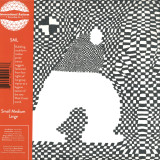
SML is bassist Anna Butterss (Jeff Parker, Daniel Villarreal, Makaya McCraven), synthesist Jeremiah Chiu (Ariel Kalma, Marta Sofia-Honer), saxophonist Josh Johnson (Jeff Parker, Makaya McCraven, Nate Mercereau, Marquis Hill), percussionist Booker Stardrum (Amirtha Kidambi, Carl Stone, Lee Ranaldo, Patrick Shiroishi), and guitarist Gregory Uhlmann (Sam Wilkes, Meg Duffy, Perfume Genius). Their debut album Small Medium Large began as a collection of long-form improvisations recorded during two
separate two-night stands at beloved Highland Park venue ETA, a major development site for the burgeoning new LA jazz & improvised music sound, which unfortunately closed its doors permanently at the end of 2023.
The venue, perhaps best known outside of LA for Jeff Parker’s 2022 album Mondays at the Enfield Tennis Academy, was the perfect location for the start of SML, especially given that both bassist Anna Buterss and saxophonist Josh Johnson are in the quartet featured on that record. Small Medium Large was engineered and recorded in stereo direct to Nagra by Bryce Gonzales and compiled, arranged, and edited with additional production, recording, and
studio composition by SML.
While editing, chopping, and rearranging stereo mixed improvisations is hardly a new concept (for a modern and relevant example we can look to Makaya McCraven’s output on IARC) these results are a stunning expansion of the Teo Macero / Miles Davis editing concept explored on classics like Bitches Brew, On The Corner, and Get Up With It. Stylistically though, these recordings have more in common with the proto trance repetitions of Harmonia, and with Holgar Czukay’s re-assemblage technique used in his work with Can. Throw in a supremely intuitive utilization of Susumu Yokota’s floating patterns polyrhythm concept and we have a truly entrancing take on time-clocked electronic rhythms augmenting with live percussion, yet maintaining that elusive human sway.
- A1: Birds Of Fire
- A2: Miles Beyond
- A3: Celestial Terrestrial Commuters
- A4: Sapphire Bullets Of Pure Love
- A5: Thousand Island Park
- A6: Hope
- B1: One Word
- B2: Sanctuary
- B3: Open Country Joy
- B4: Resolution
"Birds Of Fire" - John McLaughlin (g); Jerry Goodman (v); Jan Hammer (keyb, synth); Rick Laird (b); Billy Cobham (dr)
Of the three 'incarnations' by the spiritually inspired Mahavishnu Orchestra, the first is the most full-bodied. The enlightened John McLaughlin and his musicians were immortalized through their début album "The Inner Mounting Flame", which was included in the list of the 100 Best Jazz Albums; a short time later they recorded their highly concentrated studio compilation "Birds Of Fire". Long before today's saleably labelled World Music, the quintet set the standards for a meaningful amalgamation of dynamic rock with complex Indian rhythms and occidental conventions. Already in the title piece, the musicians combine a sharpened Hendrix style with expansive melodies, and with smacking grooves and fine riffs draw all that is grand in jazz ("Miles Beyond") into the musical centre. With almost chamber-music-like density, "Thousand Island Park" blossoms out in soft colours, whilst as a contrast unremittingly flowing cascades in "Hope" search desperately for their destination.
It is thrilling how finely weighed patterns ("One Word") escalate to techno-like violin playing and how the listener is invited to take part in an inner procession in the following "Sanctuary". After such soaring heights, we are brought back to earth with a familiar funky sound in a popular, pastoral vein ("Open Country Joy") before taking off abruptly once again: in the final piece, "Resolution" with its slowly rising carpets of sound, all that is sublime in New Music conquers over world cultures.
- A1: Sinus Wave 35 555 Hz
- A2: Sinus Wave 71 111 Hz
- A3: Sinus Wave 142 222 Hz
- A4: Sinus Wave 284 444 Hz
- A5: Sinus Wave 568 888 Hz
- A6: Sinus Wave 137 777 Hz
- A7: Sinus Wave 275 555 Hz
- A8: Sinus Wave 4551 111 Hz
- A9: Sinus Wave 9102 222 Hz
- B1: Sinus Wave 53 333 Hz
- B2: Sinus Wave 106 666 Hz
- B3: Sinus Wave 213 333 Hz
- B4: Sinus Wave 426 666 Hz
- B5: Sinus Wave 853 333 Hz
- B6: Sinus Wave 1706 666 Hz
- B7: Sinus Wave 3413 333 Hz
- B8: Sinus Wave 6826 666 Hz
- B9: Sinus Wave 13653 333 Hz
- C1: Bass Sweep Sinus Wave 142 222 Hz - 17.777 Hz Log
- C2: Bass Sweep Triangle Wave 142 222 Hz - 17.777 Hz Log
- C3: Bass Sweep Saw Wave 142 222 Hz - 17.777 Hz Log
- C4: Bass Sweep Square Wave 142 222 Hz - 17.777 Hz Log
- C5: Bass Sweep Pulse 142 222 Hz - 17.777 Hz Log
- C6: Bass Sweep Smooth Saw Wave 142 222 Hz - 17.777 Hz Log
- C7: Bass Sweep Smooth Square Wave 142 222 Hz - 17.777 Hz Log
- C8: Bass Sweep Smooth Pulse Wave 142 222 Hz - 17.777 Hz Log
- D1: Sweep Grid 1/2
- D2: Sweep Grid 1/3
- D3: Sweep Grid 1/4
- D4: Sweep Grid 1/5
- D5: Sweep Grid 1/6
- D6: Sweep Grid 1/7
- D7: Sweep Grid 1/8
- D8: Sweep Grid 1/16
- E1: Eisler - Run In Groove
- E2: Eisler - Run In Groove
- E3: Eisler - Run In Groove
- E4: Eisler - Run In Groove
- E5: Eisler - Run In Groove
- E6: Eisler - Run In Groove
- E7: Eisler - Run In Groove
- E8: Eisler - Run In Groove
- F1: Eisler Tonal Loop
- F2: Eisler Tonal Loop
- F3: Eisler Tonal Loop
- F4: Eisler Tonal Loop
- F5: Eisler Tonal Loop
- F6: Eisler Tonal Loop
- F7: Eisler Tonal Loop
- F8: Eisler Tonal Loop
- G1: Drum Pattern
- G2: Drum Pattern
- G3: Drum Pattern
- G4: Drum Pattern
- G5: Drum Pattern
- G6: Drum Pattern
- G7: Drum Pattern
- G8: Drum Pattern
- H1: Drum Pattern
- H2: Drum Pattern
- H3: Drum Pattern
- H4: Drum Pattern
- H5: Drum Pattern
- H6: Drum Pattern
- H7: Drum Pattern
- H8: Drum Pattern
- I1: Sonar
- I2: Sonar
- I3: Sonar
- I4: Sonar
- I5: Sonar
- I6: Sonar
- I7: Sonar
- I8: Sonar
- J1: Ping
- J2: Ping
- J3: Ping
- J4: Ping
- J5: Ping
- J6: Ping
- J7: Ping
- J8: Ping
- K1: Hi Surface
- K2: Hi Surface
- K3: Hi Surface
- K4: Hi Surface
- K5: Hi Surface
- K6: Hi Surface
- K7: Hi Surface
- K8: Hi Surface
- L1: Surface Tonal
- L2: Surface Tonal
- L3: Surface Tonal
- L4: Surface Tonal
- L5: Surface Tonal
- L6: Surface Tonal
- L7: Surface Tonal
- L8: Surface Tonal
- M1: Shepard
- M2: Shepard
- M3: Shepard
- M4: Shepard
- M5: Shepard
- M6: Shepard
NOTON and The Vinyl Factory are pleased to announce the release of the new edition of Carsten Nicolai’s ∞ (Endless Loop Color Edition), under his alias Noto.
This new limited edition box set celebrates Carsten Nicolai’s beloved interactive installation, bausatz noto, currently featured at The Vinyl Factory: Reverb exhibition at 180 Studios.
The exhibition features an expanded version of Nicolai’s artwork bausatz noto (1998) – an interactive piece centered around four Technics SL-1210 turntables and a selection of colored vinyl records. Visitors are invited to select and play the records, each of which has been cut with 9 or 8 unique locked grooves on each side. As Nicolai explains, “the different colors indicate different sound material, from the very abstract to the graphic” that users can loop and layer to create infinite permutations and combinations.
Previously released as a sold-out signed edition with a hardback book, this 2024 box set edition brings the installation into your own space. Comprised of twelve 10” colored vinyl records, each featuring 18 or 16 unique locked grooves (9 or 8 per side), the concept remains the same: Nicolai provides the tools to build your own soundscapes.
The records are sleeved in twelve custom-made archive folders, housed in a handmade box with artwork. Limited to 1000 copies worldwide.
Lacquers created by Lupo / Calyx Mastering
Danish instrumental collective ALAWARI was founded in 2016, and rapidly garnered a name for themselves on the European jazz scene for their explosive live performances, going on to win Denmark s Young Jazz competition in the same year. A contrast to their eponymous 2022 debut - a cacophonous musical reflection of revolution - their upcoming release is an exploration of spirituality, transformation, and the totality of the human experience. Leviathan oscillates between symphonic grandeur and intimate vulnerability, with moments so delicate that every breath can be felt. In this way, the sextet aims to demonstrate that the path to the divine is found through collective unity unity-a shared experience that transcends the individual. From lamenting melodies on a solo trumpet eventually accompanied by a dense, ominous synth, to hypnotic patterns on a percussive close close-mic d saxophone, to thunderous rhythm section grooves with searing horn harmonies, ALAWARIs innovative and dynamic arrangements offer something brand new and unexpected around every corner. Despite being a six piece, the ensembles sound feels comparable to that of an orchestra or big band, combining through through-composed classical classical-influenced orchestration, intricate interlocking parts, lush waves of texture and a warm, raw, intimate production style to craft a larger larger-thanthan-life listening experience. Leviathan embarks on a profound journey, capturing the divine and spiritual forces that permeate the arts. The album serves as a vessel vessel-slowly navigating like a majestic ship or a steadfast train, embarking on a peaceful yet powerful crusade. It invites listeners to traverse a landscape of sorrow and joy, pain and exaltation, silence and intensity. Through this journey, ALAWARI aims to reveal the primordial truth: that the spirit precedes all, and that the mundane backdrop of everyday life can be transformed and painted anew, if carried by the right vessel.
Having thrived throughout the underground realms for the last ten years, Question built a respectable body of work displaying a sound meeting constant progression, a vision sharpened and perfected with each output. Six years following the debut full-length recording, the Mexican quintet unleashes “Reflections of the Void”, a grand tome of sheer Death Metal might in eight tracks that take Question’s sonic traits and overall concept to a whole new level of magnitude. In perfect unison with the majestic Shoggoth Kinetics artwork that adorns the album’s cover, “Reflections of the Void” stands apart and invites the listener to a pathway beyond the horizon, a detailed journey on life and death and yonder. Such carefully threaded concept meets its aural accomplice as Question carries a cloud of impending doom, a dense and arrestive atmosphere on brilliantly crafted songs that drink from the fountain of the past yet blistering in its very own with a striking sense of dynamics which assuredly puts the group in the major leagues of Death Metal mastery. Obscure, threatening riffs blaze through the first moments of the record, trading somber licks and faster belligerent attacks, yet never failing to enter a redundant path, for a tempo change or a dissonant endeavor spells unexpectedly and takes the listener on an intense rollercoaster. Fiercely crafted, the pulsing bass impulses and organic drumming patterns exhale as the pounding heart of “Reflections of the Void”. Technical, precise, enter a scorching performance in taste and dexterity, never sounding dull or plastic but shining for its soulful presence, side by side with the dazzling production, utterly potent and vibrant, taking the defying arrangements to greater extents. In and above this sonic frenzy, a vociferated voice grunts the illusions of our existence with a resonating dark tone spawned directly from the imposing void. As this opus resumes into the boundless vacuum, we are left with a sense of distress and awe. Question crafted a work for the ages, one which with every listening reveals a further dimension, a hidden mystery, just like the classics in the unholy pantheon to which this opus will surely belong someday.
“Reflections of the Void” is released under the banner of Chaos Records.
Classic free jazz album reissued for the first time since the 70s. Old-style gatefold sleeve LP, with liner notes by Ed Hazell.
Noah Howard, an alto saxophonist and composer, was known for weaving intricate and innovative musical patterns, often likening his work to "sound paintings." His 1971 album Patterns, the first LP he self-produced on his Altsax label, stands as a testament to his experimental and spiritual approach to music. In interviews, Howard frequently used visual terms like "patterns" and "shapes" to describe his compositions, emphasizing the importance of melody and structure even in highly improvisational settings. For Howard, patterns and melodies were essential to guiding listeners through his explorations without alienating them, maintaining a balance between innovation and accessibility. Howard's quest for an original sound was deeply influenced by jazz greats like Charlie Parker, Ornette Coleman, and Jackie McLean. While he admired these legends, Howard avoided imitation, striving instead to develop his own distinct voice. His sound was unmistakably his own, and he felt a deep obligation to carry the jazz tradition forward through personal expression, not by mimicking others. His music was also rooted in spirituality, a legacy he traced to his upbringing in the Black Baptist Church. He believed jazz had always contained a spiritual essence, from Louis Armstrong to John Coltrane, and his work aimed to channel this cosmic, spiritual energy.
Patterns was recorded in the Netherlands during Howard's second stint in Europe, where he found a more open, less racially charged environment compared to the U.S. For the album, Howard collaborated with Dutch musicians such as Misha Mengelberg (piano), Han Bennink (drums), and Earl Freeman (bass). Despite the challenges faced by guitarist Jaap Schoonhoven, who felt out of place in the session, the album came together as a powerful mix of blues, jazz, and classical elements.
The music on Patterns is a high-energy fusion of American free jazz and Dutch improvisation. Howard's saxophone work alternates between leading with passionate, lyrical lines and blending into the collective improvisation. The album’s dynamic interplay, particularly between Mengelberg’s dissonant piano clusters and Bennink’s thunderous drumming, creates a vivid "sound painting" full of contrasting forms and colors. Patterns remains one of Howard’s most unique and celebrated recordings, showcasing his visionary approach to jazz.
Forest On Stasys takes the plunge here and launches a new label, Aura Sonora, which debuts with a hugely limited and high-quality new 12" from the boss. The imprint will be "a platform designed for sound experimentation" and the first missive backs that up with a great blend of drum & bass, half-time and techno. 'Magnetismo' is a prickly opener with slippery rhythms underpinned by bold bass. 'Domo' is a darker sound with menacing low ends and prickly percussive patterns while 'Sideral' is another late-night prowler with low sling sounds, eerie atmospheres and a real sense of futurism. A great start to life for Aura Sonora.
"This is the time that we, who have benefitted from the Last Poets shouldbe able to say, 'it's the Last Poets. It's them we should be honouring, because we did not honour them for so many years_"
KRS One wasn't just addressing the hip hop fraternity when he uttered
those words by way of introducing the video for Invocation - a poem
written thirty years ago, around the time of the Last Poets' last significant comeback. He was speaking to everyone who's been affected by the word, sound and power issuing from the most revolutionary poetry ever witnessed, and that the Last Poets had introduced to the world outside of Harlem at the dawn of the seventies.
In 2018 the two remaining Last Poets, Abiodun Oyewole and Umar Bin
Hassan, embarked on another memorable return with an album -
Understand What Black Is - that earned favourable comparison with theirseminal works of the past, whilst showcasing their undimmed passion andlyrical brilliance in an entirely new setting - that of reggae music. Trackslike Rain Of Terror ("America is a terrorist") and How Many Bullets demonstrated that they'd lost none of their fire or anger, and their essential raison d'etre remained the same.
"The Last Poets' mission was to pull the people out of the rubble o f their lives," wrote their biographer Kim Green. "They knew, deep down that poetry could save the people - that if black people could see and hear themselves and their struggles through the spoken word, they would be moved to change."
Several years later and the follow-up is now with us. The project started when Tony Allen, the Nigerian master drummer whose unique polyrhythms had driven much of Fela Kuti's best work, dropped by Prince Fatty's Brighton studio and laid down a selection of drum patterns to die for. That was back in 2019, but then the pandemic struck. Once it had passed, the label booked a studio in Brooklyn, where the two Poets voiced four tracks apiece and breathed fresh energy, fire and outrage into some of the most enduring landmarks of their career. Abiodun, who was one of the original Last Poets who'd gathered in East Harlem's Mount Morris Park to celebrate Malcolm X's birthday in May 1968, chose four poems that first appeared on the group's 1970 debut album, called simply The Last Poets. He'd written When The Revolution Comes aged twenty, whilst living in Jamaica, Queens. "We were getting ready for a revolution," he told Green. "There wasn't any question about whether there was going to be one or not. The truth was many of us still saw ourselves as "niggers" and slaves. This was a mindset that had to change if there was ever to be Black Power." He and writer Amiri Baraka were deep in conversation one day when Baraka became distracted by a pretty girl walking by. "You're a gash man," Abiodun told him. The poem inspired by that incident, Gash Man, is revisited on the new album, and exposes the heartless nature of sexual acts shorn of intimacy or affection. "Instead of the vagina being the entrance to heaven," he says, "it too often becomes a gash, an injury, a wound_" Two Little Boys meanwhile, was inspired after seeing two young boys aged around 11 or 12 "stuffing chicken and cornbread down their tasteless mouths, trying to revive shrinking lungs and a wasted mind." They'd walked into Sylvia's soul food restaurant in Harlem, ordered big meals, then bolted them down and run out the door. No one chased after them, knowing that they probably hadn't eaten in days. Fifty years later and children are still going hungry in major cities across America and elsewhere. Abiodun's poem hasn't lost any relevance at all, and neither has New York, New York, The Big Apple. "Although this was written in 1968, New York hasn't changed a bit," he admits, except "today, people just mistake her sickness for fashion." Umar is originally from Akron, Ohio, but had arrived in Harlem in early 1969 after seeing Abiodun and the other Last Poets at a Black Arts Festival in Cleveland. That's where he first witnessed what Amiri Baraka once called "the rhythmic animation of word, poem, image as word- music" - a creative force that redefined the concept of performance poetry and stripped it bare until it became a howl of rage, hurt and anger, saved from destruction by mockery and love for humanity. When Umar's father, who was a musician, was jailed for armed robbery he took to the streets from an early age where he shined shoes and raised whatever money he could to help feed his eight brothers and sisters. By the time he saw the Last Poets he'd joined the Black United Front and was ready to join the struggle. Once in Harlem, Abiodun asked him what he'd learnt in the few weeks since he'd got there. "Niggers are scared of revolution," Umar replied. "Write it down" urged Abiodun. That poem still gives off searing heat more than fifty years later. In Umar's own words, "it became a prayer, a call to arms, a spiritual pond to bathe and cleanse in because niggers are not just vile and disgusting and shiftless. Niggers are human beings lost in someone else's system of values and morals." And there you have it. It's not just race or religion that hold us back, but an economic system that keeps millions in poverty and living in fear - a system born from political choice and that's now become so entrenched, so bloated on its own success that it's put mankind in mortal danger. It was many black people's acceptance of the status quo that inspired Just Because, which like Niggers Are Scared Of Revolution, was included on that seminal first album. Along with their revolutionary rhetoric, it was the Last Poets' use of the "n word" that proved so shocking, but it would be wrong to suggest that they reclaimed it, since it never belonged to black people in the first place. There's never any hiding place when it comes to the Last Poets. They use words like weapons, and that force all who listen to decide who they are and where they stand. Umar's two remaining tracks find him revisiting poems first unleashed on the Poets' second album This Is Madness! Abiodun had left for North Carolina by then where he became more deeply enmeshed in revolutionary activities and spent almost four years in jail for armed robbery after attempting to seize funds related to the Klu Klux Klan. Meanwhile, the 21 year old Umar was squatting in Brooklyn and had developed close ties with the Dar-ul Islam Movement. A longing for purity and time-honoured spiritual values underpins Related to What, whilst This Is Madness is a call for freedom "by any means necessary," and that paints a feverish landscape peopled by prominent black leaders but that quickly descends into chaos. "All my dreams have been turned into psychedelic nightmares," he wails, over a groove now powered by Tony Allen's ferocious drumming. Those sessions lasted just two days, and we can only imagine the atmosphere in that room as the hip hop godfathers exchanged the conga drums of Harlem for the explosive sounds of authentic Afrobeat. Once they'd finished, the recordings and momentum returned to Prince Fatty's studio, since relocated from Brighton to SE London. This was stage three of the project, and who better to fill out the rhythm tracks than two key musicians from Seun Anikulapo Kuti's band Egypt 80? Enter guitarist Akinola Adio Oyebola and bassist Kunle Justice, who upon hearing Allen's trademark grooves exclaimed, "oh, the Father_ we are home!" Such joy and enthusiasm resulted in the perfect fusion of Nigerian Afrobeat and revolutionary poetry, but the vision for the album wasn't yet complete. He wanted to create a new kind of soundscape - one that reunited the Poets with the progressive jazz movement they'd once shared with musicians like Sun Ra and Pharoah Sanders. It was at that point they recruited exciting jazz talents based in the UK like Joe Armon Jones from Mercury Prize winners Ezra Collective, also widely acclaimed producer/remixer and keyboard player Kaidi Tatham, who's been likened to Herbie Hancock, and British jazz legend Courtney Pine, whose genius on the saxophone and influence on the UK's now vibrant jazz scene is beyond question. The instrumental tracks on Africanism are in many ways as revelatory and exciting as the Last Poets' own. It's important to remember that the kaleidoscope of styles and influences we're presented with here aren't the result of sampling but were played "live" by musicians responding to sounds made by other musicians. That's where the magic comes from, aided by Prince Fatty's peerless mixing which allows us to hear everything with such clarity. Music fans today have grown accustomed to listening to all kinds of different genres. Their tastes have never been so broad or all- encompassing, and so the music on this new Last Poets' album is as groundbreaking as their lyrics, and perfectly suited to the era that we're now living in. John Masouri
- Anthem Of The Trinity
- Celestial Valley
- Across The Lake Of The Ancient Word
- Desert Of Ice
In C and Rainbow in Curved Air get all the ink (inc?), but its own somewhat subtle way, 1980’s Shri Camel, the last of the three brilliant albums Terry Riley recorded for CBS, is every bit as groundbreaking as its hallowed predecessors. Not content to rest on his laurels as a minimalist master, Riley studied with Hindustani classical singer Pandit Pran Nath during the ‘70s; by blending that Eastern influence with his own experiments in just intonation (where tuning is dictated by equal mathematical intervals rather than the “tempered” tuning familiar to Western music), Riley made an album whose shimmering textures (played through a specially modified Yamaha organ) seem to change with one’s own breath or thought, like the reflection of rippling water on rock. And while Shri Camel is far more demanding and ultimately rewarding than any “New Age” recording, one definitely gets the sense that its ever-evolving, ecstatically hypnotic rhythmic and harmonic patterns are massaging the brain’s neural circuitry, leaving one refreshed, relaxed, and, yes, maybe even a little smarter than before listening. First LP reissue and long overdue!
In his third and final album, recorded ahead of the publication of his novel, Doctor Sax, Jack Kerouac uses his voice as an instrument, weaving his words inside of patterns and percussive accents the way a horn player solos over the changes of a well-known standard. The set is presented with an immense focus and energy to keep the listener engaged for a full 40 minutes. This Verve By Request title is pressed on 180-gram vinyl at Third Man in Detroit.
KitschKrieg goes USA. Als “Reise flussaufwärts Richtung Quelle“ beschreiben sie selbst diese Erfahrung.
Mit ein wenig Distanz erscheint der waghalsige Schritt logisch, unvermeidbar fast. Man muss immer weiter
durchbrechen. Die Linse, mit der man auf Dinge blicke, sei dieselbe geblieben, sagt Fizzle – nur seien es
jetzt eben andere Dinge. Andere Themen, andere Charaktere, andere Geschichten, größere Geschichten
auch. Dies ist Amerika, after all.
Die rhythmischen Patterns auf den zehn Songs reichen von Trap und Afrobeats über R&B bis hin zu House
im weitesten Sinne. Dennoch klingt das Album kohärenter als alle bisherigen KK- Releases: GEZWEI ist
das Werk einer Band, keine Compilation. Da sind die vertrauten Sounds der 808, des FM8, des Juno,
mit denen KitschKrieg ihren ureigenen Inner City Blues komponieren. Da sind die wiederkehrenden Stimmen von Hunxho, Fridayy oder Mariah The Scientist, die nicht wie Featuregäste klingen, sondern wie
neue Fixsterne im KK-Kosmos. Und über allem schwebt diese leise KitschKrieg-Melancholie – weil 6am in
Germany eben jederzeit und überall sein kann.
London based label Natural Selection present their forthcoming release in the form of a 4-track 12" EP, courtesy of Annie Hall, entitled "Atomic 20", ft. remixes from label affiliates Plant43 & Kodah. Mastered by Dadub Studios, Berlin and cut by Simon at The Exchange Vinyl.
Born in Madrid, Annie Hall has been heavily active on the Electronica, IDM and Detroit circuits since 2007 and has seen her music released by the most highly esteemed of Electro labels such as Central Processing Unit, Delsin Records, 20/20 Vision, Detroit Underground, Semantica & more. She returns to Natural Selection, after releasing on 3 previous occasions since the label's inaugural release in 2021. Her track 'Panax Ginseng' (NS001) gained support from some of the most respected DJ's and producers worldwide, inc. Dave Clarke, The Advent, NULLPTR & more.
Atomic 20 is a beautifully crafted Electro release that maintains venomous aggression, amidst breathtaking textures and ambience. Hypnotic pads spiral into the ether, contrasted alongside heavy kicks, deep bass and meticulously programmed percussion patterns. Annie's eclectic and uniquely experimental style is fully evident throughout, taking the listener on an unpredictable, emotional journey, whether at home or on the dance floor.
The B side of the release features 2 well-placed, club-focussed remixes of each original A side tracks; B1 courtesy of Electro legend Plant43, with his immaculate remix of 'Goji Berry'. B2 courtesy of Natural Selection label head Kodah, with his power driven remix of 'Atomic 20'.
Naoki Zushi. Perhaps best known for his stellar guitar contributions to psych folk group, Nagisa Ni Te, Zushi has had a parallel career, for several decades, slowly releasing solo albums that spotlight his exultant guitar playing. Originally released to CD only by Shinji Shibayama of Nagisa Ni Te’s Org imprint in 2018, IV has Zushi playing and writing at a peak, its six songs slowly unfurling with a kind of paradoxical understated grandeur. This is psychedelic guitar music at its most paced and considered, yet given to flights of inspiration, and in this respect, Zushi sits within a lineage of guitarists who’ve used their instrument both as textural anchor and improvisatory tool – think of figures like Phil Manzanera and Robert Fripp, but also Roy Montgomery, Liz Harris of Grouper, even Tom Verlaine on his instrumental solo albums. Like those artists, Zushi locates moments of deep emotional resonance amidst luxuriant textural and melodic exploration. Zushi’s history stretches back to the mid 1970s. While for many, he first appeared on the scene as a founding member of noise legends Hijokaidan, alongside Jojo Hiroshige, his musical contributions predate that encounter. He started out playing progressive rock and improvised music, making home recordings of when he was in high school. He was a member of Rasenkaidan (Spiral Staircase) alongside Hiroshige and Idiot (Kenichi Takayama), the group that soon mutated into Hijokaidan (Emergency Staircase). Zushi and Takayama would soon form Idiot O’Clock, in 1982; Zushi also led his own Naoki Zushi Unit, starting in 1983. But for many, Zushi’s first significant appearance on record was as a member of Shinji Shibayama’s mid-eighties psych-pop group, Hallelujahs, whose sole album was recently reissued on vinyl. That group mutated into Nagisa Ni Te, and Zushi has played a significant role as their lead guitarist for several decades. His own solo music has appeared sporadically – Paradise (1987), Phenomenal Luciferin (1998), III (2005) and IV, with a few recent, meditative offerings, For My Friends’ Sleep (2021) and Nocturnes (2022). With IV, though, Zushi achieved something remarkable, a kind of extended exploration of the time-altering properties of echoplexed, hypnotically spiralling guitar interplay. The opening ‘Mirror’, “a song about the mirror inside me,” Zushi explains, starts out as a lush psych-folk song, slow and gentle, but soon takes to the skies with a cat’s cradle of Fripp-esque guitars, before thick, droning chords sweep the song to a drowsy coda. ‘Nocturne’ weaves silver skeins of guitar melody around a cyclical chord pattern; it gathers energy and quiet intensity through insistent repetition. The rest of the album explores the nuance Zushi can draw out of simple elements, building on what ‘Mirror’ and ‘Nocturne’ offer – the profundity of a chord change; the melancholy of a few quietly sighed words; the exhilaration of a guitar solo bursting out of the speakers; the subtle shifts in emotional register offered by tone and touch. Throughout, there’s something quiet, yet ineffable, shading the contours of the songs, such that it makes perfect sense when Zushi says, “What I want to express through music may be ‘sense of mystery’.” A few of the songs had their basic parts recorded at LM Studio and Studio Nemu with Shibayama and Masako Takeda joining on bass and drums, respectively; much of the album, however, was tracked at Zushi’s home studio. That seems appropriate for a collection of songs that are expansive in their intimacy. Asked what drove the sessions, Zushi answers, “I thought I’d make IV an album that particularly focuses on the guitar play.” And focus it does, as Zushi’s sky-scraping, soaring, elemental tone is front and centre throughout. But these are no guitar heroics; rather, Zushi uses the guitar as conduit and diviner, a tool for spirit location, and IV is his most eloquent expression yet of such singular magic.
Continuing our quest to get all of the classic early AMT albums released on vinyl, we turn to 2006’s ‘Starless And Bible Black Sabbath’, and with the help of Makoto Kawabata’s studio wizardry, we’ve made it possible.
This latest instalment in the ‘Acid Mothers Temple Vinyl Archives - First Time On Vinyl’ series (as with the three previous SOLD OUT releases in the series) have all been meticulously put together with the help of Makoto Kawabata with the original CD artwork recreated for these vinyl editions from archive photos stored in the vaults at the Acid Mothers Temple in Osaka, Japan and the original audio remastered by James Plotkin.
Here’s what "Brainwashed" had to say upon it’s original CD only release back in 2006 …
“The title track is the meat of the beast, beginning with a minute of booms and gongs reminiscent of a thunderstorm before launching into some slow, heavy Sabbath-esque riffs. Squealing guitar and synth effects accompany the vocals of bassist Tabata Mitsuru, whose voice captures some of the sound and feeling of Ozzy's more than it does the melody. The pace is slower than most AMT fare, but things speed up considerably around the eight and a half minute mark. The group convincingly imitates the Sabbath guitar sound here and the rhythm section is particularly tight, giving listeners something on which to hang their ears or even providing them with a chance to gasp for air during Makoto's guitar explorations. Around the sixteen minute mark, everything comes to a wailing halt before the band returns to the dirge-like tempo that started the song. This pattern continues for the duration of the piece, until a couple of minutes before the ending, when the group makes a smooth transition to acoustic guitar and processed vocals to cool down.
Clocking in at nearly thirty-five minutes, the length alone may tax some listeners. However, the second track, "Woman From A Hell, "provides relief, which with a running time of six minutes is uncommon in the Acid Mothers canon for its brevity. This one condenses many of the ideas of the title track, and accomplishes much of the same evocation of Sabbath, but with the vocals in a more prominent role. The disc comes full circle, ending with thunderstorm sounds much like theones which started the album. Though the title track could have been shortened and perhaps an additional track included, this album remain some of the group's more accessible releases in some time and should please fans old and new alike.
According to the group's website, Makoto is reviving the Melting Paraiso U.F.O. line-up after a year of recording and touring with the Cosmic Inferno. This is a shame of sorts, since the Cosmic Inferno infused a much-needed vitality to the group that it had lacked since the departure of vocalist Cotton Casino. Yet the reformed Melting Paraiso U.F.O. has the potential to be even better since, if anything, Makoto seems to be the Mother of Reinvention.”
Acid Mothers Temple & The Cosmic Inferno are: Tabata Mitsuru - Bass, Vocal, Maratab - Hiroshi Higashi - Synthesizer, Dancin' King - Shimura Koji - Drums, Latino Cool - Okano Futoshi - Drums, God Speed - Makoto Kawabata - Guitars, Speed Guru
An extremely prolific artist, whose work encompasses composition, opera, theatre, radio plays, film or performance, Ergo Phizmiz returns in due time to the Discrepant fold long after his 'Two Quartets' and 'Disco Carousel' - under his given DW Robertson name - albums. A purveyor of the Creative Commons rights, Phizmiz has been deploying much of his work on the ever expanding Free Music Archive directed by WFMU since the early 2000's, creating a sprawling and defiant body of work that defies given and stale notions of sound hierarchies, history and copyright through a process that comprises collage, sampling, reappropriation, songwriting, covers and pretty much any available media with a playful and thoughtful approach.
For this new Discrepant entry, Phizmiz goes back in time to push into the future a number of pieces recorded more than two decades ago creating this perpetual motion outside a linear chronologic progression. Anticipating by almost 20 years the memefication of ASMR videos, 'Selected Ambient & ASMR Works 2001-2003' - itself a pun on the AFX classics - embraces the ambient tag not at its functional face value, but instead as a means to the "evocation of imaginary spaces, and correspondingly the invention of their sonic environments". Collecting recordings from a myriad of instruments - violin, xylophone, banjo, kora, found percussion and so on...-, shortwave radio and field recordings to create loops with different lengths that play with and/or against themselves continuously in a process "(dis)conjunction" not far removed from Feldman's 'Why Patterns?' or hip-hop's sampledelia. A free-floating temporal space that collapses the flashing images of Angelfire pages unto Web 2.0 sense of displacement.
Daniel Dumile, better known as the late, great and always mysteriously masked MC MF Doom was one of a kind. His legend lives on through his work which here gets served up on new label Doom in instrumental form. 'Saffron' (MF instrumental) is a silky late-night sound with warm melancholic chords and subtle boom-bap beats. On the flip, things get more jazzy with the expressive trumpets and more raw broken beat patterns of 'Arrow Root' (MF instrumental). It's a timeless and sophisticated sound that will woo any listener into a calming mood and comes on a limited 7".
Roberto Cacciapaglia is an Italian composer and pianist who started out in the fertile Milan avant-garde scene of the 1970s, which included Franco Battiato, Giusto Pio, Lino Capra Vaccina, Francesco Messina, among others. After studying at the conservatory, he worked at RAI's Studio of Musical Phonology – an electronic music laboratory similar to NDR/WDR in Germany, GRM/IRCAM in France or BBC Radiophonic Workshop.
Originally released in 1979, Sei Note In Logica (Six Notes In Logic) is Cacciapaglia's second album. While his debut, Sonanze, offers a series of ambient mini-soundtracks, Sei Note presents a singular, sinuous piece. The composition is based on a finite set of musical notes, yet this limitation is the point of departure for a grand tour of possible combinations and enthralling timbres (marimbas, strings, reeds and human voice).
Like Steve Reich's Music For 18 Musicians, the joyous experiment of Sei Note is grounded in constant variation. Often doubled by multiple instruments, non-repeating patterns are exquisitely layered, while electro-acoustic signals transform and further refract through visceral effects. Within this conceptual framework, Cacciapaglia does not so much juxtapose rigid dichotomies – acoustic vs. electronic, melodic vs. dissonant, simple vs. complex – as fuse them into an expansive whole.
What started as an inspired study in Minimalism becomes a bold feat of 20th century music. Sei Note In Logica is deeply sincere and, at the same time, quite playful. With one foot firmly planted in the past and the other steeped in technology, Cacciapaglia's influence can be heard in the work of Jim O'Rourke, Fennesz and Ben Vida.
Serbian powerhouse KATRAN, the mastermind behind Jezgro label and one half of Ontal, unleashes four colossal, rhythm driven, noise infused industrial techno anthems accompanied by nasty remix from talented 6SISS. This meticulously crafted dystopian soundscapes are engineered to obliterate any dancefloor, heralding the chaos. Handle with caution this is dangerous material.
The album ignites with intricate drum patterns that thunder like tanks across a barren, icy wasteland, while haunting atmospheric elements loom, setting a menacing tone for the journey ahead.
Next, a feverish descent into robots nightmare ensues, where mechanical drum liturgies weave relentless tension, immersing listeners in a post human auditory realm.
As the odyssey progresses, doom laden horns and mechanized drums merge to unleash subversive, devastating frequencies.
Just when the intensity seems to peak, filthy analog sine waves bubble through obscurity, pushing the boundaries of industrial techno music to its limits. Annihilation is the word that resonates here.
Carrying on a string of stunning archival releases from major figures of Indian classical tradition (including releases from members of the Dagar family and Amelia Cuni), Black Truffle is pleased to announce an unheard recording from tabla master Kamalesh Maitra (1924-2005). For over fifty years, Maitra devoted himself to the rare tabla tarang, a set of between ten and sixteen hand drums tuned to the notes of the raga to be performed. While the tabla tarang has its origins in the late 19th century, Maitra was the first to recognise its potential as a solo concert instrument, using the set of tuned drums to perform full-length raags. Seated behind a semi-circular array of drums, Maitra produced stunning waves of melodic improvisation enlivened with the rhythmic invention of a master percussionist.
Across his career, Maitra performed in ensembles led by Ravi Shankar, collaborated with George Harrison, and led his own East-West fusion group, the Ragatala Ensemble. However, it is in the solo setting that his remarkable artistry and the otherworldly timbral qualities of the tabla tarang are most strikingly on display. Recorded during the same 1985 Berlin sessions that produced Maitra’s self-released solo LP Tabla Tarang: Ragas on Drums, on Raag Kirwani on Tabla Tarang we are treated to Maitra stretching out for over forty minutes on the late night Raag Kirwani, accompanied by Laura Patchen on tabla and Mila Morgenstern and Marina Kitsos on tanpura. The performance begins with the traditional free-floating exposition section, where Maitra’s spacious melodic improvisation at times almost resembles a plucked string instrument (like the sarod, which Maitra also played). For the listener unaccustomed to the tabla tarang, the sound of these microtonally inflected melodic patterns played on drums has a magic quality. As Maitra begins to imply the rhythmic cycles more strongly, Patchen joins on tabla, beginning half an hour of rhythmic-melodic exploration, where virtuosity sits side by side with delicacy and meditative attention. Accompanied by beautiful archival images and extensive liner notes from Laura Patchen, for many listeners Raag Kirwani on Tabla Tarang will be the perfect introduction to the magical world of Kamalesh Maitra, released to coincide with the hundredth anniversary of the master musician’s birth.
- Wednesday Night Prayer Meeting
- Cryin' Blues
- Moanin
- Tensions
- My Jelly
- Roll Soul
- E's Flat Ah's Flat Too
Blues & Roots is not only a cornerstone in Charles Mingus' body of work but also a testament to the enduring power of the blues as a foundation for jazz
Mingus managed to both honor tradition and push the boundaries of jazz, all while making a deeply personal and politically charged musical statement. The album remains one of the most vital and influential recordings in the history of jazz music. Released in 1960 this album stands out in Mingus' discography as a raw, vibrant homage to the roots of blues and gospel traditions in jazz. Mingus sought to return to his musical roots, drawing from blues and gospel traditions he grew up with, particularly from the African American church music of his youth. The album is a powerful statement of how deeply the blues tradition influenced modern jazz. It combines the unfiltered emotional intensity of the blues with Mingus' forward-thinking and often unconventional compositional techniques. The album's tracks are imbued with a strong sense of the blues, which is especially apparent in songs like "Wednesday Night Prayer Meeting" and "Moanin'." The album carries a loose, jamsession feel, reflecting the church and street-based roots of blues music. The use of call- and- response patterns in several tracks also hints at gospel traditions. Blues & Roots is often cited as a critical album in the development of jazz as a genre that embraced both its past and future. Mingus' ability to integrate traditional musical forms (such as blues and gospel) with more modern, experimental elements opened up new possibilities for jazz. His compositional style, which juxtaposed tightly arranged sections with freewheeling solos, influenced generations of musicians, from avant-garde jazz artists to rock musicians and composers in other genres
In this next installment of Token, Brussels' own Border One steps in to showcase 'Echoes from the Abyss', another swinging, modular-driven project destined for controlled sound systems. In these four tracks, the seasoned producer does what he knows best: engaging the dancefloor through his signature sound design and use of space.
'Echoes from the Abyss' the track, like the EP, is a collection of sound associations that are synonymous with Border One's sound. Resonant and cerebral yet bouncy and full of groove, the A1 presents a shimmering veil of synthwork that gives off a truly hypnotic effect. The follow up is much more sequence-based, focusing on the elements' interactions. The producer plays along freely with his drum machine, responding to a classically loopy and dissonant main synth that insists its way from beginning to end. Tension is everything, especially when met with a sustained chord in the second half, turning the record into a weapon of suspense. 'Celestial Observer' comes back straight and center with a focused tone and a progressive arrangement. With a thick low end and shrill highs, Border One flicks through percussion patterns and filter sweeps to make an intense, at times close eyed dancefloor experience. Ducking back into obscurity for the last track, 'Escaping the Void' takes on a more minimally produced style that breathes a bit after its previous, denser productions. Concluding with a question mark is always very appropriate, and here we're faced with a record caught between ethereal soundscapes and tense implications. With 'Escaping the Void', Border One closes with his latest contribution to Token with class as always, appealing to genre veterans and newcomers alike.
A1 Northern Lights
Darkly, tense tones take center stage as Northern Lights kicks the LP off, introduced with an eerie synth before classic, striking old school breaks that aficionados will recall from the likes of John Bs Secrets drop, chopped expertly by our Spatial duo to create a quietly vengeful beat pattern with heavy kicks and a unique stuttering detail. Circling menacingly around the mix we are treated to swathes of choral detail, subtle vocal samples and shimmering ambience..
A2 Sunset on Mars
Showcasing the strengths of both producers through a delightfully rich atmosphere, Sunset on Mars opens with soothing echoed effects that ooze a welcoming sense of wonder. Delicate in composition yet still packing a punch, the breaks sit over a sumptuous deep sub bassline which carries our journey through simple key melodies, vivid mood-changing synths superbly to create a pure, wholesome atmospheric bliss.
B1 Totality
Dominant hats and cymbals surf the peaks of the mix early in Totality, detailed old school breakbeats quickly seizing our attention constructed with an effortless attention to detail. A stark, thick atmosphere is carved from a broad backdrop of sound blending vocals and synths, enveloping the listener with a dense, bleak soundscape that develops continually as the breaks roll on with memorable intent.
B2 Reincarnation
A deeply evocative, interstellar intro opens Reincarnation, generating images of lonely spacewalks with trademark Spatial aplomb. The vibe continues through a barrage of heavy analogue amens which crush the mix, edited with a chunky, commanding panache. The listener can picture pillars of isolation and thundering defiance dancing in duality as the elements weave their way fluidly throughout.
C1 Seraphim
Into an intense, epically atmospheric piece next as Seraphim channels the spirit of yesterday for a journey into the souls core via scene-trademark Hot Pants breaks, a moody 808 bassline and swirling atmospheric pads, melodies & synths. Layered with detailed FX demanding repeated listens to soak it all in, Seraphim is a special track which will take over your setlist and the journey home.
C2 Prism of Light
Sit back and relax to another slice of classic atmospheric bliss with Prism of Light, opening with a DJ-friendly hi hat intro before melodic synths generate an instantly unforgettable late-90s vibe. Hot Pants breaks drive us forward with a wondrously simple yet effective mix of 2 step and double kick edits, as blissful ambient washes and vocal hits are drizzled over the mix. Delightful.
D1 Harmonic Function A uniquely constructed beat pattern guaranteed to move you opens Harmonic Function, building up from rushing cymbals and hats intertwined with a fantastic crunchy, metallic half-time snare. Throw in a slew of mournful melodies and blanketed pad work around the mix and youre left with a superbly laid back yet danceable piece from ASC & Aural Imbalance, continually innovating in their music as ever on Spatial.
D2 Fade to Grey
Old school rhythms are on the agenda as our duo close out the album with a tense, meandering exploration through space, circling the planets through mellowed out beats before a layer of dense, analogue breaks are added to the mix as the atmosphere escalates. Exquisitely programmed vocals provide texture and feeling, while an understated bassline rumbling on below, completing a timeless collage of sound.
Words by Chris Hayes (Spatial / Red Mist)
Jan Anderzén - living in Tampere, Finland - is a collage artist making music, quilts, drawings, mosaics, videos and other things. From him, among a few others, sprang the The River of Finland. A stream that shook the European underground for infinity, back from the years 2005 and up. Jan is/was involved in acts like Kemialliset Ystävät, Avarus, Tomutonttu and The Anaksimandros. When in the past some of that River of Finland tasted like a fermented ocean of mycelia - today it tastes different, like sparkling water.
Halki pilvien - transl. Trough the clouds - brings exactly what one expects from the clouds. It is a collection of soft and gentle movements, as playful as a ‘Jan Anderzén type of music’ is always. A collection of patterns that solidify for just a brief moment in time, before sublimating in the back of the mind. This album is in constant motion.
Push play. A warped piano and cartoonish SFX’s might foretell a hyperreal approach to music. Yet while the champion of hyperrealism, Noah Creshevsky, describes his music as being written in a language we already understand (realism) yet in an exaggerated manner (hyper) - I have to add that things on this album do not sound exaggerated at all. Moreover, i have the feeling that somehow on this work, Jan is trying to underwhelm us. In the best possible way. Because clouds float trough and dissolve. Thus instead of hyperrealism, is Jan maybe speaking to us in a certain Serenerealism? Or Mildrealism?
What Jan’s music does have in common with Creshevsky’s is the no rush part. Listening to Halki pilvien makes time non-directional. The music seems to be designed to be played over and over again. This music has no direct impact like one can experience at a punk show, or at a classical music concert. This music is not that one gigantic raincloud covering the world dark. Quite the opposite, it is a pattern of clouds and clearings, floating over the lands. Trough this music a shadow play appears. This music is durable.
And it is when the sounds are at its faintest, that Jan touches the core: in the smallest detail, we find the fullest musical information.
"Exhibit B: The Human Condition". It's really, really sick. It's really different from the last one and it's really different from the two before. But it's 100 percent EXODUS. Out of the last three, this one is faster, but it's also a little more melodic, and it's also a little bit more old school. Some of Rob's vocal patterns are just so old school; it's killer. The production is a little more, let's say, less sterile. Not less sterile, but less digital perfection, more organic. It's really, really lively. There is by far more melody on it as well. Thematically, it's a little different. The last one centered a lot on religion and this one is, as the title says, about the human condition; cruelty, ignorance, and inhumanity and brutality. Just the things that man has shown to be so adept at doing.” "Our goal in EXODUS is just basically to defy time, to defy age, to have every album just get more furious and more angry and more intense. A lot of people will ask me things like, 'EXODUS is achieving a lot of popularity again, do you think it's due to thrash metal coming back?`and I say, 'No. I think thrash metal's coming back because of EXODUS.'" The goal now, he says, is to remain "the most dangerous animal in the jungle." "We wanted to portray the violence of man at its finest, so we started with our own version of the Leonardo da Vinci sketch of Vitruvian Man, but done the ‘EXODUS’ way! I was pointed in the direction of Colin Larks of Rainsong Design for the cover and he killed it! To me, the artwork represents man and his affinity for bloodshed, ignorance, and all-around ability to be led like sheep to the slaughter. The image fits the songs on this record perfectly. The whole layout is going to be as sick as the record itself!" GARY HOLT, Exodus
Marionette presents 'dessus oben alto up', the first collaborative recording by Andrea Belfi and Jules Reidy. Hailing from different ends of the globe (Australia and Italy) but both longtime residents of Berlin, Reidy and Belfi’s approaches have much in common, bringing together compositional precision and electroacoustic rigour with improvisation freedom, the immediate gratifications of rhythmic pulse, and an overtly lyrical sensibility. Working together during a residency at the sound studio of Berlin’s Callie’s, an arts institution housed in a 19th century machine factory, the pair (with Marco Anulli manning the desk) have conjured up four expansive pieces where the beautifully recorded percussive clarity of Belfi’s drums threads through a sparkling haze of guitars and electronics.
Opener ‘dessus’ begins with Reidy’s distinctive just-intoned guitar figures, shimmering over a delicate substratum of Befli’s brushwork and bass drum accents. As in all of Reidy’s recent work, the guitar is twisted out of cliché by the unfamiliar tuning and electronic processing. Hanging almost inaudibly in the background for much of the piece, a rush of synthetic tones surges into the foreground to end it. ‘oben’ is built from kinetic patterns of picked guitar arpeggios, locking into irregular grooves with Belfi’s drums, which move from elegant rolls and cymbal patter to driving closed hi-hats and explosive rock interjections. Around the traditional instruments and across the stereo field, electronic sounds swarm and swirl, fizzing and popping in a sun-drenched soundscape that at points suggests both vintage analogue synth destruction and glitching harmonies. ‘alto’ begins in similar territory but turned up a notch, eventually settling into a propulsive 6/8 groove of shifting drum accents, manically strummed 12 string acoustic, and burbling synth chords.
The B side is dedicated to the fifteen-minute ‘up’, where the strategies adopted on the other pieces are put in the service of a more relaxed, slowly unfolding epic. Anchored by a steady pulse throughout, the piece combines chiming guitars, dubbed-out bass lines and constantly adjusted percussive details into a complex flux of sound. Change is at once so subtle and so ever-present that, at any given moment, the listener can never be entirely sure quite how they got there.
Knapp vier Jahre nach ihrem Debut Patterns veröffentlicht Jenobi im Mai 2024 ihr zweites Album. Ein halbes Jahr lang schloss sich die in Hamburg lebende Musikerin Jenny Apelmo Mattsson in ihrem Studio ein und ließ für "Irregularity" 11 neue Songs entstehen, die sie nicht nur selbst geschrieben, sondern auch eigenständig aufgenommen und produziert hat.
Die bereits aus Patterns bekannte mystisch-skandinavische Melancholie trifft nun auf markante Beats, die zusammen mit der charakteristisch zarten Stimme eine ganz neue Dimension eröffnen. Außergewöhnliche, elektronische Elemente erinnern teilweise an Björk und The Knife, während selbstbewusster Sprechgesang zu lässigen Basslines eine Attitüde hervorbringen, die wir bei Künstlerinnen wie Rosalia und Noga Erez wiederfinden.
Irregularity steht dabei längst nicht nur für musikalische Innovation, sondern liefert auch eine starke Message, die Apelmo Mattsson nun aus ihrer Oase in die Welt heraustragen möchte. Viele Talfahrten und Herausforderungen prägten die 13-jährige Erfahrung als Musikerin, die sich stehts in einer männerdominierten Branche behaupten musste. Doch während Patterns destruktive Verhaltensmuster thematisiert, berichten die neuen Songs von einem neu erlangten Bewusstseinszustand und Stärke. Nach der Trauer kommt die Wut – das spiegelt sich in Texten, gespickt mit cleverironischem Humor, die ein bittersüßes Gefühl hinterlassen, dass sofort süchtig macht. So gelingt es Apelmo Mattsson patriarchalische Strukturen mit
einem selbstbewussten Schmunzeln zu kritisieren.
His unmistakable mix of cold currents and warm melodies has made Martin Matiske a regular here at Bordello A Parigi.
Amore Galattico is the German artist’s third release with us, an intergalactic voyage with a synthesizer as a guide. The title piece is a bold, yet fragile, composition. Woven around slender drum patterns are flows and shifts, key changes and scaling notes where astral washes blend with romantic flourishes. Beats are bolstered and fortified by harmonic richness in “Cuore”, an analogue space opera of daring complexity and unsurpassable execution. Matiske’s twenty five years of experience are plain to hear in this quartet. His range and musical skill are coupled with an uncanny ability to balance contrasting tones. Glacial chords are buttressed by low juddering bass in “Heaven Knows”, the listener pulled ever skyward in this sublime work. The curtain fall maintains the cinematic and dramatic quality that underscores the EP. Striking synthlines shimmer before understated rhythms, a radiant finale on an EP that takes inspiration from the stars themselves.
- A1: Zwischen Planeten
- A2: Stimme Des Wegelagerers
- A3: Aus Dem Feuer, Aus Dem Licht
- A4: Immer Wieder Im Kreis
- A5: In Den Tiefen
- A6: Hinein, Hinaus, Hinüber
- A7: Fantasiegebilde
- A8: Der Verwunschene Hain
- A9: Blick Nach Drüben
- B1: Innerlich Außerhalb
- B2: Schimmernde Chimäre
- B3: Gemeinsam Hindurch
- B4: Mit Verbundenen Augen
- B5: Purpur-Trank
- B6: Im Sternstrom
- B7: Schlingerling
- B8: Endstation Sehnsucht
Turning their gaze to the buoyant culture of wyrd, modernist German folk music, Quindi welcome a spectacularly idiosyncratic offering from Johannes Schebler, aka Baldruin. Bewildering narrative twists, high drama and intricate delicacy make Mosaike der Imagination an engrossing listen from the outset, as baroque atmospheres and tumbledown drums intertwine with tactile string plucks and needlepoint synthesis in an authoritative bridging of ancient and hypermodern sonic sensibilities.
Schebler's catalogue as Baldruin is extensive, reaching back to the late 00s and covering a lot of ground through cassette albums on respected underground labels like SicSic, A Giant Fern and Lullabies For Insomniacs. Meanwhile, his work has been recognised as part of a broader movement of experimental electronic music in Germany taking inspiration from folk traditions, as documented on last year's essential Bureau B compilation, Gespensterland. Beyond his solo work, Schebler also works with Jani Hirvonen as Grykë Pyje (mappa), and both collaborate with Paul Wilson as Yayoba (Not Not Fun). Christian Schoppik of leading dark folk project Brannten Schnüre joins him as Freundliche Kreisel (STROOM). It's a tangled, fascinating and evocative sound world which Mosaike der Imagination offers a compelling window into.
No two tracks on the album follow the same pattern or palette, whether gliding through the Giallo synth undulations and post rock tonal arcs of 'Stimme des Wegelagerers' or spelling out miasmic incantations through flickering flames on 'Aus dem Feuer, aus dem Licht'. 'Hinein, hinaus, hinüber' revolves around meditative drum mantras and cascading melodic phrasing, densely layered and evolving with purpose. 'Gemeinsam hindurch' flicks between swooping strings and pizzicato plucks in a purely romantic expression of orchestration, 'Mit verbundenen Augen' is a bewildering choral voice study and 'Im Sternstrom' revels in ecstatic synth arpeggios. Nothing can be predicted except the vibrancy and clarity of Schebler's vision.
It's a vision which extends to the front cover artwork for Mosaike der Imagination — a glorious tapestry created by Finnish artist Jan Anderzén, with a responding design and layout from Schebler adorning the rear sleeve.
Stepping to the side of the cosy daydream reveries that inhabit much of the Quindi output, Mosaike der Imagination indulges the label's penchant for sophistication in a freakily fascinating new framework from the heart of an exciting movement in experimental folk music.
Uni Cover[11,72 €]
Aussie techno innovator Alpharisc returns to Mutual Rytm for a second standout EP.
Shane Yates, aka Alpharisc, has been living and breathing techno for over 30 years. He first began producing in the mid-90s and has amassed a fine hardware collection that lends his sounds a raw, rugged feel. After breaking through with the Wetmusik party and label collective, he has let his music do the talking and isn't afraid of colouring it with a hint of nostalgia. Previous material has come via several notable labels over the years, but his most recent outings have been on SHDW's Mutual Rytm imprint, with his solo EP 'Ram Face' from 2023 becoming an underground favourite alongside a fine outing as part of the label's 'Federation Of Rytm II' and 'Federation Of Rytm III' compilations. Once again, he returns in style, uncovering an impactful selection of gems across his new 'Remain Seated' EP.
The opener 'Peace Be With You' is a straight-up techno weapon with urgent synth flashes peeling off the groove like a police siren. The drums hit hard in true Alpharisc style before 'Hail' builds on that with a more hard-edge groove topped with frosty waves of white noise that electrify the dance floor. 'Remain Seated' brings a hint of trance-leaning energy with its bright sheets of synth lighting up the driving drums and saw-tooth bass loops. Next, 'Look At This' is another brilliantly forceful techno sound with slamming drums and rusty synth loops, layering melancholic pads up top and adding a cerebral edge, while closer 'In Your Mind' is from the Jeff Mills school of synth-laced and serene deep techno with lush pads radiating cosmic light. As a bonus, digital-only cut 'Expedition' brings some backlit celestial synth work to a rubbery and pummelling drum pattern for pure techno escapism.
Jonas Munk closes his ambient trilogy with mammoth drone pieces, multi-layered guitars and hymnal krautrock. "Mirror Phase" concludes a trilogy of minimal ambient albums in Munk's (Causa Sui) own name. These eight compositions, based on guitar and synthesizer loops, marks a return to the warmer sounds Munk is often associated with. Sonic structures that slowly and gradually evolves and changes, like cloud formations in the sky. The title track, "Mirror Phase", is Munk's most expansive drone opus so far. It's a carefully arranged piece where sounds that oscillates with the same interval, but at different phases, are continuously added, hence creating shifting patterns throughout the track's nearly 18 minute duration. Elsewhere, in "Transition", multi-layered guitars creates the sonic equivalent of waves gently splashing on the shore. "At a Distance" creates a haunting, and hypnotic, soundscape by using slightly out-of-tune analog synthesizers, summoning the transcendent krautrock of Popol Vuh. And "Rise", as well as the closing track, "Return to Nowhere", recalls the glistening sounds of his Manual releases. "Mirror Phase" might just be Munk's ambient oeuvre reaching its zenith. The CD edition comes with an extra CD with Jonas Munk's 2021 album, "Altered Light", which has previously only been released on digital download and streaming.
September 26th, 1994 - Jamiroquai released a song that still to this day sounds futuristic. Blending electronic, funk, jazz, soul & pop.
The record was then famously remixed by the legendary David Morales, taking the song to a whole new audience and anthem level… giving the band their first ever Billboard Dance #1.
The iconic music video was directed by Vaughan Arnell & Anthea Benton, and features Jay Kay dancing around a blue room with multiple versions of him and the other band members appearing and disappearing. The use of motion control photography allowed for a seemingly continuous shot as the camera pans around the room.
2024, Michael Gray delivers a modern club interpretation of the classic Jamiroquai anthem on his Sultra Records imprint.
Keeping the original funk, soul undertones of Jamiroquai, he takes us on a housey ride of funky disco rhythms laden with hi-pitched synths, a soul oozing chord melody and grooving drum pattern that sits relaxed allowing the emphasis on Jay Kay’s vocal and new worked bass line to do it’s thing. A lovely alternative to the dance floor classic we all know and love.
Building up a head of steam, Ace Vision returns on the heels of his Raising Awareness EP.
For Shaped Mind, the Italian artist is exploring new musical avenues. While his musical essence, glow and style remain, a darker dancefloor palette is employed on the release. Polyrhythmic patterns race in the sample strewn “Second Phase”, rumbling waves and warehouse echoes tempered by swirling stabs. A bouncy liquid groove ushers in “Nu să Chan”, rasping beats shrouded in smoky bass while bars bend around an assortment of textures and tones. “Katana Cut (Trance Mix)” conjures up images of dancing bodies waiting for the dawn. Melodies circle percussive layers, meandering undercurrents of acid bubbling beneath shimmering synthlines. The finale comes with “Mixage Électronique.” Steady kicks and crisp cymbals give way to juddering chords, clean keys and snare rolls countering to a close.
Led by pianist/composer Barbara Fiig, the ensemble is made up of three creative communicators self described as blue sheep " of the jazz world. First stumbling into each other at the music education program at Classical Music Conservatory DKDM, their sound is rooted in collaboration and community, drawing on elements of musical poetry, jazz, folk, Nordic and Classical traditions. Regarding the name Blåly , the trio explains that it is a made up word open to interpretation. Derived from the wordly "", meaning shelter " in Danish, it is reflective of the shared feelings of safety and introspection the trio find in their music making and that they hope to impart onto their audience. Exploring themes of motherhood, new beginnings, mental health, identity, and the cathartic potential of music, the record is built around Fiigs personal approach to the piano. Combining gentle lyrical melodies and colorful melancholic harmony, Blåly perform and interpret each piece with a mature, spacious and textural sound palette, ebbing and flowing between the composed and the improvised in a collective exchange of ideas and energy. Driving drum grooves, hypnotic piano patterns and ethereal timbres from bowed double bass craft a stripped back sound world that is simple, immersive, honest,
Comic relief serves as a refreshing element that lightens up a tense or tragic situation. It creates a moment of contrast and distraction from the seriousness of the scene. This pattern can also be found in literature and film, in humorous characters like Chandler from the sitcom Friends. Especially in difficult times like these, we all occasionally long for comic relief. With his new EP, David Bay tries to create exactly such a moment of escape.
The songs on the EP unite an organic yet modern approach to indie, disco, and house music. David combines the two worlds he is rooted in: growing up in an indie band and, at the same time, running a disco-house label. After two edit EPs and a collection of singles with classic instrumentation and songwriting, this release brings everything together – music that sounds distinctly indie, but with a pulsating house beat.
Next to the four originals on the A-side, each track was remixed and is to be heard on the B-side of this vinyl: 80ies-influenced and well-known producer Lauer contributed his version of disco-gem „1999“, up and coming Dj- and producer Marie Lung flipped the indie-disco track „strangers“ into a deep and housy groover - Electro-legends Digitalism turned the dance-floor-ballad „<3 beat“ into a French-House belter and Dylan C. Greene hailing all the way from San Francisco remixed „dancing on the edge“. Out now on vinyl, only on Zissou Records.
Matter-of-factly, Lycox exclaims "Yaaahh" right at the beginning. That's an affirmation but in times of distress it can also mean resignation, something like "Yeah, whatever". Lycox says he was only freestyling though. Then the bassline appears. Elastic, expressive, full-bodied. And it's not even present the whole time. He was "trying to develop a new formula for the Kuduro beat."
Songs for the club? Most certainly. Different sensibilities, one same focused mind. Lycox evolves within tradition, he has mastered the groove, the ambience, the right tones. Simply called "Energia", the last track circles above wistfully, menacing but maybe just promising some sort of action. With a few drops one could almost switch over to a parallel universe of old school Trance, a reference that feels as alien here as maybe this track feels to someone for whom the standard Afro House sound represents modern African music.
These songs pile up in a threshold balanced between styles, sensations, maybe in the middle of life itself. Such a concentration of energy is bound to need release and that comes figuratively through details in the music reaching out to receptive ears. "To Bem Loko" explicitly tries to "literally drive everyone crazy on the dancefloor." Once again Lycox provides vocals, as in "Edson no Uige", about a friend who embarked on a trip to the Angolan province of Uige and came back speaking only the local dialect known as lingala. A nod to tradition, very emotional, without compromising complex arrangements. Consequently, we the listeners are kept believing there is still enough space for a bright future. To ears accustomed to Lycox productions the title "Contemporaneo" (opening of side B) reads like a redundancy, then.
Maybe this music can never be quite as massive as other Afro styles. Without sounding pretentious, it avoids simplistic patterns, it demands a bit more mental processing while it certainly aims to loosen the limbs. Universal in vocation, underground at the core, Lycox definitely calls it Batida but for some it is still Ghetto Music. Like DJ Veiga said when describing a previous release for Príncipe, Ghetto is home, though. Lycox adds it is a foundation of personality. "Few in our community will recognize your work when you come from the same environment, but once you establish your reputation outside of the neighbourhood and even outside of the country, people will look at you differently, as if you were a star."
Skylax Records Proudly Introduces the "Cold Summer Ep" by Peter Lc, an Electrifying Collection of Five Tracks That Showcase the Artist's Mastery in the European House Music Scene. Emerging From the Enchanting Landscapes of Apulia, Italy, Peter Lc's Sonic Expedition Begins With "Hasta La Playa." This Track, Reminiscent of Rhythmic Tides Against the Shore, Captures the Essence of Carefree Summer Days With Its Sun-Soaked Vibes and Lively Percussion, Setting the Stage for an Energetic Dance Floor Filled With Joy. as the Journey Continues, "Piano Ipnotico" Unfolds, Revealing a Hypnotic Dance Between Rhythmic Piano Chords and Pulsating Beats.
Peter Lc's Enchanting Melodies Create an Immersive Atmosphere, Guiding Listeners Through a Spellbinding Journey That Seamlessly Blends Classic Elements With a Modern, Entrancing Flair. "Time in Cologne" Marks a Temporal Shift, Resonating With Echoes of the City's Historic Charm. the Track Weaves Intricate Sonic Tapestries, Capturing the Unfolding Essence of Time in Each Beat.
Layers of Sound Interlace, Creating a Rich and Immersive Experience That Stands as a Sonic Exploration, Evoking Both Nostalgia and Forward Momentum Simultaneously. "Dive Into the Ethereal Realm of "Your Dreams," Where Dreamlike Melodies Intertwine With Pulsating Rhythms. This Nocturnal Odyssey Invites Listeners Into a World of Introspection and Reverie, Transcending Boundaries With a Seamless Blend of Atmospheric Elements and Rhythmic Patterns.
"Your Dreams" Becomes a Musical Voyage That Resonates Deeply With the subconscious.The Ep Concludes With "With Nobody," a Venture Into Darker Territories That Maintains an Undeniable Energy. Pronounced Beats Create a Driving Force That Propels the Listener Forward, With Mysterious Undertones and Intricate Arrangements Unfolding Like a Narrative. "With Nobody" Encapsulates a Perfect Balance Between Intensity and Allure, Leaving an Indelible Mark as the Grand Finale of the Ep.
Peter Lc's "Cold Summer Ep" Is a Testament to His Boundless Creativity and Mastery, Poised to Carve an Indelible Mark on the Global House Music Landscape. Each Track Is a Testament to His Unique Style—a Captivating Blend Reminiscent of Dj Sneak, Coupled With a Nod to the Golden Era of Italian Dream House From the Early '90s, but Elevated in Production Quality. Whether Basking in Sunny Vibes or Venturing Into Darker Territories, Every Composition Stands as a Bona Fide Banger....
Limited Edition Picture Disc. Including Silver/Chrome Obi Sticker and Silver Postcard with album titles and info in English and Bengali. Housed in PVC sleeve.
ICCHĀ is an international collaboration project that originated in 2023 in Dhaka, Bangladesh. The work "Chant For Hope" was realized by Miet Warlop and created on site with local performers while Micha Volders composed the musical context. The performance acts as a monumental living sculpture, in which the physical process of casting hundreds of Bengali words in plaster becomes the driving force to create a playing field between performers, public space, and participation. Woven through this performative context are more complex relationships that explore the tension between humans and language. As the words become so visible and tangible, an image of their inner bearing and our dealings with them emerges.
The recordings of this performance have been adapted and enhanced to create an album that reflects the energy and expands upon the sound created in Dhaka. ICCHĀ is the Bengali wording of "desire," and reflects the eagerness and urgency felt within the process of this collaboration. In conjunction with the seven performers, a sonic adventure emerges that thrives on the energetic rendering of the Bangla language through transient patterns and snappy melodic figures. The album will be released on 24.05.24 as vinyl picture disc and digital, and will be available as a pre-order online and in local selected record shops.
“Reflex” is Gábor Lázár’s debut album on raster. His new record is a collection of seven tracks, featuring an extended sound palette of percussions and synthesizers drawing our attention towards the essential soundscapes of techno while maintaining his distinct, uncompromising and meticulously detailed style. While the tracks do not follow traditional narratives, the album has an evolution: it gently builds up from challenging, unpredictable, and organically composed structures to linear yet playful forms of techno-infused tracks, taking us on a journey from home listening environments to club contexts.
Our senses are stimulated by micro-variations of textures and patterns, leading us to the feeling of here and now, allowing us to observe our own reactions and thoughts evoked by the listening experience. Gábor’s consistent production techniques and intuitive compositional approach work together coherently, addressing the listener’s cognition from different angles simultaneously, offering a variety of ways for the listener to get immersed.
“Reflex” will be released on raster in September 2024 on vinyl and CD.
Now on our sixth release & going strong, Brooklyn Sway returns with a heady combination of local producers, further-afield figures and scene-setting interludes to get that real Bucktown mood, accompanied by bold new artwork from NYC "Grafstract" muralist Fumero.
After words of wisdom from originator David Morales, St. Xose, patron saint of afterhours, re-rubs his own entry from BKS-01 into an electro flip with a forceful but smooth strut, Nathan Nothing's ephemeral vocals vanishing in spaces between steady bass pulses and broken beats. Those looking for late-night addresses check Noha's 'Madison Street 932', where the PanickPanick! label head proves his local cred with a funky, vocal sample-driven house jam equally at home on its eponymous street corner or somewhere later, darker, and preferably inside.
Label regulars DeWinter & Emma return with 'Unity', the spoken word Spanish vocals interweaving with choppy snare patterns and a room-filling reverberating bass roar that hits paydirt when English vox and a kick hit late in its second half. C&K are local legends Connie & Karina, and while that may not be some punters' first guess for their moniker's meaning, the track is an exercise in restraint and class, jaunty house swathed in dub echoes and hand drums that positively sways when the trombone lead swings in to carry the tune.
With his Premise EP, Felix Fleer unites long-held ideas into a cohesive and deeply personal collection, offering a unique blend of intricate textures and fragile harmonies that reward attentive listeners with its meticulous attention to detail. The title track “Premise“ opens the A- side with an infectious garage groove and Fleer’s signature brand of detuned vintage polysynths, building up to a bright crescendo that reveals a rhythmically captivating vocal hook. “Know U” features a piercing drum groove, occasionally interrupted by abstract Buchla glitches and a reduced RnB vocal chop paired with ethereal, almost organ-like layers of pads to culminate in a stripped-down moment for the bass line to take center stage. The main theme of “Thinkage” is a classic break paired with a layered pattern of abstract, percussive vocal chops. This rhythmic pulse is accompanied by a wild harmony of constantly warping and evolving pads and drawn-out bass sounds. Opening the B-side, “Real Love” is the darkest tune on the EP. Its unstable chords and intricate, unpredictable textures induce a constant sense of unease, held together by a subtle techno groove. “Rush” contrasts this with a euphoric chord progression reminiscent of early post-dubstep anthems. The EP closes with “Drift,” a final climax that revisits previous themes, offering a powerful and uplifting resolution.
- 1: Red Mist White Knuckles
- 2: The Story Of War
- 3: Should Be Heaven
- 4: Don’t Be Afraid
- 5: Where’s The One?
- 6: Like An Avalanche
- 7: I Am Dead
- 8: What Is This Love?
- 9: Sunflowers And Starlight
- 10: The World I See Is Not The World I Want
On How It Ends (?), slinky melodies snake through nocturnal atmospherics, drawing you into a world built on poetic, painterly lyricism. Night Crickets, a long-distance groove affair that materialized during the drawn-out days of lockdown, has emerged once again to soundtrack our waking dreams.
David J (Bauhaus, Love & Rockets), Victor DeLorenzo (Violent Femmes) and multi-instrumentalist Darwin Meiners spearhead a loose collective of like-minded creative souls whom, through sheer tenacity and a burning desire to collaborate and create, transcend the restrictions of space and time. Audio files shared from Los Angeles to Milwaukee, from London to the San Francisco Bay, and the ghosts of Candlestick Park shimmer through the fog, coalescing in a glorious ‘gesamtkunstwerk’ that draws from the past, the present and the imagined future.
Declaring Bauhaus, Love And Rockets, and Violent Femmes iconic, foundational bands in the history of alternative music would receive little pushback from those in the know. San Francisco born artist Darwin Meiners is a fan of all three. A chance meeting with David J grew into a friendship, and Darwin not only became a bandmate, but his manager. After reaching out to Victor DeLorenzo through e-mail, Darwin met the Violent Femmes drummer after their set at Coachella. Soon, after the three collaborated on Darwin’s 2014 release Souvenir.
As the pandemic took hold, Darwin was looking for a new project to occupy the lock down time and approached Victor, who was keen to proceed and suggested that David join as well. The musical trust established between these three was immediate and Night Crickets were born. Within weeks a global process was initiated between them, the recordings eventually forming the album, A Free Society.
Following that release, inspired by how well – and quickly – they all worked together, the trio kept up their collaboration. “We are each free to discover musical connections that could only exist in an ideal creative setting” explains Victor. “We are very lucky to have three musicians who write, sing and play various instruments in one trio… our egos seem to melt into one when we face musical decisions, so our expeditions are always filled with pure discovery, humor and drive!”
How It Ends (?) was crafted with the same collaborative spirit as A Free Society. Each member contributed contributed unique elements to spur their collective creativity—whether a drum pattern, a lyrical concept, or a musical idea—and together, they expanded these initial sparks into the finished work. True to their approach, much of what you hear was captured in the first take, reflecting a genuine, unfiltered moment.
The music on the How It Ends (?) is a true evolution of the debut album. It is deeper and darker. Having said that, the dark tone is alleviated by a healthy measure of the buoyant, bouncy and melodic. “Much of the new material is very psychedelic and the contrast between this heavy, dark psychedelia and the more uplifting pop elements puts me in mind of The Beatles’ ‘Revolver’ album to some degree,” tells David J. “The recording process for the new album was exactly the same as the first in that we all recorded remotely, taking turns to share files and reacting spontaneously to the previous track, overdubbing then passing on once again until we all felt that the track was done.”
“While we didn’t start with a specific theme, the album emerged as a contemplative exploration of endings” says Darwin. “It touches on the loss of individuals, the shifting of ideas, and the fragility of systems. Beneath this sense of darkness and finality, however, there are threads of beauty and glimpses of hope. We invite you to immerse yourself in the album and experience the journey we’ve embarked upon.”
Expected late October/early November
Scott Gilmore’s Volume 01, an Analog Synth Gem, Makes Its Vinyl Debut - Pressed at 45RPM for maximum fidelity.
Recorded on a vintage Tascam 388, the LP version of Gilmore’s alluring, easy-going instrumental electronic record arrives in the physical world via In Sheep’s Clothing Hi-Fi Records.
Los Angeles, CA — When the Los Angeles electronic musician and multi-instrumentalist Scott Gilmore recalls the creation of the songs on Volume 01, he describes specific moments of spontaneous inspiration. “I remember sitting at the tape deck, watching the leaves outside the window as they flittered in the sunlight—a moment of stillness that became intertwined with the melody I was recording,” Gilmore recalls, speaking of the track “Song For Cate.”
This sense of simplicity and presence is at the heart of Volume 01, which was recorded entirely on a Tascam 388 using a carefully curated selection of instruments.
Volume 01, an intimate, instinctual album that mixes lo-fi digital rhythms, strummed guitar, and melodic synth layers, is a collection of songs that captures Gilmore’s magnetic fluidity and the spontaneity of his process. Initially released digitally and as a limited edition cassette, Volume 01 is set to be issued on vinyl for the first time by In Sheep’s Clothing Hi-Fi.
The Tascam 388 is a classic mid-1980s analog machine that combines an 8-track reel-to-reel tape recorder with a built-in mixing console. Volume 01 exudes the kind of hazy, nostalgic warmth that only such recorders can provide. For the nine-song album, Gilmore harnessed analog synths including the Arp Odyssey, Yamaha CS-01, Korg DW-8000, Hohner Pianet T, Roland TR 606, and Roland SH 101, as well as bamboo alto saxophone, clarinet, electric guitar, and electric bass.
The album is awash in brief, propellant pieces. At just over four minutes, the relatively epic “Horizon Line” is driven by a three-note snare pattern, a two-note cymbal tap, with a humble bass-line serving as the rudder; Gilmore’s improvised keyboard runs move with an intuitive, conversational glee. The pensive "Shade" sounds like it could be a Penguin Cafe Orchestra demo. Closing track “D. Hareem” runs on a wobbly time signature but with an insistent, determined rhythm that belies genre descriptives. “I prefer to not know what I’m making as I compose,” Gilmore says. “It’s when I can’t clearly define what the music is that it’s then something that I want to put out into the world.”
In hindsight, Volume 01 was a portent. After its 2016 cassette release, Gilmore connected with International Feel, the Balearic imprint run by Marc Barrot, to release the sublime Subtle Vertigo. In 2019, Gilmore’s music caught the attention of Marc Hollander, the experimental composer and founding member of Aksak Maboul, which led to a signing with the Belgian label Crammed Discs. That deal enabled the creation of Gilmore’s solo album Two Roomed Motel and Doctor Fluorescent, a retro-futuristic, Vocoder-heavy 2020 collaboration with Eddie Ruscha V, a.k.a. Secret Circuit). Across these projects, Gilmore’s work has been mentioned in the same sentences as Stereolab, Arthur Russell, Woo, Air, R. Stevie Moore, and others, all of whom have combined synths and non-synths to memorable effect.
With the upcoming vinyl release, Volume 01 will set into wax an enduring set of works, offering listeners the chance to experience analog artistry in its most authentic, tangible form. In Sheep’s Clothing Records is honored to bring Gilmore’s work to vinyl.
Katie Gavin's debut What A Relief taps into the unguarded self-possession and homespun pop sensibility of singers like Alanis Morissette, Fiona Apple and Ani DiFranco, and uses their tenacity as a north star for Gavin's own trek towards self-discovery. "This record spans a lot of my life - it's about having a really deep desire for connection, but also encountering all the obstacles that stood in my way to be able to achieve that, patterns of isolation or even boredom with the real work of love" they say. Written over the course of seven years, What A Relief comprises a set of songs that Gavin always loved but which "had something in them" that she and her bandmates felt didn't quite fit within the universe they were trying to cultivate with MUNA. Many of them were written on acoustic guitar, and are rooted in "a style of music that's very much in my blood, and natural for me," as typified by the Women & Songs CDs that Gavin loves, which compiled music by artists like Tracy Chapman, Tori Amos and Sarah McLachlan. That openness of spirit is the overwhelming character of What A Relief, an album that's refreshing in its willingness to accept people as they come, even as it remains in dogged pursuit of a life that's kinder, wiser and more loving. Gavin's explorations of desire and intimacy feel time-worn and necessary - songs that might teach a generation if not how to live, exactly, then at least how to look within oneself for guidance about how to move forward.
Zoetrope vinyl[40,29 €]
Belgian saxophonist, composer, and producer Mattias De Craene (Nordmann, MDCIII) announces a new solo album, ‘A House Where I Dream,’ on VIERNULVIER Records. On his second album, he delivers a highly personal and healing journey, presented as an alternative soundtrack to the 1973 cult film ‘The Holy Mountain.’
The record will be released on October 11 on vinyl LP and through all digital platforms.
"The Holy Mountain" is a surreal Mexican film from 1973 directed, written, and produced by Alejandro Jodorowsky, who also stars in the film. The film holds a prominent place in avant-garde cinema and explores themes such as spirituality, mysticism, and the quest for enlightenment. It is in this vein that ‘A House Where I Dream’ is crafted.
“My mind and soul - and thus my music - come home to this motion picture” - Mattias De Craene
The album will be presented live with the film on October 16 at Videodroom during Film Fest Gent.
ABOUT THE ALBUM
With hypnotic tape loops, grainy textures, and mesmerizing saxophone, Mattias De Craene creates possible worlds that herald a spiritual transformation. From the Scottish Highlands and desolate mountains to the deepest recesses of the soul, this music has the power to create cinematic landscapes that transcend time and space. The sound of these 8 tracks is closely related to the minimalist compositions of Terry Riley, but the work of contemporary artists like KMRU or William Basinski is also drawn from the same material.
Above all, this album is a deeply personal journey and unintentionally serves as a metaphor for De Craene's ascent of his own mountain. For the Videodroom festival by Arts Center VIERNULVIER, the saxophonist began working on a new soundtrack for the film ‘The Holy Mountain’ in 2023, but his body and mind abruptly called him to a halt, forcing him to take a professional break. However, this project never left him, leading to an honest and raw quest to find himself as both a person and an artist, with Jodorowsky as a companion de route and music as an anchor. It initiated a long process of dismantling, searching, healing and back again. The album not only provides a sanctuary for dreaming to all who listen, but for its creator it also serves as both an outcry of despair and a source of comfort during challenging times.
All the tracks on 'A House Where I Dream' share an unfiltered grain of life, as one can almost feel the damp breath of the saxophone blowing.
The album opens with the three-part strong 'Transcention,' where the hypnotic interplay between soprano sax and lo-fi tape loops leads to higher realms of the mind and soul.
Alternating between deep frequencies and farout folk modalities, this mantra-like triptych acquires an alchemical character and ultimately transcends time and space.
In the ethereal 'Away,' one can peer into an abyss of resonance while a saturated tenor sax lends guidance in the spirit of Terry Riley's productions. 'You and Me' also bathes in a similar atmosphere, albeit in the vein of healing 90s ambient as granular sax tones converge with celestial chants. 'Gazing Upwards Towards The Sky,' offers different shades of blue as a slumbering tenor sax is juxtaposed to swift sax patterns. On 'A Stranger That Moved Me,' beauty lands in a soft and subtle manner, while the closing track 'Shepherd's Glow' drifts like a mountain wind flaring up at the darkest hour of the night.
The artwork is created by Gent-based artist Sam Timmerman, who portrays the world of 'A House Where I Dream' with playful repetition and mystique.
Atlas plays out like a half-remembered Greek epic of avant-pop proportions, piecing together earthy woodwinds, old-school synths, and shifting rhythmic patterns that enhance Jacob"s myth-inspired spoken word and bilingual vocals, delivered in Dutch and English.
6 years after their last album, fav favourite Kites, Submotion Orchestra make their long-awaited return with the remarkable Five Points EP. Recorded over a period of two months at band member Taz Modi's new studio in the Sussex countryside, it sees the band plough a path through electronica, jazz, soul and ambient in their own singular way. After a period of time spent looking back at their oeuvre, with the release of two Unplugged collections as well as classic debut album Finest Hour on vinyl for the first time, the refreshed, slightly older and wiser band set their sights firmly ahead, and the result is music that sounds like nothing they've done before.
Whilst featuring the uniquely fragile voice of Ruby Wood and the live instrumentation that has been their calling card in the electronic world for so long, the EP also delves into rhythms, soundscapes and effects that push their recognisable sound as far as it can go, and acts as the perfect taster for the forthcoming album that the band are currently recording.
Created as a seamless listening experience, the EP opens with the evocative and atmospheric 'Start Point', as dreamlike synths and brass mix with wordless harmonies straight from the heavens. 'Hope' continues the mood, warm analogue synth patterns combining with fragmented vocals on a persistent build-up to an emotional climax. Lead single 'Side One' cheekily nods to Submotion classic 'All Yours', before moving into newer territory, where Ruby Wood's vocals slowly become distorted and twisted, the perfect backdrop for this story about the loss of hope. Flowing joinlessly into its mirror image 'Side Two', we see the instrumental prowess of Submotion Orchestra which has so long been their defining characteristic in full flow. Finally, 'End Point' brings the EP to a moving and wistful climax, telling a tale of the wisdom that can only come after bitter experience.
The sea has long been central to Japanese culture, symbolizing both sustenance and spiritual depth. Charles A.D.'s Deep Diver draws inspiration from this, channeling the ancient traditions of diving and fishing into his music. Historically, the sea has influenced everything from Shinto rituals to the livelihoods of coastal communities. In Deep Diver, this reverence flows through aquatic soundscapes, where rhythmic waves of 90s house and Detroit techno meet Japanese minimal production techniques, New Age and Pacific Jazz. Like the tides, the album ebbs and flows, creating a serene yet dynamic homage to the timeless connection between Japan and the sea.
The opening track 'Deep Diver' plunges into the depths, its abstract sound design capturing the sensation of deep-sea propulsion. Rhythmic bubbles pulse gently alongside slow-moving chords, creating an otherworldly atmosphere. The textures are lush yet restrained, setting a tranquil stage that pulls the listener into a submerged world. 'Underwater Ruins' builds on this aquatic theme, introducing rhythmic layers and bass-heavy notes reminiscent of mid-90s Japanese ambient techno. The smooth, melodic flow nods to pioneers like Mr.YT and Susumu Yokota, while subtly incorporating the Detroit techno influence through soulful, deep basslines.
The track feels like a fusion of ambient and techno, balancing serene tones with a rolling groove, emblematic of Japanese techno soul. As the album progresses into 'Bubble Ring', it becomes clear that Charles A.D. is a master of minimalism. The production is timeless, leaning
on analog techniques where echo-drenched chords and carefully layered soundscapes take on an addictive, hypnotic quality. The simplicity of the composition is deceptive, as each element carries weight, drawing the listener deeper into the rhythm and space between the notes.
'Merperson' is where organic rhythms truly come into play. Charles A.D. gently evolves the patterns, allowing each percussive hit to flow naturally into the next. Soothing melodies emerge from within the track’s structure, eventually reaching an emotional peak without ever feeling forced. The organic nature of the arrangement creates an effortless progression that feels deeply connected to the natural movement of water.Starting the second half with 'Deep Exploration', the theme of underwater excursions becomes even more pronounced. Light, steady drumming anchors the track, allowing the melodic layers
to develop gradually. It unfolds with a calm, measured pace, before ending softly, almost as if the sounds are drifting off into the oceanic depths. 'Diffuse Reflection' stands out as the most dub house-influenced on the album, with rolling rhythms and hypnotic elements reminiscent of Maurizio's deep, pulsing sound. Yet here, the production feels submerged, with aquatic effects swirling around the rhythmic core, blending dub house with a fluid, oceanic touch. 'Traitors' delves even deeper into dub-inspired territory. Deep, resonant bass hits combine with wooden drums, while static-like sounds evoke the image of a radio tuning through static to find clarity.
Chords shimmer briefly before fading back into the liquid depths, evoking the ebb and flow of the tide. The final track on Deep Diver 'Levitation', is a fitting conclusion, as the rhythms merge and overlap like waves gently lapping the shore. The minimalistic arrangement allows each element to blend effortlessly into the next, creating a sense of unity and closure. The sounds move with the gentle grace of water, ending the album in a way that feels both complete and
open-ended, like the infinite motion of the sea.
Somehow, 15 years has passed since I worked on A Colour For Autumn.
This recording was, in many ways, a critical one for me. In some respects, it rounded out a period of work that was focused on a particular marriage of thematics and harmony. Like For Varying Degrees Of Winter, it dwelled on old world impressions of the seasons, something that, in the southern hemisphere, isn’t intrinsically part of our way of approaching place. I think it was this incongruity with my own lived experience that kick started the interest in making these recordings.
The intention had originally been to take Vivaldi head-on , as the holder of the Four Seasons terrain (I jest of course), but shortly after completing this album, it became resoundingly clear that even in the old world, seasonality was a thing that was known ‘then’, and unknowable ‘now’.
Climate change, as a lived experience and not merely as a ‘possibility’, suddenly came into focus with reports flooding in about the climatic dynamics since the turn of the century and events like the Black Saturday fires here in Australia. It felt like, and continues to feel like, seasonality as some predictable measure of our world is relegated to the ‘before’ times. This record is not about these climatic shifts however, more a recognition of how we have used patterns and predictability to guide us over the centuries and perhaps a realisation that the way forward is not the path we have known historically.
Listening back to the record with fresh ears, a process made completely delightful by Stephan Mathieu who has carefully remastered it, I am struck by how minimal some of the structures were. There are moments that strike me as uncharacteristically patient and even generous, allowing one element to hold without interference. I’m grateful to still feel a deep connection to this edition and to the people and places that helped shape it.
I hope you find some sense of your place here. It’s offered with that intention and invitation.
Fables of the future fuel the present. Lisel (Eliza Bagg) draws from this tradition on The Vanishing Point, a daring musical odyssey of altered singing, experimental pop, broken melodies, and striking electronics. A culmination of her continual dissemblance of genre, Lisel’s new album is an epic composed of allegorical tales, forming a dystopian storybook of life in the shadow of impending catastrophe. It’s a high-concept work of contemporary pop sounds, hyperpop motifs and tropes. Every song reflects the shared psycho-emotional experience of moving towards unsettling futures and looking beyond these outcomes, to the point where the horizons vanish. Evolving the sonic toolkit she employed on Patterns For Autotuned Voices And Delay (2023), Lisel transforms pop into a canvas for operatic storytelling. Along with making her own work, Bagg is a classical singer working in baroque and contemporary experimental opera, and with her project Lisel, she seeks to develop new, expressive qualities out of ancient vocal techniques from the Baroque and Renaissance periods. Her opera experience has infused her with a desire for a big, cinematic sound and holistic world-building, creating a “total artwork,” and she fits that medium into the form of a solo project. From haunting whispers to soaring melodies, she reaches back towards ancient musical traditions while incorporating futuristic sounds in order to imagine how a possible future might look back at contemporary existence. Dystopic stories melt into pop songs, hammered to ruin. Both through sonics and lyrics, the album recounts urgent narratives as ancient mythological fables, chronicling in operatic density the deepening awareness of the world’s looming, inevitable vanishing point. Photographer Carla Rossi further builds Lisel’s world through a series of photographs that similarly draw on Renaissance and Medieval painting, while placing them aesthetically in a digital realm. In these dramatic, hyper-stylized photos, Lisel takes up classical poses and yields iconographic symbols, further exploring the dissonance in her work as these manufactured “paintings” recall storytelling of the past while depicting images from an imagined future.
For the first time this century, two missed masterpieces are coming available on vinyl. The band Souled American formed in Chicago in 1986 and recorded a total of sixty-six songs between 1988 and 1996. Though not ever popular themselves, their evolving hybrid of roots / rock music heavily influenced many more popular bands to come, among them Wilco, The Jayhawks, The Feelies, Califone, Counting Crows, The Mountain Goats, and Cracker. Their records became legendary, unavailable for decades. Some got to the Internet in 2023. Their last two albums Frozen and Notes Campfire will now be re-issued in limited, hand-crafted, 30th Anniversary Editions with a fresh abundance of stories, technical information, musician credits, and cartoons that detail the unexpected origins surrounding these two early classics of “ambient Americana.” These records sound at once both old and new with brilliant melodies and profound performances stacked in unusual patterns like soft-hued bricks.
A 2024 edition of Terry Riley's »Descending Moonshine Dervishes,« originally recorded live in Berlin in 1975 and released by Kuckuck in 1982. This will be the first time the remastered album has been available since 2016.
Using just intonation and a modified organ, Riley conjures forth a rich and layered sound that challenges the Western ear, reflecting his associations with Indian classical singer Pandit Pran Nath and La Monte Young, whose Well Tuned Piano was well underway. »Descending Moonshine Dervishes« is a virtuosic and kaleidoscopic performance, standing as one of the finest works of a revolutionary composer and musician at the height of his powers.
»Descending Moonshine Dervishes« dates from 1975 and it belongs to a larger Dervish series of compositions whose origins predate Riley’s two signature works of minimalism, »In C« (1968) and »A Rainbow In Curved Air« (1969)… the piece is structured around just intonation, which stretches the listening experience into new areas. Played on a Yamaha organ with a bit of tape delay that allows Riley to duet with himself, the music of »Descending Moonshine Dervishes« is an ear expansion that goes through skittering arpeggios and long, droning notes that indicate something of the many levels that it operates on. – Louise Gray, The Wire Magazine (March 2017)
California composer Terry Riley launched what is now known as the Minimalist movement with his revolutionary classic 'In C' in 1964. This seminal work provided a new concept in musical form based on interlocking repetitive patterns. It's impact was to change the course of 20th century music and it's influence has been heard in the works of prominent composers such as Steve Reich, Philip Glass and John Adams and in the music of rock groups such as The Who, The Soft Machine, Tangerine Dream, and many others. His hypnotic, multi-layered, polymetric, brightly orchestrated eastern flavored improvisations and compositions set the stage for the prevailing interest in a new tonality. Riley has worked with Kronos Quartet, La Monte Young, members of Fluxus, Chet Baker, Pandit Pran Nath, his son Gyan Riley, choreographer Anna Halperin, and many others over the years.
Following on from September's "Sonic Underworld EP" by Shlomi Aber & Kashpitzky, James Ruskin's label delivers another first as Chloe Lula presents her Blueprint Records debut with the "Torpor EP".Her debut on Blueprint, "Torpor" is a reflection of her stylistic evolution, bringing the sounds of ambience and synths into a clean, contemporary techno framework.
Chloe is a resident DJ at Tresor. She's played at Berghain, Boiler Room, Khidi, Movement weekend in Detroit, and countless clubs, festivals and parties across Asia, Europe, and North and South America alongside artists like Kanding Ray, Helena Hauff and Lewis Fautzi, becoming known for atmospheric, acidic sets that dig deep into the niche recesses of techno. In addition to her career as a DJ and producer, Lula is a cellist-her debut instrumental full-length will be out on James Ginzburg's Subtext label in November 2024-and the senior producer of Resident Advisor, where she hosts and curates panels and interviews as a broadcast journalist at festivals like Nuits Sonores, Dekmantel, Unsound, Rewire and more.
Her debut on Blueprint, "Torpor" is a reflection of her stylistic evolution, bringing the sounds of ambience and synths into a clean, contemporary techno framework. A lifelong reader, each track-and the EP's name itself-pays homage to a book or piece of writing that has been influential in her development as a writer and an artist.
2021. Italoconnection, the partnership of Fred Ventura and Paolo Gozetti, released Midnight Confessions Vol 1. Three years on, the awaited second volume has arrived. All of the analogue emotion that characterised the first collection is present from the outset, warm throbs of bass coupled with clean melodies in “The Wait”. Smoky lyrics permeate the nine track album, the unmistakable timbre of Ventura’s voice recanting tales of optimistic encounters and lost love. As with the 2021 release, collaborations with fellow italo romantics are peppered throughout. Francesca Gastaldi returns to work with Italoconnection once again. Having featured on their Humanize EP, Gastaldi’s vibrant voice shines through the smouldering synthlines and robust beats of “Live Forever”. Jaia Sowden takes centre stage for “Just Like Water”. A story of discontent and disconnect is sang over bittersweet keys as eastern undercurrents flow. Contemporary commentary is intertwined with undulating melodies and distant lyrics in “Cold War Lovers”, a cold wave edge cutting through the sounds and words of “Systematic” .The dancefloor surfaces throughout the record. Bodies are pulled tight by the bold and bright bars of “Why” before drifting apart in the lovelorn lamentations of “Lover 2 Lover”. “Europa” pays homage to the machine music of the continent as a litany of influences are drawn upon . The title piece closes. A fragile drum pattern is bolstered by cascading chords, piano notes sailing alongside words by Gastaldi and Ventura. Welcome confessions from musicians who live and breath the synthesizer traditions of Italy.
Multi-instrumentalist and synth wizard Paul White readies his third album for R&S Records, offering up a cinematic journey on ‘Peace In Chaos’ that captures the current mood with its shadowy electronic prowess. With an unabashed love of 80s synth music and film scores, the South London based producer presents an album of perhaps his most pop leaning tracks yet, following on from 2018’s ‘Rejuvenate’ and 2014’s ‘Shaker Notes’. Across eleven tracks, White delves into a world of esoteric electronic pop, as waves of melodic synths wash over towering drum patterns and majestic bass, with White adding his own enigmatic vocals to many of the productions.
There are cult bands and then there's Souled American. In 1988, the Illinois group arguably invented "alternative country" with the album Fe. While the alt-country sound is widely recognized as Southern roots rock with an indie-punk sensibility largely defined by Uncle Tupelo's No Depression released two years later — Souled American's early music feels as if it was formed in a vacuum, inspired by the timestretching space of reggae. But over the course of the following decade, Souled American's music grew increasingly slow, insular and esoteric. Although Fe, Flubber and Around the Horn are inarguably more accessible, upbeat and even sometimes fun, if you've never heard this music before, it actually makes sense to start at the end.
Their last two albums Frozen and Notes Campfire will now be re-issued in limited, 30th Anniversary Editions with a fresh abundance of stories, technical information, musician credits, and cartoons that detail the unexpected origins surrounding these two early classics of “ambient Americana.” These records sound at once both old and new with brilliant melodies and profound performances stacked in unusual patterns like soft-hued bricks.
There are cult bands and then there's Souled American. In 1988, the Illinois group arguably invented "alternative country" with the album Fe. While the alt-country sound is widely recognized as Southern roots rock with an indie-punk sensibility largely defined by Uncle Tupelo's No Depression released two years later — Souled American's early music feels as if it was formed in a vacuum, inspired by the timestretching space of reggae. But over the course of the following decade, Souled American's music grew increasingly slow, insular and esoteric. Although Fe, Flubber and Around the Horn are inarguably more accessible, upbeat and even sometimes fun, if you've never heard this music before, it actually makes sense to start at the end.
Their last two albums Frozen and Notes Campfire will now be re-issued in limited, 30th Anniversary Editions with a fresh abundance of stories, technical information, musician credits, and cartoons that detail the unexpected origins surrounding these two early classics of “ambient Americana.” These records sound at once both old and new with brilliant melodies and profound performances stacked in unusual patterns like soft-hued bricks.
Londoner Jeigo has always had a knack for intricate and melancholic production. His emotive sounds span breaks, garage and dub and gave rise to a superb album Cerulean back in 2022. This new outing on Air Miles is another sophisticated one that shows some different sides. 'Fig' is a dusty and lo-fi mix of knocking, woody broken beat patterns and pitched-up vocal snippets that bring a sense of pain. 'Act Like You're Strong' is heads down, lip-curling UKG with shuffling and weighty drums and naughty bass. '3-5 Working Days' is somewhere in between - both club-ready but also with post-Burial vocals that tug at the heartstrings. There is a blissed-out feel to the optimistic melodic bubbles and angelic vocals of 'Found Me' that means the EP closes in lush fashion.
As we approach the threshold leading us back to the Black Lodge on our transformative 8th journey, we are escorted through and beyond the mystical portal by the vigorous and fierce forces of Sneaker. Portrait in House is a collection of 3 resonant works, which are unified into a singular vision within its uncanny language that is rooted deeply in the foundations of Jak, New Beat, EBM, and Wave. Existing inside the liminal spaces of where light meets dark, we are presented with a documentation of dissonance and harmony. We begin our voyage with Jihad, a sluggish and slogging piece that unforgivingly drags us through the grime and the dirt in a ritualistic fashion that would have the ghost of Georges Bataille dancing in circles. Voices call out and howl into the dark as the drum patterns of the 707 rhythmically grasps onto its anarchic components. In the dark, we can see the light beyond the known universe. In the words of Sneaker "The name is not our message, but a document of an evident, traditional concept in (y)our world." As we find ourselves sprawled out on the ground following the 1st sonic stanza, a menacing voice bellows and warns that this is a Sax Track. Referencing Chicago icon Lil Louis, this work juxtaposes classical elements of house music together with the bare knuckled spirit of Jak. A magical spell led by disharmonious Portasound FM keys in conversation with a teetering sub bass, where at its core, this plus this, equals something that is uniquely familiar and unfamiliar at the same time. A number fit for any uncanny ritual that will fall under the night sky. Bringing our cosmic procession to a close we pick up the pace with a commanding number titled, Dance On, a no holds barred work that will possess your soul in the name of Jak. Flangers wail unforgivingly alongside a pulsating 101, as samples of the human voice are chopped up and arranged into a conversation that hypnotically calls for our bodies to be transformed into soft machines, while powered by ceremonious motions that are generated from the liberating process of ritual movement. We command you to dance! Words by Justin Aulis Long
Not much to say on this one, Mattias Ostling aka Rolando Simmons is back on AF. You should know what you're in for: undeniably beautiful acid stuff, somewhere between propulsive and melancholy, lush but fidgety 4/4 beats...'Terrestrial Ultra-Doula EP' is a 4-track adventure that deftly dabbles in rave, IDM, techno and beyond in classic RS style. In his own words "Every completed project is the failure of an original idea and the triumph of a successful adaptation. These tracks were inspired by a dream and my subsequent reflections on it. Playing music for others is an act of alchemy that can alter thought patterns and life paths to varying degrees. It is a formidable power to wield." Ostling is one of those artists who works in a specific continuum but adds his own touch here and there--and when it comes to reverb-drenched, acid-lashed, wound-up IDM pitter-patter, not many can do it as well, or as elegantly, as this. Word, you're gonna need this one.
After recent explorations into ambient and pop under his full name, Sacha Renkas switches back to his Antenna moniker for ALT013. The Kiev-born, longtime Rotterdam-based artist uses a rough-around-the-edges, hiss-laden palette to construct his intricate, pensive club tracks. Often recording on the fly, he embraces the limitations and quirks of the hardware he works with, curating the happy accidents that come with them and that help make his music feel as alive as it does. It is emotional and imaginative in spirit, yet raw, almost instinctive in its rendering. Renkas cites the new wave and synth-pop from his youth and the sounds coming from Chicago and Detroit, as well as the Dutch West Coast he encountered later on, as inspirations. The sensitivity and hands-on approach associated with these are also tenets throughout his work. The ''Another Wave EP,'' a selection of tracks created over nearly a decade, further substantiates this approach. Made on multiple MPCs, Juno synthesizers, and an Akai S900, and mixed on a Mackie 16-channel mixer, it blends, among others, elements of first-wave techno and European proto-trance. Opener ''Alisa'' stacks angular sine melodies and formant basslines one upon another yet flows like silk, its balance immaculately kept in check. On ''Everyone M1,'' the bass organ patch from which the track derives its title finds itself amidst a lo-fi flux of capricious arpeggiators, ethereal pads, and decocted drums. ''Another Wave'' is a carefully sculpted slow burner, collected in its unfolding. Wisps of melody, gated pads, and whisper seem to wind between its drum patterns; the tension looming beneath this patchwork never entirely reveals itself. ''Quasar'' blends signature dramatic chords and off-rhythm bells with a creeping acid bassline and more kaleidoscopic drum patterns. It closes an EP distilled in its form, confident in its intent, and nowhere too bothered by genre boundaries or other formal constraints.
Kulture Galerie returns with its third various artists record featuring Doc Sleep, Rambal Cochet, The Jaffa Kid, Mesmerist, Jack Bags and Undsidedly.
The multi format label run by Filippo MSM (of Metropolitan Soul Museum) is back with its 7th release overall, this time on wax. This new collection continues to show Filippo’s predilection for music with non straight forward drum patterns and moody melodies.
Volume Three is a well thought mix of styles, spanning to and from two Trance oriented tracks from Rambal Cochet and The Mesmerist through the broken techno of Doc Sleep, Jack Bags’s all analogue Acid House track, The Jaffa Kid’s uncompromising Drexcian’s Electro and Undsidedly dreamy’s own take on the genre.
Finnish electro duo Morphology, comprised of Matti Turunen and Michael Diekmann, is set to release ‘Made Up Reality’ on Deeptrax Records, the label with a mission to deliver high-quality, groundbreaking electronic music focusing on the deeper side of electronica and eclectic leftfield dance jams, exploring those spaces between deeper house and techno, with hints from the past and a strong vision of the future.
Continuing Morphology's tradition of dark, melodic, and skilfully produced electro funk that has captivated international audiences, they’ve have been holding down the retro-activism of Detroit and its call for an illuminated future of programmable, motorized, electro-fantasies for over 15 years. With releases on Semantica, Solar One Music and a slew of albums for Germany’s Zyntax Motorcity, it’s been Cultivated Electronics and Central Processing Unit that have given new rise to the music of Morphology. Their Traveller LP released through FireScope, helmed by the UK’s B12 in 2018, the floodlights remain unshakably fixed on the Finnish pair’s brilliance, appearing on landmark compilations like CPU’s 50th release jubilee to DJ Stingray’s Kern mix for Tresor, or holding it down in the underground at Scand nights in London, to bookings at Concrete Paris and Closer in the Ukraine, to Berlin’s unmissable Berghain. With a forever exploratory live set, Morphology’s place as a mainstay of futurist electro is rock solid and burning bright.
Renowned for their soul charged, emotion rich melodies and signature blend of techno and traditional electro, Morphology's new EP takes listeners on an unforgettable auditory journey. ‘Made Up Reality’ showcases the duo's ability to integrate acid lines and vibrant drum patterns creating a sonic landscape that is both innovative and deeply resonant. ‘Seven Fingers’ is a deep dive into the darker side of electro, with haunting melodies and pulsating rhythms. ‘Particle Swarm’ is an acid-infused cut that melds techno elements with classic electro beats. ‘Gradient Descent’ is a more electrifying electro acid heater, blending head nodding bassline with sharp acid riffs and pulsating rhythms that will ignite the floor. ‘Active Inclusion’ is a vibrant, drum-heavy composition that brings the EP to a powerful close.
A1 - Desire
Opening the EP in quietly epic fashion, Desire begins with a delightful beat pattern with adistinctive cymbal hit set over warm bass tones and whale song samples. A smooth, thoughtful bass melody is introduced which joyfully intersects with gorgeous piano keys while swirling strings and atmospheric vibes layer and recede like tides of the ocean, creating a truly unique journey of a track that will linger anywhere it may be heard.
A2 - Voidscaping
Instantly setting the scene with crisp, striking breaks, Voidscaping is an atmospheric treatfor the senses with serene throwback pads reminiscent of the halcyon days of Good Looking. Bringing the piece up to date for the Spatial era is the typically intricate blending of reflection and intrigue ASC conjures with his sampling and reverb work, effortlessly thickening the soundscape with memories old and new.
AA1 - Let Go
Opening with the vibrant sounds of twilight nature and metallic bongos, ASC sparinglydeploys a glorious choral vocal before the breaks take off with an energetic pattern drivenby constant, playful hi hats. As the track develops, questions are asked of the listener bythe curious atmosphere, gradually unraveling with strings, synths and trademark vocalusage, offering a new perspective with each listen.
AA2 - Meltdown
A darkly, anxious undertone floods the mix as Meltdown grips the listener from the first barwith skillfully sequenced minimal breaks, hi hats that whoosh in and out like evening crickets you can't quite track, and intense ambient padwork. A longing female vocal occasionally yearns over the various melodies which enter at will, discreetly developing the mood with purpose, unfurling a stream of aural consciousness from this incredible producer.
Words by Chris Hayes (Spatial / Red Mist)
A1 - Deep Sea
Hefty jungle breaks shudder and thud as Aural Imbalance chartsa path through the depths with a shimmering backdrop of glorious synths and padwork that dance gleefully around asymphony of gentle rhythms. An over-arching earworm melody develops and rises above the mix, intersecting with the break pattern which gradually adds to its own character and texture with muffled breaks beneath, all combining to create this superb EP opener.
A2 - Echoes In Time
Flexing his breakbeat skillset in style, Aural Imbalance cuts andchops fine analogue jungle breaks effortlessly as Echoes In Time showcases his ever evolving production talents on Spatial.Wisps of airy pads are floated in the mix that slowly rise around the listener, somber in tone with delicate keys, bells and micro-melodies that build the atmosphere with a wondrous clarity feware capable of achieving.
AA1 - Sense of Space
A DJ-friendly intro opens with a plinky melody and hi hats asserene pads slowly usher in rumbling, weighty amen breaks, edited to perfection as is fast becoming trademark for Aural Imbalance's breakwork on the label. As the soundscape develops, a softly, hopeful xylophone melody innocently shuffles around subtle keys and synths to cap off a tale of two vibes effortlessly moulded into another sublime atmospheric collage.
AA2 - Regolith
Closing the EP with a stunning analogue break-laden workout, Regolith sees Aural Imbalance delve deeper still into the oldschool brand new vibes of Spatial with a beat pattern that immediately makes an impression. Scattered and flecked across the mix, the edits juggle restless snares and hats with a dense kickdrum and subtle 808 bass, while a tranquil blend of ambient atmospherics circle inquisitively above.
Words by Chris Hayes (Spatial / Red Mist)
2024 Reissue
Founded with the intent of bringing hidden sounds out of obscurity, Rarefied will project these sounds on to a platform to be experienced by the many denizens of sound system culture. While the music is made to enjoyed by all, it retains its identity as both an underground and unique form of artistic expression.
After a series of successful digital releases, Soukah bursts onto the vinyl scene, presenting a sound crafted over the course of almost a decade. His past works range from Industrial Noise to his own unique take on Dubstep. RARE1 showcases Soukah's versatile approach to production - His organic style, based on dark synthesis and unorthodox drum patterns, is a true representation of the Rarefied sound.
'JAK FOU' is the result of six months of studio time, the classical piano riff combined with haunting percussion results in an experience akin to ingesting 18 grams of psycobilin. On the flip side 'Loner' is a far darker, moodier affair. Written solely by candlelight, the production evokes the darkest elements of Soukah's soul. This track is best enjoyed alone, in the wilderness.
This release documents the coming together of two fallible musical instrument systems and their creator-operators. In June 2023, Graham Dunning's Mechanical Techno and Sam Underwood's Acoustic Modular System took a train journey to Galerie Paradise in Nantes, France. Following a period of exploration, points of cohesion, jeopardy and happenstance were exploited to create these nine unruly pieces that appeared initially on the ultra-limited vinyl release on the gallery’s record label. Now they celebrate a new pressing of Beaux Timbres on Accidental.
Using innovative methods, they create abstract, rhythmical and textural experimental soundscapes. Graham uses an extended turntable: a regular DJ turntable with numerous sensors, modified vinyl records and synthesizers creating irregular rhythmic patterns. Sam presents his Acoustic Modular System: a device for creating acoustic sounds with bellows, feedback and chaotic sequencers.
See You At The Maypole, the sixth full-length album in Half Waif"s prolific catalog, is a recognition of personal sadness, and a call to ecstatic togetherness. It"s gathering the colors of our spirit, in all its shades, and making something intricate and remarkable. The ceremonial folk dance performed around a maypole is filled with fauna and flora, with ribbons woven into complex braids incapable of unraveling; these dances are survivals of ancient ritual, honoring the living trees, and the return of Spring and fertility. These patterns -- this dance -- cannot be completed alone, and so, Half Waif welcomes others to join her, a collective of bleeding color. "We are so much stronger for the colorful experiences we go through," she says. "That"s where we find our humanity and find each other." While the seclusion of grief feels infinite, Rose brought the songs to her trusted friend and longtime collaborator of the past decade, Zubin Hensler. The pair worked away from others for Mythopoetics, carefully crafting each note and flourish themselves but something else was needed for See You At The Maypole. To that end, Hensler and Rose welcomed a wealth of players and friends into the world of the record: Jason Burger and Zack Levine on drums and percussion; Josh Marre (Blue Ranger) on guitar; Hannah Epperson and Elena Moon Park on violin; Kristina Teuschler on clarinet; Willem de Koch on trombone; Rebecca El-Saleh on harp; and Spencer Zahn on upright bass. Andrew Sarlo (Big Thief, Bon Iver) lent his deft mixing skills to many of the tracks, including lead single "Figurine." "This wasn"t just my story, I wanted to say. It was every story of loss-the loss of a life, the loss of a dream, the loss of trust and hope and faith. A story of finding a way back again," Rose explains. "My own avenue back to the land of the living was through my relationships with people and with the natural world. It only seemed right that these songs would invite those people in to build the very heart of the sound."
A1 - Consensus Reality
JLM opens another stellar EP for Spatial with Consensus Reality, acheery, optimistic track which opens with lush keys, and filtered breaks. Soon we are treated to long synths brimming with optimism while melodies are formed from a slew of elements entangled in joyous harmony. This is a special track before we even mention the amazingly crisp apache breaks which are introduced and toyed with to the conclusion in JLM's inimitable style.
A2 - Salva Veritate
An eerie vibe immediately grips the listener for a remarkably intense atmospheric journey in the shape of Salva Veritate. Whooshing, reverberating synths punctuate a dense soundscape laced with tensionand intrigue. The hefty Hot Pants breaks drive the track perfectly with atuneful 808 rumbling below, as blippy sub-melodies and keys add further texture to the mix to complete an immensely memorable production from JLM.
AA1 - Hotspot
Mellow keys with a hint of jazz open Hotspot, as JLM adds further flex tohis repertoire in another impressively detailed journey through sumptuous atmospherics. The track quickly bursts into life in full flow with chunky breaks driven by juddering snares nestling over smooth 808 basslines andswathes of strings & pads that swoop across the mix to create a dreamy paradox of lively calm.
AA2 - Nova
A soothing way to close the EP as JLM opens Nova with long, relaxing synthwork before the delicate beat patterns begin with a symphony offiltered effects and soft notes punctuating the soundscape. Extended reverse cymbals and subtly used reverberating vocal samples add textureto proceedings as the cosmic breaks flow, as we have become accustomed to from JLM's exceptional output on Spatial.
Words by Chris Hayes (Spatial / Red Mist)
Clan Caimán, led by composer Emilio Haro, is a group from Argentina, but their timeless, organic music transcends nationality. “Pica-Pau” (woodpecker), their third album, is their most abstract and minimal to date, but this is not a cold abstraction nor an austere minimalism; the music here, with its focus on rhythm and texture, is warm and hypnotic, seeming to have existed forever despite the fact that it was recorded in 2023-24. As on their previous albums, all with EM Records, the music is driven by the kalimabafon, Haro’s self-made tuned percussion instrument. The kalimbafon’s patterns weave through waves of reverb-drenched lap steel and guitar, as bass undertow and sans-cymbal percussion allow the music to flow music inexorably forward, like a broad, timeless river. The compositions here have a feeling of being immersed in deep night, surrounded by life, away from the enclosed isolation of the urban environment. As with previous albums, the compositions are instrumental, the exception being the final song, a vocal version of the opening track, sung in a language invented by Haro.
Frankfurt’s Max Buchalik is in the early phases of his production career but has many years of experience throwing parties in his hometown, where he is a pioneering force. With his deep understanding of dancefloor dynamics, he now pairs his love of the 80s with rich sound designs on his debut release for Brooklyn-based imprint Melodize.
Opener ‘Higher State’ is a bright house cut awash with sugary, pixelated chords and twinkling pads. Its retro-future charms and colourful, uplifting arps all serve to get hands in the air and heads amongst the stars. Remixer Venice Arms is an alias of accomplished dark disco don Curses, who has long been a fixture in the Berlin underground. His take on ‘Higher State’ is a snappy proto-house cut with 80s synth work and natty chords that are busy and full of fun.
The second original ‘Midnight Passion’ is another vibrant track with throwback synth progressions and retro textures. The melodies shine bright as they rain down over snappy drums and melancholic leads packed with exciting emotions. Remixing this one is Italian DJ, producer and label owner Fabrizio Mammarella, who has a fine discography that takes in releases on DFA, Permanent Vacation and Correspondant, as well as his own Slow Motion Music, Wrong Era Records and Emet. His lively disco-house version is lit up with shiny chords, chattery percussive patterns, woodpecker-like hits, and sustained chords that will dazzle the dance floor.
On this LP you hear two kanteles built by the Master Luthier Rauno Nieminen. One of them is a copy of a historical instrument built by the folk poet Ontrei Malinen in 1833. It is carved from single piece of pine, and it has five bronze strings. The other one is carved from a single piece of spruce. Its lowest seven strings are bronze, and highest three strings are English iron. On most tracks the two kanteles are played simultaneously.
For me, playing these instruments is searching for meaningful ways to interact with wooden objects from another time. By choosing a set of 5 to 15 frequencies and plucking them, I'm able to think, feel, and imagine more than I could without the instruments. the patterns that emerge from the vibrating strings give temporal shapes to thoughts.
The music on this album is improvised. It was recorded at home after dark and outdoors in daylight during 2020-2022. No overdubs or edits were made afterwards. On the last track the kantele is accompanied by detritus gathered from the forest floor.
Tuokioita translates to moments. This music is about colouring time.
Continuing his fruitful relationship with Discrepant after the third volume of his ongoing Organic Music Tape Series on Sucata Tapes, Tiago Sousa returns with two longform pieces for organ with 'A Thousand Strings'. A self-explanatory title in itself, 'A Thousand Strings' drifts fluidly into a celestial realm of cascading melodies and cycling patterns that never feel forced or strict throughout its two hypnotic tracks. Pulsating with life and ecstatic abandon.
Taking cues from the tradition of American minimalists like Steve Reich and, particularly, Terry Riley, the Portuguese composer's work flows with a life of his own, that, while acknowledging those influences, transcends them into his own signature. On the A side, 'A Thousand Strings' goes seamlessly from intertwining crepuscular harmonies to ascending keyboard runs in the manner of 'Persian Surgery Dervishes' finishing with a coda of rhythmic marimba-like pulses. On the flipside, 'The Things Passed' creates this maze-like tapestry of melodies that seem to drift apart only to converge back again into its internal process before setting on sustained tones infused with a sense of longing. For all things passed. For what is yet to come.
The Skies, They Shift Like Chords, Roger Enos zweites Soloalbum für die Deutsche Grammophon, wurde im
Oktober 2023 unter allgemeinem Beifall veröffentlicht und enthielt zwölf schillernde musikalische Porträts,
die einen anregenden und nachdenklich stimmenden Weg durch Klang und Stille nachzeichneten. Nach einer
Reihe von Live-Auftritten, darunter ausverkaufte Shows in der Londoner Queen Elizabeth Hall und im National Sawdust in New York, präsentiert der britische Komponist und Musiker nun ein neues Mini-Album mit
acht Tracks, ”the skies: rarities”. Diese Sammlung besteht aus Neuinterpretationen und unveröffentlichten
Highlights der ”the skies...”-Aufnahmesession, zusammen mit Enos 2023 populärem World Piano Day-Track
”Through the Blue (Piano Version)” und dem ehemaligen Amazon Original Track ”Above and Below”.
„the skies:rarities“ beginnt mit zwei Stücken, die unterschiedliche Klangwelten erkunden; die Sänger des
Vocalconsort Berlin liefern den wortlosen Chor in ”Patterned Ground” für Chor und Elektronik, während
das Eröffnungsstück ”Breaking The Surface” von Scoring Berlin stammt.
”Viele dieser Tracks stammen aus Improvisationen”, erklärt Roger Eno. ”Aber sie werden dann ”aufgeräumt”,
was in der Regel bedeutet, dass Noten herausgenommen werden, um den verbleibenden Noten mehr Raum
zu geben, was wiederum den Leuten Zeit zum Nachdenken gibt.”
Inside Automatic Popular Music there are two people sitting in a room, their backs to each other. One plays a piano with no particular attention to detail and tuning of the instrument, and another, sitting behind him, claps his hands on his own legs. They do not see each other, they never look at each other, they can only listen to each other, look around. The room is large enough, it is daytime, there are four windows through which enough light enters to illuminate the objects and furniture with objects on them. October, the temperature is great and outside the window there are many people and all these people are dancing to the music of another record.
Automatic Popular Music was recorded and mixed by Nicola Ratti between July and December 2023. The tracks consist almost entirely of sounds generated by automatisms programmed on modular synthesisers. These are combined with tape loops on which fragments of both acoustic and digital pianos are engraved, generating tracks that are structured on repetitiveness in both their rhythmic and harmonic components. The adjective 'popular' is in this case the result of the other adjective 'automatic' since the machine has been entrusted with the task of generating the melodic patterns and harmonic structures of the tracks on the disc.
Automatic Popular Music is the first release by LL, a curatorial and editorial platform based in Milano and formed by artists and curators.
Composed, recorded and mixed by Nicola Ratti between July and December 2023. Mastered by Giuseppe Ielasi. Cover photo by Cédrick Eymenier.
This is the debut hardcore breakbeat album from Z-NEO. It has shown worldwide following and been super popular with the rave fans of old and new. These works showcase Z-NEO’s first vinyl release for Rave Radio Records.
The EP features 4 brand new breakbeat hardcore tracks. Each track is beautifully produced to great precision that doesn’t lose it’s authentic rave sound. Z-NEO has captured the early 90’s feeling fusing both light and dark riffs and patterns that both take you on a journey and make you stand still to full attention.
If you love The Prodigy, Altern 8, Slipmatt and underground breakbeat hardcore then you will 100% love this EP.
Big Crown Records is proud to present Dave Guy’s debut album Ruby. Having lent his talents both on stage and in the studio to artists like Amy Winehouse, Lizzo, Pharrell, and Sharon Jones to currently playing every night on The Tonight Show as a member of The Roots, Dave steps out on his own with a jazz record that is both unique and modern. Ruby mixes his musical influences with the energies of the city that raised him, capturing different moods and inviting the listener into the world as Dave Guy sees and feels it. Recorded in Queens at The Legendary Diamond Mine, the album is produced by Homer Steinweiss and Nick Movshon and features musical contributions from Leon Michels, Marco Benevento, Claire Cottrill, and more.
Ruby instantly sits with the classics as an album that is fully realized and not simply a collection of songs. Lead single “7th Heaven” opens the album with an anthemic energy as Dave’s horn lines soar over thundering drums, ethereal vocals, and dancing piano. Keeping the energy high, “Footwork” is a Latin inspired number that is sure to soundtrack many a dance floor from SoHo to Harlem. The synth intro of “Pinky Ring” cleanses your palate for the mood shift when the track drops. Deep bass tones underline the impeccable drumming and
Dave effortlessly finds the pocket wasting no notes as the verses and choruses trade off. The record leans into spiritual jazz vibes on “Diamond Encore” with a dark and deep almost “Axelrodish” rhythm track then picks the energy back up with the stomper “Still Standing”. “Dave Wants You” has a bop all its own with an unorthodox drum pattern that Dave anchors with his trumpet hits. The otherworldly arrangement of “Drony Boy” puts the production on a pedestal. The first intro almost serves as an intermission on the album while the second
intro sets up the neck snapping track that is about to drop. A menacing guitar signals the builds and the whole thing is juxtaposed by Dave’s beautiful trumpet riffs. “Quesodillas” & “Green Door” begin the autumn of the album with their mellow & intimate energy and “Ruby’s Rubies”, the album’s closer is the perfect ending to the journey.
Nigerian electronic musician and violist Ibukun Sunday debuts on Phantom Limb with Harmony / Balance, a brooding, introspective take on Afro-ambient music that follows two acclaimed digital-only albums for Phantom Limb imprint Spirituals.
Based in Lagos, Ibukun Sunday has expertly positioned himself between the rarely-married cultures of ambient and West African musics. He entwines his compositions with field recordings from his native Nigeria and deeply considered philosophies of existence, humanity, and society. The themes of Harmony / Balance derive from Swami and Hare Krishna founder A. C. Bhaktivedanta and his work Bhagavad-Gita Eng: “As It Is”, a script on the duality of human nature. In Bhaktivedanta’s text, two cousins - warriors from the sacred Hindu text the Mahābhārata - and their armies are pitted against each other. The humility, self control, and devotion of one cousin against the arrogance, envy, and pursuit of power of the other. Bhaktivedanta writes that from this battle we see the necessity to cultivate and nurture our love and faith, but to simultaneously understand our selfishness and hubris. Appropriately, in Ibukun Sunday’s music, a heavy, apocalyptic dread contrasts fascinatingly with passages of light. The static-spiked, corrosive sound design of Harmony / Balance conjures darkness, but its skipping rhythmic patterns and melodic contours are made of beautifully vibrant colours.
Though Sunday excels in the kind of drawn-out elegance also found in the work of Kali Malone, William Basinski or Fennesz, and also in a magisterial repetition akin to Terry Riley or Manuel Göttsching, his unique practice, classical training, and core culture shine through in a pure and singular way. Scattered throughout Harmony / Balance are unexpected melodic antiphonies closely aligned with African music, interspersed between huge, spacious drones and field recordings.
Lead track “Arrayed On The Battlefield” evokes mythical and deific wars with hissing, buzzing synthesis that could be dystopian if not for a levitational, sunlit harmonic structure. It rolls and shimmers, transcendent frequencies alive with rhythm. Later, “Enemy Of My Enemy” employs shimmering, meditative chord pads and blissful negative space, while towards the end of the record, “To Fight With” could have been taken from a Denis Villeneuve sci-fi - the fizzing, fiery distortion at its peak gradually, carefully yields a rumbling, distant thunder as it closes. Throughout the record, Sunday’s education as a classical viola player is also evident. A honed musicality and developed ear for harmonic resonances lend the work a measured eloquence, even amidst deep, spiritual intuitiveness. This intensely personal and powerfully expressive creativity is key to the grace with which he crosses divides.
Ibukun Sunday is a solo electronic musician and violist based in Lagos, Nigeria. He has released two albums with Phantom Limb’s digital-only imprint Spirituals, which enjoyed rightful acclaim as unique and powerful works of experimental ambient music. He also performed at Phantom Limb’s 5th anniversary celebrations in 2023, playing alongside Richard Skelton at St. John’s on Bethnal Green in London, UK.
No Signal records is proud to introduce for the 10th release of the label one of the most important producer of all time: Jamie Bissmire. His productions have been central part of the scene through the 90s and the last decades. The UK legend spread the proper techno and electronic vibe with his solo moniker and in collaborations projects like Bandulu and Space DJz satisfying any kind of enthusiastic. The EP starts with the ambient skit "Subteranium", subtle synths and textures combined with a smooth-alternate basslines keep the listener moody and tense for an unexpected start. In Temporal Mst open up the dances. Slightly distorted 4/4 beat track, jam-packed in No Signal style, plucked arps well arranged for an elegant swing. Lore & Order is the match up to lead the dancefoors and listeners into more gloomy and wicked mood. Different sequenced synths wrap the drum groove for an hypnotic, yet enchanting and dreamy moving session. The Tapestry of Fate is definitely a massive Jamie Bissmire's signature track. Total ensemble of Ground Recordings releases, wicked patterns, dark mood and relentless pressure. Dancefloors will go mad for it. Antediluvian Analogue closes the shakers with a more modern vision, high cut on bass synth and 2/4 bleepy synth for a step-forward march. Woven Whispers closes the EP as Subteranium opened. Gloomy and dark mood, effective and reverberated synths in full shaded ambient atmosphere to stun the listener and bring it into a different sound dimension.
After Prince Istari finished the Dub Encounter with Erik Satie, he
immediately set to work on expelling the evil curse of artificial intelligence. While the encounter with Satie was guided by the original
compositions, this album delves deeper into dub science.
The opening track is "Curse Of Machine Learning," a grinding cumbia dub track that sucks you into the curse of machine learning. It's followed by "Artificial Neural Network," arguably the album's most nerve-wracking track, with wild snare rolls colliding with offbeat echoed riddim sections. "Large Language Models" offers a more relaxed, arabesque one-drop riddim with speech synthesis vocals. "Fake Image" closes the first side with a full trombone solo contributed by Eugene Rosebud.
Side B starts with the one-drop killer tune "Haunted By Delusion,"
featuring an organ solo by Prince Istari. Drum and bass in your face.
"Evil Forces," on the other hand, is a fusion of jazz and dub; after the
brass section breakdown, it rolls into a crazy synth solo. Then next „I
Want Your Data" pulls your data into the AI's guts with a vibraphone.
This is maybe the ambitious tune on the record speaking of chord
progressions. The final track sees Eugene Rosebud return with a double trombone solo in "Transhuman Feedback Rock" assisted by a saz cooling the blues pattern with a hookline. Here we have beautifull springreverb and harmonizer dub effects on the snare twirrling around the trombone solos.
All tunes composed, arranged, conducted and engineered by Prince Istari and played by his house band The Virtualistics. Trombone Solos by Eugene Rosebud. Packaged in a nice cover drawn by Markus Schäfer and frequency shift and cut by LXC.
- Opium Warlords Away Team
- Feel The Strength
- The Essence Of Life
- Faschionista
- Men Behind The Sun
- War Against Suicide
- The Mad Titan
- It Never Happened
- Vox Populi
- Legionari
- Everything Goes
- Wwii
- Der Heilige Berg
- The Holy Sweat
- Parasites
- The Hashashin
- Alien Harvest
- Ancient Wisdom
- The Rape Of Europe
- Amazing Race
- Erotomania
- Angels Of Chaos
- Pain And Love
- March
Transparent Green Vinyl[26,68 €]
Opium Warlords' sixth album "Strength!" out on Svart Records in September 2024! Opium Warlords, led by Sami Albert ”Witchfinder” Hynninen (Reverend Bizarre, The Puritan, The Candles Burning Blue), return with their sixth album Strength! It is a versatile but tight combination of pussy techno, sludge, industrial pop, hardcore punk, drone, shamanistic pulse, noise, heavy metal, old school gothic rock and march music. It is a take on European rhythmic patterns: stagnant factory beat – no groove, no swing, just a rhythm of industrialism that pierces through different genres and styles. Comparing to the dark and oppressive Nembutal (2020), Strength! is significantly more light-hearted, with its postmodern lyrics emitting from sources such as shampoo bottles and television UFO series to the Pan-Europa myth or morbid lore of death-hungry Transylvanian Iron Guard. However, the sting of irony and sarcasm is balanced with more serious subjects: Strength! is a hate/love letter to Europe and a self-reflection on Machiavellian and Nietzschean philosophies of strength and elitism. True to the band’s soul everything is covered with pure toxic misanthropy. Strength! 2LP/digital/2CD will be released 13th of September on Svart Records. Album’s first outtake, Erotomania, is out right now via digital services worldwide.
- Opium Warlords Away Team
- Feel The Strength
- The Essence Of Life
- Faschionista
- Men Behind The Sun
- War Against Suicide
- The Mad Titan
- It Never Happened
- Vox Populi
- Legionari
- Everything Goes
- Wwii
- Der Heilige Berg
- The Holy Sweat
- Parasites
- The Hashashin
- Alien Harvest
- Ancient Wisdom
- The Rape Of Europe
- Amazing Race
- Erotomania
- Angels Of Chaos
- Pain And Love
- March
Black Vinyl[24,16 €]
Opium Warlords' sixth album "Strength!" out on Svart Records in September 2024! Opium Warlords, led by Sami Albert ”Witchfinder” Hynninen (Reverend Bizarre, The Puritan, The Candles Burning Blue), return with their sixth album Strength! It is a versatile but tight combination of pussy techno, sludge, industrial pop, hardcore punk, drone, shamanistic pulse, noise, heavy metal, old school gothic rock and march music. It is a take on European rhythmic patterns: stagnant factory beat – no groove, no swing, just a rhythm of industrialism that pierces through different genres and styles. Comparing to the dark and oppressive Nembutal (2020), Strength! is significantly more light-hearted, with its postmodern lyrics emitting from sources such as shampoo bottles and television UFO series to the Pan-Europa myth or morbid lore of death-hungry Transylvanian Iron Guard. However, the sting of irony and sarcasm is balanced with more serious subjects: Strength! is a hate/love letter to Europe and a self-reflection on Machiavellian and Nietzschean philosophies of strength and elitism. True to the band’s soul everything is covered with pure toxic misanthropy. Strength! 2LP/digital/2CD will be released 13th of September on Svart Records. Album’s first outtake, Erotomania, is out right now via digital services worldwide.
Sam Shepherd alias Floating Points hat heute angekündigt, dass sein neues Album, „Cascade“, am 13. September 2024 via Ninja Tune erscheint.
„Cascade“ ist eine Eruption unvollendeter Angelegenheiten. Ende 2022 fand sich Shepherd, der dafür bekannt ist, so frei zwischen den Genres zu wechseln, wie es sein Künstlername andeutet, in der kalifornischen Wüste wieder, um an etwas Neuem zu arbeiten. „Mere Mortals“, seine erste Ballettmusik, die in Zusammenarbeit mit dem San Francisco Ballet entstand, sollte eine Kollision von Klang und Tanz sein, die die antike Parabel von Pandora durch das Prisma der Technologie erforscht. Auf „Promises“, seinem Vorgängeralbum, das 2021 veröffentlicht wurde, tauschte er seine typischen modularen Synthesizer-Teppiche und komplizierten Drum-Patterns gegen luftige Traumlandschaften aus, die er mit dem legendären Saxophonisten, Pharoah Sanders, und dem London Symphony Orchestra entwickelte. Diese Zusammenarbeit war so beliebt, dass eine Mercury Prize-Nominierung und ein ausverkauftes Konzert im Hollywood Bowl im September 2023 folgten. Zwischen diesen Projekten und einem bevorstehenden Anime-Score für Adult Swim, könnte es von außen betrachtet so aussehen, als ob Shepherd die Tanzfläche für immer verlassen würde. Aber während er tagsüber an seiner Ballettmusik schrieb, sehnte er sich nachts nach der schweißtreibenden Gemeinschaft einer Tanzfläche. Nach der pulsierenden Unbekümmertheit der elektronischen Musik. Im November 2019 veröffentlichte Shepherd sein von Kritiker:innen hochgelobtes zweites Studioalbum, „Crush“. „Cascade“ wurde als Nachfolger:in von „Crush“ konzipiert, um Album (und Publikum) die Möglichkeit zu geben, Floating Points noch einmal in seiner traditionellen Form auf einer Tanzfläche zu erleben: voller Buchla-Rhythmen, glitchenden Melodien, die einen Raum voller wogender Körper verzaubern. Die neun Songs dürfen bis zu acht Minuten am Stück schwelen und funken, was eine weitreichendere Erkundung von Sounds und Grooves als zuvor ermöglicht. Fast ein Jahrzehnt nach seinem vielbeachteten Debütalbum, „Elaenia“, hat der Komponist Wege gefunden, seine Experimente außerhalb der Clubmusik nahtlos in seine für die Tanzfläche konzipierte Musik einzubinden.
a A1. Vocoder Club Mix
Almost exactly one year after their debut album on Sdban Ultra (2023), the pan-European trio KAU continues their energetic trip with a double single release. This release, packed with intricate synthesizer arrangements, rapid drum patterns, and deep resonant basslines, is once again focused on capturing and translating their infectious live sound to tape.
Fully playing off their energetic band dynamics, the trio draws on elements of jazztronica, combined with familiar jam sounds from acts such as Yussef Dayes and corto.alto, transitioning into a groove atmosphere reminiscent of Flying Lotus. Imagine the fusion of British jazz with the innovative, vibrant 'Brussels sound'-that's where KAU sits.
"Kaugummi" (chewing gum) is the latest original track produced by the trio. The idea evolved by combining a 'dub' bassline with an intricate drum pattern. The melody is reminiscent of the EP's other side, "Mad Kau," as it uses similar unapologetic, richly diverse, and grooving elements. Both tracks culminate in highly energetic moments distinguished by aggressive arpeggiators and synths.
"Mad Kau" is a present-day remake of their previous 2022 release "Mad Max." It's a true representation of how the track is played by the trio on stage, with its iconic melody as the heartbeat of the song. It evokes moments of madness both within the musicians and the listener, hence the title.
‘Zerinjit’ invites us to the molecular world of sound, where every sonic entity is meticulously compounded to constitute the alchemic matter of the doomed reality and post-tribal escape, putting every cell into motion. Born out of debut collaboration between Den Haag’s JEANS and Florence’s TOMO from DE RIO, the EP is a massive merge of like-minded brains in a sonic dialogue, re-shaking the otherworld of techno music. An exhilarated heartbeat amidst industrial cries, shrieks, and squeals is levitated by fat hypnotic synth lines, while the rudimentary “chuckles” over the fate of the progressive, amplifying towards infinity in a symphonic and rhythmic celebration. The “Spectral Pattern” unveils the mystic force behind dragging and pulling the Hertz of the wavelength cycle, reflecting the emitted energy from the hardware core. We are turning around in vertigo, trying to capture “Gengar” bouncing across space, catching the liquid multiples of themselves. We are approaching the smoky clouds around “Acondrite-ung”, the unclimbable mountain that samarium creatures obsessively climb in hypnosis, never destined to reach the peak.
‘Zerinjit’ is a tale of the otherworld, its creatures, patterns, rhythms, saints, and martyrs, science and utopia, translated into a dance floor body language of the ordinary.
ercury Rev take you on a swan dive into the mystic: a rapture of ballad-dreams and emotional memoir at the crossroads of The Dharma Bums, Pet Sounds and Side Three of Electric Ladyland. A profound, transcendant trip from the psychedelic explorers who brought you Deserter's Songs.
David Fricke In upstate New York, deep in the seam between the Catskills mountains and the Hudson Valley, a richly swelling, spellbound sound emerges, eddying and flowing like the local Esopus Creek, or in the slipstream of the grander Hudson river, carrying the flotsam and jetsam of our hopes, dreams, fears. A sound composed of organic and electronic; guitars, keys, brass, strings, woodwind, drums - and a voice of incantations, tapping streams of consciousness that similarly eddy and flow.
Spiritually, literally, psycho-geographically: where else does Mercury Rev’s ninth album Born Horses spring from? This cascade of gleaming, glistening psych-jazz-folk-baroque-ambient quest that searches its soul but can never truly know the answer? A sound and vision linked to their exalted past whilst quite unlike anything they have created before?
The answer is somewhere between the homes of founder members Jonathan Donahue (the hamlet of Mt Tremper) and Grasshopper (the town of Kingston), in their veins and brains of their now-legendary tapping of musical cosmology, and the vital presence of new permanent member Marion Genser (keys), plus long-term ally Jesse Chandler (keys) and guests Jeff Lipstein (drums), Martin Keith (double bass) and Jim Burgess (trumpet). A place that feeds off the levitating mood of their last album, 2019’s expansive tribute Bobbie Gentry's The Delta Sweete Revisited, and the instrumental psych explorations under the names of Harmony Rockets and Mercury Rev’s Clear Light Ensemble, and the spiritual guidance of avant-garde artist Tony Conrad and Beat poet Robert Creeley, to whom Born Horses is
dedicated.
More than two years after the release of 'Impressões de Outra Ilha', Discrepant's head honcho returns home under his birth name with the appropriately titled 'Exotic Immensity'. Conjured from the seeds of an exhibition of dioramas at Le Bon Accueil in Rennes, this double LP feels quietly epic in scope, a sprawling travelogue through imagined scenarios and what if possibilities. Discarding the more rough around the edges collages of previous works under a myriad of aliases - Discogs it, if you will -, Cardoso's approach here is more meticulously composed, with seamless transitions within his own personal soundworld giving way to this hallucinated landscape of field recordings, subtle electronic tweaks, cascading patterns, queasy ambiences and kösmiche-like synth harmonies.
Perfectly embodied in Evan Crankshaw's cut up poem, filled with occult and sci-fi references such as Agrippa's Book of the Occult, William Blake's Book of Urizen, Dr. Moreau or 50's pop-science books, the music on 'Exotic Immensity' transverses time and cartography in a deeply personal matter, from the cricket-like textures and reverse loops of 'Réplica(s)' until the closing moments with the touching chord progression and mangled voices of 'Pó Nuno'. In-between, the foghorn meets bass clarinet melody of 'Ossos' recalls the unassuming but essential harmonic patterns of Laurence Crane, surrounded by an almost percussive sheet of field recordings that drift into the gliding synth tones of 'Desumanização (I & II)' until tape orchestral swells carry us into the aether. 'Aquário Novo Mundo' brims in an undisplaced cartography, from electronic marimba stabs to synth choirs, the call of the loom to labyrinthine keyboard harmonies and underwater radiance. Are we still here? Somewhere? The muffled looped rhythmic sequence of 'Imagem/Miragem', cut by the glow of cascading synths doesn't offer a reply. Nor does it need to.
'Exotic Immensity' exists on the perpetual outside. Blessed be Cardoso for showing us a way in.
Black Bile compiles some of Umberto"s most resplendent, sanguine music to date The solo work of LA composer Matt Hill draws heavily from the world of cinema, spinning immersive narratives and rich atmospheres using sound alone. Hill, an active composer for film and television, recently scored the 2022 Jerry Pyle film Loveseat (soundtrack was released in 2023). Other recent scores include the 2020 thriller Archenemy, from the producers of cult classic Mandy. Inspired by the ancient Greek theory of the "four humors," an early medical theory linking the inner workings of the human body to the elements. "Black bile" specifically links the feelings of melancholy with autumn. Hill"s celestial compositions are an autumnal soundtrack conveying beauty, yearning, reflection and comfort. Many of the album"s phrases are constructed from just two notes or sounds, arranged by Hill into complex patterns that undulate with an organic pulse. The spare melodic structure holds a myriad of small and beautiful details. The songs began with Hill improvising on the piano, to find the notes and patterns that created the musical and emotional structure from which he could expand with textural detail. Hill then would often remove the initial structure leaving a sparer and more skeletal one which he could again expand upon to create a full piece. The careful attention to each detail gives his minimal compositions emotional heft. The album masterfully stakes Umberto"s claim among other avant-ambient boundary pushers such as Lawrence English or Laurel Halo.
Truxx, the duo at the head of Sine Space 7, is back with their latest 4-track EP, "Euphoria and Illusions", set to release on August 30th. This highly anticipated release captures Truxx's signature blend of powerful, bleepy sounds and immersive atmospheres, offering a refreshing experience through raw energy and minimalism. Known for their ability to create hypnotic patterns with distinctive melodies, Truxx crafts melodic patterns in a dark and texture-rich soundscape. "Euphoria and Illusions" promises to break open every mix with a unique sound. This will be the first vinyl release of the label.
DARKEND is the band fronted by Animae (also guest vocalist for GAAHL'S WYRD on various European festivals & venues). After a rather ordinary start based on thelikes of orchestral extreme metal, DARKEND developed a quite peculiar artistic style blending black metal patterns, ritual ambience, dark classic metal riffs and solos in the vein of Mercyful Fate/Angel Witch and a ritualistic,hypnotic vibe explicitly created in order to generate a deep sonic & Spiritual transcendence.Viaticum flows out from the Sacred Spaciousness beyond duality, enshrouding its Silent Nature with the voice of ancient ceremonial chants, dungeon synth ambience and sulphur riffs engraved on arcane metal patterns. Combining shades that span from Mercyful Fate to Dissection("An Incautious Exhumation Of What Lies Beneath Forgotten Ground")and from Dead Can Dance("In Your Multitude")to Arvo Pärt("In My Multitude"),the album enlightens an immersive and cathartic pathway towards the deepest hiddenfields of who we really are.
Following a ten-part series of unannounced artist records and a spectacular high-concept album on Mask Records, label head ZentaSkai returns to the imprint for his next solo vinyl-only release, ‘Bob’.
The A1 sees the Berlin-based ZentaSkai combine a dusty, taped white noise feel with subtle, swirling dub chords as its high-end propels the track forward. It’s a stunning and evocative piece before the A2 continues with minimal drums and electric acid bleeps, a smooth organ lead completing its gorgeous soundscape.
On the B-side of the ‘Bob’ EP, ZentaSkai joins forces with long-time collaborator Sebastian Klenk. It follows their
‘Apeiron’ track on ZentaSkai’s 2023 ‘Architecture Of The Mind’ LP, among other joint work, and sees them deliver a near-twelve-minute track that is a true masterpiece. The track takes listeners through found-sound texture samples, intricate drum patterns, crunchy breakbeats, and more beautiful dub melodics.
‘Bob’ is another fantastic listening experience on Mask Records, already supported by Satoshi Tomiie, Raresh and Laurent Garnier.
"Vanatühi" by Kiwanoid is a technopagan concept album. Track titles refer to the word "nothing" in various languages.
The sonic landscape is crafted using deprecated tools: a first-generation 4-bit laptop, the DOS operating system, and a tracker program. Inspired by glitch aesthetics, the sound palette includes clicks, error noises, and low-bitrate techno sounds. Initially, the structures of the pieces may appear complex and chaotic. This electronic thicket might seem abstract, cold, and inaccessible, yet upon closer examination, it reveals a plethora of diverse species, coming across as somewhat nostalgic and warm, evoking surreal associations. From beneath towering sequoias peek pixelated ferns, LED eyes are blinking from below the undergrowth, and against the backdrop of a crackling campfire and cave paintings, a lively stomping of microchips unfolds.
Sudden contrasts, sharp cutting edges, a tachycardic bass drum engine, and irregular polyrhythms make themselves physically felt. Elsewhere, haunting lo-fi textures, hidden ambient drones, mysterious hums, and obscurely garbled samples offer introspective breathers. The dynamic range of the music is favourably extensive, and the raw imperfections of the sound are unmasked by reverb effects or other generic tools. Interwoven throughout are outsider rhythm loops, which could find a home at an alien rave party or a hobgoblin honky-tonk. Various human voice samples build a bridge to the listener, allowing them to embody a cyborg-like experience.
While each twist and turn remains unpredictable, these diverse approaches align in complementary patterns and stochastic regularities, making the whole surprisingly coherent, despite its chaos. The album doesn't bore the audience with intentionally irritating compositions or pseudocomplexity - it demands attention, but doesn't try to outrun its listeners.
Søren Skov Orbit's debut album, "Adrift," is at once subtle and profound. The saxophonist and his collaborators have created something quite special and consistently deep. This record may not easily be classifiable, but the most interesting music creeps between the lines
Danish tenor and soprano saxophonist Søren Skov (Debre Damo Dining Orchestra) and keyboardist Peder Vind co-founded the trippy quintet Søren Skov Orbit in 2016 to explore “more jazzy ideas,” as the saxophonist puts it. Joined by a rhythm section steeped in contemporary improvisation and psychedelia, bassist Casper Nyvang Rask, drummer Rune Lohse and percussionist Ayi Solomon of the legendary 80's Ghanaian roots/highlife band Classique Vibes, the Orbit belts out a richly focused helping of broadly African-inspired modern jazz with a hazy sheen.
On the opening “Notifications of Nothingness,” Skov digs in his heels, a steely but languid unspooling of burnished tenor lines atop condensed, quavering piano and the thick footfalls of bass and percussion. As a tenor player, Skov has done his homework and has a kinship with Albert Ayler, Archie Shepp, J.R. Monterose, and the Dutchman Hans Dulfer, but he clearly has got his own robust phraseology and expressiveness. He also cites multi-reedists John Gilmore, Yusef Lateef, and Bilal Abdurahman as, “some of the players I’ve been listening to the most for the last 10-15 years.”
A healthy dose of reverb is present throughout the album, echoing Alton Abraham’s studio wizardry with the Sun Ra Arkestra or the trance-inducing and compressed fidelity of certain Ethio-jazz and Mystic Revelations of Rastafari sessions. Skov notes that, “everything is recorded live at the same time in the same room. I wanted to do it that way in order to catch the dynamics and authenticity of the music.” There is, in fact, a complex teeter- totter between crisp and hazy execution, achieved by a delicately balanced mix that keeps the group’s sound simultaneously advancing and receding. Vind’s phrasing is terse and introspective, a vibrating echo that nudges and reflects on Skov’s brusque tenor in a dance of sonic displacement.
“Orbiting” pits a chunky backbeat and the teetering, taut hand-rhythms of Solomon against an infectious, almost microtonal piano riff, while Skov’s arpeggios are clean and florid as he patiently rises up from under a carpet of funky loops. Following the freer “Reflections of Rif,” “Naration” lilts with a wink at “Footprints” and tugs between up-tempo polyrhythmic drive, clanging keyboard accents, and the innately steadfast keenness of the bandleader. The coupling of Solomon and Lohse is a big part of the group’s detailed energy; as the leader puts it, “Ayi knows everything about regional differences in drum patterns. He is always listening and super responsive, and his and Rune’s dynamics are amazing.” The music both presents a “vibe” and keeps the door open for engaging well under the surface as repeated listens will be extremely rewarding.
Bónus, the new EP from prolific Detroit techno producer, Rebecca Goldberg includes 3 brand new acid tracks on the A side plus 3 remixes from mainstay Icelandic producers $leazy, Andartak and Thiz.One on the B side.
Goldberg released the A1 first single, Bleikur, a fast-paced 909/303 workout, over 3/03 weekend to coincide with her appearance on HÖR and debut DJ set at the world renowned Berlin techno club, Berghain. The single release was accompanied by a music video created by Georgian photographer Nina Nayko.
The A2 title track, Bónus, waxes squelchy and post-apocalyptic, while the A3 inside track, N.A.O., blends intricate layers of synths and drum patterns creating a dream-like experience. N.A.O. is an acronym for North Atlantic Ocean, Goldberg’s muse.
In addition to her original tracks, for the B side Rebecca enlisted the help of three producers from the North to provide their own unique takes on Bleikur (it means Pink in Icelandic).
Bónus EP is produced and arranged by Rebecca Goldberg.
Additional remix production by $leazy, Andartak and Thiz.One.
Mastered by Andy Toth.
Record pressed at Archer Record Pressing Co. in Detroit, MI.
2024 Detroit Underground
The Faint has always been perceived as a series of paradoxes: Nebraskans trafficking in electro pop anthems; a five-person outfit who insist on songwriting democracy; punk rockers laying down their guitars for a decidedly untypical kind of punk rock.
Things that don’t make sense at first often make sense later. In the creation of art, when the process is left up to the subconscious mind, when there is no preconceived concept, patterns still always emerge. Themes and recurring images, blurred in the moment, later become clear.
This is the case with The Faint’s sixth album Doom Abuse, an unexpected but also inevitable addition to their compellingly unusual catalog of music.
goat (JP) are renowned for two albums released in 2013 and 2015 that took Kraftwerk’s man-machine concept back to its roots with swingeing, inch-tight drums, bass and guitar patterns that needed to be heard to be believed. For their long-in-the-making new album ‘Joy In Fear’, band leader Koshiro Hino (YPY, KAKUHAN) describes the process as “90 percent pain” - and we can well believe it - few other records we can think of transmute DAW-composed rhythmic precision into such an expressive instrumental performance. It really is a feat of determination, skill and execution that seems to defy human dexterity.
Make no mistake - an academic exercise it ain’t - in the most visceral sense, goat (JP) make BODY music, for dancing, flailing, for losing yourself in completely. As usual, Hino plays guitar, backed by bassist Atsumi Tagami, while Akihiko Ando joins on saxophone, while Takafumi Okada and Rai Tateishi step in to handle percussion, with the latter moonlighting on flute. Every sound is sculpted into a fragment of cadence: guitar and bass prangs alternately echo and dance between the drums, and Ando's sax is mutated into a respiratory slobber of guttural smacks and phantom breaths.
In some respects, it's tempting to label it jazz, but the kind of jazz that Miles Davis spearheaded on the game-changing 'On The Corner', the blueprint for so much post-punk, electronic music and avant rock. goat (JP) take that raw alloy and sharpen it like a blade, mangling the template with the knotty metrics of Autechre or Ryoji Ikeda. The accuracy is galvanic; it's almost impossible to comprehend each player keeping a mental note of the mathematical time signatures, and yet they floss them out with trills and icy stutters that seem to evaporate around the thick, taiko-like thuds.
They practically get our teeth gnashing with the bruxist rictus chatter of ‘III I IIII III’ , before ‘Cold Heat’ introduces subtly harmonised, new aspects to their sound with slivers of Hassellian flute and ringing overtones of their percussion, while the winding sensuality of ‘Warped’ slips down very nicely. Their links to OG no-wavers like Glenn Branca & Wharton Tiers’ Theoretical Girls - is manifest in the 8 mins of chipping stop/start pulse and parry to ‘Modal Flower’, while a total left turn into Mark Fell-meets-Ligeti-esque messed up metronomics in ‘GMF’ ties it off with a properly beguiling flourish.
The second LP by Tokyo ambient conceptualists UNKNOWN ME began as a commission for historic Japanese cosmetic conglomerate Shiseido, conjuring audio approximations of seasons and scents, but soon flowered into its own refracted and rarefied environment: Bitokagaku. Translated as “beauty and science,” the album is the foursome’s first composed solely with software, reflecting the collection’s utopian, laboratorial muse.
From levitational electronica (“A Rainbow in Meditative Air”) and vaporous downtempo (“Dancing Leaves”) to planetarium reverie (“Kitsune No Yomeiri”) and AI IDM (“Retreat Beats”), the music moves like weather patterns in a bio-dome: dazzling, microcosmic, and delicately calibrated. Percolating synths crossfade with field recordings from Shiseido’s research division; the sound of streams and distant birds blur into a processed haze; clinical voices read lists of precious stones. It’s a vision of new age as soft robotics, of serenity streamlined by sentient systems.
UM’s team of engineers (Yakenohara, P-RUFF, H. Takahashi, and Osawa Yudai) cite an eclectic swath of inspirations behind Bitokagaku – molecules, stars, Kenji Miyazawa, Akira Kurosawa, even “the sparkle of rainbows” – but their guiding artistic principle is as ancient as it is eternal: “beauty.”
Return To Disorder welcomes Evighet Records label head Marco Bruno for some brilliantly controlled sonic chaos on this new electro exploration. His Sharp Focus EP brings together ambient, breaks and techno to snappy electro rhythms of the sort that he has already showcased in style on labels such as Blueprint Records and Machine. This one opens with the sleek, future-facing and speedy sounds of 'Storyteller' before 'Values Over Ego' gets more textured and raw with knick-snapping hits and prying synth lines making for real turbulence. 'Twist Of Fate' is a jungle workout that ducks and dives on warped bass and 'Karmic Pattern' is a slow but textural and intense closer with rueful chords.
Black Truffle is thrilled to announce a reissue of Chico Mello and Helinho Brandão’s self-titled release from 1984, the first return to vinyl of this classic of Brazilian experimental music with its original cover art and complete track listing. An under-recognised figure whose work inhabits a singular terrain where radical new music techniques and music theatre meet musica popular brasileira, Mello has lived and worked in Berlin since the late 1980s. A student of Dieter Schnebel, Mello played in the 90s iteration of Arnold Dreyblatt’s Orchestra of Excited Strings alongside compatriot Silvia Ocougne, with whom he produced a radical and hilarious deconstruction of MPB classics on Musica Brasileira De(s)composta (an early and rather atypical release on Edition Wandelweiser).
On this release, his only recording predating his move to Europe, Mello works with the alto saxophonist Helinho Brandão, who appears to be otherwise unknown outside Brazil. The record’s six tracks range from solo saxophone improvisation to densely layered ensemble works bridging minimalism, acoustic sound art and a plaintive melodic sensibility that calls up Edu Lobo or Milton Nascimento. Beginning with a dramatic, dissonant wind and string surge from which emerge ominously pounding piano chords, opener ‘Água’ slowly builds in intensity, a halo of clustered vocal harmonies gradually closing in on Brandão’s squealing sax until the piece opens up to reveal a gorgeous passage of melodic singing. The piano accompaniment reduces to tolling bass notes as the voice begins a repeated incantation, suggesting a ritualistic atmosphere reminiscent of parts of Xenakis’ setting of Oresteia. Dissonant, sawing tremolos on the strings climb to a crescendo before disappearing into the sounds of water being poured and splashed into metal vessels, presented not as a field recording but as a percussive element performed by the ensemble. A child’s voice then appears, singing to piano accompaniment the same melody heard earlier in the piece. After a brief solo alto improvisation from Brandão, working with the guttural pops and fleeting melodic gestures of Braxton or Roscoe Mitchell, the remainder of the first side is dedicated to the leisurely unfolding of ‘Baiando’ over the course of twelve minutes. A trio for Brandão on soprano saxophone, Mello on a very period-appropriate phased nylon string guitar and Edu Dequech on bongos, the performance eases its way hypnotically through subtle variations on a set of rhythmic and melodic patterns, almost derailed at points by Brandão’s wild forays into extended technique but held together by Mello’s droning guitar notes.
The second side opens with another multi-part epic for a larger ensemble, ‘Matraca’, which makes use of strings, electric guitars and a wide range of South American percussion instruments. Rasping violin harmonics hover as drum hits, repeated guitar notes and triangle accompany a slowly descending bass glissando. A sudden change in direction introduces a thrumming, incessantly repeated bowed bass tone, beginning a series of episodes of minimalist phasing and pattern variation, the combinations of electric guitars and orchestral instruments giving the ensemble an ad hoc charm like the early Penguin Café Orchestra but with more percussive drive. Eventually the piece is overrun by a cacophony of the titular matracas (a kind of ratchet/cog rattle). Following a lyrical trio improvisation by Mello, Brandão and Gerson Kornin on bass, the final ‘Danca’ focuses entirely on Mello’s layered acoustic guitars and vocals, using this restricted palette to build up a haunting piece of almost orchestral density, reminiscent of the 70s work of Egberto Gismonti in how it thickens a folkish ambience with harmonic sophistication.
Arriving in a starkly beautiful gatefold sleeve and sounding better than ever in its new remaster, one might call the stunning music contained on Chico Mello/Helinho Brandão ahead of its time. But what (other than some of Mello’s own work) produced in the years since its initial release has really touched the organic fusion of minimalism, free improvisation, radical instrumental technique and popular song achieved here? Forty years after its first release, Chico Mello/Helinho Brandão remains music of the future.
Fourth volume of Library Music miniatures by Daniel O’Sullivan (Ulver, Æthenor, This is Not This Heat, etc) for VHF, this time commissioned by the legendary German Music Library, Sonoton. Another sampling of O’Sullivan’s versatility and brilliance as a composer, performer, and sound designer, the focus on The Pastoral Machine is more “electronic” compared to the three previous albums O’Sullivan recorded for KPM (also issued on LP by VHF), with simpler arrangements and a focus on gentle and emotive synthesised soundworlds. Even without as many full ensemble arrangements, there’s still a wealth of diversity—“Empathogen” opens the record with latticed arpeggiating sequences recalling Japanese “environmental music” or Persian Surgery-era Terry Riley, “Fruit Of Stream Entry” burbles with gentle ripples evoking the album’s title, while “The Silversmith Of Space” mines a simple chord sequence evoking Eno’s ’70s classic short instrumentals. “Superstrings” is a series of hypnotic overlapping guitar patterns, like a lost Ash Ra or Achim Reichel track. The brief “Star Lore” is a heavy highlight with deep bass washes and grainy, tape-laminated melodies, followed immediately by Rose Keeler Schaffeler’s vocal feature on “The Oscillating Love” recalling futurist new-age pop in the vein of Enya or Virginia Astley. Housed in a jacket and heavy euro-style inner featuring collages by O’Sullivan, soon to be the subject of an art book published by Timeless Editions in mid-2024.
Milkcrate Mondays has got a red hot 7" on its hands here with DJ Abel and DJ Spinobi taking one side each. The former kicks off by, says the label, "taking an Ocean classic for a trip to Miami." His take on 'Lost' is a funk-laced jam that blends r&b vocals with bubbling beats and jazzy keys into something brilliantly seductive. On the flip side, DJ Spinobi lays down some heavyweight Afro drum patterns and raw rap bars on 'Bay Bunny' while 'PRVNZA VIP' is a more blissed-out island sound with reggaeton undertones and angelic Spanish vocals up top. A real summer weapon.
Third album from North London based indie-punk quartet. High Precision Ghosts is a raw and confident body of work, evoking both angular 80s post-punk and fuzzy 90s indie rock. FFO XTC, Guided by Voices, Weezer, Devo, Speedy Ortiz Random mixed colour vinyl limited to 300 copies. Tracklisting:
2024 Repress
Dauw welcomes Berlin based musician Midori Hirano to the label with her new album Soniscope. Award winning composer Robot Koch provided a rework of the track Patterns under his recently announced new ambient project Foam and Sand.
With releases on acclaimed labels such as Longform Editions, Sonic Pieces and Alien Transistor, Midori Hirano is no stranger within the field of electro-acoustic piano music. While she is more known for her studio-work, it is often forgotten that she also has a long tradition of writing for films and theatre productions. This forms an important part in her work and a constant inspiration for her autonomous work. Soniscope is no exception in that regard. While working on the film Mizuko (Kira Dane, Katelyn Rebelo, 2019), a still of many little Jizo statutes got her attention and came to be the first steps of her new album.
“I was fascinated by the combination of the image and sound which well emphasized the stillness with a slight of emotion.” (Midori Hirano)
With the Jizo statutes on her mind, Midori Hirano wanted to make an album and started envisioning several personal narratives. Soniscope can be considered as the soundtrack of her own personal stories related to these statues of which Mizuko Jizo was the starting point. With Soniscope, Hirano continues in the same vein as her previous albums in which piano and electronic arrangements hold a central place. However, on this record she specifically explored new possibilities in terms of techniques and instruments.
Midori Hirano is a Japanese musician, composer and producer, born in Kyoto and living in Berlin since 2008. She started learning the piano as a child, and this triggered what was to later see her study classical piano at university. Therefore her productions are based on the use of acoustic instruments such as the piano, strings or guitars, but yet experimental and an eclectic mixture of modern digital sounds with subtle electronic processing and field recordings.
Her first two albums were released on noble records, and her second, “klo:yuri”(2008), saw her further develop of her sound, garnering critical acclaim from various media including TIME magazine , BBC radio and FACT Magazine. Over the following years Midori has performed in venues and festivals as diverse as Club Transmediale, Heroines of Sound Festival, Erased Tapes Sound Gallery, L.E.V. Festival, Boiler Room Berlin, and Wonderfruit Festival.
The nine solo albums and numerous single track releases to date include the works of her other moniker MimiCof, in which she explores the realm of experimental music and detailed rhythmic patterns, combined with an idea of drawing melodic shapes and harmonies. Her recent works have been released by labels such as Sonic Pieces, Daisart, Alien Transistor, raster-media, 7k! Music and Longform Editions.
Besides producing her own works, she composes music for films, video installations and dance performances. The films that have commissioned works by Midori have been screened at Berlin International Film Festival, SXSW Film Festival, International Documentary Film Festival Amsterdam and among others.
Sumer Is Icumen In is Quentin Thirionet's (Dhavali Giri, Pairi Daeza) debut album. Still, his musical escapades are vast and varied, based almost entirely on improvisation and live recordings, of which he occasionally distributes tapes without further information. Elusive to categorization and identification, unwilling to fix his musical activity under a stable pseudonym, his projects have ranged from gypsy jazz guitar swings, French traditional songs from Auvergne, and various experimental collaborations. Increasingly closer to electronic instrumentation, he crafted what Belgian label KRAAK presents here as Maibaum, his first ever solo output. As the title goes, this may be a maypole on which his multicolored sonic visions spring about.
Former rope access worker and currently a farmer of organic greens, Thirionet lives up to these lines of work as a musician. He assembles precisely what seems like a subtle balance between high manmade structures and soft fertilized soils; a high voltage pylon placed in a biotic landscape. It's all an even blend, spontaneous and steady, but this contraption comes from profound considerations. "I chose these tracks among many others," says Quentin, "because I heard the melodies all the time in my mind, and because I cried while playing them without really understanding why."
Armed with nothing more than a blackbox, a sequencer, a freeze pedal, and a tape player, Thirionet orchestrates a vivid rite of polished futures. At times reminiscent of Hans-Joachim Roedelius' enveloping arrangements, Maibaum's ambiances rely on mild repetitive patterns subsequently textured by prickling sprouts, mechanic dislocations and revamps that stoke and brighten the stirring motions. Jim O'Rourke's I'm Happy and I'm Singing comes to mind in terms of its detailed and prismatic nature, but Sumer Is Incumen In has its particular narrative. It's a tale of regeneration, of spring's delicate procedures and allure, a celebration of gracious and fortunate junctions between nature and machinery.
The album unfolds like a massive engine being made flesh to drift along the ether of a sultry land. The terrain turns pleasant and fertile in the title track; the colors and melodies of May start to unravel. Chromatic columns rise and define the scenery's depth of field breeding a synesthetic stream between crystal lights and warbling organisms. Grande Albero Buono Magico Uoma's brisk kaleidoscopic arpeggios sound like scanning a tree's litmus foliage. Then Ciguri takes us back to the foggy swamp of the beginning but is suddenly lit by an insect’s labyrinthine roundabout. The Jeweled Grid is a poem Quanta Qualia's lustrous metallic voice recites as a report of the album's phenomena. "Shiny revelations jump out. Pearls of thought flicker about." Images from within that distill to swirl around among us. The thicket dissolves as the album concludes calmly in Le Concept De Chien N'aboie Pas. Swaying under sieved solar light, leaves and branches tingle until the winds grow weak. All the warm creatures gathered along the way, and all those who danced around the maypole's splendid equilibrium now withdraw, folding up small to foster rebirth once again.
José Badía Berner
- A1: Prayer (From Xabo: Father Boniecki)
- A2: In Between (From Xabo: Father Boniecki)
- A3: Journey (From Xabo: Father Boniecki)
- A4: Trip To Ireland (From I Never Cry)
- A5: The Beach (From I Never Cry)
- A6: The Locker Room (From I Never Cry)
- A7: At The Hospital (From I Never Cry)
- B1: Waiting (From At Home)
- B2: Wildfires (From Truth In Fire)
- B3: Ghosts (From Pradziady)
- B4: Soleil Pâle
- B5: Nora (From Nora)
Writing music for film and theatre has always been a big part of Hania Rani's musical world. It is also a part of the creative process that can be tantalisingly out of reach for listeners, either the project doesn't come to fruition or the music simply isn't available away from the film or play. From early collaborations with friends, to last year's two scores for full length films (xAbo: Father Boniecki directed by Aleksandra Potoczek and I Never Cry directed by Piotr Domalewski') Rani has been involved in many such projects, each representing an important step in her artistic development and life as a composer and artist:
"Composing for motion picture or theatre is for me a very different kind of work than writing for my own projects. Firstly, I need to collaborate with somebody else who sees the world through the lense of their own art and craft. That's why these kinds of encounters can be so exciting - they are a promise of creating something very new, as a result of creative work of so many people from all walks of life. Secondly, I feel that music in film is an invisible character, a missing emotion that creates a special atmosphere and sensation. It doesn't illustrate, it completes the work of art. I think it is an extremely sensitive matter that rejects banal associations and easy solutions. I feel like composing for film works like an exercise for my imagination."
It is the nature of these collaborations though, that sometimes the composers own preferred compositions don't make the final cut. This is where Music for Film and Theatre comes in as it allows Rani to present a selection of her own personal favourite pieces composed for film and plays. Pieces that made it to the final cut and pieces that were rejected by the director or the producer. Bringing the music together as an album offers a chance for Rani to share her music with her listeners on her own terms and a chance for her fans to hear a different side of her art.
"I put them in one place, as a collection of precious objects that were kept for years in a drawer. Some of them were composed a couple years ago, some are the result of recent research. I am very happy to finally be able to present them as a separate project."
Rani is of course grateful to all of the directors who have entrusted her to create music for their projects, but she professes especially warm feelings for the pieces composed for her first 'real' theatre play, Pradziady, directed by Michał Zdunik. The title comes from 'Dziady' a term in Slavic folklore for the spirits of the ancestors and a collection of pre-Christian rites, rituals and customs that were dedicated to them. The essence of these rituals was the 'communion of the living with the dead', namely, the establishment of relationships with the souls of the ancestors. "I felt this story needed extremely dark and fragile music, and at the same time a sound that could express the mixture of the two worlds - the living and the dead. I decided to compose part of the soundtrack with a string quartet but including two cellos, viola and only one violin. We recorded in a little house, completely built from wood, mostly from Finnish pine. I always felt this space has a very special, warm and natural acoustics - especially when it is combined with string instruments. The track composed for this theatre play is called Ghosts but actually didn't finally make it to the performance, although I like it so much that I thought it would perfectly fit
this compilation". Other highlights include the enchanting Soleil Pâle written for a collaboration with director Neels Castillon, and improvising dancers Alt Take, the beautiful melancholy of In Between (from the film score for xAbo: Father Boniecki) and the magical bliss of The Beach (from I Never Cry) and together they create a beautiful offering from an artist whose every note is worth hearing, but for whom the journey is just beginning:
"I am very happy to see that many artists consider my music as the right soundtrack for their works, because film music was always a huge inspiration for any of my compositions. I find there a lot of life and real emotions, but also a feeling of freedom. Freedom from my own thinking patterns and prejudices. I also believe strongly in collaboration between people, I always feel this is the way to create something really new, based on a mixture of different ways of thinking, feeling, expressing."
This then is Hania Rani, Music for Film and Theatre – enjoy!
- A1: The Beginning Ft Carl Hancock Rux
- A2: Too Many Rivals Ft Tim Smith
- A3: The Immortal Ft Ed Harcourt
- A4: This Holding Pattern Ft James Cox
- A5: Brother Ft Dave Gahan
- B1: Born To Be Ft Peter Hayes
- B2: Keep Me Safe Ft Rachel Fannan
- B3: Dark Side Of Your Window Ft James Allan
- B4: Love You More Ft Isobel Campbell
- B5: The End Ft Madman Butterfly
On The Edge Of A Lost And Lonely World is the sophomore album from Humanist, the moniker of frequent Mark Lanegan collaborator Rob Marshall. The album features an array of guests including Depeche Mode’s Dave Gahan, Midlake’s Tim Smith, Isobel Campbell, and Ed Harcourt, amongst others.
- New signing to Basin Rock label who released breakthrough albums by Julie Byrne, Nadia Reid, Aoife Nessa Frances, Jim Ghedi, Andrew Tuttle, Trevor Beales….
- Limited edition black vinyl with download code.
French lullabies and traditional folk songs dating as far back as the 14th century, adapted with contemporary arrangements and faint tape manipulations in Dublin, Ireland.
Imagine Serge Gainsbourg, John Martyn and Gábor Szabó squeezed on a small stage in the early hours of a smokey backstreet Parisian jazz club, slowly hypnotising the audience into hypnagogic hallucinations.
Growing up, Kevin Fowley split his time between living in France and Ireland. He listened to French lullabies sung by his mother in one room, while his father would be playing Donegal tunes on the fiddle in another. “I’m lucky to have been brought up bilingual and bicultural,” he says. “What I find interesting is that I usually think in English, but if I intentionally start thinking in French, a markedly different side of my personality comes through, encouraging different thought patterns.”
And this is apparent on his beautiful record of French lullabies À Feu Doux, which encompasses musical elements from both worlds, as it seamlessly glides across folk, jazz, and a rich yet shimmering in between sound. Varnished and exposed is the feeling that floats through À Feu Doux like a gentle gust of wind creeping in through the open window at night. Real night time music.
Coloured vinyl repress of Penguin Cafe album Rain Before Seven… A sense of optimism infuses Penguin Cafe’s fifth studio album, not the braggadocious, overconfident kind, but more a blithe, self-effacing optimism in keeping with the national character. Even when all signs point to the contrary, it operates within the certainty that things are going to be alright. Probably.
The title comes from an old weather proverb with the rhyming prognostication — fine before eleven — hinting at a happy ending, irrespective of the science: “I found it in a book and I'd never heard it before,” says Arthur Jeffes, leader of Penguin Cafe. “It has faintly optimistic overtones and I quite like it. It's fallen out of usage recently but it does describe English weather patterns coming in off the Atlantic.”
From the widescreen reverie of opener ‘Welcome to London’ with its cheeky nod to Morricone to ‘Goldfinch Yodel’, the self-described “Maypole banger” at the denouement, there’s a welcome sense of sanguinity, always with an undercurrent of exotic rhythmic exuberance. Playfulness pervades, with a titular nod to A Matter of Life... from 2011, the last album title that concluded with an ellipsis. That Penguin Cafe debut is the bridge between the legendary Penguin Cafe Orchestra, led by Arthur’s father Simon Jeffes, and the much- loved descendent, led by Arthur.
“Stylistically it's really satisfying to get back to playful rhythms and instruments,” says the younger Jeffes, who kept the group’s debut from 12 years ago in mind when writing the new album. “Certainly when starting out, I became aware that we’d stopped using quite a few of the textures that had been there at the beginning—and it was certainly there in my dad's earlier stuff. So there's a lot of balafon and textures from completely different parts of the world, musically and geographically: ukuleles, cuatros and melodicas that you can hear.”
Encouraged by co-producer Robert Raths, the rhythmic elements of Rain Before Seven... have never been more to the fore and, at times, even hint at the electronic. ‘Find Your Feet’, for instance, is underpinned with more than just a pulse. Mixed by Tom Chichester-Clark, it brings to the musical melange what Arthur describes as a “near electronic feel”. He adds, excitedly: “There are elements of fun here which we haven't really done with the last three records.” Another ebullient highlight is ‘In Re Budd’, dedicated to the late ambient godfather Harold Budd, who Arthur discovered had died on the day he’d been writing the celebratory ear worm with a deceptively tricky syncopation. Played on an upright piano with some “prepared” felt to accentuate the bounce, Jeffes feels a track with an Afro Cuban Cafe vibe would appeal to Budd’s contrariness.
forgive too slow, Avant Garde artist julia-sophie’s deeply personal debut album is testament to her ability to transform adversity into raw beauty, combining her traditional songwriting roots with her own take on experimental electronica. It features her intimate voice backed by warm and precise electronic sounds whose free spirited explorations give body to the carefully written personal songs julia-sophie comes off the drama of her 2010s rock band, Little Fish, which was signed to a major label. The surreal experiences (like being flown to Las Vegas in helicopters with a bag of slot machine money or given limousines for the day to go shopping), along with having to work in environments where she felt unsafe, drove her decision to leave the fame game. She turned down the offer to emigrate to America and engage with the machinations of the system as it did not feel “true or congruent with who I was”. Instead, she focused her attention on her hometown (Oxford, UK). She started recording lo-fi pop in her garage, using an old laptop, wonky microphones and hitting whatever was around for beats. Candy Says grew to be more of a collective than a band, and eventually co-wrote a film score for indie film Burn Burn Burn and recorded a cover of Running Up That Hill for the Netflix film Close (starring Noomi Rapace). Julia-Sophie soon started recording songs with her friend B, who had a studio stacked from wall-to-wall with analogue recording gear, vintage synths and drum machines. She decided to self-release and the music reached audiences beyond her expectations, including support from BBC Radio 6 and a feature in The Quietus. forgive too slow is Julia-Sophie’s debut solo album, and concerns relationships and the struggles we go through when we “forgive too slow” and can’t break out of patterns from the past. The songs narrate her story of self-destruction (“numb”), love (“falling”), and loss (“telephone”). By the end, embers are still burning and there is no telling if Julia-Sophie has found peace, but we do get a sense that she has gotten closer to the core of her being and is finally living authentically.
2024 Repress
Ferdinger returns to his own label with an eagerly anticipated 8th vinyl release, an EP titled "Second Nature." This captivating EP features two original tracks from Ferdinger himself, as well as two remarkable collaborations with renowned artists Introversion and JakoJako, who shouldn't require any introduction.
The EP begins with the collaborative tour de force "Air France," where Introversion and Ferdinger effortlessly blend percussive elements, groovy rhythms, and dubby chords. Intricate layers of delay create a mesmerizing atmosphere, delivering on the ethereal promise suggested by the title. Following this captivating opener is "Bottom Lines", a relentless and uncompromising pounder infused with hypnotic acid lines that will leave listeners spellbound.
Flipping over to the other side of the record, we encounter the title track "Second Nature", a high-octane and melodic journey that showcases the artistic synergy between JakoJako and Ferdinger. With finesse and elegance, they expertly merge their individual styles, building up to a breathtaking climax that will undoubtedly leave a lasting impression.
Closing out the EP is the introspective and somber track "Heart Break", which transports us back to the dubby stratosphere first introduced in the A-Side. Its more intimate nature provides a reflective and introspective conclusion to the EP, leaving listeners in a contemplative state.
A1 - Shadowplay
A delicate intro with samples of bustling twilight life gradually eases you into Shadowplay, before a retrospective melody echoes around an uncertain soundscape. Light breaks and pads develop the vibe before the track transforms as the unmistakable Demon's Theme break returns, superbly crafted rolling amens taking you right back to 1992 in ASC's expertly executed, inimitable Spatial style.
A2 - Lacuna
Crisp, sharp breaks open Lacuna in rampant stuttering style, a sci-fi aura riddling this detailed piece with hi hats and machine gun kicks, quickly conjuring a suspenseful intrigue alongside constant pads and epic effects. Driven by deep sub bass and a haunting melody that captivates the listener, long cymbals and synthwork continue before the second half of the track deepens further before the breaks subside for a lush, calming outro.
AA1 - Dimensions
ASC delivers a stunning, deeply atmospheric track with Dimensions, introduced by swathes of elegant synthwork before the Hot Pants breaks begin, chopped elegantly while a heavy bassline drops and the coloured soundscape whooshes and swirls as yearning vocals reverberate. After a sullen breakdown the breaks return and switch up to a rolling 2-step pattern which will leave you and your dancefloor drifting to another realm.
AA2 - Southern Cross
Closing the EP we have Southern Cross, a pensive number with a delicate, intricate selection of breaks - refined with exquisite clarity - set to washes of pads and synths across the mix. ASC utilises a simple high note melody to punctuate proceedings over the swirling atmospherics and breaks, creating a subtle ghostly feel to the track - perfect for a mid set direction shift or an introspective set closer as well as mesmerising headphone material.
Words by Chris Hayes (Spatial / Red Mist)
A1 - Tensor
Opening with an earworm minimal old school melody which lives long in the mind, Tensor sees JLM Productions kick off his latest Spatial EP in style, flexing his versatility in the genre with an exquisite Hot Pants break pattern in delightfully laid back fashion. Showcasing sublime filtering techniques, a lush 808 bassline and a nominal usage of kicks, Tensor lives long in the memory - and rightfully so.
A2 - Pseudovector
A real treat in store for fans of clean, edited breaks as JLM Productions immediately drops the crispest assortment of drum samples which will delight the ear and the feet in equal measure. Pseudovector is a real treat for the senses with an immense high note melody punctuating the track as the breaks build and build, adding layers of punchy detail which combine beautifully with cymbals, bongos and gentle atmospherics.
AA1 - Helios Drift
A more laid back piece that harks back to a special bygone age of slower atmospherics - as is Spatial's speciality - Helios Drift offers a feast of breakbeats with distinctive tribal maracas jubilantly shaping a unique vibe. Soothing padwork provides an elegant backdrop to the beats with rolled chords and sci fi melodies draped throughout, deconstructing towards a polished outro to this memorable mid-set breather.
AA2 - Wavefunction
Instant rolling 2-step vibes unfold as Wavefunction sees JLM Productions close the EP in style with a track which won't fail to move the discerning dancefloor. Immense 80's synthwave vibes tell a tale of cyber dystopia, highly evocative notes washing harmoniously with the breakbeats while a superb bassline solo in the breakdown invites contemplation from the audience before the beat rolls on to a reflective conclusion.
Words by Chris Hayes (Spatial / Red Mist)
A1 - Wireframe
Label stalwart Aural Imbalance returns to Spatial with the dreamy Wireframe, opening with a sea of beautiful ambient padwork which ushers in a sumptuous, brisk Circles break pattern to the forefront. A myriad of light touch samples & effects twist and twirl over the composition with a fantastic 808 bassline that complements the show-stealing breaks, completing another exquisite collage of atmospheric bliss.
A2 - Hollow Sun
Another fine exploration in atmospheric serenity, Hollow Sun opens with light hats and high-pass filtered breaks which develop into a thick, weighty slice of breakbeat bliss. Like a gentle breeze on a warm summer night, the tapestry of airy melodies beckon the listener into a realm of sonic wonder, the breaks, bass and effects crafting the kind of inimitable soft yet danceable atmosphere Aural Imbalance has truly mastered in his Spatial guise.
AA1 - Distant Stars
Mixing up the vibe with flowing keys and metallic undertones in the intro, heavy old-school breaks with a dense analogue kick drum seize the limelight as Aural Imbalance showcases an impressively subtle break editing skillset with Distant stars. While a knowing aura of elegance and grace build an ethereal soundscape with the padwork, the breaks playfully jostle in the mix towards a clean DJ-friendly outro. Sublime.
AA2 - Eclipse
Low-pass break filtering and an introspective, slightly tense atmosphere introduce Eclipse, before a real treat to the senses unfolds as heavy breakwork thunders hard into the mix with crisp snares and rolling drums. It's a symphony of light and shadow, of tension and release as Aural Imbalance continues to expand his incredible repertoire of sound on Spatial, rounding off another superb explorative EP
Words by Chris Hayes (Spatial / Red Mist)
2024 Repress
Alarico returns to Mutual Rytm with his 'Drops Of You' EP, packed with his mind-bending signature rhythms while focussing on a more minimal and atemporal approach than before.
Milan-based artist Alarico has firmly arrived on the world stage in recent years. Taking cues from the harder realms of techno of the 90s, he adds his own quirky rhythms and quickened sense of groove to showcase his modern take on the genre. Building on material dropping via his own Katana Records, with high-profile support from bigname DJs across the scene, he breaks new ground again here on this compelling new EP as he returns to SHDW's label Mutual Rytm with 'Drops Of You'.
Excellent opener '0 Kelvin' races out of the blocks with wiry synths and percussion that sounds like knives being sharpened, all over tight, punchy techno drums. 'One More' then gets more twisted with freaky synth line scurrying about the mix while hammering hits and bouncy drum programming races onwards into an unknown future.
'Asma' slips into a deeper but no less impactful groove - the tightly coiled drum funk is overlaid with soulful vocal whispers and militant snares that cannot fail to sweep dancers away. Next, the slick 'Sunburn' keeps the pace high and is another warp-speed techno excursion with bold drum patterns and dry hi-hats cutting up the beats. It's a fulsome sound fleshed out with great synth detail and euphoric vocal cries, before closer 'Drops Of You' layers broken beats, vocal snippets and psychedelic synth colours into an intense and emotional workout.
Alongside the vinyl cuts, three digital-only offerings are also loaded into this one as a trio of treats in the form of 'Sino', 'What For' and 'Erased', with each track harnessing pacy, energetic rhythms, a mix of bright and murky sonics, and tunnelling grooves crafted for maximum impact.
Alarico 'Drops Of You' drops via Mutual Rytm on 8th September 2023
Stereometrix is given the responsibility of taking care of the first release from the new label Tread A Measure and boy does he come through. His cultured Fall EP is a deep exploration of liquid techno landscapes that draw on cosmic energy, psychedelic colours and evolving synth patterns to melt your mind whether in the club or at home. There are downbeat and melancholic cuts like 'Fall', serene and soulful percolators like 'IO' and twisted sonics for afterparty freakouts like 'A2', while 'Glitch' is a collage of ghostly sounds and warped pads to close out this top-class EP.
Repress!
** Now available on vinyl* Steve Reich remains one of the most important figures in
20th century music. Though he studied at the prestigious
arts institutions Julliard and Mills College, by the mid-
1960s Reich set about dismantling the very orthodoxy that
he had been trained in. Forming a new musical language
based on repetitive processes, Reich became established
as part of the so-called 'Big Four' of New York minimalists
(along with La Monte Young, Terry Riley and Philip
Glass). Reich's influence can easily be seen today in both
the classical world and contemporary pop music.
'Four Organs' is the ultimate minimalist composition.
Performed by Reich, Glass, Art Murphy and Steve Chambers,
four identical Farfisa organs strike a single chord and
gradually lengthen each note to produce polyrhythms between
the players. Anchored by Jon Gibson's stoicallysteady
pulse on maracas, the piece deconstructs its opening
burst to a sustained mass of sound - stretching the tones to
create (in Reich's words) 'slow-motion music.'
Inspired by Reich's early training on drums, 'Phase Patterns'
treats the keyboards like tuned percussion instruments:
a basic rhythm pattern is played in unison and almost imperceptibly increases tempo to move out-of-sync.
Each progressive cycle emphasizes unique figures that are
not generated by an individual alone, but rather emerge
from the communal expression of the group.
Originally released on Shandar in 1971, Four Organs /
Phase Patterns is one of most highly regarded avant-garde
recordings in the past 45 years. This CD release features
cover photography by artist Michael Snow and is recommended
for fans of Neu!, Glenn Branca and Tim Hecker.
A new album is finally on Drivecom. A 2xLp full of new tracks recovered and rearrenged around 2022-23. No doubt the legacy of the past works are represented. Some arpeggios and melody lines will remember us to sonic landscapes from the “La Hora de las Máquinas” or “The Source” albums by Boris Divider but with a new and refreshed production sound, for sure this will be a must item for all the electro community and fans of the label.
The album opens with the intro track “The Way You Feel Me” a mix between electro and synthwave with a moog bass and arpegio reminiscent of some Arpanet’s “Wireless Internet” tracks. Then followed for the “Letters From A Sleeper” theme. As the track’s name reflects, it's a clear tribute to the synth era of David Harrow/Anne Clarke’s “Sleeper in Metropolis” just like a reply from a postnuclear future, with a big role carried out by the initial synthline. Then the first slow bpm track is for “Distante” where synthlines a la Tangerine Dream are crossed and mixed with vintage digital rhythm machine sounds and the pattern seems to be taken from those Dire Straits’ “Money for nothing” intro drum arrange in an infinite and repetitive way.
In the B Side “You Know What I Know” track is again showing an Arpanet-ish intro synthline followed by a sequential prophet's arpeggio which bring us back to the old “La hora de las máquinas” sound. Closing the first 12 inch is “Sin Mirar Atrás”. One of the most important tracks of the album for the author. A big dimensional and introspective track full of vintage synthlines and reverb. Time for “Your Light” track is again here. This song was already presented with its own reference on Drivecom. A future pure Electro classic which was announcing the album months before.
In the same side, we find another slow tempo theme called “Recursos Infinitos” an instrumental track which implements several synthlines that interlink themselves into an infnite Tangerine Dream’s soundtrack that serves as a little break to the power and darkness of “Cenital”. Electro rhythm patterns and dark arpeggio synthlines in the vibe of Vangelis’ Blade Runner are mixed in this cold dystopian agressive dancefloor track. Later we find the theme that gives name to the album: “ Memories From The Dust” a slower track which mixes sounds and melodies between “La Hora de las Máquinas“ and other 80's digital keyboard sounds. The last track is just an outro theme called “Out of Sync”. Its name is a clear statement of its own musical arrangement, synthlines are full out of timing and synchro, it was recorded in realtime from a modular synth to a digital device in one take.
A lost solo piano record from the Night Tripper! Originally put to tape in ‘82 & ‘83 for the Clean Cuts label, these tracks have remained unheard until now.
Two numbers feature the doc's raspy growl while his solo piano navigates us through the rest of the train ride, past touches of blues, jazz, and foot stompin’ boogie-woogie jive. It's the kind of magic that can only come from a dusty tape box.
In 1981, Dr. John began recording his first of two solo piano albums. The “new” performances featured on this release are of the same quality as the music on Dr. John Plays Mac Rebennack and The Brightest Smile In Town.
His left hand creates a three-note rhythmic pattern that forms the foundation for the performance while his right soulfully plays the melody and then builds off of it in the tradition of the New Orleans piano blues masters. In other songs, it begins as a nostalgic and heartfelt ballad, picking up steam during the performance and switching moods several times before returning to where it began.
While it is a real shame that he would never again record a full album of unaccompanied solos (Dr. John enjoyed leading a band too much), the release of Frankie & Johnny gives one an additional opportunity to discover just how brilliant and spirited a pianist Mac Rebennack was during his colorful career.
Kaycie Satterfield leans into the endless, prickly change inherent in life. So when the guitarist and singer-songwriter broke her wrist in 2020 and was entirely unable to play her instrument for months, she had no choice but to embrace change. “Guitar is my main source of continuity,” she says. “So I had to learn how to think outside of my current conventions and to work with limitations.” On one hand, she needed to figure out how to write and play with one hand tied behind her back. But the fact that around the same time she had to go through four moves and a breakup meant she'd have to make peace with far more drastic change. And rather than be stuck in dated patterns and stories, Satterfield was newly determined to tell her own story her own way. The resulting album, Rosie (due July 12th via Earth Libraries), is a glistening slice of indie rock that bolsters Satterfield’s impeccable songwriting with a new perspective and rich, synth-driven production.
Subexotic Records warmly welcomes Miles Otto, with his debut full length LP Desynclined, objectively his most ambitious and conceptual project to date. Following a series of inaugural EPs inhabiting the
margins of dance music and metronomic rhythm, Desynclined takes an unexpected turn. Patterns become twisted, formulae disassembled, and a form of restless energy abounds, feeding off the inherent entropy of live improvisation.
Steve Reich remains one of the most important figures in 20th century music. As part of the so-called "Big Four" of New York minimalists (along with La Monte Young, Terry Riley and Philip Glass), Reich influenced both the classical world and contemporary pop music.
Back in print ! Steve Reich remains one of the most important figures in 20th century music. Though he studied at the prestigious arts institutions Julliard and Mills College, by the mid-1960s Reich set about dismantling the very orthodoxy that he had been trained in. Forming a new musical language based on repetitive processes, Reich became established as part of the so-called "Big Four" of New York minimalists (along with La Monte Young, Terry Riley and Philip Glass). Reich's influence can easily be seen today in both the classical world and contemporary pop music."Four Organs" is the ultimate minimalist composition. Performed by Reich, Glass, Art Murphy and Steve Chambers, four identical Farfisa organs strike a single chord and gradually lengthen each note to produce polyrhythms between the players. Anchored by Jon Gibson's stoically-steady pulse on maracas, the piece deconstructs its opening burst to a sustained mass of sound – stretching the tones to create (in Reich's words) "slow-motion music."
Inspired by Reich's early training on drums, "Phase Patterns" treats the keyboards like tuned percussion instruments: a basic rhythm pattern is played in unison and almost imperceptibly increases tempo to move out-of-sync. Each progressive cycle emphasizes unique figures that are not generated by an individual alone, but rather emerge from the communal expression of the group. Originally released on Shandar in 1971, Four Organs / Phase Patterns is one of the most highly regarded avant-garde recordings of the past 50 years. This first-time vinyl reissue features cover photography by artist Michael Snow and is recommended for fans of Neu!, Glenn Branca and Tim Hecker.
Repress!
The 25th of September will see two of house and techno’s most-established talents collaborate on their debut release together, as Hot Creations head Jamie Jones teams up with Mood Records boss Nicole Moudaber on Pepper Shake.
Short, sweet and with no filler involved, Pepper Shake gets us underway swiftly, and the name certainly does the track justice. Up-tempo hats whistle beside a driving bassline, before a female vocal reels in and out. The styles of both artists are present throughout, with Jamie’s signature groove providing the foundation and Nicole’s deeper techno style coming through in the synths. Bubble Ride completes the release. Dark, gritty and harder-edged than its predecessor, this is a stripped-back peak-time club cut, with a penetrating bassline and hard-hitting kick patterns. The occasional pulse of an atmospheric sample further enhances the body of the track, to form something that’s built solely for the dancefloor.
As a world-renowned DJ and producer, head of Hot Creations and founder of the global Paradise event series, Jamie Jones has etched out a legacy in electronic music that few others can attest to. His personally curated Paradise series offers an international showcase of house and techno’s most recognisable artists, whilst his flagship label, Hot Creations, continues to pioneer a contemporary house sound. At the forefront of the MOOD brand, with offshoots including a record label (Mood Records), warehouse parties (MoodRAW), festival stages (MoodZONE) and a renowned global radio show (In the MOOD), Nicole Moudaber has rightfully established herself as a worldwide techno mainstay.
Repress!
RYUICHI SAKAMOTO'S 1985 ELECTRONIC AND AMBIENT CLASSIC RELEASED OUTSIDE OF JAPAN FOR THE FIRST TIME SINCE ITS ORIGINAL RELEASE WITH NEW LINER NOTES BY ANDY BETA AND AUDIO REMASTERED BY SEIGEN ONO
Wewantsounds continues their Ryuichi Sakamoto reissue series with the release of the 1985 album "Esperanto", composed for a performance by New York avant garde choreographer Molissa Fenley. Produced and performed by Sakamoto with contribution by Arto Lindsay and Japanese percussionist Yas-Kaz, "Esperanto" is a fascinating instrumental work mixing electronica, ambient and synth pop. Released in Japan in 1985 on Midi Inc.s' School label, the album has never been released outside of Japan until now. This special reissue comes with original artwork including a 2 pages insert with a new introduction by Journalist Andy Beta. The audio has been remastered in Tokyo by Seigen Ono.
"Esperanto" originally came out in 1985 and was Ryuichi Sakamoto's sixth solo album. Coming after his stint with the influential Yellow Magic Orchestra, and also the worldwide success of Sakamoto's 1984 soundtrack for the film "Merry Christmas Mr. Lawrence" (in which he starred alongside David Bowie), "Esperanto" was a return to Sakamoto's leftfield roots.
?Composed as the soundtrack to a performance by New York choreographer Molissa Fenley (a show commissioned by Japanese producer Shozo Tsurumoto), the album was masterminded by Sakamoto with the help of the cutting-edge electronic technology of the time (the only external contributions are by Arto Lindsay on guitar and Japanese composer Yas-Kaz on percussion).
?Indeed, the album is a fascinating soundscape experimenting with the new sampler technology - which, according to Ryuichi Sakamoto from a conversation with journalist Andy Beta mentioned in the liner notes, needed a computer that was huge at the time.
?Esperanto is composed of eight tracks displaying a varied mix of influences. "A Wongga Dance Song" is pulsating with rhythms while "A Rain Song" adopts a minimalist mode with its distinctive
repetitive pattern. "Dolphins" and "A Carved Stone" are captivating ambient pieces showcasing Sakamoto's talent for setting beautiful abstract melodic ornaments over atmospheric tones.
?One of the highlights of the album is "Adelic Penguins", a fascinating proto techno piece with a funky twist stretching over six minutes which echoes the electro funk of 1981's album "Hidari Ude No Yume." "Ulu Watu", a collage-like piece featuring bird motives and a tropical soundscape closes the album with an experimental note. It's interesting to note that, a year later, the tracks from "Esperanto" would be turned into an experimental video project by New York visual artists Kit Fitzgerald and Nam June Paik collaborator Paul Garrin.
?A unique album in Ryuichi Sakamoto's rich discography, "Esperanto" is a groundbreaking work worth rediscovering in its full glory.
Kolony Gorky is back with a third EP in less than a year that once again offers some stylish and artful rhythmic interpretations. DDrhode is behind this one in collaboration with Sohrab and it opens with the airy percussive pattern and suspensory loops of deep and deft jam 'Ghoroob' (Kryptic Rhythm) which becomes dusty downbeat and late-night jaunt when served up as the Buggin Beat. 'Azadi' has the feel of a sixties spy thriller with its mysterious leads and 'Distant Sun' shuts down with some zoned out and loved-up deep house romance. Another hard-to-define but easy-to-love EP from the already vital Kolony Gorky.
2024 Reissue
Deep in View is the debut album from Cola, a new project from Ought members Tim Darcy and Ben Stidworhty. Built on a foundation of elegant guitar grooves and knotty rhythms, Deep in View offers meditations on modern life and technology through curious lyrical vignettes, where everyday objects and scenes are never just as they seem. Cola, which most obviously is the fizzy beverage that’s bound “to poison most ordinary life on Earth,” as Darcy recites in spoken word on closing track “Landers,” but is also a term in poetics, as well as acronyms related to social security (Cost of Living Adjustment) and aeronautics (Collision on Launch Assessment).
The album sounds streamlined and intentional, as the rhythms of the punchy and exuberant guitar parts, urgent basslines, and unexpected drum patterns all tangle with each other in an elegant dance. At the center of all these elements is Darcy, whose characteristically wry voice shifts from detached to decisive to distressed, throughout the album’s course. Both enigmatically dense in meaning but precisely intricate in sound, Deep in View is an album that sparks novel interpretations with every listen, like an art object that takes on new shape with each angle from which you hold it.
Composed by Ennio Morricone alongside friend and frequent collaborator Bruno Nicolai, "Controfase" is one of the most overlooked and lesser known chapters in the maestro's extensive catalog. Various experimental elements perfectly intertwine in these skilful compositions, VCS3 blend with hair-raising violin notes on a pattern of ominous percussions by Egisto Macchi. With the precious help of Gruppo di Improvvisazione Nuova Consonanza as well as Edda Dell'Orso angelic voice, the two masterminds have crafted a true hidden gem.
alphacut sets off into brushy tribal jungle
the early 2010s have been a prosperous era for a lotta fast dance and bass music. dubstep's magic was fading due to brosounds taking over but the idea of some fresh air inbetween drums and basslines was thankfully carried on into the jungles too. not only halftime but also tribal beats grew strong, whether it being in warm dubby or cold darker reincarnations.
speaking of living on, this plate is not only a sequel to that era but also a tribute to the one like morphy, who brought dubby tribal brushy jungle onto alphacut around that time. it light up a spark to head for new territories, its soul is vibing on in 45seven and especially in this new alphacut - post morphem!
rude operator are opening with a minimal dancehall feel, wriggling from 8bar to 8bar, switching tensions with patterns with a slice of footwork dna inside - zero chances to freeze!
rainforest is stepping on with enlightening skanks and mystic basses under a riddim one simply can't escape as well.
paradox effects is not only flipping sides but vibes pretty much too. keeping it tribal and one-seventy but much darker with an amen from the vaults in a bunker-conrete jungle - the raw and free sound of leipzig.
dreadmaul is closing with a masterpiece which could have been executed by the homaged dubbing don himself. moody pads meet distant dub sirens and robotic amen leftovers step up into a hypnotising groove, taking you back down in the woods.
we are happy to be back with a solid round-up package which should never leave your tribal crates again, zooom!
Good news! Pacific Rhythm returns with its first long player of 2024 on July 5th from ZG, a collaborative effort from Zansika Lachhani and Grant (aka Tony from Frank & Tony). The LP titled “Out Of The Unknown” is the followup to the duo’s first incredibly well-received self-titled LP that landed back on NYC-based label Scissor & Thread in 2022.
Over the course of 6 tracks, ZG takes their sound a step further, building rich, deep, and complex rhythm patterns paired with thoughtful and unexpected musical arrangements. The voice of Zansika ties it all together to create a unique and singular vision of modern deep dance music informed by the duo’s life-long musical journey.
“Out Of The Unknown” effortlessly flows through dramatic atmospheric downtempo landscapes, MPC-style beatmaking, late 90’s deep house, and beautifully builds a bridge between UK and US-inspired sounds. Enjoy the trip! It’s certainly a beautiful one.
Temir Alcy (producer Enir Da - Dali Muru & The Polyphonic Swarm and multi-instrumentalist Charles Lmx) is at the junction of spherical textures of acoustic clouds and shapeshifting forms of immersive electronic percussive patterns.
By intertwining etherionic atmospheres and organic moods to magnetic and hypnotic rhythms, Temir Alcy explores the mysteries of the future and the unknown through a journey of sensory trance, where whispers and melodies of voices strike a vivid contrast between emotions’ fragility and sound’s solidity enhanced by a downtempo, leftfield and erratic kraut’s feel.
Citing sources from early Dub influenced Clash, Blitz and The Modern Lovers - Spiritual Cramp exist in a strange vacuum somewhere between David Byrne's oversized suit and a bar fight between a bunch of drunk goons on Polk Street in SF. Hate for the police, the government and the status quo are reoccurring themes in Bingham's lyrics. The sounds borrow from the past, echoes of late 70's / early 80's working class rock and punk, which function on the upbeat, showcasing very bright guitars yet generating darker vocal rhythms and darker patterning.
Two years after the release of the Polarius EP Inner Voices Of A Clown, Danny Wolfers returns to Altered Circuits, this time under his best-known alias Legowelt, for Ruins Of Cracktopolis: a collection of "hymns to survive the dystopian circus of today's techno scene" in the artist's own words. On Do You Know Who You Never Be, a short staccato lead and dark chords revolve around a monolithic kick drum pattern that takes care of the cadence and bass. A mysterious vocoder and a laser sequence that gets torn and twisted to the max join, but the track never loses its steady pace - it gets help from shakers so much mixed to the front they could be lifted from a B'more track.
Amidst the effervescing 303 lines and bold drum sequences of In A Trance Dance All Night" Wolfers finds a canvas for a stretched synthesizer jam with eighties breaking allure. This melody, together with the pads and vocal, are drenched in reverb - they float like mist ascending from the The Hague dunes. Throughout Ruins Of Cracktopolis, more vintage Dutch West Coast, the hiss-laden broken beat that guides the bass sequences and ominous blippy synth patterns switches to a 4/4 structure and back. These make for captivating shifts in pace while the minor progressions continue unfolding. Like Twin Peaks targets prime energy once the arpeggiator sequence present from the start lowers an octave. The track runs smooth like a pomade slick-back; it's only tempered slightly when the crunchy kick and tom change place for a moody chord sequence break. Even if these four tracks target the club, they are equally suited for - quoting Wolfers again - "leisurely home listening". Their greatest strengths are, as so often, their melodic aspects.
The artist is known to be a synthesizer aficionado, but his unique personal touch immediately shines through no matter which gear he works with. The machines never seem to dominate the composing process; quite the opposite: it's as if he isn't programming or registering as much as trying to teach them his take on electronic music.
Vertigini is the alias of a prodigious talent. To date, Arthur Mukharlyamov’s infectious hooks have only been available digitally. Bordello A Parigi are more than excited to give this analogue alchemist his full vinyl debut. Four tracks make up the aptly named Thunder. The title piece rumbles from speaker cones, thick banks of bass and crisp rhythms crack before smooth strings give way to flashes of melodic radiance. Inspiration lies in the heavens with this EP, he’s leaving the bonds of earth for “Galaxy Funk”. Textured percussion is cut with acid grooves while generous breaks fuel this expedition. A fierce arpeggiator immediately ignites the flip, lancing beats pierce this burbling bulwark as honeyed notes melt in the muscled sweetness of “Final Space”. The journey back to Earth is imminent, but not without one final fun-filled flurry. Rich drum patterns are the foundation for the sticky groove of “Space Trip”. Vocals echo skyward while Vertigini weaves a dancefloor delight to ease re-entry to reality.
Cloudy Vinyl[25,00 €]
Baby Blue & Halloween Orange Vinyl. In their decade-plus together, the four-piece_Julia Shapiro (guitar, vocals), Lydia Lund (guitar, vocals), Gretchen Grimm (drums, vocals), and Annie Truscott (bass, vocals)_have created a resonant body of work. Live Laugh Love is a natural continuation. Against the bizarre backdrop of the past few years, Chastity Belt remained a supportive space for the members to grow and experiment, drawing on the ingredients most essential to their process since the beginning: authenticity and levity. Recorded over three sessions in as many years (January 2020, November 2021 and 2022), the focus became more about enjoying their time together in the studio than making it feel like work. Their ease and familiarity with engineer Samur Khouja in LA, who also recorded their last album, made for a particularly enjoyable process. Once completed, they returned to renowned engineer Heba Kadry who mastered the album.Album opener "Hollow" sets the tone with a gently driving rhythm while guitar layers stream like sun rays through an open car window. A warmth radiates through Shapiro's voice, even while grappling with feeling lost and stuck. "The older I get," Shapiro says of the lyrics, "the more I realize that I might just always feel this way, and it's more about sitting with the feeling and accepting it, rather than trying to fight it." That wisdom seems to anchor Live Laugh Love. Chastity Belt has never shied from navigating the spectrum of difficult emotions, and an existential thread weaves throughout the subject matter. And yet the songs feel more grounded than ever; there's a sense of quiet confidence and self-assurance that comes with being less numb and more present. Facing discomfort takes more fortitude, after all.Live Laugh Love finds the members in their prime as musicians. Their parts trace intricate patterns over one another, but there's room to breathe between the layers. Everyone contributes to the writing, sometimes switching instruments, and for the first time, all four members sing a song. It's never been more apparent that they are creative siblings, cut from the same belt. "We've been playing music with each other for over a decade," says Shapiro, "so it really does feel like we're all fluent in the same language, and a lot of it just happens naturally.""Laugh" seeks in the balm of friendship, aware of the anticipatory nostalgia that hits during a good time that you're already missing before it's gone; the heavier guitar tones on "Chemtrails" streak ominous chord progressions over Grimm's precision timekeeping, lamenting memories that won't fade easily. During a transitional time, Truscott came across a note in their phone that read, "it's not hard all day, just sometimes," which inspired a poignant line in the chorus of "Kool-Aid," their first song as lead vocalist on a Chastity Belt recording. Another standout, "I-90 Bridge" shines with a silvery melody that soars as Lund belts one of the most resounding moments on the album: "Tell your girlfriend she's got nothing to fear/I'm set in my head/My body's a different story." The track "Blue" saunters nonchalantly with a wink; you can almost hear Shapiro's smile as she sings "Faking it big time/So I can hit my stride/Man, it feels good to be alive," channeling early Chastity Belt channeling early '90s before channeling the late Elliott Smith in a spiral of distortion and insight: "Don't get upset about it/It's gonna pass/Tell all your friends about it/They're gonna laugh.""We have such a strong sense of each other's musical inclinations" says Lund. "I think this allows for a lot of playfulness_we can kinda surprise each other, like a good punchline would."
On her sophomore album "Germ in a Population of Buildings", upsammy moves through her surroundings with the curiosity of a place-bending landscape architect. The album is rooted in her interest for ambiguous environments in constant shift, and the feeling of discovering strange patterns in different ecosystems. Often, the Amsterdam-based artist finds herself zooming in and out beyond a place's most recognizable surface features to inhabit the microscopic and gigantic. Gathering field recordings and evocative environmental sounds, she shapes this source material into vibrating electro-acoustic rhythms and unstable, psychedelic textures. upsammy's debut album, 2020's critically-acclaimed "Zoom", was praised for its careful reimagining of IDM, evolving vignettes that nodded towards the dancefloor without being shackled to its rigid set of rules. On "Germ in a Population of Buildings" her process has evolved considerably; the skeletal trace of IDM is still present but it's been trapped in amber, allowing her unique sonic landscape to develop organically. 'Being is a Stone' is a proof of concept in many ways, layering upsammy's contorted voice in rickety patterns beneath a lattice of fragile rhythms and faintly melancholy synths. It's never immediately obvious where the sounds are coming from - a hiccuping beat might be glass cracking underfoot, and larger pulses could be wet concrete, rusted iron or bent plastic. As the sounds develop they morph into each other, demolishing what came before and building on top of the ornamental wreckage. On the dynamic 'Constructing', upsammy's sound design fluxes through hyperactive bass music structures, abstracting expectations at every turn. Often her sounds are whisper quiet, rattling and vibrating until heavier masonry drops and disrupts the structure. And when discernible rhythms subside into the background, like on the album's eerie title track, they become almost illusory, morphing between the real world and the electronic. upsammy's processed voice works like a bridge between these realms, snaking between stark, whimsical melodies on 'Patterning', arching from AutoTuned detachment into cooing, dreamy intimacy. By considering the harmonies between each location she's visited, upsammy has been able to build a unique topology that's an uncanny digital amalgam of her lived experience. It's a thoughtful alternative in an era more concerned with flatting the landscape than crumpling it and examining its peaks and troughs.