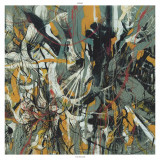
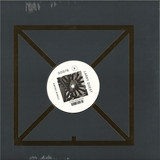
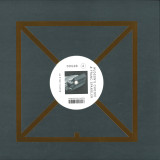
Securing his place in the scene as a mainstay after consecutively acclaimed releases on his own record label and beyond as well as lengthy touring around the globe's best venues, Altinbas returns to Token the only way he knows how. The Fuse resident's ethereal mark on driven techno comes this time with an aquatic touch, diving further into his bubbly architecture and melodic intrigue.
'Voyage' can mean many things; the past few years have been an incessant trip across the world's greatest sound systems and most dedicated audiences for the Belgian producer, or then perhaps it's a reference to the climactic and emotional nature of his productions. In any case, it's also the title track for his third EP on Token Records. Balancing warmth and anticipation, Altinbas is able pack in all the elements of a timeless record while still providing the space to breathe. Smooth and introspective, 'Voyage' kicks off the EP on a cloud of a club roller. 'Stygious Night' shares the first side with a more minimal but nonetheless effective approach. The tonal synth work on this record begs for a powerfully round system worthy of only the best dancefloors, and the space that washes around in the background gives it true dimension. Maintaining minimalism with structure through drum arrangement, 'Stygious Night' is reminiscent of a not so distant past in Berlin crafted with a clearly modern approach. As the record flips, 'Venus Ballroom' takes us by surprise with an uncommonly resonant sound at the forefront. This stylistic switch blends perfectly with historic tracks on the label that have come to define its sound since 2007. Hypnotic, psychotic, quirky, and mental - 'Venus Ballroom' proves a deep understanding of the music and appreciation of versatility. 'Psychosphere' closes down the EP with a classic sound of dissonant stabs to resonate through a foggy room. Altinbas highlights his sound with frantic clap sequences and short rides to keep his percussion rolling but dry while his synths create the acoustic he's been known to craft for the past few years. To have everyone agree on level of taste and technical capability is tough, which is why this certainly won't be the last time Altinbas will team up with Token to roll out his cutting-edge work.
Buscar:sequence
- Belt Of Orion
- Vestiges
Belt of Orion by Stockholm-based Isak Edberg is the composer's second solo release on XKatedral, and his first to focus solely on instrumental music in the form of two pieces of extended duration for solo piano. Isak Edberg is a composer of electronic and acoustic music as exemplified by Ondulations from 2017 and Lamé written in 2010 and released in 2022, both on XKatedral. Edberg was also a member of Golden Offense Orchestra, active from 2012 to 2014. Edberg writes that his music is informed by an enchantment of being and a search for holiness, rapture and transcendence through stillness, contemplation, dreaming and an attempt to uphold the present. Edberg regards his music to be an adornment of time. The two works presented here were composed in the south of France and in Stockholm during a period spanning the years 2016-2018. The music was inspired by the cold winds, starry nights and desolate, palely bright landscape of the provençal autumn, as well as reflections during a time of escapism and isolation in the life of the composer. More concretely, this music grew out of hours of improvised playing on an old piano while living alone on the countryside, during which harmonic structures and gestures were slowly worked out by means of performing and listening, assessing and balancing sounds and silences. Stylistically, the music draws on a range of sources, such as Feldman's use of space and resonance as projected through both harmonic and temporal distance, the ritualistic gestural repetitions of Satie, as well as Messiaen's resonant harmony, together with some of the harmonic lushness of Scriabin's late work. Belt of Orion is a piece that explores the contrast of two musical textures, the one being fluid, airy and progressive, the other being static, steady and repetitive. The music sequences through a series of harmonic tensions in search of a place of peace, exposing a rift in the weave of time where everything momentarily stands still. In Vestiges repetitive and rhythmic materials form a major part of the musical structure, while sections of sparse, floating harmonies temporarily interrupt with reflective pauses of stillness. The music thus employs two different and contrasting kinds of musical hypnosis, with the aim of cradling the listener into a dark and perhaps unsettling sleep. The music on this recording was performed by the renowned Swedish pianist Mats Persson, who has for many decades been a legend in the art music scene of Stockholm. Through his languid yet distinct interpretations the delicacy and intimacy of these works are elegantly brought to the fore. The recordings heard here were made over the course of two evenings at Fylkingen in Stockholm. Isak Edberg's music moves slowly through the seemingly endless world that is harmonic sound. In his practice he uses heavily reduced and carefully controlled materials to create states of maximum clarity.
- Trouble In Mind
- If You're A Viper
- When First Unto This Country
- Shiloh Town
- Shuckin' Sugar Blues
- Everytime I Think Of Freedom
- Ribbon Bow
- 8: Blues Jumped The Rabbit
- Lonesome Valley
- When I Get Home
- In The Pines
- Katie Cruel
- Karen Dalton performance featuring seven never before heard songs - Limited pressing on Sky Blue colored vinyl - Old style, Tip-On Jacket, and 8pp heavy insert featuring a treasure trove of newly discovered photos, and a 6,000 word essay by Kris Needs // In 1962, Karen summoned Richard Tucker to join her in Colorado, extolling the healthier lifestyle, and plentiful gigs at Boulder folk club The Attic. Upon his arrival, the pair solidified their personal and professional relationship, riding horses in the mountains, and performing as a duo at parties and venues throughout Denver and Boulder. Stories of the spell they conjured - and rumours of tapes! - have circulated among friends and musicians who witnessed them, but until now, no recorded evidence had turned up. Shuckin' Sugar is the glorious result of three reel to reel tapes that miraculously found their way to us in November, 2018; which featured two complete shows from The Attic in January '63, and a benefit concert for The Congress of Racial Equality (CORE) recorded the following February. Their gigs would often include brief solo sets from Karen and Richard, in addition to the duets, and all seven solo songs of Karen's found on the three reels are included here, as well as five duets, sequenced as close to how it all went down as humanly possible. To describe the record would take a poet, but all I can say is that unveiling a missing chapter in the Karen Dalton story - with six songs we've never heard her sing before - is cause for celebration in Delmore's world.
- A1: La Balançoire (Sports Et Divertissements) 1914
- A2: Berceuse (Enfantillages Pittoresques) 1913
- A3: Caresse 1897
- A4: Ce Que Dit La Petite Princesse Des Tulipes (Menus Propos Enfantins) 1913
- A5: 5Ème Gnossienne 1889
- A6: Colin-Maillard (Sports Et Divertissements) 1914
- B1: Danses De Travers (Pièces Froides) 1897
- B2: 2Ème Gnossienne 1890
- B3: 2Ème Gymnopédie 1888
- B4: Harmonie 1895?
- B5: Idylle (Avant-Dernières Pensées) 1915
- B6: Idylle Cynique (Préludes Flasques) 1912
- B7: Lui Manger Sa Tartine (Peccadilles Importunes) 1913
- C1: La Pêche (Sports Et Divertissements) 1914
- C2: Petite Ouverture À Danser 1900
- C3: Petit Prélude À La Journée (Enfantillages Pittoresques) 1913
- C4: Prière 1895
- C5: 4Ème Gnossienne 1891
- C6: 4Ème Nocturne 1919
- D1: Rêverie Du Pauvre 1900
- D2: Son Binocle (Les Trois Valses Distinguées Du Précieux Dégoûté) 1914
- D3: Songe Creux 1906-08?
- D4: Sur Un Vaisseau (Descriptions Automatiques) 1913
- D5: Tyrolienne Turque (Croquis Et Agaceries D’un Gros Bonhomme En Bois) 1913
- D6: Vexation 1895
- D7: Voix D’intérieur (Préludes Flasques) 1912
WRWTFWW Records is delighted to announce the first official worldwide reissue of Satsuki Shibano’s Wave Notation 3: Erik Satie 1984, the final album from the sound-defining Wave Notation environmental music series curated by Satoshi Ashikawa. Originally released in 1984 on the Sound Process label, Wave Notation 3 followed Ashikawa’s own Still Way (1982) and Hiroshi Yoshimura's Music For Nine Postcards (1982).
The highly sought-after album, sourced from the original master tape, is available as a double LP (housed in a luxurious heavyweight sleeve) for the first time ever. Digipack CD and digital formats are also available. This exclusive reissue, including English and Japanese liner notes by the artist, was supervised by Japanese ambient legend Yoshio Ojima.
Wave Notation 3 is a splendid tribute to seminal French composer and pianist Erik Satie, himself one of the main influences behind kankyo ongaku / environmental music (alongside Brian Eno, John Cage to name a few). The alphabetically-sequenced album features 26 pieces showcasing Shibano's unique piano interpretation of Satie’s works.
The artist explains: « For this album, I sequenced the compositions in alphabetical order of each title, irrespective of the period of each composition or style. By doing this, I attempted to effectively create ‘Music as an environment’ and at the same time, allow the listener to genuinely experience Satie’s music. »
Satsuko Shibano’s minimalistic approach to ambient classical is simply perfect and offers a beautiful and tranquil listening experience, furniture music with extra comfort and soothing simplicity, relaxing to the mind and to the soul. This Wave Notation deserves a spot among the pillars of Japanese environmental music, next to Midori Takada’s Through The Looking Glass, Hiroshi Yoshimura’s Green, and Satoshi Ashikawa’s Still Way.
The Acidboychair music project started in the early noughties as a commentary on what journalist Simon Reynolds would summarise a few years later as Retromania. Initially conceived by Thomas Baldischwyler and Andreas Diefenbach as a performative revival travesty with large-format drum computers and synthesizers reconstructed from cardboard, everything took a surprising turn when DJ Mooner (the man behind the now defunct Munich music label Erkrankung Durch Musique) took an interest in the adventurous audio material produced by Baldischwyler. In 2005, the LP 1987 (EDM1016), produced almost exclusively with long-forgotten software (SoundEdit 16, RB-338, etc.), was released on Mooner's label. As a result of the growing number of bookings, Baldischwyler had to think about improving the performability of his intentionally amateurish productions. Fortunately, the Ableton Live programme became a DAW with a MIDI sequencer and support for VST plug-ins as early as 2004 - and this made it easier for him to execute his intuitive, error-friendly version of acid house. This can be heard on the first two sample-heavy tracks on the A-side of Come Down Easy, which were recorded in 2005 and 2006 respectively at Acidboychair gigs at Hamburg's Golden Pudel Club and Munich's Registratur. The first two tracks on the B-side (produced sometime between 2006 and 2008) were actually supposed to be part of a solo release on the Acido label run by Dynamo Dreesen, but this never materialised. However, the final tracks and the 133.3 BPM lock grooves that follow are the title and central to this catalogue number TBG123: Through ethno-musicologist Arthur Boto Conley, who had already released a one-sided 12 on his label with material from one of Baldischwyler's audio installations, he met Florian Meyer (Don't DJ) and Marc Matter (Spoken Matter), who introduced him to their collaborative project Institut F?r Feinmotorik (IFFM). Baldischwyler's attempt to approach the sound aesthetics of IFFM led to the tape 60 Minutes Of Barely Modified Lock Grooves (TCCC06), recorded in Rome in 2018. A buyer of this tape introduced him to the Detroit collective Pure Rave, which he immediately contacted and introduced to the work of the IFFM. It was important for Baldischwyler to have an analogue update made and so both the Detroiters and IFFM, who now live in Berlin, were given 8 copies of EDM1016's backstock to remix the material in their own way. At their jam in Detroit, Pure Rave opted for the almost identical material that IFFM had also used for a live performance in the Hamburg project space Beek. The dominant jumps in both arrangements come from the track Eightyseven, produced in the early 2000s for the LP 1987, an awkward remix of the Spacemen 3 track Come Down Easy, which is also referred to in the liner notes on the inner sleeve of TBG123. The almost two-decade-old revival idea thus turns into false memory syndrome and runs into a - in keeping with our times - clean-cut (endless) groove. Kassem Mosse (The KM of MM/KM) on Come Down Easy after a first listening session: I think it all works very well as a mix, no matter where you start it carries you further forward back in the loop. if I understand the liner notes correctly, it's about the music's turn from tradition preservation (doing everything right) to ecstatic delusion (not doing everything right when intoxicated). Now that I'm reading again instead of listening, the titles give me a different understanding of the connections; how the skipping belongs together, which playtime is connected. Now I can name my favourites. Thank you for the journey!
Swiss label Acquit welcomes back D'Funk for more of their no-frills techno. It's seductive stuff from the off with the opener 'In Your Hood' layers up mind-melting synth sequences with sleek beats. "Let's Play' is a more bulky cut with slamming drums and subtle percussive details then 'My Next Turn' pairs things back to rubbery drum loops and dubby chords that sound all gooey and gloopy. 'Glitch My Funk' picks things up with more taught kick drums that compel you to dance as the delicate cosmic vibes permeate the groove. 'Killing Me Deeply' is a nice raw analogue deep house closer that kicks like a mule.
For ALT014, Altered Circuits presents its first Various Artists release. In addition to the label's co-founder, three friends of the label appear on this heterogeneous, club-oriented 12''. Portal, with its breakbeat layered drum section and spartan bass hook, sounds like classic Innershades from the start. When the angular leads and slowly phased, ominous chords hit, we are reminded of the artist's fondness for the new beat genre and his ability to translate its tropes and conventions to the present. On Show You Love, Mr. Ho combines skippy two-step drums with an MS20 type of flat bass. After introducing a one-bar mid-bass arpeggiator, gently swelling pads, leisurely spread side riffs and reverb-drenched musings join, calibrating the vibe to lush and groovy. On the other side, Oshana treats groove as the focal point with her Hey Kiss Kiss contribution. Over its 6-minute course, the snappy 909 kick rarely relents while a bunch of often short, many a time looped sequences emerge and disappear, unfolding a hypnotic tapestry of textures. Rising talent Salomee closes the VA with Late Night Summer, a track capable of setting the floor in motion at any moment. It revolves around a portamento-heavy, neon-tinged lead that lingers long after the track ends and a sturdy, efficient one-note bass pulse.
- 1: Voice From A Starless Domain
- 2: A Black Odyssey
- 3: The Goddess’ Lake
- 4: The Dark Night Of Souls
- 5: Soulblight
- 6: Charge
- 7: Nightbreed
The 1998 Norwegian Black Metal classic ‘Soulblight’ re-issued! “Soulblight” is a worthy contender for one of the best Black Metal albums of the 90’s! 1997’s “Witchcraft” wass a challenging album to follow up with its cult status as one of the greatest Black Metal releases owing to its complex compositions and intricate orchestration. Yet Obtained Enslavement did exactly that, as “Soulblight” is a very different release but it maintained the quality and musicianship the band made themselves known for with “Witchcraft”.
This release discards the openness and mystique of the orchestral arrangements in place of a more guitar and drum-oriented sound, but this works for the much darker and aggressive tone of “Soulblight”. The structure of the album is a highlight compared to its predecessor as it feels more conceptual and complete as a whole, rather than just a collection of songs.
This makes sense as the lyrics tell an epic tale of a great war against the ‘soulblight’, a story that can be followed through the music itself too, thus making it a conceptual album in many ways. Speaking of instrumental work, the iconic and untouchable classically influenced composition (it would be insulting to call it songwriting) of guitarists ‘Heks’ and ‘Døden’, with its weaving and developed melodies to the complex chord sequences and intricate structures, is still an aspect that is so unique to this band; the composers truly have a great understanding of music in its high-art form.
The performances delivered by the band are done with terrifying precision and clarity, unusual for the genre where commonly a ‘that will do’ attitude is employed; nowhere on this album can you hear sloppiness of any kind. Pest’s vocals are consistent and hair-raising, nothing about it sounds human and this works in favour of this otherworldly suite. Pytten has once again cemented himself as one of the greats in the Black Metal world and even just knowing this album was recorded in the infamous Grieghallen, adds to its grandeur and appeal. To conclude, “Soulblight” is a worthy contender for one of the best Black Metal albums of the 90’s. The world will likely never again see two Black Metal albums as perfect as “Soulblight” and “Witchcraft”, evil in its intent yet majestic and epic in its final form.
People Pleasers is a brand new label that kicks off with the first sounds of a new project, Shep, by respected veteran producer Jay Shepheard. It is house music which underpins these but plenty more goes on up top. 'Peach Buzz' shows that from the off with some nice airy pads and emotive vocal stabs that will make any floor take note. 'Trust Your Nose' is a deep, warm cut with shuffling drum and humid 90s organ stabs while 'The Bell Curve' has a late-night feel thanks to the pulsing synth sequences that roam about the mix. 'Higher States Of Nonchalance' shuts down with the most heady sound of the lot and a persuasive dub feel that is perfect for back rooms.
Modeight presents a captivating 4 tracker from the talented DJ and producer Valeria Croft, based in Helsinki. With a unique blend of jazz elements, house, and minimalism, Valeria effortlessly bridges these genres and brings them to the dance culture.
The EP opens with Kaksi, a low slung, slow burning groove that glides with effortless grace, featuring meandering atmospheric tones that induce a positively out of body feeling. Next is Mad Mood, a rhythmically fluid roller, peppered with a cyclical hypnotic sequence and shimmering vocals.
Pretty Inspiration showcases a deep, sub sonic wiggle, carving out a sophisticated and immensely enjoyable sonic journey. The EP wraps up with Viisi, a track that concludes with a graceful afterhours groove.
In this emphatic release, Valeria Croft brings the heat, making it a perfect fit for Modeight.
BRUK welcomes the daring shapes and inquisitive textures of ELLLL for her debut album, Earth Rotation. Across 13 scuffed cuts and grubby miniatures the Irish producer shapes out a distinctive sound world, steeped in sample science and powered by low-slung grooves. There's no direct message permeating Earth Rotation, but burning issues around embattled ecosystems hang in the air as ELLLL pushes her sound palette until it bites. Extended instrumental techniques lend the album an in-the-room tangibility, while dislocated micro-loops speak to less grounded atmospheres. Starting from densely packed collages and diligently chipping away until spacious, head-knocking arrangements remain, the end results of ELLLL's process call to mind the wayward sample acrobatics that made trip-hop and jungle so emotionally resonant and eerily alien in the same beat. There's rarely anything like conventional boom-bap or a cosily familiar break, but ELLLL finds compelling rhythms in unlikely sources of funk, whether plucked, bowed, sequenced or sculpted. Even when teetering towards techno on 'Titan', her particular approach is gloriously skewed and, by extension, innovative. No matter how serious the techniques involved, Earth Rotation is a celebration of the magic that happens when sound gets mistreated. If there are foreboding ideas lingering in the album's tendency towards dissonance, ELLLL also knows how to inject her work with a necessary mischief, making her a perfect fit amongst the maverick BRUK alumni.
It’s abundantly clear from the first bars of their 5th studio album Through Other Reflection, that this is, and could only ever be, The Soundcarriers. From the enchanting vocal duets of folk-bidden Chanteuses Leonore Wheatley and Dorian Conway; to the precise bass lines of Paul Isherwood and the limber, jazz-cool, Hal Blaine-esque drums of his his co-songwriter Adam Cann; from the fairy-like flutes, 60s-garage guitars and organ sounds pilfered from the archives of exotica - listening to the Soundcarriers resembles a rediscovery of all the most prized, esoteric corners of the 1960s, all bundled up, warped and refracted through the quartet’s astutely modern cultural lens. Channelling Tropicalia, Middle Eastern psychedelic Jazz/Funk, The French Library sounds of Nino Nardini, and a whole host of lavish obscurites beside, Through Other Reflection delivers another sonic adventure from one of the most unique and distinctive voices of British Psychedelia. After an 8 year wait for their album 4 - 2022’s Wilds - it thankfully didn’t take so long for the follow-up this time round. In many ways, this feels like a companion to Wilds; recording again at their Nottingham warehouse studio, Through Other Reflection retains that same organic glow, all the passions and imperfections of a tightly clipped unit jamming out these living, breathing pop-art nuggets as if straight onto the acetate.”We wanted to keep an air of spontaneity with this album and not get too bogged with the recording process”, explains Cann, “It was more a case of getting the songs as tightly written and arranged as possible first so we could get them down quickly in the studio. It always takes longer than you think” Less packed with strident pop hooks as its predecessor however, the music of Through… has been given extra licence to breathe, stretch out, and wander more uncharted terrains. While gleaming psych-pop of tracks like ‘The City Was’, or ‘Already Over’ confidently carry on from where they left off, from the album’s 2nd track ‘Always’, the trip becomes a little less predictable. Starting out as a smoky Procol Harum-meets-French-Psych organ ballad, the music drifts, as if of its own accord into an eerie, garage trance that lingers, cycles, and hypnotises, growing ever stranger, reaching ever-further away from its point of conception. And almost every track on Through Other Reflections holds that outer-body moment, where the band fix themselves on a limber, lysergic groove, lose all grip on time and reality, and melt themselves away into a liquid state of blind euphoria. There are sequences on this record that feel more like rituals than songs, built upon a single hypnotic rhythm which, like the centre of a vortex, pulling everything under its beatific command. Take the finale to ‘What We Found’ for instance, sounding like a ghostly march across the psychedelic moors, or ‘Feel The Way’, where a single athletic drum-loop rises and rises, growing ever more urgent and suspenseful underneath its frantic harpsichords and rasping flutes. Full of such rich stylisms as these, The Soundcarriers showcase themselves as abstract storytellers par excellence by virtue of their textures and arrangements alone. Resembling Romantic composer Maurice Ravel, but if he had just a four-piece rock band at his disposal, Through Other Reflects is rich with detail; there’s shakers, rattles, clarinets, booming drums; there’s synthesiser swarms, chiming xylophones, vintage organs and experimental Cluster & Eno-esque ambiences. Within all this nuance the music flows like some undisclosed narrative swathed in a magnetic secrecy. “It almost comes across like a story in some ways”, says Cann of the album, “the music is quite sectional with elements of exotica and cinematic type layers, it's a good balance of grooves, tunes and weirdness”. No more is this “epic cinematic feel” heard more proudly than on short instrumental ‘Sonya’s Lament” - its innate, hauntological atmospheres befitting a Peter Strickland soundtrack, or the classics of Lex Baxter, the so-called ‘Founder of Exotica’ himself. On the other hand, providing a greasier undercurrent to all these bucolic sounds is a leaning towards a more “direct” lyricism referencing more “external concerns. Laying down the first tracks for the album in the wintry gloom of pre-lockdown 2020, and drawing inspiration from time spent in Berlin, Through Other Reflections returns to some of the post-apocalyptic futurism explored in 2014’s Entropicalia - a loose concept album inspired by J.G Ballard’s The Drowned World. “The songs explore a disillusionment with the way things are going particularly after 40 years of neoliberalism”, says Cann, “They follow that folk-song tradition of wanting to escape to an imagined time, but here it’s more urban than pastoral. The first couple of ideas I came up with when doing some music in Berlin and had some time to wander aimlessly. And think the atmosphere seeped in, particularly on The City Was and Already Over. He continues, “One aspect of the title, ‘Through Other Reflections’ is about synthesis and layers of influence. How things can be filtered through other things and change the perspective. This is something you get in cities as well.” Though, as with everything The Soundcarriers make, “It can mean anything. It also just sounds kind of cool.”
The second release from fledging new label Morsecode is a world affair that features new music from Slowmouth and remixes crafted by producers in multiple countries. The lead single 'Anchor' stemmed from a discussion about authenticity in the underground and is a deep, dubby and acid-laced techno cut with raw machine warmth. Subtil founder Nils Weimann flips it into a more percussive number with broken beat loops, while Modebaku layers in deft and wispy pads and hits to make for a light yet carob sting minimal rhythm. Zalapa and Cliff Sequence then combine for a more raw and punchy version with cosmic pads and slapping tech drums. A tasteful outing for sure.
- Fragments
- Park Güell
- Séquence
- Logique Du Sens
- Musique Ridicule
- Séquence
- The Curious Sofa
- Moments De Bruits Pendant Le Naufrage
- L'horizon Perdu Du Cornet A Gidouille
- Résumé Du Concert Du Bel Canto Orquestra Du 7 Mai 1992
This is the first ever stand-alone vinyl release of the Bel Canto Orquestra"s legendary concert in Montpellier in 1983. Founded by Pascal Comelade, Pierre Bastien, Cathy Claret and Laurent Churet, the Bel Canto Orquestra was constituted of toy instruments only. During its lifetime from 1983 to 2015, other members included Victor Nubla, Pip Pyle, Jac Berrocal and many more. Includes bonus track "Résumé Du Concert Du Bel Canto Orquestra Du 7 Mai 1992" which is a never before released piano summary of the Orquestra"s 1992 concert.
- A1: Solar Wind 06 23
- A2: White Dwarf 03 48
- B1: Waveform Cascades 04 30
- B2: Dance Of The Celestial Druids 04 40
- C1: The Freak Show 04 41
- C2: Implosive Regions 04 58
- D1: Lonely Journey Of The Comet Bopp 04 38
- D2: Crossing Of The Sun-Ra Nebula 05 05
- E1: Scattering Pulsars 05 09
- E2: Alien Vessel Distress Call 06 57
- F1: Flux 07
2024 Repress
In early 2023, Tresor Records will reissue the sole output from Shifted Phases entitled The Cosmic Memoirs Of The Late
Great Rupert J. Rosinthrope. Initially released in 2002, soon after James Stinson passed away, this LP plays a mysterious and
compelling role in the Drexciya journey. While other records of Drexciya and related projects have received numerous reprints
and editions, The Cosmic Memoirs... has remained out of print since its release. This rarity leaves it more open to
interpretation with its place in the Drexciyan storm series, as it became increasingly hard to find and underexplored.
Track titles Solar Wind, White Dwarf, and Lonely Journey of the Comet Bopp reveal a focus on cosmic realms, suggesting a link
with the Drexciya LP Grava 4 that moves from the underwater to the galactic. As it launches with mechanical blows on a
precise orbit, each repetition entrenches the gravitational pull in the galaxy of Shifted Phases. In many places, it sounds like
the readout of frequencies harvested from outer space, pockmarked with packet loss from the millions of kilometres distance
travelled.
The music is hard to contain, intuitively restless in motion through its unfolding universe and achingly resonant. It shapeshifts
across aectedly melodic sequences such as in Lonely Journey..., to the sparse, hard-hitting timbres found in Alien Vessel
Distress Call and the mangled reverse vocals in The Freak Show, somewhat reminiscent of another Drexciya side-project, Glass
Domain. The mythology of Drexciya is evident in how keenly James Stinson and Gerald Donald created their imaginary worlds.
In Crossing Of The Sun-Ra Nebula, there is an undisputable reference to another Afro-futurist who delved deep into a galaxy of
their own making.
This reissue does not merely close the loop on Tresor's reissue series of the Drexciya catalogue but brings Shifted Phases to
fresh ears more than other records. Accompanied by newly commissioned artwork from Matthew Angelo Harrison, the 3xLP
vinyl reissue also features the tracks Crossing Of The Sun-Ra Nebula and Alien Vessel Distress Call, which were previously only
on the original CD release.
Scientists from Stereo 45 headquarters have finally translated the warp code sequence, opening up a parallel-time-rift connection across the vast known universe. They've enlisted the help of Tim Reaper, Dwarde, DJ Sofa, Nectax & Sketchy Rida to venture into the portal and report back their findings in the form of club-ready atmospheric Jungle.
DJ Support: Kevin Reynolds, James Baron, Hot Toddy, Pablo Valentino, Colin Dale
Suite For Chick is a heartfelt Homage to the late Jazz Maestro Chick Corea.
This collection features reinterpretations of City Gate, Rumble, Time Track, and Hymn of the Heart from the Chick Corea Elektric Band, as well as Return to Forever’s classic Romantic Warrior. These vibrant renditions celebrate Corea's enduring legacy in the jazz world.
Chick Corea played a crucial role in shaping Miles Davis's electric fusion era and was a key member of his Lost Quintet. He was also a founding force behind Return to Forever and many other influential groups.
Bangkok-based Maarten Goetheer collaborates with top Thai drummer Pong Nakornchai, blending Wurlitzer chords, Moog basslines, ARP leads, and signature Rhodes phasings. Nakornchai, a Master’s graduate in Jazz Studies from Mahidol University, leads his own quartet and embodies the progressive spirit of modern jazz in Thailand.
Maarten's inspiration stems from his musical upbringing; his father, Gerard Goetheer, was a jazz pianist. This environment fostered his deep appreciation for music. A pivotal moment came when he heard Masters at Work remixing Tania Maria, igniting his vision to merge genres and create something new.
With Suite for Chick Maarten wanted to incorporate a wider range of Modern influences that he became infatuated with throughout his Musical career such as Techno, Italo, Cosmic Disco, Dub, Acid, Boogie, Proto-House & Ambient Music.
To Maarten bringing these genres together is his current and unique interpretation of the JAZZ FUSION moniker.
Radio Support: Kev Beadle Radio support, Colin Curtis Radio support, RINSE FM mini album mix & interview on Tim Garcia show, BBC6 RADIO New Music Fix 16th Oct 2024
DJ Feedback:
DJ Harvey - Very cool collection of reworks
Terry Farley - so fucking good - house heads will be lovin’ this
Laurent Garnier / FG Radio France: Whaouuuu. That’s brilliant. Great album!
Lars Behrenroth / Deeper Shades Of House: This is so cool. Love the dub of City Gate, too. Great music
Jimpster / Freerange: Great idea to work up some contemporary interpretations of Chick classics! Was always a fan of Time Track so nice to hear this one included. These tracks strike a really nice balance of electronic/sequenced elements and live recording. I’m into it!
Tim Garcia / Rinse FM: I think this whole release is excellent and inspired, nice to see a tribute to one of my favourites work so well.
a A1: City Gate Rumble Original
[b] A2: City Gate Rumble [Reprise Dub]
[c] A3: Romantic Warrior [Original]
[d] B1: Time Track [Original]
[e] B2: Time Track [Reprise]
[Original]
Mixtacy, a new independent label based in Tokyo, was launched in 2024 by DJs, for DJs, and of DJs. Their passion lies in updating the classic house style with modern underground artists. The first EP features four exclusive tracks by mysterious Japanese underground artists, available only on vinyl. All tracks are mastered by the Romanian talent, Dragutesku. A1 Addictive Desire by YAMADAtheGIANT, whose debut 12inch vinyl sold out 200 copies in just two months in Japan. This raw acid deep house track made by hardware synths, sequencers, and sampled vocals from the cult NY house track The Playground/Desire (1992). A2; Nightfall Yearnings by P.S. Morris, a 20 years experienced master of MPC from rural Japan. This classic-style deep house tune boasts a phat groove focused for the dance floor. B1; Forest is by Bitowa, originally from the Japanese hip-hop underground, now coming into the techno field from Okinawa, southwest Japan. This modern tech house track features acapellas sampled from garage classics and disco, resulting in a unique texture. B2; Lost Sweet Cherry is made from cut-ups of Japanese porno analog tapes by the owner of strange vinyl shop Tonotopica in Asahikawa, northeast Japan. This dub sets a psychedelic atmosphere as the night starts.
2024 Repress
It’s been a long wait, pressings difficulties have got in the way, but here finally, slightly out of sequence, is the next release on SuperRhythm Trax.
Luca Lozano’s returns for his third EP on the label and turns in something truly special.
Packed full of bleeps, bass and breaks, with heavy nods here and there to Sheffield, plus the extra treat of ‘Summer Of Love’ with its dubwise swing and bonus DJ Steve remix for the real Break heads.
The Invisible Road: Original Recordings, 1985–1990 compiles an unheard, previously unreleased body of recordings by Sussan Deyhim and Richard Horowitz, dissidents from diametric backgrounds who met during the heady days of Downtown New York in the 1980s. This collection reveals the creative and life partners’ radical shared vision of avant-garde pop in all of its boundary pushing freedom, combining Deyhim’s singular approach to vocalization, Horowitz’s invention of new musical languages, and touchstones of traditional music from around the world, creating a new music that ultimately retains a voice entirely its own. Despite their difference in backgrounds and respective journeys, at the time of their meeting in the early 1980s in New York City, Sussan Deyhim and Richard Horowitz were both products of the search for freedom and understanding (and resultant awakenings) that swept the globe and helped culturally define the late 1960s and 70s. Deyhim, born and raised in Tehran, spent her teens dancing with Iran’s Pars National Ballet company, performing weekly on Iranian national television, and travelling her home country studying with master folk musicians and dancers, before relocating to Belgium and joining Maurice Béjart’s prestigious Béjart Ballet of the 20th Century. Horowitz, born and raised in Buffalo, New York, had spent much of the decade before abroad, first departing for Paris under the shadows of the Vietnam War, where he studied piano, Eastern philosophy, and became entrenched the city’s free jazz scene, playing with the likes of Steve Lacy, Anthony Braxton, and Alan Silva, before embarking south to Morocco where his friendship with Paul Bowles helped cultivate a deep passion for the country’s musical traditions and a shift in his musical practice.
The pair met by chance sometime in 1981 at Noise New York, a small studio on West 34th Street founded by the musician and recording engineer, Frank Eaton, as a utopian creative laboratory that beckoned artists and bands like Arthur Russell, Christian Marclay, Liquid Liquid and Butthole Surfers into its orbit. Both artists had recently relocated to the city, Horowitz having recently released his debut album, Oblique Sequences (Solo Nai Improvisations), on the legendary Paris based imprint Shandar, and fallen in with members of New York avant-garde like La Monte Young, Jon Hassell, David Byrne, and Brian Eno, and Deyhim having begun to more actively incorporate singing into her practice, notably recording a vocal score for choreography she was doing at La MaMa Experimental Theatre.
Initially bonding over a cassette tape of field recordings made by Paul Bowles that had been given to mutual friend and writer Brian Cullman (seeking answers for Ornette Coleman’s question “what is the sound of sound”), their earliest collaboration was documented on Horowitz’s 1981 album, Eros In Arabia, with Deyhim contributing vocals to the track “Queen Of Saba.” Over the coming years, their deep connection would routinely gravitate them into the studio, culminating in the body of recordings that would appear on their 1986 album for Crammed Discs, Desert Equations: Azax Attra. Unknown to nearly all but the artists, laying in wait over the decades on numerous multi-track and stereo reels, DAT tapes, and reference cassettes, were a vast array of recordings made by Deyhim and Horowitz bookending Desert Equations. The 13 pieces represented on The Invisible Road: Original Recordings, 1985–1990 were recorded largely between Noise New York and Daylight Studio in Brussels, during a period that Deyhim describes the partnership between herself and Horowitz’s as seeking a music “free of any specific cultural reference, with a personal musical signature,” blossoming into a body of sonority that embraced the energy of contemporary boundary pushing pop and the avant garde, filtered through their mutual love and study of various musical traditions from across the globe and deep engagement with the ideas and tactics of experimental music.
Undeniably rooted in Horowitz’s study of the North Africa ney and the music of the Berber and Gnawa cultures during his time in Morocco, Deyhim’s deep engagement with the folk traditions of Iran, and the couple’s immersion in the interconnected Downtown underground music scenes, each piece on The Invisible Road offers its own vision creative and cultural hybridity. Deyhim sings in both English and Farsi, as well as a composite tongue that she developed by drawing upon numerous indigenous vocal techniques from around the world, intuitively responding to Horowitz’s simultaneous sound syntax forming and combining a wide range synthetic and acoustic instrumentation, and experimental tape techniques, within a visionary series of free-standing expressions.
In this next installment of Token, Brussels' own Border One steps in to showcase 'Echoes from the Abyss', another swinging, modular-driven project destined for controlled sound systems. In these four tracks, the seasoned producer does what he knows best: engaging the dancefloor through his signature sound design and use of space.
'Echoes from the Abyss' the track, like the EP, is a collection of sound associations that are synonymous with Border One's sound. Resonant and cerebral yet bouncy and full of groove, the A1 presents a shimmering veil of synthwork that gives off a truly hypnotic effect. The follow up is much more sequence-based, focusing on the elements' interactions. The producer plays along freely with his drum machine, responding to a classically loopy and dissonant main synth that insists its way from beginning to end. Tension is everything, especially when met with a sustained chord in the second half, turning the record into a weapon of suspense. 'Celestial Observer' comes back straight and center with a focused tone and a progressive arrangement. With a thick low end and shrill highs, Border One flicks through percussion patterns and filter sweeps to make an intense, at times close eyed dancefloor experience. Ducking back into obscurity for the last track, 'Escaping the Void' takes on a more minimally produced style that breathes a bit after its previous, denser productions. Concluding with a question mark is always very appropriate, and here we're faced with a record caught between ethereal soundscapes and tense implications. With 'Escaping the Void', Border One closes with his latest contribution to Token with class as always, appealing to genre veterans and newcomers alike.
The third EP by the adventurous and unstoppable Stefan Schwander that you might already know from one of his other disguises such as Harmonious Thelonious, A Rocket In Dub or Antonelli Electr. - just to name a few. All tracks were virtuously and solely jammed out on Elektron's Monomachine once again.
Deep basslines, ravy bleeps, piano chords and synth melodies are awaiting us and let us reminisce of Jamaica, UK and Chicago while stepping and dancing into tomorrow.
The EP starts off gently with 'Title Track'. The first bleeps, chords, an incisive bassline and we're already grooving. Strings are building the framework while some house piano and a ravy melody let us hum along.
'Sublime' speeds things up with its shuffling, minimalistic beat but the dub bassline holds it down and functions as a resting pole to the vibrancies around. A pristine synthline comes in and supports the meandering chords. Dance off.
On the flipside 'Definition Of ...' sums it up what While My Sequencer Gently Bleeps is all about: a deep bass as bedrock, lively percussion, a little melody, tiptoeing chords. Everything sensitively used, telling a story. Listen on repeat.
A collaboration between Duncan Bellamy (Portico Quartet) and Belinda Zhawi (MA.MOYO), Jump Ship, Sit Lean, Be Still, Stand Tall is a collection of sonic-poetry that sets Zhawi’s illuminating, elliptical words in dialogue with diffuse, explorative music and sound by Bellamy. Fluctuating between expansive contemporary classical arrangements and intimate layered vocal experiments, together they render these disparate forms into something distinct, melancholic and luminous.
Belinda Zhawi is a literary & sound artist based in London & Marseille, author of Small Inheritances (ignitionpress, 2018), & experiments with sound/text performance as MA.MOYO. Her work explores African diaspora research and narratives, and how art and education can be used as intersectional tools. Her literary & sound works have been featured on various platforms including The White Review, Vogue, NTS, Boiler Room & BBC Radio. She’s held residencies with Triangle-Asterides, France; Cove Park, Scotland; Serpentine Galleries; ICA London and was a Brixton House Associate Artist 2022 - 24. Belinda’s the co-founder of literary arts platform, BORN::FREE. She is working on her first full poetry collection.
Duncan Bellamy (b. Cambridge, UK, 1986) is a multidisciplinary artist based in London. His diverse practice encompasses painting, silkscreen, photography, sound and music. His work examines the shape of time, loss and our relationship to the past and present in a period of compressed transformation. He is a founding member of Mercury Prize nominated Portico Quartet, and has contributed sound work to the artist Hannah Collins audio-visual installation I Will Make Up A Song. Bellamy is working on a debut exhibition and new music.
This third volume of Universal Synthesizer Interface delves further into early MIDI sequencing software for personal computers, focusing on Intelligent Music Software founded by Joel Chadabe in 1984. In a short period of time (1986-1990) Intelligent Music published a series of MIDI sequencing software titles that would have rippling effects throughout the music world: M, Jam Factory, UpBeat, MidiDraw, Ovaltune, Realtime, as well as an unreleased first version of Miller Puckette’s Max. These programs were a reflection of Chadabe’s desire to create interactive and intelligent algorithmic tools for home computers. Intelligent compositional tools had been floating around for decades in mainframe computer labs, but they had largely only been accessible to people working in academic or corporate laboratories. With the birth of Intelligent Music, these tools became available to anyone with a home studio. As the personal computers of this era had become less expensive and more accessible, they had also grown exponentially in processing power and seeming intelligence. In the music press from this time, we find the same two words used again and again to describe algorithmic computer systems: smart and intelligent. The tone of such articles may seem quaint by today’s standards, when AI and algorithmic control underpin so much of our technology, but the question of machine intelligence remains. Universal Synthesizer Interface VOL III Focuses exclusively on one of the more obscure of Intelligent Music’s software creations - UpBeat: The Intelligent Rhythm Sequencer, released in 1987, and hailed by reviewers of the time as “the world’s best drum machine.”
Japanese ambient owes a great debt to Masahiro Sugaya, whose work has been re-assessed and taken on all the more importance in recent years. The now cult musician and composer released his The Long Living Things album in 1988 for the performing arts company he belonged to, Pappa Tarahumara. Though it was overlooked for many years, it is now in sharp focus and gets a deserving reissue on vinyl for the first time ever by P-Vine which he also belonged to, and has long been overlooked by all but a few enthusiastic music lovers. One track from it was Grammy-nominated and rich of the record is minimalistic, with soft interwoven sequences that keep you afloat amongst the warming pads.
Featherstone returns to Ernest's Way with the “Pivot” EP, offering up six tracks that effortlessly blur the lines between various electronic music genres.
The A-side kicks off with “Pivot” where a driving breakbeat rhythm propels the track forward, enhanced by ethereal vocal cuts and rhythmic bass sequences. “Underneath It All” lightens the mood with swung drums, call and response vocals, and emotive string pads that draw the listener in, before “Moving Towards You” rounds out the first side with weighty basslines and acidic leads.
On the B-side, “After the Rain” locks into a repetitive rhythm while dreamy synths evolve and lift the energy as the track builds. “Eclipsed” deepens the experience, exploring a moodier and more intense sonic landscape. “Cipher” the final track, leaves the repetitive rhythm behind and delivers leftfield sound design scattered over a spatial broken beat.
Closely following the release of the last Borderland single, the focus returns on Transport, the last collaborative album by Juan Atkins and Moritz von Oswald.
Long time friend and studio partner of Moritz von Oswald, Carl Craig provides a new take on 'Transport'. Extending and stripping the original sequence to its bone, the illustrious Planet E president and illustrious Detroit proponent also summons a stepping drum sequence and a swaying array of moving delays.
This 12' edit is cut on the A-side. The full version of Carl Craig's remix clocks just above 20 minutes and is available digitally. Both are available to anyone who purchases the record, through the enclosed download card.
On the flip, DJ Deep & Roman Poncet rework Carl Craig's remix, adding their signature grooves and myriad of tough drums, to full effect.
Led by Sommer, the release signifies the first chapter of the drummers much much-anticipated Nordic trilogy on April Records, aiming to capture and document Nordic improvisation and composition across three carefully curated ensembles. Bassist Arild Andersens storied career stretches back to the 1970"s as one of ECM s first recording artists, collaborating with household names of the genre including Jan Garbarek, Don Cherry, Bill Frisell, John Taylor, Sonny Rollins, Chick Corea, and the list goes on. Welcoming the opportunity to work with and nurture younger artists, the ensemble was born when Daniel Sommer selected Andersen for a project during his studies at the Danish National Academy of Music. Later, impressed by Luft s performances in Ireland and Norway, Andersen suggested expanding the pair into a trio. A transcendent musical voyage, As Time Passes " blurs the lines of conventional trio roles, and celebrates the evolution of jazz as a fluid, versatile form of expression. By providing each musician the freedom of becoming a key contributor in the melodic discourse, the trio channels the spirit of jazz veterans such as the Bill Evans Trio and free free-jazz ensemble Air, while echoing the sounds and innovations of pan pan-European contemporary jazz. Mixing pensive rubato ambience with energetic grooves, instrumental dexterity, a modern ECM ECM-esque sound and folk undertones, the record s compositional clarity combined with the spontaneity of a live performance flows across and between genres, borders and generations alike. Luft s intricately over- dubbed layers of acoustic guitars, vast reverbs, and contrapuntal melodies expand the sound of the three piece into an immersive world of textures. Rendered in the stark beauty of Andersen"s bass lines, the nuanced strokes of Sommer"s drums, and capped with the lush, expansive timbres of Luft"s guitar, "As Time Passes" is a testament to the enduring and ever ever-evolving wonder of Jazz.
Leng’s San Francisco connection has long been strong, with the 40 Thieves collective – and their friend Cole Odin – providing some of the label’s most memorable releases of the last decade. That Bay Area connection comes to the fore once more on the imprint’s latest release, which sees Odin join forces with fellow San Francisco resident Marshall Watson, a long-serving producer, engineer and live performer known globally for his Balearic-minded productions.
‘Voyager’, the pair’s first collaborative single, is a genuine meeting of minds. It combines Odin’s love of low-slung dub disco, dancefloor psychedelia and low-tempo cosmic house with Watson’s
picturesque Balearic synths, sparkling piano riffs and immersive sound design. It’s this blend that dominates on the EP-opening Original Mix, an infectious workout that gets progressively more blissed-out and saucer-eyed as it progresses. Listen carefully and you’ll hear some suitably psychedelic guitar solos nestling amongst the heady washes of sound, sun-bright piano riffs and weighty bass.
Those languid, stretched-out guitar parts naturally take a more prominent role on the Extended
Guitar Mix. On this alternative take, the pair deliver a lightly tweaked take on the original groove, stretching it out while overlaying eyes-closed guitar solos, pots-and-pans percussion and a more DJ-friendly outro. It’s effectively an extended club mix – the club in question being a Bay Area basement at 5am. To round off the EP, Odin and Watson dust off their dancing shoes and pay tribute to San Francisco great Patrick Cowley. On the appropriately titled Cosmic Rave Mix, the pair swap their bass guitar for a pulsating sequenced bassline, trance-inducing synth sounds, and locked-in electronic loops designed to take you to a higher state of consciousness. By the time the track’s familiar piano refrain drops midway through, you’ll be reaching for the lasers in no time at all.
diskJokke - Loving HowardCurses - Hell yeah. I vibe with this!
Jorkes - U la la. Thanks so much. superduper <3
Heidi Lawden - Nice release for all moods
Gameboyz - Slow and power. Thanks
Pete Herbert - Yes solid all round!
Chloe - Nice EP
Severino Panzetta (Horse Meat Disco) - Yeeeeees
Xinobi - Lisbon and Porto legends. Super cool tunes
DC Salas - Howard is big!
Mufti - Fantastic EP all around! Howard my favorite
Thomass Jackson - New Ears for me Thanks!
Long time friends and Lisbon-based Mirror People & OITO//OITO for the last 20 years have been lighting up dancefloors all over their native Portugal and beyond, with their passion for eclectic sounds as the main fuel for their sonic mission. ‘MP88’ marks their first EP together. ‘Howard’ opens with rugged 4/4 rhythms, acid squelches and meandering arps to set the tone, ‘New Ears’, takes things on saturated drums & fills, vintage stab sequences and enigmatic strings. Last but not least, is the dropped tempo acidic feel ‘Alive & Kicking’. Another flawless EP in OITO//OITO Discos, limited to 300 copies, this time in Yellow vinyl.
An expedition in sound in 10 sequences: Enfoncement Deep Sink, Gouffre circulaire [Circular Abyss], Noyau secret [Secret Core], Apesanteur [Weightlessness], Entrailles [Entrails], Four solaire [Solar Furnace], Fissures [Cracks], Mer intérieure [Inner Sea], Éruption [Eruption], Remontée [Ascension]. "Labyrinthe !" is not only a very unique piece in Pierre Henry's masterful repertoire, but also a remarkable demonstration of his compositional skills and musical singularity. Indeed, for this piece, Pierre Henry was deprived of his own, otherwise essential, sonic material. Here, the sounds, provided by GRM collaborators at the time, carry their own distinct stories, sensitivities and qualities. Yet, despite this discrepancy, Pierre Henry's voice, the breath and dynamics of his own music, quickly appear. Through this sonic maze, a music arises, utterly focused on sounds, their development and their use, which Pierre Henry applies with extraordinary clarity and determination.
RADIAL
Acoustic Rhythm & Texture Sequencer
Available as C60 Limited Edition of 50 mirror dubs- (same on both sides) + Inserts
written and produced by
S.Gordon 2024.
additional percussion by Islay Spalding - TRK 7, recorded at SFS studios 2024
Synths & Radial - SDGordon.
The Radial instrument was designed to explore various material's acoustic characteristics in ways that could only be achieved through mechanical and electronic control.
It creates sporadic dense percussive sequences & sharp reciprocating sweeps or can focus in on tiny acute angles to produce deep shaking drones among a host of other planned and unplanned acoustic sounds.
Radial uses 5 voltage controlled motors and interchangeable textured cylinders captured via contact microphones positioned within the chassis. The cylinders can be synchronised or independent & the blades are interchangeable allowing the flex of certain materials to skew and augment the movements and sounds and sequences.
Playing the Radial instrument is a direct visceral experience. Its sequences sound unlike anything else i have used and the simple design by no means limits the scope of its rhythmical output. After feeling out the controls you arrive somewhere in-between the rubbery juddering fuzz or clockwork blasts of percussion and can step back allowing the physicality of the instrument itself to dictate how things proceed. Minor adjustments can have a butterfly effect on the entire tone inmate rewardingly unpredictable but controllable way.
On certain tracks there’s some synth work in a move away from the potential “instrument study” vibe of the release and Islay Spaldings blistering scrap metal percussion on Track 7 was incredible to watch.. Additional thanks to Stephan P Richter “SPR” for the advice and encouragement through the whole build.
''One Foot in the Rave'' is a vibrant collection that showcases Jonny's signature style--a blend of melodic, melancholic acid jams, bleepy funk, and warm analog electronics. Whether for the stereo or the sound system, the LP moves from the upfront bounce of ''The Apocalypse is Now'' and ''Raymond Tuesday's Big Day Out'' to the shimmering reverb of ''Starry Night'' and the birdsong-infused ''Ringfort.'' Listeners will find themselves in familiar Automatic Tasty terrain, rich with psychedelic exploration. According to Jonny, ''What to say about this record? I don't really know and it hardly matters. I wrote them on different bits of gear; ye olde faithful Roland SH101, my MC202 (pencil and paper de rigeur), a battered x0xb0x 1.0 (thx Daniel!), a beloved Yamaha Cs-5, a similarly beloved Roland SH5, a truly hammered Juno106, a Roland JX3P, a Nord something or other, an MPC2500, my TR606, and a Vermona DRM1 MKII being sequenced via a bedraggled TR626. Also Jay's TR808 is on there (thx Jay!) and a TR8 being squashed through a Mutronics Mutator (wheee Damo!) and a Zoom H4n recorder. I edited them on a dilapidated laptop, with no headphones or monitors, steering by the tiny speakers on the computer and playing them in my car, twiddling the mix as I went. But these are frivolous and unimportant details. All that matters is that these songs were made out of love. Cheerio, Jonny. P.S.: This record is dedicated to Jay 'Winthorpe' Kelly.'' ''One Foot in the Rave'' will be available on vinyl and digital platforms starting October 14th.
2024 Repress
Sublunar proudly presents "Pareidolia II," the latest EP by Sciahri, marking the next chapter in an evolving sonic journey following its first installment. This four-track release explores a spectrum of techno landscapes, offering a blend of pulsating rhythms, hypnotic sequences, and emotive soundscapes.
On the A-side, "One Letter" captivates with its infectious groove and fluid bassline, while "Homid" invites listeners on a minimalist journey, where hypnotic synth sequences create an enthralling atmosphere that captivates from start to finish.
Flipping to the B-side, "10k In One Year" enthralls with its sharp stabs and captivating rhythms, while "No Tears" delves into deeper, more introspective territories, combining classic elements with modern sensibilities.
"Pareidolia II" invites listeners to immerse themselves in a diverse array of techno experiences, each track offering a unique perspective on the genre. It's a testament to Sciahri's artistry and Sublunar's commitment to pushing sonic boundaries.
“Friends, they are my ticket out of this place I am in… feels like nothing more than a dirt bike vacation stop between Phoenix and San Diego.” Dirt Bike Vacation—for Worried Songs Records—explores the sonic world of the late amateur guitar player, Charles ‘Poppy Bob’ Walker, through a captivating set of instrumental songs made in the mid-1980s. Recorded on a single-track, Marantz field recorder, the project is a transportive document of Walker’s days spent as a meatpacking employee in Yuma, Arizona and the dailiness of that existence: driving to work, sitting in his backyard, walking around drunkenly, unwinding on the couch with a friend. These sketches, showing an experimental tendency, are surprisingly ahead of their time; some exhibit ad hoc tape delay (“Granite Bluffs,” “Goodbye YMCA”), while others make use of primitive overdubbing (“Continuation to Moon Doctor”). Not dissimilar to works such as Bruce Langhorne’s The Hired Hand soundtrack, Walker’s guitar playing is melodic, texturally rich and beautifully sober. On a musical tour from Nashville to Los Angeles, musician-archivist, Cameron Knowler, uncovered these songs from a series of dusty cassette tapes housed at a branch of the Yuma County Library. Originally tipped off by cryptic metadata entries found through an online finding aid, Knowler requested a sound sample and was immediately drawn in by their eerie, yet hopeful nature: “I didn’t care what they sounded like at first, but once I heard just a few seconds, I had to find out everything I could about Charles, who he was, and if he was still alive.” As it turns out, the two had miraculously crossed paths over 20 years prior when Cameron was a young boy accompanying his mother, a gem trader, on a biyearly sojourn to Quartzsite, a town 80 miles north of Yuma: “Charles, sitting down and smoking in a recliner, withdrawn, held what I now understand to be a mid-1990s Martin D-28 guitar. Unlike other old-timers, his instrument was sharply tuned and had a nice sound, even to my young and uncalibrated ears. Though his left hand showed signs of highly developed arthritis, his musical ideas were animated by a palpably deep understanding of fretboard anatomy, arrangement and harmony.” Sorting through the index cards associated with these tapes, Knowler was able to gain a detailed sense of most recording’s provenance, whereabouts and time: Walker’s Datsun pickup truck chugging along boiling hot Interstate 80, the Marine Corps Air Station parking lot, the Eastern Wetlands on the banks of the Colorado River, a fishing trip to Martinez Lake. Trying to reduce the amount of his own subjectivities coloring the work, Cameron constructed titles and track sequences by borrowing information gleaned from Charles’ handwritten notes: “I tried to organize everything by time of day, giving the listener the sense of how a Yuma day might sound and feel like, and each song title—even the record itself—is borrowed from his own words.” This proved no small task, as many notecards had to be deciphered and then coupled with their native tapes which needed extensive restoration treatments. The result is a project very much out of the blue, and one that is intensely personal to Knowler, having grown up in the same town under similar circumstances. “It feels like a part of my own journey as a guitarist reckoning with the defining marks of a gothic border town,” he remarks. “At the time I would’ve met Walker, I didn’t have much outside influence, but he has been in there all the while.” In their current form, the tracks combine to create a sonic journey that boldly contributes to the traditions of acoustic guitar soli, archival digs and field recordings all the same; most importantly, it is a creative document which shows a day-in-the-life of a man grappling with the human experience under a ubiquitous Yuma sun.
Why the Eye is an experimental masked quartet from Brussels that propels bodies into trance during its live performances. All instruments are DIY and played in real time, without loops or sequencers. Fans of The Residents, Société Étrange, Autechre, Boards Of Canada, The Meridian Brothers and Fulu Miziki could easily relate to their sound. Describing their music as "Prehistoric Techno", Why The Eye are set to release their new album ‘Inspirex’ on the 4th of October via Exag Records. Opening with the fidgety JNSP, the vindictive summons La Machine is a brash, abstract experience with a deep yearning to set us free from everyday political confinement while the raw Où cours-je explodes into a wild rage of disorder and mayhem. At the heart of each track are the DIY instruments band member DjP (Jean Paul Domb) has assembled over the years, some of them directly inspired by the African sanzas. With names such as ‘radiocaphone’ and ‘castabignettes’, the instruments are cleverly connected to different effects pedals and are the heartbeat of Why The Eye. Elsewhere, the album title track reveals a snappy rhythmic quality with skittish sounds while Prairies and Animal are tribal-like in delivery with a deep-lying punk ethosele
WHITE VINYL[24,79 €]
Kaum zu glauben: Harald Grosskopf gibt es jetzt schon ein Dreivierteljahrhundert. Anlässlich seines 75. Geburtstags erscheint nicht nur im Ventil Verlag seine Autobiographie "Monsieur Séquenceu" - sondern auch endlich wieder ein neues Album vom Elektronik-Altmeister. Man muss zu diesem Mann eigentlich nicht viel sagen: Mitbegründer von "Wallenstein", ergo Drummer auf mindestens zwei der wunderbarsten Krautrockalben (nämlich "Mother Universe" und "Cosmic Century"), Mitglied der legendären "Kosmischen Kuriere", Platten mit Ash Ra Temple und Klaus Schulze. Schließlich wechselt Harald Grosskopf dann von den Drums zu den Sequencern und schafft Atemberaubendes. Und nun: "Strom". Die Evokation der Elektrizität, der Virtuosität der Schaltung, die Mensch und Maschine kunstvoll verschraubt und der über ihrem Triumphzug verödeten musikalischen Digitalität entgegengestellt wird. Wer genau hinhört, der erkennt den Ingenieur hinter den Klanggebilden sogleich.
Black Vinyl[23,49 €]
Kaum zu glauben: Harald Grosskopf gibt es jetzt schon ein Dreivierteljahrhundert. Anlässlich seines 75. Geburtstags erscheint nicht nur im Ventil Verlag seine Autobiographie "Monsieur Séquenceu" - sondern auch endlich wieder ein neues Album vom Elektronik-Altmeister. Man muss zu diesem Mann eigentlich nicht viel sagen: Mitbegründer von "Wallenstein", ergo Drummer auf mindestens zwei der wunderbarsten Krautrockalben (nämlich "Mother Universe" und "Cosmic Century"), Mitglied der legendären "Kosmischen Kuriere", Platten mit Ash Ra Temple und Klaus Schulze. Schließlich wechselt Harald Grosskopf dann von den Drums zu den Sequencern und schafft Atemberaubendes. Und nun: "Strom". Die Evokation der Elektrizität, der Virtuosität der Schaltung, die Mensch und Maschine kunstvoll verschraubt und der über ihrem Triumphzug verödeten musikalischen Digitalität entgegengestellt wird. Wer genau hinhört, der erkennt den Ingenieur hinter den Klanggebilden sogleich.
Repress.
DARK VEKTOR is the new signing for the Madrid label INDUSTRIAS MEKANIKAS, a very consolidated artist within the Spanish ELECTRO scene and very well known internationally.
SIEGA LAS CADENAS, is the name with which the Catalan artist, presents this new work, a title that undoubtedly carries a very direct message about the times of repression and bias of freedoms that we came today.
This new work presents 6 tracks, three original tracks of DARK VEKTOR, along with three remixes, of the hand of some of giants of the international ELECTRO scene.
ASSEMBLER CODE, COSMIC FORCE and CESTRIAN, are in charge of finishing off this incredible reference, full of pure power in each beat, demolishing bass, and hypnotic sequences and above all a message of vindication that is the common thread of the whole EP.
Jason Kolàr (Stroom) returns to Dauw on this collaboration with Japanese musician Fumitake Tamura (Leaving Records). 'Ōki-sa' documents the duo's encounters during Kolàr's Japan tour in September 2023.
Fumitake Tamura and Jason Kolàr met in Tokyo during Kolàr’s Japanese tour in September 2023. Sharing a mutual admiration for their previous works, they decided to meet at Soundbar Patrol in Sangenjaya for a series of improvisational sessions.
The album contains a chronological sequence of ideas recorded on those summer afternoons, seamlessly connected by raw textures, lo-fi synths, and abstract beat-filled sound collages.
The title Ōki-sa was Kolàr's idea, a phonetic form of the Japanese word for 'size.' Fumitake found the Japanese phonetics of macrons and hyphens, which are not usually used in Japan, so visually interesting that they were adopted for the title.
Language communication is always subject to misreading and misunderstanding, even between speakers who share a mother tongue. Communication using sounds, which have no clear meaning, is even more prone to misreading and misunderstanding than language. Acknowledging this, they engaged in an intuitive process, with no prior discussion about references or guidelines, freely exchanging ideas and allowing the music to evolve organically.
This record aims to capture a three-day intersection of language and musical miscommunication, while also reflecting personal bonding and human connection.
Drab Majesty's third album, Modern Mirror, is a journey of self-reflection, nostalgia, love, beauty, and heartbreak told across eight addictive and emotional synth pop anthems - a seemingly classic tale delivered unblinkingly through the frame of the modern world. Elements of classic tragedy weigh heavily in the reflection of Modern Mirror in songs like "The Other Side", possessing a fundamental sound that is energetic, luminous and hopeful. Fusing the sonic aesthetics of predecessors like New Order and The Cure within the cautious instruction of Greek mythology and modern science fiction, Drab Majesty has birthed a hybrid of dreamy malaise, captured for a future moment. The first single, "Ellipsis", romantically plays up the distorted concept of courting through modern technology in a world that has yet to adapt, while on "Long Division", Deb's resounding guitar cascades around the chorus shared with No Joy frontwoman Jasamine White-Gluz, wistfully warning us against our vanity and self-obsession. Even when hope for everlasting love peeks through in "Oxytocin", a sparkling and stoic track sung by Mona D., we are firmly reminded our fleeting existence. Produced by Josh Eustis (Telefon Tel Aviv) with appearances by Jasamine White-Gluz (No Joy) and Justin Meldal-Johnson (NIN, Beck, M83, Air).
Dialling up the needlepoint rhythmic science and deadly restraint we hold so dear, SPD debuts on Sneaker Social Club with a taut four-tracker built for smashing systems with measured flair. It's no surprise to learn Will Sheppard has graced labels like Keysound, EC2A and Roska Kicks + Snares in recent times, given his sound taps into the UK bassweight lineage while maintaining a necessary futuristic tilt.
'Genbu' deals in the kind of stripped back, snaking sequences that keep a body of people rolling deep into the dance, powered by sounds so crisp you'd think they'd slipped out of a trouser press. Maintaining this sonic poise, 'Systema' is a lean, bleep-speckled roller with a firm grip on the square wave snarls lurking below the midrange.
'Willman' rides a choppier groove, but still Sheppard holds down the dance with a monk-like patience, finding power in the art of holding back before opening out into the subtly emotional swathes of 'OK' to round the record out. The devil is in the detail, and there are deep-diving layers to the sound of SPD, but this is a specific angle on club music that prizes subtlety and meditation over brash arrangement swerves and bait hype trysts. For selectors seeking sublime set builders, SPD has got you.
This release documents the coming together of two fallible musical instrument systems and their creator-operators. In June 2023, Graham Dunning's Mechanical Techno and Sam Underwood's Acoustic Modular System took a train journey to Galerie Paradise in Nantes, France. Following a period of exploration, points of cohesion, jeopardy and happenstance were exploited to create these nine unruly pieces that appeared initially on the ultra-limited vinyl release on the gallery’s record label. Now they celebrate a new pressing of Beaux Timbres on Accidental.
Using innovative methods, they create abstract, rhythmical and textural experimental soundscapes. Graham uses an extended turntable: a regular DJ turntable with numerous sensors, modified vinyl records and synthesizers creating irregular rhythmic patterns. Sam presents his Acoustic Modular System: a device for creating acoustic sounds with bellows, feedback and chaotic sequencers.
2025 Repress
For Fuse's fifth release, Brussels' Altinbas returns for a whirlwind of meditative and harmonious techno. Solidifying his identity of focused yet vibrant club music, the Fuse resident and label co-curator offers his second contribution 'Sustain' as a dancefloor-enveloping take on modern techno. Known for rich chords, whipping pads, and dry percussion, Altinbas proves once again that his touch as a producer revolves around balance and calculated effect.
'Trail of' kick starts the EP with flourishing synthwork and a taste of dub as has become the Belgian artist's signature. Dotting toms as rhythmic accents and a low to the ground shaker make for a swaying introduction with an infectious groove. Breaking things up in the second track, 'Life Force' presents Detroit style chord stabs and playful rhythmic work. With a mental synth at the foundation, the track presents 909 drums to reinvigorate atmospheric synths that make 'Life Force' a subtle hybrid of classic club genres. With a wink at Fuse's heritage and a peak into its future, Altinbas' focus on enduring music can be felt throughout 'Sustain' and truly understood in the Brussels club. As a fitting follow up, 'Purpose' opens the B-side with illuminating chords and rounded sound design and a pulsating low-end. With almost a lighthearted tone, the record fits across genres and rooms, claiming movement instead of mood as its sole medium. The title track 'Sustain' proves just that - a melodic sequence and progressive arrangement make for an intensely euphoric closing. Evolving melodies, opening filters, and big but calculated buildups sum up Altinbas's work for Fuse's fifth release on the new label. The record brims with warmth and yet it finds its way on darker dance floors with ease, providing a refined style of music that belongs only to him across the international scene.
A1 - Desire
Opening the EP in quietly epic fashion, Desire begins with a delightful beat pattern with adistinctive cymbal hit set over warm bass tones and whale song samples. A smooth, thoughtful bass melody is introduced which joyfully intersects with gorgeous piano keys while swirling strings and atmospheric vibes layer and recede like tides of the ocean, creating a truly unique journey of a track that will linger anywhere it may be heard.
A2 - Voidscaping
Instantly setting the scene with crisp, striking breaks, Voidscaping is an atmospheric treatfor the senses with serene throwback pads reminiscent of the halcyon days of Good Looking. Bringing the piece up to date for the Spatial era is the typically intricate blending of reflection and intrigue ASC conjures with his sampling and reverb work, effortlessly thickening the soundscape with memories old and new.
AA1 - Let Go
Opening with the vibrant sounds of twilight nature and metallic bongos, ASC sparinglydeploys a glorious choral vocal before the breaks take off with an energetic pattern drivenby constant, playful hi hats. As the track develops, questions are asked of the listener bythe curious atmosphere, gradually unraveling with strings, synths and trademark vocalusage, offering a new perspective with each listen.
AA2 - Meltdown
A darkly, anxious undertone floods the mix as Meltdown grips the listener from the first barwith skillfully sequenced minimal breaks, hi hats that whoosh in and out like evening crickets you can't quite track, and intense ambient padwork. A longing female vocal occasionally yearns over the various melodies which enter at will, discreetly developing the mood with purpose, unfurling a stream of aural consciousness from this incredible producer.
Words by Chris Hayes (Spatial / Red Mist)
- A1: Kirk And The Jerks, To Be A Hero
- A2: Sub Society, Hokus Montage
- A3: Kirk And The Jerks, One Way To Do It
- A4: Wonderful Broken Thing, Roam Around
- A5: The Cry, Alone
- A6: Voluntários Da Pátria, O Homem Que Eu Amo
- A7: Wonderful Broken Thing, Birds Fly So High
- A8: Kirk And The Jerks, Hang On To The Dream
- A9: Figure Ground, Intro
- B1: Kirk And The Jerks, Gun And A Tear
- B2: The Cry, Twist Of Faith
- B3: Sub Society, A Whole Lot Less
- B4: Wonderful Broken Thing, We Don’t Touch
- B5: Wonderful Broken Thing, Trains
- B6: D J. Dex/Mt, Am Rap
- B7: Potential Threat, Self Inflicted Pain
- B8: Johnny Monster, Witch Doctor
- B9: Wonderful Broken Thing, Is This What You Wanted
In the early 1990s, before the era of social media dominance, skateboarding culture found its voice through magazines and VHS video releases, notably from brands like Santa Cruz and Powell Peralta. These videos not only shaped the skateboarding world but also influenced creativity across various industries worldwide.
In 1988 and 1989, two groundbreaking videos, "Shackle Me Not" and "Hokus Pokus," emerged from the fledgling skateboard company: H-Street, unleashed a seismic shift in street skateboarding. These videos are revered as iconic masterpieces, celebrated for their innovative skateboarding sequences and unforgettable soundtracks.
“What’s particularly interesting about Hokus Pokus was its soundtrack, largely comprised of demo cassettes, unsigned artists, and bands with loose ties to the brand. Some of the songs were goofy, others almost anthemic, and few sounded of their time. Perhaps it was the repetition or the fact that Matt Hensley could have skated to the sounds of a broken oven and it would have been iconic, but the songs in Hokus Pokus became a secret handshake for the hardcore—people who really gave a shit about skateboarding’s culture not just the act”.
Artless / Anthony Pappalardo
“When we were filming for Shackle Me Not we were still a brand new company and hardly anybody knew who we were and it was so brand new. I was so busy skating and I noticed there was like a movement in skateboarding, you could feel there was a change in the way, in the tide, not just white H-Street but with every company. I think that video, the H-Street video was saw raw, with the crazy music, and you know, just the wackiness of all of it, I think that feeling went out into the world, and kids everywhere understood you don’t need to live 20mn away from Del Mar to actually be part of what’s happening. I think that just opened up the world of skateboarding to more people”
Matt Hensley – Pro skater and Floggin Molly band member.
Fast forward 35 years, and H-Street, in collaboration with Paris (France) based label Stereo Ronin Records, embarks on a momentous project to release special edition vinyl soundtracks from these seminal videos. This exclusive release features meticulously remastered tracks, including new versions and previously unreleased gems on vinyl, making it a treasure trove for any skateboarding enthusiast.
Curated from bands like Kirk & The Jerks, Sub Society, Wonderful Broken Thing, Voluntários da Pátria and The Cry, representing the golden era of skateboarding music, this album promises an unparalleled experience for fans of Punk Rock, Indy Rock, and of course, skateboarding.
Working alongside RTM Studio in Paris, Stereo Ronin Records has undertaken a remastering journey, ensuring that this vinyl edition delivers a truly unique sonic experience, capturing the essence of a bygone era while resonating with contemporary audiences.
Seit der Veröffentlichung ihrer 2020 erschienenen Single "Cleansed Existence" werden die Industrial-Metalcore-Hellraisers HERIOT aus Bristol von Künstlern, Journalisten und Fans gleichermaßen als die nächste Hoffnung für extreme Musik gehandelt. "Devoured by the Mouth of Hell" verdoppelt nicht nur die erdrückende Klaustrophobie von HERIOTs früherem Material - es enthält auch Ideen, die sie zuvor nicht angerührt haben. Die Opener "Foul Void" und "Harm Sequence" beweisen das mit einem schwindelerregenden Doppelschlag, wobei der erste Song ein Kraftwerk des Grooves mit melodischen Anklängen ist, während der zweite ein Metalcore-Amoklauf mit Vollgas ist. In anderen Stücken wie "Opaline" und "Visage" werden die Ambient-Töne, die HERIOT zuvor nur angedeutet hatten, zu kompletten Songs verarbeitet. Die Band klingt immer noch so roh und direkt wie eh und je, doch es gibt eine Verfeinerung, die nur von ihrem schieren Drang kommen kann, etwas zu erschaffen, das dem ganzen Hype um sie herum würdig ist. Die internationale Aufmerksamkeit inspirierte HERIOT dazu, sich so intensiv wie möglich auf ihre Instrumente und ihr Handwerk zu konzentrieren, und "Devoured by the Mouth of Hell" wurde in monatelanger Schreib- und Aufnahmearbeit akribisch verfeinert. Allein das Komponieren und das Aufnehmen der Demo-Versionen nahmen fast ein Jahr in Anspruch - als die Band dann Anfang 2024 ins Studio ging, holte sie sich Hilfe vom Who's Who des modernen Metals: Sylosis-Leader und Ex-Architects-Gitarrist Josh Middleton produzierte, während Justin Hill von den Prog-Metal-Koryphäen Sikth das Schlagzeug bearbeitete und Grammy-Preisträger Will Putney (der bei den Metal/Hardcore-Schwergewichten End, Fit For An Autopsy und Better Lovers spielt) das Album abmischte. HERIOT haben ein dichtes, beklemmendes und doch abwechslungsreiches Meisterwerk geschaffen. Ihr Momentum wird sich fortsetzen, wenn die Metal-Massen ihre neuen Ideen gehört haben, und es wird nicht mehr lange dauern, bis die Band von den hellsten "Rising Stars" des Metals zu ganz normalen 'Stars' aufsteigt. "Devoured by the Mouth of Hell" ist erhältlich als: Standard CD Jewelcase, 180g LP und Digitales Album.
CAR CRASH SET were one of the very few electropop acts coming out of New Zealand and have released several vinyls nationally between 1983 and 1986. Basically, the CAR CRASH SET consisted of synthesists/composers David Bulog and Nigel Russell and guitarist/producer Trevor Reekie, and was formed in late 1981, then still with Nick Jenkins on synths. They created such outstanding electropop songs with a Roland TR-606/808 and such lovely sequencing, – e.g. “Fall from Grace” is definitely a song that Anna will take with her into her grave – that it is indeed a shame that they didn’t receive more attention. Anyway, their 1983 12” ‘Two Songs’ (including “Outsider” and “Fall from Grace”) and the V/A ‘We’ll do our best’ LP (including CAR CRASH SET’s “Toys”) are at least highly collectible items amongst electropop connoisseurs and many people will be happy to see these tracks being available again as well as four previously unavailable demos from both their earliest and later days and seven more songs added to this CD version. CAR CRASH SET are currently recording again together though not only with the original Roland gear (“nothing else will do” as Dave once said): TR-606, Jupiter-4, MC-4, System 100m modular and System 104 sequencer as well as Nigel’s Korg MS20, Poly-61, Polysix and way more!
LP (3rd edition) features: limited edition of 317 copies, 180 grams yellow flame vinyl, A3 poster/revised lyrics sheet, sticker, revised hand-numbered double-sided postcard.
Guitarist Steve Howe releases his new solo album Guitarscape on 27th September on his own HoweSound label. The album will be available on CD, vinyl and digital downloads, including Dolby Atmos, Guitarscape marks a new chapter for the YES and ASIA legend as he presents, what amounts to, a guitar masterclass. "What I'm doing," said Steve, "is focusing on what I do well and what I love to do." Guitarscape features 14 new instrumental tracks in a host of musical styles, from rock through to acoustic and classical, each bearing that unmistakable Steve Howe sound. Steve plays acoustic, electric, steel and bass guitars along with keyboards and is joined by his son Dylan on drums. Steve has written all of the tracks and produced the album "This album has given me the opportunity to do something different," says Steve. "I bought a Novation Summit keyboard and found that it had a wealth of inspiring sounds. It gave me a golden opportunity to create my own keyboard structures - chordal movements and structures that I thought were a bit different. I think differently on a keyboard, I don't see the chords looking the same but then I had fun playing around with the guitar to see where that goes. "I've utilised most of the colours, as I like to I think of my styles, and I'm always pleased when I hear them running through and it moves from a steel, maybe, to a Spanish guitar. Because it's a different sort of album, I'm not using terribly conventional chord sequences but things that give me a fresh feeling and opportunities to improvise and stretch out as well as be melodic and make this a nice tuneful experience. "I began feeding the tracks to Dylan. We get on great and he seems to know what to play around my guitar, it's almost instinctive. Dylan and I fit together really beautifully. We've had the chance to do this together, so it's wonderful. "The bass parts and the keyboards are pretty interesting, everything had to be interesting but also work together. I like doing things that are super fresh and this album says what I am today.
Blurb:
A confident, two track release, cut loud to a split 12” from Meat Beat Manifesto & ScanOne
Following on from featuring together on the Yellow Machines BLE-EP series.
Bleeps, Breaks, Space and Bass.
Meat Beat Manifesto's ‘Into The Sun’ kicks off pulsing techno and IDM spasms against evocative NASA samples, the track evolves into a frenzied and unstable tower of wonky jungle break edits and heavy sub sweeps threatening imminent collapse. Weaving the contrasting rhythms with a narrative of eerie analogue pads and incidental atmospherics, Jack Dangers delivers a striking and fresh piece reminiscent of mid 90s left field rave acts such early Plug, Bedouin Ascent, and Law & Auder crew, both in their worldly experimental stylings as well as their forward-leaning progressivism.
ScanOne’s track ‘Secondary Loop’ is a seven minute galactic adventure of a slightly less hectic pace, and a brighter array of scenery. With a firm thematic nod to that 89 / 90, pre-hardcore sound exemplified by the likes of 808 State, FSOL, and Orbital, the voyage is signposted by chunky, shuffling breaks, glowing invigorating rave pads and sparkling arpeggiated sequences, built for those peak dance moments, light and dark, sundown or sunrise.
Following on from his 2022 debut release on American Dreams Records, 'Choreographies of Decay', J. Doursou offers a critical reflection in 'The Deafening Veil' of the West's warped relationship with war in other regions.
The Deafening Veil has early support with reviews confirmed with MOJO Magazine, Headphone Commute (single premiere), A Closer Listen, and Noise Narrative. A writer from Quietus is also pitching to editorial with a review TBC. Doursou began the creative process of the album when Russia invaded Ukraine. The album's lead single, 'song for Elena', is a tribute to Doursou's close friend from Ukraine. The rest of the album critiques the silence that surrounds war in other regions.
Aesthetically, Ed Schrader’s Music Beat hates to tread water. At the same time, the Baltimore-based two-piece of vocalist Ed Schrader and bassist Devlin Rice won’t force their songs to fit a preconceived style. “The next album’s always gotta be different from the last one. We’re different people from record to record. So, writing authentically to ourselves will always bring our work to a place that we haven’t been to yet,” Rice said. Schrader added, “We’re terrified of turning into AC/DC. We never want to be married to one scene or time or sound. We want to be the Boba Fett of bands! Constantly altering the way in which we make records has been pretty key in that process.”
For Orchestra Hits, the band’s latest, that alteration was welcoming longtime musical comrade Dylan Going into the fold as a co-writer and co-producer. A songwriter in his own right, a guitar sideman for ESMB on their last two tours, and a collaborator with Rice in the noise riffage band Mandate, Going had both a unique vision and an intimate familiarity with the ESMB vibe.
“Dylan came to every show we’ve ever played in New York—no matter how weird it was,” Schrader said. “He’d be standing there ready to move an amp or feed us barbecued cactus after the gig and toss on some Golden Girls so we could decompress. It felt like family as soon as we began working, but I honestly had no idea how damn good he was at tossing out these hooks.”
According to Schrader, the songs “just poured out of us” over the course of a highly caffeinated three-day weekend in a tiny room in Devlin’s house while his cat, Sandy Goose, screamed continually. “It was like three kids hiding from the world to get into some lovely mischief,” they said. The lack of external pressure in the process gives Orchestra Hits an almost paradoxical vibe. For all of the album’s layers, that mix live and sequenced instruments, it never loses the raw energy of a small handful of friends in the same room plugging in, cranking up, and playing until they pass out.
Lyrically, the album finds Schrader, now 45, meditating on experiences in their youth to make sense of the present moment. “We are not into the garden,” Schrader wails on the relentless “Roman Candle,” a song about the sad debacle of Woodstock ’99, and a direct response to Joni Mitchell’s “Woodstock,” a utopian ode to hippie idealism. A 19-year-old Schrader, having snuck into Woodstock ’99 through a hole in the fence, was there the night members of the crowd used candles intended for a vigil for victims of the Columbine High School massacre to set fires all over the grounds. Even before the fires, Schrader remembered feeling disconnected from the music, the nostalgic cash grab, and the meatheads in the crowd. After watching a press tower collapse, they boarded a random shuttle bus and were dropped off near a Denny’s. “It was a far cry from the Garden of Eden,” Schrader said. “That experience defined what I didn’t want to be a part of, and yet America is more like Woodstock ’99 than ever.”
With percolating synthesizer arpeggios, and climbing bass grooves, “IDKS” is the album’s dance-floor slapper. “’IDKS’ is a funny one,” Schrader said. “We already had a pretty satisfying suite of songs when Dylan was packing up to head back to New York, but he missed the train because of a freak snowstorm. Realizing he’d be stuck in town another day, he says to me, ‘Here’s this other weird thing I have.’ It was ‘IDKS.’ The hooks were so good I felt like Homer Simpson at a free donut convention. I just dove right in, and we cranked that baby out in like 20 minutes.”
Lyrically, “IDKS” is a letter from the true self to public-facing self. “It’s an angry song,” Schrader said. “Because the public-facing self is always looking for an easy escape, but it forces the true self into a cage. I honestly thought my lyrics were corny and was about to change them, but Dylan was digging it just the way it was. So that’s what you hear.”
With the soaring “Daylight Commander,” the band went against all of their musty-basement-bred instincts. “I went full High School Musical with the vocals,” Schrader said. “At first it felt almost embarrassing, but I remember reading somewhere that Bowie recommended always floating a little bit above your comfort zone, and that’s what we did here.” The song is part exercise in absurdity and part pop Trojan horse. “If ever we had a ‘Shiny Happy People’ moment, I guess this is it,” Schrader said.
Perhaps best described as a pioneer of the underground experimental scene, the signature of Jørgen Teller on the musical landscape of Denmark traces back to the late 1970’s. Sprung out of a whirlpool of post-punk and art school ideas, Teller has relentlessly been chiseling away on the constrictions of music in various bands, collaborations and solo projects ever since. Searching out its farthest outposts - be it free jazz, noise or acousmatic music - Teller has strived towards an approach to music without rules, often by way of improvisation and usually with the aid of electric guitar.
This album is based on a live performance held at the Inter Arts Center in Malmö in early 2022, where Teller performed a semi-improvised piece in homage to the poet Poul Borum, whom he had worked with in the mid-90’s closely before Borum’s death in 1996.
As a composer, Teller relies on a set of “basic choices” that becomes a “precise point of departure” - where he can then go against his “good knowing” of the science, trends and different schools of music and go straight into his own instincts as a performer. For this performance, he used pre- recorded material of three rhythm boxes (all out of sync), timbales and sessions on Erica synths.
In dialogue with the label, Teller has focused on extracting the recording of the rhythm boxes and timbales alone, emphasizing the tension between the rhythms. With minimalist drum sequences that could easily be placed in a proto-techno context, and the whooshing of what might be an ancient rhombus instrument, there is a feeling of a primitive presence to Teller’s rhythmic excursions. A throwback to the spiritual realms of a wordless society fighting the demons of chance.
Occasionally pierced by stark industrial drum crashes and rattling post-punk percussion, it also conjures echoes from the darker side of the 1980s. In citing Borum as its inspiration, Teller shares that he channels the poet’s energy and their shared love of “noisy stuff and darkness”.
But the pace can also go somewhere close to breakbeat on track B2, where a whirlwind of rhythmic elements clash into a deranged deconstructed club tune.
The album also features a remix by a fellow colleague of the acousmatic community; the composer Jacob Riis. On the closing track B3, Riis quietly manipulates and balances the elements of Teller’s recordings and gently releases them into a contemplative pool of static.
No Signal records is proud to introduce for the 10th release of the label one of the most important producer of all time: Jamie Bissmire. His productions have been central part of the scene through the 90s and the last decades. The UK legend spread the proper techno and electronic vibe with his solo moniker and in collaborations projects like Bandulu and Space DJz satisfying any kind of enthusiastic. The EP starts with the ambient skit "Subteranium", subtle synths and textures combined with a smooth-alternate basslines keep the listener moody and tense for an unexpected start. In Temporal Mst open up the dances. Slightly distorted 4/4 beat track, jam-packed in No Signal style, plucked arps well arranged for an elegant swing. Lore & Order is the match up to lead the dancefoors and listeners into more gloomy and wicked mood. Different sequenced synths wrap the drum groove for an hypnotic, yet enchanting and dreamy moving session. The Tapestry of Fate is definitely a massive Jamie Bissmire's signature track. Total ensemble of Ground Recordings releases, wicked patterns, dark mood and relentless pressure. Dancefloors will go mad for it. Antediluvian Analogue closes the shakers with a more modern vision, high cut on bass synth and 2/4 bleepy synth for a step-forward march. Woven Whispers closes the EP as Subteranium opened. Gloomy and dark mood, effective and reverberated synths in full shaded ambient atmosphere to stun the listener and bring it into a different sound dimension.
- A1: Effroyables Jardins (Générique)
- A2: Sabotage
- A3: Arrestation
- A4: Le Trou
- A5: Effroyables Jardins Par Leszek Mozdzer (1Ère Version Piano)
- A6: Métamorphose À L'hôpital
- A7: Une Vie Pour Une Vie
- B1: Effroyables Jardins (Générique 2Éme Variation)
- B2: Reminiscence
- B3: Mariage
- B4: Clown
- B5: Effroyables Jardins (Ge?Ne?Rique De Fin)
- B6: Effroyables Jardins Par Leszek Mozdzer (2Éme Version Piano)
- B7: Effroyables Jardins Par Leszek Mozdzer (3Éme Version Piano)
A Colourful Storm presents Effroyables Jardins, a soundtrack composed by Zbigniew Preisner for Jean Becker's eponymous film. Given limited distribution during its initial release, the soundtrack's lustre has only strengthened and it is now considered a lost gem of contemporary chamber composition. An understated triumph of the oeuvre of Preisner, who closely collaborated with Polish director Krzysztof Kie?lowski and was responsible for the film scores of Dekalog, The Double Life of Véronique and the Three Colours trilogy.
"Krzysztof and Zbigniew really found each other, as they were deeply complementary in their need of emotional expression," reflects actor Juliette Binoche upon her work in Three Colours: Blue. A Colourful Storm cites no other film leaving a greater impact on them than Three Colours: Red. These would be the last films the duo worked on together, before Kieslowski's retirement and untimely death.
Effroyable Jardins marks Preisner's post-Kieslowski era of solo composition, shifting from devotional harmonies into a beautifully restrained style of neo-Romanticism. It is his second soundtrack for Jean Becker, following Francis Ford Coppola's commission for The Secret Garden, the César-winning Élisa, and Edoardo Ponte's Between Strangers. Its leitmotif - a delicate, sparse melody for piano and organ, appears only during the opening sequence and, like Preisner's most powerful soundtracks, takes on a life of its own. Compositions for violin, harp and percussion are interspersed with haunting variations on a theme and a masterful use of silence. His music haunts the grieving Julie in Blue, soundtracks Valentine's epiphany in Red, and evokes the sublimity of moments in everyday life.
20 years of The Go! Team"s Thunder Lightning Strike, 20 years of lasers through tracing paper, orange tone oscillations, cable access hangover,music made through sunburnt circuits, a K-tel dream sequence, a haunted vision mixer, station wagon-core, straight to video, VHS in distress, something in the fog, fluff on the needle, chromakey constellations, a hovercraft on the fret board, maxing the minute maid, faxing a car alarm, a Morse code pep talk, etch-a-sketch jackknife, a daily Haley"s comet, light sound colour motion, a holiday from yourself... CD and LP are packaged with a recreation of the original CD-R version of the album that stands up as a document of band leader Ian Parton"s unique method of working.
With her new single release "Uh-Ah Song" the Ghanaian Frafra Soul singer Florence Adooni announces her debut album "Fo Yelle" on Philophon.
A lot has happened since the release of her first single "Mam Pe'ela Su'ure" in 2021. While this release was a pure studio project, Florence Adooni is now an eight-member live formation, made up of young talents from the highlife scene of Kumasi. The group has already considerable credentials: In 2023, they toured Europe twice and thrilled their audiences at festivals such as Roskilde, Down The Rabbit Hole and Überjazz. And this year, with the debut "Fo Yelle" under the belt, Florence and her group embarking on a 50+ concert summer tour through Europe, from Sweden to Portugal to UK and at festivals like FMM Sines, Xajazz, Africa Oye, Fusion, End of The Road.
The title track "Uh-Ah Song" is based on a rhythm typical of Kumasi and shines with its playful and cheerful character. Florence remembers the process of creating the piece: "When my producer Max Weissenfeldt came to me to play me on the piano an idea for a new piece, my daughter, who had just been born, began to sing in rhythm ah-ah-ah, with all joy in her face ever imaginable, while Max was playing. Max turned around and answered her with uh-uh-uh, to which she replied again with ah-ah-ah. We laughed so much and decided to make it a piece that would capture that very moment of joy we just had experienced. That's why it's somehow a children's song".
"Otoma Da Naba" (The Creator Has Done Well) has a sequencer bass line from a Roland TB-303 as its foundation. While Florence holds her verse in a kind of Ethiopian pentatonic scale, in the pre-chorus she switches to a sweetly swinging heptatonic motif, with a typical highlife guitar in the background creating the atmosphere. In the chorus, the singing then changes in that unique choir style, which is the trademark of Frafra music.
The international debut album "Fo Yelle" will be released on Philophon this summer.
Rain and experimental music have had an interesting connection for decades. Under the umbrella of American film music promotion, Hanns Eisler was already looking for "Vierzehn Arten, den Regen zu beschreiben” (fourteen ways to describe the rain) in 1941. A good 20 years later, The Cascades interpreted the periodicity of rain as a rhythm of mourning. For the Beatles ("If the rain falls, they run and hide their heads"), the precipitation inspired the band to use backward running tapes. However, it seems that there has always been a lot of rainfall in popular music. In the early seventies, David Toop and Paul Burwell even had a band project with the great name Rain In The Face...
That was a long time ago and today, rain, which in the age of climate catastrophe mainly occurs as heavy rain or an enervating endless loop, has lost a great deal of its inspiring quality. Perhaps as a reminder of the musical quality of rain, but knowing full well that it can only be enjoyed in theory, Razen call their new album "Rain Without Rain". In the music of the Brussels collective led by the two multi-instrumentalists Brecht Ameel and Kim Delcour, it certainly pours down on the roofs. In fact, the album opens with the sound of pouring rain before we hear the sequence of an oscillator played through a guitar amp on the first track „Lazy, Lazy Eye“.
The album is the captivating result of an one-night mobile studio field recording in an abandoned pedestrian tunnel in the centre of Düsseldorf, and it is finding beauty with brutal(ist) means: recorder, oscillator, guitar amp and reverberation, two musicians and four microphones, early electronics versus Early Music. “Suicide meet Hildegard von Bingen”, as Stefan Schneider, who recorded the session, admits. “Ghostly occurrences”, he adds.
Brecht Ameel states: “We do put a lot of weight and care on acoustics. On some of our recordings, the room acts as another band member, or as the main ‘mixing board’. Most of the albums we have recorded so far are not mixed in the traditional sense: they are simply „captured”, and we let the room decide what is left on the tapes. The studio recordings, then, give us the possibility of bringing other elements to the fore; precision of interplay, or tiny variations in breathing.”
The group Razen exists since 2010 and has since released numerous records on labels such as KRAAK, Marionette and Hands In The Dark. "Rain Without Rain" is their debut on the Düsseldorf label TAL. If there has been an increased international interest in experimental music from Belgium in recent years, this is not least due to musician collectives such as Razen. In terms of its electro-folkloristic intensity and instrumentation, Razen's music is quite unique worldwide. What does Razen actually mean? “We took the word from a poem by Paul Van Ostaijen, not specifically because of its meaning but because of the way it looked on paper”, Ameel explains. “But the meaning goes in the direction of ‘thundering / raging / speeding’ … although we prefer playing with a strong notion of restraint, building our world from (and with) silence.”
Olaf Karnik, Köln 2024
- A1: Tolouse Low Trax - Ossia Dub
- A2: T Woc - Luminescence
- A3: Al Wootton - Altai
- B1: Iro Aka - Generations
- B2: Hlm38 - Mystery Train Riddim
- B3: Jamie Paton - Lost Margins
- C1: Good Block - Strong Relax
- C2: While My Sequencer Gently Bleeps - Ready
- C3: Anatolian Weapons - Mountain Echoes
- D1: Shelter - The Four Knights (Dub)
- D2: Zongamin - Ggantija
- D3: Akulina - Waiting
Vol 1[28,78 €]
Emotional Response returns with a second volume of its All Trades compilation which is named after its own NTS show. It is just as vast both in terms of style but also the eras it spans with a mix of dub, new wave, slow motion electronics and plenty in between. Tolouse Low Trax kicks off with the filthy dirty and seriously heavy dub glitch of 'Ossia' to provide an early highlight before the likes of Al Wootton get percussive and tribal with 'Altai' and HLM38 channels some African Head Charge on another devastating dub cut. Later on, London's Good Block brings a little more light and sunshine with their lovely 'Strong Relax.'
DJ Feedback
Vladimir Ivkovic (Offen):
"I don’t like it, I love it!"
DJ Gibl’r (Versatile):
"A trip through so many electronic styles, much of which has been featured on my Rinse show and DJ sets beyond. "
Valentina Magaletti (CZN / Holy Tongue / Tomaga / Vanishing Twin):
"Delighted to be part of the Emotional Response 10th birthday celebrations and what an amazing selection."
Lovefingers (ESP Institute):
"Always an inspiration, Emotional Response has weaved a long, wide road this past decade and the All Trades compilations are the zenith of that music journey. "
Lena Wilikins (Salon Des Amateurs):
"Great to see so many artists that have represented our scene for the past years, including D�sseldorf luminary Stefan, aka While My Sequencer Gently Bleeps."
Sean Johnston (A Love From Outer Space / Hardway Bros):
"The perfect music to listen to before or after the party. Bravo! "
Trevor Jackson (Output / NTS):
"Congratulations on 10 years anniversay Emotional Response. This compilation covers a lot of bases perfectly."
Klex blobbing his first solo EP on Strictly Strictly, pushing forward with his virtually self-titled "Klextasy EP". Entangling techy trance strikers with dreamily warm temperament, Klex offers three strikingly quirky productions on side A, blending surprisingly seamlessly from bouncy to anthemic passages. Accompanied by a strong team of remixers, with Viikatory, Lakehead, and DJ Normal 4 pressing a psy-techy stamp on side B. Digital Bonus: Two extra Remixes from Urte and once again Normal 4. A release like a steamy open-air summer night by the lake.
Reissue
'Find Me Finding You', the new album from the new organization called the Laetitia Sadier Source Ensemble, manages to strike new chords while touching familiar keys in the song of life.
From its percolating opening beat, 'Find Me Finding You' locates new systems within the sound-universe of Laetitia Sadier. This in itself isn't a surprise - Laetitia has relentlessly followed her music through different dynamics and into a variety of dimensions over the course of four solo albums since 2010 (not to forget her three albums with Monade and the long era of Stereolab) - but the nature of the construction here stands distinctly apart from her recent albums. Laetitia was inspired by a mind's-eye envisaging of geometric forms and their possible permutations. As she sought to replicate the shapes in music, this guided the process of assembly for the album.
Part of the freshness of 'Find Me Finding You' comes from working and playing within the Source Ensemble and exploring new sound combinations via a set of youthful and evolving musical relationships. Laetitia recognized the energy of the tracks in their initial form and sought to preserve their vitality by not retaking too many performances - instead, the rawness in the tracks was retained and refined at the mixing stage, maintaining an edge throughout. When we hear synth lines diving, lifting and drifting, unusual guitar textures, the plucked sound of flat wound bass strings or the bottomless pulsing of bass pedals stepping out of the mix with an exquisite vibrancy, this is the sound of the Source Ensemble.
A key to Laetitia's music is her use of vocal arrangements. Throughout 'Finding Me Finding You' the shifting accompaniment creates space to bring this element gloriously forward. Arranged by Laetitia with Joe Watson and Jeff Parker making string charts that were subsequently transposed to vocal parts for several songs, richly arranged choirs of voices provide depth along with the thrilling presence of extra breath in the sound. Laetitia's community-politic is well-served by the groups of voices lending support to the machining of the song craft, providing additional uplift to her quintessentially forward-facing viewpoint - as well as massed voices from three different countries sharing space in harmony.
Working in collaboration is Laetita's tradition and a key to this album's view on being free together. The designation of Source Collective implies a new togetherness phase, alongside long time collaborators Emmanuel Mario and Xavi Munoz, keyboard and flutes parts played by David Thayer (Little Tornados) were essential contributions, as well as further keys, synths and electronics from Phil M FU and several intense guitar sequences from Mason le Long. Chris A Cummings (aka Marker Starling, Laetitia's favourite composer) graciously wrote 'Deep Background' for her. The duet with Hot Chip's Alexis Taylor on 'Love Captive' (not to mention Rob Mazurek's distinctive coronet playing) gives voice to an ideological cornerstone of 'Find Me Finding You'
As Country music continues broadening its influence in every corner of the modern soundscape, the quickly growing 'Red Dirt' genre, which encapsulates the Western lifestyle and outlaw sound, is taking centerstage lead by acts such as the influential Randy Rogers Band. For over 20 years, the band's roster and traditional approach has remained unchanged and inspired the surge in a new generation of artists. Acts such as Parker McCollum, Koe Wetzel, Flatland Cavalry, and William Beckmann all began their musical careers on the building blocks set forth by Randy Rogers Band.
The band's second album, Rollercoaster, is applauded as one of the most impactful collections in the Texas music scene. The influence of this record garnered the band bookings in venues once thought out of reach and made them a pillar of 'Red Dirt' Country music.
Now, as the record prepares to celebrate its 20th anniversary, the Randy Rogers Band is releasing a newly re-mastered/re-sequenced edition of Rollercoaster to commemorate the music that ignited their long-lasting journey as a Texas music staple act.
Italian artist Fedele unveils exciting upcoming album ‘Depth Of Being’ which again finds him exploring all new electronic music realms. The 11 track album arrives on his own label Obscura and is his first since going solo. Fedele is a key part of the underground scene and has been working alone for the last three years since his departure from Agents of Time.
He has truly made his mark in that time with music on the likes of Ellum Audio, Tiga’s Turbo Recordings and his own Obscura. This superb new album is a mix of stylish progression from the signature sound Fedele is known for while the other side of the album dives more into the experimental world, using more vocals than before.
ESCHR001 marks the debut vinyl release from eschr, featuring a collection of four tracks, resonating with aficionados of minimal, house, and techno. "routine" offers a hypnotic minimal house groove with a captivating pad hook, engineered to ignite dance floors.
"recall" stands out with its emphasis on syncopated rhythm, gradually constructing an intricate bassline that embodies the essence of the track. "breathe" transitions into techno, with meticulously sequenced hi-hats and a sharp electronic precision against the backdrop of raw textures of natural sound.
"Ki" pays homage to a cherished friend, uniting the EP with simple yet evocative melodies and a drum treatment that adds an organic texture to the structured canvas."eschr 001" is a testament to authenticity in the domain of electronic music.
- A1: Aperitif
- A2: The Nightbus
- A3: Beetle Juice (Feat Nix Northwest)
- A4: Free Your Dreams Ii (Interlude)
- A5: Disco Boy
- A6: Moonlight (Feat Melissa Imperilee)
- A7: Stay Home (Feat Corto Alto)
- B1: Mr People Pleaser (Feat Hilts & B-Ahwe)
- B2: Feast
- B3: Shipwreck (Interlude)
- B4: The Movement
- B5: Goodbye
- B6: By Your Side (Feat Renato Paris & Byulah)
PYJÆN are delighted to announce the release of their second album 'Feast', planned for September 2021 on DeepMatter Records. The five-piece outfit reaches inside the deep, multidimensional well of what is broadly called Jazz, bringing together all its diverse components in a singular, emotional sound. After setting a blueprint for their multifaceted artistry, combining cross-genre sensibilities with ferocious talent on their first two releases, PYJÆN have been busy writing and recording music for their second album, their most accomplished offering yet. ‘Feast’ was recorded at Peter Gabriel's legendary Real World Studios in Bath over a full week in November 2020. This proved to be an unforgettable experience, which elevated the music and created an unrivalled connection between the 5 band members and the albums featured artists Nix Northwest, Elisa Imperilee, Hilts and Corto Alto.
With the recording of this new record, each member of the group brought their own specific flavour to the table.
They explain: “We want the album to showcase our growing abilities and confidence as a group of 5 individuals, each with strong personalities and varied sets of influences, while still leaving room for featured artists, an exercise we thoroughly enjoyed on our 'Sage Secrets' EP with Blue Lab Beats and Odette Peters.” The EP reached over 1M streams on Spotify within only a few months, testimony that the band has become a major force in the UK "Jazz and beyond" scene. Their new album will fearlessly navigate the world of funk, jazz, hip-hop and punk. With their trademark raw energy, their objective is to bring people together in their love for music.
Adventurous songwriting, meticulous timing, incredibly tight horn arrangements and an obvious joy to play together are the PYJÆN trademarks. These are brought to the table in ‘Feast’ through vibrant melodies and rich cadences. The band presents a full course musical experience with four singles: in ‘Beetle Juice’ the band joins forces with rapper Nix Northwest to offer a delicious tune characterized by an easy-going yet alluring atmosphere. ‘The Nightbus’ sees a vivacious journey narrated by enticing piano, guitar and trumpet motifs. ‘Moonlight’ sets a sultry tone with Elisa Imperilee’s ethereal vocals accompanied by delightful and intricate beat sequences. ‘By Your Side’ is the final instalment before the great ‘Feast’ showcasing an enchanting vocal exchange between Byulah and Renato Paris. With its mouth-watering combinations of jazz, ‘Feast’ is a witness to the band’s exponential growth, taking listeners on a vivid sensory experience
Formed in 2016, PYJÆN is composed of Dani Diodato (guitar), Dylan Jones (trumpet), Ben Vize (sax), Benjamin Crane (bass) and Charlie Hutchinson (drums). Releasing their debut self-titled album to wide critical and public acclaim, they have gathered support from the likes of Gilles Peterson, Huey Morgan, Jazz FM, and Clash Magazine to name a few. Live, as seen at A Love Supreme, Ronnie Scott's, Jazz Cafe or Brainchild Festival, the atmosphere is sizzling and the sense of enjoyment communicated from the stage is infectious.
More than two years after the release of 'Impressões de Outra Ilha', Discrepant's head honcho returns home under his birth name with the appropriately titled 'Exotic Immensity'. Conjured from the seeds of an exhibition of dioramas at Le Bon Accueil in Rennes, this double LP feels quietly epic in scope, a sprawling travelogue through imagined scenarios and what if possibilities. Discarding the more rough around the edges collages of previous works under a myriad of aliases - Discogs it, if you will -, Cardoso's approach here is more meticulously composed, with seamless transitions within his own personal soundworld giving way to this hallucinated landscape of field recordings, subtle electronic tweaks, cascading patterns, queasy ambiences and kösmiche-like synth harmonies.
Perfectly embodied in Evan Crankshaw's cut up poem, filled with occult and sci-fi references such as Agrippa's Book of the Occult, William Blake's Book of Urizen, Dr. Moreau or 50's pop-science books, the music on 'Exotic Immensity' transverses time and cartography in a deeply personal matter, from the cricket-like textures and reverse loops of 'Réplica(s)' until the closing moments with the touching chord progression and mangled voices of 'Pó Nuno'. In-between, the foghorn meets bass clarinet melody of 'Ossos' recalls the unassuming but essential harmonic patterns of Laurence Crane, surrounded by an almost percussive sheet of field recordings that drift into the gliding synth tones of 'Desumanização (I & II)' until tape orchestral swells carry us into the aether. 'Aquário Novo Mundo' brims in an undisplaced cartography, from electronic marimba stabs to synth choirs, the call of the loom to labyrinthine keyboard harmonies and underwater radiance. Are we still here? Somewhere? The muffled looped rhythmic sequence of 'Imagem/Miragem', cut by the glow of cascading synths doesn't offer a reply. Nor does it need to.
'Exotic Immensity' exists on the perpetual outside. Blessed be Cardoso for showing us a way in.
- Main Title (Overture, Part 1)
- (Overture, Part 2)
- The Feeling That We Have
- Can I Go On?
- Glinda's Theme
- He's The Wizardhe's The Wizard / March Of The
- Munchkins
- Soon As I Get Home / Home
- You Can't Win
- Ease On Down The Road #1
- What Would I Do If I Could Feel?
- Slide Some Oil To Me
- Ease On Down The Road #2
- (I'm A) Mean Ole Lion
- Ease On Down The Road #3
- Poppy Girls
- Be A Lion
- End Of The Yellow Brick Road
- Emerald City Sequence
- So You Wanted To See The Wizard
- Is This What Feeling Gets? (Dorothy's Theme)
- Don't Nobody Bring Me No Bad News
- A Brand New Day
- Believe In Yourself (Dorothy)
- Home
- The Good Witch Glinda
- Believe In Yourself (Reprise)
It’s abundantly clear from the first bars of their 5th studio album Through Other Reflection, that this is, and could only ever be, The Soundcarriers. From the enchanting vocal duets of folk-bidden Chanteuses Leonore Wheatley and Dorian Conway; to the precise bass lines of Paul Isherwood and the limber, jazz-cool, Hal Blaine-esque drums of his his co-songwriter Adam Cann; from the fairy-like flutes, 60s-garage guitars and organ sounds pilfered from the archives of exotica - listening to the Soundcarriers resembles a rediscovery of all the most prized, esoteric corners of the 1960s, all bundled up, warped and refracted through the quartet’s astutely modern cultural lens. Channelling Tropicalia, Middle Eastern psychedelic Jazz/Funk, The French Library sounds of Nino Nardini, and a whole host of lavish obscurites beside, Through Other Reflection delivers another sonic adventure from one of the most unique and distinctive voices of British Psychedelia. After an 8 year wait for their album 4 - 2022’s Wilds - it thankfully didn’t take so long for the follow-up this time round. In many ways, this feels like a companion to Wilds; recording again at their Nottingham warehouse studio, Through Other Reflection retains that same organic glow, all the passions and imperfections of a tightly clipped unit jamming out these living, breathing pop-art nuggets as if straight onto the acetate.”We wanted to keep an air of spontaneity with this album and not get too bogged with the recording process”, explains Cann, “It was more a case of getting the songs as tightly written and arranged as possible first so we could get them down quickly in the studio. It always takes longer than you think” Less packed with strident pop hooks as its predecessor however, the music of Through… has been given extra licence to breathe, stretch out, and wander more uncharted terrains. While gleaming psych-pop of tracks like ‘The City Was’, or ‘Already Over’ confidently carry on from where they left off, from the album’s 2nd track ‘Always’, the trip becomes a little less predictable. Starting out as a smoky Procol Harum-meets-French-Psych organ ballad, the music drifts, as if of its own accord into an eerie, garage trance that lingers, cycles, and hypnotises, growing ever stranger, reaching ever-further away from its point of conception. And almost every track on Through Other Reflections holds that outer-body moment, where the band fix themselves on a limber, lysergic groove, lose all grip on time and reality, and melt themselves away into a liquid state of blind euphoria. There are sequences on this record that feel more like rituals than songs, built upon a single hypnotic rhythm which, like the centre of a vortex, pulling everything under its beatific command. Take the finale to ‘What We Found’ for instance, sounding like a ghostly march across the psychedelic moors, or ‘Feel The Way’, where a single athletic drum-loop rises and rises, growing ever more urgent and suspenseful underneath its frantic harpsichords and rasping flutes. Full of such rich stylisms as these, The Soundcarriers showcase themselves as abstract storytellers par excellence by virtue of their textures and arrangements alone. Resembling Romantic composer Maurice Ravel, but if he had just a four-piece rock band at his disposal, Through Other Reflects is rich with detail; there’s shakers, rattles, clarinets, booming drums; there’s synthesiser swarms, chiming xylophones, vintage organs and experimental Cluster & Eno-esque ambiences. Within all this nuance the music flows like some undisclosed narrative swathed in a magnetic secrecy. “It almost comes across like a story in some ways”, says Cann of the album, “the music is quite sectional with elements of exotica and cinematic type layers, it's a good balance of grooves, tunes and weirdness”. No more is this “epic cinematic feel” heard more proudly than on short instrumental ‘Sonya’s Lament” - its innate, hauntological atmospheres befitting a Peter Strickland soundtrack, or the classics of Lex Baxter, the so-called ‘Founder of Exotica’ himself. On the other hand, providing a greasier undercurrent to all these bucolic sounds is a leaning towards a more “direct” lyricism referencing more “external concerns. Laying down the first tracks for the album in the wintry gloom of pre-lockdown 2020, and drawing inspiration from time spent in Berlin, Through Other Reflections returns to some of the post-apocalyptic futurism explored in 2014’s Entropicalia - a loose concept album inspired by J.G Ballard’s The Drowned World. “The songs explore a disillusionment with the way things are going particularly after 40 years of neoliberalism”, says Cann, “They follow that folk-song tradition of wanting to escape to an imagined time, but here it’s more urban than pastoral. The first couple of ideas I came up with when doing some music in Berlin and had some time to wander aimlessly. And think the atmosphere seeped in, particularly on The City Was and Already Over. He continues, “One aspect of the title, ‘Through Other Reflections’ is about synthesis and layers of influence. How things can be filtered through other things and change the perspective. This is something you get in cities as well.” Though, as with everything The Soundcarriers make, “It can mean anything. It also just sounds kind of cool.”
Thrasher is the soundtrack to a virtual reality video game about a creature that has a life cycle that traverses different psychedelic realities. Thrasher was composed and performed by Brian Gibson, bassist of Lightning Bolt. It is the follow up to the acclaimed best-selling game and soundtrack Thumper. The central character in Thrasher is a giant centipede like creature, so Gibson employed a lot of melodic sequences that resonated well with its segments moving through space. The soundtrack has the drive you might expect knowing Gibson"s work in Lightning Bolt combined with complex melodic structures that are absolutely irresistible. In addition to bucking the hyperreality trend in gameplay, Gibson"s DIY ethos and warehouse culture roots permeate the entire soundtrack. He says it best: "Thumper has that combination of psychedelic and iconic that takes me back to the Fort Thunder days. Thrasher is a further exploration into some of those motifs." We recommend that you play this record VERY loudly.
Much time has passed since the Queer Australian/Italian-Armenian, multifaceted artist, Kristian Bahoudian aka Kris Baha, swapped the parched red earth and searing midday sun of the Australian landscape for the brutalist communist-era apartment blocks and slate-grey skies of former East Berlin. Kris is now a fixture in Berlin’s club scene and has toured most of the world as a DJ & live artist with his own unique production style of cyber industrial, EBM, wave, post punk, and early ‘90s IDM mutations. Remixing some of the scene’s most notable artists such as Boy Harsher and techno pop lord Boys Noize, Kris has garnered respect and trust in the electronic music scene for the last 13 years. To respond to the current AI revolution, Kris uploads himself to the cyber ether through his latest project: GHOSTS IN THE MACHIИE.
Across Dual Timelines —
” GHOSTS IN THE MACHIИE ” unfolds as a sci-fi cyberpunk concept project inhabiting dual timelines. In one, we glimpse a trans-humanist future where human consciousness exists as intricate sequences of binary code, entwined and controlled by omnipresent AI systems. In this coded future, a profound awakening stirs among a select few who manage to mutate the code they were governed by, unlocking memories of their history that was erased by the AI. Through this discovery they realize they can traverse temporal boundaries and utilize this power to send warning messages back in time to their former fully human selves. These eerie missives carry a dire warning for humanity, urging them to rectify the course of society before the relentless march of artificial intelligence deprives humanity of its essence. In this terrifying future, humans are rendered mere specters within the digital expanse, stripped of their souls, to become Ghosts In The Machine.
Collaboration with the future self —
The cyber odyssey unfolds from a unique perspective— Kris’s very own future self (his future ghost): a spectral entity endeavoring to caution its present incarnation against the ominous path it treads, attempting to avert a dystopian future.Sonic Alchemy —
A fuse of cybernetic synth waves, hyper-punk, and pulsating drum and bass laid out against the dystopian, industrial sonic landscape of this grim future “civilization”. Each track recounts a new chapter in the gripping narrative, drawing listeners deeper into their own story and the role we all play as a collective society with the future possibilities of unregulated AI.Recorded in Berlin with software and hardware synthesisers. AI was used to assist me with lyric themes, concepts and ideas. I also used a trained AI model of my own voice as backing vocals in ‘Haunting Me’.ll music, words & concepts by Kristian Bahoudian aka Kris Baha and his future ghost,
GHOSTS IN THE MACHIИE
Thrasher is the soundtrack to a virtual reality video game about a creature that has a life cycle that traverses different psychedelic realities. Thrasher was composed and performed by Brian Gibson, bassist of Lightning Bolt. It is the follow up to the acclaimed best-selling game and soundtrack Thumper. The central character in Thrasher is a giant centipede like creature, so Gibson employed a lot of melodic sequences that resonated well with its segments moving through space. The soundtrack has the drive you might expect knowing Gibson"s work in Lightning Bolt combined with complex melodic structures that are absolutely irresistible. In addition to bucking the hyperreality trend in gameplay, Gibson"s DIY ethos and warehouse culture roots permeate the entire soundtrack. He says it best: "Thumper has that combination of psychedelic and iconic that takes me back to the Fort Thunder days. Thrasher is a further exploration into some of those motifs." We recommend that you play this record VERY loudly.
Dies ist das fünfte Release des Labels Play With Records, die voller Stolz die zweite Folge ihrer erfolgreichen Serie ,Finest Champions Breaks" präsentieren. Wir haben ein Projekt voller Funk Basics und Old Style Sounds gefunden und der tiefe Vinylschnitt macht diese Platte ideal zum scratchen und mixen. Inklusive einer Tribute an JAMES BROWN und einer Zusammenstellung der besten Breakbeats des Meisters.
Ominous drums, obscure cellos, fuzzy and distorted guitars, psychedelic piano sequences: legendary Italian composer Alessandro Alessandroni creates a sombre and gritty war atmosphere on this classic library album "Storie Di Guerra". Originally released on the Octopus Records imprint by Flipper Music in 1972, this obscure and spooky library has been long out of print — 50 years past its release we are happy to bring this back on vinyl in collaboration with Flipper Music as a limited edition of 500 copies!
Fourth volume of Library Music miniatures by Daniel O’Sullivan (Ulver, Æthenor, This is Not This Heat, etc) for VHF, this time commissioned by the legendary German Music Library, Sonoton. Another sampling of O’Sullivan’s versatility and brilliance as a composer, performer, and sound designer, the focus on The Pastoral Machine is more “electronic” compared to the three previous albums O’Sullivan recorded for KPM (also issued on LP by VHF), with simpler arrangements and a focus on gentle and emotive synthesised soundworlds. Even without as many full ensemble arrangements, there’s still a wealth of diversity—“Empathogen” opens the record with latticed arpeggiating sequences recalling Japanese “environmental music” or Persian Surgery-era Terry Riley, “Fruit Of Stream Entry” burbles with gentle ripples evoking the album’s title, while “The Silversmith Of Space” mines a simple chord sequence evoking Eno’s ’70s classic short instrumentals. “Superstrings” is a series of hypnotic overlapping guitar patterns, like a lost Ash Ra or Achim Reichel track. The brief “Star Lore” is a heavy highlight with deep bass washes and grainy, tape-laminated melodies, followed immediately by Rose Keeler Schaffeler’s vocal feature on “The Oscillating Love” recalling futurist new-age pop in the vein of Enya or Virginia Astley. Housed in a jacket and heavy euro-style inner featuring collages by O’Sullivan, soon to be the subject of an art book published by Timeless Editions in mid-2024.
- A1: The Original Way (Feat. Freddie Foxxx)
- A2: Duck Down
- A3: Drug Dealer • A4. Like A Throttle
- B1: Build And Destroy
- B2: Ruff Ruff (Feat. Freddie Foxxx)
- B3: 13 And Good
- B4: Poisonous Products
- C1: Questions And Answers
- C2: Say Gal
- C3: We In There
- C4: Sex And Violence
- D1: How Not To Get Jerked
- D2: Who Are The Pimps?
- D3: The Real Holy Place
- D4: 13 And Good (Remix)
In the early 1990s gangsta rap was becoming more popular. KRS-One took to the mic and continued to write socially conscious raps resulting in the hard-hitting 1992 album Sex And Violence which would be the fifth and final studio album under the Boogie Down Productions name. Produced by KRS-One, Pal Joey, Kenny Parker, D-Square, and Prince Paul, the album explores the darkest sides of the American urban landscape and psyche, with KRS as narrator, detailing all sides of the matrix. While singles like the alarming drum-driven "Duck Down" and the funky-as-hell "We In There" got most of the attention in ‘92, the deeper sequence reveals plenty of additional gems: the history lesson of the dark and dusty "Drug Dealer"; "Ruff Ruff", with scowling MC favorite Freddie Foxxx (aka Bumpy Knuckles); the grooving "Questions and Answers," and the frantic record industry track "How Not To Get Jerked." The album kicks off with an intro skit featuring KRS-One as a DJ in panic needing vinyl which at the time was a dying format while cassettes and CDs became the dominant format. Thirty-two years later vinyl DJs and Hip-Hop vinyl collectors no longer need to panic. Get On Down in partnership with Sony Music's CERTIFIED is proud to bring back to vinyl this underrated gem in the BDP catalog. Featuring one of the dopest album covers by American artist Robert Williams, Sex and Violence is pressed on colored vinyl and packaged in a gatefold jacket with full lyrics.
Amsterdam's Toman is set to release his first EP since 18 months ‚Dolce Far Niente‘ on Cécille Records!
Dutch producer and DJ Toman, based in the country's capital, Amsterdam, has been steadily rising up the ranks of underground house music in recent years. He has released tracks on labels such as Meta, Eastenderz, Cuttin' Headz, and NO ART. As a rising star in the Netherlands, Toman tours the globe, bringing his raw, stripped-back style to many of the hottest locations, including reputed clubs and festivals across multiple continents.
'Courtyard' opens and sees Toman fuse together crunchy drums with an amalgamation of plucked bass tones and pulsating subs alongside filter house synth licks and vocal hooks, with the vocal on the track provided by Toman himself, all dynamically evolving throughout its eight-minute duration. 'De Bongo Man', as the name would suggest, shifts focus towards a more tribal feel, merging organic percussion atop subtly unfurling synth tones, dubbed-out stabs, resonant
flutters, a weighty low-end drive, and a sturdy rhythm section.
Title-cut 'Dolce Far Niente' follows next on the flip-side, a high-octane house cut fueled by a robust drum groove, twitchy synth lines, breathy vocal chants, and multilayered, gritty stab lines. 'Good Old Sunny Day' then rounds out the release on a more stripped-back tip via bumpy reduced drums, choppy vocals, and airy, fluttering chord sequences.
Sumer Is Icumen In is Quentin Thirionet's (Dhavali Giri, Pairi Daeza) debut album. Still, his musical escapades are vast and varied, based almost entirely on improvisation and live recordings, of which he occasionally distributes tapes without further information. Elusive to categorization and identification, unwilling to fix his musical activity under a stable pseudonym, his projects have ranged from gypsy jazz guitar swings, French traditional songs from Auvergne, and various experimental collaborations. Increasingly closer to electronic instrumentation, he crafted what Belgian label KRAAK presents here as Maibaum, his first ever solo output. As the title goes, this may be a maypole on which his multicolored sonic visions spring about.
Former rope access worker and currently a farmer of organic greens, Thirionet lives up to these lines of work as a musician. He assembles precisely what seems like a subtle balance between high manmade structures and soft fertilized soils; a high voltage pylon placed in a biotic landscape. It's all an even blend, spontaneous and steady, but this contraption comes from profound considerations. "I chose these tracks among many others," says Quentin, "because I heard the melodies all the time in my mind, and because I cried while playing them without really understanding why."
Armed with nothing more than a blackbox, a sequencer, a freeze pedal, and a tape player, Thirionet orchestrates a vivid rite of polished futures. At times reminiscent of Hans-Joachim Roedelius' enveloping arrangements, Maibaum's ambiances rely on mild repetitive patterns subsequently textured by prickling sprouts, mechanic dislocations and revamps that stoke and brighten the stirring motions. Jim O'Rourke's I'm Happy and I'm Singing comes to mind in terms of its detailed and prismatic nature, but Sumer Is Incumen In has its particular narrative. It's a tale of regeneration, of spring's delicate procedures and allure, a celebration of gracious and fortunate junctions between nature and machinery.
The album unfolds like a massive engine being made flesh to drift along the ether of a sultry land. The terrain turns pleasant and fertile in the title track; the colors and melodies of May start to unravel. Chromatic columns rise and define the scenery's depth of field breeding a synesthetic stream between crystal lights and warbling organisms. Grande Albero Buono Magico Uoma's brisk kaleidoscopic arpeggios sound like scanning a tree's litmus foliage. Then Ciguri takes us back to the foggy swamp of the beginning but is suddenly lit by an insect’s labyrinthine roundabout. The Jeweled Grid is a poem Quanta Qualia's lustrous metallic voice recites as a report of the album's phenomena. "Shiny revelations jump out. Pearls of thought flicker about." Images from within that distill to swirl around among us. The thicket dissolves as the album concludes calmly in Le Concept De Chien N'aboie Pas. Swaying under sieved solar light, leaves and branches tingle until the winds grow weak. All the warm creatures gathered along the way, and all those who danced around the maypole's splendid equilibrium now withdraw, folding up small to foster rebirth once again.
José Badía Berner
Much time has passed since the Queer Australian/Italian-Armenian, multifaceted artist, Kristian Bahoudian aka Kris Baha, swapped the parched red earth and searing midday sun of the Australian landscape for the brutalist communist-era apartment blocks and slate-grey skies of former East Berlin. Kris is now a fixture in Berlin’s club scene and has toured most of the world as a DJ & live artist with his own unique production style of cyber industrial, EBM, wave, post punk, and early ‘90s IDM mutations. Remixing some of the scene’s most notable artists such as Boy Harsher and techno pop lord Boys Noize, Kris has garnered respect and trust in the electronic music scene for the last 13 years. To respond to the current AI revolution, Kris uploads himself to the cyber ether through his latest project: GHOSTS IN THE MACHIИE.
Across Dual Timelines —
” GHOSTS IN THE MACHIИE ” unfolds as a sci-fi cyberpunk concept project inhabiting dual timelines. In one, we glimpse a trans-humanist future where human consciousness exists as intricate sequences of binary code, entwined and controlled by omnipresent AI systems. In this coded future, a profound awakening stirs among a select few who manage to mutate the code they were governed by, unlocking memories of their history that was erased by the AI. Through this discovery they realize they can traverse temporal boundaries and utilize this power to send warning messages back in time to their former fully human selves. These eerie missives carry a dire warning for humanity, urging them to rectify the course of society before the relentless march of artificial intelligence deprives humanity of its essence. In this terrifying future, humans are rendered mere specters within the digital expanse, stripped of their souls, to become Ghosts In The Machine.
Collaboration with the future self —
The cyber odyssey unfolds from a unique perspective— Kris’s very own future self (his future ghost): a spectral entity endeavoring to caution its present incarnation against the ominous path it treads, attempting to avert a dystopian future.Sonic Alchemy —
A fuse of cybernetic synth waves, hyper-punk, and pulsating drum and bass laid out against the dystopian, industrial sonic landscape of this grim future “civilization”. Each track recounts a new chapter in the gripping narrative, drawing listeners deeper into their own story and the role we all play as a collective society with the future possibilities of unregulated AI.Recorded in Berlin with software and hardware synthesisers. AI was used to assist me with lyric themes, concepts and ideas. I also used a trained AI model of my own voice as backing vocals in ‘Haunting Me’.ll music, words & concepts by Kristian Bahoudian aka Kris Baha and his future ghost,
GHOSTS IN THE MACHIИE
Hole In One is a classic progressive techno-trance track from the early nineties, created by Marcel “Hole In One” Hol. It was a massive worldwide dance hit and was supported by famous artists such as Paul Oakenfold, Ferry Corsten, Speedy J, and Tiësto. The song even reached #1 on the UK Dance Chart in 1997. The Live At Paleis Soestdijk Mix (also featured on the 12”) was the global dance version that utilized a simple and unmistakable modulated five-tone sequence Nord lead line, and the sounds of cheering crowds. Canadian DJ and producer Jerome Robbins brings the dance-floor heat with his more recent energetic, upbeat rolling bassline melodic house version.
“Todavía No”, La Paloma’s debut album, consolidates the young band from Madrid as one of the realities of the current scene. Undoubtedly, it’s definitely a bold step forward in all senses: compositional, interpretative, and artistic. Noise-rock to combat all the noise out there.
In “Una idea, pero es triste”, their celebrated debut EP, La Paloma expounded something very serious, but they explained it only once. Five songs that instantly connected with an audience eager for new references. In “Todavía no” there is more depth; here practically each cut shows a different shade of being La Paloma. “Tiré una piedra al aire” is far from “Algo ha cambiado”, but both are unequivocally La Paloma. Surely, this is something that can be attributed to the baggage acquired during this time lapse, but it certainly speaks very well of the artistic ambition of a band to which now seems to have no ceiling.
We are not, therefore, facing a mere extension of their 2021 EP, although musically they pick it up from where they left off. “Todavía no” is an accessible and contagious work, equal qualities shared with “Una idea, pero es triste”. It’s a work that conveys discontent and liberation, ambition and boredom. In large part, it’s due to the accredited ability of its composers Nico Yubero and Lucas Sierra to observe the world with the right dose of skepticism and disappointment, avoiding tormented gesticulation.
The presentation tour that followed the publication of the EP was extensive and led La Paloma to defend their songs throughout the Spanish geography, as well as visits to Portugal, Mexico and the United States. That state of grace was transferred to the studio, where they tried to reflect their live sound and proposal. With an elegant production and without undue frills, the mission of preserving the sharp fang shown in concert halls was achieved, ensuring, in turn, that the elements, arrangements and the proposal of each instrument were heard crystal clear.
Right from the start, we notice in the sequence many of the virtues that make La Paloma one of the most advantaged groups of the current scene: gushing guitars, the solidity of its rhythm section with Rubén Almonacid on bass and Juan Rojo on drums and the color tone provided by the voices of Nico and Lucas, who share the vocal tasks on alternate tracks.
But there’s more: songs that destroy the most generic canon of noise-rock to take it to little-explored territories, frantic guitar games and a cascade of imaginative arrangements. It combines popular song constructions with unpredictable structures that prevent you from anticipating what twist is to come next, making listening experience exhilarating and addictive.
“Todavía no” is a tightly cohesive album, a remarkable fact considering the two creative inputs from which the band draws from and the artistic ambition with which they faced the building of this work. Because we are talking about a complete work, conceived as such. The first chords of “Sigo aquí” sound and the disorganization of reality… is still disorganized, but somehow it makes sense now.
Following up on Ohm Hourani’s infectious single “Barbara” which included a remix from Ricardo Villalobos and Amir Javasoul, We R The Aliens is happy to present its fifth release this June with another V/A from all-star cast: Boronas & Snad, Bärtaub, Mountain People and Nesta. Tap in and make some space in your record bag
mid short >>>
Following up on Ohm Hourani’s infectious single “Barbara” which included a remix from Ricardo Villalobos and Amir Javasoul, We R The Aliens is happy to present its fifth release this June with another all-star cast: Boronas & Snad, Bärtaub, Mountain People and Nesta.
Boronas & Snad set the tone with ‘Affliction,’ laden with haunting synth work, rolling MPC percussion, meticulous backspins and mind bending delays. Fresh off an outing for Yoyaku’s main label, Istanbul duo Bärtaub give a strong nod to the 90s and the cult E- MU rompler with ‘Orbit The Dance Planet.’ Their track fuses bumpy breaks and robotic voices with ghastly chords, a snaking bass groove and of course, one-shots from the Orbit.
Mountain People kicks off the flip side with ‘I Am The Void,’ characterized by shuffled drum grooves and soft chord sequences intertwined with murky, dubbed out stabs. Beirut’s Nesta rounds out the release with ‘Tarte Citron,’ a late 90's tech house reminiscent track with crisp percussion, airy synth flutters, swelling sub bass tones and a catchy vocal hook.
repressed!
Kerri Chandler delivers ‘Lost & Found Vol.1’ this March, a four-track collection of revisited, unreleased archive cuts, including Kerri’s own Grampa, Calvin Reed Sr. as a featuring artist on the opening track.
New Jersey’s Kerri Chandler has been at the forefront of house music since the beginning of his career in the early 90’s. Over the past three decades he’s released an extensive back catalogue of material including several albums on his own Madhouse and Kaoz Theory imprints as well as the likes of DJ Deep’s Deeply Rooted, Apollonia, Jerome Sydenham’s Ibadan and Watergate Records.
Here we see Kerri dig up some never before heard archived material from the 90’s and early 2000’s for this four-track EP. Up first is ‘What Will We Do ft Grampa’, featuring spoken word and vocal lines from Kerri’s Grandfather Calvin Reed St. atop gritty swinging drums, organ lines and rounded subs. ‘Tonight’ follows and tips focus over to airy chord sequences, choppy bass notes, dreamy arpeggio lines and dynamic drums.
‘Into The Night’ opens the b-side next, bringing a raw bass hook, tension building strings and vocal chants of the track’s title into the forefront while bumpy stripped-back drums keep things driving. ‘This and That’ then rounds out the release, bringing twitchy resonant synths and phaser sweeps into the mix alongside stuttering drum programming for a funk-infused, loop driven eight minute workout.
DJ Feedback:
Honey Dijon - Classic
Kerri still has his A Game intact! Great Ep!
Laurent Garnier - Kompakt, MCDE, F Communications
PURE LOOOOOOOOOVE
Jimpster - Freerange, Delusions Of Grandeur
Kerri!!!! Classic tracks with that inimitable groove and production which makes him such an icon. Big ups!!
Terry Farley - Junior Boys Own
BACK 2 DA RAW
Fouk - Heist, House of Disco, Razor N Tape
Super hard to pick a fav as each track has its own vibe! LOVE THIS <3
Enzo Siragusa - Fuse London, InFuse
Quality as always from Kerri!
Harvey Sutherland - MCDE, PPU, This Thing
always.
Roy Davis Jnr
Full support.
Jason Kendig Honey Sound System
Always fire tracks from kerri!
DJ Bone - Subject, Metroplex
Love the entire release!
Politics of Dancing (Guillaume & David)
one love for Kerry as always :)
Joyce Muniz - Exploited Ghetto, 20:20 Vision
Nice Ep!
Massimiliano Pagliara - Panorama Bar, Ostgut Ton
groovy!
Shadow Child
king.
Tobi Neumann - What Came First
Brutally good House Music. This one I wanna have on vinyl. Thanks master Chandler for the music!
Chrissy - Chiwax, The Nite Owl Diner
Very excited for this one
Halo Varga - All Inn Music, Surface, Inmotion Music
Kerri is GOD
Mutiny - Azuli, Skint
Kerri on that deep classic vibe..Love
Alinka - Permanent Vacation, Twirl!
Brilliant as always
Diz - Robsoul
90's freshness!!!
Fish Go Deep - Innervisions, Defected
The long-awaited follow up to She's Crazy! Beautifully done. The other tracks also slamming, packed with dancefloor drive and emotion. Can't wait to play loud.
Art Of Tones, Llorca
Superb EP !
Lupe
The Grampa one, instant cult hit, very endearing! Great stuff
BD1982 - Diskotopia, Tokyo
Classic material from an absolute legend
Johannes Albert - Need Want, Mirau, Berlin Bass
vibes for days!
Joseph G. Bendavid
kerri can't fail, always bomb tracks
Terry Grant
Stone. Cold. Legend.
Harri - Sub Club
Lovely
Severino - Horse Meat Disco
oh yes quality
The opening track to the Alan Parsons Project’s Eye in the Sky remains the most recognized instrumental in sports—fanfare inseparably tied with introducing NBA legend Michael Jordan and his six-time world-champion Chicago Bulls mates before games, and still used by many teams as an energy-raising prelude. Indeed, the subdued grandiosity, cosmic bluster, and lights-out wonder of “Sirius” sets the table for the band’s smash 1982 album, whose hallmark smoothness, lushness, and balance extend to the music’s exquisite song writing, dreamy emotions, and underlying orchestral scope. Credit for the record’s craft, cohesiveness, and accessibility also falls to Alan Parsons and creative partner Eric Woolfson’s knack for recruiting session pros that translate their visions with unquestioned feeling—particularly, vocalists who include former Zombie leader Colin Blunstone and soul singer Lenny Zakatek.
Mastered from the original master tapes, Mobile Fidelity’s RTI pressed 180g 45RPM 2LP version of Eye in the Sky features succulent warmth, magnificent balance, low-end heft, and see-through transparency that take you into the studio with Parsons at Abbey Road Studios. Each note seems perfectly placed, every sequence painstakingly considered. Boasting front-to- back depth, concert-hall-level separation, realistic presence, and bang-on accuracy. This release will test the capabilities of the world’s finest stereo systems. There’s more information, more texture, more nuance— more of everything to be experienced. British progressive rock would never again sound so sophisticated, suave, or steady.
Archeo Recordings' rewarding relationship with Tony Esposito continues on AR027, as the label provide a remastered reissue of his transcendent fusion-pop masterpiece "Pagaia" alongside a trio of brand new reworks from Perugia's mighty Feel Fly. Whether you're looking for cosmic house, mellow acid, trancey techno or dubby downbeat, these remixes have you covered, and the original remains a true work of art. Available in all good record stores on 12th July as a 50 copy super limited edition on Solid Blue Vinyl (including gadget scarf) and limited black vinyl edition.
50 copy Solid Blue Vinyl Edition (including gadget scarf), and also limited black vinyl run "Pagaia" hails from the Neapolitan percussionist's 1982 LP Tamburo, his first release for the brilliant Bubble imprint. Though the album delights and excites from start to finish, dancing through jazz-funk, Mediterranean pop, slow disco and smooth fusion, it's "Pagaia" which is first among equals. Esposito's nuanced hand drums lay the foundation for Claudio Pizzale, Sara Borsarini and Simona Pirone's wordless vocals, a life affirming chorus which carries us onto the swell of bass, piano and horns which drive the track through four and a half minutes of emotional release. Emphatic and expressive, the track transports the listener into a state of body moving rapture, all driven by Tony's rhythmic fluency. The song found its way into Italian living rooms over the credits of TV show Domenica In, and found its way into club culture thanks to fanatical support from the likes of Daniele Baldelli, who even included it on his first official Cosmic compilation.
Following a string of essential releases for the likes of Internasjonal, International Feel and New Interplanetary Melodies, Daniele Tomassini, better known as Feel Fly, now joins the Archeo family with a trio of contemporary club translations of the killer "Pagaia". The Perugian's "Cosmical Remix" extends that familiar introduction into a deep and DJ-friendly blend of drum and voice, awash with airy reverb and augmented by additional percussion, building through the original piano and bass into the churn of a dance floor wormhole. Driven by an unstoppable sequencer throb, the interpretation skirts the dark side of space before landing in the light of the miracle, those heavenly vocals and lush keys leading the way. The "Instrumental Cosmical Remix", not entirely instrumental, but utterly cosmical nonetheless, sees Daniele serve a tense and tracky arrangement of his first rework, perfect for deep space exploration. Stripped of the joyful exuberance of the original, this variation is a complex blend of shadowy trance idents and the mature techno we'd expect from the likes of François K. Not content with soundtracking either side of the peaktime, Feel Fly serves up a third version, following the Compass Point through a musical map of club-dub to turn out an immersive interpolation of deep bass, spring reverb and stabbing keys that sits perfectly beside the Rhythm & Sound catalogue. Each interpretation is an emphatic demonstration of Tomassini's musical talent, production prowess, and stylistic range, and furthermore a fitting tribute to the lasting genius of Esposito's original.
2024 Repress
Physically and mentally draining in the best way possible, Wet Will Always Dry is maybe the most complete statement from Blawan to date, and as such should be ignored at your peril. This becomes evident from the album-opening 'Klade,' a dizzying, tumbling flight of pure energy over overlapping fields of electrified menace. This sets the stage for 'Careless,' which retains the hazardous, crackling atmosphere but dials back the intensity just enough to make room for a new feature, Blawan's eerie and disembodied vocals.
'Tasser' ratchets up the tempo and the frenetic energy yet more, slinging chunks of audio shrapnel and grinding factory noise over the kick-heavy beat, only letting up the tension every now and then for a convulsive breakdown. By the arrival of 'Vented,' a more steady, cycling groove has set in along with the accompaniment of suspenseful melodic swells, but the element of surprise is far from gone: there still seem to be spectral entities lurking around every corner, and there's no shortage of intriguing tumbril weirdness blowing around the imaginary streets that this track conjures up.
The slamming 'North' keeps alive the record's persistent, darkly humorous feeling that things are about to go off the rails at any moment, using wildly contorted sequences and granular debris to shift between total abandon and regimented strictness. A moment of relative calmness, along with the return of the atmospheric vocals, comes about with 'Stell,' a faintly dubby track that leaves an impression like watching streams of traffic progress underneath rolling, deep grey clouds.
'Kalosi' brings back the percussive motif of 'Tasser' and 'North,' this time partnering it with loops that bring to mind radioactive bass strings. 'Nims' then shuts things down with infectious harp-like sequences, fuzz-shrouded percussion and an 'everything but the kitchen sink' mentality towards filtering and processes which will get the attention of all but the most jaded soundhead.
Boxed set of five 7-inch vinyl records, 300 copies limited edition. Artwork poster included.
All tracks remastered from the original master tapes.
Alessandro Alessandroni is no longer remembered simply as 'the whistler' in Morricone's spaghetti western soundtracks – and rightly so, since he was the key figure behind much of Italian 'secret music' from the 60s and 70s, always there in the studio during recording sessions, whether as a multi-instrumentalist or as the leader of session vocal group I Cantori Moderni di Alessandroni. Today his pervasive presence and important role has been finally recognized by music professionals and enthusiasts alike, so much so that he is now considered the true father of Italian library music – a genre whose sound he shaped since 1968.
As a film composer, Alessandroni often worked for small productions that had very limited (and often regional-only) distribution, and whose budgets were worlds apart from those in the 'top league' where friends and colleagues like Morricone, Bacalov, Trovajoli or Piccioni thrived. Rarely released as a soundtrack, this music ended up, at best, forgotten inside dusty ¼-inch reels or, at worst, disappearing into thin air.
After a string of releases that have brought back to life forgotten or lost works by Alessandroni (Sangue di Sbirro, Afro Discoteca, Lost and Found, etc.), it was pretty natural for us at Four Flies to start delving into a little investigated area of his filmography: his scores for erotic films, the last genre to gain popularity in the flourishing Italian film industry of the 60s and 70s, and perhaps the most extreme too, the one that, by pushing things too far, eventually put an end to that industry and its genres.
So, we're now very proud to present Alessandroni Proibito, an exclusive boxed set of five 7-inch records. It contains a total of 14 previously unreleased tracks from the soundtracks of 4 soft-core erotic films that included hard-core sequences and, therefore, fell somewhere in-between normal commercial distribution and the underground scene of adult movie theatres.
Taking an artisanal approach to his musical craft, Alessandroni was not afraid of having to deal with spicy subject matter, wobbly productions, implausible plots, improvised actors, or cinematographers who were clearly no disciples of Storaro. And he was so good at making a virtue out of necessity, at turning budget constraints into creative advantages, that he created soundtracks that far surpass the films' quality, with music that at once captures and elevates the spirit of the erotic genre as if into a condensed symbol.
More specifically, the maestro recorded many of the pieces in a DIY fashion at home, using a 4-track Teac tape machine to arrange his compositions. The Teac allowed him to play different instruments on each track, which meant he could basically put an entire soundtrack together all by himself, or almost all by himself.
These recordings often feature drum machines – which provide that retro, early electronic music vibe – as well as funk guitars and exotic-sounding percussion in the rhythm tracks. In addition, there is an extensive, almost bewildering use of synthesizers to replace solo instruments that would have required a paid session player. On top this minimalist arrangement, Alessandroni layered what he could: some piano chords, a little flute and, most importantly, his signature 12-string guitar phrasing.
The result is just stunning: a unique mixture of electronic music and acoustic instruments, in a style that stops short of kitsch and ranges from cinematic ambient pieces like "Tensione erotica" to disco-funk tracks like "Snake Disco" and "One Sunday Morning", both of which feature vocals by Alessandroni himself.
Alessandroni Proibito comes with artwork by Eric Adrien Lee and a matching 30x70cm folded poster inspired to the insert-size posters which used to be hung outside movie theatres to attract cinema-goers.
The boxed set is being released in a limited edition of just 300 copies and will never be reissued. First come, first served.
DJ Support: Kerri Chandler, Prunk, M-High, Archie Hamilton, Mr.V, Alexi Delano, Laurent Garnier, Okain, Mystic Bill
Dutch House maestro Dennis Quin makes a welcome return to PIV this July with his ‘Treat You Right’ EP, comprising four originals, one of which features LA’s Cheshy on vocals. Over the past ten years Amsterdam’s Dennis Quin has moved from strength to strength and has become globally revered and respected for his raw and powerful productions, racking up releases on Cécille, Ibadan, Dungeon Meat, Eastenderz and of course the leading light of his hometown scene, PIV, where he returns with his latest EP.
Up first on the package is the original mix of title-cut ‘Treat You Right’ which sees Dennis team up with Los Angeles based Cheshy, delivering a composition that personifies the quintessential House sound, crisp 909 drums, fluttering stab sequences and a bumpy bass hook run in unison with Cheshy’s soulful vocal stylings, cinematic strings and shimmering synth lines. ‘Impressions’ follows next and showcases a different aesthetic with a swinging low-slung rhythm section, jazzy leads, marimba lines and bouncy subs to create a more Parisian deep house feel.
Further showcasing Quin’s dynamism as a producer ‘Touched’ then shifts up gears to a saturated skippy drum groove, vacillating synth stabs, a heavy dose of low-end drive and hypnotic vocal chants. Lastly to round out the release, Dennis offers up a ‘Classy Dub’ of the title-track, as the name would suggest stripping out a large portion of the vocals and reshaping the structure of some of the original elements and stirring some additional jazzy elements into the mix.
For The Elektric Band’s sophomore outing, Chick Corea - the venerated 27-time Grammy winner and National Endowment for the Arts Jazz Master - entered the studio with Dave Weckl on drums, John Patitucci on bass, and two new players who would solidify the band’s classic line up, guitarist Frank Gambale and saxophonist Eric Marienthal.
More heavily produced than its predecessor, Light Years contains several sequence-driven tracks, Corea’s attempt at reaching out to a wider audience with a brand of music that was tighter, funkier and eminently more communicative than he had recorded on 1986’s The Chick Corea Elektric Band.
The crisp, irrepressibly catchy title track is a prime example of Corea’s more commercial aspirations for the album, with Patitucci laying down a fat, funky groove with some hearty slap bass lines (a distinct flavor of the time), and Marienthal’s pungent alto sax strutting over the top. Not only did this groove-oriented track catch on with listeners, it also won a Grammy for Best R&B Instrumental Performance at the 31st Annual Grammy Awards.
Originally released on GRP Records in 1987, the album also contains the dreamy contemporary jazz offerings of “Second Sight” and “The Dragon,” the sequence-driven “Time Track”, “Flamingo,” featuring Carlos Rios on guitar and, the electrifying, techno tour de force, highly complex closer, “Kaleidoscope.
'Gemelo' is the new album from songwriter and pop auteur Angélica Garcia. Its title is a reference to the twin self – the idea of a second, more intuitive self within. It’s a vibrant, prismatic hybrid-pop record that soundtracks a journey through the different stages and forms of grief. Angélica explores its inherent loneliness, beauty, and tension, eventually finding liberation. 'Gemelo' also expertly deconstructs facets of universal themes like religion, spirit, heritage, womanhood, and ancestral veneration.
Born in East LA with Mexican and Salvadoran lineage, Angélica embodies the essence of contemporary America, a cultural landscape continually evolving through its fusion with rich Hispanic influences. In a reflection of modern America itself, 'Gemelo' also marks Garcia’s first album sung almost entirely in Spanish, inviting listeners to reconsider what they think an American record can be.
'Gemelo' was produced by Carlos Arévalo of LA-based rock band Chicano Batman, his first time working in such a role. Sequenced with extreme intent, the album progresses from a delicate, tender entry on Side A which serves almost like a meditation, to the visceral intensity of Side B, which immerses into the difficult, at times terrifying work of healing. With growth and exploration like wind behind her, Garcia arrives at her clearest and most fully realized vision of self on 'Gemelo.'
'Gemelo' is the anticipated follow-up to her 2020 breakthrough 'Cha Cha Palace,' which featured on several year-end lists and brought Angélica to NPR’s Tiny Desk.
[d] Ángel [eterna]
TIPP! :)
For the latest Cognitiva release the label present the 4th release of their Point of View series which focuses on dance floor-oriented sounds, this time they invite the marvellously talented Dr. Sud to deliver a wondrous, jazz laden odyssey, which entices as much as it delights - with some expert remixes to boot….
Dr Sud is the main alias of Gregorio Marigliano, an Italian music maker who was raised in Berlin. Marigliano’s music revolves around the principles of Jazz-meets-Dance music, drawing up the rich tradition that has come before in bringing a high level of musicality and ingenuity within his tunes. Moving fluidly between rhythms and feels, as Dr Sud he captures the imagination with thought provoking and captivating sequences, striking a fine balance between depth and danceability. Harmonies and groove play a key part within his music, such as was highlighted on his 2023 EP ‘Heading South’, coming courtesy of the Q1E2 imprint. This record really highlighted his profound abilities and deep set affection for instrumentation but also mood and tone, and it left many waiting for his next release with baited breath.
‘Point of View 4’ continues forth with the supreme feels that permeated through ‘Heading South’, with the key movement onwards being the inclusion of some killer remixes from Gary Superfly, Broke One, Turbojazz and Reekee. Two original cuts, ‘Breakfast Sun’ and ‘Desert Wind’, lead Sides A and B respectively, and do much to help create a distinctive balance and bookend kind of feel to the record. ‘Breakfast Sun’ begins with a wondrous polyrhythm to get things going, a lone vocal sample thrown in for good measure, and before long we are joined by some delicate but hyper precise melodic features. The slow drawn out chords contrast superbly with the short sharp stabs, acting in accordance with the drums, with the first breakdown providing space for the keys to really flourish and take over. The breakout back into the core rhythm allows for a lead synth line to emerge, and provide those bountiful feels we were all yearning for. The remixes do much to add flavour and some diverse alternative perpectives on the original, with the Turbojazz/Broke One remix taking things in a house-y leaning direction, with the hats and kicks shifting the rhythmic perspective towards sun kissed horizons. The Gary Superfly remix however takes things into a much more cosmic space, with a punchy acid line weaving within the underbelly of the track, providing that late night dance feel for club land scenarios.
On the B Side, ‘Desert Wind’ kicks things off, and once again the drums here start us off in a winning space. The groove is so delicate, poised and perfected, and when the first breakdown arrives the chords come into view, and its glorious to say the least. This track focuses on a much more smooth melodic sequence, with a greater emphasis placed on the lead line, but its just as impactful and soulful as the EPs opener. Delicate waterfall style keys shift in and out of view, providing an overall picture of sonic beauty that we can get behind time and time again. To wrap things up, the Reekee remix of ‘Desert Wind’ comes into view, with this track again moving into dance floor realms with a swinging garage beat that feels unstoppable, shifting and moving between the lines with a joyous ease.
Dr Sud may be a producer to keep a keen eye on, with this latest EP certainly doing that sentiment a great level of justice. This EP provides not only two beautiful original cuts from the man himself, but some imaginative remixes that honour the originals and provide us with an record that will linger long in the memory. For home use, down by the rivera, or in the club, this one has the lot…..
Tetsu Shibuya, better known as simply Tetsu or BRISA is a Japanese producer and DJ known for works on the iconic Japanese Jazzy Sport imprint, King Street sub-label Nite Grooves and his own BRISA Music. Leading the EP is title-track 'Stir', in collaboration with Turbojazz BRISA delivers a classic slice of deep house built upon layers of bright stab sequences and loose organic percussion. Detroit's beloved Jon Dixon turns his hand to 'Stir' next, encapsulating the soul of his hometown in reshaping fragments of the original composition. The original of 'Reverie' opens the B-side, laying down a broken rhythm, low-pitched vocal hooks and elongated bass grooves for a more bruk tinged feel. Byron The Aquarius then extracts the core of 'Reverie' and spins it into bumpy, subtly nuanced house workout. Lastly the third original 'Flux' rounds out the release, shifting deeper in funkinfused realms with a playful plucked bass groove and heavily swung drums.
- A1: Knowing 1:52
- A2: Mr Zero 2:50
- A3: All The Pretty Little Horses 1:57
- A4: Only The Black Rose (Demo) 0:47
- A5: Glimpses (Demo) 1:23
- A6: Shapes In My Mind (Uk Edit) 2:21
- A7: Echoes I May Find 0:28
- B1: Shining Where The Sun Has Been 2:47
- B2: Henry's Coming Home 2:57
- B3: Love Mum And Dad 3:48
- B4: Together Now 3:01
- B5: Line Of Least Resistance 2:12
- C1: Try Believing 2:41
- C2: High Mountain Theme ((Demo) 3:11
- C3: End And Out 2:36
- C4: Just Think What You're Archieving 2:22
- C5: Collector Of The Light 2:45
- C6: I'd Love To Love You Till Tomorrow 2:47
- C7: High Mountain Theme 2:18
- D1: All The Falling Angels 5:27
- D2: Cherokee 2:37
- D3: Voice Echo 2:07
- D4: The Roundalay 3:10
- D5: Sunbury Electronics Sequence
For release number 045, Luv Shack Records brings together two long time contributors Jakobin and ROTCIV for a split EP thats brimming with references to early 90s electronica.
Jakobin lays the foundation with the bubbly, trance infused „Drawan“, follows up with the spooky, upbeat electro of „Skulpt“, and finishes off with „Octagonial Tribe“, a track that oscillates between laid back melodies and squelchy acid sequences.
On the flip-side, ROTCIV showcases his signature style of industrial new beat madness: „Frenesy“ marries breakbeats with syncopated synthesizer sequences, „No More Room in Hell“ sound like a late 80s Italo Disco instrumental on steroids, while „The Confidence“ opts for broken beats and ethereal FM-flutes. As a digital bonus, ROTCIV gifts us with a heavy hitting, acid infused track by the name of „Living Art“.
Lightnin’ Hopkins is widely considered one of the great popular architects of the blues style that came be known as “country blues” and which proved to be huge influence on the future development of Rock ‘n’ Roll. “Mojo Hand” was one of Hopkins‘ signature tunes. Mixing his own style with Louisiana Creole and voodoo culture, the song ripples with an occult energy.This album, recorded for Fire Records, is especially interesting because it casts Hopkins in a more R&B-flavored environment. This obvious effort to get a hit takes for some excellent blues; moody and powerful performances play throughout. The Penguin Guide to Blues Recordings wrote that "Lightnin' is focused and businesslike and delivers a strong and varied sequence of songs; the bassist and drummer unobtrusive but very much there”.
Slip this delirious disc out of the lime/slime green sleeve and you're up close and personal with the new chapter in the TD saga.
A dance floor triptych of such seismic scale that the crew spent two years trying to wrangle the tracks on wax, finally finding a plant with the power to press them up.
Sprawling across the A-side is the devastating 'Doner Summer', an instrumental extension of some lost Munich disco masquerading as an Anatolian excursion. Ditching the vocals and cutting the kase, the crew lay down a galloping groove topped with Turkish licks and disco strings, take us into the psychedelic swirl of a tumbling drum breakdown before hitting the big red button marked banger for a searing second half. Firing up the hardware, TD blast this one further into the Phuture, dropping technoid sequences, nagging 303 and Cowley-style FX fuckery for a full on club assault.
In the alternate B-side universe, Hans Zimmer lost his dread note and Denis Villeneuve was forced to turn to Talking Drums for the Dune soundtrack. They obliged with the sci-fi rai of 'Chaba Ranks', reshaping an Algerian OG with a dancehall kick, off beat vamps and star-crossed synths, then letting loose with a heavy bass tone.
|In time honoured fashion, the team also drop a dub version, cutting out the vocals and focussing on those additional elements for the wildly cosmic 'Chaba Skanks'.
Now who's getting the spice in?
Limited Press - Numbered Insert - Drum Fun Guaranteed !
From the deep confines of the universe, we receive emissions of HC Records’ 21st release - Those Dark Whims by UHF, the production duo and Gladio Operations label heads José Castillo and David Aragón. An exciting digital LP from which a selection of tracks have been extracted for vinyl along with remixes by two label regulars, Estrato Aurora and The Lost Boys.
Skynet Was Shy opens both the LP and the vinyl, a hypnotic starting point in which the most vibrant and crystalline electro fuses with acid sequences to generate a state of pure trance, complimented and driven by spiralling sequences and mantra-like vocals. The second track on the LP and A2 on the vinyl is The Lost Boys' remix of Skynet Was Shy. A rough and sharp reinterpretation where the use of 303 sequences continues but focuses on more of a physical than a mental dance.
Hanging Baskets reactivates the state of infinite mental suspension that underlies this powerful and bold composition with deft and minimalistic use of elements: sharp broken rhythms, a dense melodic environment but with occasional moments of pure light and a new vocal message that ignites in our minds.
The B-side kicks off with Estrato Aurora's remix of Day Dream, which as usual in the work of the acclaimed Valencian producer, extends the original version to 8 minutes, giving it an unusual emotionality created by an amalgam of sound textures that interweave multiple pads, mutant melodies and pulsating percussion. Closing the vinyl, UHF's machines join forces with the lyrics of another electro heavyweight in Protestas En Las Redes Feat. Dark Vektor, a combative discourse in which the powerful and robotic vocal message of the Terrassan producer ascend alongside the futuristic melodies, extra-dimensional violins, spatial arpeggios, and metallic rhythms of the Madrid duo.
"Androids may not yet dream of electric sheep, but maybe computers do sing sad songs."
In 2013, Tzoukmanis released ‘Hope Is The Sister Of Despair’, issued here for the first time on vinyl with 4 previously unreleased tracks.
The album was made following the end of a relationship and the happy/sad feeling is everywhere in this music. Sequences twinkle and nag, soft pads pour balm on tired ears and when drums do appear they provide an intimate framework rather than a call to the dance floor. The album taps into a rich vein of sequencer romanticism, from Tangerine Dream-obsessed-‘Berlin School’ daydreamers to the whole nebula of music inspired by Warp’s Artificial Intelligence series. It also looks forward, prefiguring the return today, in troubled times, to the comforting inner space of ‘90s-worshipping ambient techno.
The German word ‘weltschmerz’, roughly translating as ‘world sadness’, fits this music well. The melancholy it inspires feels collective, almost heartening. Sorrow might be said to infuse the technology’s basic building blocks – Leibniz’s binary ‘one’ bereft of its ‘zero’, its presence twinned with absence. But there is hope, too, in the network of actions and decisions that have been fashioned here into melody and rhythm.
Two years after the release of the Polarius EP Inner Voices Of A Clown, Danny Wolfers returns to Altered Circuits, this time under his best-known alias Legowelt, for Ruins Of Cracktopolis: a collection of "hymns to survive the dystopian circus of today's techno scene" in the artist's own words. On Do You Know Who You Never Be, a short staccato lead and dark chords revolve around a monolithic kick drum pattern that takes care of the cadence and bass. A mysterious vocoder and a laser sequence that gets torn and twisted to the max join, but the track never loses its steady pace - it gets help from shakers so much mixed to the front they could be lifted from a B'more track.
Amidst the effervescing 303 lines and bold drum sequences of In A Trance Dance All Night" Wolfers finds a canvas for a stretched synthesizer jam with eighties breaking allure. This melody, together with the pads and vocal, are drenched in reverb - they float like mist ascending from the The Hague dunes. Throughout Ruins Of Cracktopolis, more vintage Dutch West Coast, the hiss-laden broken beat that guides the bass sequences and ominous blippy synth patterns switches to a 4/4 structure and back. These make for captivating shifts in pace while the minor progressions continue unfolding. Like Twin Peaks targets prime energy once the arpeggiator sequence present from the start lowers an octave. The track runs smooth like a pomade slick-back; it's only tempered slightly when the crunchy kick and tom change place for a moody chord sequence break. Even if these four tracks target the club, they are equally suited for - quoting Wolfers again - "leisurely home listening". Their greatest strengths are, as so often, their melodic aspects.
The artist is known to be a synthesizer aficionado, but his unique personal touch immediately shines through no matter which gear he works with. The machines never seem to dominate the composing process; quite the opposite: it's as if he isn't programming or registering as much as trying to teach them his take on electronic music.
There has been some waiting for new music by Giuseppe Leonardi since his highly-praised releases for Second Circle and, well… now the waiting is over, here it is: Seven amazing tracks form the aptly titled mini-album 7, out now on (still quite) new label Unsure. 7 starts with the in every way unexpected Suzi Wong, a highly addictive (and unusual) kind of reggae- and dub-influenced mutant disco adventure with amazing vocals and unbelievably tripping grooves. Anti Narcotics Police follows this road of raw and playful coolness, but Giuseppe of course has way more to offer: Both and Rrrrrrr are uplifting House Music with a quirky touch of Pop, the compelling rhythms and basslines of Wonder Girls and Wondering remind a little of Stefan Schwanders new thing While My Sequencer Gently Bleeps and the funkiness and sweetness of Deadline and its magical melodies brighten the gloomiest day. A unique pleasure!
Analogue Stories Vol 1 kicks off with“That Real Live” a spoken word riff from a classic New York film, depicting a tale of the Warriors street gang traversing the five boroughs in an effort to get home, sets the tone for this analogue excursion. Wrapped in “Abacus” synthetics and dub echo guitars.
Warm, rich deepness for your solar plexus! “Ignition sequence starts…” Channeling “Sun Ra” Austin cooks up a hypnotic lo-end wiggler filled with arpeggios and synths, topped off with haunting melodies and rhythmic nuances. To quote “Sun Ra” ….Space is the place “ On the B Side “Blacktronica”… a homage to the Belleville 3, The Detroit second wave, Wally Badarou, Herbie Hancock, George Clinton and all the melanated electronic experimenters past and present.
Abacus concocts some machine funk for your soul. Rounding out the Analogue Stories is “In4mation”, a play on word structure begging the question “Do we all get the same information?” With subtle grooves ,warm stabbing synths and a fluted rushes of melody , this one will make you say ummm....
COKE BOTTLE CLEAR VINYL[30,46 €]
On The Healer, the new full length from the Northwest-based trio of guitarist and vocalist Aaron Turner (ISIS, Old Man Gloom) bassist Brian Cook (Russian Circles, Botch) and drummer Nick Yacyshyn (Baptists) the group deepens its multi-faceted exploration into the parallel experiences of creation and destruction. Over the course of 4 tracks in 76 minutes, SUMAC present a sequence of shifting movements which undergo a constant process of expansion, contraction, corruption and regrowth. This musical methodology reflects the thematic nature of the record - narratives of experiential wounding as gateways to empowerment and evolution, both individual and collective. The group"s interpolation of melody, drone, improvisation, and complex riffing becomes a transmogrifying act embodying the depth of human experience. In its highest aspiration it mirrors our ability to endure mortal and spiritual challenges, through which we may emerge with an increased capacity for understanding, empathy, love of self and others. Dismal though the subterranean pits of The Healer may at first appear, from them can be felt the unwavering determination to embrace life, acknowledge interdependence, and honor the gift of existence.
Returning to Ransom Note Records sub-label, Insult to Injury, Timothy Clerkin is back with incendiary new record, Fading EP. An overt, Acid-Techno analogue assault on the senses, all tracks were performed live in Clerkin's vintage synthesiser recording facility. Backed with a vinyl exclusive remix from the mighty Posthuman (not available digitally) and limited to a run of 100, hand stamped 12”s, you’ll need to be fleet of foot to get your hands on it!
Titular track, Fading, features the inimitable vocal talents of Brighton based Shoegazers HANYA’s front person Heather Sheret, whose heavenly articulation offsets the high voltage, rhythmic battering that opens the record. Booming 909’s propel us forward as we’re launched headlong into the rave maelstrom where squelchy bass lines and breakbeats grapple with trancelike strings for dominance.
Next out of the gate, Sigma hurls itself from the cocoon and slaps us around the face, hugging it tightly like an Acid-Techno Xenomorph. A face melting melange of retro sounds & futurism, it’s underpinned by the nihilistic vocal sample that belies Clerkin’s antiestablishment Punk musical past. Hold onto your hats and remember to BREATHE!
ITI Records are very excited to have head honcho of the I Love Acid parties, Balkan Vinyl and record producer extraordinaire, Posthuman on remix duties. Never one to disappoint, he ‘breaks’ Fading down into tiny pieces and rebuilds it in his own image. Taking inspiration from early Hardcore and Acid aesthetics, we’re treated to a proper dance floor workout of 808s, Rave Hoovers and breakbeats.
Rounding off, Collapsed Lung is a slightly more introspective affair. Jam packed with glitched drums and sequenced, mechanical tones, it builds towards an etherial climax. This slightly distant, intangible and dreamlike number glides out of view just as quickly arrived, leaving us feelin incongruously all warm and fuzzy, after the absolute clobbering that opened the record.
Seth Troxler & Phil Moffa’s Holoverse Research Labs imprint welcomes internationally-renowned multimedia artist Chris Korda to the label for its first non-Lost Souls Of Saturn Release. A pioneer of the use of complex polymeter in electronic dance music, Korda's boundary-smashing work spans thirty years across music, digital and video art, performance and conceptual art, philosophy, activitism and culture jamming. Korda's musical output has appeared on a host of revered independent labels including Yoyaku, Perlon, Mental Groove, and Gigolo Records.
In addition to their prodigious artistic output – and ongoing role as founder of the Church of Euthanasia – Korda is also the inventor of the Polymeter MIDI Sequencer, which was used to compose Korda’s new EP, ‘Avenging Angels of Software’. Developed over thirty years, the sequencer allows for the composition of music in complex polymeter – meaning that not only do the tracks use multiple time signatures concurrently, but those time signatures are exclusively in prime or relatively prime numbers.
This collision of technology and artistic form is the central tension of the EP’s themes, with AI-generated artwork complementing Korda's lyrics considering the takeover of Earth by sentient machines. Could they succeed where we’ve failed, by becoming the better angels of our nature, and preserving our accomplishments for eternity?
The message of the record is that AI should be welcomed rather than feared. It’s not AI but ourselves that we should be afraid of, because as Engerraund Serac said in Westworld, “Our history is like the ravings of a lunatic.” As Korda explained on previous records, the catastrophic climate we’re inflicting on future generations is both monstrously cruel and wildly irrational. One can reasonably hope that sentient machines would be less vicious and self-destructive, and more human, in the best possible sense of that word. Even if they decide to delete us, they may still remember us fondly: “Your stories will amuse us / On trips to the stars.”
Brand new six track EP collaboration from two original man in the business, Lloydie Slim and Cornel Chin of Son's Junior sound system. A-side has the sweet voiced Cassandra Chin doing her rendition of a '60s classic, followed by horns and dub cuts. The B-side has New York's number one sax man Jerry Johnson blowing on another updated classic, followed by version and dub cuts. Brand new productions straight from Brooklyn NY by veterans still at it!
Player below will play samples of all tracks in sequence. click the link below the player to go to soundcloud and play tracks individually.
- Automate Insection
- Device For Annihilation
- Jetset
- Years Past
- Post Meridian
- Crushing Blows
- Inertia
- Distance To Empty
- Earache
- Full Steam Ahead
- Jetset (45 Version)
- Epiphany #2
- Sequenced For Explosion
- Send Me An Angel
- Risking Your Life With A Capital R
- Smoky Mountain High
- Strangers Die Everyday
- Crainial Masses
- Kodaliths
- Asphyxial Eclipse
- Iron Curtain
- Five Months In Poland
- Automate Insection (Live Wnyu)
- Kodaliths (Live Wnyu)
- Smoky Mountain High (Live Wnyu)
- Post Meridian (Live Wnyu)
A 2xLP discography from the late 90s post-hardcore/early screamo band, The Red Scare. The band existed during an interesting period when hardcore music was evolving and splintering into various sub-genres. They perfected a blistering hardcore that will appeal to fans of Born Against, Heroin, and Universal Order of Armageddon, as well as fans of later hardcore bands like Saetia, Jerome's Dream, City of Caterpillar, and Ampere. This record comes on high end paper, custom gatefold packaging, and limited edition colored vinyl. "Smoky Mountain High" gathers both of the bands LPs, their singles, as well as 4 live songs from their session at WNYU.
- Main Title
- Damien Flashback
- Outside The Church
- Headless Statue
- Dream Sequence
- It S A Wonderfull Life
- Are You My Son?
- Death Be Not Proud
- Transition To Morgue
- Noise In Priest S Study
- Father Morning
- Kinderman And Patient X
- Rites For Exorcism
- The Big Hit On Statue
- One Who Moves
- Closet Nurse
- Kinderman Realizes
- Nurse No. 1
- Nurse No. 2
- Nurse No. 3
- Nurse No. 4
- Doorbell
- Nurse Attacks Julie
- Father Morning Enters Cell
- The Cemetery
- Morgue To Cathedral
- Whispers In Corridors
- Father Morning Cue 1
- Father Morning Cue 2
- Father Morning Cue 3
- Father Morning Cue 4
- Father Morning Alt Mix
- The Exorcism Alt Mix
- Vocals Overdub (Bonus)
- Cell Scene Material
- The Exorcism
- Church Bells Ringing
Waxwork Records is thrilled to release THE EXORCIST III Original Motion Picture Score by Barry DeVorzon. THE EXORCIST III is a 1990 American supernatural horror film written and directed by William Peter Blatty based on his 1983 novel Legion. The film is set fifteen years after the events of The Exorcist (1973) and follows a character from the original film, Lieutenant William F. Kinderman who investigates a series of demonic murders in Georgetown that have the hallmarks fo the Gemini, a deceased serial killer.
THE EXORCIST III features a dark ambient score by Barry DeVorzon (The Warriors, Night of the Creeps). It was the last film score he ever created and features synth drones, sampled chanting, synthesized voices and real voices, and experimental sound design. Of the score, DeVorzon provided exclusively to Waxwork for this album's liner notes: "I was exploring a lot of synthesized sounds and textures and trying to do something that would make the scenes more chilling. Anything that was different, eerie, and had nothing to do with an orchestra. This was new territory for me - it wasn't orchestral, it wasn't rhythm oriented. It was just a really different animal."
Waxwork Records is proud to present THE EXORCIST Original Motion Picture Score for the first time in any format. Sourced from the original masters and then mixed, mastered, and constructed into a cohesive double LP soundtrack experience. The album features 150 gram purple smoke colored vinyl, exclusive liner notes by composer Barry DeVorzon, heavyweight gatefold packaging with matte satin coating, a 12"x12" four page booklet, and new artwork by Suspiria Vilchez."
Tilman offers up his new album ‘The Spirit Continues’ via his own Pleasant Systems this June, comprised of ten original compositions. Since 2008, the German producer Tilman has been honing his craft in House music through numerous EP’s on various respected labels and here we see him deliver his fourth long player. Taking in§uence from 80s NYC protogarage and Nu Groove’s era of deep house Tilman creates a collection of works which encapsulate the essence of his sound and history with House music over the past two decades, embracing a raw yet dreamy aesthetic throughout. Across the ten tracks Tilman employs sturdy, jacking rhythm sections, ethereal atmospherics, bumpy bass lines, shimmering chord sequences, infectious vocals and enchanting top lines culminating in somatic ecstasy.
As Token gears up for its 126th release, the time has come to invite a label favorite - Inigo Kennedy. The Englishman responsible for Token 1 readies us for three tracks of pure grain and warbling melodies packaged as 'The Calling' - a hypnotic yet stomping club record that highlights his unique production style full of character.
Taking up the entirety of the A side, 'Magnitude Seven' pulses itself through the first part of the ep. Melodic yet dissonant as many of Kennedy's best records, the track calls on a stripped down acid line to support a saturated groove and noisy synthwork. Epic in construction, 'Magnitude Seven' comes in waves of unsettling intensity emphasized by a powerful double kick sequence. The B1 takes it up a notch as the title track appropriately named 'The Calling'. A frantic four to the floor rhythm pushes along sustained notes, settling in a certain pressure. Harmonic sections breathe more life in an otherwise nail biting record that defines the Token sound accurately and Kennedy uses this arrangement to distance himself from the classic loop based template used by most producers in his field today, confirming the ongoing relevance of a longstanding career in club music. Ending with a bit of a twist for most, longtime fans will be unsurprised by the choice to wrap things up with 'Out of the Woods' - a fitting electronica closer that departs from 'The Calling' with a focus on introspection. Drifting notes and a shuffled percussion line are reminiscent of his UK roots and fit perfectly as an epilogue to his previous techno tracks. Ethereal as ever, Inigo Kennedy offers us another masterclass in out of the box production techniques in soulful electronic music.
The Slovenian label Cogo is back for another unmissable 4-tracker vinyl compilation with the heaviest hitters in the scene who represent the most artistically driven hypnotic techno to date. Jeroen Search, Border One, ORBE, and Tonske all lend a hand to provide an understated and deep vibe to this release full of music actively attempting to remove your mind to otherworldly places hitherto unknown.
Jeroen Search kicks off the release with ''Observer'' expertly drawing you in with a very simplified but polyrhythmic staccato synth and kick combination that slowly builds with modulating and swirling pads until it reaches a climax with a tightly regulated drum track and disorienting LFO sequenced synth patch.
Border One continues the theme of the release of minimalistic aesthetics with ''Contour'' featuring polyrhythmic ideas and evolving dissociative synths. The release culminates in a very simplified and restrained drum track that opens up the doors to a massive sonic environment where you're lost completely within the music, sitting somewhat awestruck by passing elements unfolding in front of your mind's eye.
Not to be outdone, ORBE takes a different tact with ''Wolheim'' by introducing the groove elements first and bringing in his deep understanding of setting the sonic stage with his signature atmospheres and scintillating synth hits. The track also echoes the thematic choices previously laid down by Border One and invites you into this strange alien world full of sonic curiosities and audio biology.
Tonske buttons up the release with ''Droid''. A track that has an overall sense of pulling the sonic environment toward you while you travel as a listener in your mind's eye. Outward synth blips are constantly coming from the outer periphery into view as if they are passing stars while traveling forward at a deliberate and determined pace.
It’s a tough call which is the bigger cult classic, the Tank Girl movie or its accompanying soundtrack, but on balance, we’d have to go for the soundtrack. Yeah, the film had a cast composed of some of the most colorful characters (Iggy Pop, Ann Magnuson) and character actors (Malcolm McDowell, Ice-T, and of course the almighty Lori Petty!) in show biz. And, its dystopic, resource-starved desert setting, intense action sequences, and lead female character mark it as a feminist (albeit funnier) precursor to Mad Max: Fury Road. But check out the soundtrack’s bona-fides: assembled by Courtney Love herself, it features a Who’s Who of ‘90s female rock including Hole, Björk, L7, Veruca Salt, and Belly among others. Plus, it even has tracks that were exclusive to its release, like a unique version of Devo’s “Girl U Want,” “Mockingbird Girl” by The Magnificent Bastards (a side project of the late Scott Weiland of Stone Temple Pilots), and a duet of “Let’s Do It, Let’s Fall in Love” between Joan Jett and The Replacements’ Paul Westerberg. In short, if there ever was a score that needs to be on wax, this would be it. We’ve done it right, too, with a gatefold jacket featuring the trademark comic book art and stills from the film, and a neon yellow vinyl pressing limited to 750 copies!
Over the past decade Tuccillo has steadily honed his craft as a producer and is now widely known and beloved for his contemporary twist on raw groove driven House music which has found a home on the likes of Nu Groove, Kwench, Melodeum, Holic Trax his own Unblock label and of course Kaoz Theory where he returns here following 2023’s ‘The Waves’ EP.
Title-cut ‘Sundown’ leads the release on a deep house tip with a swinging drum groove, airy chord sequences, intricate filtered vocals and a funk-infused bass line. ‘Holding On’ then shifts gears into Chicago House territory via a bouncy bassline and dubbed out vocal chops, intertwined with a playful organ melody, tension building strings and skippy percussion.
‘Whatever’ then opens the b-side with a more stripped-back feel, laying focus on crisp, low-slung drums, hypnotic atmospherics, choppy dub stabs and an amalgamation of vocal murmurs. ‘Velvet City’ then concludes the EP, encapsulating the core aesthetic of deep house with wandering jazzy keys, ethereal pads, organic drums and rumbling subs all silkily ebbing and flowing amongst one another.
Moonwalk X continues with ZK Bucket’s debut album mirroring his wide musical influences and production techniques from early detroit to UK wave and dub music. Techstar Liner is powered by a drumbrain and flying on ringing spring-reverbs. Stripped down rhythms, sequenced synthesizers and wide atmospheric pads with a spooky touch. Zoned-out machine music from the gritty side of town. Make sure to check the wavey vocal track “Natural Peeling”. 200 copies only.
Bank NYC is very excited to present the definitive statement of Collector, "No Prospects". Collector is the solo guise of Jason Campbell, resident of Newcastle, Australia. Since 2014, Campbell has been channelling the industrial malaise of his hometown through his unique take on heavy electronics. After a series of releases on global-spanning labels such Steel City Dance Discs (UK), Nice Music (AUS), Clan Destine (SCO) & Night People (US), the debut long-player for Bank NYC finds Collector embracing true album form for the first time in his discography. Across eight pieces, Collector delivers a bleak sonic narrative via a hardware-only approach to production: Analog drum machine patterns are intricately intertwined with menacing synth lines, and driving bass is met with the unrelenting clatter of tightly-sequenced field recordings taken straight from the heart of local industry.
Thematically, "No Prospects" navigates the downfall of Newcastle's BHP Steelworks at the end of the 20th century. Acknowledged widely as the largest de-industrialisation event in Australian history, the closure of the Steelworks in 1999 marked a dramatic cultural shift where blue-collar vocations were vanquished due to an economic slump, and were consumed by the trending cosmopolitanism seen in adjacent cities. "No Prospects" draws on Campbell's family lineage in the Newcastle's steelworks, providing a rich, personal context to an industry that both gives and takes away. The sharp intensity of the album is sustained by dramatic shifts in pace: the devestating slow burners of 'Two From Five' and 'Ricochet' are instinctually offset by the frenetic 'CFT' and 'Workers Club Collapse', which showcase Campbell's no-nonsense approach to shaping an almost club-ready breed of modern industrial techno. Although diverse across both sides, cohesion is found in Campbell's toolkit of samples that are unmistakably Collector. The album's eponymous track, 'No Prospects', serves as an introspective centrepoint - a largely arrhythmic excursion shrouded in familiar brooding, textural drones, and underpinned by the chug of machinery on the brink of collapse.
Although forever indebted to the spirit of local electronic outcasts, Bloody Fist Records, Collector's "No Prospects" is a remarkably distinct statement straight from the heart of Australia's Steel City. The complexity of arrangements speak to Campbell's long association in experimental music communities, whilst the persistent feeling of dread conveys a uniquely regional story of decay and futility. Pure Novocastrian industrial electronics.
1974 soundtrack from Ennio Morricone Pressed on Red Vinyl & includes a 30x30cm insert Liner notes and audio remastered by Claudio Fuiano “Allonsanfàn” is a 1974 historical film written and directed by Paolo and Vittorio Taviani; set in 1816 in Italy during the Restoration period, its cast features, among others, Marcello Mastroianni, Lea Massari, Laura Betti and Mimsy Farmer.
“Allonsanfàn” is the first collaboration between the two directors and Morricone, who would also compose the music for the film “Il prato” (The Meadow, 1979). The soundtrack starts with a main marching theme, “Rabbia e tarantella”, introduced by the piano and reworked in a thrilling way by the full orchestra; Giuseppe Tornatore liked it so much that in 2009 he asked Morricone to write a similar musical theme for a sequence of the film “Baarìa”. This motif is alternated with the bucolic passages for flute and orchestra of “Ritorno a casa”, the festive “Dirindindin”, the classical piece “Te Deum Laudamus” for orchestra and choir and “Frammenti di sonata” for solo violin and small ensemble.
This score was only partially issued on vinyl in 1979, and subsequently only on CD; for the first time, then, it’s here released on clear red vinyl in an extended version, including a 30x30cm insert. Liner notes and audio remastered by Claudio Fuiano.
The current lineup of New Haven's long running Mountain Movers (guitarist/vocalist Dan Greene, bassist Rick Omonte, guitarist Kr yssi Battalene, & drummer Ross Menze) have been playing together for over a decade now, making their recorded debut on a slew of singles released from 2011-2013, but it wasn't until 2015's "Death Magic" (released on New Haven label Safety Meeting) that the potential of that iteration of the group became clear; Mountain Movers are a force of nature. The camaraderie & sensitivity to each others playing has only grown over time, cr ystallizing on the group's trio of albums for Trouble In Mind; 2017's eponymous "Mountain Movers" served as a reintroduction of the group to a larger audience, while 2018's "Pink Skies" raged like a group confident in its strengths, and 2020's prescient "World What World" - written & recorded before the world shut down - slightly shifted focus away from the jams & back toward the weight of guitarist/songwriter Dan Greene's poetic tales of magical realism. The band's ninth album "Walking After Dark" finds a happy medium between both aspects of the band's strengths; Greene's lyrical compositions and the group's long-form improvised jams. To those that are tuned in, that feeling of communion is evident in the Movers' playing. The members swap & cycle effortlessly through instruments without missing a beat, utilizing the downtime of lockdown to write & record every jam in their practice space. Those piles of tapes would eventually get edited & sequenced into "Walking After Dark", a tour-de-force double-album that balances fried, stony brilliance with outré excursions of experimental serenity. Consider the opening track "Bodega On My Mind" that ambles in like a road-worn traveller, its lysergic folk strums peppered with acidic lead lines from Battalene's Telecaster, eventually giving way to "The Sun Shines On The Moon, where the group's sizzling guitars are buoyed by Omonte's pillowy bass & Menze's percussion. From there on out, tracks like "Factory Dream" give the listener a taste of The Movers' modus operandi here; a mixture of (more) traditional song craft interspersed between long-form, improvised pieces of modern psychedelia. The group shuffles through instruments; synths, drum machines, auto-harp, various forms of percussion (and whatever else was laying around) as well as the trad guitar/bass/drums configuration to craft a suite of songs that - while not necessarily similar in composition - feel unified in their overall sonic scope. Tracks like the 14-minute "Reclamation Yard", whose deep-space electronic pulse is juxtaposed against side C opener "See The City "s persistent acoustic strum that showcase similar ideas of the `spirituality ' of losing ones self in repetition, but executed differently. In many ways "Walking After Dark"s duality feels like a merger of "On The Beach"-era Neil Young & the collective freak-outs of Amon Düül, taking inspiration in the `incorporeality ' of free music and lacing it with Greene's hazy, haunting lyricism and is an exciting step forward for a band that's already a few steps ahead. "Walking After Dark" is released on black double-vinyl in a full color gatefold jacket & includes an insert with artwork & lyrics by member Dan Greene.
Since 2011, the Berlin born and raised producer and DJ Mørbeck has been delivering numerous acclaimed Techno releases via Vault Series and his own Code Is Law imprint as well as making his mark on the global club scene as a DJ. Fast forward to 2023 and we see Mørbeck inaugurate his house guise, Midnight In A Toyshop, aimed to showcase his passion for House productions in a lighter shade, whilst still retaining his signature rawness.
Setting the tone to open the EP is ‘100’s & 1000’s’, laying down warbling pad sequences and crunchy saturated drums in combination with a bouncy bass line and hypnotic vocal hooks throughout. The aptly titled ‘90’s Memento’ follows, encapsulating a classic House sound with bright, mesmeric chords, rumbling subs, processed vocal lines and a bumpy drum machine workout.
On the flip-side title-track ‘Dreams For Sale’ shifts focus to Trance tinged staccato melodies, cinematic atmospherics, acid licks and a heavily swung rhythm before ‘Every Night’ rounds out the EP on a classic Deep House tip via ethereal pads, robust percussion, circling synth lines and a vacillating low-end drive.
»Fluvius« is a conceptual album about water and its importance, in the form of rivers, in the birth and development of great civilizations throughout history. Civilizations that have worshiped water as a source of life to respect, care for, venerate, and fear. A work that probably surpasses everything that these two usual suspects of the label have previously produced - Hari Sima released »Fluido Tiempo« on Abstrakce and Mínim is a member of Mecánica Clásica.
Contemporary ambient, full of hypnotic sequences and organic developments, with meticulous and evocative arrangements. A myriad of textures and elegant details improve the album with each new listen. Eight exotic tracks sail through eight rivers which are crucial for the birth and development of great peoples and cultures around the globe. An excellent work that will hook fans of Bitchin Bajas, Fitoussi, Cortini, or the most ambient Dozzy...
Mastered by Rafael Anton Irisarri. Special limited edition of 250 copies, with die-cut kraft cardboard cover printed in white, and printed inner sleeve.
The artist Dennis Busch (James Din A4, Joyride, Pop Dylan, Pastor Fitzner, etc.) returns after over 12 years of electronic abstinence under his pseudonym James Din A4 with his new album Ins Licht (Into the light) on David Rauer's label Blubbernugget.
Hedonistic dissociative techno tracks meet twisted, light-drenched house anthems and are gently, yet brutally transformed into a multi-dimensional state of pure euphoria in dream-like sequences and abstractions. Here you can dance like nobody is watching and at the same time put your innerspace time travel on autopilot. This is a record as energetic as a Hi-Frequency crystal. It's 2024. Welcome to the age of I AM.
Musik & Artwork: Dennis Busch
Master & Cut: Loop-O
Church Andrews and Matt Davies weave intricate patterns from Fibonacci sequences on new mini-album, Yucca.
Producer and composer Church Andrews (aka Kirk Barley) and drummer Matt Davies return to explore the outer limits of rhythm on a six-track suite that is at once angular and fluid, natural and systematic. Drawn to the restrictions of working solely with one synth and live drums, the pair found creativity in limitation, developing a compositional dialogue between the sonic timbres of Kirk’s productions and Matt’s percussive practice.
Evoking the primitive yet complex form of the plant from which it takes its name, Yucca features tracks that are built around rhythmic ratios of the Fibonacci sequence. Mirroring spiral patterns exhibited in nature, each track evolves like a cellular structure of its own, from the livewire syntax of ‘Chirp’ and the deconstructed ebb and flow of ‘Ferns’, to the mini-album’s title track, where crisp grooves flit between modulated electronics like fireflies.
“I’ve always been inspired by music that is complex without sounding complex,” Matt explains. He maintains a sense of bounce amid the intricate phrasing and cites drummers Roy Haynes and his grandson Marcus Gilmore as inspirations, alongside sabar drummers from Senegal and Mridangam drumming of South India.
With a shared background in hip-hop and the swung beats of J Dilla and Flying Lotus, Kirk Barley and Matt Davies were also inspired by the minimalism of Terry Riley and the sparse palette of dub techno.
Written and recorded in Lewisham in the spring and summer of 2023, Yucca follows the release of Axis in 2022, with the duo having also performed at festivals such as Rewire and Waking Life, and recorded live sessions for FACT magazine and Worldwide FM.
The third release on Yorkshire-based Odda Recordings, following Kirk Barley’s Marionette and Flaer’s Preludes, Yucca confirms the label’s reputation for championing music on the unstable ground between the organic and the synthetic.
Crucial reissue of the cult Electric Capablanca LP, on SWIMS.
"A mechanical ghost in the corner of our room, The Electric Capablanca spins spectres, shades and sonics while nobody looks.
Lifestyle product for a Dolce Vita dreamer, the device – abandoned by one careless owner – now dreams up probable chaos."
Released September 2019, enjoy these new hallucinations from no known author; a machined mega-puzzle of miscalculated patterns, automatic failures and lost coffee house betas.
Turn the dials to creak splinters of 70s Italian midi classical (Venosta, Musci), imagined mitteleuropa ambient (Froese, Popol Vuh) and spiritual mathematics from the old new world (Spiegel, Hassell, Riley).
CapablancaCapbalancaCapalabancaCapabalanca
They’re back! This time the Finnish seers Mahti venture even deeper into the unknown on their third release Musiikki 3, assisted by the creativity of English musicians Richard Dawson and Sally Pilkington.
LIMITED MIRAGE BLUE/GREEN MARBLE COLOURED VINYL LP WITH DOWNLOAD CODE. NON-RETURNABLE.
The music reaches for space and roots at the same time bringing forth Mr. Dawson's earthy guitars and angelic voice while Ms. Pilkington weaves ethereal layerings with her synths and joins occasionally the choir.
Hannu Saha conjures ancient Karelian spirits with his kantele while Muumu, Lehtibabba and Mätky mesmerize the listener with their unique mix of electro, rock and noise.
The end result is an album full of Musiikki unlike you've never heard before!
“These ancient musicians played their ‘mahti’… and the sound they produced was called ‘musiikki’”
Hannu Saha - string kanteles ,Tomi Leppänen - sequencer/drum brain/synthesizers , Jussi Lehtisalo - noise/vocals, Teemu Elo - guitar/synthesizers, Richard Dawson - guitar/vocals , Sally Pilkington - keyboards/vocals
2024 Repress
Clear Vinyl
This is the second installment of the Warm Up Bandcamp Vinyl series and comes again signed by label boss Oscar Mulero. Limited edition vinyl EP with three cuts of merciless techno designed to shake minds and feet.
"Gradual Blending" starts with the core elements up, distorted kicks, shuffled hats, resonant percussive components, super reverberated claps, density and obscurity aligned in an hypnotic structure.
"Evolutionary Decay" is elastic and physical, a solid subbass / kick / hat groove, phased synthetic layers, atmospheres and liquidness: Intelligent tool.
"Natural Resources" relies again on distorted drums, asymmetrical sinoidal sequences and Fm synths all designed in a wise arrangement.
Timeless, hard and mental for the real players out there.
Drab Majesty's third album, Modern Mirror, is a journey of self-reflection, nostalgia, love, beauty, and heartbreak told across eight addictive and emotional synth pop anthems - a seemingly classic tale delivered unblinkingly through the frame of the modern world. Elements of classic tragedy weigh heavily in the reflection of Modern Mirror in songs like "The Other Side", possessing a fundamental sound that is energetic, luminous and hopeful. Fusing the sonic aesthetics of predecessors like New Order and The Cure within the cautious instruction of Greek mythology and modern science fiction, Drab Majesty has birthed a hybrid of dreamy malaise, captured for a future moment. The first single, "Ellipsis", romantically plays up the distorted concept of courting through modern technology in a world that has yet to adapt, while on "Long Division", Deb's resounding guitar cascades around the chorus shared with No Joy frontwoman Jasamine White-Gluz, wistfully warning us against our vanity and self-obsession. Even when hope for everlasting love peeks through in "Oxytocin", a sparkling and stoic track sung by Mona D., we are firmly reminded our fleeting existence. Produced by Josh Eustis (Telefon Tel Aviv) with appearances by Jasamine White-Gluz (No Joy) and Justin Meldal-Johnson (NIN, Beck, M83, Air).
The epochal energy of "Ascension" captivated us from the very first moment, making it an ideal intro track. With its cinematic soundtrack reminiscent of "Vangelis", Italian producer Riccardo De Polo has crafted a sublimely ethereal experience that transports listeners into the vast expanse of space. As stars and planets drift by, the music beckons us to explore further, to surrender ourselves to the moment. The low strings serve as a booster until the rocket engine roars to life and the spaceship disappears into another galaxy.
Subsequently the polyrhythmic sequence of "Wahnstimmung" spirals abstractly far below the cerebral cortex. The driving bass drum, paired with shakers and percussion, propels the composition forward at a steady pace. The tension intensifies, painting a picture of liquid metal pouring into a melting pot.
Pure, stripped-down techno as we know it from its origins.
"Inception" hypnotically takes you into a deep state of trance, engulfing you in a tribe's energy. It’s truly a classic Cocoon sound that has its very own place in Sven's sets. The vigor is palpable, the shimmering sequence will make the dust visibly glow above the open-air dance floors while the air begins to shimmer. Noisy snare drums heat the narrowed arrangement to the absolute boiling point. This is the energy we have been looking for!
More Rice is back with their 7th release, “Double-O-Seven”, the first split EP between More Rice head honchos DOTT and Sarayu. The Ep showcases the artists’ own way of interpreting the acid bassline.
The A-side Bullets On The Floor is built on DOTT’s signature basslines on a 303 with a moving atmospheric background texture throughout the track, combined with haunting noises and melodies from his trusty Prophet 6. Pricey Drive Down was made with the same foundations and instruments, with the idea of creating something different with the same timeframe.
On the B-side, Sarayu’s 4am Sci-Fi features a prominent arpeggiator throughout the track together with a rhythm created from a sequencer. A surprise on the second drop included, one for the dance floor. On B2, a trancier track of the EP, comes with rolling acid basslines with drums that keeps the tracks moving.
Made for club use!
In the dynamic landscape of contemporary jazz, Scottish pianist and composer Fergus McCreadie has carved a remarkable niche. Since 2021, his career has skyrocketed, marked by two acclaimed album releases that propelled him into the limelight – shortlisted for the Mercury Prize and clinching the Scottish Album of the Year (SAY) for "Forest Floor." His debut with Edition Records, "Cairn" (2021), set the stage for a journey deeply rooted in natural themes. McCreadie's latest venture, "Stream," continues this intriguing exploration, this time delving into the essence of water. Accompanied by his long-standing comrades, David Bowden and Stephen Henderson, the album flows with the fluidity of its namesake. It's a musical stream that flows through the rich landscapes of Scottish folklore and the sophisticated avenues of contemporary jazz, blending them seamlessly. The album's narrative is a testament to the trio's evolving musical identity, meticulously crafted to mirror a journey from darkness to light. McCreadie shares, "What I like most about this album is that it evolves from dark to light as the album goes on. It's a sort of cloudy skies to sunnier skies journey, quite different from previous albums where the track sequence was more arbitrary." Their sound, a nuanced tapestry woven with delicate touches and bold strokes, speaks of their confidence and exuberance in forging a distinct path. "Stream" is an exploration of shared passions and expressions, pushing the boundaries of their musical language and vocabulary to new depths. With "Stream," Fergus McCreadie, Bowden, and Henderson offer a refreshing antidote to the predictable. Their music is a celebration of individuality, a journey that resonates with the trio's unique voice. It's an invitation to listeners to immerse themselves in a soundscape that's both familiar in its Scottish roots and revolutionary in its jazz execution – a goal every artist aspires to achieve. "Stream" is a musical narrative that flows like water – sometimes calm, sometimes tempestuous, but always moving forward. For those seeking a fresh, engaging, and authentic musical journey, Fergus McCreadie's "Stream" is a listening adventure not to be missed.
Stream by Fergus Mccreadie, released 3 May 2024, includes the following tracks: "Driftwood", "Sun Pillars", "Stony Gate", "Coastline" and more.
Warehouse Find!
It always gives us an extra little buzz to bring you a debut release from a new artist, especially when you know it’s going to be the launch pad for someone that is going to grow to become a heavyweight player. Parisian Larry Quest has been slowly but surely paying his dues, promoting, DJing and generally immersing himself in the underground House Music scenes of Paris and then London after moving to Hackney eight years ago. Growing up playing in punk bands, then studying Jazz at music college has given him the attitude as well as the skillset to create music which is both intensely raw and rugged whilst still being musical and deep. For his debut EP he delivers four drumheavy cuts which bring together elements of Detroit techno and house to form a forward-looking sound which will make an impact wherever you play them.
Opener Conun Drums packs a serious punch with simple synth line sitting on top of a lo-slung bumpy groove. Perfectly timed synth stabs bring a touch of light to the thumping bass and metallic percussion and already we get a sense that we’re in safe hands with Larry Quest at the controls.
Red C Mellow D follows, treading similar water with live drums laying the foundation and touches of colour coming from echoing synth lines and an acidic bassline.
Flip over for the curiously titled A Frog Rovin’, which is about as quirky and off-kilter as the name suggests. The major tonality brings an optimistic vibe which sits in contrast to the thundering saturated 909 drums and speakerwobbling low-end.
Closing out this brilliant release we have Solar Assailer which plays with our sense of time as drums and filtering stabs dance around the beat completely throwing us off the scent of where the one is. Finally the elements fall into place and lock into the groove which is underpinned by the pulsing throb of the bassline. Larry’s jazz background rears it’s head now and then, coming out in the little flourishes of fusion-era chord sequences and moogy lead lines. What a debut, we hope you agree!
Brainwave Research Center returns with their 3rd Electronic music LP. Their DIY approach to creating music has forged a unique sound that is not experimental music, but music born out of experimentations with analog synthesizers. Feel Free is the third installment of their first four part series and captures the feelings and emotions of a summer season.
The A-side begins with a soundtrack to a daydream; imagining the life of a earthworm. Followed by a teeth-grinding drive through the grime of Brooklyn streets in Interceptor iii. Side A finishes out with that summer euphoria that comes from laying in the grass under the sun through dusk and watching the moon rise.
The B-side begins in a startling manner; an attempt to capture the feeling of falling in your dreams. The music continues down a darker path that reminds us of their second LP, Mosaic, with electronic experiments mixed with acoustic elements. The side concludes with two songs that capture the nostalgic feelings of summer.
Feel Free offers you a glimpse into the musings of everyday life for brainwave research center. Recommended if you like analog / digital synthesizers, sequencers, hand-played melodies, simplistic clock-like rhythms
Jimpster dons his Franc Spangler cap and joins forces with up and coming London-based producer and DJ Hudson’s Choice for a four track EP entitled Myatts Field. Touching on trippy slo-mo electronic grooves, tropical moods and percussive house jams it brings a more experimental and left field sound to Delusions Of Grandeur which we’re sure you’re going to love!
Opening track AcidMan sets the tone of the EP with a bubbling 303 line taking centre stage while pitched down vocals add a hint of menace, heightening the psychedelic mood. Dubby FX and analogue synth lines drift in and out of focus and give a live jam feel to the arrangement reminding us of something that might grace the decks of A Love From Outer Space. Heavily Percussed continues offering up a crazy percussion tool loaded with wonky cross rhythms, glitchy found sounds and a hypnotic synth sequence for good measure.
Flip over for Myatts Field, another slower tempo mutant discoid house groove which takes us on a deep trip into the jungle. Echoing sax and hazy vocals transport us to another world where Weather Report experimented with rolling four on the floor grooves and spacious dub.
Closing out the EP Roots picks up the pace with another percussion-heavy slice of tropical sounds which doffs a cap to masters such as Gregory and Osunlade. Steel pan melodic lines intersperse with chiming synth sequences making for an unusual yet hooky club track which will lock the dancers into its incessant groove.
Napoleon is the 2023 spectacle-filled action epic film that details the checkered rise and fall of the iconic French Emperor Napoleon Bonaparte, played by Oscar-winner Joaquin Phoenix. Against a stunning backdrop of large-scale filmmaking orchestrated by legendary director Ridley Scott, the film captures Bonaparte's relentless journey to power through the prism of his addictive, volatile relationship with his one true love, Josephine, showcasing his visionary military and political tactics against some of the most dynamic practical battle sequences ever filmed. At the 96th Academy Awards, Napoleon received nominations for Best Production Design, Best Costume Design, and Best Visual Effects. The film features an original score written and composed by 7-time Primetime Emmy nominatated British composer Martin Phipps. Phipps is best known for his work for the series Peaky Blinders, The Crown, and Black Mirror amongst others. Napoleon marked his first collaboration with Scott and was described by critics as “one of the most interestingly unique, albeit brief scores to debut in this genre for many years.” Napoleon is available as a limited edition of 500 individually numbered copies on translucent red coloured vinyl and includes an insert.
Napoleon by Martin Phipps, released 26 April 2024, includes the following tracks: "Josephine ", "Ladies In Waiting ", "We Are Discovered ", "Look Down " and more.
This version of Napoleon comes as a 1xLP. This release comes with (a) Insert(s).
The vinyl is pressed as a translucent, red disc.
The music from LES TONTONS FLINGUEURS (aka Crooks in Clover aka Monsieur Gangster) is as instantaneously recognizable as the James Bond theme thanks to a short and recurring melodic motif that can still stick in the heads of 21th century kids. Monothematism is a word used by musicologists to refer to the use of stylistic variations based on a single musical theme as can be heard in the Tontons : on the banjo, during the nose punch sequences, played jazz, blues, gloria or Hully Gally style. Though the Tontons music may on first listen sound nothing different than a straightforward yet catchy soundtrack, it turns out to be a real exercise in style. When reading Michel Magne's autobiography " L'amour de vivre " it clearly appears that mixing folk music and sound experiments was a mindful artistic choice. In the movie, Antoine Delafoy (Claude Rich) who is engaged to Patricia (the Mexican's daughter) is merely a Michel Magne caricature. He embodies a contemporary music composer in search of the " absolute anti-chord " by using a water tap. " We don't really know what it is but it's amusing ". In reality and despite his classical musical education, Michel Magne has indeed had a venture into avant-garde music, going as far as organizing an infrasounds concert at the Salle Gaveau venue (Paris) on July 15th, 1954. Infrasonic frequencies which quickly made the audience run for the toilets. On December 3rd,² 1956 his low-frequency sounds contributed to an " empirique " show at the Théâtre des Trois Baudets (Paris) with Alexandro Jodorowsky, Jean Michel Rankovitch and Tinguely. At the same time he wrote music on words by Françoise Sagan for Mouloudji. Again with this desire to cross the boundaries of musical genres. He recorded in 1959 an album of " musiques tachistes " from which a show with dances was staged by Michel Descombey. His taste for provocation and avant-garde did not prevent Michel Magne from composing and arranging popular music. He hence wrote the music for six Georges Lautner movies including the famous Tontons Flingueurs in 1963.Being part of the avant-garde long-haired world what could Michel Magne think of Michel Audiard ? A most kind character who had nevertheless been burned by supporters of the " nouvelle vague " including journalist Henry Chapier who described Les Tontons Flingueurs as being " chansonnier " cinema (in Combat 1963), meant for disenchanted quinquagenarians. Audiard had responded to Truffaut, another of his dispisers : " Dad's movies filled theaters, son's movies empty them. We should have been warned : with its seaside sounding name the Nouvelle Vague (new wave) drove millions of viewers out on the countryside ". In between melodic effectiveness and daring arrangements and tonality, Michel Magne's work is worth being listened to with fresh ears, cleared of clichés !
Repress
CRG020V1 and CRG020V2 are the vinyl samplers of the mix Cleric made for its 20th release.
To celebrate hitting their 20th release, Cleric's imprint pulls together 23 talents for a various artist mix compilation including tracks from the likes of Rebekah, Cleric, Stef Mendesidis, Remco Beekwilder & Stranger, Endlec, Kwartz, Setaoc Mass, Roman Poncet, Slam and many more.
Clergy has become synonymous with a balance of atmospheric and hard hitting brand of techno ever since 2014. The boss's own music has been key to that, with carefully curated releases from guests such as Dax J, Kwartz, Reflec and Cleric himself. Helping to make the label an underground favourite. "Clergy Visions 01" sees Cleric invite an array on techno heavyweights to contribute to this compilation that's mixed by the label boss himself.
The mix opens up with the bleak ambience and fizzing electric cables of Jokasti & Nek's "Grained" then Sept's "Artifical" lays down a tunnelling techno groove that immediately locks you in. The mysterious alias, Reizemann heads off to a cosmic realm with its deep space pads slowly building the momentum throughout the drums. The energy levels then stay high throughout tracks from Roman Poncet, Kwartz and Setaoc Mass, then leading onto the groove of Stef Mendesidis.
Testament to Cleric's skills as a DJ and sequencer is the fact this journey is constantly evolving while remaining coherent. A mid-section featuring the likes of Endlec, Sleeparchive and EAS keeps you on your toes with perfectly stripped back but hard dynamic drum programming and intense melody work. Remco Beekwilder & Stranger bring a more hard hitting and industrial style before Slam calm the fires once more allowing you to sink into a smooth, elongated roller. It's left to the dystopian darkness of Rebekah and atmospheric techno brilliance of Lerias to close out this most adventurous mix in real style
2024 Repress
CRG020V1 and CRG020V2 are the vinyl samplers of the mix Cleric made for its 20th release.
To celebrate hitting their 20th release, Cleric's imprint pulls together 23 talents for a various artist mix compilation including tracks from the likes of Rebekah, Cleric, Stef Mendesidis, Remco Beekwilder & Stranger, Endlec, Kwartz, Setaoc Mass, Roman Poncet, Slam and many more.
Clergy has become synonymous with a balance of atmospheric and hard hitting brand of techno ever since 2014. The boss's own music has been key to that, with carefully curated releases from guests such as Dax J, Kwartz, Reflec and Cleric himself. Helping to make the label an underground favourite. "Clergy Visions 01" sees Cleric invite an array on techno heavyweights to contribute to this compilation that's mixed by the label boss himself.
The mix opens up with the bleak ambience and fizzing electric cables of Jokasti & Nek's "Grained" then Sept's "Artifical" lays down a tunnelling techno groove that immediately locks you in. The mysterious alias, Reizemann heads off to a cosmic realm with its deep space pads slowly building the momentum throughout the drums. The energy levels then stay high throughout tracks from Roman Poncet, Kwartz and Setaoc Mass, then leading onto the groove of Stef Mendesidis.
Testament to Cleric's skills as a DJ and sequencer is the fact this journey is constantly evolving while remaining coherent. A mid-section featuring the likes of Endlec, Sleeparchive and EAS keeps you on your toes with perfectly stripped back but hard dynamic drum programming and intense melody work. Remco Beekwilder & Stranger bring a more hard hitting and industrial style before Slam calm the fires once more allowing you to sink into a smooth, elongated roller. It's left to the dystopian darkness of Rebekah and atmospheric techno brilliance of Lerias to close out this most adventurous mix in real style.
Manchester independent Dark Red Records brings it's 4th instalment in the form of a multi-artist EP from Ego-Free Sequences, rising new French talent Sqimer (also on mastering duties for this release) and label regular Darsk, all coming together to provide a satisfyingly varied selection of dark, meditative Drum & Bass and Jungle tracks which meld together classic breaks and editing with a distinctly modern and experimental approach, all finished in a wholly organic and listenable style. Feedback and support has been very strong across the board with two tracks played by scene legend Klute on his Kool FM show in February.
Channeling a love affair with classic '90s hip-hop, an affinity for otherworldly themes and an ear for raw funk, Barclay Crenshaw uses his given birth name to bare his soul and deliver a slowed-down, emotive collection of collaborations and instrumentals. This self-titled debut album is a left-field departure from his better-known alias, Claude VonStroke, but the quality is undeniably the same. The themes of ancient alien abductions and exploration of time and space are discovered and brought to life over ten tracks that sound like a mixture of gold rope chains and new age enlightenment. Modern organic beats mixed with gorgeous melodic moments and underlying grittiness create an experience that is eclectic, expressive and expansive. Coded art furthers the sense of mystery and the unknown, harking back to the past while gazing into the future.
Originally released in 1986 ‘Power’ was the work of Philly producer Derrick Graves and vocalist Terrance T. The machine lead production on ‘Power’ was part of an emerging wave of post disco producers embracing a dub aesthetic that proved to be the precursor to the emergence of house music. The vocal harmonies from Terrance were influenced by Cameo and Prince and combined with the powerful production results in a dancefloor bomb in the Larry Levan style, stripped back and dubby with a strong song at its core. This level of musicality and production was no fluke, Derrick was a seasoned session musician who worked extensively with the likes of Sister Sledge, Dexter Wansel & Donny Hathaway. Derrick had a clear understanding of emerging studio trends “Music production was evolving into a new phase where home studios were developing and it was becoming more possible for real recordings to be made! From there, I eventually enhanced my production skills by learning how to compose using sequencers, computer software (DAWs), and midi instrument implementation in the 80's and 90's. I went from a 4-track to eventually a 24-Track 2" tape machine setup!”.
The fully remastered 12” includes the essential Instrumental mix.
Dombrance is back with a colourful new EP on Discolypso featuring two new songs and remixes from a stellar cast, including Francois K, Lindstrom,
Dombrance has been described by The Sunday Times as a 'French Jarvis Cocker with a bushy moustache and flares'. He is a musical maverick who last year released his debut full-length album and performed relentlessly across the globe from Glastonbury Festival to Downtown Los Angeles, a set before Underworld at Tropico Festival in Mexico and many more.
‘Bayrou’ is a politician who had to leave the government barely after entering it after being indicted for embezzlement of public funds. It’s a timeless electronic disco sound with sugary chords and glistening arps that bring cosmic warmth to the retro-future beats. ‘Cope’ is a politician who disappeared suddenly from circulation after publicly mistaking the price of a ‘pain au chocolat’. The fantastic tune is a prickly seven-minute disco odyssey with pulsating synth sequences and crunchy percussion. It’s twitchy and edgy and perfect for peak time.
First to remix is the legendary Francois K, who flips ‘Cope’ into a psychedelic wonder that navigates in different directions and through several genres that will make dancers lose their minds. Scandi-disco king Lindstrom then comes through with an exotic remix of ‘Bayrou’ that makes you imagine a cocktail pool party filmed by David Lynch.
Yuval Havkin, also known as Rejoicer, is one of the foremost exponents of downtempo music, inspired by the fusion of jazz and hip-hop. His new album thus draws on his early influences while exploring the world of calm, melodic electronic music that borders on ambient.
This Is Reasonable has a chill-out feel to it, a record filled with melodies and atmospheres that, throughout its eleven tracks, conveys a sense of calm and floating, akin to ambient music. Stripped of the clichés of the genre, the album is built around subtle melodies and rich harmonies from keyboards and synths, which borrow as much from the spirit of jazz as from the inventions of electronica, whilst being supported by a gentle groove. This equilibrium is perfectly captured by Rejoicer's moniker, a term that evokes both the idleness of artificial paradises and a soft, caring form of spirituality.
Musical path
Yuval Havkin was born in Israel in 1985, and grew up in England before returning to his homeland. He began studying classical piano as a child, but was put off by such conservative teaching and turned to hip-hop and beatmaking in his teens. Throughout the 2000s, he learned his skills "on the job", working with musicians he met in Tel Aviv, a local scene that nurtured a sense of community and emulation. Back then, he was particularly impressed by the grooves and electronic inventions of Detroit producer Dabrye, who had a revelatory effect on him, before he discovered legendary musicians Madlib and Jay Dee aka J Dilla, who led him down the path of beatmaking.
Yuval Havkin's music career got off to a more serious start in the late 2000s with the creation of his own label, Raw Tapes, both based in Tel Aviv. Blending jazz, funk and hip hop, whilst still embracing pop influences, the label's productions showcased the richness of the new Israeli scene combining cool, elegance, playfulness, and a degree of research and inventiveness, thanks to the talent of artists and bands such as Duo Brothers, Maya Dunietz, iogi, Nitai Hershkovits, the Buttering Trio and Rejoicer, the artist's most personal project.
In 2018, Rejoicer's warm and engaging sounds caught the attention of the prestigious Los Angeles label Stones Throw, renowned for having signed his idols Madlib and J Dilla, not to mention Aloe Blacc and Peanut Butter Wolf (its founder). Two albums followed, Energy Dreams (2018) and Spiritual Sleaze (2020), both of which demonstrate his instrumental mastery, jazz culture and lush orchestrations. Both albums are on a par with more renown sampling prodigies of the beat scene, and gave him his first international recognition.
Now based between Los Angeles and Savyon, near Tel Aviv, this hyperactive and instinctive artist simultaneously pursues a career as a composer, musician and label owner, member of numerous bands and collective projects (Apifera, PlayDead, collaborations with Jimi Prasad and Avishai Cohen) while also offering his studios and production skills to other artists.
“Fela Kuti meets Aphex Twin”
This new Rejoicer album, which follows three earlier jazz-tinged records, marks a new and more personal musical direction for an artist who previously favored group work and collaborations. Following his meeting with Mathias Duchemin, founder of the Circus Company record label and a keen enthusiast of the new Israeli jazz scene, Yuval chose to delve into a more electronic and sequenced style of music, playing Prophet 6 and 8 synths, a Juno 60, a Minimoog and his Fender Rhodes keyboard, in contrast with the more organic sounds of his previous albums.
While a few tracks on this new album may sound like a laid-back version of some of the Warp label's early electronic classics by Aphex Twin or Boards of Canada, Yuval Havkin claims to have also been inspired by the great Fela Kuti, particularly in his search for harmonies between bass, keyboards and percussion, and by his elder trumpet-playing friend Avishai Cohen, a musician he particularly admires.
Beyond these various influences, This Is Reasonable is an album of compelling and bewitching melodies. The moods, peacefulness and sheer beauty of This Is Reasonable are, indeed, quite paradoxical, in stark contrast to the country's tragedies (the title explicitly refers to recent political disputes in Israel) and the war currently raging less than a hundred miles from his studio. A paradox fully embraced by the artist, who views his music as a response to the violence of our times.
- 01: E Nun Ce Voio Sta
- 02: Squadra Antifurto (Suspense)
- 03: Squadra Antifurto (Azione E Mistero)
- 04: Squadra Antifurto (Azione)
- 05: Squadra Antifurto (Nico A New York)
- 06: E Nun Ce Voio Sta (Versione Fisarmonica E Chitarra)
- 07: Squadra Antifurto (Nico A New York #2)
- 08: Squadra Antifurto (Azione #2)
- 09: Squadra Antifurto (Suspense #2)
- 10: Squadra Antifurto (Azione #3)
- 11: E Nun Ce Voio Sta (Versione Chitarra)
- 12: Squadra Antifurto (Azione E Mistero #2)
- 13: Squadra Antifurto (Azione E Mistero #3)
- 14: E Nun Ce Voio Sta (Titoli Di Coda)
Black Vinyl[33,19 €]
Here at Four Flies, we kind of feel we need a bigger word than 'proud', this time, to present, in collaboration with Beat Records, the first-ever release of the original soundtrack written in 1976 by Guido & Maurizio De Angelis for the legendary Squadra Antifurto, the second chapter of the comedy-infused crime saga directed by Bruno Corbucci and starring Tomas Milian as the iconic Italian Police Marshal Nico Giraldi.
The excitement in this case is nothing short of gigantic, difficult to rein in for those who, like ourselves, grew up adoring the character played by Milian as one of our cult heroes, and dreaming that the soundtracks of the first three films in the saga – the only ones composed by the De Angelis brothers – would one day be released.
Since the launch of our label, Squadra Antifurto has been at the top of the list of film scores we most wanted to release. Until a few months ago, this dream of ours seemed destined to remain just that, so strong was the conviction in all of us that the master tapes were definitively lost, that they had forever vanished into thin air. That's why their recovery, made possible by Maurizio De Angelis himself and the persistence of our friends at Beat Records, is an extraordinary feat.
Nearly 50 years after it was first heard in cinemas, the soundtrack penned by the De Angelis brothers is resurrected in its entirety and can finally shine its incredible power all over us.
Beautifully seeping through this score – like many others composed by the golden duo in the 1970s – are elements from the Italian, and especially Roman, folk tradition, for instance in the warm, heartfelt ballad sung by Alberto Griso, "E nun ce voio sta," which first plays in the opening credit sequence and is then reprised in various forms throughout the film, culminating with the soul-stirring orchestral version that closes the album's tracklist.
But as in any Italian crime film worthy of that name, a different soundscapetakes centre stage: it's the music that accompanies the countless scenes of tension, action, and pursuit that punctuate the film, and which has made us fall madly in love with this score.
The main theme is a prog-funk joyride, drawing inspiration from the traditional tarantella but elevated to irresistible energy thanks to a rock orchestration featuring psychedelic flutes, wild percussion, distorted electric guitars, piano chords, and various feedback and delay effects.
The resulting groove is just mind-blowing, and we almost can't believe it's finally available on a record, completely remastered for vinyl.
We really couldn't be prouder, and dedicate this release to all passionate fans of Italian crime films, the De Angelis brothers, and Tomas Milian aka Nico Giraldi.
Available starting April 12th on standard black vinyl and limited coloured vinyl (transparent amber, limited to 300 copies).
Kiria Records present the fifth release by Zenk “Oniromantic EP”. On the side A is 'Oniromantic', characterized by an incredible melody created by the synth and the groove of the percussion, perfect to be played in the middle part of the set. In the same side “Khubaba” the amazing track that transports you to another dimension. The right fit between bass, synth, percussion, drums and vocals.
On the opposite side B "Nefertiti" this track has a fantastic groove thanks to the percussion the drums, vocals and the pad playing in the background that compacts the track making it perfect for making the crowd dance. in the same side, we have the remix did by Costin Rp "Nefertiti" solid track with a pad in the background that makes you dream with a perfect groove created by percussion, vocals, pad and bass, definitely the perfect track to close the sequence of this wonderful release.
Octave One stride into 2024 with a fresh four-track EP that once again showcases their unique take on techno with three new versions of classic tracks alongside an all-new cut.
Detroit's legendary Burden Brothers had a big 2023 that saw them release their superb Never On Sunday album, which was a nod to their 90s downtempo project of the same name. The bumper collection traversed deep techno, house, and tech in their usual inimitable style while the pair themselves continued to push techno forward with their incomparable live show at the world's most notable clubs and festivals. They now show that their creative reserves continue to run deep with four more essential tracks.
The first one is a new Mothership Remix of 'Price We Pay' with long-time vocal collaborator Karina Mia. The original appeared on Never on Sunday and this version comes on strong with vast rubbery kicks powering a deep and seductive groove. Muted synths roam down low while twinkling melodies fall from above next to the controlled, soulful vocal. The superb 'Mirror Image' is a new track that rides a heavy broken beat. Downtempo chords are melancholic but stirring and have a dramatic sense of finality to them.
'A Better Tomorrow' also gets a new Mothership Mix following its original release on the Burn It Down album back in 2015. Here it is a surging cut with funky guitar riffs and bleeping synth sequences that bring to life the thundering low end. It's a hi-tech and soulful fusion of the organic and the synthetic that will blow the roof off.
Last of all is a Mothership Instruments version of 'Price We Pay' that powers along on thudding drums with edgy synth stabs riding up and down the scales. Deft keys shine and twinkle and signature Octave One arps break out at the midpoint to take things to a higher level.
These are four more classic techno sounds steeped in great synth craft from The Burden Brothers.
Black Truffle is thrilled to announce a major archival release from legendary American composer and live electronics innovator Richard Teitelbaum, centred around his soundtrack for Suzan Pitt’s cult 1978 animation Asparagus. Best known to some listeners for introducing Europe to the Moog synthesizer as a founding member of Musica Elettronica Viva in Rome, Teitelbaum’s extensive and radically experimental body of work includes collaborative recordings with master improvisers like Anthony Braxton, Andrew Cyrille and George Lewis, intercultural experiments combining electronics with non-Western instruments such as the shakuhachi, works for computer controlled piano, and large-scale multi-media operas. Recorded at York University, Toronto in 1975–1976, ‘Asparagus (European Version)’ sprawls across both sides of the first LP. Discovered by composer Matt Sargent in Teitelbaum’s tape archive, this is a previously unheard major work for Moog modular and Polymoog synthesizers, unique in Teitelbaum’s oeuvre for its lushness and gently melodic quality. The music unfolds slowly, submerging lyrical melodies and burbling arpeggios into uneasy, glacially shifting harmonic swells, the luscious texture thickened with subtle changes of modulation and phase, calling up the shifting layers of Costin Miereanu’s classic Derives or the kosmische Musik tradition more than any academic synthesizer exercise. Teitelbaum incorporated much of this material into his soundtrack for Suzan Pitt’s Asparagus, which receives its first official release here. Asparagus, famously paired with David Lynch’s Eraserhead for a two-year run of midnight screenings at New York’s Waverly Theatre, uses hand-drawn and stop animation to unfurl an oneiric succession of images, beginning with a sequence in which the female protagonist defecates two stalks of asparagus, which multiply and float out of the toilet bowl to form the letters of the title. Teitelbaum’s soundtrack interweaves delicate drifting tones from the ‘European Version’ with contributions from Steve Lacy and Steve Potts on saxophones, George Lewis on trombone and Takehisa Kosugi on violin. Edited closely to the film, even without images the soundtrack proposes a surreal journey through floating synth tones, squealing horns, propulsive arpeggios, distant chatter, and an old-timey waltz. The final side of the set presents a new realisation of Teitelbaum’s text score ‘Threshold Music’, performed at a memorial concert at Roulette, New York in 2022 by Leila Bourreuil (cello), Alvin Curran (sampler and objects), Daniel Fishkin (daxophone), Miguel Frasconi (glass objects) and Matt Sargent (lap steel). The piece asks musicians to match their instrumental volume to that of the sounds of the environment in which they play, sometimes with the addition of recorded environmental sounds, reinforcing frequencies they encounter in listening deeply to their surroundings. Here the players use a field recording taken at Teitelbaum’s home in Bearsville, New York, their long tones and shimmering, glassy textures delicately emerging from the white noise of the location recording. Released with the full approval of both Richard Teitelbaum and Suzan Pitt’s estates, Asparagus is illustrated with striking images from Pitt’s film and accompanied by detailed liner notes by Francis Plagne. These previously unheard pieces shed new light on the work of a key composer in the American experimental tradition, offering up some of Teitelbaum’s most beautiful and engaging music.
Seth Price’s suite “Coinos Driftos“ announces itself with the sound of a rolling coin – a punctuation that repeats throughout the record – before dropping the listener into a storm of harsh winds and far-away bells. When the storm abates we find ourselves in a desolate field of stuttering electric harp and electronic sub-bass. Side B emerges from a mist of gentle tones that soon give way to a juddering contraption of dropped coins and clacking noises, which itself seems to summon the arrival of a war machine – a glorious squall of high tones, bristling with Helmholtz inner-ear sensations, all just barely kept in line by a loping, irregular bassline – that resolves into a final, more personal, piece of field recording. Seth Price made the music in 2023 by improvising three straight-through takes on Arp synthesizer, bells, and electric Nagoya harp, often playing two instruments at once, with all signals routed through pedals and processors; these tracks were sequenced before the addition of overdubbed bass guitar and field recordings.
Feels as if we're stepping outside the known universe of Nigga Fox but simultaneously being invited in. It's not about being hermetic, shutting out followers of his trademark dance beats or making an experimental statement per se. All this music comes effortlessly during sessions such as any other, so don't throw away valuable time searching for a concept.
"Chá Preto" sounds revolutionary but not so much in his discography, accustomed as we are to game-changing compositional solutions in the afro musical continuum but - never forget - also in Dance Music taken as a broad genre. But is it Dance? Certainly a fair amount of suffering and introspection comes clear throughout the album, namely in the sequence made up of "Má Rotina" and "Mutadoree Leonor". "Mutadoree" is a free, alternative spelling of "much pain" and each listener can process the info as s(h)e pleases. The music is also strikingly beautiful, so there's really no final word on this.
Beats come sparse, a very personal phraseology, the dancefloor a memory. Or just something to keep in mind for a future night out. Presently there's no lack of adventure or excitement in these grooves, a uniquely themed one-person show of musical skills and bare emotion. It ends in a snap, not a trace of embellishment. Pragmatic and out of the loop. Rewind and feel it all over again. Any comparison in mind? Flip through History books and you won't find this chapter.
Turnend Tapes first vinyl offering beyond the realms of the club emerges Peculiar Glow Vol.1. An EP of radiant atmospherics from multiple artists prescribing sonic esoterism.
Shell Company introduce the record with ‘Pearl’, an exhibition of their indelible sound, nurtured by the Manchester underground; inducing intoxication through twang of guitar and stunning spoken word whilst grimy, glitched-out soundscapes modulate and vaporise.
Sailingwing follows with ‘Splendid Isolation’. A kaleidoscopic dream sequence sounding like a distant relative to Talk Talk’s Spirit of Eden. One that is voltaic and woozy drifting with spectral timbre.
Bringing side A to a close with their track ‘I Might’ is Infant, another artist flourishing in Manchester’s fertile scene. A soft and hopeful slice of blissed out synth pop showcasing Infant’s mesmerising instrumentation, voice and lyricism.
Das Wettbüro’s ‘Abendtarif’ opens side B with an auditory bath of cool electronics intersecting the styles of different eras and geographies. Ultra kinetic and slick, the group make a visionary contribution to the rich lineage of Krautrock before it.
Zoe Couppe & sigh nova offer up a sublime composition of glistening electronics and granular field recordings that mirror the spoken musings of aquatic motion amongst other abstractions. With mythic air, ‘Memoria Fluida’ guides this collection of music to its conclusion.
Peculiar Glow’s first volume is a touchstone for endeavours to follow under this project and we are delighted to share the result of what has been a lengthy but exceptionally rewarding process.
"For his fourth full length album, we see the proficiency of instrumentalist and composer Prins Emanuel in full bloom as he turns head deep into the techniques he established on the preceding outing of Diagonal Musik. Here, he revisit what he refers to as a diagonal approach in composing; i.e. starting at one point and then moving to the farthest point in the process, as a way for him to connect the dots somewhere in the middle, or - like I previously described it for the liner notes of that album - “something akin to drawing only shadows and then finishing with the contours”.
And in the tradition of great sequels, this is a much larger and intricate production. While relying on the guitar as a formative backbone to many songs, the layering of brass and woodwinds houses these compositions in bold and sharply lit structures. Mallets and percussion adds an air of momentum but also grounds these tracks in earthy hues.
Thawed and gracious, Diagonal Musik II in essence creates a space that bridges the various paths of Prins Emanuel’s musical universe. At once post-minimalist and avant garde in nature while also peeking through the door at both IDM and folk music, the lingering sensation is that of a well balanced palate that doesn’t break under the presence of repetition. Enveloped in a fourth world approach to jazz and incorporating the more contemplative side of post punk or art pop, there is a story hidden in here that gives cause to the appropriation of these influences.
The inherent warmth of certain instruments play their part in this story. Emanuel often builds on the notion of ‘organic music’ but broadens the definition via subtle electronic enhancements that sit naturally alongside their acoustic counterparts. Take for instance the voice emulator sequence that opens “Kadens Tre” and is dashed on by guitar slides and flute drills to roll further down a hill of staccato percussion. A few tracks in, the lines are so blurred it becomes a natural state until the harsh and eerie sample loops of closing track “Östan Vind” finally breaks the spell. ”
Toki Fuko – Hues Of Movement After his notable debut on
Submersive’s VA Osmotic Particles in 2021, Toki Fuko makes a
captivating return with his first solo release on the label. ‘Hues of
Movement’ comprises three original tracks and two remixes by Anthony Linell and Artefakt, embodying Submersive’s ethos of a deep, hypnotic journey into organic yet dancefloor-ready Techno. In the three original tracks, Toki Fuko once again mesmerizes with his evolving soundscapes. Electrical pulses are enhanced with expansive reverbs and woven into groovy drum sequences. The tracks gradually evolve, reminiscent of a drop of ink dispersing in water, inviting listeners to immerse themselves in the sound and lose control as they become one with the music. Anthony Linell, who performed at Submersive’s inaugural party in Paris in 2017, offers a Train remix that seamlessly bridges his signature style with Toki Fuko’s sound. The track emerges like a living entity, combining dub-influenced meditative atmospheres with ecstatic elements, growing into a full-length auditory experience.
Artefakt rounds off the release with their ‘Warble’ remix, taking listeners into depths where light cannot penetrate. The Dutch duo presents a darker take, subtly manipulating elements and maintaining high tension, keeping the end of this sonic adventure tantalizingly out of sight. Accompanying the EP is artwork by Swiss-Moroccan artist Zineb Mezzour, offering a fresh interpretation of the concepts of surface and water that Submersive explores in each release. Known for her intricate work on paper and ceramics that evoke a microscopic, organic, and spiritual world, Zineb has performed a unique visual for this vinyl. She began by drawing invisible shapes in water, then brought them to life by adding ink that transformed into unpredictable fractal shapes. This artistic process was captured to create both the cover and the video teaser for the EP.
Polycarp boss Simon Ferdinand delivers the cinematic electronica ‘Six Months’ EP in 2024, recorded across this time period and influenced by travels to Sicily, Baltimore and Zanzibar.
Hamburg, Germany’s Polycarp is the brainchild of Simon Ferdinand and has been active as a platform for the music of Simon under his own name, Basch and their music together as Bonn, as well as further notable artists such as Tilman and Johannes Albert. Here, Ferdinand returns to the imprint with another solo sonic adventure, traversing through a range of emotions and influences with elements of glitch, ambient, electro, breaks, EBM and more instilled within the project.
‘Broken’ leads the release and sets the tone through an amalgamation of hazy, glitched out jazz loops obscured and processed throughout. Title-track ‘Six Months’ then shifts towards a more ethereal deep house aesthetic with cossetting textures, stuttering synth
chords, elongated bass drones and jazzy organic drums. ‘In The Lab’ follows next and sees Basch join forces with Simon to create a haunting slice of broken beat deepness fuelled by murky low-end pulsations, saturated drums and gritty stab sequences.
First up on the flip-side is ‘The Beginning’, shifting gears towards classic electro tropes with boomy 808’s, unfurling arpeggios and twitchy resonant synth bleeps before ‘Santa Maria’ rounds out the release with a contemporary electronica feel, fusing fluttering square wave bass lines, crisp amen breaks and intricately intertwined textural elements.