This is one of Tito Puente’s best original albums released under the label of Tico in the 60s. The album features one of his best hits, “Oye Cómo Va,”. Tito Puente and his orchestra lay down a driving irresistible beat that moves from beginning to end in a pulsating performance and create an added appeal with their ensemble singing which lends an authenticity to the music. Pressed on 180g black vinyl with a tip-on-jacket. US Import.
Search:the beginning of the end
Repress of the sold out Record Store Day release, this time on a different colour. Black Spiders – Those trusted and true sons of the north are back. “We knew the new album had to be special. We’ve been away for a while. The first album was a straight shot, the second on the rocks, with this new one we had to kick down the brewery doors!” Pete Spiby. Back in June of 2017, Sheffield rock beasts Black Spiders waved goodbye to an army of loyal fans with some sonically charged shows before retreating into the shadows. And then, in November of last year, with the world in the grips of the Coronavirus pandemic and after a long year of very little fun from out of the silhouettes they returned with ‘Fly In The Soup’, the first new Black Spiders music in 6 years. Exactly the feel-good shot in the arm the world needed, while we await that other vaccine. The seeds of the Black Spider return were actually planted last summer, when singer and guitarist Pete Spiby began taking to guitarist Ozzy Lister to start writing new material and before they knew it, they had amassed the best part of 40 songs in a very short period of time which they whittled down. And then the pandemic hit. “It’s certainly been a strange process, in unfamiliar territory,” explains Pete. “We started to look at how we could do it given the restrictions and not only that, but we had to replace our original drummer too. For us and probably most other bands, we would usually take a riff or song idea to a rehearsal and thrash it out ‘till we either had something or it ended up in the song graveyard! This time around we couldn’t do that, so myself, Ozzy and on occasion Adam Irwin (bass player) started to send ideas back and forth until we had something to work with in GarageBand. We got to a point where we had enough song ideas with basic structure to go into a studio. It was at this point when we had to look for a new drummer.” With former drummer ‘Tiger’ Si Atkinson unavailable to play, with a week or two of grooming, the band took a chance on Planet Rock DJ Wyatt Wendel to occupy the drum stool. “I've never joined or worked with a band in this way EVER,” laughs Wyatt. “2020 certainly made it surreal. “A Pete/Ozzy writing session at the beginning of the year had produced some promising results, but it felt like barriers were popping up everywhere,” explains bassist Adam Irwin. “We started talking about how we could use technology such as GarageBand to help, and slowly but surely the song writing gathered pace. It was time to hook up with our old producer Matt Elliss and try these new songs out in the studio. “Heading into the studio to record songs we’d written but never played together, with a drummer that we’d never met, is one of the stranger experiences I’ve had while being in a band. Thankfully, Wyatt has turned out to be an excellent addition, who despite his faults (loud, southern) has fit right into the band dynamic. Covid has made life really tough for so many of us in our industry. And yet, this new way of song writing has been liberating, this is the most consistent and prolific we’ve ever been, and I am immensely proud of this album.” Against all of the odds, Black Spiders have crafted an album that features 13 tracks of high-energy, feel-good rock n’roll contrasted by demonic doom that despite the disjointed, isolated way it was recorded. It sounds like a band, firing on all cylinders. “We had to dig down deep to pull out some gems and what would we want from Black Spiders,” questions Pete. War, vengeance, mental health, death, conservation & climate change, where are we from? Relationships, friendships, our flaws. Where are we going? Alien life and Mother Earth - some of which made the record.” Kicking off with the aforementioned ‘Fly In The Soup’ single, this 3rd ST long-player wastes no time in grabbing you by the scruff of the neck and dragging you through an album where good times, hooks and riffs are not in short supply, but the doom-drenched likes of ‘Wizard Shall Not Kill Wizard’ and the psychedelic groove of album closer ‘Crooked Black Wings’ give us an album of many moods and dynamics and a reason to be cheerful in 2021. And why does the album have no title? “It wasn’t hard picking a title for the album, as we decided that the focus should be on the band, not the album title, so we decided not to have one. Let the music do the talking....
Cimm's fresh release features three of his own tracks and one collaboration with Sumgii, offering a blend of bass music styles. The music guides you through tribal, dub-inspired, heavy and deep vibes from beginning to end.
Tracks supported by Sicaria, Kahn, Madam X, Youngsta, Truth, J:Kenzo, Mia Koden, Fixate + more
Aho Ssan debuts on Other People with second solo album and book 'Rhizomes' featuring Nicolás Jaar, Moor Mother, Angel Bat Dawid, clipping., Blackhaine and more
Paris based composer Aho Ssan, the artist moniker of Niamké Désiré, presents his new full-length 'Rhizomes' on the Other People label following his debut LP 'Simulacrum' (2020) and collaborative record 'Limen' (2022) with fellow musician KMRU.
'Rhizomes' draws inspiration from a concept coined and developed between Gilles Deleuze and Felix Guatarri. The idea of an ever evolving structural model, constantly in motion and spreading out in all directions at once. It has no beginning and no end, but always remains in a middle, through which it grows and overflows.
"The root thought is the one that kills everything around itself while the rhizome is the root that stretches out to meet other roots," Désiré explains considering the works of French writer Édouard Glissant who addresses questions of identity, crossbreeding of cultures and its evolution.
Much like the name it borrows, Aho Ssan's 'Rhizomes' is a multimedia project that embarks on a myriad of disparate, unique musical and artistic partnerships. This piece adapts this concept to explore the influence of sound materials on creation, the appropriation of a sound object, and the collaborative nature of a composition that responds to modernity.
"Rhizome represents an underground stem system that fosters connections between various organisms and allows them to flourish collectively. It's an album that celebrates collaboration and brings together a diverse group of talented artists," Désiré continues.
Aho Ssan collaborated with a comprehensive cast of artists to create a musical rhizome including Nyokabi Kariuki, Josefa Ntjam, Blackhaine, Nicolás Jaar, Resina, R?n C?p ?uôi, Richie Culver, clipping., Lafawndah, 9T Antiope, James Ginzburg, Exzald S, Valentina Magaletti, Moor Mother, Angel Bat Dawid and Mondkopf. Cooperation and community are at the root of this project and the lens through which all the compositions can be understood through.
Aho Ssan will present 'Rhizomes' AV show together with visual artist Sevi Iko Dømochevsky at Berlin Atonal 2023. 'Rhizomes' received a Honorary Mention at Prix Ars Electronica 2023 Digital Music
Ouverture feat Nyokabi Kariuki
- Kinetic Forms - Osmo Lindeman
- Variabile - Osmo Lindeman
- Mechanical Music For Stereophonic Tape - Osmo Lindeman
- Is This The World Of Teddy - Osmo Lindeman
- Tropicana - Osmo Lindeman
- Midas - Osmo Lindeman
- Sunkist Tv Commercial - Osmo Lindeman
- Fin-Humus Tv Commercial - Osmo Lindeman
- Theme For The National Tv News 4 Drafts And The Final Broadcast Version - Osmo Lindeman
- Ritual - Osmo Lindeman
- Spectacle - Osmo Lindeman
Includes a CD featuring all tracks from the compilation
Osmo Lindeman is one of the main developers of electronic music in Finland.He was active in Europe, USA and Finland from 50s to end of 70s.In the beginning Osmo Lindeman studied and worked as a modern classical composer. During the 1960s he shifted making electronic music only at his home studio.
Lindeman is a Finnish hybrid of Monty Norman, Krzysztof Penderecki and Edgar Varèse
There is no album of his electronic work before this.
"Intrinsic Rhythm is proud to welcome and release a new record by Westcoast Goddess. The enigmatic producer provides 4 r&b flecked sample led tracks which borrow and take influence from the classic machine soul from Chicago, Detroit and NY. The EP kicks off with the musically rich " Fallin' " which uses melody and emotive machine and sample programming to welcome you to a brilliantly unique record. The title track " Time 4 Change " takes a classic tactile Chicago groove and concocts a deep hybrid of strings, evocative synth and vocal sample programming to take the listener and dancefloor to a deeper level. " Change Is Comin' " is next and takes influence from classic Gospel house music and uses classic drum machine programming combined with a chord driven lead to create a mesmerising twist on machine soul. Finally "One O' These Days" uses Boogie. New Jack Swing and Deep House variations to bring the listener through a classic song structure which builds from beginning to end. IR005 contains 4 tracks brought through the unique lens of the Westcoast Goddess and is available on limited vinyl
Founded and curated by DJ and producer Samantha Togni, Boudica is a platform that aims to give visibility to women, trans* and non-binary artists. Since the platform was first launched in 2019, Boudica has evolved into a series of club events in London at venues like The Pickle Factory, Fold and E1, a radio show, a music conference and a record label.
Boudica's mission is to promote greater gender equality within the music industry. By showcasing diverse role models from marginalised communities across the music industry, they aim to engage and inspire young and upcoming artists to pursue music careers irrespective of their background and experience within the field.
In 2020, they launched the inaugural Boudica Music Conference at Freemasons' Hall. The full day included educational panels, workshops and live music designed to encourage more artists from marginalised genders to pursue careers in the music industry. In 2022, Boudica not only held London's edition of the conference at the same venue, but they also expanded to Europe. In partnership with Pioneer DJ, they held their first edition of the conference abroad in Bologna at the Museum of Modern Art. Boudica Music Conference is touring in Europe in 2023, featuring talks, workshops alongside Pioneer DJ and club nights.
Last year, they launched the Boudica label, to support and celebrate female, trans+ and non-binary producers. Supported by Arts Council England, the label features artists such as Feminyst, Nur Jaber, Wanton Witch, OCD, Infinity Dreams, Peachlyfe, Yazzus and founder Samantha Togni. Their previous releases have garnered support from major music publications such as RA and Mixmag, resulting in a third VA release.
The third vinyl, 'Dark As It Gets', is a reflection of Boudica's continual musical evolution. The release marks a first for the platform, as they issued a callout for trans+ producers across the world to send in a track to be included on the vinyl. 'Dark As It Gets' by MIIIA was selected, and the title not only encapsulates the EP's energy but also Boudica's drive to support upcoming artists in the electronic music space.
The third vinyl commences with Rotterdam-based duo Animistic Beliefs' 'Vu Sua La Gi?'. The atmospheric track begins with menacing synths that are soon after enmeshed with vogue, gqom and percussive vocal chops that build towards a rewarding, melodic breakbeat cadence at its close.
New York-based Jasmine Infiniti's 'Top Shop' is the second track on the release. Skittish breaks and warped vocals skip across brooding, muted chords that eventually dissipate to reveal a hypnotic synth melody.
The vinyl's B-side begins with Metaraph's 'Emotional Intelligence'. The track marries pummelling kick drums, heady chords and transcendent melodies, all of which serve to guide the listener from triplet hard bass to trance bliss.
Finally, the title track, 'Dark As It Gets', produced by competition winner MIIIA, delivers a powerful sonic ending to the vinyl. In her own words, the track's relentless momentum and intricate incorporation of sampling leads listeners on a 'hypnotic, sassy and intense' techno journey from beginning to end. The uncompromising track's fierce groove emblematizes Boudica's third vinyl commitment to forward-thinking, idiosyncratic production.
The third vinyl concludes the initial Boudica trilogy, depicting members of the Boudica community as contemporary royalty, drawing inspiration from the queen herself.
Gusstaff Records and Ant-Zen are proud to announce the second solo album by Maciej Frett (Job Karma, Wrocław Industrial Festival), which is vocally supported by Anna Frett. After FRETT's 2020 debut "The World as A Hologram" was warmly received by fans and critics, it's time for the next installment of the FRETT project.The album "NOTTWO" revolves around the theme of dualism, which seems to be the raison d'être of the being of man and the world. Opposites define our way of perceiving the surrounding reality, or is it just an illusion? the artist seems to be asking…Musically, "NOTTWO" is a continuation of the first heavily rhythmic album, but this time FRETT gives many compositions an almost song-like structure. However, let's not be fooled by appearances - derived from the author's post-punk and industrial lineage, analog retro futuristic synth melodies and strong rhythms will work well both on a dark dance floor and can be a soundtrack to a non-existent movie.
Vinyl is ultra-heavy 200g black.
Nicht nur in der aktuellen Hardrock/Metal-Szene beziehen sich immer mehr junge Bands, darunter auch viele deutsche Acts (als Beispiel seien Wucan genannt), auf die heute wesentlich mehr gewürdigten Jahre des Krautrock. Natürlich handelt es sich bei dem Begriff nicht direkt um einen Stil, denn von Hardrock bis Jazz/Fusion wurde einst fast alles in diesen Topf geworfen.
Neben Elektronikpionieren wie Can, Tangerine Dream oder Kraftwerk gab es eben auch die Gruppen, die man im Rock verorten kann: Jane, Birth Control oder Lucifer´s Friend sind nur drei Beispiele. Auf „German Rock“ findet man in der Tat auch eine der frühen Bands: Floh De Cologne, die schon Anfang der Siebziger Rock mit deutscher Sprache geboten haben. Die Hardrocker Mass aus Regensburg, lieferten ihr Debütalbum, welches auf „German Rock“ ebenso gewürdigt wird, im Jahr 1977 ab.
Der Rest der ungewöhnlichen Compilation, welche es nur auf Vinyl gibt, befasst sich mit späten Gruppen, die Anfang der 80er noch einen Sound geliefert haben, der durchaus ein paar Jahre früher seinen Ursprung hätte haben können. Und in der Tat wurden auch mindestens zwei Songs nach Ende der 70er geschrieben, allerdings kam der Plattenvertrag oder das Kapital für eine Eigenpressung „zu spät“. Viele dieser spannenden Bands wie Iris, Cannock oder Sphinx waren bei Erscheinen nicht mehr dem Zeitgeist entsprechend, so dass
sie nur wenige, oder nur lokale Chancen hatten. Heute suchen Fans und Neugierige eben nach solchen unbekannten Acts, die eine vergangene Zeit neu zum Leben erwecken. Handgemachte Musik, und das nicht nur live, sondern eben auch noch im Tonstudio. Das Material der Frühachtziger-Gruppen auf dieser Compilation erinnert den einen oder anderen vielleicht auch an die regionalen Helden, wie man sie in den 80ern noch in lokalen Sporthallen erleben konnte…
Nostalgie ist aber nicht das Hauptanliegen dieser LP, sondern der Erhalt wertvoller Musik, die damals nicht bei den großen Majorlabels
erschienen ist.
Not only in the current hard rock/metal scene more and more young bands, among them also many German acts (as an example Wucan may be mentioned), refer to the nowadays much more appreciated years of Krautrock. Of course, the term is not directly a style, because from hard rock to jazz / fusion was once almost assigned to this style.
Besides electronic pioneers like Can, Tangerine Dream or Kraftwerk, there were also the groups that can be categorized as rock: Jane, Birth Control or Lucifer‘s Friend are just three examples.
On „German Rock“ you can indeed also find one of the early bands: Floh De Cologne, who already offered rock with German language at the beginning of the seventies. The hard rockers Mass from Regensburg delivered their debut album, which is also honored on „German Rock“, in 1977.
The rest of the unusual compilation, which is only available on vinyl, deals with late groups that still delivered a sound in the early eighties that could well have originated a few years earlier. And indeed, at least two songs were written in the late seventies, but the record deal or the capital for a selfpressing came „too late“. Many of these exciting bands like Iris, Cannock or Sphinx were no longer in line with the zeitgeist when they appeared, so they had few or only local chances.
Today, dedicated fans and the curious are looking for just such unknown acts that bring a bygone era back to life. Handmade music, and not only live, but also in the recording studio.
The stuff of the early eighties groups on this compilation may remind some of the regional heroes, as you could still experience them in the eighties in local gyms... Nostalgia is not the main concern of this LP, but the preservation of valuable music, which was not released by the big major labels at that time.
Red Vinyl[26,47 €]
Originally released in 1986, Life Is Hard Then You Die was the debut
album from Liverpudlian indie-pop band It's Immaterial - Now reissued
and repackaged by Last Night From Glasgow, available October 2023
Simon Braithwaite of Smash Hits wrote that Life's Hard and Then You Die shows
that It's Immaterial "write jolly good pop songs - In fact everything else here is just
as inspired and original as their recent hit."
In a retrospective review, Michael Sutton of All Music wrote, "Musically, the LP is
all over the place - new wave country, blues, folk, and synth pop - Somehow the
smorgasbord of styles works, because the band members aren't being eclectic
just for the sake of it; they simply have a wide canvas, keeping the album fresh
from beginning to end."
OVERVIEW: This is essential. We don't just refer to the album title: this new record by multi-instrumentalist and producer Thysenterprise is essential material for lovers of spiritual jazz with a hip-hop edge. As described in the liner notes: "The spirit of Pharoah Sanders, Archie Shepp, and Coltrane permeate the music here. At times, Thysenterprise and his guests meld the influence of the great jazz cannon with the rhythms of hip-hop."
'ESSENTIAL' moves with ease from spiritual sounds to hip-hop-infused head nods. The liner notes by writer John Morrison perfectly encapsulate the type of sonic trip you're in for: "While the improvisational heights that Thysenterprise and crew reach throughout the album owe a debt to hardbop and the avant-garde, there are beats and textures here akin to the work of Karriem Riggins or A Tribe Called Quest. The result is a truly contemporary sound that plays freely within the depths of human feeling."
'ESSENTIAL' is by far Thysenterprise's most personal album to date. From beginning to end, he pays a heartfelt tribute to his late father. The artist revisits and rearranges melodies from iconic jazz records that formed a profound connection between the two of them. Throughout the album, there are nods to songs that were essential for Reinier's musical upbringing. It shows that the saxophonist plays with heart and doesn't shy away from expressing grief and loss. Or as stated in the liner notes: "We play for pleasure, we play to understand ourselves and the world around us, we play to celebrate and remember our loved ones."
Renowned Dutch alto saxophonist Benjamin Herman joins Thysenterprise for intimate call-and-response on "Feedback of Silence." Next to that, Michael Moore graces "Happiness Is a Memory" with a heartfelt bass clarinet solo. Moore is part of the Han Bennink-founded ICP Orchestra. It's safe to say that Thysenterprise builds on that rich lineage of improvisation, playfulness, and distinct originality. On 'ESSENTIAL,' he takes that to new heights. The album comes beautifully packaged as a gatefold 2LP with vinyl-exclusive alternate takes on the D-side.
INDUSTRIAS MEKANIKAS returns to the fray, and comes with force, with this new release from producer CUTE HEELS.
This Colombian producer and DJ based in Berlin, and who has published in labels like; Dark Entries, Moustache Records or Schrödinger’s Box, lands in the Madrid label to present us his latest work “Steel Field”, a 12″ of six tracks in mini LP format, where the producer shows us his darker side.
All his tracks converge in styles with a very marked influence of EBM and the most hypnotic Techno, along with the treatment of his vocals with distortion and delay effects, as well as lyrics with a very devastating message,
His new Mlp “Steel Field”, will make you travel from the beginning to the end, will take you to the darkest and murkiest worlds of electronica, will make you can not stop dancing, playing, thinking and moving between the sensations and the most recondite desires of your mind.
Formed by Monster Magnet’s John McBain and Soundgarden’s Matt Cameron & Ben Shepherd in 1993 during some downtime from their day jobs and side project Hater (who released a self-titled album in 1993), Wellwater Conspiracy set about immersing themselves in the dayglo world of sixties psychedelia, channelling the vibrations of Syd Barrett’s Pink Floyd and the 13th Floor Elevators to produce the garage lo-fi-lysergic assault on the senses that is their debut album ‘Declaration of Conformity’. Originally issued on Mudhoney’s Steve Turners Super Electro label in 1997, the album was met with critical acclaim upon its release, and Rolling Stone magazine said, “Declaration’s tinny, fuzzed-out sonics decidedly evoke the Summer of Love.” God Unknown Records are proud to be welcoming the album back into print and on all digital platforms, and this coming September 22nd will see the release of a remastered vinyl pressing with extra tracks and new artwork taking influence from Blue Note Records’ fabled artwork. From start to finish, ‘Declaration Of Conformity’ is a loving homage to the true beginnings of psychedelic rock, long before the music got harder and heavier. Songs like ‘Green Undertow’ and ‘Sleeveless’ hark back to the time when The Beatles were spinning the world on its axis with ‘Tomorrow Never Knows’, Syd Barrett was the piper at the gates of dawn and Roky Erickson was introducing the world to his Texan psychedelic sounds. Wellwater Conspiracy’s music exists at that moment when pop music started to fracture and go far further out. It was still pop music, but the edges were starting to blur and the sounds were starting to fracture. This is where ‘Declaration of Conformity’ sits; at the dawn of one of the biggest cultural shifts in musical history. The Bandcamp link will also feature two bonus download-only tracks, a cover of ‘Akka Ragga’ by Shocking Blue and ‘Late Night’ by Syd Barrett. Both tracks feature Josh Homme on guitar and bass. Tracklisting A1 Sleeveless A2 You Do You A3 Trowerchord A4 Green Undertow A5 I Love You Every Day Sandy A6 Nati Bati Yi A7 Far Side Of Your Moon B1 The Ending B2 Space Travel In The Blink Of An Eye B3 6-6-5-4-3-2-1 B4 Shel Talmy B5 Lucy Leave B6 Declaration Of Conformity B7 Palomar Observatory
Nearly fifteen years of touring with peripheral regional projects (Mixtapes, Ogikubo Station, The Homeless Gospel Choir, Direct Hit!, The Mimes, Boys) has kept her tethered to both the road and to sounds that were not always her own.The solo endeavor marks the beginning of an autonomous output for her vision, harkening to sounds that are distinct to Ohio's brand of humble experimentation, roots aesthetics and pop-centric reliability.
RIYL: The Fall, Royal Trux, The Dead C, Shirley Collins, ’70s British progressive rock, Dean Blunt.
Throughout their legendary, decade-long run, the Shadow Ring were an enigmatic force on the international musical sub-underground. Before their disbandment in 2002, this shambolic rock outfit, formed by a group of rowdy teenagers in southeast England, left behind a mighty run of eight LPs, a handful of 7"s, and a spate of raucous live shows and cryptic zine appearances on both sides of the Atlantic, all which have bolstered their enduring word-of-mouth mystique. Beginning this year with the first-ever vinyl pressing of the self-released pre-Shadow Ring tape The Cat & Bells Club (1992), Blank Forms Editions is conducting a systematic retrospective of the storied group, including a multi-year LP reissue effort and a forthcoming comprehensive CD box set and an over five hundred page book. Recorded in summer of 1994 at S.H.P studios (frontman Graham Lambkin’s parents’ home), the group’s sophomore record Put the Music In Its Coffin is a more sinister, saturnine affair than their debut City Lights. Coffin was many listeners’ introduction to the Shadow Ring, who had hitherto self-released their music, courting a steady stable of international fans through the magazine and mail-order catalog Forced Exposure. For their follow-up, the duo reached out to the ascending Philadelphia label Siltbreeze, whose eclectic roster of sneering, low-fidelity rock and noise connected disparate subterranean scenes from rust-belt America to the English Midlands, Dunedin, and beyond. As luck would have it, Siltbreeze proprietor Tom Lax was already a fan of the band’s first record and arranged to release both a 7” and their “difficult second album.” The connection proved to run deeper than vinyl within six months, Lax would pick up the pair from the airport for their spring 1995 US tour. This episode marked not only their first trip to the States but their first live performances at all, formally introducing the Shadow Ring to the American underground and solidifying the allure of the Folkestone pair. From the get-go, the record has a menacing, vile ambience. Its opening track “Horse-Meat Cakes,” inspired by an anecdote by pulp author Philip K. Dick about how he and his wife subsisted off low-grade pet food when he first arrived in San Francisco, sets the tone lyrically and sonically. Subsequent tracks are filled with Rabelaisian body horror and sinewy, haptic diction. “I try to pass out vital organs, convinced that they are waste,” intones Lambkin in “Heart, Liver & Lungs,” before a chorus of detuned guitars kicks in, nearly drowning out the speaker’s account of consuming chevaline intestines. Later songs similarly detail vernacular cooking (“Caribbean Porridge,” about a cornmeal hangover cure), bodily processes (“Nocturnal Middle Rumbles,” about nighttime defecation), and creaturely conflict (“Crystal Tears” and “Spin The Animal Dial”). The album’s makeshift percussion and teenaged rawness resembles the verve of City Lights, while its screeching strings and gnarly distorted vocals give it a sparse, miasmic atmosphere that look towards the uncompromising, otherworldly experimentation of the band’s Hold Onto I.D. (1996) and Lighthouse (1997), making this one of the Shadow Ring’s most distilled musical statements
Throughout their legendary, decade-long run, the Shadow Ring were an enigmatic force on the international musical sub-underground. Before their disbandment in 2002, this shambolic rock outfit, formed by a group of rowdy teenagers in southeast England, left behind a mighty run of eight LPs, a handful of 7"s, and a spate of raucous live shows and cryptic zine appearances on both sides of the Atlantic, all which have bolstered their enduring word-of-mouth mystique. Beginning this year with the first-ever vinyl pressing of the self-released pre-Shadow Ring tape The Cat & Bells Club (1992), Blank Forms Editions is conducting a systematic retrospective of the storied group, including a multi-year LP reissue effort and a forthcoming comprehensive CD box set and an over five hundred page book. Recorded and self-released by the group's own Dry Leaf Discs in 1993, City Lights is the debut record of the then duo Graham Lambkin and Darren Harris_an assured arrival statement teeming with stripling angst and ambition. Lifelong chums Lambkin and Harris were barely nineteen and living at home in the seaside town of Folkestone, Kent, with few overhead expenses. The two were freshly employed as a forklift operator at a hardware store and an aide at a home for children with disabilities, respectively, affording them the time and funds to commit to a proper full-length release. Frontman Lambkin describes the album as a "microscopic examination of leisure activities, this time centered around a nightclub," a conceit surging through its lyrics, song titles, cover art (depicting an audience of cats and mice at the Leas Club, a Folkestone fixture), and flip side (replete with fictional bandmates and pseudonymous liner notes). On a recently-acquired secondhand guitar, Lambkin plays repetitive, brooding licks that form the record's backbone, weaving in and out of sync with Harris's free-form percussion and the pair's sing-song poetry. Tracks range from unraveling nursery-rhyme ditties to extended jams awash with Casiotone and toy piano noodling. The duo's musical hobby-horses work themselves in: the influence of Mark E. Smith's breathless deadpan, the headless outer-edges of ESP-Disk's back catalog, the eerie atmospherics of Hirsche Nicht Aufs Sofa, and the deconstructed rock tunes of the Dunedin scene are all detectable, although there is a sui generis quality to the Shadow Ring's artless temerity. "I've got to see and taste those city lights," intones Lambkin on the album's title track_indeed, this is a record of naked drive and pent-up desperation, and a shimmering glimpse of what's to come. For Fans of The Fall, Royal Trux, The Dead C, Shirley Collins, '70s British progressive rock, Dean Blunt.
- A1: Merry Christmas Mr. Lawrence Main Theme (From "Merry Christmas Mr. Lawrence")
- A2: Endroll (From "The Last Emperor")
- A3: Rain (From "The Last Emperor")
- B1: The Sheltering Sky Main Theme (From "The Sheltering Sky")
- B2: High Heels Main Theme (From "High Heels")
- B3: Wild Palms Main Theme (From "Wild Palms")
- C1: Acceptance (From "Little Buddha")
- C2: Snake Eyes Main Theme (Long Version) (From "Snake Eyes")
- C3: Bolerisch (From "Femme Fatale")
- D1: Bibo No Aozora (From "Babel")
- D2: Small Hope (From "Hara-Kiri (Ichimei)")
- D3: Yae No Sakura Opening Theme (From "Yae No Sakura")
- D4: The Revenant Main Theme (From "The Revenant")
From small beginnings in 1974 as a local cinema and university event, Film Fest Gent has grown yearly in stature and is now recognised as one of the major destinations for the film industry. A vital component is the celebration of film music in the shape of the World Soundtrack Awards which honours the very best composers at work in the world of cinema. In 2016 the award went to one of the most brilliant composers of his generation, Ryuichi Sakamoto. This is the first overview of his remarkable catalogue of film scores, fully approved by the composer and performed by the masterful Brussels Philharmonic under the baton of Dirk Brossé. Sakamoto was already a celebrated pioneer in electronic music and composer/pianist/singer in Japan when director Nagisa Oshima asked him to write the score for Merry Christmas Mr. Lawrence in 1983 and also to star alongside David Bowie. In a 30 year plus career since then he has worked with the cream of film directors including Bernardo Bertolucci (The Last Emperor), Brian De Palma (Snake Eyes), Pedro Almodovar (High Heels) and most recently Alejandro Gonzalez Inarritu (The Revenant). This compilation is a fitting tribute to his status as one of the greatest living musicians and film composers.
Prolific songwriter and guitar virtuoso David
Tattersall presents 11 new songs on themes of
memory, dreams, loneliness and love, featuring
nylon string guitar improvisations in the vein of
gypsy jazz legend Django Reinhardt.
The David Tattersall Group are old friends who
rehearsed together for months in a small, smoky,
sweaty room, before recording the album on a
huge red boat moored on the River Thames, all
vintage microphones and wooden walls inside.
Friendship is a vital part of the record’s magic.
Stylistic influences include Ronnie Lane, after
whom one song is named, and the nylon-string
guitar work of Jonathan Richman and Willie
Nelson. A pastoral mood prevails, with swells of
melancholic violin and Spaghetti Western
harmonica, backed by honky-tonk piano and the
dry drum sounds of Neil Young’s ‘Harvest’ period,
while the golden voice of Holly Holden adds a
touch of glamour to proceedings.
David’s process includes much musical
improvisation and stream of consciousness writing,
but his end goal is to couple classic songwriting
with the collective chemistry of musicians playing
live in the studio. His lyrical influences include Tom
Verlaine, John Cooper Clarke and the New York
School of Poets, particularly James Schuyler.
Pressed on 140g white vinyl with OBI strip.
Includes digital download code
Along with Aunt Mary, Junipher Greene and Terje Rypdal, Saft were also a well known group who
were part of the growing norwegian music scene in the end of the 60s and the beginning of the 70s.
Their rare debut album, released in 1971 on Polydor, is a great mixture of beatlesque songs,
garnished with some progressive pieces and touches of folk. You really can feel the enthusiasm of the
band to create a long lasting experience for their listeners throughout the entire album... and they did a
great job because every track is a brilliant musical journey on its own.
- A1: Here I Come
- A2: Revolution
- A3: Street Dance (Feat. L'entourloop)
- A4: Roots Rock Reggae (Feat. Yaniss Odua)
- A5: Rappa Pam Pam
- A6: Who Fool Dem
- B1: Free Your Sould Interlude
- B2: Mister Babylon
- B3: No Matta
- B4: Expensive Love
- B5: What A La La (Feat. Johnny Osbourne & Manudigital)
- B6: Dancehall
- B7: Perfect Timing
Skarra Mucci is a Jamaican Reggae and Dancehall artist born in Kingston. Known as the "Dancehall President", his career counts 7 solo albums, including the essential "Return of the Raggamuffin" (2012) and countless classics and cult collaborations, such as the hit "My Sound" from the album "Greater Than Great" (2014) which exceeds 15 million cumulative Spotify and YouTube streams and the critically acclaimed album "Dancehall President" (2016) with its tour of more than 100 dates around the world, from Mexico to China.
5 years after the release of "Skarra Mucci & The One Love Family" (2018), this essential figure of Jamaican music, with his versatile flow and recognizable voice, announces a new studio album with multiple influences "Perfect Timing", which is scheduled for release on September 29, 2023.
The album opens with a hybrid roots-tinged hip hop riddim. Brass and percussion resonate throughout the track as Skarra Mucci gives way to a mesmerizing voice sample that gives the track “Here I Come” all its depth.
An introduction that sets the tone for an album tinged with a mix of genres by Skarra Mucci and his team of top producers brought together by Undisputed Records. "Perfect Timing" is indeed an ode to Reggae of all eras, full of nods to the Sound System culture, from its beginnings to the present day. From the choice of the featurings to that of the producers, nothing is left to chance to offer us a journey through the highlights of this rich culture which has never ceased to evolve, without any period being left behind.
For his 1st single, it is with a major player in the current Reggae scene that Skarra Mucci has chosen to announce the release of his 8th solo album by inviting the Martiniquais Yaniss Odua on the title "Roots Rock Reggae".
Accustomed to albums teeming with successful collaborations, "Perfect Timing" is obviously no exception to the rule. We find in particular on the title "Street Dance" the essential French producers of L'Entourloop, with whom he released the very successful EP "Golden Nuggets" (2019, 6 titles, 17M cumulative streams Spotify and YouTube) to drop once again a banger between Hip-Hop and Dancehall in line with their huge 2013 hit “Dreader Than Dread” (38M combined Spotify and YouTube streams).
Jamaican legend Johnny Osbourne also takes part in the celebration for a version of his classic of the digital era "What A La La", with Skarra Mucci on the Stalag riddim replayed for the occasion by the beatmaker specialist in the matter: Manudigital.
Skarra Mucci continues his exploration of various styles and influences with the very groovy "Dancehall", produced by the musicians of Dub Akom, in which he lets us perceive all his class and his swing. We also find the massive “Who Fool Them”, a UK stepper track produced by Evidence Music, but also the future Dancehall classic “Rappa Pam Pam”, or the huge “Misty Babylon” in a much more Roots register.
The album "Perfect Timing" ends with the eponymous title, on a riddim and Lovers Rock melodies carried by a joyful piano and a groovy bass. A finale in the form of a declaration of love for Reggae, this music which gave him so much and to which he gave everything.
See you on September 29, 2023 to discover "Perfect Timing", Skarra Mucci's new album.
A bittersweet nostalgia lies at the heart of 'Imaginary People', the new
album from indie roots duo Viv & Riley
Over ten tracks, the pair applies an indie folk sheen to newly composed pop
gems, a reworking of an ancient ballad, and even an original fiddle tune, deftly
weaving together the old and new. In contrast to the sunny, lush production from
Alex Bingham of Hiss Golden Messenger, the lyrics lean melancholic. "Kygers Hill"
and "Sauvie Island" are both wistful odes to locales where these two young
master musicians spent formative years developing a penchant for songwriting.
"Is It All Over'' lampoons the futility of the billionaire space race through a darkly
comedic vision of a future music industry, while the title track expounds on the
"imaginary" versions of our idealized selves. Viv & Riley fittingly end the album
with a droning take on the traditional Ozark tale "The Blackest Crow." Both
musicians trace their original artistic inspiration to the deep roots music they
learned in their youths on opposite sides of the country. The duo's continuing
musical expansion is in part the fruition of their investment in the music scene of
their new home of Durham, NC which is known for its cross-genre collaboration
and creatively articulated roots music. However, the tracklist is still peppered with
pedal steel and the rootsy fiddle and banjo trappings the pair employed to
acclaim on their previous two releases. As much as 'Imaginary People' looks back
to nostalgic yesteryears, it importantly marks the beginning of a new direction for
these songwriting virtuosos
Bay Area technical death metal entity FABRICANT leverages any musical
tool for their riff and song fabrication
Speed, stillness, technicality, simplicity, consonance, dissonance... are all at play
for the express purpose of telling the stories of humanity's hubris, madness, and
frailty. FABRICANT glimpsed into this black vortex, extracted the raw materials of
inspiration, and refined the chaos into the ten fully actualized, death metal songs
on their debut album "Drudge to the Thicket".
This album was FABRICANT's obsession: a forbidden riddle to solve. From its
beginnings stretching as far back as their 2010 demo and to its ultimate end, this
album inhabited the deepest recesses of their minds as an omnipresent
consumer of thought. With the arrival of this debut, FABRICANT frees themselves
of this thicket. The battle was hard-won, but the next ones inexorably begin. From
new obsessions to delirium to the mundane, consciousness marches onwards,
screaming out at all of existence for answers, only to feebly fall on deaf ears.
Descend into the chaos with FABRICANT.
FABRICANT's debut album "Drudge To The Thicket" is unlike anything you'll hear
in the technical death metal genre all year, truly a unique and singular album of its
own kind. One that has been in the works for over a decade.
FABRICANT features members of celebrated technical death/ black metal outfit
Mefitis.
For fans of Necrophagist, early Pestilence, early Atheist, Defeated Sanity, and
Gorguts
Ed Sheeran’s brand-new album Autumn Variations will be available for pre-order on the 24th August at 5pm before a worldwide release on the 29th September. It will be available to stream on all platforms as well as purchase physically as a CD or various limited Vinyl editions.
Ed Sheeran is an era-defining artist who has sold over 52 million albums and 150 million singles across the world. Through his fusion of thought-provoking songwriting, universal pop and multi-genre influence, his rich tapestry is not only perfectly suited to his audience but it’s something that transcends generations.
Since surfacing on the UK circuit in 2010 with his ‘No.5 Collaborations Project’ – an eight-track EP featuring his favourite grime artists of the time – the Suffolk-raised recording artist has resonated with fans across the world through his peerless songcraft and versatility. And now, with six consecutive UK No.1 albums to his name – ‘+’ (2011), ‘x’ (2014), ‘÷’ (2017), ‘No.6 Collaborations Project’ (2019), ‘=’ (2021) and ‘-‘ (2023) – Sheeran continues to reaffirm his status as one of the most in-demand pop stars on the planet.
Prior to the release of ‘=’ (October 2021) – an album that’s now surpassed five million global sales - Sheeran secured two UK No.1 singles in the UK with ‘Bad Habits’ and ‘Shivers’, which sat atop the UK’s Official Singles Chart for a combined total of 15 weeks. Moreover, the LP saw him take home 2 x EMA’s for ‘Best Artist’ and ‘Best Song’; an American Music Award for ‘Favourite Male Pop Artist’; British GQ’s ‘Solo Artist of the Year’; 4 x Los40 Awards; a BRIT Award for ‘Songwriter of the Year’ alongside a nomination for ‘Song of the Year’ at the 2022 GRAMMY’s.
Sheeran’s most recent album, Subtract, secured Ed his sixth No.1 album. Produced by Aaron Dessner, the album was anchored in his love of singer/songwriter compositions and written against a backdrop of personal grief and hope. Ed’s most critically-acclaimed album to date, it housed the heart wrenching UK No.1 single ‘Eyes Closed’ – a song about his late friend, Jamal Edwards.
But it’s not just his recorded music that’s seen the former Glastonbury headliner become one of the sought-after artists of the 21st century. Possessing a mystical ability to turn 90,000 capacity venues into the pub back-rooms that he first started playing in, Ed made history in 2015 after becoming the first-ever artist to play Wembley Stadium solo - without a band, just with his guitar and loop pedal - over three, consecutive sold out nights. Move forward to the summer of 2019 and Ed would re-enter history books after the completion of his mammoth two-year Divide tour, officially becoming the most-attended tour of all time after it culminated with special homecoming shows in Ipswich, Suffolk. Beginning last summer, Ed is currently travelling the world on his ‘+ - = ÷ x Tour’ (pronounced ‘The Mathematics Tour’), which saw him return to Wembley Stadium for a five-night run last June.
Ed Sheeran, who was awarded an MBE for his services to music and charity in 2017, is the proud recipient of 1 x IFPI Award (best-selling global artist of 2017); 4 x Grammys; 4 x Ivor Novello’s; 7 x BRIT Awards (including two consecutive wins for ‘Global Success’ in 2018 and 2019); 7 x Billboard Awards + more. Moreover, to this day, his blockbusting third studio album ‘÷’ remains the fastest-selling album, ever, by a male artist in the UK, while the LP’s lead single, ‘Shape of You’, maintains its status as the most-streamed song in Spotify’s history.
At the end of 2019, Sheeran was presented with the Official Chart Company’s first-ever ‘No.1 Artist of the Decade’ award following a host of accomplishments in his native UK including the most No.1’s across the UK’s Official Singles and Albums chart from the years 2010-2019. Most recently, Ed scored two more feats with the OCC after becoming the first British Solo Artist to claim 52 weeks – an entire year – at No.1 on the Official UK Singles Chart, with only Elvis Presley and The Beatles achieving more overall weeks at the top, as well as becoming the first-ever artist with four albums spending an entire year or more in the UK Top 10.
Yoke Lore’s first full length album, Toward A Never Ending New Beginning is set to solidify Adrian Galvin as an indie pioneer, transcending beyond the genre with his unparalleled talent for captivating listeners with his distinct artistic vision and introspective lyricism. The 14-track album chronicles his journey of turning strengths into weaknesses, personal growth, and discovering who Yoke Lore truly is. It’s an album full of reflection and raw, unfiltered honesty that will most definitely connect with listeners on a deeper level. Combining electronic beats with subtle instrumentation, each song on Toward A Never Ending New Beginning is sonically diverse and thoughtfully crafted, taking listeners on a journey of self-discovery along with Galvin. Galvin views his debut record Toward a Never Ending New Beginning, as being guided by the principles of the I-Ching; an ancient Chinese divination text that maps out 64 transitions that you could possibly be going through at any time, reflected in the form of hexagrams. It is a meditation on all of the little changes he has gone through in his life: from celebrations to moments of sadness to moments of stillness. All of it is connected, all of it is related.
- A1: Kimberose - Smile
- A2: Terry Callier - Running Around
- A3: Kazam Feat. Carel - Backfire
- A4: Alice Russell - Mirror Mirror On The Wolf (Bonobo Remix)
- A5: Cookin' On 3 Burners Feat. Kylie Auldist - This Girl
- A6: Aloe Blacc & King Most - With My Friends
- B1: Guts Feat. Lorine Chia - Peaceful Life
- B2: Quantic Soul Orchestra Feat. Alice Russell - End Of The Road
- B3: Asa - The Beginning
- B4: The Bamboos Feat. Kylie Auldist - I Don't Wanna Stop
- B5: Jazzanova Feat. Capitol A - Rendezvous
- B6: Superfunk Feat. Ron Carroll - Lucky Star (Landser Acoustic Version)
BOTANICA is the newly established Japanese label created by DJ/ Producer, Iori Wakasa. It was formed for him to utilize it as a foundation for the realization of his own unique, artistic expression.
And now, he has the pleasure to announce his label’s inaugural title with the release of his own BOTANICA EP.
Born in 1988 in a rural Japanese city surrounded by mountains and the sea with a mild climate, Iori grew up playing RPGs with a father who was a devoted game aficionado. And he was introduced to electronic music through game music from an early age and formed his musical sensibilities through playing the classical piano around the same time.
Influenced by the spirituality and idiosyncrasies of punk rock and ethnic and indigenous music in his youth, also gradually influenced by the Tokyo club scene and the music, it didn't take him long before
he made the choice to start DJing at the age of 17 and soon afterwards, started exploring the path of music production as a form of self-expression.
Iori set up Botanica to convey 2 main concepts of 'presenting music that provides each listener with their own viewpoint' and ‘to construct a fusion between 'nature' and 'man-made objects and human
activity’. Through the experience of traveling around Japan, Europe and Asia and connecting with people of different languages and cultures, he became to appreciate that music transcends all languages and grooves, and the framework in which he would like to shape his perspective and embody it as his way of life is what he envisions as the vital expression for BOTANICA, The two tracks and the artwork included in this first EP are the first steps towards hopefully chronicling the story of the vortex that he resides in now and the new forest that he plans to weave in the future with his label.
'The Pure Land' means in Japanese 'Gokuraku-Jodo (= a space where you can live in bliss)', but in English it is closer to 'utopia' or 'paradise'. However, 'The Pure Land' is a musical work that evokes a
hypnotic and pleasant euphoria through the gradual layering of multiple rhythms and soft particles of spatial sound design. It is also shaped with the aim of liberating the listener and guiding them towards their primal self.
In contrast, 'Lunar Down' expresses the changes that occur in the human state of mind during the extended period from moonrise to moonset especially when the moon sets from its zenith and is completed with a focus on maximum dance floor impact via an inner voice that resonates in the brain that echoes throughout a well-textured bass line and rhythm track.
The artwork for the front cover of this EP was created by SHINOZAKI HILOSHI, an illustrator who has been traveling and painting to express his true way of life that he learnt in the 10+ years of commuting between Tokyo (the end) and the Hawaii Islands (the beginning), and the graphic designer hiro, who stands by Iori`s side as his life partner and as the person who understands him the best. Iori`s first steps are complemented by the label design and art direction by graphic designer hiro, who stands by his side as his life partner and most understanding partner, and the proof is the physical cut, which is presented as the foundation for the future.
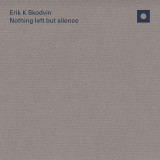
'Nothing left but silence' is Erik K Skodvin’s third solo album for Sonic Pieces and his most quiet to date. Subtitled as "Musical improvisations and quiet collages from the subconscious”, Skodvin reduces his instruments to guitar, reverb and amp - and creates a skeleton of eight hypnotic ragas that meanders in an eternal loop between ephemeral and singular.
Only on the horizon it’s possible to sense that Skodvin has also touched the neoclassical terrain in earlier productions - on Nothing left but silence, however, he acts as a twilight player who is not afraid of the coldness of endless space and who knows how to subjugate the shadowiness of the visible world. Carried by the noise of the amp and the occasional click of the effects pedals, a monolithic, reduced blues emerges, whose mediumistic quality nevertheless reveals that Skodvin's music always comes from the body - and as such is always searching for space. A space that - in this case - blends the vastness of the Norwegian steppe with the brittleness of American wasteland (as if Deathprod and Loren Connors were one and the same person), creating a persistent state between deceleration and absence of presence - that leads Skodvin ever closer to the inner essence of sound.
Initially recorded at Saal 3, Funkhaus, Berlin by Nils Frahm in 2015, the album has itself been subjected to silence as a forgotten relic, re-found and now released in a time where it might connect more with the contemporary state of mind. Welcome to the entrance to the periphery.
Following nearly 20 years of working together as a trio, and numerous cross-collaborations in different configuration between them, Ideologic Organ presents Placelessness, the debut full-length by Chris Abrahams, Oren Ambarchi, and Robbie Avenaim, comprising two long-form works at juncture of ambient music, minimalism, rigorous experimentalism and improvisation, and machine music. Having carved distinct pathways across a diverse number of musical idioms for decades, Chris Abrahams, Oren Ambarchi, and Robbie Avenaim are each, respectively, among the most noteworthy and groundbreaking figures to have emerged from Australia's thriving experimental music scene. Ambarchi and Avenaim first encountered Abrahams when seeing the Necks - the project that has served as the primary vehicle for his singular approach to the piano since its founding in 1987 - together during the late 1980s, not long after having met in Sydney's underground music community. The pair's collaborations date back more than 35 years, criss-crossing Ambarchi's pioneering solo and ensemble work for guitar and Avenaim's visionary efforts for SARPS (Semi Automated Robotic Percussion System), robotic and kinetic extensions to his drum kit. In 2004, fate brought the three together in a trio performance at the What Is Music? Festival, the annual touring showcase of experimental music founded and run by Ambarchi and Avenaim between 1994-2012. For the nearly two decades since, Abrahams, Ambarchi, and Avenaim have intermittently reformed in exclusively live contexts, in Australia and abroad, cultivating and refining the fertile ground first tilled in that early meeting. Placelessness is the first album to present this remarkable trio's efforts in recorded form. Placelessness is the joining of three highly individualised streams, working in perfect harmony; the point at which friendship, mutual respect, and decades of creative exploration produce a singular spectrum of sound. Featuring Abrahams on piano, Ambarchi on guitar, and Avenaim on drums, the album's two sides draw on each artist's enduring dedication to long-form composition. Its two pieces, Placelessness I and Placelessness II, initially began as a single, 40 minute work, before being divided and reworked into distinct, complimentary gestures for the corresponding sides of the LP. Beginning with restrained clusters of reverberant piano tones, Placelessness I progresses at an almost glacial pace, with Abrahams' interventions increasing met by sparse responses, darting within vast ambiences, on guitar and percussion by Ambarchi and Avenaim. Remarkably conversational within its convergences of tonal, rhythmic, and textural abstraction, over the work's duration a progressive sense of tension unfurls and contracts, refusing release, as each of the ensemble's members contribute to an increasingly tangled sense of density at its resolve. While an entirely autonomous work, Placelessness II rapidly realises a distillation of the energy hinted at across the length of its predecessor. Following a luring passage of harmonious calm, Abrahams' launches into shimmering lines of repeating arpeggios, complimented at each escalation of tempo by Avenaim's machine gun fire percussion work and Ambarchi's masterful delivery of tonality and texture, as the trio collectively generate dense sheets of pointillistic ambience within which individual identity is almost lost, before slowly unspooling into unexpected abstractions and dissonances that deftly intervene with the work's inner logic and calm. What could easily be termed a maximalist take on Minimalism, Placelessness is a masterstroke of contemporary, real time composition, that blurs the boundaries between ambient music, experimentalism, free improvisation, and machine music. Drawing on Chris Abrahams, Oren Ambarchi, and Robbie Avenaim's decades of respective solo and collaborative practice, and the culmination of nearly twenty years of working together as a trio, it's two durational pieces - Placelessness I and Placelessness II - take form with a startling sense of effortlessness and grace, neither shying away from explicit beauty or rigorously tension within their forms.
Tbilisi based label Domain Records launch new, only vinyl series! Cobert, label’s dear friend and one of the best in game returns on Domain Records with his solo EP. Finally, we are happy to share 5 tracks that are perfect definition of “Mind and dancefloor music”. Dedicated to the childhood idol...
Boy Harsher, Portishead, Thom Yorke, Radiohead, Beak>, ERAAS, SUUNS. Over the past seven years, Public Memory's distinctive use of analog synthesizers, electronic beats mixed with organic percussion, lo-fi sound design, and gritty ambience has created a singularly eerie and shadowy world. The first seconds of Public Memory's new record, Elegiac Beat, thrust us immediately into that world. We are in media res, with a feeling of sudden movement from a sensible point A to B. Given some time however, we realize that there is something askew–a bit of brightness here, some shadows pushed aside, some jazz and funk amongst the dub and Krautrock. This is an unfamiliar, ambiguous mood that pushes Public Memory towards new ground. We still drift past the clouded lights and hollowed out buildings of previous albums, but with an occasional bounce in our step now, a bit of golden haze around the edges. First single "Savage Grin" cements this clearly. The track has a jazzy, trip-hop flavor, albeit filtered through Public Memory's narcotic, hazy lens. We could be in a hotel lounge in the alps somewhere on holiday, or out of time in a majestic, sparkling ballroom. But we still have the feeling of being haunted, or perhaps even hunted in some way. This feeling intensifies and comes to a head towards the ever-darkening end of the track, leading directly into "Afterimage", in which someone almost imperceptibly sings "I hear them coming" in a twisted, auto-tuned flail. Second single "7 Floor" begins with flanged drums and damaged synthesizer stabs, evoking a kind of apparition floating towards us in the mist. As the track moves on there is, similarly to "Savage Grin", a contrast in feeling between a cold exterior roaming and an interior, warmer, human place. This time however, we move from the colder to the warmer as the synths from the track's beginning make way for a Rhodes-style organ and backing string synth, infusing an unexpected sense of peace. But like "Savage Grin", the track moves to its end through an in-between place beyond the haze. Faded and distant synthesizers meld with voices–human, or perhaps otherwise–that beckon us, or perhaps warn us. We can't be sure which. Third single "Far End Of The Courtyard" brings us closest to classic Public Memory territory with hip-hop beats, chopped and screwed samples, lo-fi ambience, and ghostly electric pianos complementing the vocals. There is darkness, perhaps more here than in the previous two singles, but with a crucial moment of uplifting lightness so subtle it may be missed upon first listen. As an inverse to both "Savage Grin" and "7 Floor" we end with brightness, the jazzier side of the record pushed to the forefront as the track fades away on that golden haze. In the end though, the haze may be just that: a vapor, a mist, a slight dusting of some other world on top of the degraded one Public Memory so effectively portrays. Elegiac Beat is between two places, and as it straddles the line between the two, we are uncertain if the light it brings shines directly from the sun, or if it is dimly reflected through that majestic ballroom world. For fans of 1990s Bristol trip hop, coldwave, and Thom Yorke's The Eraser
RIYL: Sigur Ros, Explosions in the Sky, Bark Psychosis, Caspian, Mogwai, This Will Destroy You. Exclusive vinyl colour (Opaque Mix Hellfire), limited to 1000 copies, and features a gatefold jacket, printed two-sided Euro sleeves, four art prints, and download code. Breaking from the strange monotony and abnormal norms that took hold during two years of pandemic life, Hammock returns with Love in the Void, an album that looks to the future, seizes the present, and unabashedly relishes the experiences and bonds that bring meaning to our days. Known for crafting orchestral works of stirring cinematic ambience, on Love in the Void the Nashville-based duo of Marc Byrd and Andrew Thompson bring guitar-forward, heart-pounding urgency to songs that shout through and shatter the static of complacency. Since forming as Hammock in 2003, Byrd and Thompson have released 14 critically-acclaimed albums and are renowned for their unique talent for bringing inexpressible emotion to life. The Covid-19 pandemic followed closely after one of Hammock’s career-defining works, the Mysterium, Universalis, and Silencia trilogy that chronicled the incomprehensible loss of Byrd’s 20-year old nephew. At their homes and apart, Byrd and Thompson then recorded Elsewhere, an album of shimmering ambience that channelled alienated longing and displacement into avenues that gave way to worlds and possibilities yet realized. Shaken awake and needing to break free of frustrations and longings, Love in the Void pulses with an unbridled spirit for action and experience and a burning desire for connection. Across songs that hammer home the keenly felt emotions of life’s highs and lows, Byrd and Thompson crest soaring crescendos awash in reverb and delve to keenly felt moments of quiet introspection, with unflinching lyrics on tracks like “Undoing” and “Denial of Endings’’ that weigh choices made and circumstances that can’t be changed. Lush and dramatic string orchestration from Matt Kidd (Slow Meadow) and emphatic drumming from Jake Finch heighten the stakes in play, and Christine Byrd’s (Lumenette) ethereal vocals leave mysteries lingering in the haze. Love in the Void is Hammock’s loudest album to date, embracing daring and vulnerability with palpable vitality at its core, and moving into an unknown future without fear.
Dedicated to Nora Forster, John Lydon's wife of nearly five decades, who passed away on April 5th 2023! Public Image Ltd. (PiL) announce their 11th studio album and first album in 8 years, End of World, to be released on 11th August 2023 on PiL Official via Cargo UK Distribution, followed by a 37-date UK and European Tour. The band began writing and recording End of World in 2018, during their 40th anniversary tour.
After The Great Pause, the band regrouped in the studio and "there was just this massive explosion of ideas," Lydon says. The result finds PiL set to release 13 of the best tracks they have ever written. The announcement comes with the release of new single Penge, which John describes as, "something of a mediaeval Viking epic." Earlier this year, PiL released Hawaii, the most personal piece of songwriting and accompanying artwork that John Lydon has ever shared. The song is a love letter to John's late wife, Nora, who had been living with Alzheimer's since long and sadly passed away on April 5th this year.
A pensive, personal yet universal love song that has resonated with many since its release in January, the song sees John reflecting on their lifetime well spent and in particular one of their happiest moments together in Hawaii. The powerfully emotional ballad is as close as John will ever come to bearing his soul. "It is dedicated to everyone going through tough times on the journey of life, with the person they care for the most," John says. "It's also a message of hope that ultimately love conquers all. As I say in the song, all journeys end and some begin again, but this is the beginning of a new journey with us. And, oddly enough, as bad as Alzheimer's is, there are great moments of tenderness between us. And I tried to capture that in the song." Celebrating their 40-year anniversary in 2018, the band is widely regarded as one of the most innovative and influential bands of all time. PiL's music and vision has earned them 5 UK Top 20 singles and 5 UK Top 20 albums.
With a shifting line-up and unique sound - fusing rock, dance, folk, pop and dub - Lydon guided the band from their debut album First Issue in 1978 through to 1992's That What Is Not, before a 17 year hiatus. Lydon reactivated PiL in 2009, touring extensively worldwide and releasing two critically acclaimed albums This is PiL in 2012 followed by their 10th studio album What The World Needs Now_ in 2015, which peaked at number 29 in the official UK album charts and picked up fantastic acclaim from both press and public. (The album also peaked at number 3 in the official UK indie charts and number 4 in the official UK vinyl charts). What The World Needs Now_ was self-funded by PiL and released on their own label 'PiL Official' via Cargo UK Distribution.
In 2018 PiL celebrated their 40th anniversary with a career-spanning box set and documentary, both called 'The Public Image Is Rotten', and a 32-date UK/Europe tour, plus dates in Japan. John Lydon, Lu Edmonds, Scott Firth and Bruce Smith continue as PiL. They are the longest stable line-up in the band's history and continue to challenge and thrive. PiL will be touring the UK and Europe in September and October 2023.
Dedicated to Nora Forster, John Lydon's wife of nearly five decades, who passed away on April 5th 2023! Public Image Ltd. (PiL) announce their 11th studio album and first album in 8 years, End of World, to be released on 11th August 2023 on PiL Official via Cargo UK Distribution, followed by a 37-date UK and European Tour. The band began writing and recording End of World in 2018, during their 40th anniversary tour.
After The Great Pause, the band regrouped in the studio and "there was just this massive explosion of ideas," Lydon says. The result finds PiL set to release 13 of the best tracks they have ever written. The announcement comes with the release of new single Penge, which John describes as, "something of a mediaeval Viking epic." Earlier this year, PiL released Hawaii, the most personal piece of songwriting and accompanying artwork that John Lydon has ever shared. The song is a love letter to John's late wife, Nora, who had been living with Alzheimer's since long and sadly passed away on April 5th this year.
A pensive, personal yet universal love song that has resonated with many since its release in January, the song sees John reflecting on their lifetime well spent and in particular one of their happiest moments together in Hawaii. The powerfully emotional ballad is as close as John will ever come to bearing his soul. "It is dedicated to everyone going through tough times on the journey of life, with the person they care for the most," John says. "It's also a message of hope that ultimately love conquers all. As I say in the song, all journeys end and some begin again, but this is the beginning of a new journey with us. And, oddly enough, as bad as Alzheimer's is, there are great moments of tenderness between us. And I tried to capture that in the song." Celebrating their 40-year anniversary in 2018, the band is widely regarded as one of the most innovative and influential bands of all time. PiL's music and vision has earned them 5 UK Top 20 singles and 5 UK Top 20 albums.
With a shifting line-up and unique sound - fusing rock, dance, folk, pop and dub - Lydon guided the band from their debut album First Issue in 1978 through to 1992's That What Is Not, before a 17 year hiatus. Lydon reactivated PiL in 2009, touring extensively worldwide and releasing two critically acclaimed albums This is PiL in 2012 followed by their 10th studio album What The World Needs Now_ in 2015, which peaked at number 29 in the official UK album charts and picked up fantastic acclaim from both press and public. (The album also peaked at number 3 in the official UK indie charts and number 4 in the official UK vinyl charts). What The World Needs Now_ was self-funded by PiL and released on their own label 'PiL Official' via Cargo UK Distribution.
In 2018 PiL celebrated their 40th anniversary with a career-spanning box set and documentary, both called 'The Public Image Is Rotten', and a 32-date UK/Europe tour, plus dates in Japan. John Lydon, Lu Edmonds, Scott Firth and Bruce Smith continue as PiL. They are the longest stable line-up in the band's history and continue to challenge and thrive. PiL will be touring the UK and Europe in September and October 2023.
Label head DJ SUPERHERB debuts under this alias on Full Dose, in collaboration with fellow Glaswegian compatriot, TEN YEARS LOST. " Concrete City Merchandise " is a timely selection of iced out beats - a perfect companion to an unusually sweltering summer.
A surprising collision of minds has produced an album of near-horizontal belters. "Ocarina of Time", with its dusty vocal loops and shimmering high end induces a lazy euphoria like no other. The title's reference to Zelda aligns the pair with a long list of talented and game-obsessed beatmakers, matching the vibe of the track perfectly.
In an album clearly representing an evolution of the Full Dose sound, "Yeah"s dembow programming and stabby riff will be familiar to those who've been around since the beginning. Combine this with the clear G-funk influences found throughout, and you're on to a winner. "Pagan Golf" continues this amalgamation of styles, resulting in a sound that's perfectly Full Dose.
In a similar vein, "On the Rise" is as true to the West Coast sound as you're likely to find this side of the Atlantic. This hit sounds like the housier end of Stones Throw filtered through the mesh of the Glaswegian underground. Moogy synths carry loopy vocals, with the occasional fizzy and elongated riser to ensure you're not too deep in a trance.
Retaining these themes but slowing the pace right down is "Key Notez". Pulsating samples of running water sit low in the mix, providing a bed for the emotive pads and gently arpeggiated synth lines. The track somehow manages to combine elements of R&B with the more emotional end of electronic music, in a way that's rarely found."
- A1: We Crossed The Atlantic
- A2: The Love You Bring
- A3: When I Was Howard Hughes
- A4: Failed Adventure
- B1: Stars (Twilight Mix)
- B2: Grand Central
- B3: International Exiles
- B4: Merry-Go-Round
- B5: Radios Appear
- C1: City Terminus
- C2: Min Min Light
- C3: Oregon Snow
- C4: Cherry Lake
- C5: Blackout
- D1: Please Don’t Say Goodbye
- D2: Museum Station
- D3: Blue Train
- D4: You Were There
- D5: Something Better Beginning
Selected Songs 1997-2003 compiles some of the finest moments in the recording history of Hydroplane, the Melbourne-based indie-pop three-piece that operated alongside The Cat’s Miaow through the second half of the nineties. It’s the third release in what feels, now, like a loosely planned series by World Of Echo, documenting the music made by this group of friends in Melbourne sharehouses (The Cat’s Miaow’s Songs ’94-’98, 2022), or in the case of The Shapiros (Gone By Fall, 2023), while traversing the International Pop Underground.
Hydroplane would be familiar to anyone already following these breadcrumb trails – Andrew Withycombe, Bart Cummings and Kerrie Bolton were the group’s core, all members of The Cat’s Miaow. With Cat’s Miaow drummer Cameron Smith itinerant, having moved to London, the trio used this opportunity to expand their music. It’s a subtle, but important shift. If The Cat’s Miaow was about the perfect, minimalist, two-minute pop song, Hydroplane’s music was far more open-ended, embracing the loops and drones, sampled house-y shuffle beats, the burbling of a Roland Jupiter-4 synth, all of which the trio joined, effortlessly, to their endless capacity for moving, elegant melodicism.
They may have only planned to release one seven-inch single, but the sound Hydroplane created was so bewitching, so compelling, that the project’s lifespan ran for around half a decade, and they ended up releasing three albums, including a self-titled debut recently reissued by Efficient Space, and seven singles. There are all kinds of compelling things happening in the music compiled here – the hazy repetition of the gentler side of Krautrock is in here, somewhere, which also suggests Stereolab at their most intimate and disarmed; the gently drifting guitars, gauzy and oneiric, set the songs adrift and floating, each one lost in its own imagined, distracted world. Songs like “The Love You Bring” set indistinct tonal floats across dance rhythms, in a way not quite heard since My Bloody Valentine’s “Instrumental” – but with the added gift of Bolton’s gorgeous voice.
This loose coalition with dance music, and the quiet experimentalism at the heart of Hydroplane, also gestures towards peers like Hood, Acetate Zero and Other People’s Children, and releases on renegade labels like Wurlitzer Jukebox and Enraptured. Like those groups and labels, The Cat’s Miaow were reconciling independent pop music’s past – sweet melody and melancholy, chiming and droning guitars – with the futures promised by DIY electronics and nascent digitalia, the interface of indie and IDM that led to some of the underground’s most blissful, texturally swoonsome music. All that is here, but also, the poise of the melodies is pure Cat’s Miaow, though, with Bolton’s voice sailing, pacifically, over some of the most pared-down, gorgeous music made during their decade.
It was a time, too, when such music could make waves – “We Crossed The Atlantic”, one of their early singles, was picked up by John Peel, who played it repeatedly on his legendary radio show, the song reaching #13 on his 1997 Festive 50. That the song itself was a cover of a tune by 1960s Australian beatnik-pop-poet Pip Proud felt even more perfect – a group of outsiders paying tribute to another outsider, played on the radio one of the few broadcasters brave and human enough to take a chance on this music. But it was a time where everything was up for grabs, and genres were flowing into each other: folk songs went drone; indie re-discovered noise; ambient pop floated, again, out onto the dancefloor. And while they may have been sequestered away in Melbourne, Australia, Hydroplane felt core to that scene, a quietly driving force.
Compiling material from across their brief but mercurial career, this double album perfectly captures the magic and mystery of Hydroplane’s dreamlike, perfect pop songs.
Kombinat 100, the suspiciously band-like live act from northern shores, are set to unleash their eagerly awaited debut album ‚Wege Übers Land’ (ways across the land). Here, everything we know and love about these notorious dancefloor smashers reemerges from the studio, squeaky clean and freshly rinsed, polished and arranged. An irresistible retrospective of Kombinat 100’s countless live gigs, there is no other way this album could have come about: All of the four Mecklenburgers’ tracks have their origins on stage.
So don’t be surprised if you find yourself moshing along from beginning to end! Kombinat100’s eclectic mix and match of influences touches on more genres than you could possibly think of, from techno, house, dub and pop to jazz and beyond, interspersed with plenty of lovingly crafted moments of homemade bliss. And it is precisely those moments, when the boys reach for their acoustic sidekicks, from accordion and melodica to congas and hammond organ, that our hearts miss a beat. Unafraid to flaunt grand emotions, melancholic opener ‚Flieg kleine Taube’ (fly away, dove’) and the sun-drenched sounds of ‘Hanne Nüte’ meet their match in the rocking grooves of ‘Out Of My Space’. In-between, the boys invariably return to their gig-inspired dancefloor roots – ‘Woterfitz’, ‘Del Maritim’ and ‘Der Pomel’ are set to move your heart, feet and mind. So, finally: a breath of fresh, Open Air for your living room!
Kombinat 100, der bandverdächtige Liveact aus dem Norden, veröffentlicht nun mit "Wege übers Land" sein lang erwartetes Debüt- Album. Das, was bisher den Dancefloor zum Einstürzen brachte, bekommen wir nun sauber im Studio aufpoliert und arrangiert. Dabei handelt es sich um eine Retrospektive der unzähligen Live-Gigs der vier Jungs aus Mecklenburg. Ihre Tracks entstehen auf der Bühne, sind für die Bühne konzipiert. Deshalb muss es auch niemenaden verwundern, wenn man von Anfang bis Ende mitgeht. Kaum ein Genre wird ausgelassen, wenn Kombinat 100 seine Einflüsse aus Techno, House, Dub, Pop und Jazz reflektiert. Aber auch die heißgeliebten handgemachten musikalischen Augenblicke dürfen natürlich nicht fehlen. Denn genau dann, wenn sie ihre akustischen Instrumente, wie Akkordeon, Melodika, Conga`s und Hamond Orgel zum Einsatz bringen, schlägt unser Herz am höchsten. Diese Tracks stehen zu ihren großen Gefühlen, wie der melancholische Opener-Track "Flieg kleine weiße Taube" oder das sonnenverwöhnte Stück "Hanne Nüte". In der Mitte wirds dann mit "Out Of My Space" shufflig und rockig. Dominiert wird das Album jedoch durch die Tracks "Woterfitz", "Del Maritim" oder "Der Pomel", welche ganz klar für den großen Floor zugeschnittenen sind. Endlich: Kombinat 100 gibt uns ein Stück Open Air-Feeling für's Wohnzimmer!
- You Move Me
- Ask Your Mama
- C'mon
- The Wench
- Another School Day
- C'mon Get Together
- Tell Him
- Lightning
- Games Up
- Do It All Night
- Can't Let You Go
- Night Watcher
- Whole Lotta Woman
- Dynamite
- Let's Twist Again
- Hooray Hooray
- Where's The Party
- Shout It Out
Formed as The Age in the late 1960s in the gritty north London neighbourhoods of Wood Green and Tottenham, teen Glam band Hello signed to Bell Records after being auditioned at home by Argent’s lead singer Russ Ballard, the concept being that the band would be supplied with original material by former Zombies manager, David Blaylock, a sure-fire formula that gave them strong overseas followings. This essential compilation gathers the best of the singles they cut for Bell, as well as more obscure rarities, the resulting picture capturing the group in all their Glam Rock glory, from prime beginnings to bittersweet end.
Freak Frequency was a fitting title for the new material Greg Obis was planning for Stuck, the frenetic and twisted post-punk outfit he formed in 2018. Inspired by the doomy social economics of Mark Fisher’s Capitalist Realism, the bleak worldbuilding of horror games Demon’s Souls and Bloodborne, and the bombastic yet arty satire of Devo, Obis channelled his audio analogy into Freak Frequency, an album ringing out with explosive sounds and ideas.
Stuck formed after Obis’ previous projects, Yeesh and Clearance, called it quits in short proximity. Obis is on guitar and vocals, which span from booming theatrics to ecstatic yelps. The project’s rhythm section is completed by shoegaze guitarist-turned-chugging bassist David Algrim and tightly wound drummer Tim Green—also a graphic designer, and the artist responsible for Stuck’s distinctively unified visual aesthetic. Original co-guitarist Donny Walsh contributed freely inventive lines for the first few years of the project, including on Freak Frequency; Ezra Saulnier of Red Tunic, the newest member of the band, now brings calculated contrapuntal riffs to match Obis’ parts.
The building blocks of Stuck include the egg punk eccentricities of Uranium Club and The Coneheads filtered through noise rock power, à la Jesus Lizard or Slint; that melange is glittered with the precision microtones of Unwound and Women. “I want the feeling of immersion and chaos and tension, with a big guitar amp playing a big chord,” says Obis of his inspirations, citing friends and peers Cloud Nothings and Preoccupations. “But I want it delivered by having a lot of smaller points of light poking through.”
In fact, writing for Freak Frequency began while Content’s recording was still underway—beginning with “Scared,” which features acoustic layers under feedback squalls. “Time Out,” with motoric guitars in the sputtering lineage of Wire, was also composed in late 2019. Obis wrote it about the cycles of compulsion and shame woven into social media use, and the way negativity drives algorithmic engagement. It became an exciting exercise for the group in ramping up speed; “I thought I knew how far I could push Tim’s tempos,” Obis recalls. “But Tim kept insisting we do it 20 bpm faster than what I had. He is an absolute monster for playing that.”
Album opener “The Punisher,” a spiral staircase of disembodied guitars and rhythmic slams over a 2/4 beat, came in the aftermath of the January 6 insurrection. It felt immediately emblematic to Freak Frequency, and Obis describes it as his favorite Stuck track: one he wishes he could write again and again. “It hits all the boxes that Stuck can do: it’s goofy, but there’s a lot of intricate guitar interplay, and at the end, there’s a big payoff,” he explains. The last song written was “Do Not Reply,” a pre-album single that came to Obis after engineering for Melkbelly and channelling their earworm melodies. Algrim wouldn’t let it on the record unless Melkbelly’s front person Miranda Winters dueted on vocals; she was happy to oblige, and the gritty epic closes Freak Frequency.
With slippery snark, percussive heft, and funhouse mirrors of sludge, Freak Frequency delivers its needed screeds with gratifying nuance. If Stuck’s interpretation of this messed-up world goes down like a bitter pill, it’s only because its sugar coating is too delicious to keep from eating.
A little more than two years after the reunion album ‚The Art of Navigating by the Stars‘, which was received fantastically by the press, SIEGES EVEN released the follow-up ‚Paramount‘ in autumn 2007. The songwriting had started directly after concerts in Russia (Moscow), Greece (Larissa and Athens) and a double headlining tour with DEADSOUL TRIBE.
It was clear from the beginning that this album - the second with the new singer Arno Menses - would not be a concept album. Rather, the band put more emphasis on writing autonomous, partly shorter songs, which were not connected by any concept in terms of content.
For the production they decided this time to work with Kristian ‚Kohle‘
Kohlmannslehner, who had rather made his mark in the field of harder music. The production style was quite different from the work of Uwe Lulis on ‚The Art of Navigating by the Stars‘: There, a lot of the material was recorded live and without clicktrack, whereas Kristian Kohlmannslehner focused more on precision and modern editing techniques. Without judging which approach is the better one, one can say that ‚Paramount‘ sounds perhaps a bit punchier, more conducive to the somewhat altered songwriting and extremely transparent.
The lyrical spectrum ranges from experiences on the mountain Corcovado in the urban area of Rio de Janeiro (‚Iconic‘), human hubris (‚Paramount‘), the dropping of the first atomic bomb on Hiroshima (‚Bridge to the Divine‘) to personal narratives (‚Tidal‘ or ‚Leftovers‘).
‚Paramount‘, like its predecessor, was very well received by the press. The band embarked on a European tour immediately following the release of the album in the fall of 2007 and played at the renowned ‚ProgPowerEurope‘ festival in the Netherlands, among other venues. In 2008 followed a show at the ‚Rock Hard‘-Festival as well as three concerts in the support of the American AOR legend JOURNEY. The live album ‚Playgrounds‘, released in spring 2008, documents the concerts of this tour. The stars were actually aligned favorably for SIEGES EVEN, so it was all the more surprising that the band‘s journey finally came to an end at the last of the three support shows for JOURNEY in Bamberg in the summer of 2008.
„Paramount“ was not available for many years and was only released on CD in 2007.
After taking time out from working together to focus on separate musical projects, maverick composer Alan Roberts (Jim Noir) and crowd-rousing vocalist Leonore Wheatley (International Teachers of Pop / The Soundcarriers) have re-joined forces to introduce Co-Pilot. Each the other’s wing person, they’re plotting an escape through Manchester’s claustrophobic grey skies with the pencil case colour of a hand-sewn multi-coloured primary school patchwork quilt. “We are both the creators in charge of navigating Co-Pilot’s overall sound which changes from track to track,” Leonore hints at what to expect. “There are about 6 different genres on one album, it's a pick n mix record!”
Happy in the haze of many boozy hours the album was recorded over just a few months whilst holed up and hanging out in Al’s city centre Dookstereo studio. The former Mill allowed the pair to relax, laugh and create without constraint. Armed with their original demos and vocal recordings from Al’s flat, they’d nip by the offie to pick up some Dutch courage before setting to work: building arrangements from a drum beat and basic chord pattern, the pair were so in tune they rarely spoke, allowing only the music to lead the way. “We’d communicate through nods of agreement or grimaces of dismay,” Leonore recalls. “Using the instruments with Al in production mode, we let the sound dictate the process whilst being drunk enough to follow it.”
The sound of life coming full circle after honing their separate crafts, Leonore had previously played keys and vocals in Jim Noir’s live band before moving on to front International Teachers of Pop for two critically lauded albums of joyous dancefloor filling bangers - their self-titled debut (2019) and Pop Gossip (2020). During that time Al would further expand Jim Noir’s universe with AM Jazz, which was celebrated as the no.1 album in Piccadilly Records’ ‘End of Year Review’ (2020), followed by the Deep View Blue E.P. (2021) cementing his status as one of Manchester’s finest songwriters.
As Leonore added her vocal magic to Al’s early demos of what would eventually become Co-Pilot’s ‘Spring Beach’ and a crooked original version of closing track ‘Corner House’, the vibe was prophetic “like the ending of Grease as Danny and Sandy take flight through the clouds”, letting their imaginations fly. The songs were the catalyst to spark a new phase of the pair working together, picking up where they left off. “From messing about with sounds during rehearsals in the very beginning it was always clear we liked the combination of sounds we made,” Leonore recalls.
Powered by a ‘try anything’ approach, Co-Pilot blends the musical DNA of what you’ve come to expect from each of the pair’s previous flight paths. “Whatever is switched on or nearby gets used. There's no 'correct' for us. If it sounds good, record it,” Al tells. United through typically turbulent wonky pop and lurking samples, whether culled from 70s TV themes or recreations of past and found sounds (see Al’s 60s tropicalia guitar on ‘Brick’, or the innocent ‘Swim to Sweden’ which opens with an ice cream van jingle Al recorded from his bedroom window) their process offers up a bucket load of Easter eggs. The album even features snippets from dearly departed pal Batfinks whilst ‘Motosaka’ is perhaps the most expensive 2-minutes on the album, featuring a Columbia Records Japan-cleared sample of Ryuichi Sakamoto’s ‘Thousand Knives’. Its synth squelches and Tom Tom Club funk also received the blessing of Haroumi Hosono, Godfather of Japanese Electronica, who agreed to being sampled in an original version of the song. “We just kept listening back and hitting gold,” Al recalls. “I was thinking ‘yeah, not sure what this is but I like it! We were buzzing with what we had made.”
But the sound wouldn’t come without self-imposed instrumental challenges. Thanks to an old mellotron sample on ‘Move To It,’ the moog riff and nautical accordion breaks on ‘Swim To Sweden’ and the 6/8 and 7/8 jaunt of ‘Brick’, time signatures were lovingly skewed to create Co-Pilot’s unique mood. “It was a bastard getting the drums right,” Leonore reveals, “but I like the wonkiness”. Levelling up through the lyrics, the words of smoky and evocative ‘She Walks In Beauty’ are based on a Lord Byron poem, with the sentiment of remembering Leonore’s late grandparents. “I wanted to see how much I could get away with just singing on one note, and how I could harmonically change everything else around it vocally,” she says. Elsewhere ‘Can You See’ was written from the perspective of a concerned sister to a brother which tells of keeping someone safe. “The lyrics are quite metaphorical about day-to-day happenings, people loved and lost. Others are rhythmic nonsense! It’s up to the listener to figure out what’s true.”
It’s clear from Al’s productive production techniques and Leonore’s knack for vocals and lyricism, Co-Pilot’s course is engineered by two aeronautically adept sonic storytellers. “We share a pretty similar sense of humour,” Al tells, “It is funny listening to this quite serious album but knowing we were giggling as we recorded it all. It’s been great to have another brain to bounce off.” Their destination might be unknown, but the clouds are about to part for a sound that is light years ahead. “You'll like at least one song,” Leonore suggests, “and hopefully them all.”
Next up in Veyl’s ever-evolving and diverse catalog comes of an experimental sonic experience from Llimbs.
The project of Hagen Ebejer, he began making music in the early 2000’s and started Llimbs in 2016, which allowed him to officially release music and perform live, making his debut at Berlin’s legendary Tresor. Now he arrives on Veyl with Midnight Amber, an 8-track album which fully realizes the Llimbs sound and vision. Inspired by dark and experimental sounds, Midnight Amber is a tour de force of genre-bending compositions, conjured using downtempo and dreamlike sounds which explore both the organic and digital.
The result is an undefinable affair which is both haunting and infectious at once. 'Unfold' commences the album with a soft yet powerful piece of melodic melancholy, inviting the listener through the gates and into the world of Llimbs. 'Divergent' picks things up with a ritual work of stirring chants which leads us to the evocative chords on 'Origin'. Finishing off side A is 'Absent', a slow burning rhythmic piece which encapsulates the listener, creating an almost nostalgic atmosphere for a time unknown.
'Phase' begins the B side with cinematic flair, creating a palpable tension which then evaporates into the ether. 'Eclipse' returns to a familiar dreamworld, traversing the skies which feel both familiar yet mysteriousbefore 'Fragment' dives deeper into a hidden universe of emotion, fusing ancient works with modern technology. Concluding the album is 'Midnight', a perfect end to a journey which exists at the intersection of the natural and mechanical, reality and surreality, marking a tremendous finale which can only lead to a new beginning.
2LP Glow In The Dark Vinyl Reprint limited to 3.000 units
IN FLAMES repräsentieren das Beste aus Vergangenheit, Gegenwart und Zukunft des Metal. IN FLAMES sind heute genauso vital und sogar noch energiegeladener als in den vergangenen Jahrzehnten, als sie Klassiker wie Come Clarity und Clayman herausbrachten.
Die Band hat sich einen umwerfenden Ruf erspielt, indem sie auf der ganzen Welt bei jedem erdenklichen großen Rock- und Metal-Festival mitreißende und inspirierende Auftritte absolvierte, als Headliner auf mehreren Tourneen auftrat und mit Bands wie Slipknot, Megadeth, Judas Priest, Killswitch Engage, Within Temptation und Lamb Of God tourte. Sie treten regelmäßig auf einigen der größten Bühnen und Festivals der Welt auf.
"Foregone", das furiose vierzehnte Studioalbum, verbindet die größten aggressiven, metallischen und melodischen Stärken ihrer bahnbrechenden Alben mit dem ausgereiften Songwriting ihrer postmodernen Ära. "Foregone" schafft es meisterhaft, wenn auch unwahrscheinlich, alle Seiten der In Flames-Fangemeinde mit kraftvoller Wucht zu bedienen.
Ein Gefühl von Stolz, Leistung und anhaltender Vitalität ist jedes Mal, wenn die Band die Bühne betritt, und überall auf "Foregone" zu spüren. Als Pioniere des Melodic Death Metal und innovative Verfechter des Grooves sind die Kunst, der Einfluss, die Größe und die Zukunft von In Flames so groß wie der Heavy Metal-Horizont selbst.
With »Discreet Music« (1975), »Music for Airports« (1978) and »Thursday Afternoon« (1985), Brian Eno invented a new music genre, Ambient Music, which he defined as »able to accommodate many levels of listening attention without enforcing one in particular; it must be as ignorable as it is interesting«. These versions performed and arranged by Dedalus Ensemble, according to the musicians and the critics who listened to it, goes beyond what we expect from it. A mental base that takes us far away. One of the only music without beginning or end in which we want to stay as long as possible.
The Dedalus Ensemble is a contemporary music ensemble based in Toulouse, founded in 1996 by Didier Aschour. Its repertoire includes works by classics of minimalism such as Christian Wolff, Phill Niblock, Frederic Rzewski, Tom Johnson, Moondog or Philip Glass.
“As I walk between the shadows I can see my full light” is the mantra and story Anna Vs June tells on “Ersi”, her debut on Subject To Restrictions Discs.
It is about personal thoughts and experiences on topics like faith and motherhood. Beginning with “As I Walk” as the clumsy state of any beginning, it continues with “Between The Shadows” where Anna relives her years as a teenager.
Continuing the narrative with “I Can See”, we listen to what it was like to grow up, finally ending with the yearning acceptance of the unknown on “My Full Light”. Anna Vs June’s musical language is based on her exploration of traditional Greek music, which she learns and whose characteristics she reinterprets in her own production. This album was produced in Anna’s studio in Athens during the months of lockdown.
- 1: I Am Not Going To Fall In Love With You
- 2: Memento Mori
- 3: That Would Only Happen In A Movie
- 4: We Interrupt Our Programme
- 5: We Should Be Together
- 6: Strike!
- 7: Science Fiction
- 8: Summer
- 9: Each Time You Open Your Eyes
- 10: We All Came From The Sea
- 11: Monochrome
- 12: Kerplunk!
- 13: Don’t Give Up Without A Fight
- 14: X Marks The Spot
- 15: You’re Just A Habit That I’m Trying To Break
- 16: Plot Twist
- 17: Whodunnit
- 18: A Song From Under The Floorboards
- 19: Telemark
- 20: Astronomic
- 21: Go Go Go
- 22: Once Bitten
- 23: La La La
- 24: The Loneliest Time Of Year
- 25: White Riot
- 26: Panama
- 27: Jump In, The Water’s Fine
- 28: We All Came From The Sea
- 29: Teper My Hovorymo
Throughout 2022, The Wedding Present’s ‘24 Songs’ series saw the legendary indie band release two new tracks a month as double A sided 7”s, ultimately creating a much-sought-after box set. David Gedge has now re-curated full-length versions of all twenty-four tracks for a new compilation album that will also comprise five bonus recordings including one featuring The Wedding Present’s first guitarist, Peter Solowka.
‘24 Songs’ was a doff of the cap to The Wedding Present’s ‘Hit Parade’ project of 30 years previous. That series proved to be a real milestone for the band with them becoming only the second-ever artist to achieve twelve Official UK Top 40 hits in a calendar year – at the time something that only Elvis had achieved!
David Gedge says: “When it came to compiling the ‘24 Songs’ album, I decided not to sequence the tracks in chronological order. With six sides of vinyl, you have six ‘beginnings’ and six ‘ends’ to play with, and I felt that the opportunity to build some kind of a musical journey was too good to miss! Listening back to this collection, I have to say that I genuinely believe that, for this project, The Wedding Present have recorded some of the best tracks in our history. I loved releasing the singles, but it’s satisfying to have them all rounded up together.”
“The idea of releasing another collection of twenty-four tracks did initially seem quite daunting,” admits David Gedge in the deluxe-CD sleeve notes but, with Jon Stewart (also of Sleeper) having joined the band at the end of 2019 and their subsequent writing partnership flourishing, he began to feel confident that they would be able to produce a year’s worth of music. And, with one of the UK’s most influential independent record labels by their side in Clue, a key partner to EMI North who will be distributing the record - there was no looking back.
[xa] 27. Jump In, The Water’s Fine [Japanese Edit]
[xb] 28. We All Came From The Sea [Utah Saints Remix]
Boris und Uniform mögen wie ein seltsames Gespann gewirkt haben, als sie sich 2019 für eine US-Tournee zusammentaten. Sicher, beide Bands nutzen die Kraft großer, explosiver Riffs, aber Boris' Rock-Heldentum, lysergische Ausbreitung und monolithischer Sludge beschwören eine andere Energie herauf als Uniforms mechanisierte Bombardements und rasende Angriffe. Als Boris jedoch Uniform einlud, als Teil ihrer Zugabe eine neu gestaltete Version ihres Klassikers „Akuma no Uta“ zu spielen, war die Chemie zwischen den Künstlern offensichtlich. Die Idee eines gemeinsamen Albums kam auf, und die Bands verbrachten das nächste Jahr damit, Songideen und Aufnahmen in ihren Heimstudios auszutauschen, bis Boris und Uniform ein Album hatten, das die furchtlose Erforschung und ungezügelte Kraft ihrer Live-Auftritte einfing. Sacred Bones Records ist stolz darauf, das gemeinsame Album Bright New Disease von Boris & Uniform zu präsentieren.
Bright New Disease beginnt mit der ersten Single „You're the Beginning“, einem wilden Thrash-Banger aus dem Boris-Lager. Von dort aus setzt das Album seinen unerbittlichen Angriff mit „Weaponized Grief“ fort, einem fiebrigen Mashup aus japanischem D-Beat und Boredoms' absichtlich unpassenden Klangtexturen. Es gibt keinen Moment, um die Trümmer zu sichten, bevor die Bands mit „No“ beginnen, einer bewussten Anspielung auf die japanische Hardcore-Hommage von Boris' 2020er Album NO. Entspannung kommt schließlich mit der eisigen Verstärkeranbetung von „The Look is a Flame", einem Song aus Boris' Feder, der Licht und Erlösung statt Düsternis und Grausamkeit beschwören soll. Verstärkt durch die kosmische Synthesizerarbeit von Randall Dunn und den ächzenden Bass von Steve Moore behält der Song das bedrohliche Timbre des Albums bei und deutet gleichzeitig die Möglichkeit der Erlösung an. Die Klangpalette des Albums wird in der zweiten Hälfte von Bright New Disease noch breiter, wie z. B. beim herausragenden Stück „Narcotic Shadow“. Mit Berdans modularen Synthesizer-Arpeggios, Boris' von Dark Wave/New Romantic inspiriertem Gesang und Greenbergs verzerrten Studiomanipulationen bietet der Song einen schäbigen und schwermütigen Kontrapunkt zu der ungezügelten Wut der ersten Hälfte des Albums. In ähnlicher Weise ist „A Man From the Earth“ weniger auf Katharsis als vielmehr auf eine düstere, tiefrote Interpretation von David Bowies Glam-Jahren fixiert. Aber diese Abweichungen dienen nur dazu, den Albumabschluss und die zweite Single „Not Surprised“ noch düsterer, qualvoller und erschütternder zu machen.
Single Blurb No 1: Single "THE UNKNOWN": With "The Unknown", British thrash masters EVILE not only present their album title track, but their most personal and haunting single-release to date! With milions of streams on Spotify, reams of video views and countless tours with acts such as Kreator, Machine Head, Vader, Overkill or festivals like Wacken and Bloodstock among many others, EVILE prove they are still leaders of the modern thrash metal movement!
Ltd Gold Colored Vinyl. Tony Allen JID018 is the eighteenth installment in the Jazz Is Dead catalog. This album features eight original songs by Adrian Younge and Tony Allen, the pioneering drummer of Afrobeat. Tony Allen JID018 was recorded during the summer of 2018 making Younge one of the last to record with Allen before his untimely passing in 2020. Allen never heard the finished recordings. Together, the two created a masterpiece that will stand alongside Allen's legendary recordings with Fela Kuti. All songs produced, recorded and mixed by Adrian Younge at Linear Labs, the preeminent analog studio of Los Angeles, CA.
“20 years ago, I dreamed a dream of creating a family of like-minded, crazy individuals from all corners of the planet. That dream was Crosstown Rebels. Over these years, I have forged beautiful friendships, discovered very talented artists and tried my best to help, advise and support some of the most colourful characters in dance music. It’s been 20 years of madness, magic and music. Now it’s been distilled into our own book to mark this milestone. I’m honestly surprised at how much I remembered!” - Damian Lazarus
For 20 years Crosstown Rebels has forged a path as one of the world’s leading electronic music labels.
Established in 2003, Damian Lazarus’ label manifesto has not changed. Discovering and nurturing new talent has always been the beating heart of the label, with a mission to soundtrack the future of the dancefloor and beyond. Introducing the world to the likes of Jamie Jones, Seth Troxler, Maceo Plex and Art Department was just the beginning. Today the roster is gloriously international, showcasing the truly global scene that Crosstown has shaped over the years.
Of course, there’s the parties too. The early Slash & Burn and Rebel Rave parties paved the way for Damian to create two of the world’s most cherished experiences, Get Lost and Day Zero, and in turn setting a benchmark for electronic music events worldwide.
Now the Crosstown Rebels story is told in a new 240 page book. 20 years of madness, magic and music. Starting right back before the beginning and taking us through to the present day, acclaimed electronic music writer Joe Muggs dives into the label’s history, interviewing Damian at length and revealing Crosstown’s story as never told before. The book brings together countless unseen photographs and artwork taken from the last two decades. It tells the story of how the dance underground battled and triumphed. This is a unique publication, not only for fans of Crosstown Rebels and Damian Lazarus, but also for anyone with an interest in independent label culture and the evolution of dance music over the last 20 years.
- Deluxe 240 page book
- Limited edition with only 400 copies on public sale
- De-bossed hardback cover, printed on FSC® certified papers, with alternating paper stocks, book ribbon and G.F. Smith endpapers
- Foreword by Pete Tong MBE
- Comprehensive label discography
- Printed in the UK by PurePrint, the first CarbonNeutral® printer in the world
Images Of Goo is what Munich sound bricolageurs Leo Hopfinger aka LeRoy (head of Das Hobos, H, Spiritual Emojis and others) and Cico Beck aka Joasihno (active member of The Notwist, Aloa Input, Spirit Fest and others) call their first musical dialogue in album format.
It is equally a dialogue with the elements of their sonic repertoire of echo variations and sonic shadows from the percussive instrument box. In their sum, a Wunderkammer of a panaudic, which can be approached and departed in six tracks per side.
There we pass a fuzzy factory flow music of sound tiles and find ourselves in the next station in a game of pot banging and gong shower with firecrackers and other sound explosions. Tinpan tinkertoy and sparkler warehouse become an offbeat downbeat of sound loops, and already we imagine ourselves amid the hammering and pounding of a magic sound forge at the center of the earth, which may be the center of a distant galaxy.
On side two, we enter a dripstone cave boogaloo ("Let's start tripping") and it drips candle wax from a vocoder space-age melody, emoting and coagulating into a Morse-coding cumbia chant. Wax music this is - music that grows out of itself, even if by the means of tape and collage.
At the end there is a music snake, which, having become snake music itself, disappears in front of our ears with a swing. And maybe this is the beginning ...
Label head J.Wiltshire returns to Super Hexagon with eight tracks of ambient techno-inspired music paying homage to some of the collective's early influences.
‘sun link' is laced with tensile rhythms, tinged with sun-washed melodies and plots a winding path through warm, Ultra Panavision soundscapes and icy dub techno sonics.
Mastered by Andy Miles
Design by Joe Gilmore
About J. Wiltshire:
Jacob Wiltshire has been releasing music and spearheading the Super Hexagon label and event series since 2015 - starting with the collective’s early showcases in Leeds and through to recent releases from Christoph de Babalon and Isabassi. ’sun link’ marks his return to the label for his third solo endeavor into the long play format.
- A1: 20
- A2: Little Love (Ft Roland Faunte)
- A3: I Looked Into Her Eyes (Ft Ural Thomas & The Pain)
- A4: Bonxair
- B1: Nomadics
- B2: See You Dancing In The Dark
- B3: Emotional
- B4: Don’t Smoke
- C1: Thinking Of
- C2: Memories (Ft Lord Apex)
- C3: Dreams
- C4: Mo1994By
- D1: Cuzratatat
- D2: Aye
- D3: When My Heart In Your Heart
- D4: Outro (End Of The Part 1)
Three years after his last album ‘I Need Space’, Mounika. is back on his favorite playground: electronic music, which arouses his curiosity since his beginnings. He is now ready to unveil ‘Don't Look At Me’, a new opus that takes us, by other paths, to his unique universe. Recorded during the confinement in the intimacy of his home studio, the French artist reveals little by little another facet of his artistic personality, more raw and affirmed, without totally abandoning the cottony sounds already proposed on titles like ‘Cut My Hair’ (diamond single) or ‘Tender Love’ (gold single). We discover sensitive compositions, still inspired by his love for trip-hop, piano and artists who made his musical culture during his youth: Moby, Ratatat, Air or Bonobo. After all, a Mounika. album without a tribute to these figures is not really an album...
But something new was needed to distinguish this opus from the previous ones. From the very first tracks, we can clearly feel this need for exploration that has always guided the French producer. ‘BonXair’ or ‘Nomadics’ take us, for example, in a more straight electronic, more heady than usual. In the same spirit, the rhythms close to the deep house of a track like ‘See You Dancing In The Dark’ offer to the album a new direction, and yet is quite representative of the work undertaken by Mounika. these last years.
In this new record that will also satisfy the fans of the first hour (a sample loop well felt, as on ‘Little Love’ or ‘I Looked Into Her Eyes’, always makes its effect), the French artist has also opened to collaborations of choice. Mounika. works on the heart, and thus wished to welcome those who have particularly marked him during his more or less recent discoveries. The American artist Roland Faunte lends his voice to the effective ‘Little Love’, while Ural Thomas & The Pain (discovered notably on the series ‘It's Bruno’) takes care of the chorus of ‘I Looked Into Her Eyes’. The British rapper Lord Apex delivers a spellbinding performance on ‘Memories’.
Finally, if you listen carefully, you can even hear Mounika. singing on some tracks... like ‘20’ or ‘Don't Smoke’. Put together, these appearances perfectly complement the energy transcribed by Mounika. throughout ‘Don't Look At Me’.
And what could be better than an amazing graphic universe to open the doors of this album like no other? Meet Carl & TJ, two cartoonish characters created in collaboration with Berlin-based artist Joe Taylor, who take care of guiding the listener through this new adventure. One is dreamy and contemplative, the other asks himself a lot of questions... and between them, they form a colorful duet illustrating with tenderness the universal emotions that punctuate this third opus, and that Mounika. will notably defend in the first part of Wax Tailor's French tour starting next April.
The successive pianos composing the productions of ‘When In My Heart In Your Heart’ then ‘Outro’ come, at the end of the record, to conclude the setting in orbit proposed by this ‘Don't Look At Me’. One more step in the sensory journey that Mounika. is committed, from the intimacy of her room to the international success, to build relentlessly.
Over the course of eight thrilling tracks, ‘Royal’ leads listeners on a topsy-turvy journey from Middle Eastern exotica to Spaghetti Western style scores, via scorching Mediterranean beaches.
Highlights of the album include the surf-meets-Western delights of “Silver Lining”, where irresistible guitar lines are piled high and topped with euphoric synths and rock drums, resulting in a timeless soundtrack for both headless nights in dive bars and heedless days at the funfair.
“Juda” follows, a deadly combination of Zepellin and Middle Eastern rock with subtle hints of synth funk. The track is named after living legend and Middle Eastern guitar hero, Yehuda Keisar, who also joins the band for this song, contributing a scorching solo. The thunderous guitar riffs are matched pound-for-pound by the irresistible percussive groove.
Boom Pam, widely renowned for their spellbinding Middle Eastern guitar music, have unveiled their highly anticipated fifth album, 'Royal'. Celebrating their twentieth anniversary, the Tel Aviv based band combine cinematic atmospherics and high-powered surf rock on
their first album for international ambassadors of Middle Eastern grooves, Batov Records.
Boom Pam “Rock the Casbah” on title track “Royal”, revealing another card up their sleeve, as they transform a famous 80's Israeli radio theme into a discoinspired super jam with a punk edge.
The band maintain their reputation for first-rate and distinctive surf rock on the fast paced “Daber Yafé” and “Monsour”.
The sonic imprint is both warmed and widened by the rare addition of a tuba supplying the lower frequencies.
Meanwhile, opener “Lava Tongue”, and “Golden” emphasize the melodic side to the band, conjuring dreamy sunset mirages to hypnotize the listener.
Boom Pam have established themselves as pioneers of modern Middle Eastern surf rock, combining sophisticated yet catchy guitar riffs, with roaring tuba basslines and fiery drums. In the past decade the band have frequently collaborated with and backed legendary Turkish folk singer-songwriter, Selda Bagcan, on stage and record, and performed at some of the world's most renowned festivals, including Primavera Sound, Lollapalooza, Fuji Rock, the Montreal Jazz Festival and many more.
An engaging listen from beginning to end, ‘Royal’ is the perfect representation of Boom Pam’s incredible 20-year journey, showcasing their superior skills in pushing the boundaries of their genre.
Black Vinyl[16,77 €]
A Colourful Storm presents Seance, a new set of songs by Maxine Funke.
Following a productive recording period beginning with Silk (2018) and ending with Forest Photographer (2020), Seance marks a remarkable levitation of Funke’s tender, softly spoken songcraft first documented on Lace (2008) and Felt (2012) into new creative heights. Folksong confessionals with the burden of memory. Ghostly confines, murmurs from the cracks. Soil, blood and skin. The beauty and mundanity of the everyday.
The voice of Funke is a distinctive instrument, one which perfectly elucidates her sometimes confessional, at other times deeply inward allusions to love, loss, joy and disquiet. Lyrics grounded in observation and adventure (“Eyeballs, asphalt, grass clippings, peppercorns”) unravel into uneasy truths daubed in self-consciousness and forbidden desire (“I’m not shy / There's just a sparkle in your eye and I don't feel right”). The simplest things can be the most difficult to express.
Opener ’Fairy Baby’ and ‘Homage’ are sensuous and probing, celebrating new beginnings while cautiously closing old chapters. ‘Quiet Shore’, a seven-minute reverie of guitar strum and poetry, conjures spirits long forgotten and shines as Funke’s first solo foray into longform songwriting. A perfect accompaniment to the album’s centrepiece, ‘Lucky Penny’, a euphoric, entrancing rush foreshadowing the delicate dreamspeak still to come.
An assertive, visionary recording by one of New Zealand’s most extraordinary voices, Seance is a lover’s lament, a revealing of self and a secluded wander through fields of enchantment.
- A1: Merry Christmas Mr. Lawrence Main Theme (From "Merry Christmas Mr. Lawrence")
- A2: Endroll (From "The Last Emperor")
- A3: Rain (From "The Last Emperor")
- B1: The Sheltering Sky Main Theme (From "The Sheltering Sky")
- B2: High Heels Main Theme (From "High Heels")
- B3: Wild Palms Main Theme (From "Wild Palms")
- C1: Acceptance (From "Little Buddha")
- C2: Snake Eyes Main Theme (Long Version) (From "Snake Eyes")
- C3: Bolerisch (From "Femme Fatale")
- D1: Bibo No Aozora (From "Babel")
- D2: Small Hope (From "Hara-Kiri (Ichimei)")
- D3: Yae No Sakura Opening Theme (From "Yae No Sakura")
- D4: The Revenant Main Theme (From "The Revenant")
From small beginnings in 1974 as a local cinema and university event, Film Fest Gent has grown yearly in stature and is now recognised as one of the major destinations for the film industry. A vital component is the celebration of film music in the shape of the World Soundtrack Awards which honours the very best composers at work in the world of cinema. In 2016 the award went to one of the most brilliant composers of his generation, Ryuichi Sakamoto. This is the first overview of his remarkable catalogue of film scores, fully approved by the composer and performed by the masterful Brussels Philharmonic under the baton of Dirk Brossé. Sakamoto was already a celebrated pioneer in electronic music and composer/pianist/singer in Japan when director Nagisa Oshima asked him to write the score for Merry Christmas Mr. Lawrence in 1983 and also to star alongside David Bowie. In a 30 year plus career since then he has worked with the cream of film directors including Bernardo Bertolucci (The Last Emperor), Brian De Palma (Snake Eyes), Pedro Almodovar (High Heels) and most recently Alejandro Gonzalez Inarritu (The Revenant). This compilation is a fitting tribute to his status as one of the greatest living musicians and film composers.
Paperback: 288 pages
Product Dimensions: 12.9 cm x 19.8 cm x 2.3 cm
• A global view of Discovery as a cultural phenomenon, placing the album at the centre of celebrity culture, fan clubs, video, the music business etc., while also examining its profound musical impact.
• An examination of Discovery as a flawed jewel, rather than blatant hagiography, as the album celebrates its 20th anniversary.
• An antidote to the revisionist history about Daft Punk and Discovery, from a journalist who has lived with the idea of Daft Punk for more than 20 years and interviewed the band.
Daft Punk’s Discovery is a record that looked into the future and liked what it saw; an album that predicted the electronic music explosion, YouTube and the end of privacy, while dragging soft rock back into vogue. Discovery was not only one of the best albums of the 2000s, it was one of the most prophetic, the kind of record that makes you wonder: how did they know?
You can draw lines from Discovery to Glass Swords, Kanye West, EDM, Autotune, iTunes, Beyoncé, Guilty Pleasures, social media and more. Discovery's footprints can be found all over the modern world but it also looked back to Daft Punk’s childhood, to Van Halen records, Japanese cartoons and even Johann Sebastian Bach.
Discovery was a record that confounded many fans when it was released in 2001, thanks to its blatant pop hooks and unlikely sonic bricolage. It was a record that was - and still is - widely misunderstood; Discovery’s impact has only become clear with the passing of time, as Daft Punk have been proved right time and time again.
This book is a homage to a fascinating, troubled beast of an album that casts a huge shadow over the 21st Century, as Discovery reaches its 20th anniversary.
“Incredible biography of the most colossal electronic act of our generation, by one of the best music writers of our time. Ben Cardew charts the history of Daft Punk from their humble rock band beginnings, to starting the groundbreaking and genre-defining Roulé records, to achieving stadium status as superhuman robot selectors.” Sinjin Hawke
Stimela were a popular and successful South African Afro-fusion outfit led by guitarist, vocalist, songwriter, producer and arranger Ray Phiri. The band was formed under the name ‘The Cannibals’ during the 1970s when Phiri got together with drummer Isaac Mtshali, keyboard player Thabo Lloyd Lelosa and bass player Jabu Sibumbe. They initially started out as instrumentalists, but later evolved to Afro-fusion when they joined forces with vocalist Jacob “Mparanyana” Radebe in 1975. The story of ‘The Cannibals’ ends when Radebe died in 1978 but the ‘Stimela’ story was only just beginning.
In 1979, after a life-changing experience in Mozambique (where they were stranded for three months) the band members had to sell all their belongings to take a train home. This trip was a watershed moment as it was here where they conceived the new name for the band: The Zulu word for “locomotive-train” STIMELA.
Stimela would soon become little short of an institution in their home country of South Africa. With soulful tunes and gripping lyrics, the band has recorded platinum-winning albums such as Fire, Passion and Ecstasy, Shadows, Fear and Pain & Look Listen and Decide. In addition to recording their own material, the group supplied instrumental accompaniment on albums by a lengthy list of legendary artists. Stimela would go on to gain global fame after being featured on Paul Simon’s iconic 1986 ‘Graceland’ album and the mega tour that followed.
Ray Phiri would enter into many successful collaborations with major acts and artists such as Harari, Joan Baez, Willie Nelson and Manu Dibango. In 2017 he was diagnosed with lung cancer and died at the age of 70. Phiri has received many awards in recognition for his contribution in the music industry, one of these is the Order of Ikhamanga awarded to him by the South African president. This was to honor his sterling contribution to the South African music industry and the successful use of arts as an instrument of social transformation.
Stimela is the tale of a South African band who have battled their way through dark days to take their rightful place in the forefront of the South African apartheid-era music invasion. One of their most memorable tracks “Whispers in the Deep” was even restricted from being broadcasted by the old South African Broadcasting Corporation.
On the album we are presenting you today (Fire, Passion and Ecstasy from 1984) the unique sounds of Ray Phiri’s Stimela are fully showcased. Expect infectious hypnotic build-up grooves, cinematic lowdown jazz-funk, Afro-soul, delightful reggae, gospel influences and funky synth-boogie sounds…all with a touch of early eighties new wave and hints of Island disco mixed with sensual bubblegum pop. It comes as no surprise that the album has now become a sought-after item due to its addictive and original-sounding nature, a must-have for any self-respecting record digger!
These recordings completely encapsulate Stimela’s fusion style. They managed to craft a modern South African sound that continues to influence SA musicians to this day. Never in a rush, yet always with a sense of purpose and direction – like the steam train after which they took their name.
Tidal Waves Music now proudly presents the first reissue of this fantastic Afro-fusion classic since 1990 (originally released in 1984 on Gallo Records) & this is also the first time the album is getting a release outside of the African continent. This rare record (original copies tend to go for large amounts on the secondary market) is now finally back available as a limited 180g vinyl edition (limited to 500 copies) complete with the original artwork. Also included is a double-sided insert containing rare pictures of the band.
Nicholas Allbrook is a Western Australian native and a highly-accomplished Australian songwriter, and multi-instrumentalist. Since the beginning of his artistic career in 2005, Allbrook has brought community and collaboration to the forefront of his artistic method. Whether it was in the poignant lyricism of his solo musical endeavors (Ganough, Wallis and Fatuna/Wabi-Sabi) or in the production style of his band POND's latest album '9', Allbrook shows a deep understanding of the human experience and the importance of art in modern society. He has collaborated with Australian and international musicians alike, from King Krule to Cat Le Bon, Holy Fuck and Cuco. Emotional, geological, psycho-geographical: this is the terrain of Manganese, Allbrook's fourth album away from Pond life. A psyche-pop wonderland, Allbrook's new solo album is the sound of a musician with a symphony in his back pocket, the Eighties history of Oz-rock in his rearview mirror and modern Australia in his sights.
As far as debut EP’s go, Life In Exile is a spellbinding introduction to the sounds of CRTB, a producer and DJ whose name is beginning to burn hot on the tongues of punters up and down the land, with good reason.
Characterised by pulsating, bass-driven grooves and masterful percussion, Newcastle born, London based CRTB has unveiled a monster of sound with his latest venture, where the producer flexes an ungodly blend of four-to-the-floor basslines, contagious melodies and synths to create a visceral soundscape, infectious enough to cause dance-floor destruction wherever these sounds land.
From the pulsating percussion of It Never Ends, to the rattling rapture of Nothing Moves You; a track that erupted in Mall Grab’s Melbourne Boiler Room set, this EP has energy coursing through its veins. This energy fuels the hypnotic sounds of Temper, and the radioactive rhythm of Nature Boy, where CRTB brings fellow heavy-hitter KETTAMA into the fold, resulting in an unforgiving, atomic anthem.
Life In Exile is an EP that sees its creator, CRTB, conduct wild, electronic experiments of sound to devastating effect: a sign of things to come from one of Newcastle, aka the Steel City’s most exciting prospects.
- 1: Colombus
- 2: Oiseau Du Matin
- 3: Les Amis De Poin
- 4: No California
- 5: Valparaiso
- 6: Cambodia
- 7: Autoroute
- 8: Pluie
The sun is shining, the heat is enveloping the body, something is still wrong. « L’Ete Suivant » (The Following Summer), the fourth album of the French quartet Limousine still maintains, as its predecessors, this mystery around indolent music difficult to circumscribe, between jazz, pop, easy-listening.
Limousine is a parallel project but essential for the musicians who participate. It is a recreation, a group without a singer, who over the years has become a ritual for these four boys trained in jazz, who have since drifted to many different shores, and who also follow varied careers - within well-known formations and with famous artists (Poni Hoax, Jeanne Added, Thomas de Pourquery, Joakim).
"The following summer ..." is today the fourth Limousine album after "Siam Roads" in 2014, already published at Ekleroshock. Where this previous project revolved around a trip to Thailand, an initiatory meeting with a traditional musician from the region of Isaan, this new record follows no path except that of fantasy and loitering. It is the result of a simple working method: the quartet met during the last three summers, between the end of July and the beginning of August, in the same studio of the 18th arrondissement of Paris.
In general, it is at this time of the season that Paris begins to empty and the atmosphere of the capital oscillates between lightness, spleen, impatience and serenity. It is among others what resonates in this disc: a form of graceful detachment, an exhilarating nonchalance.
With this release TAL delves deep into the very beginnings of Düsseldorf's post punk scene of the early 1980s. STUMM was the duo of Detlef Funder and Bernd Sevens who both would become pivotal figures in the tape underground movement of West-Germany, when they launched the SDV label in 1986. Individually they went on to produce boundary defying works as Konrad Kraft and Seventh Day respectively.
The material on this album was recorded by Funder and Sevens quite casually in 1980 in a rehearsal studio in the centre of Düsseldorf. Right from the beginning the two young musicians incorporated the atmosphere of the space in order to document the process of their sound experiments on a 4-track tape machine. For those recording sessions, which are now released for the first time ever on vinyl and download, Funder and Sevens managed to get their hands on a very rudimentary set of equipment consisting of merely a Korg MS 20 synth, a Roland CR 78 drum machine, a few electronic effects and a drum kit. The urgent and rough sound of the recordings imbues their production with a characteristic and era-specific edge that's hard to imitate today. Spontaneity and understatement were key elements in the brief creative period of STUMM. The recordings still have a uniquely dizzying quality and are somewhat of a basic blueprint for a lot of industrial/techno and post punk which was about to loom in all corners of the world. These tracks are also a testament to the vivid spark of a period in time that would soon be radically changed through the rise of digital technology.
Bernd Sevens: “Around 1980 there was a great musical awakening. Punk, New Wave, Industrial and of course Dub Reggae -- the electronic music blew us away. Everything we heard influenced us. Back then, cassette tapes were cheap and easily available. We could record our ideas on the spot and then copy and distribute the tapes. That's how it started. Giving it a go, experimenting, trial and error. The music you hear on the record was spontaneous and had no concept. Our collaboration was also not intended to be a permanent project. You could say we were dilettantes setting out on our journey, making it up as we went along. It felt like a beginning.”
"As I write these notes sitting on my balcony in July 2022, it has been more than 9 years since the release of my debut album and more than 11years since it was recorded, the time since has been a personally tumultuous period of twists and turns - retreat, reflection, realization, reassessment, therapy, triumph, trial and error - entangled in a decade-long creative block that had me questioning whether
I would ever be able to compose again and though I felt there was so much I wanted and needed to say, I felt I had lost my voice, or perhaps never had one in the first place. A constant knot had grown tighter and tighter within me over time, but I did not understand what had created it or how it might be undone. In 2018, shaken awake by the collision of two transients, I suddenly saw in a new light old
patterns whose familiar presences I realized I had felt for much of my life, but had until then never seen for what they were. Following a third, I finally found the humility to surrender, and as I began re- examining and confronting myself, I slowly started to discover new answers - and new questions to ask.
Then the Covid-19 pandemic happened, and the world stopped. Like so many of us caught in the new eerie calm, I retreated into inner spaces. I began revisiting sketches of ideas I had accumulated over the years, and finally, very, very slowly, new music started to come. " - Jussi Reijonen.
"Electrifying and deeply resonant, monumental and profoundly personal, Reijonen's five- movement suite is a beautifully crafted, remarkable journey of sound and emotion performed by a knockout nine-piece ensemble." - Monarch
"He's written one hell of a piece." - The Arts Fuse
"On this remarkable and ambitious new recording, Reijonen delivers an epic transcultural suite that feels as deeply personal as it is expansive and farreaching." - All About Jazz "a remarkable sophomore album" -The Boston Globe
"This is an album meticulously pulled together into a dense fabric of diverse musical threads. It merits repeated listening; with each fresh listen, the richness of Reijonen's intercultural vocabulary becomes more apparent." London Jazz News
"Even in our present jazz moment, when the art form is worldwide and vital, albums that come as complete surprises are relatively rare. Three seconds Kolme Toista is a stunner." Jazz Times
"Three seconds Kolme Toista is spellbinding from beginning to end, and full of virtuoso performances." All About Jazz
After her debut on Mannequin in 2019, Dissemblance now arrives on L.I.E.S. with her second full length of sombre, cold wave and emotional bedroom pop infused songs. This time around we hear the Parisen artist add a new arsenal of instrumentation to her repertoire, incorporating live drumming and a wide array of synthetic instrumentation on top of her drum computers providing a backdrop to showcase her stark vocal performances throughout the album.
Meticulously constructed, this record displays the full range of Dissemblance's musical dynamics as she pulls the listener into her universe where dreams and reality tread a thin line, one blurring into the next with no beginning nor end. From the plodding opener "Mercure" where tortured voices rise from a bed of pulsing synth tones, to the tribal drumming dreamscape conjuring rhythms of "Centauresse" or heart wrenching album closer "Bon Voyage" with its ghostly 1950s oldies arrangement and pop feel, Dissemblance expertly brings together a diverse group of styles and sounds from different areas of the electronic spectrum making them her own.
An extremely unique and strong display of modern minimal synth pop that pulls equally from the past whilst propelling towards the future. Limited to 300 copies worldwide.
- Max Cilla - La Flûte Des Mornes
- Kallaloo - Star Child
- Ophélia - Red Light Lady
- The Revolution Of St. Vincent - The Little You Say
- Wganda Kenya - El Testamento
- Richard Duroseau Et Son Orchestre - Compas Jupiter
- Max Et Henri - Mizik A Ka Kafé
- The Beginning Of The End - Come Down
- Afrosound - Caliventura
- Super Combo - Rosita Femme Chaud
- Camille Soprane - Si Ou Dit Ça Çé Ça
- Henry Guedon - Bomba Des Musiciens
- Simon Jurad Feat Les Frères Déjean - Mawa
- Wganda Kenya - Pim Pom
- Max Cilla - Crépuscule Tropical
- Gordon Henderson - More Power
- Shleu Shleu - Alouette
- Les Aiglons - Musiciens De Grande Classe
- Skahshah - Racine Core
- Afrosound - Salome
Rare Groove Collection Explore the fusion of world music with soul, funk and disco through the Rare Groove Collection. With this new volume, discover unique groove tracks straight from Jamaica! Fully remastered original versions Caribbean RARE GROOVE Discover the multi-cultural musics from around the Caribbean Islands. From Haïti to the Bahamas, passing by the French West Indies, this journey explores traditional rythms from Soca, Calypso or Biguine. Musicians as Gordon Henderson, Max Cilla or the band Skah Shah knew how to use Soul, Funk and Disco influences to create a unique groove with multiple faces.
The "Weimar EP" from singer/songwriter Albyrd is not only his ¦rst release under a new moniker; as his ¦rst selfproduced record, it also marks one of many new beginnings.
The end of the pandemic, the blossoming and withering of relationships - and of course, a tribute to his time in the city and how life's perspectives change. In 8 songs, Albyrd shows not only the range of his magni¦cent voice, but also how well soul and RnB can be interwoven with electronic music.
With a feature from Miles Bonny, Mr. Lumberjack Soul himself, this tape is de¦nitely one for the shelf. Artwork by Nänni Pää Mastering by Herb LF
RNT welcomes upstart Londoner Cody Currie into the roster with the groove-heavy Movin' Smoke EP.A precociously well-developed production talent, the young producer puts his penchant for deep house sample-scapes on full display here.
From the blissful lilt of the title track to the creatively crafted jazz funk of Infinity I & II through to the b-side bangers Make Love and Magic City, this record is a beautiful listen from beginning to end.
Ltd. Black. Zum ersten Mal auf Vinyl, zusammen mit den Farben aus dem November. 21 Jahren nach seiner ursprünglichen Veröffentlichung ist "Vengeance"; das glorreiche Debütalbum von Mystic Prophecy endlich auf Vinyl erhältlich! Das Album wurde ursprünglich 2001 veröffentlicht und 2003 von Nuclear Blast wiederveröffentlicht und war das erste Album mit dem zukünftigen Ozzy Osbourne-Gitarrenhelden Gus G. Endlich können alle Metal-Fans auf der ganzen Welt dieses Meisterwerk in die Hände bekommen.
Ltd. Gold . Zum ersten Mal auf Vinyl, zusammen mit den Farben aus dem November. 21 Jahren nach seiner ursprünglichen Veröffentlichung ist "Vengeance"; das glorreiche Debütalbum von Mystic Prophecy endlich auf Vinyl erhältlich! Das Album wurde ursprünglich 2001 veröffentlicht und 2003 von Nuclear Blast wiederveröffentlicht und war das erste Album mit dem zukünftigen Ozzy Osbourne-Gitarrenhelden Gus G. Endlich können alle Metal-Fans auf der ganzen Welt dieses Meisterwerk in die Hände bekommen.
Ltd. Black. Zum ersten Mal auf Vinyl, zusammen mit den Farben aus dem November. 21 Jahren nach seiner ursprünglichen Veröffentlichung ist "Vengeance"; das glorreiche Debütalbum von Mystic Prophecy endlich auf Vinyl erhältlich! Das Album wurde ursprünglich 2001 veröffentlicht und 2003 von Nuclear Blast wiederveröffentlicht und war das erste Album mit dem zukünftigen Ozzy Osbourne-Gitarrenhelden Gus G. Endlich können alle Metal-Fans auf der ganzen Welt dieses Meisterwerk in die Hände bekommen.
- A1: Merry Christmas Mr. Lawrence Main Theme (From "Merry Christmas Mr. Lawrence")
- A2: Endroll (From "The Last Emperor")
- A3: Rain (From "The Last Emperor")
- B1: The Sheltering Sky Main Theme (From "The Sheltering Sky")
- B2: High Heels Main Theme (From "High Heels")
- B3: Wild Palms Main Theme (From "Wild Palms")
- C1: Acceptance (From "Little Buddha")
- C2: Snake Eyes Main Theme (Long Version) (From "Snake Eyes")
- C3: Bolerisch (From "Femme Fatale")
- D1: Bibo No Aozora (From "Babel")
- D2: Small Hope (From "Hara-Kiri (Ichimei)")
- D3: Yae No Sakura Opening Theme (From "Yae No Sakura")
- D4: The Revenant Main Theme (From "The Revenant")
From small beginnings in 1974 as a local cinema and university event, Film Fest Gent has grown yearly in stature and is now recognised as one of the major destinations for the film industry. A vital component is the celebration of film music in the shape of the World Soundtrack Awards which honours the very best composers at work in the world of cinema. In 2016 the award went to one of the most brilliant composers of his generation, Ryuichi Sakamoto. This is the first overview of his remarkable catalogue of film scores, fully approved by the composer and performed by the masterful Brussels Philharmonic under the baton of Dirk Brossé. Sakamoto was already a celebrated pioneer in electronic music and composer/pianist/singer in Japan when director Nagisa Oshima asked him to write the score for Merry Christmas Mr. Lawrence in 1983 and also to star alongside David Bowie. In a 30 year plus career since then he has worked with the cream of film directors including Bernardo Bertolucci (The Last Emperor), Brian De Palma (Snake Eyes), Pedro Almodovar (High Heels) and most recently Alejandro Gonzalez Inarritu (The Revenant). This compilation is a fitting tribute to his status as one of the greatest living musicians and film composers.
With Cruisin', their second album for Telephone Explosion, Toronto's Bernice distils their playful sense of composition resulting in the most affecting collection of their young career. Across fifteen tracks, a special kind of contemporary, jazz-inflected pop unfolds, miraculous for being both fun and musically adventurous, all in the name of emotional resonance. Each groove in the bassbin is matched by a little scratch at the listener's heartstrings. The album was recorded at home with Phil Melanson (Sam Gendel, Andy Shauf) and Thom Gill (Beverly Glenn-Copeland, Joseph Shabason), led by songwriter and vocalist Robin Dann (Martha Wainwright) and producer Matthew Pencer, with additional contributions from longtime members Dan Fortin and Felicity Williams (Bahamas) being captured remotely.
Throughout their eleven years as a group, working at the intersections of several scenes and spotlights (many of which begin and end at Toronto's beloved Tranzac Club), Bernice have developed an idiosyncratic musical language that feels immediately inviting and wonderfully refreshing. The group's two previous releases, Eau De Bonjourno (2021) and Puff: In The Air Without A Shape (2018) received generous nods from both Stereogum and Pitchfork, who described the music as "unusually mesmerizing". With the songcraft a little more crystalline and the vulnerability notched up, Cruisin' feels like the right record to open Bernice up to a much wider audience.
Development of the album began in Spring, 2021 during a writing retreat at the family farm in Bond Head, Ontario. Members of the band luxuriated in slow time, tinkering with lyrics and melodies, sharing meals, knitting. From this communal gathering, the concept of 'dedication' emerged as a guiding theme. Specifically, developing songs in an almost epistolary form; as love letters or check-ins for friends, community members, pets and other more elusive acquaintances (a longtime working title for the project was 'Songs For People').
Lead single 'Underneath My Toe', one of the first pieces developed under this theme, finds the group at their most graceful and direct. Beginning with songwriter/vocalist Robin Dann singing simply 'Hi / I miss you all the time', the composition proceeds to shift subtly between soft jazz balladry and low-bit funk, revelling in the intimate beauty of a long-time-no-see letter to a dear old friend.
Though being a band that so deeply values the art of fartin' around, Bernice couldn't settle on such a straightforward approach. During the creative process, a clarifying question arose: 'Can you cruise to it?'. This somewhat ambiguous aesthetic criteria became a guiding light for the album. 'Sure, it's a beautiful song about building trust with a new nonagenarian friend... but can you cruise to it?'.
Case in point, both follow up singles, 'No Effort To Exist' and 'Second Judy', fall into a more nebulous, bewildering category of song. Undoubtedly affecting, emotionally charged, existentially searching, yet also undeniably juicy. Drum patterns skitter into place while synth tones shift on a dime to meet thematic twists. There's errant whistling and curious overdubs. Then in come elegant backing vocals, elevating the narrative while an unlikely, left-field groove is established. Miraculously, the listener is not just moved, but Cruisin'.
Therein lies the marvel of Bernice: they remind us that the rec room funk of Mario Kart 64 need not exist in mutual exclusivity to a rich tapestry of human emotions. Even as we live through this most cursed timeline, we can look into the heart of things, dwell on the challenges we're called to witness, and find a little levity to carry us through; grab a lil' mushroom and cruise the existential soup.
Of all the things that can and should and will be said of Sam Wilkes’ & Jacob Mann’s Perform the Compositions of Sam Wilkes & Jacob Mann, let’s begin at the beginning and acknowledge that it is an aptly named record indeed. An ideal collaborative effort (which is to say, greater than the sum of its parts), here we have two longtime friends, two luminaries of the New Weird Los Angeles — the experimental, genre-encompassing underground—who have, at last, devoted a full-length record to their signature musical admixture.
Since their meeting as USC music students (Wilkes studied bass, and Mann, jazz/piano), the two have, with a kind of ceaseless abandon, chased the music to the ends the earth — oftentimes quite literally; travel is a recurrent theme in Compositions’ track titles (Pre-board, Soft Landing, and Around the Horn), and the record’s second track, Jakarta, was sketched out in a hotel room in the city of the same name, where Wilkes and Mann were performing at a jazz festival in 2019. Having initially bonded over a mutual and abiding appreciation for the Soulquarians, the two have spent over a decade playing and traveling, together and separately, their styles coevolving all the while.
Across its thirteen tracks, Compositions captures the relaxed creative flow of two consummate musicians. Most of the record’s sessions (“four-to-five-day summits” in an apartment studio, occasioned by “blasts of inspiration”) began with casual improvisation, and, indeed, roughly half of the final material was composed in this manner: Wilkes and Mann squaring off, a Yamaha DX7 facing a Roland Juno 106, alternating leads, two co-pilots with no set course. And though the songs are polished to a shine, there are artifacts of the intimacy of these sessions. Yes It Is concludes with a snippet of just-intelligible studio chatter: “…A flat minor, then A major.” A figuring-it-out-as-we-go moment that briefly renders explicit the warmth, friendship, and creative freedom that is the album’s heart.
Liberation is the latest evolution by David West, a dedicated underground dweller and traveler with his groups Rat Columns and Rank/Xerox and previously spotted in Lace Curtain and Total Control. Many familiar elements of West's songwriting creep out from the speakers this time around, albeit in a sonically more adventurous and personal manner. Swathed in analogue and FM synths, pinned down by near-funk drum machines, and with a vision expanded into the past and future. While in previous incarnations, West's alienated and fragile vocal has battled with jangling guitars and distortion, Liberation sets free his woes and ruminations into space. Taking inspiration from the heyday of Mute Records, the beginnings of electronic dance music's rudimentary sampling, broken and sound art, Liberation's debut LP is 10 songs of the road, about the nameless ghosts on the highway, accidental lovers, the alienation of the stranger in a strange land, the unbearable weight of freedom.
Beginning with a curveball, Liberation's first vocal sets out the position of the forever-cuckold, the sad lover hanging on: Looking For A Lover combines a Roland 707's loping mid-tempo with creeped-out synth lines as West intones his intentions close to the ear. Continuing in a more baroque manner, Move Me makes astounding use of string samples and space, with esteemed engineer Mikey Young's (Total Control / Eddy Current Suppression Ring) production prowess making for a distilled yet inviting loneliness. Forget is the night-drive centerpiece of the album, a 7 minute that erupts into a nihilistic sub-disco darkness. A constant theme of Liberation is the friction between West's characters: a frustrated love in victim-status paired with a menacing intent. The adorable, fragile stalker in the moonlight, illuminated by Whatever You Want, a
subjugated protagonist offering they have while the city burns. The brightest pop moment of the album has this in abundance: Cold And Blue, a classic synth pop jam to be played on repeat til the end of time, like New Order played by one man in his bedroom, with no drugs for a cushion, coming down the stairs, she looks like a perfect fear and Im a monument to your existence. But West has moments of touching sincerity that speak direct to the listener, as in album highlight Leaves Falling; a sparse string arrangement frames his vocal, "why do I keep falling for you I must just really like to be alone." Liberation is the freedom from attachments, about how sometimes they're what you want most.
Spatial & Co Vol. 2 may well be the best album in the Spatial & Co series. It's absolutely flawless. Again created by French disco lord and Arpadys maestro Sauveur Mallia for French library label Tele Music in 1979, it leans far more into the space disco sound than the clean cosmic funk of its predecessor. And it's all the more thrilling for it.
Wide-eyed opener "Discomax" is starts as pure piano-disco brilliance with a bassline to die for before heading off into wigged out territory, all acidic squelches and jaw-dropping percussive breakdowns. Perfection. "Space People" follows, an eerie, half-beatless sci-fi synth workout played out against a hauntingly metronomic pulse for the first half - proper slow-mo space disco business - before the beat kicks in, the electric guitar solo wails beautifully and the bassline that emerges at its conclusion rides in on some other shit.
Closing out the A-Side, the six minute long "Bass Power" is, unsurprisingly, a deep, low-end roller with head-nod drums, whizzing synths, blissed out ambient vibes and Mallia's otherworldly bass playing super high in the mix. It's white hot funk, make no mistake, and it sounds like a re-geared library version of Roxy Music. Yes, *that* good.
Side B is laced firstly by "Holidays Morning", an emotional disco-pop groover, all electric guitars, skipping drums and synthy bleeps with more than a few moments of pure driving funk.
One for the deep heads, longtime favourite "Electric Maneges" follows, a bleepy, haunted dancehall gem, uncut tropical balearic-funk from another dimension. The sophisticated digi-soul of "Loving Discovery" comes on like a weird, interplanetary Sade instrumental, all swelling synths, warm keys and syrupy guitar rhythms. Hearing is believing.
Arguably saving the best til last, the fierce, proto-techno of "Exotic Guide" closes out this extraordinary set. The intro genuinely sounds like Detroit would a good few years later - just wild - before it glides into a driving percussive funk break complete with both stabbing, insistent synths and those of a more winding, laconic variety. The one complaint? It's over far too soon. Remarkable.
Sauveur Mallia is a crucial figure in the history of electronic and dance music and a hugely underrated French library bass player and composer from the Arpadys / Voyage crew. This is just the beginning of Be With's Mallia - Tele Music reissue campaign!
The audio for Spatial & Co Vol. 2 has been remastered by Be With regular Simon Francis, ensuring the punch of Sauveur's bass and those sick drums come through to the fullest. Pete Norman’s expert skills has made sure nothing is lost in the cut whilst the original and iconic sleeve has been restored here at Be With HQ as the finishing touch to this long overdue re-issue.
Since its beginnings, Hypnótica Colectiva has always shown a special interest in the music recorded and released in the city of Detroit.
A place with which we have both a blood and spiritual bond because of what occurred there socially and artistically during the 20th century.
This love led us to become ambassadors of what was happening there on a musical level, holding cultural events to screen documentaries translated into Spanish, as well as a number of themed sets at our events, dedicated motor city sections in our record shop or recently lectures on the history of the city and its music at the Museum of Illustration and Contemporary Art of Valencia (Muvim).
The time has now come to bring all this history, this musical influence, to the editorial section of our label HC records.
Detroit Legacy was born from the idea of capturing these influences on vinyl. Seeking artists from all over the world who share this passion that inspires them to create their music, what we can define as the universal Neo-Detroit.
For this first edition or first volume, the collective has enlisted in its ranks creators affiliated to the label who have shown us in their careers, this influence and this feeling.
Paul Cignol opens the record with Distance. From Dublin he offers us a track of warm sequences inspired by Deep Techno, with deep pads responding to organ keys and a subtle touch of 303.
Mallorcan LLuis Barcelo Sureda is responsible for the second track Funk Station. With a Techno Soul character that we might hear from Detroitish labels like Acacia or producers like Blake Baxter.
A real eminence in Techno is the Catalan Don Alex Martín, who already released in the mid-90s on Monssieur Garnier's label (France Communications). The Barcelona native brings his wealth of experience and wisdom through Megatech, which transports us to the spectrum of Derrick May’s Transmat who, in his day, was nicknamed "The Innovator". This track provides agile sequences of complex syncopated rhythms, combining with a dreamy Michigan style synth.
The anthem of the album comes from Ghent. The sublime Belgian creator, Mariska Neerman, once again makes our hairs stand on end and our hearts melt with a heavenly composition entitled Stellium.
No one interprets Neo-Detroit quite like Mariska, whom we baptise as a sovereign heiress of the genre in the world. If we have to think of an influence for this piece, we go straight to the genius of Detroit, the one and only Jeff Mills, in his most symphonic and harmonic facet of tracks released on his label Axis Records such as "The March", A Universal Voice That Speaks To All That Will Listen or A New Found Sense Of Being.
Some of these songs have been re-interpreted by world class philharmonic orchestras such as the Montpellier Philharmonic Orchestra at the 2005 Blue Potential (Pont Du Garde). Mariska's score in this song fuses organ keys with harmonic layers and violin - favourite instruments of the Detroitian extraterrestrial - with a harmonic result of strength and hope. An authentic anthem of classic emotional Techno.
Old School electro takes centre stage with the Master from Terrassa Ivan Arnau a.k.a. Dark Vektor. In the influence of Juan Atkins (the creator) as Cybotron or Model 500 and later creators who developed this sound like Aux 88. Metaverso Frik is a great recital of a urban poetry created and interpreted by Ivan, to completely devastating effect.
Croatian Bojan Jascur a.k.a. N-TER, closes the vinyl with We Will Emerge, in a exercise of vindication, a common weapon in the context of Detroit music. Raging, trippy electro in the purest style of Cosmic Force or Dynarec.
This first tribute to 8 Mile doesn't end with the vinyl, as 2 digital bonus tracks are included in the release.
We return to Barcelona with Pastin Futon in another sequence of consecutive oscillated rhythms oscillated much like Kevin Saunderson (The Elevator) in his day and the Techno Groove that we know today.
The most robotic touch of the release is the closer with this synthetic jigsaw puzzle of a track with echoes of the 1967 Detroit Riot, the Detroit Rebellion. Again produced by another Barcelona native, The Bandit (Dj Spy / Util Records). The sequences are very reminiscent of Arpanet and Drexciya.
The idea for the cover comes from Motor City itself by Jon Yowell, first cousin of HC records founder and head of HC records David Verdeguer.
Born, raised and a lifelong resident of Detroit, Jon is an enormously talented musician capable of writing lyrics, performing them on the mic and manipulating a number of stringed instruments as well as the drums, where he is a true master.
The cover is a tribute to the formative backgrounds of many of the city's musicians in every sonic trend. Wayne State University in the capital of Michigan.
Founded in 1868, it has offered didactic teaching to many of the city's musicians.
Not all of Detroit's creators went to university, and even less so when talking about Techno, many artists are self-taught or learned in a non-academic way, but it seems to us a good base to begin to highlight the origins of the city's music in a historic building, where those who have the opportunity to learn about music have been and continue to be educated.
The adapted designs are the work of our image manager Dani Requeni.
Mastering by Steve Voidloss at Black Monolith Studios in London (UK).
SUZI returns after the beautiful EP by Downstairs J with a new power compilation, including contributions by Beta Librae, Flørist, Dashiell, and Alfredo 92. This VA record explores modern takes on tech dimensions driven by catchy grooves.
The record debuts with an essential dancefloor killer by Dashiell, a talented musician based in Naarm/Melbourne. "Beep Beep" has a slick badass attitude driven by its frenetic core melody, accompanied by a spooky cosmic atmosphere, and makes this track an instant hit for dancefloors.
The second contribution, "Listening to the ants," comes from Beta Librae, one of NYC's most unique exports in recent years. Her signature contemporary deep-bleep-groovy sound can also be found in this composition, which has a slow and dubby feel filled with small insect-like details. A perfect symbiosis between organic and digital worlds.
On the flip side, we find "Dot Matrix," a groover by Berlin-based Flørist. Breaky tech-house with MPC-like swingy shakers channeling a balance between minimalistic details and slightly scratchy sound design. The bass-line, one of the key elements here, comes and goes over and over again, creating superb tension from beginning to end.
The final track "Bora" of the record comes from Copenhagen, by Alfredo 92. What makes this track so special is its propulsive drive without any kick drum in it. The association of wind-like groove elements combined with a subtle melody makes this beautifully crafted sonic tempest.
Curation and design by Cleveland. Mastering by Marco Pellegrino at Analog Cut. Distribution & production by One Eye Witness.
Everything eventually turns to dust. Everyone knows this, but few want to acknowledge that our time on this mortal coil is fleeting, preferring to remain in stasis, in hopes that "the end" will pass them by. Chicago trio FACS (guitarist Brian Case, bassist Alianna Kalaba & drummer Noah Leger) have been perfecting their brand of intense, cathartic post-punk over the course of four ever-evolving albums, beginning with 2017's "Negative Houses" thru 2021's landmark "Present Tense', which saw the trio dig deep into the gaping maw of a black hole & pulling back whatever debris they could grasp onto. Their newest "Still Life In Decay" comes as an addendum to the last album - a "post-event review" if you will. "Still Life In Decay" starts with a squall of white noise before collapsing into the band already locked into "Constellation"s lumbering groove, with Case's guitar a ghostly presence, appearing & disappearing in washes of gauzy feedback throughout the track. FACS have never been more locked in as a unit, and "Still Life In Decay" is a decidedly more focused effort. The apocalyptic chaos that defined their previous album "Present Tense" is waved away in favor of an examination of events with cumbrous clarity. FACS are a heavy band, but they don't necessarily FEEL like one (see side two's "Still Life", where Case's fluttering, melodic guitar lines are buoyed by the insistent, underlying pulse of the bass & drums). As a rhythm section, Kalaba & Leger dance & twist around each other like a double helix, forming the DNA of what makes FACS special. Collectively they approach rhythm from outside the groove as opposed to inside it, creating a lattice where Case weaves guitar lines like creeping vines, which makes the moments on "Still Life In Decay" where the band DOES lock in even more powerful. When the guitar punctures the lock-step swing of "When You Say", it hits like a hammer. Case utilizes his lyrics like a person suffering from anterograde amnesia; repeating phrases & holding onto old memories in a desperate attempt to avoid the slide into oblivion. Freeform poetic missives touching on themes of resignation, cynicism, class warfare, and a search for identity & meaning in a crumbling society; A primal desire to hold onto anything in a post-pandemic barrage of sensory overload. The album is a decidedly local affair; recorded once again at Chicago's famed Electrical Audio by renowned engineer Sanford Parker & mixed at his Hypercube Studio in Chicago's Ravenswood neighborhood & mastered by Matthew Barnhart at Chicago Mastering Service.
- A1: Laissez-Nous Rentrer Dans Vos Coeurs
- A2: Tina
- A3: L'homme Au Grand Chapeau
- A4: Une Vie Moderne
- B1: French Kiss
- B2: Telstar
- B3: Zazou Sur La Piste
- B4: La Ballade Des Cardiaques
- C1: La Noosphere, La Noosphere
- C2: Rue Merlan
- C3: Le Retour De L'homme Au Grand Chapeau
- C4: Anyhow For The Tennis
- C5: En Hommage A Pop Corn
- C6: Les Ergs N°1, 2, 3 Et 4
- C7: Outpop
- C8: Drone E. M
- D1: Tina Blues
- D2: Telstar Jungle
- D3: Zazou Sur La Piste
- D4: Sequences S.i.r
- D5: Night Tonight
- D6: Love In Loops
- D7: Some Never Fired
- D8: The Gause Mask Serves A Purpose
After the experience of Camizole, Dominique Grimaud began a new (and different) adventure in 1979 with Monique Alba. Alongside Gilbert Artman (Urban Sax), Guigou Chenevier (Etron Fou Leloublan), Jean-Pierre Grasset (Verto) and Cyril Lefebvre (Maajun), Vidéo-Aventures is composed of instrumentals capable of reconciliating Captain Beefheart, Henry Cow, Suicide and... John Barry. All with the backing of Rock In Opposition, which enabled this Musiques pour garçons et filles to become known worldwide.
“Let us enter your hearts”: is the request made by Vidéo-Aventures, and how can we refuse? Especially as Musiques pour garçons et filles, recorded by Dominique Grimaud and Monique Alba fifty years ago along with handpicked colleagues, is as fresh as ever.
1979: having improvised a huge amount (and how!) with Camizole, Grimaud tried his hand at composition and studio recording with Alba. Their first instrument was the AKS synthetiser, with which the duo recorded the instrumental tracks that were then offered to their comrades Guigou Chenevier (Etron Fou Leloublan), Gilbert Artman (Lard Free, Urban Sax), Jean-Pierre Grasset (Verto) and Cyril Lefebvre (Maajun).
At the end of the year, they all came into the studio for a week to record the eight tracks of this mini- album that Chris Cutler would issue a few months later on his label, Recommended. In France it was the beginning of the agitation around Rock In Opposition, to such a point that Musiques pour Garçons et Filles would rise to second place in the NME independent Charts. And this is hardly surprising...
For these instrumental miniatures (here with the bonus of rare archives, some of which are previously unpublished) are uncontrollable: electronics augmented by lap-steel guitar (“Tina”), cunning pop (“Zazou sur la piste”), mechanic sound (“Une vie modern”), street piano (« French Kiss »), disturbing atmospheres (“La ballade des cardiaques”) or something like a TV theme tune capable of adjusting all the colours (“Telstar”)... With such promising ingredients, why stop Vidéo-Aventures from entering?
MONO have long drawn equal inspiration from the light and dark of life, spawning more than two decades of musical turbulence and melodic transcendence. Heaven Vol. 1 marks the beginning of a new annual tradition from MONO: A new EP released on Christmas Day each year, leaning into the light at precisely the time when we need it the most - surrounded by loved ones and hopeful for what the turn of the calendar may bring us. Recorded by Takaakira `Taka' Goto at his home studio in Japan (with drums recorded by Amak Golden at Golden Hive Studio in Prague) - and mixed by Rafael Anton Irisarri and Jeremy deVine at Black Knoll Studio in New York - Heaven Vol. 1 finds MONO at their most hopeful and cinematic. Of each of Heaven Vol. 1's three tracks, MONO offers these words: Lucia: "This song was written when our beloved longtime partner Jeremy (the owner of our American label Temporary Residence Ltd.) welcomed his second child. The song is constructed with two parts; the first part celebrates the birth of a new life and the second part heads towards dreams and hope. We wrote this song with the feeling of Santa Claus riding a sleigh through the snowstorm, smiling, jumping into the swirl of pure white light and carrying many dreams." Smile: "We drew upon the snowy scenery of Christmas that we experienced when we were young. Your exhaled breath is white. Your heart is dancing in the endless silvery white world, and when you are about to grab the snow with your hands and turn around, your parents look back at you with a smile. We wrote this song whilst remembering moments like this." Silent Embrace: "Time passed and we became adults. Life is like climbing and descending many steep mountains, but the reason we're still able to continue walking is because of our loved ones, colleagues, friends and family who quietly stand by us and giving us courage and strength. We wanted to express our gratitude with this song." Limited (220 copies ww) Single Colour (Purple Vinyl) Edition!
The soundtrack to the 2006 film Casino Royale was composed by David Arnold and is Arnold's fourth soundtrack for the popular James Bond movie series. Frequent collaborator Nicholas Dodd orchestrated and conducted the score. The traditional James Bond Theme builds throughout the film before appearing in its full form over the end credits as track 25, “The Name's Bond... James Bond”.
Casino Royale takes place at the beginning of Bond's career as Agent 007, as he is earning his license to kill. The plot has Bond on an assignment to bankrupt terrorist financier Le Chiffre in a high-stakes poker game at the Casino Royale in Montenegro; Bond falls in love with femme fatale Vesper Lynd, a treasury employee assigned to provide the money he needs for the game. The film begins a story arc that continues in the 2008 film, Quantum of Solace.
Casino Royale is available as a limited edition of 1500 individually numbered copies on gold coloured vinyl. The vinyl package includes 2 printed innersleeve, a large movie poster and features secret inscriptions in the run-out groove.
Nach fünf langen Jahren seit ihrer letzten Veröffentlichung sind die finnischen Metaller Suotana mit ihrem neuen Album ''Ounas I'', das am 17. März 2023 erscheinen soll, aus dem ewigen Eis erwacht!
Diese Full-Length-Veröffentlichung ist eine epische Fortsetzung
der Reise, die der Vorgänger ''Land of the Ending Time'' im Jahr 2018 begann, und katapultiert die Band zu einem neuen Höhepunkt.
''Ounas I'' enthält 41 eisige Minuten Musik, darunter fünf brandneue Suotana-Tracks und eine "suotanisierte" Version von Summonings "Land of the Dead".
Musikalisch führt das Album neue Nuancen ein, bleibt aber fest im vertrauten SuotanaSound verankert, einschließlich melodischem Death Metal, melodischem Black Metal und einer Prise Power Metal.
Die bemerkenswertesten Unterschiede sind die Gäste auf dem Album. Keyboarder Veli-Matti Kananen (Kalmah) und Sängerin Mora steuern
ihre eigenen Talente bei.
Dino Lenny returns to Crosstown Rebels with his latest single ‘I’ve Learned That’, accompanied by remixes from Shadow Child and Jonathan Kaspar - plus his own take with Fed Conti.
A regular on labels including Afterlife, Ellum, Innervisions, and Diynamic, London-based Italian-born DJ/producer and Fine Human Records boss Dino Lenny’s solo and collaborative catalogue continues to grow as he features as one of the most consistent names within the worlds of house and techno. Having released his first EP on the label in 2019, he now returns to Damian Lazarus’ Crosstown Rebels for a second outing with the release of his touching new single ‘I’ve Learned That’ - which is one of a collection of records dedicated to his daughter - with remixes from Shadow Child, Jonathan Kaspar, and his own interpretation alongside Fed Conti.
Shaped by emotive piano keys, blooming strings and refined drums, ‘I’ve Learned’ showcases a rich and heartwarming production taking cues from dance music and beyond as the track’s uplifting and inspiring vocals carry the production across nine minutes of delight.
Beginning the transition towards more traditional electronic spheres, his remix alongside Fed Conti utilises vibrant guitar licks and a luminous bassline to head into a late-night discovery of disco influences. Next, Shadow Child’s ‘Classic Mix’ is a skippy house gem as bumping low-ends work amongst hazy chords, with Jonathan Kaspar’s remix moving deeper via surging synths for a hypnotic and thrilling ride to close.
Critically acclaimed rock group EELS announce
vinyl reissues of earlier records ‘End Times’, ‘Hombre Lobo’ and ‘Tomorrow Morning’, released via E Works / PIAS.
EELS will hit the road this Spring for the longawaited Lockdown Hurricane tour of Europe and North America, starting in March in Nottingham. The reissues follow EELS’ critically acclaimed
2022 record, ‘Extreme Witchcraft’, which found
praise at MOJO, NME, The New York Times,
Stereogum, SPIN and more. EELS have had one of the most consistently acclaimed careers in music. The ever-changing
project of principal singer / songwriter E (Mark Oliver Everett), EELS have released 14 studio albums since their 1996 debut, ‘Beautiful Freak’. In 2008, E published his highly acclaimed book,
‘Things the Grandchildren Should Know’, and starred in the award-winning ‘Parallel Worlds, Parallel Lives’ documentary about the search to understand his quantum physicist father, Hugh
Everett III. Single LP on standard weight black vinyl in a
gatefold sleeve with matt machine varnish.
CIRQLE & CYQLE are TRUENOYS & MIDM.
Together they have been working on different projects over the past years which saw them release albums & 12's on Pulver Records, DEEP MEDi Musik, Lovemonk Rec, Compost Records etc. They also created the soundtrack to Akala's novel "The Ruins Of Empires" together with Mala and directed by Andy Serkis which aired on BBC TWO.
Coming from different interests/styles it's only natural to bring these vibes all together to create their own style and that's how this LP sounds.
Productions & previous projects have been championed/played by the likes of Benji B, Moodymann, Mary Ann Hobbs, etc
Gondwana Records announces 'Goodbyes' the debut album from Estonian pianist and composer, Hanakiv, a deeply beautiful, meditative piano album featuring special guest Alabaster dePlume
"This is an album about healing. It is about saying your goodbyes to everything that doesn't serve you anymore. Each of these songs has a little goodbye in it. So, these are very beautiful and necessary goodbyes".
Hanakiv is a young composer and musician from Estonia (now based in London) who creates meditative piano-based ambient music with elements from classical and electronic music. 'Goodbyes' is her debut recording and draws on influences as diverse as Tim Hecker, Björk "Vespertine", Kara-Lis Coverdale, Arvo Pärt, Erkki-Sven Tüür and Aphex Twin as well as her own cultural heritage. Music has an important part in Estonian culture, especially choir music and its traditions, but Hanakiv also draws on her love of nature – the beautiful Estonian seaside and forests - and on her time in Iceland. However, it was moving to London that gave her the freedom to make her own music: "London gave me the freedom and courage to really be who I am (as a person and musically)" and her heritage and her new home both offer inspiration to Goodbyes, as Hanakiv moves between these two opposite places, a bustling metropolis and a small country full of nature, drawing inspiration from both as she sculpts her own voice.
Hanakiv had an unconventional music education – she started studying music at a school for handbells when she was nine and was part of a handbell ensemble for eight years. Starting on piano at the same time she went on to study composition at high school, and later at the Estonian Academy of Music. Eventually switching to electroacoustic composition, she studied in Reykjavik, and did internships in Malmö, and again Reykjavik before moving to London. She grew up in a musical family and her grandmother was a piano teacher and choir conductor.
"I would always ask her to take me to her choir rehearsals. I remember sitting under the grand piano, listening to the choir and just being mesmerised by the sounds. She also teaches in a local music school in the south of Estonia with about ten pianos, and I'd spend a lot of time there as well. I believe this was the starting point for me to get to where I am now. The last two pieces on the album (Home II and Home I) are composed in this same music school, so it feels like a full circle.
An early influence was Regina Spektor "the first artist who made me really want to play piano" alongside dream pop and Sigur Rós' as well as Estonian contemporary composers such as Erkki-Sven Tüür and Arvo Pärt. Later her studies took her to Reykjavík: "There is this amazing record shop called 12 Tónar in Reykjavik where you can drink espressos and listen to all their vinyls. I spent quite a lot of time there. There is something about Icelandic music that really excited me (the mixture of contemporary electronic sounds with melancholy, emotionality). This is when I started getting more into electronic music, and experimenting outside of classical music". Following a year long break from studying and inspired by making an electroacoustic soundtrack for a friend's abstract video, she was inspired to complete a masters in electroacoustic composition, diving fully into the worlds of sound recording and mixing and focusing on surround sound and how to position and move sounds in space, eventually doing an internship with composer Kent Olofson in Malmö, who works with multi-speaker systems for theatre productions. "I learnt a lot from him and he introduced me to some of my favourite plugins I've used a lot on this album as well."
Hanakiv moved to London just as the pandemic hit and found herself trapped, in a big new city, without any network or family and so just concentrated on making music. "I stayed in my room with my basic equipment - keyboard, Korg minilogue, SM 58 and Rode nt1-a microphones, laptop and speakers. I was reading about mixing, and trying out different things and listening to a lot of music to get the sense of the mixes and production and finishing a commission piece for 5.1 multi speaker system at that time so I set up four speakers for quadrophonic surround sound in my room!". She also found her way back to piano - my instrument – and started practicing again, playing the pieces she used to play, but also just improvising, and this was the beginning of what would become her debut album, 'Goodbyes'.
"I started appreciating everything about music again (even melody!), and everything just came together naturally, and I arrived to a point where I finally found my voice, and I had something that I wanted to say and share. I composed "Meditation I" first and started with "Goodbye", and all the other pieces are derived from that. Without "Meditation I" there wouldn't be this album. If you listen closely, "Meditation I" starts where "Goodbye" ends; "Meditation II" is born from "Meditation I".
But it was meeting Fi Roberts, a sound engineer based at the legendary Strongrom Studios in Shoreditch, London in December 2020 that really brought the album into focus. The pair bonded over an interest in prepared piano and a similar approach to production ideas (a balance of not overdoing it, and letting the songs speak for themselves, but being open to explore) and Fi became a friend but also a confidant and eventually co-producer
"Fi has a big impact on this record but I don't know how to really explain that properly. Of course, this album is sonically stunning thanks to her amazing mixes and recording skills, but she also believed in this music so much and it created something very special - that's difficult to measure with words. She just works with heart, and I really appreciate that"
This then is 'Goodbyes', the first offering from a major new voice, who offers us a meditative work full of space and tranquillity but also life and friendship and meaning. And we are very proud to welcome her to the Gondwana family.
- 1: Jamaica Girls - Rock The Beat
- 1: 2 Denroy Morgan - High On Your Love
- 1: 3 The Jiving Juniors - Sugar Dandy
- 1: 4 Chico Booth & The Upsetters - The Shimmy
- 1: 5 Lloyd Williams - Funky Beat
- 1: 6 Tommy Mccook & The Supersonics - Work Your Soul
- 1: 7 Owen Gray - Something To Remind Me
- 1: 8 Stranger & Patsy - Give Me The Right
- 1: 9 Vernon Vermont - Too Late
- 1: 0 Jimmy James - Come To Me Softly
- 1: Pat Kelly - Try To Remember
- 1: 2 Ronald Russell - Rhythm Hips
- 2: 1 Denroy Morgan - Happy Feeling
- 2: Marcia Griffiths - Everything I Own
- 2: 3 Norma Lee - Hurt
- 2: 4 The Downbeats - Thinkin' Of You
- 2: 5 Laris Mclennon - Turn Me Loose
- 2: 6 Jimmy James & The Vagabonds - Hey Girl
- 2: 7 Adiche - Chuka-Ja (Get Ready)
- 2: 8 Norma Lee - Rolling On
- 2: 9 Phyllis Dillon - Humpty Dumpty
- 2: 10 Hoagy Benson - Kangaroo
- 2: 11 Sugar Simone - Take It Easy
- 2: 1 Maynell Wilson - Motown Feeling
Rare Groove Collection Explore the fusion of world music with soul, funk and disco through the Rare Groove Collection. With this new volume, discover unique groove tracks straight from Jamaica! Fully remastered original versions Jamaican Rare Groove From the beginning of the 60s to the end of the 80s, Jamaica had a worldwide influence with ska, rocksteady, dub and reggae, but the small Caribbean island did not escape the global trends of funk, soul and disco. This mix of influences has given birth to unique groove songs, highlighted by this Jamaican Rare Groove. Double vinyl Jamaican Rare Groove From the beginning of the 60s to the end of the 80s, Jamaica had a worldwide influence with ska, rocksteady, dub and reggae, but the small Caribbean island did not escape the global trends of funk, soul and disco. This mix of influences has given birth to unique groove songs, highlighted by this Jamaican Rare Groove.
- 1: I Will Die With My Head In Flames
- 2: Stained Glass Windows In The Sky
- 3: I Didn't Mean To Hurt You
- 4: Space Blues
- 5: Autumn
- 6: Be Still
- 7: There's No Such Thing As Victory
- 8: Magellan
- 9: The Final Resting Of The Ark
- 10: Sandman's On The Rise Again
- 11: Don't Die On My Doorstep
- 12: Tuesday's Secret
- 13: Book Of Swords
- 14: Female Star
- 15: Fire Circle
- 16: The Darkest Ending
- 17: Bitter End
- 18: Rain Of Crystal Spires
- 19: Voyage To Illumination
- 20: Ballad Of The Band
Black Vinyl[26,85 €]
Following a run with Cherry Red Records that featured a potential major label jump, guitarist Maurice Deebank quitting and rejoining multiple times, several pop stardom carrots just out of reach, mixing battles with Robin Guthrie, and a shocking entry into the record charts, Lawrence (just “Lawrence”, like “Cher” or “Madonna” thank you very much) knew he would be making a change with his band Felt. He would be seeing out his plan of ten albums and ten singles in ten years alongside a new partner in Creation Records. This compilation beautifully captures those years.
Creation was beginning a rapid ascent at the time, with Alan McGee serving as its hyperactive mouthpiece and focal point. McGee was all in on the band. “Lawrence achieved pop perfection, a breathless rush of sensitivity and intelligence. It was too understated to be commercial, too art to go pop, too pop to go art—in other words it was a perfect combination of all the music I loved at the time.” McGee was thrilled to have what he considered a real star on the label, and Lawrence was equally thrilled to have such an enthusiastic cheerleader. He funneled that enthusiasm into some of the most focused songwriting of his career, as well as some of his wildest experiments, all of which are on display here.
Macht euch gefasst auf eine apokalyptische Reise!
"S.A.L.I.G.I.A" bietet komplexere Songs sowie düstere Texte über die Weltlage von heute und damals, und wie wir die Menschheit durch Krieg und Umweltzerstörung in die Apokalypse treiben.
Im Vergleich zum Debütalbum der Band bietet dieses Album ausgefeiltere Songs und Arrangements und ist eine musikalische Reise durch die Geschichte vom Mittelalter bis hin zur Gegenwart.
Anne's 7th Opus in 13 Years, Containing 6 Fantastic Covers and 6 of Her Own Songs, Recorded in One of the Most Prestigious Studios in Montreal with Her Original Blue Mind Team
Fresh from the success of her single "Killing Me Softly" from her previous album Keys to My Heart, Anne Bisson, singer-songwriter and jazz pianist, decided to perform and record more standards from the American jazz songbook, as well as new arrangements of classic songs that were so much a part of her teenage years.
Be My Lover, Anne's seventh album is, therefore, a savoury feast of original compositions and classic songs in her own bold new arrangements for acoustic trio. While still in the 'Smooth Jazz' genre, the presence of a Fender Rhodes, the legendary '70s keyboard, along with an electric bass, impart the album with quite a unique tone.
After over 18 months of musical experimentation and other creative endeavours, Anne once again brought together master drummer Paul Brochu (Gino Vanelli, Michel Legrand, UZEB) and proficient bassist Jean-Bertrand Carbou from France, for a series of informal sessions to explore the songs that were being considered for this seventh release.
These two musicians have been valuable collaborators for several years now. Paul has been featured on many of Anne's albums, notably Blue Mind, which made a huge splash when it appeared, with over 35,000 hard copies sold, while Jean-Bertrand's playing has also graced several of her albums.
Since 2009, the three have performed at several important venues, including Le Festival International de Jazz de Montréal, as well as other festivals in the United States and Mexico.
What holds them together is an evident complicity which is present from the very first notes. Their musical contributions are precise and deeply heart-felt. Their virtuoso playing greatly enhances these songs without turning them into mere technical exercises.
With precision playing, subtlety and attention to detail, as well as being recorded in impeccable High Definition, these songs will definitely please Anne's audiophile fans, while also appealing to a wider audience.
All About Ultimate High Quality CD (UHQCD)
Many years have passed since the birth of the Audio Compact Disc (CD) back in 1982. By use of High-Quality materials and a totally different manufacturing method, the definitive version of audiophile audio CD was born. Playable on any CD player, the Ultimate High Quality CD greatly surpasses all previous CDs before it!
The Ultimate High Quality CD (UHQCD):
UHQCD is a radical change to the CD manufacturing process itself. The conventional wisdom about CD manufacturing, which had remained largely unchanged across the world for over 30 years, has been exhaustively questioned. Through this effort, the ultimate in quality was attained - a level of quality that is certainly impossible to achieve with existing CD discs.
The Ultimate High Quality CD was developed through an effort to improve audio quality by simply upgrading the materials used in ordinary CDs to higher quality materials. For the substrate a high-transparency and high-fluidity polycarbonate (a type of plastic) of the type used for LCD panels was used, while for the reflective layer, low-cost, common aluminium was replaced with a unique and expensive alloy of high-reflectivity.
Differences in manufacturing methods:
Conventional CDs are produced using the technique of injection moulding to form "pits" of data on polycarbonate material. Metal plate on which "pits" representing audio source data are formed is used as a die. This is called the "stamper." Polycarbonate is melted at high temperature and poured into the die to duplicate the pit patterns on the stamper.
This method is efficient because it enables high-speed production, but it does not enable totally accurate or complete duplication of the pits on the stamper. As a melted plastic, polycarbonate is inevitably viscous, so it cannot penetrate completely into every land and groove of the tiny pits of the stamper.
The Ultimate High Quality CD photopolymer is used instead of polycarbonate to replicate the pits of the stamper. In their normal state, photopolymers are liquids, but one of their characteristic properties is that they harden when exposed to light of certain wavelengths. The advantage of this property, perfect replication of very finely detailed pits was achieved. Photopolymers in the liquid state are able to penetrate into the tiniest corners of pits on the stamper so that the pattern of the pits is reproduced to an extremely high level of accuracy. The Ultimate High Quality CD reproduces audio with greater precision and at a level that is impossible to achieve using conventional CD production technology!
Repress!
Spanish DJ and producer Indira Paganotto has unveiled her new EP ‘Lions Of God’ out on vinyl early 2023.
A four-track release, ‘Lions Of God’ kicks off with ‘Legend’, a pulsating, high-energy club cut that taps into Indira’s trademark ‘psytechno’ sound. Setting the tone for the rest of the record, it is followed by the slamming techno meets spiritual vocals of ‘Diabla’, hypnotic, highly emotive vibes of ‘Angels Never Die’, and finally the title track ‘Lions Of God’, a pumping techno cut laced with poignant breakdowns. She returns to KNTXT following last year’s ‘Himalaya’ EP.
“Indira is baaaaack!” says KNTXT label head Charlotte de Witte. “I’ve been playing these tracks for a while now and they’ve been slaying every single dance floor. In my opinion, this is her best work so far and I’m very excited to have her on board for another psytrance influenced EP on KNTXT. She’s been killing it worldwide the past couple of months and it’s been an honor to follow her journey from up close. Big things are coming!”
“‘Lions Of God’ EP is the perfect summary of these twelve years of experimentation with my own psytechno sound,” Indira adds. “You will enter the depths of my mind with these tracks, and you will experience four different stories but with the same beginning and end, the search for truth, hope and love. Low riding as if a horse were taking you running without stopping, you feel melancholic and hopeful, hidden messages that if you know me you will know why they are there! I hope you have a good trip with this EP! Thanks to my sister Charlotte and the whole KNTXT family for your support and sharing my music and my being!
One of Spain’s hottest young dance talents, Indira Paganotto’s sets are full of elegance and effusive danceability, with a quality selection that spans 90s disco to the most current underground techno music.
‘Lions Of God’ sees Indira Paganotto illustrate why she is one of the hottest names on the scene right now.
- 1: Song Against Sex
- 1: 2 You've Passed
- 1: 3 Someone Is Waiting
- 1: 4 A Baby For Pree
- 1: 5 Marching Theme
- 1: 6 Where You'll Find Me Now
- 2: 1 Avery Island/April 1St
- 2: Garden Head/Leave Me Alone
- 2: 3 Three Peaches
- 2: 4 Naomi
- 2: 5 April 8Th
- 2: 6 Pree-Sisters Swallowing A Donkey's Eye
- 3: 1 The King Of The Carrot Flowers Part One
- 3: 2 The King Of The Carrot Flowers Parts Two & Three
- 3: In The Aeroplane Over The Sea
- 3: 4 Two-Headed Boy
- 3: 5 The Fool
- 3: 6 Holland, 1945
- 3: 7 Communist Daughter
- 3: 8 Oh Comely
- 3: 9 Ghost
- 3: 10 Untitled
- 3: 11 Two-Headed Boy Part Two
- 4: 1 Oh Sister
- 4: 2 Ferris Wheel On Fire
- 4: 3 Home
- 4: April 8Th
- 4: 5 I Will Bury You In Time
- 4: 6 Engine
- 4: 7 A Baby For Pree/Glow Into You
- 4: 8 My Dream Girl Don't Exist
- 5: 1 Everything Is
- 5: 2 Here We Are (For W. Cullen Hart)
- 5: 3 Unborn
- 5: 4 Tuesday Moon
- 5: Ruby Bulbs
- 5: 6 Snow Song
- 5: 7 Aunt Eggma Blow Torch
- 6: 1 Little Birds
- 6: 2 Little Birds (Studio Version)
- 7: 1 You've Passed
- 7: 2 Where You'll Find Me Now
- 8: 1 Holland, 1945
- 8: 2 Engine
- 9: 1 A Baby For Pree
- 9: 2 Two-Headed Boy
- 9: 3 I Will Bury You In Time
- 9: 4 Garden Head/Leave Me Alone
- 9: 5 Two-Headed Boy Part Two
- 9: 6 I Love How You Love Me
- 9: 7 Engine
- 9: 8 Naomi
- 9: King Of Carrot Flowers Part Two
- 9: 10 King Of Carrot Flowers Part Three
- 9: 11 Oh Comely
The two full-length records that Jeff Mangum made as Neutral Milk Hotel sound both in and out of time. Like translations of a shared subconscious, 1996's On Avery Island and 1998's In the Aeroplane Over the Sea give voice to the perennial spirit of youthful epiphany, of beginning to see the world clearly, to process and express it-no matter when you encounter them. With lo-fi indie rock, accordion, singing saw, tape collages, the so-called "zanzithophone" and beyond, Neutral Milk Hotel created an eternal entry into their Elephant 6 scene and an enduring feeling of possibility. Mangum was born in the small city of Ruston, Louisiana, in 1970, coming of age within the '80s and '90s indie and punk undergrounds, a movement of teenagers recording in their bedrooms, sharing zines and trading tapes, listening to hardcore and experimental music on college radio. For all the mythology Mangum's elusive persona has accrued-particularly during the 15 years immediately following Aeroplane, when he abruptly left the band behind-it's the beguiling songs themselves that have resonated so deeply for generations. In 2011, Mangum collected nearly all of the band's recorded output in a limited-edition box set (self-released under Neutral Milk Hotel Records, a small operation helmed by Mangum and his mother) which is now re-pressed by Merge. // CONTENTS: Black matte box is a 2-piece telescoping casewrapped package. Outer shrink-wrap includes a front sticker with "Neutral Milk Hotel," and a back sticker listing box contents. The box set includes 2 folded posters, each printed one side and each 24 x 24 inches when flat, and 1 postcard, printed front and back with box set information and sized 3.75 x 5 inches. Vinyl records: 1. In the Aeroplane Over the Sea: LP is 11 tracks pressed 33RPM to black vinyl in a gatefold jacket + printed insert for full album download. --- 2. On Avery Island: 2-LP is 12 tracks pressed to double black vinyl in a gatefold jacket + 11 x 11 printed insert + printed insert for full album download. Sides A, B and C pressed 45RPM. Side D pressed 33RPM. --- 3. Live at Jittery Joe's: 12-inch picture disc is 11 tracks pressed 33RPM to a full color picture disc in a heavyweight poly jacket + printed insert for full album download. --- 4. Ferris Wheel on Fire: 10-inch is 8 tracks pressed 45RPM to black vinyl in a printed jacket + postcard insert + printed insert for full album download. --- 5. Everything Is: 10-inch is 7 tracks pressed 45RPM to black vinyl in a printed jacket + postcard insert + printed insert for full album download --- 6. "Little Birds": 7-inch is 2 tracks pressed 45RPM to black vinyl in a printed jacket + printed insert for full album download 7-inch housed in a heavy-weight poly jacket. --- 7. "You've Passed": 7-inch is 2 tracks pressed 45RPM to black vinyl in a printed jacket + printed insert for full album download. 7-inch housed in a heavy-weight poly jacket. --- 8. "Holland, 1945": 7-inch is 2 tracks pressed 45RPM to black vinyl in a printed jacket + printed insert for full album download. 7-inch housed in a heavyweight poly jacket.
- 1: A Letter To Dub
- 2: Champian Dub
- 3: Up And Down Dub
- 4: A Spliffing Dub
- 5: Crucial Dub
- 6: Dance Inna Dub Style
- 7: Aarafat Version
- 8: No Funny Dub
- 9: Next To Version
- 10: Live Good Dub
At the beginning of the eighties reggae music became increasingly in tune with what was happening in Kingston’s dance halls… probably more so than at any time since the sound system operators had started to make their own shuffle and boogie recordings in the late fifties. The international audience and the critics were too busy looking for a new Bob Marley to appreciate what was happening downtown and failed to acknowledge that this was a return to the real, raw roots of the music. Brash, confident, young record producers who were totally in tune with the youth audience stepped forward and seized the moment…
Oswald ‘Ossie’ Thomas began his apprenticeship in the music business at the age of
fourteen and served his time as a record salesman for Bunny ‘Striker’ Lee and Winston ‘Niney The Observer’ Holness before moving on to Miss Sonia Pottinger’s Tip Top Records.
“I ended up working in three record stores on Orange Street from 1976 to 1981… Yeah man! Me deh ‘pon me bicycle till I buy my motorcycle! Them days records were coming out left, right and centre… every day!” Ossie Thomas.
It was during his time with Miss Pottinger that Ossie began to produce records for
himself and in 1979 Ossie and Phillip Morgan began the Black Solidarity label based deep in the Kingston ghetto on Delamere Avenue. Phillip initially inspired Ossie to start the label and soon Triston Palma, Phillip Frazer and “a youth named Gary Robertson” joined in although Gary later left for Canada.
The Soul Syndicate rehearsed in the Delamere Avenue area and Tony Chin gave Ossie a cut of a rhythm that he used for Triston Palma’s ‘A Class Girl’… the label’s inaugural release. The record was a sizeable success and paved the way for hit after hit after hit on Black Solidarity. Ossie worked with just about everybody who was anybody during this critical period of the music’s development including vocalists Robert Ffrench, Little John, Sugar Minott, Frankie Paul and most notably Triston Palma.
For this release we have compiled some of the version sides to those releases. Dub still being an integral part of the Reggae Sound System Sound. So sit back and listen to what Black Solidarity, one of the most important and often overlooked labels were bringing to the dance, dubwise, back in those heady 1980’s times.
With grateful thanks to: Paul Coote, Nick Hodgson & Hasse Huss
- A1: Peter Brown - Burning Love Breakdown
- A2: The Rimshots - Do What You Feel, Pt 1
- A3: Lafayette Afro Rock Band - Hihache
- A4: The Beginning Of The End - Funky Nassau
- B1: Freedom - Get Up And Dance
- B2: Celi Bee & The Buzzy Bunch - Closer, Closer
- B3: Imagination - Flashback
- B4: T-Connection - Saturday Night
- B5: Koxo - Step By Step
- C1: Leon Ware - What's Your Name
- C2: Crown Heights Affair - The Rock Is Hot
- C3: Foxy - Get Off
- C4: Revanche - You Get High In N Y.c
- D1: Miami - Chicken Yellow (Let Me Do It To You)
- D2: Fire - You Don't Know
- D3: Amant - Hazy Shades Of Love (12" Version)
- D4: Jackie Moore - Old Time Sake
Rediscover the most sampled original titles in the history of music! After the success of the first 5 volumes Soul, Funk, Groove,Jazz and Reggae, the Sampled collection is back with a new volume: Sampled Disco Funk! Find original titles sampled by: The Prodigy - Beastie Boys - Tyler The Creator - George Michael - 2Pac...
Making Circles of Our Own is the new upcoming sophomore record from Northern Ireland's New Pagans. From the very beginning the Belfast’s indie rock outfit intent was clear: to fuse their collective creative experiences and emit a confidence in both their sound and aesthetic. New Pagans in essence is a movement, challenging issues surrounding relationships, equality and history all wrapped in massive riffs and soaring dynamics shaped into their own brand of alternative, post punk and indie rock — all encompassing on the bands incoming second album ‘Making Circles of Our Own’. With the dawning of 2023 on the horizon, New Pagans have been building off the success of 2020’s debut album ‘The Seed, The Vessel, The Roots and All’ - which helped secure them as winners of ‘Best Live Act’ at the NI Music Prize in 2020 - and emerge invigorated anew. Latest single ‘Better People’ is a stunning blast of positivity that celebrates their ability to pull together, create communities and look after one another. Often outspoken and not shy of protesting the dark themes that infiltrate modern Irish life, singer & lyricist Lyndsey Mcdougall implores us to endeavour to be just as the title suggests. And with this new era comes their staggering second album ‘Making Circles Of Our Own’, which sees the five-piece abandon the chaos of 2020 for a moment in search of hope in the future. Recorded and self-produced at Badlands Studios in the Glens of Antrim in Ireland (the band's HQ) by band members Cahir O'Doherty and Allan McGreevy, New Pagans continue to expand their DIY position. This time around they also invited Sam Petts Davis (Radiohead, Warpaint, Frank Ocean) to mix the songs and the result is an energetic and infectious collection of anthems.
Formed in 2007 in the Dolomite Alps region of Italy with a deep admiration for their native country’s hardcore punk luminaries in La Quiete and Raein, as well as eighties and nineties cult heroes in Negazione, Wretched and Indigesti. STORMO’s steady rise from unassuming beginnings has been one of consistently stirring song writing. Having amassed over 400 shows across Europe and the UK - including support slots to Converge, Full of Hell and La Dispute, as well as appearances at Fluff Fest - STORMO’s next chapter sees the band fully come of age. Lyrically, Endocannibalismo was written entirely in the band’s native tongue; partly as a byproduct of the albums nocturnal and instinctive writing process and partly in honour of their history as a band. Recorded and mixed by Giulio Favero (Zu) for mixing before being placed in the hands of Giovanni Versari at La Maesta for mastering, Endocannibalismo’s 11 tracks possess a crystalline clarity to service STORMO’s surging blastbeats, spiralling rhythms and noise punk cacophony, whilst staying true to the each songs deep seated primal nature. Seeking to tie together the whole process visually, STORMO took to artificial intelligence when creating Endocannibalismo’s art. Utilising specific prompts, the AI render was put through stages of mutation before culminating in its final form. A haunting graphic representation of living beings in a state of constant death and rebirth.
- A1: Al Norte 01 00
- A2: Into Love / Stars 05 44
- A3: Exit Strategy To Myself 03 08
- A4: Where You Find Me 02 31
- A5: Ship 04 04
- B1: Loose Ends 05 31
- B2: Into The Ice Age 06 21
- B3: Oh Sweet Fire 03 50
- B4: Ghost 01 23
- B5: Sans Soleil 03 16
- C1: Night‘s Too Dark 02 55
- C2: *Stars* 01 10
- C3: Al Sur 03 18
- C4: Into Love Again 05 08
Yellow Vinyl[37,52 €]
2023 Repress On Vertigo Days, the first album in seven years for The Notwist, one of Germany’s most iconic independent groups are alive to the possibilities of the moment. Their music has long been open-minded and exploratory, but from its engrossing structure, through its combination of melancholy pop, clangorous electronics, hypnotic Krautrock and driftwork ballads, to its international musical guests, Vertigo Days is both a new step for The Notwist, and a reminder of just how singular they’ve always been. Most importantly, the core trio of Markus and Micha Acher and Cico Beck are reaching out: as Markus reflects, “we wanted to question the concept of a band by adding other voices and ideas, other languages, and also question or blur the idea of national identity.”
It’s been seven years since The Notwist’s last album, Close To The Glass, and in that time the various members of the group have been busy with side projects (Spirit Fest, Hochzeitskapelle, Alien Ensemble, Joasihno), guest appearances, a record label (Alien Transistor), movie scoring, helping organise the Minna Miteru compilation of Japanese indie pop & running a festival (Alien Disko). Those divergent paths feed back into Vertigo Days in surprising ways, from its structure, built from group improvisations, with songs flowing and melting into one another in a collective haze, to its spirit, which feels refreshed and alive. There’s something cinematic about Vertigo Days too, reflective of the group’s time working on soundtracks, and reflected in the rich, moody photographic artwork by Lieko Shiga that adorns the cover.
The first sign of this newfound openness was the album’s lead single, “Ship”, where the group were joined by Saya of Japanese pop duo Tenniscoats, her disarmingly hymnal voice sighing over a propulsive, Krautrocking beat. Elsewhere, American multi-instrumentalist Ben LaMar Gay sings on “Oh Sweet Fire”, also contributing “a love lyric for these times, imagining two lovers in an uprising hand in hand.” American jazz clarinettist and composer Angel Bat Dawid adds clarinet to the spaced-out dream-pop of “Into The Ice Age”, while Argentinian electronica songwriter Juana Molina gifts some gorgeous singing and electronics to “Al Sur”. Saya also reappears as a member of Japanese brass band Zayaendo, who guest on the album. Throughout, The Notwist also capture the openness of their live performances, too, where they mix and link their songs in unexpected ways.
Indeed, what’s most impressive about Vertigo Days is the way it sits together as one long, flowing suite, the album conceptualised as a whole entity – it’s perfect for the long-distance, dedicated listening experience. This is also captured by the album’s lyrics, which Markus states, “feel more like one long poem.” The dimensions of that poem are multi-faceted, something intensified by the geopolitical weirdness of its times: “As the situation changed so dramatically, while we were working on the record, the theme of ‘the impossible can happen anytime,’ more about personal relationships in the beginning, became a global and political story.” But it also works at a level of poetic abstraction, such that each song gestures in multiple directions – the deeply private pans out to the global. The one certainty is that there is no certainty. “It’s maybe mostly about learning and how you never arrive anywhere,” Markus concurs. To sit within uncertainty is brave, but it’s also where we feel most alive, and Vertigo Days is an album that is brimming with life, with enthusiasm and love for music and for community, all wide-eyed and dreaming.
- A1: Al Norte 01 00
- A2: Into Love / Stars 05 44
- A3: Exit Strategy To Myself 03 08
- A4: Where You Find Me 02 31
- A5: Ship 04 04
- B1: Loose Ends 05 31
- B2: Into The Ice Age 06 21
- B3: Oh Sweet Fire 03 50
- B4: Ghost 01 23
- B5: Sans Soleil 03 16
- C1: Night‘s Too Dark 02 55
- C2: *Stars* 01 10
- C3: Al Sur 03 18
- C4: Into Love Again 05 08
Black Vinyl[26,85 €]
2023 Repress on Yellow Vinyl
On Vertigo Days, the first album in seven years for The Notwist, one of Germany’s most iconic independent groups are alive to the possibilities of the moment. Their music has long been open-minded and exploratory, but from its engrossing structure, through its combination of melancholy pop, clangorous electronics, hypnotic Krautrock and driftwork ballads, to its international musical guests, Vertigo Days is both a new step for The Notwist, and a reminder of just how singular they’ve always been. Most importantly, the core trio of Markus and Micha Acher and Cico Beck are reaching out: as Markus reflects, “we wanted to question the concept of a band by adding other voices and ideas, other languages, and also question or blur the idea of national identity.”
It’s been seven years since The Notwist’s last album, Close To The Glass, and in that time the various members of the group have been busy with side projects (Spirit Fest, Hochzeitskapelle, Alien Ensemble, Joasihno), guest appearances, a record label (Alien Transistor), movie scoring, helping organise the Minna Miteru compilation of Japanese indie pop & running a festival (Alien Disko). Those divergent paths feed back into Vertigo Days in surprising ways, from its structure, built from group improvisations, with songs flowing and melting into one another in a collective haze, to its spirit, which feels refreshed and alive. There’s something cinematic about Vertigo Days too, reflective of the group’s time working on soundtracks, and reflected in the rich, moody photographic artwork by Lieko Shiga that adorns the cover.
The first sign of this newfound openness was the album’s lead single, “Ship”, where the group were joined by Saya of Japanese pop duo Tenniscoats, her disarmingly hymnal voice sighing over a propulsive, Krautrocking beat. Elsewhere, American multi-instrumentalist Ben LaMar Gay sings on “Oh Sweet Fire”, also contributing “a love lyric for these times, imagining two lovers in an uprising hand in hand.” American jazz clarinettist and composer Angel Bat Dawid adds clarinet to the spaced-out dream-pop of “Into The Ice Age”, while Argentinian electronica songwriter Juana Molina gifts some gorgeous singing and electronics to “Al Sur”. Saya also reappears as a member of Japanese brass band Zayaendo, who guest on the album. Throughout, The Notwist also capture the openness of their live performances, too, where they mix and link their songs in unexpected ways.
Indeed, what’s most impressive about Vertigo Days is the way it sits together as one long, flowing suite, the album conceptualised as a whole entity – it’s perfect for the long-distance, dedicated listening experience. This is also captured by the album’s lyrics, which Markus states, “feel more like one long poem.” The dimensions of that poem are multi-faceted, something intensified by the geopolitical weirdness of its times: “As the situation changed so dramatically, while we were working on the record, the theme of ‘the impossible can happen anytime,’ more about personal relationships in the beginning, became a global and political story.” But it also works at a level of poetic abstraction, such that each song gestures in multiple directions – the deeply private pans out to the global. The one certainty is that there is no certainty. “It’s maybe mostly about learning and how you never arrive anywhere,” Markus concurs. To sit within uncertainty is brave, but it’s also where we feel most alive, and Vertigo Days is an album that is brimming with life, with enthusiasm and love for music and for community, all wide-eyed and dreaming.
Known for their dynamic sound and complex song structures, De Beren Gieren deliver an extravagant blend of polyrhythmic soundscapes and elitist twists, showing an ability to change mood in a way that constantly holds the listener’s attention. They effortlessly shift from more rigidly styled compositions to improvised sections and thus reveal the pulsating and ominous futuristic sound of a new world.
Produced by Dijf Sanders and Frederik Segers, ‘Less Is Endless’ is an ode to a universe teeming with life. Seen as an extension to the critically acclaimed 2017 album ‘Dug Out Skyscrapers’, it searches for vents through which life can emerge and evolve. The secret of communicating creativity can be found in the cultivation of the unfinished; the missing piece of the puzzle tickles the imagination more than the perfect end result.
From the psychotropic opener ‘A Funny Discovery’ and off-kilter piano rhythms of ‘Animalcules’ to the impressionist melodies and harmonic soundscapes of ‘Tuin’, De Beren Gieren give the music the space to breath and grow with every unexpected twist and turn. Elsewhere, ‘Guggenheim House’ is a lesson in the avant-garde, while ‘Gentse Leugentjes’ is a far cry from the traditional piano-bass-drum set-up, before the affecting ‘Moments Never a Moment’ and 18-minute ‘A Random Walk’ is an adventure in improvisation and electronics that defies any logical convention.
Forming in 2009, Fulco Ottervanger (piano, fx, synths), Lieven Van Pée (double bass, electric bass) and Simon Segers (drums, fx) quickly built a reputation across the Benelux region with their ‘must-see’ live shows and have since taken their transcendental live energy across Europe, Morocco and Japan and have performed at North Sea Jazz, Jazz Middelheim, Trondheim Jazzfestival, Ljubljana Jazz Festival, Moers Festival, Gent Jazz, Kanazawa Jazz Street and Eurosonic.
The trio’s breakthrough came with second album ‘A Raveling’ (2013) which received rave reviews, and the following year, a live recording with Portuguese trumpet player Susana Santos Silva was released as ‘The Detour Fish’ (2014) on the Clean Feed label, gaining De Beren Gieren further widespread recognition. Their 2015 release ‘One Mirrors Many’ was lauded by Dutch magazine Jazzism and signalled the beginning of their electronic quest, finding its maturity in ‘Dug Out Skyscrapers’ (2017). In 2019, they celebrated their 10th anniversary, releasing the limited edition ‘Broensgebuzze EP’.
De Beren Gieren have collaborated with renowned jazz artists including Louis Sclavis, Ernst Reijseger, Joachim Badenhorst, Marc Ribot, Jan Klare and Jean-Yves Evrard.
I Tried Words began with words, mostly words. Moriah Bailey laid the lyrics out on several pages. The words were crafted over many months with feedback from Bailey’s sister and input from the growing melodies and body of music that began to take shape around those words. The contributing musicians, Sarah Reid (violin), Ryan Robinson (percussion), and Ricky Tutaan (guitar), recorded their own parts and sent them to Bailey. The result is lush, intricate arrangements that complement a solid base of harp and vocals. The album explores dualities: yes/no, future/past, darkness/light, giving/taking, masculinity / femininity, wants/needs. It is in part about Moriah Bailey’s struggle to learn healthy boundaries but also about the harmfulness, complexity, and entanglement of many social boundaries. With I Tried Words, Bailey relies less on experimental sounds, and instead, lyrically focuses on her struggles to understand and make sense of definitions and expectations of femininity. It explores these themes through an intimate narrative of losing oneself in a relationship and struggling to find a way out of the relationship. The album ends with a triumphant goodbye and joyous new beginning in “Not Staying”. She sings: “I contorted my body and stretched myself thin to form a bridge between now and when. So, as I'm gathering my strength to say goodbye, please quit saying I should've tried
Landing on Cosmocities right on cue for the summer season ahead, Japanese producer Masumi Nishimura alias Inner Science deals out a new entry into his shimmering, shape-shifting mindset. Flying us off to a soothingly dreamy and colourful headspace, bristling with vibrant sound design minutiae to wrap your ears around, Inner Science exhibits the elevating power of his music through three original joints, complemented by two exquisite remixes from multi-faceted British genius Joe Goddard and Giegling staple, Map.ache. The acid-infused glitter of “Unfold” paves the way with understated bravura; a piece of squelchy yet dazzling nature, organically making the rounds between propulsive club music territories and exotica-laced cascades of sound. “Quiet Track 3” follows a similar course with its phantasmagoric landslides of chimey melodies and driving bass traction on stealth mode, all scudding and mingling with haiku-esque spiritual balance, while “Never Fade Away” blows the winds of poetic transcendence through a finely engineered mix of forward-racing groove and a honey-dripping, rainbow-like shower of elementally lush textures and envelopes.
Flip it over and here’s Joe Goddard taking “End of the Beginning" for a slower, slightly less sign-busy jaunt across sun-soaked clearings and pastures. Laying further focus and emphasis on the synth work and build-up here, Goddard channels Inner Science's many facets and wildland-like exuberance through a more directed, further orchestrated pathway. Tackling “Momentary Spread”, map.ache treats us to a further dynamic, floor-friendly approach, routing its listener onto proper functional, gridlocked tracks. Bleached-out pads evaporating into aether as the bass etches into your mind with durable effect, it’s a proper oneiric roller that engulfs you down its gushing throat of faded escapism and brittle, post-discoid melancholy
- A1: Logic System - Unit
- A2: Kraftwerk - Computerwelt (2009 Remastered
- B1: Whodini - Magic's Wand
- B2: Rocker's Revenger - Walking On Sunshine (Feat Donnie Calvin
- C1: Klein & Mbo - Dirty Talk (European Connection
- D1: Liaisons Dangereuses - Los Niños Del Parque
- D2: Yello - Bostich
- E1: The The - Giant
- F1: The Residents - Kaw-Liga
- G1: Clan Of Xymox - Stranger
- G2: A Split - Second - Flesh
- H1: Severed Heads - Dead Eyes Opened
- H2: The Weathermen - Poison!
- I1: New Order - Blue Monday
- J1: Anne Clark - Our Darkness
- J2: 16 Bit - Where Are You?
- K1: Phuture - We Are Phuture
- K2: Model 500 - No Ufo's (Vocal
- L1: Frankie Knuckles Feat Jamie Principle - Your Love
- L2: Quest - Mind Games (Street Mix
- M1: Jasper Van't Hof - Pili Pili
- N1: Guem Et Zaka Percussion - Le Serpent
- N2: Hugh Masekela - Don't Go Lose It Baby
- O1: Sly & Robbie - Make 'Em Move
- Q1: The Ecstasy Club - Jesus Loves The Acid
- R1: Foremost Poets - Reason To Be Dismal?
- S1: Lhasa - The Attic
- S2: A Guy Called Gerald - Voodoo Ray
- T1: M/A/R/R/S - Pump Up The Volume - Usa 12" Mix
- T2: Bobby Konders - Nervous Acid
- U1: Meat Beat Manifesto - Helter Skelter
- V1: Raze - Break 4 Love
- W1: Sueño Latino With Manuel Goettsching Performing E2-E4 - Sueño Latino (Paradise Version
- X1: Off - Electrica Salsa
- O2: Brian Eno - David Byrne - Help Me Somebody
- P1: Primal Scream - Loaded (Andy Weatherall Mix
For this uniquely personal retrospective spread over twelve vinyl discs, Sven Väth takes us back to the early days of his DJ career. On What I Used To Play we meet great pioneers of electronic music, gifted percussionists, obscure wave bands, and innovative producers of a bygone 'new electronic' era. Rough beats and irresistible grooves from the identification stage of house, techno, and acid remind us not just how far electronic music has evolved over the past four decades, but how great it was to dance to EBM, techno, and house for the very first time.
If there is one protagonist of the electronic music scene who has remained curious, innovative and at the very cutting edge of music for over four decades, it's Sven Väth. His multi-layered artist albums and Sound of the Season mix compilations have been defining the genre for over two decades, and even today, he is constantly on the lookout for the next top tune to add to the highlights of his next set. At least, that's the case when he's not producing them himself as an artist or remixer. "Actually, it's always been part of my DNA to think ahead," and nothing had been further from his mind than looking back at his past, but when in spring of 2020 the international DJ circuit had to be scaled down to virtually zero, the 'restless traveler' suddenly had time. Time to stop and reflect on "how it actually was back then, at the very beginning of my career..."
"It was a great trip and with every track, beautiful memories came flooding back".
In the London apartment, he had just moved into, Sven has set up a "little music room", where he cocooned himself for several days, "to look way back for the first time and review my musical journey through the eighties, so to speak."
The interim result was six thematically oriented playlists with a grand total of 120 tracks from 'early 80s' to 'Balearic late 80s', together with excursions into afrobeat, European new wave, and EBM sounds and a few epochal techno/house tracks from the USA in between. From these 'Best of Sven Väth's favorites', the project What I Used To Play crystallized. Sven remembers how the Cocoon team reacted to his proposal: "They found the idea of making a compilation out of it MEGA from the beginning and everyone said 'Sven, go for it', but then, of course, the work really started, namely, to clear the rights and to get clean sounding masters of the up to 40-year-old tracks. There was also disappointment, of course. We couldn't clear certain titles because the rights holders in the USA had fallen out with each other or simply disappeared from the scene. In short, it wasn't easy, but now I can safely say we got the most important tracks."
Finally, after two years of research, curation, design, and administrative fine-tuning, the "little retrospective" from 1981 to 1990 is available. The exquisitely packaged, and three-kilo heavy box set is not only physically impressive, WIUTP is also the definitive record of Sven Väth's musical development. On each of the twenty-four sides of vinyl, you can trace track by track, what influenced him during which phase, and how he took off as a DJ from his parents' Queen's Pub straight into the spotlight at Dorian Gray. There and at Vogue (later OMEN), Sven became the style-defining player in the DJ booth that he still is today.
1981 - 1990: Future Sounds of Now
In the early eighties, the crowd in clubs like Vogue and Dorian Gray danced to what nowadays we call 'dance classics' - mainly disco, funk, soul, and chart pop. It was up to a new generation of DJs, including Sven Väth, the youngest protagonist in the Rhine-Main area at the time, to create their own club-ready music mix. Good new tracks and potential floor-fillers were rarities that had to be sought out and found, in order to prove oneself worthy.
Without MP3s, internet streaming, or other digital download possibilities, music didn't just gravitate to the DJ, instead, it had to be tracked down. In well-stocked record stores in Frankfurt and Wiesbaden or even in Amsterdam, London, or New York, Sven and friends sourced the material for countless magical nights. On WIUTP we can follow Sven's very personal journey through this wild, innovative era in which synth-pop, funk, hip-hop, and disco were successively replaced as 'club music' by house, techno, acid, and breakbeat. By the end of the decade, it was clear to see that these once exotic 'fringe' phenomena would soon become 'mass' phenomena.
Early 80s
Dirty Talk by the Italian-American duo Klein & M.B.O. represents the most innovative phase of the Italo-disco genre in the early eighties like no other track. Mario Boncaldo (I) and Tony Carrasco relied entirely on the original synthetic drum and percussion sounds of the Roland TR-808, coupled with the raunchy vocals of Rossana Casale and guitar accents of Davide Piatto. Of course, other tracks from this period were also influential in style, most notably Unit by Logic System, which worked as the perfect soundtrack to the laser lighting system at the legendary Dorian Gray club. With stomping beats and robotic rap interludes, Bostich by Yello also belongs on Sven's eternal playlist - after all, it caught the attention of Afrikaa Bambaataa, who invited the Swiss duo to perform at the Roxy in New York in 1983.
EBM Wave - Mid 80s
From today's point of view, the almost ten-minute-long, downtempo track Giant by Matt Johnson's band project The The, would probably not be considered an obvious club classic. However, a closer (re)listen reveals the rhythmic intricacies of the percussion overdubs by JG Thirlwell (aka Foetus) on Johnson's composition, and it becomes clear why this exceptional piece of music is one of Sven's absolute favorites. Other classics from this phase include Kaw-Liga by the mysterious The Residents, the hypnotic-synthetic Our Darkness by Anne Clark (and David Harrow), and last but not least, the somber, monotonous anthem Where Are You? by 16Bit, one of Sven Väth's projects together with Michael Münzing, Luca Anzilotti from 1986.
US House - Late 80s
You certainly can't talk about Chicago house without mentioning Frankie Knuckles. The resident DJ at the Warehouse not only gave the name to an entire genre, but also produced epochal floor fillers on the Trax label like the timeless Your Love, sung (and moaned) by Jamie Principle. Acid house protagonists Phuture also hail from Chicago, and on We Are Phuture (also released on Trax) we hear the chirping acid sounds of the legendary Roland TB-303 in full effect. Another featured classic is No UFO's by Detroit's Model 500 aka Juan Atkins, who is rightly considered the 'Godfather of Techno' even if the genre-defining track from 1985 still breathes with the spirit of hip-hop and electro from the first breakdance era.
Afrobeat
Le Serpent, by Algerian-born Abdelmadjid Guemguem, is a track that sounds completely different from everything else on WIUTP. Made in 1978, it's a monumental, rousing groove created without bass or synths, just with five congas! Even though Guem sadly passed away in 2021, his immortal, acoustic beats are understood all over the world and will continue to enrich many thousands of DJ sets for years to come. Another classic that not only Sven appreciates beyond measure is Hugh Masekela's Don't Go Lose it, Baby. In addition to being one of the most important jazz pioneers, the trumpeter and freedom fighter from Johannesburg was very experimental, integrating electronic sounds into his music in later years, in a similar vein to Miles Davis and Herbie Hancock. Dutch jazz pianist Jasper van't Hof's afrobeat project Pili Pili has also aged well. The trance-like, almost sixteen-minute-long track of the same name, manages to fill a whole side on the seventh of twelve vinyl discs in the WIUTP box.
UK-US-Euro - Late 80s
Time for a change of scene, in the truest sense of the word, and from a musical perspective, this section is like landing on another planet. First up is Andrew Weatherall's classic remix of Primal Scream's Loaded, featuring the iconic Peter Fonda sample (lifted from the 1966 biker film Wild Angels) that came to personify the mood triggered by the British Second Summer of Love in the late eighties: "We wanna be free to do what we wanna do, and we wanna get loaded...". This period also saw the emergence of M/A/R/R/S whose only single, 1987's Pump Up The Volume, became a club classic with support from DJ legend CJ Mackintosh. In this most eclectic of sections, we also encounter New York house and reggae producer Bobby Konders and his seminal Nervous Acid.
Balearic - Late 80s
Those who know him, know that Sven had already lost his heart to the 'magic island' of Ibiza as a teenager, so with that in mind, the WIUTP project couldn't end without a Balearic chapter. Inspired by Manuel Göttsching's E2-E4, the immortal, eponymously titled Sueño Latino belongs in there without question. Equally popular on the island was, and still is Break 4 Love by Raze, which thinking about it, would also fit perfectly into the house chapter. Last, but not least, there's an overdue reunion with Sven Väth himself, in his role as frontman of the successful Frankfurt trio OFF. Together with Michael Münzing and Luca Anzilotti (later of Snap!) this 'Organization For Fun' created the off-the-wall club hit Electric Salsa in 1986 which incidentally turned into an international chart smash, putting Sven in the enviable position of having to decide between pop stardom and a DJ career. Well, we all know how that decision turned out and the rest, as they say, is history. A not insignificant part of his story is What I Used To Play. Enjoy!
"In the late 1960's, Decca was playing to its strengths – mass marketing classical and easy-listening recordings just as it had been doing since the late 1920's. In April of 1968, Decca entered into a venture that would see its repertoire prominently displayed by non-specialist retailers, and after much resistance, it moved into the world of budget releases, with the beginning of its much loved ‘The World Of’ series in 1968.
The first album set out the series’ stall perfectly, focusing on one of the label’s biggest-selling artists. Its whole raison d’être was to drive sales of the artist’s repertoire: inviting consumers to dip in here and discover more, while the rear sleeve clearly offered the catalogue numbers of the parent albums.
Later, the World Of ’s would also become treasure troves for rarities and one-offs.nitially, the series stayed in the ‘Easy’ territory and by the end of ’69, 54 titles were available. Unsurprisingly, given the label’s heritage, classical repertoire would also become a mainstay.
The first classical LP was one of the early issues:
The World of Johann Strauss. The series treated classical music much like pop: compiling the most popular pieces and presenting them across two sides.
• 180 GRAM HEAVYWEIGHT VINYL • CUT AT ABBEY ROAD STUDIOS
• NEWLY-COMPILED SELECTIONS FROM DECCA’S ILLUSTRIOUS CATALOGUE • Please note: The World of Nothern Soul - previous orders still stand.
"Sounds sublime" - Gilles Peterson
"What a delightful, excitingly beautiful album. From "At Once Familiar " all the way through to "Same as Before" everything song feels and sounds sonically glorious. A modern day classic" - Nightmares On Wax
Taking a short sabbatical from their journey into the spiritual stratosphere and beyond, Work Money Death landed on terra firma just long enough to record a follow up to the critically acclaimed "The Space In Which The Uncontrollable Unknown Resides Can Be The Place From Which Creation Arises". The new album "Thought, Action, Reaction, Interaction" explores many of the meditative motifs that mould this unique group in their quest for the perfect sound and space. Those who are familiar with Work Money Death will know their output is as much an adventure for the listener as it was for the musicians.
"Thought, Action, Reaction, Interactions" is a salute to the now sadly deceased master of the spiritual sound Pharoah Sanders, and in particular the spontaneity of his recording process.
Each of the four tracks on "Thought, Action, Reaction, Interaction" were recorded in one take with no rehearsal and while the players may have known where they were starting off none of them were sure where they would end. As much as it is entertainment, and have no doubt this LP is an unctuous, spirit-smoothing joy from beginning to end, this is an experiment of making music in the moment. Spontaneous and spiritual in its truest sense, "Thought, Action, Reaction, Interaction" is a work of innovation and unsurpassed beauty.
"At Once Familiar" is a rising salute to the day, meditative, moving and fierce. An introduction to Burkill's emotive style, at once sweeping and succinct. It fills a room, and your head, with a very real sound, rich in texture and spirit.
"Freedom As A Heartfelt Song" is buoyant with harp, the spirit of the Yorkshire Pharoah is never more to the fore. Visceral sax rides over and uplifting backing, symbiotic and pinioned with power and beauty. Think Sun Ra horns meets Don Ellis brass.
"Song Of Healing" drifts on a river of music, guided through the rapids with a heartbeat bass line. This is temple sombre, with Eastern flavours and an overarching calm. A communion of sound, a master class in the understatement and power of the slow note, deceptively light.
"Same As Before" is spoken word playing foil to the call and response of the brass, dancing alongside and against each other. Spiritual vibrations cement ethereal forms to substantive sounds. A prayer to change."
As with the previous Work, Money, Death release (which was recorded in difficult conditions due to the Covid pandemic) the aim was to recreate a situation, in this case the impromptu and unrehearsed recording sessions of Sanders in the late 60's and early 70's, everything recorded in one take, creating a body of work that is a strong nod to a certain time and ethos but not a pastiche of it.
““Sounds sublime””
Gilles Peterson — BBC6, WorldWideFM
““What a delightful, excitingly beautiful album. From “At Once Familiar “ all the way through to “Same as Before” everything song feels and sounds sonically glorious. A modern day classic””
Nightmares On Wax —
- A1: Procession
- A2: Love In The Void
- B1: Untruth
- B2: It's Ok To Be Afraid Of The Universe
- B3: Release
- B4: Gods Becoming Memories
- C1: It's In This Lie
- C2: I Would Stare Into The Sun With You Forever
- C3: Undoing
- C4: Absorbed In Light
- D1: Will We Ever Be Ourselves Again?
- D2: Denial Of Endings
- D3: The End Is The Beginning
Red Vinyl
Breaking from the strange monotony and abnormal norms that took hold during two years of pandemic life, Hammock returns with Love in the Void , an album that looks to the future, seizes the present, and unabashedly relishes the experiences and bonds that bring meaning to our days. Known for crafting orchestral works of stirring cinematic ambience, on Love in the Void the Nashville-based duo of Marc Byrd and Andrew Thompson bring guitar-forward, heart-pounding urgency to songs that shout through and shatter the static of complacency. Since forming as Hammock in 2003, Byrd and Thompson have released 14 critically-acclaimed albums, and are renowned for their unique talent for bringing inexpressible emotion to life. The Covid-19 pandemic followed closely after one of Hammock's career-defining works, the Mysterium, Universalis, and Silencia trilogy that chronicled the incomprehensible loss of Byrd's 20-year- old nephew. At their homes and apart, Byrd and Thompson then recorded Elsewhere, an album of shimmering ambience that channeled alienated longing and displacement into avenues that gave way to worlds and possibilities yet realized. Shaken awake and needing to break free of frustrations and longings, Love in the Void pulses with an unbridled spirit for action and experience and a burning desire for connection Across songs that hammer home the keenly felt emotions of life's highs and lows, Byrd and Thompson crest soaring crescendos awash in reverb and delve to keenly felt moments of quiet introspection, with unflinching lyrics on tracks like "Undoing" and "Denial of Endings'' that weigh choices made and circumstances that can't be changed. Lush and dramatic string orchestration from Matt Kidd (Slow Meadow) and emphatic drumming from Jake Finch heighten the stakes in play, and Christine Byrd's (Lumenette) ethereal vocals leave mysteries lingering in the haze. Love in the Void is Hammock's loudest album to date, embracing daring and vulnerability with palpable vitality at its core, and moving into an unknown future without fear.
- A1: Zmeyev, Misha, Viktor Minsky - Seagulls
- A2: Psalm Trees, Moods - Santiago
- A3: Ben Bada Boom - Frisky Feeling
- A4: C Y G N - Escape World
- A5: G Mills, Arbour6 - Sandy Shores
- A6: Relyae, Sadtoi - Ending
- B1: Anbuu - Tidings
- B2: Kreatev - Street Glow
- B3: Macho, Guillaume Muschalle - Blossom
- B4: Zeyn, Benji, Nymano - Brunch
- B5: Illiterate - And Forever
- B6: Mdjsty - Lavender
- C1: Gustav Gustav - Hyacinth
- C2: Blue Wednesday - Stranger
- C3: Ruck P - Lake View
- C4: Evil Needle - Opiate
- C5: Screen Jazzmaster, Viktor Minsky - Rain Dance
- C6: The Doppelgangaz - Lake Placid
- D1: Hm Surf - Condition Zero
- D2: Hanz - To Nothing
- D3: Aso - Window
- D4: Kendall Miles - Overgrowth
- D5: Inky!, Toby Schay - Violet
- D6: Taro - Just To Make Sure
With our Chillhop Raccoon mascot leaving the cozy countryside for the first time and moving to the big city of Chillville, Essentials Spring 2022 is a new chapter. An origin story with endless adventures around every corner. With Spring 2022, we see our favorite mascot settling in, unpacking, making friends, and learning the ways of a new metropolis, one paw at a time.
At 24 songs with nearly 40 musicians, Essentials Spring 2022 marks the 25th seasonal compilation since beginning back in 2016. Lofi and lively, jazzy and laid-back, press play and feel the ground start to blossom and bloom.
- 1: Cavity - First Communion
- 1: 2 Figurative Theatre
- 1: 3 Burnt Offerings
- 1: 4 Mysterium Iniquitatis
- 1: 5 Dream For Mother
- 1: 6 Stairs - Uncertain Journey
- 1: 7 Spiritual Cramp
- 1: 8 Romeo's Distress
- 1: 9 Resurrection - Sixth Communion
- 1: 0 Prayer
- 2: 1 Dogs
- 2: Romeo's Distress (Demo)
- 2: 3 Deathwish (Demo)
- 2: 4 Desperate Hell (Demo)
- 2: 5 Spiritual Cramp (Demo)
- 2: 6 Cavity - First Communion (Demo)
- 2: 7 Sleepwalk (198 Frontier Demo)
- 2: 8 Invocation (198 Frontier Demo)
- 2: 9 Cavity - First Communion (Alternate Version)
- 2: 10 Lord's Prayer (Alternate Version)
CHRISTIAN DEATH was formed by Rozz Williams in Los Angeles, California in 1979. Williams was eventually joined by guitarist/songwriter Rikk Agnew of ADOLESCENTS, James McGearty on bass and George Belanger on drums. This CHRISTIAN DEATH line-up was responsible for recording the band's iconic 1982 debut, ONLY THEATRE OF PAIN, widely regarded as the #1 American goth album of all-time. This exclusive double-LP version of OTOP commemorates its 40th anniversary- the first disc is the digitally remastered, original version of the album while the second disc is comprised of "Dogs" from HELL COMES TO YOUR HOUSE, four pre-Frontier demos, two studio demos made for a second Frontier Records' LP that never happened and two alternate studio mixes from OTOP. The gatefold LP jacket is printed in its original its black and metallic gold, includes a Colver collage poster and a hardcover copy of the photo book, ONLY THEATRE OF PAIN and all come in a hard slipcase. The oversized 12" x 12" book features rare and never-before-seen photos of CHRISTIAN DEATH as well as new interviews with photographer Edward C. Colver, the surviving band members, Frontier's Lisa Fancher and others. Colver befriended the band and followed them around in late 1981 and early 1982 at more than a dozen concerts as well as photo shoots in Rozz Williams' family home (used on the back cover and insert of ONLY THEATRE OF PAIN) and a session of now famous images at a Pomona CA cemetery. Info: Just as the theatrically-minded LA punk scene was beginning to give rise to such morbidly themed outfits as 45 Grave and the Flesh Eaters, an androgynous teenaged street performer named Rozz Williams (né Roger Painter) founded CHRISTIAN DEATH, one of the most prolific, enduring, and beloved gothic acts of all time. Williams' otherworldly groan can make "Only Theatre of Pain" difficult going for those that aren't the gothic faithful, but the loud/not-too-fast music (courtesy of ex-ADOLESCENTS guitarist Rikk Agnew and the walking-dead rhythm section of bassist James McGearty and drummer George Belanger) is appropriately doom 'n' gloomy, with inventive arrangements and clear sound - thanks to Frontier Records' go-to punk production legend, Thom Wilson- capturing the mood in full B-movie fidelity. The lyrics sacriligiously address horror topics and religion: they're overwrought (the backwards masking of 'Mysterium Iniquitatis' being one clever exception) but easy to overlook in the wash of inspired rock noise. The original lineup's recorded debut is a gem. Artists inspired by CHRISTIAN DEATH include Danzig, Craddle of Filth, Paradise Lost, Korn, Type O Negative, Nine Inch Nails, Marilyn Manson and Jane's Addiction. Press: "A depraved masterpiece, this was punk rock made poetic, subversive, and gracefully savage."- AV Club "The Gothic album to out-gothic all others" - Melody Maker "Only Theatre of Pain's influence should not be underestimated" - Record Collector Limited availability!
7" Black Vinyl in Fold-out Concertina Sleeve, 500 copies only. An anachronism in current times where individualism reigns supreme, Teeth Machine are a rare band knitted together through close camaraderie: a collective in the truest sense of the word, whose intricate, improvisational style resolutely resists being reduced to one single contributor. Teeth Machine found its beginnings in the close friendship and musical collaborations of Arthur Bently (saxophonist/lead guitarist) and Gray Rimmer (lead vocals/guitar). Having played together in various other projects since the age of 17 and disaffected with the music industry, the pair’s first furtive experimentations with the music that would later become Teeth Machine took place at a deliberate distance from the Outside world. This early incubation period, and the music made through endless bedroom sessions and demos recorded on laptops and tapes, became the spine of the project, fostering a sound that still retains both a precious intimacy and a large, expansive sonic scope. The band’s lineup as it stands today features long term friends and collaborators Anthony Boatright (Bass), Jamie Staples (Drums), and Ciara Reddy (Vocals/Synth). On their first self-assured, recorded offering to the wider world, Teeth Machine still bear the imprint of their origins, the band’s sound firmly grounded in the ethos of mutually weighted contribution, as well as the closeness cultivated in their early experiences, always retaining an air of uninhibited creativity and adolescent intimacy. ‘Gumball’, their first release on RaRaRok (Wulu, The Goa Express) was self-produced, mixed by Dilip Harris (King Krule, Mount Kimbie). It’s a song that conveys the tension and impossibility of communication and language, even when attempting to connect with those closest to us. Despite this, and however much the track itself bristles with an unmistakable air of friction, the listener gets the strong sense that there has not been a love lost, but rather one renegotiated, even expanded. Speaking about ‘Gumball’, Teeth Machine said: “‘Gumball’ is about the impossibility of talking. It was written during quite a chaotic period, and the lyrics came about after we had a big argument in the kitchen while trying to record a demo at the time - it tracks the madness and intensity of trying to make sense to someone you care about, or to yourself in your head. There’s a kind of antagonistic self help mantra that resonates throughout; it’s about internal and external conflict. It’s angry, but it’s also full of love too
Check point Catherine
“In the afternoon we performed in a rather austere theatre in East Berlin. Then I remember we crossed Checkpoint Charlie that evening to play in a club in West Berlin. The atmosphere was completely different. I felt as though we were living in a black and white spy movie.” Nicolas Fiszman recalls that chaotic day of 13 June 1982. Two outstanding guitarists, Philip Catherine and Nicolas Fiszman, who at the time was only seventeen years old, were taken from one side of Berlin to the other in pouring rain to perform to unlikely audiences. At both concerts, they played the same programme of seven pieces written by Philip, with the exception of “Crystal Bells”, composed by Charlie Mariano. The pair were not master and student. Rather, Philip remembers Nicolas like a young brother he might have taken to the beach. After the 1960s, Philip became a major figure on the jazz scene, working with the greatest: Charles Mingus, Chet Baker, Stéphane Grapelli, Dexter Gordon, to name only a few. Nicolas has played with Charles Aznavour, Vanessa Paradis, Francis Cabrel and Eric Serra, and travels the world with Sting.
On that gloomy afternoon, the two guitarists, alone on stage, decided to brighten up the morosity that reigned. The pieces they played bore titles such as “Janet”, “Babel” and “Petit Nicolas”. It is hard to believe that this varied, well-constructed, polyphonic music was not entirely written down on paper. Philip says, “Nothing is written from beginning to end. I compose the themes and some harmonic bridges. Then we have a chord chart … and that’s it.” The foundations are written; inspiration, taste, fantasy and friendship do the rest. We feel as though we are taking a nonchalant walk through Rio or Miami. The concert is punctuated by thunderous applause.
For these brief minutes in that year 1982, the East Berliners were able to fly over their tightly closed borders.
We are privileged to have unearthed this unique concert where two outstanding artists bring together two cultures to create an intense blaze of happiness.
Philip Catherine, Guitar
Nicolas Fiszman, Guitar & Bass
With the kind authorization of the Artists
Light Became Light is the debut album from Puppies in the Sun, a project composed of Alberto Cendra (synthesizers) and Cristóbal Pereira (drums), both originally from Peru and currently based in Rotterdam. Friends since childhood, they crossed paths again in Barcelona by sheer coincidence. This spontaneous pulse is also what dictated the beginnings of the project's characteristic sound: lengthy improvisational and sound exploratory sessions which are summed up in the project's first two EP's (Unheard EP and The Church of Puppies in the Sun, 2018). Like other well-known duos, Puppies in the Sun maximizes their compact instrumentation to establish themselves as a (noise) rock band without the presence of guitars or bass guitars. Far from being a limitation, this has provided them with great freedom. The lower end of the album's soundscape is triggered on Cendra's synthesizer scheme by Pereira's drums. This being one of the characteristics that emerge from the organic, minimal and spontaneous style of the band. As if it was a rocket, Light Became Light takes off in search of a sound and a space that pays tribute to cosmic rock and synthesizer music without leaving the melodic rawness of noise rock or even black metal behind. Some might also perceive an atmosphere that owes its existence to techno parties and a slight wink towards folk imagery. If there is anything that makes their sound iconic is the call for constructing wild and festive ambiances, state of trance and agitation. Light Became Light was recorded and mixed by Oscar Moreno at El Purgatorio (Madrid, Spain). In the middle of an intense heat wave, Puppies in the Sun locked themselves through the course of two weeks to record and process various analog and digital synthesizers, pianos, drums and vocals, to later mix Light Became Light in a classic analog console. Light Became Light is being published by Buh Records on 12" Vinyl in a limited edition of 300 copies. The artwork was done by the band itself and designed by Fernanda Binvignat.
Florence Cats is a poet, visual artist, sound composer, performer and acupuncturist. Born in Vilvoorde (Belgium) in 1985, she is currently living and working where Brussels merges with the Sonian forest.
Florence Cats’ working process involves things about to appear or disappear, and echo one another : air, light, wind, tone, print, voice, water, color, dust, junk, rumor… She creates eclectic pieces related to travel, porosity, natural energies and celestial events. Each proposal is in tune to a context, a space, an environment.
Ys is a generous debut. Raw, courageous.
Sunken Cathedral is Florence interpreting Claude Debussy’s La Cathédrale Engloutie (trans. the Sunken Cathedral). The track reminds me of one of those fabled Charles Ives home recordings. Where he records himself on Speak-O-Phone - an old brand of recordable aluminium phonograph discs - while practicing and composing his music. But unlike Charles Ives treating these home recordings as personal sketches, Florence Cats shares her captured moments as compositions for the public.
Similar to the Speak-O-Phone recordings, we now meet the piano as a physical expression - not as an archetype. We are together with Florence in a room. The pedal. The keys. The hiss of the room. Learn, repeat.
Trough Florence’s hands and feet, La Cathédrale Engloutie is brought out of its pupa stage to become a presence. Instead of being grounded in luxurious concert halls or on high end recordings, the piece is now natural. Sunken Cathedral is a template, an affirmation for amateurs.
The piece was originally created for the group exhibition "Here Comes the Wave” at Project(ion) room, Brussels, February 2020.
In Fall Call, we find ourselves at QO2, a sound art initiative in Brussels. This piece was captured during a residency Florence took over the summer of 2022. We listen to the moment when a summer storm just washed the city.
Fall Call is a testament to Florence’s magical - humanistic way of playing her custom-made theremin. By pushing the controls of the instruments so high, her whole body starts to control the instrument - instead of just her hands. So when she walks around in the room, the instrument answers in full color.
And then, a phone-call. Giving it a bit of a Poulenc vibe.
For the last piece, Drop Out, we find ourselves in Florence’s apartment. When Florence opens the windows, the ambience of the surrounding Sonian Forest seeps in. This is an adorable moment. It predicts new beginnings. The smell of wet dirt and dripping leaves in the air. The poetry of rain.
Repressed, note new price!! This young four-piece from Colorado roamed the basements and punk houses of America for a couple years as the band 10-4 Eleanor, and after building quite a following among the sweaty/bearded segment of the underground, they opted for a new band name and a fresh start in 2011. Thus ushered in the era of Elway, and along with it comes their Red Scare debut, Delusions. It marks an ambitious step up for the band as they ditched their home recordings and enlisted audio guru Matt Allison at Atlas Studios (Alkaline Trio, Lawrence Arms, LTJ, Smoke or Fire, etc). Rest assured, this one retains all the guts and grime that these guys are known for, but with more intricacy and nuance than you'd expect from your average "beardo" punk band. Delusions is thematically inspired by two things: our society's regard for God and having to deal with maniacal loved ones; and these brainy rockers from the Rocky Mountains are sure to capture plenty of attention with this impressive beginning. 01. 3/4 Eleanor 02. Passing Days 03. Spent So Long 04. Whispers in a Shot Glass 05. San Mateo 06. Song for Eric Solomon to Sing 07. Kristina's Last Song 08. The Tired Old Whore's Bedside Book 09. Aphorisms 10. It's Alive! 11. Tapout Endorsement: The Musical
First Word Records is very proud to bring you a brand new album from Takuya Kuroda!
Takuya Kuroda is a highly respected trumpeter and arranger born in Kobe, Japan and based in New York City. 'Midnight Crisp' is Takuya's seventh studio album, entirely self-produced and following 2020's highly acclaimed 'Fly Moon Die Soon', also released on UK label First Word (winner of the Worldwide Award's Label of the Year in 2019). Consisting of six new tracks, this once again sees Takuya displaying his unique hybrid sound, blending soulful jazz, funk, post-bop, fusion and hip hop.
After following the footsteps of his trombonist brother playing in big bands, he relocated to New York to study jazz & contemporary music at The New School in Union Square; a course he graduated from in the mid-noughties. It was here that Takuya met vocalist José James, with whom he worked on the 'Blackmagic' and 'No Beginning No End' projects.
Following graduation, Takuya established himself further in the NYC jazz scene, performing with the likes of Akoya Afrobeat and in recent years with DJ Premier's BADDER band. Premier said "The BADDER Band project was put together by my manager, and an agent I've known since the beginning of my Gang Starr career. He said, 'What if you put a band together that revolved around a trumpet player from Japan named Takuya Kuroda? He's got a hip-hop perspective and respect in the jazz field…"
Takuya Kuroda is already incredibly prolific, releasing six albums in the past decade and fortifying a solid reputation in the global jazz scene. 2011 saw the release of Takuya's independently-produced debut album, 'Edge', followed by 'Bitter and High' the following year and 'Six Aces' on P-Vine in 2013. Takuya was signed to the legendary Blue Note Records in 2014 for his album 'Rising Son', as well as appearing on their 2019 cover versions project, 'Blue Note Voyage'. He released his 5th album 'Zigzagger' on Concord in 2016, which also featured Antibalas on a reimagining of the Donald Byrd classic 'Think Twice'.
His last album was the afore-mentioned 'Fly Moon Die Soon' on First Word, which received plays and support from the likes of Pitchfork, Earmilk, Bandcamp Weekly, Worldwide FM, All About Jazz, Apple Music, Tidal, Stereogum, Treble, Brooklyn Vegan, FIP (France), Tony Minvielle, Jazz FM, Huey Morgan (BBC 6 Music), BBC Radio 3, Novena Carmel, KCRW and tons more DJs, tastemakers, selectors, radio stations, bloggers & magazines.
The new project 'Midnight Crisp' will be released October 21st 2022 on vinyl, CD and digital, worldwide via First Word Records.
From a young age, La Perla, Callao-born guitarist Oswaldo "Mita" Barreto was a fan of Cuban artists like Celina y Reutilio and Los Compadres, whose records were a staple in the port city homes. He soon learned to distinguish the sound of the Cuban tres on these records (the chordophone from rural areas of Cuba). At the age of 18, he had already mastered the instrument, although he had never seen a Cuban musician play one live until that point. At the beginning of 1969 (according to the record company's archives), his fame led him to record his first 45 RPM singles for the MAG label, which were compiled in an LP by the end of the year entitled "Arecibo", after a song dedicated to the Puerto Rican city of the same name. For these recordings he was accompanied by a group of musician friends, all linked to the tropical music scene in Callao, Peru. The album opens with two Cuban guarachas from the 1950s: 'Mango mangüé' by El Gran Fellove, whose compositions were popularized across the Americas thanks to the voice of Celia Cruz and the Sonora Matancera; and 'El yoyo' by Antonio Sánchez Reyes, another international hit performed by Cortijo y su Combo. Both songs were recorded by Mita in May 1969.
- A1: Firehouse Rock
- A2: Run Dem Down
- A3: Oh What A Feeling
- A4: Kingdom Rise Kingdom Fall
- A5: Act Of Affection
- B1: Busnah
- B2: A Fool Will Fall
- B3: Bandits Taking Over
- B4: Who Lives It
- B5: See Baba Joe
- C1: Fire House Rock (12" Mix)
- C2: A Fool Will Fall (12" Mix)
- D1: Bandits Taking Over (12" Mix)
- D2: Ishen Tree (12" Mix
•A touchstone LP from the beginning of reggae's 'post-Bob Marley era,’ Wailing Souls’ Fire House Rock was released by Greensleeves in 1981 to enduring acclaim. The title track became Wailing Souls’ most popular, anthemic song. Features production by Henry Junjo Lawes, backing by the Roots Radics with mixes by Scientist.
•For the Record Store Day 2022 edition, the original mixes were transferred from reel-to-reel to a pristine 24-bit/96k digital master. These are paired in a deluxe gatefold sleeve with a bonus 12-inch single disc of alternate, extended mixes originally released through VP’s Jah Guidance imprint.
•Sticker application; 180g Heavyweight Vinyl Pressing Gatefold sleeve with full-colour Inner Bags featuring rare photos and extensive notes.
The debut of Hamburg trio Cloud Management stages the meeting of three proven exceptional figures: Thomas Korf and Sebastian Kokus have been responsible for some stunning leftfield neo-kraut releases with their band Love-Songs in recent years; Ulf Schütte has been one of the most productive, and innovative protagonists of experimental electronic music in Germany for many years (see Datashock, Phantom Horse, or his most recent collaboration with G. Steenkiste/Hellvete on Umor Rex, for example). Following Love-Songs' highly acclaimed collaboration with Schütte, »Spannende Musik«, released in 2021, the formation of Cloud Management as a group in its own right marks a new beginning, which is celebrated with the long player on Altin Village & Mine.
The album is characterized by a dense texture of repetitions in which (modular) synthesizers and bass go head-to-head. It is on this foundation that the formal grammar of the album develops over its nearly 45-minute running time, organized along precise interventions into the hypnotic pulse: What is recognizable as echoes of 1960s/70s minimalism or Cluster functions on »Cloud Management« not in the sense that the sequences or the sequencers are left to themselves, but as highly concentrated, microscopic work on repetition. This virtuosically arranged, groove-based and even danceable density of the seven pieces never sounds strained or as an end in itself, but floating, cloud-like. The polyrhythmic workouts are at all times in the service of a refreshing expanse that opens up from the sonic saturation and is far removed from the formulaic box-checking often associated with the attribute ›kosmisch‹. »Cloud Management«, thus, marks not an exercise in the traditions of a musical past, but a distinctive position within contemporary electronic music.
All songs are written, recorded and produced by Ulf Schütte, Thomas Korf and Sebastian Kokus.
Comprehensive box of 6 LPs / EPs and the band's first rare 7inch.
Aroma Di Amore is/was Belgian’s premier cult band. Since the early eighties ADA innovatively combined electronics with rock. With a mix of razor-sharp Flemish lyrics and unconventional song structures the group earned a cult status in Belgium and abroad. 40 years later they conclude their career with a few last concerts and a vinyl box set spanning the years 1983-1987.
At the notorious Rock Rally of 1982 Aroma Di Amore stands out with their wonderful handling of the Flemish language, a deep bass, typical cold new wave drums, biting guitar riffs with the occasional flavor of absolute madness. Frontman Jos Verlooy adopts the stage name Elvis Peeters. The explanation for this remarkable pseudonym choice: in 1977 – the period of the singer's musical awakening – one of the two famous rocking Elvises (not Costello, but Presley) succumbs to his pill addiction. So, dixit Verlooy, there is an Elvis vacant. A banal surname belongs next to that exotic first name. A combination that breathes rock 'n' roll, according to the singer.
His companion Gerry Vergult – who very much determines the sound with his metallic riffs, somewhat indebted to Jean-Marie Aerts – adopts the stage name Fred Angst. Completely in line with the depressing zeitgeist of the 1980s. Gerry eats and breathes music. Besides composing most of ADA’s songs, he records & self-produces a few fantastic dark en loner solo minimal wave tracks as Fred Angst. He is still musically active, more towards the electronic leftfield nowadays under the moniker Zool.
It is clear from an early age that companion Elvis Peeters possesses the gift of the word. As an adolescent he published the punkzine “Dus”. The punk spirit stimulates Peeters. He begins to transform the poetry that he has been entrusting to paper for some time into song lyrics. It is on a whim and without any stage experience that punk friends Peeters and Angst register for the Rock Rally as Aroma di Amore. On a bed of post-punk and cold wave (Joy Division, Wire and Sisters of Mercy are the main influences), they initially let out playful, minimalist and nonsensical slogans such as "Doe De Mafia" (1982) and "Gorilla Dans De Samba" (1983). Later on, the tone becomes more serious, although Peeters' choice of words continues to show a penchant for absurdism and sarcasm. No one in Dutch songwriting imitates this verbal elasticity, certainly at that time.
The numerous songs about war are downright horrifying. In the 1980s, an arms race is underway. When the Belgian government decides to install nuclear missiles in 1981, Aroma di Amore asks for one minute of silence in the hall during performances. In "Lauwe Oorlog" (1983), Peeters exposes the core of his unrest: “paraat voor de parade / de vrede wordt begraven / met militaire eer”. To this day, the frontman of AdA still proudly wears his at least 30 year old 'atomic energy, no thanks!' button.
In 1984 Aroma releases Koude Oorlog on the new and independent Brussels label Play It Again Sam. The traditional press and radio ignore the record, but in the alternative circuits the mini-album does not go unnoticed, and the group starts to build a solid fan base, resulting in more and more offers for gigs. There's also interest in the Netherlands, and due to the international contacts of PIAS, the record also ends up in France, Switzerland, Spain and Canada.
Encouraged by this modest success, the group returns to the studio for a 12" single. With new group member Frits De Cauter on sax, they record "Voor De Dood". To this day, Voor De Dood remains the most popular AdA song, as evidenced by the countless compilations on which the song has appeared.
AdA goes to the Netherlands to record their next album “De Sfeer Van Grote Dagen”. The people from Nasmak have built a new studio in Eindhoven and one of the members, Theo Van Eenbergen (later Henry Rollins), will be the producer. “De Sfeer Van Grote Dagen” is the group's most adventurous album, and the reviews are again unanimously favorable. However, sales are disappointing and PIAS proposes to recruit Chris Reed of Red Lorry Yellow Lorry and record a new single with him. "Zonder Omzien" is recorded at the prestigious Pyramid Studio. However, PIAS is waiting to release the album and in the meantime AdA is recording a number of extra tracks with producer Ludo Camberlin, including "Koekoek In De Stad". Towards the end of the year, Lo and Elvis travel to Africa for a few months and as a result the group comes to a standstill. In this period, Zonder Omzien is released.
At the beginning of 1986, Peeters and Meulen return, and Andrea Smits leaves the group. Luc Pillards is hired as a replacement, and when Ludo Camberlin presents himself as a new label boss and producer (Anything But Records), they start recording their first full album for the label. “Harde Feiten" kicks in immediately, and the group is back up to cruising speed. In the first week of release, the record even appears in the bestseller list of the record stores.
At the beginning of 1987 the recordings for the second album start, this time in a production by Peeters and Angst themselves. Shortly after the shooting, AdA goes to Switzerland for a short but successful tour, with Men 2nd and Cas & Organized Crime as support act. "Koudvuur" is published in the autumn and considered to be their strongest record so far by the group, the reactions are rather low. Both the reviews in the press and the sales are disappointing and put a damper on the joy. Nevertheless, the group is invited to perform in Valencia, Spain, where they have an unexpected success.
MUTANT SOUNDS BLOG
Aroma Di Amore have always been outsiders, even within the confinement of the alternative rock circuit. Their peculiar blend of raw guitars, electronics, Dutch lyrics and unconventional song structures was too hybrid for many. Those howewer who, without prejudice, would lend an ear to the band's music, discovered an energetic, authentic and uncompromising collective that stood above all trends. While so many Belgian "connaisseurs" had their doubts about the possibilities of international recognition for a band singing in Dutch, Aroma Di Amore toured France, Switzerland and Spain; their records figured in alternative charts from Poland to Canada.
From beginning to end the nucleus of Aroma Di Amore consisted of Elvis PEETERS, who in a inimitable, possessed way delivered his highly original lyrics, and Fred ANGST, guitarist mastering the heaviest riffs as well as refined tapestries of sound. Furthermore, the line-up varied throughout the band's carreer with:- H.K. (Guitarist from 1982 until 1983)- Andrea SMITS (Organ from 1982 until 1985)- Luc PILLARDS (Synthsizer in 1986)- Jan WANDELAAR (Guitar and synthesizer in 1986)- Pulcherie (Saxophone in 1983)- Wout DOCKX (Bass from 1987 until 1988)and especially- Lo MEULEN (Bass from 1983 until 1987)and the late Frits DE CAUTER (Saxophone from 1984 until 1986) contributing to the music.
Box Set includes: Gorilla Dans De Samba 7" (1983), Voor De Dood 12" (1984), Koude Oorlog LP (1984), De Sfeer Van Grote Dagen 12" (1985), Zonder Omzien 12" (1986), Harde Feiten LP (1986), Koudvuur LP (1987)
First-time reissue of Aroma Di Amore's debut album, originally released in 1984.
Aroma Di Amore is/was Belgian’s premier cult band. Since the early eighties ADA innovatively combined electronics with rock. With a mix of razor-sharp Flemish lyrics and unconventional song structures the group earned a cult status in Belgium and abroad. 40 years later they conclude their career with a few last concerts and a vinyl box set spanning the years 1983-1987.
At the notorious Rock Rally of 1982 Aroma Di Amore stands out with their wonderful handling of the Flemish language, a deep bass, typical cold new wave drums, biting guitar riffs with the occasional flavor of absolute madness. Frontman Jos Verlooy adopts the stage name Elvis Peeters. The explanation for this remarkable pseudonym choice: in 1977 – the period of the singer's musical awakening – one of the two famous rocking Elvises (not Costello, but Presley) succumbs to his pill addiction. So, dixit Verlooy, there is an Elvis vacant. A banal surname belongs next to that exotic first name. A combination that breathes rock 'n' roll, according to the singer.
His companion Gerry Vergult – who very much determines the sound with his metallic riffs, somewhat indebted to Jean-Marie Aerts – adopts the stage name Fred Angst. Completely in line with the depressing zeitgeist of the 1980s. Gerry eats and breathes music. Besides composing most of ADA’s songs, he records & self-produces a few fantastic dark en loner solo minimal wave tracks as Fred Angst. He is still musically active, more towards the electronic leftfield nowadays under the moniker Zool.
It is clear from an early age that companion Elvis Peeters possesses the gift of the word. As an adolescent he published the punkzine “Dus”. The punk spirit stimulates Peeters. He begins to transform the poetry that he has been entrusting to paper for some time into song lyrics. It is on a whim and without any stage experience that punk friends Peeters and Angst register for the Rock Rally as Aroma di Amore. On a bed of post-punk and cold wave (Joy Division, Wire and Sisters of Mercy are the main influences), they initially let out playful, minimalist and nonsensical slogans such as "Doe De Mafia" (1982) and "Gorilla Dans De Samba" (1983). Later on, the tone becomes more serious, although Peeters' choice of words continues to show a penchant for absurdism and sarcasm. No one in Dutch songwriting imitates this verbal elasticity, certainly at that time.
The numerous songs about war are downright horrifying. In the 1980s, an arms race is underway. When the Belgian government decides to install nuclear missiles in 1981, Aroma di Amore asks for one minute of silence in the hall during performances. In "Lauwe Oorlog" (1983), Peeters exposes the core of his unrest: “paraat voor de parade / de vrede wordt begraven / met militaire eer”. To this day, the frontman of AdA still proudly wears his at least 30 year old 'atomic energy, no thanks!' button.
In 1984 Aroma releases Koude Oorlog on the new and independent Brussels label Play It Again Sam. The traditional press and radio ignore the record, but in the alternative circuits the mini-album does not go unnoticed, and the group starts to build a solid fan base, resulting in more and more offers for gigs. There's also interest in the Netherlands, and due to the international contacts of PIAS, the record also ends up in France, Switzerland, Spain and Canada.
Encouraged by this modest success, the group returns to the studio for a 12" single. With new group member Frits De Cauter on sax, they record "Voor De Dood". To this day, Voor De Dood remains the most popular AdA song, as evidenced by the countless compilations on which the song has appeared.
AdA goes to the Netherlands to record their next album “De Sfeer Van Grote Dagen”. The people from Nasmak have built a new studio in Eindhoven and one of the members, Theo Van Eenbergen (later Henry Rollins), will be the producer. “De Sfeer Van Grote Dagen” is the group's most adventurous album, and the reviews are again unanimously favorable. However, sales are disappointing and PIAS proposes to recruit Chris Reed of Red Lorry Yellow Lorry and record a new single with him. "Zonder Omzien" is recorded at the prestigious Pyramid Studio. However, PIAS is waiting to release the album and in the meantime AdA is recording a number of extra tracks with producer Ludo Camberlin, including "Koekoek In De Stad". Towards the end of the year, Lo and Elvis travel to Africa for a few months and as a result the group comes to a standstill. In this period, Zonder Omzien is released.
At the beginning of 1986, Peeters and Meulen return, and Andrea Smits leaves the group. Luc Pillards is hired as a replacement, and when Ludo Camberlin presents himself as a new label boss and producer (Anything But Records), they start recording their first full album for the label. “Harde Feiten" kicks in immediately, and the group is back up to cruising speed. In the first week of release, the record even appears in the bestseller list of the record stores.
At the beginning of 1987 the recordings for the second album start, this time in a production by Peeters and Angst themselves. Shortly after the shooting, AdA goes to Switzerland for a short but successful tour, with Men 2nd and Cas & Organized Crime as support act. "Koudvuur" is published in the autumn and considered to be their strongest record so far by the group, the reactions are rather low. Both the reviews in the press and the sales are disappointing and put a damper on the joy. Nevertheless, the group is invited to perform in Valencia, Spain, where they have an unexpected success.
MUTANT SOUNDS BLOG
Aroma Di Amore have always been outsiders, even within the confinement of the alternative rock circuit. Their peculiar blend of raw guitars, electronics, Dutch lyrics and unconventional song structures was too hybrid for many. Those howewer who, without prejudice, would lend an ear to the band's music, discovered an energetic, authentic and uncompromising collective that stood above all trends. While so many Belgian "connaisseurs" had their doubts about the possibilities of international recognition for a band singing in Dutch, Aroma Di Amore toured France, Switzerland and Spain; their records figured in alternative charts from Poland to Canada.
From beginning to end the nucleus of Aroma Di Amore consisted of Elvis PEETERS, who in a inimitable, possessed way delivered his highly original lyrics, and Fred ANGST, guitarist mastering the heaviest riffs as well as refined tapestries of sound. Furthermore, the line-up varied throughout the band's carreer with:- H.K. (Guitarist from 1982 until 1983)- Andrea SMITS (Organ from 1982 until 1985)- Luc PILLARDS (Synthsizer in 1986)- Jan WANDELAAR (Guitar and synthesizer in 1986)- Pulcherie (Saxophone in 1983)- Wout DOCKX (Bass from 1987 until 1988)and especially- Lo MEULEN (Bass from 1983 until 1987)and the late Frits DE CAUTER (Saxophone from 1984 until 1986)contributing to the music.
First-time reissue of Aroma Di Amore's 2nd album, originally released in 1986.
Aroma Di Amore is/was Belgian’s premier cult band. Since the early eighties ADA innovatively combined electronics with rock. With a mix of razor-sharp Flemish lyrics and unconventional song structures the group earned a cult status in Belgium and abroad. 40 years later they conclude their career with a few last concerts and a vinyl box set spanning the years 1983-1987.
At the notorious Rock Rally of 1982 Aroma Di Amore stands out with their wonderful handling of the Flemish language, a deep bass, typical cold new wave drums, biting guitar riffs with the occasional flavor of absolute madness. Frontman Jos Verlooy adopts the stage name Elvis Peeters. The explanation for this remarkable pseudonym choice: in 1977 – the period of the singer's musical awakening – one of the two famous rocking Elvises (not Costello, but Presley) succumbs to his pill addiction. So, dixit Verlooy, there is an Elvis vacant. A banal surname belongs next to that exotic first name. A combination that breathes rock 'n' roll, according to the singer.
His companion Gerry Vergult – who very much determines the sound with his metallic riffs, somewhat indebted to Jean-Marie Aerts – adopts the stage name Fred Angst. Completely in line with the depressing zeitgeist of the 1980s. Gerry eats and breathes music. Besides composing most of ADA’s songs, he records & self-produces a few fantastic dark en loner solo minimal wave tracks as Fred Angst. He is still musically active, more towards the electronic leftfield nowadays under the moniker Zool.
It is clear from an early age that companion Elvis Peeters possesses the gift of the word. As an adolescent he published the punkzine “Dus”. The punk spirit stimulates Peeters. He begins to transform the poetry that he has been entrusting to paper for some time into song lyrics. It is on a whim and without any stage experience that punk friends Peeters and Angst register for the Rock Rally as Aroma di Amore. On a bed of post-punk and cold wave (Joy Division, Wire and Sisters of Mercy are the main influences), they initially let out playful, minimalist and nonsensical slogans such as "Doe De Mafia" (1982) and "Gorilla Dans De Samba" (1983). Later on, the tone becomes more serious, although Peeters' choice of words continues to show a penchant for absurdism and sarcasm. No one in Dutch songwriting imitates this verbal elasticity, certainly at that time.
The numerous songs about war are downright horrifying. In the 1980s, an arms race is underway. When the Belgian government decides to install nuclear missiles in 1981, Aroma di Amore asks for one minute of silence in the hall during performances. In "Lauwe Oorlog" (1983), Peeters exposes the core of his unrest: “paraat voor de parade / de vrede wordt begraven / met militaire eer”. To this day, the frontman of AdA still proudly wears his at least 30 year old 'atomic energy, no thanks!' button.
In 1984 Aroma releases Koude Oorlog on the new and independent Brussels label Play It Again Sam. The traditional press and radio ignore the record, but in the alternative circuits the mini-album does not go unnoticed, and the group starts to build a solid fan base, resulting in more and more offers for gigs. There's also interest in the Netherlands, and due to the international contacts of PIAS, the record also ends up in France, Switzerland, Spain and Canada.
Encouraged by this modest success, the group returns to the studio for a 12" single. With new group member Frits De Cauter on sax, they record "Voor De Dood". To this day, Voor De Dood remains the most popular AdA song, as evidenced by the countless compilations on which the song has appeared.
AdA goes to the Netherlands to record their next album “De Sfeer Van Grote Dagen”. The people from Nasmak have built a new studio in Eindhoven and one of the members, Theo Van Eenbergen (later Henry Rollins), will be the producer. “De Sfeer Van Grote Dagen” is the group's most adventurous album, and the reviews are again unanimously favorable. However, sales are disappointing and PIAS proposes to recruit Chris Reed of Red Lorry Yellow Lorry and record a new single with him. "Zonder Omzien" is recorded at the prestigious Pyramid Studio. However, PIAS is waiting to release the album and in the meantime AdA is recording a number of extra tracks with producer Ludo Camberlin, including "Koekoek In De Stad". Towards the end of the year, Lo and Elvis travel to Africa for a few months and as a result the group comes to a standstill. In this period, Zonder Omzien is released.
At the beginning of 1986, Peeters and Meulen return, and Andrea Smits leaves the group. Luc Pillards is hired as a replacement, and when Ludo Camberlin presents himself as a new label boss and producer (Anything But Records), they start recording their first full album for the label. “Harde Feiten" kicks in immediately, and the group is back up to cruising speed. In the first week of release, the record even appears in the bestseller list of the record stores.
At the beginning of 1987 the recordings for the second album start, this time in a production by Peeters and Angst themselves. Shortly after the shooting, AdA goes to Switzerland for a short but successful tour, with Men 2nd and Cas & Organized Crime as support act. "Koudvuur" is published in the autumn and considered to be their strongest record so far by the group, the reactions are rather low. Both the reviews in the press and the sales are disappointing and put a damper on the joy. Nevertheless, the group is invited to perform in Valencia, Spain, where they have an unexpected success.
MUTANT SOUNDS BLOG
Aroma Di Amore have always been outsiders, even within the confinement of the alternative rock circuit. Their peculiar blend of raw guitars, electronics, Dutch lyrics and unconventional song structures was too hybrid for many. Those howewer who, without prejudice, would lend an ear to the band's music, discovered an energetic, authentic and uncompromising collective that stood above all trends. While so many Belgian "connaisseurs" had their doubts about the possibilities of international recognition for a band singing in Dutch, Aroma Di Amore toured France, Switzerland and Spain; their records figured in alternative charts from Poland to Canada.
From beginning to end the nucleus of Aroma Di Amore consisted of Elvis PEETERS, who in a inimitable, possessed way delivered his highly original lyrics, and Fred ANGST, guitarist mastering the heaviest riffs as well as refined tapestries of sound. Furthermore, the line-up varied throughout the band's carreer with:- H.K. (Guitarist from 1982 until 1983)- Andrea SMITS (Organ from 1982 until 1985)- Luc PILLARDS (Synthsizer in 1986)- Jan WANDELAAR (Guitar and synthesizer in 1986)- Pulcherie (Saxophone in 1983)- Wout DOCKX (Bass from 1987 until 1988)and especially- Lo MEULEN (Bass from 1983 until 1987)and the late Frits DE CAUTER (Saxophone from 1984 until 1986)contributing to the music.
First-time reissue of Aroma Di Amore's 3rd album, originally released in 1987.
Aroma Di Amore is/was Belgian’s premier cult band. Since the early eighties ADA innovatively combined electronics with rock. With a mix of razor-sharp Flemish lyrics and unconventional song structures the group earned a cult status in Belgium and abroad. 40 years later they conclude their career with a few last concerts and a vinyl box set spanning the years 1983-1987.
At the notorious Rock Rally of 1982 Aroma Di Amore stands out with their wonderful handling of the Flemish language, a deep bass, typical cold new wave drums, biting guitar riffs with the occasional flavor of absolute madness. Frontman Jos Verlooy adopts the stage name Elvis Peeters. The explanation for this remarkable pseudonym choice: in 1977 – the period of the singer's musical awakening – one of the two famous rocking Elvises (not Costello, but Presley) succumbs to his pill addiction. So, dixit Verlooy, there is an Elvis vacant. A banal surname belongs next to that exotic first name. A combination that breathes rock 'n' roll, according to the singer.
His companion Gerry Vergult – who very much determines the sound with his metallic riffs, somewhat indebted to Jean-Marie Aerts – adopts the stage name Fred Angst. Completely in line with the depressing zeitgeist of the 1980s. Gerry eats and breathes music. Besides composing most of ADA’s songs, he records & self-produces a few fantastic dark en loner solo minimal wave tracks as Fred Angst. He is still musically active, more towards the electronic leftfield nowadays under the moniker Zool.
It is clear from an early age that companion Elvis Peeters possesses the gift of the word. As an adolescent he published the punkzine “Dus”. The punk spirit stimulates Peeters. He begins to transform the poetry that he has been entrusting to paper for some time into song lyrics. It is on a whim and without any stage experience that punk friends Peeters and Angst register for the Rock Rally as Aroma di Amore. On a bed of post-punk and cold wave (Joy Division, Wire and Sisters of Mercy are the main influences), they initially let out playful, minimalist and nonsensical slogans such as "Doe De Mafia" (1982) and "Gorilla Dans De Samba" (1983). Later on, the tone becomes more serious, although Peeters' choice of words continues to show a penchant for absurdism and sarcasm. No one in Dutch songwriting imitates this verbal elasticity, certainly at that time.
The numerous songs about war are downright horrifying. In the 1980s, an arms race is underway. When the Belgian government decides to install nuclear missiles in 1981, Aroma di Amore asks for one minute of silence in the hall during performances. In "Lauwe Oorlog" (1983), Peeters exposes the core of his unrest: “paraat voor de parade / de vrede wordt begraven / met militaire eer”. To this day, the frontman of AdA still proudly wears his at least 30 year old 'atomic energy, no thanks!' button.
In 1984 Aroma releases Koude Oorlog on the new and independent Brussels label Play It Again Sam. The traditional press and radio ignore the record, but in the alternative circuits the mini-album does not go unnoticed, and the group starts to build a solid fan base, resulting in more and more offers for gigs. There's also interest in the Netherlands, and due to the international contacts of PIAS, the record also ends up in France, Switzerland, Spain and Canada.
Encouraged by this modest success, the group returns to the studio for a 12" single. With new group member Frits De Cauter on sax, they record "Voor De Dood". To this day, Voor De Dood remains the most popular AdA song, as evidenced by the countless compilations on which the song has appeared.
AdA goes to the Netherlands to record their next album “De Sfeer Van Grote Dagen”. The people from Nasmak have built a new studio in Eindhoven and one of the members, Theo Van Eenbergen (later Henry Rollins), will be the producer. “De Sfeer Van Grote Dagen” is the group's most adventurous album, and the reviews are again unanimously favorable. However, sales are disappointing and PIAS proposes to recruit Chris Reed of Red Lorry Yellow Lorry and record a new single with him. "Zonder Omzien" is recorded at the prestigious Pyramid Studio. However, PIAS is waiting to release the album and in the meantime AdA is recording a number of extra tracks with producer Ludo Camberlin, including "Koekoek In De Stad". Towards the end of the year, Lo and Elvis travel to Africa for a few months and as a result the group comes to a standstill. In this period, Zonder Omzien is released.
At the beginning of 1986, Peeters and Meulen return, and Andrea Smits leaves the group. Luc Pillards is hired as a replacement, and when Ludo Camberlin presents himself as a new label boss and producer (Anything But Records), they start recording their first full album for the label. “Harde Feiten" kicks in immediately, and the group is back up to cruising speed. In the first week of release, the record even appears in the bestseller list of the record stores.
At the beginning of 1987 the recordings for the second album start, this time in a production by Peeters and Angst themselves. Shortly after the shooting, AdA goes to Switzerland for a short but successful tour, with Men 2nd and Cas & Organized Crime as support act. "Koudvuur" is published in the autumn and considered to be their strongest record so far by the group, the reactions are rather low. Both the reviews in the press and the sales are disappointing and put a damper on the joy. Nevertheless, the group is invited to perform in Valencia, Spain, where they have an unexpected success.
MUTANT SOUNDS BLOG
Aroma Di Amore have always been outsiders, even within the confinement of the alternative rock circuit. Their peculiar blend of raw guitars, electronics, Dutch lyrics and unconventional song structures was too hybrid for many. Those howewer who, without prejudice, would lend an ear to the band's music, discovered an energetic, authentic and uncompromising collective that stood above all trends. While so many Belgian "connaisseurs" had their doubts about the possibilities of international recognition for a band singing in Dutch, Aroma Di Amore toured France, Switzerland and Spain; their records figured in alternative charts from Poland to Canada.
From beginning to end the nucleus of Aroma Di Amore consisted of Elvis PEETERS, who in a inimitable, possessed way delivered his highly original lyrics, and Fred ANGST, guitarist mastering the heaviest riffs as well as refined tapestries of sound. Furthermore, the line-up varied throughout the band's carreer with:- H.K. (Guitarist from 1982 until 1983)- Andrea SMITS (Organ from 1982 until 1985)- Luc PILLARDS (Synthsizer in 1986)- Jan WANDELAAR (Guitar and synthesizer in 1986)- Pulcherie (Saxophone in 1983)- Wout DOCKX (Bass from 1987 until 1988)and especially- Lo MEULEN (Bass from 1983 until 1987)and the late Frits DE CAUTER (Saxophone from 1984 until 1986)contributing to the music.
First-time reissue of Aroma Di Amore's 3rd EP, originally released in 1985.
Aroma Di Amore is/was Belgian’s premier cult band. Since the early eighties ADA innovatively combined electronics with rock. With a mix of razor-sharp Flemish lyrics and unconventional song structures the group earned a cult status in Belgium and abroad. 40 years later they conclude their career with a few last concerts and a vinyl box set spanning the years 1983-1987.
At the notorious Rock Rally of 1982 Aroma Di Amore stands out with their wonderful handling of the Flemish language, a deep bass, typical cold new wave drums, biting guitar riffs with the occasional flavor of absolute madness. Frontman Jos Verlooy adopts the stage name Elvis Peeters. The explanation for this remarkable pseudonym choice: in 1977 – the period of the singer's musical awakening – one of the two famous rocking Elvises (not Costello, but Presley) succumbs to his pill addiction. So, dixit Verlooy, there is an Elvis vacant. A banal surname belongs next to that exotic first name. A combination that breathes rock 'n' roll, according to the singer.
His companion Gerry Vergult – who very much determines the sound with his metallic riffs, somewhat indebted to Jean-Marie Aerts – adopts the stage name Fred Angst. Completely in line with the depressing zeitgeist of the 1980s. Gerry eats and breathes music. Besides composing most of ADA’s songs, he records & self-produces a few fantastic dark en loner solo minimal wave tracks as Fred Angst. He is still musically active, more towards the electronic leftfield nowadays under the moniker Zool.
It is clear from an early age that companion Elvis Peeters possesses the gift of the word. As an adolescent he published the punkzine “Dus”. The punk spirit stimulates Peeters. He begins to transform the poetry that he has been entrusting to paper for some time into song lyrics. It is on a whim and without any stage experience that punk friends Peeters and Angst register for the Rock Rally as Aroma di Amore. On a bed of post-punk and cold wave (Joy Division, Wire and Sisters of Mercy are the main influences), they initially let out playful, minimalist and nonsensical slogans such as "Doe De Mafia" (1982) and "Gorilla Dans De Samba" (1983). Later on, the tone becomes more serious, although Peeters' choice of words continues to show a penchant for absurdism and sarcasm. No one in Dutch songwriting imitates this verbal elasticity, certainly at that time.
The numerous songs about war are downright horrifying. In the 1980s, an arms race is underway. When the Belgian government decides to install nuclear missiles in 1981, Aroma di Amore asks for one minute of silence in the hall during performances. In "Lauwe Oorlog" (1983), Peeters exposes the core of his unrest: “paraat voor de parade / de vrede wordt begraven / met militaire eer”. To this day, the frontman of AdA still proudly wears his at least 30 year old 'atomic energy, no thanks!' button.
In 1984 Aroma releases Koude Oorlog on the new and independent Brussels label Play It Again Sam. The traditional press and radio ignore the record, but in the alternative circuits the mini-album does not go unnoticed, and the group starts to build a solid fan base, resulting in more and more offers for gigs. There's also interest in the Netherlands, and due to the international contacts of PIAS, the record also ends up in France, Switzerland, Spain and Canada.
Encouraged by this modest success, the group returns to the studio for a 12" single. With new group member Frits De Cauter on sax, they record "Voor De Dood". To this day, Voor De Dood remains the most popular AdA song, as evidenced by the countless compilations on which the song has appeared.
AdA goes to the Netherlands to record their next album “De Sfeer Van Grote Dagen”. The people from Nasmak have built a new studio in Eindhoven and one of the members, Theo Van Eenbergen (later Henry Rollins), will be the producer. “De Sfeer Van Grote Dagen” is the group's most adventurous album, and the reviews are again unanimously favorable. However, sales are disappointing and PIAS proposes to recruit Chris Reed of Red Lorry Yellow Lorry and record a new single with him. "Zonder Omzien" is recorded at the prestigious Pyramid Studio. However, PIAS is waiting to release the album and in the meantime AdA is recording a number of extra tracks with producer Ludo Camberlin, including "Koekoek In De Stad". Towards the end of the year, Lo and Elvis travel to Africa for a few months and as a result the group comes to a standstill. In this period, Zonder Omzien is released.
At the beginning of 1986, Peeters and Meulen return, and Andrea Smits leaves the group. Luc Pillards is hired as a replacement, and when Ludo Camberlin presents himself as a new label boss and producer (Anything But Records), they start recording their first full album for the label. “Harde Feiten" kicks in immediately, and the group is back up to cruising speed. In the first week of release, the record even appears in the bestseller list of the record stores.
At the beginning of 1987 the recordings for the second album start, this time in a production by Peeters and Angst themselves. Shortly after the shooting, AdA goes to Switzerland for a short but successful tour, with Men 2nd and Cas & Organized Crime as support act. "Koudvuur" is published in the autumn and considered to be their strongest record so far by the group, the reactions are rather low. Both the reviews in the press and the sales are disappointing and put a damper on the joy. Nevertheless, the group is invited to perform in Valencia, Spain, where they have an unexpected success.
MUTANT SOUNDS BLOG
Aroma Di Amore have always been outsiders, even within the confinement of the alternative rock circuit. Their peculiar blend of raw guitars, electronics, Dutch lyrics and unconventional song structures was too hybrid for many. Those howewer who, without prejudice, would lend an ear to the band's music, discovered an energetic, authentic and uncompromising collective that stood above all trends. While so many Belgian "connaisseurs" had their doubts about the possibilities of international recognition for a band singing in Dutch, Aroma Di Amore toured France, Switzerland and Spain; their records figured in alternative charts from Poland to Canada.
From beginning to end the nucleus of Aroma Di Amore consisted of Elvis PEETERS, who in a inimitable, possessed way delivered his highly original lyrics, and Fred ANGST, guitarist mastering the heaviest riffs as well as refined tapestries of sound. Furthermore, the line-up varied throughout the band's carreer with:- H.K. (Guitarist from 1982 until 1983)- Andrea SMITS (Organ from 1982 until 1985)- Luc PILLARDS (Synthsizer in 1986)- Jan WANDELAAR (Guitar and synthesizer in 1986)- Pulcherie (Saxophone in 1983)- Wout DOCKX (Bass from 1987 until 1988)and especially- Lo MEULEN (Bass from 1983 until 1987)and the late Frits DE CAUTER (Saxophone from 1984 until 1986)contributing to the music
First-time reissue of Aroma Di Amore's 4th EP, originally released in 1986.
Aroma Di Amore is/was Belgian’s premier cult band. Since the early eighties ADA innovatively combined electronics with rock. With a mix of razor-sharp Flemish lyrics and unconventional song structures the group earned a cult status in Belgium and abroad. 40 years later they conclude their career with a few last concerts and a vinyl box set spanning the years 1983-1987.
At the notorious Rock Rally of 1982 Aroma Di Amore stands out with their wonderful handling of the Flemish language, a deep bass, typical cold new wave drums, biting guitar riffs with the occasional flavor of absolute madness. Frontman Jos Verlooy adopts the stage name Elvis Peeters. The explanation for this remarkable pseudonym choice: in 1977 – the period of the singer's musical awakening – one of the two famous rocking Elvises (not Costello, but Presley) succumbs to his pill addiction. So, dixit Verlooy, there is an Elvis vacant. A banal surname belongs next to that exotic first name. A combination that breathes rock 'n' roll, according to the singer.
His companion Gerry Vergult – who very much determines the sound with his metallic riffs, somewhat indebted to Jean-Marie Aerts – adopts the stage name Fred Angst. Completely in line with the depressing zeitgeist of the 1980s. Gerry eats and breathes music. Besides composing most of ADA’s songs, he records & self-produces a few fantastic dark en loner solo minimal wave tracks as Fred Angst. He is still musically active, more towards the electronic leftfield nowadays under the moniker Zool.
It is clear from an early age that companion Elvis Peeters possesses the gift of the word. As an adolescent he published the punkzine “Dus”. The punk spirit stimulates Peeters. He begins to transform the poetry that he has been entrusting to paper for some time into song lyrics. It is on a whim and without any stage experience that punk friends Peeters and Angst register for the Rock Rally as Aroma di Amore. On a bed of post-punk and cold wave (Joy Division, Wire and Sisters of Mercy are the main influences), they initially let out playful, minimalist and nonsensical slogans such as "Doe De Mafia" (1982) and "Gorilla Dans De Samba" (1983). Later on, the tone becomes more serious, although Peeters' choice of words continues to show a penchant for absurdism and sarcasm. No one in Dutch songwriting imitates this verbal elasticity, certainly at that time.
The numerous songs about war are downright horrifying. In the 1980s, an arms race is underway. When the Belgian government decides to install nuclear missiles in 1981, Aroma di Amore asks for one minute of silence in the hall during performances. In "Lauwe Oorlog" (1983), Peeters exposes the core of his unrest: “paraat voor de parade / de vrede wordt begraven / met militaire eer”. To this day, the frontman of AdA still proudly wears his at least 30 year old 'atomic energy, no thanks!' button.
In 1984 Aroma releases Koude Oorlog on the new and independent Brussels label Play It Again Sam. The traditional press and radio ignore the record, but in the alternative circuits the mini-album does not go unnoticed, and the group starts to build a solid fan base, resulting in more and more offers for gigs. There's also interest in the Netherlands, and due to the international contacts of PIAS, the record also ends up in France, Switzerland, Spain and Canada.
Encouraged by this modest success, the group returns to the studio for a 12" single. With new group member Frits De Cauter on sax, they record "Voor De Dood". To this day, Voor De Dood remains the most popular AdA song, as evidenced by the countless compilations on which the song has appeared.
AdA goes to the Netherlands to record their next album “De Sfeer Van Grote Dagen”. The people from Nasmak have built a new studio in Eindhoven and one of the members, Theo Van Eenbergen (later Henry Rollins), will be the producer. “De Sfeer Van Grote Dagen” is the group's most adventurous album, and the reviews are again unanimously favorable. However, sales are disappointing and PIAS proposes to recruit Chris Reed of Red Lorry Yellow Lorry and record a new single with him. "Zonder Omzien" is recorded at the prestigious Pyramid Studio. However, PIAS is waiting to release the album and in the meantime AdA is recording a number of extra tracks with producer Ludo Camberlin, including "Koekoek In De Stad". Towards the end of the year, Lo and Elvis travel to Africa for a few months and as a result the group comes to a standstill. In this period, Zonder Omzien is released.
At the beginning of 1986, Peeters and Meulen return, and Andrea Smits leaves the group. Luc Pillards is hired as a replacement, and when Ludo Camberlin presents himself as a new label boss and producer (Anything But Records), they start recording their first full album for the label. “Harde Feiten" kicks in immediately, and the group is back up to cruising speed. In the first week of release, the record even appears in the bestseller list of the record stores.
At the beginning of 1987 the recordings for the second album start, this time in a production by Peeters and Angst themselves. Shortly after the shooting, AdA goes to Switzerland for a short but successful tour, with Men 2nd and Cas & Organized Crime as support act. "Koudvuur" is published in the autumn and considered to be their strongest record so far by the group, the reactions are rather low. Both the reviews in the press and the sales are disappointing and put a damper on the joy. Nevertheless, the group is invited to perform in Valencia, Spain, where they have an unexpected success.
MUTANT SOUNDS BLOG
Aroma Di Amore have always been outsiders, even within the confinement of the alternative rock circuit. Their peculiar blend of raw guitars, electronics, Dutch lyrics and unconventional song structures was too hybrid for many. Those howewer who, without prejudice, would lend an ear to the band's music, discovered an energetic, authentic and uncompromising collective that stood above all trends. While so many Belgian "connaisseurs" had their doubts about the possibilities of international recognition for a band singing in Dutch, Aroma Di Amore toured France, Switzerland and Spain; their records figured in alternative charts from Poland to Canada.
From beginning to end the nucleus of Aroma Di Amore consisted of Elvis PEETERS, who in a inimitable, possessed way delivered his highly original lyrics, and Fred ANGST, guitarist mastering the heaviest riffs as well as refined tapestries of sound. Furthermore, the line-up varied throughout the band's carreer with:- H.K. (Guitarist from 1982 until 1983)- Andrea SMITS (Organ from 1982 until 1985)- Luc PILLARDS (Synthsizer in 1986)- Jan WANDELAAR (Guitar and synthesizer in 1986)- Pulcherie (Saxophone in 1983)- Wout DOCKX (Bass from 1987 until 1988)and especially- Lo MEULEN (Bass from 1983 until 1987)and the late Frits DE CAUTER (Saxophone from 1984 until 1986)contributing to the music.
- 1: Runner: I. Sixteenths
- 2: Runner: Ii. Eighths
- 3: Runner: Iii. Quarters
- 4: Runner: Iv. Eighths
- 5: Runner: V. Sixteenths
- 6: Music For Ensemble And Orchestra: I. Sixteenths
- 7: Music For Ensemble And Orchestra: Ii. Eighths
- 8: Music For Ensemble And Orchestra: Iii. Quarters
- 9: Music For Ensemble And Orchestra: Iv. Eighths
- 10: Music For Ensemble And Orchestra: V. Sixteenths
‘Runner is a calmly luminous orchestral piece with the pulsating, propulsive
rhythms that animate much of Mr. Reich’s music.’ – New York Times
‘Reich interweaves the two groups to create a dense textural tapestry that sounds like his most native orchestral thinking to date. A beautiful and dramatically charged masterpiece.' – San Francisco Chronicle
Nonesuch Records releases the first recordings of Steve Reich’s Runner (2016) and Music for Ensemble and Orchestra (2018), performed by the Los Angeles Philharmonic and conducted by Susanna Mälkki.
Reich says Runner is written “for a large ensemble of winds, percussion, pianos, and strings. While the tempo remains more or less constant, there are five movements, played without pause, that are based on different note durations. First, even sixteenths, then irregularly accented eighths, then a very slowed-down version of the standard bell pattern from Ghana in quarters, fourth a return to the irregularly accented eighths, and finally a return to the sixteenths but now played as pulses by the winds for as long as a breath will comfortably sustain them. The title was suggested by the rapid opening and my awareness that, like a runner, I would have to pace the piece to reach a successful conclusion.”
“Music for Ensemble and Orchestra is an extension of the Baroque concerto grosso where there is more than one soloist,” the composer continues. “Here there are twenty soloists – all regular members of the orchestra, including the first stand strings and winds, as well as two vibraphones and two pianos. The piece is in five movements, though the tempo never changes, only the note value of the constant pulse in the pianos. Thus, an arch form: sixteenths, eighths, quarters, eighths, sixteenths. Music for Ensemble and Orchestra is modeled on my Runner, which has the same five movement form.”
Nonesuch has recorded every new piece of music by Steve Reich since 1985, beginning with The Desert Music and continuing through 2018’s Pulse/Quartet, resulting in 22 albums and the two box sets Phases in 2006 and Works: 1965-1995 in 1997. Most recently, the label released his Reich/Richter, performed by Ensemble intercontemporain and conducted by George Jackson, in June 2022. The Times said, ‘What a delight to be able to focus on the music, delivered here with a clever mix of pinprick precision and reverberant haze by 14 members of Ensemble Intercontemporain. The more intently you listen, the more subtleties emerge among the shifting, criss-crossing textures and phrases, sometimes coloured with gentle melancholy but decisively upbeat by the end. Reich/Richter is an ear-tickling tonic and a happy companion to Reich’s newly published book, Conversations.’ Nonesuch will put out a collection of Reich’s complete works in 2023.
Reich released a book earlier this year, Conversations, that includes dialogues with past collaborators, fellow composers, musicians, and visual artists who have been influenced by his work, including: David Lang, Brian Eno, Richard Serra, Michael Gordon, Michael Tilson Thomas, Russell Hartenberger, Robert Hurwitz, Stephen Sondheim, Jonny Greenwood, David Harrington, Elizabeth Lim-Dutton, David Robertson, Micaela Haslam, Anne Teresa de Keersmaeker, Julia Wolfe, Nico Muhly, Beryl Korot, Colin Currie, and Brad Lubman. The Wall Street Journal called the book ‘a testament to the influence of an idea – one that triggered a cultural turning point,’ and the New York Times said, ‘The joy of the book is to hear artists from a variety of disciplines and backgrounds rhapsodizing about their relationship to Reich’s music and how it influenced their own creative processes.’
Steve Reich has been called ‘America’s greatest living composer’ (Village Voice), ‘the most original musical thinker of our time’ (New Yorker), and ‘among the great composers of the century’ (New York Times). His music has influenced composers and mainstream musicians all over the world. Music for 18 Musicians and Different Trains have earned him two Grammy Awards, and in 2009, his Double Sextet won the Pulitzer Prize. Reich’s documentary video opera works – The Cave and Three Tales, done in collaboration with video artist Beryl Korot – have been performed on four continents. His recent work Quartet, for percussionist Colin Currie, sold out two consecutive concerts at Queen Elizabeth Hall in London shortly after tens of thousands at the Glastonbury Festival heard Jonny Greenwood (of Radiohead) perform Electric Counterpoint followed by the London Sinfonietta performing his Music for 18 Musicians.
In 2012, Reich was awarded the Gold Medal in Music by the American Academy of Arts and Letters. He has additionally received the Praemium Imperiale in Tokyo, the Polar Music Prize in Stockholm, the BBVA Award in Madrid, and the Golden Lion at the Venice Biennale. He has been named Commandeur de l’Ordre des Arts et des Lettres and has been awarded honorary doctorates by the Royal College of Music in London, The Juilliard School, and the Liszt Academy in Budapest, among others. ‘There’s just a handful of living composers who can legitimately claim to have altered the direction of musical history and Steve Reich is one of them,’ states the Guardian.
Redefining what an orchestra can be, the Los Angeles Philharmonic (LA Phil) is as vibrant as Los Angeles, one of the world's most open and dynamic cities. Led by Music & Artistic Director Gustavo Dudamel, this internationally renowned orchestra harnesses the transformative power of live music to build community, foster intellectual and artistic growth, and nurture the creative spirit. This is the third recent recording by the orchestra on the label; the others were the Louis Andriessen pieces The only one and Theatre of the World. Additionally, the Los Angeles Philharmonic’s recordings of The Gospel According to the Other Mary and Must the Devil Have All the Good Tunes?, with Yuja Wang, released on Deutsche Grammophon, are included in this year’s John Adams Collected Works boxed set. Nonesuch also released an LA Phil recording of Adams‘ Naïve and Sentimental Music in 2002.
Susanna Mälkki is sought-after at the highest level by symphony orchestras and opera houses worldwide. About to embark on her final season as Chief Conductor of the Helsinki Philharmonic Orchestra, she concludes a seven-year tenure with a distinctive dynamism and imaginative flair to her programming. In addition to a full season in Finland, she will lead the Helsinki orchestra on tour to the prestigious Lucerne and Edinburgh festivals, New York’s Carnegie Hall, and Washington’s Kennedy Centre this season.
Violet Vinyl
The debut of Hamburg trio Cloud Management stages the meeting of three proven exceptional figures: Thomas Korf and Sebastian Kokus have been responsible for some stunning leftfield neo-kraut releases with their band Love-Songs in recent years; Ulf Schütte has been one of the most productive, and innovative protagonists of experimental electronic music in Germany for many years (see Datashock, Phantom Horse, or his most recent collaboration with G. Steenkiste/Hellvete on Umor Rex, for example). Following Love-Songs' highly acclaimed collaboration with Schütte, »Spannende Musik«, released in 2021, the formation of Cloud Management as a group in its own right marks a new beginning, which is celebrated with the long player on Altin Village & Mine.
The album is characterized by a dense texture of repetitions in which (modular) synthesizers and bass go head-to-head. It is on this foundation that the formal grammar of the album develops over its nearly 45-minute running time, organized along precise interventions into the hypnotic pulse: What is recognizable as echoes of 1960s/70s minimalism or Cluster functions on »Cloud Management« not in the sense that the sequences or the sequencers are left to themselves, but as highly concentrated, microscopic work on repetition. This virtuosically arranged, groove-based and even danceable density of the seven pieces never sounds strained or as an end in itself, but floating, cloud-like. The polyrhythmic workouts are at all times in the service of a refreshing expanse that opens up from the sonic saturation and is far removed from the formulaic box-checking often associated with the attribute ›kosmisch‹. »Cloud Management«, thus, marks not an exercise in the traditions of a musical past, but a distinctive position within contemporary electronic music.
All songs are written, recorded and produced by Ulf Schütte, Thomas Korf and Sebastian Kokus.
Tuhka, like its titular cinder or ash symbolises new beginnings, fertile ground and creativity after a long lapse. In the same vein, the tracks on this edition were created after a long fallow period.
Tuhka was created out of archival snippets and new vocal loops created on the sunny top floor of Merlijnstraat in early 2022. Late lockdown there was spent writing on the balcony and walking or playing in nearby parks. This creative but relaxed time is embodied in the feeling on ’Tuhka,’ a release wrapping itself around the core of two long-form tracks:
Kärpässieni is a soft, pensive number, with an archival cheap synth track and a chopped-up mystery field recording mingling with a simple subdued vocal loop. There is a titular reference to amanita mushrooms, a fungi encompassing the mystery and the melancholy bitterness present in the track. The feeling is akin to a frosty morning spent on a walk to the Mercatorplein library and feeling your toes start numbing.
Varisevalehti means ’shudderingleaf’ and it consists of an airy, optimistic voice loop that progresses and winds around the length of the track. Alongside it, at times you can hear tape-manipulated samples from a ’learn Italian’ record I used to own. The feeling is more of a wander around Westerpark when the blossoms have started come loose and fly around in the air, forming soft pink deposits in the corners of streets.
Thanks to Haron Aumaj for enduring support and for the copious quantities of Banjaan borani.
On March 16, 1968, the United States Army killed over 500 unarmed
civilians in the hamlet of My Lai, Vietnam
The unimaginable brutality of the event impacted all those who witnessed it
firsthand, including helicopter pilot Hugh Thompson, who, against orders,
intervened to save Vietnamese lives. Thompson's story is the basis of the opera
My Lai, composed by Jonathan Berger (music) and Harriet Scott Chessman
(libretto) for Kronos Quartet, Vietnamese multi-instrumentalist Vân-Ánh Vanessa
Võ, and vocalist Rinde Eckert. This definitive recording of My Lai captures the
visceral, phantasmal depictions of Thompson's grief, horror, and guilt as he is
haunted by persistent memories of that cataclysmic day, half a world and nearly
four decades away. Tense and unforgiving, My Lai is "a gripping affair, beginning
to end" (New York Times). Presented here alongside recollections by Vietnamese
survivor Tran Van Duc, it is a memorial to all the My Lai villagers killed on that
grim day.
Berlin-based producer Rampue has not released an album in 14 (in words: fourteen) years. Between 2008 and 2020 he toured the world and worked mainly on his live sets in the meantime. So now only a worldwide pandemic had the power to prevent the traveling musician from continuing this hustle and bustle and eventually share a new record with the public. Corona was what brought this standstill and the otherwise well- traveled individual experiences cabin-fever during lockdown. Hence, the new Rampue album "Tragweite" came into existence in February 2021, which portrays the artist's desire for experimentation.
Inspired by a modular synthesizer (Buchla), Rampue has seemingly put himself into a kind of trance, in which he lets the machines work and combines randomly created sounds with airy structures such as low drums or simple grooves. Rampue accomplished to break free by using random sounds as a new impulse and a way out of a creative crisis, which stemmed both from the enforced home isolation and from the self-perceived paralysis. The result is literally unique, as many of the sound products cannot be reconstructed and are preserved in album form for the general public.
Listening to "Tragweite" one gets the impression that the dialectical relationship between chaos and order, further supported by its production, is the defining theme of the album. After an initially perceived chaos, a delicate order, which is determined by structuring drum patterns and basslines, takes over throughout the course of the album.
Later, it frays and loses itself again in sounds and tones created mechanically However, it never seems arbitrary, but willful and skillfully staged. For instance, "Furo?" begins with apparent arrhythmia. The combination of bass and subtle percussion, however, gives this arrhythmia a shape, guiding the track which gradually becomes more and more driving without losing its original playfulness.
Although one might be inclined to think of genres such as Downtempo or Ambient at the beginning in the further course of the album results in such a diverse sound and rhythmic landscape that one willingly questions one's own perception of music while listening and finally throws every type of categorization overboard joyfully. The listening experience is too intoxicating and enlightening to stick to simple genre boundaries. The musical spectrum ranges from straight arrangements that live entirely without a drum foundation ("Fu?r Dich") to almost meditative sound collages ("Regengesicht") to the four-to-the-floor banger "Kembang" which adds a grimmer note with a certain industrial appeal to the overall rather melancholic-progressive curation. "Direct Faden" on the other hand, surprises with its simple guitar-based foundation on which the omnipresent synth snippets and pads are allowed to let off steam towards the end of the record. The track that most closely combines the progressive production style with a danceable club atmosphere is probably "Phobia". Wafting, partly breaking away synthesizer sounds rise higher and higher, while the driving mixture of bass and drums consistently march forward.
Rampue breaks with his old, musical habits as "Tragweite" creates the impression of improvisation and jam character without getting lost. Rampue takes his listeners on a journey that is stirring and moving, sometimes demanding or even a bit disturbing, yet always one thing: incredibly exciting.
Who has never sung the first verses of this cult credits?
Gathered for the first time on vinyl, in a limited edition remasterized, the beginning and end credits of the famous cartoon France since 1982.
Luxury reissue also accompanied by instrumental versions original. Under the reproduction of the original cover of the cartoon to the unforgettable song.
A whole generation marked by this credits and the adventures of the best enemy of Indian Joe!
Macadam Mambo launches another special LP to end the 2022 season, presenting the debut album of this Belgo-Italian aural freak show called « Sexo Y Fantasia ». A delicious record full of sun by aspect, dreamy, dubby and balearic in the tone, flavored and contrasted with little bits of darkness and tension in the background. As the name suggests it, the sexiness is in every note, the erotic male voice is floating all over it, surfing on waves of endless reverb and delay. Throughout being anchored with clear hints from the 80ties and 90ties, this 35 minutes oeuvre still keeps full modernity in its form. DJ-friendly, it’s also an excellent overall listening experience to enjoy from beginning to end while sipping a fancy cocktail somewhere out in a cosmic dreamland.
Don’t miss this joint, it might be one of the highlights of the year
Before he co-founded the legendary Sunday afternoon event Body & Soul with fellow New York DJs Danny Krivit and Francois Kevorkian in 1996, Joaquin "Joe" Claussell was the driving force behind Instant House, an eclectic production outift who released a series of uplifting deep house records, several of which were spun by David Mancuso at the 90s iteration of his influential Loft parties.
In 1993, Instant House released their deepest single, Lost Horizons, through Jungle Sounds Recordings. The A-side, ‘Lost Horizons (The Mind Travel Saturday Night Sunday Morning Mix)’ is a seventeen-minute and twenty-second sojourn into the vibrant club sounds of early 90s NYC. Driven by a Latin-accented man-machine beat that marches into infinity, it comes backed by two shorter mixes, ‘Lost Horizons’ and ‘Lost Horizons (Percussion Bonus)’. Twenty-nine years later, Isle of Jura presents an official vinyl and digital reissue of this slow-burning deep cut.
The Instant House story begins in the late 80s at Dance Tracks, an East Village record store established by the businessman, DJ, and graphic designer Stan Hatzakis. Patronised by New York trendsetters like Frankie Knuckles and Larry Levan, Dance Tracks was considered one of the world's best underground dance music retailers.
During the winter of 1991, Stan got together with one of his best customers, Tony Confusione, to make music. A wall street guy by day and a keyboardist by night, Tony was also a serious DJ. Not long after their first recording sessions, they invited another Dance Tracks fixture, Joaquin "Joe" Claussell, to join them in Tony’s state-of-the-art home studio in Long Island. He brought a vibrant, percussive edge to the sample-based tracks Stan and Tony were cooking up. Emboldened, the three DJs began recording together as Instant House. That year, they released the Dance Trax EP.
In 1992, after Instant House had dropped two certified classics, 'Over' and 'Awade', for Jungle Sounds Records, Stan exited the group and sold Dance Tracks to Joe and his business partner, Stefan Prescott. Following Stan's departure, Joe and Tony headed into the studio for a special recording session. “I just remember how powerful the connection was while we were making that record,” explains Joe, recalling the creation of ‘Lost Horizons (The Mind Travel Saturday Night Sunday Morning Mix)’. “It was a very spiritual encounter in the studio.”
While laying out the drum patterns, sound effects, and arrangement, Joe explained the vibe to Tony, who played the lush cosmic chords and an effortless keyboard saxophone line over the top. “That was Tony completely feeling himself,” Joe reflects. “He performed majestically.”
After the release of the Lost Horizons 12”, Joe received a phone call from Cisco International Corp. A plane flight later, he was sitting in their label offices in Tokyo, talking to a senior record executive who wanted to introduce Lost Horizons to Japan. “What they were primarily doing at the time was pressing classical records - we’re talking thousand dollar plus classical reissues - and they wanted to license and distribute Lost Horizons,” Joe remembers. Three years later, Joe and Tony released 'Asking Forgiveness', their final 12” as Instant House, before parting ways with full hearts.
In the context of his career as a DJ, remixer, and producer, Joe is known for long songs and compositions. As Lost Horizons illustrates, he’s carried that impulse with him since his foundational days. “When I produce, I don’t believe in the beginning or endpoint of anything,” Joe explains. “I really despise the rules. To me, that’s not true to the art of creation. I just believe there is a flow in creation. When we were making music in the 90s, we were restricted by format, but that record could have gone on forever.”
The 12” is housed in a full sleeve jacket by Bradley Pinkerton based on the original release design.
Since 2018, BBE Music has been leading the field in reissuing rare modern jazz from Japan’s golden period spanning the late 60s to the early 80s. The J Jazz Masterclass Series continues to present the finest in Japanese jazz with Planets by Masaru Imada Trio + 1. Originally released in 1977 as a private press album, Planets showcases the refined playing and sophisticated compositions of one of Japan’s leading pianists, Masaru Imada. In a fifty-plus year career he has released over 40 albums, including several that have won awards from some of Japan’s leading music publications and has recorded with leading US jazz artists such as David Sanborn, Brecker Brothers, Steve Gadd, and Grover Washington Jr. Imada’s Bosendorfer piano is joined by the drums of Tetsujiro Obara and the bass of Kunimitsu Inaba, augmented by Yuji Imamura on percussion. The opening title track on Planets (featured on J Jazz vol 3) is a wafer-thin modal waltz, beginning with gentle bells and shells, followed by Obara’s deft brush work and Inaba’s hypnotically pliant bass that gives a discrete yet steady support to the gossamer melody from Imada-san’s piano. The other standout track is the suite, Sea's Pasture, an epic piece that undulates and heaves, like the dark endless ocean, rich with mystery and each side of the album ends with a solo piece on the haunting Bosendorfer. Planets comes with full reproduction of the original artwork with obi strip, extra photos, a translation of the original sleeve note and a 3000 word new sleeve note by Tony Higgins including an interview with Masaru Imada himself. The J Jazz Masterclass Series is curated by Tony Higgins and Mike Peden for BBE Music.
New pressing of the old RSD LP , now on black vinyl. An essential vinyl release of the Throwing Muses’ mainstay’s 2016’s CD and essay book that featured stories from “her life's most perception-altering junctures” (NPR). “As memoirs, her albums are so intensely personal... as art, they’re arguments for the value of unapologetic individuality” Pitchfork. “This music reminds you how alone you are; it consoles you through its insolubility, comforts you by jabbing you in the chest and letting you know how complex the struggle is, how inaccessible we are to each other but just how universal our pain can be.” The Wire. This sonically rich and fragmented record references to Hersh’s past material and sees her perform on guitar, bass, drums, piano, horns and cello. There’s a mysticism and sense of life wonderment throughout ‘Wyatt At The Coyote Palace’ that also has death as a central theme rather than the contemplation of death itself it’s reaching the end of something and beginning a new life. Tracklist: Side A. 1 Bright 2 Bubble Net 3 In Stitches 4 Secret Codes 5 Green Screen 6 Hemmingway's Tell. Side B. 7 Detox 8 Wonderland 9 Day 3 10 Diving Bell 11 Killing Two Birds 12 Guadalupe. Side C. 13 American Copper 14 August 15 Some Dumb Runaway 16 From the Plane 17 Sun Blown 18 Elysian Fields. Side D. 19 Soma Gone Slapstick 20 Cooties 21 Christmas Underground 22 Between Piety and Desire 23 Shaky Blue Can 24 Shotgun
*Ltd Coloured Vinyl on Transparent Blue Vinyl* London-based musician and producer Ryan Lee West, aka Rival Consoles, creates driving, experimental electronic music that makes synthesisers sound human. His consistent desire to create a more organic, living sound, sees him forming pieces that capture a sense of songwriting behind the machines.
‘Now Is’ marks a new chapter in an ongoing quest for refinement and evolution. More playful and melodic, the album draws from much experimentation in minimalist songwriting and seamlessly blends synthesisers and acoustic instruments. “There are some pieces that are influenced quite strongly by the isolation and anxiety of these times. There are also pieces which are more optimistic and vibrant, which I think is a consistent attitude of my records, as I want art to express many aspects of life.”
From the elevating arrangements of ‘Beginnings’ and motorik beats of ‘World Turns’, to the isolation of ‘Frontiers’, influenced by the barren landscapes of Iceland, Rival Consoles’ eighth studio album subtly morphs and evolves. “The title of the record ‘Now Is’ interests me because it is the beginning of a statement, but it is incomplete. I like art that is open and suggestive of ideas even if they are inspired by very specific things. With my previous record ‘Overflow’ being very dark, heavy and almost dystopian, I wanted to escape into a different world with this music and ended up creating a record which is a lot more colourful and euphoric.”
For the sonic ‘Vision of Self’, West looked to create the kind of movement and colour a string section in an orchestra would construct, but with synthesisers. “I think there’s a lot of synergy between the two worlds. I wanted to create a hypnotic journey, where the synths and sounds weave in and out of each other, so you get lost in the music and don’t know where one sound starts or another ends.” This “journey” West refers to is symbiotic of the way he has approached music throughout a progressive career – an ongoing project that is never static and always moving forward.
A sense of euphoria is reached with the pulsating title track which bursts into colour like the appearance of the summer sun, while ‘Echoes’ is a vivid exploration of rhythm and sound for summer nights. The track starts with a dense collage of modular synths, fragmented metallic tones, broken sounding drums and a downcast melodic synth line. “This is a piece where the main melody has been in my head for a long time and was just waiting to come out. I kind of think of it as the sonic equivalent to an impressionist painting in that I wanted to explore the sensation of lots of small layers of different colours and textures that are constantly moving around each other.”
Rival Consoles is set to appear at festivals across Europe this summer, with headline shows expected to follow in the autumn.
- A1: Breathe (Feat Lily James)
- A2: Coconut Grove (Feat Homeboy Sandman)
- A3: Don't Even Try It (Feat Liam Bailey)
- A4: Lesson 1956 (Feat Jamie Cullum & Dj Woody)
- A5: My Energy (Feat Eva Lazarus)
- B1: Feel Like Home (Feat The House Gospel Choir)
- B2: Airplane Mode (Feat Lily James & Choosey)
- B3: Harder I Rock (Feat Choosey)
- B4: Way Home (Feat O Love)
- B5: Don't Mean A Thing (Feat Beardyman)
Dressed in a powder blue suit with the frilly shirt to match, DJ Yoda invites you to be his +1 for ‘Prom Nite’, his new album promising retro Americana full of daydreaming reverie, international megastar guests, trip hop acknowledging the likes of Morcheeba and Nightmares on Wax, and the turntable extraordinaire’s bread and butter of cuts, beats and rhymes.
Certainly no stranger to retro sounds having famously peppered his DJ and AV sets with the unexpected the world over, and his ‘How to Cut n Paste’ mix series going all the way back to the 30s, Yoda’s harp-laden puppy love vibe spreads from the sweet and mellow sound of 2019’s ‘Home Cooking’, an album described as ‘boundary-breaking’ by Mojo upon slotting nicely into the UK’s blooming jazz canon. Think deliciously harmonised doo-wop murmuring ‘Goodnight Sweetheart’ with an eye for dreamboats en route to Makeout Point – on ‘My Energy’, Eva Lazarus takes the form of an earth angel, with Yoda on jukebox cut-ups, taking it back to starry-eyed, clean cut days of wonder (or more recently, Little Mix’s ‘Love Me Like You’).
Beginning enigmatically with the assistance of Hollywood A-lister (and former next-door neighbour) Lily James, ‘Breathe’ demonstrate Yoda’s continued evolution as a musician (not to mention shrewd decision maker), with James’ vocal confidence - a little Lana del Rey to her breathiness - returning on the velvet-smooth ‘Airplane Mode’. It’s a smartly executed soundclash accentuated by LA rapper Choosey, the star of the album’s straightest hip-hop shooter ‘Harder I Rock’. Homeboy Sandman adds some kick to the prom punch with typical wordplay sent down ‘Coconut Grove’, and Liam Bailey is perfectly cast for the darkly cinematic sway of ‘Don’t Even Try It’.
On an album of many talking points, the LP’s crowning glory is opening single ‘Feel Like Home’: featuring the vocal comforts of the House Gospel Choir, it’s your go–to pick-me-up when the chips are down, targeting the hairs on the backs of necks like a softer focus version of Jamie xx’s ‘Loud Places’. Extended into an alternative, equally uplifting form by Beardyman’s ‘Don’t Mean Thing’, summer festival season already has its homecoming anthem.
With tongues wagging, the twists and turns step away from Heartbreak Ridge when O Love tucks into the mouthwatering shopping list funk of ‘Way Home’; and ‘Lesson 1956’, featuring Jamie Cullum and DJ Woody, jauntily pays homage to classic Cut Chemist alchemy, Yoda’s celebrated turntable tomfoolery back in full effect and extending the flavours found in ‘Home Cooking’.
Again maximising the experience and enjoyment gained from recording live instruments and prioritising songs over beats, Yoda continues to progress with a mixture of risk-taking, elite musicianship, nostalgia brought bang up to date, and ultimately, good clean fun capable of stirring your soul, making ‘Prom Nite’ a date to remember.
Magpie artwork supplied by London’s ENDLESS, whose signature style has tagged Liberty and Lagerfeld as but two high profile clients, Yoda again maximises the experience and enjoyment gained from recording live instruments and prioritising songs over beats. His continued progress mixes risk-taking, elite musicianship, nostalgia brought bang up to date, and ultimately, good clean fun capable of stirring your soul, making ‘Prom Nite’ a date to remember.
Featured 7” Vinyl singles:
Feel Like Home (feat. The House Gospel Choir)/ Don’t Mean A Thing (feat. Beardyman)
My Energy (feat. Eva Lazarus)/Lesson 1956 (feat. Jamie Cullum & DJ Woody)
Charbel Haber is Lebanese musician, performer, visual artist and composer from Beirut. His work has seen him collaborate with artists from a wide range of disciplines - film, video art, visual art, theatre, dance - both in Lebanon and abroad.
As a solo artist and as a member of post-punk band Scrambled Eggs, he has composed music for directors Khalil Joreige and Joana Hadjithomas, Ghassan Salhab, Mohamad Malas, video artists Lamia Joreige and Akram Zaatari, Maqamat dance company and playwrights Rabih Mroueh and Lina Saneh, to name but a few. His prolific and collaborative career includes free improv group Johnny Kafta Anti-Vegetarian Orchestra, psychedelic Arabic music ensembles Malayeen and Orchestra Omar, cold wave band The Bunny Tylers and minimal ambient duo Good Luck In Death. He is the founder of Those Kids Must Choke and co-founder of Johnny Kafta's Kids Menu - two experimental record labels - and he has recorded and collaborated with notable artists from the fields of free rock and improv such as Oiseaux-Tempête, Radwan Moumneh, Tarek Atoui, Jean Francois Pauvros, The Ex, Michael Zerang, Mats Gustafson, Eddie Prevost, Xavier Charles and Tony Buck.
And once again, here I am telling you to go look for the truth and its beauty in the words of dead poets, in the little tales of ravaged cities, in aborted dreams, in the melancholy of the ruins of tomorrow, in meaningless plastic totems, in the enigmatic end of restless fools.
I'll be here long after you all disappear.
These are the first and last sentences from Charbel Haber's latest offering, A Common Misunderstanding of the Speed of Light: a multi-media musing on the chronic and the chronological, the subversive nature of time. This combination of a record and book observes the slow passing of life and the illusion of retrogradation in his every day. Simply by documenting - via image, text and tune - Haber assigns value to everything that is cast in amber by this project. There's an acceptance and appreciation of the destitution he witnesses, it is an homage given in overlapping forms.
ACMOTSOL has two parts. The book, hardcover in an embossed orange, features photographs and texts taken from Haber's personal digital diary spanning from 2020 to the start of 2022. Broken into six chapters - named for the six tracks on the record - the entries are an artist's log of sorts during a peculiar period of global hyper stagnation and navigating the aftermath of the Beirut explosions. The 96 pages highlight Haber's interest in decay, negative space and the temporality of the human condition. Instead of presenting the images and texts as they were originally paired online, they're reordered and recontextualized in the book. New connections are formed, as tenuous and fleeting as the content they surround. The images interrupt the texts in many instances, forcing pauses and inviting distraction.
At the center of the book is a sudden burst of orange pages, with stylized pluckings of the text framing a QR-code that grants access to the record. With the brilliant orange covers and matching innards, pregnant with the music at the core, it's almost as if these central pages act as a way to turn the book inside out. There, the book's purpose is altered, fixated on a mirror image of itself. It forms a self-completing arc for the project, a loop.
ACMOTSO's second half is that mirrored album. Six tracks totalling just under 52 minutes. The music could be a continuation of his solo albums Of Palm Trees and Decompositions (2016) and It Ended Up Being a Good Day Mr. Allende (2012), an exploration into the expansiveness of seemingly simple loops of a lilting guitar. Careful electronic effects add dimensions or reground the listener. There's a swelling of sound, the illusion of the push of space before it retracts back into itself or fades into the distance. Much like the images and texts the music complements, the songs challenge the purity of cycles. Endings are beginnings, beginnings are endings or is everything just the middle? Haber is quietly and elegantly grappling with the troublesome act of place-making. In music, in words and in visual storytelling.
ACMOTSOL is a work that can be calming or disorienting, depending on what is requested of it. Similar to the way loops and cycles can signify both meditation and mania. The tendrils of Haber's past - his home of Beirut, fictional and real characters encountered, authors read, films watched, composers listened, walks taken - knit themselves together for a presentation of our immediate present. An evidence of a happening. A considered project of time.
All photographs, texts and music by Charbel Haber. Album mixed by Radwan Ghazi Moumneh. Design by Maziyar Pahlevan. Printed by Albe De Coker in Belgium.
This dual-part project will be released on XX XXX 2022 on 'Other People.'
Description by Nereya Otieno.
Over the past decade, Vienna-based Florian Stöffelbauer – also known as Heap, has built a consistent reputation as a skilled DJ, producer and Neubau’s label head.
Isla is proud to present his latest effort “False Hope” which explores the intersections between industrial, electro and dark wave – all with a leftfield twist.
As diverse as it is powerful, the 7 tracks featured here almost feel like nocturnal tales, chalking out Heap’s observations wandering through the streets of a silent city, with cigarette smoke permeating the air and sirens ringing in the distance.
The cinematic essence of the release emerges from the very beginning, with the atmospheric beauty “Diall” transporting us straight into some late-80s scenery of Kraftwerkian nostalgia. In “Jetzt Oder Nie” a sharp knit of drums is placed on top of the grave frequencies of the bass: it’s indeed “now or never”, the moral imperative of the release, requiring us to take action.
Throughout the whole album, hypnotic sounds punctuate the dark space, bouncing between the polyrhythmic and uplifting energies of “Inner peace” and “No Palm Too Big”, a sneaky slow-burner with a nocturnal groove and Gayna Rose Madder’s robotic voice reciting the stream of consciousness of this urban wanderer.
“Trist” rises slowly yet powerfully thanks to its mystical synths covering the ground and preparing us for what comes next.
The title track “False Hope” holds the unique charm of a creature effortlessly floating in between dualities. As obscure as it is airy, as delicate as it is forceful, this hybrid composition is rich in details and plot twists.
At the end of this journey, “Losing time” reminds us of the urgency to take action expressed at the beginning of the album. In a rarefied canvas, an off-kilter solitary sound comes in, starting off as insistent as a car horn in rush hour, and evolving into a beautiful instrument arpeggiating the melody.
Here Heap concludes his narrative for now. We like to imagine him walking away, a shadow fading in the smoke of the city as the first lights of the day appear.
Jozef Van Wissem- Lute, Electronics, Beats, Electric Guitar, Found Bird Sounds. In 2013 van Wissem won the Cannes Soundtrack Award at the Cannes Film Festival for Jim Jarmusch’s “Only Lovers Left Alive “. In December 2017 Jozef van Wissem was invited to perform the madrigal depicted in Caravaggio’s painting The Lute Player (1596) at the Hermitage museum of Saint Petersburg. In 2022 three of his works were used for in the soundtrack and trailer of Irma Vep (HBO). His completely unique musical world can be easily verified by his collaborations, especially that these relationships are also strengthening his own musical character. He worked together with Zola Jesus, Tilda Swinton, Jarboe as well as with his long-time collaborative partner, also his friend, Jim Jarmusch. “La Cinémathèque Française in Paris commissioned me to write and perform the score at the presentation of the restored version of Nosferatu. I was a bit overwhelmed by its success. It was sold out. I wasn’t going to repeat it. But people kept asking. In the beginning the soundtrack was more improvised and reactive to the images but after a few times the audience kind of showed me the way. To start with a few notes and building the score slowly to a dense slow metal ending. I found an old 7-inch single with recordings of extinct birds on a market, I electronically processed and added them to the score . “ Manipulating the sounds of electric guitar in alternate tuning he manages to create the feeling of fear, equal to the experience of the victims of Count Orlok. “To me Nosferatu personifies this Death Bird of the Plague. The Black Death depicted in the film offers a timeless parallel with contemporary society. The vampire Count Orlok infests the city with rats and people are infected with the plague. They must quarantaine. This provokes hysteria. Much like nowadays”. With a melodic almost medieval magic and mystery Jozef van Wissem has reignited the light through the filters of dark energy post punk and even black metal into a wondrous new melodramatic cinematic space…- John Robb (Louder Than War) Beginning with a solo played on the lute, his performance will incorporate electric guitar and distorted recordings of extinct birds, graduating from subtlety to gothic horror. – New York Times Delightfully macabre, intense and electrifying – MXDWN
dreamcastmoe is the recording project of singer, songwriter, producer, and DJ Davon Bryant, a lifelong resident of Washington, DC. His music moves freely between moods and modes, hypnotic, romantic, traversing electronic, R&B, funk, soul, and hip-hop... Resident Advisor dubs it "soulful, cross-genre dance music." This ability to adapt and finesse, to twist in different directions while staying true and coherent in vision, can be traced to his home city and its complex cultural history. "Most Black kids in DC don't ever get to this point," he says. "This is what I am making this music for, in the DC tradition of soul and empathy and love that is rooted in this city. My music is for real people dealing with shit every day." A versatile, modern artist and collaborator, dreamcastmoe has thrived in the underground since his first uploads to Soundcloud and Bandcamp in 2017 and subsequent releases with labels like People's Potential Unlimited, Trading Places, and In Real Life Music. Bryant's laid-back personality, emotional honesty, and infectious energy shine through his work and how he talks about it, as Crack Magazine notes in their 2021 Rising feature: "a steady combination of confidence, creativity, and calmness." He grew up playing drums in church; he's worked dead-end jobs, had ups and downs, even sold off all his gear one time, but never stopped reinvesting in himself. He is quick to praise his co-producers, rattle off influences _ the visual feel of NBA 2K, the comedic timing of Bernie Mac, the savvy legacy of Duke Ellington, for starters _ and credit resourceful DC breakouts like Ankhlejohn that showed him the roadmap. His voice, a steady instrument, seemingly connects it all, capable of slow falsetto flow, swaggering talk-rap, and outright croon. His storytelling style is choppy yet fluid, like a mixtape, which is how Bryant sees Sound Is Like Water, his debut on Ghostly's International's freeform label, Spectral Sound. The two-part project culminates as a full-length LP release in November 2022. The first side, released as Part I, opens on the blurred beats of "El Dorado," which dreamcastmoe dedicates to his journey. It's a head-nodder, an off-kilter earworm co-produced by Max D (Future Times, RVNG Intl, etc.), with Bryant harmonizing hooks with synth jabs and a pitched-down presence. "Complicated" is the slow jam, delivered smoothly from a Saturday night crossroads. dreamcastmoe is contemplative and committed... gliding and locking ad-libs into skittering rhythms courtesy of co-producer Zackary Dawson _ but also willing to let something go, "acknowledging that everything in life IS NOT easy." "RU Ready" takes off from the jump as a tribute, challenge, and promise to his partner and his city ("The times you sat with me when I needed you the most / Told me the things that I needed to see / Young black man, really trying to be what I can be / And I'm really from DC). In its potent two-plus minutes, the sonics (co-produced by ZDBT) press the message, all cymbal crashes, breakbeats, and serrated synth lines. "Cloudy Weather, Wear Boots" is a blitzing dance-punk track made in collaboration with Jordan GCZ on Bryant's first trip to Amsterdam. The album's flipside opens on "Much More," the first of two synth-and-beat ballads co-produced by ZDBT. Later on "Long Songz," he claims, "I'm not writing love songs no more," prioritizing the vibe with "all my day ones." He calls it "a cry for more normal moments. Everything doesn't have to be a fantasy love story, more time spent getting to the money, growing, and making a way." He saves two of his most propulsive cuts for the finale, co-produced by Sami, co-founder of DC dance label 1432 R. As their titles suggest, "Take A Moment" and "Make Ya Mind" operate as anthems for movement, with Bryant free-flowing commands above wildly-styled percussion. Per Bryant, the latter is both "wake & bake jam" and a "dance floor bomb." His parting line: "Action / You got to show me action / Reaction." The world of dreamcastmoe straddles virtual reality and the realness of DC, images both imagined and lived-in. Bryant has a knack for unexpected melodies but what makes his music so exciting is his capacity to defy the expectations of genre and image. A fluid ingenuity and vulnerability bottled by Sound Is Like Water, and this is just the beginning.
The third studio release from the There’s Something About Mary star Produced by Beserkley Records founder Matthew King Kauffman and pop-legend and Rock ‘n’ Roll Hall Of Famer, Kenny Lagun. Available CD & LP, with an exclusive green colored variant for Independent retail Jonathan Richman’s intended Beserkley catalog is available again. His true releases, Jonathan Richman & The Modern Lovers and Rock ‘n’ Roll With The Modern Lovers are back, as originally intended, on CD and LP with exclusive coloured variants for Independent retail. Enter Back In Your Life. While credited to Jonathan and the Modern Lovers (which now included Andy Paley – Brian Wilson, Chris Isaak, NRBQ, John Wesley Harding), the release was Jonathan, accompanied on about half of the material by the Lovers. It followed the 'Live' record” Another musician on the record, and co-producer, was Kenny Laguna, whose work with Buddah Records (The Ohio Express, 1910 Fruitgum Company, The Lemon Pipers,) plus Tommy James & The Shondells, Crazy Elephant, Bow Wow Wow, and Joan Jett. Laguna was a perfect person to put Jonathan’s sound where it needed to go. Featuring the Richman staples, “Abdul And Cleopatra,” “Affection,” and the title track, Back In Your Life signals the ending of his Beserkley tenure, but with much more to come . . .
2022 limited edition of this Japanese no wave gem from 1982. With extended liner notes and interviews with band members about the recordings of the album, as well as unpublished photographs from 1981 by Jibiki Yuichi.
The Japanese punk rock movement known as Tokyo Rockers began in the summer of 1978. It incubated an independent music culture as well as a host of fascinating, individualistic musicians. One of the more striking units was the male-female duo Maria 023. NON played bass for them, and it was here that she first attracted attention. However, Maria 023 was short-lived, and NON would not reappear until the following year, August 1979, on stage at the legendary concert event "Drive to 80s". Her unbilled performance at the event consisted of several songs for solo bass and vocals, and her combination of intensity and a distinctly female emotionality made a striking impression. In the months that followed, NON continued to play solo and she became a pivotal presence among the female rockers on the scene at the time.
Finally she shifted from solo to group performance, and formed NON BAND. After several member changes, the line-up stabilized into a unique trio with Kinosuke Yamagishi on violin and clarinet, and Mitsuru Tamagaki on drums. It was with this line-up that the group reached a musical peak. At the same time, the Japanese punk and new wave rock scene was moving in a new direction, as a second generation of artists appeared and mushrooming independent labels began to play an increasingly important role. I myself started a label called Telegraph Records in 1981 and worked hard on record releases and building a distribution network.
Since starting the label, I had wanted to release a record by NON BAND. There were many vicissitudes before it could happen, but in February 1982 NON BAND's first album was released as a 10-inch LP on Telegraph Records, the label's fifth release. In the early Japanese indies scene, if a release sold 1000 copies it was counted as a significant success. The NON BAND album went through several repressing and sold 2000 copies. The album was a hit and the band's critical reception and popularity suddenly took off.
The shows that followed the release of the album were given a boost by the addition of two female rockers, the guitarist Kummy and keyboard player Mitsuwa. The group was reaching a real musical peak and everyone expected more great developments, but just six months after the release of the album the group would grind to a halt. Members quit the band one after another, and with no possible replacements to be found, NON herself faded away from the scene.
NON BAND's career in the early Japanese indies scene was thus short-lived. But their sole album was reissued twice on CD, and remained popular with listeners. However, the group's history was to have a second chapter.
NON ended up returning to her hometown, snowy Hirosaki in the far northern prefecture Aomori. There she raised two children and took over the running of the family business, an arts supplies store. Her thoughts turned once again towards music, and in 1999 she took up her bass again and began to sing. She invited two fabulous musicians, Keiji Haino and Tatsuya Yoshida, to Hirosaki, and performed together with them as well as solo. This marked the beginning of a new phase for her, and she played live in Tokyo and released a solo album, "ie". She got back in touch with Yamagishi and Tamagaki and reformed NON BAND. They added Emi Sasaki on accordion and began to play a handful of gigs each year, bringing a mature depth to their undiminished power and dazzling a new generation of fans. In 2012 the group released an album of recent live performances entitled " NON BAND Liven' 2009-2012". I released the album on the newly reanimated Telegraph Records.
NON still lives in the north, in Hirosaki. The city is famous for its summer Neputa festival. The first track on this album, "Duncan Dancin'" is almost a theme song for NON BAND, but its rhythm is taken from the ohayashi music that is performed in this festival, as large floats and troupes of dancers wind their way through the streets. The title refers to the legendary dancer, Isadora Duncan. The image perfectly represents NON herself: Isadora Duncan dancing to the earthy rhythms bubbling up out of the north land.
Nov 9, 2016 Jibiky Yuichi (Telegraph Factory)
In order to achieve a meticulous sound quality the reissue version is cut on 12" vinyl instead of the original 10" format. The original cover artwork has been reproduced and there are liner notes by Jibiky Yuichi with unpublished photos of NON BAND.
As three souls plunge down from the heavens, death and destruction can be felt hanging in the air like a foul stench. Red clouds swirl around a black sun that never sets and an erratic clock ticks off-tempo, moving faster and slower before rewinding and starting anew.
“Let me paint you a picture…” vocalist Mikey Arthur sings, welcoming listeners with a dramatic opening scene. It takes a skillful guide to navigate the darkest depths of hell. And, as The Gloom In The Corner depict in their second full-length album Trinity, death is merely the beginning of the series of chilling adventures
Purposefully aligning their song count with unlucky number thirteen – a reoccurring symbol in the ever-unfolding Gloom Cinematic Universe or GCU – it comes as little surprise to longtime fans that each of the Australian quartet’s enticing tracks intertwine to form an interlocking tale; this time centered around the appropriately labeled unholy trinity.
Comprised of previously deceased characters Rachel Barker, Ethan Hardy, and Clara Carne, the group’s bloody battle is woven throughout the album as the anti-heroes determinedly claw their way back to Earth from the Rabbit Hole dimension, slashing, shooting, and extinguishing anyone who dares to oppose their quest. Yet, for the Girl of Glass, Ronin, and Queen of Misanthropy, there is clearly more to the story than what can be contained within a single package.
Projecting a wide and complex web of lore, plot twists, and tongue and cheek humor, frontman Mikey Arthur, guitarist Matt Stevens, bassist Paul Musolino, and drummer Nic Haberle, have been producing highly detailed concept releases since their formation. And, consistently filling in more missing pieces of the puzzle with every body of work, the band equate each new record to a fresh season of The Umbrella Academy dropping on the streaming service of your choice. Because, just as a great TV series captivates viewers with its music and storytelling, the quartet’s work provides a complete experience designed to allow fans to check in with their favorite characters, all the while enjoying a cinematic new soundtrack.
For those just joining the GCU, as well as those looking for a quick refresh, 2016 debut album Fear Me introduced listeners to main protagonists Julian “Jay” Hardy, a Section 13 agent consumed by anger over his girlfriend Rachel’s death, and Jay’s gloom (later known as Sherlock Adaliah Bones), a demonic entity who at times takes over Jay’s body as a host vessel. 2017 EP Homecoming tells the tale of Jay’s brother Ethan, a war veteran suffering from PTSD, who upon discovering his brother’s struggle, kills himself as part of a Dante-style rescue mission to bring Rachel back to life. In 2019 EP Flesh and Bones, we’re introduced to Clara Carne, a past witness to one of Jay and Sherlock’s crimes, who instead of taking revenge, began a twisted love story with Sherlock, only to be murdered by his forced hand. And 2020’s Ultima Pluvia EP where we finally learn of Sherlock’s past as an ancient warlord under the tyrannical King Baphicho, and see Sherlock and Jay’s deaths ushered in by Section 13 opponent and New Order leader Elias DeGraver and his gloom Atticus Encey.
After 2016’s Fear Me, the band admit that their original intention was to jump straight into the events of Trinity before pivoting to create Homecoming, Flesh and Bones, and Ultima Pluvia. However, upon reflection, primary storywriter Mikey Arthur believes that pushing the timeline back actually provided greater opportunity for the group to properly flesh out the songs and plotlines for their sophomore studio record.
Indeed, while Trinity re-introduces the three central “heroes” of this new arc, it’s important to understand that while familiar, the characters are not carbon copies of who they were earlier in the story. And neither is the band who brought them to life.
Fully embracing the weird and whacky has never been a struggle for The Gloom In The Corner. Rather, it’s together with this attitude that the group come away with special moments such as the fascinating old and new dynamic between neighboring tracks “Red Clouds” – a song whose initial version predates the formation of The Gloom In The Corner as an official band – and “Gravity” in which a demo intended for future material was adjusted to fit the sonic drop.
Mirroring this evolution in the band’s musical approach, a sense of growth can also be seen projected in the characters and story that the quartet chronicle across the thirteen tracks.
Classifying their individual sound as an intricate form of “cinema or theater-core” due to the depth and breadth of their musical approach, features, samples, symphonic elements, and conceptual nature, The Gloom In The Corner continue to prove that they’re more than just a simple concept band.
In fact, similar to character theme music in movies and video games, the group seamlessly play off their diverse sonic story in a variety of ways. Continuing to breathe new life into older staples from their catalog, the quartet reworked their infamous “Oxymøron” breakdown from Fear Me into an impactful moment in Trinity’s “Nor Hell A Fury” and sprinkled audio easter eggs of this sort all throughout their new music for fans to discover.
Listeners are also brought further into the world of the GCU with the help of what The Gloom In The Corner call their “casting process.” Like picking actors for a musical, the band meticulously selected eleven different vocal features and several additional voice actors to bring the album and characters to life. Described as a 50/50 split between notable talents such as Ryo Kinoshita (Crystal Lake), Joe Badolato (Fit For An Autopsy), and Lauren Babic (Red Handed Denial), as well as talented friends and family like Elijah Witt (Cane Hill) and Mikey’s sister Amelia Duffield, each featured artist brought their own touch and realistic spark to the characters they portrayed.
For in the end, as much as Trinity and it’s cast live within the confines of their own supernatural worlds, themes such as falling out of love (Gatekeeper), battling depression (Obliteration Imminent), and standing behind women’s empowerment (Nor Hell A Fury), are ones that many can relate to or understand. And, while most individuals may avoid drowning their woes by way of transforming into full-on egotistical murderers like the Queen and King of Misanthropy and the gang, The Gloom In The Corner have illustrated that time and time again, life’s a little more fun when you can crack a smile. Taking a page from the trinity’s playbook: try to avoid the end of the world. But if you can’t…at least spend it with a killer soundtrack.
Gondwana Records announces Horizons the debut album from Jasmine Myra, produced by Matthew Halsall, it's an elevating debut record of understated beauty
Jasmine Myra is a Leeds-based saxophonist, composer and band leader Her original instrumental music has a euphoric and uplifting sound, influenced by artists as diverse as Kenny Wheeler, Bonobo and Olafur Arnalds and like Mammal Hands and Hania Rani her music has a special, emotive quality that draws the listener into her world. Matthew Halsall first heard Myra's music in 2019 shortly before the pandemic hit, signing her to Gondwana Records and producing her beautiful debut album, Horizons.
"I was immediately drawn to Jasmine's music. I could hear jazz, electronica in her music but with a deep, honest, emotional quality. I was really impressed with her skills as a composer and bandleader, that she is open and intelligent enough to bring all those influences together, to make something fresh and original. We were also delighted to work with a young artist from the North of England. London is often seen as the place to be, but cities like Manchester and Leeds are full of creative musicians too, and that sense of local community is at the heart of our values as a label."
Myra came-up through the bustling, creative Leeds music scene and her music draws on the sense of community that permeates life in the city and which is notable for a strong DIY ethos in its musical community. She attended Leeds Conservatoire and played with the Leeds based Abstract Orchestra, a jazz big-band, led by tutor Rob Mitchell that explores the synergy between jazz and hip-hop found in the recordings of Madlib, MF Doom of J Dilla. Indeed, Myra cites MF Doom and Soweto Kinch as early influences on her own music. It was in her last year at the conservatoire that Myra started to consider leading her own group and started to really think about what her own music might sound like and her first band featured guitarist Ben Haskins and drummer George Hall who both feature on Horizons and her band draws heavily on the Leeds community featuring rising stars such as pianist Jasper Green and harpist Alice Roberts.
Myra also mentions local legend, Dave Walker, who owns an instrument repair shop called 'All Brass and Woodwind' which is right next to the music college. She worked there while studying and he introduced her to a lot of local musicians. Walker also has his own line of saxophones (played by Shabaka Hutchins, Pete Wareham and Nubya Garcia), and gifted Myra the saxophone she plays on Horizons. It was Walker who encouraged Myra to apply for Jazz North Introduces, a scheme that supports emerging jazz artists in the North of England and Myra credits her winning a place, in 2018,with helping her grow in confidence.
" It gave me the opportunity to start gigging outside of Leeds, which I was very keen to do. I was quite surprised by people's reaction to the project and the support I was being shown, which helped me gain a lot of confidence. It became clear to me very quickly that being a solo artist was what I wanted to do and it was also apparent to me that mine was one of the only female-led instrumental bands on the Leeds scene, which encouraged me even more, as I wanted my project to inspire younger female musicians".
Horizons was produced by Matthew Halsall and mixed by Portico Quartet collaborator Greg Freeman, and much of the music was written during lockdown. It was a hard time for a lot of people, and initially Myra struggled mentally, deprived of shows and the connections of making music with her band and friends, but she also realised what she wanted as an artist and the result is heard on Horizons.
"I realised that my aim was to start writing music that made people feel happy and uplifted. Writing is one of my biggest passions, but I also love performing. Playing live and seeing the audience connect with my music and have a positive experience brings me so much joy".
This sense of elevation is at the heart of Horizons, together with the feeling of a journey, of reaching new ground. Prologue and Horizons were originally composed as one piece as they encapsulate Myra's own personal development as she worked on the album - taking the listener on a journey, especially Prologue; and then Horizons is that moment of release when you've reached the end goal. 1000 Miles takes inspiration from the music of Shabaka and the Ancestors. Whereas Words Left Unspoken was written after Myra's grandmother unexpectedly passed away in June, and due to Covid restrictions she was unable to visit her before she passed and say how much she loved her. Morningtide is a nod to Kenny Wheeler, particularly the track Opening from Sweet Time Suite on Music for Large and Small Ensembles but Myra also puts her own spin on it as she also does with Promise, another track influenced by Wheeler. Awakening has a calm and euphoric quality and represents that sense of problems lifting, or of reaching the other side, and New Beginnings finishes the album with a positive vibe and a sense of moving forward from darkness
This then is Horizons. A soulful, emotional and up-lifting debut from a major new voice. A snapshot of a young artist at the beginning of her journey - drawing on jazz and electronica influences to create something fresh and new. But also a celebration of her home town Leeds, and a record built on a sense of support and community before looking out to wider Horizons.
Jamie Cullum on BBC Radio 2 "...That's Jasmine Myra and 'New Beginnings', wonderful to hear new music from a new artists i've not heard before, a great new artist!"
Tom Ravenscroft on BBC 6 Music "Leeds-based saxophonist, composer and band leader Jasmine Myra. 'New Beginnings' on Gondwana Records. Compositions drawing influence by Kenny Wheeler, Bonobo, Ólafur Arnalds. Produced by Matthew Halsall"
On the eponymously titled final song of her debut album Land of No Junction, Irish songwriter Aoife Nessa Frances (pronounced Ee-fa) sings “Take me to the land of no junction/Before it fades away/Where the roads can never cross/But go their own way.” It is this search that lies at the heart of the album, recalling journeys towards an ever shifting centre - a centre that cannot hold - where maps are constantly being rewritten.
The evocative phrase is the result of a fortuitous misunderstanding. Reminiscing about childhood visits to Wales, Aoife’s musical collaborator and co-producer Cian Nugent, mentioned a train station called Llandudno Junction, which she misheard. “Land of No Junction later became a place in itself. A liminal space - a dark vast landscape to visit in dreams… A place of waiting where I could sit with uncertainty and accept it. Rejecting the distinct and welcoming the uncertain and the unknown.” Reveals Frances.
The songs traverse and inhabit this indeterminate landscape: the beginnings of love, moments of loss, discovery, fragility and strength, all intermingle and interact. Land of No Junction is shot through with a sense of mystery - an ambiguity and disorientation that illuminates with smokey luminescence. Yet, through the haze, everything comes down to what, where and who you are. Frances has built a universe full of intimacy and depth, with lyrics written through a process of free thought writing. It lends the record fluidity, each song in dialogue with the next not only through language, but the way each musical choice complements or threads into another.
Navigated by the richness of Aoife’s voice, along with the layers gently built through her collaborators’ instruments (strings, drums, guitars, keys, percussion), gives a feeling of filling up space into every corner and crack. A remarkable coherent sonic world: buoyant and aqueous, with dark undercurrents. The crossroads as a place where someone can be stuck, static in the face of the future, becomes instead an amorphous realm, where the remnants of the past and what is unknown meld together and come to an understanding. Where nostalgia and newness ebb and flow in equal measure.
Repressed !
We are proud to present a set of edits of this long-lost classic from the golden age of African music, from a figure who is still beginning to get his props internationally, Eji Oyewole.
Born to a royal lineage in Ibadan, Prince Eji Oyewole has had a career as a flautist, saxophonist and sometime bandleader spanning well over half a century. He trained both in Nigeria and then at Trinity the prestigious music school in London, and his life as an itinerant musician also saw him living for extensive periods in Geneva, Hamburg and in Lyon.
While for many years Fela Kuti (with whom Eji played) and King Sunny Adé commanded international attention to the exclusion of most other Nigerian musicians, as if there was only room for one Nigerian superstar at a time on the world stage, on the domestic scene things were very different. Eji was part of the huge craze for ‘highlife’, a generic term that in fact subsumed many different styles, united in their fusion of traditional west African forms with jazz influences and electric instruments, and in the bands’ working practices as entertainers at the nation’s numerous hotel / nightclubs. As this cracking album, recorded for EMI Nigeria at the tail end of the ‘70s and now remastered, reveals, Eji’s version of highlife was even more distinctive than most, eschewing the usual emphasis on guitars for a brasher, horn- laden sound, seemingly influenced as much by American funk as it was jazz, and of course with the heavy percussive undertow central to most African music.
This gave Eji a chance to shine, and there are some scorching solos as well as tight ensemble playing across the four lengthy (to ears accustomed to the three-minute pop song) songs. Eji also played piano on the session. The material has an element of social commentary (Oil Boom and Unity In Africa) and should help feed the seemingly insatiable appetites of the many who have been turned onto African music by the enterprising efforts of devoted collectors, labels and fellow fans.
Surely one of the few musicians who has played with Fela, Miles Davis and Bob Marley, Eji Oyewole still plays regularly in Lagos, recently had an album of new material out with his current band The Afrobars, and has been a member of Faaji Agba, a super-group that has toured internationally and been dubbed ‘the Nigerian Buena-Vista Social Club’.
Vargmal Records is an independent record label and multidisciplinary platform founded by Gent Gjonbalaj. Operating from Prishtina, Kosovo, the imprint publishes hypnotic compositions of various forms, exploring the realms of electronic music and beyond. The label's debut release marks the birth of an initiative started several years ago, reflecting on a process of growth, research and refinement.
Conceived as a foundation record, the 'Classics' EP demonstrates Vargmal's concept and overall spirit. The Italian pioneer Leo Anibaldi inaugurates the label featuring two cuts on the A-side, originally produced in the early 1990s--'Muta 5' and an as yet unheard version of 'Endurance 4'--replete with Anibaldi's signature sound programming and high-octane output. On the flip, the torch is passed to another Italian master, Donato Dozzy, who takes them to another level with his peculiar and precise remix treatment. Where Anibaldi paves the way for a possible future, Dozzy applies a modern touch to the same fundamental approach--a balancing act that shows a spectrum within the conceptual framework from two different points in the continuum, transcending any individual style or place in time.
Selected by their ability to extract the full potentiality of the sound, the tracks on this release reflect a minimalist approach that is inherently resourceful and discerning, whilst maximizing effect and impact. The efficiency of the sound can be heard in the stripped-back elements, practical arrangement and execution of the creative idea. 'Muta 5' opens the EP, a throbbing mass of pressure cooker action, continuously building tension with rippling percussion lines and syncopated beats. Ahead of its time in 1993, 'Muta 5' has a raw, driving energy and commanding authority. Dozzy reworks it into a tighter, linear forma--whilst retaining the angst of the original, he applies new synth motifs and notches the speed down for extra poise. 'Endurance 4' (Version II) is a tribal workout with hallmarks of the classic Italian deep techno sound. With arching drones, chugging rhythms and dramatic narratives, 'Endurance 4' presents an idiosyncratic style and emotive character which later became the model for this sound. Dozzy's hypnotic faculty shines through on the remix, a polished re-run that elaborates on the ominous melodic theme, and lifts the sound majestically to a gliding altitude--marking the end of this record and the beginning of Vargmal's journey.
crystal clear vinyl / limited
Vargmal Records is an independent record label and multidisciplinary platform founded by Gent Gjonbalaj. Operating from Prishtina, Kosovo, the imprint publishes hypnotic compositions of various forms, exploring the realms of electronic music and beyond. The label's debut release marks the birth of an initiative started several years ago, reflecting on a process of growth, research and refinement.
Conceived as a foundation record, the 'Classics' EP demonstrates Vargmal's concept and overall spirit. The Italian pioneer Leo Anibaldi inaugurates the label featuring two cuts on the A-side, originally produced in the early 1990s--'Muta 5' and an as yet unheard version of 'Endurance 4'--replete with Anibaldi's signature sound programming and high-octane output. On the flip, the torch is passed to another Italian master, Donato Dozzy, who takes them to another level with his peculiar and precise remix treatment. Where Anibaldi paves the way for a possible future, Dozzy applies a modern touch to the same fundamental approach--a balancing act that shows a spectrum within the conceptual framework from two different points in the continuum, transcending any individual style or place in time.
Selected by their ability to extract the full potentiality of the sound, the tracks on this release reflect a minimalist approach that is inherently resourceful and discerning, whilst maximizing effect and impact. The efficiency of the sound can be heard in the stripped-back elements, practical arrangement and execution of the creative idea. 'Muta 5' opens the EP, a throbbing mass of pressure cooker action, continuously building tension with rippling percussion lines and syncopated beats. Ahead of its time in 1993, 'Muta 5' has a raw, driving energy and commanding authority. Dozzy reworks it into a tighter, linear forma--whilst retaining the angst of the original, he applies new synth motifs and notches the speed down for extra poise. 'Endurance 4' (Version II) is a tribal workout with hallmarks of the classic Italian deep techno sound. With arching drones, chugging rhythms and dramatic narratives, 'Endurance 4' presents an idiosyncratic style and emotive character which later became the model for this sound. Dozzy's hypnotic faculty shines through on the remix, a polished re-run that elaborates on the ominous melodic theme, and lifts the sound majestically to a gliding altitude--marking the end of this record and the beginning of Vargmal's journey.
- A1: Dome
- A2: Glass Acc
- A3: Bläser
- A4: Zither
- A5: Audiolab
- A6: Grm
- A7: Ziegenmelker
- A8: Faust
- A9: Karelia Suite
- A10: Silver Bowl (Bohlen/Pierce)
- A11: Gong Gran
- A12: Clickey
- A13: Loop Voix Gran
- A14: Stadtpfarrkirche
- A15: Liquid Plate (17-Tet)
- A16: Gilbert Plasma
- B1: Jeph
- B2: Singing Stone K-Board (Pythagorean)
- B3: Underground Records
- B4: Morgenmelodie
- B5: Var Soundscapes
- B6: Arctic Winds
- B7: Blue
- B8: Happy Metal
- B9: Travelizer 2
- B10: One Man Crowd
- B11: V_Room 2
- B12: Kontour
- B13: Zymbol
Magazine is glad to announce the album Waves 3 by Curd Duca,
the third and last part of the trilogy Waves: Austrian electronic composer Curd Duca is widely known for his 1990es series of critically acclaimed easy listening 1-5 (Normal) and elevator 1-3 (Mille Plateaux).
After a long break from the studio, Duca has issued part 1 of the Waves series in late 2020 on Magazine. This was in fact his first album in 20 years. The Waves recordings pick up the thread of his 90s work and open up a new chapter. Again, everything is shifting constantly and all tracks are quite different (soft, rough, melodic, abstract ... ), but complement each other in a surprisingly coherent way to form an idiosyncratic universe.
While other experimental artists can sound as if they're attempting to lift lead weights over their heads, Duca is content flicking feathers into their faces. After his impressive 1990s/00s run on Normal and Mille Plateaux, Curd Duca had disappeared for 20 years before emerging from the aether last year.
The albums of the new "Waves" Trilogy represent a flawless examination of sound and texture. The Vienna-based producer still straddles high and low culture, but approaches his sonics with a more historically aware ear. So plain and resonant gong recordings are placed next to pop music loops and DSP-fractured cut-ups, and icy electronic jams nudge up against cassette warped instrumental sketches.
Waves 3 is a continuation and culmination of the series. In the final chapter, we’re drawn in with church bells on dome, but quickly transported to another era entirely with the crackly bläser and absurd zither, a tongue-in-cheek plunderphonic experiment assembled from zither samples. Duca follows this evocative run of tracks with a machine-gun blast of experimental sound, from the percussive 500 GRM to the ferric ASMR birdsong of ziegenmelker.
This is Duca at his most uncompromising, grabbing central European culture and dragging it through his array of processes. Playing the album from beginning to end opens up a weightless cut-and-paste mixtape, stitched together with expert foresight and a knowing wink to camera.
Like the best psychedelic experiences, memories are triggered and turned inside-out, and knowledge is allowed to blossom. Curd Duca has been refining his process for three decades now, and few artists have quite the same ability to challenge, provoke, and inspire.
- A1: Rock This Mother
- A2: Talk To Me Girl
- A3: You Can Find Me
- A4: Check This Out
- A5: Jesus Going To Clean House
- A6: Hope You Understood
- A7: Is It What You Want
- A8: Love Is Everlasting
- A9: This Is Hip-Hop Art
- A10: Opposite Of Love
- A11: Do You Know What I Mean
- B1: Saving All My Love For You
- B2: Look Out Here I Come
- B3: Girl You Always Talking
- B4: Have A Great Day
- B5: Take My Hand
- B6: I Need Your Love
- B7: Your Town
- B8: Talk Around Town
- B9: Booty Head/Take A Little Walk
- B10: I Love My Mama
- B11: I Never Found Anyone Like You
Vinyl LP[23,49 €]
As the sun sets on a quaint East Nashville house, a young man bares a piece of his soul. Facing the camera, sporting a silky suit jacket/shirt/slacks/fingerless gloves ensemble that announces "singer" before he's even opened his mouth, Lee Tracy Johnson settles onto his stage, the front yard. He sways to the dirge-like drum machine pulse of a synth-soaked slow jam, extends his arms as if gaining his balance, and croons in affecting, fragile earnest, "I need your love… oh baby…"
Dogs in the yard next door begin barking. A mysterious cardboard robot figure, beamed in from galaxies unknown and affixed to a tree, is less vocal. Lee doesn't acknowledge either's presence. He's busy feeling it, arms and hands gesticulating. His voice rises in falsetto over the now-quiet dogs, over the ambient noise from the street that seeps into the handheld camcorder's microphone, over the recording of his own voice played back from a boombox off-camera. After six minutes the single, continuous shot ends. In this intimate creative universe there are no re-takes. There are many more music videos to shoot, and as Lee later puts it, "The first time you do it is actually the best. Because you can never get that again. You expressing yourself from within."
"I Need Your Love" dates from a lost heyday. From some time in the '80s or early '90s, when Lee Tracy (as he was known in performance) and his music partner/producer/manager Isaac Manning committed hours upon hours of their sonic and visual ideas to tape. Embracing drum machines and synthesizers – electronics that made their personal futurism palpable – they recorded exclusively at home, live in a room into a simple cassette deck. Soul, funk, electro and new wave informed their songs, yet Lee and Isaac eschewed the confinement of conventional categories and genres, preferring to let experimentation guide them.
"Anytime somebody put out a new record they had the same instruments or the same sound," explains Isaac. "So I basically wanted to find something that's really gonna stand out away from all of the rest of 'em." Their ethos meant that every idea they came up with was at least worth trying: echoed out half-rapped exhortations over frantic techno-style beats, gospel synth soul, modal electro-funk, oddball pop reinterpretations, emo AOR balladry, nods to Prince and the Fat Boys, or arrangements that might collapse mid-song into a mess of arcade game-ish blips before rallying to reach the finish line. All of it conjoined by consistent tape hiss, and most vitally, Lee's chameleonic voice, which managed to wildly shape shift and still evoke something sincere – whether toggling between falsetto and tenor exalting Jesus's return, or punctuating a melismatic romantic adlib with a succinct, "We all know how it feels to be alone."
"People think we went to a studio," says Isaac derisively. "We never went to no studio. We didn't have the money to go to no studio! We did this stuff at home. I shot videos in my front yard with whatever we could to get things together." Sometimes Isaac would just put on an instrumental record, be it "Planet Rock" or "Don't Cry For Me Argentina" (from Evita), press "record," and let Lee improvise over it, yielding peculiar love songs, would-be patriotic anthems, or Elvis Presley or Marilyn Monroe tributes. Technical limitations and a lack of professional polish never dissuaded them. They believed they were onto something.
"That struggle," Isaac says, "made that sound sound good to me."
In the parlance of modern music criticism Lee and Isaac's dizzying DIY efforts would inevitably be described as "outsider." But "outsider" carries the burden of untold additional layers of meaning if you're Black and from the South, creating on a budget, and trying to get someone, anyone within the country music capital of the world to take your vision seriously. "What category should we put it in?" Isaac asks rhetorically. "I don't know. All I know is feeling. I ain't gonna name it nothing. It's music. If it grabs your soul and touch your heart that's what it basically is supposed to do."
=
Born in 1963, the baby boy of nine siblings, Lee Tracy spent his earliest years living amidst the shotgun houses on Nashville's south side. "We was poor, man!" he says, recalling the outhouse his family used for a bathroom and the blocks of ice they kept in the kitchen to chill perishables. "But I actually don't think I really realized I was in poverty until I got grown and started thinking about it." Lee's mom worked at the Holiday Inn; his dad did whatever he had to do, from selling fruit from a horse drawn cart to bootlegging. "We didn't have much," Lee continues, "but my mother and my father got us the things we needed, the clothes on our back." By the end of the decade with the city's urban renewal programs razing entire neighborhoods to accommodate construction of the Interstate, the family moved to Edgehill Projects. Lee remembers music and art as a constant source of inspiration for he and his brothers and sisters – especially after seeing the Jackson 5 perform on Ed Sullivan. "As a small child I just knew that was what I wanted to do."
His older brother Don began musically mentoring him, introducing Lee to a variety of instruments and sounds. "He would never play one particular type of music, like R&B," says Lee. "I was surrounded by jazz, hard rock and roll, easy listening, gospel, reggae, country music; I mean I was a sponge absorbing all of that." Lee taught himself to play drums by beating on cardboard boxes, gaining a rep around the way for his timekeeping, and his singing voice. Emulating his favorites, Earth Wind & Fire and Cameo, he formed groups with other kids with era-evocative band names like Concept and TNT Connection, and emerged as the leader of disciplined rehearsals. "I made them practice," says Lee. "We practiced and practiced and practiced. Because I wanted that perfection." By high school the most accomplished of these bands would take top prize in a prominent local talent show. It was a big moment for Lee, and he felt ready to take things to the next level. But his band-mates had other ideas.
"I don't know what happened," he says, still miffed at the memory. "It must have blew they mind after we won and people started showing notice, because it's like everybody quit! I was like, where the hell did everybody go?" Lee had always made a point of interrogating prospective musicians about their intentions before joining his groups: were they really serious or just looking for a way to pick up girls? Now he understood even more the importance of finding a collaborator just as committed to the music as he was.
=
Isaac Manning had spent much of his life immersed in music and the arts – singing in the church choir with his family on Nashville's north side, writing, painting, dancing, and working various gigs within the entertainment industry. After serving in the armed forces, in the early '70s he ran The Teenage Place, a music and performance venue that catered to the local youth. But he was forced out of town when word of one of his recreational routines created a stir beyond the safe haven of his bohemian circles.
"I was growing marijuana," Isaac explains. "It wasn't no business, I was smoking it myself… I would put marijuana in scrambled eggs, cornbread and stuff." His weed use originated as a form of self-medication to combat severe tooth pain. But when he began sharing it with some of the other young people he hung out with, some of who just so happened to be the kids of Nashville politicians, the cops came calling. "When I got busted," he remembers, "they were talking about how they were gonna get rid of me because they didn't want me saying nothing about they children because of the politics and stuff. So I got my family, took two raggedy cars, and left Nashville and went to Vegas."
Out in the desert, Isaac happened to meet Chubby Checker of "The Twist" fame while the singer was gigging at The Flamingo. Impressed by Isaac's zeal, Checker invited him to go on the road with him as his tour manager/roadie/valet. The experience gave Isaac a window into a part of the entertainment world he'd never encountered – a glimpse of what a true pop act's audience looked like. "Chubby Checker, none of his shows were played for Black folks," he remembers. "All his gigs were done at high-class white people areas." Returning home after a few years with Chubby, Isaac was properly motivated to make it in Music City. He began writing songs and scouting around Nashville for local talent anywhere he could find it with an expressed goal: "Find someone who can deliver your songs the way you want 'em delivered and make people feel what you want them to feel."
One day while walking through Edgehill Projects Isaac heard someone playing the drums in a way that made him stop and take notice. "The music was so tight, just the drums made me feel like, oh I'm-a find this person," he recalls. "So I circled through the projects until I found who it was.
"That's how I met him – Lee Tracy. When I found him and he started singing and stuff, I said, ohhh, this is somebody different."
=
Theirs was a true complementary partnership: young Lee possessed the raw talent, the older Isaac the belief. "He's really the only one besides my brother and my family that really seen the potential in me," says Lee. "He made me see that I could do it."
Isaac long being a night owl, his house also made for a fertile collaborative environment – a space where there always seemed to be a new piece of his visual art on display: paintings, illustrations, and dolls and figures (including an enigmatic cardboard robot). Lee and Issac would hang out together and talk, listen to music, conjure ideas, and smoke the herb Isaac had resumed growing in his yard. "It got to where I could trust him, he could trust me," Isaac says of their bond. They also worked together for hours on drawings, spreading larges rolls of paper on the walls and sketching faces with abstract patterns and imagery: alien-like beings, tri-horned horse heads, inverted Janus-like characters where one visage blurred into the other.
Soon it became apparent that they didn't need other collaborators; self-sufficiency was the natural way forward. At Isaac's behest Lee, already fed up with dealing with band musicians, began playing around with a poly-sonic Yamaha keyboard at the local music store. "It had everything on it – trumpet, bass, drums, organ," remembers Lee. "And that's when I started recording my own stuff."
The technology afforded Lee the flexibility and independence he craved, setting him on a path other bedroom musicians and producers around the world were simultaneously following through the '80s into the early '90s. Saving up money from day jobs, he eventually supplemented the Yamaha Isaac had gotten him with Roland and Casio drum machines and a Moog. Lee was living in an apartment in Hillside at that point caring for his dad, who'd been partially paralyzed since early in life. In the evenings up in his second floor room, the music put him in a zone where he could tune out everything and lose himself in his ideas.
"Oh I loved it," he recalls. "I would really experiment with the instruments and use a lot of different sound effects. I was looking for something nobody else had. I wanted something totally different. And once I found the sound I was looking for, I would just smoke me a good joint and just let it go, hit the record button." More potent a creative stimulant than even Isaac's weed was the holistic flow and spontaneity of recording. Between sessions at Isaac's place and Lee's apartment, their volume of output quickly ballooned.
"We was always recording," says Lee. "That's why we have so much music. Even when I went to Isaac's and we start creating, I get home, my mind is racing, I gotta start creating, creating, creating. I remember there were times when I took a 90-minute tape from front to back and just filled it up."
"We never practiced," says Isaac. "See, that was just so odd about the whole thing. I could relate to him, and tell him about the songs I had ideas for and everything and stuff. And then he would bring it back or whatever, and we'd get together and put it down." Once the taskmaster hell bent on rehearsing, Lee had flipped a full 180. Perfection was no longer an aspiration, but the enemy of inspiration.
"I seen where practicing and practicing got me," says Lee. "A lot of musicians you get to playing and they gotta stop, they have to analyze the music. But while you analyzing you losing a lot of the greatness of what you creating. Stop analyzing what you play, just play! And it'll all take shape."
=
"I hope you understood the beginning of the record because this was invented from a dream I had today… (You tell me, I'll tell you, we'll figure it out together)" – Lee Tracy and Isaac Manning, "Hope You Understand"
Lee lets loose a maniacal cackle when he acknowledges that the material that he and Isaac recorded was by anyone's estimation pretty out there. It's the same laugh that commences "Hope You Understand" – a chaotic transmission that encapsulates the duality at the heart of their music: a stated desire to reach people and a compulsion to go as leftfield as they saw fit.
"We just did it," says Lee. "We cut the music on and cut loose. I don't sit around and write. I do it by listening, get a feeling, play the music, and the lyrics and stuff just come out of me."
The approach proved adaptable to interpreting other artists' material. While recording a cover of Whitney Houston's pop ballad "Saving All My Love For You," Lee played Whitney's version in his headphones as he laid down his own vocals – partially following the lyrics, partially using them as a departure point. The end result is barely recognizable compared with the original, Lee and Isaac having switched up the time signature and reinvented the melody along the way towards morphing a slick mainstream radio standard into something that sounds solely their own.
"I really used that song to get me started," says Lee. "Then I said, well I need something else, something is missing. Something just came over me. That's when I came up with 'Is It What You Want.'"
The song would become the centerpiece of Lee and Isaac's repertoire. Pushed along by a percolating metronomic Rhythm King style beat somewhere between a military march and a samba, "Is It What You Want" finds Lee pleading the sincerity of his commitment to a potential love interest embellished by vocal tics and hiccups subtlely reminiscent of his childhood hero MJ. Absent chord changes, only synth riffs gliding in and out like apparitions, the song achieves a lingering lo-fi power that leaves you feeling like it's still playing, somewhere, even after the fade out.
"I don't know, it's like a real spiritual song," Lee reflects. "But it's not just spiritual. To me the more I listen to it it's like about everything that you do in your everyday life, period. Is it what you want? Do you want a car or you don't want a car? Do you want Jesus or do you want the Devil? It's basically asking you the question. Can't nobody answer the question but you yourself."
In 1989 Lee won a lawsuit stemming from injuries sustained from a fight he'd gotten into. He took part of the settlement money and with Isaac pressed up "Saving All My Love For You" b/w "Is It What You Want" as a 45 single. Isaac christened the label One Chance Records. "Because that's all we wanted," he says with a laugh, "one chance."
Isaac sent the record out to radio stations and major labels, hoping for it to make enough noise to get picked up nationally. But the response he and Lee were hoping for never materialized. According to Isaac the closest the single got to getting played on the radio is when a disk jock from a local station made a highly unusual announcement on air: "The dude said on the radio, 107.5 – 'We are not gonna play 'Is It What You Want.' We cracked up! Wow, that's deep.
"It was a whole racist thing that was going on," he reflects. "So we just looked over and kept on going. That was it. That was about the way it goes… If you were Black and you were living in Nashville and stuff, that's the way you got treated." Isaac already knew as much from all the times he'd brought he and Lee's tapes (even their cache of country music tunes) over to Music Row to try to drum up interest to no avail.
"Isaac, he really worked his ass off," says Lee. "He probably been to every record place down on Music Row." Nashville's famed recording and music business corridor wasn't but a few blocks from where Lee grew up. Close enough, he remembers, for him to ride his bike along its back alleys and stumble upon the occasional random treasure, like a discarded box of harmonicas. Getting in through the front door, however, still felt a world away.
"I just don't think at the time our music fell into a category for them," he concedes. "It was before its time."
=
Lee stopped making music some time in the latter part of the '90s, around the time his mom passed away and life became increasingly tough to manage. "When my mother died I had a nervous breakdown," he says, "So I shut down for a long time. I was in such a sadness frame of mind. That's why nobody seen me. I had just disappeared off the map." He fell out of touch with Isaac, and in an indication of just how bad things had gotten for him, lost track of all the recordings they'd made together. Music became a distant memory.
Fortunately, Isaac kept the faith. In a self-published collection of his poetry – paeans to some of his favorite entertainment and public figures entitled Friends and Dick Clark – he'd written that he believed "music has a life of its own." But his prescience and presence of mind were truly manifested in the fact that he kept an archive of he and Lee's work. As perfectly imperfect as "Is It What You Want" now sounds in a post-Personal Space world, Lee and Isaac's lone official release was in fact just a taste. The bulk of the Is It What You Want album is culled from the pair's essentially unheard home recordings – complete songs, half-realized experiments, Isaac's blue monologues and pronouncements et al – compiled, mixed and programmed in the loose and impulsive creative spirit of their regular get-togethers from decades ago. The rest of us, it seems, may have finally caught up to them.
On the prospect of at long last reaching a wider audience, Isaac says simply, "I been trying for a long time, it feels good." Ever the survivor, he adds, "The only way I know how to make it to the top is to keep climbing. If one leg break on the ladder, hey, you gotta fix it and keep on going… That's where I be at. I'll kill death to make it out there."
For Lee it all feels akin to a personal resurrection: "It's like I was in a tomb and the tomb was opened and I'm back… Man, it feels so great. I feel like I'm gonna jump out of my skin." Success at this stage of his life, he realizes, probably means something different than what it did back when he was singing and dancing in Isaac's front yard. "What I really mean by 'making it,'" he explains isn't just the music being heard but, "the story being told."
Occasionally Lee will pull up "Is It What You Want" on YouTube on his phone, put on his headphones, and listen. He remembers the first time he heard his recorded voice. How surreal it was, how he thought to himself, "Is that really me?" What would he say to that younger version of himself now?
"I would probably tell myself, hang in there, don't give up. Keep striving for the goal. And everything will work out."
Despite what's printed on the record label, sometimes you do get more than one chance.
"Bobby Dove is a gifted artist, and a brilliant new light on the songwriting scene - A time traveler, Bobby's songs meld genres with the touch of a master - I am a fan" – Mary Gauthier.Bobby Dove has built a following across Canada and beyond Born in Montreal, Quebec, Bobby has become known as one of the country's most dedicated troubadours, crooning live audiences with heart- worn originals, and paying tribute to the golden age of Country music. Along the road, Bobby has worked with a number of legendary players, and shared stages with artists such as Mary Gauthier, Richard Thompson, Irish Mythen, The Sadies and JD Mcpherson.
Bobby Dove's new album, Hopeless Romantic, offers eleven new
original Americana/Country songs on subjects such as unrequited love, being on the road, a haunted hotel and a hard-rocking pallbearer. Co-produced with Bazil Donovan (Blue Rodeo) and Tim Vesely (Rheostatics) at The Woodshed studio in Toronto,On, the record includes some of the finest in Canadian Country music including members of Blue Rodeo Jim Cuddy, Bazil Donovan and Jimmy Bowskill (The Sheepdogs, Blue Rodeo), and Burke Carroll (Kathleen Edwards).
The Dove is currently perched in western Manitoba, supporting the launch of Hopeless Romantic, as well as releasing The Bobby Dove Show, a virtual variety show, featuring Bobby's new songs, and interviews with renowned roots/Country singer- songwriters from across Canada. Sponsored by the Canada Council for the Arts, the show can be streamed on Bobby's social- media as well as on bobbydove.
"Dove can write rings around all but the very best of troubadours, telling stories in a compelling way…. This is very impressive indeed and I suggest you get Bobby Dove on your radar immediately." – Country Music People Magazine
What do you get when you mix a Culture LP with the dub stylings of the master of dub Scientist? An extraordinary LP that is, simply put, out of this world! By implementing the vocals of the great Joseph Hill from Culture and flavoring these with his dub touch, Scientist has flavored this concoction in a way that only he is capable of doing. This stellar release will take you where no man has gone before. Deep into a solar system that has no bounds and where the infinite endless vastness of space has no beginning. And no end. Take the journey beyond our galaxy into a parallel universe and rediscover a dubwise experience that will have you drifting weightless into the inexplicable unknown. Let your mind and body go.
And in addition to this brilliant musical journey you may also feast your eyes upon the impressive album cover art which has been thoughtfully created by noted American artist extraordinaire Eric White. Eric’s work has created much excitement in art galleries and collections around the world and it is an honor to have him lend his artistic eloquence to such an important project.
- A1: Striving For Perfection
- A2: Knuckleheadz Feat. Ghost Face Killer Aka Tony Starks & Golden Arms Aka Lucky Hands
- A3: Knowledge God
- A4: Criminology Feat. Ghost Face Killer Aka Tony Starks
- A5: Incarcerated Scarfaces
- B1: Rainy Dayz Feat. Ghost Face Killer Aka Tony Starks & Blue Raspberry
- B2: Guillotine (Swordz) Feat. Ghost Face Killer Aka Tony Starks, Inspektah Deck Aka Rollie Fingers, & Genius
- B3: Can It All Be So Simple (Remix) Feat. Ghost Face Killer Aka Tony Starks
- C1: Shark Niggas (Biters)
- C2: Ice Water Feat. Ghost Face Killer Aka Tony Starks & Cappachino
- C3: Glaciers Of Ice Feat. Ghost Face Killer Aka Tony Starks & Master Killa Aka Noodles Vocals By Blue Raspberry & 62Nd Assassin Of Sunz Of Man
- C4: Verbal Intercourse Feat. Ghost Face Killer Aka Tony Starks & Nas Aka Nas Escobar
- C5: Wisdom Body Feat. Ghost Face Killer Aka Tony Starks
- D1: Spot Rusherz
- D2: Ice Cream Feat. Ghost Face Killer Aka Tony Starks, Method Man Aka Johnny Blaze & Cappachino
- D3: Wu-Gambinos Feat. Ghost Face Killer Aka Tony Starks, Method Man Aka Johnny Blaze, The Rza Aka Bobby Steels & Master Killa Aka Noodles
- D4: Heaven & Hell Feat. Ghost Face Killer Aka Tony Starks
Re-pressed at last!! Limited purple vinyl. The cultural phenomenon that is the Wu-Tang cannot accurately be described without referencing one of the pillars in the Clan's discography, Chef Raekwon's Only Built 4 Cuban Linx remains firmly planted as one of the defining triumphs in their artistic legacy. The oft referred "Purple Tape", has been cited and debated by many as the greatest Wu-Tang solo project to date and a remains a bullet point in any discussion involving the greatest "Cocaine Rap" or "Street Hop" albums of all time. Raekwon's narrative, plays out like a movie script from the violent, drug fueled, underbelly of New York City's criminal landscape, intricately woven over instrumentals from the legendary mastermind behind the Wu-Tang Clan, The RZA. Even the album's main feature "Tony Starks aka Ghostface Killer", referred to as such rather described as a "guest star" appearing on 12 of the albums 18 tracks. It should be noted that while the Only Built 4 Cuban Linx did produce a string of successful singles, such as "Ice Cream", "Incarcerated Scarfaces", and "Criminology", like all classic cinema, the album was intentionally engineered to be appreciated in one sitting, played from beginning to end. In continuing with it's proud tradition of honoring historically significant hip hop albums, Get On Down is honored to present Raekwon's "Only Built 4 Cuban Linx" for the first time ever on double translucent purple vinyl housed in a high density resealable poly bag. This edition features for the first time ever on vinyl, the formerly CD only bonus track, "North Star (Jewels)". And if that wasn't enough, the entire album also features completely enhanced and painstakingly remastered audio. This is the definitive must-own vinyl edition of Raekwon's masterpiece.
- A1: Another Sketch
- A2: Be Cool (Feat Little Dragon)
- A3: Vera (Judah Speaks) (Judah Speaks)
- A4: Leave It (Feat Charlotte Day Wilson)
- A5: September
- A6: To The Floor (Feat Badbadnotgood)
- B1: Backwards (Feat Sampha)
- B2: What If? (Feat Skiifall)
- B3: Colours
- B4: About Us (Feat Elmiene)
- B5: Still (Feat Sampha & Ghetts)
- B6: Ends Now (Feat Serpentwithfeet)
One of the UK’s most consistently inventive production minds of recent times, Lil Silva has perhaps one of the most varied resumes in the world. Causing a seismic effect on the world of club music with smashes such as ‘Seasons’ and releases with the likes of Night Slugs, production credits for a diverse range of artists such as Adele, BANKS, Mark Ronson and serpentwithfeet, and a collaborative project with George FitzGerald as OTHERLiiNE even before factoring stellar solo releases under the Lil Silva moniker using his own vocal, he has continuously combined a broad range of influences to create a transformative, varied discography. After the release of ‘Backwards’ last month alongside Sampha, today Lil Silva announces his long awaited debut album, Yesterday Is Heavy.
Over 10 years in the making, ‘Yesterday Is Heavy’ is a cumulative product of an already remarkable career filled with highlights. An album about stepping out: outside of a comfort zone, and, for Lil Silva, outside of himself. It’s a debut album of heft and heart, but most of all hope – and trusting the process. Buoyed on by the encouragement of long-time collaborators like Jamie Woon and Sampha early in his career (they both implored him to commit his own voice to record), and bolstered by incomparable session experience working with Mark Ronson, Adele and more, the Lil Silva story that started aged 10 in Bedford is beginning full circle. Created primarily in the town he grew up in (and continues to live now), the pervading solace of home courses through the project, while providing the thrilling moments of sleight of hand that Silva has always been capable of.
As he so often does, Lil Silva shares the spotlight with an astonishing international cast of guests. He fuses well-versed modern legends in the shape of Sampha, Ghetts, and Little Dragon with rising stars serpentwithfeet, Charlotte Day Wilson and Skiifall to thrilling effect, the whole time never allowing his deftly dynamic yet considered touch to be outshone throughout. The album has also been created with musical direction from Louis Vuitton musical director and BBC Radio 1 tastemaker Benji B, as well as creative direction from award winning visual artist BAFIC. It’s with the opening track ‘Another Sketch’ however, where his singular talent introduces itself.
With a visual directed by UKMVA Award winner Fenn O’Meally, ‘Another Sketch’ is a prime example of the vast array of talents that Lil Silva possesses. A video that transcends generations of Black Britons (featuring Lil Silva’s own family as well as Sampha), ‘Another Sketch’ focuses on the subject of time. Looking at generations of black britons as monuments, the visual centres on the idea that despite time being able to wear down your appearance, what’s inside of you can never depreciate. The main centrepiece of this is heritage, with archive and newly recorded footage showing Silva’s family and friends enjoying the same activities they did generations ago, spliced with footage and voice notes from one of the lands of his dual heritage, Jamaica. The track itself focuses on a central theme of actions, their consequences and changing our inevitable future, with Lil Silva’s stunning falsetto shining alongside background vocals from serpentwithfeet and an instrumental that initially opens minimalistically before gradually unfurling to unveil elements of his electronic beginnings; a thumping hip hop infused beat and swelling melodic embellishments.
With ‘Yesterday Is Heavy’, Lil Silva reaps the rewards of over a decade of influence to create the debut album he’s always imagined. Simultaneously riding the line between pertinent storytelling and virtuosic production, ‘Yesterday Is Heavy’ charts the story of one of UK music’s unsung heroes taking his time to build something that is truly timeless. Yesterday Is Heavy, but tomorrow is forever.
Following on from the stunning recording of her 1992 performance at the Berlin Parampara Festival (BT079), Black Truffle is pleased to continue its documentation of the work of Berlin-based Italian singer Amelia Cuni, one of the great contemporary exponents of dhrupad, the oldest surviving style of North Indian classical vocal music. Beautifully recorded in concert at Vishweshwarayya Hall, Mumbai. 04.02.1996 presents expansive performances of three ragas stretching across four sides and almost one and a half hours of music. Beginning with the serene Raga Lalit, Cuni dwells for over twenty-five minutes on its opening alap movement, accompanied only by tanpura, her limpid yet full-bodied voice moving from graceful exposition in free tempo to increasingly rhythmically active variations, gradually spiralling upward in register. She is then joined by master pakwahaj player Manik Munde for the raga’s dhrupad and dhamar sections, the resonant tone of the drum and his constant invention with the complex 14-beat cycle serving as the perfect accompaniment for Cuni’s ecstatic melodic developments. On the more solemn Raga Bhairav, Cuni’s alap, again stretching out over a whole side, is particularly notable for its powerful held notes and mastery of microtonal movement of pitch. After Munde returns for another rhythmically intricate dhamar movement, the record ends with the buoyancy of the Raga Alhaiya Bilaval, whose mode has, for the Western listener, an unmistakably ‘major’ quality. The rapturous applause that greets the performance is reflected in a remarkable selection of press clippings contemporary with the recording, which demonstrate Cuni’s success with Indian critics. Arriving in a gorgeous gatefold featuring stunning colour photographs of Cuni taken by legendary Australian fashion photographer Robyn Beeche (who resided in India from the early 90s), Mumbai. 04.02.1996 is a document of indescribable beauty and a moving testament to music’s ability to cross national and cultural borders.
Der Grammy Gewinner Sammy Hagar veröffentlicht mit seiner Gruppe The Circle am 30. September das
neues Album „Crazy Times“
”Crazy Times”, das zweite Album der Band, ist der Nachfolger ihres viel gelobten Debüts ”Space Between”,
das in mehreren Kategorien Platz 1 der Billboard-Charts erreichte. Das neue Album enthält zehn Songs
und eine bemerkenswerte Coverversion, ”Pump It Up”, ein Song von Elvis Costello and the Attractions aus
dem Jahr 1978. Das Album wurde mit dem Produzenten Dave Cobb aufgenommen, der das Beste aus
Sammy Hager & The Circle geholt hat.
Das Album „Crazy Times“ erscheint als 1CD und am 28. Oktober dann auch auf Vinyl.
A violin, a fife, and the endless sky opens up to us. Two voices cross it, a duet of swallows playing their perpetual encounters, joined by percussion that crashes like waves on jagged coasts. This is the opening of the album Déliryom, the beginning of this "watia watia" - meaning joyful mess or tasty mishmash, opened by six "zoreys": in Reunion Island Creole, it means metropolitan people from France. But these zoreys claim their creolity as a family of the heart, a chosen homeland. And they celebrate it. Rosemary Standley (Moriarty) and Marjolaine Karlin met at a concert where Reunionese maloya was resounding in Paris. It was in 2008, and their fascination for the island, its rhythms, its language born for poetry was bound to bring them together. A character too, a majestic poet and celestial wanderer, who for them would be a spiritual father - Alain Peters. Or rather his ghost, since he died in 1995 of a heart attack, leaving behind a daughter and some twenty songs that have shaped a fertile horizon for all the musicians of the Reunion Island... and elsewhere! Six years after giving birth to their first album (Zanz in Lanfèr, 2016), the two singers continue this great journey, exploring other pieces forged over the years, always alongside percussionist and rhythm doctor Salvador Douézy, and new zoreys who have joined them. There is Gérald Chevillon, who plays bass saxophone, Chadi Chouman as a guitarist who has no equal in awakening the colors of his native East, and finally Jennifer Hutt, whose energetic violin evokes the Cajun colors of New Orleans. For even if this new album tells of other facets of the Peters totem, it also ventures towards other Creole lands, other islands where music and song are much more than entertainment: they are a way of being in the world.