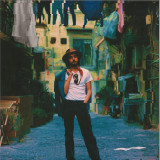
Jacken Elswyth is a London-based folk musician, banjo player, and instrument builder. At Fargrounds is her third solo album, her first for the Wrong Speed label and the latest in a rich catalogue that repositions the spectral, vulnerable sound of the banjo away from its familiar role as signifier of the past and onto lands brave, new and unexplored. “The living wood is imbued with qualities that require engagement and understanding. Working with cherry, oak or walnut involves naming it an equal partner. The parallel, synchronous transformations of wood into instrument, of growing tree into resonating sound, musical tradition into musical flourishing, lie at the heart of Jacken Elswyth’s practices both as an instrument builder and as a creative musician. One might consider her primarily as a worker in wood, but whose craft and fields of expression are absorbed by those transitional and interim processes that manifest change. The traditional tunes included here have been cultivated and maintained by generations of players and collectors, pruned, grafted, and shaped over time. However, in this setting, their long-established forms seem to morph and shift. They audibly accrue unique qualities, blossoming and swelling into new modes of being, bright-stepping arrangements unfolding with a liveliness hinting at practices of ritual and community. Meanwhile, other pieces, creative cornerstones of this collection, appear fluid, partially formed. They suggest not the cultivation of new growth from established stock, but instead the actions of something on the verge of taking form. Working with raw elements of melodic and tonal abstraction, they illuminate the process of emergence and evolution. In this context, the title At Fargrounds is telling. It suggests a point set at some distance from any centre of human concerns, a liminal space in which the cultivated world encounters the world of other living things in their living state. Here, the innate strangeness of the maintained environment–vast lawns, sculpted hedges, vacant playing fields–encounters sprawling vistas of driftwood, dense thickets of brambles, stony hillsides. Across a full century-and-a-quarter, long-standing rural and pastoral musical traditions, at some distance from their origins, have been preserved, nurtured and re-shaped under the folk revival. Placed here, these artefacts now sit in alignment with unvarnished documents featuring the raw elements of sound-making. Their working-together is achieved through a universally-applied interest in musical growth and development. The juxtaposition and combination of these elements gives evidence of new, emerging approaches to community and social music: familiar, known, yet charged with an alien vitality”–CWK Joynes. “...she knows how to knit atmospheres, and does so to especially powerful effect during Scene 4b’s three minutes of stunning bowed banjo, yearning with longing and dread, while showing off her talent, curiosity and range”–Jude Rogers review of Six Static Scenes (Guardian Folk Album Of The Month July 2022) "Jacken is an emotive player with high technical ability. Further, she builds banjos and other instruments, and that intimate knowledge of the bones and fibres holding everything together means that her playing has very few cracks" - Foxy Digitalis
Cerca:time 2 express
Announcing the debut album from one of London’s most electrifying acts, New Regency Orchestra. An 18-piece Afro-Cuban big band, inspired by the musical melting pot of NYC in the 1950s, but with the punch and power of a whole host of London’s best Latin and jazz musicians. Blowing new life into these compositions, the album is a reimagining of some of the finest music from that golden era. From early 1950s René Hernandez and Tito Puente, through to the 1970s salsa of Rafael Labasta and Orlando Marin, produced and performed with fresh fire.
NRO is the brainchild of its artistic director, and the man behind Total Refreshment Centre and Church of Sound, Lex Blondin. Through a long-held passion for jazz, Lex discovered the explosive Afro-Cuban rhythms of mid-1940s NYC via the godfather of Afro-Cuban jazz, Mario Bauzá. A time when two musical worlds collided in a fusion of creativity and energy, jazz luminaries like Dizzy Gillespie and Charlie Parker joining forces with Cuban greats like Machito and Chano Pozo. This vibrant sound was music to dance to and found a home at The New York Palladium, a formative space of freedom and expression that was key to the scene’s development.
Although dance-focussed in their makeup, those early recordings are not often heard in modern club environments and Lex dreamt of retelling their story with a contemporary dynamism. A slice of serendipity followed, as a slot at a new festival opened up and Lex jumped at the chance to make this idea a reality, an 18-piece big band breathing new life into these beloved songs.
Enlisting the expertise of some of the capital’s finest talent, Lex and co-captain Andy Wood, of Como No fame, put together a world-class line-up of talent. Bringing in Eliane Correa as musical director and bandleader, a fluid and interchanging 18-piece band was formed.
The album itself is a hand-picked selection of timeless Afro-Cuban jazz classics, reimagined with NRO’s unbridled energy. It contains ten incredible instrumental tracks including 'Pregon' with its anthemic horn stabs and the addictive head nod bounce of 'Mambo Rama', alongside two scorching vocal numbers in 'Papa Boco' and 'Labasta Llego'. Coupling a heavyweight rhythm section with a wall of horns, they provide a fresh spin on songs from Tito Puente and Chico O'Farrill, René Hernandez through to Rafael Labasta.
“Some of the tunes like Tito Puente’s ‘Mambo Rama’ and ‘Scarlet Mambo’ might sound like they went to a gym as extra drums and bass synth were added to them whilst the tune ‘Sahib & Tito’ is a mix of Tito’s ‘Mambo Buda’ and Sahib Shihab’s ‘Nus’. Our intention is to be both respectful to the innovators and inventors of this incredible music and to pay our dues, but also to add something special from London where the city’s new jazz scene connects with its Latin American musicians and the musical influences around us.”
This pure collective joy, shared experience and music you can’t help but move to.
Julius Rodriguez returns with his 2nd LP on Verve Records. The album is made up of exciting new original material and a cover of Dijon’s “Many Times”. Guest features from Keyon Harrold, Nate Mercereau, and Georgia Anne Muldrow. “This album for me embodies the meaning of "Evergreen." With the differing worlds that are presented by each track, I still aim to be fully honestly myself in my expression - maintaining my voice in any variation of musical climate. With this, I hope to carry on the importance of prioritizing the music itself, rather than letting a genre or label create a preconceived connotation of the music. The genre is me.”
- A1: Fé De Sábio - Crepúsculo
- A2: Nuno Rebelo - Vê-Se Das Nuvens
- A3: Vítor Rúa - T
- A4: Tó Neto - Daly
- B1: Luis Cilia - Saxofonía
- B2: Spqr - Flow
- B3: Telectu - Untitled
- B4: Pilar - Voz Do Mar
- C1: Carlos María Trindade - Em Campo Aberto
- C2: Balladium - Andrómeda
- C3: Ban - Irreal Social
- D1: Pop Dell'arte - Querelle
- D2: Santa Maria Gasolina Em Teu Ventre - Optical Sunday Without William Burroughs
- D3: Croix Sainte - We Build Cities
- D4: Linha Geral - Hino À Nossa Luta
Unveiling an unheard scene: Glossy Mistakes presents "Atlantic Mavericks: a Decade of Experimental Music in Portugal 1982-1993"
Glossy Mistakes is proud to announce the upcoming release of "Atlantic Mavericks: a Decade of Experimental Music in Portugal 1982-1993," a groundbreaking double LP compilation that offers a unique glimpse into the vibrant landscape of Portuguese experimental music. Set to launch on June 10th, this monumental release showcases the evolution and innovation of the Portuguese music scene during a transformative decade marked by political upheaval and artistic experimentation.
Compiled by Glossy Mario and featuring liner notes by Rui Miguel Abreu, "Atlantic Mavericks" captures the essence of a generation of artists who dared to challenge conventions and push the boundaries of what was possible in music.
The compilation stands as a testament to the eclecticism of the Portuguese music scene during this period, featuring a diverse range of genres and styles. From ambient and new age to electro, rock, and synth-pop, "Atlantic Mavericks" offers something for every listener, inviting them to explore the rich tapestry of sounds that defined the era.
The 1980s in Portugal were a time of profound transformation, marked by the aftermath of a peaceful revolution and a burgeoning desire for artistic expression. As the country emerged from political turbulence, a new generation of musicians began to explore uncharted territories, paving the way for a wave of experimentation and innovation.
From the emergence of artists like Rui Veloso and bands like UHF, who ushered in a new era of Portuguese rock, to the founding of independent record labels like Fundação Atlântica and Ama Romanta, the 1980s saw a surge in creativity and a desire for independence within the music industry.
"Atlantic Mavericks: a Decade of Experimental Music in Portugal 1982-1993" offers a comprehensive overview of this dynamic period, featuring tracks that span the spectrum of experimental music. Each song tells a story of artistic evolution and creative risk-taking, reflecting the diverse influences and eclectic tastes of the Portuguese music scene during this transformative decade.
Spanning from 1982 to 1993, the compilation includes contributions from a wide range of artists, including SPQR, Croix Sainte, Linha Geral, Balladium, Ban, Santa Maria, Gasolina Em Teu Ventre!, Fé de Sábio, and Telectu, among others. With each track carefully curated to showcase the breadth and depth of Portuguese experimental music, "Atlantic Mavericks" promises to be a must-have for music enthusiasts and adventurous listeners alike.
"Atlantic Mavericks: a Decade of Experimental Music in Portugal 1982-1993" will be available on June 10th as a double LP release, offering listeners a chance to immerse themselves in the sonic landscapes of 1980s Portugal. Whether experienced on vinyl or through digital channels, this monumental compilation is sure to leave a lasting impression on all who encounter it.
Diamanda Galás In Concert is not simply a live album. With nothing but a piano and the full expressive range of her extraordinary voice, Diamanda Galás strips away the comforting patina of time, tradition and stylistic convention to expose and express the raw human emotion that is the living heart of a song. It explores an eclectic range of material; rembetika, soul, ranchera, country and free jazz, and her passionate eviscerations reveal their hidden kinship. Four of the songs-O Prósfigas, La Llorona, Let My People Go, and Anoixe Pétra are for and by the forsaken, outcast and debased; the other three are hardboiled love songs. "In Concert" features select recordings taken from performances at Thalia Hall in Chicago, and Neptune Theatre in Seattle from 2017.
A Haunted Tongue is the third album by Colossal Squid, the solo project of producer/virtuoso drummer Adam Betts (Goldie, Squarepusher, Melt Yourself Down, Jarvis Cocker). The first self-titled Colossal Squid album (2016) was intended by Betts as a way of exploring the process of creating music from purposefully limited tools (a drumkit and electronica) and finding a place where technology and live performance could happily meet. In comparison, the second album Swungert (2019) acted as a chance to see if the music written from that same process could be moulded (via collaboration and editing) into something more traditionally recognisable as a ‘song’. A Haunted Tongue moves things on one step further, letting the process and approach fade into the background, freeing Betts to balance a million inspirations (early 90s Warp, rave tapes, Nubian drumming, Indonesian gabba…) and filter them through an anything-goes punk aesthetic that results in a feeling of freedom that is both refreshing and rare. Betts has spoken of “a recurring dream of a stranger trying to get across an important message but not talking in any discernible language” that guided these recordings. This feels appropriate to the listener – the language of A Haunted Tongue isn’t straightforward or easily classified but yet the message is clearly understood and embraced by the listener at a primal level. That message is one of hope - channelling the shared euphoria of communal musical experience and searching for an uncynical and personal expression of positive energy that can move people and resonate with them. “A while back we had a chat with JR Moores, he was doing a Bandcamp piece on the label. We mentioned we wished we did more rave-related releases. Within seconds we had the Johnny Broke album in our inbox. Johnny Broke is actually Wayne Adams. Wayne messaged and told us about Adam Betts (AKA Colossal Squid). And here we are, dealing with someone who drums for Squarepusher and Goldie. Both Chris and I have the biggest love for 90s rave music. For me (Joe) I'm listening to an alternative world that I was old enough for but missed out on. I knew the music but didn't have the knowledge to drive around the M25 looking for the fields. It's a history I don't quite have but feel like I do. It's like the Beatles: known all my life but no idea why. It's cut into our DNA. It was our punk rock but we missed it. This Colossal Squid album, no matter how many times I listen to it, brings something new every time. And it makes me feel like I'm finally there” – Wrong Speed HQ
My Back Was A Bridge For You To Cross, ANOHNI"s sixth studio album, expresses a world view by shape-shifting through a broad range of subject matter. Through a personal lens, ANOHNI addresses loss of loved ones, inequality, alienation, acceptance, cruelty, ecocide, devastation wrought by Abrahamic theologies, Future Feminism, and the possibility that we might yet transform our ways of thinking, our spiritual ideas, our societal structures, and our relationships with the rest of nature. On her first full album since 2016"s HOPELESSNESS, she explains the creative process was painstaking, yet also inspired, joyful, and intimate, a renewal and a renaming of her response to the world as she sees it. "Some of these songs respond to global and environmental concerns first voiced in popular music over 50 years ago." ANOHNI"s approach since her last record has shifted from someone tasked with challenging global denial, to an artist seeking to support others on the front lines. "I learned with HOPELESSNESS that I can provide a soundtrack that might fortify people in their work, in their activism, in their dreaming and decision-making. I can sing of an awareness that makes others feel less alone, people for whom the frank articulation of these frightening times is not a source of discomfort but a cause for identification and relief. On "It Must Change," ANOHNI soulfully describes systems in collapse with a note of compassion for humanity: "The truth is I always thought you were beautiful in your own way // That"s why this is so sad." ANOHNI"s voice is sensual and smoothed, selectively reaching to the edges of what it can contain. "We"re not getting out of here // No one"s getting out of here // This is our world," she murmurs. A portrait of legendary human rights activist Marsha P. Johnson taken by Alvin Baltrop features on the cover, reflecting a 25-year relationship with the memory of Johnson that ANOHNI has held space for in the presentation of her own work. Elsewhere, the album artwork states "IT"S TIME TO FEEL WHAT"S REALLY HAPPENING". In some ways it feels as if she is reaching across her life"s expression, and has found a moment of unique composure, wearing her long exploration of disarming intensity, with the maturity of a painter carefully choosing her colors. "I want the work to be useful, to help others move through these conversations we are now facing, to move with dignity and resilience through this bitter dawning."
Rapid-fire with the releases like it’s effortless, minimal donny Velvet Velour steps up with his latest 4-tracker. Strong tech house currents in a similar vein to Kepler’s recent ‘Lowlife’ EP, but with extra zonk - it’s a head turning label debut.
The growing catalogue of releases belies a relatively short time spent producing. That said, he’s already a key proponent of the sound’s contemporary vanguard and XK035 might be the most vital effort to date.
More Brazilian brilliance from Barefoot Beats...
Man of the moment, Aroop Roy takes a break from his busy touring schedule to serve up a super cool slice of deeply hypnotic magic. Totally bem gelada!
On the flip side, Belem born, but now Sao Paulo based DJ and producer Bernardo Pinheiro returns to Barefoot Beats and absolutely destroys the dance floor with this peak-time euphoric Brazilian Disco anthem.
All delivered on beautiful, LTD edition 10inch vinyl pressing.
BELEZAAAAAA!
Vamos!
Cher and Christina Aguilera, together? On the same soundtrack? Who cares that the Burlesque film garnered mixed reviews at best (though a lot of folks now regard the 2010 feature as a camp classic)? The soundtrack had no such difficulties; the album release went Top 20 on the charts, won a Grammy nomination, and Cher’s performance of “You Haven’t Seen the Last of Me” won a Golden Globe Award for Best Original Song. Aguilera’s star turn was something of a coming-out party, too; not only did she enjoy critical acclaim for her first leading role in a film, but her musical contributions—featuring a couple of Etta James songs and a cover of Marlene Dietrich’s “A Guy What Takes His Time’’—were sassy, jazzy, and brassy, not unlike her work on her #1 album from 2006, Back to Basics. In short, this one’s a must for fans of either artist, and for this pressing, we at Real Gone Music have created a bling-y metallic gold vinyl edition housed inside a gatefold cover boasting some sensational production stills!
Fifth solo album from saxophonist Julius Gabriel. Born out of new sounds and rhythms that the musician discovered during the pandemic, “Tales From The Subterranean” embodies a blend of primal energy and inventive exploration across twelve tracks. The opener “Time Riding” sets the mood, a tearing rhythm that sounds like a frenetic tap dance. It invites you to move and when you get to “Footworks” you are all set up, merging saxophone finger percussion with a continuous siren whisper emanating from the instrument, provoking euphoria, fear and satisfaction all at once. Moving on, you start to understand the sense of discovery behind the record and the needs Julius had, like to construct a saxophone with drone capabilities and closer to an idea of natural sound. “Hailing From The Mountains” has a meditative tone; “Westward At Sundown” feels like a ballad. Born from darkness yet radiating with newfound light, “Tales from the Subterranean“ stands as a testament to the resilience of artistic expression. It is primal music.
All music composed and performed by Julius Gabriel on electroacoustic tenor saxophone and twin soprano saxophone.
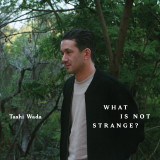
What Is Not Strange? is the first full-length album by Los Angeles-based composer Tashi Wada in over five years, comprising his most far-reaching and impassioned music to date. Written and recorded over a period that encompassed the death of his father and the birth of his daughter, the album sees Wada reflecting inward to explore broad narratives - being alive, mortality, finding one's place in the world - through new modes of ecstatic, song-based expression. While the denser forms, stark contrasts, and overt surreality may carry a different weight than Wada's earlier work, which elicited perceptual effects with minimal means, the heart of What Is Not Strange? is still in experimentation and unforeseen outcomes.
- A1: Joe Dukie & Dj Fitchie - Midnight Marauders 7 21
- A2: Ian Brown - The Gravy Train (N O W. Mix) 5 01
- A3: Tony Allen Ft Damon Albarn - Every Season 4 07
- A4: The Rootsman - Show Some Love 5 39
- B1: King Kooba - California Suite (Vagabond Mix) 6 03
- B2: Quincy Jones - Listen (What It Is) 4 14
- B3: Cortex - La Rue 4 27
- B4: Tom Scott And The L A Express - Sneakin’ In The
- C1: Search - Action Tape 1 (Madscope Mix) 5 29
- C2: Large Professor - 'Bout That Time 4 03
- C3: Tranquility Bass - Cantamilla 4 31
- C4: Mad Doctor X - Intergalactic Throwdown 6 04
- D1: Dusty Springfield - Spooky 2 44
- D2: Focus - Having Your Fun 3 43
- D3: Nightmares On Wax - Brothers On The Slide Dub (Exclusive Cover Version) 4 23
- D4: Brian Blessed - The White City Part 1 (Exclusive Spoken Word) 10 18
The Late Night Tales compilation is a bit of a ‘stealth’ project for me personally. I’m very proud of it, but at the time, I probably didn’t appreciate it as much as I do now because there was so much going on. You do these things in-between touring and you don’t really have time to reflect on them because you’re immediately onto the next thing. It’s nice to know that it’s getting re-released. George Evelyn - Nightmares on Wax May 2024 This ain't no normal nightmare, kid. This is Nightmares On Wax, aka DJ EASE, aka George Evelyn. Born under a bad sign, with lino in hand, Mr. Evelyn went forth into the world and breakdanced (brokedance?). It's what you did in the 80s when you were young, loved hip hop and couldn't rap for toffee. When house arrived they turned their clever hands to it. Bleeps and beats is what it was. That's what everyone said. But there was always a bit more than a bunch of bleeps to what Nightmares On Wax did. The north never really took the name very seriously (Sweet Exorcist even named their album Clonk as a pisstake). Then George flipped the script and went and did Smokers Delight, the beats not so much seminal as semolina: gloopy and slow and sweet and lovely. And now we have this: a 2024 reissue of his seminal Late Night Tales compilation. Tom Scott's 'Sneakin' In The Back' — one of the most sampled beats in hip hop — makes an appearance in its full glory, while Quincy Jones, the inspiration for NOW's 'Nights Interlude', backs up the classics with ‘Listen (What It Is)’. Evelyn's hip hop sensibility is to the fore throughout and nowhere is this more evident than on ‘Intergalactic Throwdown' by former Freestylers' DJ, Mad Doctor X. And can we forget the sublime version of the Classic IV's 'Spooky' by darling Dusty? No, we can't. Finally — oh, finally! — there is the now-traditional cover version, with George serving up a soupy version of 'Brothers On The Slide' that gives a nod of respect to the original British funk soul brothers, Cymande. This ain't no nightmare at all: it's Nightmares On Wax.
Following the release of Eric Chenaux's last album Say Laura (2022), The Guardian wrote "the Canadian songwriter has one of the all-time great singing voices in popular music, an intensely romantic Chet Baker-ish instrument that seems to float with piercing direction, like a paper aeroplane thrown hard through mist." With Uncut describing his songcraft "as delicate and lovely as a rare orchid" and Record Collector praising the album's "sublime alien balladry" such are the accolades that have accrued throughout Chenaux's unique and consummately uncompromising solo music for well over a decade now. Delights Of My Life opens a new chapter for the singer/guitarist and formally introduces the Eric Chenaux Trio, with Toronto-based musicians Ryan Driver on Wurlitzer organ and Phillipe Melanson on electronic percussion. Driver is a longtime collaborator, appearing on several of Chenaux's solo albums (even embedded into the very title of the 2010 masterpiece Warm Weather With Ryan Driver). Melanson has a long list of involvements that include Bernice, Joseph Shabason, and U.S Girls, and a recent release with his Impossible Burger project on Chenaux's own experimental label Rat-drifting, but this marks the first fulsome involvement between the two as players on a recording. In many ways Delights Of My Life also picks up right where Chenaux's previous album left off, in its subversions of a classic, timeless jazz-inflected balladry, while the interplay of the trio formation indeed unfurls many new delights. Recording together at Chenaux's spartan home studio in rural France, Driver's harmonically warped organ and Melanson's electroacoustic sampling and percussion hold time in newfound ways. Where previously Chenaux relied on a freeze/sustain pedal and minimalist rhythmic triggers to generate both pulse and chordal foundations, Melanson now paints timekeeping with expressive and intricate colourations, through live deployments of fluid sampled percussion (including orchestral timbres like timpani, kettle drums, and woodblock) that blur the boundaries between acoustic and electronic. Driver also ramps up his role in the song arrangements (prefigured in his support playing on Say Laura), teasing out chords and melodic filigree on Wurlitzer that percolate more prominently with Chenaux's signature fried guitar solos and succulent singing. Both trio members add dulcet backing vocals, most notably on the 10-minute tour-de-force of fuzzed and ring-modulated swing "This Ain't Life" that opens the record. All seven songs on the album groove and sway, simmer and sparkle, like nothing in the inestimable Chenaux discography to date. Chenaux's tunes have the uncanny ability to sound like jazz standards; songs you feel you've heard before, though certainly never quite like this. Yet these are of course all originals, compositionally and interpretively, bent through an inimitable avant/out-music lens. Delights Of My Life conveys warm familiarity, shot through with the exuberantly experimental subversion and playful, even mischievous, iconoclasm that continues to mark Chenaux as defiantly, virtuosically, and genially one-of-kind.
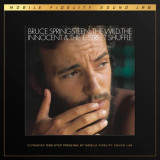
Released only eight months after his exhilarating debut, Bruce Springsteen's The Wild, the Innocent & the E Street Shuffle contains rousing dispatches from the boardwalk, the street, the beach, and the bedroom. It explodes with energy, dares to dream, teases with humour, crackles with tragedy, clings to hope, and overflows with discovery, youthfulness, and personality. It features an unforgettable cast of characters — corner boys, teenage hustlers, doomed lovers, jazz men, junk men, factory girls, fortune tellers, alley cats, pimps, escorts, and more — illuminated by vivid colour, breathtaking detail, and poetic action.
Musically, the heartfelt 1973 record is inhabited by sympathetic vignettes and cinematic arrangements steeped in rock 'n' roll, soul, jazz, and R&B. It finds the New Jersey native looking beyond the parameters of his preceding record and seeking to move on from environments he knows well (and chronicles here) by rushing headlong toward unknown territories, adventures, and people. Underpinned by the singer-guitarist's ambitious poetic enterprise and will to succeed, The Wild, the Innocent & the E Street Shuffle is the album on which Springsteen becomes the Boss.
Mastered on Mobile Fidelity's renowned mastering system, pressed at RTI on MoFi SuperVinyl, and strictly limited to 7,500 numbered copies, Mobile Fidelity's UltraDisc One-Step 180g 33RPM LP set is the definitive-sounding version of Springsteen's sophomore record. Benefitting from SuperVinyl’s nearly non-existent noise floor, superb groove definition, and dead-quiet surfaces, The Wild, the Innocent & the E Street Shuffle plays with a clarity, energy, presence, and openness that complement the expressiveness, dynamics, and scope of the seven restless songs that comprise a work Rolling Stone ranked the 345th Greatest Album of All Time.
Beyond the audiophile sonics that practically place you behind the console at 914 Sound Studios — listen to the separation between the instruments, natural decay of the notes, interplay within the widescreen soundstaging, and nothing-to-lose youthfulness of Springsteen’s voice — this reissue takes seriously this record’s influential merit by presenting it in packaging that underlines its status. Tucked in a beautiful slipcase, the LP is housed in a special foil-stamped jacket with faithful-to-the-original graphics. This reissue is made for listeners who prize sound quality and who want to engage themselves in everything involved with the invigorating set that busted Springsteen loose from the club circuit and landed him on the radio
Determined to liberate anyone within earshot and unafraid to come on strong, The Wild, the Innocent & the E Street Shuffle serves as the debut of the E Street Band — not only heard but seen for the first time by most of the public courtesy of the back-cover photograph. This is where saxophonist Clarence Clemons, organist-accordionist Danny Federici, and pianist David Sancious step out of the shadows — and drummer Vini Lopez and bassist Garry Tallent again stoke a fiery rhythmic engine that helps drive the untamed, reimagined big-band swing of “Kitty’s Back,” breathless R&B thrust of “Rosalita (Come Out Tonight),” and carefree dance steps of the funky “The E Street Shuffle.”
Of course, the main attraction remains a then-24-year-old visionary on the precipice of becoming a sensation and turning a then-bloated rock scene on its head. Recorded over three months while Springsteen and company were busy touring his debut LP, The Wild, the Innocent & the E Street Shuffle reflects the high-octane approach the vocalist embraced onstage and drifts away from the label-dictated acoustic-based frameworks of his debut. The set also witnesses Springsteen deepening his observational skills, with narratives such as the romantically tinged “4th of July, Asbury Park (Sandy)” and redemptive epic “Incident on 57th Street” mirroring changes taking place in the singer’s own life, small towns, and America at large.
A thrilling collision of memories, reflections, and composites — Sandy, Rosalita, and the latter’s parents are all based on actual people Springsteen knew, as is the community depicted in the opening track — the aptly titled The Wild, the Innocent & the E Street Shuffle resonates decades on due to its truths, authenticity, and spirit. Those characteristics — as well as the fact that many of its lengthy songs come on as the equivalent of sweaty, feverish soul revue that won’t stop until you’ve been exhausted — also explain how this now-iconic album triumphed over the reservations of industry “experts” that both demanded Springsteen re-record it and instructed deejays not to play it.
Yet there’d be no stopping a record that saw the past, present, and future, a band whose will would not be denied, and a phenomenon who was born to run. A never-ending invitation to act real cool and stay up all night, The Wild, the Innocent & the E Street Shuffle always feels alright.
The Telescopes Radio Sessions collects together the essence of three live session recordings in 3 different countries over a three year period between 2016-2019. This is the third in a series of radio session releases from Tapete Records that have so far included The Monochrome Set and Comet Gain. More session releases are being lined up for the rest of the year and beyond - enjoy the sonics and stay tuned. Over the years I have read a lot on people’s impressions of The Telescopes. Some folk think it’s a collective, others imagine it used to be a band and feel nostalgia towards what they consider to be the original line-up (even though many had come before, during and since) and some people refer to it as currently a solo career. In a way this is all true and none of it is. When faced with these kind of questions, along with questions about the style of music that The Telescopes make I often say The Telescopes house has many rooms, which explains things perfectly for me but for people on the outside looking in it only serves to increase their confusion. For me, confusion isn’t such a bad thing. Everything is born into confusion, the sense we try and make of that chaos is interesting and excites me. The universe often disorientates, it sends me a jumble of thoughts and impressions coupled with a feeling of something I need to express… if I could only decipher the encryption. This is how The Telescopes music comes to be and it is also how The Telescopes came to me. I regard The Telescopes as an entity of it’s own that introduced itself in my darkest hour and I was chosen as its vessel. From the second it arrived I was obsessed to the point where there was nothing else. A bit like having an imaginary friend. As the obsession grew it began to infect others, everybody loved my imaginary friend and wanted a piece of it. As its success grew however, so did the corruption, until one day the entity fell silent. The silence lasted for years, I tried everything to reconnect but it was having none of it. I had been a bad caretaker, I had let the house become infested and I had lost my way. This epiphany served to remind me of simpler times when anything felt possible with this entity by my side. It had trusted me with something so simplistically profound and I had let it down. The realisation of this was a eureka moment. I am not The Telescopes, I never was and never will be, I am the caretaker, the lighthouse keeper and if a job is worth doing it is worth doing well. With this dawning, I felt a crack open up in the cosmic egg and a familiar confusion in my head. The entity had returned. It was time to start untangling its tangled threads once more, to make sense of what it was saying, this time without corruption. It’s all about listening. I listen to what my cosmic friend sends me and channel this expression into what you hear through your speakers. It may take one person to achieve this, it may take more. There is no set line up or instrumentation that can hold The Telescopes. Whatever it takes to hit the zone, whatever is available, absolute focus is imperative. Sometimes it takes sabotage to keep that line of vision intact, there is no room for preconceptions or complacency in making the music. The Telescopes music is the now
incarnate and a state of total being is necessary to achieve. From the outside looking in... again, it’s all about listening. What comes through your speakers is the only thing that matters. The music either reaches you or it doesn’t. Everything else may seem interesting or confusing but ultimately it is corruption. So if you’ve bought the record, read the sleeve notes and bought a ticket to see a live show, don’t be surprised if the line-up is or isn’t the same as the recording. The only thing that is for sure is that The Telescopes as an entity is speaking to you in its own voice in every scenario.
Of course the difference between albums and live shows is that you can play the record over and over again to the point where you know every line and every note that was played. Whereas with live events you are left with an impression that can only be replayed in your mind. It can be frustrating at times. When you are touring with a great line-up and feel like something exciting is happening, you want everyone to hear it, not just the people at the shows but the people that couldn’t make it on the night as well. There is no guarantee that there will be the same line-up at a live show as there is on the album. This is why live sessions are important, they document a side of things that is often fleeting. Here we have three sessions, all different people transmitting The Telescopes sound on each. Some are regulars, some dip in and out and some were just passing through. In each case The Telescopes chose them as their vessel and as the lighthouse keeper I did everything I could to help them on that journey while trying to be a good caretaker to the house of many rooms. The Telescopes have been invited in for many sessions over the years, the first two were for John Peel on BBC Radio 1. We also recorded a session for Marc Riley and Mark Radcliffe before their
celebrity when they had a show on BBC Radio Manchester. We could have compiled this album from those sessions, it was certainly considered but Tapete and myself believe this selection gives an exciting glimpse into that fleeting side of The Telescopes in a constant state of flux that is left mostly to myth and imagination. For those who listen to the records but have never had the chance to take in the live experience, welcome to the other side. For those that follow us live, here’s a little reminder and a keepsake. Infinite suns. Stephen Lawrie February 2024.
Stasis returns to De:tuned with 7 unreleased tracks from his archives for the 'Time Sensitive' LP. Legendary UK techno pioneer Steve Pickton compiles a stunning collection of DAT tape excerpts from the Otherworld studio sessions. Recorded between 1992-1996, this collection represents the peak of the Stasis sound. An in-depth masterclass of emotive techno and simply a must-have for any true techno enthusiast.
Mastered by Matt Colton at Metropolis. Al White created all the graphic work. A separate digital release will also be available at the usual digital shops. Stay tuned!
LIMITED BOXSET[117,61 €]
10 Year Anniversary Gatefold 2LP 10 year anniversary gatefold 2LP edition of Cult of Luna's take on Fritz Lang's Metropolis film, Vertikal. "Somewhere Along The Highway" and "Eternal Kingdom" were inspired by the landscape of Västerbotten, the county we are from. We realised that there was only one way to go for us: to the city, into the future. Making a droney John Carpenter-esque album would be too easy and we've never been about taking the simple route. I was studying film at the time and had been floored by the aesthetic of German expressionism. This resonated perfectly with Erik Olofsson, who had just got into Italian futurism. This was a real challenge. We put in a lot of effort to realize our vision of the stale, artificial city in all aspects of what an album is. The way we played guitar (only down strokes), the production, artwork and band photos, everything was done with the vision as a guide. "Vertikal" is the album where we had the most precise vision of what we wanted to do and worked hardest to transform it from an idea into reality. A lot of things happened during the years between "Eternal Kingdom" and "Vertikal" and I could continue writing for ages but this will do for now. Ten years have passed since its release and what felt like a rebirth of the band, the band that is still ongoing with new goals and missions. It's a full circle kind of thing. At the time we had no label and now we are releasing it on our very own. Life is strange. Johannes Persson - Umeå December 2022
" The solo venture is expansive and easy on the ears. It's so serene yet expressive of big terrain and huge vistas of emotional landscapes of sound. He works off his own scale. Everything flows outwards. Effortlessly." - Irish Times Experimentation in early electronic music in the Sahara from the singular Mamman Sani. Dreamy organs and droning melodies reinterpret ancient folk tradition into a sublime fantastical soundscape. Never before released recordings from the very beginning - unreleased tracks from his first album, recordings of a short-lived trio, and a cover of an American folk ballad.
The concept behind the entire EP revolves around the power of scents, exploring how smells evoke emotions and memories from the past. Doci's fascination with scents and molecular fragrances inspired him to create an EP centered on the emotional experiences tied to different scents. Have you ever noticed how a fragrance can transport you back in time, bringing a rush of memories before your eyes? This EP is born from that very sensation. Needless to say, Doci's infatuation with fragrances significantly contributed to the effectiveness of the project. Hedione (Intro): Begin your odyssey with "Hedione," an atmospheric IDM/Experimental track. This floral molecular scent-inspired introduction gently ushers you into the EP's sensorial realm, setting the stage for a unique auditory adventure. Iso E Super & Ambroxan: Explore the intricate layers of musky, woody, and ambery scents in "Iso E Super" and "Ambroxan." These tracks, weaving through Break/Electro/Drum n' Bass genres with subtle Techno accents, offer a sonic journey that mirrors the nuanced edges of their aromatic inspirations. Each note captures the essence, presenting a balanced dance of rough and light tones. Javanol: Experience the raw energy of "Javanol" a leftfield/break Techno exploration. Reflecting the rough and woody facets of its scent inspiration, this track unfolds with aggressive synths and sounds, immersing you in a visceral encounter. Doc's musical interpretation captures the intensity of scent, creating a distinctive and bold auditory expression. In this EP, Doci skillfully translates fragrance into sound, inviting listeners on a textured expedition through scent-inspired composition
”Dafür bestimmt, als Jazz-Klassiker in die Geschichte einzugehen” – so das Urteil des Guardian bei der Veröffentlichung des Albums im Jahr 1997. Weiter meinte die Zeitung: ”Wheelers Kompositionen und vier der weltbesten Improvisatoren schaffen ein nachdenkliches Set, das es sich lohnt wieder und wieder zu hören. Dies ist wunderschöne, leuchtende Musik.” Angel Song gehört zu den Höhepunkten im Katalog des Labels und vereint vier Improvisationsgrößen – jeder mit einer einzigartigen künstlerischen Identität – in einer intimen, Schlagzeug-losen Quartett-Session. Kenny Wheeler ist der Komponist der neun eindringlich lyrischen Kammer-Jazzstücke und verleiht ihnen an Flügelhorn und Trompete im expressiv-melodischen Austausch mit Altsaxophonist Lee Konitz eine besonders eindringliche Atmosphäre. Das Bassfundament von Dave Holland ist so überzeugend wie eh und je und lässt Bill Frisell alle Freiheiten für harmonieumfassende Improvisation. Wie der Guardian jubelte 1997 auch die Times und sprach von einem: ”rührend schönen Album: Hollands wendige Zuverlässigkeit ist der Anker für die elegante Klangfülle von Konitz, die flimmernde Raffnesse von Frisell und die klangliche Zärtlichkeit von Wheeler selbst.” Das Album erscheint zum allerersten Mal auf Vinyl als Teil der Luminessence-Reihe und wird in einem Tip-on-Gatefold mit Session-Fotos präsentiert
Two years in the making, 25-year-old Angelica Garcia's album Cha Cha Palace is the result of an artist's need to SAY SOMETHING. The second song on the record, "Jícama" might only be a minute and 25 seconds in its entirety, but the message spans generations and is one that resonates deeply for Garcia with her Mexican and Salvadoran roots. Singing/shouting, "I see you, but you don't see me Jímaca, Jímaca, Guava Tree_I've been trying to tell ya, but you just don't see, like you I was born in this country," Garcia tells the reality for millions of Americans unapologetically and with passion.That feeling of being between places is something Garcia knows well having been raised between multigenerational, multicultural, homes with step-parents and half-siblings. Additionally, she made the journey from the West Coast to the East Coast and back again multiple times before finally settling down in Richmond, Virginia.She fondly recalls Mexican ranchera music always playing throughout her childhood. Ranchera was ingrained within the maternal side of her family with her Mother, Grandmother, Uncle & Aunt constantly singing the traditional music throughout the home of her Grandparents.Like Mitski, Lorde, Billie Eilish, and Rosalía, Garcia isn't afraid to tear pages out of her diary and express emotions that might be difficult and oftentimes daunting to share given today's social and political environment. Like her peers, she joins a new chapter of musicians who are connecting with their audiences on a level that lives outside the reaches of technology, trends, and social media, the daily experience of feeling torn between saying something and doing something, for being a voice and speaking with your voice, of being Latina while being American. And it's humanity and honesty that audiences are looking for and will find in spades throughout each note of Cha Cha Palace.
Repress!
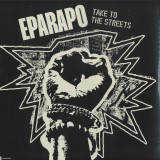
Wah Wah 45s are proud to present the full debut album from Afrobeat supergroupEparapo. Having come togetherduring the unprecedented events of the pandemic and the Black Lives Matter movement, and despite being a project born from the privations of lockdown, their music is ultimately an expression of hope, resilience & resurgence.
The word "eparapo" means "join forces" in Yoruba, the language of Afrobeat. It's also the title of a track by the late, greatTony Allen- drummer for Afrobeat legendFela Kutiand lifelong friend and mentor of our very own "Afrobeat Ambassador",Dele Sosimi. Not only did Tony help to invent Afrobeat, he always looked for ways to push the boundaries, never content with recreating what had gone before but constantly expanding and developing the genre. This project hopes to pay homage to his legacy, and that of Fela Kuti himself. Its aim is to innovate, fuse and diversify while still retaining the essence of the music.
The force behind Eparapo is bassist, composer & producerSuman Joshi.He has been a member of Dele Sosimi's Afrobeat Orchestra for nearly a decade and has performed on stage with the likes of Tony Allen, Seun Kuti, Ginger Baker & Laura Mvula. He is also bassist with UK jazz ensemble Collocutor and fusion project Cubafrobeat.
"The Eparapo project was conceived during a time of lockdowns & government scandals. The music that makes up this album was written and recorded against a backdrop of societal upheaval, culture wars and rising wealth inequality. With little scrutiny or resistance from the mainstream media, our human and democratic rights were being eroded and our institutions debased. Even our right to protest is now under threat. This is a call to action, an expression of frustration & anger at what our nation has become. It's saying that enough is enough, it's time to join forces and make our voices heard. It's time to take to the streets."Suman Joshi
The title track is an epic eleven minute musical representation of this frustration and anger, where the musicians really let loose and allow their voices to be heard. As the only instrumental track on the album it acts as a call to action that is central to this body of work. Featured vocalists on the album are Fela Kuti disciple and Wah Wah 45s artistDele Sosimi, who appears on the singlesBlack Lives Matter,From London To LagosandWho Invented Back & White?as well as a more recent recording,Follow The Money; and London based, Ghanaian born master percussionist and vocalistAfla Sackey, who takes lead vocals on the mournful yet somehow hopefulBeautiful City.
The rest of the group comprises of highly rated UK jazz vocalistSahra Gure; saxophonist, composer, producer and bandleader of the renowned forward thinking jazz outfit Collocutor,Tamar Osborn; keyboard player, producer and front man for Lokkhi Terra and Cubafrobeat,Kishon Khan; one of the UK's finest and most in demand trumpeters,Graeme Flowers, who has played with Quincy Jones, Gregory Porter and many more; trombonist for Bellowhead and mainstay of Dele's Afrobeat Orchestra,Justin Thurgur; and finally drummer for Steamdown and Sons of Kemet, as well as the man behind the Nache project,Eddie Wakili Hick.
The album will be available digitally and limited edition vinyl LP, with striking artwork by our award winning designer Animisiewasz.
- A1: Barry Woolnough - Great Father Spirit In The Sky
- A2: David Holmes & Steve Jones - The Reiki Healer From County Down
- A3: The Children Of Sunshine - It's A Long Way To Heaven
- A4: Spark Sparkle - Slythtovery
- A5: Alain Maclean - Talking Judgement Day Blues
- A6: David Crosby - Orleans
- A7: Buddy Holly - Love Is Strange
- B1: After Dinner - Paradise Of Replica
- B2: Lullaby Movement - Ru-Ru (Sleep Little Baby)
- B3: Jeff Bridges & Keefus Ciancia - It's In Every One Of Us
- B4: Song Sung - I'm Not In Love
- C1: Neo Maya - I Wont Hurt You
- C2: Bp Fallon & David Holmes - Henry Mccullough
- C3: Documenta - Love As A Ghost (Produced By David Holmes)
- C4: Keith Fullerton Whitman - Stereo Music For Acoustic Guitar, Buchla Music Box 100 Hewlett Packard Model 236 Oscillator, Electric Guitar And Computer Part I
- D1: Eat Lights Become Lights - Into Forever
- D2: Geese - Andrew Parsnip
- D3: Die Hexen - Gloomy Sunday
- D4: Jon Hopkins & David Holmes Feat Stephen Rea - Elsewhere Anchises
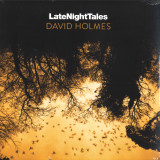
DJ and producer David Holmes is welcomed to the Late Night Tales fraternity with an evocative collection of personal songs and music, peppered with exclusive new material and rare gems. By now, I think we all know David Holmes, right There's acid house Holmes, with bone-rattling Chicago jams and Detroit destroyers, break-digger Holmes responsible for the grittily shaking 'Let's Get Killed' and seminal Essential Mix compilation (which brought Sixto Rodriguez to people's attention, and then there's soundtrack Holmes. His most enduring and vital source of musical inspiration - cinema - plugged into David's rst solo record 'This Film's Crap, Let's Slash the Seats' and inspired 2000's 'Bow Down to the Exit Sign', created as the soundtrack to a not-yet-made movie. Ofcial soundtracks have been bountiful, including scores for Soderbergh's Out Of Sight and Ocean's trilogy, '71, Hunger and Good Vibrations. In a series of personal songs sung by himself, David's last solo album 'The Holy Pictures' explored inuences of La Düsseldorf, The Jesus and Mary Chain and early Brian Eno. His Unloved collaboration with Keefus Ciancia and Jade Vincent then took us on a musical journey full of raw 60s pop-noir, psychedelia and French Ye Ye with a contemporary twist. Somehow he's also found time to produce records by Primal Scream and Jon Spencer Blues Explosion. Unsurprisingly, for someone au fait with matters cinematic, this Late Night Tales conjures up its own mindmovies. It's not only packed with the judiciously selected nuggets for which his mixes are noted but also stuffed with original material, including collaborations with BP Fallon and Jon Hopkins and an amazing new reading of 10cc's 'I'm Not In Love' by Holmes-produced Song Sung. In fact, there's a Celtic thread running through the whole journey with Stephen Rea's reading of an extract from Seamus Heaney's AENEID BOOK VI - Elsewhere Anchises. Among the other gems included here are David Crosby's lush 'Orleans', Buddy Holly's celestial 'Love Is Strange' and the Children Of Sunshine's 'It's A Long Way To Heaven'. David Holmes loves music. It's a way of expressing the sometimes inexpressible or the inconsolable, a questing desire to nd out just what is over the next hill. It's no surprise to learn he's a keen walker. Always on the move, headphones on, lost in some reverie or piece of music, the soundtrack to his life, the stuff that feeds his imagination. I walk a lot. It's amazing for listening to music: your phone or your emails aren't going and you're just in the forest listening to music. It's so intimate. Anyway, I was listening to the KLF's Chill Out album, which still sounds amazing, but it triggered an idea with concrete sounds through travelling and movement. And one of the things I was trying to do was to use this idea not just break up the moods but also as a metaphor for moving through life and arriving in different destinations or arriving at different stages in different parts of your life. Memory, Love, Living, Family, Friendship, Healing, Death and The Afterworld are some of the themes I wanted to explore within this record. Although these strong themes and tracks are personal to me, I also wanted it to be a great listen that was unpredictable yet had a seamless ow - a journey that was personal to me yet to the listener a great compilation of music that they may or may not have heard before. I hope I've succeeded in the later.' David Holmes 2016
Popol Ace is a progressive rock band from Norway which had its heyday in the 1970s. The band formed in 1972 as Popol Vuh, but changed their name in 1975 to avoid the confusion with the German group of the same name, which practiced more experimental and cosmic music. Stolen From Time is an ambitious and varied album, which testifies to the richness of progressive rock of the time. The group mixes various influences, such as Pink Floyd, Genesis, Yes, or Supertramp. The nine tracks on the album are all musical nuggets, ranging from symphonic rock to folk via jazz- rock or hard- rock. The group demonstrates great instrumental and vocal mastery, with neat arrangements and catchy melodies. Singer Jahn Teigen stands out for his powerful and expressive voice, able to move from low register to high register with ease
Two legendary figures of the Greek and international music scene, Floros Floridis and SavinaYannatou join their breaths in this new release on vinyl by To Pikap Records, entitled Blink. In the album’s seven tracks-movements, the two musicians expand the time it takes for the eye to blink. Avant-garde and improvisation, modernism and tradition seek to describe, but ultimately limit, this melodrama of existence, the libretto of which is written in the langue that may have been first heard in Pangea.
Blink departs from the ground on which records like the Residents’ Eskimo sprouted, but moves on by removing the horizon points and the conventions they carry, in order to board the next Voyager that will travel to the stars. Two experienced breaths that generate sound without rules become -through reeds and mouth- vehicles of the language of newborns deconstructing the conventions of human communication. The fragility of existence becomes -like the birdsong- lullaby and dirge, hymn and incantation. The instinctive manages to express the unspeakable in this abstract and ultimately tender work that does not conclude but remains open to the timeless movement of a prehistoric future.
Bill MacKay and Drag City are delirious with pride to announce the discovery of a new territory: Locust Land, a record which seeks to reflect the nerve-shredding consciousness run amok in our world today - and somehow allay it with sound. Bill"s music is a visceral crackling where it meets the air, and Locust Land can"t help but reflect its era more than any other in his discography. It"s been five years since the release of Fountain Fire - but in the interim, Bill has barely stopped moving, collaborating with artists across the spectrum, including cellist Katinka Kleijn, banjo player Nathan Bowles and keyboardist Cooper Crain. He"s also contributed to recordings by Steve Gunn, Ryley Walker, Bill Callahan & Bonnie Prince Billy (Blind Date Party), and Black Duck (on their self-titled record featuring Douglas McCombs and Charles Rumback). Forget five years - how"d he even get Locust Land squeezed out of his temporal lobes? Bill"s sense of music as art is constantly modulating - lifting off from where it is found and naturally migrating to some other place. Sometimes, that"s elsewhere - others, it"s simply to be found deeper inside the starting point. And so, the action of moving on informs the landscape of Locust Land. This manifests in several different ways. A restless energy and urgency is repeatedly felt - in the driving momentum of "Keeping in Time," "Glow Drift," and "When I Was Here" - while a dogged persistence radiates from the tone colors and percussion of "Oh, Pearl." Mating a dirge-like desolation with sparkling guitars, "Radiator" adds darkness and depth. The sense of searching, displacement and longing in vocal tracks "Keeping in Time," "Half of You," and "When I Was Here" speak literally to the tumult of current vibrations. Within the arrangements, there"s also departure from previous norms - in addition to the brilliant guitar work for which he is known, Bill plays a variety of keyboards, from piano to organ to synth, extending his music with the available voicings, while enriching the sound field without abandoning his signature brevity. For fans of his singing, and following in the recent tradition of Fountain Fire as well as his collaboration with Nathan Bowles, Keys, Locust Land expresses with an increased vocal presence - and heightened engagement, with Bill"s words and melodies drawing us closer. Also different: on his previous solo recordings, Bill played every sound. Here, he has invited other illustrious Chicagoans to join him: Sam Wagster (The Father Costume, Mute Duo) plays bass on three songs, two of which feature the percussion playing of Mikel Patrick Avery (Natural Information Society, Jeff Parker, etc.). Additionally, Janet Beveridge Bean (Eleventh Dream Day, Freakwater) adds otherworldly vocal textures to the elegiac "Neil"s Field." Whether played alone or with companions, this music projects the strength of a universal collective. Even with a piece that might earlier have passed for blissful pastorale, Bill displays some declamatory motives. The reverie which opens the album, "Phantasmic Fairy," embodies both transcendent and desperate moods, with Bill"s ineffable slide guitar playing afloat, with organs and synths, in a dream state suffused with a sense of foreboding - a requiem, perhaps for the days of unencumbered bandwidth? On the other side of the album, the strength to continue to hope appears in the lifting melodicism/exoticism of the album-closing title track, leaving the listener with the sense of having achieved a hard-won space - a place of personal contemplation and dissent, one that everyone on the planet deserves to visit every single day on earth. With cover art also by Bill MacKay (the third of his albums on Drag City to feature his work), Locust Land stands as a thoroughly personal statement from Bill to everyone everywhere.
For Twice Infinity’s second solo release, the London and Geneva-based DJ and producer GFX – one of the most active newcomers of the past years – makes his vinyl debut with the aptly named Vibing The Groove EP. His three original tracks span a wide array of playful, groovy, punching and driving techno that perfectly showcase GFX’s musical vision for the near future and mark a preliminary goal in his search for a unique musical expression since his release debut in 2020.
The B-side accompanies two remixes by equally exciting members of the next generation of producers; while the approach by Cuban techno activist Hioll is more to the point and made straight up for peak time sets, Manchester-based trance wunderkind Faster Horses explores his not so well know passion for funky and stepping contemporary techno.
In one sense, it's easy for artists-songwriters, specifically-to express their feelings in their work. After all, that's what the lyrics are for! But it's much harder to convey emotional energy in how you play, slash at the guitar, and the structure of the music itself. That's precisely why Girl and Girl's Sub Pop debut, Call A Doctor, feels like such a vital, electrifying shock to the senses. Not since the early work of Car Seat Headrest or Conor Oberst's widescreen emotional brutality as Bright Eyes has indie rock managed to come across as this intimate and grandiose, as the Australian quartet led by Kai James lay a lifetime's worth of woes-mental health, the human race's planned obsolescence if you've been living on this cursed rock you know what we're getting at-across a canvas of indie rock that feels both timeless and in-the-moment. An audacious and aggressively tuneful blast of a record, Call A Doctor is an unforgettable first bow from Girl and Girl, whose origins lie in James and guitarist Jayden Williams jamming in his mother's garage in the afternoon after school. One afternoon, James' Aunty Liss headed down to their practice space after walking her dog and asked if she could sit in on drums. "It sounded really great," James recalls. "We begged her to stay, and she said, 'I'll stay until you find another drummer.' We wore her down, and she eventually became a permanent member." After bassist Fraser Bell joined to round things out, Girl and Girl hit the road and began to make a name for themselves beyond the Australian bush, eventually signing to Sub Pop off the strength of word of mouth. Call A Doctor came together quickly soon after, largely recorded in marathon sessions in a two-story industrial complex over the course of two weeks. "That added to the intensity of the album," James says about the frenzied creative process overseen by producer Burke Reid. "I can hear the stress in the record, which is good because that's what it's about-being tense, tied up, and in your own head." Call A Doctor's eleven songs-spanning sweeping guitar epics and wry acoustic shuffles to spiky punk maneuvers and the type of raw, adoringly unvarnished indie-pop associated with legendary PacNW label K Records-are literally plucked from James' personal history, as he reworked older recordings with newer lyrics reflecting his past struggles as well as new anxieties that emerged prior to the album's recording. "I've struggled with mental health for a lot of my life," he explains, "and I went through a particularly difficult patch when we were making the album; the band had started to get some attention, and I felt an enormous amount of pressure to live up to it." "This record is about an individual who's too far in their head, trying to get out," James continues while discussing Call A Doctor's overall outlook-specifically the snapshot it offers of its creator. But even though this record deals with uneasy topics we all know well from within ourselves, it's important to emphasize how teeming with life Girl and Girl's music is. There's a brazen, bold sense of humor to this stuff, an undeniable brightness to the darkness that makes it impossible not to be drawn in as a listener. Feeling down never sounded so goddamn good.
"Negore" is the second album by the Kenya-based duo Odd Odokko. After their debut "Auma" saw percussionist Sven Kacirek work with pre-existing recordings of singer and instrument builder Olith Ratego, the two opted for a similar approach for the ten pieces to preserve the expressiveness of the latter"s performance. Further contributions by sound artist KMRU and Angel Bat Dawid on bass clarinet expand the duo"s sonic palette which draws on the dodo music of the Luo people and enriches it with percussive, melodic, and occasionally electronic means. The record"s title translates to "petroleum lamp," signifying the transition from day to night-when the time has come to dance. In this decidedly joyful spirit, "Negore" is dedicated to transitions and venturing into the future. Ratego"s interpretation of the folk tradition is expressly contemporary, while Kacirek uses a rich variety of avant-garde and advanced electronic music techniques to propel it even further.
It was just a matter of time till these two pearls of the Berlin club scene came together for the ultimate master combo: SACHSENTRANCE x DURCH.
The result stands for the core values of both collectives itself: pressed into a double vinyl with tracks of Metaraph, OCD, dj genderfluid, H369 & Trancemaster Krause, Tonni3000, Sabu! ft. $errano $chinken and Akribisch Rapid, this collaboration embodies a harmonious blend pushing the ideals of inclusivity, diversity and a liberated mindset, celebrating the beauty of different perspectives expressed through music and paving the way for a culture founded on openness and freedom of existence.
Through his project Lionlimb, New York based singer/songwriter/producer Stewart Bronaugh crafts unfurling soundscapes that feel mysterious and otherworldly, yet timeless and nostalgic at the same time. He presents his most ambitious vision of these inner vistas on his new album, Limbo, arriving May 24th on Bayonet Records. Inspired by a palette of '70s Italian film soundtracks, '60s girl group music, and funk and soul ballads, Bronaugh brings these influences together to invent an immersive sound all his own-with help from close collaborator Joshua Jaeger, whose live drums bring a rawness to Limbo's meticulously layered production. Led by the smoldering single "Dream of You," featuring Angel Olsen, Limbo taps into universal themes of romance, longing, and loss, while still offering a hazy escape from our present reality. Bronaugh penned the songs with "classic" songwriting in mind, transforming his personal struggles with grief and addiction into love songs. Using images inspired by nature (like the sun, moonlight, hurricanes, and deep water), he expresses being overtaken by a force greater than himself, as the psychedelic production evokes a sense of being plunged into this vast landscape. Limbo benefits from its eclectic influences, as Bronaugh overlays sitar-sounding guitar on top of funky basslines, melodramatic string arrangements, and fuzzed out guitar, making for music that could easily belong on Twin Peaks just as much as a Western cowboy film. An album of duets, Limbo features a host of female vocalists-Angel Olsen, Ewa Synowiec, to Bion augil, nderstad ocal periora ne Bill bout vocal sad ate another instrument* he explains. "When we first tried to have someone else sing, I liked it, because I felt more akin to a producer than a songwriter." There's a dreamy quality to how these singers trade off with Bronaugh, both parties expressing his inner emotions. Limbo is a culmination of Bronaugh's years of production experience, as he composed, produced, and mixed the project almost entirely by himself, with additional recording from Robin Eaton. Always inspired to make bold and experimental choices that capture his instincts in the moment, Bronaugh's production style is informed by "wanting to do the weird thing that engineers wouldn't approve of," as he describes it. "My favorite part of making music is the mistakes."
In one sense, it’s easy for artists—songwriters, specifically—to express their feelings in their work. After all, that’s what the lyrics are for! But it’s much harder to convey emotional energy in how you play, slash at the guitar, and the structure of the music itself. That’s precisely why Girl and Girl’s Sub Pop debut, Call A Doctor, feels like such a vital, electrifying shock to the senses. Not since the early work of Car Seat Headrest or Conor Oberst’s widescreen emotional brutality as Bright Eyes has indie rock managed to come across as this intimate and grandiose, as the Australian quartet led by Kai James lay a lifetime’s worth of woes—mental health, the human race’s planned obsolescence if you’ve been living on this cursed rock you know what we’re getting at—across a canvas of indie rock that feels both timeless and in-the-moment.
An audacious and aggressively tuneful blast of a record, Call A Doctor is an unforgettable first bow from Girl and Girl, whose origins lie in James and guitarist Jayden Williams jamming in his mother’s garage in the afternoon after school. One afternoon, James’ Aunty Liss headed down to their practice space after walking her dog and asked if she could sit in on drums. “It sounded really great,” James recalls. “We begged her to stay, and she said, ‘I’ll stay until you find another drummer.’ We wore her down, and she eventually became a permanent member.”
After bassist Fraser Bell joined to round things out, Girl and Girl hit the road and began to make a name for themselves beyond the Australian bush, eventually signing to Sub Pop off the strength of word of mouth. Call A Doctor came together quickly soon after, largely recorded in marathon sessions in a two-story industrial complex over the course of two weeks. “That added to the intensity of the album,” James says about the frenzied creative process overseen by producer Burke Reid. “I can hear the stress in the record, which is good because that’s what it’s about—being tense, tied up, and in your own head.”
Call A Doctor’s eleven songs—spanning sweeping guitar epics and wry acoustic shuffles to spiky punk maneuvers and the type of raw, adoringly unvarnished indie-pop associated with legendary PacNW label K Records—are literally plucked from James’ personal history, as he reworked older recordings with newer lyrics reflecting his past struggles as well as new anxieties that emerged prior to the album’s recording. “I’ve struggled with mental health for a lot of my life,” he explains, “and I went through a particularly difficult patch when we were making the album; the band had started to get some attention, and I felt an enormous amount of pressure to live up to it.”
Far from the sound of collapsing under pressure, Call A Doctor finds James and Co. stepping up with their entire collective chest. This is a record that’s so out-and-out alive that you nearly feel like you’re in the same room with Girl and Girl as you listen to it; lead single “Hello” practically bursts through the speakers, amplified by Aunty Liss’ unbelievable stickhandling duties. “‘Hello’ is all about romanticizing your own misery. Letting those deep, dark, dirty thoughts take over. Understanding that even if you could pull yourself out, you wouldn’t because the constant stress and worry is far too familiar and comfortable.”
“Mother” pogos on a spiky groove that’s reminiscent of the geographically close New Zealanders who make up the legendary Flying Nun label, while “Oh Boy” draws from the Shins’ own jangly sound, injected with James’ wonderfully nervy vocals. Then there’s Call A Doctor’s sorta-centerpiece “Maple Jean and the Anthropocene,” a five-minute epic offering a new perspective on climate change and the notion of what it means, in a personal sense, to suffer: “I live in the bushland, and I was driving home one night and hit and killed a wallaby with my car,” James recalls while discussing the song’s lyrical inspiration. “My first thought was, ‘What is the universe trying to tell me?’ No remorse, no guilt, just total self-centeredness. Which was like, Woah, you fucking psychopath! This wallaby wasn’t put on this earth to send you a message. That’s what the song is about, our egocentric species - thinking you’re the main character and that everything that happens is somehow about you.”
“This record is about an individual who’s too far in their head, trying to get out,” James continues while discussing Call A Doctor’s overall outlook—specifically the snapshot it offers of its creator. But even though this record deals with uneasy topics we all know well from within ourselves, it’s important to emphasize how teeming with life Girl and Girl’s music is. There’s a brazen, bold sense of humor to this stuff, an undeniable brightness to the darkness that makes it impossible not to be drawn in as a listener. Feeling down never sounded so goddamn good.
- Deux Angoisses 13' 00
- Yi-King 9' 04
- In Hora Conjunctionis 11' 49
- Firmament V 9' 52
- Aurora 13' 41
- Oiseaux Mécaniques 7' 38
- Et Il Créa 13' 35
- Canada 6' 02
- Het Breken Van Jef 11' 43
- Je Ne Retournerai Jamais À Tournai 8' 00
- Une Apocalypse De Jean 12' 10
- Escale 8' 25
- La Perte Du Temps 5' 00
- Missa Tenebrae 8' 27
- Co Atmosphère 5' 32
- Brouillard Face À La Mer 13' 19
- Consolation 8' 50
An anthology of the intensely arresting work of Robert Fesler (1936-2023), revealing many of his compositions (1975-1987) created with his self-built synthesizers, with as pinnacle the μP RPF78. All music composed and recorded by Robert Fesler at his home on rue Cour Boisacq in Bierges, Belgium. Except one, all tracks are previously unreleased.
With profound simplicity and devotion, Fesler paints a hermetic inner world with strong emotions of confronting solitude, sensual alienation and traumatic angst. His music was as much a therapeutic treatment as an artistic expression. Fesler quotes, »Building my synthesizers and working with them enabled me to sublimate my anxieties.« Most tracks were played and recorded real time, often with two synthesizers (the Synthese 756 and the μP RPF78), capturing the heat of the moment in one take, without multitracking. The austere and reductionist approach reinforces the overall spirit of his work, resulting in an engaging, mysterious solitary journey. It’s quite incredible how one person can put so much technical cerebral content in the development of a machine and use it in such an emotional way.
The music of Robert Fesler might be considered as very Belgian. To situate it within a close entourage, one can say it has: The endurance of Baudouin Oosterlynck The purity of Dominique Lawalree The mysticism of Arsène Souffriau
The music industry, once revered as a realm of artistic expression and creativity, has gradually transformed into a breeding ground for commercial nonsense. The rampant commercialization of music has resulted in an environment where genuine talent often takes a backseat to profit-driven motives. It’s high time we unmask and challenge the prevailing commercial bullshit that plagues the music scene today.
In the midst of all this commercial nonsense, it’s essential to recognize that there is a thriving underground and independent music scene where authenticity and creativity still flourish. Listeners can play a vital role in reshaping the music industry by supporting independent artists, seeking out diverse sounds, and rejecting the homogenized offerings of major labels.
To combat the commercial bullshit in the music scene, we must prioritize artistry over profit, diversity over uniformity, and creativity over conformity. Only by championing these values can we hope to revive the music industry as a bastion of authentic expression and genuine talent, free from the shackles of commercial exploitation.
Intrigue's self-released synth-funk rarity released officially for the first time by Backatcha. Recorded in 1986 by the same line-up that created the classics 'I Like It', 'Call Of The Heart', 'No Turning Back' and more, 'One Touch' expresses the woes of a homewrecker over a "midnight" groove weighted with synth bass and rhythm delay. This limited 12" is a forerunner to the forthcoming Intrigue compilation featuring previously unreleased material alongside the group's sought-after catalogue of recordings.
With 'Stone Flute', the free-improvising duo's third studio album proper, Galecstasy returns to the universe of synthesizers to deliver an aural odyssey, conjuring the ancient tones of a forgotten world.
The album was entirely conceived and recorded in, and around, the majestic landscapes of Joshua Tree National Park in the magnificent high desert of southern California. From atop the mountain, the two sonic surveyors were witness to a 360 degree view of the stars at night. From above, the giant rocks looked like immense wise faces looking up at the sky, or even huge bodies resting on the Earth and looking up at space. It was during this time that Galecstasy started a ritual that ended up being called the “Moon Cruise”. This would involve waiting for the full moon to rise and then driving into the national park after dark. They would turn off the headlights of the car and drive slowly through the alien landscape lit up by the moon. Boulder fields took on the shape of temples; faces carved into the rocks everywhere they looked; giant heads with smiles or haunting expressions; and the knowledge that people had been living, dancing, and making music here for thousands of years. It was during these enchanting escapades that 'Stone Flute' was conceived.
In the mountain-top recording studio, the band were utilizing every potential space to tap into the best vibrations the land had to offer. Where the mic was placed: Perhaps a giant boulder once stood, or an ancient tree. One could feel the different energies of every room. The fireplace in the living room was built of giant lava rocks for the music to swirl around. Sounds would spill and climb around the house.
"The living room was just a beautiful tangle of synthesizers and plants. It was an inspiring place to make great records. We channeled the music of the boulders buoyed by the energy shooting up from the fault lines. The good feelings emanated from the studio, it had become our own temple and the birthplace of 'Stone Flute'."
With 'Stone Flute', the free-improvising duo's third studio album proper, Galecstasy returns to the universe of synthesizers to deliver an aural odyssey, conjuring the ancient tones of a forgotten world.
The album was entirely conceived and recorded in, and around, the majestic landscapes of Joshua Tree National Park in the magnificent high desert of southern California. From atop the mountain, the two sonic surveyors were witness to a 360 degree view of the stars at night. From above, the giant rocks looked like immense wise faces looking up at the sky, or even huge bodies resting on the Earth and looking up at space. It was during this time that Galecstasy started a ritual that ended up being called the “Moon Cruise”. This would involve waiting for the full moon to rise and then driving into the national park after dark. They would turn off the headlights of the car and drive slowly through the alien landscape lit up by the moon. Boulder fields took on the shape of temples; faces carved into the rocks everywhere they looked; giant heads with smiles or haunting expressions; and the knowledge that people had been living, dancing, and making music here for thousands of years. It was during these enchanting escapades that 'Stone Flute' was conceived.
In the mountain-top recording studio, the band were utilizing every potential space to tap into the best vibrations the land had to offer. Where the mic was placed: Perhaps a giant boulder once stood, or an ancient tree. One could feel the different energies of every room. The fireplace in the living room was built of giant lava rocks for the music to swirl around. Sounds would spill and climb around the house.
"The living room was just a beautiful tangle of synthesizers and plants. It was an inspiring place to make great records. We channeled the music of the boulders buoyed by the energy shooting up from the fault lines. The good feelings emanated from the studio, it had become our own temple and the birthplace of 'Stone Flute'."
Composed by Jim O’Rourke and pieced together by Jim together with longtime collaborator and trumpeter Eivind Lønning at Jim and Eiko Ishibashi’s home in the Japanese mountains, this engrossing new album blows brass wails and tense fanfares across O'Rourke's manipulated Kyma tapestries for a deep, captivating trip into the aether.
Eivind Lønning has been sharing ideas with O'Rourke for several years: the duo collaborated on music for the Whitney's 'Calder: Hypermobility' exhibition, and Lønning played trumpet on O'Rourke's brilliant 2020 album 'Shutting Down Here'. For this new work, Lønning headed to O'Rourke and EIko Ishibashi's home studio in the Japanese mountains, where he teased unfamiliar, alien textures from his trumpet to open the labyrinthine three-part composition. O'Rourke took the material and subsequently funnelled it through his Kyma system, transforming it into a swirl of sound that hums alongside Lønning's original takes. The album was composed, mixed and mastered by O'Rourke, with everything's based on Lønning's virtuosic performance.
The album begins by cautiously introducing us to its sonic palette: wavering, bird-like horn wails that O'Rourke contorts around quiet synth oscillations and computerised swarms. Lønning's spittle-drenched blasts are given the spotlight, but O'Rourke's manipulations - often gentle and illusory, and sometimes utterly lacerating - lift the sounds into completely new territory. When Lønning begins to turn rhythmic cycles using the trumpet keys, popping with his mouth to compliment its leathery timbre, O'Rourke replies with dense, hallucinatory drones, juxtaposing unstable electronics with Lønning's breathy, sustained notes. All these sounds coalesce into a dizzy vortex, but O'Rourke is careful not to overwhelm the senses, dropping to near silence as the first act transitions into the second. O'Rourke pelts Lønning's vertiginous wails, steadily mutating them into Xenakis-like stabs until they sound like cybernetic strings and icy tones that extract the tension from Lønning's brassy harmonics.
The third act is more screwed, with O'Rourke allowing Lønning's improvisations wail into cathedral-strength reverb, accompanying the sound with glassy penetrations and throbbing subs. Here, Lønning sounds as if he's heralding the arrival of a celestial being, piercing the atmosphere with bright, sustained tones and muted, jazzy flourishes. O'Rourke hangs back, carefully spinning the notes into naturalistic fibres and orchestral drapery, before he allows the electronics to subside completely and the trumpet to echo into the imposing negative space.
'Most, but Potentially All' is a dumbfounding piece that shifts the dial on contemporary experimental music; dizzyingly complex but never showy, it's the kind of record you can spin repeatedly and hear something different each time. As an exploration of the trumpet, it's a unique expression, and as a progression of electro-acoustic compositional techniques, it draws a deep trench in the sand, setting a new standard.
"It's time. Africa, it's time. It's time that Africa changes. It's time our leaders change. Everything that happens in Africa is extraordinary. We have everything: water, earth, sun, fields of oil, gas. We have all this in Africa, but Africa is still poor. It's time we change our way of thinking. It's time for Africans to take their destiny into their own hands. If not, others will take it." This is the message instrumental guitarist Tidiane Thiam hopes to convey with his new solo album, Africa Yontii, a Pulaar title that translates to "Africa Time." To a casual listener, Thiam's bold statement starkly contrasts with his melodic playing. But a closer listen to Thiam's expressive playing reveals a thoughtful voice that stands out from the crop of contemporary guitarists. "What I should be singing (with words) I'm instead saying with my guitar," he says. Hailing from the sleepy fishing Senegalese fishing town of Podor, home of the great Baaba Maal, Thiam taught himself guitar by playing along to late-night radio broadcasts of Manding music. He soon developed his style, often reworking Pulaar folk themes into his compositions. On Africa Yontii, Thiam's third album for Sahel Sounds, he teamed up with hip-hop beat maker Ndiaye Moctar from studio M.N. Records to provide accompaniment, integrating unexpected elements such as field recordings and electronic sounds. In the liner notes for Africa Yontii, Thiam voices his concerns about the lack of opportunities for Africa's youth and the lonely road that can come with leaving behind loved ones in the hope of a better life. He also sprinkles in a philosophical query about the eroding state of the world alongside two more hopeful, traditional offerings in the form of wedding and river songs. Despite the sometimes heavy subject matter, Thiam's love for his homeland and heritage shines through. Tidiane Thiam's Africa Yontii reclaims the maligned "world music" genre within a sonic space that has long been dominated by others telling the story. As the title suggests - It's time!
Bruno Berle, the young songwriter and poet originally hailing from Maceió, the capital of Brazil’s Alagoas state, crafts songs that are simple, direct, and full of tender nuance. With his first album No Reino Dos Afetos (which translates to "In the Realm of Affections” and was released in 2022), Berle firmly established himself as a unique and important voice in the burgeoning scene of new Brazilian artists making a global impact, including peers like Ana Frango Elétrico, Tim Bernardes, Bala Desejo, Sessa and more. Now back with his second album, No Reino Dos Afetos 2, he stretches that further.
Bruno Berle’s music lives between two worlds – a traditional Brazilian folk talent steeped in history, and a contemporary, dreamy electronic pop; the result is songwriting that’s genre-bending, intentional, iconoclastic and consuming, spacious and sinewy and singular, a striking reflection of its composer while leaving space for the listener to settle in. The album follows Bruno’s relocation to São Paulo, and the songs are a reflection of his past and present. A rebuke of former categorizations of his work in Brazilian music scenes, and an idea of where his music can move, unfettered.
Berle’s music is purposeful in being a true portrait of himself, and a reflection of the music, art, and fashion scenes he personally moves through. Berle aims to provide an entrypoint for Black queer joy in his music, in his storytelling, in his presence and vision as a creative. For him, it feels subversive to be playing MPB laced with dubstep and lo-fi, a sort of intentional sacrilege, capturing a dialogue of modernity in traditional music.
Berle wrote most of the arrangements and co-produced his new album, Reino Dos Afetos 2 with longtime friend and musical partner Batata Boy, who is also from Maceió; the album was recorded in Rio de Janeiro, Maceió, and São Paulo, his new home, and picks up the conversation begun in 2022 on Berle’s debut album No Reino dos Afetos. Both records are the result of a nonlinear but coherent seven-year music creation process culminating in these albums, holding hands across space and time.
“Tirolirole,” the first single from the record, was released at the end of 2023; sun-soaked rhythms and soft voice coat the song, the lilting refrain of “Tirolirole” throughout – hushed, gentle, but somehow almost tactile, a golden-hour moment unlocked in the mind. “Tirolirole” is a triumphant future classic about the temporality of a blossoming love, with Bruno’s stunning vocal soaring over melodies which ebb and flow like the waters on the Atlantic shore. Of the track, Berle explains: “Despite ‘Tirolirole’ being an expression that evokes my childhood, just like the light words about nature, the harmony, and the poetry are epic, carrying a great hope for love.”
In fact, the guiding theme of No Reino dos Afetos 2 is a relationship, unfolding in the arc of a weekend. It traverses the innocence of an early young love, how that can be formative, can stretch on to take new shapes, or shape you. The album happens at the genesis of meeting someone and falling for them, before the relationship is thrown into overdrive – set in a big city, against a backdrop of major life changes, rising energy, the sound of São Paulo.
Something transcendental emerges in “Dizer Adeus,” with an arrangement that echoes a gospel atmosphere (evangelical and Catholic environments were pivotal to Berle’s upbringing). On “É Só Você Chegar,” piano and flute gracefully intertwine, a dance, while “Quando Penso” skews sparser, the voice-and-guitar minimalism somehow cultivating an entirely different shape – somehow both cozy and melancholy, with the background sound of a rainy day. Coupled with the lo-fi aspects that shape much of the album’s personality in the vocals and the production, No Reino Dos Afetos 2 is meticulously elaborated by Berle’s sonic alchemy, like on the mid-album instrumental “Sonho,” which feels like floating. “It’s the apex. It’s when lovers are sleeping together,” Berle explains of the feeling he wanted to encapsulate in the song.
On “Love Comes Back” Berle interprets Arthur Russell, the late Iowa musician who only reached greater visibility after he died in 1992. “His way of making music is similar to mine,” Berle explains. “He sings in a more fragile way, has more of an experimental way of recording, letting ‘chance’ appear in the final work.”
Even so, Berle doesn’t want his music to be buried in sentimentality – and the purposefulness of his craft serves as a sort of north star. The production, the arrangements, his restraint and intentionality in crafting his songs feel just as vital as their emotional cores. His songwriting is amorphous, fluid, an encompassing genre-bending movement in-and-of-itself, quietly daring. The songs are often in conversation with other works – drinking in fountains as diverse as the filmmaking of Ingmar Bergman, the poetry of Walt Whitman, the rhythm of Djavan, and the painting of Maxwell Alexandre. Musically he weaves together a rich tapestry of Brazilian folk, UK 2-step garage/dub, trip hop and sun soaked west coast songwriters; something akin to the worlds of Milton Nascimento, Arthur Russell, James Blake, Feist, and Sade colliding into one. But even then No Reino Dos Afetos 2 floats separately, a romanticism driven by a simplicity and intimacy, an open-ended possibility, Berle’s singularity as an artist at the helm of the ship.
Son Mieux is a collective formed around Dutch singer, songwriter & producer Camiel Meiresonne. Once the keyboard player in Soul Sister Dance Revolution and in his young years frontman of All Missing Pieces. After playing in bands since he was eleven years old, he is now a grown young man, ready to invite the world into his own. Son Mieux writes his songs in the after hours, which make his songs both intimate & alive. By combining folk, indie and electronic music, he manages to create a unique sound and to process the expressions of his personality in his music.
The past two years have been an accumulation of highlights for Son Mieux. Single 'Even' became 3FM Megahit, debut EP 'Vice Versa' (2016) was streamed more than 6 million times and the song 'Easy' was used under major advertising campaigns from ING, McDonalds and Deezer. The band toured the country with sold-out club shows, festivals such as Zwarte Cross and Where The Wild Things Are.
In 2017 and 2018 they took their time to write the debut album. With singles 'Hiding', 'Everyday' and 'Old Love', the debut album Faire de Son Mieux makes a more mature and fuller sound. Together with producer Thijs van der Klugt (Douwe Bob, Sue the Night), a deepening was sought without losing the characteristic Son Mieux sound.
Faire de Son Mieux is available as a limited first pressing of 500 individually numbered copies on white vinyl. The package includes 5 exclusive inserts with song lyrics and photos.
Introducing the next release in Names You Can Trust's long-running collaboration with the prolific and symbiotic musical universe of Bogotá, Colombia. Mau Gatiyo y Los Años Maravillosos formed in 2021, arising from the very same fertile ground of the Teusaquillo neighborhood that has spawned many records and musical mischievousness. At the heart of this experimental movement is what can only be described asTropicanibalismo, where a deep hunger for the roots of Colombian tropical music are only satiated by dissecting it, consuming it and ultimately creating something new again as some kind of untraditional, unholy, and yet referential form of musical sustenance.
Within this concept, there's a clear lineage of inspired and visionary artists that have been featured throughout NYCT's record catalog for the last 15 years that includes luminaries Frente Cumbiero, Meridian Brothers, and Romperayo. Each of these artists' tentacles have touched several parallel projects from their talented neighbors and friends, and whether through production, playing, engineering, or mixing, these collaborations have heavily contributed to a very fruitful and colorful scene that could only exist within Colombia's capital, while also gaining notoriety in the nooks and crannies of northern latitudes like New York, Chicago, and Los Angeles.
Mau Gatiyo, a talented accordian player and vocalist, together with his group (translated as The Wonder Years), is precisely one of these projects, a collective that has found their calling in the echoes of thevallenatosandcumbiasthat once populated the nation's airwaves throughout the 20th century. It's a traditional format that has always lent itself to storytelling, whether it be anecdotes about daily life, or using one's voice to raise uncomfortable questions in protest against the system. This is where Mau Gatiyo's poetic, almostnew wavetimbre finds a lane of its own, straddling a 2020s societal landscape under the guise of ostensibly old-time accordion music.
The debut 7-inch from the group, an excerpt from their recently released album Baño Unisex, was recorded at Mambo Negro studios by Ivan Medellin (La Sonora Mazurén) and mixed by Eblis Alvarez of Meridian Brothers, both familiar names and contributors to the NYCT catalog. Alvarez himself, who has emerged in recent years as an international beacon of this new tropical avant-garde, is no stranger to flipping traditional styles on their head, or at least respectfully off-kilter. Mau Gatiyo y sus Años Maravillosos proves to be another great vessel for this veryBogotano expression, draping the classical playing of its group members in a modern day cosmopolitan expression of righteousness, both outwardly in their dashing, performative fashion sense, and lyrically with their cheeky "420, Reloj"ganja-tune promotion – or even their outward dissenter objections to paramilitary and firearm power in "Poder Militar."
Ultimately, these songs lie at the crossroads where two cultural eras connect and become something unique, a protestation one with performance, dance, and artistic expression. This cathartic ritual of protest has a storied history in music, and these two new entries into the NYCT catalog will hopefully find their place amongst a modern day canon, or at the very least, have your feet moving and your head nodding in just approval.
Vol. 2[26,01 €]
Live albums are often a ‘hit or miss’ affair but ‘Live Oblivion’ 1 & 2 buck that trend, Recorded across 2 nights in 1974 at the Hollywood venue The Whisky A Go Go. The group were finishing off a huge US tour that had roared down the east coast then across the Midwest and by the time they hit LA, as Brian recalls “we were all absolutely performing at our height. So I decided that I really needed to record the band live at that point”. Utilising the Wally Heider Mobile Truck, the scene was set for one of the greatest jazz-fusion live recordings to be made. The show opens with a hyper fast version of Beginning Again due to drummer Steve Ferrone being almost an hour late and running high on adrenaline, Brian remembers thinking “I don’t even know if I can play it that fast!” Fortunately, he and the Oblivion Express including stellar vocalist Alex Ligertwood rise to the challenge and the result is akin to some frenetic jazzy drum & bass but also pushes the group onto another level altogether for the rest of the show. Across both volumes there are no fillers and the highlights are many - Bumpin’ On Sunset, Freedom Jazz Dance, and Inner City Blues are all stunning, but especially the epic version of Maiden Voyage which Mos Def sampled on his 1997 'If You Can Huh! You Can Hear', and both DJ Mitsu in 2004 and 2017 Crimeapple both dipped into Live Oblivion to sample that fire for their own projects.
From multiple Emmy Award-winning creators David Benioff and D. B. Weiss (Game of Thrones), and Emmy-nominated Alexander Woo (The Terror: Infamy, True Blood) comes 3 Body Problem, a thrilling story that redefines sci-fi drama with its layered mysteries and genre-bending high stakes. Based on the acclaimed, international bestselling book trilogy, The Three-Body Problem. A young woman's fateful decision in 1960s China reverberates across space and time to a group of brilliant scientists in the present day. As the laws of nature unravel before their eyes five former colleagues reunite to confront the greatest threat in humanity's history.
The anticipated series features a score by the multiple award-winning composer Ramin Djawadi, who is best known for scoring memorable themes and dynamic pieces for films and series including Game of Thrones, House of the Dragon, and Westworld. The acclaimed composer has received two Primetime Emmy Awards, was nominated for five more, and received three nominations for a Grammy Award.
3 Body Problem is available as a limited edition on translucent blue coloured vinyl, includes an insert and sticker sheet.
The lines of genre have blurred beyond recognition. The landscape flickers between haunting ambiance and noisy immersion, electronic and acoustic elements expressing emotional and mental states that are ever changing. "Somebody Else's Song" was their first true "New York album" since the band's relocation from Chicago, and much of the weight comes from the personal change inherent from living in a new place as life continues to whir around us. The duo took their time, the ideas coming into formation over the course of two years. That patience is apparent as the album unfolds, a balance between vulnerability and enormous shapeshifting rhythms.
For the first time in vinyl format the work of the Bolivian avant-garde composer, Cergio Prudencio, together with the Orquesta Experimental de Instrumentos Nativos (OEIN). The OEIN is the result of the incorporation of Aymara musical traditions into the realm of contemporary music to produce a new sonic world. The work of Bolivian composer Cergio Prudencio (La Paz, 1955) is indissolubly linked to the project of the Orquesta Experimental de Instrumentos Nativos Experimental Orchestra of Native Instruments (OEIN), which he co-founded in 1980 and of which he is the emeritus director. It constitutes one of the most challenging adventures in the music that has emerged in Bolivia and Latin America. The OEIN is the result of the incorporation of Aymara musical traditions into the realm of contemporary music to produce a new sonic world. In the composer's words, it is about "...finding in the indigenous conception of music, elements of change and transformation, to establish a historical continuity." This incorporation is not only based on using native instruments but also involves integrating their socio-historical context and philosophies from the Andean indigenous world. In addition to forming ensembles with highland native instruments (sikus, tarkas, mohoceños, pinkillos, wankaras, seeds, drums, etc.), the foundation is laid on the three structural principles that govern Aymara music: "arca-ira," which means alternation of sounds between two musicians; "tropa," which involves the formation of large ensembles of instrumentalists and sound amplification; and "wakiña," meaning community strength. According to Prudencio, the acoustic and expressive identity of Andean-highland sounds originates from these principles, as does that of the OEIN. The release of Cergio Prudencio - Antología 1: Obras para la Orquesta Experimental de Instrumentos Nativos Cergio Prudencio - Anthology 1: Works for the Experimental Orchestra of Native Instruments allows us to delve into this wealth of thought and sounds, into the work of a fundamental and radical artist, for whom decolonization is also an opening to experimentation and the new. These compositions project a historical memory into the present, constructing new horizons.
- A1: Pikiran Dan Kepentingan (Thoughts And Concerns)
- A2: Fenomena Demi Fenomena (From Phenomena To Phe-Nomena)
- A3: Lubuk Yang Terdalam (The Depths Of The Depths)
- A4: Manusia Oh Manusia (Human, Oh Human)
- B1: Selalu Ada Jalan Keluar (There Is Always A Way Out)
- B2: Meyakini Sebuah Jawaban (Believe In An Answer)
- B3: Kepada Cahaya Yang Menerangi Jiwa (To The Light Which Illuminates The Soul)
Born in 1977, in Malang, East Java, Wukir Suryadi began playing music for theatre at the age of 12 with the Idiot The-ater Studio, and later with the Rendra Theater Workshop. In his solo work, and as a member of Senyawa, Error Scream, Bendera Hitam Setengah, Potro Joyo and other groups, Wukir breaks the boundaries of traditional music, death metal and avant-garde performance. On this new release, “Cycle and Prayer,” recorded in 2023, he expands the edges of his unique artistic world further, by digging in to meditative improvisation, art, and community building in his home workshop in the mountains of central Java. These recordings vibrate inwards, toward the microcosmic ecologies of forests and rivers; they distort outwards, resonating with global waves of apocalyptic change that are forcing all living beings to the edges of existence on earth. The result is a meditative poem that moves, as its titles an-nounce, from phenomena to phenomena, praying that humans find a way out from the depths of the depths to the light that illuminates the soul.
An essential mode of creative work for Wukir is the creation of unique instruments, using these sound sources as “bullets of expression.” In addition to the spear-like tube zither Bambu Wukir, he has created the Solet, Enthong, Garu, Luku, Arrows, and Industrial Mutant instruments, which in addition to being used in live performance, have been exhibited in the Instrument Builders Project and the 2017 Jakarta Biennale. In the past few years, Wukir has begun to collaborate with local guitar makers, carpenters, and suppliers of native endemic wood in the mountain region of Salatiga. Using earthen bricks along with local woods (suren, coconut, mindi, and waru lengis) as building materials, he constructed a new studio and workshop space in Tingkir, where this album was made. The trees, water and air of the local environment have exerted a powerful influence in Wukir’s documentations of instrumental sound. On this recording, he uses the simple Cetta guitar, an instrument designed in Bali and made for Indonesian children and local communities of folk and popular musicians, in order to explore the different sonic characteristics of a more “normal” instrument built from local wood.
The themes of the album -- cycle and prayer -- arise from a foreboding series of meta-events that shook Indonesia and the world over the past years, following one after the other: the COVID-19 pandemic, the Ukrainian-Russian war, the Kanjuruhan Stadium tragedy in which football supporters were gassed and killed by police, revelations of govern-ment failures and corruption, the rise of personal vehicles, the increasing disturbance of natural patterns of the rainy season and other ecological cycles. “In these waves of technology and narratives of truth made for certain interests, playing a sound at a certain frequency and repeating can try to bring images and feelings to a certain point of con-sciousness,” Wukir told me. “Sound is a prayer that creates a change, whether gradual or rapid, in the behaviour of living things, to face the demands of the time, as humans struggle to live according to what they believe.” The draw-ings and sketches used for the cover spontaneously emerged alongside the recordings, as an instinctive depiction of “time and sound, nature that is outside of oneself, and nature that is within.”
London-based four-piece Adult Jazz announce their first full-length album in a decade, So Sorry So Slow, out 26 April 2024 via Spare Thought. Alongside the announcement comes lovesick new single ‘Suffer One’ featuring Owen Pallett, a cautious excavation of self and sexuality, clambering across a gorgeously shapeshifting, filmic five-minutes.
Containing some of the band’s most abrasive but gentle, beautiful and melismatic work to date, So Sorry So Slow has many defining characteristics: romance, panic, devotion and remorse, threaded together by an intentionally laser-focused love. It’s deeply personal, bruised and candid in its expressions of tenderness, and deeply pained in its concurrent reflections of ecological regret. Across its hour-long runtime, a delicate, frenetic energy and glacial heaviness coexist, the band pitting those paces against one another. In their richly experimental timbre, dancing strings and fluttering falsettos prang against a bed of brass drones like a wounded bird.
“We started writing in 2017 and began recording in 2018,” says vocalist Harry Burgess. “We genuinely thought it might be finished in 2018! But things kept developing and, having resolutely not struck while the iron was hot, there was no real external push to rush things after that, so we just kept letting things shift and unfold until it felt right. Listening back to my voice notes it’s nice to notice that there are fragments of ideas from the whole period 2017-2023 which have shaped the record.”
Recorded in bursts at studios across London and in the band members’ flats, at Konk, on the Isle of Wight and in Sussex, So Sorry is unambiguous in its evolution. Sonically, there are sparks of the arrhythmic brightness that afforded the band’s critically acclaimed debut album Gist Is its cult adoration, for fans of Arthur Russell and Meredith Monk, but with a blossoming, melancholic darkness often overhead. Piano sprees and luscious string sections appear like low-hanging stars on a night-time drive, whilst plunging vocal distortions and humming brass loops resurrect heavy limbs in a bad dream.
“I usually have objects as kind of totems for ideas,” explains Burgess. “The album initially started out to do with performance… the totem was a head mic, one of the subtle skin-tone ones, discreet on the forehead of a West End star. A number of the first songs in their original forms were almost musical theatre piano ballads. I think that was really a device to write about my life as the ‘main character’ (pre internet-speak reframing): regrets about romance, relationships - unsustainable relationships with the self and others.”
“However, once we started writing, the ideas about unsustainable personal relationships, loving unevenly and heartbreak conflated with a more expressly ecological regret. Like contending with big feelings of loss, endings, beauty, desolation, and with how much joy the earth contains in it. Feeling so much gratitude bound up in waves of sadness. Maybe witnessing a slow-motion goodbye to all that, or its last gasps. I love the earth and the life it supports so much. I love how ecosystems fit together - even the brutal stuff. It may be basic to say, but now is the time to be laser focused on that love. I was thinking about human centrality on earth, us as the ‘main character’, the way that is served by faith and romanticism, and the subsequent disingenuous understandings of our position in the ecosystem, as only stewards somehow, rather than subjects. The totems at this point: a herald’s horn, lorry inner tubes, archaeological tools. I guess from doom, industry, history respectively.”
“Now I would say the record is about gripping. Totems being: crampons, rope, drips, desalination equipment, accruing various survival tech. I think gripping sums up both of the threads. There’s the emotionally correct clinging to the earth that is the substrate of everything we value, or the delusional clinging to our imagined dominant position. But also the practical, technological aspects of creating a sustainable relationship, of remaining here. Then I think of romance again.”
So Sorry So Slow comes out 26th April 2024 on Spare Thought, mixed by Fabian Prynn at 4AD Studios and mastered by Alex Wharton at Abbey Road.
Adult Jazz is Harry Burgess, Tim Slater, Steven Wells and Tom Howe.
For the very first time on double vinyl, one of the most amazing musical adventures of influential singer & songwriter Julie Tippetts. Originally released on cd in 1999, Shadow Puppeteer is the result of a long running career, a devotional solo album fulfilling her royal artistic vision. Surely one of the foremost European vocalists in the field of contemporary jazz and improvised music, she started out with The Brian Auger band in the 60’s fusing soul jazz and r&b with amazing results. Moving forward into the realms of free improvisation and english jazz she found home in stunning projects as Centipede, Ovary Lodge, Ark, Mujician, The Georgian Ensemble, The Dedication Orchestra and (late husband) Keith Tippett's Tapestry. Shadow Puppeteer is a suite of compositions and improvisations in which Julie's voice and various instruments (wind chimes, tambourine, mandolin, thumb pianos, zithers and bells) are multi - tracked to showcase the full extent of her powers of expression and imagination.
Culled from three 1985 gigs in the UK during a transitional and transcendent time in the band's story, Sonic Youth's `Walls Have Ears' appeared as a 2LP set in 1986, not just a live album but an artful tapestry full of live experimentation with songs, between-song tape segues, darkness, humor and audio verité on par with elements of side B of `Master Dik' to come later. With a bit of complexity to the situation of the release itself. But that's a different story. Deleted as quickly as it appeared then, it's now issued for the first time officially under the band's auspices. In this 2LP set brimming with primitive classics like "The Burning Spear", "I Love Her All The Time", "Death Valley 69" and "I'm Insane" (uncredited on sleeve), segues and live guitar changes ooze together threaded by Madonna tapes and vocal loops off the board. The first two sides of `Walls' are massive, cavernous, with newly-drafted drummer Steve Shelley in tow taking on past tunes and unveiling "Expressway To Yr Skull" in glorious form. They tear it up especially on one trash-fi excerpt of "Blood On Brighton Beach" (actually "Making the Nature Scene") from a legendary outdoor gig November 8th where Moore, Gordon and Ranaldo's guitars treble-blast dissonant shockwaves over the black-stoned beach of Quadrophenia fame. The record's second slab spotlights an April 1985 pre-Shelley gig supporting Nick Cave at London's Hammersmith Palais and was one of the final appearances live of Bob Bert, again featuring some molten takes on "Brother James", "Kill Yr Idols", "Flower" (Iisted as "The Word (E.V.O.L.)"), "Ghost Bitch" and others. The emergence of the Jesus and Mary Chain in the world gave Brit scribes a lazy and easy parallel, addressed here with a wink with the inclusion of "Speed JAMC", another offstage tape interlude playfully scrolling through one of that band's songs at fast-forward. This document remains an essential representation of some lean and mean years of the quartet's throttling march out into the world in the mid eighties. Coloured vinyl, one red, one yellow LP.
The title track of Unklevon’s ‘UN1C’ album starts with a steady snare-heavy beat, foreboding atmospherics and a futuristic vocal. It introduces the France-based producer’s Detroit-inspired electro LP and also marks his debut full-length, landing on Boysnoize Records, a label Unklevon’s been affiliated with since 2022.
For the second track on Unklevon’s ‘UN1C’ LP, the International Chrome & Nechto artist is joined by Maral for ‘Bag Secured’, adding her sensual vocals to a raw cut featuring rough synthlines and racing rhythm. ‘Science Club’ then continues with infectious and hypnotic energy driven by a deep, earworm vocal before ‘Speed Chains’ picks up pace with speedy basslines and rhythms shot through with bleeps.
Ukranian singer Alina Pash infuses Unklevon’s ‘High Key’ with fantastic modern hip-hop flair, with ‘All 4 Homies’ returning to the club with cut-up sampling and tripped-out electro sonics. Boysnoize Records’ Boys Noize also teams up with Unklevon for ‘Spa8cid’, a menacing dancefloor heavy-hitter which eases into the acid madness of ‘Miami South Express’ which follows.
Next up, Unklevon and Vel drop the aptly named ‘Transed About U’, a true peak-time roller boasting hypnotic trance-like gated vocals, with German electro superstar DJ MELL G joining him for ‘Wizard Snakes’, taking a more classical approach with rich synth lines and crisp drum work. Closing out this fantastic first album from a promising name in the global electro spheres is ‘Call Me Von’, another amped-up, bass-laden track ready to rock the warehouse.
A leading Norwegian bassist for over 30 years, ECM legend Arild Andersen forges promising relation-ships with two rising stars - Daniel Sommer (drums) and Rob Luft (guitar) in an expansive, playful exploration of song and collective improvisation. As Time Passes " is set to release on April 26th on April Records. Led by Sommer, the release signifies the first chapter of the drummers much much-anticipated Nordic trilogy on April Records, aiming to capture and document Nordic improvisation and composition across three carefully curated ensembles. Bassist Arild Andersens storied career stretches back to the 1970"s as one of ECM s first recording artists, collaborating with household names of the genre including Jan Garbarek, Don Cherry, Bill Frisell, John Taylor, Sonny Rollins, Chick Corea, and the list goes on. Welcoming the opportunity to work with and nurture younger artists, the ensemble was born when Daniel Sommer selected Andersen for a project during his studies at the Danish National Academy of Music. Later, impressed by Luft s performances in Ireland and Norway, Andersen suggested expanding the pair into a trio. A transcendent musical voyage, As Time Passes " blurs the lines of conventional trio roles, and celebrates the evolution of jazz as a fluid, versatile form of expression. By providing each musician the freedom of becoming a key contributor in the melodic discourse, the trio channels the spirit of jazz veterans such as the Bill Evans Trio and free free-jazz ensemble Air, while echoing the sounds and innovations of pan pan-European contemporary jazz. Mixing pensive rubato ambience with energetic grooves, instrumental dexterity, a modern ECM ECM-esque sound and folk undertones, the record s compositional clarity combined with the spontaneity of a live performance flows across and between genres, borders and generations alike. Luft s intricately over-dubbed layers of acoustic guitars, vast reverbs, and contrapuntal melodies expand the sound of the three piece into an immersive world of textures. Rendered in the stark beauty of Andersen"s bass lines, the nuanced strokes of Sommer"s drums, and capped with the lush, expansive timbres of Luft"s guitar, "As Time Passes" is a testament to enduring and ever ever-evolving wonder of Jazz.
Third Child album Soul Murder released for the first time on vinyl and digipak. Combine the heavy emotion of the blues, the tone and raw power of hard rock, the finesse of soul and a twist of 60's psychedelia. It will give you a visceral musical experience that plays directly to your being. That is CHILD. Living for their art, the pubs, the booze, the endless highways and the blues is what makes this band who they are. Child are a must see for those who are worshippers at "the electric church". The freedom and power of a live performance is important to CHILD in their approach to music, endeavouring to never perform the same way twice. They look forward to once again bringing this to the world on their continued search for sonic paradise. Since the release of their runaway self-titled debut in 2014, Child have continued to develop their unique brand of heavy blues through constant writing and extensive national/international touring. The band released the follow-up 'Blueside' in December 2016, which builds on this foundation to deliver a disc of pure sonic expression whilst following in the long tradition of the blues. 2018 saw the release of Child's first EP, simply titled 'I'. Recorded live to tape, 'I' is a glimpse into the boundless directions that could be taken on upcoming releases.
Blood red vinyl, limited to 350 copies. Third Child album Soul Murder released for the first time on vinyl and digipak. Combine the heavy emotion of the blues, the tone and raw power of hard rock, the finesse of soul and a twist of 60's psychedelia. It will give you a visceral musical experience that plays directly to your being. That is CHILD. Living for their art, the pubs, the booze, the endless highways and the blues is what makes this band who they are. Child are a must see for those who are worshippers at "the electric church". The freedom and power of a live performance is important to CHILD in their approach to music, endeavouring to never perform the same way twice. They look forward to once again bringing this to the world on their continued search for sonic paradise. Since the release of their runaway self-titled debut in 2014, Child have continued to develop their unique brand of heavy blues through constant writing and extensive national/international touring. The band released the follow-up 'Blueside' in December 2016, which builds on this foundation to deliver a disc of pure sonic expression whilst following in the long tradition of the blues. 2018 saw the release of Child's first EP, simply titled 'I'. Recorded live to tape, 'I' is a glimpse into the boundless directions that could be taken on upcoming releases.
A tribute to one of the greatest songwriters & artists of our time! Features newly recorded covers from Keith Richards, Joan Jett and the Blackhearts, Rufus Wainwright, Lucinda Williams, Maxim Ludwig & Angel Olsen, Rickie Lee Jones, Mary Gauthier, Bobby Rush, Automatic, The Afghan Whigs, and Rosanne Cash. Special Record Store Day Edition pressed on Silver Nugget vinyl and housed in a silver laminated jacket Booklet features liner notes by compilation producer & former Lou Reed publicist Bill Bentley, featuring photos by Mick Rock and Timothy Greenfield-Sanders. "To me, Lou stood out. The real deal! Something important to American music and to ALL MUSIC! I miss him and his dog." - Keith Richards "Lou seemed fearless to me, like he'd rather die than be a people-pleaser. I took inspiration from that." - Rosanne Cash "Lou Reed is my earliest influence, my introduction to punk rock, and the soundtrack to the beginning of my romance with Maxim." - Angel Olsen "Lou Reed has been gone now for many years. He's one of the few people whom I miss as much now as when he left. There are so many instances where I wonder what he would say or what he would think. His general aura would always lend something really unique to the room. Thank God he left his great music and recordings. His personality is sorely missed. Love you, Lou." - Rufus Wainwright // It goes without saying that the legendary Lou Reed was a true rock 'n' roll pioneer. From The Velvet Underground's debut in 1967 all the way through the end of his days, Reed sang truth from his heart. He lived life to the limit-and then some. The Power of the Heart is a tribute to Reed's freedom of expression with covers spanning his ground-breaking years with the Velvets into his majestic solo career. Each track is a glorious extension of the Rock 'n' Roll Animal's soul, ever adventurous and avant-garde. The Power of the Heart: A Tribute to Lou Reed kicks off with a legend in his own right, Keith Richards, reimagining the Velvets' classic, "I'm Waiting for the Man." Richards' rendition instantly invites you on board this unforgettable ride. In stark contrast, "Perfect Day" is somehow even more melancholy than the original given the Rufus Wainwright treatment, featuring sparse fingerpicking and gentle harmonies. Joan Jett and the Blackhearts deliver a version of "I'm So Free" that would have even Lou rockin' in his grave. It's thrilling to hear these songs reinterpreted and sung by such heavyweights; you can even hear as Lucinda Williams channels the spirit of Lou with her take on "Legendary Hearts." Other notable tracks include a punk-drunk, loved-up duet by real-life lovers Angel Olsen & Maxim Ludwig with "I Can't Stand It," and Rickie Lee Jones' reimagining of "Walk on the Wild Side," both whimsical and enticing with her whispery vocals, stripped-down percussion, and a piano fit for a late-night lounge. This tribute album truly defies genre, but its throughline, in the end, is its heart: a deeply thoughtful collection of songs that shaped a generation, each paying homage to a man whose body of work still sings.
In the dynamic landscape of contemporary jazz, Scottish pianist and composer Fergus McCreadie has carved a remarkable niche. Since 2021, his career has skyrocketed, marked by two acclaimed album releases that propelled him into the limelight – shortlisted for the Mercury Prize and clinching the Scottish Album of the Year (SAY) for "Forest Floor." His debut with Edition Records, "Cairn" (2021), set the stage for a journey deeply rooted in natural themes. McCreadie's latest venture, "Stream," continues this intriguing exploration, this time delving into the essence of water. Accompanied by his long-standing comrades, David Bowden and Stephen Henderson, the album flows with the fluidity of its namesake. It's a musical stream that flows through the rich landscapes of Scottish folklore and the sophisticated avenues of contemporary jazz, blending them seamlessly. The album's narrative is a testament to the trio's evolving musical identity, meticulously crafted to mirror a journey from darkness to light. McCreadie shares, "What I like most about this album is that it evolves from dark to light as the album goes on. It's a sort of cloudy skies to sunnier skies journey, quite different from previous albums where the track sequence was more arbitrary." Their sound, a nuanced tapestry woven with delicate touches and bold strokes, speaks of their confidence and exuberance in forging a distinct path. "Stream" is an exploration of shared passions and expressions, pushing the boundaries of their musical language and vocabulary to new depths. With "Stream," Fergus McCreadie, Bowden, and Henderson offer a refreshing antidote to the predictable. Their music is a celebration of individuality, a journey that resonates with the trio's unique voice. It's an invitation to listeners to immerse themselves in a soundscape that's both familiar in its Scottish roots and revolutionary in its jazz execution – a goal every artist aspires to achieve. "Stream" is a musical narrative that flows like water – sometimes calm, sometimes tempestuous, but always moving forward. For those seeking a fresh, engaging, and authentic musical journey, Fergus McCreadie's "Stream" is a listening adventure not to be missed.
Stream by Fergus Mccreadie, released 3 May 2024, includes the following tracks: "Driftwood", "Sun Pillars", "Stony Gate", "Coastline" and more.
"A spiraling and winding descent into arcane black metal pandemonium! Sounding both modern and timeless at the same time, they unleash some serious throwback Celtic Frost/Darkthrone/early Mayhem vibes while projecting its hideous aura straight into the future with a shape-shifting approach to songwriting that can’t be called anything different but “prog”, while also throwing in the mix some unexpected ambient passages and improvisational liturgic abstractions ( that yield a result of constant motion and disorienting unpredictability, as if we were facing a European version of Negative Plane or a more experimental reinterpretation of the arcane mysticism of Mortuary Drape.
All in all if you are looking for black metal with a touch of timelessness and with classic heavy metal influences mixed with a keen sense of experimentalism then KVELGEYST definitely represents one of the strongest expressions of this school of thought in black metal that’s been seen in a long time." ~ CVLT NATION
Afro-Cuban star Daymé Arocena has announced her new album 'Al-Kemi' which will be released on February 23 via Brownswood Recordings. It is her first album since 'Sonocardiogram' in 2019.
Dayme's new single "American Boy" accompanies her album announcement. No other song on the album embodies Arocena’s artistic liberation like “American Boy” - an exhilarating, futuristic slice of progressive pop. “I wrote it ten years ago, but thought it was too much of a pop song,” Dayme reflects. “In an indirect way, the music industry had shown me that I wasn’t welcome in that world. There isn’t a Black woman like me who enjoys the kind of success usually reserved for Rosalía or KAROL G. The image of music genres like salsa or bachata has been painfully distorted throughout the years. You are supposed to clone and fuse yourself in order to conceal your Black or indigenous side. They told me I didn’t fit in that world, but I’m going to prove them wrong.”
When Daymé decided to switch gears and record her fourth studio album in Puerto Rico with the iconic producer Eduardo Cabra (Calle 13), she never imagined that she would end up moving there.
“From the moment I stepped foot on the island, I realized that I never wanted to leave,” says the 31 year-old Cuban singer/songwriter with a hearty laugh. “At the time, I had spent three years away from Cuba, living in Canada with my husband. I called and asked him to come over to Puerto Rico, and to please bring all my stuff. It wasn’t a conscious decision on my part. It was simply love at first sight.”
Relying on instinct and intuition is how Daymé has managed her career since she burst on the international scene with 'Nueva Era,' her prodigious debut album, in 2015. Now, she has fully reinvented her sound with 'Al-Kemi,' a revolutionary – and transformative – fusion of neo soul singing, Afro-Caribbean beats and slick new millennium pop.
The album is titled 'Al-Kemi' with the Yoruba word for alchemy. "It means the cosmovision of transformation," she explains. "It is mixing all the elements to achieve an unbeatable result, full of shine and light, like gold springing from the skin."
From the cosmopolitan smoothness of lead single “Suave y Pegao” – an effortless fusion of jazz, bossa nova and urbano stylings with reggaeton star Rafa Pabön on guest vocals – to the smoldering neo-soul of “A Fuego Lento,” with Dominican singer Vicente García, Daymé’s latest album relies on sacred formats of the past but rearranges them in a conscious quest to redraw the very definition of what Latin pop is supposed to sound like.
“It was definitely a team effort,” she reflects from her new home in San Juan. “Flexibility may well be my biggest virtue. I’m always open to every possible suggestion when it comes to making things better. My piano player, Jorge Luis "Yoyi" Lagarza, and I worked on the demos with the rest of my band. Then with Eduardo Cabra’s direction, we enlisted musicians from all over the Caribbean – Cuba, Puerto Rico, the Dominican Republic. Everybody added their energy and coloring.”
It was Daymé’s piano player who originally suggested she contact Eduardo Cabra known for combining commercial aptitude with a refined sense of craftsmanship. Not only did Cabra accept the singer’s offer, but he also invited her to stay at his home during the four months when they recorded 'Al-Kemi' in his Puerto Rico studio.
“I had no idea that he was familiar with my music,” she enthuses. “Eduardo has been in the industry for a long time, and he comes from a world that is more global and commercial than mine. He was the ideal candidate for this project, but I initially didn’t know if he would understand the social, psychological and personal complexities of the message that I wanted to express.”
“Daymé is one of the most talented musicians that I’ve ever worked with,” says Cabra. “Working together was a joy, because she knew exactly the kind of fusion that she was going for: a cross between her Afro-Cuban roots – which clearly are strong on this album – with the more contemporary vein of analogue synths, samples and a bit of electronica. We wanted both worlds to communicate, to be both respectful and disrespectful to the ancestral colors. I feel comfortable with both, and even Calle 13 walked the two paths. This is also the album where Daymé opened up to the Caribbean at large. Her understanding of harmony and her performance skills are out of this world.”
Born in Havana in 1992, Daymé grew up immersed in Afro-Cuban folk, but also listening to cassette tapes of Sade Adu, her father’s favorite singer. She was identified as a prodigious
talent at only 8 years old and soon started studying music. After studying at the prestigious Amadeo Roldán conservatory, she became co-founder and band member of the Cuban-Canadian jazz collective Maqueque in 2017. With the collective, she launched several international tours and earned a GRAMMY nomination.
“In Cuba, the emphasis on technique is exacerbated,” Daymé explains. "At the same time, opportunities are scarce on the island. A career in music provides a potential for escape, which is why the competitiveness is off the charts.”
After 20 years of living on the road in different places, Six Organs of Admittance had returned home to Humboldt County - a far country, to some, but still part of the world through which creatures of all kinds are moving through and contributing to. And some of them are human. Alone together - forming connection and exchange out of thought and expression - no different from the people on the other side of the Redwood Curtain. It was there, where Six Organs had long ago emerged, in the name of everything cycling, of circles that spiral concentrically and remain unbroken, the new music was conceived. In moments, it was as if the future had somehow wrapped around 360 degrees; elsewhere, the systems and patterns inside the writing and recording only became evident later - like a recognition that cumulus and nimbus clouds which passed through the sky the day before contained familiar shapes. Informing the songs accordingly as he went, Ben picked up on modes both musical and lyrical, threading backward through the time of Six Organs of Admittance. Almost marinating in it as a way of life. Working on the music and the vocals, then spending some time with them while stepping away from them. Walking the dog and coming back to them Time is Glass is made of that kind of time. Alone time. Recorded in the visceral environs of home, Time is Glass is sharply focused, even as misty impressionist mountains float through the background. Sweet and spiny, "The Mission" sings its purpose, before turning abruptly to the orchestral rumble of "Hephaestus": rural industrial psychedelia, ecosystem goth, synths arcing to lift a helplessly earthbound community into the firmament above. Winding almost imperceptibly back into song with "Slip Away", the time of the record becomes clear, moves fluidly, relaxed but aware, from event to event. People and things coming around again. The intuit, passing through wormholes and time, sounding deep then dissolving into the universal. The acoustic sounds ringing, layered suddenly, then clear again. Explosions of a new kind of distortion. Ecstatic melodies. Communing. The space of a day. The space of a season. Time is Glass, and Six Organs of Admittance is here and will be here, again.
Born of Austin's underground musical melting pot; Glassing's 2017 debut album `Light and Death' erupted out of the famously genre-resistant scene. 35 minutes of harrowing blast beats, searing angular feedback and frontman/bassist Dustin Coffman's sandpaper screams that set out to redefine the idea of heavy music to better reflect increasingly heavy times. Two subsequent full-length releases, 2019's `Spotted Horse' and 2021's `Twin Dream', plus especially the band's last release, the eponymous two-track EP, `Dire and Sulk' paved way for the new longplayer. More discordant, more distorted and somehow even angrier than before `From the Other Side of the Mirror', Glassing prove that uncertain times call for decisive measures. Recorded across two years of intense fits and starts, affectionately nicknamed `Hell Weeks' by the band, `From the Other Side of the Mirror' is a metaphysical foray into the fractured, warped impressions of ourselves that exist only in the minds of others. Working again with producer Andrew Hernandez, who the band liken to a fourth member at this point, Glassing pushed themselves harder, faster and more punishing than ever before. As their first full-length release with Osment and their first release on Pelagic Records, `From the Other Side of the Mirror' became an opportunity for a new beginning, free of any pre-existing limitations or thresholds. As Coffman tells us, "This allowed us to forgo a lot of the convention and structure we've relied on in the past, the substitution was for raw expression. Kindred to the emotions that birthed it, this record is spirited, painful and unmethodical." There's an indescribable, beautiful rawness to this album that comes from Glassing throwing everything on the table in plain sight, rather than polishing ideas for the benefit of others until they're unrecognisable, perfect and fake. FFO Portrayal of Guilt, Neurosis, Converge, Botch, Pelican, Unsane, This Will Destroy You, Chat Pile, Old Man Gloom, Départe
Keep It Simple!
That's what Tony Allen told me, whether on stage, in the recording studio or when we were working together on the album "The Source"(Blue Note 2017) in my studio. Obviously, if he repeated it at will, it's because it's so difficult, to express the essential, not to scatter, over-play, over-arrange. So natural for him, so constraining for others! For years he pushed us, the members of his group to develop our projects. I had something in mind, necessarily with him, unfortunately his unexpected demise decided otherwise.
It took a moment to accept his departure, to accept being a voice, to find a new path. The desire to continue the work started together, that of mixing styles, sounds to appropriate them and create new, authentic. The desire also to meet new people, another energy.
After composing music for this project, I asked my friend Ben Rubin, musician and producer to help me record it. I found in NYC what I was looking for, a sense of urgency, that of doing, generous and committed musicians. I knew Jason Lindner, a musician that I have been following for a long time and he was the first person I thought of for pianos and synthesizers. He has this ability to find new and powerful sounds, with a direct and unadorned playing. For the drums, I didn't especially thought about a musician whose playing could come close or far to Tony's. Ben suggested Josh Dion to me, I've been following him since his "Paris Monster" project, I love his ability to make his drums sound like a new instrument by playing the bass synth with his right hand, that forces him to keep it simple! He also plays 2 tracks in drum/synth mode on the album.
I'm also happy that he agreed to sing a song on this album.
So we recorded at the Figure8 recording studio in Brooklyn, Eli Crews providing the sound recording, we decided with Ben to create a powerful and assumed sound from the take. Many biases on the tones, whether on the drums and the keyboards. Back in my studio in Paris, I continued to search, to dig while recording additional saxophones, percussions and keyboards.
I met Tchad Blake during a week-long mixing seminar. His work on the album on is radical.
Keep it simple?
Difficult but I try to remain so on all the phases of evolution of this project, from writing to production, in the improvisation parts. Where I feel it the most is in the immediate joy of playing with Jason and Josh, of tweaking a few sounds in my studio to create the unexpected, surprise in the structures, authenticity. Simple as the desire to go towards something essential, to seek oneself, to find oneself, to doubt but also to invent oneself.
About 20 years ago, Carlos Giffoni quickly made a name for himself both as a noise guitarist and a laptop noisician upon arriving in New York (via Florida and Venezuela). His expertly curated annual No Fun Festival, as well as his No Fun label, further solidified him as a key figure in the international noise scene. The festival's success proved the formula for experimental and improvised music fests could work with the noise underground as well, but it also capitalized on the faster rate of connections being made between geographically disparate artists as a result of the (still relatively nascent) internet. Back then Carlos would play his laptop like a pinball machine, in contrast to the static stage presence of most laptop performers, and his solo music, like many others' at that time, expressed a less dark and dour vision of the implications of harsh noise. By the close of the 2000s, he had stopped doing the festival, switched gears musically to playing the lighter No Fun Acid sets, and moved to LA. Now he has re-emerged in a big way with Dream Walker, his first full-length since 2018's Vain (and only his second since 2010). Inspired by the masterful performances and diffusions he heard at the February 2023 GRM electronic music festival in Paris, particularly sets by old friends Lasse Marhaug, Jim O'Rourke, and Eiko Ishibashi, he began conceptualizing new music of his own in response, turning to synthesizers and other hardware to produce a work more firmly in the tradition of European electronic music than anything else he's done. Intended as a late night listen that evokes the edge of consciousness, with Carlos getting as close as possible to a trance state during the actual recording and mixing, each of the eleven tracks transition into one another rather than being standalone discrete pieces, forming two side-long suites that proceed like stages of a dream. Unabashedly tonal and repetitive, the glistening opener "Now Dream," the droning "Sleep Walker," and the closing triptych of "Lost in Descanso," "Sunrise," and "The Hidden Path" occupy a power electronics-ambient nexus that feels spiritually close to the Mego label. Elsewhere, "Ticking Clock" is reminiscent of Stereolab's non-easy listening vintage electronic side, while the two-part arpeggiated "Euphoria" recalls early Oneohtrix Point Never (which Carlos released on No Fun). The contrast between "One Breath"'s crackling opening and its remarkably fluid and soaring sustained synthesized chords is a distillation of the album's lingering tension between electronics' ability to project mechanical rupture as well as the organic and the infinite _or "walking between dreams," as Carlos himself puts it. Produced by Lasse Marhaug (who also mastered Carlos' first solo album, Welcome Home, back in 2005), released by Stephen O'Malley (who I remember DJing at the No Fun fest), with cover art and photos by personal friends, Carlos considers the album a family affair. But Dream Walker most of all heralds a maturation of the artist, and stands as a record that exists out of pure desire, rather than obligation or force of habit; a statement of reconnecting with music not by merely revisiting it, but by building on what's come before, both in his own work and in the music he loves. -Alan Licht, New York, December 2023
Melbourne/Naarm-based musician and curator Rama Parwata, known for being the backbone drummer in bands such as Kilat, Whitehorse and Rinuwat, releases his second major solo album titled ‘Ceases’ on Cassauna/Important Records.
Parwata's gripping new electro-acoustic work is a sonic exploration within the realms of post-free-jazz and experimental electronics. At its core, ‘Ceases’ navigates the liminal spaces between rhythm and noise, structure and chaos. The album traverses a vast emotional and conceptual landscape, touching upon themes of impermanence, transformation, and the cyclical nature of existence.
At the forefront of the album is Parwata's emotive compositional and performative approach, which serves as both anchor and catalyst for the album's journey. The percussion performance is cymbal heavy accompanied by deeply meditative drones and slow moving melodies. The wash of sound touches on a spiritualism akin to Coltrane’s “A Love Supreme Part 4: Psalm”, albeit with a modern electronic vision á la Tim Hecker. With a keen sense of textural intricacy Parwata favours the emotional expression of electro-acoustic composition, weaving complex poly-textures that ebb and flow with hypnotic, prayer-like intensity. Each performative gesture creates a visceral immediacy that draws the listener deeper into the celestial, otherworldly sonic framework.
The diverse array of electronic elements, meticulously crafted and seamlessly integrated into the fabric of the album are a testament of Parwata’s capacity for acousmatic composition. From pulsating synthesizers to glitched-out samples, the electronic timbres in "Ceases" serve as both sonic embellishments and structural foundations, blurring the boundaries between organic and synthetic, acoustic and digital. Honing in on the electronics, a listener could be convinced they were hearing anything from spiritual-jazz, 90s rave, dungeon synth or doom. Through judicious composition, Parwata imbues each sound with a sense of transcendental allure and paints a soundworld that has a distinct ‘outerness’. At times the narrative is pointedly bleak but over a few passages the sonic language often bends toward rejuvenation; finding respite in cadence. The title itself suggests a sense of cessation, of endings and beginnings intertwined—a motif that reverberates throughout the album.
Once again, Six Organs of Admittance showcases the intricate tangle of fingers on the fretboard and flash of lens flare slicing the air, as the future arcs 360 degrees around to become a part of the past as well. Oscillations in this glass bowl ripple outward eternally, but are rooted on the ground where all the creatures are moving and communing; humans too. An intimate cosmic expression, file under: rural-industrial psych, ecosystem goth.
If blue is the color of sadness, or the best color to reach authenticity, R.Y.F. – the project of the Italian singer-songwriter and musician Francesca Morello, based in Ravenna – goes even further with the new album Deep Dark Blue. Deep Dark Blue is an underwater album, maybe it is even a deep-sea album. The sound is dark and muffled, as if we were in a sort of cradle, a blue bubble, a sea cocoon in which to wrap ourself ves to regenerate and achieve peace, but whose casing also conveys energy. Born following a dazzling baptism in the mesmerizing sea of Stromboli, in Sicily, Deep Dark Blue is an album of suffering and healing which confirms R.Y.F.‘s destabilizing power. According to her: ”Sometimes I experience moments of great suffering, in the last two years caused by my wife’s health problems. I was “broken inside” and I didn’t know if I would be able to go back to the way I was before. Deep Dark Blue tells how I felt and how I would like to rebuild myself. I still talk about the freedom to love, but I also felt the need to talk about suffering, and I tried to do all this with irony, in the most joyful way possible. And it worked. That’s why this is also a healing album”. In Deep Dark Blue there are also some important guests, underlining R.Y.F.’s rise in her international career. They are Moor Mother, Skin (Skunk Anansie) and Alos (aka Stefania Pedretti, formerly OvO and Allun), united by feminism, queerness and political activism, to get precious artistic affinities stronger in these hard times of new repression that we are experiencing. Deep Dark Blue arose from software and analog instruments and was then developed with Maurizio “Icio” Baggio (The Soft Moon, Boy Harsher), who also took care of recording, production, mixing and mastering at the music studio La Distilleria in Bassano del Grappa. Matteo Vallicelli (The Soft Moon, Death Index) participated in the production of some tracks. Although it flows with compact fluidity, the album highlights R.Y.F.‘s mastery in expressing herself through different stylistic genres. There is a dark electro-punk common thread, but there are also blackness (Run Run Run), alt-metal guitars on dance house structures (Can I Can U feat. Skin), industrial doom (Deep Dark feat. Alos) and other experiments (the instrumental interludes Droplets and Sirene). The variety of sounds corresponds to a spontaneous variety of topics. The theme of suffering opens and closes the tracklist with Blue and Deep Dark feat. Alos, almost as if to represent a first contact with the water and the culmination reaching the bottom of the abyss, and is approached both with a smile on the lips in the sexy Lies and from a more authorial perspective in the heartfelt Violent Hopes and December 25th, the first songs on the album to have been written. Deep Dark Blue by R.Y.F. is an immersion from which you emerge different from your old self, some kind of magical creature in a new form, but it is first of all an electric shock from which one is violently happy to be struck.
Amadis and The Ambassadors" are a music group who came together in London, through front man Amadis Ferreira; cooking up a blend of music with flavours of Afro, Funk, Reggae and Soul on the menu. Rich in melody and groove, it will take you on a journey of rhythm and conscious vibration.
I want to express my unconditional gratitude to my mother and my father for all the love they have given me, all the guidance and for showing me how to share the same with all peoples in the most prosperous manner. I would like to thank my musical family, The Ambassadors, for their courage, advice, musicianship and having believed in this vision, without visionaries beside me the journey would be much harder and dimmer to see. Words alone cannot describe the joy in my heart, this is why we play music. You are blessed. My infinite gratitude also spreads to my beautiful sisters and nieces along with family dotted around various parts of the world, Angola, Portugal, India, Switzerland, Spain, Luxemburg, France, England; and to my spiritual family of dear friends, cousins, uncles and aunties spread throughout this planet all under one firmament. You are loved. Last but not least, I would like to praise my brother and friend Jonathan Rogers for opening up his studio and being the binding cord that enabled the possibility of this album to come to fruition along with the love that only true higher spirituality brings.
Book[57,94 €]
Here In, Absence" ("Here, In Absence" for the book) is the result of the dialogue between the Finnish photographer Mikael Siirilä and the music artists The Humble Bee & Offthesky initiated by IIKKI, between March 2023 and January 2024.
After a first release in 2019 on IIKKI ("All Other Voices Gone, Only Yours Remains"), a second one in 2020 on LAAPS ("We Were The Hum Of Dreams"), Craig Tattersall (The Humble Bee) and Jason Corder (Offthesky) come back with a third stunning out-of-time beauty, paired with the Mikael Siirilä photography works.
Craig Tattersall is a former member of The Remote Viewer and Famous Boyfriend bandmate Andrew Johnson. Tattersall's music can be found these days more often under his alias The Humble Bee; as a founder member of The Boats; and in his collaborative works with the likes of Bill Seaman in The Seaman And The Tattered Sail. He has run the wonderful label Cotton Goods from 2008 to 2015 and since 2009 he has recorded 16 solo albums on his moniker The Humble Bee and almost the same under his name on some collaborations.
Jason Corder is experimental-ambient multimedia artist based in Denver, CO. He has been producing music, video art, audio software, and the occasional interactive sound sculpture, for over 20 years. He teaches private courses on generative music and occasionally lectures on various sound design topics at Denver University. He currently is the Audio Director at the Denver based videogame studio Dire Wolf. Over the years, he has worked with labels such as Home Normal, 12k's term, Facture, LAAPS and more. Over the years he has performed at Mutek, Decibel, Communikey and other festivals, sharing the bill with likeminded artists Pole, Matmos, William Basinski, and more.
Mikael Siirilä: "I am a darkroom artist (b. 1978) based in Helsinki, Finland. My small individual photographs examine the themes of absence, presence and outsiderhood. My characters appear immersed in their inner worlds and moments of being: simultaneously absent and intensely present. The pictures also reveal the outsider’s gaze, lost in observation and reflection. My pictures are true observations captured with minimal interaction with the subjects. Their origin is in the act of looking, and they feel causally connected to the world. The craft of printmaking is inseparable from my artistic expression. I work solely with black & white film and the darkroom. The slow, contemplative process lends the pictures a calmness. I make physical pictures I want to stare at, feel and become lost in. Again and again."
Fine Art Book, Ltd. to 500 copies:
Hardcover book printed on Munken Lynx 150g/m2 // 80 pages, 18cm x 24cm, 51 photos // Logo and slot embossed // Selective UV varnish // Visible seam and cutting cover pages // Hand-numbered, hand-stamped.
My Proud Mountain is proud to announce third volume of the series "Songs of Townes Van Zandt", that was started in 2012 and features various artists covering Townes Van Zandt songs. Songs of Townes Van Zandt Vol. III featuring Amenra, Cave In & Marissa Nadler and will be released on April 22, 2022. Steve Brodsky of Cave In about being part of the record: "In the winter of 2010, I did a solo tour with Scott Kelly of Neurosis and Bob Wayne. It was the 3 of us and Ansgar Glade traveling in Bob's "green machine" van around the UK and Ireland. At every show, Scott played the song "Caroline" and each time I heard it, I found myself enraptured. This was my introduction to Townes Van Zandt. Pretty cool that 10 years later, Ansgar has given me and Cave In this great opportunity to show our love for TVZ's music." Lennart Bossu of Amenra says: "Being Belgians, the very American folk and country of Townes Van Zandt is not exactly the music we grew up listening to, but upon discovering his songs in our early twenties, they immediately struck a chord with us. Even people who do not understand the lyrics can probably tell that they are listening to someone who has lived and suffered, and, oddly enough, at the same time find deep comfort in his soothing voice. It is the kind of comfort that often defines great music or art in general, and it made the prospect of trying our own hand at a few of his songs no less daunting. Nonetheless, when we were asked to be part of this collection of Townes Van Zandt cover songs, we felt excited and compelled to be part of it, as, in a way, it offered us a chance to do something in return for the great songs he has given us, and also be a part of a series of albums that are almost exclusively comprised of artists we deeply respect." Marissa Nadler about Townes Van Zandt: "I've been a fan of Townes Van Zandt's music for nearly as long as I've been writing songs. When I was starting out, a friend introduced me to Townes's music and I pretty much instantly fell in love with both the rawness of his songs as well as the intense sense of longing expressed within them. His lyrics are haunting and evocative and have inspired me endlessly. These melodies will linger with you, year after year, and hopefully keep you company along the way." Ltd red vinyl LP!
Meaning ‘Hi’ in Uruguayan slang, Opa are a South American jazz-funk phenomenon. Fusing Uruguay’s native Candombe rhythms with North American jazz and pop music, Opa’s space-age synthesizers, boisterous grooves and compositional magic expressed a distinctive Afro-Uruguayan voice within the global jazz vernacular: a voice which remains as vital and unique today as when it was recorded, almost half a century ago.
Having migrated to New York from Montevideo in the early seventies, Opa were heard playing in a nightclub by renowned producer and label owner Larry Rosen. At Holly Place Studios between July and August 1975, Rosen oversaw Opa’s first recordings using a four track TEAC 3340. The album would become home to some of Opa’s hardest hitting funk jams, with moments of songwriting wonderment and soulful pop and rock progressions combining with the jazz-funk fusion Opa would become known for.
Mysteriously (for reasons unknown to the band), Opa’s debut was shelved and remained so until the mid-1990s. But the Back Home recordings were used as demos, gaining Opa a record deal with Milestone Records and the subsequent release of two cult-favourite albums: Goldenwings (1976) and Magic Time (1977).
Opa would also collaborate with North American titans including bassist Ron Carter, producer Creed Taylor and Brazilian icons Airto Moreira, Flora Purim, Hermeto Pascoal and Milton Nascimento. In more recent years Opa’s music has found new audiences after being sampled by Captain Murphy (aka Flying Lotus) and Madlib.
For fans of Azymuth, Weather Report, Cortex and The Headhunters, Opa’s Back Home will be released on Vinyl LP and CD on the 8th March 2024 via Far Out Recordings
Channeling a love affair with classic '90s hip-hop, an affinity for otherworldly themes and an ear for raw funk, Barclay Crenshaw uses his given birth name to bare his soul and deliver a slowed-down, emotive collection of collaborations and instrumentals. This self-titled debut album is a left-field departure from his better-known alias, Claude VonStroke, but the quality is undeniably the same. The themes of ancient alien abductions and exploration of time and space are discovered and brought to life over ten tracks that sound like a mixture of gold rope chains and new age enlightenment. Modern organic beats mixed with gorgeous melodic moments and underlying grittiness create an experience that is eclectic, expressive and expansive. Coded art furthers the sense of mystery and the unknown, harking back to the past while gazing into the future.
4 track 7” on green vinyl . Individual hand painted sleeves. Limited to 500 copies
worldwide. Includes poster.
Part of the Optic Sevens 5.0 Reissue Series.
Originally released in 1986 on Australian label Voyeur Records.
This is the first time that the single has been released in the UK.
Even As We Speak is an indie band from Sydney, Australia. Formed in the mid 1980s, founding members Matthew Love (guitar, banjo, vocals) and Mary Wyer (vocals, guitar) were later joined by Rob Irwin (bass) Anita Rayner (drums, banjo, mandolin), Julian Knowles (guitar, keyboards, production), and Paul Clarke (guitar, vocals.)
After a series of vinyl releases on Australian independent labels including Phantom Records, and success on the Australian indie scene, they came to the attention of BBC Radio 1 DJ John Peel who started to play the band’s ‘Goes So Slow’ Phantom Records release on his show. This brought them to the attention of UK audiences and began a relationship with UK indie label Sarah Records.
The band released several singles and an album on Sarah Records, three of which reached the Top 5 of the Melody Maker and New Musical Express UK independent music charts in 1992 and 1993.
Edoardo Florio Di Grazia is a Cantautore (singer-songwriter) and story collector from the Amalfi coast, born in Florence and living in Paris, of a Neapolitan family..
Edoardo tries, like an antenna, to pick up signals and transform them into songs. Writing songs allows him to travel and unite distant worlds, to create imaginary landscapes on which to dream up new music: the Amalfi rocks of Tangier harbor can lead directly to a house in Belleville overlooking a Florentine piazza.
Edoardo is also a writer, with a PhD in medieval history from the University of Florence, a podcast author, radio show host, and DJ Selector, a compulsive Digger constantly on the lookout for the rare gem. He will publish next spring "Italia Express" the podcast produced by Radiooooo. It is a journey in five stages through the main Italian cities (Naples, Rome, Bologna, Milan, and Genoa) to discover music and history, from the post-war period to today.
After a first EP “Indossare Il Mare” released in June 2023, the spring of 2024 will see the release of “Ambra e Corallo”, Edoardo Florio Di Grazia’s first album, produced by the Parisian afro-beat label Comet Records (Tony Allen, Ebo Taylor, etc.). 9 songs about journeys, a small collection of stories found in the deep and mythological Mediterranean Sea. Like bottles in the sea, these songs belong to no one and are timeless, messages whispering us the dream of a new path to explore. The story of his first album, "Ambra e Corallo" has the flavor of a novel, the aftertaste of a contemporary fairy tale.
The vinyl includes a QR Code booklet featuring lyrics, liners notes, photos..
Synthesizers, Tape Recorders and Analog Machines come together into an enchanting atmospheric album reminis-cent of Eno´s, Jarre´s or Vangelis´ space-romantic compositions.
Resonance is the artistic alias of Javier Pérez Rodríguez, a Canary Islands based producer who began his musical activity in the late nineties, blending cinematic experimental music with dancefloor sounds. After releasing several club-focused releases in recent times, he now presents this new departure - a synth based album for a soundtrack to a non-existent film featuring dreamlike compositions, filled with long, immersive passages that effortlessly blend ele-ments of electronic, ambient, and progressive rock music.
'Valediction' is an ambient ode, an emotional missive departing from a personal and intimate space and expands it to the universe - the cosmos expressed through a lens of ideas and concepts that contrast with its compositional com-plexity. Through this work, the author bids farewell to a stage of his life whilst presenting a new born optimistic and mature vision of parting, naturally transitioning to another phase without collision - a romantic and optimistic escape towards the reality of a recent sensitive time, which may not have been better, but perhaps it was.
'Valediction' is Resonance's spontaneous yet conscious escape to the most endearing realms of his own inner uni-verse, subsequently projecting it outward, in a sharing statement to whoever is willing to listen.
All songs by Javier Pérez Rodríguez
Mastered by Resonance, supervised by Eddy Méndez
Artwork by Aristides Garcia
Released by Keroxen records, 2024
Bruno Berle, the young songwriter and poet originally hailing from Maceió, the capital of Brazil’s Alagoas state, crafts songs that are simple, direct, and full of tender nuance. With his first album No Reino Dos Afetos (which translates to "In the Realm of Affections” and was released in 2022), Berle firmly established himself as a unique and important voice in the burgeoning scene of new Brazilian artists making a global impact, including peers like Ana Frango Elétrico, Tim Bernardes, Bala Desejo, Sessa and more. Now back with his second album, No Reino Dos Afetos 2, he stretches that further.
Bruno Berle’s music lives between two worlds – a traditional Brazilian folk talent steeped in history, and a contemporary, dreamy electronic pop; the result is songwriting that’s genre-bending, intentional, iconoclastic and consuming, spacious and sinewy and singular, a striking reflection of its composer while leaving space for the listener to settle in. The album follows Bruno’s relocation to São Paulo, and the songs are a reflection of his past and present. A rebuke of former categorizations of his work in Brazilian music scenes, and an idea of where his music can move, unfettered.
Berle’s music is purposeful in being a true portrait of himself, and a reflection of the music, art, and fashion scenes he personally moves through. Berle aims to provide an entrypoint for Black queer joy in his music, in his storytelling, in his presence and vision as a creative. For him, it feels subversive to be playing MPB laced with dubstep and lo-fi, a sort of intentional sacrilege, capturing a dialogue of modernity in traditional music.
Berle wrote most of the arrangements and co-produced his new album, Reino Dos Afetos 2 with longtime friend and musical partner Batata Boy, who is also from Maceió; the album was recorded in Rio de Janeiro, Maceió, and São Paulo, his new home, and picks up the conversation begun in 2022 on Berle’s debut album No Reino dos Afetos. Both records are the result of a nonlinear but coherent seven-year music creation process culminating in these albums, holding hands across space and time.
“Tirolirole,” the first single from the record, was released at the end of 2023; sun-soaked rhythms and soft voice coat the song, the lilting refrain of “Tirolirole” throughout – hushed, gentle, but somehow almost tactile, a golden-hour moment unlocked in the mind. “Tirolirole” is a triumphant future classic about the temporality of a blossoming love, with Bruno’s stunning vocal soaring over melodies which ebb and flow like the waters on the Atlantic shore. Of the track, Berle explains: “Despite ‘Tirolirole’ being an expression that evokes my childhood, just like the light words about nature, the harmony, and the poetry are epic, carrying a great hope for love.”
In fact, the guiding theme of No Reino dos Afetos 2 is a relationship, unfolding in the arc of a weekend. It traverses the innocence of an early young love, how that can be formative, can stretch on to take new shapes, or shape you. The album happens at the genesis of meeting someone and falling for them, before the relationship is thrown into overdrive – set in a big city, against a backdrop of major life changes, rising energy, the sound of São Paulo.
Something transcendental emerges in “Dizer Adeus,” with an arrangement that echoes a gospel atmosphere (evangelical and Catholic environments were pivotal to Berle’s upbringing). On “É Só Você Chegar,” piano and flute gracefully intertwine, a dance, while “Quando Penso” skews sparser, the voice-and-guitar minimalism somehow cultivating an entirely different shape – somehow both cozy and melancholy, with the background sound of a rainy day. Coupled with the lo-fi aspects that shape much of the album’s personality in the vocals and the production, No Reino Dos Afetos 2 is meticulously elaborated by Berle’s sonic alchemy, like on the mid-album instrumental “Sonho,” which feels like floating. “It’s the apex. It’s when lovers are sleeping together,” Berle explains of the feeling he wanted to encapsulate in the song.
On “Love Comes Back” Berle interprets Arthur Russell, the late Iowa musician who only reached greater visibility after he died in 1992. “His way of making music is similar to mine,” Berle explains. “He sings in a more fragile way, has more of an experimental way of recording, letting ‘chance’ appear in the final work.”
Even so, Berle doesn’t want his music to be buried in sentimentality – and the purposefulness of his craft serves as a sort of north star. The production, the arrangements, his restraint and intentionality in crafting his songs feel just as vital as their emotional cores. His songwriting is amorphous, fluid, an encompassing genre-bending movement in-and-of-itself, quietly daring. The songs are often in conversation with other works – drinking in fountains as diverse as the filmmaking of Ingmar Bergman, the poetry of Walt Whitman, the rhythm of Djavan, and the painting of Maxwell Alexandre. Musically he weaves together a rich tapestry of Brazilian folk, UK 2-step garage/dub, trip hop and sun soaked west coast songwriters; something akin to the worlds of Milton Nascimento, Arthur Russell, James Blake, Feist, and Sade colliding into one. But even then No Reino Dos Afetos 2 floats separately, a romanticism driven by a simplicity and intimacy, an open-ended possibility, Berle’s singularity as an artist at the helm of the ship.
In the ever-evolving landscape of the underground music scene, few bands have made an impact quite like Selofan, an immensely talented duo of Joanna Pavlidou and Dimitris Pavlidis, has carved a niche for themselves within the international pantheon of darkwave, post-punk, and '80s synthpop, blending these influences to create a sound uniquely their own. Their journey, marked by a commitment to artistic integrity and evolution, has taken them from the cozy confines of local venues to the grand stages of international festivals, earning them a dedicated following and critical acclaim along the way. Their sixth album, Partners in Hell, released in October 2020, navigated the band through unprecedented times, testing their adaptability and resilience. Despite the hurdles to performing live and the global pandemic's challenges, Selofan emerged stronger, embarking on international tours with a newfound appreciation and connection with their global audience, during this period of introspection and isolation, Joanna Pavlidou embarked on a new venture, GIOVANNA, released under Selofan’s house label, Fabrika Records. GIOVANNA, which places Pavlidou at the helm of vocal and lyrical composition, represents a full on foray into synth-pop. showcasing a different facet of her artistic identity, with lyrics entirely in Greek. In 2023, Selofan hit the circuit hard, lighting up revered festivals with their presence. They stood shoulder to shoulder with heavy hitters like Molchat Doma and Lebanon Hanover at Grey Scale and performed with with the likes of The Sisters of Mercy, VNV Nation, and She Past Away at the Death Disco fest in their hometown of Athens. With each album they have released Selofan made significant strides in their evolution, deepening their engagement with their art. And their forthcoming seventh full length studio release, Animal Mentality, is poised to be their most compelling work yet. Animal Mentality unfolds as a labyrinthine journey through the elemental aspects of human emotion and experience, set against the backdrop of Selofan's signature darkwave sound. Each track on the album delves into different facets of the human condition, from the depths of desire to the pangs of isolation, encapsulating the duo's profound understanding of the intricate spectrum of human emotion and subjective experiences. The album kicks off with "Sticky Fingers," a track that melds cinematic scope with a haunting storyline, reminiscent of Jean-Michel Jarre's icy synths and a lyrical nod to Joy Division. This opening salvo revisits the tragic allure of classic car accident songs, weaving a tale of joy turned to sorrow amidst the snowy Alps. "Love's Secret Game" delves into the depths of forbidden desire, with vocals that echo the melancholy timbre of Xmal Deutschland, Lebanon Hanover, and Nico. It's a tale of passion and ephemeral connection, promising an enduring presence despite the inevitable fracture of time and distance. In "Lucille," sung by Dimitris Pavlidis, the plot is ensnared in the machinations of a tempestuous affair, with gothic undertones evoking the dramatic soundscapes of Ultravox and Clan of Xymox. The lyrics are steeped in danger and desire - a dance with the shadows. "Sacrifice Me" plunges into the abyss of despair, driven by a Bauhaus-esque bassline. It's a plea for release from the chains of alienation, a yearning for a final gesture of solace in the face of overwhelming darkness. "Bluebirds" offers a poignant reflection on solitude, with the fleeting imagery of bluebirds symbolizing the elusive quest for happiness. The song serves as a meditation on the internal struggle to maintain hope in a world shaded by sorrow. The narrative shifts with "Glassplitter," where German lyrics paint a portrait of deceptive allure and toxic entanglement. We are confronted with irresistible danger, masked by a veneer of beauty. "Ignoranz" continues the exploration in German, pondering the universality of misunderstanding. It's a reflection on the subjective nature of truth and the shared human experience of ignorance. "Behind My Eyelids" closes the odyssey, a contemplation on melancholy and metamorphosis. The phoenix rises from the ashes of betrayal to the brighter realm of renewal - a beautiful homage to the resilience of the human spirit amidst the often harrowing cycles of life. More than just an album, Animal Mentality is a milestone in Selofan's career, marking a decade of musical innovation and growth. It's a testament to their enduring spirit and a bold step into new realms of artistic expression. As Selofan continues to evolve, they remain at the forefront of their genre, pushing boundaries and exploring the depths of the human psyche through their haunting melodies and poignant lyrics.
Growing up on the outskirts of Manchester, Daniella Lubasu feels that the city's strong indie rock legacy has had an "inevitable" impact on her Equally significant was the music of her Congolese heritage - with its upbeat rhythms, driving bass and intricate electric guitar riffs a constant presence in her childhood. It's in this intersection between the genres where Daniella grounds her sonic identity as DellaXOZ - one which has already garnered extensive love from Clara Amfo at Radio 1, early nods from The Guardian, The Line Of Best Fit, Clash and many more, and support slots with the likes of Beabadoobee, Spill Tab, Wallice, Two Door Cinema Club and Connie Constance. At age 13, armed with a cheap mic and free software from the internet, Daniella wrote and produced her first song, using music as an emotional outlet throughout her teenage years. The potential for music to shape mood is a recurring trait of Daniella's idols too. The clever wordplay and bravado of Nicki Minaj have emboldened her to channel her own "irreverent villain energy", the untethered chaos of La Tigre and Bikini Kill directly influenced her single 'AHH!!', and she is in awe of pop stars like Lana Del Rey and Lorde's ability to seamlessly shift emotions en masse. DellaXOZ is Daniella's real-time chronicle of expression and introspection, manifested via her own brand of glitchy, alt-pop-fecked indie rock. With her formative teenage years navigated during a global pandemic, it's little wonder that Daniella sets classic coming-of-age concerns to the backdrop of wider social issues and commentary. Her current ethos as DellaXOZ is to capture "the fleeting emotions and multi-dimensionality of the teenage experience", and she rejects the narrative of apathy and distraction misassigned to her generation, explaining "I think it's necessary to know what's going on in the world to not become distanced or ignorant. Current world issues like hate crimes, bans on safe abortion and poor gun control are things that I feel personally provoked to shed light on, and have already written some rage- y unreleased songs about." Currently studying for her A-levels, her lessons too expand the narratives within her songwriting. Drama classes led her to include references to Greek mythology in her tracks, where sociology galvanised her to pen her own "riot girl feminist song". It's exactly this kind of boldness and conviction to play with sounds and ideas that mark DellaXOZ as a key young creator in the next chapter of Manchester's musical tradition.
It’s been a minute, but Sneaker Social Club is gassed to facilitate the return of the mighty House Of Black Lanterns, locking in for the dankest 2-step flex in a sincere ode to pirate radio culture. Dylan Richards has always displayed an affinity for low-end pressure threaded through his versatile HOBL output on Houndstooth and his prior work as King Cannibal, but he’s never dialled in to UKG with this much focus before.
The A side comes on strong with ‘Back To Back Special’, a dark garage creeper with negative space so vast it becomes all consuming — all the better for the ample MC toasting and spring reverb FX splashes to ping out around the skeletal, hard-knocking swing and snarling bass. ‘Out To The Private Number’ maintains the theme, flipping soulful UKG tropes into an ice-cold update for these malevolent times.
On the flip, Richards pushes the formula further out with ‘Slew’, which deploys hardcore-minded bass hooks in a devilishly dissected rhythmic framework and amps up the yard intensity on the MC source material to create a deadly intersection of garage, rave and dancehall. ‘Summon Like’ dials up the eeriness and lets the growl of the bass take centre stage in a potent, unnervingly minimalist dance wrecker that simply confirms the crystal clear vision Richards is pursuing on this record.
It’s a devout love letter to the edgiest of garage’s golden era without being limited to a simple genre study. Instead, a broad church of soundsystem exaltation gets expressed through the Richards’ elevated production vocabulary, capturing the shockout, mind-blowing spirit of the most trailblazing plates when they first got dropped on an unsuspecting crowd.
Daga Voladora's last album came out in 2016. To alleviate such a long wait, only a couple of celebrated singles. Now, finally, Cristina Plaza (identity gracefully hidden under the Daga Voladora name that was before Gran Aparato Eléctrico and also a quarter of Los Eterno and half of Clovis) releases an album and does it, for the first time, in vinyl format. "Los manantiales" is the title of the happy and long-awaited return of an artist that never completely left.
"Los manantiales" ("The Springs") refers to all those sources from which I drink to make my songs: Stereolab, Broadcast, Galaxie 500, Cate Le Bon... And also some of the flamenco language. Flamenco in my own way, of course," explains Plaza. "Los manantiales" will also bring echoes of acts that the artist has not practiced as much such as Esclarecidos, Vainica Doble, Ana D or Kikí d'Akí. Deep voices for songs with substance.
But there is also that other idea of the spring that gushes forth when it can no longer be contained. "It has taken me so many years to make this album because I had a prejudice related to the previous one "Primer segundo" in which there was a coherence. Not finding that concept or thinking that this or that wasn't Daga Voladora, I couldn't get into it. Until I decided that maybe I didn't have to impose such a rigid direction on myself..."
Sketched in a town bordering Ávila where Plaza decided to get lost in the summer of 2022 and then finished off in a basement in Madrid for several months, the nine songs of "Los manantiales" make up a short album, premeditatedly short ("I don't like the songs to be longer than 2:50") but, above all, varied. Because, as can be sensed in the song Quise ser ( "I wanted to be a fictional hero, an expressionist painter, a promising actress"), here are all the imagined Cristinas and their different lives ("The song Lejos de la multitud is that longing of mine to be a vagabond"), an unmistakable sign that, as the artist confesses, "I am my own spring". And all this joyful dispersion comes from the premise with which Plaza approached the album: "I said to myself: 'Let's play'. I set out to have a good time. Suddenly, I wanted to do a dub track and I came up with Fosforito or a rock song like Lou Reed in the 80s and there was 'Me vi penando'. I wanted a rock record, an experimental record, something like Broadcast, and a musical! I wanted to do a thousand things!"
The result is a playful album, very enjoyable; but above all elegant and extremely precise. In both form and substance. Thus, the melodies are so rounded at first listen; the music would work perfectly on its own, stripped of lyrics that respond to the maxim, so often ignored, that there is really only one way to say things. "I have tried to refine the texts a lot. There are some phrases taken from Steinbeck, other things that emerge in a somewhat magical way. There's also Gary Snyder, Kerouac and his Dharma Bums, echoes of California..."
It's an album made, as usual with her, in the most absolute solitude (except for the collaboration of Andrés Arregui on sax and the final mix by Fino Oyonarte). Bareback. "I recorded everything with my computer, with my instruments, my analog keyboards, my rhythm boxes, little noises I make around... I don't make demos. I just do it. In a rough way. What I do do is repeat. The good thing about this method is that many things happen spontaneously and that's where they stay".
An album that, for all of the above, responds to the best notion of caprice. A whimsical whim, signed and finished off by the splendid cover designed by Beatriz Lobo, which feartures a painting ('La chica del King Creole') by the legendary artist Javier de Juan.
In "Los manantiales" there are many possible worlds, as many dreamed ones. Of course, those of Daga Voladora (not in vain, the album opens with a song titled Cristinópolis), but also those of any curious and sensitive listener who, by the way, will find more than one musical wink along the way. You just have to be attentive.
- A1: Fern Kinney - Baby Let Me Kiss You (Original Album Version)
- A2: Dennis Parker - Like An Eagle (Original 12" Mix)
- A3: Teddy Pendergrass - Life Is A Song Worth Singing (Original Album Version)
- B1: Earth Wind & Fire - Boogie Wonderland (Original 12" Instrumental Mix)
- B2: Slick - Space Bass (Original 12" Mix)
- B3: Chuck Cissel - Cisselin' Hot (Original 12" Mix)
- C1: Boys Town Gang - Yester-Me, Yester-You, Yesterday (Original Album Version)
- C2: Karen Young - Hot Shot
- C3: Celi Bee & The Buzzy Bunch - One Love (Original 12" Mix)
- D1: Paradise Express - Dance (Original 12" Mix)
- D2: Gloria Gaynor - Love Is Just A Heartbeat Away (Nocturna's Theme)
- D3: Bionic Boogie - Risky Changes (Extended Version)
Welcome back to Demon’s ‘Disco Discharge’ series, originally issued in a series of 2CD collections between 2009 and
2012. The themed compilations of full-length, extended Disco originals, lovingly curated by the mysterious “MrPinks”
and with detailed sleeve notes by author and Disco aficionado Alan Jones, have remained in-demand among collectors
and the club cognoscenti. This time around, the series kicks off with ‘Classic Disco’ and ‘Disco Fever USA’, both issued
in new-formatted 2CD Deluxe gatefold sleeves and, for the first time, as 2LP coloured 140-gram vinyl editions.
While Disco happened the whole world over, ‘Disco Fever USA’ cherry-picks 12 milestones hailing from its American
birthplace on 140g White vinyl. Alongside lesser-known cuts from the likes of Fern Kinney, Gloria Gaynor and Boys
Town Gang there’s also another wealth of treasures including a rare instrumental version of Earth, Wind & Fire’s
‘Boogie Wonderland’, the sublime ‘Like An Eagle’ by sometime gay porn actor Dennis Parker and Bionic Boogie’s ‘Risky
Changes’, a track you could say predicted Chicago House sound a full ten years before the fact.
Blue Bendy are kicking off 2024 with news of their highly anticipated debut album ‘So Medieval’ which is being released via state51 on 12 April. Alongside this big announcement the band are sharing the latest new track from the record, ‘Come On Baby, Dig!’, and dates for their UK tour including their largest headline show to date at The Garage in London on 9 May and a special Album Launch Show in the band’s hometown of Scunthorpe to celebrate the release.
‘So Medieval’ captures all the musical foibles, idiosyncrasies and departures from the norm which Blue Bendy have displayed across their previous releases. Expressing their sound over the course of a full record for the first time, ‘So Medieval’ is an explosive mix of genre, atmosphere and emotions. The end result is something rare for a new band: a debut album which is as experimental as it is confident and assured, as tender as it is visceral, as quiet as it is loud, as bloody as it is teary.
Released 25th January, new single ‘Come On Baby, Dig!’ follows on from previously released album tracks ‘Cloudy’ and ‘Mr. Bubblegum’. Simmering down the tempo and darkening the mood, the track stacks forlorn lyrics against an assortment of riffs, tones and textures. The music video, directed by Michael Julings, depicts an unnamed character locked in an existential battle with an immovable black fridge. Starring Laura Schuller, a performance artist recently cast in the Marina Abramović retrospective at the RA, the video also features the band coming together to conjure supernatural powers at the video's climax.
Singer and lyricist Arthur Nolan explains that “Dig is dedicated to an old flame and a city break. I was eat pray loving, digging around for some culture in the wake of breaking up. The wheels came off the trip quickly, and now I won’t go back to Bologna, I’m banned.”
Building on the momentum of their 2022 EP ‘Motorbike’ Blue Bendy are stretching out into vast new sonic terrain. Their following two singles ‘Mr Bubblegum’ - a joyously intricate piece of experimental guitar pop - and the frenetic, propulsive yet incredibly deft sprawl of ‘Cloudy’, saw the band reach new heights creatively. Of the former, The Guardian enthused: “indie is riddled with addled, verbose frontmen right now, but none so rapturous as Blue Bendy’s Arthur Nolan: here he dances all over splayed post-rock and micro-cataclysms.”
Having toured as main support for Squid and Cola as well as playing packed out tents at festivals like End Of The Road and Green Man, Blue Bendy have struck a balance between being obviously skilled musicians, writing complex, layered, overlapping and ambitious compositions, while also utilising space, breadth, and restraint. Their music is bursting with dynamism, exploring push-pull dynamics that results in something ceaselessly unpredictable.
- The Sage
- Deathwill
- 죽음이두려울때까지
- 풀이
- Confluence Loop
- 나락
- Noise And Cries
As part of Subtext's 20th anniversary, Subtext presents the debut album from bela as a co-release with Unsound.
bela was based in Seoul when they began to develop the framework for 'Noise and Cries (굉음과울음)'.Chewed up by a society that's slow to embrace those who exist on the margins, they and their close friends became fixated on the concept of death. "I wanted to cry, I Wanted to die," they recall. "The precariousness of living in South Korea hits different. I thought, let's share what is killing us." bela refused to lose hope, so they inventoried the sounds, experiences and emotions that had formulated their identity and wondered how this might form a different sort of South Korean musical expression. They considered the guttural death metal growls and industrial music they heard when they began to interface with Western culture as a teenager, the idiosyncratic folk rhythms that rattled away in the background of state events, the evocative, euphoric drones that had offered them solace, and the heady, cybernetic maximalism that's come to define contemporary queer club music.If this was going to be an album about death, bela knew wouldn't it be preoccupied with loss, but rooted in a deep desire to regain the will to live.
'Noise and Cries (굉음과울음)' is the first time bela has recorded their voice, and they metamorphose it from moment to moment, embracing a precarious vulnerability. Opener 'The Sage' references Jungtaryeong, two well-known arias from the Korean Pansori tradition - a folk form that is usually performed by a drummer and a singer. Screaming, whispering and rasping, bela twists borrowed words from the original arias, repurposing them to highlight the hypocrisy and brutality of patriarchal wisdom.
These bellowed phrases contrast with an abrasive rhythm that bela based on the eatmore jangdan, an irregular, traditional beat that's been remoulded into a jerky, electro-acoustic call to action. Even if the gargled Korean wordplay can't be fully understood, the mood translate flawlessly. On 'Death Will I', they reassemble the damaged relationship between a queer child and their
The YUM YUMS, Europe's ambassadors of power-pop are back with a brandnew album!!! Their sixth full-length is called "Poppin' Up Again" you you can be sure that whenever they have a new album poppin' up, it's gonna be a hit record!!! It's stacked with catchy hi-energy, guitar-driven power-pop songs, complete with sugary multi-layered harmonies and lyrics that seems to be stolen from some 12 year-old girl's diary. Like Joss Hutton once wrote in Bucketfull Of Brains Magazine, "Let's consider the three minute pop-song for a second or two: so simple in it's construction, so inscrutable in it's perfection, so many who have tried and failed! For me the YUM YUMS have been THE band to watch over the past few years, their perfect (yep, it's true) take on the "power-pop" thang is a source of constant pleasure and amuzement". A pretty good description that is, but what more can we say about the undisputed kings of pop? This time they deliver their idea of REAL POWER-POP, where the word power is written in capital letters and fill it up with a perfect dose of classic rock'n'roll. Putting together the essential ingrediences of the music of the RAMONES, the REAL KIDS, the PLIMSOULS, the DEVIL DOGS, the early SWEET and the OHIO EXPRESS, the 6t's and the 7t's, bubblegum, glam and punk, pop and r'n'r, they create their very own YUMMY sound. So, what we're talking about is extremely catchy pop-music with a fat, rockin' guitar sound, well executed vocal-lines, ridin'-on-the-waves drums and a crunchy punk feel to it. It simply makes you feel good!
On her new album Sun Without the Heat, McCalla brings more playfulness and joy than she has on previous records when she speaks to the concerns that have shaped her career, mainly including an ethos in which you must look back at lost and erased histories before you can embrace a forward vision of Afrofuturism and the importance of music making to heal and forge relationships across differences. Across Sun Without the Heat"s ten tracks, she achieves this with music that combines jazz, Haitian Twoubadou, American blues, folk and Brazilian Tropicalismo. Born in New York City to Haitian emigrants and activists, McCalla possesses a stunning mastery of the cello, tenor banjo and guitar. A founding member of Our Native Daughters alongside Rhiannon Giddens, Amysthyst Kiah and Allison Russell and an alumna of Grammy award-winning band The Carolina Chocolate Drops, McCalla has also received considerable praise and attention for her solo works, including 2014"s Vari-Colored Songs: A Tribute to Langston Hughes, which prompted the New York Times to rave that "her voice is disarmingly natural, and her settings are elegantly succinct" and 2022"s Breaking The Thermometer (4/5 review from The Guardian). Lyrically on Sun Without the Heat, McCalla draws from the writings of Black feminist Afrofuturist thinkers Octavia Butler, Alexis Pauline Gumbs and Adrienne Maree Brown, among others, with frequent themes being grief, connection and motherhood. Like these authors, McCalla is thinking hard about collaboration as a means of creative expression, community thinking, personal salvation, and rectifying social injustice. "The stories we"ve been told about ourselves and the stories that we have to learn to undo the stories we"ve been told," she explains."Sometimes these are painful stories to tell. This is especially vivid in the title song, "Sun Without the Heat.""
Rachika Nayar's fragments is a collection of sonic miniatures constructed from guitar loops and in the familiar comforts of her own bedroom. First released as a limited edition cassette by RVNG Intl's Commend THERE imprint in 2021, fragments (expanded) adds an entire new side of previously unreleased music to the collection, which has been newly mastered by Rafael Anton Irrisari. While growing up and developing a relationship with the instrument and her capabilities, using delay pedals to improvise layered guitar pieces evolved from a practice into a deep source of self-exploration and restoration for Nayar. On Our Hands Against the Dusk, Nayar's debut album released earlier this year, the guitar is present but processed, synthesizing with the surrounding instruments and often transforming beyond recognition. Like Our Hands, the form of fragments remains complex, informed by virtuosic, dexterous guitar playing, but the collection of sound retains a sense of primitivism, and represents a new experience for Nayar in sharing such an intimate part of her creative practice. Nayar views this practice as a constant companion. The cyclical, meditative quality of exploring loop-based expression is a means for Nayar to cleanse her creative space, and provide a psychological architecture in her home where she can "access my heart and cultivate some kind of internal movement in times of stasis." The pieces on fragments also pay homage to influences on Nayar's guitar technique, ranging from Pat Metheny's interpretations of Steve Reich's Electric Counterpoint to emotive Post/Math-Rock crossovers like Don Caballero and Toe. fragments is not only a document of Nayar's domesticity and the preliminary writing processes that evolve into song, but also a measurement of memory and spiritual realignment. Much like the metaphorical models of past homes through which Ted Kooser wanders in his essay Small Rooms in Time, Nayar uses fragments to preserve the moment, both fleeting and indelible, through its connection to place, in unchanging, raw detail. fragments provides an intimacy between Nayar and those listening in parallel spaces, activating our collective past and shared unconscious experience. Rachika Nayar's fragments (expanded) will be available in LP and digital formats from RVNG Intl. on April 7th, 2023.
one of Norways leading guitarists, and is known as an important driving force in the spread of blues music in his home country. Busk traveled to the United States early on to play in the band of the American blues artist Rock Bottom, and later returned home to start building his own solo career. "Venus Texas", his fourth album showed a shift in style. While the previous albums were characterized by driving and swing-based blues rock, "Venus Texas" is more soulful in expression. The album got rewarded with great reviews and also a Norwegian Grammy award. Now on vinyl for the first time.
tapetopia 006 In 1983, some more subdued sounds began to waft from the GDR punk underground into the second half of the ’80s. At five to the end of time, it was perpetually striking midnight and the occasional punk band would mix a little laudanum into their potential for aggression. Portents in this vein preceded a dark wave whose foamy crest would break on fog walls of dry ice. Especially in Leipzig and East Berlin, a chain-rattling zeitgeist produced bands that drew from a dark well. Many of these bands arose from the still hot or already cold ashes of punk. The two founding fathers of Neuntage Alt, René Glofke and Taymur Streng (nicknamed “Strangler”), knew each other from the East Berlin punk scene. The third man aboard, Mike Sauer, played drums in the early 1980s for Sendeschluß, a punk band that, lost in thought somewhere in the no-man’s land between punk and post-punk, faded away in 1984. Punk was no longer the order of the day, but it was a form of expression among many and easy to combine. Glofke and Streng found common ground in experimental set-ups with such otherworldly names as Medusa Brahma or Die zeitweilige Erscheinung.
From this far-flung point of departure, a short tunnel led straight into the black light of Neuntage Alt, the coldest star in the low-hanging sky above East Berlin. Neuntage Alt appeared at the end of 1986, during the last blackout phase of the GDR, on the threshold between the underground and the so-called “other bands” – a scene that used the non-socio-critical approach of German Wutwave (“anger wave”) in order to be allowed to perform publicly. In the context of this scene, Neuntage Alt did not belong to the inner circle. Moreover, the band’s subcultural base was initially in Mahlsdorf, on the south-eastern edge of East Berlin. This was where the DIY sound studio of amplitude apostle and great modulator Taymur Streng was situated. Strangler held the position of house electrician and keyboard god in various projects. One of them had the bland alias Mahlsdorfer Wohnstuben Orchester, behind which the avant-garde court chapel of the bungalow studio was concealed. There Taymur also conspired with the East Berlin underground band Ornament & Verbrechen (tapetopia #001). Ronald Lippok of Ornament & Verbrechen remembers how once, at the opening of a joint session, he and his brother Robert attended Taymur’s engaging slide show of his collection of test patterns. Afterwards, they created a piece with the psychedelic title “Das sentimentale UfO”, which sheds an iridescent light on the bizarre atmosphere in the studio. Taymur’s obsession with technology was legendary. The home studio was also his living space; a circuit, a machine park of screwed and soldered equipment, a single keyboard orgy. His own creations were also based on circuit diagrams found in the radio amateur magazine “Funkamateur”. Its somewhat clueless subtitle “Praktische Elektronik Für Alle” (Practical Electronics for All)
The prolific ambient producer Zake (Zach Frizzell) has his latest release out for out us to enjoy. B4 Plus 3 features seven compositions in all. Many of them are brilliantly done drone pieces that are expressive in beautifully done tones that rise and slide. The heavenly 'Braken' as the opener for example. The layered tones creatively mask the depth of the drones to the point of a spontaneous feel that is almost changed by anything as slight as a light wind. 'Betrayal' present bells that ring out from the meandering depth while 'Blight' is deep and foreboding tot he point of being machinelike. 'Bane' is one of the most moving pieces in drone we have heard in a long, long time. Limited to only 50 cassettes in total (+download code), act fast to get the brilliant, peaceful and moving B4 Plus 3.
We’re hugely excited to announce the brand new album from Dee C. Lee - ‘Just Something’, out 22 March on Acid Jazz. It follows the incredible response to the new single ‘Walk Away’ and last year’s double-sider ‘Don’t Forget About Love’ / ‘Be There In The Morning’, marking the return of one of the UK’s most revered soul singers. Dee is known for her work with The Style Council, Wham!, Slam Slam and Animal Nightlife, and an illustrious solo career (including the Top 3 hit ‘See The Day’). ‘Just Something’ is her first new record since 1998, and her debut for Acid Jazz. Available on LP and CD, all pre-orders from the Acid Jazz Store will be signed by Dee.
‘Just Something’ features 11 songs: nine originals co-written by Dee, a song penned by her daughter Leah Weller, a successful singer/songwriter in her own right, and two inspired covers. Produced by Sir Tristan Longworth, the album is a soulful collection that frames her instantly recognisable vocals in luxurious horns, percussion and keys, and heritage soul with a disco backdrop. While making the record has been a collaborative process, ‘Just Something’ is nevertheless the sound of a singer in charge of her own style and direction. Her vocal delivery and phrasing steal the show throughout, bright and lilting one moment, passionate and ringing the next. She cites Chaka Khan and Jean Carn as major influences, but Lee’s voice is resolutely her own, the product of a life lived.
Inspired by classic Motown, current single ‘Walk Away’ was written by Dee with one of her ‘brothers from another mother’, former fellow Style Council member Mick Talbot, and features Talbot’s distinctive piano and Wulitzer playing on the track. Talbot also plays on another of the album’s many standouts, the Leah Weller-penned ‘Everyday Summer’.
Three of the album’s songs, opener ‘Back In Time’, first single ‘Don’t Forget About Love’ and ‘How To Love’ were co-written with Michael McEvoy and Ernest McKone, whom Dee wrote with back in the 1980s. All three songs channel her musical past, from the thrill and excitement of those early Wham! days, going out and partying, to The Style Council’s trademark jazzy soul, and expressive balladry and killer choruses, which places Lee in the lineage of classic soul singers.
Elsewhere, on ‘Anything’, co-written with Paul Barry, Dee sings her heart out on a song full of optimism and hope for the future, while ‘For Once In My Life’, the oldest song here dates back to 1998, is effortlessly commercial and has hit written all over it, with Lee empowered and regal sounding over a warm blanket of bassy funk.
The album’s two covers, meanwhile, were both suggested to Lee by Acid Jazz’s Eddie Piller. In Lee’s hands, Renee Geyer’s ‘Be There In The Morning’ is pure celebration, taking its cue from the Norman Connors version from 1979. ‘I Love You’, written by Don Blackman and recorded by Weldon Irvine in 1976, could have been written with Lee in mind. A big club tune, Dee recalls hearing it everywhere she went and I wanted to keep as close to the original vibe as she could.
Dee’s relationship with Acid Jazz the goes back to The Style Council days, and it was the 2019 documentary ‘Long Hot Summers’ that renewed Dee’s friendship with label founder Ed Piller and director Dean Rudland. We’re honoured to release this record and be a part of Dee’s return to the forefront of UK soul music.
Demon Music are happy to present – Electribe 101 - ‘Electribal Memories’, this stunning half-speed master vinyl edition cut from the original tapes by Barry Grint at Air Studios. Formed when Hamburg-born / London-based, sometimes S’ Express member Billie Ray Martin hooked up with four musician / producers from Birmingham, Electribe 101 instantly hit upon a sound heavily influenced by the de rigueur deep house sounds of Chicago and Detroit but with a distinctive European twist. With Billie Ray up front, with a voice like ice on fire and looking as if she’d stepped forward in time from a circa-1966 Mary Quant catwalk, the band were instantly snapped up by Mercury Records, and taken under the wing of Pet Shop Boys manager Tom Watkins. The band released five singles in the UK, and all featured on their debut album ‘Electribal Memories’ – ‘Tell Me When The Fever Ended’, ‘Talking With Myself’, ‘You’re Walking’, ‘Lipstick On My Lover’ and an incredible cover of Odyssey’s deep soul classic ‘Inside Out’. When the album arrived in 1990, it was an instant hit with critics – immaculately produced, poised, luxurious and soulful, it was difficult to believe it was a debut record at all. After ‘Electribal Memories’, Electribe 101 called it a day. Since then, the album’s reputation has grown in stature and many of its’ singles’ attendant remixes have become sought-after rarities. The cultural earthquake prompted by the late-1980s arrival on these shores of house, acid and rave prompted many a legendary club night and a generation of superstar DJ / producers. While there were a myriad of great club tracks produced in that heady period between 1988-1991, classic albums from the scene were rather more of a rarity. One towering exception was the debut by Electribe 101…
- A1: Corridor Of Dreams Feat. Systur (Sisy Ey) & Oilly Wallace
- A2: Ugle (Drømmen Om Møn)
- A3: So Much Feat. Woolfy
- A4: I Was There
- A5: Tears We Haven’t Cried Feat. Toby Ernest
- A6: Save Me Feat. Toby Ernest & Oilly Walace
- B1: Conversations Feat. Systur (Sisy Ey)
- B2: Le Trois
- B3: Love My Way Feat. Jacob Bellens
- B4: Club Paradisco
- B5: Coming Home Feat. Toby Ernest
- B6: Reflector (Reprise)
Just when you thought you had Kasper Bjørke figured out he comes back with another great musical surprise. His new album Puzzles, which will be released April 5th on hfn music, follows two recent collaborative EPs on Live at Robert Johnson and Mule Musiq as well as his second Kasper Bjørke Quartet neoclassical/ambient album Mother on Kompakt.
Puzzles is Kasper’s love letter to the sound of early 2000s New York - merged with his Scandinavian sense of producing songs that goes beyond conventional club music; combining disco tinged instrumentations mixed with elements of 80s funk, jazz and contemporary pop songwriting, creating something familiar yet, something very fresh and innovative at the same time.
The album includes collaborations with a wide range of musicians and vocalists. From California based indie-disco troubadour Woolfy (DFA, Rong, Permanent Vacation etc.) to the Icelandic dream-folk trio Systur aka Sísý Ey (who also featured on Kasper’s 2014 single Apart, where the Michael Mayer remix became a timeless club anthem), as well as other longtime collaborators and artist friends: Toby Ernest, Jacob Bellens, WhoMadeWho’s Tomas Høffding on bass, Posh Isolation affiliate Frederik Valentin on guitar and the young, rising jazz star Oilly Wallace on saxophone and flute. Essentially, the majority of Puzzles is played and recorded live, including the drums by Rasmus Littauer (School of X, MØ). Many of the songs emerged from chord progressions written during studio sessions between Kasper and Toby - which Kasper then produced into a colourful and effective album, rooted in an expressive live feeling far from programmed patterns.
Puzzles is a new step for Kasper as a producer and artist, showcasing his ability to move and flow freely between genres and expressions, however still deeply rooted in his love and affection for the classic disco groove - which is only natural after more than two decades as an active DJ.
Another piece has been added to the musical puzzle of Kasper Bjørke
Monika Enterprise welcomes a new act to her roster with Berlin based experimental pop duo Post Neo releasing their new EP. Individually known as Nicole Luján and Pauline Weh, both musicians pursued their own solo projects before forming the duo Post Neo. On “Alles Immer Wieder” they combine as more than the sum of their parts to produce 5 songs of dark and powerful experimental avant- pop which is released as an exclusive 10” vinyl.
Pauline and Nicole met making music in Berlin during the summer of 2019 and kept collaborating online, until Nicole moved to Berlin in 2022. The musicians' different musical backgrounds result in diverse intuitions which complement each other perfectly when producing tracks together - Nicole was more into synthesis and electronic music production in Mexico City while Pauline received a classical piano education in Munich before she started doing electronic music.
In 2022 they released their first EP, «do you?», which consists of five tracks that were composed and produced as an inter-continental project between Berlin and Mexico City. In autumn of that year Post Neo received a residency at Sternhagen Gut from Musicboard Berlin where they caught the ear of monika head Gudrun Gut who was so taken with their compelling mix of techno beats and dreamy melancholic atmospheres she immediately signed them to her label.
The EP’s opening and title track “Alles Immer Wieder” (trans. Everything again and again) is a reflection on repetition and monotony as transcendence in the form of sleep, dreams, work and other daily cycles. The rhythmic juxtapositions and tempo shifts make for a captivating opening track. “Ganz Schön Was Los” (trans. A lot happening) has a proper synthwave electro pop vibe while the vocals lend a little light hearted humanity to the otherwise calculated computer music aesthetic. With its fusion of synthesizers and drum machines track B1 “Die Verwirrung” (trans. The confusion) brings a sense of melancholic doom. The flow of B2 “Wenn Wir Wüssten” (trans. If we knew what would happen) is a future-focused reflection on the unidirectional movement of time's arrow. Sampled harmonies and instrumental breakdowns make it possibly the most emotive track on the EP. And the record comes to a close with “Dreh dich” (trans. Turn around) which lures us in with delicate vocals before menacing synthesizer sounds blast us into oblivion. It is an invitation to turn the record over and start listening from the beginning again.
Post Neo’s music is steeped in minimalism: at once managing to be hugely expressive and evocative while still retaining a sense of privacy and mystery for the listener to decrypt. Like all great pop music their songs are musically captivating while also conveying a strong message. As their band name suggests, Post Neo are essentially futuristic and with live shows at some of Berlin’s hottest underground venues under their belt as well as in their hometowns of Munich and Mexico City, plus the release of „Alles Immer Wieder“ in 2024, great things are in store for the electronic pop duo.
MAGNOLIA PARK, the Florida based genre-bending alternative rock band who play more than 200 shows a year, are releasing their third album, entitled HALLOWEEN MIXTAPE II. The band"s following has grown substantially in the past year (with over 710k TikTok followers/63M views, 187k Instagram followers), as they move from opening slots on tours with everyone from Sum 41 to Simple Plan, to sold out headline tours and top slots at festivals including When We Were Young (LV /Oct 23), Reading / Leeds Festival 2023 (UK). It"s no secret that Epitaph Records has been the breeding ground for some of the most legendary bands in existence and MAGNOLIA PARK carry on in that tradition. Since forming in Orlando, Florida, in 2019, the five-piece act-vocalist Joshua Roberts, guitarists Tristan Torres and Freddie Criales, drummer Joe Horsham and keyboardist Vincent Ernst-have released two albums, three EPs, and a handful of singles, bringing their upbeat brand of alt-rock to the masses. While MAGNOLIA PARK"s music is at times lighthearted, the ethnically diverse band are also serious about spreading a message of inclusivity and inspiring other kids like them to start bands as a form of creative expression. "Our goal when we"re together is to make sure the next generation doesn"t have to face as much racial backlash for being a rock band," Torres explains. "In the industry, people look at us a certain way and try to impose things on us-and we want to make sure the next generation of rock bands don"t have to go through what we"ve been through."
Technically, Yeah. Detroit artists Eddie Logix and Jo Rad Silver alchemize sonic matter on Real, No. The EP emerges from years of creative collaboration and blends each of the artists’ strengths into a deep-house, hi tech jazz, dubby leftfield assemblage straight from the pulse of today’s Detroit.
Since 2017, the pair has been producing tracks and co-curating Technically, Yeah., an influential monthly happening that encourages (Live) electronic musical expression. The duo’s curation is grounded in community, widely genre-diverse and steadfast in commitment to technological experimentation. The Real, No. EP distills this ethos and puts it on wax.
While Jo Rad is known for techno leanings and Eddie for organic jams (recently on Rocksteady Disco,) the two transform beats into substance with a diverse and thoughtfully constructed release. Glued together with attuned mixing from Salar Ansari and cut loud at Archer Pressing in Detroit, the EP’s range puts deep grooves in the bag for every discerning DJ.
AKKA’s Side: “King David” sticks the synthy deep house groove right in gear with a driving, bubbling bassline and floating effervescent vocal chops from and for a special someone. “Mango Strut” offers a slight island twang and dives into a breaky depth of a bracing cathartic arpeggiated, hand drum ecstasy. A vitamin filled chugger.
BEEP’s Side: The duo recorded “June Buggy” the first time they jammed together on a borrowed Juno. This propulsive Italo-ish conga groover is a mechanical piece of action. The record ends by summoning the ancestry of “Callin’ Dybbs,” a textured hi-tech jazz heater. Kasan Belgrave, young-gun horn of known pedigree, lays down the sax. The sultry brass tones lock in with buxom stabs. For those who know and those who don’t yet. This one holds depths!
“Fierce jazz buggin futurism in outerspace” - Luke Una
“Driving and psychedelic and gorgeous hi-tech.” - Peter Croce
“Perfectly crunchy soul squeezed jams begging to be rinsed” - 2Lanes
“Funky, jackin’, atmospheric, groovy, ravey and ethereal”- Father Dukes
“I’m calling dibs on callin’ dybbs!” - DJ Etta
- A1: Hand In Hand Through Wonderland
- A2: I Can Remember It So Vividly
- A3: Love Reigns
- B1: Understand (Feat Brendan Yates)
- B2: Patience (Feat Nia Archives)
- B3: Without The Sun
- B4: Spirit Wave
- C1: Breathing
- C2: Intercity Relations
- C3: Time Change (Feat Novelist & D Double E)
- D1: Distant Conversation
- D2: Metaphysical
- D3: Lost In Harajuku
Black Vinyl[28,36 €]
What I Breathe is the debut album from Mall Grab AKA Jordon Alexander. The Australia-born London-based powerhouse reaches within to create the most comprehensive demonstration of his style to date – loudly defining the raw energy that has become synonymous with the moniker.
“This album is deeply personal and an exploration of all influences, sounds and sides of the Mall Grab project. It follows my journey of the last 6 years from a university dropout in Newcastle (Australia), making music as a source of happiness and expression.”
While glances of what Jordon gravitates towards in dance music can be heard in the record label imprints he steers—Looking For Trouble and Steel City Dance Discs—it's with What I Breathe that he elaborates on and articulates his diverse ear for music. Through collaborations with Brendan Yates of Turnstile, Novelist, D Double E and Nia Archives, the Mall Grab repertoire of emotive electronics is used to traverse his love of hard-to-define energies that exist between genres like Hardcore, Hip-Hop and Soul.
“I have been lucky enough to work with some of my favourite artists which have really been the glue that keeps the project coherent. There are a lot of familiar sounds on this album that my listeners and followers have become accustomed to and joined me in the deep dive. Elements of emotional but hard and pumping club music are intertwined with House, Jungle, Rave and Grime. My adopted home city of London has been a huge inspiration to how my music has evolved and progressed, and on What I Breathe I wanted to create a body of work which not only had something for everyone who has been with me the past 6 years, but also those who aren’t yet aware of what I’m about or the music I make.”
Jordon’s long-standing penchant for all things DIY blossoms in tracks like Lost In Harajuku and Without The Sun which feature his own original lyrics and vocals. As the album twists and weaves from one song to the next, gleaming melodies flare up into club-ready anthems such as Metaphysical and Breathing. The kinetic flow of the music as a whole can be attributed to the many years of cutting his teeth as a DJ, a skill that can be testified by anyone who has witnessed a Mall Grab set.
“As I was a DJ for many years before I delved into producing electronic music, I had a wide appreciation and love for all types of music, predominantly gravitating towards ‘band' music when creating my own projects, before evolving into a fully-fledged electronic producer – however always retaining the influence and love for all things live and genre-fluid.”
Even with a stack of very well-received projects already under his belt, What I Breathe can be seen as the first deep breath in and a fierce declaration of what’s to come for Mall Grab.
“I’m grateful for everything and everyone in my life, those I love and those who support my music, through all the ups and downs. I live and breathe this shit. I cannot do anything else. I will continue until there is nothing left for me to say.”
Gatefold Sleeve / 180g Vinyl
Returning to the well of Roger Doyle once again, his “Babel” project spans a decade of composition work before its’ initial release in 1999 as a 5CD set. Over 100 pieces and almost 50 collaborators it marks a journey through a virtual tower of Babel with each piece corresponding to a room within an imagined giant tower city. For the 25th Anniversary vinyl edition Doyle has revisited it- remastering it and providing its first vinyl edit - 80 minutes spread across two 180gm LP’s - rounding out the package with extended liner notes and a download code to the full 6 hours.
We’ve previously explored Roger’s Operating Theatre days and the idea for this project came in the early nineteen eighties while Doyle was heavily involved with the experimental theatre group. Working with emerging technologies and across a variety of genres he realised that he would be unlikely to achieve an overarching compositional style. Instead deciding to make a virtue out of the fact that he composed so schizophrenically, he wished to create a musical alphabet out of short abstract sounds with these sounds being analogous to phonemes in speech. With Blade Runner and sci-fi embedded in the zeitgeist of the times he came to the idea of the Tower of Babel as both a futuristic skyscraper and also an embodiment of language.
In the spring of 1990 Babel was finally begun and kept growing until it reached over 6 hours of music and was released in 1999.A large-scale musical structure making use of many technologies and music languages, with each piece of music being thought of as a 'room' or place within an enormous tower city. Each track in the main section corresponds to a virtual sonic architecture. The pieces are divided into two kinds: aural representations of actual spaces like The Dressing Room, The Stairwell and Mr. Brady's Room alongside internalised dream spaces like the Room Of Rhetoric, the Spirit Levels and the Mansard childhood memory room. Listeners can navigate their way differently through this virtual building at each hearing. As a supplement to the Babel Tower KBBL - the fictitious radio station – broadcasts a number of shows. Each has its own style and atmosphere. Collaborating with DJs, actors, writers and singers, KBBL is made to sound like a real radio station with ads, traffic reports and phone-ins.
Examples of the connections within the project can be found via the architecture were the saxophonist in the off-stage dressing room is rehearsing for her solo in the concert-hall (heard in Pagoda Charm) or the room off the stairwell, where the sounds of piano lessons and apartment life can be heard and the apartment where a muffled KBBL can be overheard At a molecular level The Iron Language Alphabet is a sound alphabet containing tiny fragments of sound representing letters or characters of an alien alphabet. This sound alphabet can be heard scattered through other pieces like The Room of Rhetoric, Pagoda Charm and in KBBL in Johnny’s Body at 002. Other molecular scatterings can be found in Cantilena where two songs sung by Operating Theatre’s Elena Lopez in KBBL are exploded and re-arranged to form new entities.
Doyle’s Babel celebrates language - a slight variation on the Biblical morality tale - and musical expression in all its variety.
ASC returns with a deeply emotive album on Past Inside the Present, showcasing a new chapter in his musical journey. Known for his versatility across electronic and drum & bass genres, James Clements channels introspection and healing in Loss. Quiet bird calls and field recordings intertwine with ASC's expertly crafted synths, creating a therapeutic sonic landscape. Each track evokes a range of emotions, from melancholy to hope, acceptance to sorrow. Loss invites listeners to embark on a poignant journey, where ASC's mastery shines through in every moment. It's a captivating and beautiful testament to the power of music as a form of self-expression and healing.
Janis Joplin wouldn't be denied on Pearl. The powerhouse vocalist had kicked her addictions, teamed with a stupendous band, and partnered with a producer that knew how to best showcase her voice on record. She came to the sessions with an armload of astonishing songs, and a burst of creative energy that mirrored her rejuvenated emotional state and undeniable spirit. You can hear it on every note of the 1971 record. Ranked #135 on Rolling Stone's 500 Greatest Albums of All Time list, Pearl sold more than four million copies and stands as the first female rock superstar's definitive studio work.
Mastered from the original master tapes, cut at 45RPM, and pressed on dead-quiet vinyl at RTI, the iconic audiophile label's reissue takes Joplin and Co.'s stupendous performances to newly transcendent levels. Boasting a fidelity that further magnifies the singer's passion and producer Paul A. Rothchild's clear production, this pressing benefits from increased spaciousness, dynamics, and openness afforded by the wider grooves. Joplin's husky, strong, and penetrating singing has never sounded so vibrant or made deeper connections. Warm, organic, and free of any artificial ceilings, this version lets you step into Sunset Sound Recorders with the performers, such is the degree of realism and authenticity. Indeed, few, if any words, describe Joplin better than "authentic," and her spirit comes to life on this 2LP set in positively transcendent fashion. Like its headliner, this pressing leaves it all on the floor.
While Joplin's electrifying vocal prowess is universally lauded – she's recognized as the greatest white female blues singer the world has ever seen – her mix of compassion, confidence, and charm play as large a role in attracting listeners and keeping them ensnared more than four decades after her tragic death. And on Pearl, she burrows into deeper stylistic veins, teasing out sides of her persona and craft she'd never previously displayed. Her signature desperation, sadness, and vulnerability remain – the harrowing, lonely wail that begins her soul-ravishing take on Jerry Ragovoy's "Cry Baby," underlined with a Wall of Sound-like piano accompaniment, could only come from a person severely scarred by loss and disappointment – yet Joplin also reveals a sense of humour and beatnik innocence that helped propel the album to the top of the charts for nine straight weeks.
Playfully introduced as "a song of great social and political import," the acapella "Mercedes Benz" reflects Joplin's throaty timbre as well as her enhanced, sunnier mood. Similarly, her definitive read of Kris Kristofferson's "Me and Bobby McGee" signals a laidback demeanour and a move into country strains, with the delivery as natural, carefree, and loving as any in the rock canon. As she does throughout the record, Joplin invests her all in the narrative so that there's no line between the performer and the song. She makes everything on Pearl feel autobiographical, and by extension, gut-wrenchingly honest, and devastatingly intimate. Joplin achieved these feats often during her brief career, yet there are differences on Pearl, chiefly among them her balance of impeccable timing and raw emotion. Heart-aching anthems such as "A Woman Left Lonely" offer both grit and control, subtlety and attack, resulting in cathartic releases distinguished with originality, personality, and instinctual passion.
Pearl remains Joplin's finest hour, with credit also owed to the Full Tilt Boogie Band – the only group she ever considered to be her own – as well as the Doors alum that sat behind the boards. Joplin and Rothchild both admitted to sharing a common bond and understanding, with the latter inheriting the role of teacher and Joplin, a willing student ready to discover how she could use her voice in new, more expressive ways. The fruits of the pair's labours fill Pearl, be it the guardedly optimistic "Get It While You Can" or assertive, fleet-footed "Move Over."
Experienced in the new light brought to fore by this definitive Mobile Fidelity edition, Joplin's swan song is no longer about a masterpiece that its creator never lived to see finished. Rather, it's about a once-in-a-lifetime vocalist realizing mammoth potential and wringing passion out of every note. It's not a tragedy, but a triumph. Get it while you can.
The Loch Ness Mouse was started in 1992 by the brothers Ole Johannes and Jørn Åleskjær and has since the beginning been a band constantly moving forward with radically changing style expression from record to record. From the 60's jangly psychedelic debut "Flair for Darjeeling" via the more classic pop oriented "Key West" to the more soul, R&B and jazz inspired expression that characterized their album "11-22". "New Graffiti", is probably The Loch Ness Mouse's sharpest and softest record at the same time. It swings in moods and incorporates everything from organic band-played R&B to electric jazz, pop soul and rock. The band also has some strong guest appearances on the record, including soul singer Myrna Braza and rapper Stella Mwangi who contribute on the album's title track, which also was a single heavily rotated on Norwegian radio. The album is now beautifully remastered and available on vinyl for the first time,
High Llamas present Hey Panda - a modern pop music/deep listening experience that could only issue forth from their personal quadrant of the galaxy. Hey Panda projects soulfully through an enervating abstract of today"s popular music; the sound of the Llamas" stately melodies and expressive ditties laid open - blissfully shattered - with drums and vocals hitting different, burning sounds and contemporary production twists pulling the ear at every turn. For the past few decades, High Llamas have trafficked in contemporary pop sounds directed toward the avant end of the spectrum as much as not. But here the message was clear. Llamas" composer-in-residence Sean O"Hagan was determined to let go. Hey Panda does just that, with a set of tunes reflecting on multiple levels how definitions change over the course of a lifetime, radiating an optimism derived from the diverse conundrums of today. Eight years since their last release, the pop musical Here Come The Rattling Trees, High Llamas have reinvented themselves again, mixing their peerless harmonic voice with what Sean regards as the "extraordinarily good" production sounds of today on Hey Panda. Choosing not to look backward to former golden ages celebrated in earlier Llamas eras, Sean"s instead found himself opened up by the sounds of music brought into the house by his adult children and the sounds encountered at sessions for which he"s recently written arrangements. In addition to the more traditional contributions he made to The Coral"s Sea of Mirrors album, plus his score for the Safdie brothers" 2022 film production, Funny Pages, Sean"s drawn great inspiration through working with Fryars, Rae Morris, King Krule, Pearl and The Oyster, while also soaking up the work of Tierra Whack and Chicago"s Pivot Gang, and being cheered on from a distance by longtime admirer Tyler The Creator. Thus, Sean"s producer procedural has evolved again, with upgrades first detected in his 2019 solo effort, Radum Calls, Radum Calls. With a cover of Billie Eilish"s "Wish You Were Gay" arranged for Bill Callahan and Bonnie Prince Billy"s Blind Date Party, along with his COVID-era solo single, "The Wild Are Welcome", Sean has leveled up again and again, leading to the delirious revelations of Hey Panda. Hey Panda"s wide reach is aided by two co-writes from Bonnie "Prince" Billy, (who bonded with Sean over a shared love of gospel soul during writing sessions), guest vocals from Rae Morris and Sean"s daughter Livvy, production twists from Fryars and the stalwart, flexible presence of High Llamas. For all of its sense of departure, Hey Panda is a movement in the High Llamas oeuvre that"s been a long time in development. Aspects of soul music were addressed at the time of Can Cladders; similarly, aspects of electronic dance music were in the mix in the late 90s, around the time of Cold and Bouncy. But nothing up to now has refocused the music of High Llamas so completely. Sharing the impulse of late-period Miles Davis and Quincy Jones, with further inspiration from Steve Lacy, SZA, Sault, No Name and Ezra Collective, among many others, Sean O"Hagan and High Llamas are living joyfully in the new and the now, with Hey Panda.
Anna Gréta goes gentle...into her second album on ACT, “Star of Spring”. The Reykjavik-born pianist, singer and a songwriter, who has lived in Stockholm since 2014, has her own way of approaching the art of quiet, artful, deeply personal songs, often drawing inspiration from the beauty and power of Iceland’s natural landscape. Her 2021 ACT debut "Nightjar in the Northern Sky" was named after a bird, and this follow-up album lands gracefully on a flower, the “glory of the snow”, also known as the "star of spring", which symbolises the ending of winter and the arrival of spring.
But look closer, and there are always other levels of meaning. Her "Nightjar”, the rare bird she once saw in front of the northern sky, was a metaphor for the search for the things which are special and essential. In fact, almost all of Anna Gréta's lyrics have more than one significance, and her storytelling has now taken a leap forward on "Star of Spring". She says of the little flower on the title track: "I wasn't just inspired by the way it takes over the meadows in spring and turns them from green to blue, but also by the fact that it blooms because it is compelled to do so. It cannot do anything else."
Anna Gréta's starting point to creating music was and is the piano. She first studied classical music, then switched to jazz. She only started singing later, when she was writing the songs for Nightjar and wanted to express herself in words. Anna Gréta's debut as a singer, pianist and songwriter earned her international acclaim: Downbeat Magazine called it „an album with the metamophoric diversity of a year’s seasons and a voice like the everchanging colours of the Northern lights“, France Musique “a remarkably immersive experience” and Jazzwise “starkly beautiful”.
On "Star Of Spring" Anna Gréta has further developed her individual style. Her vocal lines can resemble piano motifs, often doubling them and resonating with an impressively quiet vibrato, sometimes quirkily reminiscent of Björk, at other times with the brooding ease of Norah Jones. The album also bears a very distinctive production style. For each of the songs, Anna Gréta has created her own little world of choirs, rhythmic textures and various smartly used keyboard instruments. The album ranges from the hymnal and elegiac - in "She Moves" or in the title track - to the playful and cheerful "Space Time" or the extremely pared-down melancholic ballad "Denouement". And even if the general mood of the music exudes above all warmth and comfort, Anna Gréta also deals with serious topics, such as the forced birth control of women in Greenland during the 60s and 70s in the song "The Body Remembers".
There is a directness of expression and emotionality, even sensuousness about the new album, and that is not least because Anna Gréta’s band has developed and become a properly played-in unit with the experience to take this album’s more complex arrangements in its stride. The sheen and brightness of her piano playing is contrasted with a deeper voice, that of her father Sigurður Flosason's bass clarinet, on three tracks. "This album is more playful and experimental," she says. "A lot of things were easier for me than on the first album. And while I was still completely focussed on my own world then, now I was even more conscious and aware of what was going on around me."
The result is music that is rooted in jazz, but at the same time goes far beyond it in a very subtle and deeply touching way.
Debut album from Italian trio of Gabriele Mitelli, Pasquale Mirra, and Cristiano Calcagnile, longstanding members of the Italian jazz community who over the past ten years have collaborated in various formations with the likes of Rob Mazurek, Jeff Parker, Alexander Hawkins, Damon Locks, Danilo Gallo, Chad Taylor and many others.
The Elephant was first formed in 2017 with one of their first performance at the Venice Biennale, within the French Pavilion as part of the opera set up by Xavier Veilhan. Since then the trio has continued to work together across different projects but never made enough time to record a full project.
This changed in 2023 and In The Room presents the trio's vision for jazz with an intimate collection of musical polaroids that reflect the expressiveness and potentiality of the music they love.
The album features vocals from Cristina Donà, Damon Locks, and Rob Mazurek.
- Here I Am
- My Rainbow Race (Seeger)
- Wild Horses (Jagger/Richards)
- Summer Weaving
- Between The Road Signs
- Together Alone
- Maybe Not For A Lifetime
- I Am Being Guided
- I Think It's Going To Rain Today (Newman)
- The Actress
- Pretty Boy Floyd (Guthrie)
- Lovers Cross (Croce)
- Maybe I Was A (Golf Ball)
- Song Of The South
- I Am Not A Poet
- Pine And A Feather
- Stoneground Words
- Do You Believe
- Holding Out
- Love To Lose Again
- Here I Am (Alt Version)
Originally rumoured to be a double album the plan was shot down - Dave Thompson in conversation with Melanie managed to work out what it would look like and here we present all newly mastered the deluxe version. Woodstock and Glastonbury Fayre icon Melanie had been working with Easy Action on the deluxe vinyl and CD rerelease of one of the most legendary albums in her long catalogue prior to her very sad passing. In 1972, Melanie and her producer and husband Peter Schekeryk began work on what she intended to be her most ambitious album yet. Stoneground Words was to be a double album - the first such statement from any female rock artist. It would also be the first worldwide release on Neighborhood Records, the label she and Schekeryk established in 1971 - another first, as she entered territory into which only The Beatles, The Stones and The Moody Blues had previously stepped. Even more crucially, however, it was her personal response to the enormous success, earlier in the year, of the hit "Brand New Key" - "the bicycle song," as so many people recall it. Stoneground Words returned to the drawing board. Ten songs were selected; the remainder were placed to one side; and the album was released to generally positive reviews which included Melody Maker's assertion that it was "the most sophisticated she's made. The naiveté of the past has been replaced by deeper, more comprehensive methods of expression." She is the first to admit that the new edition of Stoneground Words is not a true facsimile of the original. The paperwork for all three projects, after all, disappeared long ago, as did the tapes ("who knows where?"). Stoneground Words will be released in March 2024 by Easy Action/Neighbourhood Records o Issued for the very first time as a double LP o Completely remastered. o Limited pressing on Pink Vinyl, CD Presented in large deluxe gatefold sleeve with full colour booklet o Brand new artwork o Originally recorded in New York in 1972 and released on Melanie's own Neighbourhood Records label.
Much like the North Carolina wilds it reflects, Needlefall waxes and wanes from mysterious and unsettling to ecstatic and awe-inspiring, capturing the sacred dimensions of the natural world. Magic Tuber Stringband draw on a host of fellow travelers to realize Needlefall"s intricate arrangements, exemplifying the diversity of contemporary folk movements, placing their work in the tradition of modern innovators like Moondog, Harry Partch, Pauline Oliveros, and labelmate Sally Anne Morgan. The vast forests and mountains that inspire the band as a metaphor for living music traditions - ever-changing and yet still standing, shaped over time by human hands while equally shaping the human experience. Magic Tuber Stringband, from North Carolina, are Courtney Werner and Evan Morgan, accompanied by their regular bassist Mike DeVito. Morgan is an organizer within the local music community, and Werner is a dedicated naturalist involved in local land stewardship. Needlefall answers the question "what does a modern string band sound like?" with powerful new arrangements of traditional songs and transcendent originals. The album is teeming with life, translating abundant ecosystems into arcing melodies and shimmering, mystic drones. The band explains: "If you spend enough time out in the woods you inevitably see or hear things that are hard to explain. I"ve been in caves where it"s total darkness and you"re enveloped by the disorienting sound of dripping water. The natural sights and sounds in these places are often repetitive, percussive, expressive, sometimes unsettling - the way that water carves patterns into rock or tree trunks appear in endless rows."
My Back Was A Bridge For You To Cross, ANOHNI"s sixth studio album, expresses a world view by shape-shifting through a broad range of subject matter. Through a personal lens, ANOHNI addresses loss of loved ones, inequality, alienation, acceptance, cruelty, ecocide, devastation wrought by Abrahamic theologies, Future Feminism, and the possibility that we might yet transform our ways of thinking, our spiritual ideas, our societal structures, and our relationships with the rest of nature. On her first full album since 2016"s HOPELESSNESS, she explains the creative process was painstaking, yet also inspired, joyful, and intimate, a renewal and a renaming of her response to the world as she sees it. "Some of these songs respond to global and environmental concerns first voiced in popular music over 50 years ago." ANOHNI"s approach since her last record has shifted from someone tasked with challenging global denial, to an artist seeking to support others on the front lines. "I learned with HOPELESSNESS that I can provide a soundtrack that might fortify people in their work, in their activism, in their dreaming and decision-making. I can sing of an awareness that makes others feel less alone, people for whom the frank articulation of these frightening times is not a source of discomfort but a cause for identification and relief. On "It Must Change," ANOHNI soulfully describes systems in collapse with a note of compassion for humanity: "The truth is I always thought you were beautiful in your own way // That"s why this is so sad." ANOHNI"s voice is sensual and smoothed, selectively reaching to the edges of what it can contain. "We"re not getting out of here // No one"s getting out of here // This is our world," she murmurs. A portrait of legendary human rights activist Marsha P. Johnson taken by Alvin Baltrop features on the cover, reflecting a 25-year relationship with the memory of Johnson that ANOHNI has held space for in the presentation of her own work. Elsewhere, the album artwork states "IT"S TIME TO FEEL WHAT"S REALLY HAPPENING". In some ways it feels as if she is reaching across her life"s expression, and has found a moment of unique composure, wearing her long exploration of disarming intensity, with the maturity of a painter carefully choosing her colors. "I want the work to be useful, to help others move through these conversations we are now facing, to move with dignity and resilience through this bitter dawning."
This is a repress of Tycho's second release with Ghostly International to celebrate the 10 year anniversary of this masterpiece, while Ghostly International celebrates its 25th year anniversary. For nearly a decade, Tycho has been known as the musical alias of Scott Hansen, but with the release of Awake - his second LP for Ghostly International - the solo project evolved into a three-piece band. Relating closer to post-rock than ambient soundscapes, the record is situated in the present, sounding more like Hansen than drawing from his influences. This is, in many ways, the first true Tycho record. Following 2011's Dive LP, the San Francisco-based designer toured extensively, and with a full band on stage, his sound coalesced into a percussive, organic whole. Zac Brown (guitars, bass) rejoined Scott on the road for this tour, but it was the particular addition of Rory O'Connor's live drumming that ultimately sent Hansen back to the studio with a more precise vision. "After the tour, I decided that I wanted to capture the more energetic, driven sound of the live show on the next album," Hansen recalls. Bringing musicians into Tycho's creative process was a step towards expanding his own songwriting and advancing the project beyond its current sound. In a cabin near Tahoe last winter, Zac and Scott began fleshing out the structure of the new record, but it wasn't until they set up shop in the hills of Santa Cruz with Rory that it all fell into place. "It crystallized the vision of how the drums would come to the forefront on this record," says Hansen. The sound was much more stripped-down and concise with more organic instruments in the fold. Songs like "Montana" and "Awake" are a departure from Tycho's previous material - unique to the group effort poured into the songs on the new record - while "See" and "Dye" echo ideas from previous works, bridging a middle ground between the old and new. Working with Count Eldridge, who also engineered Dive, the team could fixate on the pulses that Tycho might previously layer under synthesizers and exhume them with distinct bass and guitar patterns. Also known for his design work as ISO50, Hansen's visual and sonic efforts have dovetailed throughout the course of his career. "This is the first time in my life I've dropped everything to focus on one artistic pursuit," notes Hansen. Previous Tycho releases came to fruition when an amalgam of songs were nearing completion, but Awake is where music becomes the focus and true expression becomes the result.
Cardinal Fuzz and Little Cloud Records bring to you the new LP from a band we hold dear, Firefriend – ‘Decreation Facts’ – From São Paulo in Brazil and now close to two decades of creating and honing what has become their trademark, a heavy reverb, minimalistic slow-burn menace which sends chills down your bones. If you don't know Firefriend from somewhere along the last decade, you must cut a safe course through music. ‘Decreation’ is the undoing of creation, something destructive and primal and that Firefriend carry through on all the twelve songs written for this LP. Yury explained that the album "is a commentary on our 21st century, so violent and radical. We live in times of accelerated transformation. We wrote and recorded this album between the pandemic and WW3 – times of ground-breaking changes – and somehow that uneasy feeling got into our songs. Reality is the most crazy trip, isn it? And we are always trying to explore new territories: we want a new album to take you to new places, so we were chasing the sounds, structures and moods to make this a truly new album to match this wild new world’ ‘Decreation Facts’ is all this as they simply inject you with a liquid paranoia for their dark conjuring’s that is hugely dark and foreboding – Julia and Yury’s uber cool stoned and detached delivery creates a seriously dark menace with Julia’s delivery having echoes of Nico – all the while THAT claustrophobic reverb and tremolo encloses and swirls around the inside of your head and vibrates your inner core. This is HEAVY shit. Decreation Facts’ is an unsettling sonic fuck you to those that seek to destroy this planet for their love of money and power and we think it is a stunning achievement. As Terence McKenna might once have said – ‘Firefriend should be consumed alone, in the dark, in silence, with your eyes closed’. Firefriend advises, “Express yourself through any method you want. That is how you become a transmitter, generating waves that will open connections with others vibrating on the same frequencies. That energy field will change the game.” Now that is a truly psychedelic perspective if there ever was one. RCKNRLL, FUZZ, FEED YOUR HEAD
Deer Jade – Jukurpa
Tired of grey skies and long faces? We’ve got a serious dose of musical vitamin D for you! Deer Jade is hailing from the picturesque Lake of Geneva, an area about which the late Jean Paul Belmondo had to say a thing or two. Her infectious smile and uplifting energy behind the decks already made her a household name in clubs and festivals around the globe. This solo debut is an expression of her strong self confidence and in-syncness with the world surrounding her. “Jukurpa” might be just one of the most flamboyant house tunes you’ll come across this year, readymade for swaying to on an early summer morning dancefloor. “Cosmic Dream” is of a more introspective nature, putting gentle psychedelic synth movements to good use. There’s a lot of heart in Deer Jade’s music. We’re happy to give it a home.
David Hasert & Niconé – Wasting My Time With You
Tired of grey skies and long faces? We’ve got a serious dose of musical vitamin D for you! ?This Cologne – Berlin joint venture is shedding rays of sun galore with this lost in reverie deep house jam. Built around a catchy as hell soul vocal and occasional piano outbursts “Wasting My Time With You” will certainly be one of our favorite tunes to waste our time to in 2024.
Deer Jade – Jukurpa
Hast Du genug von grauem Himmel und langen Gesichtern? Wir haben eine ordentliche Dosis musikalisches Vitamin D für Dich! Deer Jade stammt vom pittoresken Genfer See, einer Gegend, über die der unvergessliche Jean Paul Belmondo so einiges zu sagen hatte. Ihr ansteckendes Lächeln und ihre mitreissende Energie hinter den Decks haben sie bereits zum gerne gesehenen Gast in Clubs und auf Festivals rund um den Globus gemacht. Dieses Solo-Debüt ist Ausdruck ihres starken Selbstbewusstseins und ihrer Verbundenheit mit der Welt, die sie umgibt. “Jukurpa” ist vielleicht einer der extravagantesten House-Tunes, die man in diesem Jahr zu hören bekommt, wie geschaffen zum Mitschunkeln an einem frühen Sommermorgen. “Cosmic Dream” ist von eher introspektiver Natur und holt uns mit sanften psychedelischen Synthesizer-Bewegungen ab. In der Musik von Deer Jade steckt eine Menge Herzblut. Wir freuen uns, dass sie es bei uns verschüttet.
David Hasert & Niconé – Wasting My Time With You
Hast Du genug von grauem Himmel und langen Gesichtern? Wir haben eine ordentliche Dosis musikalisches Vitamin D für Dich! Das Köln-Berliner Joint Venture versprüht mit diesem verträumten Deep-House-Jam jede Menge Sonnenstrahlen. ?”Wasting My Time With You” ist mit seinen ?catchy Soul-? Vocals und gelegentlichen Klavier?-?Kaskaden sicherlich einer unserer Lieblingssongs, mit dem wir im Jahr 2024 unsere Zeit verschwenden werden.
- Mar Vista - Visions Part 1 Her Eyes Are Closed
- Kennlisch - Kennlisch
- Crystal Eyes - Crystalzed
- Warlus - Girl Like You
- Gerard Alfonsi - Fana Stickle
- Geoffroy - Viking
- Amphyrite - Symphonie Pour 3 Oeufs Brouilles
- Eole - Friendship
- Capucine - Les Elephants
- Rictus - Flashes
- Inscir Transit Express
- Polaris - Polaris
- Joel Boutolleau - Force
- Spotch Forcey - Frustre
- Demon Wizard - Black Witch
- Temple Sun - Voyage Sans Retour
- Chantal Weber - Ballade Aux Chataignes Tombees
- Jean-Claude Zemour - X Kmh
- Rhodes Co - Baoum
- Guidon Edmond Et Clafoutis - Stormy Sunday
"For a long time, I'd come across these discs without really understanding what connected them, apart from a button and that famous logo designed by René Dessirier. Then, with a little more digging, I discovered the "self-production" link. For choirs, schools, folk singers, young pop groups, popular homes and even great composers who engraved unique copies of certain recording sessions...
The French equivalent of the English "Derby Service", the Kiosque d'Orphée, formerly at 7 Rue Grégoire de Tours in the 6th arrondissement, was taken over by Georges Batard in 1967 and moved to 20 Rue des Tournelles in the 4th arrondissement of Paris. The adventure lasted until 1991. Georges Batard was a sound engineer who used a Neumann tube engraver to engrave acetates from the tapes he received, before printing the precious vinyls in the press factories of the day, where he was able to produce very small runs of between 50 and 500 copies.
Of course, there were other structures for releasing his records, such as Voxigrave or, later, FLVM, but none of them had so many records in their catalog. Le Kiosque d'Orphée was neither a label nor a publisher, but a structure that allowed you to press your own vinyl, at a time when it was quite an adventure to get your first 45 rpm or 33 rpm album released!
Georges Batard was described as passionate and conscientious. His son, bassist Didier Batard, wrote of him:
"Georges was passionate about recording and reproducing the stereo sound of his great passion, music. He paid close attention to distortion rates, signal-to-noise ratios, response curves, rise times and other damping factors in audio equipment. He was looking for the exact reproduction of concert hall sound in his living room (with the same sound level, if possible...). In the late '50s/early '60s, he found other sound enthusiasts in AFDERS (Association Française pour le Développement de l'Enregistrement et de la Reproduction Sonores). He became its honorary president. Every Saturday afternoon, its members met to test au- dio equipment. Their opinions were published in the monthly Revue du Son.
All you had to do was send in your tapes and choose the number of record copies you'd like to take home with you, so you could finally share your creations and, in a way, exist. You could opt for a generic sleeve, available in several colors, directly customizable with your name and credits, or you could design your dream sleeve yourself in your living room or at a printer's.
This "Do It Yourself" temple gave birth to some superb pouches. Stencilled, hand-written, illustrated with paintings, drawings, illustrations by friends or girlfriends of the time, photo prints hastily stuck in the middle of a blank, white sleeve, on which the traces of time would leave their imprints, so that collectors and the curious would come and buy them decades later, with the promise of a musical discovery, unfortunately not always fulfilled...
What most of these records have in common is the youth of their songwriters, whether or not they've had a career. Stories of buddies, of getting by and dreams of glory made up this catalog. Most of them were amateur productions, both in terms of the level of the musicians and the quality of the recordings, made on a two-track or, the ultimate luxury, a 4-track in a teenager's bedroom or parents' living room.
It was the beginning of the home studio, thanks to the advent of the Revox portable tape recorder. A bit of a shaky DIY system, but, in return, the luxury of setting no limits: one-sided tracks, no outside censorship, no artistic director, no manager, no Barclay or EMI/Pathé Marconi logos...
When you finally had your own record, you could give it away or sell it to friends, family or after concerts. You could also drop it off at the nearest record shop, with undisguised pride.
It was also a calling card that could be sent to radio stations or music labels, in the hope of launching a career...
Many of the protagonists in this story tried to sign with labels, but in those days, bridges were not so easy to build between one's hometown, or even one's village, and the major or more specialized label that might have released these records. At the time, the advertisements published in the press by the Kiosque d'Orphée opened up the field of possibilities for provincial composers. It was now possible to make their own record, without having to go through the process of signing with a label.
Some of the composers who have gone on to make a career have used this channel to release their first record or parallel projects (Claude Engel, Dominique A, Andy Emler, Michel Deneuve, Claude Mairet, Mick Piellard, Tristan Mu- rail...) and sometimes even single or very limited pressings of work or promotional copies (Bernard Parmegiani, Jef Gilson...).
This album is the conclusion of a long investigation, begun six years ago. It took a long time to find the records, scattered all over the place, in the homes of collectors and sometimes the musicians themselves, and then to listen to them, sometimes painstakingly, to unearth these moments of grace.
From this work, 23 tracks remain, but there are dozens of others that could have been included, so we had to choose, and the choice had to be as universal as possible. This selection is obviously not objective, but I hope you'll like it.
Today's music is raw, touching and powerful. "
Jean-Baptiste Guillot - Born Bad Records
In a mesmerizing fusion of two beatsmiths, the renowned Instrumental hip hop virtuosos Thelonious Coltrane and Miller Gold have joined forces to create an unparalleled vinyl release, set to captivate music a¦cionados worldwide. This groundbreaking collaboration seamlessly blends the innovative drumbreaks mastery of Thelonious Coltrane with the synth compositions of Miller Gold. With a collective legacy spanning decades, these two luminaries have rede¦ned the boundaries of instrumental hip hop, in§uencing generations with their distinctive styles. The forthcoming vinyl release promises an immersive journey through the rich tapestry of future sound of instrumental hip hop, offering listeners a transcendent experience that harkens back to the golden age of the genre while pushing the boundaries of contemporary musical expression. From exhilarating improvisations to hauntingly beautiful melodies, each track on the album showcases the unparalleled artistry of Thelonious Coltrane and Miller Gold. Speaking about the collaboration, Thelonious Coltrane expressed his enthusiasm, stating, "Working with Miller has been a true privilege. Our shared passion for music and our deep respect for each other's craft have fueled this collaboration, resulting in something truly special." Speaking about the collaboration, Thelonious Coltrane expressed his enthusiasm, stating, "Working with Miller has been a true joy. Our shared passion for music and our deep respect for each other's craft have fueled this collaboration, resulting in something trulyspecial." The vinyl release is poised to reignite interest in the timeless allure of instrumental hip hop, drawing both seasoned enthusiasts and newcomers alike into its spellbinding embrace. With its evocative melodies and virtuosic performances, this collaboration between Thelonious Coltrane and Miller Gold promises to leave an indelible mark on the landscape of contemporary instrumental hip hop. Stay tuned for anticipated vinyl album
Dire Straits never made a big to-do about its final run. In classic understated British fashion, the band simply let its music speak for itself. And how. Originally released in September 1991, On Every Street became the group's swan song – a lasting testament to the influence, musicianship, and integrity of an ensemble whose merit has never been tainted by cash-grab reunions or farewell treks. It remains an essential part of the Dire Straits catalog and a blueprint of the distinctive U.K. roots rock the collective played for its 15-year career.
Sourced from the original master tapes, housed in gatefold packaging, and pressed at RTI, Mobile Fidelity's 180g 45RPM 2LP set of On Every Street presents the album like it has always been meant to be experienced: in reference-grade audiophile sound. Recorded at AIR Studios in London and produced by Dire Straits leader Mark Knopfler, it features all of the band's sonic hallmarks – wide instrumental separation, visceral textures, seemingly limitless air, broad soundstages, atmospherics that you can almost reach out and feel. Each element is made more vibrant, physical, and lifelike on this collectible reissue, which marks the first time this 60-minute work has been available at 45RPM speed.
Afforded generous groove space and black backgrounds, the songs from On Every Street burst with nuanced details and vibrant colors. Dire Straits' playing appears to float, their intricate performances organized amid hypnotic, fluid, three-dimensional arrangements. Mobile Fidelity's definitive-sounding set also brings into transparent view Knopfler's finely sculpted guitar lines, expressive tones, and laid-back vocals – as well as the balanced accompaniment from his band mates. Here's a record on which you can hear the full blossom and decay of individual notes, and imagine the size and shape of the studio. It is in every regard a demonstration disc. And it happens to be filled with timeless fare.
Remarkably, On Every Street almost never came to light. Dire Straits initially dissolved in September 1988 after touring behind its blockbuster Brothers in Arms and suffering the departure of two members. At the time, Knopfler professed his desire to work on solo material; bassist John Illsley also explored side projects. But Knopfler's decision in 1989 to form the country-leaning Notting Hillbillies reignited a spark to reconvene his primary band and craft a fresh batch of songs. Six years removed from Brothers in Arms, Knopfler, Illsley, keyboardist Alan Clark, and keyboardist Guy Fletcher teamed with A-list session pros – steel guitarist Paul Franklin, percussionist Danny Cummings, saxophonist Chris White, guitarist Phil Palmer included – to create what still stands as an unforgettable farewell.
The platinum record brings the band full circle in that it returns Dire Straits to a quartet formation; finds the group refreshingly out of step with the era's prevailing trends; and sees Knopfler and Co. knocking out song after song with the deceptive ease of a punter tossing back a pint at a pub. That subtle cool, clever poise, and innate control – signature traits that no other band ever matched – dominate On Every Street. Knopfler's clean, virtuosic six-string escapades unfurl with dizzying melodicism and economical efficiency. Led by his winding fills and focused solos, Dire Straits traverse a hybrid landscape of rock, jazz, country, boogie, blues, and pop strains with near-faultless prowess.
More than any other entry in the group's oeuvre, On Every Street welcomes quick detours down back alleys and into the depths of human souls. What makes it more brilliant is its staunch refusal to cater to commercial expectations or take advantage of prior successes; every passage feels true, every measure echoed in the service of song. It's evident in the humorous satire of "Heavy Fuel," closeted desperation of the witty "Calling Elvis," and shake-and-bake bounce of "The Bug." It pours from the album's darker corners, as on the high-and-lonesome melancholy of the title track and bruised emotionalism of "When It Comes to You."
Hinting at the open-minded approaches and boundless curiosity he'd embrace as a solo artist, Knopfler doesn't limit himself when it comes to style or subject matter. Look no further than "You and Your Friend," a shuffle whose all-inclusive lyrics encourage an array of interpretative meanings. Another of the album's deep cuts, "Iron Hand," comes on as one of the band's most memorable moments – the narrative addressing the abuses of power at the 1984 Battle of Orgreave during the U.K. miners' strike. Given cinematic heft by the expert production, the true-fiction account puts into perspective the richness, poetry, and depth of On Every Street.
"Every victory has a taste that's bittersweet," sings Knopfler on the title track. At least that bittersweetness seldom sounded so damn good on record.
Bringing to life intensely personal memories of her native County Derry and the
people, places, and customs she holds closest to her heart, Cara reveals a new
found freedom to express herself within the tiniest of details and life's larger
mysteries, leaving a profound impression.
Originally written for entirely personal reasons and without an intention to be
shared publicly, Cara's collection of poetry didn't resist the pull to be set to music
for very long. However, allowing the process of writing and recording to unfold
unconstrained by time and pressure has resulted in the finished album exceeding
expectations.
Comprising ten tracks, "Coming Home" was produced and recorded under the
expert guidance of long time musical partner Sam Lakeman and its sonic
character was brought to life with mixing by multi- Grammy winning producer/
engineer Kevin Killen, known for his work with music legends such as Kate Bush,
David Bowie, U2 and Peter Gabriel. The album marks a return to the singersongwriter style she and Sam first explored on her first solo recordings over 23
years ago, sitting within an original and contemporary soundscape. Significantly,
this is also the first of Cara's releases comprised entirely of original material.
Hailing from an exceptionally strong cultural background in the North of Ireland
and with a profound connection to her home- place and people, Cara's "Coming
Home" succeeds in distilling her reflections and feelings into compelling and
highly emotive pieces.
* Press/Publicity/Highlights:
Over atmospheric instrumentation expanded by cinematic structure and pacing, Pearlty presents Knifeplay somewhere between dream-pop influenced shoegaze and lofty slowcore, never fully committing to one or the other in its insistence on creating an immersive, organic world. Originally released in 2019, Knifeplay’s vivid debut Pearlty documents songwriter Tj Strohmer’s expressions of early adulthood in what he describes as “the journey from innocence to experience.” Written during a time of immense inspiration, Strohmer was able to peel himself away from detached nihilism, uncovering the physicality and therapeutic powers of songwriting. Newly emboldened by this discovery and the talented community surrounding him, Strohmer channeled this revelation into his work, taking Knifeplay from a bedroom experiment that merely wrote songs to a more substantial project with a purpose. Pearlty’s various climactic passages, like those heard on the impressionist album opener “Tears”, envelop listeners in textured walls of distorted guitar and noisy breakdowns, a distinct hallmark of shoegaze – but Knifeplay’s compositions go far beyond such conventions. Also featured are downtempo compositions – such as the tribute track “Angel” – that call on a range of influences, from grunge to lofi pop, all the way back to slowcore. Layers of Strohmer’s falsetto lilt adorn the songs with another dimension of sentimentality, while rounding out the sonic vastness of the group’s emotionally enrapturing style, lending impressive depth to the band’s debut full-length.
The vinyl is pressed in pink.
Ltd. Pink Coloured 180g Vinyl ( )
Before coming to Europe, in 1970, pianist Manuel Villarroel was a vet in his native Chilli. A few years later, as leader of the Machi Oul Big Band, he returned to the animal kingdom. A very specific kind of animal, for sure, the Quetzalcoatl, also known as the Feathered Serpent. What is behind this title (also the name of one of the three original compositions on this album released on the Palm label in 1976), is first and foremost a sort of homecoming...
After discovering the jazz of Herbie Hancock, McCoy Tyner, Miles Davis and John Coltrane, Villarroel was taken by the free jazz which was all the rage at the time in America and Europe, and this would inspire the first version of his Machi-Oul, project. This was a septet, with which the pianist would record, in 1971, the tremendous Terremoto (re-released by Souffle Continu FFL085). After this masterstroke Villarroel was invited to record with Perception (Perception & Friends) and with Baikida Carroll (Orange Fish Tears). While these were notable contributions, Villarroel was already looking into other combinations.
“I had to deal personally with my situation as an expatriate, without disavowing it. I tried not to betray my roots, I tried to translate into my music what was essential to me, to reflect my origins – Latin America, its musical and above all human feelings – while remaining faithful to jazz, which is the mode of expression of the musicians in the group”. This then is the ‘homecoming’ we mentioned, which would incite Manuel Villarroel to compose what he would call “structured free music”. In January 1972 the pianist enlarged his formation to reach the size of a real big band: the Septet became the Machi-Oul Big Band. Three years later in January 1975, with producer Jef Gilson at the helm, fifteen musicians including those from the old Septet (Jef Sicard, François and Jean-Louis Méchali, Gérard Coppéré) worked on a rare form of jazz. From togetherness to dissonance, we danse to it “Bolerito” then shake it up on “Leyendas De Nahuelbuta”. As for the concluding serpent, it is a piece which is impossible to pin down: “Quetzalcoat” is as impressive as it is difficult to grasp. To remind ourselves of this, lets listen to it again.
James Hudson is a captivating and charming performer who has a natural affinity with an audience. His outstanding voice can communicate the nuances of a melody and lyric with great interpretive prowess which undoubtedly sets him apart as a jazz singer at the top of his game.
James Hudson's upcoming second album 'Moonray' is a bold and ambitious project that features a unique ensemble including horns, vibraphone and strings to create a rare and accomplished sound. This follows his debut album 'Tomorrow', which attracted international media coverage and exceptional reviews from many top jazz publications (BBC Music Magazine, London Jazz News, Jazzwise, JazzViews), plus air-time across national radio stations where it was named 'Album of the Week' by Jazz FM.
Having recently sold out his first show at the world- renowned Ronnie Scott's, James is in demand at many of the UK's most respected jazz clubs. Regularly performing to sell- out crowds at Pizza Express Jazz Club Soho, Crazy Coqs, Piano Smithfield, Peggy's Skylight, and Hull Truck Theatre, he has appeared at the EFG London Jazz Festival, Leeds Jazz Festival, and Wigan International Jazz Festival. James is sought after by some of the top big bands and orchestras in the industry whom he has guested with all over the world.
James has taken great inspiration from the likes of Mel Torme, Frank Sinatra, Nat King Cole, and Sarah Vaughan which when combined with his passion for jazz standards has inspired him to establish his own voice and unique style, which is captured in his music and live performances.
Over atmospheric instrumentation expanded by cinematic structure and pacing, Pearlty presents Knifeplay somewhere between dream-pop influenced shoegaze and lofty slowcore, never fully committing to one or the other in its insistence on creating an immersive, organic world. Originally released in 2019, Knifeplay’s vivid debut Pearlty documents songwriter Tj Strohmer’s expressions of early adulthood in what he describes as “the journey from innocence to experience.” Written during a time of immense inspiration, Strohmer was able to peel himself away from detached nihilism, uncovering the physicality and therapeutic powers of songwriting. Newly emboldened by this discovery and the talented community surrounding him, Strohmer channeled this revelation into his work, taking Knifeplay from a bedroom experiment that merely wrote songs to a more substantial project with a purpose. Pearlty’s various climactic passages, like those heard on the impressionist album opener “Tears”, envelop listeners in textured walls of distorted guitar and noisy breakdowns, a distinct hallmark of shoegaze – but Knifeplay’s compositions go far beyond such conventions. Also featured are downtempo compositions – such as the tribute track “Angel” – that call on a range of influences, from grunge to lofi pop, all the way back to slowcore. Layers of Strohmer’s falsetto lilt adorn the songs with another dimension of sentimentality, while rounding out the sonic vastness of the group’s emotionally enrapturing style, lending impressive depth to the band’s debut full-length.
"Pearlty" by Knifeplay includes the following tracks: "Feel U", "Mirage", "Held My Hand", "Lemonhead" and more.
Randy Rice mixed accoustic singer-songwriter songs with electrifying acid guitar in his marvellous privately pressed double album from 1974.
Offered here in a much needed reissue so you do not have to spend over a grand for an original copy.
Housed in it's original minimalist hand made artwork with the little upgrade twist of silk-screen printing.
· First ever vinyl reissue of ultra rare privately pressed double LP!
· Remastered sound!
· Reproductions of the two original inserts!
· Plus a new one with liner notes by Randy Rice himself sharing his memories of the recording!
I was between the ages of 18 and 20 when I wrote the 22 songs found on To Anyone Who Ever Laughed at Someone Else. They express the thoughts and frustrations, hopes and fears of a young man coming of age in a world that was full of upheaval and transformation. I was a product of that period in America we call the sixties—those years between the assassination of President John F. Kennedy in November 1963 and the resignation of President Richard Nixon in August 1974. In fact, this record was released that same month Nixon resigned. Over the next five years, I toured the country as an acoustic artist performing at clubs, coffeehouses and colleges. During that time, I watched the idealism and social consciousness of the sixties slowly fade away. In its place emerged a cynicism and materialism that still seems to be with us so many years later. More than anything else, I think To Anyone Who Ever Laughed at Someone Else is a time capsule that speaks to us from a past era. A period when, above all other things, we asked questions. We questioned our country, we questioned our faith, we questioned the very purpose of life itself. I am very excited to bring those questions and these songs to a new generation on a new continent. Special thanks to my friends Jordi Segura of Wah Wah Records who took the initiative to release this 50th Anniversary Re-issue of To Anyone Who Ever Laughed at Someone Else and Michel Veenstra Klinkhamer, who introduced us.
A1.Hello
A2. Mr. Dumpty, Before The Fall
A3.The Song
A4.Mrs.Bitch
A5.Students From Marian Catholic High School
A6.Will You Still Love Me When You're Twenty-One
A7.To Anyone Who's Ever Laughed At Someone Else
B1.The Other Day
B2.SPQR Part 1 - I Wish That Fly Would Land So I Could Swat Him
B3.SPQR Part 2 - Sorry
B4.SPQR Part 3 - My Last Question
B5.SPQR Part 4 - Gosh, Darn, Golly Gee, or Those Canadians Can Sure Tell It Like It Is
B6.SPQR Part 5 - All American Girl
B7.SPQR Part 6 - Let Me Grow
C1.For Me, For You
C2.The New Testament, Or A Good Samaritan Will Never Jew You · Matthew: Love Means Never
Having To Say You're Happy
C3.The New Testament, Or A Good Samaritan Will Never Jew You · Mark: Jesus Was A Capricorn, But
Then So Am I
C4.The New Testament, Or A Good Samaritan Will Never Jew You · Luke: Morning Meditation
C5.The New Testament, Or A Good Samaritan Will Never Jew You · John: Mother Mary, Let Me Be
C6.The New Testament, Or A Good Samaritan Will Never Jew You · Fred: Post-Mortem Dirge
D1.Everyday People Revisited
D2.Filler Song
Out Of Here
D5.The Continuing Story Of A Square Peg In A Round Hole Part 3: Footnote To The Preceding Nineteen Songs, And Is It Really Necessary
D6.The Continuing Story Of A Square Peg In A Round Hole Part 4: I Hope I Always See You
Smiling
D7.The Continuing Story Of A Square Peg In A Round Hole Part 5: My Song
D3.The Continuing Story Of A Square Peg In A Round Hole Part 1: The Ballad Of Uthage
D4. The Continuing Story Of A Square Peg In A Round Hole Part 2: I Think It's Time For Me To Get
Back in print on vinyl! Deerhoof debuts their new guitarist John Dieterich and achieves widespread critical acclaim for the first time. 2002's Reveille is a defiant expression of artistic rebirth, spilling over with madcap exuberance, apocalyptic imagery, newfound technical confidence belying their no-budget DIY recording methods, and jarring stylistic about-faces in which no two songs sound alike. The contrast of Satomi's ever-catchy, ever-charming melodiousness with John and Greg's noisy, cinematic bombast still has the power to thrill and tickle and upset, more than 20 years after its initial release. Includes reimagined cover art with the faint morning glow the band had always envisioned, pressed on clear sun-colored vinyl. Complete lyrics included for the first time, written by Satomi on the center labels.
Recommended If You Like: OOIOO, Blonde Redhead, Guerilla Toss, Rolling Stones, Liars, Marnie Stern, Yoko Ono, Battles. Clear Sun Vinyl. Reissue of Deerhoof’s 2002 album Reveille. First Deerhoof album with guitarist John Dieterich. Back in print on vinyl! Deerhoof debuts their new guitarist John Dieterich and achieves widespread critical acclaim for the first time. 2002’s Reveille is a defiant expression of artistic rebirth, spilling over with madcap exuberance, apocalyptic imagery, newfound technical confidence belying their no-budget DIY recording methods, and jarring stylistic about-faces in which no two songs sound alike. The contrast of Satomi’s ever-catchy, ever-charming melodiousness with John and Greg’s noisy, cinematic bombast still has the power to thrill and tickle and upset, more than 20 years after its initial release. Includes reimagined cover art with the faint morning glow the band had always envisioned, pressed on clear sun-colored vinyl. Complete lyrics included for the first time, written by Satomi on the center labels.
Except from Rachid Taha, who allowed himself a few forays into the teeming, vibrant heaths of techno, no raï singer other than Cheb Malik has ever ventured into this terrain known for its abundance of sound. If you know about Malik Adouane's ancestry, this is hardly surprising. Born in Librecourt, near Lens, he comes from a union between an Italo-Celtic mother who instilled Western sounds into his ears and a father, a former miner born in Biskra (north-east Algeria), a palm grove near the desert, musically renowned for its lively diwan that could be called Saharan opera. In addition, the town is renowned for its chakhchouka, a dish called after its rich blend of various ingredients and spices. Just like Malik’s music, as he was a fan of James Brown, Barry White, classical Arabic and raï music. He had been thinking about it from the beginning, but the dream took a long time to materialize. In January 1986, many raï idols turned up in Bobigny, France, for a historic and seminal festival. In the midst of the audience, the young man, dressed in black leather, provided security for the concerts of many stars before becoming one himself. He would rub his eyes, not because he was dazzled, but because they were clouded by a nostalgia that remained him of itself. So, with his head full of sounds warmly recommended by the best DJs, he set out, a little provocatively, to position himself at the cutting edge of music with a new concept called "After raï". It combined the sweet and precious past with an almost uncontrollable creative audacity. It's a balm made in a test-tube-studio from a mix of Arabic melodies and lyrics - a kind of "Arabeat", and the arrogant modernity produced by samplers, electronic spinning, roaring bass and guitars made for house music. The pinnacle of the record is a masterful cover of Isaac Hayes' Shaft, which set dancefloors on fire in Paris, London, Ibiza and New York, and became internationally known thanks to its presence on a Paris Dernière compilation curated by French musician and DJ Béatrice Ardisson along with Claude Challe's iconic Buddha Bar series. Now, shall we dance?
Brooklyn-based artist Jonah Parzen-Johnson returns with the new album You're Never Really Alone, out on We Jazz Records, March 8. If you look at the label on the LP containing eight intimate compositions for baritone sax & flute, you will find the words, “we made this together”. At first thought, this simple phrase may seem out of place on a solo record, but just like the compositions on this album, it was carefully crafted to cut to the core of what this music is all about.
In Jonah’s words: “It’s pretty hard to end up at a solo saxophone concert by accident. Odds are pretty good, if you are there, it is because you light up when you experience something new, something experimental. That shared desire connects us, and suddenly, for a night, we are a community. For me, being connected to those spontaneous communities is the best part of being an experimental artist. Everything I make is in service to the cultivation of that community, our community. Without it my music doesn’t exist and because of that I can joyfully say to each person, at every concert, that we made this together.
”You’re Never Really Alone arrives in stark contrast to Parzen-Johnson’s 2020 We Jazz Records solo debut, Imagine Giving Up. Where Imagine Giving Up was celebrated for Parzen-Johnson’s ability to assemble deeply evocative electr acoustic sound worlds, “filling the landscape in one element at a time until a picture emerges that could almost be a full band,” (Wire Magazine, March 2020) You’re Never Really Alone shows us that Jonah can look you in the eye and say “my voice alone is enough”.
Across eight tracks, Parzen-Johnson, a Chicago native, explores the technical limits of his baritone saxophone and flute without ever making the listener feel like he has something to prove. You will find circular breathing, multiphonics, and explosive levels of sound, but more importantly, you will enjoy every moment of musical storytelling and compositional skill. This album is made for repeat listening.
The opening track, “When I Feel Like Myself” is a meditative invocation of self realization. Parzen-Johnson summons three and four note harmonies from his saxophone with deep control, as he gently explores how tension can become its own release. An unadorned melodic thread gently weaves each musical expression to the last, guiding us deeper into an album that simultaneously celebrates the power of one, and the yearning for exploration that unites us all.
“But into my miserable brain, always concerned with looking for noon at two o’clock" - Charles Baudelaire (1869)
The Foreign Department is the second album by Astrel K, the solo project helmed by Stockholm-based British ex-pat, Rhys Edwards. Those already familiar with Edwards’ work will likely know him for fronting the cultishly great Ulrika Spacek, and given he operates as the principal songwriter in both projects, much of the same hallmarks of his cathartic, elliptical songwriting are present in Astrel K. Nonetheless, The Foreign Department feels like a rubicon moment of sorts, and the album that Edwards has unconsciously been working towards his entire creative life.
As a title, The Foreign Department offers an instructive guide for the listener, framing a life-in-transition/artist-in-exile document that maps two impromptu moves in twelve months for its songwriter: the first from London in pursuit of a relationship, the second between homes in Stockholm as that decade long relationship then suddenly dissolved. Indeed, diffusion, dissolution and reconstitution feel like appropriate touchstones for its recurring themes. Written amidst the flux of two states, at once isolated from home and then any established emotional anchor, the resulting eleven tracks came to represent a precognitive search for shifting identity and with it forming an unwittingly biographical record. It's commendable and somewhat telling that during this shake up, Edwards somehow landed upon his most realised and original work.
With a former life stripped away, there emerged an opportunity to reinvent a sense of self through art, now not just as a writer, but a composer also. Developing the confidence to arrange songs in ways he'd previously considered off-limits, while also taking cues from the opulent string and brass arrangements of records like Mercury Rev's Deserters' Songs and Death of A Ladies Man by Leonard Cohen, Edwards enlisted a range of performers to bring to life the mini-symphonies forming in his head. Perhaps it's inevitable that an album written while facing the consequences of being alone would eventually ossify around the process of bringing people together.
For all its troubled origins, The Foreign Department is a remarkably warm sounding collection. Edwards' lyrics are typically knotty and neurotic, dancing around the poetry of quarter-life anxiety, but the music itself is often joyous and even uplifting, the combination expressing that neat duality of melancholic euphoria. Edwards sings variously of crises, "torrid pieces of art", of "houses on fire" and not "having the guts for it", yet these troubling sentiments are framed by seemingly incongruous swelling strings, chirping horns or motorik percussion, creating that sense of pushing forward or floating above, of wrapping your troubles in dreams, a salve for the moments when you get a bit too much for yourself.
Lead single, 'Darkness At Noon', likely captures this all best. Named for the French idiom "midi a quatorze heures", the maddening idea of attempting the impossible for the sake of some greater possibly pointless cause, it directly grapples with the opposing notions of wanting and not wanting, of being here and being there at the same time. The conflicting and impossible self. It’s something Edwards addresses in the song at perhaps his most open, opining, “I know I want to be seen, but I hate most of what comes out of me”. And yet here is, putting it all out in the open and on the line, the dialectics of his enlightenment up on show.
The trio's debut album, "Live from St. Hanshaugen," was recorded in Liv's living room just a week after they started playing together. In contrast, "Ville Blomster" represents the result of a year of frequent touring, practice, and studio time. The trio has developed its own expression, allowing room for exploration and improvisation. The title "Ville blomster" symbolizes the wild and improvised side of their music, along with the beautiful and simple melodic elements (the flowers) that stand out. The album was recorded at Athletic Sound in Halden with Dag Erik Johansen in May 2023. Much of the music was written just before, and the album's tracks range from rhythmic, catchy tunes inspired by pianists like Keith Jarrett and Brad Mehldau to more melancholic, airy compositions like "Vår" (Spring) and "Ødemarka."(Wasteland) Regarding the writing process, Liv says, "All the songs, except for 'Ødemarka' and 'Du og jeg, baby,' (You and me, Baby) were written in my apartment in the center of Oslo. I like to open the windows and listen to life outside, sitting alone at the piano for hours, searching for an idea with a clear character." Liv Andrea Hauge (b.1995) is an Oslo-based musician originally from Mosjøen in Nordland. She studied jazz piano at the Norwegian Academy of Music and, despite her young age and career, has made a mark with Kongle Trio (with Veslemøy Narvesen on drums and Øystein Skjelstad Østensen on bass) and Ladybird Orchestra. In 2022, she released the album "Live from St.Hanshaugen" with the Liv Andrea Hauge Trio, recorded in Liv's living room. The album was acclaimed as one of the best Norwegian jazz albums of the year. In 2023, she released the album "Hva nå, Ekko?" on Odin, with Marte Eberson, Ragnhild Moan, Signe Emmeluth, Torstein Lavik Larsen, Fredrik Luhr, and Andreas Winther. This music was a commissioned work by the Festspillene Helgeland and toured in the summer of 2022, visiting the Kongsberg Jazz Festival, Oslo Jazz Festival, and Hemnesjazz. The album's second single, "Again," was praised in Dagsavisen as "a candidate for Song of the Year in a more just world." Georgia Wartel Collins - Double bass August Glännestrand – Drums Liv Andrea Hauge – Piano
More Than Ten Years Since He First Emerged On Skull Disco, Appleblim Presents His Debut Album. The Label He Co-founded With Shackleton Was The First The World Heard Of His Productions, But Laurie Osborne's Innate Relationship With Electronic Music Culture Reaches Back Much Further Than Those Groundbreaking Early Days Of Dubstep. Early Days Spent Soaking Up Hardcore, Jungle, Techno And Plenty More Besides Were Fundamental Foundations From Which To Spring Into The Then-unknown Realms Of Sub-low Half-step Club Music. At That Time Fwd>> And Dmz Were The Church For This Ritualistic Sound, And Appleblim Was A Regular Fixture At Both.
As Dubstep Matured, Magnified, Mutated And Meandered, So Appleblim Moved Beyond Skull Disco To Explore Different Avenues Of Expression In The New Many- Layered Club Music Landscape. His Own Apple Pips Imprint Was A Natural Vessel On Which To Explore The Emergent Fusions Of Hardcore-derived Sounds And The Us-born House, Techno And Electro, While Labels Such As Aus Music Equally Provided A Home For His Work (often Alongside Komonazmuk). Meanwhile Long-standing Collaborations With Alec Storey (al Tourettes / Second Storey) Finally Manifested In The Hyper-modern Mind-twist Of Also, Captured As An Album On Legendary Rave Label R&s.
More Recently It's Been Possible To Hear Appleblim Delve Into Electro-acoustic And Ambient Production Alongside Bassweight Sounds On Tempa, One Of The Original Bastions Of Dubstep Culture. As The Existing Boundaries Between Genres, Cultures, Eras And Scenes Continue To Dissolve, On His Debut Album Appleblim Offers Up A Fresh Approach That Brings Some Of The Foundational Sound Ethics Of Rave Culture Into A Modern Framework.
Hardcore Breaks Are Still A Regular Sound Source In Contemporary Club Tracks, But On Life In A Laser It's Instantly Apparent That Appleblim Has Moved Beyond Choosing Popular Drum Samples To Truly Tap Into The Elusive Feeling Engendered By The Music Of The Era. It's A Tricky Feat To Manage, But In The Pie-eyed Chords Of ignite', The Subby 808 Tom Basslines On nci' Or The Mr. Fingers Synth Flex On manta Key' The Sonic Finish Sports The Same Understated Grit And Grime That Made Those Early Records So Timeless. There's Still Space For Modernism, Not Least On Snaking 2-step Killer i Think We'll Let The Gas Sort This One Out', But It's Offset By A Layer Of Dust, Not To Mention An Inherent Moodiness That Can't Be Faked.
This Fine Balance Of Rave Romanticism And Future-minded Approaches Binds Together In A Cohesive Conceptual Statement. First And Foremost It's Appleblim's Personal Reflection On The Music That Has Moved Him On Countless Dancefloors Since His First Flirtations With Soundsystem Culture. At The Same Time The Canny Influx Of Modern Ideas Into The Soundworld Of The 90s Genuinely Results In A New Proposition, Making For A Perfect Fit On The Modern-day 'ardcore Fetishists Label Of Choice, Sneaker Social Club. Many May Claim To Draw On Old-skool Influences In Their Modern Trax, But Take One Listen To flows From Within' And You'll Feel The Same Time-slipping Surge Of Future-shock As The Ravers At Lost, Dreamscape, The Dungeons, Clink Street, Blue Note And All Those Other Iconic Spots.
“Though seeing they do not see, though hearing they do not hear or understand.”
NYC-based producer/visual artist Nathaniel Young returns with the sophomore 12” under their techno-focused alias, Guilt Attendant. “A Flower Wilts Under The Heat Of The Son” is cut from the same cloth as 2020’s “Suburban Scum” where Young delves into overtly religious motifs and ideological critique of their cult-like upbringing. Here, though, Young challenges themself and the listener to seek hope and resolve rather than hatred and contempt.
Considering its sometimes-monolithic sound palette, the timeless sub-genre of dub techno has long stood as a versatile vehicle for exploring and expressing a wide range of emotions. From mourning those we’ve lost, to somber reflection, to hope and celebration–all united by warmth, soul, and perhaps most importantly, groove. This versatility has underpinned Young’s affinity for the dub techno framework, and this collection of tracks is the culmination of material that they’ve long aspired to manifest. Atop this foundation, Young explores the place of acceptance and understanding that they’ve ultimately had to reach in relation to their religious upbringing and the inherent dualities that plague dogmatic religious circles and our beloved dance-floor communities alike.
“A Flower Wilts Under The Heat Of The Son” places a heavy emphasis on groove and swing while attempting to stretch the limits of classic dub techno tropes. Through creative melodic layering, swung low-end, and syncopation, these tracks hope to offer a fresh take on the sound while remaining solely devoted to the dancefloor.
Through their design work for Dais Records and Hospital Productions, Young had the pleasure of crossing paths with the recently departed Juan Mendez (Silent Servant), who graciously contributed a striking, cacophonous, and noise-laden remix. Given Mendez’s expansive and diverse body of work, as well as his own affinity for dub techno, Juan’s contribution could not be more harmonious. A singular talent and an extremely kind, generous soul, Juan will be dearly missed.
Rest in peace Juan Mendez, 1977-2024
Fire! have always been about finding the essence by getting to the core of the music. Their 8th album sees the trio - for the first time on record - stripped down to the bare-bones essentials; with no flutes, no electronics, no guests and no extras, recorded live in the studio to analogue tape - the Steve Albini way - with the master himself at the controls in Electrical Audio in Chicago. Thus, this album stands as a true testament to the group's expressive power and glowing intimacy. Musically, Testament can be seen as an extension of their previous full length album Defeat, released two years ago, to the month. A solitary bass figure from Johan Berthling, quickly joined by a stout drum groove, gets it all going in a familiar fashion before Gustafsson adds desolate cries and whispers from his baritone sax. This approach is even more honed on the second track, with the most simplistic groove you're likely to hear in jazz and Gustafsson shifting between extended, lonely, tortured lines, only once abrupted by a series of short bursts. The third track starts with loose and relatively lively drums that continue throughout, but the mournful saxophone maintains a subdued atmosphere. Track four is a real beauty with the trio slipping into a trance-like dream state before shifting gear halfway into its nine minutes. The final track is the most dynamic of the lot, shifting between bursts of energy and lyrical beauty. Fire's debut album, You Liked Me Five Minutes Ago, was released in 2009 to wide international acclaim. "The basic strategy of pairing the expressive energy of free jazz with a sturdy sense of groove has yielded something potent and self-contained" (New York Times). Between this and Testament there's been six albums, including collaborations with Jim O'Rourke (Unreleased?) and Oren Ambarchi (In The Mouth A Hand), as well as the Requies EP with Stephen O'Malley and David Sandström in 2022. Testament was recorded and mixed during a three-day stint at Steve Albini's Electrical Audio studio in Chicago in December 2022. Mats Gustafsson - baritone sax Johan Berthling - bass Andreas Werliin - drums.
The Pheromoans are tenants of an unruly domain. Over the last 18 years the group have evolved from garage rock primitivists to auteurs of their own curious sound; a frothy brew of loose electronics, refractory rock and humdrum musing. Their songs are mutable, capricious, unreliable narrations, often withholding as much as they reveal. Russell Walker’s understated vocal has always been the band’s unifying focus, it is wry, unsparing and wilfully honest. Walker’s lyrics are an observational tour de force, sometimes droll, yet often tipping over into unlikely pathos. With previous releases on Upset The Rhythm, Convulsive and Alter, 2024 will witness The Pheromoans return with lucky album number 13, entitled ‘Wyrd Psearch’ (out March 1st on Upset The Rhythm).
‘Wyrd Psearch’ was recorded in Lewes throughout 2023. This was undertaken by founding member James Tranmer, his keen instinct for how the band should sound shaping many of the creative decisions. Joined by new guitarist Henry Holmes, the five piece doubled down on a decidedly breezy, melodic approach. Scott Reeve’s drumming is ever brisk, whilst Daniel Bolger explores AOR peripheries on keyboard and bass. “Wyrd Psearch finds us on relatively zestful form” affirms Walker “whether it be merrily recalling the Jason Williamson / Tim Lovejoy Covid summit, or mentally bathing in the pleasures of lunch hours spent strapped to a listening post in Borders.” With The Pheromoans there is always a familiarity at play, only broken and reassembled, like a bygone sitcom gone rogue in your memory. This contributes to the group’s peculiarly British outsider perspective, one that shouts from the sidelines, but never goes unnoticed.
Subjects covered lyrically on ‘Wyrd Psearch’ include “mid-life crises, male pattern baldness, and thwarted artistic and personal ambitions” according to Walker himself. “Nothing is off limits for scrutiny, even rural arts communities” he concludes. Lead single ‘Downtown’ swings with chiming guitars and finds Walker mid-breakdown trying to persuade a loved one to accompany him into the town centre to collect controlled medication and wind back the clock to happier times. “I want to keep you in cotton wool until pay day” he confides. ‘Cropped to Death’ and ‘Father Austin’ are ruminative and more relaxed in nature, whilst ‘Twibbon Wife’ is a more energetic effort, all jabbed synth chords, circuitous basslines and rampant drum fills. ‘Faith in the Future’ similarly bounds along with reverie.
Walker claims that the album’s title is an expression of his frustration at the ubiquity of people claiming things are eerie or weird / wyrd in the present cultural milieu. The artwork for the record is designed as an actual word search too, a knowing nod to how we all grapple for meaning amongst the absurdity of each day. Leaning into ‘weird’ as a coping mechanism is not on The Pheromoans’ agenda however. This album holds little sway with the supernatural, it’s not enough. The overriding impression given by ‘Wyrd Psearch’ is of a band renewed with ideas. There’s no trouble finding the right words, they’re hitting their mark, keeping up with the commentary. ‘Wyrd Psearch’ is a document of The Pheromoans mastering their unquiet moment.
Here In, Absence" ("Here, In Absence" for the book) is the result of the dialogue between the Finnish photographer Mikael Siirilä and the music artists The Humble Bee & Offthesky initiated by IIKKI, between March 2023 and January 2024.
After a first release in 2019 on IIKKI ("All Other Voices Gone, Only Yours Remains"), a second one in 2020 on LAAPS ("We Were The Hum Of Dreams"), Craig Tattersall (The Humble Bee) and Jason Corder (Offthesky) come back with a third stunning out-of-time beauty, paired with the Mikael Siirilä photography works.
Craig Tattersall is a former member of The Remote Viewer and Famous Boyfriend bandmate Andrew Johnson. Tattersall's music can be found these days more often under his alias The Humble Bee; as a founder member of The Boats; and in his collaborative works with the likes of Bill Seaman in The Seaman And The Tattered Sail. He has run the wonderful label Cotton Goods from 2008 to 2015 and since 2009 he has recorded 16 solo albums on his moniker The Humble Bee and almost the same under his name on some collaborations.
Jason Corder is experimental-ambient multimedia artist based in Denver, CO. He has been producing music, video art, audio software, and the occasional interactive sound sculpture, for over 20 years. He teaches private courses on generative music and occasionally lectures on various sound design topics at Denver University. He currently is the Audio Director at the Denver based videogame studio Dire Wolf. Over the years, he has worked with labels such as Home Normal, 12k's term, Facture, LAAPS and more. Over the years he has performed at Mutek, Decibel, Communikey and other festivals, sharing the bill with likeminded artists Pole, Matmos, William Basinski, and more.
Mikael Siirilä: "I am a darkroom artist (b. 1978) based in Helsinki, Finland. My small individual photographs examine the themes of absence, presence and outsiderhood. My characters appear immersed in their inner worlds and moments of being: simultaneously absent and intensely present. The pictures also reveal the outsider’s gaze, lost in observation and reflection. My pictures are true observations captured with minimal interaction with the subjects. Their origin is in the act of looking, and they feel causally connected to the world. The craft of printmaking is inseparable from my artistic expression. I work solely with black & white film and the darkroom. The slow, contemplative process lends the pictures a calmness. I make physical pictures I want to stare at, feel and become lost in. Again and again."
Fine Art Book, Ltd. to 500 copies:
Hardcover book printed on Munken Lynx 150g/m2 // 80 pages, 18cm x 24cm, 51 photos // Logo and slot embossed // Selective UV varnish // Visible seam and cutting cover pages // Hand-numbered, hand-stamped.
Several unique features set the debut studio album by folk rock supergroup Crosby, Stills & Nash, released in 1969 by Atlantic Records, apart. It's the only album by the band before adding Neil Young to their lineup. The album spawned two Top 40 singles, "Marrakesh Express" and "Suite: Judy Blue Eyes," which peaked respectively at No. 28 during the week of August 23, 1969, and at No. 21 during the week of December 6, 1969, on the U.S. Billboard Hot 100. The album itself peaked at No. 6 on the U.S. Billboard Top Pop Albums chart. It has been certified four times platinum by the RIAA for sales in excess of 4 million copies.
Instantly lifting the group to stardom, along with the Byrds' Sweetheart of the Rodeo and the Band's Music from Big Pink, the previous year, the album is cited by music reviewers for initiating sweeping changes in popular music. In 2021 the album held the rank of No. 161 on Rolling Stone's 500 Greatest Albums of All Time list.
Crosby, Stills & Nash was "the perfect blend of David Crosby's social conscience, Stephen Stills's virtuoso musicianship and Graham Nash's ability to craft the perfect pop melody for radio," writes Rolling Stone, in its review.
The band was brought together after Crosby was fired from The Byrds, Stills's band, Buffalo Springfield had broken up (a band which also featured later member, Neil Young) and Nash's departure from The Hollies. The three decided to form a band after an informal jam led them to discover how well their voices harmonized. Released in May 1969, the band would perform nine of the album's 10 songs at Woodstock, which was the second time they ever did, in August of the same year.
The album features some of CSN's most well known and iconic songs; "Suite: Judy Blue Eyes," "Marrakesh Express," "Guinnevere," "Wooden Ships," "Helplessly Hoping" and "Long Time Gone." This album saw a shift in sound to what was popular at the time — blues based rock, opting for a more folk rock, and sometimes jazz-based sound. It would lay the foundations for the California Sound that would be popularised out of Laurel Canyon in the ‘70s. Artists such as The Eagles, Jackson Browne and Fleetwood Mac would take inspiration from the sound of this record.
All the hallmarks of a top-notch Analogue Productions reissue are here for you to savor: Mastered directly from the original master tape by Bernie Grundman and cut at 45 RPM. Pressed on 180-gram vinyl at Quality Record Pressings, and housed in tip-on old style gatefold double pocket jackets with film lamination by Stoughton Printing.
Chicago hip-hop outfit Angry Blackmen made up of Quentin Branch & Brian Warren (ABM) have been stretching their arms and tapping into different sounds since they smashed onto the scene with their debut single “OK!” in 2017. A prime introduction starring two emcees showing they deserve to wield the microphone and do so with good cause. Then barely a month later ABM released sophomore single ‘Riot!’ a complete shift in sound that still housed the foundation set in ‘OK!’ A few years later the duo would drop their debut project ‘Talkshit!’ which saw them amass the following they have today.
‘The Legend of ABM’ immediately smacks the listener in the eardrum leaving no second wasted and jumping straight to the point. The 11-track adventure truly presents an expression of hip-hop that we haven’t seen before, infusing multiple sounds with the 50-year old genre. To go even deeper, Quentin Branch & Brian Warren are teaching a masterclass in top-notch poetic lyricism, creating both accessible and mind-bending music. “Stanley Kubrick” has both heroes shattering the beat with their braggadocio for what is just the appetizer to prepare the listener for what’s to come in the next ten tracks. ‘Sabotage’ tells the story of two Black men hustling through the trenches of capitalism and the effect that this journey has on them. While the album exudes catchy wordplay and spine-splitting production, if you lift up the hood, ABM is spinning a tale of depression, existentialism and self-reflection that isn’t always pretty. “Dead Men Tell No Lies” is another mutation in sound for the duo, where the industrial sounds clash, violently yet perfectly together with a blistering hook harkening to the end of time. Warren & Branch’s raw poetry educates the listener of the pre-apocalyptic world we’re already living in throughout this project. ‘The Legend of ABM’ is not an excursion for the weak, the production is meant to snap your spine in half, the lyrics from Quentin & Brian are pathos-infused and relatable to anyone simply trying to survive.
Malka Tuti is proud to present the solo debut EP by mister Andrei Rusu,
one half of Khidja.
After a series of stellar remixes in the past year to Cosmo Vitelli (on Im a Cliché), Dadalus & Bikarus, Santaka & Nic Arizona, Rusu is finally ready to present his own original solo materials to the world.
Ahead of a full LP planned on MT for later this year, Rusu is presenting us with 2 fresh new tracks. The A-side is a 120bpm dirty and distorted super- trippy banger for the biggest floors and the darkest rooms.
On the B-side Rusu collaborates with an artist known to the followers of the label - Decha, who contributes her signature expressive vocals on this half time industrial dub track. This time however, the vocals run through the hands of Rusu who soaks them with distortion and even more punk attitude, almost echoing the energies of the late Genesis P-Orridge.
The release includes 2 remixes by a couple of master remixers who also happen to be part of our extended family.
Remixing the title track, and off the success of his 2 incredible albums
released on 2023 (Music From Memory & Offen), Philipp Otterbach supplies a remix for the books, channeling the original track’s intensity through oceans of reverb, whimsical samples and addictive trippy rhythms.
For the Hedesch Remix we’ve asked one of our favourite remixers out there aka Black Merlin to contribute his cut and boy he didn’t disappoint (does he ever?)
Black Merlin supplied us with a long and addictive psychedelic synthetic and very dubby journey for the b-side.
Following the success of their collaboration with Peter Hammill on In Amazonia (2019) and In Disequilibrium (2021), Sweden’s Isildurs Bane return with a new album, The Pearl of Ever Changing Shell. This time the Swedish band is joined by singer Jinian Wilde, best known for his work in The David Cross Band. The result is another shift in direction while remaining true to the ethos that inspires and animates IB. Mats Johansson, who joined IB in 1977 standing not only as its longest-serving member but also its principal composer and keyboardist comments, “Our work with Jinian is similar to how we worked with Peter Hammill and Marillion's Steve Hogarth who worked with us on 2017’s Colours Not Found In Nature release. In principle, the music was developed for a year or so before we made contact with Jinian. The reason was to try to keep IB's expression basically, but that Jinian would have a free hand when it comes to vocal melodies, vocal harmonies, and lyrics of course. A proven way of working that allowed both IB and Jinian to feel free and comfortable as things developed."
The Pearl Of Ever Changing Shell by Isildurs Bane & Jinian Wilde, released 23 February 2024, includes the following tracks: "Part 2 - Trigger Finger (the Spiraling)", "Born Afraid (the Binding)", "Avalon (the Knowing)" and more.
This version of The Pearl Of Ever Changing Shell comes as a 1xLP.
The vinyl is pressed as a opaque disc.
The English duo Persher, Arthur Cayzer (Pariah) and Jamie Roberts (Blawan), take the same subversive, boundaryless approach to extreme music that underpins their electronic explorations. Their individual singles output are highly anticipated in the dance world in part because of their affinity expression beyond a trend. The debut album Sleep Well is ferocious and innovative. Cayzer and Roberts take a decidedly unconventional approach to writing, using the full potential of the studio in their exploration of extreme music. What sounds like a live band performance is more often than not an amalgam of many different sessions, the duo applying techniques from electronic music to heavier sonics. Recording in Roberts" studio at Funkhaus, the home of the former East German state-owned radio station, Cayzer would improvise long takes on guitar and bass, contorted and mutated by Robert"s using his extensive modular setup to add weight and texture. This primordial ooze of raw sonics was then chopped up and reassembled into bristling hooks and corrosive atmospheres. The duo"s playful, exuberant approach to music is evident in their absurdist themes and lyrics. Much of the album is inspired by "really disgusting food". Medieval Soup from the Milkbar references the epically bad meal of gray, gruel-like soup, and seeps into the track"s noxious slurry and stomach-churning riffs. "Portable Aquarium" was born of a cup of herbal tea overflowing with foliage. Their playful and often self-deprecating sense of humor allows them to find inspiration in the smallest of life"s events. Persher"s Sleep Well provides a daring, revelatory expansion on heavy music"s myriad mutations. The duo uses their production skills and their humor to embrace the powerful release they find in extreme. Persher"s debut album exudes the sheer joy of making music unconstrained by genre boundaries, as gleefully weird as it is visceral and primal.
- A1: Uc Beatz & Poppy - Fraise Des Bois
- A2: Swales - Day Dream
- A3: Dub Striker - What's Going On
- B1: Manuold - Ritual Manuold
- B2: Scruscru & Guydee - After Noor
- B3: Mario Penati - Hot 4 U
- C1: Denyl Brook - Along The Dike
- C2: Marc Brauner - Spreekanal
- C3: Yann Polewka - Circulation
- D1: Street Choice - Smokeу Dokey
- D2: Dylan Dylan - Bring Me Back
- D3: Whatever - Two Man
Today we are proud to present you our new release - double vinyl, dedicated to the third anniversary of our label with house and breaks music, which we focus on from residents. This collection is a real gift for all connoisseurs of high-quality electronic music.
Inside you will find 12 tracks from lively and reputable producers such as UC Beatz & Poppy, Swales, Dub Striker, Manuold, Scruscru & Guydee, Mario Penati, Denyl Brook, Marc Brauner, Yann Polewka, Street Choice, Dylan Dylan, WHATEVER, which cover all facets of house music. Powerful-groove house, stylish breaks, express deep tech and thoughtful deep house - each track on this vinyl is a unique story that you will want to listen to again and again.
Our label has existed for three years, and during this time we have made a huge step in the development of electronic music. Our resident team works to ensure that every release is special and memorable.
We are confident that this double vinyl will be a real treasure for all house music lovers. Every track on this album is a true dance banger that will last in the club or on your turntable forever.
So don’t wait, place an order for our new release and get a unique opportunity to hear the best tracks from our residents.
Thank you for supporting our label.
On June 29th 2023, Jeremiah Chiu walked into the Vintage Synthesizer Museum (VSM) in Highland Park, Los Angeles, with no plan more specific than "let"s fire this stuff up and see what happens." Exploring the VSM"s vast collection of classic, rare and staple synthesizers, he would sequence, trigger, and layer the machines together with help from VSM founder/curator Lance Hill. The resulting album - In Electric Time - was recorded in just two days, and edited to completion in the two days following. It was captured fully analog by engineer Ben Lumsdaine, who contributes performances on a few tracks himself. Cooper Crain (of Bitchin Bajas) makes an appearance as well; but ultimately the collection is an intuitive expression of organic electronic conceptualized and created in-context by Chiu alone, as he calls on a lifetime of work in sound synthesis to pain a fulgent, refreshingly undercut sequence of cinematic sketches and in-process themes. In some ways, In Electric Time reflects the directness of Raymond Scott"s electronic studio recordings - with sharp cuts and room chatter - and, in others, it conjures the in-the moment- magic of Harmonia.
Bella Brown & the Jealous Lovers Unveil "Soul Clap" LP: A Fusion of Retro Soul/Funk and Modern Grooves
Los Angeles-based retro soul/funk sensation Bella Brown & the Jealous Lovers are set to ignite the music scene with their highly anticipated LP, "Soul Clap." Born from the creative genius of Grammy Award-winning vocalist/songwriter Carol Hatchett, Bella Brown emerges as a diva with a fiery stage presence, drawing inspiration from the likes of Tina Turner and Sharon Jones, and channeling the empowered female leads of 70s Blaxploitation films. Led by producer/bassist/songwriter Daniel Pearson, The Jealous Lovers assemble an impressive ensemble of A-list musicians, boasting pedigrees that include names like Mick Jagger, Elton John, Whitney Houston, Prince, and Stevie Wonder. This musical collective is on a relentless quest to redefine the boundaries of music, infusing soul and funk with elements of jazz, rock, and Afro-Caribbean influences.
The essence of "Soul Clap" is derived from the cultural phenomena it is named after—a shared and improvised rhythm-making by a collective. The LP, spanning 40 minutes of pure musical bliss, invites the audience to immerse themselves in the groove and discover their individual truths in the music.
The title track, "Soul Clap," and the infectious "Living Proof" serve as funky dance bangers, echoing the spirit of Bohannan and The Tramps. These tracks, punctuated with jazzy improvisations and soulful horn arrangements, are simple yet joyful expressions of shared humanity and self-love.
"Coming For You" is Bella's audacious response to the soul/funk classic Apache, boldly announcing her and The Jealous Lovers' arrival on the modern soul landscape. "I Found You" takes a northern soul love song approach, reminiscent of Gloria Jones with a touch of modern influence, giving it a distinct Amy Winehouse feel.
Bella Brown seamlessly weaves social commentary into her art. "Bang Bang Bang," an uptempo, funky Motown groove, cleverly uses Curtis Mayfield's sense of sarcasm to reflect on American gun culture. "Lady Time" takes a driving afrobeat groove, employing brassy horns and reggae-like echoes to address the issue of homelessness.
However, the album is not without its lighthearted moments. "Fast As Lightning" celebrates a cleaner future by imagining Jimi Hendrix joining Ike and Tina Turner's band to create a classic Chuck Berry car song. "There Is Love" blends horns, strings, and vocals reminiscent of The Stylistics over a Chi-Lites style rhythm section, to create a lush message of support to those among us that may find the world a bit overwhelming at moments. Finally, "What Will You Leave Behind," is a revamped version of the group's sold-out vinyl 45 release. This track serves as a powerful call to action for a better future, delivered over a straight-up Motown groove with a funky Sly Stone finish.
Bella Brown & the Jealous Lovers have crafted an album that transcends genres, embracing the roots of soul and funk while pushing musical boundaries.
"Soul Clap" is a celebration of individual truths, shared experiences, and the timeless power of music.
Rated 5/5 in UK Music Republic Magazine
Sublime Christian folk jazz from 1970s Norway. In the '60s and '70s churches throughout Europe had serious competition for the attention of its younger members. The ecclesiastical establishment was shocked to hear teenagers expressing 'Sympathy for the Devil' rather than sympathy for Christ and his teachings. In Norway at this time the same situation was prevalent as was happening across Europe; teenagers were turning their back on the church and embracing the temptations and pleasures of the flourishing new pop culture. Priest Olaf Hillestad was all to aware of what was going on, and instead of relying on the floundering traditional methods of rounding up his flock, he embraced the musical aspirations of his younger followers. In so doing he founded the Forum Experimentale in Oslo, an organisation that promised in its statutes to "boldly work for a renewal in service life, church music and church art". It was here in the late '60s where That's Why founder members Jan Simonsen and Per Arne Løvold became responsible for the jazz masses at Forum Experimentale's chapel. Together with some top-notch musicians from other Christian music centres around the Oslo district, they recorded two albums in 1970 and 1971 under the moniker That's Why. That's Why blended deep acoustic and electric jazz with elements of Norwegian folklore and Christianity. They also included interpretations of young and old transcendental Norwegian poets such as Sidsel Mørck Krogdahl, Alfred Hauge and Aslaug Vaa, as well as introducing English and Swedish songwriters such as Åke Rosenstrøm and Charles Wesley and even William Blake's "Children of the Future Age" into the mix. This highly original fusion of secular rhythmic music, jazz improvisation and a distinguished selection of transcendental lyrics is one of the standout qualities of That's Why, separating them from more programme-orientated Christian music. The unique mix leads the listener to think they are hearing among the record grooves the tightness of grey, sober Protestantism along with the ecstasy of a lay preacher. This listener, for one, has never heard anything quite like it.
London soul star Jordan Mackampa returns with a new album titled Welcome Home, Kid! out 16 February 2024 via AWAL. This new music sees Jordan come back to his love of R&B, soul, funk and gospel with references to Dru Hill and Blackstreet, producing a new sound that nods to his earlier soundcloud works and the nostalgia of his childhood. It's brazen and bold and presents an incredibly assured artist that is no longer afraid to show off their Blackness, queerness, or sexual expression in all their forms. Getting to this place has taken Jordan decades of growth, patience & gruelling lessons to reach this state and now he can stand in his Blackness proudly. This album tells the story of how he got to this place of self-worth and the stories of the varying complex but beautiful perspectives about the Black experience. He is open and honest about sex, intimacy, imposter syndrome and how he navigates healthy love, toxic heartbreak, friendships and forgiveness. The core theme of this record is introspection with Jordan explaining, “This was a big theme for me in writing a lot of these songs because no one else has lived life in my shoes, I really had to take other peoples’ opinions & stories out of the writing and put myself at the forefront of everything. Which in turn, made me put the guitar down more and stand centre stage naked in a way. This new album for me feels even more personal now - I use more self language of “I” over “we” because all of these stories are about me and my life in even more depth than the first record touched upon, whilst covering more bases either through my own first person story telling of something current I’m dealing with or a past situation I’m using music to heal through. The debut was me figuring out shit, this album is me putting the last puzzle piece on the board.”
In the beginning was a half-truth, the truth was of war and the half-truth was post-war. Fancying the pretensions of its cultural superiority, a continent chose to hide the truth behind ridiculous jargon and the soothing distance of offshored ?????????. Europe wished itself beyond war because it thought the privilege of peace a birthright, just as it refused to understand that post-war was a euphemism for interbellum. Then the truth has set us free.
The delusion was discarded and war was revealed as an inconceivable horror. Almost immediately it turned familiar and virtually comfortable. Novelty songs of drones gutting tanks became a laughing matter and the burning tanks, their crew inside, entertainment. Consequently, a plurality of people started to collectively dream of new stages of the righteous kind of carnage. This happened within weeks.
Our imagination has swollen to the point of loss of consciousness, compounded by the narrative form long in the sways of atrophy. All of this raises the question of to what degree were the years of peace culturally squandered. The art of the previous age prided itself on self-awareness, today we fail to even notice that we no longer recognize ourselves. But we have arrived where we started and our issues were not too complex for expression.
Since no art form generates action, the most appropriate art for a culture on the edge of extinction is one that simulates pain. In these times we shouldn't produce any other music, none but this, intended to prevent our silence from being misinterpreted.
Sun Yellow LP[21,22 €]
Clear Vinyl
Blue Lake is the musical moniker of American born, Copenhagen based multidisciplinary artist and musician Jason Dungan, who signs to the Tonal Union imprint for the release of his new longform album ‘Sun Arcs’. It follows 2022’s release ‘Stikling’, earning a nomination for ‘Album of the Year’ at the Danish Music Awards plus warm praise from The Hum blog and musicians and DJs alike including Jack Rollo (Time is Away/NTS) and Carla dal Forno. A self taught player, Dungan began freely experimenting with self-built multi-string instruments, preferring to build his own hybrid 48-string zither and working in the realms of left-field ambient music, off kilter folk and improvised acoustic minimalism.
The starting point of ‘Sun Arcs’ saw Jason travel for a week alone to Andersabo, a cabin set in the idyllic Swedish woods just outside of Unnaryd, known also as the music project, festival and residency space which has been run by Dungan since 2016, hosting artists like Sofie Birch, Johan Carøe and Ellen Arkbro. Whilst writing 1-2 pieces per day, a conscious decision was made to leave behind everyday distractions and shut out the outside world to instead focus on the natural passage of time as Dungan recalls: “My only sense of time came from these daily walks out in the woods with my dog, and an awareness of the sun’s path as it moved across the sky each day.”
The album’s immersive world unfolds with the opener ‘Dallas’, an ode to his home state and a musical synthesis of these two disparate spaces (Texas and Denmark), the touchstones of Dungan’s life. A folk-esque single acoustic builds to a flowing arrangement of clarinets, organ and cello drones coupled with percussion. ‘Green-Yellow Field’ chimes in as the first of two solo oriented zither recordings twinned with the dreamlike title track ‘Sun Arcs’, both densely rich as cascading and overlapping harmonic tones resound. ‘Bloom’ emerges with a krautrock psyche before an eruption of cello drones, slide guitar and free-ranging zither playing, ushering in the anticipation of spring. With half of the recordings conceived in Andersabo, Jason returned to Copenhagen to form the album's centre piece ‘Rain Cycle’ which features a tempered Roland drum machine alongside shifting zither improvisations. ‘Writing’ explores the shimmering harp-like qualities of sweeping playing figurations with Dungan mapping out adjusted tuning “zones” on the zither for unconventional but creatively liberating effects. ‘Fur’ captures the feeling of openness and the momentum of time, seeing Dungan perform waves of solo clarinet, often in one takes and embellished with textural drones, a zither solo, and layers of guitar. ‘Wavelength’ the album's closer is fondly inspired by the film works of Michael Snow and Don Cherry’s seminal live album ‘Blue Lake’ (1974), as it builds out from a drone-generated zither chord and features an alto recorder solo. Dungan found a deep connection to Cherry’s stripped back performance ethos, focusing on the core beauty of minimal instrumentation creating a genre-less meeting between folk and jazz. A dialogue is formed between the solo and the bandlike performances, interlinked in a geographical duality with all finding a sense of commonplace as musical sketches of visited landscapes. The bountiful instrumentation ebbs and flows as further layers emerge with Dungan constructing his material much like an artist would, recording and reviewing, adding and subtracting.
Musically it portrays a form of double life led by an American-identifying person living in Scandinavia, and a new found presence in Denmark, seeking out underdeveloped marshlands and barren stretches of beach adrift from other rhythms and distractions. Highlighting their individual and potent importance Dungan concludes: “Both places feel like “me”, I think on some level the music is always some kind of self-portrait.” ‘Sun Arcs’ depicts the intricate balance of nature’s cycles and the paths outlined by the seasons, from a winter dormancy to a warm sun drenched scene. The album scales new glorying heights and further defines Dungan’s musical narrative, inhabiting a unique space in left-field, improvised and experimental music, borning his most accomplished compositions to date. A singular and visionary expression, drawing on an array of instruments and sound worlds with a renewed sense of joy and discovery.
The album's rich tapestry was mixed by Jeff Zeigler (Laraaji, Mary Lattimore, Kurt Vile /Steve Gunn) and mastered by Stephan Mathieu (Kali Malone, KMRU, Félicia Atkinson).
Michal Vaľko, aka Line Gate makes a return to mappa with his third cassette for the label. Once again the material is deeply minimalist, but shows marked evolutions in the Slovak, Prague-based artist’s unique trajectory. This time comprising two relatively short pieces (compared to the 40- and 60-minute works previously published on mappa), 'Trap' is perhaps Line Gate’s darkest yet.
Whereas previously his works focused on psychoacoustic phenomena, or highlighted the sacredness and timelessness of “the drone”, ‘Trap’ is a personal reflection of the artist’s innermost feelings, and perhaps a mirror that is held up to each listener: disillusionment, hopelessness and apathy have become an ever-present features of the society around us. ‘Trap’ very directly expresses the feelings of being lost, of despair, of wandering and not seeing the end. Vaľko utilises drones and repetitive vocal/instrumental phrases to express the endlessness of these feelings, and his own captivity within them.
The pieces draw once again on the hurdy-gurdy, but also on Vaľko’s processed, sometimes transposed voice. On “Maze I” layers of humming voices and meandering sung melodies form an impenetrable wall of sound, as the voices’ timbres intertwine and overlap, giving rise to fascinating overtones and singular resonances. On “Maze II” Vaľko returns to the earthy sound of the hurdy-gurdy alongside some deep, crooning voices (transposed an octave lower) and embellishes its drones with a performance on glass cups. More than ever, Line Gate's music resonates not just in sonic terms, but also in its deep humanity and social relevance.
Culled from three 1985 gigs in the UK during a transitional and transcendent time in the band’s story, Sonic Youth’s The Walls Have Ears appeared / disappeared as a 2LP set in 1986, not just a live album but an artful tapestry full of live experimentation with songs, between-song tape segues, darkness, humor and audio verité. It’s now issued for the first time officially under the band’s auspices.
The ’85 shows were the second time the band appeared on UK soil, Brits now getting juiced to the mythos of the emerging guitar-slinging American independent underground; an art / punk band from NYC sporting casual attitudes and tees sporting Bruce Springsteen, Madonna, and Prince made some good press copy on top of their bludgeoning stage appearance. Paul Smith of the newly-founded Blast First label acted as an overseas diplomatic envoy for Sonic Youth through their SST years as well as issuing their classic 1988 Daydream Nation outside the USA. However the Smith-produced ‘bootleg’ of their ’85 UK gigs surfaced much to everyone’s surprise, just before EVOL was to be released. It turned out to be a marker of the group’s dissatisfaction that ultimately led to the release’s deletion, and the band and Smith parting ways after Daydream.
In this 2LP set brimming with primitive classics like ‘The Burning Spear,’ ‘Death Valley 69,’ and ‘I’m Insane’ (uncredited on sleeve), segues and live guitar changes ooze together threaded by Madonna tapes and vocal loops off the board (somewhat a necessity for distraction until the band had a full fledged stage crew to prepare guitars). The first two sides of Walls are massive, cavernous, with newly-drafted drummer Steve Shelley. SY tear it up especially on one trash-fi excerpt of ‘Blood On Brighton Beach’ (actually ‘Making The Nature Scene’) from a legendary outdoor gig November 8th where Thurston Moore, Kim Gordon and Lee Ranaldo’s guitars treble-blast dissonant shockwaves over the black-stoned beach of Quadrophenia fame.
The record’s second slab spotlights an April 1985 at London’s Hammersmith Palais and was one of the final appearances live of Bob Bert on drums, again featuring some molten takes on ‘Brother James,’ ‘Flower’ (listed as ‘The Word (E.V.O.L.)’), and others. This document remains an essential representation of some lean and mean years of the quartet’s throttling march out into the world. (by Brian Turner)
Culled from three 1985 gigs in the UK during a transitional and transcendent time in the band’s story, Sonic Youth’s The Walls Have Ears appeared / disappeared as a 2LP set in 1986, not just a live album but an artful tapestry full of live experimentation with songs, between-song tape segues, darkness, humor and audio verité. It’s now issued for the first time officially under the band’s auspices.
The ’85 shows were the second time the band appeared on UK soil, Brits now getting juiced to the mythos of the emerging guitar-slinging American independent underground; an art / punk band from NYC sporting casual attitudes and tees sporting Bruce Springsteen, Madonna, and Prince made some good press copy on top of their bludgeoning stage appearance. Paul Smith of the newly-founded Blast First label acted as an overseas diplomatic envoy for Sonic Youth through their SST years as well as issuing their classic 1988 Daydream Nation outside the USA. However the Smith-produced ‘bootleg’ of their ’85 UK gigs surfaced much to everyone’s surprise, just before EVOL was to be released. It turned out to be a marker of the group’s dissatisfaction that ultimately led to the release’s deletion, and the band and Smith parting ways after Daydream.
In this 2LP set brimming with primitive classics like ‘The Burning Spear,’ ‘Death Valley 69,’ and ‘I’m Insane’ (uncredited on sleeve), segues and live guitar changes ooze together threaded by Madonna tapes and vocal loops off the board (somewhat a necessity for distraction until the band had a full fledged stage crew to prepare guitars). The first two sides of Walls are massive, cavernous, with newly-drafted drummer Steve Shelley. SY tear it up especially on one trash-fi excerpt of ‘Blood On Brighton Beach’ (actually ‘Making The Nature Scene’) from a legendary outdoor gig November 8th where Thurston Moore, Kim Gordon and Lee Ranaldo’s guitars treble-blast dissonant shockwaves over the black-stoned beach of Quadrophenia fame.
The record’s second slab spotlights an April 1985 at London’s Hammersmith Palais and was one of the final appearances live of Bob Bert on drums, again featuring some molten takes on ‘Brother James,’ ‘Flower’ (listed as ‘The Word (E.V.O.L.)’), and others. This document remains an essential representation of some lean and mean years of the quartet’s throttling march out into the world. (by Brian Turner)
- A1: Passage Through The Spheres
- A2: All Life Long (For Organ)
- A3: No Sun To Burn (For Brass)
- B1: Prisoned On Watery Shore
- B2: Retrograde Canon
- B3: Slow Of Faith
- C1: Fastened Maze
- C2: No Sun To Burn (For Organ)
- D1: All Life Long (For Voice)
- D2: Moving Forward
- D3: Formation Flight
- D4: The Unification Of Inner & Outer Life
Kali Malone's anticipated new album "All Life Long" is a collection of music for pipe organ, choir, and brass quintet composed by Kali Malone, 2020 - 2023. Choral music performed by Macadam Ensemble and conducted by Etienne Ferschaud at Chapelle Notre-Dame-de-L'Immaculée-Conception in Nantes. Brass quintet music performed by Anima Brass at The Bunker Studio in New York City. Organ music performed by Kali Malone and Stephen O'Malley on the historical meantone tempered pipe organs at Église Saint-François in Lausanne, Orgelpark in Amsterdam, and Malmö Konstmuseum in Sweden. Kali Malone composes with a rare clarity of vision. Her music is patient and focused, built on a foundation of evolving harmonic cycles that draw out latent emotional resonances. Time is a crucial factor: letting go of expectations of duration and breadth offers a chance to find a space of reflection and contemplation. In her hands, experimental reinterpretations of centuries-old polyphonic compositional methods become portals to new ways of perceiving sound, structure, and introspection. Though awe-inspiring in scope, the most remarkable thing about Malone's music is the intimacy stirred by the close listening it encourages. Malone's new album All Life Long, created between 2020 - 2023, presents her first compositions for organ since 2019's breakthrough album The Sacrificial Code alongside interrelated pieces for voice and brass performed by Macadam Ensemble and Anima Brass. Over the course of twelve pieces, harmonic themes and patterns recur, presented in altered forms and for varied instrumentation. They emerge and reemerge like echoes of their former selves, making the familiar uncanny. Propelled by lungs and breath rather than bellows and oscillators, Malone's compositions for choir and brass take on expressive qualities that complicate the austerity that has defined her work, introducing lyricism and the beauty of human fallibility into music that has been driven by mechanical processes. At the same time, the works for organ, performed by Malone with additional accompaniment by Stephen O'Malley on four different organs dating from the 15th to 17th centuries, underscore the mighty, spectral power that those rigorous operations can achieve. All Life Long simmers in an ever-shifting tension between repetition and variation. The pieces for brass, organ, and voice are alternated asymmetrically, providing nearly continuous timbral fluctuation across its 78-minute runtime even as thematic material reiterates. Each composition's internal framework of fractal pattern permutations has the paradoxical effect of creating anticipated keystone moments of dramatic reverie and lulling the listener into believing in an illusory endlessness. On an even more granular level, the historical meantone tuning systems of each organ used, and the variable intonation of brass and voice, provide further points of emotional excavation within the harmony. The titular composition "All Life Long" appears twice on the album, first as an extended canon for organ and again in the final quarter, compactly arranged for voice In the latter, Malone pairs the music with "The Crying Water" by Arthur Symons, a poem steeped in language of mourning and eternity. For organ, "All Life Long" moves with a patient stateliness, the drama concentrated in moments when shifting tonalities generate and release dissonance and ecstasy. For voice, each word is saturated with feeling, the singers swooping gracefully downward to capture the melancholy of the narrator's relationship to the timeless tears of the sea. "Passage Through The Spheres," the album's opening piece, contains lyrics in Italian pulled from Giorgio Agamban's essay In Praise of Profanation. In it, Agamban defines profanation as, in part, the act of bringing back to communal, secular use that which has been segregated to the realm of the sacred, a process Malone enacts each time she performs on church organs. This is not music of praise, or of spiritual revelation, but it is an artistic enactment of translating the indescribable. It carries the gravity of liturgical chant, and its fixation on the infinite, but draws its weight from the earthly realm of human experience. A music that draws the listener into the present moment where they can discover themselves within the interwoven musical patterns that can come to resemble the passage of days, weeks, years, a lifetime.
Skylax Welcome Back Nicolas Aftalion With Another Powerful Ep "Spirit of House Ii" After His Sensational Debut on the Label, Acclaimed by the Queen of the Genre Cinthie. Deeply Inspired by the New Jersey House Sound Popularized by Tony Humphries, and the Vibrant Energy of the New York Scene. This Release Embodies the Essence of Original House Music, Delivering an Exhilarating and Impactful Experience. Following the Success of "Spirit of House I", This Sequel Is a Natural Progression in Aftalion's Musical Journey. Prepare to Be Transported by the Enchanting Tracks Within. "Cruise in Paradise" Blends Jazz and Spanish Influences, Reminiscent of the Iconic Moments on the Album "Forever Changes" by the American Band Love (As Crazy as It Sounds), Fusing Original House With Free Jazz in an Improbable Yet Captivating Manner. "A Message to Mad Mike" Pays Homage to the Visionary Dj and Producer of Underground Resistance, Expressing Profound Admiration and Love. This Is a Monumental Record That Encompasses Everything Contemporary Electronic Music Has Forgotten. "Paris Is Burning" Serves as an Ode to the Voguing Culture of the '90s, a Celebration of Queer Expression and Vitality. "Soulful in Paris" Takes Us Back to the Soulful and Rhythmic Sounds of Strictly Rhythm and the Timeless Energy of Ultra Naté. as a Digital Bonus, Indulge in the Excellence of "Baby Driver" and "Blaster." "Spirit of House Ii" Is a Masterpiece That Captures the Essence of House Music's Roots While Embracing Innovation and Artistry. Prepare Yourself for an Extraordinary Musical Journey That Showcases Nicolas Aftalion's Profound Understanding of the Genre and His Ability to Create Timeless and Groundbreaking Compositions....
repress, yellow viny
When we established Balmat in 2021, neither of us could have imagined that within two years, we’d be putting out an album by one of our musical heroes: Mike Paradinas, aka µ-Ziq. The British producer has been an inspiration to label co-founders Albert Salinas and Philip Sherburne since the 1990s. In fact, his album-length remix project The Auteurs Vs µ-Ziq was one of the very first pieces of electronic music that Philip bought, way back in 1994. To have the opportunity to release his music now feels like a real full-circle moment.
Paradinas, of course, needs no introduction. Under a slew of aliases, chief among them µ-Ziq, the British artist revolutionized leftfield electronic music in the 1990s—coincidentally, this year marks the 30th anniversary of his debut album, Tango N’ Vectif, for his friend and sometime collaborator Aphex Twin’s Rephlex label—and his label Planet Mu has built up a formidable catalog of visionary, forwardlooking records, mapping virtually every corner of the electronic spectrum. With 1977, he turns the clock backward in a sense, and not just with the album’s title: Rooted in classic ambient and electronic sounds, these 15 tracks evoke the anything-goes spirit of the early ’90s, before the tools and tropes had calcified into cut-and-dried styles.
There’s no shortage of familiar sounds on 1977. There are echoes of raves and chillout rooms and transmissions from the fringes of techno; there are detuned synths and glistening reverb tails and, above all, gauzy vox pads, the eerie glue that holds it all together. The title, he says, is meant to invoke a general sense of nostalgia, bookmarking a year in his boyhood when he became more selfaware. More than anything, 1977 sounds like µ-Ziq distilled: Stripped of his signature breakbeats and customary chaos, Paradinas’ first-ever strictly (well, mostly) ambient album presents the essence of his music in a whole new light.
Along the way Paradinas touches on dark-ambient drones (“Marmite”), horror-film themes (“Belt & Carpet”), jungle breaks (“Mesolithic Jungle”), and even house music (“Houzz 13”), which marks the first bona fide dance-floor moment on Balmat to date). Yet the album never—to our ears, anyway— feels expressly retro. Rather, Paradinas plucks timeless sounds out of the ether and gives them a gentle tap, spinning them into unexpected new orbits. At times, 1977 feels like an experience of extended déjà vu: When we first listened to it, we had the sense that we already knew this music. It was as though we had heard it years ago, perhaps on a battered cassette tape lent to us by a friend, and been searching for it ever since. We hope you feel the same.
Artisjok Records is happy to announce the first release of XL Regular's album, "Store Duties". Hailing from the city of Rome, XL Regular is a young and innovative producer who seamlessly weaves together a tapestry of musical genres, including jazz, broken beat, house, and soul, into a mixed journey experience. The foundation of XL Regular's identity is grounded in a profound love for percussions and grooves. Drawing inspiration from global percussion traditions, XL Regular weaves intricate rhythms that form the backbone of his tracks. The result is a sound that is both dancefloor-friendly and artistically rich, showcasing his abilities producing over a broad spectrum of electronic music genres. You'll notice a rich fusion of traditional and contemporary influences. The jazz elements add a layer of sophistication and intricacy to the compositions, while the broken beat rhythms create a dynamic and ever-evolving sound. This blend is skilfully infused with the groove-inducing essence of house music and the timeless emotive power of soul. In the vast realm of the internet, where connections are not often strong and sometimes superficial, XL and AliA discovered each other in the world of music. It all began with a simple online exchange, a connection that would evolve into a profound friendship and a transformative journey into life inside and outside the music industry. "The album for me is an occasion to fullfill the need to express myself throughout every style of music I want to produce, without forcing myself into genres, something that felt natural for a label like Artisjok" - XL Regular
After a brief hiatus, Late Night Burners re-enters the party with a fresh reissue in the Still Burning series, the first of a few that will drop throughout 2024. And again, the adventure was found close by.
Roland Klinkenberg operates under many clever aliases (Simsalabim!) but arguably his biggest moment as a producer was the progressive trance tune “Inner Laugh”, which was remixed by none other than Border Community founder James Holden. And when those kinds of tunes get cross-bred with uptempo house and menacing techno, you get “SIM 01 / Trance Textures 2”. Originally released as the first record on his own Sim label in 1995, these tunes were part of the beginning of Roland’s long and illustrious career. You’ll understand it when you hear it. No remixes this time, just the four OG cuts remastered from the DAT tapes with love, respect, and tenderness.
A counterculture movement united by an expansive, experimental and deeply soulful sensibility, Japan’s rebel protest music challenged the status quo and changed the country’s music industry in the process.
The birth of Japan’s nascent acid folk scene was rooted in the messy and invigorating political climate of the late 1960s. It is a story of Dadaists, communists, pharmacists and cult leaders, led by a young generation of upstart students, artists and dreamers hellbent on turning their world upside down.
Born on the campuses of Tokyo, Kyoto and Osaka, and centred around newly formed independent label and left-wing stronghold URC, this uniquely Japanese form of folk expression provided an outlet for musicians who were tired of aping Western sounds and instead found ways to sing in Japanese and integrate traditional forms in new ways.
At the forefront of this movement was Yellow Magic Orchestra’s Haroumi Hosono, a polymath innovator whose band Happy End released the first Japanese language rock album, and whose influence would go on to be felt across Japanese music for decades. Alongside, and informed by the Kansai scene’s Takashi Nishioka and Happy End collaborator Ken Narita, they experimented with cadences and accents of the Japanese language to open the door for others to experiment with their own forms of psychedelic folk too.
Some, like Nishioka, were more inspired by Dadaism than drugs, while others, like Kazuhisa Okubo, would ultimately find work as a chemist, having founded two further folk groups that flirted with varying levels of success. Obstinately uncommercial, relentlessly creative, the music featured on Time Capsule’s Nippon Acid Folk represents a broad church of influences.
Perhaps the wildest addition to this congregation however was Hiroki Tamaki, a classically-trained violinist and committed iconoclast, whose synth-prog odysseys hinted at his obsession with the divine. Subsumed by the teachings of Bhagwan Shree Rajneesh, he penned an album in praise of the infamous religious leader of which two superbly mind-bending tracks are featured on this compilation.
Charting the decade from 1970 to 1980 as the dreams of political and spiritual liberation seeded in the ‘60s turned to dust, Nippon Acid Folk surveys a little explored corner of Japanese music history, but one which ultimately laid the foundations for an independent music industry, launching the careers of Hosono and others in the process.
Nippon Acid Folk 1970-1980 is pressed on 12” vinyl and represents the start of Time Capsule’s deep dive into Japan’s rich history of folk and psychedelic soul music.
- A1: Metaraph - In A Distant Land
- A2: Mattia Trani - Eternal Connection
- A3: Vendex - Blood Blade
- B1: Luca Agnelli - Acid Heart
- B2: Rbx - Time Lapse
- B3: Skryption - Samsara
- C1: Dexphase - Front Row Raver
- C2: Boston 168 - Nocturnal Mindset
- C3: V111 - Overdrive
- D1: Paolo Ferrara & Lorenzo Raganzini - Roxanne
- D2: Samantha Togni - London Slurp
- D3: Warind - This Feeling
GALACTICA MUSIC Launches for all Ravers, invaders and techno music Lovers.
After a big success, GALACTICA FESTIVAL decides to create a Record Label where can express his vision of music.
This discographic adventure starts with a V.A. Series called ''ICARIUS'' where great artists with techno cuts on many shades are brought together.
The label presents a 12-track VA (double vinyl) where you can find all the best of the techno scene, ranging from electronic to industrial, acid break and hard techno.
Not a Monothematic V.A., but a right compilation that encloses the essence of techno with all its shadows and variations.
- A1: Aquarius Rising
- A2: Inner Search
- A3: When It’s Real
- A4: Psych Impression
- A5: Peace Of Time
- A6: Blue Miles
- A7: Lauren’s Astral Vision
- A8: Expressions From "The Ear
- B1: The Yellow Field
- B2: Donte’s French Excursion
- B3: Solar Journey
- B4: Transitions
- B5: Shades Of Mauve
- B6: Cosmic Portals
- B7: A Piece For Reflection
The Madlib Invazion Music Library Series Entry #7: Composer, producer & arranger Mario Luciano and vocalist Lauren Santi of Polyphonic Music Library deliver a collection of recordings that delve into Psychedelic Jazz, Experimental Soul & Cosmic Fusion. This is the next up in a series of music library releases, with future volumes produced by DJ Muggs, Karriem Riggins and more. The Madlib Invazion Music Library Series was created by Madlib and Egon to give their creative friends a chance to stretch out and indulge in whatever type of music they wanted. This music was created for easy, one-stop clearance in film and television synchronization usage and for sampling. You can also enjoy these albums in the way that many do with the best of the best vintage library catalogs – listen, ponder, repeat.
Brilliant rough and funky two sider from Charles Barnwell's band The Funnybone express. A very obscure deepfunk spin with that splash of modern sound that was so appreciated at the time (I can't actually remember whether it was Ian or Keb that first played this).
It has remained an extremely rare and sought after slab of wax and this limited run of 500 will serve to sort out the heads that know the score. Big up DJ Mr Big Happy (check out his NTS show) and Daniel Mathis (Check his show Reachin' Out on WYXR) for helping unearth this rare banger.
- A1: Grana
- A2: Vorsichtig - Mutiger - Verloren
- A3: The Idea Of A Horizon
- A4: View From My Parents House
- B1: Folie
- B2: X-Pulse
- B3: Ungeheuer Ist Vieles
- B4: Seance
- B5: Nexus Ii On The Beach
- B6: Langsame Bewegung
- B7: Zwischen Luft
- C1: Chez Charles
- C2: P-Analyse
- C3: La Caduta Degli Dei
- C4: Aavikon (No Water)
- C5: Что Такое Человек
- D1: Dark Matter Art Cabinet
- D2: Hatch On A Hunch
- D3: Theban Constitutional
- D4: Kismet
- D5: No Noosphere
ESP Institute artist Bartellow, one third of the project Tambien and otherwise known in the Contemporary Classical sphere as Beni Brachtel, returns to the label with his second full-length release, Noosphere. While currently heading the SVS label and residency series out of Munich, Beni’s resume expands well beyond electronic music to include immersive sound installations such as The Adven- ture Of The Empty House (solo live performance across seven floors of Walter Henn’s Deckelbau building), a slew of compositions for the Bavarian State Opera (for which he doubled as conductor), and a prolific career of over twenty-five theater scores for institutions such as the Münchner Kammerspiele, Schauspiel Basel, Maxim Gorki Theater Berlin, Berliner Ensemble, Schauspiel Köln, Schaus- piel Graz and with directors Ersan Mondtag, Alexander Eisenach, Jessica Glause and Tobias Staab among others.
Noosphere is a compendium excerpting from theatrical scores WUT (Elfriede Jelinek, at Schauspielhaus Köln, directed by Ersan Mondtag, 2020), Ödipus and Antigone (Maxim Gorki Theatre Berlin, directed by Ersan Mondtag, 2017), Der Zauberberg (Thomas Mann, Schauspiel Graz, directed by Alexander Eisenach, 2017), Hass Tryptichon (Sybille Berg, Wiener Festwochen / Maxim Gorki Theatre, directed by Ersan Mondtag, 2019), Wonderland Ave. (Sibylle Berg, Schauspielhaus Köln, directed by Ersan Mondtag, 2018), Die Verdammten (after Visconti ́s film, Schauspielhaus Köln, directed by Ersan Mondtag, 2019) and Roi Ubu (Alfred Jarry, Theater Neumarkt, Zurich, directed by Alexander Eisenach, 2018).
The work traverses homages, infusing everything from Baroque to Impressionism, and while these types of references are certainly built into the canon of Theatre as a discipline, here we gather histor- ic layers in an even wider net. Under the self-referential thumb of Contemporary Classical music, this sort of "hindsight" approach has been largely avoided, however, in today’s all-access arena, the constant stream of historic causal-chained events has opened a delta where anything is possible. This defines Bartellow’s stance among his colleagues as well as his cultural position as a composer.
Beni considers beauty a fleeting objective in the arts, that expression is often expected to follow notions of Destructivism or the unfulfilled. Art will pore over wounds, collective angst, mourn- ing a loss of natural habitat or a fear of technological invasion, yet there is a bitter irreverence for the friction or salvation in beauty itself. Acknowledging this subjectivity — what one audience considers superficial pleasure may be deeply profound to another — he leans into musical instinct as if composing via divine conduit.
Noosphere conjures a array of suspense, ecstasy, melancholy, and dread, but in isolating the work from its theatrical component, Brachtel directs our focus toward formal qualities, clearing unim- peded space to conceive fresh narratives and examine dynamism and interconnectivity. In sympathy with often difficult theatre pieces, the passages can be dark and transgressive, but more importantly they remain relative to Brachtel’s circumstances at their time of creation. The title Noosphere speaks to the evolution of human thought and knowledge, opening a door to subjective points-of-view. For example, Nexus II On The Beach refers to both Roberto Musci’s Water Messages On Desert Sand as well as the film Bladerunner, invoking the image of an android enjoying the sunset, but whether or not this abstraction may be considered beautiful depends the listener’s cumulative life experience and perspective.
This is hybrid chamber music, augmented by electro-acoustic layers, juxtaposing various periods and successively processing their residual themes into a trans-generational rendering of “now.”
The Bronx in the 1970s, marked by the presence of notorious gangs, presented a complex and challenging urban landscape. Amidst the crumbling infrastructure and economic decline, neighbourhoods bore the scars of disinvestment, reflected in abandoned buildings and neglected public spaces. The prevalence of street gangs, such as the Ghetto Brothers, contributed to an atmosphere of heightened tension and occasional violence. Graffiti adorned subway cars and buildings, expressing both social unrest and the vibrant creativity of the community. Despite the challenges, there was a resilient spirit among residents, evidenced by grassroots efforts to address social issues. The Bronx during this era was a dynamic yet tumultuous mix of cultural expression, social struggle, and the determined spirit of a community facing adversity. The Ghetto Brothers, originating from the Melendez family who moved from Puerto Rico to the South Bronx in the 1950s, faced challenges involving violence and crime. Despite this, Benjy, a key figure, directed the group towards community improvement. The Ghetto Brothers embraced music, crafting a potent, NYC-flavored musical fusion that caught the attention of record mogul Ismael Maisonave (Salsa Records). Their collaboration resulted in the recording of eight tracks in a single electrifying day at Manhattan's Fine Tone Studios, skillfully produced by Latin studio maestro Bobby Marin (Harvey Averne, La Lupe, Brooklyn Sounds…). This musical odyssey showcases the band's ability to seamlessly blend genres, creating a NYC-flavored stew that captivates listeners with its authenticity. The hypnotic rhythms, infectious guitar riffs, and impassioned vocals reflect the Ghetto Brothers' commitment to expressing their unique experiences and uplifting their community through the universal language of music. "Power-Fuerza" is not just an album; it's a sonic testament to the Ghetto Brothers' fusion of resilience, cultural richness, and musical innovation. Each track is a vibrant tapestry, weaving together the
raw energy of the South Bronx streets and the soulful melodies born from the trio's Puerto Rican heritage. Embrace the timeless resonance of the Ghetto Brothers’ “Power-Fuerza”, one of the best Latin funk albums ever recorded…