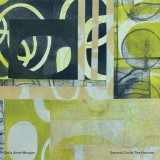
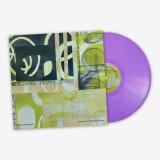
qebrus (pronounced Ké-brusse) was a project by Thomas Denis, an enigmatic French musician and producer born in 1981 and based in Caen, France, before his untimely passing in February of 2018. His undefinable otherworldly compositions and internet glitch trickery turned many heads catching the attention and support of esteemed artists such as Aphex Twin, Four Tet and Venetian Snares. The appeal of his music to other forward-pushing producers was emblematic of the uniqueness of his productions and led to collaborations with the likes of Tom Middleton, Otto Von Schirach and Mr Bill. His only release on Love Love Records, 'ᐔ ᐌ ᐂ ᐍ ᐚ', proved to be one his furthest reaching, originally released on CD during a flurry of musical productivity during 2017. Those 6 tracks of intricate extraterrestrial electronics now get the vinyl treatment, having been lovingly remastered or this reissue and pressed on green coloured wax.
The qebrus guise was that of an alien stranded on Earth and this concept was consistent throughout. The project gained notoriety almost exclusively on the internet, with many people's first experiences of his persona coming from the use of chaotic ASCII syntax in track titles which at the time 'broke' many of the websites he used to host his music. This theme of incomprehensibility extended to the sonic qualities of his music, foregoing any shred of familiar sounds in favour of an entirely electronically synthesised sound palate resulting in jarring and frenetic works full of near-imperceptible micro-details.
qebrus rarely performed live with one of the few occurrences being at an after-party following the now legendary Day For Night Festival 2016 in Austin, Texas where Aphex Twin played some of Qebrus' music to a crowd of 20,000 as Thomas watched on in what was undoubtedly an otherworldly experience for him.
Despite his vision being entirely self-driven without a care for popularity or recognition, there were many people across the globe that connected with the sheer weirdness of it all. 7 years on 'ᐔ ᐌ ᐂ ᐍ ᐚ' still sounds wholly futuristic and will likely remain so for centuries to come. In a time where it seems everything has already been done before Thomas leaves behind a legacy of an artist who was truly 'doing their own thing'.
Thomas is survived by his two children who will be receiving his proceeds from sales of this release.
“really alien sounding music”
Aphex Twin —
“Did you know that guy, Qebrus? He was on his own shit, he was making some really out there music, his music was incredible”
Venetian Snares —
“Listening to intelligent dance music producer Qebrus feels a lot like entering another dimension, his music stumbling its way through electronic chaos, leaving the listener unsure over what just happened.”
Thomas Hobbs — Crack Magazine
Suche:time synthesis
Set for release at the height of the season it’s dedicated to, ‘Music For Autumn Lovers’ by Adam Scrimshire is an eight track album of lush, mostly acoustic based, minimal instrumentals eliciting a mixture of feelings for this special time of year.
Four tracks originally released on an EP in 2022 are joined by new compositions ‘Hawthorn’, ‘Hazel’, ‘Willow’ and ‘Blackthorn’. Gently finger-picked acoustic guitars cosy up alongside pianos, synthesisers, strings and horns; filtered through an autumnal hue of susurrous production and effects. In turns comforting, melancholic and evolutionary; it feels like an album that can be kept being made and remade forever, like a season in itself.
Both a relentless creator and inspiring champion of new music; South London based Scrimshire has been recording, producing and DJing since the mid 2000s. Amongst his credits, he was featured by the Guardian as one of three producers behind the new wave of UK soul, alongside Inflo (Michael Kiwanuka, Sault, Lil Simz) and Swindle (Joel Culpepper, Greentea Peng, Kojey Radical). His bold 2023 album ‘Paroxysm’ was a response to the absurdity of the breakdown in the UK government, picking up an Album of the Week award on Huey Morgan’s BBC 6 Music show, and 2021’s beautiful ‘Nothing Feels Like Everything’ received an Album of the Year nomination at the Gilles Peterson Worldwide Awards. Scrimshire also somehow finds the time to support a wealth of talent on his label Albert’s Favourites, formed with Dave Koor and Jonny Drop, where they have recently released albums by And Is Phi, Huw Marc Bennet, Inês Loubet, Irini Arabatzi, Jonny Drop & Andrew Ashong, and Qwalia.
Radio Support: Gilles Peterson (BBC Radio 6 Music), Tom Ravenscroft/Deb Grant – New Music Fix (BBC Radio 6 Music), Huey Morgan (BBC Radio 6 Music) Guy Garvey (BBC Radio 6 Music)
Red Laser continue their prolific purple patch, unpacking four more slabs of red lit Manctolo from a host of box jammers, old and new.
Frank Butters wastes no time at all, 'The Call Of The Wild' engaging photon tubes with a highly kinetic array of crystalline synth shards, thunderous bass and hyperactive sfx. Without geeking out too much, special mention has to go out to the synthesis on display here - Butters advancing up the levels of sonic shamanism as he conjures up never-before-heard patches of interstellar cosmic NRG...
Bob Swans' 'Bodyform4U' unites the robots with a universal message of togetherness. Its multiple layers of shuddering arpeggios and star-aligned synths working in unison to quell any fears and send us off into a space age utopia. One that'll work as well soundtracking the end of the session as it will as the dancefloor's filling up; its subtle anthemic qualities sure to rouse the spirits of even the most dehumanized cyborgs.
New signing Lone Saxon drops 'Hypersleep' which utilises rich piano chords and a hefty breakbeat, switching up the vibe but keeping things super uplifting. This one reminds us of that innocent period when you could get on the megabus for 50p and score three for a tenner on the dancefloor. An evocative vocal refrain adds a moment of thoughtful introspection in between the e-rushes and arm-raising for another moment of interactive harmony.
Finally, 'Webo' sees Franz Scala (with a little help from Il Bosco) return to source, delivering a bona fide slice of maximum balls out MANCTALO chug. With tension-wrought chord progressions, delicious layers of lead melodies and a soaring vocal, there's few that can resist the charms of this late night electro-disco hyper anthem.
All aboard the starship !
RL x
Giuseppe Crisci is a musician and composer who splits his life in between London and Naples.
Known for his previous Acid House projects under the pseudonyms of DoTheDu and Crishi, he released several records on labels like Senseverse Records, Stealth Mission, and Pareidolia Recordings.
Conceived and written in his apartment in London and mostly recorded in his studio in Santa Maria Capua Vetere, this album proposes the sound of an evolving artist who drags himself into the deepest corners of heart and soul using profound synthesisers sounds which are coloured by intimate saxophone solos and rusty piano chords that enfasise strengthen the true sentiment of his lyrics narrated in English and Neapolitan dialect.
“My aim is to reach people’s soul and humbly influence them positively by trying to express what I feel deep inside myself, beyond meanings and words”— Giuseppe Crisci
The 2015 edition of Winnipeg’s send + receive festival, focussed on rhythm, turned out to be a generative meeting of minds. There, Mark Fell encountered the music of Will Guthrie, a meeting that was eventually to result in the frenetic acoustic drumkit and digital synthesis pairing heard on Infoldings and Diffractions (2020). At the same festival, Limpe Fuchs first heard and appreciated the music of Mark Fell, planting the seed of a collaboration that came to fruition when Fell (along with his son Rian Treanor) visited Fuchs at her home in Peterskirchen, Germany in September 2022. Black Truffle is pleased to announce the release of the results of this extensive session in the audacious form of a triple LP, housing over two hours of music across its six sides. The collaboration might appear unlikely: what common ground could exist between Fuchs, classically trained pianist, legend of improvised music, instrument builder and sound sculptor active since the 1960s, whose group Anima Sound connected the dots between free jazz, krautrock and ritual, and Fell, proponent of radical computer music, known for his bracingly austere productions that twist remnants of club music into algorithmic stutters? For all their seeming disparity in technology, approach and background, the music on Dessogia/Queetch/Fauch makes it immediately evident the pair share a great deal in their essentially percussive approach and ability to, in Fuch’s phrase, ‘establish silence’. Recording at her home studio, Fuchs had the use of her entire array of instruments, found, invented, and traditional, and treats the listener to some that don’t often make their way to concerts, including extensive passages performed (with Gundis Stalleicher) on pieces of wooden parquetry. Alongside metallic, wooden and skin percussion of all kinds, sounded and struck in every conceivable way, we also hear bamboo flute, viola, and Fuchs’ distinctive free-form vocalisations. Fell also stretched himself, with his contributions ranging from characteristically fizzing pitched percussive pops to swarms of sliding tones and abstract digital noise. Showing both remarkable restraint and improvisational freedom, much of the music consists of duets between a single percussion instrument and a distinctive mode of digital sound, often lingering in one timbral-rhythmic space for minutes at a time. Improvisational forward momentum coexists with a free-floating, wandering quality. On opener ‘Dessogia I’, the shimmering almost-gilssandi tones of Fuchs’ enormous set of microtonally tuned metal tubes ripples across Fell’s rubbery pulse, which moves up the frequency spectrum as Fuchs becomes more animated and switches to horn. At some points, as on the metallic chiming tones that open ‘Fauch I’, only the unexpected dynamic behaviour of Fell’s sounds distinguish them from Fuchs’ acoustic instruments. At others, like on ‘Queetch III’, the waves of sliding tones and noise textures are bracingly synthetic, joined by piercing squeaks and scrapes from Fuchs’ metal objects. Epic in scope, immersing the listener in an entirely distinctive world of sounds, and thrillingly bold in its melding of the most ancient musical procedures with cutting edge technologies, Dessogia/Queetch/Fauch is an unexpected major statement from two of the great mavericks of contemporary music.
Something About Livingis an album of live recordings by experimental jazz composer/multi-instrumentalist Robert Stillman. The music was captured over the course of Stillman's time as the solo support act for The Smile (Thom Yorke, Jonny Greenwood, Tom Skinner). The album weaves excerpts from various theater and arena shows along the tour's North American routing into a seamless whole, creating a 40-minute program that represents an expanded version of Stillman's ever-transforming live set.
Something About Livingis the product of a steady, on-stage evolution that happened over the course of the nearly 60 shows opening for the Smile across the EU, UK, US, Canada and Mexico. However, the creative origins of the set began in relative isolation during the pandemic, through Stillman's work on projects like his multi-media installationUnseen Forcesand his monthly broadcast for Margate Radio, both of which drew upon solo improvisation using saxophone, cassettes, Yamaha DX7 synthesizer, and effects.
"At the time The Smile asked whether I'd like to open for them on their first tour, I felt like I'd already been preparing without really knowing it," says Stillman. "I'd been doing this music constantly, but always for a hypothetical audience" During the pandemic, Stillman's solo set-up served as the research lab where he worked on all the concepts he was interested in: solo improvisation, creating and manipulating cassettes, FM synthesis, analogue delays chains, no-input mixing, and non-metric rhythmic pulses. So when he was offered the first Smile tour, the idea was to bring "the lab" onto the stage.
What Stillman could not have prepared for was the experience of playing in venues with capacities of up to ten thousand listeners. "The first tour was in summer 2022, so not that long after the worst of the pandemic, when I had pretty much made peace with the idea that I might never be able to perform for an audience again. Then all of a sudden I found myself in front of huge numbers of people, and felt the massive responsibility of being with an audience, of this thing I'd done alone for so longactually being witnessed, and it was completely overwhelming!" On the flip-side, Stillman also recalls, was a new appreciation of how powerful the live performance was as a social phenomenon. "It's a cliche, but also true: the moment of making and hearing music in a shared time and space has a very specific meaning and power; there was a sense that everyone in the venue was necessary to make it real, regardless of what they were doing, or how they felt about it. There was an inevitability about it that I'd never fully appreciated."
Over the course of the tours that followed, Stillman transformed this appreciation of the shared moment into an ethic of spontaneity that guided the development of his live set. "An important reference for this set has always been an Animal Collective show I saw when I first moved to New York, probably in 2001 or so, that has always set the high-water mark for what I wanted to do live- they were improvising a lot, and out of what would seem to be absolute chaos they'd find their way to something structured, and then back out again into the unknown. It was so thrilling to witness".
ThoughSomething About Livingcompiles recordings from different dates along the tour, Stillman has edited and mixed them into a work that seeks to reflect the ebb and flow between 'chaos and control' that characterizes his live set. Among the compositions featured are some from previous album releases ("Time of Waves", "What I Owe", "What Does it Mean to Be American") as well as some new compositions ("The Dream of Waking", "Renaissance 2.0," and the title track, "Something About Living").
The album/track title "Something About Living" is a reference to a line from Stillman's favorite film,My Dinner With André: "André Gregory is explaining the value of life experiences that, as he says, are'to do with living'.That really struck me, the way he articulated it. I strongly believe live music situations can ask these kinds of questions, for performers and audiences. I hope that's reflected in this music."
[a] 01: Time of Waves (Live in Miami FL) [Live]
[b] 02: What Does It Mean to Be American (Live in Forest Hills NY) [Live]
[c] 03: The Dream of Waking (Live in St Augustine FL) [Live]
[d] 04: Something About Living (Live in Richmond VA) [Live]
[e] 05: What I Owe (Live in Chesterfield MO) [Live]
[f] 06: Renaissance 2.0 (Live in Chesterfield MO) [Live]
Eight cuts of cinematic electronic music from synthwriter OFFLINE. To follow this rainbow of silky sounds is to reach a point of no return, where the last person on Earth you'll be able to communicate with will be a 1970s synthesiser.
The first edition of Era Specific Noise is both an ode to the early 2000s and the debut of a new alias by label founder Richardson. Having spent the better part of his recent memory scouring record stores and consuming more VG+ dance music than is medically recommended, this 12-inch marks a personal shift towards character-filled production without limitation.
Armed with a growing appreciation for the originality and love poured into old-school techno, ESPN001 is the first glimpse into Richardson's fast-growing stockpile of musical weaponry.
We kick things off with "Introductions", the first of two upbeat, vocal-laden pieces of DJ-friendly dance music that make up the A side. A new hardware-focused approach produces whirling, stabbing chords and a groovy baseline to meet the eponymous sample of this track. Up next, "Coming In Hot" which does just that - presenting a cohesion of warm, groovy techno littered with dubby synths and a throwback feel.
On the flip side is a pair of fresh takes reminiscent of the more functional sound of the era - the timeless, loopy techno that powers dancefloors worldwide. There’s nothing quite like finding a hidden gem on the B side! Robotic vocal loopings and a galloping low-end form “Notch”, a warehouse tune completed by a warmer feeling send-off littered with floating pads and a classic Reese bass. Closing out the release is “Synthetic Scream”, a synthesiser in anguish showcasing an almost mournful interpretation of the 909 era, complete with fast, driving percussion and classic break hits.
Welcome to Era Specific Noise - New school old school.
One of London’s most loved underground parties, Tangent, celebrates its 10th birthday this year with a new compilation on Mr Bongo. Its residents, John Gómez and Nick the Record, have curated a selection of prized, rare and dancefloor-ready tracks that have soundtracked the past decade of their parties. Alongside remastered reissues of these original cuts, the CD version of the compilation also houses three incredible edits from Nick, John and Dan Tyler of the Idjut Boys. These were too good not to press onto vinyl, so we’ve given them the standalone 12" they deserve.
Contextualising their edits Nick states, “Tangent was not only the place for us to play the music we love the most, it also became the testing ground for our edits. It was really helpful being able to see the effect each of these had on a dancefloor before the records were released and many of them also became firm Tangent classics.”
Up first, Nick is joined by Dan Tyler (Idjut Boys), who he runs the edit label Record Mission with, for a furiously feel-good re-edit of Leo Basel’s ‘Quelle Drôle De Vie’. Basing their edit on the 1987 ‘Special Remix’, it does what any great re-work does, dropping the sections from the original that don’t quite hit the mark, whilst focussing on the gold in amongst it all. The result is a slice of peak-time, French boogie joy, that will warm even the coldest hearts.
John then joins Dan at the dials for a cosmic revamp of Love Isaacs 'Surprise Surprise'. A serving of ‘80s electro-funk, dripping in swagger with a highlife tinge. John and Dan extended the grooves for maximum dancefloor power, space echoing it into the stratosphere at all the juiciest points.
Lastly, Nick takes on Rick Asikpo and Afro Fusion 'Let's Get High' from the super sought-after 1980 album, Got To Be Me. Celestial, gospel-infused soul from Nigeria, Nick homes in on the energetic last 2 minutes of the original as the building block of his 12-minute edit. A completely reworked, feverishly paced creation, Nick switches the sections around, saving the slow, soulful segment for a brilliant cosmic breakdown before the track erupts back into its full flow. Synthesised, jazz-funk elation from start to finish!
Forgetting You Is Like Breathing Water, the self-titled debut from the duo of trumpeter Will Evans and guitarist, synthesist, producer and multi-instrumentalist Theo Trump, arrives like a vault revelation. It feels like a decades-old yet newly unearthed masterwork of gorgeous ambient improvisation, the sort of thing scholars live to research and shepherd into deluxe reissue.
The patient, crystalline chords that swell and resonate like a series of confessions; the textured brass murmurs that suggest a ’60s or ’70s Fire Music master at their most poignant. Provocative found-sound experiments threading arcane religious recordings through dystopian soundscapes. Ear-shattering free-noise tumult. Where and when did this music come from? Who are these voices?
As it turns out, Forgetting You Is Like Breathing Water springs from an engrossing human story, though it isn’t necessarily the one you’d expect. This work of stunning maturity is in fact an entrance by two little-known explorers in their early 20s, who grew up together in Virginia, in the shadow of the Blue Ridge Mountains. It documents one of those perfect, sparkling moments in post-adolescence when big decisions and responsibilities are right around the corner, but for a spell, two young artists are able to create among the comforts and nostalgia of their shared past.
It also represents a reunion of sorts, as Evans and Trump connected as toddlers, became inseparable as boys, then pursued independent lives and creative paths as young adults. “Theo is my oldest friend,” Evans says, “and I feel like that’s what this band is — us meeting right in the middle of our interests.”
Now, having conjured this magic, they’ve detached once again: Evans, whose other works include the indie/avant-jazz unit Angelica X, is currently based in New York City. Trump recently moved to England, where he’d participated in his family’s theatre company, to go to school and further his solo ambient project. “This album didn’t start out as something super ambitious,” Evans explains. “It was more just an excuse to spend time together again and make music.”
***
In conversation, Evans and Trump are a delight, especially for cynics who might think that Gen-Z is only capable of doomscrolling. They come across as kindly young intellectuals who grew up using the internet as it was intended, for exposure to ideas and art across genres and generations. Trump points to indie-folk and the oracular post-rock of late Talk Talk, Bark Psychosis and Gastr del Sol. Pressed for his guitar heroes, he cites Bill Orcutt, Mary Halvorson and Marc Ribot, and mentions his devotion to alt-country. Heyday electro-industrial stuff like Skinny Puppy and Nine Inch Nails also meant a lot to him.
Evans is equally intrepid, though his background has a greater jazz focus. Ambrose Akinmusire, among today’s most thoughtfully commanding trumpeters, is a favorite. As for the soulful murmur he offers throughout Forgetting You, Pharoah Sanders’ wistful and lyrical contributions to Floating Points’ work is a touchstone.
The two grew up down the street from each other in the northern Piedmont town of Batesville, Virginia. Their families were friends, holidays were celebrated together and they became the most loyal of pals. As children they had a pretend band.
Then life unfolded, they attended different schools and their paths diverged. Evans discovered John Coltrane and became a jazz obsessive, as Trump found punk and hardcore and later began making ambient music. As a dedicated jazz trumpeter, Evans studied formally and widely; Trump was an autodidact, teaching himself guitar and absorbing synthesis and production techniques. The late teens and very early 20s brought moves away from home and back to home, as well as plenty of listening and learning. The Covid pandemic meant an opportunity to reconnect on long walks. Through it all, together and apart, they remained reverent of each other.
By early 2023, they found themselves living again among the Blue Ridge Mountains. In the evening, after giving trumpet lessons in Charlottesville, Evans would make the eerily beautiful trek “over the mountain” to Trump’s home in Staunton, Virginia. They’d talk and eat and begin to improvise, deep into the night. Evans played trumpet and sometimes drums. (Given the wee-hours recording schedule, the neighbors didn’t appreciate the latter.) Trump plugged a rickety, junk-store Telecaster-style guitar into a cheap solid-state amp and explored open tunings; he also layered on lap steel, electric bass, synths and electronics.
They locked in and relished each other’s gifts. In Trump, those include patience and intentionality and sonic decision-making; for Evans, a distinctive trumpet sound that both musicians think of as a singer’s voice. “Will’s playing is so thoughtful and well placed,” Trump says. “My goal from a producer’s mindset is that the trumpet will occupy the space that vocals would take.”
Often, they got lost in the best way. “The thing I look for most when I’m playing is that feeling of disappearing into what you’re doing,” Evans says. “Usually when that happens, the music is good.”
By the same token, they didn’t pursue free improvisation as an ethic, or as a pure process. Their goal was something closer to spontaneous composition. “We were trying to make good songs,” Evans says simply. Later, Trump did brilliant post-production work, expanding a modest setup into an enthralling soundworld. Under his judicious editorship, music that was wholly improvised sounds at times like a carefully composed new-music commission.
The results speak for themselves. “A Happy Death” summons up a swath of American desolation through the viewfinder of Wim Wenders. “Flesh of Lost Summers” and “Partings” are highlights from an essential ECM LP that never was. “A Collapse of Horses” infuses those seminal post-rock influences with the plod of doom metal or slowcore. The album’s final track, “The Mountains Are a Dream That Calls to Me,” was in fact the first thing the duo recorded, as an evocation of those twilit drives across the Blue Ridge Mountains. “Looking back at what we chose to name the songs,” Evans says, “and some of the sounds and how they make me feel, there is an air of impermanence and loss to this album.”
“I’m excited for everything that’s to come,” he adds, “but I recently thought, ‘Damn — that’s not going to happen again.’ It was a privilege for us to have that time together.”
Xylitol is the alias of Catherine Backhouse, producer and DJ under the name DJ Bunnyhausen. She was a resident DJ at Kosmische, the now dormant Krautrock club and is a fan of jungle and hardcore. She currently co-hosts the radio show Slav To The Rhythm, which focuses on vintage central and eastern European pop and electronica and she's also co-writing a book on Yugoslavian pop culture. 'Anemones' is a total project from the cover to the music. Backhouse is fascinated by early botanical illustrations of anemones and other aquatic fauna, and how the act of taxonomy reveals as much about human psychology, desire and sublimation as it does about the organic specimen as a thing in itself. Each track is a microcosm of this 'other life', an allegory for the extraordinary potential latent within bodies that the dancefloor has the power to activate. Using early jungle and garage as starting points to connect dots and open up contrasts between dance music and vintage electronics, Backhouse finds a sweet spot which, in her words "feels like something that's simultaneously still and ancient yet propulsive and ecstatic." Not afraid of letting the the hiss and flutter of the music show, 'Anemones' holds attention with ancient bubbling synths and gracefully drifting arpeggiations, occasionally brought to heel by charming melodies, all accompanied by breakbeats that explode like fireworks. 'Anemones' has a lively and unpolished aesthetic that's a kindred spirit to Nondi_'s 2023 album of smeary, water-damaged footwork, 'Flood City Trax'. 'Moebius' pits the spaced out neon chords of the track's namesake against absolutely tearing breaks, allowing time for this almost overwhelming combination to become near enough transcendental, while the bleeping melody and sad slavic chorus motif in 'Okko' feels like an artifact from an alternative future. The Drexciya meets 2-step garage of 'Dobro Jutro' creates a welcome respite at the album's midpoint before the flow builds up again to 'Daša' with its glassy sounds from a lost radiophonic workshop miniature meeting bruising kicks and snares. Meanwhile 'Iskria' has purring synth chords and 8-bit melodies evoking the cosmonaut age. The subliminal influence of the Yugo era is felt in DIY synthesis and Mitteleuropean melody and seen in song titles such as 'Jelena', 'Miha', 'Daša' (named after novelist Daša Drndič) and 'Iskria' (taken from the fictitious Balkan region in Ottessa Moshfegh's bleak fable 'Lapvona'). 'Anemones' very effectively folds experimental genres from different times and places into a very enjoyable new sound.
Citirax's next outing takes the form of a debut album from Los Angeles-based duo OP-ART. This pair, like so much great music of recent times, is born out of the creative isolation of lockdown and features Andrew Clinco, who you may know for his work with Drab Majesty. The alias they have adopted is an acronym of "Oblique Pleasures Amidst Rough Times" which they say reflected the challenges of their formation. Musically the duo is inspired by the 1960s visual art movement so embraces layered, psychedelic soundscapes with a minimalist approach and takes cues from New Wave artists like John Foxx and early OMD. OP-ART in particular focuses on analogue synthesis and gear like the Arp Odyssey and Moog Rogue while exploring time, romance, and existential themes with real emotional depth.
2024 Reissue
Founded with the intent of bringing hidden sounds out of obscurity, Rarefied will project these sounds on to a platform to be experienced by the many denizens of sound system culture. While the music is made to enjoyed by all, it retains its identity as both an underground and unique form of artistic expression.
After a series of successful digital releases, Soukah bursts onto the vinyl scene, presenting a sound crafted over the course of almost a decade. His past works range from Industrial Noise to his own unique take on Dubstep. RARE1 showcases Soukah's versatile approach to production - His organic style, based on dark synthesis and unorthodox drum patterns, is a true representation of the Rarefied sound.
'JAK FOU' is the result of six months of studio time, the classical piano riff combined with haunting percussion results in an experience akin to ingesting 18 grams of psycobilin. On the flip side 'Loner' is a far darker, moodier affair. Written solely by candlelight, the production evokes the darkest elements of Soukah's soul. This track is best enjoyed alone, in the wilderness.
Skinshape (aka Will Dorey) releases his ninth studio album titled Another Side Of Skinshape on 27th September via Lewis Recordings. As the album title suggests, Dorey’s latest body of work is somewhat unlike anything in his prior discography. However, there is always a consistent Skinshape thread which pulsates throughout all of his music - a kind of sonic dreamscape which echoes a mystical nostalgia for a sun dappled afternoon.
Taking inspiration from childhood memories, Ethiopian rhythms, and even calls to prayer, Another Side Of Skinshape gained access to the most esoteric corners of Dorey’s mind. Whilst ‘It’s About Time’ and ‘Ananda’ display a slightly more synthesised palette than we typically hear of a Skinshape tune, singles ‘Stornoway’ and ‘Lady Sun’ (which features the hazy soul vocals of West London’s Hollie Cook) replicate the same lifeblood heard on albums Nostalgia, or Craterellus Tubaeformis.
Speaking on the album, Dorey says “Some songs pay homage to the 90s whilst others the 60s and 70s. Yet you may not perceive all of these in the form that they are presented. In any case I hope that the album is enjoyable and will fit casually into the flow of your day.”
Whilst making this album, Dorey experimented with various keyboards and drum machines, which are at times layered over the excellent drumming of Thomas Blunt, who played live onto tape. Blunt is well versed in the Skinshape vernacular, also being part of Dorey’s live band. Indeed, Another Side Of Skinshape is due for release just before a run of UK and US live dates, which will be the first time the band has ever hit the open road.
Dorey is a former member of the band Palace, has played Glastonbury, BBC Maida Vale and Shepherd’s Bush Empire to name a few. Skinshape’s ‘I Didn’t Know’ has streamed over 50 million times. He is proudly from Swanage, Dorest.
For the past two decades, Dr Roman Belavkin (Solar X) has been deeply involved in AI research and mathematics at British universities. His albums from the 1990s are a testament to an era defined by the early internet-bulletin boards, FTP sites and mailing lists. In keeping with this, Solar X's music sounds surprisingly futuristic, a romantic artifact of a time eagerly anticipating tomorrow.
Following the re-issue of Solar-X's "Xrated" in 2019, GALAXIID is releasing his debut "Outre X Mer". All tracks are from the original DAT tapes and have been remastered for this release. "Pozdno Utrom", "Dileg" and "Solar X" were originally released on the "Outre X Mer EP" on Defective Records in 1995. Other tracks are out on vinyl and digital platforms for the first time.
"I was homebound for two years between 1992 and 1994, and the only way I could escape was through computer networks and writing," Belavkin recalls. Before the nasty car accident he was a member of the USSR/Russia national wushu team. Confined to his home, Belavkin started creating tracks based on ideas from his school days in the late 1980s, when he first recorded melodies on cassette tapes. This time, however, he fused those sounds with Soviet analogue synthesizers and PC sound cards. He shared these tracks via email with friends in different countries, becoming part of the "Analogue Heaven" mailing list, a community of enthusiasts united by their passion for analogue synthesis dating back to the 1960s.
During his initial pursuit of a PhD in Computer Science, Roman wanted to explore the intersection of what electronic music could offer humanity, the potential for AI to experience emotions, and whether emotions enhance or hinder intellect. These themes resonate in the music of Solar X. The album embodies ambient techno with intricate rhythms and ear caressing melodies, choppy percussion and blissful synths, making it both tranquil and danceable. Like a shimmering spaceship navigating between anxious dreams and visions, it transports the listener to a naively hopeful era yet to come.
What an unbelievable record. From the wild cover to the iconic breakbeats, Roots from Ian Carr’s Nucleus is one of the dopest albums we know. This is seriously thick, funky-prog jazz-rock heaven. Originally released on Vertigo in 1973, other than a couple of versions at the time for other territories, Roots was never re-pressed since so it’s gone on to become another one of those impossible to find records.
Maybe it was a little too out there for the time, but it’s aged very, very well indeed and this Be With re-issue, re-mastered from the original analogue tapes, shows off just why this deserves to be back in press.
Genius trumpeter and visionary composer Ian Carr was one of the most respected British musicians of his era. He was a true pioneer and saw the potential in fusing the worlds of jazz with rock, just as Miles Davis and The Tony Williams Lifetime did in the US. In late 1969, following the demise of the Rendell-Carr quintet, and tiring of British jazz, Carr assembled the legendary Nucleus. Regarding music as a continuous process, Nucleus refused to “recognise rigid boundaries” and worked on delivering what they saw as a “total musical experience”. We can get behind that.
Under bandleader Carr, Nucleus existed as a fluid line-up of inventive, skilled musicians. This constant evolution and revolution was all part of the continuous musical exploration and discovery that took jazz to new levels.
Working together with producer Fritz Fryer and engineer Roger Wake, the seven compositions by Carr, Brian Smith and Dave MacRae that make up Roots flirt with perfection, and Nucleus at that time made up of the cream of 1970s UK jazz with Brian Smith on tenor saxophones and flutes, Dave MacRae on piano and electric piano, Jocelyn Pitchen on guitar, Roger Sutton on bass, both Clive Thacker and Aureo De Souza on drums and percussion, Joy Yates delivering the vocals and of course Carr on trumpet.
The spellbinding title track immediately renders the album indispensable. Riding the illest of loping breakbeats, “Roots” is low-slung, doped-out heist-funk. An absolute monster. If it sounds familiar then that’s likely down to it being sampled by Madlib for Lootpack and Quasimoto’s “Loop Digga”, as well as by a whole host of beat manipulators. “Roots” conjures prime instrumental hip-hop / beat music, only 20 years ahead of its time. Truly, these are the roots. Through sinuous bass, twinkling keys and a hypnotic guitar riff, a smoky brass motif weaves its way into a gloriously deep haze around Carr’s solos. “Roots” is over 9 minutes long, but there’s not a single wasted second, not surprising given that this is a condensed version of an originally 40 minute long commissioned composition.
The soothing vocal fusion delight of “Images” follows. Meticulously constructed, with gorgeous flute work from Brian Smith, with Joy Yates’ silky vocals and Dave MacRae’s Rhodes never sounding better. The cool, driving “Caliban” closes out the first side. Originally the third movement in a four part commission to celebrate Shakespeare’s birthday it stands up on its own, all robust rhythms and blended brass. Keyboard colour and Carr’s trumpet are splashed across the funk drums and basslines (and there’s even some bamboo flute). This really is fusion: the elements of jazz and rock coming together in beautifully synthesis.
Side two opens in riotous fashion with the short, thrilling samba of “Wapatiti”. Next up, “Capricorn” forms a smoothed-out, jazzy constellation. Mellow and dreamy, its twinkling percussion and languid horns slowly build the vibe before head-nod drums and a killer bassline enter the fray. With a distinct heaviness that Black Sabbath would’ve envied, “Odokamona” is a venomous slice of riff-soaked jazz metal (yes, you read that right), elevated by Carr’s wah-wah horns.
The album closes with MacRae’s exceptionally cosmic “Southern Roots and Celebration”. Very much in conversation with Weather Report, it opens as a languorous, spiritual jazz of chiming keys and serene guitar that turns slowly, gorgeously into a mid-paced, brass-laced banger. It’s another sure-fire party starter and the sound of the band having a righteous blast, building an ecstatic chaos that ends with Yates screaming.
And of course we need to talk about Keith Davis’ cover for Roots. Perhaps the coolest record cover of all time? Certainly one of the most bonkers. Just your run-of-the-mill high-gloss, acid-tinged airbrush dystopian/utopian living-room party scene. Consider this your chemical flashback trigger warning.
Front-and-centre the hip-to-death green robot holds court with their giant ball of yellow barbwire wool, hooked up to… something(?) being teased out from under the stairs (probably best not to ask). A thoroughly zoned-out, long-legged Pop Art party-goer lounges half-plugged in to the painting behind her as a pair of legs flail into shot from the the top of the stairs opposite. We won’t even begin to guess what the chap’s up to in the middle, but the view out of the windows is rather nice, and someone’s already got the hoover out ready to tidy up. All of the Nucleus sleeves are something special, but this particular one? Crikey.
This Be With edition of Roots has been re-mastered from the original Vertigo master tapes, Simon Francis’ mastering working together with Pete Norman’s cut to weave their usual magic with these wonderful recordings. The crazy cover has been restored at Be With HQ as the finishing touch to this long overdue re-issue.
'Good Time' is the debut album from Austin, TX noise-pop band DAIISTAR, due out September 8th via Fuzz Club. Creating a narcotic blend of noise and melody, the band takes their inspiration from the neo-psychedelic era of the 80s and 90s and pull it into the future with modulating synthesisers, heavy guitars, bouncing bass lines, and spiralling hooks. 'Good Time' was produced by The Black Angels' Alex Maas and engineered by James Petralli of White Denim. Made up of Alex Capistran (guitar/vocals), Nick Cornetti (drums), Misti Hamrick (bass) and Derek Strahan (keys), DAIISTAR formed in the spring of 2020, just weeks before the pandemic started. "To us, these songs were a glimmer of light", Capistran says: "Starting a band at the peak of the pandemic to some might seem ill-timed, but to us it was a way to escape for a moment. There was something to look forward to and we kept our heads in the future. These songs guided us through some dark times and hopefully they can do the same for you. GOOD TIME is here." Pressing info for LP: 180g neon orange vinyl, printed inner-sleeve, download card included
Monument is one of Portico Quartet’s most accessible, direct records to date. If Terrain addressed the darker side of how Duncan Bellamy and Jack Wyllie made sense of the pandemic, then Monument resonates as an ode to better times. If not quite a dance record, it nonetheless pulses with an energy, radiance and a scalpel sharp focus. Jack Wyllie explains: “It’s possibly our most direct album to date. It’s melodic, structured and there’s an economy to it that is very efficient. There’s not much searching or wastage within the music itself, it is all finalised ideas, precisely sculpted and presented as a polished artefact.” Bellamy expands “Monument sits somewhere between our albums Portico Quartet and Art in the Age of Automation. It has perhaps a more overtly electronic edge to its sound – there are more synthesisers and electronic elements than we have used before and the music is often streamlined and rhythmic”.
'Good Time' is the debut album from Austin, TX noise-pop band DAIISTAR, due out September 8th via Fuzz Club. Creating a narcotic blend of noise and melody, the band takes their inspiration from the neo-psychedelic era of the 80s and 90s and pull it into the future with modulating synthesisers, heavy guitars, bouncing bass lines, and spiralling hooks. 'Good Time' was produced by The Black Angels' Alex Maas and engineered by James Petralli of White Denim. Made up of Alex Capistran (guitar/vocals), Nick Cornetti (drums), Misti Hamrick (bass) and Derek Strahan (keys), DAIISTAR formed in the spring of 2020, just weeks before the pandemic started. "To us, these songs were a glimmer of light", Capistran says: "Starting a band at the peak of the pandemic to some might seem ill-timed, but to us it was a way to escape for a moment. There was something to look forward to and we kept our heads in the future. These songs guided us through some dark times and hopefully they can do the same for you. GOOD TIME is here." Pressing info for LP: 180g neon orange vinyl, printed inner-sleeve, download card included
Black Truffle is thrilled to present a Song for two Mothers / Occam IX the first ever solo release from Laetitia Sonami. Born in France in 1957, Sonami studied with Éliane Radigue in Paris before moving to California in 1978 to study electronic music at Mills College, going on to make important innovations in the field of live electronics interfaces and multi-media performance. Sonami is perhaps most closely associated with one of her inventions, the Lady’s Glove, an arm-length tailored glove fitted with movement sensors allowing the performer fluidly to control digital sound parameters and processing, as well as motors, lights and video playback. Having performed with the Lady’s Glove for 25 years, Sonami retired it in 2016, turning her attention to the interface/instrument heard and pictured here, the Spring Sprye.
In Sonami’s own description, “The Spring Spyre is composed of three thin springs that are attached to reverb tank pickups, mounted on a metal ring. The audio generated when the springs are touched, rubbed or struck is analyzed in Max/MSP. The extracted features are then used to train machine learning models in Wekinator and Rapidmax and control the audio synthesis in real time. We never actually hear the springs.” After decades of aversion to documenting her work on recordings, a Song for two Mothers / Occam IX treats listeners to two side-long performances with the Spring Spyre: the very first piece developed for the instrument and the most recent, the two contrasting remarkably in sound palette, energy and form. A Song for two Mothers (2023) spins an intricate web of rippling synthetic burbles, rapid sweeps and fizzing textures. Performed in real time with the sensitive and partly uncontrollable Spring Sprye ("a bit tyrannical," Sonami calls it), the music is delicate yet chaotic. Abrupt gestures hover against a backdrop of silence, "devoid of spatial or temporal direction". After several minutes, the sound-world becomes metallic and percussive, tapping and ticking in pointillistic flurries before a wavering harmonic cloud emerges, sprinkled with resonant drips and pops.
Occam IX is a radically different proposition. At the outset of Sonami’s exploration of the Spring Sprye, she asked her former teacher Éliane Radigue to compose a piece for it—and her: like all of Radigue’s work since she ceased working with analogue electronics at the beginning of the 21st century, Occam IX is written not only for an instrument but also for a particular performer. These scores are developed verbally, through meetings and conversations between performer and composer; each is grounded in an image (usually kept from listeners, to avoid influencing their experience); all magnify the subtlest acoustic phenomena and require great commitment and patience from the performer. Sonami’s is one of the few Occam pieces to make use of electronics, bringing it closer to Radigue’s famous longform pieces for ARP 2500. Beginning from a rumbling low tone, the listener is gradually immersed in slowly lapping waves of synthetic tones, eventually thinning out into delicate bell-like pings against a background of white noise, reminiscent of one of the most beautiful sections of Kyema from the Trilogie de la Morte.
Accompanied by notes from Sonami, her longtime collaborator Paul DeMarinis, and Radigue, and illustrated with scores, photographs and images of the Spring Spyre, a Song for two Mothers / Occam IX is an essential document celebrating an under-recognised pioneer of electronic music and performance.
Japanese vibraphonist and marimba player Masayoshi Fujita returns with Migratory, his masterful new solo album, where his sonic explorations into the unknown continue.
In 2019, after 13 years of living in Berlin, Fujita returned to his native Japan with his wife and their three children, fulfilling his life-long dream of living and composing music in the midst of nature. The family found their new home in the mountain hills along the coast of Kami-cho, Hyōgo, three hours west of Kyoto.
Once settled in, Fujita spent his time turning an old kindergarten into his own music studio, Kebi Bird Studio, which became the birthplace of Migratory. On his new album, the composer and producer masterfully reimagines and mesmerises with his trademark sounds of vibraphone, and resumes his experimentation with the marimba and synthesisers that he first incorporated on his 2021 album, Bird Ambience, which followed the release of his acclaimed vibraphone triptych: Stories (2012), Apologues (2015) and Book of Life (2018).
On Fujita’s ever-evolving list of collaborators, Migratory introduces vocals from Moor Mother on ‘Our Mother’s Lights’ and Hatis Noit on ‘Higurashi’, as well as shō and saxophone to its soundscapes. Whilst at a music residency in Stockholm in 2021, Fujita met Swedish shō player Mattias Hållsten. Although it was a brief encounter, the two musicians stayed in touch. During a visit to Japan, Hållsten stopped by the studio and played on three of the tracks, including the alluring album closer ‘Yodaka’, exceeding Fujita’s own expectations.
Japanese vibraphonist and marimba player Masayoshi Fujita returns with Migratory, his masterful new solo album, where his sonic explorations into the unknown continue.
In 2019, after 13 years of living in Berlin, Fujita returned to his native Japan with his wife and their three children, fulfilling his life-long dream of living and composing music in the midst of nature. The family found their new home in the mountain hills along the coast of Kami-cho, Hyōgo, three hours west of Kyoto.
Once settled in, Fujita spent his time turning an old kindergarten into his own music studio, Kebi Bird Studio, which became the birthplace of Migratory. On his new album, the composer and producer masterfully reimagines and mesmerises with his trademark sounds of vibraphone, and resumes his experimentation with the marimba and synthesisers that he first incorporated on his 2021 album, Bird Ambience, which followed the release of his acclaimed vibraphone triptych: Stories (2012), Apologues (2015) and Book of Life (2018).
On Fujita’s ever-evolving list of collaborators, Migratory introduces vocals from Moor Mother on ‘Our Mother’s Lights’ and Hatis Noit on ‘Higurashi’, as well as shō and saxophone to its soundscapes. Whilst at a music residency in Stockholm in 2021, Fujita met Swedish shō player Mattias Hållsten. Although it was a brief encounter, the two musicians stayed in touch. During a visit to Japan, Hållsten stopped by the studio and played on three of the tracks, including the alluring album closer ‘Yodaka’, exceeding Fujita’s own expectations.
This debut full-length album by Stockholm-based composer and electroacoustic experimentalist Theodor Kentros, could easily be interpreted as 'just' an assemblage of pieces written between 2021-2024. Named after the paranoid hallucination (or, if said hallucination is real, the underground secret mail system) figuring in the 1966 Thomas Pynchon novel ‘The Crying of Lot 49’, it should rather be perceived as a very distinct, coherent stream running through his output during these years.
The six tracks – ranging in sound and disposition from serialised organ drones constructed to reach screeching and beautiful culminations, to minimalist, repetitive studies in tape loops and string synthesis – were composed and recorded in Stockholm and Visby at different occasions during down-time from his many other projects, which include a myriad of other commissions, co-running labels XKatedral and Kalkatraz Cassettes and touring with punk groups and solo shows.
2024 Repress
Alleviated Records presents the first-time vinyl reissue of Larry Heard's mid-90's gem ''Sceneries Not Songs, Volume 1''. The album stems from a time when the tempo slowed down and Heard reached a perfect synthesis of jazz influences, deep electronic ambiance and the house sound he was known for. The result is a brilliant album that should cater to both house and R&B heads alike. Now for the first time released as a 2x12''
Dark Entries and Honey Soundsystem Records have teamed up once more to release the final volume of gay porn soundtracks by San Francisco-based musician and producer, Patrick Cowley. One of the most revolutionary and influential figures in the canon of disco, Cowley created his own brand of Hi-NRG dance music, The San Francisco Sound.' Born in Buffalo, NY on October 19, 1950, Patrick moved to San Francisco in 1971 to study at the City College of San Francisco. He founded the Electronic Music Lab at the school, where he would make experimental soundtracks by blending various types of music and adapting them to the synthesizer.
By the mid-70's, Patrick's synthesis techniques landed him a job composing and producing songs for disco superstar Sylvester, including hits like You Make Me Feel (Mighty Real)', Dance Disco Heat' and Stars.' This helped Patrick obtain more work as a remixer and producer. His 18-minute long remix of Donna Summer's I Feel Love' and his production work with edgy New Wave band Indoor Life were both of particular note. By 1981, Patrick had released a string of dance 12 singles, like Menergy' and Megatron Man'. He also had founded Megatone Records, the label upon which he released his debut album, Menergy'. Around this time Patrick was hospitalized and diagnosed with an unknown illness: that which would later be called AIDS. Throughout 1982, he recorded two more Hi-NRG hits, Do You Wanna Funk' for Sylvester, and Right On Target' for Paul Parker, as well as a second solo album Mind Warp'. On November 12, 1982, he passed away.
In 1979 Patrick was contacted by John Coletti, owner of famed gay porn company Fox Studio in Los Angeles. Patrick jumped on this offer and sent reels of his college compositions from the 70s to John in LA. Coletti then used a variable speed oscillator to adjust the pitch and speed of Patrick's songs in-sync with the film scenes. The result was the VHS collections Muscle Up' and School Daze' released in 1979 and 1980. Afternooners' is the third collection of Cowley's instrumental songs, recorded in May 1982. These recordings were culled from two 23-minute reels in the Fox Studio vaults. All songs were originally untitled, so we've used the titles from Fox Studio's 8mm film loops. This compilation also includes three bonus tracks found in the archives of fellow Megatone Records recording artist Paul Parker and the attic of teenage friend Lily Bartels. Influenced by Tomita, Wendy Carlos, and Giorgio Moroder, Patrick crafted a singular sound from his collection of synthesizers, percussion, modified guitars, and hand-built equipment. The listener enters a world of forbidden vices, evocative of Patrick's time spent in the bathhouses of San Francisco. The songs on Afternooners' reflect the advances of the equipment available at the onset of the 1980s. Cowley's unadulterated electronic forms are stripped down and dubbed up. Lush electronic percussion, soaring synthesizer riffs and low slung funk grooves comingle on these magnificent soundscapes.
Featuring 70 minutes of music never before released on vinyl. All songs have been remastered by George Horn at Fantasy Studios in Berkeley, CA. The vinyl is housed in a gatefold jacket designed by Berlin-based artist Gwenael Rattke, featuring black and white photos of Patrick in his studio that opens to a full color array of x-rated scenes from the Fox Studio vaults. Included is a fold-out poster featuring a handmade collage using photography and xeroxed graphics of classic gay porn imagery and an essay from Drew Daniel of Matmos. For Patrick's 67th birthday, Dark Entries and Honey Soundsystem Records present a glimpse into the futuristic world of a young genius. These recordings shed a new light on the experimental side of a disco legend who was taken too soon.
The very first Buchla synthesiser performance by revolutionary composer Suzanne Ciani finally makes its fifty year journey from its switch-on New York art gallery to its long deserved and discerning global phonographic audience.
With this previously unheard vinyl pressing, Finders Keepers Records are proud to present an archival project of ‘art music’ that not only redefines musical history but lays genuine claim to the overused buzzwords such as pioneering, maverick, experimental, groundbreaking and esoteric, while questioning social politics and the evolution of music technology as we have come to understand it. To describe Italian-American composer Suzanne Ciani’s resurrected Buchla concert records as genuine gamechangers would be a gross understatement. These records represent a musical revolution, an artistic revelation, a scientific benchmark and a trophy in the cabinet of counterculture creativity. This sonic installation album, alongside her recently liberated WBAI/Phill Niblock 1975 sessions (FKR082), are triumphant yardsticks in the synthesiser space race and the untold story of the first woman on the proverbial musical moon. While pondering the early accolades attached to these golden era New York recordings it’s daunting to learn that these records were in fact not even records at all.
What exists on this disc now was a manifesto and a one-time gateway to a new world, which somehow was only partially pushed ajar. Captured here is a genuine live act exploring new territories with a fully performable music instrument. If the unfamiliar, modernistic, melodic pulses, tones and harmonics found on these 1970’s artistic gallery collaborations/ live presentations (then soon to be followed by academic grant applications and educational demonstrations) had been placed in a phonographic context alongside the widely marketed work of Morton Subotnick, Walter Carlos or Tomita, then the name Suzanne Ciani and her infectious influence would have already radically changed the shape, sound and gender of our record.
With the light of Buchla and Ciani’s initial flame Finders Keepers continues the journey through the vaults of this increasingly celebrated music legacy, illuminating these ‘non-records’ that evaded the limelight for almost half a century. You can’t write history when you are too busy making it. With fresh ink in the bottomless well, let’s start at the beginning. Again
It’s abundantly clear from the first bars of their 5th studio album Through Other Reflection, that this is, and could only ever be, The Soundcarriers. From the enchanting vocal duets of folk-bidden Chanteuses Leonore Wheatley and Dorian Conway; to the precise bass lines of Paul Isherwood and the limber, jazz-cool, Hal Blaine-esque drums of his his co-songwriter Adam Cann; from the fairy-like flutes, 60s-garage guitars and organ sounds pilfered from the archives of exotica - listening to the Soundcarriers resembles a rediscovery of all the most prized, esoteric corners of the 1960s, all bundled up, warped and refracted through the quartet’s astutely modern cultural lens. Channelling Tropicalia, Middle Eastern psychedelic Jazz/Funk, The French Library sounds of Nino Nardini, and a whole host of lavish obscurites beside, Through Other Reflection delivers another sonic adventure from one of the most unique and distinctive voices of British Psychedelia. After an 8 year wait for their album 4 - 2022’s Wilds - it thankfully didn’t take so long for the follow-up this time round. In many ways, this feels like a companion to Wilds; recording again at their Nottingham warehouse studio, Through Other Reflection retains that same organic glow, all the passions and imperfections of a tightly clipped unit jamming out these living, breathing pop-art nuggets as if straight onto the acetate.”We wanted to keep an air of spontaneity with this album and not get too bogged with the recording process”, explains Cann, “It was more a case of getting the songs as tightly written and arranged as possible first so we could get them down quickly in the studio. It always takes longer than you think” Less packed with strident pop hooks as its predecessor however, the music of Through… has been given extra licence to breathe, stretch out, and wander more uncharted terrains. While gleaming psych-pop of tracks like ‘The City Was’, or ‘Already Over’ confidently carry on from where they left off, from the album’s 2nd track ‘Always’, the trip becomes a little less predictable. Starting out as a smoky Procol Harum-meets-French-Psych organ ballad, the music drifts, as if of its own accord into an eerie, garage trance that lingers, cycles, and hypnotises, growing ever stranger, reaching ever-further away from its point of conception. And almost every track on Through Other Reflections holds that outer-body moment, where the band fix themselves on a limber, lysergic groove, lose all grip on time and reality, and melt themselves away into a liquid state of blind euphoria. There are sequences on this record that feel more like rituals than songs, built upon a single hypnotic rhythm which, like the centre of a vortex, pulling everything under its beatific command. Take the finale to ‘What We Found’ for instance, sounding like a ghostly march across the psychedelic moors, or ‘Feel The Way’, where a single athletic drum-loop rises and rises, growing ever more urgent and suspenseful underneath its frantic harpsichords and rasping flutes. Full of such rich stylisms as these, The Soundcarriers showcase themselves as abstract storytellers par excellence by virtue of their textures and arrangements alone. Resembling Romantic composer Maurice Ravel, but if he had just a four-piece rock band at his disposal, Through Other Reflects is rich with detail; there’s shakers, rattles, clarinets, booming drums; there’s synthesiser swarms, chiming xylophones, vintage organs and experimental Cluster & Eno-esque ambiences. Within all this nuance the music flows like some undisclosed narrative swathed in a magnetic secrecy. “It almost comes across like a story in some ways”, says Cann of the album, “the music is quite sectional with elements of exotica and cinematic type layers, it's a good balance of grooves, tunes and weirdness”. No more is this “epic cinematic feel” heard more proudly than on short instrumental ‘Sonya’s Lament” - its innate, hauntological atmospheres befitting a Peter Strickland soundtrack, or the classics of Lex Baxter, the so-called ‘Founder of Exotica’ himself. On the other hand, providing a greasier undercurrent to all these bucolic sounds is a leaning towards a more “direct” lyricism referencing more “external concerns. Laying down the first tracks for the album in the wintry gloom of pre-lockdown 2020, and drawing inspiration from time spent in Berlin, Through Other Reflections returns to some of the post-apocalyptic futurism explored in 2014’s Entropicalia - a loose concept album inspired by J.G Ballard’s The Drowned World. “The songs explore a disillusionment with the way things are going particularly after 40 years of neoliberalism”, says Cann, “They follow that folk-song tradition of wanting to escape to an imagined time, but here it’s more urban than pastoral. The first couple of ideas I came up with when doing some music in Berlin and had some time to wander aimlessly. And think the atmosphere seeped in, particularly on The City Was and Already Over. He continues, “One aspect of the title, ‘Through Other Reflections’ is about synthesis and layers of influence. How things can be filtered through other things and change the perspective. This is something you get in cities as well.” Though, as with everything The Soundcarriers make, “It can mean anything. It also just sounds kind of cool.”
GOLD VINYL[24,79 €]
A formidable power trio, hailing in parts from the icy Swedish northlands and the glacial expanse of the Swiss Alps, named after the three Norse goddesses of fate who wove the very tapestry of fate underneath the mythical World Tree, Norna aren't messing around. Their debut album, 2021's `Star is way way is Eye' was saturated filth; uncompromising, unrelenting ugliness. This though, their eponymous sophomore offering, digs its claws deeper into the dirt. Sharpened, hungry and desperate, born of the moment and yet years in the making; `Norna' liberates a primal rage that has been suppressed for far too long. Rather than defining their music around needlessly complex riffs or trapping themselves in established song structures, the band instead built colossal walls of crushing guitar noise before carving away at the chaos to form the bones of each piece. The results are hypnotic, looping dirges; apocalyptic mantras that take on their own shapes and stories, coming to life with each excruciating reprise_ Sculpted the same way as their debut album, with ideas and hooks hewn from a mass of noise held quite literally in the clouds (Dropbox being the band's platform of choice), Norna this time entered the process with a vision; a final, horrific form in mind. As such, the eponymous record pushes their boundaries even further beyond the extreme, with even the briefest moments of calm quickly curdled by the band's use of insidious ambient synthesisers, manipulated samples and even more distortion. Despite only forming in 2020, the three pillars of Norna bring decades of heaviness with them. Consisting of Swedish post-hardcore pioneer Tomas Liljedahl (Breach, The Old Wind) and Swiss stalwarts Christophe Macquat and Marc Theurillat (both of instrumental juggernaut Olten), Norna came together as a perfect storm of abrasive influences, harnessed by friend and producer Magnus Lindberg (Cult of Luna), to create something new, limitless and terrifying.
BLACK VINYL[20,38 €]
A formidable power trio, hailing in parts from the icy Swedish northlands and the glacial expanse of the Swiss Alps, named after the three Norse goddesses of fate who wove the very tapestry of fate underneath the mythical World Tree, Norna aren't messing around. Their debut album, 2021's `Star is way way is Eye' was saturated filth; uncompromising, unrelenting ugliness. This though, their eponymous sophomore offering, digs its claws deeper into the dirt. Sharpened, hungry and desperate, born of the moment and yet years in the making; `Norna' liberates a primal rage that has been suppressed for far too long. Rather than defining their music around needlessly complex riffs or trapping themselves in established song structures, the band instead built colossal walls of crushing guitar noise before carving away at the chaos to form the bones of each piece. The results are hypnotic, looping dirges; apocalyptic mantras that take on their own shapes and stories, coming to life with each excruciating reprise_ Sculpted the same way as their debut album, with ideas and hooks hewn from a mass of noise held quite literally in the clouds (Dropbox being the band's platform of choice), Norna this time entered the process with a vision; a final, horrific form in mind. As such, the eponymous record pushes their boundaries even further beyond the extreme, with even the briefest moments of calm quickly curdled by the band's use of insidious ambient synthesisers, manipulated samples and even more distortion. Despite only forming in 2020, the three pillars of Norna bring decades of heaviness with them. Consisting of Swedish post-hardcore pioneer Tomas Liljedahl (Breach, The Old Wind) and Swiss stalwarts Christophe Macquat and Marc Theurillat (both of instrumental juggernaut Olten), Norna came together as a perfect storm of abrasive influences, harnessed by friend and producer Magnus Lindberg (Cult of Luna), to create something new, limitless and terrifying.
Much time has passed since the Queer Australian/Italian-Armenian, multifaceted artist, Kristian Bahoudian aka Kris Baha, swapped the parched red earth and searing midday sun of the Australian landscape for the brutalist communist-era apartment blocks and slate-grey skies of former East Berlin. Kris is now a fixture in Berlin’s club scene and has toured most of the world as a DJ & live artist with his own unique production style of cyber industrial, EBM, wave, post punk, and early ‘90s IDM mutations. Remixing some of the scene’s most notable artists such as Boy Harsher and techno pop lord Boys Noize, Kris has garnered respect and trust in the electronic music scene for the last 13 years. To respond to the current AI revolution, Kris uploads himself to the cyber ether through his latest project: GHOSTS IN THE MACHIИE.
Across Dual Timelines —
” GHOSTS IN THE MACHIИE ” unfolds as a sci-fi cyberpunk concept project inhabiting dual timelines. In one, we glimpse a trans-humanist future where human consciousness exists as intricate sequences of binary code, entwined and controlled by omnipresent AI systems. In this coded future, a profound awakening stirs among a select few who manage to mutate the code they were governed by, unlocking memories of their history that was erased by the AI. Through this discovery they realize they can traverse temporal boundaries and utilize this power to send warning messages back in time to their former fully human selves. These eerie missives carry a dire warning for humanity, urging them to rectify the course of society before the relentless march of artificial intelligence deprives humanity of its essence. In this terrifying future, humans are rendered mere specters within the digital expanse, stripped of their souls, to become Ghosts In The Machine.
Collaboration with the future self —
The cyber odyssey unfolds from a unique perspective— Kris’s very own future self (his future ghost): a spectral entity endeavoring to caution its present incarnation against the ominous path it treads, attempting to avert a dystopian future.Sonic Alchemy —
A fuse of cybernetic synth waves, hyper-punk, and pulsating drum and bass laid out against the dystopian, industrial sonic landscape of this grim future “civilization”. Each track recounts a new chapter in the gripping narrative, drawing listeners deeper into their own story and the role we all play as a collective society with the future possibilities of unregulated AI.Recorded in Berlin with software and hardware synthesisers. AI was used to assist me with lyric themes, concepts and ideas. I also used a trained AI model of my own voice as backing vocals in ‘Haunting Me’.ll music, words & concepts by Kristian Bahoudian aka Kris Baha and his future ghost,
GHOSTS IN THE MACHIИE
The Circus is a place of lights and colors, but also of shadows, even darkness. Admittedly, it delights children and makes adults laugh. But you only need one rainy autumn evening near a circus tent and the smell of fodder to think of the sadness of the clowns, the endless training of the animals and the freaks who are hidden in some caravan... cinema, the essence of the circus – movement, light, danger and burlesque – will have been admirably rendered in Notes on the circus by Jonas Mekas (1966), one of the inventors of the filmed diary. With Cirque, Michèle Bokanowski does similar work, entirely dedicated to spinning, in the musical field.
She distinguished herself in particular in the composition of musique concrète, among others Tabou and Trois chambres d'inquiétudes, after having studied with Pierre Schaeffer and Éliane Radigue. The latter, great lady of drone and minimalism, fell under the spell of Cirque and wrote the booklet for the piece as a poem.
The piece, divided into five movements, is based on the handling and editing of recordings captured within one or more circuses (this is not specified and is of no importance) between 1988 and 1993. The initial allegro reveals the gallop of a horse joined gradually by other images. The idea of the circular space of the circus tent is immediatly and magnificently rendered and will be constantly recalled by an insistent use of the loop technique. Children's laughter, applause and drum rolls are thus sheared, repeated before being brutally interrupted. Accordion interludes and the distortion of sounds create a dreamlike atmosphere. This beautiful nightmare reminds us, to quote Éliane Radigue, the "Magic of childhood still living in the heart of man even beyond its abrupt end."
Words by Alexandre Galand, from the book “Field Recording – L’usage sonore du monde en 100 albums” (ed. Le mot et le reste, 2012)
Major member of the french musique concrète scene, Michèle Bokanowski was born on August 9, 1943 in Cannes, FR, to a musician mother and a writer father. She now lives and works in Paris.
Music lover since adolescence, it was relatively late, at the age of 22, that Michèle Bokanowski decided to study composition. Reading In Search of a Concrete Music by Pierre Schaeffer was decisive. After classical training on harmony, she met Michel Puig, a student of René Leibowitz, who taught her writing and analysis based on the Treatise of Schönberg. In September 1970 she began a two-year internship in the ORTF Research Department under the direction of Pierre Schaeffer. She takes part in the same time in a research group on sound synthesis, studies musical computing at the Faculty of Vincennes and electronic music with Éliane Radigue.
Her main works are intended for concert: Pour un pianiste, Trois chambres d’inquiétude, Tabou, Phone Variations, Cirque, L’étoile Absinthe, Chant d’Ombre, Enfance, Rhapsodia, Cadence, Elsewhere. She has also composed for theater (with Catherine Dasté), dance (with choreographers Hideyuki Yano, Marceline Lartigue, Bernardo Montet) and cinema: music for the short films of Patrick Bokanowski and his two feature films L'Ange ( 1982) and A Solar Dream (2016).
From the furnaces of Stoke-On-Trent comes the super-limited debut EP from Formal Sppeedwear, a wonky new wave teacup ready to be sipped.
Taking creative cues from Brian Eno’s Oblique Strategies and Conny Plank’s experimental recording techniques to flesh out synthpop-oriented melodies, the EP stomps along with Scary Monsters-era Bowie guitar lines, early 80s Numan basslines and surreal lyrics - “Ready, set on my mark: Tesco Extra, Marks and Sparks” cries Clewlow on 6 Lofty Ash. There’s a versatility to the tracks; with the jolting staccato of The Line counter punched by EP closer and highlight Dismount’s soaring synth slow burn.
Defying the seas of young musicians moving to London and Manchester to find their path, Beck Clewlow (Bass, Vocals, Synthesisers) Charlie Ball (Guitar, synthesisers), and Connor Wells (Drums, Guitar, Synthesisers) stuck it out in Stoke, using the city as a blank canvas - devoting their spare time to writing and experimenting, building their own studio out of charity shop finds and cash-converter synths and recording equipment.
Out in the creative wilderness of Staffordshire there’s a healthy DIY scene brewing with bands waiting to make their mark; fly posting their own shows, making one-off merch for each gig, sharing lineups with one another. “There is no sense of geographical confinement here, there’s a wealth of talent who act indifferently to their surroundings. It’s particularly nice that some of our friends from here are starting to receive attention from elsewhere” say the band. As fellow locals University and Christian Music start to garner attention from the rest of the UK, it’s time for Formal Sppeedwear to follow suit.
Stoke-on-Trent might not be the first place you’d look to find your favourite new band - The Bootleg Beatles are one of its finest exports if you ask Google - but Formal Sppeedwear are here to show you the kilns are alright.
Fourth volume of Library Music miniatures by Daniel O’Sullivan (Ulver, Æthenor, This is Not This Heat, etc) for VHF, this time commissioned by the legendary German Music Library, Sonoton. Another sampling of O’Sullivan’s versatility and brilliance as a composer, performer, and sound designer, the focus on The Pastoral Machine is more “electronic” compared to the three previous albums O’Sullivan recorded for KPM (also issued on LP by VHF), with simpler arrangements and a focus on gentle and emotive synthesised soundworlds. Even without as many full ensemble arrangements, there’s still a wealth of diversity—“Empathogen” opens the record with latticed arpeggiating sequences recalling Japanese “environmental music” or Persian Surgery-era Terry Riley, “Fruit Of Stream Entry” burbles with gentle ripples evoking the album’s title, while “The Silversmith Of Space” mines a simple chord sequence evoking Eno’s ’70s classic short instrumentals. “Superstrings” is a series of hypnotic overlapping guitar patterns, like a lost Ash Ra or Achim Reichel track. The brief “Star Lore” is a heavy highlight with deep bass washes and grainy, tape-laminated melodies, followed immediately by Rose Keeler Schaffeler’s vocal feature on “The Oscillating Love” recalling futurist new-age pop in the vein of Enya or Virginia Astley. Housed in a jacket and heavy euro-style inner featuring collages by O’Sullivan, soon to be the subject of an art book published by Timeless Editions in mid-2024.
Highly wanted amongst collectors for its unique sound, this Italian psychedelic percussion heavy disco single was originally only released on 7" format sometime in the late 70s on the Idea label. Quite experimental for its time, it stands out not only for the reckless use of percussion but also the use of early synthesiser sounds in very rhythmic conscientious manners, some moments almost sounding as if a pioneering example of Acid House years before its time. While it seems like all possible percussion instrument sounds are chaotically employed into the drum salad that unfolds, the clavinet and vibraphone offer a contrasting dreamy nuance via a simple and slowly moving melody. Besides the original “Parte 02a” version this release comes with a new remix “Drum Implosion (Parte 10a)” further propelling the chaos commenced in the original release with the aid of flangers and delays, already striking the fancy of DJs like Marcell Dettmann. Severely remastered at Manmade mastering, now featured in 12” format with full cover artwork.
Much time has passed since the Queer Australian/Italian-Armenian, multifaceted artist, Kristian Bahoudian aka Kris Baha, swapped the parched red earth and searing midday sun of the Australian landscape for the brutalist communist-era apartment blocks and slate-grey skies of former East Berlin. Kris is now a fixture in Berlin’s club scene and has toured most of the world as a DJ & live artist with his own unique production style of cyber industrial, EBM, wave, post punk, and early ‘90s IDM mutations. Remixing some of the scene’s most notable artists such as Boy Harsher and techno pop lord Boys Noize, Kris has garnered respect and trust in the electronic music scene for the last 13 years. To respond to the current AI revolution, Kris uploads himself to the cyber ether through his latest project: GHOSTS IN THE MACHIИE.
Across Dual Timelines —
” GHOSTS IN THE MACHIИE ” unfolds as a sci-fi cyberpunk concept project inhabiting dual timelines. In one, we glimpse a trans-humanist future where human consciousness exists as intricate sequences of binary code, entwined and controlled by omnipresent AI systems. In this coded future, a profound awakening stirs among a select few who manage to mutate the code they were governed by, unlocking memories of their history that was erased by the AI. Through this discovery they realize they can traverse temporal boundaries and utilize this power to send warning messages back in time to their former fully human selves. These eerie missives carry a dire warning for humanity, urging them to rectify the course of society before the relentless march of artificial intelligence deprives humanity of its essence. In this terrifying future, humans are rendered mere specters within the digital expanse, stripped of their souls, to become Ghosts In The Machine.
Collaboration with the future self —
The cyber odyssey unfolds from a unique perspective— Kris’s very own future self (his future ghost): a spectral entity endeavoring to caution its present incarnation against the ominous path it treads, attempting to avert a dystopian future.Sonic Alchemy —
A fuse of cybernetic synth waves, hyper-punk, and pulsating drum and bass laid out against the dystopian, industrial sonic landscape of this grim future “civilization”. Each track recounts a new chapter in the gripping narrative, drawing listeners deeper into their own story and the role we all play as a collective society with the future possibilities of unregulated AI.Recorded in Berlin with software and hardware synthesisers. AI was used to assist me with lyric themes, concepts and ideas. I also used a trained AI model of my own voice as backing vocals in ‘Haunting Me’.ll music, words & concepts by Kristian Bahoudian aka Kris Baha and his future ghost,
GHOSTS IN THE MACHIИE
YESYESPEAKERSYES is the first vinyl release of the remarkable collaboration between Chicago foot-work founder Kavain Wayne Space (aka RPBoo) and London duo experiment XT (drummer Paul Abbott and saxophonist Seymour Wright). The trio’s synthesis of rhythms, sounds, strategies, technologies and traditions collapse genre, distance, boundaries and preconceptions into a total, and totally unique, brain-body music.
Its two 15-minute vinyl sides are cut from a 60-minute live set at Cafe OTO, London on Friday 8th October, 2021 also available as digital download. This was the fourth meeting of the trio followed, instead of being followed by*, an RPBoo DJ set.
Each time the trio play it pushes further into new technical, emotional and creative space. The collaboration needs ears, instruments, imaginations and bodies to be used in new ways. This need is transformative. Together they – and we – learn. This unique trio combination is rooted in deep conceptual foundations, that push into real and imaginary spaces of innovation and learning in a creative practice of 'interruption' far beyond genres or what is supposed to be. And what emerges each time is a trio technology - a total dance technology for any and all bodies.
Kavain, Paul and Seymour share a fascination with the musical history of Chicago – a source of which is of continual nourishment to their ongoing practice. While Kavain’s pioneering footwork work develops the rhythmic structures of Chicago house and the samples, grooves and melodies of 60’s/70’s Chicago soul, disco and R&B, Seymour and Paul share a fascination with these musics, and bring to this lineage a long-term engagement with Chicago’s jazz traditions, from Baby Dodds to the AACM through their unique prism of club, dance, free-jazz and improvised club structures, technologies and musics.
The LP was expertly mixed by Billy Steiger and mastered by Amir Shoat. Every purchase comes with a bonus download of the full, unedited live set from Cafe OTO.
The album includes artwork by Benedict Drew and text by Edward George.
Suns of the Heart is a follow up to Junior Boys and Caribou live collaborator Colin Fisher's Reflections of the Invisible World and the preceding album V le Pape.
Suns of the Heart was created as part of the process of building on the relationship of documenting Fisher's live solo process and augmenting it over the course of 3 records with studio compositional ideas.
With Suns of the Heart, Fisher connected with his good friend David Psutka, who released Reflections of the Invisible World on his label Halocline Trance, to engineer and produce the project.
The concept for the album was to deconstruct Fisher's live process and apply a studio sampling methodology from hip hop to establish foundational layers for each track. Psutka was the perfect partner for this endeavor considering his long history of electronic music as well as his appreciation for interesting conceptual ideas.
Psutka essentially became a co-composer for a few tracks and was an indispensable force in constructing this unique document. Together they sampled various sounds, textures, incidental sounds from me on various instruments, reconfigured them in Psutka's daw and then built compositions on top of them.
Conceptually this reflects Fisher's live process, where he samples and loops sounds in transparent ways and orchestrate textures, sounds, chord changes into fully realized compositions in real time. The freedom in the studio scenario enables complete separation of each sound and texture for mixing, orchestration, and composition. The result is a compelling augmentation of his live process with the addition of Psutka's skill and conceptual sense for an entire new synthesis of ideas to something not previously possible or imaginable.
The album title and track titles were all inspired by the work of Henry Corbin.
Island Boogie arrives four years after Meecham’s previous full-length, Music Not Safari, and sees the veteran producer deliver his most ‘personal’ set yet – a collection of kaleidoscopic, cosmic-leaning, dub disco-influenced neo-boogie excursions inspired by his love of the custom-built soundsystem at Rotation Garden Party, an annual micro-festival founded by a group of friends including his former Chicken Lips production partner Dean Meredith. It's fitting, then, that the EP begins with a superb interpretation of ‘'Dévoilez-Vous’ by T-Kutt, AKA Meredith and long-term studio partner Ben Shenton. The pair’s ‘AM FM Club Mix’ sits somewhere between classic Prelude-style electrofunk, NYC proto-house and early British interpretations of American house music. Séverine Mouletin’s chopped-up improvised vocals weave in and out of sun-bright keyboard riffs, colourful synthesiser motifs, heady synth-strings, D-Train style synth-bass and delay-laden machine drums. It’s a superb re-imagination of one of the album’s most stellar moments.
The EP’s other headline-grabbing remix comes courtesy of Leng co-founder Paul Murphy AKA Mudd. He reworks title track ‘Island Boogie’, teasing out the spacey synths and languid jazz-funk grooves of Meecham’s original mix and dialling them up to the max. The resultant revision sparkles with crunchy clavinet licks, mazy synth and electric piano solos, and spacey chords rising above a mid-tempo dancefloor groove. To complete a strong package, Meecham adds two dubs in his distinctively stripped-back, tape echo-heavy style. He first takes on EP title track ‘Dévoilez-Vous’, wrapping vintage drum machine hits in oodles of space echo and dub delay while devoting more time and space to the killer bassline, Rupert Brown’s infectious hand percussion, and Mouletin’s vocalisations.
To round off the EP, he dubs out album epic ‘La Cassette’, another collaboration with Mouletin that also features additional percussion by Brown. Like the original synth-powered dancefloor dubs of the early-to-mid-80s that have long been an inspiration, Meecham’s ‘La Cassette’ dub features key musical elements – many drenched in trippy effects – popping in and out of the mix, while his sturdy drums and memorable bassline spar with Brown’s percussion below.
The long running vessel for Cameron Stallones' psychedelic excursions, Sun Araw, returns to Discrepant after last year's split with Tarzana via Keroxen sister label (KRXN033).
Without much precedent in his own - already wide-ranging - back-catalog, 'Cetacean Sensation' discards the dubby vibes, psych-rock sunburnt jams, tropical visions, or stalking sensibilities of such classic efforts as 'On Patrol' or 'Ancient Romans' towards a deeply focused and vivid solitary approach, while still retaining this Sun Araw blissed out escapist feeling.
Composed of hydrophone recordings of whales and dolphins sourced during a summer in Galicia, 'Cetacean Sensation' paints an impressionistic and sensory floating canvas that expertly escapes both academic-like documentarian purposes and any new-age spa vibrations one could associate with such subject matter. Processing those raw recordings into alluring collages that flow gracefully between moments of clear eco-location and submerged impressions of wildlife social dynamics. By the third track - Dance of the Minke - we're introduced to this ringing MIDI tone that evokes a CD-ROM era of mystic educational programs and click-and-deploy strategies that still feel very much like an unfulfilled future, conjured again by 'Spider Crab Elegy's sparse keyboard pads and sound effects that give way to this properly elegiac tentative melody. 'The Spider Crab Point' ends the album on a more uneasy vibe, with synth tones pointing towards no particular direction, confounding and strangely inviting at the same time. As sensations often do.
Music written and produced by Cameron Stallones using hydrophones and digital synthesisRecorded in 2019 in Galicia, ES
Mastering by Rashad Becker