Unplugged, this is the acoustic album of Noir Désir, the long awaited Unplugged from one of the greatest rock groups. This double album is composed of a recording made in Milan for the Italian radio during the tour Des visages des figures in 2002, the group revisits 7 titles acoustically (Si rien ne bouge, Le vent nous portera, L’homme pressé , Des visages des figures , Les écorchés, À l'envers à l'endroit , Song for JLP). The second disc comes from the TV show “Much Electric” recorded in Buenos Aires in 1997 during the 666 667 Club tour where the group performed 4 titles specially arranged for the occasion (Un jour en France, Fin de siècle, Back To You, Song for JLP). Acoustic brings an unprecedented vision to the songs, the melodies are highlighted, leaving behind for a moment the urgency of the electric versions, to explore the more serene and brighter sides of these compositions. Reviews in London Macadam, France in London, R2, Mojo and L’Echo Ads London Macadam, France in London, and L’Echo
Поиск:port
Все
This reissue of Cannonball Adderley’s classic 1958 Bluenote album ‘Somethin’ Else’ features Adderley on alto sax, Miles Davis on trumpet, Hank Jones on piano, Sam Jones on bass and Art Blakey on drums.
The bonus Riverside album, ‘Portrait of Cannonball’, recorded in 1958 includes Cannonball Adderley, alto sax; Blue Mitchell, trumpet; Bill Evans, piano; Sam Jones, bass; Philly Joe Jones, drums. The 20-page booklet contains complete information with specially prepared liner notes by Penguin Guide to Jazz’s writer Brian Morton and by France’s prestigious Jazz Magazine. “ ‘Autumn Leaves’ and ‘Love for Sale’ will never mean the same after listening to this album, this masterpiece of the 1950’s which hasn’t aged at all.” Jazz Magazine
Mastered by Stephan ZMK and cut by Simon The EXchange : 1 tune per side... Excpect a crazy sound !!!!
From the rampaging start of the EP, "Eternal Remorse", not a single note, guttural vocal, or fierce drum hit is out of place. The emerging greek artist Boris Barksdale, portraits the overall feeling of militaristic order encompasses music and vocal samples. The musical equivalent of that image, industrial society's restless march to oblivion rendered as an infinite dance track, as aggressively vibrant as it is alienated.
South London’s Oscar Jerome announced his highly-anticipated debut album ‘Breathe Deep’, due for release on July 10th 2020 via Caroline International.
A staple of the capital’s burgeoning jazz scene – previously collaborating with everyone from Shabaka Hutchings to Moses Boyd and Yussef Dayes – the ‘Breathe Deep’ LP sees Oscar bring in an army of collaborators that he says have been an integral part of his journey so far. Other guests include friends in Ezra Collective, Sons of Kemet and Maisha, as well as the critically acclaimed singer-songwriter Lianne La Havas. The record arrives off the back of a fast-growing catalogue that’s seen the Norwich-born guitarist and vocalist pick up frequent support and playlisting from the likes of 6 Music, Radio 1 and 1Xtra and embark on packed-out tours around the US, UK, Europe and Australia (including a tour with American jazz maestro Kamasi Washington and his biggest headliner to date at London’s Heaven).
Talking about his debut album, Oscar says: “‘Breathe Deep’ is a pretty broad presentation of who I am musically and my journey to get to this point. On a personal level, it’s a reflection of the effort put in during that path of self-bettering, both emotionally and in life more broadly. It’s about preparing oneself for failure and growing from that. Taking a moment to step back and see where things are going and where one has been. It also addresses the resilience of people, which is reflected in the more political moments on the album. The world is a messed up place but people still find ways of preparing themselves for it.”
- A1: Revisionist History
- A2: The American Negro
- A3: The Black Broadcast
- A4: Revolutionize
- A5: Double Consciousness
- A6: Watch The Children
- A7: Dying On The Run
- A8: Intransigence Of The Blind
- A9: James Mincey Jr
- A10: Disadvantaged Without A Title
- A11: Mama (You Will Make It)
- A12: The Black Queen
- A13: Margaret Garner
- A14: Race Is A Fallacy
- B1: Light On The Horizon
- B2: A Symphony For Sahara
- B3: America Is Listening
- B4: The March On America
- B5: Paradox Of The Positive
- B6: The Death March
- B7: Black Lives Matter
- B8: Rotten Roses
- B9: Jim Crow's Dance
- B10: Patriotic Portraits
- B11: George Stinney Jr
- B12: Sullen Countenance
The American Negro is an unapologetic critique, detailing the systemic & malevolent psychology that afflicts people of color. It should be evident that any examination of black music is an examination of the relationship between black & white America. This relationship has shaped the cultural evolution of the world and its negative roots run deep into our psyche. With an elaborate orchestral and soulful display, The American Negro re-invents the black native tongue: a politically conscious LP with a prescription to eradicate hate in America. "The American Negro is the most important creative accomplishment of my life. This project dissects the chemistry behind blind racism, using music as the medium to restore dignity and self-worth to my people": Adrian Younge is a multi-instrumentalist, film composer and producer with an analog studio and record store in Los Angeles. He is a member of The Midnight Hour and has produced for entertainment greats ranging from Jay Z, Kendrick Lamar and Wu Tang Clan. He's composed for television shows such as Marvel's Luke Cage (with Ali Shaheed Muhammad), and films including Black Dynamite. He owns the boutique record label, Linear Labs, and is co-owner of Jazz Is Dead. When he's not working on scores for major studios or networks, he's making albums that speak to his own artistry. For The American Negro, Younge not only wrote, but played every instrument of the album's rhythm section; he also orchestrated a 30-piece orchestra and recorded them in his analog studio.
Distorted classical choral recordings, synths, processed guitar… The exquisitely complex human-machine interface experiments conducted by Stefano Pilia are kept in a delicate balance by John Duncan‘s lyrics and the soulful quality of his vocals, for an album of electroacoustic songs that are a unique blend for both artists. Seeds and memories from the past are re-actualized in the present through a machine electroacoustic compositional process creating a dark, gloomy and terrifying image of the future. Duncan’s lyrics offer a counterpointing liberation to the machine processes in action here, poetically revealing the dark and intimate struggle between the human soul and its rapport with the machine.
These recordings are a point of departure for Matilde Piazzi‘s inspired liner notes and photos, that take this release to another level entirely, becoming a metaphor for contemporary efforts to reach the limits of knowledge and discovery, their heroic nature and their inevitable failure.
Both artists worked on their respective sections in isolation, Pilia in an industrial area of central Bologna, Duncan in the wilderness several kilometers south of the urban sprawl. Together, their recordings developed an almost magnetic attraction that seemed to meld effortlessly.
The experience of listening quickly takes on a cinematic quality, exquisitely moving from an oceanic uplifting (Try Again) to the depths of apocalyptic, unsettling vocals (Fare Forward), constantly maintaining a lush, richly complex tapestry. The linear understanding of time is suddenly gone, dominated by a crushing machine-defined present, with Duncan’s lyrics and vocals becoming a shamanic portal to a possible future.
‘Try Again’ is released on digital/LP and was written, recorded and mixed by Stefano Pilia and John Duncan. Mastered by Ivan Pjevcevic. LP edition comes with insert, lyrics obi and text/photography by Matilde Piazzi.
Fold Unfold is the debut album by violinist Katrine Grarup Elbo from the Danish collective We like We. As a solo artist she steps out from the safety of group performance and presents a vulnerable portrait using only her classical training and analogue electronic setup.
Peaceful scenarios of natural beauty that hover like calm mist over cold streams are interrupted by spine chilling forces. Naked passages and electroacoustic electronics together create ripples in time as the pieces mold into flowers reaching for the outer edge. Elbo summons the most time stopping affairs using only the most basic of ingredients, as a true master. Clouds of uncertainty and reason echoes infinitely into the ether as she moves in and out of acoustic and manipulated sonic landscapes. Imagine Jocelyn Pook´s captivating Masked Ball piece from Kubrick´s Eyes Wide Shut with its clouds of mystery, suddenly turning unmasked and fragile, as if abruptly standing vulnerable in the shadows listening only to the reverb of the room and ones own breath.
The album was recorded and mixed at Saal 3, Funkhaus, Berlin with Antonio Pulli. In the 29 minutes runtime, we are presented with transportations through silent, almost Baroque sounding pieces towards overpowering, processed alterations of her violin that vibrates like echoes springing off the stars. A stunning debut with all its natural purity and intimacy.
After contributing to the genesis of the label, the pioneering techno artist Zadig returns to KR3 with a 6-track EP inclusive two remixes by Adriana Lopez and Mod21.
Silent Warrior is an intense, deep and emotion-filled work dedicated to the memory of a beloved friend. A personal outburst that focuses on the hypnotic and triggering effect that music can have on each of us.
Ryley Walker currently resides in New York City. But his latest LP is a Chicago record in spirit. The masterful Course In Fable, the songwriter’s fi@h solo effort,
draws from the deep well of that city’s ferCle 1990s scene, when bands like Tortoise, The Sea and Cake and Gastr del Sol were reshaping the underground,
mixing and matching indie rock, jazz, prog and beyond.
Walker spent his formaCve years in Chicago, absorbing those heady sounds and finding ways to make them his own. Even though he emerged at first in folkrock
troubadour mode, it makes sense that he’s arrived at this point; each LP has grown more intricate and assured, his influences disClling into something
original and unusual. To put it simply: Course In Fable is Walker’s best record yet, full of acCve imaginaCon and endless possibiliCes.
Last October, Ryley went straight to one of the primary architects of the Chicago sound to make the LP. John McEn:re, Course In Fable’s producer/engineer/
mixer, can rightly be called a legend for his work with Tortoise, Stereolab, The Red Krayola, Jim O’Rourke and countless others over a prolific career that now
spans more than three decades. Seeing his name in an album’s liners is preVy much a trademark of quality.
Another Windy City exile, McEnCre is based on the west coast these days, working out of the Portland, OR studio he’s dubbed Soma West. On the seven songs
here, he delivers the signature shimmering and prisCne sonics he’s become known for over the years. But McEnCre was also inCmately involved with Course
In Fable’s overall creaCve process. “I told him to take the mixes and have at it,” Walker says.
The result is a rich, immersive affair — a headphones record if ever there was one. Course In Fable’s songs are twisty, labyrinthine things, stuffed full of ideas
(Walker half-jokingly calls it his “prog record”). But no maVer how complex it gets, the album is never overwhelmingly busy. Wiry guitars melt into gorgeous
string secCons (arranged by Douglas Jenkins of the Portland Cello Project). Tricky Cme signatures abound but feel as natural as can be. Melodies o@en dri@ in
unexpected direcCons but remain downright hummable. Like Walker’s beloved Genesis, the pop element is never too far from the surface even when shit
gets weird. (And speaking of weird, Ryley says that in addiCon to Genesis, much of the album’s inspiraCon comes from “Australian extreme scooter riders on
YouTube and balding gear heads on Craigslist.” Go figure.)
To help put together these various puzzle pieces, Ryley assembled a band made up of several longCme collaborators. Bill MacKay (another Chicago mainstay)
and Walker have made two excellent instrumental duo records of interlocking guitars and warm give-and-take — a rapport very much in evidence
throughout Course In Fable. The freakishly talented drummer Ryan Jewell has performed with Walker for years now in a variety of seangs, from
straighborward song-centric sets to blown-out improv extravaganzas. Bassist Andrew ScoJ Young (Tiger Hatchery, Health&Beauty) has logged many miles on
tour with Walker; he and Jewell are frequently astonishing, a buoyant-but-always-locked-in rhythm secCon, able to navigate someCmes dizzying turnarounds
with apparent ease. Listening to the interplay between Walker and these musicians and you might be fooled into thinking they’d spent a year roadtesCng
Course In Fable’s songs. But it all came together relaCvely fast, thanks to demos, rehearsals and the kind of musical empathy that comes from years of
playing together.
Beneath the wondrous interplay, you’ll find some of Walker’s most personal – if sCll typically crypCc — lyrics, hinCng at some of the trials the songwriter has
been dealing with in recent years. Balanced with necessary doses of dark humor and oddball poetry, Course In Fable feels most of all like a life-affirming
record, fresh air in the lungs, sun on your skin. “Fuck me, I’m alive,” Ryley sings at one point, a moment of both disbelief and pure joy.
Walker has released his albums on a who’s-who of independent labels over the past decade — Tompkins Square, Dead Oceans, Thrill Jockey and Drag City
among them. This Cme around, he’s doing it DIY-style, puang Course In Fable out on his own Husky Pants imprint. You’re in good hands. This is an album that
sounds great (mastered by Greg Calbi), looks great (artwork by Jenny Nelson and design by Michael Vallera). It probably even smells great. Whether you’ve
been onboard since the beginning or are new to the Ryley Walker universe, you’re in for a treat.
‘The Watchful Eye Of The Stars’ is Adrian’s ninth studio album.
Produced by luminary John Parish (Aldous Harding, PJ
Harvey), this sublime collection of ten songs invites us to join
Adrian at his storytelling best, regaling us with tales of travel
and wonder, by sea, by road, all quietly transfixing,
transformative and wholly captivating.
Suffused with a hazy and surreal quality, Crowley describes
‘Watchful Eye’’s poignant narratives as those which insisted
themselves upon him. After the fact, it seemed these songs
came to him more or less fully formed. “It’s a beautiful and
mysterious thing,” he says. Perhaps it is a tendency to hold onto
memories (“It’s taken me so long to write to you / Well I just
couldn’t find a pen,” he laments in ‘Bread And Wine’), that
allows him to unleash them lyrically in completion. For Crowley,
the creative process is an organic event rather than a practice
he feels compelled to regulate or control. He approaches lyrics
much like he does short story writing. “The songs straddle the
conscious and subconscious world and some are even
psychedelic in my mind, but to me they are all at once true
stories and born of another place,” he shares.
In making the album, Crowley moved between studio and at
home recording, while John Parish produced. The pair worked
from tracks made initially by Crowley on a charity shop ¾ size
nylon string guitar or Mellotron: “In this way, John wanted to
keep some of the magic of that first take,” says Crowley.
Contradictions and complexities are left intact, initial recordings
were limited to one or two takes and the songs feel more like a
dream recounted upon waking.
Jim Barr of Portishead contributed double bass and was
brought in to engineer parts of ‘Watchful Eye’ in Bristol. Nadine
Khouri and Katell Keineg were invited in as guest backing
singers.
The heavyweight vinyl includes a digital download card.
Can was founded in 1968 by Irmin Schmidt, Holger
Czukay, Michael Karoli and Jaki Liebezeit who
formed a group which would utilise and transcend
all boundaries of ethnic, electronic experimental
and modern classical music.
This classic album of tracks was recorded at the
beginning of Can’s life and features original
vocalist Malcolm Mooney.
‘Thief’ is now a rejuvenated Can classic having
been covered by Radiohead and since then
discovered by a new generation of fans.
Can’s powerful influence has never diminished and
their indelible mark is apparent in the bands who
freely acknowledge their importance - from
Portishead, James Murphy, New Order, Factory
Floor, Public Image Ltd, Mogwai, Kanye West and
Radiohead - as well as across other disciplines
such as visual art and literature.
“Can are impossible to classify and it’s impossible
to ignore their seismic influence on so many
diverse musical paths” - Richard Hawley
“Can are the most revolutionary band ever” -
Stephen Morris (New Order)
Now available on pink vinyl with digital download
code.
- Knives (Feat. Portugal. The
- Man)
- Light The Torch
- Born Into Rain (Feat. Rum.gold & Tunia)
- At Tugáni
- Get Yourself Together
- Close The Distance
- We Just Sit And Smile Here In Silence
- A Feeling Undefined (Feat. Nick Hakim & Iska Dhaaf)
- Synthetic Gods (Feat.shabazz Palaces & Stas Thee Boss)
- Gently To The Sun (Feat. Tay Sean)
- Back In That Time (Feat. Qacung)
Sub Pop release ‘Indian Yard’, the debut record
from Sitka, Alaska project Ya Tseen.
Band founder, Nicholas Galanin is one of the most
vital voices in contemporary art. His work spans
sculpture, video, installation, photography,
jewellery and music; advocating for Indigenous
sovereignty, racial, social and environmental
justice, for present and future generations.
‘Indian Yard’ is a compelling document of humanity
centred in an Indigenous perspective. Created by
one of the world’s foremost Indigenous artists, the
irrepressible album is an intense illumination of
feeling and interconnectedness.
On the track ‘Close the Distance’ Galanin reflects
on the universal need for connection and the
expression of desire across distances. The official
video, directed by Stephan Gray (Shabazz
Palaces ‘Dawn In Luxor’, ‘Deesse Du Sang’),
extends beyond human experience to consider
physical expressions of desire in biological,
mechanical, and celestial forms.
BBE Music present the latest in the acclaimed J Jazz Masterclass Series: Kohsuke Mine ‘First’, the debut album by one of the leading artists in the new wave of modern jazz that swept Japan in the late 60s and early 70s. ‘First’ epitomises the shifting sound of the Japanese modern jazz scene of the time, characterised by rich textures and tones, kinetic rhythms, punctuated by urgent, angular melody lines. Reissued for the first time since original 1970 release, Mine is joined by master keyboard player Masabumi Kikuchi on electric piano, and two American players - bassist Larry Ridley and drummer Lenny McBrowne - to deliver one of the strongest debuts in the J Jazz canon. ‘First’ announced the arrival of a serious talent, one who was to be a hugely influential figure in the Japanese jazz scene across the decade that followed and beyond. ‘First’ established an artist who built a reputation for standout albums spanning spiritual jazz, post-bop, modal and funk-fusion. All of that started here, on this exemplary album. ‘First’ is issued on CD, digital and vinyl. The vinyl edition is presented as a double album, cut at 45rpm by the Grammy-nominated Carvery, with full original reproduction artwork, including obi strip. Both CD and vinyl comes with a 4500 word sleeve note and interview with Kohsuke Mine by Tony Higgins, plus artist portraits by Shigeru Uchiyama. J Jazz Masterclass Series is curated by Tony Higgins and Mike Peden for BBE Music.
Heavy Psych trio from Portugal based in North London. Mainly influenced by 60's psychedelia and 70s Prog with hints of modern Stoner and Space Rock. They deploy their magic fog into the room to take the entire audience on a journey from the edge of a rugged desert to the outer edges of distant galaxies. The acid-doused amps of Madmess vent serpentine psych and bleed the deepest shades of violet from the electric heart of Rock & Roll. Madmess are Luis Moura (Drums), Vasco Vasconcelos (Bass) and Sam Paio (Guitar) Resident Records: "Heavy stoner riffage smashing against crashing drums is always a winner, in our book, & this one happens to be an especially yummy chunk of squealing fuzz" More Fuzz “ This Portuguese trio’s Psychedelic/Space rock conjures images in my mind of the power of a rocket launch, followed by the serenity of orbit before smashing back through the atmosphere and returning to Earth.”
Following the release of their brand new fifth studio album ‘The Absolute Universe’, progressive rock supergroup Transatlantic are pleased to reissue their much-loved debut album ‘SMPTe’ on Gatefold 180g 2LP + CD + LP-booklet. Originally released in 2000, this album saw Neal Morse, Mike Portnoy, Roine Stolt & Pete Trewavas coming together for the very first time, to craft what AllMusic called a “progressive rock masterpiece”, laying the foundation for the epic music that would be created by these four musicians over the next 20 years.
Five years on from Birdy’s last studio album ‘Beautiful Lies’, it may sound like a long break between albums but for Birdy, taking time to stop, experience the world and find out who she really is, was a necessary circuit break. Travelling to Nashville, home to the greatest heartache songs ever written and visiting LA drawing from classic artists Joni Mitchell and Nick Dave was the perfect way to seek inspiration. These gorgeous surroundings and collaborators seemed to know, instinctively, how to draw the words out from Birdy imbued Young Heart with strokes of the artists who had gone before.
‘Young Heart’ is quite the departure from Birdy’s previous album, 2015’s dramatic Beautiful Lies. Where Beautiful Lies was a fairy tale, Young Heart is a gritty realist portrait of the artist in pain, looking for the light.
Speaking of Young Heart, Birdy says: I’m so proud of this album, my last record was a lot more theatrical–there was a lot going on, it was a big production. Whereas this is quite stripped back -anything that didn’t need to be there, isn’t. There’s no decoration. This album just feels very personal – I’ve grown up a lot over the past five years and have experienced new things that have shaped my understanding of the world, but also of who I am as an artist. This album means a lot to me -I want to protect it.”
The 'Abroad EP' catalogues a period of time spent travelling Japan in the spring of 2019. Throughout the course of the month-long trip, Rudy carried around a portable recorder, capturing various sounds that caught his ear. That collection of found sounds would eventually become the foundation for the EP, each track utilizing a handful of different recordings ranging from bird calls in Tokyo's Yoyogi Park, to windchimes in the coastal town of Kawazu. The EP took a full year of patient, daily work to complete, during which time Rudy invited a diverse group of collaborators in to help finish the songs. Throughout the recording process, harp, saxophone, and violin parts were added to create a unique blend of organic and electronic sounds.
POSY is the recording name of Rudy Klobas, Portland-based producer and multi-instrumentalist with a unique sound that intersects jazz, R&B, and electronic music. Originally trained on classical guitar, POSY gradually taught himself piano, bass, and drums and began writing and recording his first songs on a four-track cassette recorder. POSY's music is lush and densely layered, but maintains an element of simplicity that ultimately leaves one feeling relaxed, nostalgic, and hopeful all at the same time.
"Flowers Bloom, Butterflies Come" is the result of a dialog between the stunning Japanese photographer and artist Miho Kajioka and the wonderful UK musicians and composers Ian Hawgood and Craig Tattersall (The Humble Bee), initiated by IIKKI, between August 2019 and January 2021.
Born in the United Kingdom, Ian Hawgood spent most of his adult life living in Japan, Italy and Poland. Currently he calls Peacehaven (on the south coast, near Brighton) his home. Since 2009, he’s well-known with his work as the curator of the Home Normal label. He makes music using an array of reel-to-reel and tape machines in his studio by the sea, where he also master works for many labels and artists alike. You could often catch him on the coast with his faithful Nagra recorder, hydrophone and field microphones. These days his focus of music is on decayed ambient works using old synths and reels mostly, alongside his childhood piano. (site)
Craig Tattersall is a former member of The Remote Viewer and Famous Boyfriend bandmate Andrew Johnson. Tattersall's music can be found these days more often under his alias The Humble Bee; as a founder member of The Boats; and in his collaborative works with the likes of Bill Seaman in The Seaman And The Tattered Sail. He has run the wonderful label Cotton Goods from 2008 to 2015 and since 2009 he has recorded 12 albums on his moniker The Humble Bee.
Miho Kajioka (b. 1973, Japan, lives in Kyoto) is an artist and a photographer since 2011. Kajioka’s work has been exhibited in Spain, Italy, France, the Netherlands, the USA, Germany, Belgium, Portugal and the United Kingdom. Kajioka’s latest book ‘so it goes’ won Prix Nadar in October 2019. "Kajioka's artistic practice is in principal snapshot based; she carries her camera everywhere and intuitively takes photos of whatever she finds interesting. These collected images serve as the basic material for her work in the darkroom where she creates her poetic and suggestive image-objects through elaborate, alternative printing methods. Kajioka regards herself more as a painter/drawer than as a photographer. She feels that photographic techniques help her to create works that fully express her artistic vision. Her images evoke a sense of mystery in her constant search for beauty. The focused, creative and respectful way in which she uses the medium of photography to creating her works seems to fit in the tradition of Japanese art that is characterized by the specifically Japanese sense of beauty, wabi sabi. (…) According to her, photography captures moments and freezes them; printing impressions is like playing with the sense of time and getting lost in its timeline." (Ibasho Gallery)
Following recent super-deluxe editions and multi-format releases of classic Who albums – ‘My Generation’, ‘Tommy’ and ‘Quadrophenia’, and the success of ‘Live at Fillmore’, we follow with The Who Sell Out – this set shaping up to be the most superlative of all…!!
Released in December 1967 – the album reflected a remarkable year in popular culture. As well as being forever immortalised as the moment when the counterculture and the ‘Love Generation’ went global, 1967 produced tremendous musical upheavals as “pop” metamorphosed to “rock”.
Originally planned by Pete Townshend and the band’s managers, as a loose concept album including jingles and commercials linking the songs styled as a Radio London broadcast – born out of necessity as the band’s managers wanted a new album and there weren’t enough songs.
The original plan was to sell advertising space on the album – Jaguar cars, Coca-Cola etc. The jingles pay tribute to the pirate radio stations and expose the myths of ‘pop-culture’ and mock consumer society – way ahead of their time…
The homage to pop-art is evident in both the advertising jingles and the iconic sleeve design – created by David King (art director at the Sunday Times) and Roger Law (who invented Spitting Image) producing four giant images for each band member – Odorono deodorant, Medac spot cream, Charles Atlas and Heinz baked beans (Roger apparently caught pneumonia from sitting in the cold beans for too long).
Photography by renowned portrait photographer David Montgomery (rare out-takes included)
The album is a bold depiction of the period in which it was made – the tail-end of the ‘swinging-60s’ meets pop-art mixed with psychedelia and straight-ahead pop craft. It’s glorious blend of classic powerful Who instrumentation, melodic harmonies, satirical lyrical imagery crystallised for what was only the group’s third album – the ambition and scope is unrivalled by the Who, or any others from that period.
Within the bold concept, were a batch of fabulous and diverse songs – I Can See for Miles (a Top Ten hit) is a Who classic, Rael, a Townshend ‘mini-opera’ with musical motifs that reappeared in Tommy and the psychedelic blast of Armenia City in the Sky and Relax are among the very best material of the 1960s.
One of the most extraordinary albums of any era – it’s The Who’s last ‘pop’ album. Two years later came Tommy – a double concept album about a deaf, dumb and blind kid…
“We were hoping to get free Jaguars. We got fifty tins of free Baked Beans”
Pete Townshend
Afrosound's mission was to emulate the guitar-heavy tropical sounds emanating from Perú and Ecuador at the time. To add to the hippie vibe, there were plenty of whacky improvised vocal asides (called 'inspiraciones'), plus custom fuzz, wah-wah, flange and echo effects boxes for the guitar and keyboards. A barrage of odd sounding synths, drum machines and other electronic flourishes were also sprinkled in to spice up the proceedings. The dozen tracks on Afrosound's debut long play make for a surprisingly diverse palette from which these Colombian musicians painted their daring portrait of Peruvian cumbia, returning the favor in bold colors that still resonate almost 50 years later. "La danza de los mirlos" kicks off with most famous Afrosound hit of all, 'Caliventura', a genius blend of funk and cumbia. Aside from the cumbia amazónica title tune, there are several other covers including three popular songs by Nelson y Sus Estrellas, plus radically reimagined versions of various Colombian costeño classics published by Fuentes. Mario "Pachanga" provides a sad but still groove-oriented Christmas son montuno / cumbia hybrid while Fruko brings us the bomba-funk ditty 'El chorrillo' and the rocking cumbia andina gem 'Cabeza de chorlito' where Sepúlveda channels Enrique Delgado. Fruko collaborator Hernán "Hercovalle" Colorado Vallejo rounds things out with the melancholic psychedelic cumbia 'Esperando por ti', proving that every tropical party has to have its down side as well. The record was also released in the US, Ecuador, Perú, Panamá, Mexico and Venezuela, and probably had an influence of its own, at least in South America. The cover of this lovingly restored reissue features the artwork for the Peruvian edition, which was licensed and issued by Lima's El Virrey label in 1974. The original Fuentes artwork, with a far more outrageous "cheesecake" image, can be seen on the back cover.
HIGHLIGHTS 180g vinyl reissue of the mega rare Mexican-only Luiz Eça album from 1970 in facsimile artwork and remastered sound. The Brazilian pianist and founder member of Tamba Trio is accompanied here by a large group of top-notch Brazilian musicians including Joyce, Nana Vasdoncelos, Wilson Simonal and Claudio Roditi delivering an outstanding mix of energetic arrangements and delicate vocal harmonies. A samba jazz masterpiece. Exclusive RSD 2020 release. DESCRIPTION Tamba Trio (Helcio Milito, Bebeto Castilho and Luiz Eça) released their first LP in 1962 and quickly became one of the most popular bossa jazz combos out of Brazil. By the mid 60s the band would expand becoming Tamba 4 and Luiz Eça would record his first albums as a leader. Trained as a classical pianist, Eça's style was a mix of jazz and pop then blended into bossa resulting in a fresh and unique sound that evolved over the years towards an even more eclectic blend. "La Nueva Onda del Brasil" was recorded in 1970 by Luiz Eça accompanied here by " La Familia Sagrada", a large group of top-notch Brazilian musicians including Joyce, Nana Vasdoncelos, Zeca do Trombone, Mauricio Maestro, Claudio Roditi_ even Wilson Simonal joins the group on Jorge Ben's 'Pais Tropical'. The album was released years later on the tiny Mexican label RVV, run by Rogelio Villareal, also home to the very rare LPs by Primo Quinteto or Rozana in a similar vein. Villareal was the owner of the Camino Real hotels group and the RVV records were exclusively available for sale at the hotels premises, as souvenirs for visitors. The band spent some periods of time touring Mexico, performing at different Camino Real locations. The album distribution was very limited and never got a local release in their native Brazil (or anywhere else) making this LP a very sought-after record that has reached cult status among Brazilian music collectors Worldwide. "La Nueva Onda del Brasil" includes both standards and originals, all performed in a very free style, an outstanding mix of energetic arrangements and delicate vocal harmonies, a sort of very late and evolved bossa mixed with jazz, emphasizing the rhythmic elements with an afrosamba twist. A samba jazz masterpiece.
A chirp, a wine and a gurgle are the sounds that make the song of swallow. You won't find any of them on here though. The third installment of this sampler series features well-rounded dance and prance material instead. Four artists, four hits. Berlin duo Cyrk pay tribute to their favorite Sunday parties with Italo Blade. Barely hidden by its name, it cuts right through any heart of stone with aural infatuation and elation. Portraying the best moment in someone's life after a gig at the infamous Papaya Playa Project, Smallville records associate Snad, delivers a skippy and irresistible MPC jam that makes one want to whistle along. The baroque effect and element of Voon's music is a given. The Italian duo made that clear with Rose in Japan and is able to repeat the trick with Brando. Like Rondo Veneziano at a rave, it's larger than life and happily jumping over the inhibition gate of restraint. Finally, Lukas Lehmann takes the boiling pot off the stove. Juno Cuts A Caper is an ode to synthesizer number six of the renowned Roland series and a masterclass in simmering down. All in all: fun, fun, fun.-
Fado is the popular folk music of the cities of Portugal and is an
expression of "saudade". "Saudade" is a difficult word to translate for it means many things, sadness, longing for someone or something, the past or even the future; nostalgia, yearning, wistfulness all of which is expressed not only in words and music, but is the very vocal qualities of the singer. Amalia Rodrigues and fado have come to mean the same thing. Amalia is the goddess of fado, and although there are many fado singers in Lisbon, Amalia reigns supreme. Even without understanding Portuguese one can feel "saudade" when listening to her thrilling voice.
Songwriter and fingerstyle guitarist, Jason McNiff releases his 7th full length album, Dust Of Yesterday, on April 16th. Produced and engineered by Roger Askew (Joe Strummer, Wilko Johnson, Christy Moore) the album was recorded throughout the summer and autumn of 2020 in Roger's home studio in Eastbourne, UK. It features McNiff's signature acoustic guitar work throughout with significant contributions from Beth Porter (of Eliza Carthy's band) on cello and Basia Bartz (most London based folk bands) on violin.
His first album since leaving London - McNiff is now based in Hastings - Dust of Yesterday is an elegy on moving away from a beloved place and a lament for lost youth. We are treated to a musical tour of McNiff's life to date, from his 8-year residency as a Flamenco guitarist in a Spanish bar in Waterloo (Damaged Woman) to hopping the northbound train from King's Cross, hiding in the lavatory up to Nottingham (A Load Along). All the songs on Dust of Yesterday, in one way or another, speak of the past. But it is not bleary-eyed nostalgia.
"I read somewhere that it is possible to literally change the past and I became very interested in this idea. It so happened around the same time that I discovered the Greek/Egyptian poet, Cavafy. In his poems he would talk about the past, but the memory is not a thing of the past, but something that is still part of him in the present. I could relate to that. "
Musically, Jason is influenced by the British acoustic guitarists (Jansch, Graham, Wizz Jones) and the great folk/rock troubadours of the 60s and 70s. He loves Mark Knopfler in the early days; the English teacher turned reluctant rock star, singing about Leeds and Newcastle and sounding like JJ Cale. For McNiff, the lyrics are central, and he has been especially captivated by those considered poets and writers as well as musicians. He loves literature and cites Hemingway, Chekhov and the aforementioned Cavafy, as major influences in his work. ( He has 'translated' Hemingway's 'For Whom the Bell Tolls' into a song on a previous album, 'Nobody's Son')
Jason McNiff was born in Bradford, Yorkshire in 1974 to an Irish father and Polish mother. Academically gifted, he did well at school and went to the University of Nottingham to study French and Russian. He fell in with the Folk & Blues scene in that city before moving to London in the mid-nineties to do another degree in English Lit. He was just in time to catch the Bert Jansch residency at the 12 Bar club. For 6 months, every Wednesday night, McNiff would be in the front row of Soho's tiny club learning fingerstyle from the master. He would later sign his first record deal with Snowstorm Records, a label run by Bert's brother-in-law and found himself opening for Bert on numerous occasions.
There followed a string of albums on various labels, including 2003's Nobody's Son (Americana UK album of the year) and 2011's April Cruel (nominated for best alt-country album at the Independent Music Awards in the US.)
Lu's Jukebox is a six-volume series of mostly full-band performances recorded live at Ray Kennedy's Room & Board Studio in Nashville, TN. Each volume features a themed set of songs by other artists curated by the multi-Grammy award winner, Lucinda Williams. The series aired as ticketed shows through Mandolin in late 2020 with a portion of ticket sales benefitting independent music venues struggling to get by through the pandemic. Like thousands of artists, Williams cut her teeth and developed her craft by playing in small, medium and large clubs throughout the country, and the world. These venues are vital to the development of artists and their music. Williams has never forgotten her roots, and often performs special shows in some of her favorite halls. This year, the Lu's Jukebox series will be made widely available on vinyl and CD. Volume 1, Running Down A Dream: A Tribute to Tom Petty, features songs from the namesake's celebrated career and is scheduled for an April 16th, 2021 street date.
Island of the Hungry Ghosts is a hybrid documentary that moves between the natural, human and spiritual worlds. Located off the coast of Indonesia, the Australian territory of Christmas Island is inhabited by migratory crabs traveling in their millions from the jungle towards the ocean, in a movement that has been provoked by the full moon for hundreds of thousands of years. Poh Lin Lee is a trauma therapist who lives with her family in this seemingly idyllic paradise. Every day, she talks with the asylum seekers held indefinitely in a high-security detention centre hidden in the island's core, attempting to support them in a situation that is as unbearable as its outcome is uncertain. As Poh Lin and her family explore the island's beautiful yet threatening landscape, the local islanders carry out their "hungry ghost" rituals for the spirits of those who died on the island without a burial. They make offerings to appease the lost souls who are said to be wandering the jungles at night looking for home. This album presents the original score Aaron Cupples created for the film. Rich in texture and harmonics, the music is characterized by the bespoke instruments and recording techniques employed in its creation. The soundtrack also features sound recordist Leo Dolgan's vivid field recordings. All captured on Christmas Island, the four pieces recall insect choruses, strange and ominous bird calls, erupting blowholes, fire, ocean, and Buddhist prayers for the dead. The album is mastered by Rashad Becker, featuring design by N MRE 08. *LP comes with an obi strip, a booklet containing stills from the documentary & liner notes, as well as a postcard granting access to the full film*
- A1: Sacha Hladiy & Paul Behnam – Abyss
- A2: Romain Azzaro – Chloe's Dream Machine I
- A3: Romain Azzaro – Chloe's Dream Machine Ii
- A4: Romain Azzaro – Chloe's Dream Machine Iii
- A5: Paul Behnam – Strat My Love
- A6: Sacha Hladiy – Solstice D´hivert
- B1: Nicolai Johansen & Ruth Mogrovejo – Catharsis
- B2: Sacha Hladiy – Grasshopper
- B3: Paul Behnam , Joao Comazzi, Sacha Hladiy – From Carnival To Quarantine
- B4: Ruth Mogrovejo – The Black Curtain
- B5: Paul Behnam & Sacha Hladiy – Tente Natalie
After a long hiatus, Romain Azzaro is reactivating his Rouge Mécanique Musique imprint with an exciting collaborative project, exploring new musical territories.
As the world started to flip on its head early in 2020, a quintet of musicians formed in Berlin : Paul Behnam (guitar), Sacha Hladiy (grand piano), Nicolai Johannsen (vibrating metal plates), Ruth Mogrovejo (viola), and Azzaro himself (zither) recorded their first album over 3 months in Azzaro’s living room, studio and basement. In Hladiy’s words, “a magical musical circus”. The collision of these different personalities and sensibilities makes Colours Of Now a singular, spontaneous and inimitable object, exploring neoclassical, ambient and experimental music.
“Romain had a wide open vision for a brand new project, connecting musicians from different horizons,” says Paul Benham, “a lot of different processes and beautiful vibrations were shared at this moment in his place.”
Nicolai Johannsen adds: “Colours Of Now is a portrait of a time which was and wasn’t; an alternation between existence and its opposite. The album is a collective formation, realized through different energies drawn to the same centre.”
“This album has become a compilation of people,situations and emotions to me,” explains Ruth Mogrojevo. “2020, the year in which we all met, has been an orderly metamorphosis from which we cannot exclude our professional activities. We all met playing music and deep down we knew that the whole project could be something great and actually meaningful.”
« Colours of Now » is a quintet that formed in early 2020 during quarantine in Berlin. The self-titled album, produced and mixed by Romain Azzaro, explores the different shades of sound in a time where uncertainty leads to the present moment.
“This is the time. And this is the record of the time.”
Laurie Anderson’s 1982 debut album, Big Science, will return to vinyl for the first time in 30 years with a new red vinyl edition on Nonesuch Records. The release includes the re-mastered original album first released on CD for the 25thanniversary in 2007.
In the early 1980s, Laurie Anderson was already respected as a conceptual artist and composer, adept at employing gear both high-tech and homemade in her often violin-based pieces, and she was a familiar figure in the cross-pollinating, Lower Manhattan music-visual art-performance circles from which Philip Glass and David Byrne also emerged. While working on her now-legendary seven-hour performance art/theater piece United States, Part I–IV, she cut the spare ‘O Superman (For Massenet)’, an electronic-age update of 19th century French operatic composer Jules Massenet’s aria ‘O Souverain’, for the tiny New York City indie label 110 Records. In the UK, DJ John Peel picked up a copy of this very limited-edition 33⅓ RPM 7” and spun the eight-minute-plus track on BBC Radio 1. The exposure resulted in an unlikely #2 hit, lots of attention in the press, and a worldwide deal with Warner Bros. Records.
’Cause when love is gone, there's always justice.
And when justice is gone, there's always force.
And when force is gone, there's always Mom. Hi Mom!
At the time of its original release, the NME wrote of Big Science, ‘There’s a dream-like, subconscious quality about her songs which helps them work at deeper, secret levels of the psyche.’ With instrumentation ranging from tape loops to found sounds to bag pipes, Big Science anticipated the tech-savvy beats, anything-goes instrumentation and sample-based nature of much contemporary electronic and dance music. On the album’s 25th anniversary, Uncut noted, ‘The broader themes of alienation and disconnection still resonate, while Anderson’s use of loops and traditional/synthesized instrumentation is prescient.’
“In the ’70s I travelled a lot,” Anderson recounts. “I worked on a tobacco farm in Kentucky, hitchhiked to the North Pole, lived in a yurt in Chiapas, and worked on a media commune. I had my own romantic vision of the road. My plan was to make a portrait of the country. Big Science, the first part of the puzzle, eventually became part two of United States I–IV (Transportation, Politics, Money, Love). My goal was to be not just the narrator but also the outsider, the stranger. Although I wasfascinated by the United States, this portrait was also about how the country looked from a distance. I was performing a lot in Europe, where American culture was simultaneously booed and cheered. But the portrait was also a picture of a culture inventing a digital world and learning to live in it. Big Science was about technology, size, industrialization,shifting attitudes toward authority, and individuality. It was sometimes alarmist, picturing the country as a burning building, a plane crash. Alongside the techno was the apocalyptic. The absurd. The everyday. It was also a series of short stories about odd characters – hatcheck clerks and pilots, preachers, drifters and strangers. There was something about Massenet’s aria ‘O Souverain’ – which inspired ‘O Superman’ – that almost stopped my heart. The pauses, the melody. “O souverain, ô juge, ô père” (O Lord, o judge, o father). A prayer about empire, ambition, and loss.”
Laurie Anderson is one of America's most renowned – and daring – creative pioneers. Her work, which encompasses music, visual art, poetry, film, and photography, has challenged and delighted audiences around the world for over 40 years. Anderson released her first album with Nonesuch Records in 2001, the critically lauded Life on a String. Her subsequent releases on the label include Live in New York (2002), Homeland (2010), the soundtrack to Anderson’s acclaimed film Heart of a Dog (2015), and her Grammy-winning collaboration with Kronos Quartet, Landfall (2018). Additionally, Anderson’s virtual-reality film La Camera Insabbiata, with Hsin-Chien Huang, won the 2017 Venice Film Festival Award for Best VR Experience, and, in 2018, Skira Rizzoli published her book All the Things I Lost in the Flood: Essays on Pictures, Language and Code, the most comprehensive collection of her artwork to date.
The amazon-naut is Bep Kororoti's second album, the LP arrives at Modern Obscure Music after his mid-2020 release “Love is the way", an EP in collaboration with African singer Akin that aimed to be one of the hits of the summer when the first restrictions were announced during the first wave of the COVID-19 pandemic, Clubs and festivals from half of the planet had to cancel plans for the rest of the year.
This second album inspired by the ancient space warrior who brought joy and new knowledge to this little community from the Amazon river is composed of clear ethnic influences, loaded with minimalist rhythms and fragments of film sequences. The LP goes hand in hand with the reinterpretation of the Brazilian Koyapos tribe myth by Marcio Matos, a visual artist in charge of giving face and image to the mesmerizing Portuguese label Principe Discos since its inception
Lothian Buses’ is an EP of genre collisions with Proc Fiskal amalgamating his twinkling, caffeinated grime sound with the rhythms and sounds of other genres, without ever overthinking it. To kick off, ‘Thurs Jung Yout’ is a kind of shoegaze drill with strings and gentle tones swelling and dissipating against busy drill beats. ‘Baguettes’ is a more classic Proc sound, a galloping rhythm against a sparse melody that was a quick fix up for a show that turned out well. ‘Choco Frito (Calamari)’ was influenced by the good life, DJing in Portugal in the sunshine and hearing Kuduro played out. The latticing drum patterns nod to the style, dropping into a sunny accordion chorus with a plucked guitar line. ‘Scarab Aloph’ is Proc's style compressed, full of micro-glitches, tight drum fills and incidental drop-outs across a pretty melody, while ‘HopeTak2’ is his percussive, breezy take on funky house with smiley melodic stabs. Finally, ‘Mullit Madollock’ takes the sonics of airy Bukem-style atmospheric jungle, an instantly recognisable inspiration that's not been as foregrounded in Proc’s work before, refitted and updated with grime-inspired melodic bass kicks.
Available again on vinyl for the first time in seven years, ‘The Fact Facer’ is
now pressed on jaundice vinyl (clear with hi-melt green and yellow).
Holy Sons is Emil Amos, a musician whose chameleonic tendencies and
technical versatility has lead to him becoming an in demand multiinstrumentalist as a founding member of Grails and Lilacs & Champagne, as
well as a member of Om and a hired gun for Jandek, to name a few.
Holy Sons is at the centre of his many musical personalities and is his
longest standing project, acting as an outlet for some of his most personal
and direct songs. In Holy Sons, Amos puts his restless imagination to work
using a variety of inventive home recording methods to turn melodic slowburners into multi-layered, atmospheric missives.
While his methods and prolificacy provide a kinship with Sebadoh, Ariel Pink
and other musicians who have offered countless transmissions from their
bedroom floor, Holy Sons comes from the mind of someone who has
internalized the minutia of 70s rock music and eschews the stereotypical lofi sound for a much deeper and more varied palate.
‘The Fact Facer’, his Thrill Jockey debut, bathes Amos’ thoughtful and even
at times philosophical, songs in Technicolor darkness and reinforces Holy
Sons as his musical centrepiece. The album is a collection of home recorded
atmospheric slow-burners steeped in 70s rock with an experimentalist edge.
The songs on ‘The Fact Facer’ creep up on the listener, their fiercely
addictive melodies unravelling slowly and purposefully. Jumping smoothly
between many facets of Amos’ songwriting, the album does much to
establish him as a talented multi-instrumentalist.
From the lysergic leads of ‘Selfish Thoughts’ to the Danny Kirwan
referencing solos of ‘Transparent Powers’ and the skilful acoustic flourishes
of ‘The Fact Facer’, Amos proves himself as adept and creative a guitarist as
he is a drummer.
It is telling that Amos has built up two Holy Sons bands simultaneously: one
based in Portland and one based in New York. Wherever the wind takes
him, there are musicians willing to pick up their instruments and follow his
lead.
“The most admirable thing about Amos’s songwriting is his willingness to
leave empty space in his songs, even though multiple tracks of vocals and
instruments go into each composition” - Pop Matters
“‘The Fact Facer’ is easily Amos’ most focused offering yet, and a perfect
entry point into a back catalogue that’s sure to have listeners drinking the
Kool-Aid again and again.” - Exclaim
Svart Records is proud to present The Limit. Punk & Doom originators go straight to the soul of heavy rock on their new album Caveman Logic to be released via Svart Records on the 9th of April 2021. More than a super-group, The Limit goes over the edge, to deliver real-deal, soulful Rock and Roll. Consisting of members of legendary Punk instigators The Stooges, the founders of Doom Rock Pentagram, legendary NYC Punk originators Testors and infamous Portugese metal band Dawnrider, The Limit break out from the foundations of heavy rock and defy all expectations, to show a new generation what doom and punk really means. On the new album Caveman Logic, Bobby Liebling, singer and main-man of Pentagram, one of the originators of early Doom Rock and an inspiration for generations of Heavy Rock fans, on vocals, gives the performance of his career, singing like his life depended on it. Sonny Vincent, enigmatic legend of the early NYC Max's Kansas City, CBGB Punk scene with his band Testors, having been on the road and recording with members of The Velvet Underground, lays down the guitar driven songs, his writing bearing all the hallmarks of ground-breaking Rock history in it’s filthy DNA. Phenomenal bass playing from Jimmy Recca, ex- The Stooges, and Ron Asheton’s New Order, gives The Limit the intense and world-class, speaker-destroying bottom end. Joined by Hugo Conim on Guitar and João Pedro Ventura on Drums from Portuguese band Dawnrider, The Limit fuses star-dust pedigree with an organic incendiary chemistry that’s instantly raw and real. A dream come true to those that know their Doom/Punk history, The Limit brings the past right up to date on Caveman Logic, with an essential, burning passion at the heart of their songs. Seldom has a collaboration of well known stars in music sounded so vigorous and frenzied as The Limit’s caveman-like roar. The Limit is an astoundingly fresh and hot-blooded shot to the veins that Heavy Rock needs in this day and age. Conjured forth by stone-age pioneers, Caveman Logic goes to the heart of impassioned Heavy Rock and Punk, to deliver the basic and vital elements often missing in so much of today’s music. If you want primitive and straight to the soul primal rock, fresh from the grave and exhumed for a new unwitting future, look no further than Caveman Logic. This is it.
Death Waltz Recording Company & Mondo are proud to present the mind-melting score to Umberto Lenzi’s 1980 contaminated zombie(?) film, Incubo Sulla Citta Contaminata (a.k.a. Nightmare City)! Composed and conducted by Stelvio Cipriani, the record you are holding in your hands is another stellar work by the late Italian maestro.
Pursued by the most ambitious, well-armed, and over/radioactive mutant zombies on film, the film’s protagonist, American news reporter Dean Miller (portrayed by Mexploitation star Hugo Stiglitz), makes it his mission to alert the public about the impending doom, but the powers that be are preventing him from doing so. Utilizing driving baselines, drums, percussion, and topped with a layer of intense keys, Cipriani delivers the perfect score to complement the mayhem unfolding on screen. Will our hero save humanity? Well, with maestro Cipriani at the helm, it doesn’t matter — the soundtrack sounds quite radiating.
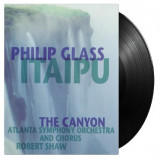
Itaipu, written by American composer Philip Glass, were commissioned by the Atlanta Symphony Orchestra and Chorus. Along with The Light (1987), they marked Glass’s continuation of a symphonic trilogy of “portraits of nature” as he had recently turned to making orchestral music. The composition pays a beautiful homage to the Itaipu Dam, which is the world’s largest hydroelectric dam built on the Paraná River between Paraguay and Brazil. The text was written in Guaraní, and translated by Daniela Thomas. The piece was first performed in 1989. This LP also includes The Canyon on the D-side, which was first performed in 1988 and commissioned by the Rotterdam Philharmonic Orchestra.
Itaipu and The Canyon are available on vinyl for the first time. It comes a in deluxe heavyweight sleeve with gloss laminate, and includes an insert with linernotes as well as the Philip Glass catalogue with info on the MOV Philip Glass series.
Compilation of all the recordings by this legendary punk band prior to their LPs: the sessions for their single 'Mucha Policía', taken for the first time in 27 years from the original tapes, which has unearthed two studio recordings unissued until now; plus rehearsals, demos and live recordings. Completely remastered. A furious, noholds-barred sonic account of a period of immense changes for Spain and the Basque Country. The origins of the most important Spanish punk group, regarded as one of the essential bands of the genre all over the Spanish speaking world.It was a time when the walls were teeming with socio-political proclamations, where the hammer and sickle - alongside the illegal Ikurriña (the flag of the Basque Country) - were the most widely used symbols. A time of general strikes and protests on the streets that often ended in an ugly manner. A time also of smoky joints, where huge speakers played loud rock and there were dreams of strawberry fields. In Santurtzi, on the left bank of the Nervión estuary, a unique band was born: ESKORBUTO. Iosu Expósito and Jualma Suarez lived in working class neighbourhoods that had grown fast. Both Kabiezes and Mamariga were, in the 50s, mainly rural areas of Santurtzi. In the 60s, industrialization and rampant development transformed them into urban areas without any investment in urbanism. Some elements for the alchemy led to the explosion: intelligent young guys who were nevertheless incapable of adhering to school discipline, a country in full swing towards freedom after 40 years of dictatorship. It was a context very familiar with the turbulence of the "Basque conflict", with neighbours seduced by the "armed fight" and the "liberation of Euskal Herria", with the question of "identity" constantly present, traumatic episodes of killings, tortures and imprisonments .One day at the end of the 70s they decided to start a band. The first period of Eskorbuto's life, before the damage done by the needle became noticeable, was incredibly fruitful. They soon found a rehearsal space, thanks to their first drummer ("Gu"), and there the first songs were born: 'Enterrado vivo', 'Busco en la basura', 'Éste es el porvenir', 'Mucha policía, poca diversión'. It was a period of line-up changes. Iñaki Laiseka played bass for them, and that role was also taken by "Seni" and "Garlopa", two precursors of "left bank" punk. Later on they found Paco Galán, who also came from a similar neighbourhood to theirs (Repélega, in Portugalete). Paco always was the necessary engine, the piece around which the rest revolved, which guaranteed continuity. His drumming also added an apparently chaotic element to the already unbridled guitar melodies and visionary texts, halfway between dirty realism and Edgar Allan Poe's nightmares. These recordings are taken from those early times of excitement and vertigo, of journeys to Madrid under a train's seat and endless trips up and down the left bank looking for "someone that I've heard is selling an amp". Now the Reina Sofía Museum exhibits their "Impuesto Revolucionario" LP and there's no Spanish speaking country without legions of fans.
- A1: Shenmue Theme - Piano
- A2: Shenmue - Sedge Tree (Original Version)
- A3: Shenhua - Sedge Flower (Original Version)
- A4: Mother's Cooking
- A5: Revenge
- A6: Rose Garden
- A7: Unwavering
- B1: The Place Where The Sun Sets - Version 2
- B2: Training
- B3: Reap The Whirlwind
- B4: Song For An Auspicious Journey
- B5: Halcyon Days
- B6: Boundless Lands
- B7: Long For Home
- C1: A Mother's Wish
- C2: Ren Of The Port
- C3: Flow Of The Lijian River
- C4: Not Even A Moment
- C5: Shenhua's Song
- C6: People Coming And Going
- C7: Path Of The Strong
- D1: Crucial Fight
- D2: Temple
- D3: Ox In Tow
- D6: Pursuit
- D7: Eager
- D8: Knowledge Of The Fist
- D9: Happy Convenience
- D10: Tense
- D11: A Bad Dream
- D12: Gallant
- D4: Sunrise Hills
- D5: Carrots
Available on 2 150g 12” vinyl, this abridged edition features 33 of the most iconic tracks in Shenmue III. It comes in a gatefold and includes a booklet with liner notes (in both English and Japanese) by Yu Suzuki and other members of the Shenmue community, as well as archival artwork. It also includes a digital download code for all 33 tracks.
First-ever official re-issue of the Ecuadorian composer's stunning electroacoustic composition "Oeldorf 8" on vinyl and CD. Remastered by KASSIAN TROYER at D&M, Berlin.
MESÍAS MAIGUASHCA (b. December 24th, 1938 in Quito / Ecuador) is a composer of Neue Musik, especially electroacoustic music, who studied at the Conservatorio Nacional de Quito, at the Eastman School of Music in Rochester, NY (1958–65), with ALBERTO GINASTERA at the Instituto di Tella in Buenos Aires, at the Hochschule für Musik in Cologne and, after a short return to Ecuador, attended the Internationale Ferienkurse für Neue Musik in Darmstadt and the Fourth Cologne Courses for New Music in 1966–67 where he studied with KARLHEINZ STOCKHAUSEN. From 1968 to 1972, MAIGUASHCA worked closely with STOCKHAUSEN in the Electronic Music Studio of the Westdeutscher Rundfunk in Cologne and joined STOCKHAUSEN's ensemble for performances at the German Pavilion at the Expo '70 in Osaka. In 1971 he became a founding member of the OELDORF GROUP of composers and performers, and began work at the Centre Européen pour la Recherche Musicale in Metz, at IRCAM in Paris, and at the ZKM in Karlsruhe. From 1990 – 2004 MAIGUASHCA was Professor of Electronic Music at the Musikhochschule of Freiburg im Breisgau where he still lives today.
The OELDORF GROUP, named after the small village 40 km away from Cologne where they lived and worked in a rented farmhouse where they set up their own studio for electronic music and studio productions, was a musicians' collective active during the 1970s. In the adjacent barn, the group held concerts for audiences up to 300 people with an emphasis on live-electronic music and other kinds of new and avant-garde music. Thanks to a long-standing contact with the Westdeutscher Rundfund, the core members of the OELDORF GROUP (PETER EÖTVÖS - electronics and keyboards, the violinist/violist and composer JOACHIM KRIST, electronics specialist and composer MESÍAS MAIGUASHCA, who also played keyboards, and his wife GABY SCHUMACHER – cello) received commissions for compositions, invitations to perform in the Musik der Zeit concert series, as well as having many of their summer concerts recorded for the late-night broadcasts of WDR3.
One of these commissioned compositions is "Oeldorf 8": a retrospective portrait of the OELDORF GROUP consisting of a series of ten short pieces for four instrumentalists (clarinet, violin, cello, electric organ/synthesizer) and tape which may be played either simultaneously or continuously without a break. It premiered in 1974 at the Darmstädter Ferienkurse and was released on LP two years later and turned into a sought-after, but not very well-known rarity achieving collector's prices., and was later unofficially reissued on KEITH FULLERTON-WHITMAN's Creep Pone CDr label.
Conceived as a sonic diary with an edge to encompass radical electronic synthesis, the 48 minute composition proves " … a thing of wonder; from the outset, MAIGUASHCA's spoken introduction of the players & concept gets slowly eroded by errant, pointillist electronic sound … which then lets loose for a good 10 minutes before a swarm of slowly rising held tones c/o the players acoustic arsenal slowly comes to the fore. On the second side, the acoustic sounds - patiently, elegantly state their cases across a good half of the segment until a rising pulse-wave drone essentially annihilates the more nuanced phrasing & slowly builds to an almost ROLAND KAYN-esque climax of raw oscillator gristle" (Soundohm).
44 years after its original release, MAIGUASHCA's stunning album finally sees its deserved and overdue re-release on CD and LP, carefully remastered by KASSIAN TROYER at D&M, Berlin.
"Maiguashca … is part of the first generation of South American maverick sound explorers that in the 1960s paved the way for a tradition of innovation that persists in the present noise and psychedelic scenes of the continent. Along with Edgar Valcárcel, César Bolaños, Beatriz Ferreyra, Mauricio Kagel or José Vicente Asuar, he contributed to expand the possibilities of musical language beyond the dominant Western canon …"
David Jarrin / Kraak Festival
Real Real World is the first collaborative effort from Nantes-based Australian drummer/percussionist Will Guthrie and Australian keyboardist/composer James Rushford. Primarily recorded in a fluid, spontaneous studio session in Nantes, with overdubs added later in Melbourne and Nantes, Real Real World presents five spacious, unhurried pieces that inhabit a unique sound world characterised by wheezing, half-voiced organ chords, chiming metal percussion, and eruptions of small sounds. Beginning with the eerily beautiful, shakuhachi-esque sound of Rushford performing on detuned portative organ, the opening title track is abruptly transformed by the entry of Guthrie’s sizzling cymbals, deep gong strikes, and rustling hand percussion. On the epic ‘Lumbering’, which occupies the majority of the record’s first side, organ chords define a space in which a kaleidoscopic succession of amplified thuds, chiming bells, rustled and dragged objects, and abruptly silenced clusters advance and recede in an oneiric blur, eventually making way for a passage of Guthrie’s virtuosic polyrhythms, itself unexpectedly overtaken by waves of melting fairground organ. The record reaches an energetic climax mid-way through the second side with the stunning ‘Slakes’, where lugubrious chords in the organ’s lowest register are joined by Guthrie’s skittering rhythms, which somehow manage to call to mind both the most chaotic moments of Balinese Gamelan and the stochastic breakbeats of late-90s Autechre. On this piece, Guthrie and Rushford are joined by Melbourne saxophone maverick Scott McConnachie, who contributes an alto sax solo of burning precision, working with a single-minded palette of piercing long tones and wild intervallic leaps. Though it makes extensive use of overdubbing, Real Real World retains a strong sense of having been performed, rather than constructed: while at times the fleeting succession of events can recall electroacoustic music, its primarily acoustic nature and unhurried pace is also reminiscent of the music of AACM affiliates or Marion Brown’s classic Afternoon of a Georgia Faun. Immediately engaging while also hiding countless details in the folds of its polychrome fabric, Real Real World is a relaxed and joyous document of collaborative musical invention.
Artwork by Patrizia Bach. Layout by Lasse Marhaug. Mixed and mastered by Joe Talia at Good Mixture, Berlin.
Reuben Sawyer is nothing if not prolific. He's also a man of many talents - his various projects have included the coldwave sounds of The Column, Hollow Sunshine's blown-out psych-noise, Anytime Cowboy's take on countrified weirdo-pop, and even ambient house courtesy of Rose. Oh, and he's a visual artist too, of course. Pfft, who needs an attention span anyway? One thing he's also dabbled in, however, is post-punk. Human Trophy is firmly in line with that tradition, but pulling from multiple directions at once - one minute this album rattles along like Big Black with the tempo down and the textures dialled up, the next we're firmly in Christian Death territory. The twisting guitar lines and pummelling bass of 'Forming Horrors' even call to mind his blackened punk project Dry Insides, but with less velocity and a helluva lot more menace. Is 'Corpse Dream' a goth record? Possibly. Whether goth is a lifestyle choice for Sawyer or not, he's certainly adept at immersing himself in sounds and making them feel like a comfortable fit. As with all his projects, it feels like another effortless facet of Reuben Sawyer - and in keeping with the rest of his output, it's absolutely packed with songs you'll wanna play again and again. Penultimate track 'The Roads' is built on a none-more gloomy pile-up of darkly portentous rhythms and a firm sense of disquiet, but once you're locked into its circular riffage you'll feel an urge to keep the loop going endlessly. Then there's the closer 'Blood Apex', a dual-vocal nightmare set to music which draws you back in even as it attempts to push you away. Yeah, it's pretty great.
Who is Harvey Couture? Some say he’s a survivor of French pop music’s sun-soaked synth-pop era of the early 1980s, others that he’s a more suave and stylish Serge Gainsbourg for the nu-Balearic era. There were even rumours circulating that he’s a musical mobster from the Cote D’Azure: a shadowy member of the mafia who deals in synths, drum machines and fretless bass guitars rather than guns, money and drugs. In truth, not even Leng Records knows much about the man behind the moniker, though his vividly kaleidoscopic, retro-futurist debut album, Scellé En Cristal, does offer a number of crafty clues. Whether listeners will make the necessary deductions to solve the mystery remains to be seen; regardless, it’s the music that matters, and on that score Scellé En Cristal simply cannot be faulted.
Rich in humid, afternoon-bright musical delights, the set sees our publicity-shy hero mix and mangle a multitude of musical influences – think proto-Balearic European synth-pop, Prince style purple funk, immersive ambient, early INXS style synth-rock, the electronic end of zouk and much more besides – with constantly colourful and imaginative results. Couture is most at home adding his variously seductive, sexy and sleazy vocals to bubbly, upbeat and mid-tempo numbers that combine delay-laden drum machine beats with surging synths, fluid bass, stylish guitars, lashings of leftfield pop nouse and plenty of tongue-in-cheek Gallic flair.
For proof, check the throbbing, off-kilter alien-funk throb of ‘Les Portes De La Perception’, the bustling, percussion-laden cheeriness of ‘Crème Solaire’ and the loose-limbed, toe-tapping brilliance of ‘Je Nes Peux Pas’, where chiming, steel pan style melodies and pots-and-pans percussion hits jostle for position with sliding fretless bass notes and flash-fried guitars. Check to ‘Passion’, a swaggering slab of bustling electrofunk/synth-rock fusion rich in ‘Rockit’-style scratches and restless synth-bass. The influence of languid, sunset-ready European pop records of the 1980s – those cuts that would later become sought-after amongst dusty-fingered collectors of Mediterranean music – is another recurring feature of Couture’s cultured but joyous debut album. It can be heard amongst the drowsy guitars, yawning bass and tumbling lead lines of ‘Look Within’, the pleasingly laidback ‘Invincible Line’, the elastic bass, fluorescent synth sounds and stuttering machine drums of ‘Marche’.
Yet Couture is no one-trick pony. Horizontal and loved-up moments of a more downtempo hue can be found scattered across the album, with the enveloping ambient awe of ‘Les Portes’ – all swelling chords, gentle melodies and atmospheric field recordings – and slowly unfurling ‘Whale Song’ both lingering long in the memory. Harvey Couture may not be ready to step out of the shadows just yet, but his music most certainly is. We have a feeling that Scellé En Cristal is just the start of the mystery monsieur’s musical journey.
A cheeky riff on the Beatles’ White Album, Cleaners From Venus frontman Martin Newell’s second solo album from 1995 is a sophisticated follow-up to the critically-acclaimed The Greatest Living Englishman. Produced by él Records fixture Louis Philippe and featuring XTC’s Dave Gregory on guitar, it’s a vivid snapshot of Newell’s life with a French chanson-inspired ease.
A longtime fan of French music, Newell sought a Gallic quality on this record - with the vocal riding at the top of the mix, rather than blurred under indie rock guitars, as was common at the time. Philippe was happy to oblige. The effect is a clarity of both form and content - on “Arcadian Boys,” Newell’s impassioned voice careens over a heartbreaking string quartet (arranged by Philippe himself) as he wonders what’s become of those “too late for the sun.” It’s a much more emotional take on the song than the guitar-laden, uptempo version that appears on the Cleaners From Venus’ My Back Wages. But The Off White Album doesn’t dwell too long in solemnity - it’s still a Martin Newell record, after all. His classic wit is on full display, whether he’s putting an irreverent spin on the Smiths (“Some Girls Are Bigger Than Others”) or fondly warning a neighbor to “watch your chemicals, girl” (“The Girls In The Flat Upstairs”).
A rich cast of characters make up The Off White Album, via both the process of its recording and the subjects of its songs. It’s a record born on the road, inspired by Newell’s experiences travelling through Europe and Asia the year of its inception. Perhaps the clearest portrait that emerges as the album draws to a close, however, is one of Newell himself: as poet, coffee shop customer, bandleader, lover and neighbor. By his own admission, The Off White Album is “a more intimate portrait of my life at that time than I’d intended.”
LA-based producer, composer, songwriter and multi-instrumentalist James McAlister is a rare creator, and highly sought after collaborator. Perhaps best known for his work with Sufjan Stevens , McAlister has also appeared on record with Lorde amongst many others, and is a regular contributor to Aaron Dessner 's projects, including the latest albums from Taylor Swift, folklore and evermore . His regular work with film music includes The Two Popes, The Big Sick, and Ron Simonsen 's recent films. In 2018 he joined Stevens, Casey Foubert , St. Vincent and Moses Sumney for the Oscar performance for music from Call Me By Your Name, where he played piano and a bottle of cupcake sprinkles. With nearly countless projects to his name, it was in 2017 that his collaboration with Stevens, Nico Muhly, and Bryce Dessner entitled Planetarium was released by 4AD. Around the same time McAlister started a deep dive into a personal sonic realm that has manifested as an ambient project under his own name. 2018 saw the release of Three Breaths , the first offering from this exploration. 2021 will see the second installment, an album called Scissortail which vividly puts McAlister's evolving master craft on display. It is a collection of moving, meditative, immediately satisfying and quietly stunning work. It is the sound of an artist letting go entirely of pre-conceptions or expectations, instead mining the depths of that very real and abstract place of sound, texture, color and feeling. Some songs arrive almost intuitively, while others feel mechanically made, fed through the framework of synthesizers and the patchwork of recording gear. And with that comes a compelling duality to the work; a machine grace informing the on-going but subconscious dialogue between energy and material, sensitivity and asceticism.
"Flowers Bloom, Butterflies Come" is the result of a dialog between the stunning Japanese photographer and artist Miho Kajioka and the wonderful UK musicians and composers Ian Hawgood and Craig Tattersall (The Humble Bee), initiated by IIKKI, between August 2019 and January 2021.
Born in the United Kingdom, Ian Hawgood spent most of his adult life living in Japan, Italy and Poland. Currently he calls Peacehaven (on the south coast, near Brighton) his home. Since 2009, he’s well-known with his work as the curator of the Home Normal label. He makes music using an array of reel-to-reel and tape machines in his studio by the sea, where he also master works for many labels and artists alike. You could often catch him on the coast with his faithful Nagra recorder, hydrophone and field microphones. These days his focus of music is on decayed ambient works using old synths and reels mostly, alongside his childhood piano. (site)
Craig Tattersall is a former member of The Remote Viewer and Famous Boyfriend bandmate Andrew Johnson. Tattersall's music can be found these days more often under his alias The Humble Bee; as a founder member of The Boats; and in his collaborative works with the likes of Bill Seaman in The Seaman And The Tattered Sail. He has run the wonderful label Cotton Goods from 2008 to 2015 and since 2009 he has recorded 12 albums on his moniker The Humble Bee.
Miho Kajioka (b. 1973, Japan, lives in Kyoto) is an artist and a photographer since 2011. Kajioka’s work has been exhibited in Spain, Italy, France, the Netherlands, the USA, Germany, Belgium, Portugal and the United Kingdom. Kajioka’s latest book ‘so it goes’ won Prix Nadar in October 2019. "Kajioka's artistic practice is in principal snapshot based; she carries her camera everywhere and intuitively takes photos of whatever she finds interesting. These collected images serve as the basic material for her work in the darkroom where she creates her poetic and suggestive image-objects through elaborate, alternative printing methods. Kajioka regards herself more as a painter/drawer than as a photographer. She feels that photographic techniques help her to create works that fully express her artistic vision. Her images evoke a sense of mystery in her constant search for beauty. The focused, creative and respectful way in which she uses the medium of photography to creating her works seems to fit in the tradition of Japanese art that is characterized by the specifically Japanese sense of beauty, wabi sabi. (…) According to her, photography captures moments and freezes them; printing impressions is like playing with the sense of time and getting lost in its timeline." (Ibasho Gallery)
There are no two voices like these. The late Amália Rodrigues, the Queen of Fado, a unique singer up there with the great voices of 20th century popular song like Piaf, Sinatra, Ella, Oum Kalthoum. Mariza, the young singer that has helped bring Fado into the 21st century. Two of the greatest and most influential stylists of Fado, the ex-libris of Portuguese popular music, a world cultural heritage.
Two artists who have a lot in common, beyond their origin. Mariza swept global audiences off their feet like only Amália had done in the 1950s and 1960s, with her residences at legendary venues such as the Paris Olympia or Carnegie Hall. Through her critically acclaimed recordings and unexpected collaborations, Mariza expanded what Fado could be – just like Amália had done in the 1960s and 1970s. Mariza became the ambassador of Portugal’s music in the 21st century like only Amália had been able to be in the 20th century.
2020, the 20th anniversary of Mariza’s career, the centenary of Amália’s birth. “This the best way I can find to pay my tribute to Amália, and to thank her for the legacy and inspiration she gave us,” says Mariza. It’s been a long time coming, but now it’s here: Mariza Sings Amália. Ten Amália standards reinvented for the 21st century, their soul intact, their identity unmistakable, their stylings unexpected.
For this new album, Mariza invited an old friend – Brazilian musician and producer Jaques Morelenbaum, regular accomplice of Ryuichi Sakamoto or Caetano Veloso. Morelenbaum produced Mariza’s triple-platinum 2005 album Transparente; here, he creates a seductive, inspired series of orchestral arrangements, simultaneously classic and innovative, that allow Mariza to delve into songs we all thought we knew and make them new, fresh, ravishing.
Mariza may have performed all over the world, may have multi-platinum albums that topped charts throughout the glove, may have received endless prestigious awards – but in the studio, face to face with the standards that defined Fado for global audiences, Mariza is starting from scratch. She has recorded Amália before, but never like this, never with this wisdom, this experience, this power of interpretation. Now was the time to try on for size the great Amália classics: “Gaivota”, “Estranha Forma de Vida”, “Com que Voz”, “Fado Português”, “Povo que Lavas no Rio”, “Foi Deus”... Ten in all for an album where Mariza more than lives up to her awards, her success, her performances and assumes the mantle only Amália wore before: that of an ambassador of music, culture, talent.
Recorded between Lisbon and Rio de Janeiro, Mariza sings Amália. Like only Amália could have done, like only Mariza can. Is it Fado? Yes, and no. Above all, it’s a match made in heaven.
“WOLF KING” have returned with a follow up to 2018’s blistering release, Loyal To The Soil. Having lost none of their bite, everyone’s favorite Bay Area blackened heavy metal band has crafted a twelve track opus that will set 2021 off to a smouldering start. The Path of Wrath tells real life tales of existential struggles and explorations of life and death. This abrasive take on mortality and the afterlife traverses themes of judgement, salvation, and looking ‘beyond the veil’. As they pick over the weight of sin and uncover the burdens of both damnation and forgiveness, ripples of pure darkness infiltrate every crevice of the album. Few do blackened heavy metal better than WOLF KING. For an uncompromising, filth-drenched, smoke-infused take on the genre, The Path of Wrath delivers the goods and then some.
"Terrific!"- Steve Lamacq, BBC 6 Music. Double header 7" from NY production duo The Still Brothers. 'Wake Up' Mixed by Skinshape. The Still Brothers are Andrew LeCoche (Ula Ruth) and Evan Heinze (The Shacks). 'Wake Up' was created in a New York winter on a cloudy day. The song's bones were sculpted in the classic Still Brothers' fashion making use of a collection of favourite sounds. It came to life when Brazilian friend and collaborator Marina B heard the track in her sleep and thought of the song's lyrics as she woke up. It might take you to that place in-between dreams and the waking life, where you are pulled in and out of a state of slumber. It incidentally speaks to the abrupt change that was about to fall upon the world in early 2020. Between the singing in Portuguese and the sounds of subway doors, the song is just alienating enough to make anyone these days to feel right at home. 'Wake Up' was mixed by Will Dorey aka Skinshape and mastered by Alex DeTurk. The cover art was designed by Sofia Ohanna. Inspired by subway preachers, jazz funerals and Hip-Hop 'The Deep' serves as an introduction to the dazzling skills of New York production duo The Still Brothers. Their debut track breaks open with a reverend crying out about the transgressions we have committed against each other. He then observes that so many of us are throwing up our hands in an act of surrendering. A poignant sentiment in these troubling times and one that will resonate throughout the world.
- 1: Not From This World
- 1: 2To Heal A Shape-Shifted Mind
- 1: 3Itself
- 1: 4A Lost Song
- 1: 5On Perd Sa Vie À Chercher Sa Place
- 1: 6Un Volcan Qui Pousse Les Os
- 1: 7De L'incapacité De Dire Au Revoir Aux Belles Choses
- 2: 1Behind The Unknow Is Where Magic Is
- 2: Eternal Conflicts
- 2: 3La Résilience Se Trouve À L'est
- 2: 4Hope Is By Nature
- 2: 5L'eternité Se Cache Dans Un Jardin Au Fond Du Mois D'août
- 2: 6Today Is The Journey
- 2: 7Toucher Le Temps Du Bout Des Doigts
THE EYE OF TIME ist das Solo-Projekt des französischen Musikers Marc Euvrie. Wesentlich geprägt wurde Euvries musikalische Entwicklung durch die DIY-Punk und Hardcore-Szene Frankreichs, obwohl er ebenso eine klassische Musikausbildung genossen hat. Mit 9 Jahren begann er Klavier zu spielen, komponierte mit 15 erste eigene Stücke und studierte später Cello am Konservatorium. Inspiriert durch Claude Debussy, Philip Glass, Eric Chopin, J.S. Bach, Michael Nyman als auch Godspeed You Black Emperor, A Silver Mt. Zion oder Portishead, fing Euvrie an, seine ganz persönliche Reflektion des komplexen Weltgeschehens in Musik zu übersetzen. Acoustic II ist das sechste Studio Album von Marc Euvrie, und sein zweites, das sich komplett auf Klavier & Cello konzentriert. Über den Entwicklungsprozess seines neuen Albums sagt Euvrie: "Klavier und Cello nahmen in den letzten Jahren einen immer wichtigeren Stellenwert in meinem kreativen Prozess ein. Nach Acoustic (2014) stieg in mir das Bedürfnis nach weiteren Akustik-Songs."
Producer extraordinaire John Morales returns to BBE Music, celebrating the life and work of R&B / soul legend Teena Marie with a double album full of brand new remixes, lovingly crafted from the original studio tapes, entitled ‘Love Songs & Funky Beats’. “Teena is somewhat underrated, and people don't really know much about her.” Says Morales. “I set out to immerse people in her music and represent what she really did. That meant for me a dive into more than her R&B hits, to dig into her ballads and dance cuts. People know she was talented. I don't really think they really knew the depth of her abilities, her complete confidence to take it upon herself to do everything – singing, producing, arranging, songwriting. Teena Marie was the total package.” John Morales had the pleasure of mixing many of Teena Marie’s original records over the years, so it felt natural to dig into the archives and select his favourite cuts to rework, extend and subtly update in his own distinctive style. While by no means a definitive collection of Lady Tee’s expansive musical catalogue, ‘Love Songs & Funky Beats’ represents a fitting tribute to a multifaceted and important voice in popular music, by one of the most storied mix engineers and remixers of our age. Jumping into the music industry deep end in 1979 with a three-year mentorship from Berry Gordy & Rick James at Motown, Teena Marie then spent seven fertile years with Epic, which yielded her greatest commercial successes (including the classic album 'Starchild'). After founding an independent label ‘Sarai’, Marie took a ten-year hiatus which ended in 2004 in a deal with hip hop label Cash Money Records; a less unlikely partnership than some might assume, given that Teena was one of the first ‘mainstream’ artists to perform a rap verse, on 1981’s ‘Square Biz’. Teena Marie Brockert forged a unique path through the industry, an artist in-charge of her own destiny, influencing (and heavily sampled by) both the hip hop and R&B sounds of the 90’s and early 2000’s. Her 1982 lawsuit against Motown records resulted in "The Brockert Initiative", which has benefitted literally thousands of other artists by making it illegal for record companies to ‘shelve’ artists by keeping them under contract without releasing their material. She continued to tour regularly and deliver commercially successful, expertly sculpted music, right up until her untimely passing in 2010.
After a 7-year hiatus, funk legend Steve Arrington returns with his uplifting and soulful new album ‘Down To The Lowest Terms: The Soul Sessions’, with artists including Mndsgn, Knxwledge and Jerry Paper on production. The album portrays his diversity of influences, which sees Arrington drawing on funk, soul, jazz, electronic and R&B.
Steve Arrington is known for his innovative vocals on classics including ‘Watching You’ and ‘Just A Touch of Love’, with Slave, as well as his solo work with tracks including ‘Dancin’ in the Key of Life’, ‘Weak at the Knees’ and ‘Nobody Can Be You’. His music has greatly influenced the hip hop generation, having been sampled by Jay-Z, A
Tribe Called Quest, Pharrell, 50 Cent, 2Pac, De La Soul, Snoop Dogg and many more. ‘Down To The Lowest Terms: The Soul Sessions’ is Steve Arrington’s first solo album since 2009’s ‘Pure Thang’.
- A1: The Principle (O Principio) (O Principio)
- A2: Bulubulu
- A3: Falta Muito? (Feat Spoek Mathambo)
- A4: Pele
- A5: The Medium (O Meio) (O Meio)
- B1: Vai De C@N@! (Feat Octa Push)
- B2: Outra Cidade (Another Town) (Another Town)
- B3: Makumba
- B4: The End (Kamicasio) (Kamicasio)
- B5: Quarentena
- B6: The Infinite (O Infinito) (O Infinito)
IKOQWE (pronounced ee-kok-weh) is a new project by Batida (aka Pedro Coquen o, the Angola-born, Lisbon-raised artist who ranks among the leading exponents of the new wave of African electronic music), and Luaty Beir o, aka Ikonoklasta, the Angolan rapper turned iconic activist.
IKOQWE’s inspiration comes from old school Hip Hop as much as from traditional Angolan music. The album (entitled ‘The Beginning, the Medium, the End and the Infinite’) includes drum machines, vocals in Angolan slang, Umbundu, Portuguese & English, discussions about neocolonialism, iniquities and falsified history, radio sounds, utopian solutions, and much more.
The album will be preceded by a 3-track digital single, ‘Pele’ (‘Skin’), containing the album version, and remixes by afro house legend Bodhi Sattva and by UK ‘disco noir’ band MADMADMAD. Also check out the music video for ‘Pele’, including some footage from IKOQWE’s first live performance.
In between steadily touring as a side woman for psych-soul LA staple, Chicano Batman, Nicky Egan has been stealthily plugging away with her New York based producer and Dap-Kings guitarist Joe Crispiano to complete her forthcoming LP "This Life". Driven by honest confessional songwriting and influenced by your favorite classic soul sounds, the record features a who's who of NY's most sought after players including Homer Steinweiss, Victor Axelrod, Brian Wolfe & Elizabeth Pupo-Walker, to name a few and will be released early this year on Transistor Sound Records, headed up in part by Colemine Record's soulster, Kelly Finnigan. Egan presents the debut 7" single, `Back To You', a fresh take on that classic 70's soul cruiser sound, that tells the tale of transience, growth and acceptance with B side "Run Run" a cinematic soul Bonnie and Clyde-esque portrait that kicks off with epic fuzz guitar lines followed by Egan's sultry vocals. Don't sleep on this B side that'll leave you feeling like you're in the back of that 1974 Maserati getaway car.
- A1: Sweet Chariot - Laurel Aitken
- A2: Brown Skin Girl - Ben Bowers With The Babba Motta Orchestra
- A3: Not Me (Man Smart, Woman Smarter) - Hubert Porter
- A4: Mango Time - Count Lasher’s Seven
- A5: Doctor - Count Lasher
- A6: It All Began With Adam And Eve - Lord Flea
- A7: Healin’ In The Balmyard - Harold Richardson & The Ticklers
- B1: Country Gal - Harold Richardson
- B2: Linstead - Market & Day O Wrigglers
- B3: Blu-Lu-Lup - Lord Fly
- B4: Samfi Man - Count Lasher & His Quintet
- B5: Glamour Gal - Harold Richardson & The Ticklers
- B6: Solas Market - Boysie Grant
- B7: The Naughty Little Flea - Boysie Grant & Reynold’s Calypso Clippers
If you are in search of the origins of Jamaican music this is a great album to start with. Mento was the original Jamaican folk music that predates Ska and Reggae. Played Exclusively on acoustic instruments Mento was based on both African and European elements. The 1950s was Mento’s golden age, as many artists recorded songs using a variety of rhythms and styles. It was the peak of Mento’s creativity and popularity and the birth of Jamaica’s recording industry.
Like it’s predecessor, the acclaimed ‘Joia!’, this album is a collection of songs sung in Welsh combined with distinct pop and South American flavours drawn from Bossa Nova, Cumbia, Samba and Tropicalismo styles, recorded in Rio de Janeiro, Caernarfon and London.
Mas feels strangely right for our times: an album whose title means several things, as befits its global outlook. Mas means “out” in Welsh, “more” in Spanish, and “but” in Portuguese: these meanings filling that single syllable with promise, potential, but also the subtle edge of a warning. It’s a mood that fits the more political tenor of Rio 18’s second turn around the world, as Carwyn and his friends explore some substantial subjects: the drowning of villages, climate change, migration and the rise of megacities. They do so not in sober, serious settings, but beautiful, uplifting songs. Other tracks also celebrate the vivid pleasures of love, nature and our essential humanity.
Mas is a record of beautiful songs that says, wait, listen, delight, come together, then act. We owe it to ourselves, to each other, to our beautiful world.
“Nothing ever really disappears,” Cassandra Jenkins says. “It just changes shape.” Over the past few years, she’s seen relationships altered, travelled three continents, wandered through museums and parks, and recorded free-associative guided tours of her New York haunts. Her observations capture the humanity and nature around her, as well as thought patterns, memories, and attempts to be present while dealing with pain and loss. With a singular voice, Jenkins siphons these ideas into the ambient folk of her new album.
An Overview on Phenomenal Nature honors flux, detail, and moments of intimacy. Jenkins arrived at engineer Josh Kaufman’s studio with ideas rather than full songs — nevertheless, they finished the album in a week. Jenkins’ voice floats amid sensuous chamber pop arrangements and raw-edged drums, ferrying us through impressionistic portraits of friends and strangers. Her lyrics unfold magical worlds, introducing you to a cast of characters like a local fisherman, a psychic at a birthday party, and driving instructor of a spiritual bent.
Jenkins’ last record, 2017’s Play Till You Win, confirmed the veteran artist’s talent. Evident of Jenkins’ experience growing up in a family band in New York City, the album showcased her meticulous songwriting and musicianship, earning her comparisons to George Harrison and Emmylou Harris. Jenkins has since played in the bands of Eleanor Friedberger, Craig Finn, and Lola Kirke, and rehearsed to tour with Purple Mountains last August before the tour’s cancellation. Her new record departs from her previous work in its openness and flexibility, following her peripatetic lifestyle. “The goal is to be more fluid, to be more like the clouds shifting constantly,” she says. The approach allowed Jenkins to express herself like she never has.
On album opener “Michaelangelo,” before the heavy drum beat and fuzz guitars enter, Jenkins sings quietly “I’m a three-legged dog, working with what I’ve got / and part of me will always be looking for what I lost // there’s a fly around my head, waiting for the day I drop dead.” Phenomenal Nature thrives in this dichotomy between ornate sonics and verbal frankness, a calming guided tour to the edge. Later, on “Crosshairs,” amid lush strings, she sings conversationally: “Empty space is my escape / it runs through me like a river / while time spits in my face.”
“Hard Drive,” the third track and album centerpiece, opens with a voice memo Jenkins recorded at The Met Breuer: a guard muses about Mrinalini Mukherjee’s hybrid textile and sculpture works, which were then on display in a retrospective titled Phenomenal Nature. “When we lose our connection to nature, we lose our spirit, our humanity,” she explains. Stuart Bogie's saxophone & Josh Kaufman's glittering guitar make way for Jenkins' spoken word which constellates scenes from her life, gradually building and blossoming as she recreates a meditation guided by a friend who incants, “One, two, three.”
Sounds of footsteps and bird calls run through the album’s glittering conclusion, “The Ramble.” Meditative and bright, it recalls how Jenkins felt while writing and recording her new material: “Everything else is falling apart, so let’s just enjoy this time,” she said. If Phenomenal Nature has a unifying theme, it’s the power of presence, the joy of walking in a world in constant flux and opening oneself to change.
PHILLIP BALLOU Pittsburgh-born Phillip Ballou’s earliest years were spent in the gospel field; after he moved to New York City in the ‘70s, he teamed up with Bennie Diggs and Arthur Freeman, founding members of The New York Community Choir and singer Arnold McCuller to form the group Revelation. The quartet recorded for RSO Records, scoring some R&B success in the US with tracks like “Get Ready For This” and “You To Me Are Everything,” touring the Bee Gees among others. Phillip also sang on albums by NYCC recorded for RCA Records and continued with Revelation until 1982. Frequently hired for sessions in and around New York, Phillip teamed up with UK soul music journalist David Nathan (who he’d met in 1974 during Nathan’s first US visit) and John Simmons, formerly a member of The Reflections, another New York vocal group to write a series of songs for his own proposed solo record deal. Although a contract did not materialize, one of the songs – “Ain’t Nothing Like The Love” – got some interest from famed Philadelphia producer Thom Bell who presented it to The O’Jays. Ultimately, the tune was turned down by Kenny Gamble and John Simmons, by then musical director for Stephanie Mills, recorded his own version for a small independent label in 1981. Phillip continued his own musical journey, touring and recording with James Taylor and Todd Rundgren. In addition, Phillip’s name graced recordings by George Benson, Billy Ocean, Kashif, Nona Hendryx, Jonathan Butler, Teddy Pendergrass and Melba Moore; in 1981, he began recording with Luther Vandross and became a part of Luther’s touring band for many years, as well as singing on productions by Luther on Aretha Franklin, Dionne Warwick and others, continuing his association with him until Luther’s 2003 stroke. Phillip returned to his gospel roots in 2004 as Minister of Music at a Brooklyn church and passed away in March 2005, aged 55 .We are proud to bring you Phillips second single on Super Disco Edits, and perhaps his best! "We'll be together" is an uplifting song with an almost gospel tinged melody. But the songs lyrics portray a love thats just about to blossom.
Heady power pop trio Portable Radio announce the release of their debut eponymous LP on March 12th 2021 on Crimson Crow Records. Lead track and first single Hot Toddy, out in February, introduces the album with its ethereal brooding pop arrangement.
Some years ago, the world started to go weird – and that’s when the then duo, Portable Radio, decided it was as good a time as any, to start making first steps.
Phil … and Mof … shared some messages and a love of melodies, and as a gift to friends and those feeling the weight of everything, recorded a version of Brian Wilson’s gorgeous opus, ‘Love & Mercy’. The result was enough for them to start writing songs, and the blueprint for Portable Radio was born – hope, empathy, fun, love, and mercy.
Phil had cut his teeth in the Beep Seals and Mof was a DJ and student of pop, and in each other they both wanted to make music that was a tonic for the times; what transpired was a clutch of songs that were filled with uplifting, rich harmonies – stirring power pop inspired by Todd Rundgren, Wings, Carole King, Electric Light Orchestra, NRBQ, Emitt Rhodes, ‘70s West Coast AOR, The Zombies, and of course, The Beach Boys.
The duo released their Baroque Pop debut single with You Are The Cosmos recordings – the double A-Side of ‘Seven Hills’ and ‘Parades’. A cult following started and some shows and radio sessions ensued, joined by extended family – tap room-Mozart Jim Noir, shed-pop wizard Aidan Smith, and Phil’s previous bandmate, the supremely talented Ian Smith (Beep Seals/Alfie).
Soon, Robyn Gibson (The Junipers/Bob Of The Pops) joined the ranks for their star turn and appearance on the ‘12 String High’ compilation. The two becoming a trio, the output cranked up, seeing the release of the debut Portable Radio EP (produced by Jim Noir) and the Christmas Selection Box, all loaded with killer hooks, washes of dreamy harmonies, and just a sprinkling of cynicism because no-one is impervious to the all-encompassing weirdness of the last couple of years.
All of these things were the groundwork for the imminent full-length, self-titled debut, out in March 2021. The LP (vinyl/download/streaming) is full to bursting with big choruses, reflective popsike, FM ready pop, melancholic ballads, with each song is treated like it’s going to be a single.
Statistique Synthétique draws as much from the history of computer sound synthesis as from its latest developments. But well beyond developing simply as a proof of concept, this piece aims to transcend the abstract status of synthetic sound objects and lead them to a properly hallucinatory state, that is to say to a meeting point where the object and perception dissolve into each other, in a sort of transcendental field. Beyond, also, hylomorphism, to reach the world of matter-form fusions, where perception knows how to see "shoulders of hills", as Cézanne wrote.
Teum (the Silvery Slit) is, as the title suggests, an overture, an opening to the game of multiplications, fragmentations, duplications. But it is also the opening understood as the void that blossoms between two borders, a break from which escapes a double tension, both the pulling force of these two edges which move apart and the opposite force of reconciliation, of compression. Okkyung Lee invites us to a truly telluric moment, a rare moment of expression where tectonic movements and shear stresses become music. If the earthquakes were, as we thought in the 18th century, due to underground thunderstorms, there is no doubt that this piece of music, both celestial and continental, could have been their audible manifestation.
Text by François Bonnet
HeckerStatistique Synthétique2020 / 25'15Computer-generated sound with resynthesized situated texture recordingsWritten and produced by Florian Hecker, 2019 - 2020Texture analysis and resynthesis algorithm: Axel Röbel, Analysis/Synthesis Team, IRCAM, ParisMastered by Rashad BeckerPhoto by Mauricio Guillén, 2019
Thanks to Axel Röbel for his commitment to the project and special appreciation to GRM, Luke Fowler, Mauricio Guillén, Dirk Mayer and Porta33
Location Texture Recordings, using DPA 4060, DPA 4017B, DPA 4021 and DPA 4060 microphones to Sound Devices 702 recorder; except segment 04:31 - 05:37, recorded by Luke Fowler, April 2019 using Sony M10.
00:00 - 02:00 Lopud, Croatia, June 200802:00 - 03:12 Ponta do Sol, Madeira, ER 101, April 201903:12 - 04:14 Prentiss St, Cambridge, MA, February 201504:14 - 04:31 Anjos, Ponta do Sol, Madeira, ER 101, April 201904:31 - 05:37 Atelier Cézanne, Aix-en-Provence, April 201905:37 - 08:31 Anjos, Ponta do Sol, Madeira, ER 101, April 201908:31 - 09:46 Praia dos Anjos, Ponta do Sol, Madeira, ER 101, April 201909:46 - 10:39 Private garden, Kissing, September 200910:39 - 11:15 Praia dos Anjos, Ponta do Sol, Madeira, ER 101, April 201911:15 - 15:11 Porto do Paul do Mar, Calheta, Madeira, April 201915:11 - 16:53 Prinz Eugen Strasse, Vienna, June 200816:53 - 24:27 Risco, Rabaçal, Madeira, April 201924:27 - 25:15 Bois de Boulogne, Avenue du Mahatma Gandhi, Paris, September 2015
:::::::::::::::::::::::::::::
Okkyung LeeTeum (the Silvery Slit)2019 / 20'03Performed, recorded and composed by Okkyung Lee (ASCAP)Mixed by Lasse MarhaugMastered by Guuseppe IelasiPhoto by Lasse MarhaugPart of Re-Imagine Europe, co-funded by the Creative Europe Programme of the European Union.
Cut by Andreas Kauffelt at Schnittstelle, Berlin, September 2020Sleeve design by Stephen O'Malley
Cool Ghouls - a band fledged in San Francisco on house shows, minimum wage jobs, BBQ's in Golden Gate Park and the romance of a city’s psychedelic history turns 10 this year. What better a decennial celebration than the release of their fourth album, At George's Zoo!
How did San Francisco's fab four arrive at George's Zoo? The teenage friendship of complimentary spirits Pat McDonald (Guitar/Vox) and Pat Thomas (Bass/Vox) serves as square one. The Patricks were munching on Eggo-waffle-sandwiches and downing warm vokda in suburban Benicia (San Francisco bay) years before McDonald would hear George Clinton address his fans as "Cool Ghouls". The boys played their debut gig as Cool Ghouls at San Francisco's legendary The Stud in 2011, but there's no doubt the musical moment cementing the band's trajectory was much earlier at the 18th birthday party for boy-wonder Ryan Wong (Guitar/Vox) - at the Wong household.
You might remember the Ghouls' earliest days... McDonald’s hair hung luxuriously past his waist, Thomas dreamt of no longer having to crash on friends' couches to call SF home and Wong looked forward to turning 21. Cool Ghouls' Pete Best, Cody Voorhees, thrashed wildly – but briefly - on the drums and Alex Fleshman (Drums), who still claims he's not really "a drummer", turned out to be a really good drummer. Thomas would sleep pee on tour. Those were golden days!
Flash forward to today and everything is up in flames. No shows, parties or bars. Cool people are streaming out of SF. It's been 2 years since the last time Cool Ghouls have even played. The STUD is gone, The Eagle Tavern is for sale and The Hemlock has been demolished for condos. Your boss is an app. Fascism is no-knocking down the door. There's a pandemic.
Fortunately for us, the Ghouls got an album in before it all went to shit, and they made it count. At George's Zoo includes 15 of the 27 tunes they managed to eke out while simultaneously working through major life moves. It was a 5-month, all out, final sprint down the homestretch (to Ryan's moving day) with affable engineer Robby Joseph, at his makeshift garage studio in the Outer Sunset (pictured on the cover). Instead of recording the entire album over a few consecutive days - like they'd done with Tim Cohen, Sonny Smith and Kelley Stoltz for the first three LPs - the band took it slow by working through a few songs each weekend after rehearsing them the week before. Robby would cue up the tape, McDonald would throw some steaks on the grill and they'd get to work - much to the neighbor, George's, chagrin.
These guys have a real commitment to elevating as songwriters, musicians and ensemble players. It's always been for the music with Cool Ghouls and this long-awaited self-produced outing is a track by track display of the ground they've covered and heights they can achieve. Their vocals and trademark harmonies are front and center and out-of-control-good. Ryan's guitar solos are incredible. The horns by Danny Brown (sax) and Andrew Stephens (trumpet) hit in all the right places. Maestro, Henry Baker (Pat Thomas Band / Tino Drima), plays keys throughout. There's even a mesmerizing string section ("Land Song") by sonic polyglot, Dylan Edrich.
None of this growth is to the detriment of the fun, natural, feeling that fans have come to expect from the band. This is a fully realized Cool Ghouls album. It paints a remarkable portrait of SF's homegrown heroes and the many corners they've explored over the last decade. The songwriting, harmony and playing are nothing if not solid. The lyrics are keen. Robby's recording and mixing sound great start to finish and even better after mastering by Mikey Young. It's a triumphant addition to their catalogue. Recommended for Stooges and Beach Boys fans alike. Listen and see!
Yes, many things have changed since 2011. Who knows what the 20's will have in store for life on Earth, let alone the Cool Ghouls? We at least know that 2021 has At George's Zoo for us, a beautiful keepsake from the Before Times when we used to stand in living rooms together while bands played.
Cathal Coughlan is the co-founder and singer of acclaimed 80s/90s pop-rock groups Microdisney and Fatima Mansions, and widely considered to be one of Ireland's most revered singer/songwriters, beloved by fans of caustic literate music in the vein of Wilco, Robert Forster and Mark Eitzel. He's released four acclaimed solo albums and this will be his first new music in 10 years. Features and reviews already set for Mojo and The Wire and expect plentiful support from BBC6 Music. Enclosed in a stunning sleeve by award-winning Bruce Brand (The Darkness and White Stripes) with a focus image portrait by outsider artist Cristabel Christo. The new record not only has his usual backing musicians, The Necropolitan String Quartet, but also Luke Haines (Auteurs/Black Box Recorder), Sean O'Hagan (Microdisney/High Llamas), Rhodri Marsden (Scritti Politti) , Aindrías O Gruama (Fatima Mansions), Cory Gray (The Delines) and Dublin singer-songwriter Eileen Gogan.. Loosely conceptual, and based around the persona of Co-Aklan, the LP is melodic and inventive. Twelve fabulous new songs; three will have videos from Marry Waterson and Andy Golding of the Wolfhounds. "Coughlan's intelligence and passion are a rebuke to a vapid music industry, his chronicles of disaffection and disgust an inspiration." - David Peschek, The Guardian
Back in 2018, Four Flies Records unearthed the previously unheard 'Africa Oscura', considered by many as the "dark side" of 'Zoo Folle' – Giuliano Sorgini's masterpiece (reissued by Four Flies Records in 2016) – and partly recorded during the same session in 1974.
The original work portrays a fictional and mysterious continent, providing a soundtrack tinged with dark
moods and cosmic shades. 'Africa Oscura' was entirely recorded by the composer, who played all instruments in his studio in Rome. This resulted in a formal spareness, a minimalism that gives it a
modern quality, something which makes it stand the test of time, or at least resonate with contemporary taste.
Since its release, 'Africa Oscura' has become a classic – a pivotal release not only within Sorgini's discography, but also one that made his name more known and accessible to a new generation of music professionals, DJs and fans of electronic music.
Four Flies have thus decided to celebrate its modernity with a double 12" featuring 7 reworks by six of Italy's most visionary DJs/producers: Jolly Mare, L.U.C.A. (aka Francisco), pAd, Painé, and Quiroga & Dario Bass.
The original tracks have been reworked with different approaches, sometimes into full reinterpretations, and with demanding dance floors in mind. The result is a stunning collection of electronic, cosmic, downtempo and Balearic reworks that preserve the spirit of the original versions while projecting them into the future.
In early 2018, Nathan Jenkins returned from the coast of Arrábida to his new home studio in a cottage tucked behind the grand hotel setting of Wim Wenders’ Lisbon Story. Breaking for lunches under a Datura tree in the garden and a far cry from the Finsbury Park basement flat he rented the previous year, a set of recordings followed that galvanised into an EP - ‘We Had A Good Time’. Music informed by out-of-town trips in a 1987 Renault 9 Super, Pitchfork attributed “remarkable healing powers” to lead song ‘Hula’.
After leaving London for a spell in Portugal, Nathan lost his taste for the night life and drew a line under a long-running NTS radio show. Much of the time spent abroad was dedicated to a longstanding collaboration with Westerman, whose album they recorded in a remote part of the Algarve countryside in 2019. Nathan’s own discography opened in 2007 with ‘Pet Sounds: In The Key Of Dee’, before pivoting in a more electronic direction via ‘Get Familiar’ and ‘Young Heartache’. From the sampledelia of 2011’s ‘Too Right’, the new wave and rave of ‘Say Arr Ee’ to the Robert Wyatt-influenced ‘Love Me Oh Please Love Me’, he’s mapped a deliberately peculiar path. 2015’s ‘Rooster’ was Eno & Byrne’s ‘Bush Of Ghosts’ given a shangaan-electro lick and clip. While Nathan’s partnership with fellow out-there pop auteur Jesse Hackett, as Blludd Relations, staggered like a half-cut Prince.
Collaged, rhythmic alternatives. Syncopated avant-garde sambas. Off kilter Sci-Fi jazz. Think Asha Putli in the spot at the Star Wars cantina. Arty, angular. Rich, but uncluttered. Frenetic, electric, blurring the boundaries between what is sampled, what is played. Nathan’s is a wilfully weird Pop, showcased in 2016 on his album ‘Loop The Loop’. Wayward but woven with hooks that come out of nowhere. Lyrical, often beautiful, solos on violin, oboe and desiccated guitars. Songs that demonstrate a nose-thumbing playfulness, a refusal to sit still. Where there’s always the urge to interrupt a carnival beat with a burst of galloping horse hooves. Or juxtapose ambient chords with a kazoo.
A roll call of Nathan’s broader musical adventures encompasses work with Paul Epworth, Sampha, Westerman and Nilüfer Yanya. Commissioned remixes reach from Dita Von Teese to Model 500, Tricky, Todd Terje and Lee “Scratch” Perry. Solo efforts gracing labels Honest Jon’s, R&S, Young Turks, Whities and The Trilogy Tapes. ‘Blue Pedro’, on the latter, making it into Crack Mag’s Top 100 Tracks Of The Decade.
In 2012 Nathan started his own label, DEEK Recordings, assuming the role of inhouse producer to collaborators. The imprint’s tagline and aesthetic - Pop, not slop! - is illustrated by an ongoing playlist of the same name and further explored in a series of compilations where Nathan and friends cover and reinterpret unsung ‘unclassics’ from alt. country to obscure 80s European arthouse scores, bouncing between Captain Beefheart, The Pixies, Sade and Mazzy Starr. DEEK’s roster is equally eccentric, non-linear and pop-literate. Laura Groves and Nautic - the realization and crystallization of a shared love for the Cocteau Twins.
12” pressed on crystal clear vinyl.
2020 has been a terrible year for everyone. However, it has also been the year in which some projects have had time to develop. This is the case of Tactil, responsible for the fourth Antimatter refelease. This new tandem is born from the collaboration between the artists from Madrid, Kawn and F-on. Deeply influenced by projects from 90´s like Porter Ricks, Jetone, Gas or Thomas Köner, "1-4" means the first ep from this duo. Drones, wrinkled textures and field recording meet long and progressive rhythmical sequences, complex delays, long reverbs and LFO modulations to shape their distinctive sound.
Caravela's debut full length LP 'Orla' is an intoxicating mix of Afro-Brazillian rhythms and contemporary London jazz drenched in modern psychedelic and progressive textures. The band's deep and infectious grooves form the basis from which they can showcase their beautiful and mature songwriting craft. Lyrics touching on social and environmental issues in both Brazil and Cape Verde, as well as reflections on modern life, weave between the songs in Loubet's native Portuguese.
Lead single 'A Macieira' garnered airplay on NTS, Worldwide FM and Soho Radio, with Music Is My Sanctuary describing it as an "uplifting and graceful lead single" in their premiere of the track.
I’ve known Alex Bleeker my entire life. Well, okay, maybe not since I was born, but there’s no doubt that I’ve shared a fair bit of memories with him over the years. We’ve acted in high school productions of Shakespeare together, gone on late-night diner runs, argued about which Weezer album is the band’s best, and swapped mutual appreciation for the music of Yo La Tengo on car rides careening around the snaky suburbia of our hometown. Just like his Real Estate bandmates Martin Courtney and Julian Lynch, we attended high school in the New Jersey enclave of Ridgewood, a place where sticky summer days yielded cool nights with a glow so nocturnal that you can practically hear the fireflies buzzing off of this sentence alone.
Indie rock—a type of music that can easily be made or listened to in someone’s garage—often dominates teenage suburban preoccupations, and both Alex and I were no exception. You can hear this legacy of listening on his new album Heaven on the Faultline, which departs from his last full-band outing as Alex Bleeker and the Freaks, 2015’s Country Agenda. Whereas that album had a more full-bodied explicitly folk-y feel, Heaven on the Faultline finds Bleeker getting back to his homespun roots over the course of its 13 songs, from the jangly guitar pop of New Jersey heroes the Feelies and YLT’s hushed, acoustic reveries to the open-hearted folk rock that marks so much of the Grateful Dead’s early catalog.
Written and recorded over the last several years, Heaven on the Faultline’s songs were initially recorded straight to GarageBand in Bleeker’s bedroom before receiving further studio refinement in co-producer Phil Hartunian’s Tropico Beauty space in Los Angeles. With contributions from Confusing Mix of Nations’ Josh Da Costa, Cameron Stallones of Sun Araw, singer-songwriter Kacey Johansing, and Parting Lines’ Tim Ramsey, Heaven on the Faultline achieves a warm and intimate feel that defines Bleeker’s mission for the album: “I wanted to capture the moment in which I fell in love with making music to begin with. This is music for myself—me getting back to music for music’s sake.”
The unsteady times we live in certainly creep into view on Heaven on the Faultline. The deceptively easygoing “D Plus” was written on the day of President Donald Trump’s inauguration with the cursed event in mind, while the anxiety of climate change hovers just above the lovely guitar loops of “Felty Feel.” “The album is very much about dealing with the anxiety of a sense of impending doom,” Bleeker states while discussing the album’s portentous vibes. “When is the hammer going to fall? How do we go forward in the face of such anxiety and experience the complexity of life?”
Tough questions with few answers, but try not to stress too much. It’s possible to experience such existential doubt while also enjoying the simple pleasures that life has to offer, and that ethos is square at the heart of Heaven on the Faultline. It defines who Alex Bleeker is, too, and is one of many reasons why I’m proud to have known this special person and artist for so long.
Larry Fitzmaurice
Until Now, Jilala has been a much sought-after phantom in relation to their better-known musical and spiritual contemporaries, The Master Musicians of Jajouka. Culled from three and a half hours of 1965 recordings by writers/artists/poets Brion Gysin and Paul Bowles, the first batch of Jilala recordings were released on a 1965 LP that was scarce even upon its initial release. The second batch of Recordings, which this LP has drawn from, came in the form of a CD by Baraka Foundation in 1998, which is also now long out of print. The Jilala brotherhood -- like the better-known Jajouka culture -- has pre-Islamic roots in Sufi mysticism that span across northern Africa from Morocco to India. Jilala shares the kinds of small, portable instruments historically favored by nomadic cultures. Even among the more ardent aficianados of "world music" these recordings have seldom been heard. In the original liner notes Ira Cohen provides a breakdown of the Jilala ensemble: "The instruments used are the shebaba, a long transversal cane flute, which leads the way; the bendir, a handheld drum resembling a tambourine without cymbals; and the karkabat which is a double castanet made of metal. On this record there are usually three flutes, six drums and one pair of castanets." In conjunction with the qraqaba -- an iron analog to the wooden castanets featured heavily in the Flamenco music of the Roma people that also flourished over the centuries mere miles to the north in southern Spain. These bendir drums provide a range very similar to that covered in contemporary popular music by the bass drum, snare, and cymbals that make up standard drum kit. The Trance-inducing grooves were major influences on such bands as Led Zeppelin, Agitation Free, Can and the Rolling Stones. The collective rhythms are often reminiscent early hip hop. oFirst time these tracks appear on vinyl - Pressed on 180 Gram Black Vinyl o Recorded by Brion Gysin & Paul Bowles in Morocco 1965 o Limited Edition of 300 Copies - DMM: Direct Metal Mastering o New Liner Notes by Peter Wetherbee o Contains insert of original liner notes from 1965 Jilala LP o Long out of print in any format for over 20 years.
LP Ltd edition GOLD vinyl, DL card (First pressing 500 copies only). New album from brothers John and Michael Gibbons, the guitarists from psychedelic drone legends, Bardo Pond. A "heavy ambient" instrumental masterpiece that explores the symbiotic relationship of the duo as they build and dismantle sounds on a unique ethereal trip. A full-length follow up to 'Joint Chiefs' from 2006, 'Celestial Scuzz' is a monumental sound piece created from hours of jam sessions and crafted into a cohesive mind-blowing trip. The result has a heavy ambience, like Eno locked in a dark room with Sunn-O))))) rehearsing next door. While Bardo Pond's trajectory takes them deep into rock music's ever-imploding sound, the brothers Gibbons surf a more ethereal and eclectic plain; from a heady and consuming space, a "sanctuary; balm for the soul." Describing the writing process, Michael Gibbons explains it as "a kind of spiritual experience. Most of the time it leaves us stunned; the more stunned we are the better the jam." // Bardo Pond: "One of underground rock's most extraordinary enigmas." The Quietus // "An exquisite and enjoyable side trip into harmonious interstellar regions with stripped down instrumentation, they drift into shimmering passages of temporal displacement." Brainwashed
Corvair is what happens when you trap two Scorpio songwriters in a house together. Comprised of a Portland-based husband / wife duo of two seasoned musicians (Brian Naubert and Heather Larimer), Corvair’s debut album charts a starcrossed love story over three decades, five cities, and six continents. Spanning from atmospheric pop to jangly confessional, 70s AM to 90s FM, this work is laden with stunning turns of phrase and prodigious melodies, two voices leaping to meet in the ether. Corvair’s debut album was largely created during the COVID pandemic shut-down of Spring 2020. It includes work with drummer Eric Eagle (Jesse Sykes, Wayne Horvitz) and Engineer Martin Feveyear (Brandi Carlile, Mark Lanegan, Mudhoney), who also mixed the record. Larimer explains, “Being stuck in a house together with very little outside influence made us more emotionally raw, definitely weirder, and also more patient and intricate in developing the songs. And because we were in a bubble, cooking dinners from paranoidly-disinfected groceries and listening to old records, really disparate references from some of our favorite music ended up colliding in odd ways--an emotional Judas Priest bridge, an anthemic Pixies outro, a spacey keyboard sound from Steve Miller, Jeff Lynne's acoustic guitar tone, a Carpenters-style lush harmony. I think it's a wonderfully weird record, but also very in-your-face pop because what else are you going to do when the world feels like it's ending?" Separately, Naubert and Larimer have created or appeared on more than 20 records. Heather’s musical mainstay was the garage pop band Eux Autres, broadly hailed as a “veritable cult classic” band, radio-debuted by the legendary John Peel, and featured in many shows, movies and commercials. Brian is a longtime fixture of the Northwest rock community, having played in vital bands such as Tube Top, Pop Sickle, and the critically-lauded Ruston Mire, since 1993. More recently, Brian released his first solo record, Hoffabus and a record with the NW Supergroup, The Service Providers. Naubert and Larimer’s decades of separate music making have finally combined, culminating in this tour de force from two formidable songwriters. Corvair sounds like nothing you’ve ever heard and everything you’ve always loved.
Press quotes: “Smart, infectious, jangly pop.” Everett True // “An irresistible set of bouncy indie-pop tinged with surf music and ‘60s girl groups, contrasted with the band’s often-biting lyrics.” KEXP.org // “One of the more exciting independent releases of the year...a veritable cult classic.” Under The Radar // “Three chord garage pop that hangs on a raunchy guitar line and crisp production from Janet Weiss (Sleater-Kinney, Quasi).” MAGNET Magazine // Brian Naubert - vocals, guitars, bass, keyboards, percussion. Heather Larimer - vocals, keyboards, percussion.
We met Moonilena in Stockholm a few years ago. Pedrodollar told us that she plays weird music and we'd get along - he was completely correct. The subsequent mixtape she put together for the Rinse FM show became a total obsession and it wasn't until months later that we found out some of our favourite tracks included were unreleased, so here we are a year or so later and we hope it soothes and uplifts you in equal measure.
Martin Georgi is not a newcomer. He is more like one of those who like to stay under the radar. The sample-based music producer made his debut in the deephouse sector on his own more than 10 years ago, completely without a label or distribution. In 2016, the Berlin record label OYE Records became aware of the hitherto unknown artist and finally re-released the tracks from his debut. Since then, his early tracks have been compared around the world with the early works of Moodyman or Theo Parrish.
After more than 10 years and the maxi “9 to 5 is killing me” (2018), a second album is finally released on the underground label quietelegance records. Stylistically it ties in with the first work. “Money from the trunk” is the title of the new album and it includes socially critical issues such as class differences that are created by capital. Georgi plays with a large portion of irony and of course plenty of samples, which the passionate record digger skillfully processed into eight new songs.
Georgi not only stands out from the conforming deep-house crowd with his raw, unconventional production style, but also ensures that old-school sampling continues to have its place in current club music. In doing so, he reacts to global music trends, which he incorporates into his tracks through the finest sample operations. So it is not surprising that his new album “Money from the trunk” has a rap song as title song, for which the renown artistic-activist rap duo Fokn Bois from Ghana is jointly responsible. Also on the list of prominent guests are Felipe Gordon from Colombia and Delfonic from Berlin as well as Cornelia Lund from fluctuating images. Roskow Kretschmann appears as co-producer, whose name is associated with many other well established musicians.
After three years of waiting since her seminal Sister funk hit single "2 Kinds Of Men", Record Kicks finally presents "Stop Look Listen" the debut album from the new Oporto soul diva Marta Ren & The Groovelvets that will hit the streets 19 February 2016. Anticipated from the first single "I'm Not A Regular Woman", which is getting airwaves all over Europe (including BBC 6, Rai Radio 1, LeMouv / Radio France), produced and recorded on an Ampex eight-track tape machine by New Max from Portuguese funk combo Expensive Soul and mastered in NYC by Andy Vandette, "Stop Look Listen" is pure dynamite and follows the best tradition of the Soul Sisters of the 60s. Marta Ren, not surprisingly described as the new Marva Whitney, brilliantly supported by her super tight 8-piece rhythm & soul combo The Groovelvets, serves you 11 tracks of pure fire and takes-no-prisoners. From the floorshakin' opening track "Don't Look" to the mellow feel-good anthems "Smiling Faces", "So Long" and the afrotastic "Be Ma Fela", the Portuguese combo deliver a visceral deep funk album, proving that they're the new 'real deal'.
Marta Ren is not a newcomer as she has been around in the Portuguese scene since the mid 90s lending her deep and powerful voice, amongst others, to break-beat outfit The Bombazines, recording two albums and establishing her unique talent at clubs and festivals all around Portugal. But Marta's passion has always been for the deepest funk and rawest soul of the sixties, and now the time has come for her to show the world her immense talent. With a powerful voice that would make the founding soul sisters proud, Marta Ren is looking to rule the world and make herself a household name. Fans of Sharon Jones & the Dap-Kings get on it!
“Sex Miami”. Let those words melt into your soul like creamy, creamy pink ice cream in on your tongue. This album by Deux Control is a smooth genre crossover paradise of 808s, Yamaha keyboards and deep mesmerizing vocals side by side with more hardcore synth elements found in bands like DAF or Nitzer Ebb.
Deux control’s sound is a mix your favourite soundtracks of electronic music with a large portion of body synth. It is sexy, cool, and a bit frightening. The music on “Sex Miami” is familiar and goes out to all listeners of all ages but especially to those in the French/Italian disco fandom out there. This is the kind of music an eighties international business traveller would listen when kicking back and clubbing after landing a fat new contract.
Deux control is the act that got bumped from the Miami Vice soundtrack last minute because being a bit to edgy for mainstream USA. They are the group that Gorigio Moroder tried to copy when he wanted to update his sound. Deux Control are the new rulers of psychedelic electric body-disco!
Enter, ANGST a series of musical ‘essays on the ephemeral being’ by Portuguese pianist and composer Tiago Sousa.
After 2015’s Um Piano nas Barricadas (Discrepant, CREP23) Sousa expands his compositional chops by writing and performing along with a trio made of clarinet, percussion and vibraphone adding a magical realism aura to the music.
It was fate that the releasing of these compositions would arrive in one of the most troubled passages of recent memory, just as a new decade begins. If it was already established that anguish is one of the hallmarks haunting our modern era, these last few years expose this existential feeling with even greater urgency.
The album that Tiago now presents, part angst part nostalgic escapism addresses this very modern concern as well as other themes dear to the so-called existentialist thinkers such as Heidegger, Camus or Kierkegaard, who among others, seek to directly challenge the Being with various concepts such as Repetition, Temporality, Interiority, Despair…
Throughout the 8 themes here presented, a delicate attempt is made to sketch a phenomenological cartography through its content and form, loosely describing the feeling of being launched into the wide world and the discovery of one self. In other words, the artist’s aim here is to convey the growing pains that the whole question about the meaning of life throws at us.
In an approach that is difficult to catalogue, the album tries to avoid genres and crystallizations in which music presents itself as a vehicle to express the ineffable and the incommunicable, expressing instead a magical world of wonder and enchantment.
- A1: Street Games
- A2: You Can In The Summertime
- A3: Bad Boy
- A4: Magic Time Of Christmas
- A5: What You Got You Gotta Show It
- A6: Trigger (Is What I’m Known As)
- A7: Daisy Rag
- B1: Rock 'N' Roll Allotment
- B2: I Can't Give You Anything But Love
- B3: Chazzajig
- B4: The Old Rustic Bridge By The Mill
- B5: Arry 'Arry 'Arry!
- B6: Little Toe Rag
- B7: I'm So Tired
• Around the second anniversary of Chas Hodges’ passing, his son Nik began going through Chas’s multitracks and picking the pieces that he felt his dad would’ve considered finished and ready to be heard by all. Back in 2007, Chas had bought himself a digital hard-disk multi-track “portastudio” recorder, which allowed him to make fully-produced recordings rather than just rough demos, playing all the instruments himself.
• So here are fourteen previously unreleased wonderful gems – ten original songs and four covers. The originals include instant classics like “Street Games” and “Rock ‘n’ Roll Allotment”, as well as two songs written with the “Only Fools And Horses” West End musical in mind, “Trigger (Is What I’m Known As)”
and “What You Got You Gotta Show It”.
• The standard “I Can’t Give You Anything But Love” is given the unmistakable Chas Hodges treatment, and the album ends with his touching rendition of The Beatles/John Lennon classic “I’m So Tired”.
• The artwork includes personal notes by both Chas’s wife Joan and son Nik, as well as previously unseen photos.
Fountains of Wayne is one of those rare bands that digs back into what pop music is all about -- good, fun tunes. Their self-titled debut studio album was released in 1996. Recorded when the band was just a duo, Chris Collingwood and the late Adam Schlesinger provided almost all the instrumentation during the recording. Schlesinger and Porter had also been members of The Belltower, and bassist Danny Weinkauf later played with Lincoln before joining They Might Be Giants. Although the songs were written over a period of years (as outlets to make each other laugh through inside jokes and references to suburban New York and New Jersey), the album was recorded in just five days. The songwriting is straightforward and wonderful; nearly every song is a pop gem. The result is an innovative album - very few albums released in the 90’s are this pleasant, charming, and all-round likeable. The record is now available on transparent red coloured vinyl, in a limited edition of 1500 copies.
- A1: Promenade
- A2: I. Gnomus
- A3: Promenade
- A4: Ii. Il Vecchio Castello
- A5: Promenade
- A6: Iii. Tuileries (Dispute D’enfants Après Jeux)
- A7: Iv. Bydlo
- B1: Promenade
- B2: V. Ballet Des Poussins Dans Leurs Coques
- B3: Vi. Samuel Goldenberg Und Schmuyle (Deux Juifs - L’un Riche Et L’autre Pauvre)
- B4: Promenade
- B5: Vii. Limoges - Le Marché (La Grande Nouvelle)
- B6: Viii. Catacombae (Sepulcrum Romanum)
- B7: Cum Mortuis In Lingua Mortua
- B8: Ix. La Cabane Sur Des Pattes De Poule (Baba-Yaga)
- B9: X. La Grande Porte (De L’ancienne Capitale Kiev)
- C1: La Valse
- D1: I. Russian Dance
- D2: Ii. Petrushka’s Room
- D3: Iii. The Shrovetide Fair
Kaleidoscope is the fourth album (and third solo piano album) by French- Georgian concert pianist Khatia Buniatishvili. The album features a unique combination of challenging pieces in which she shows her true virtuosic playing style. Some of the pieces taken on by Buniatishvili on this record are the beloved “Pictures at an Exhibition” by Moderst Mussorgsky on side A, as well as Ravel’s “La Valse” and Stravinsky’s “Petruschka”. Available on vinyl for the very first time. The two LP’s are housed in a heavyweight sleeve with gloss laminate finish. The package includes a 4-page insert. This edition is a feast for both the ears and the eyes.
Serpente is the alias of Bruno Silva, a prolific and consistent fixture of the Portuguese scene. Silva has operated under numerous aliases throughout the years including the much loved Ondness name. With past releases on Not Waving's Ecstatic and Discrepant, among others, Silva's next release is a long awaited addition to the Alien Jams catalogue, an album called "Irmãs," Portuguese for "Sisters."
Comprising of two 17 minute tracks, both "Da Clara" and "Para Celeste" are intrinsically linked, mirroring and then inverting one another. Sisters share recurring motifs, typical of the Serpente project, both tracks artfully transform the strictest percussive forces into expressive and mind expanding mantras. Redolent of their live incarnations, Serpente gigs often involve a transformative and immersive experience, and "Irmãs," embodies this spirit, embracing melodic digression in a sustained and flowing state.
On his new EP ‘Music from Organ’, producer and live musician Giulio Aldinucci offers up four tracks of layered and meticulously-crafted ambience.
In his own words: “The EP explores the interaction between the pipe organ and the sound environment, in terms of architectural space and soundscape. Every single sound of this work is created from pipe organ recordings using different techniques related to sound reflection, from granular processing to filters that “carve” the sound emulating the phonemes articulation inside the human vocal tract.”
Farron joins the EP bringing a dreamy remix. Unlike Giulio’s approach, Farron portrays a left-field dance-floor feel throughout the track with beautiful ambient pads, pulsating along a warm electronic space journey.
Katy Kirby is a Texas-based songwriter and indie rock practitioner with an affinity for unspoken rules, misunderstanding and boredom. She was born, raised and homeschooled by two ex-cheerleaders in small-town Texas and started singing in church, amidst the pasteurised-pop choruses of evangelical worship. Like many bible belt late-millennials, Katy grew up on a strict diet of this dependably uncool genre and accordingly, Cool Dry Place finds her dismantling it. "I can hear myself fighting that deeply internalized impulse to make things that are super pleasant or approachable," she says. Though Katy hasn't fully overcome the itch to please, it's to a listener's benefit. Instead of eradicating the pop sensibilities of her past, she warps them, lacing sugary hooks with sneaky rage, twisting affectionate tones into matter-of-fact reproach, and planting seemingly serene melodies with sonic jabs. The fun is in the clash. The nine tracks that make up Cool Dry Place are miscellaneous in subject (motherhood, late capitalism, disintegrating relationships) but unified by the angle from which they're told: from a person re-learning to process life with intense attention. Each song is a catalogue of fragments, the number of segments in an orange or the cut of an obsessively-worn shirt, distilled into meditations on the bizarre and microscopic exchanges that make up modern life - a relationship splintering, an uncomfortable pause, an understanding finally found. These emotional dioramas are moderated by the angular storytelling that unites Gillian Welch and Phoebe Bridgers, a favour for the conventions of short fiction over confession.
4-Track Guitar Music is the unassuming title of a cassette by Swedish composer Mats Erlandsson, which was originally released on Kali Maloneʼs and Maria W. Hornʼs XKatedral label in 2018. Composed using only, as the album title implies, a 4-track tape deck and an electric guitar, the music was later modified on the computer and re-amplified in the machine hall of Ställbergs Gruva, a disbanded Swedish iron mine.
The music is primarily composed using melodic motifs and canonical structures in which a set of pitches are transposed in octaves and delayed, creating an ever-evolving cyclical polyphony. Contrary to the albumʼs modest title, the music is a tour-de-force of exuberance and stoic catharsis, continuously bordering on a sense of ecstatic serenity, sincere contemplation and restraint.
Now Vaagner is proud to present the work on vinyl for the first time via a fully remastered reissue of 4-Track Guitar Music, with the Double LP including a bonus track titled "Cellar" by Mats Erlandsson which was not included on the original release.
As a composer, musician and sound artist, Mats Erlandsson is part of the vibrantly reemerging field of drone music in Stockholm, Sweden, and is associated with practices characterized by the extensive use of sustained sound.Erlandsson has undergone studies in composition in Stockholm, where he received a Masterʼs degree in Composition of Electronic Music. In addition to his own artistic practice, Erlandsson holds a position as studio assistant at the world-renowned Elektronmusikstudion (EMS) in Stockholm. He presents his work both as a solo artist and in collaborations, most notably together with Yair Elazar Glotman.Recent releases include Minnesmärke on Hallow Ground (2020), the collaboration Emmanatemade with Yair Elazar Glotman on 130701 (2020), Hypodermic Letters on Portals Editions (2018), Selective Miracles and Valentina Tereshkova on Posh Isolation (2016), and again together with Glotman, Negative Chambers on Miasmah (2017). Erlandsson has performed his work extensively, most recently at Présences Électronique hosted by the GRM in Paris, CTM 2019 and The Long Now in Berlin, Norbergfestival in Norberg, Sonica Festival in Ljubljana and in various music and arts venues around the world.
Research Records continue their voyage into Elite Beat's extraordinary back catalogue with their second compilation Selected Rhythms Vol. 2. The chosen tracks are lifted from the Portland collective's three-part cassette series Casual Rhythms; a treasure chest of meditative and genre-defying instrumentals where percussion and dub accents prevail.
Remastered for the first time on vinyl, Selected Rhythms Vol. 2 adds to the immersive and interstellar tapestry of Elite Beat. The compilation delves deep into the healing and hypnosis that characterises the collective. For those who were inevitably left looking for more withSelected Rhythms Vol. 1, here's a no-brainer.
Katy Kirby is a Texas-based songwriter and indie rock practitioner with an affinity for unspoken rules, misunderstanding and boredom. She was born, raised and homeschooled by two ex-cheerleaders in small-town Texas and started singing in church, amidst the pasteurised-pop choruses of evangelical worship. Like many bible belt late-millennials, Katy grew up on a strict diet of this dependably uncool genre and accordingly, Cool Dry Place finds her dismantling it. "I can hear myself fighting that deeply internalized impulse to make things that are super pleasant or approachable," she says. Though Katy hasn't fully overcome the itch to please, it's to a listener's benefit. Instead of eradicating the pop sensibilities of her past, she warps them, lacing sugary hooks with sneaky rage, twisting affectionate tones into matter-of-fact reproach, and planting seemingly serene melodies with sonic jabs. The fun is in the clash. The nine tracks that make up Cool Dry Place are miscellaneous in subject (motherhood, late capitalism, disintegrating relationships) but unified by the angle from which they're told: from a person re-learning to process life with intense attention. Each song is a catalogue of fragments, the number of segments in an orange or the cut of an obsessively-worn shirt, distilled into meditations on the bizarre and microscopic exchanges that make up modern life - a relationship splintering, an uncomfortable pause, an understanding finally found. These emotional dioramas are moderated by the angular storytelling that unites Gillian Welch and Phoebe Bridgers, a favour for the conventions of short fiction over confession.
Just when you thought every loner folk genius had been outed/discovered, hyped, and pontificated about, a new/old challenger lurks in the murky depths of time...and Maine. Sure, you have your Skip Spences, Dave Bixbys, Stone Harbours, and Perry Leopolds already, but have you heard the lonesome sound of Bill Stone? Well, don't feel bad or "unkool", hardly anyone has--unless you lived in rural Maine in the early 70s and grabbed his barely-ever seen LP in the day. Titled simply Stone, Bill's mysterious album was pressed in the micro-est of quantities, covering wistful, airy psychedelia on par with the UK's Mark Fry's classic Dreaming of Alice, while still evoking the earthy, evening-hour melancholy of Leonard Cohen or Tom Rapp. Stone was also especially influenced by one Donny P. Leitch, one Robby Zimmerman, and much trad folk, while growing up in his hometown of Old Town, Maine. Stone started out playing in a few small folk ensembles while also moonlighting with occasional solo gigs, finally recording this lone platter in 1969 in a pottery studio (!?) on a 2-track Panasonic tape recorder in Boothbay, Maine (where he says, they competed with a cat in heat). The LP features Tom Blackwell/Bill Stone-guitars, Arthur Webster-bass, Bob Blackwell/Skip Smith-drums, Bill/Beth Waterhouse on vocals. It also seems cover artist Doug Bane went on to become an acclaimed cosmic painter--committing loads of animals, psychedelic scenes, and Native American portraits to canvas, who knew? But we digress--anyhow, seems Stone's solo career slowed down after marriage hit, and he transitioned to playing covers in bars for cash, but after acquiring a masters and doctorate in education, he moved into the teaching walk of life. Bill published books and articles on subjects as diverse as school counseling and chaos theory--but now retired, he's returned to music, even recording a new album of originals and traditional numbers, based on his experiences as a cab driver (another wrinkle in the Stone Saga we must hear more of someday - but for now check out). So with Bill back in action and the world slowly crawling out of a disillusioning haze, now seems like the perfect time for a first-time-ever reissue of this incredibly rare, happy-sad, gently delicate, Stone(d) classic of a downer song-cycle.
Leeds-based art-rock trio Mush release their feverish second
album, ‘Lines Redacted’, via Memphis Industries. The new
release, which finds the group recruiting Lee Smith (The Cribs,
Pulled Apart By Horses) on mixing duties, arrives just under a
year after their debut, ‘3D Routine’, capping off what has been
an obviously tumultuous but remarkably prolific year for the
band. With any prospect of live shows decimated, the group,
led by songwriter Dan Hyndman, have found the time to
release two EPs (‘Great Artisanal Formats’ and ‘Yellow Sticker
Hour’) and now a duo of full-length albums.
Tipped previously by the likes of 6 Music, Loud & Quiet, Uncut,
Q, Stereogum, DIY, The Line of Best Fit, Dork and more, Mush,
comprised of Hyndman (guitar/vox), Nick Grant (bass/vox) and
Phil Porter (drums), present their own sonic idiosyncrasy. It’s a
sound that blurs the lines of abstract surrealism, existentialism
and social commentary; utilising guitars as tools in 2020 to
stave off malaise whilst simultaneously commenting on the
nation’s ability to fall into such dire straits. It’s a sensory
overload of wiry tones that zig-zag between punk, prog and
sardonic-funk with a relentless ability to reflect society’s faults
and apathy in a unique and acerbic manner.
Whereas the band’s debut was very much a product of its time,
something part-inspired by the political atmosphere of mid-
2019 and a genuine moment of optimism when the prospect of
a socialist government in the UK was on the cards, this new
record uses tongue-in-cheek cynicism as a coping mechanism
for the environment that we now find ourselves in. From one
song to the next, ‘Lines Redacted’ introduces a string of
different narrators with each providing a different reflection on
the Armageddon scenario that we are slowly entering, whether
that’s bemoaning it or gleefully willing it along. ‘3D Routine’
presented a bed of scathing political jibes latching onto themes
and decisions of the time. ‘Lines Redacted’ mutates these ideas
into something slightly more sinister whilst maintaining all of
Hyndman’s razor-sharp wit that permeates the album.
Mason Bee is the solo project of Benet Walsh, multi-instrumentalist producer based in the Welsh Marches, best known as long-term co-writer and touring partner with U.K. electronic duo Plaid (Warp Records). His debut album ‘Play Flights’ is a brilliant patchwork of diverse influences, from choral folk mantras to modern glitch guitar sounds and beyond. If you hear live instrumentation on a Plaid track, it’s often Benet. His writing relationship with the iconic Warp duo dates back to the early days and has spawned some of the most evocative and heartfelt electronic music of our times.
Now as Mason Bee, Benet invites us into his own sonic universe, drawing on psychedelic, electronic and folk sounds to produce something quite different. There’s a narrative feel to the songs which unfolds to reveal morphing organic forms and technicolour landscapes, realised through a rich blend of acoustic instruments, phone recordings and DIY studio techniques. Although masonry
bees are solitary by nature, this album was recorded with the help of an international cast of musicians, from Australia and Portugal to the Welsh Marches of the U.K. adding considerably to the album’s richness. The title itself refers to the first outings (or Orientation Flights) of bees, making ‘Play Flights’ a fitting name for this unique debut.
Mercurial bassist and bandleader Charles Mingus was signed to Columbia Records for the briefest of time during 1959. His Columbia recordings, however, remain some of the most inspired, mood-jumping jazz in history. The flowing sadness of "Goodbye Porkpie Hat" rings like a funeral chorus that pitches headlong into a celebration of Lester Young's life and improvising flexibility, rather than his death. And there's the funky furnace blast of "Boogie Stop Shuffle" , which reaches its glory with Booker Ervin's Texas tenor sax, wrapped tight in bluesy tone. With the index of emotions captured, these songs nail why Mingus is possibly the most relevant jazzer for the '90s generation. He swings and shouts and hollers and somersaults. His tunes either induce foot-stomping with their intensity or reach for poignant yearning with their lyrical tapestry of orchestral colors. --Andrew Bartlett
It was a solid bet that Skratchorama Records would release a 7” DJ tool specifically crafted for the international portable turntable scene. DJ Chmielix is known as a perfectionist when it comes to music production, turntable music, DJ battles and a rubix cube… he’s as hard on the cut as they come and the Mighty Wicked 7” embodies these vibrations.
The A & B side of this record both include 6 original skipless acapella scratch loops with a variety of laser samples, aaaahhhs and fressshhhhes. Side A has 4 tracks arranged in 100BPM and 2 tracks in 133.33BPM. Side B is all arranged at 83.33 BPM for use at regular speed on a turntable. This offers the ideal track size for a 7” battle record. The tracks are large enough to easily cue the needed loop on the fly, and small enough that the maximum amount of samples can be put on the record… needle dropping made easy! Each side’s tracks are separated by hidden samples which inject creativity into performances using this record. At the end of each side a single rotation of each skipless loop has been arranged twice back to back giving DJ’s two full sample banks to get dirty on the cut with.
The record has a secret theme, but we’ll leave it to you to figure it out!
Pressed on blue vinyl, artwork by Maciej Kwietnicki, and mastered by the legendary D. Perez, you are in for one of 2020’s finest scratch records… it’s time to take it to the next level!!
- A1: In Your Rosary 1
- A2: In Your Rosary 2
- B1: You Cannot See Me From Where I Look At Myself 1
- B2: You Cannot See Me From Where I Look At Myself 2
- B3: You Cannot See Me From Where I Look At Myself 3
- B4: You Cannot See Me From Where I Look At Myself 4
- C1: Horses The Color Of Rust 1
- C2: Horses The Color Of Rust 2
- C3: Horses The Color Of Rust 3
- D1: Horses The Color Of Rust 4
- D2: Kept In The Night By The Light Of The Moon
NOTON signs Italian-born, Bern-based sound-artist and producer Saele Valese.
In ‘IVIC’, his debut LP, Saele Valese, distills hauntological noise, droning tonal experiments and minimalist rhythms into a series of electro-acoustic-wave ventures written over five years in Berlin, Saas-Fee and Thun.
Drawing influences from the psychoacoustic properties of the live album format, IVIC’s 11 tracks were mixed and recorded live on DAT cassettes and through DAW experimentation, without the possibility to revise the final recordings. Valese adopted this approach to conceptually propose reconciliations between the irreversibility of the
past, and acceptance of its residuals in the present. The track titles themselves follow this pathos, citing the works of the American photographer Francesca Woodman and the poet Sylvia Plath. The inclusion of passages incorporating live sonics and throes of industrialismnso,ton.info contributes to the images of gravity, intimacy and spatiality that the music presented here invokes.
In keeping with this imagery, the music possesses a dilated, shuffling rhythmic base, much like the firm traversal of a tanker against a storm of jangling components, and still moments of gloomy sonics
alternating with more ravenous upheavals of power electronics.
If the track divisions do not pass by unheeded, they are consistently assembled to sonically accompaign the emotional charges and momentum of an imaginary cinematic experience; the beats caves in
for instants of relief, only to recoil in a cognated tempo but rearranged structurally. In another gesture of cogitated stride, the portentous waves of the record progressively rage into a turmoil in its third quarter during 'Horse The Color Of Rust'. The album reaches its closure fluctuating through microtonal oscillations to slowly eclipse into silence.
´In Your Rosary ì and Yì ou Cannot See Me From Where I Look At Myself ì were previously released on vinyl via Saele Valese’s own imprint, JSMË.
The track ‘You Cannot See Me From Where I Look At Myself’ 4 - is dedicated to the memory of Marco Bacher.
Artwork designed by Carsten Nicolai. Mastering by Matt Colton (Metropolis Studios, London).
- A1: Pa Pa Pa (Lp1 Stop The Hate)
- A2: As We Struggle Everyday
- A3: Stop The Hate
- A4: Land Grab
- A5: Na Bigmanism Spoil Government
- B1: You Can't Fight Corruption With Corruption
- B2: Show Of Shame
- B3: Privatisation
- B4: Set Your Minds & Souls Free
- C1: Free Your Mind (Lp2 For(E)
- C2: Your Enemy
- C3: Blood
- C4: Different Streets
- D1: Higher You'll Find
- D2: Hymn
- D3: Young Lady
- D4: We Are Strong
Legendary activist and Afrobeat originator Fela Kuti used his
music to lament social injustices and political corruption in his
native Nigeria. Fela’s legacy spans decades and genres,
touching on jazz, pop, funk, hip-hop, rock and beyond. While
this impact can be felt in Nigeria and the entire world, it also
greatly affected Fela’s son Femi and his son Made, both of
whom carry his legacy as torchbearers for change. Partisan
Records release two albums from Femi and Made, packaged
together and appropriately titled ‘Legacy +’.
Both albums that make up ‘Legacy +’ are steeped in the
tradition of Afrobeat invented by Fela but each also offers their
own unique vision.
Femi’s ‘Stop The Hate’ honours Fela in a traditionally fun,
sharply political and affirming way. Meanwhile Made’s
‘For(e)ward’ is a modern and progressive freedom manifesto,
pushing boundaries of the subgenre even further. Made also
performs every instrument on his album.
Both albums also feature portraits of Femi and Made, done by
Brooklyn-based artist Delphine Desane, whose work was
recently featured on the cover of Vogue Italia.
Mica Paris is back with Gospel, returning to her roots with an album inspired by legends of the genre and the experiences of her life. Featuring classic Gospel hits such as “Oh Happy Day” and “Something Inside (So Strong)”, combined with more recent songs such as Rag ‘n’ Bone Man’s “Human”, interpreted with a soulful flair, the album portrays a message of hopefulness throughout. The album also features original tracks “Mama Said” and “The Struggle” which are an emotional insight into Paris’ experiences, re-enforcing the message of hope and power in self-belief present throughout the album.
Raised in the world of Gospel by her grandparents, Mica Paris has been a powerhouse of the genre from a young age. Having been brought up surrounded by music, and after regular appearances at her local church, Paris began to establish herself as an artist, appearing as a backing vocalist on Hollywood Beyond’s 1985 album, If. At the age of 19, Paris released her debut solo album in 1988, entitled So Good, which has since gone to achieve Platinum certification. Now released on vinyl 5th February 2021
Krijn Moons aka Alchi emerges as a new voice in instrumental electronic music with his debut 'Full of It' released with Mylja.
Inspired by artists such as Nicolás Jaar, Boards of Canada, Sigur Rós and James Holden, Alchi produces and performs music that is rooted in experiment rather than a single genre, flowing between and weaving through alternative dance, instrumental electronic postrock and neoclassical influences. Playing with imperfections and disarray, Alchi’s work honours emotional ambiguity, cultivating a sound that can be equally euphoric as it can be melancholic, a feeling that words cannot - and do not have to - articulate.
This is also the approach to composition and production for ‘Full of It’, Alchi explains. “More than the sum of its parts, the sound of a song creates a space that it starts to exist in, an intangible context shaped by the details that come from zoomed-in sound design and
production or even working with old or broken instruments. At a certain point, in this space that feels somewhat unknown and familiar at the same time, everything comes to life.”
Within this ambiguity, Alchi finds a place to liberate himself from instrumental boundaries, creating landscapes that value coincidence, playful sound choices and a little bit of chaos.
'Full of It' portrays an uncommon kind of music that, in its abstraction, layers and linear structures, will balance both the familiar and the surreal.
- A1: Timo Lassy & Teppo Mäkynen - Zomp
- B1: Timo Lassy & Teppo Mäkynen - Dark Magenta
- C1: Koma Saxo - Port Koma
- D1: Koma Saxo - Fanfarum For Komarum
- E1: The Stance Brothers - Resolution Blue
- F1: The Stance Brothers - Where Is Resolution Blue?
- G1: Koma Saxo - Koma Mate
- H1: Koma Saxo - Jagd (Feat Jameszoo)
- I1: Oaagaada - Oag-Ada
- J1: Oaagaada - A Swimming Trip
- A1: Diamond Ring
- A2: Blue Trash
- A3: Black Lung
- A4: The Recap
- A5: Boots
- A6: Spaghetti
- A7: Miss Mary
- A8: Broken Cowboy
- A9: That Bastard Son
- B1: Snakeman Pt1 & 2
- B2: Time For Crawlin
- B3: Fat Little Killer Boy
- B4: Heaven In A Wheelbarrow
- B5: In Hell I'll Be In Good Company
- B6: Honey You
- B7: Travellin' Man
- B8: Banjo Odyssey
ENDLICH....das Live-Album der Bluegrass/Folk-Helden mit 17 Songs! Vor über 6 Jahren entdeckten wir die vier Gentlemen von THE DEAD SOUTH aus Regina, Saskatchewan während der Canadian Music Week in Toronto sehr spät am Abend in einem eher spärlich gefüllten Club. Unsere Begeisterung wurde von einer Vertragsunterzeichnung begleitet und so veröffentlichten wir im November 2014 ihr Debütalbum "Good Company". Natürlich sind wir ziemlich stolz, dass wir eine Indie- Erfolgsgeschichte mit der Band schreiben konnten, die nun mit einem Doppel-Live- Album namens "Served Live" gefeiert wird. Natürlich ist die Idee nicht ganz neu, aber wenn es bei einer Band doch Sinn macht, dann bei The Dead South, denn ihre Live-Shows sind schon jetzt recht legendär und vor allem auf der Bühne zeigen sich ihre Stärken, die doch recht schwer auf einem Studioalbum zur Geltung kommen: unbändige Spielfreude, eine genre-sprengende Live-Dynamik, eine gute Prise Humor sowie ein sich gegenseitiges Pushen sind nur einige Attribute, die mir gerade so einfallen wollen. Die "Die-Hard-Fans" der Band werden natürlich nicht 100%ig zufrieden sein, da trotz lediglich drei Studioalben sicher der eine oder andere Song fehlt - mir vor allem _ÇÜGunslinger's Glory', aber dieser ist halt auch sehr lang. Auch sind einige ihrer Cover- Versionen von Bands wie den Animals, The Decemberists oder diverse Tradionals Teil ihrer Live-Sets, aber hier sollten es halt nur eigene Songs auf die Platten bzw. CDs schaffen. Die 17 Songs auf "Served Live" wurden auf 17 verschiedenen Shows mitgeschnitten, denn die Band wollte so vielen Fans wie möglich ein kleines Dankeschön sagen, aber leider hat Covid-19 diesem Unterfangen einen für uns bedeutenden Strich durch die berühmte Rechnung gemacht und es fehlen jegliche Deutschland-Shows, wohingegen USA (L.A., Seattle, Portland, Boston, Atlanta, Denver, NY), GB (Manchester, London, Newcastle, Portsmouth, Belfast, Dublin) und ihre Heimat Kanada (Edmonton, Halifax, Montreal) vertreten sind. "Served Live" ein unglaublich energetisches und authentisches Live-Dokument, das auch hiesigen Fans von The Dead South sehr viel Freude bereiten wird und ein warmes Trostpflaster für die Zeit des Wartens auf die nächste Tour.
180g, schwarzes Vinyl. 1972 wurde das Album als die 14. Scheibe des legendären PILZ Labels veröffentlicht. Produzent Dieter Dierks verordnete dem Folk-Duo eine gehörige Portion kosmischer Elektronikakkorde. Das Remaster klingt besser als alle Veröffentlichungen zuvor. Dafür wurde enorm viel Arbeit investiert. Es hat sich gelohnt!
Der Hamburger Musiker und DJ RVDS schließt sich mit dem meditativen, ohrenschmeichelnden Klangkunstwerk "Moods and Dances 2021", einem musikalischen Geschenk aus einer Zeit, in der die Zukunft Vergangenheit sein wird, dem Label Bureau B an. Inspiriert von der sphärischen Exotik und den fantasievollen Elektroniksounds der Library Music, beschwört Richard von der Schulenburg Palmen, Pyramiden, Promenaden und Portale herauf, die vom Zentrum eines Holodecks aus beobachtet werden. Die Stücke nehmen uns mit auf eine Reise durch den wilden Geräte-Dschungel in Richards Privatstudio und lassen sich als Hommage an die Klang-Schattierungen in seiner Sammlung verstehen. Ob mit geschmolzener 303 auf dem Gipfel des Mount Acid, ob improvisierter Jazz auf den Fendertasten oder live mit Bühnen-Pathos, Richards Musik ist in jedem Fall eine eindringliche, allumfassende Erfahrung. Gut möglich jedoch, dass diese Erfahrung noch nie unmittelbarer war als auf seinem neuesten Werk.
Unique composer duo Rebekka Karijord & Jon Ekstrand create compelling, hybrid score to intimate portrait of teenage climate activist Greta Thunberg `I Am Greta', the intimate Hulu documentary by Swedish director Nathan Gross-man, tells the story of teenage climate activist Greta Thunberg through compel-ling, never-before-seen-footage. Starting with her one-person school strike for cli-mate action outside the Swedish Parliament, Grossman follows Greta in her rise to prominence. The film culminates with the extraordinary wind-powered voyage across the Atlantic to speak at the UN Climate Action Summit in New York. To musically accompany Greta and the children of the Fridays for Future movement on their journey, composers Rebekka Karijord and Jon Ekstrand spent time searching for the right balance when it comes to how much emotional triggers the music should of-fer: "With the music for `I Am Greta' we aimed to find a sonic counterpoint to the friction between the shy, contemplative inner world of Greta, and the unbounded ener-gy of the natural world and climate change movement. From the start we found it useful to separate the score into three distinct voices: Greta's Voice, the voice of the natural world, and the voice of the climate change movement." "We choose to work with repetition and persistent musical patterns, often illustrated through energetic string arpeggios. This we felt helped underline the remarkable persistence and focus of Greta has on the climate issue, as well as that of the re-lentlessness of nature. Then we found a few places throughout the score, where more melodic aspects could be introduced and carry the story through its dramaturgical journey. It allowed the melodic aspects to shine through when they are introduced." "The score consists of a string octet, modular synthesisers and a voice instrument built by Rebekka of 25 unique singers sampled in their full range. Our soloist on the soundtrack is the cellist Linnea Olsson, whom has a very specific airy and organ-ic tone." "Rebekka and Jon's dynamic score to `I Am Greta' is huge and intimate, uplifting and melancholic, and manages to carry the emotional nuance of Greta's story. The score forms a musical parallel to Greta's journey and narrative voice throughout the film. It's energy, urgency and emotional depth reminds us that the time for climate action is now." - Nathan Grossman, director of `I Am Greta'
'Leone' is the first meeting of electric guitarists Loren Connors and Oren Ambarchi. It's somewhat surprising it's taken this long as these two are connected by ongoing collaborators, like Jim O'Rourke and Keiji Haino. Connors, for more than 40 years, developed an iconic sound tethered to radical permutations of the blues. Ambarchi's own multi-decade transfiguration of the guitar inhabits a rarefied realm of abstracted tones and dissonance pitched between improvisation and composition. This album, like its title, is a sum of parts: solo performances by Connors and Ambarchi bookend a duo. On 'Lorn,' Connors unravels an aggressive ternary form, with an opening section wrapped in distortion and extreme phasing that contrasts against ghostly, distant single notes. Ambarchi's 'Nor,' supplants a guitar performance with melodic, shifting organ-like tones that are swallowed into a fluttering, glitchy squall. On 'Ronnel,' the duo, each audio landscape created by the two slowly rotates and overlaps the other, as if each is drawing the others' portrait on opposite sides of a translucent sheet. Recorded November 2017 by Bob Bellerue at the Issue Project Room. Mixed and mastered by Joe Talia and cut by Carl Saff. Cover illustration by Marissa Huber. Edition of 500; includes download.
‘Instant Opaque Evening’ is an epic offering from The Underflow, the new trio of Mats Gustafsson, David Grubbs and Rob Mazurek. It makes vast strides on the heels of their self-titled 2019 debut (Corbett vs. Dempsey/Underflow Records) with nearly 90 minutes of intensely focused live performances from January 2020 shows in France, Belgium, Italy and Poland. That tour was a revelation for all three members, experienced as they are, with this still-new group’s freedom to walk onstage each night determined to surprise one another, moving from long instrumental improvisations into and out of songs and covering a terrific amount of ground at each of these concerts.
‘Instant Opaque Evening’ conveys this broad sweep, from the full-tilt electronics of ‘Self-Portrait As Interference Pattern’ and the climax of the seventeen-minute ‘Instant Opaque Evening’ to the inspired, alternate universe chamber music of ‘Planks’ and ‘A Thin Eternity’ and the group’s spontaneous arrangements of three previously recorded songs by Grubbs, ‘Gethsemani Night’, ‘An Optimist Declines’ and ‘Cooler Side Of The Pillow’.
The short version of the long tale of intersecting paths bringing together these three musicians begins in Chicago in the 1990s, with all three active participants in numerous convergences among jazz, free improvisation, experimental rock and more. Both Gustafsson and Mazurek appear as guests on Gastr del Sol albums (‘Upgrade & Afterlife’ and ‘Camoufleur’ respectively; that’s Rob’s cornet taking ‘The Seasons Reverse’ to new heights) and shortly thereafter Grubbs and Gustafsson recorded two duo albums, including the deep minimalism of ‘Apertura’, a talismanic favourite of both musicians.
David Grubbs has played in Gastr del Sol, the Red Krayola and Squirrel Bait and performed with Tony Conrad, Susan Howe, Pauline Oliveros, Will Oldham and many others. He’s the author of the books The Voice in the Headphones, Now that the audience is assembled and Records Ruin the Landscape.
Saxophone player, improviser and composer Mats Gustafsson is known as a solo artist and for international tours and projects with, among many others, Sonic Youth, Merzbow, Jim O’Rourke, Barry Guy, Otomo Yoshihide, Yoshimi, Peter Brötzmann, Neneh Cherry, Christian Marclay, Albert Oehlen, Ken Vandermark and the working groups FIRE!, THE END, LUFT, ANGUISH and Gush, as well as collaborations with contemporary dance, theatre, art, poetry and projects with noise.
Rob Mazurek is a multidisciplinary artist with a focus on electro-acoustic composition, improvisation, performance, painting, sculpture, video, film and installation, who spent much of his creative life in Chicago and then Brazil. He currently lives and works in Marfa, Texas. He leads/co-leads many ensembles of various sizes and shapes including his flagship large ensemble Exploding Star Orchestra, Chicago Underground and São Paulo Underground. He has
collaborated with Bill Dixon, Pharoah Sanders, Roscoe Mitchell, Jeff Parker, Nicole Mitchell, Chad Taylor, Jim O’Rourke, Naná Vasconcelos and many others.
- A1: The Lady Caliph / La Califfa (Titoli) From 'The Lady Caliph' / 'La Califfa
- A2: Encounter / Incontro From 'The Master And Margaret' / 'Il Maestro E Margherita
- A3: You Will See Me Coming Back / Mi Vedrai Tornare (Titoli Di Coda) From 'You Will See Me Coming Back' / 'Mi Vedrai Tornare
- A4: You Die Of Love / Si Muore D'amore From 'For Love One Dies'/ 'D'amore Si Muore
- A5: A Woman To Remember / Una Donna Da Ricordare From 'Maddalena
- B1: This Kind Of Love / Questa Specie D'amore (Titoli) From 'This Kind Of Love' / 'Questa Specie D'amore
- B2: To Lydia / A Lydia From 'Listen, Let's Make Love' / 'Scusi, Facciamo L'amore?
- B3: Down The Ancient Stairs / Per Le Antiche Scale From 'Down The Ancient Stairs' / 'Per Le Antiche Scale
- B4: Children Ask Why / I Bambini Ci Chiedono Perche' (Titoli) From 'Why'/ 'I Bambini Ci Chiedono Perche
- B5: Lullaby For Adulterers / Ninna Nanna Per Adulteri From 'Mother S Heart' / 'Cuore Di Mamma
- B6: Nightmare Castle / Amanti D'oltretomba From 'Nightmare Castle' / 'Amanti D'oltretomba
- C1: The Reason, The Heart, The Love / La Ragione, Il Cuore, L'amore From 'Devil In The Brain' / 'Il Diavolo Nel Cervello
- C2: Veruschka From 'Veruschka, Poetry Of A Woman' / 'Veruschka, Poesia Di Una Donna
- C3: For Love / Per Amore From 'For Love' / 'Per Amore
- C4: Lullaby In Blue / Ninna Nanna In Blu From 'The Cat O' Nine Tails' / 'Il Gatto A Nove Code
- C5: Trip With Anita / Viaggio Con Anita From 'Lovers And Liars' / 'Viaggio Con Anita
- D1: What Have You Done To Solange? / Cosa Avete Fatto A Solange? From 'What Have You Done To Solange?' / 'Cosa Avete Fatto A Solange?
- D2: The Two Seasons Of Life / Le Due Stagioni Della Vita (Titoli) From 'The Two Seasons Of Life' / 'Le Due Stagioni Della Vita
- D3: Maybe That's Enough / Forse Basta From 'Around The World With Peynet's Lovers' / 'Il Giro Del Mondo Degli Innamorati Di Peynet
- D4: Portrait Of An Author / Ritratto D'autore From 'The Invisible Woman' / 'La Donna Invisibile
- D5: Neighbourhood Romance / Romanza Quartiere From 'Neighbourhood' / 'Quartiere
Passion is the fifth and final part of a series of five double vinyl releases that bring together some of Ennio Morricone’s greatest soundtrack music. Each collection centres on a different movie genre, together they allow the listener to rediscover the unmatched genius of the greatest movie composer of all time. Passion once again reminds us that everything in Italian life is approached with gusto, energy and passion.
Passion is available as a limited edition of 3000 individually numbered copies on pink and purple marbled vinyl. The package includes a 4-page insert with liner notes written by Claudio Fuiano. The gatefold sleeve contains a diamond glitter foil spot varnish on the outside and images of iconic movie posters on the inside.
• 180 GRAM AUDIOPHILE VINYL
• DELUXE HEAVYWEIGHT JACKET WITH LEATHER LOOK LAMINATE
• THE 1990 DEBUT-ALBUM BY JAY FARRAR, JEFF TWEEDY AND MIKE HEIDORN
• CONSIDERED AS ONE OF THE MOST IMPORTANT AND INFLUENTIAL “ALTERNATIVE COUNTRY” ALBUMS OF ALL TIME
• LIMITED EDITION OF 1500 INDIVIDUALLY NUMBERED COPIES ON CRYSTAL CLEAR VINYL
No Depression is cited as one of the most important albums in the alternative country genre. Due to the impact of the album on alternative country, the term ‘No Depression’ is sometimes used as a synonym for the genre - especially after a country music magazine named itself after the album. The album helped kick start a revolution which reverberated throughout the American underground. In 1999, Spin Magazine listed the album as one of the Top 90 Albums of the 90s. Its punk attitude, combined with Jay Farrar and Jeff Tweedy’s lyrical depictions of rural, blue-collar life paint grim portraits of Midwestern existence, left a long-lasting legacy. No Depression is now available as limited edition (only 1500 copies) on crystal clear vinyl. Each album is individually numbered and housed in a deluxe heavyweight jacket with special leather-look laminate finish.
Roly Porter returns to Subtext with 'Kistvaen'. The LP takes its name from a type of granite tomb found pre-dominantly in Dartmoor, an area in southwestern England. Scattered across the moorlands, the kistvaens were often found covered in a mound of earth and stone. They housed dead bodies, allowing them to lie facing the sun.
With 'Kistvaen', Porter speculates on the burial site as a mirror, or a gate in time. Excavating stories and images of ancient burial rituals, the record teases out similarities in emotional and social rituals between the Neolithic period and today. While a myriad of social, cultural and technological factors drastically differentiate our contemporary period and the end of the Stone Age, certain affinities may still be found in experiences of death across eras.
Venturing across histories, Porter soundtracks a moorland burial unanchored in time. Raw, unprocessed vocals are folded into field recordings made in the area, wordlessly relaying tableaus of burial rituals in Neolithic Dartmoor. 'Kistvaen' features three singular vocalists—Mary-Anne Roberts, from medieval Welsh music duo Bragod; Ellen Southern, of Bristol's Dead Space Chamber Music group; and Phil Owen, a singer and researcher in vocal traditions.
"The process of morphogenesis is an evaluation of the shape of an organism together with the differentiation of its parts.“
The T-shirts are based on the 2020 Innervisions artwork objects.
An ongoing exchange between our collaborator duo and procedural models based on mathematic formulas.
Stay tuned and enjoy the shirts.
Innervisions
Name
Object 2 - IV P(t)= 2^t/T*P0
Size & Fit
o regular fit, slightly long in length
o fits true to size
o mid to heavy weight cotton
Details
o 100% Cotton
o made in Portugal
o certified fair trade
o Crew Neck
o Pre-Washed
Print
o high quality 6 color screen print made in Berlin
Care
o Machine Wash
Ever since his early teenager days Kareem El Morr has been working on tracks in the studio. Techno was and has always been the basis. Dirty, raw and in a positive way escalating are his sets, which he has been playing since the mid of the noughties. Not being limited when playing in the clubs or producing in the studio makes him undisputedly one of the most versatile artists in Munich. How multi-faceted he is, is now being shown on his latest RFR release.
“Supersonic” throws the gate open wide to electroid sceneries. Not a few will be reminded of I-F’s “Playstation” by the first sounds of the decently wobbeling bassline. Sick bassline variations, breaky drum parts and a pinch of Neo-Goa – any questions? „Quake“ portrays Morr’s infinite and unconditional love to Techno. Reminiscences of Detroit’s High Tech Jazz are floating relentlessly through widely varied rooms, which we absolutely adore since the Basic Channel era.
On the flip Morr expands his driving functionality by a melodic component. “Blaze” kicks in with a lot of delay, distorted bells and Highspeed drums. This ain’t no dance, this is a ceremony! „Trance with Benefits“ marks the ending of the “Supersonic EP”. Pictures of wafts of mist, whose intensity is being ruptured by the first rays of sunlight penetrating the club on an early Sunday morning. Happy people lying in each other’s arms, unified by the principle that Techno would be nothing without Trance.
The Begotten is the brainchild of Jürgen De Blonde (Köhn/de portables) and Brecht Ameel (Razen), who initially performed a number of shows and released a CS under the moniker 'Kohier' - gleefully referencing the absurdity of Belgian tax systems and institutions.
On their debut LP "Temidden Laaghangende Wolken" they are joined by percussionist and improv-veteran Dirk Wachtelaer (Pablo's Eye/Vanishing Pictures), who locked with De Blonde and Ameel's post-reality continuum during a recording session at Les Ateliers Claus in Brussels. In this new trio format, The Begotten weaves a stripped-down set of after-hours, trancey observations on keys, baritone guitar and drums. Neon-lit bars are named Le Kheops or 60 Moons, streets are soaked in sheets of rain, people are staring at tax sheets and comets pass by unnoticed. Dub with tears; "Temidden Laaghangende Wolken" is the perfect backdrop of a strongly medicated game of Manillen during a 'Derrick' rerun.
Generative music seems to imply a systems approach to music, or a system that once created can utilise randomness in a creative way. The benevolence of nature’s creativity belies this musical term, and can flip the word ‘generative’ to mean to involve constantly flowing creativity with purpose. In Europe there was a time in the Pagan Renaissance when architecture would mirror nature’s generative quality. Sculptures and columns were to imply animation or movement.
That’s where Milan W.’s album comes through in 2020. His music involves the night shadows of Europe’s architecture and its growth. In Bloom personifies itself by showing Antwerp’s influential ‘Night Play’: a term that can relate to many European cities such as Bologna, Vienna, and so on and so on. The leftovers of Renaissance and gothic architecture are everywhere in Europe still; layers of ruins that can generate the impression of simultaneous time periods. Tracks like Spa and Helium Queen reveal and revel in the power of shadow movement that is generated by the night. In Milan W.’s past works, the poignant and simple creative play of dark wave and synth beat music was his vehicle for expression, but now on In Bloom he departs to a touching sidereal impressionism allied with Coil’s instrumental pieces on Horse Rotorvator — an album whose cover portrays the potential powers of the pavilion just as Milan W. is portraying the generative soul and alienation of Europe’s ‘Night Play’. Because of In Bloom we can come to believe that there is a secretive energy in alienation, a playfulness that is alight at Night.
- 1: From A Dark Night
- 2: Down To Babylon
- 3: I?Ll Give It Away
- 4: Thinking Of You
- 5: Lay You Down
- 6: Song Of A Drunken Nightingale
- 7: Quartermaster?S Wintertime
- 8: Sycamore
- 9: Mary Of The Wild Moor
- 10: All Dried Up
- 11: Dixie Darling
- 12: My Baby Crying
- 13: Burning Down A Snowflake
- 14: Bonded To You
- 15: Saga Of Bus Station Joe And Rag Luck Addie
- 16: Portland Town
- 17: When I Blow
These newly remastered editions of Bill Fox’s second album are the first since its 1998 release, including the first-ever vinyl pressing. Listeners will hear a wider soundstage, more detail, and improved listenability. Recorded on 4-track cassette, the fidelity belies the sophistication and nuance of the songwriting, This adept remaster by John Golden Sr helps bring definition to the intimate, at-home feel of the album. It sparkles.Very similar in feel and quality to Fox’s debut album, much of Transit Byzantium draws from the same group of recordings. It has the same feel of musical inevitability, that the songs exist beyond time itself, their eventual manifestation guaranteed by Apollo. He could’ve given them to the Everly Brothers, or the Byrds, or the Who, but instead they were channeled through an everyman from Cleveland with an aversion to the limelight. And while a traditional folk influence colors several songs, even those possess the indelible stamp of Fox’s charismatic voice and personality. Although nearly entirely acoustic and with minimal percussion, these eighteen songs cycle through a remarkable variety of textures and moods.While much has quite rightly been written about the god-tier songwriting here (“Song of a Drunken Nightingale,” “My Baby Crying,” “I’ll Give It Away” for starters), it should also be noted that this is a guitar player’s record, though more in terms of conception than flash. Lines of harmony and counterpoint wander between parts, sublime in their invention though sometimes crudely documented.
Early summer 2019, João Lobo started recording his compositions at les Ateliers Claus in Brussels, with guitarist Norberto Lobo, bassist Soet Kempeneer and recording engineer Christophe Albertijn. The recording sessions were planned over the course of one week, however the job was mostly done in just a few takes. With the addition of some overdubs, the whole process was finalised in a spontaneous wave. It is too simplistic to define Joao Lobo’s compositions with one term, and the association of the album “Simorgh” with this ingenious partnership’s new creations, is inevitable.
While the mix of genres and styles may be easy to distinguish, the focus centres on the result of the mixing: a highly grooving and an occasionally paused and introspective music that seems out of time and out of space. It is difficult to grasp or define a specific period in time or a geographic origin in this fusion of references, as what you listen to is a bold creation of original and surprising elements. Drummers – such as João Lobo – employ a multi-layered concept in their music, weaving the different tracks into a linear wash of sound. He plays the song with the drum set while the other members fly in and out of the compositions, always gathering around their phoenix in order to attain enlightenment.
What João Lobo and many of his contemporaries are up to, can be explained through simple terms as a future exploration of the emotionally expressive possibilities of sound. It breaks away from the conventional order providing space for the discovery of a new order. Simultaneously it allows a more profound and broader expression of what the current reality of music is and represents. It was instantly clear for me that we had to share his music with our audience and create this medium for happiness.
This release is the trio’s debut record, which is the impetus for their personal development in the realisation that features João as a mentor in the creation process. The featured compositions highlight the musicians’ unique physical aspect to control their instruments and their hidden techniques that underlying these tracks. The result is an ongoing aural interplay. It was love at first sound.
This album is a co-release between Les Albums Claus and Shhpuma.
This 1975 album was the first solo outing for David Byron, former lead singer for Uriah Heep. It isn’t a big surprise that a good portion of the album sounds a lot like the group that gave him his day job at the time: sturdy organ-driven hard-rockers like “Silver White Man” and “Hit Me With a White One” (featuring the recently deceased Ken Hensley). Take No Prisoners is a solid and consistent solo venture. It’s all there, Heep- styled rockers with a variety of roots rock and soul experiments that blend in well with the other, more traditional material. And “Love Song” proves that Byron could do a straight ballad with surprising sensitivity. Overall, Take No Prisoners is a well-crafted album that will definitely find favor with Uriah Heep fans.
Take No Prisoners is available as a limited edition of 1000 individually numbered copies on purple coloured vinyl. The package includes an insert.
• 180 GRAM AUDIOPHILE VINYL
• INCLUDES INSERT
• FORMER LEAD SINGER OF URIAH HEEP
• LIMITED EDITION OF 1000 INDIVIDUALLY NUMBERED COPIES ON PURPLE COLOURED VINYL
DAUW present the release of What the Fog, the second album of David Allred & Peter Broderick. The album is a follow-up of their first full-length LP Find the Ways, which was released through Erased Tapes in 2017.
The music itself was originally composed as a soundtrack for an 11-hours slow motion journey in the Louvre museum in Paris. The title, #monalisa, can be interpreted as a new way of perceiving art through technology and social media such as Twitter or Instagram. The movie is directed by Jennifer Anderson and Vernon Lott and tries to make us more aware of the presence of technology in our lives as well as the way we experience an exhibition or art itself. The album is a 42-minutes extraction of the 11-hours journey they went through. Each track is built in a way that makes it possible for the listener to travel from one place to the other, as if you were walking in the museum yourself. In that way, the record can even be perceived as a music documentary.
Being completely instrumental, What the Fog distinguishes itself from their first album in which the voices of both artists held a central place. Nevertheless, in line with an earlier observation from Clash Magazine, the music still combines minimalism and serenity to construct intense pieces of music.
“It presents a moment of calm that uses sparsity to create something quietly intense.” (Clash Magazine on their debut album)
Born in Maine, raised in Oregon, Peter Broderick learned to play several instruments such as piano, banjo and violin. In 2007 he joined the Danish ensemble Efterklang on their tour and had numerous collaborations with artists such as Machinefabriek and Nils Frahm. His most recent release Blackberry was released this August through Erased Tapes. It marked his first vocal album in 5 years and once again showed the variety in his ever growing repertoire.
In a relatively short period of time, Portland-based musician and multi-instrumentalist David Allred showed his songwriting capabilities through several releases on Oscarson and Erased Tapes. Besides his own music, he played as a session musician for several artists and ensembles such as Heather Woods Broderick, Masayoshi Fujita and The Beacon Sound Choir. His most recent album Felt the Transition sees the light late December 2020 through Erased Tapes.
Nuno Canavarro's Plux Quba hails from three decades in the past, yet the simple profi le of it's abstract/ambient/cutup collage makes it a record that sits quite comfortably in our IDM-informed future. In 1988, Plux Quba was a primal dark horse in the world of pants-forward electronic music - an obscurity issued with little explanation from the laid-back west coast of Europe: Portugal, of all places! - though the casual listener could hardly know that from an examination of the LP jacket. The vanguard of electronics in late-80s Europe was being pushed by organizations like Nurse With Wound, The Hafler Trio, HNAS - and yet, when Christoph Heemann came across this recording, it struck his ears and the ears of fellow listeners like nothing before. Plux Quba was handed around between the principles of the early 90s A-Musik scene: Jan St. Werner, C-Schulz, Frank Dommert, Georg Odijk, plus interested fellow travelers like Jim O'Rourke, to the intense curiosity of all. To ears that were already saturated with all things kraut, the dark corners of prog and the frontline of experimental and improvised music, it proved elusive. Not simply in how it sounded and how that sound was achieved, but in where it was coming from - like later Robert Ashley at times; certain stretches of melody recalled some of Eno's ambient pieces - but mostly, it was a completely alien soundscape!
Back in 1977, the LP Point Of Know Return marked the commercial peak of Kansas. The Progressive Rock band had experienced tremendous success with their previous release (1976’s Leftoverture) and were no longer starving for a hit, yet the sessions for their fifth album were tense. Steve Walsh briefly left the group in the middle of these sessions. Nevertheless, the LP turned out an even bigger success for the band than its predecessor. It would be their highest charting record and with four million copies sold, it was certified Quadruple Platinum by the RIAA. The tour to support the album brought them to huge venues such as New York’s Madison Square Garden and the LA Forum, with the tour book including an essay written by Rolling Stone contributor Cameron Crowe. The band became a staple on FM radio at this point, and during this period was one of the most popular rock acts in the country. “Dust In The Wind” became the hit single of the album.
• 180 GRAM AUDIOPHILE VINYL
• INSERT
• MULTI-PLATINUM 1977 ALBUM FEATURING THE SINGLES “DUST IN THE WIND” & “PORTRAIT (HE KNEW)”
• LIMITED EDITION OF 1500 INDIVIDUALLY NUMBERED COPIES ON FLAMING COLOURED VINYL
- A1: The Great Beyond
- A2: Falling
- A3: The Great Before/U Seminar
- A4: Jump To Earth
- A5: Terry Time
- A6: Joe's Life
- A7: Portal
- A8: Run/Astral Plane
- A9: Lost Soul
- A10: Meditation/Return To Earth
- A11: Terry Time Too
- A12: 22 Is Ready
- B1: Pursuit/Terry's World
- B10: Enjoy Every Minute
- B11: Just Us
- B2: Betrayal
- B3: Lost
- B4: Epiphany
- B5: Ship Chase
- B6: Escape/Inside 22
- B7: Flashback
- B8: Earthbound
- B9: Thank You
'Available exclusively on Disney+ beginning Dec. 25, 2020, Disney and Pixar’s feature film “Soul” introduces Joe Gardner, a middle-school band teacher with a serious passion for jazz music. The story is particularly relatable to the artists behind it. For Jamie Foxx, who lends his voice to Joe, it begins with jazz. “Like Joe, I hear music in everything,” said Foxx. “When you’re a jazz artist, man, you talk a little different: ‘Hey, cat!’ I got a chance to go to a few jazz fests and meet Herbie Hancock, Chick Correa—hang out with those guys. They have a way of talking, a way of dressing—everything funnels toward their music, toward the jazz."
Casper Clausen, frontman of Efterklang and adjacent project Liima, has today announced details of his first ever solo record. ‘Better Way’ will be released on January 9th via City Slang and today he shares a first taste with the juddering, krautrock-tinged, 9-minute opening jam “Used To Think”.
“Used to Think” was one of the first songs I wrote for “Better Way” a couple of years ago” Clausen comments. “I had a run of some small shows around Portugal testing the new songs I was working on at the time, and this one became one of my favourites, I really like the energy of it. It was also the song that made me reach out to the producer Sonic Boom. He ended up mixing / co-producing the entire album. There is some inspiration from his band Spacemen 3 luring around in there and he lives in Sintra, very close to Lisbon where I’ve been the past couple of years, so it all made sense.”
‘Chorochronos’ is a collection of four gorgeous experimental works for clarinet, percussion and electronics.
Red Desert Ensemble (Katie Porter and Devin Maxwell) lovingly recorded duos they’ve performed for almost two decades in small spaces, for even smaller audiences all over the US (and Canada) by Andre Cormier, Lucie Vitkova and Michael Pisaro alongside a huge new spectral work for clarinet and electronics by Maxwell.
The result is exceptional, a document of music trapped in ether or volcanic rock, both unearthed stillness and totally jarring, a perfect music-as-art for our time. With cover artwork by Christine Heindl, liner notes by Adam Tinkle, design by Phillip Niemeyer and video art by Svavar J natansson.
Bristol-based trip hop trio Jabu this week announced details of their second album. ‘Sweet Company’ will be released on November 20th via the group’s own do you have peace? imprint.
Sweet Company is the second album by Jabu. Where their first LP, Sleep Heavy, was an unflinching exploration of grief, dark and disembodied, Sweet Company’s deep, sedative soul feels like more of a lovers’ outing: optimistic, becalmed, looking outwards as well as inwards, and longing for the kind of human connections where ego and self-consciousness might dissolve. It is perhaps also an exhortation to love and accept yourself, to recover a lost innocence and peace – that paradise which has always been lost. Released via their own do you have peace? label, Sweet Company is on the one hand a very intimate and private-sounding work - the sound of life played out in a room, a bubble, a home, a head. The rhythms of everyday domesticity: listening to the plants, cars in the street, voices through the wall…. going to work, not going to work, sleeping heavy or not sleeping at all. Wavering on the brink of a revelation, of something just beyond the material world, while you wait for the kettle to boil. The core Jabu trio of producer Amos Childs and vocalists Jasmine Butt and Alex Rendall is present and correct. Sweet Company has theexhilarating sweep and confidence of a collaboration between people who trust and understand each other implicitly, and, secure in that knowledge, are able to give the absolute best of themselves to us. As before, Jasmine’s voice is a textural, painterly instrument, layered and blurred into abstraction, resisting the limits of language; the songs she sings on are portals into vast internal landscapes where the normal rules of gravity are suspended, every sound is smothered in a cathedral-like resonance, and you're both fearful and hopeful that you might never find your way back out again. Alex takes a more narrative, confessional and no less engaging pop tack: as on the gauzy, decelerated 2-step of ‘Lately’, with his masochistic, self-mocking entreaties to “be cruel to me … I like it when you make a fool of me”. Childs has a true hip-hop fiend's ear for a striking sample, and how to loop it to most hypnotic and rapturous effect, but here takes things to ever more powerfully uncanny and auteurish places, drawing inspiration from the voidal bliss-outs of shoegaze (AR Kane’s amniotic dream-pop epic 69 is one influence cited) and the space-time disturbances of dub, commanding both a raindrops-on-cobwebs delicacy and an immense, oceanic pressure. His productions seem to resist linear progression - instead they move by a kind of unstoppable diffusion, like weeds reclaiming an unkempt garden, or alien flora patterning the sea-floor and coral-caves of the subaquatic level of a computer game which may exist only in your, or his, imagination. Perhaps it's Daniela Dyson, the British-Afro-Colombian artist who contributes her vivid, energising poetic mysticism to two tracks, who best sums up Sweet Company's ambition and effect: “Me quiero perder en los momentos tan puros en su esencia que Las Horas mismas se detienen para ser testigo de nuestro amor” (I want to lose myself in the moments so pure in their essence / that The Hours themselves stop to bear witness to our love…). For a precious half an hour, we're invited to celebrate the smallness of our lives - and the limitless grandeur which that smallness contains. When it ends, we step back from the brink but things aren’t quite the same anymore: we’re haunted by what we briefly almost knew.
- A1: Big Muff - My Funny Valentine
- A2: Ballistic Brothers - Cubafro Con Amigos
- A3: Fantastic Plastic - First Class 77
- B1: Stephane Pompougnac - Green Tee
- B2: Yves Montand - Pour Faire Le Portrait D Un Oiseau
- B3: De-Phazz - No Jive
- B4: Aphrodelics - Rollin On Chrome
- B5: Charles Schillings - No Communication, No Love
- C1: Seven Dub - Chateau Rouge
- C2: New Phunk - La Neblina Del Verano
- C3: Baffa Ft Paganni - Luna De Rio
- C4: Almeidinha Do El Gringo - Chorando Sim
- D1: Grace Jones - Libertango
- D2: Nitin Sawhney - Migration
- D3: Rinocerose - Machine Pour Les Oreilles
- D4: Plying Pops - Love The Dj
- A1: A Reminiscent Drive - Ambrosia
- A2: Shirley Bassey - Where Do I Begin (Away Team Mix)
- A3: Cosmos Sound Club - Les Chrysanthèmes
- A4: Stereo Action Unlimited - Hi-Fi Trumpet (Boyz From Brazil Mix)
- A5: Coco Steel & Lovebomb - Yachts (A Man Called Adam Mix)
- B1: Hacienda - Late Lounge Lover
- B2: Funky Lowlives - Latazz
- B3: Cujo - Apollo (Adam Goldstone Edit)
- C1: Can 7 - Cruisin
- C2: Gazzara Ft Elise - Timeless (Orange Factory Remix)
- C3: Stéphane Pompougnac - Pnc Aux Portes
- C4: Nickodemus - Cleopatra In New York
- D1: Trouble Makers - Electrorloge
- D2: Gotan Project - Last Tango In Paris
- D3: Lustral - Every Time (A Man Called Adam Balearic Remix)
Original 90’s D&B imprint Odysee continues to build its portfolio of releases with this second solo E.P. from label partner Andy Odysee. Once again remaining true to same ethos that the original Source Direct and Mirage releases on Odysee Recordings became known for; Andy explores different areas of the Drum & Bass genre and delivers a 12” that showcases both musical scope and stylistic versatility.
- A1: Mega Corp - Jon Sewi
- A2: Gladdics - Black Soyls
- A3: It's Tea Time - Renegades Of Jazz
- A4: Jagged - Serafin Plum
- A5: Opera - The Maenads
- A6: Sheikah - Double Screen
- A7: Put It On Ice - Stubby Dials
- B1: The Cards - Lucinate
- B2: Waving At A Melting Square Tooth Of A Specific Rabbit (Short Version) - Woodpecking Mantis
- B3: Lucempight - Wrenasmir
- B4: Poets And Rockets - Jay Solomon
- B5: Midnight Sun - The Motion Orchestra
- B6: What - Teis Ortved
- B7: The Last Recording From Earth - Funki Porcini
This compilation sees the coming together of independent music makers from across the globe to meet in one place and gather as a single entity. That simmering hub of warmth and affection is known as Motor Jazz - a place for artists to congregate and share their devotion for songs that are infused with rhythms created by anodic wires, buttons and other digital paraphernalia. That's electronic music to you and me, and in this case electronic music with swing, a sense of freedom and improvisation that some might call 'Jazz'.
The album opens with the ominous drone of the Mega Corp., sounding like one of the parties responsible for 2020's almost post-apocalyptic feel. It's perhaps an unlikely opener for a what's a positive and optimistic collection courtesy of young musicians from across the globe, but we all need to be reminded of who's in charge sometimes, and Dutch producer Jon Sewi does just that!
The mood soon lightens though, with the soulful strings and enticing keys of Gladdics by the mysterious Black Soyls, before well established German musical artisan Renegades of Jazz brings the family in for It's Tea Time with ticking clocks, warm tea pots and slices of cake, whilst being serenaded by a very vintage sounding horn section.
Serafin Plum almost steer us into drum & bass territory with their off-the-wall percussive nugget Jagged, whilst keeping a calming hand on the shoulder (as all good parents should) with soothing keys, before it's playtime once again.
There's nothing conventional about the Motor Jazz family though, and after tea time and play time, it's time to rave! In Greek mythology, The Maenads were female followers of Dionysus; their name literally translating as "the raving ones". Often they were portrayed as being inspired by the god into a state of ecstasy through a combination of dancing and intoxication, during which time they would dress in fawn skins and carry a thyrsus - a long stick wrapped in ivy or vine leaves and tipped with a pine cone. With a sound ranging between Jazz, Techno, Rave and Breaks their track, Opera, delivers a psyche and Jazz influenced piece with colliding styles, busy drums and rich melodies.
Heading over to Dublin, Ireland, and multi-talented producer, musician and DJ, Donal Sharpson (aka Double Screen) makes his presence known with grandiose brass preempting a four-to-the-floor wood block frenzy in the shape of Sheikah, complete with enthusiastic whoops and a persuasive bassline. Meanwhile, somewhere below the Irish Sea, aquatic artiste Stubby Dials delivers the bass worrying Put It On Ice the only way he knows how - living in a submarine, he emerges from time to time to leave his master tapes on the beach with a note saying "Release this!" before submerging, never been seen again.
Back in the Netherlands, Bram van der Hoeven, otherwise known as Lucinate, is an electronic Jazz producer par excellence. His effortless balance of organic musical roots like Fusion, Bossa Nova and Soul, into the world of modern beat orientated sounds is something to behold, and with The Cards he offsets life-affirming keys with rolling drums reminiscent of some of the seminal liquid Drum & Bass he grew up with.
As the global Motor Jazz family expands, we head to Canada, where the wonderfully monikered Woodpecking Mantis brings a little acid to the party with his squelchy, stuttering and brilliantly entitled Waving At A Melting Square Tooth Of A Specific Rabbit……. We're guessing they like acid a lot in Canada.
We're going down under to Newcastle, Australia next, where things take a more serene turn. Wrenasmir, known to his parents as Craig Smith, used to be a baroque pipe organist before he discovered samplers and synthesizers. Now he makes imaginary soundtracks at his studio for the twilight beachside city that lives in his head - full of vinyl and pixels and bittersweet memories. The gorgeous Lucempight is exactly that.
Keeping things low key and tranquil, Poets And Rockets, the latest offering from Jay Solomon is a horn driven slice of futuristic dub that makes way for The Motion Orchestra's majestic Midnight Sun, complete with Alexander Bednasch on double-bass, Mark Matthes on violins, Andy Sells on drums and David Hanke on electronics and production. Though influenced heavily by neo-classical and jazz sensibilities they occupy a musical space that sits in neither sphere, with a compositional style that deftly fuses the orchestral and electronic worlds. The full Motion Orchestra album, All One, will be released later this year on Bathurst.
Sixteen year old, self taught producer and multi-instrumentalist Teis Ortved is something of a prodigy. The Copenhagen based wunderkind has so far self-released two EPs, and if What, his offering here, is anything to go by, he's going to be making big waves across the eclectic music spectrum for years to come.
If Teis is the new kid on the block then what better way to round off this compilation that with its patriarchal figure. Funki Porcini has over a quarter of a century of recordings in his back catalogue, and has spent fifteen of those years dedicated to the independent UK behemoth that is Ninja Tune records. The Last Recording From Earth is exclusive to this album and is in many ways the perfect closing song. Perhaps more concept art than traditional piece of music, the idea behind it is that an alien archeologist has found this recording tens of thousands of years after humans have disappeared into the sand…. You never know, it might just happen, and hopefully Them To Us will take on a whole new meaning.
2023 Restock
Within the elusive confines of this film awaits an unreleased album that defies categorisation by a musician who in a different time and space would be revered amongst some of the most important exponents of progressive rock, dark ambient, Krautrock and pioneering synthesiser composition - not to mention sound design and art-house film scores. As a protégé of François Bayle and Luc Ferrari who had studied classical music before immersing himself in found-sound manipulation and oscillators, Alain Pierre quickly became an enthusiastic go-to man for sound sculpture and technical studio proficiency in Belgium’s small film industry.
To the many generations of dedicated fans of the visual work of Philippe Druillet it might seem virtually impossible to adequately “score” the alien, futurist landscapes of the man who many called the “space architect” (on account of his space age reductions of Gothic cathedrals, Art Nouveau, and Indian temples), but once you have heard the sonic reactions of Alain Pierre on this the first-ever dedicated Druillet documentary, Ô Sidarta, complete with his own equivalent sound palette, it will be difficult to “hear” Druillet’s world via any other composer. Despite Druillet’s truly incredible record sleeve designs for projects like cosmic disco ensemble Black Sun, concept albums such as Attention by Jean-Pierre Mirouze (composer of Le Mariage Collectif), Parisian metal bands like Sortilège, gatefold portraits of Jimi Hendrix, later period albums by William Sheller and most relevantly on albums by Igor Wakhévitch (Docteur Faust, 1971) as well as separate releases by both Richard Pinhas and Georges Grünblatt (both from the cosmic prog outfit Heldon), it is fair to say that this criminally unreleased album by Alain Pierre would conjure up the closest synergy between sound and vision that either artist would come close to.
The almost twelve of continuous music that Alain Pierre supplied for Ô Sidarta in 1974 fortunately appears in its entirety, unedited, as it does here for the first time ever away from its original broadcasts. Broadcast on Belgian and French TV that autumn, the film received a warm reception from Druillet fans, prospective film producers and space rock fans lucky enough to catch the short feature.
Throughout his career Alain’s commitment to conceptual music excelled within both cinematic realms as well as with the live arena. Never shying away from the constraints of transporting heavy synthesiser technolog and unpredictable analogue equipment to public spaces, Alain took his self-initiated “live” work very seriously. It was within his lesser-documented performances that you would find the closest sound to the music on Ô Sidarta, proving that the Druillet collaboration was naturalistic and conceptually close to Alain’s personal stylistic agenda. A rare recording of a one-off concert at the Université libre de Bruxelles in October 1976 reveals a very similar set of movements and soundscapes found on Ô Sidarta. This rare artefact has been included on the second side of this record under its original title Notions de physique intérieure (Notions Of Interior Physics) and stands as a perfect companion piece to Ô Sidarta - complete with a very similar “kit list” including the welcome addition of an Arp Sequencer, a Korg Vocoder and a Theremin (a back line whose total would far surpass any stationary studio of the era never mind a live show!).
By looking back at his original composition for one of his very first solo soundtrack commissions, Ô Sidarta, you can hear that back in 1974 Alain had already successfully managed to combine more unlikely musical influences, experimental techniques, and previously unheard soundscapes and studio tricks in to one twelve-minute score than most musicians fail to cram in to a whole discography. But still there is so much music yet to be discovered and Ô Sidarta is just the tip of the iceberg in the middle of a cosmic sea. Much like a character from one of Philippe Druillet’s books, Alain Pierre is a rogue pilot, steering his own ship in to the unknown, uncharted, unnoticed and quite unbelievable.
- A1: Brian May - Too Much Love Will Kill You
- A2: Iggy Pop - Candy
- A3: Crowded House - Weather With You
- A4: Ub40 - Kingston Town
- A5: Manic Street Preachers - Motorcycle Emptiness
- A6: Elvis Costello - She
- B1: Lenny Kravitz - Are You Gonna Go My Way
- B2: Live - Lightning Crashes
- B3: The Cranberries - Linger
- B4: Jeff Buckley - Hallelujah
- B5: Portishead - Glory Box
- B6: Scorpions - Wind Of Change
- C1: Oasis - Wonderwall
- C2: Nick Cave & The Bad Seeds - Into My Arms
- C3: K's Choice - Not An Addict
- C4: Soundgarden - Black Hole Sun
- C5: Liquido - Narcotic
- C6: Paul Weller - You Do Something To Me
- D1: The Cure - Friday I'm In Love
- D2: Therapy? - Diane
- D3: Robbie Williams - Let Me Entertain You
- D4: Faithless - Insomnia
- D5: Ronan Keating - When You Say Nothing At All
- D6: Rem - Find The River
Fresh from Pedro Vian's full LP release, here are club ready remixes of Flexible Girl and Darwin's Nightmare. These are remixes made with the dancefloor in mind. The Flexible Girl remixes come from Chicago's renowned sound sculptor Hieroglyphic Being who supplies a key led version, Barcelona based Cardopusher with an 80s bass driven revision and a submerged acid remix from Portuguese producer Da Silva. The remix of Darwin's Nightmare is a trippy version by legendary Ukrainian producer Vakula.
Saga: Ólafur Stephensen 01.02.1936 – 28.04.2016 Wife: Klara Stephensen Children: Ingibjörg “Día” Ambonguilat Stephensen, Stephan Stephensen, Magnús Stephensen & Ólafur Björn Stephensen
Ólafur was born in Reykjavik. His parents were Stephan Stephensen, a shopkeeper at Verðandi, and Ingibjörg Stephensen, a housewife.
Ólafur graduated from The Commercial College of Iceland on June 16, 1956 and then studied public relations as well as marketing and propaganda at Columbia University in New York where he graduated in 1962.
Ólafur was a pioneer in the advertising services in Iceland which with him turned away from being solely a profession of illustrators to a new era of marketing. Ólafur touched on many subjects through his career. Alongside his study Ólafur worked for NBC News and META educational TV. He reported for UN Radio and Voice of America as well as for AFRTS under the pen name of Sonny Greco. Ólafur was the managing director of The Icelandic Red Cross, a jazz pianist in Harlem, the spokesperson for the media center of the NATO ministerial summit in Reykjavík in 1968 and hosted a program on the Icelandic National Television. Ólafur was the first Scandinavian citizen to become a member of the Advertising Club of New York, the first president of the Reykjavik chapter of JC as well as the first vice-president of JC International, the host of a jazz program on Icelandic National Radio, a judge for the American Advertising Awards and an active Freemason in Iceland as well as Portugal. Ólafur was awarded a Badge of Honour by the Finnish Red Cross in 1967.
Ólafur founded both ÓSA advertising agency and later Gott Fólk and was the first elected president of the Icelandic Advertising Association. He wrote a large number of published newspaper and magazine articles on his trade of advertising and marketing and released a book on the subject, “New and Better”, in 1987. Ólafur Stephensen released three jazz albums with his jazz trio named Tríó Óla Steph, played music both in Iceland as well as internationally with various jazz combos and was a big fencing enthusiast.
- A1: If I Could See Heaven Without Dying Feat Scott Burton
- A2: Ce-Les-Tial
- A3: Sunwalkers Part Two And Three Feat Bill Summers
- A4: Just A Little While Longer
- A5: African Bahia Sol Feat Dr Who Dat?
- B1: Viberian Waves 1 & 2 Feat Capitol Peoples
- B2: Broken Arted
- B3: Banana Peel (Cáscara De Plátano) Featuring Masauko Chipembere
- B4: Trop-Pics
- B5: Let The Cuica Play Feat Café And Micröclimate
In 2018 Far Out Recordings signed a record deal with Brooklyn born, nomadic producer Jneiro Jarel. Having just put the finishing touches to the recordings, Jarel suffered an ischemic stroke while living and working in Costa Rica and his wife Indigo was forced to set up a crowd fund to cover special medical transport back to the states to receive treatment. The release was put on hold, but thanks to the generosity of friends and fans around the world, Jarel was able to get the care he needed and is now on the long road to recovery. We’re overjoyed to finally announce that Jneiro Jarel’s After A Thousand Years is now set for an October 2020 release.
Throughout a career that has spanned over twenty years and seen collaborations with MF DOOM, Thom Yorke, Damon Albarn, BadBadNotGood, Portishead’s Beth Gibbons, Kimbra and Khujo Goodie (Dungeon Family), Jneiro Jarel’s consistently distinctive, forward thinking productions, as well as his love for the music of Brazil, made his partnership with Far Out a perfect fit.
Recorded between New York, New Orleans, Miami and Costa Rica, After A Thousand Years features legendary multi-instrumentalist Bill Summers, famed for his work with Herbie Hancock, Quincy Jones and Eddie Henderson. The album also features Malawian-American guitarist Masauko Chipembere who has worked with the likes of RZA from Wu-Tang Clan and Ladybug Mecca from Digable Planets.
For Jarel, After A Thousand Years is “a culmination of the longstanding musical contributions of the African diaspora.” Permeating the Brazilian music and Latin jazz Jarel has loved and drawn inspiration from, as well as the stateside jazz, soul and funk Jarel grew up around, the influence of Africa and its musical history, on both North and South America, is key to the album’s sound.
On lead single “Banana Peel”, Jarel’s outernational perspective makes for a track that is almost impossible to place geographically: you can hear the swing of Jarel’s native New Orleans jazz, the vibrance of Costa Rican rainforests as well as the influence of Jarel’s vast collection of Brazilian records. “Viberian Waves 1&2” is equally nonconformist, morphing from funky baroque-flavoured instrumental hip hop into a bossa inspired, percussive jam.
Taking its inspiration from the biblical prophecies found in the books of Isaiah, Daniel, and Revelation, foretelling the fully realized, physical and spiritual restoration of the earth and mankind after the thousand year reign of the Messianic Kingdom, After A Thousand Years contemplates and celebrates a world where everlasting love, peace, and harmony abound under a sovereign, divine rulership.
After A Thousand Years will be released on Vinyl LP and CD on the 30th October 2020 via Far Out Recordings.
FEEDBACK
“great release. Really like this!” Antal (Rush Hour)
“Banana Peel is exactly what we need now. Visionary Jneiro Jerel at his finest channelling healing sounds and rhythms from Mother Earth. A much-anticipated lens through Jneiro’s third eye. Thank you!” King Britt
“Sounding real good!” Errol Anderson (Touching Bass)
“I love it!!!!!!!” Raffaele Costantino (RAI RADIO 2)
“Sounds great. Congratulations. Will play it on my radio shows.” Batida
“Will pitch album to my editors” Dean Van Nguyen
“Please send me the full album once it's finished.” Francisco Noronha (Publico PT)
“Beautiful man. So happy that he's ok” King Hippo (WLPN-LP / Worldwide FM)
“cracking tune. already lined up to add to playlist. might go into radio show too.. love it” Oli Brunetti (Collectivo Futuro / Olindo Records)
“Amazing! Ive not heard anything from JJ for a long time but a welcome return, this is a cracking track. Looking forward to hearing more new material.” Mickey Jukes (1BTN FM)
“Very vibrant, fresh release! It gets better every time I am listening to it.” Shantisan (Superfly FM Vienna)
“This is a pretty special track , unique sound but very accessible , like it a lot and will play in my show Look forward to hearing the LP” Andy Wilson (Ibiza Sonica Radio)
“So good to hear Jneiro again, loving this cut. Thanks!” Chris Knight (Astrojazz)
“sublime !!!! will definitely play !!!” Mark Milz (Radio Corax)
“I-Robots approved!” Thanks for sharing...” I-Robots
Leroy Smart the self-proclaimed ‘Don’, carries much respect in the Jamaican musical community. His attacking vocal style gives his lyrics and tunes that extra meaningfulness.
Born in Jamaica and orphaned as a young child, Leroy was sent to Maxfield Park children's home and educated at the famed Alpha Boys School. The school was run by nuns who encouraged musical talent and would provide the world with the cream of Jamaica’s artistic talent. Such legends as Don Drummond, Tommy McCook, Johnny’ Dizzy’ Moore, to name but a few, all learnt their musical trade in this strict environment.
Leroy worked with many Jamaican producers, but seemed to find his feet working with Bunny ’Striker’ Lee. With whom he cut many of his greatest tunes. It is from this period that we have compiled this album. Featuring lost to now dubs to many of his classic tunes, like ' Wreck up my Life’, featured here as ’Dub Wrecker’. ’God Helps the Man’ Help yourself to Dub, Pride and Ambition If I should Dub. Fittest of the Fittest Dub for the Fittest and the title track of this selection his self-affirming Mr Smart Mr Smart in Dub.
These work alongside less known cuts that he also puts his musical stamp on .’No Love’ No Love In Dub. which sees him working over the ‘Zion Gate’ rhythm, made famous by Mr Horace Andy. The ‘My Conversation’ rhythm originally cut by Slim Smith but made into Leroy’s own ‘Jah Jah Forgive them’ For They Know What They Dub. All portrayed in his enviable style.
Such was Mr Leroy Smart’s stature in his homeland Jamaica, that when the ‘One Love’ peace concert line-up was put together for the 22nd of April 1978. The best of Jamaica’s Reggae stars was picked to play alongside Bob Marley & the Wailers. Such greats as Dennis Brown, The Mighty Diamonds, Peter Tosh and Inner Circle were chosen alongside the Don himself, Mr Smart. Whose stage shows were always colourful and to say the least eventful..
Mr Smart has continued to release music during the 80’s & 90’s, most notably with ‘She Just a Draw Card’ & ‘I’m the Don’. But as a set we feel this stands up with the best of them. Hope you enjoy the ride...
Respect Jah Floyd.
The first release of Eclectic Beats Music is from Portuguese artist and record label owner Fradinho! On ‘A Bright Future’, he blends a syncopated beat structure with an overall jazzy soulful funky groove
with Latin and Brasilian percussion, an engaging bass line and cosmic synth licks. Along with the original there are 5 remixes from the likes of the established Afronaut (Bugz In The Attic) that also features Mark de Clive-Lowe on keys, a wonderful Karmasound House remix, a Born74 Boogie Beat Mix, a Bruk Roller Mix from up and coming Mancunian producer Szajna and a darker, heavier and
dirtier UK Garage approach by Porto based LSK.
Gondwana Records are delighted to announce parts 3 and 4 of the '7" Series', our first ever 7" vinyl collection series. Featuring bespoke artwork from Gondwana Records designer Daniel Halsall, cut at Calyx in Berlin, and manufactured at Optimal, each 7" is limited to strictly 300 copies and housed in a reverse board printed sleeve with classic 'dinked' centre holes.
The return of Portico Quartet was one of the musical stories of 2017 and Endless was one of the tunes of the year. It's one of the band's biggest tunes and on the flip here is the ethereal groover Undercurrent.
Side A Endless A catchy earworm, with a hypnotic groove that announced the band's return to their signature sound and marked their first new music in five years
Side B Undercurrentcut at the same session, and making it's vinyl debut after previously only being available as a Japanese bonus track.
Amsterdam based Spill Gold ( who previously released on Portland's Beacon Sound) with a jaunty 7 track mini album for Knekelhuis. sleeve art from Jacob Hoving.
The label say:
"The summer breeze has gradually turned into a cold wind and the trees showcase their typical variegated color palette; autumn has clearly arrived in all its golden glory, a transition exemplary for Spill Gold’s work. The Amsterdam duo’s music is every bit as colorful and moving as its seasonal counterpart, where one moment a cold and stormy wind swarms the air and other times calm and stillness prevail.
On Highway Hypnosis, their first album on vinyl, Spill Gold masterfully juxtaposes darkness and light, playfulness and control, enhancing the transcendental character of the material at hand. Based on strong pop structures, the songwriting here traverses a world of Krautrock and cosmic influences at once catchy and alienating, opening the possibility for catharsis.
They’re a wonderful addition to the versatile nature of Knekelhuis. And they’re crazy good live as well."
One of dance music’s most enigmatic figures returns home to Anjunabeats. GRAMMY-nominated producer Mat Zo is back with a brand new artist album set for release in October: ‘Illusion Of Depth’. At the age of 30, this is the London-born, L.A.-based producer’s third artist LP. He broke onto the scene in 2008 and has been causing an uproar ever since. In the early naughties, he penned Anjunabeats classics like ‘The Lost’ and ‘Synapse Dynamics’ which were far ahead of their time. They were followed by the likes of ‘Superman’, ‘The Sky’ and ‘Rebound’ (with Arty). He pushed the Anjunabeats sound to the mainstage, racking up spins from Pete Tong, Axwell and Armin van Buuren. It was his GRAMMY-nominated debut album ‘Damage Control’ that fully showcased Mat’s avant-garde approach in 2013. Featuring break-out hit ‘Easy’ with close friend Porter Robinson, the track took Mat mainstream: a Radio 1 A-List addition, Sirius XM BPM listing, a #1 Billboard Heatseeking record, an Essential Mix of the year nomination and, ultimately, a GRAMMY nod for best dance and electronic recording. Since then, Mat has grown his own stable. Self-releasing his second LP in 2016, ‘Self Assemble’, via Mad Zoo, Mat’s imprint nurtured a new generation of eclectic, genre-agnostic creators.
I can't actually remember why we decided to do this project other than ask ourself, why had it not been done years ago? let's do it! Linkwood and Other Lands are well known from their various outings on Firecracker, Night Theatre, The Nuclear Family, Rush Hour, Dekmantel, AOTN and many other labels, both talented musicians and fierce producers. The plan was simple, drop them into the mostly finished Athens of the North studio and cross the streams….
The results are nothing short of spectacular but putting them into words or genres on paper is somewhat of a challenge. Folding modular textures, post-punk, Electro, House and Techno even ending in some lush Balearic business, they have moulded their years of experience and translated it into something new.
What strikes me when listening to the LP is both their voices have come through in this production. Other Lands guitar work and Vocal and Linkwood deep sense of Rhythm and structure. The recording of this LP was just pre-covid which seems strange as it fits now so well. Like a dream of what it would be like to be out In the city night in all its different factions.
We are happy to announce the first in anew series of 12" releases under DJ'S CHOICE, Four Flies Records' division devoted to fresh and cool new music in genres ranging from tropical funk and nu-soul to hip hop.
Created during the global lockdown, this new release is a joyful invitation to move our bodies and dance – something that, alas, has become almost impossible in this pandemic-ridden year.
Quero Ver Você Dançar is a collaboration between Rome-based DJ/producer The Rebel, Portuguese DJ/producer Dedy Dread, and Brazilian jazz singer Keila Abeid. Other musicians playing on the track – including Neney Santos (percussions), Marco Ravallese (keys), and Fab Samperi (flute) – masterly contribute to its soulful favela vibes.
Housed in a single jacket with beautiful artwork by Roman illustrator Federica Fruhwirth, the 12-inch single also features a super groovy remix by Mo'Horizons which, with its powerful combination of bossa and drum'n'bass rhythms, makes this release a must for tropical-music aficionados.
Also available on all major digital outlets, with two additional remixes by young Brazilian producers Afterclapp and Brasila Strut.
- A1: Linus & Lucy
- A2: Sally's Blues
- A3: Blue Charlie Brown (Version #2)
- A4: Peppermint Patty
- A5: Charlie's Blues (Variation)
- A6: Joe Cool
- B1: Frieda (With The Naturally Curly Hair) (With The Naturally Curly Hair)
- B2: Schroeder (Alternate)
- B3: Little Birdie (Vocal Vince Guaraldi)
- B4: The Masked Marvel
- B5: Linus & Lucy
On LP for the very first time, the vivid musical cues that American jazz
pianist and composer Vince Guaraldi wrote for the cast of Peanuts characters, adding new dimensions to beloved regulars like Peppermint Patty, Schroeder, Sally, and, of course, Charlie Brown.
In addition to nine songs performed by Guaraldi, the album also includes two classic Peanuts tunes recorded by pianist George Winston. Eight of the selections on Peanuts Portraits (including Winston renditions of “Linus And Lucy” and “Masked Marvel”) make their vinyl debut.
- A1: The Hoax - Now We Are Heroes
- A2: Freudian Slip - Hideaway
- A3: Slight Seconds - Chameleon Lens
- A4: Vibrant Thigh - Wooden Gangsters
- A5: The Enigma - I Don't Like
- A6: The Filth - Hypocrite
- A7: Untermensch - Ashfield Valley Headkick
- B1: The Colours Out Of Time - I'm Never Cool In My Room
- B2: Fast Cars - Images Of You
- B3: The Change - No Hope
- B4: Foreign Press - Behind The Glass
- B5: The Reducers - We Are Normal
- B6: Emergency - X-Ray Sight
- B7: V2 - That's It
After being unavailable for years this is a very Limited Edition repress on CLOCKWORK ORANGE vinyl of theGreater Manchester Punk Vol 2: Now We Are Heroes 1978-82 compilation.
More rare and previously unreleased punk / post punk gems from the cellars of Greater Manchester.
This compilation delves into the archives and focuses on the lesser well known bands of the time and shows the various styles of punk recorded between 1978-82.
Some were recorded in studios and some recorded on a portable four track. None of these bands reached the status of bands like The Buzzcocks,
Joy Division and The Fall but were an integral part of the Manchester music scene of this period.
“It was a great time to be in a band in Manchester and something of that joy, as well as the obligatory angst and artiness, comes through here. Relive then those heady days-days infused with the DIY ethic and the allure of limitless possibilities”. (Mark Radcliffe)
It's back-to-backhits with the new Names You Can Trust split single series, the first of which features two up-and-coming acts in the blossoming Latin music scene of the Pacific Northwest. From Seattle via Argentina and Miami is Terror/Cactus, a futuristic electronic cumbia project from musician Martín Selasco. Selasco's machine-forward audio/visual performances combine a mixture of bugged out digital folklore, live percussion and the omnipresent sounds inspired by the canon of South American chicha concoctions. That balance is on display in the group's debut vinyl release "Churro vs Crow." A field recording of a Mexico City street scene playfully intermingles with the track's heavy production, an innocuous battle between a crow and a churro vendor breathes a little outdoor analog into an avant digital landscape.
On the other side of the spectrum, down south in neighboring Oregon, lies Portland's Orquestra Pacifico Tropical, an 11-piece ensemble formed by a crew of talented musicians from the lush local offerings of the Willamette Valley. The band's big sound is an explosive expression of their own roots, representing the heyday of tropical music that graced stages for decades in Central and South America. Clarinet, brass, electric guitars and that familiar percussive pulse are all alive on their NYCT debut "Regreso." Imagine a return to the cross-pollinated sounds of the psychedelic '70s, an echo from the Andes, the Amazon, through the central isthmus and back to the present, only this time landing in the City of Roses.
Tape / Cassette
Ferdinand Domes is an all-round electronic music producer with a current focus on sound design and ambient tracks. Horror Childs Orient is a collection of live drum machine and syntheziser jams that were created live in Ferdinand’s studio. All tracks are a result of a flow in the moment, creating a sonic scene rather than an arranged track. The result is a collection of atmospheric rhythms, grooves and ambience. The focus is on the individual sounds and the characters of the different machines in Ferdinand’s collection; such as drum sounds from the MFB522 and TR626, synth lines from the Kawai 1M, Yamaha PSS380 and Mikrokorg. All run through tape decks and tweeked with Portastudio and guitar pedals creating a raw and warm analog sound.
- A1: Diana Krall Night And Day
- A2: Madeleine Peyroux Dance Me To The End Of Love (Album Version)
- A3: Till Brönner Stand By Me
- A4: Gregory Porter Hey Laura
- A5: Melody Gardot Baby I'm A Fool
- B1: Max Mutzke Me & Mrs Jones
- B2: Amy Winehouse You Know I'm No Good
- B3: Robbie Williams Beyond The Sea
- B4: Norah Jones Don't Know Why
- B5: Fever
- C1: Jamie Cullum Don't Stop The Music (Album Version)
- C2: Corinne Bailey Rae Put Your Records On
- C3: Mornin' (Album Version)
- C4: Frank Sinatra You Do Something To Me
- C5: Peggy Lee Black Coffee (Single Version)
- D1: Trombone Shorty (Troy Andrews) Backatown
- D2: Esperanza Spalding Black Gold (Special Guest: Algebra Blessett)
- D3: José James Trouble
- D4: Sarah Vaughan Tenderly
- D5: Aretha Franklin Ain't No Way
- E1: Chet Baker My Funny Valentine (Vocal Version)
- E2: Dusty Springfield The Look Of Love
- E3: Herbie Hancock Cantaloupe Island
- E4: Dave Brubeck Take Five
- F4: So Many Stars (Album Version)
- F5: Henry Mancini Moon River
- G1: Summertime
- G2: Etta James At Last
- G3: The Girl From Ipanema (Single Version)
- G4: Sergio Mendes & Brasil '66 Mas Que Nada
- G5: Sarah Mckenzie Quoi, Quoi, Quoi
- G6: Quincy Jones Soul Bossa Nova
- H1: Nina Simone Feeling Good
- H2: Louis Armstrong What A Wonderful World (Single Version)
- H3: Us3 Cantaloop (Flip Fantasia)
- H4: Lizz Wright My Heart (Album Version)
- H5: Je Veux
- H6: Soda Pop
- E5: Dinah Washington Mad About The Boy
- F1: Miles Davis Blue In Green
- F2: Duke Ellington Take The "A" Train
- F3: Curtis Stigers You Make Me Feel So Young
Black Truffle is proud to announce the first vinyl reissue of Rafael Toral’s Aeriola Frequency, originally released by Perdition Plastics in 1998. Toral made his name in the world of mid-90’s experimental electronics with two releases, Sound Mind Sound Body (1994) and Wave Field (1995), both now recognised as classics and reissued on vinyl by Drag City, which saw him exploring the potential of electric guitar and pedals to immerse the listener in seemingly endless waves of sustained tones. On Wave Field, inspired by the striking resonance effects he experienced during a Buzzcocks gig with bad acoustics, he achieved a synthesis—often imitated but never bettered—of rock guitar, Ambient, and the acoustic exploration of Alvin Lucier, a kind of "liquid, abstract flux of rock sound".
On Aeriola Frequency, Toral continued the explorations of Wave Field but dropped the guitar, creating a series of extended pieces using only a simple feedback loop designed to work with pure electronic resonance. The result is far more delicate than Wave Field, a steady but unstable flow of filtered tones that continually reorder themselves into new forms. On both the LP’s sides, the tones, like growing plants, imperceptibly shift from drifting freely in ambient space to weaving strangely natural melodic patterns, as the loops unfold and the resonance gently outlines recurring rhythmic shapes.
The overall effect is strikingly organic, as David Toop noted in the liner notes included in the original release (and reprinted in this reissue): “A crystal garden, the sound grows in reeds and streams, blown like spider web strands, glittering and invisible, pulsing with translucent colour, bubbling and imploding, fraying and powdering.”
A classic of the non-academic approach to electronics that flourished in the 1990s— and a big influence at the time on Black Truffle head honcho Oren Ambarchi—Aeriola Frequency ushers listeners into an endlessly fascinating world of gliding tones and shifting details that they might never want to leave.
- Recorded at Noise Precision, Portugal, December 1997 and April 1998. Remastered by Rafael Toral in 2020.
- Liner notes by David Toop and Rafael Toral.
- A1: Intro
- A2: Say The Name
- A3: 96 Neve Campbell (Feat Cam & China)
- A4: Something Underneath
- B1: Make Them Dead
- B2: She Bad
- B3: Pain Everyday (With Michael Esposito)
- C1: Check The Lock
- C2: Looking Like Meat (Feat Ho99O9)
- C3: Eaten Alive (With Jeff Parker & Ted Byrnes)
- D1: Body For The Pile (With Sickness)
- D2: Enlacing
- D3: Secret Piece (Composed By Yoko Ono)
In the horror genre, sequels are perfunctory. As the insufferable film bro Randy explains in Scream 2, "There are certain rules that one must abide by in order to create a successful sequel. Number one: the body count is always bigger. Number two: the death scenes are always much more elaborate-more blood, more gore. Carnage candy. And number three: never, ever, under any circumstances, assume the killer is dead." Last Halloween, Los Angeles experimental rap mainstays Clipping ended their three-year silence with the horrorcore-inspired album There Existed an Addiction to Blood. This October, rapper Daveed Diggs, and producers Jonathan Snipes and William Hutson return with an even higher body count, more elaborate kills, and monsters that just won't stay dead. Visions of Bodies Being Burned is less a sequel than it is the second half of a planned diptych. It turns out, Clipping took to the thematic material of horrorcore like vampires to grave soil. Before the release of There Existed an Addiction to Blood, Clipping and Sub Pop Records divided the material up into two albums, designed to be released only months apart. However, a global pandemic and multiple cancelled tours pushed the release of the project's "part two" until the following Halloween season. Visions of Bodies Being Burned contains sixteen more scary stories disguised as rap songs, incorporating as much influence from Ernest Dickerson, Clive Barker, and Shirley Jackson as it does from Three 6 Mafia, Bone Thugs-N-Harmony, and Brotha Lynch Hung. Clipping's angular, shattered interpretations of existing musical styles are always deferential, driven by fandom for the object of study rather than disdain for it. Clipping reimagine horrorcore-the purposely absurdist hip-hop subgenre that flourished in the 1990s-the way Jordan Peele does horror cinema: by twisting beloved tropes to make explicit their own radical politics of monstrosity, fear, and the uncanny. The album features a host of collaborators: Inglewood's Cam & China, fellow noise-rap pioneers Ho99o9, Tortoise guitar genius Jeff Parker, and experimental LA drummer Ted Byrnes. The final track, "Secret Piece," is a performance of a Yoko Ono text score from 1953 that instructs the players to "Decide on one note that you want to play/Play it with the following accompaniment: the woods from 5am to 8am in summer," and features nearly all of the musicians who appeared on both albums. Since their last album, Daveed Diggs-the group's Tony and Grammy Award-winning rapper-has starred in the TNT science fiction series, Snowpiercer, voiced a character in Pixar's Soul, and portrayed Frederick Douglass in Showtime's The Good Lord Bird. Writer Rivers Solomon's novella based on Clipping's Hugo-nominated song "The Deep" has been nominated for the Nebula, Hugo, and Locus Awards, and won the Lambda Literary Award for best LGBTQ SF/Fantasy/Horror novel. Clipping's song "Chapter 319"-a tribute to George Floyd (AKA Big Floyd) the former DJ-Screw affiliated rapper who was murdered by police officers in May of 2020-was released on Bandcamp on June 19th and raised over $20,000 for racial justice charities. A clip of the song also became a popular meme on TikTok, generating over 50,000 videos in which teenagers rapped the song's lyrics ("Donald Trump is a white supremacist, full stop_") directly into the frowning faces of their conservative parents. The band also contributed a Skinny Puppy-esque rework of J-Kwon's "Tipsy" to Save Stereogum: An '00s Covers Comp.
After two years since her debut full-length release, Grand River presents her second album “Blink A Few Times To Clear Your Eyes” on Editions Mego. The 8 track LP shows an evolution towards a more experimental side of the Dutch-Italian composer which is here superbly combined with her ability of creating melodies previously heard on her 2xLP “Pineapple”, released on Spazio Disponibile in 2018.
“Blink A Few Times To Clear Your Eyes” expresses how acoustic instruments can be perfectly merged with electronic and analog synthesizers to become one new organic whole. The composer, whose birth-name is Aimée Portioli, brings the listener along on her personal explorational journey of expressions within a certain genre. The title of the album indicates the desire to explore what is new and see what is around us from different perspectives.
The album opens with the track “Side Lengths”, a complex and dreamy sequence made with one of her favorite synthesizers, the Yamaha DX-7. From there we are brought from extended panoramic sound design and cinematic ambiences, back and forth to synthetic melodies, field recordings, strings and for the first time ever, Aimée’s own modified voice in the closing track “All There Now”.
Recorded primarily at her home base in Berlin, Grand River’s music is pure, magnificent and elegant which documents a solemn atemporal story where her experiences are translated into another language.
Birthed from a radio show and event series with iconic Los Angeles radio station DUBLAB, SOS MUSIC’s goal is to provide a platform for diverse and forward-thinking electronic music, with a keen emphasis on womxn talent from around the world. In conjunction with Berlin-based !K7, the label’s debut release, SOS MUSIC Vol. 1 is a 14-track eclectic compilation showcasing dance music from some of the best producers working at the moment including rRoxymore, Violet, Nightwave, Umfang, LCY & Minimal Violence - lovingly curated to uplift and celebrate the global electronic community in a time of deep uncertainty in the music industry. SOS MUSIC Vol. 1 is international to its core, drawing on in?uences from the artists’ respective backgrounds including the UK, US, Serbia, Spain, Japan, Slovenia, Portugal, Germany & Canada.
SOS MUSIC was founded in Los Angeles by Maddy Maia (UK) and Tottie (Spain via the UK). Maddy has a long history in independent music, and is currently VP A&R in the US for famed British indie label Ninja Tune. Tottie is director of events and special projects at DUBLAB, and curates music, art and cultural programming that re?ects the diverse landscape of the city and beyond.
A shared love of underground music and culture, Maia and Tottie’s bond started strong via throwing events and later with hosting a monthly radio show; The SOS Music imprint is a natural next step in the pair’s progression as curators and its goal will continue early principles the duo stuck to- to seek out diverse underground talent and amplify their voice or community, whilst championing diversity on all sides of the industry. Maddy and Tottie’s music in?uences and styles span wide across the spectrum of experimental dance music, ranging from left?eld house, orchestral ambient sounds, not forgetting a nod to their youth growing up in the UK rave scene.
- A1: Intro
- A2: Say The Name
- A3: 96 Neve Campbell (Feat. Cam & China)
- A4: Something Underneath
- A5: Make Them Dead
- A6: She Bad
- A7: Pain Everyday (With Michael Esposito)
- B1: Check The Lock
- B2: Looking Like Meat (Feat. Ho99O9)
- B3: Eaten Alive (With Jeff Parker & Ted Byrnes)
- B4: Body For The Pile (With Sickness)
- B5: Enlacing
- B6: Secret Piece
In the horror genre, sequels are perfunctory. As the insufferable film bro Randy explains in Scream 2, "There are certain rules that one must abide by in order to create a successful sequel. Number one: the body count is always bigger. Number two: the death scenes are always much more elaborate-more blood, more gore. Carnage candy. And number three: never, ever, under any circumstances, assume the killer is dead." Last Halloween, Los Angeles experimental rap mainstays Clipping ended their three-year silence with the horrorcore-inspired album There Existed an Addiction to Blood. This October, rapper Daveed Diggs, and producers Jonathan Snipes and William Hutson return with an even higher body count, more elaborate kills, and monsters that just won't stay dead. Visions of Bodies Being Burned is less a sequel than it is the second half of a planned diptych. It turns out, Clipping took to the thematic material of horrorcore like vampires to grave soil. Before the release of There Existed an Addiction to Blood, Clipping and Sub Pop Records divided the material up into two albums, designed to be released only months apart. However, a global pandemic and multiple cancelled tours pushed the release of the project's "part two" until the following Halloween season. Visions of Bodies Being Burned contains sixteen more scary stories disguised as rap songs, incorporating as much influence from Ernest Dickerson, Clive Barker, and Shirley Jackson as it does from Three 6 Mafia, Bone Thugs-N-Harmony, and Brotha Lynch Hung. Clipping's angular, shattered interpretations of existing musical styles are always deferential, driven by fandom for the object of study rather than disdain for it. Clipping reimagine horrorcore-the purposely absurdist hip-hop subgenre that flourished in the 1990s-the way Jordan Peele does horror cinema: by twisting beloved tropes to make explicit their own radical politics of monstrosity, fear, and the uncanny. The album features a host of collaborators: Inglewood's Cam & China, fellow noise-rap pioneers Ho99o9, Tortoise guitar genius Jeff Parker, and experimental LA drummer Ted Byrnes. The final track, "Secret Piece," is a performance of a Yoko Ono text score from 1953 that instructs the players to "Decide on one note that you want to play/Play it with the following accompaniment: the woods from 5am to 8am in summer," and features nearly all of the musicians who appeared on both albums. Since their last album, Daveed Diggs-the group's Tony and Grammy Award-winning rapper-has starred in the TNT science fiction series, Snowpiercer, voiced a character in Pixar's Soul, and portrayed Frederick Douglass in Showtime's The Good Lord Bird. Writer Rivers Solomon's novella based on Clipping's Hugo-nominated song "The Deep" has been nominated for the Nebula, Hugo, and Locus Awards, and won the Lambda Literary Award for best LGBTQ SF/Fantasy/Horror novel. Clipping's song "Chapter 319"-a tribute to George Floyd (AKA Big Floyd) the former DJ-Screw affiliated rapper who was murdered by police officers in May of 2020-was released on Bandcamp on June 19th and raised over $20,000 for racial justice charities. A clip of the song also became a popular meme on TikTok, generating over 50,000 videos in which teenagers rapped the song's lyrics ("Donald Trump is a white supremacist, full stop_") directly into the frowning faces of their conservative parents. The band also contributed a Skinny Puppy-esque rework of J-Kwon's "Tipsy" to Save Stereogum: An '00s Covers Comp.
Red Vinyl
Almost 10 years already….Just a short moment away from its tenth anniversary, the cutting-edge Label La Belle Records unveils the second part of its One Night Stands collection.
If the first part portrayed very warm, tropical tones, this second opus feels more like the end of a party or the morning after, with a selection of tracks at a crossroad between slo-mo, synth-pop, lo-fi, ethnic groove and nu-disco like few others have done before.
This is something you've never heard before! All thanks to the insatiable digging from the master curator and co-founder of the label, Antoine Harispuru aka Golden Bug.
From Rome to Bruxelles via Paris and Vilnius, this second edition hits hard with names like Get A Room!, Rodion, Ellis Island (a world collaboration between the Italians Bawrut and Hot Spell), Rodion, Front de Cadeaux, Claap! and some other electronic gems.
Slinger Francisco, better known as The Mighty Sparrow, has a career that spans over 40 years and counting. He has entertained audiences across the globe and earned his rightful place as « King of the Calypso World » by defeating every other competitor/pretender to his throne.
"I've Got You Under My Skin" is a song written by Cole Porter in 1936. This song was performed by so many American singers, such as Frank Sinatra, Shirley Bassey, Ella Fitzgerald, Dinah Washington, The Ravens, Frankie Valli
and The Four Seasons. Recorded at Trinidad Hilton hotel, Sparrow’s version became a classic for calypso music lovers all over the world.
Counterchange presents 'Eigenlicht' by Portuguese-German multi-instrumentalist, producer and award-winning film composer John Gürtler.
Gently teetering between krautrock-influenced synth mantras and saxophone improvisations, down-tempo electronica, sound design experiments and moments of rich ambience, 'Eigenlicht' is a diverse album of electro-acoustic music. The 11 tracks were recorded between two studios and on location at Berlin's infamous Teufelsberg, the abandoned Cold War era US spy-radio and radar outpost named 'Field Station Berlin', surrounded by forest to the west of the city.
A document of Gürtler's development, many of the pieces here were first laid down in his bunker-like former basement studios at Drontheimer Straße in north Berlin, before he eventually elevated above ground - both physically and musically - building his current Paradox Paradise studio and becoming an established film music composer. In 2019 John won the European Film Academy Award for Best Score, for his soundtrack for Nora Fingscheidt's debut feature 'Systemsprenger' (System Crasher).
In recent years John collaborated on a number of projects with acclaimed German producer and composer Phillip Sollmann aka Efdemin, performing live and releasing the 'Gegen Die Zeit' EP on Sky Walking, a subsidiary of Dial records where he also remixed Efdemin's 'Parallaxis' under the moniker The Borderland State.
In part an ode to the Macbeth Systems M5 modular synthesizer, with its three oscillators, much of the album features the towering instrument, whose uniquely rich tone and rumbling, pure bass end characterises tracks like 'Eigenlicht', 'M5', 'Synthetics' and 'Five Voice'.
"The M5's built in spring reverb and huge sliders and faders - as opposed to all the tiny knobs on Eurorack synths - make it as playable as any acoustic instrument."
John's primary background is in acoustic music, coming from woodwind and keyboard instruments, improvisation and composition. The leap into working with computers and electronic instruments found him exploring ways to make synths and samplers sound as organic as possible.
Part 2 of the compilation series sees the journey evolving, this time with a more upbeat affair. Not much has changed in terms of selection, as we continue to draw inspiration from the wider world, we bring to you the sounds of artists originating from Argentina, Japan, Netherlands, Portugal, Brazil and the UK. Beyond the restrictions of this physical realm, let you ears nourish the mind & soul as they traverse the world for you…
Argentinian resident Silvio Astier introduces us to the record with the aptly named ’Santa Maria del Buen Ayre’ - the former name of his hometown Buenos Aires. Easing us in with a wonderfully atmospheric piece, carefully mixing simple percussion patterns with his own well-crafted luscious guitar work.
Next up, we have Japan native/Berlin resident Kotoe continuing the flow of downtempo sounds that slowly settle us into this compilation. ‘Ondami’ conjures up images of a distant dream… the floating vocals and echoing chimes capable of drifting the listener to a place of blissful escapism.
The tempo is turned up a notch for the last track of side A, provided by UK born folklorica maestro El Buho. Renowned for his love of merging the traditional and natural sounds of South America with modern electronica, ’Swifts’ certainly ticks those boxes with an added touch of dance-floor-ready groove.
Portuguese native duo Oxhala continue to push the sounds on the flip side into heavier territory. ’Earth Spirit’ builds from an amalgamation of stomping tribal drums, hypnotically playful keys and distorted vocals, channeling the listener to our innate primitive spirit - this is one for the body & mind.
Dutch party-starter Mytron’s contribution ’Oil’ provides the fuel for the party as he turns to fast-paced conga rhythms, cowbells and elephant trumpets. These exotic sounds bounce along with ever-persistent energy to create the soundtrack to a hedonistic carnivalesque celebration of all things wild.
If you haven’t already peaked with the previous offering, Brazilian native El Peche wraps things up nicely with track ‘Rastro De Fogo’ (ft. Mari Branco). Tripped out vocals phase in and out as the track is dominated by a tight bassline before delicate keys bring in a softer element to finish.
Unclassifiable percussionist and producer Chiminyo will be releasing his long-awaited debut album “I Am Panda” via London tastemaker label Gearbox Records on the 25th of September. The ten-track album is a foray into unexplored sonic territory, featuring a host of diverse guest musicians from London’s burgeoning music scene. Chiminyo's music may be rooted in the London jazz scene, but his music is transcendent of anything that could be defined as such. Whilst his joint use of analogue and digital technology meaningfully honours the manic city lights of London’s bustling scene, it remains ever-changing crossing over into hip-hop, future pop, experimental electronic and global spheres. Chiminyo's tech-heavy drum kit set-up, combines the raw, immediate live sound of percussion and the futuristic timbres of his electronic productions to create his own, daring soundscapes. Via laboriously self-coded software, each cymbal crash and drum hit triggers a synth or sample, allowing Chiminyo complete control and freeing him of all loops, click-tracks and backing tracks.However, it is important to note that Chiminyo's music is far more than just a technical feat. Whilst still highly innovative in it's composition, "I AM PANDA" is purely the result of a deep and tireless exploration of the music that Chiminyo truly resonates with to create a soulful, spiritual, and evocative record that feeds off the conflicting duality between technology and nature. Composed and arranged by Chiminyo and recorded at Konk Studios by Ricardo Damian (Jorja Smith, Sampha, Binker & Moses), the new album also features a host of talented guests including Kweku Sackey aka K.O.G, singer Dunja Botic, and spoken word artist Brother Portrait of Steam Down fame. The new album follows on from Chiminyo's 2019 debut EP "I Am Chiminyo", which served as a visceral introduction to his unique sound, and earned plaudits from the likes of Gilles Peterson, BBC 1Xtra, CLASH, Red Bull, Jazzwise, Jazz FM and more. As well as his own solo project, Chiminyo also performs and records with some of the leading figures of London’s music scene, including spiritual jazz-leaning outfit Maisha and psychedelic energy bomb Cykada. He has also previously collaborated and recorded with Gary Bartz, Nubya Garcia, Shabaka Hutchings, Theon Cross, and Zara McFarlane.
Meda Fury is so gassed to welcome Silvestre back for a virtual hug and a 5 track EP of new jams and remix fire! The Lisbon boy done good has been enjoying some well earned praise for his last few releases - his '...is boss EP' on Secretsundaze, 'Girar' on Diskotopia, and 'Yeah' via yours truly. Gigs in Amsterdam, Bristol, Porto, London and Lisbon followed - including his debut on Boiler Room. For this new EP we are served 3 brand new Silvestre tracks and 2 huge remixes from one of the most respected labels in Lisbon - Príncipe! 'Todos Bem' starts as an organ led scratch-fest, with a tight auto-tune vocal from Silvestre himself, before mutating into an anthemic/hedonistic 303 acid and whistle banger! This euphoric string-laden track equally at home in Ibiza or Notting Hill Carnival! 'Paga O Que Deves' is up next; Joao's love of grime and UK bass culture is evident from the drop, twisted synths and breaks recall everyone from Eastman to Wiley. On the flip we find serious remix pressure from Silvestre's friends and contemporaries - the Lisbon crew of Príncipe! DJ Firmeza is up first, pushing the tempo way up on 'Yeah', turning it into a banging kuduro rave monster, propulsive batida drums upping the temperature. DJ Lilocox follows with an intense remix of 'Demónios Na Cabeça', converting it into a percussive trancey big-room bomb. Layers of mixed afro/gqom drums follow a strict samba-like rhythm forcing hands and possibly the ceiling higher.
Coladera is a merge of friendship and talent formed by Vitor Santana from Brazil and Joao Pires from Portugal. Both artists were eager to create a sound which they felt was missing in the Lusophone world: a true refelection between Portugal, Brazil and West Africa, especially Cape Verde and Angola.
With their latest Album "Lá Dôtu Lado" ("There on the other side") they created an authentic example of their dream, featuring songs which emphasizes the close musical and cultural ties within the Atlantic triangle. An epiphany on both sides of the Atlantic were the goddess called Yemajá on one side and Kianda on the other side. both are associated with the water and feminine mysteries.
West coast composer, artist, and producer Kaitlyn Aurelia Smith has chartered a pioneering career with multiple critically-acclaimed albums since 2015. Following the release of The Kid in 2017, Smith focused her energy in several directions. She founded Touchtheplants, a multidisciplinary creative environment for projects including the first volumes in her instrumental Electronic Series and pocket-sized poetry books on the practice of listening within. She's continued to explore the endless possibilities of electronic instruments as well as the shapes, movements, and expressions found in the physical body's relationship to sound and color. It is this life-guiding interest that forms the foundational frequencies of her most recent full-length, The Mosaic of Transformation, a bright, sensorial glide through unbound wave phenomena and the radiant power discovered within oneself. "I guess in one sentence, this album is my expression of love and appreciation for electricity," says Smith. While writing and recording, she embraced a daily practice of physical movement, passing electricity through her body and into motion, in ways reflecting her audio practice, which sends currents through modular synthesizers and into the air through speakers. Not a dancer by any traditional definition, she taught herself improvisatory movement realizing flexibility, strength, and unexpectedly, a "visual language" stemming from the human body and comprised of vibrational shapes. Understood as cymatics, as Smith says, "as a reference for how frequencies can be visualized," much like a mosaic. Smith describes her first encounters with this mosaic; "the inspiration came to me in a sudden bubble of joy. It was accompanied by a multitude of shapes that were moving seamlessly from one into the other...My movement practice has been a constant transformation piece by piece. I made this album in the same way. Every day I would transform what I did yesterday...into something else. This album has gone through about 12 different versions of itself." As it has arrived, in a completed state, The Mosaic of Transformation is a holistic manifestation of embodied motions. Smith's signature textural curiosity that fans have grown to adore pivots naturally into a proprioceptive study of melody and timbre. Airy organ and voice interweave with burbling Buchla-spawned harmonic bubbles. "The Steady Heart" quivers to life, peppering blasts of wooden organ between winding vocal affirmations. As with a body, moving one portion requires a balance and counterbalance; here, subtle tonal twitchy signals fire in conjunction with coiling arias to create a mesmeric core. When the beat arrives at the midway mark, a swooping and jittery waltz, a sense of stasis in motion, a flow state, is sonically achieved. As soon as it syncs, it disappears back into the swirling ebbs of electric force. Other tracks stray into more ruminative physical realms. "Carrying Gravity" is built around string-like pads that expand and contract like a solar plexus, becoming taught and then loose. If the record could be summarized in a single movement, it is the 10-minute closing suite, a rapturous collage called "Expanding Electricity." Symphonic phrases establish the piece before washes of glittering electric peals and synthesized vibraphone helix into focus. Soon, Smith's voice grounds it all with an intuitive vocal hook, harmonized and augmented by concentric spirals of harp-and-horn-like sounds. Smith's music doesn't capture a specific emotion as much as it captures the joys of possessing a body, and the ability to, with devotion and a steady open heart, maneuver that vessel in space by way of electricity to euphoric degrees.
Official Mr Bongo coloured vinyl re-issue for Record Store Day 2020
Asha's debut self-titled album is a wonderful fusion of jazz, soul, blues, and disco. It includes an outstanding cover version of J.J. Cale's ‘Right Down Here’; a track which Asha has made very much her own by flipping it into a deep-funk groove with sultry ethereal vocals and a drumbeat almost ready-made for samplers of the future.
The record was produced in the UK by Del Newman, who had worked with Carly Simon, Cat Stevens, and Elton John to name a few. It was released on London CBS records in 1973. Shortly after the release of the record, Asha (who was born in Mumbai), was banned by the Home Office from working in the UK for a period of time due to visa issues. These obstacles along with problems with her recording contract did not hold her back. Asha moved on and continued her musical journey elsewhere. This resulted in further astounding creative works that Mr Bongo will also be presenting soon.
For this special RSD special edition we have pressed on sky blue vinyl to bring out the colours of Asha's stunning dress that she wears for the cover portrait.
- A1: Ave Do Deserto
- A2: L Varrido
- A3: Doctor Albert Hofmann Encontra Em Barcelona Os Irmaos Siameses (2 Cabecas E 1 Cerebro) "Pico & Peco" Com Sus Sombreros A Admirar La Raponesita De Osaka
- B1: She Is Going To "The Hell" & Everybody Knows & Everybody Goes
- B2: Massacre Da Serra Eletrica I
- B3: Massacre De Serra Eletrica Ii
"Lugar Alto's newest project is the idiosyncratic album MUMIA (portuguese for MUMMY). Never released before, it is a work that was originally recorded on cassette and combines elements of post-punk, industrial and ambient music.
Kodiak Bachine and Celso Alves formed the ephemeral and eponymous duo in 1988. The partnership resulted in a single recording derived from improvised sessions using minimal amounts of electronic equipment at Celso's country house, located in the interior of São Paulo.
Bachine was an important figure in the São Paulo underground. His most renowned project was the band Agentss from 1981, which also consisted of Miguel Barella, Eduardo Amarante, Elias Glik and Lyses Pupo (later replaced by Thomas Susemihl). In its brief duration, the band released only two seven inches that were considered seminal artifacts in the Brazilian post-punk scene: “Agentes / Angra” from 1982 and “Professor Digital / Cidade Industrial” from 1983. These two rare records are highly sought after by collectors and DJs from around the world for their inventiveness and originality.
Similar to Agentss, MUMIA brings with it extreme authenticity, managing to extrapolate the barriers of more traditional Brazilian music and interact with unorthodox elements. The lyrics are a mixture of Portuguese and English and it is still possible to identify picturesque fragments of Spanish, French and German. In addition, sonically, the record portrays aesthetics from the eighties and dialogues with themes relating to LSD. Another notable feature is the fixation on Egyptian post-mortem themes, providing a cinematic and lysergic experience of the desert landscapes from the African country.
It is a recording with comic passages which provokes an unpretentious reaction from the listener. However, it still has more ethereal and atmospheric moments, such as the opening song “Ave do Deserto”. In the final two tracks, it is possible to enjoy a darker MUMIA, which with “Massacre da Serra Elétrica I” and “Massacre da Serra Elétrica II”, provide a sound experience capable of accompanying intense scenes from the macabre productions by Tobe Hooper and George Romero.
The striking new artwork was created by the Sometimes Always studio, a partner of Lugar Alto and responsible for diverse graphic collaborations with artists, venues and parties in Brazil. The album, mastered by the prolific Arthur Joly, also has a booklet containing Kodiak’s texts in Portuguese and English, in addition to the lyrics, which serve as a logical exercise for further understanding of the album.
MUMIA was unearthed by the renowned Brazilian DJ Millos Kaiser, who in addition to kindly curating this album, put together the compilation “Onda de Amor: Synthesized Brazilian Hits That Never Were (1984-94)”, released by Soundway Records.
Now, after 32 years in its tomb, the MUMIA has risen and thanks to Lugar Alto it can finally be celebrated and appreciated."
Steve Von Till has charted an extraordinary musical path over the last several decades, from his main duties as singer and guitarist of the boundary-breaking Neurosis to the psychedelic music of his Harvestman project and the gothic Americana he's released under his own name. But No Wilderness Deep Enough is truly like nothing you've ever heard from him before—an album that's devastatingly beautiful and overwhelming in its scope, reminiscent of the tragic ecstasy of Nick Cave and the Bad Seeds' recent work as well as the borderless ambient music pioneered by Brian Eno, late composer Jóhann Jóhannsson's glacial compositions, and the electronic mutations of Coil.
FOR FANS OF : MARK LANEGAN/MICHAEL GIRA/NICK CAVE.
Over the course of recent time, an aching, growing void has developed where our normal way of life has resided. Uncertainty abounds, and Steve Von Till's No Wilderness Deep Enough provides a voice of existential wisdom and experience to offer comfort and perspective in an era of uncharted territory. These six pieces of music shape a hallucinatory landscape of sound that plumbs the depths of the natural world's mysteries and uncertainties—questions that have vexed humanity since the dawn of time asked anew amidst a backdrop that's as haunting as it is holistic.
Von Till’s fifth solo album is a swirling and iridescent blend of ambient, neo-classical, and gothic Americana that swan-dives into the darkness of modern life, with the resulting emergence a sonic document of rural psychedelia that transcends the physical world—towards a greater spiritual acceptance that connects naturalism, spiritualism, and the corporeal form.
With a foundation of simple melancholy piano chord progressions embellished with mellotron, cello, french horn and electronic treatments Von Till's scorched ache spreads across the terrain of No Wilderness Deep Enough like a brushfire, adding a tactile level to his sonic creation as well as an inviting level of friction to the burning beauty painted across the album's framework.
With a foundation of simple melancholy piano chord progressions that came to fruition during jetlagged nights in his wife’s childhood home in Germany, No Wilderness Deep Enough was further embellished with mellotron and electronic treatments in Von Till’s home studio in North Idaho. Viewing the emerging result as an ambient instrumental album, he consulted friend and engineer Randall Dunn (Marissa Nadler, Earth) about adding live cello and french horn and piano in a proper studio. After enlisting Brent Arnold on cello and Aaron Korn on french horn, he challenged Von Till to sing over the music and make it his next solo album—which is exactly what happened, with final work being completed at Tucker Martine’s (the Decemberists, Neko Case) Flora Recording and Playback in Portland.
New album of one of the biggest Reggae/Dub french soundsystem starring MacGyver, Rooty Step & Pupajim (who worked with Alpha Steppa, Biga Ranx, High Tone, Mungo's Hi-Fi ...).
Available as super limited edition including 60x60cm Poster !
Since their inception at start of the 2000s, Stand High Patrol have rocked sound systems to their own riddim, assimilating and re-purposing the codes of the genre in their own unique style. From tiny bars in Brittany to huge festival stages, on independent radio or across national airwaves, the crew have quietly trod their own path, never compromising their core value of independence. Connoisseurs have long recognised Stand High’s credentials both as a dub group and a leading sound system, but they stand out from the crowd because of their ability to deliver the unexpected, whether live or on record. Their ability to draw such a diverse audience is testament to this atypical approach to making music.
In 2020, almost 20 years since their humble beginnings, the collective presents their fifth album, “Our Own Way”. As with their first two albums “Midnight Walkers” and “Matter Of Scale”, now considered as classics in their genre, this new opus asserts itself as the latest representation of the crew’s versatile approach to crafting sound. Their music, a blend of its own known as “Dubadub”, has always borrowed influences from multiple sources, and over the course of their career their roots in dub and reggae have intertwined with hip-hop, jazz, new wave, trip-hop and numerous other genres. The ‘Dubadub Musketeers’ have never ceased experimenting, forever seeking to increase the sonic territory they cover, day after day. Both live and recorded, they’ve made it a point of honour to never offer up the same thing twice. Any resemblance that “Our Own Way” might bear to those first two albums is a consequence of this obvious creative continuity, rather than of going “back to basics”.
In contrast to the last two Stand High Patrol records, the hip-hop inspired “The Shift”, or the Bristol indebted “Summer On Mars”, “Our Own Way” doesn’t have a unifying concept or theme. Rather than being limited to a single aesthetic, the LP pays respect to the entire canon of Jamaican music, all unified under Stand High’s inimitable production values. With the wealth of experience gained during the recording of their last two records, the collective decided to aim for a freer project, letting themselves be guided by their own music and their own instincts. The end result is a musical portrait of what Stand High Patrol is in the present moment.
The tracks that make up the new LP burst out of the studio, each born out of unbridled, impulsive creativity. Previously unheard compositions and specially re-tooled dub plates have been assembled into a tracklist that shifts and moves like a classic Dubadub Musketeer live set. Each step of the process has been refined by years of practice : composition, effects, and the final mix. Throughout “On Our Way”, the brutal dub stepper, though still a favourite for sound system sessions, is noticeable by its absence. Instead, it’s the full weight of the crew’s reggae heritage that’s expressed in the mix. It's not just the depth and weight of each tune that strikes the listener, but also the spaces heard between the notes that grab and hold their attention.. The sense of a trip, whether musical, internal or geographic, is omnipresent throughout the LP, linking each track to those before and after. “Our Own Way” finds Stand High Patrol exploring as usual, yet also narrating their journey as they’ve rarely done before
Sublime, unique, sexy and peculiar unreleased scores by electronic and jazz pioneer Ron Geesin, made for the sublime, unique, sexy and peculiar films by maverick director Stephen Dwoskin. There. we’ve said it. And if you have not heard of one or either of these two dudes it doesn’t really matter. Geesin made great music and worked with Pink Floyd. Dwoskin made odd films, most of them are in the BFI permanent collection. They are great and a bit strange.
These superb unreleased soundtracks come from a fascinating, progressive and important period in British film history. They represent an intriguing collaboration between the lively Ron Geesin from Scotland and the American Stephen Dwoskin, who both met in London.
Musically they are minimal, charismatic and quite groundbreaking. Here is the story…
HISTORY:
Steve Dwoskin arrived in London in 1964, aged 25, with several 16mm films in his trunk, shot in the cold-water flats of Greenwich Village. He had been on the fringe of the Factory scene, and some of his films starred Beverly Grant, ‘the queen of the underground’. But they had scarcely been seen, and they didn’t have soundtracks. For almost a year they stayed in the trunk, and stayed silent. Then he met Ron Geesin, somewhere around Portobello Road.
‘Slept last night, completely dressed after working over 12 hours on sound tracks at Ron’s,’ wrote Dwoskin in his diary for 29 July 1965. ‘My films are not anywhere near being anything. I need more energy, more concise and positive ideas and less inhibition. And of course space, money and people.’ Dwoskin, who taught and practised graphic design by day, had recently decided to stay in London beyond the term of the Fulbright scholarship that had brought him there.
Ron, living with Frankie in a basement flat in Elgin Crescent – they would marry the next year, with Dwoskin as best man – was about to leave the Original Downtown Syncopators, the trad jazz band he had joined aged seventeen-and-a-half, and was trying to go solo. On stage he would make vigorous use of piano and banjo; at home Frankie had bought him a new kind of instrument – a tape recorder. ‘Soon I had one tape recorder, two tape recorders, three tape recorders.’
Ron, wrote Dwoskin in his unpublished autobiography, ‘loved to record, and to cut and splice the quarter-inch recording tape to make new sounds. This triggered in me the idea of getting back to my films and finishing them’. Soon he was living in a dank basement in Denbigh Road, a few minutes’ walk from Elgin Crescent. Ron’s soundtracks for Dwoskin’ films, recorded in the Geesins’ flat, encompassed Ron’s very eclectic range of styles – madcap piano and fretted banjo as well as tape manipulation.
Aside from Ron’s soundtracks, some of which belong to films that no longer exist (including Pot Boiler), Frankie would act in one of the films that Dwoskin either lost or never finished during these years. He was disabled, having contracted polio as a child, and Ron and Frankie were both carers and collaborators; Ron had met him when he was struggling into his car.
There was no London equivalent to the underground film scene that Dwoskin had known in New York, and his films remained unseen until such a scene began to come into being, in the autumn of 1966. Some of them made their debut at the Mercury Theatre, near Notting Hill Gate, that September. Dwoskin wrote that Alone, starring Zelda Nelson (from Ron Rice’s Chumlum), and Chinese Checkers, with Beverly Grant and Dwoskin’s friend Joan Adler, went over best.
Soon both Dwoskin and Geesin became involved in the nascent London Film-Makers’ Co-op, which put on screenings in Better Books on Charing Cross Road – ‘if you can call them screenings,’ Ron recalls; ‘I’d call it fifteen blokes in various stages of disarray, peering through the smoke’. One or more of the films had been ‘striped’ with magnetic audiotape; with others ‘we had no means of direct syncing to the picture, so he started the film and I started the tape recorder’.
In the same autumn, Dwoskin moved into a flat almost opposite the Geesins on Elgin Crescent. More collaborations followed, including Naissant, on which Gavin Bryars, whom Geesin had met during a stint on the northern club circuit with novelty act Dr Crock and His Crackpots, played double bass.
Around the end of 1967 Geesin released his first solo LP, A Raise of Eyebrows, and Dwoskin won recognition the Fourth Experimental Film Competition, aka EXPRMNTL 4, an occasional film festival staged at Knokke-le-Zoute in Belgium. By now the films had optical soundtracks.
It was only after this that Dwoskin completed his first ‘British’ films, including Me Myself and I, with Barbara Gladstone, an American dancer who had appeared in Barbara Rubin’s Christmas on Earth, and with whom Dwoskin and Geesin had at one point devised a stage show, never produced. For Moment, a single-shot film, Geesin provided his most experimental score yet. At the time of its debut in 1970, Dwoskin and the Geesins were sharing a house in Ladbroke Grove.
By then, Ron was working with Pink Floyd, and soon afterwards he and Frankie moved out to the country, to be replaced by Bryars both in the house and as Dwoskin’s principal collaborator.
Until now these scores have remained part of the Geesin Archive and have never been issued.
Outfitted with anthemic romps, tongue-in-cheek pastiches, and percussions that pivot from rolling adventures to rain hitting the windowpane, Intimacy's 'Across the Bridge' marks the artist's fifth release on vinyl and first release on Bouquet.
A grab bag of fun, dancefloor-ready tracks written across 2019, the EP delivers his aesthetic of old computers, sci-fi movies, and science class educational videos configured into deep, spacey line-toting bedroom techno and melancholic house.
The title track features a catchy electroclash-esque (!!!) saw wave bassline, complete with emo Roland D50 strings and bells, all laid over a very beefy electro beat. It crossbreeds a Drexciya strain of low-end thump with a chewy, Eurotrash bassline evoking that time you lost your wallet at Tresor in '98. Strings and bells from the Roland D50 introduce the same euphoric high found in most of the products crawling out of Perdue's lab these days.
'Angelo's House' is a full-forced banger built around a well-traveled sample of Angelo Badalamenti's theme from Twin Peaks, recorded from an Intimacy live set early last year.
The flipside leads with the spiritual acid techno masterpiece 'Datalore 66'. Bubbling basslines hit a boiling point when placed in sequence with flutes showing genetic linkage to the Hartnoll family. Highly reactive material.
'Eternal September' opens a portal to the earliest hours of morning via synthesis of swirling pads and snapping drums. Closing the EP in introspective fashion, the track shows just how much emotional range Intimacy can pull out of decades-old disciplines.
ABOUT THE ARTIST
Parks Perdue is a Memphis-born electronic musician. A culmination of internet research and home listening in the club-barren Tennessee city, his style draws from stoned out Dutch West Coast concept albums, video game soundtracks, and old-school midwest house and techno. Perdue made his vinyl debut under the alias Intimacy in 2016 on the short lived UK, DJ Haus-run label Vector Works. Perdue is now based in Los Angeles, California.
Hello Everybody,
I hope that you will have as much enjoyment from my music here as I had performing it!! I would like at this time to give you a little "History" of myself and as to how I came to love the music that I play! Coming from a "Musical Family"; my father was Tyree Glenn, Musical Director and Trombonist with Louis Armstrong and played with the likes of Cab Calloway and Duke Ellington among others and my brother, Roger Glenn, a very "Talented Musician" in his own right, it was not difficult for me to be "Influenced" and get into "Show Business" as a Musician and Entertainer! My early years in the "Fifties" were spent playing the Saxophone with my "Teenage Band" in New Jersey and later, after 4 years at Marietta College in Ohio, in the "New York City Area" in the "Sixties"! As the song goes: "IF YOU CAN MAKE IT THERE, YOU CAN MAKE IT ANY WHERE" which I did and it was in New York City where I got my "Musical Education" which would become a part of me for the rest of my life! In the "Mid-Sixties", I was offered a "Partnership" in a Night Club in the Algarve Portugal and readily accepted the chance to perform "In My Own Club"! Moving on to Lisbon after a few successful years in the Algarve, I performed in TV and recorded records there in Lisbon! By the way, I played Professional Basketball for "Benfica Lisboa" which was and remains to this day, my "Big Love for Basketball" and was to be a big part of my life! From Lisbon, I eventually went on to live and play in Italy in the early Seventies with Rocky Roberts. Returning to Lisbon in the mid-Seventies, I worked with my buddy from my "New York City Days", the very talented "Singer & Entertainer" Wayne Bartlett, and we formed the "Duo": "Wayne & Tyree" and performed in the Casinos in Portugal! We accepted an offer to perform our show in Germany and as things worked out, I have been living and playing my music here since 1976! I have enjoyed bringing my "R&B" to everyone and showing just a little bit of how it was performing "R&B" in NYC back in the "Sixties"! I hope that you will enjoy this Compilation of my work here in Germany from the past years and I would especially like to thank Tramp Records for making this record possible and being a "True R&B Fan" of Tyree Glenn Jr. and my Music!